EP2110018A1 - Antibacterial sheet and absorbent article - Google Patents
Antibacterial sheet and absorbent article Download PDFInfo
- Publication number
- EP2110018A1 EP2110018A1 EP07832845A EP07832845A EP2110018A1 EP 2110018 A1 EP2110018 A1 EP 2110018A1 EP 07832845 A EP07832845 A EP 07832845A EP 07832845 A EP07832845 A EP 07832845A EP 2110018 A1 EP2110018 A1 EP 2110018A1
- Authority
- EP
- European Patent Office
- Prior art keywords
- antibacterial
- sheet
- polymer
- antibacterial agent
- composition
- Prior art date
- Legal status (The legal status is an assumption and is not a legal conclusion. Google has not performed a legal analysis and makes no representation as to the accuracy of the status listed.)
- Withdrawn
Links
Images


Classifications
-
- A—HUMAN NECESSITIES
- A61—MEDICAL OR VETERINARY SCIENCE; HYGIENE
- A61F—FILTERS IMPLANTABLE INTO BLOOD VESSELS; PROSTHESES; DEVICES PROVIDING PATENCY TO, OR PREVENTING COLLAPSING OF, TUBULAR STRUCTURES OF THE BODY, e.g. STENTS; ORTHOPAEDIC, NURSING OR CONTRACEPTIVE DEVICES; FOMENTATION; TREATMENT OR PROTECTION OF EYES OR EARS; BANDAGES, DRESSINGS OR ABSORBENT PADS; FIRST-AID KITS
- A61F13/00—Bandages or dressings; Absorbent pads
- A61F13/15—Absorbent pads, e.g. sanitary towels, swabs or tampons for external or internal application to the body; Supporting or fastening means therefor; Tampon applicators
- A61F13/45—Absorbent pads, e.g. sanitary towels, swabs or tampons for external or internal application to the body; Supporting or fastening means therefor; Tampon applicators characterised by the shape
- A61F13/49—Absorbent pads, e.g. sanitary towels, swabs or tampons for external or internal application to the body; Supporting or fastening means therefor; Tampon applicators characterised by the shape specially adapted to be worn around the waist, e.g. diapers or nappies
-
- A—HUMAN NECESSITIES
- A01—AGRICULTURE; FORESTRY; ANIMAL HUSBANDRY; HUNTING; TRAPPING; FISHING
- A01N—PRESERVATION OF BODIES OF HUMANS OR ANIMALS OR PLANTS OR PARTS THEREOF; BIOCIDES, e.g. AS DISINFECTANTS, AS PESTICIDES OR AS HERBICIDES; PEST REPELLANTS OR ATTRACTANTS; PLANT GROWTH REGULATORS
- A01N25/00—Biocides, pest repellants or attractants, or plant growth regulators, characterised by their forms, or by their non-active ingredients or by their methods of application, e.g. seed treatment or sequential application; Substances for reducing the noxious effect of the active ingredients to organisms other than pests
- A01N25/08—Biocides, pest repellants or attractants, or plant growth regulators, characterised by their forms, or by their non-active ingredients or by their methods of application, e.g. seed treatment or sequential application; Substances for reducing the noxious effect of the active ingredients to organisms other than pests containing solids as carriers or diluents
- A01N25/10—Macromolecular compounds
-
- A—HUMAN NECESSITIES
- A01—AGRICULTURE; FORESTRY; ANIMAL HUSBANDRY; HUNTING; TRAPPING; FISHING
- A01N—PRESERVATION OF BODIES OF HUMANS OR ANIMALS OR PLANTS OR PARTS THEREOF; BIOCIDES, e.g. AS DISINFECTANTS, AS PESTICIDES OR AS HERBICIDES; PEST REPELLANTS OR ATTRACTANTS; PLANT GROWTH REGULATORS
- A01N25/00—Biocides, pest repellants or attractants, or plant growth regulators, characterised by their forms, or by their non-active ingredients or by their methods of application, e.g. seed treatment or sequential application; Substances for reducing the noxious effect of the active ingredients to organisms other than pests
- A01N25/34—Shaped forms, e.g. sheets, not provided for in any other sub-group of this main group
-
- A—HUMAN NECESSITIES
- A61—MEDICAL OR VETERINARY SCIENCE; HYGIENE
- A61F—FILTERS IMPLANTABLE INTO BLOOD VESSELS; PROSTHESES; DEVICES PROVIDING PATENCY TO, OR PREVENTING COLLAPSING OF, TUBULAR STRUCTURES OF THE BODY, e.g. STENTS; ORTHOPAEDIC, NURSING OR CONTRACEPTIVE DEVICES; FOMENTATION; TREATMENT OR PROTECTION OF EYES OR EARS; BANDAGES, DRESSINGS OR ABSORBENT PADS; FIRST-AID KITS
- A61F13/00—Bandages or dressings; Absorbent pads
- A61F13/15—Absorbent pads, e.g. sanitary towels, swabs or tampons for external or internal application to the body; Supporting or fastening means therefor; Tampon applicators
- A61F13/84—Accessories, not otherwise provided for, for absorbent pads
- A61F13/8405—Additives, e.g. for odour, disinfectant or pH control
-
- A—HUMAN NECESSITIES
- A61—MEDICAL OR VETERINARY SCIENCE; HYGIENE
- A61K—PREPARATIONS FOR MEDICAL, DENTAL OR TOILETRY PURPOSES
- A61K31/00—Medicinal preparations containing organic active ingredients
-
- A—HUMAN NECESSITIES
- A61—MEDICAL OR VETERINARY SCIENCE; HYGIENE
- A61L—METHODS OR APPARATUS FOR STERILISING MATERIALS OR OBJECTS IN GENERAL; DISINFECTION, STERILISATION OR DEODORISATION OF AIR; CHEMICAL ASPECTS OF BANDAGES, DRESSINGS, ABSORBENT PADS OR SURGICAL ARTICLES; MATERIALS FOR BANDAGES, DRESSINGS, ABSORBENT PADS OR SURGICAL ARTICLES
- A61L15/00—Chemical aspects of, or use of materials for, bandages, dressings or absorbent pads
- A61L15/16—Bandages, dressings or absorbent pads for physiological fluids such as urine or blood, e.g. sanitary towels, tampons
- A61L15/42—Use of materials characterised by their function or physical properties
- A61L15/46—Deodorants or malodour counteractants, e.g. to inhibit the formation of ammonia or bacteria
-
- A—HUMAN NECESSITIES
- A61—MEDICAL OR VETERINARY SCIENCE; HYGIENE
- A61F—FILTERS IMPLANTABLE INTO BLOOD VESSELS; PROSTHESES; DEVICES PROVIDING PATENCY TO, OR PREVENTING COLLAPSING OF, TUBULAR STRUCTURES OF THE BODY, e.g. STENTS; ORTHOPAEDIC, NURSING OR CONTRACEPTIVE DEVICES; FOMENTATION; TREATMENT OR PROTECTION OF EYES OR EARS; BANDAGES, DRESSINGS OR ABSORBENT PADS; FIRST-AID KITS
- A61F13/00—Bandages or dressings; Absorbent pads
- A61F13/15—Absorbent pads, e.g. sanitary towels, swabs or tampons for external or internal application to the body; Supporting or fastening means therefor; Tampon applicators
- A61F13/51—Absorbent pads, e.g. sanitary towels, swabs or tampons for external or internal application to the body; Supporting or fastening means therefor; Tampon applicators characterised by the outer layers of the pads
- A61F2013/51002—Absorbent pads, e.g. sanitary towels, swabs or tampons for external or internal application to the body; Supporting or fastening means therefor; Tampon applicators characterised by the outer layers of the pads with special fibres
- A61F2013/51038—Absorbent pads, e.g. sanitary towels, swabs or tampons for external or internal application to the body; Supporting or fastening means therefor; Tampon applicators characterised by the outer layers of the pads with special fibres being a mixture of fibres
- A61F2013/51047—Absorbent pads, e.g. sanitary towels, swabs or tampons for external or internal application to the body; Supporting or fastening means therefor; Tampon applicators characterised by the outer layers of the pads with special fibres being a mixture of fibres with antibacterial agents
-
- A—HUMAN NECESSITIES
- A61—MEDICAL OR VETERINARY SCIENCE; HYGIENE
- A61F—FILTERS IMPLANTABLE INTO BLOOD VESSELS; PROSTHESES; DEVICES PROVIDING PATENCY TO, OR PREVENTING COLLAPSING OF, TUBULAR STRUCTURES OF THE BODY, e.g. STENTS; ORTHOPAEDIC, NURSING OR CONTRACEPTIVE DEVICES; FOMENTATION; TREATMENT OR PROTECTION OF EYES OR EARS; BANDAGES, DRESSINGS OR ABSORBENT PADS; FIRST-AID KITS
- A61F13/00—Bandages or dressings; Absorbent pads
- A61F13/15—Absorbent pads, e.g. sanitary towels, swabs or tampons for external or internal application to the body; Supporting or fastening means therefor; Tampon applicators
- A61F13/84—Accessories, not otherwise provided for, for absorbent pads
- A61F13/8405—Additives, e.g. for odour, disinfectant or pH control
- A61F2013/8408—Additives, e.g. for odour, disinfectant or pH control with odour control
- A61F2013/8414—Additives, e.g. for odour, disinfectant or pH control with odour control with anti-microbic
-
- A—HUMAN NECESSITIES
- A61—MEDICAL OR VETERINARY SCIENCE; HYGIENE
- A61L—METHODS OR APPARATUS FOR STERILISING MATERIALS OR OBJECTS IN GENERAL; DISINFECTION, STERILISATION OR DEODORISATION OF AIR; CHEMICAL ASPECTS OF BANDAGES, DRESSINGS, ABSORBENT PADS OR SURGICAL ARTICLES; MATERIALS FOR BANDAGES, DRESSINGS, ABSORBENT PADS OR SURGICAL ARTICLES
- A61L2300/00—Biologically active materials used in bandages, wound dressings, absorbent pads or medical devices
- A61L2300/40—Biologically active materials used in bandages, wound dressings, absorbent pads or medical devices characterised by a specific therapeutic activity or mode of action
- A61L2300/404—Biocides, antimicrobial agents, antiseptic agents
Definitions
- the present invention relates to an antibacterial sheet and an absorbent article using the antibacterial sheet.
- absorbent articles such as sanitary napkins, pantiliners and absorbent pads
- bacteria in body fluid such as sweat, urine and menstrual blood may proliferate, which may cause skin sore or inflammation.
- techniques for providing such an absorbent article with an antibacterial function have been known.
- Patent Document 1 JP-A H5-103821
- Patent Document 2 JP-A 2005-198701
- Polyvinyl alcohol is used as the binder.
- the antibacterial agent preferably exerts the action of completely killing unwanted bacteria in a body fluid while being in a wetted state due to absorption of the body fluid.
- the conventional technique in Patent Document 2 has a problem that the antibacterial agent is not readily released from the polymer used as the binder.
- polyvinyl alcohol is crystalline, and poorly-soluble in cold water, although soluble in hot water (at 75°C or more).
- the antibacterial agent mixed into the polyvinyl alcohol is hardly released, and cannot exert the effect.
- the antibacterial agent is not readily eluted from (bleeds out of) the fiber in Patent Document 1 which contains the antibacterial agent. As a result, a sufficient antibacterial effect cannot be expected.
- an object of the present invention is to provide an antibacterial sheet and an absorbent article which are capable of effectively exerting antibacterial effects upon contact with a body fluid.
- a first aspect of the present invention provides an antibacterial sheet including: an antibacterial composition; and a sheet-like base member with the antibacterial composition attached thereto.
- the antibacterial composition includes: a water-soluble thermoplastic polymer which is solid at a normal temperature and which dissolves in a body fluid; and an antibacterial agent.
- a second aspect of the present invention provides an absorbent article including the antibacterial sheet according to the above-described first present invention.
- a third aspect of the present invention provides an antibacterial composition including: a water-soluble thermoplastic polymer which is solid at a normal temperature and which dissolves in a body fluid; and an antibacterial agent.
- a water-soluble thermoplastic polymer (hereinafter, also simply referred to as a "polymer”) is usedas a carrier of an antibacterial agent in an antibacterial composition attached to a sheet-like base member.
- the water-soluble thermoplastic polymer is solid at a normal temperature and dissolves in a body fluid.
- the polymer dissolves into a body fluid upon contact therewith.
- the antibacterial agent in the polymer is released, and thereby can exert an antibacterial effect.
- the polymer remains solid.
- the antibacterial agent is held in the polymer and remains unreleased.
- the present invention makes it possible to control the release of the antibacterial agent, and thereby the antibacterial action can be more effectively exerted with a small amount of antibacterial agent.
- This can prevent skin sore or the like, keeping the skin clean, and canprovide an antibacterial sheet and an absorbent article which also provide comfortable wearing feeling.
- the antibacterial sheet is a sheet including a sheet-like base member with an antibacterial composition attached thereto.
- the "sheet” has no limitation on its width, length and thickness, and is a concept which includes, for example, a film, a tape, and the like.
- the kind of the base member is not particularly limited, and any one of a synthetic resin sheet, a woven fabric, a non-woven fabric, a paper sheet, and the like can be used as the sheet-like base member.
- the kinds of a synthetic resin and a fiber are not limited, and various kinds of base members which are commonly used for an absorbent article or the like can be used.
- the base member may have any of a single-layer structure and a multi-layer structure.
- the base member may be formed of a hydrophilic material; alternatively, the base member may be formed of a hydrophobic material whose surface is provided with hydrophilicity through surfactant treatment.
- a porous film having pores formed by perforation, stretching, tentering, punching, or the like may be used as the base member.
- the porosity of such a porous film is preferably 10 to 60%, and the average diameter of the pores is preferably around 0.1 to 2 mm.
- Typical examples include spunbonded polypropylene (PP) (for example: 1.9dtex, a weight per unit area: 20 g/m 2 ), spunlaced polyethylene terephthalate (PET)/rayon/PET (for example: 1.7 dtex, weight per unit area: 25 g/m 2 ), a tissue containing pulp or rayon (for example: weight per unit area : 15 g/m 2 ).
- PP spunbonded polypropylene
- PET spunlaced polyethylene terephthalate
- PET rayon/PET
- tissue containing pulp or rayon for example: weight per unit area : 15 g/m 2
- Anon-woven fabric obtained by a through-air method or a point bond method or a non-woven fabric having an SMS three-layer structure S: spunbonded non-woven fabric, M: melt-blown non-woven fabric or high-barrier material
- S spunbonded non-woven fabric
- M melt-blown non-woven fabric or high-barrier material
- the base member may be one using a fiber having a core-sheath structure or a side-by-side structure of PE (polyethylene)/PP, PE/PET, or other combinations.
- the functional sheet may have a structure (layers) of a bonding layer, an adhesive layer, a water-repellent layer, or the like, as needed, in addition to the sheet-like base member structure.
- the antibacterial composition includes a water-soluble thermoplastic polymer and an antibacterial agent.
- the polymer serves as a carrier for the antibacterial agent or as a binder for the non-woven fabric or the like.
- the antibacterial agent is preferably mixed and dispersed uniformly in the polymer.
- the polymer is solid at a normal temperature and dissolves in a body fluid upon contact therewith. In other words, the polymer is solid (at a normal temperature) in a state where no body fluid is present, i.e., before contact with the body fluid.
- the normal temperature represents a temperature at which an antibacterial sheet and an absorbent article are commonly used, and is, for example, room temperature (25°C).
- a polymer having a solidifying temperature of 25°C or more is preferably used as the polymer which is solid at a normal temperature.
- the polymer be liquid at a normal temperature, because, if so, the antibacterial agent may be released to the skin even in the absence of a body fluid, which may causes excessive irritation to the skin.
- the polymer be liquid at a normal temperature, because, if so, such a polymer may give a tacky feeling which reduce wearing comfortableness, and because the antibacterial effect may be lost owing to the removal of the antibacterial agent from the sheet. This removal of the antibacterial agent occurs during production or before use of the product, because the antibacterial agent attaches to production equipment, a packaging material, a finger, or the like.
- the body fluid is a generic term for fluids outside cells inside the bodies of animals, such as blood, lymph, and tissue fluid, and is a concept which includes fluids discharged from the body, such as sweat, urine, and menstrual blood.
- the water-solubility of the polymer is evaluated according to its solubility in water at 37°C.
- a beaker containing 100 cc of water is heated with a water bath set at a constant temperature of 37°C.
- 1 g of a polymer sample is added with stirring at a revolution speed of 700 rpm by using a stirrer. If a polymer dissolves completely 5 minutes after the addition, the polymer is termed as a water-soluble polymer, herein.
- the polymer can dissolve in a body fluid, the polymer is eluted into the body fluid upon the contact with the body fluid. As a result, the antibacterial agent in the composition is released, and starts to exert the action. On the other hand, in a state where no body fluid is present, the antibacterial agent in the polymer is not released. This prevents the antibacterial agent from causing irritation on user's skin, and also prevents the loss of effect of the antibacterial agent before absorption of the body fluid. Furthermore, favorable indigenous bacteria, which reside in the skin, are not sterilized before the absorption of the body fluid. In this way, the present invention makes it possible to control the release of the antibacterial agent.
- Heat rash is a typical skin trouble.
- a study conducted by the inventors has revealed that Staphylococcus epidermidis on the skin grows excessively because of perspiration, and that this excessive growth is a factor causing heat rash.
- the antibacterial sheet of the present invention the polymer dissolves upon contact with sweat to release the antibacterial agent. Accordingly, bacteria in the sweat are completely killed instantaneously, and thus heat rash is prevented.
- thermoplastic polymer that is, a water-soluble thermoplastic polymer is selected, because such a polymer allows formation of a flexible coating while avoiding being cured by heat or the like in processing the antibacterial sheet.
- Such a polymer is not particularly limited, as long as the polymer has the above-described characteristics.
- polyethylene glycols hereinafter also referred to as "PEG”s
- derivatives thereof can be used preferably.
- the derivatives of PEGs include fatty acid esters of PEGs in which the terminals of PEGs are esterified, and polyoxyethylene alkyl ethers in which the terminals of PEGs are etherified.
- fatty acid esters of PEGs include: polyethylene glycol dioleate, diethylene glycol distearate, polyethylene glycol distearate, diethylene glycol dilaurate, polyethylene glycol dilaurate, diethylene glycol stearate, polyethylene glycol palmitate, polyethylene glycol monooleate, polyethylene glycol monostearate, polyethylene glycol monolaurate, polyethylene glycol lanolin fatty acid ester, and the like.
- polyoxyethylene alkyl ethers examples include polyoxyethylene octyl dodecyl ether, polyoxyethylene oleyl ether, polyoxyethylene stearyl ether, polyoxyethylene cetyl ether, polyoxyethylene cetostearyl ether, polyoxyethylene butyl ether, polyoxyethylene hexyl decyl ether, polyoxyethylene lauryl ether, and the like. Any of these derivatives can be used alone or in combination of two or more.
- PEGs which are solid at a normal temperature (25°C) and which are water-soluble at 37°C, ones each having a molecular weight (a weight average molecular weight measured by the GPC method in terms of polyethylene standards, hereinafter the same) of 100 to 50000 are preferably used.
- the molecular weight is more preferably around 600 to 30000.
- PEGs having molecular weights different from each other or derivatives thereof It is preferable to use multiple kinds of PEGs having molecular weights different from each other or derivatives thereof.
- the use of a PEG having a small molecular weight improves adhesion of the antibacterial composition to the base member, which can prevent removal of the antibacterial agent even when the sheet is subjected to pressure during wearing or to friction. This can also prevent the sheet from being hard and can provide flexibility thereto.
- the use of a PEG having a large molecular weight prevents a tacky feeling, thereby making it possible to prevent skin discomfort or irritation.
- Such use of the multiple kinds of PEGs having molecular weights different from each other or the derivatives thereof is preferable, because solubility in a body fluid, flexibility and adhesion (fixation) to the base member can be achieved in a well-balanced manner.
- PEG-S PEG having a small molecular weight
- PEG having a molecular weight of 100 or more but less than 2000 is preferably used.
- PEG (PEG-L) having a large molecular weight a PEG having a molecular weight of 2000 to 50000 inclusive is preferably used.
- PEG-S and the PEG-L multiple kinds of PEGs having molecular weights different from each other can be used.
- the mixing ratio of the PEG-S and the PEG-L is not particularly limited, partially because the mixing ratio depends on the molecular weight of each of the PEGs.
- the weight ratio of PEG-S:PEG-L is preferably 1:9 to 9:1, more preferably 1:9 to 7:3, still more preferably 1:9 to 5:5, and further preferably 2:8 to 4:6.
- any antibacterial agent can be used, as long as the antibacterial agent can suppress the growth of bacteria such as Escherichia coli, Staphylococcus aureus, Staphylococcus epidermidis, and ammonia producing bacteria.
- the antibacterial agent can be used in combination of two ormore.
- the "antibacterial” represents a concept which includes partial sterilization, complete sterilization and bacteriostasis.
- antibacterial agents which can be used herein include:
- a water-soluble antibacterial agent which is soluble in water is preferably used, because the water-soluble antibacterial agent can effectively exert its function upon contact with a body fluid.
- Particularly preferable antibacterial agents are cationic surfactants which absorb Staphylococcus epidermidis, i.e., a plausible pathogen of heat rash, and which destroys the cell membranes of the bacteria.
- the examples of the cationic surfactant include cetylpyridinium chloride (CPC) and the like.
- the amount of the antibacterial agent blended into the antibacterial composition is not particularly limited, and may be set as appropriate in accordance with the antibacterial activity of the antibacterial agent used, the application of the antibacterial sheet, or the like.
- the amount of the antibacterial agent attached to the sheet-like base member is preferably around 0.001 to 0.1 g/m 2 , and more preferably around 0.005 to 0.05 g/m 2 .
- the antibacterial composition may contain any one or more additives or the like in addition to the above-described water-soluble polymer and the above-described antibacterial agent.
- additional components include a colorant, a perfume, a deodorant, an antioxidant, an ultraviolet preventing agent, an antistatic agent, a pH adjuster, a lubricant, adispersant, asoftener, ahumectant, ananti-inflammatoryagent, an antihistamine, and the like.
- the antibacterial composition contains, for example, a perfume and a deodorant, these agents effectively exert their effects upon contact with a body fluid as similar to the antibacterial agent, thereby making it possible to provide high deodorant and perfume effects.
- the composition maybe a solvent-containing type which uses water, an organic solvent, or the like; however, a solventless type is preferable from the view point of the environmental concern and the elimination of the drying process.
- the antibacterial composition is attached to the sheet-like base member.
- the attachment may be in such a state that, in a normal use, the antibacterial composition is not removed and remains on the base member.
- the antibacterialcomposition may be attached continuously or discontinuously to surfaces (at least one surface) of the base member or the inside thereof, and may be attached not on the entire surface of the base member but on part thereof.
- the antibacterial composition can be attached in any pattern such as a film pattern, a particulate pattern, a lined pattern, a grid pattern, a dotted pattern, and a mesh pattern.
- the antibacterial composition may by attached to at least one surface of any one of layers included in the base member.
- the attached amount of the antibacterial composition is not particularly limited; however, the attached amount is preferably around 0.05 to 10 g/m 2 , and more preferably around 0.5 to 5 g/m 2 , and further preferably around 1 to 3 g/m 2 .
- a method of attaching the antibacterial composition to the base member is not particularly limited, and, for example, the attachment is performed by coating the base member with the antibacterial composition.
- a coater a commonly-used coater, for example, a contact-type coater such as a slot coater, a roll coater, or a gravure coater, or a non-contact coater such as a spray or a spiral can be used.
- the non-contact coater is preferably used, and the spray coater is particularly preferably used, because a thin film can be formed and because no influence is given to other processed portions.
- a preferable coating method is as follows.
- the antibacterial composition is heated to melt the water-soluble polymer which is solid at a normal temperature, and then the base member is coated with the antibacterial composition by spray coating.
- the heating temperature is not particularly limited, and may be set as appropriate in accordance with the melt temperature and the viscosity of the polymer. However, the heating is preferably performed at approximately 50 to 150°C, generally, and at approximately 60 to 100°C, normally.
- the antibacterial sheet canbe used in various applications.
- the applications include a packaging material of food or the like, a kitchen paper, a wiping sheet, a medical sheet such as a wound-covering pad, a disposable underwear, a toilet mat, and various absorbent articles.
- the antibacterial sheet is preferably used in an absorbent article for absorbing a body fluid.
- the absorbent article include: a disposable diaper; a sanitary napkin, a pantiliner, a vaginal discharge sheet, and an incontinence pad, each of which is used while being attached to the inner surface of shorts; an absorbent pad which is used while being attached to the inner surface of a diaper cover; and the like.
- An absorbent article generally includes: a front face sheet (a top sheet) which is in contact with the skin; a back face sheet (a back sheet) which is in contact with a surface of clothes; and an absorber (an absorbent core) located between these two sheets.
- a front face sheet a top sheet
- a back face sheet a back sheet
- an absorber an absorbent core located between these two sheets.
- various publicly-known materials are used, and the component materials of the absorbent article are not particularly limited.
- the front face sheet is liquid-permeable, and, as the front face sheet, a non-woven fabric formed of a hydrophilic fiber such as a rayon fiber, a pulp fiber, and a synthetic fiber, a porous plastic sheet, or the like can be used preferably.
- the back face sheet is liquid-impermeable, and, as the back face sheet, various plastic sheets such as polyethylene and polyvinyl alcohol can be used.
- the back face sheet maybe air-permeable or air-impermeable.
- Each of the front face sheet and the back face sheet mayhave amulti-layer structure.
- the back face sheet may have a structure in which a non-woven fabric is laminated on a plastic sheet.
- the absorber is formed of a laminated body of pulp or a laminated body of pulp and a super absorbent polymer.
- the antibacterial sheet can be used on the front face of the absorbent article or inside the absorber.
- the antibacterial sheet may be used as part of the front face sheet.
- the use of the antibacterial sheet as the front face sheet or as part of the front face sheet includes a case where the antibacterial sheet is pasted on the front face sheet.
- the antibacterial sheet is preferably disposed at the back part of the disposable diaper as a sweat absorbent sheet for heat rash prevention.
- An antibacterial composition-attached surface of the antibacterial sheet used as the front face sheet may be located on the front-most surface which is on the skin side, or on the absorber side which is not in contact with the skin.
- the body fluid diffuses into the sheet-like base member and reaches the antibacterial composition to dissolve the polymer.
- the function of the antibacterial agent is exerted.
- the antibacterial sheet preferably has a hydrophobic skin-side surface and an inside part with hydrophilicity.
- the antibacterial sheet is preferably formed of a non-woven fabric having a multi-layer structure provided with: a layer formed mainly of a hydrophobic fiber made mainly of polyethylene, polyethylene terephthalate, or polypropylene on the surface side; and a layer formed mainly of a hydrophilic fiber made of rayon, pulp, or the like inside the non-woven fabric.
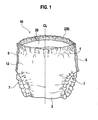
- Fig. 1 is a perspective view showing the disposable diaper.
- the disposable diaper is an underpants-type diaper 10 which is formed bilaterally symmetrically about the axis center line.
- the underpants-type diaper 10 includes a front waist region 1, a back waist region 2 and a crotch region 3.
- right and left side edge sections 5 of the front waist region 1 and the back waist region 2 are jointed.
- a waist-opening 6 disposed on the upper side and a pair of right and left leg-openings 7 disposed on the lower side are formed.
- Fig. 2 is a plan view showing the underpants-type diaper in Fig. 1 spread by separating the right and left side edge sections and viewed from the inner side of the diaper.
- the underpants-type diaper 10 includes: a front face sheet 11 which is in contact with the skin; a back face sheet 12 which is in contact with a surface of clothes; and an absorber 13 located between these two sheets.
- an antibacterial sheet 20 is pasted while being away from the waist edge and the side edges.
- the antibacterial sheet 20 includes: a sheet-like base member 21 formed of a hydrophilic fiber layer 211 and a hydrophobic fiber layer 212; and an antibacterial composition layer 22 formed of an antibacterial composition.
- the antibacterial composition layer 22 is formed on the hydrophilic fiber layer 211 of the sheet-like base member 21.
- the antibacterial composition layer 22 side of the antibacterial sheet 20 is pasted on the front face sheet 11 with an adhesive layer (not shown).
- polyvinyl alcohol manufactured by Wako Pure Chemical Industries, Ltd., the polymerization degree: approximately 2000
- CPC 1% by weight of CPC was added to the PVA to obtain the antibacterial composition.
- This PVA is solid at a normal temperature and does not dissolve in water at 37°C.
- spunlaced polyethylene terephthalate/rayon/polyethylene terephthalate members weight per unit area: 38 g/m 2 , 285 mm ⁇ 60 mm
- Each of the sheets A to E was obtained as follows. Specifically, the corresponding one of the above-described antibacterial compositions was heated to 80°C to melt the polymer, and the sheet-like base member was coated with the antibacterial composition by using a non-contact ⁇ coater (manufactured by DYNATECH Co., Ltd.) at a speed of 100 m/minute so as to achieve the corresponding coating amount shown in Table 1.
- a non-contact ⁇ coater manufactured by DYNATECH Co., Ltd.
- a kneaded-type antibacterial sheet (which is a spun sheet obtained by mixing 1% by weight of an inorganic antibacterial agent "ZEOMIC” manufactured by SINANEN ZEOMIC CO., LTD into polypropylene "NOVATEC-PP” manufactured by Japan Polypropylene Corporation, and by forming the spun sheet from the mixture by a spunbond method) was used.
- the production was carried out, so that the sheet F had a weight per unit area of 38 g/m 2 and the degree of fineness of 2 dtex.
- test strain NBRC12993
- the above-described test strain was cultured by using a blood agar medium at 35°C for 20 hours.
- the obtained test bacteria were suspended in sterile saline so as to achieve a McFarland turbidity of 0.5 (approximately 10 8 CFU/ml).
- McFarland turbidity approximately 10 8 CFU/ml
- test liquid containing the bacteria was added into 1/10 Mueller Hinton broth (MHB) medium to achieve approximately 10 4 CFU/ml, and then 0.5 ml of the medium containing the test liquid was dispensed into each well of a 24-well flat-bottom microplate (Well diameter: 16 mm, manufactured by IWAKI CO., LTD, for cell culture).
- MLB Mueller Hinton broth
- Each test sample (which is obtained by cutting one of the above-described antibacterial sheets into a circular shape with a diameter of 15 mm) was soaked into the liquid surface part in one of the wells, and left in stationary culture at 35°C.
- a well into which no test sample was soaked was provided.
- the culture medium in each of the wells was taken out and the viable cell count was determined.
- the antibacterial sheets A to C of Examples showed sufficient antibacterial effects.
- the sheets D to F of Comparative Examples did not show sufficient antibacterial effects. This is plausibly because the antibacterial agents were not sufficiently released.
- An antibacterial composition which is the same as that of the sheet B in Table 1 was prepared, and then spunlaced PET/rayon/PET was coated with the antibacterial composition in the same manner as described above. Thus, an antibacterial sheet (dimensions: 55 mm ⁇ 285 mm, coating amount: 1 g/m 2 ) was produced.
- the obtained antibacterial sheet was pasted onto back part of an underpants-type diaper (Moony Man manufactured by Unicharm Corporation) with an adhesive coated thereonto (see Figs. 1 and 2 ).
- the antibacterial composition layer was located on the front face sheet side.
- Comparative Example 4 diapers with no antibacterial sheet pasted thereonto were used.
- Comparative Example 5 diapers with the above-described sheet F (kneaded-type antibacterial sheet, dimensions: 55 mm ⁇ 285 mm) pasted thereonto were used.
Landscapes
- Health & Medical Sciences (AREA)
- Life Sciences & Earth Sciences (AREA)
- General Health & Medical Sciences (AREA)
- Engineering & Computer Science (AREA)
- Veterinary Medicine (AREA)
- Animal Behavior & Ethology (AREA)
- Public Health (AREA)
- Epidemiology (AREA)
- Pest Control & Pesticides (AREA)
- Wood Science & Technology (AREA)
- Zoology (AREA)
- Environmental Sciences (AREA)
- Dentistry (AREA)
- Toxicology (AREA)
- Plant Pathology (AREA)
- Agronomy & Crop Science (AREA)
- Chemical & Material Sciences (AREA)
- Materials Engineering (AREA)
- Hematology (AREA)
- Biomedical Technology (AREA)
- Heart & Thoracic Surgery (AREA)
- Vascular Medicine (AREA)
- Medicinal Chemistry (AREA)
- Pharmacology & Pharmacy (AREA)
- Absorbent Articles And Supports Therefor (AREA)
- Laminated Bodies (AREA)
- Materials For Medical Uses (AREA)
- Agricultural Chemicals And Associated Chemicals (AREA)
Abstract
Description
- The present invention relates to an antibacterial sheet and an absorbent article using the antibacterial sheet.
- In absorbent articles such as sanitary napkins, pantiliners and absorbent pads, bacteria in body fluid such as sweat, urine and menstrual blood may proliferate, which may cause skin sore or inflammation. Here, techniques for providing such an absorbent article with an antibacterial function have been known.
- Specifically, there have been known uses of: fibers each having a surface directly coated with an antibacterial agent; a sheet coated with an antibacterial agent after the sheet is formed; and fibers made to contain an antibacterial agent by, for example, kneading the antibacterial agent (Patent Document 1:
JP-A H5-103821 JP-A 2005-198701 - In such an absorbent article, the antibacterial agent preferably exerts the action of completely killing unwanted bacteria in a body fluid while being in a wetted state due to absorption of the body fluid.
However, the conventional technique inPatent Document 2 has a problem that the antibacterial agent is not readily released from the polymer used as the binder. Specifically, polyvinyl alcohol is crystalline, and poorly-soluble in cold water, although soluble in hot water (at 75°C or more). Hence, even when polyvinyl alcohol is brought into contact with a body fluid (at approximately 37°C), the antibacterial agent mixed into the polyvinyl alcohol is hardly released, and cannot exert the effect. Similarly, the antibacterial agent is not readily eluted from (bleeds out of) the fiber in Patent Document 1 which contains the antibacterial agent. As a result, a sufficient antibacterial effect cannot be expected. - On the other hand, use of the fiber coated with an antibacterial agent directly may arouse concern about skin irritation due to the antibacterial agent, which is a chemical agent. In addition, there is another problem that the antibacterial agent exposed on the surface of the fiber is likely to lose its action before the absorption of a body fluid.
- For this reason, an object of the present invention is to provide an antibacterial sheet and an absorbent article which are capable of effectively exerting antibacterial effects upon contact with a body fluid.
- A first aspect of the present invention provides an antibacterial sheet including: an antibacterial composition; and a sheet-like base member with the antibacterial composition attached thereto. In the antibacterial sheet, the antibacterial composition includes: a water-soluble thermoplastic polymer which is solid at a normal temperature and which dissolves in a body fluid; and an antibacterial agent.
- A second aspect of the present invention provides an absorbent article including the antibacterial sheet according to the above-described first present invention.
- A third aspect of the present invention provides an antibacterial composition including: a water-soluble thermoplastic polymer which is solid at a normal temperature and which dissolves in a body fluid; and an antibacterial agent.
-
- [
Fig. 1] Fig. 1 is a perspective view showing an embodiment of a disposable diaper. - [
Fig. 2] Fig. 2 is a plan view showing the spread diaper inFig. 1 . - [
Fig. 3] Fig. 3 is a cross-sectional view showing an embodiment of an antibacterial sheet. - In an antibacterial sheet according to the present invention, a water-soluble thermoplastic polymer (hereinafter, also simply referred to as a "polymer") is usedas a carrier of an antibacterial agent in an antibacterial composition attached to a sheet-like base member. The water-soluble thermoplastic polymer is solid at a normal temperature and dissolves in a body fluid. Thus, the polymer dissolves into a body fluid upon contact therewith. As a result, the antibacterial agent in the polymer is released, and thereby can exert an antibacterial effect. Until being in contact with a body fluid, the polymer remains solid. Thus, the antibacterial agent is held in the polymer and remains unreleased.
Hence, the present invention makes it possible to control the release of the antibacterial agent, and thereby the antibacterial action can be more effectively exerted with a small amount of antibacterial agent. This can prevent skin sore or the like, keeping the skin clean, and canprovide an antibacterial sheet and an absorbent article which also provide comfortable wearing feeling. - The antibacterial sheet is a sheet including a sheet-like base member with an antibacterial composition attached thereto.
Herein, the "sheet" has no limitation on its width, length and thickness, and is a concept which includes, for example, a film, a tape, and the like. - The kind of the base member is not particularly limited, and any one of a synthetic resin sheet, a woven fabric, a non-woven fabric, a paper sheet, and the like can be used as the sheet-like base member. The kinds of a synthetic resin and a fiber are not limited, and various kinds of base members which are commonly used for an absorbent article or the like can be used. The base member may have any of a single-layer structure and a multi-layer structure. Furthermore, the base member may be formed of a hydrophilic material; alternatively, the base member may be formed of a hydrophobic material whose surface is provided with hydrophilicity through surfactant treatment. Meanwhile, as the base member, a porous film having pores formed by perforation, stretching, tentering, punching, or the like may be used. The porosity of such a porous film is preferably 10 to 60%, and the average diameter of the pores is preferably around 0.1 to 2 mm.
- Typical examples include spunbonded polypropylene (PP) (for example: 1.9dtex, a weight per unit area: 20 g/m2), spunlaced polyethylene terephthalate (PET)/rayon/PET (for example: 1.7 dtex, weight per unit area: 25 g/m2), a tissue containing pulp or rayon (for example: weight per unit area : 15 g/m2). Anon-woven fabric obtained by a through-air method or a point bond method or a non-woven fabric having an SMS three-layer structure (S: spunbonded non-woven fabric, M: melt-blown non-woven fabric or high-barrier material) may be used. Moreover, the base member may be one using a fiber having a core-sheath structure or a side-by-side structure of PE (polyethylene)/PP, PE/PET, or other combinations.
The functional sheet may have a structure (layers) of a bonding layer, an adhesive layer, a water-repellent layer, or the like, as needed, in addition to the sheet-like base member structure. - The antibacterial composition includes a water-soluble thermoplastic polymer and an antibacterial agent. The polymer serves as a carrier for the antibacterial agent or as a binder for the non-woven fabric or the like. The antibacterial agent is preferably mixed and dispersed uniformly in the polymer.
The polymer is solid at a normal temperature and dissolves in a body fluid upon contact therewith. In other words, the polymer is solid (at a normal temperature) in a state where no body fluid is present, i.e., before contact with the body fluid. - The normal temperature represents a temperature at which an antibacterial sheet and an absorbent article are commonly used, and is, for example, room temperature (25°C). In other words, a polymer having a solidifying temperature of 25°C or more is preferably used as the polymer which is solid at a normal temperature.
It is not preferable that the polymer be liquid at a normal temperature, because, if so, the antibacterial agent may be released to the skin even in the absence of a body fluid, which may causes excessive irritation to the skin. Furthermore, it is not preferable that the polymer be liquid at a normal temperature, because, if so, such a polymer may give a tacky feeling which reduce wearing comfortableness, and because the antibacterial effect may be lost owing to the removal of the antibacterial agent from the sheet. This removal of the antibacterial agent occurs during production or before use of the product, because the antibacterial agent attaches to production equipment, a packaging material, a finger, or the like. - The body fluid is a generic term for fluids outside cells inside the bodies of animals, such as blood, lymph, and tissue fluid, and is a concept which includes fluids discharged from the body, such as sweat, urine, and menstrual blood.
The water-solubility of the polymer is evaluated according to its solubility in water at 37°C. A beaker containing 100 cc of water is heated with a water bath set at a constant temperature of 37°C. Into the beaker, 1 g of a polymer sample is added with stirring at a revolution speed of 700 rpm by using a stirrer. If a polymer dissolves completely 5 minutes after the addition, the polymer is termed as a water-soluble polymer, herein. - Since the polymer can dissolve in a body fluid, the polymer is eluted into the body fluid upon the contact with the body fluid. As a result, the antibacterial agent in the composition is released, and starts to exert the action. On the other hand, in a state where no body fluid is present, the antibacterial agent in the polymer is not released. This prevents the antibacterial agent from causing irritation on user's skin, and also prevents the loss of effect of the antibacterial agent before absorption of the body fluid. Furthermore, favorable indigenous bacteria, which reside in the skin, are not sterilized before the absorption of the body fluid.
In this way, the present invention makes it possible to control the release of the antibacterial agent. - Heat rash is a typical skin trouble. A study conducted by the inventors has revealed that Staphylococcus epidermidis on the skin grows excessively because of perspiration, and that this excessive growth is a factor causing heat rash. With the antibacterial sheet of the present invention, the polymer dissolves upon contact with sweat to release the antibacterial agent. Accordingly, bacteria in the sweat are completely killed instantaneously, and thus heat rash is prevented.
- Moreover, as the polymer, a thermoplastic polymer, that is, a water-soluble thermoplastic polymer is selected, because such a polymer allows formation of a flexible coating while avoiding being cured by heat or the like in processing the antibacterial sheet.
- Such a polymer is not particularly limited, as long as the polymer has the above-described characteristics. Specifically, polyethylene glycols (hereinafter also referred to as "PEG"s) and derivatives thereof can be used preferably.
- The derivatives of PEGs include fatty acid esters of PEGs in which the terminals of PEGs are esterified, and polyoxyethylene alkyl ethers in which the terminals of PEGs are etherified. Examples of the fatty acid esters of PEGs include: polyethylene glycol dioleate, diethylene glycol distearate, polyethylene glycol distearate, diethylene glycol dilaurate, polyethylene glycol dilaurate, diethylene glycol stearate, polyethylene glycol palmitate, polyethylene glycol monooleate, polyethylene glycol monostearate, polyethylene glycol monolaurate, polyethylene glycol lanolin fatty acid ester, and the like. Examples of the polyoxyethylene alkyl ethers include polyoxyethylene octyl dodecyl ether, polyoxyethylene oleyl ether, polyoxyethylene stearyl ether, polyoxyethylene cetyl ether, polyoxyethylene cetostearyl ether, polyoxyethylene butyl ether, polyoxyethylene hexyl decyl ether, polyoxyethylene lauryl ether, and the like. Any of these derivatives can be used alone or in combination of two or more.
- As PEGs which are solid at a normal temperature (25°C) and which are water-soluble at 37°C, ones each having a molecular weight (a weight average molecular weight measured by the GPC method in terms of polyethylene standards, hereinafter the same) of 100 to 50000 are preferably used. The molecular weight is more preferably around 600 to 30000.
- It is preferable to use multiple kinds of PEGs having molecular weights different from each other or derivatives thereof. The use of a PEG having a small molecular weight improves adhesion of the antibacterial composition to the base member, which can prevent removal of the antibacterial agent even when the sheet is subjected to pressure during wearing or to friction. This can also prevent the sheet from being hard and can provide flexibility thereto. On the other hand, the use of a PEG having a large molecular weight prevents a tacky feeling, thereby making it possible to prevent skin discomfort or irritation.
Such use of the multiple kinds of PEGs having molecular weights different from each other or the derivatives thereof is preferable, because solubility in a body fluid, flexibility and adhesion (fixation) to the base member can be achieved in a well-balanced manner. - Specifically, as a PEG (PEG-S) having a small molecular weight, a PEG having a molecular weight of 100 or more but less than 2000 is preferably used. As a PEG (PEG-L) having a large molecular weight, a PEG having a molecular weight of 2000 to 50000 inclusive is preferably used. As each of the PEG-S and the PEG-L, multiple kinds of PEGs having molecular weights different from each other can be used.
- The mixing ratio of the PEG-S and the PEG-L is not particularly limited, partially because the mixing ratio depends on the molecular weight of each of the PEGs. For example, the weight ratio of PEG-S:PEG-L is preferably 1:9 to 9:1, more preferably 1:9 to 7:3, still more preferably 1:9 to 5:5, and further preferably 2:8 to 4:6.
- As the antibacterial agent, any antibacterial agent can be used, as long as the antibacterial agent can suppress the growth of bacteria such as Escherichia coli, Staphylococcus aureus, Staphylococcus epidermidis, and ammonia producing bacteria. The antibacterial agent can be used in combination of two ormore. Herein, the "antibacterial" represents a concept which includes partial sterilization, complete sterilization and bacteriostasis.
- The followings are specific examples:
- formaldehyde-releasing agents such as N,N',N''-tris(hydroxyethyl)hexahydro-s-triazine, 2-bromo-2-nitro-1,3-propanediol, 4,4-dimethyl oxazolidine, 1,3-di(hydroxymethyl)-5,5-dimethylhydantoin, tris(hydroxymethyl)nitromethane, 4-(2-nitrobutyl)morpholine, and 1,3-dimorpholino-2-nitro-2-ethylpropane;
- halogen-containing compounds such as 1,3-dibromo-2,4-dicyanobutane, diiodomethyl-p-tolylsulfone, 2,3,5,6-tetrachloro-4-(methylsulfonyl)pyridine, and 2,4,5,6-tetrachloro isophthalonitrile;
- iodopropagyl derivatives such as 4-chlorophenyl-3-iodopropagylformal, and 3-iodopropagylbutylcarbamate;
- thiocyanate compounds such as 2-(4-thiocyanomethylthio)benzothiazole;
- isothiazolinone derivatives such as 2-octyl-4-isothiazoline-3-one, 5-chloro-2-methyl-4-isothiazoline-3-one, 1,2-benzisothiazolone-3, and N-butyl-1,2-benzisothiazolone-3;
- trihalomethylthio compounds such as N-(fluorodichloromethylthio)phtalimide, N,N-dimethyl-N'-(fluorodichloromethylthio)-N'-phenylsulfami de, and N-dichlorofluoromethylthio-N',N'-dimethyl-N-p-tolylsulfamid e;
- quaternary ammonium salts such as alkyl dimethyl benzyl ammonium chloride, dodecyl dimethyl benzyl ammonium chloride, benzethonium chloride, hexadecyl trimethyl ammonium bromide, didecyl dimethyl ammonium chloride, decyl isononyl dimethyl ammonium chloride, hexadecyl pyridinium chloride (cetyl pyridinium chloride), 4,4'-(tetramethylenedicarbonylamino)bis(1-decylpyridinium bromide), and N,N'-hexamethylenebis(4-carbamoyl-1-decyl pyridinium bromide);
- biguanide compounds such as polyhexamethylene biguanide hydrochloride, chlorhexidine gluconate, and chlorhexidine hydrochloride;
- aldehydes such as formaldehyde, 1,5-pentanedial (glutalaldehyde), and α-bromocinnamaldehyde;
- phenols such as 3-methyl-4-chlorophenol, 4-chloro-3,5-dimethylphenol, and alkyl (methyl, ethyl, propyl, butyl) p-hydroxybenzoate;
- benzimidazole derivatives such as 2-(4-thiazolyl)benzimidazole, and methyl 2-benzimidazolyl carbamate;
- pyridine oxides such as sodium pyridine-2-thiol-1-oxide and zinc bis (2-pyridylthio-1-oxide);
- carbanilides such as 3,4,4'-trichlorocarbanilide and 4,4-dichloro-3-(trifluoro methyl)carbanilide;
- diphenyl ethers such as 2,4,4'-trichloro-2'-hydroxydiphenyl ether;
- carboxylic acids such as sorbic acid, propionic acid, 10-undecylenic acid and benzoic acid; and
- organometallic compounds such as 10,10'-oxybisphenoxyarsine.
- Furthermore, antibacterial agents which can be used herein include:
- kampo medicines which show antibacterial action, such as artemisia capillaris flower, fennel, astragalus root, coptis rhizome, phellodendron bark, scutellaria root, wormwood leaf, licorice root, apricot kernel, cassia bark, magnolia bark, perillaherb, peony root, cnidium rhizome, rhubarb, clove, peach kernel, and mutan bark;
- natural antibacterial agents which are added to food, such as styrax extract, Artemisia capillaris Thunb. extract, Magnolia obovata extract, forsythia extract, pectin digests, protamine, polylysine, α-polylysine, ε-polylysine, citrus seed extract, ginger extract, tea extract, raw soybean extract, digest of red breadlike food made of wheat gluten (BENIFU), Psoralea corylifolia L. extract, moso bamboo extract, rice hull extract, lysozyme, pepper extract, and propolis; and
- other natural antibacterial agents such as mustard extract, chitosan, and derivatives thereof.
- Among the above-described antibacterial agents, a water-soluble antibacterial agent which is soluble in water is preferably used, because the water-soluble antibacterial agent can effectively exert its function upon contact with a body fluid.
Particularly preferable antibacterial agents are cationic surfactants which absorb Staphylococcus epidermidis, i.e., a plausible pathogen of heat rash, and which destroys the cell membranes of the bacteria. The examples of the cationic surfactant include cetylpyridinium chloride (CPC) and the like. - The amount of the antibacterial agent blended into the antibacterial composition is not particularly limited, and may be set as appropriate in accordance with the antibacterial activity of the antibacterial agent used, the application of the antibacterial sheet, or the like. The amount of the antibacterial agent attached to the sheet-like base member is preferably around 0.001 to 0.1 g/m2, and more preferably around 0.005 to 0.05 g/m2.
- The antibacterial composition may contain any one or more additives or the like in addition to the above-described water-soluble polymer and the above-described antibacterial agent. Examples of such additional components include a colorant, a perfume, a deodorant, an antioxidant, an ultraviolet preventing agent, an antistatic agent, a pH adjuster, a lubricant, adispersant, asoftener, ahumectant, ananti-inflammatoryagent, an antihistamine, and the like.
When the antibacterial composition contains, for example, a perfume and a deodorant, these agents effectively exert their effects upon contact with a body fluid as similar to the antibacterial agent, thereby making it possible to provide high deodorant and perfume effects.
Meanwhile, the compositionmaybe a solvent-containing type which uses water, an organic solvent, or the like; however, a solventless type is preferable from the view point of the environmental concern and the elimination of the drying process. - The antibacterial composition is attached to the sheet-like base member. The attachment may be in such a state that, in a normal use, the antibacterial composition is not removed and remains on the base member.
The antibacterialcomposition may be attached continuously or discontinuously to surfaces (at least one surface) of the base member or the inside thereof, and may be attached not on the entire surface of the base member but on part thereof. The antibacterial composition can be attached in any pattern such as a film pattern, a particulate pattern, a lined pattern, a grid pattern, a dotted pattern, and a mesh pattern. In addition, when the base member has a multi-layer structure, the antibacterial composition may by attached to at least one surface of any one of layers included in the base member. - The attached amount of the antibacterial composition is not particularly limited; however, the attached amount is preferably around 0.05 to 10 g/m2, and more preferably around 0.5 to 5 g/m2, and further preferably around 1 to 3 g/m2.
- A method of attaching the antibacterial composition to the base member is not particularly limited, and, for example, the attachment is performed by coating the base member with the antibacterial composition. As a coater, a commonly-used coater, for example, a contact-type coater such as a slot coater, a roll coater, or a gravure coater, or a non-contact coater such as a spray or a spiral can be used.
Among those, the non-contact coater is preferably used, and the spray coater is particularly preferably used, because a thin film can be formed and because no influence is given to other processed portions. - For example, a preferable coating method is as follows. The antibacterial composition is heated to melt the water-soluble polymer which is solid at a normal temperature, and then the base member is coated with the antibacterial composition by spray coating. The heating temperature is not particularly limited, and may be set as appropriate in accordance with the melt temperature and the viscosity of the polymer. However, the heating is preferably performed at approximately 50 to 150°C, generally, and at approximately 60 to 100°C, normally.
- The antibacterial sheet canbe used in various applications. Examples of the applications include a packaging material of food or the like, a kitchen paper, a wiping sheet, a medical sheet such as a wound-covering pad, a disposable underwear, a toilet mat, and various absorbent articles.
In particular, the antibacterial sheet is preferably used in an absorbent article for absorbing a body fluid. Examples of the absorbent article include: a disposable diaper; a sanitary napkin, a pantiliner, a vaginal discharge sheet, and an incontinence pad, each of which is used while being attached to the inner surface of shorts; an absorbent pad which is used while being attached to the inner surface of a diaper cover; and the like. - An absorbent article generally includes: a front face sheet (a top sheet) which is in contact with the skin; a back face sheet (a back sheet) which is in contact with a surface of clothes; and an absorber (an absorbent core) located between these two sheets. As components of the absorbent article, various publicly-known materials are used, and the component materials of the absorbent article are not particularly limited.
- Specifically, the front face sheet is liquid-permeable, and, as the front face sheet, a non-woven fabric formed of a hydrophilic fiber such as a rayon fiber, a pulp fiber, and a synthetic fiber, a porous plastic sheet, or the like can be used preferably. The back face sheet is liquid-impermeable, and, as the back face sheet, various plastic sheets such as polyethylene and polyvinyl alcohol can be used. The back face sheet maybe air-permeable or air-impermeable. Each of the front face sheet and the back face sheetmayhave amulti-layer structure. For example, the back face sheet may have a structure in which a non-woven fabric is laminated on a plastic sheet. The absorber is formed of a laminated body of pulp or a laminated body of pulp and a super absorbent polymer.
- In such an absorbent article, the antibacterial sheet can be used on the front face of the absorbent article or inside the absorber.
When used as the front face sheet, the antibacterial sheet may be used as part of the front face sheet. Here, the use of the antibacterial sheet as the front face sheet or as part of the front face sheet includes a case where the antibacterial sheet is pasted on the front face sheet. When used as part of the front face sheet, for example, in a disposable diaper, the antibacterial sheet is preferably disposed at the back part of the disposable diaper as a sweat absorbent sheet for heat rash prevention. - An antibacterial composition-attached surface of the antibacterial sheet used as the front face sheet may be located on the front-most surface which is on the skin side, or on the absorber side which is not in contact with the skin. When the antibacterial composition-attached surface is located on the absorber side, the body fluid diffuses into the sheet-like base member and reaches the antibacterial composition to dissolve the polymer. Thus, the function of the antibacterial agent is exerted.
- Furthermore, in order to separate perspired sweat or excreted urine from the skin side, for example, the antibacterial sheet preferably has a hydrophobic skin-side surface and an inside part with hydrophilicity. Specifically, the antibacterial sheet is preferably formed of a non-woven fabric having a multi-layer structure provided with: a layer formed mainly of a hydrophobic fiber made mainly of polyethylene, polyethylene terephthalate, or polypropylene on the surface side; and a layer formed mainly of a hydrophilic fiber made of rayon, pulp, or the like inside the non-woven fabric.
- Hereinafter, an embodiment in which an antibacterial sheet is applied to a disposable diaper as a sweat absorbent sheet will be described with reference to the drawings.
Fig. 1 is a perspective view showing the disposable diaper. The disposable diaper is an underpants-type diaper 10 which is formed bilaterally symmetrically about the axis center line.
The underpants-type diaper 10 includes a front waist region 1, aback waist region 2 and a crotch region 3. Here, right and left side edge sections 5 of the front waist region 1 and theback waist region 2 are jointed. Thus, a waist-opening 6 disposed on the upper side and a pair of right and left leg-openings 7 disposed on the lower side are formed. -
Fig. 2 is a plan view showing the underpants-type diaper inFig. 1 spread by separating the right and left side edge sections and viewed from the inner side of the diaper. As shown inFig. 2 , the underpants-type diaper 10 includes: afront face sheet 11 which is in contact with the skin; aback face sheet 12 which is in contact with a surface of clothes; and anabsorber 13 located between these two sheets. On the back side of thefront face sheet 11, anantibacterial sheet 20 is pasted while being away from the waist edge and the side edges. - As seen from a cross-section shown in
Fig. 3 , theantibacterial sheet 20 includes: a sheet-like base member 21 formed of ahydrophilic fiber layer 211 and ahydrophobic fiber layer 212; and anantibacterial composition layer 22 formed of an antibacterial composition. Theantibacterial composition layer 22 is formed on thehydrophilic fiber layer 211 of the sheet-like base member 21. Theantibacterial composition layer 22 side of theantibacterial sheet 20 is pasted on thefront face sheet 11 with an adhesive layer (not shown). - Hereinafter, the present invention will be described in further details by way of Examples. However, the present invention is not limited to these examples.
- An antibacterial composition (PEG:CPC=99:1) was obtained as follows. Specifically, as a water-soluble polymer for sheets A to C, PEG#600 and PEG#4000 (each number represents an approximate mean molecular weight, hereinafter the same) manufactured by NOF CORPORATION were used in a weight ratio of 3 : 7 . To the PEGs, 1% by weight of cetylpyridinium chloride (CPC, Wako Pure Chemical Industries, Ltd.) was added as an antibacterial agent to obtain the antibacterial composition.
An antibacterial composition (PVA:CPC=99:1) was obtained as follows. Specifically, as a polymer for sheets D and E, polyvinyl alcohol (PVA) (manufactured by Wako Pure Chemical Industries, Ltd., the polymerization degree: approximately 2000) was used. Similarly, 1% by weight of CPC was added to the PVA to obtain the antibacterial composition. This PVA is solid at a normal temperature and does not dissolve in water at 37°C.
As sheet-like base members, spunlaced polyethylene terephthalate/rayon/polyethylene terephthalate members (weight per unit area: 38 g/m2, 285 mm × 60 mm) were used. - Each of the sheets A to E was obtained as follows. Specifically, the corresponding one of the above-described antibacterial compositions was heated to 80°C to melt the polymer, and the sheet-like base member was coated with the antibacterial composition by using a non-contact Ω coater (manufactured by DYNATECH Co., Ltd.) at a speed of 100 m/minute so as to achieve the corresponding coating amount shown in Table 1.
As a sheet F, a kneaded-type antibacterial sheet (which is a spun sheet obtained by mixing 1% by weight of an inorganic antibacterial agent "ZEOMIC" manufactured by SINANEN ZEOMIC CO., LTD into polypropylene "NOVATEC-PP" manufactured by Japan Polypropylene Corporation, and by forming the spun sheet from the mixture by a spunbond method) was used. The production was carried out, so that the sheet F had a weight per unit area of 38 g/m2 and the degree of fineness of 2 dtex. - [Table 1]

- By use of each of the above-described antibacterial sheets, the growth suppression effect on Staphylococcus epidermidis (Strain: NBRC12993) was evaluated by the following method.
The above-described test strain was cultured by using a blood agar medium at 35°C for 20 hours. The obtained test bacteria were suspended in sterile saline so as to achieve a McFarland turbidity of 0.5 (approximately 108 CFU/ml). Thus, test liquid containing the bacteria was prepared. The test liquid containing the bacteria was added into 1/10 Mueller Hinton broth (MHB) medium to achieve approximately 104 CFU/ml, and then 0.5 ml of the medium containing the test liquid was dispensed into each well of a 24-well flat-bottom microplate (Well diameter: 16 mm, manufactured by IWAKI CO., LTD, for cell culture). - Each test sample (which is obtained by cutting one of the above-described antibacterial sheets into a circular shape with a diameter of 15 mm) was soaked into the liquid surface part in one of the wells, and left in stationary culture at 35°C. As a control for growth, a well into which no test sample was soaked was provided.
Immediately after each test sample was soaked, and after 2-, 4-, 8-, and 24-hour culture, the culture medium in each of the wells was taken out and the viable cell count was determined. A case where the cell count became in the order of 10-1 (CFU/mL) (below the detection limit) within 24 hours was graded as effective.
Table 2 shows the results. - [Table 2]

- As seen in Table 2, the antibacterial sheets A to C of Examples showed sufficient antibacterial effects. In contrast, the sheets D to F of Comparative Examples did not show sufficient antibacterial effects. This is plausibly because the antibacterial agents were not sufficiently released.
- An antibacterial composition which is the same as that of the sheet B in Table 1 was prepared, and then spunlaced PET/rayon/PET was coated with the antibacterial composition in the same manner as described above. Thus, an antibacterial sheet (dimensions: 55 mm × 285 mm, coating amount: 1 g/m2) was produced.
- The obtained antibacterial sheet was pasted onto back part of an underpants-type diaper (Moony Man manufactured by Unicharm Corporation) with an adhesive coated thereonto (see
Figs. 1 and2 ). Here, the antibacterial composition layer was located on the front face sheet side. Thus, each underpants-type diaper of the Example 4 with the antibacterial sheet was produced.
In Comparative Example 4, diapers with no antibacterial sheet pasted thereonto were used. In Comparative Example 5, diapers with the above-described sheet F (kneaded-type antibacterial sheet, dimensions: 55 mm × 285 mm) pasted thereonto were used. - Wearing test of each of the diapers was performed as follows.
As subjects, 50 infants (a half is male and the other half is female) who were around 24-monthold (and used L sized-diapers) and who had already experienced heat rash in the year of this experience were selected. Test period was from August 1 to 7, 2006, i.e., the period during which heat rash is most likely to develop. During the period, diapers were used as usual. The development of heat rash on the back of each of the infants near the part where the antibacterial sheet was pasted was visually observed by the mother. Heat rash which required care such as drug application was particularly graded as "anxious heat rash." On average, 25 diapers were used during the period. Criteria for overall evaluation are as follows. - A: Both of the incidences of heat rash and of anxious heat rash are 20% or less.
- B: Both of the incidences of heat rash and of anxious heat rash are more than 20% but 40% or less.
- C: Any one of or both of the incidences of heat rash and of anxious heat rash exceed 40%.
- [Table 3]
Table 3 Wearing test Example 4 Comparative Example 4 Comparative Example 5 Types of antibacterial sheet used Sheet B None Sheet F (kneaded-type antibacterial sheet) Evaluation result Incidence of heat rash (%) 18 56 46 Incidence of anxious heat rash (%) 11 42 36 Overall evaluation A C C - As shown in Table 3, in the case where the diapers of Example were worn, developments of heat rash were suppressed when compared with these in Comparative Examples.
- The disclosure in the present application is related to the subj ect matter described in Japanese Patent Application No.
2006-335936 filed on December 13, 2006
It shouldbe noted that, in addition to the above description, various adjustments or modifications can be made on the above-described embodiment without departing from the novel and advantageous characteristics of the present invention. Accordingly, it is intended that all of such adjustments and modifications are included in the attached CLAIMS.
Claims (7)
- An antibacterial sheet comprising:an antibacterial composition; anda sheet-like base member attached the antibacterial composition, whereinthe antibacterial composition includes:a water-soluble thermoplastic polymer which is solid at a normal temperature and which dissolves in a body fluid; andan antibacterial agent.
- The antibacterial sheet according to claim 1, comprising any one of polyethylene glycol and a derivative thereof as the water-soluble thermoplastic polymer.
- The antibacterial sheet according to claim 2, comprising a plurality of kinds of polyethylene glycols havingmolecular weights different from each other or derivatives thereof.
- The antibacterial sheet according to claim 3, comprising:one of a polyethylene glycol having a weight average molecular weight of 100 or more but less than 2000, and a derivative thereof; andone of a polyethylene glycol having a weight average molecularweight of 2000 or more but less than 50000, and a derivative thereof.
- The antibacterial sheet according to any one of claims 1 to 4, wherein the antibacterial agent is a water-soluble antibacterial agent.
- An absorbent article comprising the antibacterial sheet according to any one of claims 1 to 5.
- An antibacterial composition comprising:a water-soluble thermoplastic polymer which is solid at a normal temperature and which dissolves in a body fluid; andan antibacterial agent.
Applications Claiming Priority (2)
| Application Number | Priority Date | Filing Date | Title |
|---|---|---|---|
| JP2006335936A JP5096736B2 (en) | 2006-12-13 | 2006-12-13 | Absorbent articles |
| PCT/JP2007/073148 WO2008072487A1 (en) | 2006-12-13 | 2007-11-30 | Antibacterial sheet and absorbent article |
Publications (2)
| Publication Number | Publication Date |
|---|---|
| EP2110018A1 true EP2110018A1 (en) | 2009-10-21 |
| EP2110018A4 EP2110018A4 (en) | 2012-09-19 |
Family
ID=39511510
Family Applications (1)
| Application Number | Title | Priority Date | Filing Date |
|---|---|---|---|
| EP07832845A Withdrawn EP2110018A4 (en) | 2006-12-13 | 2007-11-30 | Antibacterial sheet and absorbent article |
Country Status (9)
| Country | Link |
|---|---|
| US (1) | US8476483B2 (en) |
| EP (1) | EP2110018A4 (en) |
| JP (1) | JP5096736B2 (en) |
| KR (1) | KR20090087109A (en) |
| CN (1) | CN101562970B (en) |
| AU (1) | AU2007330862A1 (en) |
| CA (1) | CA2672497A1 (en) |
| EA (1) | EA200900822A1 (en) |
| WO (1) | WO2008072487A1 (en) |
Cited By (4)
| Publication number | Priority date | Publication date | Assignee | Title |
|---|---|---|---|---|
| US9925096B2 (en) | 2013-12-20 | 2018-03-27 | Sca Hygiene Products Ab | Absorbent product comprising an odor control material |
| US10159612B2 (en) | 2013-12-20 | 2018-12-25 | Essity Hygiene And Health Ab | Absorbent product comprising odor control material |
| US10588314B2 (en) | 2013-09-04 | 2020-03-17 | Stiftelsen Arcada | Surfaces which stay microbiologically clean |
| EP4279049A1 (en) * | 2022-05-16 | 2023-11-22 | The Procter & Gamble Company | Method for making an absorbent article and absorbent article |
Families Citing this family (31)
| Publication number | Priority date | Publication date | Assignee | Title |
|---|---|---|---|---|
| US9717818B2 (en) * | 2009-05-08 | 2017-08-01 | Medline Industries, Inc. | Absorbent articles having antimicrobial properties and methods of manufacturing the same |
| US20130165880A1 (en) | 2010-09-17 | 2013-06-27 | David T. Amos | Antimicrobial disposable absorbent articles |
| US9084838B2 (en) * | 2011-02-04 | 2015-07-21 | Kimberly-Clark Worldwide, Inc. | Feminine care absorbent article for use in warm climates |
| DE102011077055A1 (en) * | 2011-06-07 | 2012-12-13 | Beiersdorf Ag | Active agent combination, useful in cosmetic preparation and as an active substance against bacteria, fungus and virus, and as deodorant or antiperspirant active agent, comprises epsilon-polylysine and aromatic esters |
| JP6062199B2 (en) * | 2012-09-28 | 2017-01-18 | ユニ・チャーム株式会社 | Absorbent articles |
| US9393164B2 (en) * | 2013-02-28 | 2016-07-19 | Kimberly-Clark Worldwide, Inc. | Aldehyde control in personal care products |
| GB201410510D0 (en) * | 2014-06-12 | 2014-07-30 | Fantex Ltd | Liquid Antimicrobial |
| JP6339471B2 (en) * | 2014-09-30 | 2018-06-06 | ユニ・チャーム株式会社 | Absorbent articles |
| KR101681427B1 (en) | 2014-12-05 | 2016-12-01 | 주식회사 엘지화학 | Method for preparing thermoplastic resin |
| WO2016089000A1 (en) * | 2014-12-05 | 2016-06-09 | (주) 엘지화학 | Method for preparing thermoplastic resin |
| US20170099973A1 (en) * | 2015-10-08 | 2017-04-13 | Andy Chao | Scent pad for toilet floor cleaning |
| KR101746603B1 (en) * | 2016-03-21 | 2017-06-13 | (주) 신우피앤씨 | Hygiene absorbent article having aromatic plant component |
| KR101746604B1 (en) * | 2016-03-21 | 2017-06-13 | (주) 신우피앤씨 | Hygiene absorbent article having coffee component |
| JP6754212B2 (en) * | 2016-04-04 | 2020-09-09 | 株式会社リブドゥコーポレーション | Absorbent article |
| CN107432787A (en) * | 2016-05-25 | 2017-12-05 | 天津科技大学 | A kind of biological antibiotic hydroscopic sanitary material and preparation method |
| WO2017217551A1 (en) * | 2016-06-17 | 2017-12-21 | ユニ・チャーム株式会社 | Absorbent article and method for producing absorbent article |
| CN107595486A (en) * | 2017-09-24 | 2018-01-19 | 清远市腾科机械设备有限公司 | The multicomponent top flat of absorbent article and the absorbent article for including the multicomponent top flat |
| CN109591404A (en) * | 2017-09-30 | 2019-04-09 | 宣以辰 | The pedal pad and closet seat-cushion of deodorization water suction |
| JP2019097931A (en) * | 2017-12-04 | 2019-06-24 | 花王株式会社 | Nonwoven fabric |
| CN111801076B (en) * | 2018-03-15 | 2022-05-17 | 花王株式会社 | absorbent articles |
| CN108969208A (en) * | 2018-04-25 | 2018-12-11 | 四川生命源健康管理有限公司 | The feminine sanitary napkin of anticancer function |
| CN109395149A (en) * | 2018-12-10 | 2019-03-01 | 长沙小如信息科技有限公司 | A kind of nano material Mrs's antibiotic health care protection pad |
| JP6688929B1 (en) * | 2019-05-30 | 2020-04-28 | 株式会社ニイタカ | Disinfectant composition, sanitary material, food cleaning agent, and food preservative |
| JP7186137B2 (en) * | 2019-06-20 | 2022-12-08 | ユニ・チャーム株式会社 | absorbent article |
| JP7534845B2 (en) * | 2019-09-27 | 2024-08-15 | 大王製紙株式会社 | Absorbent articles |
| TWI725705B (en) * | 2020-01-14 | 2021-04-21 | 張慧婷 | Menstrual pants |
| US12485047B2 (en) | 2020-09-25 | 2025-12-02 | Medline Industries, Lp | Reusable underwear with a refillable liner |
| CN112981721B (en) * | 2021-03-09 | 2022-01-14 | 维尼健康(深圳)股份有限公司 | Method for manufacturing natural-color degradable dispersible non-woven fabric |
| CN113616843B (en) * | 2021-08-13 | 2022-11-01 | 东莞市金保利卫生用品有限公司 | Alleviate sanitary towel of pruritus |
| KR102418316B1 (en) | 2021-09-14 | 2022-07-08 | 주식회사 엔바이오니아 | Antibacterial Sheet and Manufacturing Method Thereof |
| KR102774581B1 (en) * | 2022-08-12 | 2025-02-27 | 김현빈 | Deodorizing pad for underwear with excellent antibacterial and deodorizing effect |
Family Cites Families (17)
| Publication number | Priority date | Publication date | Assignee | Title |
|---|---|---|---|---|
| GB627797A (en) | 1946-07-17 | 1949-08-16 | Johnson & Johnson Grcat Britai | Improvements in and relating to surgical dressings |
| GB836477A (en) | 1957-10-25 | 1960-06-01 | Ici Ltd | Polymeric materials containing adsorbed or absorbed antibacterial compounds |
| GB861379A (en) | 1958-03-14 | 1961-02-22 | Ici Ltd | Therapeutic compositions comprising 1:2-benzisothiazolone derivatives |
| US4695464A (en) * | 1984-10-09 | 1987-09-22 | The Dow Chemical Company | Sustained release dosage form based on highly plasticized cellulose ether gels |
| US4678516A (en) * | 1984-10-09 | 1987-07-07 | The Dow Chemical Company | Sustained release dosage form based on highly plasticized cellulose ether gels |
| AU592065B2 (en) | 1984-10-09 | 1990-01-04 | Dow Chemical Company, The | Sustained release dosage form based on highly plasticized cellulose ether gels |
| US5662913A (en) * | 1991-04-10 | 1997-09-02 | Capelli; Christopher C. | Antimicrobial compositions useful for medical applications |
| JP3654535B2 (en) | 1991-10-16 | 2005-06-02 | シナネン株式会社 | Aseptic fibers and fiber structures |
| CN1124132C (en) * | 1995-06-30 | 2003-10-15 | 株式会社皮爱肤 | Antibacterial/bactericidal/antiseptic agent, dermatologic preparation and detergent composition |
| JP2000505692A (en) * | 1996-12-17 | 2000-05-16 | ザ、プロクター、エンド、ギャンブル、カンパニー | Absorbent products with odor control system |
| JP2000070216A (en) * | 1998-09-02 | 2000-03-07 | Pola Chem Ind Inc | Disinfectant for endoscope |
| JP2001039802A (en) * | 1999-07-29 | 2001-02-13 | Kao Corp | Water absorbing material |
| CN1187098C (en) | 2001-11-10 | 2005-02-02 | 苏州大学 | Coremia-resisting wound protecting film and its prepn |
| JP2005198701A (en) | 2004-01-13 | 2005-07-28 | Daio Paper Corp | Absorptive article and its production method |
| JP4679854B2 (en) * | 2004-08-03 | 2011-05-11 | 株式会社ナファ生活研究所 | Sterilized bamboo fiber gauze |
| JP4520366B2 (en) | 2005-06-03 | 2010-08-04 | 信越化学工業株式会社 | Silanol group-containing polymer and process for producing the same |
| US7903099B2 (en) | 2005-06-20 | 2011-03-08 | Google Inc. | Allocating advertising space in a network of displays |
-
2006
- 2006-12-13 JP JP2006335936A patent/JP5096736B2/en active Active
-
2007
- 2007-11-30 US US12/448,261 patent/US8476483B2/en not_active Expired - Fee Related
- 2007-11-30 CN CN2007800461773A patent/CN101562970B/en not_active Expired - Fee Related
- 2007-11-30 WO PCT/JP2007/073148 patent/WO2008072487A1/en not_active Ceased
- 2007-11-30 KR KR1020097013797A patent/KR20090087109A/en not_active Ceased
- 2007-11-30 EP EP07832845A patent/EP2110018A4/en not_active Withdrawn
- 2007-11-30 CA CA002672497A patent/CA2672497A1/en not_active Abandoned
- 2007-11-30 AU AU2007330862A patent/AU2007330862A1/en not_active Abandoned
- 2007-11-30 EA EA200900822A patent/EA200900822A1/en unknown
Cited By (5)
| Publication number | Priority date | Publication date | Assignee | Title |
|---|---|---|---|---|
| US10588314B2 (en) | 2013-09-04 | 2020-03-17 | Stiftelsen Arcada | Surfaces which stay microbiologically clean |
| US9925096B2 (en) | 2013-12-20 | 2018-03-27 | Sca Hygiene Products Ab | Absorbent product comprising an odor control material |
| US10159612B2 (en) | 2013-12-20 | 2018-12-25 | Essity Hygiene And Health Ab | Absorbent product comprising odor control material |
| EP4279049A1 (en) * | 2022-05-16 | 2023-11-22 | The Procter & Gamble Company | Method for making an absorbent article and absorbent article |
| WO2023224752A1 (en) * | 2022-05-16 | 2023-11-23 | The Procter & Gamble Company | Method for making an absorbent article and absorbent article |
Also Published As
| Publication number | Publication date |
|---|---|
| AU2007330862A1 (en) | 2008-06-19 |
| CN101562970B (en) | 2013-07-10 |
| JP2008142464A (en) | 2008-06-26 |
| EP2110018A4 (en) | 2012-09-19 |
| US20100062031A1 (en) | 2010-03-11 |
| KR20090087109A (en) | 2009-08-14 |
| JP5096736B2 (en) | 2012-12-12 |
| US8476483B2 (en) | 2013-07-02 |
| CA2672497A1 (en) | 2008-06-19 |
| CN101562970A (en) | 2009-10-21 |
| EA200900822A1 (en) | 2009-12-30 |
| WO2008072487A1 (en) | 2008-06-19 |
Similar Documents
| Publication | Publication Date | Title |
|---|---|---|
| US8476483B2 (en) | Antibacterial sheet and absorbent article | |
| JP5150159B2 (en) | Disposable diapers | |
| KR20060135923A (en) | Personal care products and methods to prevent bacteria from adhering to the skin | |
| US20030100877A1 (en) | Absorbent garment with incorporated skin wellness ingredients | |
| CN107432787A (en) | A kind of biological antibiotic hydroscopic sanitary material and preparation method | |
| CN101247839B (en) | Absorbent article comprising condensed tannin | |
| JP2014158509A (en) | Absorbent article | |
| JP5486655B2 (en) | Disposable diapers | |
| JP5465823B2 (en) | Functional sheet and absorbent article | |
| JP2002336297A (en) | Absorbent articles | |
| JP6347561B2 (en) | Absorbent products containing microbial control formulations | |
| US20260138353A1 (en) | Absorbent article with patterned active material | |
| WO2025115652A1 (en) | Absorbent article | |
| JP2025508558A (en) | Hygiene products containing water-soluble dry coatings with skin-beneficial additives | |
| CN121221822A (en) | A method for preparing sanitary napkins with a composite sialic acid antibacterial and anti-inflammatory layer | |
| AU2024286317A1 (en) | Absorbent hygiene article with skin-care composition | |
| WO2023238649A1 (en) | Surface material for absorbent articles | |
| JP2017108910A (en) | Body fluid absorbent article |
Legal Events
| Date | Code | Title | Description |
|---|---|---|---|
| PUAI | Public reference made under article 153(3) epc to a published international application that has entered the european phase |
Free format text: ORIGINAL CODE: 0009012 |
|
| 17P | Request for examination filed |
Effective date: 20090612 |
|
| AK | Designated contracting states |
Kind code of ref document: A1 Designated state(s): AT BE BG CH CY CZ DE DK EE ES FI FR GB GR HU IE IS IT LI LT LU LV MC MT NL PL PT RO SE SI SK TR |
|
| DAX | Request for extension of the european patent (deleted) | ||
| A4 | Supplementary search report drawn up and despatched |
Effective date: 20120821 |
|
| RIC1 | Information provided on ipc code assigned before grant |
Ipc: A61L 15/00 20060101ALI20120814BHEP Ipc: A01N 25/34 20060101ALI20120814BHEP Ipc: A61F 13/49 20060101ALI20120814BHEP Ipc: A01N 25/10 20060101AFI20120814BHEP Ipc: A61F 5/44 20060101ALI20120814BHEP Ipc: A61F 13/15 20060101ALI20120814BHEP |
|
| 17Q | First examination report despatched |
Effective date: 20130325 |
|
| STAA | Information on the status of an ep patent application or granted ep patent |
Free format text: STATUS: THE APPLICATION IS DEEMED TO BE WITHDRAWN |
|
| 18D | Application deemed to be withdrawn |
Effective date: 20130806 |