EP2099296B1 - Synergistic antimicrobial preparations containing chlorite and hydrogen peroxide - Google Patents
Synergistic antimicrobial preparations containing chlorite and hydrogen peroxide Download PDFInfo
- Publication number
- EP2099296B1 EP2099296B1 EP07862490.5A EP07862490A EP2099296B1 EP 2099296 B1 EP2099296 B1 EP 2099296B1 EP 07862490 A EP07862490 A EP 07862490A EP 2099296 B1 EP2099296 B1 EP 2099296B1
- Authority
- EP
- European Patent Office
- Prior art keywords
- hydrogen peroxide
- sodium chlorite
- chlorite
- eye
- chlorine dioxide
- Prior art date
- Legal status (The legal status is an assumption and is not a legal conclusion. Google has not performed a legal analysis and makes no representation as to the accuracy of the status listed.)
- Revoked
Links
Images


Classifications
-
- A—HUMAN NECESSITIES
- A01—AGRICULTURE; FORESTRY; ANIMAL HUSBANDRY; HUNTING; TRAPPING; FISHING
- A01N—PRESERVATION OF BODIES OF HUMANS OR ANIMALS OR PLANTS OR PARTS THEREOF; BIOCIDES, e.g. AS DISINFECTANTS, AS PESTICIDES OR AS HERBICIDES; PEST REPELLANTS OR ATTRACTANTS; PLANT GROWTH REGULATORS
- A01N59/00—Biocides, pest repellants or attractants, or plant growth regulators containing elements or inorganic compounds
-
- A—HUMAN NECESSITIES
- A61—MEDICAL OR VETERINARY SCIENCE; HYGIENE
- A61K—PREPARATIONS FOR MEDICAL, DENTAL OR TOILETRY PURPOSES
- A61K31/00—Medicinal preparations containing organic active ingredients
- A61K31/70—Carbohydrates; Sugars; Derivatives thereof
- A61K31/715—Polysaccharides, i.e. having more than five saccharide radicals attached to each other by glycosidic linkages; Derivatives thereof, e.g. ethers, esters
- A61K31/726—Glycosaminoglycans, i.e. mucopolysaccharides
- A61K31/728—Hyaluronic acid
-
- A—HUMAN NECESSITIES
- A61—MEDICAL OR VETERINARY SCIENCE; HYGIENE
- A61K—PREPARATIONS FOR MEDICAL, DENTAL OR TOILETRY PURPOSES
- A61K33/00—Medicinal preparations containing inorganic active ingredients
-
- A—HUMAN NECESSITIES
- A61—MEDICAL OR VETERINARY SCIENCE; HYGIENE
- A61K—PREPARATIONS FOR MEDICAL, DENTAL OR TOILETRY PURPOSES
- A61K33/00—Medicinal preparations containing inorganic active ingredients
- A61K33/14—Alkali metal chlorides; Alkaline earth metal chlorides
-
- A—HUMAN NECESSITIES
- A61—MEDICAL OR VETERINARY SCIENCE; HYGIENE
- A61K—PREPARATIONS FOR MEDICAL, DENTAL OR TOILETRY PURPOSES
- A61K33/00—Medicinal preparations containing inorganic active ingredients
- A61K33/20—Elemental chlorine; Inorganic compounds releasing chlorine
-
- A—HUMAN NECESSITIES
- A61—MEDICAL OR VETERINARY SCIENCE; HYGIENE
- A61K—PREPARATIONS FOR MEDICAL, DENTAL OR TOILETRY PURPOSES
- A61K33/00—Medicinal preparations containing inorganic active ingredients
- A61K33/22—Boron compounds
-
- A—HUMAN NECESSITIES
- A61—MEDICAL OR VETERINARY SCIENCE; HYGIENE
- A61K—PREPARATIONS FOR MEDICAL, DENTAL OR TOILETRY PURPOSES
- A61K33/00—Medicinal preparations containing inorganic active ingredients
- A61K33/40—Peroxides
-
- A—HUMAN NECESSITIES
- A61—MEDICAL OR VETERINARY SCIENCE; HYGIENE
- A61K—PREPARATIONS FOR MEDICAL, DENTAL OR TOILETRY PURPOSES
- A61K9/00—Medicinal preparations characterised by special physical form
- A61K9/0012—Galenical forms characterised by the site of application
- A61K9/0014—Skin, i.e. galenical aspects of topical compositions
-
- A—HUMAN NECESSITIES
- A61—MEDICAL OR VETERINARY SCIENCE; HYGIENE
- A61K—PREPARATIONS FOR MEDICAL, DENTAL OR TOILETRY PURPOSES
- A61K9/00—Medicinal preparations characterised by special physical form
- A61K9/0012—Galenical forms characterised by the site of application
- A61K9/0048—Eye, e.g. artificial tears
-
- A—HUMAN NECESSITIES
- A61—MEDICAL OR VETERINARY SCIENCE; HYGIENE
- A61L—METHODS OR APPARATUS FOR STERILISING MATERIALS OR OBJECTS IN GENERAL; DISINFECTION, STERILISATION OR DEODORISATION OF AIR; CHEMICAL ASPECTS OF BANDAGES, DRESSINGS, ABSORBENT PADS OR SURGICAL ARTICLES; MATERIALS FOR BANDAGES, DRESSINGS, ABSORBENT PADS OR SURGICAL ARTICLES
- A61L12/00—Methods or apparatus for disinfecting or sterilising contact lenses; Accessories therefor
- A61L12/08—Methods or apparatus for disinfecting or sterilising contact lenses; Accessories therefor using chemical substances
- A61L12/10—Halogens or compounds thereof
-
- A—HUMAN NECESSITIES
- A61—MEDICAL OR VETERINARY SCIENCE; HYGIENE
- A61L—METHODS OR APPARATUS FOR STERILISING MATERIALS OR OBJECTS IN GENERAL; DISINFECTION, STERILISATION OR DEODORISATION OF AIR; CHEMICAL ASPECTS OF BANDAGES, DRESSINGS, ABSORBENT PADS OR SURGICAL ARTICLES; MATERIALS FOR BANDAGES, DRESSINGS, ABSORBENT PADS OR SURGICAL ARTICLES
- A61L12/00—Methods or apparatus for disinfecting or sterilising contact lenses; Accessories therefor
- A61L12/08—Methods or apparatus for disinfecting or sterilising contact lenses; Accessories therefor using chemical substances
- A61L12/12—Non-macromolecular oxygen-containing compounds, e.g. hydrogen peroxide or ozone
- A61L12/124—Hydrogen peroxide; Peroxy compounds
-
- A—HUMAN NECESSITIES
- A61—MEDICAL OR VETERINARY SCIENCE; HYGIENE
- A61P—SPECIFIC THERAPEUTIC ACTIVITY OF CHEMICAL COMPOUNDS OR MEDICINAL PREPARATIONS
- A61P17/00—Drugs for dermatological disorders
-
- A—HUMAN NECESSITIES
- A61—MEDICAL OR VETERINARY SCIENCE; HYGIENE
- A61P—SPECIFIC THERAPEUTIC ACTIVITY OF CHEMICAL COMPOUNDS OR MEDICINAL PREPARATIONS
- A61P17/00—Drugs for dermatological disorders
- A61P17/02—Drugs for dermatological disorders for treating wounds, ulcers, burns, scars, keloids, or the like
-
- A—HUMAN NECESSITIES
- A61—MEDICAL OR VETERINARY SCIENCE; HYGIENE
- A61P—SPECIFIC THERAPEUTIC ACTIVITY OF CHEMICAL COMPOUNDS OR MEDICINAL PREPARATIONS
- A61P17/00—Drugs for dermatological disorders
- A61P17/06—Antipsoriatics
-
- A—HUMAN NECESSITIES
- A61—MEDICAL OR VETERINARY SCIENCE; HYGIENE
- A61P—SPECIFIC THERAPEUTIC ACTIVITY OF CHEMICAL COMPOUNDS OR MEDICINAL PREPARATIONS
- A61P27/00—Drugs for disorders of the senses
- A61P27/02—Ophthalmic agents
-
- A—HUMAN NECESSITIES
- A61—MEDICAL OR VETERINARY SCIENCE; HYGIENE
- A61P—SPECIFIC THERAPEUTIC ACTIVITY OF CHEMICAL COMPOUNDS OR MEDICINAL PREPARATIONS
- A61P27/00—Drugs for disorders of the senses
- A61P27/02—Ophthalmic agents
- A61P27/04—Artificial tears; Irrigation solutions
-
- A—HUMAN NECESSITIES
- A61—MEDICAL OR VETERINARY SCIENCE; HYGIENE
- A61P—SPECIFIC THERAPEUTIC ACTIVITY OF CHEMICAL COMPOUNDS OR MEDICINAL PREPARATIONS
- A61P31/00—Antiinfectives, i.e. antibiotics, antiseptics, chemotherapeutics
-
- A—HUMAN NECESSITIES
- A61—MEDICAL OR VETERINARY SCIENCE; HYGIENE
- A61P—SPECIFIC THERAPEUTIC ACTIVITY OF CHEMICAL COMPOUNDS OR MEDICINAL PREPARATIONS
- A61P31/00—Antiinfectives, i.e. antibiotics, antiseptics, chemotherapeutics
- A61P31/04—Antibacterial agents
-
- A—HUMAN NECESSITIES
- A61—MEDICAL OR VETERINARY SCIENCE; HYGIENE
- A61P—SPECIFIC THERAPEUTIC ACTIVITY OF CHEMICAL COMPOUNDS OR MEDICINAL PREPARATIONS
- A61P31/00—Antiinfectives, i.e. antibiotics, antiseptics, chemotherapeutics
- A61P31/10—Antimycotics
-
- A—HUMAN NECESSITIES
- A61—MEDICAL OR VETERINARY SCIENCE; HYGIENE
- A61P—SPECIFIC THERAPEUTIC ACTIVITY OF CHEMICAL COMPOUNDS OR MEDICINAL PREPARATIONS
- A61P31/00—Antiinfectives, i.e. antibiotics, antiseptics, chemotherapeutics
- A61P31/12—Antivirals
Definitions
- the present invention relates generally to medical compositions and methods, and more particularly to certain disinfectant/antimicrobial preparations and methods for using such preparations i) to disinfect or preserve articles or surfaces, ii) as a topical antiseptic for application to body parts, iii) to prevent or deter scar formation; iv) to treat dermatological disorders such as wounds, burns, ulcers, psoriasis, acne and other scar forming lesions; and v) to treat ophthalmic disorders such as infections, inflammation, dry eye, wound healing, and allergic conjunctivitis.
- the prior art has included numerous antimicrobial agents which have purportedly been useable for disinfection of various articles and/or for topical application to a living being for antisepsis and/or treatment of dermal disorders (e.g., wounds, burns, abrasions, infections) wherein it is desirable to prevent or deter microbial growth to aid in healing.
- Such topical antimicrobial agents have contained a variety of active microbicidal ingredients such as iodine, mercurochrome, hydrogen peroxide, and chlorine dioxide.
- Chlorite a precursor of chlorine dioxide, is known to be useable as a disinfectant for drinking water and as a preservative for contact lens care solutions.
- chlorite exhibits only weak microbicidal activity within a concentration range that is acceptable and safe for topical application to the skin (e.g., 50-1000 parts per million).
- chlorite has not been routinely used as an active microbicidal ingredient in preparations for topical application to the skin.
- compositions and methods have been proposed for activation or enhancement of the microbicidal activity of chlorite.
- Examples of such compositions and methods for activation or enhancement of the microbicidal activity of chlorite are described in United States Patent Nos. 4,997,616 (describing general activation); 5,279,673 (describing acid activation) and 5,246,662 (describing transition metal activation).
- Chlorine dioxide (ClO 2 ) and "stabilized chlorine dioxide” are known to be useable as antiseptics. Chemically, chlorine dioxide is an oxidizing agent which has strong microbicidal activity. Chlorine dioxide is generally regarded as superior even to gaseous chlorine in certain water treatment applications where it is used as to eliminate algae and other organic material and/or to remove odors or tastes. Chlorine dioxide is also effective as a microbicide, for elimination of bacteria, viruses, and microbial spores.
- chlorine dioxide is a highly reactive, unstable radical which is useable as an oxidizing agent in a number of other chemical and biochemical applications.
- chlorine dioxide can be used for (a) oxidation of double bonds between two carbon atoms; (b) oxidation of unsaturated fatty acids (lipids) via double bonds between two carbon atoms; (c) acceleration of hydrolysis of carboxylic anhydrides; (d) oxidation of aldehydes to the corresponding carboxylic acids; (e) oxidation of alcohols; (f) oxidation of amines; (g) oxidation of phenols, phenolic derivatives and thiophenolic compounds; (h) moderate oxidation of hydroquinones; (i) oxidation of amino acids, proteins and polyamides; j) oxidation of nitrates and sulfides; and (k) alteration of the CHO and CH 2 OH radical
- Concentrated chlorine dioxide in its liquid or gaseous state is highly explosive and poisonous. As a result, concentrated chlorine dioxide must be handled and transported with great caution. For this reason, it is generally not feasible to dispense pure chlorine dioxide for use as a topical antimicrobial agent or disinfectant. Instead, some antimicrobial or disinfectant preparations have been formulated to provide for "acid generation" of chlorine dioxide.
- Such acid generation solutions contain a metal chlorite (i.e., a precursor of chlorine dioxide available in powdered or liquid form) in combination with an acid which will react with the chlorite to liberate or release chlorine dioxide.
- any acid may be used for acid generation of chlorine dioxide, including strong acids such as hydrochloric acid and sulfuric acid and relatively weak acids such as citric and tartaric acid.
- Drawbacks or problems associated with these prior chlorine dioxide generating systems include a) the inconvenience of handing two separate containers or chemical components, b) the difficulty of delivering such two-component systems to the intended site of application, and c) the fact that these prior systems are of acid, rather than neutral, pH.
- the prior chlorine dioxide generating systems which utilize acid induced generation of chlorine dioxide can, if uncontrolled, cause the generation of chlorine dioxide to occur quite rapidly and, as a result, the disinfectant or antimicrobial potency of the solution may be short lived.
- Increasing the concentration of chlorite and acid within the solution may prolong its disinfectant or antimicrobial shelf life, but such increased concentrations of these chemicals can result in toxicities or (in topical applications) skin irritation. Such increased concentrations may also result in the generation of more chlorine dioxide than is required.
- United States Patent No. Re. 31,779 (Alliger ), which is a reissue of United States Patent No. 4,084,747 , describes a germicidal composition which comprises a water soluble chlorite, such as sodium chlorite, in combination with lactic acid.
- the particular composition possesses improved disinfectant properties, properties not attained by using the same composition but replacing the lactic acid with other acids such as phosphoric acid, acetic acid, sorbic acid, fumaric acid, sulfamic acid, succinic acid, boric acid, tannic acid, and citric acid.
- the germ killing composition is produced by contacting an acid material containing at least 15% by weight of lactic acid with sodium chlorite in aqueous media.
- the methods disclosed of disinfecting and sanitizing a germ carrying substrate, such as skin, include either application of the germ killing composition, or application of the reactants to provide in situ production thereof.
- United States Patent No. 5,384,134 (Kross ) describes acid induced generation of chlorine dioxide from a metal chlorite wherein the chlorite concentration is limited by the amount of available chlorous acid.
- the Kross patent describes a method for treating dermal disorders wherein a first gel, which comprises a metal chlorite, is mixed with a second gel, which comprises a protic acid.
- the chlorite ions present in such solution as chlorous acid purportedly comprise no more than about 15% by weight of the total chlorite ion concentration in the composition, and the mixture of the two gels purportedly generates chlorine dioxide over an extended time of up to 24 hours.
- stabilized chlorine dioxide refers to various compositions in which the chlorine dioxide is believed to be held in solution in the form of a labile complex.
- the stabilization of chlorine dioxide by the use of perborates was disclosed in United States Patent No. 2,701,781 (de Guevara ).
- an antiseptic solution of stabilized chlorine dioxide can be formed from an aqueous solution of chlorine dioxide and an inorganic boron compound with the boron compound and the chlorine dioxide being present in the solution as a labile complex.
- the chlorine dioxide, fixed in this stable condition, is an essential ingredient of the antiseptic solution.
- the de Guevara patent discloses that the chlorine dioxide may be introduced into the compositions either by in situ generation or it may be generated externally and introduced into the solution, as by bubbling the chlorine dioxide gas into the aqueous solution.
- Various methods may be employed for the external production of the chlorine dioxide, such as reaction of sulfuric acid with potassium chlorate or the reaction of the chlorate with moist oxalic acid.
- chlorine dioxide can be generated in situ by reaction of potassium chlorate and sulfuric acid. Note that whether the chlorine dioxide is produced in situ or externally, it is essentially an acid-induced liberation of the chlorine dioxide from potassium chlorate.
- United States Patent No. 4,317,814 (Laso ) describes stabilized chlorine dioxide preparations for treatment of burns in humans.
- Aqueous mixtures of perborate stabilized solutions of chlorine oxides, such as chlorine dioxide, in combination with glycerin are described for topical application to burned areas and may also be administered by oral application for treatment of burns.
- the aqueous solutions of perborate stabilized chlorine oxides are disclosed as being prepared by mixing with water the following: sodium chlorite, sodium hypochlorite, hydrochloric acid, sulfuric acid, an inorganic perborate, and a peroxy compound, such as sodium perborate.
- the solutions prepared in accordance with the Laso patent contain chlorine dioxide, hypochlorite and peroxy compounds as strong oxidizing agents and appear to utilize acid activation of the chlorine dioxide.
- the Laso patent states that the methods disclosed therein resulted in an immediate subsidence of burn related pain in many cases, that healing was rapid and characterized by an absence of infection or contraction, and that the burn scars were smooth and resembled normal tissue, thus eliminating the need for plastic surgery in certain cases.
- long term storage and stability are issues with the aqueous solutions described in the above-identified Laso patent, because such mixtures tend to generate chlorine dioxide very quickly, thus diminishing the long term stability of such mixtures.
- Antibiotic compounds have also been commonly used for the therapeutic treatment of burns, wounds, and skin and eye infections. While antibiotics may provide an effective form of treatment, several dangers are often associated with the use of antibiotics in the clinical environment. These dangers may include but are not limited to: (1) changes in the normal flora of the body, with resulting "superinfection” due to overgrowth of antibiotic resistant organisms; (2) direct antibiotic toxicity, particularly with prolonged use which can result in damage to kidneys, liver and neural tissue depending upon the type of antibiotic; (3) development of antibiotic resistant microbial populations which defy further treatment by antibiotics.
- Psoriasis is a noncontagious skin disorder that most commonly appears as inflamed swollen skin lesions covered with silvery white scale. This most common type of psoriasis is called "plaque psoriasis”. Psoriasis comes in many different variations and degrees of severity. Different types of psoriasis display characteristics such as pus like blisters (pustular psoriasis), severe sloughing of the skin (erythrodermic psoriasis), drop like dots (guttate psoriasis) and smooth inflamed lesions (inverse psoriasis).
- psoriasis The cause of psoriasis is not presently known, though it is generally accepted that it has a genetic component, and it has recently been established that it is an autoimmune skin disorder. Approximately one in three people report a family history of psoriasis, but there is no pattern of inheritance. There are many cases in which children with no apparent family history of the disease will develop psoriasis.
- psoriasis in any individual may depend on some precipitating event or "trigger factor".
- Trigger factors believed to affect the occurrence of psoriasis include systemic infections such as strep throat, injury to the skin (the Koebner phenomenon), vaccinations, certain medications, and intramuscular injections or oral steroid medications. Once something triggers a person's genetic tendency to develop psoriasis, it is thought that in turn, the immune system triggers the excessive skin cell reproduction.
- Skin cells are programmed to follow two possible programs: normal growth or wound healing.
- normal growth pattern skin cells are created in the basal cell layer, and then move up through the epidermis to the stratum corneum, the outermost layer of the skin. Dead cells are shed from the skin at about the same rate as new cells are produced, maintaining a balance. This normal process takes about 28 days from cell birth to death.
- a wound healing program is triggered, also known as regenerative maturation. Cells are produced at a much faster rate, theoretically to replace and repair the wound. There is also an increased blood supply and localized inflammation.
- psoriatic skin is similar to skin healing from a wound or reacting to a stimulus such as infection.
- keratinocytes skin cells
- plaque The white scale (called "plaque") that usually covers the lesion is composed of dead skin cells, and the redness of the lesion is caused by increased blood supply to the area of rapidly dividing skin cells.
- Step 1 treatments include a) topical medications (e.g., topical steroids, topical retinoids), b) systemic steroids, c) coal tar, d) anthralin, e) vitamin D3, and sunshine.
- Step 2 treatments include a) phototherapy (e.g., ultraviolet radiation), b) photochemotherapy (e.g., a combination of a topically applied radiation-activated agent followed by radiation to activate the agent) and c) combination therapy.
- Step 3 treatments include a) systemic drug therapies such as methotrexate, oral retinoids and cyclosporin and b) rotational therapy.
- Dermal ulcerations are known to occur as a result of pressure, wear, or primary/secondary vascular disorders. Dermal ulcerations are generally classified according to their etiology, as follows:
- Soaking and disinfecting solutions have the following functions:
- GPC Giant Papillary Conjunctivitis
- the in-the-eye cleaner of the present invention effectively cleans the protein deposits and maintains corneal epithelial cells healthy by keeping the corneal surface from microbial infection as well as by supplying molecular oxygen. Thereby, it provides convenience and benefits to both soft and rigid contact lens wearers.
- Dry eye is a syndrome in which tear production is inadequate or tear composition is inappropriate to properly wet the cornea and conjunctiva.
- a variety of disorders of the ocular tears causes sensations of dryness of the eyes, discomfort of presence of a foreign object to occur in the eye.
- the tear film loses its normal continuity and breaks up rapidly so that it cannot maintain its structure during the interval between spontaneous blinks. All of those tear abnormalities may have multiple causes.
- Untreated dry eye can be further deteriorated to produce more severe epithelial erosion, strands of epithelial cells, and local dry spots on the cornea, which can be further complicated by microbial infection.
- artificial tear solution which has a broad spectrum antimicrobial activity with corneal lubricating property, can provide not only comfort but also beneficial effects on recovery of damaged corneal surface.
- Airborne or hand borne allergens usually produce allergic conjunctivitis due to IgE-mediated hypersensitivity reaction. It presents itching, tearing, dry and sticky eyes, including lid-swelling, conjunctival hyperemia, papillary reaction, chemosin, and ropy mucoid discharge.
- the presence of hyaluronic acid in the tear which is included in the formulation of artificial tear, would protect corneal surface from contacting the allergens.
- the broad spectrum antimicrobial agent of the present invention keeps the corneal surface from bacterial infection and also maintains the corneal epithelial cells healthy by supplying molecular oxygen. Thus, it provides beneficial effects on the eyes sensitive to allergens.
- Bacterial keratitis is one of the leading causes of blindness in the world. In the United States, an estimated 30,000 cases occur annually, with the popularity of contact lens wear having contributed to a rising incidence in the developed world. Statistical investigation indicates that about 30 of every 100,000 contact lens wearers develop ulcerative keratitis annually in the United States, thus making the disease a significant public health issue in view of potential blindness that can occur. While eyelids, blinking of the eyelids, and corneal and conjunctival epithelial cells provide barriers to microbial invasion, one or more of these defense mechanisms can become compromised. Such compromises can include lid abnormalities, exposure of the corneal surface, poor tear production, epithelial problems, medication toxicity, trauma, and incisional surgery.
- Ocular manifestations of bacterial keratitis are found in staphylococcus and streptococcus infections that tend to cause severe infiltration and necrosis which over time can lead to perforation.
- Pseudomonal keratitis tends to progress rapidly.
- This organism produces destructive enzymes, such as protease, lipase, and elastase, and exotoxins, which result in necrotic ulceration and perforation.
- Serratia keratitis starts as a superficial para-central ulcer, with the secretion of exotoxins and protease which can produce aggressive ulceration and perforation.
- microbial adhesions In order for the bacterial keratitis to become established, microbial adhesions must bind to host cell receptors. Once this attachment has occurred, the destructive process of inflammation, necrosis, and angiogenesis can ensue.
- antibiotics include sulfonamides, trimethaprin, and quinolones. Also included are beta-lactams, penicillins, cephalasporins, aminoglycosides, tetracyclines, chloramphenicol, and erythromycin. While such antibiotics are in wide spread use, they can also become misused where antibiotic resistant pathogens emerge. Additionally, antibiotics only halt the proliferation of bacteria, but do not inhibit the activity of protease enzymes, endotoxins, or exotoxins. As is therefore apparent, a significant need is present for a bactericidal agent that addresses the proliferation of not only bacteria, but also protease enzymes, endotoxins and exotoxins.
- WO 03/009802 describes an anti-microbial liquid ophthalmic composition for direct application onto an eye of a living being.
- the composition includes from about 0.02 wt. % to about 0.2 wt. % chlorite compound and from about 0.005 wt. % to about 0.01 wt. % peroxy compound, at a pH between about 7.0 and 7.8.
- WO 00/19981 describes an anti-microbial liquid ophthalmic composition for direct application onto an eye of a living being.
- the composition includes from about 0.02 wt. % to about 0.2 wt. % chlorite compound and from about 0.005 wt. % to about 0.01 % peroxy compound, at a pH between about 7.0 and 7.8.
- CA1224415 (BERGER PETER ) describes a process for the preparation of a stabilized, modified aqueous chlorite solution containing a peroxy compound for use a biocide.
- an anti-microbial preservative for use in an ophthalmic product that is well tolerated by the human eye as claimed in claims 1 to 5.
- an antimicrobial ophthalmic composition for direct application onto an eye of a living being that is well tolerated by the human eye as claimed in claims 6 to 12.
- an antimicrobial ophthalmic composition for the manufacture of a medicament for treating dryness of an eye of a living being as claimed in claim 13.
- an antimicrobial ophthalmic composition for the manufacture of a medicament for cleansing and disinfecting a contact lens in place upon an eye of a living being as claimed in claim 14.
- antimicrobial preparations e.g., solutions, gels, ointments, creams, etc.
- articles or surfaces e.g., contact lenses, counter tops, etc.
- antisepsis of skin or other body parts e.g., prevention or minimization of scarring
- treatment or prophylaxis of dermal (i.e., skin or mucous membrane) disorders e.g., wounds, burns, infections, cold sores, ulcerations, psoriasis, scar forming lesions, acne
- ophthalmic disorders e.g., infection, inflammation, dry eye, allergic conjunctivitis, and wound healing.
- the antimicrobial preparations described herein generally comprise from 0.001% to 0.20% by weight of a metal chlorite in combination with from 0.001% to 0.05% of a peroxy compound such as hydrogen peroxide. Additionally, the chlorite/peroxide preparations described herein may contain additional components such as polymeric lubricants and surfactants, and/or may be formulated in a polymeric drug delivery system or liposomal preparation. The chlorite/peroxide preparations described herein have broad antimicrobial activity, including for example activity against gram negative and gram positive bacteria, yeasts and fungi.
- the chlorite/peroxide preparations described herein invention when applied or administered to treat dermal disorders (e.g., wounds, burns, infections, ulcerations, acne and psoriasis), will not only prevent or lessen microbial infection, but will additionally provide oxygen to the affected tissue, assist in healing and deter scar formation.
- dermal disorders e.g., wounds, burns, infections, ulcerations, acne and psoriasis
- the concentration of the metal chlorite is between about 0.002% to about 0.20%.
- the present bactericidal product is a sterile, isotonic, buffered, clear, colorless solution that additionally contains polymeric lubricant and surfactant.
- the product has a two-year shelf life when stored in a container (e.g., a white opaque plastic bottle) at room temperature as a stabilized peroxy chloral complex of chlorite and peroxide.
- Described herein are preparations which contain chlorite (e.g., a metal chlorite such as sodium chlorite) in combination with a small amount of hydrogen peroxide in neutral aqueous (pH 5.0 - 8.8, preferably pH 7.0 - 7.8, and more preferably pH 7.0 - 7.4) solution.
- chlorite e.g., a metal chlorite such as sodium chlorite
- hydrogen peroxide in neutral aqueous (pH 5.0 - 8.8, preferably pH 7.0 - 7.8, and more preferably pH 7.0 - 7.4) solution.
- an aqueous solution containing 400 ppm chlorite plus 100 ppm hydrogen peroxide remains stable beyond 18 months at room temperature, and is effective to reduce Candida albicans activity by 1.0 log within six hours of challenge, even though the individual components of such solution are ineffective when applied separately at the same concentrations to reduce Candida albicans activity.
- the hydrogen peroxide present within the chlorite/peroxide solutions of the present invention readily decomposes into molecular oxygen and water, upon contact with the peroxidase and catalase enzymes present in tissue and/or some body fluids. Such in situ generation of molecular oxygen contributes to cell vitality and enhances wound healing.
- chlorite/H 2 O 2 solutions described herein are sufficiently stable to be formulated in combination with polymeric lubricants (non ionic and/or anionic; e.g., HPMC, Methocel, CMC, hyaluronic acid, etc.,) and/or in combination with block polymer based surfactants (e.g., pluronics).
- polymeric lubricants non ionic and/or anionic; e.g., HPMC, Methocel, CMC, hyaluronic acid, etc.
- block polymer based surfactants e.g., pluronics
- an aqueous chlorite/hydrogen peroxide system can be formulated together with methocel or hyaluronic acid as a lubricant and pluronics as a surfactant for contact lens disinfectant solution (viscosity up to 50 cps at 25 degrees C) in an ophthalmically acceptable tonicity (e.g., osmolality of at least about 200 mOsmol/kg) and a buffer to maintain the pH of the formulation within an acceptable physiological range.
- the formulation of the contact lens disinfection solution, artificial tear solution, and in-eye cleaner solution contains chlorite preferably from 0.005 to 0.06 weight/volume percent and hydrogen peroxide preferably from 0.0002 to 0.05 weight/volume percent. Again, the presence of hydrogen peroxide provides the beneficial oxygen molecule to the cornea upon contact with catalase in the tear.
- chlorite/peroxide preparations of the present invention may be formulated in various ways, including liquid solutions, gels, ointments, creams, sprays, etc. Set forth herebelow are a few examples of the types of specific formulations which may be prepared in accordance with this invention.
- Formula 1 is a first preferred formulation of a liquid chlorite/peroxide solution FORMULA 1 Sodium Chlorite 0.005% - 0.10% Hydrogen Peroxide 0.005% - 0.05% Methocel A 0.05% - 0.2% Boric Acid 0.15% Sodium Chloride 0.75% Pluronic F 68/F-127 0.1% HCl or NaOH Adjust pH 7.4 Purified water Q.S. to volume
- Formula 2 is a second preferred formulation of a liquid chlorite/peroxide solution : FORMULA 2 Sodium Chlorite 0.05% Hydrogen Peroxide 0.02% Carboxymethyl Cellulose 0.01% Boric Acid 0.15% Sodium Chloride 0.75% Pluronic F68/F-127 0.1% HCl or NaOH Adjust pH 7.3 Purified water Q.S. to volume
- the chlorite/peroxide solutions may be used for a variety of medical and non-medical applications including but not necessarily limited to a) disinfection of articles and surfaces such as contact lenses, medical/dental instruments, counter tops, treatment tables, combs and brushes, etc.; antisepsis of skin or body parts (e.g., a disinfectant hand wash, antiseptic facial scrub, etc.,) and b) treatment or prophylaxis of dermal (i.e., skin or mucous membrane) disorders such as wounds, burns, infections, ulcerations, cold sores, psoriasis, acne, and c) deterrence or prevention of scar formation, and d) treatment of ophthalmic disorders (e.g., infections or inflammations caused by bacterial keratitis).
- ophthalmic disorders e.g., infections or inflammations caused by bacterial keratitis.
- the chlorite/hydrogen peroxide system is sufficiently stable to be formulated in a polymeric gel form or in a paste form.
- polymeric gel or paste formulation can contain polymers which delay or control the release of the chlorite/hydrogen peroxide (e.g., a sustained release delivery system).
- sustained release formulations provide outstanding benefits of increasing therapeutic index by maintaining the effective concentration of chlorite/H 2 0 2 for a prolonged time on the injured sites, by preventing the injured sites from external microbial contamination by forming a seal over the injured sites, and by providing oxygen molecule to the injured tissues.
- the polymeric gel provides a dry, clean, and comfortable coating on the injured sites upon application.
- Such gel formulations may contain polymeric drug delivery vehicles like hydroxypropyl methylcellulose (HPMC), methylcellulase (Methocel), hydroxyethylcellulose (HEC), hyaluronic acid, and carboxymethylcellulose (CMC), etc.
- HPMC hydroxypropyl methylcellulose
- Mehocel methylcellulase
- HEC hydroxyethylcellulose
- CMC carboxymethylcellulose
- Formula 3 is a presently preferred formulation of a chlorite/peroxide gel : FORMULA 3 Sodium Chlorite 0.02% - 0.10% Hydrogen Peroxide 0.005% - 0.05% Methocel A 2.0% Boric Acid 0.15 % Sodium Chloride 0.75% Pluronic F 68/F-127 0.1% HCl or NaOH Adjust pH 7.4 Purified water Q.S. to volume
- any of the preparations of the present invention may be formulated for sustained release of the active components by forming liposomes of the preparing in accordance with well known liposomal forming techniques and/or by adding to the formulation a pharmaceutically acceptable and effective amount (e.g., typically 1-20 percent by weight) of a sustained release component such as a polymer matrix or one or more of the following:
- Formula 4 is a presently preferred formulation of a chlorite/peroxide contact lens disinfecting solution for use in cleaning contact lenses residing in or out of the eye.
- the formulation additionally functions as a tear product for lubrication in dry-eye subjects.
- FORMULA 4 Sodium Chlorite 0.002% - 0.20% Hydrogen Peroxide 0.005% - 0.05% Hyaluronic Acid 0.001% - 0.50% Boric Acid 0.15% Sodium Chloride 0.75% Pluronic 127 0.05% - 2.0% HCl or NaOH Adjust pH to 7.4 Purified Water Q.S. to Volume
- the chlorite/peroxide preparation is specifically composed to maintain chlorite such as sodium chlorite and hydrogen peroxide as active ingredients at a pH range of 5.0 - 8.8 without generating chlorine dioxide during storage at room temperature.
- chlorite such as sodium chlorite and hydrogen peroxide
- a pH range of 5.0 - 8.8 without generating chlorine dioxide during storage at room temperature.
- multiple experiments were conducted on the liquid sodium chlorite/hydrogen peroxide solution in accordance with Formula 2 at different levels of pH within the specified range.
- experimentations should in no way be limited to liquid solution forms only, but are performed to illustrate the non-production of chlorine dioxide in the various forms of the present chlorite/peroxide preparation at different pH levels.
- the following experimentations were designed to demonstrate the stability of chlorite such as sodium chlorite and hydrogen peroxide antibacterial formulation at neutral, basic and acidic levels of pH. More specifically, the quantitative levels of sodium chlorite and the generation of chlorine dioxide were determined at the pH levels of 7.3, 8.0, 8.8, 7.0, 6.44 and 6.0. 0.1 Normal hydrochloric acid solution and 0.1 Normal sodium hydroxide solution were applied to adjust the pH levels in the experimentations. Sterile 0.9% sodium chloride sterile solution was also applied. A placebo solution with the following formulation was further applied in a spectrophotometer (e.g., Lambda 20 Model UV - Vis.
- a spectrophotometer e.g., Lambda 20 Model UV - Vis.
- the liquid solution contained sodium chlorite and hydrogen peroxide as active ingredients, as well as buffering and tonicity agents at the pH level of 7.3.
- the placebo solution contained hydrogen peroxide as active ingredient, as well as buffering and tonicity agents at the pH level of 7.3.
- Hydrogen peroxide does not absorb in the 200nm to 400nm range. Therefore, as seen in Figure 1 , absorption peaks for hydrogen peroxide were not detected.
- Sodium chlorite has an absorption maximum at 260nm, while chlorine dioxide which is a degradation product of sodium chlorite has an absorption maximum at 355nm - 358nm.
- liquid sodium chlorite/hydrogen peroxide solution does show sodium chlorite peak at 260nm, but does not show any chlorine dioxide peak at 355nm - 358nm.
- the liquid sodium chlorite/hydrogen peroxide solution contained sodium chlorite and hydrogen peroxide as active ingredients, as well as buffering and tonicity agents at the pH level of 8.0.
- the placebo solution contained hydrogen peroxide as active ingredient, as well as buffering and tonicity agents at the pH level of 8.0.
- the liquid sodium chlorite/hydrogen peroxide solution does show sodium chlorite peak at 260nm, but does not show any chlorine dioxide peak at 355nm - 358nm. This clearly indicates that at the pH level of 8.0, the liquid sodium chlorite/hydrogen peroxide solution has only sodium chlorite, and does not contain any quantities of chlorine dioxide. This is a clear indication that sodium chlorite is stable at the pH level of 8.0, and the chlorite is not breaking up and forming chlorine dioxide.
- the liquid sodium chlorite/hydrogen peroxide solution contained sodium chlorite and hydrogen peroxide as active ingredients, as well as buffering and tonicity agents at the pH level of 8.8.
- the placebo solution contained hydrogen peroxide as active ingredient, as well as buffering and tonicity agents at the pH level of 8.8.
- the liquid sodium chlorite/hydrogen peroxide solution does show sodium chlorite peak at 260nm, but does not show any chlorine dioxide peak at 355nm - 358nm. This clearly indicates that at the pH level of 8.8, the liquid sodium chlorite/hydrogen peroxide solution has only sodium chlorite, and does not contain any quantities of chlorine dioxide. This is a clear indication that sodium chlorite is stable at the pH level of 8.8, and the chlorite is not breaking up and forming chlorine dioxide.
- the liquid sodium chlorite/hydrogen peroxide solution contained sodium chlorite and hydrogen peroxide as active ingredients, as well as buffering and tonicity agents at the pH level of 7.0.
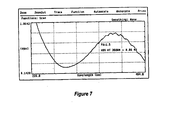
- the placebo solution contained hydrogen peroxide as active ingredient, as well as buffering and tonicity agents at the pH level of 7.0. Hydrogen peroxide does not absorb in the 200nm to 400nm range. Therefore, as seen in Figure 4 , absorption peaks for hydrogen peroxide were not detected.
- Sodium chlorite has an absorption maximum at 260nm, while chlorine dioxide which is a degradation product of sodium chlorite has an absorption maximum at 355nm - 358nm. Scanning the solutions that have a pH of 7.0 between the 200nm and 400nm will give a quantitative value for sodium chlorite as well as chlorine dioxide in the same scan.
- the sodium chlorite/hydrogen peroxide solution does show sodium chlorite peak at 260nm, but does not show any chlorine dioxide peak at 355nm - 358nm. This clearly indicates that at the pH level of 7.0, the liquid solution has only sodium chlorite, and does not contain any quantities of chlorine dioxide. This is a clear indication that sodium chlorite is stable at pH of 7.0, and the chlorite is not breaking up and forming chlorine dioxide.
- the liquid sodium chlorite/hydrogen peroxide solution contained sodium chlorite and hydrogen peroxide as active ingredients, as well as buffering and tonicity agents at the pH level of 6.44.
- Sodium chlorite has an absorption maximum at 260nm, while chlorine dioxide which is a degradation product of sodium chlorite has an absorption maximum at 355nm - 358nm.
- the liquid sodium chlorite/hydrogen peroxide solution does show sodium chlorite peak at 260nm, but does not show any chlorine dioxide peak at 355nm - 358nm. This clearly indicates that at pH of 6.44, the liquid solution has only sodium chlorite, and does not contain any quantities of chlorine dioxide. This is a clear indication that sodium chlorite is stable at pH of 6.44, and the chlorite is not breaking up and forming chlorine dioxide.
- the liquid sodium chlorite/hydrogen peroxide solution contained sodium chlorite and hydrogen peroxide as active ingredients, as well as buffering and tonicity agents at the pH level of 6.0.
- the placebo solution contained hydrogen peroxide as active ingredient, as well as buffering and tonicity agents at the pH level of 6.0. Hydrogen peroxide does not absorb in the 200nm to 400nm range. Therefore, as seen in Figure 6 , absorption peaks for hydrogen peroxide were not detected.
- Sodium chlorite has an absorption maximum at 260nm, while chlorine dioxide which is a degradation product of sodium chlorite has an absorption maximum at 355nm - 358nm. Scanning the solutions that have a pH of 6.0 between the 200nm and 400nm will give a quantitative value for sodium chlorite as well as chlorine dioxide in the same scan.
- the sodium chlorite/hydrogen peroxide solution does show sodium chlorite peak at 260nm, but does not show any chlorine dioxide peak at 355nm - 358nm. This clearly indicates that at pH level of 6.0, the liquid solution has only sodium chlorite, and does not contain any quantities of chlorine dioxide. This is a clear indication that sodium chlorite is stable at pH of 6.0, and the chlorite is not breaking up and forming chlorine dioxide.
- the liquid sodium chlorite/hydrogen peroxide solution contained sodium chlorite and hydrogen peroxide as active ingredients, as well as buffering and tonicity agents at pH of 1.5.
- the placebo solution contained hydrogen peroxide as active ingredient, as well as buffering and tonicity agents at pH of 1.5. As explained earlier, hydrogen peroxide does not absorb in the 200nm to 400nm range, and as such, no absorption peaks for hydrogen peroxide were detected.
- sodium chlorite has an absorption maximum at 260nm
- chlorine dioxide which is a degradation product of sodium chlorite has an absorption maximum at 355nm - 358nm. Scanning the solutions that have a pH of 1.5 between the 200nm and 400nm will give a quantitative value for sodium chlorite as well as chlorine dioxide in the same scan.
- the liquid sodium chlorite/hydrogen peroxide solution does not show sodium chlorite peak at 260nm, but does show a large chlorine dioxide peak at 355nm - 358nm. This clearly indicates that at the pH level of 1.5, the liquid sodium chlorite/hydrogen peroxide solution does not have any sodium chlorite. Rather, it clearly shows that the sodium chlorite has been degraded and converted to chlorine dioxide. This is a clear indication that at pH of 1.5, sodium chlorite is very unstable, and all chlorite that is present in the liquid solution is converted to chlorine dioxide.
- the liquid sodium chlorite/hydrogen peroxide solution contained sodium chlorite and hydrogen peroxide as active ingredients, as well as buffering and tonicity agents at the pH levels of 1.5, 6.0, 6.44, 7.0, 7.3, 8.0 and 8.8.
- the placebo solution contained hydrogen peroxide as active ingredient, as well as buffering and tonicity agents at the pH levels of 1.5, 6.0, 6.44, 7.0, 7.3, 8.0 and 8.8.
- Hydrogen peroxide does not adsorb in the 200nm to 400nm range.
- Sodium chlorite has an absorption maximum at 260nm, while chlorine dioxide has an absorption maximum at 355nm - 358nm.
- liquid sodium chlorite/hydrogen peroxide solutions at the pH levels of 6.0, 6.44, 7.0, 7.3, 8.0 and 8.8 does show the presence of sodium chlorite peak at 260nm, but does not show the presence of chlorine dioxide peak at 355nm - 358nm.
- liquid sodium chlorite/hydrogen peroxide solution at pH of 1.5 does not show the presence of sodium chlorite peak at 260nm, but does show the presence of chlorine dioxide peak at 355nm - 358nm.
- liquid sodium chlorite/hydrogen peroxide solution has its bactericidal properties in the pH range studied due to the sodium chlorite/ hydrogen peroxide and not due to chlorine dioxide. This is very much unlike other prior art inventions that have sodium chlorite as a starting material as, but the active bactericide is the chlorine dioxide which is generated by the acidification of the sodium chlorite.
- a human patient having psoriasis plaques present on both arms is treated as follows: Twice daily application to plaques on the left arm only, of a chlorite/peroxide solution having the following formulation: Sodium Chlorite 0.06% Hydrogen Peroxide 0.01% HPMC 2.15% Boric Acid 0.15% HCl or NaOH to adjust pH 7.4 Purified water Q.S. to volume Twice daily application to plaques on the right arm only of a commercially available 0.1% triamcinolone acetonide cream.
- the chlorite/peroxide treated psoriatic plaques on the right arm began to become less severe within 24 hours of beginning treatment and had substantially disappeared within three days of beginning treatment.
- the triamcinolone acetonide treated psoriatic plaques present on the left arm remained unchanged and inflamed during the two week treatment period.
- a human patient having psoriasis plaques present on both arms is treated for two weeks, as follows: Twice daily application to plaques on the left arm only, of a chlorite/peroxide solution having the following formulation: Sodium Chlorite 0.06% Hydrogen Peroxide 0.01% HPMC 2.0% Boric Acid 0.15% HCl or NaOH to adjust pH 7.4 Purified water Q.S. to volume/100% Twice daily application to plaques on the right arm only of a commercially available 0.1% triamcinolone acetonide cream.
- the chlorite/peroxide treated psoriatic plaques on the right arm began to become less severe within 24 hours of beginning treatment and had substantially disappeared within one week of beginning treatment.
- the triamcinolone acetonide treated psoriatic plaques present on the left arm remained unchanged and inflamed during the two week treatment period.
- the psoriatic lesions on the right arm began to subside.
- the psoriatic lesions on the right arm had substantially disappeared.
- a patient with a venous ulcer on the right leg of 3-4 cm diameter which had been present for 9-12 months was treated by twice daily application to the ulcer of gauze soaked with a chlorite/peroxide liquid solution prepared in accordance with Formula 1 above.
- the ulcer appeared clean and dry. Within 14 days of the commencement of treatment the ulcer began to decrease in size and healthy new tissue was observed about its periphery. At 35 days after commencement of treatment, the ulcer had completely healed, without scarring, and the area where the ulcer had been located was free of pain.
- a non-ambulatory, diabetic patient with decubitus ulcers on both legs and some toes, of 12-18 month duration was treated by daily application of clean, sterile gauze to the ulcers and saturation of each gauze, three times each day, with a liquid chlorite/peroxide solution prepared in accordance with Formula 1 above.
- a liquid chlorite/peroxide solution prepared in accordance with Formula 1 above.
- the ulcers began to appear less inflamed, clean and dry.
- the liquid and or gel formulations of the present invention may also be applied topically to prevent scar formation due to wounds, burns, acne, infections, trauma, surgical incision, or any other scar-forming lesion or disorder.
- Subjects with dry eye conditions have itchy and scratchy eyes. In extreme cases, the subjects have more serious problems that can interfere with health maintenance.
- Subjects were treated with a preferred tear product of the following formulation: Sodium Chlorite 0.005% - 0.02% Hydrogen Peroxide 0.01% Methylcellulose A4M 0.075% Hyaluronic Acid 0.10% - 0.125% Boric Acid 0.15% Sodium Chloride, USP 0.75% Pluronic 127 0.10% HCl or NaOH Adjust pH to 7.4 Purified Water Q.S. to Volume
- the two subjects were tested subjectively regarding the safety and efficacy of the preferred tear product.
- slit-lamp biomicroscopy of the subjects during the two-week treatment period did not show any redness, irritation, inflammation, or other signs of discomfort.
- the subjects indicated that the application of the tear product completely removed symptoms of redness, itching, scratching, pain, and dryness due to dry eye while providing lubrication that lasted for several hours. It is therefore evident that the tear product exhibits both safety and efficacy in the treatment of dry eye.
- the tear product will also have efficacy in enhancing wound healing within the eye such as after surgery where bacterial infections are to be avoided.
- the product was also tested in the treatment of conditions from allergic conjunctivitis.
- two subjects suffering from allergic conjunctivitis including itchy, scratchy eyes with constant tearing applied two drops of the product three times per day. This dosage resulted in the disappearance of the symptoms.
- the following formulation is a preferred disinfecting solution applicable to the cleaning of contact lenses by conventional soaking.
- Sodium Chlorite 0.05% Hydrogen Peroxide 0.02% Methylcellulose A4M 0.075% Hyaluronic Acid 0.05% - 0.10% Boric Acid 0.50% Pluronic 127 0.25% - 0.50% Sodium Chloride USP 0.75% HCl or NaOH Adjust pH to 7.4 Purified Water Q.S. to Volume
- the disinfecting solution can be used with soft hydrophilic lenses of varying water content (e.g., 38% to 75%), as well as with silicone acrylate rigid gas permeable lenses. Cycling studies of soft lenses soaked daily in the solution for 30 days showed no damage or change in the physical and chemical characteristics of the lenses. Eye comfort, as earlier noted, is achieved through non-binding and non-accumulating of preservative in soft or rigid gas permeable lenses, while such binding and accumulation can be found in certain currently commercially available formulations to cause irritation and discomfort.
- the following formulation is a preferred disinfecting in-eye solution applicable to the cleaning of contact lenses while they are being worn by introducing the solution into the eye: Sodium Chlorite 0.02% Hydrogen Peroxide 0.1% - 0.02% Methylcellulose A4M 0.075% Hyaluronic Acid 0.075% - 0.10% Boric Acid 0.15% Sodium Chloride USP 0.75% Pluronic 127 0.75% HCl or NaOH Adjust pH to 7.4 Purified Water Q.S. to Volume
- Tables I and II compare the antimicrobial effects of (a) 400 ppm sodium chlorite alone; (b) 200 ppm hydrogen peroxide alone; and (c) 400 ppm sodium chlorite and 200 ppm hydrogen peroxide in combination against antibiotic-resistant strains of staphylococcus haemolyticus (Table I) and pseudomonas aeruginosa (Table II) both isolated from human infected eyes. Tables I and II summarize the antimicrobial effects observed at time points one and two hours after introduction of the test solutions.
- S. haemolyticus keratitus was induced in respective right eyes of 12 rabbits by dropping broth containing 50,000 CFU/ml of S . haemolyticus onto abraded corneas of these eyes. After 24 hours, all corneas were likewise infected, and the rabbits were divided randomly into three groups.
- the rabbits (five) of Group I then were treated with the chlorite-hydrogen peroxide formulation defined above as cleaning while wearing contact lenses (here termed "Bactericide"); the rabbits (five) of Group II were treated with commercially available 0.3% ofloxacin antibiotic ophthalmic solution; and the rabbits (two) of Group III were untreated to serve as a control.
- the rabbits underwent visual eye examination, photographic documentation and biomicroscopy. After 24 hours of treatment, three animals each from Groups I and II and one animal from Group III were sacrificed. The eyes were enucleated and an 8 mm disc of cornea was homogenized and plated onto growth media for microbial isolation and quantification. After 48 hours of treatment, the same procedure was followed for the remaining animals.
- An "in the eye” contact lens cleaner containing 0.5g carboxymethylcellulose, 0.5g pluronic, and 0.05g hydrogen peroxide/sodium chlorite mixture in 100mL sterile water was provided.
- the cleaner contained 400ppm sodium chlorite and 100ppm hydrogen peroxide for a total of 500ppm hydrogen peroxide/sodium chlorite mixture.
- Two drops of the cleaner were placed in the cul-de-sac of two normal human eyes. Upon instillation of the drops, the subjects closed their eyelids and pressed their index finger on the medial cantus, so as to block the puncta and stop the tears going into the lachrymal duct.
- the subjects' tear samples were obtained by placing a fresh peroxide test strip in the cul-de-sac of the subjects' eyes.
- the used peroxide test strips were removed from the eye and left to dry at room temperature for 15 minutes.
- the level of hydrogen peroxide/sodium chlorite material left in the tear was estimated by comparing the color formed on the peroxide test strip to that of a standard color chart and recorded as shown below.
- the data presented above shows a rapid reduction in the level of hydrogen peroxide/sodium chlorite in the tear film of the treated subjects.
- the placing of the index finger on the medial cantus blocks the puncta and does not allow the tears of the subjects to escape into the lachrymal duct.
- the closing off the eyelids stops the blinking process and thus stops the pumping action of the tear removal from the treated eyes.
- the rapid reduction in the level of hydrogen peroxide/sodium chlorite from the tears is not due to the loss of the tears of the subjects into the lachrymal duct. Rather, it is believed that the reduction is due to the presence of catalase and superoxide desmutase enzymes in the tears of human subjects.
- the catalase and other enzymes start the rapid enzymatic degradation of the hydrogen peroxide/sodium chlorite preparation, whereby in a matter of 3 minutes the level in the tears of the treated subjects is almost undetectable.
- the results of this experiment tend to show that upon instillation in the eye, the hydrogen peroxide/sodium chlorite mixture behaves like a self destructing preservative with the end products being water, oxygen, and sodium chloride.
- An artificial tear product containing 0.15g sodium hyaluronate, 0.50g protector, and 0.06g hydrogen peroxide/sodium chlorite mixture in 100mL sterile water was provided.
- the artificial tear product contained 400ppm sodium chlorite and 200ppm hydrogen peroxide for a total of 600ppm hydrogen peroxide/sodium chlorite mixture.
- Two drops of the cleaner were placed in the cul-de-sac of six normal human eyes. Upon instillation of the drops, the subjects closed their eyelids and pressed their index finger on the medial cantus, so as to block the puncta and stop the tears going into the lachrymal duct.
- the subjects' tear samples were obtained by placing a fresh peroxide test strip in the cul-de-sac of the subjects' eyes.
- the used peroxide test strips were removed from the eye and left to dry at room temperature for 15 minutes.
- the level of hydrogen peroxide/sodium chlorite material left in the tear was estimated by comparing the color formed on the peroxide test strip to that of a standard color chart and recorded as shown below.
- the data presented above shows a rapid reduction in the level of hydrogen peroxide/sodium chlorite in the tear film of the treated subjects.
- the placing of the index finger on the medial cantus blocks the puncta and does not allow the tears of the subjects to escape into the lachrymal duct.
- the closing off the eyelids stops the blinking process and thus stops the pumping action of the tear removal from the treated eyes.
- the rapid reduction in the level of hydrogen peroxide/sodium chlorite from the tears is not due to the loss of the tears of the subjects into the lachrymal duct. Rather, it is believed that the reduction is due to the presence of catalase and superoxide desmutase enzymes in the tears of human subjects.
- the catalase and other enzymes start the rapid enzymatic degradation of the hydrogen peroxide/sodium chlorite preparation, whereby in a matter of 3 minutes the level in the tears of the treated subjects is almost undetectable.
- the results of this experiment tend to show that upon instillation in the eye, the hydrogen peroxide/sodium chlorite mixture behaves like a self destructing preservative with the end products being water, oxygen, and sodium chloride.
Landscapes
- Health & Medical Sciences (AREA)
- Life Sciences & Earth Sciences (AREA)
- Chemical & Material Sciences (AREA)
- General Health & Medical Sciences (AREA)
- Animal Behavior & Ethology (AREA)
- Public Health (AREA)
- Veterinary Medicine (AREA)
- Medicinal Chemistry (AREA)
- Pharmacology & Pharmacy (AREA)
- Epidemiology (AREA)
- Inorganic Chemistry (AREA)
- General Chemical & Material Sciences (AREA)
- Chemical Kinetics & Catalysis (AREA)
- Nuclear Medicine, Radiotherapy & Molecular Imaging (AREA)
- Organic Chemistry (AREA)
- Dermatology (AREA)
- Engineering & Computer Science (AREA)
- Bioinformatics & Cheminformatics (AREA)
- Ophthalmology & Optometry (AREA)
- Communicable Diseases (AREA)
- Oncology (AREA)
- Molecular Biology (AREA)
- Plant Pathology (AREA)
- Dentistry (AREA)
- Wood Science & Technology (AREA)
- Zoology (AREA)
- Environmental Sciences (AREA)
- Pest Control & Pesticides (AREA)
- Agronomy & Crop Science (AREA)
- Virology (AREA)
- Pharmaceuticals Containing Other Organic And Inorganic Compounds (AREA)
- Apparatus For Disinfection Or Sterilisation (AREA)
- Eyeglasses (AREA)
- Medicinal Preparation (AREA)
- Agricultural Chemicals And Associated Chemicals (AREA)
Priority Applications (1)
| Application Number | Priority Date | Filing Date | Title |
|---|---|---|---|
| EP15186300.8A EP2990044A1 (en) | 2006-12-04 | 2007-12-04 | Synergistic antimicrobial preparations containing chlorite and hydrogen peroxide |
Applications Claiming Priority (2)
| Application Number | Priority Date | Filing Date | Title |
|---|---|---|---|
| US11/633,355 US20070104798A1 (en) | 1999-10-04 | 2006-12-04 | Synergistic antimicrobial preparations containing chlorite and hydrogen peroxide |
| PCT/US2007/024815 WO2008070063A1 (en) | 2006-12-04 | 2007-12-04 | Synergistic antimicrobial preparations containing chlorite and hydrogen peroxide |
Related Child Applications (1)
| Application Number | Title | Priority Date | Filing Date |
|---|---|---|---|
| EP15186300.8A Division EP2990044A1 (en) | 2006-12-04 | 2007-12-04 | Synergistic antimicrobial preparations containing chlorite and hydrogen peroxide |
Publications (3)
| Publication Number | Publication Date |
|---|---|
| EP2099296A1 EP2099296A1 (en) | 2009-09-16 |
| EP2099296A4 EP2099296A4 (en) | 2009-12-23 |
| EP2099296B1 true EP2099296B1 (en) | 2015-10-21 |
Family
ID=39492544
Family Applications (2)
| Application Number | Title | Priority Date | Filing Date |
|---|---|---|---|
| EP07862490.5A Revoked EP2099296B1 (en) | 2006-12-04 | 2007-12-04 | Synergistic antimicrobial preparations containing chlorite and hydrogen peroxide |
| EP15186300.8A Withdrawn EP2990044A1 (en) | 2006-12-04 | 2007-12-04 | Synergistic antimicrobial preparations containing chlorite and hydrogen peroxide |
Family Applications After (1)
| Application Number | Title | Priority Date | Filing Date |
|---|---|---|---|
| EP15186300.8A Withdrawn EP2990044A1 (en) | 2006-12-04 | 2007-12-04 | Synergistic antimicrobial preparations containing chlorite and hydrogen peroxide |
Country Status (8)
| Country | Link |
|---|---|
| US (8) | US20070104798A1 (https=) |
| EP (2) | EP2099296B1 (https=) |
| JP (1) | JP2010511707A (https=) |
| CN (1) | CN101600348A (https=) |
| ES (1) | ES2551120T3 (https=) |
| HK (1) | HK1222131A1 (https=) |
| MX (1) | MX2009005836A (https=) |
| WO (1) | WO2008070063A1 (https=) |
Families Citing this family (32)
| Publication number | Priority date | Publication date | Assignee | Title |
|---|---|---|---|---|
| US20070104798A1 (en) | 1999-10-04 | 2007-05-10 | S.K. Pharmaceuticals, Inc. | Synergistic antimicrobial preparations containing chlorite and hydrogen peroxide |
| US20090004288A1 (en) * | 2007-06-29 | 2009-01-01 | Collins Gary L | Stabilized ophthalmic solutions |
| US20090220618A1 (en) * | 2008-02-29 | 2009-09-03 | Erning Xia | Pharmaceutical formulations comprising polyanionic materials and source of hydrogen peroxide |
| US20090239954A1 (en) * | 2008-03-19 | 2009-09-24 | Collins Gary L | Phosphate buffered ophthalmic solutions displaying improved efficacy |
| US8669241B2 (en) * | 2008-12-02 | 2014-03-11 | Rohto Pharmaceutical Co., Ltd. | Ophthalmic composition |
| US20100226999A1 (en) * | 2009-03-06 | 2010-09-09 | Tracy Quevillon-Coleman | Process for forming stabilized ophthalmic solutions |
| TW201127423A (en) * | 2009-12-17 | 2011-08-16 | Alcon Res Ltd | Ophthalmic solutions with improved disinfection profiles |
| CN101785786B (zh) * | 2010-02-20 | 2012-09-05 | 北京欧凯纳斯科技有限公司 | 一种用于治疗脚气的二氧化氯软膏 |
| US9675065B2 (en) | 2011-02-14 | 2017-06-13 | Truox, Inc. | Biocide and bleach compositions and related methods |
| WO2013093891A1 (en) * | 2011-12-22 | 2013-06-27 | Nuvo Research Gmbh | Liposomal chlorite or chlorate compositions |
| US9433643B2 (en) | 2013-04-30 | 2016-09-06 | Truox, Inc. | Microbicidal composition comprising hydrogen peroxide and aminocarboxylic acids |
| JP2015071581A (ja) * | 2013-05-20 | 2015-04-16 | 本部三慶株式会社 | 亜塩素酸水含有ウイルス殺傷剤 |
| US10131574B2 (en) | 2013-06-17 | 2018-11-20 | Corning Incorporated | Antimicrobial glass articles and methods of making and using same |
| GB2534049B (en) * | 2013-10-03 | 2020-05-06 | Halliburton Energy Services Inc | Solvent extraction and analysis of formation fluids from formation solids at a well site |
| CN106773120A (zh) * | 2015-11-25 | 2017-05-31 | 鸿富锦精密工业(深圳)有限公司 | 隐形眼镜镜片材料及隐形眼镜镜片 |
| SG11202006664UA (en) | 2018-01-14 | 2020-08-28 | Collidion Inc | Compositions, kits, methods and uses for cleaning, disinfecting, sterilizing and/or treating |
| JP2018052994A (ja) * | 2018-01-15 | 2018-04-05 | 保土谷化学工業株式会社 | 殺菌組成物 |
| CN108552216B (zh) * | 2018-01-25 | 2021-05-25 | 湖北荷普药业股份有限公司 | 一种杀孢子剂及其制备方法与应用 |
| EP3784354A1 (en) * | 2018-04-27 | 2021-03-03 | Allergan, Inc. | Sodium chlorite compositions with enhanced anti-microbial efficacy and reduced toxicity |
| KR20210005936A (ko) * | 2018-05-02 | 2021-01-15 | 오큐소프트, 인코포레이티드 | 차아염소산 기반 눈꺼풀 세정제 |
| US20220071201A1 (en) * | 2018-09-27 | 2022-03-10 | Medivators Inc. | Peracetic acid stabilized compositions with polymeric resins chelators |
| US12029218B2 (en) | 2018-09-27 | 2024-07-09 | Medivators Inc. | Peracetic acid stabilized compositions with stable lining |
| SI25540A (sl) * | 2019-01-14 | 2019-05-31 | Tompa Majcen Dominika | Formulacije s spojinami aktivnega kisika in pripomočki za njihovo aplikacijo |
| CN109846847B (zh) * | 2019-04-04 | 2021-08-10 | 石家庄卫科生物科技有限公司 | 一种用于治疗动物皮肤病的泡腾片及其制备方法 |
| EP3958915A4 (en) * | 2019-04-22 | 2023-01-11 | Allegro Ophthalmics, LLC | COMPOSITIONS AND METHODS USABLE FOR THE TREATMENT OF DRY EYE |
| CA3167941A1 (en) | 2020-02-14 | 2021-08-19 | Collidion, Inc. | Compositions, kits, methods and uses for cleaning, disinfecting, sterilizing and/or treating |
| JP2023522398A (ja) * | 2020-04-21 | 2023-05-30 | ライフアクティバス プライベート リミテッド | 呼吸器ウイルス感染症治療用塩素の医薬組成物 |
| WO2021222368A1 (en) * | 2020-04-30 | 2021-11-04 | Irenix Medical, Inc. | Sodium chlorite compositions with enhanced anti-viral and anti-microbial efficacy and reduced toxicity |
| CN111602655A (zh) * | 2020-05-09 | 2020-09-01 | 武汉中科先进技术研究院有限公司 | 抗病毒双壳微胶囊及其制备方法和具有该抗病毒双壳微胶囊的消毒涂料及其制备方法和应用 |
| CA3207295A1 (en) * | 2021-02-02 | 2022-08-11 | Autumn RYAN | Formulation comprising chlorite and percarbonate salts |
| CN113491711A (zh) * | 2021-06-09 | 2021-10-12 | 广州丰歌生物科技有限责任公司 | 一种抗菌氧溶液及其制备方法和应用 |
| SE2350131A1 (en) * | 2022-02-23 | 2023-08-24 | V3Bio Sdn Bhd | Wound hydrogel for managing acute and chronic wounds in human and animals |
Citations (6)
| Publication number | Priority date | Publication date | Assignee | Title |
|---|---|---|---|---|
| US4963287A (en) | 1987-05-26 | 1990-10-16 | The Drackett Company | Aqueous alkali metal halogenite compositions |
| US5591426A (en) | 1993-07-02 | 1997-01-07 | Bausch & Lomb Incorporated | Ophthalmic solution for artificial tears |
| US5782992A (en) | 1992-12-17 | 1998-07-21 | Allergan | Contact lens disinfecting solution containing sodium chlorite and polyvinyl pyrrolidone |
| US20040037891A1 (en) | 1999-10-04 | 2004-02-26 | Karagoezian Hampar L. | Synergistic antimicrobial ophthalmic and dermatologic preparations containing chlorite and hydrogen peroxide |
| WO2005110439A2 (en) | 2004-05-07 | 2005-11-24 | S.K. Pharmaceuticals, Inc. | Stabilized hyaluronan preparations and related methods |
| US20070104798A1 (en) | 1999-10-04 | 2007-05-10 | S.K. Pharmaceuticals, Inc. | Synergistic antimicrobial preparations containing chlorite and hydrogen peroxide |
Family Cites Families (45)
| Publication number | Priority date | Publication date | Assignee | Title |
|---|---|---|---|---|
| US2701781A (en) * | 1949-12-30 | 1955-02-08 | Charles Van Buren | Aqueous chlorine dioxide antiseptic compositions and production thereof |
| US3271242A (en) * | 1963-03-29 | 1966-09-06 | Alexander R Reed Iii | Stable chlorine dioxide composition and method of making same |
| US3585147A (en) * | 1969-10-01 | 1971-06-15 | Int Dioxcide Inc | Stabilized chlorine dioxide solutions containing a chloride and processes of making and using same |
| US3920810A (en) * | 1974-04-23 | 1975-11-18 | Burton Parsons And Company Inc | Polyacrylamide containing ophthalmic solutions |
| USRE31779E (en) * | 1976-03-26 | 1984-12-25 | Alcide Corporation | Germ-killing composition and method |
| US4084747A (en) | 1976-03-26 | 1978-04-18 | Howard Alliger | Germ killing composition and method |
| US4250269A (en) * | 1979-11-26 | 1981-02-10 | Buckman Laboratories, Inc. | Water-soluble mixtures of quaternary ammonium polymers, nonionic and/or cationic vinyl-addition polymers, and nonionic and/or cationic surfactants |
| US4317814A (en) * | 1980-06-12 | 1982-03-02 | Felipe Laso | Preparation and method for treating burns |
| US4499077A (en) * | 1981-02-03 | 1985-02-12 | Stockel Richard F | Anti-microbial compositions and associated methods for preparing the same and for the disinfecting of various objects |
| US4670185A (en) * | 1982-07-19 | 1987-06-02 | Lion Corporation | Aqueous vesicle dispersion having surface charge |
| US4574084A (en) * | 1983-02-25 | 1986-03-04 | Peter Berger | Process for the preparation of a modified aqueous chlorite solution, the solution prepared by this process and the use thereof |
| US4654208A (en) * | 1983-03-01 | 1987-03-31 | Stockel Richard F | Anti-microbial compositions comprising an aqueous solution of a germicidal polymeric nitrogen compound and a potentiating oxidizing agent |
| US4574804A (en) * | 1984-02-27 | 1986-03-11 | Board Of Regents, The University Of Texas System | Optic nerve clamp |
| US4585482A (en) * | 1984-05-25 | 1986-04-29 | Southern Research Institute | Long-acting biocidal compositions and method therefor |
| US4855135A (en) * | 1984-07-30 | 1989-08-08 | Ratcliff Perry A | Method for debriding |
| US4978535A (en) * | 1984-07-30 | 1990-12-18 | Ratcliff Perry A | Method for cleaning contact lenses |
| CA1224415A (en) * | 1984-08-23 | 1987-07-21 | Peter Berger | Process for the preparation of a modified aqueous chlorite solution, the solution prepared by this process and the use thereof |
| US4956348A (en) * | 1986-02-19 | 1990-09-11 | Eye Research Institute Of Retina Foundation | Stimulation of tear secretion with cyclic nucleotides |
| US4756844A (en) * | 1986-12-29 | 1988-07-12 | The Dow Chemical Company | Controlled-release composition having a membrane comprising submicron particles |
| US4891216A (en) * | 1987-04-14 | 1990-01-02 | Alcide Corporation | Disinfecting compositions and methods therefor |
| US4956184A (en) * | 1988-05-06 | 1990-09-11 | Alcide Corporation | Topical treatment of genital herpes lesions |
| US5607698A (en) * | 1988-08-04 | 1997-03-04 | Ciba-Geigy Corporation | Method of preserving ophthalmic solution and compositions therefor |
| US4880638A (en) * | 1988-08-23 | 1989-11-14 | Bioxy International, Ltd. | Biocidal composition and method for disinfecting articles |
| FR2637533B1 (fr) | 1988-10-10 | 1990-12-07 | Solvay | Procede pour realiser, par extrusion soufflee, une gaine en resine a base de chlorure de vinyle dont au moins une face presente un aspect mat |
| US5246662A (en) * | 1989-10-02 | 1993-09-21 | Allergan, Inc. | Methods for generating chlorine dioxide and compositions for disinfecting |
| US5078908A (en) * | 1989-10-02 | 1992-01-07 | Allergan, Inc. | Methods for generating chlorine dioxide and compositions for disinfecting |
| US4997626A (en) * | 1990-01-05 | 1991-03-05 | Allergan, Inc. | Methods to disinfect contact lenses |
| US5279673A (en) * | 1990-01-05 | 1994-01-18 | Allergan, Inc. | Methods to disinfect contact lenses |
| US5152912A (en) * | 1990-01-05 | 1992-10-06 | Allergan, Inc. | Chlorine dioxide precursor containing compositions useful in disinfecting contact lenses |
| US5009895A (en) * | 1990-02-02 | 1991-04-23 | Merck & Co., Inc. | Sustained release with high and low viscosity HPMC |
| US5225055A (en) * | 1990-02-09 | 1993-07-06 | Abbott Laboratories | Method of cleaning and disinfecting contact lenses |
| US5145644A (en) * | 1990-12-20 | 1992-09-08 | Allergan, Inc. | Hydrogen peroxide destroying compositions and methods of making and using same |
| US5281353A (en) * | 1991-04-24 | 1994-01-25 | Allergan, Inc. | Compositions and methods for disinfecting/cleaning of lenses and for destroying oxidative disinfectants |
| US5270002A (en) * | 1991-10-03 | 1993-12-14 | Allergan, Inc. | Apparatus and method useful in disinfecting contact lenses |
| DE69320581T2 (de) * | 1992-10-08 | 1999-02-11 | Tomei Sangyo K.K., Nagoya, Aichi | Verfahren zur Reinigung, Konservierung und Desinfizierung Kontaktlinsen |
| US5472703A (en) * | 1993-03-02 | 1995-12-05 | Johnson & Johnson Vision Products, Inc. | Ophthalmic lens with anti-toxin agent |
| US5736165A (en) * | 1993-05-25 | 1998-04-07 | Allergan | In-the-eye use of chlorine dioxide-containing compositions |
| US5616568A (en) * | 1993-11-30 | 1997-04-01 | The Research Foundation Of State University Of New York | Functionalized derivatives of hyaluronic acid |
| US5639481A (en) * | 1994-10-17 | 1997-06-17 | Symbollon Corporation | Method for the therapeutic treatment of a mammalian eye using an admixed composition containing free molecular iodine |
| US5855922A (en) * | 1995-12-07 | 1999-01-05 | Bio-Cide International, Inc. | Antiseptic composition and process for prophylaxis and therapeutic treatment of dermal disorders |
| US6096328A (en) * | 1997-06-06 | 2000-08-01 | The Procter & Gamble Company | Delivery system for an oral care substance using a strip of material having low flexural stiffness |
| US6033704A (en) * | 1998-08-14 | 2000-03-07 | Charvid Limited Liability Co. | Method and apparatus for preserving fruits and vegetables |
| MXPA01003507A (es) * | 1998-10-08 | 2002-06-26 | Hampar L Karagoezian | Antimicrobiano sinergico, preparaciones dermatologicas y oftalmicas que contienen clorito y peroxido de hidrogeno. |
| EP1119347B1 (en) * | 1998-10-08 | 2005-03-02 | Hampar L. Karagoezian | Synergistic antimicrobial, dermatological and ophthalmic preparations containing chlorite and hydrogen peroxide |
| US6592907B2 (en) * | 1999-10-04 | 2003-07-15 | Hampar L. Karagoezian | Synergistic antimicrobial ophthalmic and dermatologic preparations containing chlorite and hydrogen peroxide |
-
2006
- 2006-12-04 US US11/633,355 patent/US20070104798A1/en not_active Abandoned
-
2007
- 2007-12-04 JP JP2009540253A patent/JP2010511707A/ja active Pending
- 2007-12-04 CN CNA2007800489270A patent/CN101600348A/zh active Pending
- 2007-12-04 ES ES07862490.5T patent/ES2551120T3/es active Active
- 2007-12-04 MX MX2009005836A patent/MX2009005836A/es active IP Right Grant
- 2007-12-04 EP EP07862490.5A patent/EP2099296B1/en not_active Revoked
- 2007-12-04 EP EP15186300.8A patent/EP2990044A1/en not_active Withdrawn
- 2007-12-04 WO PCT/US2007/024815 patent/WO2008070063A1/en not_active Ceased
-
2010
- 2010-09-02 US US12/874,443 patent/US8460701B2/en not_active Expired - Fee Related
- 2010-09-10 US US12/879,989 patent/US20110008420A1/en not_active Abandoned
-
2012
- 2012-10-23 US US13/658,609 patent/US20130195995A1/en not_active Abandoned
-
2013
- 2013-12-31 US US14/145,126 patent/US8784901B2/en not_active Expired - Fee Related
-
2014
- 2014-06-18 US US14/307,706 patent/US9072712B2/en not_active Expired - Fee Related
-
2015
- 2015-05-21 US US14/718,852 patent/US9622480B2/en not_active Expired - Fee Related
-
2016
- 2016-09-01 HK HK16110425.6A patent/HK1222131A1/en unknown
-
2017
- 2017-03-09 US US15/454,859 patent/US10010081B2/en not_active Expired - Fee Related
Patent Citations (7)
| Publication number | Priority date | Publication date | Assignee | Title |
|---|---|---|---|---|
| US4963287A (en) | 1987-05-26 | 1990-10-16 | The Drackett Company | Aqueous alkali metal halogenite compositions |
| US5782992A (en) | 1992-12-17 | 1998-07-21 | Allergan | Contact lens disinfecting solution containing sodium chlorite and polyvinyl pyrrolidone |
| US5591426A (en) | 1993-07-02 | 1997-01-07 | Bausch & Lomb Incorporated | Ophthalmic solution for artificial tears |
| US20040037891A1 (en) | 1999-10-04 | 2004-02-26 | Karagoezian Hampar L. | Synergistic antimicrobial ophthalmic and dermatologic preparations containing chlorite and hydrogen peroxide |
| US20070104798A1 (en) | 1999-10-04 | 2007-05-10 | S.K. Pharmaceuticals, Inc. | Synergistic antimicrobial preparations containing chlorite and hydrogen peroxide |
| WO2005110439A2 (en) | 2004-05-07 | 2005-11-24 | S.K. Pharmaceuticals, Inc. | Stabilized hyaluronan preparations and related methods |
| WO2008070063A1 (en) | 2006-12-04 | 2008-06-12 | S.K. Pharmaceuticals, Inc. | Synergistic antimicrobial preparations containing chlorite and hydrogen peroxide |
Non-Patent Citations (7)
| Title |
|---|
| CHALMERS: "Hydrogen peroxide in anterior segment physiology: a literature review.", OPTOMETRY & VISION SCIENCE, vol. 66, no. 11, November 1989 (1989-11-01), pages 796 - 803, XP055299651 |
| CHEN ET AL.: "The pH in the precorneal tear film and under a contact lens measured with a fluorescent probe", EXP. EYE RES., vol. 50, no. 3, 1990, pages 251 - 259, XP022970101 |
| GILBERT GORDON, STEPHEN J. LIPPARD ET AL: "Progress in Inorganic Chemistry", vol. 15, 1972, article "The Chemistry of Chlorine Dioxide", pages: 201 - 286, XP055299636 |
| PAUGH ET AL.: "Ocular Response to Hydrogen Peroxide", AMERICAN JOURNAL OF OPTOMETRY & PHYSIOLOGICAL OPTICS, vol. 65, no. 2, 1988, pages 91 - 98, XP009031881 |
| RILEY ET AL.: "Topical hydrogen peroxide and the safety of ocular tissues.", CONTACT LENS ASSOCIATION OF OPHTHALMOLOGISTS JOURNAL, vol. 18, no. 3, July 1993 (1993-07-01), pages 186 - 190, XP055299645 |
| ROBIN L. CHALMERS ET AL: "Ocular Detection Threshold for Hydrogen Peroxide: Drops vs. Lenses", INT. CONT. LENS. CLIN., vol. 15, no. 11, November 1988 (1988-11-01), pages 351 - 357, XP055299649 |
| TAYLOR ET AL.: "SODIUM CHLORITE PROPERTIES AND REACTIONS", IND. ENG. CHEM., vol. 32, no. 7, 1940, pages 899 - 903, XP055076920 |
Also Published As
| Publication number | Publication date |
|---|---|
| US8460701B2 (en) | 2013-06-11 |
| US9072712B2 (en) | 2015-07-07 |
| EP2099296A1 (en) | 2009-09-16 |
| US20110014276A1 (en) | 2011-01-20 |
| US10010081B2 (en) | 2018-07-03 |
| EP2099296A4 (en) | 2009-12-23 |
| US20110008420A1 (en) | 2011-01-13 |
| MX2009005836A (es) | 2009-10-08 |
| HK1222131A1 (en) | 2017-06-23 |
| JP2010511707A (ja) | 2010-04-15 |
| US20140127319A1 (en) | 2014-05-08 |
| US20150264936A1 (en) | 2015-09-24 |
| US20070104798A1 (en) | 2007-05-10 |
| US9622480B2 (en) | 2017-04-18 |
| US8784901B2 (en) | 2014-07-22 |
| EP2990044A1 (en) | 2016-03-02 |
| US20170172150A1 (en) | 2017-06-22 |
| US20130195995A1 (en) | 2013-08-01 |
| WO2008070063A1 (en) | 2008-06-12 |
| CN101600348A (zh) | 2009-12-09 |
| US20140322350A1 (en) | 2014-10-30 |
| ES2551120T3 (es) | 2015-11-16 |
Similar Documents
| Publication | Publication Date | Title |
|---|---|---|
| EP2099296B1 (en) | Synergistic antimicrobial preparations containing chlorite and hydrogen peroxide | |
| US6592907B2 (en) | Synergistic antimicrobial ophthalmic and dermatologic preparations containing chlorite and hydrogen peroxide | |
| EP1119347B1 (en) | Synergistic antimicrobial, dermatological and ophthalmic preparations containing chlorite and hydrogen peroxide | |
| US7648716B2 (en) | Synergistic antimicrobial ophthalmic and dermatologic preparations containing chlorite and hydrogen peroxide | |
| US20070264226A1 (en) | Synergistically enhanced disinfecting solutions | |
| MXPA06000228A (es) | Antibioticos de oxazolidinona sustituidos con un grupo ciclopropilo y derivados de los mismos. | |
| JP4727816B2 (ja) | 亜塩素酸塩と過酸化水素とを含有する共同作用抗菌性皮膚科・眼科製剤 | |
| HK1139560A (en) | Synergistic antimicrobial preparations containing chlorite and hydrogen peroxide |
Legal Events
| Date | Code | Title | Description |
|---|---|---|---|
| PUAI | Public reference made under article 153(3) epc to a published international application that has entered the european phase |
Free format text: ORIGINAL CODE: 0009012 |
|
| 17P | Request for examination filed |
Effective date: 20090617 |
|
| AK | Designated contracting states |
Kind code of ref document: A1 Designated state(s): AT BE BG CH CY CZ DE DK EE ES FI FR GB GR HU IE IS IT LI LT LU LV MC MT NL PL PT RO SE SI SK TR |
|
| A4 | Supplementary search report drawn up and despatched |
Effective date: 20091125 |
|
| RIC1 | Information provided on ipc code assigned before grant |
Ipc: A01N 39/00 20060101ALI20091119BHEP Ipc: A61P 17/00 20060101ALI20091119BHEP Ipc: A61K 33/22 20060101ALI20091119BHEP Ipc: A61K 33/14 20060101ALI20091119BHEP Ipc: A61K 33/40 20060101AFI20091119BHEP |
|
| DAX | Request for extension of the european patent (deleted) | ||
| 17Q | First examination report despatched |
Effective date: 20100218 |
|
| GRAP | Despatch of communication of intention to grant a patent |
Free format text: ORIGINAL CODE: EPIDOSNIGR1 |
|
| INTG | Intention to grant announced |
Effective date: 20150526 |
|
| GRAS | Grant fee paid |
Free format text: ORIGINAL CODE: EPIDOSNIGR3 |
|
| GRAA | (expected) grant |
Free format text: ORIGINAL CODE: 0009210 |
|
| AK | Designated contracting states |
Kind code of ref document: B1 Designated state(s): AT BE BG CH CY CZ DE DK EE ES FI FR GB GR HU IE IS IT LI LT LU LV MC MT NL PL PT RO SE SI SK TR |
|
| REG | Reference to a national code |
Ref country code: GB Ref legal event code: FG4D Ref country code: NL Ref legal event code: MP Effective date: 20151021 |
|
| REG | Reference to a national code |
Ref country code: CH Ref legal event code: EP |
|
| REG | Reference to a national code |
Ref country code: AT Ref legal event code: REF Ref document number: 756142 Country of ref document: AT Kind code of ref document: T Effective date: 20151115 |
|
| REG | Reference to a national code |
Ref country code: ES Ref legal event code: FG2A Ref document number: 2551120 Country of ref document: ES Kind code of ref document: T3 Effective date: 20151116 |
|
| REG | Reference to a national code |
Ref country code: IE Ref legal event code: FG4D |
|
| REG | Reference to a national code |
Ref country code: FR Ref legal event code: PLFP Year of fee payment: 9 |
|
| REG | Reference to a national code |
Ref country code: DE Ref legal event code: R096 Ref document number: 602007043628 Country of ref document: DE |
|
| REG | Reference to a national code |
Ref country code: LT Ref legal event code: MG4D |
|
| REG | Reference to a national code |
Ref country code: AT Ref legal event code: MK05 Ref document number: 756142 Country of ref document: AT Kind code of ref document: T Effective date: 20151021 |
|
| PG25 | Lapsed in a contracting state [announced via postgrant information from national office to epo] |
Ref country code: LT Free format text: LAPSE BECAUSE OF FAILURE TO SUBMIT A TRANSLATION OF THE DESCRIPTION OR TO PAY THE FEE WITHIN THE PRESCRIBED TIME-LIMIT Effective date: 20151021 Ref country code: NL Free format text: LAPSE BECAUSE OF FAILURE TO SUBMIT A TRANSLATION OF THE DESCRIPTION OR TO PAY THE FEE WITHIN THE PRESCRIBED TIME-LIMIT Effective date: 20151021 Ref country code: IS Free format text: LAPSE BECAUSE OF FAILURE TO SUBMIT A TRANSLATION OF THE DESCRIPTION OR TO PAY THE FEE WITHIN THE PRESCRIBED TIME-LIMIT Effective date: 20160221 |
|
| REG | Reference to a national code |
Ref country code: DE Ref legal event code: R082 Ref document number: 602007043628 Country of ref document: DE Representative=s name: HERNANDEZ, YORCK, DIPL.-ING., DE |
|
| PG25 | Lapsed in a contracting state [announced via postgrant information from national office to epo] |
Ref country code: PT Free format text: LAPSE BECAUSE OF FAILURE TO SUBMIT A TRANSLATION OF THE DESCRIPTION OR TO PAY THE FEE WITHIN THE PRESCRIBED TIME-LIMIT Effective date: 20160222 Ref country code: LV Free format text: LAPSE BECAUSE OF FAILURE TO SUBMIT A TRANSLATION OF THE DESCRIPTION OR TO PAY THE FEE WITHIN THE PRESCRIBED TIME-LIMIT Effective date: 20151021 Ref country code: FI Free format text: LAPSE BECAUSE OF FAILURE TO SUBMIT A TRANSLATION OF THE DESCRIPTION OR TO PAY THE FEE WITHIN THE PRESCRIBED TIME-LIMIT Effective date: 20151021 Ref country code: SE Free format text: LAPSE BECAUSE OF FAILURE TO SUBMIT A TRANSLATION OF THE DESCRIPTION OR TO PAY THE FEE WITHIN THE PRESCRIBED TIME-LIMIT Effective date: 20151021 Ref country code: BE Free format text: LAPSE BECAUSE OF NON-PAYMENT OF DUE FEES Effective date: 20151231 Ref country code: PL Free format text: LAPSE BECAUSE OF FAILURE TO SUBMIT A TRANSLATION OF THE DESCRIPTION OR TO PAY THE FEE WITHIN THE PRESCRIBED TIME-LIMIT Effective date: 20151021 Ref country code: AT Free format text: LAPSE BECAUSE OF FAILURE TO SUBMIT A TRANSLATION OF THE DESCRIPTION OR TO PAY THE FEE WITHIN THE PRESCRIBED TIME-LIMIT Effective date: 20151021 Ref country code: GR Free format text: LAPSE BECAUSE OF FAILURE TO SUBMIT A TRANSLATION OF THE DESCRIPTION OR TO PAY THE FEE WITHIN THE PRESCRIBED TIME-LIMIT Effective date: 20160122 |
|
| REG | Reference to a national code |
Ref country code: DE Ref legal event code: R026 Ref document number: 602007043628 Country of ref document: DE |
|
| PG25 | Lapsed in a contracting state [announced via postgrant information from national office to epo] |
Ref country code: LU Free format text: LAPSE BECAUSE OF FAILURE TO SUBMIT A TRANSLATION OF THE DESCRIPTION OR TO PAY THE FEE WITHIN THE PRESCRIBED TIME-LIMIT Effective date: 20151204 Ref country code: CZ Free format text: LAPSE BECAUSE OF FAILURE TO SUBMIT A TRANSLATION OF THE DESCRIPTION OR TO PAY THE FEE WITHIN THE PRESCRIBED TIME-LIMIT Effective date: 20151021 Ref country code: MC Free format text: LAPSE BECAUSE OF FAILURE TO SUBMIT A TRANSLATION OF THE DESCRIPTION OR TO PAY THE FEE WITHIN THE PRESCRIBED TIME-LIMIT Effective date: 20151021 |
|
| PLBI | Opposition filed |
Free format text: ORIGINAL CODE: 0009260 |
|
| REG | Reference to a national code |
Ref country code: CH Ref legal event code: PL |
|
| PLAX | Notice of opposition and request to file observation + time limit sent |
Free format text: ORIGINAL CODE: EPIDOSNOBS2 |
|
| 26 | Opposition filed |
Opponent name: COOPERVISION INC. Effective date: 20160720 |
|
| PG25 | Lapsed in a contracting state [announced via postgrant information from national office to epo] |
Ref country code: RO Free format text: LAPSE BECAUSE OF FAILURE TO SUBMIT A TRANSLATION OF THE DESCRIPTION OR TO PAY THE FEE WITHIN THE PRESCRIBED TIME-LIMIT Effective date: 20151021 Ref country code: EE Free format text: LAPSE BECAUSE OF FAILURE TO SUBMIT A TRANSLATION OF THE DESCRIPTION OR TO PAY THE FEE WITHIN THE PRESCRIBED TIME-LIMIT Effective date: 20151021 Ref country code: SK Free format text: LAPSE BECAUSE OF FAILURE TO SUBMIT A TRANSLATION OF THE DESCRIPTION OR TO PAY THE FEE WITHIN THE PRESCRIBED TIME-LIMIT Effective date: 20151021 Ref country code: DK Free format text: LAPSE BECAUSE OF FAILURE TO SUBMIT A TRANSLATION OF THE DESCRIPTION OR TO PAY THE FEE WITHIN THE PRESCRIBED TIME-LIMIT Effective date: 20151021 |
|
| REG | Reference to a national code |
Ref country code: IE Ref legal event code: MM4A |
|
| PG25 | Lapsed in a contracting state [announced via postgrant information from national office to epo] |
Ref country code: LI Free format text: LAPSE BECAUSE OF NON-PAYMENT OF DUE FEES Effective date: 20151231 Ref country code: IE Free format text: LAPSE BECAUSE OF NON-PAYMENT OF DUE FEES Effective date: 20151204 Ref country code: CH Free format text: LAPSE BECAUSE OF NON-PAYMENT OF DUE FEES Effective date: 20151231 |
|
| REG | Reference to a national code |
Ref country code: FR Ref legal event code: PLFP Year of fee payment: 10 |
|
| PG25 | Lapsed in a contracting state [announced via postgrant information from national office to epo] |
Ref country code: SI Free format text: LAPSE BECAUSE OF FAILURE TO SUBMIT A TRANSLATION OF THE DESCRIPTION OR TO PAY THE FEE WITHIN THE PRESCRIBED TIME-LIMIT Effective date: 20151021 |
|
| PG25 | Lapsed in a contracting state [announced via postgrant information from national office to epo] |
Ref country code: BE Free format text: LAPSE BECAUSE OF FAILURE TO SUBMIT A TRANSLATION OF THE DESCRIPTION OR TO PAY THE FEE WITHIN THE PRESCRIBED TIME-LIMIT Effective date: 20151021 |
|
| PLBB | Reply of patent proprietor to notice(s) of opposition received |
Free format text: ORIGINAL CODE: EPIDOSNOBS3 |
|
| PGFP | Annual fee paid to national office [announced via postgrant information from national office to epo] |
Ref country code: DE Payment date: 20161129 Year of fee payment: 10 Ref country code: FR Payment date: 20161128 Year of fee payment: 10 Ref country code: GB Payment date: 20161130 Year of fee payment: 10 |
|
| PGFP | Annual fee paid to national office [announced via postgrant information from national office to epo] |
Ref country code: IT Payment date: 20161221 Year of fee payment: 10 Ref country code: ES Payment date: 20161111 Year of fee payment: 10 |
|
| PG25 | Lapsed in a contracting state [announced via postgrant information from national office to epo] |
Ref country code: BG Free format text: LAPSE BECAUSE OF FAILURE TO SUBMIT A TRANSLATION OF THE DESCRIPTION OR TO PAY THE FEE WITHIN THE PRESCRIBED TIME-LIMIT Effective date: 20151021 Ref country code: HU Free format text: LAPSE BECAUSE OF FAILURE TO SUBMIT A TRANSLATION OF THE DESCRIPTION OR TO PAY THE FEE WITHIN THE PRESCRIBED TIME-LIMIT; INVALID AB INITIO Effective date: 20071204 |
|
| PG25 | Lapsed in a contracting state [announced via postgrant information from national office to epo] |
Ref country code: CY Free format text: LAPSE BECAUSE OF FAILURE TO SUBMIT A TRANSLATION OF THE DESCRIPTION OR TO PAY THE FEE WITHIN THE PRESCRIBED TIME-LIMIT Effective date: 20151021 |
|
| PG25 | Lapsed in a contracting state [announced via postgrant information from national office to epo] |
Ref country code: MT Free format text: LAPSE BECAUSE OF FAILURE TO SUBMIT A TRANSLATION OF THE DESCRIPTION OR TO PAY THE FEE WITHIN THE PRESCRIBED TIME-LIMIT Effective date: 20151021 Ref country code: TR Free format text: LAPSE BECAUSE OF FAILURE TO SUBMIT A TRANSLATION OF THE DESCRIPTION OR TO PAY THE FEE WITHIN THE PRESCRIBED TIME-LIMIT Effective date: 20151021 |
|
| REG | Reference to a national code |
Ref country code: DE Ref legal event code: R064 Ref document number: 602007043628 Country of ref document: DE Ref country code: DE Ref legal event code: R103 Ref document number: 602007043628 Country of ref document: DE |
|
| RDAF | Communication despatched that patent is revoked |
Free format text: ORIGINAL CODE: EPIDOSNREV1 |
|
| RDAG | Patent revoked |
Free format text: ORIGINAL CODE: 0009271 |
|
| 27W | Patent revoked |
Effective date: 20171106 |
|
| GBPR | Gb: patent revoked under art. 102 of the ep convention designating the uk as contracting state |
Effective date: 20171106 |