EP2096540A1 - Informationsverarbeitungssystem - Google Patents
Informationsverarbeitungssystem Download PDFInfo
- Publication number
- EP2096540A1 EP2096540A1 EP08007366A EP08007366A EP2096540A1 EP 2096540 A1 EP2096540 A1 EP 2096540A1 EP 08007366 A EP08007366 A EP 08007366A EP 08007366 A EP08007366 A EP 08007366A EP 2096540 A1 EP2096540 A1 EP 2096540A1
- Authority
- EP
- European Patent Office
- Prior art keywords
- program
- command
- information processing
- controlling
- driver program
- Prior art date
- Legal status (The legal status is an assumption and is not a legal conclusion. Google has not performed a legal analysis and makes no representation as to the accuracy of the status listed.)
- Ceased
Links
Images





Classifications
-
- A63F13/12—
-
- A—HUMAN NECESSITIES
- A63—SPORTS; GAMES; AMUSEMENTS
- A63F—CARD, BOARD, OR ROULETTE GAMES; INDOOR GAMES USING SMALL MOVING PLAYING BODIES; VIDEO GAMES; GAMES NOT OTHERWISE PROVIDED FOR
- A63F13/00—Video games, i.e. games using an electronically generated display having two or more dimensions
- A63F13/70—Game security or game management aspects
- A63F13/77—Game security or game management aspects involving data related to game devices or game servers, e.g. configuration data, software version or amount of memory
-
- A—HUMAN NECESSITIES
- A63—SPORTS; GAMES; AMUSEMENTS
- A63F—CARD, BOARD, OR ROULETTE GAMES; INDOOR GAMES USING SMALL MOVING PLAYING BODIES; VIDEO GAMES; GAMES NOT OTHERWISE PROVIDED FOR
- A63F13/00—Video games, i.e. games using an electronically generated display having two or more dimensions
- A63F13/30—Interconnection arrangements between game servers and game devices; Interconnection arrangements between game devices; Interconnection arrangements between game servers
-
- G—PHYSICS
- G06—COMPUTING OR CALCULATING; COUNTING
- G06F—ELECTRIC DIGITAL DATA PROCESSING
- G06F9/00—Arrangements for program control, e.g. control units
- G06F9/06—Arrangements for program control, e.g. control units using stored programs, i.e. using an internal store of processing equipment to receive or retain programs
- G06F9/44—Arrangements for executing specific programs
- G06F9/455—Emulation; Interpretation; Software simulation, e.g. virtualisation or emulation of application or operating system execution engines
- G06F9/45504—Abstract machines for program code execution, e.g. Java virtual machine [JVM], interpreters or emulators
-
- A—HUMAN NECESSITIES
- A63—SPORTS; GAMES; AMUSEMENTS
- A63F—CARD, BOARD, OR ROULETTE GAMES; INDOOR GAMES USING SMALL MOVING PLAYING BODIES; VIDEO GAMES; GAMES NOT OTHERWISE PROVIDED FOR
- A63F2300/00—Features of games using an electronically generated display having two or more dimensions, e.g. on a television screen, showing representations related to the game
- A63F2300/20—Features of games using an electronically generated display having two or more dimensions, e.g. on a television screen, showing representations related to the game characterised by details of the game platform
- A63F2300/209—Features of games using an electronically generated display having two or more dimensions, e.g. on a television screen, showing representations related to the game characterised by details of the game platform characterized by low level software layer, relating to hardware management, e.g. Operating System, Application Programming Interface
-
- A—HUMAN NECESSITIES
- A63—SPORTS; GAMES; AMUSEMENTS
- A63F—CARD, BOARD, OR ROULETTE GAMES; INDOOR GAMES USING SMALL MOVING PLAYING BODIES; VIDEO GAMES; GAMES NOT OTHERWISE PROVIDED FOR
- A63F2300/00—Features of games using an electronically generated display having two or more dimensions, e.g. on a television screen, showing representations related to the game
- A63F2300/50—Features of games using an electronically generated display having two or more dimensions, e.g. on a television screen, showing representations related to the game characterized by details of game servers
- A63F2300/55—Details of game data or player data management
- A63F2300/552—Details of game data or player data management for downloading to client devices, e.g. using OS version, hardware or software profile of the client device
Definitions
- the present invention relates to an information processing system comprising a first information processing apparatus and a second information processing apparatus compatible with the first information processing apparatus.
- the present invention particularly relates to a control of an execution, on the second information processing apparatus, of software created for the first information processing apparatus.
- the conventional entertainment apparatus has two operation modes, i.e., a first mode and a second mode.
- the first mode is a normal mode to perform a normal operation of the apparatus
- the second mode is a compatibility mode to perform an operation on the assumption of compatibility with another model.
- the superordinate model usually starts up and operates in the normal mode. However, the super ordinate model shifts to the compatibility mode when executing a title (software) dedicated for an existing entertainment apparatus (hereinafter, referred to as a subordinate model).
- the superordinate model includes first processor means, which has an MPU (mainprocessingunit) andaGP (graphics processor), and second processor means which has an IOP (input/output subprocessor).
- first processor means acts as a main CPU and a rendering processor
- second processor means acts as an I/O processor
- the second processor means acts as a main CPU
- the first processor means acts as a rendering processor
- the second processor means acts as a rendering processor
- the second processor means is a same processor core as a CPU of the subordinate model. Therefore, the second processor means is able to execute a program code which is prepared for the CPU of the subordinate model, and perform same operations as those performed by the CPU of the subordinate model.
- Patent Document 1 Japanese Laid-Open Patent Publication No. 2001-314644
- the above entertainment apparatus disclosed in the Japanese Laid-Open Patent Publication No. 2001-314644 has the following problem.
- the superordinate model executes, in the compatibility mode, the title (software) of the subordinate model, the same processor core as that of the subordinate model is used as the main CPU. Accordingly, the superordinate model is able to perform the same operations as those of the subordinate model, and thus compatibility is sufficiently obtained.
- the superordinate model is unable to use functions newly added to the superordinate model.
- an object of the present invention is to provide an information processing system which allows, when a superordinate model compatible with a subordinate model operates software of the subordinate model, a device mounted on the superordinate model to be usable.
- a first aspect of the present invention is an information processing system comprising: a first information processing apparatus (10) having a first device (35); a second information processing apparatus (50) having a second device (36) different from the first device; first-device-using software including a first device driver program (175) for controlling the first device and including a first-device-using application program (176) which is created so as to issue a command receivable by the first device driver program and thereby control the first device; and second-device-using software including a second device driver program (173) for controlling the second device and including a second-device-using application program (172) which is created so as to issue a command receivable by the second device driver program and thereby control the second device.
- the first information processing apparatus further has emulation driver program storing means (37) and first application execution means (21).
- the emulation driver program storing means stores, in advance, an emulation driver program (372) which receives the command for controlling the second device and controls the first device, which command is issued based on the second-device-using application program.
- the first application execution means receives, by using the first device driver program included in the first-device-using software, the command for controlling the first device, which command is issued based on the first-device-using application program, and executes the first-device-using application program while controlling the first device by using the first device driver program.
- the first application execution means receives,by using the emulation driver program stored in the emulation driver program storing means, the command for controlling the second device, which command is issued based on the second-device-using application program, and executes the second-device-using application program while controlling the first device by using the emulation driver program.
- the second information processing apparatus further has second application execution means (51) for, at an execution of the second-device-using application program included in the second-device-using software, receiving, by using the second device driver program included in the second-device-using software, the command for controlling the second device, which command is issued based on the second-device-using application program, and executing the second-device-using application program while controlling the second device by using the second device driver program.
- second application execution means (51) for, at an execution of the second-device-using application program included in the second-device-using software, receiving, by using the second device driver program included in the second-device-using software, the command for controlling the second device, which command is issued based on the second-device-using application program, and executing the second-device-using application program while controlling the second device by using the second device driver program.
- the second device is different from the first device.
- being “different” means either of the following: (a) the devices are different in function; or (b) although the devices have a same function, the function is different in performance between the devices. An example of this difference is given below.
- the first information processing apparatus has processing means (first application execution means) operable to execute the first-device-using application program and the second-device-using application program.
- the second information processing apparatus has processing means (second application execution means) operable to execute the second-device-using application program.
- the processing means of the first information processing apparatus is the same as or compatible with the processing means of the second information processing apparatus.
- the first-device-using application program and the second-device-using application program are created so as to be operable on each processing means.
- the first-device-using application program is created so as to be operable on the processing means of the first information processing apparatus
- the second-device-using application program is created so as to be operable on the processing means of the second information processing apparatus.
- the first information processing apparatus may be an apparatus which is designed and released after the release of the second information processing apparatus.
- the reason for this is that since the first information processing apparatus has the emulation driver program storing means, the emulation driver program allows the second-device-using software to be, even if the second-device-using software is created on the premise of being executed using the second device of the second information processing apparatus, executed by the first information processing apparatus using the first device.
- the present invention is applicable when the first device, which is a result of enhancing the performance of the second device of the second information processing apparatus, is mounted on the first information processing apparatus, and the first information processing apparatus is released as a high-performance model after the release of the second information processing apparatus.
- the second-device-using application program which is created on the premise of being executed using the second device, is executed by the first information processing apparatus having compatibility with the second information processing apparatus
- the second-device-using application program can be executed using the first device of the first information processing apparatus.
- the information processing system further comprises selective software which includes a selective application program, the first device driver program and the second device driver program, which selective application program is created so as to allow a first process and a second process to be executed in a selective manner, which first process is for issuing the command, receivable by the first device driver program, for controlling the first device, and which second process is for issuing the command, receivable by the second device driver program, for controlling the second device.
- the first application execution means uses the first device driver program included in the selective software such that the first process is selected from among the first and second processes; receives, by using the first device driver program, the command for controlling the first device which is issued by the first process; and executes the selective application program while controlling the first device by using the first device driver program.
- the second application execution means uses the second device driver program included in the selective software such that the second process is selected from among the first and second processes; receives, by using the second device driver program, the command for controlling the second device which is issued by the second process; and executes the selective application program while controlling the second device by using the second device driver program.
- the driver programs included in the selective software are used to control the first device and the second device, respectively. This enables, for example, a use of a driver program whose version is newer and which is more optimized than the driver stored in the emulation driver program storing means.
- a third aspect of the present invention is an information processing system comprising: a first information processing apparatus (10) having a first device (35); a second information processing apparatus having a second device (36) different from the first device; second-device-using software; and selective software.
- the second-device-using software includes a second device driver program (173) for controlling the second device and includes a second-device-using application program (172) which is created so as to issue a command receivable by the second device driver program and thereby control the second device.
- the selective software includes a selective application program (174), a first device driver program and the second device driver program, which selective application program is created so as to allow a first process and a second process to be executed in a selective manner, which first process is for issuing a command, receivable by the first device driver program, for controlling the first device, and which second process is for issuing the command, receivable by the second device driver program, for controlling the second device.
- the first information processing apparatus further has: emulation driver program storing means (37) and first application execution means (21).
- the emulation driver program storing means stores, in advance, an emulation driver program which receives the command for controlling the second device and controls the first device, which command is issued based on the second-device-using application program.
- the first application execution means executes the second-device-using application program while controlling the first device by using the emulation driver program stored in the emulation driver program storing means.
- the first application execution means uses the first device driver program included in the selective software such that the first process is selected from among the first and second processes; receives, by using the first device driver program, the command for controlling the first device which is issued by the first process; and executes the selective application programwhile controlling the first device by using the first device driver program.
- the second information processing apparatus further has second application execution means for, at an execution of the second-device-using application program included in the second-device-using software, executing the second-device-using application program while controlling the second device by using the second device driver program included in the second-device-using software, and at an execution of the selective application program included in the selective software, using the second device driver program included in the selective software such that the second process is selected from among the first and second processes, receiving, by using the second device driver program, the command for controlling the second device which is issued by the second process, and executing the selective application program while controlling the second device by using the second device driver program.
- the first information processing apparatus can execute the second-device-using application program by using the first device of the first information processing apparatus. Further, at the execution of the selective application program, the driver programs included in the selective software are used to control the first device and the second device, respectively. For this reason, the first information processing apparatus can use a more optimized driver program.
- the second device has a function in common with the first device, and the function of the first device and the function of the second device differ in performance.
- the first device which differs in performance, can be used by the second-device-using application program.
- the first information processing apparatus further has: download means (36) for obtaining an emulation driver upgrade program from a predetermined server via the first device; and upgrade means (21) for upgrading the emulation driver program in the emulation driver program storing means by using the emulation driver upgrade program obtained by the download means.
- the fifth aspect allows the emulation driver program storing means to always store an optimized driver.
- the emulation driver program converts the received command for controlling the second device to an instruction to control the first device, and controls the first device in accordance with the instruction resulting from the conversion.
- the second-device-using application program can be executed by using the function of the first device which is originally unusable by the second-device-using application program.
- the first and second information processing apparatuses are game apparatuses.
- the first and second devices are wireless communication devices for performing wireless communication.
- the second-device-using application program is a game program for performing a game process using wireless communication by the second device.
- a game which is created for the first information processing apparatus, can be executed on the second information processing apparatus by using the second wireless communication device.
- the first device consumes less power for wireless communication than the second device.
- the execution of the game can be performed with lower power consumption.
- the first and second devices are communication devices for performing communication. At least one of communication functions of the second device is unable to communicate with a communication function of the first device.
- the first information processing apparatus further has the second device.
- the first application execution means executes the second-device-using application program while controlling the second device by using the second device driver program included in the second-device-using software.
- the first and second devices are wireless communication devices forperformingwireless communication.
- the second device has a first communication mode which allows direct communication between first information processing apparatuses or between second information processing apparatuses, and has a second communication mode for performing communication with a predetermined server.
- the first application execution means uses the second device when using the first communication mode, and uses the first device when using the second communication mode.
- the second device has a function in common with the first device, and the function of the first device and the function of the second device differ in performance.
- the first information processing apparatus further has: download means (36) for obtaining an emulation driver upgrade program from a predetermined server via the first device; and upgrade means (21) for upgrading the emulation driver program in the emulation driver program storing means by using the emulation driver upgrade program obtained by the download means.
- the emulation driver program converts the received command for controlling the second device to an instruction to control the first device, and controls the first device in accordance with the instruction resulting from the conversion.
- the first and second information processing apparatuses are game apparatuses.
- the first and second devices are wireless communication devices for performing wireless communication.
- the second-device-using application program is a game program for performing a game process using wireless communication by the second device.
- the first device consumes less power for wireless communication than the second device.
- the first and second devices are communication devices for performing communication. At least one of communication functions of the second device is unable to communicate with a communication function of the first device.
- the first information processing apparatus further has the second device.
- the first application execution means executes the second-device-using application program while controlling the second device by using the second device driver program included in the second-device-using software.
- the first and second devices are wireless communication devices for performing wireless communication.
- the second device has a first communication mode which allows direct communication between first information processing apparatuses or between second information processing apparatuses, and has a second communication mode for performing communication with a predetermined server.
- the first application execution means uses the second device when using the first communication mode, and uses the first device when using the second communication mode.
- An eighteenth aspect of the present invention is a first information processing apparatus in an information processing system, the system comprising: the first information processing apparatus having a first device; a second information processing apparatus having a second device different from the first device; and predetermined software including a driver program for controlling the second device and including an application program which is created so as to issue a command receivable by the driver program and thereby control the second device.
- the first information processing apparatus further has emulation driver program storing means and application execution means.
- the emulation driver program storing means stores, in advance, an emulation driver program for receiving an instruction to use the second device, which instruction is issued based on the application program, and controlling the first device.
- the application execution means receives, by using the emulation driver program stored in the emulation driver program storing means, the command for controlling the second device, which command is issued based on the application program, and executes the application program while controlling the first device by using the emulation driver program.
- the application when an application created for the second information processing apparatus is executed by the first information processing apparatus, the application can be executed using the first device.
- a nineteenth aspect of the present invention is an emulation program for receiving a command from an application program which is created so as to issue the command receivable by a driver program for controlling a predetermined device and thereby control the predetermined device, and for converting the command to a command for a driver program for controlling a different device from the predetermined device.
- the nineteenth aspect allows an application program, which is created in consideration of a particular device, to be executed by using a different device from the particular device, and allows same operations as those of the particular device to be performed.
- a twentieth aspect of the present invention is a computer-readable storage medium storing an emulation driver program to be executed by an information processing apparatus comprising a first device having at least a first function and a second device having the first function and a second function different from the first function, which first function of the first device has greater performance than the first function of the second device.
- the emulation driver program causes processing means of the information processing apparatus to perform: a first device controlling step and a second device controlling step.
- the first device controlling step is a step of: issuing a command receivable by a driver program for controlling the second device; receiving a command from an application program which is created so as to control the second device; when the received command is a first function control instruction to control the first function of the second device, converting the received first function control instruction to an instruction to control the first function of the first device; and controlling the first device in accordance with the converted instruction.
- the second device controlling step is a step of, when the received command is a second function control instruction to use the second function of the second device, controlling the second device in accordance with the second function control instruction.
- an application program which is created on the assumption of being executed using the second device, can be executed using the first device which has greater performance than the second device.
- the superordinate model when a superordinate model, which is developed after a conventional model, executes software of the conventional model, the superordinate model is able to use a newly mounted device therein, while maintaining compatibility with the conventional model.
- first information processing apparatus 10 i.e., "first information processing apparatus” in the present invention
- first information processing apparatus 10 has compatibility with and better performance than a later-described second handheld game apparatus 50 (i.e., "second information processing apparatus” in the present invention).
- second information processing apparatus 50 i.e., "second information processing apparatus” in the present invention.
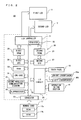
- FIG. 1 is a block diagram showing a configuration of the superordinate model 10.
- the superordinate model 10 comprises an electronic circuit card 20.
- the electronic circuit card 20 has a CPU core 21 mounted thereon.
- the CPU core 21 has compatibility with a CPU core 51 of the subordinate model 50 which will be described later.
- the CPU core 21 has higher processing capabilities than the CPU core 51.
- the CPU core 21 of the superordinate model 10 ranks as a superordinate CPU having compatibility with the CPU core 51 of the subordinate model 50.
- the CPU core 21 of the superordinate model 10 can selectively execute either one of a compatibility mode, which is for performing same operations as those of the CPU core 51 of the subordinate model 50, and a dedicated mode which is greater in processing capabilities than the compatibility mode (e.g., being able to provide an operation clock and a dedicated instruction).
- a compatibility mode which is for performing same operations as those of the CPU core 51 of the subordinate model 50
- a dedicated mode which is greater in processing capabilities than the compatibility mode (e.g., being able to provide an operation clock and a dedicated instruction).
- the CPU core 21 is connected to a connector 23, an input/output interface circuit (shown as I/F circuit in the diagram) 25, a first GPU (Graphics Processing Unit) 26, a second GPU27, aRAM24, an LCD controller 31, afirstwirelesscommunication section 35 and a second wireless communication section 36.
- a later-described memory card 17 is connected to the connector 23 in a removable manner.
- the RAM 24 stores, e.g., a game program loaded from the memory card 17, temporary data which is obtained when the CPU core 21 executes the game program, and data for generating game images. Note that, since the game program or the like loaded into the RAM 24 is one of the features of the present invention, a description thereof will be given later.
- a touch panel 15 Connected to the I/F circuit 25 are a touch panel 15, a right loudspeaker 30a, a left loudspeaker 30b, an operation switch section 14 of FIG. 1 comprising a cross switch 14a, an "A" button 14d and the like, and a microphone 33.
- a first VRAM (Video RAM) 28 is connected to the first GPU 26, and a second VRAM 29 is connected to the second GPU 27.
- the first GPU 26 generates a first game image based on data used for game image generation, which data is stored in the RAM 24, and writes the first game image into the first VRAM 28.
- the second GPU 27 also follows an instruction from the CPU core 21 to generate a second game image, and writes the second game image into the second VRAM 29.
- the first VRAM 28 and the second VRAM 29 are connected to the LCD controller 31.
- the LCD controller 31 includes a register 32.
- the register 32 stores a value of either 0 or 1 in accordance with an instruction from the CPU core 21.
- the LCD controller 31 outputs to the first LCD 11 the first game image which has been written into the first VRAM 28, and outputs to the second LCD 12 the second game image which has been written into the second VRAM 29.
- the value of the register 32 is 1, the first game image which has been written into the first VRAM 28 is outputted to the second LCD 12, and the second game image which has been written into the second VRAM 29 is outputted to the first LCD 11.
- the first wireless communication section 35 and the second wireless communication section 36 each have a function to perform wireless communication, e.g., with another game apparatus or with a server via a predetermined access point.
- wireless communication data used for a game process or other data are exchanged, for example.
- the superordinate model 10 is able to perform the following type of communication:
- the above communications (1) and (2) are performed using the second wireless communication section 36, and the above communication (3) is performed using the first wireless communication section 35.
- the reason for performing the communication (1) by using the second wireless communication section 36 is that, as described below, the first wireless communication section 35 does not support the later-described local communication.
- the reason for performing the communication (2) by using the second wireless communication section 36 is that, as described below, the subordinate model 50 does not have the first wireless communication section 35, and the first wireless communication section 35 and the second wireless communication section 36 are unable to directly communicate with each other. Note that, if the first wireless communication section 35 is configured so as to support the local communication, the above communication (1) can be performed using the first wireless communication section 35.
- the first wireless communication section 35 and the second wireless communication section 36 are different in function, particularly in the following points:
- the second wireless communication section 36 is the same as a wireless communication section 36 mounted on the later-described subordinate model 50.
- a main reason for mounting the second wireless communication section 36 on the first game apparatus is to obtain compatibility with the subordinate model 50.
- "to obtain compatibility" means to enable direct communication between the superordinate model 10 and the subordinate model 50.
- the first wireless communication section 35 has better performance than the second wireless communication section 36 in terms of communication speed, security and power saving.
- a flash memory 37 is a NAND flash memory.
- the flash memory stores an emulation driver program or the like.
- storage means herein may be any type of memory as long as the memory is a non-volatile memory, regardless of rewritable or non-rewritable.
- a subprocessor 39 is a processor for executing a later-described driver program. Note that, the subprocessor 39 is the same as a subprocessor mounted on the later-described subordinate model 50.
- the subordinate model 50 is an apparatus with which the above-described superordinate model 10 attempts to have compatibility.
- FIG. 2 is a block diagram showing the configuration of the subordinate model 50.
- a fundamental configuration of the subordinate model 50 is a result of removing the first wireless communication section 35, the flash memory 37 and the microphone 33 from the functional configuration of the superordinate model 10 described with reference to FIG. 1 .
- the subordinate model 50 has the CPU core 51 mounted thereon, the CPU core 51 having compatibility with the CPU core 21 of the above-described superordinate model 10.
- the CPU core 51 is lower in processing capability than the CPU core 21 mounted on the superordinate model 10.
- the CPU core 21 has the compatibility mode, which is for performing same processing as that of the CPU core 51, as well as the dedicated mode which is greater in performance than the compatibility mode.
- the CPU core 21 operates in the compatibility mode when executing an application dedicated for the subordinate model 50, and operates in the dedicated mode when executing an application dedicated for the superordinate model 10.
- a RAM 54 of the second game apparatus has a smaller capacity than the RAM 24 of the first game apparatus. Thus, these RAMs are different in capacity. Therefore, the CPU cores and the RAMs are each assigned with a different reference numeral, whereby each of the CPU cores and the RAMs are distinguished. Since the other components of the subordinate model 50 are the same as those of the superordinate model 10, the said other components are denoted by the same reference numerals as those used for the superordinate model 10, and detailed descriptions thereof will be omitted.
- the RAM 24 and the RAM 54 may have a same capacity.
- the subordinate model does not have a microphone.
- a microphone is a device which is newly added to the superordinate model.
- the subordinate model 50 is capable of performing the following communications:
- the communication (2) is performed with the superordinate model 10 which performs communication using the second wireless communication section 36.
- the memory card 17 can be detachably mounted either on the superordinate model 10 or on the subordinate model 50. Then, the memory card 17 has mounted thereon a ROM 17a for storing an application program (game program or the like) and a driver program and a RAM 17b for rewritably storing backup data.
- a ROM 17a for storing an application program (game program or the like)
- a driver program for rewritably storing backup data.
- driver programs there are two types of driver programs as follows:
- these application programs are executed by the CPU core 21 or by the CPU core 51, whereas the driver programs are executed by the subprocessor 39.
- the subprocessor executing a driver receives a command issued by the CPU core 21 or 51 executing an application program, and controls a device accordingly.
- the memory card 17 there are three types of the memory card 17 as follows:
- each type of the memory card 17 has a common housing shape and connector specifications. Each type of the memory card 17 can be inserted into the superordinate model 10 and the subordinate model 50, can be connected to the connector 23, and can be read by the CPUs.
- the superordinate model application program is created so as to use the second wireless communication section 36 for the location communication and to use the first wireless communication section 35 in the Wifi communication.
- the first wireless communication section 35 may be assigned with a local communication function, and the first device driver may be configured to support the local communication, and the superordinate model application program may be created so as to use the first wireless communication section 35 for both the local communication and the Wifi communication.
- the superordinate model card may store the superordinate model application program and the first device driver (i.e., storing the second device driver is unnecessary).
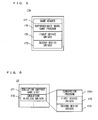
- FIGs. 3 to 5 show memory maps of the ROM 17a of the memory card 17.
- FIG. 3 shows a memory map of the subordinate model card;
- FIG. 4 shows a memory map of the dual-purpose card; and
- FIG. 5 shows a memory map of the superordinate model card.
- the ROM 17a stores a game header 171, a subordinate model game program 172 and a second device driver 173.
- the game header 171 is 4-byte data for identifying a game stored in the memory card 17.
- the subordinate model game program 172 is a game processing program which is created on the premise that the program is executed by the subordinate model 50. To be specific, this program is created to issue a command to the second device driver in order to use a driver program dedicated for the second wireless communication section 36. Further, this program does not contain a process for using dedicated functions of the superordinate model 10.
- the second device driver 173 is for controlling the second wireless communication section 36.
- the second device driver 173 has a function to receive the command issued from the subordinate model game program 172, which command is for the second wireless communication section 36, and to control the second wireless communication section 36 in accordance with the command.
- a command which the first device driver can receive is different from the command which the second device driver can receive. Therefore, even if a command for using the first wireless communication section 35, which command is for the first wireless communication section 35, is issued to the second device driver 173, a process corresponding to the command is not performed.
- the first wireless communication section 35 is a high-performance device developed after the second wireless communication section 36.
- the second device driver 173 is not created on the premise of the existence of the first wireless communication section 35.
- the ROM 17a stores the game header 171, a dual-purpose game program 174, a first device driver 175 and the second device driver 173. Since the game header 171 is the same as described above, a description thereof will be omitted.
- the dual-purpose game program 174 is a game processing program which can be executed regardless of whether the ROM 17a is inserted into the subordinate model 50 or into the superordinate model 10. This game program changes a process to be performed, based on whether the game program is executed by the superordinate model 10 or by the subordinate model 50.
- the game program is created such that when executed by the superordinate model 10, a game process using dedicated functions of the superordinate model 10 can be performed.
- the game program issues to the first device driver a command to control the first wireless communication section 35, whereas when executed by the subordinate model 50, the game program issues to the second device driver a command to control the second wireless communication section 36.
- the game program is programmed such that when a wireless setting menu is opened in the game in the case where the game program is executed by the subordinate model 50, the setting menu is opened only for WEP, whereas in the case where the game program is executed by the superordinate model 10, the setting menu is opened so as to also enable setting for WPA.
- the game program is executed by the superordinate model 10
- processing proceeds such that a process to use a microphone is performed
- processing proceeds such that a process to use a microphone is not performed.
- the program is created such that the processing branches in accordance with whether the program is executed by the superordinate model 10 or by the subordinate model 50.
- the dual-purpose game program 174 has portions which respectively perform, as a part of game processing, different processes in the case where the game program is executed by the superordinate model 10 and in the case where the game program is executed by the subordinate model 50, based on differences between devices respectively included in the superordinate model 10 and the subordinate model 50.
- the first device driver 175 is for controlling the first wireless communication section 35. To be specific, upon receiving, from the dual-purpose game program, such a command as described later for the first wireless communication section, the first device driver 175 controls the first wireless communication section.
- the second device driver 173 is the same as that in the case of the subordinate model card. Upon receiving a command for the second wireless communication section, which command is issued by the dual-purpose game program 174, the second driver 173 controls the second wireless communication section 36.
- the dual-purpose card when the dual-purpose card is inserted into the superordinate model 10, the first device driver 175 and the second device driver 173 are both loaded into the RAM 24, and then used. Further, when the dual-purpose card is inserted into the subordinate model 50, the second device driver 173 is loaded into the RAM 54, and then used.
- the ROM 17a stores the game header 171, a superordinate model game program 17 6, the first device driver 175 and the second device driver 173. Since the game header 171 and the drivers are the same as described above, descriptions thereof will be omitted.
- the superordinate model game program 176 is a game processing program which is created on the premise that the game program is executed by the CPU core 21 of the superordinate model 10. Note that, when the game program is executed, the CPU core 21 operates in the dedicated mode.
- the superordinate model game program 176 allows functions of the superordinate model 10 (e.g., a function to receive an instruction specifically directed to the CPU core 21, which instruction is not directed to the CPU core 51 of the subordinate model 50) to be made best use of. Accordingly, even though the superordinate model card can be inserted into the subordinate model 50, the subordinate model is unable to perform a game process with the superordinate model card.
- FIG. 6 shows a memory map of the flash memory 37.
- the flash memory 37 stores an emulation-support game list 371, an emulation wireless driver 372 and the like.
- the emulation-support game list 371 is a list of game programs, which are among subordinate model game programs having already been released in the form of the above-described subordinate model card and which can be operated on the superordinate model 10 in an operation mode called "emulator mode" which will be later described. From among a number of conventional games available in the market, a game which can be operated in the "emulator mode" is selected in advance, and a value of the game header 171 of the game is recorded in the emulation-support game list 371.
- the emulation wireless driver 372 comprises a conversion program 3721, the first device driver 175 and the second device driver 173. Since the first device driver 175 and the second device driver 173 are the same as described above, descriptions thereof will be omitted.
- the conversion program 3721 realizes a function to convert a command A, which a game program has issued to the second device driver 173 in order to control the second wireless communication section 36, to a command which the first device driver 175 can receive and which performs control corresponding to the commandA.
- the conversion program 3721 converts a communication start command, which the game program has issued to the second device driver 173 in order to cause the second wireless communication section 36 to start communication, to a command which the first device driver 175 can receive and which causes the first wireless communication section 35 to start communication. Therefore, a conversion table for such command conversion as above is defined in the conversion program 3721.
- the conversion program 3721 receives a command for the second wireless communication section 36, which is issued by the game program, and performs a process to convert, based on the conversion table, the command to a command for the first wireless communication section 35. Then, a process is performed for outputting, to the first device driver 175, the converted command for the first wireless communication section 35.
- the conversion program 3721 outputs a command, without converting the command, to the first device driver 175, which command has been issued to the first device driver 175 by the game program for the purpose of controlling the first wireless communication section 35.
- the emulation wireless driver 372 comprises the conversion program 3721, the first device driver 175 and the second device driver 173.
- the emulation wireless driver 372 is designed so as to control the first wireless communication section 35 in accordance with a command which the game program issues to the first device driver 175 for the purpose of controlling the first wireless communication section 35, and so as to control the second wireless communication section 36 in accordance with a command which the game program issues to the second device driver 173 for the purpose of controlling the second wireless communication section 36.
- a burden to develop an emulation wireless driver can be reduced.
- only one of the first device driver 175 and the second device driver 173 may be used.
- the conversion program 3721 outputs a command for the local communication, without converting the command, to the second device driver 173, which command has been issued to the second device driver 173 by the game program for the purpose of controlling the second wireless communication section 36.
- a game program which has been confirmed to properly operate in the "emulator mode" using the emulation wireless driver 372, is stored in a region of the dual-purpose game program 174.
- all the subordinate model game programs may be operated in the "emulator mode".
- data of the dual-purpose game program 174 is not necessary.
- the region of the dual-purpose game program 174 may be configured to be updatable via an external storage medium or a network.
- a subordinate model game program which has been confirmed, after the release of the superordinate model 10, to operate properly in the "emulator mode", or a subordinate model game program which has been released after the release of the superordinate model 10, may be registered as an emulation-support game program.
- the present invention relates to a process which is performed in the case where the subordinate model card is inserted into the superordinate model 10, that is, a process which is performed in the case where a game created for the subordinate model 50 is executed by the superordinate model 10 having compatibility with the subordinate model 50.
- subordinate model game a game of the subordinate model card (hereinafter, referred to as a "subordinate model game”) is executed by the superordinate model 10
- a manner of executing the game by the subordinate model 50 will be described, that is, a case where the subordinate model game is executed by the subordinate model 50 will be described.
- subordinate model games assumed in the present embodiment include a game in which a game process using a communication function is performed (hereinafter, referred to as a communication game) (to be more specific, a game in which a process for performing communication using the second wireless communication section 36 is performed) .
- Communication methods used herein are the following two types of communication methods.
- One of the methods is called local communication in which a plurality of game machines are directly connected to each other without a server or the like by short-range wireless communication using faint radio waves.
- This type of communication method assumes, for example, a case where a plurality of players (i.e., a plurality of subordinate models 50) are in a small area such as a same room.
- the other method is called Wifi communication for mainly performing wireless communication conforming to IEEE 802.11.
- Wifi communication a connection to a predetermined server or to the subordinate model 50 of another player is established via, e. g. the Internet, whereby the communication is performed.
- This type of communication method mainly assumes a case where players each having the subordinate model 50 are remote from each other, or a game play using an Internet connection. Note that, in the present embodiment, the local communication is performed using a proprietary protocol, and only devices each having the proprietary protocol mounted thereon are allowed to communicate with each other.
- the second wireless communication section 36 is used in the game process.
- a flow of the game process is as described below.
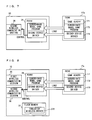
- the subordinate model game program 172 and the second device driver 173 are loaded from the memory card 17 to the RAM 54 of the subordinate model 50, as shown in FIG. 7 .
- the CPU core 51 starts performing the game process based on the subordinate model game program 172 loaded to the RAM 54.
- a command to control the second wireless communication section is issued to the second device driver 173 which has been loaded into the RAM 54. It is assumed here that a command class of the command is different between the local communication and the Wifi communication. That is, the command for the local communication and the command for the Wifi communication are different from each other.
- the second device driver 173 receives and interprets the command, and controls the secondwireless communication section 36 in accordance with a content of the command. Then, a process to return a result of the above processing to the conventional game program is performed as necessary. In this manner, the subordinate model 50 executes the communication game.
- a subordinate model game is executed by the superordinate model 10.
- the CPU core 21 of the superordinate model 10 has an execution mode which is compatible with the CPU core 51 of the subordinate model 50 (compatibility mode), and therefore, the subordinate model game can be executed by the CPU core 21.
- the second wireless communication section 36 which is the same as that mounted on the subordinate model 50, is mounted on the superordinate model 10. For this reason, when the subordinate model game is executed by the superordinate model 10, a processing flow is as described below.
- the subordinate model game program 172 and the second device driver 173 are loaded from the memory card 17 (subordinate model card) into the RAM 24, as shown in FIG. 8 .
- the CPU core 21 performs a game process based on the subordinate model game program 172 which has been loaded into the RAM 24.
- a command to control the second wireless communication section is issued to the second device driver 173 which has been loaded into the RAM 24.
- the second device driver 173 controls the second wireless communication section 36 in accordance with the command.
- the command has a specification and a command class intended for the second wireless communication section 36. Therefore, the command cannot control the first wireless communication section 35.
- the superordinate model 10 can be caused to perform the same process as that performed in the case where the subordinate model game is executed by the subordinate model 50.
- the superordinate model 10 executes the game of the subordinate model card.
- the above-described operation mode, in which the second wireless communication section 36 is used to obtain compatibility is referred to as a "normal mode”
- an operation mode, in which a later-describe process is performed is referred to as an "emulator mode” ( FIG. 8 shows a case of "normal mode”, and FIG. 9 shows a case of "emulator mode”).
- the superordinate model 10 performs a process for checking the game header 171, which is stored in the memory card 17 inserted into the superordinate model 10, against the emulation-support game list 371.
- the superordinate model 10 automatically operates in the "emulator mode".
- the superordinate model 10 operates in the "normal mode".
- the “emulator mode” is an operation mode which allows not the second wireless communication section 36 but the first wireless communication section 35 having better performance to be used in the case where the game using the aforementioned communication function is executed and communication using the Wifi communication method is performed.
- the “emulator mode” is an operation mode which uses, when the superordinate model 10 performs the communication process, the first wireless communication section 35 while emulating the second wireless communication section 36.
- a wireless driver which is loaded into the RAM 24 when the superordinate model 10 performs the boot process, is different from that of the "normal mode".
- the subordinate model game program 172 is loaded from the memory card 17 (subordinate model card) to the RAM 24.
- the wireless driver loaded into the RAM 24 at the boot process is not the second device driver 173 of the memory card 17 but the emulation wireless driver 372 stored in the flash memory 37.
- the emulation wireless driver 372 includes the conversion program 3721 as described above. Then, in the "emulator mode", the conversion program 3721 obtains, from among commands issued from the subordinate model game, a command related to communication (hereinafter, referred to as a "communication command"). Accordingly, a flow of the game process in the emulator mode is as described below.
- the CPU core 21 starts performing the game process based on the subordinate model game program 172 which has been loaded into the RAM 24.
- the communication command is issued (since the communication command is issued by the subordinate model game program 172, the communication command is, of course, a command for the second wireless communication section 36), this command is received by the emulation wireless driver 372, and then the conversion program 3721 is executed.
- the conversion program 3721 converts the command, i.e., the command for the second wireless communication section 36, to a command for the first wireless communication section. Then, the converted command is outputted to the first device driver 175 included in the emulation wireless driver 372.
- the first device driver 175 controls the first wireless communication section 35 in accordance with the converted command. Consequently, when the subordinate model game, which was not developed on the premise that the game is executed using the first wireless communication section 35, is executed, a process using the first wireless communication section 35 can be performed.
- FIG. 10 shows a flow of device control in the case where the superordinate model 10 executes the subordinate model game in the "normal mode”, and a flow of device control in the case where the superordinate model 10 executes the subordinate model game in the "emulator mode".
- the second device driver which is a driver layer receives a predetermined communication command (e.g., an API call) issued by the game program which is an application layer. Then, the second device driver accesses, based on the command, the second wireless communication section which is a hardware layer.
- a predetermined communication command e.g., an API call
- the predetermined communication command issued by the game program is received by the conversion program included in the emulation wireless driver.
- the conversion program then performs a process to convert the command as necessary, and the converted command is outputted to the first device driver included in the emulation wireless driver. Then, the first device driver accesses the first wireless communication section in accordance with the command.
- the command is outputted, without being converted, to the second device driver 173 included in the emulation wireless driver 372.
- the command may be converted and then outputted to the first device driver 175 included in the emulation wireless driver 372. In such a case, it is not necessary to include the second device driver 173 in the emulation wireless driver 372.
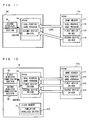
- the dual-purpose game program 174 and the second device driver 173 are loaded into the RAM 54 of the subordinate model 50, and then executed (see FIG. 11 ).
- the game does not start. In other words, the game stored in the superordinate model card cannot be played using the subordinate model 50.
- the dual-purpose game program 174, the first device driver 175 and the second device driver 173 are loaded into the RAM 24 of the superordinate model 10, and then executed (see FIG. 12 ).
- the wireless drivers stored in the dual-purpose card are used for the execution of the subordinate model game.
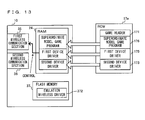
- the superordinate model game program 176, the first device driver 175 and the second device driver 173 are loaded into the RAM 24, and then executed (see FIG. 13 ). Note that, as described above, in the case where the first wireless communication section 35 has the local communication function, it is not necessary to store the second device driver 173 in the superordinate model game program 176. In this case, it is understood that the second device driver 173 is not loaded.
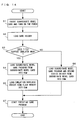
- FIG. 14 is a flowchart showing a flow of a game boot process which is performed in accordance with a boot program (stored in a boot ROM, which is not shown, of the superordinate model 10) which is executed when the subordinate model card is inserted into the superordinate model 10 and the superordinate model 10 is turned on.
- a boot program stored in a boot ROM, which is not shown, of the superordinate model 10
- the game header 171 is obtained at step S2 from the ROM 17a of the inserted memory card 17.
- step S3 it is determined, based on the obtained game header 171, whether or not a game of the inserted card supports the emulator mode.
- the emulation-support game list 371 of the flash memory 37 is referred to, and then it is determined whether or not the game header 171 obtained at step S2 is registered in the emulation-support game list 371.
- the subordinate model game program 172 is loaded from the ROM 17a into the RAM 24 at step S4. Subsequently, at step S5, the emulation wireless driver 372 is loaded into the RAM 24 from the flash memory 37.
- step S7 the subordinate model game program 172 having been loaded into the RAM 24 starts to be executed.
- the subordinate model game program 172 is loaded from the ROM 17a into the RAM 24 at step S6. Further, the second device driver 173 is loaded into the RAM 24 from the ROM 17a. Thereafter, the processing proceeds to the above-described step S7, and the subordinate model game program 172 starts to be executed.
- the game start process it is determined whether or not the game supports operations to be performed in the emulator mode, and a process to change a wireless driver to be loaded into the RAM 24 is performed based on a result of the determination.
- Described next with reference to FIG. 15 is a game process of the subordinate model game operated in the "emulator mode". Described herein is mainly a process which is performed by the emulation wireless driver of the subprocessor 39 when the communication command is issued from the CPU core 21 executing the subordinate model game program. Since a game process which is performed when the communication command is not issued is not directly relevant to the present invention, a description thereof will be omitted.
- FIG. 15 is a flowchart showing the process which is performed by the emulation wireless driver 372 when the communication command is issued during the execution of the subordinate model game program 172.
- steps S11, S12, S13, S14 and S16 indicate processes based on the conversion program 3721.
- step S15 indicates a process performed by the first device driver 175
- step S17 indicates a process performed by the second device driver 173.
- the communication command issued during the execution of the subordinate model game program 172 is received at step S11.
- the communication command issued during the execution of the subordinate model game program 172 is a command for controlling the second wireless communication section.
- step S12 it is determined at step S12 whether the received command is a command to use the local communication method or a command to use the Wifi communication method.
- the first and second wireless communication sections 35 and 36 are used in different manners from each other such that the first wireless communication section 35 is used only when the Wifi communication method is used as a communication method, and the second wireless communication section 36 is used only when the local communication method is used as a communication method.
- the command for the local communication and the command for the Wifi communication are categorized in different command classes, and thus the command for the local communication and the command for the Wifi communication are different from each other.
- the command it can be determined whether the command is for the local communication or for the Wifi communication. For example, when the instruction code is "Local_connect (argument)", the command is determined to be the command for the local communication, and when the instruction code is "WiFi__connect (argument)", the command is determined to be the command for the Wifi communication.
- the command received at the above step S11 is converted to a command for the first wireless communication section 35 at step S13.
- the converted command is outputted to the first device driver 175.
- the first wireless communication section 35 is controlled based on the converted command for the first wireless communication section 35.
- the command received at the above step S11 is outputted to the second device driver 173 at step S16.
- the command for the second wireless communication section 36 is outputted to the second device driver 173, without being converted in the above manner.
- the second wireless communication section 36 is controlled based on the command for the second wireless communication section 36.
- the superordinate model 10 when the superordinate model 10 executes a game of the subordinate model 50 (i.e. , conventional game), the super ordinate model 10 is able to use a function of the superordinate model 10 (i.e., the first wireless communication section 35 in the present embodiment), instead of a function of the subordinate model 50 (i.e., the second wireless communication section 36 in the present embodiment).
- the superordinate model 10 can realize a more comfortable game play by using the function of the superordinate model which was developed after the subordinate model, while maintaining the compatibility with the subordinate model.
- the above embodiment gives a description of an exemplary case where if the game is an emulation-support game, the game is automatically operated in the "emulator mode".
- the present invention may be configured so as to allow the player to set whether or not to execute the emulation-support game in the "emulator mode".
- the present invention may be configured so as to allow the player to select, when the superordinate model 10 executes the subordinate model game, whether to use the first wireless communication section or the second wireless communication section.
- the program for the boot process may include a function to set this selection, and in this function, the selection is performed based on an input by the player.
- a result of the selection may be stored in a predetermined region of the flash memory 37.
- step S3 in the above-described boot process shown in FIG. 14 , if data in the predetermined region indicates that "the first wireless communication section is to be used", the processing proceeds to step S3, and if the data indicates that "the second wireless communication section is to be used", the processing proceeds to step S6.
- software integratedly storing an application program and a driver program
- the software may be stored in any manner as long as the software is executable on the information processing apparatuses.
- the software integratedally storing an application program and a driver program
- the conversion program 3721 is used to convert the command issued for the second device (second wireless communication section) to the command for the first device (first wireless communication section), whereby the first device is controlled.
- the present invention is not limited to using the conversion program 3721.
- the driver for controlling the first device may be configured so as to have compatibility which enables the driver to control the second device. Then, by storing the driver for controlling the first device in storage means of the first information processing apparatus, the present invention can be implemented without using the above-described conversion program.
- the emulation driver program is configured so as to include the conversion program and the first device driver.
- the emulation driver program may be configured in any manner as long as the emulation driver program can be used to control the first device by using a command for controlling the second device.
- the software may be configured so as to include the first device driver for controlling the first device, and only the conversion program, which converts a command for controlling the second device to a command which the first device driver can receive, may be stored in the first information processing apparatus as the emulation driver program.
- the command for controlling the second device is issued, the command may be received by the first device driver included in the software, and the first device may be controlled using the first device driver.
- the above embodiment describes a wireless function (first wireless communication section 35) as an example of a function of the superordinate model 10 which is used instead of a function of the subordinate model 50 when the superordinate model 10 executes a game of the subordinate model 50 (i.e., a conventional game).
- the function to be used instead is not limited thereto.
- the function to be used instead may be any function as long as the function of the superordinate model is configured so as to be substituted for a function of the subordinate model.
- the present invention can be applied also in the case where a liquid crystal panel mounted on the superordinate model is greater, in resolution and the number of colors, than a liquid crystal panel of the subordinate model.
- the present invention is useful in the case where the superordinate model has mounted therein same components (wireless chip and the like) as those of the subordinate model for the purpose of obtaining compatibility with the subordinate model, and although a fundamental function (i.e., a wireless communication function in the present embodiment) of the superordinate model is the same as that of the subordinate model, the superordinate model has additionally mounted therein a component which is greater in performance than that of the subordinate model.
- a fundamental function i.e., a wireless communication function in the present embodiment
- the emulation-support game list 371 and the emulation wireless driver 372 stored in the flash memory 37 may be each configured such that upgrading thereof can be performed by downloading a latest version thereof from a predetermined server.
- a driver upgrade program may be stored in the flash memory 37 in advance, and this program may perform a process to upgrade the emulation wireless driver 372 of the flash memory 37 by downloading the emulation wireless driver 372 of a latest version by communicating, using the first wireless communication section 35, with a predetermined server.
- upgrading of the emulation wireless driver 372 or the like enables a conventional game, which is originally inoperable in the "emulator mode", to be operated in the emulator mode. In other words, the number of emulation-support games can be increased.
- the first device driver 175 stored in the dual-purpose card or in the superordinate model card may be the first device driver whose version is the latest when a game to be stored in these cards is developed.
- the wireless drivers to be stored in the memory card 17 each may be a driver whose version is the latest at the release of the memory card (game).
- the first device driver 175 stored in the memory card 17 is loaded into the RAM 24, and then used. For this reason, when these games are executed, a wireless driver of a newer version for the first wireless communication section can be used.
Landscapes
- Engineering & Computer Science (AREA)
- Software Systems (AREA)
- Theoretical Computer Science (AREA)
- Multimedia (AREA)
- Physics & Mathematics (AREA)
- General Engineering & Computer Science (AREA)
- General Physics & Mathematics (AREA)
- Business, Economics & Management (AREA)
- Computer Security & Cryptography (AREA)
- General Business, Economics & Management (AREA)
- Stored Programmes (AREA)
Applications Claiming Priority (1)
| Application Number | Priority Date | Filing Date | Title |
|---|---|---|---|
| JP2008046849A JP2009205422A (ja) | 2008-02-27 | 2008-02-27 | 情報処理システム |
Publications (1)
| Publication Number | Publication Date |
|---|---|
| EP2096540A1 true EP2096540A1 (de) | 2009-09-02 |
Family
ID=40602128
Family Applications (1)
| Application Number | Title | Priority Date | Filing Date |
|---|---|---|---|
| EP08007366A Ceased EP2096540A1 (de) | 2008-02-27 | 2008-04-15 | Informationsverarbeitungssystem |
Country Status (3)
| Country | Link |
|---|---|
| US (1) | US8856810B2 (de) |
| EP (1) | EP2096540A1 (de) |
| JP (1) | JP2009205422A (de) |
Families Citing this family (11)
| Publication number | Priority date | Publication date | Assignee | Title |
|---|---|---|---|---|
| JP4871373B2 (ja) | 2009-06-19 | 2012-02-08 | 任天堂株式会社 | 情報処理システムおよび情報処理装置 |
| JP5674296B2 (ja) * | 2009-09-09 | 2015-02-25 | 任天堂株式会社 | 情報処理システムおよび情報処理装置 |
| JP2011250874A (ja) | 2010-05-31 | 2011-12-15 | Nintendo Co Ltd | 情報処理プログラム、情報処理装置、情報処理システム及び情報処理方法 |
| JP5593566B2 (ja) | 2010-06-10 | 2014-09-24 | 任天堂株式会社 | 情報処理システム、情報処理装置、情報処理装置の制御方法および情報処理装置の制御プログラム |
| JP5507350B2 (ja) | 2010-06-11 | 2014-05-28 | 任天堂株式会社 | 携帯型情報端末、携帯型情報端末制御プログラム、携帯型情報システム、および、携帯型情報端末制御方法 |
| JP5677811B2 (ja) | 2010-06-11 | 2015-02-25 | 任天堂株式会社 | 携帯型情報端末、携帯情報システム、携帯型情報端末制御プログラム |
| JP2012018657A (ja) | 2010-06-11 | 2012-01-26 | Nintendo Co Ltd | 情報処理端末、情報処理システム、情報処理プログラム |
| JP4999213B2 (ja) | 2010-09-17 | 2012-08-15 | 任天堂株式会社 | 情報処理プログラム、携帯端末装置、システム、情報処理方法及び通信システム |
| JP4882022B1 (ja) | 2010-12-28 | 2012-02-22 | 任天堂株式会社 | 通信システム、情報処理プログラム、情報処理方法、情報処理装置、情報処理システム |
| US10565862B2 (en) * | 2012-11-27 | 2020-02-18 | Comcast Cable Communications, Llc | Methods and systems for ambient system control |
| US11185783B2 (en) * | 2013-03-14 | 2021-11-30 | Sony Interactive Entertainment Inc. | Controller emulation for cloud gaming |
Citations (4)
| Publication number | Priority date | Publication date | Assignee | Title |
|---|---|---|---|---|
| JP2001314644A (ja) | 2000-03-03 | 2001-11-13 | Sony Computer Entertainment Inc | エンタテインメント装置及びコンピュータシステム |
| US20040157664A1 (en) * | 2000-11-28 | 2004-08-12 | Nintendo Co., Ltd. | Hand-held video game platform emulation |
| US20060046824A1 (en) * | 2004-08-25 | 2006-03-02 | Igt | Emulation in a secure regulated environment |
| JP2008046849A (ja) | 2006-08-15 | 2008-02-28 | Fujitsu Ltd | 選択系gui部品の表示方法及び表示制御装置 |
Family Cites Families (22)
| Publication number | Priority date | Publication date | Assignee | Title |
|---|---|---|---|---|
| JPS59114595U (ja) * | 1983-01-21 | 1984-08-02 | ヤマハ株式会社 | 電子楽器 |
| JPH1069393A (ja) * | 1996-06-19 | 1998-03-10 | Hokkaido Nippon Denki Software Kk | 仮想計算機エミュレータ、仮想計算機エミュレート方法 および仮想計算機エミュレートプログラムを記録した記録 媒体 |
| US6287198B1 (en) * | 1999-08-03 | 2001-09-11 | Mccauley Jack J. | Optical gun for use with computer games |
| US6716103B1 (en) * | 1999-10-07 | 2004-04-06 | Nintendo Co., Ltd. | Portable game machine |
| US6955606B2 (en) * | 2000-03-30 | 2005-10-18 | Nintendo Co., Ltd. | Game information storage medium and game system using the same |
| US20010029205A1 (en) * | 2000-03-30 | 2001-10-11 | Sagahiro Taho | Game program delivery system and apparatus used in same |
| JP2001340640A (ja) * | 2000-03-30 | 2001-12-11 | Nintendo Co Ltd | ゲーム情報記憶媒体およびそれを用いたゲームシステム |
| JP4547071B2 (ja) * | 2000-03-30 | 2010-09-22 | 任天堂株式会社 | ゲーム情報記憶媒体およびそれを用いたゲームシステム |
| JP2001340655A (ja) * | 2000-03-30 | 2001-12-11 | Nintendo Co Ltd | ゲームプログラム配信システムおよびそれに用いる装置 |
| US7285051B2 (en) * | 2000-05-25 | 2007-10-23 | Nintendo Co., Ltd. | Game information storage medium and game system using the same |
| US6951516B1 (en) * | 2001-08-21 | 2005-10-04 | Nintendo Co., Ltd. | Method and apparatus for multi-user communications using discrete video game platforms |
| JP2002027038A (ja) * | 2000-07-11 | 2002-01-25 | Sony Corp | 携帯端末装置、携帯電話機及びデータ処理方法 |
| JP2002055826A (ja) * | 2000-08-11 | 2002-02-20 | Sega Corp | サーバ装置、携帯端末装置及びコンテンツの提供方法 |
| US6884171B2 (en) * | 2000-09-18 | 2005-04-26 | Nintendo Co., Ltd. | Video game distribution network |
| JP2002132622A (ja) * | 2000-10-19 | 2002-05-10 | Seiko Epson Corp | プログラム供給装置、プログラム供給方法、携帯端末、ネットワークシステム及びコンピュータ可読媒体 |
| US20030131136A1 (en) * | 2002-01-04 | 2003-07-10 | Emerson Theodore F. | Method and apparatus for emulating an OS-supported communication device to enable remote debugging |
| JP3599728B2 (ja) * | 2002-09-13 | 2004-12-08 | 任天堂株式会社 | ゲーム用エミュレータプログラム |
| TWI230914B (en) * | 2003-03-12 | 2005-04-11 | Au Optronics Corp | Circuit of current driving active matrix organic light emitting diode pixel and driving method thereof |
| US20060069543A1 (en) * | 2004-09-24 | 2006-03-30 | Imtiaz Sajwani | Emulated universal serial bus input devices |
| US20060142991A1 (en) * | 2004-12-29 | 2006-06-29 | Imtiaz Sajwani | Remote USB network device control |
| US7496495B2 (en) * | 2005-05-12 | 2009-02-24 | Microsoft Corporation | Virtual operating system device communication relying on memory access violations |
| US8121642B2 (en) * | 2005-08-19 | 2012-02-21 | Nintendo Co., Ltd. | Wireless user network for handheld information terminals |
-
2008
- 2008-02-27 JP JP2008046849A patent/JP2009205422A/ja active Pending
- 2008-03-06 US US12/073,564 patent/US8856810B2/en active Active
- 2008-04-15 EP EP08007366A patent/EP2096540A1/de not_active Ceased
Patent Citations (4)
| Publication number | Priority date | Publication date | Assignee | Title |
|---|---|---|---|---|
| JP2001314644A (ja) | 2000-03-03 | 2001-11-13 | Sony Computer Entertainment Inc | エンタテインメント装置及びコンピュータシステム |
| US20040157664A1 (en) * | 2000-11-28 | 2004-08-12 | Nintendo Co., Ltd. | Hand-held video game platform emulation |
| US20060046824A1 (en) * | 2004-08-25 | 2006-03-02 | Igt | Emulation in a secure regulated environment |
| JP2008046849A (ja) | 2006-08-15 | 2008-02-28 | Fujitsu Ltd | 選択系gui部品の表示方法及び表示制御装置 |
Also Published As
| Publication number | Publication date |
|---|---|
| JP2009205422A (ja) | 2009-09-10 |
| US20090217307A1 (en) | 2009-08-27 |
| US8856810B2 (en) | 2014-10-07 |
Similar Documents
| Publication | Publication Date | Title |
|---|---|---|
| US8856810B2 (en) | Information processing system configured to emulate software during an emulation mode | |
| US10860303B2 (en) | Selective operating system patching/updating | |
| US8046572B2 (en) | Booting system, boot program, and method therefor | |
| US8949205B2 (en) | Information processing apparatus for processing application software and a patch file | |
| KR20020013440A (ko) | 게임 아이템 제공 시스템, 방법 및 컴퓨터 데이타 신호 | |
| NZ503533A (en) | Method of starting up information processor , boot sequence based on invariable boot data transmitted from recording medium | |
| CN109936716B (zh) | 一种显示驱动的实现方法及系统 | |
| US8650387B2 (en) | IC chip, information processing apparatus, software module control method, information processing system, information processing method, and program | |
| US8943488B2 (en) | Video game forward compatibility including software patching | |
| JP2005202963A (ja) | Javaプログラムの処理速度を向上させるシステム及びその方法 | |
| US12434158B2 (en) | Modular multi-system gaming console | |
| US7222063B2 (en) | Emulation apparatus and parts, emulation method, recording medium and program | |
| US20230415035A1 (en) | Implementing an html5-based motion sensing game | |
| KR100662363B1 (ko) | 디스플레이 기기의 인스톨 장치 및 방법 | |
| JP5639695B2 (ja) | 情報処理システム | |
| KR100590686B1 (ko) | 이동통신 단말기에서 3d 관련 데이터를 표시하기 위한그래픽 가속기 제어 방법 | |
| US9295910B2 (en) | Methods, apparatus and systems for use of a non-native chipset to play original video game cartridges | |
| US11400380B2 (en) | Information processing apparatus and download processing method | |
| CN103297516A (zh) | 一种应用的多类型提供方法、系统及装置 | |
| JP4001722B2 (ja) | エンタテインメント装置及びコンピュータシステム | |
| EP1591897A2 (de) | Gleichzeitige Systemanwendungen in einer Multimedia-Konsole | |
| CN108121562B (zh) | 固件版本切换方法、电子设备和bios芯片 | |
| US20150231511A1 (en) | Stationary game apparatus, game apparatus, game system, recording medium and speed control method | |
| KR20220156227A (ko) | 캐시 데이터를 관리하기 위한 전자 장치 및 방법 | |
| CN101788925A (zh) | 移动终端的运行方法、设备和系统 |
Legal Events
| Date | Code | Title | Description |
|---|---|---|---|
| PUAI | Public reference made under article 153(3) epc to a published international application that has entered the european phase |
Free format text: ORIGINAL CODE: 0009012 |
|
| AK | Designated contracting states |
Kind code of ref document: A1 Designated state(s): AT BE BG CH CY CZ DE DK EE ES FI FR GB GR HR HU IE IS IT LI LT LU LV MC MT NL NO PL PT RO SE SI SK TR |
|
| AX | Request for extension of the european patent |
Extension state: AL BA MK RS |
|
| 17P | Request for examination filed |
Effective date: 20100224 |
|
| AKX | Designation fees paid |
Designated state(s): DE FR GB |
|
| 17Q | First examination report despatched |
Effective date: 20110121 |
|
| RAP1 | Party data changed (applicant data changed or rights of an application transferred) |
Owner name: NINTENDO CO., LTD. |
|
| STAA | Information on the status of an ep patent application or granted ep patent |
Free format text: STATUS: THE APPLICATION HAS BEEN REFUSED |
|
| 18R | Application refused |
Effective date: 20130912 |