EP2089556B1 - Low yield ratio dual phase steel linepipe with superior strain aging resistance - Google Patents
Low yield ratio dual phase steel linepipe with superior strain aging resistance Download PDFInfo
- Publication number
- EP2089556B1 EP2089556B1 EP07841597.3A EP07841597A EP2089556B1 EP 2089556 B1 EP2089556 B1 EP 2089556B1 EP 07841597 A EP07841597 A EP 07841597A EP 2089556 B1 EP2089556 B1 EP 2089556B1
- Authority
- EP
- European Patent Office
- Prior art keywords
- steel
- amount
- temperature
- less
- phase
- Prior art date
- Legal status (The legal status is an assumption and is not a legal conclusion. Google has not performed a legal analysis and makes no representation as to the accuracy of the status listed.)
- Active
Links
Images

Classifications
-
- C—CHEMISTRY; METALLURGY
- C22—METALLURGY; FERROUS OR NON-FERROUS ALLOYS; TREATMENT OF ALLOYS OR NON-FERROUS METALS
- C22C—ALLOYS
- C22C38/00—Ferrous alloys, e.g. steel alloys
- C22C38/12—Ferrous alloys, e.g. steel alloys containing tungsten, tantalum, molybdenum, vanadium, or niobium
-
- C—CHEMISTRY; METALLURGY
- C21—METALLURGY OF IRON
- C21D—MODIFYING THE PHYSICAL STRUCTURE OF FERROUS METALS; GENERAL DEVICES FOR HEAT TREATMENT OF FERROUS OR NON-FERROUS METALS OR ALLOYS; MAKING METAL MALLEABLE, e.g. BY DECARBURISATION OR TEMPERING
- C21D8/00—Modifying the physical properties of ferrous metals or ferrous alloys by deformation combined with, or followed by, heat treatment
- C21D8/02—Modifying the physical properties of ferrous metals or ferrous alloys by deformation combined with, or followed by, heat treatment during manufacturing of plates or strips
-
- C—CHEMISTRY; METALLURGY
- C21—METALLURGY OF IRON
- C21D—MODIFYING THE PHYSICAL STRUCTURE OF FERROUS METALS; GENERAL DEVICES FOR HEAT TREATMENT OF FERROUS OR NON-FERROUS METALS OR ALLOYS; MAKING METAL MALLEABLE, e.g. BY DECARBURISATION OR TEMPERING
- C21D8/00—Modifying the physical properties of ferrous metals or ferrous alloys by deformation combined with, or followed by, heat treatment
- C21D8/02—Modifying the physical properties of ferrous metals or ferrous alloys by deformation combined with, or followed by, heat treatment during manufacturing of plates or strips
- C21D8/0221—Modifying the physical properties of ferrous metals or ferrous alloys by deformation combined with, or followed by, heat treatment during manufacturing of plates or strips characterised by the working steps
- C21D8/0226—Hot rolling
-
- C—CHEMISTRY; METALLURGY
- C21—METALLURGY OF IRON
- C21D—MODIFYING THE PHYSICAL STRUCTURE OF FERROUS METALS; GENERAL DEVICES FOR HEAT TREATMENT OF FERROUS OR NON-FERROUS METALS OR ALLOYS; MAKING METAL MALLEABLE, e.g. BY DECARBURISATION OR TEMPERING
- C21D9/00—Heat treatment, e.g. annealing, hardening, quenching or tempering, adapted for particular articles; Furnaces therefor
- C21D9/08—Heat treatment, e.g. annealing, hardening, quenching or tempering, adapted for particular articles; Furnaces therefor for tubular bodies or pipes
- C21D9/085—Cooling or quenching
-
- C—CHEMISTRY; METALLURGY
- C22—METALLURGY; FERROUS OR NON-FERROUS ALLOYS; TREATMENT OF ALLOYS OR NON-FERROUS METALS
- C22C—ALLOYS
- C22C38/00—Ferrous alloys, e.g. steel alloys
- C22C38/001—Ferrous alloys, e.g. steel alloys containing N
-
- C—CHEMISTRY; METALLURGY
- C22—METALLURGY; FERROUS OR NON-FERROUS ALLOYS; TREATMENT OF ALLOYS OR NON-FERROUS METALS
- C22C—ALLOYS
- C22C38/00—Ferrous alloys, e.g. steel alloys
- C22C38/02—Ferrous alloys, e.g. steel alloys containing silicon
-
- C—CHEMISTRY; METALLURGY
- C22—METALLURGY; FERROUS OR NON-FERROUS ALLOYS; TREATMENT OF ALLOYS OR NON-FERROUS METALS
- C22C—ALLOYS
- C22C38/00—Ferrous alloys, e.g. steel alloys
- C22C38/04—Ferrous alloys, e.g. steel alloys containing manganese
-
- C—CHEMISTRY; METALLURGY
- C22—METALLURGY; FERROUS OR NON-FERROUS ALLOYS; TREATMENT OF ALLOYS OR NON-FERROUS METALS
- C22C—ALLOYS
- C22C38/00—Ferrous alloys, e.g. steel alloys
- C22C38/08—Ferrous alloys, e.g. steel alloys containing nickel
-
- C—CHEMISTRY; METALLURGY
- C22—METALLURGY; FERROUS OR NON-FERROUS ALLOYS; TREATMENT OF ALLOYS OR NON-FERROUS METALS
- C22C—ALLOYS
- C22C38/00—Ferrous alloys, e.g. steel alloys
- C22C38/14—Ferrous alloys, e.g. steel alloys containing titanium or zirconium
-
- C—CHEMISTRY; METALLURGY
- C21—METALLURGY OF IRON
- C21D—MODIFYING THE PHYSICAL STRUCTURE OF FERROUS METALS; GENERAL DEVICES FOR HEAT TREATMENT OF FERROUS OR NON-FERROUS METALS OR ALLOYS; MAKING METAL MALLEABLE, e.g. BY DECARBURISATION OR TEMPERING
- C21D2211/00—Microstructure comprising significant phases
- C21D2211/005—Ferrite
Definitions
- the present invention relates, in general, to linepipe and more particularly to low yield ratio, dual phase steel linepipe having a superior strain aging resistance and methods for making the same.
- Natural gas is becoming an increasingly important energy source. Often the major natural gas fields in the world are far removed from major markets. As such, pipelines may have to traverse long distances over land or under water, which can cause severe strains on the pipeline. Seismically active regions and arctic regions that are subject to frost-heave and thaw settlement cycles can cause severe strains on a pipeline. Pipelines laid across sea beds also experience severe strains due to displacement or bending caused by water currents.
- Dual phase (DP) steel has a relatively soft phase, such as a ferrite phase and a relatively hard phase. The harder phase usually has more than one constituent.
- Dual phase steels i.e. steel having a dual phase (DP) microstructure
- DP steel linepipe is attractive for installation in seismically active areas or in arctic regions subject to semi-perma frost conditions or in other situations which demand high strain capacity.
- DP steel is typically processed according to a series of steps.
- a steel slab is typically re-heated to an austenite temperature range of about 1,000°C to 1250°C, and rough rolled within a recrystallization temperature range to refine the grain size.
- the rough-rolled steel is then finish rolled within a non-recrystallization temperature range, and cooled to a temperature below Ar 3 to form ferrite followed by accelerated cooling to a temperature of 400°C or less.
- the plate is then typically worked into a U shape, then an O shape, seam welded, and expanded (known as UOE pipe making process) to the desired outer diameter.
- Arc welding, resistance welding or laser welding or the like can be used for the seam welding step in the UOE process.
- the outer diameter of the pipe is typically coated to provide protection against corrosion.
- Fusion bonded epoxy (FBE) coating is typically used for this purpose.
- FBE coating process the pipe is heated to an elevated temperature and coated with a polymer.
- strain aging leads to a degradation of strain capacity, and is a type of behavior, usually associated with yield point phenomena, in which the flow or yield strength of a metal is increased and the ductility is decreased upon heating after cold working, such as during the FBE coating process.
- strain aging refers to the hardening of metals with a corresponding decrease in ductility.
- Strain aging can be caused by the interaction between the stress field of dislocations and the strain field of solute atoms in the steel.
- the formation of solute atmospheres (“Cottrell atmospheres") around dislocations increases the resistance to dislocation movement on subsequent loading.
- Ductility in metals is generally proportional to the ease with which dislocations move in that metal.
- higher forces or stress is required to tear the dislocations away from the Cottrell atmospheres, leading to an increase of yield strength, loss of ductility and increase in ductile-to-brittle transition temperature.
- strain aging reduces strain capacity.
- a steel or component fabricated out of that steel with higher resistance to strain aging will therefore substantially retain its strain capacity after aging following cold working.
- the aging process is thought to occur in two stages. In the first stage, solute species diffuse to the dislocations to form atmospheres. In the second stage, the solute species form precipitates on the dislocations. Those precipitates contribute to the overall strength increase of the material but lower the elongation to fracture. Often, only the first stage occurs if there is a low concentration of solute species.
- the elements typically responsible for relatively low temperature ( ⁇ 300°C) strain aging in steel are carbon and nitrogen, which are interstitial solute elements in steel. Those elements have low equilibrium solubility and significantly higher diffusivities compared to that of substitutional solutes within the steel, such as chromium, vanadium, molybdenum, copper, and magnesium, just to name a few.
- carbide and nitride forming substitutional alloying elements such as chromium, vanadium, molybdenum, etc. can have an indirect effect on strain aging susceptibility by increasing the equilibrium solubility of carbon and nitrogen.
- solute carbon and nitrogen have a tendency to migrate to dislocations in the ferrite phase forming the Cottrell atmospheres. As mentioned above, these Cottrell atmospheres tend to restrict the motion of dislocations and therefore, compromise the strain capacity of the steel.
- the yield strength of dual phase steel linepipe can be increased during post-formation treatments, such as the FBE coating process.
- a typical FBE coating process requires heat.
- the thermal exposure required by the FBE coating process provides enough energy for the solid solution carbon and/or nitrogen atoms in the linepipe to migrate to the dislocations in the ferrite phase. That migration compromises the strain capacity of the linepipe for the reasons stated above.
- EP 1 382 703 A , EP 1 354 973 A1 , EP 1 035 222 A1 , JP 11012642 A , EP 0 940 476 A1 , EP 0 924 312 A1 and JP 9291310 A disclose various forms of dual-phase steel and methods of manufacturing them. These steels however fail to solve the problems of the prior art, or fail to solve such problems effectively.
- This object can be achieved by the features as defined in the independent claims. Further enhancements are characterized in the dependent claims.
- the present invention is directed to a steel composition and methods for making a dual phase steel therefrom.
- the hot rolled dual phase steel comprises carbon in an amount of 0.05% by weight to 0.12 wt%; niobium in an amount of 0.005 wt % to 0.03 wt%; titanium in an amount of 0.005 wt% to 0.02 wt%; nitrogen in an amount of 0.001 wt% to 0.01 wt%; silicon in an amount of 0.01 wt% to 0.5 wt%; manganese in an amount of 0.5 wt% to 2.0 wt%; and a total of molybdenum, chromium, vanadium and copper less than 0.20 wt%.
- the steel has a first phase consisting of ferrite and a second phase comprising one or more constituents selected from the group consisting of carbide, pearlite, martensite, lower bainite, granular bainite, upper bainite, and degenerate upper bainite.
- a solute carbon content in the first phase is 0.01 wt% or less.
- the method for making a dual phase steel plate comprises heating a steel slab to a reheating temperature from 1,000°C to 1,250°C to provide a steel slab consisting essentially of an austenite phase.
- the steel slab is reduced to form a plate in one or more hot rolling passes at a first temperature sufficient to recrystallize the austenite phase.
- the plate is reduced in one or more hot rolling passes at a second temperature wherein the austenite does not recrystallize to produce a rolled plate.
- the second temperature is below the first temperature.
- the rolled plate is then cooled to a first cooling temperature sufficient to induce austenite to ferrite transformation, and then the cluster forming atoms within the ferrite are reduced.
- the method for making the dual phase steel comprises heating a steel slab to 1,000°C to 1,250°C to provide a steel slab consisting essentially of an austenite phase.
- the steel slab is reduced to form a plate in one or more hot rolling passes at a temperature sufficient to recrystallize the austenite phase to produce a fine grained austenite phase.
- the plate is further reduced in one or more hot rolling passes at a temperature below a temperature where austenite does not recrystallize.
- the plate is cooled to a first temperature sufficient to induce austenite to ferrite transformation and quenched at a rate of at least 10°C per second (18°F/sec) to a second temperature.
- the plate is then cooled at a rate sufficient to reduce solute carbon in the ferrite.
- the present invention relates, in general, to linepipe and more particularly to low yield ratio, dual phase steel linepipe having a superior strain aging resistance and methods for making the same.
- a high strength, dual phase (DP) steel with a low yield-to-tensile ratio, high uniform elongation, and high work hardening coefficient and methods for making the same are provided.
- Such steel can be post-treated without adversely affecting its strain capacity.
- the steel is suitable for linepipe, offshore structures, oil and gas production facilities, and pressure vessels, among many other uses commonly known for steel.
- the steel includes iron and a balance of alloying elements that reduces the degree of supersaturation of carbon and nitrogen in the ferritic phases of the steel, thereby providing resistance to strain aging.
- the solute carbon content in the ferritic phase is less than 0.01 wt%, more preferably less than 0.005 wt%. In one or more embodiments, the solute carbon content is between 0.005 wt% and 0.01 wt%. In one or more embodiments, the solute carbon content is 0.006 wt%, 0.007 wt%, 0.008 wt%, or 0.009 wt%.
- the solute nitrogen content in the ferritic phase is less than 0.01 wt%, more preferably less than 0.005 wt%. In one or more embodiments, the solute nitrogen content is between 0.005 wt% and 0.01 wt%. In one or more embodiments, the solute nitrogen content is 0.006 wt%, 0.007 wt%, 0.008 wt%, or 0.009 wt%.
- the steel is formulated to have a tensile strength in pipe before and after heating for a treatment process, such as a anti-corrosion coating treatment process, that exceeds 500 MPa, more preferably 520 MPa or more.
- the steel is also formulated to have a minimum yield strength of at least 400MPa, more preferably a minimum yield strength of 415 MPa.
- the steel is also formulated to provide a precursor steel and linepipe fabricated therefrom, both before and after heating for a treatment process, having a yield to tensile strength (YTS) ratio or yield ratio (YR) of 0.90 or less, preferably 0.85 or less, even more preferably 0.8 or less.
- the YR is 0.89 or 0.88 or 0.87 or 0.86 or 0.85.
- the steel is also formulated to have a minimum uniform elongation exceeding 8%, preferably more than 10% in the precursor steel and linepipe fabricated therefrom, both before and after heating for a treatment process. Further, the steel is formulated to have a high toughness such as more than 120 J in Charpy-V-Notch test at -12°C, preferably exceeding 200 J in Charpy-V-Notch test at -12°C, even more preferably exceeding 250 J in Charpy-V-Notch test at -12°C.
- the steel preferably has a carbon content less than 0.12 wt%, more preferably less than 0.10 wt% and most preferably less than 0.08 wt%.
- the carbon content ranges from a low of 0.05 wt%, 0.06 wt%, 0.07 wt% to a high of about 0.10 wt%, 0.11 wt%, 0.12 wt%.
- the steel has a carbon content of from 0.05 wt% to 0.12 wt%.
- the steel includes silicon (Si). Silicon can be added for de-oxidation purposes. Silicon is also a strong matrix strengthener, but it has a strong detrimental effect on both base steel and HAZ toughness. Therefore, an upper limit of 0.5 wt% is preferred for silicon. Silicon increases the driving force for carbon migration into the untransformed austenite during the cool down (quenching) of the steel plate from high temperature and in this sense reduces the interstitial content of ferrite and improves its flow and ductility. This beneficial effect of silicon should be balanced with its intrinsic effect on degrading the toughness of the steel. Due to these balancing forces, an optimum silicon addition in the alloys of this invention is between 0.01 wt% to 0.5 wt%.
- the steel includes manganese (Mn).
- Manganese can be a matrix strengthener in steels and more importantly, can contribute to hardenability.
- Manganese is an inexpensive alloying addition to prevent excessive ferrite formation in thick section plates especially at mid-thickness locations of these plates which can lead to a reduction in plate strength.
- Manganese through its strong effect in delaying ferrite, pearlite, granular bainite and upper bainite transformation products of austenite during its cooling, provides processing flexibility for producing the alternate strong second phases in the microstructure such as lath martensite, lower bainite and degenerate upper bainite.
- too much manganese is harmful to steel plate toughness, so an upper limit of 2.0 wt% manganese is preferred.
- This upper limit is also preferred to substantially minimize centerline segregation that tends to occur in high manganese and continuously cast steel slabs and the attendant poor microstructure and toughness properties in the center of the plate produced from the slab.
- the steel has a Mn content of from 0.5 wt% to 2.0 wt%.
- S sulfur
- P phosphophorus
- P is less than 0.015 wt%. More preferably, the P content is less than 0.01 wt%. In one or more embodiments, the P content ranges from 0.0001 wt % to 0.009 wt%, if present.
- the steel includes niobium (Nb).
- Niobium can be added to promote grain refinement during hot rolling of the steel slab into plate which in turn improves both the strength and toughness of the steel plate.
- Niobium carbide precipitation during hot rolling serves to retard recrystallization and to inhibit grain growth, thereby providing a means of austenite grain refinement. For these reasons, at least 0.005 wt% niobium is preferred.
- Niobium is also a strong hardenability enhancer and provides precipitation strengthening in the HAZ through formation of niobium carbides or carbonitrides. These effects of niobium addition to steel are useful to minimize HAZ softening, particularly next to the fusion line, in high strength steel weldments.
- the Nb upper limit is 0.03 wt%. More preferably, the upper limit is 0.02 wt%.
- the steel includes titanium (Ti). Titanium is effective in forming fine titanium nitride (TiN) precipitates which refine the grain size in both the rolled structure and the HAZ of the steel. Thus, the toughness of the steel and HAZ are improved. A minimum of 0.005 wt% titanium is preferred for this purpose. Titanium is added to the steel in such an amount that the weight ratio of Ti/N is preferably about 3.4. Excessive titanium additions to the steel tend to deteriorate the toughness of the steel by forming coarse TiN particles or titanium carbide particles. Thus, the upper limit for titanium is 0.02 wt%.
- the steel can include aluminum (Al).
- Aluminum can be added primarily for deoxidation of the steel. At least 0.01 wt% aluminum is preferred for this purpose. Small amounts of aluminum in the steel are also beneficial for HAZ properties by tying up free nitrogen that comes about from dissolution of nitride and carbonitride particles in the coarse grain HAZ due to the intense thermal cycles of the welding process.
- aluminum is similar to silicon in reducing the deformation and toughness properties of the matrix.
- higher aluminum additions lead to excessive, coarse aluminum-oxide inclusions in the steel which degrade toughness.
- an upper limit of 0.1 wt% is preferred for aluminum additions to the steel.
- the steel includes nitrogen (N). Nitrogen can inhibit coarsening of austenite grains during slab reheating and in the HAZ by forming TiN precipitates and thereby enhancing the low temperature toughness of base metal and HAZ. For this effect a minimum of 0.0015 wt% nitrogen is preferred. However, too much nitrogen addition can lead to excessive free nitrogen in the HAZ and degrade HAZ toughness. Excessive free nitrogen can also increase the propensity for strain aging in the linepipe. For this reason, the upper limit for nitrogen is 0.01 wt%, more preferably 0.005 wt% The nitrogen content is 0.001 wt% to 0.01 wt%.
- the steel has a nitrogen content less than 0.01 wt%, more preferably less than 0.0075 wt% and most preferably less 0.005 wt%.
- the nitrogen content ranges from a low of about 0.0025 wt%, 0.0035 wt%, or 0.0045 wt% to a high of 0.0050 wt%, 0.0075 wt%, or 0.01 wt%. More preferably, the steel has a nitrogen content of from 0.0025 wt% to 0.0095 wt%.
- the steel can include nickel (Ni).
- Nickel can enhance the toughness of the base steel as well as the HAZ.
- a minimum of 0.1 wt% nickel and more preferably, a minimum of 0.3 wt% nickel is preferred to produce significant beneficial effect on the HAZ and base steel toughness.
- nickel addition to the steel promotes hardenability and, therefore, through thickness uniformity in microstructure and properties in thick sections (20 mm and higher).
- excessive nickel additions can impair field weldability (causing cold cracking), can reduce HAZ toughness by promoting hard microstructures, and can increase the cost of the steel.
- the steel has a nickel content of 1 wt% or less.
- the steel has reduced amounts of or essentially no substitutional alloying elements such as chromium, molybdenum, vanadium, and copper, for example.
- Such elements lower the carbon and nitrogen activity in the ferritic phase of the steel or result in excessive precipitation hardening, which increase the propensity for strain aging.
- the combined content of molybdenum, chromium, vanadium and copper is 0.20 wt% or less, 0.15 wt% or less, 0.12 wt% or less, 0.10 wt% or less.
- the steel can include boron (B).
- B can greatly increase the hardenability of steel very inexpensively and promote the formation of steel microstructures of lower bainite, lath martensite even in thick sections (>16 mm). Boron allows the design of steels with overall low alloying and Pcm (welding hydrogen cracking susceptibility parameter based on composition) and thereby improve HAZ softening resistance and weldability. Boron in excess of 0.002 wt% can promote the formation of embrittling particles of Fe 23 (C,B) 6 . Therefore, when Boron is added, its upper limit is 0.002 wt%. Boron also augments the hardenability effect of molybdenum and niobium.
- the steel can include chromium (Cr).
- Chromium can have a strong effect on increasing the hardenability of the steel upon direct quenching.
- chromium is a cheaper alloying addition than molybdenum for improving hardenability, especially in steels without added boron.
- Chromium improves the corrosion resistance and hydrogen induced cracking resistance (HIC). Similar to molybdenum, excessive chromium tends to cause cold cracking in weldments, and tends to deteriorate the toughness of the steel and its HAZ.
- Chromium lowers carbon activity in ferrite and can thereby lead to an increase in the amount of carbon in solid solution, which can increase the steel's propensity for strain aging. So when chromium is added a maximum of 0.2 wt% is preferred and a maximum of 0.1 wt% is even more preferred.
- the steel can include REM (rare earth metals).
- Calcium and REM suppress the generation of elongated MnS by forming sulfide and improve the properties of the steel plate (e.g. lamellar tear property).
- the addition of Ca and REM exceeding 0.01% deteriorates steel cleanliness and field weldability by forming CaO-CaS or REM-CaS. Therefore, no more than 0.02 wt% of REM is added.
- the steel can include magnesium (Mg).
- Mg magnesium
- Magnesium generally forms finely dispersed oxide particles, which can suppress coarsening of the grains and/or promote the formation of intra-granular ferrite in the HAZ and, thereby, improve HAZ toughness. At least about 0.0001 wt% Mg is desirable for the addition of Mg to be effective. However, if the Mg content exceeds 0.006 wt%, coarse oxides are formed and the toughness of the HAZ is deteriorated. Accordingly, the Mg content is less than 0.006 wt%.
- the steel can include copper (Cu).
- Copper can contribute to strengthening of the steel via increasing the hardenability and through potent precipitation strengthening via ⁇ -copper precipitates. At higher amounts, copper induces excessive precipitation hardening and if not properly controlled, can lower the toughness in the base steel plate as well as in the HAZ. Higher copper can also cause embrittlement during slab casting and hot rolling, requiring co-additions of nickel for mitigation.
- its upper limit is 0.2 wt% and an upper limit of 0.1 wt% is even more preferred.
- the steel can include vanadium (V).
- Vanadium has substantially similar, but not as strong of an effect as niobium.
- the addition of vanadium produces a remarkable effect when added in combination with niobium.
- the combined effect of vanadium and niobium greatly minimizes HAZ softening during high heat input welding such as seam welding in linepipe manufacture.
- excessive vanadium can degrade toughness of both the base steel as well as the HAZ through excessive precipitation hardening.
- vanadium like chromium and molybdenum has a strong affinity for carbon and nitrogen.
- vanadium can lower carbon activity in ferrite, causing an increase in the amount of carbon and nitrogen in solid solution, which can increase the steel's propensity for strain aging.
- vanadium when added to the steel is preferably less than about 0.1 wt% or even more preferably less than about 0.05 wt% or even more preferably less than about 0.03 wt%.
- the steel can include zirconium (Zr), hafnium (Hf) and/or tantalum (Ta).
- Zirconium (Zr), hafnium (Hf) and tantalum (Ta) are like niobium (Nb), elements that form carbides and nitrides and are effective in enhancing strength.
- Nb niobium
- the effect cannot be realized with an addition less than 0.0001 wt%.
- the toughness of steel plates deteriorates with more than 0.05 wt%. Therefore, the Ta content is less than 0.03 wt%, and the Zr content is less than 0.03 wt% and the Hf content is less than 0.03 wt%.
- the steel has a Pcm of less than 0.220, but more than 0.150.
- the steel has a dual phase microstructure that includes from 10 percent by volume to 90 percent by volume of a softer, ferrite phase or constituent ("first phase") and from 10 percent by volume to 90 percent by volume of a stronger phase or constituent ("second phase").
- the second phase comprises one or more constituents that are not ferrite and are selected from the group consisting of martensite, lower bainite, degenerate upper bainite, upper bainite, granular bainite, pearlite, carbides such as cementite and mixtures thereof.
- Ar 1 transformation temperature refers to the temperature at which transformation of austenite to ferrite or to ferrite plus cementite is completed during cooling.
- Ar 3 transformation temperature refers to the temperature at which austenite begins to transform to ferrite during cooling.
- Cooling rate refers to the rate of cooling at the center, or substantially at the center, of the plate thickness.
- Dual phase means at least two distinguishable phases or at least two distinguishable constituents.
- Granular Bainite refers to a cluster of 3 to 5 relatively equiaxed bainitic ferrite grains that surround a centrally located, small “island” of Martensite-Austenite (MA). Typical "grain" diameters are about 1-2 ⁇ m.
- Upper Bainite refers to a mixture of acicular or laths of bainitic ferrite interspersed with stringers or films of carbide phase such as cementite.
- UDB Degenerate Upper Bainite
- UUB Degenerate Upper Bainite
- MA martensite or martensite-austenite
- RA retained austenite
- UB classical upper bainite
- UB of the type first identified in medium carbon steels decades ago consists of two key features; (1) sets of parallel laths that grow in packets, and (2) cementite films at the lath boundaries.
- UB is similar to DUB in that both contain packets of parallel laths; however, the key difference is in the interlath material.
- cementite Fe 3 C
- These "films" can be relatively continuous as compared to the intermittent MA in DUB.
- interlath cementite does not form; rather the remaining austenite terminates as MA, martensite or RA.
- Lower Bainite has packets of parallel laths.
- LB also includes small, intra-lath carbide precipitates. These plate-like particles consistently precipitate on a single crystallographic variant that is oriented at approximately 55° from the primary lath growth direction (long dimension of the lath).
- Lath Martensite appears as packets of thin parallel laths.
- Lath width is typically less than about 0.5 ⁇ m.
- Untempered colonies of martensitic laths are characterized as carbide free, whereas auto-tempered LM displays intra-lath carbide precipitates.
- the intralath carbides in autotempered LM form on more than one crystallographic variant, such as on ⁇ 110 ⁇ planes of martensite.
- TEM Transmission Electron Microscopy
- Pearlite is typically a lamellar mixture of two-phases, made up of alternate layers of ferrite and cementite (Fe 3 C).
- Grain is an individual crystal in a polycrystalline material.
- Grain boundary refers to a narrow zone in a metal corresponding to the transition from one crystallographic orientation to another, thus separating one grain from another.
- Prior austenite grain size refers to an average austenite grain size in a hot-rolled steel plate prior to rolling in the temperature range in which austenite does not recrystallize.
- Quenching refers to accelerated cooling by any means whereby a fluid selected for its tendency to increase the cooling rate of the steel is utilized, as opposed to air cooling.
- Accelerated cooling finish temperature is the highest, or substantially the highest, temperature reached at the surface of the plate, after quenching is stopped, because of heat transmitted from the mid-thickness of the plate.
- a slab is a piece of steel having any dimensions.
- T nr temperature is the temperature below which austenite does not recrystallize.
- Transverse direction refers to a direction that is in the plane of rolling but perpendicular to the plate rolling direction.
- the steel composition is processed in a manner to reduce the amount of C and/or N supersaturation in the ferrite phase of the dual phase steel resulting therefrom.
- the steel is processed at conditions sufficient to allow C and N to diffuse out of ferrite and/or precipitate out during plate processing.
- the diffusion and precipitation can be accomplished through high accelerated cooling finish temperatures while retaining all the desired microstructure features (e.g. the amount of softer ferrite phase, the effective prior austenite grain size, etc.) of the dual phase microstructure design.
- the volume percent of ferrite in the steel is of from 10 vol% to 90 vol%, more preferably of from 30 vol% to 80 vol%.
- the ferrite is uniformly dispersed throughout the steel.
- the steel composition is preferably processed into dual phase plates using a two step rolling process.
- a steel billet/slab from the compositions described is first formed in normal fashion such as through a continuous casting process.
- the billet/slab can then be re-heated to a temperature ("reheat temperature") within the range of 1,000°C to 1,250°C.
- reheat temperature is sufficient to (i) substantially homogenize the steel slab, (ii) dissolve substantially all the carbide and carbonitrides of niobium and vanadium, when present, in the steel slab, and (iii) establish fine initial austenite grains in the steel slab.
- the re-heated slab is then hot rolled in one or more passes in a first reduction providing 30% to 90% reduction at a first temperature range where austenite recrystallizes.
- the reduced billet is hot rolled in one or more passes in a second rolling reduction providing 40-80% reduction at a second and somewhat lower temperature range wherein austenite does not recrystallize but above the Ar 3 transformation point.
- the cumulative rolling reduction below the T nr temperature is at least 50%, more preferably at least 70%, even more preferably at least 75%.
- the second rolling reduction is completed at "finish rolling temperature".
- the finish rolling temperature is above 700°C, preferably above 720°C, more preferably above 770°C. In one or more embodiments, the finish rolling temperature ranges from about 700 to 800°C.
- the hot rolled plate is cooled in air to a first cooling temperature or accelerated cooling start temperature (“ACST") that is sufficient to induce austenite to ferrite transformation followed by an accelerated cool at a rate of at least 10°C per second to a second cooling temperature or accelerated cooling finish temperature (“ACFT").
- AFT accelerated cooling start temperature
- the steel plate can be cooled to room temperature (i.e. ambient temperature) in ambient air.
- the steel plate is allowed to cool on its own to room temperature.
- the ACFT can range from 400°C to 700°C. In one or more embodiments, the ACFT can range from 450°C to 650°C. Preferably, the ACFT ranges from a low of about 400°C, 450°C, or 500°C to a high of about 550°C, 600°C, or 650°C.
- the ACFT can be 505°C, 510°C, 515°C, 520°C, 525°C, 530°C, 535°C, 540°C, 545°C, 550°C, or 575°C. In one or more embodiments, the ACFT can range from 540°C to 60°C.
- the high accelerated cooling finish temperature allows at least a portion of the carbon and nitrogen atoms to diffuse from the ferrite phase of the steel composition to the second phase. It is further believed that the high accelerated cooling finish temperature (“ACFT”) allows at least a portion of the carbon and nitrogen atoms to precipitate out of the ferrite phase as carbides, carbonitrides, and/or nitrides during subsequent cooling to the ambient from the ACFT. As such, the amount of free C and N in the interstices of the ferrite phase is reduced, reducing the amount of C and N available to migrate to dislocations in the ferrite. Therefore, the steel's propensity to strain age is reduced, if not eliminated.
- the plate can be formed into pipe (e.g. linepipe). Any method for forming pipe can be used.
- the precursor steel plate is fabricated into linepipe by a conventional UOE process which is well known in the art.
- the coating process can include one or more polymer coatings applied to at least the outer diameter or surface of the pipe.
- the coating can also be applied to both the inner and outer surfaces of the pipe.
- Illustrative coatings include but are not limited to fusion bonded epoxy (FBE), polypropylene, polyethylene, and polyurethane.
- FBE fusion bonded epoxy
- FBE is a thermoset polymer that can be sprayed onto the pipe using known techniques and heat cured.
- at least one layer of FBE is applied or sprayed onto the pipe.
- each layer of coating has a thickness between about 2 microns and 75 mm.
- the pipe can be heated and rotated during the application of a spray powder.
- the pipe can be heated and submerged in a fluidized bed containing the polymer.
- the pipe is heated to a temperature between 180°C and 300°C.
- One or more other coatings can then be applied to at least a portion of the pipe over the FBE layer.
- a post treatment step such as a FBE application process, facilitates the diffusion of the supersaturated carbon and nitrogen atoms, leading to the formation of solute atmospheres around dislocations in the steel.
- solute atmospheres increases the strength of the steel but decreases ductility since more strain or force is required to break the atmospheres away from the dislocations. As a result, the steel becomes less ductile and can be unsuitable for use in regions requiring high strain capacity.
- Steel plates made according the embodiments described retain all the desired microstructure features of a dual phase microstructure design but minimize the carbon supersaturation in the ferrite phase.
- Such DP steel can be readily implemented in applications where both high strength and high strain capacity are required.
- the steel is particularly useful as a precursor for making linepipe or pressure vessels.
- the steel can also be used for offshore structures including risers, oil and gas production facilities, chemicals production facilities, ship building, automotive manufacturing, airplane manufacturing, and power generation.
- Steps A, B, C, D, and E Four steel precursors (Steels A, B, C, D, and E) were prepared from heats having the chemical compositions shown in Table 1. Each precursor was prepared by vacuum induction, melting 150 kg heats and casting into slabs or by using a 250 ton industrial basic oxygen furnace and continuously casting into steel slabs. Steel plates (Examples 1-8) were prepared from these steel precursors (Steels A, B, C, D, and E) according to the process conditions summarized in Table 2.
- Example 8 represents a comparative or conventional DP steel.
- Table 1 Steel Compositions (wt.
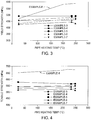
- Figures 1-4 show the variations of the mechanical properties listed in Table 3 as a function of heat treatment temperature.
- Figures 1 and 2 show examples of the steels (Examples 3-7) exhibited much improved strain aging resistance, i.e. lower YR values ( Figure 1 ) and higher uniform elongation ( Figure 2 ), than the comparative steel, Example 8. All the while, the steels (Examples 3-7) exhibited good, consistent yield strength ( Figure 3 ) and tensile strength ( Figure 4 ).
- the DP steels produced according to embodiments described did not suffer from significant strain aging in contrast to the comparative DP steel (Example 8).
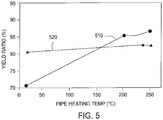
- Figure 5 shows the relationship between yield ratio (%) as a function of heat treatment temperature for steels produced according to examples described (e.g. Examples 1-7) and conventional steel (e.g. Example 8).
- Curve 510 represents Example 8 and curve 520 is Example 6.
- the steel 520 shows much improved strain aging resistance, i.e. lower yield ratios in the temperature range typical of a FBE coating process (e.g. about 200°C to about 250°C), compared to the conventional DP steel 510.
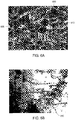
- Figure 6A is a SEM image of the steel produced in Example 8.
- Figure 6B is a TEM image of Example 8 at quarter thickness.
- the steel had been heat treated for an FBE coating simulation according to the conditions listed in Table 3.
- the steel had a first phase of ferrite 600 and a second phase of predominantly granular bainite (GB) 605 and degenerate upper bainite (DUB) 610.
- GB granular bainite
- DAB degenerate upper bainite
- the dislocations 650 in the ferrite appeared primarily straight with some kinks, indicating that these dislocations 650 are less mobile under strain.
- higher energy or greater force was needed to move or tear the dislocations 650.
- Such additional force therefore, increased the strength of the steel, but decreased ductility as shown in Table 3.
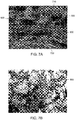
- Figure 7A shows a SEM image of an example of steel, Example 5 (Steel D with 566°C cooling finish temperature) at quarter thickness.
- Figure 7B shows a TEM image of the same steel. Again, both the SEM and TEM are images after the steel has been heated to simulate an FBE coating process according to the conditions listed in Table 3.
- Figure 7A shows the second phase of the steel was predominantly granular bainite (GB) 705, upper bainite or pearlite 710 with some lath martensite (LM) 720.
- TEM images (not shown) of the steel shown in Figure 7A actually reveal the constituent marked as 710 as more likely being pearlite.
- Figure 7B shows the dislocations 850 were tangled, curved, and/or wavy, indicating high mobility of these dislocations upon straining. In other words, less force was needed to move the C and/or N atoms from the dislocations 850. Therefore, the ductility of the steel was increased and the tensile strength was unaffected as shown in Table 3.
- Steels B, C, D, and E processed according to examples described herein each contained increased carbon and manganese content to maintain tensile strength, but were much less affected by strain aging compared to Steel A processed according to Example 8.
Landscapes
- Chemical & Material Sciences (AREA)
- Engineering & Computer Science (AREA)
- Materials Engineering (AREA)
- Mechanical Engineering (AREA)
- Metallurgy (AREA)
- Organic Chemistry (AREA)
- Physics & Mathematics (AREA)
- Thermal Sciences (AREA)
- Crystallography & Structural Chemistry (AREA)
- Heat Treatment Of Steel (AREA)
- Heat Treatment Of Articles (AREA)
Description
- The present invention relates, in general, to linepipe and more particularly to low yield ratio, dual phase steel linepipe having a superior strain aging resistance and methods for making the same.
- Natural gas is becoming an increasingly important energy source. Often the major natural gas fields in the world are far removed from major markets. As such, pipelines may have to traverse long distances over land or under water, which can cause severe strains on the pipeline. Seismically active regions and arctic regions that are subject to frost-heave and thaw settlement cycles can cause severe strains on a pipeline. Pipelines laid across sea beds also experience severe strains due to displacement or bending caused by water currents.
- Accordingly, linepipe used for these environments requires excellent strain capacity, such as excellent uniform elongation and a low yield to tensile strength ratio or yield ratio (YR) in the longitudinal direction of pipe to ensure mechanical integrity. Dual phase (DP) steel has a relatively soft phase, such as a ferrite phase and a relatively hard phase. The harder phase usually has more than one constituent. Dual phase steels (i.e. steel having a dual phase (DP) microstructure) offer high uniform elongation and low yield ratios and thus, provide superior strain capacity. For these reasons, DP steel linepipe is attractive for installation in seismically active areas or in arctic regions subject to semi-perma frost conditions or in other situations which demand high strain capacity.
- DP steel is typically processed according to a series of steps. For example, a steel slab is typically re-heated to an austenite temperature range of about 1,000°C to 1250°C, and rough rolled within a recrystallization temperature range to refine the grain size. The rough-rolled steel is then finish rolled within a non-recrystallization temperature range, and cooled to a temperature below Ar3 to form ferrite followed by accelerated cooling to a temperature of 400°C or less. The plate is then typically worked into a U shape, then an O shape, seam welded, and expanded (known as UOE pipe making process) to the desired outer diameter. Arc welding, resistance welding or laser welding or the like can be used for the seam welding step in the UOE process.
- Afterwards, the outer diameter of the pipe is typically coated to provide protection against corrosion. Fusion bonded epoxy (FBE) coating is typically used for this purpose. During the FBE coating process, the pipe is heated to an elevated temperature and coated with a polymer.
- Due to the linepipe fabrication and coating processes, most linepipe steels including DP steels are susceptible to strain aging. Strain aging leads to a degradation of strain capacity, and is a type of behavior, usually associated with yield point phenomena, in which the flow or yield strength of a metal is increased and the ductility is decreased upon heating after cold working, such as during the FBE coating process. In other words, strain aging refers to the hardening of metals with a corresponding decrease in ductility.
- Strain aging can be caused by the interaction between the stress field of dislocations and the strain field of solute atoms in the steel. The formation of solute atmospheres ("Cottrell atmospheres") around dislocations increases the resistance to dislocation movement on subsequent loading. Ductility in metals is generally proportional to the ease with which dislocations move in that metal. As a result, higher forces or stress is required to tear the dislocations away from the Cottrell atmospheres, leading to an increase of yield strength, loss of ductility and increase in ductile-to-brittle transition temperature. The net result is that strain aging reduces strain capacity. A steel or component fabricated out of that steel with higher resistance to strain aging will therefore substantially retain its strain capacity after aging following cold working.
- The aging process is thought to occur in two stages. In the first stage, solute species diffuse to the dislocations to form atmospheres. In the second stage, the solute species form precipitates on the dislocations. Those precipitates contribute to the overall strength increase of the material but lower the elongation to fracture. Often, only the first stage occurs if there is a low concentration of solute species.
- The elements typically responsible for relatively low temperature (≤300°C) strain aging in steel are carbon and nitrogen, which are interstitial solute elements in steel. Those elements have low equilibrium solubility and significantly higher diffusivities compared to that of substitutional solutes within the steel, such as chromium, vanadium, molybdenum, copper, and magnesium, just to name a few. However, carbide and nitride forming substitutional alloying elements such as chromium, vanadium, molybdenum, etc. can have an indirect effect on strain aging susceptibility by increasing the equilibrium solubility of carbon and nitrogen. As such, solute carbon and nitrogen have a tendency to migrate to dislocations in the ferrite phase forming the Cottrell atmospheres. As mentioned above, these Cottrell atmospheres tend to restrict the motion of dislocations and therefore, compromise the strain capacity of the steel.
- Similarly, it is believed that the yield strength of dual phase steel linepipe can be increased during post-formation treatments, such as the FBE coating process. As mentioned, a typical FBE coating process requires heat. The thermal exposure required by the FBE coating process provides enough energy for the solid solution carbon and/or nitrogen atoms in the linepipe to migrate to the dislocations in the ferrite phase. That migration compromises the strain capacity of the linepipe for the reasons stated above.
- There is a need, therefore, for a dual phase steel and linepipe made therefrom that have a low yield ratio, high uniform elongation and excellent work hardening properties for high strain capacity to ensure mechanical integrity in aggressive environment applications. There is also a need for new steel chemistries that will impart excellent strain aging resistance to the steel and products fabricated therefrom. Further, there is a need for a method to process dual phase steel, which provides superior strain aging resistance attributes in the linepipe and the precursor steel from which it is fabricated for excellent strain capacity, particularly after a thermal treatment process such a FBE coating process.
-
EP 1 382 703 A ,EP 1 354 973 A1 ,EP 1 035 222 A1 ,JP 11012642 A EP 0 940 476 A1 ,EP 0 924 312 A1 andJP 9291310 A - It is an object of the present invention to provide a dual phase steel and a method for preparing the same that can provide linepipe and more particularly low yield ratio, dual phase steel linepipe having a superior strain aging resistance. This object can be achieved by the features as defined in the independent claims. Further enhancements are characterized in the dependent claims.
- The invention is defined in the claims.
- In one embodiment, the present invention is directed to a steel composition and methods for making a dual phase steel therefrom. In at least one embodiment, the hot rolled dual phase steel comprises carbon in an amount of 0.05% by weight to 0.12 wt%; niobium in an amount of 0.005 wt % to 0.03 wt%; titanium in an amount of 0.005 wt% to 0.02 wt%; nitrogen in an amount of 0.001 wt% to 0.01 wt%; silicon in an amount of 0.01 wt% to 0.5 wt%; manganese in an amount of 0.5 wt% to 2.0 wt%; and a total of molybdenum, chromium, vanadium and copper less than 0.20 wt%. The steel has a first phase consisting of ferrite and a second phase comprising one or more constituents selected from the group consisting of carbide, pearlite, martensite, lower bainite, granular bainite, upper bainite, and degenerate upper bainite. A solute carbon content in the first phase is 0.01 wt% or less.
- In one exemplary embodiment, the method for making a dual phase steel plate comprises heating a steel slab to a reheating temperature from 1,000°C to 1,250°C to provide a steel slab consisting essentially of an austenite phase. The steel slab is reduced to form a plate in one or more hot rolling passes at a first temperature sufficient to recrystallize the austenite phase. The plate is reduced in one or more hot rolling passes at a second temperature wherein the austenite does not recrystallize to produce a rolled plate. The second temperature is below the first temperature. The rolled plate is then cooled to a first cooling temperature sufficient to induce austenite to ferrite transformation, and then the cluster forming atoms within the ferrite are reduced.
- In yet another embodiment, the method for making the dual phase steel comprises heating a steel slab to 1,000°C to 1,250°C to provide a steel slab consisting essentially of an austenite phase. The steel slab is reduced to form a plate in one or more hot rolling passes at a temperature sufficient to recrystallize the austenite phase to produce a fine grained austenite phase. The plate is further reduced in one or more hot rolling passes at a temperature below a temperature where austenite does not recrystallize. The plate is cooled to a first temperature sufficient to induce austenite to ferrite transformation and quenched at a rate of at least 10°C per second (18°F/sec) to a second temperature. The plate is then cooled at a rate sufficient to reduce solute carbon in the ferrite.
- The features and advantages of the present invention will be apparent to those skilled in the art from the description of the preferred embodiments which follows when taken in conjunction with the accompanying drawings.
- These drawings illustrate certain aspects of some of the embodiments of the present invention, and should not be used to limit or define the invention.
-
Figures 1-4 illustrate the variations of mechanical properties of certain illustrative steels produced. -
Figure 5 shows the relationship between yield ratio (%) as a function of heat treatment temperature for certain illustrative steels and conventional steel. -
Figure 6A is a scanning electron microscope (SEM image) of a heat treated conventional steel plate. -
Figure 6B is a transmission electron microscope (TEM) image of the heat treated conventional steel plate shown inFigure 6A . -
Figure 7A is a SEM image of a steel plate at quarter thickness. The image shows the steel having a second phase that is predominantly granular bainite (GB), upper bainite (UB) or pearlite with some lath martensite (LM). -
Figure 7B is a TEM image at quarter thickness of the steel plate shown inFigure 7A . The image shows the steel having tangled or wavy dislocations that indicate little or no carbon and/or nitrogen supersaturation. - The present invention relates, in general, to linepipe and more particularly to low yield ratio, dual phase steel linepipe having a superior strain aging resistance and methods for making the same.
- A high strength, dual phase (DP) steel with a low yield-to-tensile ratio, high uniform elongation, and high work hardening coefficient and methods for making the same are provided. Such steel can be post-treated without adversely affecting its strain capacity. The steel is suitable for linepipe, offshore structures, oil and gas production facilities, and pressure vessels, among many other uses commonly known for steel.
- In one or more embodiments, the steel includes iron and a balance of alloying elements that reduces the degree of supersaturation of carbon and nitrogen in the ferritic phases of the steel, thereby providing resistance to strain aging. The solute carbon content in the ferritic phase is less than 0.01 wt%, more preferably less than 0.005 wt%. In one or more embodiments, the solute carbon content is between 0.005 wt% and 0.01 wt%. In one or more embodiments, the solute carbon content is 0.006 wt%, 0.007 wt%, 0.008 wt%, or 0.009 wt%. The solute nitrogen content in the ferritic phase is less than 0.01 wt%, more preferably less than 0.005 wt%. In one or more embodiments, the solute nitrogen content is between 0.005 wt% and 0.01 wt%. In one or more embodiments, the solute nitrogen content is 0.006 wt%, 0.007 wt%, 0.008 wt%, or 0.009 wt%.
- The steel is formulated to have a tensile strength in pipe before and after heating for a treatment process, such as a anti-corrosion coating treatment process, that exceeds 500 MPa, more preferably 520 MPa or more. The steel is also formulated to have a minimum yield strength of at least 400MPa, more preferably a minimum yield strength of 415 MPa. The steel is also formulated to provide a precursor steel and linepipe fabricated therefrom, both before and after heating for a treatment process, having a yield to tensile strength (YTS) ratio or yield ratio (YR) of 0.90 or less, preferably 0.85 or less, even more preferably 0.8 or less. In one or more embodiments, the YR is 0.89 or 0.88 or 0.87 or 0.86 or 0.85. The steel is also formulated to have a minimum uniform elongation exceeding 8%, preferably more than 10% in the precursor steel and linepipe fabricated therefrom, both before and after heating for a treatment process. Further, the steel is formulated to have a high toughness such as more than 120 J in Charpy-V-Notch test at -12°C, preferably exceeding 200 J in Charpy-V-Notch test at -12°C, even more preferably exceeding 250 J in Charpy-V-Notch test at -12°C.
- Preferred alloying elements and preferred ranges are described in further detail below. For example, the steel preferably has a carbon content less than 0.12 wt%, more preferably less than 0.10 wt% and most preferably less than 0.08 wt%. In one or more embodiments, the carbon content ranges from a low of 0.05 wt%, 0.06 wt%, 0.07 wt% to a high of about 0.10 wt%, 0.11 wt%, 0.12 wt%. The steel has a carbon content of from 0.05 wt% to 0.12 wt%.
- The steel includes silicon (Si). Silicon can be added for de-oxidation purposes. Silicon is also a strong matrix strengthener, but it has a strong detrimental effect on both base steel and HAZ toughness. Therefore, an upper limit of 0.5 wt% is preferred for silicon. Silicon increases the driving force for carbon migration into the untransformed austenite during the cool down (quenching) of the steel plate from high temperature and in this sense reduces the interstitial content of ferrite and improves its flow and ductility. This beneficial effect of silicon should be balanced with its intrinsic effect on degrading the toughness of the steel. Due to these balancing forces, an optimum silicon addition in the alloys of this invention is between 0.01 wt% to 0.5 wt%.
- The steel includes manganese (Mn). Manganese can be a matrix strengthener in steels and more importantly, can contribute to hardenability. Manganese is an inexpensive alloying addition to prevent excessive ferrite formation in thick section plates especially at mid-thickness locations of these plates which can lead to a reduction in plate strength. Manganese, through its strong effect in delaying ferrite, pearlite, granular bainite and upper bainite transformation products of austenite during its cooling, provides processing flexibility for producing the alternate strong second phases in the microstructure such as lath martensite, lower bainite and degenerate upper bainite. However, too much manganese is harmful to steel plate toughness, so an upper limit of 2.0 wt% manganese is preferred. This upper limit is also preferred to substantially minimize centerline segregation that tends to occur in high manganese and continuously cast steel slabs and the attendant poor microstructure and toughness properties in the center of the plate produced from the slab. The steel has a Mn content of from 0.5 wt% to 2.0 wt%.
- Preferably, residuals are minimized. Sulfur (S) content is less than 0.01 wt%. Phosphorus (P) content is less than 0.015 wt%. More preferably, the P content is less than 0.01 wt%. In one or more embodiments, the P content ranges from 0.0001 wt % to 0.009 wt%, if present.
- The steel includes niobium (Nb). Niobium can be added to promote grain refinement during hot rolling of the steel slab into plate which in turn improves both the strength and toughness of the steel plate. Niobium carbide precipitation during hot rolling serves to retard recrystallization and to inhibit grain growth, thereby providing a means of austenite grain refinement. For these reasons, at least 0.005 wt% niobium is preferred. Niobium is also a strong hardenability enhancer and provides precipitation strengthening in the HAZ through formation of niobium carbides or carbonitrides. These effects of niobium addition to steel are useful to minimize HAZ softening, particularly next to the fusion line, in high strength steel weldments. For this reason a minimum of 0.01 wt% niobium is more preferred in steel plates subjected to welding during fabrication into useful objects such as linepipe. However, higher niobium can lead to excessive precipitation strengthening and consequently, degrade toughness in both the base steel and especially in the HAZ. For these reasons, the Nb upper limit is 0.03 wt%. More preferably, the upper limit is 0.02 wt%.
- The steel includes titanium (Ti). Titanium is effective in forming fine titanium nitride (TiN) precipitates which refine the grain size in both the rolled structure and the HAZ of the steel. Thus, the toughness of the steel and HAZ are improved. A minimum of 0.005 wt% titanium is preferred for this purpose. Titanium is added to the steel in such an amount that the weight ratio of Ti/N is preferably about 3.4. Excessive titanium additions to the steel tend to deteriorate the toughness of the steel by forming coarse TiN particles or titanium carbide particles. Thus, the upper limit for titanium is 0.02 wt%.
- The steel can include aluminum (Al). Aluminum can be added primarily for deoxidation of the steel. At least 0.01 wt% aluminum is preferred for this purpose. Small amounts of aluminum in the steel are also beneficial for HAZ properties by tying up free nitrogen that comes about from dissolution of nitride and carbonitride particles in the coarse grain HAZ due to the intense thermal cycles of the welding process. However, aluminum is similar to silicon in reducing the deformation and toughness properties of the matrix. In addition, higher aluminum additions lead to excessive, coarse aluminum-oxide inclusions in the steel which degrade toughness. Hence, an upper limit of 0.1 wt% is preferred for aluminum additions to the steel.
- The steel includes nitrogen (N). Nitrogen can inhibit coarsening of austenite grains during slab reheating and in the HAZ by forming TiN precipitates and thereby enhancing the low temperature toughness of base metal and HAZ. For this effect a minimum of 0.0015 wt% nitrogen is preferred. However, too much nitrogen addition can lead to excessive free nitrogen in the HAZ and degrade HAZ toughness. Excessive free nitrogen can also increase the propensity for strain aging in the linepipe. For this reason, the upper limit for nitrogen is 0.01 wt%, more preferably 0.005 wt% The nitrogen content is 0.001 wt% to 0.01 wt%.
- In one or more embodiments above or elsewhere herein, the steel has a nitrogen content less than 0.01 wt%, more preferably less than 0.0075 wt% and most preferably less 0.005 wt%. Preferably, the nitrogen content ranges from a low of about 0.0025 wt%, 0.0035 wt%, or 0.0045 wt% to a high of 0.0050 wt%, 0.0075 wt%, or 0.01 wt%. More preferably, the steel has a nitrogen content of from 0.0025 wt% to 0.0095 wt%.
- In one or more embodiments above or elsewhere herein, the steel can include nickel (Ni). Nickel can enhance the toughness of the base steel as well as the HAZ. A minimum of 0.1 wt% nickel and more preferably, a minimum of 0.3 wt% nickel is preferred to produce significant beneficial effect on the HAZ and base steel toughness. Although not to the same degree as manganese and molybdenum additions, nickel addition to the steel promotes hardenability and, therefore, through thickness uniformity in microstructure and properties in thick sections (20 mm and higher). However, excessive nickel additions can impair field weldability (causing cold cracking), can reduce HAZ toughness by promoting hard microstructures, and can increase the cost of the steel. The steel has a nickel content of 1 wt% or less.
- In one or more embodiments above or elsewhere herein, the steel has reduced amounts of or essentially no substitutional alloying elements such as chromium, molybdenum, vanadium, and copper, for example. Such elements lower the carbon and nitrogen activity in the ferritic phase of the steel or result in excessive precipitation hardening, which increase the propensity for strain aging. The combined content of molybdenum, chromium, vanadium and copper is 0.20 wt% or less, 0.15 wt% or less, 0.12 wt% or less, 0.10 wt% or less.
- In one or more embodiments above or elsewhere herein, the steel can include boron (B). Boron can greatly increase the hardenability of steel very inexpensively and promote the formation of steel microstructures of lower bainite, lath martensite even in thick sections (>16 mm). Boron allows the design of steels with overall low alloying and Pcm (welding hydrogen cracking susceptibility parameter based on composition) and thereby improve HAZ softening resistance and weldability. Boron in excess of 0.002 wt% can promote the formation of embrittling particles of Fe23(C,B)6. Therefore, when Boron is added, its upper limit is 0.002 wt%. Boron also augments the hardenability effect of molybdenum and niobium.
- In one or more embodiments above or elsewhere herein, the steel can include chromium (Cr). Chromium can have a strong effect on increasing the hardenability of the steel upon direct quenching. Thus, chromium is a cheaper alloying addition than molybdenum for improving hardenability, especially in steels without added boron. Chromium improves the corrosion resistance and hydrogen induced cracking resistance (HIC). Similar to molybdenum, excessive chromium tends to cause cold cracking in weldments, and tends to deteriorate the toughness of the steel and its HAZ. Chromium lowers carbon activity in ferrite and can thereby lead to an increase in the amount of carbon in solid solution, which can increase the steel's propensity for strain aging. So when chromium is added a maximum of 0.2 wt% is preferred and a maximum of 0.1 wt% is even more preferred.
- In one or more embodiments above or elsewhere herein, the steel can include REM (rare earth metals). Calcium and REM suppress the generation of elongated MnS by forming sulfide and improve the properties of the steel plate (e.g. lamellar tear property). However, the addition of Ca and REM exceeding 0.01% deteriorates steel cleanliness and field weldability by forming CaO-CaS or REM-CaS. Therefore, no more than 0.02 wt% of REM is added.
- In one or more embodiments above or elsewhere herein, the steel can include magnesium (Mg). Magnesium generally forms finely dispersed oxide particles, which can suppress coarsening of the grains and/or promote the formation of intra-granular ferrite in the HAZ and, thereby, improve HAZ toughness. At least about 0.0001 wt% Mg is desirable for the addition of Mg to be effective. However, if the Mg content exceeds 0.006 wt%, coarse oxides are formed and the toughness of the HAZ is deteriorated. Accordingly, the Mg content is less than 0.006 wt%.
- In one or more embodiments above or elsewhere herein, the steel can include copper (Cu). Copper can contribute to strengthening of the steel via increasing the hardenability and through potent precipitation strengthening via ε-copper precipitates. At higher amounts, copper induces excessive precipitation hardening and if not properly controlled, can lower the toughness in the base steel plate as well as in the HAZ. Higher copper can also cause embrittlement during slab casting and hot rolling, requiring co-additions of nickel for mitigation. When copper is added in the present steels, its upper limit is 0.2 wt% and an upper limit of 0.1 wt% is even more preferred.
- In one or more embodiments above or elsewhere herein, the steel can include vanadium (V). Vanadium has substantially similar, but not as strong of an effect as niobium. However, the addition of vanadium produces a remarkable effect when added in combination with niobium. The combined effect of vanadium and niobium greatly minimizes HAZ softening during high heat input welding such as seam welding in linepipe manufacture. Like niobium, excessive vanadium can degrade toughness of both the base steel as well as the HAZ through excessive precipitation hardening. Furthermore, vanadium like chromium and molybdenum has a strong affinity for carbon and nitrogen. In other words, vanadium can lower carbon activity in ferrite, causing an increase in the amount of carbon and nitrogen in solid solution, which can increase the steel's propensity for strain aging. Thus, vanadium when added to the steel is preferably less than about 0.1 wt% or even more preferably less than about 0.05 wt% or even more preferably less than about 0.03 wt%.
- In one or more embodiments above or elsewhere herein, the steel can include zirconium (Zr), hafnium (Hf) and/or tantalum (Ta). Zirconium (Zr), hafnium (Hf) and tantalum (Ta) are like niobium (Nb), elements that form carbides and nitrides and are effective in enhancing strength. However, the effect cannot be realized with an addition less than 0.0001 wt%. Yet, the toughness of steel plates deteriorates with more than 0.05 wt%. Therefore, the Ta content is less than 0.03 wt%, and the Zr content is less than 0.03 wt% and the Hf content is less than 0.03 wt%.
- The steel has a Pcm of less than 0.220, but more than 0.150. Pcm refers to a method of measuring the hardenablility and the weldability of steels based on the chemical composition. Higher concentrations of carbon and other alloying elements (e.g. Mn, Cr, Si, Mo, V, Cu, Ni) tend to increase the hardness and decrease the weldability of the steel. Since each of these materials tends to influence the hardness and weldability of the steel to different magnitudes, Pcm is a way to judge the difference in hardness/weldability between alloys made of different alloying elements. A commonly used formula for calculating the Pcm is:

- In one or more embodiments, the steel has a dual phase microstructure that includes from 10 percent by volume to 90 percent by volume of a softer, ferrite phase or constituent ("first phase") and from 10 percent by volume to 90 percent by volume of a stronger phase or constituent ("second phase"). The second phase comprises one or more constituents that are not ferrite and are selected from the group consisting of martensite, lower bainite, degenerate upper bainite, upper bainite, granular bainite, pearlite, carbides such as cementite and mixtures thereof.
- Ar1 transformation temperature refers to the temperature at which transformation of austenite to ferrite or to ferrite plus cementite is completed during cooling.
- Ar3 transformation temperature refers to the temperature at which austenite begins to transform to ferrite during cooling.
- Cooling rate refers to the rate of cooling at the center, or substantially at the center, of the plate thickness.
- Dual phase means at least two distinguishable phases or at least two distinguishable constituents.
- Granular Bainite (GB) refers to a cluster of 3 to 5 relatively equiaxed bainitic ferrite grains that surround a centrally located, small "island" of Martensite-Austenite (MA). Typical "grain" diameters are about 1-2 µm.
- Upper Bainite (UB) refers to a mixture of acicular or laths of bainitic ferrite interspersed with stringers or films of carbide phase such as cementite.
- Degenerate Upper Bainite (DUB) is a bainitic product where each colony grows by shear stress into a set (packet) of parallel laths. During and immediately after lath growth, some carbon is rejected into the interlath austenite. Due to the relatively low carbon content, carbon enrichment of the entrapped austenite is not sufficient to trigger cementite plate nucleation. Such nucleation does occur in medium and higher carbon steels resulting in the formation of classical upper bainite (UB). The lower carbon enrichment at the interlath austenite in DUB, on the other hand, results in formation of martensite or martensite-austenite (MA) mixture or be retained as retained austenite (RA).
- DUB can be confused with classical upper bainite (UB). UB of the type first identified in medium carbon steels decades ago consists of two key features; (1) sets of parallel laths that grow in packets, and (2) cementite films at the lath boundaries. UB is similar to DUB in that both contain packets of parallel laths; however, the key difference is in the interlath material. When the carbon content is about 0.15-0.40, cementite (Fe3C) can form between the laths. These "films" can be relatively continuous as compared to the intermittent MA in DUB. For low carbon steels, interlath cementite does not form; rather the remaining austenite terminates as MA, martensite or RA.
- Lower Bainite (LB) has packets of parallel laths. LB also includes small, intra-lath carbide precipitates. These plate-like particles consistently precipitate on a single crystallographic variant that is oriented at approximately 55° from the primary lath growth direction (long dimension of the lath).
- Lath Martensite (LM) appears as packets of thin parallel laths. Lath width is typically less than about 0.5 µm. Untempered colonies of martensitic laths are characterized as carbide free, whereas auto-tempered LM displays intra-lath carbide precipitates. The intralath carbides in autotempered LM form on more than one crystallographic variant, such as on {110} planes of martensite. Often in the Transmission Electron Microscopy (TEM) of an autotempered LM, the cementite is not aligned along one direction, rather it precipitates on multiple planes.
- Pearlite is typically a lamellar mixture of two-phases, made up of alternate layers of ferrite and cementite (Fe3C).
- Grain is an individual crystal in a polycrystalline material.
- Grain boundary refers to a narrow zone in a metal corresponding to the transition from one crystallographic orientation to another, thus separating one grain from another.
- Prior austenite grain size refers to an average austenite grain size in a hot-rolled steel plate prior to rolling in the temperature range in which austenite does not recrystallize.
- Quenching refers to accelerated cooling by any means whereby a fluid selected for its tendency to increase the cooling rate of the steel is utilized, as opposed to air cooling.
- Accelerated cooling finish temperature (ACFT) is the highest, or substantially the highest, temperature reached at the surface of the plate, after quenching is stopped, because of heat transmitted from the mid-thickness of the plate.
- A slab is a piece of steel having any dimensions.
- Tnr temperature is the temperature below which austenite does not recrystallize. Transverse direction refers to a direction that is in the plane of rolling but perpendicular to the plate rolling direction.
- In one or more embodiments, the steel composition is processed in a manner to reduce the amount of C and/or N supersaturation in the ferrite phase of the dual phase steel resulting therefrom. Preferably, the steel is processed at conditions sufficient to allow C and N to diffuse out of ferrite and/or precipitate out during plate processing. The diffusion and precipitation can be accomplished through high accelerated cooling finish temperatures while retaining all the desired microstructure features (e.g. the amount of softer ferrite phase, the effective prior austenite grain size, etc.) of the dual phase microstructure design. In one or more embodiments, the volume percent of ferrite in the steel is of from 10 vol% to 90 vol%, more preferably of from 30 vol% to 80 vol%. Preferably, the ferrite is uniformly dispersed throughout the steel.
- The steel composition is preferably processed into dual phase plates using a two step rolling process. In one or more embodiments, a steel billet/slab from the compositions described is first formed in normal fashion such as through a continuous casting process. The billet/slab can then be re-heated to a temperature ("reheat temperature") within the range of 1,000°C to 1,250°C. Preferably, the reheat temperature is sufficient to (i) substantially homogenize the steel slab, (ii) dissolve substantially all the carbide and carbonitrides of niobium and vanadium, when present, in the steel slab, and (iii) establish fine initial austenite grains in the steel slab. The re-heated slab is then hot rolled in one or more passes in a first reduction providing 30% to 90% reduction at a first temperature range where austenite recrystallizes. Next, the reduced billet is hot rolled in one or more passes in a second rolling reduction providing 40-80% reduction at a second and somewhat lower temperature range wherein austenite does not recrystallize but above the Ar3 transformation point. Preferably, the cumulative rolling reduction below the Tnr temperature is at least 50%, more preferably at least 70%, even more preferably at least 75%.
- The second rolling reduction is completed at "finish rolling temperature". In one or more embodiments, the finish rolling temperature is above 700°C, preferably above 720°C, more preferably above 770°C. In one or more embodiments, the finish rolling temperature ranges from about 700 to 800°C. Thereafter, the hot rolled plate is cooled in air to a first cooling temperature or accelerated cooling start temperature ("ACST") that is sufficient to induce austenite to ferrite transformation followed by an accelerated cool at a rate of at least 10°C per second to a second cooling temperature or accelerated cooling finish temperature ("ACFT"). After the ACFT, the steel plate can be cooled to room temperature (i.e. ambient temperature) in ambient air. Preferably, the steel plate is allowed to cool on its own to room temperature.
- In one or more embodiments, the ACFT can range from 400°C to 700°C. In one or more embodiments, the ACFT can range from 450°C to 650°C. Preferably, the ACFT ranges from a low of about 400°C, 450°C, or 500°C to a high of about 550°C, 600°C, or 650°C. For example, the ACFT can be 505°C, 510°C, 515°C, 520°C, 525°C, 530°C, 535°C, 540°C, 545°C, 550°C, or 575°C. In one or more embodiments, the ACFT can range from 540°C to 60°C.
- Not wishing to be bound by theory, it is believed that the high accelerated cooling finish temperature ("ACFT") allows at least a portion of the carbon and nitrogen atoms to diffuse from the ferrite phase of the steel composition to the second phase. It is further believed that the high accelerated cooling finish temperature ("ACFT") allows at least a portion of the carbon and nitrogen atoms to precipitate out of the ferrite phase as carbides, carbonitrides, and/or nitrides during subsequent cooling to the ambient from the ACFT. As such, the amount of free C and N in the interstices of the ferrite phase is reduced, reducing the amount of C and N available to migrate to dislocations in the ferrite. Therefore, the steel's propensity to strain age is reduced, if not eliminated.
- Following the rolling and cooling steps, the plate can be formed into pipe (e.g. linepipe). Any method for forming pipe can be used. Preferably, the precursor steel plate is fabricated into linepipe by a conventional UOE process which is well known in the art.
- Following the formation of the pipe, the pipe can then undergo a coating/painting step to prevent corrosion and/or mechanical damage. The coating process can include one or more polymer coatings applied to at least the outer diameter or surface of the pipe. The coating can also be applied to both the inner and outer surfaces of the pipe. Illustrative coatings include but are not limited to fusion bonded epoxy (FBE), polypropylene, polyethylene, and polyurethane. Preferably, fusion bonded epoxy (FBE) is applied. FBE is a thermoset polymer that can be sprayed onto the pipe using known techniques and heat cured. Preferably, at least one layer of FBE is applied or sprayed onto the pipe. In one or more embodiments, each layer of coating has a thickness between about 2 microns and 75 mm. In one embodiment, the pipe can be heated and rotated during the application of a spray powder. In another embodiment, the pipe can be heated and submerged in a fluidized bed containing the polymer. Preferably, the pipe is heated to a temperature between 180°C and 300°C. One or more other coatings can then be applied to at least a portion of the pipe over the FBE layer.
- As mentioned above, a post treatment step, such as a FBE application process, facilitates the diffusion of the supersaturated carbon and nitrogen atoms, leading to the formation of solute atmospheres around dislocations in the steel. The formation of these solute atmospheres ("Cottrell atmospheres") increases the strength of the steel but decreases ductility since more strain or force is required to break the atmospheres away from the dislocations. As a result, the steel becomes less ductile and can be unsuitable for use in regions requiring high strain capacity.
- Steel plates made according the embodiments described retain all the desired microstructure features of a dual phase microstructure design but minimize the carbon supersaturation in the ferrite phase. Such DP steel can be readily implemented in applications where both high strength and high strain capacity are required. For example, the steel is particularly useful as a precursor for making linepipe or pressure vessels. The steel can also be used for offshore structures including risers, oil and gas production facilities, chemicals production facilities, ship building, automotive manufacturing, airplane manufacturing, and power generation.
- To facilitate a better understanding of the present invention, the following examples of certain aspects of some examples are given. In no way should the following examples be read to limit, or define, the scope of the invention.
- The foregoing discussion can be further described with reference to the following certain illustrative non-limiting examples.
- Four steel precursors (Steels A, B, C, D, and E) were prepared from heats having the chemical compositions shown in Table 1. Each precursor was prepared by vacuum induction, melting 150 kg heats and casting into slabs or by using a 250 ton industrial basic oxygen furnace and continuously casting into steel slabs. Steel plates (Examples 1-8) were prepared from these steel precursors (Steels A, B, C, D, and E) according to the process conditions summarized in Table 2. Example 8 represents a comparative or conventional DP steel.
Table 1: Steel Compositions (wt. %) Steel C Mn P* S* Si Cu Ni Cr Mo Nb V Ti* T.Al* B* CE Pcm A 0.050 1.48 60 10 0.15 0.25 0.40 0.03 0.10 0.010 - 120 300 - 0.39 0.157 B 0.070 1.60 70 10 0.29 0.01 0.01 0.03 0.19 0.030 0.020 130 300 - 0.43 0.177 C 0.068 1.47 90 20 0.09 - 0.30 - 0.11 0.011 - 120 220 - 0.38 0.161 D 0.078 1.59 120 20 0.13 - 0.30 - - 0.011 - 130 220 - 0.39 0.169 E 0.070 1.72 100 20 0.10 0.01 0.32 0.03 - 0.010 - 100 240 1 0.39 0.170 * ppm 

Table 2: Processing conditions for steel plates Example Steel Composition Reheat Temp. (°C) Finish Rolling Temp. (°C) Cooling Start Temp. (°C) Cooling Finish Temp. (°C) 1 Steel A 1070 711 681 556 2 Steel B 1080 763 723 548 3 Steel C 1150 730 688 558 4 Steel D 1150 716 684 528 5 Steel D 1150 730 691 566 6 Steel D 1150 725 687 588 7 Steel E 1060 716 682 536 8 Steel A 1070 719 680 338 - After processing the steel into precursor plates, the steel plates were formed into linepipe. Heat-treatment on the formed pipe was carried out for 5 to 8 minutes at 200°C to 250°C to simulate the FBE coating process as listed in Table 3. The term "As-UOE" as used in Table 3 refers to the linepipe at room temperature, i.e. without the heat treatment. Mechanical properties of the pipes for longitudinal direction were measured and are also reported in Table 3.
Table 3: Mechanical properties of the pipe Example Heat Treatment Temp. (°C) Yield Strength (MPa) Tensile Strength (MPa) Yield Ratio (%) Uniform elongation (%) 1 As-UOE 447 513 87.0 11.3 220 457 521 87.7 10.3 250 468 521 89.8 10.2 2 As-UOE 435 564 77.1 12.1 220 476 578 82.4 10.5 250 498 589 84.6 9.9 3 As-UOE 452 530 85.3 12.8 235 480 537 89.4 10.3 250 490 536 91.3 11.4 4 As-UOE 486 577 84.2 11.5 235 489 566 86.4 9.2 250 491 564 87.0 10.5 5 As-UOE 451 540 83.5 12.1 235 453 545 83.1 11.4 250 473 547 86.5 11.6 6 As-UOE 426 519 82.1 14.6 235 443 526 84.2 12.5 250 441 520 84.8 13.2 7 As-UOE 437 537 81.4 12.5 250 472 553 85.4 11.9 8 As-UOE 478 656 72.9 10.7 200 586 673 87.0 10.1 250 597 677 87.3 8.9 -
Figures 1-4 show the variations of the mechanical properties listed in Table 3 as a function of heat treatment temperature. In particular,Figures 1 and 2 show examples of the steels (Examples 3-7) exhibited much improved strain aging resistance, i.e. lower YR values (Figure 1 ) and higher uniform elongation (Figure 2 ), than the comparative steel, Example 8. All the while, the steels (Examples 3-7) exhibited good, consistent yield strength (Figure 3 ) and tensile strength (Figure 4 ). As such, the DP steels produced according to embodiments described did not suffer from significant strain aging in contrast to the comparative DP steel (Example 8). -
Figure 5 shows the relationship between yield ratio (%) as a function of heat treatment temperature for steels produced according to examples described (e.g. Examples 1-7) and conventional steel (e.g. Example 8).Curve 510 represents Example 8 andcurve 520 is Example 6. As shown inFigure 5 , thesteel 520 shows much improved strain aging resistance, i.e. lower yield ratios in the temperature range typical of a FBE coating process (e.g. about 200°C to about 250°C), compared to theconventional DP steel 510. -
Figure 6A , for example, is a SEM image of the steel produced in Example 8.Figure 6B is a TEM image of Example 8 at quarter thickness. In bothFigures 6A and 6B , the steel had been heat treated for an FBE coating simulation according to the conditions listed in Table 3. The steel had a first phase offerrite 600 and a second phase of predominantly granular bainite (GB) 605 and degenerate upper bainite (DUB) 610. Referring toFigure 6B , thedislocations 650 in the ferrite appeared primarily straight with some kinks, indicating that thesedislocations 650 are less mobile under strain. As such, higher energy or greater force was needed to move or tear thedislocations 650. Such additional force, therefore, increased the strength of the steel, but decreased ductility as shown in Table 3. -
Figure 7A shows a SEM image of an example of steel, Example 5 (Steel D with 566°C cooling finish temperature) at quarter thickness.Figure 7B shows a TEM image of the same steel. Again, both the SEM and TEM are images after the steel has been heated to simulate an FBE coating process according to the conditions listed in Table 3.Figure 7A shows the second phase of the steel was predominantly granular bainite (GB) 705, upper bainite orpearlite 710 with some lath martensite (LM) 720. TEM images (not shown) of the steel shown inFigure 7A actually reveal the constituent marked as 710 as more likely being pearlite.Figure 7B shows thedislocations 850 were tangled, curved, and/or wavy, indicating high mobility of these dislocations upon straining. In other words, less force was needed to move the C and/or N atoms from thedislocations 850. Therefore, the ductility of the steel was increased and the tensile strength was unaffected as shown in Table 3. - As shown in
Figures 1-7 and Table 3, Steels B, C, D, and E processed according to examples described herein each contained increased carbon and manganese content to maintain tensile strength, but were much less affected by strain aging compared to Steel A processed according to Example 8. One would have expected that the increased carbon content in Steels B, C, D, and E would have negatively affected strain aging. Surprisingly, the opposite was found true. Furthermore, one would have expected that the combination of increased carbon and manganese contents of Steels B, D, and E would have negatively affected strain aging even more than just the increased carbon content alone. Surprisingly, the opposite was found true. Therefore, it is believed that the absence of carbon-cluster forming alloys and/or a cooling finish temperature above 528°C surprisingly provided dual phase steel pipes having good tensile and yield strengths in addition to a high resistance to strain aging. - Certain examples and features have been described using a set of numerical upper limits and a set of numerical lower limits. It should be appreciated that ranges from any lower limit to any upper limit are contemplated unless otherwise indicated. Certain lower limits, upper limits and ranges appear in one or more claims below. All numerical values are "about" or "approximately" the indicated value, and take into account experimental error and variations that would be expected by a person having ordinary skill in the art.
- Therefore, the present invention is well-adapted to carry out the objects and attain the ends and advantages mentioned as well as those which are inherent therein. While the invention has been depicted and described by reference to examples, such a reference does not imply a limitation on the invention, and no such limitation is to be inferred.
Claims (4)
- A hot rolled dual phase steel for a line pipe, consisting of:carbon in an amount of 0.05% by weight to 0.12 wt%;niobium in an amount of 0.005 wt% to 0.03 wt%;titanium in an amount of 0.005 wt% to 0.02 wt%;nitrogen in an amount of 0.001 wt% to 0.01 wt%;manganese in an amount of 0.5 wt% to 2.0 wt%;silicon in an amount of 0.01 wt% to 0.5 wt%;aluminium in an amount of up to 0.1 wt%;nickel in an amount of up to 1 wt%;optionally, boron in an amount of up to 0.002 wt%;optionally, calcium in an amount of up to 0.01 wt%;optionally, rare-earth metals (REM) in an amount of up to 0.02 wt%;optionally, magnesium in an amount of up to 0.006 wt%;optionally, copper in an amount of up to 0.2 wt%;optionally, zirconium in an amount of less than 0.03 wt%;optionally hafnium in an amount of less than 0.03 wt%;optionally tantalum in an amount of less than 0.03 wt%;phosphorus in an amount of less than 0.015 wt%;sulphur in an amount of less than 0.01 wt%a total of molybdenum, chromium, vanadium and copper is 0.20 wt% or less;and the balance iron and inevitable impurities;wherein Pcm, calculated in accordance with the formula
 and wherein the steel has tensile strength that exceeds 500 MPa, and/or a minimum yield strength of at least 400 MPa and/or a minimum uniform elongation that exceeds 8%, and/or a yield ratio of 0.90 or less, and/or a toughness of more than 120 J in Charpy-V-Notch test at -12°C;a microstructure consisting of ferrite as a first phase, and;10% by volume - 90% by volume of a second phase comprising one or more constituents selected from the group consisting of carbide, pearlite, martensite, lower bainite, granular bainite, upper bainite, and degenerate upper bainite;a solute carbon content in the first phase being 0.01 wt% or less, anda solute nitrogen content in the ferrite phase being less than 0.01 wt%.
 - A method for preparing a dual phase steel plate, comprising:heating a steel slab having a composition according to Claim 1 to a reheating temperature from 1,000°C to 1,250°C;reducing the steel slab to form a plate in at least one hot rolling pass providing 30% to 90% reduction at a first temperature;reducing the plate in at least one hot rolling pass providing 40-80% reduction at a second temperature above the Ar3 transformation point;air cooling the plate to a first cooling temperature sufficient to transform an austenite to a ferrite;reducing cluster forming atoms within the ferrite by quenching the cooled plate at a rate of at least 10°C per second to a second cooling temperature, the second cooling temperature being from 400°C to 700°C, preferably from 450°C to 650°C, preferably from 500°C to 600°C, preferably 560°C; andcooling the steel plate to ambient temperature after quenching the cooled plate to the second cooling temperature;wherein the heating of the steel slab at the reheating temperature provides a steel slab consisting essentially of an austenite phase;wherein the first temperature is sufficient to recystallize the austenite phase;wherein the austenite phase does not recrystallize at the second temperature;wherein the second temperature is below the first temperature; andwherein the first cooling temperature is from 650°C to 750°C, preferably from 660°C to 750°C, preferably from 670°C to 740°C, preferably 730°C.
- The method of Claim 2, wherein the cluster forming atoms comprise carbon and/or nitrogen.
- The method according to Claim 2 or Claim 3, further comprising forming the cooled plate into a line pipe using an UOE technique, preferably further comprising applying a coating for corrosion resistance to at least a portion of the line pipe, preferably wherein the coating comprises at least one fusion bonded epoxy compound.
Applications Claiming Priority (2)
| Application Number | Priority Date | Filing Date | Title |
|---|---|---|---|
| US85021606P | 2006-10-06 | 2006-10-06 | |
| PCT/US2007/077202 WO2008045631A2 (en) | 2006-10-06 | 2007-08-30 | Low yield ratio dual phase steel linepipe with superior strain aging resistance |
Publications (3)
| Publication Number | Publication Date |
|---|---|
| EP2089556A2 EP2089556A2 (en) | 2009-08-19 |
| EP2089556A4 EP2089556A4 (en) | 2011-10-05 |
| EP2089556B1 true EP2089556B1 (en) | 2019-05-01 |
Family
ID=38137302
Family Applications (1)
| Application Number | Title | Priority Date | Filing Date |
|---|---|---|---|
| EP07841597.3A Active EP2089556B1 (en) | 2006-10-06 | 2007-08-30 | Low yield ratio dual phase steel linepipe with superior strain aging resistance |
Country Status (5)
| Country | Link |
|---|---|
| EP (1) | EP2089556B1 (en) |
| JP (2) | JP5745222B2 (en) |
| KR (1) | KR20090078807A (en) |
| CN (1) | CN101611163B (en) |
| WO (1) | WO2008045631A2 (en) |
Families Citing this family (21)
| Publication number | Priority date | Publication date | Assignee | Title |
|---|---|---|---|---|
| US20090301613A1 (en) | 2007-08-30 | 2009-12-10 | Jayoung Koo | Low Yield Ratio Dual Phase Steel Linepipe with Superior Strain Aging Resistance |
| US7874471B2 (en) | 2008-12-23 | 2011-01-25 | Exxonmobil Research And Engineering Company | Butt weld and method of making using fusion and friction stir welding |
| CN102421538B (en) * | 2009-05-14 | 2013-11-20 | 贝卡尔特公司 | Martensitic wire with thin polymer coating |
| JP2011195856A (en) * | 2010-03-18 | 2011-10-06 | Sumitomo Metal Ind Ltd | Steel for line pipe and method for producing the same |
| WO2012127125A1 (en) | 2011-03-24 | 2012-09-27 | Arcelormittal Investigatión Y Desarrollo Sl | Hot-rolled steel sheet and associated production method |
| CN102828117A (en) * | 2012-09-03 | 2012-12-19 | 南京钢铁股份有限公司 | Low-yield ratio high-intensity hot-rolled double-phase steel plate and production method thereof |
| AT512792B1 (en) * | 2012-09-11 | 2013-11-15 | Voestalpine Schienen Gmbh | Process for the production of bainitic rail steels |
| US20140261918A1 (en) * | 2013-03-15 | 2014-09-18 | Exxonmobil Research And Engineering Company | Enhanced wear resistant steel and methods of making the same |
| MX359834B (en) | 2013-10-01 | 2018-10-12 | Hendrickson Usa Llc | Leaf spring and method of manufacture thereof having sections with different levels of through hardness. |
| CN104726787A (en) * | 2013-12-23 | 2015-06-24 | 鞍钢股份有限公司 | High-strength pressure vessel thick plate with good low-temperature toughness and production method |
| CN104342600B (en) * | 2014-10-28 | 2017-01-11 | 武汉钢铁(集团)公司 | Medium-thickness steel plate for non-normalized bridge and preparation method thereof |
| CN104789863B (en) * | 2015-03-20 | 2017-01-18 | 宝山钢铁股份有限公司 | X80 pipeline steel with good anti-strain aging property, pipeline pipe and manufacturing method of pipeline pipe |
| CN105695863B (en) * | 2016-02-04 | 2017-11-17 | 首钢总公司 | A kind of natural gas transmission pipeline hot-rolled coil and its manufacture method |
| JP6213703B1 (en) * | 2016-03-22 | 2017-10-18 | 新日鐵住金株式会社 | ERW steel pipe for line pipe |
| KR102129296B1 (en) * | 2016-07-06 | 2020-07-03 | 닛폰세이테츠 가부시키가이샤 | Electrode Steel Pipe for Line Pipe |
| CN108103416A (en) * | 2016-11-25 | 2018-06-01 | 中国石化工程建设有限公司 | A kind of low-temperature pressure container two-phase steel forgings and preparation method thereof |
| KR101988771B1 (en) | 2017-12-22 | 2019-09-30 | 주식회사 포스코 | Steel having excellent hydrogen induced cracking resistance and longitudinal strength unifomity and method for manufacturing the same |
| CN112575158B (en) * | 2019-09-29 | 2022-07-29 | 宝山钢铁股份有限公司 | High-plasticity thick-specification pipeline steel plate and manufacturing method thereof |
| CN112095054A (en) * | 2020-09-28 | 2020-12-18 | 马鞍山钢铁股份有限公司 | Mo-containing hot-rolled complex-phase steel with tensile strength of 650MPa and production method thereof |
| CN120153113A (en) * | 2022-11-29 | 2025-06-13 | 杰富意钢铁株式会社 | Steel plate and method for manufacturing the same, and steel pipe |
| CN120153114A (en) * | 2022-11-29 | 2025-06-13 | 杰富意钢铁株式会社 | Steel plate and method for manufacturing the same, and steel pipe |
Family Cites Families (22)
| Publication number | Priority date | Publication date | Assignee | Title |
|---|---|---|---|---|
| JPS5466321A (en) * | 1977-11-05 | 1979-05-28 | Nippon Steel Corp | Manufacture of unrefined high tensile steel for welded structure |
| JPS5947323A (en) * | 1982-09-10 | 1984-03-17 | Nippon Steel Corp | Production of high tension steel having excellent toughness in weld zone and property for stopping propagation of brittle fracture |
| CA2187028C (en) * | 1995-02-03 | 2001-07-31 | Hiroshi Tamehiro | High strength line pipe steel having low yield ratio and excellent low temperature toughness |
| JPH09291310A (en) * | 1996-04-26 | 1997-11-11 | Nkk Corp | Method for manufacturing earthquake-resistant building steel |
| JP3499085B2 (en) * | 1996-06-28 | 2004-02-23 | 新日本製鐵株式会社 | Low Yield Ratio High Tensile Steel for Construction Excellent in Fracture Resistance and Manufacturing Method Thereof |
| JPH1088281A (en) * | 1996-09-18 | 1998-04-07 | Nippon Steel Corp | Structural steel plate with good brittle fracture arrestability after plastic deformation and method of manufacturing the same |
| JPH10259448A (en) * | 1997-03-21 | 1998-09-29 | Kobe Steel Ltd | High strength steel sheet excellent in static absorbed energy and impact resistance and its production |
| US6331216B1 (en) * | 1997-04-30 | 2001-12-18 | Kawasaki Steel Corporation | Steel pipe having high ductility and high strength and process for production thereof |
| JPH1112642A (en) * | 1997-06-23 | 1999-01-19 | Kawasaki Steel Corp | Method for producing line pipe steel excellent in sulfide corrosion cracking resistance |
| BR9806104A (en) | 1997-06-26 | 1999-08-31 | Kawasaki Steel Co | Superfine granulation steel tube and process for its production. |
| TW459053B (en) * | 1997-12-19 | 2001-10-11 | Exxon Production Research Co | Ultra-high strength dual phase steels with excellent cryogenic temperature toughness |
| US6149969A (en) * | 1998-11-10 | 2000-11-21 | Kemacoat International Inc | On-site pipe coating process |
| JP3719037B2 (en) * | 1999-03-10 | 2005-11-24 | Jfeスチール株式会社 | Continuous cast slab having no surface crack and method for producing non-tempered high strength steel using this slab |
| CA2373064C (en) * | 1999-05-10 | 2008-10-21 | Mannesmannroehren-Werke Ag | Process for producing welded steel pipes with a high degree of strength, ductility and deformability |
| GC0000233A (en) * | 2000-08-07 | 2006-03-29 | Exxonmobil Upstream Res Co | Weld metals with superior low temperature toughness for joining high strength, low alloy steels |
| JP3848091B2 (en) * | 2001-02-28 | 2006-11-22 | 株式会社神戸製鋼所 | Steel sheet with less toughness deterioration due to strain aging |
| JP4445161B2 (en) * | 2001-06-19 | 2010-04-07 | 新日本製鐵株式会社 | Manufacturing method of thick steel plate with excellent fatigue strength |
| CN1236092C (en) * | 2001-11-16 | 2006-01-11 | Posco公司 | Steel plate having superior toughness in weld heat-affected zone and method for manufacturing the same, welding fabric using the same |
| JP3869747B2 (en) * | 2002-04-09 | 2007-01-17 | 新日本製鐵株式会社 | High-strength steel plate, high-strength steel pipe and manufacturing method excellent in deformation performance |
| WO2003099482A1 (en) * | 2002-05-24 | 2003-12-04 | Nippon Steel Corporation | Uoe steel pipe with excellent crash resistance, and method of manufacturing the uoe steel pipe |
| JP3863818B2 (en) * | 2002-07-10 | 2006-12-27 | 新日本製鐵株式会社 | Low yield ratio steel pipe |
| JP4696615B2 (en) * | 2005-03-17 | 2011-06-08 | 住友金属工業株式会社 | High-tensile steel plate, welded steel pipe and manufacturing method thereof |
-
2007
- 2007-08-30 EP EP07841597.3A patent/EP2089556B1/en active Active
- 2007-08-30 CN CN200780043094.9A patent/CN101611163B/en not_active Expired - Fee Related
- 2007-08-30 WO PCT/US2007/077202 patent/WO2008045631A2/en not_active Ceased
- 2007-08-30 KR KR1020097008671A patent/KR20090078807A/en not_active Ceased
- 2007-08-30 JP JP2009531512A patent/JP5745222B2/en not_active Expired - Fee Related
-
2014
- 2014-01-09 JP JP2014002721A patent/JP5860907B2/en not_active Expired - Fee Related
Non-Patent Citations (1)
| Title |
|---|
| None * |
Also Published As
| Publication number | Publication date |
|---|---|
| WO2008045631A2 (en) | 2008-04-17 |
| EP2089556A4 (en) | 2011-10-05 |
| JP2010506044A (en) | 2010-02-25 |
| WO2008045631A3 (en) | 2009-04-16 |
| CN101611163B (en) | 2013-01-09 |
| CN101611163A (en) | 2009-12-23 |
| JP5745222B2 (en) | 2015-07-08 |
| KR20090078807A (en) | 2009-07-20 |
| JP5860907B2 (en) | 2016-02-16 |
| EP2089556A2 (en) | 2009-08-19 |
| JP2014062333A (en) | 2014-04-10 |
Similar Documents
| Publication | Publication Date | Title |
|---|---|---|
| US9896748B2 (en) | Low yield ratio dual phase steel linepipe with superior strain aging resistance | |
| CN101611163B (en) | Low yield ratio duplex steel line pipe with excellent strain aging resistance | |
| AU736035B2 (en) | Ultra-high strength, weldable steels with excellent ultra-low temperature toughness | |
| EP3696292B1 (en) | A high tensile strength galvanized steel sheet with excellent formability and anti-crush properties and method of manufacturing the same | |
| AU736037B2 (en) | Method for producing ultra-high strength, weldable steels with superior toughness | |
| RU2216599C2 (en) | Superhigh strength double-phase steel with high impact viscosity at cryogenic temperature | |
| AU736078B2 (en) | Ultra-high strength, weldable, boron-containing steels with superior toughness | |
| AU736152B2 (en) | Ultra-high strength, weldable, essentially boron-free steels with superior toughness | |
| EP2520684B1 (en) | Austenite steel material having superior ductility | |
| EP2617853A1 (en) | High-strength hot-rolled steel sheet having superior fatigue resistance properties and method for producing same | |
| US20070193666A1 (en) | High Strength Dual Phase Steel With Low Yield Ratio, High Toughness and Superior Weldability | |
| EP2415893A2 (en) | Steel sheet excellent in workability and method for producing the same | |
| KR20170107070A (en) | A steel plate having high crack-controllability and a manufacturing method thereof | |
| CN110088346A (en) | With excellent longitudinal uniform elongation for the steel of welded still pipe, its manufacturing method and the steel pipe for using it | |
| JP2001200334A (en) | 60kg class high strength steel with excellent weldability and toughness | |
| KR20170043662A (en) | Steel strip for electric-resistance-welded steel pipe or tube, electric-resistance-welded steel pipe or tube, and process for producing steel strip for electric-resistance-welded steel pipe or tube | |
| EP2441854B1 (en) | High strength steel pipe and method for producing same | |
| KR102031455B1 (en) | Hot-rolled steel sheet having excellent low temperature toughness, steel pipe using the steel sheet and method for manufacturing thereof | |
| JP3640936B2 (en) | Hot rolling method of high toughness steel using thin slab | |
| JPH07268457A (en) | Method for manufacturing thick steel plate for high strength and high toughness line pipe | |
| JPH1136040A (en) | Material for UOE steel pipe excellent in DWTT characteristics and method for producing the same | |
| KR100584768B1 (en) | Manufacturing method of hot rolled steel sheet excellent in hydrogen organic cracking resistance | |
| KR20080036476A (en) | Steel for large diameter line pipe with excellent hydrogen organic cracking resistance and manufacturing method thereof | |
| EP4253590A1 (en) | Wire rod for cold working with improved stress corrosion resistance characteristics, steel wire, and method for manufacturing same | |
| JP2000345284A (en) | Structural steel excellent in corrosion resistance and corrosion fatigue resistance and method for producing the same |
Legal Events
| Date | Code | Title | Description |
|---|---|---|---|
| PUAI | Public reference made under article 153(3) epc to a published international application that has entered the european phase |
Free format text: ORIGINAL CODE: 0009012 |
|
| 17P | Request for examination filed |
Effective date: 20090331 |
|
| AK | Designated contracting states |
Kind code of ref document: A2 Designated state(s): AT BE BG CH CY CZ DE DK EE ES FI FR GB GR HU IE IS IT LI LT LU LV MC MT NL PL PT RO SE SI SK TR |
|
| RIN1 | Information on inventor provided before grant (corrected) |
Inventor name: HOYT, DOUGLAS, S. Inventor name: OKATSU, MITSUHIRO Inventor name: JIN, HYUN-WOO Inventor name: KOO, JAYOUNG Inventor name: AYER, RAGHAVAN Inventor name: KAKIHARA, SHINICHI Inventor name: ENDO, SHIGERU Inventor name: BEESON, DANNY, L. Inventor name: FAIRCHILD, DOUGLAS, P. Inventor name: BANGARU, NARASIMHA, V. Inventor name: OZEKCIN, ADNAN Inventor name: LEBLEU, JAMES, B., JR. |
|
| RIN1 | Information on inventor provided before grant (corrected) |
Inventor name: LEBLEU, JAMES, B., JR. Inventor name: OZEKCIN, ADNAN Inventor name: NAGAE, MORIYASU Inventor name: OKATSU, MITSUHIRO Inventor name: ENDO, SHIGERU Inventor name: HOYT, DOUGLAS, S. Inventor name: FAIRCHILD, DOUGLAS, P. Inventor name: KOO, JAYOUNG Inventor name: BANGARU, NARASIMHA, V. Inventor name: JIN, HYUN-WOO Inventor name: KAKIHARA, SHINICHI Inventor name: AYER, RAGHAVAN Inventor name: BEESON, DANNY, L. |
|
| RIN1 | Information on inventor provided before grant (corrected) |
Inventor name: NAGAE, MORIYASU Inventor name: KAKIHARA, SHINICHI Inventor name: OKATSU, MITSUHIRO Inventor name: BEESON, DANNY, L. Inventor name: FAIRCHILD, DOUGLAS, P. Inventor name: JIN, HYUN-WOO Inventor name: BANGARU, NARASIMHA, V. Inventor name: KOO, JAYOUNG Inventor name: AYER, RAGHAVAN Inventor name: OZEKCIN, ADNAN Inventor name: LEBLEU, JAMES, B., JR. Inventor name: ENDO, SHIGERU Inventor name: HOYT, DOUGLAS, S. |
|
| DAX | Request for extension of the european patent (deleted) | ||
| REG | Reference to a national code |
Ref country code: DE Ref legal event code: R079 Ref document number: 602007058260 Country of ref document: DE Free format text: PREVIOUS MAIN CLASS: C22C0038260000 Ipc: C22C0038000000 |
|
| A4 | Supplementary search report drawn up and despatched |
Effective date: 20110906 |
|
| RIC1 | Information provided on ipc code assigned before grant |
Ipc: C21D 8/02 20060101ALI20110831BHEP Ipc: C22C 38/00 20060101AFI20110831BHEP Ipc: C22C 38/08 20060101ALI20110831BHEP Ipc: C21D 9/08 20060101ALI20110831BHEP Ipc: C22C 38/14 20060101ALI20110831BHEP Ipc: C22C 38/12 20060101ALI20110831BHEP Ipc: C22C 38/02 20060101ALI20110831BHEP Ipc: C22C 38/04 20060101ALI20110831BHEP |
|
| RAP1 | Party data changed (applicant data changed or rights of an application transferred) |
Owner name: EXXONMOBIL UPSTREAM RESEARCH COMPANY Owner name: JFE STEEL CORPORATION |
|
| 17Q | First examination report despatched |
Effective date: 20150917 |
|
| RAP1 | Party data changed (applicant data changed or rights of an application transferred) |
Owner name: EXXONMOBIL UPSTREAM RESEARCH COMPANY Owner name: JFE STEEL CORPORATION |
|
| GRAP | Despatch of communication of intention to grant a patent |
Free format text: ORIGINAL CODE: EPIDOSNIGR1 |
|
| STAA | Information on the status of an ep patent application or granted ep patent |
Free format text: STATUS: GRANT OF PATENT IS INTENDED |
|
| INTG | Intention to grant announced |
Effective date: 20180810 |
|
| GRAS | Grant fee paid |
Free format text: ORIGINAL CODE: EPIDOSNIGR3 |
|
| RAP1 | Party data changed (applicant data changed or rights of an application transferred) |
Owner name: JFE STEEL CORPORATION |
|
| GRAA | (expected) grant |
Free format text: ORIGINAL CODE: 0009210 |
|
| STAA | Information on the status of an ep patent application or granted ep patent |
Free format text: STATUS: THE PATENT HAS BEEN GRANTED |
|
| AK | Designated contracting states |
Kind code of ref document: B1 Designated state(s): AT BE BG CH CY CZ DE DK EE ES FI FR GB GR HU IE IS IT LI LT LU LV MC MT NL PL PT RO SE SI SK TR |
|
| RBV | Designated contracting states (corrected) |
Designated state(s): AT BE BG CH CY CZ DE DK EE ES FI FR GB GR HU IE IS IT LI LT LU LV MC MT NL PL PT RO SE SI SK TR |
|
| REG | Reference to a national code |
Ref country code: GB Ref legal event code: FG4D |
|
| REG | Reference to a national code |
Ref country code: CH Ref legal event code: EP Ref country code: AT Ref legal event code: REF Ref document number: 1126959 Country of ref document: AT Kind code of ref document: T Effective date: 20190515 |
|
| REG | Reference to a national code |
Ref country code: DE Ref legal event code: R096 Ref document number: 602007058260 Country of ref document: DE |
|
| REG | Reference to a national code |
Ref country code: IE Ref legal event code: FG4D |
|
| REG | Reference to a national code |
Ref country code: NL Ref legal event code: MP Effective date: 20190501 |
|
| REG | Reference to a national code |
Ref country code: LT Ref legal event code: MG4D |
|
| PG25 | Lapsed in a contracting state [announced via postgrant information from national office to epo] |
Ref country code: PT Free format text: LAPSE BECAUSE OF FAILURE TO SUBMIT A TRANSLATION OF THE DESCRIPTION OR TO PAY THE FEE WITHIN THE PRESCRIBED TIME-LIMIT Effective date: 20190901 Ref country code: FI Free format text: LAPSE BECAUSE OF FAILURE TO SUBMIT A TRANSLATION OF THE DESCRIPTION OR TO PAY THE FEE WITHIN THE PRESCRIBED TIME-LIMIT Effective date: 20190501 Ref country code: NL Free format text: LAPSE BECAUSE OF FAILURE TO SUBMIT A TRANSLATION OF THE DESCRIPTION OR TO PAY THE FEE WITHIN THE PRESCRIBED TIME-LIMIT Effective date: 20190501 Ref country code: SE Free format text: LAPSE BECAUSE OF FAILURE TO SUBMIT A TRANSLATION OF THE DESCRIPTION OR TO PAY THE FEE WITHIN THE PRESCRIBED TIME-LIMIT Effective date: 20190501 Ref country code: ES Free format text: LAPSE BECAUSE OF FAILURE TO SUBMIT A TRANSLATION OF THE DESCRIPTION OR TO PAY THE FEE WITHIN THE PRESCRIBED TIME-LIMIT Effective date: 20190501 Ref country code: LT Free format text: LAPSE BECAUSE OF FAILURE TO SUBMIT A TRANSLATION OF THE DESCRIPTION OR TO PAY THE FEE WITHIN THE PRESCRIBED TIME-LIMIT Effective date: 20190501 |
|
| PG25 | Lapsed in a contracting state [announced via postgrant information from national office to epo] |
Ref country code: BG Free format text: LAPSE BECAUSE OF FAILURE TO SUBMIT A TRANSLATION OF THE DESCRIPTION OR TO PAY THE FEE WITHIN THE PRESCRIBED TIME-LIMIT Effective date: 20190801 Ref country code: LV Free format text: LAPSE BECAUSE OF FAILURE TO SUBMIT A TRANSLATION OF THE DESCRIPTION OR TO PAY THE FEE WITHIN THE PRESCRIBED TIME-LIMIT Effective date: 20190501 |
|
| REG | Reference to a national code |
Ref country code: AT Ref legal event code: MK05 Ref document number: 1126959 Country of ref document: AT Kind code of ref document: T Effective date: 20190501 |
|
| PG25 | Lapsed in a contracting state [announced via postgrant information from national office to epo] |
Ref country code: IS Free format text: LAPSE BECAUSE OF FAILURE TO SUBMIT A TRANSLATION OF THE DESCRIPTION OR TO PAY THE FEE WITHIN THE PRESCRIBED TIME-LIMIT Effective date: 20190901 |
|
| PG25 | Lapsed in a contracting state [announced via postgrant information from national office to epo] |
Ref country code: CZ Free format text: LAPSE BECAUSE OF FAILURE TO SUBMIT A TRANSLATION OF THE DESCRIPTION OR TO PAY THE FEE WITHIN THE PRESCRIBED TIME-LIMIT Effective date: 20190501 Ref country code: RO Free format text: LAPSE BECAUSE OF FAILURE TO SUBMIT A TRANSLATION OF THE DESCRIPTION OR TO PAY THE FEE WITHIN THE PRESCRIBED TIME-LIMIT Effective date: 20190501 Ref country code: DK Free format text: LAPSE BECAUSE OF FAILURE TO SUBMIT A TRANSLATION OF THE DESCRIPTION OR TO PAY THE FEE WITHIN THE PRESCRIBED TIME-LIMIT Effective date: 20190501 Ref country code: AT Free format text: LAPSE BECAUSE OF FAILURE TO SUBMIT A TRANSLATION OF THE DESCRIPTION OR TO PAY THE FEE WITHIN THE PRESCRIBED TIME-LIMIT Effective date: 20190501 Ref country code: EE Free format text: LAPSE BECAUSE OF FAILURE TO SUBMIT A TRANSLATION OF THE DESCRIPTION OR TO PAY THE FEE WITHIN THE PRESCRIBED TIME-LIMIT Effective date: 20190501 Ref country code: SK Free format text: LAPSE BECAUSE OF FAILURE TO SUBMIT A TRANSLATION OF THE DESCRIPTION OR TO PAY THE FEE WITHIN THE PRESCRIBED TIME-LIMIT Effective date: 20190501 |
|
| REG | Reference to a national code |
Ref country code: DE Ref legal event code: R097 Ref document number: 602007058260 Country of ref document: DE |
|
| PG25 | Lapsed in a contracting state [announced via postgrant information from national office to epo] |
Ref country code: IT Free format text: LAPSE BECAUSE OF FAILURE TO SUBMIT A TRANSLATION OF THE DESCRIPTION OR TO PAY THE FEE WITHIN THE PRESCRIBED TIME-LIMIT Effective date: 20190501 |
|
| PLBE | No opposition filed within time limit |
Free format text: ORIGINAL CODE: 0009261 |
|
| STAA | Information on the status of an ep patent application or granted ep patent |
Free format text: STATUS: NO OPPOSITION FILED WITHIN TIME LIMIT |
|
| PG25 | Lapsed in a contracting state [announced via postgrant information from national office to epo] |
Ref country code: TR Free format text: LAPSE BECAUSE OF FAILURE TO SUBMIT A TRANSLATION OF THE DESCRIPTION OR TO PAY THE FEE WITHIN THE PRESCRIBED TIME-LIMIT Effective date: 20190501 |
|
| 26N | No opposition filed |
Effective date: 20200204 |
|
| GBPC | Gb: european patent ceased through non-payment of renewal fee |
Effective date: 20190830 |
|
| PG25 | Lapsed in a contracting state [announced via postgrant information from national office to epo] |
Ref country code: PL Free format text: LAPSE BECAUSE OF FAILURE TO SUBMIT A TRANSLATION OF THE DESCRIPTION OR TO PAY THE FEE WITHIN THE PRESCRIBED TIME-LIMIT Effective date: 20190501 |
|
| PG25 | Lapsed in a contracting state [announced via postgrant information from national office to epo] |
Ref country code: SI Free format text: LAPSE BECAUSE OF FAILURE TO SUBMIT A TRANSLATION OF THE DESCRIPTION OR TO PAY THE FEE WITHIN THE PRESCRIBED TIME-LIMIT Effective date: 20190501 Ref country code: CH Free format text: LAPSE BECAUSE OF NON-PAYMENT OF DUE FEES Effective date: 20190831 Ref country code: LI Free format text: LAPSE BECAUSE OF NON-PAYMENT OF DUE FEES Effective date: 20190831 Ref country code: LU Free format text: LAPSE BECAUSE OF NON-PAYMENT OF DUE FEES Effective date: 20190830 Ref country code: MC Free format text: LAPSE BECAUSE OF FAILURE TO SUBMIT A TRANSLATION OF THE DESCRIPTION OR TO PAY THE FEE WITHIN THE PRESCRIBED TIME-LIMIT Effective date: 20190501 |
|
| REG | Reference to a national code |
Ref country code: BE Ref legal event code: MM Effective date: 20190831 |
|
| PG25 | Lapsed in a contracting state [announced via postgrant information from national office to epo] |
Ref country code: IE Free format text: LAPSE BECAUSE OF NON-PAYMENT OF DUE FEES Effective date: 20190830 |
|
| PG25 | Lapsed in a contracting state [announced via postgrant information from national office to epo] |
Ref country code: GB Free format text: LAPSE BECAUSE OF NON-PAYMENT OF DUE FEES Effective date: 20190830 Ref country code: BE Free format text: LAPSE BECAUSE OF NON-PAYMENT OF DUE FEES Effective date: 20190831 |
|
| PG25 | Lapsed in a contracting state [announced via postgrant information from national office to epo] |
Ref country code: CY Free format text: LAPSE BECAUSE OF FAILURE TO SUBMIT A TRANSLATION OF THE DESCRIPTION OR TO PAY THE FEE WITHIN THE PRESCRIBED TIME-LIMIT Effective date: 20190501 |
|
| PG25 | Lapsed in a contracting state [announced via postgrant information from national office to epo] |
Ref country code: GR Free format text: LAPSE BECAUSE OF FAILURE TO SUBMIT A TRANSLATION OF THE DESCRIPTION OR TO PAY THE FEE WITHIN THE PRESCRIBED TIME-LIMIT Effective date: 20190501 |
|
| PG25 | Lapsed in a contracting state [announced via postgrant information from national office to epo] |
Ref country code: MT Free format text: LAPSE BECAUSE OF FAILURE TO SUBMIT A TRANSLATION OF THE DESCRIPTION OR TO PAY THE FEE WITHIN THE PRESCRIBED TIME-LIMIT Effective date: 20190501 Ref country code: HU Free format text: LAPSE BECAUSE OF FAILURE TO SUBMIT A TRANSLATION OF THE DESCRIPTION OR TO PAY THE FEE WITHIN THE PRESCRIBED TIME-LIMIT; INVALID AB INITIO Effective date: 20070830 |
|
| PGFP | Annual fee paid to national office [announced via postgrant information from national office to epo] |
Ref country code: DE Payment date: 20250702 Year of fee payment: 19 |
|
| PGFP | Annual fee paid to national office [announced via postgrant information from national office to epo] |
Ref country code: FR Payment date: 20250703 Year of fee payment: 19 |