EP1382703A2 - Steel pipe having low yield ratio - Google Patents
Steel pipe having low yield ratio Download PDFInfo
- Publication number
- EP1382703A2 EP1382703A2 EP03015517A EP03015517A EP1382703A2 EP 1382703 A2 EP1382703 A2 EP 1382703A2 EP 03015517 A EP03015517 A EP 03015517A EP 03015517 A EP03015517 A EP 03015517A EP 1382703 A2 EP1382703 A2 EP 1382703A2
- Authority
- EP
- European Patent Office
- Prior art keywords
- steel pipe
- ferrite
- steel
- yield ratio
- content
- Prior art date
- Legal status (The legal status is an assumption and is not a legal conclusion. Google has not performed a legal analysis and makes no representation as to the accuracy of the status listed.)
- Granted
Links
Classifications
-
- C—CHEMISTRY; METALLURGY
- C22—METALLURGY; FERROUS OR NON-FERROUS ALLOYS; TREATMENT OF ALLOYS OR NON-FERROUS METALS
- C22C—ALLOYS
- C22C38/00—Ferrous alloys, e.g. steel alloys
-
- C—CHEMISTRY; METALLURGY
- C22—METALLURGY; FERROUS OR NON-FERROUS ALLOYS; TREATMENT OF ALLOYS OR NON-FERROUS METALS
- C22C—ALLOYS
- C22C38/00—Ferrous alloys, e.g. steel alloys
- C22C38/02—Ferrous alloys, e.g. steel alloys containing silicon
-
- C—CHEMISTRY; METALLURGY
- C21—METALLURGY OF IRON
- C21D—MODIFYING THE PHYSICAL STRUCTURE OF FERROUS METALS; GENERAL DEVICES FOR HEAT TREATMENT OF FERROUS OR NON-FERROUS METALS OR ALLOYS; MAKING METAL MALLEABLE, e.g. BY DECARBURISATION OR TEMPERING
- C21D8/00—Modifying the physical properties of ferrous metals or ferrous alloys by deformation combined with, or followed by, heat treatment
- C21D8/10—Modifying the physical properties of ferrous metals or ferrous alloys by deformation combined with, or followed by, heat treatment during manufacturing of tubular bodies
-
- C—CHEMISTRY; METALLURGY
- C22—METALLURGY; FERROUS OR NON-FERROUS ALLOYS; TREATMENT OF ALLOYS OR NON-FERROUS METALS
- C22C—ALLOYS
- C22C38/00—Ferrous alloys, e.g. steel alloys
- C22C38/04—Ferrous alloys, e.g. steel alloys containing manganese
-
- C—CHEMISTRY; METALLURGY
- C21—METALLURGY OF IRON
- C21D—MODIFYING THE PHYSICAL STRUCTURE OF FERROUS METALS; GENERAL DEVICES FOR HEAT TREATMENT OF FERROUS OR NON-FERROUS METALS OR ALLOYS; MAKING METAL MALLEABLE, e.g. BY DECARBURISATION OR TEMPERING
- C21D2211/00—Microstructure comprising significant phases
- C21D2211/002—Bainite
-
- C—CHEMISTRY; METALLURGY
- C21—METALLURGY OF IRON
- C21D—MODIFYING THE PHYSICAL STRUCTURE OF FERROUS METALS; GENERAL DEVICES FOR HEAT TREATMENT OF FERROUS OR NON-FERROUS METALS OR ALLOYS; MAKING METAL MALLEABLE, e.g. BY DECARBURISATION OR TEMPERING
- C21D2211/00—Microstructure comprising significant phases
- C21D2211/003—Cementite
-
- C—CHEMISTRY; METALLURGY
- C21—METALLURGY OF IRON
- C21D—MODIFYING THE PHYSICAL STRUCTURE OF FERROUS METALS; GENERAL DEVICES FOR HEAT TREATMENT OF FERROUS OR NON-FERROUS METALS OR ALLOYS; MAKING METAL MALLEABLE, e.g. BY DECARBURISATION OR TEMPERING
- C21D2211/00—Microstructure comprising significant phases
- C21D2211/005—Ferrite
-
- C—CHEMISTRY; METALLURGY
- C21—METALLURGY OF IRON
- C21D—MODIFYING THE PHYSICAL STRUCTURE OF FERROUS METALS; GENERAL DEVICES FOR HEAT TREATMENT OF FERROUS OR NON-FERROUS METALS OR ALLOYS; MAKING METAL MALLEABLE, e.g. BY DECARBURISATION OR TEMPERING
- C21D2211/00—Microstructure comprising significant phases
- C21D2211/008—Martensite
-
- C—CHEMISTRY; METALLURGY
- C21—METALLURGY OF IRON
- C21D—MODIFYING THE PHYSICAL STRUCTURE OF FERROUS METALS; GENERAL DEVICES FOR HEAT TREATMENT OF FERROUS OR NON-FERROUS METALS OR ALLOYS; MAKING METAL MALLEABLE, e.g. BY DECARBURISATION OR TEMPERING
- C21D2211/00—Microstructure comprising significant phases
- C21D2211/009—Pearlite
-
- C—CHEMISTRY; METALLURGY
- C21—METALLURGY OF IRON
- C21D—MODIFYING THE PHYSICAL STRUCTURE OF FERROUS METALS; GENERAL DEVICES FOR HEAT TREATMENT OF FERROUS OR NON-FERROUS METALS OR ALLOYS; MAKING METAL MALLEABLE, e.g. BY DECARBURISATION OR TEMPERING
- C21D8/00—Modifying the physical properties of ferrous metals or ferrous alloys by deformation combined with, or followed by, heat treatment
- C21D8/02—Modifying the physical properties of ferrous metals or ferrous alloys by deformation combined with, or followed by, heat treatment during manufacturing of plates or strips
- C21D8/0221—Modifying the physical properties of ferrous metals or ferrous alloys by deformation combined with, or followed by, heat treatment during manufacturing of plates or strips characterised by the working steps
- C21D8/0226—Hot rolling
-
- C—CHEMISTRY; METALLURGY
- C21—METALLURGY OF IRON
- C21D—MODIFYING THE PHYSICAL STRUCTURE OF FERROUS METALS; GENERAL DEVICES FOR HEAT TREATMENT OF FERROUS OR NON-FERROUS METALS OR ALLOYS; MAKING METAL MALLEABLE, e.g. BY DECARBURISATION OR TEMPERING
- C21D8/00—Modifying the physical properties of ferrous metals or ferrous alloys by deformation combined with, or followed by, heat treatment
- C21D8/02—Modifying the physical properties of ferrous metals or ferrous alloys by deformation combined with, or followed by, heat treatment during manufacturing of plates or strips
- C21D8/0247—Modifying the physical properties of ferrous metals or ferrous alloys by deformation combined with, or followed by, heat treatment during manufacturing of plates or strips characterised by the heat treatment
- C21D8/0263—Modifying the physical properties of ferrous metals or ferrous alloys by deformation combined with, or followed by, heat treatment during manufacturing of plates or strips characterised by the heat treatment following hot rolling
Definitions
- the present invention relates to a steel pipe having a low yield ratio.
- JP-A-10-17980 a method is disclosed wherein, in the event of producing a welded steel pipe having a low yield ratio, a steel containing 1 to 3% Cr as an essential component is used as the base steel and the structure of the steel is composed of a composite structure containing a soft ferrite phase and a hard bainite or martensite phase in a manner that is already known.
- JP-A-2000-54061 it is described that a steel material and a steel pipe made of the steel material, that have a low yield ratio at the ordinary temperature and are excellent in strength at a high temperature, can be obtained by controlling the C contained in the steel material to not more than 0.03%, preferably not more than 0.015%, making Nb exist in the state of solid solution and, further, properly controlling the microstructure of the steel material.
- JP-A-2000-239972 it is described that a steel material and a steel pipe made of the steel material, that have a low yield ratio at the ordinary temperature and are excellent in strength at a high temperature, can be obtained by controlling the C contained in the steel material to not more than 0.02%, preferably not more than 0.015%, and adding Nb and Sn abundantly.
- JP-A-10-17980 requires Cr of not less than 1% as an essential component in order to secure a low yield ratio and a high strength simultaneously by forming a hard phase composed of a bainite phase or a martensite phase.
- the invention cannot provide a low cost steel pipe having a low yield ratio because Cr alloy is expensive.
- Cr tends to form oxides during welding and when Cr oxides remain at a weld-butting portion, the quality of a weld deteriorates.
- the object of the present invention is, by solving the above problems, to provide a steel pipe having a low yield ratio, and the gist thereof is as follows:
- the microstructure of a steel pipe is composed of a structure containing ferrite and the average size of the ferrite grains is not smaller than 20 ⁇ m.
- a yield stress is proportioned to (grain size) -1/2 according to Hall-Petch's Law, a yield stress and a yield ratio increase as a grain size decreases. In contrast with this, a yield stress and a yield ratio decrease as a grain size increases.
- An average size of ferrite grains is preferably not smaller than 30 ⁇ m, still preferably not smaller than 40 ⁇ m.
- the average size of grains including ferrite grains is measured in accordance with the method described in the Appendix 1 of JIS G 0552. In the case of martensite or bainite, the size of prior austenite grains is measured and it is recommended to conform to the Appendix 3 of JIS G 0551.
- the content rate of ferrite in a microstructure is in the range from 70 to 98%.
- the content rate of ferrite is less than 70%, a yield stress cannot be lowered sufficiently even with a ferrite grain size increased and therefore a low yield ratio cannot be obtained.
- the content rate of ferrite exceeds 98%, the tensile strength of a steel lowers and therefore a low yield ratio cannot be obtained likewise. It is still preferable that the content rate of ferrite is in the range from 75 to 95%.
- the content rate of ferrite, bainite or martensite in a microstructure in the present invention means a volume traction of ferrite, bainite or martensite in the microstructure, respectively.
- the steel sheet In conventional hot rolling of a steel sheet used for producing a steel pipe having a low yield ratio, the steel sheet has been rolled in the temperature range from a temperature of the ⁇ phase region to a lower side temperature of the two-phase region after it is heated to a temperature of the ⁇ phase region. Therefore, it has been impossible to make the average ferrite grain size not smaller than 20 ⁇ m.
- the present invention has made it possible to: finish rolling in the temperature range from a temperature of the ⁇ phase region to a higher side temperature of the two-phase region after a steel is heated to a temperature of the ⁇ phase region; thus suppressing the fractionization of grains; and, as a result, produce a steel having an average ferrite grain size of not smaller than 20 ⁇ m. It is possible to make the average ferrite grain size not smaller than 20 ⁇ m by controlling a cooling rate to not more than 10°C/sec. up to the temperature of the Ar 1 point + 50°C after the end of hot rolling.
- the average ferrite grain size not smaller than 30 or even 40 ⁇ m by controlling a temperature at the end of hot rolling, a cooling rate after the end of hot rolling, and so on.
- the present invention is constituted of: the first invention wherein a microstructure is composed of ferrite and additionally one or both of pearlite and cementite; the second invention wherein a microstructure is composed of ferrite and bainite; and the third invention wherein a microstructure is composed of ferrite, martensite and bainite, or ferrite and martensite.
- a microstructure is composed of ferrite and additionally one or both of pearlite and cementite. That means that the microstructure is a structure that contains ferrite as an essential phase and additionally one or both of pearlite and cementite.
- a steel pipe having a low yield ratio and a tensile strength of 500 to 600 MPa can be produced.
- C is an element that precipitates as solid solution or carbides in a matrix and enhances the strength of a steel. Further, C precipitates also as the second phase composed of cementite and pearlite. Therefore, in the event of forming a hot-rolled steel sheet into a steel pipe by cold forming, C suppresses the increase of a yield stress or proof stress, enhances tensile strength and uniform elongation, and resultantly contributes to the lowering of a yield ratio.
- C is required to be contained at not less than 0.01%, preferably not less than 0.04%, for securing the effect of cementite, etc. precipitating as the second phase on the lowering of a yield ratio. However, when C is contained in excess of 0.20%, the effect of lowering a yield ratio and weldability deteriorate. For these reasons, a C content is limited to the range from 0.01 to 0.20%.
- Si functions as a deoxidizer and enhances the strength of a steel by dissolving in a matrix.
- the effect appears with a Si content of not less than 0.05%.
- Si exceeds 1.0%, the effect of lowering a yield ratio deteriorates.
- the Si content is limited to the range from 0.05 to 1.0%.
- Mn is an element that enhances the strength of a steel and accelerates the precipitation of cementite or pearlite composing the second phase. The effects appear with a Mn content of not less than 0.1%. On the other hand, when Mn is contained in excess of 2.0%, the effect of lowering a yield ratio deteriorates. For these reasons, the Mn content is limited to the range from 0.1 to 2.0%. Here, from the viewpoint of strength and toughness, it is preferable that the Mn content is in the range from 0.3 to 1.5%.
- Al is used as a deoxidizer but the amount of Al significantly influences a grain size and mechanical properties.
- An Al content of less than 0.001% is insufficient as a deoxidizer.
- Al exceeds 0.05% oxides containing A1 increase in a steel and deteriorate toughness. For these reasons, the Al content is limited to the range from 0.001 to 0.05%.
- a microstructure composed of ferrite and additionally one or both of pearlite and cementite according to the first invention is obtained by: finishing rolling in the temperature range from a temperature of the ⁇ phase region to a higher side temperature of the ⁇ - ⁇ two-phase region after a steel is heated to a temperature of the ⁇ phase region; thereafter cooling the steel at a cooling rate of not more than 10°C/sec. up to the temperature of the Ar 1 point + 50°C; and successively cooling the steel at a cooling rate of not less than 3°C/sec. in the temperature range not higher than the temperature of the Ar 1 point + 50 °C.
- a microstructure further contains spheroidized pearlite or spheroidized cementite.
- spheroidized pearlite or spheroidized cementite has the effect of improving uniform elongation.
- pearlite or cementite is spheroidized or not by defining pearlite or cementite as it is spheroidized when an aspect ratio between the length and the width of the second phase is not more than 2 in a section parallel with the rolling direction.
- the spheroidization of pearlite or cementite can be done by: heating a steel material to a temperature in the range of 1,150°C ⁇ 50°C; thereafter finishing the hot rolling of the steel material at a temperature of not lower than the Ar 1 point and thus producing a steel strip about 10 mm in thickness to which strain (dislocation) is introduced; and successively cooling the steel strip at a cooling rate of 3 to 30°C/sec. up to a temperature of not higher than 700°C, then coiling it, and, in the meantime, precipitating cementite or pearlite at grain boundaries or on dislocations.
- the average size of pearlite grains or cementite grains is not larger than 20 ⁇ m. The reason is that, by so doing, the increase of a yield ratio can be suppressed in the event of forming a steel sheet into a steel pipe.
- An average pearlite grain size of not larger than 20 ⁇ m can be obtained by controlling the cooling rate to not less than 3°C/sec. in the temperature range not higher than the temperature of the Ar 1 point + 50°C after the end of hot rolling.
- a steel pipe contains one or both of 0.01 to 0.5% Nb and 0.001 to 0.01% N.
- Nb is an element that precipitates as solid solution or carbonitrides in a matrix and enhances strength, and therefore Nb is required to be contained by at least 0.01%.
- Nb is excessively added in excess of 0.5%, the effect is saturated and a sufficient strengthening effect is not secured or, instead, precipitates coarsen and toughness deteriorates.
- a Nb content is limited to the range from 0.01 to 0.5%.
- N exists as solid solution or nitrides in a matrix.
- a N content of not less than 0.001% is required for forming nitrides that contribute to the strengthening of a steel.
- coarse nitrides tend to form and deteriorate toughness.
- the N content is limited to the range from 0.001 to 0.01%.
- a microstructure is composed of ferrite and bainite.
- a steel pipe having a low yield ratio and a tensile strength of 600 to 700 MPa can be produced.
- C is an element that precipitates as solid solution or carbides in a matrix and enhances the strength of a steel.
- C is required to be contained by not less than 0.03% because the strength in a steel material of a heavy thickness is insufficient with the content of less than 0.03%, preferably C is requited to be contained by not less than 0.05%.
- a C content is limited to the range from 0.03 to 0.20%.
- Si functions as a deoxidizer and enhances the strength of a steel by dissolving in a matrix. The effect appears with a Si content of not less than 0.05%. On the other hand, when Si exceeds 1.0%, the toughness of a steel material deteriorates. For these reasons, the Si content is limited to the range from 0.05 to 1.0%.
- Mn is an element that enhances the strength of a steel and the effect appears with a Mn content of not less than 0.1%.
- a preferable content of Mn is not less than 0.3%.
- Mn content is limited to the range from 0.1 to 2.0%.
- the Mn content is in the range from 0.3 to 1.5%.
- Al is used as a deoxidizer but the amount of Al significantly influences a grain size and mechanical properties.
- An Al content of less than 0.001% is insufficient as a deoxidizer.
- Al exceeds 0.05% oxides containing Al increase in a steel and deteriorate toughness. For these reasons, the Al content is limited to the range from 0.001 to 0.05%.
- Nb is an element that precipitates as solid solution or carbonitrides in a matrix and enhances strength, and therefore Nb is required to be contained by at least 0.01%.
- Nb is excessively added in excess of 0.5%, the effect is saturated and a sufficient strengthening effect is not secured, or instead, precipitates coarsen and toughness deteriorates.
- a Nb content is limited to the range from 0.01 to 0.5%.
- N exists as solid solution or nitrides in a matrix.
- a N content of not less than 0.001% is required for forming nitrides that contribute to the strengthening of a steel.
- coarse nitrides tend to form and deteriorate toughness.
- the N content is limited to the range from 0.001 to 0.01%.
- a microstructure containing bainite according to the second invention is obtained by: heating a steel material to a temperature in the range of 1,150°C ⁇ 100°C; thereafter hot rolling the steel material into a steel strip about 10 mm in thickness; thereafter cooling the steel strip at a cooling rate of not more than 10°C/sec. up to the temperature of the Ar 1 point + 50°C and thus causing ferrite transformation; successively cooling the steel strip at a cooling rate of not less than 5°C/sec. in the temperature range not higher than the temperature of the Ar 1 point + 50°C and thus forming bainite; and coiling the steel strip in the temperature range of not higher than 600°C.
- the content rate of bainite is in the range from 1 to 15%.
- the reason is that, in a composite structure of ferrite and bainite, though the effect of lowering the increment of a yield ratio (YR) appears during the forming of a steel pipe when a bainite content rate is in the range from 1 to 15%, the effect does not appear with a bainite content rate of less than 1% and the YR increases with a bainite content rate of more than 15%.
- the content rate of bainite is limited to the range from 1 to 15%.
- a bainite content rate in the range from 1 to 15% can be obtained by controlling the cooling rates up to the temperature of the Ar 1 point + 50°C and in the temperature range not higher than the temperature of the Ar 1 point + 50°C to the aforementioned conditions. If the cooling rates deviate from the aforementioned conditions, a bainite content rate rises or pearlite comes to be contained abundantly.
- the average size of bainite grains is in the range from 1 to 20 ⁇ m. The reason is that, by so doing, the increment of a yield ratio during the forming of a steel pipe can be lowered.
- a microstructure is composed of ferrite, martensite and bainite, or ferrite and martensite.
- a steel pipe having a low yield ratio and a tensile strength of 700 to 800 MPa can be produced.
- C is an element necessary for: precipitating as solid solution or carbides in a matrix and thus securing strength; and forming a hard phase of bainite and martensite and thus securing a low yield ratio.
- a C content is less than 0.03%, a hard phase of bainite and martensite is not formed and thus a low yield ratio is not secured. Therefore, the C content not less than 0.03% is necessary.
- a preferable content thereof is not less than 0.05%.
- C is contained in excess of 0.20%, weldability and toughness deteriorate. For these reasons, the C content is limited to the range from 0.03 to 0.20%.
- Si functions as a deoxidizer and enhances the strength of a steel by dissolving in a matrix. The effect appears with a Si content of not less than 0.05%. On the other hand, when Si exceeds 1.0%, the toughness of a steel material deteriorates. For these reasons, the Si content is limited to the range from 0.05 to 1.0%.
- Mn is an element that enhances the strength of a steel and the effect appears with a Mn content of not less than 0.1%.
- a preferable content of Mn is not less than 0.3%.
- Mn content is limited to the range from 0.1 to 2.0%.
- the Mn content is in the range from 0.3 to 1.5%.
- Al is used as a deoxidizer but the amount of Al significantly influences a grain size and mechanical properties.
- An Al content of less than 0.001% is insufficient as a deoxidizer.
- Al exceeds 0.05% oxides containing Al increase in a steel and deteriorate toughness. For these reasons, the Al content is limited to the range from 0.001 to 0.05%.
- Nb is an element that precipitates as solid solution or carbonitrides in a matrix and enhances strength, and therefore Nb is required to be contained by at least 0.01%.
- Nb is excessively added in excess of 0.5%, the effect is saturated and a sufficient strengthening effect is not secured or, instead, precipitates coarsen and toughness deteriorates.
- a Nb content is limited to the range from 0.01 to 0.5%.
- N exists as solid solution or nitrides in a matrix.
- a N content of not less than 0.001% is required for forming nitrides that contribute to the strengthening of a steel.
- N is. added in excess of 0.01%, coarse nitrides tend to form and deteriorate toughness.
- the N content is limited to the range from 0.001 to 0.01%.
- a microstructure composed of ferrite, martensite and bainite, or ferrite and martensite according to the third invention is obtained by: heating a steel material to a temperature in the range of 1,150°C ⁇ 100°C; thereafter hot rolling the steel material into a steel strip about 10 mm in thickness and finishing the hot rolling at a temperature of not lower than the Ar 3 point; thereafter cooling the steel strip at a cooling rate of not more than 10°C/sec. up to the temperature of the Ar 1 point + 50°C and thus causing ferrite transformation; successively cooling the steel strip at a cooling rate of not less than 10°C/sec.
- the content rate of bainite is in the range from 1 to 15% and/or the content rate of martensite is in the range from 1 to 15%.
- the reason is that, in a composite structure of ferrite and bainite and/or martensite, though the effect of lowering the increment of a yield ratio appears during the forming of a steel pipe when the content rate of bainite is in the range from 1 to 15% and/or the content rate of martensite is in the range from 1 to 15%, the effect does not appear with a bainite or martensite content rate of less than 1% and the YR increases with a bainite or martensite content rate of more than 15%. For these reasons, the content rate of bainite and/or that of martensite are limited to the range from 1 to 15%, respectively.
- a bainite and/or martensite content rate in the range from 1 to 15% can be obtained by controlling the cooling rates up to the temperature of the Ar 1 point + 50°C and in the temperature range not higher than the temperature of the Ar 1 point + 50°C to the aforementioned conditions. If the cooling rates deviate from the aforementioned conditions, a bainite or martensite content rate rises or pearlite comes to be contained abundantly.
- Ti is an element that has the effect of improving weldability and the effect is recognized with a Ti content of not less than 0.005%.
- Ti content is limited to the range from 0.005 to 0.1%.
- B causes grain boundary strengthening and precipitation strengthening by precipitating in the forms of M 23 (C, B) 6 , etc. and thus increases strength.
- the effect is low with a B content of less than 0.0001%.
- the B content exceeds 0.005%, the effect is saturated, a coarse B-contained phase tends to form, and enbrittlement is likely to occur.
- the B content is limited to the range from 0.0001 to 0.005%.
- V increases strength as a precipitationstrengthening element.
- the effect is insufficient with a V content of less than 0.01%.
- V content exceeds 0.5%, not only carbonitrides coarsen but also the increment of yield strength increases. For these reasons, the V content is limited to the range from 0.01 to 0.5%.
- Cu is an element that increases strength. When a Cu content is less than 0.01%, the effect is low. On the other hand, when Cu is added in excess of 1%, the increment of yield strength increases. For these reasons, the Cu content is limited to the range from 0.01 to 1%.
- Ni is an element that increases strength and also is effective for improving toughness. When a Ni content is less than 0.01%, the effect of improving toughness is low. On the other hand, when Ni is added in excess of 1%, the increment of yield strength increases. For these reasons, the Ni content is limited to the range from 0.01 to 1%.
- Cr increases strength as a precipitationstrengthening element.
- the effect is insufficient with a Cr content of less than 0.01%.
- the Cr content exceeds 1%, not only carbonitrides coarsen but also the increment of yield strength increases. For these reasons, the Cr content is limited to the range from 0.01 to 1%.
- Mo causes solid solution strengthening and at the same time increases strength.
- a Mo content is less than 0.01%, the effect is low.
- Mo is added in excess of 1%, the increment of yield strength increases. For these reasons, the Mo content is limited to the range from 0.01 to 1%.
- a steel according to the present invention can be provided in the forms of not only a steel pipe produced by cold-forming a hot-rolled steel sheet but also a steel plate and a steel sheet. Further, as an example of a product produced by cold-working a steel according to the present invention, an electric resistance welded steel pipe is nominated. With regard to the effects of the present invention, the effect of lowering a yield ratio is prominent when a low strain pipe forming method is employed.
- Example 1 relates to the first invention.
- Steels having the components shown in Table 1 were produced into continuously cast slabs and then the slabs were hot rolled into steel sheets 10 mm in thickness.
- the slabs were heated to a temperature of 1,150°C; thereafter the hot rolling was finished at a temperature of 900°C (Ar 1 point + 170°C) and thus strain (dislocation) was introduced; successively the steel sheets were cooled at the cooling rates in the range from 5 to 15°C/sec. up to a temperature of not higher than 700°C; and then the steel sheets were coiled.
- the microstructures of the steel sheets are shown in Table 2.
- the tensile properties of a steel sheet were evaluated by using an as-rolled specimen of the steel sheet to which no working was applied and a specimen thereof to which 5%-prestrain was applied.
- 5%-prestrain corresponds to the cold-working applied for forming a steel sheet 10 mm in thickness into a steel pipe 200 mm in diameter.
- prestrain is applied so as to equal the value of t (steel pipe thickness)/D (steel pipe diameter) with respect to a steel pipe to be produced.
- the prestrain was given by the method wherein a tensile test specimen was pulled with a tensile tester and the pulling was stopped at the time when the strain reached 5%.
- the tensile properties evaluated were YS (yield strength), TS (tensile strength) and YR (yield ratio). The results of the evaluation are shown in Table 2.
- the steel components were within the ranges specified in the present invention and any of the average ferrite grain sizes was not smaller than 20 ⁇ m.
- the yield ratios (YRs) of the 5%-prestrain specimens were in the range from 71 to 89%.
- the YRs of the 5%-prestrain specimens were lower than the other specimens.
- any of the steel components deviated from the ranges specified in the present invention are deviated from the ranges specified in the present invention.
- the average ferrite grain sizes were smaller than 20 ⁇ m in the cases of Symbols J-1, L-1, M-1 and O-1. These were the examples wherein YRs increased because YSs increased after 5%-prestrain was imposed. There were no cases where cementite or pearlite was spheroidized and, in the cases of Symbols H-1 to K-1, M-1 and N-1, the average grain sizes of the cementite or pearlite were outside the preferable range of not larger than 20 ⁇ m.
- Example 2 relates to the second invention.
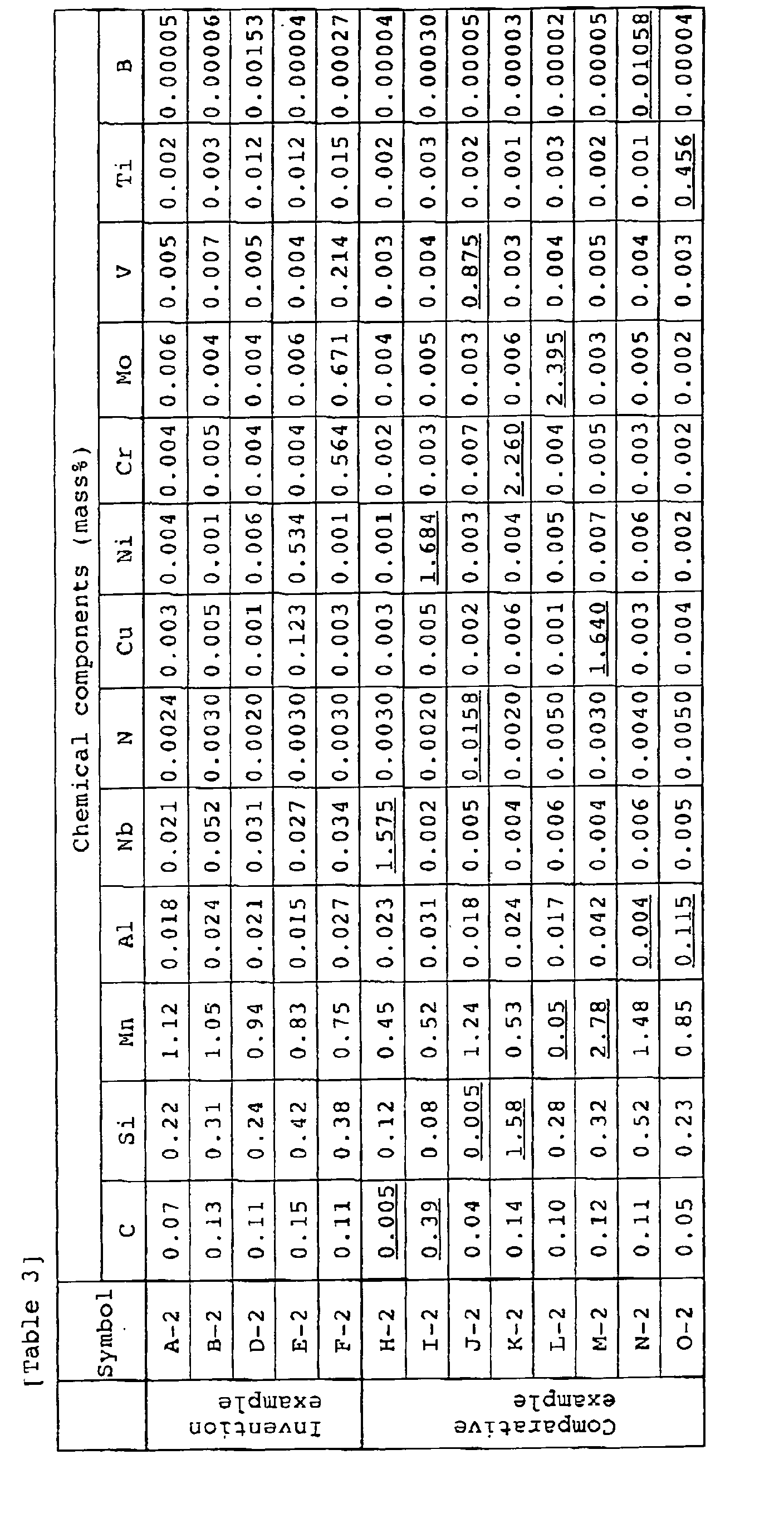
- Steels having the components shown in Table 3 were produced into continuously cast slabs and then the slabs were hot rolled into steel sheets 10 mm in thickness.
- the slabs were heated to a temperature of 1,150°C; thereafter the hot rolling was finished at a temperature of 900°C (Ar 1 point + 170°C); the steel sheets were cooled at the cooling rate of 5°C/sec. up to a temperature of 780°C (Ar 1 point + 50°C) and thus ferrite transformation was caused; successively the steel sheets were cooled at the cooling rate of 20°C/sec. in the temperature range of not higher than 780°C (Ar 1 point + 50°C) and thus bainite was formed; and then the steel sheets were coiled in the temperature range from 500°C to 600°C.
- the microstructures of the steel sheets are shown in Table 4.
- the tensile properties of a steel sheet were evaluated by using an as-rolled specimen of the steel sheet to which no working was applied and a specimen thereof to which 5%-prestrain was applied.
- 5%-prestrain corresponds to the cold-working applied for forming a steel sheet 10 mm in thickness into a steel pipe 200 mm in diameter.
- prestrain is applied so as to equal the valve of t (steel pipe thickness)/D (steel pipe diameter) with respect to a steel pipe to be produced.
- the method of imposing prestrain and the conditions of the tensile tests were the same as Example 1. The results of the evaluation are shown in Table 4.
- any of the structures was composed of ferrite and bainite, any of the average ferrite grain sizes was not smaller than 20 ⁇ m, and the content rates of bainite were in the preferable range of not more than 15%.
- the yield ratios (YRs) of the 5%prestrain specimens were in the range from 71 to 79%.
- any of the steel components deviated from the ranges specified in the present invention In the cases of the comparative examples Symbols H-2 to O-2, any of the steel components deviated from the ranges specified in the present invention.
- the crystal structures were composed of ferrite and pearlite. Pearlite was formed since the cooling rates were less than 5°C/sec. in the temperature range of not higher than Ar 1 point + 50°C.
- the average ferrite grain sizes were less than 20 ⁇ m. This meant that the average ferrite grain sizes reduced because the cooling rates were more than 10°C/sec. up to a temperature of Ar 1 point + 50°C after the end of hot rolling.
- Example 3 relates to the third invention.
- Steels having the components shown in Table 5 were produced into continuously cast slabs and then the slabs were hot rolled into steel sheets 10 mm in thickness.
- the slabs were heated to a temperature of 1,150°C; thereafter the hot rolling was finished at a temperature of 900°C (Ar 1 point + 170°C); the steel sheets were cooled at the cooling rate of 5°C/sec. up to a temperature of 780°C (Ar 1 point + 50°C) and thus ferrite transformation was caused; successively the steel sheets were cooled at the cooling rate of 30°C/sec. in the temperature range of not higher than 780°C (Ar 1 point + 50°C) and thus bainite and/or martensite were/was formed; and then the steel sheets were coiled in the temperature range from 400°C to 500°C.
- the microstructures of the steel sheets are shown in Table 6.
- the tensile properties of a steel sheet were evaluated by using an as-rolled specimen of the steel sheet to which no working was applied and a specimen thereof to which 5%-prestrain was applied.
- 5%-Prestrain corresponds to the cold-working applied for forming a steel sheet 10 mm in thickness into a steel pipe 200 mm in diameter.
- prestrain is applied so as to equal the value of t (steel pipe thickness)/D (steel pipe diameter) with respect to a steel pipe to be produced.
- the prestrain was given by the method wherein a tensile test specimen was pulled with a tensile tester and the pulling was stopped at the time when the strain reached 5%.
- the conditions of the tensile tests were the same as Example 1.
- the results of the evaluation are shown in Table 6.
- any of the structures was composed of ferrite and martensite, or ferrite, bainite and martensite, any of the average ferrite grain sizes was not smaller than 20 ⁇ m, and the bainite content rates and the martensite content rates were in the preferable range of not more than 15%.
- the yield ratios (YRs) of the 5%-prestrain specimens were in the range from 83 to 86%.
- any of the steel components deviated from the ranges specified in the present invention were composed of ferrite in the case of Symbol H-3, and of ferrite and pearlite in the case of Symbol O-3. whereas, in the case of Symbol O-3, pearlite formed because the cooling rate was less than 5°C/sec. in the temperature range of not higher than Ar 1 point + 50°C, in the case of Symbol H-3, single ferrite phase formed because the C content was as low as 0.005% in addition to the influence of the low cooling rate similar to the case of Symbol O-3.
- the average ferrite grain sizes were less than 20 ⁇ m. This meant that the average ferrite grain sizes reduced because the cooling rates were more than 10°C/sec. up to a temperature of Ar 1 point + 50°C after the end of hot rolling.
- the bainite content rates and martensite content rates exceeded 15%; the upper limit of the preferable range.
- the yield ratios (YRs) of the 5%-prestrain specimens were in the range from 93 to 95%.
- the present invention makes it possible to: reduce the production cost of a low yield ratio steel pipe by suppressing the Cr content; enhance tensile strength at the ordinary temperature by suppressing the formation of Cr oxides that deteriorate the quality of a weld and raising the upper limit of the C content; and thus obtain a low yield ratio steel pipe.
Landscapes
- Chemical & Material Sciences (AREA)
- Engineering & Computer Science (AREA)
- Materials Engineering (AREA)
- Mechanical Engineering (AREA)
- Metallurgy (AREA)
- Organic Chemistry (AREA)
- Manufacturing & Machinery (AREA)
- Physics & Mathematics (AREA)
- Thermal Sciences (AREA)
- Crystallography & Structural Chemistry (AREA)
- Heat Treatment Of Steel (AREA)
- Rigid Pipes And Flexible Pipes (AREA)
Abstract
Description
This is because it is estimated that if the yield ratio of a steel pipe for a building is lower, the steel pipe will seldom rupture, even though it yields, and therefore the structure is less likely to be destroyed.
The prestrain was given by the method wherein a tensile test specimen was pulled with a tensile tester and the pulling was stopped at the time when the strain reached 5%. The tensile properties evaluated were YS (yield strength), TS (tensile strength) and YR (yield ratio). The results of the evaluation are shown in Table 2.




Claims (10)
- A steel pipe having a low yield ratio, characterized in that: the steel pipe contains, in mass, 0.01 to 0.20% C, 0.05 to 1.0% Si, 0.1 to 2.0% and 0.001 to 0.05% A1, with the balance consisting of Fe and unavoidable impurities; the microstructure of the steel pipe is composed of ferrite and additionally one or both of pearlite and cementite; and the average size of the ferrite grains is not smaller than 20 µm.
- A steel pipe having a low yield ratio according to claim 1, characterized in that the microstructure of the steel pipe contains spheroidized pearlite or spheroidized cementite.
- A steel pipe having a low yield ratio according to claim 2, characterized in that the average size of pearlite grains or cementite grains is not larger than 20 µm.
- A steel pipe having a low yield ratio according to any one of claims 1 to 3, characterized in that the steel pipe contains, in mass, one or both of 0.01 to 0.5% Nb and 0.001 to 0.01% N.
- A steel pipe having a low yield ratio characterized in that: the steel pipe contains, in mass, 0.03 to 0.20% C, 0.05 to 1.0% Si, 0.1 to 2.0% Mn, 0.001 to 0.05% A1, 0.01 to 0.5% Nb and 0.001 to 0.01% N, with the balance consisting of Fe and unavoidable impurities; the microstructure of the steel pipe is compose of ferrite and bainite; and the average size of the ferrite grains is not smaller than 20 µm.
- A steel pipe having a low yield ratio according to claim 5, characterized in that the content rate of bainite is, in volume fraction, in the range from 1 to 15%.
- A steel pipe having a low yield ratios characterized in that: the steel pipe contains, in mass, 0.03 to 0.20% C, 0.05 to 1.0% Si, 0.1 to 2.0% Mn, 0.001 to 0.05% Al, 0.01 to 0.5% Nb and 0.001 to 0.01% N, with the balance consisting of Fe and unavoidable impurities; the microstructure of the steel pipe is composed of ferrite, martensite and bainite, or ferrite and martensite; and the average size of the ferrite grains is not smaller than 20 µm.
- A steel pipe having a low yield ratio according to claim 7, characterized in that the content rate of bainite is, in volume fraction, in the range from 1 to 15% and/or that of martensite is, in volume fraction, in the range from 1 to 15%.
- A steel pipe having a low yield ratio according to any one of claims 1 to 8, characterized in that the steel pipe contains, in mass, one or both of 0.005 to 0.1% Ti and 0.0001 to 0.005% B.
- A steel pipe having a low yield ratio according to any one of claims 1 to 9, characterized in that the steel pipe contains, in mass, one or more of 0.01 to 0.5% v, 0.01 to 1% Cu, 0.01 to 1% Ni, 0.01 to 1% Cr and 0.01 to 1% Mo.
Applications Claiming Priority (2)
| Application Number | Priority Date | Filing Date | Title |
|---|---|---|---|
| JP2002200797 | 2002-07-10 | ||
| JP2002200797A JP3863818B2 (en) | 2002-07-10 | 2002-07-10 | Low yield ratio steel pipe |
Publications (3)
| Publication Number | Publication Date |
|---|---|
| EP1382703A2 true EP1382703A2 (en) | 2004-01-21 |
| EP1382703A3 EP1382703A3 (en) | 2004-05-06 |
| EP1382703B1 EP1382703B1 (en) | 2007-12-26 |
Family
ID=29774550
Family Applications (1)
| Application Number | Title | Priority Date | Filing Date |
|---|---|---|---|
| EP03015517A Expired - Lifetime EP1382703B1 (en) | 2002-07-10 | 2003-07-09 | Steel pipe having low yield ratio |
Country Status (7)
| Country | Link |
|---|---|
| US (1) | US20040050445A1 (en) |
| EP (1) | EP1382703B1 (en) |
| JP (1) | JP3863818B2 (en) |
| KR (1) | KR100545959B1 (en) |
| AU (1) | AU2003212038B2 (en) |
| CA (1) | CA2434448C (en) |
| DE (1) | DE60318277T2 (en) |
Cited By (8)
| Publication number | Priority date | Publication date | Assignee | Title |
|---|---|---|---|---|
| WO2008045631A2 (en) | 2006-10-06 | 2008-04-17 | Exxonmobil Upstream Research Company | Low yield ratio dual phase steel linepipe with superior strain aging resistance |
| GB2445749A (en) * | 2006-10-18 | 2008-07-23 | Kobe Steel Ltd | Dual-phase steel sheet |
| DE102007030207A1 (en) * | 2007-06-27 | 2009-01-02 | Benteler Automobiltechnik Gmbh | Use of a high-strength steel alloy for producing high-strength and good formability blasting tubes |
| EP1717331A4 (en) * | 2004-02-19 | 2009-09-23 | Nippon Steel Corp | STEEL SHEET OR REDUCED STEEL PIPE FOLLOWING THE EXPRESSION OF THE BAUSHINGER EFFECT AND METHOD OF MANUFACTURING THE SAME |
| EP1662014A4 (en) * | 2003-06-12 | 2010-12-01 | Jfe Steel Corp | STEEL PLATE AND SOLDER STEEL TUBE HAVING LOW FLOW RATIO, HIGH RESISTANCE AND HIGH RESILIENCE, AND PROCESS FOR PRODUCING SAME |
| EP2135962A4 (en) * | 2007-03-29 | 2015-03-04 | Nippon Steel & Sumitomo Metal Corp | INSERT HARDENED STEEL TUBE WITH EXCELLENT WORKABILITY AND METHOD OF MANUFACTURING THEREOF |
| EP2955242A4 (en) * | 2013-04-02 | 2016-02-10 | Jfe Steel Corp | STEEL SHEET FOR NITRIDING AND PROCESS FOR PRODUCING THE SAME |
| US10301698B2 (en) | 2012-01-31 | 2019-05-28 | Jfe Steel Corporation | Hot-rolled steel sheet for generator rim and method for manufacturing the same |
Families Citing this family (13)
| Publication number | Priority date | Publication date | Assignee | Title |
|---|---|---|---|---|
| JP5157257B2 (en) * | 2007-05-29 | 2013-03-06 | Jfeスチール株式会社 | Low yield ratio steel sheet |
| US20090301613A1 (en) | 2007-08-30 | 2009-12-10 | Jayoung Koo | Low Yield Ratio Dual Phase Steel Linepipe with Superior Strain Aging Resistance |
| WO2010005362A1 (en) * | 2008-07-11 | 2010-01-14 | Aktiebolaget Skf | A method for manufacturing a steel component, a weld seam, a welded steel component, and a bearing component |
| CN101899614B (en) * | 2010-08-27 | 2012-07-04 | 攀钢集团钢铁钒钛股份有限公司 | Composite micro-alloying hot rolled steel plate containing V and Nb and preparation method thereof |
| CN101947557B (en) * | 2010-08-27 | 2013-04-10 | 攀钢集团钢铁钒钛股份有限公司 | Preparation method for reducing scales generated on surfaces of hot-rolled steel plates |
| KR101277807B1 (en) * | 2010-10-27 | 2013-06-21 | 현대제철 주식회사 | HIGH STRENGTH STRUCTURAL STEEL OF TENSILE STRENGTH OF 700MPa GRADE WITH HIGH STRENGTH AND LOW YIELD RATIO AND METHOD OF MANUFACTURING THE SAME |
| KR101412244B1 (en) * | 2012-01-31 | 2014-06-25 | 현대제철 주식회사 | Method of manufacturing hot-rolled steel |
| CN106687613A (en) * | 2014-09-08 | 2017-05-17 | 杰富意钢铁株式会社 | High-strength seamless steel pipe for oil well and manufacturing method thereof |
| JP6887328B2 (en) * | 2017-07-07 | 2021-06-16 | 日本鋳造株式会社 | Cast steel for vibration control devices and its manufacturing method |
| CN112430787B (en) * | 2019-08-26 | 2022-04-15 | 上海梅山钢铁股份有限公司 | Low-yield-ratio high-strength cold-rolled hot-dip galvanized steel plate and manufacturing method thereof |
| KR102484994B1 (en) * | 2020-12-10 | 2023-01-04 | 주식회사 포스코 | Hot-rolled steel for hyper tube and manufacturing method for the same |
| KR102492029B1 (en) | 2020-12-21 | 2023-01-26 | 주식회사 포스코 | High strength steel having excellent shock-resistance and method for manufacturing thereof |
| KR102492030B1 (en) | 2020-12-21 | 2023-01-26 | 주식회사 포스코 | High strength hot rolled steel sheet having low yield ratio and method of manufacturing the same |
Family Cites Families (14)
| Publication number | Priority date | Publication date | Assignee | Title |
|---|---|---|---|---|
| US3704180A (en) * | 1968-08-28 | 1972-11-28 | Inland Steel Co | Method for producing tough,high strength steel article |
| JPS54132421A (en) * | 1978-04-05 | 1979-10-15 | Nippon Steel Corp | Manufacture of high toughness bainite high tensile steel plate with superior weldability |
| CN1148416A (en) * | 1995-02-03 | 1997-04-23 | 新日本制铁株式会社 | High strength line-pipe steel having low-yield ratio and excullent low-temp toughness |
| KR100257900B1 (en) * | 1995-03-23 | 2000-06-01 | 에모토 간지 | Hot rolled sheet and method for forming hot rolled steel sheet having low yield ratio high strength and excellent toughness |
| JPH09118952A (en) * | 1995-10-20 | 1997-05-06 | Kobe Steel Ltd | Member made of high-strength hot rolled steel sheet having lower yield ratio |
| JPH09165644A (en) * | 1995-12-14 | 1997-06-24 | Nkk Corp | Structural steel with low yield ratio at low temperature |
| JPH1017980A (en) * | 1996-06-28 | 1998-01-20 | Sumitomo Metal Ind Ltd | Welded steel pipe with low yield ratio, and its production |
| KR100502040B1 (en) * | 1996-12-06 | 2005-09-26 | 제이에프이 스틸 가부시키가이샤 | Steel sheet for double-rolled tube and method for making the same |
| JP3371744B2 (en) * | 1997-03-25 | 2003-01-27 | 住友金属工業株式会社 | Low yield ratio steel material and method of manufacturing the same |
| JPH10310821A (en) * | 1997-05-12 | 1998-11-24 | Nkk Corp | Manufacturing method of high strength steel pipe for building |
| JP4377973B2 (en) * | 1998-03-12 | 2009-12-02 | 日新製鋼株式会社 | Steel sheet with excellent local ductility and heat treatment |
| JP3559455B2 (en) * | 1998-08-10 | 2004-09-02 | 新日本製鐵株式会社 | Low-yield-ratio type refractory steel, steel pipe, and method for producing the same |
| JP4264212B2 (en) * | 2000-02-28 | 2009-05-13 | 新日本製鐵株式会社 | Steel pipe with excellent formability and method for producing the same |
| KR100482208B1 (en) * | 2000-11-17 | 2005-04-21 | 주식회사 포스코 | Method for manufacturing steel plate having superior toughness in weld heat-affected zone by nitriding treatment |
-
2002
- 2002-07-10 JP JP2002200797A patent/JP3863818B2/en not_active Expired - Fee Related
-
2003
- 2003-07-08 CA CA002434448A patent/CA2434448C/en not_active Expired - Fee Related
- 2003-07-09 EP EP03015517A patent/EP1382703B1/en not_active Expired - Lifetime
- 2003-07-09 KR KR1020030046303A patent/KR100545959B1/en not_active Expired - Fee Related
- 2003-07-09 DE DE60318277T patent/DE60318277T2/en not_active Expired - Lifetime
- 2003-07-10 AU AU2003212038A patent/AU2003212038B2/en not_active Ceased
- 2003-07-10 US US10/617,239 patent/US20040050445A1/en not_active Abandoned
Cited By (11)
| Publication number | Priority date | Publication date | Assignee | Title |
|---|---|---|---|---|
| EP1662014A4 (en) * | 2003-06-12 | 2010-12-01 | Jfe Steel Corp | STEEL PLATE AND SOLDER STEEL TUBE HAVING LOW FLOW RATIO, HIGH RESISTANCE AND HIGH RESILIENCE, AND PROCESS FOR PRODUCING SAME |
| EP1717331A4 (en) * | 2004-02-19 | 2009-09-23 | Nippon Steel Corp | STEEL SHEET OR REDUCED STEEL PIPE FOLLOWING THE EXPRESSION OF THE BAUSHINGER EFFECT AND METHOD OF MANUFACTURING THE SAME |
| US8815024B2 (en) | 2004-02-19 | 2014-08-26 | Nippon Steel & Sumitomo Metal Corporation | Steel plate or steel pipe with small occurrence of Bauschinger effect and methods of production of same |
| WO2008045631A2 (en) | 2006-10-06 | 2008-04-17 | Exxonmobil Upstream Research Company | Low yield ratio dual phase steel linepipe with superior strain aging resistance |
| EP2089556A4 (en) * | 2006-10-06 | 2011-10-05 | Exxonmobile Upstream Res Company | BIPHASIC STEEL PIPE HOSE WITH LOW FLOW RATE HAVING HIGHER AGING RESISTANCE AFTER MILLING |
| GB2445749A (en) * | 2006-10-18 | 2008-07-23 | Kobe Steel Ltd | Dual-phase steel sheet |
| GB2445749B (en) * | 2006-10-18 | 2009-06-03 | Kobe Steel Ltd | High strength steel sheet and method for producing the same |
| EP2135962A4 (en) * | 2007-03-29 | 2015-03-04 | Nippon Steel & Sumitomo Metal Corp | INSERT HARDENED STEEL TUBE WITH EXCELLENT WORKABILITY AND METHOD OF MANUFACTURING THEREOF |
| DE102007030207A1 (en) * | 2007-06-27 | 2009-01-02 | Benteler Automobiltechnik Gmbh | Use of a high-strength steel alloy for producing high-strength and good formability blasting tubes |
| US10301698B2 (en) | 2012-01-31 | 2019-05-28 | Jfe Steel Corporation | Hot-rolled steel sheet for generator rim and method for manufacturing the same |
| EP2955242A4 (en) * | 2013-04-02 | 2016-02-10 | Jfe Steel Corp | STEEL SHEET FOR NITRIDING AND PROCESS FOR PRODUCING THE SAME |
Also Published As
| Publication number | Publication date |
|---|---|
| US20040050445A1 (en) | 2004-03-18 |
| KR20040005675A (en) | 2004-01-16 |
| JP2004043856A (en) | 2004-02-12 |
| DE60318277T2 (en) | 2008-05-08 |
| JP3863818B2 (en) | 2006-12-27 |
| KR100545959B1 (en) | 2006-01-26 |
| CA2434448C (en) | 2008-01-29 |
| DE60318277D1 (en) | 2008-02-07 |
| CA2434448A1 (en) | 2004-01-10 |
| EP1382703A3 (en) | 2004-05-06 |
| EP1382703B1 (en) | 2007-12-26 |
| AU2003212038A1 (en) | 2004-01-29 |
| AU2003212038B2 (en) | 2006-10-05 |
Similar Documents
| Publication | Publication Date | Title |
|---|---|---|
| EP1382703B1 (en) | Steel pipe having low yield ratio | |
| US20260022437A1 (en) | High strength multi-phase steel having excellent burring properties at low temperature, and method for producing same | |
| US6846371B2 (en) | Method for making high-strength high-toughness martensitic stainless steel seamless pipe | |
| US20050106411A1 (en) | High strength steel plate and method for production thereof | |
| CN103649355A (en) | Hot-rolled high-strength steel strip with improved HAZ-softening resistance and method of producing said steel | |
| JP7244718B2 (en) | Steel material for thick high-strength line pipe with excellent low-temperature toughness, elongation and small yield ratio, and method for producing the same | |
| CN107208232A (en) | Self hardening superhigh intensity multi-phase Steels with excellent processability and the method that band is prepared by it | |
| CA3081221A1 (en) | Steel material for welded steel pipe, and method for manufacturing the same | |
| US20130224063A1 (en) | Steel plate for pipeline, having excellent hydrogen induced crack resistance, and preparation method thereof | |
| CN113348255A (en) | Cold rolled steel sheet | |
| EP3556890B1 (en) | High-strength steel plate having excellent burring workability in low temperature range and manufacturing method therefor | |
| JP2001226741A (en) | High-strength cold-rolled steel sheet excellent in stretch flangeability and its manufacturing method | |
| JP2001220647A (en) | High strength cold rolled steel sheet excellent in workability and method for producing the same | |
| EP2441854B1 (en) | High strength steel pipe and method for producing same | |
| JP3879440B2 (en) | Manufacturing method of high strength cold-rolled steel sheet | |
| US20240167137A1 (en) | High strength cold rolled steel sheet for automotive use having excellent global formability and bending property | |
| JPH0987798A (en) | High-strength hot-rolled steel sheet having ultrafine grains and excellent in balance of ductility, toughness, fatigue characteristics, and strength ductility, and method for producing the same | |
| JPS59222528A (en) | Production of hot rolled high tension steel plate | |
| JP2002363685A (en) | Low yield ratio high strength cold rolled steel sheet | |
| JP2687841B2 (en) | Low yield ratio high strength steel pipe manufacturing method | |
| US20190256943A1 (en) | Method for producing a cold-rolled steel strip having trip-characteristics made of a high-strength mangan-containing steel | |
| JP3870840B2 (en) | Composite structure type high-tensile cold-rolled steel sheet excellent in deep drawability and stretch flangeability and method for producing the same | |
| JP4133003B2 (en) | High-strength steel sheet with excellent formability and its manufacturing method | |
| KR102904562B1 (en) | Cold rolled steel sheet and method of manufacturing the same | |
| JP4848586B2 (en) | Method for producing high-tensile hot-rolled steel sheet for processing having microstructure |
Legal Events
| Date | Code | Title | Description |
|---|---|---|---|
| PUAI | Public reference made under article 153(3) epc to a published international application that has entered the european phase |
Free format text: ORIGINAL CODE: 0009012 |
|
| 17P | Request for examination filed |
Effective date: 20030806 |
|
| AK | Designated contracting states |
Kind code of ref document: A2 Designated state(s): AT BE BG CH CY CZ DE DK EE ES FI FR GB GR HU IE IT LI LU MC NL PT RO SE SI SK TR |
|
| AX | Request for extension of the european patent |
Extension state: AL LT LV MK |
|
| PUAL | Search report despatched |
Free format text: ORIGINAL CODE: 0009013 |
|
| AK | Designated contracting states |
Kind code of ref document: A3 Designated state(s): AT BE BG CH CY CZ DE DK EE ES FI FR GB GR HU IE IT LI LU MC NL PT RO SE SI SK TR |
|
| AX | Request for extension of the european patent |
Extension state: AL LT LV MK |
|
| AKX | Designation fees paid |
Designated state(s): DE GB GR |
|
| 17Q | First examination report despatched |
Effective date: 20050317 |
|
| 17Q | First examination report despatched |
Effective date: 20050317 |
|
| GRAP | Despatch of communication of intention to grant a patent |
Free format text: ORIGINAL CODE: EPIDOSNIGR1 |
|
| GRAS | Grant fee paid |
Free format text: ORIGINAL CODE: EPIDOSNIGR3 |
|
| GRAA | (expected) grant |
Free format text: ORIGINAL CODE: 0009210 |
|
| AK | Designated contracting states |
Kind code of ref document: B1 Designated state(s): DE GB GR |
|
| REG | Reference to a national code |
Ref country code: GB Ref legal event code: FG4D |
|
| REF | Corresponds to: |
Ref document number: 60318277 Country of ref document: DE Date of ref document: 20080207 Kind code of ref document: P |
|
| REG | Reference to a national code |
Ref country code: GR Ref legal event code: EP Ref document number: 20080400218 Country of ref document: GR |
|
| PLBE | No opposition filed within time limit |
Free format text: ORIGINAL CODE: 0009261 |
|
| STAA | Information on the status of an ep patent application or granted ep patent |
Free format text: STATUS: NO OPPOSITION FILED WITHIN TIME LIMIT |
|
| 26N | No opposition filed |
Effective date: 20080929 |
|
| REG | Reference to a national code |
Ref country code: DE Ref legal event code: R081 Ref document number: 60318277 Country of ref document: DE Owner name: NIPPON STEEL & SUMITOMO METAL CORPORATION, JP Free format text: FORMER OWNER: NIPPON STEEL CORP., TOKIO/TOKYO, JP Effective date: 20130227 Ref country code: DE Ref legal event code: R082 Ref document number: 60318277 Country of ref document: DE Representative=s name: VOSSIUS & PARTNER, DE Effective date: 20130227 Ref country code: DE Ref legal event code: R082 Ref document number: 60318277 Country of ref document: DE Representative=s name: VOSSIUS & PARTNER PATENTANWAELTE RECHTSANWAELT, DE Effective date: 20130227 |
|
| REG | Reference to a national code |
Ref country code: DE Ref legal event code: R082 Ref document number: 60318277 Country of ref document: DE Representative=s name: VOSSIUS & PARTNER PATENTANWAELTE RECHTSANWAELT, DE Ref country code: DE Ref legal event code: R081 Ref document number: 60318277 Country of ref document: DE Owner name: NIPPON STEEL CORPORATION, JP Free format text: FORMER OWNER: NIPPON STEEL & SUMITOMO METAL CORPORATION, TOKYO, JP |
|
| PGFP | Annual fee paid to national office [announced via postgrant information from national office to epo] |
Ref country code: GR Payment date: 20210611 Year of fee payment: 19 |
|
| PGFP | Annual fee paid to national office [announced via postgrant information from national office to epo] |
Ref country code: GB Payment date: 20210616 Year of fee payment: 19 |
|
| PGFP | Annual fee paid to national office [announced via postgrant information from national office to epo] |
Ref country code: DE Payment date: 20210616 Year of fee payment: 19 |
|
| REG | Reference to a national code |
Ref country code: DE Ref legal event code: R119 Ref document number: 60318277 Country of ref document: DE |
|
| GBPC | Gb: european patent ceased through non-payment of renewal fee |
Effective date: 20220709 |
|
| PG25 | Lapsed in a contracting state [announced via postgrant information from national office to epo] |
Ref country code: GR Free format text: LAPSE BECAUSE OF NON-PAYMENT OF DUE FEES Effective date: 20230209 Ref country code: GB Free format text: LAPSE BECAUSE OF NON-PAYMENT OF DUE FEES Effective date: 20220709 Ref country code: DE Free format text: LAPSE BECAUSE OF NON-PAYMENT OF DUE FEES Effective date: 20230201 |