EP2085531A2 - Deckenrahmen zum Halten von Deckenplatten mit einer Querschiene mit lokal aufgedrücktem Ansatzteil - Google Patents
Deckenrahmen zum Halten von Deckenplatten mit einer Querschiene mit lokal aufgedrücktem Ansatzteil Download PDFInfo
- Publication number
- EP2085531A2 EP2085531A2 EP09151424A EP09151424A EP2085531A2 EP 2085531 A2 EP2085531 A2 EP 2085531A2 EP 09151424 A EP09151424 A EP 09151424A EP 09151424 A EP09151424 A EP 09151424A EP 2085531 A2 EP2085531 A2 EP 2085531A2
- Authority
- EP
- European Patent Office
- Prior art keywords
- hollow profile
- cut
- impression
- ceiling frame
- nose section
- Prior art date
- Legal status (The legal status is an assumption and is not a legal conclusion. Google has not performed a legal analysis and makes no representation as to the accuracy of the status listed.)
- Granted
Links
Images



Classifications
-
- E—FIXED CONSTRUCTIONS
- E04—BUILDING
- E04B—GENERAL BUILDING CONSTRUCTIONS; WALLS, e.g. PARTITIONS; ROOFS; FLOORS; CEILINGS; INSULATION OR OTHER PROTECTION OF BUILDINGS
- E04B9/00—Ceilings; Construction of ceilings, e.g. false ceilings; Ceiling construction with regard to insulation
- E04B9/06—Ceilings; Construction of ceilings, e.g. false ceilings; Ceiling construction with regard to insulation characterised by constructional features of the supporting construction, e.g. cross section or material of framework members
- E04B9/08—Ceilings; Construction of ceilings, e.g. false ceilings; Ceiling construction with regard to insulation characterised by constructional features of the supporting construction, e.g. cross section or material of framework members having the capability of expansion, e.g. in case of fire
-
- E—FIXED CONSTRUCTIONS
- E04—BUILDING
- E04B—GENERAL BUILDING CONSTRUCTIONS; WALLS, e.g. PARTITIONS; ROOFS; FLOORS; CEILINGS; INSULATION OR OTHER PROTECTION OF BUILDINGS
- E04B9/00—Ceilings; Construction of ceilings, e.g. false ceilings; Ceiling construction with regard to insulation
- E04B9/06—Ceilings; Construction of ceilings, e.g. false ceilings; Ceiling construction with regard to insulation characterised by constructional features of the supporting construction, e.g. cross section or material of framework members
- E04B9/12—Connections between non-parallel members of the supporting construction
- E04B9/122—Connections between non-parallel members of the supporting construction one member passing through the other member, both members laying at least partly in the same plane
Definitions
- the present invention relates to a ceiling frame for holding ceiling panels with an integrated heat expansion system, as well as to a cross runner for use in such a ceiling frame.
- EP-1 703 034 shows a ceiling frame comprising a plurality of main runners and cross runners for connecting the main runners with each other.
- Each runner comprises an upright longitudinally extending web having flanges extending in opposite sideways directions at its lower end for supporting edges of ceiling panels upon, and has a longitudinally extending hollow profile at its upper end for providing strength.
- Each cross runner comprises heat expansion nose sections at its free end parts. Each of these heat expansion nose sections comprises a free end part of the hollow profile which has been separated from the web by a first cut-out which is extending in the longitudinal direction up till an intended vertical folding line. A second cut-out has been provided in the top face of the hollow profile at the location of the intended folding line.
- the heat expansion nose section permits expansion of the ceiling frame in the case of for example heat and/or fire, and thus limits the risk of deformations, like buckling, of the ceiling frame. Should such a heat expansion nose section not be provided then the heat retardant properties of the ceiling would considerably be diminished, for example because the heat could then more easily penetrate the space above the ceiling panels, and because the ceiling panels would then be prone to fall down out of the frame.
- a disadvantage of the ceiling frame of EP-1 703 034 is that its expansion behaviour has appeared to fluctuate considerably. Also its cross runner is somewhat difficult and expensive to produce. During mounting of the cross runners between the main runners, the mechanic needs to put a downward pressure on the nose section in order to have coupling means between the runners to properly connect with each other. With this the risk exists that the nose section is accidentally bent in an undesired direction or even becomes damaged. Furthermore the risk exists that the mechanic hurts himself because of sharp edges of the second cut-out.
- the present invention aims to at least partially overcome the abovementioned disadvantages, or to provide a usable alternative.
- the invention aims to provide a ceiling frame which is user-friendly during mounting, relatively cheap to produce, and fully reliable when subjected to excessive heat.
- the ceiling frame comprises a plurality of main runners, and at least one cross runner having a longitudinal direction and coupling means for coupling the main runners with each other.
- the cross runner comprises an upright longitudinally extending web having flanges extending in opposite sideways directions at its lower end for supporting edges of ceiling panels upon, and having a longitudinally extending hollow profile at its upper end for providing strength.
- the cross runner further comprises a heat expansion nose section provided on one or both of its free end parts.
- the heat expansion nose section forms an integral part of the cross runner, and comprises a free end part of the hollow profile which has been separated by a cut from (part of) the web lying below. The cut is partially extending in the longitudinal direction up till an intended folding line.
- An impression is provided in the nose section.
- the impression extends over at least a lower part of the hollow profile.
- the cut also extends partially upwards through a lower part of the hollow profile. This upwardly extending part of the cut runs through the impression.
- the folding line is formed by an upper part of the hollow profile which lies substantially in line with the upwardly extending part of the cut.
- the nose section according to the invention is very stable and strong in the longitudinal direction, while at the same time it is flexural weak in the aimed bending direction.
- the deformation behaviour of the nose section and thus also an important part of the expansion behaviour of the entire ceiling frame, can be kept quite constant, leading to predictable and reliable results during use, and in particular when subjected to excessive heat caused by fire.
- the cross runner with the nose section according to the invention is relatively easy and cheap to produce.
- the nose section is able to be bent away in a reliable and relatively easy way around the intended folding line. Expansions of the cross runners caused by excessive heating can be reliably absorbed without the ceiling frame in its entirety deforming too much.
- the expansion force in the cross runner necessary for having the nose section to bend away is relatively low.
- An additional advantage is that the nose section can also be bent away and back again manually relatively easy and for a number of times without the risk of damaging or even accidentally breaking of the nose section. This makes it possible for a cross runner to be removed and placed back again between main runners of an already mounted ceiling frame. Because the top face of the nose section no longer needs to be provided with a cut-out, the ceiling frame becomes more user-friendly because it does not have sharp cutting edges at places where a mechanic needs to place his fingers and needs to exert downwards and forward pressure during mounting of the system.
- the coupling means are designed in such a way that they permit sliding movement of the cross runner with respect to the main runner in the longitudinal direction of the cross runner as soon as the nose section has been bent out of the way, that is to say as soon as the nose section is folded around its folding line.
- the coupling means may be formed by a hook shaped part at the free end of the cross profile which can be hooked into a slit which is present in the main runner.
- the hook shaped part After the nose section has been bent out of the way, the hook shaped part has the freedom to further slide into the slit and thus take up a certain amount of expansion or displacement in the longitudinal direction of the cross runner. Thus deformations, like buckling, of the runners in the case of excessive heat are advantageously prevented.
- the impression extends over the entire height of the hollow profile including its top face and forms the folding line around which the nose section is able to fold sideways.
- the intended folding line then lies in a vertical plane.
- the impression extends over only a lower part of the hollow profile.
- the remaining upper part of the hollow profile at the location of the nose section including its top face then forms the intended folding line around which the nose section is able to fold downwards during expansion.
- the intended folding line is then substantially horizontal.
- the respective front nose section is separated by a relatively small slit from the web lying below the front section and from the nose section lying behind this front nose section.
- the cut may have a maximum width of 2 mm.
- the thus obtained cut may still be some kind of cut-out.
- it is preferred for the cut to be a sharp cut with which the respective front nose section is merely cut loose from the web lying below the front section and from the nose section lying behind this front nose section.
- the sharp cut then as it were has zero width since the respective wall parts have only been torn loose from each other.
- Such a sharp cut for example is made with some kind of sharp edged punching tool (punching knife).
- the relatively small cut, in particular the sharp cut helps to keep the nose section robust enough and not to make it to fragile.
- edge parts of both the longitudinally and upwardly extending parts of the cut are bent sideways past one of the side faces of the upright web and past one of the side faces of the impression. This makes it possible for the nose section to more easily start its bending movement in either the sideways either the downwards direction. This is particularly important for the second preferred embodiment since there the nose section during its downward bending needs to slide past the upright web as well as past the part of the hollow profile lying behind the upwardly extending part of the cut. It is to be understood that the width of the original cut is somewhat enlarged by this sideways bending of the edge parts. Nevertheless it might still be well recognised what the dimensions of the original cut have been and whether or not the cut originally was a sharp cut.
- the impression extends at both sides of the cut.
- the impression extends in the longitudinal direction over a length which is greater than the distance between a front side of the free end part and the intended folding line.
- the impression extends over a total length which is at least 1.5 times the length of the front downwardly bendable part of the nose section, that is to say the distance between the front side of the free end part and the intended folding line.
- the impression extends over more than 75 % of the entire height of the hollow profile. More in particular the remaining upper part of the hollow profile at the location of the folding line then has a height of between 1-3 mm.
- the thickness of the remaining part of the hollow profile at the location is a measure for its bending resistance. This bending resistance may on the hand not be too big and on the other hand may not be too small. For example choosing the dimensions such that a bending resistance of 20 kg is achieved is possible.
- the impression extends at both sides of the upwardly extending part of the cut. This makes it easier to make this part of the cut at its desired location and helps in properly creating the intended folding line.
- the upwardly extending part of the cut has a longitudinal direction with an axis which extends at an angle with respect to the longitudinal direction of the cross runner. More in particular this angle lies between 70-80 degrees.
- This slanting position of the upwardly extending part of the cut has the advantage that the nose section during the sideways bending with the first preferred embodiment also moves upwards somewhat, and more easily starts with its downwards bending with the second preferred embodiment. This makes it more easy for the cross profile to move upwards somewhat during the expansion. This is particularly important and advantageous in the case of the flanges of the cross runners and the flanges of the main runners abutting against one another in the starting position.
- the impression and at least part of the cut may substantially lie in each others prolongation. Thus an even more optimal folding line is obtained.
- the impression with the first preferred embodiment may be achieved by locally impressing the hollow profile at the location of the intended folding line such that opposite wall parts of the hollow profile over the entire height thereof have been compressed towards one another.
- the impression with this first preferred embodiment has been provided on only one side of the nose section, in particular with a depth somewhat past the center face of said upright web.
- the nose section may be slightly pre-bend towards one side, making its sideways deformation behaviour more constant and the forces necessary therefore lower. This effect can be increased if the impression has been made by a pressing operation oppositely directed to a punching direction for forming the cut. The deformations on the nose section thus are opposite. If expansion forces in the longitudinal direction of the cross runner appear, a bending moment in the nose section occurs which has the effect of bending away the nose section toward one side only.
- the operations of making the impression in the nose section and punching out the cut may be performed simultaneously or after one another.
- the invention also relates to a cross runner according to claim 15.
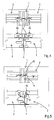
- the main runner has been given the reference numeral 1 and the cross runner the reference numeral 2.
- the runners 1, 2 each comprise an upright longitudinally extending web 3 having flanges 4 extending in opposite sideways directions at its lower end for supporting edges of ceiling panels 5 upon, and having a longitudinally extending hollow profile 6 at its upper end for providing strength.
- the cross runner 2 comprises a coupling hook 7 which can be hooked into a slit 8 provided in the main runner 1.
- fig. 1 the situation is shown in which a cross runner 2 has already been hooked onto the main runner 1 from one side, whereas another cross runner 2 still needs to be hooked onto this main runner 1 from the other side. Both cross runners 2 hook into the same slit 8 of the main runner 1.
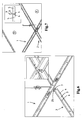
- the cross runner 2 further comprises a heat expansion nose section 10.
- the nose section 10 comprises a free end part 11 of the hollow profile 6 which at its lower side is bounded by a cut 12.
- the cut 12 has a first part 12a extending in the longitudinal direction of the cross runner 2 through its web 3, and a second part 12b extending in a slanted upward direction of approximately 75 degrees through both the web 3 and partly into the hollow profile 6.
- the nose section 10 is provided with a concavely shaped longitudinal impression 15.
- the impression 15 extends over the entire height of the hollow profile 6, including its top face 16, and substantially in the same slanting direction as the second part 12b of the cut.
- the impression 15 preferably has been made by locally impressing the hollow profile 6 at the location of the folding line 17 by exerting pressure from one side upon the hollow profile 6 over its entire height.
- the pressure causes opposite wall parts of the hollow profile 6 to be compressed towards one another over the entire height of the hollow profile 6.
- the pressure causes the top face of the hollow profile 6 to be deformed upwardly at the location of the impression 15. Because the impression 15 is made by exerting pressure from one side upon the hollow profile 6, the compressed wall parts have come to lie eccentrically from the center of the cross runner 2 ( fig. 3b ), in particular past the center face of the web 3.
- the cut 12 can be obtained by performing a punching operation on the cross runner 2.
- the pressure for making the impression 15 is exerted in a direction opposite to a punching direction for forming the cut 12 and/or for (de-)forming other parts of the cross runner 2. This might provide for counter forces during manufacturing and/or might pre-bend the nose section 10 slightly in a desired bending direction.
- the hook 7 together with the slit 8 are constructed such that they have the freedom to slide in the longitudinal direction of the cross runner 2, the cross runner 2 is free to expand and/or move in its longitudinal direction with respect to the main runner 1 as soon as the nose section 10 has cleared the way and no longer fully abuts with its front face against the main runner 1. Since the hook 7 also has the freedom to move somewhat upwards with respect to the slit 8, the flanges 4 of the cross runner 2 have the freedom to slide over the facing flange 4' of the main runner 1. The fact that the impression 15, the second part 12b of the cut and thus the folding line 17 are positioned at an angle with respect to the horizontal aids in this upward movement, because the nose section 10 also moves upward somewhat during its sideways bending movement.
- the second part 12b of the cut goes through a lower part of the impression 15, in particular through at least the lower half of the impression 15.
- This has the advantage of limiting the bending force needed for the bending movement.
- the length of the second part 12b of the cut going through the lower part of the impression 15, may be altered in dependency of the shape, height, material, thickness, etc. of the hollow profile 6, that is to say of the original bending resistance of the hollow profile 6 which possibly needs to be limited.
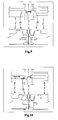
- the impression 21 preferably has been made by locally impressing the hollow profile 6 at the described section of the lower part 20 by exerting pressure from both sides upon the hollow profile 6.
- the pressure causes opposite wall parts of the hollow profile 6 to be compressed towards one another over the described section.
- This locally exerted pressure causes the upper part 23 including the top face 16 of the hollow profile 6 to maintain its sideways projecting shape and if desired to even enclose a small hollow 27.
- the cut 12 can be obtained by performing a punching operation with a sharp-edged punching tool on the cross runner 2.
- this punching operation not only has the effect of making a sharp cut, but also has the effect of bending edge parts 28 of those walls which are delimiting one side of the cut 12 to a slanted sideways projecting position, that is to say bent sideways past the respective side face of the web 3 and past the respective side face of the rest of the impression 21.
- the bending moment causes the nose section 10 to start bending downwards and thereafter backwards around its folding line 25 as soon as a certain desired threshold value has been passed. This is shown in figure 10 .
- the fact that the edge parts 28 of the walls delimiting the cut 12 have been bent sideways is important for this downwardly rotating movement, because it prevents those edge parts 28 from abutting against their opposing wall parts at the other sides of the cut 12.
- the impression 21 extends in the longitudinal direction over a length L which is more than 1.5 times the distance I between the front edge 22 and the intended folding line 25. This provides for enough free space for the nose section 10 to be rotated over an angle of more than 90 degrees around the folding line 25 without abutting against a non-compressed part of the hollow profile 6.
- the second part 12b of the cut goes through the entire height of the lower part 20 up till the remaining upper part 23.
- This has the advantage of limiting the bending force needed for the bending movement.
- the thickness of the remaining upper part may be altered in dependency of the shape, height, material, thickness, etc. of the hollow profile 6, that is to say of the original bending resistance of the hollow profile 6 which possibly needs to be limited.
- the height of the remaining upper part 23 is approximately 2 mm in the embodiment shown.
- the cross runner 2 can be made in several ways, but preferably is roll-formed out of a strip of steel material. After this roll-forming step, the punching operations may be performed for forming the cuts, the impressions, the hook, etc.
- the dimensions of the various parts may be different and/or the runners may be manufactured out of other materials and/or may have differently shaped webs, flanges and/or hollow profiles.
- other kinds of coupling means are possible between the main runner and the cross runners.
- punching or exerting pressure the impressions and the cuts, may also be achieved in another way.
- the cuts may also be (partly) formed by small cut-outs having a width smaller than 2 mm.
- the invention provides a user-friendly ceiling frame which is both easy to handle during mounting and stable and reliable during use.
Landscapes
- Engineering & Computer Science (AREA)
- Architecture (AREA)
- Physics & Mathematics (AREA)
- Electromagnetism (AREA)
- Civil Engineering (AREA)
- Structural Engineering (AREA)
- Building Environments (AREA)
- Residential Or Office Buildings (AREA)
- Body Structure For Vehicles (AREA)
- Bending Of Plates, Rods, And Pipes (AREA)
Priority Applications (2)
| Application Number | Priority Date | Filing Date | Title |
|---|---|---|---|
| EP09151424.0A EP2085531B1 (de) | 2008-01-29 | 2009-01-27 | Querschiene zur Verwendung in einem Deckenrahmen zum Halten von Deckenplatten mit lokal aufgedrücktem Ansatzteil |
| PL09151424T PL2085531T3 (pl) | 2008-01-29 | 2009-01-27 | Profil poprzeczny do zastosowania w ramie sufitowej z miejscowo zagłębionym segmentem głowicowym |
Applications Claiming Priority (2)
| Application Number | Priority Date | Filing Date | Title |
|---|---|---|---|
| EP08075069A EP2085530A1 (de) | 2008-01-29 | 2008-01-29 | Deckenrahmen zum Halten von Deckenplatten mit einer Querschiene mit lokal aufgedrücktem Ansatzteil |
| EP09151424.0A EP2085531B1 (de) | 2008-01-29 | 2009-01-27 | Querschiene zur Verwendung in einem Deckenrahmen zum Halten von Deckenplatten mit lokal aufgedrücktem Ansatzteil |
Publications (3)
| Publication Number | Publication Date |
|---|---|
| EP2085531A2 true EP2085531A2 (de) | 2009-08-05 |
| EP2085531A3 EP2085531A3 (de) | 2013-09-04 |
| EP2085531B1 EP2085531B1 (de) | 2015-03-18 |
Family
ID=39563589
Family Applications (2)
| Application Number | Title | Priority Date | Filing Date |
|---|---|---|---|
| EP08075069A Withdrawn EP2085530A1 (de) | 2008-01-29 | 2008-01-29 | Deckenrahmen zum Halten von Deckenplatten mit einer Querschiene mit lokal aufgedrücktem Ansatzteil |
| EP09151424.0A Active EP2085531B1 (de) | 2008-01-29 | 2009-01-27 | Querschiene zur Verwendung in einem Deckenrahmen zum Halten von Deckenplatten mit lokal aufgedrücktem Ansatzteil |
Family Applications Before (1)
| Application Number | Title | Priority Date | Filing Date |
|---|---|---|---|
| EP08075069A Withdrawn EP2085530A1 (de) | 2008-01-29 | 2008-01-29 | Deckenrahmen zum Halten von Deckenplatten mit einer Querschiene mit lokal aufgedrücktem Ansatzteil |
Country Status (3)
| Country | Link |
|---|---|
| EP (2) | EP2085530A1 (de) |
| ES (1) | ES2537968T3 (de) |
| PL (1) | PL2085531T3 (de) |
Cited By (3)
| Publication number | Priority date | Publication date | Assignee | Title |
|---|---|---|---|---|
| RU2658927C1 (ru) * | 2017-09-21 | 2018-06-26 | Александр Васильевич Гущин | Универсальная декоративная подвесная рамочная потолочная и стеновая система |
| RU2663519C1 (ru) * | 2017-12-04 | 2018-08-07 | Александр Васильевич Гущин | Универсальная декоративная подвесная рамочная потолочная система на гибких подвесах |
| RU2694635C1 (ru) * | 2018-08-09 | 2019-07-16 | Александр Васильевич Гущин | Усовершенствованная универсальная подвесная рамочная потолочная и стеновая система из панелей с гибким декоративным материалом и способ его крепления |
Citations (1)
| Publication number | Priority date | Publication date | Assignee | Title |
|---|---|---|---|---|
| EP1703034A1 (de) | 2005-03-18 | 2006-09-20 | Chicago Metallic Continental | Abgehängtes Deckensystem |
Family Cites Families (7)
| Publication number | Priority date | Publication date | Assignee | Title |
|---|---|---|---|---|
| US3496690A (en) * | 1967-04-17 | 1970-02-24 | Chicago Metallic Sash Co | Main runner part |
| US3965631A (en) * | 1974-08-01 | 1976-06-29 | Roblin Hope's Industries, Inc. | Fire rated grid-member with controlled expansion means |
| US4106878A (en) * | 1977-02-04 | 1978-08-15 | National Rolling Mills Company | Fire-rated ceiling grid cross joint |
| US4364686A (en) * | 1980-11-17 | 1982-12-21 | Lok Products Company | Locking device for grid system |
| US4598514A (en) * | 1984-09-06 | 1986-07-08 | Donn Incorporated | Suspension ceiling grid runner with expansion means |
| US4713919A (en) * | 1986-09-05 | 1987-12-22 | National Rolling Mills Inc. | Laser welded ceiling grid members |
| US6351919B1 (en) * | 2000-07-01 | 2002-03-05 | Worthington Armstrong Venture | Compression relief section |
-
2008
- 2008-01-29 EP EP08075069A patent/EP2085530A1/de not_active Withdrawn
-
2009
- 2009-01-27 ES ES09151424.0T patent/ES2537968T3/es active Active
- 2009-01-27 PL PL09151424T patent/PL2085531T3/pl unknown
- 2009-01-27 EP EP09151424.0A patent/EP2085531B1/de active Active
Patent Citations (1)
| Publication number | Priority date | Publication date | Assignee | Title |
|---|---|---|---|---|
| EP1703034A1 (de) | 2005-03-18 | 2006-09-20 | Chicago Metallic Continental | Abgehängtes Deckensystem |
Cited By (5)
| Publication number | Priority date | Publication date | Assignee | Title |
|---|---|---|---|---|
| RU2658927C1 (ru) * | 2017-09-21 | 2018-06-26 | Александр Васильевич Гущин | Универсальная декоративная подвесная рамочная потолочная и стеновая система |
| WO2019059815A1 (ru) * | 2017-09-21 | 2019-03-28 | Александр Васильевич ГУЩИН | Универсальная декоративная подвесная рамочная потолочная и стеновая система |
| RU2663519C1 (ru) * | 2017-12-04 | 2018-08-07 | Александр Васильевич Гущин | Универсальная декоративная подвесная рамочная потолочная система на гибких подвесах |
| WO2019112486A1 (ru) * | 2017-12-04 | 2019-06-13 | Александр Васильевич ГУЩИН | Универсальная декоративная подвесная рамочная потолочная система на гибких подвесах |
| RU2694635C1 (ru) * | 2018-08-09 | 2019-07-16 | Александр Васильевич Гущин | Усовершенствованная универсальная подвесная рамочная потолочная и стеновая система из панелей с гибким декоративным материалом и способ его крепления |
Also Published As
| Publication number | Publication date |
|---|---|
| PL2085531T3 (pl) | 2015-08-31 |
| EP2085530A1 (de) | 2009-08-05 |
| EP2085531B1 (de) | 2015-03-18 |
| ES2537968T3 (es) | 2015-06-16 |
| EP2085531A3 (de) | 2013-09-04 |
Similar Documents
| Publication | Publication Date | Title |
|---|---|---|
| US20130067850A1 (en) | Joist hanger | |
| EP1978175B1 (de) | Balken für eine abgehängte Decke in Trockenbauweise | |
| US9091078B2 (en) | Attachment device for sheet type construction siding | |
| EP2956594B1 (de) | Trägermetallstruktur für zwischendecken | |
| US8973707B2 (en) | Toe board for scaffolding and a method for producing a toe board | |
| EP2085531B1 (de) | Querschiene zur Verwendung in einem Deckenrahmen zum Halten von Deckenplatten mit lokal aufgedrücktem Ansatzteil | |
| DK171516B1 (da) | Fremgangsmåde til fremstilling af længdeindstillelig stangkobling | |
| WO2015091244A1 (de) | Schubladenwandelement | |
| CN104937186A (zh) | 用于周边装饰的夹子 | |
| EP3089618A1 (de) | Freitragendes auslegersystem und ausleger für ein freitragendes auslegersystem | |
| JP2005140330A (ja) | 連結素子、およびそれを用いる取付け組立品 | |
| WO2001042579A1 (en) | Partially rigid channel section having close transversal notches and a continuous longitudinal ribbing located on the base flange between the discontinuous side flanges | |
| US20150076425A1 (en) | Hand Tool for Removing Nails | |
| BE1023594B1 (nl) | Metalen dak- en/of gevelbedekking en werkwijze voor het bedekken van een dak en/of gevel | |
| EP1412594B1 (de) | Biegsame abschnitte mit einer oder mehreren fixierbaren schiebewänden | |
| JP2008285813A (ja) | 天井板用吊持杆の連結機構 | |
| JP4296979B2 (ja) | 防音壁の遮音板留め金具 | |
| EP1733656B1 (de) | Aufhänger | |
| CN202716314U (zh) | 切纸机刀座 | |
| KR20240002009U (ko) | 롤 블라인드 스냅의 전후 조절설치용 브래킷 조립체 | |
| JP4947513B2 (ja) | フローリング用のフロア用ステープル,フロア用ネイルの釘抜き及びその釘抜きの形状 | |
| JP6910025B2 (ja) | 落下防止金具 | |
| JP3697119B2 (ja) | 建築用板の接続構造 | |
| AU783610B2 (en) | Metal noggin | |
| JPH09314237A (ja) | リブラス折曲方法および折曲装置 |
Legal Events
| Date | Code | Title | Description |
|---|---|---|---|
| PUAI | Public reference made under article 153(3) epc to a published international application that has entered the european phase |
Free format text: ORIGINAL CODE: 0009012 |
|
| AK | Designated contracting states |
Kind code of ref document: A2 Designated state(s): AT BE BG CH CY CZ DE DK EE ES FI FR GB GR HR HU IE IS IT LI LT LU LV MC MK MT NL NO PL PT RO SE SI SK TR |
|
| AX | Request for extension of the european patent |
Extension state: AL BA RS |
|
| PUAL | Search report despatched |
Free format text: ORIGINAL CODE: 0009013 |
|
| AK | Designated contracting states |
Kind code of ref document: A3 Designated state(s): AT BE BG CH CY CZ DE DK EE ES FI FR GB GR HR HU IE IS IT LI LT LU LV MC MK MT NL NO PL PT RO SE SI SK TR |
|
| AX | Request for extension of the european patent |
Extension state: AL BA RS |
|
| RIC1 | Information provided on ipc code assigned before grant |
Ipc: E04B 9/08 20060101AFI20130726BHEP Ipc: E04B 9/12 20060101ALI20130726BHEP |
|
| 17P | Request for examination filed |
Effective date: 20140221 |
|
| RBV | Designated contracting states (corrected) |
Designated state(s): AT BE BG CH CY CZ DE DK EE ES FI FR GB GR HR HU IE IS IT LI LT LU LV MC MK MT NL NO PL PT RO SE SI SK TR |
|
| AKX | Designation fees paid |
Designated state(s): AT BE BG CH CY CZ DE DK EE ES FI FR GB GR HR HU IE IS IT LI LT LU LV MC MK MT NL NO PL PT RO SE SI SK TR |
|
| GRAP | Despatch of communication of intention to grant a patent |
Free format text: ORIGINAL CODE: EPIDOSNIGR1 |
|
| INTG | Intention to grant announced |
Effective date: 20141014 |
|
| GRAS | Grant fee paid |
Free format text: ORIGINAL CODE: EPIDOSNIGR3 |
|
| GRAA | (expected) grant |
Free format text: ORIGINAL CODE: 0009210 |
|
| AK | Designated contracting states |
Kind code of ref document: B1 Designated state(s): AT BE BG CH CY CZ DE DK EE ES FI FR GB GR HR HU IE IS IT LI LT LU LV MC MK MT NL NO PL PT RO SE SI SK TR |
|
| REG | Reference to a national code |
Ref country code: GB Ref legal event code: FG4D |
|
| REG | Reference to a national code |
Ref country code: CH Ref legal event code: EP |
|
| REG | Reference to a national code |
Ref country code: IE Ref legal event code: FG4D |
|
| REG | Reference to a national code |
Ref country code: AT Ref legal event code: REF Ref document number: 716683 Country of ref document: AT Kind code of ref document: T Effective date: 20150415 |
|
| REG | Reference to a national code |
Ref country code: DE Ref legal event code: R096 Ref document number: 602009030001 Country of ref document: DE Effective date: 20150430 |
|
| REG | Reference to a national code |
Ref country code: ES Ref legal event code: FG2A Ref document number: 2537968 Country of ref document: ES Kind code of ref document: T3 Effective date: 20150616 |
|
| REG | Reference to a national code |
Ref country code: NL Ref legal event code: T3 |
|
| PG25 | Lapsed in a contracting state [announced via postgrant information from national office to epo] |
Ref country code: SE Free format text: LAPSE BECAUSE OF FAILURE TO SUBMIT A TRANSLATION OF THE DESCRIPTION OR TO PAY THE FEE WITHIN THE PRESCRIBED TIME-LIMIT Effective date: 20150318 Ref country code: HR Free format text: LAPSE BECAUSE OF FAILURE TO SUBMIT A TRANSLATION OF THE DESCRIPTION OR TO PAY THE FEE WITHIN THE PRESCRIBED TIME-LIMIT Effective date: 20150318 Ref country code: LT Free format text: LAPSE BECAUSE OF FAILURE TO SUBMIT A TRANSLATION OF THE DESCRIPTION OR TO PAY THE FEE WITHIN THE PRESCRIBED TIME-LIMIT Effective date: 20150318 Ref country code: NO Free format text: LAPSE BECAUSE OF FAILURE TO SUBMIT A TRANSLATION OF THE DESCRIPTION OR TO PAY THE FEE WITHIN THE PRESCRIBED TIME-LIMIT Effective date: 20150618 Ref country code: FI Free format text: LAPSE BECAUSE OF FAILURE TO SUBMIT A TRANSLATION OF THE DESCRIPTION OR TO PAY THE FEE WITHIN THE PRESCRIBED TIME-LIMIT Effective date: 20150318 |
|
| REG | Reference to a national code |
Ref country code: AT Ref legal event code: MK05 Ref document number: 716683 Country of ref document: AT Kind code of ref document: T Effective date: 20150318 |
|
| REG | Reference to a national code |
Ref country code: LT Ref legal event code: MG4D |
|
| PG25 | Lapsed in a contracting state [announced via postgrant information from national office to epo] |
Ref country code: LV Free format text: LAPSE BECAUSE OF FAILURE TO SUBMIT A TRANSLATION OF THE DESCRIPTION OR TO PAY THE FEE WITHIN THE PRESCRIBED TIME-LIMIT Effective date: 20150318 Ref country code: GR Free format text: LAPSE BECAUSE OF FAILURE TO SUBMIT A TRANSLATION OF THE DESCRIPTION OR TO PAY THE FEE WITHIN THE PRESCRIBED TIME-LIMIT Effective date: 20150619 |
|
| REG | Reference to a national code |
Ref country code: PL Ref legal event code: T3 |
|
| PG25 | Lapsed in a contracting state [announced via postgrant information from national office to epo] |
Ref country code: EE Free format text: LAPSE BECAUSE OF FAILURE TO SUBMIT A TRANSLATION OF THE DESCRIPTION OR TO PAY THE FEE WITHIN THE PRESCRIBED TIME-LIMIT Effective date: 20150318 Ref country code: RO Free format text: LAPSE BECAUSE OF FAILURE TO SUBMIT A TRANSLATION OF THE DESCRIPTION OR TO PAY THE FEE WITHIN THE PRESCRIBED TIME-LIMIT Effective date: 20150318 Ref country code: PT Free format text: LAPSE BECAUSE OF FAILURE TO SUBMIT A TRANSLATION OF THE DESCRIPTION OR TO PAY THE FEE WITHIN THE PRESCRIBED TIME-LIMIT Effective date: 20150720 Ref country code: SK Free format text: LAPSE BECAUSE OF FAILURE TO SUBMIT A TRANSLATION OF THE DESCRIPTION OR TO PAY THE FEE WITHIN THE PRESCRIBED TIME-LIMIT Effective date: 20150318 Ref country code: CZ Free format text: LAPSE BECAUSE OF FAILURE TO SUBMIT A TRANSLATION OF THE DESCRIPTION OR TO PAY THE FEE WITHIN THE PRESCRIBED TIME-LIMIT Effective date: 20150318 |
|
| PG25 | Lapsed in a contracting state [announced via postgrant information from national office to epo] |
Ref country code: AT Free format text: LAPSE BECAUSE OF FAILURE TO SUBMIT A TRANSLATION OF THE DESCRIPTION OR TO PAY THE FEE WITHIN THE PRESCRIBED TIME-LIMIT Effective date: 20150318 Ref country code: IS Free format text: LAPSE BECAUSE OF FAILURE TO SUBMIT A TRANSLATION OF THE DESCRIPTION OR TO PAY THE FEE WITHIN THE PRESCRIBED TIME-LIMIT Effective date: 20150718 |
|
| REG | Reference to a national code |
Ref country code: DE Ref legal event code: R097 Ref document number: 602009030001 Country of ref document: DE |
|
| PG25 | Lapsed in a contracting state [announced via postgrant information from national office to epo] |
Ref country code: IT Free format text: LAPSE BECAUSE OF FAILURE TO SUBMIT A TRANSLATION OF THE DESCRIPTION OR TO PAY THE FEE WITHIN THE PRESCRIBED TIME-LIMIT Effective date: 20150318 |
|
| PLBE | No opposition filed within time limit |
Free format text: ORIGINAL CODE: 0009261 |
|
| STAA | Information on the status of an ep patent application or granted ep patent |
Free format text: STATUS: NO OPPOSITION FILED WITHIN TIME LIMIT |
|
| REG | Reference to a national code |
Ref country code: FR Ref legal event code: PLFP Year of fee payment: 8 |
|
| PG25 | Lapsed in a contracting state [announced via postgrant information from national office to epo] |
Ref country code: DK Free format text: LAPSE BECAUSE OF FAILURE TO SUBMIT A TRANSLATION OF THE DESCRIPTION OR TO PAY THE FEE WITHIN THE PRESCRIBED TIME-LIMIT Effective date: 20150318 |
|
| 26N | No opposition filed |
Effective date: 20151221 |
|
| PG25 | Lapsed in a contracting state [announced via postgrant information from national office to epo] |
Ref country code: SI Free format text: LAPSE BECAUSE OF FAILURE TO SUBMIT A TRANSLATION OF THE DESCRIPTION OR TO PAY THE FEE WITHIN THE PRESCRIBED TIME-LIMIT Effective date: 20150318 |
|
| PG25 | Lapsed in a contracting state [announced via postgrant information from national office to epo] |
Ref country code: LU Free format text: LAPSE BECAUSE OF FAILURE TO SUBMIT A TRANSLATION OF THE DESCRIPTION OR TO PAY THE FEE WITHIN THE PRESCRIBED TIME-LIMIT Effective date: 20160127 |
|
| REG | Reference to a national code |
Ref country code: CH Ref legal event code: PL |
|
| PG25 | Lapsed in a contracting state [announced via postgrant information from national office to epo] |
Ref country code: MC Free format text: LAPSE BECAUSE OF FAILURE TO SUBMIT A TRANSLATION OF THE DESCRIPTION OR TO PAY THE FEE WITHIN THE PRESCRIBED TIME-LIMIT Effective date: 20150318 |
|
| PG25 | Lapsed in a contracting state [announced via postgrant information from national office to epo] |
Ref country code: CH Free format text: LAPSE BECAUSE OF NON-PAYMENT OF DUE FEES Effective date: 20160131 Ref country code: LI Free format text: LAPSE BECAUSE OF NON-PAYMENT OF DUE FEES Effective date: 20160131 |
|
| REG | Reference to a national code |
Ref country code: IE Ref legal event code: MM4A |
|
| REG | Reference to a national code |
Ref country code: FR Ref legal event code: PLFP Year of fee payment: 9 |
|
| PG25 | Lapsed in a contracting state [announced via postgrant information from national office to epo] |
Ref country code: IE Free format text: LAPSE BECAUSE OF NON-PAYMENT OF DUE FEES Effective date: 20160127 |
|
| PG25 | Lapsed in a contracting state [announced via postgrant information from national office to epo] |
Ref country code: MT Free format text: LAPSE BECAUSE OF FAILURE TO SUBMIT A TRANSLATION OF THE DESCRIPTION OR TO PAY THE FEE WITHIN THE PRESCRIBED TIME-LIMIT Effective date: 20150318 |
|
| REG | Reference to a national code |
Ref country code: FR Ref legal event code: PLFP Year of fee payment: 10 |
|
| PG25 | Lapsed in a contracting state [announced via postgrant information from national office to epo] |
Ref country code: HU Free format text: LAPSE BECAUSE OF FAILURE TO SUBMIT A TRANSLATION OF THE DESCRIPTION OR TO PAY THE FEE WITHIN THE PRESCRIBED TIME-LIMIT; INVALID AB INITIO Effective date: 20090127 Ref country code: CY Free format text: LAPSE BECAUSE OF FAILURE TO SUBMIT A TRANSLATION OF THE DESCRIPTION OR TO PAY THE FEE WITHIN THE PRESCRIBED TIME-LIMIT Effective date: 20150318 |
|
| PG25 | Lapsed in a contracting state [announced via postgrant information from national office to epo] |
Ref country code: MK Free format text: LAPSE BECAUSE OF FAILURE TO SUBMIT A TRANSLATION OF THE DESCRIPTION OR TO PAY THE FEE WITHIN THE PRESCRIBED TIME-LIMIT Effective date: 20150318 Ref country code: MT Free format text: LAPSE BECAUSE OF FAILURE TO SUBMIT A TRANSLATION OF THE DESCRIPTION OR TO PAY THE FEE WITHIN THE PRESCRIBED TIME-LIMIT Effective date: 20160131 Ref country code: TR Free format text: LAPSE BECAUSE OF FAILURE TO SUBMIT A TRANSLATION OF THE DESCRIPTION OR TO PAY THE FEE WITHIN THE PRESCRIBED TIME-LIMIT Effective date: 20150318 |
|
| PG25 | Lapsed in a contracting state [announced via postgrant information from national office to epo] |
Ref country code: BG Free format text: LAPSE BECAUSE OF FAILURE TO SUBMIT A TRANSLATION OF THE DESCRIPTION OR TO PAY THE FEE WITHIN THE PRESCRIBED TIME-LIMIT Effective date: 20150318 |
|
| PGFP | Annual fee paid to national office [announced via postgrant information from national office to epo] |
Ref country code: BE Payment date: 20241219 Year of fee payment: 17 Ref country code: PL Payment date: 20241220 Year of fee payment: 17 |
|
| PGFP | Annual fee paid to national office [announced via postgrant information from national office to epo] |
Ref country code: DE Payment date: 20241218 Year of fee payment: 17 |
|
| PGFP | Annual fee paid to national office [announced via postgrant information from national office to epo] |
Ref country code: ES Payment date: 20250317 Year of fee payment: 17 |
|
| PGFP | Annual fee paid to national office [announced via postgrant information from national office to epo] |
Ref country code: GB Payment date: 20251215 Year of fee payment: 18 |
|
| PGFP | Annual fee paid to national office [announced via postgrant information from national office to epo] |
Ref country code: NL Payment date: 20251219 Year of fee payment: 18 Ref country code: FR Payment date: 20251212 Year of fee payment: 18 |