EP2083113A1 - Polyester multifilament for resin reinforcement and process for producing the same - Google Patents
Polyester multifilament for resin reinforcement and process for producing the same Download PDFInfo
- Publication number
- EP2083113A1 EP2083113A1 EP07831251A EP07831251A EP2083113A1 EP 2083113 A1 EP2083113 A1 EP 2083113A1 EP 07831251 A EP07831251 A EP 07831251A EP 07831251 A EP07831251 A EP 07831251A EP 2083113 A1 EP2083113 A1 EP 2083113A1
- Authority
- EP
- European Patent Office
- Prior art keywords
- multifilaments
- resin
- polyester
- polyester multifilaments
- immersion
- Prior art date
- Legal status (The legal status is an assumption and is not a legal conclusion. Google has not performed a legal analysis and makes no representation as to the accuracy of the status listed.)
- Granted
Links
Images
Classifications
-
- D—TEXTILES; PAPER
- D06—TREATMENT OF TEXTILES OR THE LIKE; LAUNDERING; FLEXIBLE MATERIALS NOT OTHERWISE PROVIDED FOR
- D06M—TREATMENT, NOT PROVIDED FOR ELSEWHERE IN CLASS D06, OF FIBRES, THREADS, YARNS, FABRICS, FEATHERS OR FIBROUS GOODS MADE FROM SUCH MATERIALS
- D06M15/00—Treating fibres, threads, yarns, fabrics, or fibrous goods made from such materials, with macromolecular compounds; Such treatment combined with mechanical treatment
- D06M15/19—Treating fibres, threads, yarns, fabrics, or fibrous goods made from such materials, with macromolecular compounds; Such treatment combined with mechanical treatment with synthetic macromolecular compounds
- D06M15/37—Macromolecular compounds obtained otherwise than by reactions only involving carbon-to-carbon unsaturated bonds
- D06M15/55—Epoxy resins
-
- C—CHEMISTRY; METALLURGY
- C08—ORGANIC MACROMOLECULAR COMPOUNDS; THEIR PREPARATION OR CHEMICAL WORKING-UP; COMPOSITIONS BASED THEREON
- C08J—WORKING-UP; GENERAL PROCESSES OF COMPOUNDING; AFTER-TREATMENT NOT COVERED BY SUBCLASSES C08B, C08C, C08F, C08G or C08H
- C08J5/00—Manufacture of articles or shaped materials containing macromolecular substances
- C08J5/04—Reinforcing macromolecular compounds with loose or coherent fibrous material
- C08J5/046—Reinforcing macromolecular compounds with loose or coherent fibrous material with synthetic macromolecular fibrous material
-
- C—CHEMISTRY; METALLURGY
- C08—ORGANIC MACROMOLECULAR COMPOUNDS; THEIR PREPARATION OR CHEMICAL WORKING-UP; COMPOSITIONS BASED THEREON
- C08J—WORKING-UP; GENERAL PROCESSES OF COMPOUNDING; AFTER-TREATMENT NOT COVERED BY SUBCLASSES C08B, C08C, C08F, C08G or C08H
- C08J5/00—Manufacture of articles or shaped materials containing macromolecular substances
- C08J5/04—Reinforcing macromolecular compounds with loose or coherent fibrous material
- C08J5/06—Reinforcing macromolecular compounds with loose or coherent fibrous material using pretreated fibrous materials
-
- D—TEXTILES; PAPER
- D01—NATURAL OR MAN-MADE THREADS OR FIBRES; SPINNING
- D01F—CHEMICAL FEATURES IN THE MANUFACTURE OF ARTIFICIAL FILAMENTS, THREADS, FIBRES, BRISTLES OR RIBBONS; APPARATUS SPECIALLY ADAPTED FOR THE MANUFACTURE OF CARBON FILAMENTS
- D01F11/00—Chemical after-treatment of artificial filaments or the like during manufacture
- D01F11/04—Chemical after-treatment of artificial filaments or the like during manufacture of synthetic polymers
- D01F11/08—Chemical after-treatment of artificial filaments or the like during manufacture of synthetic polymers of macromolecular compounds obtained otherwise than by reactions only involving carbon-to-carbon unsaturated bonds
-
- D—TEXTILES; PAPER
- D02—YARNS; MECHANICAL FINISHING OF YARNS OR ROPES; WARPING OR BEAMING
- D02J—FINISHING OR DRESSING OF FILAMENTS, YARNS, THREADS, CORDS, ROPES OR THE LIKE
- D02J1/00—Modifying the structure or properties resulting from a particular structure; Modifying, retaining, or restoring the physical form or cross-sectional shape, e.g. by use of dies or squeeze rollers
- D02J1/06—Imparting irregularity, e.g. slubbing or other non-uniform features, e.g. high- and low-shrinkage or strengthened and weakened sections
-
- D—TEXTILES; PAPER
- D02—YARNS; MECHANICAL FINISHING OF YARNS OR ROPES; WARPING OR BEAMING
- D02J—FINISHING OR DRESSING OF FILAMENTS, YARNS, THREADS, CORDS, ROPES OR THE LIKE
- D02J1/00—Modifying the structure or properties resulting from a particular structure; Modifying, retaining, or restoring the physical form or cross-sectional shape, e.g. by use of dies or squeeze rollers
- D02J1/08—Interlacing constituent filaments without breakage thereof, e.g. by use of turbulent air streams
-
- D—TEXTILES; PAPER
- D06—TREATMENT OF TEXTILES OR THE LIKE; LAUNDERING; FLEXIBLE MATERIALS NOT OTHERWISE PROVIDED FOR
- D06M—TREATMENT, NOT PROVIDED FOR ELSEWHERE IN CLASS D06, OF FIBRES, THREADS, YARNS, FABRICS, FEATHERS OR FIBROUS GOODS MADE FROM SUCH MATERIALS
- D06M15/00—Treating fibres, threads, yarns, fabrics, or fibrous goods made from such materials, with macromolecular compounds; Such treatment combined with mechanical treatment
- D06M15/19—Treating fibres, threads, yarns, fabrics, or fibrous goods made from such materials, with macromolecular compounds; Such treatment combined with mechanical treatment with synthetic macromolecular compounds
- D06M15/37—Macromolecular compounds obtained otherwise than by reactions only involving carbon-to-carbon unsaturated bonds
- D06M15/564—Polyureas, polyurethanes or other polymers having ureide or urethane links; Precondensation products forming them
-
- C—CHEMISTRY; METALLURGY
- C08—ORGANIC MACROMOLECULAR COMPOUNDS; THEIR PREPARATION OR CHEMICAL WORKING-UP; COMPOSITIONS BASED THEREON
- C08J—WORKING-UP; GENERAL PROCESSES OF COMPOUNDING; AFTER-TREATMENT NOT COVERED BY SUBCLASSES C08B, C08C, C08F, C08G or C08H
- C08J2323/00—Characterised by the use of homopolymers or copolymers of unsaturated aliphatic hydrocarbons having only one carbon-to-carbon double bond; Derivatives of such polymers
- C08J2323/02—Characterised by the use of homopolymers or copolymers of unsaturated aliphatic hydrocarbons having only one carbon-to-carbon double bond; Derivatives of such polymers not modified by chemical after treatment
-
- D—TEXTILES; PAPER
- D06—TREATMENT OF TEXTILES OR THE LIKE; LAUNDERING; FLEXIBLE MATERIALS NOT OTHERWISE PROVIDED FOR
- D06M—TREATMENT, NOT PROVIDED FOR ELSEWHERE IN CLASS D06, OF FIBRES, THREADS, YARNS, FABRICS, FEATHERS OR FIBROUS GOODS MADE FROM SUCH MATERIALS
- D06M2101/00—Chemical constitution of the fibres, threads, yarns, fabrics or fibrous goods made from such materials, to be treated
- D06M2101/16—Synthetic fibres, other than mineral fibres
- D06M2101/30—Synthetic polymers consisting of macromolecular compounds obtained otherwise than by reactions only involving carbon-to-carbon unsaturated bonds
- D06M2101/32—Polyesters
-
- D—TEXTILES; PAPER
- D06—TREATMENT OF TEXTILES OR THE LIKE; LAUNDERING; FLEXIBLE MATERIALS NOT OTHERWISE PROVIDED FOR
- D06M—TREATMENT, NOT PROVIDED FOR ELSEWHERE IN CLASS D06, OF FIBRES, THREADS, YARNS, FABRICS, FEATHERS OR FIBROUS GOODS MADE FROM SUCH MATERIALS
- D06M2200/00—Functionality of the treatment composition and/or properties imparted to the textile material
- D06M2200/50—Modified hand or grip properties; Softening compositions
-
- Y—GENERAL TAGGING OF NEW TECHNOLOGICAL DEVELOPMENTS; GENERAL TAGGING OF CROSS-SECTIONAL TECHNOLOGIES SPANNING OVER SEVERAL SECTIONS OF THE IPC; TECHNICAL SUBJECTS COVERED BY FORMER USPC CROSS-REFERENCE ART COLLECTIONS [XRACs] AND DIGESTS
- Y10—TECHNICAL SUBJECTS COVERED BY FORMER USPC
- Y10T—TECHNICAL SUBJECTS COVERED BY FORMER US CLASSIFICATION
- Y10T428/00—Stock material or miscellaneous articles
- Y10T428/29—Coated or structually defined flake, particle, cell, strand, strand portion, rod, filament, macroscopic fiber or mass thereof
- Y10T428/2913—Rod, strand, filament or fiber
- Y10T428/2933—Coated or with bond, impregnation or core
- Y10T428/2964—Artificial fiber or filament
- Y10T428/2967—Synthetic resin or polymer
- Y10T428/2969—Polyamide, polyimide or polyester
Definitions
- the present invention relates to polyester multifilaments for resin reinforcement which are satisfactorily homogeneously dispersed in a matrix resin to provide a filament-reinforced resin molded body excellent in mechanical characteristics and impact resistance.
- Fiber-reinforced thermoplastic resins in which thermoplastic resins such as polyolefin resins are reinforced with staple fibers have been suitably used in various industrial parts because of their excellent mechanical characteristics such as tensile strength and rigidity.
- thermoplastic resins such as polyolefin resins
- staple fibers have been suitably used in various industrial parts because of their excellent mechanical characteristics such as tensile strength and rigidity.
- glass fiber which is inexpensive and excellent in dimensional stability and heat resistance has been heavily used, and glass fiber-reinforced resins have been used in many industrial products at present.
- effective utilization of resources and saving of energy have been taken up as problems to recent global environmental waste and future depletion of oil resources, and under the present circumstances, the glass fiber-reinforced resins have problems in terms of recyclability and weight saving, because the glass fiber-reinforced resins contain glass in resins. From such a background, fiberreinforced resins have been required to meet environmental challenges such as recyclability, as well as mechanical characteristics such as
- the fiber-reinforced thermoplastic resin is usually produced by melt kneading a resin and reinforcing fiber, so that it has a disadvantage that the fiber becomes short at the time of production to result in deterioration in impact strength such as Izod impact strength or weight-drop impact strength. Furthermore, it has problems with anisotropy of strength, dimensional stability, appearance quality and the like according to the shape of a molded article, due to dispersion and orientation of the fiber in the resin. Accordingly, the use thereof is limited under the present circumstances.
- a filament-reinforced resin which satisfies resin reinforcement, recyclability and weight saving by using polyester fiber excellent in mechanical characteristics, general versatility and recyclability as reinforcing fiber is unprecedented.
- the present inventors have tried to reinforce resins with polyester fiber. As a result, it has become clear that dispersibility of the polyester fiber in the matrix resins is low, resulting in failure to obtain the sufficient reinforcing effect such as strength and impact resistance.
- An object of the invention is to solve problems as described above and to provide polyester multifilaments for resin reinforcement which are satisfactorily homogeneously dispersed in a matrix resin to provide a filament-reinforced resin molded body excellent in mechanical characteristics and impact resistance.
- the invention relates to polyester multifilaments for resin reinforcement to which a thermosetting resin is attached in an amount of 0.01 to 5.0% by weight based on the polyester multifilaments.
- a thermosetting resin used herein, an epoxy-based resin or a urethane-based resin is preferred.
- the length of multifilament bundle portions satisfying 1 ⁇ Y/X ⁇ 3 is preferably 50% or more of the length of the multifilaments before the immersion.
- polyester multifilaments for resin reinforcement of the invention are obtained by imparting the thermosetting resin to the polyester multifilaments before the polyester multifilaments are once taken up. Further, the polyester multifilaments for resin reinforcement of the invention are also obtained by imparting the thermosetting resin to the polyester multifilaments by impregnation, followed by heat treatment, after the polyester multifilaments have once been taken up.
- the polyester multifilaments for resin reinforcement of the invention are a little opened in water at 25°C and excellent in bundling properties, so that the multifilaments for reinforcement are satisfactorily homogeneously dispersed in the matrix resin to be able to obtain the filament-reinforced resin molded body excellent in mechanical characteristics and impact resistance and also to be able to expect environmental effects such as improvements in weight saving and recyclability.
- the multifilaments have the great practical effects.
- the polyester multifilaments are multifilaments comprising polyethylene terephthalate, polyethylene naphthalate or a polyester mainly composed thereof, and are not limited at all in the molecular weight, the fineness, the number of filaments, the cross sectional shape, the multifilament physical properties, the fine structure, the presence or absence of an additive contained and the polymer properties such as the terminal carboxyl group concentration of the polyester multifilaments.
- the intrinsic viscosity thereof is preferably from 0.60 to 1.20 dL/g, more preferably from 0. 65 to 1.10 dL/g, and particularly preferably from 0.70 to 0.1.00 dL/g.
- the intrinsic viscosity (the value measured at 35°C using a solution of a mixed solvent of o-chlorophenol and o-dichlorobenzene (volume ratio: 6:4)) is preferably from 0.50 to 1.00 dL/g, more preferably from 0.55 to 0.95 dL/g, and still more preferably from 0.60 to 0.90 dL/g.
- the monofilament fineness of the polyester multifilaments is usually from 1 to 20 dtex, and preferably from about 2 to about 15 dtex.
- the total fineness of the polyester multifilaments is not particularly limited, but it is usually from 150 to 3,000 dtex, and preferably from 250 to 2,000 dtex.
- the number of filaments of the polyester multifilaments is not particularly limited, but it is usually from 10 to 1,000 filaments, and preferably from 50 to 500 filaments.
- the polyester multifilaments for resin reinforcement in the invention are characterized in that a thermosetting resin is attached to the polyester multifilaments in an amount of 0.01 to 5.0% by weight.
- the polyester multifilaments are coated with the thermally stable thermosetting resin, thereby being able to maintain bundling properties of the polyester multifilaments in producing filament-reinforced resin pellets and to densely fill around the reinforcing filaments with the resin.
- the filaments are opened at the time of melt kneading in molding the filament-reinforced resin to be able to exhibit homogeneous dispersibility.
- bundling properties of the filaments enough to exhibit the effects of the invention are not obtained.
- the amount of the thermosetting resin attached to the polyester multifilaments in the invention is preferably from 0.03 to 3.5% by weight, more preferably from 0.05 to 2.0% by weight, still more preferably form 0.05 to 1.0% by weight, and particularly preferably from 0.05 to 0.5% by weight. According to such polyester multifilaments for resin reinforcement of the invention, the multifilaments for reinforcement are satisfactorily homogeneously dispersed in the matrix resin to provide the filament-reinforced resin molded body excellent in mechanical characteristics and impact resistance.
- thermosetting resin used in the polyester multifilaments used in the invention there is, for example, an unsaturated polyester resin, a vinyl ester resin, an epoxy-based resin, a phenolic (resol type) resin, a urea-melamine resin, a polyimide, a urethane-based resin, a copolymer or a modified polymer thereof, or the like.
- an epoxy-based resin or a urethane-based resin is preferred from the viewpoints of handling-processability and mechanical characteristics.
- epoxy-based resins include diglycidyl ether compounds such as ethylene glycol diglycidyl ether and polyethylene glycol diglycidyl ether, propylene glycol diglycidyl ether and polypropylene glycol diglycidyl ether, 1,4-butanediol diglycidyl ether, neopentyl glycol diglycidyl ether, polytetramethylene glycol diglycidyl ether and a polyalkylene glycol diglycidyl ether, and polyglycidyl ether compounds such as glycerol polyglycidyl ether, diglycerol polyglycidyl ether and polyglycerol polyglycidyl ether, sorbitol polyglycidyl ether, arabitol polyglycidyl ether, trimethylolpropane polyglycidyl ether, pentaerythritol polyglycid
- the urethane-based resin is one synthesized by polyaddition reaction using a polyisocyanate and a polyol as main raw materials.
- the above-mentioned polyisocyanate may be any isocyanate compound, such as an aromatic isocyanate represented by tolylene diisocyanate or the like, an aliphatic isocyanate such as hexamethylene diisocyanate or an alicyclic isocyanate.
- the above-mentioned polyol there is generally used polyethylene glycol, polytetramethylene glycol, a polyester-based polyol or the like.
- Methods for producing the polyester multifilaments for resin reinforcement in the invention include a method of first imparting the above-mentioned thermosetting resin to the polyester multifilaments before they are taken up in a cheese form in a process of producing the polyester multifilaments, and/or a method of impregnating the polyester multifilaments with the thermosetting resin after the polyester multifilaments have once been taken up, and conducting heat treatment. Either method may be employed as long as the effects of the invention are not impaired. Further, it is desirable that the polyester multifilaments of the invention are entangled.
- the degree of entanglement is preferably from 2 to 15 tangles/m, more preferably from 3 to 12 tangles/m, still more preferably from 3 to 10 tangles/m, and particularly preferably from 4 to 9 tangles/m.
- the entanglement is preferably air entanglement using interlacing or the like.
- the polyester multifilaments for resin reinforcement of the invention can be produced, for example, in the following manner. That is to say, there is mentioned a production method of imparting a spinning oil containing an amine compound to melt-spun undrawn polyester multifilaments, hot drawing them, then, imparting a finish oil containing a thermosetting resin, for example, an epoxy compound, conducting entangling treatment, and taking up in a cheese form.
- a production method of imparting a spinning oil containing an amine compound to melt-spun undrawn polyester multifilaments, hot drawing them, then, imparting a finish oil containing a thermosetting resin, for example, an epoxy compound, conducting entangling treatment, and taking up in a cheese form is not limited thereby.
- the amine compound-containing spinning oil as used herein preferably contains an amine compound in which 2 to 20 mol of ethylene oxide and/or propylene oxide are added to an aliphatic amine having 4 to 22 carbon atoms.
- the other spinning oil constituents there can be contained ones used in usual spinning oils for polyester fiber, such as a lubricating agent, an emulsifier and an antistatic agent.
- a thermosetting resin such as an epoxy compound is not contained.
- the lubricating agents include mineral oil, a fatty acid ester and the like, the emulsifiers include a higher alcohol and an ethylene oxide (EO) adduct, and the antistatic agents include various anionic and cationic surfactants and the like.
- the ratio of such respective components of the spinning oil it is preferred that 3 to 20% by weight of the amine compound, 30 to 80% by weight of the lubricating agent, 20 to 70% by weight of the emulsifier and proper amounts of the other additives are combined to 100% by weight.
- Guides, draw rollers and the like in a yarn-making process are less contaminated while exhibiting the original functions of smoothness and bundling properties of the spinning oil, which tends to improve productivity and product quality.
- the spinning oil can be imparted to melt-spun undrawn filaments by a usual roller oiling method or nozzle oiling method.
- the amount of the spinning oil imparted is preferably from 0.10 to 2.0% by weight, and more preferably from 0.30 to 1.0% by weight.
- the spinning oil solution may be imparted either in a form of a straight oil diluted with low-viscosity mineral oil, or in a form of an aqueous emulsion, without being particularly limited.
- the undrawn polyester multifilaments to which the spinning oil has been imparted are hot drawn and heat treated by conventional methods as needed. Thereafter, the finish oil containing the thermosetting resin such as the epoxy compound is imparted thereto by the usual roller oiling method or nozzle oiling method.
- the epoxy compound as used herein is preferably an epoxy compound having two or more epoxy groups in one molecule.
- the amount of the thermosetting resin attached is from 0.01 to 5% by weight, preferably from 0.03 to 3.5% by weight, and more preferably from 0.05 to 2% by weight, based on the polyester multifilaments, as described above.
- the finish oil is generally used in a form of the aqueous emulsion.
- the lubricating agent, the emulsifier, the antistatic agent and the other additives as used in the above-mentioned spinning oil may be mixed as needed in the finish oil.
- thermosetting resin to the polyester multifilaments by impregnation, followed by heat treatment, after the polyester multifilaments have once been taken up
- a treatment liquid containing the above-mentioned epoxy compound, a mixture of the isocyanate compound and the polyhydric alcohol compound or the like is attached to the polyester multifilaments, and heat treated with a heating roller or a noncontact heater.
- a method of imparting the thermosetting resin to the polyester multifilaments there can be used the usual roller oiling method or nozzle oiling method.
- the polyester multifilaments may be immersed in a treating bath in which the treating agents are placed. It is not particularly limited whether a curing agent, the other additives and the like are blended in the treatment liquid or imparted to the filaments as other treating agents, separately from the above-mentioned treating agents. However, in this case, it is necessary to select, considering stability of the treating agents, and the like. It goes without saying that stretch and/or relaxation heat treatment may be concomitantly conducted to the polyester multifilaments.
- stretch and/or relaxation heat treatment may be concomitantly conducted to the polyester multifilaments.
- a method of utilizing air current, a liquid current or the like can be employed. However, in terms of workability and obtaining tangles within the above-mentioned range, air entangling treatment using an interlace nozzle is preferred.
- thermosetting resin for example, the epoxy resin
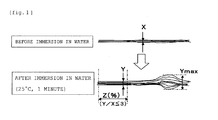
- the above polyester multifilaments for resin reinforcement in the invention are characterized in that the length of multifilament bundle portions satisfying 1 ⁇ Y/X ⁇ 3 (wherein X represents the width of the multifilaments before immersion in water and Y represents the width of the multifilaments after immersion in water at 25°C for 1 minute (see Fig. 1 )) is 50% or more of the length of the multifilaments before the immersion.
- Y/X represents bundling properties of the multifilaments in a width direction in an aqueous medium, namely in a solution, and the smaller Y/X value shows that bundling properties of the multifilaments are more excellent.
- Preferred is Y/X ⁇ 2.5, and more preferred is Y/X ⁇ 2.
- the terminology "the length of multifilament bundle portions satisfying 1 ⁇ Y/X ⁇ 3 is 50% or more of the length of the multifilaments before the immersion" represents bundling properties in a longitudinal direction of the multifilaments, and the larger this value is, the less the multifilaments are opened in the longitudinal direction thereof, showing good bundling properties.
- the length of multifilament bundle portions satisfying 1 ⁇ Y/X ⁇ 3 is less than 50% of the length of the multifilaments before the immersion, bundling properties of the multifilaments in the longitudinal direction is low, and dispersibility of the multifilaments in the matrix resin is deteriorated, so that the sufficient reinforcing effect is not obtained in mechanical characteristics such as strength and impact resistance of the molded article, and appearance quality is also deteriorated. This is therefore unfavorable.
- the length of multifilament bundle portions satisfying 1 ⁇ Y/X ⁇ 3 is preferably 65% or more and more preferably 80% or more of the length of the multifilaments before the immersion. Incidentally, the upper limit of this theoretically becomes 100%.
- thermosetting resin is cured by heat treatment in a state where the multifilaments to which the thermosetting resin is attached is arranged under tension and fixed, thereby being able to obtain it more efficiently.
- the method of imparting the epoxy resin to the polyester multifilaments before the polyester multifilaments are once taken up it can be obtained by conducting warming treatment at a temperature of 30 to 60°C for 50 hours or more in a state of a cheese-shaped package obtained by taking up the multifilaments.
- the polyester multifilaments for resin reinforcement of the invention excellent in bundling properties, in which the length of multifilament bundle portions satisfying 1 ⁇ Y/X ⁇ 3 (wherein X represents the width of the multifilaments before immersion in water and Y represents the width of the multifilaments after immersion in water at 25°C for 1 minute) is 50% or more of the length of the multifilaments before the immersion, exhibits satisfactory and homogeneous dispersibility of the multifilaments in the matrix resin, thereby being able to improve mechanical characteristics such as strength and impact resistance of the molded article.
- thermosetting resin is attached to the polyester multifilament in amount of 0.01 to 5.0% by weight, thereby being able to exhibit satisfactory and homogeneous dispersibility of the multifilaments in the matrix resin, thereby being able to improve mechanical characteristics such as strength and impact resistance of the molded article.
- thermosetting resin causes no occurrence of deterioration of bundling properties and an arranged state under tension of the multifilaments for resin reinforcement due to heat or melting and dissolution thereof in the matrix resin at the time when filament-reinforced resin strands and pellets are produced, and that the filaments are opened for the first time by shear force by a screw at the time of the subsequent melt molding, thereby being able to homogeneously disperse the filaments without breakage or entanglement thereof.
- polyester multifilaments of the invention are homogeneously dispersed in the matrix resin to exhibit excellent performance, and when the matrix resin is a polyolefinic resin such as a polyethylenic or polypropylenic resin, the performance thereof is prominently exhibited.
- the polypropylenic resin such as polypropylene alone or a polyethylene-polypropylene copolymer comprising polypropylene as a main component is preferred among others.
- the resin composition reinforced with the polyester multifilaments for resin reinforcement of the invention is not particularly limited. However, taking the molding temperature and the like into consideration, they can be suitably used in the polyolefinic resin such as polyethylene or polypropylene. Examples
- Measurement was made in accordance with ASTM-D-696.
- a test piece of 15.0 mm long ⁇ 5.0 mm wide ⁇ 2.0 mm thick was sampled from a flat plate molded, and linear coefficients of expansion in a longitudinal direction (MD) and a width direction (TD) were determined.
- polyester multifilaments of 1, 670 dtex/250 filaments having a strength of 8.2 cN/dtex, an elongation of 16.0%, a dry heat shrinkage ratio at 150°C of 9.5%, a degree of interlace entanglement of 8 interlaced portions/m and an amount of an epoxy resin attached of 0.1% by weight were obtained by a melt spinning process in the following manner.
- a spinning oil mainly comprising a polyether ester-based component containing 8% by weight of POE (10) lauryl aminoether was imparted to undrawn multifilaments spun from a spinning die and cool-solidified to an amount of an amine compound component attached of 0.02% by weight based on the multifilaments, and the multifilaments were taken up by a roller. Then, a first stage drawing was carried out between a first roller of 110°C and a second roller at a draw ratio of 3.5, and further, a second stage drawing was carried out between the second roller and a third roller of 220°C to a total draw ratio of 5.6.
- POE 10
- the resulting polyester multifilaments for resin reinforcement and a polypropylene resin (Novatec PP SA06A manufactured by Japan Polypropylene Corporation) were pultruded by using a single screw extruder having a crosshead die to produce filament-reinforced polypropylene resin pellets.
- the filament content was adjusted to 30% by weight, and the pellet length to 10 mm.
- the resulting filament-reinforced polypropylene resin pellets were supplied to a injection molding machine, and molded at a cylinder temperature of 210°C, a mold temperature of 70°C, a back pressure of 10 kg/cm 2 and a screw revolution speed of 50 rpm to form a flat plate of 80 mm ⁇ 100 mm ⁇ 2.0 mm thick, a bar of 6.4 mm thick ⁇ 12.7 mm wide ⁇ 127 mm long and a TYPE-I bar of 3.2 mm thick ⁇ 12.7 mm wide, respectively.
- Table 1 The evaluation results of the multifilaments and the filament-reinforced resin molded articles are collectively shown in Table 1.
- Polyester multifilaments of 1,670 dtex/250 filaments were obtained in the same manner as in Example 1 with the exception that the amount of the epoxy component imparted in the roller oiling in the production process of the polyester multifilaments was changed as shown in Table 1 by adjusting the degree of entanglement with an interlace nozzle. Incidentally, in Example 6, no entangling treatment was conducted. Then, filament-reinforced resin molded articles were obtained in the same manner as in Example 1. The evaluation results of the multifilaments and the filament-reinforced resin molded articles are collectively shown in Table 1.
- Polyester multifilaments of 1,670 dtex/250 filaments were obtained in the same manner as in Example 1 with the exception that no polyglycerol polyglycidyl ether was imparted in the production process of the polyester multifilaments, and that no warming treatment of the multifilaments after taken up was conducted.
- the evaluation results of the multifilaments and the filament-reinforced resin molded articles are collectively shown in Table 1.
- the polyester multifilaments for resin reinforcement of the invention shown in Examples 1 to 8 are not opened and excellent in bundling properties, so that homogeneous dispersibility of the multifilaments in the filament-reinforced resin molded articles is improved.
- strength, elongation and impact resistance of the molded articles are significantly improved to exhibit the excellent reinforcing effect.
- the difference between the linear coefficients of expansion in the longitudinal direction (MD) and the width direction (TD) decreases. This is considered to be a result of randomization of orientation of the reinforcing multifilaments by homogeneous dispersion.
- Comparative Example 1 the amount of the epoxy-based resin attached is much outside the range of the invention, resulting in poor appearance evaluation and physical properties of the resulting multifilaments. Further, use of the polyester multifilaments to which no thermosetting resin is attached in Comparative Example 2 results in deterioration of a dispersed state of the multifilaments in the filament-reinforced resin molded article, and a state where the multifilaments cohere or are entangled has been observed.
- the polyester multifilaments for resin reinforcement of the invention are satisfactorily homogeneously dispersed in the matrix resin to provide a filament-reinforced resin molded body excellent in mechanical characteristics and impact resistance. Accordingly, they are useful as multifilaments for resin reinforcement for the filament-reinforced resin molded body of a thermoplastic resin such as an olefinic resin.
Landscapes
- Chemical & Material Sciences (AREA)
- Engineering & Computer Science (AREA)
- Chemical Kinetics & Catalysis (AREA)
- Textile Engineering (AREA)
- Materials Engineering (AREA)
- Polymers & Plastics (AREA)
- Health & Medical Sciences (AREA)
- Medicinal Chemistry (AREA)
- Manufacturing & Machinery (AREA)
- Organic Chemistry (AREA)
- General Chemical & Material Sciences (AREA)
- Physics & Mathematics (AREA)
- Fluid Mechanics (AREA)
- Compositions Of Macromolecular Compounds (AREA)
- Treatments For Attaching Organic Compounds To Fibrous Goods (AREA)
- Reinforced Plastic Materials (AREA)
- Yarns And Mechanical Finishing Of Yarns Or Ropes (AREA)
Abstract
Description
- The present invention relates to polyester multifilaments for resin reinforcement which are satisfactorily homogeneously dispersed in a matrix resin to provide a filament-reinforced resin molded body excellent in mechanical characteristics and impact resistance.
- Fiber-reinforced thermoplastic resins in which thermoplastic resins such as polyolefin resins are reinforced with staple fibers have been suitably used in various industrial parts because of their excellent mechanical characteristics such as tensile strength and rigidity. Previously, glass fiber which is inexpensive and excellent in dimensional stability and heat resistance has been heavily used, and glass fiber-reinforced resins have been used in many industrial products at present. However, effective utilization of resources and saving of energy have been taken up as problems to recent global environmental waste and future depletion of oil resources, and under the present circumstances, the glass fiber-reinforced resins have problems in terms of recyclability and weight saving, because the glass fiber-reinforced resins contain glass in resins. From such a background, fiberreinforced resins have been required to meet environmental challenges such as recyclability, as well as mechanical characteristics such as strength and impact resistance.
- Further, the fiber-reinforced thermoplastic resin is usually produced by melt kneading a resin and reinforcing fiber, so that it has a disadvantage that the fiber becomes short at the time of production to result in deterioration in impact strength such as Izod impact strength or weight-drop impact strength. Furthermore, it has problems with anisotropy of strength, dimensional stability, appearance quality and the like according to the shape of a molded article, due to dispersion and orientation of the fiber in the resin. Accordingly, the use thereof is limited under the present circumstances.
- As one in which fiber dispersibility and impact resistance of such a fiber-reinforced thermoplastic resin are improved, there is proposed a fiber-reinforced resin composition in which 5 to 60% by weight of 5 to 50 mm glass long fiber is melt kneaded with a polyolefin resin, for example, as shown in patent document 1 (
JP-A-60-86139 JP-A-10-176085 JP-A-2001-81336 JP-A-2005-2202 - On the other hand, a filament-reinforced resin which satisfies resin reinforcement, recyclability and weight saving by using polyester fiber excellent in mechanical characteristics, general versatility and recyclability as reinforcing fiber is unprecedented. The present inventors have tried to reinforce resins with polyester fiber. As a result, it has become clear that dispersibility of the polyester fiber in the matrix resins is low, resulting in failure to obtain the sufficient reinforcing effect such as strength and impact resistance.
- Patent Document 1:
JP-A-60-86139 - Patent Document 2:
JP-A-10-176085 - Patent Document 3:
JP-A-2001-81336 - Patent Document 4:
JP-A-2005-2202 - An object of the invention is to solve problems as described above and to provide polyester multifilaments for resin reinforcement which are satisfactorily homogeneously dispersed in a matrix resin to provide a filament-reinforced resin molded body excellent in mechanical characteristics and impact resistance.
- The invention relates to polyester multifilaments for resin reinforcement to which a thermosetting resin is attached in an amount of 0.01 to 5.0% by weight based on the polyester multifilaments.
As the thermosetting resin used herein, an epoxy-based resin or a urethane-based resin is preferred.
Further, in the polyester multifilaments for resin reinforcement of the invention, the length of multifilament bundle portions satisfying 1≤Y/X≤3 (wherein X represents the width of the multifilaments before immersion in water and Y represents the width of the multifilaments after immersion in water at 25°C for 1 minute) is preferably 50% or more of the length of the multifilaments before the immersion.
Such polyester multifilaments for resin reinforcement of the invention are obtained by imparting the thermosetting resin to the polyester multifilaments before the polyester multifilaments are once taken up.
Further, the polyester multifilaments for resin reinforcement of the invention are also obtained by imparting the thermosetting resin to the polyester multifilaments by impregnation, followed by heat treatment, after the polyester multifilaments have once been taken up. - The polyester multifilaments for resin reinforcement of the invention are a little opened in water at 25°C and excellent in bundling properties, so that the multifilaments for reinforcement are satisfactorily homogeneously dispersed in the matrix resin to be able to obtain the filament-reinforced resin molded body excellent in mechanical characteristics and impact resistance and also to be able to expect environmental effects such as improvements in weight saving and recyclability. Thus, the multifilaments have the great practical effects.
-
- [
Fig. 1] Fig. 1 is an illustrative view showing polyester multifilaments for resin reinforcement in the invention. Best Mode for Carrying Out the Invention - In the invention, the polyester multifilaments are multifilaments comprising polyethylene terephthalate, polyethylene naphthalate or a polyester mainly composed thereof, and are not limited at all in the molecular weight, the fineness, the number of filaments, the cross sectional shape, the multifilament physical properties, the fine structure, the presence or absence of an additive contained and the polymer properties such as the terminal carboxyl group concentration of the polyester multifilaments.
- Incidentally, for the molecular weight of the polyester, in the case of polyethylene terephthalate, the intrinsic viscosity thereof (measured at a temperature of 35°C using o-chlorophenol as a solvent) is preferably from 0.60 to 1.20 dL/g, more preferably from 0. 65 to 1.10 dL/g, and particularly preferably from 0.70 to 0.1.00 dL/g.
On the other hand, in the case of polyethylene naphthalate, for the molecular weight thereof, the intrinsic viscosity (the value measured at 35°C using a solution of a mixed solvent of o-chlorophenol and o-dichlorobenzene (volume ratio: 6:4)) is preferably from 0.50 to 1.00 dL/g, more preferably from 0.55 to 0.95 dL/g, and still more preferably from 0.60 to 0.90 dL/g.
Further, the monofilament fineness of the polyester multifilaments is usually from 1 to 20 dtex, and preferably from about 2 to about 15 dtex.
Furthermore, the total fineness of the polyester multifilaments is not particularly limited, but it is usually from 150 to 3,000 dtex, and preferably from 250 to 2,000 dtex.
In addition, the number of filaments of the polyester multifilaments is not particularly limited, but it is usually from 10 to 1,000 filaments, and preferably from 50 to 500 filaments. - The polyester multifilaments for resin reinforcement in the invention are characterized in that a thermosetting resin is attached to the polyester multifilaments in an amount of 0.01 to 5.0% by weight. In the invention, the polyester multifilaments are coated with the thermally stable thermosetting resin, thereby being able to maintain bundling properties of the polyester multifilaments in producing filament-reinforced resin pellets and to densely fill around the reinforcing filaments with the resin. Thus, the filaments are opened at the time of melt kneading in molding the filament-reinforced resin to be able to exhibit homogeneous dispersibility. When the amount of the thermosetting resin attached is less than 0.01% by weight, bundling properties of the filaments enough to exhibit the effects of the invention are not obtained. On the other hand, when the amount attached exceeds 5.0% by weight, the filaments become too hard, resulting in deteriorated processability. Further, it becomes difficult to open at the time of molding, so that there is a problem that the reinforcing effect and appearance quality of the resin molded article are poor. The amount of the thermosetting resin attached to the polyester multifilaments in the invention is preferably from 0.03 to 3.5% by weight, more preferably from 0.05 to 2.0% by weight, still more preferably form 0.05 to 1.0% by weight, and particularly preferably from 0.05 to 0.5% by weight. According to such polyester multifilaments for resin reinforcement of the invention, the multifilaments for reinforcement are satisfactorily homogeneously dispersed in the matrix resin to provide the filament-reinforced resin molded body excellent in mechanical characteristics and impact resistance.
- As the thermosetting resin used in the polyester multifilaments used in the invention, there is, for example, an unsaturated polyester resin, a vinyl ester resin, an epoxy-based resin, a phenolic (resol type) resin, a urea-melamine resin, a polyimide, a urethane-based resin, a copolymer or a modified polymer thereof, or the like. In particular, an epoxy-based resin or a urethane-based resin is preferred from the viewpoints of handling-processability and mechanical characteristics.
- Of these, specific examples of the epoxy-based resins (including epoxy compounds) include diglycidyl ether compounds such as ethylene glycol diglycidyl ether and polyethylene glycol diglycidyl ether, propylene glycol diglycidyl ether and polypropylene glycol diglycidyl ether, 1,4-butanediol diglycidyl ether, neopentyl glycol diglycidyl ether, polytetramethylene glycol diglycidyl ether and a polyalkylene glycol diglycidyl ether, and polyglycidyl ether compounds such as glycerol polyglycidyl ether, diglycerol polyglycidyl ether and polyglycerol polyglycidyl ether, sorbitol polyglycidyl ether, arabitol polyglycidyl ether, trimethylolpropane polyglycidyl ether, pentaerythritol polyglycidyl ether and a polyglycidyl ether of an aliphatic polyhydric alcohol. Preferred is an aliphatic polyglycidyl ether having a highly reactive glycidyl group. More preferably, polyethylene glycol diglycidyl ether, polypropylene glycol diglycidyl ether, an alkanediol diglycidyl ether and the like are preferred.
- Further, the urethane-based resin is one synthesized by polyaddition reaction using a polyisocyanate and a polyol as main raw materials. The above-mentioned polyisocyanate may be any isocyanate compound, such as an aromatic isocyanate represented by tolylene diisocyanate or the like, an aliphatic isocyanate such as hexamethylene diisocyanate or an alicyclic isocyanate. Further, as the above-mentioned polyol, there is generally used polyethylene glycol, polytetramethylene glycol, a polyester-based polyol or the like. Furthermore, it is also possible to obtain the urethane-based resin by blocking a terminal of an isocyanate component using an appropriate blocking agent to form a prepolymer, and then, polymerizing it by heating.
- Methods for producing the polyester multifilaments for resin reinforcement in the invention include a method of first imparting the above-mentioned thermosetting resin to the polyester multifilaments before they are taken up in a cheese form in a process of producing the polyester multifilaments, and/or a method of impregnating the polyester multifilaments with the thermosetting resin after the polyester multifilaments have once been taken up, and conducting heat treatment. Either method may be employed as long as the effects of the invention are not impaired.
Further, it is desirable that the polyester multifilaments of the invention are entangled. The degree of entanglement is preferably from 2 to 15 tangles/m, more preferably from 3 to 12 tangles/m, still more preferably from 3 to 10 tangles/m, and particularly preferably from 4 to 9 tangles/m. This makes it possible to exhibit the above-mentioned effects more prominently, combined with the function of coating the polyester multifilaments with the thermosetting resin. That is to say, when the multifilaments have no tangle or the degree of entanglement is less than 2, bundling properties of the multifilaments in producing the filament-reinforced resin pellets tend to deteriorate. On the other hand, when the degree of entanglement exceeds 15 tangles/m, homogeneous dispersibility of the filaments in molding the filament-reinforced resin tends to deteriorate. The entanglement is preferably air entanglement using interlacing or the like. - Specifically, the polyester multifilaments for resin reinforcement of the invention can be produced, for example, in the following manner. That is to say, there is mentioned a production method of imparting a spinning oil containing an amine compound to melt-spun undrawn polyester multifilaments, hot drawing them, then, imparting a finish oil containing a thermosetting resin, for example, an epoxy compound, conducting entangling treatment, and taking up in a cheese form. However, the invention is not limited thereby.
- The amine compound-containing spinning oil as used herein preferably contains an amine compound in which 2 to 20 mol of ethylene oxide and/or propylene oxide are added to an aliphatic amine having 4 to 22 carbon atoms. As the other spinning oil constituents, there can be contained ones used in usual spinning oils for polyester fiber, such as a lubricating agent, an emulsifier and an antistatic agent. At this time, it is preferred that a thermosetting resin such as an epoxy compound is not contained. The lubricating agents include mineral oil, a fatty acid ester and the like, the emulsifiers include a higher alcohol and an ethylene oxide (EO) adduct, and the antistatic agents include various anionic and cationic surfactants and the like.
- For the ratio of such respective components of the spinning oil, it is preferred that 3 to 20% by weight of the amine compound, 30 to 80% by weight of the lubricating agent, 20 to 70% by weight of the emulsifier and proper amounts of the other additives are combined to 100% by weight. Guides, draw rollers and the like in a yarn-making process are less contaminated while exhibiting the original functions of smoothness and bundling properties of the spinning oil, which tends to improve productivity and product quality.
- The spinning oil can be imparted to melt-spun undrawn filaments by a usual roller oiling method or nozzle oiling method. The amount of the spinning oil imparted is preferably from 0.10 to 2.0% by weight, and more preferably from 0.30 to 1.0% by weight. The spinning oil solution may be imparted either in a form of a straight oil diluted with low-viscosity mineral oil, or in a form of an aqueous emulsion, without being particularly limited.
- The undrawn polyester multifilaments to which the spinning oil has been imparted are hot drawn and heat treated by conventional methods as needed. Thereafter, the finish oil containing the thermosetting resin such as the epoxy compound is imparted thereto by the usual roller oiling method or nozzle oiling method. The epoxy compound as used herein is preferably an epoxy compound having two or more epoxy groups in one molecule. The amount of the thermosetting resin attached is from 0.01 to 5% by weight, preferably from 0.03 to 3.5% by weight, and more preferably from 0.05 to 2% by weight, based on the polyester multifilaments, as described above. The finish oil is generally used in a form of the aqueous emulsion. The lubricating agent, the emulsifier, the antistatic agent and the other additives as used in the above-mentioned spinning oil may be mixed as needed in the finish oil.
- On the other hand, as the method of imparting the abovementioned thermosetting resin to the polyester multifilaments by impregnation, followed by heat treatment, after the polyester multifilaments have once been taken up, for example, a treatment liquid containing the above-mentioned epoxy compound, a mixture of the isocyanate compound and the polyhydric alcohol compound or the like is attached to the polyester multifilaments, and heat treated with a heating roller or a noncontact heater. As a method of imparting the thermosetting resin to the polyester multifilaments, there can be used the usual roller oiling method or nozzle oiling method. However, when the amount of the thermosetting resin to the filaments is within the range of the invention, the polyester multifilaments may be immersed in a treating bath in which the treating agents are placed. It is not particularly limited whether a curing agent, the other additives and the like are blended in the treatment liquid or imparted to the filaments as other treating agents, separately from the above-mentioned treating agents. However, in this case, it is necessary to select, considering stability of the treating agents, and the like. It goes without saying that stretch and/or relaxation heat treatment may be concomitantly conducted to the polyester multifilaments.
For the entangling treatment, a method of utilizing air current, a liquid current or the like can be employed. However, in terms of workability and obtaining tangles within the above-mentioned range, air entangling treatment using an interlace nozzle is preferred. - It is preferred also for more improving bundling properties of the multifilaments that warming treatment at a temperature of 20 to 70°C, preferably 30 to 60°C, for 50 hours or more is conducted to the polyester multifilaments for resin reinforcement obtained by these methods, for enhancing curing reaction of the thermosetting resin, for example, the epoxy resin, as needed.
- The above polyester multifilaments for resin reinforcement in the invention are characterized in that the length of multifilament bundle portions satisfying 1≤Y/X≤3 (wherein X represents the width of the multifilaments before immersion in water and Y represents the width of the multifilaments after immersion in water at 25°C for 1 minute (see
Fig. 1 )) is 50% or more of the length of the multifilaments before the immersion. Y/X represents bundling properties of the multifilaments in a width direction in an aqueous medium, namely in a solution, and the smaller Y/X value shows that bundling properties of the multifilaments are more excellent. Preferred is Y/X≤2.5, and more preferred is Y/X≤2. In the case of Y/X>3, bundling properties of the multifilaments are insufficient, and dispersibility of the multifilaments in the matrix resin is deteriorated, so that the sufficient reinforcing effect is not obtained in mechanical characteristics such as strength and impact resistance of the molded article, and appearance quality is also deteriorated. This is therefore unfavorable. On the other hand, the case of Y/X<1 shows that the width of the multifilaments is decreased by immersion thereof in water at 25°C. In addition to bundling properties, changes in monofilament diameter due to elution of components of the multifilaments in water or self extension are considered, which causes inhibition of the reinforcing effect in the filament-reinforced resin molded body, poor dispersion or a decrease in dimensional stability. This is therefore unfavorable. - Further, the terminology "the length of multifilament bundle portions satisfying 1≤Y/X≤3 is 50% or more of the length of the multifilaments before the immersion" represents bundling properties in a longitudinal direction of the multifilaments, and the larger this value is, the less the multifilaments are opened in the longitudinal direction thereof, showing good bundling properties. When the length of multifilament bundle portions satisfying 1≤Y/X≤3 is less than 50% of the length of the multifilaments before the immersion, bundling properties of the multifilaments in the longitudinal direction is low, and dispersibility of the multifilaments in the matrix resin is deteriorated, so that the sufficient reinforcing effect is not obtained in mechanical characteristics such as strength and impact resistance of the molded article, and appearance quality is also deteriorated. This is therefore unfavorable. In the invention, the length of multifilament bundle portions satisfying 1≤Y/X≤3 is preferably 65% or more and more preferably 80% or more of the length of the multifilaments before the immersion. Incidentally, the upper limit of this theoretically becomes 100%. By such polyester filaments, the reinforcing filaments are satisfactorily homogeneously dispersed in the matrix resin to provide the filament-reinforced resin molded body excellent in mechanical characteristics and impact resistance.
- In the invention, in order to adjust the length of multifilament bundle portions satisfying 1≤Y/X≤3 to 50% or more of the length of the multifilaments before the immersion, there is no particular limitation. This is achieved by a combination of conditions such as the fineness of the multifilaments, the monofilament fineness, the kind of thermosetting resin attached to the multifilaments, the amount thereof attached, the attaching method, the heat treatment temperature and the heat treatment time. In particular, the thermosetting resin is cured by heat treatment in a state where the multifilaments to which the thermosetting resin is attached is arranged under tension and fixed, thereby being able to obtain it more efficiently. For example, in the method of imparting the epoxy resin to the polyester multifilaments before the polyester multifilaments are once taken up, it can be obtained by conducting warming treatment at a temperature of 30 to 60°C for 50 hours or more in a state of a cheese-shaped package obtained by taking up the multifilaments.
- As described above, the polyester multifilaments for resin reinforcement of the invention excellent in bundling properties, in which the length of multifilament bundle portions satisfying 1≤Y/X≤3 (wherein X represents the width of the multifilaments before immersion in water and Y represents the width of the multifilaments after immersion in water at 25°C for 1 minute) is 50% or more of the length of the multifilaments before the immersion, exhibits satisfactory and homogeneous dispersibility of the multifilaments in the matrix resin, thereby being able to improve mechanical characteristics such as strength and impact resistance of the molded article. In detail, the thermosetting resin is attached to the polyester multifilament in amount of 0.01 to 5.0% by weight, thereby being able to exhibit satisfactory and homogeneous dispersibility of the multifilaments in the matrix resin, thereby being able to improve mechanical characteristics such as strength and impact resistance of the molded article. Although a mechanism of exhibiting the effects of the invention is not clear, it is considered that coating of the polyester multifilaments with the thermosetting resin causes no occurrence of deterioration of bundling properties and an arranged state under tension of the multifilaments for resin reinforcement due to heat or melting and dissolution thereof in the matrix resin at the time when filament-reinforced resin strands and pellets are produced, and that the filaments are opened for the first time by shear force by a screw at the time of the subsequent melt molding, thereby being able to homogeneously disperse the filaments without breakage or entanglement thereof.
Further, the above-mentioned entanglement is performed to the polyester multifilaments, thereby being able to easily satisfy the above-mentioned X/Y, combined with the effect due to imparting the thermosetting resin.
The polyester multifilaments of the invention are homogeneously dispersed in the matrix resin to exhibit excellent performance, and when the matrix resin is a polyolefinic resin such as a polyethylenic or polypropylenic resin, the performance thereof is prominently exhibited. The polypropylenic resin such as polypropylene alone or a polyethylene-polypropylene copolymer comprising polypropylene as a main component is preferred among others. - The resin composition reinforced with the polyester multifilaments for resin reinforcement of the invention is not particularly limited. However, taking the molding temperature and the like into consideration, they can be suitably used in the polyolefinic resin such as polyethylene or polypropylene. Examples
- The invention will be described in more detail below with reference to examples, but the invention is not limited thereby.
- There were measured the multifilament width X (mm) of 100-cm long multifilaments before immersion in water, the multifilament width Y (mm) after immersion in water at 25°C for 1 minute and the length Z (cm) of multifilament bundle portions satisfying 1≤Y/X≤3, and the filament bundling rate was calculated from the following equation (see
Fig. 1 ):
Incidentally, the maximum multifilament width Ymax (mm) after immersion in water at 25°C for 1 minute was measured, and the value of Ymax/X (maximum opening) was calculated, as an index for indicating the degree of opening of filaments of the multifilaments. - A surface of a flat plate of a molded article was visually observed. A three-step evaluation was made, taking as "Excellent (O) " the case of such extremely homogeneous dispersion that no filament bundle not opened was observed, as "Acceptable (Δ)" the case where filament bundles not opened are quite slightly observed, and as "Unacceptable (×)" the case of such inhomogeneous dispersion that many filament bundles not opened or entangled were observed.
- Measurement was made in accordance with JIS-L-1013. Incidentally, the dry heat shrinkage ratio was measured in accordance with the filament shrinkage ratio (B process).
- For a TYPE-I bar of 3.2 mm thick × 12.7 mm wide obtained by molding, measurement was made at a test speed of 50 mm/min in accordance with ASTM-D-638-02.
- A bar of 6.4 mm thick × 12.7 mm wide × 127 mm long obtained by molding was cut to half the length thereof, 63.5 mm. For the resulting bar, measurement was made in accordance with the ASTM-D-256-00 method under the following conditions:
- Number of revolutions of notch processing: 400 rpm
- Feed speed of notch processing: 120 mm/min
- Hammer capacity: 60 kgf·cm
- Measuring temperatures: 23°C, -40°C
- Measurement was made in accordance with ASTM-D-696. A test piece of 15.0 mm long × 5.0 mm wide × 2.0 mm thick was sampled from a flat plate molded, and linear coefficients of expansion in a longitudinal direction (MD) and a width direction (TD) were determined.
- Using polyethylene terephthalate chips having an intrinsic viscosity (measured in an o-chlorophenol solvent at 35°C) of 1.01 dL/g, polyester multifilaments of 1, 670 dtex/250 filaments having a strength of 8.2 cN/dtex, an elongation of 16.0%, a dry heat shrinkage ratio at 150°C of 9.5%, a degree of interlace entanglement of 8 interlaced portions/m and an amount of an epoxy resin attached of 0.1% by weight were obtained by a melt spinning process in the following manner.
A spinning oil mainly comprising a polyether ester-based component containing 8% by weight of POE (10) lauryl aminoether was imparted to undrawn multifilaments spun from a spinning die and cool-solidified to an amount of an amine compound component attached of 0.02% by weight based on the multifilaments, and the multifilaments were taken up by a roller. Then, a first stage drawing was carried out between a first roller of 110°C and a second roller at a draw ratio of 3.5, and further, a second stage drawing was carried out between the second roller and a third roller of 220°C to a total draw ratio of 5.6. Successively, a relaxation of 4% was given between the third roller and a fourth roller, and a 40% by weight aqueous solution of polyglycerol polyglycidyl ether ("Denacol EX-512" manufactured by Nagase Chemtex Corporation) was imparted thereto by a roller oiling method to an amount of an epoxy component attached of 0.1% by weight based on the multifilaments. Entanglement was imparted with an interlace nozzle between the fourth roller and a winder, and then, the resulting multifilaments were taken up on a cheese-shaped package at a speed of 3,000 m/min. Then, heat treatment was conducted at 55°C for 120 hours to obtain polyester multifilaments for resin reinforcement.
The resulting polyester multifilaments for resin reinforcement and a polypropylene resin (Novatec PP SA06A manufactured by Japan Polypropylene Corporation) were pultruded by using a single screw extruder having a crosshead die to produce filament-reinforced polypropylene resin pellets. The filament content was adjusted to 30% by weight, and the pellet length to 10 mm. Then, the resulting filament-reinforced polypropylene resin pellets were supplied to a injection molding machine, and molded at a cylinder temperature of 210°C, a mold temperature of 70°C, a back pressure of 10 kg/cm2 and a screw revolution speed of 50 rpm to form a flat plate of 80 mm × 100 mm × 2.0 mm thick, a bar of 6.4 mm thick × 12.7 mm wide × 127 mm long and a TYPE-I bar of 3.2 mm thick × 12.7 mm wide, respectively. The evaluation results of the multifilaments and the filament-reinforced resin molded articles are collectively shown in Table 1. - Polyester multifilaments of 1,670 dtex/250 filaments were obtained in the same manner as in Example 1 with the exception that the amount of the epoxy component imparted in the roller oiling in the production process of the polyester multifilaments was changed as shown in Table 1 by adjusting the degree of entanglement with an interlace nozzle. Incidentally, in Example 6, no entangling treatment was conducted. Then, filament-reinforced resin molded articles were obtained in the same manner as in Example 1. The evaluation results of the multifilaments and the filament-reinforced resin molded articles are collectively shown in Table 1.
- Polyester multifilaments of 1,670 dtex/250 filaments were obtained in the same manner as in Example 1 with the exception that no polyglycerol polyglycidyl ether was imparted in the production process of the polyester multifilaments, and that no warming treatment of the multifilaments after taken up was conducted. The evaluation results of the multifilaments and the filament-reinforced resin molded articles are collectively shown in Table 1.
-


- As apparent from the results of Table 1, the polyester multifilaments for resin reinforcement of the invention shown in Examples 1 to 8 are not opened and excellent in bundling properties, so that homogeneous dispersibility of the multifilaments in the filament-reinforced resin molded articles is improved. As a result, it is shown that strength, elongation and impact resistance of the molded articles are significantly improved to exhibit the excellent reinforcing effect. Further, the difference between the linear coefficients of expansion in the longitudinal direction (MD) and the width direction (TD) decreases. This is considered to be a result of randomization of orientation of the reinforcing multifilaments by homogeneous dispersion. On the other hand, in Comparative Example 1, the amount of the epoxy-based resin attached is much outside the range of the invention, resulting in poor appearance evaluation and physical properties of the resulting multifilaments. Further, use of the polyester multifilaments to which no thermosetting resin is attached in Comparative Example 2 results in deterioration of a dispersed state of the multifilaments in the filament-reinforced resin molded article, and a state where the multifilaments cohere or are entangled has been observed.
- When used for resin reinforcement of a matrix resin, the polyester multifilaments for resin reinforcement of the invention are satisfactorily homogeneously dispersed in the matrix resin to provide a filament-reinforced resin molded body excellent in mechanical characteristics and impact resistance. Accordingly, they are useful as multifilaments for resin reinforcement for the filament-reinforced resin molded body of a thermoplastic resin such as an olefinic resin.
Claims (6)
- Polyester multifilaments for resin reinforcement to which a thermosetting resin is attached in an amount of 0.01 to 5.0% by weight based on the polyester multifilaments.
- The polyester multifilaments for resin reinforcement according to claim 1, wherein the thermosetting resin is an epoxy-based resin or a urethane-based resin.
- The polyester multifilaments for resin reinforcement according to claim 1 or 2, wherein the polyester multifilaments have a degree of entanglement of 2 to 15 tangles/m.
- The polyester multifilaments for resin reinforcement according to any one of claims 1 to 3, wherein the length of multifilament bundle portions satisfying 1≤Y/X≤3 (wherein X represents the width of the multifilaments before immersion in water and Y represents the width of the multifilaments after immersion in water at 25°C for 1 minute) is 50% or more of the length of the multifilaments before the immersion.
- A method for producing the polyester multifilaments for resin reinforcement according to any one of claims 1 to 4, comprising imparting a thermosetting resin to polyester multifilaments before the polyester multifilaments are once taken up.
- A method for producing the polyester multifilaments for resin reinforcement according to any one of claims 1 to 4, comprising imparting a thermosetting resin to polyester multifilaments by impregnation, followed by heat treatment, after the polyester multifilaments have once been taken up.
Applications Claiming Priority (3)
| Application Number | Priority Date | Filing Date | Title |
|---|---|---|---|
| JP2006301114 | 2006-11-07 | ||
| JP2006301113 | 2006-11-07 | ||
| PCT/JP2007/071519 WO2008056645A1 (en) | 2006-11-07 | 2007-11-06 | Polyester multifilament for resin reinforcement and process for producing the same |
Publications (3)
| Publication Number | Publication Date |
|---|---|
| EP2083113A1 true EP2083113A1 (en) | 2009-07-29 |
| EP2083113A4 EP2083113A4 (en) | 2014-02-12 |
| EP2083113B1 EP2083113B1 (en) | 2016-10-26 |
Family
ID=39364461
Family Applications (2)
| Application Number | Title | Priority Date | Filing Date |
|---|---|---|---|
| EP07831251.9A Not-in-force EP2083113B1 (en) | 2006-11-07 | 2007-11-06 | Polyester multifilament for resin reinforcement and process for producing the same |
| EP07831252.7A Not-in-force EP2096134B1 (en) | 2006-11-07 | 2007-11-06 | Organic fiber-reinforced composite resin composition and organic fiber-reinforced composite resin molding |
Family Applications After (1)
| Application Number | Title | Priority Date | Filing Date |
|---|---|---|---|
| EP07831252.7A Not-in-force EP2096134B1 (en) | 2006-11-07 | 2007-11-06 | Organic fiber-reinforced composite resin composition and organic fiber-reinforced composite resin molding |
Country Status (5)
| Country | Link |
|---|---|
| US (2) | US20100080992A1 (en) |
| EP (2) | EP2083113B1 (en) |
| JP (2) | JP5676080B2 (en) |
| CN (2) | CN101535382B (en) |
| WO (2) | WO2008056646A1 (en) |
Families Citing this family (20)
| Publication number | Priority date | Publication date | Assignee | Title |
|---|---|---|---|---|
| CN101925639B (en) | 2008-01-24 | 2013-05-22 | 住友化学株式会社 | Surface-treated fiber, resin composition, and molded article of composition |
| US20110014454A1 (en) * | 2008-03-27 | 2011-01-20 | Sumitomo Chemical Company, Limited | Foam molding article, and method for producing foam molded article |
| JP2009292861A (en) * | 2008-06-02 | 2009-12-17 | Autonetworks Technologies Ltd | Polymer-molded article |
| JPWO2010073998A1 (en) * | 2008-12-24 | 2012-06-14 | 住友化学株式会社 | Foam molded body and method for producing foam molded body |
| JP2011026571A (en) * | 2009-06-26 | 2011-02-10 | Sumitomo Chemical Co Ltd | Thermoplastic resin composition reinforced by low convergent fiber |
| JP2011068739A (en) * | 2009-09-25 | 2011-04-07 | Japan Polypropylene Corp | Propylene resin composition and molded product thereof |
| JP2011132477A (en) * | 2009-12-25 | 2011-07-07 | Japan Polypropylene Corp | Fiber-reinforced polylactic acid-containing resin composition and injection-molded body |
| CN102115594B (en) * | 2009-12-31 | 2014-06-25 | 合肥杰事杰新材料股份有限公司 | Ultrahigh-toughness high-intensity organic fiber reinforced thermoplastic composite material and preparation technology thereof |
| US8729396B2 (en) * | 2010-09-02 | 2014-05-20 | Cooper Technologies Company | Full composite insulator for electrical cutout |
| KR101958608B1 (en) * | 2011-03-02 | 2019-03-14 | 다우 글로벌 테크놀로지스 엘엘씨 | A coating composition and articles made therefrom |
| JP2013001831A (en) * | 2011-06-17 | 2013-01-07 | Teijin Fibers Ltd | Organic fiber for reinforcing resin and fiber-reinforced thermoplastic resin |
| CN104419063B (en) * | 2013-08-29 | 2017-10-03 | 合肥杰事杰新材料股份有限公司 | A kind of continuous long glass fiber strengthens thermoplastic resin |
| CN104419062B (en) * | 2013-08-29 | 2017-10-03 | 合肥杰事杰新材料股份有限公司 | A kind of organic fiber filling thermoplastic resin and preparation method thereof |
| JP2015182202A (en) * | 2014-03-25 | 2015-10-22 | 日本発條株式会社 | Punching method of fiber-reinforced resin plate and manufacturing method of fiber-reinforced resin component |
| JP6523859B2 (en) * | 2014-08-28 | 2019-06-05 | 帝人株式会社 | Method of manufacturing cut body, and method of cutting fiber reinforced resin |
| KR101814057B1 (en) | 2015-09-25 | 2018-01-03 | 지에스칼텍스 주식회사 | Manufacturing method of fiber reinforced resin composite, fiber reinforced resin composite and molded article using the same |
| ES2818580T3 (en) * | 2016-09-20 | 2021-04-13 | Covestro Intellectual Property Gmbh & Co Kg | Anisotropic composite materials based on polyisocyanates |
| CN110770377B (en) * | 2017-07-05 | 2022-03-01 | 旭化成株式会社 | Method for producing commingled yarn, and method for producing woven fabric or knitted fabric |
| JP7076853B2 (en) * | 2020-07-07 | 2022-05-30 | 竹本油脂株式会社 | A diluted solution of a treatment agent for entangled drawn yarn, and a method for producing entangled drawn yarn. |
| TWI825445B (en) * | 2020-07-07 | 2023-12-11 | 日商竹本油脂股份有限公司 | Dilution of treatment agent for interlaced stretched yarn and method for producing interlaced stretched yarn |
Family Cites Families (44)
| Publication number | Priority date | Publication date | Assignee | Title |
|---|---|---|---|---|
| GB873353A (en) * | 1956-12-31 | 1961-07-26 | Du Pont | Improvements in or relating to moulding compositions |
| US3855168A (en) * | 1971-08-03 | 1974-12-17 | Mitsubishi Rayon Co | Adhesive composition for bonding polyester fiber to rubber |
| JPS4827017A (en) * | 1971-08-17 | 1973-04-10 | ||
| JPS5795374A (en) * | 1980-11-26 | 1982-06-14 | Unitika Ltd | Production of polyester fiber having good adhesiveness with rubbers |
| JPS6039763A (en) | 1983-08-11 | 1985-03-01 | Japan Storage Battery Co Ltd | Lead storage battery with eletrolyte circulating device |
| JPS6086139A (en) | 1983-10-18 | 1985-05-15 | Showa Denko Kk | Composition for hot compression molding |
| US4529655A (en) * | 1984-05-23 | 1985-07-16 | E. I. Du Pont De Nemours And Company | Interlaced polyester industrial yarns |
| US4857405A (en) * | 1984-07-18 | 1989-08-15 | Allied-Signal Inc. | Fiber for reinforcing plastic composites and reinforced plastic composites therefrom |
| US4751143A (en) * | 1984-09-20 | 1988-06-14 | Celanese Corporation | Process for treating chemically stabilized, adhesive activated polyester material, polyester material treated by the process and an improved finish composition |
| JPS636172A (en) * | 1986-06-26 | 1988-01-12 | 三菱レイヨン株式会社 | Fiber for reinforcing resin |
| JPH01168916A (en) * | 1986-12-08 | 1989-07-04 | Mitsubishi Rayon Co Ltd | Fiber for reinforcing resin |
| FR2620714B1 (en) * | 1987-09-18 | 1993-06-25 | Landler Yvan | |
| JPH01250428A (en) * | 1988-03-29 | 1989-10-05 | Asahi Fiber Glass Co Ltd | Ribbon-like material for reinforcing resin |
| JPH0625288B2 (en) | 1988-11-02 | 1994-04-06 | 三菱商事株式会社 | Method for manufacturing composite molded article |
| JPH02154068A (en) * | 1988-11-30 | 1990-06-13 | Toray Ind Inc | Production of polyester yarn for reinforcing rubber |
| JPH02154067A (en) * | 1988-11-30 | 1990-06-13 | Toray Ind Inc | Production of polyester yarn for reinforcing rubber |
| JP2932508B2 (en) * | 1989-07-12 | 1999-08-09 | 東洋紡績株式会社 | Polyester multi-yarn with improved fatigue resistance and adhesion |
| JP2941320B2 (en) | 1989-12-08 | 1999-08-25 | ポリプラスチックス株式会社 | Polyolefin resin composition for long fiber reinforced molding and method for producing the same |
| JP2935893B2 (en) | 1990-11-30 | 1999-08-16 | 昭和電工株式会社 | Long fiber-containing resin composition and method for producing the same |
| JPH0559609A (en) * | 1991-08-27 | 1993-03-09 | Unitika Ltd | Production of polyester fiber |
| JP3543011B2 (en) | 1993-04-27 | 2004-07-14 | 出光石油化学株式会社 | Polyolefin resin composition |
| JPH0782666A (en) * | 1993-07-19 | 1995-03-28 | Unitika Ltd | Method for producing polyester fiber for resin reinforcement |
| JPH07279039A (en) * | 1994-04-15 | 1995-10-24 | Teijin Ltd | Polyester fiber for reinforcing polyolefin resin molding and method for producing the same |
| JP3188590B2 (en) * | 1994-06-06 | 2001-07-16 | 帝人株式会社 | Adhesion treatment method between polyester fiber and ethylene propylene rubber |
| JP3649414B2 (en) * | 1995-02-09 | 2005-05-18 | ユニチカ株式会社 | Production method of polyester fiber |
| JPH10176085A (en) | 1996-12-20 | 1998-06-30 | Nippon Porikemu Kk | Glass fiber-reinforced resin composition |
| JPH11286875A (en) * | 1998-04-07 | 1999-10-19 | Teijin Ltd | Processing method of polyester fiber |
| EP1000118B1 (en) * | 1998-06-03 | 2005-11-09 | Mitsuboshi Belting Ltd. | Power transmission belt |
| DE19835983A1 (en) * | 1998-08-08 | 2000-02-17 | Rettenmaier & Soehne Gmbh & Co | Increasing strength of thermoplastic polymer for molded articles and semifinished products comprises including cellulose fibers precoated with duroplast and cured |
| JP3073988B1 (en) | 1999-08-12 | 2000-08-07 | 株式会社神戸製鋼所 | Manufacturing method of organic fiber reinforced resin pellets |
| KR100422027B1 (en) * | 1999-08-23 | 2004-03-11 | 데이진 가부시키가이샤 | Process for producing an adhesive-treated polyester fiber cord |
| JP2001081336A (en) | 1999-09-16 | 2001-03-27 | Idemitsu Petrochem Co Ltd | Molding material of thermoplastic resin containing glass fiber, and its production |
| JP2002167518A (en) | 2000-09-21 | 2002-06-11 | Sumitomo Chem Co Ltd | Long fiber reinforced crystalline thermoplastic resin composition |
| TR200400264T4 (en) * | 2000-11-08 | 2004-03-22 | Arteva Technologies S.A.R.L | Polyester yarn with sequentially coated finishes, a process in which the yarn is prepared and a rubber composite in which the yarn is used |
| US20040203304A1 (en) * | 2001-05-25 | 2004-10-14 | Celine Almonacil | Rubberized fabric and pneumatic tire comprising said rubberized fabric |
| JP4565537B2 (en) * | 2002-04-18 | 2010-10-20 | 東洋紡績株式会社 | Method for producing polyester fiber cord for rubber reinforcement |
| JP3907572B2 (en) * | 2002-10-28 | 2007-04-18 | 竹本油脂株式会社 | Processing method of synthetic fibers for industrial materials |
| US7037578B2 (en) * | 2002-12-11 | 2006-05-02 | The Goodyear Tire & Rubber Company | Power transmission belt |
| JP4163999B2 (en) * | 2003-06-11 | 2008-10-08 | 帝人ファイバー株式会社 | Polyester fiber for resin reinforcement |
| JP2005002202A (en) | 2003-06-11 | 2005-01-06 | Idemitsu Petrochem Co Ltd | Fiber-reinforced resin composition and its molding |
| JP2005040996A (en) | 2003-07-23 | 2005-02-17 | Toyobo Co Ltd | Organic fiber reinforced resin pellet, its production method and resin molded product |
| US7056461B2 (en) * | 2004-03-06 | 2006-06-06 | Hyosung Corporation | Process of making polyester multifilament yarn |
| JP4894276B2 (en) * | 2005-03-14 | 2012-03-14 | 住友化学株式会社 | Polyolefin resin composition |
| JP4960641B2 (en) * | 2006-02-23 | 2012-06-27 | 帝人ファイバー株式会社 | Polyester fiber for resin reinforced fabric |
-
2007
- 2007-11-06 JP JP2008543073A patent/JP5676080B2/en not_active Expired - Fee Related
- 2007-11-06 EP EP07831251.9A patent/EP2083113B1/en not_active Not-in-force
- 2007-11-06 EP EP07831252.7A patent/EP2096134B1/en not_active Not-in-force
- 2007-11-06 CN CN2007800415277A patent/CN101535382B/en not_active Expired - Fee Related
- 2007-11-06 US US12/447,746 patent/US20100080992A1/en not_active Abandoned
- 2007-11-06 WO PCT/JP2007/071520 patent/WO2008056646A1/en not_active Ceased
- 2007-11-06 WO PCT/JP2007/071519 patent/WO2008056645A1/en not_active Ceased
- 2007-11-06 JP JP2008543072A patent/JP5161788B2/en not_active Expired - Fee Related
- 2007-11-06 US US12/513,095 patent/US8034876B2/en not_active Expired - Fee Related
- 2007-11-06 CN CN2007800415328A patent/CN101535556B/en not_active Expired - Fee Related
Also Published As
| Publication number | Publication date |
|---|---|
| CN101535556B (en) | 2012-03-14 |
| EP2083113A4 (en) | 2014-02-12 |
| EP2096134A1 (en) | 2009-09-02 |
| EP2096134A4 (en) | 2012-06-06 |
| CN101535382A (en) | 2009-09-16 |
| US20100120987A1 (en) | 2010-05-13 |
| US8034876B2 (en) | 2011-10-11 |
| JP5676080B2 (en) | 2015-02-25 |
| JPWO2008056646A1 (en) | 2010-02-25 |
| CN101535382B (en) | 2013-03-27 |
| CN101535556A (en) | 2009-09-16 |
| WO2008056646A1 (en) | 2008-05-15 |
| JP5161788B2 (en) | 2013-03-13 |
| US20100080992A1 (en) | 2010-04-01 |
| EP2083113B1 (en) | 2016-10-26 |
| WO2008056645A1 (en) | 2008-05-15 |
| JPWO2008056645A1 (en) | 2010-02-25 |
| EP2096134B1 (en) | 2016-10-26 |
Similar Documents
| Publication | Publication Date | Title |
|---|---|---|
| EP2083113B1 (en) | Polyester multifilament for resin reinforcement and process for producing the same | |
| JP5238939B2 (en) | Long fiber reinforced composite resin composition and molded product | |
| EP1552044B1 (en) | Process for making poly(trimethylene terephthalate) fibers | |
| KR101917900B1 (en) | Polyester fiber for rubber reinforcement and process for producing same | |
| WO2023126207A1 (en) | Glass fiber-reinforced thermoplastic polymer composition | |
| Rezaeian et al. | An investigation on the rheology, morphology, thermal and mechanical properties of recycled poly (ethylene terephthalate) reinforced with modified short glass fibers | |
| WO2008007803A1 (en) | Antistatic polyester false twist yarn, process for producing the same, and antistatic special composite false twist yarn including the antistatic polyester false twist yarn | |
| KR930000734B1 (en) | High molecular weight polyethylene molecularly oriented molded article and manufacturing method thereof | |
| JP5683379B2 (en) | Resin composition | |
| EP1590511B1 (en) | Spin annealed poly(trimethylene terephthalate) yarn | |
| US6777496B2 (en) | Polymeric additives and polymeric articles comprising said additive | |
| JP2015140487A (en) | Core-sheath type composite fiber and method for producing the same | |
| JP5519434B2 (en) | Polyester fiber for resin reinforcement | |
| US4857405A (en) | Fiber for reinforcing plastic composites and reinforced plastic composites therefrom | |
| Haile et al. | Fabrication and basic properties of elastomeric staple fiber based on poly (butylene terephthalate)-block-(tetramethylene oxide) by melt spinning | |
| JP2005256189A (en) | Polyoxymethylene resin twisted yarn | |
| JP5238938B2 (en) | Long fiber reinforced composite resin composition and molded product | |
| JP2005068225A (en) | Composite molding material and molded article using the same | |
| JP2011026571A (en) | Thermoplastic resin composition reinforced by low convergent fiber | |
| JP2007246733A (en) | Fiber reinforced thermoplastic resin | |
| JP2020158740A (en) | Fiber reinforced thermoplastic resin composition and molded article | |
| US4880871A (en) | Fiber for reinforcing plastic composites and reinforced plastic composites therefrom | |
| WO2007072788A1 (en) | Cellular fiber and method for production thereof | |
| KR20250032471A (en) | Seath core type aerogel composite fiber and manufacturing method thereof | |
| JP2025093429A (en) | Resin composition and molded product thereof |
Legal Events
| Date | Code | Title | Description |
|---|---|---|---|
| PUAI | Public reference made under article 153(3) epc to a published international application that has entered the european phase |
Free format text: ORIGINAL CODE: 0009012 |
|
| 17P | Request for examination filed |
Effective date: 20090602 |
|
| AK | Designated contracting states |
Kind code of ref document: A1 Designated state(s): AT BE BG CH CY CZ DE DK EE ES FI FR GB GR HU IE IS IT LI LT LU LV MC MT NL PL PT RO SE SI SK TR |
|
| DAX | Request for extension of the european patent (deleted) | ||
| RAP1 | Party data changed (applicant data changed or rights of an application transferred) |
Owner name: MITSUBISHI CHEMICAL CORPORATION Owner name: TEIJIN FIBERS LIMITED |
|
| A4 | Supplementary search report drawn up and despatched |
Effective date: 20140114 |
|
| RIC1 | Information provided on ipc code assigned before grant |
Ipc: B29B 15/14 20060101ALI20140108BHEP Ipc: C08J 5/06 20060101ALI20140108BHEP Ipc: D06M 15/55 20060101AFI20140108BHEP Ipc: D06M 15/70 20060101ALI20140108BHEP Ipc: D06M 101/32 20060101ALI20140108BHEP Ipc: D01F 11/08 20060101ALI20140108BHEP Ipc: C08J 5/04 20060101ALI20140108BHEP Ipc: D06M 15/564 20060101ALI20140108BHEP Ipc: D02J 1/08 20060101ALI20140108BHEP |
|
| RAP1 | Party data changed (applicant data changed or rights of an application transferred) |
Owner name: TEIJIN LIMITED Owner name: MITSUBISHI CHEMICAL CORPORATION |
|
| RIC1 | Information provided on ipc code assigned before grant |
Ipc: D06M 101/32 20060101ALI20160321BHEP Ipc: D06M 15/55 20060101AFI20160321BHEP Ipc: D06M 15/70 20060101ALI20160321BHEP Ipc: D01F 11/08 20060101ALI20160321BHEP Ipc: B29B 15/14 20060101ALI20160321BHEP Ipc: D06M 15/564 20060101ALI20160321BHEP Ipc: C08J 5/06 20060101ALI20160321BHEP Ipc: D02J 1/08 20060101ALI20160321BHEP Ipc: C08J 5/04 20060101ALI20160321BHEP |
|
| GRAP | Despatch of communication of intention to grant a patent |
Free format text: ORIGINAL CODE: EPIDOSNIGR1 |
|
| INTG | Intention to grant announced |
Effective date: 20160520 |
|
| GRAS | Grant fee paid |
Free format text: ORIGINAL CODE: EPIDOSNIGR3 |
|
| GRAA | (expected) grant |
Free format text: ORIGINAL CODE: 0009210 |
|
| AK | Designated contracting states |
Kind code of ref document: B1 Designated state(s): AT BE BG CH CY CZ DE DK EE ES FI FR GB GR HU IE IS IT LI LT LU LV MC MT NL PL PT RO SE SI SK TR |
|
| REG | Reference to a national code |
Ref country code: GB Ref legal event code: FG4D |
|
| REG | Reference to a national code |
Ref country code: CH Ref legal event code: EP |
|
| REG | Reference to a national code |
Ref country code: AT Ref legal event code: REF Ref document number: 840130 Country of ref document: AT Kind code of ref document: T Effective date: 20161115 |
|
| REG | Reference to a national code |
Ref country code: IE Ref legal event code: FG4D |
|
| REG | Reference to a national code |
Ref country code: DE Ref legal event code: R096 Ref document number: 602007048492 Country of ref document: DE |
|
| REG | Reference to a national code |
Ref country code: LT Ref legal event code: MG4D |
|
| PG25 | Lapsed in a contracting state [announced via postgrant information from national office to epo] |
Ref country code: BE Free format text: LAPSE BECAUSE OF NON-PAYMENT OF DUE FEES Effective date: 20161130 Ref country code: LV Free format text: LAPSE BECAUSE OF FAILURE TO SUBMIT A TRANSLATION OF THE DESCRIPTION OR TO PAY THE FEE WITHIN THE PRESCRIBED TIME-LIMIT Effective date: 20161026 |
|
| REG | Reference to a national code |
Ref country code: NL Ref legal event code: MP Effective date: 20161026 |
|
| REG | Reference to a national code |
Ref country code: AT Ref legal event code: MK05 Ref document number: 840130 Country of ref document: AT Kind code of ref document: T Effective date: 20161026 |
|
| PG25 | Lapsed in a contracting state [announced via postgrant information from national office to epo] |
Ref country code: LT Free format text: LAPSE BECAUSE OF FAILURE TO SUBMIT A TRANSLATION OF THE DESCRIPTION OR TO PAY THE FEE WITHIN THE PRESCRIBED TIME-LIMIT Effective date: 20161026 Ref country code: GR Free format text: LAPSE BECAUSE OF FAILURE TO SUBMIT A TRANSLATION OF THE DESCRIPTION OR TO PAY THE FEE WITHIN THE PRESCRIBED TIME-LIMIT Effective date: 20170127 Ref country code: SE Free format text: LAPSE BECAUSE OF FAILURE TO SUBMIT A TRANSLATION OF THE DESCRIPTION OR TO PAY THE FEE WITHIN THE PRESCRIBED TIME-LIMIT Effective date: 20161026 |
|
| PG25 | Lapsed in a contracting state [announced via postgrant information from national office to epo] |
Ref country code: NL Free format text: LAPSE BECAUSE OF FAILURE TO SUBMIT A TRANSLATION OF THE DESCRIPTION OR TO PAY THE FEE WITHIN THE PRESCRIBED TIME-LIMIT Effective date: 20161026 Ref country code: AT Free format text: LAPSE BECAUSE OF FAILURE TO SUBMIT A TRANSLATION OF THE DESCRIPTION OR TO PAY THE FEE WITHIN THE PRESCRIBED TIME-LIMIT Effective date: 20161026 Ref country code: ES Free format text: LAPSE BECAUSE OF FAILURE TO SUBMIT A TRANSLATION OF THE DESCRIPTION OR TO PAY THE FEE WITHIN THE PRESCRIBED TIME-LIMIT Effective date: 20161026 Ref country code: PL Free format text: LAPSE BECAUSE OF FAILURE TO SUBMIT A TRANSLATION OF THE DESCRIPTION OR TO PAY THE FEE WITHIN THE PRESCRIBED TIME-LIMIT Effective date: 20161026 Ref country code: FI Free format text: LAPSE BECAUSE OF FAILURE TO SUBMIT A TRANSLATION OF THE DESCRIPTION OR TO PAY THE FEE WITHIN THE PRESCRIBED TIME-LIMIT Effective date: 20161026 Ref country code: PT Free format text: LAPSE BECAUSE OF FAILURE TO SUBMIT A TRANSLATION OF THE DESCRIPTION OR TO PAY THE FEE WITHIN THE PRESCRIBED TIME-LIMIT Effective date: 20170227 Ref country code: IS Free format text: LAPSE BECAUSE OF FAILURE TO SUBMIT A TRANSLATION OF THE DESCRIPTION OR TO PAY THE FEE WITHIN THE PRESCRIBED TIME-LIMIT Effective date: 20170226 Ref country code: BE Free format text: LAPSE BECAUSE OF FAILURE TO SUBMIT A TRANSLATION OF THE DESCRIPTION OR TO PAY THE FEE WITHIN THE PRESCRIBED TIME-LIMIT Effective date: 20161026 |
|
| REG | Reference to a national code |
Ref country code: CH Ref legal event code: PL |
|
| REG | Reference to a national code |
Ref country code: DE Ref legal event code: R097 Ref document number: 602007048492 Country of ref document: DE |
|
| PG25 | Lapsed in a contracting state [announced via postgrant information from national office to epo] |
Ref country code: CZ Free format text: LAPSE BECAUSE OF FAILURE TO SUBMIT A TRANSLATION OF THE DESCRIPTION OR TO PAY THE FEE WITHIN THE PRESCRIBED TIME-LIMIT Effective date: 20161026 Ref country code: MC Free format text: LAPSE BECAUSE OF FAILURE TO SUBMIT A TRANSLATION OF THE DESCRIPTION OR TO PAY THE FEE WITHIN THE PRESCRIBED TIME-LIMIT Effective date: 20161026 Ref country code: EE Free format text: LAPSE BECAUSE OF FAILURE TO SUBMIT A TRANSLATION OF THE DESCRIPTION OR TO PAY THE FEE WITHIN THE PRESCRIBED TIME-LIMIT Effective date: 20161026 Ref country code: RO Free format text: LAPSE BECAUSE OF FAILURE TO SUBMIT A TRANSLATION OF THE DESCRIPTION OR TO PAY THE FEE WITHIN THE PRESCRIBED TIME-LIMIT Effective date: 20161026 Ref country code: LI Free format text: LAPSE BECAUSE OF NON-PAYMENT OF DUE FEES Effective date: 20161130 Ref country code: DK Free format text: LAPSE BECAUSE OF FAILURE TO SUBMIT A TRANSLATION OF THE DESCRIPTION OR TO PAY THE FEE WITHIN THE PRESCRIBED TIME-LIMIT Effective date: 20161026 Ref country code: CH Free format text: LAPSE BECAUSE OF NON-PAYMENT OF DUE FEES Effective date: 20161130 Ref country code: SK Free format text: LAPSE BECAUSE OF FAILURE TO SUBMIT A TRANSLATION OF THE DESCRIPTION OR TO PAY THE FEE WITHIN THE PRESCRIBED TIME-LIMIT Effective date: 20161026 |
|
| REG | Reference to a national code |
Ref country code: IE Ref legal event code: MM4A |
|
| REG | Reference to a national code |
Ref country code: FR Ref legal event code: ST Effective date: 20170731 |
|
| RAP2 | Party data changed (patent owner data changed or rights of a patent transferred) |
Owner name: TEIJIN LIMITED Owner name: MITSUBISHI CHEMICAL CORPORATION |
|
| PG25 | Lapsed in a contracting state [announced via postgrant information from national office to epo] |
Ref country code: IT Free format text: LAPSE BECAUSE OF FAILURE TO SUBMIT A TRANSLATION OF THE DESCRIPTION OR TO PAY THE FEE WITHIN THE PRESCRIBED TIME-LIMIT Effective date: 20161026 Ref country code: BG Free format text: LAPSE BECAUSE OF FAILURE TO SUBMIT A TRANSLATION OF THE DESCRIPTION OR TO PAY THE FEE WITHIN THE PRESCRIBED TIME-LIMIT Effective date: 20170126 |
|
| PLBE | No opposition filed within time limit |
Free format text: ORIGINAL CODE: 0009261 |
|
| STAA | Information on the status of an ep patent application or granted ep patent |
Free format text: STATUS: NO OPPOSITION FILED WITHIN TIME LIMIT |
|
| GBPC | Gb: european patent ceased through non-payment of renewal fee |
Effective date: 20170126 |
|
| PG25 | Lapsed in a contracting state [announced via postgrant information from national office to epo] |
Ref country code: LU Free format text: LAPSE BECAUSE OF NON-PAYMENT OF DUE FEES Effective date: 20161130 |
|
| 26N | No opposition filed |
Effective date: 20170727 |
|
| PG25 | Lapsed in a contracting state [announced via postgrant information from national office to epo] |
Ref country code: FR Free format text: LAPSE BECAUSE OF NON-PAYMENT OF DUE FEES Effective date: 20161226 |
|
| PG25 | Lapsed in a contracting state [announced via postgrant information from national office to epo] |
Ref country code: IE Free format text: LAPSE BECAUSE OF NON-PAYMENT OF DUE FEES Effective date: 20161106 Ref country code: SI Free format text: LAPSE BECAUSE OF FAILURE TO SUBMIT A TRANSLATION OF THE DESCRIPTION OR TO PAY THE FEE WITHIN THE PRESCRIBED TIME-LIMIT Effective date: 20161026 Ref country code: GB Free format text: LAPSE BECAUSE OF NON-PAYMENT OF DUE FEES Effective date: 20170126 |
|
| PG25 | Lapsed in a contracting state [announced via postgrant information from national office to epo] |
Ref country code: HU Free format text: LAPSE BECAUSE OF FAILURE TO SUBMIT A TRANSLATION OF THE DESCRIPTION OR TO PAY THE FEE WITHIN THE PRESCRIBED TIME-LIMIT; INVALID AB INITIO Effective date: 20071106 Ref country code: CY Free format text: LAPSE BECAUSE OF FAILURE TO SUBMIT A TRANSLATION OF THE DESCRIPTION OR TO PAY THE FEE WITHIN THE PRESCRIBED TIME-LIMIT Effective date: 20161026 |
|
| PG25 | Lapsed in a contracting state [announced via postgrant information from national office to epo] |
Ref country code: TR Free format text: LAPSE BECAUSE OF FAILURE TO SUBMIT A TRANSLATION OF THE DESCRIPTION OR TO PAY THE FEE WITHIN THE PRESCRIBED TIME-LIMIT Effective date: 20161026 |
|
| PG25 | Lapsed in a contracting state [announced via postgrant information from national office to epo] |
Ref country code: MT Free format text: LAPSE BECAUSE OF NON-PAYMENT OF DUE FEES Effective date: 20161106 |
|
| PGFP | Annual fee paid to national office [announced via postgrant information from national office to epo] |
Ref country code: DE Payment date: 20181120 Year of fee payment: 12 |
|
| REG | Reference to a national code |
Ref country code: DE Ref legal event code: R119 Ref document number: 602007048492 Country of ref document: DE |
|
| PG25 | Lapsed in a contracting state [announced via postgrant information from national office to epo] |
Ref country code: DE Free format text: LAPSE BECAUSE OF NON-PAYMENT OF DUE FEES Effective date: 20200603 |