EP2073475A2 - System zur Verarbeitung gemeinsamer Verstärkungswerte - Google Patents
System zur Verarbeitung gemeinsamer Verstärkungswerte Download PDFInfo
- Publication number
- EP2073475A2 EP2073475A2 EP08172311A EP08172311A EP2073475A2 EP 2073475 A2 EP2073475 A2 EP 2073475A2 EP 08172311 A EP08172311 A EP 08172311A EP 08172311 A EP08172311 A EP 08172311A EP 2073475 A2 EP2073475 A2 EP 2073475A2
- Authority
- EP
- European Patent Office
- Prior art keywords
- data elements
- value
- gain
- data
- common
- Prior art date
- Legal status (The legal status is an assumption and is not a legal conclusion. Google has not performed a legal analysis and makes no representation as to the accuracy of the status listed.)
- Granted
Links
Images


Classifications
-
- H—ELECTRICITY
- H04—ELECTRIC COMMUNICATION TECHNIQUE
- H04L—TRANSMISSION OF DIGITAL INFORMATION, e.g. TELEGRAPHIC COMMUNICATION
- H04L27/00—Modulated-carrier systems
- H04L27/32—Carrier systems characterised by combinations of two or more of the types covered by groups H04L27/02, H04L27/10, H04L27/18 or H04L27/26
- H04L27/34—Amplitude- and phase-modulated carrier systems, e.g. quadrature-amplitude modulated carrier systems
- H04L27/38—Demodulator circuits; Receiver circuits
- H04L27/3809—Amplitude regulation arrangements
Definitions
- This description relates to a system and method for processing data with common gain values to decode communication signals.
- a method in one aspect, includes receiving data elements representative of constellation points of a modulated signal. Each data element includes a gain. The method also includes identifying a common gain value among the received data elements, and adjusting the data elements to include the common gain value.
- a factor value of approximately 4/5 may be used.
- Various mathematical operations may be used for folding, for example, folding the first portion of the adjusted floating point data elements may include calculating an absolute value of the first portion of the adjusted floating point data elements.
- a system in one aspect, includes a communication receiver for receiving a modulated signal.
- the receiver includes a gain estimator for receiving data elements representative of constellation points of a modulated signal. Each data element includes a gain.
- the gain estimator is configured to identify a common gain value among the received data elements.
- the gain estimator is further configured to adjust the data elements to include the common gain value.
- the gain estimator may be configured to remove zero value data elements from the adjusted data elements.
- the gain estimator may be further configured to fold a first portion of the adjusted data elements onto a second portion of the adjusted data elements.
- the gain estimator may be further configured to calculate an estimated value from the folded first portion and the second portion.
- the gain estimator may be further configured to apply a factor to the estimated value to identify a portion of the folded first portion and the second portion for saturation.
- the gain estimator may be further configured to represent the identified portion with a reduced precision compared to the precision of the data elements.
- Various factor values may used, for example, a value of approximately 9/5 may be used for a signal modulated signal as a Quadrature Phase Shift Keying (QPSK) signal.
- QPSK Quadrature Phase Shift Keying
- a factor value of approximately 4/5 may be used.
- Various mathematical operations may be used for folding, for example, folding the first portion of the adjusted floating point data elements may include calculating an absolute value of the first portion of the adjusted floating point data elements.
- a computer program product is tangibly embodied in an information carrier and comprises instructions.
- a processor When the instructions are executed, a processor performs a method that includes receiving data elements representative of constellation points of a modulated signal, in which each data element includes a gain. The method also includes identifying a common gain value among the received data elements, and, adjusting the data elements to include the common gain value.
- Implementations may include one or more of the following features.
- the method may also include removing zero value data elements from the adjusted data elements.
- the method may also include folding a first portion of the adjusted data elements onto a second portion of the adjusted data elements.
- the method may further include calculating an estimated value from the folded first portion and the second portion.
- the method may further include applying a factor to the estimated value to identify a portion of the folded first portion and the second portion for saturation.
- the method may further include representing the identified portion with a reduced precision compared to the precision of the data elements.
- the common gain may have various values such as the maximum exponent value.
- Various factor values may used, for example, a value of approximately 9/5 may be used for a signal modulated signal as a Quadrature Phase Shift Keying (QPSK) signal.
- QPSK Quadrature Phase Shift Keying
- a factor value of approximately 4/5 may be used.
- Various mathematical operations may be used for folding, for example, folding the first portion of the adjusted floating point data elements may include calculating an absolute value of the first portion of the adjusted floating point data elements.
- a system in one aspect, includes means for receiving a modulated signal.
- the receiving means for receiving data elements representative of constellation points of a modulated signal.
- Each data element includes a gain.
- the gain estimator is configured to identify a common gain value among the received data elements.
- the gain estimator is further configured to adjust the data elements to include the common gain value.
- FIG. 1 illustrates a communication system
- FIG. 2 is a block diagram of a portion of a communication receiver.
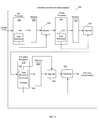
- FIG. 3 is a block diagram of a portion of a channel decoder and demultiplexer.
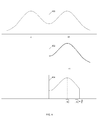
- FIG. 4 includes charts that illustrate processing of constellation data.
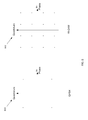
- FIG. 5 illustrates constellation diagrams.
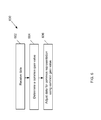
- FIG. 6 is a flowchart of a operations of a gain estimator.
- communication systems such as a cellular system 100 include communication channels that may be impaired by one or more sources such as environmental noise.
- modulation, encoding/decoding and processing techniques have been developed to assist data reception.
- standards have been promoted to adopt particular techniques.
- time division synchronous code division multiple access (TD-SCDMA) standards call for combining time division multiple access (TDMA) with an adaptive, synchronous-mode code division multiple access (CDMA) component.
- TD-SCDMA Time Division Multiple Access
- QPSK Quadrature Phase Shift Keying
- QAM quadrature amplitude modulation
- One or more coding and transmission schemes may be implemented with the cellular system 100 for complying with standards and for achieving particular data transfer rates.
- coding for High-Speed Downlink Packet Access (HSDPA), which is a 3G (third generation) mobile telephony communications transmission scheme, may be implemented to allow the cellular system 100 (or other types of communication systems and networks such as Universal Mobile Telecommunications Systems (UMTS) to provide relatively higher data transfer speeds (and capacity) and lower latency for end users.
- HSDPA is an integral feature of Release 5 of the 3 GPP specification and supports downlink speeds of 14.4 Mbit/s and round trip delays of 70 ms.
- the High-Speed Downlink Shared Channel (HS-DSCH) has been added to the UMTS specification.
- HS-DSCH is the transport channel carrying the user data.
- HS-DSCH may lack two fundamental features of other WCDMA channels, namely, variable spreading factor and fast power control. Rather, HS-DSCH provides improvements in downlink performance through the utilization of adaptive modulation and coding (AMC), a fast packet scheduling algorithm for base stations, and fast retransmission from base stations, often referred to as hybrid automatic repeat-request (HARQ).
- AMC adaptive modulation and coding
- HARQ uses a combination of incremental redundancy (IR) and chase combining, in which data may be transmitted multiple time using one or more coding techniques. For example, when a corrupt packet is received, the packet is combined with retransmitted packets to efficiently correct encountered errors. In some situations in which the encoded retransmissions are corrupted, appropriate decoding may still yield an error-free packet.
- the illustrative communication system 100 may allow efficient information transmission without significant content loss.
- data e.g., an audio signal
- a cellular network e.g., represented by a cellular tower 104
- a fixed cellular terminal 106 for delivery at a telephone 108.
- a computing device e.g., a computer system, personal digital assistant (PDA), etc.
- the appropriate equipment e.g., modem, wireless connection device such as an air-card, etc.
- the communication network e.g., cellular system 100.
- a block diagram represents a portion of an exemplary communication receiver 200 of a wireless connection device such as a fixed cellular terminal or an air-card (for use with a computing device).
- an antenna 202 is capable of transmitting and receiving electromagnetic signals to exchange data with one or more other devices and networks (e.g., cellular systems).
- the communication receiver 200 includes an radio frequency (RF) stage 204 that processes (e.g., downconverts to a baseband representation) the electromagnetic signals received by the antenna 202 and provides a corresponding analog signal to an analog baseband stage 206 for converting into the digital domain.
- RF radio frequency
- the analog baseband stage 206 includes one or multiple analog-to-digital (A/D) converters for digitizing the signals from the RF stage 204. With the carrier signal removed and the signals digitized, a collection of data channels (referred to as physical channels) is provided to a digital baseband stage 208 that processes (e.g., demodulates, decodes, etc.) the channel data and produces binary data appropriately formatted for the next portion of the communication receiver 200 (e.g., a software application layer).
- A/D analog-to-digital
- the digital baseband stage 208 includes a receiver 210 (e.g., a joint detector) that detects channels present in the digital data (provided from the analog baseband stage 206).
- the digital data received by the receiver 210 may represent a number of channels (e.g., up to sixteen channels) that include various content (e.g., control channels, voice channels, etc.)
- the receiver 210 may also detect the physical channel present in the digital data.
- the data received may represent a sum of physical channels, in which each channel includes a segment with an equivalent number of symbols (e.g., forty-four symbols). From the detected sum of physical channels, the receiver 210 may address a number of types of noise embedded in the digital signal.
- noise may be introduced by multi-path signals received by the antenna 202, interference associated with the signal content (e.g., inter-code interference), etc.
- Various operations such as channel equalization along with other techniques and methodologies may be executed by the receiver 210 for addressing noise issues and signal correction.
- a post receiver 212 also performs other operations in preparation of channel decoding such as preparing the physical channels for demodulation. For example, demodulating physical channels that implement QPSK and QAM (e.g., 16-QAM, 64-QAM, etc.) may be assisted by estimating parameters associated with the modulation schemes such as estimating constellation gain and variance. From the estimations, other quantities may be determined such as sigmal-and-interference-to-noise-ratio (SINR), for example, to assist with channel demodulation and to provide feedback (e.g., to one or more networks) that represents channel quality.
- SINR sigmal-and-interference-to-noise-ratio
- constellation rotation operations may be executed for rotating QPSK or QAM constellations, as needed.
- each constellation may be rotated 45° by the post receiver 212 to produce constellations with equivalent orientations that are associated with one or more communication standards (e.g., W-CDMA, TD-SCDMA).
- W-CDMA Wideband Code Division Multiple Access
- TD-SCDMA Time Division Multiple Access
- hardware, software and other portions of the communication receiver 200 may be used with wireless standards associated with different constellation arrangements.
- the post receiver 212 provides the extracted physical channels and other information (e.g., estimated parameters) to other portions of the communication receiver 200 (e.g., for demodulating and decoding the channels).
- the channels are provided to a channel decoder and demultiplexer 214 (also included in the digital baseband stage 208) by the post receiver 212.
- the channel decoder and demultiplexer 214 demodulates and decodes individual transport channels and may provide additional conditioning prior to passing the decoded binary data to another portion of the communication receiver 200 (e.g., a software layer).
- the channel decoder and demultiplexer 214 converts data received (from the post receiver 212) from a format corresponding to the points of the constellation being used (e.g., QPSK, QAM, etc.) to binary hard decisions.
- Complex values may be provided to the channel decoder and demultiplexer 214 that represent constellation points and formatted to comply with wireless standards such as W-CDMA (e.g., 12-bit floating point representation for Frequency Division Duplex (FDD), a 16-bit fixed point representation for Time Division Duplex (TDD), etc.).
- W-CDMA e.g., 12-bit floating point representation for Frequency Division Duplex (FDD), a 16-bit fixed point representation for Time Division Duplex (TDD), etc.
- the channel decoder and demultiplexer 214 may represent the data in a reduced precision format (e.g., 4-bit fixed representation) to reduce storage needs while retaining or enhancing dynamic range.
- a portion of an exemplary channel decoder and demultiplexer 300 implements a block-floating point architecture for processing complex data provided from a receiver (e.g., a joint detector receiver, rake receiver, an equalizer, etc.).
- a receiver e.g., a joint detector receiver, rake receiver, an equalizer, etc.
- HARQ processing data re-transmissions are attempted for each failed transmission. Such retransmissions are combined into a single encoded data packet burst prior to being decoded.
- the time between re-transmissions may be significant and channel conditions may significantly change.
- two separately transmitted data packets that are received for HARQ processing may have significantly different characteristics (e.g., power levels, SINR, etc.).
- the channel decoder and demultiplexer 300 passes blocks of data through a data buffering and processing pathway.
- Each data block is stored with a common gain value (e.g., an exponent value) rather than storing each data element at its received precision value.
- the blocks of data pass along with processing pathway, the blocks are merged with other blocks and the merged blocks are again adjusted to include a common gain value.
- the maximum gain value is determined and data elements (within a data block) are adjusted (e.g., by multiplication, division, bit shifting, etc.) to represent a value that includes the maximum gain value.
- such gain adjustment operations may occur in multiple instances along the processing pathway. For example, adjustments may be executed during processing individual soft decision values (referred to as slots), processing blocks of slots (referred to as frames) and processing blocks of frames (referred to as transmission time interval (TTI) processing) for merging existing HARQ data for HSDPA data channels (in preparation for decoding the data channels).
- slots soft decision values
- frames processing blocks of slots
- TTI transmission time interval
- additional processing operations may be executed for quantizing and producing representations with reduced size (e.g., four-bit fixed point representation).
- techniques may be implemented to account for the influences of quantization noise and truncation noise. Such techniques may include calculating a factor to balance the effects of quantization noise and truncation noise while preserving constellation point representations.
- the channel decoder and demultiplexer 300 receives, from the post receiver 212, complex values (e.g., 12-bit floating point values, 16-bit fixed point values, etc.) that represent individual soft decisions. Processing provided by the channel decoder and demultiplexer 300 reduces the size of the numerical representation (e.g., from 12-bit floating point to 7-bit fixed point) and correspondingly storage space (e.g., memory) needs. In this particular arrangement, a series of three processing stages execute operations to establish common gains. Initially the 12-bit floating point complex value representations (e.g., received in a data burst) are provided to a slot processor 302.
- complex values e.g., 12-bit floating point values, 16-bit fixed point values, etc.
- Processing provided by the channel decoder and demultiplexer 300 reduces the size of the numerical representation (e.g., from 12-bit floating point to 7-bit fixed point) and correspondingly storage space (e.g., memory) needs. In this particular arrangement, a series of three
- Each burst of received data (referred to as a slot) includes multiple complex value representations and the slot processor 302 reduces the amount of data needed to represent the complex value by identifying a common gain (e.g., a common exponent) and correspondingly adjusting the representations for the common gain.
- each complex value representation may include a sign, a mantissa and an exponent. By determining a common exponent value that can be used to represent each value, the mantissa values may be adjusted (to account for the common exponent) and stored for each representation along with a single representation of the common exponent, thereby conserving storage space.
- the slot processor 302 includes a gain estimator 304.
- One or more techniques and methodologies may be implemented to identify a common gain among multiple slots.
- the gain estimator 304 may identify the maximum exponent value from the multiple slots (provided to the channel decoder and demultiplexer 300).
- the gain estimator 304 processes the slots, to determine the maximum exponent value, the slot values (e.g., including sign, mantissa and exponent) are stored in a memory 306 (e.g., random access memory (RAM), dynamic RAM (DRAM), static RAM (SRAM), etc.) by the slot processor 302.
- RAM random access memory
- DRAM dynamic RAM
- SRAM static RAM
- the common gain value is provided to an adjuster 308 that executes operations such that each stored slot is adjusted to be represented with a mantissa and the common gain (e.g., the identified maximum exponent).
- the adjuster 308 may use bit-level shift operations (e.g., left shift, right shift, etc.), multiplications, divisions, etc. such that each stored slot is represented with the common gain.
- an exponent value of eleven may be identified by the exponent estimator 304 as the maximum exponent (of a number of slots).
- the value in a binary representation may be shifted (e.g., right shifted) to convert the mantissa to a value associated with the common exponent value of eleven.
- the slots may be processed with other slot groups (referred to as frames) such that all the groups are represented by a common gain value.
- a frame processor 310 executes operations that include processing frames to determine a common gain among the frames.
- a frame may be defined as including fifteen slots, however, more or less number of slots may be used to define a frame.
- the frame processor 310 includes a gain estimator 312 that determines a common gain among two or more frames. For example, the gain estimator 312 may identify the maximum exponent values among the frames. As the gain estimator 312 identifies the common gain, frame data may be stored in a memory 314.
- components of the channel decoder and demultiplexer 300 may compare groups of frames.
- a TTI/HARQ processor 318 included in the channel decoder and demultiplexer 300 may compare groups of frames (e.g., 1 frame, 2 frames, 4 frames, 8 frames, etc.) to identify a gain that is common the frame groups.
- the TTI/HARQ processor 318 includes a gain estimator 320 that operates similar to the gain estimators 304 and 312.
- the gain estimator 320 may identify the maximum gain value (e.g., maximum exponent value) of multiple frame groups such that all the frame groups may be adjusted for representations that commonly use the identified maximum gain.
- the TTI/HARQ processor 318 has an associated memory 322 that is used to store the frame groups and possibly other information (e.g., the common gain value).
- An adjuster 324 which may be similar to adjusters 308 and 316, is also included in the channel decoder and demultiplexer 300. Similar to the other adjusters 308, 316, the adjuster 324 correspondingly adjusts the frame groups such that the gain (identified by the gain estimator 328) is commonly used by the groups.
- the data received by the channel decoder and demultiplexer 300 is scaled to share a common exponent from the processing provided from this block-floating-point architecture (e.g., processing first on a slot by slot basis, second on a frame basis and third on a frame group basis).
- the common scaling reduces adverse affects of weaker signals received compared to stronger received signals.
- the channel decoder and demultiplexer 300 also includes a quantizer 326 that provides operations, e.g., to further reduce the width of the data representations.
- the width of the data representations e.g., 7 bits
- the TTI/HARQ processor 318 can be reduced (e.g., to 4 bits) by the quantizer 326.
- One or more techniques and methodologies may be used to provide such reductions. For example, by reducing a portion of the represented data, a reduced width may be used for representing constellation points. While such reduction can reduce quantization noise artifacts, significant reductions may introduce truncation noise into the data. As such, balancing quantization and truncation noise effects needs to be considered for data representation reductions.
- an averager 328 is executed by the TTI/HARQ processor 318. By processing the groups of frames received by the TTI/HARQ processor 318 and stored in the memory 322, the averager 328 can provide an average estimation to the quantizer 326 for setting a data reduction threshold.
- a series of three charts 402, 404, 406 illustrate exemplary operations of the averager 328 and the quantizer 326 to reduce data representation widths (e.g., from a width of 7 bits to 4 bits).
- data is transmitted by using QPSK (with four corresponding constellation points (1,1), (1,-1), (-1,1) and (-1,-1)).
- the data is distributed about values of -1 and +1.
- the chart 402 represents a probability density function (PDF) of the seven bit data, which is centered about the components (+1 and -1) of the constellation points.
- PDF probability density function
- the absolute value of the data is calculated, which in effect folds the negative values onto the positive values.
- the data centered about the value -1 are transposed onto the positive values (centered about the value +1).
- the averager 328 calculates the estimated value (e.g., average value) of the folded data, as illustrated in chart 404.
- the estimated value is the average of the absolute value of the data and is represented as and is provided to the quantizer 326 to calculate a threshold for data reduction.
- various types of calculations may be performed by the quantizer 326. For example, for transmitted signals that are modulated using QPSK, a factor of 9/5 (i.e., value of 1.8) may be applied to the average absolute value. Smaller and larger factors may also be included, for example, a factor of 4/5 may be applied to the average absolute value if a 16-QAM modulated scheme is used for data transmission. Such factors may be determined by using experimental and theoretical techniques, individually or in combination.
- chart 404 illustrates the factor of 9/5 being applied to truncate the data from the PDF. Some parameters that may also effect the factor value include coding rate, etc.
- the averager 318 is provided the groups of frames processed by the TTI/HARQ processor 318, some of which may be stored in the memory 322. Since the data is received in bursts over time, one or more gaps (e.g., represented with zero inserted values) due to rate adaptation may be present in the data stored in memory 322. Such zero value gaps may skew the estimated value calculation due to the bias imposed by the inserted zero values. To account for such gaps in the data, the averager 328 also checks for zero values and removes the corresponding data points. While such an operation may remove legitimate zero value data, in this implementation, such data loss is considered acceptable.
- gaps e.g., represented with zero inserted values
- the averager 328 also checks for zero values and removes the corresponding data points. While such an operation may remove legitimate zero value data, in this implementation, such data loss is considered acceptable.
- constellation diagram 500 represents a QPSK modulated signal
- constellation diagram 502 represents a 16-QAM modulated signal.
- individual symbols are represented with complex values that include a real part (referred to as the in-phase component) represented on the horizontal axis and an imaginary part (referred to as the quadrature component) represented on the vertical axis.
- the constellation diagram 500 includes points with coordinate pairs (1,1), (1,-1), (-1,-1) and (-1,1) and as seen in the FIG. 4 data is distributed about values -1 and 1 in the chart 402 that represents PDF data.
- received data associated with the 16-QAM constellation diagram 502 would concentrate about the two positive and two negative values used to represent the sixteen 16-QAM constellation points.
- a distinct scaling factor may be used (by the quantizer 326) dependent upon the modulation technique implemented. For example, a scaling factor of 9/5 may be used for QPSK signals while a factor of 4/5 may be used for 16-QAM signals. Other factors may also be used for QPSK and 16-QAM modulation signals and for variations of these modulations and other modulation techniques.
- Circuitry e.g., digital logic
- computing devices e.g., a computer system
- Circuitry e.g., digital logic
- computing devices e.g., a computer system
- a processor e.g., a microprocessor
- Such instructions may be stored in a storage device (e.g., hard drive, CD-ROM, etc.) and provided to the processor (or multiple processors) for execution.
- Operations of the gain estimators 304, 312 and 320 include receiving 602 data such as data elements that represents slots, frames, frame groups being processed by a channel decoder and demultiplexer.
- the received data elements have a floating point format that includes sign, mantissa and exponent portions, however, other formats may be used by the received data.
- the received data is usually represented with a single format, two or more different formats may be used to represent the data.
- operations also include determining 604 a common gain value from the received data. For example, the maximum gain value may be identified from the data elements and used to convert the elements (if needed) to a common gain value.
- mantissa values may be shifted (e.g., right shifted) such that each element is represented by the common exponent value (e.g., the maximum value).
- the channel decoder and demultiplexer 300 includes adjusters 308, 316 and 324 that are provided the common gain value (e.g., maximum value) and correspondingly adjust the data elements, as needed.
- the gain estimators may provide such functionality.
- operations of gain estimator may also include adjusting 606 the data to be commonly represented by using the common gain value. Determining the difference between gain values along with multiplication and division operations (e.g., bit level right shift operations) may be used by the exponent estimator for such adjustments.
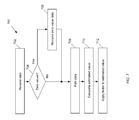
- a flowchart 700 represents some of the operations of the averager 328 (shown in FIG. 3 ).
- the averager 328 may be executed by the TTI/HARQ processor 320, however, other implementations may be used for executing the averager.
- the averager 328 may be executed by another processor (e.g., the slot processor 302, the frame processor 310, etc.) or another appropriate component of the channel decoder and demultiplexer 300.
- the averager 328 may also be executed in a distributed manner, e.g., by implementing the processing capabilities of multiple processors (or other types of components) and portions of the channel decoder and demultiplexer 300 and the communication receiver 200.
- Circuitry e.g., digital logic
- computing devices e.g., a computer system
- Circuitry e.g., digital logic
- computing devices e.g., a computer system
- a processor e.g., a microprocessor
- Such instructions may be stored in a storage device (e.g., hard drive, CD-ROM, etc.) and provided to the processor (or multiple processors) for execution.
- Operations of the averager 328 includes receiving 702 data such as groups of frame processed by the TTI/HARQ processor 318, however, the averager may also be capable of processing other types of data processed by the channel decoder and demultiplexer 300.
- the averager may also be capable of processing other types of data processed by the channel decoder and demultiplexer 300.
- data being processed by the TTI/HARQ processor 318 e.g., being processed by the gain estimator 320
- Operations of the averager 318 also include determining 704 if one or more of the data elements represent a zero value. In such situations, the averager 328 removes 706 the zero value data elements.
- a portion of the data elements are folded 708 onto another portion of the data elements.
- the averager 318 may calculate the absolute value of the data such that negative values are folded upon positive values (as illustrated with chart 404 in FIG. 4 ).
- operations of the averager 318 include calculating 710 the estimated value (e.g., mean average) of the folded data.
- the estimated value e.g., mean average
- operations include applying 712 a factor to the estimated value.
- Such a factor may be dependent upon the modulation scheme being implemented (e.g., a factor of approximately 9/5 for QPSK, 4/5 for 16-QAM, etc.).
- the quantizer 326 applies the factor to the averaged-absolute data and saturates the appropriate data to reduce the data width of the constellation point representations.
- the averager 328 may provide such functionality
- the exponent estimators 304, 312, 320 and the averager 328, and optionally with other portions of the channel decoder and demultiplexer 300 may perform any of the computer-implement methods described previously, according to one implementation.
- the communication receiver 200 may include a computing device (e.g., a computer system) for executing instructions associated with the gain estimators 304, 312, 320 and the averager 328.
- the computing device may include a processor, a memory, a storage device, and an input/output device.
- the processor may be capable of processing instructions for execution within the computing device.
- the processor is a single-threaded processor.
- the processor is a multi-threaded processor.
- the processor is capable of processing instructions stored in the memory or on the storage device to display graphical information for a user interface on the input/output device.
- the memory stores information within the computing device.
- the memory is a computer-readable medium.
- the memory is a volatile memory unit.
- the memory is a non-volatile memory unit.
- the storage device is capable of providing mass storage for the computing device.
- the storage device is a computer-readable medium.
- the storage device may be a floppy disk device, a hard disk device, an optical disk device, or a tape device.
- the input/output device provides input/output operations for the computing device.
- the input/output device includes a keyboard and/or pointing device.
- the input/output device includes a display unit for displaying graphical user interfaces.
- the features described can be implemented in digital electronic circuitry or in computer hardware, firmware, software, or in combinations of them.
- the apparatus can be implemented in a computer program product tangibly embodied in an information carrier, e.g., in a machine-readable storage device or in a propagated signal, for execution by a programmable processor; and method steps can be performed by a programmable processor executing a program of instructions to perform functions of the described implementations by operating on input data and generating output.
- the described features can be implemented advantageously in one or more computer programs that are executable on a programmable system including at least one programmable processor coupled to receive data and instructions from, and to transmit data and instructions to, a data storage system, at least one input device, and at least one output device.
- a computer program is a set of instructions that can be used, directly or indirectly, in a computer to perform a certain activity or bring about a certain result.
- a computer program can be written in any form of programming language, including compiled or interpreted languages, and it can be deployed in any form, including as a stand-alone program or as a module, component, subroutine, or other unit suitable for use in a computing environment.
- Storage devices suitable for tangibly embodying computer program instructions and data include all forms of non-volatile memory, including by way of example semiconductor memory devices, such as EPROM, EEPROM, and flash memory devices; magnetic disks such as internal hard disks and removable disks; magneto-optical disks; and CD-ROM and DVD-ROM disks.
- semiconductor memory devices such as EPROM, EEPROM, and flash memory devices
- magnetic disks such as internal hard disks and removable disks
- magneto-optical disks and CD-ROM and DVD-ROM disks.
- the processor and the memory can be supplemented by, or incorporated in, ASICs (application-specific integrated circuits).
- ASICs application-specific integrated circuits
- the features can be implemented in a computer system that includes a back-end component, such as a data server, or that includes a middleware component, such as an application server or an Internet server, or that includes a front-end component, such as a client computer having a graphical user interface or an Internet browser, or any combination of them.
- the components of the system can be connected by any form or medium of digital data communication such as a communication network. Examples of communication networks include, e.g., a LAN, a WAN, and the computers and networks forming the Internet.
- the computer system can include clients and servers.
- a client and server are generally remote from each other and typically interact through a network, such as the described one.
- the relationship of client and server arises by virtue of computer programs running on the respective computers and having a client-server relationship to each other
- a method comprising: receiving data elements representative of constellation points of a modulated signal, wherein each data element includes a gain; identifying a common gain value among the received data elements; and adjusting the data elements to include the common gain value.
- folding the first portion of the adjusted data elements includes calculating an absolute value of the first portion of the adjusted data elements.
- a system comprising: a communication receiver for receiving a modulated signal, the receiver including, a gain estimator for receiving data elements representative of constellation points of a modulated signal, wherein each data element includes a gain, the gain estimator is configured to identify a common gain value among the received data elements, the gain estimator is further configured to adjust the data elements to include the common gain value.
- the gain estimator is further configured to calculate an estimated value from the folded first portion and the second portion.
- the gain estimator is further configured to apply a factor to the estimated value to identify a portion of the folded first portion and the second portion for saturation.
- the gain estimator is further configured to represent the identified portion with a reduced precision compared to the precision of the data elements.
- modulated signal is a Quadrature Phase Shift Keying (QPSK) signal and the factor has a value of approximately 9/5.
- QPSK Quadrature Phase Shift Keying
- modulated signal is a Quadrature Amplitude Modulation (QAM) signal and the factor has a value of approximately 4/5.
- QAM Quadrature Amplitude Modulation
- the gain estimator is configured to calculate an absolute value of the first portion of the adjusted data elements for folding the first portion of the adjusted data elements.
- folding the first portion of the adjusted data elements includes calculating an absolute value of the first portion of the adjusted data elements.
- a system comprising: means for receiving a modulated signal, including, means for receiving data elements representative of constellation points of a modulated signal, wherein each data element includes a gain, the gain estimator is configured to identify a common gain value among the received data elements, the gain estimator is further configured to adjust the data elements to include the common gain value.
Landscapes
- Engineering & Computer Science (AREA)
- Computer Networks & Wireless Communication (AREA)
- Signal Processing (AREA)
- Digital Transmission Methods That Use Modulated Carrier Waves (AREA)
- Circuits Of Receivers In General (AREA)
Applications Claiming Priority (2)
| Application Number | Priority Date | Filing Date | Title |
|---|---|---|---|
| US896607P | 2007-12-21 | 2007-12-21 | |
| US12/196,724 US8155241B2 (en) | 2007-12-21 | 2008-08-22 | System for processing common gain values |
Publications (3)
| Publication Number | Publication Date |
|---|---|
| EP2073475A2 true EP2073475A2 (de) | 2009-06-24 |
| EP2073475A3 EP2073475A3 (de) | 2014-07-02 |
| EP2073475B1 EP2073475B1 (de) | 2018-05-16 |
Family
ID=40547793
Family Applications (1)
| Application Number | Title | Priority Date | Filing Date |
|---|---|---|---|
| EP08172311.6A Active EP2073475B1 (de) | 2007-12-21 | 2008-12-19 | System zur Verarbeitung gemeinsamer Verstärkungswerte |
Country Status (3)
| Country | Link |
|---|---|
| US (1) | US8155241B2 (de) |
| EP (1) | EP2073475B1 (de) |
| TW (1) | TWI371947B (de) |
Families Citing this family (9)
| Publication number | Priority date | Publication date | Assignee | Title |
|---|---|---|---|---|
| US8149702B2 (en) * | 2007-12-21 | 2012-04-03 | Mediatek Inc. | Multi-mode bit rate processor |
| US8488662B2 (en) * | 2007-12-21 | 2013-07-16 | Mediatek Inc. | Receiver bit rate processing |
| US8054922B2 (en) * | 2007-12-21 | 2011-11-08 | Mediatek Inc. | Parameter estimation for modulated signals |
| US8316378B2 (en) * | 2007-12-21 | 2012-11-20 | Mediatek Inc. | Data flow control in wireless communication systems |
| US20090161799A1 (en) * | 2007-12-21 | 2009-06-25 | Mediatek, Inc. | Decoding communication signals |
| US8155241B2 (en) | 2007-12-21 | 2012-04-10 | Mediatek Inc. | System for processing common gain values |
| US8396119B1 (en) * | 2009-09-30 | 2013-03-12 | Ambarella, Inc. | Data sample compression and decompression using randomized quantization bins |
| US20140136582A1 (en) * | 2012-11-12 | 2014-05-15 | Futurewei Technologies, Inc. | Method and apparatus for digital automatic gain control |
| US11888669B2 (en) * | 2021-06-21 | 2024-01-30 | Qualcomm Incorporated | Space frequency multi-user signaling and tone reservation signaling |
Citations (1)
| Publication number | Priority date | Publication date | Assignee | Title |
|---|---|---|---|---|
| US896608A (en) | 1906-06-15 | 1908-08-18 | Vulkan Maschinenfabriks Actien Ges | Arrangement of the winding of electromagnetic clutches. |
Family Cites Families (15)
| Publication number | Priority date | Publication date | Assignee | Title |
|---|---|---|---|---|
| US5570454A (en) * | 1994-06-09 | 1996-10-29 | Hughes Electronics | Method for processing speech signals as block floating point numbers in a CELP-based coder using a fixed point processor |
| JP3442262B2 (ja) * | 1996-06-07 | 2003-09-02 | シャープ株式会社 | ベースバンド信号歪に応答するagcシステム |
| JP3323124B2 (ja) | 1998-01-09 | 2002-09-09 | 富士通株式会社 | 変調方法及び装置 |
| US6735247B2 (en) * | 2001-03-30 | 2004-05-11 | Qualcomm, Incorporated | Method and apparatus in a communication system |
| US7318027B2 (en) * | 2003-02-06 | 2008-01-08 | Dolby Laboratories Licensing Corporation | Conversion of synthesized spectral components for encoding and low-complexity transcoding |
| US7154966B2 (en) * | 2003-06-30 | 2006-12-26 | Telefonaktiebolaget L M Ericsson (Publ) | Method and system for M-QAM detection in communication systems |
| US6986096B2 (en) * | 2003-07-29 | 2006-01-10 | Qualcomm, Incorporated | Scaling and quantizing soft-decision metrics for decoding |
| US7106811B2 (en) * | 2003-11-12 | 2006-09-12 | Interdigital Technology Corporation | Wireless communication method and apparatus for performing post-detection constellation correction |
| US7529789B2 (en) * | 2004-11-01 | 2009-05-05 | Metanoia Technologies, Inc. | Method for representing complex numbers in a communication system |
| JP4706871B2 (ja) | 2005-03-02 | 2011-06-22 | 日本電気株式会社 | ダイバーシティ受信装置及びその利得調整方法 |
| US7450670B2 (en) * | 2005-06-14 | 2008-11-11 | The Aerospace Corporation | Automatic gain control 16-ary quadrature amplitude modulation subsystem |
| US20070047675A1 (en) * | 2005-08-31 | 2007-03-01 | Interdigital Technology Corporation | Method and apparatus for scaling demodulated symbols for fixed point processing |
| US7668188B2 (en) * | 2006-02-14 | 2010-02-23 | Broadcom Corporation | Method and system for HSDPA bit level processor engine |
| US8054922B2 (en) * | 2007-12-21 | 2011-11-08 | Mediatek Inc. | Parameter estimation for modulated signals |
| US8155241B2 (en) | 2007-12-21 | 2012-04-10 | Mediatek Inc. | System for processing common gain values |
-
2008
- 2008-08-22 US US12/196,724 patent/US8155241B2/en active Active
- 2008-12-19 TW TW097149622A patent/TWI371947B/zh active
- 2008-12-19 EP EP08172311.6A patent/EP2073475B1/de active Active
Patent Citations (1)
| Publication number | Priority date | Publication date | Assignee | Title |
|---|---|---|---|---|
| US896608A (en) | 1906-06-15 | 1908-08-18 | Vulkan Maschinenfabriks Actien Ges | Arrangement of the winding of electromagnetic clutches. |
Also Published As
| Publication number | Publication date |
|---|---|
| US20090161796A1 (en) | 2009-06-25 |
| TWI371947B (en) | 2012-09-01 |
| EP2073475B1 (de) | 2018-05-16 |
| TW200943846A (en) | 2009-10-16 |
| EP2073475A3 (de) | 2014-07-02 |
| US8155241B2 (en) | 2012-04-10 |
Similar Documents
| Publication | Publication Date | Title |
|---|---|---|
| EP2073475B1 (de) | System zur Verarbeitung gemeinsamer Verstärkungswerte | |
| JP4017917B2 (ja) | 信号受信方法 | |
| CN101465837A (zh) | 处理共同增益值的方法及系统 | |
| JP5744878B2 (ja) | Harq結合を伴う、および、軟判定指向形チャネル推定を伴う、反復デコーディングアーキテクチャ | |
| US8472568B1 (en) | Scaling and quantization of soft decoding metrics | |
| JP4546466B2 (ja) | 通信システムにおけるm−qam検知用の方法およびシステム | |
| US9042471B2 (en) | Receiving device, signal processing device, and signal processing method | |
| WO2008060118A1 (en) | Channel equalization and carrier recovery method and receiver in high speed wireless communication system | |
| CN1585397B (zh) | 估计在移动通信系统中码元单元的判定边界的设备和方法 | |
| EP2073477B1 (de) | Kombiniertes 16QAM-De-Mapping, 16QAM-Konstellationsneuanordnung und TD-SCDMA-Entschlüsselung | |
| JP4067984B2 (ja) | 受信機 | |
| US20050220203A1 (en) | System & method for spreading on fading channels | |
| JP5557644B2 (ja) | 通信装置、通信方法およびプログラム | |
| US7457379B2 (en) | Adaptive multi-step combined DC offset compensation for EDGE 8-PSK | |
| EP2073476B1 (de) | Parameterbeurteilung für modulierte Signale | |
| CA2625111C (en) | A soft demodulating method for 16qam in communication system | |
| US7489741B2 (en) | System and method to perform DC compensation on a radio frequency burst in a cellular wireless network | |
| JP5419146B2 (ja) | 復調装置及び復調処理方法 | |
| CN101626361B (zh) | 高速数据分组接入系统中的解调方法和解调器 | |
| US20070047675A1 (en) | Method and apparatus for scaling demodulated symbols for fixed point processing | |
| RU2375831C1 (ru) | Способ мягкой демодуляции для 16-позиционной квадратурной амплитудной модуляции в системе связи | |
| JP2006060870A (ja) | 変調方式及び無線通信システム |
Legal Events
| Date | Code | Title | Description |
|---|---|---|---|
| PUAI | Public reference made under article 153(3) epc to a published international application that has entered the european phase |
Free format text: ORIGINAL CODE: 0009012 |
|
| AK | Designated contracting states |
Kind code of ref document: A2 Designated state(s): AT BE BG CH CY CZ DE DK EE ES FI FR GB GR HR HU IE IS IT LI LT LU LV MC MT NL NO PL PT RO SE SI SK TR |
|
| AX | Request for extension of the european patent |
Extension state: AL BA MK RS |
|
| REG | Reference to a national code |
Ref country code: DE Ref legal event code: R079 Ref document number: 602008055255 Country of ref document: DE Free format text: PREVIOUS MAIN CLASS: H04L0027320000 Ipc: H04L0027340000 |
|
| PUAL | Search report despatched |
Free format text: ORIGINAL CODE: 0009013 |
|
| AK | Designated contracting states |
Kind code of ref document: A3 Designated state(s): AT BE BG CH CY CZ DE DK EE ES FI FR GB GR HR HU IE IS IT LI LT LU LV MC MT NL NO PL PT RO SE SI SK TR |
|
| AX | Request for extension of the european patent |
Extension state: AL BA MK RS |
|
| RIC1 | Information provided on ipc code assigned before grant |
Ipc: H04L 27/34 20060101AFI20140523BHEP Ipc: H04L 27/38 20060101ALI20140523BHEP |
|
| 17P | Request for examination filed |
Effective date: 20141222 |
|
| RBV | Designated contracting states (corrected) |
Designated state(s): AT BE BG CH CY CZ DE DK EE ES FI FR GB GR HR HU IE IS IT LI LT LU LV MC MT NL NO PL PT RO SE SI SK TR |
|
| AKX | Designation fees paid |
Designated state(s): AT BE BG CH CY CZ DE DK EE ES FI FR GB GR HR HU IE IS IT LI LT LU LV MC MT NL NO PL PT RO SE SI SK TR |
|
| AXX | Extension fees paid |
Extension state: AL Extension state: BA Extension state: MK Extension state: RS |
|
| 17Q | First examination report despatched |
Effective date: 20160905 |
|
| GRAP | Despatch of communication of intention to grant a patent |
Free format text: ORIGINAL CODE: EPIDOSNIGR1 |
|
| INTG | Intention to grant announced |
Effective date: 20171025 |
|
| GRAS | Grant fee paid |
Free format text: ORIGINAL CODE: EPIDOSNIGR3 |
|
| RAP1 | Party data changed (applicant data changed or rights of an application transferred) |
Owner name: MEDIATEK INC. |
|
| GRAA | (expected) grant |
Free format text: ORIGINAL CODE: 0009210 |
|
| RAP1 | Party data changed (applicant data changed or rights of an application transferred) |
Owner name: MEDIATEK INC. |
|
| AK | Designated contracting states |
Kind code of ref document: B1 Designated state(s): AT BE BG CH CY CZ DE DK EE ES FI FR GB GR HR HU IE IS IT LI LT LU LV MC MT NL NO PL PT RO SE SI SK TR |
|
| REG | Reference to a national code |
Ref country code: GB Ref legal event code: FG4D |
|
| REG | Reference to a national code |
Ref country code: CH Ref legal event code: EP |
|
| REG | Reference to a national code |
Ref country code: IE Ref legal event code: FG4D |
|
| REG | Reference to a national code |
Ref country code: DE Ref legal event code: R096 Ref document number: 602008055255 Country of ref document: DE |
|
| REG | Reference to a national code |
Ref country code: AT Ref legal event code: REF Ref document number: 1000544 Country of ref document: AT Kind code of ref document: T Effective date: 20180615 |
|
| REG | Reference to a national code |
Ref country code: NL Ref legal event code: MP Effective date: 20180516 |
|
| REG | Reference to a national code |
Ref country code: LT Ref legal event code: MG4D |
|
| PG25 | Lapsed in a contracting state [announced via postgrant information from national office to epo] |
Ref country code: FI Free format text: LAPSE BECAUSE OF FAILURE TO SUBMIT A TRANSLATION OF THE DESCRIPTION OR TO PAY THE FEE WITHIN THE PRESCRIBED TIME-LIMIT Effective date: 20180516 Ref country code: LT Free format text: LAPSE BECAUSE OF FAILURE TO SUBMIT A TRANSLATION OF THE DESCRIPTION OR TO PAY THE FEE WITHIN THE PRESCRIBED TIME-LIMIT Effective date: 20180516 Ref country code: SE Free format text: LAPSE BECAUSE OF FAILURE TO SUBMIT A TRANSLATION OF THE DESCRIPTION OR TO PAY THE FEE WITHIN THE PRESCRIBED TIME-LIMIT Effective date: 20180516 Ref country code: NO Free format text: LAPSE BECAUSE OF FAILURE TO SUBMIT A TRANSLATION OF THE DESCRIPTION OR TO PAY THE FEE WITHIN THE PRESCRIBED TIME-LIMIT Effective date: 20180816 Ref country code: ES Free format text: LAPSE BECAUSE OF FAILURE TO SUBMIT A TRANSLATION OF THE DESCRIPTION OR TO PAY THE FEE WITHIN THE PRESCRIBED TIME-LIMIT Effective date: 20180516 Ref country code: BG Free format text: LAPSE BECAUSE OF FAILURE TO SUBMIT A TRANSLATION OF THE DESCRIPTION OR TO PAY THE FEE WITHIN THE PRESCRIBED TIME-LIMIT Effective date: 20180816 |
|
| PG25 | Lapsed in a contracting state [announced via postgrant information from national office to epo] |
Ref country code: NL Free format text: LAPSE BECAUSE OF FAILURE TO SUBMIT A TRANSLATION OF THE DESCRIPTION OR TO PAY THE FEE WITHIN THE PRESCRIBED TIME-LIMIT Effective date: 20180516 Ref country code: HR Free format text: LAPSE BECAUSE OF FAILURE TO SUBMIT A TRANSLATION OF THE DESCRIPTION OR TO PAY THE FEE WITHIN THE PRESCRIBED TIME-LIMIT Effective date: 20180516 Ref country code: GR Free format text: LAPSE BECAUSE OF FAILURE TO SUBMIT A TRANSLATION OF THE DESCRIPTION OR TO PAY THE FEE WITHIN THE PRESCRIBED TIME-LIMIT Effective date: 20180817 Ref country code: LV Free format text: LAPSE BECAUSE OF FAILURE TO SUBMIT A TRANSLATION OF THE DESCRIPTION OR TO PAY THE FEE WITHIN THE PRESCRIBED TIME-LIMIT Effective date: 20180516 |
|
| REG | Reference to a national code |
Ref country code: AT Ref legal event code: MK05 Ref document number: 1000544 Country of ref document: AT Kind code of ref document: T Effective date: 20180516 |
|
| PG25 | Lapsed in a contracting state [announced via postgrant information from national office to epo] |
Ref country code: AT Free format text: LAPSE BECAUSE OF FAILURE TO SUBMIT A TRANSLATION OF THE DESCRIPTION OR TO PAY THE FEE WITHIN THE PRESCRIBED TIME-LIMIT Effective date: 20180516 Ref country code: EE Free format text: LAPSE BECAUSE OF FAILURE TO SUBMIT A TRANSLATION OF THE DESCRIPTION OR TO PAY THE FEE WITHIN THE PRESCRIBED TIME-LIMIT Effective date: 20180516 Ref country code: DK Free format text: LAPSE BECAUSE OF FAILURE TO SUBMIT A TRANSLATION OF THE DESCRIPTION OR TO PAY THE FEE WITHIN THE PRESCRIBED TIME-LIMIT Effective date: 20180516 Ref country code: RO Free format text: LAPSE BECAUSE OF FAILURE TO SUBMIT A TRANSLATION OF THE DESCRIPTION OR TO PAY THE FEE WITHIN THE PRESCRIBED TIME-LIMIT Effective date: 20180516 Ref country code: CZ Free format text: LAPSE BECAUSE OF FAILURE TO SUBMIT A TRANSLATION OF THE DESCRIPTION OR TO PAY THE FEE WITHIN THE PRESCRIBED TIME-LIMIT Effective date: 20180516 Ref country code: SK Free format text: LAPSE BECAUSE OF FAILURE TO SUBMIT A TRANSLATION OF THE DESCRIPTION OR TO PAY THE FEE WITHIN THE PRESCRIBED TIME-LIMIT Effective date: 20180516 Ref country code: PL Free format text: LAPSE BECAUSE OF FAILURE TO SUBMIT A TRANSLATION OF THE DESCRIPTION OR TO PAY THE FEE WITHIN THE PRESCRIBED TIME-LIMIT Effective date: 20180516 |
|
| REG | Reference to a national code |
Ref country code: DE Ref legal event code: R097 Ref document number: 602008055255 Country of ref document: DE |
|
| PG25 | Lapsed in a contracting state [announced via postgrant information from national office to epo] |
Ref country code: IT Free format text: LAPSE BECAUSE OF FAILURE TO SUBMIT A TRANSLATION OF THE DESCRIPTION OR TO PAY THE FEE WITHIN THE PRESCRIBED TIME-LIMIT Effective date: 20180516 |
|
| PLBE | No opposition filed within time limit |
Free format text: ORIGINAL CODE: 0009261 |
|
| STAA | Information on the status of an ep patent application or granted ep patent |
Free format text: STATUS: NO OPPOSITION FILED WITHIN TIME LIMIT |
|
| 26N | No opposition filed |
Effective date: 20190219 |
|
| PG25 | Lapsed in a contracting state [announced via postgrant information from national office to epo] |
Ref country code: SI Free format text: LAPSE BECAUSE OF FAILURE TO SUBMIT A TRANSLATION OF THE DESCRIPTION OR TO PAY THE FEE WITHIN THE PRESCRIBED TIME-LIMIT Effective date: 20180516 |
|
| REG | Reference to a national code |
Ref country code: CH Ref legal event code: PL |
|
| PG25 | Lapsed in a contracting state [announced via postgrant information from national office to epo] |
Ref country code: LU Free format text: LAPSE BECAUSE OF NON-PAYMENT OF DUE FEES Effective date: 20181219 Ref country code: MC Free format text: LAPSE BECAUSE OF FAILURE TO SUBMIT A TRANSLATION OF THE DESCRIPTION OR TO PAY THE FEE WITHIN THE PRESCRIBED TIME-LIMIT Effective date: 20180516 |
|
| REG | Reference to a national code |
Ref country code: IE Ref legal event code: MM4A |
|
| REG | Reference to a national code |
Ref country code: BE Ref legal event code: MM Effective date: 20181231 |
|
| PG25 | Lapsed in a contracting state [announced via postgrant information from national office to epo] |
Ref country code: IE Free format text: LAPSE BECAUSE OF NON-PAYMENT OF DUE FEES Effective date: 20181219 |
|
| PG25 | Lapsed in a contracting state [announced via postgrant information from national office to epo] |
Ref country code: BE Free format text: LAPSE BECAUSE OF NON-PAYMENT OF DUE FEES Effective date: 20181231 |
|
| PG25 | Lapsed in a contracting state [announced via postgrant information from national office to epo] |
Ref country code: LI Free format text: LAPSE BECAUSE OF NON-PAYMENT OF DUE FEES Effective date: 20181231 Ref country code: CH Free format text: LAPSE BECAUSE OF NON-PAYMENT OF DUE FEES Effective date: 20181231 |
|
| PG25 | Lapsed in a contracting state [announced via postgrant information from national office to epo] |
Ref country code: MT Free format text: LAPSE BECAUSE OF NON-PAYMENT OF DUE FEES Effective date: 20181219 |
|
| PG25 | Lapsed in a contracting state [announced via postgrant information from national office to epo] |
Ref country code: TR Free format text: LAPSE BECAUSE OF FAILURE TO SUBMIT A TRANSLATION OF THE DESCRIPTION OR TO PAY THE FEE WITHIN THE PRESCRIBED TIME-LIMIT Effective date: 20180516 |
|
| PG25 | Lapsed in a contracting state [announced via postgrant information from national office to epo] |
Ref country code: PT Free format text: LAPSE BECAUSE OF FAILURE TO SUBMIT A TRANSLATION OF THE DESCRIPTION OR TO PAY THE FEE WITHIN THE PRESCRIBED TIME-LIMIT Effective date: 20180516 |
|
| PG25 | Lapsed in a contracting state [announced via postgrant information from national office to epo] |
Ref country code: CY Free format text: LAPSE BECAUSE OF FAILURE TO SUBMIT A TRANSLATION OF THE DESCRIPTION OR TO PAY THE FEE WITHIN THE PRESCRIBED TIME-LIMIT Effective date: 20180516 Ref country code: HU Free format text: LAPSE BECAUSE OF FAILURE TO SUBMIT A TRANSLATION OF THE DESCRIPTION OR TO PAY THE FEE WITHIN THE PRESCRIBED TIME-LIMIT; INVALID AB INITIO Effective date: 20081219 |
|
| PG25 | Lapsed in a contracting state [announced via postgrant information from national office to epo] |
Ref country code: IS Free format text: LAPSE BECAUSE OF FAILURE TO SUBMIT A TRANSLATION OF THE DESCRIPTION OR TO PAY THE FEE WITHIN THE PRESCRIBED TIME-LIMIT Effective date: 20180916 |
|
| P01 | Opt-out of the competence of the unified patent court (upc) registered |
Effective date: 20230607 |
|
| PGFP | Annual fee paid to national office [announced via postgrant information from national office to epo] |
Ref country code: GB Payment date: 20241227 Year of fee payment: 17 |
|
| PGFP | Annual fee paid to national office [announced via postgrant information from national office to epo] |
Ref country code: FR Payment date: 20241226 Year of fee payment: 17 |
|
| PGFP | Annual fee paid to national office [announced via postgrant information from national office to epo] |
Ref country code: DE Payment date: 20241227 Year of fee payment: 17 |