EP2073476B1 - Parameterbeurteilung für modulierte Signale - Google Patents
Parameterbeurteilung für modulierte Signale Download PDFInfo
- Publication number
- EP2073476B1 EP2073476B1 EP08172171.4A EP08172171A EP2073476B1 EP 2073476 B1 EP2073476 B1 EP 2073476B1 EP 08172171 A EP08172171 A EP 08172171A EP 2073476 B1 EP2073476 B1 EP 2073476B1
- Authority
- EP
- European Patent Office
- Prior art keywords
- constellation
- data representation
- scalar
- scalar data
- data
- Prior art date
- Legal status (The legal status is an assumption and is not a legal conclusion. Google has not performed a legal analysis and makes no representation as to the accuracy of the status listed.)
- Not-in-force
Links
Images



Classifications
-
- H—ELECTRICITY
- H04—ELECTRIC COMMUNICATION TECHNIQUE
- H04L—TRANSMISSION OF DIGITAL INFORMATION, e.g. TELEGRAPHIC COMMUNICATION
- H04L27/00—Modulated-carrier systems
- H04L27/32—Carrier systems characterised by combinations of two or more of the types covered by groups H04L27/02, H04L27/10, H04L27/18 or H04L27/26
- H04L27/34—Amplitude- and phase-modulated carrier systems, e.g. quadrature-amplitude modulated carrier systems
-
- H—ELECTRICITY
- H04—ELECTRIC COMMUNICATION TECHNIQUE
- H04L—TRANSMISSION OF DIGITAL INFORMATION, e.g. TELEGRAPHIC COMMUNICATION
- H04L27/00—Modulated-carrier systems
- H04L27/32—Carrier systems characterised by combinations of two or more of the types covered by groups H04L27/02, H04L27/10, H04L27/18 or H04L27/26
- H04L27/34—Amplitude- and phase-modulated carrier systems, e.g. quadrature-amplitude modulated carrier systems
- H04L27/38—Demodulator circuits; Receiver circuits
- H04L27/3809—Amplitude regulation arrangements
Definitions
- This description relates to a system and method for estimating parameters for decoding communication data.
- US 7 173 974 B2 recites a method and apparatus for computing soft decision input metrics to a turbo decoder including circuits associated with eight-ary phase shift keyed (8PSK) modulation and sixteen-ary quadrature amplitude modulation (16QAM).
- 8PSK phase shift keyed
- 16QAM sixteen-ary quadrature amplitude modulation
- log-likelihood ratio (LLR) metrics on code symbols are estimated as products of various constant values and various combinations of the in-phase and quadrature components of a demodulated soft decision.
- LLR log-likelihood ratio
- C/I carrier-signal-to-interference
- Estimates of the LLR metrics may also be obtained in association with generalized square QAM and M-ary PSK modulation schemes including, e.g., 64QAM, 256QAM, and 16PSK.
- US 2007/121 763 A1 recites a device for computing a threshold Sth i used in demodulating a quadrature amplitude modulated (QAM) signal to generate a plurality of soft bits per received symbol for input to a turbo decoder.
- US 2004/0233976 A1 recites an apparatus and method for estimating a decision boundary in symbol units in a mobile communication system.
- the method for estimating a decision boundary of reception symbols in a receiver of a mobile communication system includes the step of calculating a preliminary decision boundary for every symbol entered in a decision boundary estimator; and reflecting the preliminary decision boundary calculated for every symbol in a previous symbol's decision boundary having been calculated in consideration of a channel environment until reaching the previous symbol, and calculating a new decision boundary for the entered symbol.
- EP 1 876 786 A1 recites a receiver apparatus and method of blind amplitude estimation for a received complex signal, wherein the complex signal is analyzed to determine first and second order statistics of real parts and imaginary parts of the complex signal. Based on a predetermined non-linear function, amplitude scaling information is precalculated and used to derive a desired amplitude scaling information for said determined first and second order statistics. Thereby, a low complexity method for blind amplitude estimation for unknown data symbols distorted by an unknown amount of noise can be provided.
- US 2004/0264591 A1 recites a method and system for performing fast and simple M-QAM detection on received signals, such as a 16-QAM signal, by estimating M-QAM symbol constellation decision boundaries.
- Amplitude information is collected for in-phase and quadrature phase components of the received signal over a number of symbols.
- An average of the absolute value of the amplitude information of the in-phase components and of the quadrature phase components is determined over the number of symbols.
- the determined average absolute values of the in-phase and quadrature phase components provide a reference to produce the decision boundary estimates.
- Bias compensation may optionally be applied to the decision boundary estimates based on the estimated signal-to-interference ratio ("SIR") of the received signal to produce bias corrected decision boundary estimates.
- SIR signal-to-interference ratio
- a method to decode communication data according to the invention is defined in independent claim 1
- a system to decode communication data according to the present invention is defined in independent claim 6
- a computer program product to decode communication data according to the present invention is defined in independent claim 11.
- the dependent claims define preferred embodiments thereof.
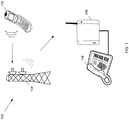
- communication systems such as a cellular system 100 include communication channels that may be impaired by one or more sources such as environmental noise.
- modulation, encoding/decoding and processing techniques have been developed to assist data transmission and reception.
- standards have been promoted to adopt particular techniques. For example, with the ever increasing demand for higher data transmission rates, standards have been promoted to adopt particular techniques. For example, time division synchronous code division multiple access (TD-SCDMA) standards call for combining time division multiple access (TDMA) with an adaptive, synchronous-mode code division multiple access (CDMA) component.
- TD-SCDMA time division synchronous code division multiple access
- CDMA adaptive, synchronous-mode code division multiple access
- TD-SCDMA Time Division Multiple Access
- QPSK Quadrature Phase Shift Keying
- QAM quadrature amplitude modulation
- the illustrative communication system 100 may allow efficient information transmission without significant content loss.
- data e.g., an audio signal
- a cellular network e.g., represented by a cellular tower 104
- a fixed cellular terminal 106 for delivery to a telephone 108.
- the fixed cellular terminal 106 includes the functionality to decode signals from the cellular network and convert the signals into a format recognizable by the telephone 108.
- a computing device e.g., a computer system, personal digital assistant (PDA), etc.
- the appropriate equipment e.g., modem, wireless connection device such as an air-card, etc.
- a block diagram represents a portion of an exemplary receiver 200 of a wireless connection device such as a fixed cellular terminal or an air-card (for use with a computing device).
- an antenna 202 is capable of transmitting and receiving electromagnetic signals to exchange data with one or more other devices and systems.
- the receiver 200 includes an radio frequency (RF) stage 204 that processes (e.g., removes carrier signals) the electromagnetic signals received by the antenna 202 and provides a corresponding analog signal to an analog baseband stage 206 for converting into the digital domain.
- the analog baseband stage 206 includes one or multiple analog-to-digital (A/D) converters for digitizing the signals from the RF stage 204.
- A/D analog-to-digital
- a collection of data channels (referred to as physical channels) is provided to a digital baseband stage 208 that processes (e.g., demodulates, decodes, etc.) the channel data and produces binary data appropriately formatted for the next portion of the receiver 200 (e.g., software application layer).
- processes e.g., demodulates, decodes, etc.
- the digital baseband stage 208 includes a joint detector 210 that detects channels present in the digital data (provided from the analog baseband stage 206).
- the digital data received by the joint detector 210 may represent a number of channels (e.g., up to sixteen channels) that include various content (e.g., control channels, voice channels, etc.).
- the joint detector 210 may also detect the physical channel (or channels) present in the digital data.
- the data received may represent a sum of physical channels, in which each channel includes a segment with an equivalent number of symbols (e.g., forty-four symbols). From the detected sum of physical channels, the joint detector 210 may address a number of types of noise embedded in the digital signal.
- noise may be introduced by multi-path signals received by the antenna 202, interference associated with the signal content (e.g., inter-code interference), etc.
- Various operations such as channel equalization along with other techniques and methodologies may be executed by the joint detector 210 for addressing noise issues and signal correction.
- the joint detector 210 also extracts individual physical channels.
- the input of the joint detector 210 may include a sum the physical channels (e.g., one summed channel with forty-four symbols) and the output may include the extracted individual channels (e.g., sixteen channels, each channel being forty-four symbols in length).
- the digital baseband stage 208 includes a post joint detector 212 that performs operations for de-mapping the physical channels and other operations in anticipation of channel decoding such as preparing the physical channels for demodulation. For example, demodulating physical channels that implement QPSK and QAM (e.g., 16-QAM, 64-QAM, etc.) may be assisted by estimating parameters associated with the modulation schemes.
- a gain estimator 214 is executed by the post joint detector 212 e.g., for determining the estimated constellation gain for channels that use, for example, QPSK and QAM modulation.
- a variance estimator 216 is executed by the post joint detector 212 e.g., to provide an estimate of signal-and-interference-to-noise-ratio (SINR), for example, to assist with channel demodulation and provide feedback (e.g., to one or more networks) that represents channel quality. While the gain estimator 214 and the variance estimator 216 highlight estimating two parameters for demodulating and decoding (e.g., soft-bit scaling), other operations may also be executed by the post joint detector 212. For example, constellation rotation operations may be executed (by the post joint detector 212 or another portion of the receiver 200) for rotating QPSK or QAM constellations, as needed.
- SINR signal-and-interference-to-noise-ratio
- each constellation may be rotated 45° by the post joint detector 212 to produce constellations with equivalent orientations that are associated with one or more communication standards (e.g., W-CDMA, TD-SCDMA).
- W-CDMA Wideband Code Division Multiple Access
- TD-SCDMA Time Division Multiple Access
- hardware, software and other portions of the system may be used with wireless standards associated with different constellation arrangements.
- the post joint detector 212 also provides the estimated parameters (e.g., constellation gain and variance) for assisting other portions of the receiver 200 (e.g., with demodulating and decoding the channels).
- the estimated constellation gain and SINR may be provided to a bit rate processor 214 (also included in the digital baseband stage 208) by the post joint detector 212.
- the bit rate processor 218 demodulates and decodes individual transport channels and may provide additional conditioning prior to passing the decoded binary data to another portion of the receiver 200 (e.g., a software layer).
- constellation diagram 300 represents the signal state space of a QPSK modulated signal
- constellation diagram 302 represents the signal state space of a 16-QAM modulated signal.
- individual symbols are represented with complex values that include a real part (referred to as the in-phase component) represented on the horizontal axis and an imaginary part (referred to as the quadrature component) represented on the vertical axis.
- a constellation gain (represented here with the term "a") is also associated with each of the constellation diagrams 300, 302.
- each constellation point may be identified (along with a corresponding symbol) and the constellation may be constructed for demodulating each channel (using the modulation technique). Further, constellation gain may be used for quantifying other channel parameters. For example, signal power and SINR for each channel may be quantified by using the associated constellation gain. While QPSK and 16-QAM are respectively illustrated with the constellation diagrams 300, 302, variations of these modulations and other modulation techniques may also be implemented.
- constellation gain "a" is estimated first and used to estimate variance.
- the technique implemented allows constellation gain to be estimated absent knowledge of the actual symbols being transmitted. As such, processing resources are conserved for other operations such as identifying the sequence symbols being provided by the joint detector 210.
- constellation gain is determined by folding data sets associated with points of the constellation. For example, by calculating the absolute value of data associated with the constellation points, data sets may be folded upon each other and constellation gain identified by calculating the estimated value (e.g., mean average) of the folded data.
- the constellation gain may be used in other operations such as calculating a variance estimation (with the variance estimator 216).
- a chart 400 illustrates complex data from a QPSK signal represented with in-phase (horizontal axis) and quadrature (vertical axis) components.
- the four constellation points are centered about component pairs (1, 1), (1, -1), (-1, -1) and (-1, 1).
- transmission noise e.g., multipath signals
- other artifacts e.g., inter-code interference
- data is scattered and does not align with the corresponding constellation point.
- a consistent constellation gain is not provided from the data distribution and is estimated by the gain estimator 214.
- the gain estimator 214 converts the complex data of the quadrature and in-phase components into a scalar representation. For example, real and imaginary parts of the complex numbers are multiplexed into one sequence of scalar values (e.g., converted to real numbers, converted to imaginary numbers). As illustrated in chart 402, the IQ data is converted into real number values that include one data series 404 with positive values (approximately centered about a value of "a") and another series 406 with negative values (approximately centered about a value of negative "a"). While these two data series 404, 406 use one convention to represent IQ data, other conventions may also be used to serialize IQ data into a real-valued representation.
- a chart 500 illustrates one series of scalar data (e.g., data series 406) being folded onto another data series (e.g., data series 404) for determining the constellation gain (of the QPSK signal).
- the absolute value is calculated of the data represented in chart 402.
- the negative values of the data series 406 are folded onto the positive valued data series 404.
- a data series 502 represents the two data series 404 and 406 upon being folded.
- the data series 502 includes data points with positive scalar values and the gain estimator 214 may use one or more techniques to determine the constellation gain.
- the estimated value (e.g., mean value) of the data series 502 may be calculated by the gain estimator 214, as represented with the bold line 504.
- folding operations may also be used for estimating constellation gain for other types of modulated signals.
- a chart 600 represents data of a 16-QAM signal, with in-phase components represented on the horizontal axis and quadrature components on the vertical axis.
- Each of the sixteen constellation points are respectively centered at integer values (e.g., -3,3 , -1,1 , etc.), and similar to the QPSK signal, noise and other sources produce data scatter about each constellation point.
- the complex IQ data in constellation diagram 600 is converted to a scalar representation (e.g., real values) and is illustrated in a chart 602.
- the real valued data is centered about values of -3, -1, 1 and 3.
- the 16-QAM serialized data provides four data series 604, 606, 608,610.
- the constellation gain "a" may be quantified.
- a folding operation by the gain estimator 214 produces two data series (compared to one data series by folding QPSK data).
- the folding operations is provided by calculating the absolute value of the 16-QAM data.
- two data series 702, 704 represent the folded 16-QAM data (respectively centered about positive values 1 and 3).
- the folding operation does not lead to one data series centered about "a” (e.g., as provided by folding a QPSK signal, as represented with trace 502). Rather two data series 702, 704 are produced, one centered about the constellation gain "a” (e.g., as represented with data series 702) and another centered about three times the constellation gain, "3a", as represented with a trace 704.
- the constellation gain may be determined by using the data scattered about both values ("a” and “3a") to calculate and an estimated value (of "2a") and dividing by this value by two.
- the data included in the data series 702 and 704 may not be uniformly distributed about both values of "a” and "3a", thereby producing a bias in the estimated value (as represented with bold trace line 706).
- a correction factor may be calculated and applied to the estimated gain value.
- a chart 800 illustrates the folded data provided in chart 700 along with the biased gain estimate (represented with the bold trace line 706) calculated from the data.
- a correction factor is used to account for the non-uniform distribution of the data series about the values of "a" and "3a".
- Terms ⁇ a and ⁇ 3a are respectively defined as the number of data points associated with data series 702 and 704.
- the number of data points that exceed the biased constellation gain estimate (represented by bold trace line 706) are counted and assigned the value "C”.
- a correction factor, N/(N+C) is calculated from the quantities and may be applied to the estimated constellation gain to correct the bias.
- the corrected estimation value provides an improved approximation compared to the bias estimation value.
- the estimated constellation gain (bias and corrected) is associated with a value of "2a" (since the estimate is calculated from data distributed among values of "a” and "3a”).
- the resulting quantity (represented by line 802) is divided by a value of two to produce the estimated corrected constellation gain "a".
- the estimated constellation gain provided by the gain estimator 214 can be used by the variance estimator 216 to estimate the variance of the constellation points.
- a chart 900 illustrates received data associated with sixteen constellation points of a 16-QAM signal. As illustrated in the chart 900, data is scatter about each constellation point.
- SINR may be calculated for demodulation or other types of operations (e.g., defining and applying weights).
- the variance estimator 216 may also calculate variance for other types of modulated signals such as QPSK signals.
- One or more techniques and methodologies may be implemented to estimate variance. For example, the Euclidean distance between constellation points, as expressed by the constellation gain "a", may be used by the variance estimator 216 for variance estimations.
- a constellation e.g., QPSK constellation, 16-QAM constellation, etc.
- One or more variance calculating techniques may then be used to quantify the data spread about the scalar representation.
- absolute value and mean subtraction operations may be repeatedly executed for folding constellation points and mapping to a single value in preparation of variance calculations.
- a series of charts 1000, 1002, 1004 represent the repetitive use of folding and estimate value subtraction for variance estimation.
- the chart 1000 illustrates complex 16-QAM constellation data in which the real and imaginary components are converted, for example, to represent real scalar values (as respectively provided by data sets 1006, 1008, 1010, 1012).
- the absolute value of the data is calculated (thereby folding negative values of data sets 1010 and 1012 onto the corresponding positive value data sets 1006 and 1008).
- the estimated value of the folded data e.g., mean value
- is calculated typically as a function of constellation gain "a".
- the estimated value is subtracted (after folding the data) to provide a zero estimate value of data sets 1014 and 1016.
- another folding operation e.g., absolute value calculation
- the data set 1016 is folded onto data set 1014.
- the estimated value e.g., mean value
- One or more variance calculation techniques and methodologies may be implemented by the variance estimator 216 to compute the variance of the zero-mean data set 1018.
- two instances of folding and estimated value subtraction operations may be executed to prepare the constellation data for a variance estimation.
- additional or less operation instances may be needed.
- additional folding and mean-value subtraction operation repetitions are needed for variance estimations.
- one instance of folding and estimated value subtraction is needed for the four constellation point data to be prepared for variance estimation.
- one or more quantities may be calculated from the information.
- the power of received signal may be determined from the constellation gain.
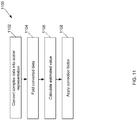
- a flowchart 1100 represents some of the operations of the gain estimator 214.
- the gain estimator 214 may be executed by a post joint detector such as the post joint detector 212 included in the receiver 200. Along with post joint detector 212, operations of the gain estimator 214 may be executed by one or more other portions of the receiver 200. Circuitry (e.g., digital logic) and computing devices (e.g., a computer system) may also be used individually or in combination to execute the operations of the gain estimator 214.
- a processor e.g., a microprocessor
- Such instructions may be stored in a storage device (e.g., hard drive, CD-ROM, etc.) and provided to the processor (or multiple processors) for execution.
- Operations of the gain estimator 214 may include converting 1102 complex IQ constellation data into a scalar representation. For example complex data that represents the in-phase and quadrature components of a QPSK or 16-QAM signals may be converted to be represented as real values (or imaginary values). Operations of the gain estimator also include folding 1104 the converted data. For example, the absolute value of the converted data may be calculated to fold the negative data values onto counterpart positive data values. Once folded, the estimated value of the folded data may be calculated 1106 by the gain estimator. For example, the mean value, or other type of estimated value (e.g., mode value, median value, etc.) may be calculated from the folded data. In some arrangements, the gain estimator 214 may include optional operations, dependent upon the modulation scheme implemented.
- operations may include applying 1108 a correction factor to the estimated value.
- a correction factor For a 16-QAM signal, along with applying a correction factor to account for data distribution bias, other factors may be applied. For example, a one-half factor (i.e., 1/2) may be applied to the corrected estimated value to account for constellation point values.
- a flowchart 1200 represents some of the operations of the variance estimator 216.
- the variance estimator 216 may be executed by a post joint detector such as the post joint detector 212 included in the receiver 200.
- operations of the variance estimator 214 may be executed by one or more other portions of the receiver 200.
- Circuitry e.g., digital logic
- computing devices e.g., a computer system
- instructions may be executed by a processor (e.g., a microprocessor) to provide the operations.
- Such instructions may be stored in a storage device (e.g., hard drive, CD-ROM, etc.) and provided to the processor (or multiple processors) for execution.
- a storage device e.g., hard drive, CD-ROM, etc.
- execution of operations (or portions of operations) common to the gain estimator 214 and the variance estimator 216 may be shared.
- resources such as memory may also be shared between the gain estimator 214, the variance estimator 216 and other associated processes.
- operations of the variance estimator 216 may include converting 1202 complex data into a scalar representation. For example complex data that represents the in-phase and quadrature components of a QPSK or 16-QAM signals may be converted to be represented as real values (or imaginary values). As mentioned above, operations include folding 1204 the converted data and removing 1206 the estimated value of the folded data. For modulation schemes such as 16-QAM, a second series of folding and estimated value removing operations may be needed to produce data with an estimated value of zero. As such, operations include determining 1208 if additional folding is needed. If needed, operations return for another set of folding and removing the estimated value (e.g., mean value). If additional folding and estimated value removing operations are not needed, the variance estimator 216 calculates 1210 the variance of the zero estimated value data.
- the receiver 200 may include a computing device (e.g., a computer system) for executing instructions associated with the gain estimator 214 and the variance estimator 216.
- the computing device may include a processor, a memory, a storage device, and an input/output device. Each of the components may be interconnected using a system bus or other similar structure.
- the processor may be capable of processing instructions for execution within the computing device. In one implementation, the processor is a single-threaded processor. In another implementation, the processor is a multi-threaded processor.
- the processor is capable of processing instructions stored in the memory or on the storage device to display graphical information for a user interface on the input/output device.
- the memory stores information within the computing device.
- the memory is a computer-readable medium.
- the memory is a volatile memory unit.
- the memory is a non-volatile memory unit.
- the storage device is capable of providing mass storage for the computing device.
- the storage device is a computer-readable medium.
- the storage device may be a floppy disk device, a hard disk device, an optical disk device, or a tape device.
- the input/output device provides input/output operations for the computing device.
- the input/output device includes a keyboard and/or pointing device.
- the input/output device includes a display unit for displaying graphical user interfaces.
- the features described can be implemented in digital electronic circuitry, or in computer hardware, firmware, software, or in combinations of them.
- the apparatus can be implemented in a computer program product tangibly embodied in an information carrier, e.g., in a machine-readable storage device or in a propagated signal, for execution by a programmable processor; and method steps can be performed by a programmable processor executing a program of instructions to perform functions of the described implementations by operating on input data and generating output.
- the described features can be implemented advantageously in one or more computer programs that are executable on a programmable system including at least one programmable processor coupled to receive data and instructions from, and to transmit data and instructions to, a data storage system, at least one input device, and at least one output device.
- a computer program is a set of instructions that can be used, directly or indirectly, in a computer to perform a certain activity or bring about a certain result.
- a computer program can be written in any form of programming language, including compiled or interpreted languages, and it can be deployed in any form, including as a stand-alone program or as a module, component, subroutine, or other unit suitable for use in a computing environment.
- Suitable processors for the execution of a program of instructions include, by way of example, both general and special purpose microprocessors, and the sole processor or one of multiple processors of any kind of computer.
- a processor will receive instructions and data from a read-only memory or a random access memory or both.
- the essential elements of a computer are a processor for executing instructions and one or more memories for storing instructions and data.
- a computer will also include, or be operatively coupled to communicate with, one or more mass storage devices for storing data files; such devices include magnetic disks, such as internal hard disks and removable disks; magneto-optical disks; and optical disks.
- Storage devices suitable for tangibly embodying computer program instructions and data include all forms of non-volatile memory, including by way of example semiconductor memory devices, such as EPROM, EEPROM, and flash memory devices; magnetic disks such as internal hard disks and removable disks; magneto-optical disks; and CD-ROM and DVD-ROM disks.
- semiconductor memory devices such as EPROM, EEPROM, and flash memory devices
- magnetic disks such as internal hard disks and removable disks
- magneto-optical disks and CD-ROM and DVD-ROM disks.
- the processor and the memory can be supplemented by, or incorporated in, ASICs (application-specific integrated circuits).
- ASICs application-specific integrated circuits
- the features can be implemented on a computer having a display device such as a CRT (cathode ray tube) or LCD (liquid crystal display) monitor for displaying information to the user and a keyboard and a pointing device such as a mouse or a trackball by which the user can provide input to the computer.
- a display device such as a CRT (cathode ray tube) or LCD (liquid crystal display) monitor for displaying information to the user and a keyboard and a pointing device such as a mouse or a trackball by which the user can provide input to the computer.
- the features can be implemented in a computer system that includes a back-end component, such as a data server, or that includes a middleware component, such as an application server or an Internet server, or that includes a front-end component, such as a client computer having a graphical user interface or an Internet browser, or any combination of them.
- the components of the system can be connected by any form or medium of digital data communication such as a communication network. Examples of communication networks include, e.g., a LAN, a WAN, and the computers and networks forming the Internet.
- the computer system can include clients and servers.
- a client and server are generally remote from each other and typically interact through a network, such as the described one.
- the relationship of client and server arises by virtue of computer programs running on the respective computers and having a client-server relationship to each other.
Landscapes
- Engineering & Computer Science (AREA)
- Computer Networks & Wireless Communication (AREA)
- Signal Processing (AREA)
- Digital Transmission Methods That Use Modulated Carrier Waves (AREA)
- Monitoring And Testing Of Transmission In General (AREA)
- Circuits Of Receivers In General (AREA)
Claims (13)
- Verfahren zum Decodieren von Kommunikationsdaten, Konvertieren (1102) von komplexen Daten, die Konstellationspunkte eines modulierten Signals darstellen, in eine skalare Datenrepräsentation durch Multiplexen von realen und imaginären Teilen der komplexen Daten in eine Folge von skalaren Werten, Falten (1104) eines ersten Teils der skalaren Datenrepräsentation auf einen zweiten Teil der skalaren Datenrepräsentation durch Anwenden einer Absolutwertfunktion, Abschätzen (1106) eines Konstellationsverstärkungswerts von dem gefalteten ersten Teil und dem zweiten Teil der skalaren Datenrepräsentation, und
Anwenden (1108) eines Korrekturfaktors auf den abgeschätzten Konstellationsverstärkungswert, um einen asymmetrischen Fehler in einer ungleichmäßigen Verteilung von Daten über die Konstellationspunkte zu kompensieren, wobei:der Konstellationsverstärkungswert für ein Quantifizieren von Kanalparametern verwendet wird; wobei das Verfahren weiter dadurch gekennzeichnet ist, dass:der Korrekturfaktor gleich N/(N+C) ist, wobei N die Gesamtzahl der Konstellationspunkte ist und C die Zahl der absoluten skalaren Werte ist, die a' überschreiten, welches der abgeschätzte Konstellationsverstärkungswert ist, bevor der asymmetrische Fehler kompensiert ist. - Verfahren gemäß Anspruch 1, weiter aufweisend:Bestimmen einer abgeschätzten Konstellationsvarianz von dem gefalteten ersten Teil und dem zweiten Teil der skalaren Datenrepräsentation.
- Verfahren gemäß einem der Ansprüche 1 und 2, weiter aufweisend:Subtrahieren der abgeschätzten Konstellationsverstärkung von dem gefalteten ersten Teil und dem zweiten Teil der skalaren Datenrepräsentation, um einen dritten Teil und einen vierten Teil der skalaren Datenrepräsentation zu generieren;Falten des dritten Teils auf den vierten Teil der skalaren Datenrepräsentation durch Anwenden der Absolutwertfunktion; undBestimmen einer Konstellationsvarianz von dem gefalteten dritten Teil und dem vierten Teil der skalaren Datenrepräsentation.
- Verfahren gemäß einem der Ansprüche 1 bis 3, wobei die skalare Datenrepräsentation reale Zahlen repräsentiert.
- Verfahren gemäß einem der Ansprüche 1 bis 4, wobei die skalare Datenrepräsentation imaginäre Zahlen repräsentiert.
- System zum Decodieren von Kommunikationsdaten, aufweisend einen Empfänger (200) für ein Empfangen eines modulierten Signals, wobei der Empfänger einen Verstärkungsabschätzer (214) für ein Konvertieren (1102) von komplexen Daten, die Konstellationspunkte eines modulierten Signals darstellen, in eine skalare Datenrepräsentation durch Multiplexen von realen und imaginären Teilen der komplexen Daten in eine Folge von skalaren Werten, Falten (1104) eines ersten Teils der skalaren Datenrepräsentation auf einen zweiten Teil der skalaren Datenrepräsentation durch Anwenden einer Absolutwertfunktion, Abschätzen (1106) eines Konstellationsverstärkungswerts von dem gefalteten ersten Teil und dem zweiten Teil der skalaren Datenrepräsentation, und
Anwenden (1108) eines Korrekturfaktors auf den abgeschätzten Konstellationsverstärkungswert, um einen asymmetrischen Fehler in einer ungleichmäßigen Verteilung von Daten über die Konstellationspunkte zu kompensieren, aufweist, wobei:der Konstellationsverstärkungswert für ein Quantifizieren von Kanalparametern verwendet wird, wobei das System weiter dadurch gekennzeichnet ist, dass:der Korrekturfaktor gleich N/(N+C) ist, wobei N die Gesamtzahl der Konstellationspunkte ist und C die Zahl der absoluten skalaren Werte ist, die a' überschreiten, welches der abgeschätzte Konstellationsverstärkungswert ist, bevor der asymmetrische Fehler kompensiert ist. - System gemäß Anspruch 6, wobei der Empfänger weiter aufweist:einen Varianzabschätzer für ein Bestimmen einer abgeschätzten Konstellationsvarianz von dem gefalteten ersten Teil und dem zweiten Teil der skalaren Datenrepräsentation.
- System gemäß einem der Ansprüche 6 und 7, wobei der Varianzabschätzer die abgeschätzte Konstellationsverstärkung von dem gefalteten ersten Teil und dem zweiten Teil der skalaren Datenrepräsentation entfernt, um einen dritten Teil und einen Vierten Teil der skalaren Datenrepräsentation zu generieren, der Varianzabschätzer eingerichtet ist, durch Anwenden der Absolutwertfunktion den dritten Teil auf den vierten Teil der skalaren Datenrepräsentation zu falten, wobei der Varianzabschätzer weiter eingerichtet ist, eine Konstellationsvarianz von dem gefalteten dritten Teil und dem vierten Teil der skalaren Datenrepräsentation zu bestimmen.
- System gemäß einem der Ansprüche 6 bis 8, wobei die skalare Datenrepräsentation reale Zahlen repräsentiert.
- System gemäß einem der Ansprüche 6 bis 9, wobei die skalare Datenrepräsentation imaginäre Zahlen repräsentiert.
- Computerprogrammprodukt zum Decodieren von Kommunikationsdaten, die konkret in einem Informationsträger enthalten sind und Instruktionen aufweisen, die, wenn sie durch einen Prozessor ausgeführt werden, ein Verfahren ausführen, das aufweist: Konvertieren (1102) von komplexen Daten, die Konstellationspunkte eines modulierten Signals darstellen, in eine skalare Datenrepräsentation durch Multiplexen von realen und imaginären Teilen der komplexen Daten in eine Folge von skalaren Werten, Falten (1104) eines ersten Teils der skalaren Datenrepräsentation auf einen zweiten Teil der skalaren Datenrepräsentation durch Anwenden einer Absolutwertfunktion, Abschätzen (1106) eines Konstellationsverstärkungswerts von dem gefalteten ersten Teil und dem zweiten Teil der skalaren Datenrepräsentation, und
Anwenden (1108) eines Korrekturfaktors auf den abgeschätzten Konstellationsverstärkungswert, um einen asymmetrischen Fehler in einer ungleichmäßigen Verteilung von Daten über die Konstellationspunkte zu kompensieren, wobei:der Konstellationsverstärkungswert für ein Quantifizieren von Kanalparametern verwendet wird, dadurch gekennzeichnet, dass:der Korrekturfaktor gleich N/(N+C) ist, wobei N die Gesamtzahl der Konstellationspunkte ist und C die Zahl der absoluten skalaren Werte ist, die a' überschreiten, welches der abgeschätzte Konstellationsverstärkungswert ist, bevor der asymmetrische Fehler kompensiert ist. - Computerprogrammprodukt gemäß Anspruch 11, wobei das Verfahren weiter aufweist:Bestimmen einer abgeschätzten Konstellationsvarianz von dem gefalteten ersten Teil und dem zweiten Teil der skalaren Datenrepräsentation.
- Computerprogrammprodukt gemäß Anspruch 11, wobei das Verfahren weiter aufweist:Subtrahieren der abgeschätzten Konstellationsverstärkung von dem gefalteten ersten Teil und dem zweiten Teil der skalaren Datenrepräsentation, um einen dritten Teil und einen vierten Teil der skalaren Datenrepräsentation zu generieren;Falten des dritten Teils auf den vierten Teil der skalaren Datenrepräsentation durch Anwenden der Absolutwertfunktion; undBestimmen einer Konstellationsvarianz von dem gefalteten dritten Teil und dem vierten Teil der skalaren Datenrepräsentation.
Applications Claiming Priority (2)
| Application Number | Priority Date | Filing Date | Title |
|---|---|---|---|
| US896607P | 2007-12-21 | 2007-12-21 | |
| US12/189,529 US8054922B2 (en) | 2007-12-21 | 2008-08-11 | Parameter estimation for modulated signals |
Publications (3)
| Publication Number | Publication Date |
|---|---|
| EP2073476A2 EP2073476A2 (de) | 2009-06-24 |
| EP2073476A3 EP2073476A3 (de) | 2014-06-25 |
| EP2073476B1 true EP2073476B1 (de) | 2017-06-28 |
Family
ID=40527482
Family Applications (1)
| Application Number | Title | Priority Date | Filing Date |
|---|---|---|---|
| EP08172171.4A Not-in-force EP2073476B1 (de) | 2007-12-21 | 2008-12-18 | Parameterbeurteilung für modulierte Signale |
Country Status (3)
| Country | Link |
|---|---|
| US (1) | US8054922B2 (de) |
| EP (1) | EP2073476B1 (de) |
| TW (1) | TWI382719B (de) |
Families Citing this family (3)
| Publication number | Priority date | Publication date | Assignee | Title |
|---|---|---|---|---|
| US8155241B2 (en) * | 2007-12-21 | 2012-04-10 | Mediatek Inc. | System for processing common gain values |
| US9287924B2 (en) * | 2011-09-20 | 2016-03-15 | St-Ericsson Sa | Method, apparatus, receiver, computer program and storage medium for joint detection |
| US11336496B2 (en) * | 2014-10-02 | 2022-05-17 | Stmicroelectronics Sa | Real time OFDM transmission system |
Citations (1)
| Publication number | Priority date | Publication date | Assignee | Title |
|---|---|---|---|---|
| US20040264591A1 (en) * | 2003-06-30 | 2004-12-30 | Telefonaktiebolaget Lm Ericsson (Publ) | Method and system for M-QAM detection in communication systems |
Family Cites Families (8)
| Publication number | Priority date | Publication date | Assignee | Title |
|---|---|---|---|---|
| US896608A (en) | 1906-06-15 | 1908-08-18 | Vulkan Maschinenfabriks Actien Ges | Arrangement of the winding of electromagnetic clutches. |
| JP3323124B2 (ja) * | 1998-01-09 | 2002-09-09 | 富士通株式会社 | 変調方法及び装置 |
| US6594318B1 (en) * | 1999-12-02 | 2003-07-15 | Qualcomm Incorporated | Method and apparatus for computing soft decision input metrics to a turbo decoder |
| KR100576014B1 (ko) * | 2003-05-23 | 2006-05-02 | 삼성전자주식회사 | 이동통신 시스템에서 심볼 단위의 결정 경계값 추정을위한 장치 및 방법 |
| AU2004212605A1 (en) * | 2003-09-26 | 2005-04-14 | Nec Australia Pty Ltd | Computation of soft bits for a turbo decoder in a communication receiver |
| JP4706871B2 (ja) | 2005-03-02 | 2011-06-22 | 日本電気株式会社 | ダイバーシティ受信装置及びその利得調整方法 |
| EP1876786A1 (de) * | 2006-07-03 | 2008-01-09 | Koninklijke Philips Electronics N.V. | Blinde Amplitudenschätzung für empfangene Symbole |
| US8155241B2 (en) * | 2007-12-21 | 2012-04-10 | Mediatek Inc. | System for processing common gain values |
-
2008
- 2008-08-11 US US12/189,529 patent/US8054922B2/en active Active
- 2008-12-18 EP EP08172171.4A patent/EP2073476B1/de not_active Not-in-force
- 2008-12-19 TW TW097149618A patent/TWI382719B/zh not_active IP Right Cessation
Patent Citations (1)
| Publication number | Priority date | Publication date | Assignee | Title |
|---|---|---|---|---|
| US20040264591A1 (en) * | 2003-06-30 | 2004-12-30 | Telefonaktiebolaget Lm Ericsson (Publ) | Method and system for M-QAM detection in communication systems |
Also Published As
| Publication number | Publication date |
|---|---|
| EP2073476A2 (de) | 2009-06-24 |
| US8054922B2 (en) | 2011-11-08 |
| EP2073476A3 (de) | 2014-06-25 |
| TW200943844A (en) | 2009-10-16 |
| TWI382719B (zh) | 2013-01-11 |
| US20090161745A1 (en) | 2009-06-25 |
Similar Documents
| Publication | Publication Date | Title |
|---|---|---|
| JP5041705B2 (ja) | データサブキャリアを利用して共通位相エラーを推定するofdm信号受信器及び方法 | |
| CN113228578B (zh) | 用于多个调制方案的改进解调制的设备和方法 | |
| CN101465836B (zh) | 通信系统与参数估计方法 | |
| US20030123582A1 (en) | Joint equalization, soft-demapping and phase error correction in wireless system with receive diversity | |
| EP1647122B1 (de) | Einstellung von entscheidungsschwellwerten in einem qam-empfänger | |
| EP2140642B1 (de) | Verfahren und vorrichtung zur abschwächung der interferenz in mehrträger-modulationssystemen | |
| EP2073475B1 (de) | System zur Verarbeitung gemeinsamer Verstärkungswerte | |
| US8233568B2 (en) | Adaptive receiver for high-order modulated signals over fading channels | |
| JP3166705B2 (ja) | 無線装置及び送信方法 | |
| CN115882923B (zh) | 一种用于宽带卫星通信的符号级残余相位偏差补偿方法 | |
| WO2008082118A1 (en) | Apparatus and method for combining received signal considering interference for each antenna, apparatus and method for computing symbol metric using it | |
| EP2073476B1 (de) | Parameterbeurteilung für modulierte Signale | |
| JP5682226B2 (ja) | 受信装置及び方法、復調装置及び方法、並びにプログラム | |
| US20060209993A1 (en) | Demodulator and receiver for pre-coded partial response signals | |
| US10382231B2 (en) | Receiver circuit | |
| CN101499818B (zh) | 一种移动通信系统中的信噪比估计方法及其系统 | |
| Ogundile et al. | Improved reliability information for rectangular 16-QAM over flat Rayleigh fading channels | |
| US10142145B2 (en) | Wireless receiver | |
| EP2068521B1 (de) | QAM-Phasenfehlerdetektor | |
| JP2001197138A (ja) | 無線装置及び送信方法 | |
| JP5288979B2 (ja) | クロック位相推定装置 |
Legal Events
| Date | Code | Title | Description |
|---|---|---|---|
| PUAI | Public reference made under article 153(3) epc to a published international application that has entered the european phase |
Free format text: ORIGINAL CODE: 0009012 |
|
| AK | Designated contracting states |
Kind code of ref document: A2 Designated state(s): AT BE BG CH CY CZ DE DK EE ES FI FR GB GR HR HU IE IS IT LI LT LU LV MC MT NL NO PL PT RO SE SI SK TR |
|
| AX | Request for extension of the european patent |
Extension state: AL BA MK RS |
|
| PUAL | Search report despatched |
Free format text: ORIGINAL CODE: 0009013 |
|
| AK | Designated contracting states |
Kind code of ref document: A3 Designated state(s): AT BE BG CH CY CZ DE DK EE ES FI FR GB GR HR HU IE IS IT LI LT LU LV MC MT NL NO PL PT RO SE SI SK TR |
|
| AX | Request for extension of the european patent |
Extension state: AL BA MK RS |
|
| RIC1 | Information provided on ipc code assigned before grant |
Ipc: H04L 27/38 20060101ALI20140521BHEP Ipc: H04L 27/34 20060101AFI20140521BHEP |
|
| 17P | Request for examination filed |
Effective date: 20141222 |
|
| RBV | Designated contracting states (corrected) |
Designated state(s): AT BE BG CH CY CZ DE DK EE ES FI FR GB GR HR HU IE IS IT LI LT LU LV MC MT NL NO PL PT RO SE SI SK TR |
|
| AKX | Designation fees paid |
Designated state(s): AT BE BG CH CY CZ DE DK EE ES FI FR GB GR HR HU IE IS IT LI LT LU LV MC MT NL NO PL PT RO SE SI SK TR |
|
| AXX | Extension fees paid |
Extension state: BA Extension state: RS Extension state: MK Extension state: AL |
|
| 17Q | First examination report despatched |
Effective date: 20160905 |
|
| GRAP | Despatch of communication of intention to grant a patent |
Free format text: ORIGINAL CODE: EPIDOSNIGR1 |
|
| INTG | Intention to grant announced |
Effective date: 20170321 |
|
| GRAS | Grant fee paid |
Free format text: ORIGINAL CODE: EPIDOSNIGR3 |
|
| GRAA | (expected) grant |
Free format text: ORIGINAL CODE: 0009210 |
|
| AK | Designated contracting states |
Kind code of ref document: B1 Designated state(s): AT BE BG CH CY CZ DE DK EE ES FI FR GB GR HR HU IE IS IT LI LT LU LV MC MT NL NO PL PT RO SE SI SK TR |
|
| REG | Reference to a national code |
Ref country code: GB Ref legal event code: FG4D |
|
| REG | Reference to a national code |
Ref country code: CH Ref legal event code: EP |
|
| REG | Reference to a national code |
Ref country code: AT Ref legal event code: REF Ref document number: 905732 Country of ref document: AT Kind code of ref document: T Effective date: 20170715 |
|
| REG | Reference to a national code |
Ref country code: IE Ref legal event code: FG4D |
|
| REG | Reference to a national code |
Ref country code: DE Ref legal event code: R096 Ref document number: 602008050847 Country of ref document: DE |
|
| PG25 | Lapsed in a contracting state [announced via postgrant information from national office to epo] |
Ref country code: GR Free format text: LAPSE BECAUSE OF FAILURE TO SUBMIT A TRANSLATION OF THE DESCRIPTION OR TO PAY THE FEE WITHIN THE PRESCRIBED TIME-LIMIT Effective date: 20170929 Ref country code: NO Free format text: LAPSE BECAUSE OF FAILURE TO SUBMIT A TRANSLATION OF THE DESCRIPTION OR TO PAY THE FEE WITHIN THE PRESCRIBED TIME-LIMIT Effective date: 20170928 Ref country code: HR Free format text: LAPSE BECAUSE OF FAILURE TO SUBMIT A TRANSLATION OF THE DESCRIPTION OR TO PAY THE FEE WITHIN THE PRESCRIBED TIME-LIMIT Effective date: 20170628 Ref country code: FI Free format text: LAPSE BECAUSE OF FAILURE TO SUBMIT A TRANSLATION OF THE DESCRIPTION OR TO PAY THE FEE WITHIN THE PRESCRIBED TIME-LIMIT Effective date: 20170628 Ref country code: LT Free format text: LAPSE BECAUSE OF FAILURE TO SUBMIT A TRANSLATION OF THE DESCRIPTION OR TO PAY THE FEE WITHIN THE PRESCRIBED TIME-LIMIT Effective date: 20170628 |
|
| REG | Reference to a national code |
Ref country code: NL Ref legal event code: MP Effective date: 20170628 |
|
| REG | Reference to a national code |
Ref country code: LT Ref legal event code: MG4D |
|
| REG | Reference to a national code |
Ref country code: AT Ref legal event code: MK05 Ref document number: 905732 Country of ref document: AT Kind code of ref document: T Effective date: 20170628 |
|
| PG25 | Lapsed in a contracting state [announced via postgrant information from national office to epo] |
Ref country code: SE Free format text: LAPSE BECAUSE OF FAILURE TO SUBMIT A TRANSLATION OF THE DESCRIPTION OR TO PAY THE FEE WITHIN THE PRESCRIBED TIME-LIMIT Effective date: 20170628 Ref country code: NL Free format text: LAPSE BECAUSE OF FAILURE TO SUBMIT A TRANSLATION OF THE DESCRIPTION OR TO PAY THE FEE WITHIN THE PRESCRIBED TIME-LIMIT Effective date: 20170628 Ref country code: LV Free format text: LAPSE BECAUSE OF FAILURE TO SUBMIT A TRANSLATION OF THE DESCRIPTION OR TO PAY THE FEE WITHIN THE PRESCRIBED TIME-LIMIT Effective date: 20170628 Ref country code: BG Free format text: LAPSE BECAUSE OF FAILURE TO SUBMIT A TRANSLATION OF THE DESCRIPTION OR TO PAY THE FEE WITHIN THE PRESCRIBED TIME-LIMIT Effective date: 20170928 |
|
| REG | Reference to a national code |
Ref country code: FR Ref legal event code: PLFP Year of fee payment: 10 |
|
| PG25 | Lapsed in a contracting state [announced via postgrant information from national office to epo] |
Ref country code: RO Free format text: LAPSE BECAUSE OF FAILURE TO SUBMIT A TRANSLATION OF THE DESCRIPTION OR TO PAY THE FEE WITHIN THE PRESCRIBED TIME-LIMIT Effective date: 20170628 Ref country code: CZ Free format text: LAPSE BECAUSE OF FAILURE TO SUBMIT A TRANSLATION OF THE DESCRIPTION OR TO PAY THE FEE WITHIN THE PRESCRIBED TIME-LIMIT Effective date: 20170628 Ref country code: EE Free format text: LAPSE BECAUSE OF FAILURE TO SUBMIT A TRANSLATION OF THE DESCRIPTION OR TO PAY THE FEE WITHIN THE PRESCRIBED TIME-LIMIT Effective date: 20170628 Ref country code: SK Free format text: LAPSE BECAUSE OF FAILURE TO SUBMIT A TRANSLATION OF THE DESCRIPTION OR TO PAY THE FEE WITHIN THE PRESCRIBED TIME-LIMIT Effective date: 20170628 Ref country code: AT Free format text: LAPSE BECAUSE OF FAILURE TO SUBMIT A TRANSLATION OF THE DESCRIPTION OR TO PAY THE FEE WITHIN THE PRESCRIBED TIME-LIMIT Effective date: 20170628 |
|
| PG25 | Lapsed in a contracting state [announced via postgrant information from national office to epo] |
Ref country code: ES Free format text: LAPSE BECAUSE OF FAILURE TO SUBMIT A TRANSLATION OF THE DESCRIPTION OR TO PAY THE FEE WITHIN THE PRESCRIBED TIME-LIMIT Effective date: 20170628 Ref country code: IS Free format text: LAPSE BECAUSE OF FAILURE TO SUBMIT A TRANSLATION OF THE DESCRIPTION OR TO PAY THE FEE WITHIN THE PRESCRIBED TIME-LIMIT Effective date: 20171028 Ref country code: PL Free format text: LAPSE BECAUSE OF FAILURE TO SUBMIT A TRANSLATION OF THE DESCRIPTION OR TO PAY THE FEE WITHIN THE PRESCRIBED TIME-LIMIT Effective date: 20170628 Ref country code: IT Free format text: LAPSE BECAUSE OF FAILURE TO SUBMIT A TRANSLATION OF THE DESCRIPTION OR TO PAY THE FEE WITHIN THE PRESCRIBED TIME-LIMIT Effective date: 20170628 |
|
| REG | Reference to a national code |
Ref country code: DE Ref legal event code: R097 Ref document number: 602008050847 Country of ref document: DE |
|
| PG25 | Lapsed in a contracting state [announced via postgrant information from national office to epo] |
Ref country code: DK Free format text: LAPSE BECAUSE OF FAILURE TO SUBMIT A TRANSLATION OF THE DESCRIPTION OR TO PAY THE FEE WITHIN THE PRESCRIBED TIME-LIMIT Effective date: 20170628 |
|
| PLBE | No opposition filed within time limit |
Free format text: ORIGINAL CODE: 0009261 |
|
| STAA | Information on the status of an ep patent application or granted ep patent |
Free format text: STATUS: NO OPPOSITION FILED WITHIN TIME LIMIT |
|
| 26N | No opposition filed |
Effective date: 20180329 |
|
| REG | Reference to a national code |
Ref country code: CH Ref legal event code: PL |
|
| PG25 | Lapsed in a contracting state [announced via postgrant information from national office to epo] |
Ref country code: SI Free format text: LAPSE BECAUSE OF FAILURE TO SUBMIT A TRANSLATION OF THE DESCRIPTION OR TO PAY THE FEE WITHIN THE PRESCRIBED TIME-LIMIT Effective date: 20170628 |
|
| REG | Reference to a national code |
Ref country code: IE Ref legal event code: MM4A |
|
| PG25 | Lapsed in a contracting state [announced via postgrant information from national office to epo] |
Ref country code: LU Free format text: LAPSE BECAUSE OF NON-PAYMENT OF DUE FEES Effective date: 20171218 Ref country code: MT Free format text: LAPSE BECAUSE OF NON-PAYMENT OF DUE FEES Effective date: 20171218 |
|
| REG | Reference to a national code |
Ref country code: BE Ref legal event code: MM Effective date: 20171231 |
|
| PG25 | Lapsed in a contracting state [announced via postgrant information from national office to epo] |
Ref country code: IE Free format text: LAPSE BECAUSE OF NON-PAYMENT OF DUE FEES Effective date: 20171218 |
|
| PG25 | Lapsed in a contracting state [announced via postgrant information from national office to epo] |
Ref country code: BE Free format text: LAPSE BECAUSE OF NON-PAYMENT OF DUE FEES Effective date: 20171231 Ref country code: CH Free format text: LAPSE BECAUSE OF NON-PAYMENT OF DUE FEES Effective date: 20171231 Ref country code: LI Free format text: LAPSE BECAUSE OF NON-PAYMENT OF DUE FEES Effective date: 20171231 |
|
| PG25 | Lapsed in a contracting state [announced via postgrant information from national office to epo] |
Ref country code: HU Free format text: LAPSE BECAUSE OF FAILURE TO SUBMIT A TRANSLATION OF THE DESCRIPTION OR TO PAY THE FEE WITHIN THE PRESCRIBED TIME-LIMIT; INVALID AB INITIO Effective date: 20081218 Ref country code: MC Free format text: LAPSE BECAUSE OF FAILURE TO SUBMIT A TRANSLATION OF THE DESCRIPTION OR TO PAY THE FEE WITHIN THE PRESCRIBED TIME-LIMIT Effective date: 20170628 |
|
| PG25 | Lapsed in a contracting state [announced via postgrant information from national office to epo] |
Ref country code: CY Free format text: LAPSE BECAUSE OF NON-PAYMENT OF DUE FEES Effective date: 20170628 |
|
| PG25 | Lapsed in a contracting state [announced via postgrant information from national office to epo] |
Ref country code: TR Free format text: LAPSE BECAUSE OF FAILURE TO SUBMIT A TRANSLATION OF THE DESCRIPTION OR TO PAY THE FEE WITHIN THE PRESCRIBED TIME-LIMIT Effective date: 20170628 |
|
| PG25 | Lapsed in a contracting state [announced via postgrant information from national office to epo] |
Ref country code: PT Free format text: LAPSE BECAUSE OF FAILURE TO SUBMIT A TRANSLATION OF THE DESCRIPTION OR TO PAY THE FEE WITHIN THE PRESCRIBED TIME-LIMIT Effective date: 20170628 |
|
| P01 | Opt-out of the competence of the unified patent court (upc) registered |
Effective date: 20230607 |
|
| PGFP | Annual fee paid to national office [announced via postgrant information from national office to epo] |
Ref country code: GB Payment date: 20231227 Year of fee payment: 16 |
|
| PGFP | Annual fee paid to national office [announced via postgrant information from national office to epo] |
Ref country code: FR Payment date: 20231227 Year of fee payment: 16 |
|
| PGFP | Annual fee paid to national office [announced via postgrant information from national office to epo] |
Ref country code: DE Payment date: 20231229 Year of fee payment: 16 |
|
| REG | Reference to a national code |
Ref country code: DE Ref legal event code: R119 Ref document number: 602008050847 Country of ref document: DE |
|
| GBPC | Gb: european patent ceased through non-payment of renewal fee |
Effective date: 20241218 |
|
| PG25 | Lapsed in a contracting state [announced via postgrant information from national office to epo] |
Ref country code: DE Free format text: LAPSE BECAUSE OF NON-PAYMENT OF DUE FEES Effective date: 20250701 |
|
| PG25 | Lapsed in a contracting state [announced via postgrant information from national office to epo] |
Ref country code: GB Free format text: LAPSE BECAUSE OF NON-PAYMENT OF DUE FEES Effective date: 20241218 |
|
| PG25 | Lapsed in a contracting state [announced via postgrant information from national office to epo] |
Ref country code: FR Free format text: LAPSE BECAUSE OF NON-PAYMENT OF DUE FEES Effective date: 20241231 |