EP2070723A1 - Decorative sheet - Google Patents
Decorative sheet Download PDFInfo
- Publication number
- EP2070723A1 EP2070723A1 EP07807881A EP07807881A EP2070723A1 EP 2070723 A1 EP2070723 A1 EP 2070723A1 EP 07807881 A EP07807881 A EP 07807881A EP 07807881 A EP07807881 A EP 07807881A EP 2070723 A1 EP2070723 A1 EP 2070723A1
- Authority
- EP
- European Patent Office
- Prior art keywords
- sheet
- layer
- base
- resin
- decoration
- Prior art date
- Legal status (The legal status is an assumption and is not a legal conclusion. Google has not performed a legal analysis and makes no representation as to the accuracy of the status listed.)
- Withdrawn
Links
Images

Classifications
-
- B—PERFORMING OPERATIONS; TRANSPORTING
- B29—WORKING OF PLASTICS; WORKING OF SUBSTANCES IN A PLASTIC STATE IN GENERAL
- B29C—SHAPING OR JOINING OF PLASTICS; SHAPING OF MATERIAL IN A PLASTIC STATE, NOT OTHERWISE PROVIDED FOR; AFTER-TREATMENT OF THE SHAPED PRODUCTS, e.g. REPAIRING
- B29C45/00—Injection moulding, i.e. forcing the required volume of moulding material through a nozzle into a closed mould; Apparatus therefor
- B29C45/14—Injection moulding, i.e. forcing the required volume of moulding material through a nozzle into a closed mould; Apparatus therefor incorporating preformed parts or layers, e.g. injection moulding around inserts or for coating articles
- B29C45/14827—Injection moulding, i.e. forcing the required volume of moulding material through a nozzle into a closed mould; Apparatus therefor incorporating preformed parts or layers, e.g. injection moulding around inserts or for coating articles using a transfer foil detachable from the insert
-
- B—PERFORMING OPERATIONS; TRANSPORTING
- B44—DECORATIVE ARTS
- B44C—PRODUCING DECORATIVE EFFECTS; MOSAICS; TARSIA WORK; PAPERHANGING
- B44C3/00—Processes, not specifically provided for elsewhere, for producing ornamental structures
- B44C3/02—Superimposing layers
-
- B—PERFORMING OPERATIONS; TRANSPORTING
- B32—LAYERED PRODUCTS
- B32B—LAYERED PRODUCTS, i.e. PRODUCTS BUILT-UP OF STRATA OF FLAT OR NON-FLAT, e.g. CELLULAR OR HONEYCOMB, FORM
- B32B15/00—Layered products comprising a layer of metal
- B32B15/04—Layered products comprising a layer of metal comprising metal as the main or only constituent of a layer, which is next to another layer of the same or of a different material
- B32B15/08—Layered products comprising a layer of metal comprising metal as the main or only constituent of a layer, which is next to another layer of the same or of a different material of synthetic resin
- B32B15/09—Layered products comprising a layer of metal comprising metal as the main or only constituent of a layer, which is next to another layer of the same or of a different material of synthetic resin comprising polyesters
-
- B—PERFORMING OPERATIONS; TRANSPORTING
- B32—LAYERED PRODUCTS
- B32B—LAYERED PRODUCTS, i.e. PRODUCTS BUILT-UP OF STRATA OF FLAT OR NON-FLAT, e.g. CELLULAR OR HONEYCOMB, FORM
- B32B15/00—Layered products comprising a layer of metal
- B32B15/20—Layered products comprising a layer of metal comprising aluminium or copper
-
- B—PERFORMING OPERATIONS; TRANSPORTING
- B32—LAYERED PRODUCTS
- B32B—LAYERED PRODUCTS, i.e. PRODUCTS BUILT-UP OF STRATA OF FLAT OR NON-FLAT, e.g. CELLULAR OR HONEYCOMB, FORM
- B32B27/00—Layered products comprising a layer of synthetic resin
- B32B27/06—Layered products comprising a layer of synthetic resin as the main or only constituent of a layer, which is next to another layer of the same or of a different material
- B32B27/08—Layered products comprising a layer of synthetic resin as the main or only constituent of a layer, which is next to another layer of the same or of a different material of synthetic resin
-
- B—PERFORMING OPERATIONS; TRANSPORTING
- B32—LAYERED PRODUCTS
- B32B—LAYERED PRODUCTS, i.e. PRODUCTS BUILT-UP OF STRATA OF FLAT OR NON-FLAT, e.g. CELLULAR OR HONEYCOMB, FORM
- B32B27/00—Layered products comprising a layer of synthetic resin
- B32B27/18—Layered products comprising a layer of synthetic resin characterised by the use of special additives
- B32B27/20—Layered products comprising a layer of synthetic resin characterised by the use of special additives using fillers, pigments, thixotroping agents
-
- B—PERFORMING OPERATIONS; TRANSPORTING
- B32—LAYERED PRODUCTS
- B32B—LAYERED PRODUCTS, i.e. PRODUCTS BUILT-UP OF STRATA OF FLAT OR NON-FLAT, e.g. CELLULAR OR HONEYCOMB, FORM
- B32B27/00—Layered products comprising a layer of synthetic resin
- B32B27/36—Layered products comprising a layer of synthetic resin comprising polyesters
-
- B—PERFORMING OPERATIONS; TRANSPORTING
- B32—LAYERED PRODUCTS
- B32B—LAYERED PRODUCTS, i.e. PRODUCTS BUILT-UP OF STRATA OF FLAT OR NON-FLAT, e.g. CELLULAR OR HONEYCOMB, FORM
- B32B7/00—Layered products characterised by the relation between layers; Layered products characterised by the relative orientation of features between layers, or by the relative values of a measurable parameter between layers, i.e. products comprising layers having different physical, chemical or physicochemical properties; Layered products characterised by the interconnection of layers
- B32B7/04—Interconnection of layers
- B32B7/12—Interconnection of layers using interposed adhesives or interposed materials with bonding properties
-
- B—PERFORMING OPERATIONS; TRANSPORTING
- B44—DECORATIVE ARTS
- B44C—PRODUCING DECORATIVE EFFECTS; MOSAICS; TARSIA WORK; PAPERHANGING
- B44C1/00—Processes, not specifically provided for elsewhere, for producing decorative surface effects
- B44C1/16—Processes, not specifically provided for elsewhere, for producing decorative surface effects for applying transfer pictures or the like
- B44C1/165—Processes, not specifically provided for elsewhere, for producing decorative surface effects for applying transfer pictures or the like for decalcomanias; sheet material therefor
- B44C1/17—Dry transfer
- B44C1/1712—Decalcomanias applied under heat and pressure, e.g. provided with a heat activable adhesive
- B44C1/1729—Hot stamping techniques
-
- B—PERFORMING OPERATIONS; TRANSPORTING
- B32—LAYERED PRODUCTS
- B32B—LAYERED PRODUCTS, i.e. PRODUCTS BUILT-UP OF STRATA OF FLAT OR NON-FLAT, e.g. CELLULAR OR HONEYCOMB, FORM
- B32B2255/00—Coating on the layer surface
- B32B2255/10—Coating on the layer surface on synthetic resin layer or on natural or synthetic rubber layer
-
- B—PERFORMING OPERATIONS; TRANSPORTING
- B32—LAYERED PRODUCTS
- B32B—LAYERED PRODUCTS, i.e. PRODUCTS BUILT-UP OF STRATA OF FLAT OR NON-FLAT, e.g. CELLULAR OR HONEYCOMB, FORM
- B32B2255/00—Coating on the layer surface
- B32B2255/26—Polymeric coating
-
- B—PERFORMING OPERATIONS; TRANSPORTING
- B32—LAYERED PRODUCTS
- B32B—LAYERED PRODUCTS, i.e. PRODUCTS BUILT-UP OF STRATA OF FLAT OR NON-FLAT, e.g. CELLULAR OR HONEYCOMB, FORM
- B32B2255/00—Coating on the layer surface
- B32B2255/28—Multiple coating on one surface
-
- B—PERFORMING OPERATIONS; TRANSPORTING
- B32—LAYERED PRODUCTS
- B32B—LAYERED PRODUCTS, i.e. PRODUCTS BUILT-UP OF STRATA OF FLAT OR NON-FLAT, e.g. CELLULAR OR HONEYCOMB, FORM
- B32B2264/00—Composition or properties of particles which form a particulate layer or are present as additives
- B32B2264/02—Synthetic macromolecular particles
- B32B2264/0214—Particles made of materials belonging to B32B27/00
- B32B2264/025—Acrylic resin particles, e.g. polymethyl methacrylate or ethylene-acrylate copolymers
-
- B—PERFORMING OPERATIONS; TRANSPORTING
- B32—LAYERED PRODUCTS
- B32B—LAYERED PRODUCTS, i.e. PRODUCTS BUILT-UP OF STRATA OF FLAT OR NON-FLAT, e.g. CELLULAR OR HONEYCOMB, FORM
- B32B2264/00—Composition or properties of particles which form a particulate layer or are present as additives
- B32B2264/10—Inorganic particles
-
- B—PERFORMING OPERATIONS; TRANSPORTING
- B32—LAYERED PRODUCTS
- B32B—LAYERED PRODUCTS, i.e. PRODUCTS BUILT-UP OF STRATA OF FLAT OR NON-FLAT, e.g. CELLULAR OR HONEYCOMB, FORM
- B32B2264/00—Composition or properties of particles which form a particulate layer or are present as additives
- B32B2264/10—Inorganic particles
- B32B2264/102—Oxide or hydroxide
-
- B—PERFORMING OPERATIONS; TRANSPORTING
- B32—LAYERED PRODUCTS
- B32B—LAYERED PRODUCTS, i.e. PRODUCTS BUILT-UP OF STRATA OF FLAT OR NON-FLAT, e.g. CELLULAR OR HONEYCOMB, FORM
- B32B2264/00—Composition or properties of particles which form a particulate layer or are present as additives
- B32B2264/10—Inorganic particles
- B32B2264/104—Oxysalt, e.g. carbonate, sulfate, phosphate or nitrate particles
-
- B—PERFORMING OPERATIONS; TRANSPORTING
- B32—LAYERED PRODUCTS
- B32B—LAYERED PRODUCTS, i.e. PRODUCTS BUILT-UP OF STRATA OF FLAT OR NON-FLAT, e.g. CELLULAR OR HONEYCOMB, FORM
- B32B2307/00—Properties of the layers or laminate
- B32B2307/40—Properties of the layers or laminate having particular optical properties
- B32B2307/402—Coloured
- B32B2307/4026—Coloured within the layer by addition of a colorant, e.g. pigments, dyes
-
- B—PERFORMING OPERATIONS; TRANSPORTING
- B32—LAYERED PRODUCTS
- B32B—LAYERED PRODUCTS, i.e. PRODUCTS BUILT-UP OF STRATA OF FLAT OR NON-FLAT, e.g. CELLULAR OR HONEYCOMB, FORM
- B32B2307/00—Properties of the layers or laminate
- B32B2307/40—Properties of the layers or laminate having particular optical properties
- B32B2307/414—Translucent
-
- B—PERFORMING OPERATIONS; TRANSPORTING
- B32—LAYERED PRODUCTS
- B32B—LAYERED PRODUCTS, i.e. PRODUCTS BUILT-UP OF STRATA OF FLAT OR NON-FLAT, e.g. CELLULAR OR HONEYCOMB, FORM
- B32B2307/00—Properties of the layers or laminate
- B32B2307/40—Properties of the layers or laminate having particular optical properties
- B32B2307/422—Luminescent, fluorescent, phosphorescent
-
- B—PERFORMING OPERATIONS; TRANSPORTING
- B32—LAYERED PRODUCTS
- B32B—LAYERED PRODUCTS, i.e. PRODUCTS BUILT-UP OF STRATA OF FLAT OR NON-FLAT, e.g. CELLULAR OR HONEYCOMB, FORM
- B32B2307/00—Properties of the layers or laminate
- B32B2307/50—Properties of the layers or laminate having particular mechanical properties
- B32B2307/51—Elastic
-
- B—PERFORMING OPERATIONS; TRANSPORTING
- B32—LAYERED PRODUCTS
- B32B—LAYERED PRODUCTS, i.e. PRODUCTS BUILT-UP OF STRATA OF FLAT OR NON-FLAT, e.g. CELLULAR OR HONEYCOMB, FORM
- B32B2307/00—Properties of the layers or laminate
- B32B2307/50—Properties of the layers or laminate having particular mechanical properties
- B32B2307/514—Oriented
- B32B2307/518—Oriented bi-axially
-
- B—PERFORMING OPERATIONS; TRANSPORTING
- B32—LAYERED PRODUCTS
- B32B—LAYERED PRODUCTS, i.e. PRODUCTS BUILT-UP OF STRATA OF FLAT OR NON-FLAT, e.g. CELLULAR OR HONEYCOMB, FORM
- B32B2307/00—Properties of the layers or laminate
- B32B2307/70—Other properties
- B32B2307/702—Amorphous
-
- B—PERFORMING OPERATIONS; TRANSPORTING
- B32—LAYERED PRODUCTS
- B32B—LAYERED PRODUCTS, i.e. PRODUCTS BUILT-UP OF STRATA OF FLAT OR NON-FLAT, e.g. CELLULAR OR HONEYCOMB, FORM
- B32B2307/00—Properties of the layers or laminate
- B32B2307/70—Other properties
- B32B2307/71—Resistive to light or to UV
-
- B—PERFORMING OPERATIONS; TRANSPORTING
- B32—LAYERED PRODUCTS
- B32B—LAYERED PRODUCTS, i.e. PRODUCTS BUILT-UP OF STRATA OF FLAT OR NON-FLAT, e.g. CELLULAR OR HONEYCOMB, FORM
- B32B2457/00—Electrical equipment
-
- B—PERFORMING OPERATIONS; TRANSPORTING
- B32—LAYERED PRODUCTS
- B32B—LAYERED PRODUCTS, i.e. PRODUCTS BUILT-UP OF STRATA OF FLAT OR NON-FLAT, e.g. CELLULAR OR HONEYCOMB, FORM
- B32B2605/00—Vehicles
- B32B2605/003—Interior finishings
-
- Y—GENERAL TAGGING OF NEW TECHNOLOGICAL DEVELOPMENTS; GENERAL TAGGING OF CROSS-SECTIONAL TECHNOLOGIES SPANNING OVER SEVERAL SECTIONS OF THE IPC; TECHNICAL SUBJECTS COVERED BY FORMER USPC CROSS-REFERENCE ART COLLECTIONS [XRACs] AND DIGESTS
- Y10—TECHNICAL SUBJECTS COVERED BY FORMER USPC
- Y10T—TECHNICAL SUBJECTS COVERED BY FORMER US CLASSIFICATION
- Y10T428/00—Stock material or miscellaneous articles
- Y10T428/24—Structurally defined web or sheet [e.g., overall dimension, etc.]
- Y10T428/24802—Discontinuous or differential coating, impregnation or bond [e.g., artwork, printing, retouched photograph, etc.]
- Y10T428/24843—Discontinuous or differential coating, impregnation or bond [e.g., artwork, printing, retouched photograph, etc.] with heat sealable or heat releasable adhesive layer
Definitions
- the present invention relates to a sheet for decoration used for decorated moldings prepared by injection molding.
- a decorating injection molding method has so far been used for decorating resin moldings having a complicated surface form such as a three-dimensional curved surface and the like.
- the decorating injection molding method is a method in which a sheet for decoration inserted into a metal die in injection molding is integrated with a molten injection resin injected into a cavity to decorate the surface of a resin molding. In general, it is classified roughly into a laminate decorating injection molding method and a transfer decorating injection molding method according to a difference in the constitution of a sheet for decoration integrated with a resin molding.
- a transfer layer side of a sheet for decoration for transfer decorating injection molding is turned to an inside of a metal die and heated from the transfer layer side by a hot plate to carry out molding so that the above sheet for decoration fits a shape in an inside of the metal die to thereby bring the sheet for decoration into close contact with the inner face of the metal die, and the metal die is clamped.
- a decorated molding is taken out from the metal die after cooled down, and then the base film is peeled, whereby the decorated molding on which the transfer layer is transferred can be obtained.
- the decorated moldings thus obtained have so far been used in various fields such as household electric appliances, car interior products and the like, and in recent years, articles having a surface form of a three-dimensional curved surface which have more complicated shapes and a high deep-drawing degree (larger elongation rate of a sheet for decoration) tend to be desired as the tastes of consumers are diversified.
- a sheet for decoration prepared by using a material which has a yield point and in which a stress value subsequent to the yield point is a fixed value or more for example, a patent document 1
- a sheet for decoration for molding constituted from two or more laminate films in which a transparent acryl film is laminated on the film at a side adhered to a molding resin and in which pictures are formed between the film at the side adhered to the molding resin and the acryl film for example, a patent document 2.
- an object of the present invention is to provide a sheet for decoration which is excellent in an impact resistance in molding a surface form having a three-dimensional curved surface having a high deep-drawing degree and which has a good followability toward a molding surface of a metal die and is suited to decorated moldings.
- a sheet for decoration which is excellent in an impact resistance in molding a surface form having a three-dimensional curved surface having a high deep-drawing degree and which has a good followability toward a molding surface of a metal die and is suited to decorative moldings.
- Fig. 1 is a schematic drawing showing a cross section of the sheet for decoration of the present invention.
- the sheet for decoration 10 of the present invention comprises a peel layer 12, a picture layer 13 and a heat adhesive resin layer 14 which are laminated in order on the surface of a base film 11 comprising a polyester film, and it is a sheet for decoration which is excellent in an impact resistance in molding a surface form having a three-dimensional curved surface having a high deep-drawing degree and which has a good followability toward a molding surface of a metal die and is suited to decorative moldings.
- "deep-drawing" means a form in which an area ratio of after molding to before molding in a sheet for decoration is 130 % or more
- a high deep-drawing degree means that the above area ratio is large.
- the base film 11 according to the present invention comprises a polyester film, and a dynamic elastic modulus thereof has to be 1.0 ⁇ 10 6 Pa or more at any temperature falling in a range of 190 to 240°C.
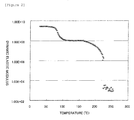
- a dynamic elastic modulus thereof is 1.0 ⁇ 10 6 Pa or more at any temperature falling in a range of 190 to 240°C” dose not mean that the dynamic elastic modulus has to be 1.0 ⁇ 10 6 Pa or more at the whole temperature range described above. As shown in, for example, Fig.
- the dynamic elastic modulus is continuously 1.0 ⁇ 10 6 Pa or more at least at a part of a range of 190 to 240°C, it may be 1.0 ⁇ 10 6 Pa or less in a range of 230 to 240°C.
- the dynamic elastic modulus shows a deformability and a flowability of a polymer and can be measured with a good repeatability.
- a measuring method of the dynamic elastic modulus is usually known well, and it is measured, for example, by determining a shift in a frequency which is brought about by giving vibration to a thermally molten resin at a constant frequency by means of a measuring instrument called a rheometer.
- a polymer is molten at a prescribed temperature, and then a rotor is vibrated at a prescribed frequency while lowering the temperature to record a temperature-dynamic elastic modulus curve, whereby dynamic elastic moduli at the respective temperatures are measured.
- the polyester base resin constituting the polyester film according to the present invention shows polymers having an ester group which are obtained from polyvalent carboxylic acids and polyhydric alcohols by polycondensation.
- the polyvalent carboxylic acids include terephthalic acid, isophthalic acid, phthalic acid, 2,6-naphhtalenedicarboxylic acid, adipic acid, sebacic acid, decanedicarboxylic acid, azelaic acid, dodecadicarboxylic acid, cyclohexanedicarboxylic acid and the like.
- the polyhydric alcohols include ethylene glycol, propanediol, butanediol, pentanediol, hexanediol, neopentyl glycol, 1,4-cyclohexanedimethanol, decanediol, 2-ethyl-butyl-1-propanediol, bisphenol A and the like.
- the polyester base resin used in the present invention may be copolymers of three or more kinds of polyvalent carboxylic acids and polyhydric alcohols and may be copolymers with monomers and polymers such as diethylene glycol, triethylene glycol, polyethylene glycol and the like.
- the above polyester base resin includes preferably polyethylene terephthalate (PET), polybutylene terephthalate and the like, and polyethylene terephthalate (PET) is particularly preferred.
- PET polyethylene terephthalate
- the above polyester base resin may be a homopolymer or a copolymer or may be a polymer obtained by polymerizing with a third component.
- a film obtained by using a copolymer includes a polyester film obtained by blending a polyester base resin comprising polyethylene terephthalate which is usually excellent in a heat resistance and a dimensional stability as a principal component (usually 90 mole % or more, preferably 95 mole % or more) with a polyester base resin comprising polybutylene terephthalate which is usually excellent in a moldability as a principal component (usually 90 mole % or more, preferably 95 mole % or more).
- a blending ratio thereof may suitably be selected according to a dynamic elastic modulus of the film obtained, and it is usually 70/30 to 95/5, preferably 75/25 to 85/15.
- the polyester film thus obtained is excellent in a heat resistance, a dimensional stability and a moldability and therefore can suitably be used as the base sheet of the present invention.
- the polyester film comprising the above polyester base resins may be used in a single sheet or in a laminate of plural sheets.
- the polyester film contains preferably fine particles for the purpose of improving a workability.
- the fine particles include inorganic particles of calcium carbonate, magnesium carbonate, calcium sulfate, barium sulfate, lithium phosphate, magnesium phosphate, calcium phosphate, aluminum oxide, silicon oxide, kaoline and the like, organic particles comprising acryl base resins and the like, internal deposited particles and the like.
- An average particle diameter of the fine particles is preferably 0.01 to 5.0 ⁇ m, more preferably 0.05 to 3.0 ⁇ m, and a content of the fine particles in the polyester base resin is preferably 0.01 to 5.0 mass %, more preferably 0.1 to 1.0 mass %.
- the polyester film may contain, if necessary, various stabilizing agents, lubricants, antioxidants, antistatic agents, defoaming agents, fluorescent brightening agents and the like.
- the polyester film used in the present invention has a thickness of usually 10 to 150 ⁇ m, preferably 10 to 125 ⁇ m and more preferably 10 to 75 ⁇ m.
- the polyester film used in the present invention is produced, for example, in the following manner.
- the polyester base resin described above and the other raw materials are supplied to a known melt extruding equipment such as an extruder, and they are molten by heating at a temperature higher than a melting point of the above polyester base resin, whereby a molten polymer is obtained.
- the molten polymer is quickly cooled and solidified on a rotary cooling drum while extruding so that the temperature is lower than a glass transition temperature of the polymer, whereby a non-oriented sheet staying in a substantially amorphous state is obtained.
- This sheet is stretched in a biaxial direction and turned into a film, and the film is subjected to thermal fixing, whereby a polyester film is obtained.
- the stretching method may be either sequential biaxial stretching or simultaneous biaxial stretching.
- the sheet may be stretched again, if necessary, in vertical and/or horizontal directions before or after subjected to thermal fixing.
- the stretching magnification is preferably 7 times or less, more preferably 5 times or less and further preferably 3 times or less in terms of an area magnification in order to obtain the satisfactory dimensional stability. If the stretching magnification falls in the above range, when the polyester film obtained is used for a sheet for decoration, the sheet for decoration does not shrink again in a temperature range in injecting the injection resin, and the film strength required in the above temperature range can be obtained.
- the polyester film may be the film produced in the manner described above or a commercial film.
- the peel layer 12 is provided in order to make it easy to peel a transfer layer comprising the peel layer 12, the picture layer 13 and the heat adhesive resin layer 14 from the base sheet 11 and function as a protective layer for the picture layer after transferring the above transfer layer onto the injection resin.
- the presence of the above peel layer makes it possible to transfer the transfer layer surely and readily onto a transferee from the sheet for decoration of the present invention.
- the peel layer can be formed by using, for example, waxes such as microcrystalline wax, carnauba wax, paraffin wax, Fisher-Tropsch wax, various low molecular polyethylenes, Japan tallow, beeswax, whale wax, privet wax, wool wax, shellac wax, candelilla wax, petrolatum, partially modified waxes, fatty acid esters, fatty acid amides and the like and thermoplastic resins such as silicone wax, silicone base resins, fluorine base resins, acryl base resins, polyester base resins, polyurethane base resins, cellulose base resins, vinyl chloride-vinyl acetate base copolymer resins, nitrocellulose and the like.
- waxes such as microcrystalline wax, carnauba wax, paraffin wax, Fisher-Tropsch wax, various low molecular polyethylenes, Japan tallow, beeswax, whale wax, privet wax, wool wax, shellac wax, candelilla wax, petrolatum, partially
- the peel layer can be formed as well by using a binder resin and a releasing material.
- the binder resin includes acryl base resins such as polymethyl methacrylate, polyethyl methacrylate, polybutyl methacrylate and the like which are thermoplastic resins, vinyl base resins such as polyvinyl acetate base resins, polyvinyl chloride-polyvinyl acetate base copolymer resins, polyvinyl alcohol, polyvinyl butyral and the like, cellulose derivatives such as ethyl cellulose, nitrocellulose, cellulose acetate and the like and unsaturated polyester base resins, polyester base resins, polyurethane base resins, aminoalkyd base resins and the like which are thermosetting resins.
- acryl base resins such as polymethyl methacrylate, polyethyl methacrylate, polybutyl methacrylate and the like which are thermoplastic resins
- vinyl base resins such as polyvinyl acetate base resins
- the releasing material includes waxes, silicone waxes, silicone base resins, melamine base resins, fluorine base resins, fine powders of talc and silica and lubricants such as surfactants and metal soaps.
- a content of the releasing material per 100 mass parts of the binder resin is preferably 1 to 10 mass parts, more preferably 3 to 5 mass parts.
- the peel layer can be formed by dissolving or dispersing the necessary materials described above in a suitable solvent to prepare a coating liquid for the peel layer and coating the above liquid on the base material by means of a gravure print method, a screen print method or a reverse coating method using a photogravure and then drying it.
- a thickness thereof after drying is usually 0.1 to 10 ⁇ m, preferably 1 to 5 ⁇ m.
- a release layer can be provided, if necessary, between the base sheet 11 and the peel layer 12.
- the release layer is provided when a releasing property of the transfer layer is not satisfactory in thermal transferring depending on combination of the materials for the base sheet 11 and the peel layer 12.
- the above release layer can be formed as well by using a release agent such as waxes, silicone waxes, silicone base resins, fluorine base resins and the like, or hydrophilic resins described in Japanese Patent Application Laid-Open No. 142988/1992 , various curing resins and the like which are suitably selected according to the characteristics of the base sheet and the transfer layer can be used as well to form the release layer.
- the release layer can be formed by dissolving or dispersing the release agent containing the necessary additives described above in a suitable solvent to prepare an ink and coating it on the base sheet 11 by publicly known means and drying.
- a thickness thereof is preferably about 0.1 to 5 ⁇ m.
- the picture layer 13 is a layer for expressing designs, characters and pattern-shaped pictures.
- the pictures of the picture layer 13 are optional, and capable of being given pictures comprising, for example, wood grains, marble grains, texture grains, sand patterns, geometric patterns, characters and the like.
- a picture pattern layer and a whole solid layer which express the pictures described above can be provided alone or in combination.
- the whole solid layer can be used usually as a masking layer, a coloring layer, a coloring masking layer or the like.
- the picture layer 13 is formed on the release layer 12 described above by a publicly known printing method such as gravure printing using a print ink, offset printing, silk screen printing, transfer printing transferred from a transfer sheet, sublimation transfer printing, ink jet printing and the like, whereby it is formed between the release layer 12 and the adhesive layer 14 as shown in Fig. 1 .
- a thickness of the picture layer 13 is preferably 5 to 40 ⁇ m, more preferably 20 to 30 ⁇ m from the viewpoint of the design.
- Polyester base resins, polyurethane base resins, acryl base resins, vinyl acetate base resins, vinyl chloride-vinyl acetate base copolymer resins, cellulose base resins and the like can preferably be given as a binder resin of the print ink used for forming the picture layer 13.
- the binder resin comprises preferably the acryl base resin alone or the mixture of the acryl base resin and the vinyl chloride-vinyl acetate base copolymer resin as a main component.
- the acryl base resin, the vinyl chloride-vinyl acetate base copolymer resin or the mixture thereof with another acryl base resin is preferred since the printing aptitude and the molding aptitude are more improved.
- the acryl base resin includes acryl base resins such as polymethyl (meth)acrylate, polyethyl (meth)acrylate, polybutyl (meth)acrylate, methyl (meth)acrylate-butyl (meth)acrylate copolymers, methyl (meth)acrylate-styrene copolymers and the like (in the above case, (meth)acrylate shows acrylate or methacrylate) and acryl resins modified with fluorine and the like. They can be used alone or in a mixture of two or more kinds thereof.
- acryl polyols obtained by copolymerizing (meth)acrylic acid alkyl esters such as methyl (meth)acrylate, ethyl (meth)acrylate, butyl (meth)acrylate, 2-ethylhexyl (meth)acrylate, octyl (meth)acrylate and the like with (meth)acrylic acid esters having a hydroxyl group in a molecule such as 2-hydroxyethyl (meth)acrylate, 2-hydroxybutyl (meth)acrylate, 2-hydroxy-3-phenoxypropyl (meth)acrylate and the like.
- resins having a vinyl acetate content of about 5 to 20 mass % and an average polymerization degree of about 350 to 900 are usually used as the vinyl chloride-vinyl acetate base copolymer resin.
- the vinyl chloride-vinyl acetate base copolymer resin may be further copolymerized, if necessary, with carboxylic acid such as maleic acid, fumaric acid and the like.
- thermoplastic polyester base resins such as thermoplastic polyester base resins, thermoplastic urethane base resins and chlorinated polyolefin base resins such as chlorinated polyethylene, chlorinated polypropylene and the like may suitably be mixed, if necessary, as an accessory component.
- reins such as thermoplastic polyester base resins, thermoplastic urethane base resins and chlorinated polyolefin base resins such as chlorinated polyethylene, chlorinated polypropylene and the like may suitably be mixed, if necessary, as an accessory component.
- a colorant used for the picture layer 13 according to the present invention includes metallic pigments comprising scale-shaped flake powders of metals, alloys and metal compounds of aluminum, chromium, nickel, tin, titanium, iron phosphide, copper, gold, silver, brass and the like, pearl pigments comprising flake powders of mica-shaped iron oxide, titanium dioxide-covered mica, titanium dioxide-covered bismuth oxychloride, bismuth oxychloride, titanium dioxide-covered talc, argentine, colored titanium dioxide-covered mica, basic lead carbonate and the like, fluorescent pigments such as strontium aluminate, calcium aluminate, barium aluminate, zinc sulfide, calcium sulfide and the like, white inorganic pigments such as titanium dioxide, zinc oxide, antimony trioxide and the like, inorganic pigments such as zinc oxide, iron oxide red, vermilion, ultramarine blue, cobalt blue, titan yellow, chrome yellow, carbon black and the like and organic pigments (
- the above picture layer 13 is a layer provided in order to impart the sheet for decoration of the present invention with a design property, and a metal thin film layer and the like may be provided thereon for the purpose of enhancing the design property.
- the metal thin film layer can be formed by a method such as vacuum vapor deposition, sputtering and the like using metal such as aluminum, chromium, gold, silver and the like.
- the above metal thin film layer may be provided on the whole surface or partially in a pattern form. Precipitation preventives, curing catalysts, UV absorbers, antioxidants, leveling agents, thickeners, defoaming agents, lubricants and the like in addition to the components described above can suitably be added to the print ink used for forming the picture layer 13.
- the print ink is provided usually in a form in which the components described above are dissolved or dispersed in a solvent.
- the solvent may be any one as long as the binder resin is dissolved or dispersed therein, and organic solvents and/or water can be used.
- the organic solvents include hydrocarbons such as toluene, xylene and the like, ketones such as acetone, methyl ethyl ketone and the like, esters such as ethyl acetate, cellosolve acetate, butyl cellosolve acetate and the like and alcohols.
- the heat adhesive resin layer 14 is formed in order to transfer the transfer layer onto a decorated molding with a good adhesive property.
- a resin used for the above heat adhesive resin layer 14 includes, for example, acryl base resins, vinyl chloride base resins, vinyl acetate base resins, vinyl chloride-vinyl acetate base copolymer resins, styrene-acryl base copolymer resins, polyester base resins, polyamide base resins and the like.
- the heat adhesive resin layer 14 can be formed by using at least one of the above resins to prepare a solution or an emulsion which can be coated and coating and drying it by a suited method selected from the coating methods given in the peel layer described above.
- a thickness thereof is preferably about 0.1 to 5 ⁇ m.
- the resins described above organic UV absorbers such as benzophenone base compounds, benzotriazole base compounds, oxalic acid anilide base compounds, cyanoacrylate base compounds, salicylate base compounds and the like and additives of inorganic fine particles having a UV absorbing ability such as oxides of zinc, titanium, cerium, tin, iron and the like.
- organic UV absorbers such as benzophenone base compounds, benzotriazole base compounds, oxalic acid anilide base compounds, cyanoacrylate base compounds, salicylate base compounds and the like
- additives of inorganic fine particles having a UV absorbing ability such as oxides of zinc, titanium, cerium, tin, iron and the like.
- colored pigments, white pigments, extender pigments, fillers, antistatic agents, antioxidants, fluorescent brightening agents and the like can suitably be used as well, if necessary, as additives.
- the sheet for decoration of the present invention is formed by laminating the peel layer 12, the picture layer 13 and the heat adhesive resin layer 14 on the surface of the base film 11 comprising a polyester film by a publicly known printing or coating means such as gravure printing, roll coating and the like.
- a publicly known printing or coating means such as gravure printing, roll coating and the like.
- the sheet for decoration of the present invention obtained in the manner described above is suitably used for transfer decorating injection molding.
- a transfer layer side of the sheet for decoration for transfer decorating injection molding is turned to an inside of a metal die and heated from the transfer layer side by a hot plate to carry out preliminarily molding so that the above sheet for decoration fits the shape of the metal die to thereby bring the sheet for decoration into close contact with the inner face of the metal die, and the metal die is clamped.
- the heating temperature falls preferably in a range of not lower than the vicinity of a glass transition temperature of the base sheet and lower than the melting temperature (or melting point). It is more preferably the vicinity of the glass transition temperature.
- the vicinity of the glass transition temperature described above shows a range of the glass transition temperature ⁇ 5°C, and it is, though depending on the resin constituting the polyester film of the base sheet, usually about 70 to 130°C.
- an injection resin described later is molten and injected into the cavity, and the above sheet for decoration is integrated with the injection resin.
- the injection resin is a thermoplastic resin
- the above injection resin is turned into a fluid state by heating and melting
- the injection resin is a thermosetting resin
- the uncured injection resin is injected at room temperature or in a fluid state by suitably heating and solidified by cooling.
- a heating temperature of the injection resin is, though depending on the injection resin, usually about 180 to 240°C.
- the decorated molding thus obtained is taken out from the metal die after cooled, and then the base film is peeled off, whereby the decorated molding on which the transfer layer comprising the peel layer, the picture layer and the heat adhesive resin layer is transferred is obtained.
- the injection resin used for the decorated molding shall not specifically be restricted as long as it is a thermoplastic resin or a thermosetting resin (including a two liquid type curable resin) which can be injection-molded, and various resins can be used therefor.
- the above thermoplastic resin material includes, for example, vinyl base polymers such as polyvinyl chloride, polyvinylidene chloride and the like, styrene base resins such as polystyrene resins, acrylonitrile-styrene base copolymer resins, ABS base resins (acrylonitrile-butadiene-styrene base copolymer resins) and the like, acryl base resins such as polymethyl (meth)aorylate, polyethyl (meth)acrylate, polyacrylonitrile and the like, polyolefin base resins such as polyethylenes, polypropylenes, polybutenes and the like, polyester base resins such as polyethylene terephthalate, ethylene glycol-ter
- thermosetting resin includes polyurethane base resins of a two liquid reaction curing type, epoxy base resins and the like.
- the above resins may be used alone or in a mixture of two or more kinds thereof.
- added to the above resins are, if necessary, various additives, for example, antioxidants, UV absorbers, light stabilizing agents, flame retardants, plasticizers, inorganic powders of silica, alumina, calcium carbonate, aluminum oxide and the like, filler such as wooden powders, glass fibers and the like, lubricants, release agents antistatic agents, colorants and the like.
- the injection resin may be a resin colored by suitably adding a colorant according to uses.
- a thickness of the injection resin molding constituting the decorated molding shall not specifically be restricted and is selected according to the uses of the above decorated molding, and it is usually 1 to 5 mm, preferably 2 to 3 mm.
- a coating liquid comprising an acryl resin as a binder resin and a silicone base resin as a releasing material was used to carry out gravure printing on a biaxially stretched PET film having a thickness of 75 ⁇ m and a dynamic elastic modulus shown in Fig. 2 at a coating amount of 4 g/m 2 to form a peel layer, and an acryl base print ink was used to carry out gravure printing of wood grain patterns at a coating amount of 8 g/m 2 to form a picture layer. Further, a coating liquid of an acryl resin base was coated thereon in a thickness of 4 ⁇ m to form a heat adhesive resin layer, whereby a sheet for decoration was obtained.
- the sheet for decoration obtained in (1) described above was heated at a hot plate temperature of 150°C to carry out molding so that the sheet for decoration fit a shape in an inside of a metal die for injection molding to thereby bring the sheet for decoration into close contact with the inner face of the metal die.
- the metal die of a form having a high deep drawing degree which had a size of 80 mm square and a rise of 10 mm and in which a corner part had a tray form of 3 R.
- an ABS resin (trade name: "Kralastic Myth-2", manufactured by NIPPON A & L INC.) was used as an injection resin and molten at 230°C, and then it was injected into a cavity.
- the metal die was cooled down, and after a molding was taken out from the metal die, the base sheet was peeled off therefrom to thereby obtain a decorated molding in which the transfer layer comprising the peel layer, the picture layer and the heat adhesive resin layer was transferred and formed on a surface. It was found that the above decorated molding was good and that the sheet for decoration of the present invention was not broken in molding a surface form having a three-dimensional curved surface having a high deep drawing degree and had a good followability toward a molding surface of the metal die.
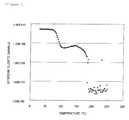
- a sheet for decoration was obtained in the same manner as in Example 1, except that the PET film used in Example 1 was changed to a PET film having a dynamic elastic modulus shown in Fig. 3 , and the above sheet for decoration was used to produce a decorated molding.
- the decorated molding was taken out to find that the sheet for decoration was broken and that the injection resin leaked out from the broken part to make it impossible to peel the base sheet.
- the sheet for decoration of the present invention is suitably used for various decorated moldings.
Landscapes
- Engineering & Computer Science (AREA)
- Manufacturing & Machinery (AREA)
- Mechanical Engineering (AREA)
- Laminated Bodies (AREA)
- Decoration By Transfer Pictures (AREA)
- Injection Moulding Of Plastics Or The Like (AREA)
Abstract
Provided is a sheet for decoration which is excellent in an impact resistance in molding a surface form having a three-dimensional curved surface having a high deep-drawing degree and which has a good followability toward a molding surface of a metal die and is suited to decorated moldings. The above sheet for decoration comprises a peel layer, a picture layer and a heat adhesive resin layer which are laminated in order on the surface of a base film comprising a polyester film, wherein a dynamic elastic modulus of the above base film is 1.0 × 10 6 Pa or more at any temperature falling in a range of 190 to 240°C.
Description
- The present invention relates to a sheet for decoration used for decorated moldings prepared by injection molding.
- A decorating injection molding method has so far been used for decorating resin moldings having a complicated surface form such as a three-dimensional curved surface and the like. The decorating injection molding method is a method in which a sheet for decoration inserted into a metal die in injection molding is integrated with a molten injection resin injected into a cavity to decorate the surface of a resin molding. In general, it is classified roughly into a laminate decorating injection molding method and a transfer decorating injection molding method according to a difference in the constitution of a sheet for decoration integrated with a resin molding.
In the transfer decorating injection molding method, a transfer layer side of a sheet for decoration for transfer decorating injection molding is turned to an inside of a metal die and heated from the transfer layer side by a hot plate to carry out molding so that the above sheet for decoration fits a shape in an inside of the metal die to thereby bring the sheet for decoration into close contact with the inner face of the metal die, and the metal die is clamped. Next, a decorated molding is taken out from the metal die after cooled down, and then the base film is peeled, whereby the decorated molding on which the transfer layer is transferred can be obtained. - The decorated moldings thus obtained have so far been used in various fields such as household electric appliances, car interior products and the like, and in recent years, articles having a surface form of a three-dimensional curved surface which have more complicated shapes and a high deep-drawing degree (larger elongation rate of a sheet for decoration) tend to be desired as the tastes of consumers are diversified. In order to meet the requirement described above, proposed are a sheet for decoration prepared by using a material which has a yield point and in which a stress value subsequent to the yield point is a fixed value or more (for example, a patent document 1) and a sheet for decoration for molding constituted from two or more laminate films in which a transparent acryl film is laminated on the film at a side adhered to a molding resin and in which pictures are formed between the film at the side adhered to the molding resin and the acryl film (for example, a patent document 2). However, when molding a surface form of a three-dimensional curved surface having a high deep-drawing degree, there has been the problem that insufficient following of a sheet for decoration toward an irregular form of a metal die allows the sheet for decoration to be broken by the temperature and shock of an injection resin when injected the injection resin.
-
- Patent document 1: Japanese Patent No.
2690258 - Patent document 2: Japanese Patent No.
2965973 -
-
Fig. 1 is a schematic drawing showing a cross section of the sheet for decoration of the present invention. -
Fig. 2 is a graph showing a dynamic elastic modulus of a PET film used in Example 1. -
Fig. 3 is a graph showing a dynamic elastic modulus of a PET film used in Comparative Example 1. -
- 10
- Sheet for decoration
- 11
- Base film
- 12
- Peel layer
- 13
- Picture layer
- 14
- Heat adhesive resin layer
- In light of the situation described above, an object of the present invention is to provide a sheet for decoration which is excellent in an impact resistance in molding a surface form having a three-dimensional curved surface having a high deep-drawing degree and which has a good followability toward a molding surface of a metal die and is suited to decorated moldings.
- Intensive researches repeated by the present inventors in order to achieve the object described above have resulted in finding that the object described above can be achieved by allowing a dynamic elastic modulus of a base sheet comprising a polyester film to fall in a prescribed range. The present invention has been completed based the above knowledge.
That is, the present invention comprises the following essential points. - 1. A sheet for decoration comprising a peel layer, a picture layer and a heat adhesive resin layer which are laminated in order on the surface of a base film comprising a polyester film, wherein a dynamic elastic modulus of the above base film is 1.0
X 106 Pa or more at any temperature falling in a range of 190 to 240°C. - 2. The sheet for decoration as described in the above item 1, wherein a resin constituting the polyester film described above is polyethylene terephthalate.
- 3. The sheet for decoration as described in the above item 1 o 2, wherein it is used for transfer decorating injection molding.
- According to the present invention, capable of being provided is a sheet for decoration which is excellent in an impact resistance in molding a surface form having a three-dimensional curved surface having a high deep-drawing degree and which has a good followability toward a molding surface of a metal die and is suited to decorative moldings.
- The present invention shall be explained below with reference to the drawings.
Fig. 1 is a schematic drawing showing a cross section of the sheet for decoration of the present invention.
As shown inFig. 1 , the sheet fordecoration 10 of the present invention comprises apeel layer 12, apicture layer 13 and a heatadhesive resin layer 14 which are laminated in order on the surface of abase film 11 comprising a polyester film, and it is a sheet for decoration which is excellent in an impact resistance in molding a surface form having a three-dimensional curved surface having a high deep-drawing degree and which has a good followability toward a molding surface of a metal die and is suited to decorative moldings. In this regard, "deep-drawing" means a form in which an area ratio of after molding to before molding in a sheet for decoration is 130 % or more, and "a high deep-drawing degree" means that the above area ratio is large. - The
base film 11 according to the present invention comprises a polyester film, and a dynamic elastic modulus thereof has to be 1.0 × 10⁶ Pa or more at any temperature falling in a range of 190 to 240°C. In this regard, "a dynamic elastic modulus thereof is 1.0 × 10⁶ Pa or more at any temperature falling in a range of 190 to 240°C" dose not mean that the dynamic elastic modulus has to be 1.0 × 10⁶ Pa or more at the whole temperature range described above. As shown in, for example,Fig. 2 , if the dynamic elastic modulus is continuously 1.0 × 10⁶ Pa or more at least at a part of a range of 190 to 240°C, it may be 1.0 × 10⁶ Pa or less in a range of 230 to 240°C. - The dynamic elastic modulus shows a deformability and a flowability of a polymer and can be measured with a good repeatability. A measuring method of the dynamic elastic modulus is usually known well, and it is measured, for example, by determining a shift in a frequency which is brought about by giving vibration to a thermally molten resin at a constant frequency by means of a measuring instrument called a rheometer. To be more specific, a polymer is molten at a prescribed temperature, and then a rotor is vibrated at a prescribed frequency while lowering the temperature to record a temperature-dynamic elastic modulus curve, whereby dynamic elastic moduli at the respective temperatures are measured.
- The polyester base resin constituting the polyester film according to the present invention shows polymers having an ester group which are obtained from polyvalent carboxylic acids and polyhydric alcohols by polycondensation. The polyvalent carboxylic acids include terephthalic acid, isophthalic acid, phthalic acid, 2,6-naphhtalenedicarboxylic acid, adipic acid, sebacic acid, decanedicarboxylic acid, azelaic acid, dodecadicarboxylic acid, cyclohexanedicarboxylic acid and the like. The polyhydric alcohols include ethylene glycol, propanediol, butanediol, pentanediol, hexanediol, neopentyl glycol, 1,4-cyclohexanedimethanol, decanediol, 2-ethyl-butyl-1-propanediol, bisphenol A and the like. Further, the polyester base resin used in the present invention may be copolymers of three or more kinds of polyvalent carboxylic acids and polyhydric alcohols and may be copolymers with monomers and polymers such as diethylene glycol, triethylene glycol, polyethylene glycol and the like.
- The above polyester base resin includes preferably polyethylene terephthalate (PET), polybutylene terephthalate and the like, and polyethylene terephthalate (PET) is particularly preferred. The above polyester base resin may be a homopolymer or a copolymer or may be a polymer obtained by polymerizing with a third component. For example, a film obtained by using a copolymer includes a polyester film obtained by blending a polyester base resin comprising polyethylene terephthalate which is usually excellent in a heat resistance and a dimensional stability as a principal component (usually 90 mole % or more, preferably 95 mole % or more) with a polyester base resin comprising polybutylene terephthalate which is usually excellent in a moldability as a principal component (usually 90 mole % or more, preferably 95 mole % or more). A blending ratio thereof may suitably be selected according to a dynamic elastic modulus of the film obtained, and it is usually 70/30 to 95/5, preferably 75/25 to 85/15. The polyester film thus obtained is excellent in a heat resistance, a dimensional stability and a moldability and therefore can suitably be used as the base sheet of the present invention. The polyester film comprising the above polyester base resins may be used in a single sheet or in a laminate of plural sheets.
- The polyester film contains preferably fine particles for the purpose of improving a workability. The fine particles include inorganic particles of calcium carbonate, magnesium carbonate, calcium sulfate, barium sulfate, lithium phosphate, magnesium phosphate, calcium phosphate, aluminum oxide, silicon oxide, kaoline and the like, organic particles comprising acryl base resins and the like, internal deposited particles and the like. An average particle diameter of the fine particles is preferably 0.01 to 5.0 µm, more preferably 0.05 to 3.0 µm, and a content of the fine particles in the polyester base resin is preferably 0.01 to 5.0 mass %, more preferably 0.1 to 1.0 mass %.
Further, the polyester film may contain, if necessary, various stabilizing agents, lubricants, antioxidants, antistatic agents, defoaming agents, fluorescent brightening agents and the like.
The polyester film used in the present invention has a thickness of usually 10 to 150 µm, preferably 10 to 125 µm and more preferably 10 to 75 µm. - The polyester film used in the present invention is produced, for example, in the following manner. First, the polyester base resin described above and the other raw materials are supplied to a known melt extruding equipment such as an extruder, and they are molten by heating at a temperature higher than a melting point of the above polyester base resin, whereby a molten polymer is obtained. Then, the molten polymer is quickly cooled and solidified on a rotary cooling drum while extruding so that the temperature is lower than a glass transition temperature of the polymer, whereby a non-oriented sheet staying in a substantially amorphous state is obtained. This sheet is stretched in a biaxial direction and turned into a film, and the film is subjected to thermal fixing, whereby a polyester film is obtained. In this case, the stretching method may be either sequential biaxial stretching or simultaneous biaxial stretching. Further, the sheet may be stretched again, if necessary, in vertical and/or horizontal directions before or after subjected to thermal fixing. In the present invention, the stretching magnification is preferably 7 times or less, more preferably 5 times or less and further preferably 3 times or less in terms of an area magnification in order to obtain the satisfactory dimensional stability. If the stretching magnification falls in the above range, when the polyester film obtained is used for a sheet for decoration, the sheet for decoration does not shrink again in a temperature range in injecting the injection resin, and the film strength required in the above temperature range can be obtained. The polyester film may be the film produced in the manner described above or a commercial film.
- The
peel layer 12 is provided in order to make it easy to peel a transfer layer comprising thepeel layer 12, thepicture layer 13 and the heatadhesive resin layer 14 from thebase sheet 11 and function as a protective layer for the picture layer after transferring the above transfer layer onto the injection resin. The presence of the above peel layer makes it possible to transfer the transfer layer surely and readily onto a transferee from the sheet for decoration of the present invention. The peel layer can be formed by using, for example, waxes such as microcrystalline wax, carnauba wax, paraffin wax, Fisher-Tropsch wax, various low molecular polyethylenes, Japan tallow, beeswax, whale wax, privet wax, wool wax, shellac wax, candelilla wax, petrolatum, partially modified waxes, fatty acid esters, fatty acid amides and the like and thermoplastic resins such as silicone wax, silicone base resins, fluorine base resins, acryl base resins, polyester base resins, polyurethane base resins, cellulose base resins, vinyl chloride-vinyl acetate base copolymer resins, nitrocellulose and the like. - Further, the peel layer can be formed as well by using a binder resin and a releasing material. The binder resin includes acryl base resins such as polymethyl methacrylate, polyethyl methacrylate, polybutyl methacrylate and the like which are thermoplastic resins, vinyl base resins such as polyvinyl acetate base resins, polyvinyl chloride-polyvinyl acetate base copolymer resins, polyvinyl alcohol, polyvinyl butyral and the like, cellulose derivatives such as ethyl cellulose, nitrocellulose, cellulose acetate and the like and unsaturated polyester base resins, polyester base resins, polyurethane base resins, aminoalkyd base resins and the like which are thermosetting resins. Also, the releasing material includes waxes, silicone waxes, silicone base resins, melamine base resins, fluorine base resins, fine powders of talc and silica and lubricants such as surfactants and metal soaps. A content of the releasing material per 100 mass parts of the binder resin is preferably 1 to 10 mass parts, more preferably 3 to 5 mass parts. The peel layer can be formed by dissolving or dispersing the necessary materials described above in a suitable solvent to prepare a coating liquid for the peel layer and coating the above liquid on the base material by means of a gravure print method, a screen print method or a reverse coating method using a photogravure and then drying it. A thickness thereof after drying is usually 0.1 to 10 µm, preferably 1 to 5 µm.
- In the sheet for decoration of the present invention, a release layer can be provided, if necessary, between the
base sheet 11 and thepeel layer 12. The release layer is provided when a releasing property of the transfer layer is not satisfactory in thermal transferring depending on combination of the materials for thebase sheet 11 and thepeel layer 12. The above release layer can be formed as well by using a release agent such as waxes, silicone waxes, silicone base resins, fluorine base resins and the like, or hydrophilic resins described in Japanese Patent Application Laid-Open No.142988/1992 base sheet 11 by publicly known means and drying. A thickness thereof is preferably about 0.1 to 5 µm. - The
picture layer 13 according to the present invention is a layer for expressing designs, characters and pattern-shaped pictures. The pictures of thepicture layer 13 are optional, and capable of being given pictures comprising, for example, wood grains, marble grains, texture grains, sand patterns, geometric patterns, characters and the like. In thepicture layer 13, a picture pattern layer and a whole solid layer which express the pictures described above can be provided alone or in combination. The whole solid layer can be used usually as a masking layer, a coloring layer, a coloring masking layer or the like. Usually, thepicture layer 13 is formed on therelease layer 12 described above by a publicly known printing method such as gravure printing using a print ink, offset printing, silk screen printing, transfer printing transferred from a transfer sheet, sublimation transfer printing, ink jet printing and the like, whereby it is formed between therelease layer 12 and theadhesive layer 14 as shown inFig. 1 . A thickness of thepicture layer 13 is preferably 5 to 40 µm, more preferably 20 to 30 µm from the viewpoint of the design. - Polyester base resins, polyurethane base resins, acryl base resins, vinyl acetate base resins, vinyl chloride-vinyl acetate base copolymer resins, cellulose base resins and the like can preferably be given as a binder resin of the print ink used for forming the
picture layer 13. The binder resin comprises preferably the acryl base resin alone or the mixture of the acryl base resin and the vinyl chloride-vinyl acetate base copolymer resin as a main component. Among them, the acryl base resin, the vinyl chloride-vinyl acetate base copolymer resin or the mixture thereof with another acryl base resin is preferred since the printing aptitude and the molding aptitude are more improved. In this regard, the acryl base resin includes acryl base resins such as polymethyl (meth)acrylate, polyethyl (meth)acrylate, polybutyl (meth)acrylate, methyl (meth)acrylate-butyl (meth)acrylate copolymers, methyl (meth)acrylate-styrene copolymers and the like (in the above case, (meth)acrylate shows acrylate or methacrylate) and acryl resins modified with fluorine and the like. They can be used alone or in a mixture of two or more kinds thereof. In addition thereto, capable of being used as well are acryl polyols obtained by copolymerizing (meth)acrylic acid alkyl esters such as methyl (meth)acrylate, ethyl (meth)acrylate, butyl (meth)acrylate, 2-ethylhexyl (meth)acrylate, octyl (meth)acrylate and the like with (meth)acrylic acid esters having a hydroxyl group in a molecule such as 2-hydroxyethyl (meth)acrylate, 2-hydroxybutyl (meth)acrylate, 2-hydroxy-3-phenoxypropyl (meth)acrylate and the like. Further, resins having a vinyl acetate content of about 5 to 20 mass % and an average polymerization degree of about 350 to 900 are usually used as the vinyl chloride-vinyl acetate base copolymer resin. The vinyl chloride-vinyl acetate base copolymer resin may be further copolymerized, if necessary, with carboxylic acid such as maleic acid, fumaric acid and the like. A mixing ratio of the acryl base resin to the vinyl chloride-vinyl acetate base copolymer resin is the acryl base resin/the vinyl chloride-vinyl acetate base copolymer resin = about 1/9 to 9/1 (mass ratio). In addition thereto, other resins, for example, reins such as thermoplastic polyester base resins, thermoplastic urethane base resins and chlorinated polyolefin base resins such as chlorinated polyethylene, chlorinated polypropylene and the like may suitably be mixed, if necessary, as an accessory component. - A colorant used for the
picture layer 13 according to the present invention includes metallic pigments comprising scale-shaped flake powders of metals, alloys and metal compounds of aluminum, chromium, nickel, tin, titanium, iron phosphide, copper, gold, silver, brass and the like, pearl pigments comprising flake powders of mica-shaped iron oxide, titanium dioxide-covered mica, titanium dioxide-covered bismuth oxychloride, bismuth oxychloride, titanium dioxide-covered talc, argentine, colored titanium dioxide-covered mica, basic lead carbonate and the like, fluorescent pigments such as strontium aluminate, calcium aluminate, barium aluminate, zinc sulfide, calcium sulfide and the like, white inorganic pigments such as titanium dioxide, zinc oxide, antimony trioxide and the like, inorganic pigments such as zinc oxide, iron oxide red, vermilion, ultramarine blue, cobalt blue, titan yellow, chrome yellow, carbon black and the like and organic pigments (including dyes) such as isoindolinone yellow, Hansa yellow A, quinacridone red, permanent red 4R, phthalocyanine blue, indathrene blue RS, aniline black and the like. They can be used alone or in a mixture of two or more kinds thereof. - The
above picture layer 13 is a layer provided in order to impart the sheet for decoration of the present invention with a design property, and a metal thin film layer and the like may be provided thereon for the purpose of enhancing the design property. The metal thin film layer can be formed by a method such as vacuum vapor deposition, sputtering and the like using metal such as aluminum, chromium, gold, silver and the like. The above metal thin film layer may be provided on the whole surface or partially in a pattern form.
Precipitation preventives, curing catalysts, UV absorbers, antioxidants, leveling agents, thickeners, defoaming agents, lubricants and the like in addition to the components described above can suitably be added to the print ink used for forming thepicture layer 13. The print ink is provided usually in a form in which the components described above are dissolved or dispersed in a solvent. The solvent may be any one as long as the binder resin is dissolved or dispersed therein, and organic solvents and/or water can be used. The organic solvents include hydrocarbons such as toluene, xylene and the like, ketones such as acetone, methyl ethyl ketone and the like, esters such as ethyl acetate, cellosolve acetate, butyl cellosolve acetate and the like and alcohols. - The heat
adhesive resin layer 14 according to the present invention is formed in order to transfer the transfer layer onto a decorated molding with a good adhesive property. A resin used for the above heatadhesive resin layer 14 includes, for example, acryl base resins, vinyl chloride base resins, vinyl acetate base resins, vinyl chloride-vinyl acetate base copolymer resins, styrene-acryl base copolymer resins, polyester base resins, polyamide base resins and the like. The heatadhesive resin layer 14 can be formed by using at least one of the above resins to prepare a solution or an emulsion which can be coated and coating and drying it by a suited method selected from the coating methods given in the peel layer described above. A thickness thereof is preferably about 0.1 to 5 µm. - Capable of being used for the heat
adhesive resin layer 14 are the resins described above, organic UV absorbers such as benzophenone base compounds, benzotriazole base compounds, oxalic acid anilide base compounds, cyanoacrylate base compounds, salicylate base compounds and the like and additives of inorganic fine particles having a UV absorbing ability such as oxides of zinc, titanium, cerium, tin, iron and the like. Further, colored pigments, white pigments, extender pigments, fillers, antistatic agents, antioxidants, fluorescent brightening agents and the like can suitably be used as well, if necessary, as additives. - The sheet for decoration of the present invention is formed by laminating the
peel layer 12, thepicture layer 13 and the heatadhesive resin layer 14 on the surface of thebase film 11 comprising a polyester film by a publicly known printing or coating means such as gravure printing, roll coating and the like. When thepicture layer 13 comprises plural layers, for example, when thepicture layer 13 comprises combination of a picture pattern layer and a whole solid layer as described above, one layer is laminated and then dried, and subsequently the other layer is laminated. - The sheet for decoration of the present invention obtained in the manner described above is suitably used for transfer decorating injection molding. In the transfer decorating injection molding, a transfer layer side of the sheet for decoration for transfer decorating injection molding is turned to an inside of a metal die and heated from the transfer layer side by a hot plate to carry out preliminarily molding so that the above sheet for decoration fits the shape of the metal die to thereby bring the sheet for decoration into close contact with the inner face of the metal die, and the metal die is clamped. In this case, the heating temperature falls preferably in a range of not lower than the vicinity of a glass transition temperature of the base sheet and lower than the melting temperature (or melting point). It is more preferably the vicinity of the glass transition temperature. The vicinity of the glass transition temperature described above shows a range of the glass transition temperature ± 5°C, and it is, though depending on the resin constituting the polyester film of the base sheet, usually about 70 to 130°C.
- Then, an injection resin described later is molten and injected into the cavity, and the above sheet for decoration is integrated with the injection resin. When the injection resin is a thermoplastic resin, the above injection resin is turned into a fluid state by heating and melting, and when the injection resin is a thermosetting resin, the uncured injection resin is injected at room temperature or in a fluid state by suitably heating and solidified by cooling. This allows the sheet for decoration to be integrated with a formed resin molding and adhered thereon, whereby a decorated molding is obtained. A heating temperature of the injection resin is, though depending on the injection resin, usually about 180 to 240°C.
- The decorated molding thus obtained is taken out from the metal die after cooled, and then the base film is peeled off, whereby the decorated molding on which the transfer layer comprising the peel layer, the picture layer and the heat adhesive resin layer is transferred is obtained.
- The injection resin used for the decorated molding shall not specifically be restricted as long as it is a thermoplastic resin or a thermosetting resin (including a two liquid type curable resin) which can be injection-molded, and various resins can be used therefor. The above thermoplastic resin material includes, for example, vinyl base polymers such as polyvinyl chloride, polyvinylidene chloride and the like, styrene base resins such as polystyrene resins, acrylonitrile-styrene base copolymer resins, ABS base resins (acrylonitrile-butadiene-styrene base copolymer resins) and the like, acryl base resins such as polymethyl (meth)aorylate, polyethyl (meth)acrylate, polyacrylonitrile and the like, polyolefin base resins such as polyethylenes, polypropylenes, polybutenes and the like, polyester base resins such as polyethylene terephthalate, ethylene glycol-terephthalic acid-isophthalic acid base copolymer resins, polybutylene terephthalate and the like, polycarbonate resins and the like. Further, the thermosetting resin includes polyurethane base resins of a two liquid reaction curing type, epoxy base resins and the like. The above resins may be used alone or in a mixture of two or more kinds thereof.
Further, added to the above resins are, if necessary, various additives, for example, antioxidants, UV absorbers, light stabilizing agents, flame retardants, plasticizers, inorganic powders of silica, alumina, calcium carbonate, aluminum oxide and the like, filler such as wooden powders, glass fibers and the like, lubricants, release agents antistatic agents, colorants and the like. The injection resin may be a resin colored by suitably adding a colorant according to uses. The same publicly known colorants as the colorants which can be used for the base film described above can be used for the colorant.
A thickness of the injection resin molding constituting the decorated molding shall not specifically be restricted and is selected according to the uses of the above decorated molding, and it is usually 1 to 5 mm, preferably 2 to 3 mm. - The present invention shall be explained below in further details with reference to examples and comparative examples, but the present invention shall by no means be restricted by these examples.
- A coating liquid comprising an acryl resin as a binder resin and a silicone base resin as a releasing material was used to carry out gravure printing on a biaxially stretched PET film having a thickness of 75 µm and a dynamic elastic modulus shown in
Fig. 2 at a coating amount of 4 g/m2 to form a peel layer, and an acryl base print ink was used to carry out gravure printing of wood grain patterns at a coating amount of 8 g/m2 to form a picture layer. Further, a coating liquid of an acryl resin base was coated thereon in a thickness of 4 µm to form a heat adhesive resin layer, whereby a sheet for decoration was obtained. - The sheet for decoration obtained in (1) described above was heated at a hot plate temperature of 150°C to carry out molding so that the sheet for decoration fit a shape in an inside of a metal die for injection molding to thereby bring the sheet for decoration into close contact with the inner face of the metal die. Used was the metal die of a form having a high deep drawing degree which had a size of 80 mm square and a rise of 10 mm and in which a corner part had a tray form of 3 R. On the other hand, an ABS resin (trade name: "Kralastic Myth-2", manufactured by NIPPON A & L INC.) was used as an injection resin and molten at 230°C, and then it was injected into a cavity. The metal die was cooled down, and after a molding was taken out from the metal die, the base sheet was peeled off therefrom to thereby obtain a decorated molding in which the transfer layer comprising the peel layer, the picture layer and the heat adhesive resin layer was transferred and formed on a surface. It was found that the above decorated molding was good and that the sheet for decoration of the present invention was not broken in molding a surface form having a three-dimensional curved surface having a high deep drawing degree and had a good followability toward a molding surface of the metal die.
- A sheet for decoration was obtained in the same manner as in Example 1, except that the PET film used in Example 1 was changed to a PET film having a dynamic elastic modulus shown in
Fig. 3 , and the above sheet for decoration was used to produce a decorated molding. The decorated molding was taken out to find that the sheet for decoration was broken and that the injection resin leaked out from the broken part to make it impossible to peel the base sheet. - The sheet for decoration of the present invention is suitably used for various decorated moldings.
Claims (3)
- A sheet for decoration comprising a peel layer, a picture layer and a heat adhesive resin layer which are laminated in order on the surface of a base film comprising a polyester film, wherein a dynamic elastic modulus of the above base film is 1.0 × 10⁶ Pa or more at any temperature falling in a range of 190 to 240°C.
- The sheet for decoration as described in claim 1, wherein a resin constituting the polyester film described above is polyethylene terephthalate.
- The sheet for decoration as described in claim 1 or 2, wherein it is used for transfer decorating injection molding.
Applications Claiming Priority (2)
| Application Number | Priority Date | Filing Date | Title |
|---|---|---|---|
| JP2006265269A JP2008080719A (en) | 2006-09-28 | 2006-09-28 | Decorative sheet |
| PCT/JP2007/068666 WO2008038659A1 (en) | 2006-09-28 | 2007-09-26 | Decorative sheet |
Publications (2)
| Publication Number | Publication Date |
|---|---|
| EP2070723A1 true EP2070723A1 (en) | 2009-06-17 |
| EP2070723A4 EP2070723A4 (en) | 2010-03-24 |
Family
ID=39230095
Family Applications (1)
| Application Number | Title | Priority Date | Filing Date |
|---|---|---|---|
| EP07807881A Withdrawn EP2070723A4 (en) | 2006-09-28 | 2007-09-26 | Decorative sheet |
Country Status (6)
| Country | Link |
|---|---|
| US (1) | US20090286054A1 (en) |
| EP (1) | EP2070723A4 (en) |
| JP (1) | JP2008080719A (en) |
| KR (1) | KR20090061008A (en) |
| CN (1) | CN101528477A (en) |
| WO (1) | WO2008038659A1 (en) |
Families Citing this family (28)
| Publication number | Priority date | Publication date | Assignee | Title |
|---|---|---|---|---|
| JP5322566B2 (en) * | 2008-09-30 | 2013-10-23 | 日本写真印刷株式会社 | Coating film adhesive film, in-mold coated product manufacturing method and in-mold coated product |
| WO2010053142A1 (en) * | 2008-11-06 | 2010-05-14 | 小野産業株式会社 | Molded resin and process for producing same |
| FR2943164B1 (en) * | 2009-03-11 | 2011-04-15 | Adhetec | ADHESIVE MARKING DEVICE COMPRISING A SUPPORT FILM AND METHOD OF MAKING SUCH A DEVICE |
| US20110117326A1 (en) * | 2009-11-16 | 2011-05-19 | Sou-Kuein Chiu | Three-dimensional print film structure |
| JP2011212887A (en) * | 2010-03-31 | 2011-10-27 | Nissha Printing Co Ltd | Raven-black tone transfer sheet |
| JP2014507303A (en) * | 2010-12-22 | 2014-03-27 | ザ プロクター アンド ギャンブル カンパニー | Foil stamping device |
| US20130153156A1 (en) | 2011-12-20 | 2013-06-20 | Norm Henry Tiilikka | Foil Stamping Apparatus |
| BR112013014034A2 (en) | 2010-12-22 | 2016-09-13 | Procter & Gamble | Stamped parts of sheet metal with asymmetrical edges |
| US11701683B2 (en) | 2010-12-22 | 2023-07-18 | The Procter & Gamble Company | Methods for foil stamping parts having asymmetrical edges |
| CA2822395C (en) | 2010-12-22 | 2015-05-12 | The Procter & Gamble Company | Methods for foil stamping parts having asymmetrical edges |
| WO2013183489A1 (en) * | 2012-06-08 | 2013-12-12 | 東レ株式会社 | Film for decorative molding and method for producing decorative molded body |
| US10099462B2 (en) * | 2013-06-28 | 2018-10-16 | Toray Plastics (America), Inc. | Releasable polyester high gloss metal transfer film |
| US9630385B2 (en) | 2012-11-08 | 2017-04-25 | Toray Plastics (America), Inc. | Releasable polyester metal transfer film |
| TWI589424B (en) * | 2013-02-01 | 2017-07-01 | 鐘化股份有限公司 | Method for producing resin molded body, and graphite sheet laminated body |
| ES2967531T3 (en) * | 2013-02-12 | 2024-04-30 | Fraunhofer Ges Forschung | Silicone-coated separating film with special vacuum drawing capacity |
| KR101990718B1 (en) * | 2015-01-28 | 2019-06-18 | 주식회사 쿠라레 | Multilayer film |
| JP5824589B1 (en) * | 2015-04-17 | 2015-11-25 | ダイハツ工業株式会社 | Decorative sheet |
| ES2807003T3 (en) * | 2015-07-24 | 2021-02-19 | Toppan Printing Co Ltd | Decorative foil and decorative panel |
| CN105630249B (en) * | 2016-02-29 | 2019-07-23 | 武汉华星光电技术有限公司 | Manufacturing method of touch panel |
| KR20180009523A (en) * | 2016-07-19 | 2018-01-29 | 주식회사 윌켐코리아 | Sticker-Type Thermosetting Film For Tire Attachment and Making Method Therefor |
| CN106965610A (en) * | 2017-01-23 | 2017-07-21 | 浙江亚欣包装材料有限公司 | Cold-ironing film production process |
| CN108034384A (en) * | 2018-01-31 | 2018-05-15 | 上海宏盾防伪材料有限公司 | A kind of transferable heatproof flame-retardant shielding layer film and preparation method thereof |
| CN109021754A (en) * | 2018-06-26 | 2018-12-18 | 桐乡市耐箔尔烫印材料有限公司 | A kind of novel black pigment foil |
| CN109021753A (en) * | 2018-06-26 | 2018-12-18 | 桐乡市耐箔尔烫印材料有限公司 | A kind of high-performance black pigment foil |
| CN108997600B (en) * | 2018-06-26 | 2021-06-22 | 桐乡市耐箔尔烫印材料有限公司 | White pigment foil |
| DE102018123453A1 (en) * | 2018-09-24 | 2020-03-26 | Leipa Georg Leinfelder Gmbh | Layer arrangement for packaging |
| CN110477522B (en) * | 2019-08-27 | 2022-04-12 | 广东溢达纺织有限公司 | Shell material, preparation method thereof and shell button |
| KR102553866B1 (en) * | 2021-09-02 | 2023-07-13 | 제이와이오토텍 주식회사 | A decorative piping and Manufacturing method thereof |
Family Cites Families (28)
| Publication number | Priority date | Publication date | Assignee | Title |
|---|---|---|---|---|
| US4101698A (en) * | 1975-07-14 | 1978-07-18 | Avery International Corp. | Elastomeric reflective metal surfaces |
| US4330352A (en) * | 1977-08-19 | 1982-05-18 | Stauffer Chemical Company | Method of forming a metallized decorative film laminate |
| JP3096691B2 (en) | 1990-10-04 | 2000-10-10 | 大日本印刷株式会社 | Thermal transfer cover film |
| JP3486692B2 (en) * | 1992-03-30 | 2004-01-13 | 大倉工業株式会社 | Base film for in-mold transfer |
| JP2690258B2 (en) | 1993-06-22 | 1997-12-10 | 大日本印刷株式会社 | Sheet for simultaneous injection molding painting and painting method using the same |
| JPH07196821A (en) * | 1993-12-28 | 1995-08-01 | Diafoil Co Ltd | Polyester film for deep drawing simultaneous transfer |
| JP3008009B2 (en) * | 1994-12-12 | 2000-02-14 | ヤマウチ株式会社 | Resin roll for calender of magnetic recording medium and method of manufacturing the same |
| US5733393A (en) * | 1996-01-17 | 1998-03-31 | The Goodyear Tire & Rubber Company | Tire having good diverse properties |
| JP2965973B1 (en) | 1998-03-13 | 1999-10-18 | 日本写真印刷株式会社 | Sheet for simultaneous simultaneous painting and method for producing resin molded article with simultaneous simultaneous painting using the same |
| US7053145B1 (en) * | 1998-08-31 | 2006-05-30 | Riken Technos Corporation | Fire-retardant resin composition and molded part using the same |
| JP2000301665A (en) * | 1999-04-22 | 2000-10-31 | Toyobo Co Ltd | Release film for transfer sheet and transfer sheet |
| US6376069B1 (en) * | 1999-06-25 | 2002-04-23 | Avery Dennison Corporation | Heat-transfer label including non-wax release layer |
| US6414059B1 (en) * | 1999-08-27 | 2002-07-02 | Riken Technos Corporation | Fire-retardant resin composition and molded part using the same |
| CA2400987C (en) * | 2000-03-02 | 2009-07-28 | Sekisui Chemical Co., Ltd. | Interlayer film for laminated glass and laminated glass |
| JP2003160720A (en) * | 2001-09-12 | 2003-06-06 | Toray Ind Inc | Biaxially oriented polyester film |
| JP2003326646A (en) * | 2002-05-10 | 2003-11-19 | Nippon Shokubai Co Ltd | Gas barrier film |
| JP2004025598A (en) * | 2002-06-25 | 2004-01-29 | Nippon Shokubai Co Ltd | Gas barrier film excellent in retort resistance |
| JP2004196991A (en) * | 2002-12-19 | 2004-07-15 | Shin Etsu Polymer Co Ltd | Transparent silicone adhesive member for optical display and transparent laminate |
| JP4133404B2 (en) * | 2003-02-12 | 2008-08-13 | 新日本製鐵株式会社 | Embossing control method |
| JP2005178276A (en) * | 2003-12-22 | 2005-07-07 | Shin Etsu Polymer Co Ltd | Decorative film and method for producing the same |
| JP2006015675A (en) * | 2004-07-05 | 2006-01-19 | Toray Ind Inc | Laminated polyester film for building materials |
| JP2006088334A (en) * | 2004-09-21 | 2006-04-06 | Panakku Kogyo Kk | Method for removing extraneous layer on thermoplastic resin substrate, method for recovering thermoplastic resin and molded article |
| US7561114B2 (en) * | 2004-12-03 | 2009-07-14 | Nitta Corporation | Electromagnetic interference suppressor, antenna device and electronic information transmitting apparatus |
| JP5070676B2 (en) * | 2005-02-28 | 2012-11-14 | 東洋紡績株式会社 | Polyester film for molding |
| JP2007099146A (en) * | 2005-10-06 | 2007-04-19 | Yokohama Rubber Co Ltd:The | Layered material, and pneumatic tire using the same |
| JP2008021990A (en) * | 2006-06-16 | 2008-01-31 | Nitta Ind Corp | Electromagnetic interference suppressor and electromagnetic interference suppression method |
| JP4917484B2 (en) * | 2006-06-16 | 2012-04-18 | ニッタ株式会社 | Magnetic sheet, antenna device using the same, and electronic information transmission device |
| BR122021014198B1 (en) * | 2008-10-23 | 2023-02-23 | Sacmi Cooperativa Meccanici Imola Societa' Cooperativa | METHOD OF MANUFACTURING A PRODUCT MADE OF MOLDED PLASTIC MATERIAL |
-
2006
- 2006-09-28 JP JP2006265269A patent/JP2008080719A/en active Pending
-
2007
- 2007-09-26 EP EP07807881A patent/EP2070723A4/en not_active Withdrawn
- 2007-09-26 WO PCT/JP2007/068666 patent/WO2008038659A1/en not_active Ceased
- 2007-09-26 KR KR1020097005591A patent/KR20090061008A/en not_active Withdrawn
- 2007-09-26 US US12/440,760 patent/US20090286054A1/en not_active Abandoned
- 2007-09-26 CN CNA2007800346652A patent/CN101528477A/en active Pending
Also Published As
| Publication number | Publication date |
|---|---|
| WO2008038659A1 (en) | 2008-04-03 |
| EP2070723A4 (en) | 2010-03-24 |
| KR20090061008A (en) | 2009-06-15 |
| US20090286054A1 (en) | 2009-11-19 |
| CN101528477A (en) | 2009-09-09 |
| JP2008080719A (en) | 2008-04-10 |
Similar Documents
| Publication | Publication Date | Title |
|---|---|---|
| US20090286054A1 (en) | Decorative Sheet | |
| JP5577673B2 (en) | Transfer decorative film, method for producing the same, decorative molded product using the same, and method for producing the same | |
| JP5593751B2 (en) | Three-dimensional molded decorative film, method for producing the same, decorative molded product using the same, and method for producing the same | |
| EP2067597A1 (en) | Embossed decorative injection-molded product and method of manufacturing the same | |
| JP2000512225A (en) | Automotive interior laminate with thermoplastic low gloss coating | |
| JP2013063537A (en) | Vinylidene fluoride resin laminated film, vinylidene fluoride resin decorative laminated film, laminated sheet, laminated body, sheet-like article for decoration material, and molded body for vehicle | |
| JP5835435B2 (en) | Three-dimensional molded decorative film, method for producing the same, decorative molded product using the same, and method for producing the same | |
| JP5876496B2 (en) | Ink printable composition | |
| WO2005095081A1 (en) | Sheet for decoration simultaneous with injection molding and decorated resin molding | |
| JP2010234769A (en) | Decorative sheet, decorative resin molded product manufacturing method, and decorative resin molded product | |
| JP5115079B2 (en) | Polyester film for molded transfer foil | |
| JP5845773B2 (en) | Three-dimensional decorative film, decorative molded product with base material, decorative molded product, and methods for producing the same | |
| JP5929078B2 (en) | Decorative sheet and decorative molded product | |
| JP5233559B2 (en) | Decorative sheet | |
| JP5764866B2 (en) | Three-dimensional molded decorative film, method for producing the same, decorative molded product using the same, and method for producing the same | |
| JP5533148B2 (en) | Manufacturing method of three-dimensional molded decorative film, decorative molded product, and manufacturing method thereof | |
| JP5845772B2 (en) | Three-dimensional decorative film, decorative molded product with base material, decorative molded product, and methods for producing the same | |
| JP5531854B2 (en) | Molded laminate | |
| JP5402152B2 (en) | Film for simultaneous injection molding | |
| JP5556041B2 (en) | Film for simultaneous injection molding | |
| JP2014221555A (en) | Transfer decorative film and method for production thereof, and decorative molded article using the same and method for production thereof | |
| JP5895969B2 (en) | Manufacturing method of three-dimensional molded decorative film, decorative molded product, and manufacturing method thereof | |
| JP2014097662A (en) | Three-dimensional molding decorative film and production method of the same, and decorative molded article and production method of the article using the film | |
| JP4816317B2 (en) | Laminated film | |
| WO2009026063A1 (en) | Custom thermoformed decoration |
Legal Events
| Date | Code | Title | Description |
|---|---|---|---|
| PUAI | Public reference made under article 153(3) epc to a published international application that has entered the european phase |
Free format text: ORIGINAL CODE: 0009012 |
|
| 17P | Request for examination filed |
Effective date: 20090323 |
|
| AK | Designated contracting states |
Kind code of ref document: A1 Designated state(s): FR GB |
|
| AX | Request for extension of the european patent |
Extension state: AL BA HR MK RS |
|
| A4 | Supplementary search report drawn up and despatched |
Effective date: 20100223 |
|
| 17Q | First examination report despatched |
Effective date: 20100728 |
|
| DAX | Request for extension of the european patent (deleted) | ||
| STAA | Information on the status of an ep patent application or granted ep patent |
Free format text: STATUS: THE APPLICATION IS DEEMED TO BE WITHDRAWN |
|
| 18D | Application deemed to be withdrawn |
Effective date: 20120828 |