EP2026331A1 - Digitale Audioverarbeitung - Google Patents
Digitale Audioverarbeitung Download PDFInfo
- Publication number
- EP2026331A1 EP2026331A1 EP08162264A EP08162264A EP2026331A1 EP 2026331 A1 EP2026331 A1 EP 2026331A1 EP 08162264 A EP08162264 A EP 08162264A EP 08162264 A EP08162264 A EP 08162264A EP 2026331 A1 EP2026331 A1 EP 2026331A1
- Authority
- EP
- European Patent Office
- Prior art keywords
- sample
- samples
- audio
- threshold value
- repetition
- Prior art date
- Legal status (The legal status is an assumption and is not a legal conclusion. Google has not performed a legal analysis and makes no representation as to the accuracy of the status listed.)
- Granted
Links
- 238000012545 processing Methods 0.000 title abstract description 9
- 238000000034 method Methods 0.000 claims description 33
- 238000012217 deletion Methods 0.000 claims description 29
- 230000037430 deletion Effects 0.000 claims description 29
- 230000005236 sound signal Effects 0.000 claims description 11
- 230000004044 response Effects 0.000 claims description 6
- 230000001186 cumulative effect Effects 0.000 claims description 2
- 238000004590 computer program Methods 0.000 claims 1
- 230000004048 modification Effects 0.000 abstract description 26
- 238000012986 modification Methods 0.000 abstract description 26
- 230000008859 change Effects 0.000 abstract description 7
- 238000001514 detection method Methods 0.000 abstract description 2
- 239000000523 sample Substances 0.000 description 74
- 230000008569 process Effects 0.000 description 12
- 238000005070 sampling Methods 0.000 description 3
- 238000010586 diagram Methods 0.000 description 2
- 230000000694 effects Effects 0.000 description 2
- 230000008901 benefit Effects 0.000 description 1
- 230000003247 decreasing effect Effects 0.000 description 1
- 238000011156 evaluation Methods 0.000 description 1
- 239000000463 material Substances 0.000 description 1
- 238000005259 measurement Methods 0.000 description 1
- 238000001228 spectrum Methods 0.000 description 1
Images

Classifications
-
- G—PHYSICS
- G10—MUSICAL INSTRUMENTS; ACOUSTICS
- G10L—SPEECH ANALYSIS TECHNIQUES OR SPEECH SYNTHESIS; SPEECH RECOGNITION; SPEECH OR VOICE PROCESSING TECHNIQUES; SPEECH OR AUDIO CODING OR DECODING
- G10L21/00—Speech or voice signal processing techniques to produce another audible or non-audible signal, e.g. visual or tactile, in order to modify its quality or its intelligibility
- G10L21/003—Changing voice quality, e.g. pitch or formants
- G10L21/007—Changing voice quality, e.g. pitch or formants characterised by the process used
- G10L21/01—Correction of time axis
Definitions
- the invention concerns digital audio processing and in particular the detection of periods where samples can be deleted or repeated unobtrusively so as to change the average sample-rate or to provide time delay modification.
- the invention consists, in one aspect, of a method and apparatus for changing the number of samples representing a time segment of an audio signal by deleting or repeating existing samples at positions in the said time segment dependant on the values of said audio samples characterised in that differences between succeeding sample values are evaluated and compared with a threshold and samples are deleted or repeated where two or more consecutive differences are less than the said threshold value.
- stereo audio is processed and respective left and right differences between succeeding sample values are evaluated and samples are repeated or deleted where both the left difference and the right difference are below the said threshold at two or more consecutive sample points.
- a sample is deleted or repeated in response to a defined number of consecutive inter-sample differences being less than the threshold value.
- the said threshold value is reduced when samples are deleted or repeated and the said threshold value is increased when a difference between succeeding samples exceeds the said threshold value.
- sample deletion or repetition is inhibited during a set number of sample periods following a point of sample deletion or repetition.
- the said set number of sample periods during which sample deletion or repetition is inhibited is adjusted in dependence on a cumulative measure of inter-sample difference values.
- the said set number of sample periods during which sample deletion or repetition is inhibited is reduced in response to an increase in the said threshold value.
- the said set number of sample periods during which sample deletion or repetition is inhibited is adjusted in dependence upon a measure of audio frequency.
- the said measure of audio frequency may be a count of zero crossings of the audio signal.
- the said set number of sample periods during which sample deletion or repetition is inhibited is adjusted in dependence upon a measure of absolute audio amplitude.
- An input stream of audio samples (1) is applied to a subtractor (2) and a single-sample store (3).
- the subtractor (2) determines the magnitude of the value-difference between the current sample and the previous sample from the store (3).
- This value-difference magnitude between a pair of consecutive samples is input to a comparator (4) which compares it with a threshold value (5).
- the threshold value (5) which is greater than zero, is determined by a silence-threshold block (6) which will be described in detail below.
- the comparator (4) will determine that it is below the threshold value (5). If the audio is nearly-silent the difference is also likely to be below the threshold value, but the outcome will depend on the frequency spectrum and the amplitude of the audio; lower-frequency, lower-amplitude audio will be more likely to give a difference-value below a given threshold value.
- the output from the comparator (4) is passed to a control logic block (7) which generates commands (8) to delete (drop) or repeat the current sample in dependence upon a sample-rate control input (9).
- the control input (9) is derived from an external process (not illustrated) which determines whether the number of samples needs to be increased or decreased. If the external process determines that fewer samples are required, the control signal (9) causes the control logic block (7) to issue sample deletion commands (8) at points in the audio where the deletion is unlikely to be audible. Similarly, if the external process determines that additional samples are required, the control signal (9) causes the control logic block (7) to issue sample repetition commands (8) at points of low audibility. If no change to the number of samples is required, the control signal (9) causes the control logic (7) to prevent the output of sample repetition or deletion commands (8).
- control logic block (7) only outputs a sample deletion or sample repetition command if a fixed, small number (say 4) consecutive value-difference magnitudes have been less than the threshold (5); and/or, after a command has been issued, no further commands are issued until a further fixed number (say 1,020) of succeeding input samples have been received. These numbers are chosen to achieve the necessary maximum range of adjustment of the sample rate and to minimise the audibility of the process.
- the commands (8) are passed to an external process (not illustrated) which can either delete or repeat the current sample so as to obtain a modified sample stream or set of samples.
- the silence-threshold block (6) determines the threshold value (5) so as to ensure that samples resulting in a value-difference less than the threshold value can be deleted or repeated with minimal subjective distortion to the audio. This is done by a process of continuous adjustment of the threshold in response to the sequence of audio samples to be processed.
- the threshold is lowered by a fixed decrement value whenever a sample deletion or repetition command is issued; and, the threshold is raised by a fixed increment value whenever the current value-difference magnitude is greater than the current threshold.
- the level at which the threshold stabilises for a given audio signal of constant amplitude will depend on the ratio of the rate of threshold increment to the rate of threshold decrement.
- the fixed decrement value and the fixed increment value can be chosen so as to achieve automatically a threshold value for which sample deletion or repetition is substantially inaudible for a wide range of audio material. Suitable maximum and minimum limits to the variation of the threshold value can also be applied and the increment and decrement functions inhibited when necessary to keep the threshold value within these limits.
- the maximum and minimum limits can be set at the levels at which the audibility of sample deletion or repetition is just acceptable for the loudest and quietest signals respectively.
- threshold increment and decrement can continue during periods where, according to the control signal (9), no sample modification is required. This will ensure that sample modification can be re-started quickly without waiting for the threshold level to adapt to the characteristics of the audio signal.
- Either the single-channel or the stereo system can be improved by providing for the rate of sample modification (i.e. deletion or repetition) to be adjusted in dependence on the dynamics of the audio. If the amplitude of the audio is decaying after a loud peak, there is a short time period after the peak (of the order of a few tens of milliseconds) during which distortion of the audio caused by sample deletion or repetition will be subjectively masked. If the amplitude continues to decay, sample modification becomes more noticeable and can be perceived as a pitch change.
- rate of sample modification i.e. deletion or repetition
- the delay between a sample modification and the next permitted sample modification can be adjusted so that the delay is reduced for a short period after a peak in the audio level, and then increased to the original delay value after a fixed number of samples have been processed.
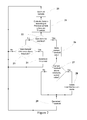
- Figure 2 shows a flow-chart of a system in which the threshold level of the system of Figure 1 is used to identify points in the audio at which the rate of sample modification can be adjusted.
- step (21) an audio sample is evaluated as in the system of Figure 1 so as to determine whether or not it should be modified (i.e. deleted or repeated). If the sample is not modified, either because the inter-sample difference is above the threshold, or because a recent previous sample has been modified, the decision step (22) passes control to decision step (23). If the difference between the current sample and its predecessor is greater than the threshold, the threshold is incremented (as described previously with reference to Figure 1 ) in step (24) and the next audio sample is made available for processing in step (25). However, if the current inter-sample difference magnitude is less than the threshold at decision step (23), control is passed to step (25) without any change to the threshold value.
- decision step (22) passes control to step (26) in which the current threshold value is stored.
- a further decision step (27) determines whether the current threshold value is above the threshold value stored on the previous occasion that a sample was modified. If the threshold is higher, the audio level is likely to be reducing after a peak (during which no sample modifications have occurred) and a faster rate of sample modification is likely to be acceptable.
- step (28) causes the delay between sample modifications to be reduced by changing the mode of operation of step (21) to a "Fast Modification" mode. This mode is maintained until a fixed number of samples have been processed in step (21).
- step (28) After step (28), or a decision that the threshold is lower than at the time of the previous sample modification at step (27), the threshold value is decremented in step (29), as described with reference to Figure (1 ), and control is passed to step (25) to commence the processing of the next audio sample.
- the Fast Modification mode is entered as the audio level begins to fall.
- the minimum permitted interval between sample modifications is set at a low value for a fixed number of samples.
- the normal delay between modifications could be 1,024 sample periods and in the Fast Modification Mode the minimum permitted interval could be set to 32 sample periods until about 20 ms of audio has been processed; the minimum period can then be doubled after each succeeding 20 ms period until the "normal" delay of 1,024 samples is reached, or the Fast Modification mode is re-started at step (28).
- Dropping or repeating samples has the effect of changing the pitch of tones. If tones can be recognised and the pitch measured, it is then possible to determine a permitted rate of sample modification that causes a barely perceptible pitch change for that tone and to set the minimum permitted delay to that value. If the absolute amplitude of the audio can also be measured then the permitted rate of sample modification can be adjusted knowing the effect of loudness on the perceptibility of pitch changes.
- the system of the invention can thus be modified by the addition of frequency or amplitude measuring processes which control the time between sample deletion or repetition. Simple frequency measurement by detecting and counting zero crossings of the audio signal, or signals for stereo, can be used.
- a multi-channel audio programme is "mixed down” to a mono or stereo version, which is analysed as described above, and samples are deleted or repeated simultaneously in all the channels of the multi-channel programme in response to the analysis of the mixed-down audio.
- Another method is to compare inter-sample difference values from more than two channels with the threshold; and, to adjust the threshold and simultaneously delete or repeat samples in all channels in dependence on the results of the comparisons.
Landscapes
- Engineering & Computer Science (AREA)
- Quality & Reliability (AREA)
- Computational Linguistics (AREA)
- Signal Processing (AREA)
- Health & Medical Sciences (AREA)
- Audiology, Speech & Language Pathology (AREA)
- Human Computer Interaction (AREA)
- Physics & Mathematics (AREA)
- Acoustics & Sound (AREA)
- Multimedia (AREA)
- Stereophonic System (AREA)
- Signal Processing For Digital Recording And Reproducing (AREA)
Applications Claiming Priority (1)
| Application Number | Priority Date | Filing Date | Title |
|---|---|---|---|
| GB0715758A GB2451828A (en) | 2007-08-13 | 2007-08-13 | Digital audio processing method for identifying periods in which samples may be deleted or repeated unobtrusively |
Publications (2)
| Publication Number | Publication Date |
|---|---|
| EP2026331A1 true EP2026331A1 (de) | 2009-02-18 |
| EP2026331B1 EP2026331B1 (de) | 2010-07-28 |
Family
ID=38543488
Family Applications (1)
| Application Number | Title | Priority Date | Filing Date |
|---|---|---|---|
| EP20080162264 Not-in-force EP2026331B1 (de) | 2007-08-13 | 2008-08-12 | Digitale Audioverarbeitung |
Country Status (4)
| Country | Link |
|---|---|
| US (1) | US8825186B2 (de) |
| EP (1) | EP2026331B1 (de) |
| DE (1) | DE602008001927D1 (de) |
| GB (1) | GB2451828A (de) |
Cited By (1)
| Publication number | Priority date | Publication date | Assignee | Title |
|---|---|---|---|---|
| US9824717B2 (en) | 2013-12-10 | 2017-11-21 | Snell Advanced Media Limited | Adjusting occupancies of a set of buffers |
Families Citing this family (1)
| Publication number | Priority date | Publication date | Assignee | Title |
|---|---|---|---|---|
| US9052991B2 (en) * | 2012-11-27 | 2015-06-09 | Qualcomm Incorporated | System and method for audio sample rate conversion |
Citations (4)
| Publication number | Priority date | Publication date | Assignee | Title |
|---|---|---|---|---|
| WO2002032054A2 (en) | 2000-10-13 | 2002-04-18 | America Online, Inc. | Dynamic latency management, dynamic drift correction, and automatic microphone detection |
| US20030043856A1 (en) * | 2001-09-04 | 2003-03-06 | Nokia Corporation | Method and apparatus for reducing synchronization delay in packet-based voice terminals by resynchronizing during talk spurts |
| EP1684516A2 (de) * | 2005-01-05 | 2006-07-26 | Microsoft Corporation | Softwarebasierte Audiowiedergabe |
| US7088774B1 (en) * | 2002-05-29 | 2006-08-08 | Microsoft Corporation | Media stream synchronization |
Family Cites Families (30)
| Publication number | Priority date | Publication date | Assignee | Title |
|---|---|---|---|---|
| US3812423A (en) * | 1973-07-16 | 1974-05-21 | Sperry Rand Corp | Network time domain measurement system |
| GB2039448B (en) * | 1979-01-02 | 1983-02-16 | British Broadcasting Corp | Altering the timing of digital sound signal samples |
| JPS5680938A (en) * | 1979-12-06 | 1981-07-02 | Shiro Okamura | Time-base compressive transmission system |
| FR2482806A1 (fr) * | 1980-05-19 | 1981-11-20 | France Etat | Procede et dispositif de synchronisation de signal numerique |
| US4899146A (en) * | 1987-04-30 | 1990-02-06 | R. R. Donnelley & Sons Company | Method of and apparatus for converting digital data between data formats |
| EP0300775B1 (de) * | 1987-07-21 | 1995-05-31 | Matsushita Electric Industrial Co., Ltd. | Verfahren und Vorrichtung zur Codierung und Decodierung eines Signals |
| US5136529A (en) * | 1989-09-29 | 1992-08-04 | Hitachi, Ltd. | Digital signal weighting processing apparatus and method |
| KR930009436B1 (ko) * | 1991-12-27 | 1993-10-04 | 삼성전자 주식회사 | 파형부호화/복호화 장치 및 방법 |
| JP2586827B2 (ja) * | 1994-07-20 | 1997-03-05 | 日本電気株式会社 | 受信装置 |
| US5834930A (en) * | 1997-03-12 | 1998-11-10 | Industrial Technology Research Institute | Device for sensing the period of a digitized signal including noise evaluation and averaging over a plurality of zero crossing |
| US6144413A (en) * | 1998-06-25 | 2000-11-07 | Analog Devices, Inc. | Synchronization signal detection and phase estimation apparatus and method |
| US6304297B1 (en) * | 1998-07-21 | 2001-10-16 | Ati Technologies, Inc. | Method and apparatus for manipulating display of update rate |
| US6763274B1 (en) * | 1998-12-18 | 2004-07-13 | Placeware, Incorporated | Digital audio compensation |
| US6581032B1 (en) * | 1999-09-22 | 2003-06-17 | Conexant Systems, Inc. | Bitstream protocol for transmission of encoded voice signals |
| JP2001160267A (ja) * | 1999-09-24 | 2001-06-12 | Victor Co Of Japan Ltd | 音声情報処理装置 |
| US7920697B2 (en) * | 1999-12-09 | 2011-04-05 | Broadcom Corp. | Interaction between echo canceller and packet voice processing |
| ATE388542T1 (de) * | 1999-12-13 | 2008-03-15 | Broadcom Corp | Sprach-durchgangsvorrichtung mit sprachsynchronisierung in abwärtsrichtung |
| US6836456B2 (en) * | 2000-07-27 | 2004-12-28 | Victor Company Of Japan, Ltd. | Information reproducing apparatus |
| US6757296B1 (en) * | 2000-11-03 | 2004-06-29 | Telefonaktiebolaget Lm Ericsson (Publ) | Method and apparatus for processing asynchronous data |
| US6724834B2 (en) * | 2002-02-22 | 2004-04-20 | Albert L. Garrett | Threshold detector for detecting synchronization signals at correlator output during packet acquisition |
| US7433815B2 (en) * | 2003-09-10 | 2008-10-07 | Dilithium Networks Pty Ltd. | Method and apparatus for voice transcoding between variable rate coders |
| US7573947B2 (en) * | 2004-07-15 | 2009-08-11 | Terayon Communication Systems, Inc. | Simplified narrowband excision |
| US8861601B2 (en) * | 2004-08-18 | 2014-10-14 | Qualcomm Incorporated | Encoder-assisted adaptive video frame interpolation |
| TWI257804B (en) * | 2005-01-07 | 2006-07-01 | Realtek Semiconductor Corp | Method for adjusting sampling condition of ADC and apparatus thereof |
| US7672742B2 (en) * | 2005-02-16 | 2010-03-02 | Adaptec, Inc. | Method and system for reducing audio latency |
| US7532685B2 (en) * | 2005-03-31 | 2009-05-12 | Alcatel-Lucent Usa Inc. | Methods of controlling tracker bandwidth in wireless communication systems |
| US7894489B2 (en) * | 2005-06-10 | 2011-02-22 | Symmetricom, Inc. | Adaptive play-out buffers and adaptive clock operation in packet networks |
| US7194379B1 (en) * | 2006-03-10 | 2007-03-20 | L3 Communications Integrated Systems L.P. | High resolution TOA circuit |
| JP2008017351A (ja) * | 2006-07-07 | 2008-01-24 | Toshiba Corp | パケットストリーム受信装置 |
| JP4123486B2 (ja) * | 2006-10-02 | 2008-07-23 | 日本ビクター株式会社 | デジタル音声処理方法及びデジタル音声処理装置、並びにコンピュータプログラム |
-
2007
- 2007-08-13 GB GB0715758A patent/GB2451828A/en not_active Withdrawn
-
2008
- 2008-08-12 DE DE200860001927 patent/DE602008001927D1/de active Active
- 2008-08-12 EP EP20080162264 patent/EP2026331B1/de not_active Not-in-force
- 2008-08-13 US US12/190,853 patent/US8825186B2/en not_active Expired - Fee Related
Patent Citations (4)
| Publication number | Priority date | Publication date | Assignee | Title |
|---|---|---|---|---|
| WO2002032054A2 (en) | 2000-10-13 | 2002-04-18 | America Online, Inc. | Dynamic latency management, dynamic drift correction, and automatic microphone detection |
| US20030043856A1 (en) * | 2001-09-04 | 2003-03-06 | Nokia Corporation | Method and apparatus for reducing synchronization delay in packet-based voice terminals by resynchronizing during talk spurts |
| US7088774B1 (en) * | 2002-05-29 | 2006-08-08 | Microsoft Corporation | Media stream synchronization |
| EP1684516A2 (de) * | 2005-01-05 | 2006-07-26 | Microsoft Corporation | Softwarebasierte Audiowiedergabe |
Cited By (1)
| Publication number | Priority date | Publication date | Assignee | Title |
|---|---|---|---|---|
| US9824717B2 (en) | 2013-12-10 | 2017-11-21 | Snell Advanced Media Limited | Adjusting occupancies of a set of buffers |
Also Published As
| Publication number | Publication date |
|---|---|
| US8825186B2 (en) | 2014-09-02 |
| DE602008001927D1 (de) | 2010-09-09 |
| US20090048696A1 (en) | 2009-02-19 |
| GB0715758D0 (en) | 2007-09-19 |
| EP2026331B1 (de) | 2010-07-28 |
| GB2451828A (en) | 2009-02-18 |
Similar Documents
| Publication | Publication Date | Title |
|---|---|---|
| US8615095B2 (en) | Automatic volume control for audio signals | |
| EP2082480B1 (de) | Audiodynamikverarbeitung unter verwendung eines reset | |
| RU2417514C2 (ru) | Регулировка усиления звука с использованием основанного на конкретной громкости обнаружения акустических событий | |
| EP1692799B1 (de) | Automatische extraktion von musikteilen eines audiostroms | |
| EP1386312B1 (de) | Verbesserung der transientenleistung bei kodierern mit niedriger bitrate durch unterdrückung des vorgeräusches | |
| US8321206B2 (en) | Transient detection and modification in audio signals | |
| CN102214464B (zh) | 音频信号的瞬态检测方法以及基于该方法的时长调整方法 | |
| EP2172930B1 (de) | Vorrichtung zur audiosignalverarbeitung und verfahren zur audiosignalverarbeitung | |
| EP3827429B1 (de) | Verdichterzielkurve zur vermeidung von verstärkungsgeräuschen | |
| US20050147262A1 (en) | Method for decreasing the dynamic range of a signal and electronic circuit | |
| KR20000022351A (ko) | 음성 구간 검출 방법과 시스템 및 그 음성 구간 검출 방법과 시스템을 이용한 음성 속도 변환 방법과 시스템 | |
| US7917358B2 (en) | Transient detection by power weighted average | |
| EP2881944A1 (de) | Audiosignalverarbeitungsvorrichtung | |
| US8903730B2 (en) | Content feature-preserving and complexity-scalable system and method to modify time scaling of digital audio signals | |
| EP2026331B1 (de) | Digitale Audioverarbeitung | |
| US8917886B2 (en) | Method of distortion-free signal compression | |
| US7130433B1 (en) | Noise reduction apparatus and noise reduction method | |
| JPH10143193A (ja) | 音声信号処理装置 | |
| KR970002195B1 (ko) | 디지탈기기의 음소거장치 및 음소거 제어방법 | |
| JP2917766B2 (ja) | 音声高能率符号化装置 | |
| CN111884729B (zh) | 录音通道选择方法、装置及电子设备 | |
| CN102132346B (zh) | 利用可适配信号再现速率的信号处理装置和方法 | |
| JPS6127598A (ja) | 音声信号の有音・無音判定方法 | |
| US20060178832A1 (en) | Device for the temporal compression or expansion, associated method and sequence of samples | |
| JP3089690B2 (ja) | ディジタルデータの高能率符号化方法 |
Legal Events
| Date | Code | Title | Description |
|---|---|---|---|
| PUAI | Public reference made under article 153(3) epc to a published international application that has entered the european phase |
Free format text: ORIGINAL CODE: 0009012 |
|
| AK | Designated contracting states |
Kind code of ref document: A1 Designated state(s): AT BE BG CH CY CZ DE DK EE ES FI FR GB GR HR HU IE IS IT LI LT LU LV MC MT NL NO PL PT RO SE SI SK TR |
|
| AX | Request for extension of the european patent |
Extension state: AL BA MK RS |
|
| 17P | Request for examination filed |
Effective date: 20090219 |
|
| 17Q | First examination report despatched |
Effective date: 20090401 |
|
| AKX | Designation fees paid |
Designated state(s): DE FR GB |
|
| RAP1 | Party data changed (applicant data changed or rights of an application transferred) |
Owner name: SNELL LIMITED |
|
| GRAP | Despatch of communication of intention to grant a patent |
Free format text: ORIGINAL CODE: EPIDOSNIGR1 |
|
| GRAS | Grant fee paid |
Free format text: ORIGINAL CODE: EPIDOSNIGR3 |
|
| GRAA | (expected) grant |
Free format text: ORIGINAL CODE: 0009210 |
|
| RIN1 | Information on inventor provided before grant (corrected) |
Inventor name: BUTTERS, JEFF Inventor name: ADDY, TIM |
|
| AK | Designated contracting states |
Kind code of ref document: B1 Designated state(s): DE FR GB |
|
| REG | Reference to a national code |
Ref country code: GB Ref legal event code: FG4D |
|
| REF | Corresponds to: |
Ref document number: 602008001927 Country of ref document: DE Date of ref document: 20100909 Kind code of ref document: P |
|
| PLBE | No opposition filed within time limit |
Free format text: ORIGINAL CODE: 0009261 |
|
| STAA | Information on the status of an ep patent application or granted ep patent |
Free format text: STATUS: NO OPPOSITION FILED WITHIN TIME LIMIT |
|
| 26N | No opposition filed |
Effective date: 20110429 |
|
| REG | Reference to a national code |
Ref country code: DE Ref legal event code: R097 Ref document number: 602008001927 Country of ref document: DE Effective date: 20110429 |
|
| PGFP | Annual fee paid to national office [announced via postgrant information from national office to epo] |
Ref country code: FR Payment date: 20110726 Year of fee payment: 4 |
|
| PGFP | Annual fee paid to national office [announced via postgrant information from national office to epo] |
Ref country code: DE Payment date: 20110801 Year of fee payment: 4 |
|
| REG | Reference to a national code |
Ref country code: FR Ref legal event code: ST Effective date: 20130430 |
|
| PG25 | Lapsed in a contracting state [announced via postgrant information from national office to epo] |
Ref country code: DE Free format text: LAPSE BECAUSE OF NON-PAYMENT OF DUE FEES Effective date: 20130301 |
|
| PG25 | Lapsed in a contracting state [announced via postgrant information from national office to epo] |
Ref country code: FR Free format text: LAPSE BECAUSE OF NON-PAYMENT OF DUE FEES Effective date: 20120831 |
|
| REG | Reference to a national code |
Ref country code: DE Ref legal event code: R119 Ref document number: 602008001927 Country of ref document: DE Effective date: 20130301 |
|
| PGFP | Annual fee paid to national office [announced via postgrant information from national office to epo] |
Ref country code: GB Payment date: 20210827 Year of fee payment: 14 |
|
| GBPC | Gb: european patent ceased through non-payment of renewal fee |
Effective date: 20220812 |
|
| PG25 | Lapsed in a contracting state [announced via postgrant information from national office to epo] |
Ref country code: GB Free format text: LAPSE BECAUSE OF NON-PAYMENT OF DUE FEES Effective date: 20220812 |