EP2020293B1 - Linienkopf und Bildgebungsvorrichtung mit selbigem - Google Patents
Linienkopf und Bildgebungsvorrichtung mit selbigem Download PDFInfo
- Publication number
- EP2020293B1 EP2020293B1 EP08012351A EP08012351A EP2020293B1 EP 2020293 B1 EP2020293 B1 EP 2020293B1 EP 08012351 A EP08012351 A EP 08012351A EP 08012351 A EP08012351 A EP 08012351A EP 2020293 B1 EP2020293 B1 EP 2020293B1
- Authority
- EP
- European Patent Office
- Prior art keywords
- light emitter
- linehead
- array
- positive lens
- imaging
- Prior art date
- Legal status (The legal status is an assumption and is not a legal conclusion. Google has not performed a legal analysis and makes no representation as to the accuracy of the status listed.)
- Ceased
Links
Images









Classifications
-
- B—PERFORMING OPERATIONS; TRANSPORTING
- B41—PRINTING; LINING MACHINES; TYPEWRITERS; STAMPS
- B41J—TYPEWRITERS; SELECTIVE PRINTING MECHANISMS, i.e. MECHANISMS PRINTING OTHERWISE THAN FROM A FORME; CORRECTION OF TYPOGRAPHICAL ERRORS
- B41J2/00—Typewriters or selective printing mechanisms characterised by the printing or marking process for which they are designed
- B41J2/435—Typewriters or selective printing mechanisms characterised by the printing or marking process for which they are designed characterised by selective application of radiation to a printing material or impression-transfer material
- B41J2/447—Typewriters or selective printing mechanisms characterised by the printing or marking process for which they are designed characterised by selective application of radiation to a printing material or impression-transfer material using arrays of radiation sources
- B41J2/45—Typewriters or selective printing mechanisms characterised by the printing or marking process for which they are designed characterised by selective application of radiation to a printing material or impression-transfer material using arrays of radiation sources using light-emitting diode [LED] or laser arrays
- B41J2/451—Special optical means therefor, e.g. lenses, mirrors, focusing means
-
- H—ELECTRICITY
- H04—ELECTRIC COMMUNICATION TECHNIQUE
- H04N—PICTORIAL COMMUNICATION, e.g. TELEVISION
- H04N1/00—Scanning, transmission or reproduction of documents or the like, e.g. facsimile transmission; Details thereof
- H04N1/04—Scanning arrangements, i.e. arrangements for the displacement of active reading or reproducing elements relative to the original or reproducing medium, or vice versa
- H04N1/19—Scanning arrangements, i.e. arrangements for the displacement of active reading or reproducing elements relative to the original or reproducing medium, or vice versa using multi-element arrays
- H04N1/191—Scanning arrangements, i.e. arrangements for the displacement of active reading or reproducing elements relative to the original or reproducing medium, or vice versa using multi-element arrays the array comprising a one-dimensional [1D] array
- H04N1/192—Simultaneously or substantially simultaneously scanning picture elements on one main scanning line
- H04N1/193—Simultaneously or substantially simultaneously scanning picture elements on one main scanning line using electrically scanned linear arrays, e.g. linear CCD arrays
- H04N1/1932—Simultaneously or substantially simultaneously scanning picture elements on one main scanning line using electrically scanned linear arrays, e.g. linear CCD arrays using an array of elements displaced from one another in the sub scan direction, e.g. a diagonally arranged array
- H04N1/1933—Staggered element arrays, e.g. arrays with elements arranged in a zigzag
-
- H—ELECTRICITY
- H04—ELECTRIC COMMUNICATION TECHNIQUE
- H04N—PICTORIAL COMMUNICATION, e.g. TELEVISION
- H04N1/00—Scanning, transmission or reproduction of documents or the like, e.g. facsimile transmission; Details thereof
- H04N1/04—Scanning arrangements, i.e. arrangements for the displacement of active reading or reproducing elements relative to the original or reproducing medium, or vice versa
- H04N1/19—Scanning arrangements, i.e. arrangements for the displacement of active reading or reproducing elements relative to the original or reproducing medium, or vice versa using multi-element arrays
- H04N1/191—Scanning arrangements, i.e. arrangements for the displacement of active reading or reproducing elements relative to the original or reproducing medium, or vice versa using multi-element arrays the array comprising a one-dimensional [1D] array
- H04N1/192—Simultaneously or substantially simultaneously scanning picture elements on one main scanning line
- H04N1/193—Simultaneously or substantially simultaneously scanning picture elements on one main scanning line using electrically scanned linear arrays, e.g. linear CCD arrays
- H04N1/1934—Combination of arrays
-
- H—ELECTRICITY
- H04—ELECTRIC COMMUNICATION TECHNIQUE
- H04N—PICTORIAL COMMUNICATION, e.g. TELEVISION
- H04N1/00—Scanning, transmission or reproduction of documents or the like, e.g. facsimile transmission; Details thereof
- H04N1/04—Scanning arrangements, i.e. arrangements for the displacement of active reading or reproducing elements relative to the original or reproducing medium, or vice versa
- H04N1/19—Scanning arrangements, i.e. arrangements for the displacement of active reading or reproducing elements relative to the original or reproducing medium, or vice versa using multi-element arrays
- H04N1/191—Scanning arrangements, i.e. arrangements for the displacement of active reading or reproducing elements relative to the original or reproducing medium, or vice versa using multi-element arrays the array comprising a one-dimensional [1D] array
- H04N1/192—Simultaneously or substantially simultaneously scanning picture elements on one main scanning line
- H04N1/193—Simultaneously or substantially simultaneously scanning picture elements on one main scanning line using electrically scanned linear arrays, e.g. linear CCD arrays
- H04N1/1935—Optical means for mapping the whole or part of a scanned line onto the array
-
- H—ELECTRICITY
- H04—ELECTRIC COMMUNICATION TECHNIQUE
- H04N—PICTORIAL COMMUNICATION, e.g. TELEVISION
- H04N2201/00—Indexing scheme relating to scanning, transmission or reproduction of documents or the like, and to details thereof
- H04N2201/0077—Types of the still picture apparatus
- H04N2201/0082—Image hardcopy reproducer
Definitions
- the present invention relates generally to a linehead and imaging apparatus incorporating the same, and more particularly to a linehead adapted to use a microlens array to project an array of light emitter devices onto the surface to be irradiated, thereby forming an array of imaging spots, and an imaging apparatus using the same.
- JP 06-344596 A has proposed that such an arrangement as shown in JP 02-4546 A is constructed of two positive lenses to approximate projection light to parallel light thereby increasing the depth of focus.
- JP 06-278314 A has come up with an optical write linehead wherein LED array chips are lined up in two rows at an interval with its repetitive phase set off by a half period, and positive lens arrays are located in two rows with each positive lens in association with each LED array chips so that the images of a light-emission dot array are lined up in a row on a photosensitive member.
- each positive lens grows large, it causes the decrease in the quantity of rim light to increase according to the cosine fourth law (shading).
- shade the quantity of light of each pixel (light-emission dot image) must remain constant on the image plane; for this, however, that shading must be corrected by changing the quantity of light of the light source (light-emission dot) for each light-emission dot.
- the intensity of light emission of the light source pixel has influences on service life; as the shading of the optical system grows large, there is a variation in the light quantity of the light-emission dot pitch over time and, hence, an image density variation, even though the uniform quantity of light is initially obtained on the image plane by adjustment of light quantity per light-emission dot.
- one advantage obtainable with embodiments of the invention is to provide an optical write linehead comprising a plurality of positive lens lined up in array form and a plurality of light emitter devices located in a row corresponding to each lens, wherein even when there are fluctuations in the optical axis direction of a surface with light emitter devices lined up on it and a write surface, variations of light-emission dot images from misalignments are reduced.
- Another object of the invention is to reduce density variations from shading between imaging spots by the respective lenses.
- Yet another advantage obtainable with embodiments of the invention is to make it possible to use a drum-form photosensitive member wherein influences of changes in an optical direction distance based on its curvature are reduced.
- a further advantage obtainable with embodiments of the invention is to provide an imaging apparatus incorporating such an optical write linehead, and an optical read linehead with the optical path reversed.
- a linehead comprising a light emitter array including a plurality of light emitter blocks located at least in a first direction at intervals wherein each light emitter block includes at least one row of a plurality of light emitter devices lined up in array form in the first direction, characterized in that a lens array is located on an exit side of said light emitter array such that one positive lens system is in alignment with each light emitter block, a write surface is located on an imaging side of said lens array, and each positive lens system forming a part of said lens array comprises a telephoto optical system having confocally located two lens groups with an aperture stop located at a confocal plane of said telephoto optical system.
- the arrangement being like such, even when one or both of the positions of the write surface and the surface with the light emitter devices located on it displace in the optical axis direction, there are no misalignments of imaging spots, and no density variations between imaging spots, resulting in prevention of deterioration of the ensuing image.
- the aforesaid positive lens system may comprise two positive lenses.
- the arrangement being like such, it is possible just only to facilitate fabricating individual lens arrays but also to facilitate correction of aberrations.
- the positive lens systems forming the aforesaid lens arrays should be all the same.
- the arrangement being like such, it is possible to provide a uniform spacing between imaging spots that are images of the light emitter devices in the first direction (main scan direction), and to make lens array fabrication easy.
- the aforesaid write surface may be defined by a plane.
- the arrangement being like such, even when a plurality of light emitter blocks are lined up in a sub-scan direction (the second direction), writing can be applied to all the rows in the same state, resulting in none of the density variations between imaging spots, etc., and prevention of deterioration of the ensuing image.
- the aforesaid write surface may be defined by a cylindrical surface.
- the optical surface located in, and nearest to the image side of, at least the image-side positive lens group in the aforesaid positive lens system defines a plane.
- the exit surface of the lens nearest to the image plane can be configured as a plane so that foreign matters such as dust and toner deposited onto that exit surface can easily is cleaned up: improved cleanability is achievable.
- the aforesaid aperture stop should be configured in such a way as to limit the aperture diameter at least in the first direction.
- the arrangement being like such, it is possible to address the main scan direction (the first direction) about which misalignments of at least off-axis imaging spots become a problem.
- the aforesaid light-emission block includes plural rows of said light emitter devices in the second direction (sub-scan direction) orthogonal to the first direction.
- the arrangement being like such, it is possible to address the formation of images at an increased imaging spot density.
- plural rows of said light emitter blocks should be lined up in the second direction orthogonal to the first direction.
- the arrangement being like such, it is possible to address the formation of images at an increased imaging spot density.
- the aforesaid light emitter device comprises an organic EL device.
- the aforesaid light emitter device may comprise a LED.
- the arrangement is being like such, it is possible to address a linehead using LED arrays, too.
- the invention also provides an imaging apparatus comprising at least two imaging stations each comprising an imaging unit which comprises a charging means around an image carrier, a linehead as recited above, a developing means and a transfer means, so that imaging is implemented in a tandem mode by letting a transfer medium pass through each station.
- the arrangement being like such, it is possible to set up an imaging apparatus such as a printer that is of small format, has higher resolving power and undergoes less image deterioration.
- Fig. 4 is illustrative of what relation a light emitter array 1 according to one embodiment of the invention has to a microlens 5 having a minus optical magnification.
- the microlens 5 is an imaging device having a minus (inverted imaging) optical magnification: the positions of the light emitter devices are inverted in the main- and sub-scan directions. That is, in the arrangement of Fig.
- even-numbered light emitter devices (8, 6, 4, 2) are lined up upstream of the direction of movement of an image carrier (in the first row) while odd-numbered light emitter devices (7, 5, 3, 1) are done downstream (in the second row), and large-numbered light emitter devices are lined up on the front side in the main scan direction.
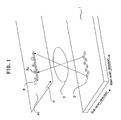
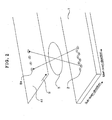
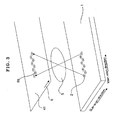
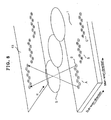
- Figs. 1 , 2 and 3 are illustrative in perspective of a portion of this embodiment corresponding to one microlens of the linehead.
- imaging spots 8a on an image carrier 41 corresponding to the odd-numbered light emitter devices 2 lined up downstream of the image carrier 41 are formed at positions inverted in the main scan direction.
- Capital R is indicative of the direction of movement of the image carrier 41.
- imaging spots 8b on the image carrier 41, lined up upstream of the image carrier 41 (in the first row) and corresponding the even-numbered light emitter devices 2 are formed at downstream positions inverted in the sub-scan direction.
- the positions of imaging spots from the front side are corresponding to light emitter devices 1 to 8 in order.
- the imaging spots can be formed in line with the main scan direction.
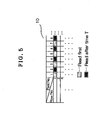
- Fig. 5 is illustrative of one exemplary memory table 10 of a line buffer with image data stored in it.
- the image data is stored while it is inverted in the main scan direction with respect to the numbers of the light embitter devices of Fig. 4 .
- the first data (1, 3, 5, 7) corresponding to the light emitter devices upstream (the first row) of the image carrier 41 is first read to let them emit light.
- the second image data (2, 4, 6, 8) stored in a memory address and corresponding to the light emitter devices downstream (the second row) of the image carrier 41 is read to let them emit light.
- the imaging spots in the first row on the image carrier are formed in line with those in the second row in the main scan direction, as indicated by the position of 8 in Fig. 6 .
- Fig. 1 is illustrative in conception and perspective of an example of reading the image data at the timing of Fig. 5 to form imaging spots.
- the light emitter devices upstream (the first row) of the image carrier 41 are first allowed to emit light to form the imaging spots on the image carrier 41.
- the odd-numbered light emitter devices downstream (the second row) of the image carrier 41 are allowed to emit light to form the imaging spots on the image carrier.
- the imaging spots by the odd-numbered light emitter devices are going to be formed at the position in line with the position of 8 in the main scan direction as shown in Fig. 6 , not at the position of 8a as described with reference to Fig. 2 .
- Fig. 7 is illustrative in schematic of one exemplary light emitter array used as the linehead.
- the light emitter array 1 is provided with a light emitter block 4 (see Fig. 4 ) wherein plural rows 3 of light emitter devices, each of which includes a plurality of light emitter devices 2 lined up in the main scan direction, are provided in the sub-scan direction.
- the light emitter block 4 comprises two rows 3 of light emitter devices lined up in the sub-scan direction, wherein one each row comprises four light emitter devices 2 lined up in the main scan direction (see Fig. 4 ). Multiple such light emitter blocks 4 are located on the light emitter array 1, with one each emitter block 4 located corresponding to the microlens 5.
- a plurality of microlenses 5 are provided in the main- and sub-scan directions of the light emitter array 1 to form a microlens array (MLA) 6.
- MLA microlens array
- the front microlens in the sub-scan direction is set off the one in the main scan direction.
- Such MLA 6 array corresponds to an arrangement wherein light emitter devices are located zigzag on the light emitter array 1.
- MLAs 6 are lined up in three rows in the sub-scan direction; for the sake of explanation, the unit blocks 4 corresponding to the three rows of MLAs 6 in the sub-scan direction are each sectioned into group A, group B and group C, respectively.
- the formation of imaging spots lined up in the main scan direction of the image carrier 41 requires the following image data controls: (1) inversion of the sub-scan direction, (2) inversion of the main scan direction, (3) adjustment of the timing of when the plural rows of light emitter devices in the lens are to emit light, and (4) adjustment of the timing of when the inter-group light emitter devices are to emit light.
- Fig. 8 is illustrative of imaging positions in the event that, in the arrangement of Fig. 7 , the surface of the image carrier to be exposed to light is irradiated with light produced out of each light emitter device 2 via the microlens 5.
- the light emitter array 1 is provided with the unit block 4 sectioned into group A, group B and group C, as explained with reference to Fig. 7 .
- the light emitter device row of each unit block 4 sectioned into group A, group B and group C is divided into the upstream (first row) and downstream (second row) sides of the image carrier 41 so that the even-numbered light emitter devices are allocated to the first row and the odd-numbered ones are allocated to the second row.
- each light emitter device 2 is operated as described with reference to Figs. 1 , 2 and 3 , whereby imaging spots are formed on the image carrier 41 at positions inverted in the main- and sub-scan directions.
- the imaging spots are formed on the image carrier 41 in the same row in the main scan direction in order of 1 to 8.
- group B too, the same operation is implemented while the image carrier 41 is moved for a given time in the sub-scan direction.
- the operation is implemented while the image carrier 41 is moved for a given time in the sub-scan direction. That way there are imaging spots based on the entered image data formed in the same row in the main scan direction in order 1 to 24 ⁇ .
- Fig. 9 is illustrative of how, in Fig. 8 , the imaging spots are formed in the sub-scan direction.
- capital S is the speed of movement of the image carrier 41
- d1 is the spacing between the first row and the second row of light emitter devices in group A
- d2 is the spacing between the second row of light emitter devices in group A and the second row of light emitter devices in group B
- d3 is the spacing between the second row of light emitter devices in group B and the second row of light emitter devices in group C
- T1 is the time from after the emission of light out of the second row of light emitter devices in group A until the first row of light emitter devices emit light
- T2 is the time taken for the imaging positions by the second row of light emitter devices in group A to move to the imaging positions by the second row of light emitter devices in group B
- T3 is the time taken for the imaging positions by the second row of light emitter devices in group A to move to the imaging positions by the second row of light emitter devices in
- T1 may be found as follows. T2 and T3, too, may likewise be found by substituting d2, and d3 for d1.
- T ⁇ 1 d ⁇ 1 ⁇ ⁇ / S
- the respective parameters are: d1 is the distance of the light emitter device in the sub-scan direction, S is the speed of movement of the imaging plane (image carrier), and ⁇ is the magnification of the lens.
- Fig. 9 after the time T2 at which the second row of light emitter devices in group A emit light, the second row of light emitter devices in group B are allowed to emit light. Further, after the time T3 from T2, the second row of light emitter devices in group C are allowed to emit light. The first row of light emitter devices in each group are allowed to light after the time T1 from the time when the second row of light emitter devices emit light.
- Such processing ensures that as shown in Fig. 8 , the imaging spots by the light emitters two-dimensionally located on the light emitter array 1 can be formed on the image carrier in a row.
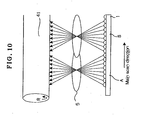
- Fig. 10 is illustrative of an example wherein when there are a plurality of rows of microlenses located, the imaging spots are inverted and formed in the main scan direction of the image carrier.
- an imaging apparatus may be set up.
- that linehead may be applied to a tandem color printer (imaging apparatus) wherein four lineheads are used to expose four photosensitive members to light so that four colors of images can be formed at the same time for transfer onto one endless intermediate transfer belt (intermediate transfer medium).
- Fig. 11 is a longitudinally sectioned view illustrative of one example of the tandem imaging apparatus using organic EL devices as light emitter devices.
- This tandem image apparatus comprises four lineheads 101K, 101C, 101M, 101Y of similar construction located at the positions to be exposed of four photosensitive drums (image carriers) 41K, 41C, 41M, 41Y of similar construction.
- That imaging apparatus is provided with a driving roller 51, a driven roller 52 and a tension roller 53. Further, there is an intermediate transfer belt (intermediate transfer medium) 50 provided, which, upon receipt of tension from the tension roller 53 to stretch it tight, is endlessly driven in the direction indicated by an action arrow (counterclockwise).
- the four photosensitive members 41K, 41C, 41M, 41Y, each having a photosensitive layer around and working as an image carrier, are located at a given interval with respect to that intermediate transfer belt 50.
- the capitals K, C, M and Y affixed to the aforesaid reference numerals mean black, cyan, magenta and yellow, respectively, indicating photosensitive members for black, cyan, magenta and yellow. The same will hold for other members, too.
- the photosensitive members 41K, 41C, 41M, 41Y are rotationally driven in synchronization with it in the direction indicated by the arrow (clockwise).
- each photosensitive member 41 there is a charger means (corona charger) 42 (K, C, M, Y) that enables the peripheral surface of the photosensitive member 41 (K, C, M, Y) to be uniformly charged, and such an inventive linehead 101 (K, C, M, Y) as described above, which allows that peripheral surface uniformly charged by the charger means 42 (K, C, M, Y) to be subject to sequential line scans in synchronization with the rotation of the photosensitive member 41 (K, C, M, Y).
- a charger means (corona charger) 42 K, C, M, Y
- the imaging apparatus comprises a developer 44 (K, C, M, Y) which adds a developing agent or toner to an electrostatic image formed by the linehead 101 (K, C, M, Y) to convert it into a visible (toner) image, a primary transfer roller 45 (K, C, M, Y) that provides a transfer means for sequentially transferring the toner images developed at the developer 44 (K, C, M, Y) onto the intermediate transfer belt 50 to be primarily transferred, and a cleaning unit 46 (K, C, M, Y) that provides a cleaning means for removal of toner remaining on the surface of the photosensitive member 41 (K, C, M, Y) after transfer.
- a developer 44 K, C, M, Y
- a developing agent or toner to an electrostatic image formed by the linehead 101 (K, C, M, Y) to convert it into a visible (toner) image
- a primary transfer roller 45 K, C, M, Y
- a cleaning unit 46 K, C, M
- Each linehead 101 (K, C, M, Y) here is located such that its array direction lies along the generating line of the photosensitive drum 41 (K, C, M, Y), and such that its light-emission energy peak wavelength substantially matches with the sensitive peak wavelength of the photosensitive member 41 (K, C, M, Y).
- a nonmagnetic one-component toner is used as the developing agent. That one-component developing agent is delivered to a developing roller via, for instance, a feed roller, and the thickness of the developing agent deposited onto the surface of the developing roller is controlled by a control blade. Then, that developing roller is brought in contact or engagement with the photosensitive member 41 (K, C, M, Y) to deposit the developing agent onto the photosensitive member 41 (K, C, M, Y) depending on its potential level so that toner images are obtained by development.
- the respective black, cyan, magenta and yellow toner images formed at the 4-color monochromatic toner image-formation station are primarily transferred in order onto the intermediate transfer belt 50 by a primary transfer bias applied to the primary transfer roller 45 (K, C, M, Y) so that they are superposed together on the intermediate transfer belt 50 into a full-color toner image.
- the full-color toner image is secondarily transferred at a secondary transfer roll 66 onto a recording medium P such as paper, whereupon it is passed through a pair of fixing rollers 61 defining a fixing unit for fixation onto the recording medium P.
- the recording medium P is ejected through a pair of ejection rollers 62 onto an output tray 68 mounted on top of the apparatus.
- reference numeral 63 is indicative of a feeder cassette with a number of recording media P piled up in it; 64 a pickup roller adapted to feed the recording media P one by one from the feeder cassette 63; 65 a pair of gate rollers adapted to control the feed timing of when to feed the recording media P to the secondary transfer portion of the secondary transfer roller 66; 66 the secondary transfer roller working as the secondary transfer means adapted to define the secondary transfer portion between it and the intermediate transfer belt 50; and 67 a cleaning blade working as the cleaning means adapted to remove toner remaining on the surface of the intermediate transfer belt 50 after the secondary transfer.
- the invention is specifically concerned with the optical system for such a linehead (optical write linehead) as described above. First of all, the principles are explained.
- Fig. 12 is illustrative of the principles of the invention.
- Fig. 12 is illustrative of relations between an light emitter device 2x at the end of a row of light emitter devices lined up on the surface of a light emitter array 1, a microlens 5 adapted to project that row of light emitter devices, and a photosensitive member (image carrier) 41 onto which that row of light emitter devices is to be projected.
- Fig. 12(a) is about the invention
- Fig. 12(b) is about the prior art.
- the microlens 5 has an aperture defined by its outside shape.
- an imaging spot 8x that is an image of the end light emitter device 2x on the photosensitive member 41 is imaged on a straight line passing through the centers of the end light emitter device 2x and microlens 5.
- the surface of the photosensitive member 41 that is an image plane shuttles back and forth in the direction of a lens's optical axis O-O' due to shakes of the photosensitive member and moves to a position indicated by 41' in Fig. 12(b) , it causes the position of the imaging spot 8x on the photosensitive member 41 to shift to a position 8x' on that straight line: it gives rise to a misalignment of the imaging spot.
- the surface 55 of the light emitter array 1 that is an object plane shuttles back and forth in the direction of the lens's optical axis O-O' due to the attachment of the light emitter array 1 or the like and moves to a position indicated by 55' in Fig. 12(b) , it causes the position of imaging spot 8x that is an image of the end light emitter device 2x on the photosensitive member 41 to shift to a position 8x" on the straight line passing through the centers of the end light emitter device 2x and microlens 5: it gives rise to a misalignment of the imaging spot. There is thus a variation of the pitch between scan lines drawn by the relative movement of that imaging-spot 8x in the sub-scan direction (a pitch variation of the imaging spot in the main scan direction).
- the microlens 5 is made up of a telephoto lens system that comprises a combination of, in order from its object side, a first positive lens L1 and a second positive lens L2 coaxially located on the optical axis O-O' wherein the image-side (rear) focus of the first positive lens L1 matches with the object-side (front) focus of the second positive lens L2 on a point (confocal point) F, and an aperture stop 11 is located at the position of that confocal point F and coaxially with the optical axis O-O'.
- the microlens 5 is made up of a telephoto lens system comprising two positive lenses L1 and L2 with the aperture stop 11 located at the position of that confocal point F, it permits a chief ray 12 coming out of the end light emitter device 2x and passing through the center of the aperture stop 11 to make its way parallel with the optical axis O-O' until it reaches the first positive lens L1. Then, the chief ray is refracted through the first positive lens L1, passing through the center of the aperture stop 11, and entering the second positive lens L2 where it is refracted, making its way parallel with the optical axis O-O'.
- the position of the imaging spot 8x on the photosensitive member 41 becomes the position 8x' of the chief ray 12 after refraction through the microlens 5: there is no misalignment of the imaging spot 8x even when the position of the photosensitive member 41 shakes back and forth.
- the position of the imaging spot 8x on the photosensitive member 41 becomes the position 8x" of the chief ray 12 after refraction through the microlens 5; there is no misalignment of the imaging spot 8x even when the position of the surface 55 of the light emitter array shakes back and forth.
- the telephoto lens system comprising two confocal positive lenses L1 and L2 with the aperture stop 11 located at that confocal point F is used as the microlens 5, it permits a divergent solid angle ⁇ from the light emitter device 2 of a light beam coming out of the light emitter device 2 at any position on the surface 55 of the light emitter array 1 and passing through the aperture in the aperture stop 11 (a divergent solid angle ⁇ from the end light emitter device 2 is shown in Fig. 12(a) ) to be the same at any position on the surface 55 of the light emitter array 1, and permits the center ray of the divergent light beam to be vertical to the surface 55 of the light emitter array 1.
- the invention provides a linehead comprising a plurality of light emitter devices lined up in a row in the main scan direction and one positive lens system located in association with the plurality of light emitter devices so that the image of the row of light emitter devices (the array of imaging spots) is projected onto a projection plane (photosensitive member) to form an image, wherein that projection optical system is configured in the so-called telecentric configuration on both sides; even when there is an axial direction displacement of one or both of the position of the projection plane (photosensitive member) and the surface of the light emitter array, there is no misalignment of imaging spots or no density variation between the imaging spots, so that the ensuing image is free from deterioration.
- the aperture stop 11 it is only needed to limit the diameter of the aperture in a direction (the main scan direction) in which there is a problem with the misalignment of an at least off-axis imaging spot; when an array of one row of light emitter devices is provided in association with one positive lens system as in the prior art (Patent Publications 1 and 3), it is only needed to limit the diameter of the aperture in the main scan direction.
- the aperture stop 11 may be of any of circular, oval, and rectangular shapes.
- the positive lenses L1 and L2 forming part of the microlens 5 are each composed of one lens; however, the microlens 5 may be made up of a lens system of positive refracting power wherein one each is composed of two or more lenses.
- optical write linehead If the optical path involved is reversed, there is an optical read linehead set up for reading images: a plurality of light receptor devices are lined up in a row in the main scan direction, and the image of the row of light receptor devices (an array of reading spots) is back projected onto a read plane to read images.
- the projection optical system is configured in the so-called telecentric configuration on both its side, or two positive lenses having a confocal point are used with an aperture stop located at the position of that confocal point.
- optical write linehead according to one example to which such inventive principles are applied is now explained.
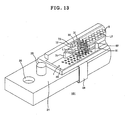
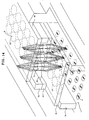
- Fig. 13 is a partly taken-apart perspective view illustrative of the construction of the optical write linehead according to this example, and Fig. 14 is a partly enlarged perspective view of that.
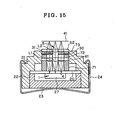
- Fig. 15 is a sectional view of that optical write linehead as taken in its sub-scan direction. Throughout the following explanation, it is noted that while the center of each row of microlenses 5 is not co-planar in the sub-scan direction, the section is taken in the sub-scan direction in such a way as to pass through the center of each row of microlenses.
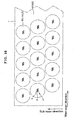
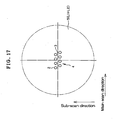
- Fig. 16 is a plan view illustrative of how to locate a light emitter array and a microlens array in this example. Further, Fig. 17 is illustrative of what relations one microlens has to the associated light emitter block.
- two light emitter device rows 3, each comprising four organic EL emitter devices 2 lined up in the main scan direction, are provided in the sub-scan direction into one light emitter block 4.
- a plurality of such light emitter blocks 4 are provided in the main- and sub-scan directions into a light emitter array 1.
- the light emitter blocks 4 are lined up in such zigzag fashion that the front position in the sub-scan direction is set off that in the main scan direction.
- the light emitter blocks 4 are lined up in three rows in the sub-scan direction. Formed on the back surface of a glass substrate 20, such emitter array 1 is driven by way of a driving circuit formed on the back surface of the same glass substrate 20. It is here noted that the organic EL devices (light emitter devices 2) on the back surface of the glass substrate 20 are sealed up by a seal member 27.
- the glass substrate 20 is fitted in an associated dent 22 in a longitudinal casing 21, and a back lid 23 is covered over it for fixation using a fixture 24.
- An optical write linehead 101 is fixed in place by inserting alignment pins 25 provided at both ends of the longitudinal casing 21 into associated alignment holes in the imaging apparatus, and screwing fixing screws into threaded holes in the imaging apparatus through insertion holes 26 in both ends of the longitudinal casing 21.
- first microlens array 61 comprising positive lens components L1 located via a first spacer 71 such that the center of each light emitter block 4 of the light emitter array 1 is in line with the positive lens L1.
- stop plate 30 having apertures 31 ( Figs. 18 and 19 ) located via a second spacer 72 such that one each aperture 31 is in line with the center of each light emitter block 4 of the light emitter array 1.
- second microlens array 62 comprising positive lens components L2 located via a third spacer 73 such that one each positive lens L2 is in line with the center of each light emitter block 4 of the light emitter array 1.
- the lens array of microlenses 5 for projecting the light emitter device row of each light emitter block 4 comprises a combination of the first microlens array 61 with the second microlens array 62.
- the image-side (back) focus of the positive lenses L1 forming the first microlens array 61 is in alignment with the object-side (front) focus of the positive lens L2 forming the second microlens array 62, and the thickness of the second 72, and the third spacer 73 is set such that the stop plate 30 is positioned at that match plane.
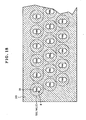
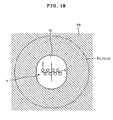
- Details of the stop plate 30 are shown in Figs. 18 and 19 . More specifically, Fig. 18 is a plan view of the stop plate 30 located in correspondence to the light emitter blocks 4 of the light emitter array 1, and Fig. 19 is illustrative of the aperture 31 in the stop plate 30 for one light emitter block 4.
- each aperture 31 is configured in such substantially oval shape as to make its diameter in the main scan direction larger than that in the sub-scan direction.
- each aperture may have any of circular, oval, rectangular or other shape (the aperture is shown as a circle in Figs. 13 and 14 ).
- Figs. 13 and 14 While light rays coming out of the center of the light emitter block 4 and arriving at the image plane (photosensitive member 41) are shown in Figs. 13 and 14 , it is understood that the light emitter block 4 here has no light emitter device 2 located at its center ( Fig. 17 ): a light ray coming out of the center of this light emitter block 4 is assumed to be virtual. In Fig. 14 , light rays adjacent to the light ray coming out of that center are leaving the light emitter devices 2 at both ends of the light emitter device 4.
- the foregoing example is directed to the so-called bottom emission type optical write linehead 101 that uses as the light emitter devices 2 organic EL devices located on the back side of the glass substrate 20 to harness light emitted toward the surface side of that glass substrate 20; however, EL devices or LEDs may just as well be located as the light emitter device 2 on the surface side of the substrate.
- the light emitter blocks 4 in the light emitter array 1 are lined up in three rows in the sub-scan direction with the front positions set off in the main scan direction, as can be seen from Fig. 16 .
- the arrays of the microlenses 5, too are lined up in three rows in the sub-scan direction with the front positions set off in the main scan direction.
- the light emitter blocks 4 lined up in the main scan direction may be lined up not only in three rows but also in two or four more rows in the sub-scan direction.
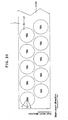
- Fig. 20 is illustrative, as in Fig. 16 , of an arrangement comprising two rows
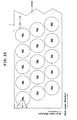
- Fig. 21 is illustrative, as in Fig. 16 , of an arrangement comprising four rows.
- the microlenses 5 lined up in the main scan direction are lined up in two or four rows in the sub-scan direction.
- one light emitter block 4 is made up of light emitter devices 3 lying in the main scan direction, and lined up in two rows in the sub-scan direction.
- the light emitter devices 3 may be lined up not only in two rows but also in any rows including one row.
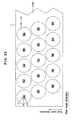
- Fig. 22 is illustrative, as in Fig. 16 , of an arrangement comprising three rows of light emitting devices 3
- Fig. 23 is illustrative, as in Fig. 16 , of an arrangement comprising four rows of light emitter devices 3. The same would apply to arrangements comprising three or more rows of light emitter blocks 4, too.
- the image plane 41 is assumed to be in planar shape parallel with the surface of the light emitter array 1 and the surface of the array of microlenses 5, and the microlenses are all assumed to have the same property.
- each microlens 5 is of telecentric construction on both its side, as already described; even when the distance of the image plane 41 from the microlenses 5 varies more or less for each row of the microlenses 5 lined up in the main scan direction, there is no misalignment of the imaging spots, and no density variation between the imaging spots. Accordingly, even when the photosensitive member 41 forming the image plane is in drum form ( Figs. 9-11 ) or other curved surface form, the inventive optical write linehead 101 may just as well be used without giving rise to imaging spot misalignment and density variations for each row of light emitter blocks 4 on the photosensitive member 41.
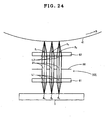
- Fig. 24 is illustrative in section of what relations the optical system for the optical write linehead 101 has to the drum form of photosensitive member 41, as taken in the sub-scan direction.
- the light emitter blocks 4 are lined up in three rows with reference numerals 4 1 , 4 2 and 4 3 indicative of the light emitter blocks 4 at the first, second and third rows, respectively, and the associated microlenses 5 are indicated by 5 1 , 5 2 and 5 3 , respectively.
- the microlenses 5 are all of the same construction, and spaced away from the light emitter blocks 4 1 , 4 2 and 4 3 by the same distance on the object side.
- the photosensitive member 41 is in cylindrical form having a generating line in the main scan direction; for instance, with the optical axis of the center microlens 5 set in such a way as to pass through the axis of the photosensitive member 41, the image-side distances of the microlenses 5 1 and 5 3 on both sides are going to vary slightly.
- the microlenses 5 1 , 5 2 and 5 3 are each of telecentric construction on both its sides; even when there is a slight difference in the image-side distance, yet the imaging magnification is going to be the same, resulting in no misalignment of the imaging spots, and no density variation between the imaging spots for the aforesaid reason.
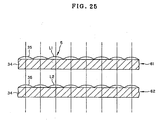
- Fig. 25 is illustrative in section, as taken in the main scan direction, of an array arrangement of microlenses 5 ( Figs. 13 and 15 ) wherein a first microlens array 61 and a second microlens array 62 are combined such that the respective microlenses L1 and L2 are coaxially in alignment.
- one surface (on the object side) of the glass substrate 34 of each microlens array 61, 62 is provided with a cluster of lens surface portions 35 formed of transparent resin and in alignment to set up the microlenses L1, L2.
- the image-side surface of the second microlens array 62 may then be used as a microlens array for, e.g., a line -head's microlens array for imaging apparatus, resulting in improvements in cleanability because even when the developing agent toner scatters away and sticks onto the plane of the microlens array, it can easily be cleaned off.
- Examples 1 to 4 are now explained with reference to specific numerical ones for the optical system used in the aforesaid examples.
- Examples 1, 2 and 3 are each directed to the microlens 5 in the case where the image plane 41 is in planar form, and
- Example 4 is directed to microlenses 5 1 , 5 2 and 5 3 in the case where the photosensitive drum 41 is used as the image plane 41.
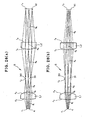
- Figs. 26(a) and 26(b) are sectional views of the optical system corresponding to one microlens 5 in Example 1, as taken in the main- and sub-scan directions, respectively.
- the microlens 5 is configured in the form of a telephoto lens system consisting of confocal plano-convex positive lens L1 and plano-convex positive lens L2; and the stop plate 30 is located on a confocal plane between the plano-convex positive lens L1 and the plano-convex positive lens L2 (where the image-side (back) focus of the plano-convex positive lens L1 matches with the object-side (front) focus of the plano-convex positive lens L2).
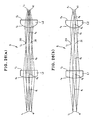
- Figs. 28(a) and 28(b) are sectional views of the optical system corresponding to one microlens 5 in Example 3, as taken in the main and sub-scan directions, respectively.
- the microlens 5 is configured in the form of a telephoto lens system consisting of a double-convex positive lens L1 and a plane-convex positive lens L2; and the stop plate 30 is located on a confocal plane between the double-convex positive lens L1 and the plano-convex positive lens L2 (where the image-side (back) focus of the double-convex positive lens L1 matches with the object-side (front) focus of the plano-convex positive lens L2).
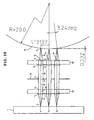
- Fig. 29 is a sectional view of the optical system corresponding to three rows of microlenses 5 1 , 5 2 and 5 3 of Example 4, as taken in the sub-scan direction
- Fig. 30 is a plan view of the arrangement of the light-emitter arrays 1 and the microlens array in this example, with the required sizes (mm) and angles indicated.
- the lenses L1 and L2 forming the microlenses 5 1 , 5 2 and 5 3 in this example are of the same shape, and the spacing between the lenses L1 and 12, the position of the stop plate 30, and the spacing between the light emitter block 4 1 , 4 2 , 4 3 and the lens L1 are the same, too.
- the microlens 5 1 , 5 2 , 5 3 has no glass substrate located on the exit side of the light emitter device 2; the microlens 5 is configured in the form of a telephoto lens system made up of a plano-convex positive lens L1 and a plano-convex positive lens L2; and the stop plate 30 is located on a confocal plane between the plano-convex positive lens L1 and the plano-convex positive lens L2 (the plane at which the image-side (back) focus of the plano-convex positive lens L2 matches with the object-side (front) focus of the plano-concave positive lens L2).
- the optical axes of the respective microlenses 5 1 , 5 2 , 5 3 are parallel with one another, and lenses of the same construction are used for the microlenses 5 1 , 5 2 and 5 3 in the first, second and third rows, with only the spacing between the lens L2 and the photosensitive member (image plane) 41 varying depending on the curvature (the radius of 20 mm) of the photosensitive member 41.
- the spacing between the photosensitive member (image plane) 41 and the lens L2 of both the microlenses 5 1 and 5 3 in the first and third rows is larger by 32 ⁇ m with respect to the microlens 5 2 in the center or second row ( Fig. 29 ).
- the tilt ⁇ of the image plane 41 with respect to the optical axis is 0.0° for the microlens 5 2 in the center or second row, and 3.24 ° for the microlenses 5 1 , 5 3 in both or the first and third rows ( Fig. 29 ).
- the cylindrical photosensitive member 41 has a diameter of 40 mm ( Fig. 29 ), and the pitch between the microlenses 5 1 , 5 2 and 5 3 is 1.13137 mm ( Fig. 30 ).
Landscapes
- Engineering & Computer Science (AREA)
- Multimedia (AREA)
- Signal Processing (AREA)
- Physics & Mathematics (AREA)
- Optics & Photonics (AREA)
- Health & Medical Sciences (AREA)
- General Health & Medical Sciences (AREA)
- Toxicology (AREA)
- Printers Or Recording Devices Using Electromagnetic And Radiation Means (AREA)
- Facsimile Heads (AREA)
Claims (12)
- Zeilenkopf mit einer Lichtemitteranordnung (1), die mehrere zumindest in einer ersten Richtung mit Abständen angeordnete Lichtemitterblöcke (4) beinhaltet, wobei jeder Lichtemitterblock wenigstens eine Reihe von mehreren Lichtemittereinrichtungen (2) beinhaltet, die in der ersten Richtung in Reihenform angeordnet sind, dadurch gekennzeichnet, dass eine Linsenanordnung (5) so an einer Austrittsseite der Lichtemitteranordnung angeordnet ist, dass ein Positivlinsensystem zu jedem Lichtemitterblock ausgerichtet ist, eine Schreiboberfläche (41) an einer Abbildungsseite der Linsenanordnung angeordnet ist und jedes Positivlinsensystem, das einen Teil der Linsenanordnung bildet, ein optisches Teleobjektivsystem umfasst, das zwei konfokal angeordnete Linsengruppen (L1, L2) aufweist, wobei eine Öffnungsblende (11) an einer konfokalen Ebene des optischen Teleobjektivsystems angeordnet ist.
- Zeilenkopf nach Anspruch 1, dadurch gekennzeichnet, dass das Positivlinsensystem zwei Positivlinsen umfasst.
- Zeilenkopf nach Anspruch 1 oder 2, dadurch gekennzeichnet, dass die Positivlinsensysteme, welche die Linsenanordnung bilden, alle gleich sind.
- Zeilenkopf nach einem der Ansprüche 1 bis 3, dadurch gekennzeichnet, dass die Schreiboberfläche eine Ebene umfasst.
- Zeilenkopf nach einem der Ansprüche 1 bis 3, dadurch gekennzeichnet, dass die Schreiboberfläche eine zylindrische Oberfläche umfasst.
- Zeilenkopf nach einem der Ansprüche 1 bis 5, dadurch gekennzeichnet, dass zumindest die optische Oberfläche, die in einer bildseitigen Positivlinsengruppe in dem Positivlinsensystem und am nächsten zu deren Bildseite angeordnet ist, eine Ebene definiert.
- Zeilenkopf nach einem der Ansprüche 1 bis 6, dadurch gekennzeichnet, dass die Öffnungsblende eine Form aufweist, die dafür geeignet ist, zumindest in der ersten Richtung einen Öffnungsdurchmesser einzuschränken.
- Zeilenkopf nach einem der Ansprüche 1 bis 7, dadurch gekennzeichnet, dass der Lichtemitterblock die Lichtemittereinrichtungen beinhaltet, die in mehreren Reihen in einer zweiten Richtung senkrecht zu der ersten Richtung angeordnet sind.
- Zeilenkopf nach einem der Ansprüche 1 bis 7, dadurch gekennzeichnet, dass die Lichtemitterblöcke in mehreren Reihen in einer zweiten Richtung senkrecht zu der ersten Richtung angeordnet sind.
- Zeilenkopf nach einem der Ansprüche 1 bis 9, dadurch gekennzeichnet, dass die Lichtemittereinrichtung eine organische EL-Einrichtung umfasst.
- Zeilenkopf nach einem der Ansprüche 1 bis 9, dadurch gekennzeichnet, dass die Lichtemittereinrichtung eine LED umfasst.
- Abbildungsvorrichtung, dadurch gekennzeichnet, dass sie wenigstens zwei Abbildungsstationen umfasst, die jeweils eine Abbildungseinheit umfassen, die ein Lademittel (42) um einen Bildträger herum, einen Zeilenkopf nach einem der Ansprüche 1 bis 11, ein Entwicklungsmittel (44) und ein Übertragungsmittel (45) umfasst, so dass eine Abbildung in einem Tandemmodus durchgeführt wird, indem ein Übertragungsmedium durch jede Station geführt wird.
Applications Claiming Priority (2)
| Application Number | Priority Date | Filing Date | Title |
|---|---|---|---|
| JP2007198405 | 2007-07-31 | ||
| JP2008047437A JP2009051194A (ja) | 2007-07-31 | 2008-02-28 | ラインヘッド及びそれを用いた画像形成装置 |
Publications (3)
| Publication Number | Publication Date |
|---|---|
| EP2020293A2 EP2020293A2 (de) | 2009-02-04 |
| EP2020293A3 EP2020293A3 (de) | 2009-08-12 |
| EP2020293B1 true EP2020293B1 (de) | 2011-09-14 |
Family
ID=39942421
Family Applications (1)
| Application Number | Title | Priority Date | Filing Date |
|---|---|---|---|
| EP08012351A Ceased EP2020293B1 (de) | 2007-07-31 | 2008-07-09 | Linienkopf und Bildgebungsvorrichtung mit selbigem |
Country Status (2)
| Country | Link |
|---|---|
| US (1) | US20090035020A1 (de) |
| EP (1) | EP2020293B1 (de) |
Families Citing this family (5)
| Publication number | Priority date | Publication date | Assignee | Title |
|---|---|---|---|---|
| CN108799861B (zh) * | 2018-07-13 | 2020-07-07 | 深圳市蓝谱里克科技有限公司 | 一种带整体阵列式透镜的led集成封装模块 |
| JP7125010B2 (ja) * | 2018-10-16 | 2022-08-24 | コニカミノルタ株式会社 | 画像形成装置 |
| JP7100295B2 (ja) * | 2018-10-31 | 2022-07-13 | コニカミノルタ株式会社 | 画像形成装置 |
| JP2020148919A (ja) * | 2019-03-14 | 2020-09-17 | 株式会社沖データ | レンズユニット、露光装置、読取ヘッド、画像形成装置および画像読取装置 |
| JP2021020249A (ja) * | 2019-07-30 | 2021-02-18 | 株式会社リコー | レーザユニットおよびレーザマーカおよびレーザ印字システム |
Family Cites Families (11)
| Publication number | Priority date | Publication date | Assignee | Title |
|---|---|---|---|---|
| CH512115A (de) * | 1969-08-12 | 1971-08-31 | Ciba Geigy Ag | Photoelektrische Abtastvorrichtung |
| JP2868175B2 (ja) | 1993-03-25 | 1999-03-10 | 京セラ株式会社 | 画像形成装置 |
| JP2801838B2 (ja) | 1993-06-08 | 1998-09-21 | 京セラ株式会社 | 画像形成装置 |
| IL120841A (en) * | 1997-05-16 | 2001-07-24 | Creoscitex Corp Ltd | Writing heads with an array of laser diodes that can be turned separately |
| US6489984B1 (en) * | 1998-12-29 | 2002-12-03 | Kenneth C. Johnson | Pixel cross talk suppression in digital microprinters |
| US6480219B1 (en) * | 1999-07-21 | 2002-11-12 | Fuji Photo Film Co., Ltd. | Exposure head |
| JP4766218B2 (ja) * | 2001-07-09 | 2011-09-07 | セイコーエプソン株式会社 | 有機elアレイ露光ヘッドとその作製方法及びそれを用いた画像形成装置 |
| US20050179962A1 (en) * | 2004-02-13 | 2005-08-18 | Williamson James B. | Compact optical scanhead |
| JP2007198405A (ja) | 2006-01-23 | 2007-08-09 | Nsk Ltd | 転がり軸受 |
| JP2008047437A (ja) | 2006-08-17 | 2008-02-28 | Hitachi Ltd | シール構造を備えた成型部品とそのシール構造形成方法 |
| JP2008132760A (ja) * | 2006-10-26 | 2008-06-12 | Seiko Epson Corp | ラインヘッド及びそれを用いた画像形成装置 |
-
2008
- 2008-07-08 US US12/169,505 patent/US20090035020A1/en not_active Abandoned
- 2008-07-09 EP EP08012351A patent/EP2020293B1/de not_active Ceased
Also Published As
| Publication number | Publication date |
|---|---|
| US20090035020A1 (en) | 2009-02-05 |
| EP2020293A2 (de) | 2009-02-04 |
| EP2020293A3 (de) | 2009-08-12 |
Similar Documents
| Publication | Publication Date | Title |
|---|---|---|
| US8089695B2 (en) | Line head and image forming apparatus using the same | |
| JP5182495B2 (ja) | ラインヘッド及びそれを用いた画像形成装置 | |
| CN101372179B (zh) | 行扫描头以及使用其的图像形成装置 | |
| CN101359212B (zh) | 行头以及使用该行头的图像形成装置 | |
| JP5196145B2 (ja) | ラインヘッド及びそれを用いた画像形成装置 | |
| US8675281B2 (en) | Lens unit, LED head, exposure device, image forming device, and scanning device | |
| US8022975B2 (en) | Line head and image forming apparatus using the same | |
| EP2020293B1 (de) | Linienkopf und Bildgebungsvorrichtung mit selbigem | |
| US7719560B2 (en) | Line head and imaging apparatus incorporating the same | |
| US8780426B2 (en) | Exposure apparatus and image forming apparatus having hologram elements | |
| US7733363B2 (en) | Line head and image forming device using the same | |
| US6462879B2 (en) | Optical writing device and image forming apparatus and method using the same | |
| US7834898B2 (en) | Image forming device, image forming method, and exposure head | |
| EP2028014B1 (de) | Zeilenkopf und Bilderzeugungsvorrichtung damit | |
| CN101276181B (zh) | 曝光装置及图像形成装置 | |
| JP4930697B2 (ja) | ラインヘッド及びそれを用いた画像形成装置 | |
| JP2008105298A (ja) | ラインヘッド及びそれを用いた画像形成装置 | |
| JP2001205845A (ja) | Ledプリンタヘッド、ロッドレンズアレイ及び画像形成装置 | |
| JP5088496B2 (ja) | ラインヘッド及びそれを用いた画像形成装置 | |
| US8654421B2 (en) | Exposure device and image forming device | |
| US20110193931A1 (en) | Image Forming Apparatus and Image Forming Method | |
| JP2008105299A (ja) | ラインヘッド及びそれを用いた画像形成装置 | |
| JP2003302595A (ja) | 光走査装置及び画像形成装置並びに光学装置 | |
| JP2010058420A (ja) | ラインヘッド、および画像形成装置 | |
| JP2009143202A (ja) | 画像形成装置および画像形成方法 |
Legal Events
| Date | Code | Title | Description |
|---|---|---|---|
| PUAI | Public reference made under article 153(3) epc to a published international application that has entered the european phase |
Free format text: ORIGINAL CODE: 0009012 |
|
| AK | Designated contracting states |
Kind code of ref document: A2 Designated state(s): AT BE BG CH CY CZ DE DK EE ES FI FR GB GR HR HU IE IS IT LI LT LU LV MC MT NL NO PL PT RO SE SI SK TR |
|
| AX | Request for extension of the european patent |
Extension state: AL BA MK RS |
|
| PUAL | Search report despatched |
Free format text: ORIGINAL CODE: 0009013 |
|
| AK | Designated contracting states |
Kind code of ref document: A3 Designated state(s): AT BE BG CH CY CZ DE DK EE ES FI FR GB GR HR HU IE IS IT LI LT LU LV MC MT NL NO PL PT RO SE SI SK TR |
|
| AX | Request for extension of the european patent |
Extension state: AL BA MK RS |
|
| RIC1 | Information provided on ipc code assigned before grant |
Ipc: H04N 1/03 20060101ALI20090703BHEP Ipc: B41J 2/45 20060101AFI20081118BHEP Ipc: G06K 7/10 20060101ALI20090703BHEP |
|
| 17P | Request for examination filed |
Effective date: 20100126 |
|
| 17Q | First examination report despatched |
Effective date: 20100311 |
|
| AKX | Designation fees paid |
Designated state(s): DE FR GB |
|
| GRAP | Despatch of communication of intention to grant a patent |
Free format text: ORIGINAL CODE: EPIDOSNIGR1 |
|
| GRAS | Grant fee paid |
Free format text: ORIGINAL CODE: EPIDOSNIGR3 |
|
| GRAA | (expected) grant |
Free format text: ORIGINAL CODE: 0009210 |
|
| AK | Designated contracting states |
Kind code of ref document: B1 Designated state(s): DE FR GB |
|
| REG | Reference to a national code |
Ref country code: GB Ref legal event code: FG4D |
|
| REG | Reference to a national code |
Ref country code: DE Ref legal event code: R096 Ref document number: 602008009706 Country of ref document: DE Effective date: 20111110 |
|
| PLBE | No opposition filed within time limit |
Free format text: ORIGINAL CODE: 0009261 |
|
| STAA | Information on the status of an ep patent application or granted ep patent |
Free format text: STATUS: NO OPPOSITION FILED WITHIN TIME LIMIT |
|
| 26N | No opposition filed |
Effective date: 20120615 |
|
| REG | Reference to a national code |
Ref country code: DE Ref legal event code: R097 Ref document number: 602008009706 Country of ref document: DE Effective date: 20120615 |
|
| REG | Reference to a national code |
Ref country code: FR Ref legal event code: PLFP Year of fee payment: 9 |
|
| REG | Reference to a national code |
Ref country code: FR Ref legal event code: PLFP Year of fee payment: 10 |
|
| PGFP | Annual fee paid to national office [announced via postgrant information from national office to epo] |
Ref country code: FR Payment date: 20170613 Year of fee payment: 10 |
|
| PGFP | Annual fee paid to national office [announced via postgrant information from national office to epo] |
Ref country code: DE Payment date: 20170705 Year of fee payment: 10 Ref country code: GB Payment date: 20170705 Year of fee payment: 10 |
|
| REG | Reference to a national code |
Ref country code: DE Ref legal event code: R119 Ref document number: 602008009706 Country of ref document: DE |
|
| GBPC | Gb: european patent ceased through non-payment of renewal fee |
Effective date: 20180709 |
|
| PG25 | Lapsed in a contracting state [announced via postgrant information from national office to epo] |
Ref country code: DE Free format text: LAPSE BECAUSE OF NON-PAYMENT OF DUE FEES Effective date: 20190201 Ref country code: FR Free format text: LAPSE BECAUSE OF NON-PAYMENT OF DUE FEES Effective date: 20180731 Ref country code: GB Free format text: LAPSE BECAUSE OF NON-PAYMENT OF DUE FEES Effective date: 20180709 |