EP2019490A1 - Segmentierte Schaltung - Google Patents
Segmentierte Schaltung Download PDFInfo
- Publication number
- EP2019490A1 EP2019490A1 EP07113376A EP07113376A EP2019490A1 EP 2019490 A1 EP2019490 A1 EP 2019490A1 EP 07113376 A EP07113376 A EP 07113376A EP 07113376 A EP07113376 A EP 07113376A EP 2019490 A1 EP2019490 A1 EP 2019490A1
- Authority
- EP
- European Patent Office
- Prior art keywords
- segment
- segments
- circuitry
- node
- segmented
- Prior art date
- Legal status (The legal status is an assumption and is not a legal conclusion. Google has not performed a legal analysis and makes no representation as to the accuracy of the status listed.)
- Granted
Links
Images


Classifications
-
- H—ELECTRICITY
- H03—ELECTRONIC CIRCUITRY
- H03M—CODING; DECODING; CODE CONVERSION IN GENERAL
- H03M1/00—Analogue/digital conversion; Digital/analogue conversion
- H03M1/66—Digital/analogue converters
- H03M1/74—Simultaneous conversion
- H03M1/78—Simultaneous conversion using ladder network
-
- H—ELECTRICITY
- H03—ELECTRONIC CIRCUITRY
- H03M—CODING; DECODING; CODE CONVERSION IN GENERAL
- H03M1/00—Analogue/digital conversion; Digital/analogue conversion
- H03M1/66—Digital/analogue converters
- H03M1/68—Digital/analogue converters with conversions of different sensitivity, i.e. one conversion relating to the more significant digital bits and another conversion to the less significant bits
- H03M1/682—Digital/analogue converters with conversions of different sensitivity, i.e. one conversion relating to the more significant digital bits and another conversion to the less significant bits both converters being of the unary decoded type
-
- H—ELECTRICITY
- H03—ELECTRONIC CIRCUITRY
- H03M—CODING; DECODING; CODE CONVERSION IN GENERAL
- H03M1/00—Analogue/digital conversion; Digital/analogue conversion
- H03M1/66—Digital/analogue converters
- H03M1/74—Simultaneous conversion
- H03M1/742—Simultaneous conversion using current sources as quantisation value generators
- H03M1/747—Simultaneous conversion using current sources as quantisation value generators with equal currents which are switched by unary decoded digital signals
Definitions
- the present invention relates to segmented circuitry, in particular to segmented mixed-signal circuitry, for example a segmented digital-to-analogue converter (DAC) or a segmented programmable current generator.
- segmented mixed-signal circuitry for example a segmented digital-to-analogue converter (DAC) or a segmented programmable current generator.
- DAC digital-to-analogue converter
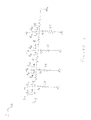
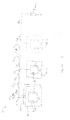
- R-2R ladder architecture One architecture which has been used to implement a DAC is a so-called R-2R ladder architecture.
- the basic building block of such an R-2R DAC is an R-2R ladder of the kind shown in Figure 1 .
- a resistor ladder 1 comprises a series of nodes N1, N2, N3 and N4. Each node is connected to the next node by a divider resistor. These divider resistors are all identical to one another and have a resistance R.
- the first node N1 is connected to a reference node RN at which a reference voltage V ref is generated.
- the fourth node N4 is connected to a ground supply line via a terminating resistor which has a resistance of 2R.
- Each of the nodes N1 to N4 is also connected to the ground supply line by a load resistor which in this case has a resistance value of 2R.
- a resistance R 4R looking into the termination resistor at node N4 is simply 2R.
- a resistance R 4L looking into node N4 from the left-hand-side is 2R in parallel with 2R, which is equivalent to a single resistance R.
- a resistance R 3R looking into the divider resistor on the right-hand-side of node N3 is R in series with R 4L , which is equivalent to a single resistance 2R.
- a resistance R 3L looking into the node N3 from the left-hand-side is 2R in parallel with R 3R , which is equivalent to a single resistance R.
- the ladder 1 can achieve binary-weighted currents using relatively few components.
- the load resistors can be constructed by using two of the divider resistors in series. This should enable a better matching to be achieved between the load resistors and the divider resistors.
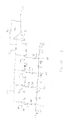
- FIG. 2 One example of an R-2R DAC using such an R-2R ladder is shown in Figure 2 .
- the load resistors are connected between the nodes N1 to N4 and respective selection switches S1 to S4, instead of being connected to ground as in Figure 1 .
- the load resistor is either connected to ground or to a connection line L1.
- the connection line L1 is also connected to an inverting input of an amplifier 3.
- the operational amplifier 3 since the operational amplifier 3 has a very high open loop gain, it acts to make the potential diference between its inputs tend to zero.
- the switches S1 to S4 in Figure 2 correspond respectively to different data bits b1 to b4 of a binary input signal of the DAC.
- the setting of the switch is by the corresponding data bit.
- the selection switch S1 connects the load resistor for node N1 to ground.
- the selection switch S1 connects the load resistor for node N1 to the connection line L1. Accordingly, the current I flows from the connection line L1 to the node N1. A current I in flowing into the connection line L1 is therefore changed by I depending on the setting of the switch S1.
- each selection switch S1 to S4 is connected to a negative supply line -V ss via a constant current sink CS1 to CS4.
- Each current sink CS1 to CS4 causes the same current I to flow through its corresponding selection switch at all times.
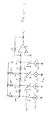
- each of nodes N4, N3 and N2 sees a resistance R between itself and the upper ground rail, and a resistance R between itself and the next node to the right.
- node N4 sees a resistance R between itself and the upper ground rail, and a resistance R between itself and node N3.
- node N3 sees a resistance R (2R in parallel with 2R) between itself and the upper ground rail, and a resistance R between itself and node N2.
- DAC circuitry of Figure 3 can achieve binary-weighted currents in a similar way to that of the circuitry in Figures 1 and 2 .
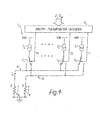
- Figure 4 shows an overview of a previously considered segmented DAC.
- the DAC in Figure 4 is part of a DAC integrated circuit (IC) of the current-steering type, and is designed to convert an m-bit digital input word (D1-Dm) into a corresponding analogue output signal.
- IC DAC integrated circuit
- the analogue circuitry further includes a number n of differential switching circuits 4 1 to 4 n corresponding respectively to the n current sources 2 1 to 2 n .
- Each differential switching circuit 4 is connected to its corresponding current source 2 and switches the current I produced by the current source either to a first terminal, connected to a first connection line A of the converter, or a second terminal connected to a second connection line B of the converter.
- Each differential switching circuit 4 receives one of a plurality of digital control signals T1 to Tn (called “thermometer-coded signals” for reasons explained hereinafter) and selects either its first terminal or its second terminal in accordance with the value of the signal concerned.
- a first output current I A of the DAC 1 is the sum of the respective currents delivered to the first terminals of the differential switching circuit
- a second output current I B of the DAC 1 is the sum of the respective currents delivered to the second terminals of the differential switching circuit.
- the analogue output signal is the voltage difference V A -V B between a voltage V A produced by sinking the first output current I A of the DAC 1 into a resistance R and a voltage V B produced by sinking the second output current I B of the converter into another resistance R.
- thermometer-coded signals T1 to Tn are derived from the binary input word D1-Dm by digital circuitry including a binary-thermometer decoder 6.
- thermometer-coded signals T1 to Tn produced by the decoder 6 are such that more of the differential switching circuits select their respective first terminals (starting from the differential switching circuit 4 1 ) without any differential switching circuit that has already selected its first terminal switching back to its second terminal.
- the binary input word D1-Dm has the value i
- the first i differential switching circuits 4 1 to 4 i select their respective first terminals
- the remaining n-i differential switching circuits 4 i+1 to 4 n select their respective second terminals.
- the analogue output signal V A -V B is equal to (2i-n)IR.
- Thermometer coding is popular in DACs of the current-steering type because, as the binary input word increases, more current sources are switched to the first connection line A without any current source that is already switched to that line A being switched to the other line B. Accordingly, the input/output characteristic of the DAC is monotonic and the glitch impulse resulting from a change of 1 in the input word is small.
- the segmentation is usually applied only to the most significant bits of the DAC, for example the six most significant bits. This requires a total of 63 identical segments.
- a non-segmented architecture is typically used for the remaining bits of the DAC (the least significant bits or LSBs). In this case, the currents for the LSBs need to be scaled appropriately relative to the currents in the MSB segments. In other words, the highest LSB will have a current of half each of the MSB segments, second-highest LSB will have a current of one quarter of each of the MSB segments, and so on.
- each LSB circuit circuitry that is basically the same as the circuitry in each MSB segment.
- the circuitry will typically comprise at least a current source or current sink and a selection switch.
- each MSB segment may also have other components, for example output cascodes, current bleed circuits, and so on. Because the currents flowing in the LSB circuits are scaled down in comparison with the currents flowing in each MSB segment, it follows that it is necessary to scale all of the corresponding components in the LSB circuits. For example, not only must the current source or sink be scaled, but so also must be the selection switch and any associated cascode.
- Such scaling of the components in the LSB circuits presents several problems. Firstly, there is a tendency to hit minimum device sizes so full scaling may not be possible for the lower LSBs. Furthermore, the output routing capacitance within the LSB circuits does not scale as compared to the MSB segments. These problems translate into unmatched switching delays for each LSB compared to other LSBs and also compared to the MSB segments. Such unmatched switching delays lead in turn to distortion in the output of the DAC.
- the R-2R ladder arrangement causes the currents for the LSBs to be scaled relative to the currents in the MSB segments.
- the LSBs have a different architecture from the MSB segments. Accordingly, it is difficult in practice to match the switching delays for the LSBs compared to each other and compared to the MSB segments.
- segmented circuitry comprising: a plurality of mutually-similar segments, including at least two first segments and a second segment, each said segment having signal changing means operable to change a magnitude of a controllable signal of the segment in dependence upon a control signal, each said first segment being connected operatively to a first node of the circuitry and each said second segment being connected operatively to a second node of the circuitry; and impedance ladder means, including a first load element connected between said first node and a load line and a second load element connected between said second node and said load line and a divider element connected between said first and second nodes, for producing a weighted combination of the controllable signals of the plurality of segments, a contribution of said second segment to said weighted combination being 1/k of a contribution of each said first segment, where k is a scaling factor.
- the segments are mutually similar to one another.
- they may be formed of the same basic circuit elements (e.g. a current source and a load element) connected together in the same basic manner.
- any mismatches between different segments should be minimised. It will appreciate that in this way such mismatches can be minimised not only between the two first segments, but also between the first segments and the second segment.
- the same type of control signal can be used for each segment, and further the magnitude of the controllable signal of each segment can be controllable in the same way in each segment.
- the segments can advantageously be arranged such that the controllable signal has the same magnitude in each cell. Firstly, this is advantageous from a system design point of view; similar circuitry can be repeated per segment throughout the segmented circuitry. Secondly, this leads to improved minimisation of mismatches between the segments.
- controllable signal in the second segment can have the same magnitude as the controllable signal in the first segments (given the same applied control signal), even though the contribution of the second segment to the weighted combination is 1/k of a contribution of each first segment, where k is a scaling factor. Otherwise, it could be imagined that the controllable signal in the second segment would need to have a magnitude 1/k times that of the controllable signal in the first segments (given the same applied control signal), which as k increases could lead to a very small such magnitude in the second segment, which is disadvantageous from a switching-delay mismatch point of view.
- the segmented circuitry is further advantageous because the available resolution in the weighted combination of the controllable signals can be increased in a simple manner, by adding an extra stage or stages in the impedance ladder means (i.e. to have one or more third segments, or fourth segments etc).
- the available resolution can also be changed in a simple manner by varying the number of segments at each such stage, i.e. the number of first segments, second segments, third segments, etc.
- the design of the segmented circuitry can be optimised from the point of view of the number segments employed, and the number of stages in the impedance ladder means (each such stage having, for example, 1/k of a contribution to the weighted combination of the controllable signals of the contribution of the preceding stage).
- the segmented circuitry of embodiments of the present invention enables this optimisation to be performed whilst maintaining low mismatch between segments.
- the segmented circuitry is configured such that: the plurality of mutually-similar segments also includes a third segment, the third segment also having such signal changing means operable to change a magnitude of a controllable current of the segment in dependence upon a control signal, and the third segment being connected operatively to a third node of the circuitry; and the impedance ladder means further includes a third load element connected between said third node and said load line and a further divider element connected between said second and third nodes, such that a contribution of said third segment to said weighted combination is 1/k of said contribution of said second segment.
- Such a third segment forms an extra stage in the impedance ladder means as mentioned above. By having a third such stage, it is possible to increase the available resolution in the weighted combination of the controllable signals to a certain level by employing fewer segments than would be required if that level was obtained with only two such stages.
- the segmented circuitry is configured such that: said plurality of mutually-similar segments also includes one or more further segments, each said further segment having such signal changing means operable to change a magnitude of a controllable signal of the segment in dependence upon a control signal and each said further segment being connected operatively to a corresponding further node of the circuitry; and said impedance ladder means further includes a further load element connected between each said further node and said load line and also includes a further divider element connected between each said further node and the preceding node.
- Such further segments form further stages in the impedance ladder means as mentioned above. Again, by having a such further stages, it is possible to increase the available resolution in the weighted combination of the controllable signals to a certain level by employing fewer segments than would be required if that level was obtained with fewer such stages.
- At least one of the second and subsequent nodes has two or more such segments connected operatively to the node concerned.
- By having two or more segments per stage it is possible to increase the available resolution in the weighted combination of the controllable signals to a certain level by employing fewer such stages than would be required if that level was obtained with one segment per.
- the segments are arranged in segment groups, each segment group comprising the same number of segments, the segments of each group being connected operatively to the same one of said nodes. It is advantageous to employ such segment groups of the same size from a system design point of view. Similar groups of circuitry can be employed across the segmented circuitry.
- the number of said segment groups for the first segments is greater than the number of segment groups for said second and any subsequent segments.
- An impedance of the or each said divider element may be (k-1) 2 /k times an impedance of the or each said load element.
- a last one of said nodes of the circuitry i.e. a final such stage
- An impedance of the terminating element may be k-1 times an impedance of the or each said load element.
- each said divider element comprises a resistance element and a bridge capacitor connected in parallel with the resistance element.
- This arrangement can be configured to reduce a variation in the scaling factor k with frequency, particularly at high frequencies, such as from 3 to 6GHz.
- a capacitance of the bridge capacitor may be at least k/(k-1) 2 times a parasitic capacitance of a resistance element in each said load element.
- a capacitance of the bridge capacitor may preferably be selected so as to compensate for losses at high frequency arising from capacitances (e.g. parasitic capacitances) of, or associated with, the segments.
- the or each said divider element and each said load element preferably comprises a plurality of mutually-similar unit resistance elements.
- mutually-similar unit resistance elements matching between segments and between stages of the impedance ladder means can be advantageously high.
- a number of said unit resistance elements in the or each said divider element is the same as a number of said unit resistance elements in each said load element, the unit resistance elements of the or each said divider element being interconnected differently from the unit resistance elements of each said load element so that the or each said divider element has a different impedance from each said load element. In this way, it can be ensured that the best trade-off between total parasitic capacitance of, and mismatch between, the load elements and divider elements is achieved.
- unit resistance elements all having the same resistance R.
- the two elements should have the same area as one another. Accordingly, the two elements should preferably have the same number of unit resistance elements as one another, interconnected differently as mentioned above to create the required resistance values.
- P*Q unit resistance elements where P and Q are integers
- PpQs P parallel branches each having Q elements in series
- QpPs Q parallel branches each having P elements in series
- two resistances having a resistance ratio [P 2 /Q 2 ]:1 are generated using the same number (P*Q) of unit resistance elements.
- the required ratio in the present case is of course [(k-1) 2 /k]:1. Accordingly, it can be seen that scaling factors k, for which k is a perfect square (i.e.
- each segment has first and second such controllable signals and said signal changing means in each said segment are operable to change respective magnitudes of said first and second controllable signals of the segment in dependence upon said control signal
- the circuitry has first and second sets of nodes, each said set having such first and subsequent nodes, and the circuitry also has first and second such impedance ladder means, said first impedance ladder means being operable to produce such a weighted combination of the first controllable signals of the plurality of segments and said second impedance ladder means being operable to produce such a weighted combination of the second controllable signals of the plurality of segments.
- Such segmented circuitry in this way can have differential outputs, an output signal of the circuitry being a difference between the weighted combination of the first controllable signals and the weighted combination of the second controllable signals.
- Such differential output circuitry is advantageous for the following reasons at least. Firstly, because the output signal of the circuitry is effectively a difference between two signals, small changes in ground potential between such circuitry and a receiver of the output signal do not affect the receiver's ability to detect the signal. Secondly, in systems that employ low supply voltages, problems with signalling can occur because of consequentially-reduced noise immunity. Differential signalling helps to reduce these problems because, for a given supply voltage, it gives twice the noise immunity of a single-ended system. Thirdly, the output signal can be transmitted on balanced lines.
- a balanced line reduces the noise on a connection by rejecting common-mode interference. Its two wires are routed in parallel so that they receive the same interference. They also have the same impedance to ground, so the interfering fields or currents induce the same voltage in both wires. Since the receiver responds only to the difference between the wires, it is not influenced by the induced noise voltage.
- each said controllable signal may be a current, or a voltage.
- each said segment may comprise a current source or sink connected to a common node of the segment and at least one first switch connected between said common node and a first output node of the segment and at least one second switch connected between said common node and a second output node of the segment.
- each segment there may be in each segment two or more such first switches and two or more such second switches, and further means for controlling the first and second switches such that at each switching event the same number of switches change state.
- Each such segment may further comprise means for reducing an output impedance at each said output node.
- segmented circuitry could form a digital-to analogue converter (DAC) or a segmented programmable current generator.
- DAC digital-to analogue converter
- a digital-to-analogue converter comprising segmented circuitry according to the aforementioned first aspect of the present invention, wherein the control signals for the first segments are derived from first bits of a digital input signal of the converter, and the control signal for the or each said second segment is derived from one or more second bits of said digital input signal, the or each said second bit being less significant than each first bit.
- DAC digital-to-analogue converter
- a segmented programmable current generator comprising segmented circuitry according to the aforementioned first aspect of the present invention, wherein the control signals for the first segments are derived from first bits of a digital input signal of the converter, and the control signal for the or each said second segment is derived from one or more second bits of said digital input signal, the or each said second bit being less significant than each first bit.
- Circuitry embodying the present invention may be provided in the form of an integrated circuit (IC) chip or chipset. According to an embodiment of a further aspect of the present invention there is provided an IC chip or chipset comprising circuitry according to any of the above-mentioned aspects of the present invention. Such an IC chip or chipset may be a small-geometry CMOS IC chip or chipset. Circuitry embodying the present invention may form part of an RF transmitter, for example part of a DAC of an RF transmitter. According to an embodiment of a further aspect of the present invention there is provided an RF transmitter comprising circuitry or an IC chip or chipset (as the case may be) according to any of the above-mentioned aspects of the present invention.
- the circuitry 20 comprises a plurality of mutually-similar circuitry segments 22.
- the circuitry segments comprise at least two first segments 22-1 which are connected to a first node N1 of the circuitry.
- the circuitry further comprises a second segment 22-2 connected to a second node N2 of the circuitry.
- a third segment 22-3 can be connected to a third node N3.
- Each of the circuitry segments 22 can be constituted in many different ways and what is shown in each segment in Figure 5 is merely an equivalent circuit of a segment.
- This equivalent circuit comprises a current source 24 connected in parallel with a load impedance Z L .
- the first node N1 is connected to the second node N2 by a divider element having an impedance Z DIV .
- the node N2 is connected to the node N3 via a divider element having the same impedance Z DIV .
- the last of the nodes in the circuitry is connected to ground via a termination element having a termination impedance Z TERM .
- the first node N1 is connected to an output node OUT of the DAC.
- the impedance Z 1L looking into the node N1 from the output node OUT is not the same as Z 2L or Z 3L .
- the impedance Z 1L is the parallel combination of the load impedances Z L in the first segments and Z 1R .
- Z 1L (k-1)/(i+k-1), where i is the number of first segments 22-1.
- the output signal at the output terminal OUT is a weighted combination of the respective signals produced by the individual segments.
- the contribution of the second segment 22-2 is 1/k of the contribution of each first segment 22-1.
- the contribution of the third segment 22-3 is 1/k of the contribution of the second segment.
- Each first segment produces its segment signals in dependence upon two or more first bits of the digital input signal applied to the DAC.
- the second segment produces its segment signal in dependence upon a further bit of a digital input signal. This further bit is the next less significant bit after the least significant bit among the first bits.
- the third segment produces its segment signal in dependence upon the next bit after the further bit.
- each of the segments has the same basic elements (the current source 24 and load element Z L ). This means that the mismatches between different segments should be minimised. For example, the mismatch in switching delays between the different segments 22-2 and 22-3 should be reduced. Also, the mismatch between the switching delays of each of these LSB segments and each of the MSB segments 22-1 should also be reduced.
- Another advantage is that adding extra resolution to the DAC becomes relatively easy, since all that is necessary is to provide extra stages in the ladder arrangement, rather than scaling the components.
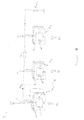
- Figure 6 shows another example of parts of DAC circuitry embodying the present invention.
- the Figure 6 circuitry 30 differs from the Figure 5 circuitry 20 in that a plurality of second segments 22-2 are connected to the second node N2 and a plurality of third segments 22-3 are connected to the third node N3.
- the second segments 22-2 together constitute a segment group SG 2 for the node N2.
- the third segments 22-3 together constitute a segment group SG 3 for the third node N3.
- each of the segment groups SG 2 and SG 3 can be used to process more than one bit of the digital input signal.
- each of the segment groups SG 2 and SG 3 may be used to process two or three bits of the digital input signal.
- the segment group SG 3 is shown as receiving plural bits B3 of the digital input signal
- the segment group SG 2 is shown as receiving plural bits B2 of the binary input signal.
- the bits of the digital input signal will not normally be applied directly to the segments.
- the bits will be decoded by a suitable decoder, such as a binary-to-thermometer decoder (as described previously with reference to Figure 4 ).
- the decoder generates thermometer-coded signals for each segment based on the relevant bits of the digital input signal.
- the number of binary bits is 2
- the number of segments in each segment group SG 2 and SG 3 should be 3.
- the number of binary bits is 3
- the number of segments in the segment groups should be 7.
- the number of segments required is 2 n -1, rather than 2 n , because for one of the binary input values (e.g. all zeros) no segment signal is required.
- each segment group may have the same number of segments. This may also make it desirable to include more segments in each group, e.g. 2 n segments, even if no spare "calibration" segment is required.
- the scaling factor k is increased because plural segments are attached to each of the nodes N2 and N3. For example, if the number of bits in each of B2 and B3 is 2, then k should be set to 4 so that the outputs of the second segments 22-2 are scaled by a factor of 4 relative to the outputs of the first segments 22-1 and so that the outputs of the third segments 22-3 are scaled by a factor of 16 relative to the outputs of the first segments 22-1.
- plural first segments 22-1 are again connected to the first node N1.
- the number of first segments is greater than the number of segments in the segment group SG 2 and in the segment group SG 3 .
- Each of the segment groups SG 11 to SG 1j has the same number of segments as each of the segment groups SG 2 and SG 3 .
- the number of segments in each segment group may be four.
- the case of a ten-bit DAC will be considered.
- the six MSBs are processed by the first segments 22-1.
- 64 first segments are provided (63 working segments and 1 segment for calibration). These 64 segments are organised as 16 segment groups SG 11 to SG 116 .
- the two highest-order LSBs (the bits B2 in Figure 6 ) are processed by the second segments 22-2 in the segment group SG 2 .
- Four segments are provided in the group SG 2 (3 working segments and 1 for calibration).
- the two lowest-order LSBs (the bits B3 in Figure 6 ) are processed by the third segments 22-3 in the segment group SG 3 .
- four segments are provided in the segment group SG 3 (3 working segments and 1 for calibration).
- each segment group SG has their respective load impedances Z L connected in parallel between the relevant node N1/N2/N3 and ground. Because of this, it is possible for a segment group SG to share a load element having a load impedance Z LG .
- Figure 7 shows the first segment groups SG 11 to SG 1j connected to node N1.
- Four first segments 22-1 are connected in parallel between an output node O 11 of the segment group SG 11 and ground.
- a shared load element 32 is also connected between the output node O 11 for the segment group and ground. The same is true for each of the other first segment groups SG 11 to SG 1j .
- the corresponding output nodes O 11 to O 1j are of course connected together to form node N1.
- the segment group SG 2 can also have a shared load element 32 connected in parallel with the segments of its group.
- the segment group SG 3 can also have a shared load element 32 connected in parallel with the segments of its group.
- shared load elements Z LG 32 are shown in Figure 7 connected between the output nodes for the segment group concerned and ground, they could equivalently be shown connected instead between an upper reference supply V TOP and their respective output nodes, as will be appreciated in respect of Figure 8 .
- the impedance Z LG required of each shared load element is ((k-1) 2 /k)Z LG .
- Z TERM (k-1)Z LG in this case.
- a shared load element for each segment group because, depending on the particular process (technology) used to fabricate the chip, a shared load element (having a smaller impedance than a per-segment load element) may be easier to fabricate.
- a per-segment load element may need to have a relatively large impedance (resistance), which will have an undesirably large area and hence a large parasitic capacitance.
- the use of per-segment load elements in the Figure 6 circuit is still possible, and may be preferable in certain fabrication processes.
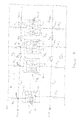
- Figure 8 shows an example constitution of one of the segments 22 in a first embodiment of the present invention.
- the DAC is a differential DAC and has first and second output nodes. Each of these output nodes effectively corresponds to the output node OUT shown in Figure 5 and Figure 6 .
- Each segment comprises first and second main switching transistors 36-1 and 36-2.
- the respective sources of the main switching transistors 36-1 and 36-2 are connected to a common node TAIL of the segment.
- a current sink 42 is connected between the common node TAIL and ground. This current sink causes a constant current I to flow through the node TAIL in use of the DAC.
- Mutually-complementary drive signals SW1 and SW2 are applied to the gates of the main switching transistors 36-1 and 36-2.
- the drain of the first main switching transistor 36-1 is connected to the source of a first cascode transistor 34 1 .
- the drain of the second main switching transistor 26-2 is connected to the source of a second cascode transistor 34 2 .
- a gate of the first cascode transistor 34 1 is connected to a positive supply line V TOP of the DAC.
- the second cascode transistor 34 2 has its drain connected to a second output node ON2 of the segment and its gate connected to the supply line V TOP .
- a first bleed current sink 40 1 is connected to the source of the first cascode transistor 34 1 and a second bleed current sink 40 2 is connected to the source of the second cascode transistor 34 2 .
- the respective first output nodes ON1 of the segments within the same segment group SG are connected together by a first line L1.
- the line L1 is also connected to the positive supply line V TOP by a first shared load element 32 1 .
- the respective second nodes ON2 of the segments within the same segment group are connected together by a second line L2.
- the line L2 is also connected to the positive supply line V TOP by a second shared load element 32 2 .
- Each of the first and second shared load elements 32 1 and 32 2 corresponds to the shared load element 32 shown in Figure 7 .
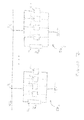
- FIG. 9 shows how the different segment groups are interconnected in the first embodiment.
- the first shared load elements 32 1 form part of a first impedance ladder arrangement 50 1 .
- This first ladder arrangement has nodes N1, N2 and N3 as described previously.
- the first and second nodes N1 and N2 are interconnected by a divider element having impedance Z DIV .
- the second and third nodes N2 and N3 are connected together by a divider element having the impedance Z DIV .
- the third node N3 is connected to the positive supply line V TOP by a termination element having the impedance Z TERM .
- the respective first lines L1 of each of the first segment groups SG 11 to SG 1j are connected in common to the first node N1 of the first ladder arrangement 50 1 .
- the line L1 of the second segment group SG 2 is connected to the second node N2 of the ladder arrangement 50 1 .
- the line L1 of the third segment group SG 3 is connected to the third node N3 of the first ladder arrangement 50 1 .
- the first shared load elements 32 1 of all the segment groups therefore form part of the first ladder arrangement 50 1 .
- the Figure 9 DAC also comprises a second impedance ladder arrangement 50 2 .
- This second ladder arrangement comprises the respective second shared load elements 32 2 of all of the segment groups.
- This second ladder arrangement 50 2 has first, second and third nodes N1, N2 and N3 similar to the first ladder arrangement 50 1 .
- the respective second lines L2 of the first segment groups SG 11 to SG 1j are connected in common to the first node N1 of the second ladder arrangement 50 2
- the second line L2 of the second segment group SG 2 is connected to the node N2 of the second ladder arrangement 50 2
- the second line L2 of the third segment group SG 3 is connected to the third node N3 of the second ladder arrangement 50 2 .
- the second ladder arrangement 50 2 also has the divider elements and termination element just as in the first ladder arrangement 50 1 .
- Figure 9 is schematic in nature, the two impedance ladder arrangements 50 1 and 50 2 being shown above and below the segments merely so that their equivalence to one another can be clearly seen.
- ground connections of the segments are not shown in Figure 9 , and accordingly the representation of the segments in Figure 9 differs from that in, for example, Figure 7 .
- Figure 9 is intended to show the two sets of signal paths of the impedance ladder arrangements.
- Each segment 22 receives a corresponding pair of mutually-complementary drive signals SW1 and SW2 from a binary-to-thermometer decoder (not shown). According to the states of the complementary drive signals SW1 and SW2, one of the main switching transistors 36-1 and 36-2 in each segment is turned ON and the other of those two transistors is turned OFF. Accordingly, the current I flows either through the transistor 36-1 or the transistor 36-2.
- Each of the cascode transistors 34 1 and 34 2 is maintained permanently on and in the saturated condition because the gate of each cascode transistor is connected to V TOP .
- the bleed current sinks 40 1 and 40 2 ensure that sufficient current flow is maintained through each of the cascode transistors even when the transistor 36-1 or 36-2 to which it is connected is turned off. For example I BLEED may be around one quarter of I.
- I BLEED +I is drawn into the segment from one of the two output nodes ON1 and ON2 and I BLEED is drawn from the other output node.
- the output node which has I+I BLEED is determined by the switching state of the segment concerned.
- the current drawn into the segment through the first output node ON1 is a first controllable signal of the segment.
- the current drawn into the segment through the second output node ON2 is a second controllable signal of the segment.
- the magnitudes of the first and second controllable signals are controlled by the switching signals SW1 and SW2 applied to the segment.
- the effect of the first impedance ladder network 50 1 is to scale the contribution of each second segment 22-2 in the second segment group SG 2 by the scaling factor k in relation to that of each first segment 22-1 in any of the first segment groups SG 11 to SG 1j .
- the contribution to the output voltage at the output terminal OUTA of each third segment 22-3 in the segment group SG 3 is scaled by the factor k 2 as compared to the contribution of each first segment.
- FIG 10 shows an example of the implementation of each of the Z DIV in the present invention.
- each divider element comprises a resistance element 62 and a bridge capacitor 64 connected in parallel with the resistance element 62.
- the capacitor 64 is used to compensate for the capacitance associated with the load elements (32 1 and 32 2 ).
- the capacitors 64 are also possible to trim the capacitors 64 (increasing them slightly) to compensate for any parasitic capacitances associated with the resistors. These resistor parasitic capacitances cause losses at high frequencies of signals propagating along the series of nodes N1 to N3 in each impedance ladder arrangement in the direction to the output terminal. Provided that the parasitic capacitances are moderate, the effect of the losses can be compensated for by increasing the capacitance of the bridge capacitor slightly.
- the capacitance C 64 of the bridge capacitance should be (k cdiv .k)/(k-1) 2 times the capacitance of each load element 32 1 or 32 2 , where k cdiv is a compensation factor.
- the bridge capacitance C 64 is simply the same as the capacitance needed to match the impedance of the load elements, i.e. k/(k-1) 2 times the capacitance of the load elements.
- the compensation factor is dependent on many factors, including the fabrication process and design choices such as segment design (e.g. the capacitance of the current source and output switches in each segment) and ESD protection arrangements. Example values are given later.
- Figures 11 (A) and 11 (B) show a preferred way of achieving such matching.
- the scaling factor k is 4.
- Z DIV (9/4).Z LG .
- the number of first segment groups is 16 and that a target output impedance of the DAC is 25 ⁇ .
- the MSB segments are in use (the 64 th being calibrated), and the LSB segments collectively serve as a 64 th segment.
- the MSB segments together contribute, in the present example, 63/64 of the output range, and the LSB segments together contribute 1/64 of the output range. It follows that Z DIV should be 900 ⁇ .
- the resistance element 62 in each divider element 60 can be implemented using 6 unit resistances 70, each having a resistance R of 600 ⁇ .
- the resistance element 62 in Figure 11(A) has three parallel branches. Each branch has two unit resistances 70 connected in series. The resulting overall resistance is 400 ⁇ .
- each divider element 60 can be implemented as shown in Figure 11 (B) .
- the resistance element 62 has two parallel branches, each branch having three of the unit resistances 70 connected in series The resulting impedance is 900 ⁇ .
- the unit resistances 70 in the load elements and divider elements are the same, accurate matching of the resistance values of the load elements and divider elements is obtainable. This is possible because the unit resistances have the same width and length, thereby eliminating width and length effects.
- the unit resistances might be implemented in the chosen process using non-silicided polysilicon.
- Non-silicided polysilicon has a resistance of 450 ⁇ / ⁇ .
- the maximum current permitted in such a resistor is 0.28mA/ ⁇ m.
- This means that the load elements 32 1 and 32 2 connected to the nodes N1 in the ladder arrangements 50 1 and 50 2 must each be capable of handling a current of 1.25mA.
- each of the load elements 32 is constituted by 3 parallel branches.
- This means that the minimum width of each of the unit resistances 70 is 1.48 ⁇ m. Because each unit resistance 70 is required to have a resistance of 600 ⁇ , in non-silicided polysilicon this corresponds to 1.33 -. This corresponds to a minimum length of 1.33 x 1.48 1.98 ⁇ m.
- the area of each unit resistance is then 3 ⁇ m 2 .
- the mismatch between resistors is inversely proportional to the square root of the area of the resistor.
- a 3 ⁇ figure can be used, i.e.
- each divider impedance Z DIV is implemented as a resistor in parallel with a bridge capacitor such that the scaling factor k is constant across all frequencies. Also as already mentioned, it is possible to apply a compensation factor k cdiv to the value of the bridge capacitances in order to compensate for parasitic capacitances. In order to explore this further, the following analysis has been carried out.
- the target output resistance of the DAC is 25 ⁇ , and allowance is made in the DAC output capacitance of 0.2pF for ESD circuitry, 0.2pF for the DAC transistors, and 0.2pF for the tracking in the DAC.
- the bridge capacitors could be formed out of metal, in which case variation in capacitance of the bridge capacitances will match variation in parasitic capacitance due to the tracking. Because the contribution of the tracking (0.2pF) to the output capacitance is assumed to be equal to the contribution due to the DAC transistors (0.2pF), a 20% variation in the parasitic capacitance of the DAC transistors relative to the metal capacitances equates to an overall effective 10% error in the value of the bridge capacitances.
- Figure 12 shows parts of each of the segments 22 in a second embodiment of the present invention. Parts in Figure 12 that are the same as the parts in the first embodiment ( Figure 8 ) are denoted by the same reference numerals.
- a plurality of main switching transistors are provided for each output node ON1 and ON2 of the segment.
- Transistors 136-1, 136-3, 136-5 and 136-7 are provided for the first output node ON1.
- Transistors 136-2, 136-4, 136-6 and 136-8 are provided for the second output node ON2.
- the arrangement of cascode transistors is changed in comparison to the Figure 8 segment. There are now two cascode transistors per output node.
- the cascode transistors 134 1 and 134 3 are provided for the first output node ON 1, and the cascode transistors 134 2 and 134 4 are provided for the second output node ON2.
- the upper cascode transistors 134 1 and 134 2 are provided to eliminate the dependence of the drain potentials of the switching transistors 136 on the potentials of the output nodes ON1 and ON2. This is achieved by taking a tap from a tap point TP1 or TP2 on each of the first and second shared load elements 132 1 and 132 2 .
- the tap point TP1 from the first shared load element 132 1 is coupled to a gate of the cascode transistor 134 2 .
- the tap point TP2 from the second shared load element 132 2 is coupled to a gate of the cascode transistor 134 1 .
- the potential at the tap point TP1 is a scaled-down version of the potential at the first output node ON1.
- the potential at the tap point TP2 is a scaled-down version of the potential at the second output node ON2.
- Application of the scaled-down potentials to the gates of the cascode transistors 134 1 and 134 2 therefore serves to fix their source potentials at values that are substantially independent of the output-node potentials.
- the further pair of cascode transistors 134 3 and 134 4 is provided to remove the dependence of the drain potentials of the switching transistors 136 on the switching state of the segment (that is which of the output nodes has the current I BLEED + I and which of them has the current I BLEED ). Further details of the arrangement and operation of the cascode transistors 134 1 to134 4 can be found in the applicant's co-pending patent application [agents ref: P108196EP00/DNL], the entire contents of which are incorporated herein by reference.
- a first phase one of the transistors 136-1 and 136-2 is turned on and the other is turned off in dependence upon the data for the segment. All of the remaining switching transistors 136-3 to 136-8 are off.
- a second phase one of the transistors 136-3 and 136-4 is turned on and the other is turned off in dependence upon the data signal. The remaining transistors 136-1, 136-2 and 136-5 to 136-8 are all off.
- one of the switching transistors 136-5 and 136-6 is turned on and the other is turned off in dependence upon the data signal.
- the remaining transistors 136-1 to 136-4 and 136-7 and 136-8 are off.
- a fourth phase one of the transistors 136-7 and 136-8 is turned on and the other is turned off in dependence upon the data signal. The remaining transistors 136-1 to 136-6 are off.
- the four-phase operation described above has the advantage that the same number of switching transistors change state from one phase to the next, irrespective of whether or not the data signal changes. For example, if in a first phase the switching transistor 136-1 is on and in the next phase the data remains the same, the transistor 136-1 is turned off and the transistor 136-3 is turned on. This kind of operation is not possible in the Figure 8 embodiment in which there is only one switching transistor 36-1 or 36-2 per output node. By arranging for the same number of switches to change state from one phase to the next, third-order distortion in the DAC is reduced.
- the tap points in the segments 22-3 of the third segment group SG 3 will be different from the corresponding tap points in the second segments 22-2.
- this difference in the tap points does not affect the ability to match the relevant parameters, in particular the switching delays, of the segments.
- the tap points are all the same because each of them is coupled to the same node N1.
- the tap points are set out at the design stage.
- the errors are less significant because, whereas MSB errors appear directly in the DAC output, the LSB errors are scaled. For example, in the case of 16 first segment groups each having four segments for the MSBs, the LSBs only contribute up to 1 / 64 th of full scale in the DAC output.
- the tap point in such a single shared load element, or the DC voltage level of the DC voltage source should preferably be optimised with respect to the MSBs.
- the present invention has been described in relation to a segmented DAC, it will be appreciated that in other embodiments the invention can be applied in any kind of segmented mixed-signal circuitry.
- the invention can be applied to digitally-programmable current generators and mixers
- bipolar transistors can be used, as can any other kind of three-terminal current device such as a valve. Effectively, any high-speed current switch can be employed in each segment in order to switch a current between two paths in dependence upon a control signal.
Landscapes
- Engineering & Computer Science (AREA)
- Theoretical Computer Science (AREA)
- Analogue/Digital Conversion (AREA)
Priority Applications (1)
| Application Number | Priority Date | Filing Date | Title |
|---|---|---|---|
| EP07113376.3A EP2019490B1 (de) | 2007-07-27 | 2007-07-27 | Segmentierte schaltung |
Applications Claiming Priority (1)
| Application Number | Priority Date | Filing Date | Title |
|---|---|---|---|
| EP07113376.3A EP2019490B1 (de) | 2007-07-27 | 2007-07-27 | Segmentierte schaltung |
Publications (2)
| Publication Number | Publication Date |
|---|---|
| EP2019490A1 true EP2019490A1 (de) | 2009-01-28 |
| EP2019490B1 EP2019490B1 (de) | 2018-07-18 |
Family
ID=39650508
Family Applications (1)
| Application Number | Title | Priority Date | Filing Date |
|---|---|---|---|
| EP07113376.3A Ceased EP2019490B1 (de) | 2007-07-27 | 2007-07-27 | Segmentierte schaltung |
Country Status (1)
| Country | Link |
|---|---|
| EP (1) | EP2019490B1 (de) |
Cited By (20)
| Publication number | Priority date | Publication date | Assignee | Title |
|---|---|---|---|---|
| EP2019486A1 (de) | 2007-07-27 | 2009-01-28 | Fujitsu Ltd. | HF-Sender |
| US8976050B1 (en) | 2013-09-12 | 2015-03-10 | Fujitsu Semiconductor Limited | Circuitry and methods for use in mixed-signal circuitry |
| EP2849021A1 (de) | 2013-09-12 | 2015-03-18 | Fujitsu Semiconductor Limited | Signalausrichtungsschaltungen und Verfahren |
| EP2849345A1 (de) | 2013-09-12 | 2015-03-18 | Fujitsu Semiconductor Limited | Schaltungen und Verfahren zur Verwendung in Schaltungen mit gemischten Signalen |
| EP2849344A1 (de) | 2013-09-12 | 2015-03-18 | Fujitsu Semiconductor Limited | Schaltungen und Verfahren zur Verwendung in Schaltungen mit gemischten Signalen |
| US9054722B2 (en) | 2013-09-12 | 2015-06-09 | Fujitsu Semiconductor Limited | Circuitry and methods for use in mixed-signal circuitry |
| US9112521B2 (en) | 2013-09-12 | 2015-08-18 | Socionext Inc. | Mixed-signal circuitry |
| US9178524B1 (en) | 2014-05-27 | 2015-11-03 | Qualcomm Incorporated | Hybrid R-2R structure for low glitch noise segmented DAC |
| US9201813B2 (en) | 2013-09-12 | 2015-12-01 | Socionext Inc. | Signal distribution circuitry |
| US9432013B2 (en) | 2013-09-12 | 2016-08-30 | Socionext Inc. | Circuitry useful for clock generation and distribution |
| US9450279B2 (en) | 2013-09-12 | 2016-09-20 | Socionext Inc. | Components and circuits for output termination |
| EP3442123A1 (de) * | 2017-08-08 | 2019-02-13 | NXP USA, Inc. | Digital-analog-wandler (dac) mit sub-dacs mit anordnungen von widerständen |
| EP3618282A1 (de) | 2018-08-31 | 2020-03-04 | Socionext Inc. | Stromerzeugung |
| US10784886B1 (en) | 2019-09-27 | 2020-09-22 | Nxp Usa, Inc. | Segmented digital to analog converter |
| US10790848B2 (en) | 2018-06-04 | 2020-09-29 | Nxp Usa, Inc. | Segmented resistive digital to analog converter |
| CN113541653A (zh) * | 2021-07-27 | 2021-10-22 | 温州大学 | 基于传输线反射原理的纳秒级陡边沿脉冲信号发生器 |
| WO2022026108A1 (en) * | 2020-07-31 | 2022-02-03 | Qualcomm Incorporated | Flash-successive approximation register (sar) hybrid analog-to-digital converter (adc) |
| CN115296671A (zh) * | 2022-10-09 | 2022-11-04 | 湖南毂梁微电子有限公司 | 混合结构的数模转换电路 |
| CN115333540A (zh) * | 2022-10-14 | 2022-11-11 | 杰创智能科技股份有限公司 | 数模转换器电阻选择方法、装置、设备及存储介质 |
| EP4125217A1 (de) | 2021-07-27 | 2023-02-01 | Socionext Inc. | Kalibrierung und ausrichtung |
Citations (5)
| Publication number | Priority date | Publication date | Assignee | Title |
|---|---|---|---|---|
| US5612696A (en) | 1994-12-03 | 1997-03-18 | Electronics & Telecommunications Research Institute | Digital-to-analog converter of current segmentation |
| US5703586A (en) | 1995-12-07 | 1997-12-30 | Analog Devices, Inc. | Digital-to-analog converter having programmable transfer function errors and method of programming same |
| US20060092065A1 (en) | 2004-10-29 | 2006-05-04 | Broadcom Corporation | Delay equalized z/2z ladder for digital to analog conversion |
| US7173552B1 (en) | 2003-10-01 | 2007-02-06 | Analog Devices, Inc. | High accuracy segmented DAC |
| EP2023489A1 (de) | 2007-07-27 | 2009-02-11 | Fujitsu Ltd. | Stromschaltungsanordnung |
-
2007
- 2007-07-27 EP EP07113376.3A patent/EP2019490B1/de not_active Ceased
Patent Citations (5)
| Publication number | Priority date | Publication date | Assignee | Title |
|---|---|---|---|---|
| US5612696A (en) | 1994-12-03 | 1997-03-18 | Electronics & Telecommunications Research Institute | Digital-to-analog converter of current segmentation |
| US5703586A (en) | 1995-12-07 | 1997-12-30 | Analog Devices, Inc. | Digital-to-analog converter having programmable transfer function errors and method of programming same |
| US7173552B1 (en) | 2003-10-01 | 2007-02-06 | Analog Devices, Inc. | High accuracy segmented DAC |
| US20060092065A1 (en) | 2004-10-29 | 2006-05-04 | Broadcom Corporation | Delay equalized z/2z ladder for digital to analog conversion |
| EP2023489A1 (de) | 2007-07-27 | 2009-02-11 | Fujitsu Ltd. | Stromschaltungsanordnung |
Cited By (27)
| Publication number | Priority date | Publication date | Assignee | Title |
|---|---|---|---|---|
| EP2019486A1 (de) | 2007-07-27 | 2009-01-28 | Fujitsu Ltd. | HF-Sender |
| US9432013B2 (en) | 2013-09-12 | 2016-08-30 | Socionext Inc. | Circuitry useful for clock generation and distribution |
| US9705475B2 (en) | 2013-09-12 | 2017-07-11 | Socionext Inc. | Circuitry useful for clock generation and distribution |
| EP2849345A1 (de) | 2013-09-12 | 2015-03-18 | Fujitsu Semiconductor Limited | Schaltungen und Verfahren zur Verwendung in Schaltungen mit gemischten Signalen |
| EP2849344A1 (de) | 2013-09-12 | 2015-03-18 | Fujitsu Semiconductor Limited | Schaltungen und Verfahren zur Verwendung in Schaltungen mit gemischten Signalen |
| US9054722B2 (en) | 2013-09-12 | 2015-06-09 | Fujitsu Semiconductor Limited | Circuitry and methods for use in mixed-signal circuitry |
| US9112521B2 (en) | 2013-09-12 | 2015-08-18 | Socionext Inc. | Mixed-signal circuitry |
| US9450279B2 (en) | 2013-09-12 | 2016-09-20 | Socionext Inc. | Components and circuits for output termination |
| US9178523B2 (en) | 2013-09-12 | 2015-11-03 | Socionext Inc. | Circuitry and methods for use in mixed-signals circuitry |
| US9201813B2 (en) | 2013-09-12 | 2015-12-01 | Socionext Inc. | Signal distribution circuitry |
| US9973186B2 (en) | 2013-09-12 | 2018-05-15 | Socionext Inc. | Circuitry and methods for use in mixed-signal circuitry |
| US9344060B2 (en) | 2013-09-12 | 2016-05-17 | Socionext Inc. | Signal-alignment circuitry and methods |
| US8976050B1 (en) | 2013-09-12 | 2015-03-10 | Fujitsu Semiconductor Limited | Circuitry and methods for use in mixed-signal circuitry |
| EP2849021A1 (de) | 2013-09-12 | 2015-03-18 | Fujitsu Semiconductor Limited | Signalausrichtungsschaltungen und Verfahren |
| WO2015183496A1 (en) * | 2014-05-27 | 2015-12-03 | Qualcomm Incorporated | Hybrid r-2r structure for low glitch noise segmented dac |
| US9178524B1 (en) | 2014-05-27 | 2015-11-03 | Qualcomm Incorporated | Hybrid R-2R structure for low glitch noise segmented DAC |
| CN109391270B (zh) * | 2017-08-08 | 2023-09-26 | 恩智浦美国有限公司 | 具有含有电阻器阵列的子dac的数/模转换器(dac) |
| EP3442123A1 (de) * | 2017-08-08 | 2019-02-13 | NXP USA, Inc. | Digital-analog-wandler (dac) mit sub-dacs mit anordnungen von widerständen |
| CN109391270A (zh) * | 2017-08-08 | 2019-02-26 | 恩智浦美国有限公司 | 具有含有电阻器阵列的子dac的数/模转换器(dac) |
| US10790848B2 (en) | 2018-06-04 | 2020-09-29 | Nxp Usa, Inc. | Segmented resistive digital to analog converter |
| EP3618282A1 (de) | 2018-08-31 | 2020-03-04 | Socionext Inc. | Stromerzeugung |
| US10784886B1 (en) | 2019-09-27 | 2020-09-22 | Nxp Usa, Inc. | Segmented digital to analog converter |
| WO2022026108A1 (en) * | 2020-07-31 | 2022-02-03 | Qualcomm Incorporated | Flash-successive approximation register (sar) hybrid analog-to-digital converter (adc) |
| CN113541653A (zh) * | 2021-07-27 | 2021-10-22 | 温州大学 | 基于传输线反射原理的纳秒级陡边沿脉冲信号发生器 |
| EP4125217A1 (de) | 2021-07-27 | 2023-02-01 | Socionext Inc. | Kalibrierung und ausrichtung |
| CN115296671A (zh) * | 2022-10-09 | 2022-11-04 | 湖南毂梁微电子有限公司 | 混合结构的数模转换电路 |
| CN115333540A (zh) * | 2022-10-14 | 2022-11-11 | 杰创智能科技股份有限公司 | 数模转换器电阻选择方法、装置、设备及存储介质 |
Also Published As
| Publication number | Publication date |
|---|---|
| EP2019490B1 (de) | 2018-07-18 |
Similar Documents
| Publication | Publication Date | Title |
|---|---|---|
| EP2019490B1 (de) | Segmentierte schaltung | |
| US6914547B1 (en) | Triple resistor string DAC architecture | |
| CN105210298B (zh) | 多串数模转换器 | |
| US6906652B2 (en) | High dynamic linearity current-mode digital-to-analog converter architecture | |
| CN205320061U (zh) | 电路 | |
| CN106209108B (zh) | 分段dac | |
| EP1257060B1 (de) | Digital-Analog-Wandler mit Stromquellenanordnung | |
| KR0179466B1 (ko) | 디지탈-아날로그 변환기 및 이를 구비한 집적회로와 디지탈-아날로그 신호 변환 방법 | |
| US7501970B2 (en) | Digital to analog converter architecture and method having low switch count and small output impedance | |
| US5446455A (en) | Auto-calibrated current-mode digital-to-analog converter and method therefor | |
| Bastos et al. | A high yield 12-bit 250-MS/s CMOS D/A converter | |
| US20130293405A1 (en) | Segmented digital-to-analog converter having weighted current sources | |
| JPH0566774B2 (de) | ||
| GB2393055A (en) | A transconductance amplifier with input sampling capacitor for a current-interpolating A-D converter | |
| JP2003124809A (ja) | 改良形スイッチトキャパシタにもとづく電荷再分布逐次近似型アナログ−ディジタル変換器(adc) | |
| JP4741680B2 (ja) | フレキシブル性を有するアナログ/デジタルコンバータ | |
| US6317069B1 (en) | Digital-to-analog converter employing binary-weighted transistor array | |
| US8912939B2 (en) | String DAC leakage current cancellation | |
| US20040119626A1 (en) | Resistor string digital to analog converter with differential outputs and reduced switch count | |
| US9143156B1 (en) | High-resolution digital to analog converter | |
| EP2853032A1 (de) | Digital-analog-wandler mit widerstandsleiter | |
| CN111801894A (zh) | 数模转换器系统 | |
| CN101908887B (zh) | Da变换装置 | |
| US6995701B1 (en) | Multichannel high resolution segmented resistor string digital-to-analog converters | |
| US7046182B1 (en) | DAC having switchable current sources and resistor string |
Legal Events
| Date | Code | Title | Description |
|---|---|---|---|
| PUAI | Public reference made under article 153(3) epc to a published international application that has entered the european phase |
Free format text: ORIGINAL CODE: 0009012 |
|
| AK | Designated contracting states |
Kind code of ref document: A1 Designated state(s): AT BE BG CH CY CZ DE DK EE ES FI FR GB GR HU IE IS IT LI LT LU LV MC MT NL PL PT RO SE SI SK TR |
|
| AX | Request for extension of the european patent |
Extension state: AL BA HR MK RS |
|
| 17P | Request for examination filed |
Effective date: 20090727 |
|
| AKX | Designation fees paid |
Designated state(s): DE FR GB |
|
| 17Q | First examination report despatched |
Effective date: 20091130 |
|
| RAP1 | Party data changed (applicant data changed or rights of an application transferred) |
Owner name: FUJITSU MICROELECTRONICS LIMITED |
|
| RAP1 | Party data changed (applicant data changed or rights of an application transferred) |
Owner name: FUJITSU SEMICONDUCTOR LIMITED |
|
| RAP1 | Party data changed (applicant data changed or rights of an application transferred) |
Owner name: SOCIONEXT INC. |
|
| GRAP | Despatch of communication of intention to grant a patent |
Free format text: ORIGINAL CODE: EPIDOSNIGR1 |
|
| STAA | Information on the status of an ep patent application or granted ep patent |
Free format text: STATUS: GRANT OF PATENT IS INTENDED |
|
| INTG | Intention to grant announced |
Effective date: 20180212 |
|
| GRAS | Grant fee paid |
Free format text: ORIGINAL CODE: EPIDOSNIGR3 |
|
| GRAA | (expected) grant |
Free format text: ORIGINAL CODE: 0009210 |
|
| STAA | Information on the status of an ep patent application or granted ep patent |
Free format text: STATUS: THE PATENT HAS BEEN GRANTED |
|
| AK | Designated contracting states |
Kind code of ref document: B1 Designated state(s): DE FR GB |
|
| REG | Reference to a national code |
Ref country code: GB Ref legal event code: FG4D |
|
| REG | Reference to a national code |
Ref country code: DE Ref legal event code: R096 Ref document number: 602007055398 Country of ref document: DE |
|
| REG | Reference to a national code |
Ref country code: DE Ref legal event code: R097 Ref document number: 602007055398 Country of ref document: DE |
|
| PLBE | No opposition filed within time limit |
Free format text: ORIGINAL CODE: 0009261 |
|
| STAA | Information on the status of an ep patent application or granted ep patent |
Free format text: STATUS: NO OPPOSITION FILED WITHIN TIME LIMIT |
|
| 26N | No opposition filed |
Effective date: 20190423 |
|
| GBPC | Gb: european patent ceased through non-payment of renewal fee |
Effective date: 20181018 |
|
| PG25 | Lapsed in a contracting state [announced via postgrant information from national office to epo] |
Ref country code: FR Free format text: LAPSE BECAUSE OF NON-PAYMENT OF DUE FEES Effective date: 20180918 |
|
| PG25 | Lapsed in a contracting state [announced via postgrant information from national office to epo] |
Ref country code: GB Free format text: LAPSE BECAUSE OF NON-PAYMENT OF DUE FEES Effective date: 20181018 |
|
| REG | Reference to a national code |
Ref country code: DE Ref legal event code: R082 Ref document number: 602007055398 Country of ref document: DE Representative=s name: HL KEMPNER PATENTANWAELTE, SOLICITORS (ENGLAND, DE Ref country code: DE Ref legal event code: R082 Ref document number: 602007055398 Country of ref document: DE Representative=s name: HL KEMPNER PATENTANWALT, RECHTSANWALT, SOLICIT, DE |
|
| PGFP | Annual fee paid to national office [announced via postgrant information from national office to epo] |
Ref country code: DE Payment date: 20230719 Year of fee payment: 17 |
|
| REG | Reference to a national code |
Ref country code: DE Ref legal event code: R119 Ref document number: 602007055398 Country of ref document: DE |
|
| PG25 | Lapsed in a contracting state [announced via postgrant information from national office to epo] |
Ref country code: DE Free format text: LAPSE BECAUSE OF NON-PAYMENT OF DUE FEES Effective date: 20250201 |