EP2017513A1 - Ventilregler und durchflussvolumensteuerung - Google Patents
Ventilregler und durchflussvolumensteuerung Download PDFInfo
- Publication number
- EP2017513A1 EP2017513A1 EP07742922A EP07742922A EP2017513A1 EP 2017513 A1 EP2017513 A1 EP 2017513A1 EP 07742922 A EP07742922 A EP 07742922A EP 07742922 A EP07742922 A EP 07742922A EP 2017513 A1 EP2017513 A1 EP 2017513A1
- Authority
- EP
- European Patent Office
- Prior art keywords
- section
- voltage
- motor
- valve
- drop
- Prior art date
- Legal status (The legal status is an assumption and is not a legal conclusion. Google has not performed a legal analysis and makes no representation as to the accuracy of the status listed.)
- Granted
Links
Images



Classifications
-
- H—ELECTRICITY
- H02—GENERATION; CONVERSION OR DISTRIBUTION OF ELECTRIC POWER
- H02P—CONTROL OR REGULATION OF ELECTRIC MOTORS, ELECTRIC GENERATORS OR DYNAMO-ELECTRIC CONVERTERS; CONTROLLING TRANSFORMERS, REACTORS OR CHOKE COILS
- H02P8/00—Arrangements for controlling dynamo-electric motors rotating step by step
- H02P8/42—Arrangements for controlling dynamo-electric motors rotating step by step characterised by non-stepper motors being operated step by step
-
- F—MECHANICAL ENGINEERING; LIGHTING; HEATING; WEAPONS; BLASTING
- F16—ENGINEERING ELEMENTS AND UNITS; GENERAL MEASURES FOR PRODUCING AND MAINTAINING EFFECTIVE FUNCTIONING OF MACHINES OR INSTALLATIONS; THERMAL INSULATION IN GENERAL
- F16K—VALVES; TAPS; COCKS; ACTUATING-FLOATS; DEVICES FOR VENTING OR AERATING
- F16K31/00—Actuating devices; Operating means; Releasing devices
- F16K31/02—Actuating devices; Operating means; Releasing devices electric; magnetic
- F16K31/04—Actuating devices; Operating means; Releasing devices electric; magnetic using a motor
-
- F—MECHANICAL ENGINEERING; LIGHTING; HEATING; WEAPONS; BLASTING
- F16—ENGINEERING ELEMENTS AND UNITS; GENERAL MEASURES FOR PRODUCING AND MAINTAINING EFFECTIVE FUNCTIONING OF MACHINES OR INSTALLATIONS; THERMAL INSULATION IN GENERAL
- F16K—VALVES; TAPS; COCKS; ACTUATING-FLOATS; DEVICES FOR VENTING OR AERATING
- F16K37/00—Special means in or on valves or other cut-off apparatus for indicating or recording operation thereof, or for enabling an alarm to be given
-
- F—MECHANICAL ENGINEERING; LIGHTING; HEATING; WEAPONS; BLASTING
- F16—ENGINEERING ELEMENTS AND UNITS; GENERAL MEASURES FOR PRODUCING AND MAINTAINING EFFECTIVE FUNCTIONING OF MACHINES OR INSTALLATIONS; THERMAL INSULATION IN GENERAL
- F16K—VALVES; TAPS; COCKS; ACTUATING-FLOATS; DEVICES FOR VENTING OR AERATING
- F16K37/00—Special means in or on valves or other cut-off apparatus for indicating or recording operation thereof, or for enabling an alarm to be given
- F16K37/0075—For recording or indicating the functioning of a valve in combination with test equipment
- F16K37/0083—For recording or indicating the functioning of a valve in combination with test equipment by measuring valve parameters
-
- G—PHYSICS
- G05—CONTROLLING; REGULATING
- G05D—SYSTEMS FOR CONTROLLING OR REGULATING NON-ELECTRIC VARIABLES
- G05D7/00—Control of flow
- G05D7/06—Control of flow characterised by the use of electric means
-
- G—PHYSICS
- G05—CONTROLLING; REGULATING
- G05D—SYSTEMS FOR CONTROLLING OR REGULATING NON-ELECTRIC VARIABLES
- G05D7/00—Control of flow
- G05D7/06—Control of flow characterised by the use of electric means
- G05D7/0617—Control of flow characterised by the use of electric means specially adapted for fluid materials
- G05D7/0629—Control of flow characterised by the use of electric means specially adapted for fluid materials characterised by the type of regulator means
- G05D7/0635—Control of flow characterised by the use of electric means specially adapted for fluid materials characterised by the type of regulator means by action on throttling means
-
- H—ELECTRICITY
- H02—GENERATION; CONVERSION OR DISTRIBUTION OF ELECTRIC POWER
- H02P—CONTROL OR REGULATION OF ELECTRIC MOTORS, ELECTRIC GENERATORS OR DYNAMO-ELECTRIC CONVERTERS; CONTROLLING TRANSFORMERS, REACTORS OR CHOKE COILS
- H02P8/00—Arrangements for controlling dynamo-electric motors rotating step by step
- H02P8/24—Arrangements for stopping
- H02P8/26—Memorising final pulse when stopping
Definitions
- the present invention relates to valve control apparatuses for installation in fluid channels to control the flow rate of a fluid, in various industrial fields, including, for example, chemical plants, semiconductor manufacturing, food, and bioindustry, and also relates to flow rate controllers including such valve control apparatuses.
- Examples of conventionally known flow rate controllers for controlling the amount of fluid flowing through a fluid channel include those using pulse motors for open/close control of valves.
- a flow rate controller using a pulse motor controls the position of a valve during driving by counting the number of input pulses and, when the driving is stopped, moves the valve back to its original position before the entire flow rate controller comes to a stop. This control allows the valve to be controlled the next time driving starts on the assumption that the valve is at the original position.
- control for returning the valve to the original position (hereinafter referred to as the "return-to-origin control") must be performed before the next time driving starts.
- Patent Document 1 discloses a technique for temporarily stopping a pulse motor upon detection of its malfunction while driving it in such a direction as to close a valve, further driving the pulse motor in such a direction as to close the valve by a predetermined number of pulses before stopping the pulse motor, and finally driving the pulse motor in such a direction as to open the valve by a specified number of pulses before stopping the pulse motor, thereby detecting the origin of the valve.
- Patent Document 2 discloses a technique, using a position sensor that outputs different signals based on the operating position of a driven part such as a valve, for driving a pulse motor in a predetermined direction upon activation, sampling signals output from the position sensor for each predetermined angle of motor driving during the driving, recognizing the current valve position from the sampling variation pattern, and setting the origin of the valve based on the recognized current position.
- This technique can reduce the amount of driving of the pulse motor when the motor is returned to its origin because a change in the position of a driven part such as a valve is followed by the updating of the origin, thus quickly enabling normal control.
- Patent Document 1 has a problem in that it tends to cause biting of a screw part for driving the valve because the pulse motor may rotate beyond its range of motion; the apparatus breaks down if the biting is so serious that the pulse motor can no longer be driven.
- Patent Document 2 has a problem in that it increases the size and cost of the apparatus because the origin is set by identifying the valve position using, for example, a rotary encoder or a sensor.
- Another approach is to write the valve position in a nonvolatile memory in real time to facilitate the return-to-origin. It is impossible, however, to write the motor position in the nonvolatile memory in real time because the writing of the data in the nonvolatile memory is much slower than the rotational speed of the motor.
- An object of the present invention which has been made in light of the above circumstances, is to provide a compact valve control apparatus and flow rate controller that eliminate the problem of biting of a screw part for driving a valve.
- a first aspect of the present invention is a valve control apparatus, for driving a valve for controlling the flow rate of a fluid flowing through a fluid channel, including a stepping motor coupled to the valve and a motor control unit for controlling the stepping motor.
- the motor control unit includes a motor control section for applying drive pulses to the pulse motor, a counting section for counting the number of drive pulses applied to the pulse motor, a voltage-drop detecting section for detecting a voltage drop of a drive power supply for the motor control section, and a writing section for writing a count from the counting section in a nonvolatile memory if the voltage-drop detecting section detects the voltage drop.
- the motor control unit for controlling the stepping motor coupled to the valve includes the motor control section for applying drive pulses to the pulse motor, the counting section for counting the number of drive pulses applied to the pulse motor, the voltage-drop detecting section for detecting a voltage drop of the drive power supply for the motor control section, and the writing section for writing the count from the counting section in the nonvolatile memory if the voltage-drop detecting section detects the voltage drop.
- the valve position can readily be identified by reading the count from the nonvolatile memory. This results in a reduction in the time to shift from the activation of the pulse motor to normal operation.
- the pulse motor can always be driven within its range of motion because the position of the pulse motor can be identified without moving it. This avoids biting of a screw part.
- the size of the apparatus can be reduced because the need for a position-detecting sensor such as a rotary encoder can be eliminated.
- the above valve control apparatus may further include a period-adjusting section for extending a drive termination period to a predetermined period of time or more.
- the drive termination period is from voltage-drop detection, at which the voltage-drop detecting section detects the voltage drop, to drive termination, at which the driving of the motor control section stops.
- the period-adjusting section is provided, the count from the counting section can reliably be written in the nonvolatile memory within the drive termination period. This allows the valve position to be reliably identified at the activation of the pulse motor, thus increasing reliability.
- the predetermined period of time must at least be set to be longer than a writing period during which the writing section writes the count in the nonvolatile memory.
- the motor control section may execute return-to-origin control for returning the valve to an origin at the start of driving of the pulse motor by reading the count written in the nonvolatile memory and driving the pulse motor based on the count.
- the return-to-origin control for returning the valve to the origin is executed at the start of driving of the pulse motor by reading the count written in the nonvolatile memory and driving the pulse motor based on the count, the time required for the return-to-origin control can be reduced.
- a second aspect of the present invention is a flow rate controller including a valve for controlling the flow rate of a fluid flowing through a fluid channel and the above valve control apparatus.
- a third aspect of the present invention is a motor control unit including a motor control section for applying drive pulses to the pulse motor, a counting section for counting the number of drive pulses applied to the pulse motor, a voltage-drop detecting section for detecting a voltage drop of a drive power supply for the motor control section, and a writing section for writing a count from the counting section in a nonvolatile memory if the voltage-drop detecting section detects the voltage drop.
- a fourth aspect of the present invention is a pulse motor apparatus including a pulse motor and the above motor control unit, which controls the pulse motor.
- the present invention provides the advantage of eliminating the problem of biting of a screw part for driving the valve and reducing the size of the apparatus.
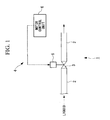
- Fig. 1 is a diagram showing, in outline, the configuration of the flow rate controller according to this embodiment.
- This flow rate controller 1 includes, as main components, a valve 3 provided in a fluid channel 2 to control the flow rate of a fluid flowing through the fluid channel 2 and a valve control apparatus 4 for driving the valve 3.
- the valve control apparatus 4 includes a pulse motor 5 coupled to the valve 3 and a motor control unit 6 for controlling the pulse motor 5.
- Fig. 2 is a diagram showing, in outline, the configuration of the valve 3 shown in Fig. 1 .
- the valve 3 in Fig. 1 includes a diaphragm needle 14, for example, as a valve element. This diaphragm needle 14 is integrated with the pulse motor 5 and is accommodated in a case 23.
- the pulse motor 5 in the case 23 is connected to the motor control unit 6 through a cable 29.
- the rotation angle is controlled based on drive signals supplied through the cable 29.
- a rotating shaft 15a of the pulse motor 5 is coupled to a coupling 16.
- the coupling 16 is coupled to a slider 17 via a spring 21.
- the slider 17 is coupled to the diaphragm needle 14.
- the diaphragm needle 14 is disposed in a port 43 formed in the fluid channel 2. The flow rate of a fluid flowing through the fluid channel 2 is adjusted depending on the gap area between the diaphragm needle 14 and the bottom surface of the port 43.
- valve 10 Next, the operation of the valve 10 will be briefly described. Suppose, for example, that no fluid flows through the port 43 with the diaphragm needle 14 in contact with the bottom surface of the port 43; that is, the valve 3 is completely closed. If the motor control unit 6, to be described later, supplies the pulse motor 5 with a drive signal that causes it to be driven in such a direction as to open the valve, the rotating shaft 15a rotates in such a direction as to lift the diaphragm needle 14 (for example, clockwise as viewed from above in Fig. 1 ) based on the drive signal.
- the motor control unit 6 to be described later, supplies the pulse motor 5 with a drive signal that causes it to be driven in such a direction as to open the valve, the rotating shaft 15a rotates in such a direction as to lift the diaphragm needle 14 (for example, clockwise as viewed from above in Fig. 1 ) based on the drive signal.
- the coupling 16 coupled to the rotating shaft 15a rotates in the same direction, and accordingly the slider 17 coupled to the coupling 16 moves upward along the motor shaft.
- the slider 17 lifts the diaphragm needle 14 coupled to the slider 17 to form a gap between the diaphragm needle 14 and the bottom surface of the port 43, so that the valve 3 is opened.
- This allows a fluid to flow into the port 43. After the fluid fills the port 43, it flows sequentially into a fluid outlet portion 42 and then flows out of the fluid outlet portion 42.
- the gap area between the diaphragm needle 14 and the bottom surface of the port 43 is adjusted depending on the number of drive pulses applied to the pulse motor 5. Specifically, the motor control unit 6 increases the gap area to increase the flow rate of the fluid by increasing the number of pulses applied to the pulse motor 5. To reduce the flow rate of the fluid, or to close the valve, on the other hand, closing-direction drive pulses are applied to the pulse motor 5 to rotate the rotating shaft 15a of the pulse motor 5 in the direction opposite the above direction (for example, counterclockwise as viewed from above in Fig. 1 ), thus gradually reducing the gap area between the diaphragm needle 14 and the bottom surface of the port 43. The flow rate can be eventually reduced to zero by completely closing the diaphragm needle 14.
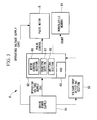
- Fig. 3 is a block diagram showing, in outline, the configuration of the motor control unit 6 according to this embodiment.
- the motor control unit 6 includes a microcomputer 62 that operates with an operating voltage of 5 V supplied from a drive power supply 61, an A/D converter 63 that operates with an operating voltage of 6 V supplied from the drive power supply 61, a nonvolatile memory 64 such as a ROM, and a voltage-drop detecting section 65 for detecting a voltage drop of the drive power supply 61.
- the microcomputer 62 includes a motor control section 66 for applying drive pulses as drive signals to the pulse motor 5, a counting section 67 for counting the number of drive pulses applied to the pulse motor 5, and a writing section 68 for writing the count from the counting section 67 in the nonvolatile memory 64 if the voltage-drop detecting section 65 detects a voltage drop.
- the motor control section 66 incorporated in the microcomputer 62 applies drive pulses corresponding to a target open/close value of the valve 3 to the pulse motor 5, thereby controlling the rotation angle of the pulse motor 5 to a desired angle.
- the diaphragm needle 14 is lifted or lowered, as described above, thus controlling the flow rate of the fluid flowing through the fluid channel 2.
- the counting section 67 counts the number of drive pulses applied to the pulse motor 5.
- the voltage-drop detecting section 65 detects the voltage drop of the drive power supply 61 and notifies the microcomputer 62.
- the writing section 68 of the microcomputer 62 reads a count from the counting section 67 and writes it in the nonvolatile memory 64. This allows the position of the pulse motor 5 to be stored in the nonvolatile memory 64 if the pulse motor 5 stops due to a power interruption during the driving, so that the position of the pulse motor 5 can readily be identified upon restarting.
- the voltage supplied from the drive power supply 61 to the voltage-drop detecting section 65 (herein referred to as the "power supply voltage"), as indicated by the solid line in Fig. 4 , drops gradually from time t1 and reaches zero at time t5.
- the microcomputer voltage supplied to the microcomputer 62 as indicated by the broken line in Fig. 4 , remains at 5 V for a predetermined period of time after the power supply voltage starts dropping at time t1, and drops gradually from time t3 and reaches zero at time t5.
- the start of the drop in power supply voltage and the start of the drop in microcomputer voltage are separated by a time difference (for example, about 130 ms) during which the writing section 68 writes the count in the nonvolatile memory 64.
- the period of time during which the writing section 68 can write in the nonvolatile memory 64 is a drive termination period from voltage-drop detection (at time t2 in Fig. 4 ), at which the drop in power supply voltage is detected due to the power supply voltage falling below a reference voltage V1 used as a reference by the voltage-drop detecting section 65, to drive termination (at time t4 in Fig. 4 ), at which the driving of the microcomputer 62 stops due to the microcomputer voltage falling below the minimum operating voltage V2 of the microcomputer.
- the drive termination period varies from device to device because it depends on, for example, the circuit configuration of the motor control unit 6; in some cases, there might be a possibility that the operation of the microcomputer 62 cannot be sustained until the writing section 68 finishes writing the count.
- the motor control unit 6 includes a period-adjusting component (period-adjusting section) for extending the drive termination period to a predetermined period of time or more.
- the predetermined period of time must at least be set to be longer than the writing period during which the writing section 68 built into the microcomputer 62 writes the count in the nonvolatile memory 64.
- Fig. 5 shows an example of the power system of the motor control unit 6.
- a voltage of 24 V output from the drive power supply 61 is input to a DC/DC converter 70 for the microcomputer.
- the DC/DC converter 70 lowers the voltage to a stable voltage of 5 V before supplying it to the microcomputer 62.
- the voltage output from the drive power supply 61 is also input to a power converter 71 for the A/D converter.
- the power converter 71 lowers the voltage to a stable voltage of 6 V before supplying it to the A/D converter 63.
- the voltage output from the drive power supply 61 is also input directly to the voltage-drop detecting section 65.
- a capacitor (period-adjusting section) 74 is provided between the DC/DC converter 70 for the microcomputer and the microcomputer 62. This allows the time at which the microcomputer voltage drops, namely, time t3, as shown in Fig. 4 , to be delayed. As a result, the drive termination period can be extended. The time at which the microcomputer voltage drops can be adjusted by adjusting the capacitance of the capacitor 74.
- Fig. 6 is a diagram showing an example of the circuit configuration of the voltage-drop detecting section 65.
- an input terminal 90 through which the power supply voltage of the drive power supply 61 is input is connected to ground through a series-connected Zener diode set 91 and a resistor divider R2.
- the Zener diode set 91 includes a 9 V Zener diode D1 and a 10 V Zener diode D3 that are connected in series.
- a node between the Zener diode set 91 and the resistor R2 is connected to, for example, a comparator (not shown) through a resistor R1.
- a power supply voltage of 24 V input from the drive power supply to the input terminal 90 is divided by the Zener diode set (period-adjusting section) 91 and the resistor R2 and is input to the comparator (not shown) through the resistor R1 (the voltage input to the comparator will be hereinafter referred to as the "detection voltage").
- the detection voltage input to one terminal of the comparator is compared with a reference voltage input to the other terminal of the comparator, and the comparison result is output to the microcomputer 62. If the detection voltage falls below the reference voltage after a drop in the power supply voltage input to the input terminal 90, the output of the comparator is reversed, so that the microcomputer 62 can be notified of the voltage drop.
- the power supply voltage input to the input terminal 90 is divided by the Zener diode set 91 and the resistor R2.
- the motor control unit 6 As described above, if the voltage supplied from the drive power supply 61 is interrupted, this state is quickly detected, and the current count is stored in the nonvolatile memory 64. The count is read from the nonvolatile memory 64 upon restarting, so that the position of the pulse motor 5, in other words, the position of the valve 3, can readily be identified. This eliminates the need for conventional origin retrieval control, thus reducing the time to shift from activation to normal operation.
- the pulse motor can always be driven within its range of motion because the position of the pulse motor 5 can be identified without moving it. This avoids biting of a screw part.
- the size of the apparatus can be reduced because the need for a position-detecting sensor such as a rotary encoder can be eliminated.
- the flow rate controller Upon activation of the flow rate controller according to this embodiment, for example, it may be shifted to normal drive control after the motor control unit 6 returns the valve 3 to the origin by reading the count written in the nonvolatile memory 64 and returning the pulse motor 5 to the original position based on the count.
Landscapes
- Engineering & Computer Science (AREA)
- General Engineering & Computer Science (AREA)
- Mechanical Engineering (AREA)
- Power Engineering (AREA)
- Physics & Mathematics (AREA)
- General Physics & Mathematics (AREA)
- Automation & Control Theory (AREA)
- Electrically Driven Valve-Operating Means (AREA)
- Indication Of The Valve Opening Or Closing Status (AREA)
- Flow Control (AREA)
- Control Of Stepping Motors (AREA)
Applications Claiming Priority (2)
| Application Number | Priority Date | Filing Date | Title |
|---|---|---|---|
| JP2006128922A JP5111780B2 (ja) | 2006-05-08 | 2006-05-08 | バルブ制御装置および流量コントローラ |
| PCT/JP2007/059487 WO2007129697A1 (ja) | 2006-05-08 | 2007-05-08 | バルブ制御装置および流量コントローラ |
Publications (3)
| Publication Number | Publication Date |
|---|---|
| EP2017513A1 true EP2017513A1 (de) | 2009-01-21 |
| EP2017513A4 EP2017513A4 (de) | 2017-12-06 |
| EP2017513B1 EP2017513B1 (de) | 2024-07-03 |
Family
ID=38667805
Family Applications (1)
| Application Number | Title | Priority Date | Filing Date |
|---|---|---|---|
| EP07742922.3A Active EP2017513B1 (de) | 2006-05-08 | 2007-05-08 | Ventilsteuerungsvorrichtung |
Country Status (5)
| Country | Link |
|---|---|
| US (1) | US8172199B2 (de) |
| EP (1) | EP2017513B1 (de) |
| JP (1) | JP5111780B2 (de) |
| KR (1) | KR101296508B1 (de) |
| WO (1) | WO2007129697A1 (de) |
Cited By (5)
| Publication number | Priority date | Publication date | Assignee | Title |
|---|---|---|---|---|
| CN102052500A (zh) * | 2009-11-09 | 2011-05-11 | 项晓明 | 非侵入式智能型阀门电动装置 |
| CN102359638A (zh) * | 2011-08-13 | 2012-02-22 | 黄山良业阀门有限公司 | 现场总线与无线控制的阀门电动装置 |
| CN102840371A (zh) * | 2012-09-04 | 2012-12-26 | 绍兴文理学院 | 一种cdma网络的远程电阀门控制系统 |
| CN104864151A (zh) * | 2015-05-19 | 2015-08-26 | 西安恒隆电气有限公司 | 物联网平衡阀及其控制方法 |
| EP2216700B1 (de) * | 2009-02-10 | 2017-07-12 | Surpass Industry Co., Ltd. | Durchflussregler |
Families Citing this family (14)
| Publication number | Priority date | Publication date | Assignee | Title |
|---|---|---|---|---|
| US20090241935A1 (en) * | 2008-03-26 | 2009-10-01 | Athir Jaaz | Gas cooking appliance |
| JP5386881B2 (ja) * | 2008-08-07 | 2014-01-15 | セイコーエプソン株式会社 | ラベル用紙の頭出し制御方法およびラベルプリンタ |
| KR101043742B1 (ko) * | 2009-06-04 | 2011-06-22 | 한길용 | 스테핑 모터 제어 장치 |
| KR101647649B1 (ko) * | 2009-06-08 | 2016-08-11 | 코웨이 주식회사 | 디스크 부재를 구동시키는 스테핑 모터 제어장치 및 제어방법 |
| ATE555340T1 (de) * | 2009-10-16 | 2012-05-15 | Diener Prec Pumps Ltd | Elektronischer adapter zur ansteuerung der bistabilen ventile |
| JP2011220451A (ja) * | 2010-04-09 | 2011-11-04 | Saginomiya Seisakusho Inc | 電動弁のパルス駆動装置およびこれを備えた電動弁の制御システム |
| HK1199851A1 (en) | 2011-09-21 | 2015-07-24 | Bayer Healthcare Llc | Continuous multi-fluid pump device, drive and actuating system and method |
| HRP20250654T1 (hr) | 2015-01-09 | 2025-07-18 | Bayer Healthcare Llc | Višestruki sustav za isporuku tekućine s višenamjenskim jednokratnim kompletom i njegove značajke |
| KR101706602B1 (ko) * | 2015-12-01 | 2017-02-15 | 주식회사 큐플러스 | 스테핑 제어에 의한 유량조절 밸브의 제어장치 |
| JP6764316B2 (ja) * | 2016-10-31 | 2020-09-30 | 株式会社不二工機 | 電動弁制御装置及びそれを備えた電動弁装置 |
| WO2019098360A1 (ja) * | 2017-11-20 | 2019-05-23 | 株式会社不二工機 | 電動弁制御装置およびそれを備えた電動弁装置 |
| JP6757088B2 (ja) * | 2019-10-07 | 2020-09-16 | 株式会社不二工機 | 電動弁制御装置及びそれを備えた電動弁装置 |
| JP2021173394A (ja) * | 2020-04-30 | 2021-11-01 | アドバンス電気工業株式会社 | 電動流量調節弁 |
| JP2024009698A (ja) * | 2022-07-11 | 2024-01-23 | 株式会社カワデン | 電動弁、電動弁システム、電動弁モニタユニット、電動弁用端子台装置および電動弁モニタシステム |
Family Cites Families (22)
| Publication number | Priority date | Publication date | Assignee | Title |
|---|---|---|---|---|
| JPS6154502A (ja) * | 1984-08-24 | 1986-03-18 | Mitsubishi Electric Corp | 数値制御装置 |
| WO1986002431A1 (en) * | 1984-10-11 | 1986-04-24 | Matsushita Electric Industrial Co., Ltd. | Apparatus for shutting off gas |
| US4694861A (en) * | 1986-12-22 | 1987-09-22 | Beckman Instruments, Inc. | Rotary pinch valve |
| US5240022A (en) * | 1991-10-03 | 1993-08-31 | Franklin Robert C | Automatic shutoff valve |
| JP3283081B2 (ja) * | 1992-12-18 | 2002-05-20 | 株式会社東海理化電機製作所 | パワーウィンドウ制御装置 |
| JPH07322693A (ja) * | 1994-05-24 | 1995-12-08 | Canon Inc | ステッピングモータ駆動装置およびステッピングモータ駆動手段を用いた記録装置 |
| CN1244932A (zh) * | 1996-12-12 | 2000-02-16 | 美国标准公司 | 流体流量伺服控制用阀系统 |
| US6186471B1 (en) * | 1998-05-15 | 2001-02-13 | Taco, Inc. | Electronic motorized zone valve |
| US5977737A (en) * | 1998-09-09 | 1999-11-02 | Labriola, Ii; Donald P. | Digital motor driver circuit and method |
| WO2000031471A1 (en) * | 1998-11-24 | 2000-06-02 | Matsushita Electric Industrial Co., Ltd. | Gas flow rate controller and gas appliance using the same |
| JP4028291B2 (ja) * | 2002-05-16 | 2007-12-26 | 株式会社鷺宮製作所 | 電動弁の駆動装置及び冷凍サイクル装置 |
| JP3654645B2 (ja) * | 2002-05-21 | 2005-06-02 | 三菱電機株式会社 | モータ駆動系の異常検出装置 |
| JP4158086B2 (ja) | 2002-05-29 | 2008-10-01 | 日本パルスモーター株式会社 | 位置決め動作装置及びその原点設定方法 |
| JP3876847B2 (ja) * | 2003-03-26 | 2007-02-07 | 株式会社デンソー | 電動アクチュエータシステム |
| KR100522545B1 (ko) * | 2003-03-28 | 2005-10-19 | 삼성전자주식회사 | 질량 유량 제어기 |
| JP4311981B2 (ja) | 2003-05-20 | 2009-08-12 | 東京計装株式会社 | バルブ制御装置およびその原点検索方法 |
| JP4196345B2 (ja) * | 2004-02-18 | 2008-12-17 | 株式会社デンソー | バルブ開閉制御装置 |
| JP4160522B2 (ja) * | 2004-03-11 | 2008-10-01 | リンナイ株式会社 | 電動弁装置 |
| US7789370B2 (en) * | 2004-04-23 | 2010-09-07 | Vetco Gray Scandanavia As | Actuator system |
| US20060238039A1 (en) * | 2005-04-06 | 2006-10-26 | Parker-Hannifin Corporation | Step motor valve assembly with fail-safe feature |
| US7556238B2 (en) * | 2005-07-20 | 2009-07-07 | Fisher Controls International Llc | Emergency shutdown system |
| US7377479B1 (en) * | 2006-11-28 | 2008-05-27 | Shui-Ching Chen | Position restoring apparatus for an open and close device |
-
2006
- 2006-05-08 JP JP2006128922A patent/JP5111780B2/ja active Active
-
2007
- 2007-05-08 US US12/226,367 patent/US8172199B2/en active Active
- 2007-05-08 WO PCT/JP2007/059487 patent/WO2007129697A1/ja not_active Ceased
- 2007-05-08 EP EP07742922.3A patent/EP2017513B1/de active Active
- 2007-05-08 KR KR1020087025745A patent/KR101296508B1/ko active Active
Non-Patent Citations (1)
| Title |
|---|
| See references of WO2007129697A1 * |
Cited By (6)
| Publication number | Priority date | Publication date | Assignee | Title |
|---|---|---|---|---|
| EP2216700B1 (de) * | 2009-02-10 | 2017-07-12 | Surpass Industry Co., Ltd. | Durchflussregler |
| CN102052500A (zh) * | 2009-11-09 | 2011-05-11 | 项晓明 | 非侵入式智能型阀门电动装置 |
| CN102359638A (zh) * | 2011-08-13 | 2012-02-22 | 黄山良业阀门有限公司 | 现场总线与无线控制的阀门电动装置 |
| CN102840371A (zh) * | 2012-09-04 | 2012-12-26 | 绍兴文理学院 | 一种cdma网络的远程电阀门控制系统 |
| CN102840371B (zh) * | 2012-09-04 | 2014-06-11 | 绍兴文理学院 | 一种cdma网络的远程电阀门控制系统 |
| CN104864151A (zh) * | 2015-05-19 | 2015-08-26 | 西安恒隆电气有限公司 | 物联网平衡阀及其控制方法 |
Also Published As
| Publication number | Publication date |
|---|---|
| WO2007129697A1 (ja) | 2007-11-15 |
| US8172199B2 (en) | 2012-05-08 |
| EP2017513B1 (de) | 2024-07-03 |
| JP2007298158A (ja) | 2007-11-15 |
| JP5111780B2 (ja) | 2013-01-09 |
| KR20090013173A (ko) | 2009-02-04 |
| KR101296508B1 (ko) | 2013-08-13 |
| EP2017513A4 (de) | 2017-12-06 |
| US20090230339A1 (en) | 2009-09-17 |
Similar Documents
| Publication | Publication Date | Title |
|---|---|---|
| US8172199B2 (en) | Valve control apparatus and flow rate controller | |
| JP5027729B2 (ja) | 流量自己診断機能を備えた圧力式流量制御装置の圧力制御弁用駆動回路 | |
| US20200063890A1 (en) | Valve position control | |
| WO2015088432A1 (en) | Method and system for diagnose of a solenoid valve | |
| CN1991222B (zh) | 电磁控制阀控制器 | |
| JPH024432B2 (de) | ||
| US5329214A (en) | Motor drive circuit | |
| JP3634459B2 (ja) | 電磁弁の駆動制御方法 | |
| US20090132114A1 (en) | Control Device and Adjusting Mechanism of a Motor Vehicle | |
| JP4775693B2 (ja) | 2線式伝送器 | |
| US10437201B1 (en) | Compensated actuator system | |
| US20240118719A1 (en) | Valve System | |
| CA1297526C (en) | Solenoid response detector | |
| JP7652402B1 (ja) | 制御装置、磁気テープ装置、および制御方法 | |
| US6836088B2 (en) | Motor driving circuit | |
| JP5796536B2 (ja) | 電子回路 | |
| US5214544A (en) | Apparatus for generating a track zero signal in a floppy disc driver without an optical track zero sensor | |
| JPH04302308A (ja) | 自動バルブの指令信号読取方法 | |
| JP2000018426A (ja) | 遮断弁駆動制御方法 | |
| US20100131967A1 (en) | Storage medium changer | |
| JP2003185243A (ja) | 省電力仕様の給湯装置 | |
| JP2016176236A (ja) | 便器洗浄装置 | |
| JPH05284770A (ja) | モーターの駆動制御装置 | |
| KR19980027928A (ko) | 컴팩트 디스크 드라이브의 트레이 이동 감지 방법 | |
| JPH02247804A (ja) | 書込み誤動作防止方式 |
Legal Events
| Date | Code | Title | Description |
|---|---|---|---|
| PUAI | Public reference made under article 153(3) epc to a published international application that has entered the european phase |
Free format text: ORIGINAL CODE: 0009012 |
|
| 17P | Request for examination filed |
Effective date: 20081020 |
|
| AK | Designated contracting states |
Kind code of ref document: A1 Designated state(s): AT BE BG CH CY CZ DE DK EE ES FI FR GB GR HU IE IS IT LI LT LU LV MC MT NL PL PT RO SE SI SK TR |
|
| AX | Request for extension of the european patent |
Extension state: AL BA HR MK RS |
|
| RBV | Designated contracting states (corrected) |
Designated state(s): DE |
|
| DAX | Request for extension of the european patent (deleted) | ||
| RIC1 | Information provided on ipc code assigned before grant |
Ipc: H02P 8/42 20060101ALI20171025BHEP Ipc: F16K 31/04 20060101AFI20171025BHEP Ipc: F16K 37/00 20060101ALI20171025BHEP Ipc: G05D 7/06 20060101ALI20171025BHEP |
|
| RA4 | Supplementary search report drawn up and despatched (corrected) |
Effective date: 20171106 |
|
| STAA | Information on the status of an ep patent application or granted ep patent |
Free format text: STATUS: EXAMINATION IS IN PROGRESS |
|
| 17Q | First examination report despatched |
Effective date: 20181204 |
|
| REG | Reference to a national code |
Ref country code: DE Ref legal event code: R079 Ref document number: 602007061885 Country of ref document: DE Free format text: PREVIOUS MAIN CLASS: F16K0031040000 Ipc: G05D0007060000 Ref country code: DE Ref legal event code: R079 Free format text: PREVIOUS MAIN CLASS: F16K0031040000 Ipc: G05D0007060000 |
|
| GRAP | Despatch of communication of intention to grant a patent |
Free format text: ORIGINAL CODE: EPIDOSNIGR1 |
|
| STAA | Information on the status of an ep patent application or granted ep patent |
Free format text: STATUS: GRANT OF PATENT IS INTENDED |
|
| RIC1 | Information provided on ipc code assigned before grant |
Ipc: F16K 37/00 20060101ALI20231127BHEP Ipc: H02P 8/42 20060101ALI20231127BHEP Ipc: F16K 31/04 20060101ALI20231127BHEP Ipc: H02P 8/26 20060101ALI20231127BHEP Ipc: G05D 7/06 20060101AFI20231127BHEP |
|
| INTG | Intention to grant announced |
Effective date: 20231213 |
|
| GRAS | Grant fee paid |
Free format text: ORIGINAL CODE: EPIDOSNIGR3 |
|
| GRAA | (expected) grant |
Free format text: ORIGINAL CODE: 0009210 |
|
| STAA | Information on the status of an ep patent application or granted ep patent |
Free format text: STATUS: THE PATENT HAS BEEN GRANTED |
|
| AK | Designated contracting states |
Kind code of ref document: B1 Designated state(s): DE |
|
| REG | Reference to a national code |
Ref country code: DE Ref legal event code: R096 Ref document number: 602007061885 Country of ref document: DE |
|
| REG | Reference to a national code |
Ref country code: DE Ref legal event code: R097 Ref document number: 602007061885 Country of ref document: DE |
|
| PLBE | No opposition filed within time limit |
Free format text: ORIGINAL CODE: 0009261 |
|
| STAA | Information on the status of an ep patent application or granted ep patent |
Free format text: STATUS: NO OPPOSITION FILED WITHIN TIME LIMIT |
|
| 26N | No opposition filed |
Effective date: 20250404 |
|
| PGFP | Annual fee paid to national office [announced via postgrant information from national office to epo] |
Ref country code: DE Payment date: 20250521 Year of fee payment: 19 |