EP2012255B1 - Bildverarbeitungsgerät und Bildverarbeitungsverfahren - Google Patents
Bildverarbeitungsgerät und Bildverarbeitungsverfahren Download PDFInfo
- Publication number
- EP2012255B1 EP2012255B1 EP08158565A EP08158565A EP2012255B1 EP 2012255 B1 EP2012255 B1 EP 2012255B1 EP 08158565 A EP08158565 A EP 08158565A EP 08158565 A EP08158565 A EP 08158565A EP 2012255 B1 EP2012255 B1 EP 2012255B1
- Authority
- EP
- European Patent Office
- Prior art keywords
- face
- pixels
- image
- face part
- score
- Prior art date
- Legal status (The legal status is an assumption and is not a legal conclusion. Google has not performed a legal analysis and makes no representation as to the accuracy of the status listed.)
- Ceased
Links
Images



Classifications
-
- G—PHYSICS
- G06—COMPUTING OR CALCULATING; COUNTING
- G06V—IMAGE OR VIDEO RECOGNITION OR UNDERSTANDING
- G06V40/00—Recognition of biometric, human-related or animal-related patterns in image or video data
- G06V40/10—Human or animal bodies, e.g. vehicle occupants or pedestrians; Body parts, e.g. hands
- G06V40/16—Human faces, e.g. facial parts, sketches or expressions
- G06V40/161—Detection; Localisation; Normalisation
- G06V40/165—Detection; Localisation; Normalisation using facial parts and geometric relationships
Definitions
- the present invention contains subject matter related to Japanese Patent Application JP 2007-177007 filed in the Japanese Patent Office on July 5, 2007.
- the present invention relates to image processing apparatuses and image processing methods for detecting and recognizing a face image included in a captured image, and, more particularly, to an image processing apparatus and an image processing method for detecting the positions of parts of a face such as the centers, inner corners, and outer corners of eyes, a nose, the lower end and sides of the nose, a mouth, the ends of the mouth, eyebrows, and the inner corners and outer corners of the eyebrows from a face image detected from an input image.
- the present invention relates to image processing apparatuses and image processing methods for detecting the positions of parts of a face from a face image using a detector employing a statistical learning algorithm such as Adaboost, and, more particularly, to an image processing apparatus and an image processing method for detecting the positions of parts of a face such as eyes from a face image detected by face detection with smaller amounts of computation and memory.
- Face recognition techniques can be widely applied to man-machine interfaces such as a personal identification system that does not impose a burden on users and a sex determination system.
- face recognition techniques have been used for automization of camera work for subject detection or subject recognition in a digital camera, for example, automatic focusing (AF), autoexposure (AE), automatic setting of the angle of view, or automatic photographing.
- face detection for detecting the position of a face image and extracting the detected face image as a detected face
- face part detection for detecting main parts of a face from the detected face
- face recognition for recognizing the detected face (specifying a person)
- face detection the size and position of a face image are detected from an input image and the detected face image is extracted as a detected face.
- face part detection face parts are detected from the detected face.
- the face parts include the centers, inner corners, and outer corners of eyes, a nose, the lower end and sides of the nose, a mouth, the ends of the mouth, eyebrows, and the inner corners and outer corners of the eyebrows.
- a detector employing a statistics learning algorithm such as Adaboost can be used for the above-described face detection.
- Adaboost was proposed by Freund et al. in 1996 as a theory in which a "strong classifier” can be obtained by combining many "weak classifiers (also called Weak Learners) that perform slightly better than random guessing".
- Each weak classifier may be a filter such as the Haar basis function, and is generated in such a manner that a weight ⁇ is assigned to the result of classification that a previously generated weak classifier is not good at.
- the reliability of each weak classifier is obtained, and, on the basis of the obtained reliability of each weak classifier, a majority vote is performed.
- a method of fixing the resolution of an image that is, a method of preparing various face detectors for various sized faces included in an input image
- a method of fixing the size of a detected face that is, a method of variously reducing the resolution of an input image for detection using a single face detector having a fixed detectable face size.
- search window A window of the same size as a learning sample is usually cut out from each image obtained by converting the scale of an input image so as to search for different sized search windows.
- an input image composed of 320 x 240 pixels includes search windows of approximately 5,000 sizes, and weak discriminators take a long time to perform arithmetic operations on all the window sizes. Accordingly, some methods of enhancing the speed of the arithmetic operation of the weak discriminator have been proposed.
- an object detection device in which, at the time of the majority vote, a window image is determined to be a non-object using obtained calculation results even in the course of calculation without waiting until all weak discriminators individually output calculation results and then further calculation is canceled.
- a threshold value used to cancel calculation is learnt in a learning session (see, for example, Japanese Unexamined Patent Application Publication No. 2005-157679 ). As a result, the amount of computation in the process of detecting an object can be markedly reduced.
- a detector employing the Adaboost algorithm can detect a face from a complex image scene using only a gradation pattern of an image signal of the scene. The inventors consider that this kind of detector can also be applied to detection of face parts.
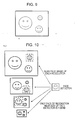
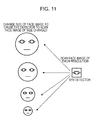
- a face part detector of a fixed size is caused to scan each face image detected from an input image while changing the resolution of the face image (see, for example, Fig. 11 ). That is, the resolution of each face image detected by a face detector is changed, and the face image is scanned by the face part detector, so that only a face part of resolution near the fixed size of the face part detector is detected.
- face parts such as the centers, inner corners, and outer corners of eyes, a nose, the lower end and sides of the nose, a mouth, the ends of the mouth, eyebrows, and the inner corners and outer corners of the eyebrows from a face image detected from an input image.
- An image processing apparatus processes an image including an image of a face according to claim 1.
- a method of detecting a face from a complex image scene using only a density pattern of an image signal a method of using a detector employing a statistics learning algorithm such as Adaboost is known. Since it is assumed that an input image includes various sized faces, a method of variously changing the resolution of the input image so as to cause a single detector having a fixed detectable face size to perform face detection each time the resolution of the face image is changed is known.
- Processing for further detecting the position of a face part such as an eye from a face image detected by the face detection basically corresponds to the processing for detecting a face image from a complex image scene using only a density pattern of an image signal. Accordingly, a face part detection method using the above-described statistical learning algorithm such as Adaboost can be considered.
- a face image obtained by the face detection is enlarged or reduced so that the size of a target face part included in the face image becomes an appropriate size detectable to a face part detector. That is, the face image is normalized in advance so that the resolution of the target face part is the same as the resolution of the face part detector. Subsequently, using only the face part detector of a fixed size, the face part is detected from the normalized face image.
- the face part detector scans only a single normalized face image including the image of a detected face detected by the face detector. That is, it is not necessary to variously change the resolution of each detected face and perform scanning each time the resolution is changed. As a result, the required amounts of computation and memory can be markedly reduced. Furthermore, since the number of scanning operations can be reduced, the speed of the face part detection can be enhanced.
- An image processing apparatus rapidly detects the position of a target face part such as an eye.
- the detection area setting unit sets an area smaller than the normalized face image as a detection area in which the position of the eye is detected.
- the detection unit defines a difference between luminance levels of at least two pixels included in the detection area as a weak hypothesis, and detects the position of the face part in the detection area using a final hypothesis defined using weak hypotheses obtained in advance by statistical learning.
- the detection unit sets a plurality of sets (for example, only several hundreds of sets) of two pixels between which there is a luminance level difference allowing easy extraction of a feature of a face part such as an eye, calculates a difference between luminance levels of two pixels included in each of the sets of two pixels, defines the calculation result as a weak hypothesis for the two pixels, and defines a final hypothesis using weak hypotheses obtained in advance by statistical learning.
- the group of the defined weak hypotheses each of which is a difference between luminance levels of two pixels included in 24 x 24 pixels is registered as a face part detection dictionary.
- the statistical learning is performed using a face image of the same resolution as the resolution of the face image normalized by the normalization unit.
- a detector employing the above-described face part detection dictionary scans the face image detected by a face detector.
- the difference between luminance levels of two pixels, which are included in each of the sets of two pixels and for which a weak hypothesis is defined is calculated. It is determined whether the calculation result matches the weak hypothesis for the two pixels.
- a sore for the two pixels is determined on the basis of the determination result.
- the scanning position is the position of the target face part.
- the size of a face image is normalized to a predetermined size in advance. Accordingly, using only a face part detector of a fixed size of, for example, 24 x 24 pixels, a face part can be detected from the normalized face image. Since the detection area setting unit sets an area smaller than the normalized face image as a detection area for the face part (for example, when a left eye is detected, an area which is smaller than the face image and in which the left eye is likely to exist is set as a scanning area of the detector instead of the entire area of the face image), the amounts of computation and memory required for face part detection can be reduced. As a result, the position of a target face part can be rapidly detected.
- the detection unit can determine that one of all the scanning positions having the highest positive score is the position of the target face part.
- a score limit value which indicates that there is no longer any possibility that the scanning position is the position of the target face part and is associated with the number of weak hypotheses, may be set by the statistical learning so as to reduce the number of weak hypotheses for which a face part detector performs computation.
- the limit value can be set on the basis of the lowest score associated with the number of weak hypotheses obtained from all pieces of input learning data.
- a score obtained from a certain number of weak hypotheses is compared with a corresponding limit value. If the score is lower than the corresponding limit value, it can be considered that the scanning position is very unlikely to be the position of the target face part. Accordingly, the subsequent score calculation is canceled, and a result representing that the scanning position is not the position of the target face part is returned.
- the detection unit is not required to scan at all points (X, Y) in the face part detection area (the area smaller than the entire area of a face image).
- score calculation is also performed at positions adjacent to the scanning position, at which score calculation is not performed by default, so as to set a position having the highest positive score as the position of a target face part.
- the target face part is each of left and right eyes.
- the normalization unit normalizes the position, size, and angle of the face image input from an input unit on the basis of the positions of both eyes detected by the detection unit and uses the normalization result for face recognition or another application.
- a method of normalizing a face image using information about the position of a face part other than both eyes can also be considered.
- a face image can be more accurately normalized using the positions of both eyes, because there is little difference in the distance between left and right eyes among individuals.
- an excellent image processing apparatus and an excellent image processing method capable of detecting the position of a face part from a face image using a detector employing a statistical learning algorithm such as Adaboost.
- an excellent image processing apparatus according to claim 1 and an excellent image processing method according to claim 10 capable of detecting the position of a face part such as an eye from a face image detected by face detection with smaller amounts of computation and memory.
- an image processing apparatus normalizes the size of a face image to a predetermined size in advance, it can detect a face part from the normalized face image using only a single face part detector of a fixed pixel size. Furthermore, since an area smaller than the normalized face image is set by the detection area setting unit as a detection area for the face part (for example, when a left eye is detected, an area which is smaller than the face image and in which the left eye is likely to exist is set as a scanning area of the detector instead of the entire area of the face image), the amounts of computation and memory required for face part detection can be reduced. As a result, the position of the face part can be rapidly detected.
- a score limit value is set for the number of weak hypotheses by performing statistical learning.
- score calculation at a certain scanning position when a score obtained from a certain number of weak hypotheses is lower than the corresponding limit value, subsequent score calculation is canceled.
- the cost required for score calculation can be reduced, and the speed of the face part detection can be enhanced.
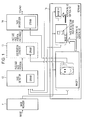
- FIG. 1 schematically illustrates the entire configuration of a face recognition system according to an embodiment of the present invention.
- a face recognition system 1 illustrated in the drawing includes an image reducer 11, a face detector 12, an eye position detector 13, a face recognizer 14, and a memory (SDRAM) 15 for storing a plurality of images.
- Each of the face detector 12, the eye position detector 13, and the face recognizer 14 includes a local memory (SDRAM).
- SDRAM local memory
- the image reducer 11 reduces the horizontal and vertical sizes of an input image to 1/2 so as to create a reduced image, and stores the reduced image and the original input image in the SDRAM (Synchronous DRAM) 15.
- the image reducer 11 creates three images, an image 1 that is the input image, an image 1/2 by reducing the horizontal and vertical sizes of the input image to 1/2, and an image 1/4 by reducing the horizontal and vertical sizes of the input image to 1/4, and stores the created images in the SDRAM 15.
- the image 1/2 and the image 1/4 be directly created from the input image from the viewpoint of accuracy of computation.
- a method of repeatedly performing reduction of an image to one-half its original size, that is, creating the image 1/2 from an input image (the image 1) and then creating the image 1/4 from the image 1/2 may be used.
- the face detector 12 detects a face from each of the input image and all the reduced images stored in the SDRAM 15, and obtains the size and position of the detected face. If processing speed is left out of consideration, the face position can be easily obtained by performing face detection upon the entire area of an image. On the other hand, in the case of the detection of various sized faces, as a method of handling the problem of the relationship between the resolution of an image and the size of a detected face (see, Fig.
- a method of fixing the resolution of an image that is, a method of preparing various face detectors for various sized faces included in an input image
- a method of fixing the size of a detected face that is, a method of variously reducing the resolution of an input image for detection using a single face detector having a fixed detectable face size (see, Fig. 10 )
- the latter is more realistic than the former. Accordingly, as illustrated in Fig. 1 , the face detector 12 checks whether a face exists in an area of 24 x 24 pixels in each of the image 1 and the reduced images 1/2 and 1/4 created by the image reducer 11.
- the image reducer 11 may further create images 7/8, 6/8, and 5/8 using various reduction ratios of 7/8, 6/8, and 5/8 and the face detector 12 may perform face detection upon each of the created images.
- a pixel difference method can be used.
- sets of two pixels, between which there is a luminance level difference allowing easy extraction of a face feature are selected from among 24 x 24 pixels and the difference between luminance levels of two pixels is obtained in each of the sets of two pixels.
- the Adaboost algorithm may be used for computation of a classifier.
- the eye position detector 13 specifies positions of left and right eyes so as to normalize a face included in an image obtained by increasing the resolution of the face image detected by the face detector 12. That is, the eye position detector 13 detects the positions of the eyes so as to obtain, on the basis of the size and position of a face in a face image obtained by the face detection, the size, position, and angle of a face included in an image obtained by increasing the resolution of the face image.
- left and right eyes are detected from a face image as face parts.
- face parts such as the centers, inner corners, and outer corners of eyes, a nose, the lower end and sides of the nose, a mouth, the ends of the mouth, eyebrows, and the inner corners and outer corners of the eyebrows may be detected.
- the pixel difference method can be used for feature extraction at the time of detection of positions of both eyes.
- the eye position detector 13 performs the pixel difference method in the same area of 24 x 24 pixels. Accordingly, using the same hardware used by the face detector 12, continuous processing can be achieved.
- the Adaboost algorithm may be used for computation of a classifier.
- a detector composed of 24 x 24 pixels a plurality of sets of two pixels (for example, only several hundreds of sets of two pixels), between which there is a luminance level difference allowing easy extraction of the feature of en eye, are selected.
- the differences between luminance levels of two pixels in the sets of two pixels are defined as weak hypotheses, and, using weak hypotheses obtained in advance by statistical learning, a final hypothesis is defined.
- the group of the weak hypotheses each of which is the difference between luminance levels of two pixels included in 24 x 24 pixels is used in an eye detector, and is registered as a face part detection dictionary.
- the eye detector composed of 24 x 24 pixels is caused to scan the face image detected by the face detector 12.
- the difference between the luminance levels of two pixels for which a weak hypothesis is defined is calculated. It is determined whether the calculation result matches the weak hypothesis. On the basis of the determination result, a score is determined. The sum of scores for all the sets of two pixels is defined as a final hypothesis. On the basis of the final hypothesis, it can be determined whether the scanning position is an eye position.
- the feature of the present invention is that the position of a face part such as an eye, a mouth, or a nose is rapidly detected.
- a face part such as an eye, a mouth, or a nose
- the face recognizer 14 obtains the size, position, and angle of a face from the face image in which the positions of left and right eyes are specified by the eye position detector 13 so as to normalize the face image detected by the face detector 12, stores the normalized face image in SRAMs included in 60 x 66 pixels, and determines whether the normalized face image is the same as a registered image.
- a method of normalizing a face image using information about the position of a face part other than both eyes can also be considered.
- a face image can be more accurately normalized using the positions of both eyes, because there is little difference in the distance between left and right eyes among individuals.
- Gabor Filtering can be applied to feature extraction in face recognition performed by the face recognizer 14. It is known that human visual cells having selectivity for specific directions exist. The cells include cells responsive to vertical lines and cells responsive to horizontal lines. Similarly, a Gabor filter is a spatial filter formed by a plurality of filters having directional selectivity.
- Gentleboost is used for computation of a classifier performed in the face recognizer 14.
- the degree of similarity between a result of processing performed on the normalized face image using a Gabor filter and a result of processing performed on the image registered in advance using a Gabor filter is obtained.
- Gentleboost is executed for the degree of similarity so as to determine whether the face image matches the registered image.
- the face detector 12 employing a statistics learning algorithm such as Adaboost can be used. Since it is assumed that an input image includes various sized faces, the resolution of the input image is variously changed so as to cause a single detector having a fixed detectable face size to perform face detection each time the resolution of the face image is changed (see, Fig. 10 ).
- the eye position detector 13 for detecting the positions of left and right eyes that are face parts uses the pixel difference method for feature extraction, and is a detector employing a statistics learning algorithm such as Adaboost.
- a face image is normalized in advance so that the resolution of left and right eyes is the same as the resolution of an eye detector.
- a face image is normalized so that the size of the face image becomes 80 x 80 pixels.
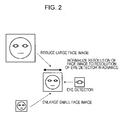
- the positions of eyes can be detected from the normalized face image of 80 x 80 pixels. That is, as illustrated in Fig. 2 , if a face image output from the face detector 12 is large, the face image is normalized in advance so that the resolution of the face image is the same as the resolution of an eye detector. On the other hand, if the face image is small, the face image is enlarged. As a result, it is not required to scan images of a plurality of resolutions. This enables rapid eye detection.
- Fig. 3 is a flowchart schematically illustrating a process of normalizing a face image and detecting eyes that are face parts.
- a face image is normalized so that the size of the face becomes a predetermined size (for example, each side of a face becomes 80 pixels) (step S2).
- an area including eyes in the normalized face image is set as an eye detection area, and an eye detector performs scanning in this eye detection area (step S3).
- the eye detector performs the pixel difference method, and the Adaboost algorithm is used for computation of a classifier.
- the size of the eye detector is 24 x 24 pixels while the size of the face image is 80 x 80 pixels.
- the eye detector sets a plurality of sets of two pixels (for example, only several hundreds of sets of two pixels), between which there is a luminance level difference allowing easy extraction of an eye feature, defines the difference between luminance levels of two pixels in each of the sets of two pixels as a weak hypothesis, and defines a final hypothesis using weak hypotheses obtained by statistical learning performed in advance.
- the statistical learning is performed so that the score of an eye (a target face part) becomes a positive value.
- the difference between luminance levels of two pixels, for which a weak hypothesis is defined is calculated in each of the sets of two pixels. It is determined whether the calculation result matches the weak hypothesis to determine a score.
- the sum of scores determined as described previously is stored as a score at the scanning position.
- a scanning position having the highest positive score is set as an eye position (step S4).
- a position having the highest positive score can be considered as the position of the target face part.
- step S5 the position of one of eyes is detected. Subsequently, the position of the other one of eyes is similarly detected by performing the process from step S3 to step S4 (step S5).
- step S6 the normalization of a face position is performed.
- scaling and rotation of the face are performed so that the eyes are adjusted to model eye positions determined in advance.
- a face image is obtained and is then used for an application at a subsequent stage, for example, a face recognition application.
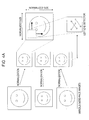
- Fig. 4 is a diagram schematically illustrating scanning of a normalized face image performed by a left eye detector.
- a face part such as a left eye
- the size of a face image is normalized to a size determined in advance, for example, the size of 80 x 80 pixels.
- the left eye detector scans the normalized face image.
- the left eye detector defines the difference between luminance levels of at least two pixels as a weak hypothesis, and obtains a final hypothesis by combining many weak hypotheses.
- the size of the face image is normalized to the size of 80 x 80 pixels.
- the left eye detector may not scan the entire area of the normalized face image.
- an area in which the left eye is likely to exist is set in advance as a left eye detection area.
- This face part detection area is a fixed area smaller than the normalized face image.
- the size of a face image is 80 x 80 pixels, while the size of an eye detector is 24 x 24 pixels.
- the left eye detector employing Adaboost statistical learning is performed so that a positive score is obtained at the position of the left eye. Accordingly, it can be considered that a position having the highest positive score, which is obtained after the left eye detector has scanned the above-described left eye detection area in X and Y directions, is the position of the target face part.
- the left eye detector is not required to scan at all points (X, Y) in the left eye detection area. By thinning out scanning positions as appropriate, a processing time required for detection can be reduced. This will be described in detail later.
- a face image as a face is performed as an application at a subsequent stage.
- preparations for the face recognition using a result of detection of both eyes performed by an eye detector functioning as a face part detector, on the basis of the size and position of a face in a face image detected by face detection, the size, position, and angle of a face in an image obtained by increasing the resolution of the face image are obtained.
- left and right eyes are detected from a face image as face parts. The reason for this is that there is little difference in the distance between left and right eyes among individuals. For example, as described previously, if the size of a face image is normalized to the size of 80 x 80 pixels, the width of each eye is 10 to 15 pixels, while the approximate distance between the eyes is 16 pixels.
- Fig. 5 illustrates an exemplary configuration of a left eye detector.
- the left eye detector composed of 24 x 24 pixels performs the pixel difference method, and uses the Adaboost algorithm for computation of a classifier.
- a plurality of sets of two pixels pix1(t) and pix2(t) (t is a positive integer of 1 to several hundreds of values), between which there is a luminance level difference allowing easy extraction of an eye feature, are set.
- a weak hypothesis representing that the difference between luminance levels of two pixels is lower than a threshold value ⁇ (t) is defined for each set of the two pixels pix1(t) and pix2(t).
- a final hypothesis is defined.
- the statistical learning is performed using a face image of the same resolution as that of a normalized face image.
- a weak hypothesis is defined for a set of two pixels between which there is a luminance level difference allowing easy extraction of an eye feature.
- a weight ⁇ (t) is therefore assigned to the set of the two pixels pix1(t) and pix2(t).
- a dictionary for left eye detection contains pieces of information about positions of the pixels pix1(t) and pix2(t), the threshold value ⁇ (t) for the difference between luminance levels of these pixels, and the weight ⁇ (t) (see, Fig. 5B ).
- This dictionary is prepared using Adaboost.
- the weak hypothesis h(t) is multiplied by the weight ⁇ (t) so as to obtain a score for the two pixels pix1(t) and pix2(t).
- the sum of scores for all sets of two pixels is defined as a final hypothesis at the scanning position.
- a position having the highest positive score which is obtained after the left eye detector has scanned the left eye detection area in the X and Y directions, is the position of a target face part.
- Fig. 5C illustrates the configuration of a face part detector in the form of program code.
- the value of score is initialized to zero at a scanning position.
- a value of h(t) ⁇ (t) obtained by multiplying the weak hypothesis h(t) by the weight ⁇ (t) is a score for the two pixels pix1(t) and pix2(t). The score of h(t) ⁇ (t) is added to score.
- the above-described score calculation is repeatedly performed for each of all sets of two pixels N times.
- the obtained score is a score at the scanning position (N is the number of all weak hypotheses, for example, several hundreds of values).
- Statistical learning is performed so that the score of an eye becomes a positive value. Accordingly, if score is a positive value, the response of true representing that the scanning position is the position of a target face part is returned. If score is not a positive value, the response of false representing that the scanning position is not the position of a target face part is returned.
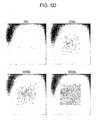
- Fig. 5D illustrates the definition of a weak hypothesis (Weak Learner: WL) that is the difference between luminance levels of two pixels in a predetermined face part detection area in a face image.
- WL Weak Learner
- examples in which the number of weak hypotheses is 2, 50, 100, and 500 are illustrated. It should be noted that gradation processing is performed upon a face image so as to prevent infringement on portrait rights.
- a face part detector for example, a left eye detector, includes weak hypotheses that are the differences between luminance levels of two pixels in several hundreds of sets of two pixels. In order to calculate a score at a scanning position, it is necessary to obtain luminance level differences of all the sets of two pixels. If scores at all scanning positions are calculated, the large amounts of computation and memory are required.
- the number of weak hypotheses computed by a face part detector may be reduced by statistical learning.
- statistical learning is performed so that the score of a target face part becomes a positive value.
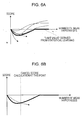
- a "limit value" representing that the evaluation or determination of a target face part cannot be performed even if score calculation is continued is obtained by statistical learning.
- This limit value can be set on the basis of the lowest score associated with the number of weak hypotheses obtained from all pieces of input learning data (see, Fig. 6A ).
- a score obtained from a certain number of weak hypotheses is compared with a corresponding limit value. If the score is lower than the corresponding limit value (see, Fig. 6B ), it can be considered that the scanning position is very unlikely to be the position of a target face part. Accordingly, the subsequent score calculation is canceled, and a result representing that the scanning position is not the position of the target face part is returned.
- the left eye detector is not required to scan at all points (X, Y) in the left eye detection area.
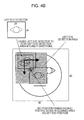
- Fig. 7 illustrates high-speed scanning performed in a face part detection area.
- default scanning positions are indicated by left-leaning hatching.
- default scanning positions are set at every other point in the horizontal direction (x direction), and scanning lines (lines in which scanning is performed at every other point) are set in every other row in the vertical direction (y direction).
- a score higher than a predetermined value is calculated at a scanning position
- score calculation is also performed at positions adjacent to the scanning position, at which score calculation is not performed by default, so as to set a position having the highest positive score as the position of a target face part.
- a scanning position at which a high score is calculated is crosshatched.
- score calculation is also performed.
- a target face part can be detected with one quarter the amount of computation required in a case in which score calculation is performed at all scanning positions while preventing the decrease in detection accuracy.
- Examples of a face part to be detected from a face image include left and right eyes.
- the face recognition face recognition system 1 is provided with the eye position detector 13 as a face part detector.
- the position, size, and angle of the face image input by an input unit are normalized.
- the normalized face image is subjected to face recognition (described previously) performed by the face recognizer 14, or can be used for another application using a detected face (not illustrated).
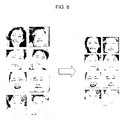
- Fig. 8 illustrates the results of normalization of detected face images which is performed on the basis of the sizes of the face images, and the results of normalization of positions, sizes, and angles of the normalized face images which is performed on the basis of the positions of eyes in the normalized face images. It can be understood from this drawing that randomly orientated faces can be accurately aligned by performing eye detection upon each face area image and normalizing the face area image on the basis of the detection result.
Landscapes
- Engineering & Computer Science (AREA)
- Physics & Mathematics (AREA)
- Health & Medical Sciences (AREA)
- Oral & Maxillofacial Surgery (AREA)
- Geometry (AREA)
- General Health & Medical Sciences (AREA)
- Human Computer Interaction (AREA)
- General Physics & Mathematics (AREA)
- Multimedia (AREA)
- Theoretical Computer Science (AREA)
- Image Analysis (AREA)
- Image Processing (AREA)
Claims (11)
- Bildverarbeitungsvorrichtung zum Verarbeiten eines Bildes, das ein Bild eines Gesichts enthält, umfassend:eine Gesichtserfassungseinrichtung (12) zum Erlangen einer ungefähren Größe eines Gesichts in einem Bild;eine Gesichtsteilerfassungseinrichtung (13) zum Erfassen einer Position eines Gesichtsteils des Gesichts in einem Bild, welches eine feste erfassbare Auflösung aufweist;eine Normalisierungseinrichtung zum Normalisieren des Bildes, welches das Gesicht enthält, basierend auf der Gesichtsgröße, so dass die Auflösung des Gesichts in etwa oder gleich der festen erfassbaren Auflösung wird;eine Erfassungsbereich-Festlegeeinrichtung zum Festlegen eines Bereichs, der kleiner ist als das von der Normalisierungseinrichtung normalisierte Bild, als einen Erfassungsbereich mit der festen erfassbaren Auflösung; undwobei die Gesichtsteilerfassungseinrichtung (13) dazu ausgelegt ist, die Position eines Gesichtsteils des Gesichts in dem Erfassungsbereich, der von der Erfassungsbereich-Einstelleinrichtung festgelegt wird, zu erfassen, durch Abtasten von Positionen in dem Erfassungsbereich mit einem Gesichtsteildetektor, der ein Bereich fester Pixelgröße ist, Berechnen eines Ergebnisses für jede Abtastposition und Bestimmen der Abtastposition, die das höchste Ergebnis aufweist, die Position des Gesichtsteils zu sein,wobei die Gesichtsteilerfassungseinrichtung (13) dazu ausgelegt ist, Abtastpositionen auszulassen, um nur einen Teil von allen Positionen in dem Erfassungsbereich abzutasten, aber ausgelassene Positionen abzutasten, die an Abtastpositionen angrenzen, für die ein Ergebnis höher als ein vorbestimmter Wert berechnet wird.
- Bildverarbeitungsvorrichtung gemäß Anspruch 1, wobei die Gesichtsteilerfassungseinrichtung (13) einen Unterschied zwischen den Leuchtstärkeniveaus von wenigstens zwei Pixeln, die in dem Erfassungsbereich enthalten sind, als eine schwache Annahme definiert und die Positionen des Gesichtsteils durch Verwendung einer endgültigen Annahme erfasst, die durch Verwendung von im Vorfeld durch statistisches Lernen erlangten schwachen Annahmen definiert wird.
- Bildverarbeitungsvorrichtung gemäß Anspruch 2, wobei in einem Anwendungsbereich der Gesichtsteilerfassungseinrichtung (13) die Gesichtsteilerfassungseinrichtung (13) mehrere Sätze von wenigstens zwei Pixeln festlegt, zwischen denen es einen Leuchtstärkeniveauunterschied gibt, der eine einfache Extraktion eines Merkmals eines Gesichtsteils erlaubt, einen Unterschied zwischen Leuchtstärkeniveaus von zwei Pixeln berechnet, die in jedem der zwei Sätze von wenigstens zwei Pixeln enthalten sind, und das Berechnungsresultat als eine schwache Annahme für die zwei Pixel definiert.
- Bildverarbeitungseinrichtung gemäß Anspruch 3, wobei, an jeder Abtastposition in dem Anwendungsbereich der Gesichtsteilerfassungseinrichtung (13), die Gesichtsteilerfassungseinrichtung (13) einen Unterschied zwischen Leuchtstärkeniveaus von zwei Pixeln berechnet, die in jedem der mehreren Sätze von wenigstens zwei Pixeln enthalten sind und für die die schwache Annahme definiert ist, bestimmt ob das Berechnungsresultat mit der schwachen Annahme für die zwei Pixel übereinstimmt, ein Ergebnis für die zwei Pixel auf der Basis des bestimmten Resultats bestimmt, und auf der Basis der Summe der Ergebnisse für alle der mehreren Sätze von wenigstens zwei Pixeln bestimmt ob die Abtastposition die Position des Gesichtsteils ist.
- Bildverarbeitungsvorrichtung gemäß Anspruch 4,
wobei das statistische Lernen so ausgeführt wird, dass ein Ergebnis eines Zielgesichtsteils ein positiver Wert wird,
wobei die Gesichtsteilerfassungseinrichtung (13) bestimmt, dass eine von allen Abtastpositionen, welche das höchste positive Ergebnis aufweist, die Position des Gesichtsteils ist. - Bildverarbeitungsvorrichtung gemäß Anspruch 5, die ferner eine Einstelleinrichtung zum Einstellen eines Ergebnisgrenzwerts auf der Basis des niedrigsten Ergebnisses aufweist, das mit der Anzahl der schwachen Annahmen zusammenhängt, die von allen Teilen von Lerndaten erlangt werden, die für das statistische Lernen verwendet werden, und
wobei, während einer Ergebnisberechnung an einer bestimmten Abtastposition, wenn ein Ergebnis, das aus einer bestimmten Anzahl von schwachen Annahmen erlangt wird, niedriger ist als der entsprechende Grenzwert, die Erfassungseinrichtung die Ergebnisberechnung abbricht. - Bildverarbeitungsvorrichtung gemäß Anspruch 6, wobei die Erfassungseinrichtung ein Resultat zurückgibt, das darstellt, dass die bestimmte Abtastposition nicht die Position des Zielgesichtsteils ist.
- Bildverarbeitungsvorrichtung gemäß einem der Ansprüche 1 bis 7,
wobei das Gesichtsteil jedes von linkem und rechtem Auge ist, und
wobei die Normalisierungseinrichtung eine Normalisierung basierend auf Positionen des linken und rechten Auges ausführt, die von der Erfassungseinrichtung erfasst werden. - Bildverarbeitungsvorrichtung gemäß Anspruch 1, die ferner umfasst:eine Definierungseinrichtung zum Festlegen mehrerer Sätze von wenigstens zwei Pixeln, die in einem Erfassungsbereich, in dem eine Position des Gesichtsteils des Gesichts erfasst wird, enthalten sind, Berechnen eines Unterschieds zwischen Leuchtstärkeniveaus von zwei Pixeln, die in jedem der mehreren Sätze von wenigstens zwei Pixeln enthalten sind, und Definieren des Berechnungsresultats als eine schwache Annahme für die zwei Pixel; undwobei die Gesichtsteilerfassungseinrichtung (13) dazu ausgelegt ist, an jeder Abtastposition in dem Erfassungsbereich einen Unterschied zwischen Leuchtstärkeniveaus der zwei Pixel zu berechnen, die in jedem der mehreren Sätze von wenigstens zwei Pixeln enthalten sind und für die die schwache Annahme definiert ist, zu bestimmen ob das Berechnungsresultat mit der schwachen Annahme für die zwei Pixel übereinstimmt, ein Ergebnis für die zwei Pixel auf der Basis des Berechnungsresultats zu bestimmen, und auf der Basis der Summe der Ergebnisse für alle der mehreren Sätze von wenigstens zwei Pixeln zu bestimmen ob die Abtastposition die Position des Gesichtsteils ist.
- Bildverarbeitungsverfahren zum Verarbeiten eines Bildes, das ein Bild eines Gesichts enthält, das die Schritte umfasst:Erlangen (S1) einer ungefähren Größe und Position eines Gesichts in einem Bild;Normalisieren (S2) des Bildes, welches das Gesicht enthält, basierend auf der Gesichtsgröße, so dass die Auflösung des Gesichts in etwa oder gleich einer festen erfassbaren Auflösung wird;Festlegen eines Bereichs, der kleiner ist als das normalisierte Bild, als einen Erfassungsbereich mit der festen erfassbaren Auflösung, in dem eine Position eines Gesichtsteils des Gesichts erfasst wird;Erfassen (S3, S4, S5) der Position des Gesichtsteils des Gesichts in dem Erfassungsbereich, der die feste erfassbare Auflösung hat, durch Abtasten von Positionen in dem Erfassungsbereich mit einem Gesichtsteildetektor, der ein Bereich fester Pixelgröße ist, Berechnen eines Ergebnisses für jede Abtastposition und Bestimmen der Abtastposition, die das höchste Ergebnis aufweist, die Position des Gesichtsteils zu sein,wobei das Erfassen dazu ausgelegt ist, Abtastpositionen auszulassen, um nur einen Teil von allen Positionen in dem Erfassungsbereich abzutasten, aber ausgelassene Positionen abzutasten, die an Abtastpositionen angrenzen, für die ein Ergebnis höher als ein vorbestimmter Wert berechnet wird.
- Bildverarbeitungsverfahren gemäß Anspruch 10, das ferner die Schritte umfasst:Festlegen mehrerer Sätze von wenigstens zwei Pixeln, die in einem Erfassungsbereich, in dem eine Position des Gesichtsteils des Gesichts erfasst wird, enthalten sind, Berechnen eines Unterschieds zwischen Leuchtstärkeniveaus von zwei Pixeln, die in jedem der mehreren Sätze von wenigstens zwei Pixeln enthalten sind und Definieren des Berechnungsresultats als eine schwache Annahme für die zwei Pixel; undBerechnen, an jeder Abtastposition (S3) in dem Erfassungsbereich, eines Unterschieds zwischen Leuchtstärkeniveaus der zwei Pixel, die in jedem der mehreren Sätze von wenigstens zwei Pixeln enthalten sind und für die die schwache Annahme definiert ist, Bestimmen ob das Berechnungsresultat mit der schwachen Annahme für die zwei Pixel übereinstimmt, Bestimmen eines Ergebnisses für die zwei Pixel auf der Basis des Berechnungsresultats und Bestimmen auf der Basis der Summe der Ergebnisse für alle der mehreren Sätze von wenigstens zwei Pixeln ob die Abtastposition die Position des Gesichtsteils ist.
Applications Claiming Priority (1)
| Application Number | Priority Date | Filing Date | Title |
|---|---|---|---|
| JP2007177007A JP4479756B2 (ja) | 2007-07-05 | 2007-07-05 | 画像処理装置及び画像処理方法、並びにコンピュータ・プログラム |
Publications (2)
| Publication Number | Publication Date |
|---|---|
| EP2012255A1 EP2012255A1 (de) | 2009-01-07 |
| EP2012255B1 true EP2012255B1 (de) | 2012-09-19 |
Family
ID=39745040
Family Applications (1)
| Application Number | Title | Priority Date | Filing Date |
|---|---|---|---|
| EP08158565A Ceased EP2012255B1 (de) | 2007-07-05 | 2008-06-19 | Bildverarbeitungsgerät und Bildverarbeitungsverfahren |
Country Status (5)
| Country | Link |
|---|---|
| US (1) | US8463049B2 (de) |
| EP (1) | EP2012255B1 (de) |
| JP (1) | JP4479756B2 (de) |
| CN (1) | CN101339609B (de) |
| TW (1) | TWI380223B (de) |
Families Citing this family (21)
| Publication number | Priority date | Publication date | Assignee | Title |
|---|---|---|---|---|
| US7630006B2 (en) | 1997-10-09 | 2009-12-08 | Fotonation Ireland Limited | Detecting red eye filter and apparatus using meta-data |
| US20110102643A1 (en) * | 2004-02-04 | 2011-05-05 | Tessera Technologies Ireland Limited | Partial Face Detector Red-Eye Filter Method and Apparatus |
| TWI427545B (zh) * | 2009-11-16 | 2014-02-21 | Univ Nat Cheng Kung | 以尺度不變特徵轉換和人臉角度估測為基礎的人臉辨識方法 |
| JP2012203613A (ja) | 2011-03-25 | 2012-10-22 | Sony Corp | 画像処理装置および方法、記録媒体並びにプログラム |
| JP5774889B2 (ja) * | 2011-03-31 | 2015-09-09 | 株式会社ソニー・コンピュータエンタテインメント | 情報処理装置、情報処理システム、および情報処理方法 |
| CN103563350B (zh) * | 2011-05-31 | 2016-09-28 | 松下知识产权经营株式会社 | 图像处理装置、图像处理方法以及数码相机 |
| JP5285748B2 (ja) * | 2011-07-08 | 2013-09-11 | 富士フイルム株式会社 | オブジェクト検出装置、方法およびプログラム |
| JP5772420B2 (ja) * | 2011-09-09 | 2015-09-02 | 住友電気工業株式会社 | 特徴量抽出装置、対象物検出システム、コンピュータプログラム及び特徴量抽出方法 |
| KR101175597B1 (ko) * | 2011-09-27 | 2012-08-21 | (주)올라웍스 | 아다부스트 학습 알고리즘을 이용하여 얼굴 특징점 위치를 검출하기 위한 방법, 장치, 및 컴퓨터 판독 가능한 기록 매체 |
| JP5841418B2 (ja) * | 2011-12-01 | 2016-01-13 | キヤノン株式会社 | 情報処理装置、情報処理方法、及びプログラム |
| TWI513291B (zh) | 2013-12-12 | 2015-12-11 | 財團法人工業技術研究院 | 影像處理的方法、裝置及電腦可讀取媒體 |
| US10592727B2 (en) * | 2014-07-28 | 2020-03-17 | Centre For Development Of Advanced Computing | Apparatus for automated monitoring of facial images and a process therefor |
| JP6447955B2 (ja) * | 2014-12-09 | 2019-01-09 | 富士ゼロックス株式会社 | 画像処理装置およびプログラム |
| CN104778481B (zh) * | 2014-12-19 | 2018-04-27 | 五邑大学 | 一种大规模人脸模式分析样本库的构建方法和装置 |
| CN105404868B (zh) * | 2015-11-19 | 2019-05-10 | 电子科技大学 | 一种基于交互平台的复杂背景中文本的快速检测方法 |
| CN106325519A (zh) * | 2016-08-31 | 2017-01-11 | 周口师范学院 | 基于眼睛检测的终端屏幕控制装置和方法 |
| CN106600855A (zh) * | 2016-12-22 | 2017-04-26 | 河南牧业经济学院 | 基于面部识别的支付装置和方法 |
| CN109559535A (zh) * | 2018-11-22 | 2019-04-02 | 深圳市博远交通设施有限公司 | 一种一体化人脸识别的动态声光协调交通信号系统 |
| CN109696788B (zh) * | 2019-01-08 | 2021-12-14 | 武汉精立电子技术有限公司 | 一种基于显示面板的快速自动对焦方法 |
| KR102923128B1 (ko) * | 2019-12-12 | 2026-02-05 | 현대자동차주식회사 | 안면 인식 잠금 해제 장치 및 그것의 동작방법 |
| CN115083592A (zh) * | 2022-05-10 | 2022-09-20 | 中国人民解放军总医院第一医学中心 | 一种基于面部识别的失血性休克辅助诊疗装置 |
Citations (1)
| Publication number | Priority date | Publication date | Assignee | Title |
|---|---|---|---|---|
| WO2006001525A1 (en) * | 2004-06-28 | 2006-01-05 | Canon Kabushiki Kaisha | Object recognition method and apparatus therefor |
Family Cites Families (21)
| Publication number | Priority date | Publication date | Assignee | Title |
|---|---|---|---|---|
| DK1277749T3 (da) * | 1996-08-05 | 2007-01-29 | Bayer Cropscience Ag | 2- og 2,5-substituerede phenylketoenoler |
| US7099510B2 (en) * | 2000-11-29 | 2006-08-29 | Hewlett-Packard Development Company, L.P. | Method and system for object detection in digital images |
| US6934332B1 (en) * | 2001-04-24 | 2005-08-23 | Vweb Corporation | Motion estimation using predetermined pixel patterns and subpatterns |
| US6895103B2 (en) | 2001-06-19 | 2005-05-17 | Eastman Kodak Company | Method for automatically locating eyes in an image |
| US7764808B2 (en) * | 2003-03-24 | 2010-07-27 | Siemens Corporation | System and method for vehicle detection and tracking |
| CN1839410B (zh) * | 2003-07-18 | 2015-05-20 | 佳能株式会社 | 图像处理设备、摄像设备、图像处理方法 |
| JP2005044330A (ja) | 2003-07-24 | 2005-02-17 | Univ Of California San Diego | 弱仮説生成装置及び方法、学習装置及び方法、検出装置及び方法、表情学習装置及び方法、表情認識装置及び方法、並びにロボット装置 |
| JP4493448B2 (ja) | 2003-09-09 | 2010-06-30 | 富士フイルム株式会社 | 対象物識別装置および方法並びにプログラム |
| JP4517633B2 (ja) * | 2003-11-25 | 2010-08-04 | ソニー株式会社 | 対象物検出装置及び方法 |
| JP2005190400A (ja) | 2003-12-26 | 2005-07-14 | Seiko Epson Corp | 顔画像検出方法及び顔画像検出システム並びに顔画像検出プログラム |
| JPWO2006030519A1 (ja) * | 2004-09-17 | 2008-05-08 | 三菱電機株式会社 | 顔認証装置及び顔認証方法 |
| KR100664956B1 (ko) * | 2004-11-24 | 2007-01-04 | 삼성전자주식회사 | 눈 검출 방법 및 장치 |
| US7599549B2 (en) * | 2004-12-22 | 2009-10-06 | Fujifilm Corporation | Image processing method, image processing apparatus, and computer readable medium, in which an image processing program is recorded |
| JP2006268825A (ja) | 2005-02-28 | 2006-10-05 | Toshiba Corp | オブジェクト検出装置、学習装置、オブジェクト検出システム、方法、およびプログラム |
| JP2008533606A (ja) | 2005-03-18 | 2008-08-21 | コーニンクレッカ フィリップス エレクトロニクス エヌ ヴィ | 顔認識を実行する方法 |
| JP2007025900A (ja) | 2005-07-13 | 2007-02-01 | Canon Inc | 画像処理装置、画像処理方法 |
| JP2007026308A (ja) | 2005-07-20 | 2007-02-01 | Canon Inc | 画像処理方法、画像処理装置 |
| JP4595750B2 (ja) | 2005-08-29 | 2010-12-08 | ソニー株式会社 | 画像処理装置および方法、並びにプログラム |
| JP4708948B2 (ja) | 2005-10-03 | 2011-06-22 | 富士フイルム株式会社 | 顔向き特定方法、顔判別方法および装置並びにプログラム |
| TWI318108B (en) | 2005-11-30 | 2009-12-11 | Univ Nat Kaohsiung Applied Sci | A real-time face detection under complex backgrounds |
| JP4532419B2 (ja) | 2006-02-22 | 2010-08-25 | 富士フイルム株式会社 | 特徴点検出方法および装置並びにプログラム |
-
2007
- 2007-07-05 JP JP2007177007A patent/JP4479756B2/ja not_active Expired - Fee Related
-
2008
- 2008-06-16 US US12/139,741 patent/US8463049B2/en not_active Expired - Fee Related
- 2008-06-17 TW TW097122547A patent/TWI380223B/zh not_active IP Right Cessation
- 2008-06-19 EP EP08158565A patent/EP2012255B1/de not_active Ceased
- 2008-07-07 CN CN2008101305641A patent/CN101339609B/zh not_active Expired - Fee Related
Patent Citations (1)
| Publication number | Priority date | Publication date | Assignee | Title |
|---|---|---|---|---|
| WO2006001525A1 (en) * | 2004-06-28 | 2006-01-05 | Canon Kabushiki Kaisha | Object recognition method and apparatus therefor |
Non-Patent Citations (1)
| Title |
|---|
| EVERINGHAM M ET AL: "Regression and Classification Approaches to Eye Localization in Face Images", AUTOMATIC FACE AND GESTURE RECOGNITION, 2006. FGR 2006. 7TH INTERNATIO NAL CONFERENCE ON SOUTHAMPTON, UK 10-12 APRIL 2006, PISCATAWAY, NJ, USA,IEEE, 10 April 2006 (2006-04-10), pages 441 - 448, XP010911647, ISBN: 978-0-7695-2503-7, DOI: 10.1109/FGR.2006.90 * |
Also Published As
| Publication number | Publication date |
|---|---|
| JP4479756B2 (ja) | 2010-06-09 |
| US20090010501A1 (en) | 2009-01-08 |
| US8463049B2 (en) | 2013-06-11 |
| CN101339609A (zh) | 2009-01-07 |
| JP2009015614A (ja) | 2009-01-22 |
| EP2012255A1 (de) | 2009-01-07 |
| TWI380223B (en) | 2012-12-21 |
| TW200910223A (en) | 2009-03-01 |
| CN101339609B (zh) | 2012-05-30 |
Similar Documents
| Publication | Publication Date | Title |
|---|---|---|
| US8463049B2 (en) | Image processing apparatus and image processing method | |
| US7995807B2 (en) | Automatic trimming method, apparatus and program | |
| US8345921B1 (en) | Object detection with false positive filtering | |
| EP1426898B1 (de) | Personendetektion durch Gesichtsdetektion und Bewegungsdetektion | |
| JP5121506B2 (ja) | 画像処理装置、画像処理方法、プログラム及び記憶媒体 | |
| US9117111B2 (en) | Pattern processing apparatus and method, and program | |
| US20070189584A1 (en) | Specific expression face detection method, and imaging control method, apparatus and program | |
| US7925093B2 (en) | Image recognition apparatus | |
| US8577099B2 (en) | Method, apparatus, and program for detecting facial characteristic points | |
| WO2020000908A1 (zh) | 一种人脸活体检测方法及装置 | |
| US10529103B2 (en) | Image processing apparatus and method for collating a plurality of images | |
| Jun et al. | Robust real-time face detection using face certainty map | |
| CN104123543A (zh) | 一种基于人脸识别的眼球运动识别方法 | |
| EP3493103A1 (de) | Verfahren und vorrichtung zur automatischen erkennung des geschlechts eines menschlichen körpers | |
| Achyutha et al. | Real time COVID-19 facemask detection using deep learning | |
| WO2012046426A1 (ja) | 物体検出装置、物体検出方法および物体検出プログラム | |
| CN105893963A (zh) | 一种筛选视频中单个行人目标的最佳易识别帧的方法 | |
| US20120076418A1 (en) | Face attribute estimating apparatus and method | |
| US12340621B2 (en) | System and method for detecting an object within an image | |
| CN113014914B (zh) | 一种基于神经网络的单人换脸短视频的识别方法和系统 | |
| US20260057053A1 (en) | Information processing device, authentication method, and storage medium | |
| CN210442821U (zh) | 一种人脸识别装置 | |
| JP4789526B2 (ja) | 画像処理装置、画像処理方法 | |
| KR20160106957A (ko) | 얼굴 검색 시스템 | |
| CN113128320A (zh) | 基于tof相机的人脸活体检测方法、检测装置及电子设备 |
Legal Events
| Date | Code | Title | Description |
|---|---|---|---|
| PUAI | Public reference made under article 153(3) epc to a published international application that has entered the european phase |
Free format text: ORIGINAL CODE: 0009012 |
|
| AK | Designated contracting states |
Kind code of ref document: A1 Designated state(s): AT BE BG CH CY CZ DE DK EE ES FI FR GB GR HR HU IE IS IT LI LT LU LV MC MT NL NO PL PT RO SE SI SK TR |
|
| AX | Request for extension of the european patent |
Extension state: AL BA MK RS |
|
| 17P | Request for examination filed |
Effective date: 20090608 |
|
| 17Q | First examination report despatched |
Effective date: 20090710 |
|
| AKX | Designation fees paid |
Designated state(s): DE FR GB |
|
| GRAP | Despatch of communication of intention to grant a patent |
Free format text: ORIGINAL CODE: EPIDOSNIGR1 |
|
| GRAS | Grant fee paid |
Free format text: ORIGINAL CODE: EPIDOSNIGR3 |
|
| GRAA | (expected) grant |
Free format text: ORIGINAL CODE: 0009210 |
|
| AK | Designated contracting states |
Kind code of ref document: B1 Designated state(s): DE FR GB |
|
| REG | Reference to a national code |
Ref country code: GB Ref legal event code: FG4D |
|
| REG | Reference to a national code |
Ref country code: DE Ref legal event code: R096 Ref document number: 602008018838 Country of ref document: DE Effective date: 20121115 |
|
| PLBE | No opposition filed within time limit |
Free format text: ORIGINAL CODE: 0009261 |
|
| STAA | Information on the status of an ep patent application or granted ep patent |
Free format text: STATUS: NO OPPOSITION FILED WITHIN TIME LIMIT |
|
| 26N | No opposition filed |
Effective date: 20130620 |
|
| REG | Reference to a national code |
Ref country code: DE Ref legal event code: R097 Ref document number: 602008018838 Country of ref document: DE Effective date: 20130620 |
|
| REG | Reference to a national code |
Ref country code: DE Ref legal event code: R084 Ref document number: 602008018838 Country of ref document: DE |
|
| REG | Reference to a national code |
Ref country code: GB Ref legal event code: 746 Effective date: 20150421 |
|
| REG | Reference to a national code |
Ref country code: DE Ref legal event code: R084 Ref document number: 602008018838 Country of ref document: DE Effective date: 20150410 |
|
| REG | Reference to a national code |
Ref country code: FR Ref legal event code: PLFP Year of fee payment: 9 |
|
| REG | Reference to a national code |
Ref country code: FR Ref legal event code: PLFP Year of fee payment: 10 |
|
| REG | Reference to a national code |
Ref country code: FR Ref legal event code: PLFP Year of fee payment: 11 |
|
| PGFP | Annual fee paid to national office [announced via postgrant information from national office to epo] |
Ref country code: FR Payment date: 20180620 Year of fee payment: 11 |
|
| PGFP | Annual fee paid to national office [announced via postgrant information from national office to epo] |
Ref country code: GB Payment date: 20180620 Year of fee payment: 11 |
|
| GBPC | Gb: european patent ceased through non-payment of renewal fee |
Effective date: 20190619 |
|
| PG25 | Lapsed in a contracting state [announced via postgrant information from national office to epo] |
Ref country code: GB Free format text: LAPSE BECAUSE OF NON-PAYMENT OF DUE FEES Effective date: 20190619 |
|
| PG25 | Lapsed in a contracting state [announced via postgrant information from national office to epo] |
Ref country code: FR Free format text: LAPSE BECAUSE OF NON-PAYMENT OF DUE FEES Effective date: 20190630 |
|
| PGFP | Annual fee paid to national office [announced via postgrant information from national office to epo] |
Ref country code: DE Payment date: 20210526 Year of fee payment: 14 |
|
| REG | Reference to a national code |
Ref country code: DE Ref legal event code: R079 Ref document number: 602008018838 Country of ref document: DE Free format text: PREVIOUS MAIN CLASS: G06K0009000000 Ipc: G06V0010000000 |
|
| REG | Reference to a national code |
Ref country code: DE Ref legal event code: R119 Ref document number: 602008018838 Country of ref document: DE |
|
| PG25 | Lapsed in a contracting state [announced via postgrant information from national office to epo] |
Ref country code: DE Free format text: LAPSE BECAUSE OF NON-PAYMENT OF DUE FEES Effective date: 20230103 |