EP2007456B1 - Mundstück für einen inhalator - Google Patents
Mundstück für einen inhalator Download PDFInfo
- Publication number
- EP2007456B1 EP2007456B1 EP07727793.7A EP07727793A EP2007456B1 EP 2007456 B1 EP2007456 B1 EP 2007456B1 EP 07727793 A EP07727793 A EP 07727793A EP 2007456 B1 EP2007456 B1 EP 2007456B1
- Authority
- EP
- European Patent Office
- Prior art keywords
- amino
- phenyl
- methoxy
- hydroxy
- yloxy
- Prior art date
- Legal status (The legal status is an assumption and is not a legal conclusion. Google has not performed a legal analysis and makes no representation as to the accuracy of the status listed.)
- Active
Links
- 0 *CC(CC[N+](CCCOC1=CCCC=C1)C1)C1OC(C(c1ccc[s]1)(c1ccc[s]1)O)=O Chemical compound *CC(CC[N+](CCCOC1=CCCC=C1)C1)C1OC(C(c1ccc[s]1)(c1ccc[s]1)O)=O 0.000 description 1
Images


Classifications
-
- A—HUMAN NECESSITIES
- A61—MEDICAL OR VETERINARY SCIENCE; HYGIENE
- A61M—DEVICES FOR INTRODUCING MEDIA INTO, OR ONTO, THE BODY; DEVICES FOR TRANSDUCING BODY MEDIA OR FOR TAKING MEDIA FROM THE BODY; DEVICES FOR PRODUCING OR ENDING SLEEP OR STUPOR
- A61M15/00—Inhalators
- A61M15/0028—Inhalators using prepacked dosages, one for each application, e.g. capsules to be perforated or broken-up
-
- A—HUMAN NECESSITIES
- A61—MEDICAL OR VETERINARY SCIENCE; HYGIENE
- A61M—DEVICES FOR INTRODUCING MEDIA INTO, OR ONTO, THE BODY; DEVICES FOR TRANSDUCING BODY MEDIA OR FOR TAKING MEDIA FROM THE BODY; DEVICES FOR PRODUCING OR ENDING SLEEP OR STUPOR
- A61M15/00—Inhalators
- A61M15/0001—Details of inhalators; Constructional features thereof
- A61M15/0021—Mouthpieces therefor
-
- A—HUMAN NECESSITIES
- A61—MEDICAL OR VETERINARY SCIENCE; HYGIENE
- A61M—DEVICES FOR INTRODUCING MEDIA INTO, OR ONTO, THE BODY; DEVICES FOR TRANSDUCING BODY MEDIA OR FOR TAKING MEDIA FROM THE BODY; DEVICES FOR PRODUCING OR ENDING SLEEP OR STUPOR
- A61M15/00—Inhalators
- A61M15/0001—Details of inhalators; Constructional features thereof
- A61M15/0021—Mouthpieces therefor
- A61M15/0025—Mouthpieces therefor with caps
- A61M15/0026—Hinged caps
-
- A—HUMAN NECESSITIES
- A61—MEDICAL OR VETERINARY SCIENCE; HYGIENE
- A61M—DEVICES FOR INTRODUCING MEDIA INTO, OR ONTO, THE BODY; DEVICES FOR TRANSDUCING BODY MEDIA OR FOR TAKING MEDIA FROM THE BODY; DEVICES FOR PRODUCING OR ENDING SLEEP OR STUPOR
- A61M2206/00—Characteristics of a physical parameter; associated device therefor
- A61M2206/10—Flow characteristics
- A61M2206/14—Static flow deviators in tubes disturbing laminar flow in tubes, e.g. archimedes screws
Definitions
- the invention relates to a mouthpiece for an inhaler for the administration of a medicament in the form of inhalable substances, substance formulations or mixtures, which has an inhalation channel for coupling to a chamber for receiving the medicament, and an inhaler thereto.
- the EP 0 911 047 A1 discloses an inhaler for inhalation of powdered medicaments from capsules comprising a base with two windows and a plate in which capsule holders and air inlets are located.
- an inhalation chamber is connected to the plate, on which a provided with two ground needles, is provided against a spring movable head.
- a mouth tube is connected to an upper part of the inhaler and a lid hinged to the lower part, the plate and the upper part.
- the describe DE 39 27 170 A1 and DE10126924 an inhaler for the inhalation of powdered, in particular micronized drugs from capsules, in the housing for receiving the capsules a tubular chamber with a bottom air inlet and a mouthpiece merging air outlet at the opposite end of the chamber and a cutter with two movable in the chamber interior cutting the Opening the capsules are arranged near their upper and lower ends.
- a sieve plate is arranged, which is part of a funnel-shaped connecting piece, which is plugged onto the beginning of the inhalation channel such that the funnel edge engages with the sieve plate in an insert plate which covers the bottom of the mouthpiece forms.
- the mesh plate is interchangeably fixed in the press fit between the hopper edge of the connector and a stop of the insert plate. This inhaler is so far to inhaled aerosols in the inhalation channel with an associated deposition of the drug can not be excluded.
- the object is achieved in that at least one component with an aerodynamic cross-section is provided in the inhalation channel.
- Inhalers are known under the trade names HandiHaler®, Spinhaler®, Rotahaler®, Aerolizer®, Flowcaps®, Turbospin®, AIR DPI®, Orbital®, Directhaler® and / or in DE 33 45 722 .
- EP 869079 US 3,991,761 . WO 99/45987 . WO 200051672 . Bell, J. Pharm. Sci. 60, 1559 (1971 ); Cox, Brit. Med. J. 2, 634 (1969 ).
- Powder inhalers are single or multi-dose powder inhalers, in particular the Spinhaler®, Rotahaler®, Aerolizer®, Inhalator®, HandiHaler®, Diskhaler®, Diskus®, Accuhaler®, Aerohaler®, Eclipse®, Turbuhaler®, Turbuhaler®, Easyhaler® , Novolizer®, Clickhaler®, Pulvinal®, Novolizer®, SkyeHaler®, Xcelovair®, Pulvina®, Taifun®, MAGhaler®, Twisthaler® and the Jethaler®.
- the WO 94/06498 A relates to a medical inhalation device with housing and mouthpiece.
- This device comprises a drive element which is rotatably mounted in the interior of the device on an axis coaxial with the longitudinal axis of the housing and close to the Air inlet of the device has a receptacle for capsule holder.
- Rotor blades on the drive member protrude into the air flow passages such that the rotatably mounted drive member is set in rotation and vibration at a generated by inhalation of the patient air flow.
- the capsule fixedly attached to the drive element is thereby moved and delivers medication through holes, which is carried along by the air flow and inhaled by the patient.
- the holes are first pricked into the inserted capsule with needles in the device.
- the WO 02/056948 A shows, for example, a powder inhaler in which a generated by compressed gas in the device gas stream entrains loose powder by hitting or overflowing.
- the resulting gas-powder dispersion impinges on a baffle before it reaches the mouthpiece.
- By impinging on the baffle particles are further deagglomerated, and the velocity of the gas stream is slowed down there.
- Preferred anticholinergic compounds are compounds which are selected from the group consisting of tiotropium salts, preferably the bromide salt, oxitropium salts, preferably the bromide salt, flutropium salts, preferably the bromide salt, Ipratropium salts, preferably the bromide salt, glycopyrronium salts, preferably the bromide salt, trospium salts, preferably the chloride salt, tolterodine.
- the cations are the pharmacologically active ingredients.
- the aforementioned salts may preferably contain chloride, bromide, iodide, sulfate, phosphate, methanesulfonate, nitrate, maleate, acetate, citrate, fumarate, tartrate, oxalate, succinate , Benzoate or p-toluenesulfonate, with chloride, bromide, iodide, sulfate, methanesulfonate or p-toluenesulfonate being preferred as counterions.
- the chlorides, bromides, iodides and methanesulfonates are particularly preferred.
- X - is a single negatively charged anion, preferably an anion selected from the group consisting of fluoride, chloride, bromide, iodide, sulfate, phosphate, methanesulfonate, nitrate, maleate, acetate, citrate, fumarate, tartrate, oxalate, succinate, benzoate and p-toluenesulfonate, preferably a singly negatively charged anion, more preferably an anion selected from the group consisting of fluoride, chloride, bromide, methanesulfonate and p-toluenesulfonate, most preferably bromide, optionally in the form of their racemates, enantiomers or hydrates.
- anion selected from the group consisting of fluoride, chloride, bromide, iodide, sulfate, phosphate, methanesulfonate, nitrate, maleate, acetate,
- Preferred dopamine agonists are compounds selected from the group consisting of bromocriptine, cabergoline, alpha-dihydroergocryptine, lisuride, pergolide, pramipexole, roxindole, ropinirole, talipexole, terguride and viozan, optionally in the form of their racemates, enantiomers , Diastereomers and optionally in the form of their pharmacologically acceptable acid addition salts, solvates or hydrates.
- these acid addition salts are selected from the group consisting of hydrochloride, hydrobromide, hydroiodide, hydrosulfate, hydrophosphate, hydromethanesulfonate, hydronitrate, hydromaleate, hydroacetate, hydrocitrate, hydrofumarate, hydrotartrate, hydroxalate, hydrosuccinate, hydrobenzoate and hydro-p-toluenesulfonate.
- Preferred H1 antihistamines are compounds selected from the group consisting of epinastin, cetirizine, azelastine, fexofenadine, levocabastine, loratadine, mizolastine, ketotifen, emedastine, dimetinden, clemastine, bamipine, cexchlorpheniramine, pheniramine, doxylamine, chlorphenoxamine , Dimenhydrinate, diphenhydramine, promethazine, ebastine, desloratidine and meclocine, optionally in the form of their racemates, enantiomers, diastereomers and optionally in the form of their pharmacologically acceptable acid addition salts, solvates or hydrates.
- these acid addition salts are selected from the group consisting of hydrochloride, hydrobromide, hydroiodide, hydrosulfate, hydrophosphate, hydromethanesulfonate, hydronitrate, hydromaleate, hydroacetate, hydrocitrate, hydrofumarate, hydrotartrate, hydroxalate, hydrosuccinate, hydrobenzoate and hydro-p-toluenesulfonate.
- inhalable macromolecules can be used as in EP 1 003 478 disclosed.
- the compound may be derived from the group of derivatives of ergot alkaloids, triptans, CGRP inhibitors, phosphodiesterase V inhibitors, optionally in the form of their racemates, enantiomers or diastereomers, optionally in the form of their pharmacologically acceptable acid addition salts, their solvates and / or or hydrates.
- medicines come with the o.g. Active ingredients, as well as their salts, esters and the combination of these agents, salts and esters.
- the component is integrally connected to the inhalation channel and extends radially into the inhalation channel. This saves costs when installing the mouthpiece or inhaler.
- NACA profile is a symmetric profile of a series of experiments conducted by the National Advisory Committee for Aerodynamic (NACA). NACA profiles are characterized by a rounded nose and a pointed rear part. Different NACA profiles are recordable in Dubs, Fritz, aerodynamics of pure subsonic flow, 4th re-work. Edition, Birkhäuser Verlag Basel, ISBN 3-7643-1073-1, on pages 210 to 213, 218, 219, 222 and 223 described.
- a NACA profile 0030 or similar profile is used which has been shown to increase the delivered dose of the drug by the use of such a profile over a conventional sieve.
- the rounded nose of the streamline body in the direction of the mouthpiece and the pointed end to the chamber is used.
- a plurality of streamline bodies are aligned in a star shape relative to one another.
- a relatively high stability is ensured, which contributes to the emptying of the vibrating during inhalation capsule.
- a cyclone-like vortex during inhalation can be produced, which can be used to modify the particle size distribution of the drug, since a strong vortex leads to a preferential deposition of heavy and large particles in the inhalation channel, whereas light active substance particles lead to Patient or user of the inhaler reach.
- the inhalation channel is preferably round in cross-section.
- the streamline bodies are expediently arranged on the side of the inhalation channel opposite the mouth side.
- the mouthpiece together with the inhalation channel and the NACA profiles made of a plastic.
- the plastics are preferably polymers, thermoplastic polycondensates, polyadducts, modified natural substances or rubbers or mixtures of these plastics. Particularly preferred here are polyolefins, vinyl chloride Pölymerisate, styrene polymers, polyacetals, polyamides, thermoplastic polyesters and polyaryl ethers or mixtures of these plastics.
- plastics examples include polyethylene, polyvinyl chloride, polyoxymethylene, polyacetal, acrylonitrile / butadiene / styrene (ABS), acrylonitrile / styrene / acrylic ester (ASA), polyamides, polycarbonate, poly (ethylene terephthalate), poly (butylene terephthalate) or poly (phenylene ether ).
- ABS acrylonitrile / butadiene / styrene
- ASA acrylonitrile / styrene / acrylic ester
- polyamides polycarbonate
- butylene terephthalate poly (butylene terephthalate)
- phenylene ether poly (phenylene ether ).
- Such plastics can be obtained, for example, from Ensinger in Germany, Nufringen.
- the mouthpiece together with the inhalation channel and the NACA profiles arranged therein can be produced by injection molding.
- the NACA profiles serve as distributors for the plastic melt, it being possible for an injection point to be formed, for example, in the center of the profiles arranged in a star shape relative to each other.
- a bow-like connection of the webs in the mouthpiece inner channel is possible ( Fig. 2 ).
- the mouthpiece described above is preferably used in an inhaler for the inhalation of a powdered medicament from a capsule, wherein the inhaler comprises a lower part, on which a lower part latchable plate is hinged to close the lower part.
- the plate has a capsule holder which can be lowered in the lower part for receiving the capsule and can be locked with the mouthpiece.
- a lid which covers the mouthpiece in a closed position, is milled by means of a closure element.
- the lower part, the plate, the mouthpiece and the lid are pivotally connected to each other by a single joint.
- an actuating member is provided, which is displaceable from a rest position into a movement and with at least one injectable into the capsule holder needle cooperates.
- two spaced apart needles are provided.
- the inhaler has a lower part 1, on which a latchable with the lower part 1 plate 2 is hinged for closing the lower part 1.
- the plate 2 is provided with a retractable in the lower part 1 capsule holder 3 for receiving a filled with a powdered drug capsule in a chamber and with a inhalation channel 4 having mouthpiece 5 locked.
- a lid 6, which covers the mouthpiece 5 in a closed position, is locked by means of a closure element.
- the lower part 1, the plate 2, the mouthpiece 5 and the lid 6 are pivotally connected to each other by a common joint 7.
- an actuator 8 is provided which cooperates with two injectable into the capsule holder 3 needles 9 for piercing the capsule.
- the spaced apart needles 9 are slidably mounted in guide sleeve 14 of the capsule holder 3. To a return movement of the needles 9 to release the holes in the capsule after releasing the actuator 8 to cause a compression spring 15 is disposed between the capsule holder 3 and the actuator 8.
- the mouthpiece 5, with the inhalation channel 4, which is round in cross-section, is made of a plastic and is produced by injection molding.
- a plurality of star-shaped aligned components 10 are arranged with an aerodynamic cross-section.
- the components 10 are designed as NACA profiles 11 and each have a rounded nose 12 and a pointed end 13, wherein the end may also be rounded in order to simplify the production.
- the mouthpiece also has one or more webs 16, which prevent the improper introduction of inappropriate capsules, further favorably influence the flow behavior of the inhaler and the exit velocity of the drug.
Landscapes
- Health & Medical Sciences (AREA)
- Engineering & Computer Science (AREA)
- Bioinformatics & Cheminformatics (AREA)
- Pulmonology (AREA)
- Anesthesiology (AREA)
- Biomedical Technology (AREA)
- Heart & Thoracic Surgery (AREA)
- Hematology (AREA)
- Life Sciences & Earth Sciences (AREA)
- Animal Behavior & Ethology (AREA)
- General Health & Medical Sciences (AREA)
- Public Health (AREA)
- Veterinary Medicine (AREA)
- Pharmaceuticals Containing Other Organic And Inorganic Compounds (AREA)
- Medicinal Preparation (AREA)
- Acyclic And Carbocyclic Compounds In Medicinal Compositions (AREA)
Description
- Die Erfindung bezieht sich auf ein Mundstück für einen Inhalator zur Verabreichung von einem Arzneimittel in Form inhalationsfähiger Substanzen, Substanzformulierungen oder -mischungen, das einen Inhalationskanal zur Kopplung mit einer Kammer zur Aufnahme des Arzneimittel aufweist, und einen Inhalator dazu.
- Die
EP 0 911 047 A1 offenbart einen Inhalator für die Inhalation pulverförmiger Arzneimittel aus Kapseln, der ein Unterteil mit zwei Fenstern und eine Platte, in der sich Kapselhalterungen sowie Lufteinlassöffnungen befinden, umfasst. Im Weiteren ist eine Inhalationskammer mit der Platte verbunden, an der ein mit zwei geschliffenen Nadeln versehener, gegen eine Feder beweglicher Kopf vorgesehen ist. Ein Mundrohr ist mit einem Oberteil des Inhalators und ein Deckel klappbar mit dem Unterteil, der Platte sowie dem Oberteil verbunden. - Des Weiteren beschreiben die
DE 39 27 170 A1 undDE10126924 einen Inhalator für die Inhalation pulverförmiger, insbesondere mikronisierter Arzneimittel aus Kapseln, in dessen Gehäuse für die Aufnahme der Kapseln eine rohrförmige Kammer mit einem bodenseitigen Lufteinlass und einem in ein Mundstück übergehenden Luftauslass an dem gegenüberliegenden Kammerende und eine Schneideinrichtung mit zwei in dem Kammerinnenraum bewegbaren Schneiden zum Öffnen der Kapseln in der Nähe von deren oberen und unteren Ende angeordnet sind. Im oberen Bereich der Kammer, in der sie in den Inhalationskanal übergeht, ist eine Siebplatte angeordnet, die Teil eines trichterförmigen Verbindungsstückes ist, das auf den Anfang des Inhalationskanals derart aufsteckbar ist, dass der Trichterrand mit der Siebplatte in eine Einsatzplatte eingreift, die den Boden des Mundstückes bildet. Alternativ ist die Siebplatte im Klemmsitz zwischen dem Trichterrand des Verbindungsstückes und einem Anschlag der Einsatzplatte austauschbar befestigt. Dieser Inhalator ist insofern zu inhalierenden Aerosols im Inhalationskanal mit einer damit einhergehenden Deposition des Arzneimittels nicht auszuschließen ist. - Es ist Aufgabe der Erfindung, einen Inhalator der eingangs genannten Art zu schaffen, mit denen jeweils eine verbesserte Ausbringung des Arzneimittels gewährleistet ist.
- Erfindungsgemäß wird die Aufgabe dadurch gelöst, dass in dem Inhalationskanal mindestens ein Bauteil mit einem aerodynamischen Querschnitt vorgesehen ist.
- Aufgrund dieser Maßnahme ist die unkontrollierte Verwirbelung des zu inhalierenden Aerosols im Inhalationskanal verringert und unhygienisch erscheinende Rückstände des Arzneimittels im Bereich des Mundstückes werden verringert. Dem Fachmann sind aus der Strömungstechnik hinreichend Profile mit einem aerodynamischen Querschnitt bekannt, mit denen sich eine verhältnismäßig geringe Verwirbelung eines Aerosols beim Inhalieren realisieren lässt.
- Inhalatoren sind unter den Markennamen HandiHaler®, Spinhaler®, Rotahaler®, Aerolizer®, Flowcaps®, Turbospin®, AIR DPI®, Orbital®, Directhaler® bekannt und/oder in
DE 33 45 722 ,EP 0 591 136 ,DE 43 18 455 ,WO 91/02558 FR-A-2 146 202 US-A-4 069 819 ,EP 666085 EP 869079 US 3,991,761 ,WO 99/45987 WO 200051672 - Die
WO 94/06498 A - Die
WO 02/056948 A - Die unten genannten Verbindungen können allein oder in Kombination zur Anwendung in der erfindungsgemäßen Vorrichtung gelangen. In den unten genannten Verbindungen ist W einen pharmakologisch, aktiver Wirkstoff und (beispielsweise) ausgewählt aus der Gruppe bestehend aus Betamimetika, Anticholinergika, Corticosteroiden, PDE4-Inhibitoren, LTD4-Antagonisten, EGFR-Hemmern, Dopamin-Agonisten, H1-Anti-histaminika, PAF-Antagonisten und PI3-Kinase Inhibitoren. Weiterhin können zwei- oder dreifach Kombinationen von W kombiniert werden und zur Anwendung in der erfindungsgemäßen Vorrichtung gelangen. Beispielhaft genannte Kombinationen von W wären:
- W stellt ein Betamimetika dar, kombiniert mit einem Anticholinergika, Corticosteroide, PDE4-Inhibitore, EGFR-Hemmern oder LTD4-Antagonisten,
- W stellt ein Anticholinergika dar; kombiniert mit einem Betamimetika, Corticosteroiden, PDE4-Inhibitoren, EGFR-Hemmern oder LTD4-Antagonisten,
- W stellt ein Corticosteroiden dar, kombiniert mit einem PDE4-Inhibitoren, EGFR-Hemmern oder LTD4-Antagonisten
- W stellt ein PDE4-Inhibitoren dar, kombiniert mit einem EGFR-Hemmern oder LTD4-Antagonisten
- W stellt ein EGFR-Hemmern dar, kombiniert mit einem LTD4-Antagonisten.
- Als Betamimetika gelangen hierbei vorzugsweise Verbindungen zur Anwendung, die ausgewählt sind aus der Gruppe bestehend aus Albuterol, Arformoterol, Bambuterol, Bitolterol, Broxaterol, Carbuterol, Clenbuterol, Fenoterol, Formoterol, Hexoprenaline, Ibuterol, Isoetharine, Isoprenaline, Levosalbutamol, Mabuterol, Meluadrine, Metaproterenol, Orciprenaline, Pirbuterol, Procaterol, Reproterol, Rimiterol, Ritodrine, Salmefamol, Salmeterol, Soterenol, Sulphonterol, Terbutaline, Tiaramide, Tolubuterol, Zinterol, CHF-1035, HOKU-81, KUL-1248 und
- 3-(4-{6-[2-Hydroxy-2-(4-hydroxy-3-hydroxymethyl-phenyl)-ethylamino]-hexyloxy}-butyl)-benzyl-sulfonamid
- 5-[2-(5,6-Diethyl-indan-2-ylamino)-1-hydroxy-ethyl]-8-hydroxy-1H-quinolin-2-on
- 4-Hydroxy-7-[2-{[2-{[3-(2-phenylethoxy)propyl]sulphonyl}ethyl]-amino}ethyl]-2(3H)-benzothiazolon
- 1-(2-Fluor-4-hydroxyphenyl)-2-[4-(1-benzimidazolyl)-2-methyl-2-butylamino]ethanol
- 1-[3-(4-Methoxybenzyl-amino)-4-hydroxyphenyl]-2-[4-(1-benzimidazolyl)-2-methyl-2-butylamino]ethanol
- 1-[2H-5-hydroxy-3-oxo-4H-1,4-benzoxazin-8-yl]-2-[3-(4-N,N-dimethylaminophenyl)-2-methyl-2-propylamino]ethanol
- 1-[2H-5-hydroxy-3-oxo-4H-1,4-benzoxazin-8-yl]-2-[3-(4-methoxyphenyl)-2-methyl-2-propylamino]ethanol
- 1-[2H-5-hydroxy-3-oxo-4H-1,4-benzoxazin-8-yl]-2-[3-{4-n-butyloxyphenyl)-2-methyl-2-propylamino]ethanol
- 1-[2H-5-hydroxy-3-oxo-4H-1,4-benzoxazin-8-yl]-2-{4-[3-(4-methoxyphenyl)-1,2,4-triazol-3-yl]-2-methyl-2-butylamino}ethanol
- 5-Hydroxy-8-(1-hydroxy-2-isopropylaminobutyl)-2H-1,4-benzoxazin-3-(4H)-on 1-(4-Amino-3-chlor-5-trifluormethylphenyl)-2-tert.-butylamino)ethanol
- 6-Hydroxy-8-{1-hydroxy-2-[2-(4-methoxy-phenyl)-1,1-dimethyl-ethylamino]-ethyl}-4H-benzo[1,4]oxazin-3-on
- 6-Hydroxy-8-{1-hydroxy-2-[2-(4-phenoxy-essigsäureethylester)-1,1-dimethyl-ethylamino]-ethyl}-4H-benzo[1,4]oxazin-3-on
- 6-Hydroxy-8-{1-hydroxy-2-[2-(4-phenoxy-essigsäure)-1,1-dimethyl-ethylamino]-ethyl}-4H-benzo[1,4]oxazin-3-on
- 8-{2-[1,1-Dimethy]-2-(2,4,6-trimethy]phenyl)-ethylamino]-1-hydroxy-ethyl}-6-hydroxy-4H-benzo[1,4]oxazin-3-on
- 6-Hydroxy-8-{1-hydroxy-2-[2-(4-hydroxy-phenyl)-1,1-dimethyl-ethylamino]-ethyl}-4H-benzo[1,4]oxazin-3-on
- 6-Hydroxy-8-{1-hydroxy-2-[2-(4-isopropyl-phenyl)-1,1dimethyl-ethylamino]-ethyl}-4H-benzo[1,4]oxazin-3-on
- 8-{2-[2-(4-Ethyl-phenyl)-1,1-dimethyl-ethylamino]-1-hydroxy-ethyl}-6-hydroxy-4H-benzo[1,4]oxazin-3-on
- 8-{2-[2-(4-Ethoxy-phenyl)-1,1-dimethyl-ethylamino]-1-hydroxy-ethyl}-6-hydroxy-4H-benzo[1,4]oxazin-3-on
- 4-(4-{2-[2-Hydroxy-2-(6-hydroxy-3-oxo-3,4-dihydro-2H-benzo[1,4]oxazin-8-yl)-ethylamino]-2-methyl-propyl}-phenoxy)-buttersäure
- 8-{2-[2-(3,4-Difluor-phenyl)-1,1-dimethyl-ethylamino]-1-hydroxy-ethyl}-6-hydroxy-4H-benzo[1,4]oxazin-3-on
- 1-(4-Ethoxy-carbonylamino-3-cyano-5-fluorophenyl)-2-(tert.-butylamino)ethanol
- 2-Hydroxy-5-(1-hydroxy-2-{2-[4-(2-hydroxy-2-phenyl-ethylamino)-phenyl]-ethylamino}-ethyl)-benzaldehyd
- N-[2-Hydroxy-5-(1-hydroxy-2-{2-[4-(2-hydroxy-2-phenyl-ethylamino)-phenyl]-ethylamino}-ethyl)-phenyl]-formamid
- 8-Hydroxy-5-(1-hydroxy-2-{2-[4-(6-methoxy-biphenyl-3-ylamino)-phenyl]-ethylamino}-ethyl)-1H-quinolin-2-on
- 8-Hydroxy-5-[1-hydroxy-2-(6-phenethylamino-hexylamino)-ethyl]-1H-quinolin-2-on
- 5-[2-(2-{4-[4-(2-Amino-2-methyl-propoxy)-phenylamino]-phenyl}-ethylamino)-1-hydroxy-ethyl]-8-hydroxy-1H-quinolin-2-on
- [3-(4-{6-[2-Hydroxy-2-(4-hydroxy-3-hydroxymethyl-phenyl)-ethylamino]-hexyloxy}-butyl)-5-methyl-phenyl]-harnstoff
- 4-(2-{6-[2-(2,6-Dichloro-benzyloxy)-ethoxy]-hexylamino}-1-hydroxy-ethyl)-2-hydroxymethyl-phenol
- 3-(4-{6-[2-Hydroxy-2-(4-hydroxy-3-hydroxymethyl-phenyl)-ethylamino]-hexyloxy}-butyl)-benzylsulfonamid
- 3-(3-{7-[2-Hydroxy-2-(4-hydroxy-3-hydroxymethyl-phenyl)-ethylamino]-heptyloxy}-propyl)-benzylsulfonamid
- 4-(2-{6-[4-(3-Cyclopentanesulfonyl-phenyl)-butoxy]-hexylamino}-1-hydroxy-ethyl)-2-hydroxymethyl-phenol
- N-Adamantan-2-yl-2-(3-{2-[2-hydroxy-2-(4-hydroxy-3-hydroxymethyl-phenyl)-ethylamino]-propyl}-phenyl)-acetamid
- Als Anticholinergika gelangen hierbei vorzugsweise Verbindungen zur Anwendung, die ausgewählt sind aus der Gruppe bestehend aus Tiotropiumsalzen, bevorzugt das Bromidsalz, Oxitropiumsalzen, bevorzugt das Bromidsalz, Flutropiumsalzen, bevorzugt das Bromidsalz, Ipratropiumsalzen, bevorzugt das Bromidsalz, Glycopyrroniumsalzen, bevorzugt das Bromidsalz, Trospiumsalzen, bevorzugt das Chloridsalz, Tolterodin. In den vorstehend genannten Salzen stellen die Kationen die pharmakologisch aktiven Bestandteile dar. Als Anionen können die vorstehend genannten Salze bevorzugt enthalten Chlorid, Bromid, Iodid, Sulfat, Phosphat, Methansulfonat, Nitrat, Maleat, Acetat, Citrat, Fumarat, Tartrat, Oxalat, Succinat, Benzoat oder p-Toluolsulfonat, wobei Chlorid, Bromid, Iodid, Sulfat, Methansulfonat oder p-Toluolsulfonat als Gegenionen bevorzugt sind. Von allen Salzen sind die Chloride, Bromide, Iodide und Methansulfonate besonders bevorzugt.
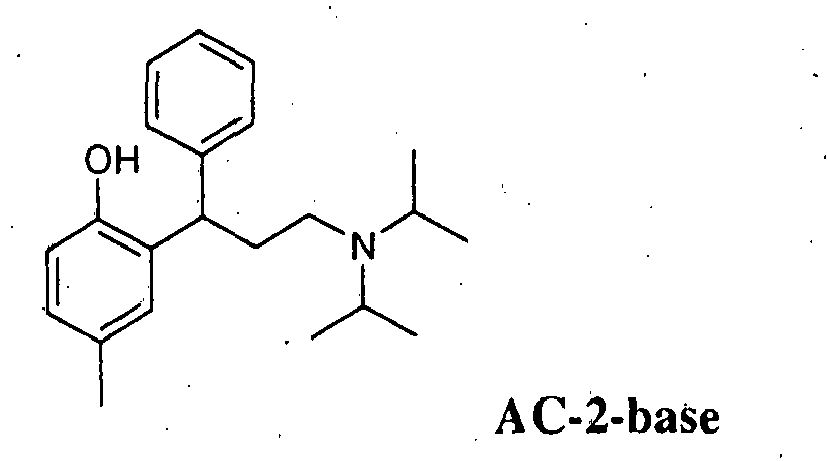
- Ebenfalls bevorzugte Anticholinergika sind ausgewählt aus den Salzen der Formel AC-1


- Weiterhin genannte Verbindungen sind:
- 2,2-Diphenylpropionsäuretropenolester-Methobromid
- 2,2-Diphenylpropionsäurescopinester-Methobromid
- 2-Fluor-2,2-Diphenylessigsäurescopinester-Methobromid
- 2-Fluor-2,2-Diphenylessigsäuretropenolester-Methobromid
- 3,3',4,4'-Tetrafluorbenzilsäuretropenolester-Methobromid
- 3,3',4,4'-Tetrafluorbenzilsäurescopinester-Methobromid
- 4,4'-Difluorbenzilsäuretropenolester-Methobromid
- 4,4'-Difluorbenzilsäurescopinester-Methobromid
- 3,3'-Difluorbenzilsäuretropenolester-Methobromid
- 3,3'-Difluorbenzilsäurescopinester-Methobromid
- 9-Hydroxy-fluoren-9-carbonsäuretropenolester-Methobromid
- 9-Fluor-fluoren-9-carbonsäuretropenolester-Methobromid
- 9-Hydroxy-fluoren-9-carbonsäurescopinester-Methobromid
- 9-Fluor-fluören-9-carbonsäurescopinester-Methobromid
- 9-Methyl-fluoren-9-carbonsäuretropenolester-Methobromid
- 9-Methyl-fluoren-9-carbonsäurescopinester-Methobromid
- Benzilsäurecyclopropyltropinester-Methobromid
- 2,2-Diphenylpropionsäurecyclopropyltropinester-Methobromid
- 9-Hydroxy-xanthen-9-carbonsäurecyclopropyltropinester-Methobromid
- 9-Methyl-fluoren-9-carbonsäurecyclopropyltropinester-Methobromid
- 9-Methyl-xanthen-9-carbonsäurecyclopropyltropinester-Methobromid
- 9-Hydroxy-fluoren-9-carbonsäurecyclopropyltropinester-Methobromid
- 4,4'-Difluorbenzilsäuremethylestercyclopropyltropinester-Methobromid
- 9-Hydroxy-xanthen-9-carbonsäuretropenolester-Methobromid
- 9-Hydroxy-xanthen-9-carbonsäurescopinester-Methobromid
- 9-Methyl-xanthen-9-carbonsäuretropenolester-Methobromid
- 9-Methyl-xanthen-9-carbonsäurescopinester-Methobromid
- 9-Ethyl-xanthen-9-carbonsäuretropenolester-Methobromid
- 9-Difluormethyl-xanthen-9-carbonsäuretropenolester-Methobromid
- 9-Hydroxymethyl-xanthen-9-carbonsäurescopinester-Metbobromid
- Als Corticosteroide gelangen hierbei vorzugsweise Verbindungen zur Anwendung, die ausgewählt sind aus der Gruppe bestehend aus Beclomethason, Betamethason, Budesonid, Butixocort, Ciclesonid, Deflazacort, Dexamethason, Etiprednol, Flunisolid, Fluticason, Loteprednol, Mometason, Prednisolon, Prednison, Rofleponid, Triamcinolon, RPR-106541, NS-126, ST-26 und
- 6,9-Difluor-17-[(2-furanylcarbonyl)oxy]-11-hydroxy-16-methyl-3-oxo-androsta-1,4-dien-17-carbothionsäure (S)-fluoromethylester
- 6,9-Difluor-11-hydroxy-16-methyl-3-oxo-17-propionyloxy-androsta-1,4-dien-17-carbothionsäure (S)-(2-oxo-tetrahydro-furan-35-yl)ester,
- 6α,9α-difluoro-11β-hydroxy-16α-methyl-3-oxo-17α-(2,2,3,3-tertamethylcyclo-propylcarbonyl)oxy-androsta-1,4-diene-17β-carbonsäure cyanomethyl ester gegebenenfalls in Form ihrer Racemate, Enantiomere oder Diastereomere und gegebenenfalls in Form ihrer Salze und Derivate, ihrer Solvate und/oder Hydrate. Jede Bezugnahme auf Steroide schließt eine Bezugnahme auf deren gegebenenfalls existierende Salze oder Derivate, Hydrate oder Solvate mit ein. Beispiele möglicher Salze und Derivate der Steroide können sein: Alkalisalze, wie beispielsweise Natrium- oder Kaliumsalze, Sulfobenzoate, Phosphate, Isonicotinate, Acetate, Dichloroacetate, Propionate, Dihydrogenphosphate, Palmitate, Pivalate oder auch Furoate.
- Als PDE4-Inhibitoren gelangen hierbei vorzugsweise Verbindungen zur Anwendung, die ausgewählt sind aus der Gruppe bestehend aus Enprofyllin, Theophyllin, Roflumilast, A-riflo (Cilomilast), Tofimilast, Pumafentrin, Lirimilast, Arofyllin, Atizoram, D-4418, Bay-198004, BY343, CP-325,366, D-4396 (Sch-351591), AWD-12-281 (GW-842470), NCS-613, CDP-840, D-4418, PD-168787, T-440, T-2585, V-11294A, C1-1018, CDC-801, CDC-3052, D-22888, YM-58997, Z-15370 und
- N-(3,5-Dichloro-1-oxo-pyridin-4-yl)-4-difluormethoxy-3-cyclopropylmethoxybenzamid
- (-)p-[(4aR*,10bS*)-9-Ethoxy-1,2,3,4,4a,10b-hexahydro-8-methoxy-2-methylbenzo[s][1,6]naphthyridin-6-yl]-N,N-diisopropylbenzamid
- (R)-(+)-1-(4-Brombenzyl)-4-[(3-cyclopentyloxy)-4-methoxyphenyl]-2-pyrrolidon 3-(Cyclopentyloxy-4-methoxyphenyl)-1-(4-N'-[N-2-cyano-S-methyl-isothioureido]benzyl)-2-pyrrolidon
- cis[4-Cyano-4-(3-cyclopentyloxy-4-methoxyphenyl)cyclohexan-1-carbonsäure] 2-carbomethoxy-4-cyano-4-(3-cyclopropylmethoxy-4-difluoromethoxy-phenyl)cyclohexan-1-on
- cis[4-Cyano-4-(3-cyclopropylmethoxy-4-difluormethoxyphenyl)cyclohexan-1-ol]
- (R)-(+)-Ethyl[4-(3-cyclopentyloxy-4-methoxyphenyl)pyrrolidin-2-yliden]acetat
- (S)-(-)-Ethyl[4-(3-cyclopentyloxy-4-methoxyphenyl)pyrrolidin-2-yliden]acetat
- 9-Cyclopentyl-5,6-dihydro-7-ethyl-3-(2-thienyl)-9H-pyrazolo[3,4-c]-1,2,4-triazolo[4,3-a]pyridin
- 9-Cyclopentyl-5,6-dihydro-7-ethyl-3-(tert-butyl)-9H-pyrazolo[3,4-c]-1,2,4-triazolo[4,3-a]pyridin
- Als LTD4-Antagonisten gelangen hierbei vorzugsweise Verbindungen zur Anwendung, die ausgewählt sind aus der Gruppe bestehend aus Montelukast, Pranlukast, Zafirlukast, MCC-847 (ZD-3523), MN-001, MEN-91507 (LM-1507), VUF-5078, VUF-K-8707, L-733321 und
- 1-(((R)-(3-(2-(6,7-Difluor-2-quinolinyl)ethenyl)phenyl)-3-(2-(2-hydroxy-2-propyl)phenyl)thio)methylcyclopropan-essigsäure,
- 1-(((1(R)-3(3-(2-(2,3-Dichlorthieno[3,2-b]pyridin-5-yl)-(E)-ethenyl)phenyl)-3-(2-(1-hydroxy-1-methylethyl)phenyl)propyl)thio)methyl)cyclopropanessigsäure
- [2-[[2-(4-tert-Butyl-2-thiazolyl)-5-benzofuranyl]oxymethyl]phenyl]essigsäure gegebenenfalls in Form ihrer Racemate, Enantiomere, Diastereomere und gegebenenfalls in Form ihrer pharmakologisch verträglichen Säureadditionssalze, Solvate oder Hydrate. Erfindungsgemäß bevorzugt sind diese Säureadditionssalze ausgewählt aus der Gruppe bestehend aus Hydrochlorid, Hydrobromid, Hydroiodid, Hydrosulfat, Hydrophosphat, Hydromethansulfonat, Hydronitrat, Hydromaleat, Hydroacetat, Hydrocitrat, Hydrofumarat, Hydrotartrat, Hydrooxalat, Hydrosuccinat, Hydrobenzoat und Hydro-p-toluolsulfonat. Unter Salzen oder Derivaten zu deren Bildung die LTD4-Antagonisten gegebenenfalls in der Lage sind, werden beispielsweise verstanden: Alkalisalze, wie beispielsweise Natrium- oder Kaliumsalze, Erdalkalisalze, Sulfobenzoate, Phosphate, Isonicotinate, Acetate, Propionate, Dihydrogenphosphate, Palmitate, Pivalate oder auch Furoate.
- Als EGFR-Hemmer gelangen hierbei vorzugsweise Verbindungen zur Anwendung, die ausgewählt sind aus der Gruppe bestehend aus Cetuximab, Trastuzumab, ABX-EGF, Mab ICR-62 und
- 4-[(3-Chlor-4-fluorphenyl)amino]-6-{[4-(morpholin-4-yl)-1-oxo-2-buten-1-yl]amino}-7-cyclopropylmethoxy-chinazolin
- 4-[(3-Chlor-4-fluorphenyl)amino]-6-{[4-(N,N-diethylamino)-1-oxo-2-buten-1-yl]-amino}-7-cyclopropylmethoxy-chinazolin
- 4-[(3-Chlor-4-fluorphenyl)amino]-6-{[4-(N,N-dimethylamino)-1-oxo-2-buten-1-yl]amino}-7-cyclopropylmethoxy-chinazolin
- 4-[(R)-(1-Phenyl-ethyl)amino]-6-{[4-(morpholin-4-yl)-1-oxo-2-buten-1-yl]amino}-7-cyclopentyloxy-chinazolin
- 4-[(3-Chlor-4-fluor-phenyl)amino]-6-{[4-((R)-6-methyl-2-oxo-morpholin-4-yl)-1-oxo-2-buten-1-yl]amino}-7-cyclopropylmethoxy-Chinazolin
- 4-[(3-Chlor-4-fluor-phenyl)amino]-6-{[4-((R)-6-methy]-2-oxo-morpholin-4-yl)-1-oxo-2-buten-1-yl]amino}-7-[(S)-(tetrahydrofuran-3-yl)oxy]-chinazolin
- 4-[(3-Chlor-4-fluor-phenyl)amino]-6-{[4-((R)-2-methoxymethyl-6-oxo-morpholin-4-yl)-1-oxo-2-buten-1-yl]amino}-7-cyclopropylmethoxy-chinazolin
- 4-[(3-Chlor-4-fluor-phenyl)amino]-6-[2-((S)-6-methyl-2-oxo-morpholin-4-yl)-ethoxy]-7-methoxy-chinazolin
- 4-[(3-Chlor-4-fluorphenyl)amino]-6-({4-[-N-(2-methoxy-ethyl)-N-methyl-amino]-1-oxo-2-buten-1-yl}amino)-7-cyclopropylmethoxy-chinazolin
- 4-[(3-Chlor-4-fluorphenyl)amino]-6-{[4-(N,N-dimethylamino)-1-oxo-2-buten-1-yl]amino}-7-cyclopentyloxy-chinazolin
- 4-[(R)-(1-Phenyl-ethyl)amino]-6-{[4-(N,N-bis-(2-methoxy-ethyl)-amino)-1-oxo-2-buten-1-yl]amino}-7-cyclopropylmethoxy-chinazolin
- 4-[(R)-(1-Phenyl-ethyl)amino]-6-({4-[N-(2-methoxy-ethyl)-N-ethyl-amino]-1-oxo-2-buten-1-yl}amino)-7-cyclopropylmethoxy-chinazolin
- 4-[(R)-(1-Phenyl-ethyl)amino]-6-({4-[N-(2-methoxy-ethyl)-N-methyl-amino]-1-oxo-2-buten-1-yl}amino)-7-cyclopropylmethoxy-chinazolin
- 4-[(R)-(1-Phenyl-ethyl)amino]-6-({4-[N-(tetrahydropyran-4-yl)-N-methyl-amino]-1-oxo-2-buten-1-yl}amino)-7-cyclopropylmethoxy-chinazolin
- 4-[(3-Chlor-4-fluorphenyl)amino]-6-{[4-(N,N-dimethylamino)-1-oxo-2-buten-1-yl]amino}-7-((R)-tetrahydrofuran-3-yloxy)-chinazolin
- 4-[(3-Chlor-4-fluorphenyl)amino]-6-{[4-(N,N-dimethylamino)-1-oxo-2-buten-1-yl]amino}-7-((S)-tetrahydrofuran-3-yloxy)-chinazolin
- 4-[(3-Chlor-4-fluorphenyl)amino]-6-({4-[N-(2-methoxy-ethyl)-N-methyl-amino]-1-oxo-2-buten-1-yl}amino)-7-cyclopentyloxy-chinazolin
- 4-[(3-Chlor-4-fluorphenyl)amino]-6-{[4-(N-cyclopropyl-N-methyl-amino)-1-oxo-2-buten-1-yl]amino}-7-cyclopentyloxy-chinazolin
- 4-[(3-Chlor-4-fluorphenyl)amino]-6-{[4-(N,N-dimethylamino)-1-oxo-2-buten-1-yl]amino}-7-[(R)-(tetrahydrofuran-2-yl)methoxy]-chinazolin
- 4-[(3-Chlor-4-fluorphenyl)amino]-6-{[4-(N,N-dimethytamino)-1-oxo-2-buten-1-yl]amino}-7-[(S)-(tetrahydrofuran-2-yl)methoxy]-chinazolin
- 4-[(3-Ethinyl-phenyl)amino]-6,7-bis-(2-methoxy-ethoxy)-chinazolin.
- 4-[(3-Chlor-4-fluorphenyl)amino]-7-[3-(morpholin-4-yl)-propyloxyl-6-[(vinyl-carbonyl)amino]-chinazolin
- 4-[(R)-(1-Phenyl-ethyl)amino]-6-(4-hydroxy-phenyl)-7H-pyrrolo[2,3-d]pyrimidin
- 3-Cyano-4-[(3-chlor-4-fluorphenyl)amino]-6-{(4-(N,N-dimethylamino)-1-oxo-2-buten-1-yl]amino}-7-ethoxy-chinolin
- 4-{[3-Chlor-4-(3-fluor-benzyloxy)-phenyl]amino}-6-(5-{[(2-methansulfonyl-ethyl)amino]methyl}-furan-2-yl)chinazolin
- 4-[(R)-(1-Phenyl-ethyl)amino]-6-{[4-((R)-6-methyl-2-oxo-morpholin-4-yl)-1-oxo-2-buten-1-yl]amino}-7-methoxy-chinazolin
- 4-[(3-Chlor-4-fluorphenyl)amino]-6-{[4-(morpholin-4-yl)-1-oxo-2-buten-1-yl]amino}-7-[(tetrahydrofuran-2-yl)methoxy]-chinazolin
- 4-[(3-Chlor-4-fluorphenyl)amino]-6-({4-[N,N-bis-(2-methoxy-ethyl)-amino]-1-oxo-2-buten-1-yl}amino)-7-[(tetrahydrofuran-2-yl)methoxy]-chinazolin
- 4-[(3-Ethinyl-phenyl)amino]-6-{[4-(5,5-dimethyl-2-oxo-morpholin-4-yl)-1-oxo-2-buten-1-yl]amino}-chinazolin
- 4-[(3-Chlor-4-fluor-phenyl)amino]-6-[2-(2,2-dimethyl-6-oxo-morpholin-4-yl)-ethoxy]-7-methoxy-chinazolin
- 4-[(3-Chlor-4-fluor-phenyl)amino]-6-[2-(2,2-dimethy]-6-oxo-morpholin-4-yl)-ethoxy]-7-[(R)-(tetrahydrofuran-2-yl)methoxy]-chinazolin
- 4-[(3-Chlor-4-fluor-phenyl)amino]-7-[2-(2,2-dimethyl-6-oxo-morpholin-4-yl)-ethoxy]-6-[(S)-(tetrahydrofuran-2-yl)methoxy]-chinazolin
- 4-[(3-Chlor-4-fluor-phenyl)amino]-6-(2-[4-(2-oxo-morpholin-4-yl)-piperidin-1-yl]-ethoxy}-7-methoxy-chinazolin
- 4-[(3-Chlor-4-fluor-phenyl)amino]-6[1-(tert.-butyloxycarbonyl)-piperidin-4-yloxy]-7-methoxy-chinazolin
- 4-[(3-Chlor-4-fluor-phenyl)amino]-6-(trans-4-amino-cyclohexan-1-yloxy)-7-methoxy-chinazolin
- 4-[(3-Chlor-4-fluor-phenyl)amino]-6-(trans-4-methansulfonylamino-cyclohexan-1-yloxy)-7-methoxy-chinazolin
- 4-[(3-Chlor-4-fluor-phenyl)amino]-6-(tetrahydropyran-3-yloxy)-7-methoxy-chinazolin
- 4-[(3-Chlor-4-fluor-phenyl)amino]-6-(1-methyl-piperidin-4-yloxy)-7-methoxy-chinazolin
- 4-[(3-Chlor-4-fluor-phenyl)amino]-6-{1-[(morpholin-4-yl)carbonyl]-piperidin-4-yl-oxy}-7-methoxy-chinazolin
- 4-[(3-Chlor-4-fluor-phenyl)amino]-6-{1-[(methoxymethyl)carbonyl]-piperidin-4-yl-oxy}-7-methoxy-chinazolin
- 4-[(3-Chlor-4-fluor-phenyl)amino]-6-(piperidin-3-yloxy)-7-methoxy-chinazolin
- 4-[(3-Chlor-4-fluor-phenyl)amino]-6-[1-(2-acetylamino-ethyl)-piperidin-4-yloxy]-7-methoxy-chinazolin
- 4-[(3-Chlor-4-fluor-phenyl)amino]-6-(tetrahydropyran-4-yloxy)-7-ethoxy-chinazolin
- 4-[(3-Chlor-4-fluor-phenyl)amino]-6-((S)-tetrahydrofuran-3-yloxy)-7-hydroxy-chinazolin
- 4-[(3-Chlor-4-fluor-phenyl)amino]-6-(tetrahydropyran-4-yloxy)-7-(2-methoxy-ethoxy)-chinazolin
- 4-[(3-Chlor-4-fluor-phenyl)amino]-6-{trans-4-[(dimethylamino)sulfonylamino]-cyclohexan-1-yloxy}-7-methoxy-chinazolin
- 4-[(3-Chlor-4-fluor-phenyl)amino]-6-{trans-4-[(morpholin-4-yl)carbonylamino]-cyclohexan-1-yloxy}-7-methoxy-chinazolin
- 4-[(3-Chlor-4-fluor-phenyl)amino]-6-{trans-4-[(morpholin-4-yl)sulfonylamino]-cyclohexan-1-yloxy}-7-methoxy-chinazolin
- 4-[(3-Chlor-4-fluor-phenyl)amino]-6-(tetrahydropyran-4-yloxy)-7-(2-acetylamino-ethoxy)-chinazolin
- 4-[(3-Chlor-4-fluor-phenyl)amino]-6-(tetrahydropyran-4-yloxy)-7-(2-methansulfonylamino-ethoxy)-chinazolin
- 4-[(3-Chlor-4-fluor-phenyl)amino]-6-{1-[(piperidin-1-yl)carbonyl]-piperidin-4-yloxy}-7-methoxy-chinazolin
- 4-[(3-Chlor-4-fluor-phenyl)amino]-6-(1-aminocarbonylmethyl-piperidin-4-yloxy)-7-methoxy-chinazolin
- 4-[(3-Chlor-4-fluor-phenyl)amino]-6-(cis-4-{N-[(tetrahydropyran-4-yl)carbonyl]-N-methyl-amino}-cyclohexan-1-yloxy)-7-methoxy-chinazolin
- 4-[(3-Chlor-4-fluor-phenyl)amino]-6-(cis-4-{N-[(morpholin-4-yl)carbonyl]-N-methyl-amino}-cyclohexan-1-yloxy)-7-methoxy-chinazolin
- 4-[(3-Chlor-4-fluor-phenyl)amino]-6-(cis-4-{N-[(morpholin-4-yl)sulfonyl]-N-methyl-amino}-cyclohexan-1-yloxy)-7-methoxy-chinazolin
- 4-[(3-Chlor-4-fluor-phenyl)amino]-6-(trans-4-ethansulfonylamino-cyclohexan-1-yloxy)-7-methoxy-chinazolin
- 4-[(3-Chlor-4-fluor-phenyl)amino]-6-(1-methansulfonyl-piperidin-4-yloxy)-7-ethoxy-chinazolin
- 4-[(3-Chlor-4-fluor-phenyl)amino]-6-(1-methansulfonyl-piperidin-4-yloxy)-7-(2-methoxy-ethoxy)-chinazolin
- 4-[(3-Chlor-4-fluor-phenyl)amino]-6-[1-(2-methoxy-acetyl)-piperidin-4-yl-oxy]-7-(2-methoxy-ethoxy)-chinazolin
- 4-[(3-Chlor-4-fluor-phenyl)amino]-6-(cis-4-acetylamino-cyclohexan-1-yloxy)-7-methoxy-chinazolin
- 4-[(3-Ethinyl-phenyl)amino]-6-[1-(tert.-butyloxycarbonyl)-piperidin-4-yloxy]-7-methoxy-chinazolin
- 4-[(3-Ethinyl-phenyl)amino]-6-(tetrahydropyran-4-yloxy]-7-methoxy-chinazolin
- 4-[(3-Chlor-4-fluor-phenyl)amino]-6-(cis-4-{N-[(piperidin-1-yl)carbonyl]-N-methyl-amino}-cyclohexan-1-yloxy)-7-methoxy-chinazolin
- 4-[(3-Chlor-4-fluor-phenyl)amino]-6-(cis-4-{N-[(4-methyl-piperazin-1-yl)carbonyl]-N-methyl-amino)-cyclohexan-1-yloxy)-7-methoxy-chinazolin
- 4-[(3-Chlor-4-fluor-phenyl)amino]-6-{cis-4-[(morpholin-4-yl)carbonylamino]-cyclohexan-1-yloxy}-7-methoxy-chinazolin
- 4-[(3-Chlor-4-fluor-phenyl)amino]-6-{1-[2-(2-oxopyrrolidin-1-yl)ethyl]-piperidin-4-yloxy}-7-methoxy-chinazolin
- 4-[(3-Chlor-4-fluor-phenyl)amino]-6-{1-[(morpholin-4-yl)carbonyl]-piperidin-4-y]oxy}-7-(2-methoxy-ethoxy)-chinazolin
- 4-[(3-Ethinyl-phenyl)amino]-6-(1-acetyl-piperidin-4-yloxy)-7-methoxy-chinazolin
- 4-[(3-Ethinyl-phenyl)amino]-6-(1-methyl-piperidin-4-yloxy)-7-methoxy-chinazolin
- 4-[(3-Ethinyl-phenyl)amino]-6-(1-methansulfonyl-piperidin-4-yloxy)-7-methoxy-chinazolin
- 4-[(3-Chlor-4-fluor-phenyl)amino]-6-(1-methyl-piperidin-4-yloxy)-7(2-methoxy-ethoxy)-chinazolin
- 4-[(3-Chlor-4-fluor-phenyl)amino]-6-(1-isopropyloxycarbonyl-piperidin-4-yloxy)-7-methoxy-chinazolin
- 4-[(3-Chlor-4-fluor-phenyl)amino]-6-(cis-4-methylamino-cyclohexan-1-yloxy)-7-methoxy-chinazolin
- 4-[(3-Chlor-4-fluor-phenyl)amino]-6-{cis-4-[N-(2-methoxy-acetyl)-N-methyl-amino]-cyclohexan-1-yloxy}-7-methoxy-chinazolin
- 4-[(3-Ethinyl-phenyl)amino]-6-(piperidin-4-yloxy)-7-methoxy-chinazolin
- 4-[(3-Ethiny)-phenyl)amino]-6-[1-(2-methoxy-acetyl)-pipendin-4-yloxy]-7-methoxy-chinazolin
- 4-[(3-Ethinyl-phenyl)amino]-6-{1-[(morpholin-4-yl)carbonyl]-piperidin-4-yloxy}-7-methoxy-chinazolin
- 4-[(3-Chlor-4-fluor-phenyl)amino]-6-{1-[(cis-2,6-dimethyl-morpholin-4-yl)carbonyl]-piperidin-4-yloxy}-7-methoxy-chinazolin
- 4-[(3-Chlor-4-fluor-phenyl)amino]-6-{1-[(2-methyl-morpholin-4-yl)carbonyl]-piperidin-4-yloxy}-7-methoxy-chinazolin
- 4-[(3-Chlor-4-fluor-phenyl)amino]-6-{1-[(S,S)-(2-oxa-5-aza-bicyclo[2.2.1]hept-5-yl)carbonyl]-piperidin-4-yloxy}-7-methoxy-chinazolin
- 4-[(3-Chlor-4-fluor-phenyl)amino]-6-{1-[(N-methyl-N-2-methoxyethyl-amino)carbonyl]-piperidin-4-yloxy}-7-methoxy-chinazolin
- 4-[(3-Chlor-4-fluor-phenyl)amino]-6-(1-ethyl-piperidin-4-yloxy)-7-methoxy-chinazolin
- 4-[(3-Chlor-4-fluor-phenyl)amino]-6-{1-[(2-methoxyethyl)carbonyl]-piperidin-4-yloxy}-7-methoxy-chinazolin
- 4-[(3-Chlor-4-fluor-phenyl)amino]-6-{1-[(3-methoxypropyl-amino)-carbonyl]-piperidin-4-yloxy}-7-methoxy-chinazolin
- 4-[(3-Chlor-4-fluor-phenyl)amino]-6-[cis-4-(N-methansulfonyl-N-methyl-amino)-cyclohexan-1-yloxy]-7-methoxy-chinazolin
- 4-[(3-Chlor-4-fluor-phenyl)amino]-6-[cis-4-(N-acetyl-N-methyl-amino)-cyclohexan-1-yloxy]-7-methoxy-chinazolin
- 4-[(3-Chlor-4-fluor-phenyl)amino]-6-(trans-4-methylamino-cyclohexan-1-yloxy)-7-methoxy-chinazolin
- 4-[(3-Chlor-4-fluor-phenyl)amino]-6-[trans-4-(N-methansulfonyl-N-methyl-amino)-cyclohexan-1-yloxy]-7-methoxy-chinazolin
- 4-[(3-Chlor-4-fluor-phenyl)amino]-6-(trans-4-dimethylamino-cyclohexan-1-yloxy)-7-methoxy-chinazolin
- 4-[(3-Chlor-4-fluor-phenyl)amino]-6-(trans-4-{N-[(morpholin-4-yl)carbonyl]-N-methyl-amino}-cyclohexan-1-yloxy)-7-methoxy-chinazolin
- 4-[(3-Ch]or-4-fluor-phenyl)amino]-6-[2-(2,2-dimethyl-6-oxo-morpholin-4-yl)-ethoxy]-7-[(S)-(tetrahydrofuran-2-yl)methoxy]-chinazolin
- 4-[(3-Chlor-4-fluor-phenyl)amino]-6-(1-methansulfonyl-piperidin-4-yloxy)-7-methoxy-chinazolin
- 4-[(3-Chlor-4-fluor-phenyl)amino]-6-(1-cyano-piperidin-4-yloxy)-7-methoxy-chinazolin
- Als Dopamin-Agonisten gelangen hierbei vorzugsweise Verbindungen zur Anwendung, die ausgewählt sind aus der Gruppe bestehend aus Bromocriptin, Cabergölin, Alpha-Dihydroergocryptin, Lisurid, Pergolid, Pramipexol, Roxindol, Ropinirol, Talipexol, Tergurid und Viozan, gegebenenfalls in Form ihrer Racemate, Enantiomere, Diastereomere und gegebenenfalls in Form ihrer pharmakologisch verträglichen Säureadditionssalze, Solvate oder Hydrate. Erfindungsgemäß bevorzugt sind diese Säureadditionssalze ausgewählt aus der Gruppe bestehend aus Hydrochlorid, Hydrobromid, Hydroiodid, Hydrosulfat, Hydrophosphat, Hydromethansulfonat, Hydronitrat, Hydromaleat, Hydroacetat, Hydrocitrat, Hydrofumarat, Hydrotartrat, Hydrooxalat, Hydrosuccinat, Hydrobenzoat und Hydro-p-toluolsulfonat.
- Als H1-Antihistaminika gelangen hierbei vorzugsweise Verbindungen zur Anwendung, die ausgewählt sind aus der Gruppe bestehend aus Epinastin, Cetirizin, Azelastin, Fexofenadin, Levocabastin, Loratadin, Mizolastin, Ketotifen, Emedastin, Dimetinden, Clemastin, Bamipin, Cexchlorpheniramin, Pheniramin, Doxylamin, Chlorphenoxamin, Dimenhydrinat, Diphenhydramin, Promethazin, Ebastin, Desloratidin und Meclozin, gegebenenfalls in Form ihrer Racemate, Enantiomere, Diastereomere und gegebenenfalls in Form ihrer pharmakologisch verträglichen Säureadditionssalze, Solvate oder Hydrate. Erfindungsgemäß bevorzugt sind diese Säureadditionssalze ausgewählt aus der Gruppe bestehend aus Hydrochlorid, Hydrobromid, Hydroiodid, Hydrosulfat, Hydrophosphat, Hydromethansulfonat, Hydronitrat, Hydromaleat, Hydroacetat, Hydrocitrat, Hydrofumarat, Hydrotartrat, Hydrooxalat, Hydrosuccinat, Hydrobenzoat und Hydro-p-toluolsulfonat.
- Außerdem können inhalierbare Makromoleküle verwendet werden, wie in
EP 1 003 478 offenbart. - Weiterhin kann die Verbindung aus der Gruppe der Derivate von Mutterkornalkaloiden, der Triptane, der CGRP-Hemmern, der Phosphodiesterase-V-Hemmer stammen, gegebenenfalls in Form ihrer Racemate, Enantiomere oder Diastereomere, gegebenenfalls in Form ihrer pharmakologisch verträglichen Säureadditionssalze, ihrer Solvate und/oder Hydrate.
- Als Derivate der Mutterkomalkaloide: Dihydroergotamin, Ergotamin.
- Für die Inhalation kommen Arzneimittel mit den o.g. Wirkstoffen in Betracht, sowie deren Salze, Ester sowie die Kombination dieser Wirkstoffe, Salze und Ester.
- Bevorzugt ist das Bauteil einstückig mit dem Inhalationskanal verbunden und erstreckt sich radial in den Inhalationskanal. Damit lassen sich Kosten bei der Montage des Mundstückes bzw. Inhalators einsparen.
- Nach einer Weiterbildung ist das Bauteil als Stromlinienkörper, insbesondere NACA-Profil, ausgebildet. Bei einem NACA-Profil handelt es sich um ein symmetrisches Profil einer Versuchsreihe, die das National Advisory Commitee for Aerodynamic (NACA) durchgeführt hat. NACA-Profile zeichnen sich durch eine abgerundete Nase und ein spitz auslaufendes hinteres Teil aus. Unterschiedliche NACA-Profile sind bespielsweise in Dubs, Fritz, Aerodynamik der reinen Unterschallströmung, 4. neubearb. Auflage, Birkhäuser Verlag Basel, ISBN 3-7643-1073-1, auf den Seiten 210 bis 213, 218, 219, 222 und 223 beschrieben.
- Vorzugsweise wird ein NACA-Profil 0030 oder ein ähnliches Profil verwendet, wobei sich zeigte, dass die abgegebene Dosis des Arzneimittels durch die Verwendung eines solchen Profils gegenüber einem konventionellen Sieb vergrößert ist. Zweckmäßigerweise weist die abgerundete Nase des Stromlinienkörpers in Richtung des Mundstücks und das spitze Ende zur Kammer.
- Um zu verhindern, dass relativ große Partikel duch den Inhalationskanal gelangen und darüber hinaus einen Anschlag für eine das Arzneimittel aufnahmende Kapsel bereitzustellen, sind mehrere Stromlinienkörper sternförmig zueinander ausgerichtet. Durch diese Anordnung ist auch eine verhältnismäßig hohe Stabilität gewährleistet, die zur Entleerung der bei der Inhalation vibrierenden Kapsel beiträgt. Im Weiteren lässt sich mit der sternförmigen Ausrichtung der NACA-Profile ein zyklonartiger Wirbel beim Inhalieren erzeugen, der zur Modifikation der Teilchengrößenverteilunng des Arzneimittels eingesetzt werden kann, da ein starker Wirbel zu einer bevorzugten Deposition schwerer und großer Partikel im Inhalationskanal führt, während leichte Wirkstoffteilchen zum Patienten bzw. Benutzer des Inhalators gelangen. Bevorzugt ist hierbei der Inhalationskanal im Querschnitt rund ausgebildet. Zweckmäßigerweise sind die Stromlinienkörper an dem der Mundseite gegenüberliegenden Seite des Inhalationskanals angeordnet.
- In Ausgestaltung besteht das Mundstück mitsamt dem Inhalationskanal und den NACA-Profilen aus einem Kunststoff. Vorzugsweise handelt es sich bei den Kunststoffen um Polymerisate, thermoplastische Polykondensate, Polyaddukte, abgewandelte Naturstoffe oder Kautschuke bzw. um Gemische dieser Kunststoffe. Besonders bevorzugt sind hier Polyolefine, Vinylchlorid-Pölymerisate, Styrol-Polymerisäte, Polyacetale, Polyamide, thermoplastische Polyester und Polyarylether bzw. Gemische dieser Kunststoffe. Beispiele für diese Kunststoffe sind Polyethylen, Polyvinylchlorid, Polyoxymethylen, Polyacetal, Acrylnitril/Butadien/Styrol(ABS), Acrylnitril/Styrol/Acryl-ester(ASA), Polyamide, Polycarbonat, Poly (ethylenterephthalat), Poly(butylenterephthalat) oder Poly(phenylenether). Derartige Kunststoffe können beispielsweise von der Firma Ensinger in Deutschland, Nufringen, bezogen werden.
- Vorzugsweise ist das Mundstück mitsamt dem Inhalationskanal und den darin angeordneten NACA-Profilen im Spritzgussverfahren herstellbar. Die NACA-Profile dienen hierbei als Verteiler für die Kunststoffschmelze, wobei ein Anspritzpunkt beispielsweise im Zentrum der sternförmig zueinander angeordneten Profile ausgebildet sein kann. Außer einer sternförmigen Anordnung ist in einer weiteren Ausführungsform auch eine bügelartige Verbindung der Stege im Mundstückinnenkanal möglich (
Fig. 2 ). - Das zuvor beschriebene Mundstück findet bevorzugt in einem Inhalator für die Inhalation eines pulverförmigen Arzneimittels aus einer Kapsel Verwendung, wobei der Inhalator ein Unterteil umfasst, an dem eine mit dem Unterteil verrastbare Platte zum Verschließen des Unterteils angelenkt ist Die Platte weist eine in dem Unterteil versenkbare Kapselhalterung zur Aufnahme der Kapsel auf und ist mit dem Mundstück verrastbar. Ein Deckel, der das Mundstück in einer Verschlussposition abdeckt, ist mittels eines Verschlusselementes verrästet. Das Unterteil, die Platte, das Mundstück und der Deckel sind durch ein einziges Gelenk verschwenkbar miteinander verbunden. Darüber hinaus ist ein Betätigungsorgan vorgesehen, das aus einer Ruhestellung in eine Bewegung versetzbar ist und dabei mit mindestens einer in die Kapselhalterung einstoßbaren Nadel zusammenwirkt. Bevorzugt sind zwei zueinander beabstandete Nadeln vorgesehen.
- Es versteht sich, dass die vorstehend genannten und nachstehend noch zu erläuternden Merkmale nicht nur in der jeweils angegebenen Kombination, sondern auch in anderen Kombinationen verwendbar sind. Der Rahmen der Erfindung ist nur durch die Ansprüche definiert.
- Die Erfindung wird im Folgenden anhand eines Ausführungsbeispieles unter Bezugnahme auf die zugehörigen Zeichnungen näher erläutert. Es zeigt:
- Fig. 1
- eine perspektivische Teil-Schnittdarstellung eines Inhalators mit einem erfindungsgemäßen Mundstück,
- Fig.2
- eine perspektivische Darstellung eines Schnittes durch das Mundstück nach
Fig. 1 , - Fig.3
- einen Querschnitt durch ein aerodynamisches Bauteil des Mundstücks gemäß der Darstellung nach
Fig. 2 und - Fig.4
- eine vergrößerte perspektivische Darstellung der Einzelheit IV nach
Fig. 2 . - Der Inhalator weist ein Unterteil 1 auf, an dem eine mit dem Unterteil 1 verrastbare Platte 2 zum Verschließen des Unterteils 1 angelenkt ist. Die Platte 2 ist mit einer in dem Unterteil 1 versenkbaren Kapselhalterung 3 zur Aufnahme einer mit einem pulverförmigen Arzneimittel gefüllten Kapsel in einer Kammer versehen und mit einem einen Inhalationskanal 4 aufweisenden Mundstück 5 verrastbar. Ein Deckel 6, der das Mundstück 5 in einer Verschlussposition abdeckt, ist mittels eines Verschlusselementes verrastet. Das Unterteil 1, die Platte 2, das Mundstück 5 und der Deckel 6 sind durch ein gemeinsames Gelenk 7 verschwenkbar miteinander verbunden. Darüber hinaus ist ein Betätigungsorgan 8 vorgesehen, das mit zwei in die Kapselhalterung 3 einstoßbaren Nadeln 9 zum Einstechen der Kapsel zusammenwirkt. Die zueinander beabstandeten Nadeln 9 sind in Führungsstutzen 14 der Kapselhalterung 3 verschiebbar gelagert. Um eine Rückstellbewegung der Nadeln 9 zur Freigabe der Löcher in der Kapsel nach dem Loslassen des Betätigungsorgans 8 zu bewirken, ist zwischen der Kapselhalterung 3 und dem Betätigungsorgan 8 eine Druckfeder 15 angeordnet.
- Das Mundstück 5 besteht mit dem darin ausgebildeten im Querschnitt runden Inhalationkanal 4 aus einem Kunststoff und ist im Spritzgussverfahren gefertigt. An dem der Mundseite gegenüberliegenden Seite des Inhalationskanals 4 sind mehrere sternförmig zueinander ausgerichtete Bauteile 10 mit einem aerodynamischen Querschnitt angeordnet. Die Bauteile 10 sind als NACA-Profile 11 ausgeführt und weisen jeweils eine abgerundete Nase 12 sowie ein spitzes Ende 13 auf, wobei das Ende auch abgerundet sein kann, um die Herstellung zu vereinfachen. Das Mundstück besitzt außerdem einen oder mehrere Stege 16, die das missbräuchliche Einführen von nicht geeigneten Kapseln verhindern, weiterhin das Strömungsverhalten des Inhalators und die Austrittsgeschwindigkeit des Arzneimittels günstig beeinflussen.
Claims (9)
- Inhalator zur Verabreichung von einem pulverförmigen Arzneimittel in Form inhalationsfähiger Substanzen, Substanzformulierungen oder -mischungen aus einer Kapsel, wobei der Inhalator ein Mundstück (5) aufweist, das einen Inhalationskanal (4) zur Kopplung mit einer Kammer zur Aufnahme der Kapsel mit dem Arzneimittel aufweist, dadurch gekennzeichnet, dass in dem Inhalationskanal (4) mindestens ein Bauteil (10) mit einem aerodynamischen Querschnitt vorgesehen ist, wobei dieses Bauteil (10) als Stromlinienkörper ausgebildet ist, und dass das Bauteil (10) einstückig mit dem Inhalationskanal (4) verbunden ist und sich radial in den Inhalationskanal (4) erstreckt.
- Inhalator nach Anspruch 1, dadurch gekennzeichnet, dass die abgerundete Nase (12) des Stromlinienkörpers in Richtung des Mundstücks (5) und ein spitzes Ende (13) zur Kammer weist.
- Inhalator einem der vorangegangenen Ansprüche, dadurch gekennzeichnet, dass mehrere Stromlinienkörper sternförmig zueinander ausgerichtet sind.
- Inhalator nach einem der vorangegangenen Ansprüche, dadurch gekennzeichnet, dass die Stromlinienkörper an dem der Mundseite gegenüberliegenden Seite des Inhalationskanals (4) angeordnet sind.
- Inhalator nach einem der Ansprüche 1 bis 4, dadurch gekennzeichnet, dass es aus einem Kunststoff besteht.
- Inhalator nach einem der Ansprüche 1 bis 5, dadurch gekennzeichnet, dass es im Spritzgussverfahren herstellbar ist.
- Inhalator nach den Ansprüchen 4, 5 und 6, dadurch gekennzeichnet, dass im Mundstück ein im Querschnitt runder Inhalationskanal (4) ausgebildet ist und das Mundstück mindestens einen Steg (16) aufweist und sich dieser Steg (16) an der Innenwand des Inhalationskanals (4) befindet.
- Inhalator nach einem der Ansprüche 1 bis 7 für die Inhalation eines pulverförmigen Arzneimittels aus einer Kapsel mit- einem Unterteil (1)- einer mit dem Unterteil (1) verrastbaren Platte (2) zum Verschließen des Unterteils (1), mit der das Mundstück (5) verrastbar ist, und eine in dem Unterteil (1) versenkbare Kapselhalterung (3) zur Aufnahme der Kapsel,- einem Deckel (6), der das Mundstück (5) in einer Verschlussposition abdeckt und mittels eines Verschlusselementes verrastet, wobei das Unterteil (1), die Platte (2), das Mundstück (5) und der Deckel (6) durch ein einziges Gelenk (7) verschwenkbar miteinander verbunden sind, und- einem Betätigungsorgan (8), das aus einer Ruhestellung in eine Bewegung versetzbar ist und dabei mit mindestens einer in die Kapselhalterung (3) einstoßbaren Nadel (9) zusammenwirkt.
- Inhalator nach einem der Ansprüche 1 bis 8 zur Applikation eines pulverförmigen Arzneimittels mit einem Wirkstoff aus der Gruppe der Anticholinergika, Betamimetika, Steroide, Phosphodiesterase IV-inhibitoren, LTD4-Antagonisten, EGFR-Kinase-Hemmer, Antiallergika, Derivate von Mutterkornalkaloiden, Triptane, CGRP-Antagonisten, Phosphodiesterase-V-Inhibitoren, sowie Kombinationen aus solchen Wirkstoffen.
Priority Applications (1)
| Application Number | Priority Date | Filing Date | Title |
|---|---|---|---|
| EP13176790.7A EP2656867B1 (de) | 2006-04-11 | 2007-04-04 | Mundstück für einen Inhalator |
Applications Claiming Priority (2)
| Application Number | Priority Date | Filing Date | Title |
|---|---|---|---|
| DE102006016901A DE102006016901A1 (de) | 2006-04-11 | 2006-04-11 | Mundstück für einen Inhalator |
| PCT/EP2007/053324 WO2007118800A1 (de) | 2006-04-11 | 2007-04-04 | Mundstück für einen inhalator |
Related Child Applications (2)
| Application Number | Title | Priority Date | Filing Date |
|---|---|---|---|
| EP13176790.7A Division-Into EP2656867B1 (de) | 2006-04-11 | 2007-04-04 | Mundstück für einen Inhalator |
| EP13176790.7A Division EP2656867B1 (de) | 2006-04-11 | 2007-04-04 | Mundstück für einen Inhalator |
Publications (2)
| Publication Number | Publication Date |
|---|---|
| EP2007456A1 EP2007456A1 (de) | 2008-12-31 |
| EP2007456B1 true EP2007456B1 (de) | 2018-10-17 |
Family
ID=38179783
Family Applications (2)
| Application Number | Title | Priority Date | Filing Date |
|---|---|---|---|
| EP07727793.7A Active EP2007456B1 (de) | 2006-04-11 | 2007-04-04 | Mundstück für einen inhalator |
| EP13176790.7A Active EP2656867B1 (de) | 2006-04-11 | 2007-04-04 | Mundstück für einen Inhalator |
Family Applications After (1)
| Application Number | Title | Priority Date | Filing Date |
|---|---|---|---|
| EP13176790.7A Active EP2656867B1 (de) | 2006-04-11 | 2007-04-04 | Mundstück für einen Inhalator |
Country Status (8)
| Country | Link |
|---|---|
| US (1) | US8281784B2 (de) |
| EP (2) | EP2007456B1 (de) |
| JP (1) | JP5233049B2 (de) |
| CA (2) | CA2647951C (de) |
| DE (1) | DE102006016901A1 (de) |
| ES (1) | ES2734501T3 (de) |
| TR (1) | TR201910393T4 (de) |
| WO (1) | WO2007118800A1 (de) |
Families Citing this family (13)
| Publication number | Priority date | Publication date | Assignee | Title |
|---|---|---|---|---|
| DE102005057685A1 (de) * | 2005-12-01 | 2007-06-06 | Boehringer Ingelheim Pharma Gmbh & Co. Kg | Inhalator und Speicher für eine trockene Arzneimittelformulierung sowie diesbezügliche Verfahren und Verwendung |
| ES2394589T3 (es) | 2007-12-14 | 2013-02-04 | Aerodesigns, Inc | Suministro de productos alimenticios transformables en aerosol |
| US8518017B2 (en) | 2009-11-12 | 2013-08-27 | Michael Caluori | Self-cleaning suction device |
| CA173518S (en) | 2016-02-08 | 2017-09-01 | Nicoventures Holdings Ltd | Cartridge for an electronic cigarette |
| GB201605105D0 (en) | 2016-03-24 | 2016-05-11 | Nicoventures Holdings Ltd | Vapour provision apparatus |
| GB201605100D0 (en) | 2016-03-24 | 2016-05-11 | Nicoventures Holdings Ltd | Vapour provision system |
| GB201605101D0 (en) | 2016-03-24 | 2016-05-11 | Nicoventures Holdings Ltd | Electronic vapour provision system |
| GB201605102D0 (en) | 2016-03-24 | 2016-05-11 | Nicoventures Holdings Ltd | Mechanical connector for electronic vapour provision system |
| EP3487776A1 (de) | 2016-07-22 | 2019-05-29 | Nicoventures Holdings Limited | Gehäuse für eine dampfbereitstellungsvorrichtung |
| CN109821118B (zh) | 2017-11-23 | 2025-12-23 | 正大天晴药业集团股份有限公司 | 新型肺部药物输送系统 |
| JP7603204B2 (ja) | 2019-07-24 | 2024-12-20 | トゥルーデル メディカル インターナショナル インコーポレイテッド | 携帯型保持チャンバ |
| USD1010101S1 (en) | 2020-09-18 | 2024-01-02 | Trudell Medical International | Holding chamber |
| WO2022161937A1 (en) | 2021-01-28 | 2022-08-04 | Aurena Laboratories Holding Ab | An inhaler body forming a passage |
Citations (1)
| Publication number | Priority date | Publication date | Assignee | Title |
|---|---|---|---|---|
| US20020005195A1 (en) * | 1998-12-03 | 2002-01-17 | John Shick | Aerosol enhancement |
Family Cites Families (34)
| Publication number | Priority date | Publication date | Assignee | Title |
|---|---|---|---|---|
| IT941426B (it) | 1971-07-17 | 1973-03-01 | Isf Spa | Inalatore a camera di turbinio per sostanze medicamentose polveriformi |
| US4069819A (en) | 1973-04-13 | 1978-01-24 | Societa Farmaceutici S.P.A. | Inhalation device |
| IT1016489B (it) | 1974-03-18 | 1977-05-30 | Isf Spa | Inalatore |
| DE3345722A1 (de) | 1983-12-17 | 1985-06-27 | Boehringer Ingelheim KG, 6507 Ingelheim | Inhalator |
| DE3927170A1 (de) | 1989-08-17 | 1991-02-21 | Boehringer Ingelheim Kg | Inhalator |
| SG45171A1 (en) * | 1990-03-21 | 1998-01-16 | Boehringer Ingelheim Int | Atomising devices and methods |
| US5476093A (en) * | 1992-02-14 | 1995-12-19 | Huhtamaki Oy | Device for more effective pulverization of a powdered inhalation medicament |
| US5785049A (en) * | 1994-09-21 | 1998-07-28 | Inhale Therapeutic Systems | Method and apparatus for dispersion of dry powder medicaments |
| AU4829593A (en) * | 1992-09-23 | 1994-04-12 | Fisons Plc | Inhalation device |
| DE69322789T2 (de) * | 1992-10-19 | 1999-07-01 | Dura Pharmaceuticals, Inc., San Diego, Calif. | Trockenpulverinhalator |
| DE4318455A1 (de) | 1993-06-03 | 1994-12-08 | Boehringer Ingelheim Kg | Kapselhalterung |
| PT101450B (pt) | 1994-02-02 | 1999-11-30 | Hovione Produtos Farmaceuticos | Novo dispositivo para inalacao |
| SE9700421D0 (sv) | 1997-02-07 | 1997-02-07 | Astra Ab | Single dose inhaler I |
| SE9700940D0 (sv) * | 1997-03-14 | 1997-03-14 | Astra Ab | Powder inhaler IV |
| PT101988B (pt) | 1997-04-04 | 2004-02-27 | Hovione Farmaciencia Sa | Sistema de orientacao e posicionamento de um objecto |
| CA2207219A1 (en) * | 1997-06-19 | 1998-12-19 | Leszek Marion Mankowski | Spacer device and method of it's use |
| DE19733651A1 (de) | 1997-08-04 | 1999-02-18 | Boehringer Ingelheim Pharma | Wässrige Aerosolzubereitungen enthaltend biologisch aktive Markomoleküle und Verfahren zur Erzeugung entsprechender Aerosole |
| GB9805102D0 (en) | 1998-03-10 | 1998-05-06 | Ciba Geigy Ag | Device |
| SI1180378T1 (sl) | 1999-03-03 | 2011-04-29 | Optinose As | Nazalni aplikator |
| US6810872B1 (en) * | 1999-12-10 | 2004-11-02 | Unisia Jecs Corporation | Inhalant medicator |
| PE20010720A1 (es) * | 1999-12-11 | 2001-07-26 | Glaxo Group Ltd | Distribuidor de medicamento |
| WO2001076671A2 (en) * | 2000-04-11 | 2001-10-18 | Trudell Medical International | Aerosol delivery apparatus with positive expiratory pressure capacity |
| JP4746247B2 (ja) * | 2000-04-18 | 2011-08-10 | エイヴォン プロテクション システムズ,インク. | 自己密封フィルター接続部およびそれを取り入れたガスマスクおよびフィルター組立体 |
| WO2002056948A1 (en) * | 2001-01-17 | 2002-07-25 | Vectura Limited | An inhaler device |
| US6550472B2 (en) * | 2001-03-16 | 2003-04-22 | Aerogen, Inc. | Devices and methods for nebulizing fluids using flow directors |
| US20030070679A1 (en) | 2001-06-01 | 2003-04-17 | Boehringer Ingelheim Pharma Kg | Capsules containing inhalable tiotropium |
| DE10126924A1 (de) | 2001-06-01 | 2002-12-05 | Boehringer Ingelheim Pharma | Inhalationskapseln |
| US20040173211A1 (en) | 2003-01-14 | 2004-09-09 | Boehringer Ingelheim International Gmbh | Powder inhaler |
| DE10300982A1 (de) * | 2003-01-14 | 2004-07-22 | Boehringer Ingelheim Pharma Gmbh & Co. Kg | Pulverinhalator |
| US7559326B2 (en) * | 2003-06-18 | 2009-07-14 | Resmed Limited | Vent and/or diverter assembly for use in breathing apparatus |
| WO2005102429A1 (en) * | 2004-04-21 | 2005-11-03 | Innovata Biomed Limited | Inhaler |
| GB0615234D0 (en) * | 2006-08-01 | 2006-09-06 | Seaberg Company The Inc | A medical dressing for open chest wounds |
| EP2106268B1 (de) * | 2006-08-30 | 2018-12-12 | Kurve Technology, Inc. | Vorrichtung zur erzeugung und abgabe eines aerosols |
| US8402966B2 (en) * | 2009-08-14 | 2013-03-26 | Scott Technologies, Inc. | Air purifying respirator having inhalation and exhalation ducts to reduce rate of pathogen transmission |
-
2006
- 2006-04-11 DE DE102006016901A patent/DE102006016901A1/de not_active Withdrawn
-
2007
- 2007-04-04 CA CA2647951A patent/CA2647951C/en not_active Expired - Fee Related
- 2007-04-04 EP EP07727793.7A patent/EP2007456B1/de active Active
- 2007-04-04 JP JP2009504696A patent/JP5233049B2/ja active Active
- 2007-04-04 TR TR2019/10393T patent/TR201910393T4/tr unknown
- 2007-04-04 CA CA2852845A patent/CA2852845A1/en not_active Abandoned
- 2007-04-04 ES ES13176790T patent/ES2734501T3/es active Active
- 2007-04-04 WO PCT/EP2007/053324 patent/WO2007118800A1/de not_active Ceased
- 2007-04-04 EP EP13176790.7A patent/EP2656867B1/de active Active
- 2007-04-04 US US12/296,783 patent/US8281784B2/en active Active
Patent Citations (1)
| Publication number | Priority date | Publication date | Assignee | Title |
|---|---|---|---|---|
| US20020005195A1 (en) * | 1998-12-03 | 2002-01-17 | John Shick | Aerosol enhancement |
Also Published As
| Publication number | Publication date |
|---|---|
| CA2647951C (en) | 2015-03-17 |
| JP2009533112A (ja) | 2009-09-17 |
| US8281784B2 (en) | 2012-10-09 |
| DE102006016901A1 (de) | 2007-10-25 |
| EP2656867A2 (de) | 2013-10-30 |
| EP2656867B1 (de) | 2019-05-15 |
| ES2734501T3 (es) | 2019-12-10 |
| TR201910393T4 (tr) | 2019-08-21 |
| CA2852845A1 (en) | 2007-10-25 |
| WO2007118800A1 (de) | 2007-10-25 |
| EP2007456A1 (de) | 2008-12-31 |
| US20100059050A1 (en) | 2010-03-11 |
| CA2647951A1 (en) | 2007-10-25 |
| JP5233049B2 (ja) | 2013-07-10 |
| EP2656867A3 (de) | 2014-01-22 |
Similar Documents
| Publication | Publication Date | Title |
|---|---|---|
| EP2007458B1 (de) | Inhalator | |
| EP2656867B1 (de) | Mundstück für einen Inhalator | |
| EP2007457B1 (de) | Inhalator | |
| EP2173421B1 (de) | Inhalator | |
| EP2007459B1 (de) | Inhalator | |
| EP2482904B1 (de) | Pulverinhalator | |
| EP2004263B1 (de) | Medikamenten-ausgabevorrichtung und medikamentenmagazin | |
| EP2178589B1 (de) | Pulverinhalator | |
| EP1948274B1 (de) | Nadel zum lochen von pulverkapseln für die inhalation | |
| EP2135632A1 (de) | Inhalator | |
| DE102006043637A1 (de) | Zerstäuber | |
| EP2254630A1 (de) | Pulverinhalatoren | |
| WO2007048763A1 (de) | Inhalator mit mundstück mit mikrobiologischer schutzfunktion | |
| EP2424603B1 (de) | Inhalationsvorrichtung | |
| DE102006044756A1 (de) | Inhalator | |
| DE102007033861A1 (de) | Pulverinhalator | |
| EP2001536A1 (de) | Packmittel für mehrdosispulverinhalatoren mit optimierten entleerungseigenschaften | |
| EP2198972A1 (de) | Reservoir und Zerstäuber |
Legal Events
| Date | Code | Title | Description |
|---|---|---|---|
| PUAI | Public reference made under article 153(3) epc to a published international application that has entered the european phase |
Free format text: ORIGINAL CODE: 0009012 |
|
| 17P | Request for examination filed |
Effective date: 20081111 |
|
| AK | Designated contracting states |
Kind code of ref document: A1 Designated state(s): AT BE BG CH CY CZ DE DK EE ES FI FR GB GR HU IE IS IT LI LT LU LV MC MT NL PL PT RO SE SI SK TR |
|
| AX | Request for extension of the european patent |
Extension state: AL BA HR MK RS |
|
| 17Q | First examination report despatched |
Effective date: 20110718 |
|
| DAX | Request for extension of the european patent (deleted) | ||
| GRAP | Despatch of communication of intention to grant a patent |
Free format text: ORIGINAL CODE: EPIDOSNIGR1 |
|
| STAA | Information on the status of an ep patent application or granted ep patent |
Free format text: STATUS: GRANT OF PATENT IS INTENDED |
|
| INTG | Intention to grant announced |
Effective date: 20180608 |
|
| GRAS | Grant fee paid |
Free format text: ORIGINAL CODE: EPIDOSNIGR3 |
|
| GRAA | (expected) grant |
Free format text: ORIGINAL CODE: 0009210 |
|
| STAA | Information on the status of an ep patent application or granted ep patent |
Free format text: STATUS: THE PATENT HAS BEEN GRANTED |
|
| AK | Designated contracting states |
Kind code of ref document: B1 Designated state(s): AT BE BG CH CY CZ DE DK EE ES FI FR GB GR HU IE IS IT LI LT LU LV MC MT NL PL PT RO SE SI SK TR |
|
| REG | Reference to a national code |
Ref country code: GB Ref legal event code: FG4D Free format text: NOT ENGLISH |
|
| REG | Reference to a national code |
Ref country code: CH Ref legal event code: EP |
|
| REG | Reference to a national code |
Ref country code: IE Ref legal event code: FG4D Free format text: LANGUAGE OF EP DOCUMENT: GERMAN |
|
| REG | Reference to a national code |
Ref country code: DE Ref legal event code: R096 Ref document number: 502007016445 Country of ref document: DE Ref country code: AT Ref legal event code: REF Ref document number: 1053265 Country of ref document: AT Kind code of ref document: T Effective date: 20181115 |
|
| REG | Reference to a national code |
Ref country code: NL Ref legal event code: MP Effective date: 20181017 |
|
| REG | Reference to a national code |
Ref country code: LT Ref legal event code: MG4D |
|
| PG25 | Lapsed in a contracting state [announced via postgrant information from national office to epo] |
Ref country code: NL Free format text: LAPSE BECAUSE OF FAILURE TO SUBMIT A TRANSLATION OF THE DESCRIPTION OR TO PAY THE FEE WITHIN THE PRESCRIBED TIME-LIMIT Effective date: 20181017 |
|
| PG25 | Lapsed in a contracting state [announced via postgrant information from national office to epo] |
Ref country code: ES Free format text: LAPSE BECAUSE OF FAILURE TO SUBMIT A TRANSLATION OF THE DESCRIPTION OR TO PAY THE FEE WITHIN THE PRESCRIBED TIME-LIMIT Effective date: 20181017 Ref country code: PL Free format text: LAPSE BECAUSE OF FAILURE TO SUBMIT A TRANSLATION OF THE DESCRIPTION OR TO PAY THE FEE WITHIN THE PRESCRIBED TIME-LIMIT Effective date: 20181017 Ref country code: LV Free format text: LAPSE BECAUSE OF FAILURE TO SUBMIT A TRANSLATION OF THE DESCRIPTION OR TO PAY THE FEE WITHIN THE PRESCRIBED TIME-LIMIT Effective date: 20181017 Ref country code: IS Free format text: LAPSE BECAUSE OF FAILURE TO SUBMIT A TRANSLATION OF THE DESCRIPTION OR TO PAY THE FEE WITHIN THE PRESCRIBED TIME-LIMIT Effective date: 20190217 Ref country code: FI Free format text: LAPSE BECAUSE OF FAILURE TO SUBMIT A TRANSLATION OF THE DESCRIPTION OR TO PAY THE FEE WITHIN THE PRESCRIBED TIME-LIMIT Effective date: 20181017 Ref country code: BG Free format text: LAPSE BECAUSE OF FAILURE TO SUBMIT A TRANSLATION OF THE DESCRIPTION OR TO PAY THE FEE WITHIN THE PRESCRIBED TIME-LIMIT Effective date: 20190117 Ref country code: LT Free format text: LAPSE BECAUSE OF FAILURE TO SUBMIT A TRANSLATION OF THE DESCRIPTION OR TO PAY THE FEE WITHIN THE PRESCRIBED TIME-LIMIT Effective date: 20181017 |
|
| PG25 | Lapsed in a contracting state [announced via postgrant information from national office to epo] |
Ref country code: GR Free format text: LAPSE BECAUSE OF FAILURE TO SUBMIT A TRANSLATION OF THE DESCRIPTION OR TO PAY THE FEE WITHIN THE PRESCRIBED TIME-LIMIT Effective date: 20190118 Ref country code: PT Free format text: LAPSE BECAUSE OF FAILURE TO SUBMIT A TRANSLATION OF THE DESCRIPTION OR TO PAY THE FEE WITHIN THE PRESCRIBED TIME-LIMIT Effective date: 20190217 Ref country code: SE Free format text: LAPSE BECAUSE OF FAILURE TO SUBMIT A TRANSLATION OF THE DESCRIPTION OR TO PAY THE FEE WITHIN THE PRESCRIBED TIME-LIMIT Effective date: 20181017 |
|
| REG | Reference to a national code |
Ref country code: DE Ref legal event code: R097 Ref document number: 502007016445 Country of ref document: DE |
|
| PG25 | Lapsed in a contracting state [announced via postgrant information from national office to epo] |
Ref country code: DK Free format text: LAPSE BECAUSE OF FAILURE TO SUBMIT A TRANSLATION OF THE DESCRIPTION OR TO PAY THE FEE WITHIN THE PRESCRIBED TIME-LIMIT Effective date: 20181017 Ref country code: CZ Free format text: LAPSE BECAUSE OF FAILURE TO SUBMIT A TRANSLATION OF THE DESCRIPTION OR TO PAY THE FEE WITHIN THE PRESCRIBED TIME-LIMIT Effective date: 20181017 Ref country code: IT Free format text: LAPSE BECAUSE OF FAILURE TO SUBMIT A TRANSLATION OF THE DESCRIPTION OR TO PAY THE FEE WITHIN THE PRESCRIBED TIME-LIMIT Effective date: 20181017 |
|
| PLBE | No opposition filed within time limit |
Free format text: ORIGINAL CODE: 0009261 |
|
| STAA | Information on the status of an ep patent application or granted ep patent |
Free format text: STATUS: NO OPPOSITION FILED WITHIN TIME LIMIT |
|
| PG25 | Lapsed in a contracting state [announced via postgrant information from national office to epo] |
Ref country code: RO Free format text: LAPSE BECAUSE OF FAILURE TO SUBMIT A TRANSLATION OF THE DESCRIPTION OR TO PAY THE FEE WITHIN THE PRESCRIBED TIME-LIMIT Effective date: 20181017 Ref country code: SK Free format text: LAPSE BECAUSE OF FAILURE TO SUBMIT A TRANSLATION OF THE DESCRIPTION OR TO PAY THE FEE WITHIN THE PRESCRIBED TIME-LIMIT Effective date: 20181017 Ref country code: EE Free format text: LAPSE BECAUSE OF FAILURE TO SUBMIT A TRANSLATION OF THE DESCRIPTION OR TO PAY THE FEE WITHIN THE PRESCRIBED TIME-LIMIT Effective date: 20181017 |
|
| 26N | No opposition filed |
Effective date: 20190718 |
|
| PG25 | Lapsed in a contracting state [announced via postgrant information from national office to epo] |
Ref country code: SI Free format text: LAPSE BECAUSE OF FAILURE TO SUBMIT A TRANSLATION OF THE DESCRIPTION OR TO PAY THE FEE WITHIN THE PRESCRIBED TIME-LIMIT Effective date: 20181017 |
|
| REG | Reference to a national code |
Ref country code: CH Ref legal event code: PL |
|
| REG | Reference to a national code |
Ref country code: BE Ref legal event code: MM Effective date: 20190430 |
|
| PG25 | Lapsed in a contracting state [announced via postgrant information from national office to epo] |
Ref country code: MC Free format text: LAPSE BECAUSE OF FAILURE TO SUBMIT A TRANSLATION OF THE DESCRIPTION OR TO PAY THE FEE WITHIN THE PRESCRIBED TIME-LIMIT Effective date: 20181017 Ref country code: LU Free format text: LAPSE BECAUSE OF NON-PAYMENT OF DUE FEES Effective date: 20190404 |
|
| PG25 | Lapsed in a contracting state [announced via postgrant information from national office to epo] |
Ref country code: LI Free format text: LAPSE BECAUSE OF NON-PAYMENT OF DUE FEES Effective date: 20190430 Ref country code: CH Free format text: LAPSE BECAUSE OF NON-PAYMENT OF DUE FEES Effective date: 20190430 |
|
| PG25 | Lapsed in a contracting state [announced via postgrant information from national office to epo] |
Ref country code: BE Free format text: LAPSE BECAUSE OF NON-PAYMENT OF DUE FEES Effective date: 20190430 |
|
| PG25 | Lapsed in a contracting state [announced via postgrant information from national office to epo] |
Ref country code: TR Free format text: LAPSE BECAUSE OF FAILURE TO SUBMIT A TRANSLATION OF THE DESCRIPTION OR TO PAY THE FEE WITHIN THE PRESCRIBED TIME-LIMIT Effective date: 20181017 |
|
| PG25 | Lapsed in a contracting state [announced via postgrant information from national office to epo] |
Ref country code: IE Free format text: LAPSE BECAUSE OF NON-PAYMENT OF DUE FEES Effective date: 20190404 |
|
| REG | Reference to a national code |
Ref country code: AT Ref legal event code: MM01 Ref document number: 1053265 Country of ref document: AT Kind code of ref document: T Effective date: 20190404 |
|
| PG25 | Lapsed in a contracting state [announced via postgrant information from national office to epo] |
Ref country code: AT Free format text: LAPSE BECAUSE OF NON-PAYMENT OF DUE FEES Effective date: 20190404 |
|
| PG25 | Lapsed in a contracting state [announced via postgrant information from national office to epo] |
Ref country code: CY Free format text: LAPSE BECAUSE OF FAILURE TO SUBMIT A TRANSLATION OF THE DESCRIPTION OR TO PAY THE FEE WITHIN THE PRESCRIBED TIME-LIMIT Effective date: 20181017 |
|
| PG25 | Lapsed in a contracting state [announced via postgrant information from national office to epo] |
Ref country code: HU Free format text: LAPSE BECAUSE OF FAILURE TO SUBMIT A TRANSLATION OF THE DESCRIPTION OR TO PAY THE FEE WITHIN THE PRESCRIBED TIME-LIMIT; INVALID AB INITIO Effective date: 20070404 Ref country code: MT Free format text: LAPSE BECAUSE OF FAILURE TO SUBMIT A TRANSLATION OF THE DESCRIPTION OR TO PAY THE FEE WITHIN THE PRESCRIBED TIME-LIMIT Effective date: 20181017 |
|
| PGFP | Annual fee paid to national office [announced via postgrant information from national office to epo] |
Ref country code: DE Payment date: 20250422 Year of fee payment: 19 |
|
| PGFP | Annual fee paid to national office [announced via postgrant information from national office to epo] |
Ref country code: FR Payment date: 20250424 Year of fee payment: 19 |
|
| PGFP | Annual fee paid to national office [announced via postgrant information from national office to epo] |
Ref country code: GB Payment date: 20260306 Year of fee payment: 20 |