EP2004845B1 - A protease detection product - Google Patents
A protease detection product Download PDFInfo
- Publication number
- EP2004845B1 EP2004845B1 EP07732335A EP07732335A EP2004845B1 EP 2004845 B1 EP2004845 B1 EP 2004845B1 EP 07732335 A EP07732335 A EP 07732335A EP 07732335 A EP07732335 A EP 07732335A EP 2004845 B1 EP2004845 B1 EP 2004845B1
- Authority
- EP
- European Patent Office
- Prior art keywords
- protease
- sample
- flow path
- liquid flow
- detection product
- Prior art date
- Legal status (The legal status is an assumption and is not a legal conclusion. Google has not performed a legal analysis and makes no representation as to the accuracy of the status listed.)
- Not-in-force
Links
- 108091005804 Peptidases Proteins 0.000 title claims abstract description 122
- 102100037486 Reverse transcriptase/ribonuclease H Human genes 0.000 title claims abstract description 119
- 239000004365 Protease Substances 0.000 title claims abstract description 96
- 238000001514 detection method Methods 0.000 title claims abstract description 39
- 108090000765 processed proteins & peptides Proteins 0.000 claims abstract description 86
- 239000007788 liquid Substances 0.000 claims abstract description 53
- PCHJSUWPFVWCPO-UHFFFAOYSA-N gold Chemical compound [Au] PCHJSUWPFVWCPO-UHFFFAOYSA-N 0.000 claims description 29
- 239000010931 gold Substances 0.000 claims description 29
- 229910052737 gold Inorganic materials 0.000 claims description 29
- 230000004888 barrier function Effects 0.000 claims description 23
- 239000002245 particle Substances 0.000 claims description 14
- 238000011144 upstream manufacturing Methods 0.000 claims description 12
- 229960002685 biotin Drugs 0.000 claims description 11
- 239000011616 biotin Substances 0.000 claims description 11
- YBJHBAHKTGYVGT-ZKWXMUAHSA-N (+)-Biotin Chemical compound N1C(=O)N[C@@H]2[C@H](CCCCC(=O)O)SC[C@@H]21 YBJHBAHKTGYVGT-ZKWXMUAHSA-N 0.000 claims description 10
- 229940124158 Protease/peptidase inhibitor Drugs 0.000 claims description 9
- 239000000137 peptide hydrolase inhibitor Substances 0.000 claims description 9
- 108010090804 Streptavidin Proteins 0.000 claims description 8
- 229920002678 cellulose Polymers 0.000 claims description 7
- 239000001913 cellulose Substances 0.000 claims description 7
- 239000000463 material Substances 0.000 claims description 6
- 238000000034 method Methods 0.000 claims description 6
- OMDQUFIYNPYJFM-XKDAHURESA-N (2r,3r,4s,5r,6s)-2-(hydroxymethyl)-6-[[(2r,3s,4r,5s,6r)-4,5,6-trihydroxy-3-[(2s,3s,4s,5s,6r)-3,4,5-trihydroxy-6-(hydroxymethyl)oxan-2-yl]oxyoxan-2-yl]methoxy]oxane-3,4,5-triol Chemical group O[C@@H]1[C@@H](O)[C@@H](O)[C@@H](CO)O[C@@H]1OC[C@@H]1[C@@H](O[C@H]2[C@H]([C@@H](O)[C@H](O)[C@@H](CO)O2)O)[C@H](O)[C@H](O)[C@H](O)O1 OMDQUFIYNPYJFM-XKDAHURESA-N 0.000 claims description 5
- 235000020958 biotin Nutrition 0.000 claims description 5
- 229920000926 Galactomannan Polymers 0.000 claims description 4
- 229920002000 Xyloglucan Polymers 0.000 claims description 4
- 239000011534 wash buffer Substances 0.000 claims description 3
- 239000000427 antigen Substances 0.000 claims description 2
- 102000036639 antigens Human genes 0.000 claims description 2
- 108091007433 antigens Proteins 0.000 claims description 2
- 239000012634 fragment Substances 0.000 claims description 2
- 239000000523 sample Substances 0.000 description 118
- 238000012360 testing method Methods 0.000 description 36
- 238000003776 cleavage reaction Methods 0.000 description 17
- 230000007017 scission Effects 0.000 description 17
- 102000011022 Chorionic Gonadotropin Human genes 0.000 description 13
- 108010062540 Chorionic Gonadotropin Proteins 0.000 description 13
- 239000000020 Nitrocellulose Substances 0.000 description 13
- 229920001220 nitrocellulos Polymers 0.000 description 13
- 239000004372 Polyvinyl alcohol Substances 0.000 description 12
- 230000002745 absorbent Effects 0.000 description 12
- 239000002250 absorbent Substances 0.000 description 12
- 229940084986 human chorionic gonadotropin Drugs 0.000 description 12
- 229920002451 polyvinyl alcohol Polymers 0.000 description 12
- 238000002372 labelling Methods 0.000 description 10
- 239000000203 mixture Substances 0.000 description 10
- 102000004142 Trypsin Human genes 0.000 description 9
- 108090000631 Trypsin Proteins 0.000 description 9
- 239000012588 trypsin Substances 0.000 description 9
- 238000003556 assay Methods 0.000 description 8
- 238000003018 immunoassay Methods 0.000 description 8
- 239000002953 phosphate buffered saline Substances 0.000 description 8
- 239000000872 buffer Substances 0.000 description 6
- 229920001223 polyethylene glycol Polymers 0.000 description 6
- 238000009825 accumulation Methods 0.000 description 5
- 230000000694 effects Effects 0.000 description 5
- GNBHRKFJIUUOQI-UHFFFAOYSA-N fluorescein Chemical compound O1C(=O)C2=CC=CC=C2C21C1=CC=C(O)C=C1OC1=CC(O)=CC=C21 GNBHRKFJIUUOQI-UHFFFAOYSA-N 0.000 description 5
- 150000001720 carbohydrates Chemical group 0.000 description 4
- 102000004190 Enzymes Human genes 0.000 description 3
- 108090000790 Enzymes Proteins 0.000 description 3
- 102000035195 Peptidases Human genes 0.000 description 3
- 230000007274 generation of a signal involved in cell-cell signaling Effects 0.000 description 3
- 239000000243 solution Substances 0.000 description 3
- 102000004856 Lectins Human genes 0.000 description 2
- 108090001090 Lectins Proteins 0.000 description 2
- 150000002009 diols Chemical class 0.000 description 2
- 239000012530 fluid Substances 0.000 description 2
- 239000007850 fluorescent dye Substances 0.000 description 2
- 229940027941 immunoglobulin g Drugs 0.000 description 2
- 239000002523 lectin Substances 0.000 description 2
- 229920001277 pectin Polymers 0.000 description 2
- 239000001814 pectin Substances 0.000 description 2
- 235000010987 pectin Nutrition 0.000 description 2
- HXITXNWTGFUOAU-UHFFFAOYSA-N phenylboronic acid Chemical group OB(O)C1=CC=CC=C1 HXITXNWTGFUOAU-UHFFFAOYSA-N 0.000 description 2
- 230000035935 pregnancy Effects 0.000 description 2
- 102000004196 processed proteins & peptides Human genes 0.000 description 2
- 102000004169 proteins and genes Human genes 0.000 description 2
- 108090000623 proteins and genes Proteins 0.000 description 2
- 238000012800 visualization Methods 0.000 description 2
- XLYOFNOQVPJJNP-UHFFFAOYSA-N water Substances O XLYOFNOQVPJJNP-UHFFFAOYSA-N 0.000 description 2
- 108091003079 Bovine Serum Albumin Proteins 0.000 description 1
- 102000008186 Collagen Human genes 0.000 description 1
- 108010035532 Collagen Proteins 0.000 description 1
- 102000007079 Peptide Fragments Human genes 0.000 description 1
- 108010033276 Peptide Fragments Proteins 0.000 description 1
- 241000208829 Sambucus Species 0.000 description 1
- 235000018735 Sambucus canadensis Nutrition 0.000 description 1
- CZMRCDWAGMRECN-UGDNZRGBSA-N Sucrose Chemical compound O[C@H]1[C@H](O)[C@@H](CO)O[C@@]1(CO)O[C@@H]1[C@H](O)[C@@H](O)[C@H](O)[C@@H](CO)O1 CZMRCDWAGMRECN-UGDNZRGBSA-N 0.000 description 1
- 229930006000 Sucrose Natural products 0.000 description 1
- 229920004890 Triton X-100 Polymers 0.000 description 1
- 239000013504 Triton X-100 Substances 0.000 description 1
- 125000000539 amino acid group Chemical class 0.000 description 1
- 150000001413 amino acids Chemical class 0.000 description 1
- 230000000890 antigenic effect Effects 0.000 description 1
- 235000007123 blue elder Nutrition 0.000 description 1
- 229940098773 bovine serum albumin Drugs 0.000 description 1
- 210000004899 c-terminal region Anatomy 0.000 description 1
- 238000004140 cleaning Methods 0.000 description 1
- 229920001436 collagen Polymers 0.000 description 1
- 238000004891 communication Methods 0.000 description 1
- 238000011161 development Methods 0.000 description 1
- LOKCTEFSRHRXRJ-UHFFFAOYSA-I dipotassium trisodium dihydrogen phosphate hydrogen phosphate dichloride Chemical compound P(=O)(O)(O)[O-].[K+].P(=O)(O)([O-])[O-].[Na+].[Na+].[Cl-].[K+].[Cl-].[Na+] LOKCTEFSRHRXRJ-UHFFFAOYSA-I 0.000 description 1
- 238000001035 drying Methods 0.000 description 1
- 235000007124 elderberry Nutrition 0.000 description 1
- 235000008995 european elder Nutrition 0.000 description 1
- MHMNJMPURVTYEJ-UHFFFAOYSA-N fluorescein-5-isothiocyanate Chemical compound O1C(=O)C2=CC(N=C=S)=CC=C2C21C1=CC=C(O)C=C1OC1=CC(O)=CC=C21 MHMNJMPURVTYEJ-UHFFFAOYSA-N 0.000 description 1
- 230000003301 hydrolyzing effect Effects 0.000 description 1
- 238000010348 incorporation Methods 0.000 description 1
- 230000007030 peptide scission Effects 0.000 description 1
- 230000017854 proteolysis Effects 0.000 description 1
- 230000002797 proteolythic effect Effects 0.000 description 1
- 229920006395 saturated elastomer Polymers 0.000 description 1
- 239000002904 solvent Substances 0.000 description 1
- 241000894007 species Species 0.000 description 1
- 239000005720 sucrose Substances 0.000 description 1
- 210000002700 urine Anatomy 0.000 description 1
Images


Classifications
-
- G—PHYSICS
- G01—MEASURING; TESTING
- G01N—INVESTIGATING OR ANALYSING MATERIALS BY DETERMINING THEIR CHEMICAL OR PHYSICAL PROPERTIES
- G01N33/00—Investigating or analysing materials by specific methods not covered by groups G01N1/00 - G01N31/00
- G01N33/48—Biological material, e.g. blood, urine; Haemocytometers
- G01N33/50—Chemical analysis of biological material, e.g. blood, urine; Testing involving biospecific ligand binding methods; Immunological testing
- G01N33/53—Immunoassay; Biospecific binding assay; Materials therefor
-
- C—CHEMISTRY; METALLURGY
- C12—BIOCHEMISTRY; BEER; SPIRITS; WINE; VINEGAR; MICROBIOLOGY; ENZYMOLOGY; MUTATION OR GENETIC ENGINEERING
- C12Q—MEASURING OR TESTING PROCESSES INVOLVING ENZYMES, NUCLEIC ACIDS OR MICROORGANISMS; COMPOSITIONS OR TEST PAPERS THEREFOR; PROCESSES OF PREPARING SUCH COMPOSITIONS; CONDITION-RESPONSIVE CONTROL IN MICROBIOLOGICAL OR ENZYMOLOGICAL PROCESSES
- C12Q1/00—Measuring or testing processes involving enzymes, nucleic acids or microorganisms; Compositions therefor; Processes of preparing such compositions
- C12Q1/34—Measuring or testing processes involving enzymes, nucleic acids or microorganisms; Compositions therefor; Processes of preparing such compositions involving hydrolase
- C12Q1/37—Measuring or testing processes involving enzymes, nucleic acids or microorganisms; Compositions therefor; Processes of preparing such compositions involving hydrolase involving peptidase or proteinase
-
- G—PHYSICS
- G01—MEASURING; TESTING
- G01N—INVESTIGATING OR ANALYSING MATERIALS BY DETERMINING THEIR CHEMICAL OR PHYSICAL PROPERTIES
- G01N33/00—Investigating or analysing materials by specific methods not covered by groups G01N1/00 - G01N31/00
- G01N33/48—Biological material, e.g. blood, urine; Haemocytometers
- G01N33/50—Chemical analysis of biological material, e.g. blood, urine; Testing involving biospecific ligand binding methods; Immunological testing
- G01N33/53—Immunoassay; Biospecific binding assay; Materials therefor
- G01N33/543—Immunoassay; Biospecific binding assay; Materials therefor with an insoluble carrier for immobilising immunochemicals
-
- G—PHYSICS
- G01—MEASURING; TESTING
- G01N—INVESTIGATING OR ANALYSING MATERIALS BY DETERMINING THEIR CHEMICAL OR PHYSICAL PROPERTIES
- G01N33/00—Investigating or analysing materials by specific methods not covered by groups G01N1/00 - G01N31/00
- G01N33/48—Biological material, e.g. blood, urine; Haemocytometers
- G01N33/50—Chemical analysis of biological material, e.g. blood, urine; Testing involving biospecific ligand binding methods; Immunological testing
- G01N33/53—Immunoassay; Biospecific binding assay; Materials therefor
- G01N33/543—Immunoassay; Biospecific binding assay; Materials therefor with an insoluble carrier for immobilising immunochemicals
- G01N33/54366—Apparatus specially adapted for solid-phase testing
- G01N33/54386—Analytical elements
- G01N33/54387—Immunochromatographic test strips
- G01N33/54388—Immunochromatographic test strips based on lateral flow
-
- G—PHYSICS
- G01—MEASURING; TESTING
- G01N—INVESTIGATING OR ANALYSING MATERIALS BY DETERMINING THEIR CHEMICAL OR PHYSICAL PROPERTIES
- G01N33/00—Investigating or analysing materials by specific methods not covered by groups G01N1/00 - G01N31/00
- G01N33/48—Biological material, e.g. blood, urine; Haemocytometers
- G01N33/50—Chemical analysis of biological material, e.g. blood, urine; Testing involving biospecific ligand binding methods; Immunological testing
- G01N33/53—Immunoassay; Biospecific binding assay; Materials therefor
- G01N33/573—Immunoassay; Biospecific binding assay; Materials therefor for enzymes or isoenzymes
Definitions
- the present invention relates to a protease detection product which is suitable for detecting a protease enzyme in a sample.
- Proteases are enzymes which digest proteins, in particular by hydrolyzing and cleaving peptide bonds. Thus a protein which is degraded by a protease is cleaved into two or more smaller peptides. Cleavage of a peptide occurs when proteases hydrolyze a peptide bond which is adjacent to a specific series of amino acid residues, although other proteases are less specific, and require only one or two amino acids to direct peptide cleavage activity:
- lateral flow immunoassays allow the detection of analytes in samples.
- a common example of such an immunoassay is a pregnancy testing kit, which comprises a nitrocellulose strip on which are located, from one end to the other: an absorbent sample receiving area; a labelled antibody band; a capture antibody band and a control band.
- the labelled antibody band comprises a plurality of monoclonal antibodies, specific for hCG (human chorionic gonadotropin) and conjugated to gold particles.
- the labelled antibodies are mobile in, and flow through, the nitrocellulose strip in the presence of a liquid.
- the capture antibody band comprises a plurality of immobilised monoclonal antibodies, each specific to hCG (although a different epitope thereof from the labelled antibodies).
- the control band comprises a plurality of immobilised antibodies specific for immunoglobulin G (IgG) from a particular species.
- a sample typically urine
- the sample naturally flows (following capillary force) along the length of the strip towards firstly the labelled antibody band, then the capture antibody band and finally the control band. It is to be appreciated that the strip thus provides a liquid flow path for the sample.
- the labelled antibody As the contents of the sample pass the labelled antibody band, the labelled antibody is mobilised within the strip and is also carried in the direction of the capture antibody band. If hCG is present in the sample then the labelled antibody binds to the hCG.
- the labelled antibody When the labelled antibody reaches the capture antibody band, one of two things may happen. If hCG is present in the sample then the hCG is bound by the capture antibodies. The majority of the hCG will already be bound to the labelled antibodies and thus a complex is formed at the immobilised capture antibody, the hCG forming a link or bridge between the capture antibody and the labelled antibody. This is commonly known as an antibody "sandwich". Alternatively, if there is no hCG in the sample then the labelled antibody passes through the capture antibody band, without interacting with the capture antibodies. It is to be appreciated that the capture antibodies are immobilised and so in either case they do not flow along the strip.
- the sample reaches the control band. Because there is an excess of labelled antibody in the kit, even if hCG is present in the sample, there is sufficient labelled antibody present in the kit to ensure some material passes beyond the capture antibody band. Thus, whether or not hCG is present in the sample, some labelled antibody reaches the control band. At the control band, the immobilised anti-IgG antibody binds to, and thus immobilises, the labelled antibody.
- the presence of the gold particles forms a visible line.
- a visible line forms at the capture antibody band.
- a visible line will form at the control band.
- the line at the control band is useful because it is indicative that the assay has reached its conclusion (which may not occur if, for example, there is insufficient liquid in the sample) and confirms the device has functioned correctly. It also permits a comparison of the capture antibody band with the control band in order to provide additional certainty to the result.
- the present invention provides an improved product for detecting the presence of protease enzymes.
- a protease detection product for detecting a protease enzyme in a sample comprising:
- the cleavable component may be bound to the label (e.g. covalently) in which case the cleavable component may be regarded as a labelled component".
- the cleavable component may be a separate component from the label, for example, the label may comprise an antibody to the label binding structure on the releasable element of the cleavable component.
- the cleavable component is pre-immobilised on the liquid flow path, in which case the "first location" is the position on the liquid flow path at which the cleavable component is located.
- a protease detection product for detecting a protease enzyme in a sample comprising:
- the medium providing the liquid flow path is an absorbent strip, for example, one made from nitrocellulose.
- the immobilisation means comprises an attachment between the base element and a structure on the liquid flow path.
- the base element may comprise biotin and the structure on the liquid flow path is streptavidin.
- the protease detection product further comprises a protease inhibitor located upstream of the capture component or capture components on the liquid flow path.
- the protease detection product further comprises a degradable or disruptable barrier on the liquid flow path.
- the barrier may be between 10 and 100 ⁇ m thick.
- the barrier is a soluble barrier such as collagen, pectin or PVA.
- the degradable or disruptable barrier comprises a lip, extending outwardly of the liquid flow path, for preventing material passing around the barrier when passing along the liquid flow path.
- the lip may extend outwardly for at least 0.5 mm. Genereally the lip extends outwardly for less than 5 mm, preferably less than 2mm. A lip of around 1 mm is most preferred.
- the protease detection product further comprises a sample receiving zone for the mixing of the cleavable component and the sample, wherein the first location is within the sample receiving zone and wherein the degradable or disruptable barrier being located downstream of the sample receiving zone and upstream of the capture component or components.
- the or each capture component comprises one half of a binding pair.
- the or each capture component comprises an antibody or an antigen binding fragment thereof.
- the or each capture component comprises cellulose, the releasable element further comprising a binding moiety capable of being bound by cellulose.
- the binding moiety is galactomannan or xyloglucan.
- label is a gold particle or a fluorophore group.
- the or each capture component comprises one half of a biotin-streptavidin binding pair.
- the protease detection product is a lateral flow immunoassay.
- a method for detecting a protease enzyme in a sample using a protease detection product comprising the steps of: providing the sample at the upstream end of the liquid flow path and allowing the sample to pass along the liquid flow path; and determining the presence of the label at the capture component and/or at the first location.
- the method further comprises the step of separately adding the label to the upstream end of the liquid flow path and allowing it to pass along the liquid flow path.
- the method further comprises the step of applying a wash buffer to the upstream end of the liquid flow path after the step of applying the sample to the liquid flow path.
- a wash buffer for example, between 50 and 500 ⁇ l of wash buffer may be added; around 150 ⁇ l being most preferred.
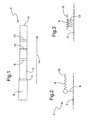
- a protease detection product 1 comprises a nitrocellulose strip 2 having first and second ends 3, 4. Attached to the first end 3 is a sample receiving zone 5 which comprises an elongate, rectangular absorbent material of slightly greater width than the nitrocellulose strip 2.
- the labelling band 6 which is arranged transverse to the long axis of the strip 2.
- the labelling band 6 comprises a plurality of labelled components 7 which are shown in further detail in Figure 2 .
- the labelled component 7 comprises a stem 8 which is immobilised within the strip 2 structure to enhance the access of the enzyme to the labelled component 7. Attached to the stem 8 is provided a protease-sensitive linker peptide 9. Attached to the free end of the protease-sensitive linker peptide 9 is provided a label 10, which in this case is a fluorophore but in other embodiments is, for example, a gold particle or a chromogenic moiety.
- protease inhibitor band 11 is located transverse to the long axis of the strip 2.
- the protease inhibitor band 11 comprises a protease inhibitor dried into the strip 2. It is to be understood that the protease inhibitor band 11 is by no means essential to the invention and is omitted in some other embodiments.
- the capture band 12 comprises a plurality of capture components 13, one of which is shown schematically in Figure 3 .
- the capture molecule 13 is a monoclonal antibody, immobilised into the strip 2 but this is not essential to the invention. What is important is that each capture component 13 is capable of binding the free end of the peptide linker 9.
- the capture component 13 is illustrated binding the peptide linker 9 but it is to be understood that this illustrates the protease detection product in use. Before the protease detection product 1 is used, no components are bound to the capture component 13.
- the sample is deposited on the sample receiving zone 5 and subsequently absorbed into the nitrocellulose strip 2, adjacent the first end 3.
- a chase buffer comprising a suitable solvent is then deposited on the sample receiving zone in order to ensure that there is sufficient liquid to carry the sample along the strip 2.
- the sample is then absorbed towards the second end 4 of the strip 2, in the direction of the arrow 14 along what is referred to as the liquid flow path.
- any protease enzyme in the sample cleaves the protease-sensitive linker peptide 9 and thus releases the free end of the linker peptide together with the label 10. If, on the other hand there is no active protease in the sample then the linker peptide 9 remains intact and is thus immobilised to the strip 2 via the stem 8.
- the sample then continues along the liquid flow path until it reaches the protease inhibitor band 11 at which point any active protease enzyme in the sample is deactivated.
- the sample continues along the liquid flow path until it reaches the capture band 12 and the plurality of capture components 13. Since any active protease enzyme in the sample has been deactivated, the sample does not degrade the capture component 13 itself.
- the capture band 12 is visualised. If the label is a fluorophore, as in the present embodiment, then this is carried out under ultraviolet light but if the label is visible under natural light (for example if the label is a gold particle) then ultraviolet light is unnecessary. If the peptide linker 9 has been cleaved and is thus bound to the capture component 13 then the accumulation of the label 10 at the capture band 12 is visible as a line on the strip 2. If, on the other hand, the sample did not contain a protease to which the peptide linker 9 was sensitive then there is no accumulation of the label 10 at the capture band 12. Thus the presence of an active protease enzyme in the sample can be assessed by observing the presence or absence of a line at the capture band 12, once the assay has completed.
- the label 10 remains at the labelling band 6.
- the presence of a line at the labelling band 6 is measured. If the label is present at the labelling band 6 then it is indicative of the absence of protease in the sample but if the label is not present at the labelling band 6 or is present at a reduced intensity then it is indicative of the presence of a protease in the sample.
- the quantity of the label at the labelling band 6 and the capture band 12 are both determined in order assess the ratio of the label at the two bands.
- the ratio of the label at the two bands it is possible to quantify the amount of, or activity of, the protease enzyme in the sample. More specifically, the greater the amount of label at the capture band 12 compared with the labelling band 6, the more protease enzyme, or the more active the protease enzyme is in the sample and vice versa .
- the capture component is an antibody.
- the capture components are components other than antibodies.
- the protease-sensitive peptide contains a carbohydrate moiety (displaying a CIS diol) and the capture component is phenylboronic acid, which is capable of binding the carbohydrate.
- the capture component 13 is cellulose and the protease-sensitive linker peptide 9 is conjugated to galactomannan or xyloglucan, either of which will bind to cellulose.
- protease inhibitor band 11 is not required because cellulose, galactomannan and xyloglucan are not affected by protease enzymes.
- binding pairs that may be used are lectin (e.g. lectin from elderberry) with a carbohydrate (a sugar O-linked to the peptide); and streptavidin with biotin
- a protease detection product 15 comprises a nitrocellulose strip 16 having first and second ends 17, 18. At the first end of the nitrocellulose strip 16 is located a sample receiving zone 19 which comprises a rectangular sheet of an absorbent material which sits above the strip 16. Impregnated in the sample receiving zone 19 is a protease-sensitive peptide conjugated to a label such as a fluorophore group. The protease sensitive peptide has a cleavage sequence at which the protease can cleave the peptide.
- the first capture band 21 comprises a plurality of monoclonal antibodies, each immobilised on the surface of the strip 16.
- the antibodies in the first capture band 21 are specific for a binding sequence of the peptide located such that the cleavage sequence is between the binding sequence and the label.
- the antibodies of the first capture band 21 are specific for the cleavage sequence itself or are specific for a conformational epitope that is disrupted through the action of the protease enzyme.
- a second capture band 22 which is also located transverse to the long axis of the strip 16.
- the second capture band comprises a plurality of monoclonal antibodies, each immobilised into the surface of the strip 16.
- the antibodies in the second capture band 22 are specific for a sequence on the peptide between the cleavage sequence and the label.
- the sample is deposited onto the sample receiving zone 19.
- a chase buffer as described in relation to the previous embodiment, is also deposited on the sample receiving zone 19. The sample soaks through the sample receiving zone 19 but is initially incapable of being absorbed further because of the presence of the soluble barrier 20. After a period of time, the buffer in the sample dissolves the soluble barrier 20. During that period of time, however, the sample thoroughly mixes with the protease-sensitive peptide therein and any protease present in the sample will cleave the peptide at the cleavage sequence.
- the sample, mixed with the protease-sensitive peptide, is absorbed along the nitrocellulose strip 16 in the direction of the arrow 23 along a liquid flow path.
- the mixture of sample and peptide then passes through the first capture band 21. If there was any active protease enzyme in the sample capable of cleaving the peptide then the peptide will have been cleaved and the antibody will bind a peptide fragment that does not carry the label. In the alternative embodiments, no peptide will be able to bind to the antibody in the first capture band because the antibody is specific for the sequence across the cleaving point, or is specific for a conformational epitope that is disrupted through the action of the protease enzyme activity. If, on the other hand, there was no active protease in the sample capable of cleaving the peptide then intact peptide will bind to the antibodies in the first capture band 21.
- the mixture of peptide and sample then continues along the strip 16 in the direction of the arrow 23 where it reaches the second capture band 22.
- the intact or cleaved peptide will bind to the antibodies in the second capture band 22. It is to be appreciated that if the protease is in the sample then little or no label will become bound to the first capture band 21 so more label is available to be bound to the second capture band 22.
- the strip 16 is then visualised in order to locate the label on it. If the label is a fluorophore group as in this embodiment, then the strip 16 is visualised under ultraviolet light. Where the label has accumulated, it is visible as a line on the strip 16. If the label has accumulated at the first capture band 21 then this is indicative of the absence of an active protease enzyme in the sample.
- the presence of the label at the second capture band 22 is determined, the presence of label at the second capture band 22 being indicative of the presence of an active protease enzyme in the sample.
- the presence of label is determined at both the first and second capture bands 21, 22 and the ratio of the intensity of the lines of label at the two bands 21, 22 is assessed.
- the second capture band 22 acts as a "control band" because label accumulation at the second capture band 22 indicates that the sample has penetrated the soluble barrier 20 and has reached the end of the assay.
- the location of the first and second capture bands, 21, 22 is reversed, i.e. the second capture band 22 is upstream of the first capture band.
- the advantage of providing the soluble barrier 20 is that thorough mixing of the protease-sensitive peptide and the sample can occur before the mixture proceeds along the liquid flow path. If the soluble barrier 20 were not provided then the nitrocellulose strip 16 would have to be much longer in order to provide sufficient time for the mixing to occur and the protease to cleave the peptide before the mixture reached the first capture band 21.
- a protease detection product 24 differs from the product shown in Figure 1 in that the labelling band 6 and the capture band 12 are replaced with a capture band 25 and a further capture band 26, respectively. Furthermore, the protease inhibitor band 11 is omitted and a soluble barrier 27 is provided in the sample receiving zone 5, separating the main part of the sample receiving zone 5 from the first end 3 of the nitrocellulose strip 2.
- protease-sensitive peptide Dried into the main part of the sample receiving zone 5 is a protease-sensitive peptide conjugated to a label such as a fluorophore group.
- the protease-sensitive peptide has a cleavage sequence at which a protease can cleave the peptide.
- the capture band 25 comprises a plurality of monoclonal antibodies, each immobilised onto the surface of the strip 2.
- the antibodies in the capture band 25 are specific for a sequence on the peptide between the cleavage sequence and the label.
- the further capture band 26 comprises a plurality of monoclonal antibodies, each immobilised on the surface of the strip 2.
- the antibodies in the further capture band 26 are specific for a binding sequence of the peptide located such that the cleavage sequence is between the binding sequence and the label.
- the antibodies of the further capture band 26 are specific for the cleavage sequence itself or are specific for a conformational epitope which is disrupted through the action of the protease enzyme.
- the protease detection product 24, is used as in the previous embodiments. Thus a sample is deposited on the sample receiving zone 5 and a chase buffer is added. The sample then mixes with the protease sensitive peptide on the sample receiving zone 25 while the soluble barrier 27 is dissolved by the buffer. If there is a suitable protease in the sample then the protease-sensitive peptide is cleaved.
- the soluble barrier 27 is degraded and the mixture of sample, buffer and protease-sensitive peptide passes along the strip 2 from the first end 3 to the second end 4.
- the antibodies in the capture band 25 bind to the protease-sensitive peptides, irrespective of whether or not it has been cleaved by a protease.
- some of the protease-sensitive peptide passes beyond the capture band 25 and reaches the further capture band 26.
- the antibodies bind and immobilise the binding sequence of the peptide. If the protease-sensitive peptide has been cleaved then the label is no longer attached to the binding sequence and so the label is not immobilised at the further capture band 26. In the alternative embodiments, the peptide does not bind to the antibodies of the further capture band 26, at all, if there has been cleavage of the protease-sensitive peptide and so for this reason the label does not accumulate at the further capture band 26. If, on the other hand, the protease-sensitive peptide has not been cleaved then the label does accumulate at the further capture band 26.
- the strip 2 is inspected to determine the outcome of the assay.
- the level of label which accumulates at the further capture band 26 is compared with the level of label accumulated at the capture band 25.
- the position of the capture band and the further capture band 26 may be reversed with respect to each other (i.e. the further capture band 26 may be located upstream on the liquid flow path of the capture band 25).
- the label comprises a gold particle to which is conjugated the protease-sensitive peptide. Also conjugated to the gold particle is a galactomannan moiety.
- the capture band 25 comprises a plurality of antibodies capable of binding a binding sequence on the peptide, the cleavage sequence being between the gold particle and the binding sequence.
- the further capture band 26 comprises PBA, which binds carbohydrate displaying a CIS diol. In the absence of protease, gold particles are bound at and accumulate at both the capture band 25 and the further capture band 26. In the presence of a suitable protease, however, the cleavage sequence is cleaved and so any peptide bound at the first capture band 25 is not attached to a gold particle.
- gold particles only accumulate at the further capture band 26 in the presence of the protease. Accordingly, the presence or absence of an active protease enzyme in the sample can be assessed by comparing the accumulation of the gold particle at the capture band 25 with gold particle accumulation at the further capture band 26.
- Example 1 The Cleavage of Immobilised Peptide on the Strip.
- test lines 1 and 2 The results of signals strengths for test lines 1 and 2 are tabulated in Table 1 below. It is to be noted that the presence of the gold conjugate at either test line not directly detected. Fluorescein was used in the cleavable peptide not for its fluorescent properties but because it is a small, antigenic molecule and several antibodies against it are commercially available. Table 1 - Signal Generation for test lines 1 and 2 using Peptide Immobilised on Strip Trypsin Standard Test line 1 Test Line 2 0 ⁇ g/ml ++++ + 50 ⁇ g/ml +++ ++ 100 ⁇ g/ml ++ +++ 250 ⁇ g/ml ++ +++ 500 ⁇ g/ml + +++ 1000 ⁇ g/ml + +++
- Example 3 The incorporation of the cleavable peptide into the sample pad of a test strip.
- test lines 1 and 2 The results of signals strengths for test lines 1 and 2 are tabulated in Table 3 below.
- Table 3 Signal Generation for test lines 1 and 2 using cleavable peptide incorporated into sample pad of test strip. Trypsin Standard Test line 1 Test Line 2 0 ⁇ g/ml +++ ++ 1000 ⁇ g/ml - +++
- the immunoassay test strip 28 comprises, at a first end, a sample receiving pad 29 made from an absorbent material.
- a dried, cleavable peptide (Fluorescein-Val-Arg-Gly-[PEG] 20 -Biotin) is dried onto the sample receiving pad 29.
- a PVA film 30, of 35 ⁇ m thickness Located beneath the sample receiving pad 29 is a PVA film 30, of 35 ⁇ m thickness.
- the PVA film 30 is sized so as to cover the entire inner end of the sample receiving pad 29 and extend an additional 1 mm around all dimensions of the sample receiving pad 29 (except on the outer end of the sample receiving pad 29).
- the PVA film 30 is a barrier to fluid passing beyond the sample receiving pad 29 but is soluble in water after a predetermined length of time.
- an intermediate pad 31 Located beneath the PVA film 30 is an intermediate pad 31.
- the intermediate pad 31 is located so that the outer end thereof 32 overlaps with the inner end 33 of the sample receiving pad 29 with the inner end 34 of the PVA film 30 being sandwiched therebetween. Furthermore, the 1 mm extension of the PVA film 30 from the inner end 33 of the sample receiving pad 29 prevents any direct fluid communication between the sample receiving pad 29 and the intermediate pad 31.
- a plurality of anti-FITC gold conjugates are dried onto the intermediate pad 31.
- first and second test lines Located on the absorbent strip 35 are first and second test lines (not shown).
- the first test line which is closest to the intermediate pad 31 comprises streptavidin immobilised on the surface of the absorbent strip 35.
- the second test line which is remote from the intermediate pad 31 comprises a plurality of anti-mouse antibodies immobilised on the absorbent strip 35.
- a protease-containing sample is added to the proximal end of the sample receiving pad 29, at the point marked A.
- the sample mixes with the cleavable peptide located in the sample receiving pad 29 and cleaves the peptide. Furthermore, the sample dissolves the PVA film 30 and, after a predetermined length of time, the cleaved peptide is capable of flowing to the intermediate pad 31 where it mixes with the anti-FITC gold conjugate.
- the mixture of cleaved peptide and anti-FITC gold conjugate is then absorbed onto the absorbent strip 35 where the biotin containing section of the cleaved peptide binds at the first test line and the Fluorescein-containing part of the cleaved peptide, binds to the anti-FITC gold conjugate which is immobilised at the second test line.
- the peptide in the absence of a protease in the sample, the peptide remains uncleaved on the sample receiving pad 29; the sample dissolves and passes through the PVA film 30 and mixes with the FITC gold conjugate on the intermediate pad 31.
- the anti-FITC gold conjugate binds to the Fluorescein of the uncleaved peptide, which is then immobilised at the first test line.
- a small amount of the anti-FITC gold conjugate in practice, does not bind to the cleavable peptide and the unbound conjugate is immobilised at the second test line.
- the anti-FITC gold conjugate is located in the intermediate pad 31 rather than the sample receiving pad 29 so as to minimise the exposure of the anti-FITC conjugate to the protease in a sample, which could otherwise exercise its proteolytic activity against the conjugate. Accordingly, by locating the anti-FITC gold conjugate in the intermediate pad 31, any proteolysis of the conjugate is minimised and thus the signal produced by the gold conjugate at the test lines is maximised.
Landscapes
- Health & Medical Sciences (AREA)
- Life Sciences & Earth Sciences (AREA)
- Immunology (AREA)
- Engineering & Computer Science (AREA)
- Chemical & Material Sciences (AREA)
- Molecular Biology (AREA)
- Urology & Nephrology (AREA)
- Hematology (AREA)
- Biomedical Technology (AREA)
- Analytical Chemistry (AREA)
- Biotechnology (AREA)
- Biochemistry (AREA)
- Microbiology (AREA)
- Physics & Mathematics (AREA)
- General Health & Medical Sciences (AREA)
- Cell Biology (AREA)
- Pathology (AREA)
- General Physics & Mathematics (AREA)
- Medicinal Chemistry (AREA)
- Food Science & Technology (AREA)
- Organic Chemistry (AREA)
- Proteomics, Peptides & Aminoacids (AREA)
- Wood Science & Technology (AREA)
- Zoology (AREA)
- Bioinformatics & Cheminformatics (AREA)
- Biophysics (AREA)
- Genetics & Genomics (AREA)
- General Engineering & Computer Science (AREA)
- Measuring Or Testing Involving Enzymes Or Micro-Organisms (AREA)
- Investigating Or Analysing Materials By The Use Of Chemical Reactions (AREA)
- Apparatus Associated With Microorganisms And Enzymes (AREA)
Priority Applications (1)
| Application Number | Priority Date | Filing Date | Title |
|---|---|---|---|
| PL07732335T PL2004845T3 (pl) | 2006-04-07 | 2007-04-05 | Produkt do wykrywania proteazy |
Applications Claiming Priority (2)
| Application Number | Priority Date | Filing Date | Title |
|---|---|---|---|
| GB0607070A GB2437311A (en) | 2006-04-07 | 2006-04-07 | A protease detection product |
| PCT/GB2007/001291 WO2007128980A1 (en) | 2006-04-07 | 2007-04-05 | A protease detection product |
Publications (2)
| Publication Number | Publication Date |
|---|---|
| EP2004845A1 EP2004845A1 (en) | 2008-12-24 |
| EP2004845B1 true EP2004845B1 (en) | 2011-09-07 |
Family
ID=36539569
Family Applications (1)
| Application Number | Title | Priority Date | Filing Date |
|---|---|---|---|
| EP07732335A Not-in-force EP2004845B1 (en) | 2006-04-07 | 2007-04-05 | A protease detection product |
Country Status (11)
| Country | Link |
|---|---|
| US (1) | US20090203059A1 (https=) |
| EP (1) | EP2004845B1 (https=) |
| JP (1) | JP5133976B2 (https=) |
| AT (1) | ATE523600T1 (https=) |
| AU (1) | AU2007246914B2 (https=) |
| CA (1) | CA2648712A1 (https=) |
| DK (1) | DK2004845T3 (https=) |
| ES (1) | ES2370437T3 (https=) |
| GB (1) | GB2437311A (https=) |
| PL (1) | PL2004845T3 (https=) |
| WO (1) | WO2007128980A1 (https=) |
Families Citing this family (29)
| Publication number | Priority date | Publication date | Assignee | Title |
|---|---|---|---|---|
| US7906276B2 (en) | 2004-06-30 | 2011-03-15 | Kimberly-Clark Worldwide, Inc. | Enzymatic detection techniques |
| US7521226B2 (en) | 2004-06-30 | 2009-04-21 | Kimberly-Clark Worldwide, Inc. | One-step enzymatic and amine detection technique |
| US7504235B2 (en) | 2005-08-31 | 2009-03-17 | Kimberly-Clark Worldwide, Inc. | Enzyme detection technique |
| GB2435511A (en) | 2006-02-23 | 2007-08-29 | Mologic Ltd | Protease detection |
| GB2435510A (en) | 2006-02-23 | 2007-08-29 | Mologic Ltd | Enzyme detection product and methods |
| GB2435512A (en) | 2006-02-23 | 2007-08-29 | Mologic Ltd | A binding assay and assay device |
| US8758989B2 (en) | 2006-04-06 | 2014-06-24 | Kimberly-Clark Worldwide, Inc. | Enzymatic detection techniques |
| US7897360B2 (en) | 2006-12-15 | 2011-03-01 | Kimberly-Clark Worldwide, Inc. | Enzyme detection techniques |
| GB2452076A (en) | 2007-08-23 | 2009-02-25 | Mologic Ltd | Detection of enzymes by detecting binding of substrate recognition molecules to modified substrates |
| PT2271670E (pt) * | 2008-03-14 | 2014-11-28 | Allergan Inc | Ensaio imunobaseado da atividade do serotipo a da toxina botulínica |
| US8368387B2 (en) | 2008-04-11 | 2013-02-05 | Mitsubishi Electric Corporation | Acceleration sensor |
| US8815609B2 (en) | 2008-05-20 | 2014-08-26 | Rapid Pathogen Screening, Inc. | Multiplanar lateral flow assay with diverting zone |
| US20130196310A1 (en) | 2008-05-20 | 2013-08-01 | Rapid Pathogen Screening, Inc. | Method and Device for Combined Detection of Viral and Bacterial Infections |
| US8962260B2 (en) | 2008-05-20 | 2015-02-24 | Rapid Pathogen Screening, Inc. | Method and device for combined detection of viral and bacterial infections |
| GB0904080D0 (en) | 2009-03-09 | 2009-04-22 | Mologic Ltd | Imaging method |
| US20120009591A1 (en) * | 2009-03-20 | 2012-01-12 | Ewa Pol | Method for detection of an enzyme-substrate reaction |
| GB201116523D0 (en) | 2011-09-23 | 2011-11-09 | Systagenix Wound Man Ip Co Bv | Wound prognosis |
| EP2671081A2 (en) | 2011-01-31 | 2013-12-11 | Systagenix Wound Management IP Co. BV. | Wound prognosis |
| WO2013016114A2 (en) * | 2011-07-22 | 2013-01-31 | Rapid Pathogen Screening, Inc. | Enzymatic cleavage based lateral flow assays |
| GB201206977D0 (en) | 2012-04-20 | 2012-06-06 | Mologic Ltd | An enzyme detection device |
| GB201206976D0 (en) | 2012-04-20 | 2012-06-06 | Mologic Ltd | An enzyme detection device |
| US20160282343A1 (en) * | 2012-08-15 | 2016-09-29 | Immunolab LLC | Quantitative lateral flow assay strips for quantitative analysis of an analyte, kits containing such strips and methods of manufacture and use of same |
| GB201318728D0 (en) * | 2013-10-23 | 2013-12-04 | Mologic Ltd | Detection of cleavage activity of an enzyme |
| US10808287B2 (en) | 2015-10-23 | 2020-10-20 | Rapid Pathogen Screening, Inc. | Methods and devices for accurate diagnosis of infections |
| GB201605110D0 (en) | 2016-03-24 | 2016-05-11 | Mologic Ltd | Detecting sepsis |
| GB201614053D0 (en) * | 2016-08-17 | 2016-09-28 | Microarray Ltd | Determining the condition of a wound |
| JP6939106B2 (ja) * | 2017-06-09 | 2021-09-22 | 東洋紡株式会社 | イムノクロマト試験片およびキットおよび測定方法 |
| GB201902458D0 (en) | 2019-02-22 | 2019-04-10 | Mologic Ltd | Treatment stratification for an excerbation of inflamation |
| BR112022024278A2 (pt) * | 2020-05-29 | 2023-02-07 | Abbott Rapid Diagnostics Int Unlimited Company | Dispositivos de teste de diagnóstico legível por máquina e métodos e aparelho para fazer e/ou processar os mesmos |
Family Cites Families (58)
| Publication number | Priority date | Publication date | Assignee | Title |
|---|---|---|---|---|
| CA983358A (en) * | 1971-09-08 | 1976-02-10 | Kenneth D. Bagshawe | Performance of chemical or biological reactions |
| US4055394A (en) * | 1976-10-18 | 1977-10-25 | Akzona Incorporated | Diagnostic test card |
| CA1095819A (en) * | 1977-01-14 | 1981-02-17 | Eastman Kodak Company | Element for analysis of liquids |
| US4178153A (en) * | 1977-11-21 | 1979-12-11 | Damon Corporation | Method and apparatus for chemical spot test analysis |
| US4258001A (en) * | 1978-12-27 | 1981-03-24 | Eastman Kodak Company | Element, structure and method for the analysis or transport of liquids |
| JPS568549A (en) * | 1979-07-02 | 1981-01-28 | Fuji Photo Film Co Ltd | Multilayer chemical analyzing material |
| JPS5767860A (en) * | 1980-10-15 | 1982-04-24 | Fuji Photo Film Co Ltd | Material for multilayer analysis |
| DE3247608A1 (de) * | 1982-12-23 | 1984-07-05 | Boehringer Mannheim Gmbh, 6800 Mannheim | Teststreifen |
| US4851356A (en) * | 1983-05-06 | 1989-07-25 | The Trustees Of Columbia University In The City Of New York | Immunoassay for human chorionic gonadotropin |
| US4522923A (en) * | 1983-10-03 | 1985-06-11 | Genetic Diagnostics Corporation | Self-contained assay method and kit |
| US4703017C1 (en) * | 1984-02-14 | 2001-12-04 | Becton Dickinson Co | Solid phase assay with visual readout |
| US4632901A (en) * | 1984-05-11 | 1986-12-30 | Hybritech Incorporated | Method and apparatus for immunoassays |
| US5879881A (en) * | 1985-04-04 | 1999-03-09 | Hybritech, Incorporated | Solid phase system for use in ligand-receptor assays |
| US4689240A (en) * | 1985-06-20 | 1987-08-25 | Miles Laboratories, Inc. | Method for forming volume independent test device |
| US5236826A (en) * | 1985-12-10 | 1993-08-17 | Murex Corporation | Immunoassay for the detection or quantitation of an analyte |
| JPS63305251A (ja) * | 1987-06-05 | 1988-12-13 | Dai Ichi Pure Chem Co Ltd | ラテツクス凝集反応を利用する免疫学的測定方法 |
| FR2621393B1 (fr) * | 1987-10-05 | 1991-12-13 | Toledano Jacques | Dispositif de detection immunoenzymatique de substances a partir d'une goutte de sang ou de liquide provenant d'un quelconque milieu biologique |
| DE3814370A1 (de) * | 1988-04-28 | 1989-11-09 | Boehringer Mannheim Gmbh | Testtraeger fuer die analyse einer probenfluessigkeit, verfahren zur durchfuehrung einer solchen analyse und herstellungsverfahren |
| US6352862B1 (en) * | 1989-02-17 | 2002-03-05 | Unilever Patent Holdings B.V. | Analytical test device for imuno assays and methods of using same |
| US5064770A (en) * | 1989-08-01 | 1991-11-12 | Wisconsin Alumni Research Foundation | Assay for 1,25-dihydroxy vitamin d receptor protein |
| US5185249A (en) * | 1990-04-04 | 1993-02-09 | Eastman Kodak Company | Dry analytical element for assaying salicylate |
| US5171662A (en) * | 1990-09-13 | 1992-12-15 | The Upjohn Company | Method of detecting HIV protease activity |
| WO1992005440A1 (en) * | 1990-09-26 | 1992-04-02 | Akers Research Corporation | Improved ligand assay |
| AU9039691A (en) * | 1990-11-14 | 1992-06-11 | Southern Research Institute | Rapid diagnostic device and kit |
| WO1992012428A1 (en) * | 1991-01-11 | 1992-07-23 | Quidel Corporation | A one-step lateral flow nonbibulous assay |
| GB9119102D0 (en) * | 1991-09-07 | 1991-10-23 | Biosyn Ltd | Bioimmunassay |
| DE4132743A1 (de) * | 1991-10-02 | 1993-04-08 | Boehringer Mannheim Gmbh | Testtraeger fuer die analyse von fluessigkeiten |
| US5296192A (en) * | 1992-04-03 | 1994-03-22 | Home Diagnostics, Inc. | Diagnostic test strip |
| US5601986A (en) * | 1994-07-14 | 1997-02-11 | Amgen Inc. | Assays and devices for the detection of extrahepatic biliary atresia |
| US6686170B1 (en) * | 1994-08-17 | 2004-02-03 | Abbott Laboratories | Assay devices with mobile control reagents |
| AUPM769394A0 (en) * | 1994-08-25 | 1994-09-15 | Commonwealth Scientific And Industrial Research Organisation | Assay for the detection of proteases |
| US5755231A (en) * | 1995-05-17 | 1998-05-26 | Plus Bio, Inc. | Test strip including integral specimen flow retarding structure |
| US5741659A (en) * | 1996-01-04 | 1998-04-21 | The United States Of America As Represented By The Secretary Of The Navy | Rapid microbial protease assay |
| US6096563A (en) * | 1996-03-29 | 2000-08-01 | Strategic Diagnostics Inc. | Dual particle immunoassay method and kit |
| US5879951A (en) * | 1997-01-29 | 1999-03-09 | Smithkline Diagnostics, Inc. | Opposable-element assay device employing unidirectional flow |
| US7312302B2 (en) * | 1997-02-20 | 2007-12-25 | Oncolmmunin, Inc. | Compositions for the detection of enzyme activity in biological samples and methods of use thereof |
| US6040195A (en) * | 1997-06-10 | 2000-03-21 | Home Diagnostics, Inc. | Diagnostic sanitary test strip |
| US6316205B1 (en) * | 2000-01-28 | 2001-11-13 | Genelabs Diagnostics Pte Ltd. | Assay devices and methods of analyte detection |
| US6750034B1 (en) * | 2000-06-30 | 2004-06-15 | Ortho-Mcneil Pharmaceutical, Inc. | DNA encoding human serine protease D-G |
| KR100425525B1 (ko) * | 2000-11-21 | 2004-03-30 | 재단법인서울대학교산학협력재단 | 조산과 태아감염 및 태아손상을 산전 진단하기 위한진단시약 및 진단키트 |
| FR2817961B1 (fr) * | 2000-12-08 | 2003-08-01 | Diagast | Barriere de separation temporaire, recipient la comprenant et procede de mise en oeuvre d'un test dans ce recipient |
| JP2002202308A (ja) * | 2000-12-27 | 2002-07-19 | Matsushita Electric Ind Co Ltd | 免疫クロマトデバイス |
| WO2003014698A2 (en) * | 2001-08-07 | 2003-02-20 | Merck & Co., Inc. | Biological assay detection method |
| AU2002341621A1 (en) * | 2001-09-10 | 2003-03-24 | Meso Scale Technologies, Llc | Methods, reagents, kits and apparatus for protein function analysis |
| EP1472238B1 (en) * | 2002-02-01 | 2012-07-04 | Promega Corporation | Bioluminescent protease assay |
| US7041453B2 (en) * | 2002-08-22 | 2006-05-09 | Bioarray Solutions Ltd. | Molecular constructs and methods of use for detection of biochemical reactions |
| EP1567677A4 (en) * | 2002-11-22 | 2007-04-18 | Marligen Biosciences Inc | DETECTION OF PROTEASE ENZYMES |
| GB0316075D0 (en) * | 2003-07-09 | 2003-08-13 | Molecular Sensing Plc | Protease detection assay |
| GB0317680D0 (en) * | 2003-07-29 | 2003-09-03 | Univ Edinburgh | Protease assay |
| US7906276B2 (en) * | 2004-06-30 | 2011-03-15 | Kimberly-Clark Worldwide, Inc. | Enzymatic detection techniques |
| US7504235B2 (en) * | 2005-08-31 | 2009-03-17 | Kimberly-Clark Worldwide, Inc. | Enzyme detection technique |
| US7279136B2 (en) * | 2005-12-13 | 2007-10-09 | Takeuchi James M | Metering technique for lateral flow assay devices |
| GB2433260A (en) * | 2005-12-16 | 2007-06-20 | Mologic Ltd | A selectable decarboxylase marker |
| GB2435511A (en) * | 2006-02-23 | 2007-08-29 | Mologic Ltd | Protease detection |
| GB2435510A (en) * | 2006-02-23 | 2007-08-29 | Mologic Ltd | Enzyme detection product and methods |
| GB2435512A (en) * | 2006-02-23 | 2007-08-29 | Mologic Ltd | A binding assay and assay device |
| GB2452076A (en) * | 2007-08-23 | 2009-02-25 | Mologic Ltd | Detection of enzymes by detecting binding of substrate recognition molecules to modified substrates |
| GB0904080D0 (en) * | 2009-03-09 | 2009-04-22 | Mologic Ltd | Imaging method |
-
2006
- 2006-04-07 GB GB0607070A patent/GB2437311A/en not_active Withdrawn
-
2007
- 2007-04-05 AU AU2007246914A patent/AU2007246914B2/en not_active Ceased
- 2007-04-05 EP EP07732335A patent/EP2004845B1/en not_active Not-in-force
- 2007-04-05 ES ES07732335T patent/ES2370437T3/es active Active
- 2007-04-05 US US12/296,413 patent/US20090203059A1/en not_active Abandoned
- 2007-04-05 PL PL07732335T patent/PL2004845T3/pl unknown
- 2007-04-05 AT AT07732335T patent/ATE523600T1/de not_active IP Right Cessation
- 2007-04-05 DK DK07732335.0T patent/DK2004845T3/da active
- 2007-04-05 CA CA002648712A patent/CA2648712A1/en not_active Abandoned
- 2007-04-05 WO PCT/GB2007/001291 patent/WO2007128980A1/en not_active Ceased
- 2007-04-05 JP JP2009503659A patent/JP5133976B2/ja not_active Expired - Fee Related
Also Published As
| Publication number | Publication date |
|---|---|
| JP5133976B2 (ja) | 2013-01-30 |
| DK2004845T3 (da) | 2011-11-21 |
| US20090203059A1 (en) | 2009-08-13 |
| ES2370437T3 (es) | 2011-12-15 |
| AU2007246914B2 (en) | 2013-03-14 |
| JP2009532052A (ja) | 2009-09-10 |
| PL2004845T3 (pl) | 2012-02-29 |
| GB0607070D0 (en) | 2006-05-17 |
| EP2004845A1 (en) | 2008-12-24 |
| WO2007128980A1 (en) | 2007-11-15 |
| ATE523600T1 (de) | 2011-09-15 |
| AU2007246914A1 (en) | 2007-11-15 |
| CA2648712A1 (en) | 2007-11-15 |
| GB2437311A (en) | 2007-10-24 |
Similar Documents
| Publication | Publication Date | Title |
|---|---|---|
| EP2004845B1 (en) | A protease detection product | |
| US7935497B2 (en) | Protease detection | |
| US7241418B2 (en) | Method for immobilizing conjugates in diagnostic tests | |
| Nagatani et al. | Gold nanoparticle-based novel enhancement method for the development of highly sensitive immunochromatographic test strips | |
| AU623678B2 (en) | Pregnancy induced hypertension and eclampsia immunoassay and reagents | |
| US20220308049A1 (en) | Lateral flow test strips with competitive assay control | |
| EP2839022B1 (en) | An enzyme detection device | |
| EP2839288B1 (en) | An enzyme detection device | |
| JP5270672B2 (ja) | 分析物の検出方法 | |
| JP5010374B2 (ja) | 免疫測定装置用の対照系としてのウシアルブミンp−アミノフェニルN−アセチルβ−Dグルコサミニドの使用 | |
| US6287785B1 (en) | Homogenous enzyme immunoassay process | |
| CN219574122U (zh) | 一种联合定量检测急性心肌梗死的荧光免疫层析试纸条 | |
| CN101305282A (zh) | 凝集分析法 | |
| JPH09502799A (ja) | マルチメンブランシステムを用いる免疫物質の固定方法 | |
| EP1054258A1 (en) | Homogeneous enzyme immunoassay process using second antibody | |
| JPS58151560A (ja) | ヒト尿カリクレイン測定用キツト |
Legal Events
| Date | Code | Title | Description |
|---|---|---|---|
| PUAI | Public reference made under article 153(3) epc to a published international application that has entered the european phase |
Free format text: ORIGINAL CODE: 0009012 |
|
| 17P | Request for examination filed |
Effective date: 20081007 |
|
| AK | Designated contracting states |
Kind code of ref document: A1 Designated state(s): AT BE BG CH CY CZ DE DK EE ES FI FR GB GR HU IE IS IT LI LT LU LV MC MT NL PL PT RO SE SI SK TR |
|
| 17Q | First examination report despatched |
Effective date: 20090514 |
|
| GRAP | Despatch of communication of intention to grant a patent |
Free format text: ORIGINAL CODE: EPIDOSNIGR1 |
|
| GRAS | Grant fee paid |
Free format text: ORIGINAL CODE: EPIDOSNIGR3 |
|
| GRAA | (expected) grant |
Free format text: ORIGINAL CODE: 0009210 |
|
| DAX | Request for extension of the european patent (deleted) | ||
| RIN1 | Information on inventor provided before grant (corrected) |
Inventor name: DAVIS, MARK JAMES Inventor name: DAVIS, PAUL JAMES Inventor name: BURNAPP, MARK |
|
| REG | Reference to a national code |
Ref country code: GB Ref legal event code: FG4D |
|
| REG | Reference to a national code |
Ref country code: CH Ref legal event code: EP |
|
| REG | Reference to a national code |
Ref country code: IE Ref legal event code: FG4D |
|
| REG | Reference to a national code |
Ref country code: DE Ref legal event code: R096 Ref document number: 602007016974 Country of ref document: DE Effective date: 20111103 |
|
| REG | Reference to a national code |
Ref country code: NL Ref legal event code: T3 |
|
| REG | Reference to a national code |
Ref country code: DK Ref legal event code: T3 |
|
| REG | Reference to a national code |
Ref country code: SE Ref legal event code: TRGR |
|
| REG | Reference to a national code |
Ref country code: ES Ref legal event code: FG2A Ref document number: 2370437 Country of ref document: ES Kind code of ref document: T3 Effective date: 20111215 |
|
| PG25 | Lapsed in a contracting state [announced via postgrant information from national office to epo] |
Ref country code: FI Free format text: LAPSE BECAUSE OF FAILURE TO SUBMIT A TRANSLATION OF THE DESCRIPTION OR TO PAY THE FEE WITHIN THE PRESCRIBED TIME-LIMIT Effective date: 20110907 Ref country code: LT Free format text: LAPSE BECAUSE OF FAILURE TO SUBMIT A TRANSLATION OF THE DESCRIPTION OR TO PAY THE FEE WITHIN THE PRESCRIBED TIME-LIMIT Effective date: 20110907 |
|
| LTIE | Lt: invalidation of european patent or patent extension |
Effective date: 20110907 |
|
| PG25 | Lapsed in a contracting state [announced via postgrant information from national office to epo] |
Ref country code: GR Free format text: LAPSE BECAUSE OF FAILURE TO SUBMIT A TRANSLATION OF THE DESCRIPTION OR TO PAY THE FEE WITHIN THE PRESCRIBED TIME-LIMIT Effective date: 20111208 Ref country code: AT Free format text: LAPSE BECAUSE OF FAILURE TO SUBMIT A TRANSLATION OF THE DESCRIPTION OR TO PAY THE FEE WITHIN THE PRESCRIBED TIME-LIMIT Effective date: 20110907 Ref country code: LV Free format text: LAPSE BECAUSE OF FAILURE TO SUBMIT A TRANSLATION OF THE DESCRIPTION OR TO PAY THE FEE WITHIN THE PRESCRIBED TIME-LIMIT Effective date: 20110907 Ref country code: CY Free format text: LAPSE BECAUSE OF FAILURE TO SUBMIT A TRANSLATION OF THE DESCRIPTION OR TO PAY THE FEE WITHIN THE PRESCRIBED TIME-LIMIT Effective date: 20110907 Ref country code: SI Free format text: LAPSE BECAUSE OF FAILURE TO SUBMIT A TRANSLATION OF THE DESCRIPTION OR TO PAY THE FEE WITHIN THE PRESCRIBED TIME-LIMIT Effective date: 20110907 |
|
| REG | Reference to a national code |
Ref country code: PL Ref legal event code: T3 |
|
| REG | Reference to a national code |
Ref country code: AT Ref legal event code: MK05 Ref document number: 523600 Country of ref document: AT Kind code of ref document: T Effective date: 20110907 |
|
| PG25 | Lapsed in a contracting state [announced via postgrant information from national office to epo] |
Ref country code: BE Free format text: LAPSE BECAUSE OF FAILURE TO SUBMIT A TRANSLATION OF THE DESCRIPTION OR TO PAY THE FEE WITHIN THE PRESCRIBED TIME-LIMIT Effective date: 20110907 |
|
| PG25 | Lapsed in a contracting state [announced via postgrant information from national office to epo] |
Ref country code: SK Free format text: LAPSE BECAUSE OF FAILURE TO SUBMIT A TRANSLATION OF THE DESCRIPTION OR TO PAY THE FEE WITHIN THE PRESCRIBED TIME-LIMIT Effective date: 20110907 Ref country code: CZ Free format text: LAPSE BECAUSE OF FAILURE TO SUBMIT A TRANSLATION OF THE DESCRIPTION OR TO PAY THE FEE WITHIN THE PRESCRIBED TIME-LIMIT Effective date: 20110907 Ref country code: IS Free format text: LAPSE BECAUSE OF FAILURE TO SUBMIT A TRANSLATION OF THE DESCRIPTION OR TO PAY THE FEE WITHIN THE PRESCRIBED TIME-LIMIT Effective date: 20120107 |
|
| PG25 | Lapsed in a contracting state [announced via postgrant information from national office to epo] |
Ref country code: RO Free format text: LAPSE BECAUSE OF FAILURE TO SUBMIT A TRANSLATION OF THE DESCRIPTION OR TO PAY THE FEE WITHIN THE PRESCRIBED TIME-LIMIT Effective date: 20110907 Ref country code: IT Free format text: LAPSE BECAUSE OF FAILURE TO SUBMIT A TRANSLATION OF THE DESCRIPTION OR TO PAY THE FEE WITHIN THE PRESCRIBED TIME-LIMIT Effective date: 20110907 Ref country code: PT Free format text: LAPSE BECAUSE OF FAILURE TO SUBMIT A TRANSLATION OF THE DESCRIPTION OR TO PAY THE FEE WITHIN THE PRESCRIBED TIME-LIMIT Effective date: 20120109 Ref country code: EE Free format text: LAPSE BECAUSE OF FAILURE TO SUBMIT A TRANSLATION OF THE DESCRIPTION OR TO PAY THE FEE WITHIN THE PRESCRIBED TIME-LIMIT Effective date: 20110907 |
|
| PLBE | No opposition filed within time limit |
Free format text: ORIGINAL CODE: 0009261 |
|
| STAA | Information on the status of an ep patent application or granted ep patent |
Free format text: STATUS: NO OPPOSITION FILED WITHIN TIME LIMIT |
|
| 26N | No opposition filed |
Effective date: 20120611 |
|
| REG | Reference to a national code |
Ref country code: DE Ref legal event code: R097 Ref document number: 602007016974 Country of ref document: DE Effective date: 20120611 |
|
| PG25 | Lapsed in a contracting state [announced via postgrant information from national office to epo] |
Ref country code: MC Free format text: LAPSE BECAUSE OF NON-PAYMENT OF DUE FEES Effective date: 20120430 |
|
| REG | Reference to a national code |
Ref country code: CH Ref legal event code: PL |
|
| PG25 | Lapsed in a contracting state [announced via postgrant information from national office to epo] |
Ref country code: LI Free format text: LAPSE BECAUSE OF NON-PAYMENT OF DUE FEES Effective date: 20120430 Ref country code: CH Free format text: LAPSE BECAUSE OF NON-PAYMENT OF DUE FEES Effective date: 20120430 |
|
| PG25 | Lapsed in a contracting state [announced via postgrant information from national office to epo] |
Ref country code: BG Free format text: LAPSE BECAUSE OF FAILURE TO SUBMIT A TRANSLATION OF THE DESCRIPTION OR TO PAY THE FEE WITHIN THE PRESCRIBED TIME-LIMIT Effective date: 20111207 |
|
| PG25 | Lapsed in a contracting state [announced via postgrant information from national office to epo] |
Ref country code: MT Free format text: LAPSE BECAUSE OF FAILURE TO SUBMIT A TRANSLATION OF THE DESCRIPTION OR TO PAY THE FEE WITHIN THE PRESCRIBED TIME-LIMIT Effective date: 20110907 |
|
| PG25 | Lapsed in a contracting state [announced via postgrant information from national office to epo] |
Ref country code: TR Free format text: LAPSE BECAUSE OF FAILURE TO SUBMIT A TRANSLATION OF THE DESCRIPTION OR TO PAY THE FEE WITHIN THE PRESCRIBED TIME-LIMIT Effective date: 20110907 |
|
| PG25 | Lapsed in a contracting state [announced via postgrant information from national office to epo] |
Ref country code: LU Free format text: LAPSE BECAUSE OF NON-PAYMENT OF DUE FEES Effective date: 20120405 |
|
| PG25 | Lapsed in a contracting state [announced via postgrant information from national office to epo] |
Ref country code: HU Free format text: LAPSE BECAUSE OF FAILURE TO SUBMIT A TRANSLATION OF THE DESCRIPTION OR TO PAY THE FEE WITHIN THE PRESCRIBED TIME-LIMIT Effective date: 20070405 |
|
| PGFP | Annual fee paid to national office [announced via postgrant information from national office to epo] |
Ref country code: GB Payment date: 20140402 Year of fee payment: 8 Ref country code: IE Payment date: 20140410 Year of fee payment: 8 |
|
| PGFP | Annual fee paid to national office [announced via postgrant information from national office to epo] |
Ref country code: SE Payment date: 20140411 Year of fee payment: 8 Ref country code: NL Payment date: 20140410 Year of fee payment: 8 Ref country code: DE Payment date: 20140430 Year of fee payment: 8 Ref country code: FR Payment date: 20140409 Year of fee payment: 8 |
|
| PGFP | Annual fee paid to national office [announced via postgrant information from national office to epo] |
Ref country code: DK Payment date: 20140410 Year of fee payment: 8 Ref country code: PL Payment date: 20140312 Year of fee payment: 8 |
|
| PGFP | Annual fee paid to national office [announced via postgrant information from national office to epo] |
Ref country code: ES Payment date: 20150310 Year of fee payment: 9 |
|
| REG | Reference to a national code |
Ref country code: DE Ref legal event code: R119 Ref document number: 602007016974 Country of ref document: DE |
|
| REG | Reference to a national code |
Ref country code: DK Ref legal event code: EBP Effective date: 20150430 |
|
| REG | Reference to a national code |
Ref country code: SE Ref legal event code: EUG |
|
| GBPC | Gb: european patent ceased through non-payment of renewal fee |
Effective date: 20150405 |
|
| REG | Reference to a national code |
Ref country code: NL Ref legal event code: MM Effective date: 20150501 |
|
| REG | Reference to a national code |
Ref country code: IE Ref legal event code: MM4A |
|
| PG25 | Lapsed in a contracting state [announced via postgrant information from national office to epo] |
Ref country code: DE Free format text: LAPSE BECAUSE OF NON-PAYMENT OF DUE FEES Effective date: 20151103 Ref country code: GB Free format text: LAPSE BECAUSE OF NON-PAYMENT OF DUE FEES Effective date: 20150405 |
|
| REG | Reference to a national code |
Ref country code: FR Ref legal event code: ST Effective date: 20151231 |
|
| PG25 | Lapsed in a contracting state [announced via postgrant information from national office to epo] |
Ref country code: FR Free format text: LAPSE BECAUSE OF NON-PAYMENT OF DUE FEES Effective date: 20150430 Ref country code: SE Free format text: LAPSE BECAUSE OF NON-PAYMENT OF DUE FEES Effective date: 20150406 |
|
| PG25 | Lapsed in a contracting state [announced via postgrant information from national office to epo] |
Ref country code: NL Free format text: LAPSE BECAUSE OF NON-PAYMENT OF DUE FEES Effective date: 20150501 |
|
| PG25 | Lapsed in a contracting state [announced via postgrant information from national office to epo] |
Ref country code: IE Free format text: LAPSE BECAUSE OF NON-PAYMENT OF DUE FEES Effective date: 20150405 Ref country code: DK Free format text: LAPSE BECAUSE OF NON-PAYMENT OF DUE FEES Effective date: 20150430 |
|
| PG25 | Lapsed in a contracting state [announced via postgrant information from national office to epo] |
Ref country code: PL Free format text: LAPSE BECAUSE OF NON-PAYMENT OF DUE FEES Effective date: 20150405 |
|
| PG25 | Lapsed in a contracting state [announced via postgrant information from national office to epo] |
Ref country code: ES Free format text: LAPSE BECAUSE OF NON-PAYMENT OF DUE FEES Effective date: 20160406 |
|
| REG | Reference to a national code |
Ref country code: ES Ref legal event code: FD2A Effective date: 20181205 |