EP2004756B1 - Färbezusammensetzung mit einem thiol/disulfid- leuchtfarbstoff mit einer externen kationischen ladung sowie verfahren zur aufhellung von keratinmaterial mit diesem farbstoff - Google Patents
Färbezusammensetzung mit einem thiol/disulfid- leuchtfarbstoff mit einer externen kationischen ladung sowie verfahren zur aufhellung von keratinmaterial mit diesem farbstoff Download PDFInfo
- Publication number
- EP2004756B1 EP2004756B1 EP07731812A EP07731812A EP2004756B1 EP 2004756 B1 EP2004756 B1 EP 2004756B1 EP 07731812 A EP07731812 A EP 07731812A EP 07731812 A EP07731812 A EP 07731812A EP 2004756 B1 EP2004756 B1 EP 2004756B1
- Authority
- EP
- European Patent Office
- Prior art keywords
- group
- alkyl
- radical
- optionally substituted
- different
- Prior art date
- Legal status (The legal status is an assumption and is not a legal conclusion. Google has not performed a legal analysis and makes no representation as to the accuracy of the status listed.)
- Not-in-force
Links
- 0 C*(*1*C1)NNC Chemical compound C*(*1*C1)NNC 0.000 description 10
- FEWYGWBHFVKDLW-VDAVUQFASA-O C/C(/C=C/C=C\C=[NH+]\CCO)=C\c(cc1)ccc1N(C)CCSSCCN(C)c1ccc(/C=C(\C)/c2[n+](CCO)cccc2)cc1 Chemical compound C/C(/C=C/C=C\C=[NH+]\CCO)=C\c(cc1)ccc1N(C)CCSSCCN(C)c1ccc(/C=C(\C)/c2[n+](CCO)cccc2)cc1 FEWYGWBHFVKDLW-VDAVUQFASA-O 0.000 description 1
- KRUKLFKYVMCEMS-FCVWEXJCSA-O C/C=C(/C=C/c(cc1)ccc1N(CCCC[SH+]SCCCCN(Cc1ccccc1)c1ccc(/C=C/c2cc[n+](C)cc2)cc1)Cc1ccccc1)\C=C/[NH+2]C Chemical compound C/C=C(/C=C/c(cc1)ccc1N(CCCC[SH+]SCCCCN(Cc1ccccc1)c1ccc(/C=C/c2cc[n+](C)cc2)cc1)Cc1ccccc1)\C=C/[NH+2]C KRUKLFKYVMCEMS-FCVWEXJCSA-O 0.000 description 1
- CCTHUALQCSRBNK-GSYRGYMFSA-O C/C=C(/C=C/c(cc1)ccc1NCCC[n]1c[n+](CCSSCC[n+]2c[n](CCCNc3ccc(/C=C/c4cc[n+](C)cc4)cc3)cc2)cc1)\C=C/[NH+2]C Chemical compound C/C=C(/C=C/c(cc1)ccc1NCCC[n]1c[n+](CCSSCC[n+]2c[n](CCCNc3ccc(/C=C/c4cc[n+](C)cc4)cc3)cc2)cc1)\C=C/[NH+2]C CCTHUALQCSRBNK-GSYRGYMFSA-O 0.000 description 1
- NQRYJNQNLNOLGT-UHFFFAOYSA-N C1CCNCC1 Chemical compound C1CCNCC1 NQRYJNQNLNOLGT-UHFFFAOYSA-N 0.000 description 1
- SHUGMBDGZGFMMS-UHFFFAOYSA-O C=CC=C(C=Cc(cc1)ccc1N(CCCCSSCCCCN(Cc1ccccc1)c1ccc(C=Cc2cc[n+](CCO)cc2)cc1)Cc1ccccc1)C=C[NH2+]CCO Chemical compound C=CC=C(C=Cc(cc1)ccc1N(CCCCSSCCCCN(Cc1ccccc1)c1ccc(C=Cc2cc[n+](CCO)cc2)cc1)Cc1ccccc1)C=C[NH2+]CCO SHUGMBDGZGFMMS-UHFFFAOYSA-O 0.000 description 1
- WYVWKZMQRYRSMA-UHFFFAOYSA-N CC(CC[IH]C)NC Chemical compound CC(CC[IH]C)NC WYVWKZMQRYRSMA-UHFFFAOYSA-N 0.000 description 1
- LMFNFTOPLUMDFM-KPCWBNKHSA-N CC/[N-]=C/C=C\C=C\C(\C)=C\c(cc1)ccc1N Chemical compound CC/[N-]=C/C=C\C=C\C(\C)=C\c(cc1)ccc1N LMFNFTOPLUMDFM-KPCWBNKHSA-N 0.000 description 1
- DSZZHPMFXCNRBH-UHFFFAOYSA-O CCN(CCSSCCN(CC)c1ccc(C=Cc2cc[n+](C)cc2)cc1)c1ccc(C=CC(C=C[NH2+]C)=CC)cc1 Chemical compound CCN(CCSSCCN(CC)c1ccc(C=Cc2cc[n+](C)cc2)cc1)c1ccc(C=CC(C=C[NH2+]C)=CC)cc1 DSZZHPMFXCNRBH-UHFFFAOYSA-O 0.000 description 1
- PIGVBJPQJYFOQC-CDFJLKBYSA-O CCNc1ccc(/C=C/C=C/C=C\C=[NH+]\CC)cc1 Chemical compound CCNc1ccc(/C=C/C=C/C=C\C=[NH+]\CC)cc1 PIGVBJPQJYFOQC-CDFJLKBYSA-O 0.000 description 1
- CMZFORWQQIVWHJ-YEXRANRMSA-N CCOC(SCCN(C)c1c(cccc2)c2c(/C=C(\C)/C(/C=C\NCCO)=C/C=[IH])cc1)=O Chemical compound CCOC(SCCN(C)c1c(cccc2)c2c(/C=C(\C)/C(/C=C\NCCO)=C/C=[IH])cc1)=O CMZFORWQQIVWHJ-YEXRANRMSA-N 0.000 description 1
- DHXBTYIKNHULND-CCEZHUSRSA-N CC[N-]1C(/C(/C)=C/c(cc2)ccc2NCCSS)=CC=CC1 Chemical compound CC[N-]1C(/C(/C)=C/c(cc2)ccc2NCCSS)=CC=CC1 DHXBTYIKNHULND-CCEZHUSRSA-N 0.000 description 1
- RJBZMTLNZWAGGQ-UHFFFAOYSA-P CC[NH+]=CC=CC=CC=Cc(cc1)ccc1[NH+](C)CCSSCCN(C)c1ccc(C=Cc2[n+](CC)cccc2)cc1 Chemical compound CC[NH+]=CC=CC=CC=Cc(cc1)ccc1[NH+](C)CCSSCCN(C)c1ccc(C=Cc2[n+](CC)cccc2)cc1 RJBZMTLNZWAGGQ-UHFFFAOYSA-P 0.000 description 1
- GHGQAWVPFMLPTM-UHFFFAOYSA-O CC[n+](cc1)ccc1/C(/C)=C/c(cc1)ccc1NCCSS Chemical compound CC[n+](cc1)ccc1/C(/C)=C/c(cc1)ccc1NCCSS GHGQAWVPFMLPTM-UHFFFAOYSA-O 0.000 description 1
- MKBNZGUWJKNIFQ-UHFFFAOYSA-N CC[n+]1c(/C=C/c(cc2)ccc2N(C)CCSc2[n+](C)cc[n]2C)cccc1 Chemical compound CC[n+]1c(/C=C/c(cc2)ccc2N(C)CCSc2[n+](C)cc[n]2C)cccc1 MKBNZGUWJKNIFQ-UHFFFAOYSA-N 0.000 description 1
- FXKCPZADPNSFOX-ZRDIBKRKSA-N CC[n](cc1)cc1/C(/C)=C/c(cc1)ccc1N Chemical compound CC[n](cc1)cc1/C(/C)=C/c(cc1)ccc1N FXKCPZADPNSFOX-ZRDIBKRKSA-N 0.000 description 1
- YWUMFRUNPBNXHR-UHFFFAOYSA-O CN(CCS)c1ccc(/C=C/c2[n+](C)cccc2)c2c1cccc2 Chemical compound CN(CCS)c1ccc(/C=C/c2[n+](C)cccc2)c2c1cccc2 YWUMFRUNPBNXHR-UHFFFAOYSA-O 0.000 description 1
- TUKKIHFOPSGMLA-UHFFFAOYSA-N CN(CCSSCCN(C)c1ccc(C=O)cc1)CO Chemical compound CN(CCSSCCN(C)c1ccc(C=O)cc1)CO TUKKIHFOPSGMLA-UHFFFAOYSA-N 0.000 description 1
- UKYAZJBWYVLIQA-UHFFFAOYSA-N CN(CCSc1[n+](C)c(cccc2)c2[n]1C)c1c(cccc2)c2c(/C=C/c2[n+](C)cccc2)cc1 Chemical compound CN(CCSc1[n+](C)c(cccc2)c2[n]1C)c1c(cccc2)c2c(/C=C/c2[n+](C)cccc2)cc1 UKYAZJBWYVLIQA-UHFFFAOYSA-N 0.000 description 1
- NAGRIEOMJSTYBQ-UHFFFAOYSA-N CN(CCSc1[n+](C)c(cccc2)c2[n]1C)c1ccc(/C=C/c2cccc[n+]2C)cc1 Chemical compound CN(CCSc1[n+](C)c(cccc2)c2[n]1C)c1ccc(/C=C/c2cccc[n+]2C)cc1 NAGRIEOMJSTYBQ-UHFFFAOYSA-N 0.000 description 1
- WQEUTQROQIAJGT-UHFFFAOYSA-N CN(CCSc1[n+](C)cc[n]1C)c1ccc(/C=C/c2cc[n+](C)cc2)cc1 Chemical compound CN(CCSc1[n+](C)cc[n]1C)c1ccc(/C=C/c2cc[n+](C)cc2)cc1 WQEUTQROQIAJGT-UHFFFAOYSA-N 0.000 description 1
- DFGUYPNBAKDWMO-UHFFFAOYSA-N CN(CCSc1[n+](C)nc[n]1C)c1ccc(/C=C/c2cc[n+](CCO)cc2)cc1 Chemical compound CN(CCSc1[n+](C)nc[n]1C)c1ccc(/C=C/c2cc[n+](CCO)cc2)cc1 DFGUYPNBAKDWMO-UHFFFAOYSA-N 0.000 description 1
- YKGAULHKGKRSSZ-UHFFFAOYSA-N CNCCSSCCN(C)c1ccc(/C=C/c2cc[n+](C)cc2)cc1 Chemical compound CNCCSSCCN(C)c1ccc(/C=C/c2cc[n+](C)cc2)cc1 YKGAULHKGKRSSZ-UHFFFAOYSA-N 0.000 description 1
- UKGVTHAPIUKGIY-UHFFFAOYSA-O C[NH2+]C=CC(C=Cc(c1c2cccc1)ccc2N(C)CCS)=CC=C Chemical compound C[NH2+]C=CC(C=Cc(c1c2cccc1)ccc2N(C)CCS)=CC=C UKGVTHAPIUKGIY-UHFFFAOYSA-O 0.000 description 1
- CBVCEKATSBYYAQ-UHFFFAOYSA-O C[NH2+]C=CC(C=Cc(cc1)ccc1N(C)CCSc1[n+](C)c(cccc2)c2[s]1)=CC=C Chemical compound C[NH2+]C=CC(C=Cc(cc1)ccc1N(C)CCSc1[n+](C)c(cccc2)c2[s]1)=CC=C CBVCEKATSBYYAQ-UHFFFAOYSA-O 0.000 description 1
- SVNIGHLAQIXUDM-UHFFFAOYSA-O C[NH2+]C=CC(C=Cc(cc1)ccc1N(C)CCSc1nccc[n+]1C)=CC=C Chemical compound C[NH2+]C=CC(C=Cc(cc1)ccc1N(C)CCSc1nccc[n+]1C)=CC=C SVNIGHLAQIXUDM-UHFFFAOYSA-O 0.000 description 1
Classifications
-
- C—CHEMISTRY; METALLURGY
- C09—DYES; PAINTS; POLISHES; NATURAL RESINS; ADHESIVES; COMPOSITIONS NOT OTHERWISE PROVIDED FOR; APPLICATIONS OF MATERIALS NOT OTHERWISE PROVIDED FOR
- C09B—ORGANIC DYES OR CLOSELY-RELATED COMPOUNDS FOR PRODUCING DYES, e.g. PIGMENTS; MORDANTS; LAKES
- C09B23/00—Methine or polymethine dyes, e.g. cyanine dyes
- C09B23/14—Styryl dyes
- C09B23/145—Styryl dyes the ethylene chain carrying an heterocyclic residue, e.g. heterocycle-CH=CH-C6H5
-
- A—HUMAN NECESSITIES
- A61—MEDICAL OR VETERINARY SCIENCE; HYGIENE
- A61K—PREPARATIONS FOR MEDICAL, DENTAL OR TOILETRY PURPOSES
- A61K8/00—Cosmetics or similar toiletry preparations
- A61K8/18—Cosmetics or similar toiletry preparations characterised by the composition
- A61K8/30—Cosmetics or similar toiletry preparations characterised by the composition containing organic compounds
- A61K8/49—Cosmetics or similar toiletry preparations characterised by the composition containing organic compounds containing heterocyclic compounds
-
- A—HUMAN NECESSITIES
- A61—MEDICAL OR VETERINARY SCIENCE; HYGIENE
- A61K—PREPARATIONS FOR MEDICAL, DENTAL OR TOILETRY PURPOSES
- A61K8/00—Cosmetics or similar toiletry preparations
- A61K8/18—Cosmetics or similar toiletry preparations characterised by the composition
- A61K8/30—Cosmetics or similar toiletry preparations characterised by the composition containing organic compounds
- A61K8/49—Cosmetics or similar toiletry preparations characterised by the composition containing organic compounds containing heterocyclic compounds
- A61K8/4906—Cosmetics or similar toiletry preparations characterised by the composition containing organic compounds containing heterocyclic compounds with one nitrogen as the only hetero atom
- A61K8/4933—Cosmetics or similar toiletry preparations characterised by the composition containing organic compounds containing heterocyclic compounds with one nitrogen as the only hetero atom having sulfur as an exocyclic substituent, e.g. pyridinethione
-
- A—HUMAN NECESSITIES
- A61—MEDICAL OR VETERINARY SCIENCE; HYGIENE
- A61K—PREPARATIONS FOR MEDICAL, DENTAL OR TOILETRY PURPOSES
- A61K8/00—Cosmetics or similar toiletry preparations
- A61K8/18—Cosmetics or similar toiletry preparations characterised by the composition
- A61K8/30—Cosmetics or similar toiletry preparations characterised by the composition containing organic compounds
- A61K8/49—Cosmetics or similar toiletry preparations characterised by the composition containing organic compounds containing heterocyclic compounds
- A61K8/494—Cosmetics or similar toiletry preparations characterised by the composition containing organic compounds containing heterocyclic compounds with more than one nitrogen as the only hetero atom
- A61K8/4946—Imidazoles or their condensed derivatives, e.g. benzimidazoles
-
- A—HUMAN NECESSITIES
- A61—MEDICAL OR VETERINARY SCIENCE; HYGIENE
- A61K—PREPARATIONS FOR MEDICAL, DENTAL OR TOILETRY PURPOSES
- A61K8/00—Cosmetics or similar toiletry preparations
- A61K8/18—Cosmetics or similar toiletry preparations characterised by the composition
- A61K8/30—Cosmetics or similar toiletry preparations characterised by the composition containing organic compounds
- A61K8/49—Cosmetics or similar toiletry preparations characterised by the composition containing organic compounds containing heterocyclic compounds
- A61K8/494—Cosmetics or similar toiletry preparations characterised by the composition containing organic compounds containing heterocyclic compounds with more than one nitrogen as the only hetero atom
- A61K8/4953—Cosmetics or similar toiletry preparations characterised by the composition containing organic compounds containing heterocyclic compounds with more than one nitrogen as the only hetero atom containing pyrimidine ring derivatives, e.g. minoxidil
-
- A—HUMAN NECESSITIES
- A61—MEDICAL OR VETERINARY SCIENCE; HYGIENE
- A61K—PREPARATIONS FOR MEDICAL, DENTAL OR TOILETRY PURPOSES
- A61K8/00—Cosmetics or similar toiletry preparations
- A61K8/18—Cosmetics or similar toiletry preparations characterised by the composition
- A61K8/30—Cosmetics or similar toiletry preparations characterised by the composition containing organic compounds
- A61K8/49—Cosmetics or similar toiletry preparations characterised by the composition containing organic compounds containing heterocyclic compounds
- A61K8/494—Cosmetics or similar toiletry preparations characterised by the composition containing organic compounds containing heterocyclic compounds with more than one nitrogen as the only hetero atom
- A61K8/496—Triazoles or their condensed derivatives, e.g. benzotriazoles
-
- A—HUMAN NECESSITIES
- A61—MEDICAL OR VETERINARY SCIENCE; HYGIENE
- A61K—PREPARATIONS FOR MEDICAL, DENTAL OR TOILETRY PURPOSES
- A61K8/00—Cosmetics or similar toiletry preparations
- A61K8/18—Cosmetics or similar toiletry preparations characterised by the composition
- A61K8/30—Cosmetics or similar toiletry preparations characterised by the composition containing organic compounds
- A61K8/69—Cosmetics or similar toiletry preparations characterised by the composition containing organic compounds containing fluorine
-
- A—HUMAN NECESSITIES
- A61—MEDICAL OR VETERINARY SCIENCE; HYGIENE
- A61Q—SPECIFIC USE OF COSMETICS OR SIMILAR TOILETRY PREPARATIONS
- A61Q5/00—Preparations for care of the hair
- A61Q5/06—Preparations for styling the hair, e.g. by temporary shaping or colouring
- A61Q5/065—Preparations for temporary colouring the hair, e.g. direct dyes
-
- C—CHEMISTRY; METALLURGY
- C09—DYES; PAINTS; POLISHES; NATURAL RESINS; ADHESIVES; COMPOSITIONS NOT OTHERWISE PROVIDED FOR; APPLICATIONS OF MATERIALS NOT OTHERWISE PROVIDED FOR
- C09B—ORGANIC DYES OR CLOSELY-RELATED COMPOUNDS FOR PRODUCING DYES, e.g. PIGMENTS; MORDANTS; LAKES
- C09B49/00—Sulfur dyes
- C09B49/12—Sulfur dyes from other compounds, e.g. other heterocyclic compounds
-
- A—HUMAN NECESSITIES
- A61—MEDICAL OR VETERINARY SCIENCE; HYGIENE
- A61K—PREPARATIONS FOR MEDICAL, DENTAL OR TOILETRY PURPOSES
- A61K2800/00—Properties of cosmetic compositions or active ingredients thereof or formulation aids used therein and process related aspects
- A61K2800/40—Chemical, physico-chemical or functional or structural properties of particular ingredients
- A61K2800/42—Colour properties
- A61K2800/43—Pigments; Dyes
- A61K2800/432—Direct dyes
- A61K2800/4322—Direct dyes in preparations for temporarily coloring the hair further containing an oxidizing agent
-
- A—HUMAN NECESSITIES
- A61—MEDICAL OR VETERINARY SCIENCE; HYGIENE
- A61K—PREPARATIONS FOR MEDICAL, DENTAL OR TOILETRY PURPOSES
- A61K2800/00—Properties of cosmetic compositions or active ingredients thereof or formulation aids used therein and process related aspects
- A61K2800/40—Chemical, physico-chemical or functional or structural properties of particular ingredients
- A61K2800/42—Colour properties
- A61K2800/43—Pigments; Dyes
- A61K2800/434—Luminescent, Fluorescent; Optical brighteners; Photosensitizers
Definitions
- the invention relates to the dyeing of keratin fibers using thiol / disulfide fluorescent dyes with an external cationic charge.
- the direct dyes which are conventionally used are, for example, dyes of the nitrobenzene type, anthraquinone dyes, nitropyridines, dyes of the azo, xanthene, acridine, azine or triarylmethane type.
- the colorations that result from the use of direct dyes are temporary or semi-permanent dyes because the nature of the interactions that bind the direct dyes to the keratinous fiber, and their desorption of the surface and / or the core of the fiber are responsible their low dyeing power and their poor resistance to washes or perspiration.
- a chemical bleaching process consists in treating keratin materials such as keratinous fibers, in particular the hair, by a strong oxidizing system, generally consisting of hydrogen peroxide associated or not with persalts, most often in an alkaline medium.
- This bleaching system has the drawback of degrading keratin materials, in particular keratinous fibers, especially human fibers such as the hair, and of altering their cosmetic properties.
- the fibers tend to become rough, more difficult to disentangle and more fragile.
- the enlightenment or the bleaching of keratinous fibers by oxidizing agents is incompatible with the treatments for modifying the shape of said fibers, particularly in the straightening treatments.
- Another lightening technique consists in applying fluorescent direct dyes to dark hair. This technique described in particular in the documents FR 2830189 and WO 2004/091473 makes it possible to respect the quality of the keratinous fiber during the treatment, but the fluorescent dyes used do not have satisfactory resistance to shampoos.
- direct dyes To increase the tenacity of the direct dyes, it is known to fix direct dyes by covalent bonding to the hair. For example, it is known to react reactive group dyes with the numerous cystine or cysteine residues in keratin fibers, for example see, for example Journal of the Society of Dyers and Colourists, Guise and Stapleton, 91, 259-264 (1975) ); Journal of Cosmetic Chemistry, 42, 1-17 (1991) ); CA 2024509 .
- disulfide dyes known for dyeing keratinous fibers are disulfide derivatives of aminothiophenol derivatives. Such dyes are described for example in the patent FR 1156407 . These dyes can be used under relatively mild conditions, in the presence of a slightly reducing medium or after a reducing pretreatment of the hair. However, these dyes may cause color turns during application.
- the object of the present invention is to provide novel systems for dyeing keratin materials, in particular human keratinous fibers, in particular the hair, which do not have the drawbacks of existing bleaching processes.
- one of the aims of the present invention is to provide direct dyeing systems which make it possible to obtain lightening effects, in particular on naturally or artificially dark keratin fibers, which are stubborn in the face of successive shampoos, which do not degrade keratin fibers and which do not alter their cosmetic properties.
- Another subject of the invention is a dye composition
- a dye composition comprising, in a suitable cosmetic medium, at least one fluorescent dye chosen from the dyes of formula (I) or (II) as defined above, and optionally a reducing agent.
- the invention also relates to new fluorescent dyes of formula (I) or (II) as defined above.
- the dyeing process according to the invention makes it possible to visibly stain dark keratin materials, in particular dark human keratin fibers, especially dark hair.
- the process of the invention makes it possible to obtain a coloration of the keratinous substances, in particular human keratinous fibers, in particular the hair, without degrading said material, which is persistent with regard to shampoos, of the common aggressions (sun, perspiration). ), and other hair treatments.
- the process of the invention also makes it possible to obtain a lightening of keratin materials such as keratinous fibers, particularly dark keratinous fibers and more particularly dark hair.
- the term naturally or artificially dark hair hair whose pitch is less than or equal to 6 (dark blonde) and preferably less than or equal to 4 (chestnut).
- the lightening of the hair is evaluated by the variation of "pitch" before and after application of the compound of formula (I) or (II).
- tone is based on the classification of natural nuances, a tone separating each nuance from that which follows or immediately precedes it. This definition and the classification of natural shades is well known to hair professionals and published in the book “Science of hair treatments” by Charles ZVIAK 1988, Ed Masson, p. 215 and 278 .
- Heights range from 1 (black) to 10 (very light blond), a unit corresponding to a tone; the higher the number, the clearer the nuance.
- An artificially colored hair is a hair whose color has been modified by a coloring treatment, for example a coloration with direct dyes or oxidation dyes.
- the wavelength where the difference is greatest between the reflectance curve of the treated hair and that of the untreated hair is in the wavelength range of 500 to 650 nanometers, and preferably in the the wavelength range from 550 to 620 nanometers.
- the fluorescent dyes of formula (I) or (II) are compounds capable of absorbing in UV or visible radiation at a wavelength ⁇ abs of between 250 and 800 nm and capable of reemitting in the visible range at a emission wavelength ⁇ em between 400 and 800 nm.
- the fluorescent compounds of formula (I) or (II) are dyes capable of absorbing in the visible range, ⁇ abs between 400 and 800 nm, and of reemitting in the visible range, ⁇ em between 400 and 800 nm. More particularly, fluorescent dyes are dyes capable of absorbing at a wavelength ⁇ abs between 420 nm and 550 nm and reemitting in the visible at a wavelength ⁇ em between 470 and 600 nm.
- a particular embodiment of the invention relates to the dyes of formula (I) or (II) in which T a , T b represent -N (R) -, -N + (R) (R °) -, a heterocycloalkyl radical or heteroaryl, cationic or non-cationic.
- the thiol fluorescent dyes of formula (II) with a SY function then comprise a group Y which represents an atom of hydrogen or an alkali metal, preferably Y represents a hydrogen atom.
- the fluorescent compounds of the invention of formula (II) contain a SY function which can be in the covalent -SY or ionic -S - Y + form depending on the nature of Y and the pH of the medium.
- the protected thiol fluorescent dyes of formula (II) contain a cationic aromatic 5- or 6-membered monocyclic heterocyclic group Y 1) comprising 1 to 4 heteroatoms chosen from oxygen, sulfur and nitrogen.
- a cationic aromatic 5- or 6-membered monocyclic heterocyclic group Y 1) comprising 1 to 4 heteroatoms chosen from oxygen, sulfur and nitrogen.
- T b represent a covalent bond.
- the protected thiol fluorescent dyes of formula (II) then comprise a cationic aromatic 5- or 6-membered monocyclic aromatic moiety Y i) comprising from 1 to 4 heteroatoms selected from oxygen, sulfur and nitrogen, such as oxazolium.
- Y represents a group chosen from oxazolium, isoxazolium, thiazolium, isothiazolium, 1,2,4-triazolium, 1,2,3-triazolium, 1,2,4-oxazolium, 1,2,4-thiadiazolium, pyrylium, pyridinium , pyrimidinium, pyrazinium, pyridazinium, triazinium and imidazolium, benzimidazolium, benzoxazolium, benzothiazolium, these groups being optionally substituted by one or more (C 1 -C 4 ) alkyl groups including methyl.
- Another particular embodiment of the invention relates to disulfide dyes of formula (I) which are symmetrical ie R a , R b , R g , R ' g , R h , R' h , R i , R ' i , R 1 , R 2 , R 3 , R 4 , T a , m, n are identical to R ' a , R' b , R " g , R '" g , R " h , R'” h, R " i , R " 'i, R' 1, R '2, R' 3, R '4, T b, m' and n ', respectively.
- fluorescent dyes of the invention By way of example of fluorescent dyes of the invention, mention may be made in particular of the following dyes: 1 2 3 4 5 6 7 8 9 10 11 12 13 14 15 16 17 18 19 - 20 21 22 23 24 25 26 27 28 29 30 31 32 33 34 35 36 37 38 39 40 41 42 43 44 45 46 47 48 49 50 51 52 53 54 55 56 57 58 59 60 61 62 63 64 65 66 67 68 69 70 71 72 73 74 75 76 77 78 79 80 82 83 84 85 86 87 88 89 90 91 92 93 94 95 96 97 98 99 100 101 102 103 104 105 106 107 108 109 110 111 112 113 114 115 116 117 118 119 120 121 122 123 124 125 126 127 128 129 130 131 132 133 134 135 135 137 138 139 140 141 142 143 144 145 146 * 147 149
- M ' represent an anionic counterion such as halides, such as chloride, bromide; nitrates; sulfonates, including C 1 -C 6 alkylsulfonates: Aik-S (O) 2 O - such as methylsulfonate or mesylate and ethylsulfonate; arylsulfonates: Ar-S (O) 2 O - such as benzenesulphonate and toluenesulphonate or tosylate; citrate; succinate; tartrate; lactate; alkylsulfates: Alk-OS (O) O - such as methylsulfate and ethylsulfate; arylsulfates: Ar-OS (O) O - such as benzenesulfate and toluenesulfate; Alkoxysulfates: Alk-OS (O) 2 O - such
- the protected thiol dyes of formula (II ") can be synthesized in two steps: the first step of preparing the unprotected thiol dye (II ') according to the methods known to those skilled in the art, for example Thiols and organic Sulfides, Thiocyanates and Isothiocyanates, organic, Ullmann's Encyclopedia, Wiley-VCH, Weinheim, 2005 . And the second step of protecting the thiol function according to conventional methods known to those skilled in the art to lead to the protected thiol dyes of formula (II ").
- a protected thiol compound ( b ) can be reacted with a protective group Y as defined previously prepared according to one of the procedures described in the works cited above, said protected thiol compound comprising at least one nucleophilic function with a quantity sufficient, preferably equimolar, of a "reactive fluorescent chromophore” or a compound comprising such a "reactive fluorescent chromophore” ( a ).
- ( a ) comprises a nucleofugal function to form a covalent bond ⁇ as can be schematized below: with R 1 , R 2 , R 3 , R 4 , R a , R b , R g , R ' g , R 1 , R' h , R 1 , R ' 1 , Y, m, n and M' are such as previously defined; Nude representing a nucleophilic amino group or heterocycloalkyl, heteroaryl; E representing a nucleofuge group such as, for example, mesylate, tosylate, triflate or halide such as bromine, iodine or chlorine.
- ⁇ represents a radical chosen from -N (R) -, -N + (R) (R °) - with R and R ° as defined above, heterocycloalkyl and heteroaryl, cationic or non-cationic.
- thiol reagent Y-SH comprising a group Y whose nucleophilic function SH can react on the carbon atom alpha to the halogen atom borne by the fluorescent chromophore (a ') to yield the fluorescent dye.
- a thioacid for example thioacetic acid
- R a , R b , R g , R ' g , R h , R' h , R i , R ' i , m, n, Hal, M' are as defined above and R 'representing a group (C 1 -C 6 ) alkyl.
- S C (NRR) NRR
- the reaction scheme is as follows: with R a , R b , R ' c , R' d , R g , R ' g , R h , R' h , R i , R ' i , m, n, Hal, An - and M' are such that previously defined.
- an imidazoline intermediate from the halide comprising the fluorescent chromophore (a ') and a thioimidazoline (b') to conduct after alkylation by an R-Gp with R representing an alkyl group and Gp a leaving group such as a halogen such as chlorine, bromine, iodine, or a mesylate or tosylate group.
- thiosulphate salts for example sodium or potassium thiosulfate
- Bunte salts (-SSO 3 - , Na + or K + ): with R a , R b , R g , R ' g , R h , R' h , R i , R ' i , m, n, Hal, M' are as defined above and M + representing an alkali metal such as sodium or potassium.
- certain protected thiol fluorescent dyes can be obtained by reacting a protected thiol compound with a compound carrying a nucleofugal function ( d ) reacted with a fluorescent chromophore carrying a nucleophilic function ( c ) , of primary or secondary amine type, heterocycloalkyl, or heteroaryl: with R 1 , R 2 , R 3 , R 4 , R a , R b , Rg, R ' g , R h , R' h , R i , R ' 1 , T a , Y, m, n, M' , E, Nu and (II ") as defined above.
- the protected thiol fluorescent dyes of formula (II) can be obtained by reaction of a compound comprising a thiol group protected by a Y group, and a previously activated hydroxy group in leaving group nucleofuge (d ') , as, for example, mesylate, tosylate, triflate or halide with a fluorescent chromophore (c ' ) bearing a primary nucleophilic amine function when R b represents a hydrogen atom, or a secondary amine.
- d ' leaving group nucleofuge
- c ' fluorescent chromophore bearing a primary nucleophilic amine function when R b represents a hydrogen atom, or a secondary amine.
- R 1 , R 2 , R 3 , R 4 , R a , R b , R g , R ' g , R h , R' h , R i , R ' i , T a , Y, m, n, M and E are as defined above.
- a compound containing a protected thiol group contains a leaving group R, such as, for example, mesylate, tosylate, or triflate, which can undergo the nucleophilic attack of the amine carried by the styryl fluorescent chromophore:
- halides as a nucleofugal leaving group on a thiol compound which may be substituted by a primary amine function, for example carried by a styryl fluorescent chromophore:
- the thiol fluorescent dyes of formula (II) according to the invention can be obtained by reaction of a compound comprising a protected thiol group and an electrophilic group (f) with a compound comprising a nucleophilic group.
- This reaction is commonly known as "Knoevenagel" condensation.
- activated methylenes is meant those mentioned for example in the patent DE19951134 1,2-dialkylpyridinium, and in particular 1,2-dimethylpyridinium, may be mentioned in particular: with R 1 , R 2 , R 3 , R 4 , R a , R b , R g , R ' g , R h , R' h , R ' i , T a , Y, m, n, M' such that defined above and G representing an oxygen atom, sulfur or a group N (R) with R representing a hydrogen atom or a (C 1 -C 4 ) alkyl group.
- R 1 , R 2 , R 3 , R 4 , R a , R b , R g , R ' g , R h , R' h , R ' i , T a , Y, m, n, M' such that defined above and G representing an oxygen atom, sulfur
- Another variant of this reaction scheme is to carry out the "Knoevenagel” coupling reaction subsequently, ie from the intermediate (f ') , the amino group NR'R "can react with one equivalent of reagent Gp- (CR 3 R 4 ) -Gp to lead to (i ') which itself can react with a protected thiol derivative Y'SH to give the intermediate aldehyde (j') .
- This intermediate can undergo the condensation reaction of "Knoevenagel” with alkylpyridinium (e) to yield the protected naphthyl thiol fluorescent dye (II ").
- Gp represents a leaving group such as a halogen atom in particular Br, I, or a tosylate group, mesylate, triflate, and Gp - represents the anionic counterion after departure from the departing group Gp.
- the thiol fluorescent dyes formed can be converted to protected thiol stain -SY 'by protecting the thiol -SH using conventional protecting groups.
- the thiol fluorescent dyes may also be metallated using standard methods known to those skilled in the art such as those described in US Pat. Advanced Organic Chemistry, "Reactions, Mechanisms and Structures," J. March, 4th Ed, John Willey & Sons, NY, 1992 .
- Protected thiol dyes can be deprotected by conventional routes such as those described in the literature "Protective Groups in Organic Synthesis,” TW Greene, John Willey & Sons ed., NY, 1981 ; “Protecting Groups”, P. Kocienski, Thieme, 3rd ed., 2005 .
- the starting reagents are commercial or accessible by conventional routes known to those skilled in the art.
- a difunctionalized naphthyl reagent (k) comprising in the 2-position a nucleofuge group G -R with R representing a group (C 1 -C 4 ) alkyl, mesylate, tosylate, or triflate and G 'representing an oxygen atom, sulfur or a group N (R) with R representing a hydrogen atom or a (C 1 -C 4 ) alkyl group comprising in the 6-position an electrophilic aldehyde or thioaldehyde group.
- the disymmetrical disulfide dyes of formula (I) may be synthesized in one step by reacting an unprotected thiol fluorescent dye with a protected thiol fluorescent dye to form the disulfide dye of formula (I) unsymmetrical.
- Y' represents a protecting group of thiol function.
- the composition of the invention contains at least one fluorescent dye of formula (I) or (II).
- the composition of the invention may also contain a reducing agent.
- This reducing agent may be chosen from thiols, for example cysteine, homocysteine, thiolactic acid, the salts of these thiols, phosphines, bisulfite, sulphites, thioglycolic acid and its esters, especially the glycerol monothioglycolate, and thioglycerol.
- This reducing agent may also be chosen from borohydrides and their derivatives, such as, for example, borohydride, cyanoborohydride, triacetoxyborohydride or trimethoxyborohydride salts: sodium, lithium, potassium, calcium, quaternary ammonium salts (tetramethylammonium, tetraethylammonium, tetra butylammonium, benzyltriethylammonium); catechol borane.
- borohydrides and their derivatives such as, for example, borohydride, cyanoborohydride, triacetoxyborohydride or trimethoxyborohydride salts: sodium, lithium, potassium, calcium, quaternary ammonium salts (tetramethylammonium, tetraethylammonium, tetra butylammonium, benzyltriethylammonium); catechol borane.
- the dye composition useful in the invention generally contains a quantity of fluorescent dyes of formula (I) or (II) between 0.001 and 50% relative to the total weight of the composition. Preferably, this amount is between 0.005 and 20% by weight and even more preferably between 0.01 and 5% by weight relative to the total weight of the composition.
- the dye composition may further contain additional direct dyes.
- These direct dyes are, for example, chosen from neutral, acidic or cationic nitro-benzene direct dyes, neutral azo, acid or cationic direct dyes, tetraazapentamethine dyes, neutral or acidic or cationic quinone dyes, in particular neutral anthraquinone dyes and direct azine dyes. , triarylmethane direct dyes, indoamine direct dyes and natural direct dyes.
- the dye composition may contain one or more oxidation bases and / or one or more couplers conventionally used for dyeing keratinous fibers.
- oxidation bases that may be mentioned are para-phenylenediamines, bis-phenylalkylenediamines, para-aminophenols, bis-para-aminophenols, ortho-aminophenols, heterocyclic bases and their addition salts.
- couplers mention may in particular be made of meta-phenylenediamines, meta-aminophenols, meta-diphenols, naphthalenic couplers, heterocyclic couplers and their addition salts.
- the coupler or couplers are each generally present in an amount of between 0.001 and 10% by weight of the total weight of the dye composition, preferably between 0.005 and 6%.
- the oxidation base (s) present in the dyeing composition are in general each present in an amount of between 0.001% and 10% by weight relative to the total weight of the dyeing composition, preferably between 0.005% and 6% by weight.
- addition salts of the oxidation bases and couplers that can be used in the context of the invention are chosen especially from the addition salts with an acid such as hydrochlorides, hydrobromides, sulphates, citrates, succinates, tartrates, lactates, tosylates, benzenesulfonates, phosphates and acetates and addition salts with a base such as alkali metal hydroxides such as sodium hydroxide, potassium hydroxide, ammonia, amines or alkanolamines.
- an acid such as hydrochlorides, hydrobromides, sulphates, citrates, succinates, tartrates, lactates, tosylates, benzenesulfonates, phosphates and acetates
- a base such as alkali metal hydroxides such as sodium hydroxide, potassium hydroxide, ammonia, amines or alkanolamines.
- the medium suitable for dyeing is a cosmetic medium generally consisting of water or a mixture of water and at least one organic solvent.
- organic solvents that may be mentioned are lower C 1 -C 4 alkanols, such as ethanol and isopropanol; polyols and polyol ethers such as 2-butoxyethanol, propylene glycol, propylene glycol monomethyl ether, diethylene glycol monoethyl ether and monomethyl ether, as well as aromatic alcohols such as benzyl alcohol or phenoxyethanol, and mixtures thereof.
- the solvents when present are preferably present in proportions preferably of between 1 and 40% by weight approximately relative to the total weight of the dye composition, and even more preferably between 5 and 30% by weight approximately.
- the dye composition may also contain various adjuvants conventionally used in compositions for dyeing hair, such as anionic, cationic, nonionic, amphoteric, zwitterionic surfactants or mixtures thereof, anionic, cationic, nonionic, amphoteric and zwitterionic polymers.
- adjuvants conventionally used in compositions for dyeing hair such as anionic, cationic, nonionic, amphoteric, zwitterionic surfactants or mixtures thereof, anionic, cationic, nonionic, amphoteric and zwitterionic polymers.
- inorganic or organic thickeners and in particular anionic, cationic, nonionic and amphoteric polymeric associative thickeners, antioxidants, penetration agents, sequestering agents, perfumes, buffers, dispersing agents, conditioning agents such as, for example, volatile or non-volatile silicones, modified or otherwise, such as amino silicones, film-forming agents, ceramides, preserving agents, agents opacifiers, conductive polymers.
- the adjuvants above are generally present in an amount for each of them between 0.01 and 20% by weight relative to the weight of the composition.
- the pH of the dyeing composition is generally between 3 and 14 approximately, and preferably between 5 and 11 approximately. It can be adjusted to the desired value by means of acidifying or alkalizing agents usually used for dyeing keratin fibers or else using conventional buffer systems.
- acidifying agents mention may be made, by way of example, of mineral or organic acids such as hydrochloric acid, orthophosphoric acid, sulfuric acid, carboxylic acids such as acetic acid, tartaric acid, citric acid, lactic acid, sulphonic acids.
- mineral or organic acids such as hydrochloric acid, orthophosphoric acid, sulfuric acid, carboxylic acids such as acetic acid, tartaric acid, citric acid, lactic acid, sulphonic acids.
- alkalinizing agents that may be mentioned, by way of example, are ammonia, alkaline carbonates, alkanolamines such as mono-, di- and triethanolamines and their derivatives, sodium or potassium hydroxides and following formula (y): in which W a is a propylene residue optionally substituted by a hydroxyl group or a C 1 -C 4 alkyl radical; R a1, R a2, R a3 and R a4, identical or different, represent a hydrogen atom, an alkyl radical in C 1 -C 4 hydroxyalkyl or C 1 -C 4.
- the dye composition may be in various forms, such as in the form of liquid, cream, gel, or in any other form suitable for dyeing keratinous fibers, and in particular hair.
- the coloring method of the invention consists in applying the composition of the invention on keratin materials, in particular keratin fibers, in particular human fibers such as the hair, more particularly the dark hair, the dyeing composition of the invention comprising at least one fluorescent dye of formula (I) or (II).
- a reducing agent may be applied pre-treatment before the application of the composition containing at least one fluorescent dye of formula (I) or (II).
- This reducing agent may be chosen from thiols for example, cysteine, homocysteine, thiolactic acid, the salts of these thiols, phosphines, bisulphite, sulphites, thioglycolic acid and its esters, in particular glycerol monothioglycolate, and thioglycerol.
- thiols for example, cysteine, homocysteine, thiolactic acid, the salts of these thiols, phosphines, bisulphite, sulphites, thioglycolic acid and its esters, in particular glycerol monothioglycolate, and thioglycerol.
- This reducing agent may also be chosen from borohydrides and their derivatives, such as, for example, borohydride, cyanoborohydride, triacetoxyborohydride or trimethoxyborohydride salts: sodium, lithium, potassium, calcium, quaternary ammonium salts (tetramethylammonium, tetraethylammonium, tetra butylammonium, benzyltriethylammonium); catecholborane.
- borohydrides and their derivatives such as, for example, borohydride, cyanoborohydride, triacetoxyborohydride or trimethoxyborohydride salts: sodium, lithium, potassium, calcium, quaternary ammonium salts (tetramethylammonium, tetraethylammonium, tetra butylammonium, benzyltriethylammonium); catecholborane.
- This pretreatment may be of short duration, in particular from 0.1 second to 30 minutes, preferably from 1 minute to 15 minutes with a reducing agent as mentioned above.
- the composition comprising at least one fluorescent dye of formula (I) or (II) also contains at least one reducing agent as defined above. This composition is then applied to the hair.
- the process of the invention may be preceded by a deprotection step aimed at rendering the SH function in situ .
- Y protective group protection alkylcarbonyl, pH> 9 arylcarbonyl, pH> 9 alkoxycarbonyl, pH> 9 aryloxycarbonyl, pH> 9 aralkoxycarbonyl pH> 9 (Di) (alkyl) aminocarbonyl, pH> 9 (Alkyl) arylaminocarbonyl pH> 9 optionally substituted aryl such as phenyl, pH> 9 5-, 6-, or 7-membered monocyclic heteroaryl such as oxazolium; pH> 9 8 to 11-membered bicyclic heteroaryl such as benzoimidazolium, or benzoxazolium pH> 9
- the deprotection step can also be carried out in the course of a hair pretreatment step such as, for example, the reducing pretreatment of the hair.
- the composition comprising at least one fluorescent dye of formula (I) or (II) also contains at least one reducing agent as defined above. This composition is then applied to the hair.
- the reducing agent is added to the dyeing composition containing at least one fluorescent dye of formula (I) or (II) at the time of use.
- Another variant is to apply the fluorescent dye of formula (I) or (II) at the same time as the reducing agent.
- the reducing agent is applied in post-treatment, after the application of the composition containing at least one fluorescent dye of formula (I) or (II).
- the duration of the post-treatment with the reducing agent may be short, for example from 0.1 second to 30 minutes, preferably from 1 minute to 15 minutes, with a reducing agent as described above.
- the reducing agent is a thiol or borohydride type agent as described above.
- a particular embodiment of the invention relates to a method in which the fluorescent dye of formula (I) or (II) can be applied directly to hair without reducing agents, free of pre or post-treatment reducers.
- a treatment with an oxidizing agent may optionally be associated.
- Any type of conventional oxidizing agent may be used in the art. Thus, it can be chosen from hydrogen peroxide, urea peroxide, alkali metal bromates, persalts such as perborates and persulfates, as well as enzymes among which include peroxidases, 2-electron oxidoreductases such as uricases and 4-electron oxygenases such as laccases. The use of hydrogen peroxide is particularly preferred.
- This oxidizing agent may be applied to the fibers before or after the application of the composition containing at least one fluorescent dye of formula (I) or (II).
- the application of the dye composition according to the invention is generally carried out at room temperature. It can however be carried out at temperatures ranging from 20 to 180 ° C.
- the invention also relates to a multi-compartment device or "kit" of dyeing in which a first compartment contains a dye composition comprising at least one fluorescent dye of formula (I) or (II) and a second compartment contains a reducing agent capable of reducing the disulfide functions of the keratin materials and / or of the disulfide function of the dye of formula (I).
- One of these compartments may further contain one or more other dyes of direct dye type or oxidation dye.
- a multi-compartment device in which a first compartment contains a dye composition comprising at least one fluorescent dye of formula (I) or (II); a second compartment contains a reducing agent capable of reducing the disulfide bond of the keratin materials and / or the disulfide function of the dye of formula (I); a third compartment contains an oxidizing agent.
- Another variant relates to a multi-compartment device or dye "kit” comprising a first compartment which contains a composition with at least one protected fluorescent dye of formula (II) and a second compartment comprising a composition containing a deprotection agent such as a base.
- Each of the devices mentioned above may be equipped with a means for delivering the desired mixture onto the hair, for example such as the devices described in the patent. FR2 586 913 .
- Steps 1 and 2 Synthesis of 4 - ((E) -2- ⁇ 4 - [(2-chloroethyl) - (methyl) amino] phenyl ⁇ vinyl) -1-methylpyridinium methyl sulfate
- Step 3 Synthesis of 1-methyl-4 - ⁇ (E) -2- [4- (methyl ⁇ 2 - [(1-methyl-1H-imidazol-2-yl) sulfanyl] ethyl ⁇ amino) phenyl] vinyl chloride ⁇ pyridinium [1]
- Step 1 4,4 '- ⁇ disulfanediylbis [ethane-2,1-diyl (methylimino)] ⁇ dibenzaldehyde
- the yellow precipitate obtained is filtered on celite, solubilized in 200 mL of dichloromethane and the solution obtained is washed with 200 mL of saturated aqueous sodium chloride solution. After drying over magnesium sulphate and evaporation of the dichloromethane, the yellow residue (80 g) is purified by chromatography on silica gel. After drying, a light yellow powder is collected.
- the analyzes indicate that the product conforms to the expected structure.
- Step 2 2,2 '- ⁇ disulfanediylbis [ethane-2,1-diyl (methylimino) -4,1-phenylene (E) ethene-2,1-diyl] ⁇ bis (1-methylpyridinium) dichloride [3]
- the solid is mixed with 300 ml of isopropanol, and after further drying by evaporation 200 1 ml of isopropanol
- the mixture is solidified, is extended by adding 100 ml of iospropanol and sintered on sintered glass, the solid collected is washed with isopropanol and then with acetone, and then dried under vacuum. After drying, 36.7 g of orange powder are collected, 27 g of orange red powder of higher purity are collected by recrystallization from isopropanol. The analyzes indicate that the product is in accordance with compound [3] and pure.
- Step 1 Synthesis of 4,4 '- ⁇ disulfanediylbis [ethane-2,1-diyl (methylimino) -4,1-phenylene (E) ethene-2,1-diyl] ⁇ bis (1-benzylpyridinium) dimethanesulfonate [ 8]
- Step 1 Synthesis of 4,4 '- ⁇ disulfanediylbis [ethane-2,1-diyl (methylimino) -4,1-phenylene (1E) prop-1-ene-1,2-diyl] ⁇ bis [dibromide] 1- (2-hydroxyethyl) pyridinium] [10]
- Step 1 Synthesis of 4 - [[3- (dimethylamino) propyl] (methyl) amino] benzaldehyde
- Step 2 synthesis of disulfanediylldipropane-3,1-diyl dimethanesulfonate
- the product is extracted with 100 ml of ethyl acetate, washed with 2 ⁇ 100 ml of molar solution of hydrochloric acid, 2 ⁇ 100 ml of water, 100 ml of a saturated solution of sodium hydrogencarbonate and 2 ⁇ x 100 mL of saturated sodium chloride solution.
- the organic phase is dried over sodium sulfate and concentrated in vacuo. 6 g of yellowish oil are collected; the analyzes show that the product obtained is compliant.
- Step 3 Synthesis of N, N '- (disulphanediyldipropane-3,1-diyl) bis (3 - [(4-formylphenyl) (methyl) amino] -N, N-dimethylpropan-1-aminium dimethanesulfonate
- Step 4 Synthesis of 1-ethyl-4 - ((E) -2- ⁇ 4 - [(17- ⁇ 4 - [(E) -2- (1-ethylpyridinium-4-yl) vinyl] phenyl ⁇ salt -4,4,13,13-tetramethyl-8,9-dithia-17-aza-4,13-diazoniaoctadéc-1-yl) (methyl) amino] phenyl ⁇ vinyl) pyridinium [11]
- N, N '- (disulfanediylldipropane-3,1-diyl) bis ⁇ 3 - [(4-formylphenyl) (methyl) amino] -N, N-dimethylpropan-1-aminium dimethane sulfonate and 163 mg of 1-ethyl-4-methylpyridinium bromide are mixed in 5 mL of isopropanol. 53 ⁇ l of pyrrolidine are added, the mixture is stirred at 70 ° C for 6 h and stirred at room temperature for 72 h.
- Step 1 Synthesis 4 - [(2-hydroxyethyl) amino] benzaldehyde
- Step 2 Synthesis of 2 - [(4-formylphenyl) amino] ethyl methylsulfate
- Step 3 Synthesis of 4,4 '- [disulfanediylbis (ethane-2,1-diylimino)] dibenzaldehyde
- Step 4 Synthesis of 2,2 '- ⁇ disulfanedlylbis [ethane-2,1-diylimino-4,1-phenylene (E) ethene-2,1-diyl] ⁇ bis [1- (2-hydroxyethyl) diol) pyridinium] [12]
- Step 1 Synthesis of 2 - [(2-hydroxyethyl) amino] benzaldehyde
- Step 2 Synthesis 2 - [(2-formylphenyl) amino] ethyl methanesulfonate
- Step 3 Synthesis of 2,2 '- [disulfanediylbis (ethane-2,1-diylimino)] di-benzaldehyde
- Step 4 Synthesis of 2,2 '- ⁇ disulfanediylbis [ethane-2,1-diylimino-2,1-phenylene (E) ethene-2,1-diyl] ⁇ bis (1-methylquinolinium) dimethyl sulfate [13]
- a lock of 1 g of hair of pitch 4 is arranged at the bottom of a bowl.
- 1 mL of ammonium thioglycolate solution at pH 8.5 are diluted with 9 mL of water.
- the solution thus obtained is applied to the locks and left to act for 30 minutes.
- the locks are rinsed with running water and then put back in a bowl.
- 10 ml of aqueous solution containing 49 mg of compound [1] are applied for 30 minutes at room temperature (the locks are inverted and re-impregnated after 15 minutes).
- the locks are then rinsed with running water and dried.
- a wick of 1 g hair of pitch 4 is arranged at the bottom of a bowl.
- 1 mL of ammonium 8.5 thioglycolate molar solution are diluted with 9 mL of water.
- the solution thus obtained is applied to the locks and left to act for 30 minutes.
- the locks are rinsed with running water and then put back in a bowl.
- 10 ml of aqueous solution containing 63 mg of compound [2] are applied for 30 minutes at room temperature (the locks are inverted and re-impregnated after 15 minutes).
- the locks are then rinsed with running water and dried.
- compositions A (9 ml) and B (1 ml) are mixed, and then the mixture obtained is applied to a lock of 1 g of dark hair (pitch 4) for 30 minutes at room temperature. (The locks are returned and re-impregnated after 15 minutes).
- the locks thus treated are divided in two, one half is subjected to 5 successive shampoos in a cycle which comprises wetting the locks with water, washing with a conventional shampoo, rinsing with water followed by drying.
- L * a * b * L * represents the brightness
- a * indicates the green / red color axis
- b * the blue / yellow color axis.
- the higher the L value the lighter or less intense the color.
- the lower the value of L the darker or more intense the color.
- the higher the value of a * the higher the shade is red and the higher the value of b * the hue is yellow.
- compositions according to the invention were expressed as a function of the reflectance of the hair. These reflectances are compared to the reflectance of a lock of untreated HT4 pitch hair.
- the reflectance is measured using a KONIKA-MINOLTA® spectrophotocolorimeter, CM 2600d and after irradiation of hair with visible light in the wavelength range of 400 to 700 nanometers.
Landscapes
- Health & Medical Sciences (AREA)
- Life Sciences & Earth Sciences (AREA)
- Public Health (AREA)
- Animal Behavior & Ethology (AREA)
- General Health & Medical Sciences (AREA)
- Veterinary Medicine (AREA)
- Birds (AREA)
- Epidemiology (AREA)
- Organic Chemistry (AREA)
- Chemical & Material Sciences (AREA)
- Cosmetics (AREA)
- Plural Heterocyclic Compounds (AREA)
- Quinoline Compounds (AREA)
- Pyridine Compounds (AREA)
Claims (16)
- Fluoreszenzfarbstoff der folgenden Formel (I) oder (II):

in der Formel (I) oder (II):➢ die Gruppen Ra und R'a, die gleich oder verschieden sind, bedeuten eine Aryl(C1-4)alkylgruppe oder eine (C1-6)Alkylgruppe, die gegenbenenfalls substituiert ist mit Hydroxy oder Amino, (C1-4)Alkylamino oder (Di)(C1-4)(alkyl)amino, wobei die beiden Alkylgruppen mit dem Stickstoffatom, von dem sie getragen werden, einen 5- bis 7-gliedrigen Heterocyclus bilden können, der gegebenenfalls ein weiteres Heteroatom enthält, das mit dem Stickstoffatom übereinstimmt oder davon verschieden ist;➢ die Gruppen Rb und R'b, die gleich oder verschieden sind, bedeuten ein Wasserstoffatom, eine Aryl(C1-4)alkylgruppe oder eine (C1-6)Alkylgruppe, die gegebenenfalls substituiert ist;➢ die Gruppen Rg, R'g, R"g und R"'g, die gleich oder verschieden sind, bedeuten ein Wasserstoffatom, ein Halogenatom, eine Aminogruppe, eine (C1-4)Alkylaminogruppe, eine (C1-4)Dialkylaminogruppe, eine Trifluormethylgruppe, eine Acylaminogruppe, eine (C1-4)Alkoxygruppe, eine (C1-4) Alkylcarbonyloxygruppe, eine (C1-4)Alkoxycarbonylgruppe, eine (C1-4)Alkylcarbonylaminogruppe, eine (C1-4)Alkylsulfonylaminogruppe, eine (C1-3)Alkylgruppe;➢ die Gruppen Rh, R'h, R"h und R'"h, die gleich oder verschieden sind, bedeuten ein Wasserstoffatom, ein Halogenatom, eine (C1-4)Diakylamino. eine (C1-4)Alkylcarbonylaminogruppe, eine Acylaminogruppe, eine (C1-4)Alkylsulfonylaminogruppe oder eine (C1-4)Alkylgruppe;➢ oder zwei Gruppen Rg und R'g; R"g und R"'g; Rh und R'h; R"h und R"'h, die von zwei benachbarten Kohlenstoffatomen getragen werden, bilden gemeinsam einen Benzoring, einen Indenoring, eine kondensierte Heterocycloalkylgruppe oder eine kondensierte Heteroarylgruppe; wobei der Benzoring, der Indenoring, die Heterocycloalkylgruppe und die Heteroarylgruppe gegebenenfalls substituiert sind mit Halogen, Amino, (C1-4)Alkylamino, (C1-4)Dialkylamino, Cyano, Carboxy, Hydroxy, Trifluormethyl, Acylamino, (C1-4)Alkoxy, (C2-4)(Poly)-hydroxyalkoxy, (C1-4)Alkylcarbonyloxy, (C1-4)Alkoxycarbonyl, (C1-4)Alkylcarbonylamino, Acylamino, Carbamoyl, (C1-4)Alkylsulfonylamino, Aminosulfonyl oder (C1-16)Alkyl, wobei diese Gruppe gegebenenfalls substituiert, ist mit einer Gruppe, die ausgewählt ist unter (C1-4)Alkoxy, Hydroxy, Cyano, Carboxy, Amino, (C1-4)Alkylamino und (C1-4)Dialkylamino, wobei die beiden Alkylgruppen, die von dem Stickstoffatom der Aminogruppe getragen werden, einen 5- bis 7-gliedrigen Heterocyclus bilden, der gegebenenfalls ein weiteres Heterocyclus bilden, der gegebenenfalls ein weiteres Heteroatom enthält, das mit dem Stickstoffatom übereinstimmt oder davon verschieden ist;➢ die Gruppen Ri, R'i, R"i und R"'i, die gleich oder verschieden sind, bedeuten ein Wasserstoffatom oder eine (C1-4)Alkylgruppe;➢ die Gruppen R1, R2, R3, R4, R'1, R'2, R'3 und R'4, die gleich oder verschieden sind, bedeuten ein Wasserstoffatom oder eine (C1-4)Alkylgruppe;➢ ➢ die Gruppen Ta et Tb, die gleich oder verschieden sind, bedeuten:i) entweder eine kovalente σ-Bindung,ii) oder eine Gruppe, die ausgewählt sind unter -N(R)-, -N+(R)(Ro)-, wobei R und Ro, die gleich oder verschieden sind, ein Wasserstoffatom, eine (C1-4)Alkylgruppe, eine (C1-4)-Hydroxyalkylgruppe oder eine Aryl(C1-4)alkylgruppe bedeuten;iii) oder eine Heterocycloalkylgruppe oder eine Heteroarylgruppe, die kanonisch oder nicht kationisch sind;➢ m, m', n und n', die gleich oder verschieden sind, bedeuten eine ganze Zahl im Bereich von 0 bis 6 (Grenzen eingeschlossen) mit: m + n und m' + n', die gleich oder verschieden sind, bedeuten eine ganze Zahl im Bereich von 1 bis 10 (Grenzen eingeschlossen);➢ wenn Ta eine kovalente σ-Bindung ist, bedeutet Y eine Gruppe, die ausgewählt ist unter;· Aryl, gegebenenfalls substituiert;· Heteroaryl, gegebenenfalls substituiert;· Heterocycloalkyl, gegebenenfalls substituiert;· (Di)arylalkyl, gegebenenfalls substituiert;· (Di)heteroarylalkyl, gegebenenfalls substituiert;· cyclisch sterisch gehindert;➢ wenn Ta -N(R)-, -N+(R)(R°)-, eine Heterocycloalkylgruppe oder eine Heteroarylgruppe ist, die kationisch oder nicht kationisch vorliegen, bedeutet Y eine Gruppe, die ausgewählt ist unter: i) eineim Wasserstoffatom; ii) einem Alkalimetall; iii) einem Erdalkalimetall; iv) einer Ammoniumgruppe: N+RαRβRγRδ oder eine Phosphoniumgruppe; P+RαRβRγRδ, wobei Rα,Rβ,Rγ und Rδ, die gleich oder verschieden sind, ein Wasserstoffatom oder eine (C1-4)Alkylgruppe bedeuten; oder v) eine Schutzgruppe für die Thiofunktion; und➢ M' ist ein anionisches Gegenion;mit der Maßgabe, dass:w enn die Verbindung der Formel (I) oder (II) weitere kanonische Teile aufweist, sie mit einem oder mehreren anionischen Gegenionen kombiniert ist, mit denen die Elektroneutralität der Formeln (I) oder (II) erreicht werden kann.
 - Fluoreszierender Farbstoff der Formel (II) nach Anspruch 1, worin Ta -N(R)-, -N+(R)(R°)-, eine kationische oder nicht kationische Heterocycloalkyl- oder Heteroarylgruppe ist; und Y ein Wasserstoffatom oder ein Alkalimetall bedeutet.
- Fluoreszierender Farbstoff der Formel (II) nach Anspruch 1, worin Ta -N(R)-, -N+(R)(R°)-, eine kationische oder nicht kationische Heterocycloalkyl- oder Heteroarylgruppe ist; und Y eine Schutzgruppe der Thiofunktion bedeutet, die unter den folgenden Gruppen ausgewählt ist:➢ (C1-4)Alkylcarbonyl;➢ (C1-4)Alkylthiocarbonyl;➢ (C1-4)Alkoxycarbonyl;➢ (C1-4)Alkoxythiocarbonyl;➢ (C1-4)Alkylthio-carbonyl;➢ Di(C1-4)(alkyl)aminocarbonyl;➢ Di(C1-4)(alkyl)aminothiocarbonyl;➢ Arylcarbonyl;➢ Aryloxycarbonyl;➢ Aryl(C1-4)alkoxycarbonyl;➢ Di(C1-4)(alkyl)aminocarbonyl;➢ (C1-4)(Alkyl)arylaminocarbonyl➢ Carboxy;➢ SO3 -, M+ mit M+ bedeutet, ein Alkalimetall oder M' der Formel (II) und M+ fehlen;➢ Aryl, gegebenenfalls substituiert;➢ Heteroaryl gegebenenfalls substituiert;➢ Heterocycloalkyl, gegebenenfalls substituiert;➢ Isothiouronium -C(NR'eR'd)=N+R'eR'f; An+, wobei R'e, R'd, R'e und R'f, die gleich oder verschieden sind, ein Wasserstoffatom oder eine Alkylgruppe bedeuten;➢ Isothioharnstoff -C(NR'eR'd)=NR'e, wobei R'e, R'd und R'e die oben angegebenen Bedeutungen aufweisen;➢ (Di)arylalkyl, gegebenenfalls substituiert;➢ (Di)heteroarylalkyl, gegebenfalls substituiert;➢ CR'1R'2R'3, wobei R'1, R'2 und R'3, die gleich oder verschieden sind, ein Halogenatom oder eine Gruppe bedeuten, die ausgewählt ist unter:· Alkyl, gegebenenfalls substituiert;· Alkyl, gegebenenfalls substituiert;· Alkoxy, gegebenenfalls substituiert;· Aryl, gegebenenfalls substituiert;· Heteroaryl, gegebenenfalls substituiert;➢ P(Z1)R"1R"2R"3, wobei R"1 und R"2, die gleich oder verschieden sind, Hydroxy, Alkoxy oder Alkyl bedeuten, R"3 Hydroxy oder Alkoxy ist und Z1 ein Sauerstoffatom oder ein Schwefelatom bedeutet;➢ cyclisch sterisch gehindert; und➢ Alkoxyalkyl, gegebenenfalls substituiert.
- Fluoreszierender Farbstoff der Formel (II) nach einem der Ansprüche 1 und 3, worin Ta -N(R)-, -N+(R)(R°)-, eine kationische oder nicht kationische Heterocycloalkyl- oder Heteroarylgruppe ist; und Y eine Schutzgruppe bedeutet, die unter den folgenden Gruppen ausgewählt ist:◆ (C1-4)Alkylcarbonyl;◆ Arylcarbonyl;◆ (C1-4)Alkoxycarbonyl;◆ Aryloxycarbonyl;◆ Aryl(C1-4)alkoxycarbonyl;◆ Di(C1-4)(alkyl)aminocarbonyl;◆ (C1-4)(Alkyl)arylaminocarbonyl;◆ Aryl, gegebenenfalls substituiert;◆ 5- oder 6-gliedriges monocyclisches Heteroaryl;◆ 8- bis 11-gliedriges kationisches bicyclisches Heteroaryl;◆ dem kationischen Heterocyclus der folgenden Formel:
 ◆ Isothiouronium -C(NH2)-N+H2, An-;◆ Isothioharnstoff -C(NH2)=NH; und◆ SO3 -,M+ mit M+ bedeutet ein Alkalimetall oder M' der Formel (II) und M+ fehlen.
 - Fluoreszierender Farbstoff der Formel (II) nach Anspruch 1, worin, wenn Ta eine Bindung ist, Y bedeutet; (i) ein 5- oder 6-gliedriges aromatisches kationisches monocyclisches Heteroaryl mit 1 bis 4 Heteroatomen, die unter Sauerstoff, Schwefel und Stickstoff ausgewählt sind; (ii) ein 8- bis 1-gliedriges kationisches bicyclisches Heteroaryl wobei diese mono- oder bicyclischen Gruppen gegebenenfalls mit einer oder mehreren Gruppen substituiert sind; iii) oder den folgenden Heterocyclus:
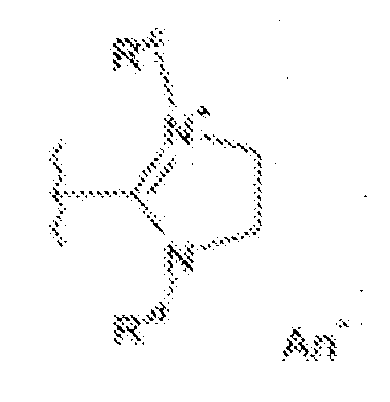
- Fluoreszierender Farbstoff nach einem der vorhergehenden Ansprüche, der unter den fluoreszierenden Farbstoffen der Formel (Ia), (IIa), (Ib), (IIb), (Ic) oder (IIc) ausgewählt ist, wobei jeder eine Ethylengruppe aufweist, die den Pyridiniumteil mit dem Phenylteil in ortho- oder para-Stellung verbindet, d.h. den Positionen 4-4', 4-2', oder 2-4' für (Ia), (IIa), (Ib) oder (IIb), oder den Positionen 4-5' oder 2-5' für (Ic) oder (IIc):
 ◆ die Gruppen R1 a R2 a, die gleich oder verschieden sind, bedeuten eine Benzyl-oder Alkylgruppe, die gegebenenfalls mit einer Hydroxygruppe substituiert ist;◆ die Gruppen R1b und R2b, die gleich oder verschieden sind, bedeuten ein Wasserstoffatom; eine Benzyl- oder Alkylgruppe;◆ die Gruppen Ta und Tb, die gleich oder verschieden sind, bedeuten, eine σ-Bindung; eine Gruppe -N+(R)(R°)-, wobei R und R°, die gleich oder verschieden sind, eine Alkylgruppe bedeuten; oder T's und T'b bedeuten eine Imidazoliumgruppe;◆ Y' bedeutet, eine Gruppe, die ausgewählt ist unter;
Imidazolium, Thiazolium; Oxazolium; 1,2,4-Triazolium; Pyridinium; Pyrimidinium; Benzoxazolium und Benzothiazolium; wobei diese Gruppen mit einer oder mehreren, identischen oder verschiedenen alkylgruppen substituiert sind;◆ m, n, m' und n', die gleich oder verschieden sind, bedeuten eine ganze Zahl im Bereich von 1 bis 6 (Grenzen eingeschlossen) mit: m + n = m' + n' bedeuten eine ganze Zahl im Bereich von 2 bis 6 (Grenzen eingeschlossen);◆ M' ist ein anionisches Gegenion;in den Formeln (Ib) oder (IIb):➢ Ra, R'a, Rb, R'b,Ri, R'i, R"i, R"'i, R1, R'1, R2, R'2, R3, R'3, R4, R'4, Ta, Tb, m, m', n, n', Y haben die in einem der vorhergehenden Ansprüchen angegebenen Bedeutungen;➢ Rg und R'g; R"g und R"'g, die gleich oder verschieden sind, bedeuten ein Wasserstoffatom, ein Halogenatom, eine Aminogruppe, eine (C1-4)Alkylaminogruppe, eine (C1-4)Dialkylaminogruppe, eine Cyanogruppe, eine Carboxygruppe; eine Hydroxygruppe, eine Trifluormethylgruppe, eine Acylaminogruppe, eine (C1-4)Alkoxygruppe, eine (C2-4)(Poly)-hydroxyalkoxygruppe, eine (C1-4)Alkylcarbonyloxygruppe, eine (C1-4)Alkoxycarbonylgruppe, eine (C1-4)Alkylcarbonylaminogruppe, eine Acylaminogruppe, eine Carbamoylgruppe, eine (C1-4)Alkylsulfonylaminogruppe, eine Aminosulfonylgruppe oder eine (C1-16)Alkylgruppe, die gegebenenfalls substituiert ist mit einer Gruppe, die ausgewählt ist unter (C1-12)Alkoxy, Hydroxy, Cyano, Carboxy, Amino, (C1-4)Alkyiamino und (C1-4)Dialkylamino, wobei die beiden Alkylgruppen, die von dem Stickstoffatom der Aminogruppe getragen werden, einen 5- bis 7-gliedrigen Heterocyclus bilden, der gegebenenfalls ein weiteres Heteroatom enthält, das mit dem Stickstoffatom übereinstimmt oder davon verschieden ist;➢ Rh und R'h; R"h und R'"h, die von zwei benachbarten Kohlenstoffatomen getragen werden, bilden gemeinsam einen Benzoring, einen Indenoring, eine kondensierte Heterocycloalkylgruppe oder eine kondensierte Heteroarylgruppe; wobei der Benzoring, der Indenoring, die Heterocycloalkylgruppe und die Heteroarylgruppe gegebenenfalls substituiert sind mit Halogen, Amino, (C1-4) Alkylamino, C1-4)Dialkylamino, Cyano, Carboxy, Hydroxy, Trifluormethyl, Acylamino, (C1-4)Alkoxy, (C2-4)(Poly)hydroxyalkoxy, (C1-4)Alkylcarbonyloxy, (C1-4)Alkoxycarbonyl, (C1-4) Alkylcarbonylamino, Acylamino, Carbamoyl, (C1-4)Alkylsulfonylamino, Aminosulfonyl oder (C1-16)Alkyl,wobei diese Gruppe gegebenenfalls substituiert ist mit einer Gruppe, die ausgewählt ist unter (C1-12)Alkoxy, Hydroxy, Cyano, Amino, (C1-4)Alkylamino und (C1-4)Dialkylamino, wobei die beiden Alkylgruppen, die von dem Stickstoffatom der Aminogruppe getragen werden, einen 5- bis 7-gliedrigen Heterocyclus bilden, der gegebenenfalls ein weiteres Heteroatom enthält, das mit dem Stickstoffatom übereinstimmt oder davon verschieden ist;und in den Formeln (Ic) oder (IIc):➢ Ra, R'a, Rb, R'b, R1, R"1, R1, R'1, R2, R'2, R3, R'3, R4, R'4, Ta, Tb, m, m', n, n', Y haben die in einem, der vorhergehenden Ansprüchen angegebenen Bedeutungen;➢ Rg, R'g, R"g, R"'g, Rh, R'h, R"h und R'"h, die gleich oder verschieden sind, bedeuten ein Wasserstoffatom, ein Halogenatom, eine Aminogruppe, eine (C1-4)Alkylaminogruppe, eine (C1-4)Dialkylaminogruppe, eine Cyanogruppe, eine Carboxygruppe, eine Hydroxygruppe, eine Trifiuormethylgruppe, eine Acylaminogruppe, eine (C1-4)-Alkoxygruppe, eine (C2-4)(Poly)hydroxyalkoxygruppe, eine (C1-4) Alkylcarbonyloxygruppe, eine (C1-4)Alkoxycarbonylgruppe, eine (C1-4)Alkylcarbonylaminogruppe, eine Acylaminogruppe, eine Carbamoylgruppe, eine (C1-4)Alkylsulfonylaminogruppe, eine Aminosulfonylgruppe oder eine (C1-16)Alkylgruppe, die gegebenenfalls substituiert ist mit einer Gruppe, die ausgewählt ist unter (C1-12)Alkoxy, Hydroxy, Cyano, Carboxy, Amino, (C1-4)Alkylamino und (C1-4)Dialkylamino, wobei die beiden Alkylgruppen, die von dem Stickstoffatom der Aminogruppe getragen werden, einen 5- bis 7-gliedrigen Heterocyclus bilden, der gegebenenfalls ein weiteres Heteroatom enthält, das mit dem Stickstoffatom übereinstimmt oder davon verschieden ist;mit der Maßgabe, dass;- wenn die Verbindungen der Formel (Ia), (IIa), (Ib), (IIb), (Ic) oder (IIc) weitere kationische Teile aufweisen, sie mit einem oder mehreren anionischen Gegenionen, kombiniert ist, mit denen die Elektroneutralitäl der Formeln (Ia), (IIa), (Ib), (IIb), (Ic) oder (IIc) erreicht wird. - Fluoreszierender Farbstoff der Formel (I) nach einem der Ansprüche 1 oder 6, der symmetrisch ist.
- Fluoreszierender Farbstoff nach einem der vorhergehenden Ansprüche, der unter den folgenden Farbstoffen ausgewählt ist:


1 2 
3 
4 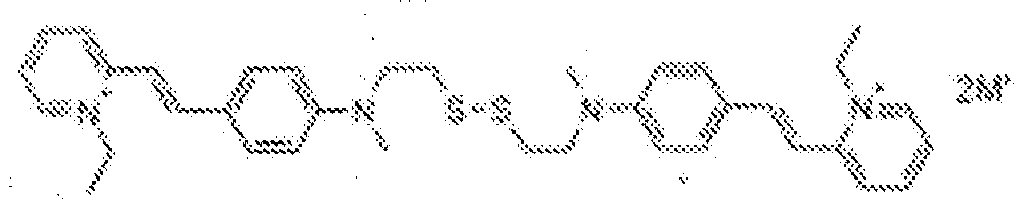
5 
6 
7 
8 
9 
10 
11 
12 

13 14 

16 

17 18 

19 20 

21 22 

23 24 

25 26 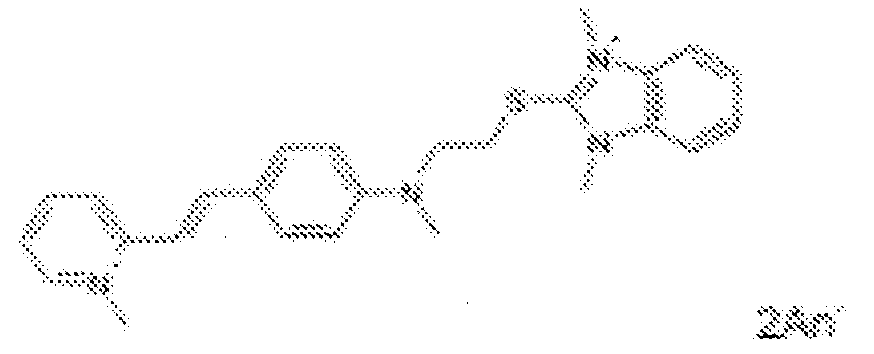

27 28 

29 30 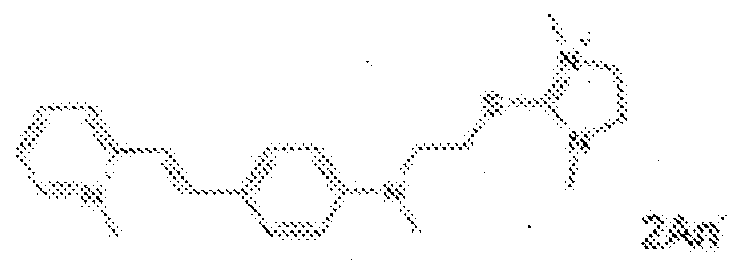

31 32 

33 34 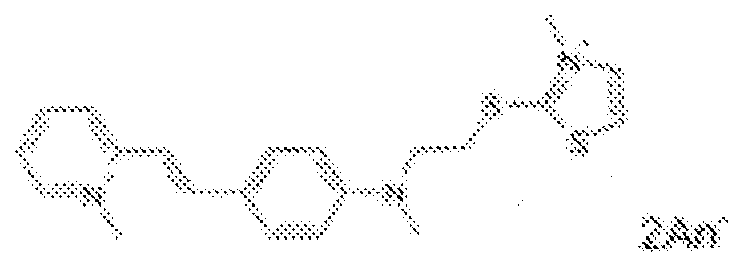

35 36 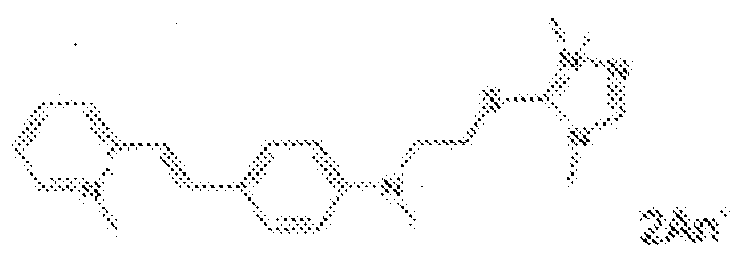

37 38 

39 40 

41 42 

43 44 

45 46 
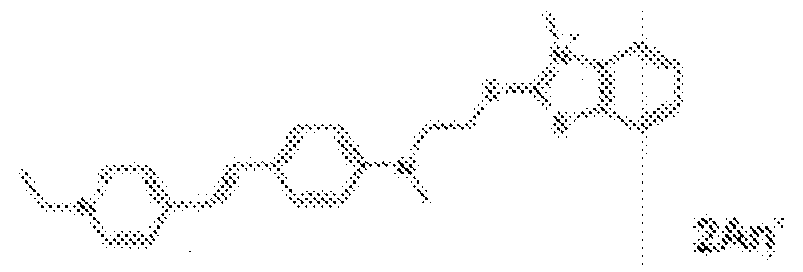
47 

49 50 

51 52 

53 54 

55 56 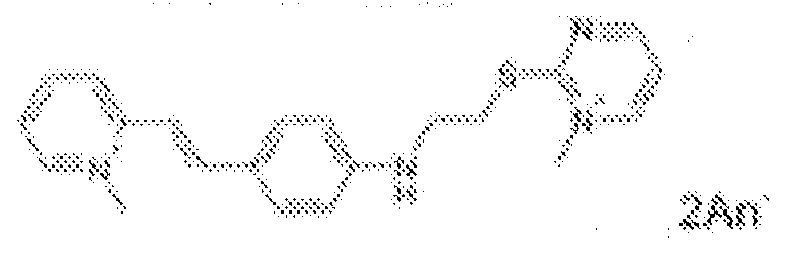

57 58 

59 60 
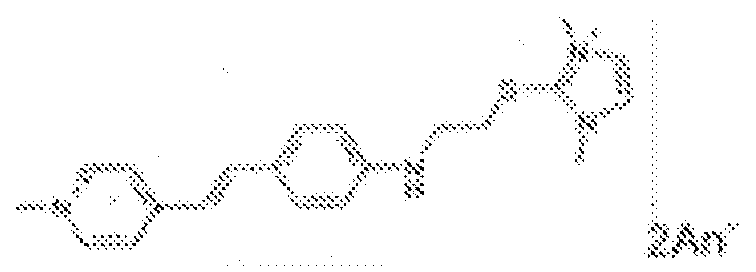
61 62 
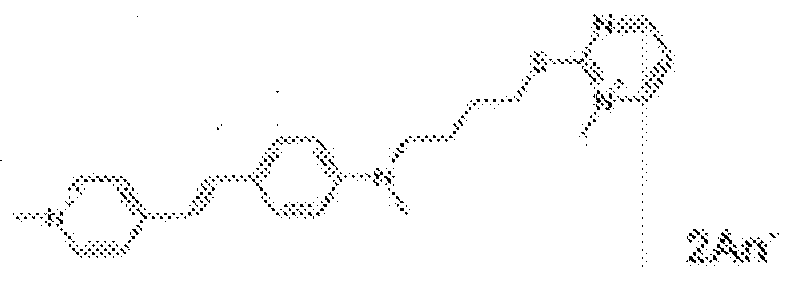
63 64 
65 
66 
67 
68 
69 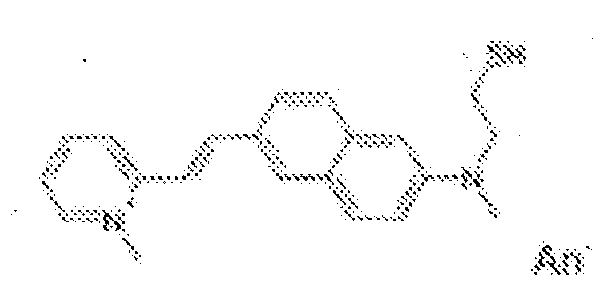
70 
71 
72 
73 
74 
75 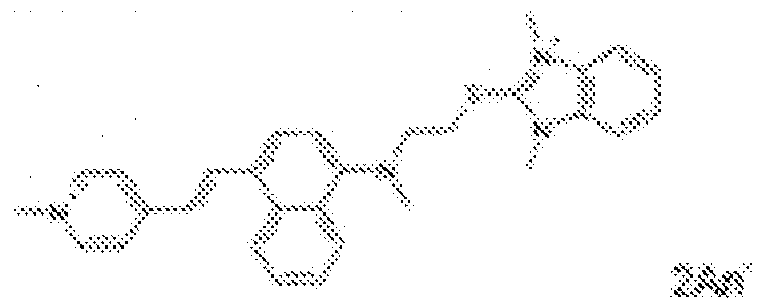
76 
77 
78 
79 
80 
82 
83 
84 
85 
86 
87 
88 
89 
90 
91 
92 
93 
94 
95 
96 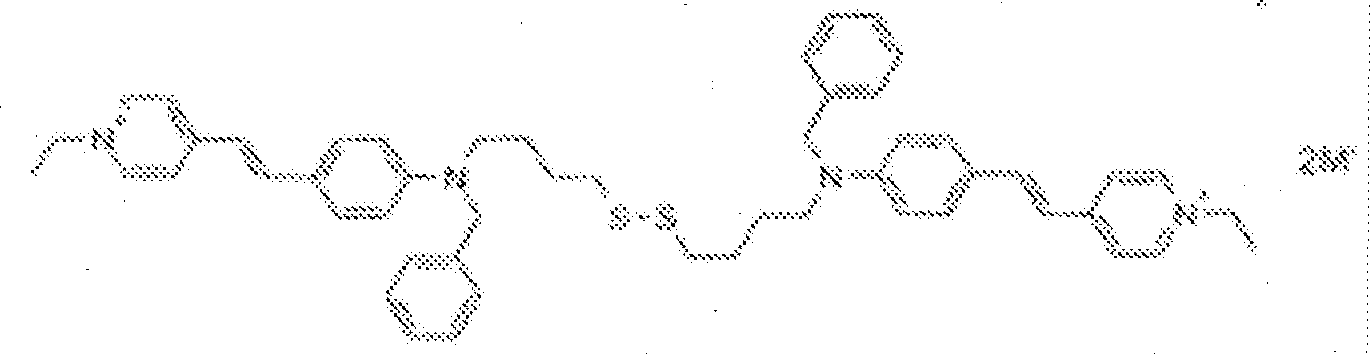
97 
98 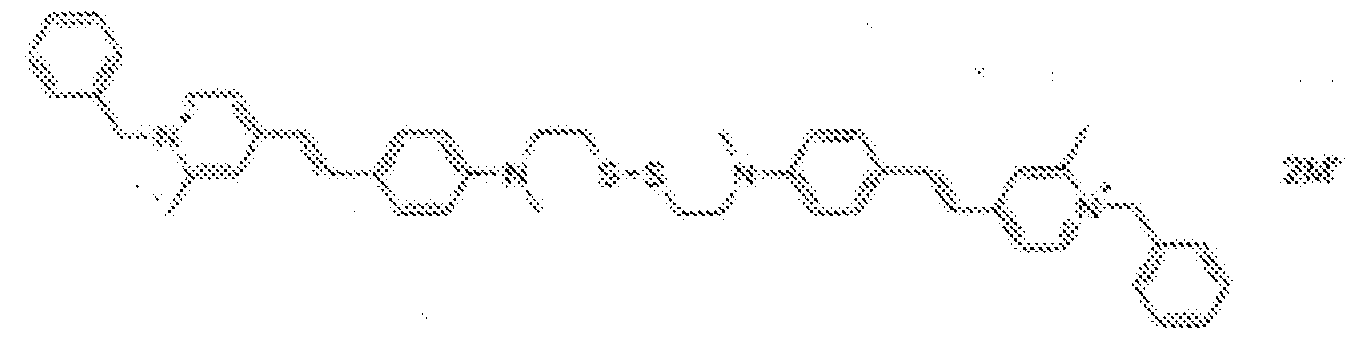
99 
100 
101 
102 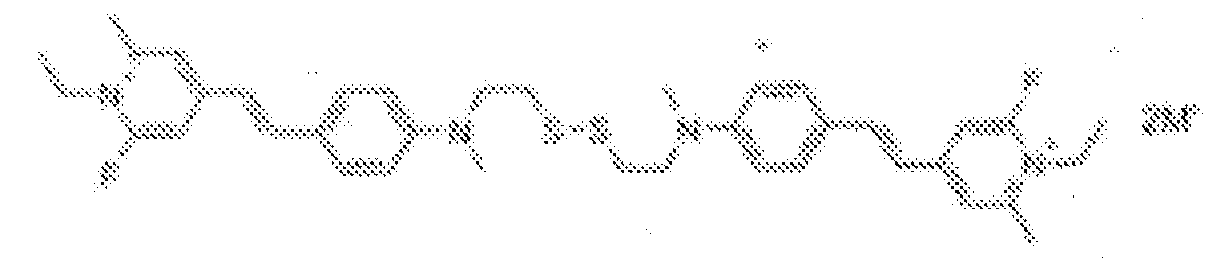
103 
104 
105 
106 
107 
108 
109 
110 
111 
112 
113 
114 
115 
116 
117 
118 
119 
120 
121 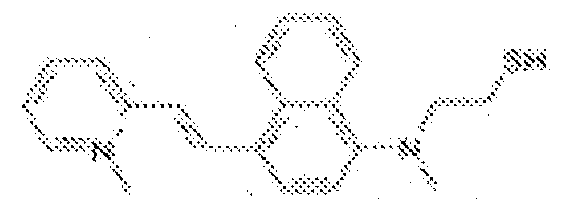
122 
123 
124 
125 
126 
127 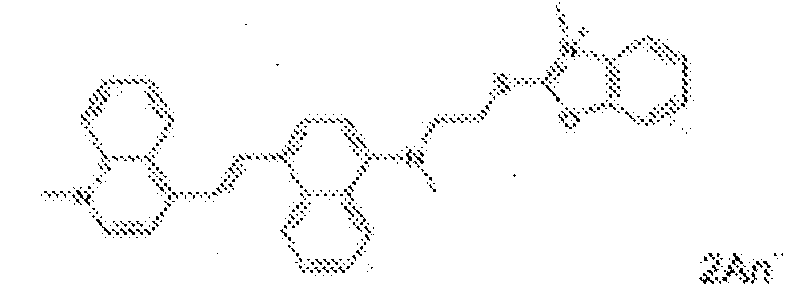
128 
129 
130 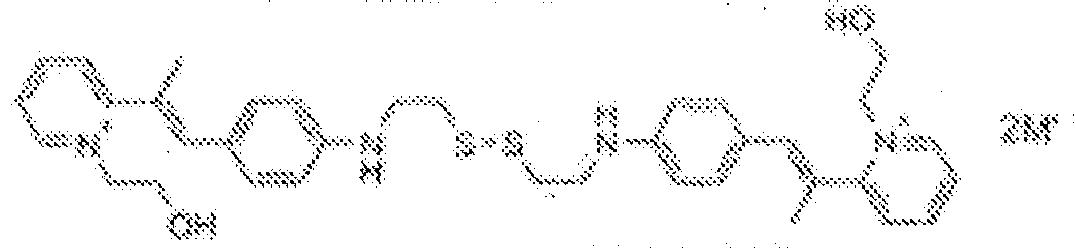
131 
132 
133 
134 
135 
135 
137 
138 
139 
140 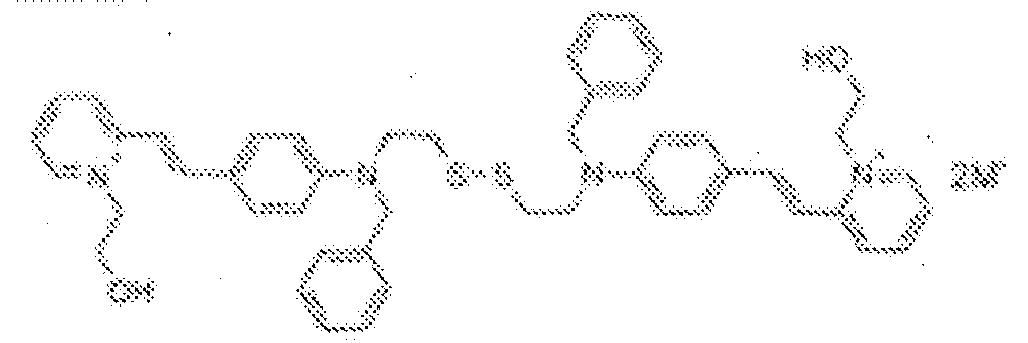
141 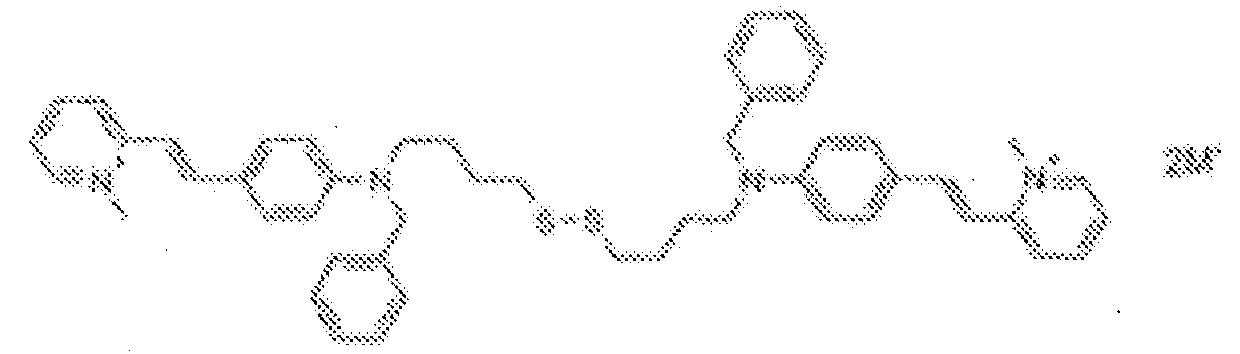
142 
143 
144 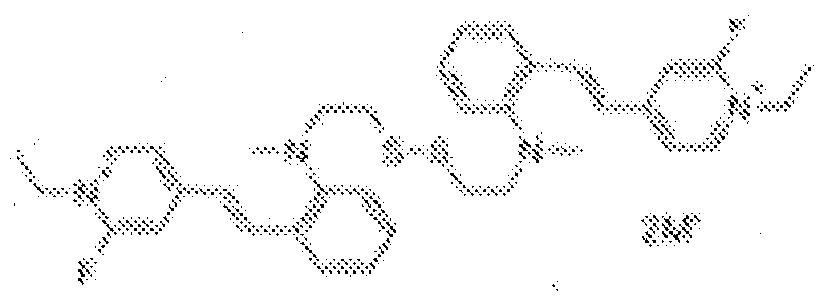

145 146 

147 148 
149 - Farbmittelzusammensetzung, die in einem kosmetisch geeigneten Medium einen fluoreszierenden Farbstoff der Formel (I) oder (II) enthält, wie er in einem der Ansprüche 1 bis 8 definiert ist.
- Farbmittelzusammensetzung, die in einem kosmetisch geeigneten Medium einen fluoreszierenden Farbstoff der Formel (I) oder (II), wie er in einem der Ansprüche 1 bis 8 definiert ist, und mindestens ein Reduktionsimttel enthält.
- Verfahren zum Färben von Keratinsubstanzen, wobei auf die Keratinsubstanzen eine Färbmittelzusammensetzung aufgetragen wird, die in einem kosmetisch geeigneten Medium mindestens einen fluoreszierenden Farbstoff der Formel (I) oder (II), wie er in einem der Ansprüche 1 bis 8 definiert ist, gegebenenfalls in Gegenwart eines Reduktionsmittels enthalt, das befähigt ist, die Disulfidbindungen von Keratinsubstanzen zu reduzieren.
- Verfahren zum Färben von Keratinsubstanzen nach Anspruch 11, dadurch gekennzeichnet, dass die Keratinsubstanzen dunkle Keratinfasern sind.
- Verfahren nach Anspruch 11 oder 12, das einen weiteren Schritt umfasst, der darin besteht, ein Oxidationsmittel auf die Keratinfasern aufzubringen.
- Verfahren nach einem der Ansprüche 11 bis 13, bei dem der fluoreszierende Farbstoff der Formel (I) oder (II) in einem Mengenanteil von 0,001 bis 50 Gew.-%, bezogen auf das Gesamtgewicht der Zusammensetzung, enthalten ist.
- Vorrichtung mit mehreren Abteilungen, wobei eine erste Abteilung eine Farbmittelzusammensetzung enthält, die einen fluoreszierenden Farbstoff, wie er in einem der Ansprüche 1 bis 8 definiert ist, aufweist, und eine zweite Abteilung ein Reduktionsmittel enthält, das befähigt ist, die Disulfidbindungen von Keratinsubstanzen zu reduzieren.
- Verwendung von fluoreszierenden Farbstoffen der Formel (I) oder (II), wie sie in einem der Ansprüche 1 bis 8 definiert sind, zum Aufhellen von dunklen Keratinfasern.
Applications Claiming Priority (5)
| Application Number | Priority Date | Filing Date | Title |
|---|---|---|---|
| FR0651035A FR2898903B1 (fr) | 2006-03-24 | 2006-03-24 | Composition de teinture comprenant un colorant disulfure fluorescent, procede d'eclaircissement des matieres keratiniques a partir de ce colorant |
| US79294106P | 2006-04-19 | 2006-04-19 | |
| FR0753066A FR2912143B1 (fr) | 2007-02-05 | 2007-02-05 | Composition de teinture comprenant un colorant fluorescent thiol, a charge cationique externe, procede d'eclaircissement des matieres keratiniques a partir de ce colorant |
| US90069607P | 2007-02-12 | 2007-02-12 | |
| PCT/FR2007/051000 WO2007110534A2 (fr) | 2006-03-24 | 2007-03-23 | Composition de teinture comprenant un colorant fluorescent thiol/disulfure, a charge cationique externe, procede d'eclaircissement des matieres keratiniques a partir de ce colorant |
Publications (2)
| Publication Number | Publication Date |
|---|---|
| EP2004756A2 EP2004756A2 (de) | 2008-12-24 |
| EP2004756B1 true EP2004756B1 (de) | 2011-05-04 |
Family
ID=38541466
Family Applications (1)
| Application Number | Title | Priority Date | Filing Date |
|---|---|---|---|
| EP07731812A Not-in-force EP2004756B1 (de) | 2006-03-24 | 2007-03-23 | Färbezusammensetzung mit einem thiol/disulfid- leuchtfarbstoff mit einer externen kationischen ladung sowie verfahren zur aufhellung von keratinmaterial mit diesem farbstoff |
Country Status (3)
| Country | Link |
|---|---|
| EP (1) | EP2004756B1 (de) |
| JP (1) | JP5431916B2 (de) |
| WO (1) | WO2007110534A2 (de) |
Families Citing this family (23)
| Publication number | Priority date | Publication date | Assignee | Title |
|---|---|---|---|---|
| EP2004755B1 (de) * | 2006-03-24 | 2011-08-03 | L'Oréal | Färbezusammensetzung mit einem thiol/disulfid- leuchtfarbstoff mit einer externen kationischen ladung und einer unterbrochenen alkylenkette sowie verfahren zur aufhellung von keratinmaterial mit diesem farbstoff |
| FR2918667A1 (fr) * | 2007-07-09 | 2009-01-16 | Oreal | Procede de coloration au moyen d'un compose de type styrylique ou iminique disulfure/thiol et stimuli, composition et dispositif pour la mise en oeuvre du procede. |
| FR2921376B1 (fr) * | 2007-09-21 | 2009-10-30 | Oreal | Compose styryl tetrahydroquinolinium thiol/disulfure, procede d'eclaircissement des matieres keratiniques a partir de ce colorant |
| FR2952300B1 (fr) | 2009-11-09 | 2012-05-11 | Oreal | Nouveaux colorants fluorescents a motif heterocyclique disulfure, composition de teinture les comprenant et procede de coloration des fibres keratiniques humaines a partir de ces colorants |
| FR2964110B1 (fr) * | 2010-08-31 | 2013-12-20 | Oreal | Colorants fluorescents a motif heterocyclique derive de thiazolone, thiazolidinone ou isothiazole, composition tinctoriale comprenant au moins un tel colorant, procede de mise en oeuvre et utilisations |
| FR2967683B1 (fr) | 2010-11-24 | 2012-11-02 | Oreal | Nouveaux colorants directs a motif derive de l'acide ascorbique, composition de teinture les comprenant et procede de coloration des matieres keratiniques humaines a partir de ces colorants |
| FR2968954B1 (fr) | 2010-12-15 | 2012-12-21 | Oreal | Procede de coloration de fibres keratiniques mettant en oeuvre un colorant direct a fonction disulfure/thiol/thiol protege et de la vapeur d'eau |
| EP2613328B1 (de) | 2011-02-23 | 2016-12-14 | Dexerials Corporation | Transparenter elektrisch leitfähiger film, informationseingabevorrichtung und elektronisches instrument |
| FR2971937B1 (fr) | 2011-02-25 | 2013-02-15 | Oreal | Composition pour colorer les fibres keratiniques comprenant un colorant direct a fonction disulfure/thiol, un polymere epaississant non cellulosique, un agent alcalin, et un agent reducteur |
| FR2971935B1 (fr) | 2011-02-25 | 2013-02-15 | Oreal | Composition pour colorer les fibres keratiniques comprenant un colorant direct a fonction disulfure/thiol, un polymere epaississant, un tensioactif non ionique, un agent alcalin, et un agent reducteur |
| FR2971939B1 (fr) | 2011-02-25 | 2013-02-15 | Oreal | Composition pour colorer les fibres keratiniques comprenant un colorant direct a fonction disulfure/thiol, un corps gras, un agent alcalin, et un agent reducteur |
| FR2971938B1 (fr) | 2011-02-25 | 2013-08-02 | Oreal | Composition pour colorer les fibres keratiniques comprenant un colorant direct a fonction disulfure/thiol, un alcool gras faiblement ou non ethoxyle, un tensioactif cationique, un agent alcalin, et un agent reducteur |
| FR2971936B1 (fr) | 2011-02-25 | 2013-02-15 | Oreal | Composition pour colorer les fibres keratiniques comprenant un colorant direct a fonction disulfure/thiol, un tensioactif non ionique, un tensioactif amphotere, un alcool gras ethoxyle, un agent alcalin, et un agent reducteur |
| WO2012113720A2 (en) | 2011-02-25 | 2012-08-30 | L'oreal | Composition for dyeing keratinous fibres comprising a direct dye having a disulphide/thiol functional group, a thickening polymer, an ethoxylated fatty alcohol and/or a nonionic surfactant, an alkaline agent and a reducing agent |
| FR2990944A1 (fr) | 2012-05-23 | 2013-11-29 | Oreal | Procede de coloration des fibres keratiniques comprenant un colorant /pigment, un compose photoactif, et une source lumineuse |
| JP6308737B2 (ja) * | 2013-08-26 | 2018-04-11 | デクセリアルズ株式会社 | 金属ナノワイヤー、分散液、透明導電膜、情報入力装置、及び、電子機器 |
| WO2015059368A1 (fr) | 2013-09-02 | 2015-04-30 | L'oreal | Procede de coloration des fibres keratiniques a partir de colorants cationiques styryles disulfures, et composition comprenant lesdits colorants |
| FR3043551B1 (fr) | 2015-11-12 | 2017-11-24 | Oreal | Colorant direct cationique a chaine aliphatique et a fonction disulfure/thiol/thiol protege pour colorer les fibres keratiniques |
| FR3044661B1 (fr) | 2015-12-03 | 2019-05-24 | L'oreal | Nouveaux colorants anioniques a motif heterocyclique disulfure, composition de teinture les comprenant et procede de coloration des matieres keratiniques humaines a partir de ces colorants |
| FR3066108B1 (fr) | 2017-05-10 | 2020-10-30 | Oreal | Colorant direct fluorescent a chaine aliphatique et a fonction disulfure/thiol/thiol protege pour colorer les matieres keratiniques |
| FR3067598B1 (fr) | 2017-06-16 | 2020-09-11 | Oreal | Procede de coloration des fibres keratiniques mettant en œuvre au moins un colorant fluorescent disulfure, thiol ou thiol protege et au moins un activateur comprenant un reducteur et moins deux agents alcalins differents |
| FR3067599B1 (fr) | 2017-06-16 | 2020-09-04 | Oreal | Procede de coloration des matieres keratiniques mettant en oeuvre au moins un colorant bleu, violet ou vert et au moins un colorant fluorescent disulfure, thiol ou thiol protege |
| FR3067597B1 (fr) | 2017-06-16 | 2020-09-04 | Oreal | Procede de coloration des fibres keratiniques mettant en œuvre au moins un colorant direct et au moins un colorant fluorescent disulfure, thiol ou thiol protege |
Family Cites Families (14)
| Publication number | Priority date | Publication date | Assignee | Title |
|---|---|---|---|---|
| NL219021A (de) * | 1956-07-17 | |||
| FR2586913B1 (fr) * | 1985-09-10 | 1990-08-03 | Oreal | Procede pour former in situ une composition constituee de deux parties conditionnees separement et ensemble distributeur pour la mise en oeuvre de ce procede |
| TW311089B (de) * | 1993-07-05 | 1997-07-21 | Ciba Sc Holding Ag | |
| FR2759756B1 (fr) * | 1997-02-20 | 1999-04-23 | Hutchinson | Dispositif de liaison etanche entre des canaux |
| FR2776923B1 (fr) * | 1998-04-06 | 2003-01-10 | Oreal | Composition de teinture pour fibres keratiniques avec un colorant direct cationique et un polymere substantif |
| FR2783416B1 (fr) * | 1998-08-26 | 2002-05-03 | Oreal | Composition de teinture pour fibres keratiniques avec un colorant direct cationique et une silicone |
| FR2830189B1 (fr) * | 2001-09-28 | 2004-10-01 | Oreal | Composition de teinture a effet eclaircissant pour fibres keratiniques humaines |
| WO2003099243A1 (de) * | 2002-05-29 | 2003-12-04 | Henkel Kommanditgesellschaft Auf Aktien | Kosmetische mittel mit protein-disulfidisomerase |
| FR2853229B1 (fr) * | 2003-04-01 | 2009-06-12 | Oreal | Procede de coloration pour matieres keratiniques humaines avec effet eclaircissant, compose fluorescent particulier et composition le comprenant |
| FR2857258B1 (fr) * | 2003-07-09 | 2007-08-17 | Oreal | Composition comprenant au moins un derive substitue de 2-[2-(4-aminophenyl)ethenyl]-1-pyridinium, procede de traitement des fibres keratiniques la mettant en oeuvre, dispositif et utilisation |
| CN1997340B (zh) * | 2004-04-08 | 2013-07-17 | 西巴特殊化学制品控股公司 | 二硫化物染料,包含它们的组合物以及染色的方法 |
| BRPI0611887B1 (pt) * | 2005-06-16 | 2016-06-07 | Ciba Sc Holding Ag | composição e método para tingimento de fibras contendo queratina |
| BRPI0617339B1 (pt) * | 2005-10-11 | 2017-04-04 | Ciba Specialty Chemicals Holding Inc | mistura de corantes de sulfeto, composição compreendendo a mesma, e método para tingir fibras contendo queratina |
| FR2898903B1 (fr) * | 2006-03-24 | 2012-08-31 | Oreal | Composition de teinture comprenant un colorant disulfure fluorescent, procede d'eclaircissement des matieres keratiniques a partir de ce colorant |
-
2007
- 2007-03-23 EP EP07731812A patent/EP2004756B1/de not_active Not-in-force
- 2007-03-23 WO PCT/FR2007/051000 patent/WO2007110534A2/fr not_active Ceased
- 2007-03-23 JP JP2009500904A patent/JP5431916B2/ja not_active Expired - Fee Related
Also Published As
| Publication number | Publication date |
|---|---|
| JP2009536671A (ja) | 2009-10-15 |
| JP5431916B2 (ja) | 2014-03-05 |
| EP2004756A2 (de) | 2008-12-24 |
| WO2007110534A2 (fr) | 2007-10-04 |
| WO2007110534A3 (fr) | 2008-04-03 |
Similar Documents
| Publication | Publication Date | Title |
|---|---|---|
| EP2004756B1 (de) | Färbezusammensetzung mit einem thiol/disulfid- leuchtfarbstoff mit einer externen kationischen ladung sowie verfahren zur aufhellung von keratinmaterial mit diesem farbstoff | |
| EP2004757B1 (de) | Färbezusammensetzung mit einem thiol/disulfid- leuchtfarbstoff mit amingruppen und einer internen kationischen ladung sowie verfahren zur aufhellung von keratinmaterial mit diesem farbstoff | |
| EP2001960B1 (de) | Färbemittel mit einem thiol/disulphid-fluoreszenzfarbstoff mit einer ortho-pyridiniumgruppe mit unterbrochener alkylenkette und einer externen kationischen ladung sowie davon gebrauch machendes verfahren zum aufhellen von keratinmaterialien | |
| EP2075289B1 (de) | Styryltetrahydrochinolinium-Thiol/Disulfidverbindung, Verfahren zum Aufhellen keratinischer Materialien unter Verwendung dieses Farbstoffs | |
| EP2024444B1 (de) | Färbezusammensetzung mit einem thiol/disulfid-naphthylimid-leuchtfarbstoff und verfahren zur aufhellung von keratinmaterial mit diesem farbstoff | |
| EP2004758B1 (de) | Färbezusammensetzung mit einem thiol/disulfid- leuchtfarbstoff mit einem heterozyklus und einer internen kationischen ladung sowie verfahren zur aufhellung von keratinmaterial mit diesem farbstoff | |
| EP2004755B1 (de) | Färbezusammensetzung mit einem thiol/disulfid- leuchtfarbstoff mit einer externen kationischen ladung und einer unterbrochenen alkylenkette sowie verfahren zur aufhellung von keratinmaterial mit diesem farbstoff | |
| EP2004754B1 (de) | Färbezusammensetzung mit einem thiol/disulfid- leuchtfarbstoff mit einem heterozyklus und einer externen kationischen ladung sowie verfahren zur aufhellung von keratinmaterial mit diesem farbstoff | |
| EP2070988B1 (de) | Styrylverbindung mit einer Hydroxy(cyclo)alkylamino- sowie Thiol/Disulfideinheit, Verfahren zum Aufhellen keratinischer Materialien ausgehend von diesem Farbmittel | |
| EP2004759B1 (de) | Verfahren zur färbung und aufhellung von keratinmaterialien bei vorhandensein eines reduktionsmittels mit einem disulfid-leuchtfarbstoff | |
| EP2062945B1 (de) | Hemicyaninstyryl-thiol/disulphid-Farbstoff, Farbstoffzusammensetzung enthaltend diesen Farbstoff, Verfahren zur Aufhellung keratinischen Materialien unter Verwendung dieses Farbstoffs | |
| WO2007110538A2 (fr) | Composition de teinture comprenant un colorant fluorescent thiol masque a groupe dimethylamino, a charge cationique interne, procede d'eclaircissement des matieres keratiniques a partir de ce colorant et de colorant disufure | |
| WO2007110541A2 (fr) | Composition de teinture comprenant un colorant fluorescent thiol/disulfure a cycle condense et charge cationique interne, procede d'eclaircissement des matieres keratiniques a partir de ce colorant | |
| WO2007110540A2 (fr) | Composition de teinture comprenant un colorant fluorescent thiol/disulfure a groupement alcoxy/hydroxy et a charge cationique interne, procede d'eclaircissement des matieres keratiniques a partir de ce colorant | |
| WO2007110536A2 (fr) | Composition de teinture comprenant un colorant fluorescent thiol/disulfure a groupe ortho-pyridinium, a chaine alkylene non interrompue et a charge cationique interne, procede d'eclaircissement des matieres keratiniques a partir de ce colorant | |
| FR2921382A1 (fr) | Colorant derive de phenyl-pyridol[1,2-a]indolium thiol-disulfure, composition tinctoriale comprenant ce colorant, procede d'eclaircissement des matieres keratiniques a partir de ce colorant | |
| FR2921380A1 (fr) | Colorant derive de pyridocycloalkyle styryle thiol/disulfure, composition tinctoriale comprenant ce colorant, procede d'eclaircissement des matieres keratiniques a partir de ce colorant | |
| FR2921374A1 (fr) | Colorant derive d'indolinium thiol/disulfure, composition tinctoriale comprenant ce colorant, procede d'eclaircissement des matieres keratiniques a partir de ce colorant | |
| FR2921379A1 (fr) | Colorant derive d'indole styryle thiol/disulfure, composition tinctoriale comprenant ce colorant, procede d'eclaircissement des matieres keratiniques a partir de ce colorant | |
| FR2921378A1 (fr) | COLORANT DICETORPYRROLO[3,4-c]PYRROLE THIOL/DISULFURE, COMPOSITION TINCTORIALE COMPRENANT CE COLORANT, PROCEDE D'ECLAIRCISSEMENT DES MATIERES KERATINIQUES A PARTIR DE CE COLORANT | |
| FR2912143A1 (fr) | Composition de teinture comprenant un colorant fluorescent thiol, a charge cationique externe, procede d'eclaircissement des matieres keratiniques a partir de ce colorant | |
| FR2912137A1 (fr) | Composition tinctoriale comprenant un colorant fluorescent thiol/disulfure a groupe pyridinium et chaine alkylene interrompue,procede d'eclaircissement a partir de la composition | |
| FR2912140A1 (fr) | Composition de teinture comprenant un colorant fluorescent thiol a heterocycle et a charge cationique interne, procede d'eclaircissement des matieres keratiniques a partir de ce colorant | |
| FR2921375A1 (fr) | COLORANT DERIVE DE TETRAHYDROPYRROLO/PYRIDO[1,2-a] INDOLINIUM THIOL/DISULFURE, PROCEDE D'ECLAIRCISSEMENT DES MATIERES KERATINIQUES A PARTIR DE CE COLORANT | |
| FR2912139A1 (fr) | Composition de teinture comprenant un colorant fluorescent thiol masque a groupe dimhtylamino, a charge cationique interne, procede d'eclaircissement des matieres keratiniques a partir de ce colorant |
Legal Events
| Date | Code | Title | Description |
|---|---|---|---|
| PUAI | Public reference made under article 153(3) epc to a published international application that has entered the european phase |
Free format text: ORIGINAL CODE: 0009012 |
|
| 17P | Request for examination filed |
Effective date: 20081024 |
|
| AK | Designated contracting states |
Kind code of ref document: A2 Designated state(s): AT BE BG CH CY CZ DE DK EE ES FI FR GB GR HU IE IS IT LI LT LU LV MC MT NL PL PT RO SE SI SK TR |
|
| GRAP | Despatch of communication of intention to grant a patent |
Free format text: ORIGINAL CODE: EPIDOSNIGR1 |
|
| DAX | Request for extension of the european patent (deleted) | ||
| GRAS | Grant fee paid |
Free format text: ORIGINAL CODE: EPIDOSNIGR3 |
|
| GRAA | (expected) grant |
Free format text: ORIGINAL CODE: 0009210 |
|
| AK | Designated contracting states |
Kind code of ref document: B1 Designated state(s): AT BE BG CH CY CZ DE DK EE ES FI FR GB GR HU IE IS IT LI LT LU LV MC MT NL PL PT RO SE SI SK TR |
|
| REG | Reference to a national code |
Ref country code: GB Ref legal event code: FG4D Free format text: NOT ENGLISH |
|
| REG | Reference to a national code |
Ref country code: CH Ref legal event code: EP |
|
| REG | Reference to a national code |
Ref country code: IE Ref legal event code: FG4D Free format text: LANGUAGE OF EP DOCUMENT: FRENCH |
|
| REF | Corresponds to: |
Ref document number: 602007014348 Country of ref document: DE Date of ref document: 20110616 Kind code of ref document: P |
|
| REG | Reference to a national code |
Ref country code: DE Ref legal event code: R096 Ref document number: 602007014348 Country of ref document: DE Effective date: 20110616 |
|
| REG | Reference to a national code |
Ref country code: NL Ref legal event code: VDEP Effective date: 20110504 |
|
| PG25 | Lapsed in a contracting state [announced via postgrant information from national office to epo] |
Ref country code: PT Free format text: LAPSE BECAUSE OF FAILURE TO SUBMIT A TRANSLATION OF THE DESCRIPTION OR TO PAY THE FEE WITHIN THE PRESCRIBED TIME-LIMIT Effective date: 20110905 Ref country code: LT Free format text: LAPSE BECAUSE OF FAILURE TO SUBMIT A TRANSLATION OF THE DESCRIPTION OR TO PAY THE FEE WITHIN THE PRESCRIBED TIME-LIMIT Effective date: 20110504 Ref country code: SE Free format text: LAPSE BECAUSE OF FAILURE TO SUBMIT A TRANSLATION OF THE DESCRIPTION OR TO PAY THE FEE WITHIN THE PRESCRIBED TIME-LIMIT Effective date: 20110504 |
|
| PG25 | Lapsed in a contracting state [announced via postgrant information from national office to epo] |
Ref country code: LV Free format text: LAPSE BECAUSE OF FAILURE TO SUBMIT A TRANSLATION OF THE DESCRIPTION OR TO PAY THE FEE WITHIN THE PRESCRIBED TIME-LIMIT Effective date: 20110504 Ref country code: CY Free format text: LAPSE BECAUSE OF FAILURE TO SUBMIT A TRANSLATION OF THE DESCRIPTION OR TO PAY THE FEE WITHIN THE PRESCRIBED TIME-LIMIT Effective date: 20110504 Ref country code: GR Free format text: LAPSE BECAUSE OF FAILURE TO SUBMIT A TRANSLATION OF THE DESCRIPTION OR TO PAY THE FEE WITHIN THE PRESCRIBED TIME-LIMIT Effective date: 20110805 Ref country code: SI Free format text: LAPSE BECAUSE OF FAILURE TO SUBMIT A TRANSLATION OF THE DESCRIPTION OR TO PAY THE FEE WITHIN THE PRESCRIBED TIME-LIMIT Effective date: 20110504 Ref country code: ES Free format text: LAPSE BECAUSE OF FAILURE TO SUBMIT A TRANSLATION OF THE DESCRIPTION OR TO PAY THE FEE WITHIN THE PRESCRIBED TIME-LIMIT Effective date: 20110815 Ref country code: IS Free format text: LAPSE BECAUSE OF FAILURE TO SUBMIT A TRANSLATION OF THE DESCRIPTION OR TO PAY THE FEE WITHIN THE PRESCRIBED TIME-LIMIT Effective date: 20110904 Ref country code: AT Free format text: LAPSE BECAUSE OF FAILURE TO SUBMIT A TRANSLATION OF THE DESCRIPTION OR TO PAY THE FEE WITHIN THE PRESCRIBED TIME-LIMIT Effective date: 20110504 Ref country code: FI Free format text: LAPSE BECAUSE OF FAILURE TO SUBMIT A TRANSLATION OF THE DESCRIPTION OR TO PAY THE FEE WITHIN THE PRESCRIBED TIME-LIMIT Effective date: 20110504 |
|
| REG | Reference to a national code |
Ref country code: IE Ref legal event code: FD4D |
|
| PG25 | Lapsed in a contracting state [announced via postgrant information from national office to epo] |
Ref country code: NL Free format text: LAPSE BECAUSE OF FAILURE TO SUBMIT A TRANSLATION OF THE DESCRIPTION OR TO PAY THE FEE WITHIN THE PRESCRIBED TIME-LIMIT Effective date: 20110504 |
|
| PG25 | Lapsed in a contracting state [announced via postgrant information from national office to epo] |
Ref country code: EE Free format text: LAPSE BECAUSE OF FAILURE TO SUBMIT A TRANSLATION OF THE DESCRIPTION OR TO PAY THE FEE WITHIN THE PRESCRIBED TIME-LIMIT Effective date: 20110504 Ref country code: IE Free format text: LAPSE BECAUSE OF FAILURE TO SUBMIT A TRANSLATION OF THE DESCRIPTION OR TO PAY THE FEE WITHIN THE PRESCRIBED TIME-LIMIT Effective date: 20110504 Ref country code: CZ Free format text: LAPSE BECAUSE OF FAILURE TO SUBMIT A TRANSLATION OF THE DESCRIPTION OR TO PAY THE FEE WITHIN THE PRESCRIBED TIME-LIMIT Effective date: 20110504 |
|
| PG25 | Lapsed in a contracting state [announced via postgrant information from national office to epo] |
Ref country code: DK Free format text: LAPSE BECAUSE OF FAILURE TO SUBMIT A TRANSLATION OF THE DESCRIPTION OR TO PAY THE FEE WITHIN THE PRESCRIBED TIME-LIMIT Effective date: 20110504 Ref country code: SK Free format text: LAPSE BECAUSE OF FAILURE TO SUBMIT A TRANSLATION OF THE DESCRIPTION OR TO PAY THE FEE WITHIN THE PRESCRIBED TIME-LIMIT Effective date: 20110504 Ref country code: RO Free format text: LAPSE BECAUSE OF FAILURE TO SUBMIT A TRANSLATION OF THE DESCRIPTION OR TO PAY THE FEE WITHIN THE PRESCRIBED TIME-LIMIT Effective date: 20110504 Ref country code: PL Free format text: LAPSE BECAUSE OF FAILURE TO SUBMIT A TRANSLATION OF THE DESCRIPTION OR TO PAY THE FEE WITHIN THE PRESCRIBED TIME-LIMIT Effective date: 20110504 |
|
| PLBE | No opposition filed within time limit |
Free format text: ORIGINAL CODE: 0009261 |
|
| STAA | Information on the status of an ep patent application or granted ep patent |
Free format text: STATUS: NO OPPOSITION FILED WITHIN TIME LIMIT |
|
| 26N | No opposition filed |
Effective date: 20120207 |
|
| PG25 | Lapsed in a contracting state [announced via postgrant information from national office to epo] |
Ref country code: IT Free format text: LAPSE BECAUSE OF FAILURE TO SUBMIT A TRANSLATION OF THE DESCRIPTION OR TO PAY THE FEE WITHIN THE PRESCRIBED TIME-LIMIT Effective date: 20110504 |
|
| REG | Reference to a national code |
Ref country code: DE Ref legal event code: R097 Ref document number: 602007014348 Country of ref document: DE Effective date: 20120207 |
|
| BERE | Be: lapsed |
Owner name: L'OREAL Effective date: 20120331 |
|
| PG25 | Lapsed in a contracting state [announced via postgrant information from national office to epo] |
Ref country code: MC Free format text: LAPSE BECAUSE OF NON-PAYMENT OF DUE FEES Effective date: 20120331 |
|
| REG | Reference to a national code |
Ref country code: CH Ref legal event code: PL |
|
| PG25 | Lapsed in a contracting state [announced via postgrant information from national office to epo] |
Ref country code: CH Free format text: LAPSE BECAUSE OF NON-PAYMENT OF DUE FEES Effective date: 20120331 Ref country code: LI Free format text: LAPSE BECAUSE OF NON-PAYMENT OF DUE FEES Effective date: 20120331 Ref country code: BE Free format text: LAPSE BECAUSE OF NON-PAYMENT OF DUE FEES Effective date: 20120331 |
|
| PG25 | Lapsed in a contracting state [announced via postgrant information from national office to epo] |
Ref country code: BG Free format text: LAPSE BECAUSE OF FAILURE TO SUBMIT A TRANSLATION OF THE DESCRIPTION OR TO PAY THE FEE WITHIN THE PRESCRIBED TIME-LIMIT Effective date: 20110804 |
|
| PG25 | Lapsed in a contracting state [announced via postgrant information from national office to epo] |
Ref country code: MT Free format text: LAPSE BECAUSE OF FAILURE TO SUBMIT A TRANSLATION OF THE DESCRIPTION OR TO PAY THE FEE WITHIN THE PRESCRIBED TIME-LIMIT Effective date: 20110504 |
|
| PG25 | Lapsed in a contracting state [announced via postgrant information from national office to epo] |
Ref country code: TR Free format text: LAPSE BECAUSE OF FAILURE TO SUBMIT A TRANSLATION OF THE DESCRIPTION OR TO PAY THE FEE WITHIN THE PRESCRIBED TIME-LIMIT Effective date: 20110504 |
|
| PG25 | Lapsed in a contracting state [announced via postgrant information from national office to epo] |
Ref country code: LU Free format text: LAPSE BECAUSE OF NON-PAYMENT OF DUE FEES Effective date: 20120323 |
|
| PG25 | Lapsed in a contracting state [announced via postgrant information from national office to epo] |
Ref country code: HU Free format text: LAPSE BECAUSE OF FAILURE TO SUBMIT A TRANSLATION OF THE DESCRIPTION OR TO PAY THE FEE WITHIN THE PRESCRIBED TIME-LIMIT Effective date: 20070323 |
|
| REG | Reference to a national code |
Ref country code: FR Ref legal event code: PLFP Year of fee payment: 10 |
|
| REG | Reference to a national code |
Ref country code: FR Ref legal event code: PLFP Year of fee payment: 11 |
|
| REG | Reference to a national code |
Ref country code: FR Ref legal event code: PLFP Year of fee payment: 12 |
|
| PGFP | Annual fee paid to national office [announced via postgrant information from national office to epo] |
Ref country code: FR Payment date: 20210210 Year of fee payment: 15 |
|
| PGFP | Annual fee paid to national office [announced via postgrant information from national office to epo] |
Ref country code: DE Payment date: 20210310 Year of fee payment: 15 Ref country code: GB Payment date: 20210310 Year of fee payment: 15 |
|
| REG | Reference to a national code |
Ref country code: DE Ref legal event code: R119 Ref document number: 602007014348 Country of ref document: DE |
|
| GBPC | Gb: european patent ceased through non-payment of renewal fee |
Effective date: 20220323 |
|
| PG25 | Lapsed in a contracting state [announced via postgrant information from national office to epo] |
Ref country code: GB Free format text: LAPSE BECAUSE OF NON-PAYMENT OF DUE FEES Effective date: 20220323 Ref country code: FR Free format text: LAPSE BECAUSE OF NON-PAYMENT OF DUE FEES Effective date: 20220331 Ref country code: DE Free format text: LAPSE BECAUSE OF NON-PAYMENT OF DUE FEES Effective date: 20221001 |