EP2000562B1 - Electrode and vacuum processing apparatus - Google Patents
Electrode and vacuum processing apparatus Download PDFInfo
- Publication number
- EP2000562B1 EP2000562B1 EP07739211A EP07739211A EP2000562B1 EP 2000562 B1 EP2000562 B1 EP 2000562B1 EP 07739211 A EP07739211 A EP 07739211A EP 07739211 A EP07739211 A EP 07739211A EP 2000562 B1 EP2000562 B1 EP 2000562B1
- Authority
- EP
- European Patent Office
- Prior art keywords
- reactant gas
- substrate
- gas injection
- electrodes
- injection holes
- Prior art date
- Legal status (The legal status is an assumption and is not a legal conclusion. Google has not performed a legal analysis and makes no representation as to the accuracy of the status listed.)
- Not-in-force
Links
- 238000012545 processing Methods 0.000 title claims abstract description 18
- 239000000758 substrate Substances 0.000 claims abstract description 160
- 239000000376 reactant Substances 0.000 claims description 232
- 238000002347 injection Methods 0.000 claims description 142
- 239000007924 injection Substances 0.000 claims description 142
- 239000012495 reaction gas Substances 0.000 abstract description 4
- 239000007789 gas Substances 0.000 description 370
- 239000010408 film Substances 0.000 description 112
- 238000005268 plasma chemical vapour deposition Methods 0.000 description 51
- 238000000151 deposition Methods 0.000 description 41
- 230000008021 deposition Effects 0.000 description 25
- 230000003068 static effect Effects 0.000 description 14
- 229910021424 microcrystalline silicon Inorganic materials 0.000 description 8
- 239000002245 particle Substances 0.000 description 7
- 238000012360 testing method Methods 0.000 description 6
- 238000000034 method Methods 0.000 description 2
- UFHFLCQGNIYNRP-UHFFFAOYSA-N Hydrogen Chemical compound [H][H] UFHFLCQGNIYNRP-UHFFFAOYSA-N 0.000 description 1
- 238000001069 Raman spectroscopy Methods 0.000 description 1
- BLRPTPMANUNPDV-UHFFFAOYSA-N Silane Chemical compound [SiH4] BLRPTPMANUNPDV-UHFFFAOYSA-N 0.000 description 1
- 238000005452 bending Methods 0.000 description 1
- 230000015572 biosynthetic process Effects 0.000 description 1
- 238000007664 blowing Methods 0.000 description 1
- 230000003139 buffering effect Effects 0.000 description 1
- 238000006243 chemical reaction Methods 0.000 description 1
- 238000000354 decomposition reaction Methods 0.000 description 1
- 230000001419 dependent effect Effects 0.000 description 1
- 238000009792 diffusion process Methods 0.000 description 1
- 239000007792 gaseous phase Substances 0.000 description 1
- 239000001257 hydrogen Substances 0.000 description 1
- 229910052739 hydrogen Inorganic materials 0.000 description 1
- 238000005259 measurement Methods 0.000 description 1
- 238000012986 modification Methods 0.000 description 1
- 230000004048 modification Effects 0.000 description 1
- 229910000077 silane Inorganic materials 0.000 description 1
- 229920006268 silicone film Polymers 0.000 description 1
- 239000010409 thin film Substances 0.000 description 1
Images




Classifications
-
- H—ELECTRICITY
- H01—ELECTRIC ELEMENTS
- H01J—ELECTRIC DISCHARGE TUBES OR DISCHARGE LAMPS
- H01J37/00—Discharge tubes with provision for introducing objects or material to be exposed to the discharge, e.g. for the purpose of examination or processing thereof
- H01J37/32—Gas-filled discharge tubes
- H01J37/32431—Constructional details of the reactor
- H01J37/32532—Electrodes
- H01J37/32541—Shape
-
- C—CHEMISTRY; METALLURGY
- C23—COATING METALLIC MATERIAL; COATING MATERIAL WITH METALLIC MATERIAL; CHEMICAL SURFACE TREATMENT; DIFFUSION TREATMENT OF METALLIC MATERIAL; COATING BY VACUUM EVAPORATION, BY SPUTTERING, BY ION IMPLANTATION OR BY CHEMICAL VAPOUR DEPOSITION, IN GENERAL; INHIBITING CORROSION OF METALLIC MATERIAL OR INCRUSTATION IN GENERAL
- C23C—COATING METALLIC MATERIAL; COATING MATERIAL WITH METALLIC MATERIAL; SURFACE TREATMENT OF METALLIC MATERIAL BY DIFFUSION INTO THE SURFACE, BY CHEMICAL CONVERSION OR SUBSTITUTION; COATING BY VACUUM EVAPORATION, BY SPUTTERING, BY ION IMPLANTATION OR BY CHEMICAL VAPOUR DEPOSITION, IN GENERAL
- C23C16/00—Chemical coating by decomposition of gaseous compounds, without leaving reaction products of surface material in the coating, i.e. chemical vapour deposition [CVD] processes
- C23C16/44—Chemical coating by decomposition of gaseous compounds, without leaving reaction products of surface material in the coating, i.e. chemical vapour deposition [CVD] processes characterised by the method of coating
- C23C16/4412—Details relating to the exhausts, e.g. pumps, filters, scrubbers, particle traps
-
- C—CHEMISTRY; METALLURGY
- C23—COATING METALLIC MATERIAL; COATING MATERIAL WITH METALLIC MATERIAL; CHEMICAL SURFACE TREATMENT; DIFFUSION TREATMENT OF METALLIC MATERIAL; COATING BY VACUUM EVAPORATION, BY SPUTTERING, BY ION IMPLANTATION OR BY CHEMICAL VAPOUR DEPOSITION, IN GENERAL; INHIBITING CORROSION OF METALLIC MATERIAL OR INCRUSTATION IN GENERAL
- C23C—COATING METALLIC MATERIAL; COATING MATERIAL WITH METALLIC MATERIAL; SURFACE TREATMENT OF METALLIC MATERIAL BY DIFFUSION INTO THE SURFACE, BY CHEMICAL CONVERSION OR SUBSTITUTION; COATING BY VACUUM EVAPORATION, BY SPUTTERING, BY ION IMPLANTATION OR BY CHEMICAL VAPOUR DEPOSITION, IN GENERAL
- C23C16/00—Chemical coating by decomposition of gaseous compounds, without leaving reaction products of surface material in the coating, i.e. chemical vapour deposition [CVD] processes
- C23C16/44—Chemical coating by decomposition of gaseous compounds, without leaving reaction products of surface material in the coating, i.e. chemical vapour deposition [CVD] processes characterised by the method of coating
- C23C16/455—Chemical coating by decomposition of gaseous compounds, without leaving reaction products of surface material in the coating, i.e. chemical vapour deposition [CVD] processes characterised by the method of coating characterised by the method used for introducing gases into reaction chamber or for modifying gas flows in reaction chamber
- C23C16/45563—Gas nozzles
- C23C16/45578—Elongated nozzles, tubes with holes
-
- C—CHEMISTRY; METALLURGY
- C23—COATING METALLIC MATERIAL; COATING MATERIAL WITH METALLIC MATERIAL; CHEMICAL SURFACE TREATMENT; DIFFUSION TREATMENT OF METALLIC MATERIAL; COATING BY VACUUM EVAPORATION, BY SPUTTERING, BY ION IMPLANTATION OR BY CHEMICAL VAPOUR DEPOSITION, IN GENERAL; INHIBITING CORROSION OF METALLIC MATERIAL OR INCRUSTATION IN GENERAL
- C23C—COATING METALLIC MATERIAL; COATING MATERIAL WITH METALLIC MATERIAL; SURFACE TREATMENT OF METALLIC MATERIAL BY DIFFUSION INTO THE SURFACE, BY CHEMICAL CONVERSION OR SUBSTITUTION; COATING BY VACUUM EVAPORATION, BY SPUTTERING, BY ION IMPLANTATION OR BY CHEMICAL VAPOUR DEPOSITION, IN GENERAL
- C23C16/00—Chemical coating by decomposition of gaseous compounds, without leaving reaction products of surface material in the coating, i.e. chemical vapour deposition [CVD] processes
- C23C16/44—Chemical coating by decomposition of gaseous compounds, without leaving reaction products of surface material in the coating, i.e. chemical vapour deposition [CVD] processes characterised by the method of coating
- C23C16/50—Chemical coating by decomposition of gaseous compounds, without leaving reaction products of surface material in the coating, i.e. chemical vapour deposition [CVD] processes characterised by the method of coating using electric discharges
- C23C16/505—Chemical coating by decomposition of gaseous compounds, without leaving reaction products of surface material in the coating, i.e. chemical vapour deposition [CVD] processes characterised by the method of coating using electric discharges using radio frequency discharges
- C23C16/509—Chemical coating by decomposition of gaseous compounds, without leaving reaction products of surface material in the coating, i.e. chemical vapour deposition [CVD] processes characterised by the method of coating using electric discharges using radio frequency discharges using internal electrodes
-
- H—ELECTRICITY
- H01—ELECTRIC ELEMENTS
- H01J—ELECTRIC DISCHARGE TUBES OR DISCHARGE LAMPS
- H01J37/00—Discharge tubes with provision for introducing objects or material to be exposed to the discharge, e.g. for the purpose of examination or processing thereof
- H01J37/32—Gas-filled discharge tubes
- H01J37/32431—Constructional details of the reactor
- H01J37/3244—Gas supply means
-
- H—ELECTRICITY
- H05—ELECTRIC TECHNIQUES NOT OTHERWISE PROVIDED FOR
- H05H—PLASMA TECHNIQUE; PRODUCTION OF ACCELERATED ELECTRICALLY-CHARGED PARTICLES OR OF NEUTRONS; PRODUCTION OR ACCELERATION OF NEUTRAL MOLECULAR OR ATOMIC BEAMS
- H05H1/00—Generating plasma; Handling plasma
- H05H1/24—Generating plasma
- H05H1/46—Generating plasma using applied electromagnetic fields, e.g. high frequency or microwave energy
-
- H—ELECTRICITY
- H05—ELECTRIC TECHNIQUES NOT OTHERWISE PROVIDED FOR
- H05H—PLASMA TECHNIQUE; PRODUCTION OF ACCELERATED ELECTRICALLY-CHARGED PARTICLES OR OF NEUTRONS; PRODUCTION OR ACCELERATION OF NEUTRAL MOLECULAR OR ATOMIC BEAMS
- H05H1/00—Generating plasma; Handling plasma
- H05H1/24—Generating plasma
- H05H1/46—Generating plasma using applied electromagnetic fields, e.g. high frequency or microwave energy
- H05H1/4645—Radiofrequency discharges
- H05H1/466—Radiofrequency discharges using capacitive coupling means, e.g. electrodes
Definitions
- the present invention relates to an electrode and a vacuum processing apparatus.
- a reactant gas is supplied to a ladder-shaped gas-blowing type electrode provided in a vacuum plasma processing apparatus and decomposition reaction is caused on the reactant gas in a plasma atmosphere to thereby deposit a thin film on a substrate (substrate to be processed) (see, for example, Patent Citation 1).
- Examples of the high-pressure gas condition include a case where the flow speed of the jetted reaction gas is equal to or more than approximately 10 in Peclet number.
- the Peclet number is expressed by (the flow speed of the reactant gas x a representative length)/(the diffusion coefficient of the reactant gas).
- Examples of a representative length include the diameter of the holes from which the reactant gas is jetted.
- JP 2003 249492 A discloses an electrode unit arranged at a predetermined distance from a surface of a substrate to be processed and extending in a direction substantially orthogonal to the predetermined distance.
- the electrode unit comprises a plurality of electrodes extending from a mount towards a surface of the substrate.
- the present invention is made to solve the above-mentioned problem, and an object thereof is to provide an electrode and a vacuum processing apparatus capable of improving the film deposition rate and the uniformity of the distribution of the deposited film.
- the speed of the film deposition on the substrate to be processed can be improved, and the uniformity of the distribution of the deposited film can be improved.
- the reactant gas can be uniformly supplied from each first gas injection hole into the buffer chamber. Since the second gas injection hole has a slit form extending in the direction in which the electrodes extend, the reactant gas can be uniformly supplied to the substrate to be processed, with respect to the direction in which the electrodes extend. Consequently, the uniformity of the distribution of the film deposited on the substrate to be processed can be improved.
- plasma discharge is made from the electrodes to the substrate to be processed, and the reactant gas jetted from the second gas injection hole provided in the buffer chambers each provided between two of the plurality of electrodes is supplied to the plasma discharge region.
- an exhauster that exhausts the reactant gas from a gap between the substrate to be processed and the electrodes is provided in a position adjoining the buffer chamber and between the electrodes.
- the exhauster exhausts the reactant gas from the gap between the substrate to be processed and the electrodes, the reactant gas staying in the plasma discharge region can also be exhausted. Consequently, the generation of minute particles can be prevented, so that the uniformity of the distribution of the film deposited on the substrate to be processed can be improved. Further, since the exhauster is disposed in the position adjoining the buffer chamber and between the electrodes, it is consequently situated in a position near the plasma discharge region. As a consequence, the reactant gas staying in the plasma discharge region is more easily exhausted, so that the uniformity of the distribution of the film deposited on the substrate to be processed can be further improved.
- a bent portion extending parallel to the surface of the substrate to be processed is provided at the end of the electrode facing the substrate to be processed.
- the bent portion Since in each of the plurality of electrodes, the bent portion is provided at the end portion facing the substrate to be processed, plasma discharge is made from the bent portion to the substrate to be processed. At this time, since plasma discharge is made from the surface of the bent portion facing the substrate to be processed to the substrate to be processed, the plasma discharge region is increased. Consequently, the region where plasma is formed is increased, and the speed of the film deposition on the substrate to be processed is improved. Since the bent portion extends along the substrate to be processed, plasma discharge can be uniformly carried out from the bent portion to the substrate to be processed. Consequently, plasma of uniform density can be formed, so that the uniformity of the distribution of the film deposited on the substrate to be processed can be improved.
- the direction in which the reactant gas is jetted from the first gas injection holes is different from the direction facing toward the second gas injection hole.
- the reactant gas jetted from the first gas injection holes Since the jetting direction of the reactant gas jetted from the first gas injection holes does not face toward the second gas injection hole, the reactant gas is not directly jetted from the second gas injection hole. That is, the reactant gas jetted from the first gas injection holes collides against one of the wall surfaces surrounding the buffer chamber, and then, is supplied from the second gas injection hole to the substrate to be processed. Consequently, the jet stream of the reactant gas is prevented from directly colliding against the substrate to be processed, so that the uniformity of the distribution of the film deposited on the substrate to be processed can be improved.
- an intercepting portion that intercepts a flow of the reactant gas jetted from the first gas injection holes is provided.
- the reactant gas jetted from the first gas injection holes collides against the intercepting portion first and then, is supplied from the second gas injection hole toward the substrate to be processed. That is, the jet stream of the reactant gas jetted from the first gas injection holes can be prevented from directly colliding against the substrate to be processed, through the second gas injection hole. Consequently, the jet stream of the reactant gas can be prevented from directly colliding against the substrate to be processed, and the uniformity of the distribution of the film deposited on the substrate to be processed can be improved.
- a second aspect of the present invention provides a vacuum processing apparatus including a casing accommodating a substrate to be processed; and the electrode according to the above-described first aspect of the present invention.
- the speed of the film deposition on the substrate to be processed accommodated in the casing can be improved, and the uniformity of the distribution of the deposited film can be improved.
- the electrode of the first aspect and the vacuum processing apparatus of the second aspect of the present invention by the provision of the plurality of first gas injection holes supplying the reactant gas into the buffer chamber and the slit-form second gas injection hole supplying the reactant gas from the buffer chamber toward the substrate to be processed, the speed of the film deposition on the substrate to be processed can be improved, and the uniformity of the film deposition can be improved.
- FIG. 1 A schematic view for explaining the structure of a plasma CVD apparatus according to a first embodiment of the present invention.
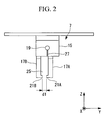
- FIG. 2 A partial cross-sectional view for explaining the structure of electrodes of FIG. 1 .
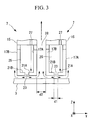
- FIG. 3 A partial cross-sectional view for explaining the arrangement of the electrodes of FIG. 1 and the flow of the reactant gas.
- FIG. 4 A partial cross-sectional view for explaining the structure of electrode units and the flow of the reactant gas in a plasma CVD apparatus according to a second embodiment of the present invention.
- FIG. 5 A partial cross-sectional view for explaining the structure of electrode units and the flow of the reactant gas in a plasma CVD apparatus according to a third embodiment of the present invention.
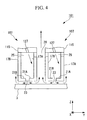
- FIG. 6 A partial cross-sectional view for explaining the structure of electrode units and the flow of the reactant gas in a plasma CVD apparatus according to a fourth embodiment of the present invention.
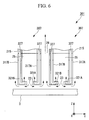
- FIG. 7 A partial cross-sectional view for explaining the structure of electrode units and the flow of the reactant gas in a plasma CVD apparatus according to a fifth embodiment of the present invention.
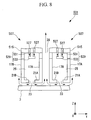
- FIG. 8 A partial cross-sectional view for explaining the structure of electrode units and the flow of the reactant gas in a plasma CVD apparatus according to a sixth embodiment of the present invention.
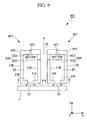
- FIG. 9 A partial cross-sectional view for explaining the structure of electrode units and the flow of the reactant gas in a plasma CVD apparatus according to a seventh embodiment of the present invention.
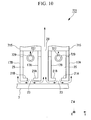
- FIG. 10 A partial cross-sectional view for explaining the structure of electrode units and the flow of the reactant gas in a plasma CVD apparatus according to an eighth embodiment of the present invention.
- FIG. 11 A schematic view for explaining the basic structure of a conventional electrode unit used for a film deposition test.
- FIG. 12 A schematic view for explaining the basic structure of an electrode unit according to the first embodiment used for the film deposition test.
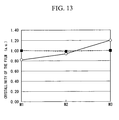
- FIG. 13 A graph for explaining the difference in crystallinity between microcrystalline silicon films deposited by using the electrode unit of FIG. 11 and those deposited by using the electrode unit of FIG. 12 .
- FIGS. 1 to 3 a plasma CVD apparatus according to a first embodiment of the present invention will be described with reference to FIGS. 1 to 3 .
- FIG. 1 is a schematic view for explaining the structure of the plasma CVD apparatus according to the present embodiment.
- the plasma CVD apparatus (vacuum processing apparatus) 1 has: a chamber (casing) 5 that accommodates a substrate (substrate to be processed) 3 on which a film is deposited; electrode units 7 that perform plasma discharge toward the substrate 3; a supplier 9 that supplies a reactant gas; an exhauster 11 that exhausts the reactant gas; and a power feeder 13 that supplies high-frequency power to the electrode units 7.
- the chamber 5 includes: the supplier 9 that supplies the reactant gas to the inside; the exhauster 11 that exhausts the reactant gas which has been used for film deposition; the power feeder 13 that supplies the high-frequency power used for plasma formation; and a pump (not shown) that reduces the pressure in the chamber 5 to a predetermined pressure.
- the electrode units 7 are supplied with the high-frequency power from the power feeder 13 to thereby perform plasma discharge at the space between it and the substrate 3, and also supply the reactant gas to the substrate 3.
- the electrode units 7 are formed so as to extend in a predetermined direction (the direction of the X axis in FIG. 1 ), and its length in the predetermined direction is a length covering at least the area of the substrate 3 where a film is deposited.
- the electrode units 7 are disposed at a predetermined distance from the substrate 3.
- the electrode units 7 are arranged substantially parallel to one another at predetermined intervals in a direction (the direction of the Y axis in FIG. 1 ) orthogonal to the predetermined direction.
- four electrode units 7 are arranged so as to cover the area of the substrate 3 where a film is deposited.
- the number of electrode units 7 is not specifically limited; it may be four as mentioned above or may be larger or smaller than that.
- the supplier 9 supplies the reactant gas used for film deposition, to the electrode units 7.
- the exhauster 11 exhausts, from the chamber 5, the reactant gas which has been supplied from the electrode units 7 to the substrate 3 and has been used for film deposition.
- the power feeder 13 supplies the high-frequency power to the electrodes to form a plasma discharge region between the electrode units 7 and the substrate 3.
- the frequency of the supplied high-frequency power is not specifically limited; a known frequency may be applied thereto.
- the substrate 3 is electrically connected to a ground electrode (not shown) provided in the chamber 5.
- FIG. 2 is a partial cross-sectional view for explaining the structure of the electrodes of FIG. 1 .
- the electrode units 7 each have a mount 15 and electrodes 17A and 17B.
- the mount 15 supports the electrodes 17A and 17B, and a supply channel 19 supplying the reactant gas from the supplier 9 to the inside, an exhaust channel (not shown) exhausting the reactant gas to the exhauster 11, and wiring (not shown) supplying the high-frequency power are formed therein.
- the electrodes 17A and 17B are a pair of substantially plate-form members that extend from the mount 15 toward the substrate 3 (in the negative direction of the Z axis) and also extend perpendicular to the plane of the paper in FIG. 2 (the direction of the X axis).
- a bent portion 21A extending toward the electrode 17B along the surface of the substrate 3 (in the direction of the Y axis) is provided on the end portion toward the substrate 3 of the electrode 17A.
- a bent portion 21B extending toward the electrode 17A along the surface of the substrate 3 is provided on the end portion toward the substrate 3 of the electrode 17B.
- the bent portions 21A and 21B work as electrodes together with the electrodes 17A and 17B.
- a slit (second gas injection hole) 23 of a predetermined width d1 and extending in the direction of the X axis is formed between the bent portions 21A and 21B. It is preferable that the predetermined width d1 is approximately twice the plasma sheath length.
- a buffer chamber 25 surrounded by the mount 15, the electrodes 17A and 17B, and the bent portions 21A and 21B is formed in each electrode unit 7.
- Gas injection holes (first gas injection holes) 27 supplying the reactant gas into the buffer chamber 25 are formed in the mount 15.
- the gas injection holes 27 are holes that allow the supply channel 19 and the buffer chamber 25 to communicate with each other, and are discretely arranged at predetermined intervals in the direction of the X axis.
- the gas injection holes 27 are formed so that the bent portion 21A coincides with the central axis of the hole.
- the arrangement of the gas injection holes 27 is not specifically limited; the gas injection holes 27 may be formed so that the bent portion 21A coincides with the central axis of the holes as mentioned above or may be formed so that the bent portion 21B coincides with the central axis.
- FIG. 3 is a partial cross-sectional view for explaining the arrangement of the electrodes of FIG. 1 and the flow of the reactant gas.
- the electrode units 7 are arranged at predetermined intervals d2 in the direction of the Y axis.
- the gaps between the electrode units 7 act as exhaust holes 28 connected to the above-mentioned exhaust channel. It is preferable that the predetermined interval d2 is approximately twice the plasma sheath length, like the predetermined width d1.
- the substrate 3 is disposed in the chamber 5 of the plasma CVD apparatus 1, and the pressure in the chamber 5 is reduced to the predetermined pressure.
- the reactant gas is supplied from the supplier 9 to the substrate 3 and the high-frequency power is supplied from the power feeder 13 to the electrode units 7, so that a plasma discharge region is formed between the electrode units 7 and the substrate 3.
- the reactant gas transforms into plasma in the plasma discharge region, and a predetermined film is deposited on the surface of the substrate 3.
- the remainder of the reactant gas used for film deposition is exhausted from the plasma discharge region through the exhaust holes 28.
- the reactant gas supplied from the supplier 9 through the supply channel 19 is jetted into the buffer chamber 25 from the gas injection holes 27.
- the reactant gas jetted into the buffer chamber 25 flows along the central axes of the gas injection holes 27, and collides against the bent portion 21A.
- the reactant gas flows out from the slit 23 toward the substrate 3 because of the difference in static pressure between the inside and outside of the buffer chamber 25.
- the electrodes 17A and 17B and the bent portions 21A and 21B are supplied with the high-frequency power from the power feeder 13, a plasma discharge region is formed between the electrodes 17A and 17B and the bent portions 21A and 21B, and the substrate 3.
- the reactant gas that has flowed out from the slit 23 flows into the plasma discharge region and is ionized, transformed into plasma.
- the reactant gas transformed into plasma forms a predetermined film on the substrate 3.
- the reactant gas transformed into plasma is made to flow out from the plasma discharge region toward the exhaust holes 28 provided between the electrode units 7 by being sucked into the exhaust holes 28.
- the reactant gas in the plasma discharge region is pushed out from the plasma discharge region by the reactant gas that flows out from the slit 23.
- the width of the slit 23 is the predetermined width d1, approximately twice the plasma sheath length, the reactant gas transformed into plasma does not enter the buffer chamber 25. Further, since the width of the exhaust holes 28 is the predetermined interval d2 approximately twice the plasma sheath length, the reactant gas transformed into plasma does not enter the exhaust holes 28. Consequently, the reactant gas can be prevented from being ionized in the buffer chamber 25 and the exhaust holes 28.
- the width of the slit 23 is the predetermined width d1 and the width of the exhaust holes 28 is the predetermined interval d2, the plasma distribution in a direction orthogonal to the direction of length of the electrode unit 7 (the direction of the Y axis) be uniformized, so that the film thickness distribution can be prevented from being nonuniform.
- the speed of the film deposition on the substrate 3 can be improved and the uniformity of the distribution of the deposited film can be improved.
- the reactant gas can be uniformly supplied from each gas injection hole 27 into the buffer chamber 25. Since the slit 23 has a slit form extending in the direction in which the electrodes 17A and 17B extend, the reactant gas can be uniformly supplied to the substrate 3 with respect to the direction in which the electrodes 17A and 17B extend. Consequently, the uniformity of the distribution of the film deposited on the substrate 3 can be improved.
- plasma discharge is made from the electrodes 17A and 17B to the substrate 3, and the reactant gas jetted from the slit 23 provided in the buffer chamber 25 between the electrodes 17A and 17B is supplied to the plasma discharge region.
- the uniformity of the distribution of the deposited film can be improved.
- the exhaust holes 28 exhaust the reactant gas from the gap between the substrate 3 and the electrodes, the reactant gas staying in the plasma discharge region can also be exhausted. Consequently, the generation of minute particles can be prevented, so that the uniformity of the distribution of the film deposited on the substrate 3 can be improved. Further, since the exhaust holes 28 are sandwiched between the electrodes 17A and 17B of adjoining buffer chambers 25, it is consequently situated in a position near the plasma discharge region. As a consequence, the reactant gas staying in the plasma discharge region is more easily exhausted, so that the uniformity of the distribution of the film deposited on the substrate 3 can be further improved.
- the film deposition rate can be improved, and the uniformity of the distribution of the deposited film can be improved.
- the bent portions 21A and 21B are provided on the end portions of the electrodes 17A and 17B facing the substrate 3, plasma discharge can be carried out from the bent portions 21A and 21B to the substrate 3. At this time, since plasma discharge is made from the surfaces of the bent portions 21A and 21B facing the substrate 3, toward the substrate 3, the plasma discharge region is increased. Consequently, the region where plasma is formed is increased to improve the speed of the film deposition on the substrate 3. Since the bent portions 21A and 21B extend along the substrate 3, plasma discharge can be uniformly carried out from the bent portions 21A and 21B to the substrate 3. Consequently, plasma of uniform density can be formed, so that the uniformity of the distribution of the film deposited on the substrate 3 can be improved.
- the jetting direction of the reactant gas jetted from the gas injection holes 27 is toward the bent portion 21A and is different from the direction facing toward the slit 23, the uniformity of the distribution of the deposited film can be improved.
- the reactant gas jetted from the gas injection holes 27 Since the jetting direction of the reactant gas jetted from the gas injection holes 27 is not toward the slit 23, the reactant gas is not directly jetted from the slit 23. That is, the reactant gas jetted from the gas injection holes 27 collides against the bent portion 21A, and then, is supplied to the substrate 3 through the slit 23 because of the difference in static pressure between the inside and outside of the buffer chamber 25. Consequently, the jet stream of the reactant gas is prevented from directly colliding against the substrate 3, so that the uniformity of the distribution of the film deposited on the substrate 3 can be improved.
- FIG. 4 is a partial cross-sectional view for explaining the structure of the electrode units and the flow of the reactant gas in the plasma CVD apparatus according to the present embodiment.
- electrode units 107 of the plasma CVD apparatus (vacuum processing apparatus) 101 each have a mount 115 and the electrodes 17A and 17B.
- Gas injection holes (first gas injection holes) 127 supplying the reactant gas into the buffer chamber 25 are formed in the mount 115.
- the gas injection holes 127 are holes that allow the supply channel (not shown) and the buffer chamber 25 to communicate with each other, and are discretely arranged at predetermined intervals in the direction of the X axis.
- the gas injection holes 127 are obliquely formed so that the electrode 17A coincides with the central axes of the holes.
- the arrangement of the gas injection holes 27 is not specifically limited; the gas injection holes 27 may be obliquely formed so that the electrode 17A coincides with the central axes of the holes as mentioned above or may be obliquely formed so that the electrode 17B coincides with the central axes.
- the reactant gas is jetted from the gas injection holes 127 into the buffer chamber 25.
- the reactant gas jetted into the buffer chamber 25 obliquely flows along the central axes of the gas injection holes 127, and collides against the electrode 17A.
- the reactant gas flows out from the slit 23 toward the substrate 3 because of the difference in static pressure between the inside and outside of the buffer chamber 25.
- the electrodes 17A and 17B and the bent portions 21A and 21B are supplied with the high-frequency power from the power feeder 13, a plasma discharge region is formed between the electrodes 17A and 17B and the bent portions 21A and 21B, and the substrate 3.
- the reactant gas that flows out from the slit 23 flows into the plasma discharge region and is ionized, transformed into plasma.
- the reactant gas transformed into plasma forms a predetermined film on the substrate 3.
- the reactant gas transformed into plasma is made to flow out from the plasma discharge region toward the exhauster 28 provided between the electrode units 107 by being sucked into the exhaust holes 28.
- the reactant gas in the plasma discharge region is pushed out from the plasma discharge region by the reactant gas which flows out from the slit 23.
- the jetting direction of the reactant gas jetted from the gas injection holes 127 faces toward the electrode 17A and is different from the direction facing toward the slit 23, the uniformity of the distribution of the deposited film can be improved.
- the reactant gas jetted from the gas injection holes 127 Since the jetting direction of the reactant gas jetted from the gas injection holes 127 does not face toward the slit 23, the reactant gas is not directly jetted from the slit 23. That is, the reactant gas jetted from the gas injection holes 127 collides against the electrode 17A, and then, is supplied to the substrate 3 through the slit 23 because of the difference in static pressure between the inside and outside of the buffer chamber 25. Consequently, the jet stream of the reactant gas is prevented from directly colliding against the substrate 3, so that the uniformity of the distribution of the film deposited on the substrate 3 can be improved.
- FIG. 5 is a partial cross-sectional view for explaining the structure of the electrode units and the flow of the reactant gas in the plasma CVD apparatus according to the present embodiment.
- electrode units 207 of the plasma CVD apparatus (vacuum processing apparatus) 201 each have a mount 215 and electrodes 217A and 217B.
- Gas injection holes (first gas injection holes) 227 supplying the reactant gas into the buffer chamber 25 are formed in the electrodes 217A and 217B.
- the gas injection holes 227 are holes that allow the supply channel (not shown) and the buffer chamber 25 to communicate with each other, and are discretely arranged at predetermined intervals in the direction of the X axis. Specifically, the gas injection holes 227 direct the reactant gas from the supply channel in the mount 215 to the buffer chamber 25 through the mount 215 and the electrodes 217A and 217B.
- the gas injection holes 227 are formed so that the reactant gas is jetted into the buffer chamber 25 in a direction substantially parallel to the Y axis.
- the reactant gas is jetted from the gas injection holes 227 into the buffer chamber 25.
- the reactant gas jetted from the gas injection holes 227 of the electrode 217A into the buffer chamber 25 collides against the electrode 217B.
- the reactant gas jetted from the gas injection holes 227 of the electrode 217B into the buffer chamber 25 collides against the electrode 217A.
- the reactant gas flows out from the slit 23 toward the substrate 3 because of the difference in static pressure between the inside and outside of the buffer chamber 25.
- the electrodes 217A and 217B and the bent portions 21A and 21B are supplied with the high-frequency power from the power feeder 13, a plasma discharge region is deposited between the electrodes 217A and 217B and the bent portions 21A and 21B, and the substrate 3.
- the reactant gas that flows out from the slit 23 flows into the plasma discharge region and is ionized, transformed into plasma.
- the reactant gas transformed into plasma forms a predetermined film on the substrate 3.
- the reactant gas transformed into plasma is made to flow out from the plasma discharge region toward the exhaust holes 28 provided between the electrode units 207 by being sucked into the exhaust holes 28.
- the reactant gas in the plasma discharge region is pushed out from the plasma discharge region by the reactant gas that flows out from the slit 23.
- the jetting direction of the reactant gas jetted from the gas injection holes 227 is toward the electrode 217A or 217B and is different from the direction facing toward the slit 23, the uniformity of the distribution of the deposited film can be improved.
- the reactant gas jetted from the gas injection holes 227 Since the jetting direction of the reactant gas jetted from the gas injection holes 227 does not face toward the slit 23, the reactant gas is not directly jetted from the slit 23. That is, the reactant gas jetted from the gas injection holes 227 collides against the electrode 217A or 218B, and then is supplied to the substrate 3 through the slit 23 due to the difference in static pressure between the inside and outside of the buffer chamber 25. Consequently, the jet stream of the reactant gas is prevented from directly colliding against the substrate 3, so that the uniformity of the distribution of the film deposited on the substrate 3 can be improved.
- FIG. 6 is a partial cross-sectional view for explaining the structure of the electrode units and the flow of the reactant gas in the plasma CVD apparatus according to the present embodiment.
- electrode units 307 of the plasma CVD apparatus (vacuum processing apparatus) 301 each have the mount 215, electrodes 317A and 317B, and bent portions 321A and 321B.
- Gas injection holes (first gas injection holes) 327 supplying the reactant gas into the buffer chamber 25 are formed in the bent portions 321A and 321B.
- the gas injection holes 327 are holes that allow the supply channel (not shown) and the buffer chamber 25 to communicate with each other, and are discretely arranged at predetermined intervals in the direction of the X axis. Specifically, the gas injection holes 327 direct the reactant gas from the supply channel in the mount 215 to the buffer chamber 25 through the mount 215, the electrodes 317A and 317B, and the bent portions 321A and 321B.
- the gas injection holes 327 are formed so that the reactant gas is jetted into the buffer chamber 25 in a direction substantially parallel to the Z axis and toward the mount 215.
- the reactant gas is jetted from the gas injection holes 327 into the buffer chamber 25.
- the reactant gas jetted from the gas injection holes 327 of the bent portions 321A and 321B into the buffer chamber 25 collides against the mount 215.
- the reactant gas flows out from the slit 23 toward the substrate 3 because of the difference in static pressure between the inside and outside of the buffer chamber 25.
- the electrodes 317A and 317B and the bent portions 321A and 321B are supplied with the high-frequency power from the power feeder 13, a plasma discharge region is formed between the electrodes 317A and 317B and the bent portions 321A and 321B, and the substrate 3.
- the reactant gas that flows out from the slit 23 flows into the plasma discharge region and is ionized, transformed into plasma.
- the reactant gas transformed into plasma forms a predetermined film on the substrate 3.
- the reactant gas transformed into plasma is made to flow out from the plasma discharge region toward the exhaust holes 28 provided between the electrode units 307 by being sucked into the exhaust holes 28.
- the reactant gas in the plasma discharge region is pushed out from the plasma discharge region by the reactant gas that flows out from the slit 23.
- the jetting direction of the reactant gas jetted from the gas injection holes 327 is toward the mount 215 and is different from the direction facing toward the slit 23, the uniformity of the distribution of the deposited film can be improved.
- the reactant gas jetted from the gas injection holes 327 Since the jetting direction of the reactant gas jetted from the gas injection holes 327 does not face toward the slit 23, the reactant gas is not directly jetted from the slit 23. That is, the reactant gas jetted from the gas injection holes 327 collides against the mount 215, and then is supplied to the substrate 3 through the slit 23 due to the difference in static pressure between the inside and outside of the buffer chamber 25. Consequently, the jet stream of the reactant gas is prevented from directly colliding against the substrate 3, so that the uniformity of the distribution of the film deposited on the substrate 3 can be improved.
- FIG. 7 is a partial cross-sectional view for explaining the structure of the electrode units and the flow of the reactant gas in the plasma CVD apparatus according to the present embodiment.
- electrode units 407 of the plasma CVD apparatus (vacuum processing apparatus) 401 each have a mount 415 and electrodes 417A and 417B.
- Gas injection holes (first gas injection holes) 427 supplying the reactant gas into the buffer chamber 25 are formed in the mount 415.
- the gas injection holes 427 are holes that allow the supply channel (not shown) and the buffer chamber 25 to communicate with each other, and are discretely arranged at predetermined intervals in the direction of the X axis. Specifically, the gas injection holes 427 direct the reactant gas from the supply channel in the mount 415 to the buffer chamber 25 through the mount 415.
- the openings of the gas injection holes 427 are formed so that the reactant gas is jetted from substantially the center of the mount 415 into the buffer chamber 25 in a direction substantially parallel to the Z axis and toward the slit 23.
- the electrodes 417A and 417B have intercepting plates (intercepting portions) 419A and 419B intercepting the flow of the reactant gas jetted from the gas injection holes 427.
- the intercepting plate 419A is a plate member extending from the surface of the electrode 417A into the buffer chamber 25 toward the electrode 417B (in the positive direction of the Y axis) and extending perpendicular to the plane of the figure (in the direction of the X axis).
- the intercepting plate 419B is a plate member extending from the surface of the electrode 417B into the buffer chamber 25 toward the electrode 417A (in the negative direction of the Y axis) and extending in the direction perpendicular to the plane of the figure.
- the intercepting plate 419A is situated closer to the bending portion 21A than the intercepting plate 419B.
- the intercepting plate 419B is situated closer to the mount 415 than the intercepting plate 419A.
- the reactant gas is jetted from the gas injection holes 427 into the buffer chamber 25.
- the reactant gas jetted from the gas injection holes 427 into the buffer chamber 25 collides against the intercepting plate 419B. Then, the colliding reactant gas flows in the buffer chamber 25 formed into a meandering channel by the intercepting plates 419A and 419B and the electrodes 417A and 417B, and flows out from the slit 23 toward the substrate 3 because of the difference in static pressure between the inside and outside of the buffer chamber 25.
- the electrodes 417A and 417B and the bent portions 21A and 21B are supplied with the high-frequency power from the power feeder 13, a plasma discharge region is formed between the electrodes 417A and 417B and the bent portions 21A and 21B, and the substrate 3.
- the reactant gas that flows out from the slit 23 flows into the plasma discharge region and is ionized, transformed into plasma.
- the reactant gas transformed into plasma forms a predetermined film on the substrate 3.
- the reactant gas transformed into plasma is made to flow out from the plasma discharge region toward the exhaust holes 28 provided between the electrode units 407 by being sucked into the exhaust holes 28.
- the reactant gas in the plasma discharge region is pushed out from the plasma discharge region by the reactant gas that flows out from the slit 23.
- the intercepting plates 419A and 419B intercepting the flow of the reactant gas jetted from the gas injection holes 427 are provided, the uniformity of the distribution of the deposited film can be improved.
- the reactant gas jetted from the gas injection holes 427 collides once against the intercepting plate 419A or 419B and then, is supplied from the slit 23 toward the substrate 3. That is, the jet stream of the reactant gas jetted from the gas injection holes 427 can be prevented from directly colliding against the substrate 3 through the slit 23. Consequently, the jet stream of the reactant gas can be prevented from directly colliding against the substrate 3, and the uniformity of the distribution of the film deposited on the substrate 3 can be improved.
- FIG. 8 is a partial cross-sectional view for explaining the structure of the electrode units and the flow of the reactant gas in the plasma CVD apparatus according to the present embodiment.
- electrode units 507 of the plasma CVD apparatus (vacuum processing apparatus) 501 each have a mount 515 and the electrodes 17A and 17B.
- the mount 515 has gas injection holes (first gas injection holes) 527 supplying the reactant gas into the buffer chamber 25 and an intercepting portion 529 intercepting the flow of the reactant gas jetted from the gas injection holes 527.
- the gas injection holes 527 are holes that allow the supply channel (not shown) and the buffer chamber 25 to communicate with each other.
- the openings of the gas injection holes 427 are discretely arranged at predetermined intervals at the surface of the mount 515 facing the buffer chamber 25 in the direction of the X axis, either closer to the electrode 17A or closer to the electrode 17B with respect to a support plate 531 described later.
- the gas injection holes 527 direct the reactant gas from the supply channel in the mount 515 to the buffer chamber 25 through the mount 515.
- the openings of the gas injection holes 527 are formed so that the reactant gas is jetted from the mount 515 into the buffer chamber 25 in the direction substantially parallel to the Z axis and toward the slit 23.
- the intercepting portion 529 comprises the support plate 531 and an intercepting plate (intercepting portion) 533.
- the support plate 531 is disposed between the mount 515 and the intercepting plate 533, and supports the intercepting plate 533.
- the support plate 531 is a plate member extending from substantially the center of the surface of the mount 515 facing the buffer chamber 25 toward the substrate 3 (in the negative direction of the Z axis) and extending in a direction orthogonal to the plane of the figure (the direction of the X axis).
- the intercepting plate 533 intercepts the flow of the reactant gas jetted from the gas injection holes 527.
- the intercepting plate 533 is a plate member extending from the end of the support plate 531 toward the electrodes 17A and 17B (in the direction of the Y axis) and extending in the direction orthogonal to the plane of the figure. Both end portions of the intercepting plate 533 in the direction of the Y axis extend up to positions coinciding with the central axes of the gas injection holes 527.
- the reactant gas is jetted from the gas injection holes 527 into the buffer chamber 25.
- the reactant gas jetted from the gas injection holes 527 into the buffer chamber 25 collides against the intercepting plate 533.
- the colliding reactant gas flows out from the slit 23 toward the substrate 3 because of the difference in static pressure between the inside and outside of the buffer chamber 25.
- the electrodes 17A and 17B and the bent portions 21A and 21B are supplied with the high-frequency power from the power feeder 13, a plasma discharge region is formed between the electrodes 17A and 17B and the bent portions 21A and 21B, and the substrate 3.
- the reactant gas that flows out from the slit 23 flows into the plasma discharge region and is ionized, transformed into plasma.
- the reactant gas transformed into plasma forms a predetermined film on the substrate 3.
- the reactant gas transformed into plasma is made to flow out from the plasma discharge region toward the exhaust holes 28 provided between the electrode units 507 by being sucked into the exhaust holes 28.
- the reactant gas in the plasma discharge region is pushed out from the plasma discharge region by the reactant gas that flows out from the slit 23.
- the intercepting portion 529 intercepting the flow of the reactant gas jetted from the gas injection holes 527 is provided, the uniformity of the distribution of the deposited film can be improved.
- the reactant gas jetted from the gas injection holes 527 collides against the intercepting plate 533 first and then, is supplied from the slit 23 toward the substrate 3. That is, the jet stream of the reactant gas jetted from the gas injection holes 527 can be prevented from directly colliding against the substrate 3 through the slit 23. Consequently, the jet stream of the reactant gas can be prevented from directly colliding against the substrate 3, and the uniformity of the distribution of the film deposited on the substrate 3 can be improved.
- FIG. 9 is a partial cross-sectional view for explaining the structure of the electrode units and the flow of the reactant gas in the plasma CVD apparatus according to the present embodiment.
- electrode units 607 of the plasma CVD apparatus (vacuum processing apparatus) 601 each have a mount 615 and the electrodes 17A and 17B.
- the mount 615 has: gas injection holes (first gas injection holes) 627 supplying the reactant gas into the buffer chamber 25; and a protruding portion 629 having the gas injection holes 627 formed therein.
- the gas injection holes 627 are holes that allow the supply channel (not shown) and the buffer chamber 25 to communicate with each other.
- the openings of the gas injection holes 627 are discretely arranged at predetermined intervals in the direction of the X axis in the surfaces of a support plate 631, described later, facing the electrode 17A and facing the electrode 17B.
- the gas injection holes 627 direct the reactant gas from the supply channel in the mount 615 to the buffer chamber 25 through the mount 615 and the support plate 631.
- the openings of the gas injection holes 627 are formed so that the reactant gas is jetted from the mount 615 into the buffer chamber 25 in the direction substantially parallel to the Y axis.
- the protruding portion 629 has the support plate 631 and an end plate 633.
- the support plate 631 is disposed between the mount 615 and the end plate 633, and supports the end plate 633.
- the support plate 631 is a plate member extending from substantially the center of the surface of the mount 615 into the buffer chamber 25 toward the substrate 3 (in the negative direction of the Z axis) and extending in the direction orthogonal to the plane of the figure (the direction of the X axis).
- the end plate 633 is a plate member extending from the end of the support plate 631 toward the electrodes 17A and 17B (in the direction of the Y axis) and extending in the direction orthogonal to the plane of the figure.
- the reactant gas is jetted from the gas injection holes 627 into the buffer chamber 25.
- the reactant gas jetted from the gas injection holes 627 into the buffer chamber 25 collides against the electrodes 17A and 17B.
- the colliding reactant gas flows out from the slit 23 toward the substrate 3 because of the difference in static pressure between the inside and outside of the buffer chamber 25.
- the electrodes 17A and 17B and the bent portions 21A and 21B are supplied with the high-frequency power from the power feeder 13, a plasma discharge region is formed between the electrodes 17A and 17B and the bent portions 21A and 21B, and the substrate 3.
- the reactant gas that flows out from the slit 23 flows into the plasma discharge region and is ionized, transformed into plasma.
- the reactant gas transformed into plasma forms a predetermined film on the substrate 3.
- the reactant gas transformed into plasma is made to flow out from the plasma discharge region toward the exhaust holes 28 provided between the electrode units 507 by being sucked into the exhaust holes 28.
- the reactant gas in the plasma discharge region is pushed out from the plasma discharge region by the reactant gas that flows out from the slit 23.
- the jetting direction of the reactant gas jetted from the gas injection holes 627 is toward the electrodes 17A and 17B and is different from the direction facing toward the slit 23, the uniformity of the distribution of the deposited film can be improved.
- the reactant gas jetted from the gas injection holes 627 Since the jetting direction of the reactant gas jetted from the gas injection holes 627 does not face toward the slit 23, the reactant gas is not directly jetted from the slit 23. That is, the reactant gas jetted from the gas injection holes 627 collides against the electrodes 17A and 18B, and then is supplied from the slit 23 to the substrate 3 because of the difference in static pressure between the inside and outside of the buffer chamber 25. Consequently, the jet stream of the reactant gas is prevented from directly colliding against the substrate 3, so that the uniformity of the distribution of the film deposited on the substrate 3 can be improved.
- FIG. 10 is a partial cross-sectional view for explaining the structure of the electrode units and the flow of the reactant gas in the plasma CVD apparatus according to the present embodiment.
- electrode units 707 of the plasma CVD apparatus (vacuum processing apparatus) 701 each have a mount 715, the electrodes 17A and 17B, and a supply pipe 729.
- the electrodes 17A and 17B are disposed on the mount 715.
- the supply tube 729 is a channel through which the reactant gas supplied from the supplier 9 (see FIG. 1 ) flows.
- the supply tube 729 which is disposed in the buffer chamber 25 is situated at a predetermined distance from the mount 715 and situated also at a predetermined distance from the electrodes 17A and 17B and the bent portions 21A and 21B.
- the supply tube 729 is disposed so as to extend in the direction orthogonal to the plane of the figure (the direction of the X axis).
- Gas injection holes (first gas injection holes) 727 supplying the reactant gas into the buffer chamber 25 are formed in the supply tube 729.
- the gas injection holes 727 are holes that allow the supply tube 729 and the buffer chamber 25 to communicate with each other.
- the openings of the gas injection holes 727 are discretely arranged at predetermined intervals in the direction of the X axis, and are formed so that the reactant gas is jetted from the supply tube 729 toward the mount 715 (in the positive direction of the Z axis).
- the reactant gas is jetted from the gas injection holes 727 into the buffer chamber 25.
- the reactant gas jetted from the gas injection holes 727 into the buffer chamber 25 collides against the mount 715.
- the colliding reactant gas flows out from the slit 23 toward the substrate 3 because of the difference in static pressure between the inside and outside of the buffer chamber 25.
- the electrodes 17A and 17B and the bent portions 21A and 21B are supplied with the high-frequency power from the power feeder 13, a plasma discharge region is formed between the electrodes 17A and 17B and the bent portions 21A and 21B, and the substrate 3.
- the reactant gas that flows out from the slit 23 flows into the plasma discharge region and is ionized, transformed into plasma.
- the reactant gas transformed into plasma forms a predetermined film on the substrate 3.
- the reactant gas transformed into plasma is made to flow out from the plasma discharge region toward the exhaust holes 28 provided between the electrode units 707 by being sucked into the exhaust holes 28.
- the reactant gas in the plasma discharge region is pushed out from the plasma discharge region by the reactant gas that flows out from the slit 23.
- the jetting direction of the reactant gas jetted from the gas injection holes 727 faces toward the mount 715 and is different from the direction facing toward the slit 23, the uniformity of the distribution of the deposited film can be improved.
- the reactant gas jetted from the gas injection holes 727 Since the jetting direction of the reactant gas jetted from the gas injection holes 727 does not face toward the slit 23, the reactant gas is not directly jetted from the slit 23. That is, the reactant gas jetted from the gas injection holes 727 collides against the mount 715, and then is supplied from the slit 23 to the substrate 3 because of the difference in static pressure between the inside and outside of the buffer chamber 25. Consequently, the jet stream of the reactant gas is prevented from directly colliding against the substrate 3, so that the uniformity of the distribution of the film deposited on the substrate 3 can be improved.
- the gas injection holes 27 are disposed in positions where they can be directly seen when the electrode unit 7X is viewed from the side of the substrate 3. That is, the center line of a slit 23X formed between electrodes 17XA and 17XB and the positions of the gas injection holes 27 substantially coincide with each other.
- the distance between the substrate 3 and the electrode unit 7X is approximately 2 mm
- the diameter of the gas injection holes 27 is a predetermined value in a range of approximately 0.3 mm to approximately 0.5 mm.
- the width of the slit 23X of the electrode 7X is a predetermined value in a range of approximately 3 mm to approximately 5 mm.
- the reactant gas which has exited from the gas injection holes 27 becomes a jet stream and heads for the substrate 3. That is, since the jet stream of the reactant gas passes through the plasma discharge region between the substrate 3 and the electrode unit 7X to be directly blown against the substrate 3, the possibility is high that the film deposited on the substrate 3 is nonuniform.
- FIG. 12 An outline of the structure of the electrode unit according to the first embodiment used for the film deposition test will be described by using FIG. 12 .
- the gas injection holes 27 are not disposed in positions where they can be directly seen when the electrode unit 7 is viewed from the substrate 3. That is, the center line of the slit 23 and the gas injection holes 27 are disposed in an offset manner.
- the distance between the substrate 3 and the electrode unit 7 is approximately 2 mm, and the diameter of the gas injection holes 27 is a predetermined value in a range of approximately 0.3 mm to approximately 0.5 mm.
- the width of the slit 23 of the electrode unit 7 of the first embodiment is a predetermined value in a range of approximately 4 mm to approximately 6 mm
- the lateral distance by which the center line of the slit 23 is offset from the gas injection holes 27 is a predetermined value in a range of approximately 4 mm to approximately 6 mm
- the volume of the buffer chamber 25 is a predetermined value in a range of approximately 8000 mm 3 to approximately 10000 mm 3 .
- the reactant gas uniformly flows out from the slit 23 into the plasma discharge region, so that the film deposited on the substrate 3 is prevented from being nonuniform.
- microcrystalline silicon film deposition in the film deposition test is as described in the following:
- the frequency of the high-frequency power supplied from the power feeder 13 is approximately 170 MHz.
- the pressure of the supplied reactant gas is approximately 4000 Pa (30 Torr), and the ratio of the silane flow amount to the hydrogen flow amount in the supplied reactant gas is 5 to 600.
- the measurement of the crystallinity of the microcrystalline silicon film deposited on the substrate 3 is performed at three points: position M1, position M2, and position M3 shown in FIGS. 11 and 12 .
- the position M1 faces the slit 23X and the slit 23.
- the position M2 faces the center of the electrode 17XA or 17XB and the electrode 17A or 17B.
- the position M3 faces the edge of the electrode 17XA or 17XB and the electrode 17A or 17B.
- the value of the crystallinity has a distribution variance of ⁇ 20% between the position M1 and the position M3.
- the values of the crystallinity are substantially the same in the area between the position M1 and the position M3. From this, it is apparent that the microcrystalline silicon film deposited by the electrode unit 7 is more excellent in uniformity than the microcrystalline silicone film deposited by the conventional electrode unit 7X.
Landscapes
- Chemical & Material Sciences (AREA)
- Engineering & Computer Science (AREA)
- Physics & Mathematics (AREA)
- Plasma & Fusion (AREA)
- Metallurgy (AREA)
- Mechanical Engineering (AREA)
- Materials Engineering (AREA)
- Organic Chemistry (AREA)
- Chemical Kinetics & Catalysis (AREA)
- General Chemical & Material Sciences (AREA)
- Analytical Chemistry (AREA)
- Electromagnetism (AREA)
- Spectroscopy & Molecular Physics (AREA)
- Chemical Vapour Deposition (AREA)
Abstract
Applications Claiming Priority (2)
| Application Number | Priority Date | Filing Date | Title |
|---|---|---|---|
| JP2006082690 | 2006-03-24 | ||
| PCT/JP2007/055768 WO2007111204A1 (ja) | 2006-03-24 | 2007-03-20 | 電極および真空処理装置 |
Publications (4)
| Publication Number | Publication Date |
|---|---|
| EP2000562A2 EP2000562A2 (en) | 2008-12-10 |
| EP2000562A9 EP2000562A9 (en) | 2009-03-25 |
| EP2000562A4 EP2000562A4 (en) | 2010-05-12 |
| EP2000562B1 true EP2000562B1 (en) | 2011-06-08 |
Family
ID=38541124
Family Applications (1)
| Application Number | Title | Priority Date | Filing Date |
|---|---|---|---|
| EP07739211A Not-in-force EP2000562B1 (en) | 2006-03-24 | 2007-03-20 | Electrode and vacuum processing apparatus |
Country Status (7)
| Country | Link |
|---|---|
| US (1) | US20090288602A1 (ja) |
| EP (1) | EP2000562B1 (ja) |
| JP (1) | JP4918493B2 (ja) |
| CN (1) | CN101360846B (ja) |
| AU (1) | AU2007230338B2 (ja) |
| ES (1) | ES2365425T3 (ja) |
| WO (1) | WO2007111204A1 (ja) |
Families Citing this family (17)
| Publication number | Priority date | Publication date | Assignee | Title |
|---|---|---|---|---|
| US10049859B2 (en) * | 2009-07-08 | 2018-08-14 | Aixtron Se | Plasma generating units for processing a substrate |
| KR101309359B1 (ko) * | 2009-08-27 | 2013-09-17 | 가부시키가이샤 알박 | 진공 처리 장치 및 진공 처리 방법 |
| JP5648349B2 (ja) * | 2009-09-17 | 2015-01-07 | 東京エレクトロン株式会社 | 成膜装置 |
| JP5529509B2 (ja) * | 2009-11-27 | 2014-06-25 | 東レエンジニアリング株式会社 | Cvd装置 |
| JP5787284B2 (ja) * | 2010-06-30 | 2015-09-30 | 国立大学法人名古屋大学 | 反応種供給装置および表面等処理装置 |
| KR101541155B1 (ko) * | 2012-12-13 | 2015-08-06 | 엘아이지인베니아 주식회사 | 원자층 증착장치 |
| KR101541154B1 (ko) * | 2012-12-13 | 2015-08-03 | 엘아이지인베니아 주식회사 | 원자층 증착장치 |
| KR101538372B1 (ko) * | 2012-12-13 | 2015-07-22 | 엘아이지인베니아 주식회사 | 원자층 증착장치 |
| KR101549846B1 (ko) * | 2013-03-08 | 2015-09-03 | 엘아이지인베니아 주식회사 | 원자층 증착장치 |
| EP2960358A1 (en) * | 2014-06-25 | 2015-12-30 | Nederlandse Organisatie voor toegepast- natuurwetenschappelijk onderzoek TNO | Plasma source and surface treatment method |
| US10526704B2 (en) * | 2015-01-30 | 2020-01-07 | Asm Ip Holding B.V. | Film forming apparatus |
| US10294562B2 (en) * | 2016-04-05 | 2019-05-21 | Aixtron Se | Exhaust manifold in a CVD reactor |
| CN109983848B (zh) * | 2016-11-24 | 2023-02-24 | 株式会社富士 | 等离子体发生装置 |
| US11286565B2 (en) * | 2018-12-13 | 2022-03-29 | Xia Tai Xin Semiconductor (Qing Dao) Ltd. | Apparatus and method for semiconductor fabrication |
| EP3714984A1 (en) * | 2019-03-26 | 2020-09-30 | Nederlandse Organisatie voor toegepast- natuurwetenschappelijk Onderzoek TNO | A fluid handling structure and method for a gas phase deposition apparatus |
| US11332827B2 (en) * | 2019-03-27 | 2022-05-17 | Applied Materials, Inc. | Gas distribution plate with high aspect ratio holes and a high hole density |
| CN116262983A (zh) * | 2021-12-14 | 2023-06-16 | 盛美半导体设备(上海)股份有限公司 | 电镀装置 |
Family Cites Families (13)
| Publication number | Priority date | Publication date | Assignee | Title |
|---|---|---|---|---|
| JPH11149998A (ja) * | 1997-11-14 | 1999-06-02 | Foi:Kk | プラズマ処理装置 |
| JP3844274B2 (ja) | 1998-06-25 | 2006-11-08 | 独立行政法人産業技術総合研究所 | プラズマcvd装置及びプラズマcvd方法 |
| JP4726369B2 (ja) * | 1999-06-19 | 2011-07-20 | エー・エス・エムジニテックコリア株式会社 | 化学蒸着反応炉及びこれを利用した薄膜形成方法 |
| JP2001093843A (ja) * | 1999-09-27 | 2001-04-06 | Kanegafuchi Chem Ind Co Ltd | プラズマcvd装置およびシリコン系薄膜光電変換装置の製造方法 |
| JP2003249492A (ja) * | 2002-02-22 | 2003-09-05 | Konica Corp | プラズマ放電処理装置、薄膜形成方法及び基材 |
| JP2005026171A (ja) * | 2003-07-01 | 2005-01-27 | Matsushita Electric Works Ltd | プラズマ処理方法及びプラズマ処理装置 |
| EP1521509B1 (en) * | 2003-09-30 | 2013-11-06 | FUJIFILM Manufacturing Europe B.V. | Method and arrangement for generating an atmospheric pressure glow plasma |
| JP4119820B2 (ja) * | 2003-11-14 | 2008-07-16 | 三菱重工業株式会社 | プラズマcvd装置および光電変換装置の製造方法 |
| JP2006004686A (ja) * | 2004-06-16 | 2006-01-05 | Matsushita Electric Ind Co Ltd | プラズマ処理方法及び装置 |
| JP4279217B2 (ja) * | 2004-07-16 | 2009-06-17 | 三菱重工業株式会社 | プラズマ処理装置及びこれを用いた太陽電池の製造方法 |
| JP3984609B2 (ja) * | 2004-11-02 | 2007-10-03 | 積水化学工業株式会社 | プラズマ処理装置の電極構造 |
| US7662253B2 (en) * | 2005-09-27 | 2010-02-16 | Lam Research Corporation | Apparatus for the removal of a metal oxide from a substrate and methods therefor |
| TWI318417B (en) * | 2006-11-03 | 2009-12-11 | Ind Tech Res Inst | Hollow-type cathode electricity discharging apparatus |
-
2007
- 2007-03-20 EP EP07739211A patent/EP2000562B1/en not_active Not-in-force
- 2007-03-20 AU AU2007230338A patent/AU2007230338B2/en not_active Ceased
- 2007-03-20 ES ES07739211T patent/ES2365425T3/es active Active
- 2007-03-20 US US12/087,071 patent/US20090288602A1/en not_active Abandoned
- 2007-03-20 CN CN2007800016101A patent/CN101360846B/zh not_active Expired - Fee Related
- 2007-03-20 WO PCT/JP2007/055768 patent/WO2007111204A1/ja not_active Ceased
- 2007-03-20 JP JP2007539404A patent/JP4918493B2/ja not_active Expired - Fee Related
Also Published As
| Publication number | Publication date |
|---|---|
| EP2000562A4 (en) | 2010-05-12 |
| CN101360846B (zh) | 2012-09-05 |
| JP4918493B2 (ja) | 2012-04-18 |
| EP2000562A2 (en) | 2008-12-10 |
| CN101360846A (zh) | 2009-02-04 |
| AU2007230338B2 (en) | 2011-04-07 |
| US20090288602A1 (en) | 2009-11-26 |
| AU2007230338A1 (en) | 2007-10-04 |
| EP2000562A9 (en) | 2009-03-25 |
| JPWO2007111204A1 (ja) | 2009-08-13 |
| ES2365425T3 (es) | 2011-10-04 |
| WO2007111204A1 (ja) | 2007-10-04 |
Similar Documents
| Publication | Publication Date | Title |
|---|---|---|
| AU2007230338B2 (en) | Electrode and vacuum processing apparatus | |
| CN104060238B (zh) | 衬垫组合件和具有衬垫组合件的衬底处理设备 | |
| US11078568B2 (en) | Pumping apparatus and method for substrate processing chambers | |
| JP5291875B2 (ja) | プラズマ装置 | |
| CN106399973A (zh) | 气体分配系统和处理腔室 | |
| US20090286405A1 (en) | Shower plate, and plasma processing apparatus, plasma processing method and electronic device manufacturing method using the shower plate | |
| TWI852382B (zh) | 批次型基底處理裝置 | |
| KR20050044248A (ko) | 표면파 여기 플라즈마 cvd 시스템 | |
| KR20050012789A (ko) | 산화막 형성 방법 및 산화막 형성 장치 | |
| CN101952940A (zh) | 衬底处理装置和方法 | |
| JP2012528242A (ja) | プラズマ堆積ソースおよび薄膜を堆積させるための方法 | |
| JP2003073835A (ja) | プラズマcvd装置およびプラズマcvd膜の形成方法 | |
| KR101076674B1 (ko) | 플라즈마 처리 장치 | |
| CN101910460A (zh) | 等离子体处理设备 | |
| CN108878244A (zh) | 用于避免异常放电和等离子体聚集的绝缘体结构 | |
| US11692269B2 (en) | Plasma processing apparatus | |
| TWI856508B (zh) | 批次型基底處理裝置 | |
| US20120325146A1 (en) | Plasma Processing Apparatus | |
| JP2012177174A (ja) | 薄膜形成装置 | |
| JP4471887B2 (ja) | プラズマプロセス装置 | |
| JP2026511341A (ja) | プラズマ強化薄膜成膜用炉管 | |
| CN121023474A (zh) | 用于半导体工艺设备的喷淋头和半导体工艺装备 | |
| TW202401569A (zh) | 基板處理裝置 | |
| TW202600895A (zh) | 批次式基板處理裝置 |
Legal Events
| Date | Code | Title | Description |
|---|---|---|---|
| PUAI | Public reference made under article 153(3) epc to a published international application that has entered the european phase |
Free format text: ORIGINAL CODE: 0009012 |
|
| 17P | Request for examination filed |
Effective date: 20080617 |
|
| AK | Designated contracting states |
Kind code of ref document: A2 Designated state(s): DE ES FR IT NL |
|
| PUAB | Information related to the publication of an a document modified or deleted |
Free format text: ORIGINAL CODE: 0009199EPPU |
|
| DAX | Request for extension of the european patent (deleted) | ||
| RBV | Designated contracting states (corrected) |
Designated state(s): DE ES FR IT NL |
|
| A4 | Supplementary search report drawn up and despatched |
Effective date: 20100414 |
|
| GRAP | Despatch of communication of intention to grant a patent |
Free format text: ORIGINAL CODE: EPIDOSNIGR1 |
|
| RIC1 | Information provided on ipc code assigned before grant |
Ipc: H05H 1/46 20060101ALI20101110BHEP Ipc: C23C 16/505 20060101AFI20101110BHEP Ipc: C23C 16/455 20060101ALI20101110BHEP |
|
| GRAS | Grant fee paid |
Free format text: ORIGINAL CODE: EPIDOSNIGR3 |
|
| GRAA | (expected) grant |
Free format text: ORIGINAL CODE: 0009210 |
|
| AK | Designated contracting states |
Kind code of ref document: B1 Designated state(s): DE ES FR IT NL |
|
| REG | Reference to a national code |
Ref country code: DE Ref legal event code: R096 Ref document number: 602007015064 Country of ref document: DE Effective date: 20110721 |
|
| REG | Reference to a national code |
Ref country code: NL Ref legal event code: T3 |
|
| REG | Reference to a national code |
Ref country code: ES Ref legal event code: FG2A Ref document number: 2365425 Country of ref document: ES Kind code of ref document: T3 Effective date: 20111004 |
|
| PLBE | No opposition filed within time limit |
Free format text: ORIGINAL CODE: 0009261 |
|
| STAA | Information on the status of an ep patent application or granted ep patent |
Free format text: STATUS: NO OPPOSITION FILED WITHIN TIME LIMIT |
|
| PGFP | Annual fee paid to national office [announced via postgrant information from national office to epo] |
Ref country code: FR Payment date: 20120319 Year of fee payment: 6 |
|
| 26N | No opposition filed |
Effective date: 20120309 |
|
| REG | Reference to a national code |
Ref country code: DE Ref legal event code: R097 Ref document number: 602007015064 Country of ref document: DE Effective date: 20120309 |
|
| PGFP | Annual fee paid to national office [announced via postgrant information from national office to epo] |
Ref country code: NL Payment date: 20120322 Year of fee payment: 6 |
|
| REG | Reference to a national code |
Ref country code: NL Ref legal event code: V1 Effective date: 20131001 |
|
| REG | Reference to a national code |
Ref country code: FR Ref legal event code: ST Effective date: 20131129 |
|
| PG25 | Lapsed in a contracting state [announced via postgrant information from national office to epo] |
Ref country code: FR Free format text: LAPSE BECAUSE OF NON-PAYMENT OF DUE FEES Effective date: 20130402 |
|
| PG25 | Lapsed in a contracting state [announced via postgrant information from national office to epo] |
Ref country code: NL Free format text: LAPSE BECAUSE OF NON-PAYMENT OF DUE FEES Effective date: 20131001 |
|
| PGFP | Annual fee paid to national office [announced via postgrant information from national office to epo] |
Ref country code: DE Payment date: 20150317 Year of fee payment: 9 Ref country code: ES Payment date: 20150212 Year of fee payment: 9 Ref country code: IT Payment date: 20150220 Year of fee payment: 9 |
|
| REG | Reference to a national code |
Ref country code: DE Ref legal event code: R119 Ref document number: 602007015064 Country of ref document: DE |
|
| PG25 | Lapsed in a contracting state [announced via postgrant information from national office to epo] |
Ref country code: DE Free format text: LAPSE BECAUSE OF NON-PAYMENT OF DUE FEES Effective date: 20161001 |
|
| PG25 | Lapsed in a contracting state [announced via postgrant information from national office to epo] |
Ref country code: IT Free format text: LAPSE BECAUSE OF NON-PAYMENT OF DUE FEES Effective date: 20160320 |
|
| PG25 | Lapsed in a contracting state [announced via postgrant information from national office to epo] |
Ref country code: ES Free format text: LAPSE BECAUSE OF NON-PAYMENT OF DUE FEES Effective date: 20160321 |
|
| REG | Reference to a national code |
Ref country code: ES Ref legal event code: FD2A Effective date: 20181205 |