EP1991283B1 - SCHLAUCHFÖRMIGE GEFÄRBTE GEFÄßPROTHESE UND IHRE VERWENDUNG IN DER CHIRURGIE - Google Patents
SCHLAUCHFÖRMIGE GEFÄRBTE GEFÄßPROTHESE UND IHRE VERWENDUNG IN DER CHIRURGIE Download PDFInfo
- Publication number
- EP1991283B1 EP1991283B1 EP07722994A EP07722994A EP1991283B1 EP 1991283 B1 EP1991283 B1 EP 1991283B1 EP 07722994 A EP07722994 A EP 07722994A EP 07722994 A EP07722994 A EP 07722994A EP 1991283 B1 EP1991283 B1 EP 1991283B1
- Authority
- EP
- European Patent Office
- Prior art keywords
- vascular prosthesis
- vessel prosthesis
- prosthesis according
- coloration
- colored
- Prior art date
- Legal status (The legal status is an assumption and is not a legal conclusion. Google has not performed a legal analysis and makes no representation as to the accuracy of the status listed.)
- Not-in-force
Links
Images

Classifications
-
- A—HUMAN NECESSITIES
- A61—MEDICAL OR VETERINARY SCIENCE; HYGIENE
- A61L—METHODS OR APPARATUS FOR STERILISING MATERIALS OR OBJECTS IN GENERAL; DISINFECTION, STERILISATION OR DEODORISATION OF AIR; CHEMICAL ASPECTS OF BANDAGES, DRESSINGS, ABSORBENT PADS OR SURGICAL ARTICLES; MATERIALS FOR BANDAGES, DRESSINGS, ABSORBENT PADS OR SURGICAL ARTICLES
- A61L27/00—Materials for grafts or prostheses or for coating grafts or prostheses
- A61L27/50—Materials characterised by their function or physical properties, e.g. injectable or lubricating compositions, shape-memory materials, surface modified materials
- A61L27/507—Materials characterised by their function or physical properties, e.g. injectable or lubricating compositions, shape-memory materials, surface modified materials for artificial blood vessels
-
- A—HUMAN NECESSITIES
- A61—MEDICAL OR VETERINARY SCIENCE; HYGIENE
- A61L—METHODS OR APPARATUS FOR STERILISING MATERIALS OR OBJECTS IN GENERAL; DISINFECTION, STERILISATION OR DEODORISATION OF AIR; CHEMICAL ASPECTS OF BANDAGES, DRESSINGS, ABSORBENT PADS OR SURGICAL ARTICLES; MATERIALS FOR BANDAGES, DRESSINGS, ABSORBENT PADS OR SURGICAL ARTICLES
- A61L27/00—Materials for grafts or prostheses or for coating grafts or prostheses
- A61L27/28—Materials for coating prostheses
- A61L27/34—Macromolecular materials
-
- A—HUMAN NECESSITIES
- A61—MEDICAL OR VETERINARY SCIENCE; HYGIENE
- A61L—METHODS OR APPARATUS FOR STERILISING MATERIALS OR OBJECTS IN GENERAL; DISINFECTION, STERILISATION OR DEODORISATION OF AIR; CHEMICAL ASPECTS OF BANDAGES, DRESSINGS, ABSORBENT PADS OR SURGICAL ARTICLES; MATERIALS FOR BANDAGES, DRESSINGS, ABSORBENT PADS OR SURGICAL ARTICLES
- A61L27/00—Materials for grafts or prostheses or for coating grafts or prostheses
- A61L27/50—Materials characterised by their function or physical properties, e.g. injectable or lubricating compositions, shape-memory materials, surface modified materials
Definitions
- the invention relates to a tubular stained vascular prosthesis and its use in surgery.
- the vascular prostheses commonly used in surgical treatment are colored white or black. Particularly in the case of textile vascular prostheses, the white color impression is produced and / or reinforced by so-called white pigments, for example titanium dioxide.
- white pigments for example titanium dioxide.
- the black staining of vascular prostheses is often produced by a coating of pyrolytic carbon.
- gray and brown stained vascular prostheses are used, the colorations of which are due in particular to corresponding silver salt coatings.
- US3805301 discloses a tubular prosthesis of Y-shape.
- EP1016422 discloses a medical implant based on an optically transparent radiopaque polymer and a filler having a radiopaque component.
- US2004 / 253185 discloses colorful colorations, in particular of red deviating colorful dyeings, medical products, especially vascular prostheses.
- a disadvantage of the stained vascular prostheses known from the prior art is, in particular, their sometimes only moderate three-dimensional recognizability for the surgeon, for example in the context of endoscopic operations and controls. Further disadvantages may arise, in particular, from a sub-optimal seam adjustment with, in particular, uneven stitch lengths and spacings, whereby in principle the risks of insufficient anchoring of the prostheses at the implantation site can be increased.
- the object of the invention is therefore to provide a colored vascular prosthesis, which has a better than the known from the prior art vascular prosthesis recognizability to the surgeon causes and a simple and uncomplicated intended handling (handling) allowed.
- a tubular vascular prosthesis having an inner and an outer surface and a wall, wherein the vascular prosthesis on the inner and outer surface has a color that causes a contrast between the inner and outer surfaces.
- the invention is of particular advantage in obliquely cut vascular prostheses, because in this case the inner surface is particularly well visible.
- the coloring is flat and in particular extends at least to a part of the inner and outer surface of the vascular prosthesis according to the invention.
- the staining of the vascular prosthesis according to the invention is preferably a so-called closed staining. Closed dyeing in the sense of the present invention is to be understood as meaning a dyeing which extends without interruptions to the entire inner and / or outer surface of the vascular prosthesis.
- the coloring of the vascular prosthesis according to the invention is opaque.
- Opaque in the sense of the present invention means that the prosthesis material under the staining is not visible to the user.
- the dyeing is sealing.
- a sealing dyeing is understood to mean a dyeing which renders the vascular prosthesis according to the invention impermeable, in particular for liquids, for example body fluids.
- the coloring of the vascular prosthesis according to the invention is particularly advantageous due to a colored coating or a colored impregnation, preferably by a colored impregnation.
- the coating or impregnation of the vascular prosthesis according to the invention may in particular comprise biological materials, for example collagen, gelatin or albumin.
- the coating or impregnation comprises at least one polymer, in particular at least one copolymer, preferably at least one terpolymer.
- the polymer may in particular be a star-shaped polymer, which may preferably be prepared in the presence of a tri- or tetra-functional organic compound and in particular in the presence of an organometallic catalyst.
- the tri- or tetra-functional compound may in particular be glycerol, ethane trimethylol, propane-trimethylol, pentaerythritol or triethanolamine.
- Such star-shaped polymers are in particular from US 6,462,169 B1 the contents of which are incorporated by reference in their entirety into the subject matter of the disclosure of the present invention.
- the coating or impregnation comprises a synthetic resorbable polymer.
- the coating or impregnation comprises a polymer based on glycolide, lactide, ⁇ -caprolactone and / or trimethylene carbonate.
- the coloring has a luminous color.
- This can in particular the contrast between the inner and outer surface of the invention Increase vascular prosthesis and thus in particular their handling, preferably in terms of their three-dimensional visibility, improve during implantation.
- the staining of the vascular prosthesis is not reflective.
- the non-reflecting properties of the vascular prosthesis according to the invention allow, in particular, a secure and accurate suture adjustment during ligation of the vascular prosthesis according to the invention with natural vascular organs, preferably with blood vessels.
- the vascular prosthesis is multicolored, preferably bicoloured.
- the inner and outer surfaces each have a coloring, wherein the inner surface of the vascular prosthesis has a different color than the outer surface.
- the differences in coloration between the inner and the outer surface of the vascular prosthesis are based on different, in particular greatly different, intensities of the same color.
- the different coloration between the inner and outer surface can be attributed to a particular extent to the fact that the dyes responsible for the dyeing, in particular the colored coating or the colored impregnation, do not penetrate completely through the wall into the interior of the vascular prosthesis.
- the dyes responsible for the dyeing in particular the colored coating or the colored impregnation
- a contrast between the inner and outer surface of the vascular prosthesis according to the invention is produced with particular advantage, which leads in particular to an improvement of the three-dimensional impression of the vascular prosthesis. Due to the improved contrast representation between the inner and the outer surface of the vascular prosthesis according to the invention, in particular errors in the implantation of the vascular prosthesis, for example an uneven seam adjustment, better recognized and corrected if necessary.
- the vascular prosthesis according to the invention may be colored at the ends of the inner and / or outer surface, preferably at the ends of the outer surface.
- the vascular prosthesis according to the invention has different colors at its ends.
- the vascular prosthesis according to the invention may have further stains between its stained ends of the prosthesis.
- the dyeings are preferably in the form of colored rings, which are arranged in particular at regular intervals on the inner and / or outer surface, preferably on the outer surface, of the vascular prosthesis according to the invention.
- different diameters can be better visualized in the case of the vessel prosthesis according to the invention, which can be present in particular in a conical shape.
- the vascular prosthesis according to the invention is undyed (white) on the inner surface and colored on the outer surface. This can advantageously bring about a contrast enhancement between the inner and outer surface of the vascular prosthesis according to the invention.
- the staining of the vascular prosthesis according to the invention is preferably caused by biocompatible dyes.
- the dyes may in particular be dyes for sutures, in particular dyes for resorbable sutures.
- the coloring is attributable to water-soluble dyes, in particular to food dyes.
- dyes are particularly suitable for aqueous coating or impregnating agents.
- the staining of the vascular prosthesis is caused by at least one dye soluble in organic solvents, in particular in ketones.
- dyes are particularly suitable for coating or impregnating agents based on organic solvent-soluble coating or impregnating polymer-based.
- the organic solvents are preferably 3-pentanone and / or acetone, preferably 3-pentanone.
- the dye soluble in organic solvents is D & C (Drug & Cosmetic) no. 2 and / or D & C (Drug & Cosmetic) no. 6 acts.
- the staining of the vascular prosthesis according to the invention may be caused by a plurality of dyes, in particular by a dye mixture.
- the staining of the vascular prosthesis is based on at least one colorful color deviating from red. This is particularly advantageous, since in this way a contrast is produced to the red color of the human and / or animal blood, whereby errors, for example due to inaccurate seam adjustments, can be avoided in particular. Overall, this makes it much easier for the surgeon to handle the vascular prosthesis according to the invention.
- the dyeing comprises at least one color from the group violet, blue, green and yellow.
- the outer surface of the vascular prosthesis is colored blue to violet.
- the outer surface of the vascular prosthesis according to the invention is colored blue to violet and the inner surface is colored less blue to violet.
- the outer surface of the vascular prosthesis according to the invention is colored blue to violet and the inner surface is undyed.
- the outer surface of the vascular prosthesis is colored green.
- the outer surface of the vascular prosthesis according to the invention is colored green and the inner surface is colored less green.
- the vascular prosthesis according to the invention preferably has a textile construction.
- the vascular prosthesis according to the invention is a knitted or woven vascular prosthesis.
- the vascular prosthesis according to the invention may be made by special knitting or weaving techniques. The knitting and weaving techniques are generally known to the person skilled in the art, so that a more detailed description is dispensed with.
- the vascular prosthesis according to the invention may be formed as a so-called non-woven structure, preferably made of expanded polytetrafluoroethylene (ePTFE) or polyurethane.
- ePTFE expanded polytetrafluoroethylene
- the vascular prosthesis according to the invention is preferably designed as a fleece structure, preferably as a spray fleece structure, in particular made of polyurethane.
- the vascular prosthesis according to the invention is preferably formed from multifilament threads.
- Multifilament vascular prostheses have an optimal absorption capacity for liquids, in particular for body fluids, preferably for blood, due to the capillary forces occurring between the individual filaments. This may be particularly advantageous in the case of non-impregnated vascular prostheses for sealing by blood coagulation during implantation.
- the wall materials of the vascular prosthesis according to the invention may in particular be polypropylene, polyester, for example polyethylene terephthalate (PET), expanded polytetrafluoroethylene (ePTFE) or polyurethane.
- PET polyethylene terephthalate
- ePTFE expanded polytetrafluoroethylene
- Polyurethane especially linear polyurethane, preferably linear aliphatic polyurethane, is because of its high elasticity and in particular low material-related thrombogenicity particularly suitable as wall material for the vascular prosthesis according to the invention.
- the ends of the vascular prosthesis are tightly sealed before application of the colored solution or colored suspension.
- a vascular prosthesis can be produced with particular advantage, which has a contrast between the inner and the outer surface.
- a vascular prosthesis can be produced whose inner surface is undyed or whose inner surface has a different coloration than the outer surface of the vascular prosthesis.
- the materials for the closure of the prosthesis ends and in particular for the prosthesis wall are chosen so that the vascular prosthesis after coloring has an inner surface which has a different color than the outer surface of the vascular prosthesis.
- Shuttering and in particular wall materials are preferably used which prevent complete passage of the colored solution or colored suspension through the sealing of the prosthesis ends and in particular through the wall of the vessel prosthesis.
- a preimpregnation, especially the inner surface, with colorless or other-colored impregnating agents may be advantageous.
- the open ends of the vascular prosthesis are sealed for staining.
- the different colors between the inner and outer surface of the vascular prosthesis can be produced with particular advantage.
- a colored coating or colored impregnating solution is applied to the vessel prosthesis.
- a colored coating or colored impregnating suspension is applied to the vascular prosthesis.
- the colored solution or colored suspension can be applied to an already impregnated or coated vascular prosthesis, wherein the vascular prosthesis is preferably coated or impregnated colorless.
- colored collagen, gelatin or albumin suspensions are used for staining the vascular prosthesis and / or its wall materials.
- colored solutions of polymers in organic solvents may be used to advantage.
- the organic solvents used are ketones, preferably 3-pentanone and / or acetone.
- the color of the polymer solutions is particularly advantageous by the addition of dyes which are soluble in organic solvents, preferably D & C (Drug & Cosmetic) no. 2 and / or D & C (Drug & Cosmetic) no. 6, reached.
- colored polymer solutions of biodegradable polymers are used, preferably copolymer solutions, advantageously terpolymer solutions, in particular tetrapolymers, be used on the basis of glycolide, lactide, ⁇ -caprolactone and / or trimethylene carbonate for staining.
- copolymer solutions advantageously terpolymer solutions, in particular tetrapolymers, be used on the basis of glycolide, lactide, ⁇ -caprolactone and / or trimethylene carbonate for staining.
- the application of the colored solution or colored suspension is carried out by spraying.
- the application of the colored solution or colored suspension is carried out by immersing the vascular prosthesis and / or its wall materials in the colored solution or colored suspension.
- the vascular prosthesis is doused with the colored solution or colored suspension.
- the colored solution or colored suspension is pressed from the inside through the prosthesis wall, preferably under pressure.
- This procedure is particularly preferred for coloring prostheses with a non-woven structure.
- the inner wall of the vascular prosthesis to remove the stained after staining of the vascular prosthesis on the inner wall colored polymers with organic solvents, especially with ketones, preferably with 3-pentanone and / or acetone rinsed become.
- the dyes are incorporated into the polymers.
- the dyes are added to a polymer melt.
- the colored polymer melt is preferably granulated after cooling and preferably added to an unstained granules.
- the order is made on an unstained or stained vascular prosthesis, wherein for the order preferably an unstained vascular prosthesis is used.
- the invention relates to the use of the vascular prosthesis according to the invention for the replacement or bridging of blood vessels.
- the vascular prosthesis according to the invention for the replacement or bridging of blood vessels.
- the vascular prosthesis according to the invention is distinguished by a significantly improved contrast between the inner and outer surface compared with the vascular prostheses known from the prior art. As a result, in particular the three-dimensional recognizability for the surgeon is significantly improved.
- the significantly increased contrast in the case of the vessel prosthesis according to the invention compared to the prior art causes in particular a precise and preferably uniform seam adjustment. This is of particular importance in relation to the ligation of the vascular prosthesis according to the invention with natural vascular organs, preferably blood vessels.
- a solution of linear polyurethane in chloroform is sprayed onto a rotatable rod.
- a polymer solution dyed with D & C violet No.2 is also applied to the sprayed-on polyurethane layer by spraying.
- a nonwoven vascular prosthesis is obtained, which is violet colored on its outer surface, whereas its inner surface has a significantly weaker violet coloration compared to the outer surface or is undyed.
- a vascular prosthesis made of polyethylene terephthalate (PET) is coated with a gelatin suspension in a known manner.
- the vascular prostheses are mounted on metal rods, which are adapted in diameter and shape of the respective prosthesis before the coating process and fixed at the ends, for example, with cable ties.
- the gelatin suspension contains a water-soluble blue dye, which is responsible for a coloration of the vascular prosthesis according to Example 1 (strongly different staining intensities of the same color on the inner and outer surface of the vascular prosthesis). Subsequently, the gelatin can be crosslinked with diisocyanate and further treated in the usual way.
- a two-way warp knitting machine and a white and blue thread system are used for the preparation of the vascular prosthesis.
- the warp knitting machine is set so that the white threads are mostly on the inside of the knit and the blue threads are mostly on the outside of the knit. Due to the low proportion of blue threads, which are visible on the inside of the fabric, the prepared vascular prosthesis is only slightly colored on the inside, so that there is a strong difference in the intensity of the same color in comparison to the outside of the vascular prosthesis. In this way, a clear contrast difference between the inner and outer surface of the vascular prosthesis is also achievable.
- a 180 W xenon light source with connected endoscopy camera with 1-CCD (Charged Coupled Devices) and a so-called vectorscope was used.
- the contrast measurement was carried out on the basis of the level [mV] of the luminance (image brightness or intensity).
- this optical test setup with attached endoscopy camera and connected lighting was directed to a white area.
- the illuminance of the xenon light source was adjusted to achieve a luminance level of 760 mV.
- the vascular prostheses 1 to 5 were each placed on a black surface. Subsequently, the xenon light source with attached endoscopy camera was respectively directed to the vascular prosthesis.
Landscapes
- Health & Medical Sciences (AREA)
- Transplantation (AREA)
- Life Sciences & Earth Sciences (AREA)
- Dermatology (AREA)
- Medicinal Chemistry (AREA)
- Oral & Maxillofacial Surgery (AREA)
- Veterinary Medicine (AREA)
- Epidemiology (AREA)
- Chemical & Material Sciences (AREA)
- Animal Behavior & Ethology (AREA)
- General Health & Medical Sciences (AREA)
- Public Health (AREA)
- Vascular Medicine (AREA)
- Prostheses (AREA)
- Materials For Medical Uses (AREA)
Abstract
Description
- Die Erfindung betrifft eine schlauchförmige gefärbte Gefäßprothese sowie ihre Verwendung in der Chirurgie.
- Die üblicherweise in der chirurgischen Versorgung zum Einsatz kommenden Gefäßprothesen sind weiß oder schwarz gefärbt. Insbesondere bei textilen Gefäßprothesen wird der weiße Farbeindruck durch sogenannte Weißpigmente, beispielsweise Titandioxid, erzeugt und/oder verstärkt. Die schwarze Färbung von Gefäßprothesen wird häufig durch eine Beschichtung mit pyrolytischem Kohlenstoff erzeugt. Daneben kommen auch grau und braun gefärbte Gefäßprothesen zum Einsatz, deren Färbungen insbesondere auf entsprechende Silbersalzbeschichtungen zurückzuführen sind.
-
US3805301 offenbart eine schlauchförmige Prothese von Y-förmiger Gestalt. -
EP1016422 offenbart ein medizinisches Implantat auf der Basis eines optisch transparenten, röntgenundurschlässigen Polymers und eines Füllmaterials mit einer röntgenundurchlässigen Komponente beschrieben. -
US2004/253185 offenbart bunte Färbungen, insbesondere von rot abweichende bunte Färbungen, medizintechnischen Produkten, insbesondere Gefässprothesen. - Nachteilig bei den aus dem Stand der Technik bekannten gefärbten Gefäßprothesen ist insbesondere ihre teilweise nur mäßige dreidimensionale Erkennbarkeit für den Chirurgen, beispielsweise im Rahmen von endoskopischen Operationen und Kontrollen. Weitere Nachteile können sich insbesondere aus einer suboptimalen Nahtjustierung mit insbesondere ungleichmäßigen Stichlängen und Abständen ergeben, wodurch grundsätzlich die Risiken einer unzureichenden Verankerung der Prothesen am Implantationsort erhöht werden können.
- Aufgabe der Erfindung ist es somit, eine gefärbte Gefäßprothese bereitzustellen, welche eine gegenüber den aus dem Stand der Technik bekannten Gefäßprothesen verbesserte Erkennbarkeit beim Chirurgen hervorruft und eine möglichst einfache und unkomplizierte bestimmungsgemäße Handhabung (Handling) erlaubt.
- Diese Aufgabe wird erfindungsgemäß gelöst durch eine schlauchförmige Gefäßprothese mit einer Innen- und einer Außenoberfläche und einer Wandung, wobei die Gefäßprothese an der Innen- und Außenoberfläche eine Färbung aufweist, die einen Kontrast zwischen der Innen- und Außenoberfläche bewirkt. Dadurch wird eine verbesserte dreidimensionale Erkennbarkeit bewirkt, die es dem Chirurgen erleichtert, einwandfreie Nähte anzubringen. Die Erfindung ist von besonderem Vorteil bei schräg angeschnittenen Gefäßprothesen, weil in diesem Fall die Innenoberfläche besonders gut sichtbar ist.
- In einer Ausführungsform der Erfindung ist die Färbung flächig und erstreckt sich insbesondere mindestens auf einen Teil der Innen- und Außenoberfläche der erfindungsgemäßen Gefäßprothese. Vorzugsweise handelt es sich bei der Färbung der erfindungsgemäßen Gefäßprothese um eine sogenannte geschlossene Färbung. Unter einer geschlossenen Färbung im Sinne der vorliegenden Erfindung soll eine Färbung verstanden werden, die sich ohne Unterbrechungen auf die gesamte Innen- und/oder Außenoberfläche der Gefäßprothese erstreckt.
- In einer weiteren Ausführungsform ist die Färbung der erfindungsgemäßen Gefäßprothese deckend. Deckend im Sinne der vorliegenden Erfindung bedeutet, daß das unter der Färbung befindliche Prothesenmaterial für den Anwender nicht sichtbar ist.
- In einer besonders bevorzugten Ausführungsform der erfindungsgemäßen Gefäßprothese ist die Färbung abdichtend. Unter einer abdichtenden Färbung im Sinne der vorliegenden Erfindung soll eine Färbung verstanden werden, welche die erfindungsgemäße Gefäßprothese undurchlässig macht, insbesondere für Flüssigkeiten, beispielsweise Körperflüssigkeiten. Durch die abdichtende vorzugsweise resorbierbare Färbung der erfindungsgemäßen Gefäßprothese kann in vorteilhafter Weise der Verlust von Körperflüssigkeit, vorzugsweise von Blut, bei der Implantation der Gefäßprothese vermieden werden.
- Die Färbung der erfindungsgemäßen Gefäßprothese ist mit besonderem Vorteil durch eine farbige Beschichtung oder durch eine farbige Imprägnierung, vorzugsweise durch eine farbige Imprägnierung, bedingt. Die Beschichtung oder Imprägnierung der erfindungsgemäßen Gefäßprothese kann insbesondere biologische Materialien, beispielsweise Kollagen, Gelatine oder Albumin, umfassen. In einer bevorzugten Ausführungsform der erfindungsgemäßen Gefäßprothese umfasst die Beschichtung oder Imprägnierung mindestens ein Polymer, insbesondere mindestens ein Copolymer, vorzugsweise mindestens ein Terpolymer. Bei dem Polymer kann es sich insbesondere um ein sternförmiges Polymer handeln, das vorzugsweise in Gegenwart einer tri- oder tetrafunktionellen organischen Verbindung und insbesondere in Gegenwart eines Organometallkatalysators herstellbar ist. Bei der tri- oder tetrafunktionellen Verbindung kann es sich insbesondere um Glycerol, Ethantrimethylol, Propan-trimethylol, Pentaerythritol oder Triethanolamin handeln. Derartige sternförmige Polymere sind insbesondere aus der
US 6,462,169 B1 bekannt, deren Inhalt durch Bezugnahme vollumfänglich zum Gegenstand der Offenbarung der vorliegenden Erfindung gemacht wird. - Mit besonderem Vorteil umfaßt die Beschichtung oder Imprägnierung ein synthetisches resorbierbares Polymer. In einer besonders bevorzugten Ausführungsform der erfindungsgemäßen Gefäßprothese umfaßt die Beschichtung oder Imprägnierung ein Polymer auf der Basis von Glykolid, Lactid, ε-Caprolacton und/oder Trimethylencarbonat.
- In einer weiteren Ausführungsform der erfindungsgemäßen Gefäßprothese weist die Färbung eine Leuchtfarbe auf. Dies kann insbesondere den Kontrast zwischen der Innen- und Außenoberfläche der erfindungsgemäßen Gefäßprothese erhöhen und somit insbesondere ihre Handhabung, vorzugsweise in Bezug auf ihre dreidimensionale Erkennbarkeit, bei der Implantation verbessern. Weiterhin ist es erfindungsgemäß bevorzugt vorgesehen, daß die Färbung der Gefäßprothese nicht spiegelnd ist. Die nicht spiegelnden Eigenschaften der erfindungsgemäßen Gefäßprothese erlauben insbesondere ein sichere und genaue Nahtjustierung beim Ligieren der erfindungsgemäßen Gefäßprothese mit natürlichen Gefäßorganen, vorzugsweise mit Blutgefäßen.
- In einer besonders bevorzugten Ausführungsform der Erfindung ist die Gefäßprothese mehrfarbig, vorzugsweise zweifarbig.
- In einer weiteren besonders bevorzugten Ausführungsform der erfindungsgemäßen Gefäßprothese weisen die innen- und Außenoberfläche jeweils eine Färbung auf, wobei die Innenoberfläche der Gefäßprothese eine andere Färbung besitzt als die Außenoberfläche. Erfindungsgemäß ist es insbesondere vorgesehen, daß die Färbungsunterschiede zwischen der Innen- und der Außenoberfläche der Gefäßprothese auf unterschiedlichen, insbesondere stark verschiedenen, Färbungsintensitäten derselben Farbe beruhen. Die unterschiedliche Färbung zwischen der Innen- und Außenoberfläche kann in besonderem Maße darauf zurückgeführt werden, daß die für die Färbung verantwortlichen Farbstoffe, insbesondere die farbige Beschichtung oder die farbige Imprägnierung, nicht vollständig durch die Wandung in das Innere der Gefäßprothese eindringen. Bezüglich weiterer Eigenschaften der Farbstoffe wird auf die folgende Beschreibung verwiesen. Auf diese Weise wird mit besonderem Vorteil ein Kontrast zwischen der Innen- und Außenoberfläche der erfindungsgemäßen Gefäßprothese erzeugt, welcher insbesondere zu einer Verbesserung des dreidimensionalen Eindrucks der Gefäßprothese führt. Durch die verbesserte Kontrastdarstellung zwischen der Innen- und der Außenoberfläche der erfindungsgemäßen Gefäßprothese können insbesondere Fehler bei der Implantation der Gefäßprothese, beispielsweise eine ungleichmäßige Nahtjustierung, besser erkannt und gegebenenfalls korrigiert werden.
- Weiterhin kann die erfindungsgemäße Gefäßprothese an den Enden der Innen- und/oder Außenoberfläche, vorzugsweise an den Enden der Außenoberfläche, gefärbt sein. Mit Vorteil weist die erfindungsgemäße Gefäßprothese an ihren Enden unterschiedliche Färbungen auf. Gegebenenfalls kann die erfindungsgemäße Gefäßprothese zwischen ihren gefärbten Prothesenenden weitere Färbungen aufweisen. Vorzugsweise sind die Färbungen als eingefärbte Ringe ausgebildet, welche insbesondere in gleichmäßigen Abständen auf der Innen- und/oder Außenoberfläche, vorzugsweise auf der Außenoberfläche, der erfindungsgemäßen Gefäßprothese angeordnet sind. Somit können beispielsweise unterschiedliche Durchmesser bei der erfindungsgemäßen Gefäßprothese, die insbesondere in konischer Form vorliegen kann, besser visualisiert werden.
- In einer insbesondere bevorzugten Ausführungsform ist die erfindungsgemäße Gefäßprothese an der Innenoberfläche ungefärbt (weiß) und an der Außenoberfläche gefärbt. Dies kann in vorteilhafter Weise eine Kontrastverstärkung zwischen der Innen- und Außenoberfläche der erfindungsgemäßen Gefäßprothese bewirken.
- Die Färbung der erfindungsgemäßen Gefäßprothese ist bevorzugt durch bioverträgliche Farbstoffe verursacht. Bei den Farbstoffen kann es sich insbesondere um Farbstoffe für Nahtmaterialien, insbesondere um Farbstoffe für resorbierbare Nahtmaterialien, handeln.
- In einer Ausführungsform der erfindungsgemäßen Gefäßprothese ist die Färbung auf wasserlösliche Farbstoffe, insbesondere auf Lebensmittelfarbstoffe, zurückzuführen. Solche Farbstoffe eignen sich besonders für Beschichtungs- oder Imprägnierungsmittel auf wäßriger Basis.
- In einer besonders bevorzugten Ausführungsform der Erfindung ist die Färbung der Gefäßprothese durch mindestens einen in organischen Lösungsmitteln, insbesondere in Ketonen, löslichen Farbstoff bedingt. Solche Farbstoffe eignen sich besonders für Beschichtungs- oder Imprägnierungsmittel auf Basis von in organischen Lösungsmitteln löslichen Beschichtungs- oder Imprägnierungsmitteln auf Polymerbasis. Bei den organischen Lösungsmitteln handelt es sich bevorzugt um 3-Pentanon und/oder Aceton, vorzugsweise um 3-Pentanon. Erfindungsgemäß ist es besonders bevorzugt, daß es sich bei dem in organischen Lösungsmitteln löslichen Farbstoff um D & C (Drug & Cosmetic) No. 2 und/oder D & C (Drug & Cosmetic) No. 6 handelt.
- Weiterhin kann die Färbung der erfindungsgemäßen Gefäßprothese durch mehrere Farbstoffe, insbesondere durch eine Farbstoffmischung, verursacht sein.
- Erfindungsgemäß ist es besonders bevorzugt, daß die Färbung der Gefäßprothese auf mindestens einer von rot abweichenden bunten Farbe beruht. Dies ist besonders vorteilhaft, da auf diese Weise ein Kontrast zu der roten Farbe des menschlichen und/oder tierischen Blutes erzeugt wird, wodurch insbesondere Fehler, beispielsweise durch ungenaue Nahtjustierungen, vermieden werden können. Dies ermöglicht insgesamt eine deutliche Erleichterung der Handhabung der erfindungsgemäßen Gefäßprothese für den Chirurgen.
- In einer vorteilhaften Ausführungsform der erfindungsgemäßen Gefäßprothese umfasst die Färbung mindestens eine Farbe aus der Gruppe violett, blau, grün und gelb. Erfindungsgemäß ist es besonders bevorzugt, daß die Außenoberfläche der Gefäßprothese blau bis violett gefärbt ist.' Vorzugsweise ist die Außenoberfläche der erfindungsgemäßen Gefäßprothese blau bis violett gefärbt und die Innenoberfläche schwächer blau bis violett gefärbt. In einer weiteren bevorzugten Ausführungsform ist die Außenoberfläche der erfindungsgemäßen Gefäßprothese blau bis violett gefärbt und die Innenoberfläche ungefärbt.
- In einer anderen bevorzugten Ausführungsform der Erfindung ist die Außenoberfläche der Gefäßprothese grün gefärbt. Vorzugsweise ist die Außenoberfläche der erfindungsgemäßen Gefäßprothese grün gefärbt und die Innenoberfläche schwächer grün gefärbt. Erfindungsgemäß ist es besonders bevorzugt, daß die Außenoberfläche der Gefäßprothese grün gefärbt und die Innenoberfläche ungefärbt ist.
- Die erfindungsgemäße Gefäßprothese weist vorzugsweise eine textile Konstruktion auf. Mit Vorteil handelt es sich bei der erfindungsgemäßen Gefäßprothese um eine gewirkte oder gewebte Gefäßprothese. Die Gefäßprothese gemäß der Erfindung kann nach speziellen Wirk- oder Webtechniken hergestellt sein. Die Wirk- und Webtechniken sind dem Fachmann allgemein bekannt, so daß auf eine ausführlichere Beschreibung verzichtet wird.
- Weiterhin kann die erfindungsgemäße Gefäßprothese als sogenannte non-woven Struktur, vorzugsweise aus expandiertem Polytetrafluorethylen (ePTFE) oder Polyurethan, ausgebildet sein. Bevorzugt ist die erfindungsgemäße Gefäßprothese als Vliesstruktur, vorzugsweise als Sprühvliesstruktur, insbesondere aus Polyurethan, ausgebildet.
- Die erfindungsgemäße Gefäßprothese ist vorzugsweise aus multifilamenten Fäden gebildet. Multifilamente Gefäßprothesen verfügen über eine aufgrund der zwischen den Einzelfilamenten auftretenden Kapillarkräfte optimale Aufnahmekapazität für Flüssigkeiten, insbesondere für Körperflüssigkeiten, vorzugsweise für Blut. Dies kann im Fall von nicht imprägnierten Gefäßprothesen zur Abdichtung durch Blutgerinnung während der Implantation besonders vorteilhaft sein.
- Bei den Wandungsmaterialien der erfindungsgemäßen Gefäßprothese kann es sich insbesondere um Polypropylen, Polyester, beispielsweise Polyethylenterephthalat (PET), expandiertes Polytetrafluorethylen (ePTFE) oder Polyurethan handeln Polyurethan, insbesondere lineares Polyurethan, vorzugsweise lineares aliphatisches Polyurethan, ist wegen seiner hohen Elastizität und insbesondere geringen materialbedingten Thrombogenität in besonderem Maße als Wandungsmaterial für die erfindungsgemäße Gefäßprothese geeignet.
- Die vorliegende Erfindung betrifft weiterhin ein Verfahren zur Herstellung der erfindungsgemäßen Gefäßprothese, umfassend den Schritt:
- Auftrag mindestens einer gefärbten Lösung oder mindestens einer gefärbten Suspension auf eine Gefäßprothese oder auf Wandungsmaterialien der Gefäßprothese.
- In einer bevorzugten Ausführungsform des erfindungsgemäßen Verfahrens werden die Enden der Gefäßprothese vor Auftrag der gefärbten Lösung oder gefärbten Suspension dicht verschlossen. Auf diese Weise kann mit besonderem Vorteil eine Gefäßprothese hergestellt werden, die einen Kontrast zwischen der Innen- und der Außenoberfläche aufweist. Je nach Dichtigkeit des Verschlusses und insbesondere der Prothesenwandung kann eine Gefäßprothese hergestellt werden, deren Innenoberfläche ungefärbt ist oder deren Innenoberfläche eine andere Färbung besitzt als die Außenoberfläche der Gefäßprothese. Vorzugsweise werden die Materialien für den Verschluß der Prothesenenden und insbesondere für die Prothesenwandung so gewählt, dass die Gefäßprothese nach Einfärbung eine Innenoberfläche aufweist, die eine andere Färbung besitzt als die Außenoberfläche der Gefäßprothese. Bevorzugt werden Verschluß- und insbesondere Wandungsmaterialien verwendet, die einen vollständigen Durchtritt der gefärbten Lösung oder gefärbten Suspension durch die Abdichtung der Prothesenenden und insbesondere durch die Wandung der Gefäßprothese verhindern. Eine Vorimprägnierung, insbesondere der Innenoberfläche, mit farblosen oder andersfarbigen Imprägnierungsmitteln kann vorteilhaft sein.
- In einer insbesondere bevorzugten Ausführungsform des erfindungsgemäßen Verfahrens werden die offenen Enden der Gefäßprothese für die Färbung dicht verschlossen. Auf diese Weise können mit besonderem Vorteil die unterschiedlichen Färbungen zwischen der Innen- und Außenoberfläche der Gefäßprothese hergestellt werden. Bezüglich weiterer Einzelheiten hierzu wird auf die bisherige Beschreibung verwiesen.
- In einer weiteren Ausführungsform des erfindungsgemäßen Verfahrens wird eine gefärbte Beschichtungs- oder gefärbte Imprägnierlösung auf die Gefäßprothese aufgetragen. In einer anderen Ausführungsform wird eine gefärbte Beschichtungs- oder gefärbte Imprägniersuspension auf die Gefäßprothese aufgetragen.
- Weiterhin kann die gefärbte Lösung oder gefärbte Suspension auf eine bereits imprägnierte oder beschichtete Gefäßprothese aufgetragen werden, wobei die Gefäßprothese vorzugsweise farblos beschichtet oder imprägniert ist.
- Mit besonderem Vorteil werden zur Färbung der Gefäßprothese und/ oder ihrer Wandungsmaterialien gefärbte Kollagen-, Gelatine- oder Albuminsuspensionen eingesetzt. Alternativ dazu können mit Vorteil farbige Lösungen von Polymeren in organischen Lösungsmitteln verwendet werden. Vorzugsweise werden als organische Lösungsmittel Ketone, vorzugsweise 3-Pentanon und/oder Aceton, verwendet. Die Farbigkeit der Polymerlösungen wird mit besonderem Vorteil durch die Zugabe von in organischen Lösungsmitteln löslichen Farbstoffen, vorzugsweise D & C (Drug & Cosmetic) No. 2 und/oder D & C (Drug & Cosmetic) No. 6, erreicht. Mit besonderem Vorteil werden farbige Polymerlösungen aus biologisch resorbierbaren Poymeren verwendet, wobei bevorzugt Copolymerlösungen, mit Vorteil Terpolymerlösungen, insbesondere Tetrapolymere, auf der Basis von Glykolid, Lactid, ε-Caprolacton und/oder Trimethylencarbonat zur Färbung eingesetzt werden. Bezüglich weiterer Einzelheiten wird auf die bisherige Beschreibung verwiesen.
- In einer bevorzugten Ausführungsform des erfindungsgemäßen Verfahrens wird der Auftrag der gefärbten Lösung oder gefärbten Suspension durch Besprühen vorgenommen.
- In einer anderen insbesondere bevorzugten Ausführungsform des erfindungsgemäßen Verfahrens wird der Auftrag der gefärbten Lösung oder gefärbten Suspension durch Eintauchen der Gefäßprothese und/oder ihrer Wandungsmaterialien in die gefärbte Lösung oder gefärbte Suspension vorgenommen. Ebenso ist es erfindungsgemäß möglich, daß die Gefäßprothese mit der gefärbten Lösung oder gefärbten Suspension übergossen wird.
- In einer weiteren Ausführungsform des erfindungsgemäßen Verfahrens wird die gefärbte Lösung oder gefärbte Suspension von innen durch die Prothesenwand gepreßt, vorzugsweise unter Ausübung von Druck. Diese Vorgehensweise ist besonders zur Einfärbung von Prothesen mit ei ner non-woven-Struktur bevorzugt. Im Falle der Färbung der Gefäßprothese mit einer gefärbten Polymerlösung oder -suspension kann die Innenwand der Gefäßprothese zur Entfernung der nach Einfärbung der Gefäßprothese an der Innenwand haftenden gefärbten Polymere mit organischen Lösungsmitteln, insbesondere mit Ketonen, vorzugsweise mit 3-Pentanon und/oder Aceton, gespült werden.
- In einer anderen besonders bevorzugten Ausführungsform des erfindungsgemäßen Verfahrens werden die Farbstoffe in die Polymere eingearbeitet. Vorzugsweise werden die Farbstoffe zu einer Polymerschmelze hinzugegeben. Die eingefärbte Polymerschmelze wird nach Abkühlung bevorzugt granuliert und vorzugsweise zu einem ungefärbten Granulat hinzugegeben.
- Bei Prothesen aus gesprühten Schichten, beispielsweise aus einem Sprühvlies, kann mit verschieden farbigen Polymerlösungen zeitlich versetzt gearbeitet werden. So wird ein Aufbau aus verschieden gefärbten Schichten erhalten.
- Zur Herstellung der erfindungsgemäßen Gefäßprothese kann es insbesondere vorgesehen sein; daß der Auftrag auf eine ungefärbte oder gefärbte Gefäßprothese vorgenommen wird, wobei für den Auftrag bevorzugt eine ungefärbte Gefäßprothese verwendet wird.
- Es ist weiterhin möglich, textile Gefäßprothesen unter Verwendung von zwei verschieden gefärbten Fadensystemen herzustellen, wobei ein Fadensystem, vorzugsweise aus weißen Fäden, vorzugsweise an der Gefäßprotheseninnenseite liegt, und das andere Fadensystem, vorzugsweise aus bunten Fäden, an der Gefäßprothesenaußenseite.
- Schließlich betrifft die Erfindung die Verwendung der erfindungsgemäßen Gefäßprothese zum Ersatz oder zur Überbrückung von Blutgefäßen. Bezüglich weiterer Einzelheiten wird auf die obige Beschreibung verwiesen.
- Die erfindungsgemäße Gefäßprothese zeichnet sich durch einen gegenüber den aus dem Stand der Technik bekannten Gefäßprothesen deutlich verbesserten Kontrast zwischen der Innen- und Außenoberfläche aus. Hierdurch wird insbesondere die dreidimensionale Erkennbarkeit für den Chirurgen deutlich verbessert. Der bei der erfindungsgemäßen Gefäßprothese gegenüber dem Stand der Technik deutlich verstärkte Kontrast bewirkt insbesondere eine genaue und vorzugsweise gleichmäßige Nahtjustierung. Dies ist in Bezug auf die Ligierung der erfindungsgemäßen Gefäßprothese mit natürlichen Gefäßorganen, vorzugsweise Blutgefäßen, von besonderer Bedeutung.
-
-
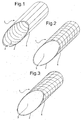
Figur 1 :- Es ist eine schräg angeschnittene erfindungsgemäße Gefäßprothese 1 gezeigt, deren Wandung 2 eine Innenoberfläche 3 aufweist, die eine andere Färbung besitzt als die Außenoberfläche 4. Die unterschiedlichen Färbungen der erfindungsgemäßen Gefäßprothese sind durch die unterschiedlichen Linienmuster, welche die Innenoberfläche 3 und Außenoberfläche 4 der erfindungsgemäßen Gefäßprothese 1 abbilden, zum Ausdruck gebracht.
-
Figur 2 :- Es ist eine schräg angeschnittene erfindungsgemäße Gefäßprothese 1 gezeigt, deren Wandung 2 an der Innenoberfläche 3 ungefärbt ist und
- an der Außenoberfläche 4 eine blauviolette Färbung aufweist. Die blauviolette Färbung der Außenoberfläche 4 der erfindungsgemäßen Gefäßprothese 1 ist durch ein im Wesentlichen rechtwinklig verlaufendes Linienmuster zum Ausdruck gebracht.
-
Figur 3 :- Es ist eine schräg angeschnittene erfindungsgemäße Gefäßprothese 1 gezeigt, deren Wandung 2 an der Innenoberfläche 3 ungefärbt ist und
- an der Außenoberfläche 4 grün gefärbt ist. Die grüne Färbung der erfindungsgemäßen Gefäßprothese 1 an der Außenoberfläche 4 ist durch ein im Wesentlichen rautenförmiges Linienmuster zum Ausdruck gebracht.
-
Figur 4 :- Es sind die Ergebnisse der Kontrastmessung verschiedener Gefäßprothesen graphisch in Form eines Histogramms wiedergegeben. Auf der Ordinate der Graphik ist der Pegel der Luminanz [mV] angegeben. Auf der Abszisse sind verschiedene gemessene Gefäßprothesen 1 bis 5 aufgeführt. Die hellen Balken spiegeln jeweils den gemessenen Luminanzpegel an der Außenoberfläche der jeweiligen Gefäßprothese wider. Die dunklen Balken spiegeln jeweils den gemessenen Luminanzpegel an der Innenoberfläche der jeweiligen Gefäßprothese wider. Im Falle der Gefäßprothese 1 handelt es sich um eine mit Silberacetat gefärbte Gefäßprothese. Die Gefäßprothese 2 ist eine mit Silber beschichtete Gefäßprothese. Die Gefäßprothese 3 ist eine unbeschichtete farblose Gefäßprothese. Bei der Gefäßprothese 4 handelt es sich um eine farblos beschichtete Gefäßprothese. Die soeben aufgeführten und näher bezeichneten Gefäßprothesen 1 bis 4 sind aus dem Stand der Technik bekannt. Demgegenüber handelt es sich bei der Gefäßprothese 5 um eine erfindungsgemäß gefärbte und Polymer beschichtete Gefäßprothese, welche an der Außenoberfläche blau gefärbt und an der Innenoberfläche deutlich schwächer blau gefärbt oder farblos ist. Der Kontrast bei den jeweiligen Gefäßprothesen ergibt sich aus dem Unterschied der gemessenen Luminanzpegel an der Innen- und Außenoberfläche der jeweiligen Gefäßprothesen.
- Weitere Merkmale und Einzelheiten der Erfindung ergeben sich aus der nachfolgenden Beschreibung einer bevorzugten Ausführungsform in Form eines Beispiels. Dabei können die einzelnen Merkmale jeweils für sich alleine oder zu mehreren in Kombination miteinander verwirklicht sein. Das Beispiel dient lediglich der Erläuterung der vorliegenden Erfindung, die in keiner Weise darauf beschränkt sein soll.
- Zur Herstellung der Prothesenwandung wird eine Lösung von linearem Polyurethan in Chloroform auf einen rotierbaren Stab aufgesprüht. Anschließend wird eine mit D & C violett No.2 gefärbte Polymerlösung auf die aufgesprühte Polyurethanschicht ebenfalls durch Sprühen aufgetragen. Auf diese Weise wird eine Vlies-Gefäßprothese erhalten, welche an ihrer Außenoberfläche violett gefärbt ist, wohingegen ihre Innenoberfläche eine im Vergleich zur Außenoberfläche deutlich schwächere Violettfärbung aufweist oder ungefärbt ist.
- Eine aus Polyethylenterephtalat (PET) gewirkte Gefäßprothese wird mit einer Gelatinesuspension in bekannter Weise beschichtet. Dabei werden die Gefäßprothesen auf Metallstäbe, die im Durchmesser und der Form der jeweiligen Prothese angepasst sind, vor dem Beschichtungsprozess aufgezogen und an den Enden beispielsweise mit Kabelbinder fixiert. Die Gelatinesuspension enthält einen wasserlöslichen blauen Farbstoff, der für eine Färbung der Gefäßprothese entsprechend Beispiel 1 verantwortlich ist (stark unterschiedliche Färbungsintensitäten derselben Farbe an der Innen- und Außenoberfläche der Gefäßprothese). Anschließend kann die Gelatine mit Diisocyanat vernetzt und in üblicher Weise weiterbehandelt werden.
- Für die Herstellung der Gefäßprothese werden eine zweifonturige Kettenwirkmaschine sowie ein weißes und blaues Fadensystem verwendet. Die Kettenwirkmaschine ist so eingestellt, dass die weißen Fäden überwiegend auf der Innenseite des Gewirks liegen und die blauen Fäden überwiegend auf der Außenseite des Gewirks. Durch die geringen Anteile der blauen Fäden, welche an der Innenseite des Gewirks sichtbar sind, ist die hergestellte Gefäßprothese an der Innenseite nur leicht gefärbt, so dass ein starker Unterschied in der Färbungsintensität derselben Farbe im Vergleich zur Außenseite der Gefäßprothese vorliegt. Auf diese Weise ist ebenfalls ein eindeutiger Kontrastunterschied zwischen der Innen- und Außenoberfläche der Gefäßprothese erzielbar.
- Im Rahmen der vorliegenden Messreihe wurde der Kontrast der folgenden Gefäßprothesen bestimmt:
- 1. Gefäßprothese 1
- 2. Gefäßprothese 2
- 3. Gefäßprothese 3
- 4. Gefäßprothese 4
- 5. Gefäßprothese 5
- Für die Messung des Kontrastes der Gefäßprothesen 1 bis 5 wurde eine 180 W Xenon-Lichtquelle mit angeschlossener Endoskopiekamera mit 1-CCD (Charged Coupled Devices) sowie ein sogenannter Vektorskop verwendet. Die Kontrastmessung erfolgte anhand des Pegels [mV] der Luminanz (Bildhelligkeit bzw. -intensität). Zur Kalibrierung wurde diese optische Versuchsanordnung mit angeschlossener Endoskopiekamera und angeschlossener Beleuchtung auf eine weiße Fläche gerichtet. Die Beleuchtungsstärke der Xenon-Lichtquelle wurde so eingestellt, dass ein Luminanzpegel von 760 mV erreicht wurde.
- Zur Messung des Kontrasts wurden die Gefäßprothesen 1 bis 5 jeweils auf eine schwarze Fläche gelegt. Anschließend wurde die Xenon-Lichtquelle mit angeschlossener Endoskopiekamera jeweils auf die Gefäßprothese gerichtet.
- Die Kontrastmessung der Gefäßprothesen führte zu den folgenden Messergebnissen:
Probe außen innen Gefäßprothese 1 434 608 Gefäßprothese 2 684 751 Gefäßprothese 3 751 760 Gefäßprothese 4 750 739 Gefäßprothese 5 311 725 - Die Messergebnisse zeigen deutlich, dass die erfindungsgemäße Gefäßprothese 5 einen gegenüber den aus dem Stand der Technik bekannten Gefäßprothesen deutlich verbesserten Kontrast zwischen der Innen- und Außenoberfläche aufweist.
Claims (12)
- Schlauchförmige Gefäßprothese mit einer Innen- und einer Außenoberfläche und einer Wandung, wobei die Gefäßprothese an der Innen- und Außenoberfläche jeweils eine Färbung aufweist, die einen Kontrast zwischen der Innen- und Außenoberfläche bewirkt, dadurch gekennzeichnet, dass die Innenoberfläche eine andere Färbung besitzt als die Außenoberfläche der Gefäßprothese und die Färbung auf mindestens einer von rot abweichenden bunten Farbe beruht.
- Gefäßprothese nach Anspruch 1, dadurch gekennzeichnet, daß sie geschlossen gefärbt ist.
- Gefäßprothese nach Anspruch 1 oder 2, dadurch gekennzeichnet, daß die Färbung abdichtend ist.
- Gefäßprothese nach einem der vorhergehenden Ansprüche, dadurch gekennzeichnet, daß die Färbung eine farbige Beschichtung oder farbige Imprägnierung ist.
- Gefäßprothese nach Anspruch 4, dadurch gekennzeichnet, daß die Beschichtung oder Imprägnierung ein Polymer, vorzugsweise ein synthetisches resorbierbares Polymer, vorzugsweise auf der Basis von Glykolid, Lactid, ε-Caprolacton und/oder Trimethylencarbonat, umfaßt.
- Gefäßprothese nach einem der vorhergehenden Ansprüche, dadurch gekennzeichnet, daß die Färbung nicht spiegelnd ist.
- Gefäßprothese nach einem der vorhergehenden Ansprüche, dadurch gekennzeichnet, daß sie mehrfarbig, vorzugsweise zweifarbig, ist.
- Gefäßprothese nach einem der vorhergehenden Ansprüche, dadurch gekennzeichnet, daß die Färbung durch mindestens einen in organischen Lösungsmitteln, insbesondere in Ketonen, löslichen Farbstoff bedingt ist.
- Gefäßprothese nach einem der vorhergehenden Ansprüche, dadurch gekennzeichnet, daß die Färbung mindestens eine Farbe aus der Gruppe violett, blau, grün und gelb umfaßt.
- Gefäßprothese nach einem der vorhergehenden Ansprüche, dadurch gekennzeichnet, daß die Außenoberfläche blau bis violett gefärbt ist.
- Gefäßprothese nach einem der Ansprüche 1 bis 9, dadurch gekennzeichnet, daß die Außenoberfläche grün gefärbt ist.
- Gefäßprothese nach einem der vorhergehenden Ansprüche zum Ersatz oder zur Überbrückung von Blutgefäßen.
Applications Claiming Priority (2)
| Application Number | Priority Date | Filing Date | Title |
|---|---|---|---|
| DE102006011218A DE102006011218A1 (de) | 2006-03-03 | 2006-03-03 | Schlauchförmige gefärbte Gefäßprothese und ihre Verwendung in der Chirurgie |
| PCT/EP2007/001794 WO2007101613A2 (de) | 2006-03-03 | 2007-03-02 | SCHLAUCHFÖRMIGE GEFÄRBTE GEFÄßPROTHESE UND IHRE VERWENDUNG IN DER CHIRURGIE |
Publications (2)
| Publication Number | Publication Date |
|---|---|
| EP1991283A2 EP1991283A2 (de) | 2008-11-19 |
| EP1991283B1 true EP1991283B1 (de) | 2012-05-16 |
Family
ID=38328923
Family Applications (1)
| Application Number | Title | Priority Date | Filing Date |
|---|---|---|---|
| EP07722994A Not-in-force EP1991283B1 (de) | 2006-03-03 | 2007-03-02 | SCHLAUCHFÖRMIGE GEFÄRBTE GEFÄßPROTHESE UND IHRE VERWENDUNG IN DER CHIRURGIE |
Country Status (5)
| Country | Link |
|---|---|
| US (1) | US8790389B2 (de) |
| EP (1) | EP1991283B1 (de) |
| DE (1) | DE102006011218A1 (de) |
| ES (1) | ES2386077T3 (de) |
| WO (1) | WO2007101613A2 (de) |
Families Citing this family (2)
| Publication number | Priority date | Publication date | Assignee | Title |
|---|---|---|---|---|
| DE102012201094A1 (de) * | 2012-01-25 | 2013-08-29 | Aesculap Ag | Flexible Gefäßprothese und Verfahren zu ihrer Herstellung |
| US11027046B2 (en) | 2017-10-31 | 2021-06-08 | Hothouse Medical Limited | Textile products having selectively applied sealant or coating and method of manufacture |
Family Cites Families (20)
| Publication number | Priority date | Publication date | Assignee | Title |
|---|---|---|---|---|
| US3805301A (en) | 1972-07-28 | 1974-04-23 | Meadox Medicals Inc | Tubular grafts having indicia thereon |
| US5100422A (en) * | 1989-05-26 | 1992-03-31 | Impra, Inc. | Blood vessel patch |
| US5383925A (en) * | 1992-09-14 | 1995-01-24 | Meadox Medicals, Inc. | Three-dimensional braided soft tissue prosthesis |
| US5989244A (en) * | 1994-11-15 | 1999-11-23 | Gregory; Kenton W. | Method of use of a sheet of elastin or elastin-based material |
| US5997517A (en) * | 1997-01-27 | 1999-12-07 | Sts Biopolymers, Inc. | Bonding layers for medical device surface coatings |
| CA2340251C (en) * | 1998-08-21 | 2005-01-04 | Providence Health System-Oregon | Insertable stent and methods of making and using same |
| US6197050B1 (en) * | 1998-09-14 | 2001-03-06 | Heartstent Corporation | Transmyocardial implant with compliance collar |
| US6200338B1 (en) * | 1998-12-31 | 2001-03-13 | Ethicon, Inc. | Enhanced radiopacity of peripheral and central catheter tubing |
| US6462169B1 (en) | 1999-11-30 | 2002-10-08 | Poly-Med, Inc. | Amorphous polymeric polyaxial initiators and compliant crystalline copolymers therefrom |
| US6794485B2 (en) | 2000-10-27 | 2004-09-21 | Poly-Med, Inc. | Amorphous polymeric polyaxial initiators and compliant crystalline copolymers therefrom |
| US6824559B2 (en) * | 2000-12-22 | 2004-11-30 | Advanced Cardiovascular Systems, Inc. | Ethylene-carboxyl copolymers as drug delivery matrices |
| SE519069C2 (sv) * | 2001-05-21 | 2003-01-07 | Cid Cardivascular Innovation D | Kirurgisk markör och ett implantat |
| US7052512B2 (en) * | 2001-07-18 | 2006-05-30 | Boston Scientific Scimed, Inc. | Fluorescent dyed lubricant for medical devices |
| WO2003022169A1 (en) * | 2001-09-12 | 2003-03-20 | Scimed Life Systems, Inc. | System for identifying medical devices |
| US20040024448A1 (en) * | 2002-08-05 | 2004-02-05 | Chang James W. | Thermoplastic fluoropolymer-coated medical devices |
| US7348364B2 (en) | 2002-10-31 | 2008-03-25 | Poly-Med, Inc. | Segmented copolyesters as compliant, absorbable coatings and sealants for vascular devices |
| US20040253185A1 (en) * | 2003-06-12 | 2004-12-16 | Atrium Medical Corp. | Medicated ink |
| US7488343B2 (en) * | 2003-09-16 | 2009-02-10 | Boston Scientific Scimed, Inc. | Medical devices |
| FR2866239B1 (fr) * | 2004-02-12 | 2007-01-12 | Perouse Laboratoires | Prothese tubulaire implantable. |
| US7638156B1 (en) * | 2005-12-19 | 2009-12-29 | Advanced Cardiovascular Systems, Inc. | Apparatus and method for selectively coating a medical article |
-
2006
- 2006-03-03 DE DE102006011218A patent/DE102006011218A1/de not_active Withdrawn
-
2007
- 2007-03-02 EP EP07722994A patent/EP1991283B1/de not_active Not-in-force
- 2007-03-02 ES ES07722994T patent/ES2386077T3/es active Active
- 2007-03-02 US US12/280,806 patent/US8790389B2/en not_active Expired - Fee Related
- 2007-03-02 WO PCT/EP2007/001794 patent/WO2007101613A2/de not_active Ceased
Also Published As
| Publication number | Publication date |
|---|---|
| DE102006011218A1 (de) | 2007-09-06 |
| ES2386077T3 (es) | 2012-08-08 |
| WO2007101613A3 (de) | 2008-08-21 |
| US20100030323A1 (en) | 2010-02-04 |
| WO2007101613A2 (de) | 2007-09-13 |
| US8790389B2 (en) | 2014-07-29 |
| EP1991283A2 (de) | 2008-11-19 |
Similar Documents
| Publication | Publication Date | Title |
|---|---|---|
| DE69021261T2 (de) | Semi-absorbierbares Garn, Gewebe und rohrförmige Prothese. | |
| DE69403203T2 (de) | Textilprothese | |
| DE69122369T2 (de) | Dreilagige Gefässprothese | |
| DE69827713T2 (de) | Prosthetisches Verchlussorgan zum Verschliessen eines Herniakanals | |
| EP1935375B1 (de) | Gewebte Aortensinusprothese mit Bulbus | |
| DE2508570C2 (de) | Gefäßprothese aus expandiertem und porösem Polytetrafluoräthylen | |
| DE60211176T2 (de) | Film mit hochporösen Gefäßtransplantatprothesen | |
| DE60121167T2 (de) | Implantierbare prothesen mit verbesserten chemischen und mechanischen eigenschaften | |
| DE69109374T2 (de) | Künstliches rohrförmiges Organ. | |
| EP2478871B1 (de) | Gefäßprothese mit integrierter Aortenklappe | |
| DE3503126C2 (de) | Verfahren zur Herstellung eines im wesentlichen blutdichten, flexiblen, kollagenbehandelten synthetischen Gefäßersatzes | |
| DE10153334A1 (de) | Flächiges Implantat | |
| US9150987B2 (en) | Areal implant | |
| DE10019604A1 (de) | Implantat | |
| EP1389075B1 (de) | Implantat für die chirurgie und verfahren zur herstellung | |
| DE3503127A1 (de) | Kollagenbeschichteter synthetischer gefaessersatz | |
| EP1429104A1 (de) | Wärmetarnplane | |
| EP1991283B1 (de) | SCHLAUCHFÖRMIGE GEFÄRBTE GEFÄßPROTHESE UND IHRE VERWENDUNG IN DER CHIRURGIE | |
| DE3913926C2 (de) | ||
| DE69007999T2 (de) | Prothese für ein lebendes Organ. | |
| DE102006028221B4 (de) | Schlauchförmige Gefäßprothese und Verfahren zu ihrer Herstellung | |
| DE3854579T2 (de) | Gewirktes oder gewobenes textilmaterial, verfahren zur herstellung und blutgefässreparaturblatt sowie kunstblutgefäss daraus. | |
| DE29811618U1 (de) | Kronen- und Brückengerüst | |
| DE1566358C3 (de) | Gefäßprothese für chirurgische Zwecke | |
| EP0385925B1 (de) | Geflochtene Gefäss-Prothese |
Legal Events
| Date | Code | Title | Description |
|---|---|---|---|
| PUAI | Public reference made under article 153(3) epc to a published international application that has entered the european phase |
Free format text: ORIGINAL CODE: 0009012 |
|
| 17P | Request for examination filed |
Effective date: 20080901 |
|
| AK | Designated contracting states |
Kind code of ref document: A2 Designated state(s): AT BE BG CH CY CZ DE DK EE ES FI FR GB GR HU IE IS IT LI LT LU LV MC MT NL PL PT RO SE SI SK TR |
|
| AX | Request for extension of the european patent |
Extension state: AL BA HR MK RS |
|
| DAX | Request for extension of the european patent (deleted) | ||
| 17Q | First examination report despatched |
Effective date: 20090112 |
|
| GRAP | Despatch of communication of intention to grant a patent |
Free format text: ORIGINAL CODE: EPIDOSNIGR1 |
|
| GRAS | Grant fee paid |
Free format text: ORIGINAL CODE: EPIDOSNIGR3 |
|
| GRAA | (expected) grant |
Free format text: ORIGINAL CODE: 0009210 |
|
| AK | Designated contracting states |
Kind code of ref document: B1 Designated state(s): AT BE BG CH CY CZ DE DK EE ES FI FR GB GR HU IE IS IT LI LT LU LV MC MT NL PL PT RO SE SI SK TR |
|
| REG | Reference to a national code |
Ref country code: GB Ref legal event code: FG4D Free format text: NOT ENGLISH |
|
| REG | Reference to a national code |
Ref country code: CH Ref legal event code: EP |
|
| REG | Reference to a national code |
Ref country code: AT Ref legal event code: REF Ref document number: 557733 Country of ref document: AT Kind code of ref document: T Effective date: 20120615 |
|
| REG | Reference to a national code |
Ref country code: IE Ref legal event code: FG4D Free format text: LANGUAGE OF EP DOCUMENT: GERMAN |
|
| REG | Reference to a national code |
Ref country code: DE Ref legal event code: R096 Ref document number: 502007009870 Country of ref document: DE Effective date: 20120712 |
|
| REG | Reference to a national code |
Ref country code: ES Ref legal event code: FG2A Ref document number: 2386077 Country of ref document: ES Kind code of ref document: T3 Effective date: 20120808 |
|
| REG | Reference to a national code |
Ref country code: NL Ref legal event code: VDEP Effective date: 20120516 |
|
| REG | Reference to a national code |
Ref country code: LT Ref legal event code: MG4D Effective date: 20120516 |
|
| PG25 | Lapsed in a contracting state [announced via postgrant information from national office to epo] |
Ref country code: PL Free format text: LAPSE BECAUSE OF FAILURE TO SUBMIT A TRANSLATION OF THE DESCRIPTION OR TO PAY THE FEE WITHIN THE PRESCRIBED TIME-LIMIT Effective date: 20120516 Ref country code: FI Free format text: LAPSE BECAUSE OF FAILURE TO SUBMIT A TRANSLATION OF THE DESCRIPTION OR TO PAY THE FEE WITHIN THE PRESCRIBED TIME-LIMIT Effective date: 20120516 Ref country code: LT Free format text: LAPSE BECAUSE OF FAILURE TO SUBMIT A TRANSLATION OF THE DESCRIPTION OR TO PAY THE FEE WITHIN THE PRESCRIBED TIME-LIMIT Effective date: 20120516 Ref country code: IS Free format text: LAPSE BECAUSE OF FAILURE TO SUBMIT A TRANSLATION OF THE DESCRIPTION OR TO PAY THE FEE WITHIN THE PRESCRIBED TIME-LIMIT Effective date: 20120916 Ref country code: SE Free format text: LAPSE BECAUSE OF FAILURE TO SUBMIT A TRANSLATION OF THE DESCRIPTION OR TO PAY THE FEE WITHIN THE PRESCRIBED TIME-LIMIT Effective date: 20120516 Ref country code: CY Free format text: LAPSE BECAUSE OF FAILURE TO SUBMIT A TRANSLATION OF THE DESCRIPTION OR TO PAY THE FEE WITHIN THE PRESCRIBED TIME-LIMIT Effective date: 20120516 |
|
| PG25 | Lapsed in a contracting state [announced via postgrant information from national office to epo] |
Ref country code: GR Free format text: LAPSE BECAUSE OF FAILURE TO SUBMIT A TRANSLATION OF THE DESCRIPTION OR TO PAY THE FEE WITHIN THE PRESCRIBED TIME-LIMIT Effective date: 20120817 Ref country code: LV Free format text: LAPSE BECAUSE OF FAILURE TO SUBMIT A TRANSLATION OF THE DESCRIPTION OR TO PAY THE FEE WITHIN THE PRESCRIBED TIME-LIMIT Effective date: 20120516 Ref country code: SI Free format text: LAPSE BECAUSE OF FAILURE TO SUBMIT A TRANSLATION OF THE DESCRIPTION OR TO PAY THE FEE WITHIN THE PRESCRIBED TIME-LIMIT Effective date: 20120516 Ref country code: PT Free format text: LAPSE BECAUSE OF FAILURE TO SUBMIT A TRANSLATION OF THE DESCRIPTION OR TO PAY THE FEE WITHIN THE PRESCRIBED TIME-LIMIT Effective date: 20120917 |
|
| PG25 | Lapsed in a contracting state [announced via postgrant information from national office to epo] |
Ref country code: SK Free format text: LAPSE BECAUSE OF FAILURE TO SUBMIT A TRANSLATION OF THE DESCRIPTION OR TO PAY THE FEE WITHIN THE PRESCRIBED TIME-LIMIT Effective date: 20120516 Ref country code: NL Free format text: LAPSE BECAUSE OF FAILURE TO SUBMIT A TRANSLATION OF THE DESCRIPTION OR TO PAY THE FEE WITHIN THE PRESCRIBED TIME-LIMIT Effective date: 20120516 Ref country code: DK Free format text: LAPSE BECAUSE OF FAILURE TO SUBMIT A TRANSLATION OF THE DESCRIPTION OR TO PAY THE FEE WITHIN THE PRESCRIBED TIME-LIMIT Effective date: 20120516 Ref country code: RO Free format text: LAPSE BECAUSE OF FAILURE TO SUBMIT A TRANSLATION OF THE DESCRIPTION OR TO PAY THE FEE WITHIN THE PRESCRIBED TIME-LIMIT Effective date: 20120516 Ref country code: EE Free format text: LAPSE BECAUSE OF FAILURE TO SUBMIT A TRANSLATION OF THE DESCRIPTION OR TO PAY THE FEE WITHIN THE PRESCRIBED TIME-LIMIT Effective date: 20120516 Ref country code: CZ Free format text: LAPSE BECAUSE OF FAILURE TO SUBMIT A TRANSLATION OF THE DESCRIPTION OR TO PAY THE FEE WITHIN THE PRESCRIBED TIME-LIMIT Effective date: 20120516 |
|
| PLBE | No opposition filed within time limit |
Free format text: ORIGINAL CODE: 0009261 |
|
| STAA | Information on the status of an ep patent application or granted ep patent |
Free format text: STATUS: NO OPPOSITION FILED WITHIN TIME LIMIT |
|
| 26N | No opposition filed |
Effective date: 20130219 |
|
| REG | Reference to a national code |
Ref country code: DE Ref legal event code: R097 Ref document number: 502007009870 Country of ref document: DE Effective date: 20130219 |
|
| PG25 | Lapsed in a contracting state [announced via postgrant information from national office to epo] |
Ref country code: BG Free format text: LAPSE BECAUSE OF FAILURE TO SUBMIT A TRANSLATION OF THE DESCRIPTION OR TO PAY THE FEE WITHIN THE PRESCRIBED TIME-LIMIT Effective date: 20120816 |
|
| BERE | Be: lapsed |
Owner name: AESCULAP A.G. Effective date: 20130331 |
|
| PG25 | Lapsed in a contracting state [announced via postgrant information from national office to epo] |
Ref country code: MC Free format text: LAPSE BECAUSE OF NON-PAYMENT OF DUE FEES Effective date: 20130331 |
|
| REG | Reference to a national code |
Ref country code: CH Ref legal event code: PL |
|
| REG | Reference to a national code |
Ref country code: IE Ref legal event code: MM4A |
|
| PG25 | Lapsed in a contracting state [announced via postgrant information from national office to epo] |
Ref country code: BE Free format text: LAPSE BECAUSE OF NON-PAYMENT OF DUE FEES Effective date: 20130331 Ref country code: IE Free format text: LAPSE BECAUSE OF NON-PAYMENT OF DUE FEES Effective date: 20130302 Ref country code: LI Free format text: LAPSE BECAUSE OF NON-PAYMENT OF DUE FEES Effective date: 20130331 Ref country code: CH Free format text: LAPSE BECAUSE OF NON-PAYMENT OF DUE FEES Effective date: 20130331 |
|
| REG | Reference to a national code |
Ref country code: AT Ref legal event code: MM01 Ref document number: 557733 Country of ref document: AT Kind code of ref document: T Effective date: 20130302 |
|
| PG25 | Lapsed in a contracting state [announced via postgrant information from national office to epo] |
Ref country code: MT Free format text: LAPSE BECAUSE OF FAILURE TO SUBMIT A TRANSLATION OF THE DESCRIPTION OR TO PAY THE FEE WITHIN THE PRESCRIBED TIME-LIMIT Effective date: 20120516 |
|
| PG25 | Lapsed in a contracting state [announced via postgrant information from national office to epo] |
Ref country code: AT Free format text: LAPSE BECAUSE OF NON-PAYMENT OF DUE FEES Effective date: 20130302 |
|
| PG25 | Lapsed in a contracting state [announced via postgrant information from national office to epo] |
Ref country code: IT Free format text: LAPSE BECAUSE OF NON-PAYMENT OF DUE FEES Effective date: 20140302 |
|
| PG25 | Lapsed in a contracting state [announced via postgrant information from national office to epo] |
Ref country code: TR Free format text: LAPSE BECAUSE OF FAILURE TO SUBMIT A TRANSLATION OF THE DESCRIPTION OR TO PAY THE FEE WITHIN THE PRESCRIBED TIME-LIMIT Effective date: 20120516 |
|
| PG25 | Lapsed in a contracting state [announced via postgrant information from national office to epo] |
Ref country code: LU Free format text: LAPSE BECAUSE OF NON-PAYMENT OF DUE FEES Effective date: 20130302 Ref country code: HU Free format text: LAPSE BECAUSE OF FAILURE TO SUBMIT A TRANSLATION OF THE DESCRIPTION OR TO PAY THE FEE WITHIN THE PRESCRIBED TIME-LIMIT; INVALID AB INITIO Effective date: 20070302 |
|
| REG | Reference to a national code |
Ref country code: FR Ref legal event code: PLFP Year of fee payment: 10 |
|
| PGFP | Annual fee paid to national office [announced via postgrant information from national office to epo] |
Ref country code: ES Payment date: 20160322 Year of fee payment: 10 |
|
| PGFP | Annual fee paid to national office [announced via postgrant information from national office to epo] |
Ref country code: GB Payment date: 20160322 Year of fee payment: 10 Ref country code: FR Payment date: 20160322 Year of fee payment: 10 |
|
| GBPC | Gb: european patent ceased through non-payment of renewal fee |
Effective date: 20170302 |
|
| REG | Reference to a national code |
Ref country code: FR Ref legal event code: ST Effective date: 20171130 |
|
| PG25 | Lapsed in a contracting state [announced via postgrant information from national office to epo] |
Ref country code: FR Free format text: LAPSE BECAUSE OF NON-PAYMENT OF DUE FEES Effective date: 20170331 |
|
| PG25 | Lapsed in a contracting state [announced via postgrant information from national office to epo] |
Ref country code: GB Free format text: LAPSE BECAUSE OF NON-PAYMENT OF DUE FEES Effective date: 20170302 |
|
| REG | Reference to a national code |
Ref country code: ES Ref legal event code: FD2A Effective date: 20180705 |
|
| PG25 | Lapsed in a contracting state [announced via postgrant information from national office to epo] |
Ref country code: ES Free format text: LAPSE BECAUSE OF NON-PAYMENT OF DUE FEES Effective date: 20170303 |
|
| PGFP | Annual fee paid to national office [announced via postgrant information from national office to epo] |
Ref country code: DE Payment date: 20210323 Year of fee payment: 15 |
|
| REG | Reference to a national code |
Ref country code: DE Ref legal event code: R119 Ref document number: 502007009870 Country of ref document: DE |
|
| PG25 | Lapsed in a contracting state [announced via postgrant information from national office to epo] |
Ref country code: DE Free format text: LAPSE BECAUSE OF NON-PAYMENT OF DUE FEES Effective date: 20221001 |