EP1983036A1 - Hitzereflektierendes Klebeband - Google Patents
Hitzereflektierendes Klebeband Download PDFInfo
- Publication number
- EP1983036A1 EP1983036A1 EP20080154021 EP08154021A EP1983036A1 EP 1983036 A1 EP1983036 A1 EP 1983036A1 EP 20080154021 EP20080154021 EP 20080154021 EP 08154021 A EP08154021 A EP 08154021A EP 1983036 A1 EP1983036 A1 EP 1983036A1
- Authority
- EP
- European Patent Office
- Prior art keywords
- layer
- adhesive tape
- heat
- adhesive
- reflecting
- Prior art date
- Legal status (The legal status is an assumption and is not a legal conclusion. Google has not performed a legal analysis and makes no representation as to the accuracy of the status listed.)
- Withdrawn
Links
- 239000002390 adhesive tape Substances 0.000 title claims abstract description 66
- 239000000853 adhesive Substances 0.000 claims abstract description 31
- 230000001070 adhesive effect Effects 0.000 claims abstract description 30
- 238000000576 coating method Methods 0.000 claims abstract description 29
- 239000011248 coating agent Substances 0.000 claims abstract description 26
- 239000004744 fabric Substances 0.000 claims abstract description 21
- 239000011521 glass Substances 0.000 claims abstract description 20
- 229910052782 aluminium Inorganic materials 0.000 claims abstract description 17
- XAGFODPZIPBFFR-UHFFFAOYSA-N aluminium Chemical compound [Al] XAGFODPZIPBFFR-UHFFFAOYSA-N 0.000 claims abstract description 17
- 238000005259 measurement Methods 0.000 claims abstract description 10
- 238000005299 abrasion Methods 0.000 claims abstract description 9
- 239000004820 Pressure-sensitive adhesive Substances 0.000 claims abstract description 8
- 239000010410 layer Substances 0.000 claims description 40
- 239000000463 material Substances 0.000 claims description 14
- 238000005452 bending Methods 0.000 claims description 10
- 239000002131 composite material Substances 0.000 claims description 8
- 229920001296 polysiloxane Polymers 0.000 claims description 8
- 241000282461 Canis lupus Species 0.000 claims description 4
- ADCOVFLJGNWWNZ-UHFFFAOYSA-N antimony trioxide Chemical compound O=[Sb]O[Sb]=O ADCOVFLJGNWWNZ-UHFFFAOYSA-N 0.000 claims description 4
- 239000002356 single layer Substances 0.000 claims description 4
- RNFJDJUURJAICM-UHFFFAOYSA-N 2,2,4,4,6,6-hexaphenoxy-1,3,5-triaza-2$l^{5},4$l^{5},6$l^{5}-triphosphacyclohexa-1,3,5-triene Chemical compound N=1P(OC=2C=CC=CC=2)(OC=2C=CC=CC=2)=NP(OC=2C=CC=CC=2)(OC=2C=CC=CC=2)=NP=1(OC=1C=CC=CC=1)OC1=CC=CC=C1 RNFJDJUURJAICM-UHFFFAOYSA-N 0.000 claims description 2
- 239000004114 Ammonium polyphosphate Substances 0.000 claims description 2
- WNROFYMDJYEPJX-UHFFFAOYSA-K aluminium hydroxide Chemical compound [OH-].[OH-].[OH-].[Al+3] WNROFYMDJYEPJX-UHFFFAOYSA-K 0.000 claims description 2
- 235000019826 ammonium polyphosphate Nutrition 0.000 claims description 2
- 229920001276 ammonium polyphosphate Polymers 0.000 claims description 2
- 239000003063 flame retardant Substances 0.000 claims description 2
- VTHJTEIRLNZDEV-UHFFFAOYSA-L magnesium dihydroxide Chemical compound [OH-].[OH-].[Mg+2] VTHJTEIRLNZDEV-UHFFFAOYSA-L 0.000 claims description 2
- 239000000347 magnesium hydroxide Substances 0.000 claims description 2
- 229910001862 magnesium hydroxide Inorganic materials 0.000 claims description 2
- NIXOWILDQLNWCW-UHFFFAOYSA-M Acrylate Chemical compound [O-]C(=O)C=C NIXOWILDQLNWCW-UHFFFAOYSA-M 0.000 abstract description 5
- 238000013016 damping Methods 0.000 abstract description 3
- XUIMIQQOPSSXEZ-UHFFFAOYSA-N Silicon Chemical compound [Si] XUIMIQQOPSSXEZ-UHFFFAOYSA-N 0.000 abstract 1
- 239000003795 chemical substances by application Substances 0.000 abstract 1
- 239000000835 fiber Substances 0.000 abstract 1
- 229910052710 silicon Inorganic materials 0.000 abstract 1
- 239000010703 silicon Substances 0.000 abstract 1
- 239000011888 foil Substances 0.000 description 16
- 238000004804 winding Methods 0.000 description 9
- 229910052751 metal Inorganic materials 0.000 description 8
- 239000002184 metal Substances 0.000 description 8
- 238000000034 method Methods 0.000 description 8
- 229910000831 Steel Inorganic materials 0.000 description 5
- 239000012876 carrier material Substances 0.000 description 5
- -1 polysiloxane Polymers 0.000 description 5
- 239000010959 steel Substances 0.000 description 5
- 239000012943 hotmelt Substances 0.000 description 4
- 239000000203 mixture Substances 0.000 description 4
- 239000002904 solvent Substances 0.000 description 4
- YXFVVABEGXRONW-UHFFFAOYSA-N Toluene Chemical compound CC1=CC=CC=C1 YXFVVABEGXRONW-UHFFFAOYSA-N 0.000 description 3
- 238000004132 cross linking Methods 0.000 description 3
- 238000007872 degassing Methods 0.000 description 3
- 230000000694 effects Effects 0.000 description 3
- 150000002148 esters Chemical class 0.000 description 3
- 229920005789 ACRONAL® acrylic binder Polymers 0.000 description 2
- RYGMFSIKBFXOCR-UHFFFAOYSA-N Copper Chemical compound [Cu] RYGMFSIKBFXOCR-UHFFFAOYSA-N 0.000 description 2
- NIXOWILDQLNWCW-UHFFFAOYSA-N acrylic acid group Chemical group C(C=C)(=O)O NIXOWILDQLNWCW-UHFFFAOYSA-N 0.000 description 2
- ISAOCJYIOMOJEB-UHFFFAOYSA-N benzoin Chemical class C=1C=CC=CC=1C(O)C(=O)C1=CC=CC=C1 ISAOCJYIOMOJEB-UHFFFAOYSA-N 0.000 description 2
- 238000009434 installation Methods 0.000 description 2
- BASFCYQUMIYNBI-UHFFFAOYSA-N platinum Chemical compound [Pt] BASFCYQUMIYNBI-UHFFFAOYSA-N 0.000 description 2
- 230000001681 protective effect Effects 0.000 description 2
- 230000005855 radiation Effects 0.000 description 2
- 238000005201 scrubbing Methods 0.000 description 2
- 239000013464 silicone adhesive Substances 0.000 description 2
- 239000000758 substrate Substances 0.000 description 2
- VZCYOOQTPOCHFL-UHFFFAOYSA-N trans-butenedioic acid Natural products OC(=O)C=CC(O)=O VZCYOOQTPOCHFL-UHFFFAOYSA-N 0.000 description 2
- 125000000391 vinyl group Chemical group [H]C([*])=C([H])[H] 0.000 description 2
- MSMAPCFQRXQMRL-UHFFFAOYSA-N (2-oxo-1,2-diphenylethyl) prop-2-enoate Chemical compound C=1C=CC=CC=1C(OC(=O)C=C)C(=O)C1=CC=CC=C1 MSMAPCFQRXQMRL-UHFFFAOYSA-N 0.000 description 1
- OVSKIKFHRZPJSS-UHFFFAOYSA-N 2,4-D Chemical compound OC(=O)COC1=CC=C(Cl)C=C1Cl OVSKIKFHRZPJSS-UHFFFAOYSA-N 0.000 description 1
- SMZOUWXMTYCWNB-UHFFFAOYSA-N 2-(2-methoxy-5-methylphenyl)ethanamine Chemical compound COC1=CC=C(C)C=C1CCN SMZOUWXMTYCWNB-UHFFFAOYSA-N 0.000 description 1
- JAHNSTQSQJOJLO-UHFFFAOYSA-N 2-(3-fluorophenyl)-1h-imidazole Chemical compound FC1=CC=CC(C=2NC=CN=2)=C1 JAHNSTQSQJOJLO-UHFFFAOYSA-N 0.000 description 1
- NEFZIZUSNPOFFC-UHFFFAOYSA-N 2-hydroxy-1,2-diphenylethanone;2-methylprop-2-enoic acid Chemical compound CC(=C)C(O)=O.C=1C=CC=CC=1C(O)C(=O)C1=CC=CC=C1 NEFZIZUSNPOFFC-UHFFFAOYSA-N 0.000 description 1
- QISOBCMNUJQOJU-UHFFFAOYSA-N 4-bromo-1h-pyrazole-5-carboxylic acid Chemical compound OC(=O)C=1NN=CC=1Br QISOBCMNUJQOJU-UHFFFAOYSA-N 0.000 description 1
- 239000010754 BS 2869 Class F Substances 0.000 description 1
- VZCYOOQTPOCHFL-OWOJBTEDSA-N Fumaric acid Natural products OC(=O)\C=C\C(O)=O VZCYOOQTPOCHFL-OWOJBTEDSA-N 0.000 description 1
- 239000004831 Hot glue Substances 0.000 description 1
- CERQOIWHTDAKMF-UHFFFAOYSA-N Methacrylic acid Chemical group CC(=C)C(O)=O CERQOIWHTDAKMF-UHFFFAOYSA-N 0.000 description 1
- OFOBLEOULBTSOW-UHFFFAOYSA-N Propanedioic acid Natural products OC(=O)CC(O)=O OFOBLEOULBTSOW-UHFFFAOYSA-N 0.000 description 1
- BQCADISMDOOEFD-UHFFFAOYSA-N Silver Chemical compound [Ag] BQCADISMDOOEFD-UHFFFAOYSA-N 0.000 description 1
- ATJFFYVFTNAWJD-UHFFFAOYSA-N Tin Chemical compound [Sn] ATJFFYVFTNAWJD-UHFFFAOYSA-N 0.000 description 1
- RTAQQCXQSZGOHL-UHFFFAOYSA-N Titanium Chemical compound [Ti] RTAQQCXQSZGOHL-UHFFFAOYSA-N 0.000 description 1
- XTXRWKRVRITETP-UHFFFAOYSA-N Vinyl acetate Chemical compound CC(=O)OC=C XTXRWKRVRITETP-UHFFFAOYSA-N 0.000 description 1
- QYKIQEUNHZKYBP-UHFFFAOYSA-N Vinyl ether Chemical class C=COC=C QYKIQEUNHZKYBP-UHFFFAOYSA-N 0.000 description 1
- 229920004482 WACKER® Polymers 0.000 description 1
- 229920005700 acResin® Polymers 0.000 description 1
- 150000003926 acrylamides Chemical class 0.000 description 1
- 239000008186 active pharmaceutical agent Substances 0.000 description 1
- 238000007259 addition reaction Methods 0.000 description 1
- 230000002411 adverse Effects 0.000 description 1
- 150000001298 alcohols Chemical class 0.000 description 1
- AZDRQVAHHNSJOQ-UHFFFAOYSA-N alumane Chemical class [AlH3] AZDRQVAHHNSJOQ-UHFFFAOYSA-N 0.000 description 1
- 230000000181 anti-adherent effect Effects 0.000 description 1
- 238000001266 bandaging Methods 0.000 description 1
- 238000009835 boiling Methods 0.000 description 1
- CXKCTMHTOKXKQT-UHFFFAOYSA-N cadmium oxide Inorganic materials [Cd]=O CXKCTMHTOKXKQT-UHFFFAOYSA-N 0.000 description 1
- CFEAAQFZALKQPA-UHFFFAOYSA-N cadmium(2+);oxygen(2-) Chemical class [O-2].[Cd+2] CFEAAQFZALKQPA-UHFFFAOYSA-N 0.000 description 1
- 125000004432 carbon atom Chemical group C* 0.000 description 1
- 239000000919 ceramic Substances 0.000 description 1
- 230000000052 comparative effect Effects 0.000 description 1
- 238000006482 condensation reaction Methods 0.000 description 1
- 239000000470 constituent Substances 0.000 description 1
- 238000010276 construction Methods 0.000 description 1
- 229910052802 copper Inorganic materials 0.000 description 1
- 239000010949 copper Substances 0.000 description 1
- 238000007607 die coating method Methods 0.000 description 1
- 238000010894 electron beam technology Methods 0.000 description 1
- 239000000839 emulsion Substances 0.000 description 1
- 238000005516 engineering process Methods 0.000 description 1
- 230000002349 favourable effect Effects 0.000 description 1
- 239000006260 foam Substances 0.000 description 1
- 238000009472 formulation Methods 0.000 description 1
- 239000003365 glass fiber Substances 0.000 description 1
- PCHJSUWPFVWCPO-UHFFFAOYSA-N gold Chemical compound [Au] PCHJSUWPFVWCPO-UHFFFAOYSA-N 0.000 description 1
- 229910052737 gold Inorganic materials 0.000 description 1
- 239000010931 gold Substances 0.000 description 1
- 230000012447 hatching Effects 0.000 description 1
- 229930195733 hydrocarbon Natural products 0.000 description 1
- 150000002430 hydrocarbons Chemical class 0.000 description 1
- 238000009413 insulation Methods 0.000 description 1
- 239000012774 insulation material Substances 0.000 description 1
- 150000002576 ketones Chemical class 0.000 description 1
- 239000004922 lacquer Substances 0.000 description 1
- 238000003475 lamination Methods 0.000 description 1
- 239000007788 liquid Substances 0.000 description 1
- 235000012245 magnesium oxide Nutrition 0.000 description 1
- AXZKOIWUVFPNLO-UHFFFAOYSA-N magnesium;oxygen(2-) Chemical class [O-2].[Mg+2] AXZKOIWUVFPNLO-UHFFFAOYSA-N 0.000 description 1
- VZCYOOQTPOCHFL-UPHRSURJSA-N maleic acid Chemical compound OC(=O)\C=C/C(O)=O VZCYOOQTPOCHFL-UPHRSURJSA-N 0.000 description 1
- FPYJFEHAWHCUMM-UHFFFAOYSA-N maleic anhydride Chemical compound O=C1OC(=O)C=C1 FPYJFEHAWHCUMM-UHFFFAOYSA-N 0.000 description 1
- 239000000155 melt Substances 0.000 description 1
- 229910044991 metal oxide Inorganic materials 0.000 description 1
- 150000004706 metal oxides Chemical class 0.000 description 1
- 150000002739 metals Chemical class 0.000 description 1
- 125000005397 methacrylic acid ester group Chemical group 0.000 description 1
- LVHBHZANLOWSRM-UHFFFAOYSA-N methylenebutanedioic acid Natural products OC(=O)CC(=C)C(O)=O LVHBHZANLOWSRM-UHFFFAOYSA-N 0.000 description 1
- 239000000178 monomer Substances 0.000 description 1
- 229920003052 natural elastomer Polymers 0.000 description 1
- 229920001194 natural rubber Polymers 0.000 description 1
- 229910001120 nichrome Inorganic materials 0.000 description 1
- 239000004745 nonwoven fabric Substances 0.000 description 1
- 238000000053 physical method Methods 0.000 description 1
- 239000002985 plastic film Substances 0.000 description 1
- 229920006255 plastic film Polymers 0.000 description 1
- 229910052697 platinum Inorganic materials 0.000 description 1
- 229920000058 polyacrylate Polymers 0.000 description 1
- 230000009993 protective function Effects 0.000 description 1
- 239000013557 residual solvent Substances 0.000 description 1
- 238000004904 shortening Methods 0.000 description 1
- 229910052709 silver Inorganic materials 0.000 description 1
- 239000004332 silver Substances 0.000 description 1
- 229920003051 synthetic elastomer Polymers 0.000 description 1
- 239000005061 synthetic rubber Substances 0.000 description 1
- 239000004753 textile Substances 0.000 description 1
- 229910001887 tin oxide Inorganic materials 0.000 description 1
- QHGNHLZPVBIIPX-UHFFFAOYSA-N tin(ii) oxide Chemical class [Sn]=O QHGNHLZPVBIIPX-UHFFFAOYSA-N 0.000 description 1
- 229910052719 titanium Inorganic materials 0.000 description 1
- 239000010936 titanium Substances 0.000 description 1
- 229920001567 vinyl ester resin Polymers 0.000 description 1
- 229920002554 vinyl polymer Polymers 0.000 description 1
- 235000014692 zinc oxide Nutrition 0.000 description 1
- RNWHGQJWIACOKP-UHFFFAOYSA-N zinc;oxygen(2-) Chemical class [O-2].[Zn+2] RNWHGQJWIACOKP-UHFFFAOYSA-N 0.000 description 1
Images



Classifications
-
- B—PERFORMING OPERATIONS; TRANSPORTING
- B32—LAYERED PRODUCTS
- B32B—LAYERED PRODUCTS, i.e. PRODUCTS BUILT-UP OF STRATA OF FLAT OR NON-FLAT, e.g. CELLULAR OR HONEYCOMB, FORM
- B32B15/00—Layered products comprising a layer of metal
- B32B15/14—Layered products comprising a layer of metal next to a fibrous or filamentary layer
-
- B—PERFORMING OPERATIONS; TRANSPORTING
- B32—LAYERED PRODUCTS
- B32B—LAYERED PRODUCTS, i.e. PRODUCTS BUILT-UP OF STRATA OF FLAT OR NON-FLAT, e.g. CELLULAR OR HONEYCOMB, FORM
- B32B7/00—Layered products characterised by the relation between layers; Layered products characterised by the relative orientation of features between layers, or by the relative values of a measurable parameter between layers, i.e. products comprising layers having different physical, chemical or physicochemical properties; Layered products characterised by the interconnection of layers
- B32B7/04—Interconnection of layers
- B32B7/12—Interconnection of layers using interposed adhesives or interposed materials with bonding properties
-
- C—CHEMISTRY; METALLURGY
- C09—DYES; PAINTS; POLISHES; NATURAL RESINS; ADHESIVES; COMPOSITIONS NOT OTHERWISE PROVIDED FOR; APPLICATIONS OF MATERIALS NOT OTHERWISE PROVIDED FOR
- C09J—ADHESIVES; NON-MECHANICAL ASPECTS OF ADHESIVE PROCESSES IN GENERAL; ADHESIVE PROCESSES NOT PROVIDED FOR ELSEWHERE; USE OF MATERIALS AS ADHESIVES
- C09J7/00—Adhesives in the form of films or foils
- C09J7/20—Adhesives in the form of films or foils characterised by their carriers
- C09J7/29—Laminated material
-
- C—CHEMISTRY; METALLURGY
- C08—ORGANIC MACROMOLECULAR COMPOUNDS; THEIR PREPARATION OR CHEMICAL WORKING-UP; COMPOSITIONS BASED THEREON
- C08K—Use of inorganic or non-macromolecular organic substances as compounding ingredients
- C08K3/00—Use of inorganic substances as compounding ingredients
- C08K3/01—Use of inorganic substances as compounding ingredients characterized by their specific function
- C08K3/016—Flame-proofing or flame-retarding additives
-
- C—CHEMISTRY; METALLURGY
- C08—ORGANIC MACROMOLECULAR COMPOUNDS; THEIR PREPARATION OR CHEMICAL WORKING-UP; COMPOSITIONS BASED THEREON
- C08K—Use of inorganic or non-macromolecular organic substances as compounding ingredients
- C08K3/00—Use of inorganic substances as compounding ingredients
- C08K3/18—Oxygen-containing compounds, e.g. metal carbonyls
- C08K3/20—Oxides; Hydroxides
- C08K3/22—Oxides; Hydroxides of metals
-
- C—CHEMISTRY; METALLURGY
- C08—ORGANIC MACROMOLECULAR COMPOUNDS; THEIR PREPARATION OR CHEMICAL WORKING-UP; COMPOSITIONS BASED THEREON
- C08K—Use of inorganic or non-macromolecular organic substances as compounding ingredients
- C08K3/00—Use of inorganic substances as compounding ingredients
- C08K3/32—Phosphorus-containing compounds
-
- C—CHEMISTRY; METALLURGY
- C08—ORGANIC MACROMOLECULAR COMPOUNDS; THEIR PREPARATION OR CHEMICAL WORKING-UP; COMPOSITIONS BASED THEREON
- C08K—Use of inorganic or non-macromolecular organic substances as compounding ingredients
- C08K5/00—Use of organic ingredients
- C08K5/0008—Organic ingredients according to more than one of the "one dot" groups of C08K5/01 - C08K5/59
- C08K5/0066—Flame-proofing or flame-retarding additives
-
- C—CHEMISTRY; METALLURGY
- C08—ORGANIC MACROMOLECULAR COMPOUNDS; THEIR PREPARATION OR CHEMICAL WORKING-UP; COMPOSITIONS BASED THEREON
- C08K—Use of inorganic or non-macromolecular organic substances as compounding ingredients
- C08K5/00—Use of organic ingredients
- C08K5/02—Halogenated hydrocarbons
-
- C—CHEMISTRY; METALLURGY
- C09—DYES; PAINTS; POLISHES; NATURAL RESINS; ADHESIVES; COMPOSITIONS NOT OTHERWISE PROVIDED FOR; APPLICATIONS OF MATERIALS NOT OTHERWISE PROVIDED FOR
- C09J—ADHESIVES; NON-MECHANICAL ASPECTS OF ADHESIVE PROCESSES IN GENERAL; ADHESIVE PROCESSES NOT PROVIDED FOR ELSEWHERE; USE OF MATERIALS AS ADHESIVES
- C09J2203/00—Applications of adhesives in processes or use of adhesives in the form of films or foils
- C09J2203/302—Applications of adhesives in processes or use of adhesives in the form of films or foils for bundling cables
-
- C—CHEMISTRY; METALLURGY
- C09—DYES; PAINTS; POLISHES; NATURAL RESINS; ADHESIVES; COMPOSITIONS NOT OTHERWISE PROVIDED FOR; APPLICATIONS OF MATERIALS NOT OTHERWISE PROVIDED FOR
- C09J—ADHESIVES; NON-MECHANICAL ASPECTS OF ADHESIVE PROCESSES IN GENERAL; ADHESIVE PROCESSES NOT PROVIDED FOR ELSEWHERE; USE OF MATERIALS AS ADHESIVES
- C09J2301/00—Additional features of adhesives in the form of films or foils
- C09J2301/30—Additional features of adhesives in the form of films or foils characterized by the chemical, physicochemical or physical properties of the adhesive or the carrier
- C09J2301/312—Additional features of adhesives in the form of films or foils characterized by the chemical, physicochemical or physical properties of the adhesive or the carrier parameters being the characterizing feature
-
- C—CHEMISTRY; METALLURGY
- C09—DYES; PAINTS; POLISHES; NATURAL RESINS; ADHESIVES; COMPOSITIONS NOT OTHERWISE PROVIDED FOR; APPLICATIONS OF MATERIALS NOT OTHERWISE PROVIDED FOR
- C09J—ADHESIVES; NON-MECHANICAL ASPECTS OF ADHESIVE PROCESSES IN GENERAL; ADHESIVE PROCESSES NOT PROVIDED FOR ELSEWHERE; USE OF MATERIALS AS ADHESIVES
- C09J2301/00—Additional features of adhesives in the form of films or foils
- C09J2301/40—Additional features of adhesives in the form of films or foils characterized by the presence of essential components
- C09J2301/408—Additional features of adhesives in the form of films or foils characterized by the presence of essential components additives as essential feature of the adhesive layer
-
- C—CHEMISTRY; METALLURGY
- C09—DYES; PAINTS; POLISHES; NATURAL RESINS; ADHESIVES; COMPOSITIONS NOT OTHERWISE PROVIDED FOR; APPLICATIONS OF MATERIALS NOT OTHERWISE PROVIDED FOR
- C09J—ADHESIVES; NON-MECHANICAL ASPECTS OF ADHESIVE PROCESSES IN GENERAL; ADHESIVE PROCESSES NOT PROVIDED FOR ELSEWHERE; USE OF MATERIALS AS ADHESIVES
- C09J2301/00—Additional features of adhesives in the form of films or foils
- C09J2301/40—Additional features of adhesives in the form of films or foils characterized by the presence of essential components
- C09J2301/41—Additional features of adhesives in the form of films or foils characterized by the presence of essential components additives as essential feature of the carrier layer
-
- C—CHEMISTRY; METALLURGY
- C09—DYES; PAINTS; POLISHES; NATURAL RESINS; ADHESIVES; COMPOSITIONS NOT OTHERWISE PROVIDED FOR; APPLICATIONS OF MATERIALS NOT OTHERWISE PROVIDED FOR
- C09J—ADHESIVES; NON-MECHANICAL ASPECTS OF ADHESIVE PROCESSES IN GENERAL; ADHESIVE PROCESSES NOT PROVIDED FOR ELSEWHERE; USE OF MATERIALS AS ADHESIVES
- C09J2400/00—Presence of inorganic and organic materials
- C09J2400/10—Presence of inorganic materials
- C09J2400/16—Metal
- C09J2400/163—Metal in the substrate
-
- C—CHEMISTRY; METALLURGY
- C09—DYES; PAINTS; POLISHES; NATURAL RESINS; ADHESIVES; COMPOSITIONS NOT OTHERWISE PROVIDED FOR; APPLICATIONS OF MATERIALS NOT OTHERWISE PROVIDED FOR
- C09J—ADHESIVES; NON-MECHANICAL ASPECTS OF ADHESIVE PROCESSES IN GENERAL; ADHESIVE PROCESSES NOT PROVIDED FOR ELSEWHERE; USE OF MATERIALS AS ADHESIVES
- C09J2400/00—Presence of inorganic and organic materials
- C09J2400/20—Presence of organic materials
- C09J2400/26—Presence of textile or fabric
- C09J2400/263—Presence of textile or fabric in the substrate
-
- C—CHEMISTRY; METALLURGY
- C09—DYES; PAINTS; POLISHES; NATURAL RESINS; ADHESIVES; COMPOSITIONS NOT OTHERWISE PROVIDED FOR; APPLICATIONS OF MATERIALS NOT OTHERWISE PROVIDED FOR
- C09J—ADHESIVES; NON-MECHANICAL ASPECTS OF ADHESIVE PROCESSES IN GENERAL; ADHESIVE PROCESSES NOT PROVIDED FOR ELSEWHERE; USE OF MATERIALS AS ADHESIVES
- C09J2433/00—Presence of (meth)acrylic polymer
-
- C—CHEMISTRY; METALLURGY
- C09—DYES; PAINTS; POLISHES; NATURAL RESINS; ADHESIVES; COMPOSITIONS NOT OTHERWISE PROVIDED FOR; APPLICATIONS OF MATERIALS NOT OTHERWISE PROVIDED FOR
- C09J—ADHESIVES; NON-MECHANICAL ASPECTS OF ADHESIVE PROCESSES IN GENERAL; ADHESIVE PROCESSES NOT PROVIDED FOR ELSEWHERE; USE OF MATERIALS AS ADHESIVES
- C09J2483/00—Presence of polysiloxane
-
- Y—GENERAL TAGGING OF NEW TECHNOLOGICAL DEVELOPMENTS; GENERAL TAGGING OF CROSS-SECTIONAL TECHNOLOGIES SPANNING OVER SEVERAL SECTIONS OF THE IPC; TECHNICAL SUBJECTS COVERED BY FORMER USPC CROSS-REFERENCE ART COLLECTIONS [XRACs] AND DIGESTS
- Y10—TECHNICAL SUBJECTS COVERED BY FORMER USPC
- Y10T—TECHNICAL SUBJECTS COVERED BY FORMER US CLASSIFICATION
- Y10T428/00—Stock material or miscellaneous articles
- Y10T428/249921—Web or sheet containing structurally defined element or component
- Y10T428/249922—Embodying intertwined or helical component[s]
-
- Y—GENERAL TAGGING OF NEW TECHNOLOGICAL DEVELOPMENTS; GENERAL TAGGING OF CROSS-SECTIONAL TECHNOLOGIES SPANNING OVER SEVERAL SECTIONS OF THE IPC; TECHNICAL SUBJECTS COVERED BY FORMER USPC CROSS-REFERENCE ART COLLECTIONS [XRACs] AND DIGESTS
- Y10—TECHNICAL SUBJECTS COVERED BY FORMER USPC
- Y10T—TECHNICAL SUBJECTS COVERED BY FORMER US CLASSIFICATION
- Y10T428/00—Stock material or miscellaneous articles
- Y10T428/249921—Web or sheet containing structurally defined element or component
- Y10T428/249924—Noninterengaged fiber-containing paper-free web or sheet which is not of specified porosity
- Y10T428/249928—Fiber embedded in a ceramic, glass, or carbon matrix
-
- Y—GENERAL TAGGING OF NEW TECHNOLOGICAL DEVELOPMENTS; GENERAL TAGGING OF CROSS-SECTIONAL TECHNOLOGIES SPANNING OVER SEVERAL SECTIONS OF THE IPC; TECHNICAL SUBJECTS COVERED BY FORMER USPC CROSS-REFERENCE ART COLLECTIONS [XRACs] AND DIGESTS
- Y10—TECHNICAL SUBJECTS COVERED BY FORMER USPC
- Y10T—TECHNICAL SUBJECTS COVERED BY FORMER US CLASSIFICATION
- Y10T428/00—Stock material or miscellaneous articles
- Y10T428/26—Web or sheet containing structurally defined element or component, the element or component having a specified physical dimension
- Y10T428/263—Coating layer not in excess of 5 mils thick or equivalent
- Y10T428/264—Up to 3 mils
- Y10T428/265—1 mil or less
Definitions
- the invention relates to a heat-reflecting adhesive tape, preferably for wrapping elongate material, in particular cables or cable sets, with a band-shaped carrier, which consists of a composite of at least a first layer, which is formed by a glass fabric, and at least one second layer, the a metallic layer is formed, and with a pressure-sensitive adhesive coating applied at least on one side of the support. Furthermore, the invention relates to the use of the adhesive tape and a cable harness, which is coated with the adhesive tape according to the invention.
- bundles of a plurality of electrical leads are wrapped prior to installation or in the already assembled state, in order to reduce the space requirement of the bundle of cables by means of bandaging and to additionally provide protective functions.
- film adhesive tapes With film adhesive tapes, a certain protection against liquid access is achieved, with airy and voluminous tapes based on thick nonwovens or foams as a carrier to obtain damping properties, when using abrasion-resistant, stable substrates a protection against scrubbing and rubbing is achieved.
- such tapes do not provide protection against heat radiation.
- the insulation material of the cables must comply with the requirements of VDA 231-106.
- T U and T O the minimum and maximum continuous service temperatures (T U and T O ) for a 3000 h duty cycle are -40 ° C and 100 ° C when classified in temperature class B, with the material having a short-term temperature (240 hours) of 125 ⁇ 3 ° C and an overload temperature (6 hours) of 150 ⁇ 3 ° C.
- the protection against radiant heat is usually done by insulating layers with a low thermal conductivity.
- temperature-resistant coverings such as corrugated pipes, silicone hoses or metal-reinforced glass cloth hoses are frequently used for this purpose, but they do not offer adequate protection for higher loads.
- heat reflection tapes which are adhesive tapes of the type mentioned in the beginning.
- These tapes consist of a glass fiber fabric (second carrier layer), which is laminated with an aluminum foil (first carrier layer) and equipped on the back with a high-temperature-resistant silicone adhesive.
- second carrier layer glass fiber fabric
- first carrier layer aluminum foil
- high-temperature-resistant silicone adhesive Such products are offered for example by the companies Tyco and Aremco, New York.
- Tyco and Aremco, New York As product disadvantages However, in these tapes, the high rigidity of the carrier and the high price compared to conventional tapes should be mentioned.
- the carrier consists of a composite of at least one first layer and at least one second layer, wherein the first layer is a metallic layer. On one side of the support is applied a pressure-sensitive adhesive coating.
- the second layer of the carrier forms a up to a temperature of at least 175 ° C resistant plastic film or up to a temperature of at least 175 ° C resistant textile support material.
- Such adhesive tapes also called “heat reflective adhesive tapes” are known.
- the rigidity of the known tapes which is particularly due to the thick metal layers used, has a particularly negative effect.
- the unwind force of the adhesive tapes is high, which has an increased winding pressure result and the cable set is particularly flexible and shows adverse properties for transport and installation. The resulting slower winding process leads to higher costs.
- aluminized or aluminum-clad braided hoses for example, from Bentley Harris
- aluminized or aluminum-clad braided hoses are known, but also result in use a very low-flexible cable set.
- test specimen for example, the insulated copper wire or the bonded to a metal mandrel winding tape
- the test specimen claimed with a thin steel wire under defined Hubgeometrien and weight load until the protective cover is worn through and there is a short circuit to stop the follower counter.
- all abrasion resistance data refer to this ISO 6722 method.
- the adhesive tape is glued to it single-layered in the longitudinal direction on a metal mandrel of 10 mm in diameter, the scrubbing takes place centrally on the adhesive tape with a weight load of 7 N.
- a steel wire according to ISO 8458-2 of 0.45 mm diameter is used.
- the number of strokes is given to short circuit. In cases of very high abrasion resistance can be achieved by increasing the support mass shortening the measurement time and reducing the number of strokes.
- an application weight of 10 N has proven to be favorable.
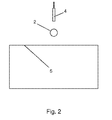
- a defined steel rod 1 with 8 mm diameter in such a way with the test piece 2 - that is, adhesive tape - wrapped to give lever lengths of 220 mm and 150 mm.
- the wrapped steel rod 1 is dropped to the stop 3 on the drop height and with a weight of about 16 g on an aluminum sheet 5.
- the aluminum sheet 5, which in the undeformed state measures 350 x 190 x 0.3 [mm], is placed in a half-toned manner under the test piece 2, so that a width of 290 mm results.
- the overall sound result is determined by means of a microphone 4 located above the test arrangement in a frequency range of, for example, 20 to 12,500 Hz with a commercially available acoustic meter, for example Type 2226 from Bruel & Kjaer recorded and recorded.
- a microphone 4 located above the test arrangement in a frequency range of, for example, 20 to 12,500 Hz with a commercially available acoustic meter, for example Type 2226 from Bruel & Kjaer recorded and recorded.
- a microphone 4 located above the test arrangement in a frequency range of, for example, 20 to 12,500 Hz with a commercially available acoustic meter, for example Type 2226 from Bruel & Kjaer recorded and recorded.
- For the human ear are particularly relevant frequencies in the range of 2,000 to 5,000 Hz.
- the attenuation is given as the difference between the zero value with un-wound steel bar and the respective measured value in dB (A).
- the object of the invention is to provide a heat-reflecting adhesive tape, which at the same time a sheathed product, ie in this case, harness ensures the sheathing of, for example cables in addition to the high heat reflection, which is more flexible than the previous products, with the known Adhesive tapes have been sheathed.
- the invention relates to a heat-reflecting adhesive tape, preferably for wrapping elongate material such as in particular lines or cable sets, with a band-shaped carrier, which consists of a composite of at least a first layer of a glass fabric having a basis weight of 30 to 200 g / m 2 , and at least one second layer formed by a metallic layer having a thickness of 10 to 40 microns and a thermal efficiency of SAE J2302 at 350 ° C greater than 45 ° C, and having at least one side of the Carrier applied pressure-sensitive adhesive coating.
- the bending stiffness of the adhesive tape in the longitudinal and transverse directions is less than 500 mN, preferably less than 300 mN (measured using a softometer KWS basic 2000 mN from Wolf).
- adheresive tape encompasses all flat structures such as films or film sections which are expanded in two dimensions, tapes of extended length and limited width, tape sections, diecuts, labels and the like.
- the adhesive coating is applied to the open, the second layer opposite side of the first layer.
- a siliconization with particularly preferably 0.5 g / m 2 to 1.5 g / m 2 , most preferably 1 g / m 2 applied, in particular of polysiloxane.
- This silicone release coating allows a very easy and uniform unwinding of the adhesive tape according to the invention in the application. This has the advantage that it can be dispensed with the use of a release paper or a release film.
- Suitable coatings are the customary polysiloxane release lacquer coating, for example from Wacker, Rhodia or Dow Corning. Suitable coatings are solvent-based, emulsion-based or 100% systems. These polysiloxane coatings are usually crosslinked by an addition reaction or by a condensation reaction.
- a very easily separating polysiloxane system is used for the coating.
- the bending stiffness of the carrier and thus of the adhesive tape is according to a further advantageous embodiment of the invention in the longitudinal direction of less than 230 mN and in the transverse direction less than 150 mN (measured using a Softometer KWS basic 2000 mN from Wolf).
- the metallic layer has a thickness of 12 to 20 microns. If necessary, this also has an imprint.
- metals silver, copper, gold, platinum, aluminum and aluminum compounds, tin, nichrome, NIROSTA, titanium, metal oxides such as cadmium oxides, tin oxides, zinc oxides, magnesium oxides, preferably aluminum.
- metal oxides such as cadmium oxides, tin oxides, zinc oxides, magnesium oxides, preferably aluminum.
- the concentration can take place in suitably equipped boilers or extruders, in particular in the concomitant degassing, a degassing extruder is preferred.
- Such an adhesive is in the DE 43 13 008 C2 explained. These acrylate masses produced in this way are completely removed from the solvent in an intermediate step.
- the K value is determined in particular in analogy to DIN 53 726.
- the solution of the composition may contain from 5 to 80% by weight, in particular from 30 to 70% by weight, of solvent.
- solvents are preferably used, in particular low-boiling hydrocarbons, ketones, alcohols and / or esters.
- single-screw, twin-screw or multi-screw extruders with one or in particular two or more degassing units are used.
- benzoin derivatives may be copolymerized, such as benzoin acrylate or benzoin methacrylate, acrylic acid or methacrylic acid ester. Such benzoin derivatives are in the EP 0 578 151 A described.
- the acrylate-based adhesive can be UV-crosslinked. Other types of crosslinking are also possible, for example electron beam crosslinking.
- self-adhesive compositions of (meth) acrylic acid and esters thereof having 1 to 25 carbon atoms, maleic, fumaric and / or itaconic acid and / or their esters, substituted (meth) acrylamides, maleic anhydride and other vinyl compounds , used as vinyl esters, in particular vinyl acetate, vinyl alcohols and / or vinyl ethers.
- the residual solvent content should be below 1% by weight.
- An adhesive which is particularly suitable is a low molecular weight acrylate hot melt pressure-sensitive adhesive, such as that marketed under the name acResin UV or Acronal®, in particular Acronal DS 3458, by BASF.
- This adhesive with a low K value obtains its application-oriented properties through a final radiation-induced crosslinking.
- the adhesive coating consists of an acrylate- or silicone-containing adhesive.
- the adhesive can be applied in the longitudinal direction of the adhesive tape in the form of a strip which has a smaller width than the carrier of the adhesive tape.
- the coated strip has, in an advantageous embodiment, a width of 10 to 80% of the width of the carrier material. Particularly preferably, the use of strips with a coating of 20 to 50% of the width of the carrier material. Depending on the application, it is also possible for a plurality of parallel strips of the adhesive to be coated on the carrier material.
- the position of the strip on the carrier is freely selectable, with an arrangement directly on one of the edges of the carrier being preferred.
- the first layer and / or the adhesive coating can be provided, for example, with the aid of a flame retardant consisting of ammonium polyphosphate, magnesium hydroxide and / or aluminum hydroxide or with the aid of a chloroparaffin, optionally in combination with antimony trioxide.
- a flame retardant consisting of ammonium polyphosphate, magnesium hydroxide and / or aluminum hydroxide or with the aid of a chloroparaffin, optionally in combination with antimony trioxide.
- the adhesive tape may preferably have an abrasion resistance according to ISO 6722 in single-layer measurement, after which a number of strokes of more than 500, in particular from 800 to 2500, are overcome.
- the tape can have a noise reduction according to BMW GS 95008-3 with single-layer measurement of more than 3 dB (A), in particular 5 dB (A) to 6 dB (A).
- the adhesive tape is preferably tearable, at least in the transverse direction.
- the adhesive tape is used to cover elongated material, in particular cable harnesses, wherein the elongate material is enveloped in the axial direction by the adhesive tape or the adhesive tape is guided in a helical spiral around the elongate product.
- the invention also includes an elongate product, in particular a cable set, encased in the adhesive tape according to the invention.
- FIG. 3 comprises a heat-reflecting adhesive tape (1) according to the invention, a band-shaped carrier (2) which consists of a composite of at least one first layer (2a), which is formed by a glass fabric having a basis weight of 30 to 200 g / m 2 , and at least a second layer (2b) formed by a metallic layer having a thickness of 10 to 40 ⁇ m and a thermal efficiency of SAE J2302 at 350 ° C greater than 45 ° C.
- a pressure-sensitive adhesive coating (3) is applied on one side of the carrier (2).
- a siliconization (4) is applied.
- FIG. 4 a section of a wiring harness is shown, which is composed of a bundling of individual cables 7 and which is covered with the adhesive tape 1 according to the invention.
- the adhesive tape 1 is guided in a spiral movement around the wiring harness.
- the section of the wiring harness shown shows two windings I and II of the adhesive tape 1. To the left, further windings would extend, these are not shown here.
- the carrier material 11, 21, 23 is coated on one side with an adhesive 12, 22, 24, wherein the order takes place in the form of a strip in the longitudinal direction, which has a smaller width than the carrier material 11, 21, 23 of the adhesive tape first
- the sheathing of the cable harness is such that the strip of adhesive 12, 22, 24 completely bonded to the substrate 11, 21, 23 of the adhesive tape 1. An adhesive bond with the cables 7 is excluded.
- the tape 1 comprises (see winding 1) in the width of the portion 24 and the gate 22 and the intermediate open carrier 23.
- the sections 22, 24 are in contrast to the exposed adhesive 12 is not visible from the outside, which is why the denser hatching is chosen for illustration.
- the adhesive tape according to the invention has the feature of outstandingly reflecting the heat, in spite of the metal film, which is much thinner than the known tapes.
- the thin metal layer is also responsible for the tape leading to much more flexible products when encased in the adhesive tape.
- the films were measured separately and as a composite with glass fabric analogous to the SAE J2302.
- the three bars arranged from left to right have the following meaning: Left (blue): Temperature on the ceramic rod without tape Middle (yellow): Temperature on the outside of the tape Right (orange): Heat Recoverability "Thermal Effectiveness"
- the superiority of the adhesive tape according to the invention is evident in the measurement of the bending stiffness, which shows the influence of the aluminum foil on the flexibility.
- Table 1 shows the bending stiffnesses (BS) of the individual materials. BS along BS across template mN mN Sample 1 229 148 Sample 2 498 295 Sample 3 917 216 Al foil 50 ⁇ m 225 - Al foil 13 ⁇ m 5 - Al foil embossed 13 ⁇ m 6 - WB pattern 1 352 558
- the bending stiffness is a measure of the flexibility of a carrier or a carrier composite.
- a commercially available aluminum foil has a bending stiffness of 3 mN. It is therefore a very flexible material.
- a 50 ⁇ m aluminum foil has a bending stiffness of 225 mN. The flexural rigidity thus increases disproportionately with the thickness of the film.
- the same glass fabric laminated with a 17 ⁇ m Al foil has a flexural rigidity of 229 mN, a bending stiffness of almost 500 mN with a 40 ⁇ m Al foil and even more than 900 mN with a thick glass mesh.
- a very thin aluminum foil for lamination of the glass fabric can be selected.
- the adhesive tape according to the invention can be produced with little effort, results in a low-cost heat-resistant tape and then meets the requirement for continuous service temperatures up to class F (200 ° C.) according to SAE J 2192 or other relevant specifications, for example Fiat Auto Normazione Procurement Specification, 9.91220 of 19 December 2001, chapter 2.4.1 Flexibility test.
Landscapes
- Chemical & Material Sciences (AREA)
- Organic Chemistry (AREA)
- Adhesive Tapes (AREA)
- Adhesives Or Adhesive Processes (AREA)
Abstract
Description
- Die Erfindung betrifft ein hitzereflektierendes Klebeband, vorzugsweise zum Umhüllen von langgestrecktem Gut wie insbesondere Leitungen oder Kabelsätze, mit einem bandförmigen Träger, der aus einem Verbund besteht aus mindestens einer ersten Schicht, die von einem Glasgewebe gebildet wird, und mindestens einer zweiten Schicht, die von einer metallischen Schicht gebildet wird, und mit einer zumindest auf einer Seite des Trägers aufgebrachten druckempfindlichen Klebebeschichtung. Des Weiteren betrifft die Erfindung die Verwendung des Klebebands sowie einen Kabelbaum, der mit dem erfindungsgemäßen Klebeband ummantelt ist.
- In vielen Industriebereichen werden Bündel aus einer Vielzahl von elektrischen Leitungen vor dem Einbau oder in bereits montiertem Zustand umwickelt, um den Raumbedarf des Leitungsbündels durch Bandagieren zu reduzieren sowie zusätzlich Schutzfunktionen zu erzielen. Mit Folienklebebändern wird ein gewisser Schutz vor Flüssigkeitszutritt erreicht, mit luftigen und voluminösen Klebebändern auf Basis von dicken Vliesstoffen oder Schaumstoffen als Träger erhält man dämpfende Eigenschaften, bei Verwendung von abriebfesten, stabilen Trägermaterialien wird eine Schutzfunktion gegen Scheuern und Reiben erzielt.
Einen Schutz gegen Hitzestrahlung bieten derartige Klebebänder jedoch nicht. - Zum Nachweis der Erfüllung der bestehenden Anforderungen durch einen Werkstoff sind für elektrische Leitungen und weitere Komponenten für Kabelsätze verschiedene Prüfungen und Tests vorgeschrieben, die unter anderem in einer, unter verschiedenen PKW-Herstellern abgestimmten Werksnorm zusammengefasst sind (LV 112 - Niederspannungsleitungen für Kraftfahrzeuge, Fassung vom Juni 2004). Entsprechend dieser Norm muss der Isolationswerkstoff der Leitungen den Anforderungen der VDA 231-106 entsprechen. Die minimale und maximale Dauergebrauchstemperatur (TU und TO) für eine Beanspruchungsdauer von 3000 h liegen beispielsweise bei einer Einordnung in die Temperaturklasse B bei -40 °C und bei 100 °C, wobei das Material einer Kurzzeittemperatur (240 Stunden) von 125 ± 3 °C und einer Überlasttemperatur (6 Stunden) von 150 ± 3 °C standhalten muss.
Elektrische Leitungen und weitere Komponenten für Kabelsätze werden zur Festlegung ihrer maximalen Dauergebrauchstemperatur in Temperaturklassen eingeteilt. Diese Einteilung in Temperaturklassen ist allgemein bekannt und in der folgenden Tabelle nochmals aufgeschlüsselt dargestellt.Klasse Dauer-gebrauchs-temperatur TU bis TO in °C Kurzzeit-temperatur (TO + 25) °C Temperatur für thermische Überlast (TO + 50) °C A - 40 bis 85 110 ± 2 136 ± 3 B - 40 bis 100 115 ± 3 150 ± 3 C - 40 bis 125 150 ± 3 175 ± 3 D - 40 bis 150 175 ± 3 200 ± 3 E - 40 bis 175 200 ± 3 225 ± 3 F - 40 bis 200 225 ± 4 250 ± 4 G - 40 bis 225 250 ± 4 275 ± 4 H - 40 bis 250 275 ± 4 300 ± 4 - Der Schutz gegen Strahlungswärme erfolgt in der Regel durch Isolationsschichten mit einem geringen Wärmeleitvermögen. Bei Kabelsätzen wird zu diesem Zweck häufig auf temperaturbeständige Umhüllungen wie Wellrohre, Silikonschläuche oder metallarmierte Glasgewebeschläuche zurückgegriffen, die aber für höhere Belastungen keinen ausreichenden Schutz bieten.
- Für Spezialanwendungen existieren darüber hinaus so genannte Hitzereflektionsbänder, bei denen es sich um Klebebänder der eingangs genannten Art handelt. Diese Bänder bestehen aus einem Glasfasergewebe (zweite Trägerschicht), das mit einer Aluminiumfolie (erste Trägerschicht) kaschiert und rückseitig mit einem hoch temperaturbeständigen Silikonklebstoff ausgerüstet ist. Derartige Produkte werden zum Beispiel von den Firmen Tyco und Aremco, New York, angeboten. Als Produktnachteile sind bei diesen Bändern jedoch die hohe Steifigkeit des Trägers sowie der im Vergleich zu konventionellen Klebebändern hohe Preis zu nennen.
- Aus der
EP 1 615 238 A1 ist ein thermisch isolierendes Klebeband zum Umhüllen von langgestrecktem Gut wie insbesondere Leitungen oder Kabelsätzen mit einem bandförmigen Träger bekannt. Der Träger besteht aus einem Verbund von mindestens einer ersten Schicht und mindestens einer zweiten Schicht, wobei die erste Schicht eine metallische Schicht ist. Auf einer Seite des Trägers ist eine druckempfindliche Klebebeschichtung aufgebracht. Die zweite Schicht des Trägers bildet eine bis zu einer Temperatur von mindestens 175 °C beständige Kunststofffolie oder ein bis zu einer Temperatur von mindestens 175 °C beständiges textiles Trägermaterial. - Derartige Klebebänder, auch "Heat Reflective-Klebebänder" genannt, sind bekannt. Da die Klebebänder für die thermische Reflektionswirkung mit Überlappung zum Beispiel um Kabel gewickelt werden, wirkt sich die Steifigkeit der bekannten Klebebänder, die insbesondere auch auf die verwendeten dicken Metallschichten zurückzuführen ist, besonders negativ aus.
Weiterhin ist die Abrollkraft der Klebebänder hoch, was einen erhöhten Wickeldruck zur Folge hat und der Kabelsatz besonders wenig flexibel wird und nachteiligen Eigenschaften für den Transport und Einbau zeigt.
Der dadurch resultierende langsamere Wickelprozess führt zu höheren Kosten. - Darüber hinaus sind aluminisierte oder aluminiumkaschierte Geflechtsschläuche (beispielsweise von der Firma Bentley Harris) bekannt, ergeben aber bei Anwendung ebenfalls einen sehr gering flexiblen Kabelsatz.
- Als Methode, die Abriebbeständigkeit von Schutzsystemen in der Fahrzeugelektrik zu bestimmen, hat sich die internationale Norm ISO 6722, Kapitel 9.3 "Scrape abrasion test" (Ausgabe April 2002), etabliert. Hier wird der Prüfling (zum Beispiel die isolierte Kupferleitung oder aber das auf einen Metalldorn geklebte Wickelband) mit einem dünnen Stahldraht unter definierten Hubgeometrien und Gewichtsbelastung beansprucht, bis die Schutzhülle durchgerieben ist und es über einen Kurzschluss zum Stoppen des mitlaufenden Zählwerkes kommt.
- Sofern nicht anders angegeben, beziehen sich alle Angaben zur Abriebfestigkeit auf diese ISO 6722-Methode. Das Klebeband wird dazu einlagig in Längsrichtung auf einem Metalldorn von 10 mm Durchmesser geklebt, die Scheuerbewegung findet mittig auf dem Klebeband mit einer Gewichtsbelastung von 7 N statt. Als Reibkörper wird ein Stahldraht gemäß ISO 8458-2 von 0,45 mm Durchmesser verwendet. Als Maßzahl für die Abriebfestigkeit wird die Anzahl der Hübe bis zum Kurzschluss angegeben. In Fällen von sehr hohen Scheuerbeständigkeiten kann über Erhöhung der Auflagemasse eine Verkürzung der Messzeit und Reduzierung der Hubzahl erreicht werden. Hierbei hat sich ein Auflagegewicht von 10 N als günstig erwiesen.
- Die physikalische Messung der Geräuschdämpfungswirkung erfolgt gemäß der Methode, wie sie in
DE 100 39 982 A1 detailliert beschrieben wird. Es handelt sich hierbei um eine in der Automobilindustrie etablierte Messmethodik, wie sie beispielsweise auch in der BMW-Norm GS 95008-3 (Ausgabe Mai 2000) angegeben wird. - Im Folgenden wird in Verbindung mit den
Figuren 1 und2 das Messverfahren nach der BMW-Norm GS 95008-3 aus Mai 2000 ausführlich dargelegt. - Es zeigen
- Figur 1
- den Aufbau der Messvorrichtung in der seitlichen Ansicht und
- Figur 2
- denselben Aufbau in der horizontalen Ansicht.
- Bei dieser Meßmethode wird ein definierter Stahlstab 1 mit 8 mm Durchmesser derartig mit dem Prüfling 2 - sprich Klebeband - umwickelt, dass sich Hebellängen von 220 mm und 150 mm ergeben. Der umwickelte Stahlstab 1 wird bis zur Arretierung 3 auf die Fallhöhe und mit einem Gewicht von ca. 16 g auf ein Aluminiumblech 5 fallen gelassen. Das Aluminiumblech 5, das im unverformten Zustand 350 x 190 x 0,3 [mm] misst, wird halbtonnenförmig unter dem Prüfling 2 angeordnet, so dass sich eine Weite von 290 mm ergibt.
Das Gesamtschallergebnis wird mittels eines über der Prüfanordnung befindlichen Mikrofons 4 in einem Frequenzbereich von beispielsweise 20 bis 12.500 Hz mit einem handelsüblichen Schallmessgerät, beispielsweise Typ 2226 der Firma Bruel & Kjaer erfasst und aufgezeichnet. Für das menschliche Ohr als besonders relevant sind Frequenzen im Bereich von 2.000 bis 5.000 Hz.
Die Dämpfung wird als Differenz zwischen Nullwert mit nicht-umwickeltem Stahlstab sowie dem jeweiligen Messwert in dB(A) angegeben. - Aufgabe der Erfindung ist es, ein hitzereflektierendes Klebeband zur Verfügung zu stellen, das bei der Ummantelung von beispielsweise Kabeln neben der hohen Hitzereflektion gleichzeitig ein ummanteltes Produkt, also in diesem Fall Kabelbaum, gewährleistet, das flexibler ist als die bisherigen Produkte, die mit den bekannten Klebebändern ummantelt worden sind.
- Gelöst wird diese Aufgabe durch ein Klebeband, wie es im Hauptanspruch näher gekennzeichnet ist. In den Unteransprüchen sind vorteilhafte Ausführungsformen der Erfindung beschrieben. Des Weiteren sind die Verwendung des erfindungsgemäßen Klebebands sowie ein mit dem Klebeband ummantelter Kabelbaum vom Erfindungsgedanken umfasst.
- Demgemäß betrifft die Erfindung ein hitzereflektierendes Klebeband, vorzugsweise zum Umhüllen von langgestrecktem Gut wie insbesondere Leitungen oder Kabelsätze, mit einem bandförmigen Träger, der aus einem Verbund besteht aus mindestens einer ersten Schicht, die von einem Glasgewebe mit einem Flächengewicht von 30 bis 200 g/m2 gebildet wird, und mindestens einer zweiten Schicht, die von einer metallischen Schicht mit einer Dicke von 10 bis 40 µm und einer thermischen Effektivität nach SAE J2302 bei 350 °C von größer 45 °C gebildet wird, und mit einer zumindest auf einer Seite des Trägers aufgebrachten druckempfindlichen Klebebeschichtung.
Die Biegesteifigkeit des Klebebands in Längs- und Querrichtung ist kleiner 500 mN, vorzugsweise kleiner 300 mN (gemessen mit einem Softometer KWS basic 2000 mN der Firma Wolf). - Der allgemeine Ausdruck "Klebeband" umfasst im Sinne dieser Erfindung alle flächigen Gebilde wie in zwei Dimensionen ausgedehnte Folien oder Folienabschnitte, Bänder mit ausgedehnter Länge und begrenzter Breite, Bandabschnitte, Stanzlinge, Etiketten und dergleichen.
- Gemäß einer vorteilhaften Ausführungsform der Erfindung ist die Klebebeschichtung auf der offenen, der zweiten Schicht gegenüberliegenden Seite der ersten Schicht aufgebracht.
- Weiter vorzugsweise ist auf der offenen, der ersten Schicht gegenüberliegenden Seite der zweiten Schicht eine Silikonisierung mit besonders vorzugsweise 0,5 g/m2 bis 1,5 g/m2, ganz besonders vorzugsweise 1 g/m2 aufgebracht, insbesondere aus Polysiloxan.
Diese Silikontrennlack-Beschichtung ermöglicht ein sehr leichtes und gleichmäßiges Abrollen des erfindungsgemäßen Klebebands bei der Anwendung. Hierdurch ergibt sich der Vorteil, dass auf die Verwendung eines Trennpapiers beziehungsweise einer Trennfolie verzichtet werden kann.
Als Beschichtung eignen sich die üblichen Polysiloxan-Trennlackbeschichtung zum Beispiel von der Firma Wacker, Rhodia oder Dow Corning. Geeignet sind Beschichtungen auf Lösemittelbasis, Emulsionsbasis oder 100%-Systeme. Diese Polysiloxan-Beschichtungen sind üblicherweise durch eine Additions- oder durch eine Kondensationsreaktion vernetzt. Vorteilhafterweise wird ein sehr leicht trennendes Polysiloxan-System für die Beschichtung verwendet. - Die Biegesteifigkeit des Trägers und damit des Klebebands ist gemäß einer weiteren vorteilhaften Ausführungsform der Erfindung in Längsrichtung kleiner 230 mN und in Querrichtung kleiner 150 mN (gemessen mit einem Softometer KWS basic 2000 mN der Firma Wolf).
- Das Glasgewebe der ersten Schicht weist vorteilhaft folgende Eigenschaften auf:
- Das Flächengewicht beträgt von 80 bis 120 g/m2.
- Die Anzahl der Fäden in Längs- und Querrichtung beträgt jeweils 3 bis 10 Fäden/cm, und/oder
- die zur Bildung des Glasgewebes verwendeten Fäden weisen einen Titer von kleiner 150 tex, vorzugsweise kleiner 100 tex auf.
- Gemäß einer weiteren vorteilhaften Ausführungsform der Erfindung weist die metallische Schicht eine Dicke von 12 bis 20 µm auf. Gegebenenfalls weist dies darüber hinaus eine Prägung auf.
- Als Metalle können gewählt werden Silber, Kupfer, Gold, Platin, Aluminium und Aluminiumverbindungen, Zinn, Nichrom, NIROSTA, Titan, Metalloxide wie Cadmiumoxide, Zinnoxide, Zinkoxide, Magnesiumoxide, vorzugsweise Aluminium. Diese Aufzählung ist dabei als nicht abschließend zu betrachten, sondern der Fachmann kann weitere hier nicht explizit genannte Metallschichten wählen, ohne den Erfindungsgedanken zu verlassen.
- Um aus dem Träger ein Selbstklebeband herzustellen, kann auf alle bekannten Klebemassensysteme zurückgegriffen werden. Neben Natur- oder Synthesekautschuk basierten Klebemassen sind insbesondere Silikonklebemassen sowie Polyacrylatklebemassen verwendbar. Wegen ihrer besonderen Eignung als Klebemasse für Wickelbänder von automobilen Kabelsätzen in Hinblick auf die Foggingfreiheit sowie die hervorragende Verträglichkeit mit PVC- sowie PVC-freien Aderisolierungen sind lösungsmittelfreie Acrylat-Hotmeltmassen zu bevorzugen, wie sie in
DE 198 07 752 A1 sowie inDE 100 11 788 A1 näher beschrieben sind.
Das Auftragsgewicht bewegt sich im Bereich zwischen 20 bis 100 g/m2.
Als Beschichtungstechnologie kommen bekannte Systeme zum Zuge, wobei sich Verfahren anbieten, die ein druckloses Auflegen von hochviskosen Klebemassen zulassen, beispielsweise die Beschichtung von Hotmelt-Klebemassen über Düsenbeschichtung oder über Transferierung von einem anti-adhäsiven Trägertuch oder Releaseliner auf den Trägerverbund. - Als Klebemasse ist eine solche auf Acrylathotmelt-Basis geeignet, die einen K-Wert von mindestens 20 aufweist, insbesondere größer 30 (gemessen jeweils in 1 Gew.-%iger Lösung in Toluol, 25 °C), erhältlich durch Aufkonzentrieren einer Lösung einer solchen Masse zu einem als Hotmelt verarbeitbaren System.
Das Aufkonzentrieren kann in entsprechend ausgerüsteten Kesseln oder Extrudern stattfinden, insbesondere beim damit einhergehenden Entgasen ist ein Entgasungs-Extruder bevorzugt.
Eine derartige Klebemasse ist in derDE 43 13 008 C2 dargelegt. Diesen auf diesem Wege hergestellten Acrylatmassen wird in einem Zwischenschritt das Lösungsmittel vollständig entzogen.
Der K-Wert wird dabei insbesondere bestimmt in Analogie zu DIN 53 726. - Zusätzlich werden dabei weitere leichtflüchtige Bestanteile entfernt. Nach der Beschichtung aus der Schmelze weisen diese Massen nur noch geringe Anteile an flüchtigen Bestandteilen auf. Somit können alle im oben angeführten Patent beanspruchten Monomere/Rezepturen übernommen werden.
Die Lösung der Masse kann 5 bis 80 Gew.-%, insbesondere 30 bis 70 Gew.-% Lösungsmittel enthalten.
Vorzugsweise werden handelsübliche Lösungsmittel eingesetzt, insbesondere niedrig siedende Kohlenwasserstoffe, Ketone, Alkohole und/oder Ester.
Weiter vorzugsweise werden Einschnecken-, Zweischnecken- oder Mehrschneckenextruder mit einer oder insbesondere zwei oder mehreren Entgasungseinheiten eingesetzt.
In der Klebemasse auf Acrylathotmelt-Basis können Benzoinderivate einpolymerisiert sein, so beispielsweise Benzoinacrylat oder Benzoinmethacrylat, Acrylsäure- oder Methacrylsäureester. Derartige Benzoinderivate sind in derEP 0 578 151 A beschrieben.
Die Klebemasse auf Acrylathotmelt-Basis kann UV-vernetzt werden. Andere Vernetzungsarten sind aber auch möglich, zum Beispiel die Elektronenstrahlenvernetzung.
In einer weiteren bevorzugten Ausführungsform werden als Selbstklebemassen Copolymerisate aus (Meth)acrylsäure und deren Estern mit 1 bis 25 C-Atomen, Malein-, Fumar- und/oder Itaconsäure und/oder deren Estern, substituierten (Meth)acrylamiden, Maleinsäureanhydrid und anderen Vinylverbindungen, wie Vinylestern, insbesondere Vinylacetat, Vinylalkoholen und/oder Vinylethern eingesetzt.
Der Restlösungsmittel-Gehalt sollte unter 1 Gew.-% betragen. - Eine Klebemasse, die sich als besonders geeignet zeigt, ist eine niedermolekulare Acrylatschmelzhaftklebemasse, wie sie unter der Bezeichnung acResin UV oder Acronal ®, insbesondere Acronal DS 3458, von der BASF geführt wird. Diese Klebemasse mit niedrigem K-Wert erhält ihre anwendungsgerechten Eigenschaften durch eine abschließende strahlenchemisch ausgelöste Vernetzung.
- Vorzugsweise besteht also die Klebebeschichtung aus einer acrylat- oder silikonhaltigen Klebemasse.
- Die Klebemasse kann in Längsrichtung des Klebebands in Form eines Streifens aufgebracht sein, der eine geringere Breite aufweist als der Träger des Klebebands.
- Der beschichtete Streifen hat in einer vorteilhaften Ausführungsform eine Breite von 10 bis 80% der Breite des Trägermaterials. Besonders vorzugsweise erfolgt der Einsatz von Streifen mit einer Beschichtung von 20 bis 50% der Breite des Trägermaterials.
Je nach Verwendungsfall können auch mehrere parallele Streifen des Klebers auf dem Trägermaterial beschichtet sein.
Die Lage des Streifens auf dem Träger ist frei wählbar, wobei eine Anordnung direkt an einer der Kanten des Trägers bevorzugt wird. - Des Weiteren können die erste Schicht und/oder die Klebebeschichtung beispielsweise mit Hilfe eines aus Ammoniumpolyphosphat, Magnesiumhydroxid und/oder Aluminiumhydroxid bestehenden Flammschutzmittels oder mit Hilfe eines Chlorparaffins, gegebenenfalls in Kombination mit Antimontrioxid, flammhemmend ausgerüstet sein.
- Das Klebeband kann vorzugsweise eine Abriebbeständigkeit nach ISO 6722 bei einlagiger Messung aufweisen, nach der eine Anzahl von Hüben von mehr als 500, insbesondere von 800 bis 2500, überstanden werden.
- Dann kann das Klebeband eine Geräuschdämpfung nach BMW GS 95008-3 bei einlagiger Messung von mehr als 3 dB (A), insbesondere 5 dB (A) bis 6 dB (A), aufweisen.
- Das Klebeband ist vorzugsweise zumindest in Querrichtung von Hand einreißbar.
- Vorzugsweise wird das Klebeband zum Ummanteln von langgestrecktem Gut wie insbesondere Kabelsätzen eingesetzt, wobei das langgestreckte Gut in axialer Richtung von dem Klebeband umhüllt wird oder das Klebeband in einer schraubenförmigen Spirale um das langgestreckte Gut geführt wird.
- Schließlich ist vom Erfindungsgedanken auch ein langgestrecktes Gut wie insbesondere ein Kabelsatz umfasst, ummantelt mit dem erfindungsgemäßen Klebeband.
- Anhand der nachfolgend beschriebenen Figuren wird das erfindungsgemäße Klebeband in einer besonders vorteilhaften Ausführungsform näher erläutert, ohne hiermit die Erfindung einschränken zu wollen.
- Es zeigen
- Figur 3
- das erfindungsgemäße Klebeband im seitlichen Schnitt,
- Figur 4
- die Verwendung des erfindungemäßen Klebebands in einer anderen Ausführungsform beim Ummanteln von Kabeln, sprich einen Kabelbaum.
- Nach
Figur 3 umfasst ein erfindungsgemäßes hitzereflektierendes Klebeband (1), einen bandförmigen Träger (2), der aus einem Verbund besteht aus mindestens einer ersten Schicht (2a), die von einem Glasgewebe mit einem Flächengewicht von 30 bis 200 g/m2 gebildet wird, und mindestens einer zweiten Schicht (2b), die von einer metallischen Schicht mit einer Dicke von 10 bis 40 µm und einer thermischen Effektivität nach SAE J2302 bei 350 °C von größer 45 °C gebildet wird.
Auf einer Seite des Trägers (2) ist eine druckempfindliche Klebebeschichtung (3) aufgebracht.
Auf der offenen, der ersten Schicht (2a) gegenüberliegenden Seite der zweiten Schicht (2b) ist eine Silikonisierung (4) aufgebracht. - In der
Figur 4 ist ein Ausschnitt eines Kabelbaums gezeigt, der sich aus einer Bündelung von einzelnen Kabeln 7 zusammensetzt und der mit dem erfindungsgemäßen Klebeband 1 ummantelt ist. Das Klebeband 1 wird in einer spiralförmigen Bewegung um den Kabelbaum geführt.
Der gezeigte Ausschnitt des Kabelbaums zeigt zwei Wicklungen I und II des Klebebands 1. Nach links hin würden sich würden weitere Wicklungen erstrecken, diese sind hier nicht dargestellt.
Das Trägermaterial 11, 21, 23 ist einseitig mit einer Klebemasse 12, 22, 24 beschichtet, wobei der Auftrag in Form eines Streifens in Längsrichtung erfolgt, der eine geringere Breite aufweist als das Trägermaterial 11, 21, 23 des Klebebands 1. - Die Ummantelung des Kabelbaums erfolgt derartig, dass der Streifen der Klebemasse 12, 22, 24 vollständig auf dem Trägermaterial 11, 21, 23 des Klebebands 1 verklebt. Eine Verklebung mit den Kabeln 7 ist ausgeschlossen.
Das Klebeband 1 umfasst (siehe Wicklung 1) in der Breite den Abschnitt 24 und den Anschnitt 22 sowie den dazwischen befindlichen offenen Träger 23. Der Abschnitt 22, der zur Wicklung II gehört, haftet also auf dem Abschnitt 23. (Der Abschnitt 24 würde auf dem Träger der nächsten linksliegenden Wicklung haften.) Die Abschnitte 22, 24 sind im Gegensatz zur offen liegenden Klebemasse 12 von außen nicht sichtbar, weshalb die dichtere Schraffur zur Darstellung gewählt ist. - Überraschend und für den Fachmann unerwartet zeigt das erfindungsgemäße Klebeband das Merkmal, trotz der gegenüber den bekannten Bändern sehr viel dünneren Metallschicht hervorragend die Hitze zu reflektieren.
Gleichzeitig ist die dünne Metallschicht auch dafür verantwortlich, dass das Klebeband zu weitaus flexibleren Produkten führt, wenn diese mit dem Klebeband ummantelt sind. - Dies zeigen auch folgende vergleichende Messungen.
- Folgende Materialien sind untersucht worden:
- 14 µm Aluminiumfolie
- 14 µm Aluminiumfolie geprägt
- 50 µm Aluminiumfolie (Stand der Technik)
- dünnes Glasgewebe (100 g/m2) mit einer 17 µm Aluminiumfolie (Sample 1 genannt)
- dünnes Glasgewebe (100 g/m2) mit einer 40 µm Aluminiumfolie (Sample 2 genannt)
- dickes Glasgewebe (330 g/m2) mit einer 40 µm Aluminiumfolie (Sample 3 genannt und Stand der Technik)
- Die Folien wurden separat und als Verbund mit Glasgewebe analog der SAE J2302 gemessen.
- In der
Figur 5 ist das Ergebnis der Hitzereflektion "Thermal Effectiveness" bei 350 °C gezeigt, in derFigur 6 bei 450 °C. - Die drei von links nach rechts angeordneten Balken haben die folgende Bedeutung:

Links (blau): Temperatur am Keramikstab ohne Tape Mitte (gelb): Temperatur auf der Außenseite vom Tape Rechts (orange): Hitzereflektionsvermögen "Thermal Effectiveness" - Es zeigt sich, dass die erfindungsgemäß eingesetzten Folie beziehungsweise der erfindungsgemäß eingesetzte Träger gegenüber den bekannten in der Leistungsfähigkeit nicht abfallen, obwohl die Metallbeschichtung sehr viel dünner ist.
- Die Überlegenheit des erfindungsgemäßen Klebebands zeigt sich bei der Messung der Biegesteifigkeit, die den Einfluss der Aluminiumfolie auf die Flexibilität zeigt.
Tabelle 1 zeigt die Biegesteifigkeiten (BS) der einzelnen Materialien. BS längs BS quer Muster mN mN Sample 1 229 148 Sample 2 498 295 Sample 3 917 216 Al-Folie 50µm 225 - Al-Folie 13µm 5 - Al-Folie 13µm geprägt 6 - WB-Muster 1 352 558 - Die Biegesteifigkeit ist ein Maß für die Flexibilität eines Trägers oder eines Trägerverbundes.
- Eine handelsübliche Aluminiumfolie hat eine Biegesteifigkeit von 3 mN. Es handelt sich also um ein sehr flexibles Material. Eine 50 µm Aluminiumfolie dagegen verfügt über eine Biegesteifigkeit von 225 mN.
Die Biegesteifigkeit steigt also überproportional mit der Dicke der Folie. - Das gleiche Glasgewebe kaschiert mit einer 17 µm Al-Folie weist eine Biegesteifigkeit von 229 mN auf, kaschiert mit einer 40 µm Al-Folie eine Biegesteifigkeit von fast 500 mN und mit einem dicken Glasgewebe sogar über 900 mN.
- Um ein flexibles Klebeband mit einem guten Hitzereflektionsvermögen zu erhalten, kann eine sehr dünne Aluminiumfolie zur Kaschierung des Glasgewebes gewählt werden.
- Das erfindungsgemäße Klebeband ist mit geringem Aufwand herstellbar, ergibt ein preisgünstiges Hitzeschutzband und erfüllt sodann die Anforderung an Dauergebrauchstemperaturen bis Klasse F (200 °C) nach SAE J 2192 oder anderen einschlägigen Spezifikationen, beispielsweise der Fiat Auto Normazione "Procurement Specification", 9.91220 vom 19. Dezember 2001, Kapitel 2.4.1 Flexibility test.
Claims (13)
- Hitzereflektierendes Klebeband (1), vorzugsweise zum Umhüllen von langgestrecktem Gut wie insbesondere Leitungen oder Kabelsätze, mit einem bandförmigen Träger (2), der aus einem Verbund besteht aus mindestens einer ersten Schicht (2a), die von einem Glasgewebe mit einem Flächengewicht von 30 bis 200 g/m2 gebildet wird, und mindestens einer zweiten Schicht (2b), die von einer metallischen Schicht mit einer Dicke von 10 bis 40 µm und einer thermischen Effektivität nach SAE J2302 bei 350 °C von größer 45 °C gebildet wird, und mit einer zumindest auf einer Seite des Trägers (2) aufgebrachten druckempfindlichen Klebebeschichtung (3), wobei die Biegesteifigkeit des Klebebands in Längs- und Querrichtung kleiner 500 mN, vorzugsweise kleiner 300 mN (gemessen mit einem Softometer KWS basic 2000 mN der Firma Wolf) ist.
- Hitzereflektierendes Klebeband nach Anspruch 1,
dadurch gekennzeichnet, dass
die Klebebeschichtung (3) auf der offenen, der zweiten Schicht (2b) gegenüberliegenden Seite der ersten Schicht (2a) aufgebracht ist. - Hitzereflektierendes Klebeband nach Anspruch 1 oder 2,
dadurch gekennzeichnet, dass
auf der offenen, der ersten Schicht (2a) gegenüberliegenden Seite der zweiten Schicht (2b) eine Silikonisierung (4) mit vorzugsweise 0,5 g/m2 bis 1,5 g/m2, besonders vorzugsweise 1 g/m2 aufgebracht ist. - Hitzereflektierendes Klebeband nach zumindest einem der Ansprüche 1 bis 3,
dadurch gekennzeichnet, dass
die Biegesteifigkeit des Klebebands in Längsrichtung kleiner 230 mN und in Querrichtung kleiner 150 mN (gemessen mit einem Softometer KWS basic 2000 mN der Firma Wolf) ist. - Hitzereflektierendes Klebeband nach zumindest einem der vorherigen Ansprüche,
dadurch gekennzeichnet, dass
das Glasgewebe der ersten Schicht (2a) folgende Eigenschaften aufweist:ein Flächengewicht von 80 bis 120 g/m2,die Anzahl der Fäden in Längs- und Querrichtung jeweils 3 bis 10 Fäden/cm beträgt, und/oderdie zur Bildung des Glasgewebes verwendeten Fäden einen Titer von kleiner 150 tex, vorzugsweise kleiner 100 tex aufweisen. - Hitzereflektierendes Klebeband nach zumindest einem der vorherigen Ansprüche,
dadurch gekennzeichnet, dass
die metallische Schicht (2b) eine Dicke von 12 bis 20 µm aufweist. - Hitzereflektierendes Klebeband nach zumindest einem der vorherigen Ansprüche,
dadurch gekennzeichnet, dass
die metallische Schicht (2b) aus Aluminium besteht. - Hitzereflektierendes Klebeband nach zumindest einem der vorherigen Ansprüche,
dadurch gekennzeichnet, dass
die Klebebeschichtung aus einer acrylat- oder silikonhaltigen Klebemasse besteht. - Hitzereflektierendes Klebeband nach zumindest einem der vorherigen Ansprüche,
dadurch gekennzeichnet, dass
die erste Schicht (2a) und/oder die Klebebeschichtung (3) beispielsweise mit Hilfe eines aus Ammoniumpolyphosphat, Magnesiumhydroxid und/oder Aluminiumhydroxid bestehenden Flammschutzmittels oder mit Hilfe eines Chlorparaffins, gegebenenfalls in Kombination mit Antimontrioxid, flammhemmend ausgerüstet ist. - Hitzereflektierendes Klebeband nach zumindest einem der vorherigen Ansprüche,
dadurch gekennzeichnet, dass
das Klebeband eine Abriebbeständigkeit nach ISO 6722 bei einlagiger Messung aufweist, nach der eine Anzahl von Hüben von mehr als 500, insbesondere von 800 bis 2500, überstanden werden. - Hitzereflektierendes Klebeband nach zumindest einem der vorherigen Ansprüche,
dadurch gekennzeichnet, dass
das Klebeband eine Geräuschdämpfung nach BMW GS 95008-3 bei einlagiger Messung von mehr als 3 dB (A), insbesondere 5 dB (A) bis 6 dB (A), aufweist. - Verwendung eines Klebebands nach zumindest einem der vorherigen Ansprüche zum Ummanteln von langgestrecktem Gut, wie insbesondere Kabelsätzen, wobei das langgestreckte Gut in axialer Richtung von dem Klebeband umhüllt wird oder das Klebeband in einer schraubenförmigen Spirale um das langgestreckte Gut geführt wird.
- Langgestrecktes Gut, wie insbesondere ein Kabelsatz, ummantelt mit einem Klebeband nach zumindest einem der vorherigen Ansprüche.
Applications Claiming Priority (1)
| Application Number | Priority Date | Filing Date | Title |
|---|---|---|---|
| DE102007018381A DE102007018381A1 (de) | 2007-04-17 | 2007-04-17 | Hitzereflektierendes Klebeband |
Publications (1)
| Publication Number | Publication Date |
|---|---|
| EP1983036A1 true EP1983036A1 (de) | 2008-10-22 |
Family
ID=39640440
Family Applications (1)
| Application Number | Title | Priority Date | Filing Date |
|---|---|---|---|
| EP20080154021 Withdrawn EP1983036A1 (de) | 2007-04-17 | 2008-04-03 | Hitzereflektierendes Klebeband |
Country Status (5)
| Country | Link |
|---|---|
| US (1) | US20080261012A1 (de) |
| EP (1) | EP1983036A1 (de) |
| JP (1) | JP2008266643A (de) |
| CN (1) | CN101289598A (de) |
| DE (1) | DE102007018381A1 (de) |
Cited By (1)
| Publication number | Priority date | Publication date | Assignee | Title |
|---|---|---|---|---|
| WO2024083630A1 (de) * | 2022-10-19 | 2024-04-25 | Certoplast Technische Klebebänder Gmbh | Klebeband |
Families Citing this family (7)
| Publication number | Priority date | Publication date | Assignee | Title |
|---|---|---|---|---|
| US7884316B1 (en) | 2007-03-21 | 2011-02-08 | Saint-Gobain Ceramics & Plastics, Inc. | Scintillator device |
| US7829857B2 (en) * | 2008-04-17 | 2010-11-09 | Menge Peter R | Radiation detector device |
| US11338401B2 (en) * | 2020-02-10 | 2022-05-24 | Derek Edward Pulsifer | Modular machine tool work holding system |
| DE102021101908A1 (de) * | 2021-01-28 | 2022-07-28 | Dr. Ing. H.C. F. Porsche Aktiengesellschaft | Schutzdeckel einer Kraftfahrzeugkarosserie |
| DE102021201856A1 (de) * | 2021-02-26 | 2022-09-01 | Tesa Se | Klebeband zum Ummanteln von langgestrecktem Gut wie insbesondere Kabelsätzen und Verfahren zur Ummantelung |
| US11569006B1 (en) | 2021-08-20 | 2023-01-31 | Tesa Se | Cover for a cable harness with different color layers |
| PL4197775T3 (pl) * | 2021-12-16 | 2024-10-21 | Walki Group Oy | Powłoka budynku |
Citations (8)
| Publication number | Priority date | Publication date | Assignee | Title |
|---|---|---|---|---|
| EP0578151A1 (de) | 1992-07-08 | 1994-01-12 | Beiersdorf Aktiengesellschaft | Schmelzhaftkleber für Medical-Produkte |
| DE4313008C1 (de) | 1993-04-21 | 1994-11-10 | Beiersdorf Ag | Selbstklebemasse auf Acrylathotmelt-Basis, Verfahren zu deren Herstellung und deren Verwendung |
| DE19807752A1 (de) | 1998-02-24 | 1999-08-26 | Beiersdorf Ag | Foggingfreies Klebeband |
| EP1090969A2 (de) * | 1999-10-01 | 2001-04-11 | Coroplast Fritz Müller GmbH & Co. KG | Klebeband |
| DE10039982A1 (de) | 2000-08-16 | 2002-03-07 | Tesa Ag | Klebebänder mit textilem Träger für die Ummantelung von langgestrecktem Gut, wie insbesondere Kabelsätzen |
| DE10011788A1 (de) | 2000-03-10 | 2002-03-28 | Tesa Ag | Verwendung eines Klebebandes als Bandagierungsband für Kabel |
| JP2003301150A (ja) * | 2002-04-11 | 2003-10-21 | Denki Kagaku Kogyo Kk | 粘着テープ |
| EP1615238A1 (de) | 2004-07-10 | 2006-01-11 | Coroplast Fritz Müller GmbH & Co. KG | Thermisch isolierendes technisches Klebeband sowie Kabelbaum hoher Temperaturbeständigkeit |
Family Cites Families (3)
| Publication number | Priority date | Publication date | Assignee | Title |
|---|---|---|---|---|
| EP0690458A3 (de) * | 1994-06-27 | 1997-01-29 | Mitsubishi Cable Ind Ltd | Isolierende Zusammensetzung und daraus hergestellter Formkörper |
| US6433273B1 (en) * | 2000-10-20 | 2002-08-13 | The Zippertubing Co. | Heat-shielding jacket |
| US6881506B2 (en) * | 2002-11-01 | 2005-04-19 | The United States Of America As Represented By The Secretary Of Agriculture | Radiant and convective heat resistant materials and emergency fire shelter made therefrom |
-
2007
- 2007-04-17 DE DE102007018381A patent/DE102007018381A1/de not_active Withdrawn
-
2008
- 2008-03-20 US US12/052,558 patent/US20080261012A1/en not_active Abandoned
- 2008-04-03 EP EP20080154021 patent/EP1983036A1/de not_active Withdrawn
- 2008-04-14 JP JP2008104255A patent/JP2008266643A/ja not_active Withdrawn
- 2008-04-15 CN CNA2008100930433A patent/CN101289598A/zh active Pending
Patent Citations (8)
| Publication number | Priority date | Publication date | Assignee | Title |
|---|---|---|---|---|
| EP0578151A1 (de) | 1992-07-08 | 1994-01-12 | Beiersdorf Aktiengesellschaft | Schmelzhaftkleber für Medical-Produkte |
| DE4313008C1 (de) | 1993-04-21 | 1994-11-10 | Beiersdorf Ag | Selbstklebemasse auf Acrylathotmelt-Basis, Verfahren zu deren Herstellung und deren Verwendung |
| DE19807752A1 (de) | 1998-02-24 | 1999-08-26 | Beiersdorf Ag | Foggingfreies Klebeband |
| EP1090969A2 (de) * | 1999-10-01 | 2001-04-11 | Coroplast Fritz Müller GmbH & Co. KG | Klebeband |
| DE10011788A1 (de) | 2000-03-10 | 2002-03-28 | Tesa Ag | Verwendung eines Klebebandes als Bandagierungsband für Kabel |
| DE10039982A1 (de) | 2000-08-16 | 2002-03-07 | Tesa Ag | Klebebänder mit textilem Träger für die Ummantelung von langgestrecktem Gut, wie insbesondere Kabelsätzen |
| JP2003301150A (ja) * | 2002-04-11 | 2003-10-21 | Denki Kagaku Kogyo Kk | 粘着テープ |
| EP1615238A1 (de) | 2004-07-10 | 2006-01-11 | Coroplast Fritz Müller GmbH & Co. KG | Thermisch isolierendes technisches Klebeband sowie Kabelbaum hoher Temperaturbeständigkeit |
Non-Patent Citations (1)
| Title |
|---|
| DATABASE WPI Week 200419, Derwent World Patents Index; AN 2004-195126, XP002490678 * |
Cited By (1)
| Publication number | Priority date | Publication date | Assignee | Title |
|---|---|---|---|---|
| WO2024083630A1 (de) * | 2022-10-19 | 2024-04-25 | Certoplast Technische Klebebänder Gmbh | Klebeband |
Also Published As
| Publication number | Publication date |
|---|---|
| DE102007018381A1 (de) | 2008-10-23 |
| US20080261012A1 (en) | 2008-10-23 |
| CN101289598A (zh) | 2008-10-22 |
| JP2008266643A (ja) | 2008-11-06 |
Similar Documents
| Publication | Publication Date | Title |
|---|---|---|
| EP1988140B1 (de) | Hitzereflektierendes Klebeband mit hohem Abrasionsschutz | |
| DE202007012475U1 (de) | Klebeband zur Längsummantelung von langgestrecktem Gut | |
| DE102007018381A1 (de) | Hitzereflektierendes Klebeband | |
| DE102008004713A1 (de) | Klebeband | |
| EP0937761B1 (de) | Foggingfreies Klebeband | |
| DE102008028427A1 (de) | Klebeband mit textilem Träger für die Kabelbandagierung | |
| DE10011788A1 (de) | Verwendung eines Klebebandes als Bandagierungsband für Kabel | |
| EP1000127B1 (de) | Klebeband zum ummanteln von langgestrecktem gut, wie kabelsätzen, kunststoffprofilen od. dgl. | |
| DE4302695A1 (de) | Elektrische Heizung | |
| EP2274391A1 (de) | Trennfolie aus polyolefin und verwendung derselben | |
| DE102016212483A1 (de) | Gewebeklebeband | |
| DE4132390C2 (de) | Flammwidriges elektrisches Kabel | |
| DE2329532B2 (de) | Mehrschichtiges flexibles Isolierband oder -blatt | |
| DE69705833T2 (de) | Selbsttragendes kabel | |
| DE10300921A1 (de) | Schutzvorrichtung für langgestreckte Gegenstände | |
| EP1615238B2 (de) | Thermisch isolierendes technisches Klebeband sowie Kabelbaum hoher Temperaturbeständigkeit | |
| DE102013111219A1 (de) | "Umhüllungsmittel für ein langgestrecktes Gut und dessen Verwendung" | |
| EP2497807B1 (de) | Verwendung eines klebebandes für die kabelbandagierung | |
| DE29917320U1 (de) | Klebeband | |
| EP2050803A2 (de) | Klebeband | |
| DE2261919B2 (de) | Elektrisches Kabel | |
| EP2340288B1 (de) | Textiler träger, klebeband damit und kabelbaum damit | |
| DE69306282T2 (de) | Verfahren zur Herstellung einer Vorrichtung zur Verschleissanzeige von Reibbelägen und mit diesem Verfahren gefertigte Vorrichtung | |
| EP3611017B1 (de) | Feuerbeständige schutzfolie | |
| DE102008025580A1 (de) | Wickelkern für Klebebänder |
Legal Events
| Date | Code | Title | Description |
|---|---|---|---|
| PUAI | Public reference made under article 153(3) epc to a published international application that has entered the european phase |
Free format text: ORIGINAL CODE: 0009012 |
|
| AK | Designated contracting states |
Kind code of ref document: A1 Designated state(s): AT BE BG CH CY CZ DE DK EE ES FI FR GB GR HR HU IE IS IT LI LT LU LV MC MT NL NO PL PT RO SE SI SK TR |
|
| AX | Request for extension of the european patent |
Extension state: AL BA MK RS |
|
| RAP1 | Party data changed (applicant data changed or rights of an application transferred) |
Owner name: TESA SE |
|
| 17P | Request for examination filed |
Effective date: 20090422 |
|
| 17Q | First examination report despatched |
Effective date: 20090527 |
|
| AKX | Designation fees paid |
Designated state(s): AT BE BG CH CY CZ DE DK EE ES FI FR GB GR HR HU IE IS IT LI LT LU LV MC MT NL NO PL PT RO SE SI SK TR |
|
| STAA | Information on the status of an ep patent application or granted ep patent |
Free format text: STATUS: THE APPLICATION IS DEEMED TO BE WITHDRAWN |
|
| 18D | Application deemed to be withdrawn |
Effective date: 20091208 |