EP1978724A2 - Verfahren und Vorrichtung zu Entstörung von Bildern - Google Patents
Verfahren und Vorrichtung zu Entstörung von Bildern Download PDFInfo
- Publication number
- EP1978724A2 EP1978724A2 EP08251095A EP08251095A EP1978724A2 EP 1978724 A2 EP1978724 A2 EP 1978724A2 EP 08251095 A EP08251095 A EP 08251095A EP 08251095 A EP08251095 A EP 08251095A EP 1978724 A2 EP1978724 A2 EP 1978724A2
- Authority
- EP
- European Patent Office
- Prior art keywords
- noise
- image
- pixel
- denoising
- band
- Prior art date
- Legal status (The legal status is an assumption and is not a legal conclusion. Google has not performed a legal analysis and makes no representation as to the accuracy of the status listed.)
- Withdrawn
Links
Images

Classifications
-
- H—ELECTRICITY
- H04—ELECTRIC COMMUNICATION TECHNIQUE
- H04N—PICTORIAL COMMUNICATION, e.g. TELEVISION
- H04N1/00—Scanning, transmission or reproduction of documents or the like, e.g. facsimile transmission; Details thereof
-
- G—PHYSICS
- G06—COMPUTING OR CALCULATING; COUNTING
- G06T—IMAGE DATA PROCESSING OR GENERATION, IN GENERAL
- G06T5/00—Image enhancement or restoration
- G06T5/70—Denoising; Smoothing
-
- H—ELECTRICITY
- H04—ELECTRIC COMMUNICATION TECHNIQUE
- H04N—PICTORIAL COMMUNICATION, e.g. TELEVISION
- H04N23/00—Cameras or camera modules comprising electronic image sensors; Control thereof
- H04N23/80—Camera processing pipelines; Components thereof
- H04N23/84—Camera processing pipelines; Components thereof for processing colour signals
- H04N23/843—Demosaicing, e.g. interpolating colour pixel values
-
- H—ELECTRICITY
- H04—ELECTRIC COMMUNICATION TECHNIQUE
- H04N—PICTORIAL COMMUNICATION, e.g. TELEVISION
- H04N23/00—Cameras or camera modules comprising electronic image sensors; Control thereof
- H04N23/80—Camera processing pipelines; Components thereof
- H04N23/84—Camera processing pipelines; Components thereof for processing colour signals
- H04N23/88—Camera processing pipelines; Components thereof for processing colour signals for colour balance, e.g. white-balance circuits or colour temperature control
-
- H—ELECTRICITY
- H04—ELECTRIC COMMUNICATION TECHNIQUE
- H04N—PICTORIAL COMMUNICATION, e.g. TELEVISION
- H04N9/00—Details of colour television systems
- H04N9/64—Circuits for processing colour signals
- H04N9/646—Circuits for processing colour signals for image enhancement, e.g. vertical detail restoration, cross-colour elimination, contour correction, chrominance trapping filters
Definitions
- the present invention relates to the field of signal processing. More specifically, the present invention relates to image denoising.
- image denoising algorithms use a basic concept that attempts to perform two opposite goals at the same time: (i) preserve image edges (the spatially correlated high frequency component of the signal) and (ii) smooth out noise (the spatially uncorrelated high frequency component of the signal).
- a processing step called thresholding or coring is often used to achieve these goals. The operation smooths out the signal variability whose amplitude is smaller than a certain threshold which is considered as a border line to discriminate signal and noise.
- the noise-signal border is defined in a softer way using a Gaussian function to evaluate the variability of a signal within a neighborhood of a pixel.
- an appropriate value has to be specified to determine the width of the Gaussian function, and such parameter setting is as important as in the other threshold-based denoising algorithms. If the threshold (or equivalent) in a denoising system is improperly set, the denoising effect may not be satisfactory, or may end up with too much blurred image with over-attenuated edges.
- the image denoising system and method utilizes a fast accurate multi-channel frequency dependent scheme for analyzing noise. Noise is decomposed within each channel into frequency bands, and sub-band noise is propagated. Denoising is then able to occur at any node in a camera pipeline after accurately predicting noise that is signal level-dependent, frequency dependent and has inter-channel correlation.
- a methodology is included for estimating image noise in each color channel at a sensor output based on average image level and camera noise parameters.
- a scheme is implemented for detecting a peak-white image level for each color channel and predicting image level values for a set of representative colors.
- noise levels are predicted for each color channel for each color patch and these noise levels are propagated to the denoising node.
- a three dimentional LUT correlates signal level to noise level. Then a denoising threshold is adaptively controlled.
- a method of denoising an image comprises acquiring an image wherein the image contains noise, splitting the noise into a plurality of sub-bands of noise, determining a threshold for each sub-band of noise and filtering out the noise below the threshold for each sub-band of noise.
- the method further comprises acquiring one or more camera parameters.
- the method further comprises computing input noise matrices by incorporating the one or more camera parameters.
- the method further comprises propagating band-wise noise from the noise matrices.
- the method further comprises generating a signal-to-noise look up table to correlate signal values and noise values.
- the method further comprises predicting a pixel-by-pixel noise amount using the signal-to-noise look up table.
- the threshold is a pixel-by-pixel threshold.
- the noise is filtered out by the pixel-by-pixel threshold.
- the one or more camera parameters include at least one of amplifier gain, auto-white balancing gains, edge enhancement gain and color correction matrices parameters.
- the one or more parameters are available at a processor when implemented on a camera.
- the one or more parameters are available via header information in an image when implemented with image rendering software on a computing device.
- Propagating band-wise noise further includes band-splitting the input noise matrices into N sub-bands each. The steps of acquiring an image, splitting the noise and determining a threshold occur in real-time.
- Predicting the pixel-by-pixel noise amount further includes inputting a pixel value into the look up table, converting the input pixel value to a predicted noise amount, mapping signal value on an input signal to band-wise noise matrices using the look up table and interpolating and extrapolating band-wise noise matrices according to the signal value.
- the method further comprises updating the look up table when a shooting condition changes.
- a method of denoising an image comprises acquiring one or more camera parameters, computing input noise matrices by incorporating the one or more camera parameters, propagating band-wise noise from the input noise matrices, generating a signal-to-noise look up table to correlate signal values and noise values, predicting a pixel-by-pixel noise amount using the signal-to-noise look up table, controlling a pixel-by-pixel threshold and filtering out noise in the image using the pixel-by-pixel threshold.
- the one or more camera parameters include at least one of amplifier gain, auto-white balancing gains, edge enhancement gain and color correction matrices parameters.
- the one or more parameters are available at a processor when implemented on a camera.
- the one or more parameters are available via header information in an image when implemented with image rendering software on a computing device.
- Propagating band-wise noise further includes band-splitting an input noise matrix into N sub-bands.
- the steps of acquiring one or more camera parameters, computing input noise matrices, propagating band-wise noise and generating a signal-to-noise look up table occur in real-time.
- Predicting the pixel-by-pixel noise amount further includes inputting a pixel value into the look up table, converting the input pixel value to a predicted noise amount, mapping signal value on an input signal to band-wise noise matrices using the look up table and interpolating and extrapolating band-wise noise matrices according to the signal value.
- the method further comprises updating the look up table when a shooting condition changes.
- a system for denoising an image comprises an image processing pipeline and a noise reduction control unit coupled to the image processing pipeline, wherein the noise reduction control unit determines threshold values to reduce noise.
- the image processing pipeline further comprises an imager for acquiring the image, a set of imaging components coupled to the imager for processing the image, a noise reduction block coupled to the set of imaging components for reducing the noise in the image and a set of post-processing components coupled to the noise reduction block for processing the image after noise reduction.
- the noise reduction block splits the noise into sub-bands and utilizes thresholds received from the noise reduction control unit to filter the noise.
- the noise reduction control unit generates thresholds based on the sub-bands.
- the noise reduction control unit is implemented on a processor.
- the noise reduction control unit implements an imager noise model, noise propagation and predicted band-wise noise matrices to determine the threshold values.
- a system for denoising an image comprises an image processing pipeline, wherein the image processing pipeline further comprises an imager for acquiring the image, a set of imaging components coupled to the imager for processing the image, a noise reduction block coupled to the set of imaging components for reducing the noise in the image and a set of post-processing components coupled to the noise reduction block for processing the image after noise reduction and a processor implementing a noise reduction control unit function coupled to the image processing pipeline, wherein the processor determines threshold values to reduce noise.
- the noise reduction block splits the noise into sub-bands and utilizes thresholds received from the noise reduction control unit to filter the noise.
- the processor generates thresholds based on the sub-bands.
- the processor implements an imager noise model, noise propagation and predicted band-wise noise matrices to determine the threshold values.
- a method of denoising an image comprises detecting an average image level at a sensor for each color channel in a set of color channels, estimating an average noise level for each color channel in the set of color channels, predicting noise at a node where denoising is performed and controlling a threshold for denoising.
- a method of denoising an image comprises detecting a peak-white image level at an image sensor for each color channel in a set of color channels, predicting image levels for a set of representative colors, computing a noise level of each color patch and each color channel, predicting noise at a node where denoising is performed, generating a three dimensional look up table to correlate signal level to noise level and adaptively controlling a threshold setting for denoising.
- parameter tuning has heavily relied on a trial-and-error approach, being based on subjective evaluation by a designer which is time-consuming and depends on personal preference of the designer.
- ⁇ pixel a ⁇ x 2 + bx + c
- x is pixel intensity
- b and c are constants specific to image sensor, analog preprocessing and analog-to-digital converter circuits.
- Constant a corresponds to pixel-to-pixel aperture variation
- constant b to optical-shot noise and constant c to floor noise includes thermal noise, dark shot noise and pixel-to-pixel dark current variation.
- Constants a, b and c can be determined either by measurement or by theoretical derivation. As shown, it is relatively simple to predict a noise amount in an image at the image sensor output. However, the more the image is processed toward final output, the more complicated the noise characteristics become ( Figure 1 ).
- Figure 1 shows a block diagram of a camera pipeline 100.
- An image sensor 102 sends a Gaussian, white and uncorrelated noise but has signal level dependence. The noise also has missing pixels (mosaiced).
- a gain component 104 produces high gain at low-light and low gain at high-light. Signal-noise behavior changes accordingly.
- a white balance component 106 changes gains for R, G and B depending on illumination. Furthermore, channel dependence exists after the white balance component 106.
- demosaicing component 108 After using a demosaicing component 108 to demosaic complete RGB planes, there is frequency dependent inter-channel correlation. Specifically, G-channel high frequency noise is copied to the B and R channels, maintaining higher inter-channel correlation than at low frequency. After a matrix component 110 the inter-channel correlation is more complicated.
- RGB to YCbCr matrix 114 adds additional inter-channel dependence.
- a sharpening/filtering component 116 boosts Y signal high frequency and bandlimits the C signal, causing additional frequency dependence.
- Final camera output usually has channel wise (YCbCr), signal-level-wise and band-wise noise.
- measurement-based noise amount identification has been proposed and used.
- the image pipeline has to have extra circuitry to measure the noise amount within a certain size of image window, which could be a cost and size impact for the system.
- larger window size translates to more precise noise prediction, there is a tradeoff between hardware size and precision.
- the measurement-based noise amount identification is not always perfect because it is hard to discriminate noise from scene texture.
- NR Noise Reduction
- wavelet NR Some Noise Reduction (NR) theories (such as wavelet NR), provide statistical/mathematical derivation of the optimal threshold value for images with a known amount of noise.
- these theories assume input image noise being white (noise power spectral distribution is flat over frequencies and has no frequency dependence). This assumption does not apply for noise in images that flow in a processing pipeline of real cameras ( Figure 1 ).
- a fast noise propagation method is known and used to predict noise amount in an arbitrary node in an image signal processing pipeline.
- this method does not account for frequency dependence of noise, and is able to have substantial error in noise amount prediction. If higher prediction accuracy is needed, image simulation with a statistically sufficient number of pixels is performed. Then, the noise amount at the node of interest can be known by measuring the resultant image. However, this is too computationally burdensome and is not realistic to be made real-time and/or on-camera. No fast noise propagation method is available that can take noise's frequency dependence in account.
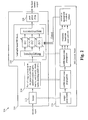
- FIG. 2 illustrates a block diagram of an image denoising system 200.
- the image denoising system 200 is divided into two large blocks, a main image processing pipeline 210 including a Noise Reduction (NR) block 216, and an NR control unit 250 which includes an image sensor noise model and noise propagation components.
- NR Noise Reduction
- an imager 212 acquires an image from the camera input such as by a user taking a picture.
- Imaging components 214 that perform image processing such as gain, matrix and filters which vary shooting conditions are coupled to the imager 212.
- the NR block 216 is coupled to the imaging components 214.
- the NR block 216 splits the image with noise data bands, uses thresholds to filter out the noise in each band and then reconstructs the image without the noise or at least with reduced noise.
- a post-processing component 218 processes the image after it is reconstructed, and ultimately, the final image is output.
- some of the components above are implemented in software using a processor, for example, the imaging components 214, the NR block 216 and the post-processing component 218. In some embodiments the components are implemented in hardware.
- Extended BB is referred to in pending U.S. Patent App. No. 11/731,261 , entitled METHOD OF AND APPARATUS FOR ANALYZING NOISE IN A SIGNAL PROCESSING SYSTEM, incorporated herein by reference.
- the NR control unit 250 is implemented on an embedded processor. The NR control unit 250 ultimately determines the thresholds for the band-wise noise so that the band-split based NR block 216 is able to filter out the noise appropriately.
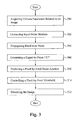
- FIG. 3 illustrates a flowchart of the procedure for denoising using the image denoising system.
- camera parameters are acquired. This step is in order to have necessary information to calculate noise amount at a node of denoising.
- some image process parameters are adaptively updated depending on shooting conditions. These parameters are, for example, amplifier gain which changes depending on scene luminance, auto-white balancing gains which change depending on chromaticity of illumination, edge enhancement gain which is able to be reduced under a dark and noisy environment and color correction matrices parameters which is able to change to maintain color constancy over various illuminations. The changes in these parameters are able to significantly affect noise characteristics at the node of denoising.
- These parameters are preferably all taken into account. These parameters are usually available at the on-camera microprocessor and are able to be used when the image denoising system is implemented on a camera. Or, these parameters are able to also be made available via header information in recorded images and are able to be used when the image denoising system is implemented as a part of image rendering software that runs on personal computers.
- step 302 input noise matrices are computed.
- the image pipeline input noise image sensor output noise
- a noise model equation (1) and constants a, b and c ) and value x in equation (1) are needed.
- constants a, b and c are able to be specified either by measurement or by theoretical derivation.
- the value x is able to be in any unit, such as electron count, voltage or digital code value while constants a, b and c should change accordingly. Some of, or all of these constants are a function of programmable amplifier gain.
- the value of x in digital code value is able to be readily known by monitoring pixel values that flow in the image pipeline; but in this implementation, an alternative way is taken, which is to have a set of representative values and to store the values as a signal-to-noise mapping data.
- the value x (each component in a vector, (r, g, b) for instance, in case of a primary-color camera system) in arbitrary units is calculated by integrating the element-wise product of camera, illumination and representative color patch spectral sensitivity, emission and reflectance distribution, respectively. Illumination estimation is running in general consumer cameras, thus this estimated illumination for computation is able to be used. For the representative color patch set, a Macbeth ColorChecker is often used.
- an auto-exposure algorithm that is also running on-camera, information related to absolute luminance of incident light (e.g. absolute number of photoelectrons) at the image sensor is able to be known, and the value x is known in a specified unit.
- ⁇ input ⁇ r 0 0 0 ⁇ g 0 0 0 ⁇ b
- diagonal elements are computed by equation (1).
- it is able to be assumed off-diagonal elements of the noise matrix are zero because inter-pixel noise correlation is able to be considered negligibly small in most image sensors.
- band-wise noise is propagated.
- the noise propagation method disclosed in pending U.S. Patent App. No. 11/731,261 , entitled METHOD OF AND APPARATUS FOR ANALYZING NOISE IN A SIGNAL PROCESSING SYSTEM, incorporated herein by reference, is able to take into account important signal operations, linear, nonlinear and spatial transformations, that are often used in a camera signal processing pipeline and is able to precisely predict noise that propagates along the pipeline.
- the equation (2) is band-split into N bands. As a result, the equation (2) becomes a band-wise expression of a noise matrix, whose size is 3N x 3N. Then, by applying a calculation explained in U.S. Patent App. No.
- band-wise noise matrices are possible at an arbitrary signal processing node (YCbCr for example), where the denoising algorithm is applied. Noise propagation is repeated for the number of patches. In the Macbeth ColorChecker's case, for example, it is 24. Thus, there are 24 band-wise noise matrices, where N is the number of bands. At the same time, to be used in the next step, signal propagation is also performed, and a set of 24 x 3 signal values is stored.
- a three dimensional signal-to-noise Look-Up Table (LUT) is generated.
- the three dimensional LUT is formed in order to correlate signal value and noise value. Any known method for generating a rectangular raster set from randomly scattered representative points is able to be used.
- pixel-by-pixel noise amount prediction occurs.
- this step occurs in real-time.
- Pixel value (YCbCr, for example) is input to the LUT, and the input pixel value is converted to a predicted noise amount.
- the LUT maps signal value to band-wise noise matrices. Band-wise noise matrices are interpolated or extrapolated, according to the input signal value. To avoid unnecessary fluctuation of the noise amount prediction, low-pass filters may be applied to the LUT input signal.
- step 310 pixel-by-pixel threshold control occurs. Since the noise amount of the input pixel is accurately predicted, the denoising process is able to have appropriate threshold value control. For example, the predicted noise amount is multiplied by a factor of three, then used as the threshold value.
- the computation does not have to be real-time (in other words, pixel-rate calculation rate is not necessary).
- the LUT has to be updated only when a shooting condition (e.g. scene luminance, illumination and so on) changes.
- the computation amount for generating the LUT is reasonably small, thus it is possible to implement the algorithm in an embedded microprocessor in a digital camcorder or a camera, where shooting condition parameters are readily available.
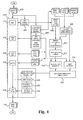
- FIG. 4 illustrates a flowchart of the procedure for denoising using the image denoising system including additional steps.
- step 400 raw image data is input such as by being acquired by a camera when a user takes a picture.
- the box 430 contains standard camera image pipeline processes such as gain 432, white balance 434, color matrix 436, gamma 438, and noise reduction 440.
- camera parameters are acquired in the step 402, where an auto exposure algorithm runs and in the step 404, where a white balancing algorithm runs. Within the white balancing algorithm is an illumination estimation algorithm and a white balance gain setup. From the auto exposure algorithm, noise model constants are computed in the step 406.
- illumination spectra, sensor spectra and Macbeth spectra go on to computing image values for a Macbeth Checker in the step 408.
- the noise model constants and image values from the steps 406 and 408 respectively are used to compute noise matrices for the Macbeth Checker in the step 410.
- the noise matrices are split into bands as described previously.
- Color matrix values and a gamma correction table are used in conjunction with the band-split noise matrices to perform band-wise noise propagation in the step 414.
- the color matrix values and the gamma correction table is also used with the image values for the Macbeth Checker for signal propagation in the step 416.
- a grid-raster 3D (signal-to-noise) LUT is generated, in the step 418.
- table lookup occurs in the step 420, interpolation/extrapolation occurs in the step 422 and the data is converted into thresholds in the step 424; all three steps occur in real-time.
- the noise is reduced within the image pipeline in the step 440.
- an image with reduced noise is output in the step 442.
- a user takes a picture with a digital camera or a movie with a digital camcorder.
- the data is processed by hardware/software components which perform standard imaging processing in addition to the denoising process described herein.
- the denoising process includes splitting the data including noise into bands, filtering each band whereby a threshold is used for each band and then reconstructing the data with minimized noise. After the noise is minimized or eliminated, post-processing occurs as well to produce a clear, denoised image or video.
- an imaging device such as a camera or camcorder implements the required hardware and/or software for band-wise denoising.
- the imaging device that is properly configured automatically handles the splitting of the noise into bands, predicting and propagating the noise and ultimately minimizing or removing the noise. The result is a much less noisy image or video.
- an average image level is detected at a sensor for each color channel in a set of color channels.
- the average noise level is then estimated for each color channel.
- Noise is predicted at the node where denoising will be performed.
- the threshold of the denoising method is then able to be accurately controlled.
- a peak-white image level is detected at the image sensor for each color channel in the set of color channels. Then, image levels for a set of representative colors are predicted. The noise level of each color patch and each color channel is computed. Noise at the node where denoising will be performed is then predicted.
- a 3-D look-up-table (LUT) is generated to correlate signal level to noise level.
- the threshold setting is then able to be adaptively controlled.
- a pixel-by-pixel noise propagation pipeline is implemented, which works in parallel with the image pipeline.
Landscapes
- Engineering & Computer Science (AREA)
- Multimedia (AREA)
- Signal Processing (AREA)
- Physics & Mathematics (AREA)
- General Physics & Mathematics (AREA)
- Theoretical Computer Science (AREA)
- Image Processing (AREA)
- Studio Devices (AREA)
- Facsimile Image Signal Circuits (AREA)
- Picture Signal Circuits (AREA)
- Color Television Image Signal Generators (AREA)
Priority Applications (1)
| Application Number | Priority Date | Filing Date | Title |
|---|---|---|---|
| EP10196037A EP2360906A3 (de) | 2007-03-29 | 2008-03-27 | Verfahren und Vorrichtung zur Entstörung von Bildern |
Applications Claiming Priority (1)
| Application Number | Priority Date | Filing Date | Title |
|---|---|---|---|
| US11/731,542 US8711249B2 (en) | 2007-03-29 | 2007-03-29 | Method of and apparatus for image denoising |
Publications (2)
| Publication Number | Publication Date |
|---|---|
| EP1978724A2 true EP1978724A2 (de) | 2008-10-08 |
| EP1978724A3 EP1978724A3 (de) | 2009-03-11 |
Family
ID=39709297
Family Applications (2)
| Application Number | Title | Priority Date | Filing Date |
|---|---|---|---|
| EP08251095A Withdrawn EP1978724A3 (de) | 2007-03-29 | 2008-03-27 | Verfahren und Vorrichtung zu Entstörung von Bildern |
| EP10196037A Withdrawn EP2360906A3 (de) | 2007-03-29 | 2008-03-27 | Verfahren und Vorrichtung zur Entstörung von Bildern |
Family Applications After (1)
| Application Number | Title | Priority Date | Filing Date |
|---|---|---|---|
| EP10196037A Withdrawn EP2360906A3 (de) | 2007-03-29 | 2008-03-27 | Verfahren und Vorrichtung zur Entstörung von Bildern |
Country Status (4)
| Country | Link |
|---|---|
| US (1) | US8711249B2 (de) |
| EP (2) | EP1978724A3 (de) |
| JP (1) | JP2008252911A (de) |
| CN (1) | CN101282417A (de) |
Cited By (3)
| Publication number | Priority date | Publication date | Assignee | Title |
|---|---|---|---|---|
| WO2014011923A1 (en) * | 2012-07-11 | 2014-01-16 | Google Inc. | Abstract camera pipeline for uniform cross-device control of image capture and processing |
| EP2132887A4 (de) * | 2007-03-29 | 2015-04-01 | Sony Corp | Verfahren und vorrichtung zum analysieren von rauschen in einem signalverarbeitungssystem |
| WO2016207776A1 (en) * | 2015-06-22 | 2016-12-29 | Omnisens Sa | A method for reducing noise in measurements taken by a distributed sensor |
Families Citing this family (43)
| Publication number | Priority date | Publication date | Assignee | Title |
|---|---|---|---|---|
| US7421374B2 (en) * | 2005-11-17 | 2008-09-02 | Honeywell International Inc. | Apparatus and method for analyzing model quality in a process control environment |
| JP5032911B2 (ja) * | 2007-07-31 | 2012-09-26 | キヤノン株式会社 | 画像処理装置及び画像処理方法 |
| US8374457B1 (en) | 2008-12-08 | 2013-02-12 | Adobe Systems Incorporated | System and method for interactive image-noise separation |
| JP5197423B2 (ja) * | 2009-02-18 | 2013-05-15 | オリンパス株式会社 | 画像処理装置 |
| US20110075935A1 (en) * | 2009-09-25 | 2011-03-31 | Sony Corporation | Method to measure local image similarity based on the l1 distance measure |
| KR20110048922A (ko) * | 2009-11-03 | 2011-05-12 | 삼성전자주식회사 | 이미지 센서의 통합 노이즈 모델링 방법 및 이를 이용하는 노이즈 저감 방법 |
| US8711250B2 (en) | 2011-02-09 | 2014-04-29 | Olympus Corporation | Image signal processing apparatus and image signal processing method |
| US9014490B2 (en) * | 2011-02-15 | 2015-04-21 | Sony Corporation | Method to measure local image similarity and its application in image processing |
| CN102685510A (zh) * | 2011-03-07 | 2012-09-19 | 奥林巴斯株式会社 | 图像信号处理装置及图像信号处理方法 |
| JP6035718B2 (ja) * | 2011-09-07 | 2016-11-30 | カシオ計算機株式会社 | 投影装置、投影方法及びプログラム |
| US20130282338A1 (en) * | 2012-04-19 | 2013-10-24 | Microchip Technology Incorporated | Method and System for Energy Efficient Measurement of Sensor Signals |
| US8913844B2 (en) * | 2012-06-05 | 2014-12-16 | The United States Of America As Represented By The Administrator Of The National Aeronautics Space Administration | Reducing sensor and readout circuitry noise in digital domain using reference pixels |
| WO2014070273A1 (en) * | 2012-11-02 | 2014-05-08 | Board Of Regents, The University Of Texas System | Recursive conditional means image denoising |
| KR101459034B1 (ko) | 2013-07-11 | 2014-11-07 | 숭실대학교산학협력단 | 영상 처리 시스템 및 방법 |
| US9071401B2 (en) | 2013-10-17 | 2015-06-30 | Cisco Technology, Inc. | Pilot-less noise estimation |
| US9184878B2 (en) | 2013-10-17 | 2015-11-10 | Cisco Technology, Inc. | Non-disruptive network noise measurement |
| US9667842B2 (en) * | 2014-08-30 | 2017-05-30 | Apple Inc. | Multi-band YCbCr locally-adaptive noise modeling and noise reduction based on scene metadata |
| US9525804B2 (en) | 2014-08-30 | 2016-12-20 | Apple Inc. | Multi-band YCbCr noise modeling and noise reduction based on scene metadata |
| CN104796583B (zh) * | 2015-05-14 | 2017-11-21 | 上海兆芯集成电路有限公司 | 相机噪声模型产生及使用方法以及使用该方法的装置 |
| US9626745B2 (en) | 2015-09-04 | 2017-04-18 | Apple Inc. | Temporal multi-band noise reduction |
| US9639920B2 (en) * | 2015-09-14 | 2017-05-02 | Qualcomm Incorporated | Dither directed LUT output value interpolation |
| US20170150014A1 (en) * | 2015-11-24 | 2017-05-25 | Le Holdings (Beijing) Co., Ltd. | Method and electronic device for video denoising and detail enhancement |
| US10282831B2 (en) * | 2015-12-28 | 2019-05-07 | Novatek Microelectronics Corp. | Method and apparatus for motion compensated noise reduction |
| US10043243B2 (en) * | 2016-01-22 | 2018-08-07 | Siemens Healthcare Gmbh | Deep unfolding algorithm for efficient image denoising under varying noise conditions |
| WO2017132600A1 (en) * | 2016-01-29 | 2017-08-03 | Intuitive Surgical Operations, Inc. | Light level adaptive filter and method |
| CN105913403A (zh) * | 2016-06-27 | 2016-08-31 | 乐视控股(北京)有限公司 | 图像降噪方法及系统 |
| US10482339B2 (en) | 2016-12-09 | 2019-11-19 | United States Of America As Represented By The Secretary Of The Air Force | Quantifying computer vision algorithm performance in the presence of system uncertainty |
| EP3586303B1 (de) * | 2017-02-24 | 2025-08-20 | Sunnybrook Research Institute | Systeme und verfahren zur rauschminderung in der bildgebung |
| CN108391067B (zh) * | 2018-05-10 | 2023-09-29 | 浙江芯劢微电子股份有限公司 | 一种基于rgb-ir传感器的去噪增强装置及方法 |
| JP7311994B2 (ja) | 2019-03-27 | 2023-07-20 | キヤノン株式会社 | 画像処理装置、撮像装置、画像処理方法、及びプログラム |
| CN111050026B (zh) * | 2019-12-13 | 2022-08-19 | 努比亚技术有限公司 | 一种图像降噪控制方法、终端及计算机可读存储介质 |
| WO2021177758A1 (en) | 2020-03-04 | 2021-09-10 | Samsung Electronics Co., Ltd. | Methods and systems for denoising media using contextual information of the media |
| US11328390B2 (en) * | 2020-05-13 | 2022-05-10 | Ambu A/S | Method for adaptive denoising and sharpening and visualization systems implementing the method |
| DE102021103095A1 (de) | 2021-02-10 | 2022-08-11 | Carl Zeiss GOM Metrology GmbH | Bildverarbeitende Messeinrichtung und Verfahren zur digitalen Übertragung von Bildinformationen |
| CN113066033B (zh) * | 2021-04-19 | 2023-11-17 | 智领高新科技发展(北京)有限公司 | 一种彩色图像的多阶段去噪系统及方法 |
| CN115482156B (zh) * | 2021-05-31 | 2026-04-14 | 北京小米移动软件有限公司 | 图像处理方法及装置、图像处理设备及存储介质 |
| US20240354910A1 (en) * | 2021-07-07 | 2024-10-24 | Qualcomm Incorporated | Cascade image processing for noise reduction |
| CN113763271B (zh) * | 2021-09-03 | 2024-06-07 | 北京理工大学 | 一种基于物理噪声模型的高质量光谱去噪方法 |
| KR102770799B1 (ko) * | 2021-10-06 | 2025-02-21 | 삼성전자주식회사 | 영상 개선 방법 및 장치 |
| CN115082335B (zh) * | 2022-06-06 | 2024-07-19 | 北京理工大学 | 一种基于噪声建模的图像去噪方法 |
| US12327338B2 (en) * | 2022-10-20 | 2025-06-10 | Carnegie Mellon University | Methods for improving datasets for skeleton-based action detection |
| CN116233630B (zh) * | 2023-05-05 | 2023-07-14 | 深圳市和惠源电子科技有限公司 | 一种cmos传感器电源纹波噪声去除的方法、设备及存储介质 |
| CN117726542B (zh) * | 2024-02-18 | 2024-06-21 | 北京理工大学 | 基于扩散模型的可控噪声去除方法及系统 |
Citations (1)
| Publication number | Priority date | Publication date | Assignee | Title |
|---|---|---|---|---|
| WO2005029846A1 (en) | 2003-09-23 | 2005-03-31 | Koninklijke Philips Electronics, N.V. | Video de -noising algorithm using inband motion-compensated temporal filtering |
Family Cites Families (45)
| Publication number | Priority date | Publication date | Assignee | Title |
|---|---|---|---|---|
| US3971065A (en) | 1975-03-05 | 1976-07-20 | Eastman Kodak Company | Color imaging array |
| FR2389277A1 (fr) | 1977-04-29 | 1978-11-24 | Ibm France | Procede de quantification a allocation dynamique du taux de bits disponible, et dispositif de mise en oeuvre dudit procede |
| JPS62290268A (ja) * | 1986-06-10 | 1987-12-17 | Matsushita Electric Ind Co Ltd | 雑音除去装置 |
| US5012333A (en) | 1989-01-05 | 1991-04-30 | Eastman Kodak Company | Interactive dynamic range adjustment system for printing digital images |
| US6289308B1 (en) | 1990-06-01 | 2001-09-11 | U.S. Philips Corporation | Encoded wideband digital transmission signal and record carrier recorded with such a signal |
| JP2751447B2 (ja) * | 1989-08-22 | 1998-05-18 | 松下電器産業株式会社 | ノイズ低減装置 |
| JPH0556309A (ja) | 1991-08-27 | 1993-03-05 | Onkyo Corp | 雑音低減回路 |
| JPH07249101A (ja) | 1994-03-08 | 1995-09-26 | Hitachi Eng Co Ltd | ニューロ利用の文字認識装置及び輝度正規化方法 |
| JP3364342B2 (ja) * | 1994-12-19 | 2003-01-08 | 松下電器産業株式会社 | 雑音除去装置 |
| JP3790906B2 (ja) * | 1996-03-25 | 2006-06-28 | オリンパス株式会社 | 撮像装置 |
| US6098038A (en) | 1996-09-27 | 2000-08-01 | Oregon Graduate Institute Of Science & Technology | Method and system for adaptive speech enhancement using frequency specific signal-to-noise ratio estimates |
| FI104521B (fi) | 1997-01-30 | 2000-02-15 | Nokia Multimedia Network Termi | Menetelmä kuvasekvenssien kontrastin parantamiseksi |
| EP0878790A1 (de) | 1997-05-15 | 1998-11-18 | Hewlett-Packard Company | Sprachkodiersystem und Verfahren |
| US6226321B1 (en) | 1998-05-08 | 2001-05-01 | The United States Of America As Represented By The Secretary Of The Air Force | Multichannel parametric adaptive matched filter receiver |
| US7209567B1 (en) | 1998-07-09 | 2007-04-24 | Purdue Research Foundation | Communication system with adaptive noise suppression |
| US6643398B2 (en) | 1998-08-05 | 2003-11-04 | Minolta Co., Ltd. | Image correction device, image correction method and computer program product in memory for image correction |
| JP4596496B2 (ja) * | 1998-11-18 | 2010-12-08 | ソニー株式会社 | ノイズ除去装置およびノイズ除去方法 |
| US6600833B1 (en) * | 1999-07-23 | 2003-07-29 | Intel Corporation | Methodology for color correction with noise regulation |
| US6480610B1 (en) | 1999-09-21 | 2002-11-12 | Sonic Innovations, Inc. | Subband acoustic feedback cancellation in hearing aids |
| US6813389B1 (en) | 1999-12-15 | 2004-11-02 | Eastman Kodak Company | Digital image processing method and system including noise reduction and tone scale adjustments |
| EP1124384A1 (de) | 2000-02-10 | 2001-08-16 | Sony Corporation | Informationsverarbeitungssystem mit adaptivem Klassifizierer für komprimierte Bilddaten |
| JP3758452B2 (ja) | 2000-02-28 | 2006-03-22 | コニカミノルタビジネステクノロジーズ株式会社 | 記録媒体、並びに、画像処理装置および画像処理方法 |
| US7173657B2 (en) | 2000-03-24 | 2007-02-06 | Rochester Institute Of Technology | System and method for analyzing, optimizing and/or designing spectral sensitivity curves for an imaging device |
| CA2309002A1 (en) * | 2000-05-23 | 2001-11-23 | Jonathan Martin Shekter | Digital film grain reduction |
| US6377637B1 (en) | 2000-07-12 | 2002-04-23 | Andrea Electronics Corporation | Sub-band exponential smoothing noise canceling system |
| TW533406B (en) | 2001-09-28 | 2003-05-21 | Ind Tech Res Inst | Speech noise elimination method |
| JP4406195B2 (ja) | 2001-10-09 | 2010-01-27 | セイコーエプソン株式会社 | 画像データの出力画像調整 |
| AU2002343629A1 (en) | 2001-11-06 | 2003-05-19 | Rochester Institute Of Technology | Method and system for optimizing a selection of spectral sensitivities |
| EP1345172A1 (de) | 2002-02-26 | 2003-09-17 | Sony International (Europe) GmbH | Kontrastverbesserung in digitalen Bildern |
| JP2003284084A (ja) | 2002-03-20 | 2003-10-03 | Sony Corp | 画像処理装置および方法、並びに画像処理装置の製造方法 |
| US6987881B2 (en) | 2002-04-26 | 2006-01-17 | Keio University | Automatic visibility improvement method for digital image |
| JP4133029B2 (ja) | 2002-06-25 | 2008-08-13 | 富士フイルム株式会社 | 画像処理方法および装置 |
| JP4224996B2 (ja) * | 2002-07-25 | 2009-02-18 | パナソニック株式会社 | 撮像装置 |
| JP3762725B2 (ja) * | 2002-08-22 | 2006-04-05 | オリンパス株式会社 | 撮像システムおよび画像処理プログラム |
| JP3861808B2 (ja) | 2002-12-25 | 2006-12-27 | ソニー株式会社 | 撮像装置 |
| US7636436B2 (en) | 2003-05-15 | 2009-12-22 | At&T Intellectual Property Ii, L.P. | Method for the performance testing of echo cancellers using an artificial segmented test signal |
| KR100510532B1 (ko) * | 2003-06-10 | 2005-08-26 | 삼성전자주식회사 | 베이어 패턴 컬러 신호에 대한 적응형 노이즈 제거 필터,이를 구비한 디지털 영상 신호 처리 장치, 및 그 방법 |
| JP2005303803A (ja) | 2004-04-14 | 2005-10-27 | Olympus Corp | 撮像装置と画像記録媒体、および画像処理装置ならびに画像処理プログラムとその記録媒体 |
| WO2007002406A2 (en) | 2005-06-20 | 2007-01-04 | The Trustees Of Columbia University In The City Of New York | Interactive diagnostic display system |
| JP4869653B2 (ja) * | 2005-08-03 | 2012-02-08 | オリンパス株式会社 | 画像処理装置 |
| US7791656B2 (en) | 2005-08-16 | 2010-09-07 | Konica Minolta Holdings, Inc. | Image sensing apparatus and image processing method |
| KR101128454B1 (ko) | 2005-11-10 | 2012-03-23 | 삼성전자주식회사 | 콘트라스트 향상 방법 및 장치 |
| KR100756318B1 (ko) | 2006-01-16 | 2007-09-06 | 삼성전자주식회사 | 이득 조절 가능한 절단 빈도함수 평활화를 이용한 영상처리 방법 및 시스템 |
| KR20090008745A (ko) | 2007-07-18 | 2009-01-22 | 삼성전자주식회사 | 히스토그램 등화 장치 및 방법 |
| US20090161982A1 (en) | 2007-12-19 | 2009-06-25 | Nokia Corporation | Restoring images |
-
2007
- 2007-03-29 US US11/731,542 patent/US8711249B2/en not_active Expired - Fee Related
-
2008
- 2008-03-27 EP EP08251095A patent/EP1978724A3/de not_active Withdrawn
- 2008-03-27 EP EP10196037A patent/EP2360906A3/de not_active Withdrawn
- 2008-03-28 JP JP2008114515A patent/JP2008252911A/ja active Pending
- 2008-03-31 CN CNA2008100880805A patent/CN101282417A/zh active Pending
Patent Citations (1)
| Publication number | Priority date | Publication date | Assignee | Title |
|---|---|---|---|---|
| WO2005029846A1 (en) | 2003-09-23 | 2005-03-31 | Koninklijke Philips Electronics, N.V. | Video de -noising algorithm using inband motion-compensated temporal filtering |
Non-Patent Citations (1)
| Title |
|---|
| JANSEN MAARTEN ET AL.: "Image de-noising by integer wavelet transforms and generalized cross validation", MEDICAL PHYSICS, vol. 26, no. 4, 1 April 1999 (1999-04-01), XP012010758, DOI: doi:10.1118/1.598562 |
Cited By (7)
| Publication number | Priority date | Publication date | Assignee | Title |
|---|---|---|---|---|
| EP2132887A4 (de) * | 2007-03-29 | 2015-04-01 | Sony Corp | Verfahren und vorrichtung zum analysieren von rauschen in einem signalverarbeitungssystem |
| WO2014011923A1 (en) * | 2012-07-11 | 2014-01-16 | Google Inc. | Abstract camera pipeline for uniform cross-device control of image capture and processing |
| CN104471510A (zh) * | 2012-07-11 | 2015-03-25 | 谷歌公司 | 用于图像采集和处理的统一跨设备控制的抽象相机管道 |
| US9030571B2 (en) | 2012-07-11 | 2015-05-12 | Google Inc. | Abstract camera pipeline for uniform cross-device control of image capture and processing |
| US9374543B2 (en) | 2012-07-11 | 2016-06-21 | Google Inc. | Abstract camera pipeline for uniform cross-device control of image capture and processing |
| CN104471510B (zh) * | 2012-07-11 | 2017-06-09 | 谷歌公司 | 用于图像采集和处理的统一跨设备控制的抽象相机管道 |
| WO2016207776A1 (en) * | 2015-06-22 | 2016-12-29 | Omnisens Sa | A method for reducing noise in measurements taken by a distributed sensor |
Also Published As
| Publication number | Publication date |
|---|---|
| CN101282417A (zh) | 2008-10-08 |
| US20080239094A1 (en) | 2008-10-02 |
| US8711249B2 (en) | 2014-04-29 |
| EP2360906A2 (de) | 2011-08-24 |
| JP2008252911A (ja) | 2008-10-16 |
| EP2360906A3 (de) | 2012-08-29 |
| EP1978724A3 (de) | 2009-03-11 |
Similar Documents
| Publication | Publication Date | Title |
|---|---|---|
| US8711249B2 (en) | Method of and apparatus for image denoising | |
| US12238427B2 (en) | Global tone mapping | |
| US9754349B2 (en) | Prevention of highlight clipping | |
| US9386288B2 (en) | Compensating for sensor saturation and microlens modulation during light-field image processing | |
| KR101454609B1 (ko) | 이미지 프로세싱 방법 및 장치 | |
| US9635332B2 (en) | Saturated pixel recovery in light-field images | |
| CN102970549B (zh) | 图像处理方法及装置 | |
| KR102567860B1 (ko) | 개선된 역 톤 매핑 방법 및 대응하는 디바이스 | |
| JP4645921B2 (ja) | 画像信号処理装置および方法、プログラム、並びに撮像装置 | |
| TWI549511B (zh) | 影像感測裝置及色彩校正矩陣修正方法與查找表建立方法 | |
| WO2019104047A1 (en) | Global tone mapping | |
| US7327504B2 (en) | Method of detecting clipped image pixels | |
| JP2009100302A (ja) | 画像処理装置、画像処理方法、プログラム、撮像装置、及び撮像方法 | |
| US7773257B2 (en) | Color metric for halo artifacts | |
| JP2013179485A (ja) | 画像処理装置及びその制御方法 | |
| KR101005625B1 (ko) | 카메라 색상 특성 곡선을 이용한 영상 밝기 변화에 따른 색 보정 방법 | |
| Burns | Image quality concepts | |
| JP2004235700A (ja) | 画像処理装置、画像処理方法、およびそのプログラム | |
| JP6543786B2 (ja) | 画像処理装置および画像処理方法 | |
| Ponomarenko et al. | Color image lossy compression based on blind evaluation and prediction of noise characteristics | |
| JP2004096291A (ja) | 画像処理装置、画像処理方法、及びそのプログラム並びにそのプログラムを記録した記録媒体 |
Legal Events
| Date | Code | Title | Description |
|---|---|---|---|
| PUAI | Public reference made under article 153(3) epc to a published international application that has entered the european phase |
Free format text: ORIGINAL CODE: 0009012 |
|
| AK | Designated contracting states |
Kind code of ref document: A2 Designated state(s): AT BE BG CH CY CZ DE DK EE ES FI FR GB GR HR HU IE IS IT LI LT LU LV MC MT NL NO PL PT RO SE SI SK TR |
|
| AX | Request for extension of the european patent |
Extension state: AL BA MK RS |
|
| PUAL | Search report despatched |
Free format text: ORIGINAL CODE: 0009013 |
|
| AK | Designated contracting states |
Kind code of ref document: A3 Designated state(s): AT BE BG CH CY CZ DE DK EE ES FI FR GB GR HR HU IE IS IT LI LT LU LV MC MT NL NO PL PT RO SE SI SK TR |
|
| AX | Request for extension of the european patent |
Extension state: AL BA MK RS |
|
| 17P | Request for examination filed |
Effective date: 20090827 |
|
| AKX | Designation fees paid |
Designated state(s): DE FR GB NL |
|
| 17Q | First examination report despatched |
Effective date: 20091019 |
|
| STAA | Information on the status of an ep patent application or granted ep patent |
Free format text: STATUS: THE APPLICATION IS DEEMED TO BE WITHDRAWN |
|
| 18D | Application deemed to be withdrawn |
Effective date: 20131001 |