EP1978005A1 - Materiau de faible adhesion, moules pour le moulage de resines et materiau antitache - Google Patents
Materiau de faible adhesion, moules pour le moulage de resines et materiau antitache Download PDFInfo
- Publication number
- EP1978005A1 EP1978005A1 EP06843407A EP06843407A EP1978005A1 EP 1978005 A1 EP1978005 A1 EP 1978005A1 EP 06843407 A EP06843407 A EP 06843407A EP 06843407 A EP06843407 A EP 06843407A EP 1978005 A1 EP1978005 A1 EP 1978005A1
- Authority
- EP
- European Patent Office
- Prior art keywords
- low adhesion
- oxide
- materials
- sro
- produced
- Prior art date
- Legal status (The legal status is an assumption and is not a legal conclusion. Google has not performed a legal analysis and makes no representation as to the accuracy of the status listed.)
- Withdrawn
Links
- 239000000463 material Substances 0.000 title claims abstract description 488
- 229920005989 resin Polymers 0.000 title claims abstract description 150
- 239000011347 resin Substances 0.000 title claims abstract description 150
- 238000000465 moulding Methods 0.000 title claims abstract description 124
- RUDFQVOCFDJEEF-UHFFFAOYSA-N yttrium(III) oxide Inorganic materials [O-2].[O-2].[O-2].[Y+3].[Y+3] RUDFQVOCFDJEEF-UHFFFAOYSA-N 0.000 claims abstract description 277
- 239000006104 solid solution Substances 0.000 claims abstract description 87
- 239000000126 substance Substances 0.000 claims abstract description 87
- MRELNEQAGSRDBK-UHFFFAOYSA-N lanthanum oxide Inorganic materials [O-2].[O-2].[O-2].[La+3].[La+3] MRELNEQAGSRDBK-UHFFFAOYSA-N 0.000 claims abstract description 83
- KTUFCUMIWABKDW-UHFFFAOYSA-N oxo(oxolanthaniooxy)lanthanum Chemical compound O=[La]O[La]=O KTUFCUMIWABKDW-UHFFFAOYSA-N 0.000 claims abstract description 80
- 239000002131 composite material Substances 0.000 claims description 67
- 239000000203 mixture Substances 0.000 claims description 42
- 239000012530 fluid Substances 0.000 claims description 30
- 239000002689 soil Substances 0.000 claims description 23
- 239000005416 organic matter Substances 0.000 claims description 8
- 239000000853 adhesive Substances 0.000 abstract description 18
- 230000001070 adhesive effect Effects 0.000 abstract description 18
- 230000014759 maintenance of location Effects 0.000 abstract description 6
- IATRAKWUXMZMIY-UHFFFAOYSA-N strontium oxide Inorganic materials [O-2].[Sr+2] IATRAKWUXMZMIY-UHFFFAOYSA-N 0.000 description 69
- 229910002056 binary alloy Inorganic materials 0.000 description 66
- 239000003822 epoxy resin Substances 0.000 description 19
- 238000010587 phase diagram Methods 0.000 description 19
- 229920000647 polyepoxide Polymers 0.000 description 19
- 238000000034 method Methods 0.000 description 13
- -1 polytetrafluoroethylene Polymers 0.000 description 12
- 239000000758 substrate Substances 0.000 description 10
- 238000002474 experimental method Methods 0.000 description 9
- 238000010438 heat treatment Methods 0.000 description 9
- CURLTUGMZLYLDI-UHFFFAOYSA-N Carbon dioxide Chemical compound O=C=O CURLTUGMZLYLDI-UHFFFAOYSA-N 0.000 description 6
- 239000000654 additive Substances 0.000 description 6
- 230000000996 additive effect Effects 0.000 description 6
- 230000000694 effects Effects 0.000 description 6
- 150000002500 ions Chemical class 0.000 description 6
- 229910052746 lanthanum Inorganic materials 0.000 description 6
- 229910052712 strontium Inorganic materials 0.000 description 6
- 150000001768 cations Chemical class 0.000 description 5
- 230000014509 gene expression Effects 0.000 description 5
- 229910052751 metal Inorganic materials 0.000 description 5
- 239000002184 metal Substances 0.000 description 5
- 239000011368 organic material Substances 0.000 description 5
- 229910001315 Tool steel Inorganic materials 0.000 description 4
- 238000005229 chemical vapour deposition Methods 0.000 description 4
- 230000007423 decrease Effects 0.000 description 4
- 238000005240 physical vapour deposition Methods 0.000 description 4
- 229910002092 carbon dioxide Inorganic materials 0.000 description 3
- 239000001569 carbon dioxide Substances 0.000 description 3
- 230000007246 mechanism Effects 0.000 description 3
- 229910052760 oxygen Inorganic materials 0.000 description 3
- 239000001301 oxygen Substances 0.000 description 3
- 239000000843 powder Substances 0.000 description 3
- 229920001187 thermosetting polymer Polymers 0.000 description 3
- 238000001721 transfer moulding Methods 0.000 description 3
- BVKZGUZCCUSVTD-UHFFFAOYSA-L Carbonate Chemical compound [O-]C([O-])=O BVKZGUZCCUSVTD-UHFFFAOYSA-L 0.000 description 2
- 229910010293 ceramic material Inorganic materials 0.000 description 2
- 239000011248 coating agent Substances 0.000 description 2
- 238000000576 coating method Methods 0.000 description 2
- 238000000748 compression moulding Methods 0.000 description 2
- 239000000945 filler Substances 0.000 description 2
- XLYOFNOQVPJJNP-UHFFFAOYSA-M hydroxide Chemical compound [OH-] XLYOFNOQVPJJNP-UHFFFAOYSA-M 0.000 description 2
- 230000001771 impaired effect Effects 0.000 description 2
- 238000001746 injection moulding Methods 0.000 description 2
- 229920001343 polytetrafluoroethylene Polymers 0.000 description 2
- 239000004810 polytetrafluoroethylene Substances 0.000 description 2
- 238000012545 processing Methods 0.000 description 2
- 238000007789 sealing Methods 0.000 description 2
- 229920002379 silicone rubber Polymers 0.000 description 2
- 239000004945 silicone rubber Substances 0.000 description 2
- 239000007787 solid Substances 0.000 description 2
- 229910001233 yttria-stabilized zirconia Inorganic materials 0.000 description 2
- 229910052769 Ytterbium Inorganic materials 0.000 description 1
- QVGXLLKOCUKJST-UHFFFAOYSA-N atomic oxygen Chemical compound [O] QVGXLLKOCUKJST-UHFFFAOYSA-N 0.000 description 1
- 239000004566 building material Substances 0.000 description 1
- 239000000919 ceramic Substances 0.000 description 1
- 238000006243 chemical reaction Methods 0.000 description 1
- 238000004140 cleaning Methods 0.000 description 1
- 238000000975 co-precipitation Methods 0.000 description 1
- 238000012937 correction Methods 0.000 description 1
- 230000003247 decreasing effect Effects 0.000 description 1
- 238000000151 deposition Methods 0.000 description 1
- 230000008021 deposition Effects 0.000 description 1
- 238000001035 drying Methods 0.000 description 1
- 150000004679 hydroxides Chemical class 0.000 description 1
- 230000010354 integration Effects 0.000 description 1
- 238000007733 ion plating Methods 0.000 description 1
- 239000007769 metal material Substances 0.000 description 1
- 238000007750 plasma spraying Methods 0.000 description 1
- 239000002904 solvent Substances 0.000 description 1
- 238000005507 spraying Methods 0.000 description 1
- 238000004544 sputter deposition Methods 0.000 description 1
- 230000006641 stabilisation Effects 0.000 description 1
- 238000011105 stabilization Methods 0.000 description 1
- LEDMRZGFZIAGGB-UHFFFAOYSA-L strontium carbonate Chemical compound [Sr+2].[O-]C([O-])=O LEDMRZGFZIAGGB-UHFFFAOYSA-L 0.000 description 1
- 229910000018 strontium carbonate Inorganic materials 0.000 description 1
- 238000013519 translation Methods 0.000 description 1
- UONOETXJSWQNOL-UHFFFAOYSA-N tungsten carbide Chemical compound [W+]#[C-] UONOETXJSWQNOL-UHFFFAOYSA-N 0.000 description 1
- 238000001771 vacuum deposition Methods 0.000 description 1
- XLYOFNOQVPJJNP-UHFFFAOYSA-N water Chemical compound O XLYOFNOQVPJJNP-UHFFFAOYSA-N 0.000 description 1
- NAWDYIZEMPQZHO-UHFFFAOYSA-N ytterbium Chemical compound [Yb] NAWDYIZEMPQZHO-UHFFFAOYSA-N 0.000 description 1
- 229910052727 yttrium Inorganic materials 0.000 description 1
- VWQVUPCCIRVNHF-UHFFFAOYSA-N yttrium atom Chemical compound [Y] VWQVUPCCIRVNHF-UHFFFAOYSA-N 0.000 description 1
Images


Classifications
-
- B—PERFORMING OPERATIONS; TRANSPORTING
- B29—WORKING OF PLASTICS; WORKING OF SUBSTANCES IN A PLASTIC STATE IN GENERAL
- B29C—SHAPING OR JOINING OF PLASTICS; SHAPING OF MATERIAL IN A PLASTIC STATE, NOT OTHERWISE PROVIDED FOR; AFTER-TREATMENT OF THE SHAPED PRODUCTS, e.g. REPAIRING
- B29C33/00—Moulds or cores; Details thereof or accessories therefor
- B29C33/56—Coatings, e.g. enameled or galvanised; Releasing, lubricating or separating agents
-
- B—PERFORMING OPERATIONS; TRANSPORTING
- B29—WORKING OF PLASTICS; WORKING OF SUBSTANCES IN A PLASTIC STATE IN GENERAL
- B29C—SHAPING OR JOINING OF PLASTICS; SHAPING OF MATERIAL IN A PLASTIC STATE, NOT OTHERWISE PROVIDED FOR; AFTER-TREATMENT OF THE SHAPED PRODUCTS, e.g. REPAIRING
- B29C33/00—Moulds or cores; Details thereof or accessories therefor
- B29C33/38—Moulds or cores; Details thereof or accessories therefor characterised by the material or the manufacturing process
-
- B—PERFORMING OPERATIONS; TRANSPORTING
- B29—WORKING OF PLASTICS; WORKING OF SUBSTANCES IN A PLASTIC STATE IN GENERAL
- B29C—SHAPING OR JOINING OF PLASTICS; SHAPING OF MATERIAL IN A PLASTIC STATE, NOT OTHERWISE PROVIDED FOR; AFTER-TREATMENT OF THE SHAPED PRODUCTS, e.g. REPAIRING
- B29C33/00—Moulds or cores; Details thereof or accessories therefor
- B29C33/56—Coatings, e.g. enameled or galvanised; Releasing, lubricating or separating agents
- B29C33/60—Releasing, lubricating or separating agents
-
- C—CHEMISTRY; METALLURGY
- C04—CEMENTS; CONCRETE; ARTIFICIAL STONE; CERAMICS; REFRACTORIES
- C04B—LIME, MAGNESIA; SLAG; CEMENTS; COMPOSITIONS THEREOF, e.g. MORTARS, CONCRETE OR LIKE BUILDING MATERIALS; ARTIFICIAL STONE; CERAMICS; REFRACTORIES; TREATMENT OF NATURAL STONE
- C04B35/00—Shaped ceramic products characterised by their composition; Ceramics compositions; Processing powders of inorganic compounds preparatory to the manufacturing of ceramic products
- C04B35/50—Shaped ceramic products characterised by their composition; Ceramics compositions; Processing powders of inorganic compounds preparatory to the manufacturing of ceramic products based on rare-earth compounds
-
- C—CHEMISTRY; METALLURGY
- C04—CEMENTS; CONCRETE; ARTIFICIAL STONE; CERAMICS; REFRACTORIES
- C04B—LIME, MAGNESIA; SLAG; CEMENTS; COMPOSITIONS THEREOF, e.g. MORTARS, CONCRETE OR LIKE BUILDING MATERIALS; ARTIFICIAL STONE; CERAMICS; REFRACTORIES; TREATMENT OF NATURAL STONE
- C04B35/00—Shaped ceramic products characterised by their composition; Ceramics compositions; Processing powders of inorganic compounds preparatory to the manufacturing of ceramic products
- C04B35/50—Shaped ceramic products characterised by their composition; Ceramics compositions; Processing powders of inorganic compounds preparatory to the manufacturing of ceramic products based on rare-earth compounds
- C04B35/505—Shaped ceramic products characterised by their composition; Ceramics compositions; Processing powders of inorganic compounds preparatory to the manufacturing of ceramic products based on rare-earth compounds based on yttrium oxide
-
- C—CHEMISTRY; METALLURGY
- C04—CEMENTS; CONCRETE; ARTIFICIAL STONE; CERAMICS; REFRACTORIES
- C04B—LIME, MAGNESIA; SLAG; CEMENTS; COMPOSITIONS THEREOF, e.g. MORTARS, CONCRETE OR LIKE BUILDING MATERIALS; ARTIFICIAL STONE; CERAMICS; REFRACTORIES; TREATMENT OF NATURAL STONE
- C04B35/00—Shaped ceramic products characterised by their composition; Ceramics compositions; Processing powders of inorganic compounds preparatory to the manufacturing of ceramic products
- C04B35/622—Forming processes; Processing powders of inorganic compounds preparatory to the manufacturing of ceramic products
- C04B35/64—Burning or sintering processes
- C04B35/645—Pressure sintering
-
- C—CHEMISTRY; METALLURGY
- C04—CEMENTS; CONCRETE; ARTIFICIAL STONE; CERAMICS; REFRACTORIES
- C04B—LIME, MAGNESIA; SLAG; CEMENTS; COMPOSITIONS THEREOF, e.g. MORTARS, CONCRETE OR LIKE BUILDING MATERIALS; ARTIFICIAL STONE; CERAMICS; REFRACTORIES; TREATMENT OF NATURAL STONE
- C04B2235/00—Aspects relating to ceramic starting mixtures or sintered ceramic products
- C04B2235/02—Composition of constituents of the starting material or of secondary phases of the final product
- C04B2235/30—Constituents and secondary phases not being of a fibrous nature
- C04B2235/32—Metal oxides, mixed metal oxides, or oxide-forming salts thereof, e.g. carbonates, nitrates, (oxy)hydroxides, chlorides
- C04B2235/3205—Alkaline earth oxides or oxide forming salts thereof, e.g. beryllium oxide
- C04B2235/3213—Strontium oxides or oxide-forming salts thereof
-
- C—CHEMISTRY; METALLURGY
- C04—CEMENTS; CONCRETE; ARTIFICIAL STONE; CERAMICS; REFRACTORIES
- C04B—LIME, MAGNESIA; SLAG; CEMENTS; COMPOSITIONS THEREOF, e.g. MORTARS, CONCRETE OR LIKE BUILDING MATERIALS; ARTIFICIAL STONE; CERAMICS; REFRACTORIES; TREATMENT OF NATURAL STONE
- C04B2235/00—Aspects relating to ceramic starting mixtures or sintered ceramic products
- C04B2235/02—Composition of constituents of the starting material or of secondary phases of the final product
- C04B2235/30—Constituents and secondary phases not being of a fibrous nature
- C04B2235/32—Metal oxides, mixed metal oxides, or oxide-forming salts thereof, e.g. carbonates, nitrates, (oxy)hydroxides, chlorides
- C04B2235/3224—Rare earth oxide or oxide forming salts thereof, e.g. scandium oxide
- C04B2235/3225—Yttrium oxide or oxide-forming salts thereof
-
- C—CHEMISTRY; METALLURGY
- C04—CEMENTS; CONCRETE; ARTIFICIAL STONE; CERAMICS; REFRACTORIES
- C04B—LIME, MAGNESIA; SLAG; CEMENTS; COMPOSITIONS THEREOF, e.g. MORTARS, CONCRETE OR LIKE BUILDING MATERIALS; ARTIFICIAL STONE; CERAMICS; REFRACTORIES; TREATMENT OF NATURAL STONE
- C04B2235/00—Aspects relating to ceramic starting mixtures or sintered ceramic products
- C04B2235/02—Composition of constituents of the starting material or of secondary phases of the final product
- C04B2235/30—Constituents and secondary phases not being of a fibrous nature
- C04B2235/32—Metal oxides, mixed metal oxides, or oxide-forming salts thereof, e.g. carbonates, nitrates, (oxy)hydroxides, chlorides
- C04B2235/3224—Rare earth oxide or oxide forming salts thereof, e.g. scandium oxide
- C04B2235/3227—Lanthanum oxide or oxide-forming salts thereof
Definitions
- the present invention relates to a material less adhesive to basic substances (the material will hereinafter be referred to as "low adhesion material”), a resin molding die at least having a molding surface formed of such low adhesion material, and a soil resistant material having a function preventing an organic matter from soiling the same and thus adhering thereto.
- low adhesion material a material less adhesive to basic substances
- resin molding die at least having a molding surface formed of such low adhesion material
- a soil resistant material having a function preventing an organic matter from soiling the same and thus adhering thereto.
- transfer molding, injection molding, compression molding and the like are employed to complete a molded object having set resin. More specifically, a fluid resin is introduced into a cavity of a resin molding die and set to complete the molded object.
- the die is formed mainly of tool steel. Furthermore, an ejection mechanism is used to eject the molded object out of the die to help to remove the molded object.
- polytetrafluoroethylene, silicone rubber and other similar organic material that has good non-wettability to fluid resin is considered as potential materials for improving the releasability between the molding surface of the die and the set resin.
- thermosetting resin containing a ceramic filler such as basic epoxy resin
- a wear resistant, metal based high hardness material is deposited on the surface of the die.
- Cr, TiC, CrN or a similar, excellently wear resistant, metal based, high hardness material is used to plate or deposited on the surface of the die by physical vapor deposition (PVD), chemical vapor deposition (CVD) or the like to coat the surface.
- PVD physical vapor deposition
- CVD chemical vapor deposition
- Y 2 O 3 which provides a sintered compact stable in the air, has good releasability from epoxy resin, and have proposed to use Y 2 O 3 to form a molding surface of a die (see Japanese Patent Laying-open No. 2005-274478 , or Patent Document 2, page 8).
- epoxy resin is a basic resin
- Y 2 O 3 is a basic oxide. From this, the fact that Y 2 O 3 has good releasability from basic epoxy resin is considered to indicate that a basic material is appropriate as a material excellent in releasability from epoxy resin.
- a basic oxide larger in basicity than Y 2 O 3 is considered as a material further more excellent in releasability than Y 2 O 3 , i.e., a material further less adhesive than Y 2 O 3 .
- basic means a property providing an electron pair or that accepting a proton (see Rikagaku Jiten, 4th edition, Iwanami Shoten, 1987, p.161 for example).
- the present invention contemplates a low adhesion material that is less adhesive to a basic substance than Y 2 O 3 is and that is also excellently shape-retentive, an excellently releasable and shape-retentive resin molding die, and a soil resistant material having a function preventing an organic matter from soiling the same and thus adhering thereto.
- the present invention provides a low adhesion material having a low adhesion property with respect to a basic substance.
- the low adhesion material is produced at least from a first material of Y 2 O 3 and a second material, and is shape-retentive, i.e., has a property maintaining a fixed geometry, when the second material has a ratio having a predetermined value relative to a total of the first and second materials.
- the second material is formed of an oxide. The oxide satisfies at least one of the condition that the oxide contains a substance having an ionic radius larger than Y 3+ and the condition that the oxide is larger in basicity than the first material.
- the present low adhesion material includes the second material that is formed of L a2 O 3 , and at least includes a solid solution produced from the first and second materials.
- the present low adhesion material may include the second material that is formed of La 2 O 3 , and include a composite oxide produced at least from the first and second materials.
- the present low adhesion material may include the second material that is formed of La 2 O 3 , and be a mixture at least including a solid solution produced from Y 2 O 3 and La 2 O 3 and a composite oxide produced from Y 2 O 3 and La 2 O 3 .
- present low adhesion material may include the second material that is formed of SrO, and include a solid solution produced from the first and second materials.
- the present low adhesion material may include the second material that is formed of SrO, and include a composite oxide produced from the first and second materials.
- the present low adhesion material may include the second material that is formed of SrO, and be a mixture including a solid solution produced from Y 2 O 3 and SrO and a composite oxide produced from Y 2 O 3 and SrO.
- the present invention in another aspect provides a low adhesion material having a low adhesion property with respect to a basic substance.
- the low adhesion material is produced at least from a first material of Y 2 O 3 and a plurality of materials other than the first material, and is shape-retentive, i.e., has a property maintaining a fixed geometry, when the plurality of materials each have a ratio having a predetermined value relative to a total of the first material and the plurality of materials.
- the plurality of materials are each formed of an oxide.
- the oxide each satisfies at least one of the condition that the oxide contains a substance having an ionic radius larger than Y 3+ and the condition that the oxide is larger in basicity than the first material.
- the present invention also provides a resin molding die having a cavity and used to set basic fluid resin introduced in the cavity to provide set resin, the resin molding die having a molding surface defined by a surface exposed to the fluid resin, the resin molding die having a low adhesion property between the molding surface and the set resin.
- the molding surface has at least a portion formed of a low adhesion material.
- the low adhesion material is produced at least from a first material of Y 2 O 3 and a second material, and is shape-retentive, i.e., has a property maintaining a fixed geometry, when the second material has a ratio having a predetermined value relative to a total of the first and second materials.
- the second material is formed of an oxide. The oxide satisfies at least one of the condition that the oxide contains a substance having an ionic radius larger than Y 3+ and the condition that the oxide is larger in basicity than the first material.
- the present invention also provides a resin molding die having a cavity and used to set basic fluid resin introduced in the cavity to provide set resin, the resin molding die having a molding surface defined by a surface exposed to the fluid resin, the resin molding die having a low adhesion property between the molding surface and the set resin.
- the molding surface has at least a portion formed of a low adhesion material.
- the low adhesion material is produced at least from a first material of Y 2 O 3 and a plurality of materials other than the first material and is shape-retentive when the plurality of materials each have a ratio having a predetermined value relative to a total of the first material and the plurality of materials.
- the plurality of materials are each formed of an oxide.
- the oxide each satisfies at least one of the condition that the oxide contains a substance having an ionic radius larger than Y 3+ and the condition that the oxide is larger in basicity than the first material.
- the present invention can provide three effects, as follows:
- Y 2 O 3 and an oxide containing a substance having an ionic radius larger than Y 3+ are used to produce a low adhesion material.
- the low adhesion material has a surface with a smaller number of ions exposed per unit area than Y 2 O 3 alone does. This provides a reduced number of sites per unit area. These sites contribute to chemical bonding of a molecule of a substance and that of the low adhesion material. This is considered as a reason for allowing the low adhesion material to be less adhesive to the substance than Y 2 O 3 alone is.
- the second material that is formed of an oxide larger in basicity than Y 2 O 3 has a predetermined ratio.
- the plurality of materials that are formed of oxides each larger in basicity than Y 2 O 3 each have a predetermined ratio. With such predetermined ratio, the low adhesion material is shape-retentive.
- the low adhesion material in spite of containing an oxide larger in basicity than Y 2 O 3 , i.e., an oxide less stable in the air than Y 2 O 3 , the low adhesion material can be satisfactorily shape-retentive. Furthermore, the low adhesion material can be more shape-retentive than such oxide alone or each of such oxides alone. Note that throughout the specification a "plurality of materials” means a “plurality of types of materials”.
- the present low adhesion material contains at least one of a solid solution and a composite oxide.
- the solid solution and the composite oxide are produced from Y 2 O 3 and La 2 O 3 , respectively, or Y 2 O 3 and SrO, respectively.
- La 2 O 3 and SrO are both oxides larger in basicity than Y 2 O 3 .
- a low adhesion material containing at least one of a solid solution and a composite oxide that are each less adhesive to a basic substance than Y 2 O 3 alone is.
- La and Sr are both substances each having an ionic radius larger than Y 3+ .
- a low adhesion material containing at least one of a solid solution and a composite oxide that are less adhesive to a substance than Y 2 O 3 alone is.
- the following two points can be said for the ratio of their materials.
- the solid solution and the composite oxide to provide a satisfactorily better shape retentive property than an oxide alone that is larger in basicity than Y 2 O 3 , i.e., an oxide (La 2 O 3 or SrO) alone that is significantly less shape-retentive than Y 2 O 3 .
- an oxide La 2 O 3 or SrO
- the low adhesion material can have a good shape retentive property.
- the present low adhesion material is formed of a mixture.
- such mixture has two types.
- One type of mixture at least contains a solid solution and a composite oxide produced from Y 2 O 3 and La 2 O 3 , respectively.
- the other type of mixture at least contains a solid solution and a composite oxide produced from Y 2 O 3 and SrO, respectively.
- the solid solution and the composite oxide are less adhesive to a substance (a basic substance in particular) than Y 2 O 3 alone is, and satisfactorily more shape-retentive than an oxide (La 2 O 3 or SrO) alone that is less shape-retentive than Y 2 O 3 .
- an oxide La 2 O 3 or SrO
- the present resin molding die has at least a portion of a molding surface thereof exposed to a basic fluid resin, that is formed of a low adhesion material.
- the low adhesion material is formed at least of a first material of Y 2 O 3 and a second material, or Y 2 O 3 and a plurality of materials other than Y 2 O 3 .
- the second material and the plurality of materials other than Y 2 O 3 are each formed of an oxide.
- the oxide satisfies at least one of the condition that it contains a substance having an ionic radius larger than Y 3+ and the condition that it is larger in basicity than Y 2 O 3 .
- the low adhesion material is less adhesive to set resin (a basic set resin in particular) than Y 2 O 3 alone is.
- the low adhesion material functions as a highly releasable material, there can be obtained a resin molding die that has a molding surface less adhesive to basic set resin, in particular, than Y 2 O 3 alone is, i.e., that is high in releasability.
- the second material that is formed an oxide larger in basicity than Y 2 O 3 has a predetermined ratio, or relative to a total of Y 2 O 3 and a plurality of materials other than Y 2 O 3 , the plurality of materials that are formed of oxides each larger in basicity than Y 2 O 3 each have a predetermined ratio. With such predetermined ratio, the low adhesion material is shape-retentive.
- the low adhesion material can be satisfactorily shape-retentive.
- the resin molding die can thus have a molding surface at least partially formed of a satisfactorily shape-retentive low adhesion material.
- the present low adhesion material can also be used as a soil resistant material having a function preventing an organic matter from soiling the same and thus adhering thereto.
- 1, 10 top portion (of resin molding die), 2: bottom portion thereof, 3: highly releasable material (or low adhesion material), 4: resin flow channel, 5: cavity, 6 molding surface, 7: substrate, 8: chip, 9: wire, 11: molding die's main body, 12: mold releasing layer
- the present invention provides a resin molding die 1, 10 that is used to set basic fluid resin to provide set basic resin and provides a low adhesion property between a molding surface 6, which is a surface exposed to the fluid resin, and the set resin.
- Resin molding die 1, 10 has molding surface 6 formed of a low adhesion material 3.
- Low adhesion material 3 is a solid solution produced from Y 2 O 3 and an other oxide.
- the oxide is La 2 O 3 , which contains La, a substance having an ionic radius larger than Y 3+ , and is larger in basicity than Y 2 O 3 .
- Low adhesion material 3 contains La 2 O 3 at a predetermined ratio relative to a total of Y 2 O 3 and La 2 O 3 , and with such ratio, low adhesion material 3 is shape-retentive.
- the present low adhesion material has a low adhesion property with respect to a basic substance (e.g., epoxy resin) and has the following two features:
- the other material/materials is/are formed of an oxide/oxides that contains/each contain a substance having an ionic radius larger than Y 3+ and/or is/are larger in basicity than Y 2 O 3 .
- the other material/materials has/each have a predetermined ratio, and with such predetermined ratio, the low adhesion material is shape-retentive. Note that if the other materials is a plurality of types of materials, the materials each have a predetermined ratio.
- Fig. 1 is a flowchart of a method of producing the low adhesion material in the present embodiment.
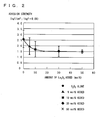
- Fig. 2 shows a relationship between an amount of La 2 O 3 added relative to a total of Y 2 O 3 and the added La 2 O 3 in the source materials of the low adhesion material of the present embodiment, and the adhesion strength provided between a product produced from the Y 2 O 3 and the La 2 O 3 and a basic substance, i.e., epoxy resin.
- an “amount" of La 2 O 3 "added”, as referred to herein, means an amount added in the source materials of a sample used to obtain the data of Fig. 2 , rather than a ratio of La 2 O 3 in the sample per se, i.e., a ratio obtained by actually analyzing the sample.
- an “amount of La 2 O 3 ... relative to a total of Y 2 O 3 and the La 2 O 3 " and similar expressions mean an amount of La 2 O 3 in mol% for a total amount of 100 mol% of Y 2 O 3 and La 2 O 3 .
- the expressions "an (the) amount added” and “... relative to a (the) total ... “appearing in the following description are also similarly used.
- the present embodiment adopts a low adhesion material of a La 2 O 3 - Y 2 O 3 pseudo binary system material produced from a first material of Y 2 O 3 and a second material of La 2 O 3 , as based on an experiment and an analysis. More specifically, of such La 2 O 3 -Y 2 O 3 pseudo binary system materials, a solid solution of La-Y 2 O 3 , a mixture of a solid solution of La-Y 2 O 3 and a composite oxide of LaYO 3 , and a composite oxide of LaYO 3 are adopted.
- These low adhesion materials contain substances and source materials adopted as follows:
- La is adopted as a substance having an ionic radius larger than Y 3+ , which is an ion of Y contained in the first material of Y 2 O 3 .
- La 2 YO 3 is adopted as a second material formed of an oxide satisfying both the condition that it contains a substance (La) having an ionic radius larger than Y 3+ and the condition that it is larger in basicity than Y 2 O 3 .
- an isoelectric point of surface is used as an index indicating the acidity/basicity of a surface of an oxide.
- An IEPS larger than 7 indicates basicity and that smaller than 7 indicates acidity.
- the value of an IEPS can be represented by a ratio of an electric charge of a cation (a positive ion) configuring an oxide and its ionic radius (see George A. Parks, "The Isoelectric Points of Solid Oxides, Solid Hydroxides, and Aqueous Hydroxo Complex System", 65, 177-198 (1965 )).
- IEPS A - B ⁇ Z / R + 0.029 ⁇ C + a
- Z valence of cation
- R r + + 2 ⁇ r ⁇ 0 r + : radius of cation ( ⁇ )
- r0 radius of oxygen ion ( ⁇ )
- A B: constant C: correction coefficient for crystalline field stabilization energy of M-OH bond
- a coefficient for coordination number of hydrate (associated with Coulomb attraction energy between proton and oxygen ion of M-hydroxyl group).
- Expressions (1) and (2) provide an IEPS indicating 9.5 for Y 2 O 3 and 9.8 for La 2 O 3 . It can be said that La 2 O 3 is further larger in basicity than Y 2 O 3 .
- the low adhesion material is produced in a method, e.g., a powder mixture method, as will be described hereinafter with reference to Fig. 1 .
- step S1 the first material or Y 2 O 3 in the form of powder is prepared in an amount as required.
- step S2 the second material or La 2 O 3 in the form of powder is added in a predetermined amount and furthermore at step S3 a solvent is added thereto.
- step S4 a ball mill is used to mix them together.
- step S5 the mixture is dried and sieved.
- step S6 a die used to form a predetermined shape is used to mold the mixture with a predetermined pressure exerted thereto.
- the molded object is hot-pressed at a predetermined temperature for a predetermined period of time. It is thus pressurized and burnt. More specifically, it is thus processed for example at 1,350°C for one hour with a pressure of 40 MPa exerted to press it.
- the pressurized and burnt, sintered compact is subjected to a heat treatment at a predetermined temperature for a predetermined period of time to facilitate a reaction providing a solid solution or a composite oxide.
- the treatment in this case is performed for example at 1,550°C for 5 hours.
- Steps S1-S8 can provide a low adhesion material formed of a sintered compact of a La 2 O 3 -Y 2 O 3 pseudo binary system material and having a predetermined shape. Note that the method of producing the low adhesion material may be coprecipitation.
- Fig. 2 shows a relationship between an amount of La 2 O 3 added relative to a total of Y 2 O 3 and the added La 2 O 3 in the source materials, and the adhesion strength provided between a product produced from the Y 2 O 3 and the La 2 O 3 (i.e., a La 2 O 3 -Y 2 O 3 pseudo binary system material) and a basic substance, i.e., epoxy resin.
- a product produced from the Y 2 O 3 and the La 2 O 3 i.e., a La 2 O 3 -Y 2 O 3 pseudo binary system material
- a basic substance i.e., epoxy resin
- La 2 O 3 is added in four different amounts of 5 mol%, 10 mol%, 30 mol% and 50 mol% relative to a total amount of Y 2 O 3 and the added La 2 O 3 in the source materials.
- La 2 O 3 -Y 2 O 3 pseudo binary system materials having the four amounts added, respectively, are used to prepare samples in the method as described above.
- La 2 O 3 -Y 2 O 3 pseudo binary system materials corresponding to the samples prepared from the first material of Y 2 O 3 and the second material of La 2 O 3 are analyzed and a result is obtained, as follows:
- the samples containing La 2 O 3 added in amounts of 5 mol% and 10 mol% are a Y 2 O 3 solid solution, i.e., a solid solution of La-Y 2 O 3 .
- the sample containing La 2 O 3 added in an amount of 30 mol% is a mixture of a solid solution of La-Y 2 O 3 and a composite oxide of LaYO 3 .
- the sample containing La 2 O 3 added in an amount of 50 mol% is a composite oxide of LaYO 3 .
- a solid solution of La-Y 2 O 3 , a mixture of a solid solution of La-Y 2 O 3 and a composite oxide of LaYO 3 , and a composite oxide of LaYO 3 all have small adhesion strength falling within a range applicable as a low adhesion material for a resin molding die, and a shape retentive property of an extent applicable to the resin molding die.
- the solid solution of La-Y 2 O 3 , the mixture of the solid solution of La-Y 2 O 3 and the composite oxide of LaYO 3 , and the composite oxide of LaYO 3 all correspond to the present low adhesion material.
- the adhesion strength shown in Fig. 2 is measured as follows: First, epoxy resin, a thermosetting resin, is prepared as a basic substance. Then the epoxy resin is brought into contact with the La 2 O 3 -Y 2 O 3 pseudo binary system material and set in an ambient of 175°C to provide set epoxy resin. The set epoxy resin and the pseudo binary system material thus adhere to each other.
- the set resin and the pseudo binary system material are pulled in an ambient of 175°C in a direction perpendicular to the interface of the adhesion and when they peel off the current load exerted is measured. Then the load is divided by the area of the interface of the adhesion to calculate the adhesion strength between the pseudo binary system material and the set resin.
- This adhesion strength corresponds to a mold releasing strength, a strength per unit area that is required to release the set resin from the resin molding die formed of the pseudo binary system material.
- the present embodiment can provide a low adhesion material that has a small adhesion strength falling within a range applicable to a resin molding die and a satisfactory shape retentive property of an extent applicable to the resin molding die.
- the low adhesion material having the small adhesion strength is obtained possibly on two grounds associated with ionic radius and basicity, as follows:
- the low adhesion material is obtained possibly because the La 2 O 3 -Y 2 O 3 pseudo binary system material contains La, a substance having an ionic radius larger than Y 3+ . More specifically, by Y 2 O 3 with La 3+ , which has an ionic radius larger than Y 3+ , contained therein, the pseudo binary system material can have a surface exposing a smaller number of cations per unit area than Y 2 O 3 alone can.
- the pseudo binary system material has a surface having a smaller number of sites contributing to chemical bonding of a molecule of a substance (in the present embodiment, epoxy resin) and that of a surficial cation with oxygen serving as an intermediate than Y 2 O 3 alone does. This is considered as a reason allowing the low adhesion material (the La 2 O 3 -Y 2 O 3 pseudo binary system material) to be less adhesive to the substance than Y 2 O 3 alone is.
- the low adhesion material is obtained possibly because the La 2 O 3 -Y 2 O 3 pseudo binary system material contains La 2 O 3 , an oxide larger in basicity than Y 2 O 3 . This is considered as a reason allowing the pseudo binary system material to be larger in basicity than Y 2 O 3 alone and thus further closer in basicity to epoxy resin.
- the pseudo binary system material and the basic substance are bounded by a force smaller than when Y 2 O 3 alone and the basic substance are done so. This is considered as a reason allowing the low adhesion material (i.e., the La 2 O 3 -Y 2 O 3 pseudo binary system material) to be superior to Y 2 O 3 alone.
- the range of adhesion strength required varies with the application of the low adhesion material.
- the low adhesion material may be such a material that the amount of La 2 O 3 added thereto is 0 mol%, i.e., Y 2 O 3 alone, from a practical point of view.
- such a material that the amount of La 2 O 3 added thereto is 0 mol%, that has an adhesion strength of approximately 2.57 kgf/cm 2 (25.2 N/cm 2 ) in Fig. 2 is applicable as the low adhesion material for the resin molding die.
- a furthermore excellently releasable material i.e., a material having a furthermore smaller adhesion strength
- the adhesion strength between the low adhesion material, or the La 2 O 3 -Y 2 O 3 pseudo binary system material, and a basic substance can further be reduced by increasing the amount of La 2 O 3 added in the source materials.
- the La 2 O 3 -Y 2 O 3 pseudo binary system material formed of the first material of Y 2 O 3 and the second material of La 2 O 3 that contains the La 2 O 3 added in further increased amounts in the source materials is, however, disadvantageously reduced in stability in the air.
- La 2 O 3 has a nature allowing it to absorb the water vapor and carbon dioxide present in the air, i.e., that it is low in stability in the air (for this nature, see Rikagaku Jiten, forth edition, Iwanami Shoten, 1987, p 503 , for example), and this prevents the La 2 O 3 -Y 2 O 3 pseudo binary system material from maintaining its shape and hence prevents the resin molding die from maintaining its shape.
- ratio of La 2 O 3 means a ratio of the second material of La 2 O 3 relative to a total of the first material of Y 2 O 3 and the second material of La 2 O 3 in the pseudo binary system material produced. In other words, it means a ratio obtained by actually analyzing the pseudo binary system material.
- ratio in the following description is also similarly used.
- the second material of La 2 O 3 has a ratio having a range, which is determined in the following procedure: Initially, a substance obtained by subjecting a Y 2 O 3 -La 2 O 3 mixture material to a heat treatment is assumed. Then in accordance with a phase diagram a range of a ratio of La 2 O 3 that allows the assumed substance to exist as a predetermined substance is found.
- the "predetermined substance" as referred to herein is any of the solid solution of La-Y 2 O 3 , the mixture of the solid solution of La-Y 2 O 3 and the composite oxide of LaYO 3 , and the composite oxide of LaYO 3 .
- the found ratio range is adopted as the range of the ratio of La 2 O 3 .
- the phase diagram used herein is found in a document " Phase Diagram of the System La2O3-Y2O3 at High Temperatures" (Masao MIZUNO et al., Yogyo-Kyokai-Shi, 84, [7] 347 (1976 )).
- the La 2 O 3 -Y 2 O 3 pseudo binary system material can exist as any of the solid solution of La-Y 2 O 3 , the mixture of the solid solution of La-Y 2 O 3 and the composite oxide of LaYO 3 , and the composite oxide of LaYO 3 when La 2 YO 3 has a ratio falling within a range having a lower limit exceeding 0 mol% and an upper limit in a vicinity of 75 mol%.
- the low adhesion material of the present embodiment can be obtained when the La 2 O 3 -Y 2 O 3 pseudo binary system material contains La 2 O 3 at a ratio falling within a range exceeding 0 mol% and at most approximately 75 mol%.
- the La 2 O 3 -Y 2 O 3 pseudo binary system material becomes a La 2 O 3 solid solution.
- it contains a La 2 O 3 solid solution having a main lattice of La 2 O 3 , which has such a nature that it is low in chemical stability in the air. This is considered as a reason for which the La 2 O 3 -Y 2 O 3 pseudo binary system material is impaired in stability in the air.
- the ratio of La 2 O 3 and the type of the La 2 O 3 -Y 2 O 3 pseudo binary system material produced has a relationship, as will be described hereinafter with reference to the aforementioned phase diagram for a heat treatment performed at 1,860°C by way of example.
- the phase diagram when La 2 O 3 has a ratio exceeding 0 mol% and at most around 20 mol%, the solid solution of La-Y 2 O 3 is produced.
- the phase diagram when La 2 O 3 has a ratio around 20 mol% to around 40 mol%, the mixture of the solid solution of La-Y 2 O 3 and the composite oxide of LaYO 3 is produced.
- La 2 O 3 has a ratio around 40 mol% to around 75 mol%, the composite oxide of LaYO 3 is produced.
- the solid solution of La-Y 2 O 3 , the mixture of the solid solution of LaY 2 O 3 and the composite oxide of LaYO 3 , and the composite oxide of LaYO 3 also exist stably at a temperature to which they are heated when they are used as a resin molding die (i.e., approximately 180°C), and at room temperature.
- La 2 O 3 -Y 2 O 3 pseudo binary system materials are thus shape-retentive at the aforementioned temperature (including that of the heat treatment).
- the present embodiment can provide a low adhesion material formed of a La 2 O 3 -Y 2 O 3 pseudo binary system material and shape-retentive in the range of room temperature to the temperature of the heat treatment.
- the present low adhesion material in a second embodiment will be described hereinafter.
- the present embodiment adopts a low adhesion material of a SrO-Y 2 O 3 pseudo binary system material produced from a first material of Y 2 O 3 and a second material of SrO, as based on an experiment and an analysis. More specifically, of such SrO-Y 2 O 3 pseudo binary system materials, a solid solution of Sr-Y 2 O 3 , a mixture of a solid solution of Sr-Y 2 O 3 and a composite oxide of SrY 2 O 4 , and a composite oxide of SrY 2 O 4 are adopted.
- These low adhesion materials contain substances and source materials adopted as follows:
- Sr is adopted as a substance having an ionic radius larger than Y 3+ , which is an ion of Y contained in the first material of Y 2 O 3 .
- Y 3+ has an ionic radius of 1.02 ⁇ (102 pm) and Sr 3+ has an ionic radius of 1.18 ⁇ (118 pm).
- SrO is adopted as a second material formed of an oxide satisfying both the condition that it contains a substance (Sr) having an ionic radius larger than Y 3+ and the condition that it is larger in basicity than Y 2 O 3 .
- expressions (1) and (2) provide an IEPS indicating 9.5 for Y 2 O 3 and 12.8 for SrO. It can be said that SrO is further larger in basicity than Y 2 O 3 .
- the SrO-Y 2 O 3 pseudo binary system material containing Y 2 O 3 and SrO is produced by adding SrO to Y 2 O 3 by a predetermined amount.
- This pseudo binary system material is produced in a method substantially identical to that described in the first embodiment. Accordingly the method will not be described repeatedly.
- Fig. 3 shows a relationship between an amount of SrO added relative to a total of Y 2 O 3 and the added SrO in the source materials of the low adhesion material of the present embodiment, and the adhesion strength provided between a product produced from the Y 2 O 3 and the SrO and a basic substance, i.e., epoxy resin.
- SrO is added in two different amounts of 10 mol% and 19 mol% relative to a total amount of Y 2 O 3 and the added SrO in the source materials.
- the two types of SrO-Y 2 O 3 pseudo binary system materials are used to prepare samples.
- Each sample and a material with 0 mol% of SrO, i.e., Y 2 O 3 alone, are used to conduct an experiment and obtain data, which is used to calculate adhesion strength.
- a result thereof shows, as shown in Fig. 3 , that the amount of SrO added increases, the adhesion strength decreases.
- adhesion strength shown in Fig. 3 all fall within a range applicable as a low adhesion material for a resin molding die. Furthermore, the samples are all satisfactorily shape retentive to such an extent that they can be used for the resin molding die. Note that the adhesion strength shown in Fig. 3 is calculated from a result of an experiment similar to that described in the first embodiment.
- the samples prepared from the first material of Y 2 O 3 and the second material of SrO, i.e., SrO-Y 2 O 3 pseudo binary system materials are analyzed and a result is obtained, as follows:
- the samples containing SrO added in amounts of 10 mol% and 19 mol%, respectively, are both a mixture of a solid solution of Sr-Y 2 O 3 and a composite oxide of SrY 2 O 4 .
- the mixture of the solid solution of Sr-Y 2 O 3 and the composite oxide of SrY 2 O 4 has small adhesion strength falling within a range applicable as a low adhesion material for a resin molding die, and a shape retentive property of an extent applicable to the resin molding die.
- the mixture of the solid solution of Sr-Y 2 O 3 and the composite oxide of SrY 2 O 4 thus corresponds to the present low adhesion material.
- the solid solution of Sr-Y 2 O 3 and the composite oxide of SrY 2 O 4 that configure the mixture are both a SrO-Y 2 O 3 pseudo binary system material produced from Y 2 O 3 and SrO.
- such a material that the amount of SrO added thereto is 0 mol% i.e., Y 2 O 3 alone
- the present embodiment can also provide the SrO-Y 2 O 3 pseudo binary system material with further reduced adhesion strength by increasing the amount of SrO added in the source materials.
- the SrO-Y 2 O 3 pseudo binary system material formed of the first material of Y 2 O 3 and the second material of SrO that contains the SrO added in further increased amounts in the source materials is, however, disadvantageously reduced in stability in the air, similarly as described in the first embodiment. This is attributed to that SrO has a nature allowing it to bind to carbon dioxide present in the air and thus provide carbonate (SrCO 3 ).
- the SrO has a ratio having an upper limit, which is determined according to phase diagrams, which are indicated in a document " Phase diagrams of yttrium sesquioxide-strontium oxide and ytterbium sesquioxide-strontium oxide systems" (S. G. Tresvyatskii, et al., Izv.Akad.Nauk SSSR, Neorg.Mater., 7[10] 1808-1811 (1971 )) and Translation " Inorg. Mater. (Engl. Transl.), 7[10] 1614-1617 (1971 )" for the document, respectively.
- the samples formed of source materials containing SrO added in amounts of 10 mol% and 19 mol% are SrO-Y 2 O 3 pseudo binary system materials produced that are mixtures of a solid solution of Sr-Y 2 O 3 and a composite oxide of SrY 2 O 4 . Furthermore, these mixtures correspond in the phase diagram to a range denoted by "C-Y 2 O 3 ss + SrY 2 O 4 ", which represents a Y 2 O 3 solid solution + SrY 2 O 4 , and, as has been described previously, correspond to the present low adhesion material.
- a SrO-Y 2 O 3 pseudo binary system material is produced from source materials including SrO added in an amount further increased from the state shown in. Fig.3 , it can bee seen from the phase diagram that when SrO is added in an amount that attains a value of some extent, the SrO-Y 2 O 3 pseudo binary system material is produced to be a composite oxide of SrY 2 O 4 , and from the phase diagram it can be said that in the composite oxide of SrY 2 O 4 , SrO has a ratio of 50 mol%.
- the composite oxide of SrY 2 O 4 included in a sample increases in ratio as the amount of SrO added increases. Furthermore, according to Fig. 3 , adding an increased amount of SrO provides an improved adhesion property, and it is inferred that the composite oxide of SrY alone has a better property with respect to adhesion than that of Y 2 O 3 alone. The composite oxide of SrY 2 O 4 alone is thus considered to correspond to the present low adhesion material.
- the SrO-Y 2 O 3 pseudo binary system material contains SrOss (a SrO solid solution).
- SrO having such a nature that it is low in chemical stability in the air will be contained in the SrO-Y 2 O 3 pseudo binary system material. This is considered as a reason for which the SrO-Y 2 O 3 pseudo binary system material is impaired in chemical stability in the air.
- a SrO-Y 2 O 3 pseudo binary system material is produced from source materials including SrO added in an amount further decreased from 10 mol% (see Fig. Fig.3 ), it can be seen from the phase diagram that when SrO is added in an amount that attains a value of some extent, the SrO-Y 2 O 3 pseudo binary system material is produced to be a Y 2 O 3 ss (a Y 2 O 3 solid solution), i.e., a solid solution of Sr-Y 2 O 3 .
- the solid solution of Sr -Y 2 O 3 can be implemented as a SrO-Y 2 O 3 pseudo binary system material containing SrO at a ratio exceeding 0 mol% and at most 1.5 mol%.
- the first point is that, according to the phase diagram, SrO has a ratio smallest for Y 2 O 3 alone, for which SrO has a ratio of 0 mol%, larger for the solid solution of Sr-Y 2 O 3, and further larger for the mixture of the solid solution of Sr-Y 2 O 3 and the composite oxide of SrY 2 O 4 .
- the second point is that Y 2 O 3 alone, for which SrO has a ratio of 0 mol%, provides largest adhesion to a basic substance, and the adhesion decreases as SrO increases in ratio (see Fig. Fig.3 ).
- the third point is that Y 2 O 3 alone and the mixture of the solid solution of Sr-Y 2 O 3 and the composite oxide of SrY 2 O 4 both have properties required for the present low adhesion material in terms of adhesion and shape retention.
- adhesion to a basic substance will be discussed. Smaller adhesion to the basic substance is preferable.
- SrO has a ratio larger for the solid solution of Sr-Y 2 O 3 than for Y 2 O 3 alone, as has been discussed above at the first point.
- adhesion to a basic substance decreases as SrO increases in ratio, as has been discussed above at the second point. Therefore the solid solution of Sr-Y 2 O 3 is less adhesive than Y 2 O 3 alone.
- a SrO- Y 2 O 3 pseudo binary system material is considered to become less shape-retentive as SrO, which has such a nature that it is low in chemical stability in the air, increases in ratio. In other words, it is the most shape retentive for Y 2 O 3 alone, less shape retentive for the solid solution of Sr-Y 2 O 3 , and further less shape retentive for the mixture of the solid solution of Sr-Y 2 O 3 and the composite oxide of SrY 2 O 4 .
- the aforementioned mixture considered less shape retentive than the solid solution of Sr-Y 2 O 3 has a shape retentive property required for the low adhesion material, as has been discussed above at the third point. Therefore it can be said that the solid solution of Sr-Y 2 O 3 has a shape retentive property required for the low adhesion material. From the above discussion, the solid solution of Sr-Y 2 O 3 is considered to correspond to the present low adhesion material.
- the ratio of SrO and the type of the SrO-Y 2 O 3 pseudo binary system material produced has a relationship, as will be described hereinafter with reference to the aforementioned phase diagram for a heat treatment performed at 1,970°C by way of example.
- the phase diagram when SrO has a ratio exceeding 0 mol% and at most around 1.5 mol%, the solid solution of Sr-Y 2 O 3 is produced.
- SrO has a ratio around 1.5 mol% to around 50 mol%
- the mixture of the solid solution of Sr-Y 2 O 3 and the composite oxide of SrY 2 O 4 is produced.
- SrO has a ratio of 50 mol%
- the composite oxide of SrY 2 O 4 is alone produced.
- the solid solution of Sr-Y 2 O 3 , the mixture of the solid solution of Sr-Y 2 O 3 and the composite oxide of SrY 2 O 4 , and the composite oxide of SrY 2 O 4 also exist stably at a temperature to which they are heated when they are used as a resin molding die (i.e., approximately 180°C), and at room temperature.
- SrO-Y 2 O 3 pseudo binary system materials are thus satisfactorily shape-retentive at the aforementioned temperature (including that of the heat treatment).
- the present embodiment can provide a low adhesion material formed of a SrO-Y 2 O 3 pseudo binary system material and satisfactorily shape-retentive in the range of room temperature to the temperature of the heat treatment.
- SrO-Y 2 O 3 pseudo binary system materials having small adhesion strength are obtained possibly on two grounds associated with ionic radius and basicity, similarly as discussed in the first embodiment.
- a first ground is that the SrO-Y 2 O 3 pseudo binary system material contains Sr, a substance having an ionic radius larger than Y 3+ .
- a second ground is that the SrO-Y 2 O 3 pseudo binary system material contains SrO, an oxide larger in basicity than Y 2 O 3 .
- the first and second embodiments provide the present low adhesion material implemented by the following six materials: (1) a solid solution of La-Y 2 O 3 ; (2) a mixture of a solid solution of La-Y 2 O3 and a composite oxide of LaYO 3 ; (3) a composite oxide of LaYO 3 ; (4) a solid solution of Sr-Y 2 O 3; (5) a mixture of a solid solution of Sr-Y 2 O 3 and a composite oxide of SrY 2 O 4 ; and (6) a composite oxide of SrY 2 O 4 .
- the present low adhesion material may be the above six low adhesion materials each having an other substance added thereto as an additive.
- the present low adhesion material may be formed of two or more of the six low adhesion materials, that are combined together as appropriate and thus mixed together at an appropriate ratio.
- a low adhesion material formed of three components of Y 2 O 3 , La and Sr i.e., a La 2 O 3 -SrO-Y 2 O 3 pseudo ternary system material may be formed.
- a low adhesion material of three components of Y 2 O 3 , La and Sr with one or more different substances added thereto, i.e., a higher order, multi-component material can also be used as the present low adhesion material.
- the low adhesion material may also be provided by a mixture of the first material of Y 2 O 3 alone and at least one of the solid solution of La-Y 2 O 3 , the mixture of the solid solution of La-Y 2 O 3 and the composite oxide of LaYO 3 , and the composite oxide of LaYO 3 . Furthermore it can also be provided by a mixture of the first material of Y 2 O 3 alone and at least one of the solid solution of Sr-Y 2 O 3 , the mixture of the solid solution of Sr-Y 2 O 3 and the composite oxide of SrY 2 O 4 , and the composite oxide of SrY 2 O 4 .
- the second material an oxide has been described that satisfies both the condition that it contains a substance having an ionic radius larger than Y 3+ , which is an ion of Y contained in the first material of Y 2 O 3 , and the condition that it is larger in basicity than Y 2 O 3 .
- the second material is not limited thereto.
- it may be an oxide that satisfies at least one of the condition that it contains a substance having an ionic radius larger than Y 3+ and the condition that it is larger in basicity than Y 2 O 3 .
- the present low adhesion material is produced as an oxide is added to Y 2 O 3 , and the oxide added to Y 2 O 3 contains a substance having an ionic radius larger than Y 3+ , an ion contained in Y 2 O 3 , and the substance is La and Sr.
- the present low adhesion material is not limited thereto and may be produced from Y 2 O 3 having added thereto an oxide containing a substance different from La and Sr as a substance having an ionic radius larger than Y 3+ .
- a material produced with such oxide can also serve as the present low adhesion material.
- the second material (or an additive) is added in an amount having a lower limit, as will be described hereinafter.
- the material is less adhesive to a basic substance.
- adding the second material (or the additive) to the first material or Y 2 O 3 has provided an effect of the present invention, i.e., reduced adhesion strength.
- the second material (or the additive) has a ratio exceeding 0 mol% can be a lower limit of the ratio of the second material.
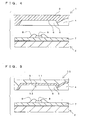
- Figs. 4 and 5 are cross sections of a resin molding die of the present embodiment and an exemplary variation thereof, respectively, both of which are exaggerated for ease of illustration.
- transfer molding is employed as an example of a resin molding method and a chip mounted on a substrate is sealed with epoxy resin.
- Figs. 4 and 5 show top and bottom portions 1 and 2, respectively, together configuring a resin sealing die.
- Top portion 1 corresponds to the present resin molding die.
- Top portion 1 is formed of the present low adhesion material for example of the first embodiment, i.e., a highly releasable material 3 made of a solid solution of La-Y 2 O 3 .
- Top portion 1 is provided with a resin flow channel 4 passing fluid resin (not shown) and a cavity 5 receiving the fluid resin.
- Resin flow channel 4 and cavity 5 are provided in the form of a recess. Accordingly, highly releasable material 3 is exposed in resin flow channel 4 and cavity 5 at a molding surface 6 i.e., at a portion of the resin molding die that is exposed to the fluid resin.
- bottom portion 2 is formed of tool steel or the like, and thereon a substrate 7 formed of a lead frame, a printed substrate and the like is placed. On substrate 7 a chip 8 is mounted, and substrate 7 and chip 8 have their respective electrodes (not shown) electrically connected by a wire 9.
- the resin molding die shown in Figs. 4 and 5 operates, as will be described hereinafter.
- substrate 7 is positioned on bottom portion 2 and then fixed by suction or the like.
- top portion 1 descends and cooperates with bottom portion 2 to completely close the die.
- a plunger (not shown) is used to push a fluid resin, which is made of a thermosetting resin and has a predetermined viscosity, to introduce the fluid resin through resin flow channel 4 into cavity 5.
- top portion 1 and bottom portion 2 are used to heat and thus set the fluid resin. Then top portion 1 ascends to open the die, and a molded product formed of substrate 7, chip 8 and wire 9 integrally sealed with the set resin is ejected.
- the resin molding die in the present embodiment is characterized by having top portion 1 exposed to fluid resin, that is configured of highly releasable material 3 formed of the solid solution La-Y 2 O 3 described in the first embodiment.
- top portion 1 will have molding surface 6 exposed to the fluid resin, that is configured of highly releasable material 3.
- Highly releasable material 3 has an excellent low adhesion property with respect to set resin provided by setting fluid resin and is also a chemically stable substance.
- This low adhesion property contributes to excellent releasability from the set resin, a property preventing the set resin from readily soiling and thus adhering to the molding surface, and a property helping to remove such soil adhering to the molding surface.
- the present embodiment can implement a resin molding die that does not require an ejection mechanism, can maintain excellent releasability for a long period of time, and does not require frequent cleaning.
- the present embodiment can implement a resin molding die superior in releasability in comparison with a resin molding die having a molding surface with Cr, TiC, CrN or a similar, metal based material deposited thereon.
- a ceramic material produced from an oxide such as a solid solution of La-Y 2 O 3 produced from Y 2 O 3 and La 2 O 3 , is excellently wear-resistant. This can eliminate the problem of the wearing of an organic matter coating a molding surface.
- the resin molding die of the present embodiment is produced by processing, as required, such as providing an attachment hole to, the low adhesion material (the solid solution of La-Y 2 O 3 ) produced in the first embodiment and having a predetermined geometry such as resin flow channel 4, cavity 5 and the like. Furthermore, if a more precise geometry is required, the low adhesion material that is in the form of a block or burnt to generally have a predetermined geometry may be cut or the like and thus undergo precision processing. Thus, top portion 1 shown in Figs. 4 and 5 , for example, can be completed.
- a top portion 10 corresponds to the resin molding die of the present exemplary variation.
- Resin molding die 10 has top portion 10 having a main body 11 formed of a material conventionally used for a resin molding die, such as tool steel, and a mold releasing layer 12 in the form of a layer or film formed of the low adhesion material of the first embodiment (the solid solution of La-Y 2 O 3 ) deposited on a surface of main body 11.
- Mold releasing layer 12 is provided using a well-known, appropriate technique selected e.g., from vacuum deposition, electronic beam deposition, sputtering, plasma spraying, ion plating or similar physical vapor deposition (PVD), chemical vapor deposition (CVD), or burning a material in the form of sheet. Mold releasing layer 12 present on molding surface 6 can provide an effect similar to that obtained by the resin molding die shown in Fig. 4 . Note that the low adhesion material of the first embodiment provided at least on molding surface 6, suffices. This allows molding surface 6 to have an excellent low adhesion property with respect to set resin, i.e., excellent releasability.
- mold releasing layer 12 formed of the low adhesion material can be determined in thickness as appropriate. If small adhesion alone is considered, mold releasing layer 12 is only required to have a thickness of an extent allowing a unit cell formed of the low adhesion material to be formed, i.e., a thickness of approximately a few nm. If durability and the like are also considered, it is preferable that mold releasing layer 12 in effect defining molding surface 6 of the resin molding die have a predetermined thickness (for example of approximately a few hundreds ⁇ m).
- the molding die may have main body 11 formed of hard metal containing tungsten carbide (WC), a ceramic material formed for example of 3 mol% yttria stabilized zirconia (3YSZ), or the like.
- WC hard metal containing tungsten carbide
- YSZ 3 mol% yttria stabilized zirconia
- the present embodiment (including the exemplary variation) has provided a resin molding die having a molding surface formed of the low adhesion material of the first embodiment, i.e., a solid solution of La-Y 2 O 3 .
- the present low adhesion material is not limited thereto, and it may be those described in the first and second embodiments.
- the low adhesion materials of the first and second embodiments with an other substance added thereto as an additive may be used as a low adhesion material forming a molding surface.
- low adhesion materials of the first and second embodiments that are combined together, as appropriate, and thus mixed together at an appropriate ratio may be adopted as a low adhesion material forming a molding surface.
- Y 2 O 3 having added thereto an oxide containing a substance different from La and Sr as a substance having an ionic radius larger than Y 3+ may be adopted as a low adhesion material forming a molding surface.
- Such materials can also provide an effect similar to that of the present embodiment and exemplary variation.
- the low adhesion material that is in the form of a block (or rectangular parallelepiped) may be used as a cavity block configuring a bottom surface or a top surface of the cavity.
- the present embodiment has been described by illustrating a resin molding die used when chip 8 mounted on substrate 7 is sealed with resin.
- the present resin molding die is not limited thereto. It is also applicable to a resin molding die used in general transfer molding, compression molding, injection molding, and the like when fluid resin is introduced into cavity 5 and thus set to provide a molded object.
- the present resin molding die is not limited thereto and may be exposed to the fluid resin at molding surface 6 having only a portion, e.g., an internal bottom surface of cavity 5 (a top surface thereof in Figs. 4 and 5 ), formed of the highly releasable material.
- the present low adhesion material is used for a resin molding die, as has been described above, the present low adhesion material is not limited thereto in application. It can be used in an application other than the resin molding die, i.e., an other application requiring low wettability to a basic substance. More specifically, such low adhesion material can be used to coat such a portion of a member or the like that is exposed to fluid resin.
- the present low adhesion material is applicable to an application requiring a low adhesion property with respect to a substance other than resin and having basicity.
- such low adhesion material can be used as a material having a function preventing an organic matter from soiling it and thus adhering thereto.
- the present low adhesion material would be used as a material for a building material used for such as an external wall of a building, a bathtub, sanitary chinaware, and other similar equipment.
- the present low adhesion material may also be used as a material for coating a surface of a member used in such applications.
- the aforementioned low adhesion material 3 can also be used as a soil resistant material having a function preventing an organic matter from soiling it and thus adhering thereto.
Landscapes
- Engineering & Computer Science (AREA)
- Chemical & Material Sciences (AREA)
- Ceramic Engineering (AREA)
- Manufacturing & Machinery (AREA)
- Materials Engineering (AREA)
- Structural Engineering (AREA)
- Organic Chemistry (AREA)
- Mechanical Engineering (AREA)
- Inorganic Chemistry (AREA)
- Moulds For Moulding Plastics Or The Like (AREA)
- Laminated Bodies (AREA)
- Compositions Of Macromolecular Compounds (AREA)
Applications Claiming Priority (2)
| Application Number | Priority Date | Filing Date | Title |
|---|---|---|---|
| JP2006017335A JP3974152B2 (ja) | 2006-01-26 | 2006-01-26 | 低密着性材料、樹脂成形型及び防汚性材料 |
| PCT/JP2006/326025 WO2007086228A1 (fr) | 2006-01-26 | 2006-12-27 | Materiau de faible adhesion, moules pour le moulage de resines et materiau antitache |
Publications (2)
| Publication Number | Publication Date |
|---|---|
| EP1978005A1 true EP1978005A1 (fr) | 2008-10-08 |
| EP1978005A4 EP1978005A4 (fr) | 2011-05-25 |
Family
ID=38309029
Family Applications (1)
| Application Number | Title | Priority Date | Filing Date |
|---|---|---|---|
| EP06843407A Withdrawn EP1978005A4 (fr) | 2006-01-26 | 2006-12-27 | Materiau de faible adhesion, moules pour le moulage de resines et materiau antitache |
Country Status (7)
| Country | Link |
|---|---|
| US (1) | US20080296532A1 (fr) |
| EP (1) | EP1978005A4 (fr) |
| JP (1) | JP3974152B2 (fr) |
| KR (2) | KR20090082293A (fr) |
| CN (1) | CN101238081A (fr) |
| TW (1) | TW200730467A (fr) |
| WO (1) | WO2007086228A1 (fr) |
Families Citing this family (5)
| Publication number | Priority date | Publication date | Assignee | Title |
|---|---|---|---|---|
| JP3996138B2 (ja) * | 2004-03-26 | 2007-10-24 | Towa株式会社 | 低密着性材料及び樹脂成形型 |
| JP4230492B2 (ja) | 2006-04-11 | 2009-02-25 | Towa株式会社 | 低密着性材料、樹脂成形型及び防汚性材料 |
| JP5554898B2 (ja) * | 2008-03-24 | 2014-07-23 | Towa株式会社 | 低密着性材料及びその製造方法、成形型及びその製造方法、並びに、防汚性材料及びその製造方法 |
| JP5561992B2 (ja) * | 2009-10-09 | 2014-07-30 | Towa株式会社 | 低密着性材料、防汚性材料、成形型、及び、それらの製造方法 |
| WO2016019418A1 (fr) * | 2014-08-08 | 2016-02-11 | Pullman Espresso Accessories | Presse-mouture amélioré à conception étagée |
Family Cites Families (15)
| Publication number | Priority date | Publication date | Assignee | Title |
|---|---|---|---|---|
| FR1449899A (fr) * | 1965-07-09 | 1966-05-06 | Combustible Nucleaire | Matériau réfractaire résistant aux métaux liquides réactifs, tels que l'uranium |
| US4040845A (en) * | 1976-03-04 | 1977-08-09 | The Garrett Corporation | Ceramic composition and crucibles and molds formed therefrom |
| US4115134A (en) * | 1977-07-11 | 1978-09-19 | Gte Laboratories Incorporated | Transparent yttria ceramics and method for producing same |
| DE3683086D1 (de) * | 1985-06-06 | 1992-02-06 | Remet Corp | Giessen von reaktionsfaehigen metallen in keramische formen. |
| US4769353A (en) * | 1986-11-04 | 1988-09-06 | General Electric Company | Strontium-containing yttrium oxide ceramic body |
| US4761390A (en) * | 1987-02-02 | 1988-08-02 | Raytheon Company | Optically transparent yttrium oxide |
| JPH04164859A (ja) * | 1990-10-30 | 1992-06-10 | Onoda Cement Co Ltd | 軽希土類酸化物焼結体、その製造方法及びそれよりなるルツボ |
| US5494866A (en) * | 1991-06-17 | 1996-02-27 | Alliedsignal Inc. | Stress-rupture resistant sintered silicon nitride |
| JP2500631B2 (ja) * | 1993-07-23 | 1996-05-29 | 品川白煉瓦株式会社 | MgO部分安定化ZrO2焼結体製ダイス又はニップル |
| JP4240516B2 (ja) * | 1998-11-26 | 2009-03-18 | Toto株式会社 | 防汚性部材 |
| JP2005193610A (ja) * | 2004-01-09 | 2005-07-21 | Towa Corp | 複合材料及び樹脂成形型 |
| JP4518808B2 (ja) * | 2004-02-09 | 2010-08-04 | Towa株式会社 | 導電性多孔質材料、その材料からなる樹脂成形型、及びその材料の製造方法 |
| JP3996138B2 (ja) * | 2004-03-26 | 2007-10-24 | Towa株式会社 | 低密着性材料及び樹脂成形型 |
| JP2006131429A (ja) * | 2004-11-02 | 2006-05-25 | Towa Corp | 低密着性材料及び樹脂成形型 |
| DE102006027958A1 (de) * | 2006-06-14 | 2007-12-20 | Schott Ag | Optokeramiken, daraus hergestellte optische Elemente sowie Abbildungsoptiken |
-
2006
- 2006-01-26 JP JP2006017335A patent/JP3974152B2/ja not_active Expired - Fee Related
- 2006-12-27 KR KR1020097013884A patent/KR20090082293A/ko not_active Withdrawn
- 2006-12-27 CN CNA2006800290224A patent/CN101238081A/zh active Pending
- 2006-12-27 EP EP06843407A patent/EP1978005A4/fr not_active Withdrawn
- 2006-12-27 US US11/920,421 patent/US20080296532A1/en not_active Abandoned
- 2006-12-27 KR KR1020077027278A patent/KR100961798B1/ko not_active Expired - Fee Related
- 2006-12-27 WO PCT/JP2006/326025 patent/WO2007086228A1/fr not_active Ceased
- 2006-12-29 TW TW095150108A patent/TW200730467A/zh not_active IP Right Cessation
Also Published As
| Publication number | Publication date |
|---|---|
| TW200730467A (en) | 2007-08-16 |
| US20080296532A1 (en) | 2008-12-04 |
| KR100961798B1 (ko) | 2010-06-08 |
| EP1978005A4 (fr) | 2011-05-25 |
| JP2007197251A (ja) | 2007-08-09 |
| JP3974152B2 (ja) | 2007-09-12 |
| KR20080015803A (ko) | 2008-02-20 |
| CN101238081A (zh) | 2008-08-06 |
| TWI339198B (fr) | 2011-03-21 |
| WO2007086228A1 (fr) | 2007-08-02 |
| KR20090082293A (ko) | 2009-07-29 |
Similar Documents
| Publication | Publication Date | Title |
|---|---|---|
| US8304872B2 (en) | Lead frame, method for manufacturing the same and semiconductor device | |
| US20110042857A1 (en) | Method of evaluating adhesion property, low-adhesion material, and mold for molding resin | |
| EP3144656A1 (fr) | Système de capteur de pression | |
| EP1978005A1 (fr) | Materiau de faible adhesion, moules pour le moulage de resines et materiau antitache | |
| EP3011182B1 (fr) | Corps de pompe constitué d'au moins deux matériaux frittables différents | |
| EP2917711B1 (fr) | Système capteur de température et procede de production d'un système capteur de température | |
| JP5294844B2 (ja) | 電極および製造方法 | |
| KR100923623B1 (ko) | 저밀착성 재료, 수지 성형틀 및 방오성 재료 | |
| EP3011184A1 (fr) | Carter de pompe constituée d'une matière magnétique et d'une matière non-magnétique | |
| US7784764B2 (en) | Low-adhesion material, mold for molding resin using the same and contaminant adhesion preventing material | |
| DE102013110042A1 (de) | Elektrochemischer Sensor | |
| JP2006131429A5 (fr) | ||
| EP3123032A1 (fr) | Carter de pompe constitué d'au moins trois matériaux frittables différents | |
| JP5554898B2 (ja) | 低密着性材料及びその製造方法、成形型及びその製造方法、並びに、防汚性材料及びその製造方法 | |
| CN1623214A (zh) | 在阴极触点上有附着层的电容器 | |
| WO2024126241A1 (fr) | Dispositif microfluidique, en particulier cartouche, avec un tampon pour le transfert de chaleur vers un substrat d'analyse |
Legal Events
| Date | Code | Title | Description |
|---|---|---|---|
| PUAI | Public reference made under article 153(3) epc to a published international application that has entered the european phase |
Free format text: ORIGINAL CODE: 0009012 |
|
| 17P | Request for examination filed |
Effective date: 20071221 |
|
| AK | Designated contracting states |
Kind code of ref document: A1 Designated state(s): NL |
|
| DAX | Request for extension of the european patent (deleted) | ||
| RBV | Designated contracting states (corrected) |
Designated state(s): NL |
|
| A4 | Supplementary search report drawn up and despatched |
Effective date: 20110426 |
|
| STAA | Information on the status of an ep patent application or granted ep patent |
Free format text: STATUS: THE APPLICATION HAS BEEN WITHDRAWN |
|
| 18W | Application withdrawn |
Effective date: 20110721 |