EP1975915B1 - Reduction of mura effects, and display - Google Patents
Reduction of mura effects, and display Download PDFInfo
- Publication number
- EP1975915B1 EP1975915B1 EP08005830.8A EP08005830A EP1975915B1 EP 1975915 B1 EP1975915 B1 EP 1975915B1 EP 08005830 A EP08005830 A EP 08005830A EP 1975915 B1 EP1975915 B1 EP 1975915B1
- Authority
- EP
- European Patent Office
- Prior art keywords
- display
- mura
- pixels
- tone scale
- gray levels
- Prior art date
- Legal status (The legal status is an assumption and is not a legal conclusion. Google has not performed a legal analysis and makes no representation as to the accuracy of the status listed.)
- Not-in-force
Links
- 230000000694 effects Effects 0.000 title description 9
- 230000009467 reduction Effects 0.000 title description 7
- 230000007547 defect Effects 0.000 claims description 32
- 238000000034 method Methods 0.000 claims description 24
- 230000035945 sensitivity Effects 0.000 claims description 9
- 230000000007 visual effect Effects 0.000 claims description 8
- 238000005286 illumination Methods 0.000 claims description 6
- 230000008569 process Effects 0.000 claims description 4
- 238000012937 correction Methods 0.000 description 23
- 230000006870 function Effects 0.000 description 11
- 239000004973 liquid crystal related substance Substances 0.000 description 6
- 238000007689 inspection Methods 0.000 description 5
- 238000004519 manufacturing process Methods 0.000 description 3
- 239000000463 material Substances 0.000 description 3
- 238000007792 addition Methods 0.000 description 2
- 239000000654 additive Substances 0.000 description 2
- 230000000996 additive effect Effects 0.000 description 2
- 238000013459 approach Methods 0.000 description 2
- 230000008901 benefit Effects 0.000 description 2
- 230000001419 dependent effect Effects 0.000 description 2
- 238000001914 filtration Methods 0.000 description 2
- 230000014509 gene expression Effects 0.000 description 2
- 238000013507 mapping Methods 0.000 description 2
- 238000012360 testing method Methods 0.000 description 2
- 239000010409 thin film Substances 0.000 description 2
- 230000032683 aging Effects 0.000 description 1
- 230000003466 anti-cipated effect Effects 0.000 description 1
- 230000006735 deficit Effects 0.000 description 1
- 238000001514 detection method Methods 0.000 description 1
- 238000013100 final test Methods 0.000 description 1
- 239000011521 glass Substances 0.000 description 1
- 230000006872 improvement Effects 0.000 description 1
- 230000004301 light adaptation Effects 0.000 description 1
- 230000008447 perception Effects 0.000 description 1
- 238000002407 reforming Methods 0.000 description 1
- 230000004044 response Effects 0.000 description 1
- 230000003068 static effect Effects 0.000 description 1
- 230000036962 time dependent Effects 0.000 description 1
- 238000011179 visual inspection Methods 0.000 description 1
- 238000004383 yellowing Methods 0.000 description 1
Images



Classifications
-
- G—PHYSICS
- G09—EDUCATION; CRYPTOGRAPHY; DISPLAY; ADVERTISING; SEALS
- G09G—ARRANGEMENTS OR CIRCUITS FOR CONTROL OF INDICATING DEVICES USING STATIC MEANS TO PRESENT VARIABLE INFORMATION
- G09G3/00—Control arrangements or circuits, of interest only in connection with visual indicators other than cathode-ray tubes
- G09G3/20—Control arrangements or circuits, of interest only in connection with visual indicators other than cathode-ray tubes for presentation of an assembly of a number of characters, e.g. a page, by composing the assembly by combination of individual elements arranged in a matrix no fixed position being assigned to or needed to be assigned to the individual characters or partial characters
- G09G3/2007—Display of intermediate tones
-
- G—PHYSICS
- G09—EDUCATION; CRYPTOGRAPHY; DISPLAY; ADVERTISING; SEALS
- G09G—ARRANGEMENTS OR CIRCUITS FOR CONTROL OF INDICATING DEVICES USING STATIC MEANS TO PRESENT VARIABLE INFORMATION
- G09G2320/00—Control of display operating conditions
- G09G2320/02—Improving the quality of display appearance
- G09G2320/0233—Improving the luminance or brightness uniformity across the screen
-
- G—PHYSICS
- G09—EDUCATION; CRYPTOGRAPHY; DISPLAY; ADVERTISING; SEALS
- G09G—ARRANGEMENTS OR CIRCUITS FOR CONTROL OF INDICATING DEVICES USING STATIC MEANS TO PRESENT VARIABLE INFORMATION
- G09G2320/00—Control of display operating conditions
- G09G2320/02—Improving the quality of display appearance
- G09G2320/0271—Adjustment of the gradation levels within the range of the gradation scale, e.g. by redistribution or clipping
- G09G2320/0276—Adjustment of the gradation levels within the range of the gradation scale, e.g. by redistribution or clipping for the purpose of adaptation to the characteristics of a display device, i.e. gamma correction
-
- G—PHYSICS
- G09—EDUCATION; CRYPTOGRAPHY; DISPLAY; ADVERTISING; SEALS
- G09G—ARRANGEMENTS OR CIRCUITS FOR CONTROL OF INDICATING DEVICES USING STATIC MEANS TO PRESENT VARIABLE INFORMATION
- G09G2320/00—Control of display operating conditions
- G09G2320/02—Improving the quality of display appearance
- G09G2320/029—Improving the quality of display appearance by monitoring one or more pixels in the display panel, e.g. by monitoring a fixed reference pixel
- G09G2320/0295—Improving the quality of display appearance by monitoring one or more pixels in the display panel, e.g. by monitoring a fixed reference pixel by monitoring each display pixel
-
- G—PHYSICS
- G09—EDUCATION; CRYPTOGRAPHY; DISPLAY; ADVERTISING; SEALS
- G09G—ARRANGEMENTS OR CIRCUITS FOR CONTROL OF INDICATING DEVICES USING STATIC MEANS TO PRESENT VARIABLE INFORMATION
- G09G2320/00—Control of display operating conditions
- G09G2320/06—Adjustment of display parameters
- G09G2320/066—Adjustment of display parameters for control of contrast
-
- G—PHYSICS
- G09—EDUCATION; CRYPTOGRAPHY; DISPLAY; ADVERTISING; SEALS
- G09G—ARRANGEMENTS OR CIRCUITS FOR CONTROL OF INDICATING DEVICES USING STATIC MEANS TO PRESENT VARIABLE INFORMATION
- G09G2320/00—Control of display operating conditions
- G09G2320/06—Adjustment of display parameters
- G09G2320/0693—Calibration of display systems
-
- G—PHYSICS
- G09—EDUCATION; CRYPTOGRAPHY; DISPLAY; ADVERTISING; SEALS
- G09G—ARRANGEMENTS OR CIRCUITS FOR CONTROL OF INDICATING DEVICES USING STATIC MEANS TO PRESENT VARIABLE INFORMATION
- G09G2360/00—Aspects of the architecture of display systems
- G09G2360/14—Detecting light within display terminals, e.g. using a single or a plurality of photosensors
- G09G2360/145—Detecting light within display terminals, e.g. using a single or a plurality of photosensors the light originating from the display screen
- G09G2360/147—Detecting light within display terminals, e.g. using a single or a plurality of photosensors the light originating from the display screen the originated light output being determined for each pixel
-
- G—PHYSICS
- G09—EDUCATION; CRYPTOGRAPHY; DISPLAY; ADVERTISING; SEALS
- G09G—ARRANGEMENTS OR CIRCUITS FOR CONTROL OF INDICATING DEVICES USING STATIC MEANS TO PRESENT VARIABLE INFORMATION
- G09G3/00—Control arrangements or circuits, of interest only in connection with visual indicators other than cathode-ray tubes
- G09G3/20—Control arrangements or circuits, of interest only in connection with visual indicators other than cathode-ray tubes for presentation of an assembly of a number of characters, e.g. a page, by composing the assembly by combination of individual elements arranged in a matrix no fixed position being assigned to or needed to be assigned to the individual characters or partial characters
- G09G3/34—Control arrangements or circuits, of interest only in connection with visual indicators other than cathode-ray tubes for presentation of an assembly of a number of characters, e.g. a page, by composing the assembly by combination of individual elements arranged in a matrix no fixed position being assigned to or needed to be assigned to the individual characters or partial characters by control of light from an independent source
- G09G3/36—Control arrangements or circuits, of interest only in connection with visual indicators other than cathode-ray tubes for presentation of an assembly of a number of characters, e.g. a page, by composing the assembly by combination of individual elements arranged in a matrix no fixed position being assigned to or needed to be assigned to the individual characters or partial characters by control of light from an independent source using liquid crystals
- G09G3/3611—Control of matrices with row and column drivers
Definitions
- the present invention relates to a system for detecting defects in a displayed image. More specifically, the present invention relates to a system for detecting and correcting mura defects in a displayed image.
- liquid crystal displays electroluminescent displays, organic light emitting devices, plasma displays, and other types of displays are increasing.
- the increasing demand for such displays has resulted in significant investments to create high quality production facilities to manufacture high quality displays.
- the display industry still primarily relies on the use of human operators to perform the final test and inspection of displays.
- the operator performs visual inspections of each display for defects, and accepts or rejects the display based upon the operator's perceptions.
- Such inspection includes, for example, pixel-based defects and area-based defects.
- the quality of the resulting inspection is dependent on the individual operator is inspection which are subjective and prone to error.
- Mura defects are contrast-type defects, where one or more pixels is brighter or darker than surrounding pixels, when they should have uniform luminance. For example, when an intended flat region of color is displayed, various imperfections in the display components may result in undesirable modulations of the luminance.
- Mura defects may also be referred to as “Alluk” defects or generally non-uniformity distortions. Generically, such contrast-type defects may be identified as “blobs”, “bands”, “streaks”, etc. There are many stages in the manufacturing process that may result in Mura defects on the display.
- Mura defects may appear as low frequency, high-frequency, noise-like, and/or very structured patterns on the display. In general, most Mura defects tend to be static in time once a display is constructed. However, some Mura defects that are time dependent include pixel defects as well as various types of non-uniform aging, yellowing, and burn in. Display non-uniformity deviations that are due to the input signal (such as image capture noise) are not considered Mura defects.
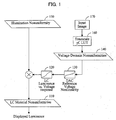
- FIG. 1 illustrates liquid crystal devices and sources of mura.
- mura defects may occur as a result of various components of the display such as LC120, Digital Analog Converter (DAC) 130 and so on.
- mura defects may occur as a result of Voltage-Domain Nonuniformities 140, Illumination Nonuniformities 150 and so on.
- the combination of the light sources (e.g., fluorescent tubes or light emitting diodes) and the diffuser results in very low frequency modulations as opposed to a uniform field in the resulting displayed image.
- the LCD panel itself may be a source of mura defects because of non-uniformity in the liquid crystal material deposited on the glass.
- This type of mura tends to be low frequency with strong asymmetry, that is, it may appear streaky which has some higher frequency components in a single direction.
- Another source of mura defects tends to be the driving circuitry (e.g., clocking noise) which causes grid like distortions on the display.
- Yet another source of mura defects is pixel noise, which is primarily due to variations in the localized driving circuitry (e.g., the thin film transistors) and is usually manifested as a fixed pattern noise.
- WO 93/19453 on which the two-part form is based, discloses a flat panel display inspection system comprising a camera for detecting, for example, the brightness uniformity across the display. According to an embodiment, errors in the detected image may be avoided by calculating compensation factors that may be applied to the display drivers. Accordingly, the brightness uniformity may be corrected.
- WO 97/00452 refers to a mura detection apparatus and method, wherein an image of the display is taken and processed.
- WO 2004/047058 refers to a method of improving the output uniformity of a display device.
- EP-A-1211661 discloses a process for producing a display having a luminance-correcting function.
- JP 2006 084729 is concerned with providing a luminance correction method and a display system, which are capable of resolving luminance unevenness neither too much nor too little.
- a measured luminance of each prescribed pixel position at the time of displaying a display image having each prescribed pixel value on a display panel is prestored in a hard disk, and a correction value is calculated in an arithmetic part on the basis of a target luminance, the measured luminance, and gradation characteristics of the display panel, and the calculated correction value is used to correct each pixel value of an image to be displayed on the display panel.
- a target luminance for one prescribed pixel value is determined by the arithmetic part, and a target luminance for another prescribed pixel value is calculated in the arithmetic part on the basis of the determined target luminance and the gradation characteristics of the display panel.
- JP 2005 221525 is concerned with providing a display device which emits light with uniform brightness by correcting luminance unevenness of the display device without the impairment of the gradation performance.
- the light emission luminance of phosphors to respective electron emitters is measured by a first measuring section and is then converted to peak values which are thereafter stored into a correction table (LUT). If there is a variation in the light emission luminance, an element characteristic correction section performs correction by discretely reforming the respective element characteristics in such a manner that the uniform element characteristics can be attained.
- the light emission luminance of the phosphors corresponding to the respective electron emitters is further measured by a second measuring section and thereafter the LUT is formed and if there is the variation in the light emission luminance, the display device is applied in the video display based on the correction LUT.
- the mura defects due to the thin film transistor noise and driver circuits does not occur in the luminance domain, but rather occurs in the voltage domain.
- the result manifests itself in the LCD response curse which is usually an S-shaped function of luminance.
- An object of the present invention is to provide a more straightforward approach which is to measure and correct the resulting tone scale for each pixel of the display, rather than correct for each non-uniformity in their different domains.
- a more straightforward approach is to measure the resulting tone scale for each pixel of the display.
- the low frequency mura non-uniformities as well as the higher frequency fixed pattern mura non-uniformity will appear as distortions in the displayed tone scale.
- additive distortions in the code value domain will show up as vertical offsets in the tone scale's of the pixels affected by such a distortion.
- Illumination based distortions which are additive in the log domain will show up as non-linear additions in the tone scale.
- the system may reflect the issues occurring in the different domains back to the code value domain. If each pixel's tonescale is forced to be identical (or substantially so), then at each gray level all of the pixels will have the same luminance (or substantially so), thus the mura will be reduced to zero (or substantially so).
- FIG. 2 illustrates capturing mura tonescale.
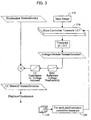
- FIG. 3 illustrates loading correction mura tonescales.
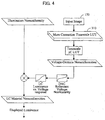
- FIG. 4 illustrates input imagery and loaded mura correction tonescale.
- the process of detecting and correcting for mura defects may be done as a set of steps.
- the capture and generation of the corrective tone scale is created which may be expressed in the form of a look up table. Initially, values in the look up table are set to a uniform value k before the display is measured (220), and converted to ⁇ by a tonescale ⁇ C look up table 160.
- mura is captured by a camera (210).
- the tonescale is stored for each pixel (230), and a corrective tonescale is calculated for each pixel (240).
- the corrective tone scale may be applied to a mura look up table which operates on the frame buffer memory of the display.
- the display is used to receive image data which is modified by the mura look up table (310), prior to being displayed on the display.
- the first step is to use an image capture device, such as a camera, to capture the mura as a function of gray level.
- the camera should have a resolution equal to or greater than the display so that there is at least one pixel in the camera image corresponding to each display pixel. For high resolution displays or low resolution cameras, the camera may be shifted in steps across the display to characterize the entire display.
- the captured images are combined so that a tone scale across its display range is generated for each pixel (or a sub-set thereof). If the display has zero mura, then the corrective mura tone scales would all be the same.
- a corrective tone scale for each pixel is determined so that the combination of the corrective tone scale together with the system non-uniformity provides a resulting tone scale that is substantially uniform across the display. Initially, the values in the mura correction tone scale look up table may be set to unity before the display is measured. After determining the corrective mura tone scale values for each pixel, it is loaded into the display memory as shown in FIG. 4 .
- any flat field will appear uniform, and even mura that may be visible on ramped backgrounds, such as a sky gradient, will be set to zero.
- the mura reduction technique is effective for reducing display non-uniformities, it also tends to reduce the dynamic range, namely, the maximum to minimum in luminance levels. Moreover, the reduction in the dynamic range also depends on the level of mura which varies from display to display, thus making the resulting dynamic range of the display variable. For example, the mura on the left side of the display may be less bright than the mura on the right side of the display. This is typical for mura due to illumination non-uniformity, and this will tend to be the case for all gray levels. Since the mura correction can not make a pixel brighter than its max, the effect of mura correction is to lower the luminance of the left side to match the maximum value of the darker side.
- the darker right side can at best match the black level of the lighter left side.
- the corrected maximum gets reduced to the lowest maximum value across the display, and the corrected minimum gets elevated to the lightest minimum value across the display.
- the dynamic range e.g., log max - log min
- the same reduction in dynamic range also occurs for the other non-uniformities.
- a high amplitude fixed pattern noise leads to a reduction of overall dynamic range after mura correction.
- the technique of capturing the mura from the pixels and thereafter correcting the mura using a look up table may be relatively accurate within the signal to noise ratio of the image capture apparatus and the bit-depth of the mural correction look up table. However, it was determined that taking into account that actual effects of the human visual system that will actually view the display may result in a greater dynamic range than would otherwise result.
- some mura effects of particular frequencies are corrected in such a manner that the changes may not be visible to the viewer.
- the dynamic range of the display is reduced while the viewer will not otherwise perceive a difference in the displayed image.
- a slight gradient across the image so that the left side is darker than the right side may be considered a mura effect.
- the human visual system has very low sensitivity to such a low frequency mura artifact and thus may not be sufficiently advantageous to remove. That is, it generally takes a high amplitude of such mura waveforms to be readily perceived by the viewer. If the mura distortion is generally imperceptible to the viewer, although physically measurable, then it is not useful to modify it.
- FIG. 5 illustrates contrast sensitivity function dependence on viewing angle.
- one measure of the human visual system is a contrast sensitivity function (CSF) of the human eye. This is one of several criteria that may be used so that only the mura that is readily visible to the eye is corrected. This has the benefit of maintaining a higher dynamic range of the correction than the technique illustrated in FIGS. 3-5 .
- CSF contrast sensitivity function
- the CSF of the human visual system is a function of spatial frequencies and thus should be mapped to digital frequencies for use in mura reduction. Such a mapping is dependent on the viewing distance.
- the CSF changes shape, maximum sensitivity, and bandwidth is a function of the viewing conditions, such as light adaptation level, display size, etc. As a result the CSF should be chosen for the conditions that match that of the display and its anticipated viewing conditions.
- the CSF may be converted to a point spread function (psf) and then used to filter the captured mura images via convolution. Typically, there is a different point spread function for each gray level.
- the filtering may be done by leaving the CSF in the frequency domain and converting the mura images to the frequency domain for multiplication with the CSF, and then convert back to the spatial domain via inverse Fourier transform.
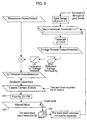
- FIG. 6 illustrates a contrast sensitivity model to attenuate the mura correction to maintain a higher dynamic range.
- a system that includes mura capture, corrective mura tone scale calculation, CSF filtered, and mura correction tone scale look up table is illustrated.
- CSF 610
- FIG. 7 illustrates the effects of using the CSF to maintain bandwidth.
- the corrective data may be based upon a weighting function that emphasizes a mid-range over a low range and a high range.
- the dynamic range of the image displayed on the display may be greater than it would have otherwise been had the characteristics generally not visible by the human visual system been considered.
Landscapes
- Engineering & Computer Science (AREA)
- Physics & Mathematics (AREA)
- Computer Hardware Design (AREA)
- General Physics & Mathematics (AREA)
- Theoretical Computer Science (AREA)
- Control Of Indicators Other Than Cathode Ray Tubes (AREA)
- Liquid Crystal Display Device Control (AREA)
- Image Processing (AREA)
- Testing Of Optical Devices Or Fibers (AREA)
- Liquid Crystal (AREA)
Applications Claiming Priority (1)
| Application Number | Priority Date | Filing Date | Title |
|---|---|---|---|
| US11/731,094 US8026927B2 (en) | 2007-03-29 | 2007-03-29 | Reduction of mura effects |
Publications (3)
| Publication Number | Publication Date |
|---|---|
| EP1975915A2 EP1975915A2 (en) | 2008-10-01 |
| EP1975915A3 EP1975915A3 (en) | 2009-05-27 |
| EP1975915B1 true EP1975915B1 (en) | 2016-11-02 |
Family
ID=39542049
Family Applications (1)
| Application Number | Title | Priority Date | Filing Date |
|---|---|---|---|
| EP08005830.8A Not-in-force EP1975915B1 (en) | 2007-03-29 | 2008-03-27 | Reduction of mura effects, and display |
Country Status (3)
| Country | Link |
|---|---|
| US (1) | US8026927B2 (enExample) |
| EP (1) | EP1975915B1 (enExample) |
| JP (2) | JP2008250319A (enExample) |
Families Citing this family (31)
| Publication number | Priority date | Publication date | Assignee | Title |
|---|---|---|---|---|
| TWI375198B (en) * | 2007-05-17 | 2012-10-21 | Tpo Displays Corp | A system for displaying images |
| US8049695B2 (en) * | 2007-10-15 | 2011-11-01 | Sharp Laboratories Of America, Inc. | Correction of visible mura distortions in displays by use of flexible system for memory resources and mura characteristics |
| JP5362753B2 (ja) * | 2008-07-31 | 2013-12-11 | 株式会社イクス | 画質調整装置及び画像補正データ生成プログラム |
| US20110012908A1 (en) * | 2009-07-20 | 2011-01-20 | Sharp Laboratories Of America, Inc. | System for compensation of differential aging mura of displays |
| GB2473614A (en) * | 2009-09-16 | 2011-03-23 | Sharp Kk | Private display with main and side images and axis-dependent luminance control |
| KR101699089B1 (ko) | 2010-04-05 | 2017-01-23 | 가부시키가이샤 제이올레드 | 유기 el 표시 장치의 표시 방법 및 유기 el 표시 장치 |
| WO2011125113A1 (ja) | 2010-04-05 | 2011-10-13 | パナソニック株式会社 | 有機el表示装置および有機el表示装置の製造方法 |
| WO2012005284A1 (ja) * | 2010-07-07 | 2012-01-12 | シャープ株式会社 | 液晶表示装置 |
| US20120075354A1 (en) * | 2010-09-29 | 2012-03-29 | Sharp Laboratories Of America, Inc. | Capture time reduction for correction of display non-uniformities |
| JPWO2014128822A1 (ja) * | 2013-02-19 | 2017-02-02 | 株式会社イクス | 補正データ生成方法、補正データ生成システム及びこれらを用いた画質調整技術 |
| US20150187306A1 (en) * | 2013-12-30 | 2015-07-02 | Shenzhen China Star Optoelectronics Technology Co., Ltd. | System and method for poor display repair for liquid crystal display panel |
| JP6341672B2 (ja) * | 2014-01-23 | 2018-06-13 | キヤノン株式会社 | 画像処理装置、画像処理方法、及び、プログラム |
| CN103854556B (zh) | 2014-02-19 | 2016-05-18 | 北京京东方显示技术有限公司 | 基色子像素的电压补偿装置及方法、显示装置 |
| TWI625714B (zh) * | 2014-02-21 | 2018-06-01 | 群創光電股份有限公司 | 有機發光顯示器 |
| CN104217701A (zh) * | 2014-08-22 | 2014-12-17 | 京东方科技集团股份有限公司 | 一种显示面板的控制方法、装置以及时序控制器 |
| US10341637B1 (en) * | 2015-03-11 | 2019-07-02 | Facebook Technologies, Llc | Full frame uniformity across panels |
| JP6559795B2 (ja) * | 2015-03-20 | 2019-08-14 | ホアウェイ・テクノロジーズ・カンパニー・リミテッド | ディスプレイムラ補正方法、装置、及びシステム |
| JP6577223B2 (ja) * | 2015-04-21 | 2019-09-18 | シャープ株式会社 | 液晶表示装置 |
| CN105244001B (zh) * | 2015-11-09 | 2018-01-09 | 深圳市华星光电技术有限公司 | 一种确定mura补偿值的方法以及装置 |
| WO2017187827A1 (ja) * | 2016-04-28 | 2017-11-02 | 株式会社イクス | ムラ評価方法及びムラ評価装置 |
| WO2018061093A1 (ja) | 2016-09-27 | 2018-04-05 | 堺ディスプレイプロダクト株式会社 | 液晶表示装置の輝度むら補正方法及び補正データ生成装置 |
| CN106898286B (zh) * | 2017-03-15 | 2020-07-03 | 武汉精测电子集团股份有限公司 | 基于指定位置的Mura缺陷修复方法及装置 |
| CN109791112A (zh) * | 2017-08-04 | 2019-05-21 | 深圳市柔宇科技有限公司 | Mura检测方法和Mura检测系统 |
| US10755133B2 (en) * | 2018-02-22 | 2020-08-25 | Samsung Display Co., Ltd. | System and method for line Mura detection with preprocessing |
| CN109147696B (zh) * | 2018-09-03 | 2021-02-26 | 重庆惠科金渝光电科技有限公司 | 数据处理方法、显示装置和计算机可读存储介质 |
| US11113999B2 (en) | 2018-09-03 | 2021-09-07 | Chongqing Hkc Optoelectronics Technology Co., Ltd. | Data processing method, display device, and computer-readable storage medium |
| CN109036277B (zh) * | 2018-09-27 | 2020-06-09 | 京东方科技集团股份有限公司 | 补偿方法及补偿装置、显示装置、显示方法及存储介质 |
| CN109358438B (zh) * | 2018-10-30 | 2021-03-26 | 京东方科技集团股份有限公司 | 云纹评价方法、装置和系统 |
| JP2021081494A (ja) * | 2019-11-15 | 2021-05-27 | シャープ株式会社 | 画像処理システム、画像処理方法、及び画像処理プログラム |
| CN111583863B (zh) * | 2020-05-25 | 2021-08-27 | 昆山国显光电有限公司 | 一种mura补偿方法、装置和显示面板 |
| CN119993066B (zh) * | 2025-04-01 | 2025-09-23 | 京东方科技集团股份有限公司 | 显示面板亮度补偿方法、介质和设备 |
Citations (2)
| Publication number | Priority date | Publication date | Assignee | Title |
|---|---|---|---|---|
| JP2005221525A (ja) * | 2004-02-03 | 2005-08-18 | Canon Inc | 表示装置 |
| JP2006084729A (ja) * | 2004-09-15 | 2006-03-30 | Nanao Corp | 輝度補正方法及び表示システム |
Family Cites Families (19)
| Publication number | Priority date | Publication date | Assignee | Title |
|---|---|---|---|---|
| JPH07507139A (ja) | 1992-03-16 | 1995-08-03 | フォトン・ダイナミクス・インコーポレーテッド | フラット・パネル・ディスプレイ検査システム |
| US5917935A (en) | 1995-06-13 | 1999-06-29 | Photon Dynamics, Inc. | Mura detection apparatus and method |
| US6154561A (en) | 1997-04-07 | 2000-11-28 | Photon Dynamics, Inc. | Method and apparatus for detecting Mura defects |
| JP2001324961A (ja) | 2000-03-10 | 2001-11-22 | Ngk Insulators Ltd | 表示装置の製造方法 |
| US7110012B2 (en) * | 2000-06-12 | 2006-09-19 | Sharp Laboratories Of America, Inc. | System for improving display resolution |
| JP3431075B2 (ja) | 2001-08-27 | 2003-07-28 | 科学技術振興事業団 | 液晶ディスプレイパネルムラの分類処理方法、その装置及びプログラム |
| KR100422295B1 (ko) * | 2002-05-18 | 2004-03-11 | 엘지.필립스 엘시디 주식회사 | 디스플레이 장치의 화질 분석 방법 및 시스템 |
| US8111222B2 (en) | 2002-11-21 | 2012-02-07 | Koninklijke Philips Electronics N.V. | Method of improving the output uniformity of a display device |
| JP2004212311A (ja) * | 2003-01-08 | 2004-07-29 | Seiko Epson Corp | ムラ欠陥の検出方法及び装置 |
| US20040179028A1 (en) | 2003-03-12 | 2004-09-16 | Fuji Photo Film Co., Ltd. | Pixel defect correcting method, color mura correcting method and image display device |
| JP4036142B2 (ja) | 2003-05-28 | 2008-01-23 | セイコーエプソン株式会社 | 電気光学装置、電気光学装置の駆動方法および電子機器 |
| JP2005017715A (ja) | 2003-06-26 | 2005-01-20 | Toshiba Corp | 面むら補正装置及び面むら補正方法 |
| US6937249B2 (en) * | 2003-11-07 | 2005-08-30 | Integrated Color Solutions, Inc. | System and method for display device characterization, calibration, and verification |
| JP2005316408A (ja) * | 2004-03-30 | 2005-11-10 | Sanyo Electric Co Ltd | 表示むら補正値生成装置 |
| US20060034536A1 (en) * | 2004-06-23 | 2006-02-16 | Ogren Wayne E | Systems and methods relating to magnitude enhancement analysis suitable for high bit level displays on low bit level systems, determining the material thickness, and 3D visualization of color space dimensions |
| JP2006018169A (ja) * | 2004-07-05 | 2006-01-19 | Sony Corp | 画像表示装置及びその温度補正方法 |
| ATE453907T1 (de) | 2004-10-25 | 2010-01-15 | Barco Nv | OPTISCHE KORREKTUR FÜR LEUCHTPANEELE MIT HOHER GLEICHMÄßIGKEIT |
| JP4857586B2 (ja) * | 2005-04-05 | 2012-01-18 | セイコーエプソン株式会社 | 電子回路の駆動方法及び駆動回路、発光装置、並びに電子機器 |
| KR101137856B1 (ko) * | 2005-10-25 | 2012-04-20 | 엘지디스플레이 주식회사 | 평판표시장치 및 그 화질제어방법 |
-
2007
- 2007-03-29 US US11/731,094 patent/US8026927B2/en not_active Expired - Fee Related
-
2008
- 2008-03-19 JP JP2008072423A patent/JP2008250319A/ja active Pending
- 2008-03-27 EP EP08005830.8A patent/EP1975915B1/en not_active Not-in-force
-
2009
- 2009-01-14 JP JP2009005586A patent/JP2009122690A/ja active Pending
Patent Citations (2)
| Publication number | Priority date | Publication date | Assignee | Title |
|---|---|---|---|---|
| JP2005221525A (ja) * | 2004-02-03 | 2005-08-18 | Canon Inc | 表示装置 |
| JP2006084729A (ja) * | 2004-09-15 | 2006-03-30 | Nanao Corp | 輝度補正方法及び表示システム |
Also Published As
| Publication number | Publication date |
|---|---|
| JP2008250319A (ja) | 2008-10-16 |
| EP1975915A3 (en) | 2009-05-27 |
| US8026927B2 (en) | 2011-09-27 |
| US20080238934A1 (en) | 2008-10-02 |
| EP1975915A2 (en) | 2008-10-01 |
| JP2009122690A (ja) | 2009-06-04 |
Similar Documents
| Publication | Publication Date | Title |
|---|---|---|
| EP1975915B1 (en) | Reduction of mura effects, and display | |
| US8049695B2 (en) | Correction of visible mura distortions in displays by use of flexible system for memory resources and mura characteristics | |
| US20110012908A1 (en) | System for compensation of differential aging mura of displays | |
| US8610654B2 (en) | Correction of visible mura distortions in displays using filtered mura reduction and backlight control | |
| US20120075354A1 (en) | Capture time reduction for correction of display non-uniformities | |
| US20100013750A1 (en) | Correction of visible mura distortions in displays using filtered mura reduction and backlight control | |
| CN107818766B (zh) | 用于驱动显示面板的集成电路及其方法 | |
| CN101685612B (zh) | 背光源亮度控制装置和视频显示装置 | |
| KR101333680B1 (ko) | 디스플레이장치 및 그의 밝기 조정방법 | |
| JP5026545B2 (ja) | 表示装置、輝度ムラ補正方法、補正データ作成装置、および補正データ作成方法 | |
| US9990878B2 (en) | Data clipping method using red, green, blue and white data, and display device using the same | |
| JP2019514041A (ja) | ムラ現象の補償方法 | |
| TWI525604B (zh) | 影像分析和影像顯示的裝置和方法 | |
| CN111883038A (zh) | 像素的灰阶值确定方法、显示面板和计算机可读存储介质 | |
| JP2011158717A (ja) | 表示装置、輝度ムラ補正方法、補正データ作成装置、および補正データ作成方法 | |
| JP2009128733A (ja) | 液晶表示装置、制御回路、および液晶表示制御方法、並びにコンピュータ・プログラム | |
| KR101389359B1 (ko) | 디스플레이장치 및 그의 밝기 조정방법 | |
| US12112676B2 (en) | Demura method for display panel | |
| Klompenhouwer | The temporal MTF of displays and related video signal processing | |
| WO2019192139A1 (zh) | 显示装置的图像处理方法 | |
| US7817876B2 (en) | Method of noisy signal analysis and apparatus thereof | |
| KR20050084308A (ko) | 광 및 전자 lcd 패널 보상 기능을 갖는 컬러 불균일보정 방법 및 장치 | |
| CN107886918B (zh) | 一种视频图像实时修正方法 | |
| CN120932601A (zh) | 一种提升电视整机显示亮度一致性的方法 | |
| JP2021047309A (ja) | 画像表示装置 |
Legal Events
| Date | Code | Title | Description |
|---|---|---|---|
| PUAI | Public reference made under article 153(3) epc to a published international application that has entered the european phase |
Free format text: ORIGINAL CODE: 0009012 |
|
| AK | Designated contracting states |
Kind code of ref document: A2 Designated state(s): AT BE BG CH CY CZ DE DK EE ES FI FR GB GR HR HU IE IS IT LI LT LU LV MC MT NL NO PL PT RO SE SI SK TR |
|
| AX | Request for extension of the european patent |
Extension state: AL BA MK RS |
|
| RIN1 | Information on inventor provided before grant (corrected) |
Inventor name: OZAWA, YASUO Inventor name: DALY, SCOTT J. |
|
| PUAL | Search report despatched |
Free format text: ORIGINAL CODE: 0009013 |
|
| AK | Designated contracting states |
Kind code of ref document: A3 Designated state(s): AT BE BG CH CY CZ DE DK EE ES FI FR GB GR HR HU IE IS IT LI LT LU LV MC MT NL NO PL PT RO SE SI SK TR |
|
| AX | Request for extension of the european patent |
Extension state: AL BA MK RS |
|
| 17P | Request for examination filed |
Effective date: 20091117 |
|
| 17Q | First examination report despatched |
Effective date: 20100104 |
|
| AKX | Designation fees paid |
Designated state(s): DE FR GB |
|
| GRAP | Despatch of communication of intention to grant a patent |
Free format text: ORIGINAL CODE: EPIDOSNIGR1 |
|
| INTG | Intention to grant announced |
Effective date: 20160602 |
|
| GRAS | Grant fee paid |
Free format text: ORIGINAL CODE: EPIDOSNIGR3 |
|
| GRAA | (expected) grant |
Free format text: ORIGINAL CODE: 0009210 |
|
| AK | Designated contracting states |
Kind code of ref document: B1 Designated state(s): DE FR GB |
|
| REG | Reference to a national code |
Ref country code: GB Ref legal event code: FG4D |
|
| REG | Reference to a national code |
Ref country code: DE Ref legal event code: R096 Ref document number: 602008047126 Country of ref document: DE |
|
| REG | Reference to a national code |
Ref country code: DE Ref legal event code: R097 Ref document number: 602008047126 Country of ref document: DE |
|
| PLBE | No opposition filed within time limit |
Free format text: ORIGINAL CODE: 0009261 |
|
| STAA | Information on the status of an ep patent application or granted ep patent |
Free format text: STATUS: NO OPPOSITION FILED WITHIN TIME LIMIT |
|
| 26N | No opposition filed |
Effective date: 20170803 |
|
| GBPC | Gb: european patent ceased through non-payment of renewal fee |
Effective date: 20170327 |
|
| REG | Reference to a national code |
Ref country code: FR Ref legal event code: ST Effective date: 20171130 |
|
| PG25 | Lapsed in a contracting state [announced via postgrant information from national office to epo] |
Ref country code: FR Free format text: LAPSE BECAUSE OF NON-PAYMENT OF DUE FEES Effective date: 20170331 |
|
| PG25 | Lapsed in a contracting state [announced via postgrant information from national office to epo] |
Ref country code: GB Free format text: LAPSE BECAUSE OF NON-PAYMENT OF DUE FEES Effective date: 20170327 |
|
| PGFP | Annual fee paid to national office [announced via postgrant information from national office to epo] |
Ref country code: DE Payment date: 20190321 Year of fee payment: 12 |
|
| REG | Reference to a national code |
Ref country code: DE Ref legal event code: R119 Ref document number: 602008047126 Country of ref document: DE |
|
| PG25 | Lapsed in a contracting state [announced via postgrant information from national office to epo] |
Ref country code: DE Free format text: LAPSE BECAUSE OF NON-PAYMENT OF DUE FEES Effective date: 20201001 |