EP1964197B1 - Pem fuel cell system comprising hydrogen generation based on hydride conversion with product water - Google Patents
Pem fuel cell system comprising hydrogen generation based on hydride conversion with product water Download PDFInfo
- Publication number
- EP1964197B1 EP1964197B1 EP06826323.5A EP06826323A EP1964197B1 EP 1964197 B1 EP1964197 B1 EP 1964197B1 EP 06826323 A EP06826323 A EP 06826323A EP 1964197 B1 EP1964197 B1 EP 1964197B1
- Authority
- EP
- European Patent Office
- Prior art keywords
- cathode
- fuel cell
- hydrogen
- power generator
- water
- Prior art date
- Legal status (The legal status is an assumption and is not a legal conclusion. Google has not performed a legal analysis and makes no representation as to the accuracy of the status listed.)
- Ceased
Links
- 239000000446 fuel Substances 0.000 title claims description 78
- XLYOFNOQVPJJNP-UHFFFAOYSA-N water Substances O XLYOFNOQVPJJNP-UHFFFAOYSA-N 0.000 title claims description 65
- UFHFLCQGNIYNRP-UHFFFAOYSA-N Hydrogen Chemical compound [H][H] UFHFLCQGNIYNRP-UHFFFAOYSA-N 0.000 title claims description 54
- 239000001257 hydrogen Substances 0.000 title claims description 54
- 229910052739 hydrogen Inorganic materials 0.000 title claims description 54
- 238000006243 chemical reaction Methods 0.000 title description 11
- 150000004678 hydrides Chemical class 0.000 title description 4
- 239000012528 membrane Substances 0.000 claims description 26
- 238000009792 diffusion process Methods 0.000 claims description 23
- 239000011148 porous material Substances 0.000 claims description 14
- 239000007789 gas Substances 0.000 claims description 13
- QVGXLLKOCUKJST-UHFFFAOYSA-N atomic oxygen Chemical compound [O] QVGXLLKOCUKJST-UHFFFAOYSA-N 0.000 claims description 12
- 239000001301 oxygen Substances 0.000 claims description 12
- 229910052760 oxygen Inorganic materials 0.000 claims description 12
- 230000002209 hydrophobic effect Effects 0.000 claims description 9
- 239000003054 catalyst Substances 0.000 claims description 7
- 239000011248 coating agent Substances 0.000 claims description 6
- 238000000576 coating method Methods 0.000 claims description 6
- 230000005611 electricity Effects 0.000 claims description 4
- 230000001105 regulatory effect Effects 0.000 claims description 3
- 238000004519 manufacturing process Methods 0.000 claims 1
- 210000004027 cell Anatomy 0.000 description 48
- 239000003570 air Substances 0.000 description 7
- 230000004907 flux Effects 0.000 description 5
- 238000010248 power generation Methods 0.000 description 5
- OKTJSMMVPCPJKN-UHFFFAOYSA-N Carbon Chemical compound [C] OKTJSMMVPCPJKN-UHFFFAOYSA-N 0.000 description 4
- BASFCYQUMIYNBI-UHFFFAOYSA-N platinum Chemical compound [Pt] BASFCYQUMIYNBI-UHFFFAOYSA-N 0.000 description 4
- 239000000376 reactant Substances 0.000 description 4
- 229910052799 carbon Inorganic materials 0.000 description 3
- 210000000170 cell membrane Anatomy 0.000 description 3
- -1 lithium aluminum hydride Chemical compound 0.000 description 3
- 238000000034 method Methods 0.000 description 3
- 239000000126 substance Substances 0.000 description 3
- 229920000557 Nafion® Polymers 0.000 description 2
- 239000002033 PVDF binder Substances 0.000 description 2
- 229920001774 Perfluoroether Polymers 0.000 description 2
- 239000012080 ambient air Substances 0.000 description 2
- 239000003708 ampul Substances 0.000 description 2
- 230000007423 decrease Effects 0.000 description 2
- 238000003487 electrochemical reaction Methods 0.000 description 2
- 238000005370 electroosmosis Methods 0.000 description 2
- 239000007788 liquid Substances 0.000 description 2
- 239000000463 material Substances 0.000 description 2
- 229910052697 platinum Inorganic materials 0.000 description 2
- 239000004810 polytetrafluoroethylene Substances 0.000 description 2
- 229920001343 polytetrafluoroethylene Polymers 0.000 description 2
- 229920002981 polyvinylidene fluoride Polymers 0.000 description 2
- 238000004064 recycling Methods 0.000 description 2
- 239000004215 Carbon black (E152) Substances 0.000 description 1
- 239000011230 binding agent Substances 0.000 description 1
- 239000006227 byproduct Substances 0.000 description 1
- ABDBNWQRPYOPDF-UHFFFAOYSA-N carbonofluoridic acid Chemical compound OC(F)=O ABDBNWQRPYOPDF-UHFFFAOYSA-N 0.000 description 1
- 239000002131 composite material Substances 0.000 description 1
- 125000000816 ethylene group Chemical group [H]C([H])([*:1])C([H])([H])[*:2] 0.000 description 1
- 238000004880 explosion Methods 0.000 description 1
- 230000008713 feedback mechanism Effects 0.000 description 1
- 239000012530 fluid Substances 0.000 description 1
- UQSQSQZYBQSBJZ-UHFFFAOYSA-N fluorosulfonic acid Chemical compound OS(F)(=O)=O UQSQSQZYBQSBJZ-UHFFFAOYSA-N 0.000 description 1
- 229910002804 graphite Inorganic materials 0.000 description 1
- 239000010439 graphite Substances 0.000 description 1
- 229930195733 hydrocarbon Natural products 0.000 description 1
- 150000002430 hydrocarbons Chemical class 0.000 description 1
- 150000002431 hydrogen Chemical class 0.000 description 1
- 239000012280 lithium aluminium hydride Substances 0.000 description 1
- 229910052987 metal hydride Inorganic materials 0.000 description 1
- 150000004681 metal hydrides Chemical class 0.000 description 1
- 238000005459 micromachining Methods 0.000 description 1
- 230000003204 osmotic effect Effects 0.000 description 1
- 239000002245 particle Substances 0.000 description 1
- 230000037361 pathway Effects 0.000 description 1
- 239000012466 permeate Substances 0.000 description 1
- 229920003023 plastic Polymers 0.000 description 1
- 239000004033 plastic Substances 0.000 description 1
- 229920000573 polyethylene Polymers 0.000 description 1
- 239000000047 product Substances 0.000 description 1
- QQONPFPTGQHPMA-UHFFFAOYSA-N propylene Natural products CC=C QQONPFPTGQHPMA-UHFFFAOYSA-N 0.000 description 1
- 125000004805 propylene group Chemical group [H]C([H])([H])C([H])([*:1])C([H])([H])[*:2] 0.000 description 1
- 230000001681 protective effect Effects 0.000 description 1
- 239000007787 solid Substances 0.000 description 1
- 239000000758 substrate Substances 0.000 description 1
Images


Classifications
-
- H—ELECTRICITY
- H01—ELECTRIC ELEMENTS
- H01M—PROCESSES OR MEANS, e.g. BATTERIES, FOR THE DIRECT CONVERSION OF CHEMICAL ENERGY INTO ELECTRICAL ENERGY
- H01M8/00—Fuel cells; Manufacture thereof
- H01M8/04—Auxiliary arrangements, e.g. for control of pressure or for circulation of fluids
- H01M8/04291—Arrangements for managing water in solid electrolyte fuel cell systems
-
- H—ELECTRICITY
- H01—ELECTRIC ELEMENTS
- H01M—PROCESSES OR MEANS, e.g. BATTERIES, FOR THE DIRECT CONVERSION OF CHEMICAL ENERGY INTO ELECTRICAL ENERGY
- H01M4/00—Electrodes
- H01M4/86—Inert electrodes with catalytic activity, e.g. for fuel cells
- H01M4/8647—Inert electrodes with catalytic activity, e.g. for fuel cells consisting of more than one material, e.g. consisting of composites
- H01M4/8657—Inert electrodes with catalytic activity, e.g. for fuel cells consisting of more than one material, e.g. consisting of composites layered
-
- H—ELECTRICITY
- H01—ELECTRIC ELEMENTS
- H01M—PROCESSES OR MEANS, e.g. BATTERIES, FOR THE DIRECT CONVERSION OF CHEMICAL ENERGY INTO ELECTRICAL ENERGY
- H01M8/00—Fuel cells; Manufacture thereof
- H01M8/06—Combination of fuel cells with means for production of reactants or for treatment of residues
- H01M8/0606—Combination of fuel cells with means for production of reactants or for treatment of residues with means for production of gaseous reactants
- H01M8/065—Combination of fuel cells with means for production of reactants or for treatment of residues with means for production of gaseous reactants by dissolution of metals or alloys; by dehydriding metallic substances
-
- H—ELECTRICITY
- H01—ELECTRIC ELEMENTS
- H01M—PROCESSES OR MEANS, e.g. BATTERIES, FOR THE DIRECT CONVERSION OF CHEMICAL ENERGY INTO ELECTRICAL ENERGY
- H01M8/00—Fuel cells; Manufacture thereof
- H01M8/10—Fuel cells with solid electrolytes
- H01M8/1007—Fuel cells with solid electrolytes with both reactants being gaseous or vaporised
-
- H—ELECTRICITY
- H01—ELECTRIC ELEMENTS
- H01M—PROCESSES OR MEANS, e.g. BATTERIES, FOR THE DIRECT CONVERSION OF CHEMICAL ENERGY INTO ELECTRICAL ENERGY
- H01M2250/00—Fuel cells for particular applications; Specific features of fuel cell system
- H01M2250/30—Fuel cells in portable systems, e.g. mobile phone, laptop
-
- H—ELECTRICITY
- H01—ELECTRIC ELEMENTS
- H01M—PROCESSES OR MEANS, e.g. BATTERIES, FOR THE DIRECT CONVERSION OF CHEMICAL ENERGY INTO ELECTRICAL ENERGY
- H01M8/00—Fuel cells; Manufacture thereof
- H01M8/04—Auxiliary arrangements, e.g. for control of pressure or for circulation of fluids
- H01M8/04082—Arrangements for control of reactant parameters, e.g. pressure or concentration
- H01M8/04201—Reactant storage and supply, e.g. means for feeding, pipes
- H01M8/04216—Reactant storage and supply, e.g. means for feeding, pipes characterised by the choice for a specific material, e.g. carbon, hydride, absorbent
-
- Y—GENERAL TAGGING OF NEW TECHNOLOGICAL DEVELOPMENTS; GENERAL TAGGING OF CROSS-SECTIONAL TECHNOLOGIES SPANNING OVER SEVERAL SECTIONS OF THE IPC; TECHNICAL SUBJECTS COVERED BY FORMER USPC CROSS-REFERENCE ART COLLECTIONS [XRACs] AND DIGESTS
- Y02—TECHNOLOGIES OR APPLICATIONS FOR MITIGATION OR ADAPTATION AGAINST CLIMATE CHANGE
- Y02B—CLIMATE CHANGE MITIGATION TECHNOLOGIES RELATED TO BUILDINGS, e.g. HOUSING, HOUSE APPLIANCES OR RELATED END-USER APPLICATIONS
- Y02B90/00—Enabling technologies or technologies with a potential or indirect contribution to GHG emissions mitigation
- Y02B90/10—Applications of fuel cells in buildings
-
- Y—GENERAL TAGGING OF NEW TECHNOLOGICAL DEVELOPMENTS; GENERAL TAGGING OF CROSS-SECTIONAL TECHNOLOGIES SPANNING OVER SEVERAL SECTIONS OF THE IPC; TECHNICAL SUBJECTS COVERED BY FORMER USPC CROSS-REFERENCE ART COLLECTIONS [XRACs] AND DIGESTS
- Y02—TECHNOLOGIES OR APPLICATIONS FOR MITIGATION OR ADAPTATION AGAINST CLIMATE CHANGE
- Y02E—REDUCTION OF GREENHOUSE GAS [GHG] EMISSIONS, RELATED TO ENERGY GENERATION, TRANSMISSION OR DISTRIBUTION
- Y02E60/00—Enabling technologies; Technologies with a potential or indirect contribution to GHG emissions mitigation
- Y02E60/30—Hydrogen technology
- Y02E60/50—Fuel cells
Definitions
- a pneumatic valve is used to control a hydrogen generating chemical reaction that feeds hydrogen oxygen PEM fuel cells.
- the valve comprises a substantial portion of the power generator volume and weight, and thus reduces the energy density and specific energy of the power generator.
- PEM fuel cells use a simple chemical reaction to combine hydrogen and oxygen into water, producing electric current in the process.
- Hydrogen may be produced by a chemical reaction between a fuel, such as lithium aluminum hydride and water vapor.
- a fuel such as lithium aluminum hydride and water vapor.
- hydrogen molecules are ionized by a platinum catalyst, and give up electrons.
- the PEM allows protons to flow through, but not electrons.
- hydrogen ions flow through the PEM to a cathode, while electrons flow through an external circuit.
- the electrons travel through the external circuit, they can perform useful work by powering an electrical device such as an electric motor, light bulb or electronic circuitry.
- the electrons and hydrogen ions combine with oxygen to form water.
- the byproducts of the reaction are water and heat.
- water tends to accumulate at a cathode.
- the water can block pores, and hence the pathways for reactant species, leading to a decrease in power generation.
- DE10050554 A1 discloses a fuel cell wherein a hydrogen source comprises a chemical hydride (10) bound in an organic substance which reacts with water forming gaseous hydrogen.
- US 2005/0181245 A1 discloses a fuel cell power supply wherein water generated by the fuel cell may be recycled.
- US 2002/0182459 A1 discloses a system of two fuel cell ampoules that can deliver a reactant by diffusion through one of the two ampoules to the other such that when said reactant enters the second ampoule it reacts with another reactant in said second ampoule, making hydrogen gas as a product.
- US 2004/0161646 A1 discloses a system for generating electrical power using a fuel cell.
- the system includes generating hydrogen gas by reacting water vapour with a substantially non-fluid substance and transporting the generated hydrogen gas to the fuel cell which generates electrical power
- US3649360 discloses a combined water removal and hydrogen generation fuel cell power plant.
- US5759712 discloses a miniature fuel cell system using porous plastic membranes as substrates of fuel cells.
- valveless power generator which may include water recycling.
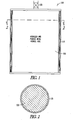
- FIG. 1 is a front cross section view of a power generator 100.
- FIG. 2 is a top cross section view of the power generator 100.
- the power generator comprises a fuel cell stack 110 that is exposed to air.
- the power generator 100 in one embodiment is built as a hollow cylinder with two ends, and surrounds a fuel 120. Other geometries for the shape of the power generator include rectangular solids, spheres, and other non geometrical shapes.
- the fuel is a hydrogen generating fuel that is used by the generating stack 110 to generate electricity.
- the fuel in one embodiment comprises a hydrogen and porous metal hydride fuel.
- the fuel cell stack 110 combines with oxygen from the air to create water and electricity.
- a pressure relief valve 130 may be used to relieve pressure should excess hydrogen be generated.
- the relief valve may be located on the power generator with access to the hydrogen generated by the fuel.
- the porous nature of the fuel allows the relief valve to be located on one of the ends of the power generator.
- the pressure relief valve 130 operates as a safety valve to prevent explosion.
- the pressure relief valve 130 vents hydrogen to the atmosphere or ambient in one embodiment if the internal pressure of the power generator rises above a predetermined value, such as 68,9x10 3 to 68.9x10 4 Pa (10 to 100 PSI) above ambient pressure.
- the valve may close following relief of the internal pressure, enabling the power generator to resume normal operation.
- FIG. 3A illustrates a cross section of a fuel cell stack 300.
- a cathode current collector 305 is formed on the outside of the fuel cell stack 300, and is exposed to air. Pores are formed in the current collector 305 to allow air to pass through.
- a cathode gas diffusion layer (GDL) 310 is coupled to the cathode current collector.
- a hydrophobic micro porous layer 315 is formed on the cathode GDL and separates the cathode GDL 310 from a catalyst coated proton exchange membrane (PEM), such as a Nafion® membrane layer 320.
- PEM catalyst coated proton exchange membrane
- a hydrophilic micro porous layer 325 separates layer 320 from an anode GDL 330, which in turn is coupled to an anode current collector 335.
- the anode current collector 335 has pores formed therein to allow hydrogen to pass through to the anode.
- the anode current collector 335 is separated by water vapor and hydrogen permeable membrane 340.
- Membrane 340 is liquid water and particulate impermeable. Membrane 340 is used to separate the fuel 345 from the anode current collector 335.
- the layers between the cathode and the hydrogen generating fuel serve to separate the cathode from the hydrogen generator containing the fuel 345 that generates hydrogen when exposed to water vapor and provide a diffusion path.
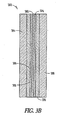
- FIG. 3B illustrates an alternative fuel cell stack 360.
- a proton exchange member 362 comprises a perfluorinated membrane such as perfluorosulfonic acid or perfluorocarboxylic acid, or a hydrocarbon membrane or a composite membrane.
- the fuel cell stack is composed of a cathode current collector 364, cathode gas diffusion electrode 366 with micro porous layer (this gas diffusion electrode with a hydrophobic MPL is the same as the gas diffusion layer, except that it has the catalyst 368 on the surface of the micro porous layer, rather than on the Nafion®) proton exchange membrane (without catalyst) anode gas diffusion electrode 370 with a hydrophobic MPL having a catalyst 374 on the surface of the MPL, and anode current collector 380.
- the gas diffusion electrodes are one piece in one embodiment with three layers.
- the three layers are the gas diffusion layer (GDL)(carbon paper), the micro porous layer (MPL) (PTFE or PVDF) and the catalyst layer (carbon/platinum).
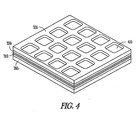
- FIG. 4 is a perspective view of the fuel cell stack 300.
- Anode current collector 335 is illustrated, showing multiple pores 410.
- the pores are relatively large to allow hydrogen to move through to the anode gas diffusion layer 330.
- Water used in the hydrogen generator is generated in the fuel cells by the electrochemical reaction between oxygen from the ambient and hydrogen from the hydrogen generator.
- the water generated at the fuel cells is exactly, or substantially matches, the amount of water needed to generate the hydrogen consumed in the electrochemical reaction, thus the reaction is self sustaining when the water generated is recycled.
- the term substantially matches takes into account that water generated at the fuel cells may not exactly match the water needed to generate the hydrogen. Water vapor from ambient may also be transported, and some water vapor may be lost to ambient.
- the relief valve 130 is provided in case the reaction generates excess hydrogen.
- the hydrophobic coating on the cathode GDL and the hydrophilic coating on the anode GDL promote back permeation of water (from cathode to anode) through the PEM by increasing the hydraulic pressure difference across the PEM.
- a hygroscopic material (hydrogen generating hydride fuel) at the anode further increases the hydraulic pressure difference across the PEM by reducing the humidity (vapor pressure) at the cathode.
- a diffusion path is thus provided between the fuel cell cathode and the hydrogen generator.
- Power generator 100 is a valveless power generator that produces power without the need for moving parts. Further, there are no limits on power generation that are imposed by power generators that use a valve to control diffusion of water vapor from the fuel cells to the fuel. Further, the valveless power generator may provide a self regulating water flow. The rate of hydrogen generation is regulated according to the electrical power drawn from the fuel cell without the need for moving parts. Still further, by not requiring a valve to operate, the fuel cells may occupy the surface of the power generator, with fuel occupying a large volume of the power generator. Removing the valve frees up a significant portion of the volume of the power generator for additional fuel, improving energy density and specific energy of the power generator.
- the power generators may be packaged in containers that provide continuous access of the cathode to ambient air in one embodiment, either through selected holes in the containers, or through a gas permeable container.
- the container may have leads to the current collection plates.
- a container may have multiple fuel cells electrically coupled in series or parallel to provide desired voltages and current capabilities.
- the power generator does not require liquid water.
- Water vapor is provided from the cathode region of the fuel cell, and air is provided immediately adjacent to the cathode.
- Water transport is through the membrane of the fuel cell.
- a path for water is provided from the cathode region of the fuel cell and air immediately adjacent to the cathode, wherein the path is not through the fuel cell membrane.
- Water transport through the fuel cell varies with differential pressure. The water transport rate decreases if the pressure differential increases.
- a micro porous layer is added to the fuel cell membrane to encourage water transport from the cathode to the anode.
- Hydrophobic layers are added to the fuel cell to encourage water transport from the cathode to the anode.
- Hydrophilic layers are also added to the fuel cell to encourage water transport from the cathode to the anode.
- the fuel cell may be produced with micromachining processes, and a protective cover may be provided for the cathode to prevent excess exposure to air and water vapor when power generation is not desired.
- the cap may be removed when power generation is desired.
- I F n d ⁇ ⁇ ⁇ C C - A ⁇ M + K ⁇ ⁇ ⁇ P C - A ⁇ ⁇ ⁇ M H 2 ⁇ O
- ⁇ ⁇ P C - A P Cathode - P Anode - 2 ⁇ ⁇ ⁇ cos ⁇ C r
- Current density (I) is a function of the absolute pressure difference across the PEM membrane.
- water flux at the fuel cell cathode is the sum of at least three modes of water transport. Water diffusion in the PEM membrane, electro osmosis, and hydraulic permeation.
- Water transport into the power generator by diffusion is promoted by using thin membranes and using a large water concentration difference across the membrane.
- Water transport out of the power generator by electro osmosis is a function of current density, and can be minimized with low current density.
- Water transport into the power generator (from cathode to anode) by hydraulic permeation is promoted by using a hydrophobic coating and small pore size on the cathode GDL and a hydrophilic coating and large pore size on the anode GDL.
- Hydraulic permeation is increased by using a hydroscopic fuel that creates a low humidity (low hydraulic pressure) atmosphere at the anode. Hydraulic permeation can also be increased by setting up a pressure differential across the fuel cell membrane. This can be accomplished by operating the power generator at lower than ambient hydrogen pressure.
- ⁇ M membrane thickness
- ⁇ C contact angle
- ⁇ C contact angle
- r C pore radius
- ⁇ C contact angle
- ⁇ C pore radius
- the micro porous layers are composed of 100 to 500 nm carbon or graphite particles mixed with a polymeric binder, usually PTFE or PVDF.
- the pore size of the cathode MPL can range from 100 to 1000 nm, the thickness can range from 10 to 100 um, and the contact angle from 90 to 120 degrees.
- the pore size of the anode MPL can range from 500 to 2000 nm, the thickness from 10 to 100 um, and the contact angle from 50 to 90 degrees.
- the rate at which water is generated by the fuel cells is equal to the rate at which water is consumed by the hydrogen generating reaction.
- the reaction is self sustaining and the pressure inside the generator is constant. If the load is increased, the pressure inside the power generator is reduced as hydrogen is consumed by the fuel cells. The drop in internal pressure causes the hydraulic permeation to increase, thus more water is transported into the hydrogen generator and more hydrogen is generated, and a new steady state is achieved at a lower pressure.
- a relief valve may be provided proximate the hydrogen generator to relieve pressure should excess hydrogen be generated for various reasons.
- FIG. 5 illustrates a further embodiment of a power generator 500.
- a container 510 holds a hydrogen generating fuel 515, which in one embodiment occupies a substantial volume of the power generator.
- a membrane, 525 such as a Gore Tex water vapor and hydrogen permeable membrane separates the fuel 515 from a fuel cell assembly 530.
- the fuel cell assembly 530 may be formed in the same manner as fuel cell stack 300.
- Fuel cell assembly 530 in one embodiment is separated from the membrane 520 by an open space 535.
- Open space 535 provides a space for the hydrogen to accumulate and work its way through the ports of the fuel cell stack to the anode and cathode.
- a diffusion path separates the fuel cell cathode from the hydrogen generator.
- the fuel cell assembly 530 in one embodiment is supported by the container 510.
- Container 510 also contains openings 540, and a base 545.
- the openings 540 provide access to ambient air, and the oxygen used in the reaction to produce electricity. Such openings may be restricted to limit the amount of oxygen provided to the cathode to an amount sufficient for desired power generation.
- Openings 540 may also contain an oxygen-permeable water vapor-impermeable membrane 550 positioned between the opening and the cathode, that allows substantially enough oxygen to permeate from the ambient to the cathode for a desired power level while restricting permeation of water vapor from the cathode to the ambient.
- the membrane 550 comprises a thin layer or layers of a fluorinated ethylene polymer or propylene (FEP) or perfluoroalkoxy (PFA) to provide high selectivity. Other materials may also operate in a similar manner. Such a membrane may also be used in other embodiments, such for power generator 100, wherein it may surround the cathode.
Landscapes
- Chemical & Material Sciences (AREA)
- Chemical Kinetics & Catalysis (AREA)
- Electrochemistry (AREA)
- General Chemical & Material Sciences (AREA)
- Life Sciences & Earth Sciences (AREA)
- Engineering & Computer Science (AREA)
- Manufacturing & Machinery (AREA)
- Sustainable Development (AREA)
- Sustainable Energy (AREA)
- Composite Materials (AREA)
- Fuel Cell (AREA)
- Inert Electrodes (AREA)
Applications Claiming Priority (2)
| Application Number | Priority Date | Filing Date | Title |
|---|---|---|---|
| US11/257,738 US7811690B2 (en) | 2005-10-25 | 2005-10-25 | Proton exchange membrane fuel cell |
| PCT/US2006/040984 WO2007050448A2 (en) | 2005-10-25 | 2006-10-20 | Pem fuel cell system comprising hydrogen generation based on hydride conversion with product water |
Publications (2)
| Publication Number | Publication Date |
|---|---|
| EP1964197A2 EP1964197A2 (en) | 2008-09-03 |
| EP1964197B1 true EP1964197B1 (en) | 2014-01-22 |
Family
ID=37813591
Family Applications (1)
| Application Number | Title | Priority Date | Filing Date |
|---|---|---|---|
| EP06826323.5A Ceased EP1964197B1 (en) | 2005-10-25 | 2006-10-20 | Pem fuel cell system comprising hydrogen generation based on hydride conversion with product water |
Country Status (5)
| Country | Link |
|---|---|
| US (2) | US7811690B2 (https=) |
| EP (1) | EP1964197B1 (https=) |
| JP (3) | JP2009514170A (https=) |
| CN (1) | CN101346845B (https=) |
| WO (1) | WO2007050448A2 (https=) |
Families Citing this family (15)
| Publication number | Priority date | Publication date | Assignee | Title |
|---|---|---|---|---|
| US7811690B2 (en) | 2005-10-25 | 2010-10-12 | Honeywell International Inc. | Proton exchange membrane fuel cell |
| US7727655B2 (en) * | 2005-10-25 | 2010-06-01 | Honeywell International Inc. | Fuel cell stack having catalyst coated proton exchange member |
| US20100285388A1 (en) * | 2007-05-18 | 2010-11-11 | Sim Composites Inc. | Catalyst-coated proton exchange membrane and process of producing same |
| US8993135B2 (en) * | 2007-11-01 | 2015-03-31 | Honeywell International Inc. | Fuel cell stack for hydrogen fuel power generator |
| US9029038B2 (en) * | 2007-11-01 | 2015-05-12 | Honeywell International Inc. | Method of forming a fuel cell stack |
| JP2010103033A (ja) * | 2008-10-27 | 2010-05-06 | Fujitsu Ltd | 燃料電池 |
| US20110236729A1 (en) | 2008-12-05 | 2011-09-29 | Roustaei Alex Hr | Hydrogen cells or microcells with a hydrogen generator |
| US8172928B2 (en) * | 2009-01-15 | 2012-05-08 | Honeywell International Inc. | Fuel source for electrochemical cell |
| US8409518B2 (en) * | 2009-03-16 | 2013-04-02 | GM Global Technology Operations LLC | Sulfur tolerant perovskite supported catalysts |
| US9130216B2 (en) | 2011-07-11 | 2015-09-08 | Uwm Research Foundation, Inc. | Integrated photo-bioelectrochemical systems |
| US9527038B2 (en) | 2011-07-11 | 2016-12-27 | Uwm Research Foundation, Inc. | Osmotic bioelectrochemical systems |
| US8945790B2 (en) * | 2013-03-15 | 2015-02-03 | Ford Global Technologies, Llc | Microporous layer structures and gas diffusion layer assemblies in proton exchange membrane fuel cells |
| DE102020102390A1 (de) | 2020-01-31 | 2021-08-05 | Audi Aktiengesellschaft | Brennstoffzelle und Brennstoffzellensystem |
| GB2619902A (en) * | 2021-12-22 | 2023-12-27 | Francis Geary Paul | Flow through electrode stack |
| CN116207306B (zh) * | 2023-04-24 | 2023-08-01 | 中汽数据有限公司 | 燃料电池电拖拽系数确定方法 |
Family Cites Families (47)
| Publication number | Priority date | Publication date | Assignee | Title |
|---|---|---|---|---|
| US3649360A (en) * | 1970-01-16 | 1972-03-14 | United Aircraft Corp | Combined water removal and hydrogen generation fuel cell powerplant |
| US4155712A (en) * | 1976-04-12 | 1979-05-22 | Taschek Walter G | Miniature hydrogen generator |
| US4261955A (en) * | 1978-09-01 | 1981-04-14 | The United States Of America As Represented By The Secretary Of The Army | Vertical type porous membrane hydrogen generator |
| US4614204A (en) * | 1984-12-10 | 1986-09-30 | Uop Inc. | Rotary valve for interconnecting conduits in three groups |
| JP3418995B2 (ja) * | 1992-03-19 | 2003-06-23 | 株式会社日立製作所 | 化学反応設備 |
| US5336570A (en) * | 1992-08-21 | 1994-08-09 | Dodge Jr Cleveland E | Hydrogen powered electricity generating planar member |
| US5372617A (en) * | 1993-05-28 | 1994-12-13 | The Charles Stark Draper Laboratory, Inc. | Hydrogen generation by hydrolysis of hydrides for undersea vehicle fuel cell energy systems |
| US5914200A (en) * | 1993-06-14 | 1999-06-22 | Siemens Aktiengesellschaft | High-temperature fuel cell stack arrangement with centrally located exit air space |
| US6093501A (en) * | 1995-06-07 | 2000-07-25 | H Power Corporation | Fuel cell using an aqueous hydrogen-generating process |
| US5549983A (en) | 1996-01-22 | 1996-08-27 | Alliedsignal Inc. | Coflow planar fuel cell stack construction for solid electrolytes |
| JP3681467B2 (ja) * | 1996-03-29 | 2005-08-10 | 株式会社エクォス・リサーチ | 燃料電池発電装置およびその運転方法 |
| US5759712A (en) * | 1997-01-06 | 1998-06-02 | Hockaday; Robert G. | Surface replica fuel cell for micro fuel cell electrical power pack |
| DE19819291A1 (de) * | 1998-04-30 | 1999-11-11 | Emitec Emissionstechnologie | Brennstoffzellen-Modul |
| GB9810440D0 (en) * | 1998-05-16 | 1998-07-15 | Secr Defence | Multi element fuel cell system |
| JP4588882B2 (ja) * | 1998-09-30 | 2010-12-01 | ユミコア・アクチエンゲゼルシャフト・ウント・コムパニー・コマンディットゲゼルシャフト | 高分子電解質膜燃料電池における反応水の排出方法 |
| AU6356800A (en) | 1999-07-30 | 2001-02-19 | Procter & Gamble Company, The | Microvalve for controlling fluid flow |
| US6432566B1 (en) * | 1999-10-25 | 2002-08-13 | Utc Fuel Cells, Llc | Direct antifreeze cooled fuel cell power plant |
| US6395414B1 (en) * | 2000-02-11 | 2002-05-28 | General Motors Corporation | Staged venting of fuel cell system during rapid shutdown |
| US6492044B1 (en) | 2000-06-29 | 2002-12-10 | Plug Power Inc. | Reactant conditioning for high temperature fuel cells |
| US6872486B2 (en) * | 2000-07-19 | 2005-03-29 | The Johns Hopkins University | Scalable all-polymer fuel cell |
| US6531238B1 (en) * | 2000-09-26 | 2003-03-11 | Reliant Energy Power Systems, Inc. | Mass transport for ternary reaction optimization in a proton exchange membrane fuel cell assembly and stack assembly |
| DE10050554A1 (de) * | 2000-10-12 | 2002-04-25 | Novars Ges Fuer Neue Technolog | Wasserstoffquelle zum Betrieb einer Brennstoffzelle, und hiermit bestückte Brennstoffzelle |
| US6645651B2 (en) * | 2001-06-01 | 2003-11-11 | Robert G. Hockaday | Fuel generator with diffusion ampoules for fuel cells |
| US7445860B2 (en) * | 2001-08-28 | 2008-11-04 | Honeywell International Inc. | Electrical power generator |
| DE10209419A1 (de) * | 2002-03-05 | 2003-09-25 | Celanese Ventures Gmbh | Verfahren zur Herstellung einer Polymerelektrolytmembran und deren Anwendung in Brennstoffzellen |
| US7393369B2 (en) * | 2002-06-11 | 2008-07-01 | Trulite, Inc. | Apparatus, system, and method for generating hydrogen |
| JP3997515B2 (ja) * | 2002-07-22 | 2007-10-24 | ソニー株式会社 | 電気化学デバイスの製造方法 |
| US6844100B2 (en) * | 2002-08-27 | 2005-01-18 | General Electric Company | Fuel cell stack and fuel cell module |
| US6866836B2 (en) * | 2002-09-13 | 2005-03-15 | General Motors Corporation | Method of generating hydrogen from borohydrides and water |
| US20040062978A1 (en) * | 2002-10-01 | 2004-04-01 | Graftech, Inc. | Fuel cell power packs and methods of making such packs |
| KR20050052533A (ko) * | 2002-10-17 | 2005-06-02 | 크리스토퍼 케이. 다이어 | 전기 에너지를 생성하는 방법 및 연료 전지 시스템 |
| US6867159B2 (en) * | 2002-12-04 | 2005-03-15 | Ballard Power Systems Inc. | Application of an ionomer layer to a substrate and products related thereto |
| US20040128825A1 (en) * | 2002-12-31 | 2004-07-08 | Belchuk Mark A. | Laminated membrane electrode seal assembly |
| WO2004075375A2 (en) | 2003-02-19 | 2004-09-02 | Honeywell International Inc. | Electrical power generator |
| US7544431B2 (en) * | 2003-04-10 | 2009-06-09 | Hewlett-Packard Development Company, L.P. | Regulated hydrogen production system |
| JP4362359B2 (ja) * | 2003-12-26 | 2009-11-11 | 本田技研工業株式会社 | 燃料電池及び燃料電池スタック |
| US7226689B2 (en) * | 2003-06-20 | 2007-06-05 | Ballard Power Systems Inc. | Method of making a membrane electrode assembly for electrochemical fuel cells |
| US6979508B2 (en) * | 2003-11-12 | 2005-12-27 | Ener 1 Inc. | Fuel cell with integrated feedback control |
| TWI381572B (zh) * | 2003-11-14 | 2013-01-01 | Encite Lllc | 自動調節之氣體產生器和方法 |
| US20050181245A1 (en) * | 2005-03-28 | 2005-08-18 | Honeywell International Inc. | Hydrogen and electrical power generator |
| US7201986B2 (en) * | 2004-05-04 | 2007-04-10 | Angstrom Power Incorporated | Electrochemical cells formed on pleated substrates |
| EP1601037B1 (de) | 2004-05-28 | 2015-09-30 | Umicore AG & Co. KG | Membran-Elektroden-Einheit für Direkt-Methanol-Brennstoffzellen (DMFC) |
| US7927760B2 (en) * | 2004-12-17 | 2011-04-19 | The Penn State Research Foundation | Methods to control water flow and distribution in direct methanol fuel cells |
| CN101199068A (zh) * | 2005-04-14 | 2008-06-11 | H2沃尔特公司 | 燃料和燃料电池的集成装置 |
| US7553569B2 (en) * | 2005-04-14 | 2009-06-30 | Gm Global Technology Operations, Inc. | Dynamic cathode gas control for a fuel cell system |
| US8048576B2 (en) * | 2005-07-12 | 2011-11-01 | Honeywell International Inc. | Power generator shut-off valve |
| US7811690B2 (en) | 2005-10-25 | 2010-10-12 | Honeywell International Inc. | Proton exchange membrane fuel cell |
-
2005
- 2005-10-25 US US11/257,738 patent/US7811690B2/en not_active Expired - Fee Related
-
2006
- 2006-10-20 CN CN200680048951XA patent/CN101346845B/zh not_active Expired - Fee Related
- 2006-10-20 EP EP06826323.5A patent/EP1964197B1/en not_active Ceased
- 2006-10-20 WO PCT/US2006/040984 patent/WO2007050448A2/en not_active Ceased
- 2006-10-20 JP JP2008537806A patent/JP2009514170A/ja not_active Withdrawn
-
2010
- 2010-09-01 US US12/873,895 patent/US8202657B2/en not_active Expired - Fee Related
-
2014
- 2014-10-28 JP JP2014219075A patent/JP6129806B2/ja not_active Expired - Fee Related
-
2017
- 2017-01-06 JP JP2017000881A patent/JP6325698B2/ja not_active Expired - Fee Related
Also Published As
| Publication number | Publication date |
|---|---|
| WO2007050448A2 (en) | 2007-05-03 |
| US20070092767A1 (en) | 2007-04-26 |
| US7811690B2 (en) | 2010-10-12 |
| US8202657B2 (en) | 2012-06-19 |
| JP2009514170A (ja) | 2009-04-02 |
| EP1964197A2 (en) | 2008-09-03 |
| CN101346845A (zh) | 2009-01-14 |
| JP6325698B2 (ja) | 2018-05-16 |
| JP2015053275A (ja) | 2015-03-19 |
| JP6129806B2 (ja) | 2017-05-17 |
| WO2007050448A3 (en) | 2007-12-21 |
| US20100330442A1 (en) | 2010-12-30 |
| CN101346845B (zh) | 2011-09-07 |
| JP2017084816A (ja) | 2017-05-18 |
Similar Documents
| Publication | Publication Date | Title |
|---|---|---|
| US8202657B2 (en) | Proton exchange membrane fuel cell | |
| US7727655B2 (en) | Fuel cell stack having catalyst coated proton exchange member | |
| EP1946398B1 (en) | Water reclamation in a micropower generator | |
| US8404395B2 (en) | Ring of fuel cells with a hydrogen generator | |
| US7781083B2 (en) | Hydrogen/hydrogen peroxide fuel cell | |
| CN1243607A (zh) | 用于微型燃料电池电源组的表面复型燃料电池 | |
| JP2005522846A (ja) | 燃料電池におけるガス輸送の制御 | |
| KR20030082442A (ko) | 기체 발생 시스템 | |
| US20100099005A1 (en) | Vapor fed direct hydrocarbon alkaline fuel cells | |
| US20040062979A1 (en) | Anode diffusion layer for a direct oxidation fuel cell | |
| CN1706064A (zh) | 用于产生电能的燃料电池系统及方法 | |
| CN101263080A (zh) | 发电机截流阀 | |
| HK1024566A (en) | Surface replica fuel cell for micro fuel cell electrical power pack |
Legal Events
| Date | Code | Title | Description |
|---|---|---|---|
| PUAI | Public reference made under article 153(3) epc to a published international application that has entered the european phase |
Free format text: ORIGINAL CODE: 0009012 |
|
| 17P | Request for examination filed |
Effective date: 20080424 |
|
| AK | Designated contracting states |
Kind code of ref document: A2 Designated state(s): DE FR GB |
|
| DAX | Request for extension of the european patent (deleted) | ||
| RBV | Designated contracting states (corrected) |
Designated state(s): DE FR GB |
|
| 17Q | First examination report despatched |
Effective date: 20090721 |
|
| GRAP | Despatch of communication of intention to grant a patent |
Free format text: ORIGINAL CODE: EPIDOSNIGR1 |
|
| INTG | Intention to grant announced |
Effective date: 20131030 |
|
| GRAS | Grant fee paid |
Free format text: ORIGINAL CODE: EPIDOSNIGR3 |
|
| GRAA | (expected) grant |
Free format text: ORIGINAL CODE: 0009210 |
|
| AK | Designated contracting states |
Kind code of ref document: B1 Designated state(s): DE FR GB |
|
| REG | Reference to a national code |
Ref country code: GB Ref legal event code: FG4D |
|
| REG | Reference to a national code |
Ref country code: DE Ref legal event code: R096 Ref document number: 602006040200 Country of ref document: DE Effective date: 20140306 |
|
| REG | Reference to a national code |
Ref country code: DE Ref legal event code: R097 Ref document number: 602006040200 Country of ref document: DE |
|
| PLBE | No opposition filed within time limit |
Free format text: ORIGINAL CODE: 0009261 |
|
| STAA | Information on the status of an ep patent application or granted ep patent |
Free format text: STATUS: NO OPPOSITION FILED WITHIN TIME LIMIT |
|
| 26N | No opposition filed |
Effective date: 20141023 |
|
| REG | Reference to a national code |
Ref country code: DE Ref legal event code: R097 Ref document number: 602006040200 Country of ref document: DE Effective date: 20141023 |
|
| REG | Reference to a national code |
Ref country code: FR Ref legal event code: PLFP Year of fee payment: 11 |
|
| REG | Reference to a national code |
Ref country code: FR Ref legal event code: PLFP Year of fee payment: 12 |
|
| REG | Reference to a national code |
Ref country code: FR Ref legal event code: PLFP Year of fee payment: 13 |
|
| PGFP | Annual fee paid to national office [announced via postgrant information from national office to epo] |
Ref country code: DE Payment date: 20201030 Year of fee payment: 15 Ref country code: GB Payment date: 20201027 Year of fee payment: 15 Ref country code: FR Payment date: 20201027 Year of fee payment: 15 |
|
| REG | Reference to a national code |
Ref country code: DE Ref legal event code: R119 Ref document number: 602006040200 Country of ref document: DE |
|
| GBPC | Gb: european patent ceased through non-payment of renewal fee |
Effective date: 20211020 |
|
| PG25 | Lapsed in a contracting state [announced via postgrant information from national office to epo] |
Ref country code: GB Free format text: LAPSE BECAUSE OF NON-PAYMENT OF DUE FEES Effective date: 20211020 Ref country code: DE Free format text: LAPSE BECAUSE OF NON-PAYMENT OF DUE FEES Effective date: 20220503 |
|
| PG25 | Lapsed in a contracting state [announced via postgrant information from national office to epo] |
Ref country code: FR Free format text: LAPSE BECAUSE OF NON-PAYMENT OF DUE FEES Effective date: 20211031 |
|
| P01 | Opt-out of the competence of the unified patent court (upc) registered |
Effective date: 20230525 |