EP1959680A2 - Verfahren, Vorrichtung und System für die Implementierung einer Dienstverwaltung - Google Patents
Verfahren, Vorrichtung und System für die Implementierung einer Dienstverwaltung Download PDFInfo
- Publication number
- EP1959680A2 EP1959680A2 EP07122139A EP07122139A EP1959680A2 EP 1959680 A2 EP1959680 A2 EP 1959680A2 EP 07122139 A EP07122139 A EP 07122139A EP 07122139 A EP07122139 A EP 07122139A EP 1959680 A2 EP1959680 A2 EP 1959680A2
- Authority
- EP
- European Patent Office
- Prior art keywords
- service
- user
- features
- management strategy
- service management
- Prior art date
- Legal status (The legal status is an assumption and is not a legal conclusion. Google has not performed a legal analysis and makes no representation as to the accuracy of the status listed.)
- Withdrawn
Links
Images



Classifications
-
- H—ELECTRICITY
- H04—ELECTRIC COMMUNICATION TECHNIQUE
- H04N—PICTORIAL COMMUNICATION, e.g. TELEVISION
- H04N5/00—Details of television systems
- H04N5/44—Receiver circuitry for the reception of television signals according to analogue transmission standards
- H04N5/445—Receiver circuitry for the reception of television signals according to analogue transmission standards for displaying additional information
-
- H—ELECTRICITY
- H04—ELECTRIC COMMUNICATION TECHNIQUE
- H04N—PICTORIAL COMMUNICATION, e.g. TELEVISION
- H04N21/00—Selective content distribution, e.g. interactive television or video on demand [VOD]
- H04N21/20—Servers specifically adapted for the distribution of content, e.g. VOD servers; Operations thereof
- H04N21/23—Processing of content or additional data; Elementary server operations; Server middleware
- H04N21/239—Interfacing the upstream path of the transmission network, e.g. prioritizing client content requests
- H04N21/2393—Interfacing the upstream path of the transmission network, e.g. prioritizing client content requests involving handling client requests
-
- H—ELECTRICITY
- H04—ELECTRIC COMMUNICATION TECHNIQUE
- H04N—PICTORIAL COMMUNICATION, e.g. TELEVISION
- H04N21/00—Selective content distribution, e.g. interactive television or video on demand [VOD]
- H04N21/20—Servers specifically adapted for the distribution of content, e.g. VOD servers; Operations thereof
- H04N21/25—Management operations performed by the server for facilitating the content distribution or administrating data related to end-users or client devices, e.g. end-user or client device authentication, learning user preferences for recommending movies
- H04N21/258—Client or end-user data management, e.g. managing client capabilities, user preferences or demographics, processing of multiple end-users preferences to derive collaborative data
- H04N21/25808—Management of client data
-
- H—ELECTRICITY
- H04—ELECTRIC COMMUNICATION TECHNIQUE
- H04N—PICTORIAL COMMUNICATION, e.g. TELEVISION
- H04N21/00—Selective content distribution, e.g. interactive television or video on demand [VOD]
- H04N21/20—Servers specifically adapted for the distribution of content, e.g. VOD servers; Operations thereof
- H04N21/25—Management operations performed by the server for facilitating the content distribution or administrating data related to end-users or client devices, e.g. end-user or client device authentication, learning user preferences for recommending movies
- H04N21/258—Client or end-user data management, e.g. managing client capabilities, user preferences or demographics, processing of multiple end-users preferences to derive collaborative data
- H04N21/25866—Management of end-user data
- H04N21/25875—Management of end-user data involving end-user authentication
-
- H—ELECTRICITY
- H04—ELECTRIC COMMUNICATION TECHNIQUE
- H04N—PICTORIAL COMMUNICATION, e.g. TELEVISION
- H04N21/00—Selective content distribution, e.g. interactive television or video on demand [VOD]
- H04N21/20—Servers specifically adapted for the distribution of content, e.g. VOD servers; Operations thereof
- H04N21/25—Management operations performed by the server for facilitating the content distribution or administrating data related to end-users or client devices, e.g. end-user or client device authentication, learning user preferences for recommending movies
- H04N21/258—Client or end-user data management, e.g. managing client capabilities, user preferences or demographics, processing of multiple end-users preferences to derive collaborative data
- H04N21/25866—Management of end-user data
- H04N21/25883—Management of end-user data being end-user demographical data, e.g. age, family status or address
-
- H—ELECTRICITY
- H04—ELECTRIC COMMUNICATION TECHNIQUE
- H04N—PICTORIAL COMMUNICATION, e.g. TELEVISION
- H04N21/00—Selective content distribution, e.g. interactive television or video on demand [VOD]
- H04N21/20—Servers specifically adapted for the distribution of content, e.g. VOD servers; Operations thereof
- H04N21/25—Management operations performed by the server for facilitating the content distribution or administrating data related to end-users or client devices, e.g. end-user or client device authentication, learning user preferences for recommending movies
- H04N21/262—Content or additional data distribution scheduling, e.g. sending additional data at off-peak times, updating software modules, calculating the carousel transmission frequency, delaying a video stream transmission, generating play-lists
- H04N21/26283—Content or additional data distribution scheduling, e.g. sending additional data at off-peak times, updating software modules, calculating the carousel transmission frequency, delaying a video stream transmission, generating play-lists for associating distribution time parameters to content, e.g. to generate electronic programme guide data
Definitions
- the present invention relates to communication service technologies, and particularly, to a method, an apparatus and a system for implementing service management.
- a service may be carried out according to the service management, based on the cost of the service.
- the cost includes the cost of hardware devices, the cost of maintaining an operation, and the cost of copyright, etc. From an operator's point of view, attention is attached to the benefit-cost ratio. Therefore, the number and scope of users who use a service with a higher operation or construction cost should be controlled. For example, because the construction cost of the video on demand service is relatively high, the video on demand service should merely be carried out in certain users with high income to reduce the investment.
- a user has basic qualifications for carrying out a service based on the actual situation of the user may be automatically determined according to the service management, so that the service may merely be carried out in the group of users fulfilling the basic qualifications.
- different interactive services have different requirements on terminals and networks in the digital television field at present.
- Various problems occur if a service is carried out on a terminal or network dissatisfying the basic qualifications for operating the service.
- the service management should determine whether a user satisfies the basic qualifications for operating the service according to the type of the network of user and the model of the terminal. If the user satisfies the basic qualifications, the service may be provided to the user; otherwise, the service is screened.
- the group of users may be subdivided, the resources of users may be deeply dug from an operator's point of view, personalized combination and classification of service information may be provided to users and diversified service and interactive service experience may be provided to the users based on the features of the user according to the service management. For example, the operator hopes that a list which displays programs according to the types of the programs is adjusted on the basis of the personal favorite of the user.
- the service contents, in which the user is interested, are placed at a convenient position to make it convenient for the user to select the service.
- the service information of the service may be filtered according to the service management. Because the service information provided by various services is varying and a piece of service information may be provided for a special group of users and screened from the users who are not in the group. Therefore, the service management is required to filter the service information of the service on the basis of certain features of users. For example, for a user who receives distance education, it is managed that the user may merely receive the service related to the current lesson during the teaching.
- FIG. 1 shows a schematic diagram illustrating a conventional system for implementing service management.
- the system includes a Subscriber Management System (SMS) or Billing Supporting System (BSS) 150, a service middleware 140, an interactive Electronic Program Guide (EPG) 130, a service server 160, a set-top box 120 and a television 110.
- SMS Subscriber Management System
- BSS Billing Supporting System
- EPG Electronic Program Guide
- the set-top box 120 and the television 110 are terminal devices of a user and used for sending a service request to the interactive EPG 130.
- the interactive EPG 130 is configured to display an interactive service menu based on the received service request, and further send the received service request to the service middleware 140.
- the service middleware 140 is configured to perform service management and service configuration based on the service request sent from the interactive EPG 130, and request a service of the service server 160.
- the SMS or BSS 150 is configured to perform service operation management.
- the service server 160 is configured to provide the service to the set-top box 120 and the television 110 via the service middleware 140 and the interactive EPG 130.
- a typical process of a service is hereinafter described by taking the structure of the system shown in Figure 1 as an example.
- the process of the service may be divided into a service navigation process, a service request and serving process, and a service terminating process.
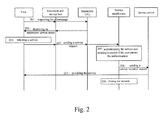
- Blocks 201-202 are the service navigation process
- Blocks 203-207 are the service request and service providing process
- Block 208 is the service terminating process.
- Block 201 A user requests a homepage from the interactive EPG via a television and a set-top box.
- Block 202 The interactive EPG displays an interactive service menu to the user via the television and the set-top box.
- service information may be classified and graded, and may be displayed in types and piloted on the interactive EPG
- the service management of the method is system level management, i.e. the interactive EPG displays the same interactive service menu to all users. All users may pick up the serving navigation of a service if the system may provide the service; otherwise, all the users may not pick up the serving navigation of the service.
- Block 203 The user selects a service.
- the user selects the needed service by performing an interactive operation under the guide of the interactive EPG
- Block 204 The set-top box sends a service request to a service middleware via an interactive EPG
- Block 205 The service middleware authenticates the user for the service.
- watching levels are used to implement secrecy manage of the service access when the service middleware authenticates the user for the service.
- the watching level of a user requesting for the service is lower than the management level of the service, the user is asked to input a management password. The user may use the service merely when the management password is correct. If the user passes the authentication of the service, the service middleware creates a session for the service request, which includes applying for and allocating physical and logical resources.
- Block 206 The service middleware sends a service resource request to a service server.
- Block 207 The service server provides the service to the user.
- Block 208 is performed if the service ends or the user terminates the service ahead.
- Block 208 The service middleware closes the session.
- the service middleware closes the session, releases the resources and terminates the service.
- the conventional method for implementing service management manages a service on system level.
- the same classification and grading of the service information of a service are provided to all users. Therefore, risks in supervision are brought forward because of the lack of filtering and screening the service information of the service based on the features of users.
- the conventional method for implementing service management manages a service on system level, the service is not subdivided according to the features of each user. As a result, the service may not accurately cover the user with a higher benefit-cost ratio, and thus, the operation cost of the service is increased.
- a service may not be carried out according to the features of a user and the new demand put forward by various services may not be met well.
- embodiments of the present invention provide a method, an apparatus and a system for managing a service, in which a service may be carried out according to the features of a user.
- a method for managing a service which is suitable for the field of digital television, internet television or mobile television includes:
- An apparatus for managing a service which is suitable for the field of digital television, internet television or mobile television includes:
- a system for managing a service which is suitable for the field of digital television, internet television or mobile television includes:
- embodiments of the present invention provide a method, a system, an interactive EPG and a service middleware for implementing service management. Diverse choices may be provided for users by applying various feature combinations of users in the service management. Therefore, the demand of an operator on fine operation and deep digging of resources may be satisfied according to the experience of users and diversified services provided for users.
- the method, system, interactive EPG and service middleware for implementing service management may determine different management measures for a service requested by users with different features and carry out the service for the users with different features according to a service management strategy set in advance.
- the technical solution of the method for implementing service management includes: storing a service management strategy, inserting a process of executing the service management strategy into the procedure of a service; executing the service management strategy taking the features of a user as management conditions; and determining management measure for a service requested by the user based on the features of the user requesting for the service when the inserted process is performed.
- FIG. 3 shows a schematic diagram illustrating a system according to an embodiment of the present invention.
- the system includes an SMS / BSS 350, a service middleware 340, an interactive EPG 330, a service server 360, and a set-top box 320.
- the set-top box 320 is a terminal device.
- the set-top box 320 is configured to forward service requests sent from users with different features to the interactive EPG 330.
- the interactive EPG 330 is configured to send the received service requests which are sent from users with different features and forwarded by the set-top box 320 to the service middleware 340, store a service management strategy, and insert a process of executing the service management strategy into the procedure of a service.
- the interactive EPG 330 performs the service management strategy taking the features of a user as manage conditions, and determines manage measure for the service requested by the user based on the features of the user requesting for the service.
- the service middleware 340 is configured to send the received service requests sent from the interactive EPG 330 to the service server 360, store a service management strategy, and insert a process of executing the service management strategy into the procedure of a service.
- the service middleware 340 performs the service management strategy taking the features of a user as manage conditions, and determines manage measure for the service requested by the user based on the features of the user requesting for the service.
- the service server 360 is configured to provide the service to the terminal device 320 via the service middleware 340 and the interactive EPG 330.
- the service middleware includes at least one first managing sub-unit 342.
- the first managing sub-unit 342 is configured to store a service management strategy, and insert a process of executing the service management strategy into the procedure of a service.
- the service middleware 340 performs the service management strategy taking the features of a user as manage conditions, and determines manage measure for the service requested by the user based on the features of the user requesting for the service.
- the interactive EPG 330 includes at least one second managing sub-unit 331.
- the second managing sub-unit 331 is configured to store a service management strategy, and insert a process of executing the service management strategy into the procedure of a service.
- the interactive EPG 330 performs the service management strategy taking the features of a user as manage conditions, and determines manage measure for the service requested by the user based on the features of the user requesting for the service.
- the system shown in Figure 3 differs from that shown in Figure 1 mainly in two aspects.
- the first managing sub-unit 342 is newly added to the service middleware 340. Therefore, a service may be managed based on the features of the user requesting for the service and the manage strategy.
- the first managing sub-unit 342 may revise a session, add a service manage point in the procedure of an interaction, provide a service manage function at the service manage point, and manage a service with the service management strategy.
- the second managing sub-unit 331 is newly added to the interactive EPG 330.
- the second managing sub-unit 331 may manage a service according to the features of the user by using the manage strategy at each service manage point.
- Figure 4 shows a flow chart for managing a service according to an embodiment of the present invention.
- the flow includes a service navigation process, a service request and serving process, and a service terminating process.
- the service navigation process and the service request and serving process adopt the technical solutions provided by embodiments of the present invention, while the service terminating process adopts a conventional technical solution. Therefore, the service terminating process will not be described in the following description.
- service manage points are preset based on the preset service management strategy and different features of uses.
- the preset service management strategy is applied to determine manage measure for the service requested by the user based on the features of the user requesting for the service.
- the first is user basic sub-feature including such features as address, region, education, income level, maturity level, service level and credit of the user.
- the second is user service sub-feature including such features as activation situation of a service, and order information of a service product.
- the third is user device sub-feature including such features as a manufacturer of a set-top box, the model of the set-top box, the number of the set-top box, the IP of the set-top box, the manufacturer of an intelligent card, the model of the intelligent card, and the number of the intelligent card.
- the fourth is user network sub-feature including such features as the type of the network, and whether there is a home gateway.
- the features of the user include the combination of at least one of the four types of the sub-features of the user.
- the features of the user may be saved in the service middleware, or be obtained by the service middleware from other parts of the system.
- two service manage points are preset in the service navigation procedure and three service manage points are preset in the service request and serving procedure.
- the method specifically includes the following processes.
- Process 401 A user participates in an interactive service.
- a set-top box requests an interactive EPG for a homepage.
- a client of the set-top box requests the interactive EPG for the homepage.
- the interactive EPG determines the functions to be displayed on the homepage and a homepage template.
- Process 403 is an inserted process of executing a service management strategy based on the features of the user for determining the homepage template.
- the process is taken as service manage point 1 for managing the homepage template.
- service management strategy 1 for managing the homepage template in the interactive EPG is applied at service manage point 1.
- Manage measure for the service requested by the user is determined based on the features of the user requesting for the service.
- the fields and format defined by the service management strategy are shown in Table 1.
- the method for determining the manage measure for the service requested by the user based on the features of the user requesting for the service includes: determining whether the features of the user requesting for the service satisfy the manage conditions of the service management strategy, taking the corresponding manage measure in the service management strategy as the manage measure for the service requested by the user, and otherwise, not performing the manage measure.
- the manage conditions of service management strategy 1 consist of the combination of the sub-features of the user, i.e. the model of a device, the type of the network and the family address of the user.
- the user may be specifically defined as a user with such features as, the model of a set-top box being STB GAME, the network being an IP network, and the family address being the Wangfu International Garden. It is determined that whether at least one of user service sub-features in the manage conditions of a service management strategy in a homepage template matches the corresponding at least one of the user service sub-features of the user requesting for the service. If matched, the manage measure determined by the items of the type of the processing and the definition of the processing recorded in Table 1 is taken as the manage measure for the service requested by the user.
- the functions to be displayed on the homepage and the homepage template are determined.
- Process 404 The interactive EPG authenticates the user.
- the process of the authentication is included in this embodiment. Therefore, the user is authenticated in this embodiment.
- Process 405 The interactive EPG determines service classified data to be displayed.
- Process 405 is performed if the user passes the authentication.
- Process 405 is an inserted process of executing a service management strategy for filtering the service classified data based on the features of the user.
- Process 405 is taken as service manage point 2 used for managing the filtration of the service classified data.
- Service manage point strategy 2 of the interactive EPG is applied at the service manage point 2 to filter the service classified data based on the combination of the sub-features of the user, and return the filtered service classified data.
- the displayed homepage and the service classified data include user data, an EPG template, topic data and contents data.
- the four types of data associate with each other and all include their respective fields of user group property.
- the user group property is determined by one or more sub-features of the user.
- the association of the four types of data is shown in Figure 5 .
- multiple EPG templates may be displayed to a user with such features as, the model of a set-top box being STB GAME, the network being an IP network, and the family address being Wangfu International Garden.
- the interactive EPG determines the services and the service classified data to be displayed to the user.
- the interactive EPG determines the topic data including English films to be displayed to the user with such features as, the model of the set-top box being STB GAME, the network being an IP network, and the education status being bachelor degree or above.
- Process 406 The interactive EPG displays the homepage template and service classified data to the user via the set-top box.
- Processes 401-406 describe the service navigation process, while the following Processes 407-417 describe the service request and service providing process in accordance with the embodiment of the present invention.
- the process specifically includes the following Process:
- Process 407 The user sends a service request to the set-top box.
- the user selects a service from the service classified data and requests the set-top box for the service.
- Process 408 The set-top box sends a service request to a service middleware via the interactive EPG
- the service request is sent to the interactive EPG after being encapsulated based on a protocol.
- the interactive EPG sends the service request to the service middleware after dealing with the request.
- Process 409 The service middleware authenticates the user for the service.
- the service middleware authenticates the user for the service to guarantee that the user requesting for the service has the authority of accessing the service.
- Process 410 The service middleware determines session resource parameters to be allocated for this interactive session.
- Process 410 is an inserted process of executing a service management strategy for determining the session resource parameters based on the features of the user.
- Process 410 is taken as service manage point 3 for determining the session resource parameters to be allocated.
- Service management strategy 3 used for determining the session resource parameters is applied at service manage point 3.
- the session resource parameters to be allocated for the interactive session are determined according to the sub-features of the user requesting for the service.
- Process 411 The service middleware establishes the interactive session.
- the service middleware establishes the interactive session, and assigns system resources and network resources based on the session resource parameters to be allocated.
- Process 412 The service middleware determines service resource parameters to be allocated for the service.
- Process 412 is an inserted process of executing a service management strategy for determining the service resource parameters to be allocated based on the features of the user.
- Process 412 is taken as service manage point 4 for determining the service resource parameters.
- Service management strategy 4 for determining the service resource parameters is applied at service manage point 4.
- the service middleware determines the service resource parameters to be allocated on the basis of the combination of the sub-features of the user requesting for the service.
- Process 413 The service middleware negotiates with a service server for obtaining the service resource parameters.
- the service middleware requests the service server to allocate the service resource parameters.
- the service server dispatches the resources and prepares for playing based on the service resource parameters requested.
- Process 414 The service server determines the service resource parameters to be returned.
- Process 414 is an inserted process of executing a service management strategy for filtering the service resource parameters based on the features of the user.
- Process 414 is taken as service manage point 5 used for filtering the service resource parameters.
- Service manage point strategy 5 used for filtering of the service resource parameters is applied at service manage point 5.
- the service middleware selects and filters the service resource parameters returned according to the combination of the sub-features of the user, and returns the filtered service resource parameters to the set-top box via the interactive EPG
- Process 415 The set-top box sends a service manage request to the service server.
- a client of the set-top box sends the service manage request to the service server by using the service resource parameters to request for the service.
- Process 416 The service server sends a service manage request response to the set-top box.
- Process 417 The service server provides the service to the user via the set-top box.
- the service server provides the service
- the set-top box displays the service to the user.
- Process 418 The procedure of the service is terminated.
- service manage points are set in the procedure of the service, and service management strategies are applied at the service manage points.
- the service management for the user is automatically implemented inside the system, which requires no more engineering measure and network layout. Therefore, the difficulty and risk in the implementation of engineering and the subsequent maintenance are reduced, and the complexity of the operation is also reduced.
- the otherness of service navigation information is dynamically managed based on the combination of the sub-features of a user, which supports the personalized demands of the user well, reduces the time used for browsing and query of the user, improves the experience of the user, improves the satisfaction of the user for the service, and advances the value of a brand provided by an operator.
- different topic data and contents are displayed based on the properties of users. The contents include a template, ordering a program, live broadcasting, carrousel and information browsing. Therefore, the diversity of operating a service may be implemented conveniently.
- the third service manage point it may be determined whether a user requesting for a service has the basic qualification for carrying out the service, based on the basic qualification for carrying out the service and the combination of the corresponding features of the user requesting for the service. Therefore, users covered by the service may be managed accurately, the benefit from a single user in the operation may be increased, the cost-benefit ratio may be reduced, and the cost of the operation may be reduced.
- the provision of a service and the distinction of the provided service are managed based on the combination of the features of a user. Therefore, it is possible to provide diversified service, which is convenient for the packaging and expanding of a service brand.
- service information may be filtered and screened according to the combination of the sub-features of a user, so that the group of users served by each service may be managed strictly, and the risk in supervising a service is reduced.
- a strategy managing unit 341 and a console 310 are further included based on the structure of the system shown in Figure 3 .
- the console 310 is configured to send a manage strategy managing request to the strategy managing unit 341.
- the strategy managing unit 341 is configured to send a service management strategy managing request to the first managing sub-unit 342 in the service middleware 340 and the second managing sub-unit 331 in the interactive EPG 330 based on the manage strategy managing request sent by the console 310.
- the strategy managing unit 341, which is a newly-added functional unit, is set in the service middleware 340.
- the strategy managing unit 341 may manage service management strategies saved in the first managing sub-unit 342 in the service middleware 340 and service management strategies saved in the second managing sub-unit 331 in the interactive EPG 330 based on the manage strategy managing request sent from the console 310.
- the management implemented by the strategy managing unit 341 includes adding, removing, revising and querying the service management strategies.
- the newly-added strategy managing unit 341 equips the service middleware 340 with the function of strategy configuration and strategy management and drives online loading of a service management strategy.
- the first managing sub-unit 342 in the service middleware 340 and the second managing sub-unit 331 in the interactive EPG 330 update the corresponding service management strategies based on the service management strategy managing request sent from the strategy managing unit 341.
- Figure 6 shows a flow chart of a method for managing a service management strategy according to an embodiment of the present invention.
- the method specifically includes the following process:
- a console sends a manage strategy managing request to a strategy managing unit in a service middleware.
- the manage strategy managing request sent by the console to the strategy managing unit in the service middleware includes an adding request, a removing request or a revising request.
- Process 602 A strategy managing unit in the service middleware authenticates strategy information.
- the strategy managing unit in the service middleware resolves the manage strategy managing request to acquire the operation information and the strategy information of the request, and authenticates the strategy information.
- Process 603 The strategy managing unit in the service middleware stores the strategy information.
- the strategy managing unit in the service middleware performs permanent storage for the strategy information which has been determined to be valid strategy information.
- Process 604 The strategy managing unit in the service middleware sends a service management strategy managing request for loading the service management strategy to the first managing sub-unit.
- the strategy managing unit in the service middleware sends the service management strategy managing request for loading the service management strategy to the first managing sub-unit.
- the service management strategy managing request requests to add or revise the service management strategy
- the service management strategy added or revised is also required to be transmitted to the first managing sub-unit in the service middleware.
- Process 605 The first managing sub-unit in the service middleware loads the service management strategy.
- the first managing sub-unit in the service middleware loads the corresponding service management strategy based on the service management strategy managing request.
- Process 606 The first managing sub-unit in the service middleware returns the result of the processing to the strategy managing unit in the service middleware.
- the strategy managing unit in the service middleware sends a service management strategy managing request for loading a service management strategy to the second managing sub-unit in the interactive EPG
- the service management strategy managing request is an adding or a revising request
- the service management strategy is transmitted based on the measure for Process 604.
- Process 608 The second managing sub-unit in the interactive EPG loads the service management strategy.
- Process 609 The second managing sub-unit in the interactive EPG returns the result of the processing to the strategy managing unit in the service middleware.
- the manage strategy in a service may be configured based on a combination of the sub-features of a user and the demand of an operation. Therefore, the flexibility of the operation is enhanced, which facilitates the packaging and expanding of a service, enhances the energy of the service, improves the competitiveness of the service, and provides more choices for the user.
- FIG. 7 shows a schematic diagram illustrating the structure of an interactive EPG according to an embodiment of the present invention.
- the interactive EPG includes a receiving unit 701, a sending unit 703 and a managing unit 702.
- the receiving unit 701 is configured to receive a service request carrying the features of a user sent from the user and send the service request to the managing unit 702.
- the managing unit 702 is configured to store a service management strategy, insert a process of executing the service management strategy into the procedure of a service, execute the service management strategy taking the features of the user as manage conditions when the process of executing the service management strategy is executed, determine the manage measure for the service requested by the user based on the features of the user sending the service request to the receiving unit 701, and send the service request sent from the receiving unit 701 to the sending unit 703.
- the sending unit 703 is configured to forward the service request sent from the managing unit 702 to the service middleware.
- FIG 8 shows a schematic diagram illustrating the structure of a service middleware according to an embodiment of the present invention.
- the service middleware includes a receiving unit 801, a sending unit 803 and a managing unit 802.
- the receiving unit 801 is configured to receive the service request carrying the features of the user sent from the interactive EPG and send the service request to the service managing unit 802.
- the service managing unit 802 is configured to store a service management strategy, insert a process of executing the service management strategy into the procedure of a service, execute the service management strategy taking the features of the user as manage conditions when the process of executing the service management strategy is executed, determine the manage measure for the service requested by the user based on the features of the user requesting for the service, and send the service request sent from the receiving unit 801 to the sending unit 803.
- the sending unit 803 is configured to forward the service request sent from the service managing unit 802 to a service server.
- the service middleware may also include a strategy managing unit 804.
- the strategy managing unit 804 is configured to send a service management strategy managing request of a service to the managing unit in the service middleware and the managing unit in the interactive EPG based on a manage strategy managing request sent from a console.
Landscapes
- Engineering & Computer Science (AREA)
- Databases & Information Systems (AREA)
- Multimedia (AREA)
- Signal Processing (AREA)
- Computer Graphics (AREA)
- Computer Security & Cryptography (AREA)
- Information Transfer Between Computers (AREA)
- Management, Administration, Business Operations System, And Electronic Commerce (AREA)
- Telephonic Communication Services (AREA)
- Two-Way Televisions, Distribution Of Moving Picture Or The Like (AREA)
Applications Claiming Priority (1)
| Application Number | Priority Date | Filing Date | Title |
|---|---|---|---|
| CN200710084871.6A CN101022539B (zh) | 2007-02-15 | 2007-02-15 | 实现业务控制的方法、系统、交互式epg和业务中间件 |
Publications (2)
| Publication Number | Publication Date |
|---|---|
| EP1959680A2 true EP1959680A2 (de) | 2008-08-20 |
| EP1959680A3 EP1959680A3 (de) | 2011-11-02 |
Family
ID=38710171
Family Applications (1)
| Application Number | Title | Priority Date | Filing Date |
|---|---|---|---|
| EP07122139A Withdrawn EP1959680A3 (de) | 2007-02-15 | 2007-12-03 | Verfahren, Vorrichtung und System für die Implementierung einer Dienstverwaltung |
Country Status (3)
| Country | Link |
|---|---|
| US (1) | US20080201750A1 (de) |
| EP (1) | EP1959680A3 (de) |
| CN (1) | CN101022539B (de) |
Cited By (1)
| Publication number | Priority date | Publication date | Assignee | Title |
|---|---|---|---|---|
| EP2501130A4 (de) * | 2009-11-11 | 2015-06-24 | Zte Corp | Verfahren und system zur programmverwaltung im wortdienst eines videoprogramms |
Families Citing this family (14)
| Publication number | Priority date | Publication date | Assignee | Title |
|---|---|---|---|---|
| CN101383997B (zh) * | 2007-09-07 | 2013-06-05 | 华为技术有限公司 | 交互业务数据的处理方法、设备及系统 |
| CN101945251B (zh) * | 2010-06-02 | 2014-02-05 | 中兴通讯股份有限公司 | 一种实现交互式网络电视业务控制的方法及系统及机顶盒 |
| CN102883223A (zh) * | 2011-07-12 | 2013-01-16 | 上海帕科软件科技有限公司 | 采用互动式epg分发系统的iptv系统 |
| CN102421013B (zh) * | 2011-11-17 | 2017-08-04 | 南京中兴软件有限责任公司 | 广播业务开展方法和系统 |
| CN103346974B (zh) | 2013-06-03 | 2015-04-08 | 华为技术有限公司 | 一种业务流程的控制方法及网络设备 |
| WO2015085535A1 (zh) * | 2013-12-12 | 2015-06-18 | 北京创毅视讯科技有限公司 | 广播中间件、广播终端、广播服务器设备及广播通信方法 |
| CN105721940B (zh) * | 2014-12-05 | 2019-01-01 | 中国移动通信集团公司 | 一种业务处理方法、机顶盒、网络设备及系统 |
| CN105701600A (zh) * | 2015-12-31 | 2016-06-22 | 北京奇艺世纪科技有限公司 | 一种实现开放式业务流程的方法和装置 |
| CN106792202B (zh) * | 2016-12-27 | 2020-09-08 | 东华互联宜家数据服务有限公司 | 机顶盒数据适配方法、装置以及系统 |
| CN108022079A (zh) * | 2017-10-31 | 2018-05-11 | 深圳前海微众银行股份有限公司 | 服务资源的共享方法、装置及计算机可读存储介质 |
| CN109978547B (zh) * | 2017-12-28 | 2021-08-03 | 北京京东尚科信息技术有限公司 | 风险行为控制方法及系统、设备和存储介质 |
| CN108989438A (zh) * | 2018-07-26 | 2018-12-11 | 青柠智云(杭州)科技有限责任公司 | 数据分发网络的实现方法、装置和系统 |
| CN109389409B (zh) * | 2018-09-17 | 2021-10-15 | 内蒙古易商信息科技有限公司 | 业务处理方法和系统 |
| CN114828009A (zh) * | 2022-03-23 | 2022-07-29 | 康键信息技术(深圳)有限公司 | 基于插件的业务授权方法、装置、设备及介质 |
Family Cites Families (14)
| Publication number | Priority date | Publication date | Assignee | Title |
|---|---|---|---|---|
| US6212191B1 (en) * | 1997-01-30 | 2001-04-03 | International Business Machines Corporation | Method and system for providing security to asynchronous transfer mode emulated local-area networks |
| US6813775B1 (en) * | 1999-03-29 | 2004-11-02 | The Directv Group, Inc. | Method and apparatus for sharing viewing preferences |
| US6470378B1 (en) * | 1999-03-31 | 2002-10-22 | Intel Corporation | Dynamic content customization in a clientserver environment |
| CN1163063C (zh) * | 1999-09-10 | 2004-08-18 | 皇家菲利浦电子有限公司 | 对可接收节目提供建议的方法和设备 |
| US7424677B2 (en) * | 1999-09-16 | 2008-09-09 | Sharp Laboratories Of America, Inc. | Audiovisual information management system with usage preferences |
| US20020059610A1 (en) * | 2000-05-23 | 2002-05-16 | Ellis Michael D. | Interactive television application with watch lists |
| US20020078453A1 (en) * | 2000-12-15 | 2002-06-20 | Hanchang Kuo | Hub pages for set top box startup screen |
| US20020162108A1 (en) * | 2001-03-30 | 2002-10-31 | Catherine Lin-Hendel | Interactive/ active electronic program/ content guide (IAEPG) with computer enhanced, web-wrapped user interfaces, programablility, and automated search, record, and present |
| US7380262B2 (en) * | 2001-06-12 | 2008-05-27 | Thomson Licensing | Method and apparatus for generating a list of suggested scheduled television programs |
| US20040228291A1 (en) * | 2003-05-15 | 2004-11-18 | Huslak Nicolas Steven | Videoconferencing using managed quality of service and/or bandwidth allocation in a regional/access network (RAN) |
| US7617516B2 (en) * | 2003-05-15 | 2009-11-10 | At&T Intellectual Property I, L.P. | Methods and systems for providing video on demand over a communication network using managed quality of service, bandwidth allocation and/or user profiles |
| US20050160458A1 (en) * | 2004-01-21 | 2005-07-21 | United Video Properties, Inc. | Interactive television system with custom video-on-demand menus based on personal profiles |
| US7849064B2 (en) * | 2004-04-23 | 2010-12-07 | Tvworks, Llc | Application programming interface combining asset listings |
| KR100725397B1 (ko) * | 2005-07-22 | 2007-06-07 | 삼성전자주식회사 | 방송 수신 장치 및 상기 방송 수신 장치를 이용한데이터방송 어플리케이션 실행 방법 |
-
2007
- 2007-02-15 CN CN200710084871.6A patent/CN101022539B/zh active Active
- 2007-12-03 US US11/949,354 patent/US20080201750A1/en not_active Abandoned
- 2007-12-03 EP EP07122139A patent/EP1959680A3/de not_active Withdrawn
Cited By (1)
| Publication number | Priority date | Publication date | Assignee | Title |
|---|---|---|---|---|
| EP2501130A4 (de) * | 2009-11-11 | 2015-06-24 | Zte Corp | Verfahren und system zur programmverwaltung im wortdienst eines videoprogramms |
Also Published As
| Publication number | Publication date |
|---|---|
| US20080201750A1 (en) | 2008-08-21 |
| CN101022539B (zh) | 2010-08-25 |
| EP1959680A3 (de) | 2011-11-02 |
| CN101022539A (zh) | 2007-08-22 |
Similar Documents
| Publication | Publication Date | Title |
|---|---|---|
| US20080201750A1 (en) | Method, apparatus and system for implementing service management | |
| DE602004009511T2 (de) | Vorrichtung und Verfahren zur Verteilung von Programmempfehlungen mittels digitaler Set-Top Boxen | |
| CN101212599B (zh) | 一种数字电视用户界面管理系统及管理方法 | |
| DE69435068T2 (de) | Gerät und Verfahren für Anforderungs-Videoprogramme | |
| US20090328093A1 (en) | Multimedia Content Filtering | |
| CN102780915B (zh) | 预约节目的方法、装置及系统 | |
| US8935349B2 (en) | Establishment of a conference | |
| CN102780923A (zh) | 服务系统及其在数字接收器中提供服务的方法 | |
| AU2011202182B1 (en) | Creation and presentation of selective digital content feeds | |
| DE202011110780U1 (de) | Multifunktionsanzeigevorrichtung | |
| DE69903977T2 (de) | Anwendergruppen-identifizierungs-system | |
| DE202011110535U1 (de) | Bildanzeigevorrichtung zur Bereitstellung eines Fernsteuerdienstes | |
| CN105263055B (zh) | 一种电视直播的互动方法及系统 | |
| DE102011111402A1 (de) | OCAP/STB ACAP/Satellite-receiver audience response/comsumer information application | |
| CN103354563A (zh) | 基于互联网电视客户端定制epg界面的方法和装置 | |
| KR20150081413A (ko) | 서비스 서버의 채널 가입페이지를 제공 방법 | |
| GB2452519A (en) | System and Method for Providing User Recommendations | |
| CN105721927A (zh) | 一种虚拟客厅显示系统及方法 | |
| DE69907761T2 (de) | Verfahren und gerät zur verwaltung von mehreren anwendungsprogrammen in grossflächigen netzwerken | |
| US20090249401A1 (en) | Facilitating interactive functionality for a community of mind in association with delivery of televised content | |
| US20070268381A1 (en) | Method and Device for the Automatic Processing of Spontaneous Data | |
| EP2271048A1 (de) | Verfahren zur Bereitstellung eines Multimedia-Dienstes | |
| CN109246482B (zh) | 基于iptv机顶盒的用户分组管理方法及系统 | |
| KR101086153B1 (ko) | 신규 및 업데이트 정보에 대한 개인별 알림 기능을 갖는 디지털 방송 시스템 및 방법 | |
| CN102883029B (zh) | 实现三屏互动的手机客户端系统 |
Legal Events
| Date | Code | Title | Description |
|---|---|---|---|
| PUAI | Public reference made under article 153(3) epc to a published international application that has entered the european phase |
Free format text: ORIGINAL CODE: 0009012 |
|
| 17P | Request for examination filed |
Effective date: 20071203 |
|
| AK | Designated contracting states |
Kind code of ref document: A2 Designated state(s): AT BE BG CH CY CZ DE DK EE ES FI FR GB GR HU IE IS IT LI LT LU LV MC MT NL PL PT RO SE SI SK TR |
|
| AX | Request for extension of the european patent |
Extension state: AL BA HR MK RS |
|
| PUAL | Search report despatched |
Free format text: ORIGINAL CODE: 0009013 |
|
| AK | Designated contracting states |
Kind code of ref document: A3 Designated state(s): AT BE BG CH CY CZ DE DK EE ES FI FR GB GR HU IE IS IT LI LT LU LV MC MT NL PL PT RO SE SI SK TR |
|
| AX | Request for extension of the european patent |
Extension state: AL BA HR MK RS |
|
| RIC1 | Information provided on ipc code assigned before grant |
Ipc: H04N 5/445 20110101AFI20110929BHEP |
|
| AKX | Designation fees paid |
Designated state(s): AT BE BG CH CY CZ DE DK EE ES FI FR GB GR HU IE IS IT LI LT LU LV MC MT NL PL PT RO SE SI SK TR |
|
| 17Q | First examination report despatched |
Effective date: 20131011 |
|
| STAA | Information on the status of an ep patent application or granted ep patent |
Free format text: STATUS: THE APPLICATION IS DEEMED TO BE WITHDRAWN |
|
| 18D | Application deemed to be withdrawn |
Effective date: 20140221 |