EP1957274B1 - Procede de transfert d'un motif micronique sur un article optique et article optique ainsi obtenu - Google Patents
Procede de transfert d'un motif micronique sur un article optique et article optique ainsi obtenu Download PDFInfo
- Publication number
- EP1957274B1 EP1957274B1 EP06841872A EP06841872A EP1957274B1 EP 1957274 B1 EP1957274 B1 EP 1957274B1 EP 06841872 A EP06841872 A EP 06841872A EP 06841872 A EP06841872 A EP 06841872A EP 1957274 B1 EP1957274 B1 EP 1957274B1
- Authority
- EP
- European Patent Office
- Prior art keywords
- layer
- pattern
- latex
- optical article
- lens
- Prior art date
- Legal status (The legal status is an assumption and is not a legal conclusion. Google has not performed a legal analysis and makes no representation as to the accuracy of the status listed.)
- Active
Links
- 238000000034 method Methods 0.000 title claims abstract description 76
- 230000003287 optical effect Effects 0.000 title claims abstract description 67
- 229920000126 latex Polymers 0.000 claims abstract description 121
- 239000004816 latex Substances 0.000 claims abstract description 113
- 239000000463 material Substances 0.000 claims abstract description 71
- 230000035939 shock Effects 0.000 claims abstract description 6
- 229910052751 metal Inorganic materials 0.000 claims description 27
- 239000002184 metal Substances 0.000 claims description 27
- 239000012528 membrane Substances 0.000 claims description 20
- 238000000151 deposition Methods 0.000 claims description 16
- 238000000576 coating method Methods 0.000 claims description 11
- 239000000758 substrate Substances 0.000 claims description 11
- PCHJSUWPFVWCPO-UHFFFAOYSA-N gold Chemical compound [Au] PCHJSUWPFVWCPO-UHFFFAOYSA-N 0.000 claims description 10
- 229910052737 gold Inorganic materials 0.000 claims description 10
- 239000010931 gold Substances 0.000 claims description 10
- 229910052782 aluminium Inorganic materials 0.000 claims description 9
- XAGFODPZIPBFFR-UHFFFAOYSA-N aluminium Chemical compound [Al] XAGFODPZIPBFFR-UHFFFAOYSA-N 0.000 claims description 9
- BASFCYQUMIYNBI-UHFFFAOYSA-N platinum Chemical compound [Pt] BASFCYQUMIYNBI-UHFFFAOYSA-N 0.000 claims description 6
- 239000007788 liquid Substances 0.000 claims description 5
- PXHVJJICTQNCMI-UHFFFAOYSA-N Nickel Chemical compound [Ni] PXHVJJICTQNCMI-UHFFFAOYSA-N 0.000 claims description 4
- KDLHZDBZIXYQEI-UHFFFAOYSA-N Palladium Chemical compound [Pd] KDLHZDBZIXYQEI-UHFFFAOYSA-N 0.000 claims description 4
- 239000004205 dimethyl polysiloxane Substances 0.000 claims description 4
- 239000007769 metal material Substances 0.000 claims description 4
- 229920000435 poly(dimethylsiloxane) Polymers 0.000 claims description 4
- -1 polydimethylsiloxane Polymers 0.000 claims description 4
- 238000007639 printing Methods 0.000 claims description 4
- BQCADISMDOOEFD-UHFFFAOYSA-N Silver Chemical compound [Ag] BQCADISMDOOEFD-UHFFFAOYSA-N 0.000 claims description 3
- 239000011248 coating agent Substances 0.000 claims description 3
- 229910052697 platinum Inorganic materials 0.000 claims description 3
- 229910052709 silver Inorganic materials 0.000 claims description 3
- 239000004332 silver Substances 0.000 claims description 3
- 238000004528 spin coating Methods 0.000 claims description 3
- 238000007738 vacuum evaporation Methods 0.000 claims description 3
- VYZAMTAEIAYCRO-UHFFFAOYSA-N Chromium Chemical compound [Cr] VYZAMTAEIAYCRO-UHFFFAOYSA-N 0.000 claims description 2
- RYGMFSIKBFXOCR-UHFFFAOYSA-N Copper Chemical compound [Cu] RYGMFSIKBFXOCR-UHFFFAOYSA-N 0.000 claims description 2
- 238000005299 abrasion Methods 0.000 claims description 2
- 239000000956 alloy Substances 0.000 claims description 2
- 229910045601 alloy Inorganic materials 0.000 claims description 2
- 230000003667 anti-reflective effect Effects 0.000 claims description 2
- 230000000703 anti-shock Effects 0.000 claims description 2
- 229910052804 chromium Inorganic materials 0.000 claims description 2
- 239000011651 chromium Substances 0.000 claims description 2
- 238000004040 coloring Methods 0.000 claims description 2
- 229910052802 copper Inorganic materials 0.000 claims description 2
- 239000010949 copper Substances 0.000 claims description 2
- 150000002739 metals Chemical class 0.000 claims description 2
- 229910052759 nickel Inorganic materials 0.000 claims description 2
- 229910052763 palladium Inorganic materials 0.000 claims description 2
- 230000000750 progressive effect Effects 0.000 claims description 2
- 238000004544 sputter deposition Methods 0.000 claims description 2
- FGUUSXIOTUKUDN-IBGZPJMESA-N C1(=CC=CC=C1)N1C2=C(NC([C@H](C1)NC=1OC(=NN=1)C1=CC=CC=C1)=O)C=CC=C2 Chemical compound C1(=CC=CC=C1)N1C2=C(NC([C@H](C1)NC=1OC(=NN=1)C1=CC=CC=C1)=O)C=CC=C2 FGUUSXIOTUKUDN-IBGZPJMESA-N 0.000 claims 1
- 229910052500 inorganic mineral Inorganic materials 0.000 claims 1
- 239000011707 mineral Substances 0.000 claims 1
- 239000005871 repellent Substances 0.000 claims 1
- 230000001070 adhesive effect Effects 0.000 abstract description 10
- 239000000853 adhesive Substances 0.000 abstract description 9
- 230000000717 retained effect Effects 0.000 abstract 1
- 239000010410 layer Substances 0.000 description 152
- 238000012546 transfer Methods 0.000 description 32
- 230000008569 process Effects 0.000 description 18
- 239000000047 product Substances 0.000 description 13
- 230000008021 deposition Effects 0.000 description 11
- 230000006870 function Effects 0.000 description 10
- 239000000126 substance Substances 0.000 description 7
- 230000000295 complement effect Effects 0.000 description 6
- 230000008901 benefit Effects 0.000 description 5
- 229920001577 copolymer Polymers 0.000 description 5
- 230000005672 electromagnetic field Effects 0.000 description 5
- 238000001704 evaporation Methods 0.000 description 5
- 238000004519 manufacturing process Methods 0.000 description 5
- 229920000642 polymer Polymers 0.000 description 5
- 238000002174 soft lithography Methods 0.000 description 5
- 238000005119 centrifugation Methods 0.000 description 4
- 238000001035 drying Methods 0.000 description 4
- 238000005530 etching Methods 0.000 description 4
- 230000035515 penetration Effects 0.000 description 4
- 229920006243 acrylic copolymer Polymers 0.000 description 3
- 230000005540 biological transmission Effects 0.000 description 3
- 235000013870 dimethyl polysiloxane Nutrition 0.000 description 3
- 230000000694 effects Effects 0.000 description 3
- 230000008020 evaporation Effects 0.000 description 3
- 238000001914 filtration Methods 0.000 description 3
- 230000010287 polarization Effects 0.000 description 3
- 229920002635 polyurethane Polymers 0.000 description 3
- 239000004814 polyurethane Substances 0.000 description 3
- KFZMGEQAYNKOFK-UHFFFAOYSA-N Isopropanol Chemical compound CC(C)O KFZMGEQAYNKOFK-UHFFFAOYSA-N 0.000 description 2
- 239000012790 adhesive layer Substances 0.000 description 2
- 238000013459 approach Methods 0.000 description 2
- IISBACLAFKSPIT-UHFFFAOYSA-N bisphenol A Chemical compound C=1C=C(O)C=CC=1C(C)(C)C1=CC=C(O)C=C1 IISBACLAFKSPIT-UHFFFAOYSA-N 0.000 description 2
- 238000004140 cleaning Methods 0.000 description 2
- 239000000470 constituent Substances 0.000 description 2
- 238000003851 corona treatment Methods 0.000 description 2
- 238000007598 dipping method Methods 0.000 description 2
- 239000011521 glass Substances 0.000 description 2
- 229920003008 liquid latex Polymers 0.000 description 2
- 239000006193 liquid solution Substances 0.000 description 2
- 238000000465 moulding Methods 0.000 description 2
- CXQXSVUQTKDNFP-UHFFFAOYSA-N octamethyltrisiloxane Chemical compound C[Si](C)(C)O[Si](C)(C)O[Si](C)(C)C CXQXSVUQTKDNFP-UHFFFAOYSA-N 0.000 description 2
- 238000004987 plasma desorption mass spectroscopy Methods 0.000 description 2
- 238000009832 plasma treatment Methods 0.000 description 2
- 229920000058 polyacrylate Polymers 0.000 description 2
- 229920000515 polycarbonate Polymers 0.000 description 2
- 239000004417 polycarbonate Substances 0.000 description 2
- 239000002243 precursor Substances 0.000 description 2
- JHQVCQDWGSXTFE-UHFFFAOYSA-N 2-(2-prop-2-enoxycarbonyloxyethoxy)ethyl prop-2-enyl carbonate Chemical compound C=CCOC(=O)OCCOCCOC(=O)OCC=C JHQVCQDWGSXTFE-UHFFFAOYSA-N 0.000 description 1
- 239000004593 Epoxy Substances 0.000 description 1
- JOYRKODLDBILNP-UHFFFAOYSA-N Ethyl urethane Chemical compound CCOC(N)=O JOYRKODLDBILNP-UHFFFAOYSA-N 0.000 description 1
- 239000004952 Polyamide Substances 0.000 description 1
- 239000004642 Polyimide Substances 0.000 description 1
- 239000002174 Styrene-butadiene Substances 0.000 description 1
- 238000010521 absorption reaction Methods 0.000 description 1
- NIXOWILDQLNWCW-UHFFFAOYSA-N acrylic acid group Chemical group C(C=C)(=O)O NIXOWILDQLNWCW-UHFFFAOYSA-N 0.000 description 1
- 230000010062 adhesion mechanism Effects 0.000 description 1
- 230000004075 alteration Effects 0.000 description 1
- 230000003373 anti-fouling effect Effects 0.000 description 1
- 239000007864 aqueous solution Substances 0.000 description 1
- 230000015572 biosynthetic process Effects 0.000 description 1
- 229940106691 bisphenol a Drugs 0.000 description 1
- 230000003139 buffering effect Effects 0.000 description 1
- KAKZBPTYRLMSJV-UHFFFAOYSA-N butadiene group Chemical group C=CC=C KAKZBPTYRLMSJV-UHFFFAOYSA-N 0.000 description 1
- MTAZNLWOLGHBHU-UHFFFAOYSA-N butadiene-styrene rubber Chemical compound C=CC=C.C=CC1=CC=CC=C1 MTAZNLWOLGHBHU-UHFFFAOYSA-N 0.000 description 1
- 238000003486 chemical etching Methods 0.000 description 1
- 239000003795 chemical substances by application Substances 0.000 description 1
- 230000001427 coherent effect Effects 0.000 description 1
- 239000004020 conductor Substances 0.000 description 1
- 238000011109 contamination Methods 0.000 description 1
- 239000003599 detergent Substances 0.000 description 1
- 238000003618 dip coating Methods 0.000 description 1
- 238000004090 dissolution Methods 0.000 description 1
- 230000009977 dual effect Effects 0.000 description 1
- 239000000428 dust Substances 0.000 description 1
- 229920001971 elastomer Polymers 0.000 description 1
- 239000000806 elastomer Substances 0.000 description 1
- 239000013536 elastomeric material Substances 0.000 description 1
- 238000004049 embossing Methods 0.000 description 1
- 230000002349 favourable effect Effects 0.000 description 1
- 239000012467 final product Substances 0.000 description 1
- 238000007306 functionalization reaction Methods 0.000 description 1
- 238000010438 heat treatment Methods 0.000 description 1
- 238000005286 illumination Methods 0.000 description 1
- 238000007641 inkjet printing Methods 0.000 description 1
- 239000011159 matrix material Substances 0.000 description 1
- 229910044991 metal oxide Inorganic materials 0.000 description 1
- 150000004706 metal oxides Chemical class 0.000 description 1
- 238000000813 microcontact printing Methods 0.000 description 1
- 238000012986 modification Methods 0.000 description 1
- 230000004048 modification Effects 0.000 description 1
- 239000002052 molecular layer Substances 0.000 description 1
- 239000000178 monomer Substances 0.000 description 1
- 230000003647 oxidation Effects 0.000 description 1
- 238000007254 oxidation reaction Methods 0.000 description 1
- 239000002245 particle Substances 0.000 description 1
- 239000008188 pellet Substances 0.000 description 1
- 230000008447 perception Effects 0.000 description 1
- 229920000636 poly(norbornene) polymer Polymers 0.000 description 1
- 229920002492 poly(sulfone) Polymers 0.000 description 1
- 229920002647 polyamide Polymers 0.000 description 1
- 229920002857 polybutadiene Polymers 0.000 description 1
- 229920000728 polyester Polymers 0.000 description 1
- 229920000139 polyethylene terephthalate Polymers 0.000 description 1
- 239000005020 polyethylene terephthalate Substances 0.000 description 1
- 229920001721 polyimide Polymers 0.000 description 1
- 238000006116 polymerization reaction Methods 0.000 description 1
- 229920000193 polymethacrylate Polymers 0.000 description 1
- 229920000098 polyolefin Polymers 0.000 description 1
- 238000002360 preparation method Methods 0.000 description 1
- 239000011253 protective coating Substances 0.000 description 1
- 238000009877 rendering Methods 0.000 description 1
- 239000011347 resin Substances 0.000 description 1
- 229920005989 resin Polymers 0.000 description 1
- 239000012487 rinsing solution Substances 0.000 description 1
- 230000003678 scratch resistant effect Effects 0.000 description 1
- 239000004065 semiconductor Substances 0.000 description 1
- 238000000926 separation method Methods 0.000 description 1
- 239000002356 single layer Substances 0.000 description 1
- 239000000243 solution Substances 0.000 description 1
- 239000007921 spray Substances 0.000 description 1
- 238000005507 spraying Methods 0.000 description 1
- 238000003892 spreading Methods 0.000 description 1
- 230000007480 spreading Effects 0.000 description 1
- 239000011115 styrene butadiene Substances 0.000 description 1
- 229920003048 styrene butadiene rubber Polymers 0.000 description 1
- 125000000446 sulfanediyl group Chemical group *S* 0.000 description 1
- 238000004381 surface treatment Methods 0.000 description 1
- 238000007669 thermal treatment Methods 0.000 description 1
- 239000012815 thermoplastic material Substances 0.000 description 1
- 150000003553 thiiranes Chemical class 0.000 description 1
- 239000012780 transparent material Substances 0.000 description 1
- 239000002966 varnish Substances 0.000 description 1
- 238000012800 visualization Methods 0.000 description 1
- XLYOFNOQVPJJNP-UHFFFAOYSA-N water Substances O XLYOFNOQVPJJNP-UHFFFAOYSA-N 0.000 description 1
Images

Classifications
-
- G—PHYSICS
- G02—OPTICS
- G02C—SPECTACLES; SUNGLASSES OR GOGGLES INSOFAR AS THEY HAVE THE SAME FEATURES AS SPECTACLES; CONTACT LENSES
- G02C7/00—Optical parts
- G02C7/02—Lenses; Lens systems ; Methods of designing lenses
-
- B—PERFORMING OPERATIONS; TRANSPORTING
- B41—PRINTING; LINING MACHINES; TYPEWRITERS; STAMPS
- B41F—PRINTING MACHINES OR PRESSES
- B41F17/00—Printing apparatus or machines of special types or for particular purposes, not otherwise provided for
- B41F17/001—Pad printing apparatus or machines
-
- B—PERFORMING OPERATIONS; TRANSPORTING
- B29—WORKING OF PLASTICS; WORKING OF SUBSTANCES IN A PLASTIC STATE IN GENERAL
- B29D—PRODUCING PARTICULAR ARTICLES FROM PLASTICS OR FROM SUBSTANCES IN A PLASTIC STATE
- B29D11/00—Producing optical elements, e.g. lenses or prisms
- B29D11/00009—Production of simple or compound lenses
-
- B—PERFORMING OPERATIONS; TRANSPORTING
- B29—WORKING OF PLASTICS; WORKING OF SUBSTANCES IN A PLASTIC STATE IN GENERAL
- B29D—PRODUCING PARTICULAR ARTICLES FROM PLASTICS OR FROM SUBSTANCES IN A PLASTIC STATE
- B29D11/00—Producing optical elements, e.g. lenses or prisms
- B29D11/00009—Production of simple or compound lenses
- B29D11/00317—Production of lenses with markings or patterns
- B29D11/00326—Production of lenses with markings or patterns having particular surface properties, e.g. a micropattern
- B29D11/00336—Production of lenses with markings or patterns having particular surface properties, e.g. a micropattern by making depressions in the lens surfaces
-
- B—PERFORMING OPERATIONS; TRANSPORTING
- B29—WORKING OF PLASTICS; WORKING OF SUBSTANCES IN A PLASTIC STATE IN GENERAL
- B29D—PRODUCING PARTICULAR ARTICLES FROM PLASTICS OR FROM SUBSTANCES IN A PLASTIC STATE
- B29D11/00—Producing optical elements, e.g. lenses or prisms
- B29D11/00865—Applying coatings; tinting; colouring
- B29D11/00884—Spin coating
-
- B—PERFORMING OPERATIONS; TRANSPORTING
- B41—PRINTING; LINING MACHINES; TYPEWRITERS; STAMPS
- B41F—PRINTING MACHINES OR PRESSES
- B41F17/00—Printing apparatus or machines of special types or for particular purposes, not otherwise provided for
-
- B—PERFORMING OPERATIONS; TRANSPORTING
- B41—PRINTING; LINING MACHINES; TYPEWRITERS; STAMPS
- B41K—STAMPS; STAMPING OR NUMBERING APPARATUS OR DEVICES
- B41K3/00—Apparatus for stamping articles having integral means for supporting the articles to be stamped
- B41K3/02—Apparatus for stamping articles having integral means for supporting the articles to be stamped with stamping surface located above article-supporting surface
- B41K3/12—Apparatus for stamping articles having integral means for supporting the articles to be stamped with stamping surface located above article-supporting surface with curved stamping surface for stamping by rolling contact
- B41K3/14—Apparatus for stamping articles having integral means for supporting the articles to be stamped with stamping surface located above article-supporting surface with curved stamping surface for stamping by rolling contact for relief stamping
-
- G—PHYSICS
- G02—OPTICS
- G02C—SPECTACLES; SUNGLASSES OR GOGGLES INSOFAR AS THEY HAVE THE SAME FEATURES AS SPECTACLES; CONTACT LENSES
- G02C7/00—Optical parts
-
- G—PHYSICS
- G03—PHOTOGRAPHY; CINEMATOGRAPHY; ANALOGOUS TECHNIQUES USING WAVES OTHER THAN OPTICAL WAVES; ELECTROGRAPHY; HOLOGRAPHY
- G03H—HOLOGRAPHIC PROCESSES OR APPARATUS
- G03H2210/00—Object characteristics
- G03H2210/50—Nature of the object
- G03H2210/53—Coded object not directly interpretable, e.g. encrypted object, barcode
-
- G—PHYSICS
- G03—PHOTOGRAPHY; CINEMATOGRAPHY; ANALOGOUS TECHNIQUES USING WAVES OTHER THAN OPTICAL WAVES; ELECTROGRAPHY; HOLOGRAPHY
- G03H—HOLOGRAPHIC PROCESSES OR APPARATUS
- G03H2270/00—Substrate bearing the hologram
- G03H2270/55—Substrate bearing the hologram being an optical element, e.g. spectacles
-
- Y—GENERAL TAGGING OF NEW TECHNOLOGICAL DEVELOPMENTS; GENERAL TAGGING OF CROSS-SECTIONAL TECHNOLOGIES SPANNING OVER SEVERAL SECTIONS OF THE IPC; TECHNICAL SUBJECTS COVERED BY FORMER USPC CROSS-REFERENCE ART COLLECTIONS [XRACs] AND DIGESTS
- Y10—TECHNICAL SUBJECTS COVERED BY FORMER USPC
- Y10S—TECHNICAL SUBJECTS COVERED BY FORMER USPC CROSS-REFERENCE ART COLLECTIONS [XRACs] AND DIGESTS
- Y10S977/00—Nanotechnology
- Y10S977/84—Manufacture, treatment, or detection of nanostructure
- Y10S977/887—Nanoimprint lithography, i.e. nanostamp
Definitions
- the present invention relates to a method for transferring a micron-sized pattern to an optical article, and to an optical article comprising such a pattern using this method. It is particularly suitable for a product of the optical lens type, in particular of the ophthalmic lens type. This method is very advantageous for introducing a holographic pattern.
- soft lithography methods for "soft-lithography” in English
- lithographic processes conventionally used for the manufacture of integrated electronic circuits. While the latter are based on the selective irradiation and dissolution of portions of a resin mask according to a given pattern, the soft lithography processes use a buffer whose surface has a microrelief consisting of hollows and protuberances. This microrelief defines the pattern to reproduce on the product. The pattern is reproduced on one side of the product by applying the stamp, under conditions that are adapted according to the material present on the surface of the product.
- the face of the product is covered with a metal layer and the pad is coated with a substance capable of protecting the metal layer during an etching step.
- a portion of the substance is selectively transferred from the pad to the metal layer at locations that correspond to the protuberances of the buffer.
- the metal layer is then etched only at the places thereof that correspond to the hollows of the buffer. Now it is necessary to use a substance that forms a self-assembled molecular layer on the metal layer to obtain a satisfactory print quality. For this, the metal layer must be free of pollution and consist of a little metal subject to possible chemical surface alteration, such as oxidation.
- the document JP07-219435 describes a method of manufacturing a hologram seal, according to which a hologram consisting of hollows and protuberances is first etched on the surface of a thermoplastic material and then covered by a metal layer.
- a hologram consisting of hollows and protuberances is first etched on the surface of a thermoplastic material and then covered by a metal layer.
- An object of the present invention is to provide a method of transferring a pattern which is simple to implement and compatible with a large number of materials constituting the pattern.
- the present invention must in particular allow the transfer on an optical article of a pattern having a definition at the micron scale, or even sub-micron, such a pattern advantageously constituting a hologram.
- micron encompasses both a micron pattern presenting a definition at the micron size scale, and a submicron pattern having a lower scale definition.
- the size of the micron is at the scale of hundreds or even fifty nanometers.
- the layer of transferable material deposited on the microrelief of the buffer during step / a / does not generally conformally conforms to the microrelief.
- the layer is preferentially present on the areas of the microrelief which are similar to orthogonal planes in the main direction in which the deposition of material has taken place. These zones are carried by the protuberances (13) or the depressions of the buffer (12b), as indicated in FIG. figure 1 b.
- a method according to the invention is therefore of the soft lithography type and, as a result, has specific advantages.
- the method does not include any etching step because the portions of the layer of transferable material that are initially located in the depressions of the surface of the pad are not brought into contact with the latex layer which acts as an adhesive material , and thus are not transferred to the surface of the latex.
- This method is precise and has the advantage of being non-polluting, no chemical etching step being necessary.
- a layer of still partially liquid latex ensures adhesion, on the surface of the optical article, portions of the layer of transferable material that are transferred during the application of the buffer.
- Such an adhesion mechanism is compatible with a a large number of transferable materials, including electrically conductive materials, metallic, insulating, dielectric, or refractile materials.
- the adhesion which is thus obtained is little affected by pollution present on the optical article or on the layer of transferable material.
- An advantage of the invention lies in the contacting conditions of the pad coated with at least one layer of transferable material on the surface of the optical article coated with at least one layer of latex. These conditions essentially concern the properties of the latex layer, the application pressure of the buffer and its duration. They can be controlled, with simple and inexpensive means that are commonly available. The conditions for obtaining a latex layer with adequate properties are within the skill of those skilled in the art. Among the conditions for bringing the pad into contact with the surface of the optical article, advantageously, the process according to the invention is carried out under conditions such that the buffer has an approach parallel to the normal of the point of contact. on the substrate of the optical article.
- a latex in this type of process is particularly advantageous insofar as the latex has an adhesive property which exists only transiently during the drying phase. It is therefore not essential after carrying out the method of removing the latex layer on the optical article outside the area carrying the pattern.
- the adhesive nature of the latex layer disappears as it dries and the latex particles coalesce.
- the use of a latex in this type of process is also very advantageous insofar as according to one embodiment of the invention the latex is capable of reproducing a specific microrelief imposed by the pressure of a master microrelief.
- micronic pattern comprising one or more elementary patterns; each elementary pattern having a size between 10 .mu.m (micrometer) and 50 nm (nm), advantageously between 5 .mu.m and 100 nm, and very advantageously between 3 .mu.m and 150 nm.
- the transferred pattern may be, in particular, a diffracting pattern when illuminated by a light beam.
- This may be in particular a holographic pattern.
- Such a pattern is particularly suitable for identifying a product and / or distinguishing an original product from a counterfeit copy.
- the method according to the invention is particularly suitable for introducing an amplitude hologram on the optical article.
- An amplitude hologram denotes a holographic microstructure that preferentially affects the amplitude of the electromagnetic field in normal incidence. This is the case in particular of a hologram composed of an arrangement of transparent areas and opaque areas, which are also reflective in the case where the opacity is obtained by a metal.
- a reading image corresponding to the hologram can then be visualized by transmission or reflection of a light beam on the lens.
- the transferred pattern according to the invention is also adapted to introduce a phase hologram on the optical article.
- a phase hologram denotes a holographic microstructure that preferentially affects the phase of the electromagnetic field at normal incidence.
- the pattern itself may also represent a logo or directly readable inscription on the optical article.
- the pattern consists of a plurality of elementary and identical patterns, it can be both holographic and have a directly readable meaning on the optical article.
- the holographic pattern may also be of the digital hologram type, that is, a computer-generated hologram (often referred to by the acronym "CGH” for "Computer Generated Hologram”).
- the holographic pattern may be constituted a set of contiguous pixels, each pixel having a surface area of between 0.2 ⁇ m 2 and 25 ⁇ m 2 , advantageously between 0.2 ⁇ m 2 and 4 ⁇ m 2 .
- the pattern will comprise a large number of pixels, for example a total number greater than 10 000 pixels, thus making it possible to obtain by reconstruction under illumination an image having a sufficient resolution.
- the transferred pattern may occupy a reduced portion of a face of the article, in particular to not hide said article itself or to hinder subsequent use of the article. In such a configuration, the pattern will preferentially occupy a portion of the face of the article less than 25 mm 2 .
- the transferred pattern can occupy substantially a whole face of the article, especially when it comprises a network of micron or submicron wires.
- a pattern occupying an entire face of the article can be made to obtain an antistatic function on the surface of the optical article, for producing a set of electrodes of a display matrix or a polarization filtering function. a light reflected or transmitted by the optical article.
- the polarizing effect is obtained by transferring a pattern of parallel conductive yarns (wire-grid or wire-grid type network).
- a treatment of the surface of the optical article can be performed before disposing the latex layer on the surface of said optical article.
- This treatment is in particular chosen from a chemical, thermal, plasma and corona treatment.
- This surface treatment may in particular comprise a chemical treatment consisting of cleaning with isopropanol and / or water from the surface of the optical article. Thus, dust or dirt possibly present on this surface can be removed.
- the latex layer may, in the context of the invention, be deposited by a spin coating process, a well-integrated process, in particular in the production lines of ophthalmic lenses. It can also be deposited by other deposition techniques such as dipping (dip-coating), the spray, the jet of material using nozzles of an inkjet print head.
- the thickness of the latex layer deposited on the surface of the optical article is generally between 0.2 ⁇ m and 50 ⁇ m, advantageously between 1 ⁇ m and 10 ⁇ m.
- the layer must be optically transparent. Its transmission rate may be variable, especially in the case of a tinted layer, but it must neither diffuse nor diffract or modify the perception of an object observed by transparency through the optical article comprising such a layer of adhesive material .
- These functionalized coatings can be deposited in the form of a film or a monolayer or multilayer varnish, by any deposition means such as, for example, dipping, centrifuging, spraying, or jet printing of material by the nozzles of a head. inkjet printing. They are advantageously chosen from coatings having a type of anti-shock, anti-abrasion, anti-reflective, anti-fouling, anti-fog, antistatic, polarizing, coloring and photochromic function.
- the method thus comprises an additional step which is performed after step / e / and which consists in covering the surface of the optical article with at least one functionalized coating over the transferred pattern and the latex layer.
- This coating in addition to its functionalization advantageously constitutes a protective coating of the transferred pattern.
- the transferable material may be a metallic material such as, for example, gold, aluminum, chromium, silver, copper, nickel, platinum, palladium or an alloy comprising one at least of these metals.
- the layer of transferable material may advantageously be deposited in step / a / on the surface of the buffer by vacuum evaporation or by sputtering.
- the layer of transferable material may comprise a stack of several layers of respective materials.
- the material of at least one of the layers of the stack can then be refractive.
- the visualization of the transferred pattern may also result partially from an interferential behavior of a light beam used to illuminate the pattern.
- the transfer of a stack of several material layers can thus lead, depending on the thickness of said stack, to the realization of a hologram that very significantly affects the phase of the electromagnetic field in normal incidence. Such a transfer thus makes it possible to approach conditions for producing a phase hologram.
- a phase hologram denotes a holographic microstructure that preferentially affects the phase of the electromagnetic field at normal incidence.
- the surface of the buffer is applied against the surface of the optical article which carries the latex layer, in step / c /, under suitable conditions so that the portions of the layer of transferable material that are located on the protuberances of the surface of the pad are selectively transferred to the surface of the optical article.
- the portions of the layer of transferable material that are in the hollows of the buffer are not transferred to the surface of the optical article during the application of the buffer because the hollows of the microrelief are not set. contact with the latex layer.
- the buffer is applied at step / c / with a moderate pressure, so that the protuberances of the buffer do not penetrate into the latex layer.
- the latex layer then retains a substantially constant thickness on the face of the optical article, at least in the portion of that face that is occupied by the transferred pattern.
- the contrast of the transferred pattern then results from the presence or absence of transferable material on the surface of the article at different locations of the pattern.
- the transferred pattern forms a juxtaposition of opaque and transparent areas, and if this pattern forms a diffractive structure holographic, the result is an amplitude hologram.
- the combination of the selective transfer, the transferable material present on the protuberances, the optical article, and the absence of penetration of the latex into the hollows of the pattern allow the formation of a amplitude hologram.
- the surface of the buffer is applied against the surface of the optical article which carries the latex layer, in step / c /, under suitable conditions so that the protuberances of the pad surface penetrate completely into the latex layer so that the portions of the layer of transferable material that are located on the protuberances of the pad surface as well as those in the pad recesses are co-transferred to the surface of the optical article.
- the surface of the pad is applied for a suitable duration, that is to say a suitable drying time, so that after removal of the buffer the latex layer has permanent depressions created by the penetration of the protuberances of the buffer in the latex layer.
- the latex layer thus has on its surface a microrelief which is none other than the complement of the microrelief carried by the surface of the pad.
- the pattern is molded into the latex layer.
- the microrelief carried by the latex layer consists of recesses and protuberances.
- the depressions and protuberances are covered with portions of the metal layer transferred.
- the contrast of the transferred pattern may result, at least in part, from thickness variations of the latex layer.
- the transferred pattern is a holographic pattern
- the resulting microrelief may constitute a phase hologram.
- a phase hologram denotes a holographic microstructure that preferentially affects the phase of the electromagnetic field at normal incidence.
- the base lens comprises in particular an organic substrate.
- substrate is meant the basic constituent transparent material of the optical lens and more particularly of the ophthalmic lens. This material serves as a support for the stacking of one or more coatings, and helps to create the corrective function of the lens in the case of a corrective ophthalmic lens.
- the optical article is an ophthalmic lens
- the substrates can be tinted directly in the mass.
- one or more coatings may optionally be present. These coatings include functionalized coatings as described above.
- the lens is substantially transparent, when the pattern is of the holographic type, it can be adapted to form a read image when a light beam is sent through the lens at the location of the pattern.
- the latex layer may further form a protection of the lens against any shocks subsequently received by it.
- a layer of a scratch-resistant material is also formed on the lens, over the latex layer and the transferred pattern.
- a buffer comprises a base 10 and a membrane 11.
- the membrane 11 has a surface S and is fixed on the base 10 by its face opposite to the surface S.
- the surface S supporting the pattern comprises hollows 12 and protuberances 13 which correspond to two different values of the thickness of the membrane 11.
- the recesses 12 and the protuberances 13 form a micron-sized microrelief, which defines the pattern noted P.
- P designates the geometric arrangement of the surface portions of the protuberances intended to be
- the membrane 11 may be based on polydimethylsiloxane, or PDMS at least at the protuberances 13 of the surface S of the buffer. Such a material has a low surface energy, which is favorable to obtain a good quality of transfer.
- This low surface energy of the material the constituent of the membrane and its soft character characterized by its elastic modulus is an important condition because it ensures a perfect contact between the latex layer and the transferable material portions carried by the surface S of the buffer, and also ensures that the transferable layer , in particular metal easily separates from the buffer to adhere to the adhesive layer.
- the commercial PDMS called Sylgard 184 (Dow Corning) has an elastic modulus of 2.5 MPa (megapascal).
- Other materials, in particular of the elastomeric material type, may also be suitable for the membrane 11.
- the recesses 12 and the protuberances 13 may be formed in different ways.
- a liquid containing precursor monomers of the elastomer may be poured into a membrane mold provided with the pattern P, and then polymerized inside the mold by heating or irradiation with UV light.
- the membrane 11 which is obtained after demolding is fixed on the base 10.
- the recesses 12 and the protuberances 13 may have dimensions of between 10 micrometers and 50 nanometers, for example, measured parallel to the membrane 11
- the depth of the recesses 12 may be from 0.1 micrometer to 30 microns, preferably from 0.1 to 10 microns.
- a layer facilitating the separation of the metal layer 14 from the membrane 11 may be deposited on the surface S before the deposition of the layer of transferable material 14.
- the surface S can be deformed during an application thereof against the receiving surface, depending on a curvature of the latter. This deformation can result from a crushing of the membrane which varies along the surface S, and / or from a variable recoil of the membrane when it is suitably fixed on the base 10.
- the figure 1b is a widened view of the membrane 11.
- a layer 14, for example made of gold or aluminum, is deposited on the membrane 11. and is distributed over the areas of the microrelief (12b and 13) which constitute orthogonal planes to the main direction in which the deposition of matter took place.
- the layer 14 may have a thickness e of 30 nanometers, for example example. It can be deposited on the surface S in several ways, in particular by vacuum evaporation of a quantity of gold or aluminum contained in a crucible and heated by Joule effect.
- an ophthalmic lens which is initially constituted by a base lens 1, has for example a convex front surface and a concave posterior surface.
- the pattern P is transferred to the anterior face of the lens, but it is understood that a similar transfer can be performed on the back side.
- the invention is particularly suitable for transferring a pattern onto a pseudo-spherical surface.
- the term "pseudo-spherical surface" means a continuous concave or convex surface, that is to say devoid of holes or steps.
- at least one of the two faces of an optical lens is pseudo-spherical; so that the variation in thickness of the resulting lens gives it an optical power.
- Afocal, unifocal, bifocal, trifocal and progressive ophthalmic lenses all have at least one pseudo-spherical face.
- a spherical surface corresponds to a particular case of pseudo-spherical surface, for which radii of curvature of the surface in two perpendicular directions are equal.
- the expression "pseudo-spherical surface" is understood to include the particular case of spherical surfaces.
- the ophthalmic lens 1 may be of any type as previously described.
- ophthalmic lens is meant the lenses adapting in particular to a spectacle frame and whose function is to protect the eye and / or correct vision.
- the surface of the lens 1 which is intended to receive the pattern P is first cleaned.
- the lens may be subjected to corona treatment or plasma treatment, but a cleaning method using one or more detergent and / or rinsing solutions may also be used.
- a latex layer in liquid form is formed on the anterior face of the lens 1.
- the latex layer is deposited by centrifugation ("spin coating" in English) using a liquid solution Latex, referenced 20.
- the lens 1 is placed horizontally on a support 30 and rotated about a vertical axis.
- the liquid 20 is then dispensed onto the lens 1.
- the speed of rotation of the lens during the spreading of the latex determines, in a manner known per se, the thickness of the latex layer which is formed on the lens.
- the duration of the spread influences the drying of the latex layer.
- the latex layer is referenced 2 in the following.
- the front face of the lens 1 which is covered by the layer 2 has a temporary adhesive power, as long as the layer 2 is not permanently dry.
- This adhesive power results from numerous chemical bonds present in the liquid latex.
- Several latices may be used to form layer 2, among which may be mentioned, by way of example, polyurethane latices, poly (meth) acrylate latices, polyester latices, latices comprising butadiene units such as polybutadienes or poly (styrene-butadiene).
- latices are in particular described in the patents US5,316,791 , US 6,503,631 and US 6,489,028 which are incorporated herein by reference.
- photochromic latexes as described in the patents EP 1 161 512 and FR 2,811,322 .
- use will be made of acrylic latices such as that marketed by Zeneca under the name A-639, or polyurethane latices sold under the names W-240 and W-234 by the company Baxenden.
- the surface S of the pad and more specifically the protuberances 13 and the recesses 12b which carry the metal layer 14, is then applied against the anterior face of the lens 1 covered by the layer 2. For this, the pad is approached in one direction substantially perpendicular to the face of the lens ( figure 2b ).
- the application is carried out with sufficient pressure to obtain a good cohesion of the metal layer 14 with the latex layer 2, at the protuberances 13 of the surface S.
- the application pressure of the buffer against the lens 1 is not too great to prevent the latex of the layer 2 enters between the protuberances 13 during application.
- the protuberances 13 of the surface S does not penetrate the layer 2.
- only portions of the metal layer 14 which are located initially on the protuberances 13 come into contact with the latex layer 2.
- these portions of layer 14, referenced 3 on the figure 3 remain selectively bonded to the lens 1, due to the adhesive power of the latex not yet dry. They have shapes that reproduce those of the protuberances 13 of the surface S of the pad, parallel to the surface of the lens, so that the pattern P is transferred to the lens 1.
- the material of the layer 14 therefore has a function of material transfer of the pattern P on the lens 1.
- the portions of the layer 14 which are located in the recesses 12 of the surface S are removed with the buffer when the latter is spaced from the lens 1, since they have not entered in contact with the latex layer 2. Intervals without metallic material, referenced 4a on the figure 3 and which correspond to the recesses 12 of the surface S, thus separate the portions 3 on the anterior face of the lens 1.
- the inventors have observed that application pressures of the buffer on the lens 1, which are between 0.1 and 60 grams per millimeter-square surface of the protuberances of the pattern P, provide selective transfer qualities to obtain an amplitude hologram.
- the buffer is applied against the lens 1 when the latex layer 2 has begun to densify while drying partially, but while it has not yet dried completely, to conserve sufficient tackiness.
- the pad may be applied against the lens ten seconds after the deposition of the latex layer by centrifugation, and for two seconds.
- the portions of material 3 which form the transferred pattern P are then located at the same level on the latex layer 2, in a direction perpendicular to this layer, and are separated by gaps devoid of transferable material.
- the application pressure of the buffer against the lens 1 is sufficient to cause penetration into the recesses 12 of the latex of the layer 2 between the protuberances 13.
- the protuberances 13 of the surface S thus enter the layer 2.
- all the portions of materials transferable from the metal layer 14 comes into contact with the latex layer 2 so that, when the buffer is removed, all the portions of the layer 14 remain fully adhered to the layer 2, that is to say both the layer of transferable material present on the protuberances that the layer of transferable material present in the portion 12b of the hollows.
- the penetration of the protuberances 13 in the layer 2 creates in the latter a reproduction of the microrelief, by molding or embossing.
- the pattern that is transferred to the lens 1 then consists of several portions of the transferable material of the layer 14, which are located at different levels of molding depth of the microrelief in the latex layer 2.
- the portions referenced 3 and 4b respectively correspond to the protuberances 13 and the recesses 12 of the surface S of the buffer.
- the inventors have found that the application pressure of the buffer on the lens 1 can be greater than 60 grams per millimeter-square when the tampon is still applied against the lens 1 with a delay of ten seconds after the deposition of the layer 2 by centrifugation for two seconds.
- the surface taken into account for the calculation of the pressure is that of the protuberances 13 constituting the pattern P.
- the layer 2 definitively secures the portions 3 of transferable material (from the zones 13), or all the portions of the layer 14 transferred from the protuberances 13 and the recesses 12b which constitutes (nt) the transferred pattern P.
- the latex layer 2 further constitutes a protection of the lens 1 against shocks.
- a layer of latex can dampen a shock applied to a surface.
- the layer 2 may therefore have a dual function within the scope of the invention: in addition to fixing portions of transferable material on the lens, it protects it against possible shocks.
- An upper layer 5 may also be applied to the front face of the lens 1.
- This layer 5 covers in particular the pattern It can be formed from a solution of precursors deposited on the latex layer 2 and on the portions 3 of transferred material which form the pattern P ( figure 3 ), or on all transferred portions of the layer 14 covering the microrelief molded into the latex ( figure 4 ).
- Such an upper layer 5 may furthermore possess an optical function such as, for example, a function of polarization, absorption, coloration or filtering of a light which passes through the lens 1.
- the transferred pattern constitutes a holographic diffractive structure
- a reading image diffracted by the hologram and rendering the information it contains can then be visualized by transmission or by reflection of a coherent light beam on the lens 1 , at the place of the transferred motive P.
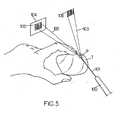
- the holographic pattern P is illuminated by a laser pen 100 of low power, for example red color of wavelength 645 nanometers.
- the distance between the laser 100 and the pattern P is not critical for image reconstruction.
- the light beam 101 from the laser 100 is diffracted by the pattern P, so that it is divided into at least two secondary beams 102 and 103 after passing through the lens 1.
- Each of the two beams 102 and 103 reconstructs an image at a distance of distance of the lens 1 which can be between 20 and 50 centimeters, for example.
- This image is revealed by placing an object 104 serving as a screen on the path of one of the two beams 102 or 103. Because the light used is from a laser, the object that serves as a screen can be any.
- the image can also be projected on an image sensor, for example of the CCD (Charge Coupled Device) or CMOS (for "Complementary Metal Oxide Semiconductor”) type to enable fast and accurate recognition.
- the images corresponding to each of the two beams 102 and 103 are referenced 105 and 106, respectively.
- the ophthalmic lens 1 may be intended to be assembled in a pair of glasses.
- the pattern P may be small and printed near an edge of the lens 1 ( figure 5 ).
- the transferred pattern P may occupy a portion of the face of the lens 1 which is less than 25 mm 2.
- the pattern can also be introduced on a part of the lens to be cut off. In this case the pattern is mainly introduced for purposes of traceability of the final product.
- Such a configuration is particularly interesting if the transferred pattern corresponds to a computer generated hologram CGH type and which consists of pixels.
- Such a hologram can thus contain a very large amount of information over a very small space, advantageously between 15 mm 2 and 0.5 mm 2 , making it possible, for example, to guarantee complete traceability of the optical article in the production line and logistics.
- the transferred pattern P can occupy the entire anterior face of the lens 1, for example when it gives the lens a particular optical function. This may be the case, in particular, when the transferred pattern P consists of a set of electrically conductive wires parallel to a given direction, for filtering light passing through the lens according to a polarization thereof.
- the conductive wires have a width of a few tens of nanometers and are spaced two by two by a few tens of nanometers.
- an intermediate layer may be deposited on the membrane 11 of the tampon before the layer of transferable material 14, to adjust a surface energy between the layer 14 and the membrane 11 of the buffer. Such an adjustment can further improve the transfer of the portions 3 of transferable material to the lens 1.
- the pattern transferred to the lens can be a diffracting pattern, that is to say whose visibility results from a diffraction of the light by the portions 3 and / or the gaps 4 present therebetween.
- the pattern that is transferred may be visible under ambient lighting conditions, or when illuminated by a laser beam.
- the key parameter of the process is the state of the Latex layer at the time of step / c /: bringing the surface of the pad into contact which comprises the layer of transferable material with the Latex layer.
- the layer of latex thus deposited retains its properties for about ten seconds, a period of time that defines the process window during which the transfer must be performed.
- the exemplified method is optimized for a digital holographic pattern composed of square elementary pixels having a dimension of 1 ⁇ m on each side.
- the membrane 11 of the tampon carries on its surface a microrelief consisting of recesses 12 and protuberances 13 of rectangular profile as schematized on the figure 1.a .
- the depth of the microrelief (altitude difference between the hollows 12b and the protuberances 13) is 1 .mu.m.
- the holographic pattern has characteristics such that the width of the protuberances of the microrelief carried by the membrane 11 and measured along an axis parallel to an edge of the square pixels varies between 1 .mu.m and 85 .mu.m depending on the area of the buffer considered.
- the metal layer is obtained by evaporation under vacuum.
- the suitable metallic material is placed in a crucible and heated by Joule effect.
- the evaporation is carried out on the Sylgard® 184 buffer which has not undergone any prior surface preparation.
- the evaporation of the metal layer takes place in the same day as the transfer step on the ophthalmic lens.
- the transfer of the layer 14 is selectively: only the portions of material initially located on the protuberances (13) of the buffer are transferred.
- the transferred holographic pattern is of amplitude hologram type.
- the protuberances of the surface of the buffer can penetrate entirely into the latex layer.
- the transfer of the layer 14 is integral: all the portions of the transferable layer 14 present on the protuberances 13 and the recesses 12b are transferred.
- the integral transfer of the portions of the layer 14 is accompanied by the permanent deposition of the latex layer, reproducing the microrelief complementary to the microrelief constituting the pattern P of the buffer.
- the transferred holographic pattern is of the phase hologram type, covered with a metal layer.
- Buffering is orthogonal to the surface.
- This limit pressure P is determined for a layer of 30 nm of gold or aluminum, on the latex deposited under the conditions described above.
- the pressure applied for stamping the tampon on the convex face of an ophthalmic lens (with a radius of curvature 120 mm) coated with a layer of latex deposited under the conditions described above is 1.5 g / mm. 2 .
- the transfer of the 30 nm gold layer is selective; the hologram obtained is an amplitude hologram.
- the pressure applied for stamping the tampon on the convex face of an ophthalmic lens (with a radius of curvature 120 mm) coated with a layer of latex deposited under the conditions described above is 1.5 g / mm. 2 .
- the transfer of the 30 nm aluminum layer is integral, and the latex layer is permanently embedded, so that the microrelief of the latex layer is the microrelief complementary to the microrelief constituting the pattern P on the surface of the buffer.
- the hologram obtained is a phase hologram.
Landscapes
- Engineering & Computer Science (AREA)
- Health & Medical Sciences (AREA)
- Ophthalmology & Optometry (AREA)
- Manufacturing & Machinery (AREA)
- Mechanical Engineering (AREA)
- Physics & Mathematics (AREA)
- General Health & Medical Sciences (AREA)
- General Physics & Mathematics (AREA)
- Optics & Photonics (AREA)
- Diffracting Gratings Or Hologram Optical Elements (AREA)
- Holo Graphy (AREA)
- Eyeglasses (AREA)
- Polarising Elements (AREA)
- Optical Fibers, Optical Fiber Cores, And Optical Fiber Bundles (AREA)
Priority Applications (1)
| Application Number | Priority Date | Filing Date | Title |
|---|---|---|---|
| PL06841872T PL1957274T3 (pl) | 2005-12-08 | 2006-12-06 | Sposób przenoszenia motywu mikronowego na wyrób optyczny i wyrób optyczny uzyskany w ten sposób |
Applications Claiming Priority (2)
| Application Number | Priority Date | Filing Date | Title |
|---|---|---|---|
| FR0512492A FR2894515B1 (fr) | 2005-12-08 | 2005-12-08 | Procede de transfert d'un motif micronique sur un article optique et article optique ainsi obtenu |
| PCT/FR2006/002665 WO2007066006A2 (fr) | 2005-12-08 | 2006-12-06 | Procede de transfert d'un motif micronique sur un article optique et article optique ainsi obtenu |
Publications (2)
| Publication Number | Publication Date |
|---|---|
| EP1957274A2 EP1957274A2 (fr) | 2008-08-20 |
| EP1957274B1 true EP1957274B1 (fr) | 2010-03-24 |
Family
ID=36928296
Family Applications (1)
| Application Number | Title | Priority Date | Filing Date |
|---|---|---|---|
| EP06841872A Active EP1957274B1 (fr) | 2005-12-08 | 2006-12-06 | Procede de transfert d'un motif micronique sur un article optique et article optique ainsi obtenu |
Country Status (14)
| Country | Link |
|---|---|
| US (1) | US7874671B2 (enExample) |
| EP (1) | EP1957274B1 (enExample) |
| JP (1) | JP5424645B2 (enExample) |
| KR (1) | KR101370552B1 (enExample) |
| CN (1) | CN101326058B (enExample) |
| AT (1) | ATE461815T1 (enExample) |
| AU (1) | AU2006323921B2 (enExample) |
| BR (1) | BRPI0619528A8 (enExample) |
| CA (1) | CA2632525C (enExample) |
| DE (1) | DE602006013186D1 (enExample) |
| FR (1) | FR2894515B1 (enExample) |
| PL (1) | PL1957274T3 (enExample) |
| PT (1) | PT1957274E (enExample) |
| WO (1) | WO2007066006A2 (enExample) |
Families Citing this family (21)
| Publication number | Priority date | Publication date | Assignee | Title |
|---|---|---|---|---|
| FR2879313B1 (fr) * | 2004-12-10 | 2007-04-06 | Essilor Int | Procede d'inscription de donnees sur une lentille, et lentille comprenant des donnees inscrites |
| JP5214232B2 (ja) * | 2007-12-20 | 2013-06-19 | Asti株式会社 | プラスチック製微細構造体製造方法 |
| JP2010287625A (ja) * | 2009-06-09 | 2010-12-24 | Toshiba Corp | テンプレート及びパターン形成方法 |
| CN102653190A (zh) * | 2011-03-04 | 2012-09-05 | 国家纳米科学中心 | 形成石墨烯氧化物图案和石墨烯图案的方法 |
| JP2012242582A (ja) * | 2011-05-19 | 2012-12-10 | Sakusan:Kk | 眼鏡用レンズ |
| CN102350853B (zh) * | 2011-07-19 | 2013-11-20 | 陈炜玲 | 全息图纹膜的制作工艺、全息图纹膜及系统 |
| EP2604415B1 (en) * | 2011-12-15 | 2017-05-24 | Essilor International (Compagnie Générale D'Optique) | System and method for generating machine marking instructions |
| TWM429700U (en) * | 2012-01-19 | 2012-05-21 | Benq Materials Corp | Engraving device |
| KR102132298B1 (ko) * | 2012-12-31 | 2020-07-09 | 쓰리엠 이노베이티브 프로퍼티즈 캄파니 | 롤-투-롤 공정에서 고 릴리이프 스탬프를 사용하는 미세접촉 인쇄 |
| MX362359B (es) * | 2014-02-06 | 2019-01-14 | Vision Ease Lp | Rejilla de alambre polarizada y metodo de fabricacion. |
| DE102015109703B4 (de) * | 2015-06-17 | 2022-03-17 | tooz technologies GmbH | Brillenglas, Brille und Verfahren zur Herstellung eines Brillenglases |
| KR20160039588A (ko) * | 2016-03-22 | 2016-04-11 | 주식회사 우리옵토 | 일정 곡률을 가지는 광학 렌즈상에 마이크로 패턴을 형성하는 방법 |
| CN106273218A (zh) * | 2016-06-15 | 2017-01-04 | 东莞科大光学镜片有限公司 | 一种防雾镜片的制造方法及其制品 |
| EP3640714A1 (en) * | 2018-10-17 | 2020-04-22 | Essilor International | Optical articles comprising encapsulated microlenses and methods of making the same |
| EP3812142A1 (de) * | 2019-10-23 | 2021-04-28 | Carl Zeiss Vision International GmbH | Verfahren zur herstellung eines brillenglases sowie ein erzeugnis umfassend ein brillenglas |
| EP3988288A1 (en) | 2020-10-23 | 2022-04-27 | Carl Zeiss Vision International GmbH | Method of manufacturing a spectacle lens |
| EP3988289A1 (en) | 2020-10-23 | 2022-04-27 | Carl Zeiss Vision International GmbH | Method of manufacturing a spectacle lens |
| EP3988290A1 (en) * | 2020-10-23 | 2022-04-27 | Carl Zeiss Vision International GmbH | Method for manufacturing a spectacle lens |
| CN113427888B (zh) * | 2021-06-15 | 2022-06-17 | 清华大学 | 印章单元的设计方法、印章单元及印章 |
| CN114516188A (zh) * | 2022-02-17 | 2022-05-20 | 深圳睿晟自动化技术有限公司 | 微纳米级光波导镜面热压工艺方法 |
| WO2023175193A2 (en) * | 2022-03-18 | 2023-09-21 | Carl Zeiss Vision International Gmbh | Coated lens and method for manufacturing the same |
Family Cites Families (44)
| Publication number | Priority date | Publication date | Assignee | Title |
|---|---|---|---|---|
| DE2613034A1 (de) | 1976-03-26 | 1977-09-29 | Siemens Ag | Faelschungssichere ausweiskarte mit lippmann-bragg-hologramm |
| FR2507196A1 (fr) * | 1981-06-09 | 1982-12-10 | Euverte Bernard | Feuille ou bande pour le transfert d'adhesif |
| JPH0614414B2 (ja) * | 1986-06-17 | 1994-02-23 | 共同印刷株式会社 | 転写型光記録媒体 |
| JP2899296B2 (ja) * | 1988-11-10 | 1999-06-02 | アレン・エル・コーエン | 多焦点位相板の製造方法 |
| JPH04147180A (ja) | 1990-10-09 | 1992-05-20 | Dainippon Printing Co Ltd | パターニングした計算機ホログラム |
| US5634669A (en) | 1991-04-16 | 1997-06-03 | American Bank Note Holographics, Inc. | Holographic check authentication article |
| WO1995004948A1 (en) | 1993-08-06 | 1995-02-16 | Commonwealth Scientific And Industrial Research Organisation | A diffractive device |
| JPH0749471A (ja) * | 1993-08-06 | 1995-02-21 | Kuraray Co Ltd | 眼 鏡 |
| WO1995011945A1 (en) | 1993-10-29 | 1995-05-04 | Minnesota Mining And Manufacturing Company | Pressure-sensitive adhesives having microstructured surfaces |
| US5752442A (en) * | 1993-11-03 | 1998-05-19 | Corning Incorporated | Method for printing a color filter |
| JP3552262B2 (ja) * | 1994-02-09 | 2004-08-11 | 凸版印刷株式会社 | ホログラムシールおよびその製造方法 |
| JPH07261010A (ja) * | 1994-03-18 | 1995-10-13 | Shimadzu Corp | レプリカ回折格子 |
| EP0784542B1 (en) * | 1995-08-04 | 2001-11-28 | International Business Machines Corporation | Stamp for a lithographic process |
| US5772905A (en) * | 1995-11-15 | 1998-06-30 | Regents Of The University Of Minnesota | Nanoimprint lithography |
| US20030080471A1 (en) * | 2001-10-29 | 2003-05-01 | Chou Stephen Y. | Lithographic method for molding pattern with nanoscale features |
| US6309580B1 (en) * | 1995-11-15 | 2001-10-30 | Regents Of The University Of Minnesota | Release surfaces, particularly for use in nanoimprint lithography |
| US20080217813A1 (en) * | 1995-11-15 | 2008-09-11 | Chou Stephen Y | Release surfaces, particularly for use in nanoimprint lithography |
| DE19644620A1 (de) | 1996-10-18 | 1998-04-23 | Chromatron Laser Sys Gmbh | Vorrichtung aus einem beschichteten oder bedampften Trägermaterial |
| US5892600A (en) | 1996-12-27 | 1999-04-06 | Kuo; Wei-Wu Alex | Spectacle lens structure with a planar reflective outer surface |
| JPH1172606A (ja) * | 1997-08-29 | 1999-03-16 | Shimadzu Corp | SiCのパターンエッチング方法 |
| US5937758A (en) * | 1997-11-26 | 1999-08-17 | Motorola, Inc. | Micro-contact printing stamp |
| US6060256A (en) * | 1997-12-16 | 2000-05-09 | Kimberly-Clark Worldwide, Inc. | Optical diffraction biosensor |
| DE19758395C2 (de) | 1997-12-23 | 2002-01-03 | Marcel Rogalla | Verfahren und Sehvorrichtung zur holographischen Visualisierung virtueller Bilder und Muster |
| JP2002513067A (ja) * | 1998-04-24 | 2002-05-08 | ミネソタ マイニング アンド マニュファクチャリング カンパニー | ストライプ接着剤被覆テープ |
| GB2343864B (en) | 1998-11-20 | 2003-07-16 | Agra Vadeko Inc | Improved security thread and method and apparatus for applying same to a substrate |
| US6579673B2 (en) * | 1998-12-17 | 2003-06-17 | Kimberly-Clark Worldwide, Inc. | Patterned deposition of antibody binding protein for optical diffraction-based biosensors |
| KR100307449B1 (ko) * | 1999-01-13 | 2001-12-28 | 김순택 | 음극선관용 기능성 필름 |
| DE19926698A1 (de) | 1999-06-11 | 2000-12-14 | Hsm Gmbh | Computergeneriertes Sicherheitsmerkmal |
| US6452699B1 (en) | 1999-09-28 | 2002-09-17 | Holospex, Inc. | Controlled diffraction efficiency far field viewing devices |
| JP4548679B2 (ja) | 1999-10-08 | 2010-09-22 | 大日本印刷株式会社 | 体積ホログラム積層体における粘着剤層用粘着剤 |
| JP2001121582A (ja) * | 1999-10-26 | 2001-05-08 | Ntt Advanced Technology Corp | 金型およびその製造方法 |
| DE10060531A1 (de) * | 1999-12-15 | 2001-06-21 | Henkel Kgaa | Transferklebeband |
| US6399295B1 (en) * | 1999-12-17 | 2002-06-04 | Kimberly-Clark Worldwide, Inc. | Use of wicking agent to eliminate wash steps for optical diffraction-based biosensors |
| JP4453945B2 (ja) * | 2000-09-18 | 2010-04-21 | 大日本印刷株式会社 | 転写箔シート及びその剥離性・破断性の評価方法 |
| DE10127980C1 (de) | 2001-06-08 | 2003-01-16 | Ovd Kinegram Ag Zug | Diffraktives Sicherheitselement |
| US7220452B2 (en) | 2001-10-31 | 2007-05-22 | Massachusetts Institute Of Technology | Multilayer transfer patterning using polymer-on-polymer stamping |
| US20030152693A1 (en) * | 2002-02-12 | 2003-08-14 | Su Kai C. | Methods of applying a coating to an optical surface |
| ATE413442T1 (de) | 2002-05-28 | 2008-11-15 | 3M Innovative Properties Co | Härtbare klebegegenstände mit topographischen merkmalen |
| US20040115279A1 (en) * | 2002-09-06 | 2004-06-17 | The Ohio State University | Microfabrication of polymer microparticles |
| US7179396B2 (en) * | 2003-03-25 | 2007-02-20 | Molecular Imprints, Inc. | Positive tone bi-layer imprint lithography method |
| JP4147180B2 (ja) | 2003-12-24 | 2008-09-10 | ポーラ化成工業株式会社 | ゲル状の皮膚外用剤 |
| JP2006152074A (ja) * | 2004-11-26 | 2006-06-15 | Hitachi Chem Co Ltd | 光硬化型樹脂組成物、およびこれを用いてなる回折型集光フィルム |
| FR2894514B1 (fr) * | 2005-12-08 | 2008-02-15 | Essilor Int | Procede de transfert d'un motif micronique sur un article optique et article optique ainsi obtenu |
| EP1795497B1 (en) * | 2005-12-09 | 2012-03-14 | Obducat AB | Apparatus and method for transferring a pattern with intermediate stamp |
-
2005
- 2005-12-08 FR FR0512492A patent/FR2894515B1/fr not_active Expired - Fee Related
-
2006
- 2006-12-06 CN CN2006800462292A patent/CN101326058B/zh active Active
- 2006-12-06 PL PL06841872T patent/PL1957274T3/pl unknown
- 2006-12-06 WO PCT/FR2006/002665 patent/WO2007066006A2/fr not_active Ceased
- 2006-12-06 DE DE602006013186T patent/DE602006013186D1/de active Active
- 2006-12-06 US US12/095,966 patent/US7874671B2/en active Active
- 2006-12-06 BR BRPI0619528A patent/BRPI0619528A8/pt not_active IP Right Cessation
- 2006-12-06 PT PT06841872T patent/PT1957274E/pt unknown
- 2006-12-06 AT AT06841872T patent/ATE461815T1/de not_active IP Right Cessation
- 2006-12-06 CA CA2632525A patent/CA2632525C/fr not_active Expired - Fee Related
- 2006-12-06 EP EP06841872A patent/EP1957274B1/fr active Active
- 2006-12-06 JP JP2008543866A patent/JP5424645B2/ja not_active Expired - Fee Related
- 2006-12-06 AU AU2006323921A patent/AU2006323921B2/en not_active Ceased
- 2006-12-06 KR KR1020087016576A patent/KR101370552B1/ko active Active
Also Published As
| Publication number | Publication date |
|---|---|
| KR20080080360A (ko) | 2008-09-03 |
| US7874671B2 (en) | 2011-01-25 |
| PL1957274T3 (pl) | 2010-08-31 |
| EP1957274A2 (fr) | 2008-08-20 |
| KR101370552B1 (ko) | 2014-03-06 |
| US20080316558A1 (en) | 2008-12-25 |
| AU2006323921A1 (en) | 2007-06-14 |
| FR2894515B1 (fr) | 2008-02-15 |
| CA2632525A1 (fr) | 2007-06-14 |
| BRPI0619528A2 (pt) | 2011-10-04 |
| JP2009518674A (ja) | 2009-05-07 |
| CN101326058A (zh) | 2008-12-17 |
| DE602006013186D1 (de) | 2010-05-06 |
| CN101326058B (zh) | 2011-05-25 |
| JP5424645B2 (ja) | 2014-02-26 |
| FR2894515A1 (fr) | 2007-06-15 |
| WO2007066006A3 (fr) | 2007-07-26 |
| CA2632525C (fr) | 2014-09-16 |
| AU2006323921B2 (en) | 2012-05-24 |
| ATE461815T1 (de) | 2010-04-15 |
| PT1957274E (pt) | 2010-06-25 |
| BRPI0619528A8 (pt) | 2018-08-14 |
| WO2007066006A2 (fr) | 2007-06-14 |
Similar Documents
| Publication | Publication Date | Title |
|---|---|---|
| EP1957274B1 (fr) | Procede de transfert d'un motif micronique sur un article optique et article optique ainsi obtenu | |
| EP1957275B1 (fr) | Procede de transfert d'un motif micronique sur un article optique et article optique ainsi obtenu | |
| CA2568421C (fr) | Procede de realisation d'un element optique transparent, composant optique intervenant dans ce procede et element optique ainsi obtenu | |
| EP1904884B1 (fr) | Composant optique transparent pixellise comprenant un revetement absorbant, son procede de realisation et son utilisation dans un element optique | |
| EP1820068B1 (fr) | Procede d'inscription de donnees sous forme holographique sur une lentille et lentille correspondante | |
| EP1825319A1 (fr) | Procede de realisation d'un element optique transparent, composant optique intervenant dans ce procede et element optique ainsi obtenu | |
| WO2010010275A2 (fr) | Procede de transfert d'une portion de film fonctionnel | |
| CA2779101A1 (fr) | Element de securite comportant un substrat portant une structure optique et un motif de reference, et procede associe | |
| EP3037897B1 (fr) | Procédé de fabrication d'un cadran d'affichage pour objet portable tel qu'une pièce d'horlogerie et cadran d'affichage | |
| JP2009518674A5 (enExample) | ||
| EP1904883A1 (fr) | Composant optique pixellise a parois apodisees, son procede de fabrication et son utilisation dans la fabrication d'un element optique transparent | |
| EP4240595B1 (fr) | Procede de fabrication d'un document de securite | |
| WO2022003045A1 (fr) | Procédés de fabrication de composants optiques de sécurité, composants optiques de sécurité et objets sécurisés équipés de tels composants | |
| BRPI0619528B1 (pt) | Processo de transferência de um motivo micrônico sobre um artigo óptico e artigo óptico assim obtido |
Legal Events
| Date | Code | Title | Description |
|---|---|---|---|
| PUAI | Public reference made under article 153(3) epc to a published international application that has entered the european phase |
Free format text: ORIGINAL CODE: 0009012 |
|
| 17P | Request for examination filed |
Effective date: 20080523 |
|
| AK | Designated contracting states |
Kind code of ref document: A2 Designated state(s): AT BE BG CH CY CZ DE DK EE ES FI FR GB GR HU IE IS IT LI LT LU LV MC NL PL PT RO SE SI SK TR |
|
| 17Q | First examination report despatched |
Effective date: 20090525 |
|
| GRAP | Despatch of communication of intention to grant a patent |
Free format text: ORIGINAL CODE: EPIDOSNIGR1 |
|
| GRAS | Grant fee paid |
Free format text: ORIGINAL CODE: EPIDOSNIGR3 |
|
| GRAA | (expected) grant |
Free format text: ORIGINAL CODE: 0009210 |
|
| AK | Designated contracting states |
Kind code of ref document: B1 Designated state(s): AT BE BG CH CY CZ DE DK EE ES FI FR GB GR HU IE IS IT LI LT LU LV MC NL PL PT RO SE SI SK TR |
|
| REG | Reference to a national code |
Ref country code: GB Ref legal event code: FG4D Free format text: NOT ENGLISH |
|
| REG | Reference to a national code |
Ref country code: CH Ref legal event code: EP |
|
| REG | Reference to a national code |
Ref country code: IE Ref legal event code: FG4D |
|
| REF | Corresponds to: |
Ref document number: 602006013186 Country of ref document: DE Date of ref document: 20100506 Kind code of ref document: P |
|
| REG | Reference to a national code |
Ref country code: CH Ref legal event code: NV Representative=s name: ISLER & PEDRAZZINI AG |
|
| REG | Reference to a national code |
Ref country code: PT Ref legal event code: SC4A Free format text: AVAILABILITY OF NATIONAL TRANSLATION Effective date: 20100618 |
|
| REG | Reference to a national code |
Ref country code: NL Ref legal event code: VDEP Effective date: 20100324 |
|
| PG25 | Lapsed in a contracting state [announced via postgrant information from national office to epo] |
Ref country code: LT Free format text: LAPSE BECAUSE OF FAILURE TO SUBMIT A TRANSLATION OF THE DESCRIPTION OR TO PAY THE FEE WITHIN THE PRESCRIBED TIME-LIMIT Effective date: 20100324 |
|
| LTIE | Lt: invalidation of european patent or patent extension |
Effective date: 20100324 |
|
| PG25 | Lapsed in a contracting state [announced via postgrant information from national office to epo] |
Ref country code: SI Free format text: LAPSE BECAUSE OF FAILURE TO SUBMIT A TRANSLATION OF THE DESCRIPTION OR TO PAY THE FEE WITHIN THE PRESCRIBED TIME-LIMIT Effective date: 20100324 Ref country code: FI Free format text: LAPSE BECAUSE OF FAILURE TO SUBMIT A TRANSLATION OF THE DESCRIPTION OR TO PAY THE FEE WITHIN THE PRESCRIBED TIME-LIMIT Effective date: 20100324 Ref country code: LV Free format text: LAPSE BECAUSE OF FAILURE TO SUBMIT A TRANSLATION OF THE DESCRIPTION OR TO PAY THE FEE WITHIN THE PRESCRIBED TIME-LIMIT Effective date: 20100324 Ref country code: AT Free format text: LAPSE BECAUSE OF FAILURE TO SUBMIT A TRANSLATION OF THE DESCRIPTION OR TO PAY THE FEE WITHIN THE PRESCRIBED TIME-LIMIT Effective date: 20100324 |
|
| REG | Reference to a national code |
Ref country code: PL Ref legal event code: T3 |
|
| REG | Reference to a national code |
Ref country code: IE Ref legal event code: FD4D |
|
| PG25 | Lapsed in a contracting state [announced via postgrant information from national office to epo] |
Ref country code: ES Free format text: LAPSE BECAUSE OF FAILURE TO SUBMIT A TRANSLATION OF THE DESCRIPTION OR TO PAY THE FEE WITHIN THE PRESCRIBED TIME-LIMIT Effective date: 20100705 Ref country code: GR Free format text: LAPSE BECAUSE OF FAILURE TO SUBMIT A TRANSLATION OF THE DESCRIPTION OR TO PAY THE FEE WITHIN THE PRESCRIBED TIME-LIMIT Effective date: 20100625 Ref country code: NL Free format text: LAPSE BECAUSE OF FAILURE TO SUBMIT A TRANSLATION OF THE DESCRIPTION OR TO PAY THE FEE WITHIN THE PRESCRIBED TIME-LIMIT Effective date: 20100324 Ref country code: RO Free format text: LAPSE BECAUSE OF FAILURE TO SUBMIT A TRANSLATION OF THE DESCRIPTION OR TO PAY THE FEE WITHIN THE PRESCRIBED TIME-LIMIT Effective date: 20100324 Ref country code: SE Free format text: LAPSE BECAUSE OF FAILURE TO SUBMIT A TRANSLATION OF THE DESCRIPTION OR TO PAY THE FEE WITHIN THE PRESCRIBED TIME-LIMIT Effective date: 20100324 Ref country code: EE Free format text: LAPSE BECAUSE OF FAILURE TO SUBMIT A TRANSLATION OF THE DESCRIPTION OR TO PAY THE FEE WITHIN THE PRESCRIBED TIME-LIMIT Effective date: 20100324 |
|
| PG25 | Lapsed in a contracting state [announced via postgrant information from national office to epo] |
Ref country code: BG Free format text: LAPSE BECAUSE OF FAILURE TO SUBMIT A TRANSLATION OF THE DESCRIPTION OR TO PAY THE FEE WITHIN THE PRESCRIBED TIME-LIMIT Effective date: 20100624 Ref country code: CZ Free format text: LAPSE BECAUSE OF FAILURE TO SUBMIT A TRANSLATION OF THE DESCRIPTION OR TO PAY THE FEE WITHIN THE PRESCRIBED TIME-LIMIT Effective date: 20100324 Ref country code: IS Free format text: LAPSE BECAUSE OF FAILURE TO SUBMIT A TRANSLATION OF THE DESCRIPTION OR TO PAY THE FEE WITHIN THE PRESCRIBED TIME-LIMIT Effective date: 20100724 Ref country code: SK Free format text: LAPSE BECAUSE OF FAILURE TO SUBMIT A TRANSLATION OF THE DESCRIPTION OR TO PAY THE FEE WITHIN THE PRESCRIBED TIME-LIMIT Effective date: 20100324 |
|
| PLBE | No opposition filed within time limit |
Free format text: ORIGINAL CODE: 0009261 |
|
| STAA | Information on the status of an ep patent application or granted ep patent |
Free format text: STATUS: NO OPPOSITION FILED WITHIN TIME LIMIT |
|
| PG25 | Lapsed in a contracting state [announced via postgrant information from national office to epo] |
Ref country code: DK Free format text: LAPSE BECAUSE OF FAILURE TO SUBMIT A TRANSLATION OF THE DESCRIPTION OR TO PAY THE FEE WITHIN THE PRESCRIBED TIME-LIMIT Effective date: 20100324 Ref country code: IE Free format text: LAPSE BECAUSE OF FAILURE TO SUBMIT A TRANSLATION OF THE DESCRIPTION OR TO PAY THE FEE WITHIN THE PRESCRIBED TIME-LIMIT Effective date: 20100324 |
|
| 26N | No opposition filed |
Effective date: 20101228 |
|
| PG25 | Lapsed in a contracting state [announced via postgrant information from national office to epo] |
Ref country code: IT Free format text: LAPSE BECAUSE OF FAILURE TO SUBMIT A TRANSLATION OF THE DESCRIPTION OR TO PAY THE FEE WITHIN THE PRESCRIBED TIME-LIMIT Effective date: 20100324 |
|
| BERE | Be: lapsed |
Owner name: ESSILOR INTERNATIONAL (COMPAGNIE GENERALE D'OPTIQ Effective date: 20101231 |
|
| PG25 | Lapsed in a contracting state [announced via postgrant information from national office to epo] |
Ref country code: MC Free format text: LAPSE BECAUSE OF NON-PAYMENT OF DUE FEES Effective date: 20101231 |
|
| PG25 | Lapsed in a contracting state [announced via postgrant information from national office to epo] |
Ref country code: BE Free format text: LAPSE BECAUSE OF NON-PAYMENT OF DUE FEES Effective date: 20101231 |
|
| PG25 | Lapsed in a contracting state [announced via postgrant information from national office to epo] |
Ref country code: CY Free format text: LAPSE BECAUSE OF FAILURE TO SUBMIT A TRANSLATION OF THE DESCRIPTION OR TO PAY THE FEE WITHIN THE PRESCRIBED TIME-LIMIT Effective date: 20100324 |
|
| PG25 | Lapsed in a contracting state [announced via postgrant information from national office to epo] |
Ref country code: HU Free format text: LAPSE BECAUSE OF FAILURE TO SUBMIT A TRANSLATION OF THE DESCRIPTION OR TO PAY THE FEE WITHIN THE PRESCRIBED TIME-LIMIT Effective date: 20100925 Ref country code: LU Free format text: LAPSE BECAUSE OF NON-PAYMENT OF DUE FEES Effective date: 20101206 |
|
| PG25 | Lapsed in a contracting state [announced via postgrant information from national office to epo] |
Ref country code: TR Free format text: LAPSE BECAUSE OF FAILURE TO SUBMIT A TRANSLATION OF THE DESCRIPTION OR TO PAY THE FEE WITHIN THE PRESCRIBED TIME-LIMIT Effective date: 20100324 |
|
| REG | Reference to a national code |
Ref country code: FR Ref legal event code: PLFP Year of fee payment: 10 |
|
| PGFP | Annual fee paid to national office [announced via postgrant information from national office to epo] |
Ref country code: CH Payment date: 20151228 Year of fee payment: 10 |
|
| PGFP | Annual fee paid to national office [announced via postgrant information from national office to epo] |
Ref country code: PT Payment date: 20151120 Year of fee payment: 10 Ref country code: PL Payment date: 20151119 Year of fee payment: 10 |
|
| REG | Reference to a national code |
Ref country code: FR Ref legal event code: PLFP Year of fee payment: 11 |
|
| REG | Reference to a national code |
Ref country code: CH Ref legal event code: PL |
|
| PG25 | Lapsed in a contracting state [announced via postgrant information from national office to epo] |
Ref country code: PT Free format text: LAPSE BECAUSE OF NON-PAYMENT OF DUE FEES Effective date: 20170606 |
|
| PG25 | Lapsed in a contracting state [announced via postgrant information from national office to epo] |
Ref country code: CH Free format text: LAPSE BECAUSE OF NON-PAYMENT OF DUE FEES Effective date: 20161231 Ref country code: LI Free format text: LAPSE BECAUSE OF NON-PAYMENT OF DUE FEES Effective date: 20161231 |
|
| REG | Reference to a national code |
Ref country code: FR Ref legal event code: PLFP Year of fee payment: 12 |
|
| REG | Reference to a national code |
Ref country code: DE Ref legal event code: R081 Ref document number: 602006013186 Country of ref document: DE Owner name: ESSILOR INTERNATIONAL, FR Free format text: FORMER OWNER: ESSILOR INTERNATIONAL (COMPAGNIE GENERALE D'OPTIQUE), CHARENTON-LE-PONT, FR |
|
| PG25 | Lapsed in a contracting state [announced via postgrant information from national office to epo] |
Ref country code: PL Free format text: LAPSE BECAUSE OF NON-PAYMENT OF DUE FEES Effective date: 20161206 |
|
| REG | Reference to a national code |
Ref country code: GB Ref legal event code: 732E Free format text: REGISTERED BETWEEN 20180517 AND 20180523 |
|
| REG | Reference to a national code |
Ref country code: FR Ref legal event code: TP Owner name: ESSILOR INTERNATIONAL, FR Effective date: 20180601 |
|
| P01 | Opt-out of the competence of the unified patent court (upc) registered |
Effective date: 20230525 |
|
| PGFP | Annual fee paid to national office [announced via postgrant information from national office to epo] |
Ref country code: GB Payment date: 20241227 Year of fee payment: 19 |
|
| PGFP | Annual fee paid to national office [announced via postgrant information from national office to epo] |
Ref country code: FR Payment date: 20241226 Year of fee payment: 19 |
|
| PGFP | Annual fee paid to national office [announced via postgrant information from national office to epo] |
Ref country code: DE Payment date: 20241227 Year of fee payment: 19 |