EP1952799A2 - Kosmetische Zubereitung mit Hyaluronsäure und Saponinen zur Behandlung von Hautalterungserscheinungen - Google Patents
Kosmetische Zubereitung mit Hyaluronsäure und Saponinen zur Behandlung von Hautalterungserscheinungen Download PDFInfo
- Publication number
- EP1952799A2 EP1952799A2 EP08103572A EP08103572A EP1952799A2 EP 1952799 A2 EP1952799 A2 EP 1952799A2 EP 08103572 A EP08103572 A EP 08103572A EP 08103572 A EP08103572 A EP 08103572A EP 1952799 A2 EP1952799 A2 EP 1952799A2
- Authority
- EP
- European Patent Office
- Prior art keywords
- saponins
- preparation
- weight
- cosmetic
- hyaluronic acid
- Prior art date
- Legal status (The legal status is an assumption and is not a legal conclusion. Google has not performed a legal analysis and makes no representation as to the accuracy of the status listed.)
- Granted
Links
Classifications
-
- A—HUMAN NECESSITIES
- A61—MEDICAL OR VETERINARY SCIENCE; HYGIENE
- A61K—PREPARATIONS FOR MEDICAL, DENTAL OR TOILETRY PURPOSES
- A61K8/00—Cosmetics or similar toiletry preparations
- A61K8/18—Cosmetics or similar toiletry preparations characterised by the composition
- A61K8/72—Cosmetics or similar toiletry preparations characterised by the composition containing organic macromolecular compounds
- A61K8/73—Polysaccharides
- A61K8/735—Mucopolysaccharides, e.g. hyaluronic acid; Derivatives thereof
-
- A—HUMAN NECESSITIES
- A61—MEDICAL OR VETERINARY SCIENCE; HYGIENE
- A61K—PREPARATIONS FOR MEDICAL, DENTAL OR TOILETRY PURPOSES
- A61K8/00—Cosmetics or similar toiletry preparations
- A61K8/18—Cosmetics or similar toiletry preparations characterised by the composition
- A61K8/96—Cosmetics or similar toiletry preparations characterised by the composition containing materials, or derivatives thereof of undetermined constitution
- A61K8/97—Cosmetics or similar toiletry preparations characterised by the composition containing materials, or derivatives thereof of undetermined constitution from algae, fungi, lichens or plants; from derivatives thereof
- A61K8/9783—Angiosperms [Magnoliophyta]
- A61K8/9789—Magnoliopsida [dicotyledons]
-
- A—HUMAN NECESSITIES
- A61—MEDICAL OR VETERINARY SCIENCE; HYGIENE
- A61Q—SPECIFIC USE OF COSMETICS OR SIMILAR TOILETRY PREPARATIONS
- A61Q19/00—Preparations for care of the skin
- A61Q19/08—Anti-ageing preparations
Definitions
- the present invention relates to cosmetic preparations with a combination of active ingredients of hyaluronic acid and saponins.
- the "mature skin” of older people differs from "normal skin” younger in a variety of symptoms. It is usually drier and shows uneven cornification. Their lack of water-binding capacity in the dermis causes deep wrinkles. The tendency of the epidermis to blepharic lifts is increased. The pattern of aging skin develops in genetic aging similar to chronic environmental damage such as that caused by excessive UV exposure.
- the tasks are solved surprisingly by a cosmetic preparation containing an active ingredient combination 0.001 to 3% by weight hyaluronic acid and 0.01 to 4% by weight saponins, wherein the weight data refer to the total weight of the preparation, characterized in that the preparation contains a lipid phase with a total polarity of less than 30 mN / m.
- the tasks are surprisingly solved by a cosmetic preparation containing a combination of 0.001 to 3% by weight hyaluronic acid and 0.01 to 8% by weight of leguminous extract containing 0.01 to 99% by weight saponins, wherein the weights of the hyaluronic acid and the legume extract on the total weight of the preparation and the weight of the saponins refer to the Total weight of the legume extract, characterized in that the preparation contains a lipid phase with a total polarity of less than 30 mN / m.
- the objects are surprisingly achieved by a cosmetic preparation containing a combination of 0.001 to 3% by weight hyaluronic acid and 0.01 to 8% by weight of soybean extract containing 0.01 to 99% by weight of saponins, the hyaluronic acid and soybean extract weights being based on the total weight of the preparation and the saponins indicating the total weight of the soybean extract characterized in that the preparation contains a lipid phase having a total polarity of less than 30 mN / m.
- the weight ratio of hyaluronic acid to saponins is from 1: 1 to 1:10.
- compositions of the invention are characterized in that the preparation contains saponins of glycosides of triterpene sapogenins, optionally together with further saponins of glycosides of steroid sapogenins
- Hyaluronic acid is a glycosaminoglycan found in the vitreous humor of the eyes, the synovial fluid of the joints and in the skin. Together with the chondroitin sulfates and dermatan sulfate, it is a constituent of all connective tissue (except the cornea).
- Hyaluronic acid is a high molecular weight compound with M R between 50,000 and several million.
- the basic building block of hyaluronic acid is an aminodisaccharide composed of D-glucuronic acid and N- acetyl-D-glucosamine in ⁇ - (1 ⁇ 3) -glycosidic bond, which is linked to the next unit ⁇ - (1 ⁇ 4) -glycosidically:
- the sodium salt of hyaluronic acid is used as a moisturizer for the manufacture of cosmetic products (Römpp online Lexikon Version 2.5, 2004).
- Saponins refers to a group of generally vegetable glycosides that form colloidal, soap-like solutions as surface-active compounds in water.
- the saponins are divided into triterpene saponins and steroid saponins according to the type of their aglycone, the sapogenins.
- the carbohydrate portion can consist of up to 11 monosaccharide residues (mostly D-glucose, D-galactose, L-rhamnose, L-arabinose, D-xylose, D-fucose, D-glucuronic acid).
- the main food-borne saponins the oleanolic acid saponins (sugar beet), glycyrrhizin (licorice root) and the soybean saponins, belong to the triterpene saponins range.
- saponins are used as wetting and dispersing agents or foaming agents in toothpowders, mouthwashes and the like.
- Shampoos used (Rompp online lexicon version 2.5, 2004).
- the active ingredients according to the invention are known per se to the cosmetic specialist, it has hitherto not been possible to incorporate saponins and, in particular, the combination of hyaluronic acid and saponins, stably and in an effective form into cosmetic preparations, in particular emulsions.
- saponins and, in particular, the combination of hyaluronic acid and saponins stably and in an effective form into cosmetic preparations, in particular emulsions.
- the problem always arose that the homogeneous incorporation of the two raw materials was not possible by a standard method.
- Both raw materials can not be incorporated through the lipid phase because they contain hydrophilic molecular components.
- the saponins or the saponins-containing plant extract is in this case first with at least four times the amount of a glycol a log P value between -3.6 and 1 mixed and dissolved with constant stirring and heating. Subsequently, the solution of the possibly still hot pre-emulsion is added.
- the saponin may also be incorporated into the water phase of the preparation, which contains at least four times the amount of saponin of corresponding glycol: under heating and stirring continuously, the poorly soluble substance is stirred and dispersed and then combined with the fatty phase containing the emulsifiers.
- preparations according to the invention or inventive compositions are understood as meaning both the preparations according to the invention per se and the preparations prepared by the process according to the invention and also the preparations used according to the invention.
- the preparation according to the invention contains saponins based on triterpene sapogenins.
- soy aspirin these are especially saponins from soy aspirin A or soybean agcogenol B.
- saponins based on steroid sapogenins may also be present.
- leguminous extracts according to the invention are preferably from representatives of the genera Abrus, Anagyris, Andira, Anthyllis, Arachis, Aspalathus, Astragalus, Baptistia, Canavalia, Castanospermum, Cicer, Crotalaria, Cyamopsis, Cytisus, Derris, Dipteryx, Galega, Genista, Glycine, Glycyrrhiza, Gymnoclamdus, Indigofera, Laburnum, Lathyrus, Lens, Lespedeza, Medicago, Melilotus, Mucuna, Myroxylon, Ononis, Oxytropis, Phaseolus, Physostigma, Piptadenia, Psicidia, Pisum, Pterocarpus, Robinia, Sophora, Trifolium, Trigonella, Ulex, Vigna, Vicia and Wisteria elected.
- soybean Glycine soy
- broad bean Vicia faba
- common bean Phaseolus vulgaris
- linamarin Phaseolus lunatus
- mung bean Phaseolus aureus and Vigna radiata
- lentil Lifalfa
- Chinese tragacanth Astragalus membranaceus
- pea Pisum sativum
- common bean Vigna mungo
- gray bean Vigna angularis
- licorice Glycyrrhiza glabra
- peanut Arachis hypogaea
- purple root Sophora favescens
- common rue Galega officinalis
- Chickpea Cicer arietinum
- flagworm Oxytropis
- Bengali hemp Cirotalaria juncea
- Japanese wisteria Wisteria floribunda
- white clover Trifolium repens
- soya extracts contain as natural products a variety of compounds, whose main representatives are the fats, carbohydrates, proteins, isoflavones, lecithins and saponins. Depending on the extraction method, the extracts may contain different ingredients. So there soybean oils or soy extracts containing at least 90% isoflavonoids.
- soya extracts which have a high content of saponins. These should represent an accumulation of saponin compared to the content in the soybean.
- the soybean contains about 6.5 mg / g saponins.
- the extract should contain at least 10mg / g, but even more than 100mg / g saponin.
- An example of a suitable extract according to the invention is the soybean germ extract of Lucas Meyer Beauty Essentials with an approximate saponin content of 140 mg / g. It is a yellowish powder with a slight odor of roasted nuts.
- the preparation according to the invention is in the form of an emulsion and is particularly preferred according to the invention if the preparation according to the invention is in the form of an O / W emulsion.
- the preparation contains one or more of the following emulsifiers or emulsifier combinations: Polyglyceryl-2-dipolyhydroxystearate, PEG-30 dipolyhydroxystearate, cetyl dimethicone copolyol, glycol distearate, Glykoldilaurat, Diethylenglykoldilaurat, sorbitan trioleate, Glykololeat, glyceryl dilaurate, sorbitan tristearate, propylene glycol stearate, propylene glycol laurate, Propylenglykoldistearat, sucrose distearate, PEG-3 castor oil, Pentaerythritylmonostearat, Pentaerythritylsesquioleat, glyceryl oleate, glyceryl stearate, Glyceryl diisostearate, pentaerythrityl monooleate, sorbitan ses
- Sorbitan Stearate PEG-7 Hydrogenated Castor Oil, PEG-5-Soyasterol, PEG-6 Sorbitan Beeswax, Glyceryl Stearate SE, Methyl Glucose Sequistearate, PEG-10 Hydrogenated Castor Oil, Sorbitan Palmitate, PE G-22 / dodecyl glycol copolymer, polyglyceryl-2-PEG-4 stearate, sorbitan laurate, PEG-4 laurate, polysorbate 61, polysorbate 81, polysorbate 65, polysorbate 80, triceteareth-4-phosphate, triceteareth-4 phosphates, and sodium C 14-17 Alkyl Sec Sulfonate (Hostacerin CG from Hoechst), glyceryl stearate and PEG-100 stearates (Arlacel 165 from ICI), polysorbate 85, trilaureth 4-phosphate, PEG-35 castor
- O / W emulsifiers from the group of fatty acids which are wholly or partly with customary alkalis (such as, for example, sodium and / or potassium hydroxide, sodium and / or potassium carbonate and mono- and / or Triethanolamine) are neutralized.
- customary alkalis such as, for example, sodium and / or potassium hydroxide, sodium and / or potassium carbonate and mono- and / or Triethanolamine
- stearic acid and stearates, isostearic acid and isostearates, palmitic acid and palmitates as well as myristic acid and myristates are particularly advantageous.
- the O / W emulsifier (s) are preferably selected from the following group: PEG-9 stearate, PEG-8 distearate, PEG-20 stearate, PEG-8 stearate, PEG-8 oleate, PEG-25 glyceryl trioleate , PEG-40 sorbitan lanolate, PEG-15 glyceryl ricinoleate, PEG-20 glyceryl stearate, PEG-20 glyceryl isostearate, PEG-20 glyceryl oleate, PEG-20 stearate, PEG-20 methyl glucose sesquistearate, PEG-30 glyceryl isostearate, PEG 20-glyceryl laurate, PEG-30 stearate, PEG-30 glyceryl stearate, PEG-40 stearate, PEG-30 glyceryl laurate, PEG-50 stearate, PEG-100 stearate, PEG-150 laurate.
- the coemulsifier (s) are preferably selected according to the invention from the following group: butyloctanol, butyldecanol, hexyloctanol, hexyldecanol, octyldodecanol, behenyl (C 22 H 45 OH), cetearyl alcohol [a mixture of cetyl alcohol (C 16 H 33 OH) and stearyl alcohol (C 18 H 37 OH)], lanolin alcohols (wool wax alcohols, which are the unsaponifiable alcohol fraction of wool wax obtained after saponification of wool wax). Particularly preferred are cetyl and cetylstearyl alcohol.
- the oil phase of the emulsions, hydrodispersions or lipid dispersions in the context of the present invention is advantageously selected from the group of esters of saturated and / or unsaturated, branched and / or unbranched alkanecarboxylic acids having a chain length of 3 to 30 carbon atoms and saturated and / or unsaturated, branched and / or unbranched alcohols of a chain length of 3 to 30 carbon atoms, from the group of esters of aromatic carboxylic acids and saturated and / or unsaturated, branched and / or unbranched alcohols having a chain length of 3 to 30 carbon atoms.
- ester oils can then be advantageously selected from the group isopropyl myristate, isopropyl palmitate, isopropyl stearate, isopropyl oleate, n-butyl stearate, n-hexyl laurate, n-decyl oleate, isooctyl stearate, isononyl stearate, isononyl isononanoate, 2-ethylhexyl palmitate, 2-ethylhexyl laurate, 2-hexyldecyl stearate, 2 Octyldodecyl palmitate, oleyl oleate, oleyl erucate, erucyl oleate, erucyl erucate and synthetic, semi-synthetic and natural mixtures of such esters, eg Jojoba oil.
- the oil phase can be advantageously selected from the group of branched and unbranched hydrocarbons and waxes, the silicone oils, the dialkyl ethers, the group of saturated or unsaturated, branched or unbranched alcohols, and the fatty acid triglycerides, namely the triglycerol esters of saturated and / or unsaturated, branched and / or unbranched alkanecarboxylic acids of a chain length of 8 to 24, in particular 12-18 C-atoms.
- the fatty acid triglycerides can be selected, for example, advantageously from the group of synthetic, semi-synthetic and natural oils, for example olive oil, sunflower oil, soybean oil, peanut oil, rapeseed oil, almond oil, palm oil, coconut oil, palm kernel oil and the like.
- Blends of such oil and wax components are also advantageous to use in the context of the present invention. It may also be advantageous, if appropriate, to use waxes, for example cetyl palmitate, as the sole lipid component of the oil phase.
- the oil phase is selected from the group consisting of 2-ethylhexyl isostearate, octyldodecanol, isotridecyl isononanoate, isoeicosane, 2-ethylhexyl cocoate, C 12-15 alkyl benzoate, caprylic capric triglyceride, dicaprylyl ether.
- mixtures of C 12-15 alkyl benzoate and 2-ethylhexyl isostearate mixtures of C 12-15 alkyl benzoate and Isotridecylisononanoat and mixtures of C 12-15 alkyl benzoate, 2-Ethylhexylisostearat and Isotridecylisononanoat.
- hydrocarbons paraffin oil, squalane and squalene are to be used advantageously in the context of the present invention.
- the oil phase may further comprise a content of cyclic or linear silicone oils or consist entirely of such oils, although it is preferred to use an additional content of other oil phase components except the silicone oil or silicone oils.
- cyclomethicone octamethylcyclotetrasiloxane
- silicone oils are also advantageous for the purposes of the present invention, for example hexamethylcyclotrisiloxane, polydimethylsiloxane, poly (methylphenylsiloxane).
- mixtures of cyclomethicone and isotridecyl isononanoate, of cyclomethicone and 2-ethylhexyl isostearate are particularly advantageous.
- the aqueous phase of the preparations according to the invention advantageously contains alcohols, diols or polyols of low C number, and their ethers, preferably ethanol, isopropanol, propylene glycol, glycerol, ethylene glycol, ethylene glycol monoethyl or monobutyl ether, propylene glycol monomethyl, monoethyl or monobutyl ether, diethylene glycol monomethyl - or monoethyl ether and analogous products, also lower C-number alcohols, eg Ethanol, isopropanol, 1,2-propanediol, 2-methyl-1,3-propanediol, glycerol, and in particular one or more thickeners.
- alcohols, diols or polyols of low C number, and their ethers preferably ethanol, isopropanol, propylene glycol, glycerol, ethylene glycol, ethylene glycol monoethyl
- the cosmetic preparations according to the invention may comprise cosmetic auxiliaries as are customarily used in such preparations, for example preservatives, Bactericides, perfumes, foaming inhibitors, colorants, pigments having a coloring effect, thickeners, surface-active substances, emulsifiers, softening, moisturizing and / or moisturizing substances, fats, oils, waxes or other usual ingredients of a cosmetic or dermatological Formulation such as complexing agents, alcohols, polyols, polymers, foam stabilizers, electrolytes, organic solvents or silicone derivatives, plant extracts, vitamins, perfumes.
- cosmetic auxiliaries as are customarily used in such preparations, for example preservatives, Bactericides, perfumes, foaming inhibitors, colorants, pigments having a coloring effect, thickeners, surface-active substances, emulsifiers, softening, moisturizing and / or moisturizing substances, fats, oils, waxes or other usual ingredients of a cosmetic or dermatological Formulation such
- active ingredient combinations used according to the invention can also be combined with the antioxidants and / or radical scavengers known in cosmetics.
- preparations according to the invention may also contain substances which absorb UV radiation in the UVB range, the total amount of filter substances being e.g. 0.1 wt .-% to 30 wt .-%, preferably 0.5 to 10 wt .-%, in particular 1.0 to 6.0 wt .-%, based on the total weight of the preparations to cosmetic preparations for To provide the hair or the skin against the entire range of ultraviolet radiation. They can also serve as a sunscreen for hair.
- the total amount of filter substances being e.g. 0.1 wt .-% to 30 wt .-%, preferably 0.5 to 10 wt .-%, in particular 1.0 to 6.0 wt .-%, based on the total weight of the preparations to cosmetic preparations for To provide the hair or the skin against the entire range of ultraviolet radiation. They can also serve as a sunscreen for hair.
- UVB filters which can be used in combination with the active compound combinations according to the invention should of course not be limiting.
- UVA filters that are commonly included in cosmetic preparations. These substances are preferably derivatives of dibenzoylmethane, in particular 1- (4'-tert-butylphenyl) -3- (4'-methoxyphenyl) propane-1,3-dione and 1-phenyl-3- (4 '-isopropylphenyl) propane-1,3-dione.
- UVA filters are derived from the group of triazines, e.g. the 2,4-bis - ⁇ [4- (2-ethyl-hexyloxy) -2-hydroxy] -phenyl ⁇ -6- (4-methoxyphenyl) -1,3,5-triazine (trade name Tinosorb® S) and the Group of triazoles, such as the 2,2'-methylenebis [6-2H-benzotriazol-2yl] -4- (1,1,3,3-tetramethylbutyl) phenol) (trade name Tinosorb® M).
- An advantageous water-soluble UVA filter is the 2'-bis (1,4-phenylene) -1 H-benzimidazole-4,6-disulfonic acid sodium salt (trade name Neo Heliopan AP®).
- the amounts used for the UVB combination can be used.
- Preferred inorganic pigments are metal oxides and / or other water-insoluble or insoluble metal compounds, in particular oxides of titanium (TiO 2 ), zinc (ZnO), iron (eg Fe 2 O 3 ), zirconium (ZrO 2 ), silicon ( SiO 2 ), manganese (for example MnO), aluminum (Al 2 O 3 ), cerium (for example Ce 2 O 3 ), mixed oxides of the corresponding metals and mixtures of such oxides and also the barium sulfate (BaSO 4 ).
- the pigments can also be used advantageously in the form of commercially available oily or aqueous predispersions.
- dispersants and / or solubilizers can be added to these predispersions.
- the pigments can advantageously be surface-treated ("coated"), in which case, for example, a hydrophilic, amphiphilic or hydrophobic character is formed or should be preserved.
- This surface treatment may consist in providing the pigments with a thin hydrophilic and / or hydrophobic inorganic and / or organic layer by processes known per se.
- the various surface coatings may also contain water for the purposes of the present invention.
- Inorganic surface coatings for the purposes of the present invention may consist of aluminum oxide (Al 2 O 3 ), aluminum hydroxide Al (OH) 3 or aluminum oxide hydrate (also: Alumina, CAS No .: 1333-84-2), sodium hexametaphosphate (NaPO 3 ) 6 , sodium metaphosphate (NaPO 3 ) n , silicon dioxide (SiO 2 ) (also: silica, CAS No .: 7631-86-9), or iron oxide (Fe 2 O 3 ).
- Al 2 O 3 aluminum oxide
- Al aluminum hydroxide Al
- Al oxide hydrate also: Alumina, CAS No .: 1333-84-2
- sodium hexametaphosphate (NaPO 3 ) 6 sodium metaphosphate (NaPO 3 ) n
- silicon dioxide SiO 2
- silica also: silica, CAS No .: 7631-86-9
- iron oxide Fe 2 O 3
- Organic surface coatings for the purposes of the present invention may consist of vegetable or animal aluminum stearate, vegetable or animal stearic acid, lauric acid, dimethylpolysiloxane (also: dimethicone), methylpolysiloxane (methicone), simethicone (a mixture of dimethylpolysiloxane with an average chain length of 200 to 350 dimethylsiloxane Units and silica gel) or alginic acid. These organic surface coatings may be present alone, in combination and / or in combination with inorganic coating materials.
- the process for the preparation of the cosmetic preparation according to the invention is characterized in that the saponins or the saponins containing soy extract first in at least four times the amount of a glycol with a log P value between -3.6 and 1 or in the Water phase of the preparation containing this amount of the glycol is dissolved and then combined with a fatty phase containing the emulsifiers.
- an active ingredient combination according to the invention ie the active ingredient combination of 0.001 to 3% by weight hyaluronic acid and 0.01 to 4% by weight saponins, or 0.001 to 3% by weight hyaluronic acid and 0.01 to 8% by weight of legume extract containing 0.01 to 99% by weight of saponins
- the plant extract is preferably soybean extract.
- these uses are preferred when the cosmetic or the cosmetic preparation is applied topically to the skin.
- prophylaxis and treatment in the context of this disclosure exclusively cosmetic prophylaxis and treatment and in no way a therapeutic prophylaxis and treatment in terms of patent law.
- the uses according to the invention are used in particular in skin or face creams, skin or face lotions and day or night creams or lotions.
Landscapes
- Health & Medical Sciences (AREA)
- Life Sciences & Earth Sciences (AREA)
- Animal Behavior & Ethology (AREA)
- General Health & Medical Sciences (AREA)
- Public Health (AREA)
- Veterinary Medicine (AREA)
- Birds (AREA)
- Epidemiology (AREA)
- Gerontology & Geriatric Medicine (AREA)
- Dermatology (AREA)
- Engineering & Computer Science (AREA)
- Biotechnology (AREA)
- Botany (AREA)
- Microbiology (AREA)
- Mycology (AREA)
- Cosmetics (AREA)
Abstract
Description
- Die vorliegende Erfindung betrifft kosmetische Zubereitungen mit einer Wirkstoffkombination aus Hyaluronsäure und Saponinen.
- Der Wunsch, schön und attraktiv auszusehen, ist von Natur aus im Menschen verwurzelt. Auch wenn das Schönheitsideal im Laufe der Zeit Wandlungen erfahren hat, so ist das Streben nach einem makellosen Äußeren, immer das Ziel der Menschen gewesen. Einen wesentlichen Anteil an einem schönen und attraktiven Äußeren hat dabei der Zustand und das Aussehen der Haut. Um der Haut ein makelloses Aussehen zu verleihen, bedarf es der regelmäßigen Reinigung und Pflege.
- Zur Pflege der Haut werden den Verbrauchern heutzutage eine Vielzahl von kosmetischen Zubereitungen, meist in Form von Cremes und Lotionen d.h. als Emulsion angeboten. Produkte, welche die Alterungserscheinungen der Haut (insbesondere das Auftreten von Fältchen und Falten) temporär oder dauerhaft verzögern oder beseitigen, haben dabei eine stetig wachsende Bedeutung. Neben Wasser zur Hautbefeuchtung sowie Ölen und Lipiden zur Rückfettung der Haut enthalten derartige Hautpflegeprodukte eine Vielzahl an Wirk- Hilfs- und Zusatzstoffen.
- Die "reife Haut" älterer Menschen unterscheidet sich von "normaler Haut" jüngerer in einer Vielzahl von Symptomen. Sie ist in der Regel trockener und zeigt eine ungleichmäßige Verhornung. Durch ihr fehlendes Wasserbindevermögen in der Lederhaut entstehen tiefe Falten. Die Neigung der Oberhaut zu blasigen Abhebungen ist erhöht. Das Bild der Altershaut entwickelt sich beim genetischen Altern ähnlich wie bei chronischer Umweltschädigung wie sie zum Beispiel durch übermäßige UV-Exposition hervorgerufen wird.
- Exogene Faktoren, wie UV-Licht und chemische Noxen, können kumulativ wirksam sein und z.B. die endogenen Alterungsprozesse beschleunigen bzw. sie ergänzen. In Epidermis und Dermis kommt es insbesondere durch exogene Faktoren z.B. zu folgenden Strukturschäden- und Funktionsstörungen in der Haut, die über Maß und Qualität der Schäden bei chronologischer Alterung hinausgehen:
- a) Sichtbare Gefäßerweiterungen (Teleangiektasien, Cuperosis);
- b) Schlaffheit und Ausbildung von Falten;
- c) lokale Hyper-, Hypo- und Fehlpigmentierungen (z.B. Altersflecken);
- d) vergrößerte Anfälligkeit gegenüber mechanischem Stress (z.B. Rissigkeit)
- e) Abnahme des Kollagengehaltes der Haut (z.B. durch verminderte Neusynthese und/oder durch verstärkten Abbau)
- f) Störungen des Glykosaminoglykan und Elastinstoffwechsels.
- Die Hautforschung hat in den vergangenen Jahren eine Vielzahl an Wirkstoffen entwickelt bzw. entdeckt, mit denen sich Hautalterungserscheinungen kosmetisch behandeln lassen und der optisch wahrnehmbare Hautalterungsprozess verlangsamen läßt.
- Herkömmliche Hautpflegeprodukte zur Prophylaxe und Behandlung von Hautalterungssymptomen weisen jedoch den Nachteil auf, dass sich diese Wirkstoffe in der Regel nur schwer und in ungenügenden Mengen in kosmetische Formulierungen einarbeiten lassen. Ferner tritt nach dem Stande der Technik regelmäßig der Nachteil auf, dass sich Kombinationen von Wirkstoffen nur schwer in die Zubereitungen einarbeiten lassen, da die Wirkstoffe nicht nur Unverträglichkeiten gegenüber der "Trägerzubereitung" sondern auch untereinander aufweisen können.
- Es war die Aufgabe der vorliegenden Erfindung, eine neue, stabile und kosmetisch wirksame Hautpflegezubereitung zur Prophylaxe und Behandlung von Hautalterungserscheinungen, insbesondere Fältchen und Falten zu entwickeln. Insbesondere sollte durch die Hautpflegezubereitung die Hautfeuchtigkeit erhöht werden.
- Überraschend gelöst werden die Aufgaben durch eine
kosmetische Zubereitung enthaltend eine Wirkstoffkombination aus
0,001 bis 3 Gewichts-% Hyaluronsäure und
0,01 bis 4 Gewichts-% Saponinen,
wobei sich die Gewichtsangaben auf das Gesamtgewicht der Zubereitung beziehen, dadurch gekennzeichnet, das die Zubereitung eine Lipidphase mit einer Gesamtpolarität von weniger als 30 mN/m enthält. - Ferner werden die Aufgaben überraschend gelöst durch eine
kosmetische Zubereitung enthaltend eine Kombination aus
0,001 bis 3 Gewichts-% Hyaluronsäure und
0,01 bis 8 Gewichts-% Leguminosenextrakt, welcher 0,01 bis 99 Gewichts-% Saponine enthält,
wobei sich die Gewichtsangaben der Hyaluronsäure und des Leguminosenextraktes auf das Gesamtgewicht der Zubereitung beziehen und die Gewichtsangabe der Saponine auf das Gesamtgewicht des Leguminosenextraktes beziehen, dadurch gekennzeichnet, das die Zubereitung eine Lipidphase mit einer Gesamtpolarität von weniger als 30 mN/m enthält. - Insbesondere werden die Aufgaben überraschend gelöst durch eine kosmetische Zubereitung enthaltend eine Kombination aus
0,001 bis 3 Gewichts-% Hyaluronsäure und
0,01 bis 8 Gewichts-% Sojaextrakt, welcher 0,01 bis 99 Gewichts-% Saponine enthält, wobei sich die Gewichtsangaben der Hyaluronsäure und des Sojaextraktes auf das Gesamtgewicht der Zubereitung beziehen und die Gewichtsangabe der Saponine auf das Gesamtgewicht des Sojaextraktes beziehen, dadurch gekennzeichnet, das die Zubereitung eine Lipidphase mit einer Gesamtpolarität von weniger als 30 mN/m enthält. - Es hat sich dabei als erfindungsgemäß besonders vorteilhaft herausgestellt, wenn das Gewichtsverhältnis von Hyaluronsäure zu Saponinen von 1:1 bis 1:10 beträgt.
- Vorteilhafte Ausführungsformen der Erfindung sind dadurch gekennzeichnet, dass die Zubereitung Saponine aus Glycosiden von Triterpensapogeninen neben gegebenenfalls weiteren Saponinen aus Glycosiden von Steroidsapogeninen enthält
- Hyaluronsäure ist ein im Glaskörper von Augen, der Synovialflüssigkeit der Gelenke und in der Haut vorkommendes Glykosaminoglykan, das zusammen mit den Chondroitinsulfaten und Dermatansulfat ein Bestandteil aller Bindegewebe (außer Augenhornhaut) ist.
- Hyaluronsäure ist eine hochmolekulare Verbindung mit MR zwischen 50000 und mehreren Millionen. Grundbaustein der Hyaluronsäure ist ein aus D-Glucuronsäure und N-Acetyl-D-glucosamin in β-(1 →3)-glykosidischer Bindung aufgebautes Aminodisaccharid, das mit der nächsten Einheit β-(1 →4)-glykosidisch verbunden ist:

- Das Natriumsalz der Hyaluronsäure wird als Moisturizer (Feuchthaltemittel) für die Herstellung kosmetischer Mittel verwendet (Römpp online Lexikon Version 2.5, 2004).
- Als Saponine (von "Sapo" latein. Seife) bezeichnet man eine Gruppe von im allgemeinen pflanzlichen Glykosiden, die als oberflächenaktive Verbindungen in Wasser kolloidale, seifenartige Lösungen bilden.
- Die Saponine werden nach der Art ihrer Aglykone, der Sapogenine, in Triterpen- Saponine und Steroid- Saponine unterteilt. Der Kohlenhydrat-Anteil kann aus bis zu 11 Monosaccharid-Resten (meistens D-Glucose, D-Galactose, L-Rhamnose, L-Arabinose, D-Xylose, D-Fucose, D-Glucuronsäure) bestehen.
- Die wichtigsten in Lebensmitteln vorkommenden Saponine, die Oleanolsäure- Saponine (Zuckerrübe), Glycyrrhizin (Süßholzwurzel) und die Sojabohnen- Saponine, gehören der Reihe der Triterpen- Saponine an.
- In der Kosmetik werden Saponine als Netz- und Dispergiermittel bzw. Schaumbildner bei Zahnpulvern, Mundwässern u. Shampoos eingesetzt (Römpp online Lexikon Version 2.5, 2004).
- Die erfindungsgemäßen Wirkstoffe sind dem Kosmetik- Fachmann zwar an sich bekannt, doch ist es bisher nicht gelungen, Saponine und insbesondere die Kombination aus Hyaluronsäure und Saponinen stabil und in einer wirksamen Form in kosmetische Zubereitungen, insbesondere Emulsionen, einzuarbeiten. So trat bei der Kombination aus den beiden Wirkstoffen nach dem Stand der Technik immer das Problem auf, dass die homogene Einarbeitung der beiden Rohstoffe nicht nach einem Standardverfahren möglich war. Somit war es auch nicht möglich, eine konstante Wirkstoffkonzentration zu gewährleisten, besonders über einen längeren Lagerzeitraum hinweg. Beide Rohstoffe können nicht über die Lipidphase eingearbeitet werde, da Sie hydrophile Molekülbestandteile enthalten. Aber eine Einararbeitung der beiden Rohstoffe über die Wasserphase ist ebenfalls nicht möglich, da sich die Saponine und Hyaluronsäure nicht gleichzeitig homogen in der Wasserphase lösen/ dispergieren lassen, ohne Trübungen/ Kristalle zu bilden.
- Das Problem konnte nun erfindungsgemäß gelöst werden, indem ein besonderes Verfahren zur Herstellung einer kosmetischen Zubereitung, die sowohl Saponine als auch Hyaluronsäure enthält, erarbeitet wurde: die Saponine bzw. der die Saponine enthaltende Pflanzenextrakt wird hierbei zunächst mit mindestens der vierfachen Menge an einem Glykol mit einem log P Wert zwischen -3,6 und 1 gemischt und unter ständigem Rühren sowie Erwärmung gelöst. Anschließend wird die Lösung der möglichst noch heißen Präemulsion zugegeben. Alternativ kann das Saponin auch in die Wasserphase der Zubereitung, welche mindestens das Vierfache der Saponinmenge an entsprechendem Glykol enthält, eingearbeitet werden: unter Erwärmung und ständigem Rühren wird die schlecht lösliche Substanz eingerührt und dispergiert und anschließend mit der Fettphase, welche die Emulgatoren enthält, vereinigt. In beiden Fällen erwies es sich als vorteilhaft, die Hyaluronsäure separat in einem Vielfachen an Wasser anzurühren und vorzuquellen, so daß ein Gel entsteht. Dieses wird der nicht mehr ganz heißen Emulsion unter Rühren zugegeben.
- Als erfindungsgemäß bzw. erfindungsgemäße Zubereitungen werden im Rahmen der vorliegenden Erfindung sowohl die erfindungsgemäßen Zubereitungen an sich als auch die nach dem erfindungsgemäßen Verfahren hergestellten Zubereitungen als auch die erfindungsgemäß verwendeten Zubereitungen verstanden.
- Es ist erfindungsgemäß von Vorteil, wenn die erfindungsgemäße Zubereitung Saponine auf Basis von Triterpensapogeninen enthalten. Bei der Verwendung von Sojasaponin sind das besonders Saponine aus Sojasapogenol A oder Sojasagpogenol B. Aber es können gegebenenfalls auch Saponine auf Basis von Steroidsapogeninen enthalten sein.
- Die erfindungsgemäßen Leguminosenextrakte (Fam. Fabaceae) sind vorzugsweise aus Vertretern der Gattungen Abrus, Anagyris, Andira, Anthyllis, Arachis, Aspalathus, Astragalus, Baptistia, Canavalia, Castanospermum, Cicer, Crotalaria, Cyamopsis, Cytisus, Derris, Dipteryx, Galega, Genista, Glycine, Glycyrrhiza, Gymnoclamdus, Indigofera, Laburnum, Lathyrus, Lens, Lespedeza, Medicago, Melilotus, Mucuna, Myroxylon, Ononis, Oxytropis, Phaseolus, Physostigma, Piptadenia, Psicidia, Pisum, Pterocarpus, Robinia, Sophora, Trifolium, Trigonella, Ulex, Vigna, Vicia und Wisteria gewählt.
- Besonders geeignet sind hierbei Extrakte aus Soyabohne (Glycine Soja), Saubohne (Vicia faba), Gartenbohne (Phaseolus vulgaris), Linamarin (Phaseolus lunatus), Mungobohne (Phaseolus aureus und Vigna radiata), Linse (Lens culinaris), Luzerne (Medicago sativa), Chinesischer Traganth (Astragalus membranaceus), Erbse (Pisum sativum), Urdbohne (Vigna mungo), Mattenbohne (Vigna angularis), Süßholz (Glycyrrhiza glabra), Erdnuß (Arachis hypogaea), Schnurbaumwurzel (Sophora favescens), Geißraute (Galega officinalis), Kichererbse (Cicer arietinum), Fahnenwicke (Oxytropis), Bengalischer Hanf (Crotalaria juncea), Japanischer Blauregen (Wisteria floribunda) und Weißklee (Trifolium repens).
- Werden die erfindungsgemäßen Saponine in Form eines Sojaextraktes eingesetzt, so ist es erfindungsgemäß von Vorteil, wenn der Soyaextrakt auf den Sapogeningehalt standardisiert ist. Soyaextrakte enthalten als Naturprodukte eine Vielzahl an Verbindungen, deren wichtigste Vertreter die Fette, Kohlenhydrate, Proteine, Isoflavone, Lecithine und die Saponine sind. Je nach Extraktionsverfahren können die Extrakte unterschiedliche Inhaltsstoffe enthalten. So gibt es Sojaöle oder solche Sojaextrakte, die mind. 90% Isoflavonoide enthalten. Erfindungsgemäß von Vorteil sind diejenigen Soyaextrakte, die einen hohen Gehalt an Saponinen aufweisen. Diese sollten eine Anreicherung an Saponin im Vergleich zum Gehalt in der Soyabohne darstellen. Die Soyabohne enthält ca. 6,5 mg/g Saponine. Der Extrakt sollte mindestens 10mg/g, besonders vorteilhaft aber sogar über 100mg/g Saponin enthalten. Ein Beispiel für einen erfindungsgemäß geeigneten Extrakt ist der Soybean Germ Extract von Lucas Meyer Beauty Essentials mit einem ungefähren Saponingehalt von 140mg/g. Es handelt sich hierbei um ein gelbliches Pulver mit einem leichten Eigengeruch nach gerösteten Nüssen.
- Es ist erfindungsgemäß bevorzugt, wenn die erfindungsgemäße Zubereitung in Form einer Emulsion vorliegt und erfindungsgemäß besonders bevorzugt, wenn die erfindungsgemäße Zubereitung in Form einer O/W-Emulsion vorliegt.
- Dabei ist es vorteilhaft im Sinne der vorliegenden Erfindung, wenn die Zubereitung einen oder mehrere der folgenden Emulgatoren bzw. Emulgatorkombinationen enthält:
Polyglyceryl-2-Dipolyhydroxystearat, PEG-30-Dipolyhydroxystearat, Cetyldimethiconcopolyol, Glykoldistearat, Glykoldilaurat, Diethylenglykoldilaurat, Sorbitantrioleat, Glykololeat, Glyceryldilaurat, Sorbitantristearat, Propylenglykolstearat, Propylenglykollaurat, Propylenglykoldistearat, Sucrosedistearat, PEG-3 Castor Oil, Pentaerythritylmonostearat, Pentaerythritylsesquioleat, Glyceryloleat, Glycerylstearat, Glyceryldüsostearat, Pentaerythritylmonooleat, Sorbitansesquioleat, Isostearyldiglycerylsuccinat, Glycerylcaprat, Palm Glycerides, Cholesterol, Lanolin, Glyceryloleat (mit 40 % Monoester), Polyglyceryl-2-Sesquiisostearat, Polyglyceryl-2-Sesquioleat, PEG-20 Sorbitan Beeswax, Sorbitanoleat, Sorbitanisostearat, Trioleylphosphat, Glyceryl Stearate und Ceteareth-20 (Teginacid von Th. Goldschmidt), Sorbitanstearat, PEG-7 Hydrogenated Castor Oil, PEG-5-Soyasterol, PEG-6 Sorbitan Beeswax, Glycerylstearat SE, Methylglucosesesquistearate, PEG-10 Hydrogenated Castor Oil, Sorbitanpalmitat, PEG-22/Dodecylglykol Copolymer, Polyglyceryl-2-PEG-4-Stearat, Sorbitanlaurat, PEG-4-Laurat, Polysorbat 61, Polysorbat 81, Polysorbat 65, Polysorbat 80, Triceteareth-4-Phosphat, Triceteareth-4 Phosphate und Sodium C14-17 Alkyl Sec Sulfonat (Hostacerin CG von Hoechst), Glycerylstearat und PEG-100 Stearate (Arlacel 165 von ICI), Polysorbat 85, Trilaureth-4-Phosphat, PEG-35 Castor Oil, Sucrosestearat, Trioleth-8-Phosphat, C12-15 Pareth-12, PEG-40 Hydrogenated Castor Oil, PEG-16 Soya Sterol, Polysorbat 80, Polysorbat 20, Polyglyceryl-3-methylglucose Distearat, PEG-40 Castor Oil, Natriumcetearylsulfat, Lecithin, Laureth-4-Phosphat, Propylenglykolstearat SE, PEG-25 Hydrogenated Castor Oil, PEG-54 Hydrogenated Castor Oil, Glycerylstearat SE, PEG-6 Caprylic/Capric Glycerides, Glyceryloleat und Propylenglykol, Glyceryllanolat, Polysorbat 60, Glycerylmyristat, Glycerylisostearat und Polyglyceryl-3 Oleat, Glyceryllaurat, PEG-40-Sorbitanperoleat, Laureth-4, Glycerinmonostearat, Isostearylglycerylether, Cetearyl Alcohol und Natriumcetearylsulfat, PEG-22-Dodecylglykolcopolymer, Polyglyceryl-2-PEG-4-Stearat, Pentaerythrithylisostearat, Polyglyceryl-3-Diisostearat, Sorbitanoleat und Hydrogenated Castor Oil und Cera alba und Stearinsäure, Natriumdihydroxycetylphosphat und Isopropylhydroxycetylether, Methylglucosesesquistearat, Methylglucosedioleat, Sorbitanoleat und PEG-2 Hydrogenated Castor Oil und Ozokerit und Hydrogenated Castor Oil, PEG-2 Hydrogenated Castor Oil, PEG-45-/Dodecylglykolcopolymer, Methoxy PEG-22-/Dodecylglykolcopolymer, Hydrogenated Coco Glycerides, Polyglyceryl-4-Isostearat, PEG-40-Sorbitanperoleat, PEG-40-Sorbitanperisostearat, PEG-8-Beeswax, Laurylmethiconcopolyol, Polyglyceryl-2-Laurat, Stearamidopropyl-PG-dimoniumchloridphosphat, PEG-7 Hydrogenated Castor Oil, Triethylcitrat, Glycerylstearatcitrat, Cetylphosphat, Polyglycerolmethylglucosedistearat, Poloxamer 101, Kaliumcetylphosphat, Glycerylisostearat, Polyglyceryl-3-Diisostearate. - Besonders vorteilhaft im Sinne der Erfindung sind O/W-Emulgatoren aus der Gruppe der Fettsäuren, welche ganz oder teilweise mit üblichen Alkalien (wie z. B. Natrium- und/oder Kaliumhydroxid, Natrium- und/oder Kaliumcarbonat sowie Mono- und/oder Triethanolamin) neutralisiert sind. Besonders vorteilhaft sind beispielsweise Stearinsäure und Stearate, Isostearinsäure und Isostearate, Palmitinsäure und Palmitate sowie Myristinsäure und Myristate.
- Der oder die O/W-Emulgatoren werden vorzugsweise gewählt aus der folgenden Gruppe: PEG-9-Stearat, PEG-8-Distearat, PEG-20-Stearat, PEG-8 Stearat, PEG-8-Oleat, PEG-25-Glyceryltrioleat, PEG-40-Sorbitanlanolat, PEG-15-Glycerylricinoleat, PEG-20-Glycerylstearat, PEG-20-Glycerylisostearat, PEG-20-Glyceryloleat, PEG-20-Stearat, PEG-20-Methylglucosesesquistearat, PEG-30-Glycerylisostearat, PEG-20-Glyceryllaurat, PEG-30-Stearat, PEG-30-Glycerylstearat, PEG-40-Stearat, PEG-30-Glyceryllaurat, PEG-50-Stearat, PEG-100-Stearat, PEG-150-Laurat. Besonders vorteilhaft sind beispielsweise polyethoxylierte Stearinsäureester.
- Der oder die Coemulgatoren werden erfindungsgemäß vorzugsweise aus der folgenden Gruppe gewählt: Butyloctanol, Butyldecanol, Hexyloctanol, Hexyldecanol, Octyldodecanol, Behenylalkohol (C22H45OH), Cetearylalkohol [eine Mischung aus Cetylalkohol (C16H33OH) und Stearylalkohol (C18H37OH)], Lanolinalkohole (Wollwachsalkohole, die die unverseifbare Alkoholfraktion des Wollwachses darstellen, die nach der Verseifung von Wollwachs erhalten wird). Besonders bevorzugt sind Cetyl- und Cetylstearylalkohol.
- Die Gesamtpolarität der Lipidphase wird erfindungsgemäß wie folgt bestimmt:
- Meßgerät:
- Ringtensiometer (z.B. Krüss K 10)
- Meßgröße:
- spezifische Grenzflächenenergie = Grenzflächenspannung [Einheit: mN/m]
- Die Lipidphase kann vorteilhaft gewählt werden aus folgender Substanzgruppe:
- Mineralöle, Mineralwachse
- Öle, wie Triglyceride der Caprin- oder der Caprylsäure, ferner natürliche Öle wie z.B. Rizinusöl, Macadamia-, Avocado- oder Jojobaöl, Dialkylether wie z.B. Di-n-octylether sowie Dialkylcarbonate wie beispielsweise Di-n-octylcarbonat
- Fette, Wachse und andere natürliche und synthetische Fettkörper, vorzugsweise Ester von Fettsäuren mit Alkoholen niedriger C-Zahl, z.B. mit Isopropanol, Propylenglykol oder Glycerin, oder Ester von Fettalkoholen mit Alkansäuren niedriger C-Zahl oder mit Fettsäuren;
- Alkylbenzoate;
- Silikonöle wie Dimethylpolysiloxane, Diethylpolysiloxane, Diphenylpolysiloxane sowie Mischformen daraus.
- Die Ölphase der Emulsionen, Hydrodispersionen oder Lipidispersionen im Sinne der vorliegenden Erfindung wird vorteilhaft gewählt aus der Gruppe der Ester aus gesättigten und/oder ungesättigten, verzweigten und/oder unverzweigten Alkancarbonsäuren einer Kettenlänge von 3 bis 30 C-Atomen und gesättigten und/oder ungesättigten, verzweigten und/oder unverzweigten Alkoholen einer Kettenlänge von 3 bis 30 C-Atomen, aus der Gruppe der Ester aus aromatischen Carbonsäuren und gesättigten und/oder ungesättigten, verzweigten und/oder unverzweigten Alkoholen einer Kettenlänge von 3 bis 30 C-Atomen. Solche Esteröle können dann vorteilhaft gewählt werden aus der Gruppe Isopropylmyristat, Isopropylpalmitat, Isopropylstearat, Isopropyloleat, n-Butylstearat, n-Hexyllaurat, n-Decyloleat, Isooctylstearat, Isononylstearat, Isononylisononanoat, 2-Ethylhexylpalmitat, 2-Ethylhexyllaurat, 2-Hexyldecylstearat, 2-Octyldodecylpalmitat, Oleyloleat, Oleylerucat, Erucyloleat, Erucylerucat sowie synthetische, halbsynthetische und natürliche Gemische solcher Ester, z.B. Jojobaöl.
- Ferner kann die Ölphase vorteilhaft gewählt werden aus der Gruppe der verzweigten und unverzweigten Kohlenwasserstoffe und -wachse, der Silkonöle, der Dialkylether, der Gruppe der gesättigten oder ungesättigten, verzweigten oder unverzweigten Alkohole, sowie der Fettsäuretriglyceride, namentlich der Triglycerinester gesättigter und/oder ungesättigter, verzweigter und/oder unverzweigter Alkancarbonsäuren einer Kettenlänge von 8 bis 24, insbesondere 12-18 C-Atomen. Die Fettsäuretriglyceride können beispielsweise vorteilhaft gewählt werden aus der Gruppe der synthetischen, halbsynthetischen und natürlichen Öle, z.B. Olivenöl, Sonnenblumenöl, Sojaöl, Erdnussöl, Rapsöl, Mandelöl, Palmöl, Kokosöl, Palmkernöl und dergleichen mehr.
- Auch Abmischungen solcher Öl- und Wachskomponenten sind vorteilhaft im Sinne der vorliegenden Erfindung einzusetzen. Es kann auch gegebenenfalls vorteilhaft sein, Wachse, beispielsweise Cetylpalmitat, als alleinige Lipidkomponente der Ölphase einzusetzen.
- Vorteilhaft wird die Ölphase gewählt aus der Gruppe 2-Ethylhexylisostearat, Octyldodecanol, Isotridecylisononanoat, Isoeicosan, 2-Ethylhexylcocoat, C12-15-Alkylbenzoat, Capryl-Caprinsäuretriglycerid, Dicaprylylether.
- Besonders vorteilhaft sind Mischungen aus C12-15-Alkylbenzoat und 2-Ethylhexylisostearat, Mischungen aus C12-15-Alkylbenzoat und Isotridecylisononanoat sowie Mischungen aus C12-15-Alky-Ibenzoat, 2-Ethylhexylisostearat und Isotridecylisononanoat.
- Von den Kohlenwasserstoffen sind Paraffinöl, Squalan und Squalen vorteilhaft im Sinne der vorliegenden Erfindung zu verwenden.
- Vorteilhaft kann die Ölphase ferner einen Gehalt an cyklischen oder linearen Silikonölen aufweisen oder vollständig aus solchen Ölen bestehen, wobei allerdings bevorzugt wird, außer dem Silikonöl oder den Silikonölen einen zusätzlichen Gehalt an anderen Ölphasenkomponenten zu verwenden.
- Vorteilhaft wird Cyclomethicon (Octamethylcyclotetrasiloxan) als erfindungsgemäß zu verwendendes Silikonöl eingesetzt. Aber auch andere Silikonöle sind vorteilhaft im Sinne der vorliegenden Erfindung zu verwenden, beispielsweise Hexamethylcyclotrisiloxan, Polydimethylsiloxan, Poly(methylphenylsiloxan).
- Besonders vorteilhaft sind ferner Mischungen aus Cyclomethicon und Isotridecylisononanoat, aus Cyclomethicon und 2-Ethylhexylisostearat.
- Die wässrige Phase der erfindungsgemäßen Zubereitungen enthält gegebenenfalls vorteilhaft Alkohole, Diole oder Polyole niedriger C-Zahl, sowie deren Ether, vorzugsweise Ethanol, Isopropanol, Propylenglykol, Glycerin, Ethylenglykol, Ethylenglykolmonoethyl- oder -monobutylether, Propylenglykolmonomethyl, -monoethyl- oder -monobutylether, Diethylenglykolmonomethyl- oder -monoethylether und analoge Produkte, ferner Alkohole niedriger C-Zahl, z.B. Ethanol, Isopropanol, 1,2-Propandiol, 2-Methyl-1,3-propandiol, Glycerin sowie insbesondere ein oder mehrere Verdickungsmittel.
- Die erfindungsgemäßen kosmetischen Zubereitungen können kosmetische Hilfsstoffe enthalten, wie sie üblicherweise in solchen Zubereitungen verwendet werden, z.B. Konservierungsmittel, Bakterizide, Parfüme, Substanzen zum Verhindern des Schäumens, Farbstoffe, Pigmente, die eine färbende Wirkung haben, Verdickungsmittel, oberflächenaktive Substanzen, Emulgatoren, weichmachende, anfeuchtende und/oder feucht haltende Substanzen, Fette, Öle, Wachse oder andere übliche Bestandteile einer kosmetischen oder dermatologischen Formulierung wie Komplexbildner, Alkohole, Polyole, Polymere, Schaumstabilisatoren, Elektrolyte, organische Lösemittel oder Silikonderivate, Pflanzenextrakte, Vitamine, Parfümstoffe.
- Insbesondere können erfindungsgemäß verwendete Wirkstoffkombinationen auch mit den in der Kosmetik bekannten Antioxidantien und/oder Radikalfängern kombiniert werden.
- Vorteilhaft können erfindungsgemäße Zubereitungen außerdem Substanzen enthalten, die UV-Strahlung im UVB-Bereich absorbieren, wobei die Gesamtmenge der Filtersubstanzen z.B. 0,1 Gew.-% bis 30 Gew.-%, vorzugsweise 0,5 bis 10 Gew.-%, insbesondere 1,0 bis 6,0 Gew.-% beträgt, bezogen auf das Gesamtgewicht der Zubereitungen, um kosmetische Zubereitungen zur Verfügung zu stellen, die das Haar bzw. die Haut vor dem gesamten Bereich der ultravioletten Strahlung schützen. Sie können auch als Sonnenschutzmittel fürs Haar dienen.
- Enthalten die erfindungsgemäßen Zubereitungen UVB-Filtersubstanzen, können diese öllöslich oder wasserlöslich sein. Erfindungsgemäß vorteilhafte öllösliche UVB-Filter sind z.B.:
- 3-Benzylidencampher-Derivate, vorzugsweise 3-(4-Methylbenzyliden)campher, 3-Benzylidencampher;
- 4-Aminobenzoesäure-Derivate, vorzugsweise 4-(Dimethylamino)-benzoësäure(2-ethylhexyl)ester, 4-(Dimethylamino)benzoesäureamylester;
- Ester der Zimtsäure, vorzugsweise 4-Methoxyzimtsäure(2-ethylhexyl)ester, 4-Methoxyzimtsäureisopentylester;
- Ester der Salicylsäure, vorzugsweise Salicylsäure(2-ethylhexyl)ester, Salicylsäure(4-isopropylbenzyl)ester, Salicylsäurehomomenthylester,
- Derivate des Benzophenons, vorzugsweise 2-Hydroxy-4-methoxybenzophenon, 2-Hydroxy-4-methoxy-4'-methylbenzophenon, 2,2'-Dihydroxy-4-methoxybenzophenon;
- Ester der Benzalmalonsäure, vorzugsweise 4-Methoxybenzalmalonsäuredi(2-ethylhexyl)ester,
- Ester der 2-Cyano-3,3-Diphenylacrylsäure, bevorzugt Ethylhexyl-2-cyano-3,3-diphenyl-acrylat,
- Diethylhexyl-butamidotriazon, 2,4,6-Trianilino-(p-carbo-2'-ethyl-1'-hexyloxy) -1,3,5-triazin.
- Vorteilhafte wasserlösliche UVB-Filter sind z.B.:
- Salze der 2-Phenylbenzimidazol-5-sulfonsäure wie ihr Natrium-, Kalium- oder ihr Triethanolammonium-Salz, sowie die Sulfonsäure selbst;
- Sulfonsäure-Derivate von Benzophenonen, vorzugsweise 2-Hydroxy-4-methoxybenzophenon-5-sulfonsäure und ihre Salze;
- Sulfonsäure-Derivate des 3-Benzylidencamphers, wie z.B. 4-(2-Oxo-3-bornylidenmethyl)benzolsulfonsäure, 2-Methyl-5-(2-oxo-3-bornylidenmethyl)sulfonsäure und ihre Salze sowie das 1,4-di(2-oxo-10-Sulfo-3-bornylidenmethyl)-Benzol und dessen Salze (die entprehenden 10-Sulfato-verbindungen, beispielsweise das entsprechende Natrium-, Kalium- oder Triethanolammonium-Salz), auch als Benzol-1,4-di(2-oxo-3-bornylidenmethyl-10-Sulfonsäure bezeichnet
- Die Liste der genannten UVB-Filter, die in Kombination mit den erfindungsgemäßen Wirkstoffkombinationen verwendet werden können, soll selbstverständlich nicht limitierend sein.
- Es kann auch von Vorteil sein, UVA-Filter einzusetzen, die üblicherweise in kosmetischen Zubereitungen enthalten sind. Bei diesen Substanzen handelt es sich vorzugsweise um Derivate des Dibenzoylmethans, insbesondere um 1-(4'-tert.Butylphenyl)-3-(4'-methoxyphenyl)propan-1,3-dion und um 1-Phenyl-3-(4'-isopropylphenyl)propan-1,3-dion.
- Weiterhin vorteilhafte UVA-Filter entstammen der Gruppe der Triazine, so z.B. das 2,4-Bis-{[4-(2-Ethyl-hexyloxy)-2-hydroxy]-phenyl}-6-(4-methoxyphenyl)-1,3,5-triazin (Handelsbezeichnung Tinosorb® S) sowie der Gruppe der Triazole, wie z.B. das 2,2'-Methylen-bis- [6-2H-benzotriazol-2yl]-4-(1,1,3,3-tetramethylbutyl)phenol) (Handels-bezeichnung Tinosorb® M). Ein vorteilhafter wasserlöslicher UVA-Filter stellt das 2'-bis-(1,4-Phenylen)-1 H-benzimidazol-4,6-disulfonsäure-Natriumsalz dar (Handelsbezeichnung Neo Heliopan AP®).
- Es können die für die UVB-Kombination verwendeten Mengen eingesetzt werden.
- Bevorzugte anorganische Pigmente sind Metalloxide und/oder andere in Wasser schwerlösliche oder unlösliche Metallverbindungen, insbesondere Oxide des Titans (TiO2), Zinks (ZnO), Eisens (z. B. Fe2O3), Zirkoniums (ZrO2), Siliciums (SiO2), Mangans (z. B. MnO), Aluminiums (Al2O3), Cers (z. B. Ce2O3), Mischoxide der entsprechenden Metalle sowie Abmischungen aus solchen Oxiden sowie das Sulfat des Bariums (BaSO4).
Die Pigmente können vorteilhaft im Sinne der vorliegenden Erfindung auch in Form kommerziell erhältlicher öliger oder wässriger Vordispersionen zur Anwendung kommen. Diesen Vordispersionen können vorteilhaft Dispergierhilfsmittel und/oder Solubilisationsvermittler zugesetzt sein. - Die Pigmente können erfindungsgemäß vorteilhaft oberflächlich behandelt ("gecoatet") sein, wobei beispielsweise ein hydrophiler, amphiphiler oder hydrophober Charakter gebildet werden bzw. erhalten bleiben soll. Diese Oberflächenbehandlung kann darin bestehen, dass die Pigmente nach an sich bekannten Verfahren mit einer dünnen hydrophilen und/oder hydrophoben anorganischen und/oder organischen Schicht versehen werden. Die verschiedenen Oberflächenbeschichtungen können im Sinne der vorliegenden Erfindung auch Wasser enthalten.
- Anorganische Oberflächenbeschichtungen im Sinne der vorliegenden Erfindung können bestehen aus Aluminiumoxid (Al2O3), Aluminiumhydroxid Al(OH)3, bzw. Aluminiumoxidhydrat (auch: Alumina, CAS-Nr.: 1333-84-2), Natriumhexametaphosphat (NaPO3)6, Natriummetaphosphat (NaPO3)n, Siliciumdioxid (SiO2) (auch: Silica, CAS-Nr.: 7631-86-9), oder Eisenoxid (Fe2O3). Diese anorganischen Oberflächenbeschichtungen können allein, in Kombination und/oder in Kombination mit organischen Beschichtungsmaterialien vorkommen.
- Organische Oberflächenbeschichtungen im Sinne der vorliegenden Erfindung können bestehen aus pflanzlichem oder tierischem Aluminiumstearat, pflanzlicher oder tierischer Stearinsäure, Laurinsäure, Dimethylpolysiloxan (auch: Dimethicone), Methylpolysiloxan (Methicone), Simethicone (einem Gemisch aus Dimethylpolysiloxan mit einer durchschnittlichen Kettenlänge von 200 bis 350 Dimethylsiloxan-Einheiten und Silicagel) oder Alginsäure. Diese organischen Oberflächenbeschichtungen können allein, in Kombination und/oder in Kombination mit anorganischen Beschichtungsmaterialien vorkommen.
- Erfindungsgemäß ist auch das Verfahren zur Herstellung der erfindungsgemäßen kosmetischen Zubereitung welches dadurch gekennzeichnet ist, dass die Saponine bzw. der die Saponine enthaltende Sojaextrakt zunächst in mindestens der vierfachen Menge an einem Glykol mit einem log P Wert zwischen -3,6 und 1 oder in der Wasserphase der Zubereitung, welche diese Menge an dem Glykol enthält, gelöst wird und anschließend mit einer Fettphase, welche die Emulgatoren enthält, vereinigt wird.
- Der erfindungsgemäße log P Wert wird dabei nach folgendem Programm berechnet:
- Hersteller:
- Advanced Chemistry Development Inc. (ACD) 90 Adelaide Street West, Suite 702 Toronto / Canada
- Programm:
- ACD / LogD Suite v. 4.5
- Erfindungsgemäß ist die Verwendung der erfindungsgemäßen kosmetischen Zubereitung bzw. der erfindungsgemäßen Wirkstoffkombination aus Hyaluronsäure und Saponinen zur kosmetischen Prophylaxe und/oder Behandlung von Hautalterungserscheinungen, insbesondere von Fältchen und Falten.
- Erfindungsgemäß ist die Verwendung einer erfindungsgemäßen Wirkstoffkombination (d.h. der Wirkstoffkombination aus 0,001 bis 3 Gewichts-% Hyaluronsäure und
0,01 bis 4 Gewichts-% Saponinen, bzw. 0,001 bis 3 Gewichts-% Hyaluronsäure und
0,01 bis 8 Gewichts-% Leguminosenextrakt , welcher 0,01 bis 99 Gewichts-% Saponine enthält) zur Herstellung eines Kosmetikums zur Behandlung von Hautalterungserscheinungen, insbesondere von Fältchen und Falten. Bei dem Pflanzenextrakt handelt es sich vorzugsweise um Sojaextrakt. - Erfindungsgemäß bevorzugt sind diese Verwendungen dann, wenn das Kosmetikum bzw. die kosmetische Zubereitung topisch auf der Haut angewendet wird.
- Erfindungsgemäß bedeuten Prophylaxe und Behandlung im Rahmen dieser Offenbarung ausschließlich die kosmetische Prophylaxe und Behandlung und keinesfalls eine therapeutische Prophylaxe und Behandlung im Sinne des Patentrechtes.
- Die erfindungsgemäßen Verwendungen finden insbesondere in Haut- oder Gesichtscremes, Haut- oder Gesichtslotionen sowie Tages- oder Nachtcremes oder -lotionen Anwendung.
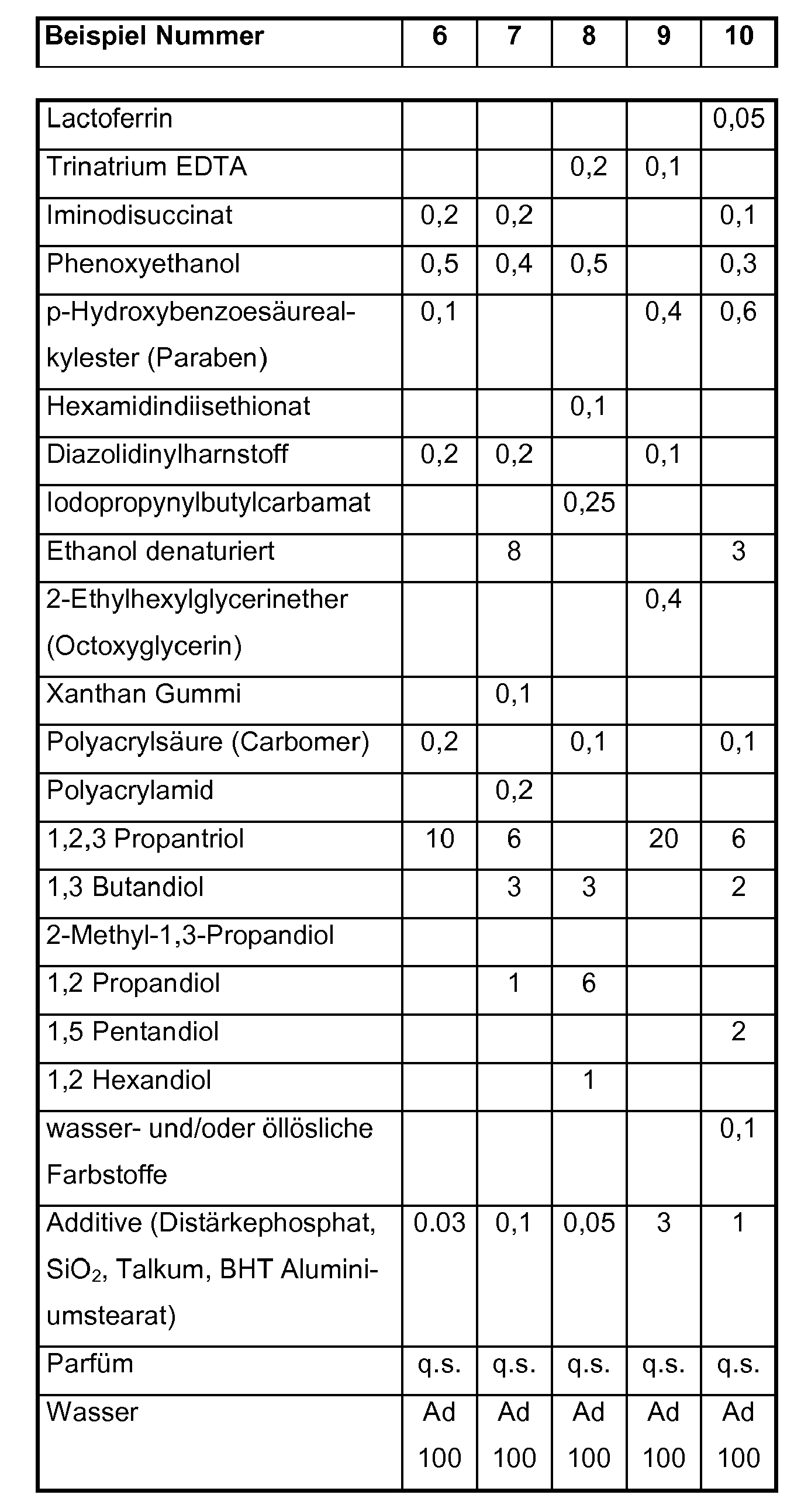
- Die nachfolgenden Beispiele sollen die vorliegende Erfindung verdeutlichen, ohne sie einzuschränken. Alle Mengenangaben, Anteile und Prozentanteile sind, soweit nicht anders angegeben, auf das Gewicht und die Gesamtmenge bzw. auf das Gesamtgewicht der Zubereitungen bezogen.


Claims (8)
- Kosmetische Zubereitung enthaltend eine Wirkstoffkombination aus
0,001 bis 3 Gewichts-% Hyaluronsäure und
0,01 bis 4 Gewichts-% Saponinen,
wobei sich die Gewichtsangaben auf das Gesamtgewicht der Zubereitung beziehen, dadurch gekennzeichnet, das die Zubereitung eine Lipidphase mit einer Gesamtpolarität von weniger als 30 mN/m enthält. - Kosmetische Zubereitung enthaltend eine Kombination aus
0,001 bis 3 Gewichts-% Hyaluronsäure und
0,01- 8 Gewichts-% eines Leguminosenextraktes, welcher 0,01 bis 99 Gewichts- % Saponine enthält, wobei sich die Gewichtsangaben der Hyaluronsäure und des Leguminosenextraktes auf das Gesamtgewicht der Zubereitung beziehen und die Gewichtsangabe der Saponine auf das Gesamtgewicht des Leguminoseextraktes beziehen, dadurch gekennzeichnet, das die Zubereitung eine Lipidphase mit einer Gesamtpolarität von weniger als 30 mN/m enthält. - Kosmetische Zubereitung enthaltend eine Kombination aus
0,001 bis 3 Gewichts-% Hyaluronsäure und
0,01 bis 8 Gewichts-% Soyaextrakt, welcher 0,01 bis 99 Gewichts-% Saponine enthält,
wobei sich die Gewichtsangaben der Hyaluronsäure und des Soyaextraktes auf das Gesamtgewicht der Zubereitung beziehen und die Gewichtsangabe der Saponine auf das Gesamtgewicht des Sojaextraktes beziehen, dadurch gekennzeichnet, das die Zubereitung eine Lipidphase mit einer Gesamtpolarität von weniger als 30 mN/m enthält. - Kosmetische Zubereitung nach einem der Ansprüche 1 bis 3, dadurch gekennzeichnet, dass die Zubereitung Saponine aus Glycosiden von Triterpensapogeninen neben gegebenenfalls weiteren Saponinen aus Glycosiden von Steroidsapogeninen enthält.
- Zubereitung nach einem der vorhergehenden Ansprüche, dadurch gekennzeichnet, dass die Zubereitung in Form einer O/W-Emulsion vorliegt.
- Verfahren zur Herstellung einer kosmetischen Zubereitung nach einem der vorhergehenden Ansprüche, dadurch gekennzeichnet, dass die Saponine bzw. der die Saponine enthaltende Sojaextrakt zunächst in mindestens der vierfachen Menge an einem Glykol mit einem log P Wert zwischen -3,6 und 1 gelöst wird und anschließend der Präemulsion zugegeben wird oder in der Wasserphase der Zubereitung, welche mindestens diese Menge an Glykol enthält, dispergiert und anschließend mit der Fettphase, welche die Emulgatoren enthält , vereinigt wird.
- Verwendung einer kosmetischen Zubereitung nach einem der vorhergehenden Ansprüche zur kosmetischen Prophylaxe und/oder Behandlung von Hautalterungserscheinungen, insbesondere von Fältchen und Falten.
- Verwendung einer Wirkstoffkombination nach einem der Ansprüche 1 oder 2 zur Herstellung eines Kosmetikums zur Behandlung von Hautalterungserscheinungen, insbesondere von Fältchen und Falten.
Applications Claiming Priority (2)
| Application Number | Priority Date | Filing Date | Title |
|---|---|---|---|
| DE102005012554A DE102005012554A1 (de) | 2005-03-16 | 2005-03-16 | Kosmetische Zubereitung mit Hyaluronsäure |
| EP05801470A EP1865916A2 (de) | 2005-03-16 | 2005-11-01 | Kosmetische zubereitung mit hyaluronsäure und saponinen zur behandlung von hautalterungserscheinungen |
Related Parent Applications (1)
| Application Number | Title | Priority Date | Filing Date |
|---|---|---|---|
| EP05801470A Division EP1865916A2 (de) | 2005-03-16 | 2005-11-01 | Kosmetische zubereitung mit hyaluronsäure und saponinen zur behandlung von hautalterungserscheinungen |
Publications (3)
| Publication Number | Publication Date |
|---|---|
| EP1952799A2 true EP1952799A2 (de) | 2008-08-06 |
| EP1952799A3 EP1952799A3 (de) | 2008-08-20 |
| EP1952799B1 EP1952799B1 (de) | 2017-01-11 |
Family
ID=35539053
Family Applications (2)
| Application Number | Title | Priority Date | Filing Date |
|---|---|---|---|
| EP08103572.7A Expired - Lifetime EP1952799B1 (de) | 2005-03-16 | 2005-11-01 | Kosmetische zubereitung mit hyaluronsäure und saponinen zur behandlung von hautalterungserscheinungen |
| EP05801470A Withdrawn EP1865916A2 (de) | 2005-03-16 | 2005-11-01 | Kosmetische zubereitung mit hyaluronsäure und saponinen zur behandlung von hautalterungserscheinungen |
Family Applications After (1)
| Application Number | Title | Priority Date | Filing Date |
|---|---|---|---|
| EP05801470A Withdrawn EP1865916A2 (de) | 2005-03-16 | 2005-11-01 | Kosmetische zubereitung mit hyaluronsäure und saponinen zur behandlung von hautalterungserscheinungen |
Country Status (5)
| Country | Link |
|---|---|
| US (1) | US8252348B2 (de) |
| EP (2) | EP1952799B1 (de) |
| DE (1) | DE102005012554A1 (de) |
| ES (1) | ES2622084T3 (de) |
| WO (1) | WO2006018454A2 (de) |
Cited By (1)
| Publication number | Priority date | Publication date | Assignee | Title |
|---|---|---|---|---|
| WO2018004490A1 (en) * | 2016-07-01 | 2018-01-04 | Bioarge Bitiksel Kozmetik Arastirma Gelistirme Muhendislik Ltd. Sti. | Enhanced oil dispersion and transdermal delivery |
Families Citing this family (9)
| Publication number | Priority date | Publication date | Assignee | Title |
|---|---|---|---|---|
| JP4689717B2 (ja) * | 2006-04-21 | 2011-05-25 | 日本板硝子株式会社 | 光輝性顔料およびその製造方法、並びに該光輝性顔料を含む水性樹脂組成物 |
| US8685752B2 (en) | 2006-11-03 | 2014-04-01 | Purdue Research Foundation | Ex vivo flow cytometry method and device |
| US9107834B2 (en) * | 2007-04-18 | 2015-08-18 | Nippon Sheet Glass Company, Limited | Bright pigment and cosmetic composition using the same |
| EP2687563B1 (de) * | 2007-04-27 | 2018-04-04 | Nippon Sheet Glass Company, Limited | Fotolumineszentes Pigment und fotolumineszente Beschichtungszusammensetzung |
| WO2009051243A1 (ja) * | 2007-10-18 | 2009-04-23 | Nippon Sheet Glass Company, Limited | 光輝性顔料 |
| US8039024B2 (en) * | 2008-01-23 | 2011-10-18 | Apr Applied Pharma Research, S.A. | Device and composition for the delivery of a preservative-free balsamic cream |
| FR2945936A1 (fr) * | 2009-05-26 | 2010-12-03 | Jean Claude Epiphani | Procede de fabrication d'une emulsion aqueuse d'une substance active huileuse pour application cosmetique, alimentaire ou pharmaceutique |
| FR3012334A1 (fr) * | 2013-10-29 | 2015-05-01 | World Cosmetics | Composition cosmetique anti age |
| CA3044478A1 (en) * | 2016-12-01 | 2018-06-07 | Daniel Dal ' Asta Coimbra | Non-surgical facelift method, uses of a substance that stimulates or generates an increase in volume |
Family Cites Families (15)
| Publication number | Priority date | Publication date | Assignee | Title |
|---|---|---|---|---|
| FR2680686B1 (fr) * | 1991-08-28 | 1993-11-05 | Oreal | Lotion tri-phases destinee a un usage corporel, pharmaceutique ou cosmetique. |
| FR2695561B1 (fr) * | 1992-09-17 | 1994-12-02 | Lvmh Rech Gie | Composition cosmétique ou dermatologique contenant au moins une saponine de type ginsenoside, et ses applications, notamment pour le soin des cheveux. |
| DE4410778C2 (de) * | 1994-03-28 | 2002-09-12 | Beisel Guenther | Mittel zur Herstellung eines medizinisch und/oder kosmetisch und/oder keimabtötend und/oder parasitenabtötend wirkenden wässrigen stabilen Schaums und dessen Verwendung |
| US6461622B2 (en) * | 1994-09-07 | 2002-10-08 | Johnson & Johnson Consumer Companies, Inc. | Topical compositions |
| JPH08217660A (ja) * | 1995-02-16 | 1996-08-27 | Shiseido Co Ltd | 皮膚外用剤 |
| FR2746316B1 (fr) * | 1996-03-19 | 1998-06-12 | Guerlain | Nouvelles compositions cosmetologiques ou dermatologiques |
| IT1288257B1 (it) * | 1996-11-29 | 1998-09-11 | Paoli Ambrosi Gianfranco De | Composizione per uso cosmetico,farmaceutico o dietetico a base di un aminozucchero e/o di un acido poliidrossilico |
| JPH1135445A (ja) * | 1997-07-23 | 1999-02-09 | Osaka Yakuhin Kenkyusho:Kk | 化粧料組成物 |
| FR2767057B1 (fr) * | 1997-08-08 | 1999-10-29 | Lvmh Rech | Utilisation du ginsenoside rb1 comme agent destine a stimuler la synthese de l'elastine |
| FR2767059B1 (fr) * | 1997-08-11 | 2000-03-24 | Lvmh Rech | Utilisation d'extraits de polygonatum pour stimuler la synthese de l'elastine cutanee |
| WO1999047113A1 (en) * | 1998-03-16 | 1999-09-23 | The Procter & Gamble Company | Compositions for regulating skin appearance |
| FR2791260B1 (fr) * | 1999-03-26 | 2003-06-06 | Dior Christian Parfums | Compositions cosmetiques ou dermatologiques contenant au moins une substance destinee a augmenter la fonctionnalite et/ou l'expression des recepteurs membranaires cd44 des cellules de la peau |
| US20030165456A1 (en) * | 2001-05-14 | 2003-09-04 | Avon Products | Skin care compositions and methods of improving aesthetic appearance of skin using same |
| FR2848116B1 (fr) | 2002-12-10 | 2007-01-05 | Nuxe Lab | Composition cosmetique comprenant un inhibiteur des metallo-proteinases et un lipopeptide. |
| DE10301632A1 (de) * | 2003-01-17 | 2004-07-29 | Beiersdorf Ag | Kosmetische oder dermatologische Zubereitungen mit einem Gehalt an Kreatin, Kreatinin und/oder seinen Derivaten in Kombination mit Sojabohnenkeimextrakten |
-
2005
- 2005-03-16 DE DE102005012554A patent/DE102005012554A1/de not_active Withdrawn
- 2005-11-01 ES ES08103572.7T patent/ES2622084T3/es not_active Expired - Lifetime
- 2005-11-01 EP EP08103572.7A patent/EP1952799B1/de not_active Expired - Lifetime
- 2005-11-01 EP EP05801470A patent/EP1865916A2/de not_active Withdrawn
- 2005-11-01 US US11/908,335 patent/US8252348B2/en not_active Expired - Fee Related
- 2005-11-01 WO PCT/EP2005/055677 patent/WO2006018454A2/de not_active Ceased
Cited By (1)
| Publication number | Priority date | Publication date | Assignee | Title |
|---|---|---|---|---|
| WO2018004490A1 (en) * | 2016-07-01 | 2018-01-04 | Bioarge Bitiksel Kozmetik Arastirma Gelistirme Muhendislik Ltd. Sti. | Enhanced oil dispersion and transdermal delivery |
Also Published As
| Publication number | Publication date |
|---|---|
| WO2006018454A2 (de) | 2006-02-23 |
| WO2006018454A3 (de) | 2006-05-11 |
| EP1952799B1 (de) | 2017-01-11 |
| DE102005012554A1 (de) | 2006-09-28 |
| ES2622084T3 (es) | 2017-07-05 |
| US20080306021A1 (en) | 2008-12-11 |
| EP1865916A2 (de) | 2007-12-19 |
| US8252348B2 (en) | 2012-08-28 |
| EP1952799A3 (de) | 2008-08-20 |
Similar Documents
| Publication | Publication Date | Title |
|---|---|---|
| EP1406599B1 (de) | Kreatin enthaltende kosmetische und dermatologische zubereitungen zur behandlung und aktiven prävention trockener haut und anderer negativer veränderungen der physiologischen homöostase der gesunden haut | |
| EP0821945B1 (de) | Schaumförmige Lichtzubereitungen mit einem Gehalt an wasserlöslichen Lichtschutzsubstanzen und grenzflächenaktiven Substanzen | |
| DE602004012473T2 (de) | Zusammensetzungen enthaltend Amidine und Alkan Polyol | |
| EP1140008A1 (de) | Kosmetische oder pharmazeutische lecithinhaltige gele oder niedrigviskose, lecithinhaltige o/w-mikroemulsionen | |
| DE10133202A1 (de) | Osmolyte enthaltende kosmetische und dermatologische Zubereitungen zur Behandlung und aktiven Prävention trockener Haut und anderer negativer Veränderungen der physiologischen Homöostase der gesunden Haut | |
| EP1952799B1 (de) | Kosmetische zubereitung mit hyaluronsäure und saponinen zur behandlung von hautalterungserscheinungen | |
| DE10133203A1 (de) | Catechine oder Extrakte von grünem Tee enthaltende kosmetische und dermatologische Zubereitungen zur Behandlung und aktiven Prävention trockener Haut und anderer negativer Veränderungen der physiologischen Homöostase der gesunden Haut | |
| WO2011061024A1 (de) | Tetrapeptide zur aufhellung der haut | |
| EP2090283B1 (de) | Verwendung von Elektrolyten zur Stärkung der Barrierefunktion der Haut | |
| EP1043017A2 (de) | Ceramide enthaltendes Hautpflegemittel | |
| DE10133200A1 (de) | Carnitin enthaltende kosmetische und dermatologische Zubereitungen zur Behandlung und aktiven Prävention trockener Haut und anderer negativer Veränderungen der physiologischen Homöostase der gesunden Haut | |
| DE19720339A1 (de) | Wirkstoffe und Zubereitungen für die Hautaufhellung und zur Verhinderung der Hautbräunung | |
| EP1582202A1 (de) | Zubereitung gegen gerötete Haut, einschliesslich grünen und weissen Pigmenten und UV-Filtern | |
| WO2002098386A2 (de) | Verwendung von natriumpolystyrolsulfonat zur hautstraffung | |
| EP1000603B1 (de) | Verwendung von oberflächenaktiven Citronensäureestern zur Stabilisierung von Flavonen, Flavanonen bzw. Flavonoiden, synergistische Gemische aus Flavonen, Flavanonen bzw. Flavonoiden und oberflächenaktiven Substanzen sowie kosmetische und dermatologische Zubereitungen mit einem Gehalt an solchen Gemischen | |
| DE102004013607A1 (de) | Lipidkombination gegen aschenfarbene Haut | |
| DE102004013633A1 (de) | Tapioka in kosmetischen Zubereitungen | |
| DE102005063063A1 (de) | Kosmetische Zusammensetzungen zur Hautmattierung | |
| WO2004014325A1 (de) | Kosmetische zubereitungen mit zwei phasen | |
| DE10133197A1 (de) | Aminosäuren enthaltende kosmetische und dermatologische Zubereitungen zur Behandlung und aktiven Prävention trockener Haut und anderer negativer Veränderungen der physiologischen Homöostase der gesunden Haut | |
| DE10133196A1 (de) | Nicotinsäure enthaltende kosmetische und dermatologische Zubereitungen zur Behandlung und aktiven Prävention trockener Haut und anderer negativer Veränderungen der physiologischen Homöostase der gesunden Haut | |
| DE19645320B4 (de) | Schaumförmige Lichtschutzzubereitungen mit einem Gehalt an wasserlöslichen Lichtschutzfiltersubstanzen und grenzflächenaktiven Substanzen und deren Verwendung | |
| DE102004039726A1 (de) | Fließfähige kosmetische Zubereitung mit Lichtschutzfiltern | |
| DE10133201A1 (de) | Elektrolythaltige kosmetische und dermatologische Zubereitungen zur Behandlung und aktiven Prävention trockener Haut und anderer negativer Veränderungen der physiologischen Homöostase der Haut | |
| DE10133199A1 (de) | Cineol enthaltende kosmetische und dermatologische Zubereitungen zur Behandlung und aktiven Prävention trockener Haut und anderer negativer Veränderungen der physiologischen Homöostase der gesunden Haut |
Legal Events
| Date | Code | Title | Description |
|---|---|---|---|
| PUAI | Public reference made under article 153(3) epc to a published international application that has entered the european phase |
Free format text: ORIGINAL CODE: 0009012 |
|
| PUAL | Search report despatched |
Free format text: ORIGINAL CODE: 0009013 |
|
| AC | Divisional application: reference to earlier application |
Ref document number: 1865916 Country of ref document: EP Kind code of ref document: P |
|
| AK | Designated contracting states |
Kind code of ref document: A2 Designated state(s): AT BE BG CH CY CZ DE DK EE ES FI FR GB GR HU IE IS IT LI LT LU LV MC NL PL PT RO SE SI SK TR |
|
| AX | Request for extension of the european patent |
Extension state: AL BA HR MK RS |
|
| AK | Designated contracting states |
Kind code of ref document: A3 Designated state(s): AT BE BG CH CY CZ DE DK EE ES FI FR GB GR HU IE IS IT LI LT LU LV MC NL PL PT RO SE SI SK TR |
|
| AX | Request for extension of the european patent |
Extension state: AL BA HR MK RS |
|
| RIN1 | Information on inventor provided before grant (corrected) |
Inventor name: FAENGER, SABINE Inventor name: MUMMERT, CHRISTOPHER Inventor name: BUERGER, ANETTE Inventor name: FILBRY, ALEXANDER Inventor name: GALLINAT, STEFAN |
|
| 17P | Request for examination filed |
Effective date: 20090220 |
|
| 17Q | First examination report despatched |
Effective date: 20090324 |
|
| AKX | Designation fees paid |
Designated state(s): AT BE BG CH CY CZ DE DK EE ES FI FR GB GR HU IE IS IT LI LT LU LV MC NL PL PT RO SE SI SK TR |
|
| RIC1 | Information provided on ipc code assigned before grant |
Ipc: A61K 8/97 20060101AFI20150115BHEP Ipc: A61K 8/73 20060101ALI20150115BHEP Ipc: A61Q 19/08 20060101ALI20150115BHEP |
|
| GRAP | Despatch of communication of intention to grant a patent |
Free format text: ORIGINAL CODE: EPIDOSNIGR1 |
|
| GRAJ | Information related to disapproval of communication of intention to grant by the applicant or resumption of examination proceedings by the epo deleted |
Free format text: ORIGINAL CODE: EPIDOSDIGR1 |
|
| INTG | Intention to grant announced |
Effective date: 20160704 |
|
| INTC | Intention to grant announced (deleted) | ||
| GRAP | Despatch of communication of intention to grant a patent |
Free format text: ORIGINAL CODE: EPIDOSNIGR1 |
|
| INTG | Intention to grant announced |
Effective date: 20161010 |
|
| GRAS | Grant fee paid |
Free format text: ORIGINAL CODE: EPIDOSNIGR3 |
|
| GRAA | (expected) grant |
Free format text: ORIGINAL CODE: 0009210 |
|
| AC | Divisional application: reference to earlier application |
Ref document number: 1865916 Country of ref document: EP Kind code of ref document: P |
|
| AK | Designated contracting states |
Kind code of ref document: B1 Designated state(s): AT BE BG CH CY CZ DE DK EE ES FI FR GB GR HU IE IS IT LI LT LU LV MC NL PL PT RO SE SI SK TR |
|
| REG | Reference to a national code |
Ref country code: GB Ref legal event code: FG4D Free format text: NOT ENGLISH |
|
| REG | Reference to a national code |
Ref country code: CH Ref legal event code: EP |
|
| REG | Reference to a national code |
Ref country code: AT Ref legal event code: REF Ref document number: 860608 Country of ref document: AT Kind code of ref document: T Effective date: 20170115 |
|
| REG | Reference to a national code |
Ref country code: IE Ref legal event code: FG4D Free format text: LANGUAGE OF EP DOCUMENT: GERMAN |
|
| REG | Reference to a national code |
Ref country code: DE Ref legal event code: R096 Ref document number: 502005015497 Country of ref document: DE |
|
| REG | Reference to a national code |
Ref country code: LT Ref legal event code: MG4D |
|
| REG | Reference to a national code |
Ref country code: NL Ref legal event code: MP Effective date: 20170111 |
|
| PG25 | Lapsed in a contracting state [announced via postgrant information from national office to epo] |
Ref country code: NL Free format text: LAPSE BECAUSE OF FAILURE TO SUBMIT A TRANSLATION OF THE DESCRIPTION OR TO PAY THE FEE WITHIN THE PRESCRIBED TIME-LIMIT Effective date: 20170111 |
|
| REG | Reference to a national code |
Ref country code: ES Ref legal event code: FG2A Ref document number: 2622084 Country of ref document: ES Kind code of ref document: T3 Effective date: 20170705 |
|
| PG25 | Lapsed in a contracting state [announced via postgrant information from national office to epo] |
Ref country code: IS Free format text: LAPSE BECAUSE OF FAILURE TO SUBMIT A TRANSLATION OF THE DESCRIPTION OR TO PAY THE FEE WITHIN THE PRESCRIBED TIME-LIMIT Effective date: 20170511 Ref country code: GR Free format text: LAPSE BECAUSE OF FAILURE TO SUBMIT A TRANSLATION OF THE DESCRIPTION OR TO PAY THE FEE WITHIN THE PRESCRIBED TIME-LIMIT Effective date: 20170412 Ref country code: LT Free format text: LAPSE BECAUSE OF FAILURE TO SUBMIT A TRANSLATION OF THE DESCRIPTION OR TO PAY THE FEE WITHIN THE PRESCRIBED TIME-LIMIT Effective date: 20170111 Ref country code: FI Free format text: LAPSE BECAUSE OF FAILURE TO SUBMIT A TRANSLATION OF THE DESCRIPTION OR TO PAY THE FEE WITHIN THE PRESCRIBED TIME-LIMIT Effective date: 20170111 |
|
| PG25 | Lapsed in a contracting state [announced via postgrant information from national office to epo] |
Ref country code: SE Free format text: LAPSE BECAUSE OF FAILURE TO SUBMIT A TRANSLATION OF THE DESCRIPTION OR TO PAY THE FEE WITHIN THE PRESCRIBED TIME-LIMIT Effective date: 20170111 Ref country code: LV Free format text: LAPSE BECAUSE OF FAILURE TO SUBMIT A TRANSLATION OF THE DESCRIPTION OR TO PAY THE FEE WITHIN THE PRESCRIBED TIME-LIMIT Effective date: 20170111 Ref country code: PL Free format text: LAPSE BECAUSE OF FAILURE TO SUBMIT A TRANSLATION OF THE DESCRIPTION OR TO PAY THE FEE WITHIN THE PRESCRIBED TIME-LIMIT Effective date: 20170111 Ref country code: PT Free format text: LAPSE BECAUSE OF FAILURE TO SUBMIT A TRANSLATION OF THE DESCRIPTION OR TO PAY THE FEE WITHIN THE PRESCRIBED TIME-LIMIT Effective date: 20170511 Ref country code: BG Free format text: LAPSE BECAUSE OF FAILURE TO SUBMIT A TRANSLATION OF THE DESCRIPTION OR TO PAY THE FEE WITHIN THE PRESCRIBED TIME-LIMIT Effective date: 20170411 |
|
| REG | Reference to a national code |
Ref country code: DE Ref legal event code: R097 Ref document number: 502005015497 Country of ref document: DE |
|
| PG25 | Lapsed in a contracting state [announced via postgrant information from national office to epo] |
Ref country code: IT Free format text: LAPSE BECAUSE OF FAILURE TO SUBMIT A TRANSLATION OF THE DESCRIPTION OR TO PAY THE FEE WITHIN THE PRESCRIBED TIME-LIMIT Effective date: 20170111 Ref country code: EE Free format text: LAPSE BECAUSE OF FAILURE TO SUBMIT A TRANSLATION OF THE DESCRIPTION OR TO PAY THE FEE WITHIN THE PRESCRIBED TIME-LIMIT Effective date: 20170111 Ref country code: RO Free format text: LAPSE BECAUSE OF FAILURE TO SUBMIT A TRANSLATION OF THE DESCRIPTION OR TO PAY THE FEE WITHIN THE PRESCRIBED TIME-LIMIT Effective date: 20170111 Ref country code: SK Free format text: LAPSE BECAUSE OF FAILURE TO SUBMIT A TRANSLATION OF THE DESCRIPTION OR TO PAY THE FEE WITHIN THE PRESCRIBED TIME-LIMIT Effective date: 20170111 Ref country code: CZ Free format text: LAPSE BECAUSE OF FAILURE TO SUBMIT A TRANSLATION OF THE DESCRIPTION OR TO PAY THE FEE WITHIN THE PRESCRIBED TIME-LIMIT Effective date: 20170111 |
|
| PLBE | No opposition filed within time limit |
Free format text: ORIGINAL CODE: 0009261 |
|
| STAA | Information on the status of an ep patent application or granted ep patent |
Free format text: STATUS: NO OPPOSITION FILED WITHIN TIME LIMIT |
|
| REG | Reference to a national code |
Ref country code: FR Ref legal event code: PLFP Year of fee payment: 13 |
|
| PG25 | Lapsed in a contracting state [announced via postgrant information from national office to epo] |
Ref country code: DK Free format text: LAPSE BECAUSE OF FAILURE TO SUBMIT A TRANSLATION OF THE DESCRIPTION OR TO PAY THE FEE WITHIN THE PRESCRIBED TIME-LIMIT Effective date: 20170111 |
|
| 26N | No opposition filed |
Effective date: 20171012 |
|
| PG25 | Lapsed in a contracting state [announced via postgrant information from national office to epo] |
Ref country code: SI Free format text: LAPSE BECAUSE OF FAILURE TO SUBMIT A TRANSLATION OF THE DESCRIPTION OR TO PAY THE FEE WITHIN THE PRESCRIBED TIME-LIMIT Effective date: 20170111 |
|
| PG25 | Lapsed in a contracting state [announced via postgrant information from national office to epo] |
Ref country code: MC Free format text: LAPSE BECAUSE OF FAILURE TO SUBMIT A TRANSLATION OF THE DESCRIPTION OR TO PAY THE FEE WITHIN THE PRESCRIBED TIME-LIMIT Effective date: 20170111 |
|
| PG25 | Lapsed in a contracting state [announced via postgrant information from national office to epo] |
Ref country code: LI Free format text: LAPSE BECAUSE OF NON-PAYMENT OF DUE FEES Effective date: 20171130 Ref country code: CH Free format text: LAPSE BECAUSE OF NON-PAYMENT OF DUE FEES Effective date: 20171130 |
|
| PG25 | Lapsed in a contracting state [announced via postgrant information from national office to epo] |
Ref country code: LU Free format text: LAPSE BECAUSE OF NON-PAYMENT OF DUE FEES Effective date: 20171101 |
|
| REG | Reference to a national code |
Ref country code: BE Ref legal event code: MM Effective date: 20171130 |
|
| REG | Reference to a national code |
Ref country code: IE Ref legal event code: MM4A |
|
| PG25 | Lapsed in a contracting state [announced via postgrant information from national office to epo] |
Ref country code: IE Free format text: LAPSE BECAUSE OF NON-PAYMENT OF DUE FEES Effective date: 20171101 |
|
| PG25 | Lapsed in a contracting state [announced via postgrant information from national office to epo] |
Ref country code: BE Free format text: LAPSE BECAUSE OF NON-PAYMENT OF DUE FEES Effective date: 20171130 |
|
| REG | Reference to a national code |
Ref country code: AT Ref legal event code: MM01 Ref document number: 860608 Country of ref document: AT Kind code of ref document: T Effective date: 20171101 |
|
| PG25 | Lapsed in a contracting state [announced via postgrant information from national office to epo] |
Ref country code: AT Free format text: LAPSE BECAUSE OF NON-PAYMENT OF DUE FEES Effective date: 20171101 |
|
| PG25 | Lapsed in a contracting state [announced via postgrant information from national office to epo] |
Ref country code: HU Free format text: LAPSE BECAUSE OF FAILURE TO SUBMIT A TRANSLATION OF THE DESCRIPTION OR TO PAY THE FEE WITHIN THE PRESCRIBED TIME-LIMIT; INVALID AB INITIO Effective date: 20051101 |
|
| PG25 | Lapsed in a contracting state [announced via postgrant information from national office to epo] |
Ref country code: CY Free format text: LAPSE BECAUSE OF NON-PAYMENT OF DUE FEES Effective date: 20170111 |
|
| PG25 | Lapsed in a contracting state [announced via postgrant information from national office to epo] |
Ref country code: TR Free format text: LAPSE BECAUSE OF FAILURE TO SUBMIT A TRANSLATION OF THE DESCRIPTION OR TO PAY THE FEE WITHIN THE PRESCRIBED TIME-LIMIT Effective date: 20170111 |
|
| REG | Reference to a national code |
Ref country code: DE Ref legal event code: R081 Ref document number: 502005015497 Country of ref document: DE Owner name: BEIERSDORF AKTIENGESELLSCHAFT, DE Free format text: FORMER OWNER: BEIERSDORF AG, 20253 HAMBURG, DE |
|
| PGFP | Annual fee paid to national office [announced via postgrant information from national office to epo] |
Ref country code: DE Payment date: 20241130 Year of fee payment: 20 |
|
| PGFP | Annual fee paid to national office [announced via postgrant information from national office to epo] |
Ref country code: GB Payment date: 20241120 Year of fee payment: 20 |
|
| PGFP | Annual fee paid to national office [announced via postgrant information from national office to epo] |
Ref country code: FR Payment date: 20241128 Year of fee payment: 20 |
|
| PGFP | Annual fee paid to national office [announced via postgrant information from national office to epo] |
Ref country code: ES Payment date: 20241230 Year of fee payment: 20 |
|
| REG | Reference to a national code |
Ref country code: DE Ref legal event code: R071 Ref document number: 502005015497 Country of ref document: DE |
|
| REG | Reference to a national code |
Ref country code: GB Ref legal event code: PE20 Expiry date: 20251031 |
|
| REG | Reference to a national code |
Ref country code: ES Ref legal event code: FD2A Effective date: 20251127 |
|
| PG25 | Lapsed in a contracting state [announced via postgrant information from national office to epo] |
Ref country code: ES Free format text: LAPSE BECAUSE OF EXPIRATION OF PROTECTION Effective date: 20251102 |