EP1938689A1 - Penetrationsförderer für Herbizide - Google Patents
Penetrationsförderer für Herbizide Download PDFInfo
- Publication number
- EP1938689A1 EP1938689A1 EP06026145A EP06026145A EP1938689A1 EP 1938689 A1 EP1938689 A1 EP 1938689A1 EP 06026145 A EP06026145 A EP 06026145A EP 06026145 A EP06026145 A EP 06026145A EP 1938689 A1 EP1938689 A1 EP 1938689A1
- Authority
- EP
- European Patent Office
- Prior art keywords
- methyl
- oder
- alkyl
- und
- ethyl
- Prior art date
- Legal status (The legal status is an assumption and is not a legal conclusion. Google has not performed a legal analysis and makes no representation as to the accuracy of the status listed.)
- Withdrawn
Links
- 239000004009 herbicide Substances 0.000 title claims abstract description 43
- 230000035515 penetration Effects 0.000 title claims abstract description 27
- 239000000203 mixture Substances 0.000 claims abstract description 64
- 239000003995 emulsifying agent Substances 0.000 claims abstract description 22
- 239000013543 active substance Substances 0.000 claims abstract description 13
- WTLBZVNBAKMVDP-UHFFFAOYSA-N tris(2-butoxyethyl) phosphate Chemical compound CCCCOCCOP(=O)(OCCOCCCC)OCCOCCCC WTLBZVNBAKMVDP-UHFFFAOYSA-N 0.000 claims abstract description 12
- 238000000034 method Methods 0.000 claims description 33
- 239000011814 protection agent Substances 0.000 claims description 20
- 239000000654 additive Substances 0.000 claims description 7
- 239000004476 plant protection product Substances 0.000 claims description 5
- 230000001737 promoting effect Effects 0.000 claims description 5
- 238000004519 manufacturing process Methods 0.000 claims description 4
- 241000196324 Embryophyta Species 0.000 abstract description 51
- 239000004480 active ingredient Substances 0.000 abstract description 23
- 230000002708 enhancing effect Effects 0.000 abstract 1
- -1 phenoxy, naphthoxy Chemical group 0.000 description 128
- OAWUUPVZMNKZRY-UHFFFAOYSA-N cyprosulfamide Chemical compound COC1=CC=CC=C1C(=O)NS(=O)(=O)C1=CC=C(C(=O)NC2CC2)C=C1 OAWUUPVZMNKZRY-UHFFFAOYSA-N 0.000 description 83
- 125000004178 (C1-C4) alkyl group Chemical group 0.000 description 77
- 229910052736 halogen Inorganic materials 0.000 description 72
- 150000002367 halogens Chemical class 0.000 description 71
- 150000001875 compounds Chemical class 0.000 description 59
- UFHFLCQGNIYNRP-UHFFFAOYSA-N Hydrogen Chemical compound [H][H] UFHFLCQGNIYNRP-UHFFFAOYSA-N 0.000 description 49
- 150000003254 radicals Chemical class 0.000 description 48
- 238000009472 formulation Methods 0.000 description 36
- 239000001257 hydrogen Substances 0.000 description 32
- 229910052739 hydrogen Inorganic materials 0.000 description 32
- 125000001997 phenyl group Chemical group [H]C1=C([H])C([H])=C(*)C([H])=C1[H] 0.000 description 32
- OPGCOAPTHCZZIW-UHFFFAOYSA-N diethyl 1-(2,4-dichlorophenyl)-5-methyl-4h-pyrazole-3,5-dicarboxylate Chemical group CCOC(=O)C1(C)CC(C(=O)OCC)=NN1C1=CC=C(Cl)C=C1Cl OPGCOAPTHCZZIW-UHFFFAOYSA-N 0.000 description 23
- 125000000229 (C1-C4)alkoxy group Chemical group 0.000 description 22
- 229910052760 oxygen Inorganic materials 0.000 description 22
- 125000004432 carbon atom Chemical group C* 0.000 description 20
- PQKBPHSEKWERTG-LLVKDONJSA-N ethyl (2r)-2-[4-[(6-chloro-1,3-benzoxazol-2-yl)oxy]phenoxy]propanoate Chemical group C1=CC(O[C@H](C)C(=O)OCC)=CC=C1OC1=NC2=CC=C(Cl)C=C2O1 PQKBPHSEKWERTG-LLVKDONJSA-N 0.000 description 20
- MWKVXOJATACCCH-UHFFFAOYSA-N isoxadifen-ethyl Chemical group C1C(C(=O)OCC)=NOC1(C=1C=CC=CC=1)C1=CC=CC=C1 MWKVXOJATACCCH-UHFFFAOYSA-N 0.000 description 20
- 125000000623 heterocyclic group Chemical group 0.000 description 19
- 150000003839 salts Chemical class 0.000 description 19
- 125000004765 (C1-C4) haloalkyl group Chemical group 0.000 description 18
- YMWUJEATGCHHMB-UHFFFAOYSA-N Dichloromethane Chemical compound ClCCl YMWUJEATGCHHMB-UHFFFAOYSA-N 0.000 description 16
- 125000000217 alkyl group Chemical group 0.000 description 15
- 125000000956 methoxy group Chemical group [H]C([H])([H])O* 0.000 description 15
- BACHBFVBHLGWSL-UHFFFAOYSA-N methyl 2-[4-(2,4-dichlorophenoxy)phenoxy]propanoate Chemical group C1=CC(OC(C)C(=O)OC)=CC=C1OC1=CC=C(Cl)C=C1Cl BACHBFVBHLGWSL-UHFFFAOYSA-N 0.000 description 15
- BACHBFVBHLGWSL-JTQLQIEISA-N rac-diclofop methyl Natural products C1=CC(O[C@@H](C)C(=O)OC)=CC=C1OC1=CC=C(Cl)C=C1Cl BACHBFVBHLGWSL-JTQLQIEISA-N 0.000 description 15
- 125000002023 trifluoromethyl group Chemical group FC(F)(F)* 0.000 description 15
- PXDNXJSDGQBLKS-UHFFFAOYSA-N foramsulfuron Chemical compound COC1=CC(OC)=NC(NC(=O)NS(=O)(=O)C=2C(=CC=C(NC=O)C=2)C(=O)N(C)C)=N1 PXDNXJSDGQBLKS-UHFFFAOYSA-N 0.000 description 14
- 150000002431 hydrogen Chemical class 0.000 description 14
- 229910052717 sulfur Inorganic materials 0.000 description 14
- 230000008569 process Effects 0.000 description 13
- UWVKRNOCDUPIDM-UHFFFAOYSA-N Ethoxysulfuron Chemical compound CCOC1=CC=CC=C1OS(=O)(=O)NC(=O)NC1=NC(OC)=CC(OC)=N1 UWVKRNOCDUPIDM-UHFFFAOYSA-N 0.000 description 12
- 239000005560 Foramsulfuron Substances 0.000 description 12
- ICJSJAJWTWPSBD-UHFFFAOYSA-N cloquintocet Chemical compound C1=CN=C2C(OCC(=O)O)=CC=C(Cl)C2=C1 ICJSJAJWTWPSBD-UHFFFAOYSA-N 0.000 description 12
- QWWHRELOCZEQNZ-UHFFFAOYSA-N 2,2-dichloro-1-(1-oxa-4-azaspiro[4.5]decan-4-yl)ethanone Chemical compound ClC(Cl)C(=O)N1CCOC11CCCCC1 QWWHRELOCZEQNZ-UHFFFAOYSA-N 0.000 description 11
- CLQMBPJKHLGMQK-UHFFFAOYSA-N 2-(4-isopropyl-4-methyl-5-oxo-4,5-dihydro-1H-imidazol-2-yl)nicotinic acid Chemical compound N1C(=O)C(C(C)C)(C)N=C1C1=NC=CC=C1C(O)=O CLQMBPJKHLGMQK-UHFFFAOYSA-N 0.000 description 11
- IAJOBQBIJHVGMQ-UHFFFAOYSA-N 2-amino-4-[hydroxy(methyl)phosphoryl]butanoic acid Chemical compound CP(O)(=O)CCC(N)C(O)=O IAJOBQBIJHVGMQ-UHFFFAOYSA-N 0.000 description 11
- CTTHWASMBLQOFR-UHFFFAOYSA-N Amidosulfuron Chemical compound COC1=CC(OC)=NC(NC(=O)NS(=O)(=O)N(C)S(C)(=O)=O)=N1 CTTHWASMBLQOFR-UHFFFAOYSA-N 0.000 description 11
- GMBRUAIJEFRHFQ-UHFFFAOYSA-N Fenchlorazole-ethyl Chemical group N1=C(C(=O)OCC)N=C(C(Cl)(Cl)Cl)N1C1=CC=C(Cl)C=C1Cl GMBRUAIJEFRHFQ-UHFFFAOYSA-N 0.000 description 11
- 239000002253 acid Substances 0.000 description 11
- MAHPNPYYQAIOJN-UHFFFAOYSA-N azimsulfuron Chemical compound COC1=CC(OC)=NC(NC(=O)NS(=O)(=O)C=2N(N=CC=2C2=NN(C)N=N2)C)=N1 MAHPNPYYQAIOJN-UHFFFAOYSA-N 0.000 description 11
- VJYIFXVZLXQVHO-UHFFFAOYSA-N chlorsulfuron Chemical compound COC1=NC(C)=NC(NC(=O)NS(=O)(=O)C=2C(=CC=CC=2)Cl)=N1 VJYIFXVZLXQVHO-UHFFFAOYSA-N 0.000 description 11
- 125000001559 cyclopropyl group Chemical group [H]C1([H])C([H])([H])C1([H])* 0.000 description 11
- 239000000126 substance Substances 0.000 description 11
- XOPFESVZMSQIKC-UHFFFAOYSA-N triasulfuron Chemical compound COC1=NC(C)=NC(NC(=O)NS(=O)(=O)C=2C(=CC=CC=2)OCCCl)=N1 XOPFESVZMSQIKC-UHFFFAOYSA-N 0.000 description 11
- XLYOFNOQVPJJNP-UHFFFAOYSA-N water Substances O XLYOFNOQVPJJNP-UHFFFAOYSA-N 0.000 description 11
- 125000004769 (C1-C4) alkylsulfonyl group Chemical group 0.000 description 10
- 239000004215 Carbon black (E152) Substances 0.000 description 10
- JCXJVPUVTGWSNB-UHFFFAOYSA-N Nitrogen dioxide Chemical compound O=[N]=O JCXJVPUVTGWSNB-UHFFFAOYSA-N 0.000 description 10
- CSPPKDPQLUUTND-NBVRZTHBSA-N Sethoxydim Chemical compound CCO\N=C(/CCC)C1=C(O)CC(CC(C)SCC)CC1=O CSPPKDPQLUUTND-NBVRZTHBSA-N 0.000 description 10
- 125000004093 cyano group Chemical group *C#N 0.000 description 10
- 125000002485 formyl group Chemical group [H]C(*)=O 0.000 description 10
- COYBRKAVBMYYSF-UHFFFAOYSA-N heptan-2-yl [(5-chloroquinolin-8-yl)oxy]acetate Chemical group C1=CN=C2C(OCC(=O)OC(C)CCCCC)=CC=C(Cl)C2=C1 COYBRKAVBMYYSF-UHFFFAOYSA-N 0.000 description 10
- 229930195733 hydrocarbon Natural products 0.000 description 10
- 239000003112 inhibitor Substances 0.000 description 10
- 125000002496 methyl group Chemical group [H]C([H])([H])* 0.000 description 10
- RBSXHDIPCIWOMG-UHFFFAOYSA-N 1-(4,6-dimethoxypyrimidin-2-yl)-3-(2-ethylsulfonylimidazo[1,2-a]pyridin-3-yl)sulfonylurea Chemical compound CCS(=O)(=O)C=1N=C2C=CC=CN2C=1S(=O)(=O)NC(=O)NC1=NC(OC)=CC(OC)=N1 RBSXHDIPCIWOMG-UHFFFAOYSA-N 0.000 description 9
- MCNOFYBITGAAGM-UHFFFAOYSA-N 2,2-dichloro-1-[5-(furan-2-yl)-2,2-dimethyl-1,3-oxazolidin-3-yl]ethanone Chemical compound C1N(C(=O)C(Cl)Cl)C(C)(C)OC1C1=CC=CO1 MCNOFYBITGAAGM-UHFFFAOYSA-N 0.000 description 9
- 239000003666 Amidosulfuron Substances 0.000 description 9
- 239000005469 Azimsulfuron Substances 0.000 description 9
- PFJJMJDEVDLPNE-UHFFFAOYSA-N Benoxacor Chemical compound C1=CC=C2N(C(=O)C(Cl)Cl)C(C)COC2=C1 PFJJMJDEVDLPNE-UHFFFAOYSA-N 0.000 description 9
- NRFQZTCQAYEXEE-UHFFFAOYSA-N Fenclorim Chemical compound ClC1=CC(Cl)=NC(C=2C=CC=CC=2)=N1 NRFQZTCQAYEXEE-UHFFFAOYSA-N 0.000 description 9
- 239000005561 Glufosinate Substances 0.000 description 9
- 239000005586 Nicosulfuron Substances 0.000 description 9
- 239000005616 Rimsulfuron Substances 0.000 description 9
- 239000005619 Sulfosulfuron Substances 0.000 description 9
- 125000003342 alkenyl group Chemical group 0.000 description 9
- 239000000460 chlorine Substances 0.000 description 9
- IWEDIXLBFLAXBO-UHFFFAOYSA-N dicamba Chemical compound COC1=C(Cl)C=CC(Cl)=C1C(O)=O IWEDIXLBFLAXBO-UHFFFAOYSA-N 0.000 description 9
- 125000005842 heteroatom Chemical group 0.000 description 9
- ZTYVMAQSHCZXLF-UHFFFAOYSA-N methyl 2-[[4,6-bis(difluoromethoxy)pyrimidin-2-yl]carbamoylsulfamoyl]benzoate Chemical compound COC(=O)C1=CC=CC=C1S(=O)(=O)NC(=O)NC1=NC(OC(F)F)=CC(OC(F)F)=N1 ZTYVMAQSHCZXLF-UHFFFAOYSA-N 0.000 description 9
- RTCOGUMHFFWOJV-UHFFFAOYSA-N nicosulfuron Chemical compound COC1=CC(OC)=NC(NC(=O)NS(=O)(=O)C=2C(=CC=CN=2)C(=O)N(C)C)=N1 RTCOGUMHFFWOJV-UHFFFAOYSA-N 0.000 description 9
- 125000000449 nitro group Chemical group [O-][N+](*)=O 0.000 description 9
- MEFOUWRMVYJCQC-UHFFFAOYSA-N rimsulfuron Chemical compound CCS(=O)(=O)C1=CC=CN=C1S(=O)(=O)NC(=O)NC1=NC(OC)=CC(OC)=N1 MEFOUWRMVYJCQC-UHFFFAOYSA-N 0.000 description 9
- PQTBTIFWAXVEPB-UHFFFAOYSA-N sulcotrione Chemical compound ClC1=CC(S(=O)(=O)C)=CC=C1C(=O)C1C(=O)CCCC1=O PQTBTIFWAXVEPB-UHFFFAOYSA-N 0.000 description 9
- IMEVJVISCHQJRM-UHFFFAOYSA-N triflusulfuron-methyl Chemical compound COC(=O)C1=CC=CC(C)=C1S(=O)(=O)NC(=O)NC1=NC(OCC(F)(F)F)=NC(N(C)C)=N1 IMEVJVISCHQJRM-UHFFFAOYSA-N 0.000 description 9
- 125000004767 (C1-C4) haloalkoxy group Chemical group 0.000 description 8
- 125000004169 (C1-C6) alkyl group Chemical group 0.000 description 8
- 125000004209 (C1-C8) alkyl group Chemical group 0.000 description 8
- 125000005913 (C3-C6) cycloalkyl group Chemical group 0.000 description 8
- MHULQDZDXMHODA-UHFFFAOYSA-N 1-(2,2-dichloroacetyl)-3,3,8a-trimethyl-2,4,7,8-tetrahydropyrrolo[1,2-a]pyrimidin-6-one Chemical compound C1C(C)(C)CN(C(=O)C(Cl)Cl)C2(C)N1C(=O)CC2 MHULQDZDXMHODA-UHFFFAOYSA-N 0.000 description 8
- OHXLAOJLJWLEIP-UHFFFAOYSA-N 2-(dichloromethyl)-2-methyl-1,3-dioxolane Chemical compound ClC(Cl)C1(C)OCCO1 OHXLAOJLJWLEIP-UHFFFAOYSA-N 0.000 description 8
- CABMTIJINOIHOD-UHFFFAOYSA-N 2-[4-methyl-5-oxo-4-(propan-2-yl)-4,5-dihydro-1H-imidazol-2-yl]quinoline-3-carboxylic acid Chemical compound N1C(=O)C(C(C)C)(C)N=C1C1=NC2=CC=CC=C2C=C1C(O)=O CABMTIJINOIHOD-UHFFFAOYSA-N 0.000 description 8
- YRMLFORXOOIJDR-UHFFFAOYSA-N Dichlormid Chemical compound ClC(Cl)C(=O)N(CC=C)CC=C YRMLFORXOOIJDR-UHFFFAOYSA-N 0.000 description 8
- UKSLKNUCVPZQCQ-UHFFFAOYSA-N Fluxofenim Chemical compound C=1C=C(Cl)C=CC=1C(C(F)(F)F)=NOCC1OCCO1 UKSLKNUCVPZQCQ-UHFFFAOYSA-N 0.000 description 8
- XVOKUMIPKHGGTN-UHFFFAOYSA-N Imazethapyr Chemical compound OC(=O)C1=CC(CC)=CN=C1C1=NC(C)(C(C)C)C(=O)N1 XVOKUMIPKHGGTN-UHFFFAOYSA-N 0.000 description 8
- JUJFQMPKBJPSFZ-UHFFFAOYSA-M Iodosulfuron-methyl-sodium Chemical compound [Na+].COC(=O)C1=CC=C(I)C=C1S(=O)(=O)[N-]C(=O)NC1=NC(C)=NC(OC)=N1 JUJFQMPKBJPSFZ-UHFFFAOYSA-M 0.000 description 8
- 239000003905 agrochemical Substances 0.000 description 8
- 125000003545 alkoxy group Chemical group 0.000 description 8
- RYVIXQCRCQLFCM-UHFFFAOYSA-N bispyribac Chemical compound COC1=CC(OC)=NC(OC=2C(=C(OC=3N=C(OC)C=C(OC)N=3)C=CC=2)C(O)=O)=N1 RYVIXQCRCQLFCM-UHFFFAOYSA-N 0.000 description 8
- 125000004356 hydroxy functional group Chemical group O* 0.000 description 8
- NIFKBBMCXCMCAO-UHFFFAOYSA-N methyl 2-[(4,6-dimethoxypyrimidin-2-yl)carbamoylsulfamoyl]-4-(methanesulfonamidomethyl)benzoate Chemical group COC(=O)C1=CC=C(CNS(C)(=O)=O)C=C1S(=O)(=O)NC(=O)NC1=NC(OC)=CC(OC)=N1 NIFKBBMCXCMCAO-UHFFFAOYSA-N 0.000 description 8
- 239000000575 pesticide Substances 0.000 description 8
- 238000002360 preparation method Methods 0.000 description 8
- 159000000000 sodium salts Chemical class 0.000 description 8
- SNOOUWRIMMFWNE-UHFFFAOYSA-M sodium;6-[(3,4,5-trimethoxybenzoyl)amino]hexanoate Chemical compound [Na+].COC1=CC(C(=O)NCCCCCC([O-])=O)=CC(OC)=C1OC SNOOUWRIMMFWNE-UHFFFAOYSA-M 0.000 description 8
- 239000007921 spray Substances 0.000 description 8
- HCNBYBFTNHEQQJ-UHFFFAOYSA-N 2-[(4,6-dimethoxypyrimidin-2-yl)carbamoylsulfamoyl]-6-(trifluoromethyl)pyridine-3-carboxylic acid Chemical compound COC1=CC(OC)=NC(NC(=O)NS(=O)(=O)C=2C(=CC=C(N=2)C(F)(F)F)C(O)=O)=N1 HCNBYBFTNHEQQJ-UHFFFAOYSA-N 0.000 description 7
- MIJLZGZLQLAQCM-UHFFFAOYSA-N 2-ethoxyethyl 2-(4-{[3-chloro-5-(trifluoromethyl)pyridin-2-yl]oxy}phenoxy)propanoate Chemical group C1=CC(OC(C)C(=O)OCCOCC)=CC=C1OC1=NC=C(C(F)(F)F)C=C1Cl MIJLZGZLQLAQCM-UHFFFAOYSA-N 0.000 description 7
- UPMXNNIRAGDFEH-UHFFFAOYSA-N 3,5-dibromo-4-hydroxybenzonitrile Chemical compound OC1=C(Br)C=C(C#N)C=C1Br UPMXNNIRAGDFEH-UHFFFAOYSA-N 0.000 description 7
- 239000005489 Bromoxynil Substances 0.000 description 7
- 239000005497 Clethodim Substances 0.000 description 7
- OFSLKOLYLQSJPB-UHFFFAOYSA-N Cyclosulfamuron Chemical compound COC1=CC(OC)=NC(NC(=O)NS(=O)(=O)NC=2C(=CC=CC=2)C(=O)C2CC2)=N1 OFSLKOLYLQSJPB-UHFFFAOYSA-N 0.000 description 7
- 239000005504 Dicamba Substances 0.000 description 7
- PQKBPHSEKWERTG-UHFFFAOYSA-N Fenoxaprop ethyl Chemical group C1=CC(OC(C)C(=O)OCC)=CC=C1OC1=NC2=CC=C(Cl)C=C2O1 PQKBPHSEKWERTG-UHFFFAOYSA-N 0.000 description 7
- HWATZEJQIXKWQS-UHFFFAOYSA-N Flazasulfuron Chemical compound COC1=CC(OC)=NC(NC(=O)NS(=O)(=O)C=2C(=CC=CN=2)C(F)(F)F)=N1 HWATZEJQIXKWQS-UHFFFAOYSA-N 0.000 description 7
- 239000005514 Flazasulfuron Substances 0.000 description 7
- RXCPQSJAVKGONC-UHFFFAOYSA-N Flumetsulam Chemical compound N1=C2N=C(C)C=CN2N=C1S(=O)(=O)NC1=C(F)C=CC=C1F RXCPQSJAVKGONC-UHFFFAOYSA-N 0.000 description 7
- 239000005562 Glyphosate Substances 0.000 description 7
- 239000005981 Imazaquin Substances 0.000 description 7
- 239000005579 Metamitron Substances 0.000 description 7
- 239000005584 Metsulfuron-methyl Substances 0.000 description 7
- YNAVUWVOSKDBBP-UHFFFAOYSA-N Morpholine Chemical compound C1COCCN1 YNAVUWVOSKDBBP-UHFFFAOYSA-N 0.000 description 7
- 239000005600 Propaquizafop Substances 0.000 description 7
- LTUNNEGNEKBSEH-UHFFFAOYSA-N Prosulfuron Chemical compound COC1=NC(C)=NC(NC(=O)NS(=O)(=O)C=2C(=CC=CC=2)CCC(F)(F)F)=N1 LTUNNEGNEKBSEH-UHFFFAOYSA-N 0.000 description 7
- 239000005604 Prosulfuron Substances 0.000 description 7
- 239000005624 Tralkoxydim Substances 0.000 description 7
- 125000003118 aryl group Chemical group 0.000 description 7
- MKQSWTQPLLCSOB-UHFFFAOYSA-N benzyl 2-chloro-4-(trifluoromethyl)-1,3-thiazole-5-carboxylate Chemical compound N1=C(Cl)SC(C(=O)OCC=2C=CC=CC=2)=C1C(F)(F)F MKQSWTQPLLCSOB-UHFFFAOYSA-N 0.000 description 7
- 229910052801 chlorine Inorganic materials 0.000 description 7
- SILSDTWXNBZOGF-JWGBMQLESA-N clethodim Chemical compound CCSC(C)CC1CC(O)=C(C(CC)=NOC\C=C\Cl)C(=O)C1 SILSDTWXNBZOGF-JWGBMQLESA-N 0.000 description 7
- JBDHZKLJNAIJNC-LLVKDONJSA-N clodinafop-propargyl Chemical group C1=CC(O[C@H](C)C(=O)OCC#C)=CC=C1OC1=NC=C(Cl)C=C1F JBDHZKLJNAIJNC-LLVKDONJSA-N 0.000 description 7
- 239000000839 emulsion Substances 0.000 description 7
- 150000002148 esters Chemical class 0.000 description 7
- 229910052731 fluorine Inorganic materials 0.000 description 7
- XDDAORKBJWWYJS-UHFFFAOYSA-N glyphosate Chemical compound OC(=O)CNCP(O)(O)=O XDDAORKBJWWYJS-UHFFFAOYSA-N 0.000 description 7
- 229940097068 glyphosate Drugs 0.000 description 7
- 230000002363 herbicidal effect Effects 0.000 description 7
- VHCNQEUWZYOAEV-UHFFFAOYSA-N metamitron Chemical compound O=C1N(N)C(C)=NN=C1C1=CC=CC=C1 VHCNQEUWZYOAEV-UHFFFAOYSA-N 0.000 description 7
- RSMUVYRMZCOLBH-UHFFFAOYSA-N metsulfuron methyl Chemical group COC(=O)C1=CC=CC=C1S(=O)(=O)NC(=O)NC1=NC(C)=NC(OC)=N1 RSMUVYRMZCOLBH-UHFFFAOYSA-N 0.000 description 7
- 125000004433 nitrogen atom Chemical group N* 0.000 description 7
- 239000003921 oil Substances 0.000 description 7
- FROBCXTULYFHEJ-OAHLLOKOSA-N propaquizafop Chemical compound C1=CC(O[C@H](C)C(=O)OCCON=C(C)C)=CC=C1OC1=CN=C(C=C(Cl)C=C2)C2=N1 FROBCXTULYFHEJ-OAHLLOKOSA-N 0.000 description 7
- 229920006395 saturated elastomer Polymers 0.000 description 7
- 125000001424 substituent group Chemical group 0.000 description 7
- DQFPEYARZIQXRM-LTGZKZEYSA-N tralkoxydim Chemical compound C1C(=O)C(C(/CC)=N/OCC)=C(O)CC1C1=C(C)C=C(C)C=C1C DQFPEYARZIQXRM-LTGZKZEYSA-N 0.000 description 7
- 125000006526 (C1-C2) alkyl group Chemical group 0.000 description 6
- 125000006536 (C1-C2)alkoxy group Chemical group 0.000 description 6
- 125000004768 (C1-C4) alkylsulfinyl group Chemical group 0.000 description 6
- 125000004191 (C1-C6) alkoxy group Chemical group 0.000 description 6
- LPVPNRSVMLNXGQ-UHFFFAOYSA-N 1-(azepan-1-yl)-2,2-dichloroethanone Chemical compound ClC(Cl)C(=O)N1CCCCCC1 LPVPNRSVMLNXGQ-UHFFFAOYSA-N 0.000 description 6
- ZAWPDPLWGKAAHU-UHFFFAOYSA-N 2,2-dichloro-n-[2-oxo-2-(prop-2-enylamino)ethyl]-n-prop-2-enylacetamide Chemical compound ClC(Cl)C(=O)N(CC=C)CC(=O)NCC=C ZAWPDPLWGKAAHU-UHFFFAOYSA-N 0.000 description 6
- 239000005631 2,4-Dichlorophenoxyacetic acid Substances 0.000 description 6
- IRCMYGHHKLLGHV-UHFFFAOYSA-N 2-ethoxy-3,3-dimethyl-2,3-dihydro-1-benzofuran-5-yl methanesulfonate Chemical compound C1=C(OS(C)(=O)=O)C=C2C(C)(C)C(OCC)OC2=C1 IRCMYGHHKLLGHV-UHFFFAOYSA-N 0.000 description 6
- LLWADFLAOKUBDR-UHFFFAOYSA-N 2-methyl-4-chlorophenoxybutyric acid Chemical compound CC1=CC(Cl)=CC=C1OCCCC(O)=O LLWADFLAOKUBDR-UHFFFAOYSA-N 0.000 description 6
- PVSGXWMWNRGTKE-UHFFFAOYSA-N 5-methyl-2-[4-methyl-5-oxo-4-(propan-2-yl)-4,5-dihydro-1H-imidazol-2-yl]pyridine-3-carboxylic acid Chemical compound N1C(=O)C(C(C)C)(C)N=C1C1=NC=C(C)C=C1C(O)=O PVSGXWMWNRGTKE-UHFFFAOYSA-N 0.000 description 6
- CSCPPACGZOOCGX-UHFFFAOYSA-N Acetone Chemical compound CC(C)=O CSCPPACGZOOCGX-UHFFFAOYSA-N 0.000 description 6
- 125000000882 C2-C6 alkenyl group Chemical group 0.000 description 6
- HEDRZPFGACZZDS-UHFFFAOYSA-N Chloroform Chemical compound ClC(Cl)Cl HEDRZPFGACZZDS-UHFFFAOYSA-N 0.000 description 6
- 239000005512 Ethofumesate Substances 0.000 description 6
- 239000005574 MCPA Substances 0.000 description 6
- 239000005575 MCPB Substances 0.000 description 6
- WFVUIONFJOAYPK-KAMYIIQDSA-N Oxabetrinil Chemical compound C=1C=CC=CC=1C(/C#N)=N\OCC1OCCO1 WFVUIONFJOAYPK-KAMYIIQDSA-N 0.000 description 6
- 239000005594 Phenmedipham Substances 0.000 description 6
- YNQSILKYZQZHFJ-UHFFFAOYSA-N R-29148 Chemical compound CC1CN(C(=O)C(Cl)Cl)C(C)(C)O1 YNQSILKYZQZHFJ-UHFFFAOYSA-N 0.000 description 6
- VYPSYNLAJGMNEJ-UHFFFAOYSA-N Silicium dioxide Chemical compound O=[Si]=O VYPSYNLAJGMNEJ-UHFFFAOYSA-N 0.000 description 6
- WHKUVVPPKQRRBV-UHFFFAOYSA-N Trasan Chemical compound CC1=CC(Cl)=CC=C1OCC(O)=O WHKUVVPPKQRRBV-UHFFFAOYSA-N 0.000 description 6
- 125000000304 alkynyl group Chemical group 0.000 description 6
- XMQFTWRPUQYINF-UHFFFAOYSA-N bensulfuron-methyl Chemical compound COC(=O)C1=CC=CC=C1CS(=O)(=O)NC(=O)NC1=NC(OC)=CC(OC)=N1 XMQFTWRPUQYINF-UHFFFAOYSA-N 0.000 description 6
- VAIZTNZGPYBOGF-UHFFFAOYSA-N butyl 2-(4-{[5-(trifluoromethyl)pyridin-2-yl]oxy}phenoxy)propanoate Chemical group C1=CC(OC(C)C(=O)OCCCC)=CC=C1OC1=CC=C(C(F)(F)F)C=N1 VAIZTNZGPYBOGF-UHFFFAOYSA-N 0.000 description 6
- 125000003917 carbamoyl group Chemical group [H]N([H])C(*)=O 0.000 description 6
- 229910052799 carbon Inorganic materials 0.000 description 6
- NSWAMPCUPHPTTC-UHFFFAOYSA-N chlorimuron-ethyl Chemical compound CCOC(=O)C1=CC=CC=C1S(=O)(=O)NC(=O)NC1=NC(Cl)=CC(OC)=N1 NSWAMPCUPHPTTC-UHFFFAOYSA-N 0.000 description 6
- 125000001188 haloalkyl group Chemical group 0.000 description 6
- 239000001301 oxygen Substances 0.000 description 6
- 125000004430 oxygen atom Chemical group O* 0.000 description 6
- IDOWTHOLJBTAFI-UHFFFAOYSA-N phenmedipham Chemical compound COC(=O)NC1=CC=CC(OC(=O)NC=2C=C(C)C=CC=2)=C1 IDOWTHOLJBTAFI-UHFFFAOYSA-N 0.000 description 6
- 125000006413 ring segment Chemical group 0.000 description 6
- 239000000243 solution Substances 0.000 description 6
- 239000002904 solvent Substances 0.000 description 6
- DQKWXTIYGWPGOO-UHFFFAOYSA-N (2,6-dibromo-4-cyanophenyl) octanoate Chemical compound CCCCCCCC(=O)OC1=C(Br)C=C(C#N)C=C1Br DQKWXTIYGWPGOO-UHFFFAOYSA-N 0.000 description 5
- 125000006273 (C1-C3) alkyl group Chemical group 0.000 description 5
- 125000006274 (C1-C3)alkoxy group Chemical group 0.000 description 5
- WVQBLGZPHOPPFO-LBPRGKRZSA-N (S)-metolachlor Chemical compound CCC1=CC=CC(C)=C1N([C@@H](C)COC)C(=O)CCl WVQBLGZPHOPPFO-LBPRGKRZSA-N 0.000 description 5
- NUPJIGQFXCQJBK-UHFFFAOYSA-N 2-(4-isopropyl-4-methyl-5-oxo-4,5-dihydro-1H-imidazol-2-yl)-5-(methoxymethyl)nicotinic acid Chemical compound OC(=O)C1=CC(COC)=CN=C1C1=NC(C)(C(C)C)C(=O)N1 NUPJIGQFXCQJBK-UHFFFAOYSA-N 0.000 description 5
- MAYMYMXYWIVVOK-UHFFFAOYSA-N 2-[(4,6-dimethoxypyrimidin-2-yl)carbamoylsulfamoyl]-4-(methanesulfonamidomethyl)benzoic acid Chemical compound COC1=CC(OC)=NC(NC(=O)NS(=O)(=O)C=2C(=CC=C(CNS(C)(=O)=O)C=2)C(O)=O)=N1 MAYMYMXYWIVVOK-UHFFFAOYSA-N 0.000 description 5
- GQQIAHNFBAFBCS-UHFFFAOYSA-N 2-[2-chloro-5-(1,3-dioxo-4,5,6,7-tetrahydroisoindol-2-yl)-4-fluorophenoxy]acetic acid Chemical compound C1=C(Cl)C(OCC(=O)O)=CC(N2C(C3=C(CCCC3)C2=O)=O)=C1F GQQIAHNFBAFBCS-UHFFFAOYSA-N 0.000 description 5
- IOYNQIMAUDJVEI-ZFNPBRLTSA-N 2-[N-[(E)-3-chloroprop-2-enoxy]-C-ethylcarbonimidoyl]-3-hydroxy-5-(oxan-4-yl)cyclohex-2-en-1-one Chemical compound C1C(=O)C(C(=NOC\C=C\Cl)CC)=C(O)CC1C1CCOCC1 IOYNQIMAUDJVEI-ZFNPBRLTSA-N 0.000 description 5
- ZAYKVYVNMLEAMI-UHFFFAOYSA-N 4-(carboxymethyl)-2,3-dihydrochromene-4-carboxylic acid Chemical compound C1=CC=C2C(CC(=O)O)(C(O)=O)CCOC2=C1 ZAYKVYVNMLEAMI-UHFFFAOYSA-N 0.000 description 5
- VTNQPKFIQCLBDU-UHFFFAOYSA-N Acetochlor Chemical compound CCOCN(C(=O)CCl)C1=C(C)C=CC=C1CC VTNQPKFIQCLBDU-UHFFFAOYSA-N 0.000 description 5
- 239000005488 Bispyribac Substances 0.000 description 5
- 125000004399 C1-C4 alkenyl group Chemical group 0.000 description 5
- ZAMOUSCENKQFHK-UHFFFAOYSA-N Chlorine atom Chemical compound [Cl] ZAMOUSCENKQFHK-UHFFFAOYSA-N 0.000 description 5
- WMLPCIHUFDKWJU-UHFFFAOYSA-N Cinosulfuron Chemical compound COCCOC1=CC=CC=C1S(=O)(=O)NC(=O)NC1=NC(OC)=NC(OC)=N1 WMLPCIHUFDKWJU-UHFFFAOYSA-N 0.000 description 5
- 239000005499 Clomazone Substances 0.000 description 5
- 239000005500 Clopyralid Substances 0.000 description 5
- 239000005501 Cycloxydim Substances 0.000 description 5
- TYIYMOAHACZAMQ-CQSZACIVSA-N Cyhalofop-butyl Chemical group C1=CC(O[C@H](C)C(=O)OCCCC)=CC=C1OC1=CC=C(C#N)C=C1F TYIYMOAHACZAMQ-CQSZACIVSA-N 0.000 description 5
- 239000005502 Cyhalofop-butyl Substances 0.000 description 5
- 239000005503 Desmedipham Substances 0.000 description 5
- QZXATCCPQKOEIH-UHFFFAOYSA-N Florasulam Chemical compound N=1N2C(OC)=NC=C(F)C2=NC=1S(=O)(=O)NC1=C(F)C=CC=C1F QZXATCCPQKOEIH-UHFFFAOYSA-N 0.000 description 5
- 239000005529 Florasulam Substances 0.000 description 5
- 239000005558 Fluroxypyr Substances 0.000 description 5
- LXKOADMMGWXPJQ-UHFFFAOYSA-N Halosulfuron Chemical compound COC1=CC(OC)=NC(NC(=O)NS(=O)(=O)C=2N(N=C(Cl)C=2C(O)=O)C)=N1 LXKOADMMGWXPJQ-UHFFFAOYSA-N 0.000 description 5
- 239000005566 Imazamox Substances 0.000 description 5
- NAGRVUXEKKZNHT-UHFFFAOYSA-N Imazosulfuron Chemical compound COC1=CC(OC)=NC(NC(=O)NS(=O)(=O)C=2N3C=CC=CC3=NC=2Cl)=N1 NAGRVUXEKKZNHT-UHFFFAOYSA-N 0.000 description 5
- 239000005567 Imazosulfuron Substances 0.000 description 5
- 101150039283 MCPB gene Proteins 0.000 description 5
- 239000005577 Mesosulfuron Substances 0.000 description 5
- 239000005578 Mesotrione Substances 0.000 description 5
- VGHPMIFEKOFHHQ-UHFFFAOYSA-N Metosulam Chemical compound N1=C2N=C(OC)C=C(OC)N2N=C1S(=O)(=O)NC1=C(Cl)C=CC(C)=C1Cl VGHPMIFEKOFHHQ-UHFFFAOYSA-N 0.000 description 5
- 239000005582 Metosulam Substances 0.000 description 5
- 239000005583 Metribuzin Substances 0.000 description 5
- 239000005591 Pendimethalin Substances 0.000 description 5
- 239000005595 Picloram Substances 0.000 description 5
- 239000005601 Propoxycarbazone Substances 0.000 description 5
- VXMNDQDDWDDKOQ-UHFFFAOYSA-N Pyrazosulfuron Chemical compound COC1=CC(OC)=NC(NC(=O)NS(=O)(=O)C=2N(N=CC=2C(O)=O)C)=N1 VXMNDQDDWDDKOQ-UHFFFAOYSA-N 0.000 description 5
- 239000005614 Quizalofop-P-ethyl Substances 0.000 description 5
- 239000005615 Quizalofop-P-tefuryl Substances 0.000 description 5
- 229910006074 SO2NH2 Inorganic materials 0.000 description 5
- 239000005618 Sulcotrione Substances 0.000 description 5
- HFCYZXMHUIHAQI-UHFFFAOYSA-N Thidiazuron Chemical compound C=1C=CC=CC=1NC(=O)NC1=CN=NS1 HFCYZXMHUIHAQI-UHFFFAOYSA-N 0.000 description 5
- 239000005626 Tribenuron Substances 0.000 description 5
- 239000005627 Triclopyr Substances 0.000 description 5
- 239000005629 Tritosulfuron Substances 0.000 description 5
- 239000012868 active agrochemical ingredient Substances 0.000 description 5
- XCSGPAVHZFQHGE-UHFFFAOYSA-N alachlor Chemical compound CCC1=CC=CC(CC)=C1N(COC)C(=O)CCl XCSGPAVHZFQHGE-UHFFFAOYSA-N 0.000 description 5
- ORFLOUYIJLPLPL-WOJGMQOQSA-N alloxydim Chemical compound CCC\C(=N/OCC=C)C1=C(O)CC(C)(C)C(C(=O)OC)C1=O ORFLOUYIJLPLPL-WOJGMQOQSA-N 0.000 description 5
- 125000004397 aminosulfonyl group Chemical group NS(=O)(=O)* 0.000 description 5
- MXWJVTOOROXGIU-UHFFFAOYSA-N atrazine Chemical compound CCNC1=NC(Cl)=NC(NC(C)C)=N1 MXWJVTOOROXGIU-UHFFFAOYSA-N 0.000 description 5
- PPWBRCCBKOWDNB-UHFFFAOYSA-N bensulfuron Chemical compound COC1=CC(OC)=NC(NC(=O)NS(=O)(=O)CC=2C(=CC=CC=2)C(O)=O)=N1 PPWBRCCBKOWDNB-UHFFFAOYSA-N 0.000 description 5
- ZOMSMJKLGFBRBS-UHFFFAOYSA-N bentazone Chemical compound C1=CC=C2NS(=O)(=O)N(C(C)C)C(=O)C2=C1 ZOMSMJKLGFBRBS-UHFFFAOYSA-N 0.000 description 5
- 229910002091 carbon monoxide Inorganic materials 0.000 description 5
- 125000006297 carbonyl amino group Chemical group [H]N([*:2])C([*:1])=O 0.000 description 5
- GGWHBJGBERXSLL-NBVRZTHBSA-N chembl113137 Chemical compound C1C(=O)C(C(=N/OCC)/CCC)=C(O)CC1C1CSCCC1 GGWHBJGBERXSLL-NBVRZTHBSA-N 0.000 description 5
- RIUXZHMCCFLRBI-UHFFFAOYSA-N chlorimuron Chemical compound COC1=CC(Cl)=NC(NC(=O)NS(=O)(=O)C=2C(=CC=CC=2)C(O)=O)=N1 RIUXZHMCCFLRBI-UHFFFAOYSA-N 0.000 description 5
- KIEDNEWSYUYDSN-UHFFFAOYSA-N clomazone Chemical compound O=C1C(C)(C)CON1CC1=CC=CC=C1Cl KIEDNEWSYUYDSN-UHFFFAOYSA-N 0.000 description 5
- HUBANNPOLNYSAD-UHFFFAOYSA-N clopyralid Chemical compound OC(=O)C1=NC(Cl)=CC=C1Cl HUBANNPOLNYSAD-UHFFFAOYSA-N 0.000 description 5
- WZJZMXBKUWKXTQ-UHFFFAOYSA-N desmedipham Chemical compound CCOC(=O)NC1=CC=CC(OC(=O)NC=2C=CC=CC=2)=C1 WZJZMXBKUWKXTQ-UHFFFAOYSA-N 0.000 description 5
- VAIZTNZGPYBOGF-CYBMUJFWSA-N fluazifop-P-butyl Chemical group C1=CC(O[C@H](C)C(=O)OCCCC)=CC=C1OC1=CC=C(C(F)(F)F)C=N1 VAIZTNZGPYBOGF-CYBMUJFWSA-N 0.000 description 5
- GINFBXXYGUODAT-UHFFFAOYSA-N flucarbazone Chemical compound O=C1N(C)C(OC)=NN1C(=O)NS(=O)(=O)C1=CC=CC=C1OC(F)(F)F GINFBXXYGUODAT-UHFFFAOYSA-N 0.000 description 5
- FOUWCSDKDDHKQP-UHFFFAOYSA-N flumioxazin Chemical compound FC1=CC=2OCC(=O)N(CC#C)C=2C=C1N(C1=O)C(=O)C2=C1CCCC2 FOUWCSDKDDHKQP-UHFFFAOYSA-N 0.000 description 5
- MEFQWPUMEMWTJP-UHFFFAOYSA-N fluroxypyr Chemical compound NC1=C(Cl)C(F)=NC(OCC(O)=O)=C1Cl MEFQWPUMEMWTJP-UHFFFAOYSA-N 0.000 description 5
- BGZZWXTVIYUUEY-UHFFFAOYSA-N fomesafen Chemical compound C1=C([N+]([O-])=O)C(C(=O)NS(=O)(=O)C)=CC(OC=2C(=CC(=CC=2)C(F)(F)F)Cl)=C1 BGZZWXTVIYUUEY-UHFFFAOYSA-N 0.000 description 5
- MFSWTRQUCLNFOM-SECBINFHSA-N haloxyfop-P-methyl Chemical group C1=CC(O[C@H](C)C(=O)OC)=CC=C1OC1=NC=C(C(F)(F)F)C=C1Cl MFSWTRQUCLNFOM-SECBINFHSA-N 0.000 description 5
- NRXQIUSYPAHGNM-UHFFFAOYSA-N ioxynil Chemical compound OC1=C(I)C=C(C#N)C=C1I NRXQIUSYPAHGNM-UHFFFAOYSA-N 0.000 description 5
- 125000001449 isopropyl group Chemical group [H]C([H])([H])C([H])(*)C([H])([H])[H] 0.000 description 5
- PUIYMUZLKQOUOZ-UHFFFAOYSA-N isoproturon Chemical compound CC(C)C1=CC=C(NC(=O)N(C)C)C=C1 PUIYMUZLKQOUOZ-UHFFFAOYSA-N 0.000 description 5
- ITGSCCPVERXFGN-UHFFFAOYSA-N isoxadifen Chemical compound C1C(C(=O)O)=NOC1(C=1C=CC=CC=1)C1=CC=CC=C1 ITGSCCPVERXFGN-UHFFFAOYSA-N 0.000 description 5
- 239000007788 liquid Substances 0.000 description 5
- KPUREKXXPHOJQT-UHFFFAOYSA-N mesotrione Chemical compound [O-][N+](=O)C1=CC(S(=O)(=O)C)=CC=C1C(=O)C1C(=O)CCCC1=O KPUREKXXPHOJQT-UHFFFAOYSA-N 0.000 description 5
- JTHMVYBOQLDDIY-UHFFFAOYSA-N methyl 2-[(4-methyl-5-oxo-3-propoxy-1,2,4-triazole-1-carbonyl)sulfamoyl]benzoate Chemical compound O=C1N(C)C(OCCC)=NN1C(=O)NS(=O)(=O)C1=CC=CC=C1C(=O)OC JTHMVYBOQLDDIY-UHFFFAOYSA-N 0.000 description 5
- FOXFZRUHNHCZPX-UHFFFAOYSA-N metribuzin Chemical compound CSC1=NN=C(C(C)(C)C)C(=O)N1N FOXFZRUHNHCZPX-UHFFFAOYSA-N 0.000 description 5
- 239000003960 organic solvent Substances 0.000 description 5
- CHIFOSRWCNZCFN-UHFFFAOYSA-N pendimethalin Chemical compound CCC(CC)NC1=C([N+]([O-])=O)C=C(C)C(C)=C1[N+]([O-])=O CHIFOSRWCNZCFN-UHFFFAOYSA-N 0.000 description 5
- NQQVFXUMIDALNH-UHFFFAOYSA-N picloram Chemical compound NC1=C(Cl)C(Cl)=NC(C(O)=O)=C1Cl NQQVFXUMIDALNH-UHFFFAOYSA-N 0.000 description 5
- 239000005648 plant growth regulator Substances 0.000 description 5
- 125000002924 primary amino group Chemical group [H]N([H])* 0.000 description 5
- LFULEKSKNZEWOE-UHFFFAOYSA-N propanil Chemical compound CCC(=O)NC1=CC=C(Cl)C(Cl)=C1 LFULEKSKNZEWOE-UHFFFAOYSA-N 0.000 description 5
- OSUHJPCHFDQAIT-GFCCVEGCSA-N quizalofop-P-ethyl Chemical group C1=CC(O[C@H](C)C(=O)OCC)=CC=C1OC1=CN=C(C=C(Cl)C=C2)C2=N1 OSUHJPCHFDQAIT-GFCCVEGCSA-N 0.000 description 5
- BBKDWPHJZANJGB-IKJXHCRLSA-N quizalofop-P-tefuryl Chemical group O=C([C@H](OC=1C=CC(OC=2N=C3C=CC(Cl)=CC3=NC=2)=CC=1)C)OCC1CCCO1 BBKDWPHJZANJGB-IKJXHCRLSA-N 0.000 description 5
- OORLZFUTLGXMEF-UHFFFAOYSA-N sulfentrazone Chemical compound O=C1N(C(F)F)C(C)=NN1C1=CC(NS(C)(=O)=O)=C(Cl)C=C1Cl OORLZFUTLGXMEF-UHFFFAOYSA-N 0.000 description 5
- FZMKKCQHDROFNI-UHFFFAOYSA-N sulfometuron Chemical compound CC1=CC(C)=NC(NC(=O)NS(=O)(=O)C=2C(=CC=CC=2)C(O)=O)=N1 FZMKKCQHDROFNI-UHFFFAOYSA-N 0.000 description 5
- FZXISNSWEXTPMF-UHFFFAOYSA-N terbutylazine Chemical compound CCNC1=NC(Cl)=NC(NC(C)(C)C)=N1 FZXISNSWEXTPMF-UHFFFAOYSA-N 0.000 description 5
- LOQQVLXUKHKNIA-UHFFFAOYSA-N thifensulfuron Chemical compound COC1=NC(C)=NC(NC(=O)NS(=O)(=O)C2=C(SC=C2)C(O)=O)=N1 LOQQVLXUKHKNIA-UHFFFAOYSA-N 0.000 description 5
- BQZXUHDXIARLEO-UHFFFAOYSA-N tribenuron Chemical compound COC1=NC(C)=NC(N(C)C(=O)NS(=O)(=O)C=2C(=CC=CC=2)C(O)=O)=N1 BQZXUHDXIARLEO-UHFFFAOYSA-N 0.000 description 5
- REEQLXCGVXDJSQ-UHFFFAOYSA-N trichlopyr Chemical compound OC(=O)COC1=NC(Cl)=C(Cl)C=C1Cl REEQLXCGVXDJSQ-UHFFFAOYSA-N 0.000 description 5
- KVEQCVKVIFQSGC-UHFFFAOYSA-N tritosulfuron Chemical compound FC(F)(F)C1=NC(OC)=NC(NC(=O)NS(=O)(=O)C=2C(=CC=CC=2)C(F)(F)F)=N1 KVEQCVKVIFQSGC-UHFFFAOYSA-N 0.000 description 5
- UDPGUMQDCGORJQ-UHFFFAOYSA-N (2-chloroethyl)phosphonic acid Chemical compound OP(O)(=O)CCCl UDPGUMQDCGORJQ-UHFFFAOYSA-N 0.000 description 4
- 125000006648 (C1-C8) haloalkyl group Chemical group 0.000 description 4
- 125000006652 (C3-C12) cycloalkyl group Chemical group 0.000 description 4
- YIVXMZJTEQBPQO-UHFFFAOYSA-N 2,4-DB Chemical compound OC(=O)CCCOC1=CC=C(Cl)C=C1Cl YIVXMZJTEQBPQO-UHFFFAOYSA-N 0.000 description 4
- KFEFNHNXZQYTEW-UHFFFAOYSA-N 2-(4-isopropyl-4-methyl-5-oxo-4,5-dihydro-1H-imidazol-2-yl)-4-methylbenzoic acid Chemical compound N1C(=O)C(C(C)C)(C)N=C1C1=CC(C)=CC=C1C(O)=O KFEFNHNXZQYTEW-UHFFFAOYSA-N 0.000 description 4
- YEJRWHAVMIAJKC-UHFFFAOYSA-N 4-Butyrolactone Chemical compound O=C1CCCO1 YEJRWHAVMIAJKC-UHFFFAOYSA-N 0.000 description 4
- IJGRMHOSHXDMSA-UHFFFAOYSA-N Atomic nitrogen Chemical compound N#N IJGRMHOSHXDMSA-UHFFFAOYSA-N 0.000 description 4
- 239000005472 Bensulfuron methyl Substances 0.000 description 4
- 239000005476 Bentazone Substances 0.000 description 4
- 239000005496 Chlorsulfuron Substances 0.000 description 4
- VYNOULHXXDFBLU-UHFFFAOYSA-N Cumyluron Chemical compound C=1C=CC=CC=1C(C)(C)NC(=O)NCC1=CC=CC=C1Cl VYNOULHXXDFBLU-UHFFFAOYSA-N 0.000 description 4
- 239000005976 Ethephon Substances 0.000 description 4
- 239000005532 Flumioxazine Substances 0.000 description 4
- PXGOKWXKJXAPGV-UHFFFAOYSA-N Fluorine Chemical compound FF PXGOKWXKJXAPGV-UHFFFAOYSA-N 0.000 description 4
- FMGZEUWROYGLAY-UHFFFAOYSA-N Halosulfuron-methyl Chemical compound ClC1=NN(C)C(S(=O)(=O)NC(=O)NC=2N=C(OC)C=C(OC)N=2)=C1C(=O)OC FMGZEUWROYGLAY-UHFFFAOYSA-N 0.000 description 4
- GRSMWKLPSNHDHA-UHFFFAOYSA-N Naphthalic anhydride Chemical compound C1=CC(C(=O)OC2=O)=C3C2=CC=CC3=C1 GRSMWKLPSNHDHA-UHFFFAOYSA-N 0.000 description 4
- WTKZEGDFNFYCGP-UHFFFAOYSA-N Pyrazole Chemical compound C=1C=NNC=1 WTKZEGDFNFYCGP-UHFFFAOYSA-N 0.000 description 4
- BGNQYGRXEXDAIQ-UHFFFAOYSA-N Pyrazosulfuron-ethyl Chemical compound C1=NN(C)C(S(=O)(=O)NC(=O)NC=2N=C(OC)C=C(OC)N=2)=C1C(=O)OCC BGNQYGRXEXDAIQ-UHFFFAOYSA-N 0.000 description 4
- 229940100389 Sulfonylurea Drugs 0.000 description 4
- 239000005621 Terbuthylazine Substances 0.000 description 4
- 239000005623 Thifensulfuron-methyl Substances 0.000 description 4
- 150000007513 acids Chemical class 0.000 description 4
- 125000004390 alkyl sulfonyl group Chemical group 0.000 description 4
- 150000001408 amides Chemical class 0.000 description 4
- 150000003863 ammonium salts Chemical class 0.000 description 4
- CNBGNNVCVSKAQZ-UHFFFAOYSA-N benzidamine Natural products C12=CC=CC=C2C(OCCCN(C)C)=NN1CC1=CC=CC=C1 CNBGNNVCVSKAQZ-UHFFFAOYSA-N 0.000 description 4
- GINJFDRNADDBIN-FXQIFTODSA-N bilanafos Chemical compound OC(=O)[C@H](C)NC(=O)[C@H](C)NC(=O)[C@@H](N)CCP(C)(O)=O GINJFDRNADDBIN-FXQIFTODSA-N 0.000 description 4
- 150000001768 cations Chemical class 0.000 description 4
- 238000009792 diffusion process Methods 0.000 description 4
- ZUOUZKKEUPVFJK-UHFFFAOYSA-N diphenyl Chemical compound C1=CC=CC=C1C1=CC=CC=C1 ZUOUZKKEUPVFJK-UHFFFAOYSA-N 0.000 description 4
- 229940079593 drug Drugs 0.000 description 4
- 239000003814 drug Substances 0.000 description 4
- 125000001495 ethyl group Chemical group [H]C([H])([H])C([H])([H])* 0.000 description 4
- 239000011737 fluorine Substances 0.000 description 4
- 125000000262 haloalkenyl group Chemical group 0.000 description 4
- SEOVTRFCIGRIMH-UHFFFAOYSA-N indole-3-acetic acid Chemical compound C1=CC=C2C(CC(=O)O)=CNC2=C1 SEOVTRFCIGRIMH-UHFFFAOYSA-N 0.000 description 4
- VWGAYSCWLXQJBQ-UHFFFAOYSA-N methyl 4-iodo-2-[(4-methoxy-6-methyl-1,3,5-triazin-2-yl)carbamoylsulfamoyl]benzoate Chemical group COC(=O)C1=CC=C(I)C=C1S(=O)(=O)NC(=O)NC1=NC(C)=NC(OC)=N1 VWGAYSCWLXQJBQ-UHFFFAOYSA-N 0.000 description 4
- 229910052757 nitrogen Inorganic materials 0.000 description 4
- IOXAXYHXMLCCJJ-UHFFFAOYSA-N oxetan-3-yl 2-[(4,6-dimethylpyrimidin-2-yl)carbamoylsulfamoyl]benzoate Chemical compound CC1=CC(C)=NC(NC(=O)NS(=O)(=O)C=2C(=CC=CC=2)C(=O)OC2COC2)=N1 IOXAXYHXMLCCJJ-UHFFFAOYSA-N 0.000 description 4
- ZDXMLEQEMNLCQG-UHFFFAOYSA-N sulfometuron methyl Chemical compound COC(=O)C1=CC=CC=C1S(=O)(=O)NC(=O)NC1=NC(C)=CC(C)=N1 ZDXMLEQEMNLCQG-UHFFFAOYSA-N 0.000 description 4
- AHTPATJNIAFOLR-UHFFFAOYSA-N thifensulfuron-methyl Chemical group S1C=CC(S(=O)(=O)NC(=O)NC=2N=C(OC)N=C(C)N=2)=C1C(=O)OC AHTPATJNIAFOLR-UHFFFAOYSA-N 0.000 description 4
- YMXOXAPKZDWXLY-QWRGUYRKSA-N tribenuron methyl Chemical group COC(=O)[C@H]1CCCC[C@@H]1S(=O)(=O)NC(=O)N(C)C1=NC(C)=NC(OC)=N1 YMXOXAPKZDWXLY-QWRGUYRKSA-N 0.000 description 4
- BHZWBQPHPLFZSV-UHFFFAOYSA-N (2,6-dibromo-4-cyanophenyl) heptanoate Chemical compound CCCCCCC(=O)OC1=C(Br)C=C(C#N)C=C1Br BHZWBQPHPLFZSV-UHFFFAOYSA-N 0.000 description 3
- MPPOHAUSNPTFAJ-SECBINFHSA-N (2r)-2-[4-[(6-chloro-1,3-benzoxazol-2-yl)oxy]phenoxy]propanoic acid Chemical compound C1=CC(O[C@H](C)C(O)=O)=CC=C1OC1=NC2=CC=C(Cl)C=C2O1 MPPOHAUSNPTFAJ-SECBINFHSA-N 0.000 description 3
- WMMQJAQJAPXWDO-UHFFFAOYSA-N (4-chlorophenyl) n-methylcarbamate Chemical compound CNC(=O)OC1=CC=C(Cl)C=C1 WMMQJAQJAPXWDO-UHFFFAOYSA-N 0.000 description 3
- ADDQHLREJDZPMT-AWEZNQCLSA-N (S)-metamifop Chemical compound O=C([C@@H](OC=1C=CC(OC=2OC3=CC(Cl)=CC=C3N=2)=CC=1)C)N(C)C1=CC=CC=C1F ADDQHLREJDZPMT-AWEZNQCLSA-N 0.000 description 3
- PYKLUAIDKVVEOS-RAXLEYEMSA-N (e)-n-(cyanomethoxy)benzenecarboximidoyl cyanide Chemical compound N#CCO\N=C(\C#N)C1=CC=CC=C1 PYKLUAIDKVVEOS-RAXLEYEMSA-N 0.000 description 3
- 239000002794 2,4-DB Substances 0.000 description 3
- WNTGYJSOUMFZEP-UHFFFAOYSA-N 2-(4-chloro-2-methylphenoxy)propanoic acid Chemical compound OC(=O)C(C)OC1=CC=C(Cl)C=C1C WNTGYJSOUMFZEP-UHFFFAOYSA-N 0.000 description 3
- GOCUAJYOYBLQRH-UHFFFAOYSA-N 2-(4-{[3-chloro-5-(trifluoromethyl)pyridin-2-yl]oxy}phenoxy)propanoic acid Chemical compound C1=CC(OC(C)C(O)=O)=CC=C1OC1=NC=C(C(F)(F)F)C=C1Cl GOCUAJYOYBLQRH-UHFFFAOYSA-N 0.000 description 3
- YUVKUEAFAVKILW-UHFFFAOYSA-N 2-(4-{[5-(trifluoromethyl)pyridin-2-yl]oxy}phenoxy)propanoic acid Chemical compound C1=CC(OC(C)C(O)=O)=CC=C1OC1=CC=C(C(F)(F)F)C=N1 YUVKUEAFAVKILW-UHFFFAOYSA-N 0.000 description 3
- JAXUXISKXAOIDD-UHFFFAOYSA-N 2-(5-chloroquinolin-8-yl)oxypropanedioic acid Chemical compound C1=CN=C2C(OC(C(=O)O)C(O)=O)=CC=C(Cl)C2=C1 JAXUXISKXAOIDD-UHFFFAOYSA-N 0.000 description 3
- KRQUFUKTQHISJB-YYADALCUSA-N 2-[(E)-N-[2-(4-chlorophenoxy)propoxy]-C-propylcarbonimidoyl]-3-hydroxy-5-(thian-3-yl)cyclohex-2-en-1-one Chemical compound CCC\C(=N/OCC(C)OC1=CC=C(Cl)C=C1)C1=C(O)CC(CC1=O)C1CCCSC1 KRQUFUKTQHISJB-YYADALCUSA-N 0.000 description 3
- MPPOHAUSNPTFAJ-UHFFFAOYSA-N 2-[4-[(6-chloro-1,3-benzoxazol-2-yl)oxy]phenoxy]propanoic acid Chemical compound C1=CC(OC(C)C(O)=O)=CC=C1OC1=NC2=CC=C(Cl)C=C2O1 MPPOHAUSNPTFAJ-UHFFFAOYSA-N 0.000 description 3
- CAAMSDWKXXPUJR-UHFFFAOYSA-N 3,5-dihydro-4H-imidazol-4-one Chemical class O=C1CNC=N1 CAAMSDWKXXPUJR-UHFFFAOYSA-N 0.000 description 3
- FBXGQDUVJBKEAJ-UHFFFAOYSA-N 4h-oxazin-3-one Chemical compound O=C1CC=CON1 FBXGQDUVJBKEAJ-UHFFFAOYSA-N 0.000 description 3
- ZOGDSYNXUXQGHF-UHFFFAOYSA-N 5-(3-butanoyl-2,4,6-trimethylphenyl)-2-[(Z)-N-ethoxy-C-ethylcarbonimidoyl]-3-hydroxycyclohex-2-en-1-one Chemical compound C(C)ON=C(CC)/C=1C(CC(CC1O)C1=C(C(=C(C=C1C)C)C(CCC)=O)C)=O ZOGDSYNXUXQGHF-UHFFFAOYSA-N 0.000 description 3
- VRODIKIAQUNGJI-UHFFFAOYSA-N 5-phenyl-4,5-dihydro-1,2-oxazole-3-carboxylic acid Chemical compound C1C(C(=O)O)=NOC1C1=CC=CC=C1 VRODIKIAQUNGJI-UHFFFAOYSA-N 0.000 description 3
- DVOODWOZJVJKQR-UHFFFAOYSA-N 5-tert-butyl-3-(2,4-dichloro-5-prop-2-ynoxyphenyl)-1,3,4-oxadiazol-2-one Chemical group O=C1OC(C(C)(C)C)=NN1C1=CC(OCC#C)=C(Cl)C=C1Cl DVOODWOZJVJKQR-UHFFFAOYSA-N 0.000 description 3
- WEVYAHXRMPXWCK-UHFFFAOYSA-N Acetonitrile Chemical compound CC#N WEVYAHXRMPXWCK-UHFFFAOYSA-N 0.000 description 3
- 239000002890 Aclonifen Substances 0.000 description 3
- UHOVQNZJYSORNB-UHFFFAOYSA-N Benzene Chemical compound C1=CC=CC=C1 UHOVQNZJYSORNB-UHFFFAOYSA-N 0.000 description 3
- JDWQITFHZOBBFE-UHFFFAOYSA-N Benzofenap Chemical compound C=1C=C(Cl)C(C)=C(Cl)C=1C(=O)C=1C(C)=NN(C)C=1OCC(=O)C1=CC=C(C)C=C1 JDWQITFHZOBBFE-UHFFFAOYSA-N 0.000 description 3
- BMTAFVWTTFSTOG-UHFFFAOYSA-N Butylate Chemical compound CCSC(=O)N(CC(C)C)CC(C)C BMTAFVWTTFSTOG-UHFFFAOYSA-N 0.000 description 3
- OKTJSMMVPCPJKN-UHFFFAOYSA-N Carbon Chemical group [C] OKTJSMMVPCPJKN-UHFFFAOYSA-N 0.000 description 3
- PYKLUAIDKVVEOS-UHFFFAOYSA-N Cyometrinil Chemical compound N#CCON=C(C#N)C1=CC=CC=C1 PYKLUAIDKVVEOS-UHFFFAOYSA-N 0.000 description 3
- NNYRZQHKCHEXSD-UHFFFAOYSA-N Daimuron Chemical compound C1=CC(C)=CC=C1NC(=O)NC(C)(C)C1=CC=CC=C1 NNYRZQHKCHEXSD-UHFFFAOYSA-N 0.000 description 3
- 239000005507 Diflufenican Substances 0.000 description 3
- MYMOFIZGZYHOMD-UHFFFAOYSA-N Dioxygen Chemical compound O=O MYMOFIZGZYHOMD-UHFFFAOYSA-N 0.000 description 3
- 102000016680 Dioxygenases Human genes 0.000 description 3
- 108010028143 Dioxygenases Proteins 0.000 description 3
- XEKOWRVHYACXOJ-UHFFFAOYSA-N Ethyl acetate Chemical compound CCOC(C)=O XEKOWRVHYACXOJ-UHFFFAOYSA-N 0.000 description 3
- 239000005513 Fenoxaprop-P Substances 0.000 description 3
- 239000005531 Flufenacet Substances 0.000 description 3
- 239000005565 Haloxyfop-P Substances 0.000 description 3
- 239000005571 Isoxaflutole Substances 0.000 description 3
- ANFHKXSOSRDDRQ-UHFFFAOYSA-N Isoxapyrifop Chemical compound C1CCON1C(=O)C(C)OC(C=C1)=CC=C1OC1=NC=C(Cl)C=C1Cl ANFHKXSOSRDDRQ-UHFFFAOYSA-N 0.000 description 3
- CERQOIWHTDAKMF-UHFFFAOYSA-N Methacrylic acid Chemical compound CC(=C)C(O)=O CERQOIWHTDAKMF-UHFFFAOYSA-N 0.000 description 3
- ZMXDDKWLCZADIW-UHFFFAOYSA-N N,N-Dimethylformamide Chemical compound CN(C)C=O ZMXDDKWLCZADIW-UHFFFAOYSA-N 0.000 description 3
- 239000005590 Oxyfluorfen Substances 0.000 description 3
- OQMBBFQZGJFLBU-UHFFFAOYSA-N Oxyfluorfen Chemical compound C1=C([N+]([O-])=O)C(OCC)=CC(OC=2C(=CC(=CC=2)C(F)(F)F)Cl)=C1 OQMBBFQZGJFLBU-UHFFFAOYSA-N 0.000 description 3
- 239000005597 Pinoxaden Substances 0.000 description 3
- NQRYJNQNLNOLGT-UHFFFAOYSA-N Piperidine Chemical compound C1CCNCC1 NQRYJNQNLNOLGT-UHFFFAOYSA-N 0.000 description 3
- 239000005599 Profoxydim Substances 0.000 description 3
- JUJWROOIHBZHMG-UHFFFAOYSA-N Pyridine Chemical compound C1=CC=NC=C1 JUJWROOIHBZHMG-UHFFFAOYSA-N 0.000 description 3
- PXIPVTKHYLBLMZ-UHFFFAOYSA-N Sodium azide Chemical compound [Na+].[N-]=[N+]=[N-] PXIPVTKHYLBLMZ-UHFFFAOYSA-N 0.000 description 3
- NINIDFKCEFEMDL-UHFFFAOYSA-N Sulfur Chemical compound [S] NINIDFKCEFEMDL-UHFFFAOYSA-N 0.000 description 3
- YXFVVABEGXRONW-UHFFFAOYSA-N Toluene Chemical compound CC1=CC=CC=C1 YXFVVABEGXRONW-UHFFFAOYSA-N 0.000 description 3
- DDBMQDADIHOWIC-UHFFFAOYSA-N aclonifen Chemical compound C1=C([N+]([O-])=O)C(N)=C(Cl)C(OC=2C=CC=CC=2)=C1 DDBMQDADIHOWIC-UHFFFAOYSA-N 0.000 description 3
- 125000002252 acyl group Chemical group 0.000 description 3
- 125000003282 alkyl amino group Chemical group 0.000 description 3
- 125000004414 alkyl thio group Chemical group 0.000 description 3
- QVGXLLKOCUKJST-UHFFFAOYSA-N atomic oxygen Chemical compound [O] QVGXLLKOCUKJST-UHFFFAOYSA-N 0.000 description 3
- HKPHPIREJKHECO-UHFFFAOYSA-N butachlor Chemical compound CCCCOCN(C(=O)CCl)C1=C(CC)C=CC=C1CC HKPHPIREJKHECO-UHFFFAOYSA-N 0.000 description 3
- 235000013877 carbamide Nutrition 0.000 description 3
- 125000002915 carbonyl group Chemical group [*:2]C([*:1])=O 0.000 description 3
- 239000012141 concentrate Substances 0.000 description 3
- WCGGWVOVFQNRRS-UHFFFAOYSA-N dichloroacetamide Chemical compound NC(=O)C(Cl)Cl WCGGWVOVFQNRRS-UHFFFAOYSA-N 0.000 description 3
- WYEHFWKAOXOVJD-UHFFFAOYSA-N diflufenican Chemical compound FC1=CC(F)=CC=C1NC(=O)C1=CC=CN=C1OC1=CC=CC(C(F)(F)F)=C1 WYEHFWKAOXOVJD-UHFFFAOYSA-N 0.000 description 3
- 239000006185 dispersion Substances 0.000 description 3
- 239000000975 dye Substances 0.000 description 3
- 239000000945 filler Substances 0.000 description 3
- IANUJLZYFUDJIH-UHFFFAOYSA-N flufenacet Chemical compound C=1C=C(F)C=CC=1N(C(C)C)C(=O)COC1=NN=C(C(F)(F)F)S1 IANUJLZYFUDJIH-UHFFFAOYSA-N 0.000 description 3
- 125000004438 haloalkoxy group Chemical group 0.000 description 3
- GOCUAJYOYBLQRH-MRVPVSSYSA-N haloxyfop-P Chemical compound C1=CC(O[C@H](C)C(O)=O)=CC=C1OC1=NC=C(C(F)(F)F)C=C1Cl GOCUAJYOYBLQRH-MRVPVSSYSA-N 0.000 description 3
- OYIKARCXOQLFHF-UHFFFAOYSA-N isoxaflutole Chemical compound CS(=O)(=O)C1=CC(C(F)(F)F)=CC=C1C(=O)C1=C(C2CC2)ON=C1 OYIKARCXOQLFHF-UHFFFAOYSA-N 0.000 description 3
- 229940088649 isoxaflutole Drugs 0.000 description 3
- CONWAEURSVPLRM-UHFFFAOYSA-N lactofen Chemical compound C1=C([N+]([O-])=O)C(C(=O)OC(C)C(=O)OCC)=CC(OC=2C(=CC(=CC=2)C(F)(F)F)Cl)=C1 CONWAEURSVPLRM-UHFFFAOYSA-N 0.000 description 3
- 239000012669 liquid formulation Substances 0.000 description 3
- JCHMGYRXQDASJE-UHFFFAOYSA-N metcamifen Chemical compound C1=CC(NC(=O)NC)=CC=C1S(=O)(=O)NC(=O)C1=CC=CC=C1OC JCHMGYRXQDASJE-UHFFFAOYSA-N 0.000 description 3
- MFSWTRQUCLNFOM-UHFFFAOYSA-N methyl 2-(4-{[3-chloro-5-(trifluoromethyl)pyridin-2-yl]oxy}phenoxy)propanoate Chemical compound C1=CC(OC(C)C(=O)OC)=CC=C1OC1=NC=C(C(F)(F)F)C=C1Cl MFSWTRQUCLNFOM-UHFFFAOYSA-N 0.000 description 3
- YGHJGQYNECSZDY-UHFFFAOYSA-N methyl 2-[4-(6-chloroquinoxalin-2-yl)oxyphenoxy]propanoate Chemical group C1=CC(OC(C)C(=O)OC)=CC=C1OC1=CN=C(C=C(Cl)C=C2)C2=N1 YGHJGQYNECSZDY-UHFFFAOYSA-N 0.000 description 3
- QTGVGIVRLSGTJJ-UHFFFAOYSA-N n-(acetamidomethyl)-2-chloro-n-(2,6-diethylphenyl)acetamide Chemical compound CCC1=CC=CC(CC)=C1N(CNC(C)=O)C(=O)CCl QTGVGIVRLSGTJJ-UHFFFAOYSA-N 0.000 description 3
- 239000004533 oil dispersion Substances 0.000 description 3
- MGOHCFMYLBAPRN-UHFFFAOYSA-N pinoxaden Chemical compound CCC1=CC(C)=CC(CC)=C1C(C1=O)=C(OC(=O)C(C)(C)C)N2N1CCOCC2 MGOHCFMYLBAPRN-UHFFFAOYSA-N 0.000 description 3
- ASRAWSBMDXVNLX-UHFFFAOYSA-N pyrazolynate Chemical compound C=1C=C(Cl)C=C(Cl)C=1C(=O)C=1C(C)=NN(C)C=1OS(=O)(=O)C1=CC=C(C)C=C1 ASRAWSBMDXVNLX-UHFFFAOYSA-N 0.000 description 3
- FKERUJTUOYLBKB-UHFFFAOYSA-N pyrazoxyfen Chemical compound C=1C=C(Cl)C=C(Cl)C=1C(=O)C=1C(C)=NN(C)C=1OCC(=O)C1=CC=CC=C1 FKERUJTUOYLBKB-UHFFFAOYSA-N 0.000 description 3
- 239000000377 silicon dioxide Substances 0.000 description 3
- 239000007787 solid Substances 0.000 description 3
- 238000005507 spraying Methods 0.000 description 3
- 239000008399 tap water Substances 0.000 description 3
- 235000020679 tap water Nutrition 0.000 description 3
- YLQBMQCUIZJEEH-UHFFFAOYSA-N tetrahydrofuran Natural products C=1C=COC=1 YLQBMQCUIZJEEH-UHFFFAOYSA-N 0.000 description 3
- IYMLUHWAJFXAQP-UHFFFAOYSA-N topramezone Chemical compound CC1=C(C(=O)C2=C(N(C)N=C2)O)C=CC(S(C)(=O)=O)=C1C1=NOCC1 IYMLUHWAJFXAQP-UHFFFAOYSA-N 0.000 description 3
- ZSDSQXJSNMTJDA-UHFFFAOYSA-N trifluralin Chemical compound CCCN(CCC)C1=C([N+]([O-])=O)C=C(C(F)(F)F)C=C1[N+]([O-])=O ZSDSQXJSNMTJDA-UHFFFAOYSA-N 0.000 description 3
- 150000003672 ureas Chemical class 0.000 description 3
- 239000004562 water dispersible granule Substances 0.000 description 3
- IVWWFWFVSWOTLP-YVZVNANGSA-N (3'as,4r,7'as)-2,2,2',2'-tetramethylspiro[1,3-dioxolane-4,6'-4,7a-dihydro-3ah-[1,3]dioxolo[4,5-c]pyran]-7'-one Chemical compound C([C@@H]1OC(O[C@@H]1C1=O)(C)C)O[C@]21COC(C)(C)O2 IVWWFWFVSWOTLP-YVZVNANGSA-N 0.000 description 2
- LNGRZPZKVUBWQV-UHFFFAOYSA-N (4-chloro-2-methylsulfonylphenyl)-(5-cyclopropyl-1,2-oxazol-4-yl)methanone Chemical compound CS(=O)(=O)C1=CC(Cl)=CC=C1C(=O)C1=C(C2CC2)ON=C1 LNGRZPZKVUBWQV-UHFFFAOYSA-N 0.000 description 2
- SODPIMGUZLOIPE-UHFFFAOYSA-N (4-chlorophenoxy)acetic acid Chemical compound OC(=O)COC1=CC=C(Cl)C=C1 SODPIMGUZLOIPE-UHFFFAOYSA-N 0.000 description 2
- 125000006595 (C1-C3) alkylsulfinyl group Chemical group 0.000 description 2
- 125000004455 (C1-C3) alkylthio group Chemical group 0.000 description 2
- 125000004737 (C1-C6) haloalkoxy group Chemical group 0.000 description 2
- 125000006650 (C2-C4) alkynyl group Chemical group 0.000 description 2
- 125000006552 (C3-C8) cycloalkyl group Chemical group 0.000 description 2
- XEJNEDVTJPXRSM-UHFFFAOYSA-N 1-(2,4-dichlorophenyl)-5-methyl-4,5-dihydro-1H-pyrazole-3,5-dicarboxylic acid Chemical compound OC(=O)C1(C)CC(C(O)=O)=NN1C1=CC=C(Cl)C=C1Cl XEJNEDVTJPXRSM-UHFFFAOYSA-N 0.000 description 2
- JXXAENOFMXLHMD-UHFFFAOYSA-N 1-(4-ethoxy-6-ethyl-1,3,5-triazin-2-yl)-3-[(2-methyl-1,1-dioxo-2,3-dihydro-1-benzothiophen-7-yl)sulfonyl]urea Chemical compound CCOC1=NC(CC)=NC(NC(=O)NS(=O)(=O)C=2C=3S(=O)(=O)C(C)CC=3C=CC=2)=N1 JXXAENOFMXLHMD-UHFFFAOYSA-N 0.000 description 2
- VFKQCVXKFOOOQP-UHFFFAOYSA-N 1-(4-ethyl-6-methoxy-1,3,5-triazin-2-yl)-3-[(2-methyl-1,1-dioxo-2,3-dihydro-1-benzothiophen-7-yl)sulfonyl]urea Chemical compound COC1=NC(CC)=NC(NC(=O)NS(=O)(=O)C=2C=3S(=O)(=O)C(C)CC=3C=CC=2)=N1 VFKQCVXKFOOOQP-UHFFFAOYSA-N 0.000 description 2
- CYEPHQRHXVAJJG-UHFFFAOYSA-N 1-(4-methoxy-6-methyl-1,3,5-triazin-2-yl)-3-(2-methoxyphenyl)sulfonylurea Chemical compound COC1=NC(C)=NC(NC(=O)NS(=O)(=O)C=2C(=CC=CC=2)OC)=N1 CYEPHQRHXVAJJG-UHFFFAOYSA-N 0.000 description 2
- BXKKQFGRMSOANI-UHFFFAOYSA-N 1-methoxy-3-[4-[(2-methoxy-2,4,4-trimethyl-3h-chromen-7-yl)oxy]phenyl]-1-methylurea Chemical compound C1=CC(NC(=O)N(C)OC)=CC=C1OC1=CC=C2C(C)(C)CC(C)(OC)OC2=C1 BXKKQFGRMSOANI-UHFFFAOYSA-N 0.000 description 2
- XFNJVKMNNVCYEK-UHFFFAOYSA-N 1-naphthaleneacetamide Chemical compound C1=CC=C2C(CC(=O)N)=CC=CC2=C1 XFNJVKMNNVCYEK-UHFFFAOYSA-N 0.000 description 2
- PRPINYUDVPFIRX-UHFFFAOYSA-N 1-naphthaleneacetic acid Chemical compound C1=CC=C2C(CC(=O)O)=CC=CC2=C1 PRPINYUDVPFIRX-UHFFFAOYSA-N 0.000 description 2
- TUUWVHDHPUNCTO-UHFFFAOYSA-N 2,2,2-tributoxyethyl dihydrogen phosphate Chemical compound CCCCOC(COP(O)(O)=O)(OCCCC)OCCCC TUUWVHDHPUNCTO-UHFFFAOYSA-N 0.000 description 2
- FOMHMPJALXOZGZ-UHFFFAOYSA-N 2,2-dichloro-1-(2,2-dimethyl-1,3-oxazolidin-3-yl)ethanone Chemical compound CC1(C)OCCN1C(=O)C(Cl)Cl FOMHMPJALXOZGZ-UHFFFAOYSA-N 0.000 description 2
- SXSNYZPSATVORJ-UHFFFAOYSA-N 2,2-dichloro-1-(2,2-dimethyl-5-phenyl-1,3-oxazolidin-3-yl)ethanone Chemical compound C1N(C(=O)C(Cl)Cl)C(C)(C)OC1C1=CC=CC=C1 SXSNYZPSATVORJ-UHFFFAOYSA-N 0.000 description 2
- BIXDGFXKRPNCKF-UHFFFAOYSA-N 2,2-dichloro-1-(2,2-dimethyl-5-thiophen-2-yl-1,3-oxazolidin-3-yl)ethanone Chemical compound C1N(C(=O)C(Cl)Cl)C(C)(C)OC1C1=CC=CS1 BIXDGFXKRPNCKF-UHFFFAOYSA-N 0.000 description 2
- OISQRMLHYOLTJL-UHFFFAOYSA-N 2,2-dichloro-n-(1,3-dioxolan-2-ylmethyl)-n-prop-2-enylacetamide Chemical compound ClC(Cl)C(=O)N(CC=C)CC1OCCO1 OISQRMLHYOLTJL-UHFFFAOYSA-N 0.000 description 2
- OVSKIKFHRZPJSS-UHFFFAOYSA-N 2,4-D Chemical compound OC(=O)COC1=CC=C(Cl)C=C1Cl OVSKIKFHRZPJSS-UHFFFAOYSA-N 0.000 description 2
- AXHCGXRBOHBEQA-UHFFFAOYSA-N 2-(5-chloro-2-methylphenoxy)acetic acid Chemical compound CC1=CC=C(Cl)C=C1OCC(O)=O AXHCGXRBOHBEQA-UHFFFAOYSA-N 0.000 description 2
- DWDIDIITNMWCKN-UHFFFAOYSA-N 2-(N-ethoxy-C-propylcarbonimidoyl)-3-hydroxy-5-(2-phenylsulfanylpropyl)cyclohex-2-en-1-one Chemical compound C1C(=O)C(C(=NOCC)CCC)=C(O)CC1CC(C)SC1=CC=CC=C1 DWDIDIITNMWCKN-UHFFFAOYSA-N 0.000 description 2
- UWHURBUBIHUHSU-UHFFFAOYSA-N 2-[(4-methoxy-6-methyl-1,3,5-triazin-2-yl)carbamoylsulfamoyl]benzoic acid Chemical compound COC1=NC(C)=NC(NC(=O)NS(=O)(=O)C=2C(=CC=CC=2)C(O)=O)=N1 UWHURBUBIHUHSU-UHFFFAOYSA-N 0.000 description 2
- WVQBLGZPHOPPFO-UHFFFAOYSA-N 2-chloro-N-(2-ethyl-6-methylphenyl)-N-(1-methoxypropan-2-yl)acetamide Chemical compound CCC1=CC=CC(C)=C1N(C(C)COC)C(=O)CCl WVQBLGZPHOPPFO-UHFFFAOYSA-N 0.000 description 2
- VONWPEXRCLHKRJ-UHFFFAOYSA-N 2-chloro-n-phenylacetamide Chemical compound ClCC(=O)NC1=CC=CC=C1 VONWPEXRCLHKRJ-UHFFFAOYSA-N 0.000 description 2
- IEGRLEZDTRNPRH-UHFFFAOYSA-N 2-hydroxyiminocyclohexan-1-one Chemical compound ON=C1CCCCC1=O IEGRLEZDTRNPRH-UHFFFAOYSA-N 0.000 description 2
- RZCJYMOBWVJQGV-UHFFFAOYSA-N 2-naphthyloxyacetic acid Chemical compound C1=CC=CC2=CC(OCC(=O)O)=CC=C21 RZCJYMOBWVJQGV-UHFFFAOYSA-N 0.000 description 2
- PNKYIZBUGAZUHQ-UHFFFAOYSA-N 2-quinolin-8-yloxyacetic acid Chemical compound C1=CN=C2C(OCC(=O)O)=CC=CC2=C1 PNKYIZBUGAZUHQ-UHFFFAOYSA-N 0.000 description 2
- NGBMMSDIZNGAOK-UHFFFAOYSA-N 2h-triazolo[4,5-d]pyrimidine-5-sulfonamide Chemical class NS(=O)(=O)C1=NC=C2NN=NC2=N1 NGBMMSDIZNGAOK-UHFFFAOYSA-N 0.000 description 2
- XMTQQYYKAHVGBJ-UHFFFAOYSA-N 3-(3,4-DICHLOROPHENYL)-1,1-DIMETHYLUREA Chemical compound CN(C)C(=O)NC1=CC=C(Cl)C(Cl)=C1 XMTQQYYKAHVGBJ-UHFFFAOYSA-N 0.000 description 2
- XKLPBDMZJSWRBL-UHFFFAOYSA-N 3-benzoylcyclohexane-1,2-dione Chemical compound C=1C=CC=CC=1C(=O)C1CCCC(=O)C1=O XKLPBDMZJSWRBL-UHFFFAOYSA-N 0.000 description 2
- AWRKZJMELLVWDI-UHFFFAOYSA-N 3-pyrimidin-2-yloxypyridine-2-carboxylic acid Chemical class OC(=O)C1=NC=CC=C1OC1=NC=CC=N1 AWRKZJMELLVWDI-UHFFFAOYSA-N 0.000 description 2
- GBCCAVJIOHCZPZ-UHFFFAOYSA-N 4,4-dimethyl-2-(2-nitrobenzoyl)cyclohexane-1,3-dione Chemical compound O=C1C(C)(C)CCC(=O)C1C(=O)C1=CC=CC=C1[N+]([O-])=O GBCCAVJIOHCZPZ-UHFFFAOYSA-N 0.000 description 2
- HGQKYGRNLZLAJG-UHFFFAOYSA-N 4,4-dimethyl-2-(3-methylsulfonyl-2-nitrobenzoyl)cyclohexane-1,3-dione Chemical compound O=C1C(C)(C)CCC(=O)C1C(=O)C1=CC=CC(S(C)(=O)=O)=C1[N+]([O-])=O HGQKYGRNLZLAJG-UHFFFAOYSA-N 0.000 description 2
- SIYAHZSHQIPQLY-UHFFFAOYSA-N 4-(4-chlorophenoxy)butanoic acid Chemical compound OC(=O)CCCOC1=CC=C(Cl)C=C1 SIYAHZSHQIPQLY-UHFFFAOYSA-N 0.000 description 2
- WFIVJAIMJXDDHK-UHFFFAOYSA-N 7-chloro-n-(2,6-dichloro-3-methylphenyl)-5-methoxy-[1,2,4]triazolo[1,5-c]pyrimidine-2-sulfonamide Chemical compound N=1N2C(OC)=NC(Cl)=CC2=NC=1S(=O)(=O)NC1=C(Cl)C=CC(C)=C1Cl WFIVJAIMJXDDHK-UHFFFAOYSA-N 0.000 description 2
- ZCYVEMRRCGMTRW-UHFFFAOYSA-N 7553-56-2 Chemical compound [I] ZCYVEMRRCGMTRW-UHFFFAOYSA-N 0.000 description 2
- XKJMBINCVNINCA-UHFFFAOYSA-N Alfalone Chemical compound CON(C)C(=O)NC1=CC=C(Cl)C(Cl)=C1 XKJMBINCVNINCA-UHFFFAOYSA-N 0.000 description 2
- NXQDBZGWYSEGFL-UHFFFAOYSA-N Anilofos Chemical compound COP(=S)(OC)SCC(=O)N(C(C)C)C1=CC=C(Cl)C=C1 NXQDBZGWYSEGFL-UHFFFAOYSA-N 0.000 description 2
- WKBOTKDWSSQWDR-UHFFFAOYSA-N Bromine atom Chemical compound [Br] WKBOTKDWSSQWDR-UHFFFAOYSA-N 0.000 description 2
- 125000006577 C1-C6 hydroxyalkyl group Chemical group 0.000 description 2
- 125000003601 C2-C6 alkynyl group Chemical group 0.000 description 2
- 125000000041 C6-C10 aryl group Chemical group 0.000 description 2
- 239000005494 Chlorotoluron Substances 0.000 description 2
- DHWRNDJOGMTCPB-UHFFFAOYSA-N Dimefuron Chemical compound ClC1=CC(NC(=O)N(C)C)=CC=C1N1C(=O)OC(C(C)(C)C)=N1 DHWRNDJOGMTCPB-UHFFFAOYSA-N 0.000 description 2
- 239000005510 Diuron Substances 0.000 description 2
- GUVLYNGULCJVDO-UHFFFAOYSA-N EPTC Chemical compound CCCN(CCC)C(=O)SCC GUVLYNGULCJVDO-UHFFFAOYSA-N 0.000 description 2
- IAYPIBMASNFSPL-UHFFFAOYSA-N Ethylene oxide Chemical compound C1CO1 IAYPIBMASNFSPL-UHFFFAOYSA-N 0.000 description 2
- 239000005533 Fluometuron Substances 0.000 description 2
- DHAHEVIQIYRFRG-UHFFFAOYSA-N Fluoroglycofen Chemical compound C1=C([N+]([O-])=O)C(C(=O)OCC(=O)O)=CC(OC=2C(=CC(=CC=2)C(F)(F)F)Cl)=C1 DHAHEVIQIYRFRG-UHFFFAOYSA-N 0.000 description 2
- 239000005534 Flupyrsulfuron-methyl Substances 0.000 description 2
- 239000005564 Halosulfuron methyl Substances 0.000 description 2
- FAIXYKHYOGVFKA-UHFFFAOYSA-N Kinetin Natural products N=1C=NC=2N=CNC=2C=1N(C)C1=CC=CO1 FAIXYKHYOGVFKA-UHFFFAOYSA-N 0.000 description 2
- 239000005573 Linuron Substances 0.000 description 2
- 235000011430 Malus pumila Nutrition 0.000 description 2
- 235000015103 Malus silvestris Nutrition 0.000 description 2
- 239000005580 Metazachlor Substances 0.000 description 2
- RRVIAQKBTUQODI-UHFFFAOYSA-N Methabenzthiazuron Chemical compound C1=CC=C2SC(N(C)C(=O)NC)=NC2=C1 RRVIAQKBTUQODI-UHFFFAOYSA-N 0.000 description 2
- LKJPSUCKSLORMF-UHFFFAOYSA-N Monolinuron Chemical compound CON(C)C(=O)NC1=CC=C(Cl)C=C1 LKJPSUCKSLORMF-UHFFFAOYSA-N 0.000 description 2
- NWBJYWHLCVSVIJ-UHFFFAOYSA-N N-benzyladenine Chemical compound N=1C=NC=2NC=NC=2C=1NCC1=CC=CC=C1 NWBJYWHLCVSVIJ-UHFFFAOYSA-N 0.000 description 2
- CCGPUGMWYLICGL-UHFFFAOYSA-N Neburon Chemical compound CCCCN(C)C(=O)NC1=CC=C(Cl)C(Cl)=C1 CCGPUGMWYLICGL-UHFFFAOYSA-N 0.000 description 2
- 239000004534 Oil miscible flowable concentrate Substances 0.000 description 2
- 239000005589 Oxasulfuron Substances 0.000 description 2
- WYNCHZVNFNFDNH-UHFFFAOYSA-N Oxazolidine Chemical compound C1COCN1 WYNCHZVNFNFDNH-UHFFFAOYSA-N 0.000 description 2
- NBIIXXVUZAFLBC-UHFFFAOYSA-N Phosphoric acid Chemical compound OP(O)(O)=O NBIIXXVUZAFLBC-UHFFFAOYSA-N 0.000 description 2
- OAICVXFJPJFONN-UHFFFAOYSA-N Phosphorus Chemical compound [P] OAICVXFJPJFONN-UHFFFAOYSA-N 0.000 description 2
- GLUUGHFHXGJENI-UHFFFAOYSA-N Piperazine Chemical compound C1CNCCN1 GLUUGHFHXGJENI-UHFFFAOYSA-N 0.000 description 2
- GPGLBXMQFQQXDV-UHFFFAOYSA-N Primisulfuron Chemical compound OC(=O)C1=CC=CC=C1S(=O)(=O)NC(=O)NC1=NC(OC(F)F)=CC(OC(F)F)=N1 GPGLBXMQFQQXDV-UHFFFAOYSA-N 0.000 description 2
- KYQCOXFCLRTKLS-UHFFFAOYSA-N Pyrazine Chemical compound C1=CN=CC=N1 KYQCOXFCLRTKLS-UHFFFAOYSA-N 0.000 description 2
- CZPWVGJYEJSRLH-UHFFFAOYSA-N Pyrimidine Chemical compound C1=CN=CN=C1 CZPWVGJYEJSRLH-UHFFFAOYSA-N 0.000 description 2
- 239000005617 S-Metolachlor Substances 0.000 description 2
- JXVIIQLNUPXOII-UHFFFAOYSA-N Siduron Chemical compound CC1CCCCC1NC(=O)NC1=CC=CC=C1 JXVIIQLNUPXOII-UHFFFAOYSA-N 0.000 description 2
- HBPDKDSFLXWOAE-UHFFFAOYSA-N Tebuthiuron Chemical compound CNC(=O)N(C)C1=NN=C(C(C)(C)C)S1 HBPDKDSFLXWOAE-UHFFFAOYSA-N 0.000 description 2
- WYURNTSHIVDZCO-UHFFFAOYSA-N Tetrahydrofuran Chemical compound C1CCOC1 WYURNTSHIVDZCO-UHFFFAOYSA-N 0.000 description 2
- FZWLAAWBMGSTSO-UHFFFAOYSA-N Thiazole Chemical compound C1=CSC=N1 FZWLAAWBMGSTSO-UHFFFAOYSA-N 0.000 description 2
- YTPLMLYBLZKORZ-UHFFFAOYSA-N Thiophene Chemical compound C=1C=CSC=1 YTPLMLYBLZKORZ-UHFFFAOYSA-N 0.000 description 2
- GWEVSGVZZGPLCZ-UHFFFAOYSA-N Titan oxide Chemical compound O=[Ti]=O GWEVSGVZZGPLCZ-UHFFFAOYSA-N 0.000 description 2
- XLOMVQKBTHCTTD-UHFFFAOYSA-N Zinc monoxide Chemical compound [Zn]=O XLOMVQKBTHCTTD-UHFFFAOYSA-N 0.000 description 2
- 125000004442 acylamino group Chemical group 0.000 description 2
- 150000001298 alcohols Chemical class 0.000 description 2
- 125000003302 alkenyloxy group Chemical group 0.000 description 2
- 125000004183 alkoxy alkyl group Chemical group 0.000 description 2
- 125000004453 alkoxycarbonyl group Chemical group 0.000 description 2
- 125000004448 alkyl carbonyl group Chemical group 0.000 description 2
- 125000004644 alkyl sulfinyl group Chemical group 0.000 description 2
- VGPYEHKOIGNJKV-UHFFFAOYSA-N asulam Chemical compound COC(=O)NS(=O)(=O)C1=CC=C(N)C=C1 VGPYEHKOIGNJKV-UHFFFAOYSA-N 0.000 description 2
- 239000003525 auxine Substances 0.000 description 2
- 239000004305 biphenyl Substances 0.000 description 2
- 235000010290 biphenyl Nutrition 0.000 description 2
- GDTBXPJZTBHREO-UHFFFAOYSA-N bromine Substances BrBr GDTBXPJZTBHREO-UHFFFAOYSA-N 0.000 description 2
- 229910052794 bromium Inorganic materials 0.000 description 2
- 125000000484 butyl group Chemical group [H]C([*])([H])C([H])([H])C([H])([H])C([H])([H])[H] 0.000 description 2
- 239000004490 capsule suspension Substances 0.000 description 2
- 150000004657 carbamic acid derivatives Chemical class 0.000 description 2
- JJWKPURADFRFRB-UHFFFAOYSA-N carbonyl sulfide Chemical compound O=C=S JJWKPURADFRFRB-UHFFFAOYSA-N 0.000 description 2
- 229920002678 cellulose Polymers 0.000 description 2
- 229910052798 chalcogen Inorganic materials 0.000 description 2
- 150000001787 chalcogens Chemical class 0.000 description 2
- DQFPEYARZIQXRM-UHFFFAOYSA-N chembl2355904 Chemical compound C1C(=O)C(C(CC)=NOCC)=C(O)CC1C1=C(C)C=C(C)C=C1C DQFPEYARZIQXRM-UHFFFAOYSA-N 0.000 description 2
- CSPPKDPQLUUTND-UHFFFAOYSA-N chembl3186232 Chemical compound CCON=C(CCC)C1=C(O)CC(CC(C)SCC)CC1=O CSPPKDPQLUUTND-UHFFFAOYSA-N 0.000 description 2
- 239000003795 chemical substances by application Substances 0.000 description 2
- JXCGFZXSOMJFOA-UHFFFAOYSA-N chlorotoluron Chemical compound CN(C)C(=O)NC1=CC=C(C)C(Cl)=C1 JXCGFZXSOMJFOA-UHFFFAOYSA-N 0.000 description 2
- BIKACRYIQSLICJ-UHFFFAOYSA-N cloransulam-methyl Chemical group N=1N2C(OCC)=NC(F)=CC2=NC=1S(=O)(=O)NC1=C(Cl)C=CC=C1C(=O)OC BIKACRYIQSLICJ-UHFFFAOYSA-N 0.000 description 2
- 238000007796 conventional method Methods 0.000 description 2
- 229920001577 copolymer Polymers 0.000 description 2
- 244000038559 crop plants Species 0.000 description 2
- 125000000392 cycloalkenyl group Chemical group 0.000 description 2
- 125000000753 cycloalkyl group Chemical group 0.000 description 2
- GGWHBJGBERXSLL-UHFFFAOYSA-N cycloxydim Chemical compound C1C(=O)C(C(=NOCC)CCC)=C(O)CC1C1CSCCC1 GGWHBJGBERXSLL-UHFFFAOYSA-N 0.000 description 2
- 230000001419 dependent effect Effects 0.000 description 2
- 125000004663 dialkyl amino group Chemical group 0.000 description 2
- XXWNKVBJDWSYBN-UHFFFAOYSA-N diethoxy-phenoxy-sulfanylidene-$l^{5}-phosphane Chemical compound CCOP(=S)(OCC)OC1=CC=CC=C1 XXWNKVBJDWSYBN-UHFFFAOYSA-N 0.000 description 2
- 125000004786 difluoromethoxy group Chemical group [H]C(F)(F)O* 0.000 description 2
- 239000004491 dispersible concentrate Substances 0.000 description 2
- 239000002270 dispersing agent Substances 0.000 description 2
- 230000000694 effects Effects 0.000 description 2
- 239000004495 emulsifiable concentrate Substances 0.000 description 2
- 238000005516 engineering process Methods 0.000 description 2
- 239000003623 enhancer Substances 0.000 description 2
- ZINJLDJMHCUBIP-UHFFFAOYSA-N ethametsulfuron-methyl Chemical group CCOC1=NC(NC)=NC(NC(=O)NS(=O)(=O)C=2C(=CC=CC=2)C(=O)OC)=N1 ZINJLDJMHCUBIP-UHFFFAOYSA-N 0.000 description 2
- 125000001301 ethoxy group Chemical group [H]C([H])([H])C([H])([H])O* 0.000 description 2
- XORSBWXSVBDCCX-UHFFFAOYSA-N ethyl 1-(2,4-dichlorophenyl)-5-phenylpyrazole-3-carboxylate Chemical compound C=1C=C(Cl)C=C(Cl)C=1N1N=C(C(=O)OCC)C=C1C1=CC=CC=C1 XORSBWXSVBDCCX-UHFFFAOYSA-N 0.000 description 2
- JEMXUSHXYOXNFL-UHFFFAOYSA-N ethyl 2-(5-chloroquinolin-8-yl)oxyacetate Chemical compound C1=CN=C2C(OCC(=O)OCC)=CC=C(Cl)C2=C1 JEMXUSHXYOXNFL-UHFFFAOYSA-N 0.000 description 2
- OSUHJPCHFDQAIT-UHFFFAOYSA-N ethyl 2-{4-[(6-chloroquinoxalin-2-yl)oxy]phenoxy}propanoate Chemical group C1=CC(OC(C)C(=O)OCC)=CC=C1OC1=CN=C(C=C(Cl)C=C2)C2=N1 OSUHJPCHFDQAIT-UHFFFAOYSA-N 0.000 description 2
- ZKDUJUNNBWZZCO-UHFFFAOYSA-N ethyl 5-[(2,4-dichlorophenyl)methyl]-4,5-dihydro-1,2-oxazole-3-carboxylate Chemical compound C1C(C(=O)OCC)=NOC1CC1=CC=C(Cl)C=C1Cl ZKDUJUNNBWZZCO-UHFFFAOYSA-N 0.000 description 2
- RZILCCPWPBTYDO-UHFFFAOYSA-N fluometuron Chemical compound CN(C)C(=O)NC1=CC=CC(C(F)(F)F)=C1 RZILCCPWPBTYDO-UHFFFAOYSA-N 0.000 description 2
- 125000002541 furyl group Chemical group 0.000 description 2
- IXORZMNAPKEEDV-OBDJNFEBSA-N gibberellin A3 Chemical class C([C@@]1(O)C(=C)C[C@@]2(C1)[C@H]1C(O)=O)C[C@H]2[C@]2(C=C[C@@H]3O)[C@H]1[C@]3(C)C(=O)O2 IXORZMNAPKEEDV-OBDJNFEBSA-N 0.000 description 2
- 239000008187 granular material Substances 0.000 description 2
- 239000004519 grease Substances 0.000 description 2
- 239000003630 growth substance Substances 0.000 description 2
- 150000002430 hydrocarbons Chemical group 0.000 description 2
- MTNDZQHUAFNZQY-UHFFFAOYSA-N imidazoline Chemical compound C1CN=CN1 MTNDZQHUAFNZQY-UHFFFAOYSA-N 0.000 description 2
- 238000002347 injection Methods 0.000 description 2
- 239000007924 injection Substances 0.000 description 2
- 229910052740 iodine Inorganic materials 0.000 description 2
- 239000011630 iodine Substances 0.000 description 2
- 125000000959 isobutyl group Chemical group [H]C([H])([H])C([H])(C([H])([H])[H])C([H])([H])* 0.000 description 2
- 125000003253 isopropoxy group Chemical group [H]C([H])([H])C([H])(O*)C([H])([H])[H] 0.000 description 2
- 239000003350 kerosene Substances 0.000 description 2
- QANMHLXAZMSUEX-UHFFFAOYSA-N kinetin Chemical compound N=1C=NC=2N=CNC=2C=1NCC1=CC=CO1 QANMHLXAZMSUEX-UHFFFAOYSA-N 0.000 description 2
- 229960001669 kinetin Drugs 0.000 description 2
- HQKMJHAJHXVSDF-UHFFFAOYSA-L magnesium stearate Chemical compound [Mg+2].CCCCCCCCCCCCCCCCCC([O-])=O.CCCCCCCCCCCCCCCCCC([O-])=O HQKMJHAJHXVSDF-UHFFFAOYSA-L 0.000 description 2
- STEPQTYSZVCJPV-UHFFFAOYSA-N metazachlor Chemical compound CC1=CC=CC(C)=C1N(C(=O)CCl)CN1N=CC=C1 STEPQTYSZVCJPV-UHFFFAOYSA-N 0.000 description 2
- LQPRNRFJJUSONA-UHFFFAOYSA-N methyl 2-benzhydryloxyacetate Chemical compound C=1C=CC=CC=1C(OCC(=O)OC)C1=CC=CC=C1 LQPRNRFJJUSONA-UHFFFAOYSA-N 0.000 description 2
- OESAUMRCEWQSAA-UHFFFAOYSA-N methyl 3-[(4-methoxy-6-methyl-1,3,5-triazin-2-yl)carbamoylamino]thiophene-2-carboxylate Chemical compound S1C=CC(NC(=O)NC=2N=C(OC)N=C(C)N=2)=C1C(=O)OC OESAUMRCEWQSAA-UHFFFAOYSA-N 0.000 description 2
- KABSXJFKDZOTFH-UHFFFAOYSA-N methyl 5-[(4,6-dimethylpyrimidin-2-yl)carbamoylsulfamoyl]-1-pyridin-2-ylpyrazole-4-carboxylate Chemical compound COC(=O)C=1C=NN(C=2N=CC=CC=2)C=1S(=O)(=O)NC(=O)NC1=NC(C)=CC(C)=N1 KABSXJFKDZOTFH-UHFFFAOYSA-N 0.000 description 2
- DSRNRYQBBJQVCW-UHFFFAOYSA-N metoxuron Chemical compound COC1=CC=C(NC(=O)N(C)C)C=C1Cl DSRNRYQBBJQVCW-UHFFFAOYSA-N 0.000 description 2
- 239000004530 micro-emulsion Substances 0.000 description 2
- 125000002950 monocyclic group Chemical group 0.000 description 2
- WFVUIONFJOAYPK-UHFFFAOYSA-N n-(1,3-dioxolan-2-ylmethoxy)benzenecarboximidoyl cyanide Chemical compound C=1C=CC=CC=1C(C#N)=NOCC1OCCO1 WFVUIONFJOAYPK-UHFFFAOYSA-N 0.000 description 2
- YCAVTTFYAOQYCZ-UHFFFAOYSA-N n-(2,6-dichloro-3-methylphenyl)-5,7-dimethoxy-[1,2,4]triazolo[1,5-c]pyrimidine-2-sulfonamide Chemical compound N=1N2C(OC)=NC(OC)=CC2=NC=1S(=O)(=O)NC1=C(Cl)C=CC(C)=C1Cl YCAVTTFYAOQYCZ-UHFFFAOYSA-N 0.000 description 2
- MKEMUHFGDFMPNS-UHFFFAOYSA-N n-(2,6-difluorophenyl)-7-fluoro-5-methoxy-[1,2,4]triazolo[1,5-c]pyrimidine-2-sulfonamide Chemical compound N=1N2C(OC)=NC(F)=CC2=NC=1S(=O)(=O)NC1=C(F)C=CC=C1F MKEMUHFGDFMPNS-UHFFFAOYSA-N 0.000 description 2
- XKJHVXRGZZRHBW-UHFFFAOYSA-N n-(2,6-difluorophenyl)-7-methyl-[1,2,4]triazolo[1,5-c]pyrimidine-2-sulfonamide Chemical compound N=1N2C=NC(C)=CC2=NC=1S(=O)(=O)NC1=C(F)C=CC=C1F XKJHVXRGZZRHBW-UHFFFAOYSA-N 0.000 description 2
- NYDKNJDNBUFWRJ-UHFFFAOYSA-N n-[4-(dimethylcarbamoylamino)phenyl]sulfonyl-2-methoxybenzamide Chemical compound COC1=CC=CC=C1C(=O)NS(=O)(=O)C1=CC=C(NC(=O)N(C)C)C=C1 NYDKNJDNBUFWRJ-UHFFFAOYSA-N 0.000 description 2
- ZYAOTFVRVOXVSD-UHFFFAOYSA-N n-[4-(dimethylcarbamoylamino)phenyl]sulfonylnaphthalene-1-carboxamide Chemical compound C1=CC(NC(=O)N(C)C)=CC=C1S(=O)(=O)NC(=O)C1=CC=CC2=CC=CC=C12 ZYAOTFVRVOXVSD-UHFFFAOYSA-N 0.000 description 2
- 125000004123 n-propyl group Chemical group [H]C([H])([H])C([H])([H])C([H])([H])* 0.000 description 2
- 150000007524 organic acids Chemical class 0.000 description 2
- 150000003009 phosphonic acids Chemical class 0.000 description 2
- 229910052698 phosphorus Inorganic materials 0.000 description 2
- 239000011574 phosphorus Substances 0.000 description 2
- 229930195732 phytohormone Natural products 0.000 description 2
- 125000005936 piperidyl group Chemical group 0.000 description 2
- 229920001223 polyethylene glycol Polymers 0.000 description 2
- 239000000843 powder Substances 0.000 description 2
- 239000003755 preservative agent Substances 0.000 description 2
- 229930195734 saturated hydrocarbon Natural products 0.000 description 2
- 150000004760 silicates Chemical class 0.000 description 2
- 229920002545 silicone oil Polymers 0.000 description 2
- 239000004550 soluble concentrate Substances 0.000 description 2
- 239000007858 starting material Substances 0.000 description 2
- 125000000547 substituted alkyl group Chemical group 0.000 description 2
- 239000011593 sulfur Substances 0.000 description 2
- 239000000725 suspension Substances 0.000 description 2
- 239000004546 suspension concentrate Substances 0.000 description 2
- 239000004548 suspo-emulsion Substances 0.000 description 2
- 230000009885 systemic effect Effects 0.000 description 2
- VZGDMQKNWNREIO-UHFFFAOYSA-N tetrachloromethane Chemical compound ClC(Cl)(Cl)Cl VZGDMQKNWNREIO-UHFFFAOYSA-N 0.000 description 2
- 125000000335 thiazolyl group Chemical group 0.000 description 2
- 125000001544 thienyl group Chemical group 0.000 description 2
- 150000003558 thiocarbamic acid derivatives Chemical class 0.000 description 2
- 230000032258 transport Effects 0.000 description 2
- 150000003852 triazoles Chemical class 0.000 description 2
- VLCQZHSMCYCDJL-UHFFFAOYSA-N tribenuron methyl Chemical compound COC(=O)C1=CC=CC=C1S(=O)(=O)NC(=O)N(C)C1=NC(C)=NC(OC)=N1 VLCQZHSMCYCDJL-UHFFFAOYSA-N 0.000 description 2
- 235000013311 vegetables Nutrition 0.000 description 2
- SJWOCKTZFQIKHZ-UHFFFAOYSA-N (1-ethoxy-1-oxopropan-2-yl) 3,6-dichloro-2-methoxybenzoate Chemical compound CCOC(=O)C(C)OC(=O)C1=C(Cl)C=CC(Cl)=C1OC SJWOCKTZFQIKHZ-UHFFFAOYSA-N 0.000 description 1
- VIXCLRUCUMWJFF-KGLIPLIRSA-N (1R,5S)-benzobicyclon Chemical compound CS(=O)(=O)c1ccc(C(=O)C2=C(Sc3ccccc3)[C@H]3CC[C@H](C3)C2=O)c(Cl)c1 VIXCLRUCUMWJFF-KGLIPLIRSA-N 0.000 description 1
- FMPJHEINDXIEHS-UHFFFAOYSA-N (2-phenoxyphenyl) hydrogen carbonate Chemical class OC(=O)OC1=CC=CC=C1OC1=CC=CC=C1 FMPJHEINDXIEHS-UHFFFAOYSA-N 0.000 description 1
- FDPDDXKMRXBSLH-UHFFFAOYSA-N (2-phenylmethoxyphenyl) hydrogen carbonate Chemical class OC(=O)OC1=CC=CC=C1OCC1=CC=CC=C1 FDPDDXKMRXBSLH-UHFFFAOYSA-N 0.000 description 1
- AVNCAFPAKWCXJP-UHFFFAOYSA-N (4-chlorophenyl)-methylcarbamic acid Chemical compound OC(=O)N(C)C1=CC=C(Cl)C=C1 AVNCAFPAKWCXJP-UHFFFAOYSA-N 0.000 description 1
- 125000006677 (C1-C3) haloalkoxy group Chemical group 0.000 description 1
- 125000006583 (C1-C3) haloalkyl group Chemical group 0.000 description 1
- 125000002861 (C1-C4) alkanoyl group Chemical group 0.000 description 1
- 125000006656 (C2-C4) alkenyl group Chemical group 0.000 description 1
- 125000006272 (C3-C7) cycloalkyl group Chemical group 0.000 description 1
- MCNOFYBITGAAGM-QMMMGPOBSA-N (S)-furilazole Chemical compound C1N(C(=O)C(Cl)Cl)C(C)(C)O[C@@H]1C1=CC=CO1 MCNOFYBITGAAGM-QMMMGPOBSA-N 0.000 description 1
- REIIOHUYMPSAPS-WVLIHFOGSA-N (ne)-n-[(1-methyl-2h-pyridin-6-yl)methylidene]hydroxylamine;hydrochloride Chemical compound Cl.CN1CC=CC=C1\C=N\O REIIOHUYMPSAPS-WVLIHFOGSA-N 0.000 description 1
- 0 *C(*C1CCCCC1)NC1N(*)C(*)NC(N)N1 Chemical compound *C(*C1CCCCC1)NC1N(*)C(*)NC(N)N1 0.000 description 1
- DKYBVKMIZODYKL-UHFFFAOYSA-N 1,3-diazinane Chemical compound C1CNCNC1 DKYBVKMIZODYKL-UHFFFAOYSA-N 0.000 description 1
- WNXJIVFYUVYPPR-UHFFFAOYSA-N 1,3-dioxolane Chemical compound C1COCO1 WNXJIVFYUVYPPR-UHFFFAOYSA-N 0.000 description 1
- HAIJMMLLLZQTHT-UHFFFAOYSA-N 1,3-oxazolidine 1,3-thiazolidine Chemical compound C1COCN1.C1CSCN1 HAIJMMLLLZQTHT-UHFFFAOYSA-N 0.000 description 1
- OGYGFUAIIOPWQD-UHFFFAOYSA-N 1,3-thiazolidine Chemical compound C1CSCN1 OGYGFUAIIOPWQD-UHFFFAOYSA-N 0.000 description 1
- HKELWJONQIFBPO-UHFFFAOYSA-N 1-(2,4-dichlorophenyl)-5-(trichloromethyl)-1,2,4-triazole-3-carboxylic acid Chemical compound N1=C(C(=O)O)N=C(C(Cl)(Cl)Cl)N1C1=CC=C(Cl)C=C1Cl HKELWJONQIFBPO-UHFFFAOYSA-N 0.000 description 1
- OJMROTIHMXNNBF-UHFFFAOYSA-N 1-(2-chlorophenyl)-5-phenylpyrazole-3-carboxylic acid Chemical compound C=1C=CC=C(Cl)C=1N1N=C(C(=O)O)C=C1C1=CC=CC=C1 OJMROTIHMXNNBF-UHFFFAOYSA-N 0.000 description 1
- IANQTJSKSUMEQM-UHFFFAOYSA-N 1-benzofuran Chemical compound C1=CC=C2OC=CC2=C1 IANQTJSKSUMEQM-UHFFFAOYSA-N 0.000 description 1
- JZMVMNPHOICWSC-UHFFFAOYSA-N 1-dodecylpyrrolidin-2-one;1-octylazepan-2-one Chemical compound CCCCCCCCN1CCCCCC1=O.CCCCCCCCCCCCN1CCCC1=O JZMVMNPHOICWSC-UHFFFAOYSA-N 0.000 description 1
- 239000005971 1-naphthylacetic acid Substances 0.000 description 1
- VCSWZXSTJNUEPD-UHFFFAOYSA-N 1-o-ethyl 3-o-methyl 2-(5-chloroquinolin-8-yl)oxypropanedioate Chemical compound C1=CN=C2C(OC(C(=O)OCC)C(=O)OC)=CC=C(Cl)C2=C1 VCSWZXSTJNUEPD-UHFFFAOYSA-N 0.000 description 1
- YBYIRNPNPLQARY-UHFFFAOYSA-N 1H-indene Natural products C1=CC=C2CC=CC2=C1 YBYIRNPNPLQARY-UHFFFAOYSA-N 0.000 description 1
- 125000004793 2,2,2-trifluoroethoxy group Chemical group FC(CO*)(F)F 0.000 description 1
- RWAYWQJSMMEBHO-UHFFFAOYSA-N 2,2-dichloro-2-(4-phenyl-1H-pyrazol-5-yl)acetic acid Chemical compound ClC(C(=O)O)(C1=NNC=C1C1=CC=CC=C1)Cl RWAYWQJSMMEBHO-UHFFFAOYSA-N 0.000 description 1
- TVFWYUWNQVRQRG-UHFFFAOYSA-N 2,3,4-tris(2-phenylethenyl)phenol Chemical compound C=1C=CC=CC=1C=CC1=C(C=CC=2C=CC=CC=2)C(O)=CC=C1C=CC1=CC=CC=C1 TVFWYUWNQVRQRG-UHFFFAOYSA-N 0.000 description 1
- JECYNCQXXKQDJN-UHFFFAOYSA-N 2-(2-methylhexan-2-yloxymethyl)oxirane Chemical compound CCCCC(C)(C)OCC1CO1 JECYNCQXXKQDJN-UHFFFAOYSA-N 0.000 description 1
- YZYJOTQEZIQUHE-UHFFFAOYSA-N 2-(3,3-dichloro-2-phenyl-1H-pyrazol-5-yl)acetic acid Chemical compound ClC1(C=C(NN1C1=CC=CC=C1)CC(=O)O)Cl YZYJOTQEZIQUHE-UHFFFAOYSA-N 0.000 description 1
- FROBCXTULYFHEJ-UHFFFAOYSA-N 2-(propan-2-ylideneamino)oxyethyl 2-[4-(6-chloroquinoxalin-2-yl)oxyphenoxy]propanoate Chemical compound C1=CC(OC(C)C(=O)OCCON=C(C)C)=CC=C1OC1=CN=C(C=C(Cl)C=C2)C2=N1 FROBCXTULYFHEJ-UHFFFAOYSA-N 0.000 description 1
- YXBDMGSFNUJTBR-NFSGWXFISA-N 2-[(E)-N-[(E)-3-chloroprop-2-enoxy]-C-propylcarbonimidoyl]-5-(2-ethylsulfanylpropyl)-3-hydroxycyclohex-2-en-1-one Chemical compound Cl/C=C/CO\N=C(/CCC)C1=C(O)CC(CC(C)SCC)CC1=O YXBDMGSFNUJTBR-NFSGWXFISA-N 0.000 description 1
- WZSUBJOAZZHMOO-UHFFFAOYSA-N 2-[2-(4-methyl-5-oxo-4-propan-2-yl-1h-imidazol-2-yl)pyridin-3-yl]acetic acid Chemical compound O=C1C(C(C)C)(C)NC(C=2C(=CC=CN=2)CC(O)=O)=N1 WZSUBJOAZZHMOO-UHFFFAOYSA-N 0.000 description 1
- 125000004974 2-butenyl group Chemical group C(C=CC)* 0.000 description 1
- 125000000069 2-butynyl group Chemical group [H]C([H])([H])C#CC([H])([H])* 0.000 description 1
- GVQXFVDVAWRIBB-UHFFFAOYSA-N 2-chloro-n-(2,6-dimethylphenyl)-n-(1h-pyrazol-5-ylmethyl)acetamide Chemical compound CC1=CC=CC(C)=C1N(C(=O)CCl)CC1=NNC=C1 GVQXFVDVAWRIBB-UHFFFAOYSA-N 0.000 description 1
- 125000004182 2-chlorophenyl group Chemical group [H]C1=C([H])C(Cl)=C(*)C([H])=C1[H] 0.000 description 1
- ZTTKDUXKVPEXCG-UHFFFAOYSA-N 2-cyano-3-cyclopropyl-1-(2-mesyl-4-trifluoromethylphenyl)propan-1,3-dione Chemical compound CS(=O)(=O)C1=CC(C(F)(F)F)=CC=C1C(=O)C(C#N)C(=O)C1CC1 ZTTKDUXKVPEXCG-UHFFFAOYSA-N 0.000 description 1
- CHZCERSEMVWNHL-UHFFFAOYSA-N 2-hydroxybenzonitrile Chemical compound OC1=CC=CC=C1C#N CHZCERSEMVWNHL-UHFFFAOYSA-N 0.000 description 1
- BUNHNNQIXNPQAZ-UHFFFAOYSA-N 2-methoxy-n-[4-(propan-2-ylcarbamoyl)phenyl]sulfonylbenzamide Chemical compound COC1=CC=CC=C1C(=O)NS(=O)(=O)C1=CC=C(C(=O)NC(C)C)C=C1 BUNHNNQIXNPQAZ-UHFFFAOYSA-N 0.000 description 1
- LOHXCLHVVJGTLU-UHFFFAOYSA-N 2-oxopropyl 2-(5-chloroquinolin-8-yl)oxyacetate Chemical compound C1=CN=C2C(OCC(=O)OCC(=O)C)=CC=C(Cl)C2=C1 LOHXCLHVVJGTLU-UHFFFAOYSA-N 0.000 description 1
- 125000003903 2-propenyl group Chemical group [H]C([*])([H])C([H])=C([H])[H] 0.000 description 1
- 125000001494 2-propynyl group Chemical group [H]C#CC([H])([H])* 0.000 description 1
- BCIHMWNOJJYBSJ-UHFFFAOYSA-N 2-pyrimidin-2-yloxybenzoic acid Chemical class OC(=O)C1=CC=CC=C1OC1=NC=CC=N1 BCIHMWNOJJYBSJ-UHFFFAOYSA-N 0.000 description 1
- CMLFRMDBDNHMRA-UHFFFAOYSA-N 2h-1,2-benzoxazine Chemical group C1=CC=C2C=CNOC2=C1 CMLFRMDBDNHMRA-UHFFFAOYSA-N 0.000 description 1
- GTODOEDLCNTSLG-UHFFFAOYSA-N 2h-triazole-4-carboxylic acid Chemical compound OC(=O)C1=CNN=N1 GTODOEDLCNTSLG-UHFFFAOYSA-N 0.000 description 1
- 125000000474 3-butynyl group Chemical group [H]C#CC([H])([H])C([H])([H])* 0.000 description 1
- 125000004179 3-chlorophenyl group Chemical group [H]C1=C([H])C(*)=C([H])C(Cl)=C1[H] 0.000 description 1
- WEQPBCSPRXFQQS-UHFFFAOYSA-N 4,5-dihydro-1,2-oxazole Chemical compound C1CC=NO1 WEQPBCSPRXFQQS-UHFFFAOYSA-N 0.000 description 1
- WVQFVFHYUXCSBD-UHFFFAOYSA-N 4-(2,3-dichlorophenyl)-1h-pyrazole-5-carboxylic acid Chemical class N1N=CC(C=2C(=C(Cl)C=CC=2)Cl)=C1C(=O)O WVQFVFHYUXCSBD-UHFFFAOYSA-N 0.000 description 1
- ZKNJNQMWDDAXCN-UHFFFAOYSA-N 4-(5-chloro-2-methylphenoxy)butanoic acid Chemical compound CC1=CC=C(Cl)C=C1OCCCC(O)=O ZKNJNQMWDDAXCN-UHFFFAOYSA-N 0.000 description 1
- MBFHUWCOCCICOK-UHFFFAOYSA-N 4-iodo-2-[(4-methoxy-6-methyl-1,3,5-triazin-2-yl)carbamoylsulfamoyl]benzoic acid Chemical compound COC1=NC(C)=NC(NC(=O)NS(=O)(=O)C=2C(=CC=C(I)C=2)C(O)=O)=N1 MBFHUWCOCCICOK-UHFFFAOYSA-N 0.000 description 1
- 125000004172 4-methoxyphenyl group Chemical group [H]C1=C([H])C(OC([H])([H])[H])=C([H])C([H])=C1* 0.000 description 1
- QMNWXSUXINMZIM-UHFFFAOYSA-N 4-methylpentan-2-yl 2-(5-chloroquinolin-8-yl)oxyacetate Chemical compound C1=CN=C2C(OCC(=O)OC(C)CC(C)C)=CC=C(Cl)C2=C1 QMNWXSUXINMZIM-UHFFFAOYSA-N 0.000 description 1
- HBAQYPYDRFILMT-UHFFFAOYSA-N 8-[3-(1-cyclopropylpyrazol-4-yl)-1H-pyrazolo[4,3-d]pyrimidin-5-yl]-3-methyl-3,8-diazabicyclo[3.2.1]octan-2-one Chemical class C1(CC1)N1N=CC(=C1)C1=NNC2=C1N=C(N=C2)N1C2C(N(CC1CC2)C)=O HBAQYPYDRFILMT-UHFFFAOYSA-N 0.000 description 1
- 108010000700 Acetolactate synthase Proteins 0.000 description 1
- 235000017060 Arachis glabrata Nutrition 0.000 description 1
- 244000105624 Arachis hypogaea Species 0.000 description 1
- 235000010777 Arachis hypogaea Nutrition 0.000 description 1
- 235000018262 Arachis monticola Nutrition 0.000 description 1
- 235000007319 Avena orientalis Nutrition 0.000 description 1
- 244000075850 Avena orientalis Species 0.000 description 1
- QGQSRQPXXMTJCM-UHFFFAOYSA-N Benfuresate Chemical compound CCS(=O)(=O)OC1=CC=C2OCC(C)(C)C2=C1 QGQSRQPXXMTJCM-UHFFFAOYSA-N 0.000 description 1
- 241000219310 Beta vulgaris subsp. vulgaris Species 0.000 description 1
- 240000002791 Brassica napus Species 0.000 description 1
- 235000004977 Brassica sinapistrum Nutrition 0.000 description 1
- WTLFGINDVSRWFN-UHFFFAOYSA-N C(C)OC(=O)C1=NN(C(C1CC)(C)C(=O)OCC)C1=C(C=C(C=C1)Cl)Cl Chemical compound C(C)OC(=O)C1=NN(C(C1CC)(C)C(=O)OCC)C1=C(C=C(C=C1)Cl)Cl WTLFGINDVSRWFN-UHFFFAOYSA-N 0.000 description 1
- PKJSEBVMSBMITK-UHFFFAOYSA-N C1(=CC=CC=C1)C1(CC(=NO1)CC(=O)O)C1=CC=CC=C1 Chemical compound C1(=CC=CC=C1)C1(CC(=NO1)CC(=O)O)C1=CC=CC=C1 PKJSEBVMSBMITK-UHFFFAOYSA-N 0.000 description 1
- KXDHJXZQYSOELW-UHFFFAOYSA-M Carbamate Chemical compound NC([O-])=O KXDHJXZQYSOELW-UHFFFAOYSA-M 0.000 description 1
- 239000005490 Carbetamide Substances 0.000 description 1
- LWOLGHMOQLJMIH-UHFFFAOYSA-N ClC1(C=C(NN1C1=CC=CC=C1)C(=O)O)Cl Chemical compound ClC1(C=C(NN1C1=CC=CC=C1)C(=O)O)Cl LWOLGHMOQLJMIH-UHFFFAOYSA-N 0.000 description 1
- 229920000742 Cotton Polymers 0.000 description 1
- 229920005682 EO-PO block copolymer Polymers 0.000 description 1
- VGGSQFUCUMXWEO-UHFFFAOYSA-N Ethene Chemical compound C=C VGGSQFUCUMXWEO-UHFFFAOYSA-N 0.000 description 1
- 239000005977 Ethylene Substances 0.000 description 1
- 229940127405 Fatty Acid Synthetase Inhibitors Drugs 0.000 description 1
- 108010010803 Gelatin Proteins 0.000 description 1
- 229930191978 Gibberellin Natural products 0.000 description 1
- MXCOJKLBLFWFNI-VBFYFJBNSA-N Gibberellin A15 Natural products O=C(O)[C@H]1[C@@H]2[C@@]3(C)C(=O)OC[C@]2([C@H]2[C@@]41CC(=C)[C@H](C4)CC2)CCC3 MXCOJKLBLFWFNI-VBFYFJBNSA-N 0.000 description 1
- BKBYHSYZKIAJDA-UHFFFAOYSA-N Gibberellin A29 Natural products C12CCC(C3)(O)C(=C)CC23C(C(O)=O)C2C3(C)C(=O)OC21CC(O)C3 BKBYHSYZKIAJDA-UHFFFAOYSA-N 0.000 description 1
- NYLKJADFYRJQOI-DMQYUYNFSA-N Gibberellin A35 Natural products C([C@@H]1C[C@]2(CC1=C)[C@H]1C(O)=O)[C@H](O)[C@H]2[C@@]2(OC3=O)[C@H]1[C@@]3(C)[C@@H](O)CC2 NYLKJADFYRJQOI-DMQYUYNFSA-N 0.000 description 1
- KSBJAONOPKRVRR-UHFFFAOYSA-N Gibberellin A44 Natural products C12CCC(C3)(O)C(=C)CC23C(C(O)=O)C2C3(C)C(=O)OCC21CCC3 KSBJAONOPKRVRR-UHFFFAOYSA-N 0.000 description 1
- FKMJLJSSQHSAEF-WQODXWHISA-N Gibberellin A50 Natural products O=C(O)[C@H]1[C@@H]2[C@@]3(C)[C@@H](O)[C@@H](O)C[C@@]2(OC3=O)[C@@H]2[C@@H](O)C[C@H]3C(=C)C[C@@]12C3 FKMJLJSSQHSAEF-WQODXWHISA-N 0.000 description 1
- JKQCGVABHHQYKQ-YZVDRFENSA-N Gibberellin A61 Natural products O=C(O)[C@H]1[C@@H]2[C@]3(C)C(=O)O[C@]2([C@H](O)CC3)[C@H]2[C@]31CC(=C)[C@@H](C3)CC2 JKQCGVABHHQYKQ-YZVDRFENSA-N 0.000 description 1
- 244000068988 Glycine max Species 0.000 description 1
- 235000010469 Glycine max Nutrition 0.000 description 1
- 241000219146 Gossypium Species 0.000 description 1
- 240000005979 Hordeum vulgare Species 0.000 description 1
- 235000007340 Hordeum vulgare Nutrition 0.000 description 1
- DGAQECJNVWCQMB-PUAWFVPOSA-M Ilexoside XXIX Chemical compound C[C@@H]1CC[C@@]2(CC[C@@]3(C(=CC[C@H]4[C@]3(CC[C@@H]5[C@@]4(CC[C@@H](C5(C)C)OS(=O)(=O)[O-])C)C)[C@@H]2[C@]1(C)O)C)C(=O)O[C@H]6[C@@H]([C@H]([C@@H]([C@H](O6)CO)O)O)O.[Na+] DGAQECJNVWCQMB-PUAWFVPOSA-M 0.000 description 1
- 239000005568 Iodosulfuron Substances 0.000 description 1
- JLLJHQLUZAKJFH-UHFFFAOYSA-N Isouron Chemical compound CN(C)C(=O)NC=1C=C(C(C)(C)C)ON=1 JLLJHQLUZAKJFH-UHFFFAOYSA-N 0.000 description 1
- UQVYUTAMNICZNI-UHFFFAOYSA-N Karbutilate Chemical compound CN(C)C(=O)NC1=CC=CC(NC(=O)OC(C)(C)C)=C1 UQVYUTAMNICZNI-UHFFFAOYSA-N 0.000 description 1
- 229920001732 Lignosulfonate Polymers 0.000 description 1
- 235000007688 Lycopersicon esculentum Nutrition 0.000 description 1
- 244000141359 Malus pumila Species 0.000 description 1
- 244000070406 Malus silvestris Species 0.000 description 1
- 240000003183 Manihot esculenta Species 0.000 description 1
- 235000016735 Manihot esculenta subsp esculenta Nutrition 0.000 description 1
- 102000003939 Membrane transport proteins Human genes 0.000 description 1
- 108090000301 Membrane transport proteins Proteins 0.000 description 1
- SECXISVLQFMRJM-UHFFFAOYSA-N N-Methylpyrrolidone Chemical compound CN1CCCC1=O SECXISVLQFMRJM-UHFFFAOYSA-N 0.000 description 1
- WPPOGHDFAVQKLN-UHFFFAOYSA-N N-Octyl-2-pyrrolidone Chemical compound CCCCCCCCN1CCCC1=O WPPOGHDFAVQKLN-UHFFFAOYSA-N 0.000 description 1
- ZWXPDGCFMMFNRW-UHFFFAOYSA-N N-methylcaprolactam Chemical compound CN1CCCCCC1=O ZWXPDGCFMMFNRW-UHFFFAOYSA-N 0.000 description 1
- CTQNGGLPUBDAKN-UHFFFAOYSA-N O-Xylene Chemical compound CC1=CC=CC=C1C CTQNGGLPUBDAKN-UHFFFAOYSA-N 0.000 description 1
- 240000007594 Oryza sativa Species 0.000 description 1
- 235000007164 Oryza sativa Nutrition 0.000 description 1
- ZCQWOFVYLHDMMC-UHFFFAOYSA-N Oxazole Chemical compound C1=COC=N1 ZCQWOFVYLHDMMC-UHFFFAOYSA-N 0.000 description 1
- PCNDJXKNXGMECE-UHFFFAOYSA-N Phenazine Natural products C1=CC=CC2=NC3=CC=CC=C3N=C21 PCNDJXKNXGMECE-UHFFFAOYSA-N 0.000 description 1
- 241000219998 Philenoptera violacea Species 0.000 description 1
- 240000004713 Pisum sativum Species 0.000 description 1
- 235000010582 Pisum sativum Nutrition 0.000 description 1
- 229920002845 Poly(methacrylic acid) Polymers 0.000 description 1
- 239000002202 Polyethylene glycol Substances 0.000 description 1
- 108010059820 Polygalacturonase Proteins 0.000 description 1
- 239000004372 Polyvinyl alcohol Substances 0.000 description 1
- XBDQKXXYIPTUBI-UHFFFAOYSA-N Propionic acid Substances CCC(O)=O XBDQKXXYIPTUBI-UHFFFAOYSA-N 0.000 description 1
- GOOHAUXETOMSMM-UHFFFAOYSA-N Propylene oxide Chemical compound CC1CO1 GOOHAUXETOMSMM-UHFFFAOYSA-N 0.000 description 1
- 235000007238 Secale cereale Nutrition 0.000 description 1
- 244000082988 Secale cereale Species 0.000 description 1
- 229920002125 Sokalan® Polymers 0.000 description 1
- 240000003768 Solanum lycopersicum Species 0.000 description 1
- 244000061456 Solanum tuberosum Species 0.000 description 1
- 235000002595 Solanum tuberosum Nutrition 0.000 description 1
- 244000062793 Sorghum vulgare Species 0.000 description 1
- 229920002472 Starch Polymers 0.000 description 1
- 235000021536 Sugar beet Nutrition 0.000 description 1
- 239000004809 Teflon Substances 0.000 description 1
- 229920006362 Teflon® Polymers 0.000 description 1
- GNVMUORYQLCPJZ-UHFFFAOYSA-M Thiocarbamate Chemical compound NC([S-])=O GNVMUORYQLCPJZ-UHFFFAOYSA-M 0.000 description 1
- 235000021307 Triticum Nutrition 0.000 description 1
- 244000098338 Triticum aestivum Species 0.000 description 1
- 240000008042 Zea mays Species 0.000 description 1
- 235000016383 Zea mays subsp huehuetenangensis Nutrition 0.000 description 1
- 235000002017 Zea mays subsp mays Nutrition 0.000 description 1
- AMRQXHFXNZFDCH-SECBINFHSA-N [(2r)-1-(ethylamino)-1-oxopropan-2-yl] n-phenylcarbamate Chemical compound CCNC(=O)[C@@H](C)OC(=O)NC1=CC=CC=C1 AMRQXHFXNZFDCH-SECBINFHSA-N 0.000 description 1
- 238000010521 absorption reaction Methods 0.000 description 1
- 229960003767 alanine Drugs 0.000 description 1
- 125000001931 aliphatic group Chemical group 0.000 description 1
- 229910052783 alkali metal Inorganic materials 0.000 description 1
- 229910052784 alkaline earth metal Inorganic materials 0.000 description 1
- 125000006193 alkinyl group Chemical group 0.000 description 1
- 150000004996 alkyl benzenes Chemical class 0.000 description 1
- 125000005907 alkyl ester group Chemical group 0.000 description 1
- 125000005103 alkyl silyl group Chemical group 0.000 description 1
- 150000008051 alkyl sulfates Chemical class 0.000 description 1
- 229940045714 alkyl sulfonate alkylating agent Drugs 0.000 description 1
- 150000008052 alkyl sulfonates Chemical class 0.000 description 1
- 125000005133 alkynyloxy group Chemical group 0.000 description 1
- 229910000147 aluminium phosphate Inorganic materials 0.000 description 1
- 229910000323 aluminium silicate Inorganic materials 0.000 description 1
- 150000001412 amines Chemical class 0.000 description 1
- 150000008064 anhydrides Chemical class 0.000 description 1
- 125000003710 aryl alkyl group Chemical group 0.000 description 1
- 125000001769 aryl amino group Chemical group 0.000 description 1
- 125000004429 atom Chemical group 0.000 description 1
- 125000000852 azido group Chemical group *N=[N+]=[N-] 0.000 description 1
- 239000002585 base Substances 0.000 description 1
- DMSMPAJRVJJAGA-UHFFFAOYSA-N benzo[d]isothiazol-3-one Chemical compound C1=CC=C2C(=O)NSC2=C1 DMSMPAJRVJJAGA-UHFFFAOYSA-N 0.000 description 1
- 125000003236 benzoyl group Chemical group [H]C1=C([H])C([H])=C(C([H])=C1[H])C(*)=O 0.000 description 1
- MSCZSYCMTIOUHJ-UHFFFAOYSA-N benzyl 3-(4,6-dimethoxypyrimidin-2-yl)oxypyridine-2-carboxylate Chemical compound COC1=CC(OC)=NC(OC=2C(=NC=CC=2)C(=O)OCC=2C=CC=CC=2)=N1 MSCZSYCMTIOUHJ-UHFFFAOYSA-N 0.000 description 1
- 125000001797 benzyl group Chemical group [H]C1=C([H])C([H])=C(C([H])=C1[H])C([H])([H])* 0.000 description 1
- 125000001584 benzyloxycarbonyl group Chemical group C(=O)(OCC1=CC=CC=C1)* 0.000 description 1
- IXORZMNAPKEEDV-OHSBXDGMSA-N berelex Chemical compound C([C@@]1(O)C(=C)C[C@@]2(C1)[C@H]1C(O)=O)C[C@H]2[C@]2(C=C[C@@H]3O)C1[C@@]3(C)C(=O)O2 IXORZMNAPKEEDV-OHSBXDGMSA-N 0.000 description 1
- 230000004071 biological effect Effects 0.000 description 1
- 230000015572 biosynthetic process Effects 0.000 description 1
- LLEMOWNGBBNAJR-UHFFFAOYSA-N biphenyl-2-ol Chemical compound OC1=CC=CC=C1C1=CC=CC=C1 LLEMOWNGBBNAJR-UHFFFAOYSA-N 0.000 description 1
- 229960002836 biphenylol Drugs 0.000 description 1
- 239000001055 blue pigment Substances 0.000 description 1
- 238000009835 boiling Methods 0.000 description 1
- 239000007853 buffer solution Substances 0.000 description 1
- 229930188620 butyrolactone Natural products 0.000 description 1
- 239000004486 capsule suspension for seed treatment Substances 0.000 description 1
- 239000006229 carbon black Substances 0.000 description 1
- 125000005521 carbonamide group Chemical group 0.000 description 1
- 150000004649 carbonic acid derivatives Chemical class 0.000 description 1
- 150000001727 carbonic acid monoesters Chemical class 0.000 description 1
- 125000003178 carboxy group Chemical group [H]OC(*)=O 0.000 description 1
- 150000001732 carboxylic acid derivatives Chemical class 0.000 description 1
- 230000001413 cellular effect Effects 0.000 description 1
- 239000001913 cellulose Substances 0.000 description 1
- 235000010980 cellulose Nutrition 0.000 description 1
- 229920003086 cellulose ether Polymers 0.000 description 1
- 235000013339 cereals Nutrition 0.000 description 1
- 238000006243 chemical reaction Methods 0.000 description 1
- 239000007795 chemical reaction product Substances 0.000 description 1
- 239000004524 cold fogging concentrate Substances 0.000 description 1
- 239000004523 combi-pack liquid/liquid Substances 0.000 description 1
- 239000004522 combi-pack solid/liquid Substances 0.000 description 1
- 239000004525 combi-pack solid/solid Substances 0.000 description 1
- 239000002131 composite material Substances 0.000 description 1
- 239000000470 constituent Substances 0.000 description 1
- 239000004488 contact liquid or gel Substances 0.000 description 1
- 239000004489 contact powder Substances 0.000 description 1
- 239000013256 coordination polymer Substances 0.000 description 1
- 150000001907 coumarones Chemical class 0.000 description 1
- 238000002425 crystallisation Methods 0.000 description 1
- 230000008025 crystallization Effects 0.000 description 1
- 125000001995 cyclobutyl group Chemical group [H]C1([H])C([H])([H])C([H])(*)C1([H])[H] 0.000 description 1
- OILAIQUEIWYQPH-UHFFFAOYSA-N cyclohexane-1,2-dione Chemical class O=C1CCCCC1=O OILAIQUEIWYQPH-UHFFFAOYSA-N 0.000 description 1
- 125000000113 cyclohexyl group Chemical group [H]C1([H])C([H])([H])C([H])([H])C([H])(*)C([H])([H])C1([H])[H] 0.000 description 1
- 125000001511 cyclopentyl group Chemical group [H]C1([H])C([H])([H])C([H])([H])C([H])(*)C1([H])[H] 0.000 description 1
- 239000004062 cytokinin Substances 0.000 description 1
- UQHKFADEQIVWID-UHFFFAOYSA-N cytokinin Natural products C1=NC=2C(NCC=C(CO)C)=NC=NC=2N1C1CC(O)C(CO)O1 UQHKFADEQIVWID-UHFFFAOYSA-N 0.000 description 1
- 230000035613 defoliation Effects 0.000 description 1
- 125000004473 dialkylaminocarbonyl group Chemical group 0.000 description 1
- 125000004772 dichloromethyl group Chemical group [H]C(Cl)(Cl)* 0.000 description 1
- 235000014113 dietary fatty acids Nutrition 0.000 description 1
- LPVVTHQFIVXMEZ-UHFFFAOYSA-N diethyl 2-(5-chloroquinolin-8-yl)oxypropanedioate Chemical compound C1=CN=C2C(OC(C(=O)OCC)C(=O)OCC)=CC=C(Cl)C2=C1 LPVVTHQFIVXMEZ-UHFFFAOYSA-N 0.000 description 1
- 238000010790 dilution Methods 0.000 description 1
- 239000012895 dilution Substances 0.000 description 1
- 125000002147 dimethylamino group Chemical group [H]C([H])([H])N(*)C([H])([H])[H] 0.000 description 1
- 238000007598 dipping method Methods 0.000 description 1
- DOFZAZXDOSGAJZ-UHFFFAOYSA-N disulfoton Chemical compound CCOP(=S)(OCC)SCCSCC DOFZAZXDOSGAJZ-UHFFFAOYSA-N 0.000 description 1
- 239000004492 dustable powder Substances 0.000 description 1
- 235000013399 edible fruits Nutrition 0.000 description 1
- 239000004496 electrochargeable liquid Substances 0.000 description 1
- 239000004516 emulsifiable gel Substances 0.000 description 1
- 239000004499 emulsifiable powder Substances 0.000 description 1
- 239000004500 emulsion for seed treatment Substances 0.000 description 1
- 239000004487 encapsulated granule Substances 0.000 description 1
- 150000002170 ethers Chemical class 0.000 description 1
- IVEMKPKJNOWXSK-UHFFFAOYSA-N ethyl 1-(2,4-dichlorophenyl)-5-methylpyrazole-3-carboxylate Chemical compound N1=C(C(=O)OCC)C=C(C)N1C1=CC=C(Cl)C=C1Cl IVEMKPKJNOWXSK-UHFFFAOYSA-N 0.000 description 1
- XQTFGOSTLPHBRA-UHFFFAOYSA-N ethyl 1-(2,4-dichlorophenyl)-5-propan-2-ylpyrazole-3-carboxylate Chemical compound N1=C(C(=O)OCC)C=C(C(C)C)N1C1=CC=C(Cl)C=C1Cl XQTFGOSTLPHBRA-UHFFFAOYSA-N 0.000 description 1
- HVCNNTAUBZIYCG-UHFFFAOYSA-N ethyl 2-[4-[(6-chloro-1,3-benzothiazol-2-yl)oxy]phenoxy]propanoate Chemical compound C1=CC(OC(C)C(=O)OCC)=CC=C1OC1=NC2=CC=C(Cl)C=C2S1 HVCNNTAUBZIYCG-UHFFFAOYSA-N 0.000 description 1
- XCLXGCQTGNGHJQ-UHFFFAOYSA-N ethyl 2-[4-[3-chloro-5-(trifluoromethyl)pyridin-2-yl]oxyphenoxy]propanoate Chemical compound C1=CC(OC(C)C(=O)OCC)=CC=C1OC1=NC=C(C(F)(F)F)C=C1Cl XCLXGCQTGNGHJQ-UHFFFAOYSA-N 0.000 description 1
- SQFPMCDRPGJOQH-UHFFFAOYSA-N ethyl 5-(4-fluorophenyl)-5-phenyl-4h-1,2-oxazole-3-carboxylate Chemical compound C1C(C(=O)OCC)=NOC1(C=1C=CC(F)=CC=1)C1=CC=CC=C1 SQFPMCDRPGJOQH-UHFFFAOYSA-N 0.000 description 1
- WWHBBYNEFXJGME-UHFFFAOYSA-N ethyl 5-tert-butyl-1-(2,4-dichlorophenyl)pyrazole-3-carboxylate Chemical compound N1=C(C(=O)OCC)C=C(C(C)(C)C)N1C1=CC=C(Cl)C=C1Cl WWHBBYNEFXJGME-UHFFFAOYSA-N 0.000 description 1
- 125000004494 ethyl ester group Chemical group 0.000 description 1
- 108010093305 exopolygalacturonase Proteins 0.000 description 1
- 229930195729 fatty acid Natural products 0.000 description 1
- 239000000194 fatty acid Substances 0.000 description 1
- 239000004503 fine granule Substances 0.000 description 1
- 239000004517 flo-dust Substances 0.000 description 1
- 239000004507 flowable concentrates for seed treatment Substances 0.000 description 1
- 125000003983 fluorenyl group Chemical group C1(=CC=CC=2C3=CC=CC=C3CC12)* 0.000 description 1
- 235000011389 fruit/vegetable juice Nutrition 0.000 description 1
- 239000000417 fungicide Substances 0.000 description 1
- 239000000499 gel Substances 0.000 description 1
- 239000004514 gel for seed treatment Substances 0.000 description 1
- 239000004539 gel or paste concentrate Substances 0.000 description 1
- 239000008273 gelatin Substances 0.000 description 1
- 229920000159 gelatin Polymers 0.000 description 1
- 235000019322 gelatine Nutrition 0.000 description 1
- 235000011852 gelatine desserts Nutrition 0.000 description 1
- 239000003448 gibberellin Substances 0.000 description 1
- GFEIVLLXVCBXOQ-UHFFFAOYSA-N gibberelline Natural products CC12CCCC3(C(O)OC1=O)C4CCC5(O)CC4(CC5=C)C(C23)C(=O)O GFEIVLLXVCBXOQ-UHFFFAOYSA-N 0.000 description 1
- 125000004440 haloalkylsulfinyl group Chemical group 0.000 description 1
- 125000004441 haloalkylsulfonyl group Chemical group 0.000 description 1
- 125000000232 haloalkynyl group Chemical group 0.000 description 1
- 150000008282 halocarbons Chemical class 0.000 description 1
- 125000005843 halogen group Chemical group 0.000 description 1
- VJYWBLDDQZIGJI-UHFFFAOYSA-N heptan-2-yl acetate Chemical compound CCCCCC(C)OC(C)=O VJYWBLDDQZIGJI-UHFFFAOYSA-N 0.000 description 1
- 125000001072 heteroaryl group Chemical group 0.000 description 1
- 238000004128 high performance liquid chromatography Methods 0.000 description 1
- 239000004521 hot fogging concentrate Substances 0.000 description 1
- 125000000717 hydrazino group Chemical group [H]N([*])N([H])[H] 0.000 description 1
- 125000003392 indanyl group Chemical group C1(CCC2=CC=CC=C12)* 0.000 description 1
- 125000003454 indenyl group Chemical group C1(C=CC2=CC=CC=C12)* 0.000 description 1
- 239000003617 indole-3-acetic acid Substances 0.000 description 1
- 230000008595 infiltration Effects 0.000 description 1
- 238000001764 infiltration Methods 0.000 description 1
- 239000010954 inorganic particle Substances 0.000 description 1
- 239000002917 insecticide Substances 0.000 description 1
- 238000002955 isolation Methods 0.000 description 1
- CTAPFRYPJLPFDF-UHFFFAOYSA-N isoxazole Chemical compound C=1C=NOC=1 CTAPFRYPJLPFDF-UHFFFAOYSA-N 0.000 description 1
- 239000004922 lacquer Substances 0.000 description 1
- 150000003951 lactams Chemical class 0.000 description 1
- 150000003893 lactate salts Chemical class 0.000 description 1
- 150000002596 lactones Chemical class 0.000 description 1
- 125000000040 m-tolyl group Chemical group [H]C1=C([H])C(*)=C([H])C(=C1[H])C([H])([H])[H] 0.000 description 1
- 239000004515 macrogranule Substances 0.000 description 1
- 235000019359 magnesium stearate Nutrition 0.000 description 1
- 235000009973 maize Nutrition 0.000 description 1
- 239000000463 material Substances 0.000 description 1
- 230000010534 mechanism of action Effects 0.000 description 1
- 239000000155 melt Substances 0.000 description 1
- 230000009061 membrane transport Effects 0.000 description 1
- 229910052751 metal Inorganic materials 0.000 description 1
- 239000002184 metal Substances 0.000 description 1
- 125000005397 methacrylic acid ester group Chemical group 0.000 description 1
- TYIHVCIQMMTVHE-UHFFFAOYSA-N methyl 2-(4-isopropyl-4-methyl-5-oxo-4,5-dihydro-1H-imidazol-2-yl)-5-methylbenzoate Chemical compound COC(=O)C1=CC(C)=CC=C1C1=NC(C)(C(C)C)C(=O)N1 TYIHVCIQMMTVHE-UHFFFAOYSA-N 0.000 description 1
- NDQZMBNEHYSVPL-UHFFFAOYSA-N methyl 2-(5-chloroquinolin-8-yl)oxyacetate Chemical compound C1=CN=C2C(OCC(=O)OC)=CC=C(Cl)C2=C1 NDQZMBNEHYSVPL-UHFFFAOYSA-N 0.000 description 1
- WVWKXYWWQHOXRW-UHFFFAOYSA-N methyl 2-[4-(4-bromo-2-chlorophenoxy)phenoxy]propanoate Chemical compound C1=CC(OC(C)C(=O)OC)=CC=C1OC1=CC=C(Br)C=C1Cl WVWKXYWWQHOXRW-UHFFFAOYSA-N 0.000 description 1
- YCOVJABVQDMJTA-UHFFFAOYSA-N methyl 2-[4-(4-bromo-2-fluorophenoxy)phenoxy]propanoate Chemical compound C1=CC(OC(C)C(=O)OC)=CC=C1OC1=CC=C(Br)C=C1F YCOVJABVQDMJTA-UHFFFAOYSA-N 0.000 description 1
- YWDFLVXKSADHHE-UHFFFAOYSA-N methyl 2-[4-(6-fluoroquinoxalin-2-yl)oxyphenoxy]propanoate Chemical compound C1=CC(OC(C)C(=O)OC)=CC=C1OC1=CN=C(C=C(F)C=C2)C2=N1 YWDFLVXKSADHHE-UHFFFAOYSA-N 0.000 description 1
- QIWVGZJFXBPJAR-UHFFFAOYSA-N methyl 2-[4-[(2,4-dichlorophenyl)methyl]phenoxy]propanoate Chemical compound C1=CC(OC(C)C(=O)OC)=CC=C1CC1=CC=C(Cl)C=C1Cl QIWVGZJFXBPJAR-UHFFFAOYSA-N 0.000 description 1
- MYUXNKKGOFZPPL-UHFFFAOYSA-N methyl 2-[4-[2-chloro-4-(trifluoromethyl)phenoxy]phenoxy]propanoate Chemical compound C1=CC(OC(C)C(=O)OC)=CC=C1OC1=CC=C(C(F)(F)F)C=C1Cl MYUXNKKGOFZPPL-UHFFFAOYSA-N 0.000 description 1
- ZJRMHBXXQVADAC-UHFFFAOYSA-N methyl 2-[4-[2-fluoro-4-(trifluoromethyl)phenoxy]phenoxy]propanoate Chemical compound C1=CC(OC(C)C(=O)OC)=CC=C1OC1=CC=C(C(F)(F)F)C=C1F ZJRMHBXXQVADAC-UHFFFAOYSA-N 0.000 description 1
- MDXGYOOITGBCBW-UHFFFAOYSA-N methyl 2-[4-[4-(trifluoromethyl)phenoxy]phenoxy]propanoate Chemical compound C1=CC(OC(C)C(=O)OC)=CC=C1OC1=CC=C(C(F)(F)F)C=C1 MDXGYOOITGBCBW-UHFFFAOYSA-N 0.000 description 1
- ZVQSMXOVGFSOBT-UHFFFAOYSA-N methyl 3-(4,6-dimethoxypyrimidin-2-yl)oxypyridine-2-carboxylate Chemical compound COC(=O)C1=NC=CC=C1OC1=NC(OC)=CC(OC)=N1 ZVQSMXOVGFSOBT-UHFFFAOYSA-N 0.000 description 1
- 235000019713 millet Nutrition 0.000 description 1
- 239000002480 mineral oil Substances 0.000 description 1
- 150000007522 mineralic acids Chemical class 0.000 description 1
- 238000002156 mixing Methods 0.000 description 1
- 230000000877 morphologic effect Effects 0.000 description 1
- 125000004108 n-butyl group Chemical group [H]C([H])([H])C([H])([H])C([H])([H])C([H])([H])* 0.000 description 1
- BYVCTYDTPSKPRM-UHFFFAOYSA-N naphthalene-1-carbonyl naphthalene-1-carboxylate Chemical compound C1=CC=C2C(C(OC(=O)C=3C4=CC=CC=C4C=CC=3)=O)=CC=CC2=C1 BYVCTYDTPSKPRM-UHFFFAOYSA-N 0.000 description 1
- UFWIBTONFRDIAS-UHFFFAOYSA-N naphthalene-acid Natural products C1=CC=CC2=CC=CC=C21 UFWIBTONFRDIAS-UHFFFAOYSA-N 0.000 description 1
- 125000001624 naphthyl group Chemical group 0.000 description 1
- 230000007935 neutral effect Effects 0.000 description 1
- 229920000847 nonoxynol Polymers 0.000 description 1
- SNQQPOLDUKLAAF-UHFFFAOYSA-N nonylphenol Chemical class CCCCCCCCCC1=CC=CC=C1O SNQQPOLDUKLAAF-UHFFFAOYSA-N 0.000 description 1
- 235000015097 nutrients Nutrition 0.000 description 1
- 125000003261 o-tolyl group Chemical group [H]C1=C([H])C(*)=C(C([H])=C1[H])C([H])([H])[H] 0.000 description 1
- 239000007764 o/w emulsion Substances 0.000 description 1
- 239000004536 oil dispersible powder Substances 0.000 description 1
- 239000004535 oil miscible liquid Substances 0.000 description 1
- 235000005985 organic acids Nutrition 0.000 description 1
- 239000004482 other powder Substances 0.000 description 1
- WCPAKWJPBJAGKN-UHFFFAOYSA-N oxadiazole Chemical compound C1=CON=N1 WCPAKWJPBJAGKN-UHFFFAOYSA-N 0.000 description 1
- 125000003854 p-chlorophenyl group Chemical group [H]C1=C([H])C(*)=C([H])C([H])=C1Cl 0.000 description 1
- 125000001037 p-tolyl group Chemical group [H]C1=C([H])C(=C([H])C([H])=C1*)C([H])([H])[H] 0.000 description 1
- 239000012188 paraffin wax Substances 0.000 description 1
- 239000002245 particle Substances 0.000 description 1
- 235000020232 peanut Nutrition 0.000 description 1
- 239000008188 pellet Substances 0.000 description 1
- 239000003961 penetration enhancing agent Substances 0.000 description 1
- HVAMZGADVCBITI-UHFFFAOYSA-M pent-4-enoate Chemical compound [O-]C(=O)CCC=C HVAMZGADVCBITI-UHFFFAOYSA-M 0.000 description 1
- 239000003090 pesticide formulation Substances 0.000 description 1
- UYWQUFXKFGHYNT-UHFFFAOYSA-N phenylmethyl ester of formic acid Natural products O=COCC1=CC=CC=C1 UYWQUFXKFGHYNT-UHFFFAOYSA-N 0.000 description 1
- LFGREXWGYUGZLY-UHFFFAOYSA-N phosphoryl Chemical group [P]=O LFGREXWGYUGZLY-UHFFFAOYSA-N 0.000 description 1
- 230000000885 phytotoxic effect Effects 0.000 description 1
- 239000004541 plant rodlet Substances 0.000 description 1
- 239000004584 polyacrylic acid Substances 0.000 description 1
- 229920000642 polymer Polymers 0.000 description 1
- 229920001451 polypropylene glycol Polymers 0.000 description 1
- 229920001296 polysiloxane Polymers 0.000 description 1
- 229920002451 polyvinyl alcohol Polymers 0.000 description 1
- 229920000036 polyvinylpyrrolidone Polymers 0.000 description 1
- 239000001267 polyvinylpyrrolidone Substances 0.000 description 1
- 235000013855 polyvinylpyrrolidone Nutrition 0.000 description 1
- 159000000001 potassium salts Chemical class 0.000 description 1
- 239000004540 pour-on Substances 0.000 description 1
- 239000004493 powder for dry seed treatment Substances 0.000 description 1
- 239000002243 precursor Substances 0.000 description 1
- JBDHZKLJNAIJNC-UHFFFAOYSA-N prop-2-ynyl 2-[4-(5-chloro-3-fluoropyridin-2-yl)oxyphenoxy]propanoate Chemical compound C1=CC(OC(C)C(=O)OCC#C)=CC=C1OC1=NC=C(Cl)C=C1F JBDHZKLJNAIJNC-UHFFFAOYSA-N 0.000 description 1
- VXPLXMJHHKHSOA-UHFFFAOYSA-N propham Chemical compound CC(C)OC(=O)NC1=CC=CC=C1 VXPLXMJHHKHSOA-UHFFFAOYSA-N 0.000 description 1
- RUOJZAUFBMNUDX-UHFFFAOYSA-N propylene carbonate Chemical compound CC1COC(=O)O1 RUOJZAUFBMNUDX-UHFFFAOYSA-N 0.000 description 1
- 230000001681 protective effect Effects 0.000 description 1
- DNXIASIHZYFFRO-UHFFFAOYSA-N pyrazoline Chemical compound C1CN=NC1 DNXIASIHZYFFRO-UHFFFAOYSA-N 0.000 description 1
- PBMFSQRYOILNGV-UHFFFAOYSA-N pyridazine Chemical compound C1=CC=NN=C1 PBMFSQRYOILNGV-UHFFFAOYSA-N 0.000 description 1
- UMJSCPRVCHMLSP-UHFFFAOYSA-N pyridine Natural products COC1=CC=CN=C1 UMJSCPRVCHMLSP-UHFFFAOYSA-N 0.000 description 1
- 125000005554 pyridyloxy group Chemical group 0.000 description 1
- HNJBEVLQSNELDL-UHFFFAOYSA-N pyrrolidin-2-one Chemical compound O=C1CCCN1 HNJBEVLQSNELDL-UHFFFAOYSA-N 0.000 description 1
- BBKDWPHJZANJGB-UHFFFAOYSA-N quizalofop-p-tefuryl Chemical compound C=1C=C(OC=2N=C3C=CC(Cl)=CC3=NC=2)C=CC=1OC(C)C(=O)OCC1CCCO1 BBKDWPHJZANJGB-UHFFFAOYSA-N 0.000 description 1
- 235000009566 rice Nutrition 0.000 description 1
- 150000004671 saturated fatty acids Chemical class 0.000 description 1
- 235000003441 saturated fatty acids Nutrition 0.000 description 1
- 125000002914 sec-butyl group Chemical group [H]C([H])([H])C([H])([H])C([H])(*)C([H])([H])[H] 0.000 description 1
- 235000012239 silicon dioxide Nutrition 0.000 description 1
- 239000002002 slurry Substances 0.000 description 1
- 239000011734 sodium Substances 0.000 description 1
- 229910052708 sodium Inorganic materials 0.000 description 1
- JKPSVOHVUGMYGH-UHFFFAOYSA-M sodium;(4,6-dimethoxypyrimidin-2-yl)-[[3-methoxycarbonyl-6-(trifluoromethyl)pyridin-2-yl]sulfonylcarbamoyl]azanide Chemical compound [Na+].COC(=O)C1=CC=C(C(F)(F)F)N=C1S(=O)(=O)NC(=O)[N-]C1=NC(OC)=CC(OC)=N1 JKPSVOHVUGMYGH-UHFFFAOYSA-M 0.000 description 1
- 239000006104 solid solution Substances 0.000 description 1
- 239000004528 solution for seed treatment Substances 0.000 description 1
- 239000004544 spot-on Substances 0.000 description 1
- 238000001694 spray drying Methods 0.000 description 1
- 239000004551 spreading oil Substances 0.000 description 1
- 239000003381 stabilizer Substances 0.000 description 1
- 229910001220 stainless steel Inorganic materials 0.000 description 1
- 239000010935 stainless steel Substances 0.000 description 1
- 239000008107 starch Substances 0.000 description 1
- 235000019698 starch Nutrition 0.000 description 1
- 230000000707 stereoselective effect Effects 0.000 description 1
- 125000003107 substituted aryl group Chemical group 0.000 description 1
- NVBFHJWHLNUMCV-UHFFFAOYSA-N sulfamide Chemical class NS(N)(=O)=O NVBFHJWHLNUMCV-UHFFFAOYSA-N 0.000 description 1
- 150000003455 sulfinic acids Chemical class 0.000 description 1
- 229940124530 sulfonamide Drugs 0.000 description 1
- 150000003456 sulfonamides Chemical class 0.000 description 1
- 150000003460 sulfonic acids Chemical class 0.000 description 1
- YROXIXLRRCOBKF-UHFFFAOYSA-N sulfonylurea Chemical class OC(=N)N=S(=O)=O YROXIXLRRCOBKF-UHFFFAOYSA-N 0.000 description 1
- 239000003826 tablet Substances 0.000 description 1
- 239000004558 technical concentrate Substances 0.000 description 1
- 239000004557 technical material Substances 0.000 description 1
- 125000000999 tert-butyl group Chemical group [H]C([H])([H])C(*)(C([H])([H])[H])C([H])([H])[H] 0.000 description 1
- 125000001712 tetrahydronaphthyl group Chemical group C1(CCCC2=CC=CC=C12)* 0.000 description 1
- VLLMWSRANPNYQX-UHFFFAOYSA-N thiadiazole Chemical compound C1=CSN=N1.C1=CSN=N1 VLLMWSRANPNYQX-UHFFFAOYSA-N 0.000 description 1
- 150000003566 thiocarboxylic acids Chemical class 0.000 description 1
- 229930192474 thiophene Natural products 0.000 description 1
- 239000004408 titanium dioxide Substances 0.000 description 1
- 230000009261 transgenic effect Effects 0.000 description 1
- ZOKXUAHZSKEQSS-UHFFFAOYSA-N tribufos Chemical compound CCCCSP(=O)(SCCCC)SCCCC ZOKXUAHZSKEQSS-UHFFFAOYSA-N 0.000 description 1
- STCOOQWBFONSKY-UHFFFAOYSA-N tributyl phosphate Chemical compound CCCCOP(=O)(OCCCC)OCCCC STCOOQWBFONSKY-UHFFFAOYSA-N 0.000 description 1
- GBXQPDCOMJJCMJ-UHFFFAOYSA-M trimethyl-[6-(trimethylazaniumyl)hexyl]azanium;bromide Chemical compound [Br-].C[N+](C)(C)CCCCCC[N+](C)(C)C GBXQPDCOMJJCMJ-UHFFFAOYSA-M 0.000 description 1
- 239000004560 ultra-low volume (ULV) liquid Substances 0.000 description 1
- 239000004555 ultra-low volume (ULV) suspension Substances 0.000 description 1
- 150000004670 unsaturated fatty acids Chemical class 0.000 description 1
- 235000021122 unsaturated fatty acids Nutrition 0.000 description 1
- 229930195735 unsaturated hydrocarbon Natural products 0.000 description 1
- 239000008158 vegetable oil Substances 0.000 description 1
- 239000007762 w/o emulsion Substances 0.000 description 1
- 239000004565 water dispersible tablet Substances 0.000 description 1
- 239000004520 water soluble gel Substances 0.000 description 1
- 239000004549 water soluble granule Substances 0.000 description 1
- 239000004552 water soluble powder Substances 0.000 description 1
- 239000004553 water soluble powder for seed treatment Substances 0.000 description 1
- 239000004554 water soluble tablet Substances 0.000 description 1
- 229920003169 water-soluble polymer Polymers 0.000 description 1
- 239000004563 wettable powder Substances 0.000 description 1
- 239000008096 xylene Substances 0.000 description 1
- 150000003739 xylenols Chemical class 0.000 description 1
- 239000011787 zinc oxide Substances 0.000 description 1
Classifications
-
- A—HUMAN NECESSITIES
- A01—AGRICULTURE; FORESTRY; ANIMAL HUSBANDRY; HUNTING; TRAPPING; FISHING
- A01N—PRESERVATION OF BODIES OF HUMANS OR ANIMALS OR PLANTS OR PARTS THEREOF; BIOCIDES, e.g. AS DISINFECTANTS, AS PESTICIDES OR AS HERBICIDES; PEST REPELLANTS OR ATTRACTANTS; PLANT GROWTH REGULATORS
- A01N57/00—Biocides, pest repellants or attractants, or plant growth regulators containing organic phosphorus compounds
- A01N57/10—Biocides, pest repellants or attractants, or plant growth regulators containing organic phosphorus compounds having phosphorus-to-oxygen bonds or phosphorus-to-sulfur bonds
- A01N57/12—Biocides, pest repellants or attractants, or plant growth regulators containing organic phosphorus compounds having phosphorus-to-oxygen bonds or phosphorus-to-sulfur bonds containing acyclic or cycloaliphatic radicals
Definitions
- the invention relates to the field of chemical crop protection, in particular the use of a special compound as a penetration promoter for agrochemical active substances from the group of herbicides and safeners and pesticides containing this compound.
- the compound is tributoxyethyl phosphate (CAS Regno: 4712-55-4, hereinafter referred to as TBEP).
- penetration enhancer compounds which promote the uptake of herbicides and safeners, alone or in admixture, through the cuticle of a plant into the plant, i. Accelerate the rate of absorption and / or increase the amount of drug absorbed into the plant.
- the object of the invention is therefore to provide further substances with penetration-promoting properties for agrochemical active ingredients.
- TBEP is already known as a solvent in correspondingly high application rates in crop protection, as in herbicides (see, eg EP 1251736 B1 . EP 1164842 B1 ) and insecticides (see, eg JP 08291004 A . US 5674517 A ).
- Out GB 2022070 A TBEP is known for defoliation, wherein it was added in ratios of (TBEP: active ingredient) 2: 1 to 4: 1 to the herbicidal active ingredients. In the field of fungicides, the use of TBEP seems to be still largely unknown.
- Another object of the invention is the use of the components of the plant protection agent described herein, which is applied to the harmful plants.
- the invention likewise relates to the use of the method described here, wherein the components are applied simultaneously or sequentially to the harmful plants.
- herbicides include plant growth regulators, and from the group of safeners, as well as plant nutrients which have systemic properties, and as a combination partner candidate contact agents.
- herbicides includes both herbicides and plant growth regulators unless the context otherwise indicates.
- systemic agents i. those that are absorbed by the plant through the leaves or over the roots and passed on in the juice stream, the transport system or plant.
- active compounds which have a Log P value of ⁇ 4 (determined according to EEC Directive 79/831 Annex V. A8 by HPLC, gradient method, acetonitrile / 0.1% aqueous phosphoric acid), in particular those having a Log P value of ⁇ 4 and ⁇ 0.1.
- Examples of individual active substances from the group of herbicides, including plant growth regulators, and from the group of safeners are:
- herbicides are e.g. ALS inhibitors (acetolactate synthetase inhibitors) or herbicides from the group of carbamates, thiocarbamates, haloacetanilides, substituted phenoxy, naphthoxy and phenoxyphenoxycarboxylic acid derivatives and heteroaryloxy-phenoxyalkanecarboxylic acid derivatives, such as quinolyloxy, quinoxalyl-oxy, pyridyloxy , Benzoxazolyloxy- and Benzthiazolyloxyphenoxyalkancarbonklareester, cyclo-hexanedione derivatives, imidazolinones, phosphorus-containing herbicides, eg glufosinate-type or glyphosate-type, pyrimidinyloxy-pyridinecarboxylic acid derivatives, pyrimidyloxybenzoic acid derivatives, triazolopyrimidine-sulfonamide derivatives and S- (N-ary
- the agrochemical active substances can also be growth regulators. Examples of these are ethephon, tribufos, cyclanilides and thidiazuron.
- the herbicides (plant growth regulators) of groups A to X are, for example, from the above-mentioned publications and / or from " The Pesticide Manual, 12th Edition (2000) to 14th Edition (2006), The British Crop Protection Council , " Agricultural Chemicals Book II - Herbicides - “, by WT Thompson, Thompson Publications, Fresno CA, USA 1990 and " Farm Chemicals Handbook '90 ", master Publishing Company, Willoughby OH, USA, 1990 , known.
- radicals in the formulas (S-II) to (S-VIII) generally apply to the radicals in the formulas (S-II) to (S-VIII).
- the radicals alkyl, alkoxy, haloalkyl, haloalkoxy, alkylamino and alkylthio and the corresponding unsaturated and / or substituted radicals can each be straight-chain or branched in the carbon skeleton.
- Alkyl radicals, even in the composite meanings such as alkoxy, haloalkyl, etc., preferably have 1 to 4 carbon atoms and, for example, methyl, ethyl, n- or i-propyl, n-, i-, t- or 2-butyl.
- Alkenyl and alkynyl radicals have the meaning of the possible unsaturated radicals corresponding to the alkyl radicals;
- Alkenyl means, for example, allyl, 1-methylprop-2-en-1-yl, 2-methyl-prop-2-en-1-yl, but-2-en-1-yl, but-3-en-1-yl , 1-methyl-but-3-en-1-yl and 1-methyl-but-2-en-1-yl.
- Alkynyl means, for example Propargyl, but-2-yn-1-yl, but-3-yn-1-yl, 1-methyl-but-3-yn-1-yl.
- (C 1 -C 4 ) -alkyl is the abbreviation for alkyl having 1 to 4 carbon atoms; the same applies to other general remainder definitions with bracketed ranges for the possible number of C atoms.
- Cycloalkyl is preferably a cyclic alkyl radical having 3 to 8, preferably 3 to 7, particularly preferably 3 to 6, C atoms, for example cyclopropyl, cyclobutyl, cyclopentyl and cyclohexyl.
- Cycloalkenyl and cycloalkynyl refer to corresponding unsaturated compounds.
- Halogen is fluorine, chlorine, bromine or iodine.
- Haloalkyl, haloalkenyl and haloalkynyl by halogen preferably by fluorine, chlorine and / or bromine, in particular by fluorine or chlorine, partially or completely substituted alkyl, alkenyl or alkynyl, for example CF 3 , CHF 2 , CH 2 F, CF 2 CF 3 , CH 2 CHFCl, CCl 3 , CHCl 2 , CH 2 CH 2 Cl.
- Haloalkoxy is eg OCF 3 , OCHF 2 , OCH 2 F, OCF 2 CF 3 , OCH 2 CF 3 and OCH 2 CH 2 Cl. The same applies to other halogen-substituted radicals.
- a hydrocarbon radical can be an aromatic or an aliphatic hydrocarbon radical, where an aliphatic hydrocarbon radical is generally a straight-chain or branched saturated or unsaturated hydrocarbon radical Hydrocarbon radical is, preferably with 1 to 18, particularly preferably 1 to 12 C-atoms, for example alkyl, alkenyl or alkynyl.
- Aryl is generally a mono-, bi- or polycyclic aromatic system having preferably 6-20 C atoms, preferably 6 to 14 C atoms, particularly preferably 6 to 10 C atoms, for example phenyl, naphthyl, tetrahydronaphthyl, indenyl, indanyl , Pentalenyl and fluorenyl, more preferably phenyl.
- Heterocyclic ring, heterocyclic radical or heterocyclyl means a mono-, bi- or polycyclic ring system which is saturated, unsaturated and / or aromatic and contains one or more, preferably 1 to 4, heteroatoms, preferably from the group N, S and O.
- saturated heterocycles having 3 to 7 ring atoms and one or two heteroatoms from the group N, O and S, wherein the chalcogens are not adjacent.
- Particularly preferred are monocyclic rings having 3 to 7 ring atoms and a heteroatom from the group N, O and S, and morpholine, dioxolane, piperazine, imidazoline and oxazolidine.
- Very particularly preferred saturated heterocycles are oxirane, pyrrolidone, morpholine and tetrahydrofuran.
- partially unsaturated heterocycles having 5 to 7 ring atoms and one or two heteroatoms from the group N, O and S.
- partially unsaturated heterocycles having 5 to 6 ring atoms and one heteroatom from the group N, O and S.
- Very particular preferred partially unsaturated heterocycles are pyrazoline, imidazoline and isoxazoline.
- heteroaryl for example mono- or bicyclic aromatic heterocycles having 5 to 6 ring atoms containing one to four heteroatoms from the group N, O, S, wherein the chalcogens are not adjacent.
- monocyclic aromatic heterocycles having 5 to 6 ring atoms which contain a heteroatom from the group, N, O and S, and pyrimidine, pyrazine, pyridazine, oxazole, thiazole, thiadiazole, oxadiazole, pyrazole, triazole and isoxazole.
- pyrazole, thiazole, triazole and furan are particularly preferred.
- Substituted radicals such as substituted hydrocarbon radicals, for example substituted Alkyl, alkenyl, alkynyl, aryl such as phenyl and arylalkyl such as benzyl, or substituted heterocyclyl, represent a substituted radical derived from the unsubstituted radical, wherein the substituents preferably one or more, preferably 1, 2 or 3, in the case of Cl and F also to to the maximum possible number, substituents from the group halogen, alkoxy, haloalkoxy, alkylthio, hydroxy, amino, nitro, carboxy, cyano, azido, alkoxycarbonyl, alkylcarbonyl, formyl, carbamoyl, mono- and dialkylaminocarbonyl, substituted amino such as acylamino, mono- and Dialkylamino and alkylsulfinyl, haloalkylsulfinyl, alkylsulfonyl,
- radicals with C atoms those having 1 to 4 C atoms, in particular 1 or 2 C atoms, are preferred.
- substituents from the group halogen for example fluorine or chlorine, (C 1 -C 4 ) alkyl, preferably methyl or ethyl, (C 1 -C 4 ) haloalkyl, preferably trifluoromethyl, (C 1 -C 4 ) alkoxy , preferably methoxy or ethoxy, (C 1 -C 4 ) haloalkoxy, nitro and cyano.
- substituents methyl, methoxy and chlorine are particularly preferred.
- Mono- or disubstituted amino means a chemically stable radical from the group of substituted amino radicals which are N-substituted by, for example, one or two identical or different radicals from the group consisting of alkyl, alkoxy, acyl and aryl; preferably monoalkylamino, dialkylamino, acylamino, arylamino, N-alkyl-N-arylamino and N-heterocycles.
- alkyl radicals having 1 to 4 carbon atoms are preferred.
- Aryl is preferably phenyl.
- Substituted aryl is preferably substituted phenyl.
- acyl preferably (C 1 -C 4 ) alkanoyl.
- substituted hydroxylamino or hydrazino is preferably (C 1 -C 4 ) alkanoyl.
- halogens such as Cl and F also up to five times, by identical or different radicals from the group halogen, (C 1 -C 4 ) -alkyl, (C 1 -C 4 ) alkoxy, (C 1 -C 4 ) haloalkyl, (C 1 -C 4 ) haloalkoxy and nitro, for example o-, m- and p-tolyl, dimethylphenols, 2-, 3- and 4-chlorophenyl, 2-, 3- and 4-trifluoro and trichlorophenyl, 2,4-, 3,5-, 2,5- and 2,3-dichlorophenyl
- An acyl radical is the radical of an organic acid having preferably up to 6 C atoms, for example the radical of a carboxylic acid and radicals derived therefrom, such as the thiocarboxylic acid, optionally N-substituted iminocarboxylic acids, or the radical of carbonic acid monoesters, optionally N-substituted carbamic acids, sulfonic acids , Sulfinic acids, phosphonic acids, phosphinic acids.
- Acyl is, for example, formyl, alkylcarbonyl, such as (C 1 -C 4 alkyl) carbonyl, phenylcarbonyl, where the phenyl ring may be substituted, for example as indicated above for phenyl, or alkyloxycarbonyl, phenyloxycarbonyl, benzyloxycarbonyl, alkylsulfonyl, alkylsulfinyl or N-alkyl -1-iminoalkyl. Also encompassed by the formulas (S-II) to (S-VIII) are all stereoisomers having the same topological linkage of the atoms and mixtures thereof.
- Such compounds contain one or more asymmetric C atoms or double bonds, which are not specified separately in the general formulas.
- the possible defined by their specific spatial form possible stereoisomers, such as enantiomers, diastereomers, Z and E isomers can be obtained by conventional methods from mixtures of stereoisomers or prepared by stereoselective reactions in combination with the use of stereochemically pure starting materials.
- the compounds of the formula (S-II) are, for example, from EP-A-0333131 ( ZA-89/1960 ) EP-A-0269806 ( US 4,891,057 ) EP-A-0346620 ( AU-A-89/34951 ) EP-A-0174562 .
- EP-A-0346620 ( WO-A-91/08202 ) WO-A-91/07874 or WO-A-95/07897 ( ZA 94/7120 ) and the literature cited therein, or can be prepared by or analogously to the processes described therein.
- the compounds of formula (S-III) are made EP-A-0086750 .
- EP-A-094 349 US 4,902,340
- EP-A-0191736 US 4,881,966
- EP-A-0492366 and literature cited therein or can be prepared by or analogously to the processes described therein.
- Some compounds are also in EP-A-0582198 and WO-A-02/34048 described.
- the compounds of formula (S-IV) are known from numerous patent applications, for example US 4,021,224 and US 4,021,229 , Compounds of subgroup b) are still out CN-A-87/102789 .
- EP-A-365484 as well as The Pesticide Manual, 11th to 13th Edition, British Crop Protection Council and the Royal Society of Chemistry (1997 ), known.
- the compounds of subgroup c) are in the WO 97/45016 subgroup d) in the WO-A-99/16744 (especially in EP-A-365484 ).
- the cited documents contain detailed information on preparation processes and starting materials and name preferred compounds. These documents are expressly referred to, they are by quotation as part of this description.
- the safeners of the above groups a) to e) reduce or prevent the phytotoxic effects which can occur when using the herbicidal compositions according to the invention in crops without impairing the effectiveness of the herbicides against harmful plants.
- the field of application of the herbicides can be considerably extended and, in particular, the use of safeners makes it possible to use herbicides which hitherto could only be used with limited or insufficient success, i. of combinations that resulted in insufficient control of the harmful plants without safener in low dosages with little effect.
- safeners in the formulations according to the invention, inter alia: 4-dichloroacetyl-1-oxa-4-aza-spiro [4.5] -decane (AD-67), 1-dichloroacetyl-hexahydro-3,3,8a-trimethylpyrrolo [1,2-a] pyrimidine-6 (2H) -one (dicyclonone, BAS-145138), 4-dichloroacetyl-3,4-dihydro-3-methyl-2H-1,4-benzoxazine (Benoxacor), cloquintocet , 5-chloro-quinolin-8-oxy-acetic acid (1-methyl-hexyl ester) (cloquintocet-mexyl), ⁇ - (cyanomethoxyimino) -phenylacetonitrile (cyometrinil), 2,2-dichloro-N- (2-oxo) 2- (2-propenylamino) ethyl)
- Particular embodiments of the invention are the method for promoting the penetration and its use, wherein TBEP is applied in the amounts (B) according to the invention with mixtures of herbicides and safener (A), either simultaneously or sequentially.
- herbicides are combined, e.g. Fenoxaprop-p-ethyl + loxyniloctanoate, diclofopmethyl + bromoxyniloctanoate, CMPP + bromoxyniloctanoate, MCPA + loxyniloctanoate, bromoxyniloctanoate + bromoxynil heptanoate, bromoxyniloctanoate + bromoxynilheptanoate + MCPA, bromoxynil octanoate + bromoxynil-heptanoate + 2,4-D, phenmedipham + desmedipham, phenmedipham + desmedipham + ethofumesate, metamitron + ethofumesate, phenmedipham + ethofumesate + metamitron, fenoxaprop-p-ethyl + iodosul
- the weight ratio safener: herbicide can vary within wide limits and is preferably in the range from 1: 100 to 100: 1, in particular from 1: 100 to 50: 1, very particularly preferably from 1:10 to 10: 1
- Herbicide (s) and safener (s) are usually of the herbicide type and / or safener used and the type of treatment to be treated Plant stock depends.
- herbicides from the group of ACCase inhibitors such as alloxydim, butroxydim, clethodim, clodinafop-propargyl, cycloxydim, cyhalofop-butyl, diclofop-methyl, fenoxaprop, fenoxaprop-ethyl, fenoxaprop-P, fenoxaprop- P-ethyl, Fluazifop, Fluazifop-P-butyl, Fluazifop-butyl, Haloxyfop, Haloxyfop-P, Haloxyfopetotyl, Haloxyfop-P-methyl, Metamifop, Profoxydim, Propaquizafop, Quizalofop-P-tefuryl, Quizalofop-P-ethyl, Sethoxydim, Tepraloxydim,
- the crop protection agents according to the invention generally contain from 0.01 to 99% by weight, in particular from 0.1 to 95% by weight, of the active compounds from the group of herbicides and / or safeners.
- Tributoxyethyl phosphate (TBEP) as component (B) has the CAS Regno: 4712-55-4 and is described in detail in this entry in the literature in its other properties.
- the content of TBEP (B) in the plant protection products according to the invention depends on the area-related application amount per hectare (ha) and must therefore be adjusted accordingly. This also applies to the preparation of an application solution, for example a spray mixture, when using the method according to the invention.
- the area-related application rates for TBEP (B) are between 2.5 and 150 g / ha, preferably 5 to 100 g / ha, more preferably 10 to 100 g / ha, the volume of the spray mixture generally being between 100-500 Uha ,
- emulsifiers may be necessary as component (C) in the preparation of the crop protection agent according to the invention and / or the application of the process according to the invention, preferably in the form of spray liquors.
- Suitable emulsifiers are selected from the group of ionic and nonionic emulsifiers and mixtures thereof with HLB values of 10 to 17 (e.g., emulsifier 1371B). They may be added either directly and / or by the formulation of components (A) and / or (B).
- the surface-related application rates of component (C) are in the application of the plant protection agent according to the invention and / or the method according to the invention generally between 10 and 200 g / ha, preferably between 20 and 200 g / ha.
- auxiliaries and additives which may be present in the preferably liquid formulations according to the invention are all customary Formulation aids in question, such as organic solvents, defoamers, emulsifiers other than component (C), dispersants, preservatives, acids and bases, dyes, fillers and also water.
- Suitable organic solvents are all customary organic solvents which readily dissolve the agrochemical active ingredients used.
- Aliphatic and aromatic, optionally halogenated hydrocarbons such as toluene, xylene, Solvesso ®, vegetable and mineral oils, such as white spirit, kerosene, alkylbenzenes and spindle oil, furthermore propylene carbonate, carbon tetrachloride, chloroform, methylene chloride and methylene chloride, and also esters, such as ethyl acetate, Lactates of further lactones, such as butyrolactone, as well as lactams, such as N-methylpyrrolidone, N-octylpyrrolidone, N-dodecylpyrrolidone N-octylcaprolactam and N-methylcaprolactam, ⁇ -butyrolactone, dimethylformamide and tributyl phosphate.
- Suitable defoamers are conventional defoamers present in formulations of agrochemical active compounds. Examples include silicone oils, dispersions of silicone oils, magnesium stearate, phosphinic and phosphonic acids, in particular Fluowet PL 80 ® .
- Suitable emulsifiers other than component (C) are customary surface-active substances present in formulations of agrochemical active compounds. Examples which may be mentioned are ethoxylated nonylphenols, polyethylene glycol ethers of linear alcohols, end-capped and non-end-capped alkoxylated linear and branched, saturated and unsaturated alcohols, reaction products of alkylphenols with ethylene oxide and / or propylene oxide, ethylene oxide-propylene oxide block copolymers, polyethylene glycols and polypropylene glycols Fatty acid esters, terminal-capped and non-end-capped alkoxylated linear and branched, saturated and unsaturated fatty acids, alkyl sulfonates, alkyl sulfates, alkyl ether sulfates, aryl sulfates, ethoxylated arylalkylphenols such as tristyrylphenol ethoxylate having an average of 16 ethylene oxide units per molecule, further
- Suitable dispersants are all substances customarily used in crop protection agents for this purpose.
- preference is given to natural and synthetic water-soluble polymers such as gelatin, starch and cellulose derivatives, in particular cellulose esters and cellulose ethers, furthermore polyvinyl alcohol, polyvinylpyrrolidone, polyacrylic acid, ligninsulfonates, polymethacrylic acid and co-polymers.
- Suitable preservatives are all substances usually present in plant treatment compositions for this purpose. Be mentioned as examples Preventol® ® and Proxel ®.
- Suitable dyes are all customary for the production of pesticides inorganic or organic dyes. Examples include titanium dioxide, carbon black, zinc oxide and blue pigments.
- Suitable fillers are all substances normally used for this purpose in crop protection agents.
- inorganic particles such as carbonates, silicates and oxides having an average particle size of 0.005 to 10 .mu.m, more preferably from 0.02 to 2 microns.
- examples include silicon dioxide, so-called highly disperse silica, silica gels, and natural and synthetic silicates and aluminosilicates.
- Suitable compounds which act as emulsion stabilizers and / or crystallization inhibitors are all substances conventionally used for this purpose in crop protection agents.
- the content of the individual components in the pesticides according to the invention and the area-related application amount when using the method according to the invention can be varied within a substantial range.
- all formulations which are suitable for the crop protection agents according to the invention with the components (A) and (B) and optionally the components (C) and / or (D) include all formulations which are applied to plants or their propagation material.
- the processes used for their preparation are generally known to the person skilled in the art and are described, for example, in US Pat Winnacker-Kuchler, "Chemical Technology” Volume 7, C. Hanser Verlag Kunststoff, 4th ed., 1986 ; JW van Valkenburg, "Pesticide Formulations", Marcel Dekker NY, 1973 . K. Martens, “Spray Drying Handbook", 3rd ed. 1979, G. Goodwin Ltd., London on, or Mollet, Grubenmann, "Formulation Technology", Wiley-VCH-Verlag, Weinheim, 2000 ,
- formulation types are those mentioned in the "Manual on development and use of FAO and WHO specifications for pesticides" (FAO and WHO, 2002, appendix E) (each using the GCPF formulation codes with English abbreviation and designation): AL Any other liquid; AP Any other powder; CF Capsule Suspension for Seed Treatment; CG Encapsulated granule; CL contact liquid or gel; CP contact powder; CS capsule suspension; DC Dispersible concentrate; DP Dustable powder; DS Powder for dry seed treatment; EC Emulsifiable concentrate; ED Electrochargeable liquid; EC Emulsifiable Granules; EO emulsion, water in oil; EP emulsifiable powder; ES Emulsion for seed treatment; EW emulsion, oil in water; FG fine granule; FS Flowable concentrate for seed treatment; GF Gel for Seed Treatment; GG Macrogranule; GL emulsifiable gel; GP flo-dust; GR
- liquid formulation types Preference is given to liquid formulation types. These include the formulation types OD Oil dispersion; DC (dispersible concentrate GCPF formulation code); EC (GCPF Formulation Code for Emulsion Concentrate); EW (GCPF formulation code for oil-in-water emulsion); ES (GCPF Formulation Code for Emulsion Stain); FS (GCPF Formulation Code for Multiphase Concentrate for Seed Treatment); EO (GCPF formulation code for water in oil emulsion); ME (GCPF Formulation Code for Microemulsion); SE (GCPF formulation code for suspoemulsion); SL (GCPF formulation code for water-soluble concentrate); CS (Capsule Suspension GCPF Formulation Code) and AL (GCPF Formulation Code for ready-to-use liquid formulation, other liquids for undiluted use).
- DC dispersible concentrate GCPF formulation code
- EC GCPF Formulation Code for Emulsion Concentrate
- EW GCPF formulation code for oil-in-water emulsion
- ES GCPF
- Oil dispersions are Especially preferred. Oil dispersion, formulation type OD), emulsion concentrates (formulation type EC).
- the active ingredient concentration z. B. about 10 to 90 wt .-%; the remainder to 100% by weight consists of TBEP (B) and customary formulation constituents (emulsifier, auxiliaries and additives), which applies to all formulations.
- the Active ingredient concentration about 1 to 90, preferably 5 to 80 wt .-% amount.
- Dust-like formulations contain 1 to 30 wt .-% of active ingredient, preferably usually 5 to 20 wt .-% of active ingredient, sprayable solutions contain about 0.05 to 80, preferably 2 to 50 wt .-% of active ingredient.
- the active ingredient content depends, in part, on whether the active compound is liquid or solid and which granulating aids, fillers, etc. are used.
- the content of active ingredient is, for example, between 1 and 95% by weight, preferably between 10 and 80% by weight.
- the concentration of active ingredient may be about 1 to 50, preferably 3 to 30,% by weight.
- the invention further relates to a method for controlling harmful organisms, preferably harmful plants, wherein the plant protection agent according to the invention or the components used in the process according to the invention, preferably in an effective amount, is applied to the harmful plants.
- the invention further relates to pesticides according to the invention and to processes comprising at least the components (A) and (B) which, in a preferred embodiment, have superadditive effects (synergism). Due to the improved control of harmful organisms by the plant protection products and methods according to the invention, it is possible to reduce the application rate and / or to increase the safety margin. Both are economically as well as ecologically sensible.
- the choice of the amounts to be used by components (A) and (B) and the ratio of components (A): (B) are dependent on a whole series of factors.
- the preparation of the plant protection agents according to the invention is carried out, for example, in such a way that the components are mixed together in the respectively desired ratios.
- agrochemical active ingredients are solids, they are generally used either in finely ground form or in the form of a solid Solution or suspension in an organic solvent or water. If the agrochemical active ingredient is liquid, the use of an organic solvent is often unnecessary. It is also possible to use a solid agrochemical active ingredient in the form of a melt.
- the temperatures can be varied within a certain range when carrying out the process. It is generally carried out at temperatures between 0 ° C and 80 ° C, preferably between 10 ° C and 60 ° C.
- the general procedure is to mix TBEP (B) with one or more of the agrochemical active compounds (A) and optionally with the emulsifier (C) and the auxiliaries and additives (D).
- the order in which the components are mixed together depends on the type of formulation.
- customary devices come into consideration, which are used for the production of agrochemical formulations.
- the respective surface and / or object-related application rate of the plant protection agents according to the invention of the most varied formulation types and of the method according to the invention for controlling said harmful organisms varies greatly.
- these are known to the person skilled in the art as being customary for the respective field of application
- Application media used in the usual amounts; for example, from several hundred liters of water per hectare in standard spraying over a few liters of oil per hectare in the ultra-low volume aircraft application to a few milliliters of physiological solutions in injection procedures.
- concentrations of the crop protection agents according to the invention in the corresponding application media therefore vary within a wide range and are dependent on the respective field of use.
- concentrations are used which are known to the person skilled in the art as customary for the respective field of use. Preference is given to concentrations of from 0.01% by weight to 99% by weight, particularly preferably from 0.1% by weight to 90% by weight.
- the crop protection agents according to the invention of the most varied types of formulations, as well as the components necessary for carrying out the process according to the invention, can be used e.g. in the preparation forms customary for liquid preparations, either as such or after prior dilution with water, e.g. as emulsions, suspensions or solutions.
- the application is carried out by conventional methods, e.g. by spraying, pouring or injecting.
- the application rate of the crop protection agents of various formulation types according to the invention, as well as the components necessary for carrying out the process according to the invention, can be varied within a substantial range. It depends on the particular herbicides and / or safeners and their content in the formulations.
- the TBEP (B) to be used is generally applied together with the active substance (A) or directly after one another, preferably in the form of a spray mixture containing TBEP (B) in inventive amounts and the active ingredient (s) in effective amounts and optionally one or more emulsifiers (C).
- a spray mixture containing TBEP (B) in inventive amounts and the active ingredient (s) in effective amounts and optionally one or more emulsifiers (C).
- other customary auxiliaries and additives can be added.
- the spray mixture is preferably based on made of water and / or an oil, for example a high-boiling hydrocarbon such as kerosene or paraffin.
- the components for the process according to the invention can be realized either as a tank mixture or via a "ready-to-use formulation" (co-formulation).
- the plants treated according to the invention are all types of harmful plants, such as weeds.
- the crop plants their use in economically important, for example, transgenic crops of useful and ornamental plants, e.g. of cereals, such as wheat, barley, rye, oats, millet, rice, cassava and maize, or else cultures of peanut, sugarbeet, cotton, soya, rapeseed, potato, tomato, pea and other vegetables.
- the crop protection agents according to the invention have a number of advantages.
- the general penetration of the active ingredients into the plant tissue by TBEP is significantly improved.
- the faster onset of penetration thus also causes a higher rainfastness.
- the penetration is improved at lower temperatures (for example less than 15 ° C.).
- TBEP has been found to be more compatible than other alkyl ester additives in trials.
- the use of TBEP thus allows savings on the active ingredients used.
- TBEP is less harmful to the environment as it has a reduced volatility.
- the penetration of drugs was measured by enzymatically isolated cuticle of apple tree leaves.
- the cuticles represent all green parts of plants, such as leaf blade, petiole, stalk, stem, Hypocotyl and many fruits.
- the cuticles were centered on the silicone grease with tweezers placed coated edges of the diffusion cells and sealed with a likewise greased ring.
- the arrangement was chosen so that the morphological outer side of the cuticles was directed outwards, ie towards the air, while the original inner side was facing the inside of the diffusion cell.
- the diffusion cells were filled with water or with a mixture of water and solvent.
- the solvent was allowed to evaporate, then each turned the chambers and placed them in thermostatically controlled tubs, wherein air was blown on the outside of the cuticle with a defined temperature and humidity. The onset of penetration therefore took place at a relative humidity of 60% and a set temperature of 20 and 25 ° C, respectively. Drug penetration was measured with radiolabeled drug.
Landscapes
- Life Sciences & Earth Sciences (AREA)
- Agronomy & Crop Science (AREA)
- Pest Control & Pesticides (AREA)
- Plant Pathology (AREA)
- Health & Medical Sciences (AREA)
- Engineering & Computer Science (AREA)
- Dentistry (AREA)
- General Health & Medical Sciences (AREA)
- Wood Science & Technology (AREA)
- Zoology (AREA)
- Environmental Sciences (AREA)
- Agricultural Chemicals And Associated Chemicals (AREA)
Abstract
Die Erfindung betrifft das Gebiet des chemischen Pflanzenschutzes, insbesondere die Verwendung einer speziellen Verbindung als Penetrationsförderer für agrochemische Wirkstoffe aus der Gruppe der Herbizide und Safener sowie Pflanzenschufizmittel enthaltend diese Verbindung. Bei der Verbindung handelt es sich um Tributoxyethylphosphat (TBEP).
Description
- Die Erfindung betrifft das Gebiet des chemischen Pflanzenschutzes, insbesondere die Verwendung einer speziellen Verbindung als Penetrationsförderer für agrochemische Wirkstoffe aus der Gruppe der Herbizide und Safener sowie Pflanzenschutzmittel enthaltend diese Verbindung. Bei der Verbindung handelt es sich um Tributoxyethylphosphat (CAS Regno: 4712-55-4; im folgenden als TBEP bezeichnet).
- Die Förderung der Penetration von Herbiziden und Safenern in Pflanzen wird durch 'Penetrationsförderer' bewirkt. Unter dem Begriff Penetrationsförderer werden Verbindungen verstanden, welche die Aufnahme von Herbiziden und Safenern, allein oder in Mischung, durch die Kutikula einer Pflanze in die Pflanze fördern, d.h. die Aufnahmegeschwindigkeit beschleunigen und/oder die aufgenommene Menge des Wirkstoffs in die Pflanze erhöhen.
- Stoffe, welche die Penetration von Herbiziden und/oder Safenern durch die Kutikula der Pflanze erhöhen sind wertvolle Hilfsstoffe im chemischen Pflanzenschutz. Obgleich bereits verschiedene Stoffklassen als Penetrationsförderer bekannt sind (siehe z.B.
WO 2005/104844 A ), besteht unter verschiedenen Gesichtspunkten immer noch ein Bedarf an weiteren Verbindungen mit solchen Eigenschaften. - Aufgabe der Erfindung ist es daher, weitere Stoffe mit penetrationsfördernden Eigenschaften für agrochemische Wirkstoffe bereitzustellen.
- Es wurde nun überraschend gefunden, dass sich das Lösungsmittel TBEP im Gegensatz zu vielen anderen Lösungsmitteln in bestimmten niedrigeren Aufwandmengen und bestimmten Mischungsverhältnissen zum Wirkstoff zur Erhöhung der Penetration von Herbiziden und Safenern, allein oder in Mischung, durch die Kutikula der Pflanze und damit zur biologischen Wirkungssteigerung von Pflanzenschutzmitteln eignet.
- TBEP ist schon als Lösungsmittel in entsprechend hohen Aufwandmengen im Pflanzenschutz bekannt, wie in Herbiziden (siehe z.B.
EP 1251736 B1 ,EP 1164842 B1 ) und Insektiziden (siehe z.B.JP 08291004 A US 5674517 A ). AusGB 2022070 A - Gegenstand der Erfindung ist daher ein Pflanzenschutzmittel, enthaltend die Komponenten
- (A) einen oder mehrere Wirkstoffe aus der Gruppe der Herbizide und/oder Safener,
- (B) Tributoxyethylphosphat (TBEP) in Dosierungen von 2,5 bis 150,0 g/ha,
- (C) gegebenenfalls einen oder mehrere Emulgatoren, vorzugsweise aus der Gruppe der ionischen und nicht-ionischen Emulgatoren und deren Gemische mit HLB-Werten von 10 bis 17, und
- (D) gegebenenfalls einen oder mehrere weitere Hilfs - und Zusatzstoffe.
- Weiterer Gegenstand der Erfindung ist die Verwendung der Komponenten des hier beschriebenen Pflanzenschutzmittels, welches auf die Schadpflanzen appliziert wird.
- Gegenstand der Erfindung ist auch ein Verfahren zur Förderung der Penetration,
wobei man die Komponenten - (A) einen oder mehrere Wirkstoffe aus der Gruppe der Herbizide und/oder Safener,
- (B) Tributoxyethylphosphat (TBEP) in Dosierungen von 2,5 bis 150,0 g/ha und
- (C) gegebenenfalls einen oder mehrere Emulgatoren, vorzugsweise aus der Gruppe der ionischen und nicht-ionischen Emulgatoren und deren Gemische mit HLB-Werten von 10 bis 17, gleichzeitig oder sequentiell auf die Schadpflanzen appliziert.
- Ebenso Gegenstand der Erfindung ist die Verwendung des hier beschriebenen Verfahrens, wobei man die Komponenten gleichzeitig oder sequentiell auf die Schadpflanzen appliziert.
- Da der Wirkmechanismus von TBEP als Penetrationsförderer grundsätzlich unabhängig von der Art des eingesetzten agrochemischen Wirkstoffs ist, kommen alle Wirkstoffe aus der Gruppe der Herbizide in Frage, deren biologische Wirksamkeit gegen Unkäuter im weiteren Sinne, im folgenden als Schadpflanzen bezeichnet, durch erhöhtes Eindringen in die Schadpflanze gesteigert werden kann. In Falle der Wirkstoffe aus der Gruppe der Safener wird ein erhöhtes Eindringen in die Kulturpflanze gewünscht, damit die Schutzwirkung gesteigert werden kann.
- Vorzugsweise genannt seien Wirkstoffe aus der Gruppe der Herbizide, umfassend auch Pflanzenwuchsregulatoren, und aus der Gruppe der Safener, sowie Pflanzennährstoffe, die über systemische Eigenschaften verfügen, sowie als Kombinationspartner in Frage kommende Kontaktmittel. Im folgenden beinhaltet der Begriff Herbizide sowohl Herbizide wie auch Pflanzenwuchsregulatoren soweit aus dem Zusammenhang nichts anderes hervorgeht.
- Weiterhin bevorzugt innerhalb der oben genannten Gruppen sind systemische Wirkstoffe, d.h. solche die von der Pflanze durch die Blätter oder über die Wurzeln aufgenommen und im Saftstrom, dem Transportsystem oder Pflanze, weitergeleitet werden. Besonders bevorzugt sind solche Wirkstoffe, die einen Log P Wert von ≤ 4 aufweisen (bestimmt gemäß EEC-Directive 79/831 Annex V. A8 durch HPLC, Gradientenmethode, Acetronitril /0,1 % wässrige Phosphorsäure), insbesondere solche mit einem Log P Wert von ≤ 4 und ≥ 0,1.
- Beispiele für einzelne Wirkstoffe aus der Gruppe der Herbizide, umfassend auch Pflanzenwuchsregulatoren, und aus der Gruppe der Safener sind:
- Beispiele für Herbizide sind z.B. ALS-Inhibitoren (Acetolactat-Synthetase-Inhibitoren) oder Herbizide aus der Gruppe der Carbamate, Thiocarbamate, Halogenacetanilide, substituierte Phenoxy-, Naphthoxy- und Phenoxyphenoxycarbonsäure-Derivate sowie Heteroaryloxy-phenoxyalkancarbonsäure-Derivate, wie Chinolyloxy-, Chinoxalyl-oxy-, Pyridyloxy-, Benzoxazolyloxy- und Benzthiazolyloxyphenoxyalkancarbonsäureester, Cyclo-hexandionabkömmlinge, Imidazolinone, Phosphor-haltige Herbizide, z.B. vom Glufosinate-Typ oder vom Glyphosate-Typ, Pyrimidinyloxy-pyridincarbonsäure-Derivate, Pyrimidyloxy-benzoesäure-Derivate, Triazolopyrimidin-sulfonamid-Derivate sowie S-(N-Aryl-N-alkylcarbamoylmethyl)-dithiophosphorsäureester, Harnstoffe sowie Hydroxybenzonitrile.
- Bei den herbiziden Wirkstoffen aus der Gruppe der ALS-Inhibitoren wie Sulfonylharnstoffe sind im Sinne der vorliegenden Erfindung neben den neutralen Verbindungen stets auch deren Salze mit anorganischen und/oder organischen Gegenionen zu verstehen. So können z.B. Sulfonylharnstoffe z.B. Salze bilden, bei denen der Wasserstoff der -SO2-NH-Gruppe durch ein für die Landwirtschaft geeignetes Kation ersetzt ist. Diese Salze sind beispielsweise Metallsalze, insbesondere Alkalimetallsalze oder Erdalkalimetallsalze, insbesondere Natrium- und Kaliumsalze, oder auch Ammoniumsalze oder Salze mit organischen Aminen. Ebenso kann Salzbildung durch Anlagerung einer Säure an basischen Gruppen, wie z.B. Amino und Alkylamino, erfolgen. Geeignete Säuren hierfür sind starke anorganische und organische Säuren, beispielsweise HCl, HBr, H2SO4 oder HNO3.
- A) Bevorzugte ALS-Inhibitoren entstammen aus der Reihe der Sulfonylharnstoffe und/oder ihrer Salze, z.B. Pyrimidin- oder Triazinylaminocarbonyl-[benzol-, pyridin-, pyrazol-, thiophen- und (alkylsulfonyl)-alkylamino-]-sulfamide. Solche geeigneten Sulfonylharnstoffe sind beispielsweise
- A1) Phenyl- und Benzylsulfonylharnstoffe und verwandte Verbindungen, z.B.
1-(2-Chlorphenylsulfonyl)-3-(4-methoxy-6-methyl-1,3,5-triazin-2-yl)-harnstoff (Chlorsulfuron),
1-(2-Ethoxycarbonylphenylsulfonyl)-3-(4-chlor-6-methoxypyrimidin-2-yl)-harnstoff (Chlorimuron-ethyl),
1-(2-Methoxyphenylsulfonyl)-3-(4-methoxy-6-methyl-1,3,5-triazin-2-yl)-harnstoff (Metsulfuron-methyl),
1-(2-Chlorethoxyphenylsulfonyl)-3-(4-methoxy-6-methyl-1,3,5-triazin-2-yl)-harnstoff (Triasulfuron),
1-(2-Methoxycarbonylphenylsulfonyl)-3-(4,6-dimethylpyrimidin-2-yl)-harnstoff (Sulfumeturon-methyl),
1-(2-Methoxycarbonylphenylsulfonyl)-3-(4-methoxy-6-methyl-1,3,5-triazin-2-yl)-3-methylharnstoff (Tribenuron-methyl),
1-(2-Methoxycarbonylbenzylsulfonyl)-3-(4,6-dimethoxypyrimidin-2-yl)-harnstoff (Bensulfuron-methyl),
1-(2-Methoxycarbonylphenylsulfonyl)-3-(4,6-bis-(difluormethoxy)pyrimidin-2-yl)-harnstoff, (Primisulfuron-methyl),
3-(4-Ethyl-6-methoxy-1,3,5-triazin-2-yl)-1-(2,3-dihydro-1,1-dioxo-2-methylbenzo-[b]thiophen-7-sulfonyl)-harnstoff (EP-A 0 079 683 ),
3-(4-Ethoxy-6-ethyl-1,3,5-triazin-2-yl)-1-(2,3-dihydro-1,1-dioxo-2-methylbenzo[b]-thiophen-7-sulfonyl)harnstoff (EP-A 0 079 683 ),
3-(4-Methoxy-6-methyl-1,3,5-triazin-2-yl)-1-(2-methoxycarbonyl-5-jod-phenylsulfonyl)-harnstoff (lodosulfuron-methyl und dessen Natriumsalz,WO 92/13845
CGA-277476, (s. Brighton Crop Prot. Conf. - Weeds - 1995, S. 79),
Methyl-2-[3-(4,6-dimethoxypyrimidin-2-yl)ureidosulfonyl]-4-methansulfon-amido-methyl-benzoat (Mesosulfuron-methyl,WO 95/10507
N,N-Dimethyl-2-[3-(4,6-dimethoxypyrimidin-2-yl)ureidosulfonyl]-4-formylamino-benzamid (Foramsulfuron,WO 95/01344 - A2) Thienylsulfonylharnstoffe, z.B.
1-(2-Methoxycarbonylthiophen-3-yl)-3-(4-methoxy-6-methyl-1,3,5-triazin-2-yl)harnstoff (Thifensulfuron-methyl); - A3) Pyrazolylsulfonylharnstoffe, z.B.
1-(4-Ethoxycarbonyl-1-methylpyrazol-5-yl-sulfonyl)-3-(4,6-dimethoxypyrimidin-2-yl)harnstoff (Pyrazosulfuron-methyl);
Methyl-3-chlor-5-(4,6-dimethoxypyrimidin-2-ylcarbamoylsulfamoyl)-1-methyl-pyrazol-4-carboxylat (EP-A 0 282 613 );
5-(4,6-Dimethylpyrimidin-2-yl-carbamoylsulfamoyl)-1-(2-pyridyl)-pyrazol-4-carbonsäuremethylester (NC-330, s. Brighton Crop Prot. Conference 'Weeds' 1991, Vol. 1, S. 45 ff.),
DPX-A8947, Azimsulfuron, (s. Brighton Crop Prot. Conf. Weeds' 1995, S. 65); - A4) Sulfondiamid-Derivate, z.B.
3-(4,6-Dimethoxypyrimidin-2-yl)-1-(N-methyl-N-methylsulfonylaminosulfonyl)-harnstoff (Amidosulfuron) und dessen Strukturanaloge (EP-A 0 131 258 und Z. Pfl. Krankh. Pfl. Schutz, Sonderheft XII, 489-497 (1990)); - A5) Pyridylsulfonylharnstoffe, z.B.
1-(3-N,N-Dimethylaminocarbonylpyridin-2-ylsulfonyl)-3-(4,6-dimethoxypyrimidin-2-yl)-harnstoff (Nicosulfuron),
1-(3-Ethylsulfonylpyridin-2-ylsulfonyl)-3-(-(4,6-dimethoxypyrimidin-2-yl)-harnstoff (Rimsulfuron),
2-[3-(4,6-Dimethoxypyrimidin-2-yl)-ureidosulfonyl]-6-trifluormethyl-3-pyridin-carbonsäuremethylester, Natriumsalz (DPX-KE 459, Flupyrsulfuron, s. Brighton Crop Prot. Conf. Weeds, 1995, S. 49),
Pyridylsulfonylharnstoffe, wie sie z.B. inDE-A 40 00 503 undDE-A 40 30 577 beschrieben sind, vorzugsweise solche der Formel
- E
- CH oder N, vorzugsweise CH,
- R20
- lod oder NR25R26,
- R21
- Wasserstoff, Halogen, Cyano, (C1-C3)-Alkyl, (C1-C3)-Alkoxy, (C1-C3)- Halogenalkyl, (C1-C3)-Halogenalkoxy, (C1-C3)-Alkylthio, (C1-C3)-Alkoxy-(C1-C3)-alkyl, (C1-C3)-Alkoxy-carbonyl, Mono- oder Di-((C1-C3)-alkyl)-amino, (C1-C3)-Alkylsulfinyl oder -sulfonyl, SO2-NRxRy oder CO-NRxRy, insbesondere Wasserstoff,
- Rx, Ry
- unabhängig voneinander Wasserstoff, (C1-C3)-Alkyl, (C1-C3)-Alkenyl, (C1-C3)-Alkinyl oder zusammen -(CH2)4-, -(CH2)5- oder -(CH2)2-O-(CH2)2-,
- n
- 0,1,2 oder 3, vorzugsweise 0 oder 1 ist,
- R22
- Wasserstoff oder CH3,
- R23
- Halogen, (C1-C2)-Alkyl, (C1-C2)-Alkoxy, (C1-C2)-Halogenalkyl, insbesondere CF3, (C1-C2)-Halogenalkoxy, vorzugsweise OCHF2 oder OCH2CF3,
- R24
- (C1-C2)-Alkyl, (C1-C2)-Halogenalkoxy, vorzugsweise OCHF2, oder (C1-C2)-Alkoxy,
- R25
- (C1-C4)-Alkyl,
- R26
- (C1-C4)-Alkylsulfonyl oder
- A6) Alkoxyphenoxysulfonylharnstoffe, wie sie z.B. in
EP-A 0 342 569 beschrieben sind, vorzugsweise solche der Formel
- E
- CH oder N, vorzugsweise CH,
- R27
- Ethoxy, Propoxy oder Isopropoxy,
- R28
- Halogen, NO2, CF3, CN, (C1-C4)-Alkyl, (C1-C4)-Alkoxy, (C1-C4)-Alkylthio oder (C1-C3)-Alkoxy-carbonyl, vorzugsweise in 6-Position am Phenylring,
- n
- 0, 1, 2 oder 3, vorzugsweise 0 oder 1,
- R29
- Wasserstoff, (C1-C4)-Alkyl oder (C3-C4)-Alkenyl,
- R30, R31
- unabhängig voneinander Halogen, (C1-C2)-Alkyl, (C1-C2)-Alkoxy, (C1-C2)-Halogenalkyl, (C1-C2)-Halogenalkoxy oder (C1-C2)-Alkoxy-(C1-C2)-alkyl, vorzugsweise OCH3 oder CH3, bedeuten, z.B. 3-(4,6-Dimethoxypyrimidin-2-yl)-1-(2-ethoxyphenoxy)-sulfonylharnstoff, oder deren Salze;
- A7) Imidazolylsulfonylharnstoffe, z.B.
MON 37500, Sulfosulfuron (s. Brighton Crop Prot. Conf. 'Weeds', 1995, S: 57), und andere verwandte Sulfonylharnstoff-Derivate und Mischungen daraus;
Typische Vertreter dieser Wirkstoffe sind unter anderem die nachfolgend aufgeführten Verbindungen: Amidosulfuron, Azimsulfuron, Bensulfuron-Methyl, Chlorimuron-Ethyl, Chlorsulfuron, Cinosulfuron, Cyclosulfamuron, Ethametsulfuron-Methyl, Ethoxysulfuron, Flazasulfuron, Flupyrsulfuron-Methyl-Natrium, Halosulfuron-Methyl, Imazosulfuron, Metsulfuron-Methyl, Nicosulfuron, Oxasulfuron, Primisulfuron-Methyl, Prosulfuron, Pyrazosulfuron-Ethyl, Rimsulfuron, Sulfometuron-Methyl, Sulfosulfuron, Thifensulfuron-Methyl, Triasulfuron, Tribenuron-Methyl, Triflusulfuron-Methyl, Iodosulfuron-Methyl und dessen Natriumsalz (WO 92/13845 - B) Herbizide vom Typ der Phenoxyphenoxy- und
Heteroaryloxyphenoxycarbonsäure-Derivate, wie - B1) Phenoxyphenoxy- und Benzyloxyphenoxy-carbonsäure-Derivate, z.B. 2-(4-(2,4-Dichlorphenoxy)-phenoxy)-propionsäuremethylester (Diclofop-methyl),
2-(4-(4-Brom-2-chlorphenoxy)-phenoxy)-propionsäuremethylester (DE-A 26 01 548 ),
2-(4-(4-Brom-2-fluorphenoxy)-phenoxy)-propionsäuremethylester (US-A 4,808,750 ),
2-(4-(2-Chlor-4-trifluormethylphenoxy)-phenoxy)-propionsäuremethylester (DE-A 24 33 067 ),
2-(4-(2-Fluor-4-trifluormethylphenoxy)-phenoxy)-propionsäuremethylester (US-A 4,808,750 ),
2-(4-(2,4-Dichlorbenzyl)-phenoxy)-propionsäuremethylester (DE-A 24 17 487 ),
4-(4-(4-Trifluormethylphenoxy)-phenoxy)-pent-2-en-säureethylester,
2-(4-(4-Trifluormethylphenoxy)-phenoxy)-propionsäuremethylester (DE-A 24 33 067 ); - B2) "Einkernige" Heteroaryloxyphenoxy-alkancarbonsäure-Derivate, z.B.
2-(4-(3,5-Dichlorpyridyl-2-oxy)-phenoxy)-propionsäureethylester (EP-A 0 002 925 ),
2-(4-(3,5-Dichlorpyridyl-2-oxy)-phenoxy)-propionsäurepropargylester (EP-A 0 003 114 ),
2-(4-(3-Chlor-5-trifluormethyl-2-pyridyloxy)-phenoxy)-propionsäuremethylester (EP-A 0 003 890 ),
2-(4-(3-Chlor-5-trifluormethyl-2-pyridyloxy)-phenoxy)-propionsäureethylester (EP-A 0 003 890 ),
2-(4-(5-Chlor-3-fluor-2-pyridyloxy)-phenoxy)-propionsäurepropargylester (EP-A 0 191 736 ),
2-(4-(5-Trifluormethyl-2-pyridyloxy)-phenoxy)-propionsäurebutylester (Fluazifop-butyl); - B3) "Zweikernige" Heteroaryloxyphenoxy-alkancarbonsäure-Derivate, z.B. 2-(4-(6-Chlor-2-chinoxalyloxy)-phenoxy)-propionsäuremethylester und -ethylester (Quizalofopmethyl und Quizalofopethyl),
2-(4-(6-Fluor-2-chinoxalyloxy)-phenoxy)-propionsäuremethylester (s. J. Pest. Sci. Vol. 10, 61 (1985)),
2-(4-(6-Chlor-2-chinoxalyloxy)-phenoxy)-propionsäure-2-isopropylidenaminooxy-ethylester (Propaquizafop),
2-(4-(6-Chlorbenzoxazol-2-yl-oxy)-phenoxy)-propionsäureethylester (Fenoxaprop-ethyl), dessen D(+) Isomer (Fenoxaprop-P-ethyl) und 2-(4-(6-Chlorbenzthiazol-2-yloxy)-phenoxy)-propionsäureethylester (DE-A 26 40 730 ),
2-(4-(6-Chlorchinoxalyloxy)-phenoxy)-propionsäure-tetrahydro-2-furylmethylester (EP-A 0 323 727 ); - C) Chloracetanilide, z.B.
N-Methoxymethyl-2,6-diethyl-chloracetanilid (Alachlor),
N-(3-Methoxyprop-2-yl)-2-methyl-6-ethyl-chloracetanilid (Metolachlor),
N-(3-Methyl-1,2,4-oxadiazol-5-yl-methyl)-chloressigsäure-2,6-dimethylanilid,
N-(2,6-Dimethylphenyl)-N-(1-pyrazolylmethyl)-chloressigsäureamid (Metazachlor); - D) Thiocarbamate, z.B.
S-Ethyl-N,N-dipropylthiocarbamat (EPTC),
S-Ethyl-N,N-diisobutylthiocarbamat (Butylate); - E) Cyclohexandionoxime, z.B.
3-(1-Allyloxyiminobutyl)-4-hydroxy-6,6-dimethyl-2-oxocyclohex-3-encarbon-säuremethylester, (Alloxydim),
2-(1-Ethoxyiminobutyl)-5-(2-ethylthiopropyl)-3-hydroxy-cyclohex-2-en-1-on (Sethoxydim),
2-(1-Ethoxyiminobutyl)-5-(2-phenylthiopropyl)-3-hydroxy-cyclohex-2-en-1-on (Cloproxydim),
2-(1-(3-Chlorallyloxy)-iminobutyl)-5-(2-ethylthiopropyl)-3-hydroxy-cyclohex-2-en-1-on,
2-(1-(3-Chlorallyloxy)-iminopropyl)-5-(2-ethylthiopropyl)-3-hydroxy-cyclohex-2-en-1-on (Clethodim),
2-(1-Ethoxyiminobutyl)-3-hydroxy-5-(thian-3-yl)-cyclohex-2-en-on (Cycloxydim),
2-(1-Ethoxyiminopropyl)-5-(2,4,6-trimethylphenyl)-3-hydroxy-cyclohex-2-en-1-on (Tralkoxydim); - F) Imidazolinone, z.B.
2-(4-Isopropyl-4-methyl-5-oxo-2-imidazolin-2-yl)-5-methylbenzoesäure-methylester und 2-(4-Isopropyl-4-methyl-5-oxo-2-imidazolin-2-yl)-4-methylbenzoesäure (Imazamethabenz),
5-Ethyl-2-(4-isopropyl-4-methyl-5-oxo-2-imidazolin-2-yl)-pyridin-3-carbonsäure (Imazethapyr),
2-(4-Isopropyl-4-methyl-5-oxo-2-imidazolin-2-yl)-chinolin-3-carbonsäure (Imazaquin),
2-(4-Isopropyl-4-methyl-5-oxo-2-imidazolin-2-yl)-pyridin-3-carbonsäure (Imazapyr),
5-Methyl-2-(4-isopropyl-4-methyl-5-oxo-2-imidazolin-2-yl)-pyridin-3-carbonsäure (Imazethamethapyr); - G) Triazolopyrimidinsulfonamid-Derivate, z.B.
N-(2,6-Difluorphenyl)-7-methyl-1,2,4-triazolo[1,5-c]pyrimidin-2-sulfonamid (Flumetsulam),
N-(2,6-Dichlor-3-methylphenyl)-5,7-dimethoxy-1,2,4-triazolo[1,5-c]pyrimidin-2-sulfonamid,
N-(2,6-Difluorphenyl)-7-fluor-5-methoxy-1,2,4-triazolo[1, 5-c]-pyrimidin-2-sulfonamid,
N-(2,6-Dichlor-3-methylphenyl)-7-chlor-5-methoxy-1,2,4-triazolo[1,5-c]-pyrimidin-2-sulfonamid,
N-(2-Chlor-6-methoxycarbonyl)-5,7-dimethyl-1,2,4-triazolo[1,5-c]-pyrimidin-2-sulfonamid (EP-A 0 343 752 ,US-A 4,988,812 ); - H) Benzoylcyclohexandione, z.B.
2-(2-Chlor-4-methylsulfonylbenzoyl)-cyclohexan-1,3-dion (SC-0051,EP-A 0 137 963 ), 2-(2-Nitrobenzoyl)-4,4-dimethyl-cyclohexan-1,3-dion (EP-A 0 274 634 ), 2-(2-Nitro-3-methylsulfonylbenzoyl)-4,4-dimethylcyclohexan-1,3-dion (WO 91/13548 - I) Pyrimidinyloxy-pyridincarbonsäure- bzw. Pyrimidinyloxybenzoesäure-Derivate, z.B.
3-(4,6-Dimethoxypyrimidin-2-yl)-oxy-pyridin-2-carbonsäurebenzylester (EP-A 0 249 707 ),
3-(4,6-Dimethoxypyrimidin-2-yl)-oxy-pyridin-2-carbonsäuremethylester (EP-A 0 249 707 ),
2,6-Bis[(4,6-dimethoxypyrimidin-2-yl)-oxy]-benzoesäure (EP-A 0 321 846 ),
2,6-Bis[(4,6-dimethoxypyrimidin-2-yl)-oxy]-benzoesäure-1-(ethoxycarbonyl-oxyethyl)-ester (EP-A 0 472 113 ); - J) S-(N-Aryl-N-alkyl-carbamoylmethyl)-dithiophosphonsäureester, wie S-[N-(4-Chlorphenyl)-N-isopropyl-carbamoylmethyl]-O,O-dimethyl-dithiophosphat (Anilophos).
- K) Alkylazine, z.B. wie beschrieben in
WO-A 97/08156 WO-A-97/31904 DE-A-19826670 ,WO-A-98/15536 WO-A-98/15537 WO-A-98/15538 WO-A-98/15539 DE-A-19828519 ,WO-A-98/34925 WO-A-98/42684 WO-A-99/18100 WO-A-99/19309 WO-A-99/37627 WO-A-99/65882 
- R1
- (C1-C4)-Alkyl oder (C1-C4)-Haloalkyl;
- R2
- (C1-C4)-Alkyl, (C3-C6)-Cycloalkyl oder (C3-C6)-Cycloalkyl-(C1-C4)-Alkyl und
- A
- -CH2-, -CH2-CH2-, -CH2-CH2-CH2-, -O-, -CH2-CH2-O-, -CH2-CH2-CH2-O-


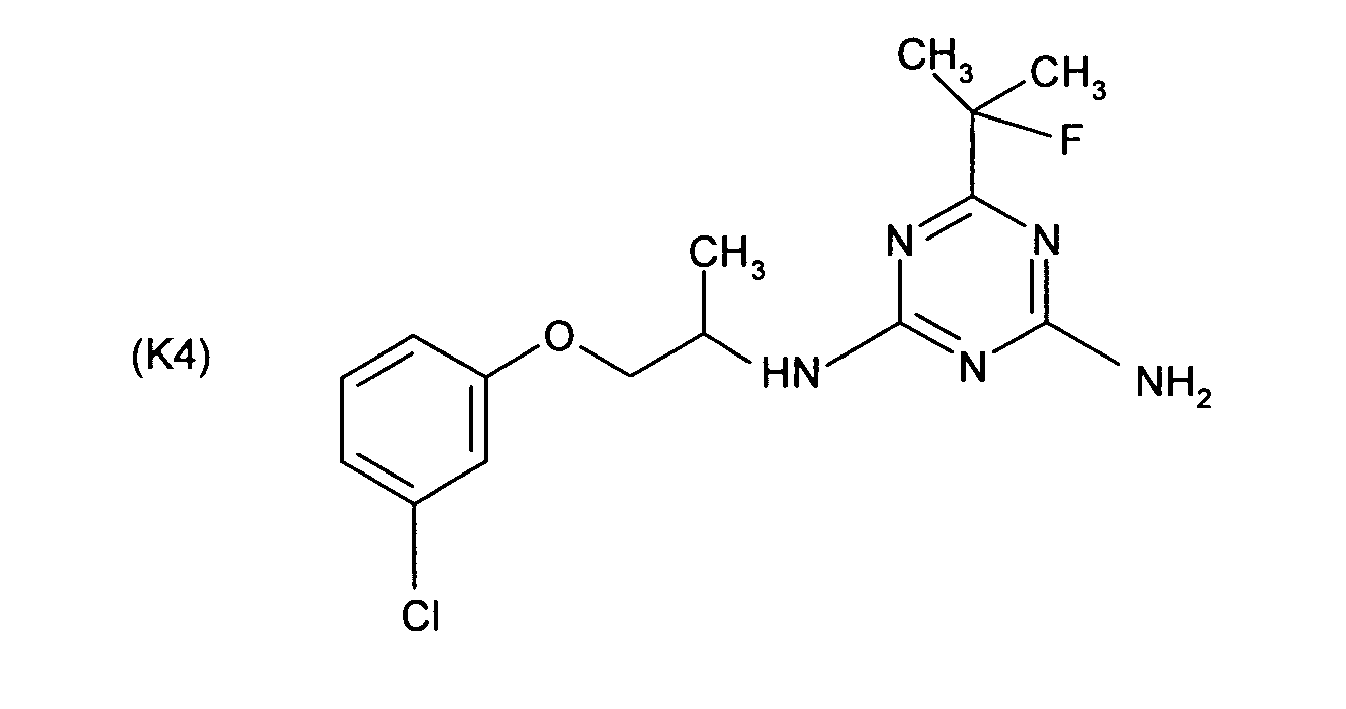


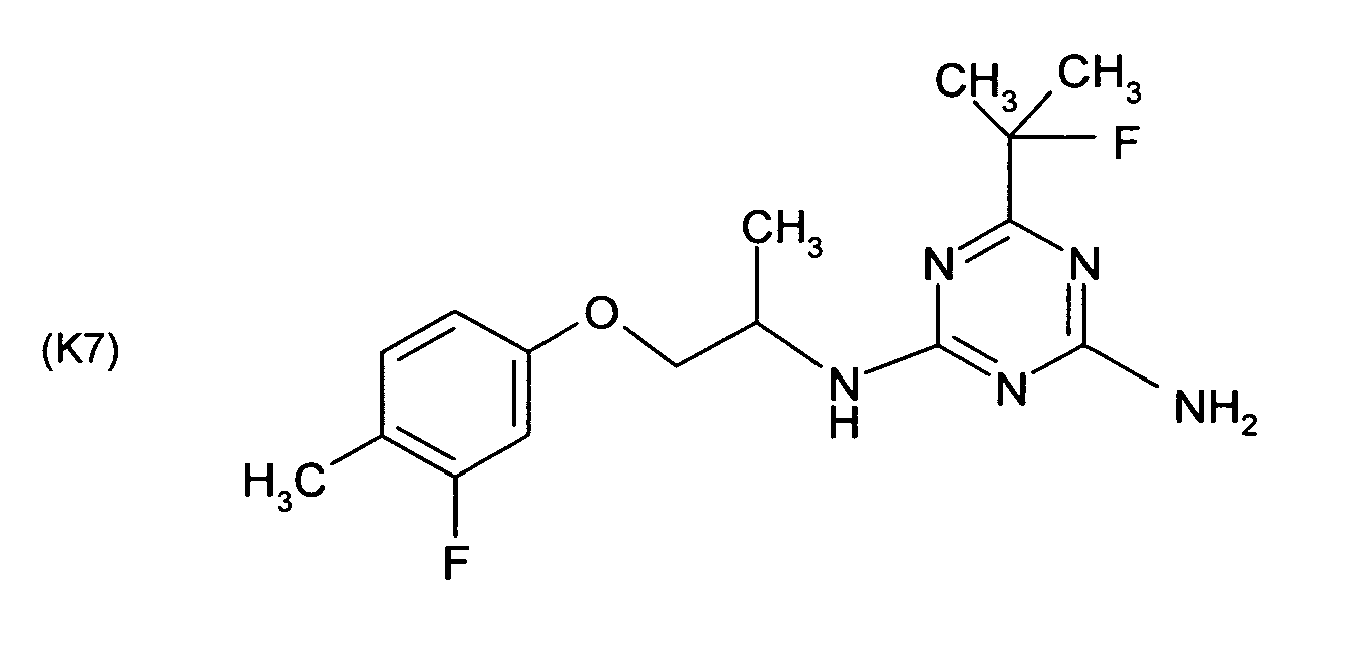
- L) phosphorhaltige Herbizide, z.B. eine oder mehrere Verbindungen der Formel (IV) oder deren Derivate wie Salze,

Z1 einen Rest der Formel -OM, -NHCH(CH3)CONHCH(CH3)CO2M oder -NHCH(CH3)CONHCH[CH2CH(CH3)2]CO2M und
M = H oder ein Salz bildendes Kation bedeuten,
und/oder eine oder mehrere Verbindungen der Formel (V) oder deren Derivate wie Salze,
Z2 einen Rest der Formel CN oder CO2R1 bedeutet, in dem R1 = Q oder ein Salz bildendes Kation ist und dabei Q = H, Alkyl, Alkenyl, Alkoxyalkyl oder C6-C10-Aryl, das unsubstituiert oder substituiert ist und vorzugsweise unsubstituiert oder durch einen oder mehrere Reste aus der Gruppe Alkyl, Alkoxy, Halogen, CF3, NO2 und CN substituiert ist, und
R2,R3 jeweils unabhängig voneinander H, Alkyl, C6-C10-Aryl, das unsubstituiert oder substituiert ist und vorzugsweise unsubstituiert oder durch einen oder mehrere Reste aus der Gruppe Alkyl, Alkoxy, Halogen, CF3, NO2 und CN substituiert ist, oder Biphenyl oder ein Salz bildendes Kation bedeuten.
Beispiele für Wirkstoffe der Formel (IV) und (V) sind folgende:- Glufosinate und dessen Ammoniumsalz in racemischer Form, d.h. 2-Amino-4-[hydroxy(methyl)phosphinoyl]-butansäure bzw. dessen Ammoniumsalz,
- das L-Enantiomer von Glufosinate und dessen Ammoniumsalz,
- Bilanafos/Bialaphos, d.h. L-2-Amino-4-[hydroxy(methyl)phosphinoyl]-butanoyl-L-alaninyl-L-alanin und dessen Natriumsalz
- Glyphosate.
- M) Carbamate, z.B. Asulam, Carbetamide, Chloropham und Propham;
- N) Benzofurane, z.B. Benfuresate und Ethofumesate;
- O) Phytohormone;
- P) Auxine und Auxinanaloga, z.B. 4-Indol-3-buttersäure, Indol-3-essigsäure, 1-Naphthylessigsäure, 2-(1-Naphthyl)acetamid und 2-Naphthyloxyessigsäure;
- Q) Zytokinine, z.B. Cythokinin, Kinetin und 6-Benzylaminopurin;
- R) Gibberelline, z.B. Gibberillinsäure, Gibberillin A4 und A7;
- S) Absissinsäure- und deren Derivate;
- T) Ethylenvorläufer, z.B. Ethephon;
- U) Herbizide aus der Gruppe der Fettsäuresynthetase-Inhibitoren;
- V) Harnstoffe, z.B. Chlorotoluron, Dimefuron, Diuron, Fluometuron, Isoproturon, Isouron, Karbutilate, Linuron, Methabenzthiazuron, Metobenzuron, Metoxuron, Monolinuron, Neburon, Siduron und Tebuthiuron und
- W) Metamitron.
- X) Hydroxybenzonitrile, z.B. wie Bromoxynil und loxynil und deren Salze und Ester, wie Bromoxyniloctanoat und loxyniloctanoat.
- Die agrochemischen Wirkstoffe können auch Wachstumsregulatoren sein. Beispiele hierfür sind Ethephon, Tribufos, Cyclanilide und Thidiazuron.
- Die Herbizide (Pflanzenwuchsregulatoren) der Gruppen A bis X sind beispielsweise aus den oben jeweils genannten Schriften und/oder aus "The Pesticide Manual", 12. Auflage (2000) bis 14. Auflage (2006), The British Crop Protection Council, "Agricultural Chemicals Book II - Herbicides -", by W.T. Thompson, Thompson Publications, Fresno CA, USA 1990 und "Farm Chemicals Handbook '90", Meister Publishing Company, Willoughby OH, USA,1990, bekannt.
- Beispiele für Safener sind unter anderem:
- a) Verbindungen der Formeln (S-II) bis (S-IV),

- n'
- ist eine natürliche Zahl von 0 bis 5, vorzugsweise 0 bis 3;
- T
- ist eine (C1 oder C2)-Alkandiylkette, die unsubstituiert oder mit einem oder zwei (C1-C4)Alkylresten oder mit [(C1-C3)-Alkoxy]-carbonyl substituiert ist;
- W
- ist ein unsubstituierter oder substituierter divalenter heterocyclischer Rest aus der Gruppe der teilungesättigten oder aromatischen Fünfring-Heterocyclen mit 1 bis 3 Heteroringatomen des Typs N oder O, wobei mindestens ein N-Atom und höchstens ein O-Atom im Ring enthalten ist, vorzugsweise ein Rest aus der Gruppe (W1) bis (W4),

- m'
- ist 0 oder 1;
- R17, R19
- sind gleich oder verschieden Halogen, (C1-C4)Alkyl, (C1-C4)Alkoxy, Nitro oder (C1-C4)Haloalkyl;
- R18, R20
- sind gleich oder verschieden OR24, SR24 oder NR24R25 oder ein gesättigter oder ungesättigter 3- bis 7-gliedriger Heterocyclus mit mindestens einem N-Atom und bis zu 3 Heteroatomen, vorzugsweise aus der Gruppe O und S, der über das N-Atom mit der Carbonylgruppe in (S-II) bzw. (S-III) verbunden ist und unsubstituiert oder durch Reste aus der Gruppe (C1-C4)Alkyl, (C1-C4)Alkoxy oder gegebenenfalls substituiertes Phenyl substituiert ist, vorzugsweise ein Rest der Formel OR24, NHR25 oder N(CH3)2, insbesondere der Formel OR24;
- R24
- ist Wasserstoff oder ein unsubstituierter oder substituierter aliphatischer Kohlenwasserstoffrest, vorzugsweise mit insgesamt 1 bis 18 C-Atomen;
- R25
- ist Wasserstoff, (C1-C6)Alkyl, (C1-C6)Alkoxy oder substituiertes oder unsubstituiertes Phenyl;
- Rx
- ist H, (C1-C8)Alkyl, C1-C8(Haloalkyl), (C1-C4)Alkoxy(C1-C8)Alkyl, Cyano oder COOR26, worin R26 Wasserstoff, (C1-C8)Alkyl, (C1-C8)Haloalkyl, (C1-C4)Alkoxy-(C1-C4)alkyl, (C1-C6)Hydroxyalkyl, (C3-C12)Cycloalkyl oder Tri-(C1-C4)-alkylsilyl ist;
- R27, R28, R29
- sind gleich oder verschieden Wasserstoff, (C1-C8)Alkyl, (C1-C8)Haloalkyl, (C3-C12)Cycloalkyl oder substituiertes oder unsubstituiertes Phenyl;
- R21
- ist (C1-C4)Alkyl, (C1-C4)Haloalkyl, (C2-C4)Alkenyl, (C2-C4)Haloalkenyl, (C3-C7)Cycloalkyl, vorzugsweise Dichlormethyl;
- R22, R23
- ist gleich oder verschieden Wasserstoff, (C1-C4)Alkyl, (C2-C4)Alkenyl, (C2-C4)Alkinyl, (C1-C4)Haloalkyl, (C2-C4)Haloalkenyl, (C1-C4)Alkylcarbamoyl-(C1-C4)alkyl, (C2-C4)Alkenylcarbamoyl-(C1-C4)alkyl, (C1-C4)Alkoxy-(C1-C4)alkyl, Dioxolanyl-(C1-C4)alkyl, Thiazolyl, Furyl, Furylalkyl, Thienyl, Piperidyl, substituiertes oder unsubstituiertes Phenyl, oder R22 und R23 bilden zusammen einen substituierten oder unsubstituierten heterocyclischen Ring, vorzugsweise einen Oxazolidin-, Thiazolidin-, Piperidin-, Morpholin-, Hexahydropyrimidin- oder Benzoxazinring;
- Verbindungen vom Typ der Dichlorphenylpyrazolin-3-carbonsäure (d.h. der Formel (S-II), worin W = (W1) und (R17)n' = 2,4-Cl2), vorzugsweise Verbindungen wie 1-(2,4-Dichlorphenyl)-5-(ethoxycarbonyl)-5-methyl-2-pyrazolin-3-carbonsäureethylester (II-1, Mefenpyr-diethyl), Mefenpyr-dimethyl und Mefenpyr (II-0), und verwandte Verbindungen, wie sie in der
WO-A-91/07874 - Derivate der Dichlorphenylpyrazolcarbonsäure (d.h. der Formel (S-II), worin W = (W2) und (R17)n' = 2,4-Cl2 ist), vorzugsweise Verbindungen wie 1-(2,4-Dichlorphenyl)-5-methyl-pyrazol-3-carbonsäureethylester (II-2), 1-(2,4-Dichlorphenyl)-5-isopropyl-pyrazol-3-carbonsäureethylester (II-3), 1-(2,4-Dichlorphenyl)-5-(1,1-dimethyl-ethyl)pyrazol-3-carbonsäureethylester (II-4), 1-(2,4-Dichlorphenyl)-5-phenyl-pyrazol-3-carbonsäureethylester (II-5) und verwandte Verbindungen, wie sie in
EP-A-0333131 undEP-A-0269806 beschrieben sind; - Verbindungen vom Typ der Triazolcarbonsäuren (d.h. der Formel (S-II), worin W = (W3) und (R17)n' = 2,4-Cl2 ist), vorzugsweise Verbindungen wie Fenchlorazol-ethyl, d.h. 1-(2,4-Dichlorphenyl)-5-trichlormethyl-(1H)-1,2,4-triazol-3-carbonsäureethylester (II-6), und verwandte Verbindungen (siehe
EP-A-0174562 undEP-A-0346620 ); - Verbindungen vom Typ der 5-Benzyl- oder 5-Phenyl-2-isoxazolin-3-carbonsäure oder der 5,5-Diphenyl-2-isoxazolin-3-carbonsäure wie Isoxadifen (II-12), (worin W = (W4) ist), vorzugsweise Verbindungen wie 5-(2,4-Dichlorbenzyl)-2-isoxazolin-3-carbonsäureethylester (II-7) oder 5-Phenyl-2-isoxazolin-3-carbonsäureethylester (II-8) und verwandte Verbindungen, wie sie in
WO-A- 91/08202 WO-A-95/07897 - Verbindungen vom Typ der 8-Chinolinoxyessigsäure, z.B. solche der Formel (S-III), worin (R19)n' = 5-Cl, R20 = OR24 und T = CH2 ist, vorzugsweise die Verbindungen (5-Chlor-8-chinolinoxy)essigsäure-(1-methylhexyl)-ester (III-1, Cloquintocet-mexyl), (5-Chlor-8-chinolinoxy)essigsäure-(1,3-dimethyl-but-1-yl)-ester (III-2), (5-Chlor-8-chinolinoxy)essigsäure-4-allyl-oxy-butylester (III-3), (5-Chlor-8-chinolinoxy)essigsäure-1-allyloxy-prop-2-ylester (III-4), (5-Chlor-8-chinolinoxy)essigsäureethylester (III-5), (5-Chlor-8-chinolinoxy)essigsäuremethylester (III-6), (5-Chlor-8-chinolinoxy)essigsäureallylester (III-7), (5-Chlor-8-chinolinoxy)essigsäure-2-(2-propyliden-iminoxy)-1-ethylester (III-8), (5-Chlor-8-chinolinoxy)essigsäure-2-oxo-prop-1-ylester (III-9), (5-Chlor-8-chinolinoxy)essigsäure (III-10) und dessen Salze wie sie z.B. in der
WO-A-02/34048 EP-A-0860750 ,EP-A-0094349 undEP-A-0191736 oderEP-A-0492366 beschrieben sind. - Verbindungen vom Typ der (5-Chlor-8-chinolinoxy)-malonsäure, d.h. der Formel (S-III), worin (R19)n' = 5-Cl, R20= OR24, T = -CH(COO-Alkyl)- ist, vorzugsweise die Verbindungen (5-Chlor-8-chinolinoxy)-malonsäure-diethylester (III-11), (5-Chlor-8-chinolinoxy)-malonsäurediallylester, (5-Chlor-8-chinolinoxy)-malonsäure-methyl-ethylester und verwandte Verbindungen, wie sie in
EP-A-0582198 beschrieben sind. - Verbindungen vom Typ der Dichloracetamide, d.h. der Formel (S-IV), vorzugsweise: N,N-Diallyl-2,2-dichloracetamid (Dichlormid (IV-1), aus
US 4,137,070 ), 4-Dichloracetyl-3,4-dihydro-3-methyl-2H-1,4-benzoxazin (IV-2, Benoxacor, ausEP 0149974 ), N1,N2-Diallyl-N2-dichloracetylglycinamid (DKA-24 (IV-3), aus HU 2143821), 4-Dichloracetyl-1-oxa-4-aza-spiro[4,5]decan (AD-67), 2,2-Dichlor-N-(1,3-dioxolan-2-ylmethyl)-N-(2-propenyl)acetamid (PPG-1292), 3-Dichloracetyl-2,2,5-trimethyloxazolidin (R-29148, IV-4), 3-Dichloracetyl-2,2-dimethyl-5-phenyloxazolidin, 3-Dichloracetyl-2,2-dimethyl-5-(2-thienyl)oxazolidin, 3-Dichloracetyl-5-(2-furanyl)-2,2-dimethyloxazolidin (Furilazole (IV-5), MON 13900), 1-Dichloracetyl-hexahydro-3,3,8a-trimethylpyrrolo[1,2-a]pyrimidin-6(2H)-on (Dicyclonon, BAS 145138),
- b) eine oder mehreren Verbindungen aus Gruppe:
1,8-Naphthalsäureanhydrid, Methyl-diphenylmethoxyacetat, 1-(2-Chlorbenzyl)-3-(1-methyl-1-phenylethyl)harnstoff (Cumyluron), O,O-Diethyl S-2-ethylthioethyl phosphordithioat (Disulfoton), 4-Chlorphenyl-methylcarbamat (Mephenate), O,O-Diethyl-O-phenylphosphorotioat (Dietholate), 4-Carboxy-3,4-dihydro-2H-1-benzopyran-4-essigsäure (CL-304415, CAS-Regno: 31541-57-8),
Cyanomethoxyimino(phenyl)acetonitril (Cyometrinil), 1,3-Dioxolan-2-ylmethoxyimino(phenyl)acetonitril (Oxabetrinil), 4'-Chlor-2,2,2-trifluoracetophenon-O-1,3-dioxolan-2-ylmethyloxim (Fluxofenim), 4,6-Dichlor-2-phenylpyrimidin (Fenclorim), Benzyl-2-chlor-4-trifluormethyl-1,3-thiazol-5-carboxylat (Flurazole), 2-Dichlormethyl-2-methyl-1,3-dioxolan (MG-191), N-(4-Methylphenyl)-N'-(1-methyl-1-phenylethyl)harnstoff (Dymron), (2,4-Dichlorphenoxy)essigsäure (2,4-D), (4-Chlorphenoxy)essigsäure, (R,S)-2-(4-Chlor-o-tolyloxy)propionsäure (Mecoprop), 4-(2,4-Dichlorphenoxy)buttersäure (2,4-DB), (4-Chlor-o-tolyloxy)essigsäure (MCPA), 4-(4-Chlor-o-tolyloxy)buttersäure, 4-(4-Chlorphenoxy)buttersäure, 3,6-Dichlor-2-methoxybenzoesäure (Dicamba), 1-(Ethoxycarbonyl)ethyl 3,6-dichlor-2-methoxybenzoat (Lactidichlor) sowie deren Salze und Ester, vorzugsweise (C1-C8); - c) N-Acylsulfonamide der Formel (S-V) und ihre Salze,

- R30
- Wasserstoff, einen Kohlenwasserstoffrest, einen Kohlenwasserstoffoxyrest, einen Kohlenwasserstoffthiorest oder einen Heterocyclylrest, der vorzugsweise über ein C-Atom gebunden ist, wobei jeder der letztgenannten 4 Reste unsubstituiert oder durch einen oder mehrere gleiche oder verschiedene Reste aus der Gruppe Halogen, Cyano, Nitro, Amino, Hydroxy, Carboxy, Formyl, Carbonamid, Sulfonamid und Reste der Formel -Za-Ra substituiert ist,
wobei jeder Kohlenwasserstoffteil vorzugsweise 1 bis 20 C-Atome aufweist und ein C-haltiger Rest R30 inklusive Substituenten vorzugsweise 1 bis 30 C-Atome aufweist; - R31
- Wasserstoff oder (C1-C4)-Alkyl, vorzugsweise Wasserstoff, oder
- R30 und R31
- zusammen mit der Gruppe der Formel -CO-N- den Rest eines 3- bis 8-gliedrigen gesättigten oder ungesättigten Rings;
- R32
- gleich oder verschieden Halogen, Cyano, Nitro, Amino, Hydroxy, Carboxy, Formyl, CONH2, SO2NH2 oder einen Rest der Formel -Zb-Rb ;
- R33
- Wasserstoff oder (C1-C4)-Alkyl, vorzugsweise H;
- R34
- gleich oder verschieden Halogen, Cyano, Nitro, Amino, Hydroxy, Carboxy, CHO, CONH2, SO2NH2 oder einen Rest der Formel -Zc-Rc ;
- Ra
- einen Kohlenwasserstoffrest oder einen Heterocyclylrest, wobei jeder der beiden letztgenannten Reste unsubstituiert oder durch einen oder mehrere gleiche oder verschiedene Reste aus der Gruppe Halogen, Cyano, Nitro, Amino, Hydroxy, Mono- und Di-[(C1-C4)-alkyl]-amino substituiert ist, oder einen Alkylrest, in dem mehrere, vorzugsweise 2 oder 3, nicht benachbarte CH2-Gruppen jeweils durch ein Sauerstoffatom ersetzt sind;
- Rb,Rc
- gleich oder verschieden einen Kohlenwasserstoffrest oder einen Heterocyclylrest, wobei jeder der beiden letztgenannten Reste unsubstituiert oder durch einen oder mehrere gleiche oder verschiedene Reste aus der Gruppe Halogen, Cyano, Nitro, Amino, Hydroxy, Phosphoryl, Halogen-(C1-C4)-alkoxy, Mono- und Di-[(C1-C4)-alkyl]-amino substituiert ist, oder einen Alkylrest, in dem mehrere, vorzugsweise 2 oder 3, nicht benachbarte CH2-Gruppen jeweils durch ein Sauerstoffatom ersetzt sind;
- Za
- eine divalente Gruppe der Formel -O-, -S-, -CO-, -CS-, -CO-O-, -CO-S-, -O-CO-, -S-CO-, -SO-, -SO2-, -NR*-, -CO-NR*-, -NR*-CO-, -SO2-NR*- oder -NR*-SO2-, wobei die rechts angegebene Bindung der jeweiligen divalenten Gruppe die Bindung zum Rest Ra ist und wobei die R* in den letztgenannten 5 Resten unabhängig voneinander jeweils H, (C1-C4)-Alkyl oder Halo-(C1-C4)-alkyl bedeuten;
- Zb, Zc
- unabhängig voneinander eine direkte Bindung oder eine divalente Gruppe der Formel -O-, -S-, -CO-, -CS-, -CO-O-, -CO-S-, -O-CO-, -S-CO-, -SO-, -SO2-, -NR*-, -SO2-NR*-, -NR*-SO2-, -CO-NR*- oder -NR*-CO-, wobei die rechts angegebene Bindung der jeweiligen divalenten Gruppe die Bindung zum Rest Rb bzw. Rc ist und wobei die R* in den letztgenannten 5 Resten unabhängig voneinander jeweils H, (C1-C4)-Alkyl oder Halo-(C1-C4)-alkyl bedeuten;
- n
- eine ganze Zahl von 0 bis 4, vorzugsweise 0, 1 oder 2, insbesondere 0 oder 1, und
- m
- eine ganze Zahl von 0 bis 5, vorzugsweise 0, 1, 2 oder 3, insbesondere 0, 1 oder 2; bedeuten;
- R30 = H3C-O-CH2-, R31 = R33 = H, R34 = 2-OMe ist (V-1),
- R30 = H3C-O-CH2-, R31 = R33 = H, R34 = 2-OMe-5-Cl ist (V-2),
- R30 = Cyclopropyl, R31 = R33 = H, R34 = 2-OMe ist (V-3),
- R30 = Cyclopropyl, R31 = R33 = H, R34 = 2-OMe-5-Cl ist (V-4),
- R30 = Cyclopropyl, R31 = R33 = H, R34 = 2-Me ist (V-5),
- R30 = tert. Butyl, R31 = R33 = H, R34 = 2-OMe ist (V-6).
- d) Acylsulfamoylbenzoesäureamide der allgemeinen Formel (S-VI), gegebenenfalls auch in Salzform,

- X3
- CH oder N;
- R35
- Wasserstoff, Heterocyclyl oder einen Kohlenwasserstoffrest, wobei die beiden letztgenannten Reste gegebenenfalls durch einen oder mehrere, gleiche oder verschiedene Reste aus der Gruppe Halogen, Cyano, Nitro, Amino, Hydroxy, Carboxy, CHO, CONH2, SO2NH2 und Za-Ra substituiert sind;
- R36
- Wasserstoff, Hydroxy, (C1-C6)-Alkyl, (C2-C6)-Alkenyl, (C2-C6)-Alkinyl, (C1-C6)-Alkoxy, (C2-C6)-Alkenyloxy, wobei die fünf letztgenannten Reste gegebenenfalls durch einen oder mehrere, gleiche oder verschiedene Reste aus der Gruppe Halogen, Hydroxy, (C1-C4)-Alkyl, (C1-C4)-Alkoxy und (C1-C4)-Alkylthio substituiert sind, oder
- R35 und R36
- zusammen mit dem sie tragenden Stickstoffatom einen 3- bis 8-gliedrigen gesättigten oder ungesättigten Ring;
- R37
- Halogen, Cyano, Nitro, Amino, Hydroxy, Carboxy, CHO, CONH2, SO2NH2 oder Zb-Rb;
- R38
- Wasserstoff, (C1-C4)-Alkyl, (C2-C4)-Alkenyl oder (C2-C4)-Alkinyl;
- R39
- Halogen, Cyano, Nitro, Amino, Hydroxy, Carboxy, Phosphoryl, CHO, CONH2, SO2NH2 oder Zc-Rc;
- Ra
- einen (C2-C20)-Alkylrest, dessen Kohlenstoffkette ein- oder mehrfach durch Sauerstoffatome unterbrochen ist, Heterocyclyl oder einen Kohlenwasserstoffrest, wobei die zwei letztgenannten Reste gegebenenfalls durch einen oder mehrere, gleiche oder verschiedene Reste aus der Gruppe Halogen, Cyano, Nitro, Amino, Hydroxy, Mono- und Di-[(C1-C4)-alkyl]-amino substituiert sind;
- Rb Rc
- gleich oder verschieden einen (C2-C20)-Alkylrest, dessen Kohlenstoffkette ein- oder mehrfach durch Sauerstoffatome unterbrochen ist, Heterocyclyl oder einen Kohlenwasserstoffrest, wobei die zwei letztgenannten Reste gegebenenfalls durch einen oder mehrere, gleiche oder verschiedene Reste aus der Gruppe Halogen, Cyano, Nitro, Amino, Hydroxy, Phosphoryl, (C1-C4)-Haloalkoxy, Mono- und Di-[(C1-C4)-alkyl]-amino substituiert sind;
- Za
- eine divalente Einheit aus der Gruppe O, S, CO, CS, C(O)O, C(O)S, SO, SO2, NRd, C(O)NRd oder SO2NRd;
- Zb, Zc
- gleich oder verschieden eine direkte Bindung oder eine divalente Einheit aus der Gruppe O, S, CO, CS, C(O)O, C(O)S, SO, SO2, NRd ,SO2NRd oder C(O)NRd;
- Rd
- Wasserstoff, (C1-C4)-Alkyl oder (C1-C4)-Haloalkyl;
- n
- eine ganze Zahl von 0 bis 4, und
- m
- für den Fall, dass X für CH steht, eine ganze Zahl von 0 bis 5, und für den Fall, dass X für N steht, eine ganze Zahl von 0 bis 4 bedeuten;
- X3
- CH;
- R35
- Wasserstoff, (C1-C6)-Alkyl, (C3-C6)-Cycloalkyl, (C2-C6)-Alkenyl, (C5-C6)-Cycloalkenyl, Phenyl oder 3- bis 6-gliedriges Heterocyclyl mit bis zu drei Heteroatomen aus der Gruppe Stickstoff, Sauerstoff und Schwefel, wobei die sechs letztgenannten Reste gegebenenfalls durch einen oder mehrere, gleiche oder verschiedene Substituenten aus der Gruppe Halogen, (C1-C6)-Alkoxy, (C1-C6)-Haloalkoxy, (C1-C2)-Alkylsulfinyl, (C1-C2)-Alkylsulfonyl, (C3-C6)-Cycloalkyl, (C1-C4)-Alkoxycarbonyl, (C1-C4)-Alkylcarbonyl und Phenyl und im Falle cyclischer Reste auch (C1-C4)-Alkyl und (C1-C4)-Haloalkyl substituiert sind;
- R36
- Wasserstoff, (C1-C6)-Alkyl, (C2-C6)-Alkenyl, (C2-C6)-Alkinyl, wobei die drei letztgenannten Reste gegebenenfalls durch einen oder mehrere, gleiche oder verschiedene Substituenten aus der Gruppe Halogen, Hydroxy, (C1-C4)-Alkyl, (C1-C4)-Alkoxy und (C1-C4)-Alkylthio substituiert sind;
- R37
- Halogen, (C1-C4)-Haloalkyl, (C1-C4)-Haloalkoxy, Nitro, (C1-C4)-Alkyl, (C1-C4)-Alkoxy, (C1-C4)-Alkylsulfonyl, (C1-C4)-Alkoxycarbonyl oder (C1-C4)-Alkylcarbonyl;
- R38
- Wasserstoff;
- R39
- Halogen, Nitro, (C1-C4)-Alkyl, (C1-C4)-Haloalkyl, (C1-C4)-Haloalkoxy, (C3-C6)-Cycloalkyl, Phenyl, (C1-C4)-Alkoxy, Cyano, (C1-C4)-Alkylthio, (C1-C4)-Alkylsulfinyl, (C1-C4)-Alkylsulfonyl, (C1-C4)-Alkoxycarbonyl oder (C1-C4)-Alkylcarbonyl;
- n
- 0, 1 oder 2 und
- m
- 1 oder 2 bedeuten.
WO-A-99/16744 
- R21
- = Cyclo-Propyl und R22 = H ist (S3-1 = 4-Cyclopropylaminocarbonyl-N-(2-methoxybenzoyl)benzolsulfonamid; Cyprosulfamide);
- R21
- = Cyclo-Propyl und R22 = 5-Cl ist (S3-2),
- R21
- = Ethyl und R22 = H ist (S3-3),
- R21
- = iso-Propyl und R22 = 5-Cl ist (S3-4) und
- R21
- = iso-Propyl und R22 = H ist (S3-5 = 4-iso-propylaminocarbonyl-N-(2-methoxybenzoyl)benzolsulfonamid);
- e) Verbindungen vom Typ der N-Acylsulfamoylphenylharnstoffe der Formel (S-VIII), die z.B. bekannt sind aus der
EP-A-365484 
- A
- für einen Rest aus der Gruppe


- Rα und Rβ
- unabhängig voneinander für Wasserstoff, C1-C8-Alkyl, C3-C8-Cycloalkyl, C3-C6-Alkenyl, C3-C6-Alkinyl, Rx
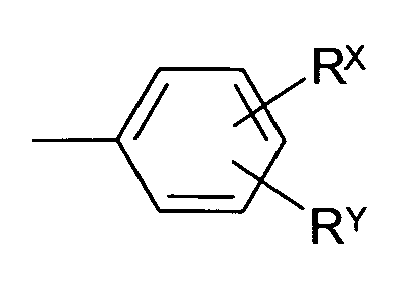

- Rα und Rβ
- gemeinsam für eine C4-C6-Alkylenbrücke oder eine durch Sauerstoff, Schwefel, SO, SO2, NH oder -N(C1-C4-Alkyl)- unterbrochene C4-C6-Alkylenbrücke,
- Rγ
- für Wasserstoff oder C1-C4-Alkyl,
- Ra und Rb
- unabhängig voneinander für Wasserstoff, Halogen, Cyan, Nitro, Trifluormethyl, C1-C4-Alkyl, C1-C4-Alkoxy, C1-C4-Alkylthio, C1-C4-Alkylsulfinyl, C1-C4-Alkylsulfonyl, -COORj, -CONRkRm, -CORn, -SO2NRkRm oder -OSO2-C1-C4-Alkyl, oder Ra und Rb gemeinsam für eine C3-C4-Alkylenbrücke, die durch Halogen oder C1-C4-Alkyl substituiert sein kann, oder eine C3-C4-Alkenylenbrücke, die durch Halogen oder C1-C4-Alkyl substituiert sein kann, oder eine C4-Alkadienylenbrücke, die durch Halogen oder C1-C4-Alkyl substituiert sein kann, und
- Rg und Rh
- unabhängig voneinander für Wasserstoff, Halogen, C1-C4-Alkyl, Trifluormethyl, Methoxy, Methylthio oder -COORj stehen, wobei
- Rc
- Wasserstoff, Halogen, C1-C4-Alkyl oder Methoxy,
- Rd
- Wasserstoff, Halogen, Nitro, C1-C4-Alkyl, C1-C4-Alkoxy, C1-C4-Alkylthio, C1-C4-Alkylsulfinyl, C1-C4-Alkylsulfonyl, -COORj oder -CONRkRm,
- Re
- Wasserstoff, Halogen, C1-C4-Alkyl, -COORj, Trifluormethyl oder Methoxy, oder Rd und Re gemeinsam für eine C3-C4-Alkylenbrücke,
- Rf
- Wasserstoff, Halogen oder C1-C4-Alkyl,
- RX und RY
- unabhängig voneinander Wasserstoff, Halogen, C1-C4-Alkyl, C1-C4-Alkoxy, C1-C4-Alkylthio, -COOR4, Trifluormethyl, Nitro oder Cyan,
- Rj, Rk und Rm
- unabhängig voneinander Wasserstoff oder C1-C4-Alkyl,
- Rk und Rm
- gemeinsam eine C4-C6-Alkylenbrücke oder eine durch Sauerstoff, NH oder -N(C1-C4-Alkyl)- unterbrochene C4-C6-Alkylenbrücke, und
- Rn
- C1-C4-Alkyl, Phenyl oder durch Halogen, C1-C4-Alkyl, Methoxy, Nitro oder Trifluormethyl substituiertes Phenyl bedeuten;
- Sofern es im Einzelnen nicht anders definiert wird, gelten für die Reste in den Formeln zu (S-II) bis (S-VIII) im Allgemeinen die folgenden Definitionen.
Die Reste Alkyl, Alkoxy, Haloalkyl, Haloalkoxy, Alkylamino und Alkylthio sowie die entsprechenden ungesättigten und/oder substituierten Reste können im Kohlenstoffgerüst jeweils geradkettig oder verzweigt sein.
Alkylreste, auch in den zusammengesetzten Bedeutungen wie Alkoxy, Haloalkyl usw. haben vorzugsweise 1 bis 4 C-Atome und, bedeuten z.B. Methyl, Ethyl, n- oder i-Propyl, n-, i-, t- oder 2-Butyl. Alkenyl- und Alkinylreste haben die Bedeutung der den Alkylresten entsprechenden möglichen ungesättigten Reste; Alkenyl bedeutet z.B. Allyl, 1-Methylprop-2-en-1-yl, 2-Methyl-prop-2-en-1-yl, But-2-en-1-yl, But-3-en-1-yl, 1-Methyl-but-3-en-1-yl und 1-Methyl-but-2-en-1-yl. Alkinyl bedeutet z.B.
Propargyl, But-2-in-1-yl, But-3-in-1-yl, 1-Methyl-but-3-in-1-yl. "(C1-C4)-Alkyl" ist die Kurzschreibweise für Alkyl mit 1 bis 4 C-Atomen; entsprechendes gilt für andere allgemeine Restedefinitionen mit in Klammern angegebenen Bereichen für die mögliche Anzahl von C-Atomen.
Cycloalkyl bedeutet bevorzugt einen cyclischen Alkylrest mit 3 bis 8, vorzugsweise 3 bis 7, besonders bevorzugt 3 bis 6 C-Atomen, beispielsweise Cyclopropyl, Cyclobutyl, Cyclopentyl und Cyclohexyl. Cycloalkenyl und Cycloalkinyl bezeichnen entsprechende ungesättigte Verbindungen.
Halogen bedeutet Fluor, Chlor, Brom oder lod. Haloalkyl, Haloalkenyl und Haloalkinyl bedeuten durch Halogen, vorzugsweise durch Fluor, Chlor und/oder Brom, insbesondere durch Fluor oder Chlor, teilweise oder vollständig substituiertes Alkyl, Alkenyl oder Alkinyl, z.B. CF3, CHF2, CH2F, CF2CF3, CH2CHFCl, CCl3, CHCl2, CH2CH2Cl. Haloalkoxy ist z.B. OCF3, OCHF2, OCH2F, OCF2CF3, OCH2CF3 und OCH2CH2Cl. Entsprechendes gilt für sonstige Halogen substituierte Reste.
Ein Kohlenwasserstoffrest kann ein aromatischer oder ein aliphatischer Kohlenwasserstoffrest sein, wobei ein aliphatischer Kohlenwasserstoffrest im allgemeinen ein geradkettiger oder verzweigter gesättigter oder ungesättigter Kohlenwasserstoffrest ist, vorzugsweise mit 1 bis 18, besonders bevorzugt 1 bis 12 C-Atomen, z.B. Alkyl, Alkenyl oder Alkinyl.
Vorzugsweise bedeutet aliphatischer Kohlenwasserstoffrest Alkyl, Alkenyl oder Alkinyl mit bis zu 12 C-Atomen; entsprechendes gilt für einen aliphatischen Kohlenwasserstoffrest in einem Kohlenwasserstoffoxyrest.
Aryl ist im allgemeinen ein mono-, bi- oder polycyclisches aromatisches System mit vorzugsweise 6-20 C-Atomen, bevorzugt 6 bis 14 C-Atomen, besonders bevorzugt 6 bis 10 C-Atomen, z.B. Phenyl, Naphthyl, Tetrahydronaphthyl, Indenyl, Indanyl, Pentalenyl und Fluorenyl, besonders bevorzugt Phenyl.
Heterocyclischer Ring, heterocyclischer Rest oder Heterocyclyl bedeutet ein mono-, bi- oder polycyclisches Ringsystem, das gesättigt, ungesättigt und/oder aromatisch ist und eine oder mehrere, vorzugsweise 1 bis 4, Heteroatome, vorzugsweise aus der Gruppe N, S und O, enthält.
Bevorzugt sind gesättigte Heterocyclen mit 3 bis 7 Ringatomen und einem oder zwei Heteroatomen aus der Gruppe N, O und S, wobei die Chalcogene nicht benachbart sind. Besonders bevorzugt sind monocyclische Ringe mit 3 bis 7 Ringatomen und einem Heteroatom aus der Gruppe N, O und S, sowie Morpholin, Dioxolan, Piperazin, Imidazolin und Oxazolidin. Ganz besonders bevorzugte gesättigte Heterocyclen sind Oxiran, Pyrrolidon, Morpholin und Tetrahydrofuran.
Bevorzugt sind auch teilweise ungesättigte Heterocyclen mit 5 bis 7 Ringatomen und einem oder zwei Heteroatomen aus der Gruppe N, O und S. Besonders bevorzugt sind teilweise ungesättigte Heterocyclen mit 5 bis 6 Ringatomen und einem Heteroatom aus der Gruppe N, O und S. Ganz besonders bevorzugte teilweise ungesättigte Heterocyclen sind Pyrazolin, Imidazolin und Isoxazolin.
Ebenso bevorzugt ist Heteroaryl, z.B. mono- oder bicyclische aromatische Heterocyclen mit 5 bis 6 Ringatomen, die ein bis vier Heteroatome aus der Gruppe N, O, S enthalten, wobei die Chalcogene nicht benachbart sind. Besonders bevorzugt sind monocyclische aromatische Heterocyclen mit 5 bis 6 Ringatomen, die ein Heteroatom aus der Gruppe, N, O und S enthalten, sowie Pyrimidin, Pyrazin, Pyridazin, Oxazol, Thiazol, Thiadiazol, Oxadiazol, Pyrazol, Triazol und Isoxazol. Ganz besonders bevorzugt sind Pyrazol, Thiazol, Triazol und Furan.
Substituierte Reste, wie substituierte Kohlenwasserstoffreste, z.B. substituiertes Alkyl, Alkenyl, Alkinyl, Aryl wie Phenyl und Arylalkyl wie Benzyl, oder substituiertes Heterocyclyl, bedeuten einen vom unsubstituierten Grundkörper abgeleiteten substituierten Rest, wobei die Substituenten vorzugsweise einen oder mehrere, vorzugsweise 1, 2 oder 3, im Falle von Cl und F auch bis zur maximal möglichen Anzahl, Substituenten aus der Gruppe Halogen, Alkoxy, Haloalkoxy, Alkylthio, Hydroxy, Amino, Nitro, Carboxy, Cyano, Azido, Alkoxycarbonyl, Alkylcarbonyl, Formyl, Carbamoyl, Mono- und Dialkylaminocarbonyl, substituiertes Amino wie Acylamino, Mono- und Dialkylamino und Alkylsulfinyl, Haloalkylsulfinyl, Alkylsulfonyl, Haloalkylsulfonyl und, im Falle cyclischer Reste, auch Alkyl und Haloalkyl sowie den genannten gesättigten kohlenwasserstoffhaltigen Substituenten entsprechende ungesättigte aliphatische Substituenten, vorzugsweise Alkenyl, Alkinyl, Alkenyloxy, Alkinyloxy, bedeuten. Bei Resten mit C-Atomen sind solche mit 1 bis 4 C-Atomen, insbesondere 1 oder 2 C-Atomen, bevorzugt. Bevorzugt sind in der Regel Substituenten aus der Gruppe Halogen, z.B. Fluor oder Chlor, (C1-C4)Alkyl, vorzugsweise Methyl oder Ethyl, (C1-C4)Haloalkyl, vorzugsweise Trifluormethyl, (C1-C4)Alkoxy, vorzugsweise Methoxy oder Ethoxy, (C1-C4)Haloalkoxy, Nitro und Cyano. Besonders bevorzugt sind dabei die Substituenten Methyl, Methoxy und Chlor.
Mono- oder disubstituiertes Amino bedeutet einen chemisch stabilen Rest aus der Gruppe der substituierten Aminoreste, welche beispielsweise durch einen oder zwei gleiche oder verschiedene Reste aus der Gruppe Alkyl, Alkoxy, Acyl und Aryl N-substituiert sind; vorzugsweise Monoalkylamino, Dialkylamino, Acylamino, Arylamino, N-Alkyl-N-Arylamino sowie N-Heterocyclen. Dabei sind Alkylreste mit 1 bis 4 C-Atomen bevorzugt. Aryl ist dabei vorzugsweise Phenyl. Substituiertes Aryl ist dabei vorzugsweise substituiertes Phenyl. Für Acyl gilt dabei die weiter unten genannte Definition, vorzugsweise (C1-C4)Alkanoyl. Entsprechendes gilt für substituiertes Hydroxylamino oder Hydrazino.
Gegebenenfalls substituiertes Phenyl ist vorzugsweise Phenyl, das unsubstituiert oder ein- oder mehrfach, vorzugsweise bis zu dreifach, bei Halogen wie Cl und F auch bis zu fünffach, durch gleiche oder verschiedene Reste aus der Gruppe Halogen, (C1-C4)Alkyl, (C1-C4)Alkoxy, (C1-C4)Haloalkyl, (C1-C4)Haloalkoxy und Nitro substituiert ist, z.B. o-, m- und p-Tolyl, Dimethylphenyle, 2-, 3- und 4-Chlorphenyl, 2-, 3- und 4-Trifluor- und -Trichlorphenyl, 2,4-, 3,5-, 2,5- und 2,3-Dichlorphenyl, o-, mund p-Methoxyphenyl.
Ein Acylrest bedeutet den Rest einer organischen Säure mit vorzugsweise bis zu 6 C-Atomen, z.B. den Rest einer Carbonsäure und Reste davon abgeleiteter Säuren wie der Thiocarbonsäure, gegebenenfalls N-substituierter Iminocarbonsäuren, oder der Rest von Kohlensäuremonoestern, gegebenenfalls N-substituierter Carbaminsäuren, Sulfonsäuren, Sulfinsäuren, Phosphonsäuren, Phosphinsäuren. Acyl bedeutet beispielsweise Formyl, Alkylcarbonyl, wie (C1-C4-Alkyl)-carbonyl, Phenylcarbonyl, wobei der Phenylring substituiert sein kann, z.B. wie oben für Phenyl angegeben, oder Alkyloxycarbonyl, Phenyloxycarbonyl, Benzyloxycarbonyl, Alkylsulfonyl, Alkylsulfinyl oder N-Alkyl-1-iminoalkyl.
Von den Formeln (S-II) bis (S-VIII) umfasst sind auch alle Stereoisomeren, welche die gleiche topologische Verknüpfung der Atome aufweisen, und deren Gemische. Solche Verbindungen enthalten ein oder mehrere asymmetrische C-Atome oder auch Doppelbindungen, die in den allgemeinen Formeln nicht gesondert angegeben sind. Die durch ihre spezifische Raumform definierten möglichen Stereoisomeren, wie Enantiomere, Diastereomere, Z- und E-Isomere, können nach üblichen Methoden aus Gemischen der Stereoisomeren erhalten oder auch durch stereoselektive Reaktionen in Kombination mit dem Einsatz von stereochemisch reinen Ausgangsstoffen hergestellt werden. - Die Verbindungen der Formel (S-II) sind z.B. aus
EP-A-0333131 (ZA-89/1960 EP-A-0269806 (US 4,891,057 ),EP-A-0346620 (AU-A-89/34951 EP-A-0174562 ,EP-A-0346620 (WO-A-91/08202 WO-A-91/07874 WO-A-95/07897 ZA 94/7120 EP-A-0086750 ,EP-A-094349 US 4,902,340 ),EP-A-0191736 (US 4,881,966 ) undEP-A-0492366 und dort zitierter Literatur bekannt oder können nach oder analog den dort beschriebenen Verfahren hergestellt werden. Einige Verbindungen sind ferner inEP-A-0582198 undWO-A-02/34048 US 4,021,224 undUS 4,021,229 . Verbindungen der Untergruppe b) sind weiterhin ausCN-A-87/102789 ,EP-A-365484 WO-A-97/45016 WO-A-99/16744 EP-A-365484 - Die Safener der vorstehenden Gruppen a) bis e) reduzieren oder unterbinden phytotoxische Effekte, die beim Einsatz der herbiziden Mittel gemäß der Erfindung in Nutzpflanzenkulturen auftreten können, ohne die Wirksamkeit der Herbizide gegen Schadpflanzen zu beeinträchtigen. Hierdurch kann das Einsatzgebiet der Herbizide erheblich erweitert werden und insbesondere ist durch die Verwendung von Safenern der Einsatz von Herbiziden, die bislang nur beschränkt oder mit nicht ausreichendem Erfolg eingesetzt werden konnten, d.h. von Kombinationen, die ohne Safener in niedrigen Dosierungen mit wenig Breitenwirkung zu nicht ausreichender Kontrolle der Schadpflanzen führten.
- Besonders bevorzugt kommen sind als Safener in den erfindungsgemäßen Formulierungen unter anderem: 4-Dichloracetyl-1-oxa-4-aza-spiro[4.5]-decan (AD-67), 1-Dichloracetyl-hexahydro-3,3,8a-trimethylpyrrolo[1,2-a]-pyrimidin-6(2H)-on (Dicyclonon, BAS-145138), 4-Dichloracetyl-3,4-dihydro-3-methyl-2H-1,4-benzoxazin (Benoxacor), Cloquintocet, 5-Chlor-chinolin-8-oxy-essigsäure-(1-methyl-hexylester) (Cloquintocet-mexyl), α-(Cyanomethoxyimino)-phenylacetonitril (Cyometrinil), 2,2-Dichlor-N-(2-oxo-2-(2-propenylamino)-ethyl)-N-(2-propenyl)-acetamid (DKA-24), 2,2-Dichlor-N,N-di-2-propenyl-acetamid (Dichlormid), N-(4-Methyl-phenyl)-N'-(1-methyl-1-phenyl-ethyl)-harnstoff (Dymron), 4,6-Dichlor-2-phenyl-pyrimidin (Fenclorim), 1-(2,4-Dichlor-phenyl)-5-trichlormethyl-1 H-1,2,4-triazol-3-carbonsäure-ethylester (Fenchlorazol-ethyl), 2-Chlor-4-trifluormethyl-thiazol-5-carbonsäure-phenylmethylester (Flurazole), 4-Chlor-N-(1,3-dioxolan-2-yl-methoxy)-a-trifluor-acetophenonoxim (Fluxofenim), 3-Dichloracetyl-5-(2-furanyl)-2,2-dimethyl-oxazolidin (Furilazole, MON-13900), Ethyl-4,5-dihydro-5,5-diphenyl-3-isoxazolcarboxylat (Isoxadifen-ethyl), Diethyl-1-(2,4-dichlorphenyl)-4,5-dihydro-5-methyl-1H-pyrazol-3,5-dicarboxylat (Mefenpyr-diethyl), 2-Dichlormethyl-2-methyl-1,3-dioxolan (MG-191), 1,8-Naphthalsäureanhydrid, α-(1,3-Dioxolan-2-yl-methoximino)-phenylacetonitril (Oxabetrinil), 2,2-Dichlor-N-(1,3-dioxolan-2-yl-methyl)-N-(2-propenyl)-acetamid (PPG-1292), 3-Dichloracetyl-2,2-dimethyl-oxazolidin (R-28725), 3-Dichloracetyl-2,2,5-trimethyl-oxazolidin (R-29148), 1-(2-Chlor-phenyl)-5-phenyl-1 H-pyrazol-3-carbonsäure-methylester, 4-Cyclopropylaminocarbonyl-N-(2-methoxybenzoyl)benzolsulfonamid (Cyprosulfamide), 4-iso-propylaminocarbonyl-N-(2-methoxybenzoyl)benzolsulfonamid und N-(2-Methoxy-benzoyl)-4-[(methylamino-carbonyl)-amino]-benzolsulfonamid.
- Ganz besonders bevorzugt sind die Safenern Mefenpyr-diethyl, Cloquintocet-mexyl, Isoxadifen-ethyl, 4-Cyclopropylaminocarbonyl-N-(2-methoxybenzoyl)benzolsulfonamid (Cyprosulfamide), 4-iso-propylaminocarbonyl-N-(2-methoxybenzoyl)benzolsulfonamid oder Fenchlorazol-ethyl; insbesondere ganz besonders bevorzugt sind Mefenpyr-diethyl, Cloquintocet-mexyl oder Isoxadifen-ethyl.
- Besondere Ausführungsformen der Erfindung sind das Verfahren zur Förderung der Penetration und dessen Verwendung, wobei TBEP in den erfindungsgemäßen Mengen (B) mit Mischungen von Herbiziden und Safener (A), entweder gleichzeitig oder sequentiell appliziert wird.
- Bevorzugte Herbizid-Safener-Mischungen sind Kombinationen der folgenden Verbindungen miteinander:
- a) Verbindungen, die als ACCase-Inhibitoren wirksam sind, wie Alloxydim, Butroxydim, Clethodim, Clodinafop-propargyl, Cycloxydim, Cyhalofop-butyl, Diclofop-methyl, Fenoxaprop, Fenoxaprop-ethyl, Fenoxaprop-P, Fenoxaprop-P-ethyl, Fluazifop, Fluazifop-P-butyl, Fluazifop-butyl, Haloxyfop, Haloxyfop-P, Haloxyfop-etotyl, Haloxyfop-P-methyl, Metamifop, Profoxydim, Propaquizafop, Quizalofop-P-tefuryl, Quizalofop-P-ethyl, Sethoxydim, Tepraloxydim, Tralkoxydim und Isoxapyrifop,
- b) Verbindungen, die als p-Hydroxyphenyl pyruvate dioxygenase (HPPD)-Inhibitoren wirksam sind, wie Benzobicyclon, Benzofenap, Isoxaflutole und dessen Diketonitrile, Mesotrione, Pyrazolynate, Pyrazoxyfen, Sulcotrione und Isoxachlortole,
- c) Verbindungen verschiedener Wirkstoffgruppen, wie Atrazin, Acetochlor, Aclonifen, Alachlor, Amidochlor, Amidosulfuron, Azimsulfuron, Bentazon, Bensulfuron(methyl), Bromoxynil(-octanoat/-heptanoat), Butachlor, Bispyribac, Chlorsulfuron, Chlorimuron, Clomazone, Clopyralid, Cinosulfuron, Cyclosulfamuron, 2,4-D-Ester, 2,4-DB-Ester, 2,4-DP-Ester, CMPP-Ester, MCPA-Ester, MCPB, EPTC, Desmedipham, Diflufenican, Dicamba, Ethoxysulfuron, Ethofumesat, Flazasulfuron, Florasulam, Flucarbazone, Flumetsulam, Flufenacet, Fluoroglykofen, Fluroxypyr, Flupyrsulfuron, Foramsulfuron, Flumioxazin, Flumiclorac, Fomesafen, Glufosinate, Glyphosate, Imazapyr, Imazosulfuron, lodosulfuron, lodosulfuron-methyl, loxynil(-octanoat), Lactofen, Halosulfuron, Imazamox, Imazapic, Imazapyr, Imazethapyr, Imazaquin, Metosulam, Mesosulfuron(-methyl), (S-)Metolachlor, Metsulfuron-methyl, Metamitron, Nicosulfuron, Oxyfluorfen, Pendimethalin, Phenmedipham, Picloram, Pinoxaden, Primisulfuron-methyl, Prosulfuron, Propanil, Propoxycarbazone, Pyrazosulfuron(-methyl), Rimsulfuron, Sulfentrazone, Sulfosulfuron, Sulfometuron, Terbuthylazin, Thifensulfuron, Triasulfuron, Tribenuron, Triclopyr, Triflusulfuron-methyl, Trifluralin, Tritosulfuron, Topramezone, Oxazinon, Oxadiargyl, Metribuzin, und deren Salze, z.B. die Natriumsalze.
- d) Verbindungen, die als Safener wirksam sind, wie AD 67 (4-(dichloroacetyl)-1-oxa-4-azaspiro[4.5]decane), Benoxacor, CL 304,415 (4-carboxymethylchroman-4-carboxylic acid), Cloquintocet, Cloquintocet-mexyl, Cyprosulfamide, Dichlormid, Dicyclonon, DKA-24 (N1,N2-diallyl-N2-dichloroacetylglycinamide), Fenchlorazole, Fenchlorazole-ethyl, Fenclorim, Flurazole, Fluxofenim, Furilazole, Isoxadifen-ethyl, Mefenpyr-diethyl, MG 191 (2-dichloromethyl-2-methyl-1,3-dioxolane), Naphthalsäureanhydrid (naphthalene-1,8-dicarboxylic anhydride), Oxabetrinil and TI-35 (1-dichloroacetylazepane).
- In einer weiteren Ausführungsform können z.B. verschiedene Herbizide miteinander kombiniert werden, z.B. Fenoxaprop-p-ethyl + loxynil-octanoat, Diclofop-methyl + Bromoxynil-octanoat, CMPP + Bromoxynil-octanoat, MCPA + loxynil-octanoat, Bromoxynil-octanoat + Bromoxynil-heptanoat, Bromoxynil-octanoat + Bromoxynil-heptanoat + MCPA, Bromoxynil-octanoat + Bromoxynil-heptanoat+ 2,4-D, Phenmedipham + Desmedipham, Phenmedipham + Desmedipham + Ethofumesate, Metamitron + Ethofumesate, Phenmedipham + Ethofumesate + Metamitron, Fenoxaprop-p-ethyl + lodosulfuron-methyl-natrium, Fenoxaprop-p-ethyl + Diclofop-methyl, Fenoxaprop-p-ethyl + lodosulfuron-methyl-natrium + Diclofop-methyl.
- Als besonders bevorzugt sind die Kombinationen aus: Foramsulfuron + lodosulfuron-methyl-sodium + Isoxadifen-ethyl, lodosulfuron-methyl-sodium + Isoxadifen-ethyl, Foramsulfuron + Isoxadifen-ethyl, Fenoxaprop-P-ethyl + Ethoxysulfuron + Isoxadifen-ethyl, Ethoxysulfuron + Isoxadifen-ethyl, Fenoxaprop-P-ethyl + Isoxadifen-ethyl, lodosulfuron-methyl-sodium + Mesosulfuron-methyl + Mefenpyr-diethyl, Mesosulfuron-methyl + Mefenpyr-diethyl, lodosulfuron-methyl-sodium + Mefenpyr-diethyl, Fenoxaprop-P-ethyl + Mefenpyr-diethyl, Fenoxaprop-P-ethyl + Diclofop-methyl + Mefenpyr-diethyl, Diclofop-methyl + Mefenpyr-diethyl, Diclofop-methyl + Sethoxydim + Mefenpyr-diethyl, Sethoxydim + Mefenpyr-diethyl, Fenoxaprop-P-ethyl + Isoproturon + Mefenpyr-diethyl, Isoproturon + Mefenpyr-diethyl, Clodinafop-propargyl + Cloquintocet-mexyl, Fenoxaprop-ethyl + Fenchlorazole-ethyl, Fenoxaprop-P-ethyl + Fenchlorazole-ethyl, Flucarbazone + Cyprosulfamide, Foramsulfuron + Cyprosulfamide, lodosulfuron(-methyl) + Cyprosulfamide, Metosulam + Cyprosulfamide, Metsulfuron(-methyl) + Cyprosulfamide, Nicosulfuron + Cyprosulfamide, Primisulfuron(.methyl) + Cyprosulfamide, Prosulfuron + Cyprosulfamide, Thifensulfuron + Cyprosulfamide, Tribenuron + Cyprosulfamide, Cloransulam-methyl + Cyprosulfamide, Chlorimuron + Cyprosulfamide, Ethoxysulfuron + Cyprosulfamide, Flazasulfuron + Cyprosulfamide, Florasulam + Cyprosulfamide, Flumetsulam + Cyprosulfamide, Halosulfuron + Cyprosulfamide, Imazamox + Cyprosulfamide, Imazapic + Cyprosulfamide, Imazapyr + Cyprosulfamide, Imazethapyr + Cyprosulfamide, Mesosulfuron + Cyprosulfamide, Propoxycarbazone + Cyprosulfamide, Sulfosulfuron + Cyprosulfamide, Amidosulfuron + Cyprosulfamide, Chlorsulfuron + Cyprosulfamide, Imazaquin + Cyprosulfamide, Triasulfuron + Cyprosulfamide, Sulfometuron + Cyprosulfamide, Cyclosulfamuron + Cyprosulfamide, Flupyrsulfuron + Cyprosulfamide, Pyrazosulfuron + Cyprosulfamide, Azimsulfuron + Cyprosulfamide, Bensulfuron + Cyprosulfamide, Bispyribac + Cyprosulfamide, Rimsulfuron + Cyprosulfamide, Tritosulfuron + Cyprosulfamide, Sulcotrione + Cyprosulfamide, Clomazone + Cyprosulfamide, Mesotrione + Cyprosulfamide, Topramezone + Cyprosulfamide, Metribuzin + Cyprosulfamide, Bentazon + Cyprosulfamide, Bromoxynil + Cyprosulfamide, Propanil + Cyprosulfamide, Atrazin + Cyprosulfamide, Terbuthylazin + Cyprosulfamide, EPTC + Cyprosulfamide, Tepraloxydim + Cyprosulfamide, Clethodim + Cyprosulfamide, Alloyxdim + Cyprosulfamide, Sethoxydim + Cyprosulfamide, Tralkoxydim + Cyprosulfamide, Clodinafop-propargyl + Cyprosulfamide, Cyhalofop-butyl + Cyprosulfamide, Diclofop-methyl + Cyprosulfamide, Fenoxaprop-P-ethyl + Cyprosulfamide, Fluazifop-P-butyl + Cyprosulfamide, Haloxyfop-methyl + Cyprosulfamide, Haloxyfop-etotyl + Cyprosulfamide, Haloxyfop-R-methyl + Cyprosulfamide, Haloxyfop-ethoxyethyl + Cyprosulfamide, Propaquizafop + Cyprosulfamide, Quizalofop-P-tefuryl + Cyprosulfamide, Quizalofop-P-ethyl + Cyprosulfamide, Acetochlor + Cyprosulfamide, S-Metolachlor + Cyprosulfamide, Flumioxazin + Cyprosulfamide, Flumiclorac + Cyprosulfamide, Fomesafen + Cyprosulfamide, Sulfentrazone + Cyprosulfamide, Dicamba + Cyprosulfamide, MCPA + Cyprosulfamide, MCPB + Cyprosulfamide, 2,4-D + Cyprosulfamide, Clopyralid + Cyprosulfamide, Fluroxypyr + Cyprosulfamide, Picloram + Cyprosulfamide, Triclopyr + Cyprosulfamide, Glufosinate + Cyprosulfamide, Glyphosate + Cyprosulfamide und Pendimethalin + Cyprosulfamide.
- Das Gewichtsverhältnis Safener : Herbizid kann innerhalb weiter Grenzen variieren und liegt vorzugsweise im Bereich von 1 : 100 bis 100 : 1, insbesondere von 1 : 100 bis 50 : 1, ganz besonders bevorzugt 1 : 10 bis 10 : 1. Die jeweils optimalen Mengen an Herbizid(en) und Safener(n) sind üblicherweise vom Typ des Herbizids und/oder vom verwendeten Safener sowie von der Art des zu behandelnden Pflanzenbestandes abhängig.
- Ganz besonders bevorzugt in den erfindungsgemäßen Pflanzenschutzmittel sind Herbizide aus der Gruppe der ACCase-Inhibitoren, wie Alloxydim, Butroxydim, Clethodim, Clodinafop-propargyl, Cycloxydim, Cyhalofop-butyl, Diclofop-methyl, Fenoxaprop, Fenoxaprop-ethyl, Fenoxaprop-P, Fenoxaprop-P-ethyl, Fluazifop, Fluazifop-P-butyl, Fluazifop-butyl, Haloxyfop, Haloxyfop-P, Haloxyfop-etotyl, Haloxyfop-P-methyl, Metamifop, Profoxydim, Propaquizafop, Quizalofop-P-tefuryl, Quizalofop-P-ethyl, Sethoxydim, Tepraloxydim, Tralkoxydim und Isoxapyrifop; aus der Gruppe der p-Hydroxyphenyl pyruvate dioxygenase (HPPD)-Inhibitoren, wie Benzobicyclon, Benzofenap, Isoxaflutole und dessen Diketonitrile, Mesotrione, Pyrazolynate, Pyrazoxyfen, Sulcotrione und Isoxachlortole; aus der Gruppe der ALS-Inhibitoren, Hydroxybenzonitrile und weiterer verschiedener Wirkstoffgruppen, wie Atrazin, Acetochlor, Aclonifen, Alachlor, Amidochlor, Amidosulfuron, Azimsulfuron, Bentazon, Bensulfuron(-methyl), Bromoxynil(-octanoat/-heptanoat), Butachlor, Bispyribac, Chlorsulfuron, Chlorimuron, Clomazone, Clopyralid, Cinosulfuron, Cyclosulfamuron, 2,4-D-Ester, 2,4-DB-Ester, 2,4-DP-Ester, CMPP-Ester, MCPA-Ester, MCPB, EPTC, Desmedipham, Diflufenican, Dicamba, Ethoxysulfuron, Ethofumesat, Flazasulfuron, Florasulam, Flucarbazone, Flumetsulam, Flufenacet, Fluoroglykofen, Fluroxypyr, Flupyrsulfuron, Foramsulfuron, Flumioxazin, Flumiclorac, Fomesafen, Glufosinate, Glyphosate, lmazapyr, Imazosulfuron, lodosulfuron, lodosulfuron-methyl, loxynil(-octanoat), Lactofen, Halosulfuron, Imazamox, Imazapic, Imazapyr, Imazethapyr, Imazaquin, Metosulam, Mesosulfuron(-methyl), (S-)Metolachlor, Metsulfuron-methyl, Metamitron, Nicosulfuron, Oxyfluorfen, Pendimethalin, Phenmedipham, Picloram, Pinoxaden, Primisulfuron-methyl, Prosulfuron, Propanil, Propoxycarbazone, Pyrazosulfuron(-methyl), Rimsulfuron, Sulfentrazone, Sulfosulfuron, Sulfometuron, Terbuthylazin, Thifensulfuron, Triasulfuron, Tribenuron, Triclopyr, Triflusulfuron-methyl, Trifluralin, Tritosulfuron, Topramezone, Oxazinon, Oxadiargyl, Metribuzin, und deren Salze, z.B. die Natriumsalze; aus der Gruppe der Pflanzenwuchsregulatoren, wie Ethephon, Cyclanilide und Thidiazuron; aus der Gruppe der Safener, wie AD 67 (4-(dichloroacetyl)-1-oxa-4-azaspiro[4.5]decane), Benoxacor, CL 304,415 (4-carboxymethylchroman-4-carboxylic acid), Cloquintocet, Cloquintocet-mexyl, Cyprosulfamide, Dichlormid, Dicyclonon, DKA-24 (N1,N2-diallyl-N2-dichloroacetylglycinamide), Fenchlorazole, Fenchlorazole-ethyl, Fenclorim, Flurazole, Fluxofenim, Furilazole, Isoxadifen-ethyl, Mefenpyr-diethyl, MG 191 (2-dichloromethyl-2-methyl-1,3-dioxolane), Naphthalsäureanhydrid (naphthalene-1,8-dicarboxylic anhydride), Oxabetrinil and TI-35 (1-dichloroacetylazepane); sowie Mischungen aus Herbiziden und Safenern, wie Isoxadifen-ethyl-Mischungen mit Foramsulfuron, lodosulfuron-methyl-sodium, Fenoxaprop-P-ethyl, Ethoxysulfuron, wie Mefenpyr-diethyl-Mischungen mit lodosulfuron-methyl-sodium, Mesosulfuron-methyl, Fenoxaprop-P-ethyl, Diclofop-methyl, Sethoxydim, Isoproturon, wie Clodinafop-propargyl + Cloquintocet-mexyl, wie Fenoxaprop-P-ethyl + Fenchlorazole-ethyl, wie Cyprosulfamide-Mischungen mit Flucarbazone, Foramsulfuron, lodosulfuron(-methyl), Metosulam, Metsulfuron(-methyl), Nicosulfuron, Primisulfuron(-methyl), Prosulfuron, Thifensulfuron, Tribenuron, Cloransulam-methyl, Chlorimuron, Ethoxysulfuron, Flazasulfuron, Florasulam, Flumetsulam, Halosulfuron, lmazamox, Imazapic, Imazapyr, Imazethapyr, Mesosulfuron, Propoxycarbazone, Sulfosulfuron, Amidosulfuron, Chlorsulfuron, Imazaquin, Triasulfuron, Sulfometuron, Cyclosulfamuron, Flupyrsulfuron, Pyrazosulfuron, Azimsulfuron, Bensulfuron, Bispyribac, Rimsulfuron, Tritosulfuron, Sulcotrione, Clomazone, Mesotrione, Topramezone, Metribuzin, Bentazon, Bromoxynil, Propanil, Atrazin, Terbuthylazin, EPTC, Tepraloxydim, Clethodim, Alloyxdim, Sethoxydim, Tralkoxydim, Clodinafop-propargyl, Cyhalofop-butyl, Diclofop-methyl, Fenoxaprop-P-ethyl, Fluazifop-P-butyl, Haloxyfop-methyl, Haloxyfop-etotyl, Haloxyfop-R-methyl, Haloxyfop-ethoxyethyl, Propaquizafop, Quizalofop-P-tefuryl, Quizalofop-P-ethyl, Acetochlor, S-Metolachlor, Flumioxazin, Flumiclorac, Fomesafen, Sulfentrazone, Dicamba, MCPA, MCPB, 2,4-D, Clopyralid, Fluroxypyr, Picloram, Triclopyr, Glufosinate, Glyphosate, Pendimethalin.
- Die erfindungsgemäßen Pflanzenschutzmittel enthalten in der Regel 0,01 bis 99 Gew.-%, insbesondere 0,1 bis 95 Gew.-%, der Wirkstoffe aus der Gruppe der Herbizide und/oder Safener. Die flächenbezogenen Aufwandmengen der Komponente (A) liegen im allgemeinen zwischen 10 und 2000 g AS/ha (AS = Aktivsubstanz, d. h. Aufwandmenge bezogen auf den aktiven Wirkstoff), bevorzugt zwischen 50 und 300 g AS/ha.
- Tributoxyethylphosphat (TBEP) als Komponente (B) hat die CAS Regno: 4712-55-4 und wird unter diesem Eintrag in der Fachliteratur in seinen weiteren Eigenschaften ausführlich beschrieben.
- Der Gehalt an TBEP (B) in den erfindungsgemäßen Pflanzenschutzmitteln ist abhängig von der flächenbezogenen Applikationsmenge pro Hektar (ha) und muss daher entsprechend angepasst werden. Dies gilt auch für die Herstellung einer Applikationslösung, beispielsweise einer Spritzbrühe, beim Einsatz des erfindungsgemäßen Verfahrens. Die flächenbezogenen Applikationsmengen für TBEP (B) liegen zwischen 2,5 und 150 g/ha, bevorzugt 5 bis 100 g/ha, besonders bevorzugt 10 bis 100 g/ha, wobei das Volumen der Spritzbrühe in der Regel zwischen 100-500 Uha liegt.
- Gegebenenfalls kann als Komponente (C) bei der Herstellung des erfindungsgemäßen Pflanzenschutzmittels und/oder der Applikation des erfindungsgemäßen Verfahrens, bevorzugt in Form von Spritzbrühen, die Zugabe eines oder mehrerer Emulgatoren notwendig sein. Geeignete Emulgatoren sind aus der Gruppe der ionischen und nicht-ionischen Emulgatoren und deren Gemische mit HLB-Werten von 10 bis 17 (z.B. Emulgator 1371 B). Sie können entweder direkt und/oder durch die Formulierung der Komponenten (A) und/oder (B) zugesetzt werden.
- Die flächenbezogenen Aufwandmengen der Komponente (C) liegen bei der Applikation des erfindungsgemäßen Pflanzenschutzmittels und/oder des erfindungsgemäßen Verfahrens im allgemeinen zwischen 10 und 200 g/ha, bevorzugt zwischen 20 und 200 g/ha.
- Als weitere Hilfs - und Zusatzstoffe (Komponente D), die in den erfindungsgemäßen, vorzugsweise flüssige Formulierungen enthalten sein können, kommen alle üblichen Formulierhilfsmittel in Frage, wie organische Solventien, Entschäumer, von Komponente (C) verschiedene Emulgatoren, Dispergiermittel, Konservierungsmittel, Säuren und Basen, Farbstoffe, Füllstoffe und auch Wasser.
- Als organische Solventien kommen alle üblichen organischen Lösungsmittel in Betracht, welche die eingesetzten agrochemischen Wirkstoffe gut lösen. Vorzugsweise genannt seien aliphatische und aromatische, gegebenenfalls halogenierte Kohlenwasserstoffe, wie Toluol, Xylol, Solvesso®, Pflanzen- und Mineralöle, wie Testbenzin, Petroleum, Alkylbenzole und Spindelöl, weiterhin Propylencarbonat, Tetrachlormethan, Chloroform, Methylenchlorid und Dichlormethan, außerdem Ester, wie Ethylacetat, Lactate ferner Lactone, wie Butyrolacton, außerdem Lactame, wie N-Methylpyrrolidon, N-Octylpyrrolidon, N-Dodecylpyrrolidon N-Octylcaprolactam und N-Methylcaprolactam, γ-Butyrolacton, Dimethylformamid sowie Tributylphosphat.
- Als Entschäumer kommen übliche, in Formulierungen von agrochemischen Wirkstoffen vorhandene Entschäumer in Frage. Beispielhaft genannt seien Silikonöle, Dispersionen von Silikonölen, Magnesiumstearat, Phosphin- und Phosphonsäuren, insbesondere Fluowet PL 80®.
- Als von Komponente (C) verschiedene Emulgatoren kommen übliche, in Formulierungen von agrochemischen Wirkstoffen vorhandene oberflächenative Substanzen in Frage. Beispielhaft genannt seien ethoxylierte Nonylphenole, Polyethylenglykolether von linearen Alkoholen, Endgruppen-verschlossene und nicht Endgruppen-verschlossene alkoxylierte lineare und verzweigte, gesättigte und ungesättigte Alkohole, Umsetzungsprodukte von Alkylphenolen mit Ethylenoxid und/oder Propylenoxid, Ethylenoxid- Propylenoxid-Blockcopolymere, Polyethylenglykole und Polypropylenglykole, weiterhin Fettsäureester, Endgruppen-verschlossene und nicht Endgruppen-verschlossene alkoxylierte lineare und verzweigte, gesättigte und ungesättigte Fettsäuren, Alkylsulfonate, Alkylsulfate, Alkylethersulfate, Arylsulfate, ethoxylierte Arylalkylphenole, wie zum Beispiel Tristyryl-phenol-ethoxylat mit durchschnittlich 16 Ethylenoxid-Einheiten pro Molekül, weiterhin ethoxylierte und propoxylierte Arylalkylphenole sowie sulfatierte oder phosphatierte Arylalkylphenol-ethoxylate bzw. -ethoxy- und -propoxylate.
- Als Dispergiermittel kommen alle üblicherweise in Pflanzenschutzmitteln für diesen Zweck eingesetzten Substanzen in Betracht. Vorzugsweise genannt seien, neben den oben unter von Komponente (C) verschiedenen Emulgatoren genannten Verbindungen, natürliche und synthetische, wasserlösliche Polymere, wie Gelatine, Stärke und Cellulosederivate, insbesondere Celluloseester und Celluloseether, ferner Polyvinylalkohol, Polyvinylpyrrolidon, Polyacrylsäure, Ligninsulfonate, Polymethacrylsäure und Co-Polymerisate aus (Meth)acrylsäure und (Meth)acrylsäureestern, und außerdem auch mit Alkalimetallhydroxid neutralisierte Co-Polymerisate aus Methacrylsäure und Methacrylsäureester.
- Als Konservierungsmittel kommen alle üblicherweise für diesen Zweck in Pflanzenbehandlungsmitteln vorhandenen Substanzen in Betracht. Als Beispiele genannt seien Preventol® und Proxel®.
- Als Farbstoffe kommen alle für die Herstellung von Pflanzenschutzmitteln üblichen anorganischen oder organischen Farbstoffe in Frage. Beispielhaft genannt seien Titandioxid, Farbruß, Zinkoxid und Blaupigmente.
- Als Füllstoffe kommen alle üblicherweise für diesen Zweck in Pflanzenschutzmitteln eingesetzten Substanzen in Betracht. Vorzugsweise genannt seien anorganische Partikel, wie Carbonate, Silikate und Oxide mit einer mittleren Teilchengröße von 0,005 bis 10 µm, besonders bevorzugt von 0,02 bis 2 µm. Beispielhaft erwähnt seien Siliziumdioxid, sogenannte hochdisperse Kieselsäure, Kieselgele, sowie natürliche und synthetische Silikate und Alumosilikate.
- Als Verbindungen, die als Emulsions-Stabilisatoren und/oder Kristallisationsinhibitoren wirken, kommen alle üblicherweise für diesen Zweck in Pflanzenschutzmitteln eingesetzte Substanzen in Betracht.
- Der Gehalt an den einzelnen Komponenten in den erfindungsgemäßen Pflanzenschutzmitteln und die flächenbezogenen Applikationsmenge beim Einsatz des erfindungsgemäßen Verfahrens kann innerhalb eines größeren Bereichs variiert werden.
- Zu den für die erfindungsgemäßen Pflanzenschutzmitteln mit den Komponenten (A) und (B) sowie gegebenenfalls den Komponenten (C) und/oder (D) in Frage kommenden Formulierungstypen gehören prinzipiell alle Formulierungen, die auf Pflanzen oder deren Vermehrungsgut ausgebracht werden. Die zu deren Herstellung verwendeten Verfahren sind dem Fachmann allgemein geläufig und beispielsweise beschrieben in Winnacker-Küchler, "Chemische Technologie" Band 7, C. Hanser Verlag München, 4. Aufl., 1986; J.W. van Valkenburg, "Pesticide Formulations", Marcel Dekker N.Y., 1973, K. Martens, "Spray Drying Handbook", 3rd Ed. 1979, G. Goodwin Ltd., London, oder Mollet, Grubenmann, "Formulierungstechnik", Wiley-VCH-Verlag, Weinheim, 2000.
- Daneben kommen für die einzelnen Komponenten des erfindungsgemäßen Verfahrens prinzipiell auch alle Formulierungstypen in Frage.
- Beispiele für Formulierungstypen sind die im "Manual on development and use of FAO and WHO specifications for pesticides" (FAO and WHO, 2002, appendix E) erwähnten (jeweils Verwendung der GCPF-Formulierungskodes mit englischer Abkürzung und Bezeichnung): AL Any other liquid; AP Any other powder; CF Capsule Suspension for Seed Treatment; CG Encapsulated granule; CL Contact liquid or gel; CP Contact powder; CS Capsule suspension; DC Dispersible concentrate; DP Dustable powder; DS Powder for dry seed treatment; EC Emulsifiable concentrate; ED Electrochargeable liquid; EG Emulsifiable Granule; EO Emulsion, water in oil; EP emulsifiable powder; ES Emulsion for seed treatment; EW Emulsion, oil in water; FG Fine granule; FS Flowable concentrate for seed treatment; GF Gel for Seed Treatment; GG Macrogranule; GL Emulsifiable gel; GP Flo-dust; GR Granule; GS Grease; GW Water soluble gel; HN Hot fogging concentrate; KK Combi-pack solid/liquid; KL Combi-pack liquid/liquid; KN Cold fogging concentrate; KP Combi-pack solid/solid; LA Lacquer; LS Solution for seed treatment; ME Microemulsion; MG Microgranule; OD Oil dispersion; OF Oil miscible flowable concentrate/oil miscible suspension; OL Oil miscible liquid; OP Oil dispersible powder; PA Paste; PC Gel or paste concentrate; PO Pour-on; PR Plant rodlet; PT Pellet; SA Spot-on; SC suspension concentrate; SD suspension concentrate for direct application; SE Suspo-emulsion; SG Water soluble granule; SL Soluble concentrate; SO Spreading oil; SP Water soluble powder; SS Water soluble powder for seed treatment; ST Water soluble tablet; SU Ultra-low volume (ULV) suspension; TB Tablet; TC Technical material; TK Technical concentrate; UL Ultra-low volume (ULV) liquid; WG Water dispersible granules; WP Wettable powder; WS Water dispersible powder for slurry seed treatment; WT Water dispersible tablet; XX Others.
- Bevorzugt sind flüssige Formulierungstypen. Hierzu gehören die Formulierungstypen OD Oil dispersion; DC (GCPF-Formulierungskode für dispergierbares Konzentrat); EC (GCPF-Formulierungskode für Emulsionskonzentrat); EW (GCPF-Formulierungskode für Öl-in-Wasser-Emulsion); ES (GCPF-Formulierungskode für Emulsionsbeize); FS (GCPF-Formulierungskode für Mehrphasenkonzentrat zur Saatgutbehandlung); EO (GCPF-Formulierungskode für Wasser in Öl Emulsion); ME (GCPF-Formulierungskode für Mikroemulsion); SE (GCPF-Formulierungskode für Suspoemulsion); SL (GCPF-Formulierungskode für wasserlösliches Konzentrat); CS (GCPF-Formulierungskode für Kapselsuspension) und AL (GCPF-Formulierungskode für gebrauchsfertige Flüssigformulierung, sonstige Flüssigkeiten zur unverdünnten Anwendung).
- Besonders bevorzugt sind Öldispersionen (syn. oil dispersion; Formulierungstyp OD) Emulsionskonzentrate (Formulierungstyp EC).
- In Spritzpulvern beträgt die Wirkstoffkonzentration z. B. etwa 10 bis 90 Gew.-%; der Rest zu 100 Gew.-% besteht aus TBEP (B) und üblichen Formulierungsbestandteilen (Emulgator, Hilfs- und Zusatzstoffen), welches für alle Formulierungen gilt. Bei emulgierbaren Konzentraten kann die Wirkstoffkonzentration etwa 1 bis 90, vorzugsweise 5 bis 80 Gew.-% betragen. Staubförmige Formulierungen enthalten 1 bis 30 Gew.-% Wirkstoff, vorzugsweise meistens 5 bis 20 Gew.-% an Wirkstoff, versprühbare Lösungen enthalten etwa 0.05 bis 80, vorzugsweise 2 bis 50 Gew.-% Wirkstoff. Bei wasserdispergierbaren Granulaten hängt der Wirkstoffgehalt zum Teil davon ab, ob die wirksame Verbindung flüssig oder fest vorliegt und welche Granulierhilfsmittel, Füllstoffe usw. verwendet werden. Bei den in Wasser dispergierbaren Granulaten liegt der Gehalt an Wirkstoff beispielsweise zwischen 1 und 95 Gew.-%, vorzugsweise zwischen 10 und 80 Gew.-%. Bei Öldispersionen kann die Wirkstoffkonzentration etwa 1 bis 50, vorzugsweise 3 bis 30 Gew.-% betragen.
- Weiterhin Gegenstand der Erfindung ist ein Verfahren zur Bekämpfung von Schadorganismen, vorzugsweise schädlichen Pflanzen, wobei das erfindungsgemäße Pflanzenschutzmittel bzw. die im erfindungsgemäßen Verfahren eingesetzten Komponenten, bevorzugt in einer wirksamen Menge, auf die Schadpflanzen appliziert wird.
- Die Erfindung betrifft weiterhin auch erfindungsgemäße Pflanzenschutzmittel und Verfahren, enthaltend mindestens die Komponenten (A) und (B), die in einer bevorzugten Ausführungsform überadditive Effekte (Synergismus) zeigen. Aufgrund der verbesserten Kontrolle der Schadorganismen durch die erfindungsgemäßen Pflanzenschutzmittel und Verfahren wird es möglich, die Aufwandmenge zu senken und/oder die Sicherheitsmarge zu erhöhen. Beides ist sowohl ökonomisch als auch ökologisch sinnvoll. Die Wahl der von den Komponenten (A) und (B) einzusetzenden Mengen und das Verhältnis der Komponenten (A) : (B) sind dabei von einer ganzen Reihe von Faktoren abhängig.
- Die Herstellung der erfindungsgemäßen Pflanzenschutzmittel erfolgt z.B. in der Weise, dass man die Komponenten in den jeweils gewünschten Verhältnissen miteinander vermischt. Handelt es sich bei den Herbiziden und/oder Safenern, im Folgenden als agrochemische Wirkstoffe bezeichnet, um eine Festsubstanz, so setzt man diesen im allgemeinen entweder in fein gemahlener Form oder in Form einer Lösung oder Suspension in einem organischen Solvens oder Wasser ein. Ist der agrochemische Wirkstoff flüssig, so erübrigt sich häufig die Verwendung eines organischen Lösungsmittels. Es ist außerdem möglich, einen festen agrochemischen Wirkstoff in Form einer Schmelze einzusetzen.
- Die Temperaturen können bei der Durchführung des Verfahrens in einem bestimmten Bereich variiert werden. Man arbeitet im allgemeinen bei Temperaturen zwischen 0°C und 80°C, vorzugsweise zwischen 10°C und 60°C.
- Zur Herstellung erfindungsgemäßer Pflanzenschutzmittel geht man im Allgemeinen so vor, dass man TBEP (B) mit einem oder mehreren der agrochemischen Wirkstoffe (A) sowie gegebenenfalls mit dem Emulgator (C) und den Hilfs- und Zusatzstoffen (D) vermischt. Die Reihenfolge, in der die Komponenten miteinander vermischt werden, hängt vom jeweiligen Formulierungstyp ab.
- Zur Durchführung des Herstellungsverfahrens kommen übliche Geräte in Betracht, die zur Herstellung von agrochemischen Formulierungen eingesetzt werden.
- Zum Einsatz des erfindungsgemäßen Pflanzenschutzmittels und zur Durchführung des erfindungsgemäßen Verfahrens können als Applikationsformen alle, dem Fachmann als gebräuchlich bekannten Verfahren verwendet werden; beispielsweise genannt seien: Spritzen, Tauchen, Nebeln sowie eine Reihe spezieller Verfahren zur direkten unter- oder oberirdischen Behandlung von gesamten Pflanzen oder Teilen (Saatgut, Wurzel, Stolonen, Stengel, Stamm, Blatt), wie beispielsweise Stamminjektion bei Bäumen oder Stengelbandagen bei perennierenden Pflanzen, und eine Reihe spezieller indirekter Applikationsverfahren.
- Die jeweilige flächen- und/oder objektbezogene Aufwandmenge der erfindungsgemäßen Pflanzenschutzmittel unterschiedlichster Formulierungstypen und des erfindungsgemäßen Verfahrens zur Bekämpfung der genannten Schadorganismen variiert sehr stark. Im Allgemeinen werden hierfür die, dem Fachmann als gebräuchlich für das jeweilige Einsatzgebiet bekannten Applikationsmedien in den gebräuchlichen Mengen eingesetzt; wie beispielsweise von mehreren hundert Liter Wasser pro Hektar bei Standard-Spritzverfahren über wenige Liter Öl pro Hektar bei der ,Ultra Low Volume'-Flugzeugapplikation bis hin zu wenigen Millilitern einer physiologischen Lösungen bei Injektionsverfahren. Die Konzentrationen der erfindungsgemäßen Pflanzenschutzmittel in den entsprechenden Applikationsmedien variieren daher in einem weiten Bereich und sind vom jeweiligen Einsatzgebiet abhängig. Im Allgemeinen werden Konzentrationen verwendet, die dem Fachmann als gebräuchlich für das jeweilige Einsatzgebiet bekannt sind. Bevorzugt sind Konzentrationen von 0,01 Gew.-% bis 99 Gew.-%, besonders bevorzugt von 0,1 Gew.-% bis 90 Gew.-%.
- Die erfindungsgemäßen Pflanzenschutzmittel unterschiedlichster Formulierungstypen, wie auch die zur Durchführung des erfindungsgemäßen Verfahrens notwendigen Komponenten, können z.B. in den für Flüssigpräparate üblichen Zubereitungsformen entweder als solche oder nach vorherigem Verdünnen mit Wasser ausgebracht werden, also z.B. als Emulsionen, Suspensionen oder Lösungen. Die Anwendung erfolgt dabei nach üblichen Methoden, also z.B. durch Verspritzen, Gießen oder Injizieren.
- Die Aufwandmenge an den erfindungsgemäßen Pflanzenschutzmitteln unterschiedlichster Formulierungstypen, wie auch die zur Durchführung des erfindungsgemäßen Verfahrens notwendigen Komponenten, kann innerhalb eines größeren Bereiches variiert werden. Sie richtet sich nach den jeweiligen Herbiziden und/oder Safenern und nach deren Gehalt in den Formulierungen.
- Bei dem erfindungsgemäßen Verfahren zur Förderung der Penetration von Wirkstoffen in Pflanzen wird das zu verwendende TBEP (B) in der Regel zusammen mit dem bzw. den Wirkstoffen (A) oder unmittelbar hintereinander ausgebracht, vorzugsweise in Form einer Spritzbrühe, welche TBEP (B) in erfindungsgemäßen Mengen und den oder die Wirkstoffe (A) in wirksamen Mengen und gegebenenfalls einen oder mehrere Emulgatoren (C) enthält. Zusätzlich können weitere übliche Hilfs- und Zusatzmittel zugesetzt werden. Die Spritzbrühe wird bevorzugt auf Basis von Wasser und/oder einem Öl, z.B. einem hochsiedenden Kohlenwasserstoff wie Kerosin oder Paraffin hergestellt. Dabei können die Komponenten für das erfindungsgemäße Verfahren entweder als Tankmischung oder über eine "FertigFormulierung" ("ready-to-use formulation"; Co-Formulierung) realisiert werden.
- Im Falle von Herbiziden und/oder Safenern ist das Aufbringen auf die Schadpflanze bzw. Kulturpflanze bevorzugt. Die erfindungsgemäß behandelten Pflanzen sind, soweit es den Einsatz von Herbiziden betrifft, alle Arten von Schadpflanzen, wie Unkräutern. Im Hinblick auf die Kulturpflanzen ist die Anwendung in wirtschaftlich bedeutenden, beispielsweise auch transgenen Kulturen von Nutz- und Zierpflanzen, z.B. von Getreide, wie Weizen, Gerste, Roggen, Hafer, Hirse, Reis, Maniok und Mais, oder auch Kulturen von Erdnuss, Zuckerrübe, Baumwolle, Soja, Raps, Kartoffel, Tomate, Erbse und anderen Gemüsesorten bevorzugt.
- Die erfindungsgemäßen Pflanzenschutzmittel, sowie die erfindungsgemäßen Verfahren, weisen eine Reihe von Vorteilen auf. So wird die allgemeine Penetration der Wirkstoffe in das Pflanzengewebe durch TBEP deutlich verbessert. Das schnellere Einsetzen der Penetration bewirkt somit auch eine höhere Regenfestigkeit. Gleichzeitig ist die Penetration bei niedrigeren Temperaturen (beispielsweise kleiner 15° C) verbessert. Im Hinblick auf die Kulturpflanzenverträglichkeit erwies sich in Versuchen TBEP als verträglicher als andere Alkylester-Additive. Insgesamt ermöglicht die Verwendung von TBEP damit Einsparungen an den eingesetzten Wirkstoffen. Daneben ist TBEP weniger belastend für die Umwelt, da es über eine reduzierte Flüchtigkeit verfügt.
- Die Erfindung wird durch die Beispiele näher erläutert ohne sie darauf zu beschränken.
- In diesem Test wurde die Penetration von Wirkstoffen durch enzymatisch isolierte Kutikeln von Apfelbaumblättern gemessen. Die Kutikeln repräsentieren alle grünen Pflanzenteile, wie Blattspreite, Blattstiel, Stengel, Stamm, Hypokotyl und viele Früchte.
- Verwendet wurden Blätter, die in voll entwickeltem Zustand von Apfelbäumen der Sorte Golden Delicious abgeschnitten wurden. Die Isolierung der Kutikeln erfolgte in der Weise, dass
- zunächst auf der Unterseite mit Farbstoff markierte und ausgestanzte Blattscheiben mittels Vakuuminfiltration mit einer auf einen pH-Wert zwischen 3 und 4 gepufferten Pectinase-Lösung (0,2 bis 2 Gew.-%ig) gefüllt wurden,
- dann Natriumazid hinzugefügt wurde und
- die so behandelten Blattscheiben bis zur Auflösung der ursprünglichen Blattstruktur und zur Ablösung der nicht zellulären Kutikula stehen gelassen wurden.
- Danach wurden nur die von Spaltöffnungen und Haaren freien Kutikeln der Blattoberseiten weiter verwendet. Sie wurden mehrfach abwechselnd mit Wasser und einer Pufferlösung vom pH-Wert 7 gewaschen. Die erhaltenen sauberen Kutikel wurden schließlich auf Teflonplättchen aufgezogen und mit einem schwachen Luftstrahl geglättet und getrocknet.
- Im nächsten Schritt wurden die so gewonnenen Kutikelmembranen für Membran-Transport-Untersuchungen in Diffusionszellen (= Transportkammern) aus Edelstahl eingelegt. Dazu wurden die Kutikeln mit einer Pinzette mittig auf die mit Silikonfett bestrichenen Ränder der Diffusionszellen platziert und mit einem ebenfalls gefetteten Ring verschlossen. Die Anordnung wurde so gewählt, dass die morphologische Außenseite der Kutikeln nach außen, also zur Luft, gerichtet war, während die ursprüngliche Innenseite dem Inneren der Diffusionszelle zugewandt war. Die Diffusionszellen waren mit Wasser bzw. mit einem Gemisch aus Wasser und Lösungsmittel gefüllt.
- Zur Bestimmung der Penetration wurden jeweils 10 µl einer Spritzbrühe der in den Beispielen genannten Zusammensetzung auf die Außenseite einer Kutikula appliziert.
- In den Spritzbrühen wurden jeweils die unten in den Tabellen aufgelisteten Lösungsmittel (Leitungswasser oder einem Gemisch aus Aceton 20 Gew.-% / Leitungswasser 80 Gew.-%) verwendet.
- Nach dem Auftragen der Spritzbrühen ließ man jeweils das Lösungsmittel verdunsten, drehte dann jeweils die Kammern um und stellte sie in thermostatisierte Wannen, wobei auf die Außenseite der Kutikula Luft mit einer definierten Temperatur und Luftfeuchtigkeit geblasen wurde. Die einsetzende Penetration fand daher bei einer relativen Luftfeuchtigkeit von 60 % und einer eingestellten Temperatur von 20 bzw. 25 °C statt. Die Wirkstoffpenetration wurde mit radioaktiv markiertem Wirkstoff gemessen.
Tabelle 1: Förderung der Penetration verschiedener Herbizide und Safener* durch TBEP im Vergleich zur Kontrolle Wirkstoff ohne/mit TBEP % Penetration (nach Stunden)** % Penetration (nach Stunden)** Safener 1,7 (3) 17,4 (24) 0,2 g/l Isoxadifen-ethyl (A) 0,2 g/l Isoxadifen-ethyl (A) 26,5(3) 73,1(24) + 0,5 g/l TBEP (B) Safener 0,4 (3) 4,9 (24) 0,2 g/l Mefenpyr-diethyl (A) 0,2 g/l Mefenpyr-diethyl (A) 3,4 (3) 25,5 (24) + 0,5 g/l TBEP (B) Safener 0,1 (3) 0,3 (24) 0,2 g/l Cyprosulfamide (A) 0,2 g/l Cyprosulfamide (A) 5,7 (3) 10,2 (24) + 0,5 g/l TBEP (B) Herbizid (Wachstumsregulator) 0,6 (6) 0,9 (24) 0,2 g/l Thidiazuron (A) 0,2 g/l Thidiazuron (A) 74,4 (6) 93,1 (24) mit 3 g/l TBEP (B) * Wirkstoff gelöst in einem Gemisch aus Aceton/ Leitungswasser (20/80 Gew.-%);
** Mittelwerte aus 4-8 Wiederholungen für die Penetration durch Apfelblattkutikeln (Temperatur = 20-25°C, rel. Luftfeuchte 56-60 %); Isoxadifen-ethyl (Hersteller Bayer CropScience), Mefenpyr-diethyl (Hersteller Bayer CropScience), Cyprosulfamide (4-Cyclopropylaminocarbonyl-N-(2-methoxybenzoyl)benzolsulfonamid, Hersteller Bayer CropScience), Thidiazuron (Hersteller Bayer CropScience). - Wie anhand der in der Tabelle aufgeführten Beispiele zu erkennen ist, führt TBEP zu einer beträchtlichen Aufnahmesteigerung der Wirkstoffe.
1-[4-(N-2-Methoxybenzoylsulfamoyl)phenyl]-3-methylharnstoff,
1-[4-(N-2-Methoxybenzoylsulfamoyl)phenyl]-3,3-dimethylharnstoff,
1-[4-(N-4,5-Dimethylbenzoylsulfamoyl)phenyl]-3-methylharnstoff,
1-[4-(N-Naphthoylsulfamoyl)phenyl]-3,3-dimethylharnstoff,
einschließlich der Stereoisomeren und der in der Landwirtschaft gebräuchlichen Salze.
Claims (7)
- Pflanzenschutzmittel, enthaltend die Komponenten(A) einen oder mehrere Wirkstoffe aus der Gruppe der Herbizide und/oder Safener,(B) Tributoxyethylphosphat (TBEP) in Dosierungen von 2,5 bis 150,0 g/ha,(C) gegebenenfalls einen oder mehrere Emulgatoren, vorzugsweise aus der Gruppe der ionischen und nicht-ionischen Emulgatoren und deren Gemische mit HLB-Werten von 10 bis 17, und(D) gegebenenfalls einen oder mehrere weitere Hilfs - und Zusatzstoffe.
- Verwendung der Komponenten eines Pflanzenschutzmittels gemäß Anspruch 1, welches auf die Schadpflanzen appliziert wird.
- Herstellung des Pflanzenschutzmittels gemäß Anspruch 1, wobei man die Komponenten in den jeweils gewünschten Verhältnissen miteinander vermischt.
- Verfahren zur Bekämpfung von Schadorganismen, wobei man die Komponenten eines Pflanzenschutzmittels gemäß Anspruch 1, auf die Schadpflanzen appliziert wird.
- Verfahren zur Förderung der Penetration, wobei man die Komponenten(A) einen oder mehrere Wirkstoffe aus der Gruppe der Herbizide und/oder Safener,(B) Tributoxyethylphosphat (TBEP) in Dosierungen von 2,5 bis 150,0 g/ha und(C) gegebenenfalls einen oder mehrere Emulgatoren, vorzugsweise aus der Gruppe der ionischen und nicht-ionischen Emulgatoren und deren Gemische mit HLB-Werten von 10 bis 17,gleichzeitig oder sequentiell auf die Schadpflanzen appliziert.
- Verwendung des Verfahrens gemäß Anspruch 5, wobei man die Komponenten gleichzeitig oder sequentiell auf die Schadpflanzen appliziert.
- Verfahren zur Bekämpfung von Schadorganismen, wobei das Verfahren gemäß Anspruch 5, auf die Schadpflanzen appliziert wird.
Priority Applications (11)
| Application Number | Priority Date | Filing Date | Title |
|---|---|---|---|
| EP06026145A EP1938689A1 (de) | 2006-12-18 | 2006-12-18 | Penetrationsförderer für Herbizide |
| CNA200780049866XA CN101583281A (zh) | 2006-12-18 | 2007-12-07 | 用于除草剂和安全剂的渗透促进剂 |
| BRPI0720384-5A BRPI0720384A2 (pt) | 2006-12-18 | 2007-12-07 | Promotores de penetração para herbicidas e protetores |
| EP07856448A EP2117317A2 (de) | 2006-12-18 | 2007-12-07 | Penetrationsförderer für herbizide und safener |
| UAA200907531A UA95825C2 (ru) | 2006-12-18 | 2007-12-07 | Способ усиления проникновения гербицидов и сафенеров в растения |
| AU2007335005A AU2007335005A1 (en) | 2006-12-18 | 2007-12-07 | Penetration enhancer for herbicides and safeners |
| CA002673033A CA2673033A1 (en) | 2006-12-18 | 2007-12-07 | Penetration enhancer for herbicides and safeners |
| PCT/EP2007/010643 WO2008074406A2 (de) | 2006-12-18 | 2007-12-07 | Penetrationsförderer für herbizide und safener |
| US12/519,744 US20100048516A1 (en) | 2006-12-18 | 2007-12-07 | Penetration enhancer for fungicides |
| EA200900858A EA200900858A1 (ru) | 2006-12-18 | 2007-12-07 | Вещество, способствующее прониканию гербицидов и защитных средств |
| CO09063561A CO6220914A2 (es) | 2006-12-18 | 2009-06-18 | Mejorador de penetracion para herbicidas y aseguradores |
Applications Claiming Priority (1)
| Application Number | Priority Date | Filing Date | Title |
|---|---|---|---|
| EP06026145A EP1938689A1 (de) | 2006-12-18 | 2006-12-18 | Penetrationsförderer für Herbizide |
Publications (1)
| Publication Number | Publication Date |
|---|---|
| EP1938689A1 true EP1938689A1 (de) | 2008-07-02 |
Family
ID=38055212
Family Applications (2)
| Application Number | Title | Priority Date | Filing Date |
|---|---|---|---|
| EP06026145A Withdrawn EP1938689A1 (de) | 2006-12-18 | 2006-12-18 | Penetrationsförderer für Herbizide |
| EP07856448A Withdrawn EP2117317A2 (de) | 2006-12-18 | 2007-12-07 | Penetrationsförderer für herbizide und safener |
Family Applications After (1)
| Application Number | Title | Priority Date | Filing Date |
|---|---|---|---|
| EP07856448A Withdrawn EP2117317A2 (de) | 2006-12-18 | 2007-12-07 | Penetrationsförderer für herbizide und safener |
Country Status (10)
| Country | Link |
|---|---|
| US (1) | US20100048516A1 (de) |
| EP (2) | EP1938689A1 (de) |
| CN (1) | CN101583281A (de) |
| AU (1) | AU2007335005A1 (de) |
| BR (1) | BRPI0720384A2 (de) |
| CA (1) | CA2673033A1 (de) |
| CO (1) | CO6220914A2 (de) |
| EA (1) | EA200900858A1 (de) |
| UA (1) | UA95825C2 (de) |
| WO (1) | WO2008074406A2 (de) |
Families Citing this family (6)
| Publication number | Priority date | Publication date | Assignee | Title |
|---|---|---|---|---|
| EP1938688A1 (de) * | 2006-12-18 | 2008-07-02 | Bayer CropScience AG | Penetrationsförderer für Insektizide |
| EP3322294B1 (de) * | 2015-06-30 | 2025-06-25 | King Abdullah University Of Science And Technology | Pflanzenwachstumsförderer und verfahren zu ihrer verwendung |
| WO2021105898A1 (en) | 2019-11-25 | 2021-06-03 | King Abdullah University Of Science And Technology | Strigolactone analogs and methods of using |
| WO2022117515A1 (en) | 2020-12-01 | 2022-06-09 | Bayer Aktiengesellschaft | Compositions comprising iodosulfuron-methyl and tehp |
| UA130814C2 (uk) | 2020-12-01 | 2026-05-20 | Баєр Акціенгезельшафт | Композиції, що містять мезосульфурон-метил і tehp |
| US20240324590A1 (en) * | 2021-08-03 | 2024-10-03 | UPL Corporation Limited | Combinations of triazolinone herbicides with safeners |
Citations (7)
| Publication number | Priority date | Publication date | Assignee | Title |
|---|---|---|---|---|
| GB2022070A (en) * | 1978-04-12 | 1979-12-12 | Sandoz Ltd | Defoliation compositions |
| JPS5724303A (en) * | 1980-07-21 | 1982-02-08 | Mitsui Toatsu Chem Inc | Insecticidal composition |
| DE3513889A1 (de) * | 1984-04-23 | 1985-10-24 | Kao Corp., Tokio/Tokyo | Biozidzusammensetzung |
| EP0579052A2 (de) * | 1992-07-03 | 1994-01-19 | Jörg Prof. Dr. Schönherr | Pflanzenbehandlungsmittel |
| JPH08291004A (ja) * | 1995-04-24 | 1996-11-05 | Nippon Kayaku Co Ltd | 害虫防除剤組成物 |
| WO2000056146A1 (de) * | 1999-03-23 | 2000-09-28 | Aventis Cropscience Gmbh | Flüssige zubereitungen und tensid/lösungsmittel-systeme |
| WO2001047356A1 (de) * | 1999-12-28 | 2001-07-05 | Aventis Cropscience Gmbh | Tensid/lösungsmittel-systeme |
Family Cites Families (6)
| Publication number | Priority date | Publication date | Assignee | Title |
|---|---|---|---|---|
| US2978418A (en) * | 1956-02-15 | 1961-04-04 | Switzer Brothers Inc | Water emulsifiable composition |
| US5674517A (en) * | 1996-04-26 | 1997-10-07 | Henkel Corporation | Emulsifier for pesticide concentrates |
| DE102004020840A1 (de) * | 2004-04-27 | 2005-11-24 | Bayer Cropscience Ag | Verwendung von Alkylcarbonsäureamiden als Penetrationsförderer |
| GB0603891D0 (en) * | 2006-02-27 | 2006-04-05 | Syngenta Ltd | Novel herbicides |
| EP1938688A1 (de) * | 2006-12-18 | 2008-07-02 | Bayer CropScience AG | Penetrationsförderer für Insektizide |
| EP1938687A1 (de) * | 2006-12-18 | 2008-07-02 | Bayer CropScience AG | Penetrationsförderer für Fungizide |
-
2006
- 2006-12-18 EP EP06026145A patent/EP1938689A1/de not_active Withdrawn
-
2007
- 2007-12-07 CN CNA200780049866XA patent/CN101583281A/zh active Pending
- 2007-12-07 BR BRPI0720384-5A patent/BRPI0720384A2/pt not_active IP Right Cessation
- 2007-12-07 AU AU2007335005A patent/AU2007335005A1/en not_active Abandoned
- 2007-12-07 EA EA200900858A patent/EA200900858A1/ru unknown
- 2007-12-07 US US12/519,744 patent/US20100048516A1/en not_active Abandoned
- 2007-12-07 CA CA002673033A patent/CA2673033A1/en not_active Abandoned
- 2007-12-07 WO PCT/EP2007/010643 patent/WO2008074406A2/de not_active Ceased
- 2007-12-07 UA UAA200907531A patent/UA95825C2/ru unknown
- 2007-12-07 EP EP07856448A patent/EP2117317A2/de not_active Withdrawn
-
2009
- 2009-06-18 CO CO09063561A patent/CO6220914A2/es unknown
Patent Citations (7)
| Publication number | Priority date | Publication date | Assignee | Title |
|---|---|---|---|---|
| GB2022070A (en) * | 1978-04-12 | 1979-12-12 | Sandoz Ltd | Defoliation compositions |
| JPS5724303A (en) * | 1980-07-21 | 1982-02-08 | Mitsui Toatsu Chem Inc | Insecticidal composition |
| DE3513889A1 (de) * | 1984-04-23 | 1985-10-24 | Kao Corp., Tokio/Tokyo | Biozidzusammensetzung |
| EP0579052A2 (de) * | 1992-07-03 | 1994-01-19 | Jörg Prof. Dr. Schönherr | Pflanzenbehandlungsmittel |
| JPH08291004A (ja) * | 1995-04-24 | 1996-11-05 | Nippon Kayaku Co Ltd | 害虫防除剤組成物 |
| WO2000056146A1 (de) * | 1999-03-23 | 2000-09-28 | Aventis Cropscience Gmbh | Flüssige zubereitungen und tensid/lösungsmittel-systeme |
| WO2001047356A1 (de) * | 1999-12-28 | 2001-07-05 | Aventis Cropscience Gmbh | Tensid/lösungsmittel-systeme |
Non-Patent Citations (2)
| Title |
|---|
| DATABASE WPI Week 198211, Derwent World Patents Index; AN 1982-21087E, XP002434500 * |
| DATABASE WPI Week 199703, Derwent World Patents Index; AN 1997-029410, XP002434499 * |
Also Published As
| Publication number | Publication date |
|---|---|
| UA95825C2 (ru) | 2011-09-12 |
| WO2008074406A2 (de) | 2008-06-26 |
| EP2117317A2 (de) | 2009-11-18 |
| EA200900858A1 (ru) | 2009-12-30 |
| US20100048516A1 (en) | 2010-02-25 |
| WO2008074406A3 (de) | 2009-04-09 |
| CO6220914A2 (es) | 2010-11-19 |
| CA2673033A1 (en) | 2008-06-26 |
| CN101583281A (zh) | 2009-11-18 |
| BRPI0720384A2 (pt) | 2014-01-14 |
| WO2008074406A4 (de) | 2009-06-04 |
| AU2007335005A1 (en) | 2008-06-26 |
Similar Documents
| Publication | Publication Date | Title |
|---|---|---|
| EP1096855B1 (de) | Herbizide mittel mit substituierten phenylsulfonylharnstoffen zur unkrautbekämpfung in reis | |
| KR100417509B1 (ko) | 4-요오도-2-[3-(4-메톡시-6-메틸-1,3,5-트리아진-2-일)우레이도설포닐]-벤조산에스테르를포함하는제초제 | |
| EP1089627B1 (de) | Kombinationen aus herbiziden und safenern | |
| EP1227725B1 (de) | Nichtwässrige oder wasserarme suspensionskonzentrate von wirkstoffmischungen für den pflanzenschutz | |
| EP2111104A2 (de) | Ölsuspensionskonzentrat mit mikrogekapselten agrochemischen wirkstoffen | |
| EP2048945A2 (de) | Neue mikroemulgierbare konzentrate | |
| DE10119721A1 (de) | Herbizide Mittel enthaltend Benzoylcyclohexandione und Safener | |
| DE10258867A1 (de) | Mikroemulsionskonzentrate | |
| EP1947946A2 (de) | Neue sulfonamid-haltige feste formulierungen | |
| EP0713646A2 (de) | Synergistische herbizide Mittel | |
| EP2117317A2 (de) | Penetrationsförderer für herbizide und safener | |
| EP1523235A1 (de) | Fluessige adjuvantien | |
| EA011949B1 (ru) | Масляный суспензионный концентрат, жидкое гербицидное средство, способ их получения, их применение и способ борьбы с нежелательным ростом растений на их основе | |
| EP1926378B1 (de) | Lagerstabile formulierungen von sulfonamiden | |
| WO2008017377A2 (de) | Neue mikroemulsionskonzentrate | |
| DE10231615A1 (de) | Feste Adjuvantien | |
| WO2007112904A1 (de) | Penetrationsförderer für herbizide wirkstoffe | |
| DE102007013362A1 (de) | Penetrationsförderer für herbizide Wirkstoffe | |
| DE10258856A1 (de) | Flüssige Adjuvantien | |
| EP1836894A1 (de) | Neue Sulfonamid-haltige feste Formulungen |
Legal Events
| Date | Code | Title | Description |
|---|---|---|---|
| PUAI | Public reference made under article 153(3) epc to a published international application that has entered the european phase |
Free format text: ORIGINAL CODE: 0009012 |
|
| AK | Designated contracting states |
Kind code of ref document: A1 Designated state(s): AT BE BG CH CY CZ DE DK EE ES FI FR GB GR HU IE IS IT LI LT LU LV MC NL PL PT RO SE SI SK TR |
|
| AX | Request for extension of the european patent |
Extension state: AL BA HR MK RS |
|
| AKX | Designation fees paid | ||
| STAA | Information on the status of an ep patent application or granted ep patent |
Free format text: STATUS: THE APPLICATION IS DEEMED TO BE WITHDRAWN |
|
| 18D | Application deemed to be withdrawn |
Effective date: 20090106 |
|
| REG | Reference to a national code |
Ref country code: DE Ref legal event code: 8566 |