EP3322294B1 - Pflanzenwachstumsförderer und verfahren zu ihrer verwendung - Google Patents
Pflanzenwachstumsförderer und verfahren zu ihrer verwendung Download PDFInfo
- Publication number
- EP3322294B1 EP3322294B1 EP16801287.0A EP16801287A EP3322294B1 EP 3322294 B1 EP3322294 B1 EP 3322294B1 EP 16801287 A EP16801287 A EP 16801287A EP 3322294 B1 EP3322294 B1 EP 3322294B1
- Authority
- EP
- European Patent Office
- Prior art keywords
- compound
- moiety
- group
- ring
- plant
- Prior art date
- Legal status (The legal status is an assumption and is not a legal conclusion. Google has not performed a legal analysis and makes no representation as to the accuracy of the status listed.)
- Active
Links
Images




Classifications
-
- A—HUMAN NECESSITIES
- A01—AGRICULTURE; FORESTRY; ANIMAL HUSBANDRY; HUNTING; TRAPPING; FISHING
- A01N—PRESERVATION OF BODIES OF HUMANS OR ANIMALS OR PLANTS OR PARTS THEREOF; BIOCIDES, e.g. AS DISINFECTANTS, AS PESTICIDES OR AS HERBICIDES; PEST REPELLANTS OR ATTRACTANTS; PLANT GROWTH REGULATORS
- A01N35/00—Biocides, pest repellants or attractants, or plant growth regulators containing organic compounds containing a carbon atom having two bonds to hetero atoms with at the most one bond to halogen, e.g. aldehyde radical
- A01N35/02—Biocides, pest repellants or attractants, or plant growth regulators containing organic compounds containing a carbon atom having two bonds to hetero atoms with at the most one bond to halogen, e.g. aldehyde radical containing aliphatically bound aldehyde or keto groups, or thio analogues thereof; Derivatives thereof, e.g. acetals
-
- A—HUMAN NECESSITIES
- A01—AGRICULTURE; FORESTRY; ANIMAL HUSBANDRY; HUNTING; TRAPPING; FISHING
- A01N—PRESERVATION OF BODIES OF HUMANS OR ANIMALS OR PLANTS OR PARTS THEREOF; BIOCIDES, e.g. AS DISINFECTANTS, AS PESTICIDES OR AS HERBICIDES; PEST REPELLANTS OR ATTRACTANTS; PLANT GROWTH REGULATORS
- A01N37/00—Biocides, pest repellants or attractants, or plant growth regulators containing organic compounds containing a carbon atom having three bonds to hetero atoms with at the most two bonds to halogen, e.g. carboxylic acids
- A01N37/42—Biocides, pest repellants or attractants, or plant growth regulators containing organic compounds containing a carbon atom having three bonds to hetero atoms with at the most two bonds to halogen, e.g. carboxylic acids containing within the same carbon skeleton a carboxylic group or a thio analogue, or a derivative thereof, and a carbon atom having only two bonds to hetero atoms with at the most one bond to halogen, e.g. keto-carboxylic acids
-
- A—HUMAN NECESSITIES
- A01—AGRICULTURE; FORESTRY; ANIMAL HUSBANDRY; HUNTING; TRAPPING; FISHING
- A01N—PRESERVATION OF BODIES OF HUMANS OR ANIMALS OR PLANTS OR PARTS THEREOF; BIOCIDES, e.g. AS DISINFECTANTS, AS PESTICIDES OR AS HERBICIDES; PEST REPELLANTS OR ATTRACTANTS; PLANT GROWTH REGULATORS
- A01N49/00—Biocides, pest repellants or attractants, or plant growth regulators, containing compounds containing the group, wherein m+n>=1, both X together may also mean —Y— or a direct carbon-to-carbon bond, and the carbon atoms marked with an asterisk are not part of any ring system other than that which may be formed by the atoms X, the carbon atoms in square brackets being part of any acyclic or cyclic structure, or the group, wherein A means a carbon atom or Y, n>=0, and not more than one of these carbon atoms being a member of the same ring system, e.g. juvenile insect hormones or mimics thereof
-
- C—CHEMISTRY; METALLURGY
- C07—ORGANIC CHEMISTRY
- C07C—ACYCLIC OR CARBOCYCLIC COMPOUNDS
- C07C49/00—Ketones; Ketenes; Dimeric ketenes; Ketonic chelates
- C07C49/20—Unsaturated compounds containing keto groups bound to acyclic carbon atoms
- C07C49/24—Unsaturated compounds containing keto groups bound to acyclic carbon atoms containing hydroxy groups
- C07C49/242—Unsaturated compounds containing keto groups bound to acyclic carbon atoms containing hydroxy groups containing rings other than six-membered aromatic rings
-
- C—CHEMISTRY; METALLURGY
- C07—ORGANIC CHEMISTRY
- C07C—ACYCLIC OR CARBOCYCLIC COMPOUNDS
- C07C59/00—Compounds having carboxyl groups bound to acyclic carbon atoms and containing any of the groups OH, O—metal, —CHO, keto, ether, groups, groups, or groups
- C07C59/40—Unsaturated compounds
- C07C59/76—Unsaturated compounds containing keto groups
- C07C59/90—Unsaturated compounds containing keto groups containing singly bound oxygen-containing groups
-
- C—CHEMISTRY; METALLURGY
- C07—ORGANIC CHEMISTRY
- C07C—ACYCLIC OR CARBOCYCLIC COMPOUNDS
- C07C62/00—Compounds having carboxyl groups bound to carbon atoms of rings other than six—membered aromatic rings and containing any of the groups OH, O—metal, —CHO, keto, ether, groups, groups, or groups
- C07C62/30—Unsaturated compounds
- C07C62/38—Unsaturated compounds containing keto groups
-
- C—CHEMISTRY; METALLURGY
- C07—ORGANIC CHEMISTRY
- C07C—ACYCLIC OR CARBOCYCLIC COMPOUNDS
- C07C2601/00—Systems containing only non-condensed rings
- C07C2601/12—Systems containing only non-condensed rings with a six-membered ring
- C07C2601/16—Systems containing only non-condensed rings with a six-membered ring the ring being unsaturated
Definitions
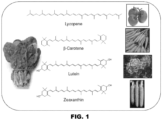
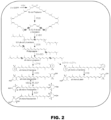
- Carotenoids are widely distributed isoprenoid pigments characterized by their bright yellow to red colors (for examples and biosynthesis, see Figures 1 and 2 ; for review see, references 6 and 10 from the list of references provided below). Carotenoids differ in the number of conjugated double bonds, the presence and type of cyclic end groups, and oxygen-containing functional group. Carotenoids are known as essential components of the photosynthetic apparat. In addition, they serve as a platform that is used by many organisms to generate bioactive compounds acting as hormones or chemical signals.
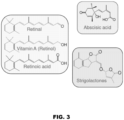
- retinol vitamin A
- retinoic acid retinoic acid
- retinal which are essential for vision and development in vertebrates
- abscisic acid and strigolactones which regulate different aspects of plant growth, development and adaptation to environment
- carotenoid-derived signaling molecules and growth regulators there are still unidentified plant carotenoid-derived signaling molecules and growth regulators, as indicated by different plant mutants and by studies on inhibitors of carotenoid biosynthesis. Examples of such compounds might be involved in the regulation of other processes in plants, such as lateral root formation (18), early chloroplast and leaf development (4), and carotenoid biosynthesis (8).
- CCOs carotenoid cleavage oxygenases
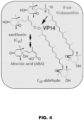
- NCEDs are involved in ABA biosynthesis ( Figure 4 ), providing the ABA precursor xanthoxin by cleaving the C10-C11' double bond in 9-cis-configured xanthophylls (epoxy-carotenoids), such as 9-cis-violaxanthin or 9' -cis- violaxanthin (17, 20).
- the second group is the carotenoid cleavage dioxygenaeses (CCD) that encompasses enzymes with different substrate-, stereo- and double bond specificities.
- CCD carotenoid cleavage dioxygenaeses
- CCD1 enzymes produce various carotenoid derived volatiles such as ⁇ -ionone and geranial.
- CCD4 enzyme activity is a negative regulator of carotenoid content in different tissue and is supposed to be involved in heat stress response.
- the two types, CCD7 and CCD8 catalyze two distinct steps in the biosynthesis of strigolactones (2) ( Figure 5 ).
- plant CCD8 enzymes do not cleave intact carotenoids, such as ⁇ -carotene, but only already cleaved carotenoids (apocarotenoids) (1).
- a further unique feature of this enzyme is its capability to form two totally different products, i.e.
- kits can also be prepared including, for example, the compounds or compositions, properly packaged, along with instructions for carrying out the methods of use.
- the invention relates to a method comprising promoting the growth of at least one plant as defined in appended claim 1.
- This method may make use of an effective amount of at least one composition comprising at least one compound which is represented by A-B-C, wherein B is a bivalent polyene moiety, A is a monovalent moiety as defined in claim 1 linked to B by a six-membered carbon ring, wherein the ring has at least one substituent linked to the ring by an oxygen atom, and C is a specific monovalent moiety as defined in claim 1 linked to B by a carbonyl group.
- the method may make use of a compound having the structure (IV) defined in claim 1 and hereinbelow.
- the bivalent polyene moiety B is a C 4 -C 20 hydrocarbon moiety with no heteroatoms.
- the bivalent polyene moiety B has three conjugated double bonds.
- the six-membered ring is a phenyl ring, a cyclohexane ring, a cyclohexadiene ring, or a cyclohexene ring.
- the monovalent moiety A consists of only one cyclohexene ring.
- the monovalent moiety A comprises a cyclohexene ring, and the cyclohexene ring has a double bond in conjugation with a double bond of the polyene moiety B.
- the monovalent moiety A, the substituent is a hydroxyl, ketone, epoxy, alkoxy, or polyether moiety.
- the monovalent moiety A is represented by:
- the monovalent moiety C linked to B by a carbonyl moiety is represented by -C(O)-R, wherein R is an alkyl group or a carboxylic acid group.
- C is represented by:
- the compound is represented by structure Z: wherein S 1 is an alkyl or a carboxylic acid group; wherein S 2 is an alkyl, carboxylic acid, or -CH 2 OH group; wherein S 3 is an alkyl, a carboxylic acid, or a -CH 2 OH group; and wherein S 4 is an alkyl, carboxylic acid, or -CH 2 OH group, wherein optionally S 1 , S 2 , S 3 , and S 4 are each methyl.
- the compound is 3-OH- ⁇ -apo-13-carotenone.
- the compound is one of the following structures (I) - (VIII):
- the compound is a first compound
- the composition further comprises at least one second compound different from the first and which also is a plant growth regulator, wherein optionally the second compound is auxin, cytokinin, gibberlin, or ethylene.
- the composition further comprises at least one aqueous solvent system.
- the composition further comprises at least one delivery compound which is different from the compound which is represented by A-B-C and which facilitates delivery of the compound which is represented by A-B-C for promoting the growth of at least one plant.
- the plant is a monocotyledon, a dicotyledon, a gymnosperm, a cereal, or an algae.
- Another embodiment is a plant propagation material treated with a composition as described and/or claimed herein.
- a third aspect of the invention is a compound represented by structure Z: wherein S 1 can be an alkyl or a carboxylic acid group; wherein S 2 can be an alkyl, carboxylic acid, or -CH 2 OH group; wherein S 3 can be an alkyl, a carboxylic acid, or a -CH 2 OH group; and wherein S 4 can be an alkyl, carboxylic acid, or -CH 2 OH group.
- the alkyl group can be, for example, a C 1 to C 4 alkyl.
- S 1 , S 2 , S 3 , and S 4 are each methyl.
- S 1 , S 2 , S 3 , and S 4 are each not methyl.
- the -OH moiety stereochemically can be above or below the cyclohexene ring.
- An advantage for at least some embodiments is improved plant root growth. Plant growth can be improved, and biomass can be enhanced. In addition, combinations of compounds can be used, and synergistic improvements can be observed with use of multiple compounds.
- An additional advantage for at least some embodiments includes use and potential use for a wide spectrum of plants.
- An additional advantage for at least some embodiments is the active ingredient is a natural compound rather than a synthetic compound. This can contribute to limited environmental impact and regulatory burden and reduced plant toxicity.
- Nomenclature for carotenoid compounds is generally known in the art.
- Plant growth promotion is generally known in the art. See, for example, US Patent Publication Nos. 2010/0179061 ; 2012/0172623 ; 2010/0331189 ; 2011/0088128 . See also, for example, L. M. Srivastava, Plant Growth and Development: Hormones and Environment, 2002 . See also, for example, US Patent No. 8,980,795 .
- One embodiment provides for a method comprising promoting the growth of at least one plant with use of an effective amount of at least one composition comprising an effective amount of at least one compound which is represented by structure (IV) or by A-B-C, wherein B is a bivalent polyene moiety, A is a monovalent moiety as defined in claim 1 linked to B by a cyclohexene or cyclohexane ring, wherein the ring has at least one substituent linked to the ring by an oxygen atom, and C is a monovalent moiety as defined in claim 1 and linked to B by a carbonyl group.
- B is a bivalent polyene moiety
- A is a monovalent moiety as defined in claim 1 linked to B by a cyclohexene or cyclohexane ring, wherein the ring has at least one substituent linked to the ring by an oxygen atom
- C is a monovalent moiety as defined in claim 1 and linked to B by a carbonyl group.
- a compound which can be made and used by methods described herein, can be represented by A-B-C, wherein B is a bivalent polyene moiety, A is a monovalent moiety linked to B by a six-membered carbon ring, wherein the ring has at least one substituent linked to the ring by an oxygen atom, and C is a monovalent moiety linked to B by a carbonyl group.
- Polyene moieties whether oligomeric or polymeric, are generally known in the art. See, for example, reference 10; or Anslyn, Dougherty, Modern Physical Organic Chemistry, 2006, Chapter 17 on Organic Electronic Materials , for example.
- Polyenes can comprise conjugated ethylenically unsaturated double bonds as in oligomeric or polymeric polyacetylene moieties.
- the polyenes can be extensively or fully conjugated.
- the polyene chain can be understood to have a backbone with optional substituents, replacing hydrogen.
- the polyene chain can be unsubstitued or substituted.
- an alkyl group such as a C 1 -C 6 alkyl group such as a methyl or ethyl can replace a hydrogen.
- alkoxy group such as methoxy or ethoxy can replace hydrogen.
- the polyene moiety can be an all hydrocarbon chain whether substituted or unsubstituted.
- the bivalent polyene moiety B is a hydrocarbon moiety with no heteroatoms. In another embodiment, the bivalent polyene moiety B is a C 4 -C 20 hydrocarbon moiety with no heteroatoms. In another embodiment, the bivalent polyene moiety B is a C 5 -C 10 hydrocarbon moiety with no heteroatoms.
- an alkyl group such as a C 1 -C 6 alkyl group such as a methyl or ethyl can replace a hydrogen in the polyene.
- the substituent can be a hydrocarbon comprising only carbon and hydrogen and being free of a heteroatom such as oxygen or nitrogen.
- alkoxy group such as methoxy or ethoxy can replace hydrogen.
- the bivalent polyene moiety B has two to ten double bonds. In another embodiment, the bivalent polyene moiety B has two to four double bonds. In one embodiment, the bivalent polyene moiety B has three double bonds which can be three conjugated double bonds.
- the double bonds of bivalent polyene moiety B are in an all trans configuration.
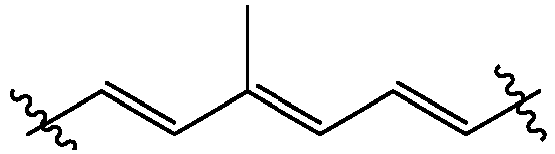
- the bivalent polyene moiety B is a C 7 hydrocarbon moiety with one methyl substituent and no heteroatoms represented by:
- monovalent moiety A For monovalent moiety A, six-membered carbon rings are known in the art, whether saturated or unsaturated, including phenyl, cyclohexane cyclohexadiene, and cyclohexene rings. More particularly, the ionone moiety with a single cyclohexene ring is particularly known in the carotenoid art. In one embodiment, the monovalent moiety A consists of only one cyclohexene ring.
- the cyclohexene ring can be of the ⁇ or ⁇ ring types as known in the carotenoid art, as shown below:
- the cyclohexene ring of monovalent moiety A has a double bond in conjugation with a double bond of the polyene moiety B.
- the monovalent moiety A is a C 6 -C 12 moiety.
- the monovalent moiety A is a C 9 moiety.
- the substituent is a hydroxyl, ketone, epoxy, alkoxy, or polyether moiety. In another embodiment, the substituent is a hydroxyl moiety.
- the compound is represented by: wherein RO- is the substituent and R can be, for example, hydrogen (RO- is then hydroxyl substituent), an alkyl group such as a C 1 -C 12 alkyl group (RO- is then alkoxy substituent), or a monovalent group comprising ether moiety such as RO-R- or RO-RO-R- wherein R is a monovalent C 1 -C 12 alkyl group or a bivalent C 1 -C 12 alkylene group (RO-is then a polyether substituent).
- R can be, for example, hydrogen (RO- is then hydroxyl substituent), an alkyl group such as a C 1 -C 12 alkyl group (RO- is then alkoxy substituent), or a monovalent group comprising ether moiety such as RO-R- or RO-RO-R- wherein R is a monovalent C 1 -C 12 alkyl group or a bivalent C 1 -C 12 alkylene group (RO-is then a polyether substituent
- the monovalent moiety A can be represented by formula X:
- the monovalent moiety A can be represented by formula XX:
- R 1 and R 2 independently can be, for example, hydrogen or an alkyl group such as a C 1 -C 6 alkyl group, or a C 1 -C 3 alkyl group, including methyl. In one embodiment, R 1 and R 2 are each methyl.
- R 3 and R 4 independently can be, for example, hydrogen or an alkyl group such as a C 1 -C 6 alkyl group, or a C 1 -C 3 alkyl group, including methyl. In one embodiment, R 3 and R 4 are each hydrogen. Alternatively R 3 and R 4 can be a ketone group, or a group comprising oxygen.
- R 5 and R 6 independently can be, for example, hydrogen, a monovalent moiety comprising oxygen such as hydroxyl or carboxyl, or an alkyl group such as a C 1 -C 6 alkyl group, or a C 1 -C 3 alkyl group, including methyl.
- R 5 is hydroxyl and R 6 is hydrogen.
- the stereochemistry for R 5 and R 6 and the cyclohexane ring can be represented by: wherein R 5 is R x O- and R 6 is hydrogen, and R x can be hydrogen.
- the monovalent moiety A is represented by:
- R 7 , R 8 , and R 9 independently can be, for example, hydrogen or an alkyl group such as a C 1 -C 6 alkyl group, or a C 1 -C 3 alkyl group, including methyl. In one embodiment, for formula X, R 7 and R 8 are hydrogen and R 9 is methyl.
- plant growth regulators which can be formulated into the composition include, for example, auxins, cytokinins (CKs), gibberellins (GBs), abscisic acid (ABA), and ethylene.
- plant growth regulators include, for example, brassinosteroids, salicylic acid, jasmonates, plant peptide hormones, polyamines, nitric oxide (NO), strigolactones, and karrikins.
- the compound is a first compound
- the composition further comprises at least one second compound different from the first which also is a plant growth regulator, wherein the second compound is, for example, auxin, cytokinin, gibberlin, or ethylene.
- the compound is a first compound
- the composition further comprises at least one second compound different from the first which also is a plant growth regulator, wherein the second compound is auxin.
- the composition further comprises at least one solvent or at least one solvent system including an aqueous solvent system.
- the composition further comprises water.
- water is the only solvent used.
- the solvent composition can be formulated for a particular application. For example, concentrations can be varied, co-solvents can be used, and additives can be included.
- the rest of the composition can be the adjuvant(s) such as carrier(s), solvent(s), and surface active agent(s).
- adjuvant(s) such as carrier(s), solvent(s), and surface active agent(s).
- Plants modify the architecture of their roots depending on the growth conditions and nutrients and water availability. Under phosphate deficiency, plants increase the root-to-shoot ratio and, in many cases, develop a shallower root system with shorter primary roots, denser root hairs, and more and longer lateral roots. This root architecture provides better access to phosphate, which usually accumulates in the upper part of the soil, a strategy designated as "topsoil foraging" (12; 14), while deeper roots improve growth under drought conditions (14).
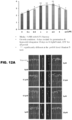
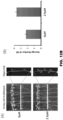
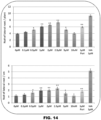
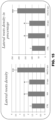
- Dicotyledonous plants do not develop crown roots but can produce adventitious roots that, originate from stems, similar to the crown roots, or from other non-root tissues. Therefore, we tested whether ⁇ -apo-13-carotenone can also induce adventitious root formation in the model plant Arabidopsis thaliana. As shown in Figures 12A and 12B , the compound exerted a clear induction on the number of hypocotyl-derived adventitious roots that usually arise spontaneously after dark-light transition. Highest activity - around 50% increase, was obtained with 2.5 ⁇ M concentrations ( Figures 12A and 12B ). Similar results were obtained with wounding induced hypocotyl-derived adventitious roots (not shown).
Landscapes
- Life Sciences & Earth Sciences (AREA)
- Organic Chemistry (AREA)
- Chemical & Material Sciences (AREA)
- Health & Medical Sciences (AREA)
- Environmental Sciences (AREA)
- Engineering & Computer Science (AREA)
- Dentistry (AREA)
- General Health & Medical Sciences (AREA)
- Wood Science & Technology (AREA)
- Zoology (AREA)
- Plant Pathology (AREA)
- Agronomy & Crop Science (AREA)
- Pest Control & Pesticides (AREA)
- Insects & Arthropods (AREA)
- Agricultural Chemicals And Associated Chemicals (AREA)
- Breeding Of Plants And Reproduction By Means Of Culturing (AREA)
- Cultivation Of Plants (AREA)
Claims (15)
- Verfahren, umfassend das Fördern des Wachstums mindestens einer Pflanze unter Verwendung einer wirksamen Menge mindestens einer Zusammensetzung, die eine wirksame Menge mindestens einer Verbindung umfasst, die durch Struktur (IV):
 oder durch A-B-C wiedergegeben wird, wobei B für eine zweiwertige Polyengruppierung steht,A für eine einwertige Gruppierung steht, die einen sechsgliedrigen Kohlenstoffring umfasst und über den sechsgliedrigen Kohlenstoffring mit B verknüpft ist, wobei der sechsgliedrige Ring mindestens einen ein Sauerstoffatom umfassenden Substituenten aufweist, wobei der Substituent über das Sauerstoffatom mit dem sechsgliedrigen Ring verknüpft ist, undC für eine einwertige Gruppierung steht, die eine Carbonylgruppierung mit der Struktur -C(O)-R umfasst, die über die Carbonylgruppe mit B verknüpft ist, wobei R für eine Alkylgruppe oder eine Carbonsäuregruppe steht.
 - Verfahren nach Anspruch 1, wobei es sich bei der zweiwertigen Polyengruppierung um eine C4-C20-Kohlenwasserstoffgruppierung ohne Heteroatome handelt, vorzugsweise wobei die zweiwertige Polyengruppierung B drei konjugierte Doppelbindungen aufweist.
- Verfahren nach Anspruch 1 oder 2, wobei die Doppelbindungen der zweiwertigen Polyengruppierung B in einer all-trans-Konfiguration vorliegen, vorzugsweise wobei B durch Folgendes wiedergegeben wird:
- Verfahren nach einem der Ansprüche 1-3, wobei es sich bei dem sechsgliedrigen Ring um einen ungesättigten Ring handelt.
- Verfahren nach einem der Ansprüche 1-3, wobei es sich bei dem sechsgliedrigen Ring um einen Phenylring, einen Cyclohexanring, einen Cyclohexadienring oder einen Cyclohexenring handelt.
- Verfahren nach einem der Ansprüche 1-5, wobei die einwertige Gruppierung A einen Cyclohexenring umfasst und der Cyclohexenring eine Doppelbindung in Konjugation mit einer Doppelbindung der Polyengruppierung B aufweist.
- Verfahren nach einem der Ansprüche 1-6, wobei es sich in der einwertigen Gruppierung A bei dem Substituenten um eine Hydroxyl-, Keton-, Epoxy-, Alkoxy- oder Polyethergruppierung handelt, vorzugsweise wobei die einwertige Gruppierung A durch Folgendes wiedergegeben wird:

- Verfahren nach einem der Ansprüche 1-7, wobei C durch Folgendes wiedergegeben wird:

- Verfahren nach einem der Ansprüche 1-8, wobei die Verbindung durch Struktur Z wiedergegeben wird:

- Verfahren nach einem der Ansprüche 1-9, wobei die Verbindung durch Folgendes wiedergegeben wird:

- Verfahren nach einem der Ansprüche 1-10, wobei es sich bei der Verbindung um 3-β-OH-Apo-13-carotinon handelt.
- Verfahren nach einem der Ansprüche 1-11, wobei es sich bei der Verbindung um eine erste Verbindung handelt und die Zusammensetzung ferner mindestens eine zweite Verbindung umfasst, die von der ersten verschieden ist und die ebenfalls ein Pflanzenwachstumsregulator ist, wobei es sich gegebenenfalls bei der zweiten Verbindung um Auxin, Cytokinin, Gibberlin oder Ethylen handelt.
- Verfahren nach einem der Ansprüche 1-12, wobei die Zusammensetzung ferner mindestens eine Verbindung umfasst, die von der Verbindung, die durch die Struktur (IV) oder A-B-C wiedergegeben wird, verschieden ist, und die die Zuführung der Verbindung, die durch die Struktur (IV) oder A-B-C wiedergegeben wird, zur Förderung des Wachstums mindestens einer Pflanze erleichtert.
- Zusammensetzung zur Förderung des Wachstums mindestens einer Pflanze, wobei die Zusammensetzung Folgendes umfasst:(i) mindestens eine Verbindung, die durch die Struktur (IV):
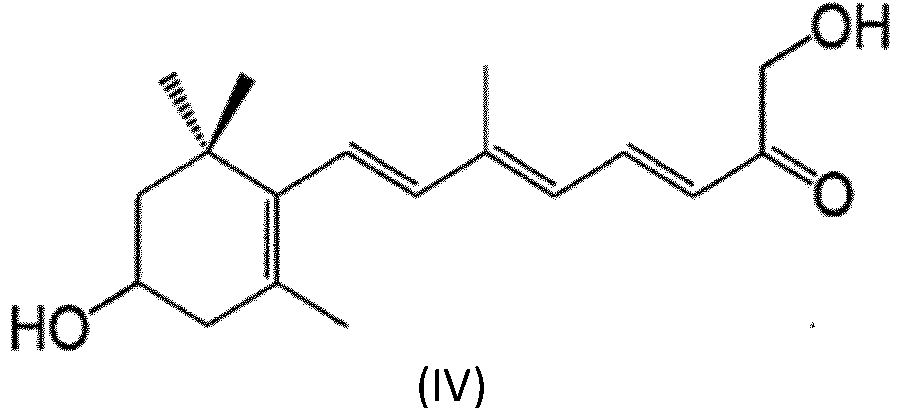 oder durch A-B-C wiedergegeben wird, wobeiB für eine zweiwertige Polyengruppierung steht,A für eine einwertige Gruppierung steht, die einen sechsgliedrigen Ring umfasst und über den sechsgliedrigen Kohlenstoffring mit B verknüpft ist, wobei der Ring mindestens einen ein Sauerstoffatom umfassenden Substituenten aufweist, wobei der Substituent über das Sauerstoffatom mit dem Ring verknüpft ist, undC für eine einwertige Gruppierung steht, die eine Carbonylgruppierung mit der Struktur -C(O)-R umfasst, die über eine Carbonylgruppe mit B verknüpft ist, wobei R für eine Alkylgruppe oder eine Carbonsäuregruppe steht; und(ii) mindestens eine Verbindung, die von Verbindung (i) verschieden ist und die die Zuführung von Verbindung (i) zur Förderung des Wachstums mindestens einer Pflanze erleichtert.
 - Verbindung, wiedergegeben durch Struktur Z:

Applications Claiming Priority (2)
| Application Number | Priority Date | Filing Date | Title |
|---|---|---|---|
| US201562186705P | 2015-06-30 | 2015-06-30 | |
| PCT/IB2016/001058 WO2017001927A1 (en) | 2015-06-30 | 2016-06-28 | Plant growth promoters and methods of using them |
Publications (2)
| Publication Number | Publication Date |
|---|---|
| EP3322294A1 EP3322294A1 (de) | 2018-05-23 |
| EP3322294B1 true EP3322294B1 (de) | 2025-06-25 |
Family
ID=57394611
Family Applications (1)
| Application Number | Title | Priority Date | Filing Date |
|---|---|---|---|
| EP16801287.0A Active EP3322294B1 (de) | 2015-06-30 | 2016-06-28 | Pflanzenwachstumsförderer und verfahren zu ihrer verwendung |
Country Status (5)
| Country | Link |
|---|---|
| US (1) | US10888090B2 (de) |
| EP (1) | EP3322294B1 (de) |
| ES (1) | ES3046839T3 (de) |
| PL (1) | PL3322294T3 (de) |
| WO (1) | WO2017001927A1 (de) |
Families Citing this family (8)
| Publication number | Priority date | Publication date | Assignee | Title |
|---|---|---|---|---|
| US20180325103A1 (en) * | 2017-04-03 | 2018-11-15 | Spogen Biotech Inc. | Agricultural compositions for improved crop productivity and enhanced phenotypes |
| US11399538B2 (en) * | 2017-06-26 | 2022-08-02 | King Abdullah University Of Science And Technology | Plant growth promoter with strigolactones regulation activities |
| KR20200031144A (ko) | 2017-07-20 | 2020-03-23 | 스포겐 바이오테크 인코포레이티드 | 식물 보호, 성장 및 생산성 향상을 위한 생물활성 폴리펩타이드 |
| US11523610B2 (en) | 2018-03-21 | 2022-12-13 | King Abdullah University Of Science And Technology | Regulating plant growth using a diapocarotenoid |
| CN109321510B (zh) * | 2018-09-29 | 2021-08-20 | 昆明理工大学 | 独脚金内酯在促进单针藻油脂积累中的应用 |
| US12144344B2 (en) | 2018-11-09 | 2024-11-19 | Duke University | Compositions and methods for modulating root growth |
| US20220400669A1 (en) * | 2019-10-24 | 2022-12-22 | King Abdullah University Of Science And Technology | Compounds and methods for promoting plant growth |
| JP7605458B2 (ja) | 2020-12-16 | 2024-12-24 | 株式会社サウスプロダクト | アレン構造を持つカロテノイドの生産方法 |
Family Cites Families (19)
| Publication number | Priority date | Publication date | Assignee | Title |
|---|---|---|---|---|
| EP0371882A3 (de) * | 1988-12-01 | 1991-04-24 | Her Majesty In Right Of Canada As Represented By The National Research Council Of Canada | Abscisine säureähnliche Pflanzenwachstumsregulatoren-Keimungspromotoren |
| US7132458B2 (en) | 1994-08-10 | 2006-11-07 | Chemaphor Inc. | Oxidized carotenoid fractions and ketoaldehyde useful as cell-differentiation inducers, cytostatic agents, and anti-tumor agents |
| AU1348297A (en) | 1995-12-21 | 1997-07-14 | Basf Corporation | Enhancing the rate of seed germination with application of ethylene biosynthesis inhibitors |
| JPH09208407A (ja) | 1996-02-08 | 1997-08-12 | Sagami Chem Res Center | 植物成長促進剤 |
| DK1806982T3 (en) | 2004-09-28 | 2018-11-19 | Avivagen Inc | COMPOSITIONS AND PROCEDURES FOR PROMOTING WEIGHT ADMINISTRATION AND FOOD TRAFFIC |
| JP5080467B2 (ja) | 2005-07-21 | 2012-11-21 | デ・セイシャス・ボアヴィダ・フェレイラ、ヒカルド・マヌエル | ルピナス属の植物から抽出され又は形質転換型で製造されるタンパク質、及びその使用方法 |
| WO2007043046A2 (en) | 2005-10-11 | 2007-04-19 | Lycored Ltd. | Carotenoid oxidation products as chemopreventive and chemotherapeutic agents |
| WO2008072458A1 (ja) | 2006-12-13 | 2008-06-19 | Panasonic Corporation | プラズマディスプレイ装置およびプラズマディスプレイパネルの駆動方法 |
| EP1938689A1 (de) * | 2006-12-18 | 2008-07-02 | Bayer CropScience AG | Penetrationsförderer für Herbizide |
| WO2008146873A1 (ja) | 2007-05-30 | 2008-12-04 | Nisshin Pharma Inc. | 植物生長促進剤 |
| US20100331189A1 (en) | 2008-02-28 | 2010-12-30 | Tokai University Educational System | Plant Growth Promoter Utilizing Potato Cyst Nematode |
| US7858828B2 (en) | 2008-03-26 | 2010-12-28 | University Of Maryland, College Park | Process for synthesis of (3R,3'R,6'R)-lutein and its stereoisomers |
| NZ590512A (en) * | 2008-07-24 | 2012-08-31 | Valent Biosciences Corp | Use of plant growth regulators abscisic acid (aba) and cytokinin to reduce aba related plant leaf yellowing |
| US8519173B2 (en) | 2009-09-16 | 2013-08-27 | Shiseido Company, Ltd. | Plant growth regulator |
| EA201391310A1 (ru) * | 2011-03-21 | 2014-03-31 | Зе Гавернэс Оф Зе Юниверсити Оф Альберта | Регуляторы роста растений на основе ауксина |
| US20120252673A1 (en) * | 2011-03-29 | 2012-10-04 | Stoller Enterprises, Inc. | Composition and method for stress mitigation in plants |
| EP2518062A1 (de) | 2011-04-28 | 2012-10-31 | Albert-Ludwigs-Universität Freiburg | Neuartige Strigolacton-Analoga und deren Verwendung |
| CN104135862B (zh) | 2012-02-13 | 2016-01-13 | 先正达参股股份有限公司 | 植物生长调节 |
| MX368229B (es) | 2012-05-14 | 2019-09-25 | Syngenta Participations Ag | Compuestos reguladores del crecimiento vegetal. |
-
2016
- 2016-06-28 WO PCT/IB2016/001058 patent/WO2017001927A1/en not_active Ceased
- 2016-06-28 ES ES16801287T patent/ES3046839T3/es active Active
- 2016-06-28 PL PL16801287.0T patent/PL3322294T3/pl unknown
- 2016-06-28 US US15/738,928 patent/US10888090B2/en active Active
- 2016-06-28 EP EP16801287.0A patent/EP3322294B1/de active Active
Also Published As
| Publication number | Publication date |
|---|---|
| WO2017001927A1 (en) | 2017-01-05 |
| US10888090B2 (en) | 2021-01-12 |
| ES3046839T3 (en) | 2025-12-02 |
| PL3322294T3 (pl) | 2025-11-12 |
| US20180184651A1 (en) | 2018-07-05 |
| EP3322294A1 (de) | 2018-05-23 |
Similar Documents
| Publication | Publication Date | Title |
|---|---|---|
| EP3322294B1 (de) | Pflanzenwachstumsförderer und verfahren zu ihrer verwendung | |
| Rosas-Saavedra et al. | Biosynthesis of carotenoids in plants: enzymes and color | |
| Rai et al. | Biotechnological advances in guava (Psidium guajava L.): recent developments and prospects for further research | |
| Sarropoulou et al. | Melatonin enhances root regeneration, photosynthetic pigments, biomass, total carbohydrates and proline content in the cherry rootstock PHL-C (Prunus avium× Prunus cerasus) | |
| Walter et al. | Carotenoids and their cleavage products: biosynthesis and functions | |
| Norris et al. | Genetic dissection of carotenoid synthesis in arabidopsis defines plastoquinone as an essential component of phytoene desaturation. | |
| Taylor et al. | Carotenoid biosynthesis in plant storage organs: recent advances and prospects for improving plant food quality | |
| Zeevaart | Abscisic acid metabolism and its regulation | |
| Hannoufa et al. | Regulation of carotenoid accumulation in plants | |
| Oritani et al. | Biosynthesis and metabolism of abscisic acid and related compounds | |
| CA2647900C (en) | Inhibitors of a 9-cis-epoxycarotenoid dioxygenase | |
| Ilg et al. | Overexpression of the rice carotenoid cleavage dioxygenase 1 gene in Golden Rice endosperm suggests apocarotenoids as substrates in planta | |
| Baranski et al. | Carotenoid biosynthesis and regulation in plants | |
| Li et al. | β-Carotene accumulation induced by the cauliflower Or gene is not due to an increased capacity of biosynthesis | |
| van den Berg et al. | Jasmonates and their role in plant growth and development, with special reference to the control of potato tuberization: a review | |
| Arcos et al. | Boosting carotenoid content in Malus domestica var. Fuji by expressing AtDXR through an Agrobacterium‐mediated transformation method | |
| Hai et al. | Involvement of carotenoid cleavage dioxygenase 4 gene in tepal color change in Lilium brownii var. colchesteri | |
| Jia et al. | Genetic transformation of the astaxanthin biosynthetic genes bkt and crtR-B into apple tree to increase photooxidation resistance | |
| Li et al. | Advances in carotenoid and apocarotenoid metabolisms and functions in plants | |
| Cazzonelli et al. | Biosynthesis and regulation of carotenoids in plants—micronutrients, vitamins and health benefits | |
| Boyd et al. | Sesquiterpene-like inhibitors of a 9-cis-epoxycarotenoid dioxygenase regulating abscisic acid biosynthesis in higher plants | |
| Al-Babili | Plant growth promoters and methods of using them | |
| Fu et al. | Capsanthin/Capsorubin Synthase Expression in Tomato Alters Carotenoid Pools, Enhancing Provitamin A and Flavor Volatiles | |
| Maffei et al. | Anatomy, physiology, biosynthesis, molecular biology, tissue culture, and biotechnology of mint essential oil production | |
| Wrightstone et al. | ORANGE family proteins: multifunctional chaperones shaping plant carotenoid level, plastid development, stress tolerance, and more |
Legal Events
| Date | Code | Title | Description |
|---|---|---|---|
| STAA | Information on the status of an ep patent application or granted ep patent |
Free format text: STATUS: UNKNOWN |
|
| STAA | Information on the status of an ep patent application or granted ep patent |
Free format text: STATUS: THE INTERNATIONAL PUBLICATION HAS BEEN MADE |
|
| PUAI | Public reference made under article 153(3) epc to a published international application that has entered the european phase |
Free format text: ORIGINAL CODE: 0009012 |
|
| STAA | Information on the status of an ep patent application or granted ep patent |
Free format text: STATUS: REQUEST FOR EXAMINATION WAS MADE |
|
| 17P | Request for examination filed |
Effective date: 20180110 |
|
| AK | Designated contracting states |
Kind code of ref document: A1 Designated state(s): AL AT BE BG CH CY CZ DE DK EE ES FI FR GB GR HR HU IE IS IT LI LT LU LV MC MK MT NL NO PL PT RO RS SE SI SK SM TR |
|
| AX | Request for extension of the european patent |
Extension state: BA ME |
|
| DAV | Request for validation of the european patent (deleted) | ||
| DAX | Request for extension of the european patent (deleted) | ||
| STAA | Information on the status of an ep patent application or granted ep patent |
Free format text: STATUS: EXAMINATION IS IN PROGRESS |
|
| 17Q | First examination report despatched |
Effective date: 20200326 |
|
| GRAP | Despatch of communication of intention to grant a patent |
Free format text: ORIGINAL CODE: EPIDOSNIGR1 |
|
| STAA | Information on the status of an ep patent application or granted ep patent |
Free format text: STATUS: GRANT OF PATENT IS INTENDED |
|
| INTG | Intention to grant announced |
Effective date: 20250121 |
|
| GRAS | Grant fee paid |
Free format text: ORIGINAL CODE: EPIDOSNIGR3 |
|
| GRAA | (expected) grant |
Free format text: ORIGINAL CODE: 0009210 |
|
| STAA | Information on the status of an ep patent application or granted ep patent |
Free format text: STATUS: THE PATENT HAS BEEN GRANTED |
|
| AK | Designated contracting states |
Kind code of ref document: B1 Designated state(s): AL AT BE BG CH CY CZ DE DK EE ES FI FR GB GR HR HU IE IS IT LI LT LU LV MC MK MT NL NO PL PT RO RS SE SI SK SM TR |
|
| REG | Reference to a national code |
Ref country code: GB Ref legal event code: FG4D |
|
| REG | Reference to a national code |
Ref country code: CH Ref legal event code: EP |
|
| REG | Reference to a national code |
Ref country code: CH Ref legal event code: EP |
|
| REG | Reference to a national code |
Ref country code: IE Ref legal event code: FG4D |
|
| REG | Reference to a national code |
Ref country code: DE Ref legal event code: R096 Ref document number: 602016092674 Country of ref document: DE |
|
| PG25 | Lapsed in a contracting state [announced via postgrant information from national office to epo] |
Ref country code: FI Free format text: LAPSE BECAUSE OF FAILURE TO SUBMIT A TRANSLATION OF THE DESCRIPTION OR TO PAY THE FEE WITHIN THE PRESCRIBED TIME-LIMIT Effective date: 20250625 |
|
| REG | Reference to a national code |
Ref country code: LT Ref legal event code: MG9D |
|
| PG25 | Lapsed in a contracting state [announced via postgrant information from national office to epo] |
Ref country code: GR Free format text: LAPSE BECAUSE OF FAILURE TO SUBMIT A TRANSLATION OF THE DESCRIPTION OR TO PAY THE FEE WITHIN THE PRESCRIBED TIME-LIMIT Effective date: 20250926 Ref country code: NO Free format text: LAPSE BECAUSE OF FAILURE TO SUBMIT A TRANSLATION OF THE DESCRIPTION OR TO PAY THE FEE WITHIN THE PRESCRIBED TIME-LIMIT Effective date: 20250925 |
|
| PG25 | Lapsed in a contracting state [announced via postgrant information from national office to epo] |
Ref country code: BG Free format text: LAPSE BECAUSE OF FAILURE TO SUBMIT A TRANSLATION OF THE DESCRIPTION OR TO PAY THE FEE WITHIN THE PRESCRIBED TIME-LIMIT Effective date: 20250625 |
|
| PG25 | Lapsed in a contracting state [announced via postgrant information from national office to epo] |
Ref country code: HR Free format text: LAPSE BECAUSE OF FAILURE TO SUBMIT A TRANSLATION OF THE DESCRIPTION OR TO PAY THE FEE WITHIN THE PRESCRIBED TIME-LIMIT Effective date: 20250625 |
|
| PG25 | Lapsed in a contracting state [announced via postgrant information from national office to epo] |
Ref country code: RS Free format text: LAPSE BECAUSE OF FAILURE TO SUBMIT A TRANSLATION OF THE DESCRIPTION OR TO PAY THE FEE WITHIN THE PRESCRIBED TIME-LIMIT Effective date: 20250925 |
|
| REG | Reference to a national code |
Ref country code: CH Ref legal event code: U11 Free format text: ST27 STATUS EVENT CODE: U-0-0-U10-U11 (AS PROVIDED BY THE NATIONAL OFFICE) Effective date: 20251027 |
|
| PG25 | Lapsed in a contracting state [announced via postgrant information from national office to epo] |
Ref country code: LV Free format text: LAPSE BECAUSE OF FAILURE TO SUBMIT A TRANSLATION OF THE DESCRIPTION OR TO PAY THE FEE WITHIN THE PRESCRIBED TIME-LIMIT Effective date: 20250625 |
|
| REG | Reference to a national code |
Ref country code: NL Ref legal event code: MP Effective date: 20250625 |
|
| PG25 | Lapsed in a contracting state [announced via postgrant information from national office to epo] |
Ref country code: NL Free format text: LAPSE BECAUSE OF FAILURE TO SUBMIT A TRANSLATION OF THE DESCRIPTION OR TO PAY THE FEE WITHIN THE PRESCRIBED TIME-LIMIT Effective date: 20250625 |
|
| REG | Reference to a national code |
Ref country code: ES Ref legal event code: FG2A Ref document number: 3046839 Country of ref document: ES Kind code of ref document: T3 Effective date: 20251202 |
|
| PG25 | Lapsed in a contracting state [announced via postgrant information from national office to epo] |
Ref country code: PT Free format text: LAPSE BECAUSE OF FAILURE TO SUBMIT A TRANSLATION OF THE DESCRIPTION OR TO PAY THE FEE WITHIN THE PRESCRIBED TIME-LIMIT Effective date: 20251027 |
|
| REG | Reference to a national code |
Ref country code: AT Ref legal event code: MK05 Ref document number: 1805468 Country of ref document: AT Kind code of ref document: T Effective date: 20250625 |