EP1925608A1 - Procédé de production d'hydrolysat - Google Patents
Procédé de production d'hydrolysat Download PDFInfo
- Publication number
- EP1925608A1 EP1925608A1 EP06796580A EP06796580A EP1925608A1 EP 1925608 A1 EP1925608 A1 EP 1925608A1 EP 06796580 A EP06796580 A EP 06796580A EP 06796580 A EP06796580 A EP 06796580A EP 1925608 A1 EP1925608 A1 EP 1925608A1
- Authority
- EP
- European Patent Office
- Prior art keywords
- organic compound
- water
- reaction
- hydrolysis reaction
- mixer
- Prior art date
- Legal status (The legal status is an assumption and is not a legal conclusion. Google has not performed a legal analysis and makes no representation as to the accuracy of the status listed.)
- Granted
Links
- 0 C*CCC(C1C(C2)C1C)C2C1CCC1 Chemical compound C*CCC(C1C(C2)C1C)C2C1CCC1 0.000 description 2
- QBHFVLAJPUIHGQ-UHFFFAOYSA-N C(C(CC1CCCC1)C1CCC1)C1COC1 Chemical compound C(C(CC1CCCC1)C1CCC1)C1COC1 QBHFVLAJPUIHGQ-UHFFFAOYSA-N 0.000 description 1
Images

Classifications
-
- C—CHEMISTRY; METALLURGY
- C07—ORGANIC CHEMISTRY
- C07C—ACYCLIC OR CARBOCYCLIC COMPOUNDS
- C07C41/00—Preparation of ethers; Preparation of compounds having groups, groups or groups
- C07C41/01—Preparation of ethers
- C07C41/18—Preparation of ethers by reactions not forming ether-oxygen bonds
- C07C41/26—Preparation of ethers by reactions not forming ether-oxygen bonds by introduction of hydroxy or O-metal groups
Definitions
- the present invention relates to a method for producing a hydrolysate.
- glyceryl ether obtained by ring-opening reaction of glycidyl ether is a compound useful as a solvent, an emulsifier, a dispersant, a detergent, a foam booster and the like.
- glyceryl ether is produced using a catalyst in general, as a method for producing glyceryl ether without using a catalyst, for example, a method in which glycidyl ether is brought into a hydrolysis reaction with subcritical water or the like has been known (see Patent Reference 1).
- Patent Reference 1 Japanese Laid-Open Publication No. 2002-88000 .
- the present invention provides a method for effectively producing a high quality hydrolysate by making a mixture state of an organic compound and water be a good condition for reaction.
- the present invention is directed to a method for producing a hydrolysate in which an organic compound and water are mixed and a hydrolysis reaction of the organic compound is performed.
- the mixing is performed under shear flow of the organic compound and the water at a shear rate U/Dmin of 5.5 sec -1 or more (where Dmin is a flow channel minimum inner diameter (mm) in a mixing section and U is a flow rate (mm/sec) of a mixture of the organic compound and the water in the mixing section), and the hydrolysis reaction of the organic compound is performed at a reaction temperature of 150 °C to 350 °C and a reaction pressure equal to or higher than a saturation vapor pressure of the water.
- the present invention is characterized in that when an organic compound and water are mixed to perform a hydrolysis reaction of the organic compound, under predetermined conditions, the organic compound and water are mixed and hydrolysis of the organic compound is performed.
- decomposition and a side reaction of an organic compound as a raw material can be suppressed in the hydrolysis reaction and thus deterioration of hue of the generated hydrolysate and the like can be prevented. Furthermore, according to the present invention, since the hydrolysis reaction is performed under a high temperature condition, the reaction can proceed with high selectivity even without using a catalyst, the step of removing a catalyst from a reactant is not necessary, and a high quality hydrolysate can be efficiently produced.
- components and the like described below can be used independently or two or more of the components can be combined and then used.
- an organic compound used as a raw material is not particularly limited as long as it is a compound which can be decomposed through hydrolysis.
- the hydrolysis reaction is preferably a ring-opening reaction using water.
- an organic compound used as a raw material is preferably a compound which has a ring structure and of which ring structure is opened due to the hydrolysis reaction.
- glycidyl ether expressed by the following general formula (I) is preferable.
- Gryceryl ether obtained by ring-opening of glycidyl ether is a compound useful as a solvent, an emulsifier, a dispersant, a detergent, a foam booster and the like.
- hydrocarbon group denoted by R in which part or all hydrogen atoms may be replaced with fluorine atoms and of which carbon number is 1 to 20, for example, a straight-chain or branched-chain alkyl group of which carbon number is 1 to 20, a straight-chain or branched-chain alkenyl group of which carbon number is 2 to 20, an aryl group of which carbon number is 6 to 14 or the like may be used.
- hydrocarbon group specifically, a methyl group, an ethyl group, a n-propyl group, a n-butyl group, a n-pentyl group, a n-hexyl group, a n-heptyl group, a n-octyl group, a n-nonyl group, a n-decyl group, a n-dodecyl group, a tetradecyl group, a hexadecyl group, an octadecyl group, an eicosyl group, a 2-propyl group, a 2-butyl group, a 2-methyl-2-propyl group, a 2-pentyl group, a 3-pentyl group, a 2-hexyl group, a 3-hexyl group, a 2-octyl group, a 2-ethylhexyl group, a phen
- hydrocarbon group in which hydrogen atoms are replaced with fluorine atoms for example, there are a perfluoroalkyl group such as a nanofluorohexyl group, a hexafluorohexyl group, a tridecafluorooctyl group, a heptadecafluorooctyl group, a heptadecafluorodecyl group and the like, obtained by replacing hydrogen atoms of the above-described hydrocarbon groups with fluorine atoms in an arbitrary manner without particular limits of the degree and location of replacement.
- a perfluoroalkyl group such as a nanofluorohexyl group, a hexafluorohexyl group, a tridecafluorooctyl group, a heptadecafluorooctyl group, a heptadecafluorodecyl group and the like, obtained by replacing hydrogen atom
- oxyalkylene group denoted by OA of which carbon number is 2 to 4 are alkylene oxide such as an oxyethylene group, an oxytrimethylene group, an oxypropylene group, an oxybutylene group and the like.
- the carbon number of the hydrocarbon group denoted as R is preferably 1 to 12 in view of improving selectivity.
- p a number of 0 to 6 is preferable and 0 is more preferable.
- glycidyl ether preferably used as a raw material
- n-butylglycidyl ether 2-methyl-propylglycidyl ether, n-pentylglycidyl ether, 2-methy-butylglycidyl ether, n-hexylglycidyl ether, 2-methyl-pentylglycidyl ether, phenylglycidyl ether, n-octylglycidyl ether, 2-ethyl-hexylglycidyl ether, isodecylglycidyl ether, n-stearylglycidyl ether and the like
- n-butylglycidyl ether 2-methyl-propylglycidyl ether
- n-pentylglycidyl ether 2-methy-butylglycidyl ether
- types of water used for the hydrolysis reaction of a raw material are not limited unless water inhibits achievement of desired effects of the present invention.
- water for example, ion-exchange water, distilled water, reverse osmosis filtered water and the like can be used.
- water containing salt and the like such as tap water is no problem.
- An amount of water with respect to an organic compound is not particularly limited. However, in terms of molar conversion, it is preferably 20 to 500 times as large as a stoichiometric amount of water required for a reaction, more preferably 40 to 300 times as large as the stoichiometric amount thereof, and furthermore preferable 70 to 200 times as large as the stoichiometric amount thereof. In the above-described range, a side reaction such as dimerization of an organic compound as a raw material and a generated hydrolysate and the like can be suppressed and thus the selectivity of the hydrolysate can be further increased.
- the above-described organic compound as a raw material and water are mixed and then a hydrolysis reaction is performed.
- mixing of an organic compound and water and a hydrolysis reaction can be simultaneously performed in a reactor (Aspect 1) or an organic compound and water may be mixed in a mixer and then a hydrolysis reaction may be performed in a reactor (Aspect 2).
- the reactor serves as a mixing section and a reaction section
- the mixer corresponds to the mixing section and the reactor corresponds to the reaction section.
- Mixing of an organic compound and water is performed at a shear rate (U/Dmin) of 5.5 (sec -1 ) or more, preferably at a shear rate (U/Dmin) of 10 (sec -1 ) or more, more preferably at a shear rate (U/Dmin) of 20 (sec -1 ) or more, and further more preferably at a shear rate (U/Dmin) of 100 (sec -1 ) or more.
- a shear rate (U/Dmin) of 5.5 (sec -1 ) or more preferably at a shear rate (U/Dmin) of 10 (sec -1 ) or more, more preferably at a shear rate (U/Dmin) of 20 (sec -1 ) or more, and further more preferably at a shear rate (U/Dmin) of 100 (sec -1 ) or more.
- Dmin is a flow channel minimum inner diameter (mm) and U is a flow rate (mm/sec) of the mixture of the organic compound and water at Dmin.
- Q ml/sec
- U mm/sec
- n the number of the flow channel minimum inner diameter.
- n the number of pores in the mixer.
- U mm / sec Q ⁇ 1000 / n ⁇ ⁇ ⁇ Dmin 2 / 4
- a cross-sectional shape of the mixing portions does not have to be a circular shape.
- U is a flow rate at a flow channel minimum cross-sectional area. In that case, a diameter of a circle having the same area as the flow channel minimum cross section is used as Dmin.
- the flow channel minimum inner diameter of the mixing section is preferably 1 mm or more in view of productivity and is preferable 15 mm or less in view of achieving a good mixed state of an organic compound and water. In consideration of these views, the flow channel minimum inner diameter is preferably 1 to 15 mm and more preferably 1 to 10 mm.
- the flow channel minimum inner diameter of the mixing section means the flow channel minimum inner diameter of the mixer in Aspect 1 and also the flow channel minimum inner diameter of the mixer in Aspect 2.
- a mixing time is not particularly limited as long as the mixing time is long enough to sufficiently mix an organic compound and water.
- the mixing time is preferably selected to be within the range from about 0.001 seconds to 10 hours.
- the range from about 0.001 seconds to 1 hour is more preferable and the range from 0.001 seconds to 10 minutes is further more preferable.
- the mixing time for a continuous type mixer means a time in which a reaction liquid is retained in the mixer and is indicated by a value obtained by dividing a volume of the mixer by a flow volume of reaction materials supplied to the reactor per unit time.
- a reaction temperature for a hydrolysis reaction is 150 °C to 350 °C, preferably 200 °C to 300 °C and more preferably 250 °C to 290 °C.
- a reaction pressure a hydrolysis reaction is performed under a condition where a pressure equal to or higher than a saturation vapor pressure of water is applied and water can be kept to be in a liquid state.
- a reaction time varies depending on a reaction temperature, a type of a raw material to be used and the like and therefore can not be determined.
- the reaction time is preferably selected to be within the range from 0.1 minute to 10 hours. The range from 0.1 minute to 1 hour is more preferable and the range from 0.1 minute to 10 minutes is further more preferable.
- the reaction time is counted from the completion of loading a raw material and the like.
- the reaction time is counted from a timing at which a reaction has reached a stationary state.
- the reaction time of the continuous type reactor means a time in which a reaction liquid is retained in the reactor and is indicated by a value obtained by dividing a volume of the reactor by a flow volume of reaction materials supplied to the reactor per unit time.
- a hydrolysis reaction is preformed at a high temperature.
- the reaction proceeds even without a catalyst.
- an acid or alkali catalyst can be added.
- a catalyst used in the present invention is not particularly limited but, for example, an acid, a base or a combination of an acid and a base, which are in general used in hydrolysis reaction, can be used.
- a usage amount of the catalyst is not particularly limited as long as a desired reaction efficiency of a hydrolysis reaction of a raw material is achieved.
- the usage amount is preferably 0.01 to 10 parts by weight and more preferably 0.1 to 5 parts by weight with respect to 100 parts by weight of an organic compound as a raw material.
- a mixer used for mixing an organic compound and water in advance in the case of a batch type mixer, for example, a propeller mixer, an agihomo-mixer, a homo-mixer, a disk turbine paddle impeller having a high shear property, a pitched blade paddle impeller, a paddle blade impeller and the like can be preferably used.
- a continuous type mixer for example, a pipe line mixer, a line homo-mixer, an ultrasonic mixer, a high pressure homogenizer, pumps such as a centrifugal pump having a high shear property, a disper mixer, a static mixer and like can be preferably used.
- a static mixer because it has a simple configuration and its maintenance can be done in a simple manner, compared to the other ones.
- an orifice contraction flow type mixer is more preferable because a fluid shear rate at a mixing section thereof is high and high mixing effect can be achieved.
- a temperature when an organic compound and water are mixed in a mixer is not particularly limited but is preferably about the same temperature as a reaction temperature.
- a reactor for performing a hydrolysis reaction in the case of a continuous type reactor, a flow tube type reactor such as a tube type reactor, a tower type reactor, a semi-batch reactor such as a continuous stirred tank reactor and the like can be used.
- the reactor serves as a mixing section and a reaction section. In this case, mixing is performed by flow and diffusion of a reaction liquid.
- a material of the reactor used according to the present invention is not particularly limited.
- a material used for chemical reaction can be arbitrarily used.
- metal materials such as steel, stainless steel, Fe-Cr-Ni alloy such as carpenter 20 and the like, copper alloy, aluminum alloy, Ni-Cr-Fe alloy, Ni-Cu alloy, Ni-Mo-Fe-Cr alloy, cobalt alloy, titanium alloy, zirconium alloy, molybdenum, chromium and the like, hard glass, silica glass, porcelain, glass lining, synthetic resin, ceramic materials and the like.
- a metal material such as austenitic stainless steel, Ni-Cr-Fe alloy, Ni-Mo-Fe-Cr alloy and the like is preferable and Ni-Cr-Fe alloy and Ni-Mo-Fe-Cr alloy are more preferable.
- a hydrolysis reaction can be performed by either one of a batch method in which a raw material at a required amount for 1 batch is supplied and a hydrolysis reaction for the amount is completed in a batch operation and a continuous method in which a raw material is continuously supplied and a hydrolysis reaction is performed.
- a temperature can be increased/reduced in a short time, reaction conditions can be controlled in a simple manner and a reaction can be made to effectively proceed, it is preferable to continuously perform a hydrolysis reaction.
- a tube type reactor When a hydrolysis reaction is continuously performed, a tube type reactor is preferably used because it exhibits good operability and high resistance to pressure in a high pressure reaction. Furthermore, when a mixer is used, a static mixer is preferably used because it has a simple configuration and its maintenance can be performed in a simple manner. Specifically, an orifice contraction flow type mixer is more preferable because a fluid shear rate at a mixing section thereof is high and high mixing effect can be achieved.
- a reacted mixture is cooled down to a desired temperature, evaporation or distillation, spontaneous sedimentation or centrifugal sedimentation or the like is performed as desired according to a known method to refine the mixture and separate the mixture from unreacted water, thus obtaining a hydrolysate.
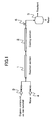
- the reaction apparatus of FIG. 1 includes a tube type reactor 1, a cooler 2, a raw material supply section 3, a water supply section 4 and a separate collection tank 5. Each of the raw material supply section 3 and the water supply section 4 is connected to the tube type reactor 1.
- 2-ethyl-hexylglycidyl ether as a raw material and ion exchange water were continuously supplied at 0.73 g/min and 7.03 g/min, respectively, from the raw material supply section 3 and water supply section 4 to the tube type reactor 1 (having a flow channel minimum inner diameter of 1.0 mm, a tube length of 10 m and being formed of SUS316).
- a pressure (i.e., reaction pressure) in the tube type reactor 1 was controlled by a back pressure valve 6 so as to be 5MPa.
- a hydrolysis reaction of an organic compound as a raw material was performed.
- the saturation vapor pressure of water at 250 °C was 4.0 MPa and the amount of water with respect to the organic compound as a raw material in a stationary state of the reaction was, in terms of molar conversion, 100 times as large as a stoichiometric amount of water required for the reaction.
- the reactant was sampled at one hour after glycidyl ether was supplied and the hydrolysis reaction was started, and a reaction conversion ratio and a dimer selective ratio for glyceryl ether were obtained from a gas chromatogram (a gas chromatography apparatus: Agilent 6850 Series II manufactured by Agilent Technologies, a capillary column: HP-ULTRA2 having dimensions of 12 m ⁇ 0.2 mm ⁇ 0.33 ⁇ m, an internal standard substance: n-decan). Results are shown in Table 1.
- the reaction conversion ratio was calculated based on: reacted glycidyl ether (mol) / supplied glycidyl ether (mol) x 100.
- the dimer production rate indicating a side reaction was calculated based on: a dimer amount (mol%) in the reactant / the reaction conversion ratio (mol%) x 100.
- the tube type reactor 1 having a tube length of 3.1 m was used, the reaction temperature was adjusted to be 270 °C, the reaction pressure was adjusted to be 7 MPa, 2-ethyl-hexylglycidyl ether as a raw material was supplied at 0.23 g/min and ion exchange water was supplied at 2.2 g/min. Other than that, in the same manner as in Example 1, glyceryl ether was produced. Results are shown in Table 1. Note that a saturation vapor pressure of water at 270 °C is 5.5 MPa.
- the reaction temperature was adjusted to be 290 °C and the reaction pressure was adjusted to be 9 MPa. Other than that, in the same manner as in Example 3, glyceryl ether was produced. Results are shown in Table 1. Note that a saturation vapor pressure of water at 290 °C is 7.4 MPa.
- the apparatus of FIG. 2 includes a tube type reactor 1, a cooler 2, a raw material supply section 3, a water supply section 4, a separate collection tank 5 and a mixer 7. Each of the raw material supply section 3 and the water supply section 4 is connected to the mixer 7.
- reaction temperature a temperature of the inner fluid become 270 °C and a pressure (i.e., reaction pressure) in the tube type reactor 1 was adjusted to be 7 MPa.
- reaction pressure a pressure in the tube type reactor 1 was adjusted to be 7 MPa.
- a hydrolysis reaction of an organic compound as a raw material was performed.
- an amount of water with respect to the organic compound as a raw material was, in terms of molar conversion, 100 times as large as a stoichiometric amount of water required for a reaction.
- the reactant was sampled at one hour after glycidyl ether was supplied and the hydrolysis reaction was started, and a reaction conversion ratio and a dimer selective ratio for glyceryl ether were obtained from the gas chromatogram. Results are shown in Table 1.
- the reaction temperature was adjusted to be 290 °C
- the reaction pressure was adjusted to be 9 MPa
- 2-ethyl-hexylglycidyl ether as a raw material and ion exchange water were continuously supplied at 102 g/min and 985 g/min, respectively, to the mixer 7.
- glyceryl ether was produced. Results are shown in Table 1.
- the tube type reactor 1 having a tube length of 10.8 m was used, isodecylglycidyl ether as a raw material and ion exchange water were supplied at 77.0 g/min and 647 g/min, respectively, to the mixer 7, the reaction temperature was adjusted to be 280 °C and the reaction pressure was adjusted to be 8 MPa. Other than that, in the same manner as in Example 6, glyceryl ether was produced. Results are shown in Table 1. Note that a saturation vapor pressure of water at 280 °C is 6.4 MPa.
- the reaction apparatus of FIG. 2 was used. After preheating to the same temperature as a reaction temperature, 2-ethyl-hexylglycidyl ether as a raw material and ion exchange water were continuously supplied at 4650 g/min and 45000 g/min, respectively, to the mixer 7.
- a contraction flow type mixer (in this case, Bunsan-kun manufactured by Fujikin, including 5 pairs of 20-pore block and 25-pore block and having a contraction section inner diameter of 3.0 mm ⁇ and a pore length of 0.05 m) was provided in the mixer 7. Reaction materials mixed in the mixer 7 were continuously supplied to the tube type reactor 1 (having a flow channel inner diameter of 50 mm and a tube length of 74 m).
- the present invention is useful as a method for producing a hydrolysate, in which an organic compound and water are mixed and a hydrolysis reaction of the organic compound is performed.
- a hydrolysate obtained according to the present invention e.g., glyceryl ether obtained by hydrolysis of glycidyl ether can be used as a solvent, an emulsifier, a dispersant, a detergent, a foam booster and the like.
Landscapes
- Chemical & Material Sciences (AREA)
- Organic Chemistry (AREA)
- Chemical Kinetics & Catalysis (AREA)
- Organic Low-Molecular-Weight Compounds And Preparation Thereof (AREA)
Applications Claiming Priority (2)
| Application Number | Priority Date | Filing Date | Title |
|---|---|---|---|
| JP2005240276A JP4790346B2 (ja) | 2005-08-22 | 2005-08-22 | 加水分解物の製造方法 |
| PCT/JP2006/316317 WO2007023765A1 (fr) | 2005-08-22 | 2006-08-21 | Procédé de production d’hydrolysat |
Publications (3)
| Publication Number | Publication Date |
|---|---|
| EP1925608A1 true EP1925608A1 (fr) | 2008-05-28 |
| EP1925608A4 EP1925608A4 (fr) | 2009-11-25 |
| EP1925608B1 EP1925608B1 (fr) | 2017-03-08 |
Family
ID=37771510
Family Applications (1)
| Application Number | Title | Priority Date | Filing Date |
|---|---|---|---|
| EP06796580.6A Not-in-force EP1925608B1 (fr) | 2005-08-22 | 2006-08-21 | Procédé de production d'hydrolysat |
Country Status (6)
| Country | Link |
|---|---|
| US (1) | US20090131725A1 (fr) |
| EP (1) | EP1925608B1 (fr) |
| JP (1) | JP4790346B2 (fr) |
| CN (1) | CN101180251B (fr) |
| ES (1) | ES2625800T3 (fr) |
| WO (1) | WO2007023765A1 (fr) |
Families Citing this family (1)
| Publication number | Priority date | Publication date | Assignee | Title |
|---|---|---|---|---|
| JP2022143665A (ja) * | 2021-03-18 | 2022-10-03 | 本田技研工業株式会社 | 加水分解連続処理装置及び加水分解連続処理方法 |
Family Cites Families (2)
| Publication number | Priority date | Publication date | Assignee | Title |
|---|---|---|---|---|
| FR2721597B1 (fr) * | 1994-06-24 | 1998-02-06 | Sumitomo Chemical Co | Procédé pour préparer un hydroxyde métallique en fines particules comprenant de l'hydroxyde d'aluminium et un oxyde métallique en fines particules comprenant de l'oxyde d'aluminium. |
| JP3955223B2 (ja) * | 2002-03-14 | 2007-08-08 | 花王株式会社 | グリセリルエーテルの製造方法 |
-
2005
- 2005-08-22 JP JP2005240276A patent/JP4790346B2/ja not_active Expired - Fee Related
-
2006
- 2006-08-21 US US12/064,419 patent/US20090131725A1/en not_active Abandoned
- 2006-08-21 EP EP06796580.6A patent/EP1925608B1/fr not_active Not-in-force
- 2006-08-21 ES ES06796580.6T patent/ES2625800T3/es active Active
- 2006-08-21 WO PCT/JP2006/316317 patent/WO2007023765A1/fr not_active Ceased
- 2006-08-21 CN CN2006800178332A patent/CN101180251B/zh not_active Expired - Fee Related
Also Published As
| Publication number | Publication date |
|---|---|
| EP1925608B1 (fr) | 2017-03-08 |
| CN101180251A (zh) | 2008-05-14 |
| ES2625800T3 (es) | 2017-07-20 |
| CN101180251B (zh) | 2012-04-18 |
| JP4790346B2 (ja) | 2011-10-12 |
| US20090131725A1 (en) | 2009-05-21 |
| WO2007023765A1 (fr) | 2007-03-01 |
| EP1925608A4 (fr) | 2009-11-25 |
| JP2007055909A (ja) | 2007-03-08 |
Similar Documents
| Publication | Publication Date | Title |
|---|---|---|
| CN103391912B (zh) | 用于酚类和酚醚类的羟基化的方法 | |
| CN101835734B (zh) | 制备任选取代的对羟基扁桃酸型化合物及其衍生物的方法 | |
| EP3763696A1 (fr) | Procédé de production d'alcools delta gamma-insaturés | |
| CN102516051B (zh) | 一种丙酮在碱性催化剂下液相缩合制备异佛尔酮的方法 | |
| EP1925608B1 (fr) | Procédé de production d'hydrolysat | |
| CN110156621A (zh) | 在微通道反应器中进行液-液均相合成n,n-二甲基乙酰胺的方法 | |
| WO2018016270A1 (fr) | Procédé de production d'alcool de guerbet | |
| US20140371493A1 (en) | Methods of converting polyols | |
| CN104370875B (zh) | 一种乙基香兰素1,2-丙二醇缩醛的制备方法 | |
| Yamamoto et al. | Continuous Production Using a T-Shaped Micro/Milli-Reactor for RUCY-Catalyzed Asymmetric Hydrogenation of Acetophenone | |
| JP4587464B2 (ja) | グリセリルエーテルの製造方法 | |
| US20060052646A1 (en) | Process for producing ether compounds in presence of a copper (II) salt | |
| US6232505B1 (en) | Methoxyacetone preparation | |
| JP5406422B2 (ja) | 反応生成物の製造方法 | |
| US11261144B2 (en) | Process for preparing fluorobenzene by direct fluorination | |
| JP4738169B2 (ja) | グリセリルエーテルの製造方法 | |
| CN109651124B (zh) | 合成对甲基苯甲醛的方法 | |
| CN114478462A (zh) | 一种Taylor流流型下CO2低温连续合成环状碳酸酯的方法 | |
| CN109651113B (zh) | 合成烷基芳香醛的方法 | |
| JP3955223B2 (ja) | グリセリルエーテルの製造方法 | |
| JP2014516933A (ja) | フェノール類およびフェノールエーテル類のヒドロキシル化方法 | |
| JP4069654B2 (ja) | シクロアルケンの製造方法 | |
| WO2012025548A1 (fr) | Procédé pour la préparation d'alcénones | |
| CN117567243A (zh) | 联产丙二醇/二丙二醇/聚醚202的方法及聚醚的制备方法 | |
| US9193656B2 (en) | Process for the manufacture of halogenated precursors of alkenones and of alkenones |
Legal Events
| Date | Code | Title | Description |
|---|---|---|---|
| PUAI | Public reference made under article 153(3) epc to a published international application that has entered the european phase |
Free format text: ORIGINAL CODE: 0009012 |
|
| 17P | Request for examination filed |
Effective date: 20080221 |
|
| AK | Designated contracting states |
Kind code of ref document: A1 Designated state(s): DE ES FR |
|
| RBV | Designated contracting states (corrected) |
Designated state(s): DE ES FR |
|
| A4 | Supplementary search report drawn up and despatched |
Effective date: 20091027 |
|
| 17Q | First examination report despatched |
Effective date: 20120309 |
|
| DAX | Request for extension of the european patent (deleted) | ||
| GRAP | Despatch of communication of intention to grant a patent |
Free format text: ORIGINAL CODE: EPIDOSNIGR1 |
|
| INTG | Intention to grant announced |
Effective date: 20161129 |
|
| GRAS | Grant fee paid |
Free format text: ORIGINAL CODE: EPIDOSNIGR3 |
|
| GRAA | (expected) grant |
Free format text: ORIGINAL CODE: 0009210 |
|
| AK | Designated contracting states |
Kind code of ref document: B1 Designated state(s): DE ES FR |
|
| REG | Reference to a national code |
Ref country code: DE Ref legal event code: R096 Ref document number: 602006051925 Country of ref document: DE |
|
| REG | Reference to a national code |
Ref country code: ES Ref legal event code: FG2A Ref document number: 2625800 Country of ref document: ES Kind code of ref document: T3 Effective date: 20170720 |
|
| REG | Reference to a national code |
Ref country code: FR Ref legal event code: PLFP Year of fee payment: 12 |
|
| REG | Reference to a national code |
Ref country code: DE Ref legal event code: R097 Ref document number: 602006051925 Country of ref document: DE |
|
| PLBE | No opposition filed within time limit |
Free format text: ORIGINAL CODE: 0009261 |
|
| STAA | Information on the status of an ep patent application or granted ep patent |
Free format text: STATUS: NO OPPOSITION FILED WITHIN TIME LIMIT |
|
| 26N | No opposition filed |
Effective date: 20171211 |
|
| REG | Reference to a national code |
Ref country code: FR Ref legal event code: PLFP Year of fee payment: 13 |
|
| PGFP | Annual fee paid to national office [announced via postgrant information from national office to epo] |
Ref country code: ES Payment date: 20220901 Year of fee payment: 17 Ref country code: DE Payment date: 20220621 Year of fee payment: 17 |
|
| PGFP | Annual fee paid to national office [announced via postgrant information from national office to epo] |
Ref country code: FR Payment date: 20220709 Year of fee payment: 17 |
|
| P01 | Opt-out of the competence of the unified patent court (upc) registered |
Effective date: 20230522 |
|
| REG | Reference to a national code |
Ref country code: DE Ref legal event code: R119 Ref document number: 602006051925 Country of ref document: DE |
|
| PG25 | Lapsed in a contracting state [announced via postgrant information from national office to epo] |
Ref country code: FR Free format text: LAPSE BECAUSE OF NON-PAYMENT OF DUE FEES Effective date: 20230831 Ref country code: DE Free format text: LAPSE BECAUSE OF NON-PAYMENT OF DUE FEES Effective date: 20240301 |
|
| REG | Reference to a national code |
Ref country code: ES Ref legal event code: FD2A Effective date: 20240930 |
|
| PG25 | Lapsed in a contracting state [announced via postgrant information from national office to epo] |
Ref country code: ES Free format text: LAPSE BECAUSE OF NON-PAYMENT OF DUE FEES Effective date: 20230822 |
|
| PG25 | Lapsed in a contracting state [announced via postgrant information from national office to epo] |
Ref country code: ES Free format text: LAPSE BECAUSE OF NON-PAYMENT OF DUE FEES Effective date: 20230822 |