EP1923445A1 - Polyaldimin enthaltende feuchtigkeitshärtende Heissschmelzklebstoff-Zusammensetzung - Google Patents
Polyaldimin enthaltende feuchtigkeitshärtende Heissschmelzklebstoff-Zusammensetzung Download PDFInfo
- Publication number
- EP1923445A1 EP1923445A1 EP20060124348 EP06124348A EP1923445A1 EP 1923445 A1 EP1923445 A1 EP 1923445A1 EP 20060124348 EP20060124348 EP 20060124348 EP 06124348 A EP06124348 A EP 06124348A EP 1923445 A1 EP1923445 A1 EP 1923445A1
- Authority
- EP
- European Patent Office
- Prior art keywords
- acid
- moisture
- adhesive composition
- melt adhesive
- composition according
- Prior art date
- Legal status (The legal status is an assumption and is not a legal conclusion. Google has not performed a legal analysis and makes no representation as to the accuracy of the status listed.)
- Granted
Links
- 239000000203 mixture Substances 0.000 title claims abstract description 121
- 239000004831 Hot glue Substances 0.000 title claims abstract description 83
- 239000004814 polyurethane Substances 0.000 claims abstract description 46
- 229920002635 polyurethane Polymers 0.000 claims abstract description 46
- IQPQWNKOIGAROB-UHFFFAOYSA-N isocyanate group Chemical group [N-]=C=O IQPQWNKOIGAROB-UHFFFAOYSA-N 0.000 claims abstract description 33
- 239000000758 substrate Substances 0.000 claims abstract description 24
- 238000000034 method Methods 0.000 claims abstract description 22
- 239000007787 solid Substances 0.000 claims abstract description 18
- 230000015572 biosynthetic process Effects 0.000 claims abstract description 9
- 239000000463 material Substances 0.000 claims abstract description 9
- 238000010438 heat treatment Methods 0.000 claims abstract description 3
- 229920000642 polymer Polymers 0.000 claims description 45
- -1 DAMP Chemical compound 0.000 claims description 43
- 239000002253 acid Substances 0.000 claims description 42
- 229920005862 polyol Polymers 0.000 claims description 34
- 150000003077 polyols Chemical class 0.000 claims description 34
- 150000002009 diols Chemical class 0.000 claims description 26
- 239000000853 adhesive Substances 0.000 claims description 23
- 230000001070 adhesive effect Effects 0.000 claims description 23
- 125000004432 carbon atom Chemical group C* 0.000 claims description 22
- 150000004705 aldimines Chemical group 0.000 claims description 21
- 229920000768 polyamine Polymers 0.000 claims description 20
- 229920000728 polyester Polymers 0.000 claims description 19
- 150000007513 acids Chemical class 0.000 claims description 17
- 125000004435 hydrogen atom Chemical group [H]* 0.000 claims description 17
- 150000001875 compounds Chemical class 0.000 claims description 16
- WPYMKLBDIGXBTP-UHFFFAOYSA-N benzoic acid Chemical compound OC(=O)C1=CC=CC=C1 WPYMKLBDIGXBTP-UHFFFAOYSA-N 0.000 claims description 15
- 239000004215 Carbon black (E152) Substances 0.000 claims description 14
- 125000001931 aliphatic group Chemical group 0.000 claims description 14
- 229930195733 hydrocarbon Natural products 0.000 claims description 14
- 239000004417 polycarbonate Substances 0.000 claims description 14
- 229920000515 polycarbonate Polymers 0.000 claims description 14
- 125000003118 aryl group Chemical group 0.000 claims description 13
- 238000010382 chemical cross-linking Methods 0.000 claims description 13
- 239000007788 liquid Substances 0.000 claims description 13
- XLYOFNOQVPJJNP-UHFFFAOYSA-N water Substances O XLYOFNOQVPJJNP-UHFFFAOYSA-N 0.000 claims description 13
- OFOBLEOULBTSOW-UHFFFAOYSA-N Malonic acid Chemical compound OC(=O)CC(O)=O OFOBLEOULBTSOW-UHFFFAOYSA-N 0.000 claims description 12
- 125000005842 heteroatom Chemical group 0.000 claims description 12
- 229920005906 polyester polyol Polymers 0.000 claims description 12
- 230000008569 process Effects 0.000 claims description 11
- 125000003277 amino group Chemical group 0.000 claims description 10
- 239000005056 polyisocyanate Substances 0.000 claims description 9
- 229920001228 polyisocyanate Polymers 0.000 claims description 9
- RTZKZFJDLAIYFH-UHFFFAOYSA-N Diethyl ether Chemical compound CCOCC RTZKZFJDLAIYFH-UHFFFAOYSA-N 0.000 claims description 8
- NAQMVNRVTILPCV-UHFFFAOYSA-N hexane-1,6-diamine Chemical compound NCCCCCCN NAQMVNRVTILPCV-UHFFFAOYSA-N 0.000 claims description 8
- 125000002887 hydroxy group Chemical group [H]O* 0.000 claims description 8
- 150000002762 monocarboxylic acid derivatives Chemical class 0.000 claims description 8
- 238000002360 preparation method Methods 0.000 claims description 8
- 239000005711 Benzoic acid Substances 0.000 claims description 7
- 125000000217 alkyl group Chemical group 0.000 claims description 7
- 235000010233 benzoic acid Nutrition 0.000 claims description 7
- NIMLQBUJDJZYEJ-UHFFFAOYSA-N isophorone diisocyanate Chemical compound CC1(C)CC(N=C=O)CC(C)(CN=C=O)C1 NIMLQBUJDJZYEJ-UHFFFAOYSA-N 0.000 claims description 7
- 238000004806 packaging method and process Methods 0.000 claims description 7
- 239000005058 Isophorone diisocyanate Substances 0.000 claims description 6
- 125000001072 heteroaryl group Chemical group 0.000 claims description 6
- 229920003023 plastic Polymers 0.000 claims description 6
- 125000002924 primary amino group Chemical group [H]N([H])* 0.000 claims description 6
- YGSDEFSMJLZEOE-UHFFFAOYSA-N salicylic acid Chemical compound OC(=O)C1=CC=CC=C1O YGSDEFSMJLZEOE-UHFFFAOYSA-N 0.000 claims description 6
- RNLHGQLZWXBQNY-UHFFFAOYSA-N 3-(aminomethyl)-3,5,5-trimethylcyclohexan-1-amine Chemical compound CC1(C)CC(N)CC(C)(CN)C1 RNLHGQLZWXBQNY-UHFFFAOYSA-N 0.000 claims description 5
- 125000005442 diisocyanate group Chemical group 0.000 claims description 5
- 239000011521 glass Substances 0.000 claims description 5
- 229910052751 metal Inorganic materials 0.000 claims description 5
- 239000002184 metal Substances 0.000 claims description 5
- 229910052760 oxygen Inorganic materials 0.000 claims description 5
- 239000001301 oxygen Substances 0.000 claims description 5
- JZUHIOJYCPIVLQ-UHFFFAOYSA-N 2-methylpentane-1,5-diamine Chemical compound NCC(C)CCCN JZUHIOJYCPIVLQ-UHFFFAOYSA-N 0.000 claims description 4
- 125000003710 aryl alkyl group Chemical group 0.000 claims description 4
- QVGXLLKOCUKJST-UHFFFAOYSA-N atomic oxygen Chemical compound [O] QVGXLLKOCUKJST-UHFFFAOYSA-N 0.000 claims description 4
- 125000004122 cyclic group Chemical group 0.000 claims description 4
- 229910001092 metal group alloy Inorganic materials 0.000 claims description 4
- 125000002496 methyl group Chemical group [H]C([H])([H])* 0.000 claims description 4
- 239000004033 plastic Substances 0.000 claims description 4
- 125000000467 secondary amino group Chemical group [H]N([*:1])[*:2] 0.000 claims description 4
- 239000004753 textile Substances 0.000 claims description 4
- XSQUKJJJFZCRTK-UHFFFAOYSA-N urea group Chemical group NC(=O)N XSQUKJJJFZCRTK-UHFFFAOYSA-N 0.000 claims description 4
- 239000002023 wood Substances 0.000 claims description 4
- VGKUQBORKKSJMG-UHFFFAOYSA-N 2,2,6-trimethylcyclohexane-1,4-diamine Chemical compound CC1CC(N)CC(C)(C)C1N VGKUQBORKKSJMG-UHFFFAOYSA-N 0.000 claims description 3
- HMJBXEZHJUYJQY-UHFFFAOYSA-N 4-(aminomethyl)octane-1,8-diamine Chemical compound NCCCCC(CN)CCCN HMJBXEZHJUYJQY-UHFFFAOYSA-N 0.000 claims description 3
- IGSBHTZEJMPDSZ-UHFFFAOYSA-N 4-[(4-amino-3-methylcyclohexyl)methyl]-2-methylcyclohexan-1-amine Chemical compound C1CC(N)C(C)CC1CC1CC(C)C(N)CC1 IGSBHTZEJMPDSZ-UHFFFAOYSA-N 0.000 claims description 3
- DZIHTWJGPDVSGE-UHFFFAOYSA-N 4-[(4-aminocyclohexyl)methyl]cyclohexan-1-amine Chemical compound C1CC(N)CCC1CC1CCC(N)CC1 DZIHTWJGPDVSGE-UHFFFAOYSA-N 0.000 claims description 3
- 125000003342 alkenyl group Chemical group 0.000 claims description 3
- 125000003545 alkoxy group Chemical group 0.000 claims description 3
- 125000005018 aryl alkenyl group Chemical group 0.000 claims description 3
- 125000004429 atom Chemical group 0.000 claims description 3
- 239000000945 filler Substances 0.000 claims description 3
- FJKROLUGYXJWQN-UHFFFAOYSA-N papa-hydroxy-benzoic acid Natural products OC(=O)C1=CC=C(O)C=C1 FJKROLUGYXJWQN-UHFFFAOYSA-N 0.000 claims description 3
- 239000000123 paper Substances 0.000 claims description 3
- 229960004889 salicylic acid Drugs 0.000 claims description 3
- 239000012780 transparent material Substances 0.000 claims description 3
- SLAMLWHELXOEJZ-UHFFFAOYSA-N 2-nitrobenzoic acid Chemical compound OC(=O)C1=CC=CC=C1[N+]([O-])=O SLAMLWHELXOEJZ-UHFFFAOYSA-N 0.000 claims description 2
- QLBRROYTTDFLDX-UHFFFAOYSA-N [3-(aminomethyl)cyclohexyl]methanamine Chemical compound NCC1CCCC(CN)C1 QLBRROYTTDFLDX-UHFFFAOYSA-N 0.000 claims description 2
- FDLQZKYLHJJBHD-UHFFFAOYSA-N [3-(aminomethyl)phenyl]methanamine Chemical compound NCC1=CC=CC(CN)=C1 FDLQZKYLHJJBHD-UHFFFAOYSA-N 0.000 claims description 2
- 125000002837 carbocyclic group Chemical group 0.000 claims description 2
- 229910052799 carbon Inorganic materials 0.000 claims description 2
- 239000006229 carbon black Substances 0.000 claims description 2
- 125000002915 carbonyl group Chemical group [*:2]C([*:1])=O 0.000 claims description 2
- 239000000919 ceramic Substances 0.000 claims description 2
- 239000002131 composite material Substances 0.000 claims description 2
- 125000004185 ester group Chemical group 0.000 claims description 2
- 239000004744 fabric Substances 0.000 claims description 2
- 239000010985 leather Substances 0.000 claims description 2
- 239000011368 organic material Substances 0.000 claims description 2
- 239000002985 plastic film Substances 0.000 claims description 2
- 229910052573 porcelain Inorganic materials 0.000 claims description 2
- 239000000843 powder Substances 0.000 claims description 2
- 238000004132 cross linking Methods 0.000 abstract description 28
- 239000012790 adhesive layer Substances 0.000 abstract description 2
- 150000001299 aldehydes Chemical class 0.000 description 35
- 238000006243 chemical reaction Methods 0.000 description 19
- QTBSBXVTEAMEQO-UHFFFAOYSA-N Acetic acid Chemical compound CC(O)=O QTBSBXVTEAMEQO-UHFFFAOYSA-N 0.000 description 10
- 230000009965 odorless effect Effects 0.000 description 10
- UPMLOUAZCHDJJD-UHFFFAOYSA-N 4,4'-Diphenylmethane Diisocyanate Chemical compound C1=CC(N=C=O)=CC=C1CC1=CC=C(N=C=O)C=C1 UPMLOUAZCHDJJD-UHFFFAOYSA-N 0.000 description 9
- KWYUFKZDYYNOTN-UHFFFAOYSA-M Potassium hydroxide Chemical compound [OH-].[K+] KWYUFKZDYYNOTN-UHFFFAOYSA-M 0.000 description 9
- MTHSVFCYNBDYFN-UHFFFAOYSA-N diethylene glycol Chemical compound OCCOCCO MTHSVFCYNBDYFN-UHFFFAOYSA-N 0.000 description 9
- 239000000126 substance Substances 0.000 description 9
- CURLTUGMZLYLDI-UHFFFAOYSA-N Carbon dioxide Chemical compound O=C=O CURLTUGMZLYLDI-UHFFFAOYSA-N 0.000 description 8
- 150000001298 alcohols Chemical class 0.000 description 8
- 235000014113 dietary fatty acids Nutrition 0.000 description 8
- 150000002148 esters Chemical class 0.000 description 8
- 229930195729 fatty acid Natural products 0.000 description 8
- 239000000194 fatty acid Substances 0.000 description 8
- 229920001451 polypropylene glycol Polymers 0.000 description 8
- 150000004072 triols Chemical class 0.000 description 8
- YRDQAIWXWUHXPQ-UHFFFAOYSA-N (2,2-dimethyl-3-oxopropyl) dodecanoate Chemical compound CCCCCCCCCCCC(=O)OCC(C)(C)C=O YRDQAIWXWUHXPQ-UHFFFAOYSA-N 0.000 description 7
- FERIUCNNQQJTOY-UHFFFAOYSA-N Butyric acid Natural products CCCC(O)=O FERIUCNNQQJTOY-UHFFFAOYSA-N 0.000 description 7
- LYCAIKOWRPUZTN-UHFFFAOYSA-N Ethylene glycol Chemical group OCCO LYCAIKOWRPUZTN-UHFFFAOYSA-N 0.000 description 7
- KQNPFQTWMSNSAP-UHFFFAOYSA-N alpha-isobutyric acid Natural products CC(C)C(O)=O KQNPFQTWMSNSAP-UHFFFAOYSA-N 0.000 description 7
- 150000001412 amines Chemical class 0.000 description 7
- QQVIHTHCMHWDBS-UHFFFAOYSA-N isophthalic acid Chemical compound OC(=O)C1=CC=CC(C(O)=O)=C1 QQVIHTHCMHWDBS-UHFFFAOYSA-N 0.000 description 7
- WQEPLUUGTLDZJY-UHFFFAOYSA-N n-Pentadecanoic acid Natural products CCCCCCCCCCCCCCC(O)=O WQEPLUUGTLDZJY-UHFFFAOYSA-N 0.000 description 7
- PEDCQBHIVMGVHV-UHFFFAOYSA-N Glycerine Chemical compound OCC(O)CO PEDCQBHIVMGVHV-UHFFFAOYSA-N 0.000 description 6
- KKEYFWRCBNTPAC-UHFFFAOYSA-N Terephthalic acid Chemical compound OC(=O)C1=CC=C(C(O)=O)C=C1 KKEYFWRCBNTPAC-UHFFFAOYSA-N 0.000 description 6
- 150000001735 carboxylic acids Chemical class 0.000 description 6
- POULHZVOKOAJMA-UHFFFAOYSA-N dodecanoic acid Chemical compound CCCCCCCCCCCC(O)=O POULHZVOKOAJMA-UHFFFAOYSA-N 0.000 description 6
- 150000004665 fatty acids Chemical class 0.000 description 6
- KEMQGTRYUADPNZ-UHFFFAOYSA-N heptadecanoic acid Chemical compound CCCCCCCCCCCCCCCCC(O)=O KEMQGTRYUADPNZ-UHFFFAOYSA-N 0.000 description 6
- IPCSVZSSVZVIGE-UHFFFAOYSA-N hexadecanoic acid Chemical compound CCCCCCCCCCCCCCCC(O)=O IPCSVZSSVZVIGE-UHFFFAOYSA-N 0.000 description 6
- VKOBVWXKNCXXDE-UHFFFAOYSA-N icosanoic acid Chemical compound CCCCCCCCCCCCCCCCCCCC(O)=O VKOBVWXKNCXXDE-UHFFFAOYSA-N 0.000 description 6
- BDAGIHXWWSANSR-UHFFFAOYSA-N methanoic acid Natural products OC=O BDAGIHXWWSANSR-UHFFFAOYSA-N 0.000 description 6
- XNGIFLGASWRNHJ-UHFFFAOYSA-N phthalic acid Chemical compound OC(=O)C1=CC=CC=C1C(O)=O XNGIFLGASWRNHJ-UHFFFAOYSA-N 0.000 description 6
- SZHOJFHSIKHZHA-UHFFFAOYSA-N tridecanoic acid Chemical compound CCCCCCCCCCCCC(O)=O SZHOJFHSIKHZHA-UHFFFAOYSA-N 0.000 description 6
- 239000004698 Polyethylene Substances 0.000 description 5
- 239000004721 Polyphenylene oxide Substances 0.000 description 5
- 239000004743 Polypropylene Substances 0.000 description 5
- WNLRTRBMVRJNCN-UHFFFAOYSA-N adipic acid Chemical compound OC(=O)CCCCC(O)=O WNLRTRBMVRJNCN-UHFFFAOYSA-N 0.000 description 5
- OBETXYAYXDNJHR-UHFFFAOYSA-N alpha-ethylcaproic acid Natural products CCCCC(CC)C(O)=O OBETXYAYXDNJHR-UHFFFAOYSA-N 0.000 description 5
- 150000001991 dicarboxylic acids Chemical class 0.000 description 5
- XBDQKXXYIPTUBI-UHFFFAOYSA-N dimethylselenoniopropionate Natural products CCC(O)=O XBDQKXXYIPTUBI-UHFFFAOYSA-N 0.000 description 5
- 239000012948 isocyanate Substances 0.000 description 5
- 150000002513 isocyanates Chemical class 0.000 description 5
- BDJRBEYXGGNYIS-UHFFFAOYSA-N nonanedioic acid Chemical compound OC(=O)CCCCCCCC(O)=O BDJRBEYXGGNYIS-UHFFFAOYSA-N 0.000 description 5
- 229920000570 polyether Polymers 0.000 description 5
- 229920000573 polyethylene Polymers 0.000 description 5
- 229920001155 polypropylene Polymers 0.000 description 5
- 238000003860 storage Methods 0.000 description 5
- DVKJHBMWWAPEIU-UHFFFAOYSA-N toluene 2,4-diisocyanate Chemical compound CC1=CC=C(N=C=O)C=C1N=C=O DVKJHBMWWAPEIU-UHFFFAOYSA-N 0.000 description 5
- FJJYHTVHBVXEEQ-UHFFFAOYSA-N 2,2-dimethylpropanal Chemical compound CC(C)(C)C=O FJJYHTVHBVXEEQ-UHFFFAOYSA-N 0.000 description 4
- YIWUKEYIRIRTPP-UHFFFAOYSA-N 2-ethylhexan-1-ol Chemical compound CCCCC(CC)CO YIWUKEYIRIRTPP-UHFFFAOYSA-N 0.000 description 4
- PAYRUJLWNCNPSJ-UHFFFAOYSA-N Aniline Chemical compound NC1=CC=CC=C1 PAYRUJLWNCNPSJ-UHFFFAOYSA-N 0.000 description 4
- 241000512897 Elaeis Species 0.000 description 4
- 235000001950 Elaeis guineensis Nutrition 0.000 description 4
- KFZMGEQAYNKOFK-UHFFFAOYSA-N Isopropanol Chemical compound CC(C)O KFZMGEQAYNKOFK-UHFFFAOYSA-N 0.000 description 4
- LRHPLDYGYMQRHN-UHFFFAOYSA-N N-Butanol Chemical compound CCCCO LRHPLDYGYMQRHN-UHFFFAOYSA-N 0.000 description 4
- MUBZPKHOEPUJKR-UHFFFAOYSA-N Oxalic acid Chemical compound OC(=O)C(O)=O MUBZPKHOEPUJKR-UHFFFAOYSA-N 0.000 description 4
- WERYXYBDKMZEQL-UHFFFAOYSA-N butane-1,4-diol Chemical compound OCCCCO WERYXYBDKMZEQL-UHFFFAOYSA-N 0.000 description 4
- 239000001569 carbon dioxide Substances 0.000 description 4
- 229910002092 carbon dioxide Inorganic materials 0.000 description 4
- 239000003054 catalyst Substances 0.000 description 4
- 239000007795 chemical reaction product Substances 0.000 description 4
- 238000001816 cooling Methods 0.000 description 4
- GHVNFZFCNZKVNT-UHFFFAOYSA-N decanoic acid Chemical compound CCCCCCCCCC(O)=O GHVNFZFCNZKVNT-UHFFFAOYSA-N 0.000 description 4
- 239000000539 dimer Substances 0.000 description 4
- FUZZWVXGSFPDMH-UHFFFAOYSA-N hexanoic acid Chemical compound CCCCCC(O)=O FUZZWVXGSFPDMH-UHFFFAOYSA-N 0.000 description 4
- 238000006460 hydrolysis reaction Methods 0.000 description 4
- 230000003301 hydrolyzing effect Effects 0.000 description 4
- 239000010410 layer Substances 0.000 description 4
- 229920002521 macromolecule Polymers 0.000 description 4
- ISYWECDDZWTKFF-UHFFFAOYSA-N nonadecanoic acid Chemical compound CCCCCCCCCCCCCCCCCCC(O)=O ISYWECDDZWTKFF-UHFFFAOYSA-N 0.000 description 4
- 238000006068 polycondensation reaction Methods 0.000 description 4
- CXMXRPHRNRROMY-UHFFFAOYSA-N sebacic acid Chemical compound OC(=O)CCCCCCCCC(O)=O CXMXRPHRNRROMY-UHFFFAOYSA-N 0.000 description 4
- 150000003512 tertiary amines Chemical class 0.000 description 4
- NQPDZGIKBAWPEJ-UHFFFAOYSA-N valeric acid Chemical compound CCCCC(O)=O NQPDZGIKBAWPEJ-UHFFFAOYSA-N 0.000 description 4
- JJMOMMLADQPZNY-UHFFFAOYSA-N 3-hydroxy-2,2-dimethylpropanal Chemical compound OCC(C)(C)C=O JJMOMMLADQPZNY-UHFFFAOYSA-N 0.000 description 3
- CNPURSDMOWDNOQ-UHFFFAOYSA-N 4-methoxy-7h-pyrrolo[2,3-d]pyrimidin-2-amine Chemical compound COC1=NC(N)=NC2=C1C=CN2 CNPURSDMOWDNOQ-UHFFFAOYSA-N 0.000 description 3
- WSFSSNUMVMOOMR-UHFFFAOYSA-N Formaldehyde Chemical compound O=C WSFSSNUMVMOOMR-UHFFFAOYSA-N 0.000 description 3
- 239000005057 Hexamethylene diisocyanate Substances 0.000 description 3
- UFHFLCQGNIYNRP-UHFFFAOYSA-N Hydrogen Chemical compound [H][H] UFHFLCQGNIYNRP-UHFFFAOYSA-N 0.000 description 3
- 239000005639 Lauric acid Substances 0.000 description 3
- 235000021314 Palmitic acid Nutrition 0.000 description 3
- 229930040373 Paraformaldehyde Natural products 0.000 description 3
- 229920002396 Polyurea Polymers 0.000 description 3
- DNIAPMSPPWPWGF-UHFFFAOYSA-N Propylene glycol Chemical compound CC(O)CO DNIAPMSPPWPWGF-UHFFFAOYSA-N 0.000 description 3
- HEMHJVSKTPXQMS-UHFFFAOYSA-M Sodium hydroxide Chemical compound [OH-].[Na+] HEMHJVSKTPXQMS-UHFFFAOYSA-M 0.000 description 3
- 235000021355 Stearic acid Nutrition 0.000 description 3
- YIMQCDZDWXUDCA-UHFFFAOYSA-N [4-(hydroxymethyl)cyclohexyl]methanol Chemical compound OCC1CCC(CO)CC1 YIMQCDZDWXUDCA-UHFFFAOYSA-N 0.000 description 3
- 229960000583 acetic acid Drugs 0.000 description 3
- IISBACLAFKSPIT-UHFFFAOYSA-N bisphenol A Chemical compound C=1C=C(O)C=CC=1C(C)(C)C1=CC=C(O)C=C1 IISBACLAFKSPIT-UHFFFAOYSA-N 0.000 description 3
- 230000000052 comparative effect Effects 0.000 description 3
- 239000000470 constituent Substances 0.000 description 3
- 150000002170 ethers Chemical class 0.000 description 3
- 125000000524 functional group Chemical group 0.000 description 3
- YAQXGBBDJYBXKL-UHFFFAOYSA-N iron(2+);1,10-phenanthroline;dicyanide Chemical compound [Fe+2].N#[C-].N#[C-].C1=CN=C2C3=NC=CC=C3C=CC2=C1.C1=CN=C2C3=NC=CC=C3C=CC2=C1 YAQXGBBDJYBXKL-UHFFFAOYSA-N 0.000 description 3
- 150000002736 metal compounds Chemical class 0.000 description 3
- SLCVBVWXLSEKPL-UHFFFAOYSA-N neopentyl glycol Chemical compound OCC(C)(C)CO SLCVBVWXLSEKPL-UHFFFAOYSA-N 0.000 description 3
- 239000012299 nitrogen atmosphere Substances 0.000 description 3
- QIQXTHQIDYTFRH-UHFFFAOYSA-N octadecanoic acid Chemical compound CCCCCCCCCCCCCCCCCC(O)=O QIQXTHQIDYTFRH-UHFFFAOYSA-N 0.000 description 3
- OQCDKBAXFALNLD-UHFFFAOYSA-N octadecanoic acid Natural products CCCCCCCC(C)CCCCCCCCC(O)=O OQCDKBAXFALNLD-UHFFFAOYSA-N 0.000 description 3
- WWZKQHOCKIZLMA-UHFFFAOYSA-N octanoic acid Chemical compound CCCCCCCC(O)=O WWZKQHOCKIZLMA-UHFFFAOYSA-N 0.000 description 3
- ZQPPMHVWECSIRJ-KTKRTIGZSA-N oleic acid group Chemical group C(CCCCCCC\C=C/CCCCCCCC)(=O)O ZQPPMHVWECSIRJ-KTKRTIGZSA-N 0.000 description 3
- 238000006116 polymerization reaction Methods 0.000 description 3
- 239000007858 starting material Substances 0.000 description 3
- 239000008117 stearic acid Substances 0.000 description 3
- 238000003756 stirring Methods 0.000 description 3
- TUNFSRHWOTWDNC-HKGQFRNVSA-N tetradecanoic acid Chemical compound CCCCCCCCCCCCC[14C](O)=O TUNFSRHWOTWDNC-HKGQFRNVSA-N 0.000 description 3
- JOXIMZWYDAKGHI-UHFFFAOYSA-N toluene-4-sulfonic acid Chemical compound CC1=CC=C(S(O)(=O)=O)C=C1 JOXIMZWYDAKGHI-UHFFFAOYSA-N 0.000 description 3
- SRKDPGBALCTPQV-UHFFFAOYSA-N (2,2-dimethyl-3-oxopropyl) octadecanoate Chemical compound CCCCCCCCCCCCCCCCCC(=O)OCC(C)(C)C=O SRKDPGBALCTPQV-UHFFFAOYSA-N 0.000 description 2
- OBETXYAYXDNJHR-SSDOTTSWSA-M (2r)-2-ethylhexanoate Chemical compound CCCC[C@@H](CC)C([O-])=O OBETXYAYXDNJHR-SSDOTTSWSA-M 0.000 description 2
- OHLKMGYGBHFODF-UHFFFAOYSA-N 1,4-bis(isocyanatomethyl)benzene Chemical compound O=C=NCC1=CC=C(CN=C=O)C=C1 OHLKMGYGBHFODF-UHFFFAOYSA-N 0.000 description 2
- SBJCUZQNHOLYMD-UHFFFAOYSA-N 1,5-Naphthalene diisocyanate Chemical compound C1=CC=C2C(N=C=O)=CC=CC2=C1N=C=O SBJCUZQNHOLYMD-UHFFFAOYSA-N 0.000 description 2
- XDOFQFKRPWOURC-UHFFFAOYSA-N 16-methylheptadecanoic acid Chemical compound CC(C)CCCCCCCCCCCCCCC(O)=O XDOFQFKRPWOURC-UHFFFAOYSA-N 0.000 description 2
- GQHTUMJGOHRCHB-UHFFFAOYSA-N 2,3,4,6,7,8,9,10-octahydropyrimido[1,2-a]azepine Chemical compound C1CCCCN2CCCN=C21 GQHTUMJGOHRCHB-UHFFFAOYSA-N 0.000 description 2
- FTZILAQGHINQQR-UHFFFAOYSA-N 2-Methylpentanal Chemical compound CCCC(C)C=O FTZILAQGHINQQR-UHFFFAOYSA-N 0.000 description 2
- ICSNLGPSRYBMBD-UHFFFAOYSA-N 2-aminopyridine Chemical compound NC1=CC=CC=N1 ICSNLGPSRYBMBD-UHFFFAOYSA-N 0.000 description 2
- GAWAYYRQGQZKCR-UHFFFAOYSA-N 2-chloropropionic acid Chemical compound CC(Cl)C(O)=O GAWAYYRQGQZKCR-UHFFFAOYSA-N 0.000 description 2
- HNVAGBIANFAIIL-UHFFFAOYSA-N 2-hydroxy-2-methylpropanal Chemical compound CC(C)(O)C=O HNVAGBIANFAIIL-UHFFFAOYSA-N 0.000 description 2
- BYGQBDHUGHBGMD-UHFFFAOYSA-N 2-methylbutanal Chemical compound CCC(C)C=O BYGQBDHUGHBGMD-UHFFFAOYSA-N 0.000 description 2
- WMRCTEPOPAZMMN-UHFFFAOYSA-N 2-undecylpropanedioic acid Chemical compound CCCCCCCCCCCC(C(O)=O)C(O)=O WMRCTEPOPAZMMN-UHFFFAOYSA-N 0.000 description 2
- QZWKEPYTBWZJJA-UHFFFAOYSA-N 3,3'-Dimethoxybenzidine-4,4'-diisocyanate Chemical compound C1=C(N=C=O)C(OC)=CC(C=2C=C(OC)C(N=C=O)=CC=2)=C1 QZWKEPYTBWZJJA-UHFFFAOYSA-N 0.000 description 2
- OSWFIVFLDKOXQC-UHFFFAOYSA-N 4-(3-methoxyphenyl)aniline Chemical compound COC1=CC=CC(C=2C=CC(N)=CC=2)=C1 OSWFIVFLDKOXQC-UHFFFAOYSA-N 0.000 description 2
- HCJLTNJVGXHKTN-UHFFFAOYSA-N 4-[(4-amino-3-ethylcyclohexyl)methyl]-2-ethylcyclohexan-1-amine Chemical compound C1CC(N)C(CC)CC1CC1CC(CC)C(N)CC1 HCJLTNJVGXHKTN-UHFFFAOYSA-N 0.000 description 2
- SEVSMVUOKAMPDO-UHFFFAOYSA-N 4-acetoxy benzaldehyde Chemical compound CC(=O)OC1=CC=C(C=O)C=C1 SEVSMVUOKAMPDO-UHFFFAOYSA-N 0.000 description 2
- KWXICGTUELOLSQ-UHFFFAOYSA-N 4-dodecylbenzenesulfonic acid Chemical compound CCCCCCCCCCCCC1=CC=C(S(O)(=O)=O)C=C1 KWXICGTUELOLSQ-UHFFFAOYSA-N 0.000 description 2
- QGZKDVFQNNGYKY-UHFFFAOYSA-N Ammonia Chemical compound N QGZKDVFQNNGYKY-UHFFFAOYSA-N 0.000 description 2
- IJGRMHOSHXDMSA-UHFFFAOYSA-N Atomic nitrogen Chemical compound N#N IJGRMHOSHXDMSA-UHFFFAOYSA-N 0.000 description 2
- GMTFURRRXIRGLH-UHFFFAOYSA-N C12CCCC2C2(CN)CC1CC2 Chemical compound C12CCCC2C2(CN)CC1CC2 GMTFURRRXIRGLH-UHFFFAOYSA-N 0.000 description 2
- 239000005632 Capric acid (CAS 334-48-5) Substances 0.000 description 2
- OKTJSMMVPCPJKN-UHFFFAOYSA-N Carbon Chemical compound [C] OKTJSMMVPCPJKN-UHFFFAOYSA-N 0.000 description 2
- VGGSQFUCUMXWEO-UHFFFAOYSA-N Ethene Chemical compound C=C VGGSQFUCUMXWEO-UHFFFAOYSA-N 0.000 description 2
- 239000005977 Ethylene Substances 0.000 description 2
- IAYPIBMASNFSPL-UHFFFAOYSA-N Ethylene oxide Chemical compound C1CO1 IAYPIBMASNFSPL-UHFFFAOYSA-N 0.000 description 2
- RRHGJUQNOFWUDK-UHFFFAOYSA-N Isoprene Chemical compound CC(=C)C=C RRHGJUQNOFWUDK-UHFFFAOYSA-N 0.000 description 2
- AMIMRNSIRUDHCM-UHFFFAOYSA-N Isopropylaldehyde Chemical compound CC(C)C=O AMIMRNSIRUDHCM-UHFFFAOYSA-N 0.000 description 2
- KDXKERNSBIXSRK-UHFFFAOYSA-N Lysine Natural products NCCCCC(N)C(O)=O KDXKERNSBIXSRK-UHFFFAOYSA-N 0.000 description 2
- 239000004472 Lysine Substances 0.000 description 2
- AFVFQIVMOAPDHO-UHFFFAOYSA-N Methanesulfonic acid Chemical compound CS(O)(=O)=O AFVFQIVMOAPDHO-UHFFFAOYSA-N 0.000 description 2
- IMNFDUFMRHMDMM-UHFFFAOYSA-N N-Heptane Chemical compound CCCCCCC IMNFDUFMRHMDMM-UHFFFAOYSA-N 0.000 description 2
- LGRFSURHDFAFJT-UHFFFAOYSA-N Phthalic anhydride Natural products C1=CC=C2C(=O)OC(=O)C2=C1 LGRFSURHDFAFJT-UHFFFAOYSA-N 0.000 description 2
- 229920003171 Poly (ethylene oxide) Polymers 0.000 description 2
- 239000004952 Polyamide Substances 0.000 description 2
- 235000019484 Rapeseed oil Nutrition 0.000 description 2
- 239000003677 Sheet moulding compound Substances 0.000 description 2
- 235000019486 Sunflower oil Nutrition 0.000 description 2
- WYURNTSHIVDZCO-UHFFFAOYSA-N Tetrahydrofuran Chemical compound C1CCOC1 WYURNTSHIVDZCO-UHFFFAOYSA-N 0.000 description 2
- ZJCCRDAZUWHFQH-UHFFFAOYSA-N Trimethylolpropane Chemical compound CCC(CO)(CO)CO ZJCCRDAZUWHFQH-UHFFFAOYSA-N 0.000 description 2
- ISKQADXMHQSTHK-UHFFFAOYSA-N [4-(aminomethyl)phenyl]methanamine Chemical compound NCC1=CC=C(CN)C=C1 ISKQADXMHQSTHK-UHFFFAOYSA-N 0.000 description 2
- 235000011054 acetic acid Nutrition 0.000 description 2
- XECAHXYUAAWDEL-UHFFFAOYSA-N acrylonitrile butadiene styrene Chemical compound C=CC=C.C=CC#N.C=CC1=CC=CC=C1 XECAHXYUAAWDEL-UHFFFAOYSA-N 0.000 description 2
- 229920000122 acrylonitrile butadiene styrene Polymers 0.000 description 2
- 239000004676 acrylonitrile butadiene styrene Substances 0.000 description 2
- 238000007792 addition Methods 0.000 description 2
- 239000002318 adhesion promoter Substances 0.000 description 2
- 239000001361 adipic acid Substances 0.000 description 2
- 235000011037 adipic acid Nutrition 0.000 description 2
- 238000005575 aldol reaction Methods 0.000 description 2
- 229920013640 amorphous poly alpha olefin Polymers 0.000 description 2
- 150000008064 anhydrides Chemical class 0.000 description 2
- YZXBAPSDXZZRGB-DOFZRALJSA-N arachidonic acid Chemical compound CCCCC\C=C/C\C=C/C\C=C/C\C=C/CCCC(O)=O YZXBAPSDXZZRGB-DOFZRALJSA-N 0.000 description 2
- HUMNYLRZRPPJDN-UHFFFAOYSA-N benzaldehyde Chemical compound O=CC1=CC=CC=C1 HUMNYLRZRPPJDN-UHFFFAOYSA-N 0.000 description 2
- SRSXLGNVWSONIS-UHFFFAOYSA-N benzenesulfonic acid Chemical compound OS(=O)(=O)C1=CC=CC=C1 SRSXLGNVWSONIS-UHFFFAOYSA-N 0.000 description 2
- 230000001680 brushing effect Effects 0.000 description 2
- QDHFHIQKOVNCNC-UHFFFAOYSA-N butane-1-sulfonic acid Chemical compound CCCCS(O)(=O)=O QDHFHIQKOVNCNC-UHFFFAOYSA-N 0.000 description 2
- JHIWVOJDXOSYLW-UHFFFAOYSA-N butyl 2,2-difluorocyclopropane-1-carboxylate Chemical compound CCCCOC(=O)C1CC1(F)F JHIWVOJDXOSYLW-UHFFFAOYSA-N 0.000 description 2
- VHRGRCVQAFMJIZ-UHFFFAOYSA-N cadaverine Chemical compound NCCCCCN VHRGRCVQAFMJIZ-UHFFFAOYSA-N 0.000 description 2
- 150000001732 carboxylic acid derivatives Chemical class 0.000 description 2
- KJPRLNWUNMBNBZ-UHFFFAOYSA-N cinnamic aldehyde Natural products O=CC=CC1=CC=CC=C1 KJPRLNWUNMBNBZ-UHFFFAOYSA-N 0.000 description 2
- 239000003240 coconut oil Substances 0.000 description 2
- 235000019864 coconut oil Nutrition 0.000 description 2
- 238000010276 construction Methods 0.000 description 2
- 229920001577 copolymer Polymers 0.000 description 2
- 238000001723 curing Methods 0.000 description 2
- IFDVQVHZEKPUSC-UHFFFAOYSA-N cyclohex-3-ene-1,2-dicarboxylic acid Chemical compound OC(=O)C1CCC=CC1C(O)=O IFDVQVHZEKPUSC-UHFFFAOYSA-N 0.000 description 2
- QSAWQNUELGIYBC-UHFFFAOYSA-N cyclohexane-1,2-dicarboxylic acid Chemical compound OC(=O)C1CCCCC1C(O)=O QSAWQNUELGIYBC-UHFFFAOYSA-N 0.000 description 2
- IEJIGPNLZYLLBP-UHFFFAOYSA-N dimethyl carbonate Chemical compound COC(=O)OC IEJIGPNLZYLLBP-UHFFFAOYSA-N 0.000 description 2
- WOZVHXUHUFLZGK-UHFFFAOYSA-N dimethyl terephthalate Chemical compound COC(=O)C1=CC=C(C(=O)OC)C=C1 WOZVHXUHUFLZGK-UHFFFAOYSA-N 0.000 description 2
- UKMSUNONTOPOIO-UHFFFAOYSA-N docosanoic acid Chemical compound CCCCCCCCCCCCCCCCCCCCCC(O)=O UKMSUNONTOPOIO-UHFFFAOYSA-N 0.000 description 2
- GHLKSLMMWAKNBM-UHFFFAOYSA-N dodecane-1,12-diol Chemical compound OCCCCCCCCCCCCO GHLKSLMMWAKNBM-UHFFFAOYSA-N 0.000 description 2
- TVIDDXQYHWJXFK-UHFFFAOYSA-N dodecanedioic acid Chemical compound OC(=O)CCCCCCCCCCC(O)=O TVIDDXQYHWJXFK-UHFFFAOYSA-N 0.000 description 2
- 230000032050 esterification Effects 0.000 description 2
- 238000005886 esterification reaction Methods 0.000 description 2
- 125000001033 ether group Chemical group 0.000 description 2
- 239000006260 foam Substances 0.000 description 2
- 235000019253 formic acid Nutrition 0.000 description 2
- LNTHITQWFMADLM-UHFFFAOYSA-N gallic acid Chemical compound OC(=O)C1=CC(O)=C(O)C(O)=C1 LNTHITQWFMADLM-UHFFFAOYSA-N 0.000 description 2
- 239000007789 gas Substances 0.000 description 2
- LEQAOMBKQFMDFZ-UHFFFAOYSA-N glyoxal Chemical compound O=CC=O LEQAOMBKQFMDFZ-UHFFFAOYSA-N 0.000 description 2
- MNWFXJYAOYHMED-UHFFFAOYSA-N heptanoic acid Chemical compound CCCCCCC(O)=O MNWFXJYAOYHMED-UHFFFAOYSA-N 0.000 description 2
- RRAMGCGOFNQTLD-UHFFFAOYSA-N hexamethylene diisocyanate Chemical compound O=C=NCCCCCCN=C=O RRAMGCGOFNQTLD-UHFFFAOYSA-N 0.000 description 2
- XXMIOPMDWAUFGU-UHFFFAOYSA-N hexane-1,6-diol Chemical compound OCCCCCCO XXMIOPMDWAUFGU-UHFFFAOYSA-N 0.000 description 2
- 239000001257 hydrogen Substances 0.000 description 2
- 229910052739 hydrogen Inorganic materials 0.000 description 2
- 230000007062 hydrolysis Effects 0.000 description 2
- 239000000543 intermediate Substances 0.000 description 2
- GWYFCOCPABKNJV-UHFFFAOYSA-N isovaleric acid Chemical compound CC(C)CC(O)=O GWYFCOCPABKNJV-UHFFFAOYSA-N 0.000 description 2
- 239000000944 linseed oil Substances 0.000 description 2
- 235000021388 linseed oil Nutrition 0.000 description 2
- 238000004519 manufacturing process Methods 0.000 description 2
- 239000000155 melt Substances 0.000 description 2
- 150000002739 metals Chemical class 0.000 description 2
- VNWKTOKETHGBQD-UHFFFAOYSA-N methane Chemical compound C VNWKTOKETHGBQD-UHFFFAOYSA-N 0.000 description 2
- 230000006855 networking Effects 0.000 description 2
- 150000005338 nitrobenzoic acids Chemical class 0.000 description 2
- FBUKVWPVBMHYJY-UHFFFAOYSA-N nonanoic acid Chemical compound CCCCCCCCC(O)=O FBUKVWPVBMHYJY-UHFFFAOYSA-N 0.000 description 2
- 235000014593 oils and fats Nutrition 0.000 description 2
- 239000004006 olive oil Substances 0.000 description 2
- 235000008390 olive oil Nutrition 0.000 description 2
- 125000001181 organosilyl group Chemical group [SiH3]* 0.000 description 2
- 239000003346 palm kernel oil Substances 0.000 description 2
- 239000002540 palm oil Substances 0.000 description 2
- SECPZKHBENQXJG-FPLPWBNLSA-N palmitoleic acid Chemical compound CCCCCC\C=C/CCCCCCCC(O)=O SECPZKHBENQXJG-FPLPWBNLSA-N 0.000 description 2
- WLJVNTCWHIRURA-UHFFFAOYSA-N pimelic acid Chemical compound OC(=O)CCCCCC(O)=O WLJVNTCWHIRURA-UHFFFAOYSA-N 0.000 description 2
- 229920001200 poly(ethylene-vinyl acetate) Polymers 0.000 description 2
- 229920002647 polyamide Polymers 0.000 description 2
- 229920000098 polyolefin Polymers 0.000 description 2
- 229920006324 polyoxymethylene Polymers 0.000 description 2
- 239000000047 product Substances 0.000 description 2
- BDERNNFJNOPAEC-UHFFFAOYSA-N propan-1-ol Chemical compound CCCO BDERNNFJNOPAEC-UHFFFAOYSA-N 0.000 description 2
- 235000019260 propionic acid Nutrition 0.000 description 2
- KIDHWZJUCRJVML-UHFFFAOYSA-N putrescine Chemical compound NCCCCN KIDHWZJUCRJVML-UHFFFAOYSA-N 0.000 description 2
- IUVKMZGDUIUOCP-BTNSXGMBSA-N quinbolone Chemical compound O([C@H]1CC[C@H]2[C@H]3[C@@H]([C@]4(C=CC(=O)C=C4CC3)C)CC[C@@]21C)C1=CCCC1 IUVKMZGDUIUOCP-BTNSXGMBSA-N 0.000 description 2
- 238000007127 saponification reaction Methods 0.000 description 2
- 239000002904 solvent Substances 0.000 description 2
- TYFQFVWCELRYAO-UHFFFAOYSA-N suberic acid Chemical compound OC(=O)CCCCCCC(O)=O TYFQFVWCELRYAO-UHFFFAOYSA-N 0.000 description 2
- 125000001424 substituent group Chemical group 0.000 description 2
- AGGIJOLULBJGTQ-UHFFFAOYSA-N sulfoacetic acid Chemical compound OC(=O)CS(O)(=O)=O AGGIJOLULBJGTQ-UHFFFAOYSA-N 0.000 description 2
- 239000002600 sunflower oil Substances 0.000 description 2
- 229920001169 thermoplastic Polymers 0.000 description 2
- 150000003613 toluenes Chemical class 0.000 description 2
- XFNJVJPLKCPIBV-UHFFFAOYSA-N trimethylenediamine Chemical compound NCCCN XFNJVJPLKCPIBV-UHFFFAOYSA-N 0.000 description 2
- ZDPHROOEEOARMN-UHFFFAOYSA-N undecanoic acid Chemical compound CCCCCCCCCCC(O)=O ZDPHROOEEOARMN-UHFFFAOYSA-N 0.000 description 2
- 229940005605 valeric acid Drugs 0.000 description 2
- NLVXSWCKKBEXTG-UHFFFAOYSA-N vinylsulfonic acid Chemical compound OS(=O)(=O)C=C NLVXSWCKKBEXTG-UHFFFAOYSA-N 0.000 description 2
- 239000003039 volatile agent Substances 0.000 description 2
- PAPBSGBWRJIAAV-UHFFFAOYSA-N ε-Caprolactone Chemical compound O=C1CCCCCO1 PAPBSGBWRJIAAV-UHFFFAOYSA-N 0.000 description 2
- DNIAPMSPPWPWGF-VKHMYHEASA-N (+)-propylene glycol Chemical compound C[C@H](O)CO DNIAPMSPPWPWGF-VKHMYHEASA-N 0.000 description 1
- ZZFHBVUWNRIESU-UHFFFAOYSA-N (2,2-dimethyl-3-oxopropyl) benzoate Chemical compound O=CC(C)(C)COC(=O)C1=CC=CC=C1 ZZFHBVUWNRIESU-UHFFFAOYSA-N 0.000 description 1
- IHDCVMIUYUAVNR-UHFFFAOYSA-N (2,2-dimethyl-3-oxopropyl) hexadecanoate Chemical compound CCCCCCCCCCCCCCCC(=O)OCC(C)(C)C=O IHDCVMIUYUAVNR-UHFFFAOYSA-N 0.000 description 1
- QOXPAWMZHIRZIQ-UHFFFAOYSA-N (2,2-dimethyl-3-oxopropyl) hexadecanoate;(2,2-dimethyl-3-oxopropyl) tetradecanoate Chemical compound CCCCCCCCCCCCCC(=O)OCC(C)(C)C=O.CCCCCCCCCCCCCCCC(=O)OCC(C)(C)C=O QOXPAWMZHIRZIQ-UHFFFAOYSA-N 0.000 description 1
- DYNJLLYSKAWFEW-UHFFFAOYSA-N (2,2-dimethyl-3-oxopropyl) tetradecanoate Chemical compound CCCCCCCCCCCCCC(=O)OCC(C)(C)C=O DYNJLLYSKAWFEW-UHFFFAOYSA-N 0.000 description 1
- 239000001893 (2R)-2-methylbutanal Substances 0.000 description 1
- SZCWBURCISJFEZ-UHFFFAOYSA-N (3-hydroxy-2,2-dimethylpropyl) 3-hydroxy-2,2-dimethylpropanoate Chemical compound OCC(C)(C)COC(=O)C(C)(C)CO SZCWBURCISJFEZ-UHFFFAOYSA-N 0.000 description 1
- MUTGBJKUEZFXGO-OLQVQODUSA-N (3as,7ar)-3a,4,5,6,7,7a-hexahydro-2-benzofuran-1,3-dione Chemical compound C1CCC[C@@H]2C(=O)OC(=O)[C@@H]21 MUTGBJKUEZFXGO-OLQVQODUSA-N 0.000 description 1
- CUXYLFPMQMFGPL-WPOADVJFSA-N (9Z,11E,13E)-octadeca-9,11,13-trienoic acid Chemical compound CCCC\C=C\C=C\C=C/CCCCCCCC(O)=O CUXYLFPMQMFGPL-WPOADVJFSA-N 0.000 description 1
- OYHQOLUKZRVURQ-NTGFUMLPSA-N (9Z,12Z)-9,10,12,13-tetratritiooctadeca-9,12-dienoic acid Chemical compound C(CCCCCCC\C(=C(/C\C(=C(/CCCCC)\[3H])\[3H])\[3H])\[3H])(=O)O OYHQOLUKZRVURQ-NTGFUMLPSA-N 0.000 description 1
- WRIDQFICGBMAFQ-UHFFFAOYSA-N (E)-8-Octadecenoic acid Natural products CCCCCCCCCC=CCCCCCCC(O)=O WRIDQFICGBMAFQ-UHFFFAOYSA-N 0.000 description 1
- KJPRLNWUNMBNBZ-QPJJXVBHSA-N (E)-cinnamaldehyde Chemical compound O=C\C=C\C1=CC=CC=C1 KJPRLNWUNMBNBZ-QPJJXVBHSA-N 0.000 description 1
- NCYNKWQXFADUOZ-UHFFFAOYSA-N 1,1-dioxo-2,1$l^{6}-benzoxathiol-3-one Chemical compound C1=CC=C2C(=O)OS(=O)(=O)C2=C1 NCYNKWQXFADUOZ-UHFFFAOYSA-N 0.000 description 1
- MHYXPAGFFCSTCJ-UHFFFAOYSA-N 1,2-bis(2-isocyanatopropan-2-yl)naphthalene Chemical compound C1=CC=CC2=C(C(C)(C)N=C=O)C(C(C)(N=C=O)C)=CC=C21 MHYXPAGFFCSTCJ-UHFFFAOYSA-N 0.000 description 1
- OPCJOXGBLDJWRM-UHFFFAOYSA-N 1,2-diamino-2-methylpropane Chemical compound CC(C)(N)CN OPCJOXGBLDJWRM-UHFFFAOYSA-N 0.000 description 1
- RTTZISZSHSCFRH-UHFFFAOYSA-N 1,3-bis(isocyanatomethyl)benzene Chemical compound O=C=NCC1=CC=CC(CN=C=O)=C1 RTTZISZSHSCFRH-UHFFFAOYSA-N 0.000 description 1
- GNQKHBSIBXSFFD-UHFFFAOYSA-N 1,3-diisocyanatocyclohexane Chemical compound O=C=NC1CCCC(N=C=O)C1 GNQKHBSIBXSFFD-UHFFFAOYSA-N 0.000 description 1
- YPFDHNVEDLHUCE-UHFFFAOYSA-N 1,3-propanediol Substances OCCCO YPFDHNVEDLHUCE-UHFFFAOYSA-N 0.000 description 1
- ROHUXHMNZLHBSF-UHFFFAOYSA-N 1,4-bis(isocyanatomethyl)cyclohexane Chemical compound O=C=NCC1CCC(CN=C=O)CC1 ROHUXHMNZLHBSF-UHFFFAOYSA-N 0.000 description 1
- LGLNTUFPPXPHKF-UHFFFAOYSA-N 1,4-diisocyanato-2,3,5,6-tetramethylbenzene Chemical compound CC1=C(C)C(N=C=O)=C(C)C(C)=C1N=C=O LGLNTUFPPXPHKF-UHFFFAOYSA-N 0.000 description 1
- ALQLPWJFHRMHIU-UHFFFAOYSA-N 1,4-diisocyanatobenzene Chemical compound O=C=NC1=CC=C(N=C=O)C=C1 ALQLPWJFHRMHIU-UHFFFAOYSA-N 0.000 description 1
- OGYGFBZFWNMNHB-UHFFFAOYSA-N 1,4-dimethylcyclohexa-2,4-diene-1-sulfonic acid Chemical compound CC1=CCC(C)(S(O)(=O)=O)C=C1 OGYGFBZFWNMNHB-UHFFFAOYSA-N 0.000 description 1
- 229940008841 1,6-hexamethylene diisocyanate Drugs 0.000 description 1
- PWGJDPKCLMLPJW-UHFFFAOYSA-N 1,8-diaminooctane Chemical compound NCCCCCCCCN PWGJDPKCLMLPJW-UHFFFAOYSA-N 0.000 description 1
- ODJFPJKKFJKPPB-UHFFFAOYSA-N 1-(hydroxymethyl)cyclohexane-1-carbaldehyde;1-(hydroxymethyl)cyclohex-3-ene-1-carbaldehyde Chemical compound OCC1(C=O)CCCCC1.OCC1(C=O)CCC=CC1 ODJFPJKKFJKPPB-UHFFFAOYSA-N 0.000 description 1
- TYVMZSWNEDFDKQ-UHFFFAOYSA-N 1-(hydroxymethyl)cyclopentane-1-carbaldehyde Chemical compound OCC1(C=O)CCCC1 TYVMZSWNEDFDKQ-UHFFFAOYSA-N 0.000 description 1
- ICLCCFKUSALICQ-UHFFFAOYSA-N 1-isocyanato-4-(4-isocyanato-3-methylphenyl)-2-methylbenzene Chemical compound C1=C(N=C=O)C(C)=CC(C=2C=C(C)C(N=C=O)=CC=2)=C1 ICLCCFKUSALICQ-UHFFFAOYSA-N 0.000 description 1
- FXZFFVCJWZTTMX-UHFFFAOYSA-N 1-methylcyclohexane-1-carbaldehyde Chemical compound O=CC1(C)CCCCC1 FXZFFVCJWZTTMX-UHFFFAOYSA-N 0.000 description 1
- ZUGYJALETFVYJV-UHFFFAOYSA-N 1-methylcyclopentane-1-carbaldehyde Chemical compound O=CC1(C)CCCC1 ZUGYJALETFVYJV-UHFFFAOYSA-N 0.000 description 1
- RTBFRGCFXZNCOE-UHFFFAOYSA-N 1-methylsulfonylpiperidin-4-one Chemical compound CS(=O)(=O)N1CCC(=O)CC1 RTBFRGCFXZNCOE-UHFFFAOYSA-N 0.000 description 1
- SQAINHDHICKHLX-UHFFFAOYSA-N 1-naphthaldehyde Chemical compound C1=CC=C2C(C=O)=CC=CC2=C1 SQAINHDHICKHLX-UHFFFAOYSA-N 0.000 description 1
- XYHKNCXZYYTLRG-UHFFFAOYSA-N 1h-imidazole-2-carbaldehyde Chemical compound O=CC1=NC=CN1 XYHKNCXZYYTLRG-UHFFFAOYSA-N 0.000 description 1
- BVNYROHOUZCIEL-UHFFFAOYSA-N 2,2-diethylbutanal Chemical compound CCC(CC)(CC)C=O BVNYROHOUZCIEL-UHFFFAOYSA-N 0.000 description 1
- KLNKSFKJPAJHIC-UHFFFAOYSA-N 2,2-dimethyl-3-octadecoxypropanal Chemical compound CCCCCCCCCCCCCCCCCCOCC(C)(C)C=O KLNKSFKJPAJHIC-UHFFFAOYSA-N 0.000 description 1
- SUMZWDXUXLTFFX-UHFFFAOYSA-N 2,2-dimethyl-3-oxopropanoic acid Chemical compound O=CC(C)(C)C(O)=O SUMZWDXUXLTFFX-UHFFFAOYSA-N 0.000 description 1
- QYPLKDUOPJZROX-UHFFFAOYSA-N 2,2-dimethylbutanal Chemical compound CCC(C)(C)C=O QYPLKDUOPJZROX-UHFFFAOYSA-N 0.000 description 1
- DDHUNHGZUHZNKB-UHFFFAOYSA-N 2,2-dimethylpropane-1,3-diamine Chemical compound NCC(C)(C)CN DDHUNHGZUHZNKB-UHFFFAOYSA-N 0.000 description 1
- HLLGFGBLKOIZOM-UHFFFAOYSA-N 2,2-diphenylacetaldehyde Chemical compound C=1C=CC=CC=1C(C=O)C1=CC=CC=C1 HLLGFGBLKOIZOM-UHFFFAOYSA-N 0.000 description 1
- QBDAFARLDLCWAT-UHFFFAOYSA-N 2,3-dihydropyran-6-one Chemical compound O=C1OCCC=C1 QBDAFARLDLCWAT-UHFFFAOYSA-N 0.000 description 1
- PQXKWPLDPFFDJP-UHFFFAOYSA-N 2,3-dimethyloxirane Chemical compound CC1OC1C PQXKWPLDPFFDJP-UHFFFAOYSA-N 0.000 description 1
- DPQHRXRAZHNGRU-UHFFFAOYSA-N 2,4,4-trimethylhexane-1,6-diamine Chemical compound NCC(C)CC(C)(C)CCN DPQHRXRAZHNGRU-UHFFFAOYSA-N 0.000 description 1
- GISVICWQYMUPJF-UHFFFAOYSA-N 2,4-Dimethylbenzaldehyde Chemical compound CC1=CC=C(C=O)C(C)=C1 GISVICWQYMUPJF-UHFFFAOYSA-N 0.000 description 1
- MZEGJNMYXWIQFF-UHFFFAOYSA-N 2,5-diisocyanato-1,1,3-trimethylcyclohexane Chemical compound CC1CC(N=C=O)CC(C)(C)C1N=C=O MZEGJNMYXWIQFF-UHFFFAOYSA-N 0.000 description 1
- IRLYGRLEBKCYPY-UHFFFAOYSA-N 2,5-dimethylbenzenesulfonic acid Chemical compound CC1=CC=C(C)C(S(O)(=O)=O)=C1 IRLYGRLEBKCYPY-UHFFFAOYSA-N 0.000 description 1
- GXVUZYLYWKWJIM-UHFFFAOYSA-N 2-(2-aminoethoxy)ethanamine Chemical compound NCCOCCN GXVUZYLYWKWJIM-UHFFFAOYSA-N 0.000 description 1
- LZIPBJBQQPZLOR-UHFFFAOYSA-N 2-(4-methylphenyl)sulfonyloxyethyl 4-methylbenzenesulfonate Chemical compound C1=CC(C)=CC=C1S(=O)(=O)OCCOS(=O)(=O)C1=CC=C(C)C=C1 LZIPBJBQQPZLOR-UHFFFAOYSA-N 0.000 description 1
- UCEILBKMJKUVFS-UHFFFAOYSA-N 2-(hydroxymethyl)-2-methylbutanal Chemical compound CCC(C)(CO)C=O UCEILBKMJKUVFS-UHFFFAOYSA-N 0.000 description 1
- FKNUYPBTCINVEP-UHFFFAOYSA-N 2-(hydroxymethyl)-2-methylpentanal Chemical compound CCCC(C)(CO)C=O FKNUYPBTCINVEP-UHFFFAOYSA-N 0.000 description 1
- MBVGJZDLUQNERS-UHFFFAOYSA-N 2-(trifluoromethyl)-1h-imidazole-4,5-dicarbonitrile Chemical compound FC(F)(F)C1=NC(C#N)=C(C#N)N1 MBVGJZDLUQNERS-UHFFFAOYSA-N 0.000 description 1
- UNNGUFMVYQJGTD-UHFFFAOYSA-N 2-Ethylbutanal Chemical compound CCC(CC)C=O UNNGUFMVYQJGTD-UHFFFAOYSA-N 0.000 description 1
- LCZVSXRMYJUNFX-UHFFFAOYSA-N 2-[2-(2-hydroxypropoxy)propoxy]propan-1-ol Chemical class CC(O)COC(C)COC(C)CO LCZVSXRMYJUNFX-UHFFFAOYSA-N 0.000 description 1
- SLXGMYKTPUPXNX-UHFFFAOYSA-N 2-benzyl-3-hydroxy-2-methylpropanal Chemical compound OCC(C)(C=O)CC1=CC=CC=C1 SLXGMYKTPUPXNX-UHFFFAOYSA-N 0.000 description 1
- FZZMTSNZRBFGGU-UHFFFAOYSA-N 2-chloro-7-fluoroquinazolin-4-amine Chemical compound FC1=CC=C2C(N)=NC(Cl)=NC2=C1 FZZMTSNZRBFGGU-UHFFFAOYSA-N 0.000 description 1
- IKCLCGXPQILATA-UHFFFAOYSA-N 2-chlorobenzoic acid Chemical class OC(=O)C1=CC=CC=C1Cl IKCLCGXPQILATA-UHFFFAOYSA-N 0.000 description 1
- RCQAUUCWIIQGEP-UHFFFAOYSA-N 2-ethyl-2-(hydroxymethyl)butanal Chemical compound CCC(CC)(CO)C=O RCQAUUCWIIQGEP-UHFFFAOYSA-N 0.000 description 1
- UVEFAZXHHJHMGK-UHFFFAOYSA-N 2-ethyl-2-(hydroxymethyl)hexanal Chemical compound CCCCC(CC)(CO)C=O UVEFAZXHHJHMGK-UHFFFAOYSA-N 0.000 description 1
- HEPHYCJJLAUKSB-UHFFFAOYSA-N 2-methyl-3-phenylpropanal Chemical compound O=CC(C)CC1=CC=CC=C1 HEPHYCJJLAUKSB-UHFFFAOYSA-N 0.000 description 1
- PJKVFARRVXDXAD-UHFFFAOYSA-N 2-naphthaldehyde Chemical compound C1=CC=CC2=CC(C=O)=CC=C21 PJKVFARRVXDXAD-UHFFFAOYSA-N 0.000 description 1
- CMWKITSNTDAEDT-UHFFFAOYSA-N 2-nitrobenzaldehyde Chemical compound [O-][N+](=O)C1=CC=CC=C1C=O CMWKITSNTDAEDT-UHFFFAOYSA-N 0.000 description 1
- YQRRSRIXFYXCMY-UHFFFAOYSA-N 2-phenylpropanal Chemical compound O=CC(C)C1=CC=CC=C1.O=CC(C)C1=CC=CC=C1 YQRRSRIXFYXCMY-UHFFFAOYSA-N 0.000 description 1
- JDMMZVAKMAONFU-UHFFFAOYSA-N 2-trimethylsilylacetic acid Chemical compound C[Si](C)(C)CC(O)=O JDMMZVAKMAONFU-UHFFFAOYSA-N 0.000 description 1
- LQJBNNIYVWPHFW-UHFFFAOYSA-N 20:1omega9c fatty acid Natural products CCCCCCCCCCC=CCCCCCCCC(O)=O LQJBNNIYVWPHFW-UHFFFAOYSA-N 0.000 description 1
- OIUKJBJURCIFTN-UHFFFAOYSA-N 3,3-dimethyl-4-oxobutanoic acid Chemical compound O=CC(C)(C)CC(O)=O OIUKJBJURCIFTN-UHFFFAOYSA-N 0.000 description 1
- SGVGYKFWOFPROF-UHFFFAOYSA-N 3,4-di(nonyl)naphthalene-1,2-disulfonic acid Chemical compound C1=CC=C2C(S(O)(=O)=O)=C(S(O)(=O)=O)C(CCCCCCCCC)=C(CCCCCCCCC)C2=C1 SGVGYKFWOFPROF-UHFFFAOYSA-N 0.000 description 1
- HFCHWQRAWARZRT-UHFFFAOYSA-N 3-(2-ethylhexoxy)-2,2-dimethylpropanal Chemical compound CCCCC(CC)COCC(C)(C)C=O HFCHWQRAWARZRT-UHFFFAOYSA-N 0.000 description 1
- GWYFCOCPABKNJV-UHFFFAOYSA-M 3-Methylbutanoic acid Natural products CC(C)CC([O-])=O GWYFCOCPABKNJV-UHFFFAOYSA-M 0.000 description 1
- POTQBGGWSWSMCX-UHFFFAOYSA-N 3-[2-(3-aminopropoxy)ethoxy]propan-1-amine Chemical compound NCCCOCCOCCCN POTQBGGWSWSMCX-UHFFFAOYSA-N 0.000 description 1
- ANOPCGQVRXJHHD-UHFFFAOYSA-N 3-[3-(3-aminopropyl)-2,4,8,10-tetraoxaspiro[5.5]undecan-9-yl]propan-1-amine Chemical compound C1OC(CCCN)OCC21COC(CCCN)OC2 ANOPCGQVRXJHHD-UHFFFAOYSA-N 0.000 description 1
- YOOSAIJKYCBPFW-UHFFFAOYSA-N 3-[4-(3-aminopropoxy)butoxy]propan-1-amine Chemical compound NCCCOCCCCOCCCN YOOSAIJKYCBPFW-UHFFFAOYSA-N 0.000 description 1
- JDHXMEFRAIAHFO-UHFFFAOYSA-N 3-dodecoxy-2,2-dimethylpropanal Chemical compound CCCCCCCCCCCCOCC(C)(C)C=O JDHXMEFRAIAHFO-UHFFFAOYSA-N 0.000 description 1
- NRUZMSHBQGMUGR-UHFFFAOYSA-N 3-hydroxy-2,2-diphenylpropanal Chemical compound C=1C=CC=CC=1C(C=O)(CO)C1=CC=CC=C1 NRUZMSHBQGMUGR-UHFFFAOYSA-N 0.000 description 1
- DEBRVWHWFXLIRK-UHFFFAOYSA-N 3-hydroxy-2-methyl-2-phenylpropanal Chemical compound OCC(C)(C=O)C1=CC=CC=C1 DEBRVWHWFXLIRK-UHFFFAOYSA-N 0.000 description 1
- WJIOHMVWGVGWJW-UHFFFAOYSA-N 3-methyl-n-[4-[(3-methylpyrazole-1-carbonyl)amino]butyl]pyrazole-1-carboxamide Chemical compound N1=C(C)C=CN1C(=O)NCCCCNC(=O)N1N=C(C)C=C1 WJIOHMVWGVGWJW-UHFFFAOYSA-N 0.000 description 1
- SKIKWYMNQLOTQO-UHFFFAOYSA-N 3-methylhexane-1,5-diol Chemical compound CC(O)CC(C)CCO SKIKWYMNQLOTQO-UHFFFAOYSA-N 0.000 description 1
- ZETIVVHRRQLWFW-UHFFFAOYSA-N 3-nitrobenzaldehyde Chemical compound [O-][N+](=O)C1=CC=CC(C=O)=C1 ZETIVVHRRQLWFW-UHFFFAOYSA-N 0.000 description 1
- ZMSQJSMSLXVTKN-UHFFFAOYSA-N 4-[2-(2-morpholin-4-ylethoxy)ethyl]morpholine Chemical compound C1COCCN1CCOCCN1CCOCC1 ZMSQJSMSLXVTKN-UHFFFAOYSA-N 0.000 description 1
- ARIREUPIXAKDAY-UHFFFAOYSA-N 4-butylbenzaldehyde Chemical compound CCCCC1=CC=C(C=O)C=C1 ARIREUPIXAKDAY-UHFFFAOYSA-N 0.000 description 1
- JRHHJNMASOIRDS-UHFFFAOYSA-N 4-ethoxybenzaldehyde Chemical compound CCOC1=CC=C(C=O)C=C1 JRHHJNMASOIRDS-UHFFFAOYSA-N 0.000 description 1
- BXRFQSNOROATLV-UHFFFAOYSA-N 4-nitrobenzaldehyde Chemical compound [O-][N+](=O)C1=CC=C(C=O)C=C1 BXRFQSNOROATLV-UHFFFAOYSA-N 0.000 description 1
- QWLHJVDRPZNVBS-UHFFFAOYSA-N 4-phenoxybenzaldehyde Chemical compound C1=CC(C=O)=CC=C1OC1=CC=CC=C1 QWLHJVDRPZNVBS-UHFFFAOYSA-N 0.000 description 1
- PJMDLNIAGSYXLA-UHFFFAOYSA-N 6-iminooxadiazine-4,5-dione Chemical class N=C1ON=NC(=O)C1=O PJMDLNIAGSYXLA-UHFFFAOYSA-N 0.000 description 1
- YPIFGDQKSSMYHQ-UHFFFAOYSA-N 7,7-dimethyloctanoic acid Chemical compound CC(C)(C)CCCCCC(O)=O YPIFGDQKSSMYHQ-UHFFFAOYSA-N 0.000 description 1
- QSBYPNXLFMSGKH-UHFFFAOYSA-N 9-Heptadecensaeure Natural products CCCCCCCC=CCCCCCCCC(O)=O QSBYPNXLFMSGKH-UHFFFAOYSA-N 0.000 description 1
- QTBSBXVTEAMEQO-UHFFFAOYSA-M Acetate Chemical compound CC([O-])=O QTBSBXVTEAMEQO-UHFFFAOYSA-M 0.000 description 1
- NIXOWILDQLNWCW-UHFFFAOYSA-M Acrylate Chemical compound [O-]C(=O)C=C NIXOWILDQLNWCW-UHFFFAOYSA-M 0.000 description 1
- 235000021357 Behenic acid Nutrition 0.000 description 1
- DPUOLQHDNGRHBS-UHFFFAOYSA-N Brassidinsaeure Natural products CCCCCCCCC=CCCCCCCCCCCCC(O)=O DPUOLQHDNGRHBS-UHFFFAOYSA-N 0.000 description 1
- ZTQSAGDEMFDKMZ-UHFFFAOYSA-N Butyraldehyde Chemical class CCCC=O ZTQSAGDEMFDKMZ-UHFFFAOYSA-N 0.000 description 1
- 239000005635 Caprylic acid (CAS 124-07-2) Substances 0.000 description 1
- 229920000742 Cotton Polymers 0.000 description 1
- 239000004971 Cross linker Substances 0.000 description 1
- XFXPMWWXUTWYJX-UHFFFAOYSA-N Cyanide Chemical compound N#[C-] XFXPMWWXUTWYJX-UHFFFAOYSA-N 0.000 description 1
- 239000009261 D 400 Substances 0.000 description 1
- MYMOFIZGZYHOMD-UHFFFAOYSA-N Dioxygen Chemical compound O=O MYMOFIZGZYHOMD-UHFFFAOYSA-N 0.000 description 1
- LROJZZICACKNJL-UHFFFAOYSA-N Duryl aldehyde Chemical compound CC1=CC(C)=C(C=O)C=C1C LROJZZICACKNJL-UHFFFAOYSA-N 0.000 description 1
- URXZXNYJPAJJOQ-UHFFFAOYSA-N Erucic acid Natural products CCCCCCC=CCCCCCCCCCCCC(O)=O URXZXNYJPAJJOQ-UHFFFAOYSA-N 0.000 description 1
- LFQSCWFLJHTTHZ-UHFFFAOYSA-N Ethanol Chemical compound CCO LFQSCWFLJHTTHZ-UHFFFAOYSA-N 0.000 description 1
- PIICEJLVQHRZGT-UHFFFAOYSA-N Ethylenediamine Chemical compound NCCN PIICEJLVQHRZGT-UHFFFAOYSA-N 0.000 description 1
- VZCYOOQTPOCHFL-OWOJBTEDSA-N Fumaric acid Chemical compound OC(=O)\C=C\C(O)=O VZCYOOQTPOCHFL-OWOJBTEDSA-N 0.000 description 1
- YNAVUWVOSKDBBP-UHFFFAOYSA-N Morpholine Natural products C1COCCN1 YNAVUWVOSKDBBP-UHFFFAOYSA-N 0.000 description 1
- AFCARXCZXQIEQB-UHFFFAOYSA-N N-[3-oxo-3-(2,4,6,7-tetrahydrotriazolo[4,5-c]pyridin-5-yl)propyl]-2-[[3-(trifluoromethoxy)phenyl]methylamino]pyrimidine-5-carboxamide Chemical compound O=C(CCNC(=O)C=1C=NC(=NC=1)NCC1=CC(=CC=C1)OC(F)(F)F)N1CC2=C(CC1)NN=N2 AFCARXCZXQIEQB-UHFFFAOYSA-N 0.000 description 1
- 239000004818 Non-reactive adhesive Substances 0.000 description 1
- 239000005642 Oleic acid Substances 0.000 description 1
- ZQPPMHVWECSIRJ-UHFFFAOYSA-N Oleic acid Natural products CCCCCCCCC=CCCCCCCCC(O)=O ZQPPMHVWECSIRJ-UHFFFAOYSA-N 0.000 description 1
- 235000021319 Palmitoleic acid Nutrition 0.000 description 1
- 239000005643 Pelargonic acid Substances 0.000 description 1
- ALQSHHUCVQOPAS-UHFFFAOYSA-N Pentane-1,5-diol Chemical compound OCCCCCO ALQSHHUCVQOPAS-UHFFFAOYSA-N 0.000 description 1
- YGYAWVDWMABLBF-UHFFFAOYSA-N Phosgene Chemical compound ClC(Cl)=O YGYAWVDWMABLBF-UHFFFAOYSA-N 0.000 description 1
- 229920000538 Poly[(phenyl isocyanate)-co-formaldehyde] Polymers 0.000 description 1
- DUFKCOQISQKSAV-UHFFFAOYSA-N Polypropylene glycol (m w 1,200-3,000) Chemical class CC(O)COC(C)CO DUFKCOQISQKSAV-UHFFFAOYSA-N 0.000 description 1
- GOOHAUXETOMSMM-UHFFFAOYSA-N Propylene oxide Chemical compound CC1CO1 GOOHAUXETOMSMM-UHFFFAOYSA-N 0.000 description 1
- BLRPTPMANUNPDV-UHFFFAOYSA-N Silane Chemical compound [SiH4] BLRPTPMANUNPDV-UHFFFAOYSA-N 0.000 description 1
- KDYFGRWQOYBRFD-UHFFFAOYSA-N Succinic acid Natural products OC(=O)CCC(O)=O KDYFGRWQOYBRFD-UHFFFAOYSA-N 0.000 description 1
- NINIDFKCEFEMDL-UHFFFAOYSA-N Sulfur Chemical compound [S] NINIDFKCEFEMDL-UHFFFAOYSA-N 0.000 description 1
- AXMVYSVVTMKQSL-UHFFFAOYSA-N UNPD142122 Natural products OC1=CC=C(C=CC=O)C=C1O AXMVYSVVTMKQSL-UHFFFAOYSA-N 0.000 description 1
- 239000012963 UV stabilizer Substances 0.000 description 1
- XTXRWKRVRITETP-UHFFFAOYSA-N Vinyl acetate Chemical compound CC(=O)OC=C XTXRWKRVRITETP-UHFFFAOYSA-N 0.000 description 1
- 229920002522 Wood fibre Polymers 0.000 description 1
- OXIKYYJDTWKERT-UHFFFAOYSA-N [4-(aminomethyl)cyclohexyl]methanamine Chemical compound NCC1CCC(CN)CC1 OXIKYYJDTWKERT-UHFFFAOYSA-N 0.000 description 1
- UKLDJPRMSDWDSL-UHFFFAOYSA-L [dibutyl(dodecanoyloxy)stannyl] dodecanoate Chemical compound CCCCCCCCCCCC(=O)O[Sn](CCCC)(CCCC)OC(=O)CCCCCCCCCCC UKLDJPRMSDWDSL-UHFFFAOYSA-L 0.000 description 1
- YVHDRFKHKGNLNW-UHFFFAOYSA-L [dibutyl(octadecanoyloxy)stannyl] octadecanoate Chemical compound CCCCCCCCCCCCCCCCCC(=O)O[Sn](CCCC)(CCCC)OC(=O)CCCCCCCCCCCCCCCCC YVHDRFKHKGNLNW-UHFFFAOYSA-L 0.000 description 1
- XQBCVRSTVUHIGH-UHFFFAOYSA-L [dodecanoyloxy(dioctyl)stannyl] dodecanoate Chemical compound CCCCCCCCCCCC(=O)O[Sn](CCCCCCCC)(CCCCCCCC)OC(=O)CCCCCCCCCCC XQBCVRSTVUHIGH-UHFFFAOYSA-L 0.000 description 1
- 239000006096 absorbing agent Substances 0.000 description 1
- 230000009471 action Effects 0.000 description 1
- 238000001994 activation Methods 0.000 description 1
- 239000000654 additive Substances 0.000 description 1
- 238000004026 adhesive bonding Methods 0.000 description 1
- 239000002313 adhesive film Substances 0.000 description 1
- IBVAQQYNSHJXBV-UHFFFAOYSA-N adipic acid dihydrazide Chemical compound NNC(=O)CCCCC(=O)NN IBVAQQYNSHJXBV-UHFFFAOYSA-N 0.000 description 1
- 238000004220 aggregation Methods 0.000 description 1
- 230000002776 aggregation Effects 0.000 description 1
- 150000007933 aliphatic carboxylic acids Chemical class 0.000 description 1
- 229910052783 alkali metal Inorganic materials 0.000 description 1
- DTOSIQBPPRVQHS-PDBXOOCHSA-N alpha-linolenic acid Chemical compound CC\C=C/C\C=C/C\C=C/CCCCCCCC(O)=O DTOSIQBPPRVQHS-PDBXOOCHSA-N 0.000 description 1
- 235000020661 alpha-linolenic acid Nutrition 0.000 description 1
- 125000004202 aminomethyl group Chemical group [H]N([H])C([H])([H])* 0.000 description 1
- 229910021529 ammonia Inorganic materials 0.000 description 1
- JFCQEDHGNNZCLN-UHFFFAOYSA-N anhydrous glutaric acid Natural products OC(=O)CCCC(O)=O JFCQEDHGNNZCLN-UHFFFAOYSA-N 0.000 description 1
- 239000011952 anionic catalyst Substances 0.000 description 1
- YMNKUHIVVMFOFO-UHFFFAOYSA-N anthracene-9-carbaldehyde Chemical compound C1=CC=C2C(C=O)=C(C=CC=C3)C3=CC2=C1 YMNKUHIVVMFOFO-UHFFFAOYSA-N 0.000 description 1
- 239000003963 antioxidant agent Substances 0.000 description 1
- 235000021342 arachidonic acid Nutrition 0.000 description 1
- 229940114079 arachidonic acid Drugs 0.000 description 1
- 150000003934 aromatic aldehydes Chemical class 0.000 description 1
- 229940116226 behenic acid Drugs 0.000 description 1
- MIAUJDCQDVWHEV-UHFFFAOYSA-N benzene-1,2-disulfonic acid Chemical class OS(=O)(=O)C1=CC=CC=C1S(O)(=O)=O MIAUJDCQDVWHEV-UHFFFAOYSA-N 0.000 description 1
- 229940092714 benzenesulfonic acid Drugs 0.000 description 1
- 229960004365 benzoic acid Drugs 0.000 description 1
- 150000001622 bismuth compounds Chemical class 0.000 description 1
- JDIBGQFKXXXXPN-UHFFFAOYSA-N bismuth(3+) Chemical compound [Bi+3] JDIBGQFKXXXXPN-UHFFFAOYSA-N 0.000 description 1
- FNYKAWJEEWSNEH-UHFFFAOYSA-K bismuth;3,3,5,5-tetramethylhexanoate Chemical compound [Bi+3].CC(C)(C)CC(C)(C)CC([O-])=O.CC(C)(C)CC(C)(C)CC([O-])=O.CC(C)(C)CC(C)(C)CC([O-])=O FNYKAWJEEWSNEH-UHFFFAOYSA-K 0.000 description 1
- 229920001400 block copolymer Polymers 0.000 description 1
- CDQSJQSWAWPGKG-UHFFFAOYSA-N butane-1,1-diol Chemical class CCCC(O)O CDQSJQSWAWPGKG-UHFFFAOYSA-N 0.000 description 1
- KDYFGRWQOYBRFD-NUQCWPJISA-N butanedioic acid Chemical compound O[14C](=O)CC[14C](O)=O KDYFGRWQOYBRFD-NUQCWPJISA-N 0.000 description 1
- 150000001718 carbodiimides Chemical class 0.000 description 1
- BVKZGUZCCUSVTD-UHFFFAOYSA-N carbonic acid Chemical class OC(O)=O BVKZGUZCCUSVTD-UHFFFAOYSA-N 0.000 description 1
- 150000004649 carbonic acid derivatives Chemical class 0.000 description 1
- 150000001244 carboxylic acid anhydrides Chemical class 0.000 description 1
- 230000003197 catalytic effect Effects 0.000 description 1
- 229940117916 cinnamic aldehyde Drugs 0.000 description 1
- SECPZKHBENQXJG-UHFFFAOYSA-N cis-palmitoleic acid Natural products CCCCCCC=CCCCCCCCC(O)=O SECPZKHBENQXJG-UHFFFAOYSA-N 0.000 description 1
- 238000004140 cleaning Methods 0.000 description 1
- 238000006482 condensation reaction Methods 0.000 description 1
- 238000003851 corona treatment Methods 0.000 description 1
- 239000013078 crystal Substances 0.000 description 1
- WTWBUQJHJGUZCY-UHFFFAOYSA-N cuminaldehyde Chemical group CC(C)C1=CC=C(C=O)C=C1 WTWBUQJHJGUZCY-UHFFFAOYSA-N 0.000 description 1
- DCFDVJPDXYGCOK-UHFFFAOYSA-N cyclohex-3-ene-1-carbaldehyde Chemical compound O=CC1CCC=CC1 DCFDVJPDXYGCOK-UHFFFAOYSA-N 0.000 description 1
- VKIRRGRTJUUZHS-UHFFFAOYSA-N cyclohexane-1,4-diamine Chemical compound NC1CCC(N)CC1 VKIRRGRTJUUZHS-UHFFFAOYSA-N 0.000 description 1
- KVFDZFBHBWTVID-UHFFFAOYSA-N cyclohexane-carboxaldehyde Natural products O=CC1CCCCC1 KVFDZFBHBWTVID-UHFFFAOYSA-N 0.000 description 1
- LJOODBDWMQKMFB-UHFFFAOYSA-N cyclohexylacetic acid Chemical compound OC(=O)CC1CCCCC1 LJOODBDWMQKMFB-UHFFFAOYSA-N 0.000 description 1
- VELDYOPRLMJFIK-UHFFFAOYSA-N cyclopentanecarbaldehyde Chemical compound O=CC1CCCC1 VELDYOPRLMJFIK-UHFFFAOYSA-N 0.000 description 1
- YQLZOAVZWJBZSY-UHFFFAOYSA-N decane-1,10-diamine Chemical compound NCCCCCCCCCCN YQLZOAVZWJBZSY-UHFFFAOYSA-N 0.000 description 1
- FOTKYAAJKYLFFN-UHFFFAOYSA-N decane-1,10-diol Chemical compound OCCCCCCCCCCO FOTKYAAJKYLFFN-UHFFFAOYSA-N 0.000 description 1
- 230000001419 dependent effect Effects 0.000 description 1
- 239000002274 desiccant Substances 0.000 description 1
- 150000004985 diamines Chemical class 0.000 description 1
- RJGHQTVXGKYATR-UHFFFAOYSA-L dibutyl(dichloro)stannane Chemical compound CCCC[Sn](Cl)(Cl)CCCC RJGHQTVXGKYATR-UHFFFAOYSA-L 0.000 description 1
- JGFBRKRYDCGYKD-UHFFFAOYSA-N dibutyl(oxo)tin Chemical compound CCCC[Sn](=O)CCCC JGFBRKRYDCGYKD-UHFFFAOYSA-N 0.000 description 1
- AYOHIQLKSOJJQH-UHFFFAOYSA-N dibutyltin Chemical compound CCCC[Sn]CCCC AYOHIQLKSOJJQH-UHFFFAOYSA-N 0.000 description 1
- 239000012975 dibutyltin dilaurate Substances 0.000 description 1
- 239000003085 diluting agent Substances 0.000 description 1
- WDNQRCVBPNOTNV-UHFFFAOYSA-N dinonylnaphthylsulfonic acid Chemical compound C1=CC=C2C(S(O)(=O)=O)=C(CCCCCCCCC)C(CCCCCCCCC)=CC2=C1 WDNQRCVBPNOTNV-UHFFFAOYSA-N 0.000 description 1
- ROORDVPLFPIABK-UHFFFAOYSA-N diphenyl carbonate Chemical compound C=1C=CC=CC=1OC(=O)OC1=CC=CC=C1 ROORDVPLFPIABK-UHFFFAOYSA-N 0.000 description 1
- SZXQTJUDPRGNJN-UHFFFAOYSA-N dipropylene glycol Chemical compound OCCCOCCCO SZXQTJUDPRGNJN-UHFFFAOYSA-N 0.000 description 1
- QFTYSVGGYOXFRQ-UHFFFAOYSA-N dodecane-1,12-diamine Chemical compound NCCCCCCCCCCCCN QFTYSVGGYOXFRQ-UHFFFAOYSA-N 0.000 description 1
- 239000000975 dye Substances 0.000 description 1
- 230000008030 elimination Effects 0.000 description 1
- 238000003379 elimination reaction Methods 0.000 description 1
- 125000001240 enamine group Chemical group 0.000 description 1
- 230000007613 environmental effect Effects 0.000 description 1
- DPUOLQHDNGRHBS-KTKRTIGZSA-N erucic acid Chemical compound CCCCCCCC\C=C/CCCCCCCCCCCC(O)=O DPUOLQHDNGRHBS-KTKRTIGZSA-N 0.000 description 1
- 238000005530 etching Methods 0.000 description 1
- FPIQZBQZKBKLEI-UHFFFAOYSA-N ethyl 1-[[2-chloroethyl(nitroso)carbamoyl]amino]cyclohexane-1-carboxylate Chemical compound ClCCN(N=O)C(=O)NC1(C(=O)OCC)CCCCC1 FPIQZBQZKBKLEI-UHFFFAOYSA-N 0.000 description 1
- CJMZLCRLBNZJQR-UHFFFAOYSA-N ethyl 2-amino-4-(4-fluorophenyl)thiophene-3-carboxylate Chemical compound CCOC(=O)C1=C(N)SC=C1C1=CC=C(F)C=C1 CJMZLCRLBNZJQR-UHFFFAOYSA-N 0.000 description 1
- 125000001495 ethyl group Chemical group [H]C([H])([H])C([H])([H])* 0.000 description 1
- 239000005038 ethylene vinyl acetate Substances 0.000 description 1
- 230000007717 exclusion Effects 0.000 description 1
- 150000002191 fatty alcohols Chemical class 0.000 description 1
- 239000003063 flame retardant Substances 0.000 description 1
- 230000009969 flowable effect Effects 0.000 description 1
- CNUDBTRUORMMPA-UHFFFAOYSA-N formylthiophene Chemical compound O=CC1=CC=CS1 CNUDBTRUORMMPA-UHFFFAOYSA-N 0.000 description 1
- 235000011087 fumaric acid Nutrition 0.000 description 1
- 150000002238 fumaric acids Chemical class 0.000 description 1
- HYBBIBNJHNGZAN-UHFFFAOYSA-N furfural Chemical compound O=CC1=CC=CO1 HYBBIBNJHNGZAN-UHFFFAOYSA-N 0.000 description 1
- 229940074391 gallic acid Drugs 0.000 description 1
- 235000004515 gallic acid Nutrition 0.000 description 1
- 239000012362 glacial acetic acid Substances 0.000 description 1
- 229940015043 glyoxal Drugs 0.000 description 1
- HHLFWLYXYJOTON-UHFFFAOYSA-N glyoxylic acid Chemical class OC(=O)C=O HHLFWLYXYJOTON-UHFFFAOYSA-N 0.000 description 1
- 238000000227 grinding Methods 0.000 description 1
- 239000012760 heat stabilizer Substances 0.000 description 1
- 150000002374 hemiaminals Chemical class 0.000 description 1
- MHIBEGOZTWERHF-UHFFFAOYSA-N heptane-1,1-diol Chemical class CCCCCCC(O)O MHIBEGOZTWERHF-UHFFFAOYSA-N 0.000 description 1
- PWSKHLMYTZNYKO-UHFFFAOYSA-N heptane-1,7-diamine Chemical compound NCCCCCCCN PWSKHLMYTZNYKO-UHFFFAOYSA-N 0.000 description 1
- ACCCMOQWYVYDOT-UHFFFAOYSA-N hexane-1,1-diol Chemical class CCCCCC(O)O ACCCMOQWYVYDOT-UHFFFAOYSA-N 0.000 description 1
- 229920001519 homopolymer Polymers 0.000 description 1
- 239000012943 hotmelt Substances 0.000 description 1
- 150000002430 hydrocarbons Chemical group 0.000 description 1
- QWPPOHNGKGFGJK-UHFFFAOYSA-N hypochlorous acid Chemical compound ClO QWPPOHNGKGFGJK-UHFFFAOYSA-N 0.000 description 1
- 238000011065 in-situ storage Methods 0.000 description 1
- QXJSBBXBKPUZAA-UHFFFAOYSA-N isooleic acid Natural products CCCCCCCC=CCCCCCCCCC(O)=O QXJSBBXBKPUZAA-UHFFFAOYSA-N 0.000 description 1
- 125000001449 isopropyl group Chemical group [H]C([H])([H])C([H])(*)C([H])([H])[H] 0.000 description 1
- 150000002596 lactones Chemical class 0.000 description 1
- 239000004849 latent hardener Substances 0.000 description 1
- 229960004488 linolenic acid Drugs 0.000 description 1
- KQQKGWQCNNTQJW-UHFFFAOYSA-N linolenic acid Natural products CC=CCCC=CCC=CCCCCCCCC(O)=O KQQKGWQCNNTQJW-UHFFFAOYSA-N 0.000 description 1
- OVWYEQOVUDKZNU-UHFFFAOYSA-N m-tolualdehyde Chemical compound CC1=CC=CC(C=O)=C1 OVWYEQOVUDKZNU-UHFFFAOYSA-N 0.000 description 1
- 150000002689 maleic acids Chemical class 0.000 description 1
- 238000002844 melting Methods 0.000 description 1
- 230000008018 melting Effects 0.000 description 1
- 239000012528 membrane Substances 0.000 description 1
- WSFSSNUMVMOOMR-NJFSPNSNSA-N methanone Chemical compound O=[14CH2] WSFSSNUMVMOOMR-NJFSPNSNSA-N 0.000 description 1
- 125000000956 methoxy group Chemical group [H]C([H])([H])O* 0.000 description 1
- 150000005342 methoxybenzoic acids Chemical class 0.000 description 1
- KFKXSMSQHIOMSO-UHFFFAOYSA-N methyl 2-oxoacetate Chemical compound COC(=O)C=O KFKXSMSQHIOMSO-UHFFFAOYSA-N 0.000 description 1
- VUQUOGPMUUJORT-UHFFFAOYSA-N methyl 4-methylbenzenesulfonate Chemical compound COS(=O)(=O)C1=CC=C(C)C=C1 VUQUOGPMUUJORT-UHFFFAOYSA-N 0.000 description 1
- 238000013008 moisture curing Methods 0.000 description 1
- 150000002763 monocarboxylic acids Chemical class 0.000 description 1
- 239000000178 monomer Substances 0.000 description 1
- KMBPCQSCMCEPMU-UHFFFAOYSA-N n'-(3-aminopropyl)-n'-methylpropane-1,3-diamine Chemical compound NCCCN(C)CCCN KMBPCQSCMCEPMU-UHFFFAOYSA-N 0.000 description 1
- ITZPOSYADVYECJ-UHFFFAOYSA-N n'-cyclohexylpropane-1,3-diamine Chemical compound NCCCNC1CCCCC1 ITZPOSYADVYECJ-UHFFFAOYSA-N 0.000 description 1
- PSZYNBSKGUBXEH-UHFFFAOYSA-N naphthalene-1-sulfonic acid Chemical compound C1=CC=C2C(S(=O)(=O)O)=CC=CC2=C1 PSZYNBSKGUBXEH-UHFFFAOYSA-N 0.000 description 1
- 125000005608 naphthenic acid group Chemical group 0.000 description 1
- 229910052757 nitrogen Inorganic materials 0.000 description 1
- SXJVFQLYZSNZBT-UHFFFAOYSA-N nonane-1,9-diamine Chemical compound NCCCCCCCCCN SXJVFQLYZSNZBT-UHFFFAOYSA-N 0.000 description 1
- KHLCTMQBMINUNT-UHFFFAOYSA-N octadecane-1,12-diol Chemical compound CCCCCCC(O)CCCCCCCCCCCO KHLCTMQBMINUNT-UHFFFAOYSA-N 0.000 description 1
- OEIJHBUUFURJLI-UHFFFAOYSA-N octane-1,8-diol Chemical compound OCCCCCCCCO OEIJHBUUFURJLI-UHFFFAOYSA-N 0.000 description 1
- 229960002446 octanoic acid Drugs 0.000 description 1
- 230000003287 optical effect Effects 0.000 description 1
- 235000006408 oxalic acid Nutrition 0.000 description 1
- MHYFEEDKONKGEB-UHFFFAOYSA-N oxathiane 2,2-dioxide Chemical compound O=S1(=O)CCCCO1 MHYFEEDKONKGEB-UHFFFAOYSA-N 0.000 description 1
- ZRSNZINYAWTAHE-UHFFFAOYSA-N p-methoxybenzaldehyde Chemical compound COC1=CC=C(C=O)C=C1 ZRSNZINYAWTAHE-UHFFFAOYSA-N 0.000 description 1
- FXLOVSHXALFLKQ-UHFFFAOYSA-N p-tolualdehyde Chemical compound CC1=CC=C(C=O)C=C1 FXLOVSHXALFLKQ-UHFFFAOYSA-N 0.000 description 1
- QNGNSVIICDLXHT-UHFFFAOYSA-N para-ethylbenzaldehyde Natural products CCC1=CC=C(C=O)C=C1 QNGNSVIICDLXHT-UHFFFAOYSA-N 0.000 description 1
- 229920002866 paraformaldehyde Polymers 0.000 description 1
- 235000011837 pasties Nutrition 0.000 description 1
- UWJJYHHHVWZFEP-UHFFFAOYSA-N pentane-1,1-diol Chemical class CCCCC(O)O UWJJYHHHVWZFEP-UHFFFAOYSA-N 0.000 description 1
- WTSXICLFTPPDTL-UHFFFAOYSA-N pentane-1,3-diamine Chemical compound CCC(N)CCN WTSXICLFTPPDTL-UHFFFAOYSA-N 0.000 description 1
- 125000001997 phenyl group Chemical group [H]C1=C([H])C([H])=C(*)C([H])=C1[H] 0.000 description 1
- 229910052698 phosphorus Inorganic materials 0.000 description 1
- 239000000049 pigment Substances 0.000 description 1
- IUGYQRQAERSCNH-UHFFFAOYSA-N pivalic acid Chemical compound CC(C)(C)C(O)=O IUGYQRQAERSCNH-UHFFFAOYSA-N 0.000 description 1
- 238000009832 plasma treatment Methods 0.000 description 1
- 239000004014 plasticizer Substances 0.000 description 1
- 229920006267 polyester film Polymers 0.000 description 1
- 229920000582 polyisocyanurate Polymers 0.000 description 1
- 229920001296 polysiloxane Polymers 0.000 description 1
- 229920000166 polytrimethylene carbonate Polymers 0.000 description 1
- 239000004800 polyvinyl chloride Substances 0.000 description 1
- 238000002203 pretreatment Methods 0.000 description 1
- QJZUKDFHGGYHMC-UHFFFAOYSA-N pyridine-3-carbaldehyde Chemical compound O=CC1=CC=CN=C1 QJZUKDFHGGYHMC-UHFFFAOYSA-N 0.000 description 1
- BGUWFUQJCDRPTL-UHFFFAOYSA-N pyridine-4-carbaldehyde Chemical compound O=CC1=CC=NC=C1 BGUWFUQJCDRPTL-UHFFFAOYSA-N 0.000 description 1
- WPYJKGWLDJECQD-UHFFFAOYSA-N quinoline-2-carbaldehyde Chemical compound C1=CC=CC2=NC(C=O)=CC=C21 WPYJKGWLDJECQD-UHFFFAOYSA-N 0.000 description 1
- 230000009257 reactivity Effects 0.000 description 1
- 238000011084 recovery Methods 0.000 description 1
- 229920005989 resin Polymers 0.000 description 1
- 239000011347 resin Substances 0.000 description 1
- 230000002441 reversible effect Effects 0.000 description 1
- 238000005488 sandblasting Methods 0.000 description 1
- 229910000077 silane Inorganic materials 0.000 description 1
- 238000007711 solidification Methods 0.000 description 1
- 230000008023 solidification Effects 0.000 description 1
- 235000010199 sorbic acid Nutrition 0.000 description 1
- WSWCOQWTEOXDQX-MQQKCMAXSA-N sorbic acid group Chemical group C(\C=C\C=C\C)(=O)O WSWCOQWTEOXDQX-MQQKCMAXSA-N 0.000 description 1
- 150000003398 sorbic acids Chemical class 0.000 description 1
- 238000005507 spraying Methods 0.000 description 1
- 230000003068 static effect Effects 0.000 description 1
- 238000006467 substitution reaction Methods 0.000 description 1
- 150000005846 sugar alcohols Polymers 0.000 description 1
- 229910052717 sulfur Inorganic materials 0.000 description 1
- 239000011593 sulfur Substances 0.000 description 1
- 150000008053 sultones Chemical class 0.000 description 1
- 229920001897 terpolymer Polymers 0.000 description 1
- 125000000999 tert-butyl group Chemical group [H]C([H])([H])C(*)(C([H])([H])[H])C([H])([H])[H] 0.000 description 1
- 238000010998 test method Methods 0.000 description 1
- YLQBMQCUIZJEEH-UHFFFAOYSA-N tetrahydrofuran Natural products C=1C=COC=1 YLQBMQCUIZJEEH-UHFFFAOYSA-N 0.000 description 1
- UFDHBDMSHIXOKF-UHFFFAOYSA-N tetrahydrophthalic acid Natural products OC(=O)C1=C(C(O)=O)CCCC1 UFDHBDMSHIXOKF-UHFFFAOYSA-N 0.000 description 1
- 150000003568 thioethers Chemical class 0.000 description 1
- 150000003606 tin compounds Chemical class 0.000 description 1
- RUELTTOHQODFPA-UHFFFAOYSA-N toluene 2,6-diisocyanate Chemical compound CC1=C(N=C=O)C=CC=C1N=C=O RUELTTOHQODFPA-UHFFFAOYSA-N 0.000 description 1
- YZVRVDPMGYFCGL-UHFFFAOYSA-N triacetyloxysilyl acetate Chemical compound CC(=O)O[Si](OC(C)=O)(OC(C)=O)OC(C)=O YZVRVDPMGYFCGL-UHFFFAOYSA-N 0.000 description 1
- 150000003628 tricarboxylic acids Chemical class 0.000 description 1
- YNJBWRMUSHSURL-UHFFFAOYSA-N trichloroacetic acid Chemical compound OC(=O)C(Cl)(Cl)Cl YNJBWRMUSHSURL-UHFFFAOYSA-N 0.000 description 1
- ZIBGPFATKBEMQZ-UHFFFAOYSA-N triethylene glycol Chemical compound OCCOCCOCCO ZIBGPFATKBEMQZ-UHFFFAOYSA-N 0.000 description 1
- IMNIMPAHZVJRPE-UHFFFAOYSA-N triethylenediamine Chemical compound C1CN2CCN1CC2 IMNIMPAHZVJRPE-UHFFFAOYSA-N 0.000 description 1
- SRPWOOOHEPICQU-UHFFFAOYSA-N trimellitic anhydride Chemical compound OC(=O)C1=CC=C2C(=O)OC(=O)C2=C1 SRPWOOOHEPICQU-UHFFFAOYSA-N 0.000 description 1
- QXJQHYBHAIHNGG-UHFFFAOYSA-N trimethylolethane Chemical compound OCC(C)(CO)CO QXJQHYBHAIHNGG-UHFFFAOYSA-N 0.000 description 1
- QHUNJMXHQHHWQP-UHFFFAOYSA-N trimethylsilyl acetate Chemical compound CC(=O)O[Si](C)(C)C QHUNJMXHQHHWQP-UHFFFAOYSA-N 0.000 description 1
- JCUPGHJJFSUZRF-UHFFFAOYSA-N trimethylsilyl benzenesulfonate Chemical compound C[Si](C)(C)OS(=O)(=O)C1=CC=CC=C1 JCUPGHJJFSUZRF-UHFFFAOYSA-N 0.000 description 1
- VFFKJOXNCSJSAQ-UHFFFAOYSA-N trimethylsilyl benzoate Chemical compound C[Si](C)(C)OC(=O)C1=CC=CC=C1 VFFKJOXNCSJSAQ-UHFFFAOYSA-N 0.000 description 1
- NTJPIRDYMVYFNP-UHFFFAOYSA-M trimethylsilylmethanesulfonate Chemical compound C[Si](C)(C)CS([O-])(=O)=O NTJPIRDYMVYFNP-UHFFFAOYSA-M 0.000 description 1
- NTJPIRDYMVYFNP-UHFFFAOYSA-N trimethylsilylmethanesulfonic acid Chemical compound C[Si](C)(C)CS(O)(=O)=O NTJPIRDYMVYFNP-UHFFFAOYSA-N 0.000 description 1
- GRXOWOKLKIZFNP-UHFFFAOYSA-N undecane-1,1-diol Chemical class CCCCCCCCCCC(O)O GRXOWOKLKIZFNP-UHFFFAOYSA-N 0.000 description 1
- KLNPWTHGTVSSEU-UHFFFAOYSA-N undecane-1,11-diamine Chemical compound NCCCCCCCCCCCN KLNPWTHGTVSSEU-UHFFFAOYSA-N 0.000 description 1
- JOYRKODLDBILNP-UHFFFAOYSA-N urethane group Chemical group NC(=O)OCC JOYRKODLDBILNP-UHFFFAOYSA-N 0.000 description 1
- 239000003981 vehicle Substances 0.000 description 1
- 239000002025 wood fiber Substances 0.000 description 1
Classifications
-
- C—CHEMISTRY; METALLURGY
- C09—DYES; PAINTS; POLISHES; NATURAL RESINS; ADHESIVES; COMPOSITIONS NOT OTHERWISE PROVIDED FOR; APPLICATIONS OF MATERIALS NOT OTHERWISE PROVIDED FOR
- C09J—ADHESIVES; NON-MECHANICAL ASPECTS OF ADHESIVE PROCESSES IN GENERAL; ADHESIVE PROCESSES NOT PROVIDED FOR ELSEWHERE; USE OF MATERIALS AS ADHESIVES
- C09J175/00—Adhesives based on polyureas or polyurethanes; Adhesives based on derivatives of such polymers
- C09J175/04—Polyurethanes
-
- C—CHEMISTRY; METALLURGY
- C08—ORGANIC MACROMOLECULAR COMPOUNDS; THEIR PREPARATION OR CHEMICAL WORKING-UP; COMPOSITIONS BASED THEREON
- C08G—MACROMOLECULAR COMPOUNDS OBTAINED OTHERWISE THAN BY REACTIONS ONLY INVOLVING UNSATURATED CARBON-TO-CARBON BONDS
- C08G18/00—Polymeric products of isocyanates or isothiocyanates
- C08G18/06—Polymeric products of isocyanates or isothiocyanates with compounds having active hydrogen
- C08G18/08—Processes
- C08G18/10—Prepolymer processes involving reaction of isocyanates or isothiocyanates with compounds having active hydrogen in a first reaction step
- C08G18/12—Prepolymer processes involving reaction of isocyanates or isothiocyanates with compounds having active hydrogen in a first reaction step using two or more compounds having active hydrogen in the first polymerisation step
-
- B—PERFORMING OPERATIONS; TRANSPORTING
- B32—LAYERED PRODUCTS
- B32B—LAYERED PRODUCTS, i.e. PRODUCTS BUILT-UP OF STRATA OF FLAT OR NON-FLAT, e.g. CELLULAR OR HONEYCOMB, FORM
- B32B37/00—Methods or apparatus for laminating, e.g. by curing or by ultrasonic bonding
- B32B37/12—Methods or apparatus for laminating, e.g. by curing or by ultrasonic bonding characterised by using adhesives
- B32B37/1207—Heat-activated adhesive
-
- C—CHEMISTRY; METALLURGY
- C08—ORGANIC MACROMOLECULAR COMPOUNDS; THEIR PREPARATION OR CHEMICAL WORKING-UP; COMPOSITIONS BASED THEREON
- C08G—MACROMOLECULAR COMPOUNDS OBTAINED OTHERWISE THAN BY REACTIONS ONLY INVOLVING UNSATURATED CARBON-TO-CARBON BONDS
- C08G18/00—Polymeric products of isocyanates or isothiocyanates
- C08G18/06—Polymeric products of isocyanates or isothiocyanates with compounds having active hydrogen
- C08G18/28—Polymeric products of isocyanates or isothiocyanates with compounds having active hydrogen characterised by the compounds used containing active hydrogen
- C08G18/40—High-molecular-weight compounds
- C08G18/42—Polycondensates having carboxylic or carbonic ester groups in the main chain
- C08G18/4202—Two or more polyesters of different physical or chemical nature
-
- C—CHEMISTRY; METALLURGY
- C08—ORGANIC MACROMOLECULAR COMPOUNDS; THEIR PREPARATION OR CHEMICAL WORKING-UP; COMPOSITIONS BASED THEREON
- C08G—MACROMOLECULAR COMPOUNDS OBTAINED OTHERWISE THAN BY REACTIONS ONLY INVOLVING UNSATURATED CARBON-TO-CARBON BONDS
- C08G18/00—Polymeric products of isocyanates or isothiocyanates
- C08G18/06—Polymeric products of isocyanates or isothiocyanates with compounds having active hydrogen
- C08G18/28—Polymeric products of isocyanates or isothiocyanates with compounds having active hydrogen characterised by the compounds used containing active hydrogen
- C08G18/40—High-molecular-weight compounds
- C08G18/48—Polyethers
- C08G18/50—Polyethers having heteroatoms other than oxygen
- C08G18/5021—Polyethers having heteroatoms other than oxygen having nitrogen
- C08G18/5024—Polyethers having heteroatoms other than oxygen having nitrogen containing primary and/or secondary amino groups
- C08G18/503—Polyethers having heteroatoms other than oxygen having nitrogen containing primary and/or secondary amino groups being in latent form
-
- B—PERFORMING OPERATIONS; TRANSPORTING
- B32—LAYERED PRODUCTS
- B32B—LAYERED PRODUCTS, i.e. PRODUCTS BUILT-UP OF STRATA OF FLAT OR NON-FLAT, e.g. CELLULAR OR HONEYCOMB, FORM
- B32B37/00—Methods or apparatus for laminating, e.g. by curing or by ultrasonic bonding
- B32B37/12—Methods or apparatus for laminating, e.g. by curing or by ultrasonic bonding characterised by using adhesives
- B32B37/1207—Heat-activated adhesive
- B32B2037/1215—Hot-melt adhesive
-
- B—PERFORMING OPERATIONS; TRANSPORTING
- B32—LAYERED PRODUCTS
- B32B—LAYERED PRODUCTS, i.e. PRODUCTS BUILT-UP OF STRATA OF FLAT OR NON-FLAT, e.g. CELLULAR OR HONEYCOMB, FORM
- B32B37/00—Methods or apparatus for laminating, e.g. by curing or by ultrasonic bonding
- B32B37/12—Methods or apparatus for laminating, e.g. by curing or by ultrasonic bonding characterised by using adhesives
- B32B2037/1253—Methods or apparatus for laminating, e.g. by curing or by ultrasonic bonding characterised by using adhesives curable adhesive
- B32B2037/1261—Methods or apparatus for laminating, e.g. by curing or by ultrasonic bonding characterised by using adhesives curable adhesive moisture curable
-
- B—PERFORMING OPERATIONS; TRANSPORTING
- B32—LAYERED PRODUCTS
- B32B—LAYERED PRODUCTS, i.e. PRODUCTS BUILT-UP OF STRATA OF FLAT OR NON-FLAT, e.g. CELLULAR OR HONEYCOMB, FORM
- B32B2375/00—Polyureas; Polyurethanes
-
- B—PERFORMING OPERATIONS; TRANSPORTING
- B32—LAYERED PRODUCTS
- B32B—LAYERED PRODUCTS, i.e. PRODUCTS BUILT-UP OF STRATA OF FLAT OR NON-FLAT, e.g. CELLULAR OR HONEYCOMB, FORM
- B32B2379/00—Other polymers having nitrogen, with or without oxygen or carbon only, in the main chain
- B32B2379/08—Polyimides
-
- C—CHEMISTRY; METALLURGY
- C08—ORGANIC MACROMOLECULAR COMPOUNDS; THEIR PREPARATION OR CHEMICAL WORKING-UP; COMPOSITIONS BASED THEREON
- C08G—MACROMOLECULAR COMPOUNDS OBTAINED OTHERWISE THAN BY REACTIONS ONLY INVOLVING UNSATURATED CARBON-TO-CARBON BONDS
- C08G2170/00—Compositions for adhesives
- C08G2170/20—Compositions for hot melt adhesives
-
- Y—GENERAL TAGGING OF NEW TECHNOLOGICAL DEVELOPMENTS; GENERAL TAGGING OF CROSS-SECTIONAL TECHNOLOGIES SPANNING OVER SEVERAL SECTIONS OF THE IPC; TECHNICAL SUBJECTS COVERED BY FORMER USPC CROSS-REFERENCE ART COLLECTIONS [XRACs] AND DIGESTS
- Y10—TECHNICAL SUBJECTS COVERED BY FORMER USPC
- Y10T—TECHNICAL SUBJECTS COVERED BY FORMER US CLASSIFICATION
- Y10T428/00—Stock material or miscellaneous articles
- Y10T428/249921—Web or sheet containing structurally defined element or component
-
- Y—GENERAL TAGGING OF NEW TECHNOLOGICAL DEVELOPMENTS; GENERAL TAGGING OF CROSS-SECTIONAL TECHNOLOGIES SPANNING OVER SEVERAL SECTIONS OF THE IPC; TECHNICAL SUBJECTS COVERED BY FORMER USPC CROSS-REFERENCE ART COLLECTIONS [XRACs] AND DIGESTS
- Y10—TECHNICAL SUBJECTS COVERED BY FORMER USPC
- Y10T—TECHNICAL SUBJECTS COVERED BY FORMER US CLASSIFICATION
- Y10T428/00—Stock material or miscellaneous articles
- Y10T428/31504—Composite [nonstructural laminate]
- Y10T428/31551—Of polyamidoester [polyurethane, polyisocyanate, polycarbamate, etc.]
Definitions
- the invention relates to the field of moisture-curing hot-melt adhesives.
- Hotmelt adhesives are adhesives based on thermoplastic polymers. These polymers are solid at room temperature, soften when heated to viscous liquids and can thus be applied as a melt. In contrast to the so-called hot melt adhesives (warm melts), which have a pasty consistency and are applied at slightly elevated temperatures, typically in the range of 40 to 80 ° C, the hot melt adhesives are applied at temperatures from 80 ° C, typically from 85 ° C. On cooling to room temperature, they solidify while simultaneously developing the adhesive strength.
- Classic hotmelt adhesives are non-reactive adhesives. When heated, they soften or melt again, making them unsuitable for use at elevated temperature. In addition, conventional hotmelt adhesives often tend to creep (cold flow) even at temperatures far below the softening point.
- reactive hotmelt adhesives by the introduction of reactive, crosslinking groups into the polymer structure.
- Particularly suitable reactive hotmelt adhesives are polyurethane compositions, also referred to for short as PUR-RHM. These usually consist of isocyanate group-containing polyurethane polymers which are obtained by reacting suitable polyols with an excess of diisocyanates. After application, they quickly build a high adhesive strength by cooling and get their final properties, in particular heat resistance and resistance to environmental influences, by the post-crosslinking of the polyurethane polymer as a result of the reaction of Isocyanate groups with moisture.
- Bubble-free curing systems are known in the field of single-component polyurethanes applied at room temperature. They usually contain latent hardeners, especially polyaldimines.
- WO 2004/013200 A1 describes room temperature applicable, polyaldimine-containing compositions that cure without disturbing smell.
- the object of the present invention is to provide a polyurethane composition which can be used as a reactive hot-melt adhesive and which is stable on storage and which hardens even in the case of thick-layered application without the formation of bubbles.
- the goal is that the crosslinking is rapid and complete and the adhesive has a good final strength.
- the hot-melt adhesive compositions despite the high temperatures prevailing in their application and the polyaldimines contained in the composition, or the aldehydes formed therefrom in the hydrolysis, for the most part odorless, or at least low odor.
- the crosslinked adhesives have the advantages of freedom from bubbles and good final strength.
- the invention relates to a method for bonding according to claim 17, the resulting article according to claim 22 and a method for reducing the formation of bubbles and for accelerating the chemical crosslinking of amorphous moisture-reactive hotmelt adhesive compositions according to claim 24.
- polymer in the present document comprises on the one hand a collective of chemically uniform, but with respect to degree of polymerization, molecular weight and chain length different macromolecules, which was produced by a polyreaction (polymerization, polyaddition, polycondensation).
- polyreaction polymerization, polyaddition, polycondensation
- the term also encompasses derivatives of such a collective of macromolecules from polyreactions, compounds which have been obtained by reactions, such as additions or substitutions, of functional groups on given macromolecules and which may be chemically uniform or chemically nonuniform.
- prepolymers ie reactive oligomeric pre-adducts whose functional groups are involved in the construction of macromolecules.
- polyurethane polymer includes all polymers which are prepared by the so-called Düsocyanat polyaddition process. This also includes those polymers which are almost or completely free of urethane groups. Examples of polyurethane polymers are polyether-polyurethanes, polyester-polyurethanes, polyether-polyureas, polyureas, polyester-polyureas, polyisocyanurates and polycarbodiimides.
- room temperature refers to a temperature of 25 ° C.
- Substance names beginning with "poly”, such as polyaldimine, polyisocyanate, polyol or polyamine, in the present document refer to substances which formally contain two or more of the functional groups occurring in their name per molecule.
- primary amino group in the present document denotes an NH 2 group which is bonded to an organic radical
- secondary amino group denotes an NH group which is attached to two organic radicals which also together form part of a ring can, is bound.
- aliphatic amino group is meant an amino group which is bonded to an aliphatic, cycloaliphatic or arylaliphatic radical. It thus differs from an "aromatic amino group” which is bonded directly to an aromatic or heteroaromatic radical, such as in aniline or 2-aminopyridine.
- the moisture-reactive hotmelt adhesive composition comprising at least one solid at room temperature, contains isocyanate groups and polyurethane polymer P.
- a suitable polyurethane polymer P is obtainable by the reaction of at least one polyol with at least one polyisocyanate.
- Suitable polyols are in particular polyether polyols, polyester polyols and polycarbonate polyols, and mixtures of these polyols.
- polyether polyols also called polyoxyalkylene polyols
- polyoxyalkylene polyols are those which are polymerization products of ethylene oxide, 1,2-propylene oxide, 1,2- or 2,3-butylene oxide, tetrahydrofuran or mixtures thereof, possibly polymerized with the aid of a starter molecule having two or more active hydrogen atoms such as water, ammonia or compounds having multiple OH or NH groups such as 1,2-ethanediol, 1,2- and 1,3-propanediol, neopentyl glycol, diethylene glycol, triethylene glycol, the isomeric dipropylene glycols and tripropylene glycols, the isomers Butanediols, pentanediols, hexanediols, heptanediols, octanediols, nonanediols, decanediols, undecan
- Both polyoxyalkylene polyols having a low degree of unsaturation (measured according to ASTM D-2849-69 and expressed in milliequivalents of unsaturation per gram of polyol (mEq / g)) prepared, for example, by means of so-called double metal cyanide complex catalysts (DMC catalysts) can be used ), as well as polyoxyalkylene polyols having a higher degree of unsaturation, prepared for example with the aid of anionic catalysts such as NaOH, KOH or alkali metal alkoxides.
- DMC catalysts double metal cyanide complex catalysts
- Particularly suitable polyether polyols are polyoxyalkylene diols and triols, in particular polyoxyalkylene diols.
- Particularly suitable polyoxyalkylene diols and triols are polyoxyethylene di- and triols as well as polyoxypropylene di- and triols.
- polyoxypropylene diols and triols having a degree of unsaturation lower than 0.02 meq / g and a molecular weight in Range of 1000 to 30,000 g / mol
- polyoxypropylene diols and triols having a molecular weight of 400 to 8,000 g / mol.
- molecular weight or “molecular weight” is meant in the present document always the molecular weight average M n .
- polyoxypropylene diols having a degree of unsaturation lower than 0.02 meq / g and a molecular weight in the range of 1000 to 12,000, in particular between 1000 and 8000 g / mol.
- Such polyether polyols are sold, for example, under the trade name Acclaim® by Bayer.
- EO-endcapped ethylene oxide-endcapped polyoxypropylene diols and triols.
- the latter are special polyoxypropylene-polyoxyethylene polyols obtained, for example, by alkoxylating pure polyoxypropylene polyols with ethylene oxide after completion of the polypropoxylation and thereby having primary hydroxyl groups.
- Suitable polyester polyols are polyesters which carry at least two hydroxyl groups and are prepared by known processes, in particular the polycondensation of hydroxycarboxylic acids or the polycondensation of aliphatic and / or aromatic polycarboxylic acids with dihydric or polyhydric alcohols.
- polyester polyols which are prepared from dihydric to trivalent, especially dihydric, alcohols, such as, for example, ethylene glycol, diethylene glycol, propylene glycol, dipropylene glycol, neopentyl glycol, 1,4-butanediol, 1,5-pentanediol, 3-methyl-1,5 hexanediol, 1,6-hexanediol, 1,8-octanediol, 1,10-decanediol, 1,12-dodecanediol, 1,12-hydroxystearyl alcohol, 1,4-cyclohexanedimethanol, dimer fatty acid diol (dimerdiol), hydroxypivalic acid neopentyl glycol ester, glycerol, 1, 1,1-trimethylolpropane or mixtures of the abovementioned alcohols, with organic di- or tricarboxylic acids, in particular
- polyester polyols are polyester diols.
- Particularly suitable polyesterdiols are those prepared from adipic acid, azelaic acid, sebacic acid, dodecanedicarboxylic acid, dimer fatty acid, phthalic acid, isophthalic acid and terephthalic acid as dicarboxylic acid and from ethylene glycol, diethylene glycol, neopentyl glycol, 1,4-butanediol, 1,6-hexanediol, dimer fatty acid diol and 1,4- Cyclohexanedimethanol as a dihydric alcohol.
- Particularly suitable are also polyester diols prepared from ⁇ -caprolactone and one of the aforementioned dihydric alcohols as starters.
- the polyester polyols advantageously have a molecular weight of from 1000 to 15 000 g / mol, in particular from 1500 to 8000 g / mol, in particular from 1700 to 5500 g / mol.
- liquid at room temperature amorphous, partially crystalline and crystalline polyester di- and triols, in particular polyester diols.
- Suitable liquid at room temperature polyester polyols are not far below room temperature, for example at temperatures between 0 ° C and 25 ° C, and are preferably used in combination with at least one amorphous, semi-crystalline or crystalline polyester polyol.
- Particularly suitable are amorphous polyester diols, and mixtures of amorphous and liquid at room temperature polyester diols.
- Suitable polycarbonate polyols are those which are obtainable by polycondensation, for example of the abovementioned dihydric or trihydric alcohols used to form the polyesterpolyols, using dialkyl carbonates, such as dimethyl carbonate, diaryl carbonates, such as diphenyl carbonate, or phosgene.
- polycarbonate diols in particular amorphous polycarbonate diols.
- polystyrene resin Suitable as polyols are block copolymers bearing at least two hydroxyl groups, which have at least two different blocks having a polyether, polyester and / or polycarbonate structure of the type described above.
- Preferred polyols are polyester polyols and polycarbonate polyols, in particular polyester diols and polycarbonate diols.
- amorphous polyester diols and amorphous polycarbonate diols are particularly preferred, as well as mixtures of amorphous and liquid at room temperature polyester or polycarbonate diols.
- polyester diols especially amorphous polyester diols, as well as mixtures of amorphous and liquid at room temperature Polyesterdiolen.
- polyisocyanates for the preparation of a polyurethane polymer P it is possible to use commercially available aliphatic, cycloaliphatic or aromatic polyisocyanates, in particular diisocyanates, for example the following:
- HDI 1,6-hexamethylene diisocyanate
- TMDI 2-methylpentamethylene-1,5-diisocyanate, 2,2,4- and 2,4,4-trimethyl-1,6-hexamethylene diisocyanate
- 1,10-decamethylene diisocyanate 1 , 12-dodecamethylene diisocyanate, lysine and lysine ester diisocyanate, cyclohexane-1,3- and 1,4-diisocyanate and any desired mixtures of these isomers
- 1-methyl-2,4- and 2,6-diisocyanatocyclohexane and any desired mixtures of these isomers HTDI or H 6 TDI
- 1-isocyanato-3,3,5-trimethyl-5-isocyanatomethylcyclohexane isophorone diisocyanate or IPDI
- HMDI isophorone diisocyanate
- the preparation of the polyurethane polymer P is carried out in a known manner directly from the polyisocyanates and the polyols, or by stepwise adduction, as they are known as chain extension reactions.
- the polyurethane polymer P is prepared via a reaction of at least one polyisocyanate and at least one polyol, wherein the isocyanate groups are present in a stoichiometric excess over the hydroxyl groups.
- the ratio between isocyanate and hydroxyl groups is 1.3 to 2.5, in particular 1.5 to 2.2.
- the polyurethane polymer P is solid at room temperature. It may be crystalline, semi-crystalline or amorphous. For a partially crystalline or amorphous polyurethane polymer P, it is true that it is not or only slightly flowable at room temperature, ie in particular that it has a viscosity of more than 5,000 Pa.s at 20 ° C.
- the polyurethane polymer P has a molecular weight of preferably more than 1000 g / mol, in particular such between 1200 and 50,000 g / mol, preferably between 2000 and 30,000 g / mol.
- the polyurethane polymer P preferably has an average functionality in the range from 1.8 to 2.2.
- the polyurethane polymer P which is solid at room temperature is preferably transparent.
- amorphous polyols or a mixture of room temperature liquid and amorphous polyols are used to make a transparent room temperature solid polyurethane polymer.
- the polyurethane polymer P amorphous. Further, the polyurethane polymer P is preferably transparent, both before and after chemical crosslinking with moisture.
- the polyurethane polymer P is present in an amount of from 40 to 100% by weight, especially from 75 to 100% by weight, preferably from 80 to 100% by weight, based on the total moisture-reactive hot-melt adhesive composition.
- the moisture-reactive hotmelt adhesive composition contains, in addition to the room temperature solid, isocyanate-containing polyurethane polymer P a polyaldimine ALD of the formula (I a) or (Ib), where X, n, Y 1 , Y 2 , Y 3 and Y 4 have the meanings already mentioned.
- X is a hydrocarbon radical which is optionally substituted, and which optionally contains heteroatoms, in particular in the form of ether oxygen, tertiary amine nitrogen or thioether sulfur.
- N is preferably 2 or 3, in particular 2.
- Y 1 and Y 2 each represent a methyl group.
- Y 3 is preferably a radical of the formula (II) or (III) wherein R 3 represents a hydrogen atom or an alkyl or arylalkyl group, preferably a hydrogen atom; R 4 is a hydrocarbon radical having 1 to 30, in particular 12 to 30, carbon atoms, which optionally contains heteroatoms; and R 5 either represents a hydrogen atom, or represents a linear or branched alkyl radical having 1 to 30, in particular 11 to 30, C atoms, optionally with cyclic proportions and optionally with at least one heteroatom, or represents a mono- or polyunsaturated, linear or branched hydrocarbon radical having 5 to 30 C atoms, or an optionally substituted aromatic or heteroaromatic, 5- or 6-membered ring.
- a polyaldimine ALD of the formula (I a) or (I b) is obtainable by a condensation reaction with elimination of water between a polyamine of the formula (IV) and an aldehyde of the formula (V a) or (V b).
- the aldehyde of the formula (V a) or (V b) is in this case used stoichiometrically or in stoichiometric excess with respect to the amino groups of the polyamine of the formula (IV).
- Suitable polyamines of the formula (IV) are polyamines having aliphatic primary amino groups, for example the following: Aliphatic polyamines such as ethylenediamine, 1,2- and 1,3-propanediamine, 2-methyl-1,2-propanediamine, 2,2-dimethyl 1,3-propanediamine, 1,3- and 1,4-butanediamine, 1,3- and 1,5-pentanediamine, 1,6-hexamethylenediamine, 2,2,4- and 2,4,4-trimethylhexamethylenediamine and mixtures thereof, 1,7-heptanediamine, 1,8-octanediamine, 4-aminomethyl-1,8-octanediamine, 1,9-nonanediamine, 1,10-decanediamine, 1,11-undecanediamine, 1,12-dodecanediamine, methyl- bis (3-aminopropyl) amine, 1,5-diamino-2-methylpentane (MPMD), 1,3-diaminopentane (DAMP
- heptane (NBDA, manufactured by Mitsui Chemicals), 3 (4), 8 (9) -bis (aminomethyl) -tricyclo [5.2.1.0 2,6 ] decane, 1,4-diamino-2,2, 6-trimethylcyclohexane (TMCDA), 3,9-bis (3-aminopropyl) -2,4,8,10-tetraoxaspiro [5.5] undecane, 1,3- and 1,4-xylylenediamine, aliphatic polyamines containing ether groups, such as Bis (2-aminoethyl) ether, 4,7-dioxadecane-1,10-diamine, 4,9-dioxadodecane-1,12-diamine and higher oligomers thereof, polyoxyalkylene polyamines having two or three amino groups, for example, available under the Name Jeffamine® (from Huntsman Chemicals), under the name polyetheramine (from BASF) or under the name PC name
- Preferred polyamines of the formula (IV) are polyamines which are selected from the group consisting of 1,6-hexamethylenediamine, MPMD, DAMP, IPDA, 4-aminomethyl-1,8-octanediamine, 1,3-xylylenediamine, 1,3 Bis (aminomethyl) cyclohexane, bis (4-aminocyclohexyl) methane, bis (4-amino-3-methylcyclohexyl) methane, 3 (4), 8 (9) -bis (aminomethyl) tricyclo [ 5.2.1.0 2,6 ] -decane, 1,4-diamino-2,2,6-trimethylcyclohexane and polyoxyalkylene polyamines having two or three amino groups, in particular the types EDR-148, D-230 available under the trade name Jeffamine®, D-400, D-2000, T-403 and T-5000 from Huntsman and analogous compounds from BASF or Nitroil, and mixtures thereof.
- Aldehydes of the formula (V a) or (V b) are used to prepare a polyaldimine ALD of the formula (I a) or (I b).
- These aldehydes have the property that their radicals Y 1 , Y 2 , Y 3 and Y 4 have no groupings which are reactive in the absence of water with isocyanate groups; In particular, Y 1 , Y 2 , Y 3 and Y 4 have no hydroxyl groups, no primary or secondary amino groups, no urea groups and no other active hydrogen groups.
- first aldehydes of the formula (V a) are suitable, where Y 1 , Y 2 and Y 3 have the meanings already mentioned.
- aldehydes of the formula (V a) are, in a first embodiment, aldehydes of the formula (VI), that is to say aldehydes of the formula (V a) having the radical Y 3 of the formula (II) in which R 3 represents a hydrogen atom or an alkyl or arylalkyl group, R 4 stands for a hydrocarbon radical having 1 to 30 C atoms, which optionally contains heteroatoms, and Y 1 and Y 2 have the meanings already mentioned.
- aldehydes of the formula (VI) that is to say aldehydes of the formula (V a) having the radical Y 3 of the formula (II) in which R 3 represents a hydrogen atom or an alkyl or arylalkyl group
- R 4 stands for a hydrocarbon radical having 1 to 30 C atoms, which optionally contains heteroatoms
- Y 1 and Y 2 have the meanings already mentioned.
- Y 1 and Y 2 are each preferably a methyl group, and R 3 is preferably a hydrogen atom.
- Aldehydes of the formula (VI) are ethers of aliphatic, araliphatic or cycloaliphatic 2,2-disubstituted 3-hydroxyaldehydes with alcohols of the formula HO-R 4 , for example fatty alcohols.
- Suitable 2,2-disubstituted 3-hydroxy aldehydes are in turn obtainable from aldol reactions, in particular crossed aldol reactions, between primary or secondary aliphatic aldehydes, in particular formaldehyde, and secondary aliphatic, secondary araliphatic or secondary cycloaliphatic aldehydes, such as, for example, 2-methylbutyraldehyde.
- 2-ethylbutyraldehyde 2-methylvaleraldehyde, 2-ethylcaproic aldehyde, cyclopentanecarboxaldehyde, cyclohexanecarboxaldehyde, 1,2,3,6-tetrahydrobenzaldehyde, 2-methyl-3-phenylpropionaldehyde, 2-phenylpropionaldehyde (hydratropaldehyde) or diphenylacetaldehyde.
- aldehydes of the formula (VI) are to be mentioned 2,2-dimethyl-3- (2-ethylhexyloxy) propanal, 2,2-dimethyl-3-lauroxy-propanal and 2,2-dimethyl-3-stearoxy propanal.
- aldehydes of the formula (V a) are aldehydes of the formula (VII), that is, aldehydes of the formula (V a) with the radical Y 3 of the formula (III).
- R 3 is a hydrogen atom or an alkyl or arylalkyl group
- R 5 is either for a hydrogen atom, or for a linear or branched alkyl radical having 1 to 30 C atoms, optionally with cyclic moieties and optionally with at least one heteroatom, or a mono- or polyunsaturated, linear or branched hydrocarbon radical having 5 to 30 C atoms, or an optionally substituted, aromatic or heteroaromatic, 5- or 6-membered ring
- Y 1 and Y 2 have the meanings already mentioned.
- each of Y 1 and Y 2 is preferably a methyl group, and R 3 is preferably a hydrogen atom.
- Compounds of the formula (VII) are esters of the 2,2-disubstituted 3-hydroxy aldehydes already described, for example 2,2-dimethyl-3-hydroxypropanal, 2-hydroxymethyl-2-methylbutanal, 2-hydroxymethyl-2-ethyl- butanal, 2-hydroxymethyl-2-methyl-pentanal, 2-hydroxymethyl-2-ethyl-hexanal, 1-hydroxymethyl-cyclopentanecarboxaldehyde, 1-hydroxymethyl-cyclohexanecarboxaldehyde 1-hydroxymethylcyclohex-3-encarboxaldehyde, 2-hydroxymethyl-2-methyl-3-phenylpropanal, 3-hydroxy-2-methyl-2-phenylpropanal and 3-hydroxy-2,2-diphenylpropanal, with suitable carboxylic acids.
- suitable carboxylic acids are aliphatic carboxylic acids, such as formic acid, acetic acid, propionic acid, butyric acid, isobutyric acid, valeric acid, caproic acid, 2-ethyl-caproic acid, capric acid, lauric acid, tridecanoic acid, myristic acid, pentadecanoic acid, palmitic acid, margaric acid, stearic acid, nonadecanoic acid, arachidic acid , Palmitoleic, oleic, erucic, linoleic, elaeostearic, arachidonic, fatty acids from technical saponification of natural oils and fats such as rapeseed oil, sunflower oil, linseed oil, olive oil, coconut oil, oil palm kernel oil and oil palm oil, as well as technical mixtures of fatty acids containing such acids contain.
- rapeseed oil sunflower oil
- linseed oil olive oil
- coconut oil oil palm kernel oil and
- suitable carboxylic acids are aromatic carboxylic acids, for example benzoic acid or the positionally isomeric toluenes, ethyl or isopropyl or tert-butyl or methoxy or nitrobenzoic acids.
- Preferred aldehydes of the formula (VII) are 2,2-dimethyl-3-lauroyloxypropanal, 2,2-dimethyl-3-myristoyloxypropanal 2,2-dimethyl-3-palmitoyloxypropanal, 2,2-dimethyl-3-stearoyloxy Propanal and 2,2-dimethyl-3-benzoyloxy-propanal, and analogous esters of other 2,2-disubstituted 3-hydroxy aldehydes.
- R 5 is selected from the group consisting of phenyl and the C 11 , C 13 , C 15 and C 17 alkyl groups.
- aldehyde of the formula (VII) is 2,2-dimethyl-3-lauroyloxypropanal.
- aldehyde of the formula (VII) is a 2,2-disubstituted 3-hydroxy aldehyde, for example 2,2-dimethyl-3-hydroxypropanal, which are prepared, for example, from formaldehyde (or paraformaldehyde) and isobutyraldehyde, optionally in situ can be reacted with a carboxylic acid to the corresponding ester.
- This esterification can be done without the use of solvents
- Known methods are described, for example, described in Houben-Weyl, "Methods of Organic Chemistry", Vol. VIII, pages 516-528 ,
- the aldehyde of the formula (V a) is odorless.
- an "odorless" substance is meant a substance that is so low in odor that it is not palpable to most human individuals, that is imperceptible to the nose.
- Odorless aldehydes of the formula (V a) are, on the one hand, in particular aldehydes of the formula (VI) in which the radical R 4 is a hydrocarbon radical having 12 to 30 C atoms, which optionally contains heteroatoms.
- odorless aldehydes of the formula (V a) are in particular aldehydes of the formula (VII) in which the radical R 5 is either a linear or branched alkyl group having 11 to 30 carbon atoms, optionally with cyclic moieties, and optionally with at least one heteroatom , in particular with at least one ether oxygen, or represents a mono- or polyunsaturated linear or branched hydrocarbon chain having 11 to 30 carbon atoms.
- odorless aldehydes of the formula (VII) are esterification products of the 2,2-disubstituted 3-hydroxy aldehydes already mentioned with carboxylic acids such as lauric acid, tridecanoic acid, myristic acid, pentadecanoic acid, palmitic acid, margaric acid, stearic acid, nonadecanoic acid, arachidic acid, palmitoleic acid, oleic acid, erucic acid , Linoleic acid, linolenic acid, elaeostearic acid, arachidonic acid, fatty acids from the technical saponification of natural oils and fats, such as rapeseed oil, sunflower oil, linseed oil, olive oil, coconut oil, oil palm kernel oil and oil palm oil, as well as technical mixtures of fatty acids containing these acids.
- carboxylic acids such as lauric acid, tridecanoic acid, myristic acid, pentadecanoic acid, palmitic
- Preferred aldehydes of the formula (VII) are 2,2-dimethyl-3-lauroyloxypropanal, 2,2-dimethyl-3-myristoyloxypropanal, 2,2-dimethyl-3-palmitoyloxypropanal and 2,2-dimethyl-3-stearoyloxypropanal. Particularly preferred is 2,2-dimethyl-3-lauroyloxypropanal.
- aldehydes of the formula (Vb) are suitable for the preparation of a polyaldimine ALD .
- Y is 4 either is a substituted or unsubstituted aryl or heteroaryl group which has a ring size between 5 and 8, preferably 6, atoms, or for where R 6 is a hydrogen atom or an alkoxy group, or represents a substituted or unsubstituted alkenyl or arylalkenyl group having at least 6 C atoms.
- Suitable aldehydes of the formula (Vb) are aromatic aldehydes, such as, for example, benzaldehyde, 2- and 3- and 4-tolualdehyde, 4-ethyl- and 4-propyl- and 4-isopropyl and 4-butylbenzaldehyde, 2,4- Dimethylbenzaldehyde, 2,4,5-trimethylbenzaldehyde, 4-acetoxybenzaldehyde, 4-anisaldehyde, 4-ethoxybenzaldehyde, the isomeric di- and trialkoxybenzaldehydes, 2-, 3- and 4-nitrobenzaldehyde, 2- and 3- and 4-formylpyridine, 2 -Furfuraldehyde, 2-thiophenecarbaldehyde, 1- and 2-naphthylaldehyde, 3- and 4-phenyloxybenzaldehyde; Quinoline-2-carbaldehyde and its 3-, 4-, 5-, 6-, 7- and
- Suitable aldehydes of the formula (Vb) are furthermore glyoxal, glyoxylic acid esters, for example methyl glyoxalate, cinnamic aldehyde and substituted cinnamaldehydes.
- the polyaldimines ALD of the formula (I a) having aliphatic aldimine groups and the polyaldimines ALD of the formula (I b) having aromatic aldimine groups have the property that their aldimine groups can not tautomerize to form enamine groups since they act as substituents in the ⁇ -position contain no hydrogen to the C-atom of the aldimine group. Because of this property, they form particularly storable together with isocyanate group-containing polyurethane polymer P, that is substantially viscosity-stable, mixtures, even if highly reactive aromatic isocyanate groups such as those of TDI and MDI are present.
- Polyaldimines ALD which are prepared starting from odorless aldehydes of the previously described particularly preferred embodiment, are odorless. Such odorless polyaldimines ALD are particularly preferred.
- polyaldimines ALD those having the formula (Ia) are preferred.
- the polyaldimines ALD are stable under suitable conditions, in particular with the exclusion of moisture.
- their aldimine groups can formally hydrolyze via intermediates into amino groups, liberating the corresponding aldehyde of formula (V a) or (V b) used to prepare the aldimine. Since this hydrolysis reaction is reversible and the chemical equilibrium lies clearly on the aldimine side, it can be assumed that in the absence of amine-reactive groups only a part of the aldimine groups will be partially or completely hydrolyzed.
- the hydrolyzing aldimine groups react with the isocyanate groups to form urea groups.
- the reaction of the isocyanate groups with the hydrolyzing aldimine groups need not necessarily take place via free amino groups.
- reactions with intermediates of the hydrolysis reaction are possible.
- a hydrolyzing aldimine group in the form of a hemiaminal reacts directly with an isocyanate group.
- a polyaldimine ALD is preferably light in the moisture-reactive hotmelt adhesive composition superstoichiometric, stoichiometric or substoichiometric amount based on all free isocyanate groups present.
- the ratio between aldimine groups and isocyanate groups is 0.1 to 1.1, in particular 0.15 to 1.0, particularly preferably 0.2 to 0.9, equivalent aldimine groups per equivalent of isocyanate groups.
- polyaldimine ALD it is also possible to use mixtures of different polyaldimines ALD .
- mixtures of different polyamines ALD can be used, which were prepared starting from mixtures of different polyamines of the formula (IV) and / or mixtures of different aldehydes of the formula (V a) or (V b). It may be particularly advantageous to use as polyaldimine ALD mixtures of polyaldimines ALD , which were prepared starting from mixtures consisting of di- and triamines of the formula (IV).
- the moisture-reactive hotmelt adhesive composition contains in addition to the isocyanate group-containing polyurethane polymer P and the polyaldimine ALD of the formula (I a) or (I b) additionally at least one acid K in the form of an organic mono- or dicarboxylic acid or an organic mono- or Disulfonic acid or a compound which is hydrolyzable to one of these acids.
- the acid K may also be mixtures of two or more of said acids or compounds hydrolyzable to these acids.
- Preferred acids K are aromatic monocarboxylic acids, in particular benzoic acid, salicylic acid and 2-nitrobenzoic acid.
- the acid K is present in an amount of 0.001 to 5% by weight, preferably 0.005 to 2% by weight, based on the total moisture-reactive hot-melt adhesive composition.
- the acid K has a catalytic effect on the hydrolysis of the polyaldimine ALD , which accelerates the chemical crosslinking of the moisture-reactive hot-melt adhesive composition.
- the previously described moisture-reactive hot-melt adhesive composition optionally contains further constituents, as are commonly used in the prior art. It is clear to the person skilled in the art that such further constituents are to be selected as a function of the particular composition and in their nature and amount such that, despite their presence, the storage stability of the composition is given.
- the moisture-reactive hot-melt adhesive composition described above contains non-reactive thermoplastic polymers, such as homopolymers or copolymers of unsaturated monomers, in particular from the group comprising ethylene, propylene, butylene, isobutylene, isoprene, vinyl acetate or higher esters thereof, and (meth) acrylate.
- non-reactive thermoplastic polymers such as homopolymers or copolymers of unsaturated monomers, in particular from the group comprising ethylene, propylene, butylene, isobutylene, isoprene, vinyl acetate or higher esters thereof, and (meth) acrylate.
- non-reactive thermoplastic polymers such as homopolymers or copolymers of unsaturated monomers, in particular from the group comprising ethylene, propylene, butylene, isobutylene, isoprene, vinyl acetate or higher esters thereof, and (meth) acrylate.
- EVA ethylene-vinyl
- the described moisture-reactive hot-melt adhesive composition contains catalysts for the reaction of the isocyanate groups, such as metal compounds or tertiary amines.
- Suitable metal compounds are, for example, tin compounds such as dibutyltin diacetate, dibutyltin dilaurate, dibutyltin distearate, dibutyltin diacetylacetonate, dioctyltin dilaurate, dibutyltin dichloride, dibutyltin oxide, tin (II) carboxylates; Stannoxanes such as laurylstannoxane; Bismuth compounds such as bismuth (III) octoate, bismuth (III) neodecanoate or bismuth (III) oxinate.
- tin compounds such as dibutyltin diacetate, dibutyltin dilaurate, dibutyltin distearate, dibutyltin diacetylacetonate, dioctyltin dilaurate, dibutyltin dichloride, dibutyltin oxide,
- tertiary amines examples include 2,2'-dimorpholinodiethyl ether and other morpholine ether derivatives, 1,4-diazabicyclo [2.2.2] octane and 1,8-diazabicyclo [5.4.0] undec-7-ene.
- the moisture-reactive hot-melt adhesive composition may contain mixtures of the catalysts mentioned. Particularly suitable are mixtures of metal compounds and tertiary amines.
- the moisture-reactive hot-melt adhesive composition described above contains reactive diluents or crosslinkers, for example oligomers or polymers of diisocyanates such as MDI, PMDI, TDI, HDI, 1,1-dodecamethylene diisocyanate, cyclohexane-1,3- or 1,4-diisocyanate, IPDI, perhydro -2,4'- and -4,4'-diphenylmethane diisocyanate, 1,3- and 1,4-tetramethylxylylene, especially isocyanurates, carbodiimides, uretonimines, biurets, allophanates and iminooxadiazinediones of said diisocyanates, adducts of polyisocyanates with short-chain polyols, and Adipic dihydrazide and other dihydrazides, and other polyaldimines, in particular those which are obtained from the reaction of polyamines of the
- moisture-reactive hot-melt adhesive composition may contain other additives, in particular fillers, plasticizers, adhesion promoters, in particular silane-containing compounds, UV absorbers, UV or Heat stabilizers, antioxidants, flame retardants, optical brighteners, pigments, dyes and drying agents, as well as other substances commonly used in isocyanate-containing compositions.
- additives in particular fillers, plasticizers, adhesion promoters, in particular silane-containing compounds, UV absorbers, UV or Heat stabilizers, antioxidants, flame retardants, optical brighteners, pigments, dyes and drying agents, as well as other substances commonly used in isocyanate-containing compositions.
- the previously described moisture-reactive hot-melt adhesive composition is free of carbon black.
- the previously described moisture-reactive hot-melt adhesive composition is completely free of fillers.
- the previously described moisture-reactive hot-melt adhesive composition is transparent. In particular, it is transparent both before and after chemical crosslinking with moisture.
- Such a composition is particularly suitable for the bonding of substrates, in which at least one of the substrates to be bonded is transparent or translucent.
- the moisture-reactive hot-melt adhesive composition described above is prepared and stored in the absence of moisture.
- a suitable climate-proof packaging or arrangement such as in a keg, bag or cartridge, it has excellent storage stability.
- storage-stable and “storage stability” in the context of a composition in the present document refers to the fact that the viscosity of the composition at the application temperature with suitable storage in the period considered not or at most so strong increases that the composition of the intended way remains usable.
- a reactive hotmelt adhesive For the mode of action of a reactive hotmelt adhesive, it is important that the adhesive is meltable, that is, that it has a sufficiently low viscosity at the application temperature to be applied, and that it builds up as quickly as possible enough adhesive strength, even before the Crosslinking reaction is complete with atmospheric moisture (initial strength). It has been shown that the described compositions at the application temperature, which is for hot-melt adhesives in the range of 80 ° C to 200 ° C, typically from 120 ° C to 160 ° C, have a good manageable viscosity, and that they build up on cooling sufficiently fast a good adhesive strength. A readily manageable viscosity is understood as meaning, in particular, a viscosity of 1-50 Pas.
- the previously described moisture-reactive hot-melt adhesive composition comes into contact with moisture, in particular in the form of atmospheric moisture.
- the chemical crosslinking with moisture also sets in, mainly by hydrolyzing the existing aldimine groups by moisture and reacting quickly with existing isocyanate groups in the manner already described. Excess isocyanate groups also crosslink with moisture in a known manner.
- crosslinking designate the process of high molecular weight polyurethane plastics caused by the chemical reaction of isocyanate groups, even if no covalently linked network is formed. If the crosslinking reaction in a moisture-reactive hot-melt adhesive composition has progressed through the entire mass, it is also called “through-hardening”.
- the moisture needed for crosslinking can either come from the air (humidity), or the composition can be contacted with a water-containing component, for example by brushing or spraying, or it can be a water-containing composition Component may be added, for example in the form of a water-containing paste, which is mixed, for example via a static mixer.
- the moisture-reactive hot-melt adhesive composition described above exhibits crosslinking upon crosslinking with moisture markedly reduced tendency to form bubbles, because in the cross-linking reaction, the presence of aldimine groups - depending on the stoichiometry - produces less or no carbon dioxide.
- the previously described moisture-reactive hot-melt adhesive composition exhibits a relatively rapid chemical crosslinking, even if the composition is amorphous and / or has been applied thick-layered.
- the previously described moisture-reactive hot-melt adhesive composition is transparent.
- a composition contains at least one transparent polyurethane polymer P , typically obtainable by reacting at least one amorphous polyol, in particular at least one amorphous polyester or polycarbonate polyol with a polyisocyanate in the manner already described.
- a transparent moisture-reactive hot-melt adhesive composition is particularly suitable for the bonding of transparent substrates in which the bonding site is visible.
- Amorphous, or transparent, PUR-RHM which crosslink only via the reaction of isocyanate groups with water, show a very strong tendency to form bubbles and a very slow cross-linking, especially when used in thicker layers. This is probably due to the fact that the amorphous adhesive skin resulting from the chemical crosslinking with moisture from the surface is particularly impermeable to gas, and that the carbon dioxide formed during the crosslinking hardly exits from the inside as well as the moisture required for crosslinking from the outside lets happen.
- such transparent moisture-reactive hot-melt adhesive compositions can be applied in thicker layers, for example, in layer thicknesses of more than 500 microns, especially more than 800 microns to several millimeters, without the formation of strong bubbles during crosslinking, and without the Networking becomes excessively slow.
- the previously described moisture-reactive hot-melt adhesive composition is used for bonding a substrate S1 and a substrate S2 .
- Step iii) is typically followed by a step iv) of chemically crosslinking the composition with moisture.
- a step iv) of chemically crosslinking the composition with moisture The person skilled in the art understands that, depending on the system used, temperature and reactivity of the composition, the crosslinking reaction can already begin during the application. However, the main part of the networking takes place after the Application, and thus primarily in the solid state of aggregation of the polyurethane polymer P, or the adhesive instead.
- the substrates S1 and / or S2 can be pretreated prior to applying the composition.
- Such pretreatments include in particular physical and / or chemical cleaning and activation processes, for example grinding, sandblasting, brushing, corona treatment, plasma treatment, flaming, etching or the like, or treatment with cleaners or solvents or the application of an adhesion promoter, a primer solution or a primer.
- the substrates S1 and S2 may be a variety of materials.
- plastics organic materials such as leather, fabrics, paper, wood, resin-bonded wood materials, resin-Texil composites, glass, porcelain, ceramics and metals and metal alloys, in particular painted or powder-coated metals and metal alloys are suitable.
- plastics are polyvinyl chloride (PVC), acrylonitrile-butadiene-styrene copolymers (ABS), SMC (sheet molding composites), polycarbonate (PC), polyamide (PA), polyesters, polyoxymethylene (POM), polyolefins (PO), in particular polyethylene (PE), polypropylene (PP), ethylene / propylene copolymers (EPM) and ethylene / propylene-diene terpolymers (EPDM), preferably plasma, corona or flame-treated PP or PE.
- PVC polyvinyl chloride
- ABS acrylonitrile-butadiene-styrene copolymers
- SMC sheet molding composites
- PC polycarbonate
- PA polyamide
- PO polyamide
- PO polyoxymethylene
- PO polyolefins
- PE polyethylene
- PP polypropylene
- EPM ethylene / propylene copolymers
- EPDM ethylene / propylene-
- the substrates S1 and / or S2 are transparent materials, in particular transparent plastic films.
- Another preferred transparent material is glass, especially in the form of a disk.
- the thickness of the adhesive in the bond is typically 10 microns or more.
- the bond thickness is between 10 microns and 2 millimeters, especially between 80 microns and 500 microns.
- the moisture-reactive hot-melt adhesive composition described above is used in particular in an industrial manufacturing process.
- the composition is suitable for bonds in which the bonding site is visible.
- it is particularly suitable for the bonding of glass, in particular in vehicle and window construction.
- it is particularly suitable for the gluing of transparent packaging.
- Such articles are in particular articles of the transport, furniture, textile or packaging industry.
- the automotive industry in particular is preferred.
- Exemplary such articles are automotive interior trim parts such as headliner, sun visor, instrument panel, door side panel, parcel shelf, and the like; Wood fiber materials from the shower and bath area; Furniture decorative films, membrane films with textiles such as cotton, polyester films in the clothing sector or textiles with foams for automotive equipment.
- Such articles in particular articles from the packaging industry.
- such an article is a transparent packaging.
- the described moisture-reactive hot-melt adhesive composition exhibits similarly good properties as the prior art systems, namely rapid bond strength, good heat resistance and high final strength with good ductility, the mechanical end properties being very broad to adapt the needs of an adhesive application.
- it is amorphous, in particular transparent.
- the invention relates to a process for reducing the formation of bubbles and for accelerating the chemical crosslinking of amorphous, especially transparent, moisture-reactive hotmelt adhesive compositions, by adding at least one polyaldimine ALD to at least one amorphous polyurethane polymer P , as has already been described above Formula (I a) or (I b), as previously described, and at least one acid K in the form of an organic mono- or dicarboxylic acid or an organic mono- or disulfonic acid or a compound hydrolyzable to one of these acids, as previously already described.
- amine content The total content of aldimino groups and free amino groups in the compounds prepared (" amine content ") was determined titrimetrically (with 0.1N HClO 4 in glacial acetic acid, against crystal violet) and is always given in mmol NH 2 / g (even if it is not only primary amino groups are involved).
- the viscosity was measured at the indicated temperature with a Brookfield viscometer with spindle number 27 and 5 revolutions per minute.
- the curing time was determined as follows: The respective hotmelt adhesive was applied to silicone paper at 150.degree. C. so that an adhesive strip of 60 ⁇ 500 mm with a thickness of 500 micrometers was produced. This specimen was stored at 23 ° C and 55% relative humidity. At regular intervals, a piece of this strip was cut off and placed on a hot plate at a temperature of 150 ° C. As soon as no more melting of the adhesive was observed, the adhesive was considered as fully hardened. The cure time is a measure of the rate of chemical crosslinking.
- Tensile strength and elongation at break were determined on the basis of DIN 53504, on dumbbells with a thickness of 2 mm and a length of 75 mm (web length 30 mm, web width 4 mm).
- an adhesive film of 2 mm thickness was prepared (application temperature of the adhesive 150 ° C), from which the dumbbells were punched out and then stored for 2 weeks at 23 ° C and 50% relative humidity.
- the permanent tensile extension was tested on the dumbbells used to measure tensile strength and elongation at break. 1 minute after discharge, the torn dumbbell was reassembled, its length measured and deducted from the initial length of 75 mm.
- the tensile extension is a measure of the resilience of the adhesive: the lower the permanent extension, the better the recovery.
- bubbles was optically determined on cylindrical specimens with a diameter of 25 mm and a thickness of 2 mm, which were prepared at an adhesive temperature of 150 ° C and then stored for 2 weeks at 23 ° C and 50% relative humidity.
- polyol Dynacoll ® 7250 polyol Dynacoll ® 7250 (polyester diol, OH number 21 mg KOH / g, liquid at room temperature; Degussa), 1000 g of polyol Dynacoll ® 7150 (polyester diol, OH number 42 mg KOH / g, solid at room temperature amorphous, softening point 95 ° C; Degussa) and 281 g of 4,4'-methylenediphenyl diisocyanate (MDI; Desmodur ® 44 MC L, Bayer) were reacted to give an NCO-terminated polyurethane polymer by a known method at 140 ° C.
- the reaction product had a titrimetrically determined content of free isocyanate groups of 2.0% by weight and was solid at room temperature. It was stored in the absence of moisture.
- Table 1 show that the hot-melt adhesives of Examples 1, 2 and 3 according to the invention have a significantly shorter through-hardening time, ie a higher crosslinking rate, and greatly reduced blistering in comparison to the hotmelt adhesive of Comparative Example 4.
- the hot-melt adhesives of Inventive Examples 1, 2 and 3 also have a lower permanent tensile elongation, and thus a better resilience, than the hot-melt adhesive of Comparative Example 4.
Landscapes
- Chemical & Material Sciences (AREA)
- Organic Chemistry (AREA)
- Health & Medical Sciences (AREA)
- Chemical Kinetics & Catalysis (AREA)
- Medicinal Chemistry (AREA)
- Polymers & Plastics (AREA)
- Adhesives Or Adhesive Processes (AREA)
- Polyurethanes Or Polyureas (AREA)
Abstract
Description
- Die Erfindung betrifft das Gebiet der feuchtigkeitshärtenden Heissschmelzklebstoffe.
- Heissschmelzklebstoffe (Hotmelts) sind Klebstoffe, welche auf thermoplastischen Polymeren basieren. Diese Polymere sind bei Raumtemperatur fest, erweichen beim Erwärmen zu viskosen Flüssigkeiten und können somit als Schmelze appliziert werden. Im Unterschied zu den sogenannten Warmschmelzklebstoffen (Warmmelts), welche eine pastöse Konsistenz haben und bei leicht erhöhten Temperaturen, typischerweise im Bereich von 40 bis 80 °C, appliziert werden, erfolgt die Applikation der Heissschmelzklebstoffe bei Temperaturen ab 80 °C, typischerweise ab 85°C. Beim Abkühlen auf Raumtemperatur verfestigen sie sich unter gleichzeitigem Aufbau der Klebefestigkeit. Klassische Heissschmelzklebstoffe sind nicht-reaktive Klebstoffe. Bei Erwärmung erweichen oder schmelzen sie wieder, wodurch sie sich für einen Einsatz bei erhöhter Temperatur nicht eignen. Zudem neigen klassische Heissschmelzklebstoffe oft auch bei Temperaturen weit unterhalb des Erweichungspunkts zum Kriechen (kalter Fluss).
- Diese Nachteile wurden bei den sogenannten reaktiven Heissschmelzklebstoffen durch das Einbringen von reaktiven, zur Vernetzung führenden Gruppen in die Polymerstruktur weitgehend behoben. Als reaktive Heissschmelzklebstoffe besonders geeignet sind Polyurethanzusammensetzungen, kurz auch PUR-RHM genannt. Diese bestehen üblicherweise aus Isocyanatgruppen aufweisenden Polyurethanpolymeren, die durch Umsetzung geeigneter Polyole mit einem Überschuss an Diisocyanaten erhalten werden. Nach ihrer Applikation bauen sie durch Abkühlen schnell eine hohe Klebefestigkeit auf und erhalten ihre Endeigenschaften, insbesondere Wärmestandfestigkeit und Beständigkeit gegenüber Umwelteinflüssen, durch die Nachvernetzung des Polyurethanpolymers infolge der Reaktion der Isocyanatgruppen mit Feuchtigkeit. Bedingt durch das bei der Vernetzungsreaktion entstehende Kohlendioxid-Gas besteht aber die Gefahr, dass im Klebstoff Blasen entstehen, die die Endfestigkeit und die Haftung zu den Substraten vermindern sowie, im Fall von sichtbaren Verklebungen, beispielsweise im Verpackungsbereich, die Ästhetik beeinträchtigen können. Zur Blasenbildung neigen insbesondere amorphe PUR-RHM, da die von der Oberfläche her entstehende Haut aus ausgehärtetem Klebstoff für Kohlendioxid äusserst undurchlässig ist. Gleichzeitig lässt die Haut auch kaum Feuchtigkeit in die tiefer liegenden, noch nicht ausgehärteten Klebstoffschichten eindringen, so dass die vollständige Vernetzung bei solchen Klebstoffen, insbesondere wenn in Schichtdicken von 500 Mikrometern oder mehr appliziert, überaus viel Zeit braucht oder gar nicht zustande kommt.
- Im Gebiet der bei Raumtemperatur applizierten einkomponentigen Polyurethane sind blasenfrei aushärtende Systeme bekannt. Sie enthalten üblicherweise latente Härter, insbesondere Polyaldimine.
WO 2004/013200 A1 beschreibt bei Raumtemperatur applizierbare, Polyaldimine enthaltende Zusammensetzungen, die ohne störenden Geruch aushärten. - Aufgabe der vorliegenden Erfindung ist es, eine als reaktiver Heissschmelzklebstoff einsetzbare Polyurethanzusammensetzung zur Verfügung zu stellen, die lagerstabil ist und die auch bei dickschichtiger Anwendung ohne die Bildung von Blasen aushärtet. Zudem ist es das Ziel, dass die Vernetzung rasch und vollständig erfolgt und der Klebstoff über eine gute Endfestigkeit verfügt.
- Überraschenderweise wurde gefunden, dass diese Aufgabe durch die feuchtigkeitsreaktive Heissschmelzklebstoff-Zusammensetzung gemäss Anspruch 1 gelöst werden kann. Es zeigte sich, dass die Geschwindigkeit der Vernetzung, welche im Wesentlichen im abgekühlten, d.h. festen, Zustand erfolgt, im Vergleich zu Zusammensetzungen, welche keine Polyaldimine enthalten, deutlich erhöht ist. Dies ist erstaunlich, da die Vernetzung von Isocyanatgruppen über Polyaldimine sogar mehr Wasser benötigt als die Vernetzung von Isocyanatgruppen über Wasser allein. Insbesondere stellte sich heraus, dass die Vernetzungsgeschwindigkeit bei amorphen Heissschmelzklebstoff-Zusammensetzungen besonders stark erhöht ist. Weiterhin zeigte sich erstaunlicherweise, dass die Heissschmelzklebstoff-Zusammensetzungen trotz der bei ihrer Applikation herrschenden hohen Temperaturen und der in der Zusammensetzung enthaltenen Polyaldimine, bzw. der bei der Hydrolyse daraus gebildeten Aldehyde, zum Grossteil geruchsfrei, bzw. zumindest geruchsarm, sind. Die vernetzten Klebstoffe weisen die Vorteile der Blasenfreiheit und einer guten Endfestigkeit auf.
- In weiteren Aspekten betrifft die Erfindung ein Verfahren zur Verklebung gemäss Anspruch 17, die daraus resultierenden Artikel gemäss Anspruch 22 sowie ein Verfahren zur Reduktion der Blasenbildung und zur Beschleunigung der chemischen Vernetzung von amorphen feuchtigkeitsreaktiven Heissschmelzklebstoff-Zusammensetzungen gemäss Anspruch 24.
- Bevorzugte Ausführungsformen sind Gegenstand der abhängigen Ansprüche.
- Gegenstand der vorliegenden Erfindung sind feuchtigkeitsreaktive Heissschmelzklebstoff-Zusammensetzungen, umfassend
- a) mindestens ein bei Raumtemperatur festes, Isocyanatgruppen aufweisendes Polyurethanpolymer P,
- b) mindestens ein Polyaldimin ALD der Formel (I a) oder (I b),


X für den organischen Rest eines n-funktionellen primären Polyamins nach Entfernung von n aliphatischen primären Aminogruppen steht, wobei dieser organische Rest keine Gruppierungen aufweist, die in Abwesenheit von Wasser mit Isocyanatgruppen reaktionsfähig sind, insbesondere keine Hydroxylgruppen, keine sekundären Aminogruppen, keine Harnstoffgruppen und keine anderen Gruppen mit aktivem Wasserstoff;
n für 2 oder 3 oder 4 steht;- Y1 und Y2
- entweder unabhängig voneinander
jeweils für einen einwertigen Kohlenwasserstoffrest mit 1 bis 12 C-Atomen stehen,
oder zusammen für einen zweiwertigen Kohlenwasserstoffrest mit 4 bis 20 C-Atomen, der Teil eines, gegebenenfalls substituierten,
carbocyclischen Rings mit 5 bis 8, bevorzugt 6, C-Atomen, ist, stehen; - Y3
- für einen einwertigen Kohlenwasserstoffrest steht, welcher gegebenenfalls mindestens ein Heteroatom, insbesondere Sauerstoff in Form von Ether-, Carbonyl- oder Ester-Gruppen, aufweist;
- Y4 entweder
- für eine substituierte oder unsubstituierte Aryl- oder Heteroaryl-Gruppe, welche eine Ringgrösse zwischen 5 und 8, bevorzugt 6, Atomen aufweist, steht
oder für
oder für eine substituierte oder unsubstituierte Alkenyl- oder Arylalkenylgruppe mit mindestens 6 C-Atomen steht;
- c) mindestens eine Säure K in Form einer organischen Monocarbonsäure oder Dicarbonsäure oder einer organischen Monosulfonsäure oder Disulfonsäure oder einer zu einer dieser Säuren hydrolysierbaren Verbindung.
- Der Begriff "Polymer" umfasst im vorliegenden Dokument einerseits ein Kollektiv von chemisch einheitlichen, sich aber in Bezug auf Polymerisationsgrad, Molmasse und Kettenlänge unterscheidenden Makromolekülen, das durch eine Polyreaktion (Polymerisation, Polyaddition, Polykondensation) hergestellt wurde. Der Begriff umfasst andererseits auch Derivate eines solchen Kollektivs von Makromolekülen aus Polyreaktionen, Verbindungen also, die durch Umsetzungen, wie beispielsweise Additionen oder Substitutionen, von funktionellen Gruppen an vorgegebenen Makromolekülen erhalten wurden und die chemisch einheitlich oder chemisch uneinheitlich sein können. Der Begriff umfasst im Weiteren auch sogenannte Prepolymere, das heisst reaktive oligomere Voraddukte, deren funktionelle Gruppen am Aufbau von Makromolekülen beteiligt sind.
- Der Begriff "Polyurethanpolymer" umfasst sämtliche Polymere, welche nach dem sogenannten Düsocyanat-Polyadditions-Verfahren hergestellt werden. Dies schliesst auch solche Polymere ein, die nahezu oder gänzlich frei sind von Urethangruppen. Beispiele für Polyurethanpolymere sind Polyether-Polyurethane, Polyester-Polyurethane, Polyether-Polyharnstoffe, Polyharnstoffe, Polyester-Polyharnstoffe, Polyisocyanurate und Polycarbodiimide.
- Als "Raumtemperatur" wird eine Temperatur von 25 °C bezeichnet.
- Mit "Poly" beginnende Substanznamen wie Polyaldimin, Polyisocyanat, Polyol oder Polyamin bezeichnen im vorliegenden Dokument Substanzen, die formal zwei oder mehr der in ihrem Namen vorkommenden funktionellen Gruppen pro Molekül enthalten.
- Der Begriff "primäre Aminogruppe" bezeichnet im vorliegenden Dokument eine NH2-Gruppe, die an einen organischen Rest gebunden ist, während der Begriff "sekundäre Aminogruppe" eine NH-Gruppe bezeichnet, die an zwei organische Reste, welche auch gemeinsam Teil eines Rings sein können, gebunden ist.
- Als "aliphatische Aminogruppe" wird eine Aminogruppe bezeichnet, die an einen aliphatischen, cycloaliphatischen oder arylaliphatischen Rest gebunden ist. Sie unterscheidet sich damit von einer "aromatischen Aminogruppe", welche direkt an einen aromatischen oder heteroaromatischen Rest gebunden ist, wie beispielsweise in Anilin oder 2-Aminopyridin.
- Die feuchtigkeitsreaktive Heissschmelzklebstoff-Zusammensetzung umfasst mindestens ein bei Raumtemperatur festes, Isocyanatgruppen aufweisendes Polyurethanpolymer P.
- Ein geeignetes Polyurethanpolymer P ist erhältlich durch die Umsetzung von mindestens einem Polyol mit mindestens einem Polyisocyanat.
- Als Polyole geeignet sind insbesondere Polyetherpolyole, Polyesterpolyole und Polycarbonatpolyole, sowie Mischungen dieser Polyole.
- Als Polyetherpolyole, auch Polyoxyalkylenpolyole genannt, sind insbesondere jene geeignet, welche Polymerisationsprodukte von Ethylenoxid, 1,2-Propylenoxid, 1,2- oder 2,3-Butylenoxid, Tetrahydrofuran oder Mischungen davon sind, eventuell polymerisiert mit Hilfe eines Startermoleküls mit zwei oder mehreren aktiven Wasserstoffatomen wie beispielsweise Wasser, Ammoniak oder Verbindungen mit mehreren OH- oder NH-Gruppen wie beispielsweise 1,2-Ethandiol, 1,2- und 1,3-Propandiol, Neopentylglykol, Diethylenglykol, Triethylenglykol, die isomeren Dipropylenglykole und Tripropylenglykole, die isomeren Butandiole, Pentandiole, Hexandiole, Heptandiole, Octandiole, Nonandiole, Decandiole, Undecandiole, 1,3- und 1,4-Cyclohexandimethanol, Bisphenol A, hydriertes Bisphenol A, 1,1,1-Trimethylolethan, 1,1,1-Trimethylolpropan, Glycerin, Anilin sowie Mischungen der vorgenannten Verbindungen. Eingesetzt werden können sowohl Polyoxyalkylenpolyole, die einen niedrigen Ungesättigtheitsgrad aufweisen (gemessen nach ASTM D-2849-69 und angegeben in Milliequivalent Ungesättigtheit pro Gramm Polyol (mEq/g)), hergestellt beispielsweise mit Hilfe von sogenannten Double Metal Cyanide Complex Katalysatoren (DMC-Katalysatoren), als auch Polyoxyalkylenpolyole mit einem höheren Ungesättigtheitsgrad, hergestellt beispielsweise mit Hilfe von anionischen Katalysatoren wie NaOH, KOH oder Alkalialkoholaten.
- Als Polyetherpolyole besonders geeignet sind Polyoxyalkylendiole und -triole, insbesondere Polyoxyalkylendiole. Besonders geeignete Polyoxyalkylendi- und triole sind Polyoxyethylendi- und -triole sowie Polyoxypropylendi- und -triole.
- Besonders geeignet sind Polyoxypropylendiole und -triole mit einem Ungesättigtheitsgrad tiefer als 0.02 mEq/g und einem Molekulargewicht im Bereich von 1000 bis 30'000 g/mol, sowie Polyoxypropylendiole und -triole mit einem Molekulargewicht von 400 bis 8'000 g/mol. Unter ,Molekulargewicht' oder ,Molgewicht' versteht man im vorliegenden Dokument stets das Molekulargewichtsmittel Mn. Insbesondere geeignet sind Polyoxypropylendiole mit einem Ungesättigtheitsgrad tiefer als 0.02 mEq/g und einem Molekulargewicht im Bereich von 1000 bis 12'000, insbesondere zwischen 1000 und 8000 g/mol. Solche Polyetherpolyole werden beispielsweise unter dem Handelsnamen Acclaim® von Bayer vertrieben.
- Ebenfalls besonders geeignet sind sogenannte "EO-endcapped" (ethylene oxide-endcapped) Polyoxypropylendiole und -triole. Letztere sind spezielle Polyoxypropylenpolyoxyethylenpolyole, die beispielsweise dadurch erhalten werden, dass reine Polyoxypropylenpolyole nach Abschluss der Polypropoxylierung mit Ethylenoxid alkoxyliert werden und dadurch primäre Hydroxylgruppen aufweisen.
- Als Polyesterpolyole geeignet sind mindestens zwei Hydroxylgruppen tragende Polyester, welche nach bekannten Verfahren, insbesondere der Polykondensation von Hydroxycarbonsäuren oder der Polykondensation von aliphatischen und/oder aromatischen Polycarbonsäuren mit zwei- oder mehrwertigen Alkoholen, hergestellt werden.
- Insbesondere geeignet sind Polyesterpolyole, welche hergestellt sind aus zwei- bis dreiwertigen, insbesondere zweiwertigen, Alkoholen, wie beispielsweise Ethylenglykol, Diethylenglykol, Propylenglykol, Dipropylenglykol, Neopentylglykol, 1,4-Butandiol, 1,5-Pentandiol, 3-Methyl-1,5-hexandiol, 1,6-Hexandiol, 1,8-Octandiol, 1,10-Decandiol, 1,12-Dodecandiol, 1,12-Hydroxystearylalkohol, 1,4-Cyclohexandimethanol, Dimerfettsäurediol (Dimerdiol), Hydroxypivalinsäureneopentylglykolester, Glycerin, 1,1,1-Trimethylolpropan oder Mischungen der vorgenannten Alkohole, mit organischen Di- oder Tricarbonsäuren, insbesondere Dicarbonsäuren, oder deren Anhydride oder Ester, wie beispielsweise Bernsteinsäure, Glutarsäure, Adipinsäure, Trimethyladipinsäure, Korksäure, Azelainsäure, Sebacinsäure, Dodecandicarbonsäure, Maleinsäure, Fumarsäure, Dimerfettsäure, Phthalsäure, Phthalsäureanhydrid, Isophthalsäure, Terephthalsäure, Dimethylterephthalat, Hexahydrophthalsäure, Trimellithsäure und Trimellithsäureanhydrid, oder Mischungen der vorgenannten Säuren, sowie Polyesterpolyole aus Lactonen wie beispielsweise aus ε-Caprolacton und Startern wie den vorgenannten zwei- oder dreiwertigen Alkoholen.
- Besonders geeignete Polyesterpolyole sind Polyesterdiole. Insbesondere geeignete Polyesterdiole sind solche hergestellt aus Adipinsäure, Azelainsäure, Sebacinsäure, Dodecandicarbonsäure, Dimerfettsäure, Phthalsäure, Isophthalsäure und Terephthalsäure als Dicarbonsäure und aus Ethylenglykol, Diethylenglykol, Neopentylglykol, 1,4-Butandiol, 1,6-Hexandiol, Dimerfettsäurediol und 1,4-Cyclohexandimethanol als zweiwertigem Alkohol. Insbesondere geeignet sind auch Polyesterdiole hergestellt aus ε-Caprolacton und einem der vorgenannten zweiwertigen Alkohole als Starter.
- Die Polyesterpolyole weisen vorteilhaft ein Molekulargewicht von 1000 bis 15'000 g/mol, insbesondere von 1500 bis 8000 g/mol, insbesondere von 1700 bis 5500 g/mol, auf.
- Insbesondere geeignet sind bei Raumtemperatur flüssige, amorphe, teilkristalline und kristalline Polyesterdi- und -triole, insbesondere Polyesterdiole. Geeignete bei Raumtemperatur flüssige Polyesterpolyole sind nicht weit unterhalb von Raumtemperatur fest, beispielsweise bei Temperaturen zwischen 0 °C und 25 °C, und werden vorzugsweise in Kombination mit mindestens einem amorphen, teilkristallinen oder kristallinen Polyesterpolyol eingesetzt. Besonders geeignet sind amorphe Polyesterdiole, sowie Mischungen aus amorphen und bei Raumtemperatur flüssigen Polyesterdiolen.
- Als Polycarbonatpolyole geeignet sind jene, wie sie durch Polykondensation beispielsweise der oben genannten - zum Aufbau der Polyesterpolyole eingesetzten - zwei- oder dreiwertigen Alkohole mit Dialkylcarbonaten, wie Dimethylcarbonat, Diarylcarbonaten, wie Diphenylcarbonat, oder Phosgen zugänglich sind.
- Besonders geeignet sind Polycarbonatdiole, insbesondere amorphe Polycarbonatdiole.
- Als Polyole ebenfalls geeignet sind mindestens zwei Hydroxylgruppen tragende Blockcopolymere, welche mindestens zwei verschiedene Blöcke mit Polyether-, Polyester- und/oder Polycarbonatstruktur der oben beschriebenen Art aufweisen.
- Als Polyole bevorzugt sind Polyesterpolyole und Polycarbonatpolyole, insbesondere Polyesterdiole und Polycarbonatdiole.
- Besonders bevorzugt sind amorphe Polyesterdiole und amorphe Polycarbonatdiole, sowie Mischungen aus amorphen und bei Raumtemperatur flüssigen Polyester- oder Polycarbonatdiolen.
- Am meisten bevorzugt sind Polyesterdiole, insbesondere amorphe Polyesterdiole, sowie Mischungen aus amorphen und bei Raumtemperatur flüssigen Polyesterdiolen.
- Als Polyisocyanate für die Herstellung eines Polyurethanpolymers P können handelsübliche aliphatische, cycloaliphatische oder aromatische Polyisocyanate, insbesondere Diisocyanate, verwendet werden, beispielsweise die folgenden:
- 1,6-Hexamethylendiisocyanat (HDI), 2-Methylpentamethylen-1,5-diisocyanat, 2,2,4- und 2,4,4-Trimethyl-1,6-hexamethylendiisocyanat (TMDI), 1,10-Decamethylendiisocyanat, 1,12-Dodecamethylendiisocyanat, Lysin- und Lysinesterdiisocyanat, Cyclohexan-1,3- und -1,4-diisocyanat und beliebige Gemische dieser Isomeren, 1-Methyl-2,4- und -2,6-diisocyanatocyclohexan und beliebige Gemische dieser Isomeren (HTDI oder H6TDI), 1-Isocyanato-3,3,5-trimethyl-5-isocyanatomethyl-cyclohexan (=Isophorondiisocyanat oder IPDI), Perhydro-2,4'- und -4,4'-diphenylmethandiisocyanat (HMDI oder H12MDI), 1,4-Diisocyanato-2,2,6-trimethylcyclohexan (TMCDI), 1,3- und 1,4-Bis-(isocyanatomethyl)-cyclohexan, m- und p-Xylylendiisocyanat (m- und p-XDI), m- und p-Tetramethyl-1,3- und -1,4-xylylendiisocyanat (m- und p-TMXDI), Bis-(1-Isocyanato-1-methylethyl)-naphthalin, 2,4- und 2,6-Toluylendiisocyanat und beliebige Gemische dieser Isomeren (TDI), 4,4'-, 2,4'- und 2,2'-Diphenylmethandiisocyanat und beliebige Gemische dieser Isomeren (MDI), 1,3- und 1,4-Phenylendiisocyanat, 2,3,5,6-Tetramethyl-1,4-diisocyanatobenzol, Naphthalin-1,5-diisocyanat (NDI), 3,3'-Dimethyl-4,4'-diisocyanatodiphenyl (TODI), Dianisidindiisocyanat (DADI), Oligomere und Polymere der vorgenannten Isocyanate, sowie beliebige Mischungen der vorgenannten Isocyanate. Bevorzugt sind MDI, TDI, HDI und IPDI. Besonders bevorzugt sind MDI und IPDI.
- Die Herstellung des Polyurethanpolymers P erfolgt in bekannter Art und Weise direkt aus den Polyisocyanaten und den Polyolen, oder durch schrittweise Adduktionsverfahren, wie sie auch als Kettenverlängerungsreaktionen bekannt sind.
- In einer bevorzugten Ausführungsform wird das Polyurethanpolymer P über eine Reaktion von mindestens einem Polyisocyanat und mindestens einem Polyol hergestellt, wobei die Isocyanatgruppen gegenüber den Hydroxylgruppen im stöchiometrischen Überschuss vorliegen. Vorteilhaft beträgt das Verhältnis zwischen Isocyanat- und Hydroxylgruppen 1.3 bis 2.5, insbesondere 1.5 bis 2.2.
- Das Polyurethanpolymer P ist bei Raumtemperatur fest. Es kann dabei kristallin, teilkristallin oder amorph sein. Für ein teilkristallines oder amorphes Polyurethanpolymer P gilt dabei, dass es bei Raumtemperatur nicht oder nur wenig fliessfähig ist, das heisst insbesondere, dass es bei 20 °C eine Viskosität von mehr als 5'000 Pa.s aufweist.
- Das Polyurethanpolymer P weist ein Molekulargewicht von vorzugsweise über 1000 g/mol, insbesondere ein solches zwischen 1200 und 50'000 g/mol, bevorzugt ein solches zwischen 2000 und 30'000 g/mol, auf.
- Weiterhin weist das Polyurethanpolymer P bevorzugt eine mittlere Funktionalität im Bereich von 1.8 bis 2.2 auf.
- Bevorzugt ist das bei Raumtemperatur feste Polyurethanpolymer P transparent. Typischerweise werden zur Herstellung eines transparenten, bei Raumtemperatur festen Polyurethanpolymers entweder amorphe Polyole oder eine Mischung von bei Raumtemperatur flüssigen und amorphen Polyolen verwendet.
- Vorzugsweise das Polyurethanpolymer P amorph. Weiter ist das Polyurethanpolymer P vorzugsweise transparent, sowohl vor als auch nach dem chemischen Vernetzen mit Feuchtigkeit.
- Üblicherweise ist das Polyurethanpolymer P in einer Menge von 40 - 100 Gewichts-%, insbesondere von 75 - 100 Gewichts-%, bevorzugt von 80 - 100 Gewichts-%, bezogen auf die gesamte feuchtigkeitsreaktive Heissschmelzklebstoff-Zusammensetzung, vorhanden.
- Die feuchtigkeitsreaktive Heissschmelzklebstoff-Zusammensetzung enthält neben dem bei Raumtemperatur festen, Isocyanatgruppen aufweisenden Polyurethanpolymer P ein Polyaldimin ALD der Formel (I a) oder (Ib),


- Bevorzugt steht X für einen Kohlenwasserstoffrest, welcher gegebenenfalls substituiert ist, und welcher gegebenenfalls Heteroatome enthält, insbesondere in Form von Ether-Sauerstoff, tertiärem Amin-Stickstoff oder Thioether-Schwefel.
- Bevorzugt steht n für 2 oder 3, insbesondere für 2.
- Bevorzugt stehen Y1 und Y2 jeweils für eine Methylgruppe.
- Bevorzugt steht Y3 für einen Rest der Formel (II) oder (III),


R4 für einen Kohlenwasserstoffrest mit 1 bis 30, insbesondere 12 bis 30, C-Atomen, der gegebenenfalls Heteroatome enthält, steht;
und
R5 entweder
für ein Wasserstoffatom steht,
oder für einen linearen oder verzweigten Alkylrest mit 1 bis 30, insbesondere 11 bis 30, C-Atomen, gegebenenfalls mit cyclischen Anteilen und gegebenenfalls mit mindestens einem Heteroatom, steht,
oder für einen einfach oder mehrfach ungesättigten, linearen oder verzweigten Kohlenwasserstoffrest mit 5 bis 30 C-Atomen steht,
oder für einen, gegebenenfalls substituierten, aromatischen
oder heteroaromatischen, 5- oder 6-gliedrigen Ring steht. - Die gestrichelten Linien in den Formeln in diesem Dokument stellen jeweils die Bindung zwischen einem Substituenten und dem zugehörigen Molekülrest dar.
- Ein Polyaldimin ALD der Formel (I a) oder (I b) ist erhältlich durch eine Kondensationsreaktion unter Abspaltung von Wasser zwischen einem Polyamin der Formel (IV) und einem Aldehyd der Formel (V a) oder (V b). Der Aldehyd der Formel (V a) oder (V b) wird hierbei in Bezug auf die Aminogruppen des Polyamins der Formel (IV) stöchiometrisch oder im stöchiometrischen Überschuss eingesetzt.


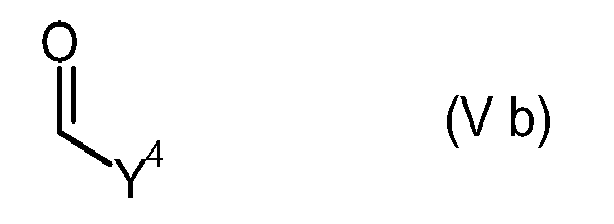
- In den Formeln (IV), (V a) und (V b) weisen X, n und Y1, Y2, Y3 und Y4 die bereits erwähnten Bedeutungen auf.
- Geeignete Polyamine der Formel (IV) sind Polyamine mit aliphatischen primären Aminogruppen, beispielsweise die folgenden: Aliphatische Polyamine wie Ethylendiamin, 1,2- und 1,3-Propandiamin, 2-Methyl-1,2-propandiamin, 2,2-Dimethyl-1,3-propandiamin, 1,3- und 1,4-Butandiamin, 1,3- und 1,5-Pentandiamin, 1,6-Hexamethylendiamin, 2,2,4- und 2,4,4-Trimethylhexamethylendiamin und Mischungen davon, 1,7-Heptandiamin, 1,8-Octandiamin, 4-Aminomethyl-1,8-octandiamin, 1,9-Nonandiamin, 1,10-Decandiamin, 1,11-Undecandiamin, 1,12-Dodecandiamin, Methyl-bis-(3-aminopropyl)amin, 1,5-Diamino-2-methylpentan (MPMD), 1,3-Diaminopentan (DAMP), 2,5-Dimethyl-1,6-hexamethylendiamin, cycloaliphatische Polyamine wie 1,3- und 1,4-Diaminocyclohexan, Bis-(4-aminocyclohexyl)-methan, Bis-(4-amino-3-methylcyclohexyl)-methan, Bis-(4-amino-3-ethylcyclohexyl)-methan, Bis-(4-amino-3,5-dimethylcyclohexyl)-methan, 1-Amino-3-aminomethyl-3,5,5-trimethylcyclohexan (= Isophorondiamin oder IPDA), 2- und 4-Methyl-1,3-diaminocyclohexan und Mischungen davon, 1,3- und 1,4-Bis-(aminomethyl)cyclohexan, 1-Cyclo-hexylamino-3-aminopropan, 2,5(2,6)-Bis-(aminomethyl)-bicyclo[2.2.1]heptan (NBDA, hergestellt von Mitsui Chemicals), 3(4),8(9)-Bis-(aminomethyl)-tricyclo-[5.2.1.02,6]decan, 1,4-Diamino-2,2,6-trimethylcyclohexan (TMCDA), 3,9-Bis-(3-aminopropyl)-2,4,8,10-tetraoxaspiro[5.5]undecan, 1,3- und 1,4-Xylylendiamin, Ethergruppen-haltige aliphatische Polyamine wie Bis-(2-aminoethyl)ether, 4,7-Dioxadecan-1,10-diamin, 4,9-Dioxadodecan-1,12-diamin und höhere Oligomere davon, Polyoxyalkylen-Polyamine mit zwei oder drei Aminogruppen, beispielsweise erhältlich unter dem Namen Jeffamine® (von Huntsman Chemicals), unter dem Namen Polyetheramin (von BASF) oder unter dem Namen PC Amine® (von Nitroil), sowie Mischungen der vorgenannten Polyamine.
- Als Polyamine der Formel (IV) bevorzugt sind Polyamine, welche ausgewählt sind aus der Gruppe bestehend aus 1,6-Hexamethylendiamin, MPMD, DAMP, IPDA, 4-Aminomethyl-1,8-octandiamin, 1,3-Xylylendiamin, 1,3-Bis-(aminomethyl)cyclohexan, Bis-(4-aminocyclohexyl)-methan, Bis-(4-amino-3-methylcyclohexyl)-methan, 3(4),8(9)-Bis-(aminomethyl)-tricyclo[5.2.1.02,6]-decan, 1,4-Diamino-2,2,6-trimethylcyclohexan und Polyoxyalkylen-Polyamine mit zwei oder drei Aminogruppen, insbesondere die unter dem Handelsnamen Jeffamine® erhältlichen Typen EDR-148, D-230, D-400, D-2000, T-403 und T-5000 von Huntsman und dazu analoge Verbindungen von BASF oder Nitroil, sowie deren Mischungen untereinander.
- Zur Herstellung eines Polyaldimins ALD der Formel (I a) oder (I b) werden Aldehyde der Formel (V a) oder (V b) verwendet. Diese Aldehyde haben die Eigenschaft, dass ihre Reste Y1, Y2, Y3 und Y4 keine Gruppierungen aufweisen, die in Abwesenheit von Wasser mit Isocyanatgruppen reaktionsfähig sind; insbesondere weisen Y1, Y2, Y3 und Y4 keine Hydroxylgruppen, keine primären oder sekundären Aminogruppen, keine Harnstoffgruppen und keine anderen Gruppen mit aktivem Wasserstoff auf.
- Zur Herstellung eines Polyaldimins ALD sind erstens Aldehyde der Formel (V a) geeignet, wobei Y1, Y2 und Y3 die bereits genannten Bedeutungen aufweisen.

- Aldehyde der Formel (V a) sind tertiäre aliphatische oder tertiäre cycloaliphatische Aldehyde, wie beispielsweise Pivalaldehyd (= 2,2-Dimethylpropanal), 2,2-Dimethyl-butanal, 2,2-Diethyl-butanal, 1-Methyl-cyclopentancarboxaldehyd, 1-Methyl-cyclohexancarboxaldehyd; sowie Ether aus 2-Hydroxy-2-methylpropanal und Alkoholen wie Propanol, Isopropanol, Butanol und 2-Ethylhexanol; Ester aus 2-Formyl-2-methylpropionsäure oder 3-Formyl-3-methylbuttersäure und Alkoholen wie Propanol, Isopropanol, Butanol und 2-Ethylhexanol; Ester aus 2-Hydroxy-2-methylpropanal und Carbonsäuren wie Buttersäure, Isobuttersäure und 2-Ethylhexansäure; sowie die im folgenden als besonders geeignet beschriebenen Ether und Ester von 2,2-disubstituierten 3-Hydroxypropanalen, -butanalen oder analogen höheren Aldehyden, insbesondere von 2,2-Dimethyl-3-hydroxypropanal.
- Besonders geeignete Aldehyde der Formel (V a) sind in einer ersten Ausführungsform Aldehyde der Formel (VI), das heisst, Aldehyde der Formel (V a) mit dem Rest Y3 der Formel (II)

R3 für ein Wasserstoffatom oder für eine Alkyl- oder Arylalkylgruppe steht,
R4 für einen Kohlenwasserstoffrest mit 1 bis 30 C-Atomen, der gegebenenfalls Heteroatome enthält, steht, und
Y1 und Y2 die bereits genannten Bedeutungen aufweisen. - In Formel (VI) stehen Y1 und Y2 jeweils bevorzugt für eine Methylgruppe, und R3 steht bevorzugt für ein Wasserstoffatom.
- Aldehyde der Formel (VI) stellen Ether von aliphatischen, araliphatischen oder cycloaliphatischen 2,2-disubstituierten 3-Hydroxyaldehyden mit Alkoholen der Formel HO-R4 dar, beispielsweise Fettalkoholen. Geeignete 2,2-disubstituierte 3-Hydroxyaldehyde sind ihrerseits erhältlich aus Aldol-Reaktionen, insbesondere gekreuzten Aldol-Reaktionen, zwischen primären oder sekundären aliphatischen Aldehyden, insbesondere Formaldehyd, und sekundären aliphatischen, sekundären araliphatischen oder sekundären cycloaliphatischen Aldehyden, wie beispielsweise 2-Methylbutyraldehyd, 2-Ethylbutyraldehyd, 2-Methylvaleraldehyd, 2-Ethylcapronaldehyd, Cyclopentancarboxaldehyd, Cyclohexancarboxaldehyd, 1,2,3,6-Tetrahydrobenzaldehyd, 2-Methyl-3-phenylpropionaldehyd, 2-Phenylpropionaldehyd (Hydratropaldehyd) oder Diphenylacetaldehyd.
- Als Beispiele solcher Aldehyde der Formel (VI) genannt werden sollen 2,2-Dimethyl-3-(2-ethylhexyloxy)-propanal, 2,2-Dimethyl-3-lauroxy-propanal und 2,2-Dimethyl-3-stearoxy-propanal.
- In einer zweiten Ausführungsform sind besonders geeignete Aldehyde der Formel (V a) Aldehyde der Formel (VII), das heisst, Aldehyde der Formel (V a) mit dem Rest Y3 der Formel (III).

R3 für ein Wasserstoffatom oder für eine Alkyl- oder Arylalkylgruppe;
R5 steht entweder
für ein Wasserstoffatom,
oder für einen linearen oder verzweigten Alkylrest mit 1 bis 30 C-Atomen, gegebenenfalls mit cyclischen Anteilen und gegebenenfalls mit mindestens einem Heteroatom,
oder für einen einfach oder mehrfach ungesättigten, linearen oder verzweigten Kohlenwasserstoffrest mit 5 bis 30 C-Atomen,
oder für einen, gegebenenfalls substituierten, aromatischen oder heteroaromatischen, 5- oder 6-gliedrigen Ring;
und Y1 und Y2 weisen die bereits genannten Bedeutungen auf. - In Formel (VII) stehen Y1 und Y2 jeweils bevorzugt für eine Methylgruppe, und R3 steht bevorzugt für ein Wasserstoffatom.
- Verbindungen der Formel (VII) stellen Ester der bereits beschriebenen 2,2-disubstituierten 3-Hydroxyaldehyde, wie beispielsweise 2,2-Dimethyl-3-hydroxypropanal, 2-Hydroxymethyl-2-methyl-butanal, 2-Hydroxymethyl-2-ethyl-butanal, 2-Hydroxymethyl-2-methyl-pentanal, 2-Hydroxymethyl-2-ethyl-hexanal, 1-Hydroxymethyl-cyclopentancarboxaldehyd, 1-Hydroxymethyl-cyclohexancarboxaldehyd 1-Hydroxymethyl-cyclohex-3-encarboxaldehyd, 2-Hydroxymethyl-2-methyl-3-phenyl-propanal, 3-Hydroxy-2-methyl-2-phenyl-propanal und 3-Hydroxy-2,2-diphenyl-propanal, mit geeigneten Carbonsäuren dar.
- Beispiele für geeignete Carbonsäuren sind zum einen aliphatische Carbonsäuren, wie Ameisensäure, Essigsäure, Propionsäure, Buttersäure, Isobuttersäure, Valeriansäure, Capronsäure, 2-Ethyl-capronsäure, Caprinsäure, Laurinsäure, Tridecansäure, Myristinsäure, Pentadecansäure, Palmitinsäure, Margarinsäure, Stearinsäure, Nonadecansäure, Arachinsäure, Palmitoleinsäure, Ölsäure, Erucasäure, Linolsäure, Linolensäure, Elaeostearinsäure, Arachidonsäure, Fettsäuren aus der technischen Verseifung von natürlichen Ölen und Fetten wie beispielsweise Rapsöl, Sonnenblumenöl, Leinöl, Ölbaumöl, Kokosnussöl, Ölpalmkernöl und Ölpalmöl, sowie technische Gemische von Fettsäuren, welche solche Säuren enthalten. Als Carbonsäuren geeignet sind zum anderen aromatische Carbonsäuren, beispielsweise Benzoesäure oder die stellungsisomeren Tolylsäuren, Ethyl- oder Isopropyl-oder tert.-Butyl- oder Methoxy- oder Nitrobenzoesäuren.
- Bevorzugte Aldehyde der Formel (VII) sind 2,2-Dimethyl-3-lauroyloxy-propanal, 2,2-Dimethyl-3-myristoyloxypropanal 2,2-Dimethyl-3-palmitoyloxy-propanal, 2,2-Dimethyl-3-stearoyloxy-propanal und 2,2-Dimethyl-3-benzoyloxy-propanal, sowie analoge Ester anderer 2,2-disubstituierter 3-Hydroxyaldehyde.
- In einer besonders bevorzugten Ausführungsform ist R5 ausgewählt aus der Gruppe bestehend aus Phenyl und den C11-, C13-, C15- und C17-Alkylgruppen.
- Als Aldehyd der Formel (VII) besonders bevorzugt ist 2,2-Dimethyl-3-lauroyloxypropanal.
- In einer bevorzugten Herstellmethode des Aldehyds der Formel (VII) wird ein 2,2-disubstituierter 3-Hydroxyaldehyd, beispielsweise 2,2-Dimethyl-3-hydroxypropanal, welcher beispielsweise aus Formaldehyd (oder Paraformaldehyd) und Isobutyraldehyd, gegebenenfalls in situ, hergestellt werden kann, mit einer Carbonsäure zum entsprechenden Ester umgesetzt. Diese Veresterung kann ohne die Verwendung von Lösemitteln nach bekannten Methoden erfolgen, beschrieben beispielsweise in Houben-Weyl, "Methoden der organischen Chemie", Vol. VIII, Seiten 516 - 528.
- In einer besonders bevorzugten Ausführungsform ist der Aldehyd der Formel (V a) geruchsfrei. Unter einer "geruchsfreien" Substanz wird eine Substanz verstanden, die so geruchsarm ist, dass sie für die meisten menschlichen Individuen nicht riechbar, das heisst mit der Nase nicht wahrnehmbar, ist.
- Geruchsfreie Aldehyde der Formel (V a) sind einerseits insbesondere Aldehyde der Formel (VI), in welchen der Rest R4 für einen Kohlenwasserstoffrest mit 12 bis 30 C-Atomen, der gegebenenfalls Heteroatome enthält, steht.
- Andererseits sind geruchsfreie Aldehyde der Formel (V a) insbesondere Aldehyde der Formel (VII), in welchen der Rest R5 entweder für eine lineare oder verzweigte Alkylgruppe mit 11 bis 30 Kohlenstoff-Atomen, gegebenenfalls mit cyclischen Anteilen, und gegebenenfalls mit mindestens einem Heteroatom, insbesondere mit mindestens einem Ether-Sauerstoff, oder für eine einfach oder mehrfach ungesättigte lineare oder verzweigte Kohlenwasserstoffkette mit 11 bis 30 Kohlenstoff-Atomen steht.
- Beispiele für geruchsfreie Aldehyde der Formel (VII) sind Veresterungsprodukte aus den bereits genannten 2,2-disubstituierten 3-Hydroxyaldehyden mit Carbonsäuren wie beispielsweise Laurinsäure, Tridecansäure, Myristinsäure, Pentadecansäure, Palmitinsäure, Margarinsäure, Stearinsäure, Nonadecansäure, Arachinsäure, Palmitoleinsäure, Ölsäure, Erucasäure, Linolsäure, Linolensäure, Elaeostearinsäure, Arachidonsäure, Fettsäuren aus der technischen Verseifung von natürlichen Ölen und Fetten, wie beispielsweise Rapsöl, Sonnenblumenöl, Leinöl, Ölbaumöl, Kokosnussöl, Ölpalmkernöl und Ölpalmöl, sowie technische Gemische von Fettsäuren, welche diese Säuren enthalten. Bevorzugte Aldehyde der Formel (VII) sind 2,2-Dimethyl-3-lauroyloxypropanal, 2,2-Dimethyl-3-myristoyloxypropanal, 2,2-Dimethyl-3-palmitoyloxypropanal und 2,2-Dimethyl-3-stearoyloxypropanal. Besonders bevorzugt ist 2,2-Dimethyl-3-lauroyloxypropanal.
- Zur Herstellung eines Polyaldimins ALD sind zweitens Aldehyde der Formel (V b) geeignet,

für eine substituierte oder unsubstituierte Aryl- oder Heteroaryl-Gruppe steht, welche eine Ringgrösse zwischen 5 und 8, bevorzugt 6, Atomen aufweist,
oder für
oder für eine substituierte oder unsubstituierte Alkenyl- oder Arylalkenylgruppe mit mindestens 6 C-Atomen steht. - Geeignete Aldehyde der Formel (V b) sind aromatische Aldehyde, wie beispielsweise Benzaldehyd, 2- und 3- und 4-Tolualdehyd, 4-Ethyl- und 4-Propyl- und 4-Isopropyl und 4-Butyl-benzaldehyd, 2,4-Dimethylbenzaldehyd, 2,4,5-Trimethylbenzaldehyd, 4-Acetoxybenzaldehyd, 4-Anisaldehyd, 4-Ethoxybenzaldehyd, die isomeren Di- und Trialkoxybenzaldehyde, 2-, 3- und 4-Nitrobenzaldehyd, 2- und 3- und 4-Formylpyridin, 2-Furfuraldehyd, 2-Thiophencarbaldehyd, 1- und 2-Naphthylaldehyd, 3- und 4-Phenyloxy-benzaldehyd; Chinolin-2-carbaldehyd und dessen 3-, 4-, 5-, 6-, 7- und 8-Stellungsisomere, sowie Anthracen-9-carbaldehyd.
- Geeignete Aldehyde der Formel (V b) sind weiterhin Glyoxal, Glyoxalsäureester, beispielsweise Glyoxalsäuremethylester, Zimtaldehyd und substituierte Zimtaldehyde.
- Die Polyaldimine ALD der Formel (I a) mit aliphatischen Aldimingruppen und die Polyaldimine ALD der Formel (I b) mit aromatischen Aldimingruppen haben die Eigenschaft, dass ihre Aldimingruppen nicht zu Enamingruppen tautomerisieren können, da sie als Substituenten in α-Stellung zum C-Atom der Aldimingruppe keinen Wasserstoff enthalten. Aufgrund dieser Eigenschaft bilden sie zusammen mit Isocyanatgruppen enthaltenden Polyurethanpolymeren P besonders lagerfähige, das heisst weitgehend viskositätsstabile, Mischungen, auch wenn hochreaktive aromatische Isocyanatgruppen wie diejenigen von TDI und MDI vorhanden sind.
- Polyaldimine ALD, welche ausgehend von geruchsfreien Aldehyden der vorgängig beschriebenen besonders bevorzugten Ausführungsform hergestellt sind, sind geruchsfrei. Solche geruchsfreien Polyaldimine ALD sind besonders bevorzugt.
- Als Polyaldimine ALD sind diejenigen, welche die Formel (I a) aufweisen, bevorzugt.
- Die Polyaldimine ALD sind unter geeigneten Bedingungen, insbesondere unter Ausschluss von Feuchtigkeit, lagerstabil. Bei Zutritt von Feuchtigkeit können ihre Aldimingruppen über Zwischenstufen formal zu Aminogruppen hydrolysieren, wobei der entsprechende, zur Herstellung des Aldimins verwendete Aldehyd der Formel (V a) oder (V b) freigesetzt wird. Da diese Hydrolysereaktion reversibel ist und das chemische Gleichgewicht deutlich auf der Aldiminseite liegt, ist davon auszugehen, dass in Abwesenheit von gegenüber Aminen reaktiven Gruppen nur ein Teil der Aldimingruppen teilweise oder ganz hydrolysieren.
- In Gegenwart von Isocyanatgruppen reagieren die hydrolysierenden Aldimingruppen mit den Isocyanatgruppen zu Harnstoffgruppen. Die Reaktion der Isocyanatgruppen mit den hydrolysierenden Aldimingruppen muss dabei nicht notwendigerweise über freie Aminogruppen erfolgen. Selbstverständlich sind auch Reaktionen mit Zwischenstufen der Hydrolysereaktion möglich. Beispielsweise ist es denkbar, dass eine hydrolysierende Aldimingruppe in der Form eines Halbaminals direkt mit einer Isocyanatgruppe reagiert.
- Ein Polyaldimin ALD ist in der feuchtigkeitsreaktiven Heissschmelzklebstoff-Zusammensetzung bevorzugt in einer leicht überstöchimetrischen, stöchiometrischen oder unterstöchiometrischen Menge bezogen auf alle freien Isocyanatgruppen vorhanden. Vorteilhaft beträgt das Verhältnis zwischen Aldimingruppen und Isocyanatgruppen 0.1 bis 1.1, insbesondere 0.15 bis 1.0, besonders bevorzugt 0.2 bis 0.9, Equivalent Aldimingruppen pro Equivalent Isocyanatgruppen.
- Als Polyaldimin ALD können auch Mischungen verschiedener Polyaldimine ALD verwendet werden. Insbesondere können Mischungen verschiedener Polyamine ALD eingesetzt werden, welche ausgehend von Mischungen verschiedener Polyamine der Formel (IV) und/oder Mischungen verschiedener Aldehyde der Formel (V a) oder (V b) hergestellt wurden. Es kann insbesondere vorteilhaft sein, als Polyaldimin ALD Mischungen von Polyaldiminen ALD zu verwenden, welche ausgehend von Mischungen bestehend aus Di- und Triaminen der Formel (IV) hergestellt wurden.
- Die feuchtigkeitsreaktive Heissschmelzklebstoff-Zusammensetzung enthält neben dem bei Raumtemperatur festen, Isocyanatgruppen aufweisenden Polyurethanpolymer P und dem Polyaldimin ALD der Formel (I a) oder (I b) zusätzlich mindestens eine Säure K in Form einer organischen Mono- oder Dicarbonsäure oder einer organischen Mono- oder Disulfonsäure oder einer zu einer dieser Säuren hydrolysierbaren Verbindung.
- In einer ersten Ausführungsform stellt die Säure K eine organische Mono- oder Dicarbonsäure oder eine zu einer organischen Mono- oder Dicarbonsäure hydrolysierbare Verbindung dar, beispielsweise ausgewählt aus
- gesättigten aliphatischen Monocarbonsäuren wie Ameisensäure, Essigsäure, Propionsäure, Buttersäure, Isobuttersäure, Valeriansäure, Isovaleriansäure, Pivalinsäure, Capronsäure, Oenanthsäure, Caprylsäure, 2-Ethylhexansäure, Pelargonsäure, Caprinsäure, Neodecansäure, Undecansäure, Laurinsäure, Tridecansäure, Myristinsäure, Pentadecansäure, Palmitinsäure, Margarinsäure, Stearinsäure, Isostearinsäure, Arachinsäure und Behensäure;
- gesättigten aliphatischen Dicarbonsäuren wie Oxalsäure, Malonsäure, Bernsteinsäure, Glutarsäure, Adipinsäure, Pimelinsäure, Korksäure, Azelainsäure, Sebacinsäure und Dodecandisäure;
- einfach oder mehrfach ungesättigten aliphatischen Mono- oder Dicarbonsäuren wie Palmitoleinsäure, Ölsäure, Erucasäure, Sorbinsäure, Linolsäure, Linolensäure, Elaeostearinsäure, Ricinolsäure, Ricinensäure, Maleinsäure, Fumarsäure und Sorbinsäure;
- cycloaliphatischen Mono- oder Dicarbonsäuren wie Cyclohexancarbonsäure, Hexahydrophthalsäure, Tetrahydrophthalsäure, Harzsäuren und Naphthensäuren;
- halogenierten aliphatischen Mono- oder Dicarbonsäuren wie Trichloressigsäure und 2-Chlorpropionsäure;
- aromatischen Mono- oder Dicarbonsäuren wie Benzoesäure, Salicylsäure, Gallussäure, Phthalsäure, Terephthalsäure, Isophthalsäure und die stellungsisomeren Tolylsäuren, Methoxybenzoesäuren, Chlorbenzoesäuren und Nitrobenzoesäuren;
- technischen Carbonsäure-Gemischen wie zum Beispiel Versatic®-Säuren;
- Carbonsäureanhydriden wie Phthalsäureanhydrid und Hexahydrophthalsäureanhydrid;
- Silylester der genannten organischen Carbonsäuren, beispielsweise Siliciumtetraacetat, Trimethylsilylacetat, Triacetoxyethylacetat, Laurinsäuretrimethylsilylester und Benzoesäuretrimethylsilylester.
- In einer zweiten Ausführungsform stellt die Säure K eine organische Mono- oder Disulfonsäure oder eine zu einer organischen Mono- oder Disulfonsäure hydrolysierbare Verbindung dar, beispielsweise ausgewählt aus
- aliphatischen oder aromatischen Mono- und Disulfonsäuren wie Methylsulfonsäure, Vinylsulfonsäure, Butylsulfonsäure, Sulfoessigsäure, Benzolsulfonsäure, die stellungsisomeren Benzoldisulfonsäuren, p-Toluolsulfonsäure, p-Xylolsulfonsäure, 4-Dodecylbenzolsulfonsäure, 1-Naphtalinsulfonsäure, Dinonylnaphthalinsulfonsäure und Dinonylnaphthalindisulfonsäure;
- Alkyl- oder Silylestern der genannten Mono- oder Disulfonsäuren, beispielsweise p-Toluolsulfonsäuremethylester, Ethylenglykol-bis-p-toluolsulfonat, Trimethylsilyl-methansulfonat und Benzolsulfonsäuretrimethylsilylester;
- Sultonen und Anhydriden, beispielsweise 1,4-Butansulton und 2-Sulfobenzoesäureanhydrid.
- Bei der Säure K kann es sich auch um Mischungen aus zwei oder mehr der genannten Säuren oder zu diesen Säuren hydrolysierbaren Verbindungen handeln.
- Als Säure K bevorzugt sind aromatische Monocarbonsäuren, insbesondere Benzoesäure, Salicylsäure und 2-Nitrobenzoesäure.
- Üblicherweise ist die Säure K in einer Menge von 0.001 bis 5 Gewichts-%, bevorzugt 0.005 bis 2 Gewichts-%, bezogen auf die gesamte feuchtigkeitsreaktive Heissschmelzklebstoff-Zusammensetzung, vorhanden.
- Die Säure K hat eine katalytische Wirkung auf die Hydrolyse des Polyaldimins ALD, was die chemische Vernetzung der feuchtigkeitsreaktiven Heissschmelzklebstoff-Zusammensetzung beschleunigt.
- Die vorgängig beschriebene feuchtigkeitsreaktive Heissschmelzklebstoff-Zusammensetzung enthält gegebenenfalls weitere Bestandteile, wie sie nach dem Stand der Technik üblicherweise eingesetzt werden. Dem Fachmann ist dabei klar, dass solche weiteren Bestandteile in Abhängigkeit der jeweiligen Zusammensetzung und in ihrer Art und Menge so zu wählen sind, dass trotz ihrer Anwesenheit die Lagerstabilität der Zusammensetzung gegeben ist.
- Gegebenenfalls enthält die vorgängig beschriebene feuchtigkeitsreaktive Heissschmelzklebstoff-Zusammensetzung nicht-reaktive thermoplastische Polymere, wie beispielsweise Homo- oder Copolymere von ungesättigten Monomeren, insbesondere aus der Gruppe umfassend Ethylen, Propylen, Butylen, Isobutylen, Isopren, Vinylacetat oder höhere Ester davon, und (Meth)acrylat. Besonders geeignet sind Ethylenvinylacetat-Copolymere (EVA), ataktische Poly-α-Olefine (APAO), Polypropylene (PP) und Polyethylene (PE).
- Gegebenenfalls enthält die beschriebene feuchtigkeitsreaktive Heissschmelzklebstoff-Zusammensetzung Katalysatoren für die Reaktion der Isocyanatgruppen, wie Metallverbindungen oder tertiäre Amine.
- Geeignete Metallverbindungen sind beispielsweise Zinnverbindungen wie Dibutylzinndiacetat, Dibutylzinndilaurat, Dibutylzinndistearat, Dibutylzinndiacetylacetonat, Dioctylzinndilaurat, Dibutylzinndichlorid, Dibutylzinnoxid, Zinn(II)-carboxylate; Stannoxane wie Laurylstannoxan; Bismutverbindungen wie Bismut(III)-octoat, Bismut(III)-neodecanoat oder Bismut(III)-oxinate.
- Geeignete tertiäre Amine sind beispielsweise 2,2'-Dimorpholinodiethylether und andere Morpholinether-Derivate, 1,4-Diazabicyclo[2.2.2]octan und 1,8-Diazabicyclo[5.4.0]undec-7-en.
- Ebenso kann die feuchtigkeitsreaktive Heissschmelzklebstoff-Zusammensetzung Mischungen der genannten Katalysatoren enthalten. Besonders geeignet sind Mischungen von Metallverbindungen und tertiäre Amine.
- Gegebenenfalls enthält die vorgängig beschriebene feuchtigkeitsreaktive Heissschmelzklebstoff-Zusammensetzung Reaktivverdünner oder Vernetzer, beispielsweise Oligomere oder Polymere von Diisocyanaten wie MDI, PMDI, TDI, HDI, 1, 12-Dodecamethylendiisocyanat, Cyclohexan-1,3- oder 1,4-diisocyanat, IPDI, Perhydro-2,4'- und -4,4'-diphenylmethandiisocyanat, 1,3- und 1,4-Tetramethylxylylendiisocyanat, insbesondere Isocyanurate, Carbodiimide, Uretonimine, Biurete, Allophanate und Iminooxadiazindione der genannten Diisocyanate, Addukte von Polyisocyanaten mit kurzkettigen Polyolen, sowie Adipinsäure-dihydrazid und andere Dihydrazide, sowie weitere Polyaldimine, insbesondere solche, welche aus der Umsetzung von Polyaminen der Formel (IV) mit Dialdehyden erhalten werden.
- Weiterhin kann die vorgängig beschriebene feuchtigkeitsreaktive Heissschmelzklebstoff-Zusammensetzung andere Zusätze enthalten, wie insbesondere Füllstoffe, Weichmacher, Haftvermittler, insbesondere Silangruppen enthaltende Verbindungen, UV-Absorptionsmittel, UV- oder Wärmestabilisatoren, Antioxidantien, Flammschutzmittel, optische Aufheller, Pigmente, Farbstoffe und Trocknungsmittel, sowie weitere üblicherweise in isocyanathaltigen Zusammensetzungen eingesetzte Substanzen.
- In einer bevorzugten Ausführungsform ist die vorgängig beschriebene feuchtigkeitsreaktive Heissschmelzklebstoff-Zusammensetzung frei von Russ.
- In einer weiteren bevorzugten Ausführungsform ist die vorgängig beschriebene feuchtigkeitsreaktive Heissschmelzklebstoff-Zusammensetzung ganz frei von Füllstoffen.
- In einer besonders bevorzugten Ausführungsform ist die vorgängig beschriebene feuchtigkeitsreaktive Heissschmelzklebstoff-Zusammensetzung transparent. Insbesondere ist sie sowohl vor als auch nach dem chemischen Vernetzen mit Feuchtigkeit transparent. Eine solche Zusammensetzung ist besonders geeignet für die Verklebung von Substraten, bei der zumindest eines der zu verklebenden Substrate durchsichtig oder durchscheinend ist.
- Die vorgängig beschriebene feuchtigkeitsreaktive Heissschmelzklebstoff-Zusammensetzung wird unter Ausschluss von Feuchtigkeit hergestellt und aufbewahrt. In einer geeigneten, klimadichten Verpackung oder Anordnung, wie beispielsweise in einem Fass, einem Beutel oder einer Kartusche, verfügt sie über eine hervorragende Lagerstabilität. Mit den Begriffen "lagerstabil" und "Lagerstabilität" in Zusammenhang mit einer Zusammensetzung wird im vorliegenden Dokument der Sachverhalt bezeichnet, dass die Viskosität der Zusammensetzung bei der Applikationstemperatur bei geeigneter Lagerung in der betrachteten Zeitspanne nicht oder höchstens so stark ansteigt, dass die Zusammensetzung auf die vorgesehene Weise verwendbar bleibt.
- Für die Wirkungsweise eines reaktiven Heissschmelzklebstoffes ist es wichtig, dass der Klebstoff aufschmelzbar ist, das heisst, dass er bei der Applikationstemperatur eine genügend niedrige Viskosität aufweist, um applizierbar zu sein, und dass er beim Erkalten möglichst schnell eine genügende Klebefestigkeit aufbaut, schon bevor die Vernetzungsreaktion mit Luftfeuchtigkeit abgeschlossen ist (Anfangsfestigkeit). Es hat sich gezeigt, dass die beschriebenen Zusammensetzungen bei der Applikationstemperatur, welche für Heissschmelzklebstoffe im Bereich von 80 °C bis 200 °C, typischerweise von 120 °C bis 160 °C, liegt, eine gut handhabbare Viskosität aufweisen, und dass sie beim Erkalten genügend schnell eine gute Klebefestigkeit aufbauen. Als gut handhabbare Viskosität wird insbesondere eine Viskosität von 1 - 50 Pas verstanden.
- Bei der Applikation kommt die vorgängig beschriebene feuchtigkeitsreaktive Heissschmelzklebstoff-Zusammensetzung in Kontakt mit Feuchtigkeit, insbesondere in Form von Luftfeuchtigkeit. Parallel zur physikalischen Erhärtung infolge Erstarren beim Abkühlen setzt auch die chemische Vernetzung mit Feuchtigkeit ein, hauptsächlich indem die vorhandenen Aldimingruppen durch Feuchtigkeit hydrolysiert werden und in der bereits beschriebenen Weise schnell mit vorhandenen Isocyanatgruppen reagieren. Überschüssige Isocyanatgruppen vernetzen ebenfalls mit Feuchtigkeit in bekannter Weise.
- Mit den Begriffen "Vernetzung", "chemische Vernetzung", "Vernetzungsreaktion" wird im gesamten Dokument der durch die chemische Reaktion von Isocyanatgruppen ausgelöste Prozess der Entstehung von hochmolekularen Polyurethan-Kunststoffen bezeichnet, auch dann, wenn dabei kein kovalent verbundenes Netzwerk entsteht. Ist die Vernetzungsreaktion in einer feuchtigkeitsreaktiven Heissschmelzklebstoff-Zusammensetzung durch die ganze Masse fortgeschritten, spricht man auch von "Durchhärtung".
- Die für die Vernetzung benötigte Feuchtigkeit kann entweder aus der Luft stammen (Luftfeuchtigkeit), oder aber die Zusammensetzung kann mit einer Wasser enthaltenden Komponente in Kontakt gebracht werden, zum Beispiel durch Bestreichen oder durch Besprühen, oder es kann der Zusammensetzung bei der Applikation eine Wasser enthaltende Komponente zugesetzt werden, zum Beispiel in Form einer wasserhaltigen Paste, die, beispielsweise über einen Statikmischer, eingemischt wird.
- Die vorgängig beschriebene feuchtigkeitsreaktive Heissschmelzklebstoff-Zusammensetzung zeigt bei der Vernetzung mit Feuchtigkeit eine stark verminderte Tendenz zur Bildung von Blasen, da bei der Vernetzungsreaktion durch das Vorhandensein von Aldimingruppen - je nach Stöchiometrie - weniger oder gar kein Kohlendioxid gebildet wird.
- Des Weiteren zeigt die vorgängig beschriebene feuchtigkeitsreaktive Heissschmelzklebstoff-Zusammensetzung eine relativ schnelle chemische Vernetzung, auch wenn die Zusammensetzung amorph ist und/oder dickschichtig appliziert wurde.
- In einer bevorzugten Ausführungsform ist die vorgängig beschriebene feuchtigkeitsreaktive Heissschmelzklebstoff-Zusammensetzung transparent. Eine solche Zusammensetzung enthält mindestens ein transparentes Polyurethanpolymer P, typischerweise erhältlich durch Umsetzung mindestens eines amorphen Polyols, insbesondere mindestens eines amorphen Polyester-oder Polycarbonatpolyols mit einem Polyisocyanat in der bereits beschriebenen Weise. Eine transparente feuchtigkeitsreaktive Heissschmelzklebstoff-Zusammensetzung ist besonders geeignet für die Verklebung von transparenten Substraten, bei denen die Verklebungsstelle sichtbar ist.
- Amorphe, beziehungsweise transparente, PUR-RHM, welche nur über die Reaktion von Isocyanatgruppen mit Wasser vernetzen, zeigen eine sehr starke Tendenz zur Bildung von Blasen und eine sehr langsame Vernetzung, insbesondere bei einer Anwendung in dickeren Schichten. Dies rührt wohl daher, dass die bei der chemischen Vernetzung mit Feuchtigkeit von der Oberfläche her entstehende amorphe Klebstoff-Haut besonders gasundurchlässig ist und sowohl das bei der Vernetzung entstehende Kohlendioxid von innen her, als auch die für die Vernetzung benötigte Feuchtigkeit von aussen her, kaum passieren lässt.
- Die vorgängig beschriebenen feuchtigkeitsreaktiven Heissschmelzklebstoff-Zusammensetzungen, insbesondere die transparenten, verhalten sich in Bezug auf Blasenbildung und Geschwindigkeit der chemischen Vernetzung besonders vorteilhaft. Durch die Anwesenheit mindestens eines Polyaldimins ALD der Formel (I a) oder (I b) wird bei der Vernetzung mit Feuchtigkeit einerseits weniger oder gar kein CO2 gebildet, was die Blasenbildung vermindert; andererseits ist die Geschwindigkeit der Vernetzung deutlich erhöht, wohl aufgrund der schnellen Reaktion des Aldimins und eines verbesserten Transports der Feuchtigkeit durch die Klebstoff-Haut hindurch. Deshalb können solche transparenten feuchtigkeitsreaktive Heissschmelzklebstoff-Zusammensetzungen in dickeren Schichten appliziert werden, beispielsweise in Schichtdicken von mehr als 500 Mikrometern, insbesondere mehr als 800 Mikrometern bis hin zu mehreren Millimetern, ohne dass bei der Vernetzung eine starke Bildung von Blasen auftritt, und ohne dass die Vernetzung übermässig langsam wird.
- Bei der Anwendung wird die vorgängig beschriebene feuchtigkeitsreaktive Heissschmelzklebstoff-Zusammensetzung zum Verkleben eines Substrates S1 und eines Substrates S2 eingesetzt.
- Ein solches Verfahren zur Verklebung eines Substrates S1 und eines Substrates S2 umfasst die Schritte
- i) Aufheizen der vorgängig beschriebenen feuchtigkeitsreaktiven Heissschmelzklebstoff-Zusammensetzung auf eine Temperatur zwischen 80 °C und 200 °C, insbesondere zwischen 120 °C und 160 °C;
- ii) Applikation der aufgeheizten Zusammensetzung auf ein Substrat S1;
- iii) Kontaktieren der applizierten Zusammensetzung mit einem Substrat S2;
- An den Schritt iii) schliesst sich typischerweise ein Schritt iv) des chemischen Vernetzens der Zusammensetzung mit Feuchtigkeit an. Der Fachmann versteht, dass je nach verwendetem System, Temperatur und Reaktivität der Zusammensetzung, die Vernetzungsreaktion bereits während der Applikation beginnen kann. Der Hauptteil der Vernetzung findet jedoch nach der Applikation, und somit primär im festen Aggregatszustand des Polyurethanpolymers P, bzw. des Klebstoffs, statt.
- Die Substrate S1 und/oder S2 können bei Bedarf vor dem Applizieren der Zusammensetzung vorbehandelt werden. Derartige Vorbehandlungen umfassen insbesondere physikalische und/oder chemische Reinigungs- und Aktivierungsverfahren, beispielsweise Schleifen, Sandstrahlen, Bürsten, Coronabehandlung, Plasmabehandlung, Beflammen, Anätzen oder dergleichen, oder Behandeln mit Reinigern oder Lösemitteln oder das Aufbringen eines Haftvermittlers, einer Haftvermittlerlösung oder eines Primers.
- Die Substrate S1 und S2 können eine Vielzahl von Materialien darstellen. Insbesondere eignen sich Kunststoffe, organische Materialien wie Leder, Stoffe, Papier, Holz, mit Harz gebundene Holzwerkstoffe, Harz-Texil-Compositewerkstoffe, Glas, Porzellan, Keramik sowie Metalle und Metall-Legierungen, insbesondere lackierte oder pulverbeschichtete Metalle und Metall-Legierungen.
- Als Kunststoffe eignen sich insbesondere Polyvinylchlorid (PVC), Acrylonitril-Butadien-Styrol-Copolymere (ABS), SMC (Sheet Moulding Composites), Polycarbonat (PC), Polyamid (PA), Polyester, Polyoxymethylen (POM), Polyolefine (PO), insbesondere Polyethylen (PE), Polypropylen (PP), Ethylen/Propylen-Copolymere (EPM) und Ethylen/Propylen-Dien-Terpolymere (EPDM), bevorzugt mit Plasma, Corona oder Flammen oberflächenbehandeltes PP oder PE.
- Als bevorzugte Materialien für die Substrate S1 und/oder S2 gelten transparente Materialien, insbesondere transparente Kunststofffolien. Ein anderes bevorzugtes transparentes Material ist Glas, insbesondere in Form einer Scheibe.
- Die Dicke des Klebstoffs in der Verklebung (Verklebungsdicke) beträgt typischerweise 10 Mikrometer oder mehr. Insbesondere liegt die Verklebungsdicke zwischen 10 Mikrometern und 2 Millimetern, vor allem zwischen 80 Mikrometern und 500 Mikrometern.
- Die vorgängig beschriebene feuchtigkeitsreaktive Heissschmelzklebstoff-Zusammensetzung wird insbesondere in einem industriellen Fertigungsprozess eingesetzt.
- Insbesondere eignet sich die Zusammensetzung für Verklebungen, in welchen die Verklebungsstelle sichtbar ist. So eignet sie sich einerseits insbesondere für die Verklebung von Glas, insbesondere im Fahrzeug- und Fensterbau. Andererseits eignet sie sich insbesondere für das Verkleben von Klarsichtverpackungen.
- Aus dem Verklebungsverfahren resultieren Artikel. Derartige Artikel sind insbesondere Artikel der Transportmittel-, Möbel-, Textil- oder Verpackungsbranche. Als Transportmittelbranche wird insbesondere die Automobilbranche bevorzugt.
- Beispielhafte derartige Artikel sind Automobil-Innenausstattungsteile, wie Dachhimmel, Sonnenblende, Instrumententafel, Türseitenteil, Hutablage und dergleichen; Holzfaserwerkstoffe aus dem Duschen- und Badbereich; Möbel-Dekorfolien, Membranfolien mit Textilien wie Baumwolle, Polyesterfolien im Bekleidungsbereich oder Textilien mit Schäumen für Autoausstattungen.
- Weitere derartige Artikel insbesondere Artikel aus der Verpackungsbranche. Insbesondere handelt es sich bei einem derartigen Artikel um eine Klarsichtverpackung.
- Die vorgängig beschriebene feuchtigkeitsreaktive Heissschmelzklebstoff-Zusammensetzung, umfassend
- a) mindestens ein bei Raumtemperatur festes, Isocyanatgruppen aufweisendes Polyurethanpolymer P,
- b) mindestens ein Polyaldimin ALD der Formel (I a) oder (I b), und
- c) mindestens eine Säure K in Form einer organischen Mono- oder Dicarbonsäure oder einer organischen Mono- oder Disulfonsäure oder einer zu einer dieser Säuren hydrolysierbaren Verbindung
- So ist sie hervorragend hitzestabil, d.h. dass die Viskosität bei einer gegebenen Applikationstemperatur über die Zeit nicht oder nur geringfügig erhöht wird. Weiterhin hat sie eine stark verminderte Tendenz zur Bildung von Blasen und zeigt im Vergleich zu nur über die Reaktion von Isocyanatgruppen mit Wasser vernetzenden Systemen eine deutlich höhere Vernetzungsgeschwindigkeit. Neben diesen Vorteilen zeigt die beschriebene feuchtigkeitsreaktive Heissschmelzklebstoff-Zusammensetzung ähnlich gute Eigenschaften wie die Systeme nach dem Stand der Technik, nämlich eine schnelle Klebefestigkeit, eine gute Wärmestandfestigkeit und eine hohe Endfestigkeit bei einer guten Dehnbarkeit, wobei die mechanischen Endeigenschaften sich in einem sehr breiten Bereich an die Bedürfnisse einer Klebeanwendung anpassen lassen.
- In einer besonders bevorzugten Ausführungsform ist sie geruchsfrei.
- In einer weiteren besonders bevorzugten Ausführungsform ist sie amorph, insbesondere transparent.
- In einem weiteren Aspekt betrifft die Erfindung ein Verfahren zur Reduktion der Blasenbildung und zur Beschleunigung der chemischen Vernetzung von amorphen, insbesondere transparenten, feuchtigkeitsreaktiven Heissschmelzklebstoff-Zusammensetzungen, indem zu mindestens einem amorphen Polyurethanpolymer P, wie es vorgängig bereits beschrieben wurde, mindestens ein Polyaldimin ALD der Formel (I a) oder (I b), wie es vorgängig bereits beschrieben wurde, und mindestens eine Säure K in Form einer organischen Mono- oder Dicarbonsäure oder einer organischen Mono- oder Disulfonsäure oder einer zu einer dieser Säuren hydrolysierbaren Verbindung, wie sie vorgängig bereits beschrieben wurde, gegeben wird.
- Der totale Gehalt an Aldiminogruppen und freien Aminogruppen in den hergestellten Verbindungen ("Amin-Gehalt") wurde titrimetrisch bestimmt (mit 0.1N HClO4 in Eisessig, gegen Kristallviolett) und ist stets angegeben in mmol NH2/g (auch wenn es sich nicht nur um primäre Aminogruppen handelt).
- Die Viskosität wurde bei der angegebenen Temperatur mit einem Brookfield Viskosimeter mit Spindel Nr. 27 und 5 Umdrehungen pro Minute gemessen.
- Die Durchhärtungszeit wurde folgendermassen bestimmt: Der jeweilige Heissschmelzklebstoff wurde bei 150 °C auf Silikonpapier appliziert, so dass ein Klebstoffstreifen von 60 x 500 mm mit einer Dicke von 500 Mikrometern entstand. Dieser Probekörper wurde bei 23 °C und 55 % relativer Luftfeuchtigkeit gelagert. In regelmässigen Zeitabständen wurde ein Stück dieses Streifens abgeschnitten und auf eine Heizplatte mit einer Temperatur von 150 °C gelegt. Sobald kein Aufschmelzen des Klebstoffes mehr zu beobachten war, galt der Klebstoff als durchgehärtet. Die Durchhärtungszeit ist ein Mass für die Geschwindigkeit der chemischen Vernetzung.
- Die Zugfestigkeit und die Bruchdehnung wurden in Anlehnung an DIN 53504 bestimmt, an Hanteln mit einer Dicke von 2 mm und einer Länge von 75 mm (Steglänge 30 mm, Stegbreite 4 mm). Zur Herstellung der Hanteln wurde ein Klebstofffilm von 2 mm Dicke zubereitet (Applikationstemperatur des Klebstoffs 150 °C), aus welchem die Hanteln ausgestanzt und anschliessend während 2 Wochen bei 23 °C und 50% relativer Luftfeuchtigkeit gelagert wurden.
- Die bleibende Zugverlängerung wurde an den zur Messung der Zugfestigkeit und Bruchdehnung benutzten Hanteln geprüft. 1 Minute nach der Entlastung wurde die gerissene Hantel wieder zusammengefügt, deren Länge gemessen und davon die Ausgangslänge von 75 mm abgezogen. Die Zugverlängerung ist ein Mass für das Rückstellvermögen des Klebstoffs: je geringer die bleibende Zugverlängerung, desto besser das Rückstellvermögen.
- Die Blasenbildung wurde optisch bestimmt an zylinderförmigen Probekörpern mit einem Durchmesser von 25 mm und einer Dicke von 2 mm, welche bei einer Klebstoff temperatur von 150 °C hergestellt und anschliessend 2 Wochen bei 23 °C und 50% relativer Luftfeuchtigkeit gelagert wurden.
- In einem Rundkolben wurden unter Stickstoffatmosphäre 625 g (2.20 mol) 2,2-Dimethyl-3-lauroyloxy-propanal vorgelegt. Unter kräftigem Rühren wurden aus einem Eintropftrichter langsam 250 g (2.10 mol NH2) Jeffamine® D-230 (Huntsman; alpha, omega-Polyoxypropylendiamin, Amin-Equivalentgewicht 119 g/Eq) zugegeben. Danach wurden bei 80 °C die flüchtigen Bestandteile im Vakuum vollständig abdestilliert. Es wurden 837 g gelbliches, bei Raumtemperatur flüssiges Reaktionsprodukt erhalten mit einem Aldimin-Gehalt, bestimmt als Amin-Gehalt, von 2.5 mmol NH2/g.
- In einem Rundkolben wurden unter Stickstoffatmosphäre 298.7 g (1.05 mol) 2,2-Dimethyl-3-lauroyloxy-propanal vorgelegt. Unter kräftigem Rühren wurden aus einem beheizten Eintropftrichter langsam 58.1 g (0.50 mol) 1,6-Hexamethylendiamin zugegeben. Danach wurden bei 80 °C die flüchtigen Bestandteile im Vakuum vollständig abdestilliert. Es wurden 338.2 g gelbliches, bei Raumtemperatur flüssiges Reaktionsprodukt erhalten mit einem Aldimin-Gehalt, bestimmt als Amin-Gehalt, von 2.94 mmol NH2/g.
- In einem Rundkolben wurden unter Stickstoffatmosphäre 625 g (2.20 mol) 2,2-Dimethyl-3-lauroyloxy-propanal vorgelegt. Unter kräftigem Rühren wurden aus einem Eintropftrichter langsam 334.2 g (2.10 mol NH2) Jeffamine® T-403 (Huntsman; Polyoxypropylentriamin, Amin-Equivalentgewicht 159 g/Eq) zugegeben. Danach wurden bei 80 °C die flüchtigen Bestandteile im Vakuum vollständig abdestilliert. Es wurden 921 g gelbliches, bei Raumtemperatur flüssiges Reaktionsprodukt erhalten mit einem Aldimin-Gehalt, bestimmt als Amin-Gehalt, von 2.28 mmol NH2/g.
- 1000 g Polyol Dynacoll® 7250 (Polyester-Diol, OH-Zahl 21 mg KOH/g, bei Raumtemperatur flüssig; Degussa), 1000 g Polyol Dynacoll® 7150 (Polyester-Diol, OH-Zahl 42 mg KOH/g, bei Raumtemperatur fest, amorph, Erweichungspunkt 95 °C; Degussa) und 281 g 4,4'-Methylendiphenyldiisocyanat (MDI; Desmodur® 44 MC L, Bayer) wurden nach bekanntem Verfahren bei 140 °C zu einem NCO-terminierten Polyurethanpolymeren umgesetzt. Das Reaktionsprodukt hatte einen titrimetrisch bestimmten Gehalt an freien Isocyanatgruppen von 2.0 Gewichts-% und war bei Raumtemperatur fest. Es wurde unter Ausschluss von Feuchtigkeit aufbewahrt.
- 95 Gewichtsteile (GT) des beschriebenen Polyurethanpolymers P, 5 GT Polyaldimin ALD-1 und 0.05 GT Benzoesäure wurden bei einer Temperatur von 140 °C homogen vermischt und unter Ausschluss von Feuchtigkeit aufbewahrt.
- 95 Gewichtsteile (GT) des beschriebenen Polyurethanpolymers P, 5 GT Polyaldimin ALD-2 und 0.05 GT Benzoesäure wurden bei einer Temperatur von 140 °C homogen vermischt und unter Ausschluss von Feuchtigkeit aufbewahrt.
- 95 Gewichtsteile (GT) des beschriebenen Polyurethanpolymers P, 5 GT Polyaldimin ALD-3 und 0.05 GT Benzoesäure wurden bei einer Temperatur von 140 °C homogen vermischt und unter Ausschluss von Feuchtigkeit aufbewahrt.
- Als Beispiel 4 wurde das beschriebene Polyurethanpolymer P verwendet, also ohne Zusatz eines Polyaldimins ALD und einer Säure.
Tabelle 1: Eigenschaften der Beispiele 1 bis 3 und des Vergleichsbeispiels 4. a n.b. = nicht bestimmbar, da zu viele Blasen im Film Beispiel 1 2 3 4 (Vergl.) Viskosität bei 130 °C [Pa·s] 15 16 21 14.5 Durchhärtungszeit 18 h 22 h 24 h 48 h Zugfestigkeit [MPa] 34 30 31 n.b.a Bruchdehnung [%] 450 475 415 n.b.a Bleibende Zugverlängerung 5.5 mm 3.5 mm 8.5 mm 10 mm Blasenbildung wenige wenige wenige sehr viele, Schaum - Die Resultate der Tabelle 1 zeigen, dass die Heissschmelzklebstoffe der erfindungsgemässen Beispiele 1, 2 und 3 eine deutlich kürzere Durchhärtungszeit, das heisst eine höhere Vernetzungsgeschwindigkeit, und eine stark verminderte Blasenbildung aufweisen im Vergleich zum Heissschmelzklebstoff des Vergleichsbeispiels 4. Die Heissschmelzklebstoffe der erfindungsgemässen Beispiele 1, 2 und 3 weisen ausserdem eine geringere bleibende Zugverlängerung, und damit ein besseres Rückstellvermögen, auf als der Heissschmelzklebstoff des Vergleichsbeispiels 4.
Claims (24)
- Feuchtigkeitsreaktive Heissschmelzklebstoff-Zusammensetzung umfassenda) mindestens ein bei Raumtemperatur festes, Isocyanatgruppen aufweisendes Polyurethanpolymer P,b) mindestens ein Polyaldimin ALD der Formel (I a) oder (I b),

 c) mindestens eine Säure K in Form einer organischen Monocarbonsäure oder Dicarbonsäure oder einer organischen Monosulfonsäure oder Disulfonsäure oder einer zu einer dieser Säuren hydrolysierbaren Verbindung;wobei in Formel (I a) oder (I b)
X für den organischen Rest eines n-funktionellen primären Polyamins nach Entfernung von n aliphatischen primären Aminogruppen steht,
wobei dieser organische Rest keine Gruppierungen aufweist, die in Abwesenheit von Wasser mit Isocyanatgruppen reaktionsfähig sind, insbesondere keine Hydroxylgruppen, keine sekundären Aminogruppen, keine Harnstoffgruppen und keine anderen Gruppen mit aktivem Wasserstoff;
n für 2 oder 3 oder 4, insbesondere für 2 oder 3, bevorzugt für 2, steht;Y1 und Y2 entweder unabhängig voneinander jeweils für einen einwertigen Kohlenwasserstoffrest mit 1 bis 12 C-Atomen stehen,
oder zusammen für einen zweiwertigen Kohlenwasserstoffrest mit 4 bis 20 C-Atomen, der Teil eines, gegebenenfalls substituierten, carbocyclischen Rings mit 5 bis 8, bevorzugt 6, C-Atomen, ist, stehen;Y3 für einen einwertigen Kohlenwasserstoffrest steht, welcher gegebenenfalls mindestens ein Heteroatom, insbesondere Sauerstoff in Form von Ether-, Carbonyl- oder Ester-Gruppen, aufweist;Y4 entweder für eine substituierte oder unsubstituierte Aryl- oder Heteroaryl-Gruppe, welche eine Ringgrösse zwischen 5 und 8, bevorzugt 6, Atomen aufweist, steht
oder für
wobei R2 für ein Wasserstoffatom oder für eine Alkoxygruppe steht,
oder für eine substituierte oder unsubstituierte Alkenyl- oder Arylalkenylgruppe mit mindestens 6 C-Atomen steht. - Feuchtigkeitsreaktive Heissschmelzklebstoff-Zusammensetzung gemäss Anspruch 1, dadurch gekennzeichnet, dass das feste, Isocyanatgruppen aufweisende Polyurethanpolymer P aus mindestens einem Polyol und mindestens einem Polyisocyanat hergestellt wird.
- Feuchtigkeitsreaktive Heissschmelzklebstoff-Zusammensetzung gemäss Anspruch 2, dadurch gekennzeichnet, dass das Polyol ein Polyesterpolyol, insbesondere ein bei Raumtemperatur flüssiges, amorphes, teilkristallines oder kristallines Polyesterdiol, ist, wobei das bei Raumtemperatur flüssige Polyesterdiol bei einer Temperatur zwischen 0 °C und 25 °C fest ist und vorzugsweise in Kombination mit mindestens einem amorphen, teilkristallinen oder kristallinen Polyesterpolyol eingesetzt wird.
- Feuchtigkeitsreaktive Heissschmelzklebstoff-Zusammensetzung gemäss Anspruch 2, dadurch gekennzeichnet, dass das Polyol ein Polycarbonatpolyol, insbesondere ein Polycarbonatdiol, ist.
- Feuchtigkeitsreaktive Heissschmelzklebstoff-Zusammensetzung gemäss einem der Ansprüche 2 bis 4, dadurch gekennzeichnet, dass das Polyol amorph ist.
- Feuchtigkeitsreaktive Heissschmelzklebstoff-Zusammensetzung gemäss einem der vorhergehenden Ansprüche, dadurch gekennzeichnet, dass für die Herstellung des bei Raumtemperatur festen Polyurethanpolymers P mindestens ein Diisocyanat, insbesondere MDI, TDI, HDI oder IPDI, bevorzugt MDI, eingesetzt wird.
- Feuchtigkeitsreaktive Heissschmelzklebstoff-Zusammensetzung gemäss einem der vorhergehenden Ansprüche, dadurch gekennzeichnet, dass das bei Raumtemperatur feste Polyurethanpolymer P in einer Menge von 40 - 100 Gewichts-%, insbesondere von 75 - 100 Gewichts-%, bevorzugt von 80 - 100 Gewichts-%, bezogen auf die gesamte Heissschmelzklebstoff-Zusammensetzung, vorhanden ist.
- Feuchtigkeitsreaktive Heissschmelzklebstoff-Zusammensetzung gemäss einem der vorhergehenden Ansprüche, dadurch gekennzeichnet, dass das n-funktionelle primäre Polyamin ausgewählt ist aus der Gruppe bestehend aus 1,6-Hexamethylendiamin, MPMD, DAMP, IPDA, 4-Aminomethyl-1,8-octandiamin, 1,3-Xylylendiamin, 1,3-Bis-(aminomethyl)cyclohexan, Bis-(4-aminocyclohexyl)-methan, Bis-(4-amino-3-methylcyclohexyl)-methan, 3(4),8(9)-Bis-(aminomethyl)-tricyclo[5.2.1.02,6]decan, 1,4-Diamino-2,2,6-trimethylcyclohexan und Polyoxyalkylen-Polyamine mit zwei oder drei Aminogruppen, sowie deren Mischungen untereinander.
- Feuchtigkeitsreaktive Heissschmelzklebstoff-Zusammensetzung gemäss einem der vorhergehenden Ansprüche, dadurch gekennzeichnet, dass das Polyaldimin ALD der Formel (I a) oder (I b) in einer derartigen Menge in der Heissschmelzklebstoff-Zusammensetzung vorhanden ist, dass das Verhältnis zwischen Aldimingruppen und Isocyanatgruppen 0.1 bis 1.1, insbesondere 0.15 bis 1.0, besonders bevorzugt 0.2 bis 0.9, Equivalent Aldimingruppen pro Equivalent Isocyanatgruppen beträgt.
- Feuchtigkeitsreaktive Heissschmelzklebstoff-Zusammensetzung gemäss einem der vorhergehenden Ansprüche, dadurch gekennzeichnet, dass Y1 und Y2 jeweils für eine Methylgruppe steht.
- Feuchtigkeitsreaktive Heissschmelzklebstoff-Zusammensetzung gemäss einem der vorhergehenden Ansprüche, dadurch gekennzeichnet, dass Y3 für einen Rest der Formel (II) oder (III) steht


R4 für einen Kohlenwasserstoffrest mit 1 bis 30, insbesondere 12 bis 30, C-Atomen, der gegebenenfalls Heteroatome enthält, steht; und
R5 entweder
für ein Wasserstoffatom steht,
oder für einen linearen oder verzweigten Alkylrest mit 1 bis 30, insbesondere 11 bis 30, C-Atomen, gegebenenfalls mit cyclischen Anteilen und gegebenenfalls mit mindestens einem Heteroatom, steht,
oder für einen einfach oder mehrfach ungesättigten, linearen oder verzweigten Kohlenwasserstoffrest mit 5 bis 30 C-Atomen steht,
oder für einen, gegebenenfalls substituierten, aromatischen oder heteroaromatischen, 5- oder 6-gliedrigen Ring steht. - Feuchtigkeitsreaktive Heissschmelzklebstoff-Zusammensetzung gemäss einem der vorhergehenden Ansprüche, dadurch gekennzeichnet, dass das Polyaldimin ALD die Formel (I a) aufweist.
- Feuchtigkeitsreaktive Heissschmelzklebstoff-Zusammensetzung gemäss einem der vorhergehenden Ansprüche, dadurch gekennzeichnet, dass die Säure K eine aromatische Monocarbonsäure, insbesondere Benzoesäure, Salicylsäure oder 2-Nitrobenzoesäure ist.
- Feuchtigkeitsreaktive Heissschmelzklebstoff-Zusammensetzung gemäss einem der vorhergehenden Ansprüche, dadurch gekennzeichnet, dass die Säure K in einer Menge von 0.001 bis 5 Gewichts-%, bevorzugt 0.005 bis 2 Gewichts-%, bezogen auf die gesamte Heissschmelzklebstoff-Zusammensetzung, vorhanden ist.
- Feuchtigkeitsreaktive Heissschmelzklebstoff-Zusammensetzung gemäss einem der vorhergehenden Ansprüche, dadurch gekennzeichnet, dass die Heissschmelzklebstoff-Zusammensetzung frei von Füllstoffen, insbesondere frei von Russ, ist.
- Feuchtigkeitsreaktive Heissschmelzklebstoff-Zusammensetzung gemäss einem der vorhergehenden Ansprüche, dadurch gekennzeichnet, dass das Polyurethanpolymer P amorph ist.
- Verfahren zur Verklebung eines Substrates S1 und eines Substrates S2 umfassend die Schrittei) Aufheizen der feuchtigkeitsreaktiven Heissschmelzklebstoff-Zusammensetzung gemäss einem der Ansprüche 1 bis 16 auf eine Temperatur zwischen 80 °C und 200 °C, insbesondere zwischen 120 °C und 160 °C;ii)Applikation der aufgeheizten Zusammensetzung auf ein Substrat S1;iii) Kontaktieren der applizierten Zusammensetzung mit einem Substrat S2;wobei das Substrat S2 aus dem gleichen oder einem unterschiedlichen Material wie das Substrat S1 besteht.
- Verfahren zur Verklebung gemäss Anspruch 17, dadurch gekennzeichnet, dass an Schritt iii) sich ein Schritt iv) des chemischen Vernetzens der Zusammensetzung mit Feuchtigkeit anschliesst.
- Verfahren zur Verklebung gemäss Anspruch 17 oder 18, dadurch gekennzeichnet, dass das Substrat S1 und/oder S2 ein Kunststoff, ein organisches Material wie Leder, Stoff, Papier, Holz, ein mit Harz gebundener Holzwerkstoff, ein Harz-Texil-Compositewerkstoff, Glas, Porzellan, Keramik oder ein Metall oder eine Metall-Legierungen, insbesondere ein lackiertes oder pulverbeschichtetes Metall oder Metall-Legierung, ist.
- Verfahren zur Verklebung gemäss Anspruch 17 oder 18 oder 19, dadurch gekennzeichnet, dass das Substrat S1 und/oder S2 ein transparentes Material, insbesondere eine transparente Kunststofffolie oder ein Glas, ist.
- Verfahren zur Verklebung gemäss einem der Ansprüche 17 bis 20, dadurch gekennzeichnet, dass die Dicke des Klebstoffes in der Verklebung ≥ 10 Mikrometer, insbesondere zwischen 10 Mikrometer und 2 Millimeter, vor allem zwischen 80 Mikrometer und 500 Mikrometer, beträgt.
- Artikel, welcher nach einem Verfahren zur Verklebung gemäss einem der Ansprüche 17 bis 21 verklebt wurde.
- Artikel nach Anspruch 22, dadurch gekennzeichnet, dass der Artikel ein Artikel der Transportmittel-, Möbel-, Textil- oder Verpackungsbranche ist.
- Verfahren zur Reduktion der Blasenbildung und zur Beschleunigung der chemischen Vernetzung von amorphen, insbesondere transparenten, feuchtigkeitsreaktiven Heissschmelzklebstoff-Zusammensetzungen, indem zu mindestens einem amorphen Polyurethanpolymer P,
wie es in einer feuchtigkeitsreaktiven Heissschmelzklebstoff-Zusammensetzung gemäss einem der Ansprüche 1 bis 16 beschrieben worden ist,
mindestens ein Polyaldimin ALD der Formel (I a) oder (I b),
wie es in einer feuchtigkeitsreaktiven Heissschmelzklebstoff-Zusammensetzung gemäss einem der Ansprüche 1 bis 16 beschrieben worden ist,
und mindestens eine Säure K in Form einer organischen Monocarbonsäure oder Dicarbonsäure oder einer organischen Monosulfonsäure oder Disulfonsäure oder einer zu einer dieser Säuren hydrolysierbaren Verbindung,
wie sie in einer feuchtigkeitsreaktiven Heissschmelzklebstoff-Zusammensetzung gemäss einem der Ansprüche 1 bis 16 beschrieben worden ist,
gegeben wird.
Priority Applications (9)
| Application Number | Priority Date | Filing Date | Title |
|---|---|---|---|
| AT06124348T ATE434653T1 (de) | 2006-11-17 | 2006-11-17 | Polyaldimin enthaltende feuchtigkeitshärtende heissschmelzklebstoff-zusammensetzung |
| EP20060124348 EP1923445B1 (de) | 2006-11-17 | 2006-11-17 | Polyaldimin enthaltende feuchtigkeitshärtende Heissschmelzklebstoff-Zusammensetzung |
| DE200650004082 DE502006004082D1 (de) | 2006-11-17 | 2006-11-17 | Polyaldimin enthaltende feuchtigkeitshärtende Heissschmelzklebstoff-Zusammensetzung |
| CN2007800428084A CN101541908B (zh) | 2006-11-17 | 2007-11-16 | 包含聚醛缩亚胺的湿固化性热熔胶组合物 |
| US12/312,180 US20100291368A1 (en) | 2006-11-17 | 2007-11-16 | Moisture-curing hot-melt adhesive compound containing polyaldimine |
| BRPI0719063-8A2A BRPI0719063A2 (pt) | 2006-11-17 | 2007-11-16 | Composto adesivo termoplástico curado através de umidade contendo polialdimina |
| JP2009536743A JP2010510343A (ja) | 2006-11-17 | 2007-11-16 | ポリアルジミンを含む湿気硬化性ホットメルト接着剤コンパウンド |
| PCT/EP2007/062468 WO2008059056A1 (de) | 2006-11-17 | 2007-11-16 | Polyaldimin enthaltende feuchtigkeitshärtende heissschmelzklebstoff-zusammensetzung |
| US14/440,314 US20150232721A1 (en) | 2006-11-17 | 2015-05-01 | Moisture-curing hot-melt adhesive compound containing polyaldimine |
Applications Claiming Priority (1)
| Application Number | Priority Date | Filing Date | Title |
|---|---|---|---|
| EP20060124348 EP1923445B1 (de) | 2006-11-17 | 2006-11-17 | Polyaldimin enthaltende feuchtigkeitshärtende Heissschmelzklebstoff-Zusammensetzung |
Publications (2)
| Publication Number | Publication Date |
|---|---|
| EP1923445A1 true EP1923445A1 (de) | 2008-05-21 |
| EP1923445B1 EP1923445B1 (de) | 2009-06-24 |
Family
ID=37596427
Family Applications (1)
| Application Number | Title | Priority Date | Filing Date |
|---|---|---|---|
| EP20060124348 Not-in-force EP1923445B1 (de) | 2006-11-17 | 2006-11-17 | Polyaldimin enthaltende feuchtigkeitshärtende Heissschmelzklebstoff-Zusammensetzung |
Country Status (8)
| Country | Link |
|---|---|
| US (2) | US20100291368A1 (de) |
| EP (1) | EP1923445B1 (de) |
| JP (1) | JP2010510343A (de) |
| CN (1) | CN101541908B (de) |
| AT (1) | ATE434653T1 (de) |
| BR (1) | BRPI0719063A2 (de) |
| DE (1) | DE502006004082D1 (de) |
| WO (1) | WO2008059056A1 (de) |
Cited By (2)
| Publication number | Priority date | Publication date | Assignee | Title |
|---|---|---|---|---|
| EP2145907A1 (de) * | 2008-07-14 | 2010-01-20 | Sika Technology AG | Amorphes Polyurethanpolymer und dessen Verwendung in Heissschmelzklebstoffen |
| CN111961177A (zh) * | 2020-08-24 | 2020-11-20 | 万华化学集团股份有限公司 | 一种高弹性聚氨酯-聚脲水分散体及其制备方法,以及一种印花浆 |
Families Citing this family (11)
| Publication number | Priority date | Publication date | Assignee | Title |
|---|---|---|---|---|
| EP2368955A1 (de) | 2010-03-26 | 2011-09-28 | Sika Technology AG | Formgedächtnis-Material auf Basis eines Strukturklebstoffs |
| EP2368957A1 (de) | 2010-03-26 | 2011-09-28 | Sika Technology AG | Verstärkungselement zur Verstärkung in Hohlräumen von strukturellen Bauteilen |
| EP2368956A1 (de) | 2010-03-26 | 2011-09-28 | Sika Technology AG | Formgedächtnis-Material auf Basis eines Strukturklebstoffs |
| CN104903378B (zh) * | 2013-01-22 | 2019-05-17 | Sika技术股份公司 | 包含三醛亚胺的屋顶用液体施加的防水膜 |
| WO2014196607A1 (ja) * | 2013-06-07 | 2014-12-11 | 株式会社カネカ | 硬化性樹脂組成物、それを用いてなる構造接着剤、コーティング材又は繊維強化複合材料、それを発泡してなる発泡体、それを硬化してなる積層体、及びそれらの硬化物 |
| CN103485191B (zh) * | 2013-09-24 | 2015-08-19 | 安徽安利材料科技股份有限公司 | 高透明聚氨酯合成革 |
| DE102015224997A1 (de) * | 2015-12-11 | 2017-06-14 | Henkel Ag & Co. Kgaa | Verfahren zur Konfektionierung und Auftragung von Klebstoffen |
| US11214706B2 (en) * | 2015-12-21 | 2022-01-04 | Sika Technology Ag | Polyurethane composition with low plasticiser migration |
| US20190337278A1 (en) | 2016-12-14 | 2019-11-07 | Sika Technology Ag | Instant pre-fixation of adhesive bonded insert parts which is preferably made of plastic with the help of chemical screws |
| CN106700011A (zh) * | 2017-02-09 | 2017-05-24 | 东莞市亿明新材料有限公司 | 一种初期粘接力强的聚氨酯热熔胶的制备和使用方法 |
| CN107877978B (zh) * | 2017-10-18 | 2019-08-06 | 浙江万宝龙胶粘制品有限公司 | 不干胶贴纸复合机 |
Citations (4)
| Publication number | Priority date | Publication date | Assignee | Title |
|---|---|---|---|---|
| JPH0693242A (ja) * | 1992-09-09 | 1994-04-05 | Mitsui Toatsu Chem Inc | 反応性ホットメルト型接着剤組成物 |
| EP0832953A2 (de) * | 1996-09-25 | 1998-04-01 | Sanyo Chemical Industries, Ltd. | Heisschmelzkleber Zusammensetzung, Verfahren zu seiner Herstellung in Pulverform und deren Zusammensetzung |
| EP1329469A1 (de) * | 2002-01-18 | 2003-07-23 | Sika Schweiz AG | Polyurethanzusammensetzung |
| WO2004013200A1 (de) * | 2002-07-26 | 2004-02-12 | Sika Technology Ag | Polyaldimin enthaltende polyurethanzusammensetzung |
Family Cites Families (16)
| Publication number | Priority date | Publication date | Assignee | Title |
|---|---|---|---|---|
| US3881043A (en) * | 1971-06-21 | 1975-04-29 | Ppg Industries Inc | Laminated safety windshields |
| DE3607996A1 (de) * | 1986-03-11 | 1987-09-17 | Basf Ag | Feuchtigkeitshaertende, lagerstabile einkomponenten-polyurethansysteme und deren verwendung |
| DE3624924A1 (de) * | 1986-07-23 | 1988-01-28 | Basf Ag | Feuchtigkeitshaertende, lagerstabile einkomponenten-polyurethansysteme und deren verwendung |
| JP3207216B2 (ja) * | 1990-07-20 | 2001-09-10 | 三井化学株式会社 | ポリアルジミンを含有する湿気硬化性ポリウレタン組成物、同組成物を含有してなる防水材、床材、シーリング材、壁材、及び塗料 |
| JP3276393B2 (ja) * | 1992-05-08 | 2002-04-22 | 三井化学株式会社 | ポリアルジミンを含有する湿気硬化性ポリウレタン組成物 |
| US5955199A (en) * | 1997-09-26 | 1999-09-21 | Ashland Inc. | Imine-containing curative for two component polyurethane structural adhesives |
| EP1384709A1 (de) * | 2002-07-26 | 2004-01-28 | Sika Technology AG | Polyaldimine |
| US6749943B1 (en) * | 2002-07-02 | 2004-06-15 | 3M Innovative Properties Company | Silane based moisture curing hot-melt adhesives |
| US6803412B2 (en) * | 2003-03-13 | 2004-10-12 | H.B. Fuller Licensing & Financing Inc. | Moisture curable hot melt sealants for glass constructions |
| EP1524282A1 (de) * | 2003-10-15 | 2005-04-20 | Sika Technology AG | Zweikomponentige Polyurethanzusammensetzung mit hoher Frühfestigkeit |
| JP3970860B2 (ja) * | 2003-11-03 | 2007-09-05 | ローム アンド ハース カンパニー | 水分反応性ホットメルト組成物 |
| JP4655199B2 (ja) * | 2004-01-20 | 2011-03-23 | Dic株式会社 | 湿気硬化性ホットメルト接着剤 |
| JP4578876B2 (ja) * | 2004-07-22 | 2010-11-10 | セメダイン株式会社 | 湿気硬化型ポリウレタンシーリング材組成物 |
| DE102005045888B3 (de) * | 2005-09-26 | 2006-09-14 | Siemens Ag | Vorrichtung zum Betreiben einer Brennkraftmaschine |
| EP1770107A1 (de) * | 2005-09-30 | 2007-04-04 | Sika Technology AG | Feuchtigkeitshärtende Polyurethanzusammensetzung |
| CN101883753B (zh) * | 2007-11-13 | 2014-06-04 | Sika技术股份公司 | 芳族醛亚胺及含有醛亚胺的聚氨酯组合物 |
-
2006
- 2006-11-17 DE DE200650004082 patent/DE502006004082D1/de active Active
- 2006-11-17 EP EP20060124348 patent/EP1923445B1/de not_active Not-in-force
- 2006-11-17 AT AT06124348T patent/ATE434653T1/de not_active IP Right Cessation
-
2007
- 2007-11-16 US US12/312,180 patent/US20100291368A1/en not_active Abandoned
- 2007-11-16 WO PCT/EP2007/062468 patent/WO2008059056A1/de not_active Ceased
- 2007-11-16 JP JP2009536743A patent/JP2010510343A/ja active Pending
- 2007-11-16 BR BRPI0719063-8A2A patent/BRPI0719063A2/pt not_active IP Right Cessation
- 2007-11-16 CN CN2007800428084A patent/CN101541908B/zh not_active Expired - Fee Related
-
2015
- 2015-05-01 US US14/440,314 patent/US20150232721A1/en not_active Abandoned
Patent Citations (4)
| Publication number | Priority date | Publication date | Assignee | Title |
|---|---|---|---|---|
| JPH0693242A (ja) * | 1992-09-09 | 1994-04-05 | Mitsui Toatsu Chem Inc | 反応性ホットメルト型接着剤組成物 |
| EP0832953A2 (de) * | 1996-09-25 | 1998-04-01 | Sanyo Chemical Industries, Ltd. | Heisschmelzkleber Zusammensetzung, Verfahren zu seiner Herstellung in Pulverform und deren Zusammensetzung |
| EP1329469A1 (de) * | 2002-01-18 | 2003-07-23 | Sika Schweiz AG | Polyurethanzusammensetzung |
| WO2004013200A1 (de) * | 2002-07-26 | 2004-02-12 | Sika Technology Ag | Polyaldimin enthaltende polyurethanzusammensetzung |
Cited By (5)
| Publication number | Priority date | Publication date | Assignee | Title |
|---|---|---|---|---|
| EP2145907A1 (de) * | 2008-07-14 | 2010-01-20 | Sika Technology AG | Amorphes Polyurethanpolymer und dessen Verwendung in Heissschmelzklebstoffen |
| US8398809B2 (en) | 2008-07-14 | 2013-03-19 | Sika Technology Ag | Amorphous polyurethane polymer and its use in hotmelt adhesives |
| CN101628966B (zh) * | 2008-07-14 | 2014-06-18 | Sika技术股份公司 | 无定形聚氨酯聚合物及其在热熔粘合剂中的用途 |
| CN111961177A (zh) * | 2020-08-24 | 2020-11-20 | 万华化学集团股份有限公司 | 一种高弹性聚氨酯-聚脲水分散体及其制备方法,以及一种印花浆 |
| CN111961177B (zh) * | 2020-08-24 | 2022-04-19 | 万华化学集团股份有限公司 | 一种高弹性聚氨酯-聚脲水分散体及其制备方法,以及一种印花浆 |
Also Published As
| Publication number | Publication date |
|---|---|
| DE502006004082D1 (de) | 2009-08-06 |
| EP1923445B1 (de) | 2009-06-24 |
| ATE434653T1 (de) | 2009-07-15 |
| WO2008059056A1 (de) | 2008-05-22 |
| CN101541908A (zh) | 2009-09-23 |
| BRPI0719063A2 (pt) | 2013-11-26 |
| CN101541908B (zh) | 2013-05-22 |
| US20100291368A1 (en) | 2010-11-18 |
| JP2010510343A (ja) | 2010-04-02 |
| US20150232721A1 (en) | 2015-08-20 |
Similar Documents
| Publication | Publication Date | Title |
|---|---|---|
| EP1990387B1 (de) | Über Polyurethan-Heissschmelzklebstoff verbundene Schichtbundkörper sowie Verfahren zum Verkleben von Weichmacher enthaltenden Kunststoffen | |
| EP2132245B1 (de) | Isocyanat- und aldiminogruppen aufweisende zusammensetzung mit niedrigem isocyanat-monomergehalt | |
| WO2008059056A1 (de) | Polyaldimin enthaltende feuchtigkeitshärtende heissschmelzklebstoff-zusammensetzung | |
| EP2189485B1 (de) | Alpha-Silan enthaltende Polyurethanzusammensetzung mit anisotropen Materialeigenschaften | |
| EP1470173B1 (de) | Zweikomponentige polyurethanzusammensetzung mit hoher fr hfe stigkeit | |
| EP1996635B1 (de) | Feuchtigkeitshärtende polyurethanzusammensetzung mit gutem tieftemperaturverhalten | |
| EP1527115B1 (de) | Polyaldimin enthaltende polyurethanzusammensetzung | |
| EP2220034B1 (de) | Aromatische aldimine und aldimin enthaltende polyurethanzusammensetzungen | |
| EP2021391B1 (de) | Zweikomponentige polyurethanzusammensetzung mit hoher frühfestigkeit | |
| EP2038360B1 (de) | Feuchtigkeitsreaktiver schmelzklebstoff mit erhöhter offenzeit | |
| EP2189484B1 (de) | Organomethoxysilan enthaltende Polyurethanzusammensetzung mit anisotropen Materialeigenschaften | |
| EP2089447B1 (de) | Polyurethanzusammensetzung mit guter anfangsfestigkeit | |
| WO2007036575A1 (de) | Reaktive polyurethan-heissschmelzklebstoffe mit niedrigem isocyanat-monomergehalt | |
| EP1975189A1 (de) | Polyurethanzusammensetzung enthaltend asymmetrisches Dialdimin | |
| EP2137137B1 (de) | Dialdimin, dialdimin enthaltende emulsion, sowie zweikomponentige polyurethanzusammensetzung und deren verwendungen | |
| WO2017009310A1 (de) | Polyurethan-heissschmelzklebstoff, enthaltend dialdimine mit verbesserter haftung auf edelstahl | |
| EP2090601A2 (de) | Feuchtigkeitsreaktive Klebstoffzusammensetzungen mit sehr geringer Temperaturabhängigkeit des Schubmoduls | |
| EP2664637A1 (de) | Reaktive Polyurethan-Heissschmelzklebstoffe mit niedrigem Isocyanat-Monomergehalt | |
| EP2036931A1 (de) | Feuchtigkeitsreaktive Klebstoffzusammensetzungen mit sehr geringer Temperaturabhängigkeit des Schubmoduls |
Legal Events
| Date | Code | Title | Description |
|---|---|---|---|
| PUAI | Public reference made under article 153(3) epc to a published international application that has entered the european phase |
Free format text: ORIGINAL CODE: 0009012 |
|
| AK | Designated contracting states |
Kind code of ref document: A1 Designated state(s): AT BE BG CH CY CZ DE DK EE ES FI FR GB GR HU IE IS IT LI LT LU LV MC NL PL PT RO SE SI SK TR |
|
| AX | Request for extension of the european patent |
Extension state: AL BA HR MK RS |
|
| 17P | Request for examination filed |
Effective date: 20081121 |
|
| AKX | Designation fees paid |
Designated state(s): AT BE BG CH CY CZ DE DK EE ES FI FR GB GR HU IE IS IT LI LT LU LV MC NL PL PT RO SE SI SK TR |
|
| GRAP | Despatch of communication of intention to grant a patent |
Free format text: ORIGINAL CODE: EPIDOSNIGR1 |
|
| GRAS | Grant fee paid |
Free format text: ORIGINAL CODE: EPIDOSNIGR3 |
|
| GRAA | (expected) grant |
Free format text: ORIGINAL CODE: 0009210 |
|
| AK | Designated contracting states |
Kind code of ref document: B1 Designated state(s): AT BE BG CH CY CZ DE DK EE ES FI FR GB GR HU IE IS IT LI LT LU LV MC NL PL PT RO SE SI SK TR |
|
| REG | Reference to a national code |
Ref country code: GB Ref legal event code: FG4D Free format text: NOT ENGLISH |
|
| REG | Reference to a national code |
Ref country code: CH Ref legal event code: EP |
|
| REG | Reference to a national code |
Ref country code: IE Ref legal event code: FG4D Free format text: LANGUAGE OF EP DOCUMENT: GERMAN |
|
| REF | Corresponds to: |
Ref document number: 502006004082 Country of ref document: DE Date of ref document: 20090806 Kind code of ref document: P |
|
| PG25 | Lapsed in a contracting state [announced via postgrant information from national office to epo] |
Ref country code: FI Free format text: LAPSE BECAUSE OF FAILURE TO SUBMIT A TRANSLATION OF THE DESCRIPTION OR TO PAY THE FEE WITHIN THE PRESCRIBED TIME-LIMIT Effective date: 20090624 Ref country code: LT Free format text: LAPSE BECAUSE OF FAILURE TO SUBMIT A TRANSLATION OF THE DESCRIPTION OR TO PAY THE FEE WITHIN THE PRESCRIBED TIME-LIMIT Effective date: 20090624 |
|
| PG25 | Lapsed in a contracting state [announced via postgrant information from national office to epo] |
Ref country code: SI Free format text: LAPSE BECAUSE OF FAILURE TO SUBMIT A TRANSLATION OF THE DESCRIPTION OR TO PAY THE FEE WITHIN THE PRESCRIBED TIME-LIMIT Effective date: 20090624 Ref country code: PL Free format text: LAPSE BECAUSE OF FAILURE TO SUBMIT A TRANSLATION OF THE DESCRIPTION OR TO PAY THE FEE WITHIN THE PRESCRIBED TIME-LIMIT Effective date: 20090624 Ref country code: LV Free format text: LAPSE BECAUSE OF FAILURE TO SUBMIT A TRANSLATION OF THE DESCRIPTION OR TO PAY THE FEE WITHIN THE PRESCRIBED TIME-LIMIT Effective date: 20090624 Ref country code: SE Free format text: LAPSE BECAUSE OF FAILURE TO SUBMIT A TRANSLATION OF THE DESCRIPTION OR TO PAY THE FEE WITHIN THE PRESCRIBED TIME-LIMIT Effective date: 20090924 |
|
| NLV1 | Nl: lapsed or annulled due to failure to fulfill the requirements of art. 29p and 29m of the patents act | ||
| PG25 | Lapsed in a contracting state [announced via postgrant information from national office to epo] |
Ref country code: EE Free format text: LAPSE BECAUSE OF FAILURE TO SUBMIT A TRANSLATION OF THE DESCRIPTION OR TO PAY THE FEE WITHIN THE PRESCRIBED TIME-LIMIT Effective date: 20090624 Ref country code: IS Free format text: LAPSE BECAUSE OF FAILURE TO SUBMIT A TRANSLATION OF THE DESCRIPTION OR TO PAY THE FEE WITHIN THE PRESCRIBED TIME-LIMIT Effective date: 20091024 Ref country code: CZ Free format text: LAPSE BECAUSE OF FAILURE TO SUBMIT A TRANSLATION OF THE DESCRIPTION OR TO PAY THE FEE WITHIN THE PRESCRIBED TIME-LIMIT Effective date: 20090624 Ref country code: ES Free format text: LAPSE BECAUSE OF FAILURE TO SUBMIT A TRANSLATION OF THE DESCRIPTION OR TO PAY THE FEE WITHIN THE PRESCRIBED TIME-LIMIT Effective date: 20091005 |
|
| REG | Reference to a national code |
Ref country code: IE Ref legal event code: FD4D |
|
| PG25 | Lapsed in a contracting state [announced via postgrant information from national office to epo] |
Ref country code: SK Free format text: LAPSE BECAUSE OF FAILURE TO SUBMIT A TRANSLATION OF THE DESCRIPTION OR TO PAY THE FEE WITHIN THE PRESCRIBED TIME-LIMIT Effective date: 20090624 Ref country code: NL Free format text: LAPSE BECAUSE OF FAILURE TO SUBMIT A TRANSLATION OF THE DESCRIPTION OR TO PAY THE FEE WITHIN THE PRESCRIBED TIME-LIMIT Effective date: 20090624 |
|
| PG25 | Lapsed in a contracting state [announced via postgrant information from national office to epo] |
Ref country code: PT Free format text: LAPSE BECAUSE OF FAILURE TO SUBMIT A TRANSLATION OF THE DESCRIPTION OR TO PAY THE FEE WITHIN THE PRESCRIBED TIME-LIMIT Effective date: 20091024 Ref country code: BG Free format text: LAPSE BECAUSE OF FAILURE TO SUBMIT A TRANSLATION OF THE DESCRIPTION OR TO PAY THE FEE WITHIN THE PRESCRIBED TIME-LIMIT Effective date: 20090924 |
|
| PG25 | Lapsed in a contracting state [announced via postgrant information from national office to epo] |
Ref country code: DK Free format text: LAPSE BECAUSE OF FAILURE TO SUBMIT A TRANSLATION OF THE DESCRIPTION OR TO PAY THE FEE WITHIN THE PRESCRIBED TIME-LIMIT Effective date: 20090624 Ref country code: IE Free format text: LAPSE BECAUSE OF FAILURE TO SUBMIT A TRANSLATION OF THE DESCRIPTION OR TO PAY THE FEE WITHIN THE PRESCRIBED TIME-LIMIT Effective date: 20090624 |
|
| PLBE | No opposition filed within time limit |
Free format text: ORIGINAL CODE: 0009261 |
|
| STAA | Information on the status of an ep patent application or granted ep patent |
Free format text: STATUS: NO OPPOSITION FILED WITHIN TIME LIMIT |
|
| BERE | Be: lapsed |
Owner name: SIKA TECHNOLOGY A.G. Effective date: 20091130 |
|
| 26N | No opposition filed |
Effective date: 20100325 |
|
| PG25 | Lapsed in a contracting state [announced via postgrant information from national office to epo] |
Ref country code: MC Free format text: LAPSE BECAUSE OF NON-PAYMENT OF DUE FEES Effective date: 20091130 |
|
| PG25 | Lapsed in a contracting state [announced via postgrant information from national office to epo] |
Ref country code: GR Free format text: LAPSE BECAUSE OF FAILURE TO SUBMIT A TRANSLATION OF THE DESCRIPTION OR TO PAY THE FEE WITHIN THE PRESCRIBED TIME-LIMIT Effective date: 20090925 Ref country code: BE Free format text: LAPSE BECAUSE OF NON-PAYMENT OF DUE FEES Effective date: 20091130 |
|
| PG25 | Lapsed in a contracting state [announced via postgrant information from national office to epo] |
Ref country code: AT Free format text: LAPSE BECAUSE OF NON-PAYMENT OF DUE FEES Effective date: 20091117 |
|
| PG25 | Lapsed in a contracting state [announced via postgrant information from national office to epo] |
Ref country code: RO Free format text: LAPSE BECAUSE OF FAILURE TO SUBMIT A TRANSLATION OF THE DESCRIPTION OR TO PAY THE FEE WITHIN THE PRESCRIBED TIME-LIMIT Effective date: 20090624 |
|
| PG25 | Lapsed in a contracting state [announced via postgrant information from national office to epo] |
Ref country code: IT Free format text: LAPSE BECAUSE OF FAILURE TO SUBMIT A TRANSLATION OF THE DESCRIPTION OR TO PAY THE FEE WITHIN THE PRESCRIBED TIME-LIMIT Effective date: 20090624 |
|
| PG25 | Lapsed in a contracting state [announced via postgrant information from national office to epo] |
Ref country code: LU Free format text: LAPSE BECAUSE OF NON-PAYMENT OF DUE FEES Effective date: 20091117 |
|
| PG25 | Lapsed in a contracting state [announced via postgrant information from national office to epo] |
Ref country code: HU Free format text: LAPSE BECAUSE OF FAILURE TO SUBMIT A TRANSLATION OF THE DESCRIPTION OR TO PAY THE FEE WITHIN THE PRESCRIBED TIME-LIMIT Effective date: 20091225 |
|
| REG | Reference to a national code |
Ref country code: CH Ref legal event code: PL |
|
| PG25 | Lapsed in a contracting state [announced via postgrant information from national office to epo] |
Ref country code: CH Free format text: LAPSE BECAUSE OF NON-PAYMENT OF DUE FEES Effective date: 20101130 Ref country code: LI Free format text: LAPSE BECAUSE OF NON-PAYMENT OF DUE FEES Effective date: 20101130 |
|
| PG25 | Lapsed in a contracting state [announced via postgrant information from national office to epo] |
Ref country code: TR Free format text: LAPSE BECAUSE OF FAILURE TO SUBMIT A TRANSLATION OF THE DESCRIPTION OR TO PAY THE FEE WITHIN THE PRESCRIBED TIME-LIMIT Effective date: 20090624 |
|
| PG25 | Lapsed in a contracting state [announced via postgrant information from national office to epo] |
Ref country code: CY Free format text: LAPSE BECAUSE OF FAILURE TO SUBMIT A TRANSLATION OF THE DESCRIPTION OR TO PAY THE FEE WITHIN THE PRESCRIBED TIME-LIMIT Effective date: 20090624 |
|
| REG | Reference to a national code |
Ref country code: FR Ref legal event code: PLFP Year of fee payment: 10 |
|
| REG | Reference to a national code |
Ref country code: FR Ref legal event code: PLFP Year of fee payment: 11 |
|
| REG | Reference to a national code |
Ref country code: FR Ref legal event code: PLFP Year of fee payment: 12 |
|
| REG | Reference to a national code |
Ref country code: FR Ref legal event code: PLFP Year of fee payment: 13 |
|
| PGFP | Annual fee paid to national office [announced via postgrant information from national office to epo] |
Ref country code: DE Payment date: 20211020 Year of fee payment: 16 Ref country code: GB Payment date: 20211020 Year of fee payment: 16 |
|
| PGFP | Annual fee paid to national office [announced via postgrant information from national office to epo] |
Ref country code: FR Payment date: 20211020 Year of fee payment: 16 |
|
| REG | Reference to a national code |
Ref country code: DE Ref legal event code: R119 Ref document number: 502006004082 Country of ref document: DE |
|
| GBPC | Gb: european patent ceased through non-payment of renewal fee |
Effective date: 20221117 |
|
| PG25 | Lapsed in a contracting state [announced via postgrant information from national office to epo] |
Ref country code: GB Free format text: LAPSE BECAUSE OF NON-PAYMENT OF DUE FEES Effective date: 20221117 Ref country code: DE Free format text: LAPSE BECAUSE OF NON-PAYMENT OF DUE FEES Effective date: 20230601 |
|
| PG25 | Lapsed in a contracting state [announced via postgrant information from national office to epo] |
Ref country code: FR Free format text: LAPSE BECAUSE OF NON-PAYMENT OF DUE FEES Effective date: 20221130 |