EP1921933B1 - Processing for making filter tow - Google Patents
Processing for making filter tow Download PDFInfo
- Publication number
- EP1921933B1 EP1921933B1 EP06779210.1A EP06779210A EP1921933B1 EP 1921933 B1 EP1921933 B1 EP 1921933B1 EP 06779210 A EP06779210 A EP 06779210A EP 1921933 B1 EP1921933 B1 EP 1921933B1
- Authority
- EP
- European Patent Office
- Prior art keywords
- filaments
- tow
- additive
- additives
- filter rod
- Prior art date
- Legal status (The legal status is an assumption and is not a legal conclusion. Google has not performed a legal analysis and makes no representation as to the accuracy of the status listed.)
- Not-in-force
Links
Images






Classifications
-
- A—HUMAN NECESSITIES
- A24—TOBACCO; CIGARS; CIGARETTES; SIMULATED SMOKING DEVICES; SMOKERS' REQUISITES
- A24D—CIGARS; CIGARETTES; TOBACCO SMOKE FILTERS; MOUTHPIECES OF CIGARS OR CIGARETTES; MANUFACTURE OF TOBACCO SMOKE FILTERS OR MOUTHPIECES
- A24D3/00—Tobacco smoke filters, e.g. filter tips or filtering inserts; Filters specially adapted for simulated smoking devices; Mouthpieces of cigars or cigarettes
- A24D3/02—Manufacture of tobacco smoke filters
- A24D3/0204—Preliminary operations before the filter rod forming process, e.g. crimping, blooming
- A24D3/0212—Applying additives to filter materials
-
- A—HUMAN NECESSITIES
- A24—TOBACCO; CIGARS; CIGARETTES; SIMULATED SMOKING DEVICES; SMOKERS' REQUISITES
- A24D—CIGARS; CIGARETTES; TOBACCO SMOKE FILTERS; MOUTHPIECES OF CIGARS OR CIGARETTES; MANUFACTURE OF TOBACCO SMOKE FILTERS OR MOUTHPIECES
- A24D3/00—Tobacco smoke filters, e.g. filter tips or filtering inserts; Filters specially adapted for simulated smoking devices; Mouthpieces of cigars or cigarettes
- A24D3/06—Use of materials for tobacco smoke filters
- A24D3/08—Use of materials for tobacco smoke filters of organic materials as carrier or major constituent
- A24D3/10—Use of materials for tobacco smoke filters of organic materials as carrier or major constituent of cellulose or cellulose derivatives
-
- A—HUMAN NECESSITIES
- A24—TOBACCO; CIGARS; CIGARETTES; SIMULATED SMOKING DEVICES; SMOKERS' REQUISITES
- A24D—CIGARS; CIGARETTES; TOBACCO SMOKE FILTERS; MOUTHPIECES OF CIGARS OR CIGARETTES; MANUFACTURE OF TOBACCO SMOKE FILTERS OR MOUTHPIECES
- A24D3/00—Tobacco smoke filters, e.g. filter tips or filtering inserts; Filters specially adapted for simulated smoking devices; Mouthpieces of cigars or cigarettes
- A24D3/06—Use of materials for tobacco smoke filters
- A24D3/14—Use of materials for tobacco smoke filters of organic materials as additive
-
- A—HUMAN NECESSITIES
- A24—TOBACCO; CIGARS; CIGARETTES; SIMULATED SMOKING DEVICES; SMOKERS' REQUISITES
- A24D—CIGARS; CIGARETTES; TOBACCO SMOKE FILTERS; MOUTHPIECES OF CIGARS OR CIGARETTES; MANUFACTURE OF TOBACCO SMOKE FILTERS OR MOUTHPIECES
- A24D3/00—Tobacco smoke filters, e.g. filter tips or filtering inserts; Filters specially adapted for simulated smoking devices; Mouthpieces of cigars or cigarettes
- A24D3/06—Use of materials for tobacco smoke filters
- A24D3/16—Use of materials for tobacco smoke filters of inorganic materials
Definitions
- This invention relates to a process for making a crimped tow of filaments, known as filter tow, suitable for conversion into filter rods for use as tobacco smoke filters.
- filter tow a crimped tow of filaments
- the most commonly used filter tows comprise cellulose acetate filaments which are valued for their ability to produce high quality filters.
- One approach has been to have a multi-section filter in which carbon particles are confined to an inner section of the filter, with the part of the filter which goes in the mouth being a standard cellulose acetate filament filter.
- the middle section may comprise a bed of loose carbon particles.
- a loose bed of particles in the cigarette filter may sometimes be by-passed as a filtration medium by channelling of the smoke stream passing through it.
- the present invention seeks to provide an improved method for the manufacture of filter tow, which may be used in the manufacture of filter rods and cigarettes.
- the present invention also seeks to provide improved filter tow.
- a method of preparing a crimped tow of cellulose acetate filaments comprising the steps of:
- the at least one additive comprises a solution, emulsion, liquid, or particulate material or combinations thereof.
- the at least one additive comprises malic acid, potassium carbonate, citric acid, tartaric acid, lactic acid, ascorbic acid, polyethyleneimine, cyclodextrin, sodium hydroxide, sulphamic acid, sodium sulphamate, polyvinyl acetate and carboxylated acrylate.
- the at least one additive comprises particles of carbon, silica, zeolite, clay, alumina, metal, molecular sieves or an ion exchange resin.
- the carbon comprises activated carbon.
- the particles comprise a material capable of generating a gaseous emission.
- the material is a liquid which can volatilized to generate a gas or vapour by the action of heat and/or reduced pressure.
- the material is water.
- the method further comprises the step of steeping the particles in water before application to the filaments.
- the at least one additive is applied to the filaments using an adhesive.
- the adhesive comprises a cellulose ether.
- the adhesive comprises methyl cellulose.
- the method further comprises the step of applying a shed suppressor to the filaments.
- the shed suppressor is glycerol.
- the filaments have a non-circular cross-section.
- the filaments have a multi-lobal cross-section.
- the component is a Hoffmann analyte.
- the component comprises hydrogen cyanide, formaldehyde, pyridine, quinoline or phenol.
- the step of forming filaments from the dope comprises extruding the dope through a spinneret to form an array of filaments, and drying the filaments to remove a dope solvent.
- the at least one additive is applied to the filaments during the drying step.
- the at least one additive is applied to the filaments after the drying step.
- the method comprises the step of combining the filaments produced by a plurality of spinnerets to produce a banded tow of filaments.
- the at least one additive is applied to the filaments before formation of the banded tow.
- the at least one additive is applied to the filaments after formation of the banded tow.
- the at least one additive is applied to the filaments immediately before the step of crimping to form the crimped tow.
- the at least one additive comprises a plurality of additives.
- the plurality of additives comprises two additives.
- the plurality of additives comprises three additives.
- the plurality of additives are applied separately to the filaments.
- the plurality of additives are applied concurrently to the filaments.
- the plurality of additives are applied sequentially to the filaments.
- each of the plurality of additives is incorporated into a substantially separate portion of the filaments.
- the method comprises the step of applying the plurality of additives to the banded tow in stripes.
- the step of applying the plurality of additives to the banded tow in stripes further comprises the application of a barrier material between adjacent stripes.
- the barrier material comprises white oil.
- the step of forming filaments from the dope comprises extruding the dope through a spinneret to form an array of filaments, and drying the filaments to remove a dope solvent.
- one of the plurality of additives is applied to the filaments during the drying step and another of the plurality of additives is applied to the filaments after the drying step.
- one of the plurality of additives is applied to the filaments formed by a first spinnerette and another of the plurality of additives is applied to the filaments formed by a second spinnerette.
- the step of providing cellulose acetate dope comprises incorporating at least one additive into the dope.
- the method further comprises the step of plaiting the crimped tow of filaments into a bale.
- the method further comprises the step of forming a filter rod from the crimped tow of filaments.
- the step of forming a filter rod further comprises incorporating at least one additive into the filter rod.
- a particulate additive is incorporated into the tow of filaments.
- a particulate additive is incorporated into a cavity in the filter rod.
- the step of forming a filter rod comprises combining a plurality of filter rod segments together to form the filter rod.
- each of the plurality of filter rod segments comprises filaments that incorporate a different additive.
- the filter rod comprises three filter rod segments.
- the method further comprises the step of forming a cigarette from the filter rod.
- a crimped tow of cellulose acetate filaments obtainable by a method as defined above.
- a bale of tow obtainable by a method as defined above.
- the bale of tow is suitable for use on a conventional rod-maker with little or no modification being necessary.
- a filter rod obtainable by a method as defined above
- a cigarette obtainable by a method as defined above.
- the invention may include one or more of the following preferred features.
- the particles are applied to the filaments before the formation of a banded tow.
- the at least one additive comprises particles
- the particles are not pre-treated to load them with a material capable of generating a gaseous emission from the particles.
- the at least one additive comprises particles
- an adhesive is not used to bond the particles to the filaments.
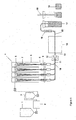
- the conventional method of manufacturing cellulose acetate filter tow will now be described with reference to Figure 1 .
- the starting material is typically cellulose acetate flake which has been prepared from wood pulp.
- the cellulose acetate flake is dissolved in a solvent comprising about ⁇ 97% acetone and ⁇ 3% water in a mixer 1 to form a relatively viscous solution known as spinning dope.
- the dope typically undergoes a two stage filtration process by being pumped through a filter system 2 in order to remove fibrous or particulate matter which would otherwise cause problems with the subsequent spinning step.
- the filtered dope is passed into a storage tank 3 before being preheated and pumped to an array of spinning cells 4.
- Each spinning cell 4 comprises a spinneret 5 positioned above a relatively long drying chamber 6.
- the spinneret 5 has a head which typically comprises several hundred small holes through which the dope is extruded under pressure.
- the holes may be, for example, circular, triangular, square or rectangular that give rise to filaments having crenelated, "Y", "X” and dog-bone shaped cross-sections respectively.
- the dope After being extruded through the spinneret 5, the dope forms an array of filaments 7 which are passed down through the drying chamber 6 which acts to remove the majority of the dope solvent. This normally involved the passing of a counter current of heated air which serves to evaporate most of the acetone from the extruded array of filaments 7.
- the array of filaments 7 is gathered together to form a gathered array of filaments 8 which leaves the drying chamber 6.
- spin finish After leaving the drying spinning cell 4, it is normal to apply "spin finish" to the gathered array of filaments 8 in order to provide beneficial properties.
- the spin finish normally comprises an oil-in-water emulsion containing white oil and surfactants. This serves to protect the filaments from abrasion, imparts reduced friction and avoids electrostatic problems.
- Spin finish is applied by passing the gathered array of filaments 8 over a roller 9 which dips into a reservoir of spin finish.
- each spinning cell produces a relatively small amount of filaments
- the output from a number of spinning cells for example from 25 to 100 but typically in the region of 50, is consolidated to form a ribbon or band of filaments known as a banded tow.
- a banded tow For clarity, only four spinning cells are shown in Figure 1 .
- the output of each of the spinning cells 4 is consolidated by a series of guides 10 to form the banded tow 11.
- the banded tow 11 contains a large number of individual filaments, typically in the region of 2,000 to 40,000.
- the banded tow undergoes a crimping step involving the passage of the banded tow through a crimper 12 which imparts a generally sinusoidal shaped crimp along the length of the tow. This is typically performed by passing the banded tow 11 through a pair of rollers and box known as "stuffer-box" crimping.
- the crimped banded tow 13 is then passed through a conditioner 14 which contains a number of zones of different temperature and humidity in order to ensure that the crimped tow 13 has had most of the residual solvent removed and has been restored to the tow's natural regain of moisture.
- the conditioned crimped tow 15 may be subjected to a stretching step by passing through a pair of rollers 16 operating at slightly different speeds. This stretching step may be useful in the method of the present invention, as discussed in more detail below.
- the crimped tow 15 is then carefully plaited into a container 17 and subsequently compressed by a hydraulic press 18 in order to give a bale of crimped tow 19.
- the bale 19 may then be sold to filter rod or cigarette manufacturers for processing into cigarette filter rods and subsequent incorporation into cigarettes.
- the compressed tow 19 provides a convenient compact unit known as a bale containing a relatively long length of crimped tow 15 for the preparation of cigarette filter rods.
- This process involves the pulling of one end of the crimped tow 15 from the bale 19 and passage through a rod maker machine which produces the cigarette filter rods.
- the crimped tow 15 passes over a number of mechanical and/or air spreading devices to open up the web of the tow.
- the web of stretched tow is sprayed with a plasticiser (typically triacetin) before passing through a garniture which funnels the stretched web of tow into a circular shape and packages the circular plug of filter with a paper casing.
- the paper-wrapped filter plug is then chopped into individual filter rods for use in subsequent steps to prepare cigarettes. These subsequent steps typically involve the cutting of the filter rods into individual cigarette filters followed by their combination with rods of tobacco to form complete filter cigarettes.
- bale of crimped tow which already incorporates an additional component or components which may then be used on traditional rod-making machines with no or minimal changes to produce filters that can or have the potential to remove or reduce the level of certain constituents of mainstream smoke.
- this approach also allows the use of dispersions, solutions, liquids or emulsions which would not be compatible with addition at the rod making stage.
- the speed that filter tow passes through a rod maker machine means that there is only a fraction of a second between the addition of a component to the stretched web of tow and the formation of a filter rod from that tow.
- a solution, liquid, emulsion or dispersion of an additive introduced at the rod-maker stage would have little time to dry before the formation of the final filter rod. This could lead to many problems such as the deterioration of the paper casing, clogging of the garniture, tape, cutting and rod feed mechanisms and/or retraction of fibre in the rods.
- the solution of filter tow is applied at a stage in the manufacture before the rod maker, then sufficient time may be allowed for necessary drying of the various additives.
- Formaldehyde H 2 CO
- Acetaldehyde CH 3 CHO
- Proprionaldehde CH 3 CH 2 CHO
- Benz(a)arithracene C 18 H 12
- Benzo(b)flouroanthene C 20 H 12
- Benzo(1)fluoroanthene C 20 H 12
- Benzo(k)fluoroanthene C 20 H 12 ) .
- Benzo(a)pyrene C 20 H 12
- Dibenzo(a,h)anthracene Dibenzo(a,1)pyrene
- N-Nitrosodimethylamine ((CH 3 ) 2 NNO) N-Nitrosoethylmethylamine ((CH 3 CH 2 )(CH 3 )NNO) N Nitrosodiethylamine ((CH 3 CH 2 ) 2 NNO) N-Nitroso-di-n-propylamine ((CH 3 (CH 2 ) 2 ) 2 NNO) N-Nitroso-di-n-butylamine ((CH 3 (CH 2 ) 3 ) 2 NNO) N-Nitrosopyrrolidine ((C 4 H 8 NNO)) N-Nitrosopiperidine ((C 5 H 10 NNO)) N-Nitroso-diethanolamine N-Nitrosonornicotine N-Nitrosoanabasine 4-(Methylnitrosamino)-1-(3-pyridyl)-1-butanone
- the present invention is concerned with the incorporation of one or more additives into filter tow during the manufacturing stage which may remove components of main-stream cigarette smoke, and in particular to remove Hoffmann analytes from cigarette smoke.
- By “remove” it is meant that the level of the component in cigarette smoke may be reduced or completely removed by a filter of the present invention in comparison to an equivalent filter which does not contain any such additives.
- the spinning cell 20 comprises a spinnerette 21 positioned above a drying chamber 22. As shown, dope is extruded through the spinneret head 21 to produce an array of filaments 23.
- the filaments 23 are passed through the elongated drying chamber 22 against a counter current of heated air. The heated air serves to remove the majority of the acetone from the extruded array of filaments 23.
- the array of filaments is gathered together at the bottom of the chamber 22 to give a gathered array of filaments 24, which is passed over a roller 25 which applies spin finish and then passed onto further manufacturing processes.
- An additive may be incorporated into the array of filaments 23 at this stage as shown.
- a dispersion of a particulate material may be incorporated into the filament at this stage by spraying an aerosol at the array of filaments.
- Figure 2 shows the addition of particulate calcium carbonate to the filaments 23.
- a spray nozzle 26 is provided having an inlet 27 for compressed air and an inlet 28 for particulate calcium carbonate.
- the particulate calcium carbonate is blown into the drying chamber 22 to impact upon the filaments 23. This results in effective incorporation of the particulate material into the filaments.
- This technique is applicable to other forms of additive, including solutions, liquids, and emulsions.
- FIG. 3 shows a variation of this aspect of the invention.
- a spinning cell 30 is shown having a spinnerette 31 above a drying chamber 32. Dope is pumped through the spinneret 31 to form an array of filaments 33. After passing through the drying chamber, the gathered filaments 34 pass over a roller 35 which applies spin finish.
- a metered stream application system (MSA) 36 Positioned in the drying chamber 32 is a metered stream application system (MSA) 36.
- MSA comprises a metering pump that pumps a fluid to a guide having an aperture that allows the fluid to be applied directly onto the fibres surface.
- the fluid could be a dispersion, liquid, emulsion or solution.
- FIG. 4 An alternative method of introducing additional components into the filtered tow is shown in Figure 4 .
- a spinning cell 40 is shown producing gathered filaments 41.
- the filaments 41 pass through an applicator system 42 which applies an additive to the filaments.
- the treated filaments 43 then pass over a spin finish roller 44 before continuing on the manufacture process.
- the applicator system 42 may comprises a roller, a spray, a MSA system or other suitable systems known in the art.
- a preferred applicator system is a MSA such as that shown in Figure 3
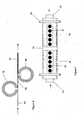
- FIG. 5 shows an applicator 50 for use in the present invention.
- the applicator 50 has a generally tubular shape, comprising a cylindrical side wall 51 surrounding an inner plenum chamber 52.
- a series of apertures 53 are provided in the side wall 51 along the length of the applicator 50.
- the length of the series of apertures 53 is substantially equal to the width of a banded tow of filaments.
- One end of the applicator 50 is provided with an additive inlet 54 and the other end is closed off by an end wall 55.
- an additive may be introduced via the inlet 54 into the interior 52 of the applicator 50 in the form of a solution, liquid, emulsion or dispersion. The additive may then pass through the apertures 53 and be applied to the banded tow.
- Figure 6 shows how the applicator 50 may be used in practice to apply an additive to both sides of a banded tow of acetate.
- the output from a number of spinnerets is typically gathered together and arranged to provide a wide flat ribbon comprising several thousand individual filaments.
- the output from a wide range of numbers of spinnerets may be gathered together, for example 25 to 100, typically the output of around 50 to 70 spinneret heads is used to produce a banded tow 57.
- the banded tow 57 passes through a pair of applicators, with a first applicator 50 in contact with the upper face of the banded tow 57, and a second applicator 60 in contact with the lower face of the banded tow 57.
- the second applicator 60 is of similar construction to the first applicator 50.
- the first and second applicators 50 and 60 are arranged with offset apertures to ensure the even application of additive across the full width of the banded tow 57.
- the additive is applied across its upper face to give a partially treated tow 58.
- the partially treated tow 58 then passes against the second applicator 60 which applies additive across its lower face to give the final treated tow 59.
- a solution, emulsion, liquid or dispersion of additive or additives may be applied to both sides of the banded tow.
- Solvents, liquids, dispersants, adhesives and or shed suppressors may be used during the application of additives.
- An "adhesive" is generally a solid and a "shed suppressor” is generally a liquid.
- Preferred adhesives which may be used in the present invention are set out below:
- the treated tow 59 may then be passed through a crimper in order to produce a crimped tow.
- the coated tow 59 may then be passed through dryers which are well known in the art.
- the tow may undergo a stretching step.
- a stretching step may be necessary if the fibres have become partially bonded to each other in order to restore some of the openability of the treated banded tow.
- the crimped tow may then be plaited into bales for later use.
- This has the advantage that a conventional filter rod making process and machine may be used with a bale of tow according to the present invention which has been previously treated with additives.
- the treated tow may be used in a conventional filter rod making machine with little or no modifications being required.
- the resulting cigarettes may then have the capability of selectively reducing the amount of certain components of cigarette smoke.
- additives may be consistently applied to the filaments.
- a dispersion of particulate additive such as activated carbon powder
- particulate additive such as activated carbon powder
- Another particularly advantageous feature of the present invention is that a number of different components or additives may be incorporated into the tow during manufacture.
- the list of Hoffmann analytes include acidic compounds and alkaline compounds. These may require different additives in order to reduce their concentration in main-stream smoke.
- an acidic tow additive may remove an alkaline analyte whilst an alkaline tow additive may reduce an acidic analyte.
- the mixing of an acidic additive with an alkaline additive would simply lead to neutralisation and thus loss of activity and/or reactivity. It would therefore be beneficial to incorporate both acidic and alkaline additives into the tow whilst retaining their individual activity and reactivity.
- the present invention provides solutions to this particular problem which are also applicable to other additives which are not compatible with each other.
- FIG. 7 Another applicator 70 is shown in Figure 7 that has two separate applicator zones which allow for the separate and concurrent application of two different additives to tow.
- the applicator 70 corresponds to the applicator 50 shown in Figure 5 except that it has a barrier 71 positioned within the interior plenum chamber about midway along the length of the applicator 70, forming two separate applicator zones 72 and 73.
- One end of the applicator has a first additive inlet 74 leading to a series of apertures 76 which form a first applicator zone 72.
- the other end of the applicator has a second additive inlet 75 leading to a series of apertures 77 which form a second applicator zone 73.
- Figure 8 shows how the applicator 70 may be used in practice.
- a banded tow of filaments 81 passes against a pair of applicators comprising a first applicator 70 and a second applicator 80.
- the banded tow 1 passes through a pair of applicators, with a first applicator 70 in contact with the upper face of the banded tow 81, and a second applicator 80 in contact with the lower face of the banded tow 81.
- the second applicator 80 is of similar construction to the first applicator 70.
- the first and second applicators 70 and 80 are arranged with offset apertures to ensure the even application of additive across the full width of the banded tow 81.
- the two additives are applied across its upper face by the two applicator zones to give a partially treated tow 82.
- the partially treated tow 82 then passes against the second applicator 80 which applies the two additives across its lower face to give the final treated tow 83.
- the treated tow has two stripes of additives along its length. This aspect allows an acidic additive to be applied to one half of the banded tow with an alkaline additive being added to the other half of the banded tow.
- Figure 9 shows a plan view corresponding to Figure 8 .
- the untreated banded tow 81 passes against the applicators 70 and 80 to become the treated tow 83.
- the first applicator zones of the applicators 70 and 80 coat one half of the width of the tow with an acidic additive to give treated stripe 84.
- the second applicator zones of the applicators 70 and 80 coat the other half of the width of the tow with an alkaline additive to give treated stripe 85.
- the present invention also envisages the use of similar applicators to apply more than two additives to a banded tow. This could result in a banded tow having, for example, 3, 4 or 5 different types of additives across the width of the tow.
- Figure 10 shows an example of this aspect of the invention.
- a banded tow 90 passes through a pair of applicators 91 and 92, which each have three applicators zones. As the tow 90 passes against the applicators 91 and 92, three different types of additives are applies to each face of the tow, giving a treated tow 93.
- the treated tow 93 has a first outer strip 94 of acidic material, a central strip 95 of particulate material, and a second outer strip 96 of alkaline material.
- incompatible additives may be applied to the banded tow whilst being kept relatively isolated from other components.
- the treated banded tow may then be used in a conventional rod maker to produce filter rods having a mixture of different filaments with different additives thereon.
- the treated filter rod may then selectively reduce the presence of different types of components of main-stream-cigarette smoke.
- a modified applicator may be used to apply a thin (eg 1 to 2 mm) strip of white oil between stripes of incompatible additives, such as an acidic compound and a basic compound, to prevent the additives from mixing together.
- the concept of applying more than one additive is also applicable to other stages of the tow manufacture process.
- different additives may be introduced to filaments during or after the spinning step but before being banded together.
- one set of spinning cells may produce filaments which incorporate acidic additive, sprayed thereon.
- a second set of spinning cells may produce filaments which incorporate an alkaline additive.
- the treated gathered arrays of filaments may be subsequently banded together to form the banded tow. This has the benefit that differently treated filaments may be more homogeneously distributed across the banded tow and in the resulting filter rod.
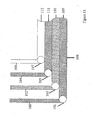
- Figure 11 shows the output from four different spinning cells being banded together to form a banded tow.
- a first array of filaments 100 incorporating an acidic additive, passes around a guide 101 to begin to form the banded tow.
- a second array of filaments 102 incorporating an adsorbent particulate additive, passes around a guide 103 to join the growing banded tow.
- a third array of filaments 104 incorporating an alkaline additive, passes around a guide 105 to join the banded tow.
- a fourth array of filaments 106 which does not incorporate an additional additive, passes around a guide 107 to complete the banded tow 108.
- the compete banded tow 108 thus comprises four stripes of filaments 109, 110, 111 and 112, each incorporating a different, or no, additive.
- Another aspect of the present invention concerns the combination of additives at different stages in the manufacturing process.
- the additive-containing dope may then be used to form filaments which are treated with one or more further additives in accordance with the invention.
- a compound such as sodium sulphamate may be dissolved in the dope and used to form filaments.
- the sodium sulphamate-containing filaments may then be treated with a dispersion of carbon powder before being crimped and formed into a bale. Numerous other combination of treatments are possible.
- the terms "cellulose acetate dope" or "dope” as used herein encompass a solution of cellulose acetate which includes one or more additives.
- the present invention may be used in combination with themselves or with known techniques in the art.
- the present invention may produce treated crimped tow which may then be used in a rod maker which incorporates particulate material.
- a cigarette filter rod may be produced having enhanced functionality and the ability to selectively reduce different components of cigarette smoke.
- a first additive may be incorporated as an aerosol of particulates blown into the drying chamber following spinning of an array of filaments.
- the resulting tow of filaments may then be treated by the application of an emulsion of a different additive at a downstream step.
- a filter rod which contains a number of different additives.
- a filter rod may be formed by combining a number of filter rod segments together to form the final filter rod.
- three filter rod segments each having a length of 10 mm may be joined together to form a complete filter rod having a length of 30 mm.
- Each of the filter rod segments may be made in accordance with the present invention and so contain different additives.
- the first segment may comprises filaments treated with an acidic compound
- the second segment may comprise filaments treated with a basic compound
- the third segment may comprises filaments treated with sodium sulphamate.
- the complete filter rod may remove basic compounds (first segment), acidic compounds (second segment) and formaldehyde (third segment), whilst keeping incompatible additives separate.
- This aspect of the invention encompasses a wide range of possible variations and combination of additives.
- Example 1 The Application of a Solution of DL-Malic Acid to the Towband before Crimping
- the application system consisted of a pressurised tank, 0.69 bar (10 psi), containing a 50% aqueous solution of malic acid that supplied the inlet to a metering gear pump.
- the output from this pump was split into two separate streams with each outlet conduit feeding an applicator over which a tow comprising 3 denier filaments having a "Y-shaped" cross-section and 11,677 filaments in total (known as 3Y/35,000) with an oil level of ⁇ 0.3% ran prior to crimping.
- the conduits to each applicator were of equal length and internal bore to ensure equal flow to each applicator.
- the applicators consisted of a plenum chamber and a series of eleven or twelve 1 mm diameter holes through which the pumped 50% malic acid solution was uniformly applied to the uncrimped towband about 1 m before the crimper.
- the applicators were placed so that the positions of the holes relative to the towband were offset to ensure an uniform application to the towband with eleven apertures on one side and twelve apertures on the other side of the tow.
- the application process of the malic acid solution was performed after the towband had been assembled from the individual spinning ends, but prior to the crimping process.
- the crimping process comprised a pair of driven rollers that drive the tow into a box.
- the box well known as a stuffer box, had a hinged top knife.
- the rollers were forced together by a hydraulic ram.
- the pressure on this ram, (the roller pressure) was about 0.48 bar (7 psi).
- the pump speed was adjusted until a slight excess of solution was observed to be dripping from the crimper.
- the individual filaments buckled and formed a stable crimped towband.
- the resultant crimped towband was dried, stretched as required in order to partially loosen the towband and plaited into a box in order to form a bale.
- the malic acid loading on the tow in the bale was determined by measuring the linear density, (the total denier), of the tow and comparing with a control with no acid applied.
- the level of malic acid on the tow was found to be 16% by weight.
- the distribution of the malic acid on the treated filament was investigated using a scanning electron microscope.
- an untreated control filament was also investigated and the resulting electron micrograph is shown in Figure 12 (1000x magnification, 3 kV, 10 mm).
- the control filament was prepared according to the method of Example 1 except that malic acid solution was riot applied to the filaments.
- Figure 13 shows an electron micrograph for a filament prepared by the method of Example 1 (1000x magnification, 3 kV, 10 mm). It can be seen that the malic acid has formed a relatively smooth thin smeared layer over the surface of the filament.
- Figure 14 shows the treated filament in more detail (10000x magnification, 3 kV, 10 mm). Again, at this greater magnification it can be seen that the malic acid has formed a relatively smooth layer over the surface of the filament.
- a bale of the tow treated with malic acid was processed into filter rods using a standard Hauni KDF3/AF3 rod maker.
- a gravimetric analysis comparing the tow and rods indicated that there was surprisingly no significant loss of malic acid during the rod making process.
- the rods were cut into ⁇ 20 mm tips and attached to tobacco columns to produce cigarettes.
- a smoking' analysis was carried out on these cigarettes, specifically evaluating the level of the compounds pyridine and quinoline in mainstream smoke. Quinoline and pyridine form part of the Hoffmann analyte list.
- Table 1 compare the malic acid tow/filters with standard 3Y/35,000 acetate tow/filters with no additive applied.
- Table 1 Parameter Sample Control Additive DL-malic acid (16% by weight) None Rod Diameter 7.73 7.72 20 mm Tip PD mm 88 88 Retention % TR 53.5 49.9 Retention % NR 49.1 47.2 Tar mg/cigarette 8.4 8.4 Nicotine mg/cigarette 0.66 0.66 CO mg/cigarette 12.4 11.3 Pyridine ⁇ g/cigarette ⁇ 0.2 10.2 Quinoline ⁇ g/cigarette 0.07 0.26
- the abbreviation PD stands for pressure drop and is representative of the resistance to air flow through the filter. It is traditionally measured in mm of water in this technical field. The PD was measured using the method of a QTM, Filtrona rod tester well known in the field. TR and NR stand for tar retention and nicotine retention by the filter and were measured by standard methods well known in the field.
- Example 2 The Application of a Solution of Potassium Carbonate to the Towband before Crimping using Glycerol as a Shed Suppressor
- the application system consisted of a pressurised tank 0.69 bar (10 psi) containing a 50% aqueous solution of potassium carbonate and 10% glycerol that supplied the inlet to a metering gear pump.
- the output from this pump was split into two streams with each outlet conduit feeding an applicator over which a 3Y/35,000 low oil ( ⁇ 0.3% oil) tow ran prior to crimping. It was found to be advantageous to reduce the oil level of the tow from typical values of 0.8 to 1.4% in order to enable better adhesion of the additive.
- the conduits to each applicator were of equal length and internal bore to ensure equal flow to each applicator.
- the applicators consisted of a plenum chamber and a series of eleven or twelve 1 mm diameter holes through which the pumped 50% potassium carbonate solution was uniformly applied to the uncrimped tow band about 1 m before the crimper.
- the applicators were placed so that the positions of the holes relative to the towband were offset to ensure an uniform application to the towband.
- the application process of the potassium carbonate solution was performed after the towband had been assembled from the individual spinning ends, but prior to the crimping process.
- the crimping process comprised a pair of driven rollers that drive the tow into a box.
- the box also known as a stuffer box
- the rollers were forced together by a hydraulic ram.
- the pressure on this ram was 0.48 bar (7 psi).
- the pump speed was adjusted until a slight excess of solution was observed to be dripping from the crimper.
- the individual filaments buckled and formed a stable crimped towband.
- the resultant crimped towband was dried, stretched as required in order to partially loosen the towband and plaited into a box in order to form a bale.
- the potassium carbonate loading on the tow in the bale was determined by measuring the linear density (the total denier) of the tow and comparing with a control tow with nothing applied. The level of potassium carbonate on the tow was found to be 8% by weight.
- a bale of the tow treated with potassium carbonate tow was processed into filter rods using a standard Hauni KDF3/AF3 rod maker.
- a gravimetric analysis comparing the tow and rods indicated that there was surprisingly no significant loss of potassium carbonate during the rod making process.
- the rods were cut into 20 mm tips and attached to tobacco columns to produce cigarettes.
- a smoking analysis was carried out on these cigarettes, specifically evaluating the level of the compounds hydrogen cyanide and phenol in mainstream smoke. Hydrogen cyanide and phenol form part of the Hoffmann analyte list.
- Example 3 The application of a Solution of Potassium Carbonate to the Towband before Crimping using Polyacrylic Acid as an Adhesive
- the application system consisted of a pressurised tank 0.69 bar (10 psi) containing a 50% aqueous solution of potassium carbonate and 1% polyacrylic acid that supplied the inlet to a metering gear pump. The output from this pump was split into two streams with each outlet conduit feeding an applicator over which a 3Y/35,000 low oil ( ⁇ 0.3% oil) tow ran prior to crimping.
- the conduits to each applicator were of equal length and internal bore to ensure equal flow to each applicator.
- the applicators consisted of a plenum chamber and a series of eleven or twelve 1 mm diameter holes through which the pumped the solution was uniformly applied to the uncrimped tow band about 1 m before the crimper.
- the applicators were placed so that the positions of the holes relative to the towband were offset to ensure an uniform application to the towband.
- the application process of the solution was performed after the towband had been assembled from the individual spinning ends, but prior to the crimping process.
- the crimping process comprised a pair of driven rollers that drive the tow into a box.
- the box also known as a stuffer box
- the rollers were forced together by a hydraulic ram.
- the pressure on this ram, (the roller pressure) was 0.48 bar 7 psi.
- the pump speed was adjusted until a slight excess of solution was observed to be dripping from the crimper.
- the individual filaments buckled and formed a stable crimped towband.
- the resultant crimped towband was dried, stretched as required in order to partially loosen the towband and plaited into a box in order to form a bale.
- the potassium carbonate loading on the tow in the bale was determined by measuring the linear density (the total denier) of the tow and comparing with a control tow with nothing applied. The level of potassium carbonate on the tow was found to be 8% by weight.
- a bale of tow treated with potassium carbonate was processed into filter rods using a standard Hauni KDF3/AF3 rod maker.
- a gravimetric analysis comparing the tow and rods indicated that there was surprisingly no significant loss of potassium carbonate during the rod making process.
- the rods were cut into 20 mm tips and attached to tobacco columns to produce cigarettes.
- a smoking analysis was carried out on these cigarettes, specifically evaluating the level of the acidic compounds hydrogen cyanide and phenol in mainstream smoke. Hydrogen cyanide and phenol form part of the Hoffmann analyte list.
- Example 4 The Application of Various Solutions of Acids to the Towband before Crimping.
- Example 2 Following the work of Example 1, a range of other acids were investigated. These included citric, L-tartaric, lactic (a liquid at room temperature) and ascorbic acids. In each case an aqueous solution was made up and placed in the pressurised tank previously described. The roller nip pressure was set to 6 psi and the loadings on the tow determined by a gravimetric method. The results are shown in Table 4 below. Table 4 Citric acid L-Tartaric acid Lactic acid Ascorbic acid Solution Conc (%) 50 50 50 17 Level of acid on tow (% by weight) 9.2 11.8 5.7 3.8
- Example 5 (not according to the invention) - The Application of Poly(Ethyleneimine) (PEI) Solution to the Towband before Crimping
- a bale of this tow was processed into filter rods using a standard Hauni KDF3/AF3 opener and rod maker. There was minimal loss of the additive on processing.
- This tow is expected to reduce the level of Formaldehyde in mainstream smoke.
- Formaldehyde is on the Hoffmann analyte list.
- Cavasol W7 M a methylated cyclodextrin from Wacker Chemie
- Example 1 A sample of Cavasol W7 M (a methylated cyclodextrin from Wacker Chemie) was made into a 25% aqueous solution and applied to the uncrimped tow using the method of Example 1. It was desirable to use the derivatised cyclodextrins in order to make use of the increased solubility as this leads to higher potential loadings on the tow. Surprisingly a satisfactory tow was produced. The resultant loadings on the tow are given below. The loading of the methylated cyclodextrin on tow using a crimper roller pressure of 6 psi is shown in Table 6 below. Table 6 Roller Pressure (psi) Loading on tow (% by weight) 6 6.5
- a bale of the material was processed into filter rods using a standard Hauni KDF3/AF3 opener and rod maker. There was minimal loss of the additive on processing.
- a 40% aqueous solution of sodium sulphamate was produced by carefully adding an equimolar amount of sodium hydroxide to a solution of sulphamic acid. The solution was applied to the uncrimped tow using the method of Example 1. Surprisingly a satisfactory tow was produced.
- the loading of Sodium Sulphamate on tow using a crimper roller pressure of 6 psi is shown in Table 7 below.
- Example 8 The Spraying of a Calcium Carbonate Dispersion onto Filaments in the Spinning Cell
- the spinning cell used consisted of a 30cm square, 5 m long rectangular chamber through which air at about 100°C was forced in a direction counter to that of the filament extrusion.
- dope was fed to a spinneret. This jet had 200 triangular holes. The side of each triangle was 56 ⁇ m in length.
- a spinning dope was extruded through the spinneret holes.
- the dope concentration was 26% cellulose acetate in a solvent comprising 97% acetone 3% water.
- the dope extrusion rate was adjusted to give a filament denier per filament (dpf) of 3.
- a 30% aqueous dispersion of finely divided calcium carbonate powder (70% ⁇ 1-2 ⁇ m, 97% ⁇ 5 ⁇ m supplied by Longcliffe) having a surface area of ⁇ 5m 2 /g was placed in a bottle equipped with an aerosol fitting.
- the vessel was connected to a compressed air supply and the dispersion was sprayed onto the cellulose diacetate filaments in the first part of the extrusion zone. Typically this was within a distance of 15 cm from the face of the spinneret. Surprisingly the spinning stability was not affected and the particles were attached to the nascent filaments.
- a loading of 1.5% by weight of calcium carbonate was applied to the filaments.
- This work demonstrates the potential for applying particles that preferably have a surface area less than 100m 2 /g that are potentially capable of reducing substances in mainstream smoke that are on the Hoffmann analyte list.
- a carboxylated acrylate emulsion (Glascol C20 supplied by Ciba Specialities as a 46% polymer in water emulsion) was added as a 20% solids emulsion below the spinning cell but prior to spin finish application via an MSA system.
- Example 10 The Application of Two Different Additives to the Towband before Scrimping - Citric Acid and Potassium Carbonate
- Example 2 Following the work principles of Example 1, two different aqueous solutions were applied to the towband, namely citric acid and potassium carbonate/glycerol.
- an aqueous solution was made up and placed in two separate pressurised tanks previously described. Each tank was connected to a separate pump that pumped the solution to an applicator.
- the applicator had a plate that divided the plenum chamber into two.
- One solution was fed to one side of the applicator the other solution to the other side. This resulted in one half of the towband being treated with citric acid solution and the other half of the towband being treated with potassium carbonate solution.
- the feed rate of the solutions was carefully regulated in order to ensure no excess solutions were being applied in order to reduce any potential for the solutions to mix together.
- This example illustrates the potential to combine the addition methods described above in order to get a combined effect.
- the method of example 8 is used to apply a loading of calcium carbonate to the filaments in the cell.
- the method of example 6 is used to apply a cyclodextrin solution to the already treated filaments. This gives a resulting tow that possesses the functionality of both species.
Landscapes
- Chemical & Material Sciences (AREA)
- Engineering & Computer Science (AREA)
- Materials Engineering (AREA)
- Inorganic Chemistry (AREA)
- Cigarettes, Filters, And Manufacturing Of Filters (AREA)
Applications Claiming Priority (2)
| Application Number | Priority Date | Filing Date | Title |
|---|---|---|---|
| GBGB0517551.8A GB0517551D0 (en) | 2005-08-27 | 2005-08-27 | Process for making filter tow |
| PCT/GB2006/003179 WO2007026131A1 (en) | 2005-08-27 | 2006-08-25 | Processing for making filter tow |
Publications (2)
| Publication Number | Publication Date |
|---|---|
| EP1921933A1 EP1921933A1 (en) | 2008-05-21 |
| EP1921933B1 true EP1921933B1 (en) | 2015-12-30 |
Family
ID=35198515
Family Applications (1)
| Application Number | Title | Priority Date | Filing Date |
|---|---|---|---|
| EP06779210.1A Not-in-force EP1921933B1 (en) | 2005-08-27 | 2006-08-25 | Processing for making filter tow |
Country Status (7)
| Country | Link |
|---|---|
| US (1) | US8308624B2 (https=) |
| EP (1) | EP1921933B1 (https=) |
| JP (1) | JP5289954B2 (https=) |
| CN (1) | CN101252850B (https=) |
| GB (1) | GB0517551D0 (https=) |
| MX (1) | MX2008002797A (https=) |
| WO (1) | WO2007026131A1 (https=) |
Families Citing this family (79)
| Publication number | Priority date | Publication date | Assignee | Title |
|---|---|---|---|---|
| US9675109B2 (en) | 2005-07-19 | 2017-06-13 | J. T. International Sa | Method and system for vaporization of a substance |
| US10244793B2 (en) | 2005-07-19 | 2019-04-02 | Juul Labs, Inc. | Devices for vaporization of a substance |
| US7479098B2 (en) | 2005-09-23 | 2009-01-20 | R. J. Reynolds Tobacco Company | Equipment for insertion of objects into smoking articles |
| JP5317394B2 (ja) * | 2006-05-30 | 2013-10-16 | 株式会社ダイセル | たばこフィルター用素材及びたばこフィルター |
| DE102007029831A1 (de) | 2007-06-28 | 2009-01-08 | Reemtsma Cigarettenfabriken Gmbh | Verfahren zum Herstellen von Tabakrauchfiltern |
| AT505730B1 (de) * | 2007-08-16 | 2010-07-15 | Helfenberger Immobilien Llc & | Mischung, insbesondere spinnlösung |
| US8991402B2 (en) * | 2007-12-18 | 2015-03-31 | Pax Labs, Inc. | Aerosol devices and methods for inhaling a substance and uses thereof |
| US8079369B2 (en) | 2008-05-21 | 2011-12-20 | R.J. Reynolds Tobacco Company | Method of forming a cigarette filter rod member |
| US8375958B2 (en) * | 2008-05-21 | 2013-02-19 | R.J. Reynolds Tobacco Company | Cigarette filter comprising a carbonaceous fiber |
| WO2009143338A2 (en) * | 2008-05-21 | 2009-11-26 | R.J. Reynolds Tobacco Company | Apparatus and associated method for forming a filter component of a smoking article and smoking articles made therefrom |
| US8613284B2 (en) * | 2008-05-21 | 2013-12-24 | R.J. Reynolds Tobacco Company | Cigarette filter comprising a degradable fiber |
| WO2011070639A1 (ja) * | 2009-12-07 | 2011-06-16 | 日本たばこ産業株式会社 | 粉粒体添加装置及びその添加方法 |
| CN101856149B (zh) * | 2010-06-10 | 2011-10-05 | 红云红河烟草(集团)有限责任公司 | 一种改善卷烟嘴棒品质的方法 |
| CN102334751B (zh) * | 2010-07-28 | 2013-07-31 | 南通烟滤嘴有限责任公司 | 烟用纸芯滤棒及其制造方法 |
| US8720450B2 (en) * | 2010-07-30 | 2014-05-13 | R.J. Reynolds Tobacco Company | Filter element comprising multifunctional fibrous smoke-altering material |
| CN101914866B (zh) * | 2010-08-05 | 2012-05-23 | 云南烟草科学研究院 | 降低卷烟危害的滤嘴棒材料醋酸纤维的制备方法 |
| CN102120923B (zh) * | 2010-11-25 | 2013-04-10 | 昆明理工大学 | 一步法制备高固含量聚丙烯酸酯香烟过滤嘴棒粘接剂 |
| US9192193B2 (en) * | 2011-05-19 | 2015-11-24 | R.J. Reynolds Tobacco Company | Molecularly imprinted polymers for treating tobacco material and filtering smoke from smoking articles |
| US20120325231A1 (en) * | 2011-06-23 | 2012-12-27 | Eastman Chemical Company | Filters having improved degradation and methods of making them |
| CN102247010B (zh) * | 2011-07-02 | 2013-08-21 | 云南瑞升烟草技术(集团)有限公司 | 一种线状功能型纤维材料在卷烟中的应用 |
| US9149070B2 (en) | 2011-07-14 | 2015-10-06 | R.J. Reynolds Tobacco Company | Segmented cigarette filter for selective smoke filtration |
| GB201112539D0 (en) | 2011-07-21 | 2011-08-31 | British American Tobacco Co | Porous carbon and methods of production thereof |
| US9289012B2 (en) | 2011-07-29 | 2016-03-22 | R. J. Reynolds Tobacco Company | Plasticizer composition for degradable polyester filter tow |
| US8973588B2 (en) | 2011-07-29 | 2015-03-10 | R.J. Reynolds Tobacco Company | Plasticizer composition for degradable polyester filter tow |
| EP2740508B1 (en) | 2011-08-16 | 2016-06-15 | PAX Labs, Inc. | Low temperature electronic vaporization device |
| CN102352557A (zh) * | 2011-08-18 | 2012-02-15 | 中国烟草总公司郑州烟草研究院 | 环糊精接枝固载醋酸纤维素的方法及其应用 |
| CN102432686B (zh) * | 2011-08-26 | 2013-06-19 | 福建农林大学 | 一种微纳米纤维素及其制备方法 |
| US8967155B2 (en) * | 2011-11-03 | 2015-03-03 | Celanese Acetate Llc | Products of high denier per filament and low total denier tow bands |
| US20130115452A1 (en) * | 2011-11-03 | 2013-05-09 | Celanese Acetate Llc | High Denier Per Filament and Low Total Denier Tow Bands |
| US10517530B2 (en) | 2012-08-28 | 2019-12-31 | Juul Labs, Inc. | Methods and devices for delivering and monitoring of tobacco, nicotine, or other substances |
| CN102894480B (zh) * | 2012-10-23 | 2014-03-05 | 肖昌义 | 新型卷烟滤嘴 |
| CN102960860B (zh) * | 2012-11-27 | 2014-04-16 | 湖南中烟工业有限责任公司 | 一种通过化学交联得到的卷烟烟气重金属吸附剂的应用方法 |
| US20140174461A1 (en) * | 2012-12-20 | 2014-06-26 | Eastman Chemical Company | Surface Attachment of Particles to Cellulose Ester Fibers |
| US10279934B2 (en) | 2013-03-15 | 2019-05-07 | Juul Labs, Inc. | Fillable vaporizer cartridge and method of filling |
| US10653180B2 (en) | 2013-06-14 | 2020-05-19 | Juul Labs, Inc. | Multiple heating elements with separate vaporizable materials in an electric vaporization device |
| KR102490695B1 (ko) | 2013-05-06 | 2023-01-19 | 쥴 랩스, 인크. | 에어로졸 장치를 위한 니코틴 염 제제 및 그 방법 |
| ES2778099T3 (es) | 2013-09-05 | 2020-08-07 | Schweitzer-Mauduit International Inc | Envoltura del tapón revestida para un artículo para fumar |
| CN103628253B (zh) * | 2013-11-18 | 2016-08-24 | 湖南中烟工业有限责任公司 | 一种滤棒用功能化丝束的制备方法及其应用 |
| EP4552512A3 (en) | 2013-12-05 | 2025-07-02 | Juul Labs, Inc. | Nicotine liquid formulations for aerosol devices and methods thereof |
| CN106028845A (zh) * | 2013-12-11 | 2016-10-12 | 施韦特-莫迪国际公司 | 用于吸烟制品的包裹物 |
| US9549573B2 (en) | 2013-12-23 | 2017-01-24 | Pax Labs, Inc. | Vaporization device systems and methods |
| US10076139B2 (en) | 2013-12-23 | 2018-09-18 | Juul Labs, Inc. | Vaporizer apparatus |
| US10159282B2 (en) | 2013-12-23 | 2018-12-25 | Juul Labs, Inc. | Cartridge for use with a vaporizer device |
| US10058129B2 (en) | 2013-12-23 | 2018-08-28 | Juul Labs, Inc. | Vaporization device systems and methods |
| US20160366947A1 (en) | 2013-12-23 | 2016-12-22 | James Monsees | Vaporizer apparatus |
| KR102267997B1 (ko) | 2013-12-23 | 2021-06-23 | 쥴 랩스, 인크. | 기화 디바이스 시스템 및 방법 |
| USD825102S1 (en) | 2016-07-28 | 2018-08-07 | Juul Labs, Inc. | Vaporizer device with cartridge |
| USD842536S1 (en) | 2016-07-28 | 2019-03-05 | Juul Labs, Inc. | Vaporizer cartridge |
| EP2910477B1 (en) | 2014-02-21 | 2018-03-28 | Celanese Acetate LLC | Methods for packaging fibrous materials |
| US9839238B2 (en) | 2014-02-28 | 2017-12-12 | Rai Strategic Holdings, Inc. | Control body for an electronic smoking article |
| JP5841671B1 (ja) * | 2014-03-13 | 2016-01-13 | 株式会社ダイセル | シガレットフィルター用のセルロースアセテートのトウバンド、シガレットフィルター、トウバンドの製造装置、及びトウバンドの製造方法 |
| WO2015175979A1 (en) | 2014-05-16 | 2015-11-19 | Pax Labs, Inc. | Systems and methods for aerosolizing a smokeable material |
| RU2710434C2 (ru) * | 2014-11-28 | 2019-12-26 | Дайсел Корпорэйшн | Целлюлозно-ацетатная волокнистая жгутовая лента для использования в сигаретном фильтре, сигаретный фильтр, устройство для изготовления жгутовой ленты и способ изготовления жгутовой ленты |
| KR102627987B1 (ko) | 2014-12-05 | 2024-01-22 | 쥴 랩스, 인크. | 교정된 투여량 제어 |
| CN104720106A (zh) * | 2015-01-28 | 2015-06-24 | 湖南中烟工业有限责任公司 | 一种减害功能材料在制备烟用功能滤嘴中的应用 |
| CN104720100B (zh) * | 2015-01-28 | 2018-10-19 | 湖南中烟工业有限责任公司 | 一种纤维素纸中定位添加减害功能材料的沟槽滤嘴及其制备方法和应用 |
| CN104720107B (zh) * | 2015-01-28 | 2018-10-19 | 湖南中烟工业有限责任公司 | 一种丝束中定位添加降焦减害功能材料的卷烟滤嘴及其制备方法和应用 |
| EP3088309A1 (de) | 2015-04-29 | 2016-11-02 | Solvay Acetow GmbH | Verfahren zum herstellen eines verpackten filter tow-ballens |
| CN105088867B (zh) * | 2015-08-04 | 2017-03-22 | 浙江中烟工业有限责任公司 | 一种降低烟气中苯酚含量的纳米纤维复合纸及其制备方法和应用 |
| MX377347B (es) | 2016-02-11 | 2025-03-07 | Juul Labs Inc | Cartucho rellenable de vaporizador y metodo de relleno |
| WO2017139675A1 (en) | 2016-02-11 | 2017-08-17 | Pax Labs, Inc. | Securely attaching cartridges for vaporizer devices |
| US10405582B2 (en) | 2016-03-10 | 2019-09-10 | Pax Labs, Inc. | Vaporization device with lip sensing |
| USD849996S1 (en) | 2016-06-16 | 2019-05-28 | Pax Labs, Inc. | Vaporizer cartridge |
| USD851830S1 (en) | 2016-06-23 | 2019-06-18 | Pax Labs, Inc. | Combined vaporizer tamp and pick tool |
| USD836541S1 (en) | 2016-06-23 | 2018-12-25 | Pax Labs, Inc. | Charging device |
| USD848057S1 (en) | 2016-06-23 | 2019-05-07 | Pax Labs, Inc. | Lid for a vaporizer |
| US11660403B2 (en) | 2016-09-22 | 2023-05-30 | Juul Labs, Inc. | Leak-resistant vaporizer device |
| USD887632S1 (en) | 2017-09-14 | 2020-06-16 | Pax Labs, Inc. | Vaporizer cartridge |
| CN107668771A (zh) * | 2017-09-19 | 2018-02-09 | 河南中烟工业有限责任公司 | 一种细支滤棒中香线用茴香香精及其应用 |
| CN108903055B (zh) * | 2018-08-17 | 2020-11-27 | 绍兴恒元机械制造有限公司 | 一种卷烟纸质过滤嘴的制备方法 |
| EP3876760B1 (en) | 2018-11-08 | 2024-05-15 | Juul Labs, Inc. | Cartridges for vaporizer devices |
| EP3906074A1 (en) | 2018-12-31 | 2021-11-10 | Juul Labs, Inc. | Cartridges for vaporizer devices |
| CN109864342B (zh) * | 2019-04-11 | 2021-09-28 | 滁州卷烟材料厂 | 一种降低卷烟烟气中重金属的复合滤嘴添加材料 |
| CN112841718A (zh) * | 2019-11-28 | 2021-05-28 | 湖南中烟工业有限责任公司 | 一种具有降低卷烟主流烟气中氨释放量功能的卷烟滤棒添加剂及其制备方法和应用 |
| EP4090187B1 (en) | 2020-01-14 | 2026-01-07 | Juul Labs, Inc. | Hybrid gel-fiber wick for use in a vaporizer device |
| KR102373179B1 (ko) * | 2020-03-05 | 2022-03-11 | 조영상 | 독성 기체물질을 저감시키는 담배필터 |
| CN112754070A (zh) * | 2021-01-22 | 2021-05-07 | 郑州轻工业大学 | 一种烟草香固体缓释卷烟滤棒 |
| EP4412476A4 (en) * | 2021-10-08 | 2025-09-17 | Eastman Chem Co | ARTICLES CONTAINING MELT-PROCESSABLE CELLULOSE ACETATE COMPOSITIONS COMPRISING AN ALKALINE FILLER |
| EP4419449A1 (en) | 2021-10-21 | 2024-08-28 | Acetate International LLC | Packaged fibrous material bales comprising lower sheet |
Family Cites Families (36)
| Publication number | Priority date | Publication date | Assignee | Title |
|---|---|---|---|---|
| IT599386A (https=) * | 1952-12-05 | |||
| US3008472A (en) * | 1957-12-16 | 1961-11-14 | Eastman Kodak Co | Filament filter containing a hygroscopic compound |
| US3021242A (en) * | 1957-12-16 | 1962-02-13 | Eastman Kodak Co | Bonding additives onto filament filters |
| US3038780A (en) * | 1959-10-23 | 1962-06-12 | Eastman Kodak Co | Spinning solution containing an aluminum complex |
| US3062611A (en) * | 1959-10-26 | 1962-11-06 | Eastman Kodak Co | Method of making a roughened tow |
| US3173427A (en) * | 1962-02-05 | 1965-03-16 | Eastman Kodak Co | Tow with internally incorporated additive |
| US3397705A (en) * | 1965-08-02 | 1968-08-20 | Eastman Kodak Co | Filter elements and additive containing material therefor |
| US3428056A (en) * | 1965-07-21 | 1969-02-18 | Eastman Kodak Co | Tobacco smoke filter incorporating coated polyolefin additive |
| US3407822A (en) * | 1966-02-07 | 1968-10-29 | Eastman Kodak Co | Tobacco smoke filters containing polyethylene encapsulated cellulose particles |
| US3340879A (en) * | 1967-01-16 | 1967-09-12 | Brown & Williamson Tobacco Corp | Cigarette filters |
| US3410282A (en) * | 1967-03-13 | 1968-11-12 | Eastman Kodak Co | Filter medium for removing hydrogen cyanide from tobacco smoke |
| US3429318A (en) * | 1967-09-07 | 1969-02-25 | Eastman Kodak Co | Selective filter medium |
| US3618619A (en) * | 1970-03-03 | 1971-11-09 | Eastman Kodak Co | Tobacco smoke filters |
| US4744932A (en) * | 1985-05-31 | 1988-05-17 | Celanese Corporation | Process for forming a skinless hollow fiber of a cellulose ester |
| US4763674A (en) * | 1986-04-16 | 1988-08-16 | Hercules Incorporated | Method and device for controlling hydrogen cyanide and nitric oxide concentrations in cigarette smoke |
| JPS63105665A (ja) * | 1986-10-21 | 1988-05-10 | 三菱レイヨン株式会社 | シガレツトフイルタ−素材 |
| US5038803A (en) * | 1988-02-04 | 1991-08-13 | Hercules Incorporated | Method and device for control of by-products from cigarette smoke |
| US4907609A (en) * | 1988-08-24 | 1990-03-13 | Hercules Incorporated | Method of increasing the hardness of cigarette filter elements |
| US4964426A (en) * | 1988-09-28 | 1990-10-23 | Eastman Kodak Company | Tobacco smoke filters and process for production thereof |
| GB8823388D0 (en) * | 1988-10-05 | 1988-11-09 | Cigarette Components Ltd | Tobacco smoke filter containing particulate additive |
| US5009239A (en) * | 1988-12-20 | 1991-04-23 | Hoechst Celanese Corporation | Selective delivery and retention of aldehyde and nicotine by-product from cigarette smoke |
| EP0434339A3 (en) * | 1989-12-18 | 1991-10-09 | R.J. Reynolds Tobacco Company | Cigarette and cigarette filter element therefor |
| US5234720A (en) * | 1990-01-18 | 1993-08-10 | Eastman Kodak Company | Process of preparing lubricant-impregnated fibers |
| US5150721A (en) | 1990-02-28 | 1992-09-29 | Lee Benedict M | Tobacco smoke filter material and process for production thereof |
| SE500634C2 (sv) * | 1992-12-22 | 1994-08-01 | House Of Blend Ab | Filtercigarett |
| DE4322967C1 (de) * | 1993-07-09 | 1994-10-13 | Rhodia Ag Rhone Poulenc | Filtertow aus Celluloseacetat, dessen Herstellung und Verwendung als Tabakrauchfilterelement |
| DE4322966C2 (de) * | 1993-07-09 | 1995-10-26 | Rhodia Ag Rhone Poulenc | Aus Celluloseacetat geformte Gebilde und ihre Verwendung als Filtertow und Tabakrauchfilterelement |
| DE19541873A1 (de) * | 1995-11-09 | 1997-05-15 | Rhodia Ag Rhone Poulenc | Filterzigarette |
| CN1172037C (zh) * | 1997-05-02 | 2004-10-20 | 卡吉尔公司 | 可降解的聚合物纤维、制备、产品及使用方法 |
| DE19951062C2 (de) * | 1999-10-22 | 2002-04-04 | Rhodia Acetow Gmbh | Hochleistungs-Zigarettenfilter |
| CN1166324C (zh) | 2001-12-28 | 2004-09-15 | 上海烟草(集团)公司 | 降低卷烟烟气有害成分的卷烟滤嘴及其制备方法 |
| ATE299653T1 (de) * | 2002-04-03 | 2005-08-15 | Filtrona Richmond Inc | Verfahren und einrichtung zum auftragen von additiv auf einen vliesstoff sowie vliesstoff |
| EP1380684A1 (de) * | 2002-07-11 | 2004-01-14 | Zschimmer & Schwarz GmbH & Co KG Chemische Fabriken | Formulierung eines hochviskosen Mineralöls zur herstellung von Filtern für Tabakwaren |
| DE50211168D1 (de) * | 2002-08-16 | 2007-12-20 | Hauni Maschinenbau Ag | Verfahren und Einrichtung zum Zuführen eines, vorzugsweise flüssigen, Zusatzstoffes auf eine bewegte, ausgebreitete Bahn aus Filtermaterial |
| US7428905B2 (en) * | 2004-07-30 | 2008-09-30 | R.J. Reynolds Tobacco Company | Method of making smokeable tobacco substitute filler having an increased fill value |
| US20060225753A1 (en) * | 2005-02-22 | 2006-10-12 | Rothmans, Benson & Hedges, Inc. | Tobacco smoke filter and tobacco blend for altering mainstream smoke |
-
2005
- 2005-08-27 GB GBGB0517551.8A patent/GB0517551D0/en not_active Ceased
-
2006
- 2006-08-25 JP JP2008527514A patent/JP5289954B2/ja not_active Expired - Fee Related
- 2006-08-25 EP EP06779210.1A patent/EP1921933B1/en not_active Not-in-force
- 2006-08-25 CN CN2006800313601A patent/CN101252850B/zh not_active Expired - Fee Related
- 2006-08-25 US US12/064,467 patent/US8308624B2/en not_active Expired - Fee Related
- 2006-08-25 MX MX2008002797A patent/MX2008002797A/es active IP Right Grant
- 2006-08-25 WO PCT/GB2006/003179 patent/WO2007026131A1/en not_active Ceased
Also Published As
| Publication number | Publication date |
|---|---|
| WO2007026131A1 (en) | 2007-03-08 |
| GB0517551D0 (en) | 2005-10-05 |
| MX2008002797A (es) | 2008-04-08 |
| US20080245376A1 (en) | 2008-10-09 |
| EP1921933A1 (en) | 2008-05-21 |
| US8308624B2 (en) | 2012-11-13 |
| CN101252850B (zh) | 2013-04-10 |
| JP2009505649A (ja) | 2009-02-12 |
| JP5289954B2 (ja) | 2013-09-11 |
| CN101252850A (zh) | 2008-08-27 |
Similar Documents
| Publication | Publication Date | Title |
|---|---|---|
| EP1921933B1 (en) | Processing for making filter tow | |
| JP2009505649A5 (https=) | ||
| KR101677817B1 (ko) | 높은 데니어/필라멘트 및 낮은 총 데니어 토우 밴드의 제품 | |
| KR101677818B1 (ko) | 높은 데니어/필라멘트 및 낮은 총 데니어 토우 밴드 | |
| US8790556B2 (en) | Process of making tri-arc filaments | |
| JP3726061B2 (ja) | 高性能シガレットフィルター | |
| CN111201342A (zh) | 高dpf醋酸纤维素丝束及制造方法 | |
| CN201536617U (zh) | 吸食烟草所用的过滤嘴棒 | |
| US20140026911A1 (en) | Spinneret Comprising Tri-Arc Holes and Tri-Arc Filaments Produced Therefrom | |
| EP1574142A1 (en) | Process for making filter tow | |
| CN101410028A (zh) | 在吸烟制品的制备中使用的杆的制备方法 | |
| WO2014018446A1 (en) | Spinneret comprising tri-arc holes and tri-arc filaments produced therefrom | |
| CN102440436A (zh) | 一种选择性吸附烟气中重金属物质的香烟滤棒的生产方法 | |
| JP2015525079A (ja) | 3弧孔を含む紡糸口金およびそれから製造された3弧フィラメント | |
| WO2025027345A1 (en) | A material for use as a component for an aerosol provision article | |
| TWI894623B (zh) | 用於氣態介質中之何夫曼化合物的多重過濾裝置 | |
| CN104394720A (zh) | 包含三边圆弧形孔的喷丝头和由其生产的三边圆弧形长丝 | |
| WO2025027343A1 (en) | A material for use as a component for an aerosol provision article | |
| EP4566464A1 (en) | Lyocell material, smoking articles, and manufacturing method thereof | |
| WO2025027337A1 (en) | A material for use as a component for an aerosol provision article |
Legal Events
| Date | Code | Title | Description |
|---|---|---|---|
| PUAI | Public reference made under article 153(3) epc to a published international application that has entered the european phase |
Free format text: ORIGINAL CODE: 0009012 |
|
| 17P | Request for examination filed |
Effective date: 20080327 |
|
| AK | Designated contracting states |
Kind code of ref document: A1 Designated state(s): AT BE BG CH CY CZ DE DK EE ES FI FR GB GR HU IE IS IT LI LT LU LV MC NL PL PT RO SE SI SK TR |
|
| RIN1 | Information on inventor provided before grant (corrected) |
Inventor name: BANKS, ANDREW Inventor name: DAY, CRAIG Inventor name: TRAVERS, JOHN |
|
| 17Q | First examination report despatched |
Effective date: 20100729 |
|
| DAX | Request for extension of the european patent (deleted) | ||
| GRAP | Despatch of communication of intention to grant a patent |
Free format text: ORIGINAL CODE: EPIDOSNIGR1 |
|
| INTG | Intention to grant announced |
Effective date: 20150701 |
|
| GRAS | Grant fee paid |
Free format text: ORIGINAL CODE: EPIDOSNIGR3 |
|
| GRAA | (expected) grant |
Free format text: ORIGINAL CODE: 0009210 |
|
| AK | Designated contracting states |
Kind code of ref document: B1 Designated state(s): AT BE BG CH CY CZ DE DK EE ES FI FR GB GR HU IE IS IT LI LT LU LV MC NL PL PT RO SE SI SK TR |
|
| REG | Reference to a national code |
Ref country code: GB Ref legal event code: FG4D |
|
| REG | Reference to a national code |
Ref country code: CH Ref legal event code: EP |
|
| REG | Reference to a national code |
Ref country code: AT Ref legal event code: REF Ref document number: 767048 Country of ref document: AT Kind code of ref document: T Effective date: 20160115 |
|
| REG | Reference to a national code |
Ref country code: IE Ref legal event code: FG4D |
|
| REG | Reference to a national code |
Ref country code: DE Ref legal event code: R096 Ref document number: 602006047614 Country of ref document: DE |
|
| REG | Reference to a national code |
Ref country code: CH Ref legal event code: NV Representative=s name: PATENTANWAELTE SCHAAD, BALASS, MENZL AND PARTN, CH |
|
| REG | Reference to a national code |
Ref country code: LT Ref legal event code: MG4D |
|
| PG25 | Lapsed in a contracting state [announced via postgrant information from national office to epo] |
Ref country code: LT Free format text: LAPSE BECAUSE OF FAILURE TO SUBMIT A TRANSLATION OF THE DESCRIPTION OR TO PAY THE FEE WITHIN THE PRESCRIBED TIME-LIMIT Effective date: 20151230 |
|
| REG | Reference to a national code |
Ref country code: NL Ref legal event code: MP Effective date: 20151230 |
|
| REG | Reference to a national code |
Ref country code: AT Ref legal event code: MK05 Ref document number: 767048 Country of ref document: AT Kind code of ref document: T Effective date: 20151230 |
|
| PG25 | Lapsed in a contracting state [announced via postgrant information from national office to epo] |
Ref country code: LV Free format text: LAPSE BECAUSE OF FAILURE TO SUBMIT A TRANSLATION OF THE DESCRIPTION OR TO PAY THE FEE WITHIN THE PRESCRIBED TIME-LIMIT Effective date: 20151230 Ref country code: FI Free format text: LAPSE BECAUSE OF FAILURE TO SUBMIT A TRANSLATION OF THE DESCRIPTION OR TO PAY THE FEE WITHIN THE PRESCRIBED TIME-LIMIT Effective date: 20151230 Ref country code: SE Free format text: LAPSE BECAUSE OF FAILURE TO SUBMIT A TRANSLATION OF THE DESCRIPTION OR TO PAY THE FEE WITHIN THE PRESCRIBED TIME-LIMIT Effective date: 20151230 Ref country code: GR Free format text: LAPSE BECAUSE OF FAILURE TO SUBMIT A TRANSLATION OF THE DESCRIPTION OR TO PAY THE FEE WITHIN THE PRESCRIBED TIME-LIMIT Effective date: 20160331 |
|
| PG25 | Lapsed in a contracting state [announced via postgrant information from national office to epo] |
Ref country code: NL Free format text: LAPSE BECAUSE OF FAILURE TO SUBMIT A TRANSLATION OF THE DESCRIPTION OR TO PAY THE FEE WITHIN THE PRESCRIBED TIME-LIMIT Effective date: 20151230 |
|
| PG25 | Lapsed in a contracting state [announced via postgrant information from national office to epo] |
Ref country code: ES Free format text: LAPSE BECAUSE OF FAILURE TO SUBMIT A TRANSLATION OF THE DESCRIPTION OR TO PAY THE FEE WITHIN THE PRESCRIBED TIME-LIMIT Effective date: 20151230 Ref country code: CZ Free format text: LAPSE BECAUSE OF FAILURE TO SUBMIT A TRANSLATION OF THE DESCRIPTION OR TO PAY THE FEE WITHIN THE PRESCRIBED TIME-LIMIT Effective date: 20151230 Ref country code: IT Free format text: LAPSE BECAUSE OF FAILURE TO SUBMIT A TRANSLATION OF THE DESCRIPTION OR TO PAY THE FEE WITHIN THE PRESCRIBED TIME-LIMIT Effective date: 20151230 |
|
| PG25 | Lapsed in a contracting state [announced via postgrant information from national office to epo] |
Ref country code: RO Free format text: LAPSE BECAUSE OF FAILURE TO SUBMIT A TRANSLATION OF THE DESCRIPTION OR TO PAY THE FEE WITHIN THE PRESCRIBED TIME-LIMIT Effective date: 20151230 Ref country code: SK Free format text: LAPSE BECAUSE OF FAILURE TO SUBMIT A TRANSLATION OF THE DESCRIPTION OR TO PAY THE FEE WITHIN THE PRESCRIBED TIME-LIMIT Effective date: 20151230 Ref country code: EE Free format text: LAPSE BECAUSE OF FAILURE TO SUBMIT A TRANSLATION OF THE DESCRIPTION OR TO PAY THE FEE WITHIN THE PRESCRIBED TIME-LIMIT Effective date: 20151230 Ref country code: PT Free format text: LAPSE BECAUSE OF FAILURE TO SUBMIT A TRANSLATION OF THE DESCRIPTION OR TO PAY THE FEE WITHIN THE PRESCRIBED TIME-LIMIT Effective date: 20160502 Ref country code: PL Free format text: LAPSE BECAUSE OF FAILURE TO SUBMIT A TRANSLATION OF THE DESCRIPTION OR TO PAY THE FEE WITHIN THE PRESCRIBED TIME-LIMIT Effective date: 20151230 Ref country code: IS Free format text: LAPSE BECAUSE OF FAILURE TO SUBMIT A TRANSLATION OF THE DESCRIPTION OR TO PAY THE FEE WITHIN THE PRESCRIBED TIME-LIMIT Effective date: 20160430 Ref country code: AT Free format text: LAPSE BECAUSE OF FAILURE TO SUBMIT A TRANSLATION OF THE DESCRIPTION OR TO PAY THE FEE WITHIN THE PRESCRIBED TIME-LIMIT Effective date: 20151230 |
|
| REG | Reference to a national code |
Ref country code: DE Ref legal event code: R097 Ref document number: 602006047614 Country of ref document: DE |
|
| PG25 | Lapsed in a contracting state [announced via postgrant information from national office to epo] |
Ref country code: DK Free format text: LAPSE BECAUSE OF FAILURE TO SUBMIT A TRANSLATION OF THE DESCRIPTION OR TO PAY THE FEE WITHIN THE PRESCRIBED TIME-LIMIT Effective date: 20151230 |
|
| PLBE | No opposition filed within time limit |
Free format text: ORIGINAL CODE: 0009261 |
|
| STAA | Information on the status of an ep patent application or granted ep patent |
Free format text: STATUS: NO OPPOSITION FILED WITHIN TIME LIMIT |
|
| 26N | No opposition filed |
Effective date: 20161003 |
|
| PG25 | Lapsed in a contracting state [announced via postgrant information from national office to epo] |
Ref country code: BE Free format text: LAPSE BECAUSE OF NON-PAYMENT OF DUE FEES Effective date: 20160831 |
|
| PG25 | Lapsed in a contracting state [announced via postgrant information from national office to epo] |
Ref country code: SI Free format text: LAPSE BECAUSE OF FAILURE TO SUBMIT A TRANSLATION OF THE DESCRIPTION OR TO PAY THE FEE WITHIN THE PRESCRIBED TIME-LIMIT Effective date: 20151230 |
|
| REG | Reference to a national code |
Ref country code: DE Ref legal event code: R119 Ref document number: 602006047614 Country of ref document: DE |
|
| PG25 | Lapsed in a contracting state [announced via postgrant information from national office to epo] |
Ref country code: MC Free format text: LAPSE BECAUSE OF FAILURE TO SUBMIT A TRANSLATION OF THE DESCRIPTION OR TO PAY THE FEE WITHIN THE PRESCRIBED TIME-LIMIT Effective date: 20151230 |
|
| REG | Reference to a national code |
Ref country code: CH Ref legal event code: PL |
|
| GBPC | Gb: european patent ceased through non-payment of renewal fee |
Effective date: 20160825 |
|
| PG25 | Lapsed in a contracting state [announced via postgrant information from national office to epo] |
Ref country code: LI Free format text: LAPSE BECAUSE OF NON-PAYMENT OF DUE FEES Effective date: 20160831 Ref country code: CH Free format text: LAPSE BECAUSE OF NON-PAYMENT OF DUE FEES Effective date: 20160831 |
|
| REG | Reference to a national code |
Ref country code: FR Ref legal event code: ST Effective date: 20170428 |
|
| REG | Reference to a national code |
Ref country code: IE Ref legal event code: MM4A |
|
| PG25 | Lapsed in a contracting state [announced via postgrant information from national office to epo] |
Ref country code: FR Free format text: LAPSE BECAUSE OF NON-PAYMENT OF DUE FEES Effective date: 20160831 Ref country code: IE Free format text: LAPSE BECAUSE OF NON-PAYMENT OF DUE FEES Effective date: 20160825 Ref country code: DE Free format text: LAPSE BECAUSE OF NON-PAYMENT OF DUE FEES Effective date: 20170301 Ref country code: GB Free format text: LAPSE BECAUSE OF NON-PAYMENT OF DUE FEES Effective date: 20160825 |
|
| PG25 | Lapsed in a contracting state [announced via postgrant information from national office to epo] |
Ref country code: LU Free format text: LAPSE BECAUSE OF NON-PAYMENT OF DUE FEES Effective date: 20160825 |
|
| PG25 | Lapsed in a contracting state [announced via postgrant information from national office to epo] |
Ref country code: HU Free format text: LAPSE BECAUSE OF FAILURE TO SUBMIT A TRANSLATION OF THE DESCRIPTION OR TO PAY THE FEE WITHIN THE PRESCRIBED TIME-LIMIT; INVALID AB INITIO Effective date: 20060825 Ref country code: CY Free format text: LAPSE BECAUSE OF FAILURE TO SUBMIT A TRANSLATION OF THE DESCRIPTION OR TO PAY THE FEE WITHIN THE PRESCRIBED TIME-LIMIT Effective date: 20151230 |
|
| PG25 | Lapsed in a contracting state [announced via postgrant information from national office to epo] |
Ref country code: TR Free format text: LAPSE BECAUSE OF FAILURE TO SUBMIT A TRANSLATION OF THE DESCRIPTION OR TO PAY THE FEE WITHIN THE PRESCRIBED TIME-LIMIT Effective date: 20151230 |
|
| PG25 | Lapsed in a contracting state [announced via postgrant information from national office to epo] |
Ref country code: BG Free format text: LAPSE BECAUSE OF FAILURE TO SUBMIT A TRANSLATION OF THE DESCRIPTION OR TO PAY THE FEE WITHIN THE PRESCRIBED TIME-LIMIT Effective date: 20151230 |