EP1921638A2 - Hexagonaler, Z-förmig gesinterter Ferritkörper und Herstellungsverfahren dafür - Google Patents
Hexagonaler, Z-förmig gesinterter Ferritkörper und Herstellungsverfahren dafür Download PDFInfo
- Publication number
- EP1921638A2 EP1921638A2 EP07020704A EP07020704A EP1921638A2 EP 1921638 A2 EP1921638 A2 EP 1921638A2 EP 07020704 A EP07020704 A EP 07020704A EP 07020704 A EP07020704 A EP 07020704A EP 1921638 A2 EP1921638 A2 EP 1921638A2
- Authority
- EP
- European Patent Office
- Prior art keywords
- hexagonal
- type ferrite
- sintered body
- plane
- orientation
- Prior art date
- Legal status (The legal status is an assumption and is not a legal conclusion. Google has not performed a legal analysis and makes no representation as to the accuracy of the status listed.)
- Withdrawn
Links
Images


Classifications
-
- H—ELECTRICITY
- H01—ELECTRIC ELEMENTS
- H01F—MAGNETS; INDUCTANCES; TRANSFORMERS; SELECTION OF MATERIALS FOR THEIR MAGNETIC PROPERTIES
- H01F10/00—Thin magnetic films, e.g. of one-domain structure
- H01F10/08—Thin magnetic films, e.g. of one-domain structure characterised by magnetic layers
- H01F10/10—Thin magnetic films, e.g. of one-domain structure characterised by magnetic layers characterised by the composition
- H01F10/18—Thin magnetic films, e.g. of one-domain structure characterised by magnetic layers characterised by the composition being compounds
- H01F10/20—Ferrites
-
- H—ELECTRICITY
- H01—ELECTRIC ELEMENTS
- H01F—MAGNETS; INDUCTANCES; TRANSFORMERS; SELECTION OF MATERIALS FOR THEIR MAGNETIC PROPERTIES
- H01F1/00—Magnets or magnetic bodies characterised by the magnetic materials therefor; Selection of materials for their magnetic properties
- H01F1/01—Magnets or magnetic bodies characterised by the magnetic materials therefor; Selection of materials for their magnetic properties of inorganic materials
- H01F1/03—Magnets or magnetic bodies characterised by the magnetic materials therefor; Selection of materials for their magnetic properties of inorganic materials characterised by their coercivity
- H01F1/12—Magnets or magnetic bodies characterised by the magnetic materials therefor; Selection of materials for their magnetic properties of inorganic materials characterised by their coercivity of soft-magnetic materials
- H01F1/34—Magnets or magnetic bodies characterised by the magnetic materials therefor; Selection of materials for their magnetic properties of inorganic materials characterised by their coercivity of soft-magnetic materials non-metallic substances, e.g. ferrites
- H01F1/342—Oxides
- H01F1/344—Ferrites, e.g. having a cubic spinel structure (X2+O)(Y23+O3), e.g. magnetite Fe3O4
- H01F1/348—Hexaferrites with decreased hardness or anisotropy, i.e. with increased permeability in the microwave (GHz) range, e.g. having a hexagonal crystallographic structure
-
- H—ELECTRICITY
- H01—ELECTRIC ELEMENTS
- H01F—MAGNETS; INDUCTANCES; TRANSFORMERS; SELECTION OF MATERIALS FOR THEIR MAGNETIC PROPERTIES
- H01F1/00—Magnets or magnetic bodies characterised by the magnetic materials therefor; Selection of materials for their magnetic properties
- H01F1/01—Magnets or magnetic bodies characterised by the magnetic materials therefor; Selection of materials for their magnetic properties of inorganic materials
- H01F1/03—Magnets or magnetic bodies characterised by the magnetic materials therefor; Selection of materials for their magnetic properties of inorganic materials characterised by their coercivity
- H01F1/12—Magnets or magnetic bodies characterised by the magnetic materials therefor; Selection of materials for their magnetic properties of inorganic materials characterised by their coercivity of soft-magnetic materials
- H01F1/34—Magnets or magnetic bodies characterised by the magnetic materials therefor; Selection of materials for their magnetic properties of inorganic materials characterised by their coercivity of soft-magnetic materials non-metallic substances, e.g. ferrites
- H01F1/36—Magnets or magnetic bodies characterised by the magnetic materials therefor; Selection of materials for their magnetic properties of inorganic materials characterised by their coercivity of soft-magnetic materials non-metallic substances, e.g. ferrites in the form of particles
Definitions
- the present invention relates to high frequency magnetic materials, and particularly to a hexagonal Z-type ferrite used for electronic components such as choke coils and noise removal elements or electromagnetic wave absorbers in a high frequency band of several MHz to several GHz.
- Z-type ferrites containing Co are known to have a relatively high permeability and to exhibit excellent high frequency characteristics.
- Z-type ferrites containing Co have an easy magnetization plane, an operation to align the c-axes of crystal grains by means of a rotating magnetic field applied from outside during forming can be performed (hereinafter, this operation is referred to as plane orientation, and the plane to which this operation is performed is referred to as oriented plane).
- plane orientation By performing plane orientation, it is possible to increase the permeability in the oriented plane.
- Patent Document 1 discloses that plane orientation of Z-type ferrite can be performed by applying a rotating magnetic field.
- Patent Document 2 describes that a high level of plane orientation can be attained by applying a magnetic field from orthogonal two directions and also by using a hygroscopic mold so that disordering of the orientation is reduced.
- Patent Document 3 discloses a Z-type ferrite which is subjected to plane orientation by rotating a metal die in a static magnetic field.
- Patent Documents 1 to 3 there are descriptions that it is possible to obtain a sintered body in which z-type ferrite crystal is plane-oriented.
- Patent Documents 1 and 2 will lead to the complexity of apparatuses and processes relating to forming thereby causing a problem in productivity. Moreover, besides the aspect of productivity, they may not necessarily be adequate in the aspect of the application of those materials to devices.
- Patent Document 2 describes that although owing to the plane orientation a high permeability of more than 30 is obtained in the oriented plane, the direction perpendicular to the oriented plane becomes a hard magnetization direction exhibiting a low permeability of not more than 3.
- Patent Document 2 discloses in Table 1, a ferrite which has a permeability ⁇ of 1.5 in a direction perpendicular to the easy magnetization plane. Its permeability of this direction does not differ much from the permeability of vacuum of 1, and thus it is speculated that the ferrite does not substantially function as a magnetic body for the concerned direction.
- the degree of orientation fc ⁇ is more preferably not less than 0.45. Moreover, the degree of orientation fc // is more preferably not less than 0.5.
- EBSP Electro Back Scattering Pattern
- the aforementioned hexagonal Z-type ferrite sintered body is principally composed of BaO, CoO, and Fe 2 O 3 and preferably has a Ba-rich composition deviating from the stoichiometric composition Ba 3 Co 2 Fe 24 O 41 of a hexagonal Z-type ferrite.
- Use of a Ba-rich composition makes it possible to achieve high densification.
- the aforementioned hexagonal Z-type ferrite sintered body preferably has a sintered body density of not less than 5.0 ⁇ 10 3 kg/m 3 . Configuring the sintered body density in such range contributes to the improvement of permeability. A sintered body density of not less than 5.0 ⁇ 10 3 kg/m 3 is preferable to obtain a permeability of not less than 40. In this aspect, the sintered body density is more preferably not less than 5.1 ⁇ 10 3 kg/m 3 .
- the ratio of ⁇ // / ⁇ ⁇ is preferably not more than 0.6 at 100 kHz and/or 100 MHz for permeability ⁇ // of at least two directions which are in parallel with the aforementioned c-axis-oriented plane and intersect with each other at right angles, where ⁇ ⁇ is a permeability perpendicular to the aforementioned c-axis-oriented plane, and ⁇ // is a permeability parallel with the aforementioned c-axis-oriented plane.
- ratio ⁇ // / ⁇ ⁇ means a better orientation and also means that a high ⁇ ⁇ can be achieved.
- the aforementioned permeability ratio is more preferably not more than 0.4. Further the aforementioned ratio ⁇ // / ⁇ ⁇ is preferably not less than 0.1.
- the permeability in the direction parallel with the c-axis-oriented plane decreases. If the difference between the permeability in the direction perpendicular to the c-axis-oriented plane and the permeability in the direction parallel with the c-axis-oriented plane becomes excessively large, it becomes difficult to use the direction along the c-axis-oriented plane as the magnetic path direction, leading to serious limitation to the magnetic circuit design.
- the ratio ⁇ // / ⁇ ⁇ for the concerned direction and permeability becomes very small, making it substantially difficult to use the concerned direction as a magnetic path.
- a value by a gap method in which measurement is made by inserting a hexagonal Z-type ferrite sintered body specimen into a gap provided in a ring specimen having a known permeability is used for the permeability at 100 kHz, and a value by a ring method as described below is used for the permeability at 100 MHz.
- the permeability in the direction perpendicular to the aforementioned c-axis-oriented plane at 100 kHz is preferably not less than 30.
- the aforementioned permeability is more preferably not less than 35, and further preferably not less than 40.
- the permeability at 100 MHz is preferably not less than 30, and more preferably not less than 35.
- the permeability at 100 kHz of at least two directions which are parallel with the c-axis-oriented plane and intersect with each other at right angles is preferably not less than 8.
- Exhibiting a high permeability in at least two directions which are parallel with the c-axis-oriented plane and intersect with each other at right angles means that the anisotropy of permeability in the concerned in-plane directions is small. According to such configuration, it is possible to provide a hexagonal Z-type ferrite sintered body which has a low anisotropy of permeability and a high flexibility of design.
- the permeability in the direction parallel with the c-axis-oriented plane at 100 kHz is more preferably not less than 10.
- the permeability in the direction parallel with the c-axis-oriented plane at 100 MHz is more preferably not less than 8.
- the aforementioned hexagonal Z-type ferrite sintered body preferably has a machined surface. Having a machined surface will result in a configuration in which a portion at an end of the sintered body where orientation is disordered has been removed, and thereby contributes to increasing permeability, and restraining the variation of the permeability.
- the method of manufacturing the hexagonal Z-type ferrite sintered body according to the present invention is characterized by comprising the steps of: forming a hexagonal Z-type ferrite powder which has a specific surface area of 800 to 4000 m 2 /kg in a uniaxial magnetic field to obtain a green body; and sintering the aforementioned green body. According to such method, it is possible to provide a hexagonal Z-type ferrite sintered body which has a high permeability and a low anisotropy of permeability.
- the aforementioned method of manufacturing the hexagonal Z-type ferrite sintered body it is preferable to perform forming after mixing the aforementioned hexagonal Z-type ferrite powder with water to make a slurry, so that the concentration of hexagonal Z-type ferrite powder in the aforementioned slurry is not more than 70% by weight. According to the aforementioned configuration, it is possible to achieve a higher orientation.
- the aforementioned concentration is preferably not more than 65% by weight.
- the hexagonal Z-type ferrite sintered body it is preferable to perform forming after stirring the aforementioned hexagonal Z-type ferrite powder in a die cavity while applying a magnetic field. According to the concerned configuration, it is possible to realize an even higher orientation.
- the aforementioned hexagonal Z-type ferrite powder is preferably obtained by pulverizing a hexagonal Z-type ferrite sintered body. Since such hexagonal Z-type ferrite powder has little secondary phase and its crystal grains have fully grown, it is easily oriented and therefore is advantageous.
- the present invention it is possible to provide a hexagonal Z-type ferrite which has a high permeability in a specific direction, and has a high permeability even in directions other than the concerned direction, thus offering a good balance of permeability and a method of manufacturing thereof.
- the ferrite sintered body of the present invention it becomes possible to provide high quality choke coils, inductors, and magnetic wave absorbers.
- the ferrite sintered body used as the material for the present invention can be manufactured by a typical powder metallurgy method applied to the manufacturing of ferrites, unless particularly specified in the present invention.
- the typical powder metallurgy method is as follows.
- raw materials are mixed by a wet ball mill, and then calcined using an electric furnace etc. to obtain calcined powder. Further, the resultant calcined powder is pulverized using a wet ball mill etc. and the resultant pulverized powder is formed by a press machine and then is fired by using an electric furnace etc. to obtain a hexagonal Z-type ferrite sintered body.
- the pulverized powder to be subjected to the above described forming is fabricated for example as follows.
- the sintered body obtained as described above is crushed by using a jaw crusher, a disk mill, etc. to obtain a coarse powder.
- the resultant coarse powder is pulverized by using a vibration mill, a ball mill, a jet mill, etc. to obtain a fine powder.
- the resultant fine powder is added with water to form a slurry and is pressed while applying a magnetic field using a metal die which is devised such that a magnetic flux is introduced in its molding cavity.
- the resultant green body is dried and thereafter resintered to obtain a ferrite sintered body. This manufacturing method will be described in more detail below.
- a hexagonal Z-type ferrite is typically represented by Ba 3 Co 2 F 24 O 41 .
- a hexagonal Z-type ferrite sintered body is a sintered body containing such a hexagonal Z-type ferrite phase. It is possible to partially replace part of Ba with Sr, or part of Co with at least one of Cu, Zn, and Ni.
- the hexagonal Z-type ferrite sintered body may partially contain a secondary phase such as hexagonal ferrite phases (W phase, Y phase, and M phase) other than the above described Z phase, a spinel phase, BaFe 2 O 4 phase, etc.
- a hexagonal Z-type ferrite sintered body is principally composed of BaO, CoO, Fe 2 O 3 , and preferably has a Ba-rich composition deviating from the stoichiometric composition Ba 3 Co 2 Fe 24 O 41 of hexagonal Z-type ferrite. It is considered that deviating from the stoichiometric composition Ba 3 Co 2 Fe 24 O 41 may result in the generation of a secondary phase, and a Ba-rich composition is likely to result in a BaFe 2 O 4 phase. This BaFe 2 O 4 phase will contribute to increasing the sintered body density, while it will not significantly affect the magnetic orientation since it is a nonmagnetic phase even when it grows into a secondary phase. Thus, since it is possible to increase the sintered body density while maintaining a high orientation, the above Ba-rich composition is preferable to obtain a hexagonal Z-type ferrite having a high permeability.
- Li and in addition Si may be contained in combination.
- Li in conjunction with Si When Li in conjunction with Si is contained, a specific synergetic effect of increasing the sintered body density and the permeability.
- Si When it is less than 0.05% by mass in terms of SiO 2 , there is substantially no such effect, and on the other hand, when it exceeds 0.5% by mass, the volume resistivity will no longer be improved, and the permeability and sintered body density will be caused to decrease; therefore, a rang of 0.05 to 0.5% by mass is preferable.
- the hexagonal Z-type ferrite sintered body according to the present invention has a magnetic orientation as described below.
- ⁇ I(HKL) is obtained by integrating diffraction peaks of hexagonal Z-type ferrite over entire 2 ⁇ from 20° to 80°.
- I(HKL) represents an integrated intensity of the diffraction peaks from the lattice plane represented by an index (HKL).
- the peak angle of diffraction line of (HKL) plane being ⁇ (HKL)
- a value obtained by integrating from ⁇ (HKL)-0.4° to ⁇ (HKL)+0.4° is used as I(HKL).
- the degree of orientation fc ⁇ is defined.
- the larger value of this degree of orientation fc ⁇ i.e. the larger value of the denominator ⁇ I(HK0) means that there are more crystal grains of which c-axis is oriented toward the concerned plane, in the plane on which X-ray diffraction is being conducted.
- hexagonal Z-type ferrites in the case of the composition represented by Ba 3 CO 2 Fe 24 O 41 , since the direction perpendicular to the c-axis (i.e. C-plane) is an easy magnetization plane, the fact that there are more crystal grains of which c-axis is oriented toward the concerned plane means that the permeability in the direction perpendicular to the concerned plane becomes higher.
- the permeability becomes higher in the direction perpendicular to the plane on which X-ray diffraction is being performed, and it becomes possible to obtain for example a permeability of not less than 30 at a frequency of 100 kHz.
- the plane which has such a degree of orientation is referred to as a "c-axis-oriented plane.” More preferably, the degree of orientation fc ⁇ is not less than 0.45 to attain a permeability of not less than 35. Moreover, it is preferable to have a permeability of not less than 30 even at 100 MHz.
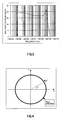
- FIG. 1 shows, as an ideal state, a state in which c-axes of all the crystal grains are oriented toward the plane on which X-ray diffraction is being conducted.
- the C-plane of each crystal grain is perpendicular to the plane on which X-ray diffraction is being conducted.
- the permeability in the direction perpendicular to the plane on which X-ray diffraction is being conducted will become high in whichever direction c-axis is oriented.
- the state in which the direction of c-axis is also oriented in a fixed direction corresponds to the case of the plane oriented state as disclosed in Patent Document 1.
- the state of FIG. 1 since there is no difference between the state of FIG. 1 and the plane oriented state, there will be no difference of permeability in principle in the concerned direction.
- aligning c-axes in a fixed direction will make the permeability in the concerned fixed direction to be extremely low.
- the present invention has adopted the state in which C-planes are oriented in a direction perpendicular to the plane on which X-ray diffraction is being conducted (C-planes are parallel with the concerned direction), and c-axes are randomly oriented in the direction of the plane perpendicular to the concerned direction.
- a degree of orientation fc // calculated from fc // I(0018)/I(110) in an X-ray diffraction in two planes which are perpendicular to the above described c-axis-oriented plane (corresponds to the plane on which X-ray diffraction is being conducted) and are perpendicular to each other (herein after referred to as perpendicular planes) is adopted and the concerned degree of orientation fc // is configured to be not less than 0.3.
- the larger value of the concerned degree of orientation fc // means that there are more crystal grains of which c-axes are oriented in the direction perpendicular to the above described perpendicular planes. This condition is satisfied at least in the two perpendicular planes, which ensures that c-axes are randomly oriented.
- Such an orientation mode corresponds to an orientation mode possessed by a sintered body formed by applying a uniaxial magnetic field, i.e. a direct-current static magnetic field of a predetermined direction. By doing this, it is possible to obtain a high permeability in a direction parallel with the c-axis-oriented plane without being biased to a specific direction.
- the degree of orientation fc ⁇ By adjusting the degree of orientation fc ⁇ to be not less than 0.4, it is possible to make the ratio of the permeability at 100 kHz in the direction parallel with the c-axis-oriented plane to the permeability at 100 kHz in the direction perpendicular to the c-axis-oriented plane to be not more than 0.6, in at least two directions which are parallel with the c-axis-oriented plane and are perpendicular to each other.
- the above described permeability ratio it is preferable to increase the permeability in the perpendicular direction to the c-axis-oriented plane by adjusting the above described permeability ratio to be not more than 0.4, and further to be not more than 0.3.
- the above described orientation mode it becomes possible to make the above described ratio to be not less than 0.1 in at least two directions which are parallel with the c-axis-oriented plane and are perpendicular to each other.
- the configuration relating to the above described permeability ratio may be fulfilled at 100 MHz instead of, or in addition to 100 kHz.
- a permeability of not less than 8 at 100 MHz it may be possible to satisfy the condition that fc // is not less than 0.3 in a plane which is perpendicular to the c-axis-oriented plane (a plane in the plane orientation direction), but is not possible to satisfy the condition that fc // is not less than 0.3 in two planes which are perpendicular to each other.
- the concerned degree of orientation fc // is not less than 0.5.
- fc // may be not less than 0.3 in two planes which are perpendicular to the above described c-axis-oriented plane and are perpendicular to each other, more preferably fc // is not less than 0.3 in three planes which form an angle of 120° or in larger number of planes. It is more preferable that fc // is not less than 0.3 in any plane perpendicular to the above described c-axis-oriented plane.
- the hexagonal Z-type ferrite sintered body may comprise a c-axis-oriented plane which satisfies the above described conditions.
- a plane may be a sintered body surface or inside a sintered body. When it is inside a sintered body, it may be exposed by cutting or grinding a sintered body to evaluate the above described degree of orientation.
- X-ray diffraction may be conducted on one of the surfaces thereof to evaluate the degree of orientation fc ⁇ , and when as the result of that the concerned plane becomes a c-axis-oriented plane, the degree of orientation fc // may be evaluated on two other surfaces which are perpendicular to the c-axis-oriented plane and perpendicular to each other.
- a hexagonal Z-type ferrite sintered body which has a small anisotropy of permeability and a good magnetic balance can be understood as described below. That is, an orientation analysis by an electron back scattering pattern (EBSP) in a scanning electron microscope (SEM) may be used. In such an orientation analysis, since an inclination amount of the c-axis of a crystal grain with respect to the direction perpendicular to the orientation analysis plane of a sintered body can be observed, the orientation state of crystal grains can be evaluated.
- EBSP electron back scattering pattern
- SEM scanning electron microscope
- ⁇ AV ⁇ n ⁇ / ⁇ n ⁇
- ⁇ is the orientation angle difference between the direction perpendicular to the orientation analysis plane of the hexagonal Z-type ferrite sintered body and the c-axis direction of the hexagonal Z-type ferrite at the measurement point of the EBSP
- n( ⁇ ) represents the number of measurement points to indicate the above described ⁇ .
- ⁇ n( ⁇ ) and ⁇ n( ⁇ ) indicates the summation of ⁇ n( ⁇ ) and n( ⁇ ) respectively for all ⁇ in the interval of 0 to 90°.
- C-planes are oriented in the direction perpendicular to the orientation analysis plane to provide a hexagonal Z-type ferrite having a good permeability in the concerned direction.
- c-axes will be oriented in the direction parallel with the above described orientation analysis plane and the above described orientation analysis plane becomes a c-axis-oriented plane.
- n AV ⁇ I ⁇ / m (where, ⁇ represents an angle when the orientation difference between the projection direction of c-axis direction to the above described orientation analysis plane and "one straight line" in the above described orientation analysis plane forms a positive acute angle.
- I( ⁇ ) represents the number of measurement points to indicate orientation difference ⁇
- m represents the number of dividing points in the interval of 0 to 90°.
- SD ⁇ ⁇ I ⁇ - n AV 2 / m 1 / 2
- the above described "one straight line” may be any one in the above described orientation analysis plane. By doing this way, it is possible to obtain a high permeability in the direction parallel with the c-axis-oriented plane. Since the value of SD increases as the number of measurement points increases, an index which is divided by n AV which corresponds to an average number of measurement points is used as the index so that the results of EBSP analysis of a different number of measurement points can be compared.
- n AV is preferably set to be about 4000.
- the average orientation difference ⁇ AV is not less than 65°, and SD/n AV to be not more than 0.6, it is possible to configure such that a permeability is not less than 30 at 100 kHz in the perpendicular direction to the c-axis-oriented plane, a permeability is not less than 8 at 100 kHz in the direction parallel with the c-axis-oriented plane and the ratio of the permeability in the direction parallel with the c-axis-oriented plane to the permeability in the direction perpendicular to c-axis-oriented plane is not less than 0.15.
- the aforementioned ratio is more preferably not less than 0.20.
- the evaluation of EBSP may be performed at a span of 1 ⁇ m by using a beam of a diameter of 1 ⁇ m.
- the analysis area may be selected within a range of 0.01 to 0.3 ⁇ 10 -6 m 2 depending on the average diameter of crystal grains so that not less than 40 crystal grains are included in the analysis area, in this invention, an analysis area of 0.16 ⁇ 10 -6 m 2 is adopted as a general purpose condition to perform orientation analysis.
- the density of hexagonal Z-type ferrite sintered body is preferably not less than 4.7 ⁇ 10 3 kg/m 3 .
- a sintered body density of not less than 5.0 ⁇ 10 3 kg/m 3 is more preferable to obtain a permeability of not less than 40.
- the sintered body density is not less than 5.1 ⁇ 10 3 kg/m 3 . Though there is no specific upper limit, it is preferably less than 5.25 ⁇ 10 3 kg/m 3 since coarse grains tend to be generated as the sintered body density increases.
- the hexagonal Z-type ferrite of which permeability is improved by the improvement of orientation is also advantageous in the frequency characteristics of permeability compared with the case in which the permeability is improved by controlling other factors such as the composition and structure.
- the hexagonal Z-type ferrite relating to the present invention has an excellent frequency characteristics and, for example, the value of permeability at 1 GHz may be made to be 30% to 80% of the value of permeability at 100 MHz.
- the average crystal grain diameter of the sintered body is preferably within a range of 4 to 50 ⁇ m.
- the change rate ( 100 ⁇ (
- ) ⁇ 100MHz ) of the real part of a complex permeability at 1 GHz, ⁇ 1GHz , with respect to a permeability (the real part of complex permeability) at 100 MHz, ⁇ 100MHz will be reduced.
- Such change rate may be not more than 40%.
- a high permeability can be obtained even at a high frequency of about 1 GHz. It is possible to make the permeability at 1 GHz to be not less than 25.
- the grain diameter of the sintered body is calculated in such a way that with the longest (maximum diameter) of the lines which can be drawn inside the observed crystal grain being a long axis, and the longest of the lines which can be drawn perpendicular to the long axis inside the crystal grain being a short axis, an average of the short axis and the long axis is the crystal grain diameter for individual grain.
- An average crystal grain diameter may be determined by evaluating and averaging 100 arbitrary grains.
- the above described hexagonal Z-type ferrite sintered body is obtained by using for example the below described method of manufacturing a hexagonal Z-type ferrite sintered body. That is, a hexagonal Z-type ferrite sintered body is obtained through a forming step to form hexagonal Z-type ferrite powder having a specific surface area of 800 to 4000 m 2 /kg in a uniaxial magnetic field to obtain a green body, and a sintering step to sinter the concerned green body.
- the specific surface area of hexagonal Z-type ferrite powder is controlled to be 800 to 4000 m 2 /kg. This will realize a high orientation and a high permeability.
- the specific surface area is too small, the sintered body density will not be increased, and orientation is also low.
- orientation will be reduced and coarse grains are likely to be generated.
- Usable forming methods include press forming, extrusion forming, injection forming, and the like, but particularly preferable is simple, press forming.
- press forming an axial magnetic field forming process in which the magnetic filed application direction and the pressing direction are parallel, and a transverse magnetic field forming process in which the magnetic field application direction and the pressing direction are perpendicular can be used, but to obtain high orientation, the lateral magnetic field forming process is preferable.
- orientation is performed by forming in a magnetic field.
- a uniaxial magnetic field as described above, that is, a direct-current static magnetic field applied in a predetermined direction may be used.
- An application method in which the application direction or angle of a magnetic field changes in time, such as a rotating magnetic field is not suitable.
- Forming by the application of a uniaxial magnetic field makes it possible to obtain the hexagonal Z-type ferrite sintered body relating to the present invention described above, in which C-planes of crystal grains are oriented so as to be parallel with magnetic field application direction, and c-axis directions are in a random state in the plane perpendicular to the magnetic field application direction.
- forming can be performed by means of a dry forming which utilizes dried powder, in order to increase orientation, it is preferable to use a wet forming which utilizes a slurry obtained by mixing hexagonal Z-type ferrite powder with a medium such as water.
- a medium such as water.
- the kind of water as the medium is not specifically limited, and for example service water may be used.
- the slurry for forming may be produced by mixing dry pulverized powder with water, the slurry after wet pulverization may be preferably used as it is as the slurry for forming without being subjected to a drying process. Such method will make it possible to achieve an even higher degree of orientation.
- the slurry concentration that is, the weight proportion of hexagonal Z-type ferrite powder in the slurry may be not more than 85% by weight. This is because, when it is higher than 85% by weight, friction between grains increases, and rotation of grains becomes insufficient thereby causing decline of the degree of orientation.
- a high orientation such as a degree of orientation fc ⁇ of not less than 0.5
- it is more preferable to perform forming with the concentration of hexagonal Z-type ferrite powder in the above described slurry being not more than 70% by weight. More preferably, the slurry concentration is not more than 65% by weight.
- the slurry concentration is preferably not less than 50% by weight. This is because, when it is less than 50% by weight, it takes much time for dewatering during forming thereby reducing the productivity.
- the method of feeding the slurry may be injecting the slurry by pressure into a die cavity under the application of a magnetic field, or charging the slurry into a die cavity and thereafter applying a magnetic field.
- the medium in the slurry is removed through a water drain hole or a clearance formed in the cavity, during pressurization.
- the hexagonal Z-type ferrite powder after forming, that is, the green body is to be subjected to sintering after being sufficiently dried.
- the above described hexagonal Z-type ferrite powder can be obtained by performing calcining in a powder state and pulverizing it as with a common process
- the method of pulverizing a hexagonal Z-type ferrite sintered body is preferable in the viewpoint of pulverizability.
- the grains constituting hexagonal Z-type ferrite powder are preferably single crystals. In this respect, since grains have grown in the sintered body, pulverizing the concerned sintered body will make it possible to obtain powder containing a large number of grains which are single crystals.
- the method of pulverizing a hexagonal Z-type ferrite sintered body to obtain powder is a process for preparing powder preferable for orientation in a magnetic field.
- the average crystal grain diameter of the hexagonal Z-type ferrite sintered body to be subjected to such pulverization is preferably 5 to 200 ⁇ m.
- the average crystal grain diameter of hexagonal Z-type ferrite in the powder after calcining is 5 to 200 ⁇ m.
- the powder to be subjected to forming contains substantially no hexagonal M-type ferrite phase.
- the hexagonal M-type ferrite phase exhibits uniaxial anisotropy, in which c-axis is an easy magnetization axis, and tends to be oriented in the uniaxial direction of applied magnetic field, thereby producing an orientation state (plane orientation) different from the orientation state relating to the present invention, even if it turns into a hexagonal Z-type ferrite phase during sintering.
- the expression "contains substantially no hexagonal M-type ferrite phase” means that the ratio of the intensity of the (006) peak which is the peak of hexagonal M-type ferrite to the intensity of the (1016) peak which is the peak of maximum intensity of hexagonal Z-type ferrite phase is not more than 5% in an X-ray diffraction.
- the powder subjected to the forming is preferably hexagonal Z-type ferrite which contains substantially neither Y-type ferrite nor spinel ferrite.
- the expression "contains substantially neither Y-type ferrite nor spinel ferrite” means that the ratio of the intensity of the (0012) peak of Y-type ferrite to the intensity of the (1016) peak which is the peak of maximum intensity of hexagonal Z-type ferrite is not more than 5%, and the ratio of the intensity of the (440) peak of spinel ferrite to the same is not more than 7%.
- the hexagonal Z-type ferrite sintered body which is obtained through forming in a magnetic field as described above, may have a disorder of orientation near the surfaces thereof. Therefore, removing the surface by machining will increase the portion of a high degree of orientation in the entire sintered body, and is advantageous in obtaining a high permeability. Also removing the surface by machining will lead to the suppression of the variation in the orientation, and therefore in the permeability in the sintered body.
- the machining may be performed on at least part of the sintered body. Surface machining either by grinding or by cutting will remove the surface area.
- Fe 2 O 3 , BaCO 3 , and Co 3 O 4 were weighed such that the composition of principal components are 70.2% by mole of Fe 2 O 3 , 18.8% by mole of BaO and 11.0% by mole of CoO.
- Mn 3 O 4 , Li 2 CO 3 and SiO 2 were added such that their proportions to the principal components are: 3.0% by mass of Mn 3 O 4 , 0.4% by mass of Li 2 CO 3 and 0.13% by mass of SiO 2 and were mixed for 16 hours in a wet ball mill.
- Mn 3 O 4 , Li 2 CO 3 , and SiO 2 may be added during pulverization which is performed after calcining.
- the mixture was calcined at 1100°C for 2 hours in the atmosphere.
- the calcined powder was pulverized for 18 hours in a wet ball mill.
- the resultant pulverized powder was added with a binder (PVA) and granulated. After granulation, it was pressed and then sintered at 1300°C for 3 hours in an oxygen atmosphere.
- PVA binder
- the resultant sintered body was crushed by a jaw crusher and then coarsely pulverized in a disk mill to obtain a coarsely pulverized powder. Further, powder fabricated by pulverizing the coarsely pulverized powder in a stamp mill, powder fabricated by pulverizing the resultant coarsely pulverized powder by a vibration mill, and powder fabricated by pulverizing the powder pulverized by the vibration mill in a ball mill are obtained respectively. In this process, the pulverization time of the ball mill was varied to obtain powders having a different particle diameter (powder 1 to 5).
- powder 1 has an insufficient sintered body strength and therefore not suitable for practical uses, and powder 5 in which coarse grains were generated is not suitable for practical uses as well.
- sintered bodies were further fabricated by varying the forming conditions as shown below.
- the powders were added with water such that the slurry concentration was 73% by weight, and wetly formed in a uniaxial magnetic field.
- the forming pressure was 87.5 MPa, and the magnetic field was applied in the direction perpendicular to the press direction. The applied magnetic field was within a range of 0 to 848 kA/m.
- the resultant green body was resintered in the same condition as described above to obtain a cubic sintered body of about 10 mm sides.
- the specimen was cut in such a way to obtain a cut plane of which normal corresponds to the magnetic field application direction of the sintered body, and X-ray diffraction (XRD) analysis was conducted on the cut plane to evaluate the degree of orientation fc ⁇ .
- XRD X-ray diffraction
- XRD X-ray diffraction
- I(HKL) represents a value integrated over the range from ⁇ (HKL)-0.4° to ⁇ (HKL)+0.4°, with the peak angle of the diffraction line of (HKL) plane being ⁇ (HKL).
- the degree of orientation fc // defined herein is a value which is the diffraction peak intensity generated from the lattice plane of index (0018) divided by the diffraction intensity generated from the lattice plane of index (110) of Z-type ferrite.
- the magnetic field application direction is referred to as H direction, the permeability in H direction as ⁇ H , and a plane of which normal corresponds to H direction as H-plane, and for the press direction, similarly referred to as P direction, ⁇ P and P-plane, and for the case of the direction perpendicular to both the magnetic field application direction and the press direction, as L direction, ⁇ L and L-plane.
- a ring-shape ferrite of a high ⁇ of which permeability had been measured in advance, was formed with a gap and provided with a winding (hereinafter, referred to as a yoke part).
- non-oriented hexagonal ferrite ⁇ 2.8, 5.7, 12.9
- consolidated powder metal ⁇ 45, 60
- spinel ferrite ⁇ 14.0, 19.2, 29.3, 32.8, 50.0, 55.0
- a hexagonal Z-type ferrite sintered body according to a conventional dry process was prepared.
- the conditions before the calcination and the condition for firing were the same as those described above.
- Calcined powder was pulverized for 18 hours in a ball mill, and resultant pulverized powder was added with 1% by weight of PVA for granulation, and was dryly formed without magnetic field.
- the resultant green body was sintered at 1300°C for 3 hours in an oxygen atmosphere.
- FIG. 3 The frequency dependence of the permeability of the resultant hexagonal Z-type ferrite sintered body is shown in FIG. 3.
- the permeability at 100 kHz is 19.4 and the permeability at 100 MHz is 16.6, both of which are not more than 20.
- the permeability at 100 MHz tends to be slightly lowered with respect to the permeability at 100 kHz as shown in FIG. 3.
- Table 2 shows the values of sintered body density, fc ⁇ , fc // , permeability at 100 kHz of the sintered body obtained by varying the applied magnetic field in the range of 0 to 848 kA/m. Even when the applied magnetic field is 0, the permeability at 100 kHz is not less than 20, which shows that the permeability is higher than that of the hexagonal Z-type ferrite sintered body according to the conventional dry process shown in FIG. 3.
- Table 2 Powder used Applied magnetic field intensity (kA/m) Sintered body density ( ⁇ 10 3 kg/m 3 ) Degree of orientation Real part of H direction permeability (100 kHz) f C ⁇ f C// H-plane L-plane P-plane Comp.
- the sintered body densities of examples 1 to 4 were not less than 5.1 ⁇ 10 3 kg/m 3 , and thus in all cases exhibited a high value of not less than 5.00 ⁇ 10 3 kg/m 3 . Further, for examples 2 to 4 for which fc ⁇ was not less than 0.45, high permeabilities of not less than 35 were obtained. Especially for examples 3 and 4 for which the applied magnetic field intensity was not less than 568 kA/m, a very high permeability in H direction of not less than 40 was obtained.
- the degree of orientation fc // in L-plane and P-plane was, in all cases, not less than 0.3, and c-axes were randomly oriented in the directions perpendicular to the magnetic field application direction (directions parallel with the c-axis-oriented plane) showing that a hexagonal Z-type ferrite sintered body having a small anisotropy of orientation has been obtained.
- the degree of orientation fc // of L-plane becomes not less than 1.0 and the ratio of the degree of orientation fc // of L-plane to the degree of orientation fc // of P-plane is not less than 0.7, thereby showing that the anisotropy in the direction perpendicular to the magnetic field application direction (direction parallel with the c-axis-oriented plane) has further decreased.
- Table 3 shows fc ⁇ and the real part of the permeability at 100 kHz of the specimen which was fabricated using powder 3 and by varying the magnetic field in the range of 23.2 to 848 kA/m.
- example 12 is the specimen which was prepared by stirring the powder using a stick in the cavity during application of a magnetic field before the press forming in a magnetic field.
- Table 3 Powder used Slurry concentration Applied magnetic field intensity Sintered body density ( ⁇ 10 3 kg/m 3 ) Degree of orientation f C ⁇ Real part of permeability (100 kHz) (wt%) (kA/m) (H-plane) ⁇ H Ex. 7 Powder 3 73 23.2 5.06 0.43 31 Ex. 8 Powder 3 73 136 5.13 0.52 43 Ex. 9 Powder 3 73 376 5.10 0.52 42.5 Ex. 10 Powder 3 73 568 5.13 0.62 41 Ex. 11 Powder 3 73 848 5.11 0.58 40.5 Ex. 12 Powder 3 73 848 (with stirring) 5.13 0.68 48.5
- the permeabilities of P direction and L direction were measured by a gap method to find that they were 15.5 and 20.5 respectively, indicating a high permeability of not less than 15 even in the direction perpendicular to H direction.
- the ratios of permeabilities ( ⁇ L / ⁇ H , ⁇ P / ⁇ H ) at 100 kHz were from 0.38 to 0.51, that is, within a range of not more than 0.6 and not less than 0.1, also showing that a hexagonal Z-type ferrite sintered body having a good balance of anisotropy has been obtained.
- stirring the slurry in a magnetic field caused the degree of orientation to increase making it possible to obtain a high value of not less than 45 for the permeability in the magnetic field application direction (H direction).
- specimens were prepared by a longitudinal magnetic field forming process, in which magnetic field application direction and the pressing direction are the same, and it was found that the degree of orientation fc ⁇ thereof was decreased by amount of about 0.2 to 0.3 compared with the case of the above described lateral magnetic field forming.
- the frequency characteristics of the permeability, particularly the permeability at high frequencies of not less than 100 MHz, of one direction of the oriented hexagonal Z-type ferrite was evaluated by means of the technique described below. That is, since the permeability in the direction parallel with the C-plane of the ferrite sintered body oriented by a uniaxial magnetic field cannot be readily measured with a ring-shape specimen, three ring specimens, of which the ring annular surface are parallel with H-plane, P-plane, or L-plane, were cut out, and from the measurement results of permeabilities of these ring specimens, the permeabilities of H direction, P direction, and L direction were calculated.
- the longitudinal direction and lateral direction along the plate surface of magnetic plate having an anisotropy are defined to be Y direction (for example P direction) and X direction (for example H direction) respectively, a ring specimen in which the difference between the outer diameter and inner diameter thereof is sufficiently small is cut out from the concerned magnetic plate, and N-turn-winding was provided on the concerned ring specimen; and it is supposed that a current I is applied to the winding to measure an initial permeability. Further, let the sectional area of the ring specimen be S.
- d l is an infinitesimal line element vector in the tangent direction of the ring specimen.
- H is the magnetic field vector in the ring specimen.
- ⁇ X and ⁇ Y as well as ⁇ xyplane as described below are in each case a relative permeability.
- this method will be referred to as a "ring method.”
- the following specimens were fabricated to measure the permeability of each direction, and others. That is, powder 2 of Table 1 was added with water in such a way that the slurry concentration was 73% by weight, and the slurry is put into a nonmagnetic die to be rotated 3 times with the die in a static magnetic field of 480 kA/m, and after the rotation, is formed with a forming pressure of 22 MPa in a static magnetic field of the same intensity. At this time, the forming pressure was applied in the direction perpendicular to the magnetic field. The resultant green body was sintered at 1350°C in an oxygen atmosphere to obtain a sintered body (comparison example 4).
- H direction the direction in which a magnetic field is applied during pressing for forming
- P direction the press direction
- L direction direction perpendicular to both H direction and P direction
- H-plane the planes each of which the normal corresponds to the aforementioned respective direction
- P-plane the planes each of which the normal corresponds to the aforementioned respective direction
- L-plane the planes each of which the normal corresponds to the aforementioned respective direction
- Table 4 shows the sintered body density, the degrees of orientation (fc ⁇ , fc // ), and the values of the real part of permeability at 100 MHz for H, L, P directions determined by the ring method, for comparative examples 1 to 4 and examples 1 and 4.
- Table 4 Powder used Sintered body density ( ⁇ 10 3 kg/m 3 ) Degree of orientation Real part of permeability (100 MHz) f C ⁇ f C// H-plane L-plane P-plane ⁇ H ⁇ L ⁇ P Comp. Ex. 4 Powder 2 4.80 0.74 0.07 - 35.0 27.8 4.0 Comp. Ex. 1 Powder 4 5.16 0.21 0.52 1.12 15.6 17.6 10.5 Comp. Ex.
- fc // in L-plane exhibited a small value of not more than 0.1 which was smaller compared to fc // in P-plane, and c-axes were oriented concentrating in a specific direction in H-plane. Further, at this time, the permeability in P direction was as low as not more than 4.
- fc // was not less than 1.4 for both L-plane and P-plane, and c-axes were randomly oriented even in the direction perpendicular to the magnetic field application direction (direction parallel with c-axis-oriented plane) showing that a hexagonal Z-type ferrite sintered body having a small anisotropy of orientation in the c-axis-oriented plane has been obtained.
- the permeability ⁇ L in L direction and the permeability ⁇ P in P direction were 11.5 and 9.1 respectively, confirming that each shows a high value of not les than 8.
- the permeability in H direction also exhibited a high value of not less than 35.
- the ratios of the permeability ⁇ L of L direction and the permeability ⁇ P of P direction with respect to the permeability ⁇ H of H direction, that is the direction perpendicular to the c-axis-oriented plane, were 0.31 and 0.24 respectively, revealing that each exhibits a high value of not more than 0.4 and not less than 0.15 indicating a good balance of anisotropy in permeability.
- Table 5 shows the sintered body density, fc ⁇ , and ⁇ H obtained through the gap method of the specimen prepared by using powder 2.
- Table 5 Powder used Slurry concentration (%) Applied magnetic field intensity (kA/m) Sintered body density ( ⁇ 10 3 kg/m 3 ) Degree of orientation f C ⁇ Real part of permeability (100 kHz) H-plane ⁇ H Ex. 13 Powder 2 73 136 4.59 0.55 35 Ex. 14 Powder 2 73 848 4.60 0.61 31
- examples 13 and 14 become to exhibit a degree of orientation not less than 0.5 by the application of a magnetic field of not less than 136 kA/m, and to exhibit a permeability value of not less than 30. Further, it is also seen that in the case of using powder 2 having a specific surface area of 1080 m 2 /kg which is smaller than that of powder 3, the degree of orientation fc ⁇ has increased when compared with the case of using powder 3 at the same applied magnetic field intensity.
- a sintered body specimen (example 15) was prepared in the same manner as in example 11 except that the slurry was not dried after pulverizing and formed as it was adjusting the slurry concentration to be 68%.
- a sintered body specimen (example 16) was prepared in a condition which differed from that of the aforementioned specimen only in the composition of the principal components.
- the composition of principal components of example 16 is 70.6% by mole of Fe 2 O 3 , 17.6% by mole of BaO, and 11.8% by mole of CoO, which corresponds to the stoichiometric composition of Ba 3 CO 2 Fe 24 O 41 .
- Table 6 shows sintered body density, the degree of orientation fc ⁇ , and the real part of the permeability at 100 kHz for examples 15 and 16. The permeabilities were measured by the gap method.
- Table 6 Powder used Slurry concentration (%) Applied magnetic field intensity (kA/m) Sintered body density ( ⁇ 10 3 kg/m 3 ) Degree of orientation f C ⁇ (H-plane) Real part of permeability (100 kHz) ⁇ H Ex. 15 Powder 3 68 848 5.14 0.70 55.0 Ex. 16 Powder 3 68 848 4.95 0.74 40.0
- example 16 which had a stoichiometric composition exhibited a high degree of orientation of not less than 0.7 and a high permeability of not less than 40.
- example 15 which had a Ba-rich composition deviating from the stoichiometric composition
- the sintered body density has increased by not less than 3%.
- the degree of orientation of example 15 exhibited only a slight decrease with respect to that of example 16.
- the permeability increases 30% or more and a permeability of 50 or more is obtained.
- a Ba-rich composition deviating from the stoichiometric composition is preferable in increasing the density and permeability of oriented hexagonal Z-type ferrite.
- the real part of the permeability at 100 kHz for each H, P, and L direction ⁇ H , ⁇ L , ⁇ P were measured by a gap method to find that they were 55.0, 21.0 and 12.5 respectively.
- a very high permeability of not less than 50 was obtained even at 100 kHz.
- a high permeability of not less than 10 was obtained also in the direction parallel with the c-axis-oriented plane, and the ratios of permeabilities ( ⁇ L / ⁇ H , ⁇ P / ⁇ H ) were from 0.23 to 0.38, that is, within a range of not more than 0.4 and not less than 0.1, showing that a hexagonal Z-type ferrite sintered body having a good balance of anisotropy has been obtained.
- the real part of permeability at 100 MHz in each H, L, and P direction was evaluated by the ring method to find that they were 51.5, 11.8, and 8.1.
- a very high permeability of not less than 50 was obtained even at 100 MHz.
- a high permeability of not less than 8 was obtained and the ratios of permeabilities ( ⁇ L / ⁇ H , ⁇ P / ⁇ H ) were from 0.16 to 0.23, that is, within a range of not more than 0.4 and not less than 0.1, indicating excellent characteristics even at 100 MHz.
- a sintered body specimen (example 17) was prepared in the same manner as in example 15 except that the calcination was performed at 1330°C for 3 hours in oxygen atmosphere and the calcined powder was pulverized for 22 hours to be subjected to forming.
- the sintered body density, the degree of orientation fc ⁇ , and the real part of the permeability at 100 kHz were evaluated on the obtained specimen, and results of which are shown in Table 7.
- the permeability was measured by the gap method. (Table 7) Slurry concentration (%) Applied magnetic field intensity (kA/m) Sintered body density ( ⁇ 10 3 kg/m 3 ) Degree of orientation f C ⁇ (H-plane) Real part of permeability (100 kHz) ⁇ H Ex. 17 68 848 5.05 0.66 42.0
- An observation magnification was selected such that at least not less than 40 crystal grains were included in the EBSP observation area.
- the observation area was 200 ⁇ m ⁇ 800 ⁇ m (0.16 ⁇ 10 -6 m 3 ), and the step interval of the beam was 1 ⁇ m.
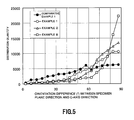
- the orientation angle difference between the c-axis direction of the crystal and the perpendicular direction of specimen plate surface (observed plane) was determined for each point, based on the orientation information obtained from the measurement points, and the number of points which had the same orientation angle difference ⁇ was counted to obtain n( ⁇ ), thereby obtaining an orientation difference distribution diagram of ⁇ with n( ⁇ ) being the longitudinal axis.
- the obtained distribution diagrams of orientation difference are summarized in FIG. 5.
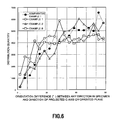
- comparative example 1, examples 1, 2, and 8 in all cases exhibit a similar tendency, although there is a slight bias in the distribution of I( ⁇ ) with respect to ⁇ , the value is not more than 7000 points even in the direction in which c-axis direction is observed with a highest intensity in FIG. 6 compared with the case of FIG. 5 in which the observation points at a highest intensity was more than 20000 points.
- the ratio is in all cases not more than 0.6 in examples and thus the level of bias is low.
- SD/n AV which is SD calculated by Equation 3 divided by n AV calculated by Equation 2
- Table 8 The value of SD/n AV can be used as the index of variance, which is not more than 0.6 in any of comparative example 1, examples 1, 2, and 8, confirming that the projection direction of c-axis to the c-axis-oriented plane does not exhibit strong bias. Further, particularly in example 8, SD/n AV is not more than 0.21 indicating that the projection direction of c-axis to the c-axis-oriented plane is randomly distributed in the plane.
- Table 9 shows the values of the degree of orientation fc ⁇ and the permeability in the case in which forming was performed by using powder 4, applying the specific magnetic field of 848 kA/m, and varying the slurry concentration. It is seen that when the slurry concentration decreases, the degree of orientation increases. When slurry concentration became not more than 65% by weight, fc ⁇ became not less than 0.6 and a high permeability exceeding 40 was obtained. (Table 9) Powder used Slurry concentration (%) Applied magnetic field intensity (kA/m) Sintered body density ( ⁇ 10 3 kg/m 3 ) Degree of orientation f C ⁇ (H-plane) Real part of permeability (100 kHz) ⁇ H Ex. 4 Powder 4 73 848 5.15 0.49 41 Ex. 5 Powder 4 65 848 5.22 0.60 40 Ex. 6 Powder 4 60 848 5.18 0.71 44
- FIG. 7 shows the frequency characteristics of the complex permeability of example 4 determined by the ring method in a range of 100 MHz to 1.8 GHz. It is seen from FIG. 7 that the real part of the complex permeability in H direction is not less than 30 up to 1 GHz and thus a high permeability is maintained.
- the present invention it is possible to provide a hexagonal Z-type ferrite which has a particularly high permeability in a specific direction and still has a high permeability in the directions other than the concerned direction thereby offering an excellent balance of permeability, and a method of manufacturing the same.
- the ferrite sintered body according to the present invention it becomes possible to provide high quality choke coils, inductors, magnetic wave absorbers, and others.
Landscapes
- Chemical & Material Sciences (AREA)
- Engineering & Computer Science (AREA)
- Power Engineering (AREA)
- Dispersion Chemistry (AREA)
- Crystallography & Structural Chemistry (AREA)
- Materials Engineering (AREA)
- Magnetic Ceramics (AREA)
- Soft Magnetic Materials (AREA)
- Manufacturing Cores, Coils, And Magnets (AREA)
Applications Claiming Priority (2)
| Application Number | Priority Date | Filing Date | Title |
|---|---|---|---|
| JP2006289685 | 2006-10-25 | ||
| JP2007091193A JP2008133166A (ja) | 2006-10-25 | 2007-03-30 | 六方晶z型フェライト焼結体およびその製造方法 |
Publications (2)
| Publication Number | Publication Date |
|---|---|
| EP1921638A2 true EP1921638A2 (de) | 2008-05-14 |
| EP1921638A3 EP1921638A3 (de) | 2010-02-10 |
Family
ID=39091825
Family Applications (1)
| Application Number | Title | Priority Date | Filing Date |
|---|---|---|---|
| EP07020704A Withdrawn EP1921638A3 (de) | 2006-10-25 | 2007-10-23 | Hexagonaler, Z-förmiger gesinterter Ferritkörper und Herstellungsverfahren dafür |
Country Status (4)
| Country | Link |
|---|---|
| US (1) | US20080101979A1 (de) |
| EP (1) | EP1921638A3 (de) |
| JP (1) | JP2008133166A (de) |
| KR (1) | KR20080037521A (de) |
Cited By (1)
| Publication number | Priority date | Publication date | Assignee | Title |
|---|---|---|---|---|
| EP2447960A1 (de) | 2010-10-29 | 2012-05-02 | Shin-Etsu Chemical Co., Ltd. | Anisotroper gesinterter Seltenerdmagnet und Herstellungsverfahren |
Families Citing this family (8)
| Publication number | Priority date | Publication date | Assignee | Title |
|---|---|---|---|---|
| US8128757B2 (en) | 2006-11-21 | 2012-03-06 | Ulvac, Inc. | Method of manufacturing oriented body, molded body and sintered body as well as method of manufacturing permanent magnet |
| WO2008084611A1 (ja) | 2007-01-11 | 2008-07-17 | Ulvac, Inc. | 成形装置 |
| JP5212305B2 (ja) * | 2009-08-05 | 2013-06-19 | 株式会社村田製作所 | 磁性材料とそれを用いたコイル部品 |
| US8609062B2 (en) | 2010-12-07 | 2013-12-17 | Skyworks Solutions, Inc. | Specialty materials processing techniques for enhanced resonant frequency hexaferrite materials for antenna applications and other electronic devices |
| WO2012103020A2 (en) * | 2011-01-24 | 2012-08-02 | Skyworks Solutions, Inc. | Specialty materials processing techniques for enhanced resonant frequency hexaferrite materials for antenna applications and other electronic devices |
| KR20130001984A (ko) * | 2011-06-28 | 2013-01-07 | 삼성전기주식회사 | 적층형 파워 인덕터의 갭층 조성물 및 상기 갭층을 포함하는 적층형 파워 인덕터 |
| KR101736734B1 (ko) * | 2015-06-01 | 2017-05-17 | 주식회사 이엠따블유 | 페라이트 시트, 이의 제조 방법 및 이를 구비하는 전자 부품 |
| CN113744991B (zh) * | 2021-09-17 | 2022-10-11 | 横店集团东磁股份有限公司 | 一种Co2Z型铁氧体材料及其制备方法和用途 |
Family Cites Families (2)
| Publication number | Priority date | Publication date | Assignee | Title |
|---|---|---|---|---|
| US5593612A (en) * | 1990-11-30 | 1997-01-14 | The United States Of America As Represented By The Secretary Of The Navy | U, W, X, Y and Z-type ferrites |
| WO2007111122A1 (ja) * | 2006-03-29 | 2007-10-04 | Hitachi Metals, Ltd. | コイル部品およびその製造方法 |
-
2007
- 2007-03-30 JP JP2007091193A patent/JP2008133166A/ja active Pending
- 2007-10-09 KR KR1020070101360A patent/KR20080037521A/ko not_active Withdrawn
- 2007-10-23 EP EP07020704A patent/EP1921638A3/de not_active Withdrawn
- 2007-10-24 US US11/877,843 patent/US20080101979A1/en not_active Abandoned
Cited By (2)
| Publication number | Priority date | Publication date | Assignee | Title |
|---|---|---|---|---|
| EP2447960A1 (de) | 2010-10-29 | 2012-05-02 | Shin-Etsu Chemical Co., Ltd. | Anisotroper gesinterter Seltenerdmagnet und Herstellungsverfahren |
| US8388766B2 (en) | 2010-10-29 | 2013-03-05 | Shin-Etsu Chemical Co., Ltd. | Anisotropic rare earth sintered magnet and making method |
Also Published As
| Publication number | Publication date |
|---|---|
| JP2008133166A (ja) | 2008-06-12 |
| US20080101979A1 (en) | 2008-05-01 |
| KR20080037521A (ko) | 2008-04-30 |
| EP1921638A3 (de) | 2010-02-10 |
Similar Documents
| Publication | Publication Date | Title |
|---|---|---|
| KR101858484B1 (ko) | 페라이트 소결 자석 및 그 제조 방법 | |
| US20080101979A1 (en) | Hexagonal z-type ferrite sintered body and manufacturing method thereof | |
| EP3150567B1 (de) | Ferritmagnetisches material | |
| EP2784044B1 (de) | Hexagonales Magnetoplumbit-Ferrit | |
| KR101649242B1 (ko) | 페라이트 소결 자석의 제조 방법 및 페라이트 소결 자석 | |
| EP2511249B9 (de) | Ferritmagnetmaterial, ferritmagnet und ferritsintermagnet | |
| KR101377409B1 (ko) | 페라이트 자성 재료 | |
| JP4254897B2 (ja) | 酸化物磁性材料 | |
| WO1999034376A1 (en) | Ferrite magnet and process for producing the same | |
| CN101316803A (zh) | 氧化磁性材料及其制造方法和铁氧体烧结磁体及其制造方法 | |
| WO2022120149A1 (en) | Copper oxide doped ni-co-zn ferrite for very high frequency and ultra high frequency applications and process methodology | |
| JP2000331813A (ja) | フェライト磁石粉末 | |
| CN101202141A (zh) | 六方晶z型铁氧体烧结体及其制造方法 | |
| Singh et al. | Low‐temperature synthesis of Mn0. 2Ni0. 2Zn0. 6Fe2O4 ferrites by citrate precursor method and study of their properties | |
| JP5541475B2 (ja) | フェライト焼結体およびその製造方法並びに電子部品 | |
| JP5196101B2 (ja) | 軟磁性フェライト、磁気回路およびインダクタンス素子 | |
| JP5110262B2 (ja) | フェライト磁石の製造方法 | |
| JP2008050220A (ja) | 六方晶z型フェライト焼結体およびその製造方法 | |
| JP3944860B2 (ja) | フェライト磁石粉末 |
Legal Events
| Date | Code | Title | Description |
|---|---|---|---|
| PUAI | Public reference made under article 153(3) epc to a published international application that has entered the european phase |
Free format text: ORIGINAL CODE: 0009012 |
|
| AK | Designated contracting states |
Kind code of ref document: A2 Designated state(s): AT BE BG CH CY CZ DE DK EE ES FI FR GB GR HU IE IS IT LI LT LU LV MC MT NL PL PT RO SE SI SK TR |
|
| AX | Request for extension of the european patent |
Extension state: AL BA HR MK RS |
|
| PUAL | Search report despatched |
Free format text: ORIGINAL CODE: 0009013 |
|
| AK | Designated contracting states |
Kind code of ref document: A3 Designated state(s): AT BE BG CH CY CZ DE DK EE ES FI FR GB GR HU IE IS IT LI LT LU LV MC MT NL PL PT RO SE SI SK TR |
|
| AX | Request for extension of the european patent |
Extension state: AL BA HR MK RS |
|
| STAA | Information on the status of an ep patent application or granted ep patent |
Free format text: STATUS: THE APPLICATION HAS BEEN WITHDRAWN |
|
| 18W | Application withdrawn |
Effective date: 20100614 |