EP1908441A1 - Saugfähiger artikel - Google Patents
Saugfähiger artikel Download PDFInfo
- Publication number
- EP1908441A1 EP1908441A1 EP06766647A EP06766647A EP1908441A1 EP 1908441 A1 EP1908441 A1 EP 1908441A1 EP 06766647 A EP06766647 A EP 06766647A EP 06766647 A EP06766647 A EP 06766647A EP 1908441 A1 EP1908441 A1 EP 1908441A1
- Authority
- EP
- European Patent Office
- Prior art keywords
- sheet
- permeation
- absorber
- absorbent
- absorbent article
- Prior art date
- Legal status (The legal status is an assumption and is not a legal conclusion. Google has not performed a legal analysis and makes no representation as to the accuracy of the status listed.)
- Granted
Links
Images





Classifications
-
- A—HUMAN NECESSITIES
- A61—MEDICAL OR VETERINARY SCIENCE; HYGIENE
- A61F—FILTERS IMPLANTABLE INTO BLOOD VESSELS; PROSTHESES; DEVICES PROVIDING PATENCY TO, OR PREVENTING COLLAPSING OF, TUBULAR STRUCTURES OF THE BODY, e.g. STENTS; ORTHOPAEDIC, NURSING OR CONTRACEPTIVE DEVICES; FOMENTATION; TREATMENT OR PROTECTION OF EYES OR EARS; BANDAGES, DRESSINGS OR ABSORBENT PADS; FIRST-AID KITS
- A61F13/00—Bandages or dressings; Absorbent pads
- A61F13/15—Absorbent pads, e.g. sanitary towels, swabs or tampons for external or internal application to the body; Supporting or fastening means therefor; Tampon applicators
- A61F13/45—Absorbent pads, e.g. sanitary towels, swabs or tampons for external or internal application to the body; Supporting or fastening means therefor; Tampon applicators characterised by the shape
- A61F13/49—Absorbent pads, e.g. sanitary towels, swabs or tampons for external or internal application to the body; Supporting or fastening means therefor; Tampon applicators characterised by the shape specially adapted to be worn around the waist, e.g. diapers or nappies
-
- A—HUMAN NECESSITIES
- A61—MEDICAL OR VETERINARY SCIENCE; HYGIENE
- A61F—FILTERS IMPLANTABLE INTO BLOOD VESSELS; PROSTHESES; DEVICES PROVIDING PATENCY TO, OR PREVENTING COLLAPSING OF, TUBULAR STRUCTURES OF THE BODY, e.g. STENTS; ORTHOPAEDIC, NURSING OR CONTRACEPTIVE DEVICES; FOMENTATION; TREATMENT OR PROTECTION OF EYES OR EARS; BANDAGES, DRESSINGS OR ABSORBENT PADS; FIRST-AID KITS
- A61F13/00—Bandages or dressings; Absorbent pads
- A61F13/15—Absorbent pads, e.g. sanitary towels, swabs or tampons for external or internal application to the body; Supporting or fastening means therefor; Tampon applicators
- A61F13/53—Absorbent pads, e.g. sanitary towels, swabs or tampons for external or internal application to the body; Supporting or fastening means therefor; Tampon applicators characterised by the absorbing medium
- A61F13/534—Absorbent pads, e.g. sanitary towels, swabs or tampons for external or internal application to the body; Supporting or fastening means therefor; Tampon applicators characterised by the absorbing medium having an inhomogeneous composition through the thickness of the pad
- A61F13/537—Absorbent pads, e.g. sanitary towels, swabs or tampons for external or internal application to the body; Supporting or fastening means therefor; Tampon applicators characterised by the absorbing medium having an inhomogeneous composition through the thickness of the pad characterised by a layer facilitating or inhibiting flow in one direction or plane, e.g. a wicking layer
- A61F13/53743—Absorbent pads, e.g. sanitary towels, swabs or tampons for external or internal application to the body; Supporting or fastening means therefor; Tampon applicators characterised by the absorbing medium having an inhomogeneous composition through the thickness of the pad characterised by a layer facilitating or inhibiting flow in one direction or plane, e.g. a wicking layer characterised by the position of the layer relative to the other layers
- A61F13/53747—Absorbent pads, e.g. sanitary towels, swabs or tampons for external or internal application to the body; Supporting or fastening means therefor; Tampon applicators characterised by the absorbing medium having an inhomogeneous composition through the thickness of the pad characterised by a layer facilitating or inhibiting flow in one direction or plane, e.g. a wicking layer characterised by the position of the layer relative to the other layers the layer is facing the topsheet
-
- A—HUMAN NECESSITIES
- A61—MEDICAL OR VETERINARY SCIENCE; HYGIENE
- A61F—FILTERS IMPLANTABLE INTO BLOOD VESSELS; PROSTHESES; DEVICES PROVIDING PATENCY TO, OR PREVENTING COLLAPSING OF, TUBULAR STRUCTURES OF THE BODY, e.g. STENTS; ORTHOPAEDIC, NURSING OR CONTRACEPTIVE DEVICES; FOMENTATION; TREATMENT OR PROTECTION OF EYES OR EARS; BANDAGES, DRESSINGS OR ABSORBENT PADS; FIRST-AID KITS
- A61F13/00—Bandages or dressings; Absorbent pads
- A61F13/15—Absorbent pads, e.g. sanitary towels, swabs or tampons for external or internal application to the body; Supporting or fastening means therefor; Tampon applicators
-
- A—HUMAN NECESSITIES
- A61—MEDICAL OR VETERINARY SCIENCE; HYGIENE
- A61F—FILTERS IMPLANTABLE INTO BLOOD VESSELS; PROSTHESES; DEVICES PROVIDING PATENCY TO, OR PREVENTING COLLAPSING OF, TUBULAR STRUCTURES OF THE BODY, e.g. STENTS; ORTHOPAEDIC, NURSING OR CONTRACEPTIVE DEVICES; FOMENTATION; TREATMENT OR PROTECTION OF EYES OR EARS; BANDAGES, DRESSINGS OR ABSORBENT PADS; FIRST-AID KITS
- A61F13/00—Bandages or dressings; Absorbent pads
- A61F13/15—Absorbent pads, e.g. sanitary towels, swabs or tampons for external or internal application to the body; Supporting or fastening means therefor; Tampon applicators
- A61F13/45—Absorbent pads, e.g. sanitary towels, swabs or tampons for external or internal application to the body; Supporting or fastening means therefor; Tampon applicators characterised by the shape
- A61F13/49—Absorbent pads, e.g. sanitary towels, swabs or tampons for external or internal application to the body; Supporting or fastening means therefor; Tampon applicators characterised by the shape specially adapted to be worn around the waist, e.g. diapers or nappies
- A61F13/495—Absorbent pads, e.g. sanitary towels, swabs or tampons for external or internal application to the body; Supporting or fastening means therefor; Tampon applicators characterised by the shape specially adapted to be worn around the waist, e.g. diapers or nappies with faecal cavity
-
- A—HUMAN NECESSITIES
- A61—MEDICAL OR VETERINARY SCIENCE; HYGIENE
- A61F—FILTERS IMPLANTABLE INTO BLOOD VESSELS; PROSTHESES; DEVICES PROVIDING PATENCY TO, OR PREVENTING COLLAPSING OF, TUBULAR STRUCTURES OF THE BODY, e.g. STENTS; ORTHOPAEDIC, NURSING OR CONTRACEPTIVE DEVICES; FOMENTATION; TREATMENT OR PROTECTION OF EYES OR EARS; BANDAGES, DRESSINGS OR ABSORBENT PADS; FIRST-AID KITS
- A61F13/00—Bandages or dressings; Absorbent pads
- A61F13/15—Absorbent pads, e.g. sanitary towels, swabs or tampons for external or internal application to the body; Supporting or fastening means therefor; Tampon applicators
- A61F13/51—Absorbent pads, e.g. sanitary towels, swabs or tampons for external or internal application to the body; Supporting or fastening means therefor; Tampon applicators characterised by the outer layers of the pads
- A61F13/511—Topsheet, i.e. the permeable cover or layer facing the skin
-
- A—HUMAN NECESSITIES
- A61—MEDICAL OR VETERINARY SCIENCE; HYGIENE
- A61F—FILTERS IMPLANTABLE INTO BLOOD VESSELS; PROSTHESES; DEVICES PROVIDING PATENCY TO, OR PREVENTING COLLAPSING OF, TUBULAR STRUCTURES OF THE BODY, e.g. STENTS; ORTHOPAEDIC, NURSING OR CONTRACEPTIVE DEVICES; FOMENTATION; TREATMENT OR PROTECTION OF EYES OR EARS; BANDAGES, DRESSINGS OR ABSORBENT PADS; FIRST-AID KITS
- A61F13/00—Bandages or dressings; Absorbent pads
- A61F13/15—Absorbent pads, e.g. sanitary towels, swabs or tampons for external or internal application to the body; Supporting or fastening means therefor; Tampon applicators
- A61F13/51—Absorbent pads, e.g. sanitary towels, swabs or tampons for external or internal application to the body; Supporting or fastening means therefor; Tampon applicators characterised by the outer layers of the pads
- A61F13/511—Topsheet, i.e. the permeable cover or layer facing the skin
- A61F13/51121—Topsheet, i.e. the permeable cover or layer facing the skin characterised by the material
-
- A—HUMAN NECESSITIES
- A61—MEDICAL OR VETERINARY SCIENCE; HYGIENE
- A61F—FILTERS IMPLANTABLE INTO BLOOD VESSELS; PROSTHESES; DEVICES PROVIDING PATENCY TO, OR PREVENTING COLLAPSING OF, TUBULAR STRUCTURES OF THE BODY, e.g. STENTS; ORTHOPAEDIC, NURSING OR CONTRACEPTIVE DEVICES; FOMENTATION; TREATMENT OR PROTECTION OF EYES OR EARS; BANDAGES, DRESSINGS OR ABSORBENT PADS; FIRST-AID KITS
- A61F13/00—Bandages or dressings; Absorbent pads
- A61F13/15—Absorbent pads, e.g. sanitary towels, swabs or tampons for external or internal application to the body; Supporting or fastening means therefor; Tampon applicators
- A61F13/51—Absorbent pads, e.g. sanitary towels, swabs or tampons for external or internal application to the body; Supporting or fastening means therefor; Tampon applicators characterised by the outer layers of the pads
- A61F13/511—Topsheet, i.e. the permeable cover or layer facing the skin
- A61F13/512—Topsheet, i.e. the permeable cover or layer facing the skin characterised by its apertures, e.g. perforations
-
- A—HUMAN NECESSITIES
- A61—MEDICAL OR VETERINARY SCIENCE; HYGIENE
- A61F—FILTERS IMPLANTABLE INTO BLOOD VESSELS; PROSTHESES; DEVICES PROVIDING PATENCY TO, OR PREVENTING COLLAPSING OF, TUBULAR STRUCTURES OF THE BODY, e.g. STENTS; ORTHOPAEDIC, NURSING OR CONTRACEPTIVE DEVICES; FOMENTATION; TREATMENT OR PROTECTION OF EYES OR EARS; BANDAGES, DRESSINGS OR ABSORBENT PADS; FIRST-AID KITS
- A61F13/00—Bandages or dressings; Absorbent pads
- A61F13/15—Absorbent pads, e.g. sanitary towels, swabs or tampons for external or internal application to the body; Supporting or fastening means therefor; Tampon applicators
- A61F13/51—Absorbent pads, e.g. sanitary towels, swabs or tampons for external or internal application to the body; Supporting or fastening means therefor; Tampon applicators characterised by the outer layers of the pads
- A61F13/511—Topsheet, i.e. the permeable cover or layer facing the skin
- A61F13/513—Topsheet, i.e. the permeable cover or layer facing the skin characterised by its function or properties, e.g. stretchability, breathability, rewet, visual effect; having areas of different permeability
- A61F13/51305—Topsheet, i.e. the permeable cover or layer facing the skin characterised by its function or properties, e.g. stretchability, breathability, rewet, visual effect; having areas of different permeability having areas of different permeability
-
- A—HUMAN NECESSITIES
- A61—MEDICAL OR VETERINARY SCIENCE; HYGIENE
- A61F—FILTERS IMPLANTABLE INTO BLOOD VESSELS; PROSTHESES; DEVICES PROVIDING PATENCY TO, OR PREVENTING COLLAPSING OF, TUBULAR STRUCTURES OF THE BODY, e.g. STENTS; ORTHOPAEDIC, NURSING OR CONTRACEPTIVE DEVICES; FOMENTATION; TREATMENT OR PROTECTION OF EYES OR EARS; BANDAGES, DRESSINGS OR ABSORBENT PADS; FIRST-AID KITS
- A61F13/00—Bandages or dressings; Absorbent pads
- A61F13/15—Absorbent pads, e.g. sanitary towels, swabs or tampons for external or internal application to the body; Supporting or fastening means therefor; Tampon applicators
- A61F13/53—Absorbent pads, e.g. sanitary towels, swabs or tampons for external or internal application to the body; Supporting or fastening means therefor; Tampon applicators characterised by the absorbing medium
- A61F13/539—Absorbent pads, e.g. sanitary towels, swabs or tampons for external or internal application to the body; Supporting or fastening means therefor; Tampon applicators characterised by the absorbing medium characterised by the connection of the absorbent layers with each other or with the outer layers
Definitions
- the present invention relates to an absorbent article such as a disposable diaper or an absorbent pad.
- the invention relates to an absorbent article having improved performance of absorbing and retaining soft feces.
- Patent Document 2 in particular, among others, is conceived to have excellent performance of absorbing and retaining soft feces, according to the experiment conducted by the inventors of the present invention, it is difficult with hydrophilic continuous fibers to transfer soft feces sufficiently to the absorber, and further improvement is desired for the performance of absorbing and retaining soft feces.
- a primary object to be addressed by the present invention is to provide an absorbent article having an excellent performance of absorbing and retaining urine or soft feces.
- the present invention which addresses this object, is as follows.
- An absorbent article including in sequence, a surface sheet facing the skin which comprises a perforated sheet and allows permeation of excremental liquid therethrough; a permeation sheet which allows permeation of excremental liquid therethrough; and an absorbent element disposed on a backside of the permeation sheet which includes cotton-like pulp for retaining the excremental liquid, wherein a soft feces permeation speed S1 of the surface sheet is higher than a soft feces permeation speed S2 of the permeation sheet; the perforated surface sheet has a group of permeation holes for excremental liquid formed at an excretion region thereof where at least an area facing the body part excreting the excremental liquid and its vicinity are included, and an effective opening area of a single permeation hole is 3 to 75 mm 2 , and a ratio of opening area is 10 to 80%; and the absorbent element has a cotton-like pulp layer exposed on a use side thereof, and the surface sheet, the permeation sheet and the cotton-like pulp layer
- the soft feces permeation speed S1 of the surface sheet is greater than the soft feces permeation speed S2 for the permeation sheet.
- the soft feces permeation speed S2 is to be greater than the soft feces permeation speed S3 of the cotton-like pulp layer of the absorbent element.
- absorbent articles of this kind are required to have a good capability of carrying away soft feces rapidly from the skin as well as accommodating and retaining the soft feces at a location distant from the skin. It has been found that in order to achieve this, each of the constituent elements not only needs to have a high soft feces permeation speed, but also needs to have a speed gradient as defined in the present invention with regard to the soft feces permeation speed for each of the constituent elements, and the speed gradient is dominant to the absolute value of the speed.
- the performance of absorbing and retaining urine or soft feces is made excellent.
- the excremental liquid if the excremental liquid cannot be transferred rapidly to the absorbent element, the excremental liquid eventually stays behind in the permeation sheet.
- an absorber which is made up mainly of cotton-like pulp, it is conventional to wrap around the absorber with tissue paper so as to maintain the shape.
- the liquid portion of soft feces is more viscous, unlike urine, the permeability is poorer. If the surface side of the absorber is more difficult for the liquid portion of the soft feces to permeate through, the surface side becomes a barrier to the liquid portion of the soft feces that are to be transferred from the permeation sheet, thereby making it difficult for the soft feces to permeate through the permeation sheet.
- the performance of absorbing and retaining soft feces becomes insufficient.
- the excremental liquid transferred to the permeation sheet can be rapidly transferred to the cotton-like pulp layer, and accordingly, the tendency of the excremental liquid staying behind in the permeation sheet can be prevented.
- the performance of absorbing and retaining soft feces is enhanced.
- the absorbent article according to claim 1 or 2 wherein the permeation sheet comprises a sheet which is made mainly of water-repellent or hydrophobic fibers.
- the permeation sheet is hydrophilic, the permeability would be excellent in the case of urine.
- the solid portions of the soft feces are retained between the fibers, and in association therewith, the liquid portion in the soft feces or between the solid portions is also retained.
- the liquid portion of the soft feces is brought to the state of being retained and remained behind, thereby it becoming difficult for the liquid portion to be transferred to the absorbent element.
- the permeation sheet uses a sheet formed mainly from water-repellent or hydrophobic fibers
- the water-repellent or hydrophobic fibers will exhibit a function of manifesting filterability against the liquid portion in the soft feces or between the solid portions, and therefore, the liquid portion is separated from the solid portions and transferred to the absorbent element side.
- the aforementioned permeation sheet has a room to continually receive soft feces, and its function of continuous filtration is manifested, the liquid portion of the soft feces can be transferred to the absorbent element side rapidly in bulk.
- the permeation sheet comprises a filament assembly, and filaments of the filament assembly are oriented in the planar direction of the sheet.
- the permeation sheet is formed from filament assemblies, and the filaments are oriented in the planar direction of the sheet, the permeability of soft feces, particularly of the liquid portion, becomes excellent.
- the reason for this is conceived to be based on the following phenomenon. Specifically, in the case of random non-woven fabrics of short fibers, there is limitation even in increasing or decreasing the fiber density, in order to maintain the shape of the sheet. Thus, it is difficult to transfer the solid portions of soft feces to the permeation sheet. In this respect, if filament assemblies are used instead of short fiber assemblies, the solid portions of soft feces can be transferred between filaments.
- the direction of orientation of the filaments is in the thickness direction as in the case of Patent Document 2, unless the solid portions and the liquid portion of the soft feces slip through between the filaments, it is difficult to transfer the liquid portion to the absorbent element side.
- the filaments are oriented in the planar direction of the sheet as in the case of the present invention, the solid portions of the soft feces are retained and remained behind between the filaments, and the filaments function as a filter material.
- the liquid portion of the soft feces can be transferred to the absorbent element side rapidly in bulk.
- filaments spirally crimped filaments can be used. If the filaments are spirally crimped, the filaments exhibit the function as a filter material more effectively, and the liquid portion of soft feces can be transferred to the absorbent element side rapidly in bulk.
- the absorbent article having a main body section which includes the permeation sheet, the absorbent element and a fusion section formed by fusing the surface sheet onto a top surface of the main body section,
- the fusion section is provided at at least one site in the width direction at various locations in the front and rear directions of the article.
- Conventional absorbent articles in general include a liquid-permeable surface sheet facing the skin, and a main body section for receiving the excremental liquid which has permeated through the surface sheet, and the surface sheet is fused to the surface of the main body section by heat-sealing, ultrasonic sealing or the like.
- This fusion section has been hitherto provided over the entire surface sheet, but there have existed sections having no fusion section anywhere in the width direction with respect to the anteroposterior direction of the article.
- crimps are generated on the surface sheet depending on the present or absence of the fusion section, and the permeation performance of the surface sheet is deteriorated.
- the present invention has been achieved based on such finding, and by providing a fusion section at at least one site in the width direction at various locations in the anteroposterior direction of the article, the fusion strength and hardening due to fusion become uniform along the anteroposterior direction of the article, and the surface and the main body section feel more like being unified. Thus, crimps are hardly generated even though the article is bent along the anteroposterior direction of the body. As a result, the permeation performance inherent to the surface sheet can be exhibited to the maximum, and thus the permeation performance can be further improved as compared with the products of prior art.
- the fusion section is disposed densely along the anteroposterior direction of the article.
- the fusion section practically does not allow the permeation of excremental liquid, if the area is excessively increased, the permeation performance may be impaired. Therefore, it is preferable to construct as described in the present claim, so that the area ratio of the fusion section is lower in the middle part onto which excremental liquid is excreted.
- the main body section is exposed at the lateral sides of the surface sheet, because excremental liquid can be directly introduced to the main body section from the lateral sides, without involving the surface sheet.
- the main body section is exposed at lateral sides of the surface sheet, a quasi-fusion section is provided at the exposed parts, without decreasing the width intended for fusion in association with the exposure. Then, even if the area ratio of the fusion section of the surface sheet in the middle part is decreased in order to improve absorbability, the fluctuation in the fusion processing conditions may be suppressed to be low. Therefore, stable and high-quality fusion processing of the surface sheet can be performed, while facilitating the absorption of a low-viscosity liquid such as urine.
- the fusion section can be definitely formed by processing. As a result, generation of crimps can be certainly prevented, and the permeation performance can be certainly improved. Additionally, the MD direction and the CD direction mean the directions in the fusion processing.
- the absorbent element has an absorber containing super absorbent polymer particles and an element for wrapping the absorber, and at least part of an area of the element for wrapping the absorber located between the absorber and the permeation sheet is made of a non-woven fabric having a density of 0.01 to 0.2 g/cm 3 .
- the absorbent element has an absorber containing super absorbent polymer particles and an element for wrapping the absorber, and at least part of an area of the element for wrapping the absorber located between the absorber and the permeation sheet is made of an air-through non-woven fabric.
- an area of the element for wrapping the absorber other than the area made of a non-woven fabric is made of tissue paper or crepe paper.
- absorbent article according to any one of claims 9 to 13, wherein the absorber comprises an upper layer absorber and another layer absorber, and the upper layer absorber does not contain super absorbent polymer particles.
- an absorbent article having excellent performance of absorbing and retaining urine or soft feces is obtained.
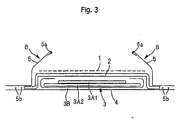
- the absorbent pad shown in Fig. 1 and Fig. 2 includes, in sequence from the top side toward the backside, a surface sheet 1 facing the skin, which sheet allows excremental liquid to permeate through and comprises a perforated sheet; a permeation sheet 2 which allows excremental liquid to permeate through; and an absorbent element 3 which is disposed on the backside of the permeation sheet 2 and contains a cotton-like pulp layer retaining the excremental liquid. Furthermore, the absorbent pad also has barrier cuffs B, B standing from both sides of the product to the user-surface.
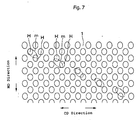
- the excretion region which includes the area of the perforated surface sheet facing the body part excreting the excremental liquid, and the vicinities, has a large number of permeation holes H, H... for excremental liquid formed over the entire area in the present embodiment.
- the group of permeation holes H, H... those having an effective opening area of a single permeation hole of 3 to 75 mm 2 (more preferably 5 to 30 mm 2 ), and a ratio of opening area of 10 to 80% (more preferably 30 to 60%) are preferably used. If the opening area and the ratio of opening area are small, the permeability of the solid portions of soft feces is deteriorated, whereas if the opening area is excessively large, the solid portions of soft feces remaining behind on the surface of the permeation sheet is contacted with the skin, thereby causing rashes on the skin or requiring troublesome works of skin wiping. If the ratio of opening area is excessively large, the strength of the system is decreased, which is undesirable.
- the permeation sheet 2 which directly faces the surface sheet 1, functions as a second sheet in the depicted example. Details thereof will be described later.
- the absorbent element 3 which directly faces the permeation sheet 2 and retains excremental liquid, has a cotton-like pulp layer 3A exposed to the side of use-surface.
- the specific example of Fig. 2 shows the constitution of an absorbent element 3 in which the backside and the lateral sides of the cotton-like pulp layer 3A are wrapped with the tissue paper or crepe paper (wrapping material 3B) of a forehead wrapping.
- the backside sheet 4 which constitutes the back surface side of the absorbent article is a liquid-impermeable sheet in the embodiment, and is formed from, for example, a plastic sheet.
- the backside sheet 4 may be permeable to air.
- the backside sheet 4 is extended out from the side edges of the absorbent element 3 to the lateral direction.
- a barrier sheet 5 is provided.
- the outer side of the barrier sheet is fixed to the extended portion of the backside sheet by a hot melt adhesive or the like, and the tip side of the inner free part is folded toward the inside, with an elastic stretch member 5a such as rubber thread is fixed onto the folded part, while being stretched.
- an elastic stretch member 5a such as rubber thread is fixed onto the folded part, while being stretched.
- the free part constitutes the standing barrier cuffs B, B.
- the permeation sheet 2 is extended outwards from the side edges of the absorbent element 3, and the extended section is interposed between the barrier sheet 5 and the backside sheet 4, and fixed by a hot melt adhesive or the like.
- the surface sheet 1 is not in a state of being fixed to the barrier sheet 5 and the backside sheet 4.
- the surface sheet 1 is needed to be fixed to the members of the article in any form.
- the surface sheet 1 is fixed onto the permeation sheet 2.
- the surface sheet 1 according to the present invention is a perforated sheet and has large openings. As a result, the hot melt adhesive protrudes from the permeation holes to the use-surface, and permeation of excremental liquid through the permeation holes H is impeded by the presence of the hot melt adhesive.
- the overall fixed area is kept as small as possible. Further, in order to prevent protrusion of the hot melt adhesive from the permeation holes to the use surface side, it is desirable to partially fix the surface sheet 1 onto the permeation sheet 2 by heat sealing or ultrasonic sealing.
- the inner front and back edges of the barrier sheet 5 are fixed to the surface sheet 1 at four points in total, by a hot melt adhesive (the points of fixation are shown by symbol F).
- elastic stretch members 5b, 5b... are fixed, while being stretched, between the barrier sheet 5 and the backside sheet 4, along the leg periphery, so that fittability of the article around the leg periphery is enhanced.
- the cotton pulp layer is changed to a single layer of cotton-like pulp layer 3A, including an upper cotton-like pulp layer 3A1 having a narrow width and a lower cotton-like pulp layer 3A2 having a broad width.
- super absorbent polymer particles can be provided in an appropriate area of the absorbent element 3 for the purpose of retaining large quantities of liquid portion.
- the polymer particles can be dispersed within the absorber 3A, in addition to dispersing and spreading over the absorber 3A.
- super absorbent polymer particles can be incorporated only to the lower cotton-like pulp layer 3A2.
- the objects indicated with symbol O in fig. 4 are the super absorbent polymer particles.
- the configuration of wrapping the lateral sides of the sheets may be exemplified by a configuration in which the backside sheet wraps up to the two lateral sides above the surface sheet by forehead wrapping; a configuration in which the permeation sheet wraps up the entire absorbent element; a configuration in which the surface sheet wraps up the permeation sheet and an absorbent element; a configuration in which the permeation sheet wraps up the entire absorbent element, and the surface sheet further wraps up the permeation sheet and the entire absorbent element from the above; or the like may be employed.
- the soft feces permeation speed S1 of the surface sheet 1, the soft feces permeation speed S2 of the permeation sheet 2, and the soft feces permeation speed S3 of the top layer of the absorbent element are in the relationship of S ⁇ 1 > S ⁇ 2 > S ⁇ 3.
- the method of measuring the permeation speed of soft feces the following Example of using pseudo-soft feces may be referred to.
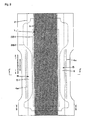
- these fusion sections m, m... are provided substantially at at least one site in the width direction at various locations in the anteroposterior direction of the product.
- Such pattern is arranged such that the projections of the processing roll are substantially not discontinued in the direction of outer circumference. In other words, the pattern can be achieved by arranging the projections such that some number of projections always performs fusion.
- the pattern of the fusion sections m, m... can be appropriately determined, but for example, a pattern in which multiple groups of fusion sections comprising a plurality of fusion sections m, m... arranged in a V-shaped line, at different locations in the anteroposterior direction as well as in the width direction, are provided in parallel along the anteroposterior direction as shown in Fig. 6 , can be used.
- the configuration of the fusion sections m, m... an appropriate configuration such as an elliptical shape, a round shape, a triangular shape, a rectangular shape, a diamond shape or a hexagonal shape, can be employed, and these can be arranged regularly or irregularly.
- the fusion section m in the drawing indicates the shape of the processing range; therefore, since the surface sheet 1 is perforated, there are cases in which the shape of the fusion section does not match the shape of the bonding part where fusion actually occurs.
- the area ratios of the fusion sections m, m... ratio of the area occupied by the entire fusion sections per unit area
- the area ratio of the latter may be made higher.
- the lengths of the front and back edge parts FE and BE, and the middle part C of the article can be appropriately set, but for example, the front and back edge parts FE and BE can be respectively set to be in the range of 1 to 100 mm from the front tip and the back tip, and the area between the two can be taken as the middle part C.
- the area per one site of the fusion section m is preferably in the range of 1 to 300 mm 2 , and particularly in the range of 5 to 30 mm 2 , and the area ratio is preferably in the range of 0.1 to 20%, and particularly in the range of 0.5 to 10%.
- the area ratio for the front and back edge parts FE and BE is preferably in the range of 5 to 30%, and particularly in the range of 5 to 20%, while the area ratio for the middle part C is preferably in the range of 1 to 30%, and particularly in the range of 1 to 15%.
- the surface sheet 1 is a perforated sheet
- the fusion sections m, m... can be definitely formed by processing, which is preferable.
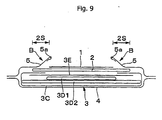
- Fig. 8 and Fig. 9 show examples of the absorbent pad according to the present invention, and the absorbent pad includes a main body section comprising, in sequence from the top side toward the backside, a surface sheet 1 facing the skin, which sheet allows excremental liquid to permeate through; a permeation sheet 2 which allows excremental liquid to permeate through; and an absorbent element 3 which retains the excremental liquid; and also includes barrier cuffs-B, B standing from the top surface side.
- the surface sheet 1 has a large number of permeation holes H, H... for excremental liquid formed at least in the area facing the anus, or over the entire area according to the embodiment.
- a surface sheet 1 which can be favorably used is one having an effective opening area of a single permeation hole of 3 to 75 mm 2 , and having a ratio of opening area of 10 to 80%, with regard to a group of permeation holes for excremental liquid formed at least in the area facing the anus.- If the opening area and the ratio of opening area are small, the permeability of the solid portions of soft feces is deteriorated, while if the opening area is excessively large, the solid portions of soft feces remaining behind on the surface of the permeation sheet 2 is contacted with the skin, thereby causing rashes on the skin or requiring troublesome works of skin wiping. If the ratio of opening area is excessively large, the strength of the system is decreased, which is undesirable.
- the surface sheet 1 is made water-repellent so as to suppress diffusion on the surface sheet 1, or the like, it becomes difficult for a low viscosity liquid such as urine to permeate through the surface sheet 1.
- the absorbent element 3 directly facing the permeation sheet 2 has absorbers 3D1 and 3D2, which are mainly composed of cotton-like pulp retaining excremental liquid; an upper wrapping material 3E covering the lateral sides of the permeation sheets 2 of the absorbers 3D1 and 3D2; and a lower wrapping material 3C which is composed of tissue paper or crepe paper covering the remaining surfaces of the absorbers 3b1 and 3B2.
- the absorbent element has a structure in which the absorbers 3B1 and 3B2 are wrapped by the upper wrapping material 3E and the lower wrapping material 3C.
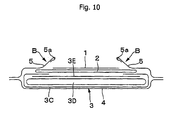
- the absorber As shown in Fig. 8 and Fig. 9 , it is preferable to use a bilayer absorber formed by laminating an upper absorber 3D1 with a narrow width over a lower absorber 3D2 with a broad width, but a single layer absorber 3D as shown in Fig. 10 can also be used.
- the backside sheet 4 is extended from the side edges of the absorbent element 3 to the lateral sides, and reaches the top surface side while being folded, thus to form flaps which cover the lateral sides of the surface sheet 1.
- a barrier sheet 5 At the lateral sides of the backside sheet 4 is provided a barrier sheet 5.
- the outer side of the barrier sheet is fixed to the extended portion of the backside sheet 4 by a hot melt adhesive or the like, and the tip side of the inner_free part is folded toward the inside, with an elastic stretch member 5a such as rubber thread is fixed onto the folded part, while being stretched.
- an elastic stretch member 5a such as rubber thread is fixed onto the folded part, while being stretched.
- the free part constitutes the standing barrier cuffs B, B.
- an elastic stretch member 4a is fixed, while being stretched, between the barrier sheet 5 and the backside sheet 4, along the leg periphery, so that fittability of the article around the leg periphery is enhanced.
- the surface sheet 1 is fused to the main body section, that is, the permeation sheet 2 in the case of having the permeation sheet 2 as depicted in the diagram, and to the absorbent element 3 in the case of not having the permeation sheet 2.
- heat sealing or ultrasonic sealing can be used. These process methods are the same in the fundamental principle, except the difference in the manner of heating, and fusion is performed such that a number of projections provided on the outer periphery of a processing roll are heated while being pressed on the surface sheet 1, thus to fuse the pressed part generated by the projections.
- these fusion sections m, m... are provided substantially at at least one site in the width direction at various locations in the anteroposterior direction of the product.
- Such pattern is arranged such that the projections of the processing roll are substantially not discontinued in the direction of outer circumference. In other words, the pattern can be achieved by arranging the projections such that some number of projections always performs fusion.
- the pattern of the fusion sections m, m... can be appropriately determined, but for example, a pattern in which multiple groups of fusion sections comprising a plurality of fusion sections m, m... arranged in a V-shaped line, at different locations in the anteroposterior direction as well as in the width direction, are provided in parallel along the anteroposterior direction as depicted in the drawing, can be used.
- a configuration of the fusion sections m, m... an appropriate configuration such as an elliptical shape, a round shape, a triangular shape, a rectangular shape, a diamond shape or a hexagonal shape, can be employed, and these can be arranged regularly or irregularly.
- the fusion section m in the drawing indicates the shape of the processing range; therefore, in the case where the surface sheet 1 or the main body section as the body to be fused (permeation sheet 2 in the present embodiment) is perforated, there are cases in which the shape of the fusion section does not match the shape of the bonding part where fusion actually occurs.
- the area ratios of the fusion sections m, m... ratio of the area occupied by the entire fusion sections per unit area
- the area ratio of the latter may be made higher.
- the lengths of the front and back edge parts FE and BE, and the middle part C of the article can be appropriately set, but for example, the front and back edge parts FE and BE can be respectively set to be in the range of 1 to 100 mm from the front tip and the back tip, and the area between the two can be taken as the middle part C.
- the area per one site of the fusion section m is preferably in the range of 1 to 300 mm 2 , and particularly in the range of 5 to 30 mm 2 , and the area ratio is preferably in the range of 0.1 to 20%, and particularly in the range of 0.5 to 10%.
- the area ratio for the front and back edge parts FE and BE is preferably in the range of 5 to 30%, and particularly in the range of 5 to 20%, while the area ratio for the middle part C is preferably in the range of 1 to 30%, and particularly in the range of 1 to 15%.
- the surface sheet 1 is a perforated sheet
- the surface sheet 1 can be fused stably with high quality.
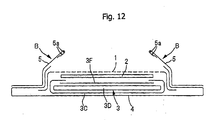
- the absorbent pad shown in Fig. 11 and Fig. 12 includes in sequence from the top side toward the backside, a surface sheet 1 facing the skin, which sheet allows excremental liquid such as urine or the liquid portion of soft feces to permeate through; a permeation sheet 2 which allows excremental liquid to permeate through; and an absorbent element 3 which is disposed on the backside of the permeation sheet 2 and retains the excremental liquid. Furthermore, the absorbent pad also has barrier cuffs B, B standing toward the top surface.
- the surface sheet 1 has a large number of permeation holes H, H... for excremental liquid formed at least in the area facing the anus, or over the entire area according to the embodiment.
- a surface sheet 1 which can be favorably used is one having an effective opening area of a single permeation hole of 3 to 75 mm 2 , and having a ratio of opening area of 10 to 80%, with regard to a group of permeation holes for excremental liquid formed at least in the area facing the anus.
- the opening area and the ratio of opening area are small, the permeability of the solid portions of soft feces is deteriorated, while if the opening area is excessively large, the solid portions of soft feces remaining behind on the surface of the permeation sheet 2 is contacted with the skin, thereby causing rashes on the skin or requiring troublesome works of skin wiping. If the ratio of opening area is excessively large, the strength of the system is decreased, which is undesirable.
- the permeation sheet 2 which directly faces the surface sheet 1, functions as a second sheet in the depicted example. Details thereof will be described later.
- the absorbent element 3 which directly faces the permeation sheet 2 has an absorber 3D mainly composed of, for example, cotton-like pulp for retaining excremental liquid; and a top layer sheet 3F which is disposed between this absorber 3D and the permeation sheet 2, and is formed from an air-through non-woven fabric.
- This top layer sheet 3F is composed of a wrapping material 3C made of tissue paper or crepe paper, and an element for wrapping the absorber 3D of the absorbent element 3.
- the permeation sheet 2 is preferably formed from an air-through non-woven fabric, and details thereof will be described later.
- the backside sheet 4 which constitutes the back surface side of the absorbent article is a liquid-impermeable sheet in the embodiment, and is formed from, for example, a plastic sheet.
- the backside sheet 4 may be permeable to air.
- the backside sheet 4 is extended out from the side edges of the absorbent element 3 to the lateral direction, and reaches the top surface side while being folded, thus to form flaps which cover the lateral sides of the surface sheet 1.
- a barrier sheet 5 At the lateral sides of the backside sheet 4 is provided a barrier sheet 5.
- the outer side of the barrier sheet is fixed to the extended portion of the backside sheet 4 by a hot melt adhesive or the like, and the tip side of the inner free part is folded toward the inside, with an elastic stretch member 5a such as rubber thread is fixed onto the folded part, while being stretched.
- an elastic stretch member 5a such as rubber thread is fixed onto the folded part, while being stretched.
- the free part constitutes the standing barrier cuffs B, B.
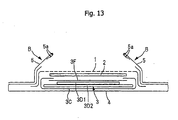
- Fig. 13 shows an article in which, as the absorber 3D, a single layer absorber is replaced by an upper layer absorber 3D1 with a narrow width and a lower layer absorber 3D2, which is an other layer absorber with a broad width.
- super absorbent polymer particles are provided.
- the particles may be dispersed within the absorber 3D, in addition to dispersing and spraying on the absorber 3D.
- the top layer sheet 3F constituting the element for wrapping the absorber 3D is formed not from crepe paper or the like, but from an air-through non-woven fabric, there is a risk that the polymer particles may escape to the outside through the top layer sheet 3, if such configurations are employed (the configuration in which particles are dispersed and sprayed on the absorber 3D, and the configuration in which the particles are dispersed within the absorber 3D).
- a bilayer structure having an upper layer absorber 3D1 and a lower layer absorber 3D2, and to incorporate super absorbent polymer particles into the lower layer absorber 3D2 only, without incorporating super absorbent polymer particles into the upper layer absorber 3D1.
- the objects indicated by symbol O in the diagram are super absorbent polymer particles.
- the upper layer absorber 3D1 preferably has a thickness of 1 to 50 mm, and a basis weight of 50 to 300 g/m 2 . Also, since the present embodiment employs a configuration in which the wrapping material 3C of crepe paper or the like is turned in up to the upper lateral sides of the absorbent element 3, the upper layer absorber 3D1 is set to have a narrower width than the lower layer absorber 3D2 (this configuration is preferable from the viewpoint of production costs). However, if a configuration in which the top layer sheet 3F constitutes the upper lateral sides of the absorbent element 3 is to be taken, it is desirable that the upper layer absorber 3D1 is set to have a broader width than the lower layer absorber 3D2.
- the absorber 3D is divided into two layers in the depicted example, the absorber may also be divided into three layers of an upper layer absorber, a mid-layer absorber and a lower layer absorber, or into a plurality of 4 or more, such as an upper layer absorber, a plurality of mid-layer absorbers, and a lower layer absorber. Also, it is also possible to employ a configuration in which the absorber 3D is not divided into plural layers as described above, but super absorbent polymer particles are incorporated only into the middle part or the lower part in the thickness direction of one absorber.
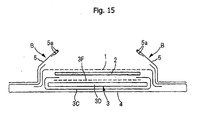
- the top layer sheet 3F can be formed from a perforated sheet, as shown in Fig. 15 .
- the effective opening area of a single permeation hole is 0.5 to 40 mm 2
- the ratio of opening area is 1 to 80%.
- the upper layer absorber 3D1 which does not contain the super absorbent polymer particles, to be thick, in order to prevent the super absorbent polymer particles from escaping to the outside.
- the two edge parts of the top layer sheet 3F overlap on the lower side of the side edges of the wrapping material 3C such as crepe paper, but the two edge parts can also be made to overlap on the upper side.
- the top layer sheet 3F is made of an air-through non-woven fabric, and the excremental liquid can now easily spread in the planar direction, it is preferable to employ the former configuration (the configuration of overlapping on the lower side), in which the excremental liquid is spread within the absorbent element 3, but not on the surface of the absorbent element 3.
- the soft feces permeation speed S1 of the surface sheet 1, the soft feces permeation speed S2 of the permeation sheet 2, and the soft feces permeation speed S4 for the top layer sheet 3F are correlated in the relationship of S1 > S2 > S4.
- Absorbent articles of this kind are required to have a good capability of carrying away soft feces rapidly from the skin as well as accommodating and retaining the soft feces at a location distant from the skin.
- each of the constituent elements not only has a high soft feces permeation speed, but also has a speed gradient as defined in the present invention with regard to the soft feces permeation speed for each of the constituent elements, and the speed gradient is dominant to the absolute value of the speed.
- the soft feces permeation speed gradient as described above, the performance of absorbing and retaining urine or the liquid portion of soft feces is excellently improved.
- the material of the surface sheet 1 is preferably a non-woven fabric so as to make the sensation of the skin good, but a plastic sheet may also be used.
- a plastic sheet may also be used.
- appropriate shapes can be employed, such as the circular shape as depicted, an elliptical shape having the major axis along the longitudinal direction, a round shape, a triangular shape, a rectangular shape, a diamond shape, or a hexagonal shape, and these holes may be arranged in large numbers, regularly or irregularly, at a portion or over the entire surface of the surface sheet.
- non-woven fabric for the surface sheet 1 As a suitable non-woven fabric for the surface sheet 1, an air-through non-woven fabric, a resin-bonded non-woven fabric, an air-laid non-woven fabric, a spunlace non-woven fabric, a heat-rolled non-woven fabric, a spun bond non-woven fabric, or the like may be mentioned.
- the fineness of the fibers constituting the non-woven fabric is 2 to 15 dtex, particularly 3 to 10 dtex, and more particularly 4 to 10 dtex, from the viewpoint of increasing the permeability by maintaining the space for absorbing soft feces.
- the basis weight is preferably 5 to 45 g/m 2 .
- the permeation sheet 2 functions as a layer for rapidly transferring the excremental liquid which has permeated through the surface sheet 2, to the absorbent element 3.
- a sheet mainly composed of water-repellent or hydrophobic fibers is suitable, and a non-woven fabric sheet such as an air-through non-woven fabric can also be used.
- an assembly of filaments in particular, for example, a product obtained by opening tows of bundled filaments into a sheet form, particularly a product in which filaments are oriented in the planar direction of the sheet, or a product in which filaments are spirally crimped, is preferred.
- the filaments of the permeation sheet 2 are oriented in the planar direction of the sheet
- the filaments can be oriented in the anteroposterior direction of the product as shown in Fig. 5(a) , as well as can be oriented in the width direction (a direction perpendicular to the anteroposterior direction) of the product as shown in Fig. 5(b) .
- the effect of allowing the liquid portion of soft feces to permeate while diffusing in the vicinities, is more significant in the case of orienting the filaments in the longitudinal direction of the product.
- water-repellent or hydrophobic filaments that can be suitably used, fibers of PET, PP, PE and the like, as well as filaments made from those fibers into a core-in-sheath structure, may be mentioned.
- the fineness of the filaments can be set to, for example, about 1 to 16 deniers, preferably 1 to 10 deniers, and more preferably 2 to 8 deniers.
- the filaments may be non-crimped fibers, but are preferably crimped fibers.
- the crimp rate of crimped fibers can be set to, for example, about 5 to 75 crimps, preferably 10 to 50 crimps, and more preferably 15 to 50 crimps, per inch.
- crimped fibers prepared by uniform crimping are frequently used. When crimped fibers are used, a permeation sheet having a large volume and a light weight can be produced, and also highly integrated tows due to intertwining of fibers can be easily produced.
- the shape of cross-section of tow composing fibers is not particularly limited, and for example, may be any of circular, elliptical, non-circular (e.g. Y-shape, X-shape, I-shape, R-shape) and hollow shapes.
- the filaments can be used in the form of tows (fiber bundles or filament bundles) formed by bundling, for example, about 3,000 to 1,000,000 short fibers, and preferably 5,000 to 1,000,000 short fibers. It is preferable that a tow is constructed by bundling about 3,000 to 1,000,000 filaments.
- a binder having an effect of adhering or fusing the contacting parts of fibers can be used for the purpose of mainly maintaining the shape.
- various resin adhesives, and particularly thermoplastic resins can be used.
- the filament assemblies can be produced by known methods.
- a representative example thereof involves, as previously described, forming a tow by bundling filaments, and-opening the tow.
- the width of an open tow can be any width, and for example, can be about 100 to 2000 mm, and preferably 150 to 1500 mm, in width.
- the density of the filament assembly can be adjusted.
- the filament assembly one having a fiber density of 0.0075 g/cm 3 or less, and particularly 0.0060 to 0.0070 g/cm 3 , with a thickness of 10 mm, is very suitable.
- the basis weight of the permeation sheet of the present invention is preferably 10 to 100 g/m 2 .
- the basis weight of the permeation sheet 2 can be adjusted by the selection of the tow to form the original fabric, of by the production conditions.
- the method of opening tows for example, a method of loading a tow to a plurality of tow opening rolls, and gradually enlarging the width of the tow along with the proceeding of the tow; a method of opening a tow by repeating tensing (stretching) and relaxing (contraction) of the tow; a method of widening and opening a tow using compressed air; or the like may be used.
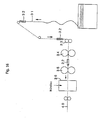
- Fig. 16 is a schematic diagram showing an exemplary tow opening facility.
- a tow 31 which will serve as the original fabric, is sequentially drawn out, and during the conveying process, is passed through a tow opening unit which combines a widening means 32 using compressed air, and a plurality of tow opening nip rolls 33, 34 and 35 having a peripheral speed as fast as the rolls in the downstream, so as to be widened and opened.
- a binder is added to the tow through a binder adding box 36, and the tow is formed into a fiber bundle 40 of filaments with desired width and density.
- the permeation sheet 2 is preferably of a single sheet structure, but if necessary, may have a laminate structure, so that the sheet is considered substantially as a single sheet.
- an air-through non-woven fabric a resin-bonded non-woven fabric, an air-laid non-woven fabric, a spunlace non-woven fabric, a heat-rolled non-woven fabric, a spun bond non-woven fabric or the like may be used, but an air-through non-woven fabric is most appropriate.
- the air-through non-woven fabrics those using water-repellent or hydrophobic fibers are particularly preferred.
- the water-repellent or hydrophobic fibers fibers of PET, PP, PE and the like, and fibers made of these materials and having a core-in-sheath structure may be mentioned.
- the lower layer sheet a perforated sheet can be used. In this case, it is preferable that the effective opening area of a single permeation hole is 0.5 to 40 mm 2 , and the ratio of opening area is 1 to 80%, from the viewpoint of the permeability of liquid portion.
- the basis weight of a single permeation sheet 2, or a permeation sheet 2 which is substantially considered as a single sheet, is preferably 10 to 60 g/m 2 .
- the cotton-like pulp layer known cotton-like pulp can be used, and the cotton-like pulp layer can be produced by integrating pulp fibers by a known method, and interlacing the pulp fibers by means of air, a water stream or the like.
- the pulp fibers those comprising cellulose fibers such as chemical pulp obtained from wood or dissolved pulp, or artificial cellulose fibers such as rayon or acetate, can be used.
- the super absorbent polymer can be adhered to the wrapping material 3B which wraps the cotton-like pulp layer 3A1 and the cotton-like pulp layer 3A2.
- the adhesive for this case, the thermoplastic resins described above can be used.
- an air-through non-woven fabric As the upper side wrapping material 3E, an air-through non-woven fabric, a resin-bonded non-woven fabric, an air-laid non-woven fabric, a spunlace non-woven fabric, a heat-rolled non-woven fabric, a spun bond non-woven fabric and the like can be used, but an air-through non-woven fabric is most suitable.
- the air-through non-woven fabrics it is particularly preferable to use water-repellent or hydrophobic fibers.
- the water-repellent or hydrophobic fibers fibers of PET, PP, PE and the like, as well as fibers made of these and having a core-in-sheath structure may be mentioned.
- the basis weight of the upper side wrapping material is preferably 10 t0 60 g/m 2 .
- the upper side wrapping material 3E can be made into a single layer, as well as can be laminated to a structure of two layers or more, for example a trilayer structure. If laminated, the basis weight in the laminated state is preferably 10 to 60 g/m 2 .
- the upper side wrapping material 3A can be formed from a perforated sheet.
- the effective opening area of a single permeation hole is 0.5 to 40 mm 2 , and the ratio of opening area is 1 to 80%, from the viewpoint of the permeability of liquid portion.
- perforation may be performed on various non-woven fabrics, or a plastic sheet may also be perforated.
- the absorbers 3D1 and 3D2 known cotton-like pulp can be used, and the absorbers can be produced by integrating pulp fibers by a known method, and interlacing the pulp fibers by means of air, a water stream or the like.
- the pulp fibers those comprising cellulose fibers such as chemical pulp obtained from wood or dissolved pulp, or artificial cellulose fibers such as rayon or acetate, can be used.
- super absorbent polymer particles can be encapsulated for the purpose of retaining large quantities of liquid portions.
- thermoplastic resins described above can be used.
- At least a portion of the area located between the absorber 3D_and the permeation sheet 2 (top layer sheet 3A), preferably the area facing the anus, and more preferably the entire region, is formed not from crepe paper or the like, but from a non-woven fabric having a density of 0.01 to 0.2 g/cm 3 , or an air-through non-woven fabric.
- a viscous excremental liquid would form a membrane (barrier) on the surface of the crepe paper or the like, causing inhibition of the permeation of urine or soft feces.
- the excremental liquid such as the liquid portion of soft feces can be transferred to the absorber 3D rapidly and surely.
- the density of the non-woven fabric is 0.01 g/cm 3 or greater, any risk that the non-woven fabric would be torn off, and surperabsorbent polymer particles would spill out, is completely eliminated.
- the density of the non-woven fabric is 0.2 g/cm 3 or less, any risk that the non-woven fabric would cause inhibition of the permeation of urine or soft feces, is completely eliminated.
- crepe paper is changed to these non-woven fabrics, the performance of maintaining the shape of the absorber 3D is maintained the same as in the case of crepe paper.
- the density (g/cm 3 ) of the non-woven fabric is taken from the value determined from the basis weight (g/cm 2 ) /thickness (cm).
- the thickness is the value obtained by measuring under a load of 0.7 kPa, based on JIS P8118.
- non-woven fabrics it is particularly preferable to use not hydrophilic fibers, but water-repellent or hydrophobic fibers, for the same reasons as in the case of the permeation sheet 2 described above.
- water-repellent or hydrophobic fibers fibers of PET, PP, PE and the like, as well as fibers made of these and having a core-in-sheath_structure may be mentioned.
- the top layer sheet 3A is preferably one having a fineness of 2 to 7 dtex and a basis weight of 10 to 45 g/m 2 , and more preferably one having a fineness of 3.3 to 5.6 dtex and a basis weight of 20 to 40 g/m 2 . If this condition is satisfied, the permeability of viscous excremental liquid is secured, and also the risk of super absorbent polymer spilling out is reduced. Thus, the upper layer absorber 3D1 described above can be omitted.
- a sheet having a large fineness and a small basis weight is preferred (that is, a sheet in a sieve form, rather than of the reticulate shape of wire screen, is preferred).
- the super absorbent polymer becomes prone to spill out to the outside.
- this balance is established by means of the fineness and the basis weight.
- the basis weight is less than 10 9 /m 2 , the strength of the sheet is weakened.
- the top layer sheet 3A can be of a single layer, or can be laminated into bilayers, trilayers, quadrilayers or more multiple layers.
- the absorber 3D for example, cotton-like pulp or the same material as the permeation sheet 2 can be used.
- the cotton-like pulp can be produced by integrating pulp fibers by a known method, and interlacing the pulp fibers by means of air, a water stream or the like.
- the pulp fibers those comprising cellulose fibers such as chemical pulp obtained from wood or dissolved pulp, or artificial cellulose fibers such as rayon or acetate, can be used.
- super absorbent polymer particles that can be used, for example, in the above-described form for the absorbent element 3, carboxymethylcellulose, polyacrylic acid and salts thereof, acrylic acid salt polymer cross-linking products, starch-acrylic acid graft copolymers, hydrolysates of starch-acrylonitrile graft copolymers, polyoxyethylene cross-linking products, carboxymethylcellulose cross-linking products, partial cross-linking products of water-swellable polymers such as polyethylene oxide or polyacrylamide, copolymers of isobutylene and maleic acid, and the like are suitably used.
- polymers having blocking preventing agents added can also be used.
- the super absorbent polymers those in various forms such as powdered, particulate, granular, pellet-like, sol-like, suspension-like, gel-like, film-like, or non-woven fabric-like forms, are available. However, these all can be used for the present invention, and particularly powdered product is very suitably used.
- a method of conferring by spraying a super absorbent polymer in the powdered particle form on the exterior or interior of the absorber; a method of impregnating the absorber with a monomer (to be a super absorbent polymer) and then polymerizing the monomer; a method of coating a non-cross-linked, gel-like super absorbent polymer on the absorber; and the like can be employed.
- the basis weight of the super absorbent polymer can be appropriately set in accordance with the amount of absorption required in response to the amount of excremental liquid. Therefore, although it cannot be defined in short words, the basis weight can be set generally to 0.03 g/cm 2 or less, and particularly suitably to 0.01 to 0.025 g/cm 2 .
- the backside sheet 4 constituting the backside of the absorbent article is a liquid-impermeable sheet in the embodiment, and for example, a plastic sheet can be used.
- the backside sheet 4 may be permeable to air.
- Pseudo-feces resembling soft feces were prepared, and the permeation speed of the pseudo-feces in a structure which was similar to the product as much as possible, was investigated.
- the composition of the pseudo-feces was as follows.
- a liquid having the above-described composition was prepared by (1) introducing component 1 into the artificial urine of component 4, and heating the mixture to 100°C while stirring, to dissolve the starch; (2) cooling the temperature of the product of (1) to room temperature, and then introducing component 2; (3) introducing component 3 in the same manner as in (2); and (4) if uniform diffusion is confirmed, adding the surfactant and adjusting the liquid to 28 dyne.
- a spun bond non-woven fabric made of PP which had permeation holes for excremental liquid having a size of a major axis of 4 mm and a minor axis of 3 mm, disposed in a zigzag pattern at a separation distance of 1.5 mm in the 45° width direction and the longitudinal direction, and had a basis weight of 35 g/m 2 , was used as the surface sheet.
- the present invention can be applied as an absorbent article such as a disposable diaper or an absorbent pad, and particularly as an absorbent article having excellent performance of absorbing and retaining viscous excremental liquid such as soft feces.
Landscapes
- Health & Medical Sciences (AREA)
- Epidemiology (AREA)
- Engineering & Computer Science (AREA)
- Biomedical Technology (AREA)
- Heart & Thoracic Surgery (AREA)
- Vascular Medicine (AREA)
- Life Sciences & Earth Sciences (AREA)
- Animal Behavior & Ethology (AREA)
- General Health & Medical Sciences (AREA)
- Public Health (AREA)
- Veterinary Medicine (AREA)
- Absorbent Articles And Supports Therefor (AREA)
- Orthopedics, Nursing, And Contraception (AREA)
Applications Claiming Priority (4)
| Application Number | Priority Date | Filing Date | Title |
|---|---|---|---|
| JP2005176861A JP4346581B2 (ja) | 2005-06-16 | 2005-06-16 | 吸収性物品 |
| JP2005176862A JP4390747B2 (ja) | 2005-06-16 | 2005-06-16 | 吸収性物品 |
| JP2005288177A JP4346596B2 (ja) | 2005-09-30 | 2005-09-30 | 吸収性物品 |
| PCT/JP2006/311836 WO2006134918A1 (ja) | 2005-06-16 | 2006-06-13 | 吸収性物品 |
Publications (3)
| Publication Number | Publication Date |
|---|---|
| EP1908441A1 true EP1908441A1 (de) | 2008-04-09 |
| EP1908441A4 EP1908441A4 (de) | 2011-01-19 |
| EP1908441B1 EP1908441B1 (de) | 2015-04-08 |
Family
ID=37532276
Family Applications (1)
| Application Number | Title | Priority Date | Filing Date |
|---|---|---|---|
| EP06766647.9A Expired - Lifetime EP1908441B1 (de) | 2005-06-16 | 2006-06-13 | Saugfähiger artikel |
Country Status (4)
| Country | Link |
|---|---|
| US (1) | US20090131896A1 (de) |
| EP (1) | EP1908441B1 (de) |
| KR (1) | KR101302740B1 (de) |
| WO (1) | WO2006134918A1 (de) |
Cited By (2)
| Publication number | Priority date | Publication date | Assignee | Title |
|---|---|---|---|---|
| EP2204152A4 (de) * | 2007-06-29 | 2012-10-31 | Daio Seishi Kk | Einwegwindel |
| CN107106372A (zh) * | 2015-01-02 | 2017-08-29 | Sca卫生用品公司 | 吸收制品 |
Families Citing this family (24)
| Publication number | Priority date | Publication date | Assignee | Title |
|---|---|---|---|---|
| JP5551963B2 (ja) * | 2010-05-14 | 2014-07-16 | 日本製紙クレシア株式会社 | 吸水性物品 |
| CA2861230C (en) | 2011-12-28 | 2016-11-29 | Livedo Corporation | Absorbent article |
| US9216117B2 (en) | 2012-03-30 | 2015-12-22 | Kimberly-Clark Worldwide, Inc. | Absorbent article with point fusion bonding |
| US20130261582A1 (en) * | 2012-03-30 | 2013-10-03 | EoYeon Hwang | Absorbent Article |
| US9394637B2 (en) | 2012-12-13 | 2016-07-19 | Jacob Holm & Sons Ag | Method for production of a hydroentangled airlaid web and products obtained therefrom |
| US9861533B2 (en) | 2013-05-08 | 2018-01-09 | The Procter & Gamble Company | Apertured nonwoven materials and methods for forming the same |
| US9889052B2 (en) * | 2014-01-16 | 2018-02-13 | Livedo Usa, Inc. | Absorbent article having two or more absorbing cores |
| JP2017510397A (ja) | 2014-03-06 | 2017-04-13 | ザ プロクター アンド ギャンブル カンパニー | 3次元基材 |
| WO2016073694A1 (en) | 2014-11-06 | 2016-05-12 | The Procter & Gamble Company | Absorbent article with color effects |
| EP3215085B1 (de) | 2014-11-06 | 2019-10-09 | The Procter and Gamble Company | Spinnvliesstoffbahnen/-laminate aus gekräuselter faser |
| CN107072835B (zh) | 2014-11-06 | 2021-03-02 | 宝洁公司 | 包括面向衣服的层合体的吸收制品 |
| JP5829349B1 (ja) * | 2015-05-29 | 2015-12-09 | ユニ・チャーム株式会社 | 吸収性物品用不織布 |
| US10973702B2 (en) * | 2015-08-26 | 2021-04-13 | The Procter & Gamble Company | Absorbent articles having three dimensional substrates and indicia |
| EP3478235B1 (de) | 2016-07-01 | 2020-10-14 | The Procter and Gamble Company | Saugfähige artikel mit verbesserter oberschichttrockenheit |
| EP3582733B1 (de) | 2017-02-16 | 2022-08-17 | The Procter & Gamble Company | Saugfähige artikel mit substraten mit sich wiederholenden mustern von öffnungen mit mehreren wiederholungseinheiten |
| KR101966202B1 (ko) * | 2017-07-04 | 2019-04-05 | 한국다이퍼 주식회사 | 다중 sap 시트를 포함하는 패드 및 그의 제조 방법 |
| US12127925B2 (en) | 2018-04-17 | 2024-10-29 | The Procter & Gamble Company | Webs for absorbent articles and methods of making the same |
| KR102125578B1 (ko) * | 2018-04-19 | 2020-06-22 | 한남대학교 산학협력단 | 항균 팬티형 기저귀 |
| KR102270245B1 (ko) * | 2019-01-21 | 2021-06-28 | 주식회사 업드림코리아 | 흡수율 및 통기성 향상을 위한 하이브리드 생리대 |
| WO2020219414A1 (en) | 2019-04-24 | 2020-10-29 | The Procter & Gamble Company | Highly extensible nonwoven webs and absorbent articles having such webs |
| JP7578394B2 (ja) * | 2019-09-27 | 2024-11-06 | 大王製紙株式会社 | 吸収性物品 |
| EP4531782A1 (de) | 2022-05-25 | 2025-04-09 | The Procter & Gamble Company | Absorbierender artikel mit konformen merkmalen |
| EP4531784A1 (de) * | 2022-05-25 | 2025-04-09 | The Procter & Gamble Company | Absorbierender artikel mit konformen merkmalen |
| US20250381081A1 (en) * | 2022-07-06 | 2025-12-18 | Kimberly-Clark Worldwide, Inc. | A Nonwoven Material with a Shaped Perforated Zone |
Family Cites Families (38)
| Publication number | Priority date | Publication date | Assignee | Title |
|---|---|---|---|---|
| US4324247A (en) * | 1980-05-12 | 1982-04-13 | The Procter & Gamble Company | Disposable absorbent article having an absorbent core and a topsheet |
| JPS5710334A (en) * | 1980-06-23 | 1982-01-19 | Kao Corp | Absorptive article |
| US4699823A (en) * | 1985-08-21 | 1987-10-13 | Kimberly-Clark Corporation | Non-layered absorbent insert having Z-directional superabsorbent concentration gradient |
| JPH0611278B2 (ja) * | 1985-11-20 | 1994-02-16 | ユニ・チヤ−ム株式会社 | 使い捨ておむつ |
| US4908026A (en) * | 1986-12-22 | 1990-03-13 | Kimberly-Clark Corporation | Flow distribution system for absorbent pads |
| US4798603A (en) * | 1987-10-16 | 1989-01-17 | Kimberly-Clark Corporation | Absorbent article having a hydrophobic transport layer |
| JPH0265861A (ja) | 1988-08-31 | 1990-03-06 | Daio Paper Corp | 紙おむつ |
| CA2026326A1 (en) * | 1989-10-04 | 1991-04-05 | James Arthur Davis | Disposable diaper having a humidity transfer region, breathable zone panel and separation layer |
| US5300054A (en) * | 1991-01-03 | 1994-04-05 | The Procter & Gamble Company | Absorbent article having rapid acquiring, wrapped multiple layer absorbent body |
| SK280045B6 (sk) * | 1991-01-03 | 1999-07-12 | The Procter And Gamble Company | Absorpčný výrobok s viacvrstvovým absorpčným jadro |
| AU652441B2 (en) * | 1991-04-18 | 1994-08-25 | Smith & Nephew Plc | Hygienic absorbent devices |
| CA2054029C (en) * | 1991-07-17 | 1998-05-19 | Louise Cynthia Ellis Coe | Absorbent article exhibiting improved fluid management |
| US5342338A (en) * | 1993-06-11 | 1994-08-30 | The Procter & Gamble Company | Disposable absorbent article for low-viscosity fecal material |
| ES2171821T3 (es) * | 1993-08-17 | 2002-09-16 | Procter & Gamble | Articulo absorbente desechable con capacidad para almacenar material fecal de baja viscosidad. |
| CA2138584C (en) * | 1993-12-30 | 2006-08-15 | Wanda Walton Jackson | Apertured film/nonwoven composite for personal care absorbent articles and the like |
| MY124298A (en) * | 1994-12-28 | 2006-06-30 | Kao Corp | Absorbent sheet, process for producing the same, and absorbent article using the same |
| JP3383497B2 (ja) * | 1995-11-30 | 2003-03-04 | ユニ・チャーム株式会社 | 使い捨ての体液吸収性着用物品 |
| JP3258909B2 (ja) * | 1996-06-28 | 2002-02-18 | ユニ・チャーム株式会社 | 使い捨ての体液吸収性物品 |
| JP3325486B2 (ja) * | 1997-02-28 | 2002-09-17 | ユニ・チャーム株式会社 | 使い捨てトレーニングパンツ |
| SE514391C2 (sv) * | 1997-12-03 | 2001-02-19 | Sca Hygiene Prod Ab | Absorberande alster |
| BR9910290A (pt) * | 1998-05-08 | 2001-07-03 | Procter & Gamble | Artigo absorvente com melhores integridade e aquisição |
| US6706945B1 (en) * | 1998-11-04 | 2004-03-16 | Kimberly-Clark Worldwide, Inc. | Absorbent article with improved, wet-formed absorbent |
| US6323388B1 (en) * | 1998-11-04 | 2001-11-27 | Kimberly-Clark Worldwide, Inc. | Absorbent article with an improved, wet-formed absorbent |
| US6635801B1 (en) * | 1999-05-14 | 2003-10-21 | The Procter & Gamble Company | Disposable absorbent article combining low viscosity liquid handling and high viscosity liquid handling |
| US6443936B1 (en) * | 1999-08-06 | 2002-09-03 | The Procter & Gamble Company | Absorbent article having improved adhesive system to provide flexibility and breathability |
| US6610390B1 (en) * | 1999-08-13 | 2003-08-26 | First Quality Nonwovens, Inc. | Nonwoven with non-symmetrical bonding configuration |
| JP3929226B2 (ja) | 2000-03-27 | 2007-06-13 | ユニ・チャーム株式会社 | 使い捨て着用物品 |
| JP3744768B2 (ja) | 2000-03-29 | 2006-02-15 | ユニ・チャーム株式会社 | 排泄物処理用の使い捨て着用物品 |
| JP3681320B2 (ja) * | 2000-03-31 | 2005-08-10 | ユニ・チャーム株式会社 | 体液吸収性着用物品 |
| JP3964611B2 (ja) * | 2000-08-25 | 2007-08-22 | ユニ・チャーム株式会社 | 衛生物品用の体液吸収性パネル |
| JP3771432B2 (ja) * | 2000-08-28 | 2006-04-26 | ユニ・チャーム株式会社 | 使い捨ての体液吸収性着用物品 |
| JP3875007B2 (ja) * | 2000-09-01 | 2007-01-31 | ユニ・チャーム株式会社 | 連続フィラメントを有する表面層を用いた吸収性物品およびその製造方法 |
| JP3875018B2 (ja) * | 2000-12-12 | 2007-01-31 | ユニ・チャーム株式会社 | 連続フィラメントの表面材を用いた吸収性物品 |
| JP4146192B2 (ja) * | 2001-09-11 | 2008-09-03 | ユニ・チャーム株式会社 | 吸収性物品 |
| US7759540B2 (en) * | 2002-07-23 | 2010-07-20 | Paragon Trade Brands, Llc | Absorbent articles containing absorbent cores having zoned absorbency and methods of making same |
| US20040024375A1 (en) * | 2002-08-02 | 2004-02-05 | John Litvay | Multi-functional tissue for absorbent articles |
| US7132585B2 (en) * | 2002-12-05 | 2006-11-07 | Uni-Charm Corporation | Absorbent article with liquid acquisition layer |
| JP4124687B2 (ja) * | 2003-03-31 | 2008-07-23 | 大王製紙株式会社 | 吸収性物品及び吸収性物品におけるエンボス形成方法 |
-
2006
- 2006-06-13 KR KR1020087001283A patent/KR101302740B1/ko not_active Expired - Fee Related
- 2006-06-13 WO PCT/JP2006/311836 patent/WO2006134918A1/ja not_active Ceased
- 2006-06-13 US US11/922,190 patent/US20090131896A1/en not_active Abandoned
- 2006-06-13 EP EP06766647.9A patent/EP1908441B1/de not_active Expired - Lifetime
Cited By (2)
| Publication number | Priority date | Publication date | Assignee | Title |
|---|---|---|---|---|
| EP2204152A4 (de) * | 2007-06-29 | 2012-10-31 | Daio Seishi Kk | Einwegwindel |
| CN107106372A (zh) * | 2015-01-02 | 2017-08-29 | Sca卫生用品公司 | 吸收制品 |
Also Published As
| Publication number | Publication date |
|---|---|
| EP1908441A4 (de) | 2011-01-19 |
| US20090131896A1 (en) | 2009-05-21 |
| EP1908441B1 (de) | 2015-04-08 |
| WO2006134918A1 (ja) | 2006-12-21 |
| KR20080025154A (ko) | 2008-03-19 |
| KR101302740B1 (ko) | 2013-08-30 |
Similar Documents
| Publication | Publication Date | Title |
|---|---|---|
| EP1908441B1 (de) | Saugfähiger artikel | |
| EP2105115B1 (de) | Einwegwindel | |
| EP2123241B1 (de) | Papierwindel | |
| TWI375552B (de) | ||
| EP1772126B1 (de) | Gerät zur herstellung von saugfähigem material; saugfähiges material und saugfähiger artikel | |
| EP1782783B1 (de) | Saugfähiges material | |
| KR100760147B1 (ko) | 흡수 용품을 위한 패턴 결합 층 | |
| RU2754248C1 (ru) | Впитывающее изделие | |
| EP3424476B1 (de) | Wegwerfwindel | |
| EP2281535A1 (de) | Saugfähiger artikel und damenbinde | |
| MXPA05001363A (es) | Tejido multifuncional para articulo absorbente. | |
| JPH09117470A (ja) | 吸収性物品 | |
| KR20040101392A (ko) | 바이패스 채널 부재를 구비한 흡수체 및 이를 사용한흡수체 제품 | |
| CN102686192A (zh) | 吸收性物品 | |
| KR20070113196A (ko) | 흡수성 물품 | |
| EP1274383B1 (de) | Faserschicht, verfahren zur herstellung und diese faserschicht enthaltender absorbierender artikel | |
| JP4901433B2 (ja) | 吸収体及びその製造方法 | |
| JP4390747B2 (ja) | 吸収性物品 | |
| EP2098201A1 (de) | Saugfähiger artikel | |
| CN109106513B (zh) | 一种复合吸收芯体 | |
| JP4638205B2 (ja) | 吸収性物品 | |
| CN101198304B (zh) | 吸收性物品 | |
| JP2006014884A (ja) | 体液吸収構造 | |
| JP4688103B2 (ja) | 吸収性物品 | |
| JP2008125602A (ja) | 吸収体及びそれを用いた吸収性物品 |
Legal Events
| Date | Code | Title | Description |
|---|---|---|---|
| PUAI | Public reference made under article 153(3) epc to a published international application that has entered the european phase |
Free format text: ORIGINAL CODE: 0009012 |
|
| 17P | Request for examination filed |
Effective date: 20080114 |
|
| AK | Designated contracting states |
Kind code of ref document: A1 Designated state(s): AT BE BG CH CY CZ DE DK EE ES FI FR GB GR HU IE IS IT LI LT LU LV MC NL PL PT RO SE SI SK TR |
|
| DAX | Request for extension of the european patent (deleted) | ||
| A4 | Supplementary search report drawn up and despatched |
Effective date: 20101222 |
|
| 17Q | First examination report despatched |
Effective date: 20130122 |
|
| REG | Reference to a national code |
Ref country code: DE Ref legal event code: R079 Ref document number: 602006045054 Country of ref document: DE Free format text: PREVIOUS MAIN CLASS: A61F0013490000 Ipc: A61F0013150000 |
|
| GRAP | Despatch of communication of intention to grant a patent |
Free format text: ORIGINAL CODE: EPIDOSNIGR1 |
|
| RIC1 | Information provided on ipc code assigned before grant |
Ipc: A61F 13/537 20060101ALI20141112BHEP Ipc: A61F 13/49 20060101ALI20141112BHEP Ipc: A61F 13/15 20060101AFI20141112BHEP Ipc: A61F 13/495 20060101ALI20141112BHEP Ipc: A61F 13/513 20060101ALI20141112BHEP Ipc: A61F 13/512 20060101ALI20141112BHEP Ipc: A61F 13/539 20060101ALI20141112BHEP |
|
| INTG | Intention to grant announced |
Effective date: 20141128 |
|
| GRAS | Grant fee paid |
Free format text: ORIGINAL CODE: EPIDOSNIGR3 |
|
| GRAA | (expected) grant |
Free format text: ORIGINAL CODE: 0009210 |
|
| AK | Designated contracting states |
Kind code of ref document: B1 Designated state(s): AT BE BG CH CY CZ DE DK EE ES FI FR GB GR HU IE IS IT LI LT LU LV MC NL PL PT RO SE SI SK TR |
|
| REG | Reference to a national code |
Ref country code: GB Ref legal event code: FG4D |
|
| REG | Reference to a national code |
Ref country code: CH Ref legal event code: EP |
|
| REG | Reference to a national code |
Ref country code: IE Ref legal event code: FG4D |
|
| REG | Reference to a national code |
Ref country code: AT Ref legal event code: REF Ref document number: 719940 Country of ref document: AT Kind code of ref document: T Effective date: 20150515 |
|
| REG | Reference to a national code |
Ref country code: DE Ref legal event code: R096 Ref document number: 602006045054 Country of ref document: DE Effective date: 20150521 |
|
| REG | Reference to a national code |
Ref country code: AT Ref legal event code: MK05 Ref document number: 719940 Country of ref document: AT Kind code of ref document: T Effective date: 20150408 |
|
| REG | Reference to a national code |
Ref country code: NL Ref legal event code: VDEP Effective date: 20150408 |
|
| REG | Reference to a national code |
Ref country code: LT Ref legal event code: MG4D |
|
| PG25 | Lapsed in a contracting state [announced via postgrant information from national office to epo] |
Ref country code: NL Free format text: LAPSE BECAUSE OF FAILURE TO SUBMIT A TRANSLATION OF THE DESCRIPTION OR TO PAY THE FEE WITHIN THE PRESCRIBED TIME-LIMIT Effective date: 20150408 |
|
| PG25 | Lapsed in a contracting state [announced via postgrant information from national office to epo] |
Ref country code: FI Free format text: LAPSE BECAUSE OF FAILURE TO SUBMIT A TRANSLATION OF THE DESCRIPTION OR TO PAY THE FEE WITHIN THE PRESCRIBED TIME-LIMIT Effective date: 20150408 Ref country code: ES Free format text: LAPSE BECAUSE OF FAILURE TO SUBMIT A TRANSLATION OF THE DESCRIPTION OR TO PAY THE FEE WITHIN THE PRESCRIBED TIME-LIMIT Effective date: 20150408 Ref country code: PT Free format text: LAPSE BECAUSE OF FAILURE TO SUBMIT A TRANSLATION OF THE DESCRIPTION OR TO PAY THE FEE WITHIN THE PRESCRIBED TIME-LIMIT Effective date: 20150810 Ref country code: LT Free format text: LAPSE BECAUSE OF FAILURE TO SUBMIT A TRANSLATION OF THE DESCRIPTION OR TO PAY THE FEE WITHIN THE PRESCRIBED TIME-LIMIT Effective date: 20150408 |
|
| PG25 | Lapsed in a contracting state [announced via postgrant information from national office to epo] |
Ref country code: GR Free format text: LAPSE BECAUSE OF FAILURE TO SUBMIT A TRANSLATION OF THE DESCRIPTION OR TO PAY THE FEE WITHIN THE PRESCRIBED TIME-LIMIT Effective date: 20150709 Ref country code: LV Free format text: LAPSE BECAUSE OF FAILURE TO SUBMIT A TRANSLATION OF THE DESCRIPTION OR TO PAY THE FEE WITHIN THE PRESCRIBED TIME-LIMIT Effective date: 20150408 Ref country code: AT Free format text: LAPSE BECAUSE OF FAILURE TO SUBMIT A TRANSLATION OF THE DESCRIPTION OR TO PAY THE FEE WITHIN THE PRESCRIBED TIME-LIMIT Effective date: 20150408 Ref country code: IS Free format text: LAPSE BECAUSE OF FAILURE TO SUBMIT A TRANSLATION OF THE DESCRIPTION OR TO PAY THE FEE WITHIN THE PRESCRIBED TIME-LIMIT Effective date: 20150808 |
|
| REG | Reference to a national code |
Ref country code: DE Ref legal event code: R097 Ref document number: 602006045054 Country of ref document: DE |
|
| PG25 | Lapsed in a contracting state [announced via postgrant information from national office to epo] |
Ref country code: EE Free format text: LAPSE BECAUSE OF FAILURE TO SUBMIT A TRANSLATION OF THE DESCRIPTION OR TO PAY THE FEE WITHIN THE PRESCRIBED TIME-LIMIT Effective date: 20150408 Ref country code: IT Free format text: LAPSE BECAUSE OF FAILURE TO SUBMIT A TRANSLATION OF THE DESCRIPTION OR TO PAY THE FEE WITHIN THE PRESCRIBED TIME-LIMIT Effective date: 20150408 Ref country code: MC Free format text: LAPSE BECAUSE OF FAILURE TO SUBMIT A TRANSLATION OF THE DESCRIPTION OR TO PAY THE FEE WITHIN THE PRESCRIBED TIME-LIMIT Effective date: 20150408 Ref country code: DK Free format text: LAPSE BECAUSE OF FAILURE TO SUBMIT A TRANSLATION OF THE DESCRIPTION OR TO PAY THE FEE WITHIN THE PRESCRIBED TIME-LIMIT Effective date: 20150408 |
|
| REG | Reference to a national code |
Ref country code: CH Ref legal event code: PL |
|
| PLBE | No opposition filed within time limit |
Free format text: ORIGINAL CODE: 0009261 |
|
| STAA | Information on the status of an ep patent application or granted ep patent |
Free format text: STATUS: NO OPPOSITION FILED WITHIN TIME LIMIT |
|
| PG25 | Lapsed in a contracting state [announced via postgrant information from national office to epo] |
Ref country code: CZ Free format text: LAPSE BECAUSE OF FAILURE TO SUBMIT A TRANSLATION OF THE DESCRIPTION OR TO PAY THE FEE WITHIN THE PRESCRIBED TIME-LIMIT Effective date: 20150408 Ref country code: RO Free format text: LAPSE BECAUSE OF NON-PAYMENT OF DUE FEES Effective date: 20150408 Ref country code: PL Free format text: LAPSE BECAUSE OF FAILURE TO SUBMIT A TRANSLATION OF THE DESCRIPTION OR TO PAY THE FEE WITHIN THE PRESCRIBED TIME-LIMIT Effective date: 20150408 Ref country code: SK Free format text: LAPSE BECAUSE OF FAILURE TO SUBMIT A TRANSLATION OF THE DESCRIPTION OR TO PAY THE FEE WITHIN THE PRESCRIBED TIME-LIMIT Effective date: 20150408 Ref country code: LU Free format text: LAPSE BECAUSE OF FAILURE TO SUBMIT A TRANSLATION OF THE DESCRIPTION OR TO PAY THE FEE WITHIN THE PRESCRIBED TIME-LIMIT Effective date: 20150613 |
|
| 26N | No opposition filed |
Effective date: 20160111 |
|
| REG | Reference to a national code |
Ref country code: IE Ref legal event code: MM4A |
|
| PG25 | Lapsed in a contracting state [announced via postgrant information from national office to epo] |
Ref country code: LI Free format text: LAPSE BECAUSE OF NON-PAYMENT OF DUE FEES Effective date: 20150630 Ref country code: CH Free format text: LAPSE BECAUSE OF NON-PAYMENT OF DUE FEES Effective date: 20150630 Ref country code: IE Free format text: LAPSE BECAUSE OF NON-PAYMENT OF DUE FEES Effective date: 20150613 |
|
| REG | Reference to a national code |
Ref country code: FR Ref legal event code: PLFP Year of fee payment: 11 |
|
| PG25 | Lapsed in a contracting state [announced via postgrant information from national office to epo] |
Ref country code: SI Free format text: LAPSE BECAUSE OF FAILURE TO SUBMIT A TRANSLATION OF THE DESCRIPTION OR TO PAY THE FEE WITHIN THE PRESCRIBED TIME-LIMIT Effective date: 20150408 |
|
| PG25 | Lapsed in a contracting state [announced via postgrant information from national office to epo] |
Ref country code: BE Free format text: LAPSE BECAUSE OF FAILURE TO SUBMIT A TRANSLATION OF THE DESCRIPTION OR TO PAY THE FEE WITHIN THE PRESCRIBED TIME-LIMIT Effective date: 20150408 |
|
| REG | Reference to a national code |
Ref country code: FR Ref legal event code: PLFP Year of fee payment: 12 |
|
| PG25 | Lapsed in a contracting state [announced via postgrant information from national office to epo] |
Ref country code: HU Free format text: LAPSE BECAUSE OF FAILURE TO SUBMIT A TRANSLATION OF THE DESCRIPTION OR TO PAY THE FEE WITHIN THE PRESCRIBED TIME-LIMIT; INVALID AB INITIO Effective date: 20060613 Ref country code: BG Free format text: LAPSE BECAUSE OF FAILURE TO SUBMIT A TRANSLATION OF THE DESCRIPTION OR TO PAY THE FEE WITHIN THE PRESCRIBED TIME-LIMIT Effective date: 20150408 |
|
| PG25 | Lapsed in a contracting state [announced via postgrant information from national office to epo] |
Ref country code: SE Free format text: LAPSE BECAUSE OF FAILURE TO SUBMIT A TRANSLATION OF THE DESCRIPTION OR TO PAY THE FEE WITHIN THE PRESCRIBED TIME-LIMIT Effective date: 20150408 Ref country code: CY Free format text: LAPSE BECAUSE OF FAILURE TO SUBMIT A TRANSLATION OF THE DESCRIPTION OR TO PAY THE FEE WITHIN THE PRESCRIBED TIME-LIMIT Effective date: 20150408 |
|
| PG25 | Lapsed in a contracting state [announced via postgrant information from national office to epo] |
Ref country code: TR Free format text: LAPSE BECAUSE OF FAILURE TO SUBMIT A TRANSLATION OF THE DESCRIPTION OR TO PAY THE FEE WITHIN THE PRESCRIBED TIME-LIMIT Effective date: 20150408 |
|
| REG | Reference to a national code |
Ref country code: FR Ref legal event code: PLFP Year of fee payment: 13 |
|
| PGFP | Annual fee paid to national office [announced via postgrant information from national office to epo] |
Ref country code: GB Payment date: 20220428 Year of fee payment: 17 Ref country code: FR Payment date: 20220510 Year of fee payment: 17 Ref country code: DE Payment date: 20220505 Year of fee payment: 17 |
|
| REG | Reference to a national code |
Ref country code: DE Ref legal event code: R119 Ref document number: 602006045054 Country of ref document: DE |
|
| GBPC | Gb: european patent ceased through non-payment of renewal fee |
Effective date: 20230613 |
|
| PG25 | Lapsed in a contracting state [announced via postgrant information from national office to epo] |
Ref country code: DE Free format text: LAPSE BECAUSE OF NON-PAYMENT OF DUE FEES Effective date: 20240103 Ref country code: GB Free format text: LAPSE BECAUSE OF NON-PAYMENT OF DUE FEES Effective date: 20230613 |
|
| PG25 | Lapsed in a contracting state [announced via postgrant information from national office to epo] |
Ref country code: FR Free format text: LAPSE BECAUSE OF NON-PAYMENT OF DUE FEES Effective date: 20230630 |