EP1908259B1 - Vorrichtung und verfahren zur schätzung des füllfaktors von client-eingangspuffern einer echtzeit-inhaltsverteilung - Google Patents
Vorrichtung und verfahren zur schätzung des füllfaktors von client-eingangspuffern einer echtzeit-inhaltsverteilung Download PDFInfo
- Publication number
- EP1908259B1 EP1908259B1 EP06764129.0A EP06764129A EP1908259B1 EP 1908259 B1 EP1908259 B1 EP 1908259B1 EP 06764129 A EP06764129 A EP 06764129A EP 1908259 B1 EP1908259 B1 EP 1908259B1
- Authority
- EP
- European Patent Office
- Prior art keywords
- client
- filling rate
- data
- input buffer
- estimation
- Prior art date
- Legal status (The legal status is an assumption and is not a legal conclusion. Google has not performed a legal analysis and makes no representation as to the accuracy of the status listed.)
- Ceased
Links
- 239000000872 buffer Substances 0.000 title claims description 61
- 238000000034 method Methods 0.000 title claims description 19
- 238000011084 recovery Methods 0.000 claims 1
- 230000005540 biological transmission Effects 0.000 description 8
- 101150012579 ADSL gene Proteins 0.000 description 7
- 102100020775 Adenylosuccinate lyase Human genes 0.000 description 7
- 108700040193 Adenylosuccinate lyases Proteins 0.000 description 7
- 235000003642 hunger Nutrition 0.000 description 6
- 230000015654 memory Effects 0.000 description 6
- 238000012544 monitoring process Methods 0.000 description 6
- 230000037351 starvation Effects 0.000 description 6
- 238000004891 communication Methods 0.000 description 3
- 238000001514 detection method Methods 0.000 description 3
- 238000011144 upstream manufacturing Methods 0.000 description 3
- 238000012937 correction Methods 0.000 description 2
- 238000011161 development Methods 0.000 description 2
- 238000005516 engineering process Methods 0.000 description 2
- 235000021183 entrée Nutrition 0.000 description 2
- 230000006870 function Effects 0.000 description 2
- 238000009499 grossing Methods 0.000 description 2
- 230000005641 tunneling Effects 0.000 description 2
- 230000006978 adaptation Effects 0.000 description 1
- 238000006243 chemical reaction Methods 0.000 description 1
- 230000006835 compression Effects 0.000 description 1
- 238000007906 compression Methods 0.000 description 1
- 230000003247 decreasing effect Effects 0.000 description 1
- 230000003111 delayed effect Effects 0.000 description 1
- 230000004907 flux Effects 0.000 description 1
- 230000008014 freezing Effects 0.000 description 1
- 238000007710 freezing Methods 0.000 description 1
- 238000012545 processing Methods 0.000 description 1
- 108090000623 proteins and genes Proteins 0.000 description 1
- 230000001105 regulatory effect Effects 0.000 description 1
- 239000000523 sample Substances 0.000 description 1
- 238000006467 substitution reaction Methods 0.000 description 1
- 230000002123 temporal effect Effects 0.000 description 1
- 238000012546 transfer Methods 0.000 description 1
- 230000003936 working memory Effects 0.000 description 1
Images
Classifications
-
- H—ELECTRICITY
- H04—ELECTRIC COMMUNICATION TECHNIQUE
- H04N—PICTORIAL COMMUNICATION, e.g. TELEVISION
- H04N21/00—Selective content distribution, e.g. interactive television or video on demand [VOD]
- H04N21/20—Servers specifically adapted for the distribution of content, e.g. VOD servers; Operations thereof
- H04N21/25—Management operations performed by the server for facilitating the content distribution or administrating data related to end-users or client devices, e.g. end-user or client device authentication, learning user preferences for recommending movies
- H04N21/258—Client or end-user data management, e.g. managing client capabilities, user preferences or demographics, processing of multiple end-users preferences to derive collaborative data
-
- H—ELECTRICITY
- H04—ELECTRIC COMMUNICATION TECHNIQUE
- H04L—TRANSMISSION OF DIGITAL INFORMATION, e.g. TELEGRAPHIC COMMUNICATION
- H04L47/00—Traffic control in data switching networks
- H04L47/10—Flow control; Congestion control
-
- H—ELECTRICITY
- H04—ELECTRIC COMMUNICATION TECHNIQUE
- H04L—TRANSMISSION OF DIGITAL INFORMATION, e.g. TELEGRAPHIC COMMUNICATION
- H04L47/00—Traffic control in data switching networks
- H04L47/10—Flow control; Congestion control
- H04L47/24—Traffic characterised by specific attributes, e.g. priority or QoS
- H04L47/2416—Real-time traffic
-
- H—ELECTRICITY
- H04—ELECTRIC COMMUNICATION TECHNIQUE
- H04L—TRANSMISSION OF DIGITAL INFORMATION, e.g. TELEGRAPHIC COMMUNICATION
- H04L47/00—Traffic control in data switching networks
- H04L47/10—Flow control; Congestion control
- H04L47/29—Flow control; Congestion control using a combination of thresholds
-
- H—ELECTRICITY
- H04—ELECTRIC COMMUNICATION TECHNIQUE
- H04L—TRANSMISSION OF DIGITAL INFORMATION, e.g. TELEGRAPHIC COMMUNICATION
- H04L47/00—Traffic control in data switching networks
- H04L47/10—Flow control; Congestion control
- H04L47/30—Flow control; Congestion control in combination with information about buffer occupancy at either end or at transit nodes
-
- H—ELECTRICITY
- H04—ELECTRIC COMMUNICATION TECHNIQUE
- H04L—TRANSMISSION OF DIGITAL INFORMATION, e.g. TELEGRAPHIC COMMUNICATION
- H04L65/00—Network arrangements, protocols or services for supporting real-time applications in data packet communication
- H04L65/60—Network streaming of media packets
- H04L65/61—Network streaming of media packets for supporting one-way streaming services, e.g. Internet radio
- H04L65/613—Network streaming of media packets for supporting one-way streaming services, e.g. Internet radio for the control of the source by the destination
-
- H—ELECTRICITY
- H04—ELECTRIC COMMUNICATION TECHNIQUE
- H04L—TRANSMISSION OF DIGITAL INFORMATION, e.g. TELEGRAPHIC COMMUNICATION
- H04L65/00—Network arrangements, protocols or services for supporting real-time applications in data packet communication
- H04L65/60—Network streaming of media packets
- H04L65/75—Media network packet handling
- H04L65/765—Media network packet handling intermediate
-
- H—ELECTRICITY
- H04—ELECTRIC COMMUNICATION TECHNIQUE
- H04L—TRANSMISSION OF DIGITAL INFORMATION, e.g. TELEGRAPHIC COMMUNICATION
- H04L65/00—Network arrangements, protocols or services for supporting real-time applications in data packet communication
- H04L65/80—Responding to QoS
-
- H—ELECTRICITY
- H04—ELECTRIC COMMUNICATION TECHNIQUE
- H04N—PICTORIAL COMMUNICATION, e.g. TELEVISION
- H04N21/00—Selective content distribution, e.g. interactive television or video on demand [VOD]
- H04N21/40—Client devices specifically adapted for the reception of or interaction with content, e.g. set-top-box [STB]; Operations thereof
- H04N21/43—Processing of content or additional data, e.g. demultiplexing additional data from a digital video stream; Elementary client operations, e.g. monitoring of home network or synchronising decoder's clock; Client middleware
- H04N21/44—Processing of video elementary streams, e.g. splicing a video clip retrieved from local storage with an incoming video stream or rendering scenes according to encoded video stream scene graphs
- H04N21/44004—Processing of video elementary streams, e.g. splicing a video clip retrieved from local storage with an incoming video stream or rendering scenes according to encoded video stream scene graphs involving video buffer management, e.g. video decoder buffer or video display buffer
-
- H—ELECTRICITY
- H04—ELECTRIC COMMUNICATION TECHNIQUE
- H04N—PICTORIAL COMMUNICATION, e.g. TELEVISION
- H04N21/00—Selective content distribution, e.g. interactive television or video on demand [VOD]
- H04N21/60—Network structure or processes for video distribution between server and client or between remote clients; Control signalling between clients, server and network components; Transmission of management data between server and client, e.g. sending from server to client commands for recording incoming content stream; Communication details between server and client
- H04N21/63—Control signaling related to video distribution between client, server and network components; Network processes for video distribution between server and clients or between remote clients, e.g. transmitting basic layer and enhancement layers over different transmission paths, setting up a peer-to-peer communication via Internet between remote STB's; Communication protocols; Addressing
- H04N21/647—Control signaling between network components and server or clients; Network processes for video distribution between server and clients, e.g. controlling the quality of the video stream, by dropping packets, protecting content from unauthorised alteration within the network, monitoring of network load, bridging between two different networks, e.g. between IP and wireless
- H04N21/64723—Monitoring of network processes or resources, e.g. monitoring of network load
-
- H—ELECTRICITY
- H04—ELECTRIC COMMUNICATION TECHNIQUE
- H04N—PICTORIAL COMMUNICATION, e.g. TELEVISION
- H04N21/00—Selective content distribution, e.g. interactive television or video on demand [VOD]
- H04N21/60—Network structure or processes for video distribution between server and client or between remote clients; Control signalling between clients, server and network components; Transmission of management data between server and client, e.g. sending from server to client commands for recording incoming content stream; Communication details between server and client
- H04N21/63—Control signaling related to video distribution between client, server and network components; Network processes for video distribution between server and clients or between remote clients, e.g. transmitting basic layer and enhancement layers over different transmission paths, setting up a peer-to-peer communication via Internet between remote STB's; Communication protocols; Addressing
- H04N21/647—Control signaling between network components and server or clients; Network processes for video distribution between server and clients, e.g. controlling the quality of the video stream, by dropping packets, protecting content from unauthorised alteration within the network, monitoring of network load, bridging between two different networks, e.g. between IP and wireless
- H04N21/64723—Monitoring of network processes or resources, e.g. monitoring of network load
- H04N21/64738—Monitoring network characteristics, e.g. bandwidth, congestion level
-
- H—ELECTRICITY
- H04—ELECTRIC COMMUNICATION TECHNIQUE
- H04N—PICTORIAL COMMUNICATION, e.g. TELEVISION
- H04N21/00—Selective content distribution, e.g. interactive television or video on demand [VOD]
- H04N21/60—Network structure or processes for video distribution between server and client or between remote clients; Control signalling between clients, server and network components; Transmission of management data between server and client, e.g. sending from server to client commands for recording incoming content stream; Communication details between server and client
- H04N21/63—Control signaling related to video distribution between client, server and network components; Network processes for video distribution between server and clients or between remote clients, e.g. transmitting basic layer and enhancement layers over different transmission paths, setting up a peer-to-peer communication via Internet between remote STB's; Communication protocols; Addressing
- H04N21/647—Control signaling between network components and server or clients; Network processes for video distribution between server and clients, e.g. controlling the quality of the video stream, by dropping packets, protecting content from unauthorised alteration within the network, monitoring of network load, bridging between two different networks, e.g. between IP and wireless
- H04N21/64746—Control signals issued by the network directed to the server or the client
- H04N21/64753—Control signals issued by the network directed to the server or the client directed to the client
Definitions
- the present invention relates to the field of distributing digital content from a server to clients. And more particularly the context of the distribution of video on a distribution network such as the IP network.
- clients typically include an input buffer in which received packets are stored. These buffers are therefore filled by the packets coming from the servers via the network, while the client empties them as and when the data is consumed by the return of the content.
- these input buffers do not empty completely causing a starvation of the buffer, ("underflow” in English), nor do they fill up completely causing an overflow of the buffer (“overflow” in English) .
- underflow in English
- overflow overflow
- the invention proposes a solution for detecting starvation situations and overflowing the input buffer of a client to a real-time distribution of content. This detection is done upstream of the customers by a dynamic estimate of the filling rate of the input buffers of these customers. In this way it is possible to predict the occurrence of famine or overflow situations and to take actions such as inserting stored video sequences or storing pending packets.
- the apparatus is adapted to send to a client a content replacement sequence when the estimated filling of the customer's input buffer passes below a threshold.
- the apparatus further comprises means for storing real-time content replacement sequences.
- the apparatus is adapted to temporarily store the data packets destined for a client whose estimation of the filling rate of its input buffer passes over a threshold.
- the apparatus is adapted to send an alert message when the estimate of the filling rate of a customer goes below a threshold.
- the apparatus is adapted to send an alert message when the estimate of the filling rate of a customer passes above a threshold.
- the invention also relates to a method for estimating the filling rate of the input buffer of a device for decoding a content sent in the form of a digital data stream, called a client, by a connectable surveillance device.
- the monitoring apparatus having means for passing data packets between the distribution network and the client connected to said distribution network, these means for passing data packets transmitting all the data packets between the client and the distribution network, this method comprising a step of calculating an estimate of the filling rate of the input buffer of the at least one client according to the size of its buffer input, the amount of data it stores before triggering the decoding, and data packets that have passed through said monitor to we have at least one customer.
- the method comprises sending to a client a content replacement sequence when the estimated filling rate of the input buffer of said customer goes below a threshold.
- the calculation of the estimation of the filling ratio is carried out periodically.
- the calculation of the estimation of the filling ratio is carried out each time a data packet is sent to the client.
- the method further comprises a step of sending a stored sequence when the estimate of the filling rate passes below a threshold.
- the method further comprises a step of temporarily storing the data packets destined for a client whose estimation of the filling rate of its input buffer passes over a threshold.
- the method further comprises a step of sending an alert message when the estimate of the filling rate of a customer goes below a threshold.
- the method further comprises a step of sending an alert message when the estimate of the filling rate of a customer passes above a threshold.
- the invention relates to all types of real-time digital content distribution on packet-switched networks.
- the exemplary embodiment is in the more specific context of video distribution over an IP network, such as for example the Internet or a dedicated distribution network.
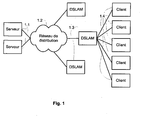
- FIG. 1 An exemplary architecture reflecting the framework of the exemplary embodiment is illustrated in figure 1 .
- servers referenced 1.1, real-time digital content distribution. These servers are connected to a distribution network, referenced 1.2.
- the exemplary embodiment is placed in the context where the end customers, referenced 1.4, are connected to the distribution network via the ADSL technology ("Asynchronous Digital Subscriber Line" in English).
- ADSL technology Asynchronous Digital Subscriber Line
- This technology enables the customer's high-speed connection to the distribution network via the telephone line.
- the central office is equipped with a connection equipment called DSLAM, referenced 1.3 ("Digital Subscriber Line Access Multiplexer" in English).
- DSLAMs being connected to the distribution network, they jointly enable a modem called ADSL modem at the client to multiplex the connection.
- each client via the DSLAM, is connected to the content distribution network.
- the exemplary embodiment of the invention is part of an ADSL access from the client to the distribution network, the invention is not limited to this framework and works in the same way on any type of connection between the customer and the distribution network.
- the invention is not necessarily implemented in a DSLAM but, on the contrary can be implemented in any device passing data packets between a distribution network (for example Internet network or ADSL network) and the buffer memory at least one customer connected to the distribution network.
- a distribution network for example Internet network or ADSL network
- the connection between the device and the buffer memory of a client does not suffer disturbances affecting the filling rate of this buffer memory (in particular jitter type interference or loss of packets). This is for example a point-to-point link to the client or a local network entry point (eg home network) to which the customer belongs.
- the server contains, or is capable of generating, digital data files, typically audio and video services. These files are distributed in the form of real-time data streams encoded according to the MPEG ("Moving Picture Engineering Group") standard. According to this standard the data is divided into packets, these packets being then distributed over the network to the clients.
- the multipoint broadcast mode consists for a transmitter or a group of transmitters, to transmit a packet to a group of customers, in a multicast mode of transmission ("multicast" in English). In this mode, the packets are sent to an address called multipoint broadcast address and will be routed to all recipients belonging to the broadcast group. It will be said of a customer who joins a broadcast group that he subscribes to the group and a customer who leaves the group that he unsubscribes from the group.
- Multipoint broadcast mode is used in practice to save intermediate bandwidth in the network when a source transmits data to a group of recipients, as is the case when broadcasting TV services ("live TV"). " in English). Indeed, in this case, the use of a point-to-point transmission mode implies that the data is sent as many times as there are recipients. This mode causes the duplication of packets on the parts of the network common to the paths between the source and the different recipients. On the contrary, multipoint broadcasting allows the data to be sent only once, this data being duplicated on the routers of the network, according to the paths leading to the recipients belonging to the broadcasting group.
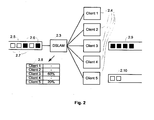
- the figure 2 illustrates more precisely the operation of the distribution of video streams from servers via a distribution network to customers in the exemplary embodiment of the invention. This figure focuses on what is happening at the client and DSLAM level. Customers referenced 2.4 and numbered from 1 to 5 are connected to the same DSLAM referenced 2.3. The figure also illustrates the input buffers referenced 2.9 and 2.10 of the clients 3 and 4.
- the referenced data 2.5 arriving from the servers via the distribution network on the DSLAM comprise two data streams. A first stream whose packets, referenced 2.6, in black is intended for the client 3 while the second stream whose packets, referenced 2.7, is intended for the client 5. Logically, therefore, black data packets are found in the buffer 2.9 client 3 and white packets in the client's buffer 2.10 5.
- the DSLAM 2.3 in addition to its role of managing the ADSL connection between the client and the network acts as a first-level router between the clients and the network. All the traffic between the distribution network and the clients that it connects passes through it. In the downstream direction, it receives all the data packets, real-time and other content, from the network via its network interface and distributes them to the recipient clients. In the uplink direction, it receives all packets sent by clients and retransmits them to the network. In the context of the exemplary embodiment of the invention, it will contain the table referenced 2.8, the function of which will be described later.
- the clients are typically digital television decoders in the exemplary embodiment, but may be any device for the reproduction of a real-time content, such as a digital television, a digital audio system or other. These clients therefore consume the data packets contained in the buffer for the return of the content.
- the rate of consumption is regulated by the speed of restitution.
- the MPEG standard provides, for example, the presence of time references called PTS ("Presentation Time Stamp" in English) regularly inserted into certain data packets and defining the time when the associated data must be presented and returned by the customer.
- PTS Presentation Time Stamp
- These associated data are typically images for video and sound samples for the sound. The respect of the real time and the good restitution of the contents thus require the respect of these PTS and the display at the foreseen time of the data.
- the client is no longer able to respect its real-time constraints and to return the data at the scheduled time, there is a break in service. If the content is video, images will be missed and the user will perceive a black screen where the freezing of the image depending on how the customer will react to the lack of information. The causes of such a situation can be multiple. It can be a server subject to too much solicitation that can no longer provide its data. It can still be a congestion in the network delaying or even losing some data packets. On the other hand, an overflow of the input buffer may also occur.
- the solution proposed in the exemplary embodiment of the invention consists of monitoring the filling rate of the customer input buffers. This monitoring is done upstream of the clients in the network. It can, for example, be done at the level of the DSLAM. In order to initialize this monitoring, the DSLAM must know for the clients to which it is connected and which it will monitor the buffers, the size of its input buffer, as well as the amount of data that the decoder will store before launching decoding. It is possible to predict the communication by the client of the size of its buffer to the DSLAM and this amount of initial storage. There are several ways to make this communication. In the case of an implementation of the invention on the DSLAM, the simplest is to integrate this transmission to the exchange of messages initializing the connection.
- connection is established between the client and the DSLAM by using a point-to-point connection establishment protocol such as Point-to-Point Tunneling Protocol (PPPoE) or Point-to-Point Tunneling Protocol (PTP). in English) or PPPoA (Point to Point Protocol over ATM). All these protocols include a preliminary parameter negotiation phase, the input buffer size and the initial storage amount can be added to the parameters exchanged during this phase.
- PPPoE Point-to-Point Tunneling Protocol
- PTP Point-to-Point Tunneling Protocol
- PPPoA Point to Point Protocol over ATM
- the DSLAM has the information on the size of the client buffer and the amount of data stored before triggering the decoding, it is possible to estimate the fill rate of the decoder input buffer. Indeed, the DSLAM, because it is located on the last link between the network and the customer has the knowledge of all data received by the customer. He knows the speed of decoding and therefore consumption of data by the customer. This information can be inferred from the stream or be part of the parameters that the client sends to the DSLAM. This information depends on the type of real-time data stream sent, its compression ratio and its coding. The estimation is done in two phases, at first the decoding is not launched on the client. The buffer is filled with data sent by the DSLAM, without consumption.
- the DSLAM estimates the filling rate of the buffer by calculating the data that has been sent to the client less the data consumed.
- the DSLAM can in this way maintain a table, like the illustrated one figure 2 , and referenced 2.8, giving for all clients the fill rate of the input buffer. So, on the figure 2 , Table 2.8 shows that the client input buffer 3 is 60% filled, while that of the client 5 is filled to 20%. Clients 1, 2, and 4 do not receive real-time content streams.
- the DSLAM can therefore know at any time the filling rates of the input buffers of the clients receiving a flow of real-time content and without involving messages exchanges between the DSLAM and the customers.
- the calculation of the estimate of the filling rate of the buffers must be done regularly. It can be done with each packet sent to the client or periodically.
- the buffer fill rate is the amount of data sent to the client.
- this rate corresponds to the totality of the data sent minus the data consumed.
- thresholds can be set to trigger an alert. For example, you can set these thresholds at 5% and 95% and trigger the alert when the fill rate is less than 5% or greater than 95%. This knowledge can trigger an alert or corrective actions.
- An embodiment of the invention provides, for example, that the DSLAM contains pre-recorded or generated video sequences on the fly, these sequences being able to be stored in memory or on disk, referenced 3.23 on the figure 3 , within the DSLAM.
- famine In case of famine, it is possible to send to the client, data packets of such a prerecorded sequence instead of missing packets for the program it is receiving.
- the user will therefore perceive an interruption of his program during which he will display a replacement or substitution sequence, which may be, for example, program announcements, a specific message related to the condition of transmission of the required content, advertising sequences or any type of sequence that we may wish to make available.
- the impact will likely be less negative than a "black screen" or a freeze of the image.
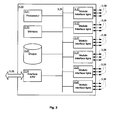
- the architecture of such a DSLAM according to the exemplary embodiment of the invention is illustrated figure 3 .
- the monitoring apparatus referenced 3.20, contains a processor referenced 3.21 allowing the execution of processing, a working memory referenced 3.22 for storing data as the table 2.8, a storage memory referenced 3.23 can be a disk and allowing to storing, for example, replacement sequences according to a particular embodiment of the invention.
- the device has a referenced interface 3.24 connecting it to the content distribution network by means of a link referenced 3.25. In the exemplary embodiment, this link and this interface are ATM links ("Asynchronous Transfer Mode" in English), but it can also be for example Gigabit Ethernet.
- a series of line interface modules referenced 3.27 each make it possible to establish ADSL connections referenced 3.28 with clients, typically 16, by the telephone line.
- These modules, the processor, the memory, the disk and the interface with the distribution network communicate via an internal bus referenced 3.26.
- the communications between the distribution network and the customers are thus mixed on the link 3.25 and distributed on the links 3.28 according to the client involved.
- the DSLAM stores in a buffer of its own data that the client is not more able to receive. This data will be sent delayed when the fill rate has decreased.
- the exemplary embodiment of the invention describes an implementation within the DSLAM of the invention, but it can be implemented on other devices, or even be implemented on a dedicated device connected to the link arriving at the DSLAM or on the link between the DSLAM and the customer.
- the only necessary condition is to implement the invention within the network at a point that sees all the data going to the client so as to allow a reliable estimate of the data that it receives.
- the invention may, for example, be implemented on a device connected to the link upstream of the DSLAM and functioning as a probe analyzing the traffic on the link.
- the exemplary embodiment is in the case of an ADSL connection of customers but can work just as well regardless of the connection mode and may be implemented, for example, on a headend cable in the case of a cable connection, where on a wireless access point in the case of a wireless connection between the customer and the distribution network.
Landscapes
- Engineering & Computer Science (AREA)
- Signal Processing (AREA)
- Computer Networks & Wireless Communication (AREA)
- Multimedia (AREA)
- Computer Security & Cryptography (AREA)
- Databases & Information Systems (AREA)
- Computer Graphics (AREA)
- Data Exchanges In Wide-Area Networks (AREA)
- Two-Way Televisions, Distribution Of Moving Picture Or The Like (AREA)
- Communication Control (AREA)
Claims (12)
- Vorrichtung (2.3), anschließbar an ein Netz zur paketweisen Verteilung (1.2) von Inhalt, wobei der Inhalt in Form eines digitalen Datenstroms an mindestens einen Clienten (2.4) gesendet wird, wobei der mindestens eine Client über einen Eingangspuffer (2.9, 2.10) verfügt, in welchem er die erhaltenen Daten lagert, bevor sie zum Zwecke der Wiedergabe des Inhalts decodiert werden, wobei die Vorrichtung über Mittel (3.27) verfügt, um Datenpakete zwischen dem Verteilnetz (1.2) und dem mindestens einen Clienten (2.4), der an besagtes Verteilnetz (1.2) angeschlossen ist, zu übertragen, wobei durch diese Mittel zur Übertragung von Datenpaketen alle Pakete hin zum Puffer des Clienten übertragen werden, dadurch gekennzeichnet, dass sie Folgendes umfasst:- Mittel zur Berechnung (3.21) einer Schätzung des Füllfaktors des Eingangspuffers des mindestens einen Clienten in Abhängigkeit von mindestens einem Parameter des besagten Clienten, der unter den folgenden Parametern ausgesucht wurde:- die Größe des Eingangspuffers des mindestens einen Clienten, der an das Verteilnetz angeschlossen ist- die Datenmenge, die der mindestens eine Client vor dem Starten der Decodierung lagert, wenn er einen Datenstrom erhält- die Wiedergabemenge, die der mindestens eine Client verwendet, um den Eingangspuffer zu leeren- und Mittel zum Versenden einer Inhalts-Ersatzsequenz an einen Clienten, wenn der geschätzte Füllfaktor des Eingangspuffers des besagten Clienten unterhalb eines ersten Schwellenwertes liegt.
- Vorrichtung nach Anspruch 1, bestehend unter anderem aus Mitteln zur Lagerung von Echtzeitinhalts-Ersatzsequenzen.
- Vorrichtung nach irgendeinem der Ansprüche 1 und 2, geeignet für eine vorübergehende Lagerung der für einen Clienten bestimmten Datenpakete, bei dem die Schätzung des Füllfaktors seines Eingangspuffers oberhalb eines zweiten Schwellenwertes liegt.
- Vorrichtung nach irgendeinem der Ansprüche 1 bis 3, geeignet für das Versenden einer Warnnachricht, wenn die Schätzung des Füllfaktors eines Clienten unterhalb eines dritten Schwellenwertes liegt.
- Vorrichtung nach irgendeinem der Ansprüche 1 bis 4, geeignet für das Versenden einer Warnnachricht, wenn die Schätzung des Füllfaktors eines Clienten oberhalb eines vierten Schwellenwertes liegt.
- Vorrichtung nach irgendeinem der Ansprüche 1 bis 5, dadurch gekennzeichnet, dass es sich dabei um einen Zugangsmultiplexer zu einer digitalen Clienten-Anschlussleitung (DSLAM) handelt.
- Verfahren zur Schätzung des Füllfaktors des Eingangspuffers einer Vorrichtung zur Decodierung eines in Form eines digitalen Datenstroms gesendeten Inhalts, Client genannt, durch ein Überwachungsgerät, das an ein Netz zur paketvermittelten Inhaltsverteilung anschließbar ist, wobei das Überwachungsgerät mit Mitteln versehen ist, um Datenpakete zwischen dem Verteilnetz und dem mit besagtem Verteilnetz verbundenen Clienten zu übertragen, wobei durch diese Mittel zur Übertragung von Datenpaketen alle Datenpakete zwischen dem Clienten und dem Verteilnetz übertragen werden, dadurch gekennzeichnet, dass es mindestens die folgenden Schritte umfasst:- die Berechnung einer Schätzung des Füllfaktors des Eingangspuffers des mindestens einen Clienten in Abhängigkeit von der Größe seines Eingangspuffers, von der Qualität der von ihm vor Starten der Decodierung gelagerten Daten und von den Datenpaketen, die durch das besagte Überwachungsgerät hin zu dem mindestens einen Clienten übertragen wurden,- und die Versendung einer Inhalts-Ersatzsequenz an einen Clienten, wenn der geschätzte Füllfaktor des Eingangspuffers des besagten Clienten unterhalb eines ersten Schwellenwertes liegt.
- Verfahren nach Anspruch 7, bei dem die Berechnung der Schätzung des Füllfaktors in regelmäßiger Form vorgenommen wird.
- Verfahren nach irgendeinem der Ansprüche 7 und 8, bei dem die Berechnung der Schätzung des Füllfaktors jedes Mal dann vorgenommen wird, wenn ein Datenpaket an den Clienten gesendet wird.
- Verfahren nach einem der Ansprüche 7 bis 9, bestehend unter anderem aus einem Schritt zur vorübergehenden Lagerung der für einen Clienten bestimmten Datenpakete, bei dem die Schätzung des Füllfaktors seines Eingangspuffers oberhalb eines zweiten Schwellenwertes liegt.
- Verfahren nach einem der Ansprüche 7 bis 10, bestehend unter anderem aus einem Schritt zum Versenden einer Warnnachricht, wenn die Schätzung des Füllfaktors eines Clienten unterhalb eines dritten Schwellenwertes liegt.
- Verfahren nach einem der Ansprüche 7 bis 11, bestehend unter anderem aus einem Schritt zum Versenden einer Warnnachricht, wenn die Schätzung des Füllfaktors eines Clienten oberhalb eines vierten Schwellenwertes liegt.
Applications Claiming Priority (2)
| Application Number | Priority Date | Filing Date | Title |
|---|---|---|---|
| FR0552134A FR2888441A1 (fr) | 2005-07-11 | 2005-07-11 | Appareil et procede d'estimation du taux de remplissage des tampons d'entree de clients d'une distribution de contenu temps reel. |
| PCT/EP2006/064109 WO2007006786A2 (fr) | 2005-07-11 | 2006-07-11 | Appareil et procede d'estimation du taux de remplissage des tampons d'entree de clients d'une distribution de contenu temps reel |
Publications (2)
| Publication Number | Publication Date |
|---|---|
| EP1908259A2 EP1908259A2 (de) | 2008-04-09 |
| EP1908259B1 true EP1908259B1 (de) | 2014-10-22 |
Family
ID=36072154
Family Applications (1)
| Application Number | Title | Priority Date | Filing Date |
|---|---|---|---|
| EP06764129.0A Ceased EP1908259B1 (de) | 2005-07-11 | 2006-07-11 | Vorrichtung und verfahren zur schätzung des füllfaktors von client-eingangspuffern einer echtzeit-inhaltsverteilung |
Country Status (7)
| Country | Link |
|---|---|
| US (1) | US20090285094A1 (de) |
| EP (1) | EP1908259B1 (de) |
| JP (1) | JP4733743B2 (de) |
| KR (1) | KR101280132B1 (de) |
| CN (1) | CN101218807B (de) |
| FR (1) | FR2888441A1 (de) |
| WO (1) | WO2007006786A2 (de) |
Families Citing this family (10)
| Publication number | Priority date | Publication date | Assignee | Title |
|---|---|---|---|---|
| FR2922401B1 (fr) * | 2007-10-10 | 2010-04-16 | Sagem Comm | Dispositif de reception en continu de paquets de donnees audio et/ou video |
| JP4900317B2 (ja) * | 2008-05-12 | 2012-03-21 | 富士通株式会社 | フレーム送信装置、フレーム送信方法およびフレーム送信プログラム |
| US20130051257A1 (en) * | 2011-08-31 | 2013-02-28 | International Business Machines Corporation | Scheduling of Packets at Cellular Base Stations |
| JP2013141138A (ja) * | 2012-01-05 | 2013-07-18 | Nec Corp | 配信装置、配信方法、およびプログラム |
| GB2547815B (en) * | 2013-08-28 | 2018-08-29 | Metaswitch Networks Ltd | Data processing |
| JP6575975B2 (ja) | 2015-05-08 | 2019-09-18 | テレフオンアクチーボラゲット エルエム エリクソン(パブル) | 無線デバイスにおけるサービスアプリケーションのネットワーク推奨によるバッファ管理 |
| US10733167B2 (en) | 2015-06-03 | 2020-08-04 | Xilinx, Inc. | System and method for capturing data to provide to a data analyser |
| EP3350972B1 (de) * | 2015-09-18 | 2019-07-31 | Sony Mobile Communications Inc. | Verfahren und vorrichtungen zur steuerung von streaming über ein funknetzwerk |
| WO2017116262A1 (en) * | 2015-12-29 | 2017-07-06 | Ringcentral, Inc., (A Delaware Corporation) | System and method for estimating distributed consumption of a quota |
| CN105718329B (zh) * | 2016-01-15 | 2019-03-26 | 广州视源电子科技股份有限公司 | 终端数据恢复方法和系统 |
Family Cites Families (16)
| Publication number | Priority date | Publication date | Assignee | Title |
|---|---|---|---|---|
| US5084877A (en) * | 1989-05-05 | 1992-01-28 | At&T Bell Laboratories | High speed transport protocol |
| US5877812A (en) * | 1995-11-21 | 1999-03-02 | Imedia Corporation | Method and apparatus for increasing channel utilization for digital video transmission |
| JPH09298734A (ja) * | 1996-04-30 | 1997-11-18 | Matsushita Electric Ind Co Ltd | ビデオオンデマンドシステム |
| JPH10164597A (ja) | 1996-12-04 | 1998-06-19 | Sanyo Electric Co Ltd | 符号化方法およびその方法を用いた符号化装置 |
| KR100302263B1 (ko) * | 1997-03-25 | 2001-09-22 | 모리시타 요이찌 | 스트림 데이터 전송방법 및 시스템 |
| US6041359A (en) * | 1997-06-09 | 2000-03-21 | Microsoft Corporation | Data delivery system and method for delivering computer data over a broadcast network |
| US6714516B1 (en) * | 1999-04-30 | 2004-03-30 | Alcatel | Congestion control mechanism for SSCOP protocol |
| US6678332B1 (en) * | 2000-01-04 | 2004-01-13 | Emc Corporation | Seamless splicing of encoded MPEG video and audio |
| AU2001232988A1 (en) * | 2000-03-24 | 2001-10-08 | Dotrocket, Inc. | A system and method for increasing data packet transfer rate in a computer network |
| EP1250004A1 (de) * | 2001-04-11 | 2002-10-16 | Deutsche Thomson-Brandt Gmbh | Verfahren und Gerät zur Steuerung der Einfügung von Stopfdaten in einen aufzuzeichnenden Bitstrom |
| JP2002319971A (ja) * | 2001-04-20 | 2002-10-31 | Fujitsu Ltd | パケットデータ中継装置及び配信装置 |
| US7274661B2 (en) * | 2001-09-17 | 2007-09-25 | Altera Corporation | Flow control method for quality streaming of audio/video/media over packet networks |
| US6910079B2 (en) * | 2002-01-25 | 2005-06-21 | University Of Southern California | Multi-threshold smoothing |
| JP2003289526A (ja) * | 2002-03-28 | 2003-10-10 | Toshiba Corp | 映像受信端末装置およびその再生制御方法 |
| CN1281036C (zh) * | 2003-08-15 | 2006-10-18 | 上海贝尔阿尔卡特股份有限公司 | 一种分组交换网络分布式自适应抖动缓冲区调整方法 |
| US7870590B2 (en) * | 2004-10-20 | 2011-01-11 | Cisco Technology, Inc. | System and method for fast start-up of live multicast streams transmitted over a packet network |
-
2005
- 2005-07-11 FR FR0552134A patent/FR2888441A1/fr active Pending
-
2006
- 2006-07-11 JP JP2008520869A patent/JP4733743B2/ja not_active Expired - Fee Related
- 2006-07-11 CN CN2006800252097A patent/CN101218807B/zh not_active Expired - Fee Related
- 2006-07-11 WO PCT/EP2006/064109 patent/WO2007006786A2/fr not_active Ceased
- 2006-07-11 US US11/988,626 patent/US20090285094A1/en not_active Abandoned
- 2006-07-11 EP EP06764129.0A patent/EP1908259B1/de not_active Ceased
- 2006-07-11 KR KR1020087000801A patent/KR101280132B1/ko not_active Expired - Fee Related
Also Published As
| Publication number | Publication date |
|---|---|
| EP1908259A2 (de) | 2008-04-09 |
| CN101218807A (zh) | 2008-07-09 |
| CN101218807B (zh) | 2012-05-23 |
| WO2007006786A2 (fr) | 2007-01-18 |
| JP4733743B2 (ja) | 2011-07-27 |
| US20090285094A1 (en) | 2009-11-19 |
| FR2888441A1 (fr) | 2007-01-12 |
| KR101280132B1 (ko) | 2013-07-05 |
| JP2009500975A (ja) | 2009-01-08 |
| KR20080032088A (ko) | 2008-04-14 |
| WO2007006786A3 (fr) | 2007-04-12 |
Similar Documents
| Publication | Publication Date | Title |
|---|---|---|
| US9158769B2 (en) | Systems and methods for network content delivery | |
| US9641578B2 (en) | Minimizing unicast bandwidth in an adaptive bit rate system | |
| KR100898210B1 (ko) | 디지털 신호를 전송하고 수신된 스트리밍 콘텐트 채널을 변경하기 위한 방법 및 장치, 및 컴퓨터 판독가능한 매체 | |
| US20190260816A1 (en) | Content Delivery | |
| US9113132B2 (en) | System and methods for recording a compressed video and audio stream | |
| US20060230176A1 (en) | Methods and apparatus for decreasing streaming latencies for IPTV | |
| WO2020086452A1 (en) | Low-latency video internet streaming for management and transmission of multiple data streams | |
| US20030091000A1 (en) | Intelligent buffering process for network confernece video | |
| EP3053303B1 (de) | Verfahren zur abonnierung von von multicastklienten kommenden datenströmen | |
| CN113014586B (zh) | Rtp数据包乱序处理及重组帧方法和系统 | |
| WO2007116321A2 (en) | Device and method for dynamically storing media data | |
| EP1908259A2 (de) | Vorrichtung und verfahren zur schätzung des füllfaktors von client-eingangspuffern einer echtzeit-inhaltsverteilung | |
| KR100921162B1 (ko) | 스트리밍 데이터 전달 시스템에서 물리층 복구 | |
| WO2009053595A1 (fr) | Dispositif de reception en continu de paquets de donnees audio et/ou video | |
| CN101090369B (zh) | 一种在流媒体系统中控制数据包发送速率的方法 | |
| US7530089B1 (en) | System and method for improving video quality using a constant bit rate data stream | |
| CN105306970B (zh) | 一种流媒体直播发送速度的控制方法及装置 | |
| CN101163238A (zh) | 一种平滑实现实时转播/直播的流媒体服务方法 | |
| FR2980662A1 (fr) | Methode d'enregistrement d'un contenu dans un fichier sur un serveur et dispositif correspondant | |
| US20060230171A1 (en) | Methods and apparatus for decreasing latency in A/V streaming systems | |
| EP2055042A2 (de) | Mechanismus zur verwaltung von empfänger-/decoder-anschlüssen | |
| CN114070827B (zh) | 一种转推流数据的传输方法、设备及介质 | |
| KR102144527B1 (ko) | 서버 기반 광고 제공 방법 및 장치 | |
| Huo et al. | QoS adaptive data organizing and delivery framework for p2p media streaming | |
| EP2553900B1 (de) | Adaptierbare datenstromübertragung |
Legal Events
| Date | Code | Title | Description |
|---|---|---|---|
| PUAI | Public reference made under article 153(3) epc to a published international application that has entered the european phase |
Free format text: ORIGINAL CODE: 0009012 |
|
| 17P | Request for examination filed |
Effective date: 20080131 |
|
| AK | Designated contracting states |
Kind code of ref document: A2 Designated state(s): DE FR GB |
|
| DAX | Request for extension of the european patent (deleted) | ||
| RBV | Designated contracting states (corrected) |
Designated state(s): DE FR GB |
|
| RAP1 | Party data changed (applicant data changed or rights of an application transferred) |
Owner name: THOMSON LICENSING |
|
| GRAP | Despatch of communication of intention to grant a patent |
Free format text: ORIGINAL CODE: EPIDOSNIGR1 |
|
| GRAJ | Information related to disapproval of communication of intention to grant by the applicant or resumption of examination proceedings by the epo deleted |
Free format text: ORIGINAL CODE: EPIDOSDIGR1 |
|
| GRAP | Despatch of communication of intention to grant a patent |
Free format text: ORIGINAL CODE: EPIDOSNIGR1 |
|
| INTG | Intention to grant announced |
Effective date: 20140429 |
|
| INTG | Intention to grant announced |
Effective date: 20140508 |
|
| GRAS | Grant fee paid |
Free format text: ORIGINAL CODE: EPIDOSNIGR3 |
|
| GRAA | (expected) grant |
Free format text: ORIGINAL CODE: 0009210 |
|
| AK | Designated contracting states |
Kind code of ref document: B1 Designated state(s): DE FR GB |
|
| REG | Reference to a national code |
Ref country code: GB Ref legal event code: FG4D Free format text: NOT ENGLISH |
|
| REG | Reference to a national code |
Ref country code: DE Ref legal event code: R084 Ref document number: 602006043445 Country of ref document: DE |
|
| REG | Reference to a national code |
Ref country code: DE Ref legal event code: R096 Ref document number: 602006043445 Country of ref document: DE Effective date: 20141204 |
|
| REG | Reference to a national code |
Ref country code: DE Ref legal event code: R084 Ref document number: 602006043445 Country of ref document: DE Effective date: 20141025 |
|
| REG | Reference to a national code |
Ref country code: DE Ref legal event code: R097 Ref document number: 602006043445 Country of ref document: DE |
|
| PLBE | No opposition filed within time limit |
Free format text: ORIGINAL CODE: 0009261 |
|
| STAA | Information on the status of an ep patent application or granted ep patent |
Free format text: STATUS: NO OPPOSITION FILED WITHIN TIME LIMIT |
|
| 26N | No opposition filed |
Effective date: 20150723 |
|
| GBPC | Gb: european patent ceased through non-payment of renewal fee |
Effective date: 20150711 |
|
| PG25 | Lapsed in a contracting state [announced via postgrant information from national office to epo] |
Ref country code: GB Free format text: LAPSE BECAUSE OF NON-PAYMENT OF DUE FEES Effective date: 20150711 |
|
| REG | Reference to a national code |
Ref country code: FR Ref legal event code: PLFP Year of fee payment: 11 |
|
| REG | Reference to a national code |
Ref country code: FR Ref legal event code: PLFP Year of fee payment: 12 |
|
| REG | Reference to a national code |
Ref country code: DE Ref legal event code: R082 Ref document number: 602006043445 Country of ref document: DE Representative=s name: HOFSTETTER, SCHURACK & PARTNER PATENT- UND REC, DE |
|
| REG | Reference to a national code |
Ref country code: FR Ref legal event code: PLFP Year of fee payment: 13 |
|
| PGFP | Annual fee paid to national office [announced via postgrant information from national office to epo] |
Ref country code: FR Payment date: 20180723 Year of fee payment: 13 |
|
| PGFP | Annual fee paid to national office [announced via postgrant information from national office to epo] |
Ref country code: DE Payment date: 20181024 Year of fee payment: 13 |
|
| REG | Reference to a national code |
Ref country code: DE Ref legal event code: R119 Ref document number: 602006043445 Country of ref document: DE |
|
| PG25 | Lapsed in a contracting state [announced via postgrant information from national office to epo] |
Ref country code: DE Free format text: LAPSE BECAUSE OF NON-PAYMENT OF DUE FEES Effective date: 20200201 |
|
| PG25 | Lapsed in a contracting state [announced via postgrant information from national office to epo] |
Ref country code: FR Free format text: LAPSE BECAUSE OF NON-PAYMENT OF DUE FEES Effective date: 20190731 |
|
| P01 | Opt-out of the competence of the unified patent court (upc) registered |
Effective date: 20230527 |