EP1895566A2 - Gas monitoring apparatus and gas monitoring method - Google Patents
Gas monitoring apparatus and gas monitoring method Download PDFInfo
- Publication number
- EP1895566A2 EP1895566A2 EP07001763A EP07001763A EP1895566A2 EP 1895566 A2 EP1895566 A2 EP 1895566A2 EP 07001763 A EP07001763 A EP 07001763A EP 07001763 A EP07001763 A EP 07001763A EP 1895566 A2 EP1895566 A2 EP 1895566A2
- Authority
- EP
- European Patent Office
- Prior art keywords
- diphenylcyanoarsine
- signal
- diphenylchloroarsine
- intensity
- concentration
- Prior art date
- Legal status (The legal status is an assumption and is not a legal conclusion. Google has not performed a legal analysis and makes no representation as to the accuracy of the status listed.)
- Withdrawn
Links
- 238000012544 monitoring process Methods 0.000 title claims abstract description 17
- 238000000034 method Methods 0.000 title claims description 16
- BDHNJKLLVSRGDK-UHFFFAOYSA-N diphenylcyanoarsine Chemical compound C=1C=CC=CC=1[As](C#N)C1=CC=CC=C1 BDHNJKLLVSRGDK-UHFFFAOYSA-N 0.000 claims abstract description 35
- YHHKGKCOLGRKKB-UHFFFAOYSA-N diphenylchlorarsine Chemical compound C=1C=CC=CC=1[As](Cl)C1=CC=CC=C1 YHHKGKCOLGRKKB-UHFFFAOYSA-N 0.000 claims abstract description 23
- 238000000668 atmospheric pressure chemical ionisation mass spectrometry Methods 0.000 claims abstract description 9
- 150000002500 ions Chemical class 0.000 claims description 72
- 230000035945 sensitivity Effects 0.000 claims description 8
- 238000004458 analytical method Methods 0.000 claims description 7
- 239000002575 chemical warfare agent Substances 0.000 abstract description 8
- 238000011897 real-time detection Methods 0.000 abstract 1
- 239000007789 gas Substances 0.000 description 42
- 239000013043 chemical agent Substances 0.000 description 39
- 238000005259 measurement Methods 0.000 description 17
- 239000000523 sample Substances 0.000 description 16
- 239000000126 substance Substances 0.000 description 11
- 238000004949 mass spectrometry Methods 0.000 description 10
- 238000004885 tandem mass spectrometry Methods 0.000 description 9
- 238000005040 ion trap Methods 0.000 description 8
- 238000011088 calibration curve Methods 0.000 description 7
- 238000006243 chemical reaction Methods 0.000 description 7
- 238000001514 detection method Methods 0.000 description 7
- 238000005516 engineering process Methods 0.000 description 7
- 238000001819 mass spectrum Methods 0.000 description 6
- VLKZOEOYAKHREP-UHFFFAOYSA-N n-Hexane Chemical compound CCCCCC VLKZOEOYAKHREP-UHFFFAOYSA-N 0.000 description 6
- XLYOFNOQVPJJNP-UHFFFAOYSA-N water Chemical compound O XLYOFNOQVPJJNP-UHFFFAOYSA-N 0.000 description 6
- 238000002474 experimental method Methods 0.000 description 5
- XLYOFNOQVPJJNP-UHFFFAOYSA-O oxonium Chemical compound [OH3+] XLYOFNOQVPJJNP-UHFFFAOYSA-O 0.000 description 5
- 238000000354 decomposition reaction Methods 0.000 description 4
- 238000001212 derivatisation Methods 0.000 description 4
- 238000002347 injection Methods 0.000 description 4
- 239000007924 injection Substances 0.000 description 4
- 238000005202 decontamination Methods 0.000 description 3
- 230000003588 decontaminative effect Effects 0.000 description 3
- 238000010494 dissociation reaction Methods 0.000 description 3
- 230000005593 dissociations Effects 0.000 description 3
- 230000005684 electric field Effects 0.000 description 3
- 239000001307 helium Substances 0.000 description 3
- 229910052734 helium Inorganic materials 0.000 description 3
- SWQJXJOGLNCZEY-UHFFFAOYSA-N helium atom Chemical compound [He] SWQJXJOGLNCZEY-UHFFFAOYSA-N 0.000 description 3
- -1 nitrogen molecule ions Chemical class 0.000 description 3
- 238000005086 pumping Methods 0.000 description 3
- 239000012488 sample solution Substances 0.000 description 3
- 239000000243 solution Substances 0.000 description 3
- 239000013076 target substance Substances 0.000 description 3
- IJGRMHOSHXDMSA-UHFFFAOYSA-N Atomic nitrogen Chemical compound N#N IJGRMHOSHXDMSA-UHFFFAOYSA-N 0.000 description 2
- DYAHQFWOVKZOOW-UHFFFAOYSA-N Sarin Chemical compound CC(C)OP(C)(F)=O DYAHQFWOVKZOOW-UHFFFAOYSA-N 0.000 description 2
- 238000000065 atmospheric pressure chemical ionisation Methods 0.000 description 2
- 239000003795 chemical substances by application Substances 0.000 description 2
- 238000011109 contamination Methods 0.000 description 2
- 230000003247 decreasing effect Effects 0.000 description 2
- 238000010586 diagram Methods 0.000 description 2
- 230000008030 elimination Effects 0.000 description 2
- 238000003379 elimination reaction Methods 0.000 description 2
- 230000036541 health Effects 0.000 description 2
- 238000011835 investigation Methods 0.000 description 2
- 231100000518 lethal Toxicity 0.000 description 2
- 230000001665 lethal effect Effects 0.000 description 2
- 239000002243 precursor Substances 0.000 description 2
- 238000012545 processing Methods 0.000 description 2
- 239000010453 quartz Substances 0.000 description 2
- VYPSYNLAJGMNEJ-UHFFFAOYSA-N silicon dioxide Inorganic materials O=[Si]=O VYPSYNLAJGMNEJ-UHFFFAOYSA-N 0.000 description 2
- 239000002689 soil Substances 0.000 description 2
- 231100000331 toxic Toxicity 0.000 description 2
- 230000002588 toxic effect Effects 0.000 description 2
- HGUFODBRKLSHSI-UHFFFAOYSA-N 2,3,7,8-tetrachloro-dibenzo-p-dioxin Chemical compound O1C2=CC(Cl)=C(Cl)C=C2OC2=C1C=C(Cl)C(Cl)=C2 HGUFODBRKLSHSI-UHFFFAOYSA-N 0.000 description 1
- OKTJSMMVPCPJKN-UHFFFAOYSA-N Carbon Chemical compound [C] OKTJSMMVPCPJKN-UHFFFAOYSA-N 0.000 description 1
- 231100000111 LD50 Toxicity 0.000 description 1
- 230000015572 biosynthetic process Effects 0.000 description 1
- 229910052799 carbon Inorganic materials 0.000 description 1
- 239000003153 chemical reaction reagent Substances 0.000 description 1
- 150000001875 compounds Chemical class 0.000 description 1
- 238000012790 confirmation Methods 0.000 description 1
- 238000010276 construction Methods 0.000 description 1
- 230000000694 effects Effects 0.000 description 1
- 239000002895 emetic Substances 0.000 description 1
- 230000007613 environmental effect Effects 0.000 description 1
- 238000003912 environmental pollution Methods 0.000 description 1
- 238000011156 evaluation Methods 0.000 description 1
- 238000001704 evaporation Methods 0.000 description 1
- 230000008020 evaporation Effects 0.000 description 1
- 230000010220 ion permeability Effects 0.000 description 1
- 238000000752 ionisation method Methods 0.000 description 1
- GIKLTQKNOXNBNY-OWOJBTEDSA-N lewisite Chemical compound Cl\C=C\[As](Cl)Cl GIKLTQKNOXNBNY-OWOJBTEDSA-N 0.000 description 1
- 238000004519 manufacturing process Methods 0.000 description 1
- 239000000203 mixture Substances 0.000 description 1
- 230000007935 neutral effect Effects 0.000 description 1
- 229910052757 nitrogen Inorganic materials 0.000 description 1
- 239000002245 particle Substances 0.000 description 1
- 238000002360 preparation method Methods 0.000 description 1
- 230000008569 process Effects 0.000 description 1
- 230000000717 retained effect Effects 0.000 description 1
- 206010041232 sneezing Diseases 0.000 description 1
- 238000001179 sorption measurement Methods 0.000 description 1
- 230000007480 spreading Effects 0.000 description 1
- 238000003892 spreading Methods 0.000 description 1
- 229910001220 stainless steel Inorganic materials 0.000 description 1
- 239000010935 stainless steel Substances 0.000 description 1
- 231100000419 toxicity Toxicity 0.000 description 1
- 230000001988 toxicity Effects 0.000 description 1
Images



Classifications
-
- H—ELECTRICITY
- H01—ELECTRIC ELEMENTS
- H01J—ELECTRIC DISCHARGE TUBES OR DISCHARGE LAMPS
- H01J49/00—Particle spectrometers or separator tubes
- H01J49/0027—Methods for using particle spectrometers
- H01J49/0036—Step by step routines describing the handling of the data generated during a measurement
-
- Y—GENERAL TAGGING OF NEW TECHNOLOGICAL DEVELOPMENTS; GENERAL TAGGING OF CROSS-SECTIONAL TECHNOLOGIES SPANNING OVER SEVERAL SECTIONS OF THE IPC; TECHNICAL SUBJECTS COVERED BY FORMER USPC CROSS-REFERENCE ART COLLECTIONS [XRACs] AND DIGESTS
- Y10—TECHNICAL SUBJECTS COVERED BY FORMER USPC
- Y10T—TECHNICAL SUBJECTS COVERED BY FORMER US CLASSIFICATION
- Y10T436/00—Chemistry: analytical and immunological testing
- Y10T436/24—Nuclear magnetic resonance, electron spin resonance or other spin effects or mass spectrometry
Definitions
- the present invention belongs to the field of mass spectrometry technology and, more particularly, relates to a gas monitoring apparatus for measuring the concentration (s) of a chemical warfare agent(s) in the atmosphere using a mass spectrometer and displaying the same.
- the chemical agent detector is constituted of a sample introduction section 1, an ionization section 2, a mass spectrometry section 3, a control section 4, a suction pump 5, a computer 6 for measurement and processing and a vacuum pump 7.
- a sample 16 introduced into the sample introduction section 1 is heated and vaporized.
- the sample, now gaseous, is led to the ionization section 2 by means of the suction pump 5.
- the sample introduced into the ionization section 2 is sent to and ionized in a corona discharge region.
- the ions formed are led to the mass spectrometry section 3 for mass spectrometric analysis.
- the results of the mass analysis are processed by the measurement/processing computer 6 for displaying. When the results obtained show the characteristic features of the results of measurement of a chemical agent, the chemical agent is regarded as having been detected.
- JP 2000-162189 A As a gas monitoring apparatus which utilizes atmospheric pressure chemical ionization mass spectrometry, an exhaust gas monitoring apparatus is disclosed in JP 2000-162189 A . In this apparatus, an exhaust gas is taken into an atmospheric pressure chemical ionization mass spectrometer and the concentration of dioxin and related compounds contained in the exhaust gas is displayed.
- JP 2005-274566 A describes that lewisite, diphenylcyanoarsine and/or diphenylchloroarsine is subjected to derivatization treatment and then analyzed by a gas analyzer.
- DC diphenylcyanoarsine
- DA diphenylchloroarsine
- JP 2005-274565 A discloses a technology of analyzing DC and DA which comprises derivatization treatment thereof, followed by analysis using a gas analyzer.
- this method still has two problems in the following points.
- the first problem is the detection time problem.
- the above technology includes the steps of collection, by suction, of a sample gas ⁇ derivatization treatment ⁇ analysis by a gas chromatograph and, therefore, it seems that scores of minutes is required for obtaining the results. Since, however, once a person is exposed to a chemical agent, the effect thereof is produced in an instant, it is necessary, on the occasion of chemical agent leakage, to issue a warning as soon as possible. Thus, an apparatus which can detect DC and DA simultaneously without needing any complicated procedure has been demanded.
- the second problem is the sensitivity problem.
- DC and DA are converted to one and the same substance. Therefore, the total amount of DC and DA can be determined but a problem remains, namely the respective concentrations of DC and DA cannot be known.
- the median lethal dose concentration which is lethal to half of persons exposed to that concentration for 1 minute
- DC is estimated to be 1000-10000 mg-min/m 3 and that of DA to be about 15000 mg-min/m 3 .
- DC is considered to be more toxic than DA. Therefore, in case a worker engaged in abandoned chemical agent treatment should be exposed to DC and/or DA, it is important, in deciding the method of treatment, among others, to know the individual concentrations.
- the present invention provides a chemical agent monitoring apparatus capable of determining the respective concentrations of DC and DA simultaneously by utilizing the technology of atmospheric pressure chemical ionization mass spectrometry.
- the gas monitoring apparatus of the invention comprises a gas introduction section for introducing a sample gas, an ion source for ionizing components contained in the sample gas by corona discharge, a mass spectrometer for analyzing the ions formed by the ion source for m/z (value resulting from division of the mass by the valence), an operation section for calculating the concentrations of measurement target substances contained in the sample gas based on the ion intensity data obtained by the mass spectrometer, and a display section for displaying the operation results obtained in the operation section, in which apparatus the sum total concentration of diphenylcyanoarsine and diphenylchloroarsine are calculated from a signal common to diphenylcyanoarsine and diphenylchloroarsine included in the measurement target substances, the concentration of diphenylcyanoarsine is calculated from a signal specific to diphenylcyanoarsine and the concentration of diphenylchloroarsine is calculated from the difference between the sum total concentration
- the exact concentrations of DC and DA can be known in an instant in accordance with the present invention. Therefore, the information about the chemical agent species leaked out and the concentrations thereof, which are important in carrying out evacuation and leading of workers and nearby residents, treatment thereof and decontamination, among others, can be promptly provided. Since the respective concentrations of DC and DA, which differ in toxicity, can be determined, evacuation, treatment, decontamination and like dealing with the aftermath can be carried out appropriately.
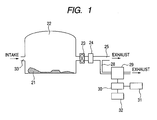
- Fig. 1 is a block diagram illustrating the constitution of the whole apparatus necessary for carrying out the invention. As a typical example, the case of monitoring the concentrations of chemical agents released into the atmosphere on the occasion of digging up and recovering an abandoned chemical weapon is described.
- a tent 22 is set up in the vicinity of the digging up/recovering site 21. It is necessary to maintain the inside of the tent 22 at a negative pressure relative to the outside open air so that even when a chemical agent gas is generated within the inside, the gas may be prevented from leaking out of the tent. For that purpose, the air inside the tent 22 is always exhausted by an exhaust fan 23, while the open air is fed to the tent inside through an air inlet 33.
- the pressure within the tent 22 is determined by the conductance balance between air intake and air exhaustion.
- the exhaust pipe 25 for exhausting the air in the tent 22 to the outside is provided with a chemical agent removing filter 24 such as an active carbon filter and, thus, even if a chemical agent gas is generated in the process of working inside the tent 22, the leakage of the gas to the outside can be prevented.
- a part of the gas in the exhaust pipe 25 is branched by an introduction pipeline 28 and introduced into a chemical agent detector 29.
- the detection signal from the chemical agent detector 29 is sent to a data processor 30.
- the data processor 30 refers to a database 31 storing chemical agent-derived signals, calculates the chemical agent concentration from the relation between the signal detected by the chemical agent detector 29 and the chemical agent concentration (namely sensitivity), and causes the chemical agent concentration to be displayed in a display section 32.
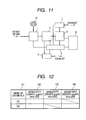
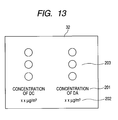
- the information stored in the database 31 includes substance names 101, sites of signals appearing on a mass spectrum (m/z) and sensitivities 102, 103 and 104 at respective m/z values, among others, as shown, for example, in Fig. 12. It is recommended that the display section 32 be provided with alarms 203, for instance, for judging the degree of danger with ease in addition to substance names 201 and concentrations thereof 202, as shown in Fig. 13.
- color coding is made on the alarm 32, for example if a blue lamp for indicating a level below the control level, a yellow lamp for indicating a level exceeding the control level, or a red lamp for indicating a level greatly exceeding the control level and needing emergent worker evacuation is lighted according to the situation, the situation can be recognized with ease. It is further recommended that such functions as sounding an alarm or/and notifying an administrator about the danger through wire or by radio be provided.
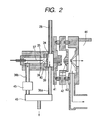
- Fig. 2 shows the ion source section of the chemical agent detector which utilizes the technique of atmospheric pressure chemical ionization mass spectrometry.
- a gas introduced through the introduction pipeline 28 is once introduced into an ion drift section 34.
- This ion drift section 34 is in an approximately atmospheric pressure condition.
- a part of the gas introduced into the ion drift section 34 is introduced into a corona discharge section 35 and the remainder is discharged out of the ion source via an exhaust pipeline 36a.
- the gas introduced into the corona discharge section 35 is introduced into a corona discharge region 38 formed in the vicinity of the extreme end of a needle electrode 37 by application of a high voltage to the needle electrode 37 and is ionized.
- a gas is introduced into the corona discharge region 38 in the direction approximately opposing the current of drifting ions from the needle electrode toward a counter electrode 39.
- the ions formed are introduced into the ion drift section 34 through the opening 40 of a counter electrode 39 under the influence of an electric field. On this occasion, it is possible to drift the ions and efficiently introduce them into a first narrow orifice 41.
- the ions introduced from the first narrow orifice 41 are introduced into a vacuum section 44 through a second narrow office 42 and a third narrow orifice 43.
- the flow rate control of the gas flowing into the corona discharge section 35 is important for high-sensitivity and stable detection.
- a flow rate controlling section 45 is preferably provided in an exhaust gas pipeline 36b.
- the ion drift section 34, corona discharge section 35 and introduction pipeline 28, among others, are preferably heated by means of heaters (not shown) or the like from the viewpoint of preventing the sample from being adsorbed thereon.
- the rates of flow of the gas passing through the introduction pipeline 28 and exhaust pipeline 36a can be determined by the capacity of a suction pump 46, for example a diaphragm pump, and the pipeline conductance, it is also possible to provide a control device such as a flow rate controller 45 in the introduction pipeline 28 and/or exhaust pipeline 36a.
- Fig. 3 is a figure showing the apparatus constitution of the mass spectrometry section of the chemical agent detector. It shows an example of the use of a quadrupole ion trap mass spectrometer (hereinafter referred to as "ion trap mass spectrometer") as the mass spectrometer.
- An ion source 47 having the structure shown in Fig. 2 is connected with an introduction pipeline 28 and exhaust pipelines 36a and 36b. Components contained in the gas introduced into the ion source are partly ionized.
- the ions formed by means of the ion source and the gas introduced into the ion source are partly taken into a vacuum section 44 evacuated by a vacuum pump 48 via the first narrow orifice 41, second narrow orifice 42 and third narrow orifice 43.
- These narrow orifices have a diameter of about 0.3 mm and the electrodes having the narrow orifices are heated to about 100°C-300°C by heaters (not shown).
- the gas portion not introduced into the first narrow orifice is exhausted to the outside via the exhaustion pipes 36a and 36b by means of a pump.
- differential exhaustion sections 49a and 49b which are exhausted by a roughing vacuum pump 50.
- a roughing vacuum pump 50 is a rotary pump, scroll pump or mechanical booster pump, for instance.
- a voltage can be applied to the electrodes having the narrow orifices 41, 42 and 43 by a power source (not shown) so that the ion permeability of the differential exhaustion sections 49a and 49b may be improved and, at the same time, cluster ions formed by adiabatic expansion may be cleaved by collision with remaining molecules.
- a power source not shown
- a scroll pump with a pumping speed of 900 liters/minute was used as the roughing vacuum pump 50, and a turbo-molecular pump with a pumping speed of 300 liters/second as the vacuum pump 48 for evacuating the vacuum section 44.
- the roughing vacuum pump 50 also serves as a pump for exhausting the back pressure side of the turbo-molecular pump.
- the pressure between the second narrow orifice 42 and the third narrow orifice 43 is about 100 pascals. It is also possible to remove the electrode having the second narrow orifice 42 to form a differential exhaustion section constituted of two narrow orifices, namely the first narrow orifice 41 and third narrow orifice 43.
- the ions formed after passage through the third narrow orifice 43 are converged by a convergent lens 51.
- An einzel lens consisting of three electrodes, for instance, is generally used as the convergent lens 51.
- the ions further pass through a slit electrode 52.
- the structure is such that the ions that have passed through the third narrow orifice 43 are focused on the opening section of the slit electrode 52 by the convergent lens 51 and pass therethrough, while the neutral and other particles not focused collide with this slit portion and hardly enter the mass spectrometer side.
- the ions that have passed through the slit electrode 52 are deflected and focused by means of a double cylinder type deflector 55 consisting of an inner cylindrical electrode 53 and an outer cylindrical electrode 54 each having a large number of openings.
- the double cylinder type deflector 55 the deflection and focusing are realized by utilizing the electric field of the outer cylindrical electrode as spreading from the opening of the inner cylindrical electrode. This is described in detail in JP 07 (1995) -85834 .
- the ions that have passed through the double cylinder type deflector 55 are introduced into the ion trap mass spectrometer constituted of a ring electrode 56 and end gap electrodes 57a and 57b.
- a gate electrode 58 for controlling the timing of injection of the ions into the mass spectrometer.
- Flange electrodes 59a and 59b are provided for preventing quartz rings 60a and 60b, which hold the ring electrode 56 and end cap electrodes 57a and 57b, from being charged by ions arriving at the quartz rings 60a and 60b.
- Helium is fed from a helium gas feeding pipe (not shown) to the ion trap mass spectrometer inside and the pressure therein is maintained at about 0.1 pascal.
- the ion trap mass spectrometer is controlled by a mass spectrometer controlling section (not shown).
- the ions introduced into the mass spectrometer collide with the helium gas and lose their energy and are entrapped by an alternating electric field.
- the ions entrapped are discharged out of the ion trap mass spectrometer according to the m/z values of the ions and, after passage through an ion outlet lens 61, are detected by a detector 62.
- the signals detected are amplified by an amplifier 63 and then processed in a data processor 64.
- the ion trap mass spectrometer has a characteristic feature in that it entraps ions within the inside thereof (in a space surrounded by the ring electrode 56 and the end gap electrodes 57a and 57b) , so that even when the concentration of the detection target substance(s) is low and the amount of ions formed is small, the ions can be detected by prolonging the ion introduction time. Therefore, even when the sample concentration is low, ions can be concentrated at a high rate in the ion trap mass spectrometer and thus the sample pretreatment (e.g. concentration) can be very much simplified.
- a mass spectrum of DC as obtained in the chemical agent monitoring apparatus described above referring to Figs. 1-3 is shown in Fig. 4, and a mass spectrum of DA as obtained in the same manner is shown in Fig. 5.
- the positive ionization mode was used.
- a hexane solution of DC or DA was injected into the introduction pipeline 28.
- the size of injection of the reagent was about 20 ng in each case.
- DC is a chemical substance having the following structure:
- DA is a chemical substance having the following structure
- DA has a molecular weight of 264
- the signals shown in Fig. 4 and Fig. 5 were obtained instantaneously (within 1 second) and thus it was found that the DC and DA gases can be instantaneously detected upon arrival thereof at the ion source when the technique of atmospheric pressure chemical ionization mass spectrometry is used in the positive ionization mode.
- the time required for each measurement was about 2 seconds. Therefore, once an alarm threshold value is determined by obtaining data for the air at the site of measurement and determining the standard deviation ⁇ of the background, it is possible to immediately detect DC in case of leakage thereof and give an alarm. Since the DC concentration can be easily determined from the calibration curve and signal intensity, it is possible to measure the DC concentration, even when it is very low, almost on the real time basis in accordance with the present invention.
- each sample solution was injected into the introduction pipeline 28.
- each arrow indicates the timing of sample solution injection.
- the narrow orifice-forming electrodes and pipelines were maintained at a temperature of 120°C and the corona discharge current was set at 10 microamperes.
- the intensity ratio was almost constant.
- a solution of a mixture of DC and DA was prepared and injected into the introduction pipeline 28.
- a flow for estimating the DA concentration is shown in Fig. 14.
- the concentrations of DC or/and DA at very low levels can be known rapidly and exactly and, therefore, environmental leakage monitoring becomes possible in abandoned chemical weapon treatment or the like and the invention can thus contribute to the safety of workers and nearby residents, among others.
Landscapes
- Chemical & Material Sciences (AREA)
- Analytical Chemistry (AREA)
- Other Investigation Or Analysis Of Materials By Electrical Means (AREA)
Applications Claiming Priority (1)
| Application Number | Priority Date | Filing Date | Title |
|---|---|---|---|
| JP2006237892A JP2008058238A (ja) | 2006-09-01 | 2006-09-01 | ガスモニタリング装置及びガスモニタリング方法 |
Publications (1)
| Publication Number | Publication Date |
|---|---|
| EP1895566A2 true EP1895566A2 (en) | 2008-03-05 |
Family
ID=38950827
Family Applications (1)
| Application Number | Title | Priority Date | Filing Date |
|---|---|---|---|
| EP07001763A Withdrawn EP1895566A2 (en) | 2006-09-01 | 2007-01-26 | Gas monitoring apparatus and gas monitoring method |
Country Status (4)
| Country | Link |
|---|---|
| US (1) | US7663098B2 (enExample) |
| EP (1) | EP1895566A2 (enExample) |
| JP (1) | JP2008058238A (enExample) |
| CN (1) | CN101135668A (enExample) |
Cited By (1)
| Publication number | Priority date | Publication date | Assignee | Title |
|---|---|---|---|---|
| CN113447611A (zh) * | 2021-05-20 | 2021-09-28 | 南京云联信息科技有限公司 | 一种基于工业互联网气体检测预警系统及装置 |
Families Citing this family (6)
| Publication number | Priority date | Publication date | Assignee | Title |
|---|---|---|---|---|
| JP4837056B2 (ja) * | 2009-02-25 | 2011-12-14 | 警察庁科学警察研究所長 | ガス分析装置 |
| CN102109491B (zh) * | 2009-12-24 | 2013-03-27 | 同方威视技术股份有限公司 | 离子迁移谱检测仪的基于离子图序列的物质识别方法 |
| US9099286B2 (en) * | 2012-12-31 | 2015-08-04 | 908 Devices Inc. | Compact mass spectrometer |
| EP2988316B1 (en) * | 2013-04-19 | 2020-10-14 | Shimadzu Corporation | Mass spectrometer |
| CN104199433A (zh) * | 2014-09-26 | 2014-12-10 | 胡景宗 | 火电厂集控辅助预警系统 |
| WO2017180933A1 (en) * | 2016-04-15 | 2017-10-19 | Yale University | System, apparatus, and method for monitoring organic compounds in a gas environment |
Family Cites Families (12)
| Publication number | Priority date | Publication date | Assignee | Title |
|---|---|---|---|---|
| JPS5166894A (en) * | 1974-09-09 | 1976-06-09 | Denki Kagaku Keiki Kk | Taikichu no tankasuisonodosokuteihoshiki |
| JPS5916665B2 (ja) * | 1977-04-23 | 1984-04-17 | 株式会社堀場製作所 | 炭化水素測定装置 |
| JPS5984467A (ja) * | 1982-11-06 | 1984-05-16 | Mitsubishi Electric Corp | モノリシツク赤外線電荷転送素子 |
| JP3876554B2 (ja) * | 1998-11-25 | 2007-01-31 | 株式会社日立製作所 | 化学物質のモニタ方法及びモニタ装置並びにそれを用いた燃焼炉 |
| US6338266B1 (en) * | 2000-04-05 | 2002-01-15 | Industrial Scientific Corporation | Method of identifying a gas and associated apparatus |
| US20020172967A1 (en) * | 2001-02-13 | 2002-11-21 | Gadek Thomas R. | Identification of non-covalent complexes by mass spectrometry |
| AU2003281805A1 (en) * | 2002-07-18 | 2004-02-23 | The Johns Hopkins University | Combined chemical/biological agent detection system and method utilizing mass spectrometry |
| US6822223B2 (en) * | 2002-08-29 | 2004-11-23 | Siemens Energy & Automation, Inc. | Method, system and device for performing quantitative analysis using an FTMS |
| JP3787116B2 (ja) * | 2002-11-06 | 2006-06-21 | 株式会社日立製作所 | 化学剤の探知方法 |
| JP4303499B2 (ja) * | 2003-03-24 | 2009-07-29 | 株式会社日立ハイテクコントロールシステムズ | 化学剤の探知装置 |
| JP2005274565A (ja) * | 2004-02-27 | 2005-10-06 | Kobelco Kaken:Kk | 大気中の有機砒素化学剤の分析方法およびその装置 |
| JP4418721B2 (ja) * | 2004-08-20 | 2010-02-24 | 株式会社堀場製作所 | 窒素化合物分析装置 |
-
2006
- 2006-09-01 JP JP2006237892A patent/JP2008058238A/ja active Pending
-
2007
- 2007-01-26 EP EP07001763A patent/EP1895566A2/en not_active Withdrawn
- 2007-02-09 US US11/704,351 patent/US7663098B2/en not_active Expired - Fee Related
- 2007-02-16 CN CN200710078911.6A patent/CN101135668A/zh active Pending
Cited By (2)
| Publication number | Priority date | Publication date | Assignee | Title |
|---|---|---|---|---|
| CN113447611A (zh) * | 2021-05-20 | 2021-09-28 | 南京云联信息科技有限公司 | 一种基于工业互联网气体检测预警系统及装置 |
| CN113447611B (zh) * | 2021-05-20 | 2024-01-26 | 南京云联信息科技有限公司 | 一种基于工业互联网气体检测预警系统及装置 |
Also Published As
| Publication number | Publication date |
|---|---|
| CN101135668A (zh) | 2008-03-05 |
| US20080054172A1 (en) | 2008-03-06 |
| US7663098B2 (en) | 2010-02-16 |
| JP2008058238A (ja) | 2008-03-13 |
Similar Documents
| Publication | Publication Date | Title |
|---|---|---|
| US7829848B2 (en) | Gas monitoring apparatus | |
| US7663098B2 (en) | Gas monitoring apparatus and gas monitoring method | |
| US6639215B2 (en) | Ion source and mass spectrometer | |
| US6838664B2 (en) | Mass spectrometer, mass spectrometry, and monitoring system | |
| Mulligan et al. | Direct monitoring of toxic compounds in air using a portable mass spectrometer | |
| US8188444B2 (en) | Analytic spectrometers with non-radioactive electron sources | |
| JP4303499B2 (ja) | 化学剤の探知装置 | |
| US7820962B2 (en) | Detection systems and dopants | |
| Wolf et al. | Direct gas-phase detection of nerve and blister warfare agents utilizing active capillary plasma ionization mass spectrometry | |
| CN107195529B (zh) | 一种基于激发态质子电子协同转移反应的离子化方法及其装置 | |
| Urabe et al. | Development of portable mass spectrometer with electron cyclotron resonance ion source for detection of chemical warfare agents in air | |
| US6943343B2 (en) | Chemical agent detection apparatus and method | |
| JP4054493B2 (ja) | イオン源 | |
| JP2001351569A (ja) | ガス測定用オンラインモニター装置 | |
| Ringer | Detection of nerve agents using proton transfer reaction mass spectrometry with ammonia as reagent gas | |
| CN210604501U (zh) | 化学气体痕量检测仪 | |
| JP4291398B2 (ja) | 質量分析装置および危険物探知装置 | |
| JP4062341B2 (ja) | イオン化質量分析計,分析方法およびそれを用いた計測システム | |
| JP4197676B2 (ja) | モニタリングシステム | |
| Hoffland et al. | Ion Mobility Spectrometry as a Field Screening Technique. | |
| JP2009047710A (ja) | 化学剤の探知方法 | |
| McLuckey et al. | Explosives detection with an ion trap mass spectrometer |
Legal Events
| Date | Code | Title | Description |
|---|---|---|---|
| PUAI | Public reference made under article 153(3) epc to a published international application that has entered the european phase |
Free format text: ORIGINAL CODE: 0009012 |
|
| AK | Designated contracting states |
Kind code of ref document: A2 Designated state(s): AT BE BG CH CY CZ DE DK EE ES FI FR GB GR HU IE IS IT LI LT LU LV MC NL PL PT RO SE SI SK TR |
|
| AX | Request for extension of the european patent |
Extension state: AL BA HR MK YU |
|
| 17P | Request for examination filed |
Effective date: 20080331 |
|
| STAA | Information on the status of an ep patent application or granted ep patent |
Free format text: STATUS: THE APPLICATION HAS BEEN WITHDRAWN |
|
| 18W | Application withdrawn |
Effective date: 20100604 |