EP1893597B1 - Ampa-rezeptoren-verstärker - Google Patents
Ampa-rezeptoren-verstärker Download PDFInfo
- Publication number
- EP1893597B1 EP1893597B1 EP06771143A EP06771143A EP1893597B1 EP 1893597 B1 EP1893597 B1 EP 1893597B1 EP 06771143 A EP06771143 A EP 06771143A EP 06771143 A EP06771143 A EP 06771143A EP 1893597 B1 EP1893597 B1 EP 1893597B1
- Authority
- EP
- European Patent Office
- Prior art keywords
- mmol
- propane
- add
- biphenyl
- thiophen
- Prior art date
- Legal status (The legal status is an assumption and is not a legal conclusion. Google has not performed a legal analysis and makes no representation as to the accuracy of the status listed.)
- Active
Links
- 0 CC1(*)C(NS(*)(=O)=O)=C(C)SC=C1 Chemical compound CC1(*)C(NS(*)(=O)=O)=C(C)SC=C1 0.000 description 1
Classifications
-
- C—CHEMISTRY; METALLURGY
- C07—ORGANIC CHEMISTRY
- C07D—HETEROCYCLIC COMPOUNDS
- C07D333/00—Heterocyclic compounds containing five-membered rings having one sulfur atom as the only ring hetero atom
- C07D333/02—Heterocyclic compounds containing five-membered rings having one sulfur atom as the only ring hetero atom not condensed with other rings
- C07D333/04—Heterocyclic compounds containing five-membered rings having one sulfur atom as the only ring hetero atom not condensed with other rings not substituted on the ring sulphur atom
- C07D333/26—Heterocyclic compounds containing five-membered rings having one sulfur atom as the only ring hetero atom not condensed with other rings not substituted on the ring sulphur atom with hetero atoms or with carbon atoms having three bonds to hetero atoms with at the most one bond to halogen, e.g. ester or nitrile radicals, directly attached to ring carbon atoms
-
- C—CHEMISTRY; METALLURGY
- C07—ORGANIC CHEMISTRY
- C07C—ACYCLIC OR CARBOCYCLIC COMPOUNDS
- C07C311/00—Amides of sulfonic acids, i.e. compounds having singly-bound oxygen atoms of sulfo groups replaced by nitrogen atoms, not being part of nitro or nitroso groups
- C07C311/01—Sulfonamides having sulfur atoms of sulfonamide groups bound to acyclic carbon atoms
- C07C311/02—Sulfonamides having sulfur atoms of sulfonamide groups bound to acyclic carbon atoms of an acyclic saturated carbon skeleton
- C07C311/08—Sulfonamides having sulfur atoms of sulfonamide groups bound to acyclic carbon atoms of an acyclic saturated carbon skeleton having the nitrogen atom of at least one of the sulfonamide groups bound to a carbon atom of a six-membered aromatic ring
-
- A—HUMAN NECESSITIES
- A61—MEDICAL OR VETERINARY SCIENCE; HYGIENE
- A61P—SPECIFIC THERAPEUTIC ACTIVITY OF CHEMICAL COMPOUNDS OR MEDICINAL PREPARATIONS
- A61P25/00—Drugs for disorders of the nervous system
-
- A—HUMAN NECESSITIES
- A61—MEDICAL OR VETERINARY SCIENCE; HYGIENE
- A61P—SPECIFIC THERAPEUTIC ACTIVITY OF CHEMICAL COMPOUNDS OR MEDICINAL PREPARATIONS
- A61P25/00—Drugs for disorders of the nervous system
- A61P25/14—Drugs for disorders of the nervous system for treating abnormal movements, e.g. chorea, dyskinesia
- A61P25/16—Anti-Parkinson drugs
-
- A—HUMAN NECESSITIES
- A61—MEDICAL OR VETERINARY SCIENCE; HYGIENE
- A61P—SPECIFIC THERAPEUTIC ACTIVITY OF CHEMICAL COMPOUNDS OR MEDICINAL PREPARATIONS
- A61P25/00—Drugs for disorders of the nervous system
- A61P25/28—Drugs for disorders of the nervous system for treating neurodegenerative disorders of the central nervous system, e.g. nootropic agents, cognition enhancers, drugs for treating Alzheimer's disease or other forms of dementia
-
- C—CHEMISTRY; METALLURGY
- C07—ORGANIC CHEMISTRY
- C07C—ACYCLIC OR CARBOCYCLIC COMPOUNDS
- C07C323/00—Thiols, sulfides, hydropolysulfides or polysulfides substituted by halogen, oxygen or nitrogen atoms, or by sulfur atoms not being part of thio groups
- C07C323/50—Thiols, sulfides, hydropolysulfides or polysulfides substituted by halogen, oxygen or nitrogen atoms, or by sulfur atoms not being part of thio groups containing thio groups and carboxyl groups bound to the same carbon skeleton
- C07C323/62—Thiols, sulfides, hydropolysulfides or polysulfides substituted by halogen, oxygen or nitrogen atoms, or by sulfur atoms not being part of thio groups containing thio groups and carboxyl groups bound to the same carbon skeleton having the sulfur atom of at least one of the thio groups bound to a carbon atom of a six-membered aromatic ring of the carbon skeleton
- C07C323/63—Thiols, sulfides, hydropolysulfides or polysulfides substituted by halogen, oxygen or nitrogen atoms, or by sulfur atoms not being part of thio groups containing thio groups and carboxyl groups bound to the same carbon skeleton having the sulfur atom of at least one of the thio groups bound to a carbon atom of a six-membered aromatic ring of the carbon skeleton the carbon skeleton being further substituted by nitrogen atoms, not being part of nitro or nitroso groups
-
- C—CHEMISTRY; METALLURGY
- C07—ORGANIC CHEMISTRY
- C07D—HETEROCYCLIC COMPOUNDS
- C07D213/00—Heterocyclic compounds containing six-membered rings, not condensed with other rings, with one nitrogen atom as the only ring hetero atom and three or more double bonds between ring members or between ring members and non-ring members
- C07D213/02—Heterocyclic compounds containing six-membered rings, not condensed with other rings, with one nitrogen atom as the only ring hetero atom and three or more double bonds between ring members or between ring members and non-ring members having three double bonds between ring members or between ring members and non-ring members
- C07D213/04—Heterocyclic compounds containing six-membered rings, not condensed with other rings, with one nitrogen atom as the only ring hetero atom and three or more double bonds between ring members or between ring members and non-ring members having three double bonds between ring members or between ring members and non-ring members having no bond between the ring nitrogen atom and a non-ring member or having only hydrogen or carbon atoms directly attached to the ring nitrogen atom
- C07D213/60—Heterocyclic compounds containing six-membered rings, not condensed with other rings, with one nitrogen atom as the only ring hetero atom and three or more double bonds between ring members or between ring members and non-ring members having three double bonds between ring members or between ring members and non-ring members having no bond between the ring nitrogen atom and a non-ring member or having only hydrogen or carbon atoms directly attached to the ring nitrogen atom with hetero atoms or with carbon atoms having three bonds to hetero atoms with at the most one bond to halogen, e.g. ester or nitrile radicals, directly attached to ring carbon atoms
- C07D213/72—Nitrogen atoms
- C07D213/75—Amino or imino radicals, acylated by carboxylic or carbonic acids, or by sulfur or nitrogen analogues thereof, e.g. carbamates
-
- C—CHEMISTRY; METALLURGY
- C07—ORGANIC CHEMISTRY
- C07D—HETEROCYCLIC COMPOUNDS
- C07D213/00—Heterocyclic compounds containing six-membered rings, not condensed with other rings, with one nitrogen atom as the only ring hetero atom and three or more double bonds between ring members or between ring members and non-ring members
- C07D213/02—Heterocyclic compounds containing six-membered rings, not condensed with other rings, with one nitrogen atom as the only ring hetero atom and three or more double bonds between ring members or between ring members and non-ring members having three double bonds between ring members or between ring members and non-ring members
- C07D213/04—Heterocyclic compounds containing six-membered rings, not condensed with other rings, with one nitrogen atom as the only ring hetero atom and three or more double bonds between ring members or between ring members and non-ring members having three double bonds between ring members or between ring members and non-ring members having no bond between the ring nitrogen atom and a non-ring member or having only hydrogen or carbon atoms directly attached to the ring nitrogen atom
- C07D213/60—Heterocyclic compounds containing six-membered rings, not condensed with other rings, with one nitrogen atom as the only ring hetero atom and three or more double bonds between ring members or between ring members and non-ring members having three double bonds between ring members or between ring members and non-ring members having no bond between the ring nitrogen atom and a non-ring member or having only hydrogen or carbon atoms directly attached to the ring nitrogen atom with hetero atoms or with carbon atoms having three bonds to hetero atoms with at the most one bond to halogen, e.g. ester or nitrile radicals, directly attached to ring carbon atoms
- C07D213/72—Nitrogen atoms
- C07D213/76—Nitrogen atoms to which a second hetero atom is attached
-
- C—CHEMISTRY; METALLURGY
- C07—ORGANIC CHEMISTRY
- C07D—HETEROCYCLIC COMPOUNDS
- C07D231/00—Heterocyclic compounds containing 1,2-diazole or hydrogenated 1,2-diazole rings
- C07D231/02—Heterocyclic compounds containing 1,2-diazole or hydrogenated 1,2-diazole rings not condensed with other rings
- C07D231/10—Heterocyclic compounds containing 1,2-diazole or hydrogenated 1,2-diazole rings not condensed with other rings having two or three double bonds between ring members or between ring members and non-ring members
- C07D231/14—Heterocyclic compounds containing 1,2-diazole or hydrogenated 1,2-diazole rings not condensed with other rings having two or three double bonds between ring members or between ring members and non-ring members with hetero atoms or with carbon atoms having three bonds to hetero atoms with at the most one bond to halogen, e.g. ester or nitrile radicals, directly attached to ring carbon atoms
- C07D231/38—Nitrogen atoms
-
- C—CHEMISTRY; METALLURGY
- C07—ORGANIC CHEMISTRY
- C07D—HETEROCYCLIC COMPOUNDS
- C07D237/00—Heterocyclic compounds containing 1,2-diazine or hydrogenated 1,2-diazine rings
- C07D237/02—Heterocyclic compounds containing 1,2-diazine or hydrogenated 1,2-diazine rings not condensed with other rings
- C07D237/04—Heterocyclic compounds containing 1,2-diazine or hydrogenated 1,2-diazine rings not condensed with other rings having less than three double bonds between ring members or between ring members and non-ring members
-
- C—CHEMISTRY; METALLURGY
- C07—ORGANIC CHEMISTRY
- C07D—HETEROCYCLIC COMPOUNDS
- C07D257/00—Heterocyclic compounds containing rings having four nitrogen atoms as the only ring hetero atoms
- C07D257/02—Heterocyclic compounds containing rings having four nitrogen atoms as the only ring hetero atoms not condensed with other rings
- C07D257/04—Five-membered rings
-
- C—CHEMISTRY; METALLURGY
- C07—ORGANIC CHEMISTRY
- C07D—HETEROCYCLIC COMPOUNDS
- C07D333/00—Heterocyclic compounds containing five-membered rings having one sulfur atom as the only ring hetero atom
- C07D333/02—Heterocyclic compounds containing five-membered rings having one sulfur atom as the only ring hetero atom not condensed with other rings
- C07D333/04—Heterocyclic compounds containing five-membered rings having one sulfur atom as the only ring hetero atom not condensed with other rings not substituted on the ring sulphur atom
- C07D333/26—Heterocyclic compounds containing five-membered rings having one sulfur atom as the only ring hetero atom not condensed with other rings not substituted on the ring sulphur atom with hetero atoms or with carbon atoms having three bonds to hetero atoms with at the most one bond to halogen, e.g. ester or nitrile radicals, directly attached to ring carbon atoms
- C07D333/30—Hetero atoms other than halogen
- C07D333/36—Nitrogen atoms
-
- C—CHEMISTRY; METALLURGY
- C07—ORGANIC CHEMISTRY
- C07D—HETEROCYCLIC COMPOUNDS
- C07D409/00—Heterocyclic compounds containing two or more hetero rings, at least one ring having sulfur atoms as the only ring hetero atoms
- C07D409/02—Heterocyclic compounds containing two or more hetero rings, at least one ring having sulfur atoms as the only ring hetero atoms containing two hetero rings
- C07D409/10—Heterocyclic compounds containing two or more hetero rings, at least one ring having sulfur atoms as the only ring hetero atoms containing two hetero rings linked by a carbon chain containing aromatic rings
Definitions
- Glutamate is the major excitatory neurotransmitter in the central nervous system.
- Three glutamate receptor ion channel subtypes have been identified based on their sensitivity to the selective activators (agonists) N-methyl-D-aspartate (NMDA), ⁇ -amino-3-hydroxy-5-methyl-4-isoxazole propionic acid (AMPA), and kainate.
- NMDA N-methyl-D-aspartate
- AMPA ⁇ -amino-3-hydroxy-5-methyl-4-isoxazole propionic acid
- kainate the selective activators
- AMPA receptors mediate cellular responses to glutamate by direct and indirect mechanisms.
- AMPA receptor ion channels allow sodium ions (Na + ) and calcium ions (Ca 2+ ) to pass directly through the channel pore.
- AMPA receptor ion channels can facilitate the activation of NMDA receptors by initiating cellular depolarization that relieves magnesium ion (Mg 2+ )-dependent block of NMDA receptors.
- AMPA receptor subtypes have been identified and cloned: GluR1, GluR2, GluR3, and GluR4 as disclosed by Hollmann and Heinemann, Ann. Rev. Neurosci., 17, 31-108 (1994 ). Each subunit consists of a sequence of approximately 900 amino acids. Four subunits are thought to assemble to form a tetrameric ion channel complex with the functional properties of this ion channel most likely being determined by its subunit composition.
- Ion channel currents activated by glutamate via AMPA receptors are transient.
- the time course of currents is modified by refractory states caused during glutamate binding which is referred to as desensitization and by the rate of glutamate removal from the ion channel binding site which results in deactivation.
- Ion influx through AMPA receptors may be enhanced by compounds that either prevent desensitization or by compounds that slow deactivation rates.
- Compounds that enhance glutamate-stimulated ion influx at AMPA receptors are known as positive AMPA receptor allosteric modulators or AMPA receptor potentiators.
- One such compound, which selectively potentiates AMPA receptor function is cyclothiazide. Since AMPA receptors play a pivotal role in mediating fast excitatory transmission in the central nervous system, molecules that enhance AMPA receptor function have multiple therapeutic targets.
- AMPA receptors Compounds that allosterically potentiate AMPA receptors have been shown to enhance synaptic activity in vitro and in vivo as disclosed, for example, by I. Ito, et al., J. Physiol., 424, 533-543 (1990 ) and A. Copani, et al., Journal of Neurochemistry, 58, 1199-1204 (1992 ). Such compounds have also been shown to enhance learning and memory in rats, monkeys, and humans, and are reviewed by Gouliaev and Senning, Brain Research Reviews, 19, 180-222 (1994 ).
- sulfonamide derivatives which are useful, for example, for treating psychiatric and neurological disorders, for example cognitive disorders, Alzheimer's disease, age-related dementias, age-induced memory impairment, tardive dyskinesia, Huntington's chorea, myoclonus, Parkinson's disease, reversal of drug-induced states (such as cocaine, amphetamines, alcohol-induced states), depression, attention deficit disorder, attention deficit hyperactivity disorder, psychosis, cognitive deficits associated with psychosis, and drug-induced psychosis.
- drug-induced states such as cocaine, amphetamines, alcohol-induced states
- Chem., 43, 4354 (2000 ) further disclose biarylpropylsulfonamides which are potent potentiators of AMPA receptors.
- X. Li, et al., Neuropharmacology, 40, 1028 (2001 ) disclose antidepressant-like actions of an AMPA receptor potentiators.
- D.D. Schoepp, et al. and Tizzano, et al., Society for Neuroscience Abstracts, 26(1-2), 528.19 and 528.20, 30th Annual Meeting, New La, (November 4-9, 2000 ) disclose an orally active AMPA receptor potentiator that enhances spatial learning and memory performance in rats, and reverses both pharmacologically and age-associated learning and memory deficit in rats.
- WO 02/098847 and WO 2006/015827 disclose sulfonamide derivatives which potentiate glutamate receptors. New AMPA receptor potentiators are needed to treat these neurological disorders.
- the present invention provides compounds of Formula I: where:
- the present invention provides a compound of Formula I for use as a pharmaceutical.
- the present invention further relates to a method of potentiating glutamate receptor function in a patient, which comprises administering to said patient in need of such treatment an effective amount of a compound of Formula I or a pharmaceutically acceptable salt thereof.
- the present invention further relates to a method of treating schizophrenia, cognitive deficits associated with schizophrenia, Alzheimer's disease, dementia of the Alzheimer's type, mild cognitive impairment, Parkinson's disease, or depression in a patient, which comprises administering to a patient in need of such treatment an effective amount of a compound of Formula I or a pharmaceutically acceptable salt thereof.
- the present invention provides the use of a compound of Formula I, or a pharmaceutically acceptable salt thereof, for the manufacture of a medicament for treating schizophrenia, cognitive deficits associated with schizophrenia, Alzheimer's disease, dementia of the Alzheimer's type, mild cognitive impairment, Parkinson's disease, or depression.
- the present invention provides the use of a compound of Formula I, or a pharmaceutically acceptable salt thereof, for treating schizophrenia, cognitive deficits associated with schizophrenia, Alzheimer's disease, dementia of the Alzheimer's type, mild cognitive impairment, Parkinson's disease, or depression.
- the invention further provides pharmaceutical compositions comprising, a compound of Formula I, or a pharmaceutically acceptable salt thereof, and a pharmaceutically acceptable carrier, diluent, or excipient.
- WO 2005/040110 teaches the use of compounds that potentiate glutamate receptor function in conjunction with antipsychotics, antidepressants and drugs useful in treating cognitive disorder.
- glutamate receptor function refers to any increased responsiveness of glutamate receptors, for example AMPA receptors, to glutamate or an agonist, and includes but is not limited to inhibition of rapid desensitization or deactivation of AMPA receptors to glutamate.
- a wide variety of conditions may be treated or prevented by compounds of Formula I and their pharmaceutically acceptable salts through their action as potentiators of glutamate receptor function.
- Such conditions include those associated with glutamate hypofunction, such as psychiatric and neurological disorders, for example cognitive disorders and neuro-degenerative disorders such as Alzheimer's disease; dementia of the Alzheimer's type, age-related dementias; age-induced memory impairment; cognitive deficits due to autism, Down's syndrome and other central nervous system disorders with childhood onset, cognitive deficits post electroconvulsive therapy, movement disorders such as tardive dyskinesia, Huntington's chorea, myoclonus, dystonia, spasticity, Parkinson's disease; reversal of drug-induced states (such as cocaine, amphetamines, alcohol-induced states); depression; attention deficit disorder; attention deficit hyperactivity disorder; psychosis such as schizophrenia; cognitive deficits associated with psychosis such as schizophrenia, drug-induced psychosis, stroke, and sexual dysfunction.
- Compounds of Formula I may also be useful for improving memory
- cognition includes various "domains". These domains include short-term memory, long term memory, working memory, executive function, and attention. As used herein the term “cognitive disorder” is meant to encompass any disorder characterized by a deficit in one or more of the cognitive domains, including but not limited to short term memory, long term memory, working memory, executive function, and attention.
- cognitive disorder includes, but is not limited to the following specific disorders: age-related cognitive decline, mild cognitive impairment, Alzheimer's disease, dementia, dementia of the Alzheimer's type, Parkinson's dementia, Lewy Body dementia, substance-induced persisting dementia, alcohol-induced persisting dementia, alcohol-induced cognitive impairment, AIDS-induced dementia, learning disorders, cognitive deficits subsequent to cardiac bypass surgery and grafting, stroke, cerebral ischemia, spinal cord trauma, head trauma, perinatal hypoxia, cardiac arrest, and hypoglycemic neuronal damage, vascular dementia, multi-infarct dementia, cognitive deficits associated with amylotrophic lateral sclerosis, and cognitive deficits associated with multiple sclerosis.
- Mild cognitive impairment has been defined as a potential prodromal phase of dementia associated with Alzheimer's disease based on clinical presentation and on progression of patients exhibiting mild cognitive impairment to Alzheimer's dementia over time. ( Morris, et al., Arch. Neurol., 58, 397-405 (2001 ); Petersen, et al., Arch. Neurol., 56, 303-308 (1999 )).
- DSM-IV Diagnostic and Statistical Manual of Mental Disorders (1994, American Psychiatric Association, Washington, D.C .) provides a diagnostic tool for identifying many of the disorders described herein.
- the skilled artisan will recognize that there are alternative nomenclatures, nosologies, and classification systems for disorders described herein, including those as described in the International Statistical Classification of Diseases and Related Health Problems, tenth revision (ICD-10) (1992, World Health Organization, Geneva ) and that terminology and classification systems evolve with medical scientific progress.
- the present invention includes the pharmaceutically acceptable salts of the compounds defined by Formula I.
- a compound of this invention can possess a sufficiently acidic group, and accordingly react with any of a number of organic and inorganic bases to form a pharmaceutically acceptable salt.
- pharmaceutically acceptable salt refers to salts of the compounds of Formula I which are substantially non-toxic to living organisms.
- Typical pharmaceutically acceptable salts include those salts prepared by reaction of the compounds of the present invention with a pharmaceutically acceptable organic or inorganic base. Such salts are known as base addition salts.
- Such salts include the pharmaceutically acceptable salts listed in Journal of Pharmaceutical Science, 66, 2-19 (1977 ), which are known to the skilled artisan. Magnesium, diethylamine, hemipiperazine, and tert -butylamine salts are preferred. The tert -butylamine salts are most preferred.
- Some of the compounds of the present invention have one or more chiral centers and may exist in a variety of stereoisomeric configurations. As a consequence of these chiral centers, the compounds of the present invention occur as racemates, mixtures of enantiomers and as individual enantiomers, as well as diastereomers and mixtures of diastereomers. All such racemates, enantiomers, and diastereomers are within the scope of the present invention.
- the specific stereoisomers and enantiomers of compounds of Formula I can be prepared by one of ordinary skill in the art utilizing well known techniques and processes, such as those disclosed by J.
- Halo As used herein, the terms "Halo”, “Halide” or “Hal” refers to a chlorine, bromine, iodine or fluorine atom, unless otherwise specified herein.
- C 1 -C 4 alkyl refers to a straight or branched, monovalent, saturated aliphatic chain of one to four carbon atoms and includes, but is not limited to, methyl, ethyl, propyl, isopropyl, butyl, isobutyl, and t-butyl.
- C 1 -C 4 alkyl includes within its definition the term "C 1 -C 3 alkyl”.
- C 1 -C 4 alkoxy refers to a straight or branched alkyl chain having from one to four carbon atoms attached to an oxygen atom. Typical C 1 -C 4 alkoxy groups include methoxy, ethoxy, propoxy, isopropoxy, butoxy, tert -butoxy and the like.
- C 1 -C 4 alkoxy includes within its definition the term “C 1 -C 3 alkoxy”.
- C 1 -C 4 acyl refers to a straight or branched alkyl chain having from one to three carbon atoms attached to a carbonyl group. Examples include, but are not limited to acetyl, propionyl, butyryl, 2-methylpropionyl and the like.
- C 1 -C 4 acyl includes within its definition the term “C 1 -C 3 acyl”.
- C 1 -C 4 alkylthio refers to a straight or branched alkyl chain having from one to four carbon atoms attached to an sulfur atom.
- Typical C 1 -C 4 alkylthio groups include methylthio, ethylthio, propylthio, isopropylthio, butylthio, tert -butylthio and the like.
- C 1 -C 4 alkylthio includes within its definition the term “C 1 -C 3 alkythio".
- Certain classes of compounds of Formula I are preferred AMPA potentiaters. The following paragraphs describe such preferred classes:
- Preferred embodiments of the invention include all combinations of paragraphs a) -t).
- Especially preferred compounds of Formula I are those where A is R is hydrogen; R 1 is as described in paragraph h); and R 2 is C 1 -C 4 alkyl. It is also preferred that A is R is hydrogen; R 1 is as described in paragraph h); and R 2 is isopropyl. It is particularly preferred that A is R is hydrogen; R 1 is phenyl substituted in the 2-position with C 1 -C 4 alkoxy or cyano and in the 4-position with -COOH; and R 2 is isopropyl. It is most preferred that A is R is hydrogen; R 1 is 2-cyano-4-carboxyphenyl or 2-ethoxy-4-carboxyphenyl; and R 2 is isopropyl.
- Especially preferred compounds of Formula II are those where A is R 5 is hydrogen; R 2 is C 1 -C 4 alkyl; R 6 is in the 2-position of the phenyl to which it is attached and is selected from the group consisting of cyano and C 1 -C 4 alkoxy; R 7 is in the 4-position of the phenyl ring to which it is attached and is -COOR 9 , and R 9 is C 1 -C 4 alkyl.
- R 5 is hydrogen;
- R 2 is isopropyl;
- R 6 is in the 2-position of the phenyl to which it is attached and is selected from the group consisting of cyano and C 1 -C 4 alkoxy;
- R 7 is in the 4-position of the phenyl ring to which it is attached and is -COOR 9 , and
- R 9 is C 1 -C 4 alkyl.
- R 5 is hydrogen;
- R 2 is isopropyl;
- R 6 is in the 2-position of the phenyl to which it is attached and is selected from the group consisting of cyano, methoxy, and ethoxy;
- R 7 is in the 4-position of the phenyl ring to which it is attached and is -COOR 9 , and
- R 9 is methyl or ethyl.
- the compounds of Formula I can be prepared by one of ordinary skill in the art following art recognized techniques and procedures. More specifically, compounds of Formula I can be prepared as set forth in the schemes, methods, and examples set forth below. The reagents and starting materials are readily available to one of ordinary skill in the art. All substituents, unless otherwise specified, are as previously defined.
- the compounds of Formula I where A and R 1 are as previously defined may be prepared as illustrated in the following scheme where (i) is a suitable aryl boronic acid, aryl trimethylstannyl, or aryl boronoic ester, and X is bromo, iodo, chloro, or trifluoromethane-sulfoxy.
- the compound of structure (ii) is coupled to a suitable phenyl boronic acid, suitable phenyl boronic ester, or suitable phenyl trimethylstannane (i), under Suzuki-Type or Stille -Type coupling reaction conditions well known to one of ordinary skill in the art to provide the compound of Formula I. See Suzuki, A., Journal of Organometallic Chemistry, 576, 147-168 (1999 ), and Miyaura and Suzuki, Chemical Reviews, 95, 2457-2483 (1995 ) for examples of general cross-coupling techniques and for methods for preparing suitable starting materials and reagents.
- the compound of structure (ii) is combined with about 1.0 to 1.5 equivalents of the suitable phenyl boronic acid or ester (i) in a suitable organic solvent or a suitable mixture of solvents.
- suitable organic solvents include 1,4-dioxane, dimethoxyethane (DME), DMF, benzene, toluene, acetone, ethanol (EtOH), and the like.
- suitable solvent mixtures include DME/EtOH, THF:Water, and the like.
- a suitable catalyst such as tetrakis(triphenylphosphine)palladium, dichlorobis(triphenylphosphine)-palladium (II), Pd(PCy 3 ) 2 Cl 2 , or [1,1-bis(diphenylphospino)ferrocene] dichloro-palladium(II) or palladium black and a suitable base, for example sodium carbonate, are added to the reaction mixture with stirring.
- a suitable base for example sodium carbonate
- compounds of Formula (I) may also be prepared by coupling a suitable aryl halide with a suitable aryl boronic acid, suitable aryl boronic ester, or suitable aryl trimethylstannyl compound under Suzuki-Type or Stille -Type coupling reaction conditions well known to one of ordinary skill in the art to provide the compound of Formula (I).
- boronic acids and esters can be prepared as illustrated in the following scheme where A is as previously defined, and Hal is bromo or iodo.
- the resulting triflate is dissolved in a suitable solvent such as acetonitrile or dimethylsulfoxide and reacted in the presence of a base such as triethylamine or potassium acetate, catalyst such as [1,1'-bis(disphenylphosphino)-ferrocene]dichloropalladium(II) complex, and a borane such as bis(pinacolato)borane to form the requisite boronic ester (ia).
- a base such as triethylamine or potassium acetate
- catalyst such as [1,1'-bis(disphenylphosphino)-ferrocene]dichloropalladium(II) complex
- a borane such as bis(pinacolato)borane to form the requisite boronic ester (ia).
- PdCl 2 (dppf) and the base potassium acetate in dimethylformamide may be employed if necessary or desired.
- the boronic acid ester may also be prepared by reacting the phenyl halide (v) in an appropriate solvent such as acetonitrile or dimethylsulfoxide and a base such as triethylamine or potassium acetate is added.
- a catalyst such as [1,1'-bis(disphenylphosphino)-ferrocene]dichloropalladium(II) complex and a borane such as bis(pinacolato)borane are added.
- the resultant borate ester can be hydrolyzed under conditions well known in the art, with an acid such as hydrochloride acid or in a suitable solvent such as acetone and in the presence of an oxidizing agent such as sodium periodate and an ammonium acetate solution to provide the boronic acid (ib).
- an acid such as hydrochloride acid or in a suitable solvent such as acetone
- an oxidizing agent such as sodium periodate and an ammonium acetate solution to provide the boronic acid (ib).
- the aniline (vi) is reacted with a suitable oxidizing reagent, such as isoamyl nitrite in a suitable solvent, such as acetonitrile, in the presence of a source of halide, such as diiodomethane, to provide compounds of formula (v).
- a suitable oxidizing reagent such as isoamyl nitrite in a suitable solvent, such as acetonitrile
- a source of halide such as diiodomethane
- Certain compounds of Formula I may be serve as intermediates to further compounds of Formula I via reactions and functional group transformations familiar to those skilled in the art. See Larock, R., "Comprehensive Organic Transformations," VCH Publishing, Inc., New York, 1989 .
- an amino group is reacted with a suitable sulfonyl chloride in the presence of pyridine or aqueous base, such as triethylamine, under conditions well known in the art to provide the corresponding sulfonamide.
- nitro substitutents are readily converted to amines by reacting the nitro-containing compound with a suitable reducing agent, such as tin chloride, in an appropriate solvent, for example, ethanol.
- carboxylic esters of Formula II are converted to carboxylic acids of Formula I under conditions well known to the skilled artisan, for example by treating an ester of Formula II in a suitable solvent or solvent mixture such as THF, methanol, ethanol, and the like with water and a slight excess of suitable base, such as lithium hydroxide, sodium hydroxide, potassium hydroxide and the like.
- suitable solvent or solvent mixture such as THF, methanol, ethanol, and the like
- suitable base such as lithium hydroxide, sodium hydroxide, potassium hydroxide and the like.
- the resultant carboxylic acid can then be converted to the primary amide under well known conditions.
- the carboxylic acid compound of Formula I is dissolved in a suitable organic solvent, such as methylene chloride or THF and treated with oxalyl chloride optionally followed by addition of a catalytic amount of DMF with stirring.
- a suitable organic solvent such as methylene chloride or THF
- Primary amide compounds of Formula I can be converted to tetrazolyl compounds of Formula I under standard conditions.
- the primary amide compound of Formula I is reacted with silicon tetrachloride and sodium azide in the presence of a suitable organic solvent, such as acetonitrile.
- tetrazolyl compounds Formula I are formed by reacting a cyano compound of Formula I with sodium azide and triethylamine in a suitable organic solvent.
- the resultant ester may be hydrolyzed in the following manner: Mix 2-ethoxy-4'-[3-(propane-2-sulfonylamino)-thiophen-2-yl]-biphenyl-4-carboxylic acid ethyl ester (38 g, 80 mmol), in ethanol (100 mL) and NaOH 2 M in water (400 mL) and stir the reaction mixture for one hour at RT. Evaporate the ethanol and wash the aqueous mixture with 200 mL of EtOAc. Acidify the aqueous mixture to pH 2 using HCl 1N. Extract the desired product with EtOAc.
- Propane-2-sulfonic acid (2- ⁇ 2',2'-bis-[(propane-2-sulfonylamino)-methyl]-biphenyl-4-yl ⁇ -thiophen-3-yl)-amide
- propane-2-sulfonic acid (2- ⁇ 2'-[(propane-2-sulfonylamino)-methyl]-biphenyl-4-yl ⁇ -thiophen-3-yl)-amide
- DBU 1,8-diazabicyclo [5.4.0] undec-7-ene
- a master plate is prepared with 250 ⁇ L of the free acid of the subject compound in methanol (0.1 M) added to all wells set in a 96 well format.
- An array of bases is dispensed to each well in one and two molar equivalents.
- the solvents are evaporated from all 96 wells using a Genevac Series II evaporator leaving solid residue in the master plate.
- An array of solvents is dispensed to each one of these wells through a cap mat and then heated to 55°C with stirring and allowed to equilibrate for 60 - 90 minutes at about 55°C. Each sample is then filtered hot and transferred to corresponding wells in an evaporation plate, a precipitation plate, and a cooling plate.
- the evaporation plate is prepared by transferring 200 ⁇ L of the filtrate from the master plate using 55°C heated syringes to the open well titer plate and is then allowed to evaporate to dryness over night at room temperature and ambient humidity.
- the precipitation plate is prepared by adding 100 ⁇ L of the filtrate from the master plate using 55°C heated syringes to capped 96 well titer plate where each well contains an anti-solvent of 200 ⁇ L of heptane or 2-propanol. After equilibrating for a period of nine hours at room temperature, the excess solution is wicked away using pre-cut Whatman filter paper.
- the cooling plate is prepared by transferring 200 ⁇ L of the filtrate from the master plate to individual wells using 55°C heated syringes in a capped titer plate, and cooling exponentially from 55 to 10°C over a period of 8 hours.
- Photomicrographs are collected on the material at the bottom of each well in the 96 well plates using a Zeiss Axiovert 200M inverted incident-light microscope with a 2.5X objective. If the material is crystalline, it exhibits birefringence that is displayed as white against a dark background. Amorphous solids appear dark or as opaque droplets or rings.
- HEK293 cells stably expressing human iGluR4 (obtained as described in European Patent Application Publication No. EP-A1-0583917 ) are used in the electrophysiological characterization of AMPA receptor potentiators.
- recording pipettes have a resistance of 2-3 M ⁇ .
- Using the whole-cell voltage clamp technique Hamill et al.(1981)Pflügers Arch., 391: 85-100 ), cells are voltage-clamped at -60mV and control current responses to 1 mM glutamate are evoked.
- the concentration of the test compound, both in the bathing solution and co-applied with glutamate is increased in half log units until the maximum effect was seen. Data collected in this manner are fit to the Hill equation, yielding an EC 50 value, indicative of the potency of the test compound.
- Reversibility of test compound activity is determined by assessing control glutamate 1mM responses. Once the control responses to the glutamate challenge are re-established, the potentiation of these responses by 100 ⁇ M cyclothiazide is determined by its inclusion in both the bathing solution and the glutamate-containing solution. In this manner, the efficacy of the test compound relative to that of cyclothiazide can be determined.
- compositions of the present invention are prepared by known procedures using well-known and readily available ingredients.
- the active ingredient will usually be mixed with a carrier, or diluted by a carrier, or enclosed within a carrier, and may be in the form of a capsule, sachet, paper, or other container.
- the carrier serves as a diluent, it may be a solid, semi-solid, or liquid material which acts as a vehicle, excipient, or medium for the active ingredient.
- compositions can be in the form of tablets, pills, powders, lozenges, sachets, cachets, elixirs, suspensions, emulsions, solutions, syrups, aerosols, ointments containing, for example, up to 10% by weight of active compound, soft and hard gelatin capsules, suppositories, sterile injectable solutions, and sterile packaged powders.
- Suitable carriers, excipients, and diluents include lactose, dextrose, sucrose, sorbitol, mannitol, starches, gum, acacia, calcium phosphate, alginates, tragcanth, gelatin, calcium silicate, micro-crystalline cellulose, polyvinylpyrrolidone, cellulose, water syrup, methyl cellulose, methyl and propyl hydroxybenzoates, talc, magnesium stearate, and mineral oil.
- the formulations can additionally include lubricating agents, wetting agents, emulsifying and suspending agents, preserving agents, sweetening agents, or flavoring agents.
- Compositions of the invention may be formulated so as to provide quick, sustained, or delayed release of the active ingredient after administration to the patient by employing procedures well known in the art.
- compositions are preferably formulated in a unit dosage form, each dosage containing from about 0.1 mg to about 300 mg, preferably about 0.1 mg to about 100 mg, and most preferably about 1.0 to about 100 mg of compound of Formula I.
- unit dosage form refers to a physically discrete unit suitable as unitary dosages for human subjects and other mammals, each unit containing a predetermined quantity of active material calculated to produce the desired therapeutic effect, in association with a suitable pharmaceutical carrier, diluent, or excipient.
- patient refers to a mammal, such as a mouse, guinea pig, rat, dog or human. It is understood that the preferred patient is a human.
- treating or “to treat” or “treatment” each mean to alleviate symptoms, eliminate the causation either on a temporary or permanent basis, or to prevent or slow the appearance of symptoms of the named disorder.
- the methods of this invention encompass both therapeutic and prophylactic administration.
- the term "effective amount” refers to the amount of a compound of Formula I which is effective, upon single or multiple dose administration to a patient, in treating the patient suffering from the named disorder.
- an effective amount can be readily determined by the attending diagnostician, as one skilled in the art, by the use of known techniques and by observing results obtained under analogous circumstances.
- determining the effective amount or dose a number of factors are considered by the attending diagnostician, including, but not limited to: the species of mammal; its size, age, and general health; the specific disease or disorder involved; the degree of or involvement or the severity of the disease or disorder; the response of the individual patient; the particular compound administered; the mode of administration; the bioavailability characteristics of the preparation administered; the dose regimen selected; the use of concomitant medication; and other relevant circumstances.
- the compound of Formula I can be administered by a variety of routes including oral, rectal, transdermal, subcutaneous, intravenous, intramuscular, bucal or intranasal routes.
- the compound of Formula I may be administered by continuous infusion.
- a typical daily dose will contain from about 0.005 mg/kg to about 10 mg/kg of the compound of Formula I.
- daily doses will be about 0.005 mg/kg to about 5 mg/kg, more preferably from about 0.005 mg/kg to about 2 mg/kg.
- the dosages of the drugs used in the combinations set forth herein must also, in the final analysis, be set by the physician in charge of the case, using knowledge of the drugs, the properties of the drugs in combination as determined in clinical trials, and the characteristics of the patient, including diseases other than that for which the physician is treating the patient.
- compositions contain from about 0.5% to about 50% of the compounds in total, depending on the desired doses and the type of composition to be used.
- the amount of the compounds is best defined as the effective amount, that is, the amount of each compound which provides the desired dose to the patient in need of such treatment.
- a formulation may include 1% carboxymethylcellulose sodium, 0.25% polysorbate 80 and 0.05% Dow Corning Antifoam 1510-US in purified water) through the oral route.
- a composition of 5% pharmasolve, 0.4% 1N NaOH, 94.6% Dextrose 5% in water may be used.
Landscapes
- Organic Chemistry (AREA)
- Chemical & Material Sciences (AREA)
- Health & Medical Sciences (AREA)
- Engineering & Computer Science (AREA)
- Bioinformatics & Cheminformatics (AREA)
- Biomedical Technology (AREA)
- Neurology (AREA)
- Neurosurgery (AREA)
- Life Sciences & Earth Sciences (AREA)
- Public Health (AREA)
- Medicinal Chemistry (AREA)
- Nuclear Medicine, Radiotherapy & Molecular Imaging (AREA)
- Chemical Kinetics & Catalysis (AREA)
- Pharmacology & Pharmacy (AREA)
- Veterinary Medicine (AREA)
- Animal Behavior & Ethology (AREA)
- General Health & Medical Sciences (AREA)
- General Chemical & Material Sciences (AREA)
- Psychology (AREA)
- Hospice & Palliative Care (AREA)
- Psychiatry (AREA)
- Pharmaceuticals Containing Other Organic And Inorganic Compounds (AREA)
- Preparation Of Compounds By Using Micro-Organisms (AREA)
- Saccharide Compounds (AREA)
- Organic Low-Molecular-Weight Compounds And Preparation Thereof (AREA)
- Thiazole And Isothizaole Compounds (AREA)
- Steroid Compounds (AREA)
- Medicines That Contain Protein Lipid Enzymes And Other Medicines (AREA)
Claims (10)
- Verbindung der Formel I
 A ausgewählt ist aus der Gruppe, die besteht aus
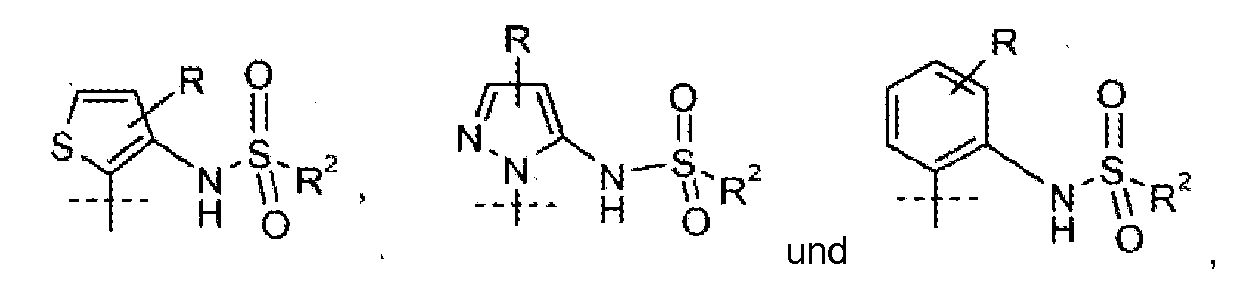 R für H, Halogen, -COOH oder -CH2COOH steht,R1 steht für Phenyl, das optional substituiert ist mit einem ersten Substituenten, der ausgewählt ist aus der Gruppe, die besteht aus Halogen, Cyano, C1-C4-Acyl, -COOH, -NHR3, C1-C2-Alkyl, das substituiert ist mit -NHCH3, -N(SO2(C1-C3-Alkyl))2, -COOH, -CONH2, Cyano, Hydroxy oder Tetrazol-5-yl, -OCH2COOH, -SCH2COOH, -C(O)CH2CH2COOH, -SO2NH2, Tetrazol-5-yl und 1,2,4-Triazol-1-yl, optional mit weiterer Substitution mit einem zweiten Substituenten, der ausgewählt ist aus der Gruppe, die besteht aus Halogen, Trifluormethyl, Cyano, Nitro, C1-C4-Alkoxy, Hydroxy, C1-C4-Alkyl, C1-C4-Alkylthio, -NHCH2CN, -OCH2CN, -NHSO2CH(CH3)2 und -C(O)NHR4 optional mit weiterer Substitution mit einem dritten Substituenten, der ausgewählt ist aus der Gruppe, die besteht aus Halogen und Cyano, optional mit weiterer Substitution mit einem vierten Substituenten, der ausgewählt ist aus der Gruppe, die besteht aus Halogen,R2 für C1-C4-Alkyl oder Dimethylamino steht,R3 für -SO2(C1-C3-Alkyl), C1-C4-Acyl, C1-C4-Alkyl oder Wasserstoff steht, undR4 für Wasserstoff, C1-C4-Alkyl oder -SO2(C1-C4-Alkyl) steht,oder ein pharmazeutisch akzeptables Salz hiervon.
 - Verbindung nach Anspruch 1, worin A steht für

- Verbindung nach Anspruch 2, worin R2 für Isopropyl steht.
- Verbindung 2-Cyano-4'-[3-(propan-2-sulfonylamino)-thiophen-2-yl]-biphenyl-4-carbonsäure oder ein pharmazeutisch akzeptables Salz hiervon.
- Verbindung 2-Ethoxy-4'-[3-(propan-2-sulfonylamino)-thiophen-2-yl]-biphenyl-4-carbonsäure oder ein pharmazeutisch akzeptables Salz hiervon.
- Pharmazeutische Formulierung, umfassend eine Verbindung nach einem der Ansprüche 1 bis 5 in Kombination mit einem pharmazeutisch akzeptablen Träger, Verdünnungsmittel oder Exzipient.
- Verbindung der Formel I für die Verwendung als ein Pharmazeutikum.
- Verbindung der Formel I für die Verwendung zur Behandlung von Alzheimer-Krankheit.
- Verbindung der Formel I für die Verwendung zur Behandlung von Parkinson-Krankheit.
- Verbindung der Formel IIworin
 A ausgewählt ist aus der Gruppe, die besteht aus
 R2 für C1-C4-Alkyl oder Dimethylamino steht,R5 für H, Halogen, -COOR8 oder -CH2COOR8 steht,R6 für H, Cyano, C1-C4-Alkoxy, Halogen, Hydroxy, Trifluormethyl oder Methylthio steht,R7 für -COOR9, -C(O)CH2CH2COOR9, -OCH2COOR9, -SCH2COOR9 oder C1-C2-Alkyl steht, das mit -COOR9 substituiert ist, undR8 und R9 jeweils unabhängig aus der Gruppe ausgewählt sind, die besteht aus Wasserstoff und C1-C4-Alkyl, mit der Maßgabe, dass wenigstens einer der Reste R8 und R9 etwas anderes als Wasserstoff ist,oder ein Basenadditionssalz hiervon.
Priority Applications (4)
| Application Number | Priority Date | Filing Date | Title |
|---|---|---|---|
| EP06771143A EP1893597B1 (de) | 2005-06-06 | 2006-05-25 | Ampa-rezeptoren-verstärker |
| SI200630176T SI1893597T1 (sl) | 2005-06-06 | 2006-05-25 | Ojaäśevalci ampa receptorja |
| PL06771143T PL1893597T3 (pl) | 2005-06-06 | 2006-05-25 | Związki wspomagające działanie receptora AMPA |
| CY20091100077T CY1108718T1 (el) | 2005-06-06 | 2009-01-21 | Ενισχυται υποδοχεως αμρα |
Applications Claiming Priority (5)
| Application Number | Priority Date | Filing Date | Title |
|---|---|---|---|
| EP05380117 | 2005-06-06 | ||
| EP05380187 | 2005-08-18 | ||
| US72420605P | 2005-10-06 | 2005-10-06 | |
| EP06771143A EP1893597B1 (de) | 2005-06-06 | 2006-05-25 | Ampa-rezeptoren-verstärker |
| PCT/US2006/020204 WO2006132811A2 (en) | 2005-06-06 | 2006-05-25 | Ampa receptor potentiators |
Publications (2)
| Publication Number | Publication Date |
|---|---|
| EP1893597A2 EP1893597A2 (de) | 2008-03-05 |
| EP1893597B1 true EP1893597B1 (de) | 2008-11-12 |
Family
ID=43268739
Family Applications (1)
| Application Number | Title | Priority Date | Filing Date |
|---|---|---|---|
| EP06771143A Active EP1893597B1 (de) | 2005-06-06 | 2006-05-25 | Ampa-rezeptoren-verstärker |
Country Status (16)
| Country | Link |
|---|---|
| EP (1) | EP1893597B1 (de) |
| KR (1) | KR100975995B1 (de) |
| AT (1) | ATE414073T1 (de) |
| AU (1) | AU2006255709B2 (de) |
| BR (1) | BRPI0611353A2 (de) |
| CA (1) | CA2611609C (de) |
| DK (1) | DK1893597T3 (de) |
| EA (1) | EA012310B1 (de) |
| ES (1) | ES2314932T3 (de) |
| NZ (1) | NZ562631A (de) |
| PL (1) | PL1893597T3 (de) |
| PT (1) | PT1893597E (de) |
| SI (1) | SI1893597T1 (de) |
| TN (1) | TNSN07462A1 (de) |
| TW (2) | TW201431849A (de) |
| WO (1) | WO2006132811A2 (de) |
Families Citing this family (4)
| Publication number | Priority date | Publication date | Assignee | Title |
|---|---|---|---|---|
| GB0602560D0 (en) * | 2006-02-08 | 2006-03-22 | Glaxo Group Ltd | Compounds |
| US20100035865A1 (en) * | 2007-04-03 | 2010-02-11 | Pfizer Inc | Sulfonamides and Pharmaceutical Compositions Thereof |
| WO2014121055A2 (en) * | 2013-02-04 | 2014-08-07 | Janssen Pharmaceutica Nv | Flap modulators |
| TWI644899B (zh) | 2013-02-04 | 2018-12-21 | 健生藥品公司 | Flap調節劑 |
Family Cites Families (14)
| Publication number | Priority date | Publication date | Assignee | Title |
|---|---|---|---|---|
| US5151684A (en) | 1991-04-12 | 1992-09-29 | Johnsen Edward L | Electronic inventory label and security apparatus |
| EP0811375B1 (de) * | 1995-02-21 | 2001-01-03 | Nippon Suisan Kaisha, Ltd. | Gluteminsäurerezeptor agonisten |
| US6269342B1 (en) | 1995-04-28 | 2001-07-31 | Telxon Corporation | Programmable shelf tag system |
| US6307919B1 (en) | 1998-05-29 | 2001-10-23 | Yehuda Yoked | Remote controlled electronic price tag |
| EP1436776A4 (de) | 1998-05-29 | 2004-08-25 | Tagcorp Inc | Ferngesteuertes elektronisches preisschild |
| US6753830B2 (en) | 1998-09-11 | 2004-06-22 | Visible Tech-Knowledgy, Inc. | Smart electronic label employing electronic ink |
| GB2356108A (en) | 1999-11-03 | 2001-05-09 | Motorola Israel Ltd | Anti-theft shopping tag with display |
| WO2002063602A1 (en) | 2001-02-07 | 2002-08-15 | Visible Tech-Knowledgy, Llc | Smart electronic label employing electronic ink |
| US20040157817A1 (en) * | 2001-05-30 | 2004-08-12 | Cantell Buddy Eugene | Cycloalkenylsulfonamide derivatives |
| US20030092770A1 (en) | 2002-10-23 | 2003-05-15 | Phil Skolnick | Combination therapy for treatment of depression |
| ATE430729T1 (de) * | 2003-10-08 | 2009-05-15 | Lilly Co Eli | Pyrrol- und pyrazolderivate als potentiatoren von glutamatrezeptoren |
| US7520429B2 (en) | 2004-03-31 | 2009-04-21 | United Parcel Service Of America, Inc. | Systems and methods for an electronic programmable merchandise tag |
| US20070270471A1 (en) * | 2004-08-09 | 2007-11-22 | Glaxo Group Limited | Compounds Which Potentiate Glutamate Receptor and Uses Thereof in Medicine |
| US7178727B2 (en) | 2005-01-26 | 2007-02-20 | Tagcorp, Inc. | Remote controlled separable electronic price tag |
-
2006
- 2006-05-11 TW TW103117042A patent/TW201431849A/zh unknown
- 2006-05-11 TW TW095116654A patent/TWI446908B/zh not_active IP Right Cessation
- 2006-05-25 PL PL06771143T patent/PL1893597T3/pl unknown
- 2006-05-25 SI SI200630176T patent/SI1893597T1/sl unknown
- 2006-05-25 ES ES06771143T patent/ES2314932T3/es active Active
- 2006-05-25 AT AT06771143T patent/ATE414073T1/de active
- 2006-05-25 DK DK06771143T patent/DK1893597T3/da active
- 2006-05-25 PT PT06771143T patent/PT1893597E/pt unknown
- 2006-05-25 WO PCT/US2006/020204 patent/WO2006132811A2/en not_active Ceased
- 2006-05-25 EP EP06771143A patent/EP1893597B1/de active Active
- 2006-05-25 BR BRPI0611353-2A patent/BRPI0611353A2/pt not_active IP Right Cessation
- 2006-05-25 AU AU2006255709A patent/AU2006255709B2/en not_active Ceased
- 2006-05-25 EA EA200702618A patent/EA012310B1/ru not_active IP Right Cessation
- 2006-05-25 CA CA2611609A patent/CA2611609C/en not_active Expired - Fee Related
- 2006-05-25 KR KR1020077028411A patent/KR100975995B1/ko not_active Expired - Fee Related
- 2006-05-25 NZ NZ562631A patent/NZ562631A/en not_active IP Right Cessation
-
2007
- 2007-12-05 TN TNP2007000462A patent/TNSN07462A1/en unknown
Also Published As
| Publication number | Publication date |
|---|---|
| WO2006132811A3 (en) | 2007-02-01 |
| KR100975995B1 (ko) | 2010-08-17 |
| EA012310B1 (ru) | 2009-08-28 |
| PT1893597E (pt) | 2009-01-13 |
| AU2006255709A1 (en) | 2006-12-14 |
| TW200718419A (en) | 2007-05-16 |
| WO2006132811A2 (en) | 2006-12-14 |
| TWI446908B (zh) | 2014-08-01 |
| AU2006255709B2 (en) | 2011-10-06 |
| CA2611609C (en) | 2013-09-24 |
| TNSN07462A1 (en) | 2009-03-17 |
| CA2611609A1 (en) | 2006-12-14 |
| PL1893597T3 (pl) | 2009-04-30 |
| ATE414073T1 (de) | 2008-11-15 |
| NZ562631A (en) | 2011-01-28 |
| EP1893597A2 (de) | 2008-03-05 |
| ES2314932T3 (es) | 2009-03-16 |
| KR20080024474A (ko) | 2008-03-18 |
| BRPI0611353A2 (pt) | 2010-12-07 |
| EA200702618A1 (ru) | 2008-04-28 |
| SI1893597T1 (sl) | 2009-04-30 |
| DK1893597T3 (da) | 2009-01-19 |
| TW201431849A (zh) | 2014-08-16 |
Similar Documents
| Publication | Publication Date | Title |
|---|---|---|
| CA2541458C (en) | Pyrrole and pyrazole derivatives as potentiators of glutamate receptors | |
| JP5497650B2 (ja) | Ccr10アンタゴニスト | |
| EP1706395B1 (de) | Thiophen- und furanverbindungen | |
| US7393868B2 (en) | AMPA receptor potentiators | |
| EP1893597B1 (de) | Ampa-rezeptoren-verstärker | |
| AU2007333247B2 (en) | AMPA receptor potentiators | |
| US7625932B2 (en) | Pyrrole and pyrazole derivatives as potentiators of glutamate receptors | |
| JP5014334B2 (ja) | Ampa受容体増強剤 | |
| HK1116182B (en) | Ampa receptor potentiators | |
| CN101189221B (zh) | Ampa受体增效剂 | |
| HK1121741A (en) | Ampa receptor potentiators | |
| KR100519010B1 (ko) | 히스톤 디아세틸라제 저해활성을 갖는 벤즈히드록시아미드유도체 및 그의 제조방법 |
Legal Events
| Date | Code | Title | Description |
|---|---|---|---|
| PUAI | Public reference made under article 153(3) epc to a published international application that has entered the european phase |
Free format text: ORIGINAL CODE: 0009012 |
|
| 17P | Request for examination filed |
Effective date: 20080107 |
|
| AK | Designated contracting states |
Kind code of ref document: A2 Designated state(s): AT BE BG CH CY CZ DE DK EE ES FI FR GB GR HU IE IS IT LI LT LU LV MC NL PL PT RO SE SI SK TR |
|
| AX | Request for extension of the european patent |
Extension state: AL BA HR MK YU |
|
| GRAP | Despatch of communication of intention to grant a patent |
Free format text: ORIGINAL CODE: EPIDOSNIGR1 |
|
| GRAS | Grant fee paid |
Free format text: ORIGINAL CODE: EPIDOSNIGR3 |
|
| GRAA | (expected) grant |
Free format text: ORIGINAL CODE: 0009210 |
|
| AK | Designated contracting states |
Kind code of ref document: B1 Designated state(s): AT BE BG CH CY CZ DE DK EE ES FI FR GB GR HU IE IS IT LI LT LU LV MC NL PL PT RO SE SI SK TR |
|
| AX | Request for extension of the european patent |
Extension state: AL BA HR MK YU |
|
| REG | Reference to a national code |
Ref country code: GB Ref legal event code: FG4D |
|
| REG | Reference to a national code |
Ref country code: CH Ref legal event code: NV Representative=s name: E. BLUM & CO. AG PATENT- UND MARKENANWAELTE VSP Ref country code: CH Ref legal event code: EP |
|
| REG | Reference to a national code |
Ref country code: IE Ref legal event code: FG4D |
|
| REG | Reference to a national code |
Ref country code: HK Ref legal event code: DE Ref document number: 1116182 Country of ref document: HK |
|
| REF | Corresponds to: |
Ref document number: 602006003661 Country of ref document: DE Date of ref document: 20081224 Kind code of ref document: P |
|
| REG | Reference to a national code |
Ref country code: RO Ref legal event code: EPE |
|
| REG | Reference to a national code |
Ref country code: PT Ref legal event code: SC4A Free format text: AVAILABILITY OF NATIONAL TRANSLATION Effective date: 20081231 |
|
| REG | Reference to a national code |
Ref country code: DK Ref legal event code: T3 |
|
| REG | Reference to a national code |
Ref country code: GR Ref legal event code: EP Ref document number: 20090400003 Country of ref document: GR |
|
| REG | Reference to a national code |
Ref country code: SE Ref legal event code: TRGR |
|
| REG | Reference to a national code |
Ref country code: ES Ref legal event code: FG2A Ref document number: 2314932 Country of ref document: ES Kind code of ref document: T3 |
|
| REG | Reference to a national code |
Ref country code: PL Ref legal event code: T3 |
|
| REG | Reference to a national code |
Ref country code: HU Ref legal event code: AG4A Ref document number: E004897 Country of ref document: HU |
|
| REG | Reference to a national code |
Ref country code: HK Ref legal event code: GR Ref document number: 1116182 Country of ref document: HK |
|
| PLBE | No opposition filed within time limit |
Free format text: ORIGINAL CODE: 0009261 |
|
| STAA | Information on the status of an ep patent application or granted ep patent |
Free format text: STATUS: NO OPPOSITION FILED WITHIN TIME LIMIT |
|
| 26N | No opposition filed |
Effective date: 20090813 |
|
| PGFP | Annual fee paid to national office [announced via postgrant information from national office to epo] |
Ref country code: CY Payment date: 20130524 Year of fee payment: 8 |
|
| PGFP | Annual fee paid to national office [announced via postgrant information from national office to epo] |
Ref country code: IS Payment date: 20140414 Year of fee payment: 9 |
|
| PG25 | Lapsed in a contracting state [announced via postgrant information from national office to epo] |
Ref country code: CY Free format text: LAPSE BECAUSE OF NON-PAYMENT OF DUE FEES Effective date: 20140525 |
|
| PG25 | Lapsed in a contracting state [announced via postgrant information from national office to epo] |
Ref country code: IS Free format text: LAPSE BECAUSE OF FAILURE TO SUBMIT A TRANSLATION OF THE DESCRIPTION OR TO PAY THE FEE WITHIN THE PRESCRIBED TIME-LIMIT Effective date: 20151201 |
|
| REG | Reference to a national code |
Ref country code: FR Ref legal event code: PLFP Year of fee payment: 11 |
|
| PGFP | Annual fee paid to national office [announced via postgrant information from national office to epo] |
Ref country code: NL Payment date: 20160506 Year of fee payment: 11 Ref country code: LU Payment date: 20160518 Year of fee payment: 11 |
|
| PGFP | Annual fee paid to national office [announced via postgrant information from national office to epo] |
Ref country code: CZ Payment date: 20160512 Year of fee payment: 11 Ref country code: ES Payment date: 20160513 Year of fee payment: 11 Ref country code: IE Payment date: 20160426 Year of fee payment: 11 Ref country code: CH Payment date: 20160425 Year of fee payment: 11 Ref country code: GB Payment date: 20160426 Year of fee payment: 11 Ref country code: MC Payment date: 20160427 Year of fee payment: 11 Ref country code: BG Payment date: 20160325 Year of fee payment: 11 Ref country code: DE Payment date: 20160524 Year of fee payment: 11 Ref country code: FI Payment date: 20160509 Year of fee payment: 11 Ref country code: GR Payment date: 20160426 Year of fee payment: 11 |
|
| PGFP | Annual fee paid to national office [announced via postgrant information from national office to epo] |
Ref country code: LT Payment date: 20160425 Year of fee payment: 11 Ref country code: SK Payment date: 20160428 Year of fee payment: 11 Ref country code: FR Payment date: 20160428 Year of fee payment: 11 Ref country code: PL Payment date: 20160414 Year of fee payment: 11 Ref country code: LV Payment date: 20160426 Year of fee payment: 11 Ref country code: PT Payment date: 20160427 Year of fee payment: 11 Ref country code: TR Payment date: 20160428 Year of fee payment: 11 Ref country code: SE Payment date: 20160506 Year of fee payment: 11 Ref country code: DK Payment date: 20160426 Year of fee payment: 11 Ref country code: AT Payment date: 20160426 Year of fee payment: 11 Ref country code: RO Payment date: 20160425 Year of fee payment: 11 Ref country code: SI Payment date: 20160517 Year of fee payment: 11 Ref country code: BE Payment date: 20160524 Year of fee payment: 11 Ref country code: IT Payment date: 20160518 Year of fee payment: 11 Ref country code: HU Payment date: 20160425 Year of fee payment: 11 Ref country code: EE Payment date: 20160503 Year of fee payment: 11 |
|
| PG25 | Lapsed in a contracting state [announced via postgrant information from national office to epo] |
Ref country code: LU Free format text: LAPSE BECAUSE OF NON-PAYMENT OF DUE FEES Effective date: 20170531 |
|
| REG | Reference to a national code |
Ref country code: DE Ref legal event code: R119 Ref document number: 602006003661 Country of ref document: DE |
|
| REG | Reference to a national code |
Ref country code: EE Ref legal event code: MM4A Ref document number: E002921 Country of ref document: EE Effective date: 20170531 |
|
| REG | Reference to a national code |
Ref country code: LT Ref legal event code: MM4D Effective date: 20170525 |
|
| REG | Reference to a national code |
Ref country code: CH Ref legal event code: PL |
|
| REG | Reference to a national code |
Ref country code: SE Ref legal event code: EUG Ref country code: DK Ref legal event code: EBP Effective date: 20170531 |
|
| REG | Reference to a national code |
Ref country code: NL Ref legal event code: MM Effective date: 20170601 |
|
| REG | Reference to a national code |
Ref country code: AT Ref legal event code: MM01 Ref document number: 414073 Country of ref document: AT Kind code of ref document: T Effective date: 20170525 |
|
| GBPC | Gb: european patent ceased through non-payment of renewal fee |
Effective date: 20170525 |
|
| PG25 | Lapsed in a contracting state [announced via postgrant information from national office to epo] |
Ref country code: SK Free format text: LAPSE BECAUSE OF NON-PAYMENT OF DUE FEES Effective date: 20170525 Ref country code: CZ Free format text: LAPSE BECAUSE OF NON-PAYMENT OF DUE FEES Effective date: 20170525 Ref country code: HU Free format text: LAPSE BECAUSE OF NON-PAYMENT OF DUE FEES Effective date: 20170526 Ref country code: MC Free format text: LAPSE BECAUSE OF NON-PAYMENT OF DUE FEES Effective date: 20170531 Ref country code: AT Free format text: LAPSE BECAUSE OF NON-PAYMENT OF DUE FEES Effective date: 20170525 Ref country code: RO Free format text: LAPSE BECAUSE OF NON-PAYMENT OF DUE FEES Effective date: 20170525 Ref country code: LT Free format text: LAPSE BECAUSE OF NON-PAYMENT OF DUE FEES Effective date: 20170525 Ref country code: FI Free format text: LAPSE BECAUSE OF NON-PAYMENT OF DUE FEES Effective date: 20170525 Ref country code: EE Free format text: LAPSE BECAUSE OF NON-PAYMENT OF DUE FEES Effective date: 20170531 |
|
| REG | Reference to a national code |
Ref country code: SK Ref legal event code: MM4A Ref document number: E 4922 Country of ref document: SK Effective date: 20170525 |
|
| REG | Reference to a national code |
Ref country code: IE Ref legal event code: MM4A |
|
| PG25 | Lapsed in a contracting state [announced via postgrant information from national office to epo] |
Ref country code: GR Free format text: LAPSE BECAUSE OF NON-PAYMENT OF DUE FEES Effective date: 20171206 Ref country code: CH Free format text: LAPSE BECAUSE OF NON-PAYMENT OF DUE FEES Effective date: 20170531 Ref country code: SE Free format text: LAPSE BECAUSE OF NON-PAYMENT OF DUE FEES Effective date: 20170526 Ref country code: LV Free format text: LAPSE BECAUSE OF NON-PAYMENT OF DUE FEES Effective date: 20170525 Ref country code: LI Free format text: LAPSE BECAUSE OF NON-PAYMENT OF DUE FEES Effective date: 20170531 Ref country code: SI Free format text: LAPSE BECAUSE OF NON-PAYMENT OF DUE FEES Effective date: 20170526 Ref country code: PT Free format text: LAPSE BECAUSE OF NON-PAYMENT OF DUE FEES Effective date: 20171127 |
|
| REG | Reference to a national code |
Ref country code: SI Ref legal event code: KO00 Effective date: 20180112 |
|
| REG | Reference to a national code |
Ref country code: FR Ref legal event code: ST Effective date: 20180131 |
|
| PG25 | Lapsed in a contracting state [announced via postgrant information from national office to epo] |
Ref country code: NL Free format text: LAPSE BECAUSE OF NON-PAYMENT OF DUE FEES Effective date: 20170601 Ref country code: LU Free format text: LAPSE BECAUSE OF NON-PAYMENT OF DUE FEES Effective date: 20170525 |
|
| REG | Reference to a national code |
Ref country code: BE Ref legal event code: MM Effective date: 20170531 |
|
| PG25 | Lapsed in a contracting state [announced via postgrant information from national office to epo] |
Ref country code: DK Free format text: LAPSE BECAUSE OF NON-PAYMENT OF DUE FEES Effective date: 20170531 Ref country code: GB Free format text: LAPSE BECAUSE OF NON-PAYMENT OF DUE FEES Effective date: 20170525 Ref country code: IE Free format text: LAPSE BECAUSE OF NON-PAYMENT OF DUE FEES Effective date: 20170525 Ref country code: DE Free format text: LAPSE BECAUSE OF NON-PAYMENT OF DUE FEES Effective date: 20171201 |
|
| PG25 | Lapsed in a contracting state [announced via postgrant information from national office to epo] |
Ref country code: FR Free format text: LAPSE BECAUSE OF NON-PAYMENT OF DUE FEES Effective date: 20170531 Ref country code: IT Free format text: LAPSE BECAUSE OF NON-PAYMENT OF DUE FEES Effective date: 20170525 |
|
| REG | Reference to a national code |
Ref country code: ES Ref legal event code: FD2A Effective date: 20180704 |
|
| PG25 | Lapsed in a contracting state [announced via postgrant information from national office to epo] |
Ref country code: ES Free format text: LAPSE BECAUSE OF NON-PAYMENT OF DUE FEES Effective date: 20170526 |
|
| PG25 | Lapsed in a contracting state [announced via postgrant information from national office to epo] |
Ref country code: BE Free format text: LAPSE BECAUSE OF NON-PAYMENT OF DUE FEES Effective date: 20170531 |
|
| PG25 | Lapsed in a contracting state [announced via postgrant information from national office to epo] |
Ref country code: PL Free format text: LAPSE BECAUSE OF NON-PAYMENT OF DUE FEES Effective date: 20170525 |
|
| PG25 | Lapsed in a contracting state [announced via postgrant information from national office to epo] |
Ref country code: BG Free format text: LAPSE BECAUSE OF NON-PAYMENT OF DUE FEES Effective date: 20171206 |
|
| PG25 | Lapsed in a contracting state [announced via postgrant information from national office to epo] |
Ref country code: TR Free format text: LAPSE BECAUSE OF NON-PAYMENT OF DUE FEES Effective date: 20170525 |