EP1881763B1 - Dekontaminationslösungen und deren verwendung zur denaturierung, modifikation, degradation, solubilisierung und entfernung von proteinen, nukleinsäuremolekülen und mikroorganismen - Google Patents
Dekontaminationslösungen und deren verwendung zur denaturierung, modifikation, degradation, solubilisierung und entfernung von proteinen, nukleinsäuremolekülen und mikroorganismen Download PDFInfo
- Publication number
- EP1881763B1 EP1881763B1 EP06742300A EP06742300A EP1881763B1 EP 1881763 B1 EP1881763 B1 EP 1881763B1 EP 06742300 A EP06742300 A EP 06742300A EP 06742300 A EP06742300 A EP 06742300A EP 1881763 B1 EP1881763 B1 EP 1881763B1
- Authority
- EP
- European Patent Office
- Prior art keywords
- solution according
- decontamination solution
- decontamination
- microorganisms
- dna
- Prior art date
- Legal status (The legal status is an assumption and is not a legal conclusion. Google has not performed a legal analysis and makes no representation as to the accuracy of the status listed.)
- Expired - Lifetime
Links
Images




Classifications
-
- A—HUMAN NECESSITIES
- A01—AGRICULTURE; FORESTRY; ANIMAL HUSBANDRY; HUNTING; TRAPPING; FISHING
- A01N—PRESERVATION OF BODIES OF HUMANS OR ANIMALS OR PLANTS OR PARTS THEREOF; BIOCIDES, e.g. AS DISINFECTANTS, AS PESTICIDES OR AS HERBICIDES; PEST REPELLANTS OR ATTRACTANTS; PLANT GROWTH REGULATORS
- A01N59/00—Biocides, pest repellants or attractants, or plant growth regulators containing elements or inorganic compounds
- A01N59/16—Heavy metals; Compounds thereof
-
- A—HUMAN NECESSITIES
- A01—AGRICULTURE; FORESTRY; ANIMAL HUSBANDRY; HUNTING; TRAPPING; FISHING
- A01N—PRESERVATION OF BODIES OF HUMANS OR ANIMALS OR PLANTS OR PARTS THEREOF; BIOCIDES, e.g. AS DISINFECTANTS, AS PESTICIDES OR AS HERBICIDES; PEST REPELLANTS OR ATTRACTANTS; PLANT GROWTH REGULATORS
- A01N31/00—Biocides, pest repellants or attractants, or plant growth regulators containing organic oxygen or sulfur compounds
- A01N31/02—Acyclic compounds
-
- A—HUMAN NECESSITIES
- A01—AGRICULTURE; FORESTRY; ANIMAL HUSBANDRY; HUNTING; TRAPPING; FISHING
- A01N—PRESERVATION OF BODIES OF HUMANS OR ANIMALS OR PLANTS OR PARTS THEREOF; BIOCIDES, e.g. AS DISINFECTANTS, AS PESTICIDES OR AS HERBICIDES; PEST REPELLANTS OR ATTRACTANTS; PLANT GROWTH REGULATORS
- A01N31/00—Biocides, pest repellants or attractants, or plant growth regulators containing organic oxygen or sulfur compounds
- A01N31/08—Oxygen or sulfur directly attached to an aromatic ring system
- A01N31/14—Ethers
-
- A—HUMAN NECESSITIES
- A01—AGRICULTURE; FORESTRY; ANIMAL HUSBANDRY; HUNTING; TRAPPING; FISHING
- A01N—PRESERVATION OF BODIES OF HUMANS OR ANIMALS OR PLANTS OR PARTS THEREOF; BIOCIDES, e.g. AS DISINFECTANTS, AS PESTICIDES OR AS HERBICIDES; PEST REPELLANTS OR ATTRACTANTS; PLANT GROWTH REGULATORS
- A01N43/00—Biocides, pest repellants or attractants, or plant growth regulators containing heterocyclic compounds
- A01N43/02—Biocides, pest repellants or attractants, or plant growth regulators containing heterocyclic compounds having rings with one or more oxygen or sulfur atoms as the only ring hetero atoms
- A01N43/04—Biocides, pest repellants or attractants, or plant growth regulators containing heterocyclic compounds having rings with one or more oxygen or sulfur atoms as the only ring hetero atoms with one hetero atom
- A01N43/06—Biocides, pest repellants or attractants, or plant growth regulators containing heterocyclic compounds having rings with one or more oxygen or sulfur atoms as the only ring hetero atoms with one hetero atom five-membered rings
- A01N43/08—Biocides, pest repellants or attractants, or plant growth regulators containing heterocyclic compounds having rings with one or more oxygen or sulfur atoms as the only ring hetero atoms with one hetero atom five-membered rings with oxygen as the ring hetero atom
-
- A—HUMAN NECESSITIES
- A01—AGRICULTURE; FORESTRY; ANIMAL HUSBANDRY; HUNTING; TRAPPING; FISHING
- A01N—PRESERVATION OF BODIES OF HUMANS OR ANIMALS OR PLANTS OR PARTS THEREOF; BIOCIDES, e.g. AS DISINFECTANTS, AS PESTICIDES OR AS HERBICIDES; PEST REPELLANTS OR ATTRACTANTS; PLANT GROWTH REGULATORS
- A01N43/00—Biocides, pest repellants or attractants, or plant growth regulators containing heterocyclic compounds
- A01N43/72—Biocides, pest repellants or attractants, or plant growth regulators containing heterocyclic compounds having rings with nitrogen atoms and oxygen or sulfur atoms as ring hetero atoms
- A01N43/74—Biocides, pest repellants or attractants, or plant growth regulators containing heterocyclic compounds having rings with nitrogen atoms and oxygen or sulfur atoms as ring hetero atoms five-membered rings with one nitrogen atom and either one oxygen atom or one sulfur atom in positions 1,3
- A01N43/76—1,3-Oxazoles; Hydrogenated 1,3-oxazoles
-
- A—HUMAN NECESSITIES
- A01—AGRICULTURE; FORESTRY; ANIMAL HUSBANDRY; HUNTING; TRAPPING; FISHING
- A01N—PRESERVATION OF BODIES OF HUMANS OR ANIMALS OR PLANTS OR PARTS THEREOF; BIOCIDES, e.g. AS DISINFECTANTS, AS PESTICIDES OR AS HERBICIDES; PEST REPELLANTS OR ATTRACTANTS; PLANT GROWTH REGULATORS
- A01N43/00—Biocides, pest repellants or attractants, or plant growth regulators containing heterocyclic compounds
- A01N43/72—Biocides, pest repellants or attractants, or plant growth regulators containing heterocyclic compounds having rings with nitrogen atoms and oxygen or sulfur atoms as ring hetero atoms
- A01N43/74—Biocides, pest repellants or attractants, or plant growth regulators containing heterocyclic compounds having rings with nitrogen atoms and oxygen or sulfur atoms as ring hetero atoms five-membered rings with one nitrogen atom and either one oxygen atom or one sulfur atom in positions 1,3
- A01N43/78—1,3-Thiazoles; Hydrogenated 1,3-thiazoles
-
- A—HUMAN NECESSITIES
- A01—AGRICULTURE; FORESTRY; ANIMAL HUSBANDRY; HUNTING; TRAPPING; FISHING
- A01N—PRESERVATION OF BODIES OF HUMANS OR ANIMALS OR PLANTS OR PARTS THEREOF; BIOCIDES, e.g. AS DISINFECTANTS, AS PESTICIDES OR AS HERBICIDES; PEST REPELLANTS OR ATTRACTANTS; PLANT GROWTH REGULATORS
- A01N57/00—Biocides, pest repellants or attractants, or plant growth regulators containing organic phosphorus compounds
- A01N57/10—Biocides, pest repellants or attractants, or plant growth regulators containing organic phosphorus compounds having phosphorus-to-oxygen bonds or phosphorus-to-sulfur bonds
- A01N57/16—Biocides, pest repellants or attractants, or plant growth regulators containing organic phosphorus compounds having phosphorus-to-oxygen bonds or phosphorus-to-sulfur bonds containing heterocyclic radicals
-
- A—HUMAN NECESSITIES
- A61—MEDICAL OR VETERINARY SCIENCE; HYGIENE
- A61P—SPECIFIC THERAPEUTIC ACTIVITY OF CHEMICAL COMPOUNDS OR MEDICINAL PREPARATIONS
- A61P31/00—Antiinfectives, i.e. antibiotics, antiseptics, chemotherapeutics
- A61P31/02—Local antiseptics
-
- A—HUMAN NECESSITIES
- A61—MEDICAL OR VETERINARY SCIENCE; HYGIENE
- A61P—SPECIFIC THERAPEUTIC ACTIVITY OF CHEMICAL COMPOUNDS OR MEDICINAL PREPARATIONS
- A61P43/00—Drugs for specific purposes, not provided for in groups A61P1/00-A61P41/00
Definitions
- the invention relates to a decontamination solution for the treatment of surfaces that are contaminated with unwanted proteins, nucleic acid molecules or microorganisms.
- the invention further relates to the use of this decontamination solution and a suitable buffer system.
- Microbial contamination continues to cause major problems and commercial losses in, for example, food technology, manufacturing, hospitals, sanitation and households.
- decontamination solutions with aggressive chemical substances, such as, for example, formaldehyde, alcohols, phenols, sodium azide, sodium hypochlorite against microorganisms or strongly oxidizing agents, such as hypochlorite, bleach or mineral acids, which denature proteins and make nucleic acids unmodifiable for amplification methods such as polymerase chain reaction (PCR), nick translation with Klenow polymerase, strand displacement amplification, ligase chain reaction, transcription-mediated amplification, rolling -Circle amplification and many others.
- PCR polymerase chain reaction
- nick translation with Klenow polymerase nick translation with Klenow polymerase
- strand displacement amplification ligase chain reaction
- transcription-mediated amplification rolling -Circle amplification and many others.
- the highly aggressive chemicals and oxidizing agents used for decontamination cause a permanent modification and denaturation of the proteins and destabilization of the double strand and modifications that block an amplification. In general, this results in modifications to particularly reactive groups of the molecules and oxidative damage.
- Disadvantages of these solutions and methods are each only selective activities against proteins, DNA or microorganisms and the incomplete removal of all nucleic acids, the preservation of the modified molecules, the only partial degradation and the aggressiveness of the chemicals used to devices, instruments, surfaces and also the Skin and mucous membranes of users.
- bactericide containing iron (III) ions (Fe 3+ ), L-ascorbic acid and one or more members from the group consisting of sorbic acid, benzoic acid and para-hydroxybenzoic acid ester is known.
- the bactericidal effect of this composition can be enhanced, for example, by adding a small amount of a surfactant.
- the object of the present invention is therefore to overcome the disadvantages of the prior art and to develop new methods and solutions that do not work with aggressive chemicals or strong oxidizing agents and also completely decontaminate the treated substrates.
- the mixture has a pH in the range from 3 to 7, preferably from 4 to 6.
- the solution according to the invention is stable over longer periods of time and enables a particularly effective degradation of nucleic acids.
- the skin compatibility of the solution according to the invention is optimal.
- the mixture additionally with a buffer system Carbonates and derivatives of succinic acid, preferably in each case in a concentration of 1 mM to 500 mM.
- a buffer system Carbonates and derivatives of succinic acid, preferably in each case in a concentration of 1 mM to 500 mM.
- the vitamins according to the invention or their salts or acidic derivatives one or more compounds and / or their salts selected from the group of water-soluble vitamins with the properties of antioxidants, such as preferably vitamin C, riboflavin and niacin. They are used in amounts of 10 mM to 100 mM based on the total solution.
- the metal ions according to the invention are two and / or three-valent ions of the metals of the 4th period and / or subgroups I, II and VIII of the periodic system of the elements. They are used in the form of their salts with organic and / or inorganic acids or bases.
- Preferred compounds according to the invention are one or more compounds selected from subgroup VIII, in particular iron, cobalt, nickel, copper or zinc. They are used in amounts of 1 mM to 100 mM, based on the total solution, in particular in amounts of 5 mM to 10 mM.
- the surfactants contained according to the invention can be, for example, anionic, nonionic, amphoteric or cationic inert surfactants or suitable mixtures be with each other or with each other.
- alkyl ether sulfates, alkyl and / or aryl sulfonates, alkyl sulfates, amphoteric surfactants, betaines, alkylamidoalkylamines, alkyl-substituted amino acids, alkyl-substituted imino acids, acylated amino acids, amphoteric surfactant combinations can be used.
- all inert surfactants are suitable. Inert means that they do not affect the synergistic solution or the test result.
- anionic and nonionic surfactants are available in quantities of 0.1%. to 10 wt .-%, based on the total solution, in particular in amounts of 0.2% to 0.5 wt .-%, used.
- the decontamination solutions according to the invention may additionally contain further customary inert auxiliaries and additives, for example suitable buffer substances for establishing a defined pH value, for example tris (tris (hydroxymethyl) -aminomethane), MES (2 (morpholino) ethanesulfonic acid), HEPES (2) [4- (2-hydroxyethyl) -1-piperazinyl] -ethanesulfonic acid and / or MOPS (3- (N-morpholino) propanesulfonic acid) These buffer substances are used in amounts of 1 mM to 500 mM based on the total solution.
- suitable buffer substances for establishing a defined pH value for example tris (tris (hydroxymethyl) -aminomethane), MES (2 (morpholino) ethanesulfonic acid), HEPES (2) [4- (2-hydroxyethyl) -1-piperazinyl] -ethanesulfonic acid and / or MOPS (3- (N-morpholino
- the decontamination is usually carried out by spraying or triturating the solution according to the invention on contaminated surfaces or by soaking.
- exposure time 0.5 to 2 minutes at room temperature or slightly elevated temperature is generally sufficient for complete denaturation, modification, degradation, solubilization and removal of proteins, nucleic acid molecules and microorganisms from surfaces.
- the methods used can be varied and can be adapted to the respective requirements.
- Another object of the invention is the use of the decontamination solutions according to the invention for denaturing, modification, degradation, solubilization and removal of proteins and nucleic acid molecules of surfaces.
- the novel, advantageous buffer system with carbonates and derivatives of succinic acid is particularly suitable for the decontamination solution according to the invention.
- the various mixtures with pH values between pH 2 and 8.5 each give clear, slightly yellowish to brownish solutions which are stable over longer periods of time and in particular in the range pH 4 to pH 6 bring about a very efficient degradation of the DNA molecules, such as Comparison with the mineral 0.5 M phosphoric acid of pH 1.5 in FIG. 5 shows.
- the carbonates and derivatives of succinic acid are each contained in a concentration of 1 mM to 500 mM.
- the solution with the buffer system can advantageously be adjusted to a pH in the range from 2 to 8.5, in particular from 3 to 7, preferably from 4 to 6. This ensures that the other dissolved in the solution components are not affected and beyond a skin-friendly solution can be produced.
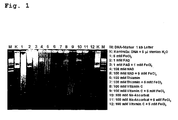
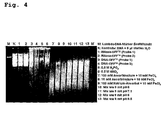
- FIGS. 1 to 5 show the efficient degradation of DNA molecules by the new three-component system compared to other known solutions.
- Identical aliquots of DNA plasmids (YEp351) were treated with the listed solutions for 2 minutes. Subsequently, the DNA samples were denatured and the single-stranded DNA molecules were gel-electrophoretically separated on an agarose gel (1%). After staining with ethidium bromide gives the listed images.
- the control shows the intact plasmid DNA after treatment with sterile water. When strand breaks are introduced, the molecular weight of the affected DNA molecules decreases. This can be determined in the gel by comparison with the control and with the molecular weight marker.
- the DNA was stained after gel electrophoresis in 1% agarose gel with ethidium bromide and photographed.
- Fig. 1 shows the comparison of nucleic acid degradation by vitamins, metal ions and a three-component system of vitamins, metal ions and detergents.
- M DNA marker 1 kb ladder
- K control: DNA + 5 ml sterile H2O
- 1 5 mM FeCl32: 1 mM FAD
- 3 1 mM FAD + 1 mM FeCl3
- 4 100 mM NAD
- 5 100 mM NAD + 5 mM FeCl3
- 6 100 mM thiamine
- 7 100 mM thiamine + 5 mM FeCl3
- 8 100 mM vitamin C
- 9 100 mM vitamin C + 5 mM FeCl3
- 10 100 mM Na ascorbate
- 12 100 mM ascorbic acid + 5 mM FeCl 3
- All samples each with 0.2% Triton-100 and 0.2% Twe
- Fig. 2 shows the test of nucleic acid degradation by combinations of vitamin C, metal ions and detergents.
- L 1kb conductor; M: lambda DNA marker EcoRI / HindIII; 1: 10 mM vitamin C; 2: 100 mM vitamin C; 3:10 mM FeCl 3 ; 4: 100 mM vitamin C + 10 mM FeCl 3 ; 5:10 mM ZnCl 2 ; 6: 100 mM vitamin C + 10 mM ZnCl 2 ; 7: DNA-OFFTM; K: control: 5 ⁇ l of sterile H 2 O). All samples each contain 0.2% TritonX-100 and 0.2% Tween 20.
- Fig. 3 shows comparison of nucleic acid degradation by mixtures with ascorbic acid or Na ascorbate.
- M lambda DNA marker Eco RI / Hind III; K: control: 5 ⁇ l sterile H2O; 1: DNA-OFF TM ; 2: 100 mM HAc + 10 mM FeCl3 + 0.2% TritonX-100; 3: 100 mM ascorbic acid + 0.2% Triton-100; 4: 100 mM Ascorbic acid + 10mM FeSO4 + 0.2% TritonX-100; 5: 100 mM ascorbic acid + ZnCl 2 + 0.2% TritonX-100; 6: 100 mM Na ascorbate + 0.2% TritonX-100; 7: 100 mM Na ascorbate + 10 mM FeCl3 + 0.2% TritonX-100; 8: 100 mM Na ascorbate + ZnCl2 + 0.2% TritonX-100).
- Fig. 4 shows comparison of nucleic acid degradation by mixtures with mineral acids, ascorbic acid or Na ascorbate (pH 6 to 8.5).
- M lambda DNA marker Eco RI / Hind III K: control: DNA + 5 ⁇ l sterile H2O; 1: RNase-OFFTM (sample 1); 2: RNase-OFFTM (sample 2); 3: DNA-OFFTM ( Sample 1); 4: DNA-OFFTM (Sample 2); 5: 0.5 M H3PO4; 6: 0.5 M HNO3; 7: 100 mM ascorbic acid + 10 mM FeCl3; 8: 10 mM ascorbic acid + 10 mM FeC13; 9: 100 mM sodium ascorbate + 10 mM FeCl3; 10: mix as 9 only at pH 6; 11: mix as 9 only at pH 7.1; 12: mix as 9 only at pH 8; 13: mix as 9 only at pH 8.5).
- Samples 5 to 13 each contain 0.2% TritonX
- Fig. 5 shows an example of a new buffer system with sodium carbonate and malic acid as compared with mineral acid.
- the masterbatch contained 50 mM ascorbic acid, 5 mM FeCl 3 and 0.2% each of TritonX-100 and 0.2% Tween 20.
- M DNA marker 1 Kb ladder
- K control: DNA + 5 ⁇ l sterile H 2 O; 1: mixture pH 10; 2: mixture pH 9; 3: mixture pH 7; 4: mixture pH 6; 5: mixture pH 4; 6: 0.5 MH 3 PO 4 (pH 1.5) with 0.2% TritonX-100 and 0.2% Tween 20.
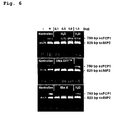
- FIG. 6 Figure 3 shows the blocking of PCR amplifiability of DNA molecules after treatment with the new three component system (Mix A: 100mM Vitamin C + 10mM FeCl 3 + 0.2% TritonX-100 and 0.2% Tween 20).
- Mat A 100mM Vitamin C + 10mM FeCl 3 + 0.2% TritonX-100 and 0.2% Tween 20.
- Various amounts (0.1 to 1 ng) of a DNA sample were dried in PCR tubes. These PCR tubes with the dried DNA were treated with the listed solutions for 20 seconds. Subsequently, the vessels were 2x with 100 ul washed with sterile distilled water. Then the tubes were filled with a 50 ⁇ l PCR reaction mix and the PCR reaction was performed.
- the PCR reaction mix contains primer pairs for the amplification of the control DNA (scIMP2 gene of the yeast) and the test DNA (scPCP1 gene of the yeast).
- the control DNA (1ng) indicates whether the PCR reaction has been successful.
- a band of test DNA indicates that intact DNA molecules are still present for this gene. Complete removal or blocking of the test DNA should not result in amplified DNA bands in the gel.
- the DNA was stained after gel electrophoresis in 1% agarose gel with ethidium bromide and photographed.
- the known DNA-OFF TM serves as a positive control.
- As a negative control sterile water (H 2 O) is used.
- Fig. 7 shows the standard test with RNaseA for the inactivation of enzymes by the new three-component system.
- Identical aliquots of 10 ⁇ g RNaseA were dried in Eppendorf tubes. These vessels were then each provided with 1 ml of listed solutions, vortexed for 20 seconds and then incubated for 5 minutes at RT. Subsequently, the vessels were washed twice with 1 ml of sterile water each time. Then 5 ⁇ g total RNA of E. coli into the tubes and incubated for 30 minutes at 37 ° C. Subsequently, the total RNA samples were provided with formamide / bromophenol blue buffer and denatured at 95 ° C for 5 minutes.
- RNA molecules were gel-electrophoretically separated in an agarose gel (1.2%). After staining with EtBr, the picture given is obtained. The untreated controls show the intact total RNA. In the presence of active RNaseA, these RNA molecules are degraded. Upon successful complete inactivation of RNaseA, total RNA molecules also remain unchanged.
- K total RNA control
- 1 RNase-OFF (A)
- 2 RNase-OFF (B)
- 3 ascorbic acid mix with 100 mM vitamin C + 10 mM FeCl 3 + 0.5 % SDS
- 4 empty
- 5 H2O
- 6 10 ⁇ g RNase A
- 7 empty
- K total RNA control
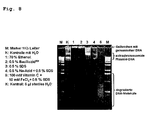
- Fig. 8 shows the efficient degradation of genomic DNA and extrachromosomal genetic material in microorganisms by the new three-component system.
- a recombinant Escherichia coli strain with an extrachromosomal plasmid (YEp351) was grown overnight in LB amp medium. 5 ⁇ l each of this E. coli suspension were treated with 5 ⁇ l of lysozyme solution (1 mg / ml) for 5 minutes and then incubated with 5 ⁇ l of the listed solutions (1-5) for a further 5 minutes. After addition of bromophenol blue, the samples were placed in the gel pockets and the DNA molecules separated by electrophoresis. Only in sample 5 with the three-component system is a massive degradation of the DNA molecules detectable.
- Table 1 shows the antimicrobial activity test of the new three-component system.
- Fresh cultures of the indicated microorganisms were adjusted to a cell count of 10 6 in 50 ⁇ l and then each with 50 ⁇ l of water, 70% ethanol or the three-component system (100 mM ascorbic acid, 10 mM FeCl 3 and 0.5% SDS) in the ratio 1: 1 mixed. After an incubation period of 2 minutes, the 100 ⁇ l batches with the bacteria were plated out on appropriate growth plates. After incubation of 1 - For 3 days at 28 ° C ( Saccharomyces cerevisiae and Candida parapsilosis ) or 37 ° C ( Escherichia coli and Bacillus subtilis ), the number of colonies grown was determined. In the sterile water runs, all microorganisms survived. The 70% ethanol or three-component systems showed no colony growth, indicating that in these cases all microorganisms were killed.
- Table 2 shows the preferred compositions of the three-component surface active agent solution, vitamins and metal ions for the removal of DNA molecules from surfaces and devices.
Landscapes
- Life Sciences & Earth Sciences (AREA)
- Health & Medical Sciences (AREA)
- General Health & Medical Sciences (AREA)
- Engineering & Computer Science (AREA)
- Dentistry (AREA)
- Wood Science & Technology (AREA)
- Zoology (AREA)
- Environmental Sciences (AREA)
- Pest Control & Pesticides (AREA)
- Plant Pathology (AREA)
- Agronomy & Crop Science (AREA)
- Chemical & Material Sciences (AREA)
- Inorganic Chemistry (AREA)
- General Chemical & Material Sciences (AREA)
- Public Health (AREA)
- Chemical Kinetics & Catalysis (AREA)
- Veterinary Medicine (AREA)
- Medicinal Chemistry (AREA)
- Nuclear Medicine, Radiotherapy & Molecular Imaging (AREA)
- Organic Chemistry (AREA)
- Pharmacology & Pharmacy (AREA)
- Animal Behavior & Ethology (AREA)
- Bioinformatics & Cheminformatics (AREA)
- Communicable Diseases (AREA)
- Oncology (AREA)
- Detergent Compositions (AREA)
- Micro-Organisms Or Cultivation Processes Thereof (AREA)
- Processing Of Solid Wastes (AREA)
- Medicinal Preparation (AREA)
- Medicines That Contain Protein Lipid Enzymes And Other Medicines (AREA)
- Pharmaceuticals Containing Other Organic And Inorganic Compounds (AREA)
- Apparatus For Disinfection Or Sterilisation (AREA)
- Measuring Or Testing Involving Enzymes Or Micro-Organisms (AREA)
- Separation Using Semi-Permeable Membranes (AREA)
- Floor Finish (AREA)
Description
- Die Erfindung betrifft eine Dekontaminationslösung zur Behandlung von Oberflächen, die mit unerwünschten Proteinen, Nukleinsäure-Molekülen oder Mikroorganismen kontaminiert sind. Die Erfindung betrifft ferner die Verwendung dieser Dekontaminationslösung und ein dafür geeignetes Puffersystem.
- Durch die stürmischen Entwicklungen der Molekularbiologie werden Arbeitstechniken zum Nachweis und zur Amplifikation von DNA-Molekülen oder Proteinen immer wichtiger [Sambrook, J. et al., eds (1989) Molecular Cloning: A Laboratory Manual, 2nd Led., Cold Spring Harbor Laboratory Press, Cold Spring Harbor, NY.]. Aktuelle Beispiele betreffen z.B. die medizinische Diagnostik, forensische Nachweisverfahren und biomedizinische Forschungen.
- Mit der Entdeckung der Polymerase-Ketten-Reaktion (PCR) sind sogar Einzelmolekülnachweise möglich. Ein neues Problem dieser extremen Verfeinerung der Nachweismethoden ist die Kontamination von Oberflächen in Laboren, an Geräten oder Arbeitsmaterialien mit unerwünschten Nukleinsäuremolekülen, Proteinen oder Mikroorganismen.
- Mikrobielle Kontaminationen verursachen weiterhin große Probleme und kommerzielle Verluste zum Beispiel im Bereich der Lebensmitteltechnologie, in der Produktion, in Krankenhäuser, Hygieneinstituten und auch im Haushalt.
- Schon länger gibt es daher verschiedenste Dekontaminationslösungen mit aggressiven chemischen Substanzen wie z.B. Formaldehyd, Alkoholen, Phenolen, Natriumazid, Natriummhypochlorid gegen Mikroorganismen oder stark oxidierenden Agenzien, wie z.B. Hypochlorid, Bleichmitteln oder mineralischen Säuren, die Proteine denaturieren und Nukleinsäuren modifizieren und unamplifizierbar machen für Amplifizierungsmethoden wie z.B. Polymerase-Kettenreaktion (PCR), Nicktranslation mit Klenow-Polymerase, Strangverdrängungs-Amplifikation, Ligase-Kettenreaktion, transkriptionsvermittelte Amplifikation, Rolling-Circle-Amplifikation und viele andere mehr.
- Die zur Dekontamination verwendeten stark aggressiven Chemikalien und oxidierenden Agenzien verursachen dabei eine permanente Modifizierung und Denaturierung der Proteine und Destabilisierung des Doppelstranges und Modifikationen die eine Amplifikation blockieren. Im Allgemeinen ergeben sich dabei Modifikationen an besonders reaktiven Gruppen der Moleküle und oxidative Schädigungen.
- Deshalb werden allgemein solche aggressiven chemischen Lösungen zur Waschung und Spülung von Geräten, Instrumenten und Arbeitsoberflächen verwendet.
- Nachteile dieser Lösungen und Methoden sind dabei die jeweils nur selektiven Wirksamkeiten gegen Proteine, DNA oder Mikroorganismen und die unvollständige Entfernung aller Nukleinsäuren, der Erhalt der modifizierten Moleküle, der nur teilweise Abbau und die Aggressivität der verwendeten Chemikalien gegenüber Geräten, Instrumenten, Oberflächen und auch der Haut und Schleimhäute der Anwender.
- Eine graduelle Verbesserung der Effizienz dieser Methode brachte die Kombination der Lösungen mit oberflächenaktiven Substanzen. Aber auch hierbei bleiben die aggressiven chemischen Substanzen und die unvollständige Zerstörung und Entfernung der Nukleinsäuren, Proteine und Mikroorganismen problematisch.
- Das kommerzielle Interesse an solchen Lösungen unterstreicht der bereits breite kommerzielle Vertrieb von entsprechenden DNA- und Protein-Dekontaminations-Lösungen und antimikrobiellen Mitteln unter den verschiedensten Markennamen.
- Aus der
DE-A-19 936 428 ist beispielsweise ein Bakterizid bekannt, dass Eisen(III)-Ionen (Fe3+), L-Ascorbinsäure und ein oder mehrere Mitglieder aus der Gruppe bestehend aus Sorbinsäure, Benzoesäure und para-Hydroxybenzoesäureester enthält. Die bakterizide Wirkung dieser Zusammensetzung kann beispielsweise durch Zugabe einer kleinen Menge eines grenzflächenaktiven Mittels verstärkt werden. - Die Nachteile dieser bekannten Dekontaminationslösungen und Methoden sind ihre nur begrenzte Wirkungen gegen verschiedenartige biologische Moleküle wie entweder Proteine oder Nukleinsäuren oder nur antimikrobielle Wirkung und ihre zum Teil sehr aggressiven chemischen Wirkungen mit gesundheitsschädlichen Eigenschaften. Besonders für die Dekontamination von Mikroorganismen gibt es bis heute nur Mittel die eine Abtötung bewirken, aber die Erbinformation, extrachromosomale Erbträger und Proteine nicht inaktivieren oder zerstören.
- Es ist bekannt, dass in physiologischen Mengen von mikromolaren Konzentrationen Antioxidanzien in Kombination mit zweiwertigen Metallionen vereinzelt zu Schäden und partiellen Strangbrüchen an Nukleinsäuremolekülen führen können (Padayatty S.J., Katz A., Wang Y., Eck P., Kwon O., Lee J.H., Chen S., Corpe C, Dutta A, Dutta SK and Levine M. (2003) Vitamin C as an antioxidant: evaluation of its role in disease prevention. J. Am. Coll. Nutr. 1, 18-35; Blokhina O., Virolainen E., Fagerstedt K.V. (2003) Antioxidants, Oxidative Damage and Oxygen Depriviation Stress: a Review. Annals Botany 91:179-194; Veal J. M., Merchant K. & Rill R. L. (1991) The influence of reducing agent and 1,10-phenanthroline concentration on DNA cleavage by phenanthroline + copper. Nucl Acids Res Vol. 19, No. 12, 3383-3388). Dies sind jedoch nur vereinzelte, isolierte Ergebnisse, die nur auf den jeweiligen Einzelfall anwendbar sind.
- Die neuen Erkenntnisse der modernen Molekularbiologie und Gentechnologie zeigen, dass schon die Erbinformation alleine, einzelne Gene oder sogar Teile davon, sowie bestimmte Proteine ausreichen, um Erkrankungen auszulösen oder unerwünschte genetische Veränderungen zu verursachen.
- Daher besteht in der Praxis ein Bedarf an verbesserten Verfahren, Agenzien, Methoden und Lösungen zur effizienten und vor allem auch schonenden vollständigen Dekontamination von Oberflächen und Geräten von Proteinen, Nukleinsäuren und Mikroorganismen.
- Aufgabe der vorliegenden Erfindung ist es daher, die Nachteile des Standes der Technik zu überwinden und neue Verfahren und Lösungen zu entwickeln, die nicht mit aggressiven Chemikalien oder stark oxidierenden Agenzien arbeiten und außerdem die behandelten Substrate vollständig dekontaminieren.
- Diese Aufgabe wird erfindungsgemäß gelöst durch eine Dekontaminationslösung, die zumindest eine synergistische Mischung aus
- a) mindestens einem Vitamin in Mengen von 10 mM bis 100 mM,
- b) mindestens einem Metallion in Mengen von 1 mM bis 100 mM und
- c) mindestens einer oberflächenaktiven Verbindung in Mengen von 0.1 % bis 10 Gew.-% der Gesamtlösung enthält.
- Bei der Verwendung natürlicher Antioxidanzien in Kombination mit Metallionen und oberflächenaktiven Stoffen hat sich überraschenderweise herausgestellt, dass verschiedenste Vitamine in Kombination mit Metallionen und Detergenzien zu extrem schnellen, massiven Strangbrüchen und Modifikationen in Nukleinsäuremolekülen und Proteinen führen. Dieser überraschende Effekt führt zu einer effizienten Abtötung von Mikroorganismen durch die Inaktivierung und Zerstörung ihrer Erbinformation und Proteine. Besonders überraschend und neu ist der Befund, dass mit dem erfindungsgemäßen Dreikomponenten-System die Inaktivierung und Degradation im gesamten pH-Bereich von 2 bis 8,5 mit im Wesentlichen gleicher Effizienz abläuft. Dadurch, dass in einem vergleichsweise milden pH-Bereich gearbeitet werden kann, schont die erfindungsgemäße Lösung in vorteilhafter Weise die zu behandelnden Oberflächen und ist darüber hinaus hautverträglich für den Anwender. Durch Aufsprühen, Verreiben oder Einweichen in der Lösung der drei Komponenten werden Proteine und Nukleinsäuren denaturiert, solubilisiert, inaktiviert, degradiert und entfernt und damit dann auch Mikroorganismen sehr effizient abgetötet.
- In vorteilhafter Ausgestaltung der Erfindung ist vorgesehen, dass die Mischung einen pH-Wert im Bereich von 3 bis 7, vorzugsweise von 4 bis 6, aufweist. In diesen pH-Bereichen ist die erfindungsgemäße Lösung über längere Zeiträume stabil und ermöglichen einen besonders effektiven Abbau von Nukleinsäuren. Darüber hinaus ist im Bereich von pH 4 bis 6 die Hautverträglichkeit der erfindungsgemäßen Lösung optimal.
- Besonders bevorzugt ist eine vorteilhafte Ausführungsform, bei der die Mischung zusätzlich ein Puffersystem mit Carbonaten und Derivaten der Bernsteinsäure, vorzugsweise jeweils in einer Konzentration von 1 mM bis 500 mM, enthält. Bei der Verwendung dieses erfindungsgemäßen Puffersystems in der erfindungsgemäßen Dekontaminationslösung kann der pH-Wert der Lösung, der sich aufgrund der gelösten Komponenten, insbesondere der sauren Vitamine, im stark sauren Bereich befindet, leicht bis beispielsweise in den neutralen oder schwach basischen Bereich angehoben werden, ohne dass die gelösten Metallionen ausfallen.
- In einer bevorzugten Ausführungsform der erfindungsgemäßen Dekontaminationslösung sind die erfindungsgemäß enthaltenen Vitamine bzw. deren Salze oder sauren Derivate ein oder mehrere Verbindungen und/oder deren Salze ausgesucht aus der Gruppe der wasserlöslichen Vitamine mit den Eigenschaften von Antioxidanzien, wie vorzugsweise Vitamin C, Riboflavin und Niacin. Sie werden in Mengen von 10 mM bis 100 mM bezogen auf die Gesamtlösung eingesetzt.
- In einer weiteren bevorzugten Ausführungsform der erfindungsgemäßen Dekontaminationslösung sind die erfindungsgemäß enthaltenen Metallionen zwei und/oder 3-wertige Ionen der Metalle der 4. Periode und/oder Nebengruppen I, II und VIII des periodischen Systems der Elemente. Sie werden in Form ihrer Salze mit organischen und/oder anorganische Säuren oder Basen eingesetzt. Erfindungsgemäß bevorzugt sind ein oder mehrere Verbindungen ausgesucht aus der Nebengruppe VIII, insbesondere Eisen, Kobalt, Nickel, Kupfer oder Zink. Sie werden in Mengen von 1 mM bis 100 mM, bezogen auf die Gesamtlösung, insbesondere in Mengen von 5 mM bis 10 mM, eingesetzt.
- Die erfindungsgemäß enthaltenen oberflächenaktiven Substanzen können beispielsweise anionische, nichtionische, amphotere oder kationische inerte Tenside oder geeignete Mischungen miteinander oder untereinander sein. Insbesondere können Alkylethersulfate, Alkyl- und/oder Arylsulfonate, Alkylsulfate, Amphotenside, Betaine, Alkylamidoalkylamine, Alkylsubstituierte Aminosäuren, alkylsubstituierte Iminosäuren, Acylierte Aminosäuren, Amphotensidkombinationen eingesetzt werden. Grundsätzlich sind alle inerten Tenside geeignet. Inert bedeutet, dass sie weder die synergistische Lösung noch das Versuchsergebnis beeinflussen. Erfindungsgemäß bevorzugt sind anionische und nichtionische Tenside. Sie werden in Mengen von 0.1 %. bis 10 Gew.-%, bezogen auf die Gesamtlösung, insbesondere in Mengen von 0.2 % bis 0.5 Gew.-%, eingesetzt.
- Die erfindungsgemäßen Dekontaminationslösungen können zusätzlich weitere übliche inerte Hilfs- und Zusatzstoffe enthalten wie beispielsweise geeignete Puffersubstanzen zur Einstellung eines definierten pH-Wertes, wie beispielsweise Tris (Tris(hydroxymethyl)-aminomethan), MES (2(Morpholino)ethansulfonsäure), HEPES (2-[4-(2-Hydroxyethyl)-1-piperazinyl]-ethansulfonsäure und/oder MOPS (3-(N-Morpholino) propansulfonsäure. Diese Puffersubstanzen werden in Mengen von 1 mM bis 500 mM bezogen auf die Gesamtlösung eingesetzt.
- Die effiziente Wirkung des neuen Dreikomponenten-Systems ist umso überraschender, da nachgewiesenermaßen die jeweiligen Einzelkomponenten keine besondere degradierende Wirkung zeigen und auch Mischungsverhältnisse außerhalb des erfindungsgemäßen Bereiches nicht oder nur unzureichend wirken. Erst die Kombination von Vitaminen mit Metallionen und Detergenzien, vorzugsweise in einem geeigneten Mischungsverhältnis, führt zu einem synergistischen Effekt und zu einem sehr schnellen und massiven Abbau der Biomoleküle. Insbesondere bei Einhaltung der korrekten bevorzugten Konzentrationen ist eine effektive Wirksamkeit der erfindungsgemäßen Dekontaminationslösung gewährleistet. Grundsätzlich können so alle Oberflächen sehr schonend zur Entfernung von Proteinen, Nukleinsäure-Kontaminationen und Mikroorganismen behandelt werden.
- Die Dekontaminierung erfolgt in der Regel durch Aufsprühen oder Verreiben der erfindungsgemäßen Lösung auf kontaminierte Oberflächen oder durch Einweichen. Als Einwirkzeit sind 0,5 bis 2 Minuten bei Raumtemperatur oder schwach erhöhter Temperatur im allgemeinen ausreichend zur vollständigen Denaturierung, Modifikation, Degradation, Solubilisierung und Entfernung von Proteinen, Nukleinsäuremolekülen und Mikroorganismen von Oberflächen. Die angewandten Verfahren sind jedoch variierbar und können den jeweiligen Erfordernissen angepasst werden.
- Ein weiterer Gegenstand der Erfindung ist die Verwendung der erfindungsgemäßen Dekontaminationslösungen zur Denaturierung, Modifikation, Degradation, Solubilisierung und Entfernung von Proteinen und Nukleinsäuremolekülen von Oberflächen.
- Das neue, vorteilhafte Puffersystem mit Carbonaten und Derivaten der Bernsteinsäure ist für die erfindungsgemäße Dekontaminationslösung besonders geeignet. Die verschiedenen Mischungen mit pH-Werten zwischen pH 2 und 8,5 ergeben jeweils klare leicht gelbliche bis bräunliche Lösungen, die über längere Zeiträume stabil sind und insbesondere im Bereich pH 4 bis pH 6 einen sehr effizienten Abbau der DNA-Moleküle bewirken, wie der Vergleich mit der mineralischen 0.5 M Phosphorsäure von pH 1.5 in
Figur 5 zeigt. - In vorteilhafter Ausgestaltung des erfindungsgemäßen Puffersystems ist vorgesehen, dass die Carbonate und Derivate der Bernsteinsäure jeweils in einer Konzentration von 1 mM bis 500 mM enthalten sind.
- Die Lösung mit dem Puffersystem kann in vorteilhafter Weise auf einen pH-Wert im Bereich von 2 bis 8,5, insbesondere von 3 bis 7, vorzugsweise von 4 bis 6, eingestellt sein. Hierdurch wird gewährleistet, dass die weiteren in der Lösung gelösten Bestandteile nicht beeinträchtigt werden und darüber hinaus eine hautverträgliche Lösung hergestellt werden kann.
- Die Erfindung betrifft daher auch ein Verfahren zum Einstellen des pH-Wertes einer Lösung, die zumindest eine Mischung aus
- a) mindestens einem Vitamin in Mengen von 10 mM bis 100 mM,
- b) mindestens einem Metallion in Mengen von 1 mM bis 100 mM und
- c) mindestens einer oberflächenaktiven Verbindung in Mengen von 0.1 % bis 10 Gew.-% der Gesamtlösung enthält, wobei die Mischung mittels des erfindungsgemäßen Puffersystems auf einen pH-Wert im Bereich von 2 bis 8,5, insbesondere von 3 bis 7, vorzugsweise von 4 bis 6, eingestellt werden kann.
- Die Erfindung wird durch die folgenden nicht-einschränkenden Figuren, Beispiele und Tabellen veranschaulicht:
- Dabei zeigen
Fig. 1 bis 5 die effiziente Degradation von DNA-Molekülen durch das neue Dreikomponenten-System im Vergleich mit bekannten anderen Lösungen. -
Fig. 6 zeigt die Blockierung der PCR-Amplifizierbarkeit von DNA-Molekülen nach der Behandlung mit dem neuen Dreikomponenten-System. -
Fig. 7 zeigt den Standard-Test mit RNaseA zur Inaktivierung von Enzymen durch das neue Dreikomponenten-System. -
Fig. 8 . zeigt den effizienten Abbau genomischer DNA und extrachromosomaler Erbträger in Mikroorganismen durch das neue Dreikomponenten-System. - Tabelle 1 zeigt den Test zur antimikrobiellen Wirkung des neuen Dreikomponenten-Systems.
- Tabelle 2 zeigt den bevorzugten Grundaufbau und die bevorzugten Zusammensetzungen für das Dreikomonenten-System aus Detergenz, Vitaminen und Metallionen.
-
Figuren 1 bis 5 zeigen die effiziente Degradation von DNA-Molekülen durch das neue Dreikomponenten-System im Vergleich mit bekannten anderen Lösungen. Identische Aliquots von DNA-Plasmiden (YEp351) wurden für 2 Minuten mit den aufgeführten Lösungen behandelt. Anschließend wurden die DNA-Proben denaturiert und die einzelsträngigen DNA-Moleküle auf einem Agarosegel (1%) gelelektrophoretisch aufgetrennt. Nach der Färbung mit Ethidiumbromid erhält man die aufgeführten Bilder. Die Kontrolle zeigt die intakte Plasmid-DNA nach Behandlung mit sterilem Wasser. Bei der Einfügung von Strangbrüchen verkleinert sich das Molekulargewicht der betroffenen DNA-Moleküle. Dies kann im Gel durch den Vergleich mit der Kontrolle und mit dem Molekulargewichtsmarker bestimmt werden. Es wurden jeweils 5 µg DNA in 5 µl sterilem Tris-Puffer(1 mM; pH 8.0) mit 5 µl der angegebenen Lösungen für 2 Minuten bei Raumtemperatur behandelt. Anschließend wurden die Proben mit 5 µl 100 mM Tris (pH 12) gemischt, mit Bromphenolblau-Marker versehen und für 5 Minuten bei 95°C denaturiert. Die denaturierten Proben wurden sofort auf 4°C abgekühlt und jeweils Aliquots mit 1 µg DNA pro Gelspur aufgetragen. - Die DNA wurde nach der Gelelektrophorese im 1%-igen Agarosegel mit Ethidiumbromid angefärbt und fotografiert.
-
Fig. 1 zeigt den Vergleich des Nukleinsäure-Abbaus durch Vitamine, Metallionen und ein Dreikomponenten-System aus Vitaminen, Metallionen und Detergentien. (M: DNA-Marker 1 kb Leiter; K: Kontrolle: DNA + 5 ml steriles H2O; 1:5 mM FeCl32: 1 mM FAD; 3: 1 mM FAD + 1 mM FeCl3; 4: 100 mM NAD; 5: 100 mM NAD + 5 mM FeCl3; 6: 100 mM Thiamin; 7: 100 mM Thiamin + 5 mM FeCl3; 8: 100 mM Vitamin C; 9: 100 mM Vitamin C + 5 mM FeCl3; 10: 100 mM Na-Ascorbat; 11: 100 mM Na-Ascorbat + 5 mM FeCl3; 12: 100 mM Ascorbinsäure + 5 mM FeCl3). Alle Proben mit je 0,2 % Triton-100 und 0,2 % Tween 20. -
Fig. 2 zeigt den Test des Nukleinsäure-Abbaus durch Kombinationen aus Vitamin C, Metallionen und Detergentien. L: 1kb Leiter; M: Lambda-DNA-Marker EcoRI/HindIII; 1: 10 mM Vitamin C; 2: 100 mM Vitamin C; 3: 10 mM FeCl3; 4: 100 mM Vitamin C + 10 mM FeCl3; 5: 10 mM ZnCl2; 6: 100 mM Vitamin C + 10 mM ZnCl2; 7: DNA-OFFTM; K: Kontrolle: 5 µl steriles H2O). Alle Proben mit je 0,2 % TritonX-100 und 0,2 % Tween 20. -
Fig. 3 zeigt Vergleich des Nukleinsäure-Abbaus durch Mischungen mit Ascorbinsäure oder Na-Ascorbat. (M: Lambda DNA--Marker EcoRI/HindIII; K: Kontroll: 5 µl steriles H2O; 1: DNA-OFF™; 2: 100 mM HAc + 10 mM FeCl3 + 0,2 % TritonX-100; 3: 100 mM Ascorbinsäure + 0,2 % Triton-100; 4: 100 mM Ascorbinsäure + 10 mM FeSO4 + 0,2 % TritonX-100; 5: 100 mM Ascorbinsäure + ZnCl2 + 0.2 % TritonX-100; 6: 100 mM Na-Ascorbat + 0,2 % TritonX-100; 7: 100 mM Na-Ascorbat + 10 mM FeCl3 + 0,2 % TritonX-100; 8: 100 mM Na-Ascorbat + ZnCl2 + 0,2% TritonX-100). -
Fig. 4 zeigt Vergleich des Nukleinsäure-Abbaus durch Mischungen mit mineralischen Säuren, Ascorbinsäure oder Na-Ascorbat (pH 6 bis 8,5). (M: Lambda-DNA-Marker EcoRI/HindIII K: Kontrolle: DNA + 5 µl steriles H2O; 1: RNase-OFFTM (Probe 1); 2: RNase-OFFTM (Probe 2); 3: DNA-OFFTM (Probe 1); 4: DNA-OFFTM (Probe 2); 5: 0,5 M H3PO4; 6: 0.5 M HNO3; 7: 100 mM Ascorbinsäure + 10 mM FeCl3; 8: 10 mM Ascorbinsäure + 10 mM FeC13; 9: 100 mM Natrium-Ascorbat + 10 mM FeCl3; 10: Mix wie 9 nur mit pH 6; 11: Mix wie 9 nur mit pH 7.1; 12: Mix wie 9 nur mit pH 8; 13: Mix wie 9 nur mit pH 8.5). Die Proben 5 bis 13 enthalten je 0,2 % TritonX-100 und 0,2% Tween 20. -
Fig. 5 zeigt ein Beispiel für ein neues Puffersystem mit Natriumcarbonat und Hydroxybernsteinsäure im Vergleich mit mineralischer Säure. Die Grundmischung enthielt 50 mM Ascorbinsäure, 5 mM FeCl3 und je 0,2 % TritonX-100 und 0,2% Tween 20. (M: DNA-Marker 1 Kb Leiter), K: Kontrolle: DNA + 5 µl steriles H2O; 1: Mischung pH 10; 2: Mischung pH 9; 3: Mischung pH 7; 4: Mischung pH 6; 5: Mischung pH 4; 6: 0.5 M H3PO4 (pH 1.5) mit 0,2 % TritonX-100 und 0,2% Tween 20. -
Fig. 6 zeigt die Blockierung der PCR-Amplifizierbarkeit von DNA-Molekülen nach der Behandlung mit dem neuen Dreikomponenten-System (Mix A: 100 mM Vitamin C + 10 mM FeCl3+ 0.2 % TritonX-100 und 0,2 % Tween 20). Verschiedene Mengen (0.1 bis 1 ng) einer DNA-Probe wurden in PCR-Gefäßen getrocknet. Diese PCR-Gefäße mit der eingetrockneten DNA wurden für 20 Sekunden mit den aufgeführten Lösungen behandelt. Anschließend wurden die Gefäße 2x mit je 100 µl sterilem destilliertem Wasser gewaschen. Dann wurden die Gefäße mit einem 50 µl PCR-Reaktionsmix gefüllt und die PCR-Reaktion durchgeführt. Der PCR-Reaktionsmix enthält Primerpaare für die Amplifikation der Kontroll-DNA (scIMP2-Gen der Hefe) und der Test-DNA (scPCP1-Gen der Hefe). Die Kontroll-DNA (1ng) zeigt an, ob die PCR-Reaktion erfolgreich verlaufen ist. Eine Bande der Test-DNA zeigt an, dass noch intakte DNA-Moleküle für dieses Gens vorhanden sind. Bei einer vollständigen Entfernung oder Blockierung der Test-DNA darf es keine amplifizierte DNA-Bande im Gel geben. Die DNA wurde nach der Gelelektrophorese im 1%-ige Agarosegel mit Ethidiumbromid angefärbt und fotografiert. Als positive Kontrolle dient das bekannte DNA-OFF™. Als negative Kontrolle wird steriles Wasser (H2O) verwendet. -
Fig. 7 zeigt den Standard-Test mit RNaseA zur Inaktivierung von Enzymen durch das neue Dreikomponenten-System. Identische Aliquots von 10 µg RNaseA wurden in Eppendorfgefäßen eingetrocknet. Dann wurden diese Gefäße mit je 1 ml aufgeführten Lösungen versehen, 20 Sekunden gevortext und dann 5 Minuten bei RT inkubiert. Anschließend wurden die Gefäße 2-mal mit je 1 ml sterilem Wasser gewaschen. Dann wurden je 5 µg Gesamt-RNA von E. coli in die Gefäße gegeben und für 30 Minuten bei 37°C inkubiert. Anschließend wurden die Gesamt-RNA-Proben mit Formamid/Bromphenolblau-Puffer versehen und bei 95°C für 5 Minuten denaturiert. Anschließend wurden die kompletten 5 µg Gesamt-RNA in einem Agarosegel (1,2%) gelelektrophoretisch aufgetrennt. Nach der Färbung mit EtBr erhält man das aufgeführte Bild. Die unbehandelte Kontrollen zeigen die intakte Gesamt-RNA. Bei der Anwesenheit von aktiver RNaseA werden diese RNA-Moleküle abgebaut. Bei erfolgreicher vollständiger Inaktivierung der RNaseA bleiben die Gesamt-RNA-Moleküle gleichfalls unverändert. - (K: Gesamt-RNA Kontrolle; 1: RNase-OFF (A); 2: RNase-OFF (B); 3: Ascorbinsäure-Mix mit 100 mM Vitamin C + 10 mM FeCl3+ 0.5 % SDS; 4: leer; 5: H2O; 6: 10 µg RNase A; 7: leer; K: Gesamt-RNA Kontrolle)
-
Fig. 8 . zeigt den effizienten Abbau genomischer DNA und extrachromosomaler Erbträger in Mikroorganismen durch das neue Dreikomponenten-System. Ein rekombinanter Escherichia coli Stamm mit einem extrachromosomalen Plasmid (YEp351) wurde über Nacht in LB amp Medium angezogen. Je 5 µl dieser E. coli Suspension wurden mit 5 µl Lysozymlösung (1mg/ml) für 5 Minuten behandelt und dann mit 5 µl der aufgeführten Lösungen (1 - 5) für weitere 5 Minuten inkubiert. Nach Zugabe von Bromphenolblau wurden die Proben in die Geltaschen gegeben und durch Elektrophorese die DNA-Moleküle aufgetrennt. Nur in der Probe 5 mit dem Dreikomponenten-System ist eine massive Degradation der DNA-Moleküle nachweisbar. Bei der Kontrolle mit sterilem Wasser (K) und bei der Probe 3 und 4 wird eine Lyse der Zellen beobachtet, so dass die extrachromosomal Plasmid-DNA freigesetzt wird und in das Gel einwandern kann. In den Proben 1 und 2 beobachtet man eine Ausfällung des Zelllysates und der DNA, so dass alle DNA-Moleküle in der Geltasche liegen bleiben. - (M: Marker 1Kb Leiter; K: Kontrolle mit H2O; 1: 70 % Ethanol; 2: 0.5 % Bacillozid™; 3: 0.5 % SDS; 4: 0.5 % Na-Azid + 0.5 % SDS; 5: 100 mM Vitamin C + 10 mM FeCl3+ 0.5 % SDS; K: Kontroll: 5 µl steriles H2O)
- Tabelle 1 zeigt den Test zur antimikrobiellen Wirkung des neuen Dreikomponenten-Systems.
- Frische Kulturen der angegeben Mikroorganismen wurden auf eine Zellzahl von 106 in 50 µl eingestellt und dann mit je 50 µl Wasser, 70 % Ethanol oder dem Dreikomponenten-System (100 mM Ascorbinsäure, 10 mM FeCl3 und 0.5 % SDS) im Verhältnis 1:1 gemischt. Nach einer Inkubationszeit von 2 Minuten wurden die 100 µl Ansätze mit den Bakterien auf entsprechende Wachstumsplatten ausplattiert. Nach einer Inkubation von 1 - 3 Tagen bei 28°C (Saccharomyces cerevisiae und Candida parapsilosis) oder 37°C (Escherichia coli und Bacillus subtilis) wurde die Zahl der gewachsenen Kolonien bestimmt. In den Ansätzen mit sterilem Wasser überlebten alle Mikroorganismen. Die Ansätze mit 70 % Ethanol oder dem Dreikomponenten-System zeigten kein Koloniewachstum, was anzeigt, dass in diesen Fällen alle Mikroorganismen abgetötet wurden.
- Tabelle 2 zeigt die bevorzugte Zusammensetzungen der Lösung mit Dreikomponenten aus oberflächen-aktiver Substanz, Vitaminen und Metallionen für die Entfernung von DNA-Molekülen von Oberflächen und Geräten.
-
- amp: Ampicillin
- Bacillozid™: kommerzielle, antibakterielle Lösung
- DNase-OFF™:kommerzielle Lösung zur Inaktivierung von DNA
- EtBr: Ethidiumbromid
- FAD: Flavinadenindinukleotid
- K: Kontrolle
- M: Molekulargewichtsmarker
- PCR: Polymerase Chain Reaktion / Polymerasekettenreaktion
- RNase-OFF™:kommerzielle Lösung zur Inaktivierung von RNasen
- RNaseA: Ribonuklease A (aus Rinderpankreas)
- RT: Raumtepmeratur
- sc: Saccharomyces cerevisiae
- scIMP2: Saccharomyces cerevisiae Gen
für Inner Membrane Protease 2 - scPCP1: Saccharomyces cerevisiae Gen
für Processing of Cytochrome c Peroxidase - SDS: Sodiumdodecylsulfate
- TX: TritonX-100 (nichtionisches Detergenz)
- YEp351: Yeast Episomal plasmid
| Test zur antimikrobiellen Wirkung des neuen Dreikomponenten-Systems. |
| H2O | 70% Ethanol | Dreikomponenten-System | |
| Mikroorganismen | |||
| Escherichia coli | 106 | 0 | 0 |
| Bacillus subtilis | 106 | 0 | 0 |
| Saccharomyces cerevisiae | 106 | 0 | 0 |
| Candida parapsilosis | 106 | 0 | 0 |
| Bevorzugte Zusammensetzungen der Lösung mit Dreikomponenten aus oberflächen-aktiver Substanz, Vitaminen und Metallionen für die Entfernung von DNA-Molekülen von Oberflächen und Geräten. |
| Lössungsansätze |
| pH Bereich: 2.0 - 8.5 |
| Vitamine: 1 mM - 100 mM |
| Metallionen: 1 mM bis 50 mM |
| Detergenzien: 0.1 % bis 5 % |
Claims (11)
- Dekontaminationslösung, zumindest enthaltend eine synergistische Mischung ausa) mindestens einem Vitamin in Mengen von 10 mM bis 100 mM,b) mindestens einem Metallion in Mengen von 1 mM bis 100 mM undc) mindestens einer oberflächenaktiven Verbindung in Mengen von 0.1 % bis 10 Gew.-% der Gesamtlösung.
- Dekontaminationslösung gemäß Anspruch 1, dadurch gekennzeichnet, dass die Mischung einen pH-Wert im Bereich von 2 bis 8.5 aufweist.
- Dekontaminationslösung gemäß Anspruch 1 oder 2, dadurch gekennzeichnet, dass die Mischung zusätzlich ein Puffersystem mit Carbonaten und Derivaten der Bernsteinsäure enthält.
- Dekontaminationslösung gemäß mindestens einem der Ansprüche 1 bis 3, dadurch gekennzeichnet, dass als Vitamine, deren Salze oder sauren Derivate, mindestens eine Verbindung, ausgesucht aus der Gruppe der wasserlöslichen Vitamine mit der Eigenschaft von Antioxidanzien, enthalten sind.
- Dekontaminationslösung gemäß mindestens einem der Ansprüche 1 bis 4, dadurch gekennzeichnet, dass die Metallionen aus den Metallen der 4. Periode und der Nebengruppen I, II, oder VIII des periodischen Systems der Elemente stammen.
- Dekontaminationslösung gemäß Anspruch 5, dadurch gekennzeichnet, dass die Metalle in Form ihrer Salze mit Säuren oder Basen vorliegen.
- Dekontaminationslösung gemäß mindestens einem der Ansprüche 1 bis 6, dadurch gekennzeichnet, dass als oberflächenaktive Substanz mindestens eine Verbindung ausgesucht aus der Gruppe der anionischen, nichtionischen, amphoteren oder kationischen Tenside oder geeigneter Mischungen miteinander oder untereinander enthalten ist.
- Dekontaminationslösung gemäß mindestens einem der Ansprüche 1 bis 7, dadurch gekennzeichnet, dass das Metallion gemäß b) in Mengen von 5 mM bis 10 mM enthalten ist.
- Dekontaminationslösung gemäß mindestens einem der Ansprüche 1 bis 8, dadurch gekennzeichnet, dass die oberflächenaktive Substanz gemäß c) in Mengen von 0.2 % bis 0.5 Gew.-% der Gesamtlösung enthalten ist.
- Nicht-therapeutische Verwendung der Lösungen gemäß mindestens einem der Ansprüche 1 bis 9 zur Denaturierung, Modifikation, Degradation, Solubilisierung und Entfernung von Proteinen und Nukleinsäuremolekülen von Oberflächen.
- Verfahren zum Einstellen des pH-Wertes einer Dekontaminationslösung gemäß mindestens einem der Ansprüche 1 bis 9, dadurch gekennzeichnet, dass die Mischung mittels eines Puffersystems umfassend Carbonate und Derivate der Bernsteinsäure auf einen pH-Wert im Bereich von 2 bis 8.5 eingestellt wird.
Applications Claiming Priority (2)
| Application Number | Priority Date | Filing Date | Title |
|---|---|---|---|
| DE102005020327A DE102005020327A1 (de) | 2005-04-30 | 2005-04-30 | Dekontaminationslösungen und deren Verwendung zur Denaturierung, Modifikation, Degradation, Solubilisierung und Entfernung von Proteinen, Nukleinsäuremolekülen und Mikroorganismen von Oberflächen |
| PCT/DE2006/000758 WO2006116983A2 (de) | 2005-04-30 | 2006-05-02 | Dekontaminationslösungen und deren verwendung zur denaturierung, modifikation, degradation, solubilisierung und entfernung von proteinen, nukleinsäuremolekülen und mikroorganismen |
Publications (2)
| Publication Number | Publication Date |
|---|---|
| EP1881763A2 EP1881763A2 (de) | 2008-01-30 |
| EP1881763B1 true EP1881763B1 (de) | 2011-04-06 |
Family
ID=36791064
Family Applications (1)
| Application Number | Title | Priority Date | Filing Date |
|---|---|---|---|
| EP06742300A Expired - Lifetime EP1881763B1 (de) | 2005-04-30 | 2006-05-02 | Dekontaminationslösungen und deren verwendung zur denaturierung, modifikation, degradation, solubilisierung und entfernung von proteinen, nukleinsäuremolekülen und mikroorganismen |
Country Status (9)
| Country | Link |
|---|---|
| US (4) | US20090028961A1 (de) |
| EP (1) | EP1881763B1 (de) |
| JP (1) | JP4918084B2 (de) |
| AT (1) | ATE504208T1 (de) |
| CA (1) | CA2604223C (de) |
| DE (2) | DE102005020327A1 (de) |
| ES (1) | ES2364186T3 (de) |
| NO (1) | NO338200B1 (de) |
| WO (1) | WO2006116983A2 (de) |
Cited By (1)
| Publication number | Priority date | Publication date | Assignee | Title |
|---|---|---|---|---|
| DE102011119160A1 (de) | 2011-11-22 | 2013-05-23 | Largentec Gmbh | Vorrichtung zum Verhindern und/oder Behandeln von Harnwegsinfektionen |
Families Citing this family (11)
| Publication number | Priority date | Publication date | Assignee | Title |
|---|---|---|---|---|
| DE102007030103A1 (de) | 2007-06-28 | 2009-01-02 | Bode Chemie Gmbh & Co. Kg | Verwendung einer synergistischen Zusammensetzung als therapeutisches oder kosmetisches Mittel |
| DE102007030931A1 (de) | 2007-07-03 | 2009-01-08 | Birgit Riesinger | Zusammensetzung, enthaltend mindestens einen nutritiven, mindestens einen desinfizierenden bzw. dekontaminierenden und/oder mindestens einen Proteasen hemmend wirkenden Wirkstoff und/oder Wirkstoffkomplex |
| US7687027B2 (en) * | 2008-02-27 | 2010-03-30 | Becton, Dickinson And Company | Cleaning compositions, methods and materials for reducing nucleic acid contamination |
| DE102008064481A1 (de) * | 2008-12-18 | 2010-08-12 | Bode Chemie Gmbh | Kombinierte Desinfektions- und Dekontaminationsmittel mit erhöhter Wirksamkeit |
| EP2481288A1 (de) | 2011-01-26 | 2012-08-01 | multiBIND biotec GmbH | Synergistische Desinfektionszusammensetzung mit ätherischen Ölen |
| US8470755B1 (en) | 2012-03-23 | 2013-06-25 | The Procter & Gamble Company | Liquid cleaning and disinfecting compositions comprising a zinc inorganic salt |
| US9133417B2 (en) | 2012-03-23 | 2015-09-15 | The Procter & Gamble Company | Liquid cleaning and disinfecting compositions comprising an assymetrically branched amine oxide |
| EP3000321A1 (de) | 2014-09-25 | 2016-03-30 | multiBIND biotec GmbH | Verwendung einer Zusammensetzung und eines Verfahrens zur Saatgutbehandlung |
| MX2018002983A (es) * | 2018-03-09 | 2019-09-10 | Inst Tecnologico Jose Mario Molina Pasquel Y Henriquez | Suspensión antiviral potencializadora para tratamiento de fibras y su metodo de preparación. |
| CN116042326A (zh) * | 2022-10-25 | 2023-05-02 | 深圳思凝一云科技有限公司 | 一种核酸污染清除剂 |
| DE102024109695B3 (de) | 2024-04-08 | 2025-03-06 | Allvater Biosolutions GmbH | Wasserlösliches Dekontaminationskonzentrat, Dekontaminationslösung, Herstellungsverfahren zur Herstellung einer Dekontaminationslösung sowie Bereitstellungsvefahren zur Bereitstellung eines Dekontaminationskonzentrats |
Family Cites Families (20)
| Publication number | Priority date | Publication date | Assignee | Title |
|---|---|---|---|---|
| FR2041E (fr) | 1902-08-28 | 1903-12-16 | Gabriel Alexandre Appert | Système de fermeture de sureté pour portes en tous genres |
| US4402959A (en) * | 1980-06-02 | 1983-09-06 | Merck & Co., Inc. | Antimicrobial compositions |
| US4510065A (en) * | 1982-06-01 | 1985-04-09 | Sherman Laboratories, Inc. | Soft contact lens preservative system, prophylactic cleaner and method |
| JPS6354937A (ja) * | 1986-08-26 | 1988-03-09 | Nippon Zeon Co Ltd | 消臭性銅含有組成物 |
| DE19631124A1 (de) * | 1996-08-01 | 1998-02-05 | Fresenius Medical Care De Gmbh | Verfahren zur Herstellung einer Bicarbonat enthaltenden Infusions- oder Dialysierlösung |
| DK173459B1 (da) | 1998-04-07 | 2000-11-27 | Even Marstrand | Præparat til behandling af cancer og colitis ulcerosa samt anvendelse af et titankompleks og et zinksalt til fremstilling a |
| JP3853985B2 (ja) * | 1998-08-03 | 2006-12-06 | 有限会社 健康百二十才 | 鉄イオン含有殺菌液 |
| DE19850830B4 (de) * | 1998-11-04 | 2004-12-30 | Fresenius Medical Care Deutschland Gmbh | Verfahren zur Herstellung einer Lösung, insbesondere einer Dialyse- oder Infusionslösung |
| JP4524923B2 (ja) * | 1999-05-19 | 2010-08-18 | 日油株式会社 | ポリマー、生体内分解性材料および用途 |
| DE19927936B4 (de) * | 1999-06-18 | 2009-04-09 | Predinal Gmbh | Verwendung von Säften natürlich gewachsener Zitrusfrüchte als mikrobizide Komponente in Desinfektionsmitteln |
| ATE355846T1 (de) | 1999-10-04 | 2007-03-15 | John Carter | Pharmazeutische zusammensetzung, die kupfer, salicylsäure und vitamin c enthält |
| MXPA02008373A (es) * | 2000-02-28 | 2002-12-13 | Procter & Gamble | Composiciones antimicrobianas acidas para el tratamiento de alimentos y superficies que contactan alimentos y metodos para la utilizacion de las mismas. |
| JP2003531858A (ja) | 2000-04-28 | 2003-10-28 | オーシャン・ニュートリション・カナダ・リミテッド | 結合組織の疾患の治療に有用な組成物 |
| DE60207020D1 (de) * | 2001-08-21 | 2005-12-08 | Ajinomoto Kk | Bakterizide Guanidin-Derivate, dermal applizierbare Zusammensetzungen, Zusammensetzungen zum Waschen und antibakterielle Faseraggregate |
| WO2003041499A2 (en) * | 2001-11-12 | 2003-05-22 | Veckis Industries Ltd. | Bactericides based on metal-chelate complexes and disinfecting composition |
| US8071076B2 (en) * | 2002-05-28 | 2011-12-06 | Oral Health Clinical Services Llc | Oral lubricating and stain retarding compositions |
| TWI228051B (en) * | 2003-05-19 | 2005-02-21 | Well Being Biochemical Corp | Anti-bacterial, anti-viral, and anti-fungus composition, its preparation and use |
| US7090882B2 (en) * | 2003-06-12 | 2006-08-15 | Cargill, Incorporated | Antimicrobial salt solutions for food safety applications |
| DE102006001213A1 (de) | 2006-01-10 | 2007-07-12 | Multibind Biotec Gmbh | Synergistische Lösung aus Ascobinsäure oder deren Derivaten und Metallionen effizienten, selektiven Abtötung pathologischer Säugerzellen |
| DE102007030103A1 (de) * | 2007-06-28 | 2009-01-02 | Bode Chemie Gmbh & Co. Kg | Verwendung einer synergistischen Zusammensetzung als therapeutisches oder kosmetisches Mittel |
-
2005
- 2005-04-30 DE DE102005020327A patent/DE102005020327A1/de not_active Withdrawn
-
2006
- 2006-05-02 DE DE502006009255T patent/DE502006009255D1/de not_active Expired - Lifetime
- 2006-05-02 CA CA2604223A patent/CA2604223C/en not_active Expired - Lifetime
- 2006-05-02 WO PCT/DE2006/000758 patent/WO2006116983A2/de not_active Ceased
- 2006-05-02 US US11/913,094 patent/US20090028961A1/en not_active Abandoned
- 2006-05-02 AT AT06742300T patent/ATE504208T1/de active
- 2006-05-02 EP EP06742300A patent/EP1881763B1/de not_active Expired - Lifetime
- 2006-05-02 ES ES06742300T patent/ES2364186T3/es not_active Expired - Lifetime
- 2006-05-02 JP JP2008508075A patent/JP4918084B2/ja not_active Expired - Lifetime
-
2007
- 2007-11-23 NO NO20076045A patent/NO338200B1/no unknown
-
2013
- 2013-04-21 US US13/867,089 patent/US20130243885A1/en not_active Abandoned
-
2015
- 2015-11-10 US US14/936,713 patent/US20160081348A1/en not_active Abandoned
-
2017
- 2017-10-02 US US15/722,153 patent/US10980239B2/en not_active Expired - Lifetime
Cited By (2)
| Publication number | Priority date | Publication date | Assignee | Title |
|---|---|---|---|---|
| DE102011119160A1 (de) | 2011-11-22 | 2013-05-23 | Largentec Gmbh | Vorrichtung zum Verhindern und/oder Behandeln von Harnwegsinfektionen |
| WO2013076088A1 (de) | 2011-11-22 | 2013-05-30 | Largentec Gmbh | Vorrichtung zum verhindern und/oder behandeln von harnwegsinfektionen |
Also Published As
| Publication number | Publication date |
|---|---|
| ES2364186T3 (es) | 2011-08-26 |
| US10980239B2 (en) | 2021-04-20 |
| US20130243885A1 (en) | 2013-09-19 |
| NO338200B1 (no) | 2016-08-01 |
| EP1881763A2 (de) | 2008-01-30 |
| WO2006116983A3 (de) | 2007-06-21 |
| US20180027818A1 (en) | 2018-02-01 |
| JP2008540332A (ja) | 2008-11-20 |
| JP4918084B2 (ja) | 2012-04-18 |
| DE102005020327A1 (de) | 2006-11-09 |
| CA2604223A1 (en) | 2006-11-09 |
| NO20076045L (no) | 2007-11-23 |
| WO2006116983A2 (de) | 2006-11-09 |
| US20160081348A1 (en) | 2016-03-24 |
| US20090028961A1 (en) | 2009-01-29 |
| DE502006009255D1 (de) | 2011-05-19 |
| CA2604223C (en) | 2013-04-09 |
| ATE504208T1 (de) | 2011-04-15 |
Similar Documents
| Publication | Publication Date | Title |
|---|---|---|
| US10980239B2 (en) | Decontamination solution and its use for denaturation, modification, degradation, solubilisation and removal of proteins, nucleic acid molecules and microorganisms | |
| DE60001914T2 (de) | Mehrzweck zusammensetzungen von säuren | |
| EP1861495B1 (de) | Verwendung von nukleasen zum abbau von nukleinsäure in gegenwart von chaotropen agenzien und/oder tensiden | |
| Hamzah et al. | The inhibition activity of tannin on the formation of mono-species and polymicrobial biofilm Escherichia coli, Staphylococcus aureus, Pseudomonas aeruginosa, and Candida albicans | |
| DE19936428A1 (de) | Eisenionen enthaltendes Bakterizid | |
| DE69821995T2 (de) | Antimikrobielle zusammensetzung | |
| EP3593791A1 (de) | Antimikrobielle zusammensetzungen | |
| EP2170398B1 (de) | Verwendung einer synergistischen zusammensetzung als therapeutisches mittel oder desinfektionsmittel | |
| JPS61191601A (ja) | 水含有組成物中の微生物の制御 | |
| Holloway et al. | The effect of copper (II), iron (II) sulphate, and vitamin C combinations on the weak antimicrobial activity of (+)-catechin against Staphylococcus aureus and other microbes | |
| DE68924497T2 (de) | Stabilisatorzusammensetzung und stabilisierte, wässerige Systeme. | |
| EP2046125B1 (de) | Biozide zusammensetzung für die ledergerbung | |
| CN106818768A (zh) | 一种申嗪霉素水溶性液剂及其用途 | |
| DD218550A5 (de) | Mittel zur antimikrobiellen behandlung von insbesondere lebens- und futtermitteln | |
| KR102516405B1 (ko) | 제형 안정성이 우수한 투명 항균 조성물 | |
| DE102006018983A1 (de) | Dekontaminationslösungen und deren Verwendung zur effizienten Degradation und Inaktivierung von Proteinen und Nukleinsäuren bei erhöhten Temperaturen | |
| EP0659340B1 (de) | Konservierung von Säulenmaterialien in wässrigen Lösungen | |
| KR20200108377A (ko) | 방부제 조성물 및 이를 포함하는 물티슈 | |
| DE19508654B4 (de) | Tuberkulozides Desinfekionsmittel und dessen Verwendung | |
| EP3527666A1 (de) | Verfahren zur gewinnung von biozidverbindungen aus bacillus sp. kulturen, formulierungen davon und ihre verwendung zur erhaltung von kulturgütern | |
| DE69032220T2 (de) | Zusammensetzung und Verfahren zur Sterilisierung der Pathogene in Gegenwart von Wasser | |
| US20180332847A1 (en) | Antimicrobial metal carboxylate-benzisothiazolinone mixtures | |
| CN117044719B (zh) | 一种防腐剂组合物及其制备方法和应用 | |
| EP0940081B1 (de) | Wirkstoffkombinationen und Desinfektionsmittel, Konservierungsmittel und Antiseptika dieselben enthaltend | |
| EP3135112A1 (de) | Zusammensetzung enthaltend 1,2-dibrom-2,4-dicyanobutan (dbdcb) und wenigstens eine organische säure und/oder deren derivate |
Legal Events
| Date | Code | Title | Description |
|---|---|---|---|
| PUAI | Public reference made under article 153(3) epc to a published international application that has entered the european phase |
Free format text: ORIGINAL CODE: 0009012 |
|
| 17P | Request for examination filed |
Effective date: 20070619 |
|
| AK | Designated contracting states |
Kind code of ref document: A2 Designated state(s): AT BE BG CH CY CZ DE DK EE ES FI FR GB GR HU IE IS IT LI LT LU LV MC NL PL PT RO SE SI SK TR |
|
| 17Q | First examination report despatched |
Effective date: 20080610 |
|
| DAX | Request for extension of the european patent (deleted) | ||
| GRAP | Despatch of communication of intention to grant a patent |
Free format text: ORIGINAL CODE: EPIDOSNIGR1 |
|
| GRAS | Grant fee paid |
Free format text: ORIGINAL CODE: EPIDOSNIGR3 |
|
| GRAA | (expected) grant |
Free format text: ORIGINAL CODE: 0009210 |
|
| AK | Designated contracting states |
Kind code of ref document: B1 Designated state(s): AT BE BG CH CY CZ DE DK EE ES FI FR GB GR HU IE IS IT LI LT LU LV MC NL PL PT RO SE SI SK TR |
|
| REG | Reference to a national code |
Ref country code: GB Ref legal event code: FG4D Free format text: NOT ENGLISH |
|
| REG | Reference to a national code |
Ref country code: CH Ref legal event code: EP |
|
| REG | Reference to a national code |
Ref country code: IE Ref legal event code: FG4D |
|
| REF | Corresponds to: |
Ref document number: 502006009255 Country of ref document: DE Date of ref document: 20110519 Kind code of ref document: P |
|
| REG | Reference to a national code |
Ref country code: DE Ref legal event code: R096 Ref document number: 502006009255 Country of ref document: DE Effective date: 20110519 |
|
| REG | Reference to a national code |
Ref country code: NL Ref legal event code: VDEP Effective date: 20110406 |
|
| REG | Reference to a national code |
Ref country code: ES Ref legal event code: FG2A Ref document number: 2364186 Country of ref document: ES Kind code of ref document: T3 Effective date: 20110826 |
|
| PG25 | Lapsed in a contracting state [announced via postgrant information from national office to epo] |
Ref country code: SI Free format text: LAPSE BECAUSE OF FAILURE TO SUBMIT A TRANSLATION OF THE DESCRIPTION OR TO PAY THE FEE WITHIN THE PRESCRIBED TIME-LIMIT Effective date: 20110406 |
|
| LTIE | Lt: invalidation of european patent or patent extension |
Effective date: 20110406 |
|
| REG | Reference to a national code |
Ref country code: IE Ref legal event code: FD4D |
|
| PG25 | Lapsed in a contracting state [announced via postgrant information from national office to epo] |
Ref country code: PT Free format text: LAPSE BECAUSE OF FAILURE TO SUBMIT A TRANSLATION OF THE DESCRIPTION OR TO PAY THE FEE WITHIN THE PRESCRIBED TIME-LIMIT Effective date: 20110808 Ref country code: LT Free format text: LAPSE BECAUSE OF FAILURE TO SUBMIT A TRANSLATION OF THE DESCRIPTION OR TO PAY THE FEE WITHIN THE PRESCRIBED TIME-LIMIT Effective date: 20110406 Ref country code: SE Free format text: LAPSE BECAUSE OF FAILURE TO SUBMIT A TRANSLATION OF THE DESCRIPTION OR TO PAY THE FEE WITHIN THE PRESCRIBED TIME-LIMIT Effective date: 20110406 |
|
| BERE | Be: lapsed |
Owner name: MULTIBIND BIOTEC G.M.B.H. Effective date: 20110531 |
|
| PG25 | Lapsed in a contracting state [announced via postgrant information from national office to epo] |
Ref country code: CY Free format text: LAPSE BECAUSE OF FAILURE TO SUBMIT A TRANSLATION OF THE DESCRIPTION OR TO PAY THE FEE WITHIN THE PRESCRIBED TIME-LIMIT Effective date: 20110406 Ref country code: FI Free format text: LAPSE BECAUSE OF FAILURE TO SUBMIT A TRANSLATION OF THE DESCRIPTION OR TO PAY THE FEE WITHIN THE PRESCRIBED TIME-LIMIT Effective date: 20110406 Ref country code: GR Free format text: LAPSE BECAUSE OF FAILURE TO SUBMIT A TRANSLATION OF THE DESCRIPTION OR TO PAY THE FEE WITHIN THE PRESCRIBED TIME-LIMIT Effective date: 20110707 Ref country code: LV Free format text: LAPSE BECAUSE OF FAILURE TO SUBMIT A TRANSLATION OF THE DESCRIPTION OR TO PAY THE FEE WITHIN THE PRESCRIBED TIME-LIMIT Effective date: 20110406 Ref country code: IS Free format text: LAPSE BECAUSE OF FAILURE TO SUBMIT A TRANSLATION OF THE DESCRIPTION OR TO PAY THE FEE WITHIN THE PRESCRIBED TIME-LIMIT Effective date: 20110806 |
|
| PG25 | Lapsed in a contracting state [announced via postgrant information from national office to epo] |
Ref country code: NL Free format text: LAPSE BECAUSE OF FAILURE TO SUBMIT A TRANSLATION OF THE DESCRIPTION OR TO PAY THE FEE WITHIN THE PRESCRIBED TIME-LIMIT Effective date: 20110406 Ref country code: MC Free format text: LAPSE BECAUSE OF NON-PAYMENT OF DUE FEES Effective date: 20110531 |
|
| PG25 | Lapsed in a contracting state [announced via postgrant information from national office to epo] |
Ref country code: EE Free format text: LAPSE BECAUSE OF FAILURE TO SUBMIT A TRANSLATION OF THE DESCRIPTION OR TO PAY THE FEE WITHIN THE PRESCRIBED TIME-LIMIT Effective date: 20110406 Ref country code: IE Free format text: LAPSE BECAUSE OF FAILURE TO SUBMIT A TRANSLATION OF THE DESCRIPTION OR TO PAY THE FEE WITHIN THE PRESCRIBED TIME-LIMIT Effective date: 20110406 Ref country code: CZ Free format text: LAPSE BECAUSE OF FAILURE TO SUBMIT A TRANSLATION OF THE DESCRIPTION OR TO PAY THE FEE WITHIN THE PRESCRIBED TIME-LIMIT Effective date: 20110406 |
|
| PLBE | No opposition filed within time limit |
Free format text: ORIGINAL CODE: 0009261 |
|
| STAA | Information on the status of an ep patent application or granted ep patent |
Free format text: STATUS: NO OPPOSITION FILED WITHIN TIME LIMIT |
|
| PG25 | Lapsed in a contracting state [announced via postgrant information from national office to epo] |
Ref country code: DK Free format text: LAPSE BECAUSE OF FAILURE TO SUBMIT A TRANSLATION OF THE DESCRIPTION OR TO PAY THE FEE WITHIN THE PRESCRIBED TIME-LIMIT Effective date: 20110406 Ref country code: SK Free format text: LAPSE BECAUSE OF FAILURE TO SUBMIT A TRANSLATION OF THE DESCRIPTION OR TO PAY THE FEE WITHIN THE PRESCRIBED TIME-LIMIT Effective date: 20110406 Ref country code: PL Free format text: LAPSE BECAUSE OF FAILURE TO SUBMIT A TRANSLATION OF THE DESCRIPTION OR TO PAY THE FEE WITHIN THE PRESCRIBED TIME-LIMIT Effective date: 20110406 Ref country code: RO Free format text: LAPSE BECAUSE OF FAILURE TO SUBMIT A TRANSLATION OF THE DESCRIPTION OR TO PAY THE FEE WITHIN THE PRESCRIBED TIME-LIMIT Effective date: 20110406 |
|
| 26N | No opposition filed |
Effective date: 20120110 |
|
| PG25 | Lapsed in a contracting state [announced via postgrant information from national office to epo] |
Ref country code: BE Free format text: LAPSE BECAUSE OF NON-PAYMENT OF DUE FEES Effective date: 20110531 |
|
| REG | Reference to a national code |
Ref country code: DE Ref legal event code: R097 Ref document number: 502006009255 Country of ref document: DE Effective date: 20120110 |
|
| PG25 | Lapsed in a contracting state [announced via postgrant information from national office to epo] |
Ref country code: LU Free format text: LAPSE BECAUSE OF NON-PAYMENT OF DUE FEES Effective date: 20110502 |
|
| PG25 | Lapsed in a contracting state [announced via postgrant information from national office to epo] |
Ref country code: BG Free format text: LAPSE BECAUSE OF FAILURE TO SUBMIT A TRANSLATION OF THE DESCRIPTION OR TO PAY THE FEE WITHIN THE PRESCRIBED TIME-LIMIT Effective date: 20110706 |
|
| PG25 | Lapsed in a contracting state [announced via postgrant information from national office to epo] |
Ref country code: TR Free format text: LAPSE BECAUSE OF FAILURE TO SUBMIT A TRANSLATION OF THE DESCRIPTION OR TO PAY THE FEE WITHIN THE PRESCRIBED TIME-LIMIT Effective date: 20110406 |
|
| PG25 | Lapsed in a contracting state [announced via postgrant information from national office to epo] |
Ref country code: HU Free format text: LAPSE BECAUSE OF FAILURE TO SUBMIT A TRANSLATION OF THE DESCRIPTION OR TO PAY THE FEE WITHIN THE PRESCRIBED TIME-LIMIT Effective date: 20110406 |
|
| REG | Reference to a national code |
Ref country code: FR Ref legal event code: PLFP Year of fee payment: 11 |
|
| REG | Reference to a national code |
Ref country code: FR Ref legal event code: PLFP Year of fee payment: 12 |
|
| REG | Reference to a national code |
Ref country code: FR Ref legal event code: PLFP Year of fee payment: 13 |
|
| PG25 | Lapsed in a contracting state [announced via postgrant information from national office to epo] |
Ref country code: IT Free format text: LAPSE BECAUSE OF NON-PAYMENT OF DUE FEES Effective date: 20200502 |
|
| PGFP | Annual fee paid to national office [announced via postgrant information from national office to epo] |
Ref country code: DE Payment date: 20250519 Year of fee payment: 20 |
|
| PGFP | Annual fee paid to national office [announced via postgrant information from national office to epo] |
Ref country code: GB Payment date: 20250522 Year of fee payment: 20 Ref country code: ES Payment date: 20250616 Year of fee payment: 20 |
|
| PGFP | Annual fee paid to national office [announced via postgrant information from national office to epo] |
Ref country code: FR Payment date: 20250523 Year of fee payment: 20 |
|
| PGFP | Annual fee paid to national office [announced via postgrant information from national office to epo] |
Ref country code: CH Payment date: 20250601 Year of fee payment: 20 |
|
| PGFP | Annual fee paid to national office [announced via postgrant information from national office to epo] |
Ref country code: AT Payment date: 20250519 Year of fee payment: 20 |
|
| PGFP | Annual fee paid to national office [announced via postgrant information from national office to epo] |
Ref country code: IT Payment date: 20250530 Year of fee payment: 20 |
|
| PG25 | Lapsed in a contracting state [announced via postgrant information from national office to epo] |
Ref country code: IT Free format text: LAPSE BECAUSE OF NON-PAYMENT OF DUE FEES Effective date: 20200502 |
|
| PGRI | Patent reinstated in contracting state [announced from national office to epo] |
Ref country code: IT Effective date: 20251031 |
|
| REG | Reference to a national code |
Ref country code: CH Ref legal event code: H14 Free format text: ST27 STATUS EVENT CODE: U-0-0-H10-H14 (AS PROVIDED BY THE NATIONAL OFFICE) Effective date: 20260502 Ref country code: DE Ref legal event code: R071 Ref document number: 502006009255 Country of ref document: DE |