EP1856596B1 - Computereingabeeinrichtung mit verbesserter steuerleistungsfähigkeit - Google Patents
Computereingabeeinrichtung mit verbesserter steuerleistungsfähigkeit Download PDFInfo
- Publication number
- EP1856596B1 EP1856596B1 EP06716686A EP06716686A EP1856596B1 EP 1856596 B1 EP1856596 B1 EP 1856596B1 EP 06716686 A EP06716686 A EP 06716686A EP 06716686 A EP06716686 A EP 06716686A EP 1856596 B1 EP1856596 B1 EP 1856596B1
- Authority
- EP
- European Patent Office
- Prior art keywords
- input device
- substrate
- computer input
- protruding
- mouse
- Prior art date
- Legal status (The legal status is an assumption and is not a legal conclusion. Google has not performed a legal analysis and makes no representation as to the accuracy of the status listed.)
- Expired - Lifetime
Links
Images



Classifications
-
- G—PHYSICS
- G06—COMPUTING OR CALCULATING; COUNTING
- G06F—ELECTRIC DIGITAL DATA PROCESSING
- G06F3/00—Input arrangements for transferring data to be processed into a form capable of being handled by the computer; Output arrangements for transferring data from processing unit to output unit, e.g. interface arrangements
- G06F3/01—Input arrangements or combined input and output arrangements for interaction between user and computer
- G06F3/03—Arrangements for converting the position or the displacement of a member into a coded form
- G06F3/033—Pointing devices displaced or positioned by the user, e.g. mice, trackballs, pens or joysticks; Accessories therefor
- G06F3/039—Accessories therefor, e.g. mouse pads
- G06F3/0395—Mouse pads
-
- G—PHYSICS
- G06—COMPUTING OR CALCULATING; COUNTING
- G06F—ELECTRIC DIGITAL DATA PROCESSING
- G06F3/00—Input arrangements for transferring data to be processed into a form capable of being handled by the computer; Output arrangements for transferring data from processing unit to output unit, e.g. interface arrangements
- G06F3/01—Input arrangements or combined input and output arrangements for interaction between user and computer
- G06F3/03—Arrangements for converting the position or the displacement of a member into a coded form
- G06F3/033—Pointing devices displaced or positioned by the user, e.g. mice, trackballs, pens or joysticks; Accessories therefor
- G06F3/0354—Pointing devices displaced or positioned by the user, e.g. mice, trackballs, pens or joysticks; Accessories therefor with detection of two-dimensional [2D] relative movements between the device, or an operating part thereof, and a plane or surface, e.g. 2D mice, trackballs, pens or pucks
-
- G—PHYSICS
- G06—COMPUTING OR CALCULATING; COUNTING
- G06F—ELECTRIC DIGITAL DATA PROCESSING
- G06F3/00—Input arrangements for transferring data to be processed into a form capable of being handled by the computer; Output arrangements for transferring data from processing unit to output unit, e.g. interface arrangements
- G06F3/01—Input arrangements or combined input and output arrangements for interaction between user and computer
- G06F3/03—Arrangements for converting the position or the displacement of a member into a coded form
- G06F3/033—Pointing devices displaced or positioned by the user, e.g. mice, trackballs, pens or joysticks; Accessories therefor
- G06F3/0354—Pointing devices displaced or positioned by the user, e.g. mice, trackballs, pens or joysticks; Accessories therefor with detection of two-dimensional [2D] relative movements between the device, or an operating part thereof, and a plane or surface, e.g. 2D mice, trackballs, pens or pucks
- G06F3/03543—Mice or pucks
Definitions
- the invention relates to the field of computer input devices for selecting an item on e.g. a display panel.
- An example of such an input device is a computer mouse.
- the invention relates to a computer input device that is adapted for preventing injuries, such as repetitive strain injury (RSI), when operated by a human being, by improving the control performance of the computer input device.
- RMI repetitive strain injury
- a standard computer mouse may be displaced over a substrate with a horizontally held hand.
- the mouse can only be displaced in two dimensions, viz. over a flat substrate.
- the bottom of the computer mouse usually has protruding elements, typically 1 millimetre thick, consisting of a flat, smooth, plastic plate surrounded by a frame, cast from the mouse bottom, to prevent a shifting of the plate.
- the flat plastic plate protrudes above the frame so that only this plate is in contact with the flat substrate.
- the frame itself does not contact the surface.
- US 4,559, 532 discloses an X-Y input device comprising a rotatable ball and a casing housing the rotatable ball.
- the casing has a lower opening with the rotatable ball partly projecting downwardly there through for rolling movement on a base.
- the casing has at least one annular projection on a lower surface thereof for rejecting foreign matter.
- the layer is made of a technical ceramic material e.g. aluminium oxide-ceramic, having a high scratch- and wear-resistance, and having a friction-reducing, very smooth surface, and has a concavely curved surface relative to the mouse underlay, so as to reduce the support point and friction and is glued on to the bottom face of the computer mouse in place of the original smooth layer which can be dissolved away.
- a technical ceramic material e.g. aluminium oxide-ceramic, having a high scratch- and wear-resistance, and having a friction-reducing, very smooth surface, and has a concavely curved surface relative to the mouse underlay, so as to reduce the support point and friction and is glued on to the bottom face of the computer mouse in place of the original smooth layer which can be dissolved away.
- the phenomenon manifesta itself that the friction is not the equally large everywhere because of patches, on the substrate and on the plate, which are flatter, rougher, greasier, dryer or dirty in a varying manner.
- the combinations of these different patches yield different friction resistances such as e.g. the local rolling over dirt particles, slipping, catching etc.
- the mouse With a constant muscle force, the mouse therefore cannot be displaced with a constant speed. Because one has to position the cursor precisely on the object, a difference in displacement speed is undesirable.
- Cursor velocity may e.g. be reduced by changing the software setting for the driver of the computer mouse. For this, however, one has to displace the entire arm to be able to displace the mouse, having as a consequence that the shoulder and the body are being used as a so called "fixed bearding".
- a computer input device and a protruding leg for such a device are defined in claims 1 and 8.
- the protruding legs have a bevelled and/or rounded shape.
- the bevel defines an angle with a horizontal line parallel to said substrate of more than 5 degrees and less than 175 degrees and/or a rounding of the protruding leg defines an angle of more than 10 degrees and less than 170 degrees, measured between the tangential line among the rounding and said horizontal line whereby the tangential line runs through the rounding on the position of the rounding where this tangential line follows the most vertical direction.
- the protruding leg comprises a rotatable ball at its distal end.
- the ball rolls in the streamlined hole during displacement of the computer input device. In this way, the friction at the bottom of the streamlined hole is strongly reduced, whereas the sidewall of the leg can press against the sidewall of the streamlined hole for a horizontal resistance.
- the protruding legs are manufactured from a material or contain a coating that is sufficiently hard to avoid substantial damage of the protruding legs during use. Scratches on the protruding legs may significantly reduce the advantageous effects of the protruding legs.
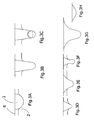
- FIGS. 2A-2D and FIGS. 3A-3H Various embodiments of the invention will now be described with reference to FIGS. 2A-2D and FIGS. 3A-3H .
- FIG. 2A shows an illustration of a protruding leg 1 of a computer mouse pressed into a substrate 2.
- the protruding leg 1 is shaped to form a streamlined hole 3 in the substrate 2.
- the protruding leg 1 has a smooth and hard surface 4.
- the rounded leg 1 presses obliquely against the wall of the hole 3 while pressing irregularities 5 into the soft material.
- the leg 1 is a single part or a combination parts that are permanently attached to each other.
- the leg 1 has a continuous and smooth surface to form the streamline hole 1.
- the effect of the shape and smoothness of the protruding leg is that a finite gradual resistance is experienced by the user of the computer mouse, whereas the irregularity of the friction is not increased.
- each leg 1 When the mouse is moved over the substrate 2, the legs 1 work their way through the soft material of the substrate. In this process, the front side of each leg 1 first compresses the soft, flexible, homogeneous material of the substrate 2, whereafter the material of the substrate gradually passes underneath the smooth leg 1. In this way a constant mechanical resistance is experienced opposite to the direction of the displacement of the mouse.
- the hard, smooth legs 1 press with the front side against the side of the hole.
- an average pressure area is determined. Irregularities of the substrate such as dirt, bulges etc. which protrude with respect to the average substrate, are now pressed into the soft material of the wall of the hole by the hard leg 1.
- a smoothly polished leg will catch minimally to the irregularities of for instance a cloth substrate so that a minimum friction resistance with the substrate 2 occurs.
- a hard leg 1 reduces the chance of being scratched itself.
- an obliquely-directed force can be pressed a) vertically in the direction of the substrate and b) horizontally against the flexible side of the hole 3 in the substrate 2.
- the muscles of the user can express their energy already without the mouse being displaced with respect to the substrate 2. The muscles therefore do not have to provide careful, subdued force at the beginning of a mouse displacement.
- the mouse will start to move when the horizontal force is larger than the flexibility of the wall of the hole 3 in the substrate 2 and the small friction between the leg 1 and the material of the substrate 2. By sensing the resistance, one knows how much force and in what direction is needed for a particular displacement.
- a cursor on a display panel can be moved fast to a virtual object and can, at close proximity hereof, immediately reduce velocity to slowly and precisely position the cursor on the object.
- the computer mouse may have any type of tracking means to register its movement relative to the substrate 2.
- the light footed standard mouse with the 1 millimetre thick, smooth, flat protruding elements discussed in the introduction and shown in FIGS. 1A and 1B , has protruding elements with sharp edges and transitional jumps in the surface. Consequently, the protruding elements are not capable of forming the streamlined hole. Therefore, using the standard mouse, one can only activate muscles to move the mouse and stiffen the muscles to slow down the movement again. The pressing of this standard mouse against the surface friction of a substrate only yields more irregularity in the displacement and grinds the mouse bottom against the surface. To put it differently, the standard mouse lacks control of the mouse movement in the third dimension, i.e. in the direction of the substrate 2, as is the case for the computer mouse according to the invention. Furthermore, the protruding elements of the standard mouse are relatively soft as compared to the hard surface of the legs 1 according to the embodiment of the invention.
- the shape of the leg 1 is responsible for obtaining the centred, streamlined hole 3 in the substrate 2.
- the leg 1 may be bevelled and/or rounded to be able to centre itself in the substrate 2, press a hole 3 herein and to let the material of the substrate 2 slide gradually underneath the leg 1, i.e. from the beginning to the end of the hole 3.
- the leg 1 can have bevels and/or roundings at the bottom, the sides or between these two sides.
- FIG. 2B For a bevelled leg 1, the forces experienced by the leg 1 on interaction with a substrate 2 are indicated by the arrows in FIG. 2B.
- FIG. 2C indicates the forces for a rounded leg 1.
- a cross-section of leg 1 comprising a bevelled edge and a rounded bottom.
- Each rounding on the leg 1 may be more than 10 degrees and less than 170 degrees. This angle is measured between the horizontal line Ho (parallel to the substrate 2) and the tangential line Ta (perpendicular to the radius r of the rounding) which run together through a crossing point on the rounding where the rounding has the most vertical direction.
- the tangential line Ta is determined at the rounding on the position of the rounding where this line follows the most vertical direction.
- FIG. 2E shown a protruding bevelled leg 1.
- the bevel comprises a sloping sidewall, the angle of which may be more than 5 degrees and less than 175 degrees. This is the bevel angle between a horizontal line Ho(parallel to the substrate 2) and the bevelled plane.
- the contact area of the flat protruding elements during normal use of a standard mouse runs substantially parallel to the substrate 2.
- the leg 1 comprises a semi-spherical leg fixated to the device bottom 6 of the computer mouse.
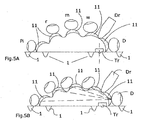
- FIGS. 4A-4C and FIG. 5A, FIG. 5B Further advantageous control features of the computer mouse according to the invention will be discussed now with reference to FIGS. 4A-4C and FIG. 5A, FIG. 5B .
- the mouse housing has two flat support strips 12 on the sides on which the little finger Pi and the thumb D can rest. These strips 12 may prevent tilt of the computer mouse. It is noted that the strips 12 may have legs 1 attached to the side facing the substrate 2, as shown in FIG. 5A . These legs 1 may be provided on the strips 1 instead of the legs 1 underneath the main body of the mouse or in addition to the legs 1 underneath the main body of the mouse.
- a recess 13 is provided in the back of the mouse housing and a tracking element is schematically indicated by Tr. It can be seen, in FIG. 4C , how the little finger Pi and the thumb D can easily flex/pivot without touching the mouse housing.
- the fingertips can hold the caps 11 also more to the side. In that way the thumb D and the other fingers w, m, r, and Pi can press in each others direction.
- the mouse 10 is thus held between the thumb D and the other fingers w, m, r, and Pi, whereas a standard mouse is held only between the thumb and the little finger.
- the mouse 10 comprises a tracking element Tr.
- the tracking can be optically (camera), magnetically (such as a magnetic pen and tablet) or mechanical (trackball) and takes place preferably directly below and between the positions for the thumb tip D and index finger tip w and not in the middle of the mouse as in the standard mouse.
- the thumb and index, finger can therefore orient themselves in detail to the origin of the cursor and control it accurately.
Landscapes
- Engineering & Computer Science (AREA)
- General Engineering & Computer Science (AREA)
- Theoretical Computer Science (AREA)
- Human Computer Interaction (AREA)
- Physics & Mathematics (AREA)
- General Physics & Mathematics (AREA)
- Position Input By Displaying (AREA)
- Input From Keyboards Or The Like (AREA)
- Mechanical Treatment Of Semiconductor (AREA)
- Lubricants (AREA)
Claims (8)
- Computereingabevorrichtung (10), aufweisend ein Mittel zum Registrieren einer Verlagerung der Vorrichtung relativ zu einem flexiblen Substrat (2) zum Auswählen eines Elements auf einem Anzeigepaneel, wobei die Computereingabevorrichtung aufweist:einen Vorrichtungsboden (6), der dazu vorgesehen ist, dass er im Gebrauch der Computereingabevorrichtung dem Substrat zugewandt ist und dabei im Wesentlichen getrennt von dem Substrat bleibt; undeinen oder mehrere abstehende Füße (1), die sich von dem Boden erstrecken,wobei mindestens einer der abstehenden Füße eine harte und glatte Oberfläche (4) aufweist,
dadurch gekennzeichnet, dass
der mindestens eine abstehende Fuß gestaltet ist, während einer Bewegung in eine Richtung relativ zu dem flexiblen Substrat der Computereingabevorrichtung in das flexible Substrat gedrückt zu werden, so dass ein im Wesentlichen stromlinienförmiges Loch (3) gebildet wird, das von einer Wand definiert ist, so dass die harte und glatte Oberfläche des abstehenden Fußes gegen die Wand des stromlinienförmigen Lochs drückt und dadurch einen gleichmäßigen, im Wesentlichen konstanten Widerstand in einer der Richtung der Bewegung entgegengesetzten Richtung erfährt und Unregelmäßigkeiten in dem flexiblen Substrat drückt. - Computereingabevorrichtung gemäß Anspruch 1, wobei der mindestens eine abstehende Fuß eine polierte oder polierte und verchromte Oberfläche hat.
- Computereingabevorrichtung gemäß einem oder mehreren der vorangehenden Ansprüche, wobei der mindestens eine abstehende Fuß eine abgeschrägte und/oder abgerundete Form hat.
- Computereingabevorrichtung gemäß Anspruch 3, wobei die abgeschrägte Form einen Winkel mit einer Horizontallinie parallel zu dem Substrat bildet, der größer als 5 Grad und kleiner als 175 Grad ist, und/oder eine Rundung des abstehenden Fußes einen Winkel zwischen der Tangentiallinie an die Rundung und der Horizontallinie bildet, der größer als 10 Grad und kleiner als 170 Grad ist, wobei die Tangentiallinie durch die Rundung an derjenigen Position der Rundung verläuft, an der die Tangentiallinie am meisten der vertikalen Richtung folgt.
- Computereingabevorrichtung gemäß einem oder mehreren der vorangehenden Ansprüche, wobei der mindestens eine abstehende Fuß eine drehbare Kugel an seinem Distalende aufweist.
- Computereingabevorrichtung gemäß einem oder mehreren der vorangehenden Ansprüche, wobei die abstehenden Füße von dem Boden über eine Distanz von mindestens 2 mm hin abstehen.
- Computereingabevorrichtung gemäß Anspruch 6, wobei das mindestens eine abstehende Element aus einem Material hergestellt ist, das relativ zu dem Substrat hart ist.
- Abstehender Fuß mit einer harten und glatten Oberfläche (4), dadurch gekennzeichnet, dass
der abstehende Fuß gestaltet ist, in ein flexibles Substrat gedrückt zu werden, so dass während einer Bewegung in eine Richtung relativ zu dem flexiblen Substrat ein im Wesentlichen stromlinienförmiges Loch (3) gebildet wird, das von einer Wand definiert ist, so dass die harte und glatte Oberfläche des abstehenden Fußes gegen die Wand des stromlinienförmigen Lochs drückt und dadurch einen gleichmäßigen, im Wesentlichen konstanten Widerstand in einer der Richtung der Bewegung entgegengesetzten Richtung erfährt und Unregelmäßigkeiten in dem flexiblen Substrat drückt und
der abstehende Fuß Aufsatzstrukturen zum Ansetzen des abstehenden Fußes an einen Vorrichtungsboden einer Computereingabevorrichtung aufweist.
Applications Claiming Priority (2)
| Application Number | Priority Date | Filing Date | Title |
|---|---|---|---|
| NL1028523A NL1028523C2 (nl) | 2005-03-11 | 2005-03-11 | Computermuis met pootjes voor een centrerende, gelijkmatige weerstand met de ondergrond. |
| PCT/NL2006/050053 WO2006096064A2 (en) | 2005-03-11 | 2006-03-10 | Computer input device with improved control perfomance |
Publications (2)
| Publication Number | Publication Date |
|---|---|
| EP1856596A2 EP1856596A2 (de) | 2007-11-21 |
| EP1856596B1 true EP1856596B1 (de) | 2009-11-11 |
Family
ID=36730103
Family Applications (1)
| Application Number | Title | Priority Date | Filing Date |
|---|---|---|---|
| EP06716686A Expired - Lifetime EP1856596B1 (de) | 2005-03-11 | 2006-03-10 | Computereingabeeinrichtung mit verbesserter steuerleistungsfähigkeit |
Country Status (8)
| Country | Link |
|---|---|
| US (1) | US20080246730A1 (de) |
| EP (1) | EP1856596B1 (de) |
| JP (1) | JP2008533585A (de) |
| CN (1) | CN101137955A (de) |
| AT (1) | ATE448513T1 (de) |
| DE (1) | DE602006010338D1 (de) |
| NL (1) | NL1028523C2 (de) |
| WO (1) | WO2006096064A2 (de) |
Families Citing this family (9)
| Publication number | Priority date | Publication date | Assignee | Title |
|---|---|---|---|---|
| US20080259026A1 (en) * | 2007-04-20 | 2008-10-23 | Leonid Zeldin | Ergonomic cursor control device that does not assume any specific posture of hand and fingers |
| WO2009047437A2 (fr) * | 2007-09-14 | 2009-04-16 | Delphi Technologies Inc. | Panneaux de controle d'instruments de bord |
| FR2921167B1 (fr) * | 2007-09-18 | 2009-12-04 | Nova | Ensemble constitue par une souris informatique et par un tapis de souris |
| US8350813B2 (en) * | 2008-11-13 | 2013-01-08 | Wacom Co., Ltd. | Digitizer and input device |
| US20100220057A1 (en) * | 2009-02-27 | 2010-09-02 | Carder Mark D | Finger operated computer mouse |
| NL1036867C2 (en) * | 2009-04-16 | 2010-10-19 | Marcel Petrus Simons | Computer mouse with improved optical and mechanical contact with the mouse pad. |
| JP5310389B2 (ja) * | 2009-08-27 | 2013-10-09 | ソニー株式会社 | 情報処理装置、情報処理方法、及びプログラム |
| JP5304544B2 (ja) * | 2009-08-28 | 2013-10-02 | ソニー株式会社 | 情報処理装置、情報処理方法、及びプログラム |
| NL1039405C2 (nl) * | 2012-02-27 | 2013-08-28 | Marcel Petrus Simons | Flexibele wrijvingsweerstand bij computermuis en muismat. |
Family Cites Families (10)
| Publication number | Priority date | Publication date | Assignee | Title |
|---|---|---|---|---|
| US3835464A (en) * | 1973-01-11 | 1974-09-10 | Xerox Corp | Position indicator for a display system |
| JPS5923840A (ja) * | 1982-07-30 | 1984-02-07 | Kawasaki Steel Corp | 高強度焼結材料の製造方法 |
| US4559532A (en) * | 1982-08-07 | 1985-12-17 | Alps Electric Co., Ltd. | X-Y Position input device for display system |
| JPS59163512A (ja) * | 1983-03-09 | 1984-09-14 | Alps Electric Co Ltd | X−y方向入力装置の組立方法 |
| US4623787A (en) * | 1983-12-05 | 1986-11-18 | Wico Corporation | Ball and transducer mounting arrangement for mouse |
| US4635496A (en) * | 1985-04-18 | 1987-01-13 | Mctyre Scott B | Attachment for a display position indicator |
| JPH05346835A (ja) * | 1991-08-09 | 1993-12-27 | Nisshin Koki Kk | 透光型マウスパッド、その製造方法、マウスおよび座標読み取り装置 |
| US5287090A (en) * | 1992-09-30 | 1994-02-15 | Grant Alan H | Combination mouse and track ball unit |
| US7009597B1 (en) * | 1999-06-10 | 2006-03-07 | International Business Machines Corporation | Positioning control of a computer mouse |
| DE202004015041U1 (de) * | 2004-09-25 | 2004-11-25 | Meuer, Andrej | Reibungsarme Gleitplättchen für Computermäuse |
-
2005
- 2005-03-11 NL NL1028523A patent/NL1028523C2/nl not_active IP Right Cessation
-
2006
- 2006-03-10 DE DE602006010338T patent/DE602006010338D1/de not_active Expired - Lifetime
- 2006-03-10 EP EP06716686A patent/EP1856596B1/de not_active Expired - Lifetime
- 2006-03-10 JP JP2008500654A patent/JP2008533585A/ja active Pending
- 2006-03-10 US US11/885,863 patent/US20080246730A1/en not_active Abandoned
- 2006-03-10 AT AT06716686T patent/ATE448513T1/de not_active IP Right Cessation
- 2006-03-10 CN CNA200680007913XA patent/CN101137955A/zh active Pending
- 2006-03-10 WO PCT/NL2006/050053 patent/WO2006096064A2/en not_active Ceased
Also Published As
| Publication number | Publication date |
|---|---|
| ATE448513T1 (de) | 2009-11-15 |
| US20080246730A1 (en) | 2008-10-09 |
| WO2006096064A3 (en) | 2007-07-05 |
| NL1028523C2 (nl) | 2006-09-12 |
| CN101137955A (zh) | 2008-03-05 |
| DE602006010338D1 (de) | 2009-12-24 |
| EP1856596A2 (de) | 2007-11-21 |
| JP2008533585A (ja) | 2008-08-21 |
| WO2006096064A2 (en) | 2006-09-14 |
Similar Documents
| Publication | Publication Date | Title |
|---|---|---|
| EP1856596B1 (de) | Computereingabeeinrichtung mit verbesserter steuerleistungsfähigkeit | |
| JP2010528381A (ja) | ガイド線を有するタッチ式ポインティング・デバイス | |
| TW201535188A (zh) | 運用力量方向判定的觸控系統及方法 | |
| US11048341B2 (en) | Zonal input device | |
| WO2006054163A3 (en) | Portable haptic interface | |
| US20170168634A1 (en) | Operating aid for a touch-sensitive display | |
| JP4446734B2 (ja) | 凹凸増幅部材および凹凸増幅部材を用いた凹凸検出方法 | |
| JP2011191885A (ja) | 入力装置およびポインティングデバイス | |
| EP3210770B1 (de) | Geschichtetes verbundstoffinnenteil | |
| US20090151523A1 (en) | Pivot grip | |
| Nakai et al. | Detection of tangential force for a touch panel using shear deformation of the gel | |
| CN106502434A (zh) | 独立输入设备 | |
| JP6043951B2 (ja) | タッチパネル | |
| KR20190009622A (ko) | 일체형 손목거치 마우스패드 | |
| CN201111641Y (zh) | 操作灵活的鼠标 | |
| NL1039405C2 (nl) | Flexibele wrijvingsweerstand bij computermuis en muismat. | |
| Han et al. | Trampoline: a double-sided elastic touch device for repoussé and chasing techniques | |
| CN110764630B (zh) | 摇杆 | |
| US20130214110A1 (en) | Ergonomic mousepad | |
| KR101777731B1 (ko) | 영상의 표본화 및 양자화 데이터를 이용한 접촉상태와 힘 검출 장치 및 이를 이용한 접촉상태와 힘 검출 방법 | |
| CN204423330U (zh) | 一种鼠标垫 | |
| CN115904102B (zh) | 一种鼠标垫及计算机终端 | |
| Nakai et al. | Tangential force input for touch panels using bezel-aligned elastic pillars and a transparent sheet | |
| CN111381690B (zh) | 具有活动发光结构的鼠标 | |
| TW201413493A (zh) | 輸入裝置及可攜式電子裝置 |
Legal Events
| Date | Code | Title | Description |
|---|---|---|---|
| PUAI | Public reference made under article 153(3) epc to a published international application that has entered the european phase |
Free format text: ORIGINAL CODE: 0009012 |
|
| 17P | Request for examination filed |
Effective date: 20070907 |
|
| AK | Designated contracting states |
Kind code of ref document: A2 Designated state(s): AT BE BG CH CY CZ DE DK EE ES FI FR GB GR HU IE IS IT LI LT LU LV MC NL PL PT RO SE SI SK TR |
|
| AX | Request for extension of the european patent |
Extension state: AL BA HR MK YU |
|
| DAX | Request for extension of the european patent (deleted) | ||
| 17Q | First examination report despatched |
Effective date: 20080715 |
|
| GRAP | Despatch of communication of intention to grant a patent |
Free format text: ORIGINAL CODE: EPIDOSNIGR1 |
|
| GRAS | Grant fee paid |
Free format text: ORIGINAL CODE: EPIDOSNIGR3 |
|
| GRAA | (expected) grant |
Free format text: ORIGINAL CODE: 0009210 |
|
| AK | Designated contracting states |
Kind code of ref document: B1 Designated state(s): AT BE BG CH CY CZ DE DK EE ES FI FR GB GR HU IE IS IT LI LT LU LV MC NL PL PT RO SE SI SK TR |
|
| REG | Reference to a national code |
Ref country code: GB Ref legal event code: FG4D |
|
| REG | Reference to a national code |
Ref country code: CH Ref legal event code: EP |
|
| REG | Reference to a national code |
Ref country code: IE Ref legal event code: FG4D |
|
| REF | Corresponds to: |
Ref document number: 602006010338 Country of ref document: DE Date of ref document: 20091224 Kind code of ref document: P |
|
| NLV1 | Nl: lapsed or annulled due to failure to fulfill the requirements of art. 29p and 29m of the patents act | ||
| LTIE | Lt: invalidation of european patent or patent extension |
Effective date: 20091111 |
|
| PG25 | Lapsed in a contracting state [announced via postgrant information from national office to epo] |
Ref country code: IS Free format text: LAPSE BECAUSE OF FAILURE TO SUBMIT A TRANSLATION OF THE DESCRIPTION OR TO PAY THE FEE WITHIN THE PRESCRIBED TIME-LIMIT Effective date: 20100311 Ref country code: ES Free format text: LAPSE BECAUSE OF FAILURE TO SUBMIT A TRANSLATION OF THE DESCRIPTION OR TO PAY THE FEE WITHIN THE PRESCRIBED TIME-LIMIT Effective date: 20100222 Ref country code: PT Free format text: LAPSE BECAUSE OF FAILURE TO SUBMIT A TRANSLATION OF THE DESCRIPTION OR TO PAY THE FEE WITHIN THE PRESCRIBED TIME-LIMIT Effective date: 20100311 Ref country code: FI Free format text: LAPSE BECAUSE OF FAILURE TO SUBMIT A TRANSLATION OF THE DESCRIPTION OR TO PAY THE FEE WITHIN THE PRESCRIBED TIME-LIMIT Effective date: 20091111 Ref country code: SE Free format text: LAPSE BECAUSE OF FAILURE TO SUBMIT A TRANSLATION OF THE DESCRIPTION OR TO PAY THE FEE WITHIN THE PRESCRIBED TIME-LIMIT Effective date: 20091111 Ref country code: LT Free format text: LAPSE BECAUSE OF FAILURE TO SUBMIT A TRANSLATION OF THE DESCRIPTION OR TO PAY THE FEE WITHIN THE PRESCRIBED TIME-LIMIT Effective date: 20091111 |
|
| PGFP | Annual fee paid to national office [announced via postgrant information from national office to epo] |
Ref country code: LU Payment date: 20100318 Year of fee payment: 5 |
|
| PG25 | Lapsed in a contracting state [announced via postgrant information from national office to epo] |
Ref country code: PL Free format text: LAPSE BECAUSE OF FAILURE TO SUBMIT A TRANSLATION OF THE DESCRIPTION OR TO PAY THE FEE WITHIN THE PRESCRIBED TIME-LIMIT Effective date: 20091111 Ref country code: CY Free format text: LAPSE BECAUSE OF FAILURE TO SUBMIT A TRANSLATION OF THE DESCRIPTION OR TO PAY THE FEE WITHIN THE PRESCRIBED TIME-LIMIT Effective date: 20091111 Ref country code: SI Free format text: LAPSE BECAUSE OF FAILURE TO SUBMIT A TRANSLATION OF THE DESCRIPTION OR TO PAY THE FEE WITHIN THE PRESCRIBED TIME-LIMIT Effective date: 20091111 Ref country code: LV Free format text: LAPSE BECAUSE OF FAILURE TO SUBMIT A TRANSLATION OF THE DESCRIPTION OR TO PAY THE FEE WITHIN THE PRESCRIBED TIME-LIMIT Effective date: 20091111 |
|
| PG25 | Lapsed in a contracting state [announced via postgrant information from national office to epo] |
Ref country code: AT Free format text: LAPSE BECAUSE OF FAILURE TO SUBMIT A TRANSLATION OF THE DESCRIPTION OR TO PAY THE FEE WITHIN THE PRESCRIBED TIME-LIMIT Effective date: 20091111 Ref country code: BE Free format text: LAPSE BECAUSE OF FAILURE TO SUBMIT A TRANSLATION OF THE DESCRIPTION OR TO PAY THE FEE WITHIN THE PRESCRIBED TIME-LIMIT Effective date: 20091111 |
|
| PG25 | Lapsed in a contracting state [announced via postgrant information from national office to epo] |
Ref country code: BG Free format text: LAPSE BECAUSE OF FAILURE TO SUBMIT A TRANSLATION OF THE DESCRIPTION OR TO PAY THE FEE WITHIN THE PRESCRIBED TIME-LIMIT Effective date: 20100211 Ref country code: RO Free format text: LAPSE BECAUSE OF FAILURE TO SUBMIT A TRANSLATION OF THE DESCRIPTION OR TO PAY THE FEE WITHIN THE PRESCRIBED TIME-LIMIT Effective date: 20091111 Ref country code: DK Free format text: LAPSE BECAUSE OF FAILURE TO SUBMIT A TRANSLATION OF THE DESCRIPTION OR TO PAY THE FEE WITHIN THE PRESCRIBED TIME-LIMIT Effective date: 20091111 Ref country code: EE Free format text: LAPSE BECAUSE OF FAILURE TO SUBMIT A TRANSLATION OF THE DESCRIPTION OR TO PAY THE FEE WITHIN THE PRESCRIBED TIME-LIMIT Effective date: 20091111 |
|
| PG25 | Lapsed in a contracting state [announced via postgrant information from national office to epo] |
Ref country code: SK Free format text: LAPSE BECAUSE OF FAILURE TO SUBMIT A TRANSLATION OF THE DESCRIPTION OR TO PAY THE FEE WITHIN THE PRESCRIBED TIME-LIMIT Effective date: 20091111 Ref country code: CZ Free format text: LAPSE BECAUSE OF FAILURE TO SUBMIT A TRANSLATION OF THE DESCRIPTION OR TO PAY THE FEE WITHIN THE PRESCRIBED TIME-LIMIT Effective date: 20091111 |
|
| PLBE | No opposition filed within time limit |
Free format text: ORIGINAL CODE: 0009261 |
|
| STAA | Information on the status of an ep patent application or granted ep patent |
Free format text: STATUS: NO OPPOSITION FILED WITHIN TIME LIMIT |
|
| 26N | No opposition filed |
Effective date: 20100812 |
|
| PG25 | Lapsed in a contracting state [announced via postgrant information from national office to epo] |
Ref country code: MC Free format text: LAPSE BECAUSE OF NON-PAYMENT OF DUE FEES Effective date: 20100331 Ref country code: GR Free format text: LAPSE BECAUSE OF FAILURE TO SUBMIT A TRANSLATION OF THE DESCRIPTION OR TO PAY THE FEE WITHIN THE PRESCRIBED TIME-LIMIT Effective date: 20100212 |
|
| PG25 | Lapsed in a contracting state [announced via postgrant information from national office to epo] |
Ref country code: IE Free format text: LAPSE BECAUSE OF NON-PAYMENT OF DUE FEES Effective date: 20100310 |
|
| PG25 | Lapsed in a contracting state [announced via postgrant information from national office to epo] |
Ref country code: IT Free format text: LAPSE BECAUSE OF FAILURE TO SUBMIT A TRANSLATION OF THE DESCRIPTION OR TO PAY THE FEE WITHIN THE PRESCRIBED TIME-LIMIT Effective date: 20091111 |
|
| PGFP | Annual fee paid to national office [announced via postgrant information from national office to epo] |
Ref country code: CH Payment date: 20110316 Year of fee payment: 6 |
|
| PGFP | Annual fee paid to national office [announced via postgrant information from national office to epo] |
Ref country code: GB Payment date: 20120326 Year of fee payment: 7 |
|
| PGFP | Annual fee paid to national office [announced via postgrant information from national office to epo] |
Ref country code: DE Payment date: 20120327 Year of fee payment: 7 |
|
| PGFP | Annual fee paid to national office [announced via postgrant information from national office to epo] |
Ref country code: FR Payment date: 20120413 Year of fee payment: 7 |
|
| PG25 | Lapsed in a contracting state [announced via postgrant information from national office to epo] |
Ref country code: HU Free format text: LAPSE BECAUSE OF FAILURE TO SUBMIT A TRANSLATION OF THE DESCRIPTION OR TO PAY THE FEE WITHIN THE PRESCRIBED TIME-LIMIT Effective date: 20100512 Ref country code: NL Free format text: LAPSE BECAUSE OF FAILURE TO SUBMIT A TRANSLATION OF THE DESCRIPTION OR TO PAY THE FEE WITHIN THE PRESCRIBED TIME-LIMIT Effective date: 20091111 |
|
| PG25 | Lapsed in a contracting state [announced via postgrant information from national office to epo] |
Ref country code: TR Free format text: LAPSE BECAUSE OF FAILURE TO SUBMIT A TRANSLATION OF THE DESCRIPTION OR TO PAY THE FEE WITHIN THE PRESCRIBED TIME-LIMIT Effective date: 20091111 |
|
| REG | Reference to a national code |
Ref country code: CH Ref legal event code: PL |
|
| PG25 | Lapsed in a contracting state [announced via postgrant information from national office to epo] |
Ref country code: CH Free format text: LAPSE BECAUSE OF NON-PAYMENT OF DUE FEES Effective date: 20120331 Ref country code: LI Free format text: LAPSE BECAUSE OF NON-PAYMENT OF DUE FEES Effective date: 20120331 |
|
| PG25 | Lapsed in a contracting state [announced via postgrant information from national office to epo] |
Ref country code: LU Free format text: LAPSE BECAUSE OF NON-PAYMENT OF DUE FEES Effective date: 20110310 |
|
| GBPC | Gb: european patent ceased through non-payment of renewal fee |
Effective date: 20130310 |
|
| REG | Reference to a national code |
Ref country code: FR Ref legal event code: ST Effective date: 20131129 |
|
| REG | Reference to a national code |
Ref country code: DE Ref legal event code: R119 Ref document number: 602006010338 Country of ref document: DE Effective date: 20131001 |
|
| PG25 | Lapsed in a contracting state [announced via postgrant information from national office to epo] |
Ref country code: FR Free format text: LAPSE BECAUSE OF NON-PAYMENT OF DUE FEES Effective date: 20130402 Ref country code: GB Free format text: LAPSE BECAUSE OF NON-PAYMENT OF DUE FEES Effective date: 20130310 Ref country code: DE Free format text: LAPSE BECAUSE OF NON-PAYMENT OF DUE FEES Effective date: 20131001 |