EP1848757B1 - Method of neutralizing polysiloxane hydrolyzates - Google Patents
Method of neutralizing polysiloxane hydrolyzates Download PDFInfo
- Publication number
- EP1848757B1 EP1848757B1 EP05854955A EP05854955A EP1848757B1 EP 1848757 B1 EP1848757 B1 EP 1848757B1 EP 05854955 A EP05854955 A EP 05854955A EP 05854955 A EP05854955 A EP 05854955A EP 1848757 B1 EP1848757 B1 EP 1848757B1
- Authority
- EP
- European Patent Office
- Prior art keywords
- carbon
- hydrolyzate
- polysiloxane
- derived
- hydrolyzates
- Prior art date
- Legal status (The legal status is an assumption and is not a legal conclusion. Google has not performed a legal analysis and makes no representation as to the accuracy of the status listed.)
- Expired - Lifetime
Links
Images
Classifications
-
- B—PERFORMING OPERATIONS; TRANSPORTING
- B01—PHYSICAL OR CHEMICAL PROCESSES OR APPARATUS IN GENERAL
- B01D—SEPARATION
- B01D15/00—Separating processes involving the treatment of liquids with solid sorbents; Apparatus therefor
-
- B—PERFORMING OPERATIONS; TRANSPORTING
- B01—PHYSICAL OR CHEMICAL PROCESSES OR APPARATUS IN GENERAL
- B01J—CHEMICAL OR PHYSICAL PROCESSES, e.g. CATALYSIS OR COLLOID CHEMISTRY; THEIR RELEVANT APPARATUS
- B01J20/00—Solid sorbent compositions or filter aid compositions; Sorbents for chromatography; Processes for preparing, regenerating or reactivating thereof
- B01J20/02—Solid sorbent compositions or filter aid compositions; Sorbents for chromatography; Processes for preparing, regenerating or reactivating thereof comprising inorganic material
- B01J20/20—Solid sorbent compositions or filter aid compositions; Sorbents for chromatography; Processes for preparing, regenerating or reactivating thereof comprising inorganic material comprising free carbon; comprising carbon obtained by carbonising processes
-
- C—CHEMISTRY; METALLURGY
- C08—ORGANIC MACROMOLECULAR COMPOUNDS; THEIR PREPARATION OR CHEMICAL WORKING-UP; COMPOSITIONS BASED THEREON
- C08G—MACROMOLECULAR COMPOUNDS OBTAINED OTHERWISE THAN BY REACTIONS ONLY INVOLVING UNSATURATED CARBON-TO-CARBON BONDS
- C08G77/00—Macromolecular compounds obtained by reactions forming a linkage containing silicon with or without sulfur, nitrogen, oxygen or carbon in the main chain of the macromolecule
- C08G77/04—Polysiloxanes
- C08G77/06—Preparatory processes
-
- C—CHEMISTRY; METALLURGY
- C08—ORGANIC MACROMOLECULAR COMPOUNDS; THEIR PREPARATION OR CHEMICAL WORKING-UP; COMPOSITIONS BASED THEREON
- C08G—MACROMOLECULAR COMPOUNDS OBTAINED OTHERWISE THAN BY REACTIONS ONLY INVOLVING UNSATURATED CARBON-TO-CARBON BONDS
- C08G77/00—Macromolecular compounds obtained by reactions forming a linkage containing silicon with or without sulfur, nitrogen, oxygen or carbon in the main chain of the macromolecule
- C08G77/04—Polysiloxanes
- C08G77/12—Polysiloxanes containing silicon bound to hydrogen
-
- C—CHEMISTRY; METALLURGY
- C08—ORGANIC MACROMOLECULAR COMPOUNDS; THEIR PREPARATION OR CHEMICAL WORKING-UP; COMPOSITIONS BASED THEREON
- C08G—MACROMOLECULAR COMPOUNDS OBTAINED OTHERWISE THAN BY REACTIONS ONLY INVOLVING UNSATURATED CARBON-TO-CARBON BONDS
- C08G77/00—Macromolecular compounds obtained by reactions forming a linkage containing silicon with or without sulfur, nitrogen, oxygen or carbon in the main chain of the macromolecule
- C08G77/04—Polysiloxanes
- C08G77/32—Post-polymerisation treatment
- C08G77/34—Purification
Definitions
- This invention is directed generally to polysiloxane hydrolyzates, and is an improvement over existing methods of neutralizing and/or purifying polysiloxane hydrolyzates.
- hydride functional linear, branched and/or cyclic polysiloxane ( ⁇ Si-H) hydrolyzates and linear, branched and/or cyclic polydialkylsiloxane hydrolyzates such as polydimethylsiloxane (PDMS) hydrolyzates, are more efficiently neutralized and purified according to the invention.
- PDMS polydimethylsiloxane
- US Patent 5,075,479 (December 24, 1991 ) describes a hydrolysis process for producing PDMS hydrolyzates
- US Patent 5,493,040 (February 20, 1996 ) relates to a hydrolysis process for producing hydride functional polysiloxane hydrolyzates.
- hydrolyzates containing cyclic and linear hydride functional polysiloxanes are obtained by hydrolyzing CH 3 SiHCl 2 and (CH 3 ) 3 SiCl.
- the hydrolyzate is neutralized with sodium bicarbonate to remove trace levels of chlorine based species, particularly chloride ions in the form of hydrochloric acid (HCl) and then used in the preparation of higher molecular weight hydride functional polysiloxane polymers.
- Hydrolyzates containing cyclic and linear PDMS are obtained by hydrolyzing (CH 3 ) 2 SiCl 2 with or without either (CH 3 ) 3 SiCl or an endblocking oligomer such as (CH 3 ) 3 SiO[(CH 3 ) 2 SiO] 0-10 -
- the hydrolyzate is typically neutralized with sodium bicarbonate to remove trace chlorine based species such as HCl and then used in the preparation of higher molecular weight polydimethylsiloxane polymers.
- US Patent 5,276,173 (January 4, 1994 ) describes the removal of ionic chloride from hydroxyl-terminated siloxane compounds by contacting the siloxane with a molecular sieve material.
- This invention is directed to a method of neutralizing a polysiloxane hydrolyzate comprising treating a polysiloxane hydrolyzates containing residual acidic constituents with carbon, and separating the carbon from the treated neutralized polysiloxane hydrolyzate.
- the polysiloxane hydralyzates can be, for example, a hydride functional polysiloxane hydrolyzate or a polydialkylsiloxane hydrolyzate such as a polydimethylsiloxane hydrolyzate.
- the carbon neutralizing agent is selected from the group consisting of coke, charcoal, carbon derived from bituminous coal, carbon derived from anthracite coal, carbon derived from lignite, carbon derived from wood, carbon derived from peat, and carbon derived from coconut shells. Carbon derived from bituminous coal is preferred.
- the carbon neutralizing agent may be brought into contact with the hydrolyzate by any suitable means such as by mixing the carbon and hydrolyzate in a mixing tank and then removing the carbon from the treated neutralized polysiloxane hydrolyzate by passing it through any conventional type of solid liquid separation device.
- a preferred solid liquid separation device is a plate and frame filter press, followed by treatment of the filtered effluent by any suitable means for removing particulate (especially carbon) fines to a level appropriate for the specification required for the hydrolyzate such as a suitable so-called polishing filter.
- devices other than plate and frame filter presses and polishing filters can also be used.
- the polysiloxane hydrolyzate may be passed through a fixed bed of the carbon neutralizing agent using a suitable predetermined residence time, from which the hydrolyzate is passed to a post filter to remove carbon fines from the effluent.
- a further alternative process may include the use of one or more carbon impregnated filters to filter the hydrolyzate.
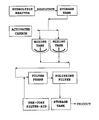
- the single drawing figure is a simplified functional representation of the process according to the invention, in which the flow pattern of the materials through the various pieces of equipment is illustrated.
- the chlorosilane feed for hydrolysis processes contains chlorosilanes of the formula R 2 SiCl 2 .
- R may be the same of different, but is usually the same and may be any suitable group such as, for example, hydrogen or a hydrocarbon radical such as an alkyl group, a cycloalkyl group, an aryl group, an alkylaryl group, or an aralkyl group containing 1-20 carbon atoms.
- the hydrocarbon radical may be a group such as methyl, ethyl, propyl, isopropyl, n-butyl, isobutyl, tert-butyl, sec- butyl, pentyl, hexyl, phenyl, tolyl, benzyl, and beta-phenylethyl.
- chlorosilanes include compounds such as dimethyldichlorosilane (CH 3 ) 2 SiCl 2 , diethyldichlorosilane (C 2 H 5 ) 2 SiCl 2 , di-n-propyldichlorosilane (n-C 3 H 7 ) 2 SiCl 2 , di-i-propyldichlorosilane (i-C 3 H 7 ) 2 SiCl 2 , di-n-butyldichlorosilane (n-C 4 H 9 ) 2 SiCl 2 , di-i-butyldichlorosilane (i-C 4 H 9 ) 2 SiCl 2 , di-t-butyldichlorosilane (t-C 4 H 9 ) 2 SiCl 2 , n-butylmethyldichlorosilane CH 3 (n-C 4 H 9 )SiCl 2 , octadecylmethyldichlor
- the carbon used in the neutralization and purification process herein is selected from the group consisting of coke, charcoal, carbon derived from bituminous coal, carbon derived from anthracite coal, carbone derived from lignite (brown coal), carbon derived from wood, carbon derived from peat, or carbon derived from coconut shells.
- Carbon derived from bituminous coal is preferred herein because it is readily available commercially and is relatively intensive.
- the carbon may be added to the polysiloxane hydrolyzate, mixed, and then separated.
- the polysiloxane may be passed through a fixed bed of carbon from which carbon fines are subsequently removed.
- One carbon species which may be used in the process of the invention is a granular bituminous-based activated carbon sold under the trademark BPL ® 80X270 by Calgon Carbon Corporation, Pittsburgh, Pennsylvania.
- This material consists of carbon particles of a size that will pass through a 0.177mm (80 mesh) screen but that are retained on a 0.053mm (270 mesh) screen.
- the average particles size is greater than 53 micron ( ⁇ m) and less than 180 ( ⁇ m).
- An alternative suitable carbon species is a granular bituminous-based activated carbon sold by Calgon Carbon Corporation under their trademark BPL ® 12X30.
- This material consists of carbon particles of a size that will pass through a 1.68 mm (12 mesh) screen but that are retained on a 0.595 mm (30 mesh) screen. The average particle size is greater than 550 micron ( ⁇ m) and less than 1410 ( ⁇ m).
- the BPL ® 12X30 had moisture level of about 2-10 percent.
- crude hydrolyzate product containing residual levels of chlorine containing species such as HCl is obtained from a hydrolysis reactor that is part of a hydrolysis process generally represented by US Patent 4,382,145 , UPS Application SN 10/958,768 , US Patent 5,075,479 , and US Patent 5,493,040 , referred to above.
- the hydrolyzate is pumped into a storage tank, from which it is fed into one or more mixing tanks of suitable capacity, each with a capacity of about 1,000-2,000 gallons (4.546 - 9.092m 3 )).
- the neutralizing and purifying agent i.e., activated carbon, is fed into each mixing tank where it is thoroughly dispersed in the crude hyrolyzate, to effect neutralization of residual chlorine containing species, in particular HCl to acceptable levels.
- Neutralized hydrolyzate from the mixing tanks is passed into a plate and frame filter press having a stack of filter plates covered with filter cloths that have been pre-coated with a suitable filter-aid.
- the activated carbon, as well as other particulate impurities that may be in the neutralized hydrolyzate, are removed and retained on the coated filter cloths.
- the neutralized and filtered hydrolyzate is pumped under pressure through a suitable filter for the removal of fine particulates to a level required dependent of the requirements of the product being filtered.
- the polysiloxane hydrolyzate may be passed through a fixed bed comprising the carbon neutralizing material, and then the carbon fines may be subsequently removed from the neutralized hydrolyzate using a suitable particulate fines filter.
- a series of five (5) runs were conducted using equipment generally as depicted in Fig. 1.
- a 17,500 pound (7938 kg) batch of hydrolyzate at ambient temperature was treated.
- Approximately 20 pounds (10.872 kg) of activated carbon was fed into each of the mixing tanks for each of the runs.
- the mixing tanks were maintained at atmospheric pressure.
- the activated carbon was the granular bituminous-based activated carbon, BPL ® 80X270 sold by Calgon Carbon Corporation, as described above.
- the slurry of hydrolyzate and activated carbon was agitated for about four hours.
- the product was analyzed to determine its acid number as a measure of neutralization of HCl.
- sodium carbonate appears to be similar in efficiency to the carbon used, it also has some negative consequences not apparent from these results.
- the neutralizing effect of sodium carbonate works by means of a chemical reaction resulting in the formation of a calcium chloride contaminant in the siloxane. It is believed that carbon substantially works by means of adsorption, and is easy to separate from the siloxane by filtration after the mixing process is complete, thereby minimizing the level of contamination.
- the following examples relate to the carbon treatment of PDMS hydrolyzate to reduce the HCl content, and to thereby minimize the water content typically present in the PDMS.
- a condensation reaction caused by the presence of HCl leads to the formation of water, that results in an increase in the viscosity of PDMS over time, i.e., so-called viscosity drifting.
- the HCl content of PDMS is believed to be the cause of this undesirable condensation reaction.
- HCl was removed from PDMS containing water at low parts per million (ppm) levels. After treatment with carbon, it was observed that there was less hydrolysable HCl, and this phenomenon was unexpected.
- the neutralizing agent used in this example was a granular bituminous-based activated carbon sold under the trademark BPL ® 12X30 by Calgon Carbon Corporation, Pittsburgh, Pennsylvania. This material consists of carbon particles of a size that will pass through a 12 mesh screen but that are retained on a 30 mesh screen. The average particle size is greater than 550 micron ( ⁇ m) and less than 1410 ( ⁇ m).
- the BPL ® 12X30 had a moisture level of about 2-10 percent. 10 gram of the carbon was added to 300 gram of PDMS.
- the results were determined analytically by means of an ion chromatographic method that is typically used for the separation of anions and cations in aqueous samples, using a conductivity detector for detection, and external standard calibrations for he quantitative analysis. Either a suppressed or a non-suppressed background conductivity mode of operation may be specified with the conductivity detection.
- the results are reported as parts per million (ppm) or parts per billion (ppb), on a weight/weight basis.
- Example 4 was repeated, except that the PDMS was passed through a 30 milliliter packed bed of the same carbon neutralizing agent with a residence time of 6 minutes.
- the HCl content of the feed PDMS was 0.28 ppm.
- the treated PDMS exiting the bed contained on average 0.05 ppm HCl. This procedure was repeated using a residence time of 40 minutes, and the average HCl content of PDMS was reduced from 0.15 ppm to 0.03 ppm after 9 hours.
- Amberlyst® A26 is a strongly basic macroreticular anionic resin having a quaternary ammonium functional group and a pore-diameter of 400-700 x 10 -10 m available from Rohm & Haas Company, Philadelphia, Pennsylvania.
- Amberlyst ® A21 is a weakly basic macroreticular anionic resin having an amino-functional group and an average pore size of 900-1300 10 -10 m.
- Molecular Sieve X 13 has a formula approximately corresponding to Na 86[ (AlO 2 ) 86 (SiO 2 ) 106] XH 2 O- It has a bulk density of 600-700 kg m -3 , a nominal pore size of 10 x 10 -10 m, and is a product available from UOP LLC, Des Plaines, Illinois, USA.
- Table 4 Neutralizing Agent/Absorbent Percent HCl Removed Molecular Sieve X13 48 MgO 64 Amberlyst® A26 72 Carbon 81 Amberlyst ® A21 89
- Example 6 and Table 4 show that Amberlyst ® A21 removed slightly more HCl than carbon, there are reasons why carbon is more suitable for this invention. For example, carbon has a lower initial unit cost, its use involves no addition of contaminants, and it is capable of removing other impurities from PDMS streams such as sulfur. Amberlyst ® A21 on the other hand has a slight odour upon its first usage that taints the hydrolyzate.
Landscapes
- Chemical & Material Sciences (AREA)
- Chemical Kinetics & Catalysis (AREA)
- Organic Chemistry (AREA)
- Health & Medical Sciences (AREA)
- Medicinal Chemistry (AREA)
- Polymers & Plastics (AREA)
- Analytical Chemistry (AREA)
- Inorganic Chemistry (AREA)
- Silicon Polymers (AREA)
- Solid-Sorbent Or Filter-Aiding Compositions (AREA)
- Carbon And Carbon Compounds (AREA)
Applications Claiming Priority (2)
| Application Number | Priority Date | Filing Date | Title |
|---|---|---|---|
| US64369505P | 2005-01-13 | 2005-01-13 | |
| PCT/US2005/046320 WO2006076137A1 (en) | 2005-01-13 | 2005-12-16 | Method of neutralizing polysiloxane hydrolyzates |
Publications (2)
| Publication Number | Publication Date |
|---|---|
| EP1848757A1 EP1848757A1 (en) | 2007-10-31 |
| EP1848757B1 true EP1848757B1 (en) | 2008-08-13 |
Family
ID=36218739
Family Applications (1)
| Application Number | Title | Priority Date | Filing Date |
|---|---|---|---|
| EP05854955A Expired - Lifetime EP1848757B1 (en) | 2005-01-13 | 2005-12-16 | Method of neutralizing polysiloxane hydrolyzates |
Country Status (9)
| Country | Link |
|---|---|
| US (1) | US7479566B2 (enExample) |
| EP (1) | EP1848757B1 (enExample) |
| JP (1) | JP2008527141A (enExample) |
| KR (1) | KR101195783B1 (enExample) |
| CN (1) | CN101084255B (enExample) |
| AT (1) | ATE404612T1 (enExample) |
| BR (1) | BRPI0519857A2 (enExample) |
| DE (1) | DE602005009029D1 (enExample) |
| WO (1) | WO2006076137A1 (enExample) |
Families Citing this family (7)
| Publication number | Priority date | Publication date | Assignee | Title |
|---|---|---|---|---|
| US7696293B2 (en) * | 2005-05-23 | 2010-04-13 | Dow Corning Corporation | Method of neutralizing polysiloxanes containing acidic residuals |
| DE602007001965D1 (de) | 2006-03-31 | 2009-09-24 | Dow Corning Toray Co Ltd | Herstellungsverfahren für silikonpolyether |
| CN102284271B (zh) * | 2011-06-20 | 2012-12-19 | 钟洪兵 | 一种利用阔叶林木屑制作回收蒸发汽油的活性炭及其制作方法 |
| CN107177344A (zh) * | 2017-05-27 | 2017-09-19 | 湖北兴瑞化工有限公司 | 一种以二甲基二氯硅烷水解物为原料生产高透明度107胶的方法 |
| KR20210021453A (ko) * | 2018-06-19 | 2021-02-26 | 닛산 가가쿠 가부시키가이샤 | 염류가 제거된 폴리실록산의 제조방법 |
| CN110550773A (zh) * | 2019-08-16 | 2019-12-10 | 江西蓝星星火有机硅有限公司 | 一种降低二甲基二氯硅烷水解物中氯离子及其它杂质含量的方法和装置 |
| CN110343248A (zh) * | 2019-08-20 | 2019-10-18 | 江西蓝星星火有机硅有限公司 | 一种提高含氢硅油质量的方法 |
Family Cites Families (14)
| Publication number | Priority date | Publication date | Assignee | Title |
|---|---|---|---|---|
| US3853933A (en) * | 1974-01-14 | 1974-12-10 | Gen Electric | Continuous process for producing polysiloxane oils utilizing a carbon black catalyst |
| JPS5938993B2 (ja) | 1980-03-11 | 1984-09-20 | 電気化学工業株式会社 | カ−ボンブラックの製造装置 |
| US4382145A (en) | 1981-09-02 | 1983-05-03 | General Electric Company | Method of hydrolyzing organochlorosilanes |
| US5075479A (en) * | 1991-05-20 | 1991-12-24 | Dow Corning Corporation | Anhydrous hydrogen chloride evolving one-step process for producing siloxanes |
| JP2885295B2 (ja) | 1991-11-22 | 1999-04-19 | 信越化学工業株式会社 | シロキサン類の精製方法 |
| US5276173A (en) | 1992-10-05 | 1994-01-04 | Dow Corning Corporation | Method for removal for ionic chloride from hydroxyl-terminated siloxanes |
| US5766565A (en) * | 1993-01-21 | 1998-06-16 | Dow Corning Corporation | Purification of hydrochloric acid |
| US5483040A (en) | 1993-02-05 | 1996-01-09 | Fortune; William S. | Electrically heated hot gas soldering instrument |
| DE4422813A1 (de) | 1994-06-29 | 1996-01-04 | Wacker Chemie Gmbh | Verfahren zum Stabilisieren von Organpolysiloxanen |
| TR200201276T2 (tr) | 1999-11-10 | 2002-09-23 | General Electric Company | Siloksan bileşiklerinin stabilizasyonu için işlem |
| JP3812661B2 (ja) | 2002-05-13 | 2006-08-23 | 信越化学工業株式会社 | シリコーン油の精製法 |
| JP2004083883A (ja) * | 2002-06-27 | 2004-03-18 | Dow Corning Toray Silicone Co Ltd | オルガノポリシロキサンレジンの製造方法 |
| DE102004019377A1 (de) | 2004-04-21 | 2005-11-10 | Wacker-Chemie Gmbh | Verfahren zur Herstellung von linearen Si-H Gruppen aufweisenden Organopolysiloxanen |
| US7208617B2 (en) | 2004-10-05 | 2007-04-24 | Dow Corning Corporation | Hydrolysis of chlorosilanes |
-
2005
- 2005-12-16 JP JP2007551272A patent/JP2008527141A/ja active Pending
- 2005-12-16 KR KR1020077015944A patent/KR101195783B1/ko not_active Expired - Fee Related
- 2005-12-16 AT AT05854955T patent/ATE404612T1/de not_active IP Right Cessation
- 2005-12-16 US US11/792,027 patent/US7479566B2/en not_active Expired - Fee Related
- 2005-12-16 CN CN2005800439681A patent/CN101084255B/zh not_active Expired - Fee Related
- 2005-12-16 EP EP05854955A patent/EP1848757B1/en not_active Expired - Lifetime
- 2005-12-16 WO PCT/US2005/046320 patent/WO2006076137A1/en not_active Ceased
- 2005-12-16 DE DE602005009029T patent/DE602005009029D1/de not_active Expired - Lifetime
- 2005-12-16 BR BRPI0519857-7A patent/BRPI0519857A2/pt not_active IP Right Cessation
Also Published As
| Publication number | Publication date |
|---|---|
| KR20070099604A (ko) | 2007-10-09 |
| WO2006076137B1 (en) | 2006-09-14 |
| JP2008527141A (ja) | 2008-07-24 |
| DE602005009029D1 (de) | 2008-09-25 |
| BRPI0519857A2 (pt) | 2009-03-24 |
| US7479566B2 (en) | 2009-01-20 |
| CN101084255B (zh) | 2010-10-27 |
| CN101084255A (zh) | 2007-12-05 |
| EP1848757A1 (en) | 2007-10-31 |
| WO2006076137A1 (en) | 2006-07-20 |
| US20080125600A1 (en) | 2008-05-29 |
| KR101195783B1 (ko) | 2012-11-05 |
| ATE404612T1 (de) | 2008-08-15 |
Similar Documents
| Publication | Publication Date | Title |
|---|---|---|
| JP5656862B2 (ja) | 珪素化合物の精製 | |
| KR20240093859A (ko) | 열분해 생성물의 정제 방법 및 정제된 열분해 오일의 용도 | |
| JPS62142188A (ja) | シロキサンの精製法 | |
| US7479566B2 (en) | Method for preparation of alkoxysilanes having reduced halide | |
| US5445742A (en) | Process for purifying halosilanes | |
| US4962221A (en) | Chloride reduction in polysiloxanes | |
| US5330735A (en) | Purification of hydrochloric acid | |
| EP0592149A2 (en) | Method for removal of ionic chloride from hydroxyl-terminated siloxanes | |
| US8039658B2 (en) | Removal of trace arsenic impurities from triethylphosphate (TEPO) | |
| EP1362878B1 (en) | Purification of silicone oil | |
| EP0770619B1 (en) | Process for purifying halosilanes | |
| US7696293B2 (en) | Method of neutralizing polysiloxanes containing acidic residuals | |
| EP0776901A1 (en) | Process for separation of dimethyldichlorosilane from methyltrichlorosilane | |
| EP4504816B1 (en) | Method for decolorizing cyanoethyltrimethoxysilane | |
| GB1567096A (en) | Process for removing biphenyls from | |
| EP0776902A1 (en) | Process for separation of methyltrichlorosilane from dimethyldichlorosilane | |
| JPH09291147A (ja) | ポリエーテルポリオールの精製法、及び該ポリエーテルポリオール中のジオールの回収法 | |
| CN112189026A (zh) | 除去盐类了的聚硅氧烷的制造方法 | |
| Goldberg | A stability study of octadecylalumina columns for use in HPLC |
Legal Events
| Date | Code | Title | Description |
|---|---|---|---|
| PUAI | Public reference made under article 153(3) epc to a published international application that has entered the european phase |
Free format text: ORIGINAL CODE: 0009012 |
|
| 17P | Request for examination filed |
Effective date: 20070725 |
|
| AK | Designated contracting states |
Kind code of ref document: A1 Designated state(s): AT BE BG CH CY CZ DE DK EE ES FI FR GB GR HU IE IS IT LI LT LU LV MC NL PL PT RO SE SI SK TR |
|
| 17Q | First examination report despatched |
Effective date: 20071127 |
|
| GRAP | Despatch of communication of intention to grant a patent |
Free format text: ORIGINAL CODE: EPIDOSNIGR1 |
|
| DAX | Request for extension of the european patent (deleted) | ||
| GRAS | Grant fee paid |
Free format text: ORIGINAL CODE: EPIDOSNIGR3 |
|
| GRAA | (expected) grant |
Free format text: ORIGINAL CODE: 0009210 |
|
| AK | Designated contracting states |
Kind code of ref document: B1 Designated state(s): AT BE BG CH CY CZ DE DK EE ES FI FR GB GR HU IE IS IT LI LT LU LV MC NL PL PT RO SE SI SK TR |
|
| REG | Reference to a national code |
Ref country code: GB Ref legal event code: FG4D |
|
| REG | Reference to a national code |
Ref country code: CH Ref legal event code: EP |
|
| REG | Reference to a national code |
Ref country code: IE Ref legal event code: FG4D |
|
| REF | Corresponds to: |
Ref document number: 602005009029 Country of ref document: DE Date of ref document: 20080925 Kind code of ref document: P |
|
| PG25 | Lapsed in a contracting state [announced via postgrant information from national office to epo] |
Ref country code: IS Free format text: LAPSE BECAUSE OF FAILURE TO SUBMIT A TRANSLATION OF THE DESCRIPTION OR TO PAY THE FEE WITHIN THE PRESCRIBED TIME-LIMIT Effective date: 20081213 Ref country code: LT Free format text: LAPSE BECAUSE OF FAILURE TO SUBMIT A TRANSLATION OF THE DESCRIPTION OR TO PAY THE FEE WITHIN THE PRESCRIBED TIME-LIMIT Effective date: 20080813 Ref country code: NL Free format text: LAPSE BECAUSE OF FAILURE TO SUBMIT A TRANSLATION OF THE DESCRIPTION OR TO PAY THE FEE WITHIN THE PRESCRIBED TIME-LIMIT Effective date: 20080813 |
|
| PG25 | Lapsed in a contracting state [announced via postgrant information from national office to epo] |
Ref country code: LV Free format text: LAPSE BECAUSE OF FAILURE TO SUBMIT A TRANSLATION OF THE DESCRIPTION OR TO PAY THE FEE WITHIN THE PRESCRIBED TIME-LIMIT Effective date: 20080813 Ref country code: SI Free format text: LAPSE BECAUSE OF FAILURE TO SUBMIT A TRANSLATION OF THE DESCRIPTION OR TO PAY THE FEE WITHIN THE PRESCRIBED TIME-LIMIT Effective date: 20080813 Ref country code: AT Free format text: LAPSE BECAUSE OF FAILURE TO SUBMIT A TRANSLATION OF THE DESCRIPTION OR TO PAY THE FEE WITHIN THE PRESCRIBED TIME-LIMIT Effective date: 20080813 Ref country code: ES Free format text: LAPSE BECAUSE OF FAILURE TO SUBMIT A TRANSLATION OF THE DESCRIPTION OR TO PAY THE FEE WITHIN THE PRESCRIBED TIME-LIMIT Effective date: 20081124 Ref country code: FI Free format text: LAPSE BECAUSE OF FAILURE TO SUBMIT A TRANSLATION OF THE DESCRIPTION OR TO PAY THE FEE WITHIN THE PRESCRIBED TIME-LIMIT Effective date: 20080813 |
|
| PG25 | Lapsed in a contracting state [announced via postgrant information from national office to epo] |
Ref country code: BE Free format text: LAPSE BECAUSE OF FAILURE TO SUBMIT A TRANSLATION OF THE DESCRIPTION OR TO PAY THE FEE WITHIN THE PRESCRIBED TIME-LIMIT Effective date: 20080813 |
|
| PG25 | Lapsed in a contracting state [announced via postgrant information from national office to epo] |
Ref country code: BG Free format text: LAPSE BECAUSE OF FAILURE TO SUBMIT A TRANSLATION OF THE DESCRIPTION OR TO PAY THE FEE WITHIN THE PRESCRIBED TIME-LIMIT Effective date: 20081113 Ref country code: DK Free format text: LAPSE BECAUSE OF FAILURE TO SUBMIT A TRANSLATION OF THE DESCRIPTION OR TO PAY THE FEE WITHIN THE PRESCRIBED TIME-LIMIT Effective date: 20080813 |
|
| PG25 | Lapsed in a contracting state [announced via postgrant information from national office to epo] |
Ref country code: RO Free format text: LAPSE BECAUSE OF FAILURE TO SUBMIT A TRANSLATION OF THE DESCRIPTION OR TO PAY THE FEE WITHIN THE PRESCRIBED TIME-LIMIT Effective date: 20080813 Ref country code: CZ Free format text: LAPSE BECAUSE OF FAILURE TO SUBMIT A TRANSLATION OF THE DESCRIPTION OR TO PAY THE FEE WITHIN THE PRESCRIBED TIME-LIMIT Effective date: 20080813 Ref country code: PT Free format text: LAPSE BECAUSE OF FAILURE TO SUBMIT A TRANSLATION OF THE DESCRIPTION OR TO PAY THE FEE WITHIN THE PRESCRIBED TIME-LIMIT Effective date: 20090113 Ref country code: SK Free format text: LAPSE BECAUSE OF FAILURE TO SUBMIT A TRANSLATION OF THE DESCRIPTION OR TO PAY THE FEE WITHIN THE PRESCRIBED TIME-LIMIT Effective date: 20080813 |
|
| PLBE | No opposition filed within time limit |
Free format text: ORIGINAL CODE: 0009261 |
|
| STAA | Information on the status of an ep patent application or granted ep patent |
Free format text: STATUS: NO OPPOSITION FILED WITHIN TIME LIMIT |
|
| 26N | No opposition filed |
Effective date: 20090514 |
|
| PG25 | Lapsed in a contracting state [announced via postgrant information from national office to epo] |
Ref country code: MC Free format text: LAPSE BECAUSE OF NON-PAYMENT OF DUE FEES Effective date: 20081231 Ref country code: EE Free format text: LAPSE BECAUSE OF FAILURE TO SUBMIT A TRANSLATION OF THE DESCRIPTION OR TO PAY THE FEE WITHIN THE PRESCRIBED TIME-LIMIT Effective date: 20080813 |
|
| PG25 | Lapsed in a contracting state [announced via postgrant information from national office to epo] |
Ref country code: IT Free format text: LAPSE BECAUSE OF FAILURE TO SUBMIT A TRANSLATION OF THE DESCRIPTION OR TO PAY THE FEE WITHIN THE PRESCRIBED TIME-LIMIT Effective date: 20080813 |
|
| REG | Reference to a national code |
Ref country code: IE Ref legal event code: MM4A |
|
| PG25 | Lapsed in a contracting state [announced via postgrant information from national office to epo] |
Ref country code: IE Free format text: LAPSE BECAUSE OF NON-PAYMENT OF DUE FEES Effective date: 20081216 |
|
| PG25 | Lapsed in a contracting state [announced via postgrant information from national office to epo] |
Ref country code: SE Free format text: LAPSE BECAUSE OF FAILURE TO SUBMIT A TRANSLATION OF THE DESCRIPTION OR TO PAY THE FEE WITHIN THE PRESCRIBED TIME-LIMIT Effective date: 20081113 |
|
| PG25 | Lapsed in a contracting state [announced via postgrant information from national office to epo] |
Ref country code: PL Free format text: LAPSE BECAUSE OF FAILURE TO SUBMIT A TRANSLATION OF THE DESCRIPTION OR TO PAY THE FEE WITHIN THE PRESCRIBED TIME-LIMIT Effective date: 20080813 |
|
| PG25 | Lapsed in a contracting state [announced via postgrant information from national office to epo] |
Ref country code: LU Free format text: LAPSE BECAUSE OF NON-PAYMENT OF DUE FEES Effective date: 20081216 Ref country code: HU Free format text: LAPSE BECAUSE OF FAILURE TO SUBMIT A TRANSLATION OF THE DESCRIPTION OR TO PAY THE FEE WITHIN THE PRESCRIBED TIME-LIMIT Effective date: 20090214 Ref country code: CY Free format text: LAPSE BECAUSE OF FAILURE TO SUBMIT A TRANSLATION OF THE DESCRIPTION OR TO PAY THE FEE WITHIN THE PRESCRIBED TIME-LIMIT Effective date: 20080813 |
|
| REG | Reference to a national code |
Ref country code: CH Ref legal event code: PL |
|
| GBPC | Gb: european patent ceased through non-payment of renewal fee |
Effective date: 20091216 |
|
| PG25 | Lapsed in a contracting state [announced via postgrant information from national office to epo] |
Ref country code: TR Free format text: LAPSE BECAUSE OF FAILURE TO SUBMIT A TRANSLATION OF THE DESCRIPTION OR TO PAY THE FEE WITHIN THE PRESCRIBED TIME-LIMIT Effective date: 20080813 |
|
| PG25 | Lapsed in a contracting state [announced via postgrant information from national office to epo] |
Ref country code: CH Free format text: LAPSE BECAUSE OF NON-PAYMENT OF DUE FEES Effective date: 20091231 Ref country code: LI Free format text: LAPSE BECAUSE OF NON-PAYMENT OF DUE FEES Effective date: 20091231 Ref country code: GR Free format text: LAPSE BECAUSE OF FAILURE TO SUBMIT A TRANSLATION OF THE DESCRIPTION OR TO PAY THE FEE WITHIN THE PRESCRIBED TIME-LIMIT Effective date: 20081114 |
|
| PG25 | Lapsed in a contracting state [announced via postgrant information from national office to epo] |
Ref country code: GB Free format text: LAPSE BECAUSE OF NON-PAYMENT OF DUE FEES Effective date: 20091216 |
|
| REG | Reference to a national code |
Ref country code: DE Ref legal event code: R082 Ref document number: 602005009029 Country of ref document: DE Representative=s name: FLEISCHER, ENGELS & PARTNER MBB, PATENTANWAELT, DE |
|
| PGFP | Annual fee paid to national office [announced via postgrant information from national office to epo] |
Ref country code: DE Payment date: 20141209 Year of fee payment: 10 |
|
| PGFP | Annual fee paid to national office [announced via postgrant information from national office to epo] |
Ref country code: FR Payment date: 20141208 Year of fee payment: 10 |
|
| REG | Reference to a national code |
Ref country code: DE Ref legal event code: R119 Ref document number: 602005009029 Country of ref document: DE |
|
| REG | Reference to a national code |
Ref country code: FR Ref legal event code: ST Effective date: 20160831 |
|
| PG25 | Lapsed in a contracting state [announced via postgrant information from national office to epo] |
Ref country code: DE Free format text: LAPSE BECAUSE OF NON-PAYMENT OF DUE FEES Effective date: 20160701 |
|
| PG25 | Lapsed in a contracting state [announced via postgrant information from national office to epo] |
Ref country code: FR Free format text: LAPSE BECAUSE OF NON-PAYMENT OF DUE FEES Effective date: 20151231 |