EP1827856B1 - Partikelgemisch - Google Patents
Partikelgemisch Download PDFInfo
- Publication number
- EP1827856B1 EP1827856B1 EP05796514A EP05796514A EP1827856B1 EP 1827856 B1 EP1827856 B1 EP 1827856B1 EP 05796514 A EP05796514 A EP 05796514A EP 05796514 A EP05796514 A EP 05796514A EP 1827856 B1 EP1827856 B1 EP 1827856B1
- Authority
- EP
- European Patent Office
- Prior art keywords
- particles
- mixture
- container
- particle
- tubular structure
- Prior art date
- Legal status (The legal status is an assumption and is not a legal conclusion. Google has not performed a legal analysis and makes no representation as to the accuracy of the status listed.)
- Expired - Lifetime
Links
Images

Classifications
-
- B—PERFORMING OPERATIONS; TRANSPORTING
- B41—PRINTING; LINING MACHINES; TYPEWRITERS; STAMPS
- B41M—PRINTING, DUPLICATING, MARKING, OR COPYING PROCESSES; COLOUR PRINTING
- B41M3/00—Printing processes to produce particular kinds of printed work, e.g. patterns
- B41M3/14—Security printing
- B41M3/144—Security printing using fluorescent, luminescent or iridescent effects
Definitions
- the invention relates to a particle mixture and the stabilization of these particles in the mixture.
- luminescent substances are often used. These substances are usually processed in the form of powdered pigments, as in the EP 0 659 935 A2 described.
- the coding may be, for example, that the different luminescent substances are present in different amounts in the mixture.
- the WO 02/078964 a color coding for an object, wherein differently colored, with the naked human eye imperceptible colored particles form an encoding.
- the present invention seeks to reduce or prevent the segregation of powdery mixtures of different particles.
- a particle system which comprises a container and a particle mixture located in the container. At least a portion of the particles in the mixture differ at least to some extent from the remaining particles, the container having at least one means substantially inhibiting the spatial movement of the particles relative to one another, the particle mixture being divided into subsets and separated by suitable means which cause the spatial movement of the particles relative to each other is substantially prevented.
- the particles in the mixture essentially do not change their spatial arrangement relative to one another, in particular this means that the agent essentially prevents segregation of the particle mixture or stabilizes a homogeneous distribution of the particles in the mixture, for which purpose the particle mixture becomes a tubular structure filled.
- This structure is placed meandering in the container. Preferably, this structure additionally has separated chambers and optionally a tear thread.
- the particle system according to the invention ensures that this distribution is stabilized.
- measure is understood to mean any physical and / or chemical quantity which promotes segregation of the particle mixture.
- these are the shape, the weight, the size, the density, the electrostatic charge and / or the surface roughness of the particles.
- differently sized particles are mixed homogeneously, they will be arranged during shaking movements of the container in such a way that smaller particles migrate in the direction of container bottom and the larger particles accumulate at the top. Without any countermeasures, an uneven distribution of particles of different sizes is obtained when considering the total amount.
- a similar tendency to segregation also shows particles which differ in weight or surface roughness, i. Heavy or less rough particles tend to be closer to the bottom of the container than the lighter or rougher particles.
- the invention relates not only to powdery particles but also to dispersed particles.
- the particles are preferably pulverulent particles. Particularly preferred are pigments.
- the particle mixture comprises luminescent substances.
- the luminescent substances are advantageously inorganic substances, such as rare earth-doped host lattices, as they are also in the WO 2002/070279 are described.
- the luminescent substances are a mixture of chemically and / or physically distinguishable luminescent substances.
- Chemically and / or physically distinguishable substances are e.g. if they have different empirical formulas, different lattice structures or different spectra.
- coding is generated based on the distinctness of the particles in the mixture. This can for example be based on the presence or absence of certain substances or on the different concentration ratios in the mixture. It is also conceivable to construct the coding via the spectral properties of the different substances.
- For the particles is preferably D 99 ⁇ 50 microns, more preferably D 99 ⁇ 20 microns.
- D 99 ⁇ 50 microns for the particles to be introduced into paper, D 99 ⁇ 20 ⁇ m, and for particles to be printed, D 99 is 6 to 10 ⁇ m.
- the container is the transport containers usually used for pourable cargo. These are, for example, plastic barrels, metal barrels, plastic bags, etc.
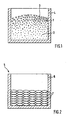
- Fig. 1 shows a transport container 4, which was filled with a particle mixture 1 of small and large particles 2.3.
- the container has already been transported, so that the different sized particles were already subject to a segregation effect due to shaking movements.
- the initially homogeneous mixture now shows an uneven distribution of the different particles, so that the customer no longer has an even distribution of all particles over the delivered total quantity.
- the containers such as the shipping container, have a capacity of 2001, preferably 1001, more preferably 501.
- the delivered quantities of particles usually range between approx. 10 and 100 kg.
- Fig. 2 shows a particle system according to the invention 5, which consists of the container 6 and a plurality of separate packaging units 7 with the particles therein (not shown).
- the separate packaging units are plastic bags which have been filled and welded with the particle mixture freshly produced by the manufacturer.
- the bags are particularly well suited for the packaging of statically chargeable particles or highly viscous dispersions.
- the filled plastic bags are then stacked in the container 6. If necessary, the bags are equipped with a valve including dust filter. This has the advantage that when stacking from the lower bag by the weight of the overlying bag air is squeezed, this come to lie more densely and thus the space can be better utilized.
- the bags restrict the freedom of movement of the particles in the container, so that segregation is substantially prevented. Furthermore, the bags have the advantage that the particle mixture is easier to handle and also by the portion-wise packaging a dosage is facilitated.
- the bags are preferably water-soluble, so that tearing and emptying of the bags is unnecessary.
- a water-insoluble bag with water-soluble weld and air cushion. In use, the weld dissolves, the particles are released, the insoluble bag floats on the surface of the solution or dispersion and can be fished off.
- the non-water-soluble packaging units consist for example of polymer film, such as PE, PP, PVC.
- the water-soluble packaging units consist for example of PVA or carboxymethylcellulose films. Conceivable are also packaging units made of paper, optionally coated, paper composites, fabric etc.
- the packaging units preferably hold about 100 g to 5 kg of particles.
- the number of packaging units depends on the size of the container, but should preferably be chosen so that the space of the container is filled as completely as possible.
- Fig. 3 shows a further inventive particle system 8, which consists of the container 9 and a tubular structure 10 with the particles therein (not shown).
- the structure 10 is filled with the freshly produced by the manufacturer particle mixture and inserted meandering in the container.
- At the bends of the tubular structure creates a kind of natural barrier for the particle mixture, so that here too the freedom of movement of the particles is limited in the container.
- webs 11 may be incorporated in the interior of the structure, so that the structure is subdivided into individual chambers. For emptying of the structure this must only be removed from the container, so that the particle mixture can be distributed through an opening at one end of the structure.
- the structure can also be cut open or torn open by a longitudinally worked-in tear thread.
- the tubular structure is preferably made of PE, PP or PVC. Also conceivable are all other materials, as under Fig. 2 to the separate packaging units described.
- the tubular structure has a diameter between 5 to 20 cm and is about 3 m long. The dimensions can of course be varied according to the containers and particles used.
Landscapes
- Packages (AREA)
- Basic Packing Technique (AREA)
- Vacuum Packaging (AREA)
- Buffer Packaging (AREA)
- Carbon And Carbon Compounds (AREA)
Description
- Die Erfindung betrifft ein Partikelgemisch und die Stabilisierung dieser Partikel im Gemisch.
- Zur Absicherung von Artikeln, wie z.B. Wertdokumenten, hochwertigen Markenartikeln etc., gegen Fälschung werden oft lumineszierende Substanzen verwendet. Diese Substanzen werden üblicherweise in Form von pulverförmigen Pigmenten verarbeitet, wie in der
EP 0 659 935 A2 beschrieben. - Zur Erhöhung des Fälschungsschutzes wurde in der
WO 00/71363 - Des Weiteren offenbart die
WO 02/078964 - Für den Anwender ist es entscheidend, dass die Codierung im gesamten Gemisch einheitlich ist und sich nicht innerhalb des Gemisches ändert.
- Gerade beim Transport von größeren Verpackungseinheiten vom Hersteller zum Kunden besteht oftmals das Problem, dass sich Partikelgemische, die z.B. Partikel mit unterschiedlichem Durchmesser enthalten, durch Rüttelbewegungen entmischen, da die kleineren Partikel tendenziell Richtung Verpackungsboden wandern, während sich die größeren Partikel auf der Oberfläche ansammeln.
- Aus der
US 5,806,283 , derAT 269 737 B EP 0 061638 A1 sind Verpackungen für Gemische bekannt, bei denen ein Entmischen dadurch verhindert wird, dass in der Verpackung ein Vakuum erzeugt wird. Aus derDE 1 801459 B ist eine weitere Vakuumverpackung bekannt, die zudem Unterteilungen aufweist, die beim Ausschütten des Gemischs zu einer erneuten Vermischung des Gemischs führen. - Ausgehend von diesem Stand der Technik liegt der Erfindung die Aufgabe zugrunde, die Entmischung von pulverförmigen Gemischen aus unterschiedlichen Partikeln zu vermindern bzw. zu verhindern.
- Die Lösung dieser Aufgabe ergibt sich aus den unabhängigen Ansprüchen. Weiterbildungen sind Gegenstand der Unteransprüche.
- Erfindungsgemäß wird ein Partikelsystem bereitgestellt, das einen Behälter und ein sich in dem Behälter befindliches Partikelgemisch umfasst. Wenigstens ein Teil der Partikel im Gemisch unterscheidet sich wenigstens in einem Maß von den restlichen Partikeln, wobei der Behälter wenigstens ein Mittel aufweist, das die räumliche Bewegung der Partikel relativ zueinander im Wesentlichen unterbindet, wobei das Partikelgemisch in Teilmengen aufgeteilt und durch geeignete Mittel getrennt wird, die bewirken, dass die räumliche Bewegung der Partikel relativ zueinander im Wesentlichen unterbunden wird. Dies bedeutet, dass die Partikel im Gemisch im Wesentlichen ihre räumliche Anordnung zueinander nicht verändern, insbesondere bedeutet dies, dass das Mittel ein Entmischen des Partikelgemisches im Wesentlichen verhindert bzw. eine homogene Verteilung der Partikel im Gemisch stabilisiert, dazu wird das Partikelgemisch in ein schlauchförmiges Gebilde eingefüllt. Dieses Gebilde wird mäanderförmig in den Behälter eingebracht. Vorzugsweise weist dieses Gebilde zusätzlich abgetrennte Kammern und gegebenenfalls einen Aufreißfaden auf.
- Insbesondere bei einem Gemisch, bei dem es auf die homogene Verteilung von sich unterscheidenden Partikeln ankommt, gewährleistet das erfindungsgemäße Partikelsystem, dass diese Verteilung stabilisiert wird.
- Unter "Maß" wird im Sinne der Erfindung jede physikalische und/oder chemische Größe verstanden, die eine Entmischung des Partikelgemisches begünstigt. Insbesondere handelt es sich hierbei um die Form, das Gewicht, die Größe, die Dichte, die elektrostatische Aufladung und/ oder die Oberflächenrauigkeit der Partikel.
- Werden beispielsweise unterschiedlich große Partikel homogen vermengt, werden sich diese bei Rüttelbewegungen des Behältnisses so anordnen, dass kleinere Partikel Richtung Behältnisboden wandern und die größeren Partikel sich oben ansammeln. Man erhält ohne Gegenmaßnahmen somit bei Betrachtung der Gesamtmenge eine ungleichmäßige Verteilung der unterschiedlich großen Partikel.
- Eine ähnliche Entmischungstendenz zeigen auch Partikel, die sich im Gewicht oder der Oberflächenrauigkeit unterscheiden, d.h. schwere bzw. weniger raue Partikel werden im Vergleich zu den leichteren bzw. raueren Partikeln eher zum Behältnisboden tendieren.
- Die Erfindung betrifft neben pulverförmigen Partikeln auch dispergierte Partikel. Bei den Partikeln handelt es sich bevorzugt um pulverförmige Teilchen. Besonders bevorzugt handelt es sich um Pigmente. Ganz besonders bevorzugt umfasst das Partikelgemisch Lumineszenzstoffe.
- Die Lumineszenzstoffe sind vorteilhafterweise anorganische Stoffe, wie seltenerddotierte Wirtsgitter, wie sie auch in der
WO 2002/070279 beschrieben sind. - Insbesondere handelt es sich bei den Lumineszenzstoffen um eine Mischung von chemisch und/oder physikalisch unterscheidbaren Lumineszenzstoffen. Chemisch und/ oder physikalisch unterscheidbar sind die Stoffe z.B. dann, wenn sie unterschiedliche Summenformeln, unterschiedliche Gitterstrukturen oder unterschiedliche Spektren aufweisen.
- In einer erfindungsgemäßen Ausführungsform wird auf der Grundlage der Unterscheidbarkeit der Partikel in der Mischung eine Codierung erzeugt. Diese kann beispielsweise auf der An- oder Abwesenheit bestimmter Stoffe beruhen oder auch auf den unterschiedlichen Konzentrationsverhältnissen im Gemisch. Denkbar ist auch, die Codierung über die spektralen Eigenschaften der unterschiedlichen Stoffe aufzubauen.
- Für die Partikel gilt vorzugsweise D99 < 50 µm, besonders bevorzugt D99 < 20 µm. Insbesondere gilt für die Partikel, die in Papier eingebracht werden sollen, dass D99 < 20 µm ist, und für Partikel, die verdruckt werden sollen, dass D99 6 bis 10 µm ist.
- Bei dem Behälter handelt es sich um die üblicherweise eingesetzten Transportbehältnisse für schüttfähiges Transportgut. Dies sind beispielsweise Plastiktonnen, Blechtonnen, Plastiksäcke, etc.
- Erfindungsgemäß wir auch ein Verfahren zum Herstellen eines erfindungsgemäßen Partikelsystems bereitgestellt.
- Weitere Ausführungsformen und Vorteile der Erfindung werden im Folgenden anhand der Figur erläutert. Die in der Figur gezeigten Proportionen entsprechen nicht unbedingt den in der Realität vorliegenden Verhältnissen und dienen vornehmlich zur Verbesserung der Anschaulichkeit.
- Es zeigen
- Fig. 1
- Partikelgemisch mit Behälter nach dem Stand der Technik im Querschnitt,
- Fig. 2 und 3
- erfindungsgemäße Partikelsysteme im Querschnitt.
-
Fig. 1 zeigt einen Transportcontainer 4, der mit einem Partikelgemisch 1 aus kleinen und großen Partikeln 2,3 befüllt wurde. Der Container wurde bereits transportiert, so dass die unterschiedlich großen Partikel bereits auf Grund von Rüttelbewegungen einem Entmischungseffekt unterlagen. Das anfänglich homogene Gemisch zeigt nun eine ungleichmäßige Verteilung der unterschiedlichen Partikel, so dass beim Kunden eine gleichmäßige Verteilung aller Partikel über die gelieferte Gesamtmenge nicht mehr vorliegt. Üblicherweise weisen die Behälter, wie der Transportcontainer, ein Fassungsvermögen von 2001, bevorzugt von 1001, besonders bevorzugt von 501 auf. - Die gelieferten Mengen an Partikel bewegen sich üblicherweise zwischen ca. 10 und 100 kg.
-
Fig. 2 zeigt ein erfindungsgemäßes Partikelsystem 5, das aus dem Behälter 6 und mehreren separaten Verpackungseinheiten 7 mit den darin befindlichen Partikeln (nicht gezeigt) besteht. Bei den separaten Verpackungseinheiten handelt es sich im vorliegenden Fall um Plastiksäckchen, die mit dem frisch vom Hersteller produzierten Partikelgemisch befüllt und verschweißt wurden. Besonders gut eignen sich die Säckchen zum Abpacken von statisch aufladbaren Partikeln oder hochviskosen Dispersionen. Die befüllten Plastiksäckchen werden dann in den Behälter 6 gestapelt. Gegebenenfalls sind die Säckchen mit einem Ventil inclusive Staubfilter ausgerüstet. Dies hat den Vorteil, dass beim Stapeln aus den unteren Säckchen durch das Gewicht der darüber liegenden Säckchen Luft ausgepresst wird, diese dadurch dichter zu liegen kommen und so der Raum besser ausgenutzt werden kann. Beim Transport vom Hersteller zum Kunden schränken die Säckchen die Bewegungsfreiheit der Partikel im Behälter ein, so dass eine Entmischung im Wesentlichen verhindert wird. Des Weiteren haben die Säckchen den Vorteil, dass das Partikelgemisch leichter zu handhaben ist und auch durch die portionsweise Verpackung eine Dosierung erleichtert wird. Vorzugsweise sind die Säckchen wasserlöslich, so dass sich ein Aufreißen und Entleeren der Säckchen erübrigt. Alternativ zu den vollständig wasserlöslichen Säckchen besteht auch die Möglichkeit, ein wasserunlösliches Säckchen mit wasserlöslicher Schweißnaht und Luftkissen einzusetzen. Beim Einsatz löst sich die Schweißnaht, die Parteikel werden freigesetzt, das unlösliche Säckchen schwimmt an der Oberfläche der Lösung bzw. Dispersion und kann abgefischt werden. Die nicht wasserlöslichen Verpackungseinheiten bestehen z.B. aus Polymerfolie, wie PE, PP, PVC. Die wasserlöslichen Verpackungseinheiten bestehen z.B. aus PVA- oder Carboxymethylcellulose-Folien. Denkbar sind auch Verpackungseinheiten aus Papier, gegebenenfalls beschichtet, Papierverbunde, Stoff etc. - Die Verpackungseinheiten fassen vorzugsweise ca. 100 g bis 5 kg Partikel. Die Anzahl der Verpackungseinheiten richtet sich nach der Größe des Behälters, sollte aber vorzugsweise so gewählt werden, dass der Raum des Behälters möglichst vollständig gefüllt ist.
-
Fig. 3 zeigt ein weiteres erfindungsgemäßes Partikelsystem 8, das aus dem Behälter 9 und einem schlauchförmigen Gebilde 10 mit den darin befindlichen Partikeln (nicht gezeigt) besteht. Das Gebilde 10 wird mit dem frisch vom Hersteller produzierten Partikelgemisch befüllt und in den Behälter mäanderförmig eingelegt. An den Biegungen des schlauchförmigen Gebildes entsteht eine Art natürlicher Barriere für das Partikelgemisch, so dass auch hier die Bewegungsfreiheit der Partikel im Behälter eingeschränkt wird. Zusätzlich können im Innern des Gebildes Stege 11 eingearbeitet sein, so dass das Gebilde in einzelne Kammern unterteilt wird. Zum Entleeren des Gebildes muss dieses lediglich aus dem Behälter entnommen werden, so dass das Partikelgemisch durch eine Öffung an einem Ende des Gebildes ausgeschüttet werden kann. Bei Einsatz weniger rieselfähiger Partikelgemische kann des Gebilde auch aufgeschnitten werden oder durch einen längs eingearbeiteten Aufreißfaden aufgerissen werden. Das schlauchförmige Gebilde besteht vorzugsweise aus PE, PP oder PVC. Denkbar sind auch sämtliche weitere Materialien, wie unterFig. 2 zu den separaten Verpackungseinheiten beschrieben. Vorzugsweise weist das schlauchförmige Gebilde einen Durchmesser zwischen 5 bis 20 cm auf und ist etwa 3 m lang. Die Abmessungen können selbstverständlich in Abhängigkeit von eingesetzten Behältern und Partikeln entsprechend variiert werden.
Claims (12)
- Partikelsystem, umfassend einen Behälter und ein sich in dem Behälter befindliches Partikelgemisch zum Fälschungsschutz, wobei wenigstens ein Teil der Partikel im Gemisch sich wenigstens in einem Maß von den restlichen Partikeln unterscheidet, wobei der Behälter wenigstens ein Mittel aufweist, das die räumliche Bewegung der Partikel relativ zueinander im Wesentlichen unterbindet, wobei das Partikelgemisch in Teilmengen aufgeteilt ist und das Mittel geeignet ist, die Teilmengen räumlich zu trennen, wodurch ein Entmischen des Partikelgemisches im Wesentlichen verhindert wird, dadurch gekennzeichnet, dass das Mittel ein schlauchförmiges Gebilde ist, welches das Partikelgemisch aufnimmt, und mäanderförmig in dem Behälter angeordnet ist.
- System nach Anspruch 1, wobei das Mittel eine homogene Verteilung der Partikel im Partikelgemisch stabilisiert.
- System nach wenigstens einem der Ansprüche 1 oder 2 , wobei die Partikel Pigmente sind.
- System nach wenigstens einem der Ansprüche 1 bis 3, wobei die Partikel eine Codierung bilden.
- System nach Anspruch 4, wobei die Codierung auf dem Mischungsverhältnis der Partikel im Gemisch basiert.
- System nach wenigstens einem der Ansprüche 1 bis 5, wobei die Partikel Lumineszenzstoffe umfassen.
- System nach wenigstens einem der Ansprüche 1 bis 6, wobei das Maß die Größe, die Form, das Gewicht, die Dichte, die elektrostatische Aufladung und/oder die Oberflächenrauhigkeit ist.
- System nach wenigstens einem der Ansprüche 1 bis 7, wobei das schlauchförmige Gebilde abgetrennte Kammern aufweist.
- System nach wenigstens einem der Ansprüche 1 bis 8, wobei das schlauchförmige Gebilde einen Aufreißfaden aufweist.
- Verfahren zum Bereitstellen eines Partikelsystems umfassend einen Behälter und ein sich in dem Behälter befindliches Partikelgemisch zum Fälschungsschutz, wobei wenigstens ein Teil der Partikel im Gemisch sich wenigstens in einem Maß von den restlichen Partikeln unterscheidet, wobei der Behälter mit wenigstens einem Mittel ausgestattet wird, das die räumliche Bewegung der Partikel relativ zueinander im Wesentlichen unterbindet, wobei das Gemisch in Teilmengen aufgeteilt wird und das Mittel die Teilmengen räumlich trennt, wodurch ein Entmischen des Partikelgemisches im Wesentlichen verhindert wird, dadurch gekennzeichnet, dass das Mittel ein schlauchförmiges Gebilde ist, in welches das Partikelgemisch eingefüllt wird, und das mäanderförmig in dem Behälter angeordnet wird.
- Verfahren nach Anspruch 10, wobei das schlauchförmige Gebilde abgetrennte Kammern aufweist.
- Verfahren nach Anspruch 10 oder 11, wobei das schlauchförmige Gebilde mittels eines Aufreißfades geöffnet wird.
Applications Claiming Priority (2)
| Application Number | Priority Date | Filing Date | Title |
|---|---|---|---|
| DE102004052151A DE102004052151A1 (de) | 2004-10-26 | 2004-10-26 | Partikelgemisch |
| PCT/EP2005/011397 WO2006045575A1 (de) | 2004-10-26 | 2005-10-24 | Partikelgemisch |
Publications (2)
| Publication Number | Publication Date |
|---|---|
| EP1827856A1 EP1827856A1 (de) | 2007-09-05 |
| EP1827856B1 true EP1827856B1 (de) | 2011-09-21 |
Family
ID=35559484
Family Applications (1)
| Application Number | Title | Priority Date | Filing Date |
|---|---|---|---|
| EP05796514A Expired - Lifetime EP1827856B1 (de) | 2004-10-26 | 2005-10-24 | Partikelgemisch |
Country Status (6)
| Country | Link |
|---|---|
| US (1) | US20100180978A1 (de) |
| EP (1) | EP1827856B1 (de) |
| AT (1) | ATE525216T1 (de) |
| DE (1) | DE102004052151A1 (de) |
| RU (1) | RU2394690C2 (de) |
| WO (1) | WO2006045575A1 (de) |
Family Cites Families (22)
| Publication number | Priority date | Publication date | Assignee | Title |
|---|---|---|---|---|
| US1713301A (en) * | 1927-10-25 | 1929-05-14 | Quaker City Chocolate & Confec | Packaging of confections |
| US2604983A (en) * | 1945-02-09 | 1952-07-29 | Nat Biscuit Co | Display package with transparent wrapper |
| US3199671A (en) * | 1963-04-09 | 1965-08-10 | Coroga Company | Package assembly |
| US3207420A (en) * | 1964-05-19 | 1965-09-21 | Octaviano D Navarrete-Kindelan | Container |
| GB1118175A (en) * | 1965-01-07 | 1968-06-26 | Hoeganaes Ab | Means for preventing segregation of pulverulent material |
| DE1801459B1 (de) * | 1968-10-05 | 1970-07-02 | Poulsen Preben Andersen | Quaderfoermiger Verpackungsbehaelter fuer Trockensubstanzmischungen |
| US3992811A (en) * | 1975-03-10 | 1976-11-23 | Bernard Yellin | Sand painting unit |
| US4223043A (en) * | 1978-10-16 | 1980-09-16 | Oliver Johnson | Detachable cell frozen confection forming and holding apparatus |
| US4235065A (en) * | 1979-03-23 | 1980-11-25 | Harry Freeman | Method of packaging fragile articles |
| DE3111612A1 (de) * | 1981-03-25 | 1982-10-14 | Elektro-Thermit Gmbh, 4300 Essen | Anwendung der vakuumfolienverpackung zur abpackung aluminothermischer gemische |
| US4932548A (en) * | 1989-09-18 | 1990-06-12 | Bensinger Jennifer H | Space divider assembly for a freezer chest |
| TW207982B (en) * | 1992-04-17 | 1993-06-21 | Brainpower Inc | System for confining articles in a container |
| US5244268A (en) * | 1992-07-14 | 1993-09-14 | Derrickson Elizabeth J | Carrying case for food items |
| US5354569A (en) * | 1992-07-16 | 1994-10-11 | Brown Richard S | Method of packaging lettuce for storing and shipping |
| DE4344552A1 (de) * | 1993-12-24 | 1995-06-29 | Giesecke & Devrient Gmbh | Verfahren und Vorrichtung zur Ausstattung von Wertpapieren mit Echtheitsmerkmalen |
| US5806283A (en) * | 1996-04-12 | 1998-09-15 | Shafer; Richard A. | Vacuum packaging of plastic blends |
| ATE233300T1 (de) * | 1997-12-29 | 2003-03-15 | Sicpa Holding Sa | Überzugszusammensetzung, verwendung von teilchen, verfahren zur markierung und identifizierung eines diese überzugszusammensetzung enthaltenden sicherheitsdokumentes |
| US5960981A (en) * | 1998-06-15 | 1999-10-05 | Emergency One, Inc. | Water tank baffle |
| RU2224707C2 (ru) * | 1998-06-26 | 2004-02-27 | Елкем Аса | Способ уплотнения сыпучего порошкового материала и устройство для его осуществления |
| DE19923959A1 (de) * | 1999-05-25 | 2000-11-30 | Giesecke & Devrient Gmbh | Wertdokument |
| DE10116315A1 (de) * | 2001-04-02 | 2002-10-10 | Giesecke & Devrient Gmbh | Farbcodierung zur Kennzeichnung von Gegentänden |
| AT500449B8 (de) * | 2004-05-13 | 2007-02-15 | Dsm Fine Chem Austria Gmbh | Verpackungsmethode zum verhindern des zusammenbackens von chemikalien in pulver und/odergranulatform |
-
2004
- 2004-10-26 DE DE102004052151A patent/DE102004052151A1/de not_active Withdrawn
-
2005
- 2005-10-24 RU RU2007119447/12A patent/RU2394690C2/ru not_active IP Right Cessation
- 2005-10-24 AT AT05796514T patent/ATE525216T1/de active
- 2005-10-24 EP EP05796514A patent/EP1827856B1/de not_active Expired - Lifetime
- 2005-10-24 WO PCT/EP2005/011397 patent/WO2006045575A1/de not_active Ceased
- 2005-10-24 US US11/665,988 patent/US20100180978A1/en not_active Abandoned
Also Published As
| Publication number | Publication date |
|---|---|
| US20100180978A1 (en) | 2010-07-22 |
| RU2394690C2 (ru) | 2010-07-20 |
| WO2006045575A1 (de) | 2006-05-04 |
| ATE525216T1 (de) | 2011-10-15 |
| EP1827856A1 (de) | 2007-09-05 |
| DE102004052151A1 (de) | 2006-04-27 |
| RU2007119447A (ru) | 2009-01-27 |
Similar Documents
| Publication | Publication Date | Title |
|---|---|---|
| DE2205716A1 (de) | Aufgabevorrichtung für Schüttgut | |
| DE2905840A1 (de) | Behaelter | |
| DE102006004291A1 (de) | Sack und Verfahren zur Herstellung desselben | |
| DE202021103069U1 (de) | Sack oder Bündelverpackung ohne Kunststoffelemente mit hohem Schutz vor Feuchtigkeit und Wasser | |
| EP0148360B1 (de) | Verfahren zum Verdichten und/oder Abfüllen von pulverförmigen Stoffen | |
| EP0982238B1 (de) | Grossgebinde für hochdisperse, hochlufthaltige Feststoffe und ein Verfahren zu deren Befüllung | |
| DE1914541B2 (de) | Pneumatische Förderanlage zur chargenweisen Beschickung von mehreren Verbraucherstationen mit feinkörnigem Gut | |
| DE102009050485B4 (de) | Fahrzeuge mit einer Explosions- und Brand- sowie Schwallschutzeinrichtung | |
| DE68910819T2 (de) | Entladungsgerät. | |
| DE102004052151A1 (de) | Partikelgemisch | |
| EP1224133A1 (de) | Verfahren zur befüllung von containern | |
| EP0085326A2 (de) | Vorrichtung zum Aufwärtsfördern von Feststoffpartikeln mittels eines Gas/Flüssigkeits-Gemisches | |
| DE202016003199U1 (de) | Ventilsack | |
| DE69729267T2 (de) | Vorrichtung mit Filterelement zur Reinigung von leicht belastetem Wasser | |
| DE102010054698A1 (de) | Vorrichtung zur Austragung von Schüttgut | |
| DE102009041970A1 (de) | Silo mit einer Befüllvorrichtung | |
| DE10355546A1 (de) | Verfahren und Vorrichtung zum Befüllen von flexiblen Behältnissen | |
| DE4140213A1 (de) | Ventilsack mit entlueftungsventil | |
| DE20203463U1 (de) | Speicheranordnung zur vorübergehenden Aufnahme von zur Betonfertigung einsetzbarem pulverartigem Material, insbesondere Bindemittel | |
| DE69221834T2 (de) | Verfahren zur Optimierung des Plazierens von rechteckigen Objekten oder Paketen | |
| DE19960663B4 (de) | Verfahren zum Umhüllen eines Stapels aus Einzelstücken mit einer Haube aus Schlauchfolie sowie bei dem Verfahren anzuwendende Schlauchfolie | |
| DE10161687B4 (de) | Beschichtungsmaterial für flexible Unterlagen und dessen Verwendung | |
| DE102017000108B4 (de) | Beutel für pulverförmiges Schüttgut | |
| EP4642704A1 (de) | Papiersack | |
| DE8813375U1 (de) | Vorrichtung zum Einfüllen von Füllgut in insbesondere Säcke |
Legal Events
| Date | Code | Title | Description |
|---|---|---|---|
| PUAI | Public reference made under article 153(3) epc to a published international application that has entered the european phase |
Free format text: ORIGINAL CODE: 0009012 |
|
| 17P | Request for examination filed |
Effective date: 20070529 |
|
| AK | Designated contracting states |
Kind code of ref document: A1 Designated state(s): AT BE BG CH CY CZ DE DK EE ES FI FR GB GR HU IE IS IT LI LT LU LV MC NL PL PT RO SE SI SK TR |
|
| 17Q | First examination report despatched |
Effective date: 20071113 |
|
| DAX | Request for extension of the european patent (deleted) | ||
| GRAP | Despatch of communication of intention to grant a patent |
Free format text: ORIGINAL CODE: EPIDOSNIGR1 |
|
| GRAS | Grant fee paid |
Free format text: ORIGINAL CODE: EPIDOSNIGR3 |
|
| GRAA | (expected) grant |
Free format text: ORIGINAL CODE: 0009210 |
|
| AK | Designated contracting states |
Kind code of ref document: B1 Designated state(s): AT BE BG CH CY CZ DE DK EE ES FI FR GB GR HU IE IS IT LI LT LU LV MC NL PL PT RO SE SI SK TR |
|
| REG | Reference to a national code |
Ref country code: GB Ref legal event code: FG4D Free format text: NOT ENGLISH |
|
| REG | Reference to a national code |
Ref country code: CH Ref legal event code: EP |
|
| REG | Reference to a national code |
Ref country code: IE Ref legal event code: FG4D Free format text: LANGUAGE OF EP DOCUMENT: GERMAN |
|
| REG | Reference to a national code |
Ref country code: DE Ref legal event code: R096 Ref document number: 502005011917 Country of ref document: DE Effective date: 20111124 |
|
| REG | Reference to a national code |
Ref country code: DE Ref legal event code: R082 Ref document number: 502005011917 Country of ref document: DE |
|
| REG | Reference to a national code |
Ref country code: NL Ref legal event code: VDEP Effective date: 20110921 |
|
| PG25 | Lapsed in a contracting state [announced via postgrant information from national office to epo] |
Ref country code: FI Free format text: LAPSE BECAUSE OF FAILURE TO SUBMIT A TRANSLATION OF THE DESCRIPTION OR TO PAY THE FEE WITHIN THE PRESCRIBED TIME-LIMIT Effective date: 20110921 Ref country code: SE Free format text: LAPSE BECAUSE OF FAILURE TO SUBMIT A TRANSLATION OF THE DESCRIPTION OR TO PAY THE FEE WITHIN THE PRESCRIBED TIME-LIMIT Effective date: 20110921 Ref country code: LT Free format text: LAPSE BECAUSE OF FAILURE TO SUBMIT A TRANSLATION OF THE DESCRIPTION OR TO PAY THE FEE WITHIN THE PRESCRIBED TIME-LIMIT Effective date: 20110921 |
|
| LTIE | Lt: invalidation of european patent or patent extension |
Effective date: 20110921 |
|
| PG25 | Lapsed in a contracting state [announced via postgrant information from national office to epo] |
Ref country code: CY Free format text: LAPSE BECAUSE OF FAILURE TO SUBMIT A TRANSLATION OF THE DESCRIPTION OR TO PAY THE FEE WITHIN THE PRESCRIBED TIME-LIMIT Effective date: 20110921 Ref country code: SI Free format text: LAPSE BECAUSE OF FAILURE TO SUBMIT A TRANSLATION OF THE DESCRIPTION OR TO PAY THE FEE WITHIN THE PRESCRIBED TIME-LIMIT Effective date: 20110921 Ref country code: LV Free format text: LAPSE BECAUSE OF FAILURE TO SUBMIT A TRANSLATION OF THE DESCRIPTION OR TO PAY THE FEE WITHIN THE PRESCRIBED TIME-LIMIT Effective date: 20110921 Ref country code: GR Free format text: LAPSE BECAUSE OF FAILURE TO SUBMIT A TRANSLATION OF THE DESCRIPTION OR TO PAY THE FEE WITHIN THE PRESCRIBED TIME-LIMIT Effective date: 20111222 |
|
| REG | Reference to a national code |
Ref country code: IE Ref legal event code: FD4D |
|
| BERE | Be: lapsed |
Owner name: GIESECKE & DEVRIENT G.M.B.H. Effective date: 20111031 |
|
| PG25 | Lapsed in a contracting state [announced via postgrant information from national office to epo] |
Ref country code: IS Free format text: LAPSE BECAUSE OF FAILURE TO SUBMIT A TRANSLATION OF THE DESCRIPTION OR TO PAY THE FEE WITHIN THE PRESCRIBED TIME-LIMIT Effective date: 20120121 Ref country code: IE Free format text: LAPSE BECAUSE OF FAILURE TO SUBMIT A TRANSLATION OF THE DESCRIPTION OR TO PAY THE FEE WITHIN THE PRESCRIBED TIME-LIMIT Effective date: 20110921 Ref country code: SK Free format text: LAPSE BECAUSE OF FAILURE TO SUBMIT A TRANSLATION OF THE DESCRIPTION OR TO PAY THE FEE WITHIN THE PRESCRIBED TIME-LIMIT Effective date: 20110921 Ref country code: CZ Free format text: LAPSE BECAUSE OF FAILURE TO SUBMIT A TRANSLATION OF THE DESCRIPTION OR TO PAY THE FEE WITHIN THE PRESCRIBED TIME-LIMIT Effective date: 20110921 |
|
| PG25 | Lapsed in a contracting state [announced via postgrant information from national office to epo] |
Ref country code: RO Free format text: LAPSE BECAUSE OF FAILURE TO SUBMIT A TRANSLATION OF THE DESCRIPTION OR TO PAY THE FEE WITHIN THE PRESCRIBED TIME-LIMIT Effective date: 20110921 Ref country code: PT Free format text: LAPSE BECAUSE OF FAILURE TO SUBMIT A TRANSLATION OF THE DESCRIPTION OR TO PAY THE FEE WITHIN THE PRESCRIBED TIME-LIMIT Effective date: 20120123 Ref country code: IT Free format text: LAPSE BECAUSE OF FAILURE TO SUBMIT A TRANSLATION OF THE DESCRIPTION OR TO PAY THE FEE WITHIN THE PRESCRIBED TIME-LIMIT Effective date: 20110921 Ref country code: PL Free format text: LAPSE BECAUSE OF FAILURE TO SUBMIT A TRANSLATION OF THE DESCRIPTION OR TO PAY THE FEE WITHIN THE PRESCRIBED TIME-LIMIT Effective date: 20110921 Ref country code: MC Free format text: LAPSE BECAUSE OF NON-PAYMENT OF DUE FEES Effective date: 20111031 Ref country code: NL Free format text: LAPSE BECAUSE OF FAILURE TO SUBMIT A TRANSLATION OF THE DESCRIPTION OR TO PAY THE FEE WITHIN THE PRESCRIBED TIME-LIMIT Effective date: 20110921 Ref country code: EE Free format text: LAPSE BECAUSE OF FAILURE TO SUBMIT A TRANSLATION OF THE DESCRIPTION OR TO PAY THE FEE WITHIN THE PRESCRIBED TIME-LIMIT Effective date: 20110921 |
|
| REG | Reference to a national code |
Ref country code: CH Ref legal event code: PL |
|
| PLBE | No opposition filed within time limit |
Free format text: ORIGINAL CODE: 0009261 |
|
| STAA | Information on the status of an ep patent application or granted ep patent |
Free format text: STATUS: NO OPPOSITION FILED WITHIN TIME LIMIT |
|
| PG25 | Lapsed in a contracting state [announced via postgrant information from national office to epo] |
Ref country code: DK Free format text: LAPSE BECAUSE OF FAILURE TO SUBMIT A TRANSLATION OF THE DESCRIPTION OR TO PAY THE FEE WITHIN THE PRESCRIBED TIME-LIMIT Effective date: 20110921 Ref country code: LI Free format text: LAPSE BECAUSE OF NON-PAYMENT OF DUE FEES Effective date: 20111031 Ref country code: CH Free format text: LAPSE BECAUSE OF NON-PAYMENT OF DUE FEES Effective date: 20111031 Ref country code: BE Free format text: LAPSE BECAUSE OF NON-PAYMENT OF DUE FEES Effective date: 20111031 |
|
| REG | Reference to a national code |
Ref country code: FR Ref legal event code: ST Effective date: 20120706 |
|
| 26N | No opposition filed |
Effective date: 20120622 |
|
| GBPC | Gb: european patent ceased through non-payment of renewal fee |
Effective date: 20111221 |
|
| PG25 | Lapsed in a contracting state [announced via postgrant information from national office to epo] |
Ref country code: FR Free format text: LAPSE BECAUSE OF NON-PAYMENT OF DUE FEES Effective date: 20111121 |
|
| REG | Reference to a national code |
Ref country code: DE Ref legal event code: R097 Ref document number: 502005011917 Country of ref document: DE Effective date: 20120622 |
|
| PG25 | Lapsed in a contracting state [announced via postgrant information from national office to epo] |
Ref country code: GB Free format text: LAPSE BECAUSE OF NON-PAYMENT OF DUE FEES Effective date: 20111221 |
|
| REG | Reference to a national code |
Ref country code: AT Ref legal event code: MM01 Ref document number: 525216 Country of ref document: AT Kind code of ref document: T Effective date: 20111024 |
|
| PG25 | Lapsed in a contracting state [announced via postgrant information from national office to epo] |
Ref country code: AT Free format text: LAPSE BECAUSE OF NON-PAYMENT OF DUE FEES Effective date: 20111024 |
|
| PG25 | Lapsed in a contracting state [announced via postgrant information from national office to epo] |
Ref country code: ES Free format text: LAPSE BECAUSE OF FAILURE TO SUBMIT A TRANSLATION OF THE DESCRIPTION OR TO PAY THE FEE WITHIN THE PRESCRIBED TIME-LIMIT Effective date: 20120101 |
|
| PG25 | Lapsed in a contracting state [announced via postgrant information from national office to epo] |
Ref country code: LU Free format text: LAPSE BECAUSE OF NON-PAYMENT OF DUE FEES Effective date: 20111024 |
|
| PG25 | Lapsed in a contracting state [announced via postgrant information from national office to epo] |
Ref country code: BG Free format text: LAPSE BECAUSE OF FAILURE TO SUBMIT A TRANSLATION OF THE DESCRIPTION OR TO PAY THE FEE WITHIN THE PRESCRIBED TIME-LIMIT Effective date: 20111221 |
|
| PG25 | Lapsed in a contracting state [announced via postgrant information from national office to epo] |
Ref country code: TR Free format text: LAPSE BECAUSE OF FAILURE TO SUBMIT A TRANSLATION OF THE DESCRIPTION OR TO PAY THE FEE WITHIN THE PRESCRIBED TIME-LIMIT Effective date: 20110921 |
|
| PG25 | Lapsed in a contracting state [announced via postgrant information from national office to epo] |
Ref country code: HU Free format text: LAPSE BECAUSE OF FAILURE TO SUBMIT A TRANSLATION OF THE DESCRIPTION OR TO PAY THE FEE WITHIN THE PRESCRIBED TIME-LIMIT Effective date: 20110921 |
|
| PGFP | Annual fee paid to national office [announced via postgrant information from national office to epo] |
Ref country code: DE Payment date: 20161031 Year of fee payment: 12 |
|
| REG | Reference to a national code |
Ref country code: DE Ref legal event code: R119 Ref document number: 502005011917 Country of ref document: DE |
|
| PG25 | Lapsed in a contracting state [announced via postgrant information from national office to epo] |
Ref country code: DE Free format text: LAPSE BECAUSE OF NON-PAYMENT OF DUE FEES Effective date: 20180501 |