EP1810897A2 - Sensoreinrichtung zur Erfassung einer Benetzung auf einer Scheibe - Google Patents
Sensoreinrichtung zur Erfassung einer Benetzung auf einer Scheibe Download PDFInfo
- Publication number
- EP1810897A2 EP1810897A2 EP07107915A EP07107915A EP1810897A2 EP 1810897 A2 EP1810897 A2 EP 1810897A2 EP 07107915 A EP07107915 A EP 07107915A EP 07107915 A EP07107915 A EP 07107915A EP 1810897 A2 EP1810897 A2 EP 1810897A2
- Authority
- EP
- European Patent Office
- Prior art keywords
- sensor device
- transmitter
- receiver
- transmitters
- receivers
- Prior art date
- Legal status (The legal status is an assumption and is not a legal conclusion. Google has not performed a legal analysis and makes no representation as to the accuracy of the status listed.)
- Granted
Links
Images


Classifications
-
- G—PHYSICS
- G01—MEASURING; TESTING
- G01N—INVESTIGATING OR ANALYSING MATERIALS BY DETERMINING THEIR CHEMICAL OR PHYSICAL PROPERTIES
- G01N21/00—Investigating or analysing materials by the use of optical means, i.e. using sub-millimetre waves, infrared, visible or ultraviolet light
- G01N21/84—Systems specially adapted for particular applications
- G01N21/88—Investigating the presence of flaws or contamination
- G01N21/95—Investigating the presence of flaws or contamination characterised by the material or shape of the object to be examined
- G01N21/958—Inspecting transparent materials or objects, e.g. windscreens
-
- B—PERFORMING OPERATIONS; TRANSPORTING
- B60—VEHICLES IN GENERAL
- B60S—SERVICING, CLEANING, REPAIRING, SUPPORTING, LIFTING, OR MANOEUVRING OF VEHICLES, NOT OTHERWISE PROVIDED FOR
- B60S1/00—Cleaning of vehicles
- B60S1/02—Cleaning windscreens, windows or optical devices
- B60S1/04—Wipers or the like, e.g. scrapers
- B60S1/06—Wipers or the like, e.g. scrapers characterised by the drive
- B60S1/08—Wipers or the like, e.g. scrapers characterised by the drive electrically driven
- B60S1/0818—Wipers or the like, e.g. scrapers characterised by the drive electrically driven including control systems responsive to external conditions, e.g. by detection of moisture, dirt or the like
- B60S1/0822—Wipers or the like, e.g. scrapers characterised by the drive electrically driven including control systems responsive to external conditions, e.g. by detection of moisture, dirt or the like characterized by the arrangement or type of detection means
- B60S1/0833—Optical rain sensor
- B60S1/0837—Optical rain sensor with a particular arrangement of the optical elements
-
- B—PERFORMING OPERATIONS; TRANSPORTING
- B60—VEHICLES IN GENERAL
- B60Q—ARRANGEMENT OF SIGNALLING OR LIGHTING DEVICES, THE MOUNTING OR SUPPORTING THEREOF OR CIRCUITS THEREFOR, FOR VEHICLES IN GENERAL
- B60Q1/00—Arrangement of optical signalling or lighting devices, the mounting or supporting thereof or circuits therefor
- B60Q1/02—Arrangement of optical signalling or lighting devices, the mounting or supporting thereof or circuits therefor the devices being primarily intended to illuminate the way ahead or to illuminate other areas of way or environments
- B60Q1/04—Arrangement of optical signalling or lighting devices, the mounting or supporting thereof or circuits therefor the devices being primarily intended to illuminate the way ahead or to illuminate other areas of way or environments the devices being headlights
- B60Q1/14—Arrangement of optical signalling or lighting devices, the mounting or supporting thereof or circuits therefor the devices being primarily intended to illuminate the way ahead or to illuminate other areas of way or environments the devices being headlights having dimming means
- B60Q1/1415—Dimming circuits
- B60Q1/1423—Automatic dimming circuits, i.e. switching between high beam and low beam due to change of ambient light or light level in road traffic
-
- B—PERFORMING OPERATIONS; TRANSPORTING
- B60—VEHICLES IN GENERAL
- B60S—SERVICING, CLEANING, REPAIRING, SUPPORTING, LIFTING, OR MANOEUVRING OF VEHICLES, NOT OTHERWISE PROVIDED FOR
- B60S1/00—Cleaning of vehicles
- B60S1/02—Cleaning windscreens, windows or optical devices
- B60S1/04—Wipers or the like, e.g. scrapers
- B60S1/06—Wipers or the like, e.g. scrapers characterised by the drive
- B60S1/08—Wipers or the like, e.g. scrapers characterised by the drive electrically driven
- B60S1/0818—Wipers or the like, e.g. scrapers characterised by the drive electrically driven including control systems responsive to external conditions, e.g. by detection of moisture, dirt or the like
- B60S1/0822—Wipers or the like, e.g. scrapers characterised by the drive electrically driven including control systems responsive to external conditions, e.g. by detection of moisture, dirt or the like characterized by the arrangement or type of detection means
-
- B—PERFORMING OPERATIONS; TRANSPORTING
- B60—VEHICLES IN GENERAL
- B60Q—ARRANGEMENT OF SIGNALLING OR LIGHTING DEVICES, THE MOUNTING OR SUPPORTING THEREOF OR CIRCUITS THEREFOR, FOR VEHICLES IN GENERAL
- B60Q2300/00—Indexing codes for automatically adjustable headlamps or automatically dimmable headlamps
- B60Q2300/30—Indexing codes relating to the vehicle environment
- B60Q2300/31—Atmospheric conditions
- B60Q2300/314—Ambient light
-
- B—PERFORMING OPERATIONS; TRANSPORTING
- B60—VEHICLES IN GENERAL
- B60Q—ARRANGEMENT OF SIGNALLING OR LIGHTING DEVICES, THE MOUNTING OR SUPPORTING THEREOF OR CIRCUITS THEREFOR, FOR VEHICLES IN GENERAL
- B60Q2300/00—Indexing codes for automatically adjustable headlamps or automatically dimmable headlamps
- B60Q2300/30—Indexing codes relating to the vehicle environment
- B60Q2300/33—Driving situation
- B60Q2300/337—Tunnels or bridges
-
- B—PERFORMING OPERATIONS; TRANSPORTING
- B60—VEHICLES IN GENERAL
- B60Q—ARRANGEMENT OF SIGNALLING OR LIGHTING DEVICES, THE MOUNTING OR SUPPORTING THEREOF OR CIRCUITS THEREFOR, FOR VEHICLES IN GENERAL
- B60Q2300/00—Indexing codes for automatically adjustable headlamps or automatically dimmable headlamps
- B60Q2300/40—Indexing codes relating to other road users or special conditions
- B60Q2300/42—Indexing codes relating to other road users or special conditions oncoming vehicle
-
- B—PERFORMING OPERATIONS; TRANSPORTING
- B60—VEHICLES IN GENERAL
- B60S—SERVICING, CLEANING, REPAIRING, SUPPORTING, LIFTING, OR MANOEUVRING OF VEHICLES, NOT OTHERWISE PROVIDED FOR
- B60S1/00—Cleaning of vehicles
- B60S1/02—Cleaning windscreens, windows or optical devices
- B60S1/04—Wipers or the like, e.g. scrapers
- B60S1/06—Wipers or the like, e.g. scrapers characterised by the drive
- B60S1/08—Wipers or the like, e.g. scrapers characterised by the drive electrically driven
- B60S1/0818—Wipers or the like, e.g. scrapers characterised by the drive electrically driven including control systems responsive to external conditions, e.g. by detection of moisture, dirt or the like
- B60S1/0822—Wipers or the like, e.g. scrapers characterised by the drive electrically driven including control systems responsive to external conditions, e.g. by detection of moisture, dirt or the like characterized by the arrangement or type of detection means
- B60S1/0874—Wipers or the like, e.g. scrapers characterised by the drive electrically driven including control systems responsive to external conditions, e.g. by detection of moisture, dirt or the like characterized by the arrangement or type of detection means characterized by the position of the sensor on the windshield
- B60S1/0881—Wipers or the like, e.g. scrapers characterised by the drive electrically driven including control systems responsive to external conditions, e.g. by detection of moisture, dirt or the like characterized by the arrangement or type of detection means characterized by the position of the sensor on the windshield characterized by the attachment means on the windshield
Definitions
- the invention relates to a sensor device for detecting a wetting of a disc according to the preamble of the main claim.
- the sensor device has a plurality of transmitters and at least one receiver, which coupled via a coupling means a defined radiation in the disc and decouple whose wetting is to be measured by moisture or contamination.
- the transmitters are arranged concentrically on the coupling means around the receiver or in sections concentrically, wherein the coupling means is configured circular or annular.
- the coupling means is configured circular or annular.
- An advantage of the sensor device according to the invention with the features of the main claim is a significant improvement in the response of the sensor device which adjusts itself by increasing the ratio of sensitive area to the support surface. This is achieved by the trapezoidal arrangement of the transmitter and receiver, since so an elongated contiguous sensitive surface is formed, whereby the probability that an on-disk raindrop drifts through the wind on the sensitive surface is increased. This results in a significant improvement in the response.
- the contact surface of the sensor can be reduced, thereby reducing the outer dimensions of the sensor on the disc.
- the outer dimensions of the sensor housing can still be selected rectangular due to the trapezoidal arrangement of the transmitter and receiver, so that the base can be arranged under optimal utilization of the support surface of the light guide in this.
- a rectangular bearing surface or housing also has a cost-reducing effect during production.
- the smaller contact surface of the light guide is a significant assembly advantage, since with constant contact force of the contact pressure increases and thus a disturbing bubble formation between the coupling medium and the disc can be avoided.
- the sensor device proves to be the integration of an automatic light control (ALS), as for example in the DE 196 30 216 C2 is described in the rain sensor module.
- the receiving optics of the automatic light control (ALS) can detect a wide environment of the vehicle by means of a directional and global sensor. For example, tunnel entrances can be detected by the forward detection cone of the direction sensor in good time before the entrance. Due to the trapezoidal arrangement the transmitter and receiver remains in the center of the sensor for the receiving optics despite the compact design enough space. It proves to be advantageous that the trapezoid comprises a larger and a smaller parallel, since the receiving optics can thus additionally extend in the direction of the larger parallels without increasing the overall dimensions of the sensor.
- FIG. 1 shows a schematic sectional drawing of a possible embodiment of the optical part of the sensor device according to the invention
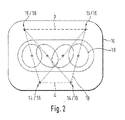
- Figure 2 shows a schematic drawing of the contours of a possible embodiment of the sensor device according to the invention
- Figure 3 shows the light guide body of the sensor device according to the invention of FIG. 1 with a receiving optics for an automatic light control in perspective view.
- FIG. 1 shows a light guide 10 of a sensor device shown in section with a sensor housing 11.
- the support surface of the light guide 10 is, for example, by the same contact via the coupling medium 12, z. B. a silicone pad with a disc 13 given.
- the outer dimensions of the light guide 10 approximately correspond to the length and width dimensions of the sensor device, while the sensor housing 11 can also protrude bulging over the contacted bearing surface of the light guide 10 on the disc 13 and therein different elements of Sensor device, in particular transmitter 14 and receiver 15, and a circuit board 24 record.
- the sensor device is fixed, for example, on the inside of the disc 13, for example a windshield of a motor vehicle. Not shown is the attachment of the sensor housing 11 with the disc 13.
- the Lichtleit stresses 10 or the sensor housing 11 is fixed by pressing on the disc 13, wherein the Lichtleit stresses 10 holds the function, emanating from a transmitter 14 transmitter light 17 in the disc 13th to couple in and decoupled in the disc 13 by total reflection or reflection deflected emitter light 20 at another predetermined location on a receiver 15.
- optical elements 16 which are attached as lenses on the light guide, preferably formed and bundle the rays of the transmitter light 17,20 in the desired direction, down or divert.
- At least one light emitting transmitter 14 and a light detecting receiver 15 are mounted within the sensor housing 11 in the illustrated sectional plane.
- the emitters preferably used are light-emitting diodes (LEDs) as receivers, preferably light-detecting diodes (LRD), where the transmitter radiation of the light is in the infrared (IR) or visual (VIS) range, but any others are Frequency ranges possible.
- LEDs light-emitting diodes
- LPD light-detecting diodes
- IR infrared
- VIS visual
- a corresponding in its construction of a light emitting diode receiver element can be used, whereby an optimal frequency adjustment between transmitter 14 and receiver 15 can be achieved.
- a material, here a plastic is chosen, which is transparent for the transmission frequency of the light emitting diodes (LED), but opaque for extraneous light.
- FIG. 2 shows a possible arrangement of the transmitters 14 and receivers 15.
- the transmitter 14 and receiver 15 of the sensor device are placed near the optical elements 16 of FIG.
- Transmitter 14, receiver 15 and the respectively associated optical elements 16 span a base area indicated by dashed lines, which according to the invention corresponds to a trapezoid.
- the optical elements 16 are arranged near each of a transmitter 14. Characterized in that the optical elements 16 are formed here as two juxtaposed lenses, resulting in each transmitter 14 two measuring paths in two directions. Analogously, the receiver 15 are arranged.
- the optical elements 16 consist for example of lenses or mirrors, which can also merge into one another. Also, a solution with only one lens is possible because by appropriate choice of the distances a and b of the trapezoidal base 18, the resulting error angle can be kept low.
- the distances a and b between the transmitters 14 and the receivers 15 are by the wavelength of the emitting radiation of the transmitter 14, the thickness of the disc 13 and the light guide 10, the refractive index of the disc 13, the entrance angle and the entry point of the transmitter light 17 in the disc 13 is determined.
- the distances are chosen such that the coupled in the disc 13 radiation of the transmitter light 17 is totally reflected for each measuring path a single time on the outer surface of the disc 13 and then decoupled from the disc 13 and passed to the receiver 15.
- the sketched sensitive surface 19 corresponds to the areas on the wettable side of the disc 13, in which the total reflection of the radiation of the transmitter light 17 at unworn slice 13 takes place.
- the reflection surfaces of the transmitter light 17 have a certain diameter.
- the named parameters should be so large that an approximately contiguous sensitive surface 19 is formed from the individual reflection surfaces. This is inventively achieved in that the intersections of the central axes of the radiation cone 20 of the transmitter 14 with the wettable side of the disc 13 lie on a straight line and have approximately the same distance.
- the distance a or b of the transmitter 14 and receiver 15 or of the respectively associated optical elements 16 is to be chosen correspondingly greater and the coupling medium 12 only at the coupling and decoupling regions of the Light on the disc 13 to install.
- FIG. 3 shows the optical waveguide 10 of the sensor device according to the invention as shown in FIG. Since the trapezoid from transmitters 14 and receivers 15 comprises a shorter and a longer parallel, a receiving optics 21 for an automatic light control of the motor vehicle is arranged - shifted somewhat from the center in the direction of the longer parallels.
- This receiving optics 21 is made of a translucent material whose transparency range is in the visual range.
- the light guide 10 and the receiving optics 21 are integrally formed, for example, in a multi-component injection molding process, but also an education of several items is possible, wherein in In this case, the receiving optics 21 is inserted into a corresponding recess of the light guide 10.
- the receiving optics 21 itself here contains four, approximately lens-shaped elements 22, 23.
- daylight sensors are mounted in the vicinity, with which the brightness conditions in the vicinity of the vehicle can be sensed direction sensitive.
- the one first element 23 of these lenticular elements 22, 23 is designed such that it detects the overall brightness in the vehicle environment without directional sensitivity.
- Plexiglass is often used as the material for the light-guiding body 10, since it is cost-effective and easy to process. However, since transparency is only required in the area of the transmitter light, another plastic is also conceivable. Particularly suitable is also a light guide material which, for example by a chemical or physical process on the side facing the disc 13 softer and more elastic properties than on the side facing away from the disc 13, since the coupling medium 12 can be saved.
- certain substances in particular soot particles, can be spatially selectively added to the material during the production process of the optical waveguide 10. For example, only the function required areas for the transmitter light 17 to be permeable. An analogous procedure is also possible for the coupling medium 12.
- a transmitter 14 and a receiver 15 are placed at each corner of the trapezium or only one transmitter 14 used for the entire trapezoid, in which case the optical elements 16 have reflective properties to anyway at several corners of the trapezoidal transmitter light 17 in the disc 13 to be able to dock.
- the receiving optics 21 may comprise a plurality of elements 22, 23, in particular a facet structure is possible, which permits a more accurate evaluation of the brightness distribution taking into account the spatial structure. As a result, for example, oncoming vehicles can be detected. Naturally, light frequencies can also be filtered here. Because of this wealth of information, for example, between high beam and low beam can be switched automatically or semi-automatically.
Landscapes
- Engineering & Computer Science (AREA)
- Mechanical Engineering (AREA)
- Automation & Control Theory (AREA)
- Chemical & Material Sciences (AREA)
- Health & Medical Sciences (AREA)
- Life Sciences & Earth Sciences (AREA)
- Physics & Mathematics (AREA)
- Analytical Chemistry (AREA)
- Biochemistry (AREA)
- General Health & Medical Sciences (AREA)
- General Physics & Mathematics (AREA)
- Immunology (AREA)
- Pathology (AREA)
- Investigating Or Analysing Materials By Optical Means (AREA)
- Geophysics And Detection Of Objects (AREA)
Abstract
Description
- Die Erfindung geht aus von einer Sensoreinrichtung zur Erfassung einer Benetzung einer Scheibe nach dem Oberbegriff des Hauptanspruchs.
- Aus der
DE 197 01 258 A1 ist eine Sensoreinrichtung zur Steuerung von Wisch-Waschanlagen für Kraftfahrzeugscheiben bekannt geworden, die nach einem optoelektronischen Prinzip funktioniert. Die Sensoreinrichtung weist mehrere Sender und mindestens einen Empfänger auf, die über ein Koppelmittel eine definierte Strahlung in die Scheibe ein- und auskoppeln, deren Benetzung durch Feuchtigkeit oder Verschmutzung gemessen werden soll. Die Sender sind konzentrisch auf dem Koppelmittel um den Empfänger oder abschnittsweise konzentrisch angeordnet, wobei das Koppelmittel kreis- oder ringförmig ausgestaltet ist. Durch Sender, Empfänger und Koppelmittel wird somit eine kreisförmige Grundfläche aufgespannt. Aufgrund dessen ist der Sensor bzw. das Sensorgehäuse kreiszylinderförmig ausgestaltet. - Vorteilhaft in der erfindungsgemäßen Sensoreinrichtung mit den Merkmalen des Hauptanspruchs ist eine wesentliche Verbesserung des Ansprechverhaltens des Sensoreinrichtung welche sich durch die Erhöhung des Verhältnises von sensitiver Fläche zur Auflagefläche einstellt. Dies wird durch die trapezförmige Anordung der Sender und Empfänger erreicht, da so eine länglich zusammenhängende sensitive Fläche entsteht, wodurch die Wahrscheinlichkeit, daß ein auf der Scheibe befindlicher Regentropfen durch den Fahrtwind auf die sensitive Fläche driftet, erhöht wird. Dies hat eine deutliche Verbesserung des Ansprechverhaltens zur Folge.
- Weitere Vorteile der Erfindung ergeben sich aus den kennzeichnenden Merkmalen der Unteransprüche.
- Durch die Verwendung mehrerer Empfänger pro Sender wird die Anzahl der Meßstrecken und damit die Anzahl der sensitiven Flächen erhöht, was einen Kostenvorteil ergibt. Derselbe Effekt tritt auf, wenn mehrere Sender und nur ein Empfänger verwendet werden. Werden zwei Sender und zwei Empfänger eingesetzt, können vier Meßstrecken und damit vier sensitive Flächen erzielt werden. Ist der Abstand der zwei Sender von dem Abstand der zwei Empfänger etwa doppelt so groß, ergibt sich eine besonders gleichmäßige Anordnung der sensitiven Flächen.
- Weiter erweist es sich als vorteilhaft, die Sensoreinrichtung so auf der Scheibe zu befestigen, daß die Sender in Einbaulage auf der unteren Parallelen und die Empfänger auf der oberen Parallelen des Trapezes angeordnet sind. Sonneneinstrahlung, die vorzugsweise von oben erfolgt und störendes Fremdlicht darstellt, kann so auf den Empfängern minimiert werden.
- Durch die verbesserten Eigenschaften, insbesondere durch das verbesserte Verhältnis zwischen sensitiver Fläche und Auflagefläche, kann die Auflagefläche des Sensors verringert werden, wodurch sich die äußeren Abmessungen des Sensors auf der Scheibe reduzieren. Besonders vorteilhaft ist dabei, daß durch die trapezförmige Anordnung der Sender und Empfänger die äußeren Abmessungen des Sensorgehäuses trotzdem rechteckig gewählt werden können, so daß die Grundfläche unter optimaler Ausnutzung der Auflagefläche des Lichtleitkörpers in diese angeordnet werden kann. Eine rechteckige Auflagefläche bzw. Gehäuse wirkt sich darüber hinaus kostenreduzierend bei der Fertigung aus. Außerdem stellt die kleinere Auflagefläche des Lichtleitkörpers einen wesentlichen Montagevorteil dar, da bei konstanter Anpreßkraft der Anpreßdruck steigt und damit eine störende Blasenbildung zwischen dem Koppelmedium und der Scheibe vermieden werden kann.
- Weiterhin erweist es sich als vorteilhaft, daß in der Anordnung jeweils zwei Sender bzw. zwei Empfänger auf den sich gegenüberliegenden parallelen Seiten angeordnet sind. Da nun vier Meßstrecken, d.h. vier sensitive Flächen des Sensors mit lediglich je zwei Sendern und Empfängern realisiert sind, ergibt sich ein wesentlicher Kostenvorteil.
- Als vorteilhafte Weiterbildung der Sensoreinrichtung erweist sich die Integration einer automatischen Lichtsteuerung (ALS), wie sie beispielsweise in der
DE 196 30 216 C2 beschrieben ist, in das Regensensormodul. Die Empfangsoptik der automatischen Lichtsteuerung (ALS) kann durch eine Richtungs- und Globalsensorik ein weites Umfeld des Fahrzeugs erfassen. So können beispielsweise Tunneleinfahrten durch die nach vorn gerichteten Erfassungskegel der Richtungssensorik rechtzeitig vor der Einfahrt erkannt werden. Durch die trapezförmige Anordnung der Sender und Empfänger, bleibt im Zentrum des Sensors für die Empfangsoptik trotz der kompakten Bauform genügend Raum. Hierbei erweist es sich als vorteilhaft, daß das Trapez eine größere und eine kleinere Parallele umfaßt, da die Empfangsoptik sich so zusätzlich in Richtung der größeren Parallelen erstrecken kann ohne die Gesamtabmessungen des Sensors zu vergrößern. - Ein Ausführungsbeispiel der Erfindung ist in den Figuren 1 bis 3 dargestellt und in der nachfolgenden Beschreibung näher erläutert. Es zeigt Figur 1 eine schematische Schnitt- Zeichnung einer möglichen Ausführungsform des optischen Teils der erfindungsgemäßen Sensoreinrichtung, Figur 2 zeigt eine schematische Zeichnung der Konturen einer möglichen Ausführungsform der erfindungsgemäßen Sensoreinrichtung und Figur 3 zeigt den Lichtleitkörper der erfindungsgemäßen Sensoreinrichtung nach Fig. 1 mit einer Empfangsoptik für eine Automatische Lichtsteuerung in perspektivischer Darstellung.
- Figur 1 zeigt einen Lichtleitkörper 10 einer im Schnitt dargestellten Sensoreinrichtung mit einem Sensorgehäuse 11. Die Auflagefläche des Lichtleitkörpers 10 ist beispielsweise durch den Kontakt desselben über das Koppelmedium 12, z. B. ein Silikonkissen mit einer Scheibe 13 gegeben. Allgemein entsprechen die äußeren Abmessungen des Lichtleitkörpers 10 etwa den Längen- und BreitenAbmessungen der Sensoreinrichtung, dabei kann das Sensorgehäuse 11 auch bauchig über die kontaktierte Auflagefläche des Lichtleitkörpers 10 auf der Scheibe 13 überstehen und darin verschiedene Elemente der Sensoreinrichtung, insbesondere Sender 14 und Empfänger 15, sowie eine Schaltungsplatine 24 aufnehmen.
- Die Sensoreinrichtung ist beispielsweise auf der Innenseite der Scheibe 13, beispielsweise einer Frontscheibe eines Kraftfahrzeugs, befestigt. Nicht dargestellt ist die Befestigung des Sensorgehäuses 11 mit der Scheibe 13. Vorzugsweise ist der Lichtleitkörper 10 oder das Sensorgehäuse 11 durch Pressung auf der Scheibe 13 befestigt, wobei der Lichtleitkörper 10 die Funktion innehat, ein von einem Sender 14 abgestrahltes Senderlicht 17 in die Scheibe 13 einzukoppeln und das in der Scheibe 13 durch Totalreflektion oder Reflektion umgelenkte Senderlicht 20 an einer anderen vorbestimmten Stelle auf einen Empfänger 15 auszukoppeln. Dies geschieht hier an optischen Elementen 16, die als Linsen am Lichtleitkörper befestigt, vorzugsweise angeformt sind und die Strahlen des Senderlichtes 17,20 in die gewünschte Richtung bündeln, ab- oder umlenken.
- Oberhalb des Lichtleitkörpers 10 ist in der dargestellten Schnittebene mindestens ein Licht ausstrahlender Sender 14 und ein Licht detektierende Empfänger 15 innerhalb des Sensorgehäuses 11 befestigt. Als Sender sind vorzugsweise Licht-emitierende-Dioden (LED) als Empfänger vorzugsweise Licht-detektierende-Dioden (LRD) zu verwenden, wobei die Senderstrahlung des Lichtes im infraroten (IR) oder im visuellen Bereich (VIS) liegt, jedoch sind auch beliebig andere Frequenzbereiche möglich. Als Empfänger kann auch ein in seinem Aufbau einer Leuchtdiode entsprechendes Empfängerelement verwendet werden, wodurch eine optimale Frequenzanpassung zwischen Sender 14 und Empfänger 15 erreicht werden kann. Als Material des Lichtleitkörpers 10 wird ein Werkstoff, hier ein Kunststoff gewählt, der für die Sendefrequenz der lichtemittierenden Dioden (LED) zwar transparent, für störendes Fremdlicht jedoch opak ist.
- In Figur 2 ist eine mögliche Anordnung der Sender 14 und Empfänger 15 zu sehen. Die Sender 14 und Empfänger 15 der Sensoreinrichtung, sind nahe den optischen Elementen 16 aus Figur 1 plaziert. Sender 14, Empfänger 15 und die jeweils dazugehörigen optischen Elemente 16 spannen eine gestrichelt angedeutete Grundfläche 18 auf, welche erfindungsgemäß einem Trapez entspricht.
- Auf einer ersten Parallelen des Trapezes sind zwei optische Elemente 16 nahe jeweils eines Senders 14 angeordnet. Dadurch, daß die optischen Elemente 16 hier als jeweils zwei nebeneinander angeordnete Linsen ausgebildet sind, ergeben sich für jeden Sender 14 zwei Meßstrecken in zwei Richtungen. Analog dazu sind die Empfänger 15 angeordnet. Die optischen Elemente 16 bestehen beispielsweise aus Linsen oder Spiegeln, welche auch ineinander übergehen können. Auch eine Lösung mit nur jeweils einer Linse ist möglich, da durch entsprechende Wahl der Abstände a und b der trapezförmigen Grundfläche 18 die entstehenden Fehlwinkel gering gehalten werden können.
- Die Abstände a bzw. b zwischen den Sendern 14 und den Empfängern 15 sind durch die Wellenlänge der emittierenden Strahlung der Sender 14, die Dicke der Scheibe 13 und des Lichtleitkörpers 10, dem Brechungsindex der Scheibe 13, dem Eintrittswinkel und der Eintrittsstelle des Senderlichtes 17 in die Scheibe 13 bestimmt. Die Abstände sind derart gewählt, daß die in der Scheibe 13 eingekoppelte Strahlung des Senderlichts 17 je Meßstrecke ein einziges Mal an der außenliegenden Oberfläche der Scheibe 13 totalreflektiert wird und anschließend aus der Scheibe 13 ausgekoppelt und zum Empfänger 15 geleitet wird.
Die skizzierte sensitive Fläche 19 entspricht den Bereichen auf der benetzbaren Seite der Scheibe 13, an denen die Totalreflektion der Strahlung des Senderlichtes 17 bei unbenetzter Scheibe 13 erfolgt. Je nach Anordnung der Sender 14 und Empfänger 15 zur Scheibe 13, der Dicke der Scheibe 13 und der Form der optischen Elemente 16 haben die Reflexionsflächen des Senderlichtes 17 einen bestimmten Durchmesser. Die benannten Parameter sollen erfindungsgemäß jedoch so groß sein, daß aus den einzelnen Reflexionsflächen eine annähernd zusammenhängende sensitive Fläche 19 entsteht. Dies wird erfindungsgemäß dadurch erreicht, daß die Schnittpunkte der Mittelachsen der Strahlungskegel 20 der Sender 14 mit der benetzbaren Seite der Scheibe 13 auf einer Geraden liegen und etwa gleichen Abstand haben. - Bei mehr als einer gewünschten Totalreflektion an der benetzbaren Außenseite der Scheibe 13 ist der Abstand a bzw. b der Sender 14 und Empfänger 15 bzw. der jeweils zugehörigen optischen Elemente 16 entsprechend größer zu wählen und das Koppelmedium 12 nur an den Ein- und Auskoppelbereichen des Lichtes an der Scheibe 13 anzubringen.
- In Figur 3 ist der Lichtleitkörper 10 der erfindungsgemäßen Sensoreinrichtung nach Fig. 1 dargestellt. Da das Trapez aus Sendern 14 und Empfängern 15 eine kürzere und eine längere Parallele umfaßt, ist - etwas aus dem Zentrum in Richtung der längeren Parallelen hin verschoben - eine Empfangsoptik 21 für eine automatische Lichtsteuerung des Kraftfahrzeugs angeordnet. Diese Empfangsoptik 21 ist aus einem lichtdurchlässigem Material gefertigt, dessen Transparenzbereich im visuellen Bereich liegt.
- Der Lichtleitkörper 10 und die Empfangsoptik 21 sind einteilig, beispielsweise in einem Mehrkomponenten-Spritzgußverfahren hergestellt, jedoch ist auch eine Ausbildung aus mehreren Einzelteilen möglich, wobei in diesem Fall die Empfangsoptik 21 in eine entsprechende Aussparung des Lichtleitkörpers 10 eingesetzt ist.
- Die Empfangsoptik 21 selbst enthält hier vier, näherungsweise linsenförmig ausgebildete Elemente 22, 23. In einem Sensorgehäuse sind in deren Nähe ein oder mehrere hier nicht dargestellte Tageslichtsensoren angebracht, mit denen die Helligkeitsverhältnisse in der Umgebung des Fahrzeugs richtungssensitiv erfaßt werden können. Das eine erste Element 23 dieser linsenförmigen Elemente 22, 23 ist derart ausgebildet, daß es die Gesamthelligkeit in der Fahrzeugumgebung ohne Richtungssensitivität erfasst. Die übrigen drei, linsenförmigen zweiten Elemente 22, weisen mit schmalen Lichterfassungskegeln in drei verschiedene Richtungen vor dem Kraftfahrzeug um beispielsweise Tunneleinfahrten frühzeitig erkennen zu können, insbesondere zu einem Zeitpunkt zudem sich diese noch nicht genau in Fahrtrichtung befinden.
- Als Material für den Lichtleitkörper 10 dient häufig Plexiglas (PMMA), da es kostengünstig und gut zu verarbeiten ist. Da jedoch transparenz nur im Bereich des Senderlichts benöitgt wird, ist auch ein anderer Kunststoff denkbar. Besonders geeignet ist auch ein Lichtleitkörpermaterial welches sich beispielsweise durch ein chemisches oder physikalisches Verfahren auf der der Scheibe 13 zugewandten Seite weichere und elastischere Eigenschaften aufweist als auf der der Scheibe 13 abgewandten Seite, da so das Koppelmedium 12 eingespart werden kann.
- Um die Filtereigenschaften des Lichtleitkörpers 10 zu erreichen, können dem Material während des Herstellungprozesses des Lichtleiters 10 bestimmte Stoffe, insbesondere Rußpartikel, räumlich selektiv zugesetzt werden. So können beispielsweise nur die zur Funktion benötigten Bereiche für das Senderlicht 17 durchlässig sein. Eine analoge Vorgehensweise ist auch für das Koppelmedium 12 möglich.
- In weiteren Varianten werden an jedem Eckpunkt des Trapezes ein Sender 14 und ein Empfänger 15 plaziert oder nur ein Sender 14 für das gesamte Trapez zu verwendet, wobei dann die optischen Elemente 16 reflektierende Eigenschaften aufweisen um trotzdem an mehreren Eckpunkten des Trapezes Senderlicht 17 in die Scheibe 13 einkoppeln zu können.
- Die Empfangsoptik 21 kann eine Vielzahl von Elementen 22,23 umfassen, insbesondere ist eine Facetten - Struktur möglich, welche eine genauere Auswertung der Helligkeitsverteilung unter Berücksichtigung der räumlichen Struktur zuläßt. Dadurch können beispielsweise entgegenkommende Fahrzeuge erkannt werden. Auch hier können selbstverständlich Lichtfrequenzen gefiltert werden. Aufgrund dieser Fülle von Informationen kann beispielsweise zwischen Fern- und Abblendlicht automatisch oder halbautomatisch geschalten werden.
Claims (14)
- Sensoreinrichtung zur Erfassung einer Benetzung, insbesondere Niederschlag und/oder einer Verschmutzung, auf einer Scheibe (13), vorzugsweise einer Frontscheibe von Kraftfahrzeugen, mit mindestens zwei Sendern (14), mindestens zwei Empfängern (15) und mindestens einem Lichtleitkörper (10) zwischen Scheibe (13) und Sendern (14) bzw. Empfängern (15) für eine von dem mindestens einen Sender (14) abgestrahlte Strahlung, dadurch gekennzeichnet, daß die Sender (14) und Empfänger (15) derart angeordnet sind, daß eine zusammenhängende sensitive Fläche entsteht.
- Sensoreinrichtung nach Anspruch 1, dadurch gekennzeichnet, daß zwischen Sender (14) und Empfänger (15) die Strahlung mindestens einmal an einer Fläche der Scheibe (13) reflektiert wird, wobei der mindestens eine Sender (14) Strahlung in verschiedene Richtungen abgibt und die dadurch entstehenden Reflexionsflächen eine zumindest annähernd zusammenhängende sensitive Fläche (19) ergeben.
- Sensoreinrichtung nach Anspruch 1, dadurch gekennzeichnet, daß mindestens ein Sender (14) Strahlung in zwei Richtungen auf zwei Empfänger (15) ausstrahlt.
- Sensoreinrichtung nach Anspruch 1 oder 3, dadurch gekennzeichnet, daß mindestens ein Empfänger (15) Strahlung aus zwei Richtungen von zwei Sendern (14) empfängt.
- Sensoreinrichtung nach einem der vorhergehenden Ansprüche, dadurch gekennzeichnet, daß die Anzahl der Sender (14) und Empfänger (15) jeweils zwei beträgt.
- Sensoreinrichtung nach Anspruch 5, dadurch gekennzeichnet, daß das Trapez ein symmetrisches Trapez ist wobei die Abstände der zwei Sender (14) von den Abständen der zwei Empfänger (15) so verschieden sind, daß der eine Abstand etwa das doppelte des anderen Abstands beträgt.
- Sensoreinrichtung nach einem der vorhergehenden Ansprüche, dadurch gekennzeichnet, daß die Sensoreinrichtung vier Meßstrecken aufweist.
- Sensoreinrichtung nach Anspruch 5, dadurch gekennzeichnet, daß die Sender (14) auf der ersten, in Einbaulage unteren Parallelen und die Empfänger (15) auf der zweiten, in Einbaulage oberen Parallelen des Trapezes angeordnet sind.
- Sensoreinrichtung nach einem der vorhergehenden Ansprüche, dadurch gekennzeichnet, daß die Zentren der Reflexionsflächen der Strahlungskegel (20) des mindestens einen Senders (14) in der Scheibe (13) in einem zumindest annähernd gleichen Abstand nebeneinander angeordnet sind, vorzugsweise auf einer Linie, welche sich zwischen den beiden Parallelen des Trapezes befindet.
- Sensoreinrichtung nach einem der vorhergehenden Ansprüche, dadurch gekennzeichnet, daß Lichtleitkörper (10), Sender (14) und Empfänger (15) derart ausgebildet und angeordnet sind, daß in der Scheibe (13) lediglich eine einzige Totalreflexion des Senderlichtes (17) auftritt.
- Sensoreinrichtung nach einem der Ansprüche 1 bis 10, dadurch gekennzeichnet, daß jeweils einem Sender (14) bzw. Empfänger (15) am Lichtleitkörper (10) ein optisches Element (16) zugeordnet ist, welches mehrere, insbesondere zwei, getrennte Linsen aufweist.
- Sensoreinrichtung nach Anspruch 11, dadurch gekennzeichnet, daß die Linsen ineinander übergehen.
- Sensoreinrichtung nach einem der Ansprüche 1 bis 10, dadurch gekennzeichnet, daß jeweils einem Sender (14) bzw. Empfänger (15) am Lichtleitkörper (10) ein optisches Element (16) zugeordnet ist, welches eine einzige Linse aufweist.
- Sensoreinrichtung nach einem der Ansprüche 6 bis 13, dadurch gekennzeichnet, daß das in dem Lichtleitkörper (10) zentrisch oder etwas zur längeren Parallelen hin verschoben eine Empfangsoptik (21) für eine Automatische Lichtsteuerung (ALS) angeordnet ist
Applications Claiming Priority (2)
| Application Number | Priority Date | Filing Date | Title |
|---|---|---|---|
| DE19933641A DE19933641A1 (de) | 1999-07-17 | 1999-07-17 | Sensoreinrichtung zur Erfassung einer Benetzung auf einer Scheibe |
| EP00952910A EP1202886B1 (de) | 1999-07-17 | 2000-07-05 | Sensoreinrichtung zur erfassung einer benetzung auf einer scheibe |
Related Parent Applications (2)
| Application Number | Title | Priority Date | Filing Date |
|---|---|---|---|
| EP00952910.8 Division | 2000-07-05 | ||
| EP00952910A Division EP1202886B1 (de) | 1999-07-17 | 2000-07-05 | Sensoreinrichtung zur erfassung einer benetzung auf einer scheibe |
Publications (3)
| Publication Number | Publication Date |
|---|---|
| EP1810897A2 true EP1810897A2 (de) | 2007-07-25 |
| EP1810897A3 EP1810897A3 (de) | 2008-02-13 |
| EP1810897B1 EP1810897B1 (de) | 2010-09-15 |
Family
ID=7915179
Family Applications (2)
| Application Number | Title | Priority Date | Filing Date |
|---|---|---|---|
| EP00952910A Expired - Lifetime EP1202886B1 (de) | 1999-07-17 | 2000-07-05 | Sensoreinrichtung zur erfassung einer benetzung auf einer scheibe |
| EP07107915A Expired - Lifetime EP1810897B1 (de) | 1999-07-17 | 2000-07-05 | Sensoreinrichtung zur Erfassung einer Benetzung auf einer Scheibe |
Family Applications Before (1)
| Application Number | Title | Priority Date | Filing Date |
|---|---|---|---|
| EP00952910A Expired - Lifetime EP1202886B1 (de) | 1999-07-17 | 2000-07-05 | Sensoreinrichtung zur erfassung einer benetzung auf einer scheibe |
Country Status (11)
| Country | Link |
|---|---|
| US (1) | US6744371B1 (de) |
| EP (2) | EP1202886B1 (de) |
| JP (1) | JP2003504631A (de) |
| KR (1) | KR100829409B1 (de) |
| CN (1) | CN1170706C (de) |
| AU (1) | AU6556500A (de) |
| BR (1) | BR0012550B1 (de) |
| DE (3) | DE19933641A1 (de) |
| ES (2) | ES2352806T3 (de) |
| MY (1) | MY125212A (de) |
| WO (1) | WO2001005637A1 (de) |
Families Citing this family (22)
| Publication number | Priority date | Publication date | Assignee | Title |
|---|---|---|---|---|
| DE10308085B4 (de) * | 2002-03-08 | 2006-09-07 | Leuze Electronic Gmbh & Co Kg | Optoelektronische Vorrichtung |
| DE10212269A1 (de) * | 2002-03-20 | 2003-10-02 | Bosch Gmbh Robert | Regensensor, insbesondere für Scheiben |
| EP1382946A1 (de) * | 2002-07-15 | 2004-01-21 | Product Innovation Limited | Füllstandsaufnehmer |
| JP2004198214A (ja) * | 2002-12-18 | 2004-07-15 | Denso Corp | 雨滴および光検出装置 |
| DE10326854A1 (de) * | 2003-06-14 | 2004-12-30 | Hella Kgaa Hueck & Co. | Sensoreinrichtung zur Erfassung der Benetzung einer Scheibe |
| DE102004003686A1 (de) * | 2004-01-24 | 2005-08-18 | Hella Kgaa Hueck & Co. | Vorrichtung für ein Kraftfahrzeug zum Messen von Licht |
| DE102004015699A1 (de) | 2004-03-29 | 2005-10-20 | Bosch Gmbh Robert | Regensensor |
| JP4241561B2 (ja) * | 2004-09-28 | 2009-03-18 | 株式会社デンソー | 雨滴検出装置 |
| JP4292413B2 (ja) | 2004-10-12 | 2009-07-08 | 株式会社デンソー | 雨滴検出装置並びにそれを備えたワイパ自動制御装置 |
| DE102006042806A1 (de) * | 2006-09-08 | 2008-03-27 | Endress + Hauser Flowtec Ag | Opto-elektronische Vorrichtung |
| DE202006017362U1 (de) * | 2006-11-13 | 2008-03-20 | Trw Automotive Electronics & Components Gmbh & Co. Kg | Regensensor |
| DE102007027071B4 (de) * | 2007-06-12 | 2019-09-12 | Bcs Automotive Interface Solutions Gmbh | Verfahren und Sensor zur Erfassung von Benetzungsereignissen auf einer Scheibe |
| JP4770917B2 (ja) * | 2008-11-17 | 2011-09-14 | 株式会社デンソー | 雨滴検出装置 |
| DE102010013837A1 (de) | 2010-03-26 | 2011-09-29 | Vr Vision Research Gmbh | Sensorsystem zur Ermittlung des Benetzungsgrades auf einer Scheibe |
| KR101327031B1 (ko) * | 2011-10-31 | 2013-11-13 | 현대자동차주식회사 | 와이퍼 블레이드의 내구성 판단 장치 |
| JP5672583B2 (ja) * | 2012-07-13 | 2015-02-18 | 株式会社リコー | 撮像装置、付着物検出装置、移動装置用機器制御システム及び移動装置 |
| DE102012019621A1 (de) * | 2012-10-06 | 2014-04-10 | Valeo Schalter Und Sensoren Gmbh | Regensensor, Kraftfahrzeug und Verfahren zum Erfassen der Intensität eines Niederschlags |
| DE102013211738A1 (de) * | 2013-06-21 | 2014-12-24 | Continental Automotive Gmbh | Vorrichtung zur Feuchtigkeitserkennung |
| KR20170071891A (ko) * | 2015-12-16 | 2017-06-26 | 현대자동차주식회사 | 다면 측정 레인센서 |
| US10053059B1 (en) * | 2017-10-04 | 2018-08-21 | Ford Global Technologies, Llc | Detection and identification of opaqueness of vehicle windows |
| CN112313500B (zh) * | 2018-06-25 | 2024-07-16 | 力特保险丝公司 | 具有动态光学配置控制的光学雨水传感器 |
| DE102022103101A1 (de) | 2021-04-14 | 2022-10-20 | HELLA GmbH & Co. KGaA | Sensorvorrichtung zur Erfassung der Benetzung einer Scheibe, insbesondere der Scheibe eines Fahrzeuges |
Family Cites Families (14)
| Publication number | Priority date | Publication date | Assignee | Title |
|---|---|---|---|---|
| JPS6029644A (ja) * | 1983-07-27 | 1985-02-15 | Nippon Denso Co Ltd | 車両用曇り検出装置 |
| FR2648096B1 (fr) * | 1989-06-12 | 1991-08-23 | Valeo Systemes Dessuyage | Systeme d'essuie-glace avec detecteur de pluie |
| DE4134432A1 (de) * | 1991-10-18 | 1993-04-22 | Daimler Benz Ag | Verfahren zur anpassung der ansprechempfindlichkeit eines niederschlagssensorsystems an umgebungsverhaeltnisse und sensorsystem mit einem niederschlagssensor |
| DE4318114C2 (de) * | 1993-06-01 | 1998-07-16 | Kostal Leopold Gmbh & Co Kg | Sensoreinrichtung |
| DE19701258A1 (de) * | 1996-01-18 | 1997-07-24 | Itt Mfg Enterprises Inc | Regensensor mit planarer Koppelfolie |
| US5661303A (en) * | 1996-05-24 | 1997-08-26 | Libbey-Owens-Ford Co. | Compact moisture sensor with collimator lenses and prismatic coupler |
| DE19718390A1 (de) * | 1997-04-30 | 1998-11-05 | Sick Ag | Opto-elektronischer Sensor |
| JPH1134802A (ja) * | 1997-07-22 | 1999-02-09 | Nippon Sheet Glass Co Ltd | レインセンサを応用した制御装置 |
| US5898183A (en) | 1997-10-16 | 1999-04-27 | Libbey-Owens-Ford Co. | Compact moisture sensor with efficient high obliquity optics |
| DE19815747C1 (de) * | 1998-04-08 | 1999-10-28 | Bosch Gmbh Robert | Sensoreinrichtung zur Erfassung einer Benetzung auf einer Scheibe |
| DE19815746C1 (de) * | 1998-04-08 | 1999-11-04 | Bosch Gmbh Robert | Sensoreinrichtung zur Erfassung einer Benetzung auf einer Scheibe |
| DE19815748C5 (de) * | 1998-04-08 | 2008-02-28 | Robert Bosch Gmbh | Sensoreinrichtung zur Erfassung einer Benetzung einer Scheibe |
| US6232603B1 (en) * | 1998-10-29 | 2001-05-15 | Kelsey-Hayes Co. | Rain sensor operation on solar reflective glass |
| EP0999104A3 (de) * | 1998-11-02 | 2003-09-17 | Central Glass Company, Limited | Regensensor und Belichtungsystem für Hologram |
-
1999
- 1999-07-17 DE DE19933641A patent/DE19933641A1/de not_active Withdrawn
-
2000
- 2000-07-05 CN CNB008104980A patent/CN1170706C/zh not_active Expired - Fee Related
- 2000-07-05 BR BRPI0012550-4A patent/BR0012550B1/pt not_active IP Right Cessation
- 2000-07-05 DE DE50015064T patent/DE50015064D1/de not_active Expired - Lifetime
- 2000-07-05 JP JP2001510697A patent/JP2003504631A/ja active Pending
- 2000-07-05 DE DE50015997T patent/DE50015997D1/de not_active Expired - Lifetime
- 2000-07-05 EP EP00952910A patent/EP1202886B1/de not_active Expired - Lifetime
- 2000-07-05 US US10/030,836 patent/US6744371B1/en not_active Expired - Lifetime
- 2000-07-05 ES ES07107915T patent/ES2352806T3/es not_active Expired - Lifetime
- 2000-07-05 WO PCT/DE2000/002199 patent/WO2001005637A1/de not_active Ceased
- 2000-07-05 ES ES00952910T patent/ES2300271T3/es not_active Expired - Lifetime
- 2000-07-05 EP EP07107915A patent/EP1810897B1/de not_active Expired - Lifetime
- 2000-07-05 AU AU65565/00A patent/AU6556500A/en not_active Abandoned
- 2000-07-05 KR KR1020027000646A patent/KR100829409B1/ko not_active Expired - Fee Related
- 2000-07-17 MY MYPI20003262 patent/MY125212A/en unknown
Also Published As
| Publication number | Publication date |
|---|---|
| EP1202886A1 (de) | 2002-05-08 |
| WO2001005637A1 (de) | 2001-01-25 |
| EP1810897A3 (de) | 2008-02-13 |
| EP1202886B1 (de) | 2008-03-26 |
| DE50015997D1 (de) | 2010-10-28 |
| AU6556500A (en) | 2001-02-05 |
| DE50015064D1 (de) | 2008-05-08 |
| KR100829409B1 (ko) | 2008-05-15 |
| CN1361733A (zh) | 2002-07-31 |
| ES2352806T3 (es) | 2011-02-23 |
| EP1810897B1 (de) | 2010-09-15 |
| DE19933641A1 (de) | 2001-03-08 |
| ES2300271T3 (es) | 2008-06-16 |
| BR0012550A (pt) | 2002-04-09 |
| JP2003504631A (ja) | 2003-02-04 |
| KR20020016000A (ko) | 2002-03-02 |
| US6744371B1 (en) | 2004-06-01 |
| MY125212A (en) | 2006-07-31 |
| BR0012550B1 (pt) | 2013-01-22 |
| CN1170706C (zh) | 2004-10-13 |
Similar Documents
| Publication | Publication Date | Title |
|---|---|---|
| EP1202886B1 (de) | Sensoreinrichtung zur erfassung einer benetzung auf einer scheibe | |
| EP1289796B1 (de) | Lichtempfindliche sensoreinheit, insbesondere zum automatischen schalten von beleuchtungseinrichtungen | |
| EP0981470B2 (de) | Optischer sensor | |
| DE102008020171B4 (de) | Optische Sensorvorrichtung | |
| EP1424252B1 (de) | Optischer Sensor | |
| DE102007036492B4 (de) | Optische Sensorvorrichtung | |
| EP0762153A2 (de) | Optisches System | |
| DE19943887A1 (de) | Optischer Sensor | |
| EP2000373A2 (de) | Optische Sensorvorrichtung zur Erfassung einer Benetzung | |
| DE3619208A1 (de) | Vorrichtung zum optischen erfassen von fremdkoerpern | |
| DE102008054388A1 (de) | Lichtsensor zum Erfassen von Helligkeit | |
| DE19815748C2 (de) | Sensoreinrichtung zur Erfassung einer Benetzung einer Scheibe | |
| DE102004054465A1 (de) | Optischer Sensor zur Detektion von Feuchtigkeit auf einer Scheibe eines Kraftfahrzeugs | |
| EP1907891B1 (de) | Optischer sensor zur erfassung von objekten in einem überwachungsbereich | |
| DE10147176B4 (de) | Sensoreinrichtung zur Erfassung der Benetzung einer Scheibe, insbesondere einer Kraftfahrzeugscheibe | |
| DE19821335A1 (de) | Optoelektronische Sensoreinrichtung | |
| EP2259953B1 (de) | Vorrichtung zur bestimmung der reflexionseigenschaften einer grenzfläche mit verbesserter fremdlichtunterdrückung | |
| DE10339696A1 (de) | Vorrichtung zur Erfassung von Objekten auf einer transparenten Wand, insbesondere von Regentropfen auf einer Windschutzscheibe | |
| DE10034555A1 (de) | Lichtempfindliche Sensoreinheit, insbesondere zum automatischen Schalten von Beleuchtungseinrichtungen | |
| DE29923466U1 (de) | Sensoreinrichtung zur Erfassung einer Benetzung auf einer Scheibe | |
| EP1574880B1 (de) | Sendeelement für Lichtschranken, Lichtgitter und dergleichen | |
| WO2009019059A1 (de) | Optische regensensorvorrichtung für ein kraftfahrzeug | |
| DE10212269A1 (de) | Regensensor, insbesondere für Scheiben | |
| DE102024120595A1 (de) | Sensorbaugruppe für ein Kraftfahrzeug und Kraftfahrzeug | |
| DE102020206812A1 (de) | LiDAR-System mit Störquellenerkennung, Fahrzeug und Verfahren zur Störquellenerkennung |
Legal Events
| Date | Code | Title | Description |
|---|---|---|---|
| PUAI | Public reference made under article 153(3) epc to a published international application that has entered the european phase |
Free format text: ORIGINAL CODE: 0009012 |
|
| AC | Divisional application: reference to earlier application |
Ref document number: 1202886 Country of ref document: EP Kind code of ref document: P |
|
| AK | Designated contracting states |
Kind code of ref document: A2 Designated state(s): DE ES FR GB IT |
|
| PUAL | Search report despatched |
Free format text: ORIGINAL CODE: 0009013 |
|
| AK | Designated contracting states |
Kind code of ref document: A3 Designated state(s): DE ES FR GB IT |
|
| 17P | Request for examination filed |
Effective date: 20080813 |
|
| 17Q | First examination report despatched |
Effective date: 20080918 |
|
| AKX | Designation fees paid |
Designated state(s): DE ES FR GB IT |
|
| GRAP | Despatch of communication of intention to grant a patent |
Free format text: ORIGINAL CODE: EPIDOSNIGR1 |
|
| GRAS | Grant fee paid |
Free format text: ORIGINAL CODE: EPIDOSNIGR3 |
|
| GRAA | (expected) grant |
Free format text: ORIGINAL CODE: 0009210 |
|
| AC | Divisional application: reference to earlier application |
Ref document number: 1202886 Country of ref document: EP Kind code of ref document: P |
|
| AK | Designated contracting states |
Kind code of ref document: B1 Designated state(s): DE ES FR GB IT |
|
| REG | Reference to a national code |
Ref country code: GB Ref legal event code: FG4D Free format text: NOT ENGLISH |
|
| REF | Corresponds to: |
Ref document number: 50015997 Country of ref document: DE Date of ref document: 20101028 Kind code of ref document: P |
|
| REG | Reference to a national code |
Ref country code: ES Ref legal event code: FG2A Effective date: 20110211 |
|
| PLBE | No opposition filed within time limit |
Free format text: ORIGINAL CODE: 0009261 |
|
| STAA | Information on the status of an ep patent application or granted ep patent |
Free format text: STATUS: NO OPPOSITION FILED WITHIN TIME LIMIT |
|
| 26N | No opposition filed |
Effective date: 20110616 |
|
| REG | Reference to a national code |
Ref country code: DE Ref legal event code: R097 Ref document number: 50015997 Country of ref document: DE Effective date: 20110616 |
|
| REG | Reference to a national code |
Ref country code: FR Ref legal event code: PLFP Year of fee payment: 17 |
|
| PGFP | Annual fee paid to national office [announced via postgrant information from national office to epo] |
Ref country code: DE Payment date: 20160927 Year of fee payment: 17 Ref country code: GB Payment date: 20160722 Year of fee payment: 17 Ref country code: IT Payment date: 20160721 Year of fee payment: 17 |
|
| PGFP | Annual fee paid to national office [announced via postgrant information from national office to epo] |
Ref country code: FR Payment date: 20160722 Year of fee payment: 17 |
|
| PGFP | Annual fee paid to national office [announced via postgrant information from national office to epo] |
Ref country code: ES Payment date: 20160722 Year of fee payment: 17 |
|
| REG | Reference to a national code |
Ref country code: DE Ref legal event code: R119 Ref document number: 50015997 Country of ref document: DE |
|
| GBPC | Gb: european patent ceased through non-payment of renewal fee |
Effective date: 20170705 |
|
| REG | Reference to a national code |
Ref country code: FR Ref legal event code: ST Effective date: 20180330 |
|
| PG25 | Lapsed in a contracting state [announced via postgrant information from national office to epo] |
Ref country code: GB Free format text: LAPSE BECAUSE OF NON-PAYMENT OF DUE FEES Effective date: 20170705 Ref country code: DE Free format text: LAPSE BECAUSE OF NON-PAYMENT OF DUE FEES Effective date: 20180201 |
|
| PG25 | Lapsed in a contracting state [announced via postgrant information from national office to epo] |
Ref country code: FR Free format text: LAPSE BECAUSE OF NON-PAYMENT OF DUE FEES Effective date: 20170731 |
|
| PG25 | Lapsed in a contracting state [announced via postgrant information from national office to epo] |
Ref country code: IT Free format text: LAPSE BECAUSE OF NON-PAYMENT OF DUE FEES Effective date: 20170705 |
|
| REG | Reference to a national code |
Ref country code: ES Ref legal event code: FD2A Effective date: 20181105 |
|
| PG25 | Lapsed in a contracting state [announced via postgrant information from national office to epo] |
Ref country code: ES Free format text: LAPSE BECAUSE OF NON-PAYMENT OF DUE FEES Effective date: 20170706 |