EP1800518B1 - Improved head related transfer functions for panned stereo audio content - Google Patents
Improved head related transfer functions for panned stereo audio content Download PDFInfo
- Publication number
- EP1800518B1 EP1800518B1 EP05791205.7A EP05791205A EP1800518B1 EP 1800518 B1 EP1800518 B1 EP 1800518B1 EP 05791205 A EP05791205 A EP 05791205A EP 1800518 B1 EP1800518 B1 EP 1800518B1
- Authority
- EP
- European Patent Office
- Prior art keywords
- hrtf
- filter
- sum
- ear hrtf
- difference
- Prior art date
- Legal status (The legal status is an assumption and is not a legal conclusion. Google has not performed a legal analysis and makes no representation as to the accuracy of the status listed.)
- Expired - Lifetime
Links
Images







Classifications
-
- H—ELECTRICITY
- H04—ELECTRIC COMMUNICATION TECHNIQUE
- H04S—STEREOPHONIC SYSTEMS
- H04S3/00—Systems employing more than two channels, e.g. quadraphonic
-
- H—ELECTRICITY
- H04—ELECTRIC COMMUNICATION TECHNIQUE
- H04S—STEREOPHONIC SYSTEMS
- H04S5/00—Pseudo-stereo systems, e.g. in which additional channel signals are derived from monophonic signals by means of phase shifting, time delay or reverberation
-
- H—ELECTRICITY
- H04—ELECTRIC COMMUNICATION TECHNIQUE
- H04R—LOUDSPEAKERS, MICROPHONES, GRAMOPHONE PICK-UPS OR LIKE ACOUSTIC ELECTROMECHANICAL TRANSDUCERS; ELECTRIC HEARING AIDS; PUBLIC ADDRESS SYSTEMS
- H04R5/00—Stereophonic arrangements
-
- H—ELECTRICITY
- H04—ELECTRIC COMMUNICATION TECHNIQUE
- H04R—LOUDSPEAKERS, MICROPHONES, GRAMOPHONE PICK-UPS OR LIKE ACOUSTIC ELECTROMECHANICAL TRANSDUCERS; ELECTRIC HEARING AIDS; PUBLIC ADDRESS SYSTEMS
- H04R5/00—Stereophonic arrangements
- H04R5/02—Spatial or constructional arrangements of loudspeakers
-
- H—ELECTRICITY
- H04—ELECTRIC COMMUNICATION TECHNIQUE
- H04S—STEREOPHONIC SYSTEMS
- H04S2400/00—Details of stereophonic systems covered by H04S but not provided for in its groups
- H04S2400/01—Multi-channel, i.e. more than two input channels, sound reproduction with two speakers wherein the multi-channel information is substantially preserved
-
- H—ELECTRICITY
- H04—ELECTRIC COMMUNICATION TECHNIQUE
- H04S—STEREOPHONIC SYSTEMS
- H04S2420/00—Techniques used stereophonic systems covered by H04S but not provided for in its groups
- H04S2420/01—Enhancing the perception of the sound image or of the spatial distribution using head related transfer functions [HRTF's] or equivalents thereof, e.g. interaural time difference [ITD] or interaural level difference [ILD]
Definitions
- the present invention is related to the field of audio signal processing, and more specifically to processing channels of audio through filters to provide a perception of spatial dimension, including correctly locating a panned signal while listening using a binaural or transaural playback system.
- FIG. 1 shows a common binaural playback system that includes processing multiple channels of audio by a plurality of Head Related Transfer Function (HRTF) filters, e.g., FIR filters, so as to provide a listener 20 with the impression that each of the input audio channels is being presented from a particular direction.
- HRTF Head Related Transfer Function
- FIG. 1 shows the processing of a number, denoted N, of audio sources consisting of a first audio channel 11 (Channel 1), a second audio channel (Channel 2), ..., and an N'th audio channel 12 (Channel N) of information.
- the binaural playback system is for playback using a pair of headphones 19 worn by the listener 20.
- Each channel is processed by a pair of HRTF filters, one filter aimed for playback though the left ear 22 of the listener, the other played through the right ear 23 of the listener 20.
- a first HRTF pair of filters 13, 14, up to an N'th pair of HRTF filters 15 and 16 are shown.
- the outputs of each HRTF filter meant for the left ear 22 of the listener 20 are added by an adder 18, and the outputs of each HRTF filter meant for playback through the right ear 23 of the listener 20 are added by an adder 17.
- the direction of incidence of each channel perceived by the listener 20 is determined by the choice of HRTF filter pair that is applied to that channel. For example, in FIG.
- Audio Channel 1 (11) is processed through a pair of filters 13, 14, so that the listener is presented with audio input via headphones 19 that will give the listener the impression that the sound of Audio Channel 1 (11) is incident to the listener from a particular arrival azimuth angle denoted ⁇ 1 , e.g., from a location 21.
- the HRTF filter pair for the second audio channel is designed such that the sound of Audio Channel 2 is incident to the listener from a particular arrival azimuth angle denoted ⁇ 2 , ...
- the HRTF filter pair for N'th audio channel is designed such that the sound of Audio Channel N (12) is incident to the listener from a particular arrival azimuth angle denoted ⁇ N .
- FIG. 1 shows only the azimuth angles of arrival, e.g., the angle of arrival of the perceived sound corresponding to Channel 1 from a perceived source 21.
- HRTF filters may be used to provide the listener 20 with stimulus corresponding to any arrival direction, specified by both an azimuth angle of incidence and an elevation angle of incidence.
- HRTF filter pair By a HRTF filter pair is meant the set of two separate HRTF filters required to process a single channel for the two ears 22, 23 of the listener, one HRTF filter per ear. Therefore, for two channel sound, two HRTF filters pairs are used.
- FIG. 2 shows a stereo binauralizer system that includes two audio inputs, a left channel input 31 and a right channel input 32.
- Each of the two audio channel inputs are separately processed, with the left channel input being processed through one HRTF pair 33,34, and the right channel input being processed through a different HRTF pair 35, 36.
- the left channel input 31 and the right channel input 32 are meant for symmetric playback, such that the aim of binauralizing using the two HRTF pairs is to give the perception to the listener of hearing the left and right channels from respective left and right angular locations that are symmetrically positioned relative to the medial plane of the listener 20.
- the left channel is perceived from source 37 at an azimuth angle ⁇ and the right channel is perceived to be from a source 38 at an azimuth angle that is the negative of the azimuth angle of the right perceived source 37, i.e., from an azimuth angle- ⁇ .
- the HRTF from the left source 37 to the left ear 22 is equal to the HRTF from the right source 38 to the right ear 23. Denote such an HRTF as HRTF near .
- the HRTF from the left source 37 to the right ear 23 is equal to the HRTF from the right source 38 to the left ear 22. Denote such a HRTF as HRTF far .
- the HRTF filters are typically found by measuring the actual HRTF response of a dummy head, or a human listener's head.
- Relatively sophisticated binaural processing systems make use of extensive libraries of HRTF measurements, corresponding to multiple listeners and/or multiple sound incident azimuth and elevation angles.
- a binauralizer such as that of FIG. 2 can be forced to be symmetrical by using HRTF filter pairs formed by averaging measured HRTFs.
- such a binauralizer simulates the way a normal stereo speaker system works, by presenting the left audio input signal though an HRTF pair corresponding to a virtual left speaker, e.g., 37 and the right audio input signal though an HRTF pair corresponding to a virtual right speaker, e.g., 38.
- This is known to work well for providing the listener with the sensation that sounds, left and right channel inputs, are emanating from left and right virtual speaker locations, respectively.
- panning To so create a stereo pair by dividing an input between the left and right channel is called “panning;” equally dividing the signal is called “center panning.”
- MonoInput center panned e.g., split between the two channel inputs.
- RightAudio MonoInput 2
- results of a so center panned signal for stereo speaker reproduction is meant to be perceived as a signal emanating from the front center.
- LeftEar HRTF near ⁇ LeftAudio + HRTF far ⁇
- RightEar HRTF near ⁇ RightAudio + HRTF far ⁇
- X denotes the filtering operation, e.g., in the case that HRTF near is expressed as an impulse response, and LeftAudio as a time domain input, HRTF near X LeftAudio denotes convolution.
- a signal that is meant to appear to come from the center rear typically will not be perceived to come from the center rear when played back on headphones via a binauralizer that uses symmetric rear HRTF filters aimed at placing the rear speakers at symmetric rear virtual speaker locations.
- WO99/14983 describes an apparatus for creating, utilizing a pair of oppositely opposed headphone speakers, the sensation of a sound source being spatially distant from the area between the pair of headphones.
- US6243476B1 describes a system for generating loudspeaker-ready binaural signals.
- Described herein in different embodiments and aspects are a method to process audio signals, an apparatus accepting audio signals, a carrier medium that carried instructions for a processor to implement the method to process audio signals, and a carrier medium carrying filter data to implement a filter of audio signals.
- the inputs include a panned signal
- each of these provide a listener with a sensation that the panned signal component emanates from a virtual sound source at a center location.
- the invention is a method and apparatus as defined in the claims.
- One aspect of the present invention is a binauralizer and binauralizing method that, for the case of a stereo pair of inputs, uses measured or assumed HRTF pairs for two sources at a first source angle and a second source angle to binuaralize the stereo pair of inputs for more than two source angles, e.g. to create the illusion that a signal that is panned between the stereo pair of inputs is emanating from a source at a third source angle between the first and second source angles.
- FIG. 3 shows an example of HRTFs for three source angles, a first azimuth angle, denoted ⁇ , for a left virtual speaker, an angle for a right virtual speaker, which in FIG. 3 is - ⁇ under the assumption of symmetry, and a center virtual speaker at an angle of 0 degrees, i.e., half way between the left and right virtual speakers.
- the HRTF pair is denoted as the pair HRTF( 0, L) and HRTF( 0, R) respectively.
- the left virtual speaker HRTF pair is denoted as the pair HRTF( ⁇ , L) and HRTF( ⁇ , R) respectively
- the right virtual speaker HRTF pair is denoted as the pair HRTF( - ⁇ , L) and HRTF( - ⁇ , R) respectively.
- an equalizing filter is applied to the inputs.
- the filtering of such an equalizing filter may be applied (a) to the left and right channel input signals prior to binauralizing, or (b) to the measured or assumed HRTFs for the listener for the left and right virtual speaker locations, such that the average of the resulting near and far HRTFs approximates the desired phantom center HRTF. That is, HRTF near ⁇ + HRTF far ⁇ 2 ⁇ HRTF ctr where HRTF' near and HRTF' far , are the HRTF' near and HRTF' far filters that include equalization.
- EQ C the equalizing filter response, e.g., impulse response.
- the equalizing filter is obtained by an equalizing filter that is the combination of the desired HRTF filter and an inverse filter.
- the present invention is not restricted to any particular method of determining the inverse filter.
- One alternate method structures the inverse filtering problem as an adaptive filter design problem.
- a FIR filter of impulse response X , length m 1 is followed by a FIR filter of impulse response Y of length m 2 .
- a reference output of delaying an input is subtracted from the output of the cascaded filters X and Y to produce an error signal.
- the coefficients of Y are adaptively changed to minimize the mean squared error signal.
- This is a standard adaptive filter problem, solved by standard methods such as the least mean squared (LMS) method, or a variation called the normalized LMS method. See for example, S. Haykim, "Adaptive Filter Theory," 3rd Ed., Englewood Cliffs, NJ: Prentice Hall, 1996 .
- Other inverse filtering determining methods also may be used.
- Yet another embodiment of the inverse filter is determined in the frequency domain.
- the inventor produces a library of HRTF filters for use with binauralizers. These predetermined HRTF filters are known to behave smoothly in the frequency domain, such that their frequency responses are known to be invertible to produce a filter whose frequency response is the inverse of that of the HRTF filter.
- the method of creating an inverse filter is to invert HRTF near + HRTF far 2 for such HRTF filters are known to be well behaved.
- the filter HRTF near + HRTF far 2 is inverted in the frequency domain as follows:
- a smoothing to the amplitude response, e.g., in a logarithmic frequency domain scale, e.g., on 1/3 octave resolution.
- the smoothing is to force the smoothed amplitude response to be well behaved, and thus to be invertible.
- this equalization has been found to not cause undue deterioration of the overall process, in that listeners do not perceive the left and right virtual speaker sounds to be bad.
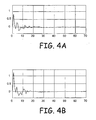
- FIG. 4A shows the measured 0° HRTF, which is the desired center filter denoted HRTF center
- FIG. 4B shows the measured 45° near ear HRTF, HRTF near used in the binauralizer
- FIG. 4C shows the measured 45° far ear HRTF, HRTF far used in the binauralizer
- FIG. 4D shows the average of the near and far ear 45° HRTFs. It can be seen the sum of the near and far HRTFs does not match the desired 0° HRTF.
- FIGS. 5A-5D show how equalization can be used to modify the near and far HRTF filters such that the sum more closely matches the desired 0° HRTF.
- FIG. 5A shows the impulse response of the equalization filter EQ c to be applied to HRTF near and HRTF far .
- FIG. 5B shows the 45° near ear HRTF after equalization, that is, HRTF' near ⁇ .
- FIG. 5C shows the 45° far ear HRTF after equalization, that is, HRTF' near
- FIG. 5D shows the resulting average of the equalized near HRTF and equalized far HRTFs. Comparing FIG. 5D with FIG. 4A , it can be seen that the average of the equalized near and far HRTFs closely matches the measured 0° HRTF.
- FIG. 6 shows the frequency magnitude response of the equalization filter EQ c .
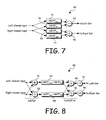
- FIGS. 7 and 8 show two alternate implementations of binauralizers using such determined equalized HRTF filters.
- FIG. 7 shows a first implementation 40 in which four filters: two near filters 41 and 44 of impulse responses HRTF' near and two far filters 42 and 43 of impulse responses HRTF' far are used to create signals to be added by adders 45 and 46 to produce the left ear signal and right ear signal.
- FIG. 8 shows a second implementation 50 that uses the shuffler structure first proposed by Cooper and Bauck. See for example, U.S. Patent 4,893,342 to Cooper and Bauck titled HEAD DIFFRACTION COMPENSATED STEREO SYSTEM.
- a shuffler that includes an adder 51 and a subtractor 52 produces a first signal which is a sum of the left and right audio input signals, and a second signal which is the difference of the left and right audio signals.
- a sum filter 53 having an impulse response HRTF' near + HRTF' far for the first shuffled signal: the sum signal
- a difference filter 54 having an impulse response HRTF' near - HRTF' far for the second shuffled signal: the difference signal.
- the resulting signals are now unshuffled in an unshuffler network (an "unshuffler") that reverses the operation of a shuffler, and includes an adder 55 to produce the left ear signal, and a subtractor 56 to produce the right ear signal.
- Scaling may be included, e.g., as divide by two attenuators 57 and 58 in each path, or a series of attenuators split at different parts of the circuit.
- the sum filter 53 has an impulse response that by equalizing the near and far HRTFs is approximately equal to the desired center HRTF filter response, 2* HRTF center . This makes sense, since the sum filter followed by the unshuffler network 55, 56 and attenuators 57, 58 is basically an HRTF filter pair for a center panned signal.
- FIG. 9 Such an implementation is shown in FIG. 9 and corresponds to:
- the embodiment of FIG. 9 achieves this by using a shuffler network that includes the adder 51 and subtractor 52 to produce the center and difference signals. While the embodiment of FIG. 9 uses Left and Right equalized HRTFs, then converts them into the sum and difference of the equalized HRTFs, the embodiment of FIG. 9 replaces the sum filter with a sum filter 59 that has twice the desired center HRTF response, and uses for the difference filter 60 a response equal to the unequalized difference filter. This method provides the desired high-quality center HRTF image, at the expense of some localization error in the Left and Right signals.
- the equalization filter e.g., that of FIG. 6 for the virtual speakers at ⁇ 45°
- the equalization filter is modified, so as to be only partially effective, resulting in a set of HRTFs that have a slightly less clear center image than the HRTFs described in the first above-described set of embodiments, but with the advantage that the left and right signals are not colored as much as would occur with the equalized HRTF filters described in the first above-described set of embodiments.
- an equalizer is produced by halving (on a dB scale) the equalization curve of FIG. 6 so that, at each frequency, the effect of the filter is halved, and likewise, the equalization filter's phase response (not shown) is halved, while maintaining the well-behaved phase response, e.g., maintaining a minimum phase filter.
- the resulting filter is such that a pair of such equalization filters cascaded provide the same response as the filter shown in FIG. 6 .
- This equalization filter is used to equalize the desired, e.g., measured HRTF filters for the desired speaker locations. When the resulting signals are played back to a listener, the inventor found that the resulting near and far equalized HRTF filters exhibit a partly improved center image, but suffer only less equalization error in the left and right images.
- center panning is known to correctly create the location of the center for a listener, i.e., to create a phantom center image for stereo speaker playback, only when the stereo speakers are placed symmetrically in front of the listener at no more than about ⁇ 45 degrees to the listener.
- aspects of the present invention provide for playback though headphones with front-center image location the virtual left/right speakers are up to +/-90 degrees to the listener.
- crosstalk refers to the left ear hearing sound from the right speaker, and also to the right ear hearing sound from the left speaker. Because normal sound cues are disturbed by crosstalk, crosstalk is known to significantly blur localization. Crosstalk cancellation reverses the effect of crosstalk.
- a typical cross-talk-cancelled filter includes two filters that process the mono input signal to two speakers, usually placed in front of the listener like a regular stereo pair, with the signals at the speakers intended to provide a stimulus at the listener's ears that corresponds to a binaural response attributable to a sound arrival from a virtual sound location.
- the 0 degree front image is still typically created by the more common method of splitting an input between the two speakers, called center panning, rather than by using HRTFs, so that the mono input to be centrally located by a listener is fed to the left and right speakers with around 3 to 6dB of attenuation.
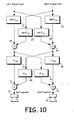
- FIG. 10 shows such a crosstalk cancelled binauralizing filter implemented as a cascade of a binauralizer to place virtual speakers at the desired locations, e.g., at ⁇ 60°.
- the binauralizer includes in the symmetric case (or forced symmetric case, e.g., per Eq.
- each near and far filter are added by adders 65, 66 to form the left and right binauralized signals.
- the binauralizer is followed by a cross-talk canceller to cancel the cross talk created at the actual speaker locations, e.g., at ⁇ 30° angles.
- the cross talk canceller accepts the signals from the binauralizer and includes in the symmetric case or forced symmetric case the near crosstalk cancelling filters 67, 68 whose impulse response is denoted X near and the far crosstalk ⁇ cancelling filters 69, 70 whose impulse response is denoted X far , followed by summers 71 and 72 to cancel the cross talk created at the ⁇ 30° angles.
- the outputs are for a left speaker 73 and a right speaker 74.
- each of the near and far binauralizer and crosstalk cancelling filters is a linear time-invariant system
- the cascade of the binauralizer may be represented as a two-input, two output system.
- FIG. 11 shows an implementation of such a crosstalk cancelled binauralizer as four filters 75, 76, 77, and 78, and two summers 79 and 80.
- the four filters in the symmetric (or forced symmetric) case have two different impulse responses: a near impulse response denoted G near for filters 75 and 76, and a far impulse response, denoted G far for filters 77 and 78, wherein each of the G near and G far are functions of the HRTF filters HRTF near and HRTF far and the crosstalk cancelling filters X near and X far .
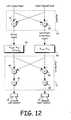
- FIG. 12 shows a crosstalk cancelled binauralizer including a shuffling network 90 that has an adder 81 to produce a sum signal and a subtractor 82 to produce a difference signal, a sum signal filter 83 to filter the sum signal, such a sum signal filter having an impulse response proportional to G near + G far , a difference filter 84 to filter the difference signal, the difference signal filter having an impulse response proportional to G near - G far , followed by an un-shuffling network 91 that also includes a summer 85 to produce the left speaker signal for a left speaker 73 and a subtractor to produce a right speaker signal for a right speaker 74.
- a shuffling network 90 that has an adder 81 to produce a sum signal and a subtractor 82 to produce a difference signal, a sum signal filter 83 to filter the sum signal, such a sum signal filter having an impulse response proportional to G near + G far , a difference filter 84 to filter the difference signal, the difference signal filter having an impulse response proportion
- FIG. 12 a crosstalk cancelled binauralizing filter is implemented by a structure shown in FIG. 12 , which is similar to the structures shown in FIG. 8 and FIG.9 .
- the sum filter is designed to accurately reproduce a source located at the center, e.g., at 0°. Rather than calculate what such a filter is, one embodiment uses a delta function for such a filter, using the knowledge that a listener listening to an equal amount of a mono signal on a left and a right speaker accurately localizes such a signal as coming from the center.
- the cross-talk-cancelled filters are equalized to force the sum filter to be approximately the identity filter, e.g., a filter whose impulse response is a delta function.
- the sum filter is replaced by a flat (delta function impulse response) filter.
- the cross-talk-cancelled application of this invention generally corrects for a commonly perceived equalization errors that occur in the center image.
- Another aspect of the invention is correctly simulating a rear center sound source, by binauralizing to simulate speakers at angles ⁇ 90 degrees or more, e.g., having two rear virtual speaker locations, further locating a phantom center being localized at the 180 degree (rear-center) position, as if a speaker was located at the rear center position.
- a first rear signal embodiment includes equalizing the rear near and rear far HRTF filters such that the sum of the equalized rear near and rear far filters approximates the desired rear center HRTF filter.
- a binauralizer that uses a shuffler plus a sum signal HRTF filters that approximate a desired center rear HRTF creates playback signals that when reproduced through headphones appear to correctly come from the center, but with the left and right rear signals appearing to come from left and right rear virtual speakers that are slightly off the desired locations.
- Another embodiment includes combining front and rear processing to process both rear signals and front signals.
- surround sound e.g., four channel sound
- surround sound is able to process the front left and right signals, and also the rear left and right signals to correctly reproduce a virtual center front sound and a virtual center rear sound.
- analog to digital converters will be understood by those in the art to be included.
- digital-to-analog converters will be understood to be used to convert the digital signal outputs to analog outputs for playback through headphones, or in the transaural filtering case, through loudspeakers.
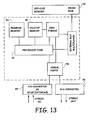
- FIG. 13 shows a form of implementation of an audio processing system for processing a stereo input pair according to aspects of the invention.
- the audio processing system includes: a analog-to-digital (A/D) converter 97 for converting analog inputs to corresponding digital signals, and a digital to analog (D/A) converter 98 to convert the processed signals to analog output signals.
- the block 97 includes a SPDIF interface provided for digital input signals rather than the A/D converter.
- the system includes a DSP device capable of processing the input to generate the output sufficiently fast.
- the DSP device includes interface circuitry in the form of serial ports 96 for communicating with the A/D and D/A converters 97,98 without processor overhead, and, in one embodiment, an off-device memory 92 and a DMA engine that can copy data from the off-chip memory to an on-chip memory 95 without interfering with the operation of the input/output processing.
- the code for implementing the aspects of the invention described herein may be in the off-chip memory and be loaded to the on-chip memory as required.
- the DSP device includes a program memory 94 including code that cause the processor 93 of the DSP device to implement the filtering described herein.
- An external bus multiplexor is included for the case that external memory is required.
- FIG. 14A shows a binauralizing system that accepts five channels of audio information in the form of a left, center and right signals aimed at playback through front speakers, and a left surround and right surround signals aimed at playback via rear speakers.
- the binauralizer implements HRTF filter pairs for each input, including, for the left surround and right surround signals, aspects of the invention so that a listener listening through headphones experiences a signal that is center rear panned to be coming from the center rear of the listener.
- the binauralizer is implemented using a processing system, e.g., a DSP device that includes a processor.
- a memory in included for holding the instructions, including any parameters that cause the processor to execute filtering as described hereinabove.
- FIG. 14B shows a binauralizing system that accepts four channels of audio information in the form of a left and right from signals aimed at playback through front speakers, and a left rear and right rear signals aimed at playback via rear speakers.
- the binauralizer implements HRTF filter pairs for each input, including for left and right signals, and for the left rear and right rear signals, aspects of the invention so that a listener listening through headphones experiences a signal that is center front panned to be coming from the center front of the listener, and a signal that is center rear panned to be coming from the center rear of the listener.
- the binauralizer is implemented using a processing system, e.g., a DSP device that includes a processor.
- a memory in included for holding the instructions, including any parameters that cause the processor to execute filtering as described hereinabove.
- the methodologies described herein are, in one embodiment, performable by a machine that includes one or more processors that accept code segments containing instructions. For any of the methods described herein, when the instructions are executed by the machine, the machine performs the method. Any machine capable of executing a set of instructions (sequential or otherwise) that specify actions to be taken by that machine are included.
- a typical machine may be exemplified by a typical processing system that includes one or more processors.
- Each processor may include one or more of a CPU, a graphics processing unit, and a programmable DSP unit.
- the processing system further may include a memory subsystem including main RAM and/or a static RAM, and/or ROM.
- a bus subsystem may be included for communicating between the components.
- the processing system requires a display, such a display may be included, e.g., a liquid crystal display (LCD) or a cathode ray tube (CRT) display.
- the processing system also includes an input device such as one or more of an alphanumeric input unit such as a keyboard, a pointing control device such as a mouse, and so forth.
- the term memory unit as used herein also encompasses a storage system such as a disk drive unit.
- the processing system in some configurations may include a sound output device, and a network interface device.
- the memory subsystem thus includes a carrier medium that carries machine readable code segments (e.g., software) including instructions for performing, when executed by the processing system, one of more of the methods described herein.
- the software may reside in the hard disk, or may also reside, completely or at least partially, within the RAM and/or within the processor during execution thereof by the computer system.
- the memory and the processor also constitute a carrier medium carrying machine readable code.
- the machine operates as a standalone device or may be connected, e.g., networked to other machines, in a networked deployment, the machine may operate in the capacity of a server or a client machine in a server-client network environment, or as a peer machine in a peer-to-peer or distributed network environment.
- the machine may be a personal computer (PC), a tablet PC, a set-top box (STB), a Personal Digital Assistant (PDA), a cellular telephone, a web appliance, a network router, switch or bridge, or any machine capable of executing a set of instructions (sequential or otherwise) that specify actions to be taken by that machine.
- machine shall also be taken to include any collection of machines that individually or jointly execute a set (or multiple sets) of instructions to perform any one or more of the methodologies discussed herein.
- each of the methods described herein is in the form of a computer program that executes on a processing system, e.g., a one or more processors that are part of binauralizing system, or in another embodiment, a transaural system.
- a processing system e.g., a one or more processors that are part of binauralizing system, or in another embodiment, a transaural system.
- embodiments of the present invention may be embodied as a method, an apparatus such as a special purpose apparatus, an apparatus such as a data processing system, or a carrier medium, e.g., a computer program product.
- the carrier medium carries one or more computer readable code segments for controlling a processing system to implement a method.
- aspects of the present invention may take the form of a method, an entirely hardware embodiment, an entirely software embodiment or an embodiment combining software and hardware aspects.
- the present invention may take the form of carrier medium (e.g., a computer program product on a computer-readable storage medium) carrying computer-readable program code segments embodied in the medium.
- the software may further be transmitted or received over a network via the network interface device.
- the carrier medium is shown in an exemplary embodiment to be a single medium, the term “carrier medium” should be taken to include a single medium or multiple media (e.g., a centralized or distributed database, and/or associated caches and servers) that store the one or more sets of instructions.
- the term " carrier medium” shall also be taken to include any medium that is capable of storing, encoding or carrying a set of instructions for execution by the machine and that cause the machine to perform any one or more of the methodologies of the present invention.
- a carrier medium may take many forms, including but not limited to, non-volatile media, volatile media, and transmission media.
- Non-volatile media includes, for example, optical, magnetic disks, and magneto-optical disks.
- Volatile media includes dynamic memory, such as main memory.
- Transmission media includes coaxial cables, copper wire and fiber optics, including the wires that comprise a bus subsystem. Transmission media may also take the form of acoustic or light waves, such as those generated during radio wave and infrared data communications.
- carrier medium shall accordingly be taken to include, but not be limited to, solid-state memories, optical and magnetic media, and carrier wave signals.
- inventions are in the form of a carrier medium carrying computer readable data for filters to process a pair of stereo inputs.
- the data may be in the form of the impulse responses of the filters, or of the frequency domain transfer functions of the filters.
- the filters include two HRTF filters designed as described above. In the case that the processing is for headphone listening, the HRTF filters are used to filter the input data in a binauralizer, and in the case of speaker listening, the HRTF filters are incorporated in a crosstalk cancelled binauralizer.
Landscapes
- Physics & Mathematics (AREA)
- Engineering & Computer Science (AREA)
- Acoustics & Sound (AREA)
- Signal Processing (AREA)
- Stereophonic System (AREA)
Applications Claiming Priority (2)
| Application Number | Priority Date | Filing Date | Title |
|---|---|---|---|
| US10/965,130 US7634092B2 (en) | 2004-10-14 | 2004-10-14 | Head related transfer functions for panned stereo audio content |
| PCT/AU2005/001568 WO2006039748A1 (en) | 2004-10-14 | 2005-10-10 | Improved head related transfer functions for panned stereo audio content |
Publications (3)
| Publication Number | Publication Date |
|---|---|
| EP1800518A1 EP1800518A1 (en) | 2007-06-27 |
| EP1800518A4 EP1800518A4 (en) | 2011-10-12 |
| EP1800518B1 true EP1800518B1 (en) | 2014-04-16 |
Family
ID=36147964
Family Applications (1)
| Application Number | Title | Priority Date | Filing Date |
|---|---|---|---|
| EP05791205.7A Expired - Lifetime EP1800518B1 (en) | 2004-10-14 | 2005-10-10 | Improved head related transfer functions for panned stereo audio content |
Country Status (13)
| Country | Link |
|---|---|
| US (2) | US7634092B2 (enExample) |
| EP (1) | EP1800518B1 (enExample) |
| JP (2) | JP4986857B2 (enExample) |
| KR (2) | KR20120094045A (enExample) |
| CN (1) | CN101040565B (enExample) |
| AU (1) | AU2005294113B2 (enExample) |
| BR (1) | BRPI0516527B1 (enExample) |
| CA (1) | CA2579465C (enExample) |
| IL (1) | IL181902A (enExample) |
| MX (1) | MX2007004329A (enExample) |
| MY (1) | MY147141A (enExample) |
| TW (1) | TWI397325B (enExample) |
| WO (1) | WO2006039748A1 (enExample) |
Families Citing this family (115)
| Publication number | Priority date | Publication date | Assignee | Title |
|---|---|---|---|---|
| US7242782B1 (en) * | 1998-07-31 | 2007-07-10 | Onkyo Kk | Audio signal processing circuit |
| US8234395B2 (en) | 2003-07-28 | 2012-07-31 | Sonos, Inc. | System and method for synchronizing operations among a plurality of independently clocked digital data processing devices |
| US8290603B1 (en) | 2004-06-05 | 2012-10-16 | Sonos, Inc. | User interfaces for controlling and manipulating groupings in a multi-zone media system |
| US8020023B2 (en) | 2003-07-28 | 2011-09-13 | Sonos, Inc. | Systems and methods for synchronizing operations among a plurality of independently clocked digital data processing devices without a voltage controlled crystal oscillator |
| US11650784B2 (en) | 2003-07-28 | 2023-05-16 | Sonos, Inc. | Adjusting volume levels |
| US11106425B2 (en) | 2003-07-28 | 2021-08-31 | Sonos, Inc. | Synchronizing operations among a plurality of independently clocked digital data processing devices |
| US11106424B2 (en) | 2003-07-28 | 2021-08-31 | Sonos, Inc. | Synchronizing operations among a plurality of independently clocked digital data processing devices |
| US11294618B2 (en) | 2003-07-28 | 2022-04-05 | Sonos, Inc. | Media player system |
| US9977561B2 (en) | 2004-04-01 | 2018-05-22 | Sonos, Inc. | Systems, methods, apparatus, and articles of manufacture to provide guest access |
| US8868698B2 (en) | 2004-06-05 | 2014-10-21 | Sonos, Inc. | Establishing a secure wireless network with minimum human intervention |
| US8326951B1 (en) | 2004-06-05 | 2012-12-04 | Sonos, Inc. | Establishing a secure wireless network with minimum human intervention |
| US7634092B2 (en) * | 2004-10-14 | 2009-12-15 | Dolby Laboratories Licensing Corporation | Head related transfer functions for panned stereo audio content |
| JP2006203850A (ja) * | 2004-12-24 | 2006-08-03 | Matsushita Electric Ind Co Ltd | 音像定位装置 |
| JP4988716B2 (ja) | 2005-05-26 | 2012-08-01 | エルジー エレクトロニクス インコーポレイティド | オーディオ信号のデコーディング方法及び装置 |
| EP1905002B1 (en) * | 2005-05-26 | 2013-05-22 | LG Electronics Inc. | Method and apparatus for decoding audio signal |
| JP4821250B2 (ja) * | 2005-10-11 | 2011-11-24 | ヤマハ株式会社 | 音像定位装置 |
| KR100739798B1 (ko) * | 2005-12-22 | 2007-07-13 | 삼성전자주식회사 | 청취 위치를 고려한 2채널 입체음향 재생 방법 및 장치 |
| EP1979898B1 (en) * | 2006-01-19 | 2014-08-06 | Lg Electronics Inc. | Method and apparatus for processing a media signal |
| KR100878816B1 (ko) * | 2006-02-07 | 2009-01-14 | 엘지전자 주식회사 | 부호화/복호화 장치 및 방법 |
| US8619998B2 (en) * | 2006-08-07 | 2013-12-31 | Creative Technology Ltd | Spatial audio enhancement processing method and apparatus |
| JP4914124B2 (ja) * | 2006-06-14 | 2012-04-11 | パナソニック株式会社 | 音像制御装置及び音像制御方法 |
| US8788080B1 (en) | 2006-09-12 | 2014-07-22 | Sonos, Inc. | Multi-channel pairing in a media system |
| US12167216B2 (en) | 2006-09-12 | 2024-12-10 | Sonos, Inc. | Playback device pairing |
| US9202509B2 (en) | 2006-09-12 | 2015-12-01 | Sonos, Inc. | Controlling and grouping in a multi-zone media system |
| US8483853B1 (en) | 2006-09-12 | 2013-07-09 | Sonos, Inc. | Controlling and manipulating groupings in a multi-zone media system |
| US8229143B2 (en) * | 2007-05-07 | 2012-07-24 | Sunil Bharitkar | Stereo expansion with binaural modeling |
| US20090037386A1 (en) * | 2007-08-03 | 2009-02-05 | Dietmar Theobald | Computer file processing |
| CN101816192B (zh) * | 2007-10-03 | 2013-05-29 | 皇家飞利浦电子股份有限公司 | 用于头戴耳机再现的方法、头戴耳机再现系统 |
| US9031242B2 (en) * | 2007-11-06 | 2015-05-12 | Starkey Laboratories, Inc. | Simulated surround sound hearing aid fitting system |
| US7966393B2 (en) * | 2008-02-18 | 2011-06-21 | Clear Channel Management Services, Inc. | System and method for media stream monitoring |
| JP5042083B2 (ja) * | 2008-03-17 | 2012-10-03 | 三菱電機株式会社 | 能動騒音制御方法および能動騒音制御装置 |
| US9485589B2 (en) | 2008-06-02 | 2016-11-01 | Starkey Laboratories, Inc. | Enhanced dynamics processing of streaming audio by source separation and remixing |
| US9185500B2 (en) | 2008-06-02 | 2015-11-10 | Starkey Laboratories, Inc. | Compression of spaced sources for hearing assistance devices |
| US8705751B2 (en) * | 2008-06-02 | 2014-04-22 | Starkey Laboratories, Inc. | Compression and mixing for hearing assistance devices |
| TWI475896B (zh) | 2008-09-25 | 2015-03-01 | Dolby Lab Licensing Corp | 單音相容性及揚聲器相容性之立體聲濾波器 |
| US9247369B2 (en) * | 2008-10-06 | 2016-01-26 | Creative Technology Ltd | Method for enlarging a location with optimal three-dimensional audio perception |
| CN102440003B (zh) * | 2008-10-20 | 2016-01-27 | 吉诺迪奥公司 | 音频空间化和环境仿真 |
| EP2380364B1 (en) * | 2008-12-22 | 2012-10-17 | Koninklijke Philips Electronics N.V. | Generating an output signal by send effect processing |
| GB2476747B (en) * | 2009-02-04 | 2011-12-21 | Richard Furse | Sound system |
| US8000485B2 (en) * | 2009-06-01 | 2011-08-16 | Dts, Inc. | Virtual audio processing for loudspeaker or headphone playback |
| JP5397131B2 (ja) * | 2009-09-29 | 2014-01-22 | 沖電気工業株式会社 | 音源方向推定装置及びプログラム |
| EP2373055B1 (de) * | 2010-03-16 | 2017-11-01 | Deutsche Telekom AG | Kopfhörer-Vorrichtung zur Wiedergabe binauraler räumlicher Audiosignale und damit ausgestattetes System |
| CN101835072B (zh) * | 2010-04-06 | 2011-11-23 | 瑞声声学科技(深圳)有限公司 | 虚拟环绕声处理方法 |
| US9578419B1 (en) * | 2010-09-01 | 2017-02-21 | Jonathan S. Abel | Method and apparatus for estimating spatial content of soundfield at desired location |
| WO2012054750A1 (en) * | 2010-10-20 | 2012-04-26 | Srs Labs, Inc. | Stereo image widening system |
| US11265652B2 (en) | 2011-01-25 | 2022-03-01 | Sonos, Inc. | Playback device pairing |
| US11429343B2 (en) | 2011-01-25 | 2022-08-30 | Sonos, Inc. | Stereo playback configuration and control |
| CN102438199A (zh) * | 2011-09-06 | 2012-05-02 | 深圳东原电子有限公司 | 一种虚拟环绕声扩大听音区的方法 |
| US9344292B2 (en) | 2011-12-30 | 2016-05-17 | Sonos, Inc. | Systems and methods for player setup room names |
| US9602927B2 (en) * | 2012-02-13 | 2017-03-21 | Conexant Systems, Inc. | Speaker and room virtualization using headphones |
| US9510124B2 (en) * | 2012-03-14 | 2016-11-29 | Harman International Industries, Incorporated | Parametric binaural headphone rendering |
| JP5897219B2 (ja) * | 2012-08-31 | 2016-03-30 | ドルビー ラボラトリーズ ライセンシング コーポレイション | オブジェクト・ベースのオーディオの仮想レンダリング |
| US9380388B2 (en) | 2012-09-28 | 2016-06-28 | Qualcomm Incorporated | Channel crosstalk removal |
| CN104956689B (zh) | 2012-11-30 | 2017-07-04 | Dts(英属维尔京群岛)有限公司 | 用于个性化音频虚拟化的方法和装置 |
| WO2014164361A1 (en) * | 2013-03-13 | 2014-10-09 | Dts Llc | System and methods for processing stereo audio content |
| CN104075746B (zh) * | 2013-03-29 | 2016-09-07 | 上海航空电器有限公司 | 具有方位信息的虚拟声源定位验证装置的验证方法 |
| US9426300B2 (en) | 2013-09-27 | 2016-08-23 | Dolby Laboratories Licensing Corporation | Matching reverberation in teleconferencing environments |
| US9473871B1 (en) * | 2014-01-09 | 2016-10-18 | Marvell International Ltd. | Systems and methods for audio management |
| KR102121748B1 (ko) | 2014-02-25 | 2020-06-11 | 삼성전자주식회사 | 입체 사운드를 재생하는 방법 및 장치 |
| CN106664499B (zh) | 2014-08-13 | 2019-04-23 | 华为技术有限公司 | 音频信号处理装置 |
| JP6401576B2 (ja) * | 2014-10-24 | 2018-10-10 | 株式会社河合楽器製作所 | 効果付与装置 |
| JP6929219B2 (ja) | 2014-11-30 | 2021-09-01 | ドルビー ラボラトリーズ ライセンシング コーポレイション | ソーシャルメディアにリンクした大型劇場設計 |
| US9551161B2 (en) | 2014-11-30 | 2017-01-24 | Dolby Laboratories Licensing Corporation | Theater entrance |
| US9743187B2 (en) * | 2014-12-19 | 2017-08-22 | Lee F. Bender | Digital audio processing systems and methods |
| CN110809227B (zh) | 2015-02-12 | 2021-04-27 | 杜比实验室特许公司 | 用于耳机虚拟化的混响生成 |
| US10248376B2 (en) | 2015-06-11 | 2019-04-02 | Sonos, Inc. | Multiple groupings in a playback system |
| GB2544458B (en) * | 2015-10-08 | 2019-10-02 | Facebook Inc | Binaural synthesis |
| CN105246001B (zh) * | 2015-11-03 | 2018-08-28 | 中国传媒大学 | 双耳录音耳机重放系统及方法 |
| US10303422B1 (en) | 2016-01-05 | 2019-05-28 | Sonos, Inc. | Multiple-device setup |
| CN112235695B (zh) | 2016-01-18 | 2022-04-15 | 云加速360公司 | 用于音频信号串扰处理的方法、系统及介质 |
| CN108781331B (zh) * | 2016-01-19 | 2020-11-06 | 云加速360公司 | 用于头戴式扬声器的音频增强 |
| DE102017103134B4 (de) * | 2016-02-18 | 2022-05-05 | Google LLC (n.d.Ges.d. Staates Delaware) | Signalverarbeitungsverfahren und -systeme zur Wiedergabe von Audiodaten auf virtuellen Lautsprecher-Arrays |
| US10142755B2 (en) | 2016-02-18 | 2018-11-27 | Google Llc | Signal processing methods and systems for rendering audio on virtual loudspeaker arrays |
| JP6786834B2 (ja) * | 2016-03-23 | 2020-11-18 | ヤマハ株式会社 | 音響処理装置、プログラムおよび音響処理方法 |
| EP3453190A4 (en) | 2016-05-06 | 2020-01-15 | DTS, Inc. | SYSTEMS FOR IMMERSIVE AUDIO PLAYBACK |
| CN107493543B (zh) * | 2016-06-12 | 2021-03-09 | 深圳奥尼电子股份有限公司 | 用于耳机耳塞的3d音效处理电路及其处理方法 |
| US10602264B2 (en) * | 2016-06-14 | 2020-03-24 | Orcam Technologies Ltd. | Systems and methods for directing audio output of a wearable apparatus |
| US10331750B2 (en) | 2016-08-01 | 2019-06-25 | Facebook, Inc. | Systems and methods to manage media content items |
| US10712997B2 (en) | 2016-10-17 | 2020-07-14 | Sonos, Inc. | Room association based on name |
| US10771896B2 (en) * | 2017-04-14 | 2020-09-08 | Hewlett-Packard Development Company, L.P. | Crosstalk cancellation for speaker-based spatial rendering |
| US10623883B2 (en) * | 2017-04-26 | 2020-04-14 | Hewlett-Packard Development Company, L.P. | Matrix decomposition of audio signal processing filters for spatial rendering |
| CN107221337B (zh) * | 2017-06-08 | 2018-08-31 | 腾讯科技(深圳)有限公司 | 数据滤波方法、多人语音通话方法以及相关设备 |
| US11122384B2 (en) | 2017-09-12 | 2021-09-14 | The Regents Of The University Of California | Devices and methods for binaural spatial processing and projection of audio signals |
| US10003905B1 (en) | 2017-11-27 | 2018-06-19 | Sony Corporation | Personalized end user head-related transfer function (HRTV) finite impulse response (FIR) filter |
| FR3075443A1 (fr) * | 2017-12-19 | 2019-06-21 | Orange | Traitement d'un signal monophonique dans un decodeur audio 3d restituant un contenu binaural |
| WO2019146254A1 (ja) * | 2018-01-29 | 2019-08-01 | ソニー株式会社 | 音響処理装置、音響処理方法及びプログラム |
| US10375506B1 (en) * | 2018-02-28 | 2019-08-06 | Google Llc | Spatial audio to enable safe headphone use during exercise and commuting |
| US10142760B1 (en) | 2018-03-14 | 2018-11-27 | Sony Corporation | Audio processing mechanism with personalized frequency response filter and personalized head-related transfer function (HRTF) |
| US10764704B2 (en) | 2018-03-22 | 2020-09-01 | Boomcloud 360, Inc. | Multi-channel subband spatial processing for loudspeakers |
| CN111937414A (zh) * | 2018-04-10 | 2020-11-13 | 索尼公司 | 音频处理装置、音频处理方法和程序 |
| WO2019241760A1 (en) * | 2018-06-14 | 2019-12-19 | Magic Leap, Inc. | Methods and systems for audio signal filtering |
| CN116156411A (zh) * | 2018-06-18 | 2023-05-23 | 奇跃公司 | 用于交互式音频环境的空间音频 |
| WO2020023482A1 (en) | 2018-07-23 | 2020-01-30 | Dolby Laboratories Licensing Corporation | Rendering binaural audio over multiple near field transducers |
| CN115866505B (zh) | 2018-08-20 | 2026-02-03 | 华为技术有限公司 | 音频处理方法和装置 |
| CN110856095B (zh) * | 2018-08-20 | 2021-11-19 | 华为技术有限公司 | 音频处理方法和装置 |
| US10856097B2 (en) | 2018-09-27 | 2020-12-01 | Sony Corporation | Generating personalized end user head-related transfer function (HRTV) using panoramic images of ear |
| US11113092B2 (en) | 2019-02-08 | 2021-09-07 | Sony Corporation | Global HRTF repository |
| CN112956210B (zh) * | 2019-02-15 | 2022-09-02 | 华为技术有限公司 | 基于均衡滤波器的音频信号处理方法及装置 |
| US11625222B2 (en) * | 2019-05-07 | 2023-04-11 | Apple Inc. | Augmenting control sound with spatial audio cues |
| US11451907B2 (en) | 2019-05-29 | 2022-09-20 | Sony Corporation | Techniques combining plural head-related transfer function (HRTF) spheres to place audio objects |
| US11347832B2 (en) | 2019-06-13 | 2022-05-31 | Sony Corporation | Head related transfer function (HRTF) as biometric authentication |
| US10841728B1 (en) | 2019-10-10 | 2020-11-17 | Boomcloud 360, Inc. | Multi-channel crosstalk processing |
| US11146908B2 (en) | 2019-10-24 | 2021-10-12 | Sony Corporation | Generating personalized end user head-related transfer function (HRTF) from generic HRTF |
| US11070930B2 (en) | 2019-11-12 | 2021-07-20 | Sony Corporation | Generating personalized end user room-related transfer function (RRTF) |
| CN111641899B (zh) | 2020-06-09 | 2022-11-04 | 京东方科技集团股份有限公司 | 虚拟环绕声发声电路、平面音源装置及平面显示设备 |
| WO2022010453A1 (en) * | 2020-07-06 | 2022-01-13 | Hewlett-Packard Development Company, L.P. | Cancellation of spatial processing in headphones |
| CN111866546A (zh) * | 2020-07-21 | 2020-10-30 | 山东超越数控电子股份有限公司 | 一种基于FFmpeg的网络音频选择源的实现方法 |
| US12549945B2 (en) | 2020-09-25 | 2026-02-10 | Sonos, Inc. | Intelligent setup for playback devices |
| CN116097664B (zh) * | 2020-10-19 | 2026-08-04 | 英尼特音响有限公司 | 利用左耳和右耳之间的多阶hrtf的声音再现 |
| CN114584914B (zh) * | 2020-11-30 | 2025-01-14 | 深圳市三诺数字科技有限公司 | 一种3d音效方法及装置 |
| GB2603768B (en) * | 2021-02-11 | 2024-09-18 | Sony Interactive Entertainment Inc | Transfer function modification system and method |
| CN113099359B (zh) * | 2021-03-01 | 2022-10-14 | 深圳市悦尔声学有限公司 | 一种基于hrtf技术的高仿真声场重现的方法及其应用 |
| CN113645531B (zh) * | 2021-08-05 | 2024-04-16 | 高敬源 | 一种耳机虚拟空间声回放方法、装置、存储介质及耳机 |
| CN115278474B (zh) * | 2022-07-27 | 2025-07-15 | 歌尔科技有限公司 | 串声消除方法、装置、音频设备及计算机可读存储介质 |
| CN116389972A (zh) * | 2023-03-17 | 2023-07-04 | 上海艾为电子技术股份有限公司 | 音频信号处理方法、系统、芯片和电子设备 |
Citations (1)
| Publication number | Priority date | Publication date | Assignee | Title |
|---|---|---|---|---|
| US6243476B1 (en) * | 1997-06-18 | 2001-06-05 | Massachusetts Institute Of Technology | Method and apparatus for producing binaural audio for a moving listener |
Family Cites Families (26)
| Publication number | Priority date | Publication date | Assignee | Title |
|---|---|---|---|---|
| US411078A (en) * | 1889-09-17 | Rock-drilling machine | ||
| US3088997A (en) | 1960-12-29 | 1963-05-07 | Columbia Broadcasting Syst Inc | Stereophonic to binaural conversion apparatus |
| US3236949A (en) | 1962-11-19 | 1966-02-22 | Bell Telephone Labor Inc | Apparent sound source translator |
| US4910779A (en) | 1987-10-15 | 1990-03-20 | Cooper Duane H | Head diffraction compensated stereo system with optimal equalization |
| US4893342A (en) | 1987-10-15 | 1990-01-09 | Cooper Duane H | Head diffraction compensated stereo system |
| US5440639A (en) | 1992-10-14 | 1995-08-08 | Yamaha Corporation | Sound localization control apparatus |
| US5622172A (en) * | 1995-09-29 | 1997-04-22 | Siemens Medical Systems, Inc. | Acoustic display system and method for ultrasonic imaging |
| US6091894A (en) | 1995-12-15 | 2000-07-18 | Kabushiki Kaisha Kawai Gakki Seisakusho | Virtual sound source positioning apparatus |
| US5742689A (en) * | 1996-01-04 | 1998-04-21 | Virtual Listening Systems, Inc. | Method and device for processing a multichannel signal for use with a headphone |
| AU1527197A (en) | 1996-01-04 | 1997-08-01 | Virtual Listening Systems, Inc. | Method and device for processing a multi-channel signal for use with a headphone |
| GB9603236D0 (en) * | 1996-02-16 | 1996-04-17 | Adaptive Audio Ltd | Sound recording and reproduction systems |
| US6697491B1 (en) * | 1996-07-19 | 2004-02-24 | Harman International Industries, Incorporated | 5-2-5 matrix encoder and decoder system |
| US6009178A (en) * | 1996-09-16 | 1999-12-28 | Aureal Semiconductor, Inc. | Method and apparatus for crosstalk cancellation |
| US6421446B1 (en) | 1996-09-25 | 2002-07-16 | Qsound Labs, Inc. | Apparatus for creating 3D audio imaging over headphones using binaural synthesis including elevation |
| GB9622773D0 (en) | 1996-11-01 | 1997-01-08 | Central Research Lab Ltd | Stereo sound expander |
| US6067361A (en) * | 1997-07-16 | 2000-05-23 | Sony Corporation | Method and apparatus for two channels of sound having directional cues |
| JP4627880B2 (ja) * | 1997-09-16 | 2011-02-09 | ドルビー ラボラトリーズ ライセンシング コーポレイション | リスナーの周囲にある音源の空間的ひろがり感を増強するためのステレオヘッドホンデバイス内でのフィルタ効果の利用 |
| GB9726338D0 (en) * | 1997-12-13 | 1998-02-11 | Central Research Lab Ltd | A method of processing an audio signal |
| KR100598003B1 (ko) * | 1998-03-25 | 2006-07-06 | 레이크 테크놀로지 리미티드 | 오디오 신호 처리 방법 및 장치 |
| AUPP271598A0 (en) * | 1998-03-31 | 1998-04-23 | Lake Dsp Pty Limited | Headtracked processing for headtracked playback of audio signals |
| US20020184128A1 (en) * | 2001-01-11 | 2002-12-05 | Matt Holtsinger | System and method for providing music management and investment opportunities |
| IL141822A (en) * | 2001-03-05 | 2007-02-11 | Haim Levy | A method and system for imitating a 3D audio environment |
| EP1442411A4 (en) * | 2001-09-30 | 2006-02-01 | Realcontacts Ltd | RELATED SERVICES |
| ES2328922T3 (es) * | 2002-09-23 | 2009-11-19 | Koninklijke Philips Electronics N.V. | Generacion de una señal de sonido. |
| JP2006500818A (ja) | 2002-09-23 | 2006-01-05 | コーニンクレッカ フィリップス エレクトロニクス エヌ ヴィ | 音再生システム、プログラム、及びデータ担体 |
| US7634092B2 (en) * | 2004-10-14 | 2009-12-15 | Dolby Laboratories Licensing Corporation | Head related transfer functions for panned stereo audio content |
-
2004
- 2004-10-14 US US10/965,130 patent/US7634092B2/en active Active
-
2005
- 2005-10-06 TW TW094134953A patent/TWI397325B/zh not_active IP Right Cessation
- 2005-10-10 AU AU2005294113A patent/AU2005294113B2/en not_active Expired
- 2005-10-10 US US11/664,231 patent/US7634093B2/en not_active Expired - Lifetime
- 2005-10-10 WO PCT/AU2005/001568 patent/WO2006039748A1/en not_active Ceased
- 2005-10-10 EP EP05791205.7A patent/EP1800518B1/en not_active Expired - Lifetime
- 2005-10-10 CA CA2579465A patent/CA2579465C/en not_active Expired - Lifetime
- 2005-10-10 KR KR1020127015604A patent/KR20120094045A/ko not_active Ceased
- 2005-10-10 KR KR1020077007392A patent/KR101202368B1/ko not_active Expired - Lifetime
- 2005-10-10 BR BRPI0516527-0A patent/BRPI0516527B1/pt active IP Right Grant
- 2005-10-10 CN CN2005800350273A patent/CN101040565B/zh not_active Expired - Lifetime
- 2005-10-10 MX MX2007004329A patent/MX2007004329A/es active IP Right Grant
- 2005-10-10 JP JP2007535948A patent/JP4986857B2/ja not_active Expired - Lifetime
- 2005-10-13 MY MYPI20054818A patent/MY147141A/en unknown
-
2007
- 2007-03-13 IL IL181902A patent/IL181902A/en active IP Right Grant
-
2012
- 2012-01-20 JP JP2012009561A patent/JP2012120219A/ja active Pending
Patent Citations (1)
| Publication number | Priority date | Publication date | Assignee | Title |
|---|---|---|---|---|
| US6243476B1 (en) * | 1997-06-18 | 2001-06-05 | Massachusetts Institute Of Technology | Method and apparatus for producing binaural audio for a moving listener |
Also Published As
| Publication number | Publication date |
|---|---|
| US20080056503A1 (en) | 2008-03-06 |
| MY147141A (en) | 2012-11-14 |
| BRPI0516527A (pt) | 2008-09-09 |
| HK1103211A1 (en) | 2007-12-14 |
| IL181902A (en) | 2012-02-29 |
| CA2579465A1 (en) | 2006-04-20 |
| US20060083394A1 (en) | 2006-04-20 |
| TWI397325B (zh) | 2013-05-21 |
| JP4986857B2 (ja) | 2012-07-25 |
| TW200621067A (en) | 2006-06-16 |
| CN101040565B (zh) | 2010-05-12 |
| US7634092B2 (en) | 2009-12-15 |
| AU2005294113A1 (en) | 2006-04-20 |
| BRPI0516527B1 (pt) | 2019-06-25 |
| US7634093B2 (en) | 2009-12-15 |
| KR20070065352A (ko) | 2007-06-22 |
| JP2008516539A (ja) | 2008-05-15 |
| JP2012120219A (ja) | 2012-06-21 |
| AU2005294113B2 (en) | 2009-11-26 |
| CN101040565A (zh) | 2007-09-19 |
| KR20120094045A (ko) | 2012-08-23 |
| EP1800518A4 (en) | 2011-10-12 |
| IL181902A0 (en) | 2007-07-04 |
| EP1800518A1 (en) | 2007-06-27 |
| CA2579465C (en) | 2013-10-01 |
| KR101202368B1 (ko) | 2012-11-16 |
| WO2006039748A1 (en) | 2006-04-20 |
| MX2007004329A (es) | 2007-06-07 |
Similar Documents
| Publication | Publication Date | Title |
|---|---|---|
| US7634093B2 (en) | Head related transfer functions for panned stereo audio content | |
| KR101004393B1 (ko) | 가상 서라운드에서 공간 인식을 개선하는 방법 | |
| CN102611966B (zh) | 用于虚拟环绕渲染的扬声器阵列 | |
| US20110135098A1 (en) | Methods and devices for reproducing surround audio signals | |
| JP7008862B2 (ja) | カンファレンスのためのサブバンド空間処理およびクロストークキャンセルシステム | |
| CN106664499A (zh) | 音频信号处理装置 | |
| EP3225039B1 (en) | System and method for producing head-externalized 3d audio through headphones | |
| JPH0851698A (ja) | サラウンド信号処理装置及び映像音声再生装置 | |
| CN110719564B (zh) | 音效处理方法和装置 | |
| Parodi | A systematic study of binaural reproduction systems through loudspeakers | |
| HK1103211B (en) | Improved head related transfer functions for panned stereo audio content | |
| JP2023522995A (ja) | 音響クロストークのキャンセルと仮想スピーカ技術 | |
| CN112653985B (zh) | 使用2声道立体声扬声器处理音频信号的方法和设备 | |
| CN118764800A (zh) | 一种采用hrtf-方法进行声场扩展的方法和设备 | |
| JP2018201125A (ja) | 多入力多出力系の直接逆同定方法及び装置及びプログラム及び記憶媒体、多入力多出力逆フィルタ装置及び方法 | |
| Lim | Virtual loudspeaker algorithms for multiple listener immersive audio rendering | |
| HK1075167B (en) | Method for improving spatial perception in virtual surround |
Legal Events
| Date | Code | Title | Description |
|---|---|---|---|
| PUAI | Public reference made under article 153(3) epc to a published international application that has entered the european phase |
Free format text: ORIGINAL CODE: 0009012 |
|
| 17P | Request for examination filed |
Effective date: 20070427 |
|
| AK | Designated contracting states |
Kind code of ref document: A1 Designated state(s): AT BE BG CH CY CZ DE DK EE ES FI FR GB GR HU IE IS IT LI LT LU LV MC NL PL PT RO SE SI SK TR |
|
| REG | Reference to a national code |
Ref country code: HK Ref legal event code: DE Ref document number: 1103211 Country of ref document: HK |
|
| DAX | Request for extension of the european patent (deleted) | ||
| A4 | Supplementary search report drawn up and despatched |
Effective date: 20110908 |
|
| RIC1 | Information provided on ipc code assigned before grant |
Ipc: H04S 3/00 20060101ALI20110902BHEP Ipc: H04S 5/00 20060101AFI20110902BHEP Ipc: H04R 5/02 20060101ALI20110902BHEP |
|
| 17Q | First examination report despatched |
Effective date: 20120110 |
|
| GRAP | Despatch of communication of intention to grant a patent |
Free format text: ORIGINAL CODE: EPIDOSNIGR1 |
|
| INTG | Intention to grant announced |
Effective date: 20131106 |
|
| GRAS | Grant fee paid |
Free format text: ORIGINAL CODE: EPIDOSNIGR3 |
|
| GRAA | (expected) grant |
Free format text: ORIGINAL CODE: 0009210 |
|
| AK | Designated contracting states |
Kind code of ref document: B1 Designated state(s): AT BE BG CH CY CZ DE DK EE ES FI FR GB GR HU IE IS IT LI LT LU LV MC NL PL PT RO SE SI SK TR |
|
| REG | Reference to a national code |
Ref country code: GB Ref legal event code: FG4D |
|
| REG | Reference to a national code |
Ref country code: CH Ref legal event code: EP |
|
| REG | Reference to a national code |
Ref country code: AT Ref legal event code: REF Ref document number: 663152 Country of ref document: AT Kind code of ref document: T Effective date: 20140515 |
|
| REG | Reference to a national code |
Ref country code: IE Ref legal event code: FG4D |
|
| REG | Reference to a national code |
Ref country code: DE Ref legal event code: R096 Ref document number: 602005043312 Country of ref document: DE Effective date: 20140528 |
|
| REG | Reference to a national code |
Ref country code: HK Ref legal event code: GR Ref document number: 1103211 Country of ref document: HK |
|
| REG | Reference to a national code |
Ref country code: AT Ref legal event code: MK05 Ref document number: 663152 Country of ref document: AT Kind code of ref document: T Effective date: 20140416 |
|
| REG | Reference to a national code |
Ref country code: NL Ref legal event code: VDEP Effective date: 20140416 |
|
| REG | Reference to a national code |
Ref country code: LT Ref legal event code: MG4D |
|
| PG25 | Lapsed in a contracting state [announced via postgrant information from national office to epo] |
Ref country code: GR Free format text: LAPSE BECAUSE OF FAILURE TO SUBMIT A TRANSLATION OF THE DESCRIPTION OR TO PAY THE FEE WITHIN THE PRESCRIBED TIME-LIMIT Effective date: 20140717 Ref country code: CY Free format text: LAPSE BECAUSE OF FAILURE TO SUBMIT A TRANSLATION OF THE DESCRIPTION OR TO PAY THE FEE WITHIN THE PRESCRIBED TIME-LIMIT Effective date: 20140416 Ref country code: IS Free format text: LAPSE BECAUSE OF FAILURE TO SUBMIT A TRANSLATION OF THE DESCRIPTION OR TO PAY THE FEE WITHIN THE PRESCRIBED TIME-LIMIT Effective date: 20140816 Ref country code: LT Free format text: LAPSE BECAUSE OF FAILURE TO SUBMIT A TRANSLATION OF THE DESCRIPTION OR TO PAY THE FEE WITHIN THE PRESCRIBED TIME-LIMIT Effective date: 20140416 Ref country code: NL Free format text: LAPSE BECAUSE OF FAILURE TO SUBMIT A TRANSLATION OF THE DESCRIPTION OR TO PAY THE FEE WITHIN THE PRESCRIBED TIME-LIMIT Effective date: 20140416 Ref country code: BG Free format text: LAPSE BECAUSE OF FAILURE TO SUBMIT A TRANSLATION OF THE DESCRIPTION OR TO PAY THE FEE WITHIN THE PRESCRIBED TIME-LIMIT Effective date: 20140716 Ref country code: FI Free format text: LAPSE BECAUSE OF FAILURE TO SUBMIT A TRANSLATION OF THE DESCRIPTION OR TO PAY THE FEE WITHIN THE PRESCRIBED TIME-LIMIT Effective date: 20140416 |
|
| PG25 | Lapsed in a contracting state [announced via postgrant information from national office to epo] |
Ref country code: AT Free format text: LAPSE BECAUSE OF FAILURE TO SUBMIT A TRANSLATION OF THE DESCRIPTION OR TO PAY THE FEE WITHIN THE PRESCRIBED TIME-LIMIT Effective date: 20140416 Ref country code: LV Free format text: LAPSE BECAUSE OF FAILURE TO SUBMIT A TRANSLATION OF THE DESCRIPTION OR TO PAY THE FEE WITHIN THE PRESCRIBED TIME-LIMIT Effective date: 20140416 Ref country code: ES Free format text: LAPSE BECAUSE OF FAILURE TO SUBMIT A TRANSLATION OF THE DESCRIPTION OR TO PAY THE FEE WITHIN THE PRESCRIBED TIME-LIMIT Effective date: 20140416 Ref country code: PL Free format text: LAPSE BECAUSE OF FAILURE TO SUBMIT A TRANSLATION OF THE DESCRIPTION OR TO PAY THE FEE WITHIN THE PRESCRIBED TIME-LIMIT Effective date: 20140416 Ref country code: SE Free format text: LAPSE BECAUSE OF FAILURE TO SUBMIT A TRANSLATION OF THE DESCRIPTION OR TO PAY THE FEE WITHIN THE PRESCRIBED TIME-LIMIT Effective date: 20140416 |
|
| PG25 | Lapsed in a contracting state [announced via postgrant information from national office to epo] |
Ref country code: PT Free format text: LAPSE BECAUSE OF FAILURE TO SUBMIT A TRANSLATION OF THE DESCRIPTION OR TO PAY THE FEE WITHIN THE PRESCRIBED TIME-LIMIT Effective date: 20140818 |
|
| REG | Reference to a national code |
Ref country code: DE Ref legal event code: R097 Ref document number: 602005043312 Country of ref document: DE |
|
| PG25 | Lapsed in a contracting state [announced via postgrant information from national office to epo] |
Ref country code: RO Free format text: LAPSE BECAUSE OF FAILURE TO SUBMIT A TRANSLATION OF THE DESCRIPTION OR TO PAY THE FEE WITHIN THE PRESCRIBED TIME-LIMIT Effective date: 20140416 Ref country code: BE Free format text: LAPSE BECAUSE OF FAILURE TO SUBMIT A TRANSLATION OF THE DESCRIPTION OR TO PAY THE FEE WITHIN THE PRESCRIBED TIME-LIMIT Effective date: 20140416 Ref country code: EE Free format text: LAPSE BECAUSE OF FAILURE TO SUBMIT A TRANSLATION OF THE DESCRIPTION OR TO PAY THE FEE WITHIN THE PRESCRIBED TIME-LIMIT Effective date: 20140416 Ref country code: DK Free format text: LAPSE BECAUSE OF FAILURE TO SUBMIT A TRANSLATION OF THE DESCRIPTION OR TO PAY THE FEE WITHIN THE PRESCRIBED TIME-LIMIT Effective date: 20140416 Ref country code: SK Free format text: LAPSE BECAUSE OF FAILURE TO SUBMIT A TRANSLATION OF THE DESCRIPTION OR TO PAY THE FEE WITHIN THE PRESCRIBED TIME-LIMIT Effective date: 20140416 Ref country code: CZ Free format text: LAPSE BECAUSE OF FAILURE TO SUBMIT A TRANSLATION OF THE DESCRIPTION OR TO PAY THE FEE WITHIN THE PRESCRIBED TIME-LIMIT Effective date: 20140416 |
|
| PGFP | Annual fee paid to national office [announced via postgrant information from national office to epo] |
Ref country code: CH Payment date: 20141027 Year of fee payment: 10 |
|
| PLBE | No opposition filed within time limit |
Free format text: ORIGINAL CODE: 0009261 |
|
| STAA | Information on the status of an ep patent application or granted ep patent |
Free format text: STATUS: NO OPPOSITION FILED WITHIN TIME LIMIT |
|
| 26N | No opposition filed |
Effective date: 20150119 |
|
| PG25 | Lapsed in a contracting state [announced via postgrant information from national office to epo] |
Ref country code: IT Free format text: LAPSE BECAUSE OF FAILURE TO SUBMIT A TRANSLATION OF THE DESCRIPTION OR TO PAY THE FEE WITHIN THE PRESCRIBED TIME-LIMIT Effective date: 20140416 |
|
| REG | Reference to a national code |
Ref country code: DE Ref legal event code: R097 Ref document number: 602005043312 Country of ref document: DE Effective date: 20150119 |
|
| PG25 | Lapsed in a contracting state [announced via postgrant information from national office to epo] |
Ref country code: LU Free format text: LAPSE BECAUSE OF FAILURE TO SUBMIT A TRANSLATION OF THE DESCRIPTION OR TO PAY THE FEE WITHIN THE PRESCRIBED TIME-LIMIT Effective date: 20141010 Ref country code: MC Free format text: LAPSE BECAUSE OF FAILURE TO SUBMIT A TRANSLATION OF THE DESCRIPTION OR TO PAY THE FEE WITHIN THE PRESCRIBED TIME-LIMIT Effective date: 20140416 |
|
| REG | Reference to a national code |
Ref country code: IE Ref legal event code: MM4A |
|
| PG25 | Lapsed in a contracting state [announced via postgrant information from national office to epo] |
Ref country code: SI Free format text: LAPSE BECAUSE OF FAILURE TO SUBMIT A TRANSLATION OF THE DESCRIPTION OR TO PAY THE FEE WITHIN THE PRESCRIBED TIME-LIMIT Effective date: 20140416 |
|
| REG | Reference to a national code |
Ref country code: FR Ref legal event code: PLFP Year of fee payment: 11 |
|
| PG25 | Lapsed in a contracting state [announced via postgrant information from national office to epo] |
Ref country code: IE Free format text: LAPSE BECAUSE OF NON-PAYMENT OF DUE FEES Effective date: 20141010 |
|
| REG | Reference to a national code |
Ref country code: CH Ref legal event code: PL |
|
| PG25 | Lapsed in a contracting state [announced via postgrant information from national office to epo] |
Ref country code: LI Free format text: LAPSE BECAUSE OF NON-PAYMENT OF DUE FEES Effective date: 20151031 Ref country code: HU Free format text: LAPSE BECAUSE OF FAILURE TO SUBMIT A TRANSLATION OF THE DESCRIPTION OR TO PAY THE FEE WITHIN THE PRESCRIBED TIME-LIMIT; INVALID AB INITIO Effective date: 20051010 Ref country code: TR Free format text: LAPSE BECAUSE OF FAILURE TO SUBMIT A TRANSLATION OF THE DESCRIPTION OR TO PAY THE FEE WITHIN THE PRESCRIBED TIME-LIMIT Effective date: 20140416 Ref country code: CH Free format text: LAPSE BECAUSE OF NON-PAYMENT OF DUE FEES Effective date: 20151031 |
|
| REG | Reference to a national code |
Ref country code: FR Ref legal event code: PLFP Year of fee payment: 12 |
|
| REG | Reference to a national code |
Ref country code: FR Ref legal event code: PLFP Year of fee payment: 13 |
|
| REG | Reference to a national code |
Ref country code: FR Ref legal event code: PLFP Year of fee payment: 14 |
|
| P01 | Opt-out of the competence of the unified patent court (upc) registered |
Effective date: 20230512 |
|
| PGFP | Annual fee paid to national office [announced via postgrant information from national office to epo] |
Ref country code: GB Payment date: 20240919 Year of fee payment: 20 |
|
| PGFP | Annual fee paid to national office [announced via postgrant information from national office to epo] |
Ref country code: FR Payment date: 20240919 Year of fee payment: 20 |
|
| PGFP | Annual fee paid to national office [announced via postgrant information from national office to epo] |
Ref country code: DE Payment date: 20240919 Year of fee payment: 20 |
|
| REG | Reference to a national code |
Ref country code: DE Ref legal event code: R071 Ref document number: 602005043312 Country of ref document: DE |
|
| REG | Reference to a national code |
Ref country code: GB Ref legal event code: PE20 Expiry date: 20251009 |