EP1762592A1 - Polymere Formmassen aus Basis von thermoplastischen Polyamiden - Google Patents
Polymere Formmassen aus Basis von thermoplastischen Polyamiden Download PDFInfo
- Publication number
- EP1762592A1 EP1762592A1 EP06017758A EP06017758A EP1762592A1 EP 1762592 A1 EP1762592 A1 EP 1762592A1 EP 06017758 A EP06017758 A EP 06017758A EP 06017758 A EP06017758 A EP 06017758A EP 1762592 A1 EP1762592 A1 EP 1762592A1
- Authority
- EP
- European Patent Office
- Prior art keywords
- component
- nitrogen
- polymer molding
- polyamide
- compounds according
- Prior art date
- Legal status (The legal status is an assumption and is not a legal conclusion. Google has not performed a legal analysis and makes no representation as to the accuracy of the status listed.)
- Granted
Links
- 0 CN(C(C(N1C)N2*)N(*)C1=O)C2=O Chemical compound CN(C(C(N1C)N2*)N(*)C1=O)C2=O 0.000 description 2
- ZFSLODLOARCGLH-UHFFFAOYSA-N Oc1nc(O)nc(O)n1 Chemical compound Oc1nc(O)nc(O)n1 ZFSLODLOARCGLH-UHFFFAOYSA-N 0.000 description 1
Classifications
-
- C—CHEMISTRY; METALLURGY
- C08—ORGANIC MACROMOLECULAR COMPOUNDS; THEIR PREPARATION OR CHEMICAL WORKING-UP; COMPOSITIONS BASED THEREON
- C08K—Use of inorganic or non-macromolecular organic substances as compounding ingredients
- C08K5/00—Use of organic ingredients
- C08K5/49—Phosphorus-containing compounds
- C08K5/51—Phosphorus bound to oxygen
- C08K5/53—Phosphorus bound to oxygen bound to oxygen and to carbon only
- C08K5/5313—Phosphinic compounds, e.g. R2=P(:O)OR'
Definitions
- the invention relates to polymeric molding compositions based on thermoplastic polyamides with high flame resistance and high glow wire resistance, a process for their preparation and their use.
- the salts of phosphinic acids have proven to be effective flame-retardant additives ( DE-A-2 252 258 and DE-A-2 447 727 ).
- Calcium and aluminum phosphinates have been described as particularly effective in polyesters and affect the material properties of the polymer molding compositions less than, for example, the alkali metal salts (US Pat. EP-A-0 699 708 ).
- phosphinates have been found to be more effective than flame retardants in a wide range of polymers as the phosphinates ( PCT / EP 97/01664 such as DE-A-197 34 437 and DE-A-197 37 727 ).
- the DE-A-196 14 424 describes phosphinates in conjunction with nitrogen synergists in polyesters and polyamides.
- melamine and melamine compounds are described as effective synergists, which themselves also have a certain effect in certain thermoplastics, but are significantly more effective in combination with phosphinates.
- the DE-A-199 33 901 describes phosphinates in combination with reaction products of melamine and phosphoric acid (phosphorus / nitrogen flame retardants), for example melamine polyphosphate, as flame retardants for polyesters and polyamides.
- flame retardants like those in DE-A-199 33 901 can be described, the stability of the polyamide in the melt processing can be influenced. Stability during processing can be significantly improved by the addition of zinc compounds such as zinc borate, zinc oxide or zinc stearate ( PCT / EP 03/09434 ).
- the effectiveness of the phosphinates and the nitrogen synergists or the melamine-phosphoric acid reaction products as flame retardants is described essentially on the basis of the fire test according to the UL 94 vertical test.
- trimming in the glow-wire test according to IEC 60695-2-13 is important, and in addition high flame retardancy is desirable.
- the effectiveness of the combinations It. DE-A-199 33 901 in polyamides with regard to the fire test according to the UL 94 vertical test is satisfactory, while the effectiveness in the glow wire test according to IEC 60695-2-13 is still insufficient for certain applications.
- thermoplastic polyamides which at the same time have a high flame retardancy and a high glow-wire resistance.
- polymeric molding compositions based on thermoplastic polyamides in which phosphinates with nitrogen-containing synergists or phosphorus / nitrogen flame retardants, with simultaneous addition of glass fibers and talc, and optionally the addition of zinc compounds and other additives are used meet both requirements while corresponding molding compounds containing either only glass fibers or talcum but not the combination of both additives meet only one of the two requirements.
- Polyamide molding compounds which have both a high flame retardancy and a high glow wire resistance are advantageous for a plastics manufacturer, plastic compounder or user since the variety of types can be limited to certain polyamide molding compounds or polyamide types. This has particular economic advantages, since it accounts for omitted product change from a polyamide molding compound to another, for example, cleaning times and larger quantities of a uniform polyamide molding compound can be made.
- the polyamides are preferably polyamide 6, polyamide 12, partially aromatic polyamides and / or polyamide 66, which includes molding compositions which contain polyamides which are obtainable by copolymerization of two or more monomers, or mixtures of several polyamides, the mixing ratio being arbitrary is.
- R 1 , R 2 of component B are the same or different and are methyl, ethyl, n-propyl, iso-propyl, n-butyl, tert-butyl, n-pentyl and / or phenyl.
- R 3 of component B is methylene, ethylene, n-propylene, iso-propylene, n-butylene, tert-butylene, n-pentylene, n-octylene or n-dodecylene; Phenylene or naphthylene; Methyl-phenylene, ethyl-phenylene, tert-butylphenylene, methyl-naphthylene, ethyl-naphthylene or tert-butylnaphthylene; Phenyl-methylene, phenyl-ethylene, phenyl-propylene or phenyl-butylene.
- Component C is preferably benzoguanamine, tris (hydroxyethyl) isocyanurate, allantoin, glycouril, melamine, melamine cyanurate, urea cyanurate, dicyandiamide and / or guanidine.
- the condensation products of the melamine are preferably melem, melam, melon and / or higher-condensed compounds thereof.
- the reaction products are preferably dimelamine pyrophosphate, melamine polyphosphate, melem polyphosphate, melampolyphosphate, melon polyphosphate and / or mixed polysalts of this type.
- the reaction products are nitrogen-containing phosphates of the formulas (NH 4 ) y H 3-y PO 4 or (NH 4 PO 3 ) z , with y being 1 to 3 and z being 1 to 10,000
- Component D is preferably glass fibers, in particular short glass fibers or endless strands (rovings).
- component E is talc.
- Component F is preferably zinc oxide, zinc borate, zinc sulfide, zinc stearate and / or zinc montanate.
- Component G is preferably an additive and processing aid such as pigments, dyes, waxes, nucleating agents, lubricants and mold release agents, plasticizers, light stabilizers, stabilizers, antioxidants, metal deactivators, antistatic agents or mixtures of such additives.
- additive and processing aid such as pigments, dyes, waxes, nucleating agents, lubricants and mold release agents, plasticizers, light stabilizers, stabilizers, antioxidants, metal deactivators, antistatic agents or mixtures of such additives.
- the novel polymeric molding compositions preferably contain from 40 to 60% by weight of component A, from 4 to 15% by weight of component B, from 4 to 15% by weight of component C, from 15 to 30% by weight of component D, 6 to 20 wt .-% of component E, 0.1 to 2.5 wt .-% of component F or mixtures thereof and 0.1 to 2.5 wt .-% of component G or mixtures thereof.
- the invention also relates to the use of the novel polymeric molding compositions according to one or more of claims 1 to 14 for the production of or in moldings as they are used in the electrical industry.
- polyamides of the amino acid type and / or of the diamine-dicarboxylic acid type are also included which contain polyamides which are obtainable by copolymerization of two or more monomers, or mixtures of several polyamides, wherein the mixing ratio is arbitrary.
- R 1 , R 2 of component B may be identical or different and denote C 1 -C 6 -alkyl, linear or branched and / or phenyl.
- M of component B is best Ca, Al or Zn.
- Suitable as component C are also condensation products of melamine.
- the component C may also be reaction products of melamine with polyphosphoric acid and / or reaction products of condensation products of melamine with polyphosphoric acid or mixtures thereof, in which case melamine polyphosphate is preferred.
- Component D may also be carbon fibers, potassium titanate fibers, aramid fibers, natural fibers, glass fabrics, glass mats and / or glass fibers.
- Component E may also be amorphous silica, barium sulfate, magnesium carbonate, calcium carbonate, kaolin, titanium dioxide, powdered quartz, mica, feldspar, wollastonite, silicates and / or talc.
- the polymeric molding compositions according to the invention also contain 30 to 70 wt .-% of component A, 2 to 20 wt .-% of component B, 2 to 20 wt .-% of component C, 5 to 60 wt .-% of component D. , 2 to 30 wt .-% of component E, 0 to 5 wt .-% of component F or mixtures thereof and 0 to 5 wt .-% of component G or mixtures thereof.
- the polymeric molding compositions according to the invention also contain 35 to 65 wt .-% of component A, 3 to 18 wt .-% of component B, 3 to 18 wt .-% of component C, 10 to 35 wt .-% of the component D, 5 to 25 wt .-% of component E, 0 to 3 wt .-% of component F or mixtures thereof and 0 to 3 wt .-% of component G or mixtures thereof.
- the polymeric molding compositions of the invention often contain 40 to 60 wt .-% of component A, 4 to 15 wt .-% of component B, 4 to 15 wt .-% of component C, 15 to 30 wt .-% of component D. , 6 to 20 wt .-% of component E, 0 to 2.5 wt .-% of component F or mixtures thereof and 0 to 2.5 wt .-% of component G or mixtures thereof.
- component A, B, C, and optionally E and F are added in a twin-screw extruder via the main or soendosiergang, wherein the component D via a separate side dosing is added.
- the process may be carried out by physically mixing several components B, C, and optionally E and F prior to addition to the twin screw extruder.
- the invention also relates to the use of the novel polymeric molding compositions according to one or more of claims 1 to 25 for the production of or in moldings, films, threads and fibers.
- the moldings are preferably switches or switch parts, contactors, circuit breakers, bobbins, connectors, plug connectors, fuse boxes and circuit breaker housings.
- novel molding compositions of polyamides, phosphinates, nitrogen-containing synergists or phosphorus-nitrogen flame retardants, glass fibers and talc and optionally one Zinc compound have improved filament resistance at the same time high flame retardancy, while molding compositions of polyamides, phosphinates and phosphorus / nitrogen flame retardants, which additionally contain either only glass fibers or talc and optionally a zinc compound, either lower flame retardancy or lower filament resistance.
- the molding compositions according to the invention contain from 30 to 70% by weight of a thermoplastic polyamide, as described, for example, in US Pat DE-A-199 20 276 to be discribed.
- the polyamides are preferably those of the amino acid type and / or of the diamine-dicarboxylic acid type.
- the polyamides are preferably polyamide 6, polyamide 12, partly aromatic polyamides and / or polyamide 66.
- the molding compositions may also contain polyamides which are obtainable by copolymerization of two or more monomers or mixtures of several polyamides, the mixing ratio being arbitrary is.
- Protonated nitrogen bases are preferably understood to mean the protonated bases of ammonia, melamine, triethanolamine, in particular NH 4 + .
- Suitable phosphinates are in the PCT / WO 97/39053 described, to which reference is expressly made.
- Particularly preferred phosphinates are aluminum, calcium and zinc phosphinates.
- Condensation products of melamine are z. As melem, melam or melon or higher condensed compounds of this type and mixtures thereof and may, for. B. be prepared by a method as in WO-A-96/16948 is described.
- the phosphorus / nitrogen flame retardants are preferably reaction products of melamine with phosphoric acid or condensed phosphoric acids or reaction products of condensation products of melamine with phosphoric acid or condensed phosphoric acids and mixtures of the products mentioned.
- the reaction products with phosphoric acid or condensed phosphoric acids are compounds which are formed by reacting melamine or the condensed melamine compounds, such as melam, melem or melon, etc., with phosphoric acid.
- Examples thereof are dimelamine phosphate, dimelamine pyrophosphate, melamine phosphate, melamine pyrophosphate, melamine polyphosphate, melampolyphosphate, melon polyphosphate and melem polyphosphate or mixed polysalts, as described, for example, in US Pat. B. in the WO 98/39306 are described.
- the molding compositions according to the invention contain from 5 to 60% by weight of a fibrous reinforcing material.
- Preferred fibrous reinforcing materials are carbon fibers, potassium titanate fibers, aramid fibers, natural fibers, glass fabrics, glass mats and most preferably glass fibers.
- the glass fibers may be equipped with surface modifications such as a size and an adhesion promoter. The incorporation of these glass fibers can take place both in the form of short glass fibers and in the form of endless strands (rovings).
- the glass fibers used have a diameter in the range of 5 to 25 microns and in the finished injection molded part, the average particle length of the glass fibers in the range of 0.1 to 2 mm.
- the molding compositions according to the invention contain from 2 to 30% by weight of a filler.
- Preferred fillers are amorphous silica, barium sulfate, magnesium carbonate, calcium carbonate, kaolin, titanium dioxide, powdered quartz, mica, feldspar, wollastonite, silicates and particularly preferably talc.
- Talc is a hydrated magnesium silicate of the composition Mg 3 [(OH) 2 / Si 4 O 10 ] or 3MgO.4SiO 2 .H 2 O.
- admixtures of chlorite, dolomite and carbonates may be present.
- the talc may be equipped with a surface coating.
- the talc used has an average particle size of 0.1 to 40 microns, preferably 0.5 to 30 microns, more preferably 1 to 20 microns.
- additives and reinforcing materials can be introduced into the plastic in a wide variety of process steps.
- polyamides it is thus possible to incorporate additives and reinforcing substances into the polymer melt at the beginning or at the end of the polymerization / polycondensation or in a subsequent compounding process on conventional extruders or kneaders.
- the components B to G can be added individually or via appropriate premixes.
- component A a powdery polyamide, which was obtained, for example by grinding and mix with the components B to G prior to a further processing step accordingly.
- processing processes in which the additives and reinforcing agents are added later. This is especially practiced when using pigment or additive masterbatches which contain appropriate additives in a suitable carrier material.
- the abovementioned additives and reinforcing materials are in the form of granules, flakes, fibers, fine grains, powders and / or micronisate.
- the components B and C are preferably added as a physical mixture of the solids, as a melt mixture, as a compactate, as an extrudate or in the form of a masterbatch.
- the abovementioned components E and / or F and, if appropriate, G can be incorporated into such mixtures.
- the invention also relates to moldings, films, threads and fibers which are produced from the polyamide molding compositions according to the invention, preferably moldings which are used in the electrical industry eg as switches or switch parts, contactors, circuit breakers, bobbins, plugs, connector strips, fuse boxes, circuit breaker housings etc. Find application.
- the preparation of the molding compositions was carried out on a co-rotating twin-screw extruder (Leistritz ZSE 27 type HP 44 D) at a temperature profile of 280 ° C at the main hopper sloping to 255 ° C at the Extruder nozzle, a screw speed of 250 revolutions per minute and a throughput of 20 kg per hour. Under these conditions, a melt temperature at the nozzle of about 280 ° C resulted.
- Component A PA 6.6 as granules
- the powdered components B, C, E and F were added via a first side metering unit and component D (glass fibers) via a second side metering unit.
- the molding compositions were processed on an injection molding machine (type Arburg 320 C Allrounder) at a temperature setting of the cylinder from 270 ° C at the intake to 300 ° C at the nozzle and a mold temperature of 80 ° C to test specimens and UL 94- Flame retardant vertical tests and tested and rated for glow wire resistance in accordance with the IEC 60695-2-13 standard.
- UL 94 specimens of dimensions 127 mm x 12.7 mm x 0.8 mm, or 127 mm x 12.7 mm x 1.6 mm, for testing the filament resistance test specimens of dimensions 60 mm x 60 mm x 1 mm, or 60 mm x 60 mm x 2 mm produced.
- Determination of flame retardancy was performed using the UL 94 Vertical Test (Underwriter Laboratories Inc., Standard for Safety, Test for Flammability of Plastic Materials for Parts in Devices and Appliances, ISBN 0-7629-0082-2). This test is used extensively in the field of electrical engineering and electronic applications for the assessment of fire behavior and allows a classification of the tested materials under the influence of an external ignition source in the form of an open flame. The afterburning times, the afterglow behavior and the dripping behavior of the test specimens are evaluated. For the classification of a flame-retardant plastic in class V-0, the following criteria must be met: for a set of five specimens, all specimens shall not burn after 10 seconds of flame exposure with an open flame of defined height for no longer than 10 seconds.
- the sum of the afterburning times at 10 Flames of five specimens may not exceed 50 seconds. In addition, no burning dripping or complete burning should take place and the sum of the afterburning and afterglow time of the respective test specimen must not exceed 30 seconds. Classification of Class V-1 requires that the individual afterburning times are not longer than 30 seconds and that the sum of the afterburning times of 10 flameings of five samples is not greater than 250 seconds. In addition, no burning dripping or complete burning should take place and the sum of the afterburning and afterglow time of the respective test specimen must not exceed 60 seconds.
- the determination of the glow wire resistance was based on the IEC 60695-2-13. In this test, the so-called GWIT value is determined.
- GWIT stands for glow-wire ignition temperature and indicates the temperature, which is around 25 K (30 K at test temperatures between 900 ° C and 960 ° C) higher than the temperature at the point of the glow wire, at the There is no inflammation in a test on three specimens given thickness. Inflammation is defined as a flame that lasts longer than five seconds.
- This test is also important in the field of electrical engineering and electronic applications, since components in electronic products can assume such high temperatures in the event of a fault, for example in the event of a short circuit or overload, that components in the immediate vicinity of the current-carrying conductors can ignite.
- Table 1 shows comparative examples of polyamide molding compositions based on PA 6.6 (component A), optionally the aluminum salt of diethylphosphinic acid (DEPAL, component B), optionally the phosphorus / nitrogen flame retardant melamine polyphosphate (MPP, component C), optionally zinc borate (component F), containing either glass fibers (component D) or talc (component E1 or E2) or a combination of glass fibers and talc but no component B, C or F. All amounts are given as wt%.
- component A optionally the aluminum salt of diethylphosphinic acid
- MPP phosphorus / nitrogen flame retardant melamine polyphosphate
- component F optionally zinc borate
- Examples A1 and A2 according to the invention show that in the combination of glass fibers and talcum in the polyamide molding compositions both a high flame retardancy (class V-0 in the UL 94 vertical test) and a high glow wire resistance (GWIT of 775 ° C. or higher) is achieved with a total constant dosage of flame retardants (components B and C).
- a high flame retardancy class V-0 in the UL 94 vertical test
- GWIT high glow wire resistance
- Table 1 Comparative Examples (Test Series 1): Polyamide molding compositions based on PA 6.6 (component A), optionally the aluminum salt of diethylphosphinic acid (DEPAL, component B), optionally the phosphorus / nitrogen flame retardant melamine polyphosphate (MPP, component C), optionally zinc borate (component F) containing either glass fibers (component D) or talcum (component E1 or E2) or a combination of glass fibers and talc but no component B, C or F.
- component A Polyamide molding compositions based on PA 6.6
- DEPAL diethylphosphinic acid
- MPP phosphorus / nitrogen flame retardant melamine polyphosphate
- component F zinc borate
Landscapes
- Chemical & Material Sciences (AREA)
- Health & Medical Sciences (AREA)
- Chemical Kinetics & Catalysis (AREA)
- Medicinal Chemistry (AREA)
- Polymers & Plastics (AREA)
- Organic Chemistry (AREA)
- Compositions Of Macromolecular Compounds (AREA)
Abstract


R1, R2
gleich oder verschieden sind und C1-C6-Alkyl, linear oder verzweigt und/oder Aryl;
R3
C1-C10-Alkylen, linear oder verzweigt, C6-C10-Arylen, -Alkylarylen oder -Arylalkylen;
M
Mg, Ca, Al, Sb, Sn, Ge, Ti, Zn, Fe, Zr, Ce, Bi, Sr, Mn, Li, Na, K und/oder eine protonierte Stickstoffbase;
m
1 bis 4; n 1 bis 4; x 1 bis 4 bedeuten,
als Komponente C 2 bis 20 Gew.-% eines stickstoffhaltigen Synergisten oder eines Phosphor/Stickstoff-Flammschutzmittels,
als Komponente D 5 bis 60 Gew.% eines faserförmigen Verstärkungsstoffes,
als Komponente E 2 bis 30 Gew.-% eines Füllstoffes,
als Komponente F 0 bis 5 Gew.-% einer organischen oder anorganischen Zinkverbindung oder Mischungen verschiedener Zinkverbindungen und
als Komponente G 0 bis 5 Gew.-% übliche Zusatzstoffe und Verarbeitungshilfsmittel, wobei die Summe der Komponenten A bis G immer 100 Gew.-% beträgt.
Description
- Die Erfindung betrifft polymere Formmassen auf Basis von thermoplastischen Polyamiden mit hoher Flammwidrigkeit und hoher Glühdrahtbeständigkeit, ein Verfahren zu ihrer Herstellung und ihre Verwendung.
- Insbesondere für thermoplastische Polymere haben sich die Salze von Phosphinsäuren (Phosphinate) als wirksame flammhemmende Zusätze erwiesen (
DE-A-2 252 258 undDE-A-2 447 727 ). Calcium- und Aluminiumphosphinate sind in Polyestern als besonders effektiv beschrieben worden und beeinträchtigen die Materialeigenschaften der Polymerformmassen weniger als z.B. die Alkalimetallsalze (EP-A-0 699 708 ). - Darüber hinaus wurden synergistische Kombinationen von Phosphinaten mit bestimmten stickstoffhaltigen Verbindungen gefunden, die in einer ganzen Reihe von Polymeren als Flammschutzmittel effektiver wirken, als die Phosphinate allein (
PCT/EP 97/01664 sowieDE-A-197 34 437 undDE-A-197 37 727 ). DieDE-A-196 14 424 beschreibt Phosphinate in Verbindung mit Stickstoffsynergisten in Polyestern und Polyamiden. Unter anderem werden Melamin und Melaminverbindungen als wirksame Synergisten beschrieben, die selbst auch eine gewisse Wirkung in bestimmten Thermoplasten haben, in Kombination mit Phosphinaten aber deutlich wirksamer sind. - Die
DE-A-199 33 901 beschreibt Phosphinate in Kombination mit Umsetzungsprodukten von Melamin und Phosphorsäure (Phosphor/Stickstoff-Flammschutzmittel), beispielsweise Melaminpolyphosphat, als Flammschutzmittel für Polyester und Polyamide. Durch die Verwendung von Flammschutzmitteln wie sie inDE-A-199 33 901 beschrieben werden, kann die Stabilität des Polyamids bei der Verarbeitung in der Schmelze beeinflusst werden. Die Stabilität bei der Verarbeitung kann durch den Zusatz von Zinkverbindungen wie Zinkborat, Zinkoxid oder Zinkstearat deutlich verbessert werden (PCT/EP 03/09434 ).
Zur Verbesserung der Verarbeitungsstabilität können nachPCT/EP 03/09434 auch bestimmte Oxide, Hydroxide, Carbonate, Silikate, Borate, Stannate, gemischte Oxid-Hydroxide, Oxid-Hydroxid-Carbonate, Hydroxid-Silikate oder Hydroxid-Borate oder Mischungen dieser Stoffe zugesetzt werden. Es können beispielsweise Magnesiumoxid, Calciumoxid, Aluminiumoxid, Manganoxid, Zinnoxid, Aluminiumhydroxid, Böhmit, Dihydrotalcit, Hydrocalumit, Magnesiumhydroxid, Calciumhydroxid, Calciumcarbonat, Zinkhydroxid, Zinnoxidhydrat oder Manganhydroxid verwendet werden. - Die Wirksamkeit der Phosphinate und der Stickstoffsynergisten bzw. der Melamin-Phosphorsäure-Umsetzungsprodukte als Flammschutzmittel wird im Wesentlichen anhand der Brandprüfung nach dem UL 94 Vertikaltest beschrieben. Für bestimmte Anwendungen von polymeren Formmassen auf Basis von Polyamiden im Haushaltsgerätebereich ist jedoch das Abschneiden im Glühdrahttest nach IEC 60695-2-13 von Bedeutung, wobei zusätzlich eine hohe Flammwidrigkeit wünschenswert ist. Die Wirksamkeit der Kombinationen It.
DE-A-199 33 901 in Polyamiden hinsichtlich der Brandprüfung nach dem UL 94 Vertikaltest ist zufrieden stellend, während die Wirksamkeit im Glühdrahttest nach IEC 60695-2-13 für bestimmte Anwendungen noch unzureichend ist. - Es war daher Aufgabe der vorliegenden Erfindung, polymere Formmassen auf Basis von thermoplastischen Polyamiden zur Verfügung zu stellen, die zugleich eine hohe Flammwidrigkeit und eine hohe Glühdrahtbeständigkeit aufweisen. Überraschend wurde gefunden, dass polymere Formmassen auf Basis von thermoplastischen Polyamiden, in denen Phosphinate mit stickstoffhaltigen Synergisten oder Phosphor/Stickstoff-Flammschutzmitteln, unter gleichzeitigem Zusatz von Glasfasern und Talkum, sowie gegebenenfalls dem Zusatz von Zinkverbindungen und weiteren Additiven verwendet werden, beide gestellten Anforderungen erfüllen, während entsprechende Formmassen, die entweder nur Glasfasern oder Talkum aber nicht die Kombination aus beiden Zuschlagstoffen enthalten, nur eine der beiden gestellten Anforderungen erfüllen.
- Polyamidformmassen, die sowohl eine hohe Flammwidrigkeit als auch eine hohe Glühdrahtbeständigkeit aufweisen, sind für einen Kunststoffhersteller, Kunststoffcompoundeur oder Verwender vorteilhaft, da die Typenvielfalt auf bestimmte Polyamidformmassen bzw. Polyamidtypen eingeschränkt werden kann. Dies hat insbesondere wirtschaftliche Vorteile, da wegen entfallender Produktwechsel von einer Polyamidformmasse zu einer anderen beispielsweise Reinigungszeiten entfallen und größere Produktmengen einer einheitlichen Polyamidformmasse gefertigt werden können.
- Gegenstand der Erfindung sind daher polymere Formmassen auf Basis von thermoplastischen Polyamiden, enthaltend
als Komponente A 30 bis 70 Gew.-% eines thermoplastischen Polyamides,
als Komponente B 2 bis 20 Gew.-% eines Phosphinsäuresalzes der Formel (I) und/oder eines Diphosphinsäuresalzes der Formel (II) und/oder deren Polymeren,
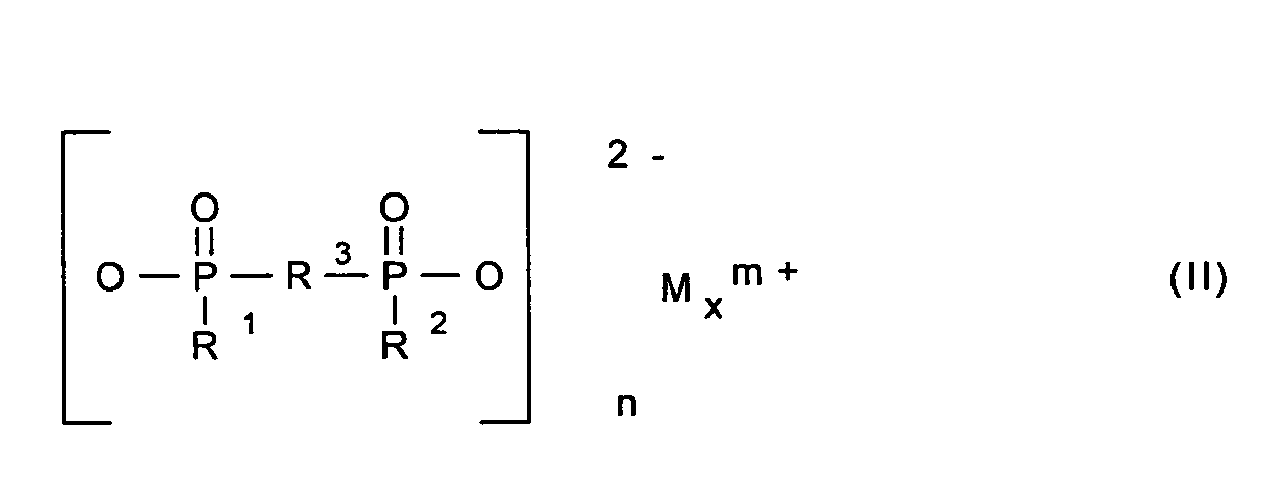
- R1, R2
- gleich oder verschieden sind und C1-C6-Alkyl, linear oder verzweigt und/oder Aryl;
- R3
- C1-C10-Alkylen, linear oder verzweigt, C6-C10-Arylen, -Alkylarylen oder -Arylalkylen;
- M
- Mg, Ca, Al, Sb, Sn, Ge, Ti, Zn, Fe, Zr, Ce, Bi, Sr, Mn, Li, Na, K und/oder eine protonierte Stickstoffbase;
- m
- 1 bis 4; n 1 bis 4; x 1 bis 4 bedeuten,
- Bevorzugt handelt es sich bei den Polyamiden um Polyamid 6, Polyamid 12, teilaromatische Polyamide und/oder Polyamid 66, wobei Formmassen eingeschlossen sind, die Polyamide enthalten, die durch Copolymerisation zweier oder mehrerer Monomeren erhältlich sind, oder Mischungen mehrerer Polyamide, wobei das Mischungsverhältnis beliebig ist.
- Bevorzugt sind R1, R2 der Komponente B gleich oder verschieden und bedeuten Methyl, Ethyl, n-Propyl, iso-Propyl, n-Butyl, tert.-Butyl, n-Pentyl und/oder Phenyl.
- Bevorzugt bedeutet R3 der Komponente B Methylen, Ethylen, n-Propylen, iso-Propylen, n-Butylen, tert.-Butylen, n-Pentylen, n-Octylen oder n-Dodecylen; Phenylen oder Naphthylen; Methyl-phenylen, Ethyl-phenylen, tert.-Butylphenylen, Methyl-naphthylen, Ethyl-naphthylen oder tert.-Butylnaphthylen; Phenyl-methylen, Phenyl-ethylen, Phenyl-propylen oder Phenyl-butylen.
- Bevorzugt handelt es sich bei der Komponente C um eine Stickstoffverbindung der Formeln (III) bis (VIII),


- R5 bis R7
- Wasserstoff, C1-C8-Alkyl, C5-C16-Cycloalkyl oder -Alkylcycloalkyl, möglicherweise substituiert mit einer Hydroxy- oder einer C1-C4-Hydroxyalkyl-Funktion, C2-C8-Alkenyl, C1-C8-Alkoxy, -Acyl, -Acyloxy, C6-C12-Aryl oder -Arylalkyl, -OR8 und -N(R8)R9 , sowie N-alicyclisch oder N-aromatisch,
- R8
- Wasserstoff, C1-C8-Alkyl, C5-C16-Cycloalkyl oder -Alkylcycloalkyl, möglicherweise substituiert mit einer Hydroxy- oder einer C1-C4-Hydroxyalkyl-Funktion, C2-C8-Alkenyl, C1-C8-Alkoxy, -Acyl, -Acyloxy oder C6-C12-Aryl oder -Arylalkyl,
- R9 bis R13
- die gleichen Gruppen wie R8 sowie -O-R8,
- m und n
- unabhängig voneinander 1, 2, 3 oder 4,
- X
- Säuren, die Addukte mit Triazinverbindungen (III) bilden können, bedeuten,
- Bevorzugt handelt es sich bei der Komponente C um Benzoguanamin, Tris(hydroxyethyl)isocyanurat, Allantoin, Glycouril, Melamin, Melamincyanurat, Harnstoffcyanurat, Dicyandiamid und/oder Guanidin.
- Bevorzugt handelt es sich bei den Kondensationsprodukten des Melamins um Melem, Melam, Melon und/oder höherkondensierte Verbindungen davon.
- Bevorzugt handelt es sich bei den Umsetzungsprodukten um Dimelaminpyrophosphat, Melaminpolyphosphat, Melempolyphosphat, Melampolyphosphat, Melonpolyphosphat und/oder gemischte Polysalze dieses Typs.
- Bevorzugt handelt es bei den Umsetzungsprodukten um stickstoffhaltige Phosphate der Formeln (NH4)y H3-y PO4 bzw. (NH4 PO3)z, mit y gleich 1 bis 3 und z gleich 1 bis 10.000.
- Bevorzugt handelt es sich bei der Komponente D um Glasfasern, insbesondere um Kurzglasfasern oder Endlosstränge (Rovings).
- Besonders bevorzugt handelt es sich bei der Komponente E um Talkum.
- Bevorzugt handelt es sich bei der Komponente F um Zinkoxid, Zinkborat, Zinksulfid, Zinkstearat und/oder Zinkmontanat.
- Bevorzugt handelt es sich bei der Komponente G um Zusatzstoffe und Verarbeitungshilfsmittel wie Pigmente, Farbstoffe, Wachse, Nukleierungsmittel, Gleit- und Entformungshilfsmittel, Weichmacher, Lichtschutzmittel, Stabilisatoren, Antioxidantien, Metalldesaktivatoren, Antistatika oder Mischungen derartiger Additive.
- Bevorzugt enthalten die erfindungsgemäßen polymeren Formmassen 40 bis 60 Gew.-% der Komponente A, 4 bis 15 Gew.-% der Komponente B, 4 bis 15 Gew.-% der Komponente C, 15 bis 30 Gew.-% der Komponente D, 6 bis 20 Gew.-% der Komponente E, 0,1 bis 2,5 Gew.-% der Komponente F oder deren Mischungen und 0,1 bis 2,5 Gew.-% der Komponente G oder deren Mischungen.
- Die Erfindung betrifft auch die Verwendung der erfindungsgemäßen polymeren Formmassen nach einem oder mehreren der Ansprüche 1 bis 14 zur Herstellung von oder in Formkörpern wie sie in der Elektroindustrie Anwendung finden.
- Geeinet sind auch Polyamide vom Aminosäure-Typ und/oder vom Diamin-Dicarbonsäure-Typ, wobei Formmassen eingeschlossen sind, die Polyamide enthalten, die durch Copolymerisation zweier oder mehrerer Monomeren erhältlich sind, oder Mischungen mehrerer Polyamide, wobei das Mischungsverhältnis beliebig ist.
- R1, R2 der Komponente B können gleich oder verschieden sein und C1-C6-Alkyl, linear oder verzweigt und/oder Phenyl bedeuten.
- M der Komponente B ist am besten Ca, Al oder Zn.
- Geeignet als Komponente C sind auch Kondensationsprodukte des Melamins.
- Bei der Komponente C kann es sich auch um Umsetzungsprodukte von Melamin mit Polyphosphorsäure und/oder um Umsetzungsprodukte von Kondensationsprodukten des Melamins mit Polyphosphorsäure oder Gemische davon handeln, wobei dann Melaminpolyphosphat bevorzugt ist.
- Bei Komponente D kann es sich auch um Kohlenstofffasern, Kaliumtitanatfasern, Aramidfasern, Naturfasern, Glasgewebe, Glasmatten und/oder Glasfasern handeln.
- Bei Komponente E kann es sich auch um amorphe Kieselsäure, Bariumsulfat, Magnesiumcarbonat, Calciumcarbonat, Kaolin, Titandioxid, gepulverter Quarz, Glimmer, Feldspat, Wollastonit, Silikate und/oder Talkum handeln.
- Bevorzugt enthalten die erfindungsgemäßen polymeren Formmassen auch 30 bis 70 Gew.-% der Komponente A, 2 bis 20 Gew.-% der Komponente B, 2 bis 20 Gew.-% der Komponente C, 5 bis 60 Gew.-% der Komponente D, 2 bis 30 Gew.-% der Komponente E, 0 bis 5 Gew.-% der Komponente F oder deren Mischungen und 0 bis 5 Gew.-% der Komponente G oder deren Mischungen.
- Weiterhin bevorzugt enthalten die erfindungsgemäßen polymeren Formmassen auch 35 bis 65 Gew.-% der Komponente A, 3 bis 18 Gew.-% der Komponente B, 3 bis 18 Gew.-% der Komponente C, 10 bis 35 Gew.-% der Komponente D, 5 bis 25 Gew.-% der Komponente E, 0 bis 3 Gew.-% der Komponente F oder deren Mischungen und 0 bis 3 Gew.-% der Komponente G oder deren Mischungen.
- Insbesondere enthalten die erfindungsgemäßen polymeren Formmassen oft 40 bis 60 Gew.-% der Komponente A, 4 bis 15 Gew.-% der Komponente B, 4 bis 15 Gew.-% der Komponente C, 15 bis 30 Gew.-% der Komponente D, 6 bis 20 Gew.-% der Komponente E, 0 bis 2,5 Gew.-% der Komponente F oder deren Mischungen und 0 bis 2,5 Gew.-% der Komponente G oder deren Mischungen.
- Bei einem geeigneten Verfahren zur Herstellung von polymeren Formmassen nach einem oder mehreren der Ansprüche 1 bis 15 werden Komponente A, B, C, und ggf. E und F in einem Doppelschneckenextruder über den Haupt- bzw. Seitendosiergang zugegeben, wobei die Komponente D über einen separaten Seitendosiergang zugegeben wird.
- Das Verfahren kann so ausgeführt werden, dass mehrere Komponenten B, C, und ggf. E und F vor der Zugabe in den Doppelschneckenextruder physikalisch gemischt werden.
- Die Erfindung betrifft auch die Verwendung der erfindungsgemäßen polymeren Formmassen nach einem oder mehreren der Ansprüche 1 bis 25 zur Herstellung von oder in Formkörpern, Filmen, Fäden und Fasern.
- Bevorzugt handelt es sich bei den Formkörpern um Schalter oder Schalterteile, Schalt-Schütze, Schutzschalter, Spulenkörper, Stecker, Steckerleisten, Sicherungsgehäuse und Schutzschaltergehäuse.
- Überraschenderweise wurde gefunden, dass erfindungsgemäße Formmassen aus Polyamiden, Phosphinaten, stickstoffhaltigen Synergisten oder Phosphor-Stickstoff-Flammschutzmitteln, Glasfasern und Talkum und gegebenenfalls einer Zinkverbindung eine verbesserte Glühdrahtbeständigkeit bei gleichzeitig hoher Flammwidrigkeit aufweisen, während Formmassen aus Polyamiden, Phosphinaten und Phosphor/Stickstoff-Flammschutzmitteln, die zusätzlich entweder nur Glasfasern oder Talkum und gegebenenfalls eine Zinkverbindung enthalten, entweder geringere Flammwidrigkeit oder geringere Glühdrahtbeständigkeit aufweisen.
- Als Komponente A enthalten die erfindungsgemäßen Formmassen 30 bis 70 Gew.-% eines thermoplastischen Polyamids, wie sie z.B. in der
DE-A-199 20 276 beschrieben werden. Bevorzugt handelt es sich bei den Polyamiden um solche vom Aminosäure-Typ und/oder vom Diamin-Dicarbonsäure-Typ. Bevorzugt handelt es sich bei den Polyamiden um Polyamid 6, Polyamid 12, teilaromatische Polyamide und/oder Polyamid 66. Die Formmassen können aber auch Polyamide enthalten, die durch Copolymerisation zweier oder mehrerer Monomeren erhältlich sind, oder Mischungen mehrerer Polyamide enthalten, wobei das Mischungsverhältnis beliebig ist. - Unter protonierten Stickstoffbasen werden bevorzugt die protonierten Basen von Ammoniak, Melamin, Triethanolamin, insbesondere NH4 +, verstanden.
- Geeignete Phosphinate sind in der
PCT/WO 97/39053 - Besonders bevorzugte Phosphinate sind Aluminium-, Calcium- und Zinkphosphinate.
- Kondensationsprodukte des Melamins sind z. B. Melem, Melam oder Melon bzw. höher kondensierte Verbindungen dieses Typs sowie Gemische derselben und können z. B. durch ein Verfahren hergestellt werden, wie es in
WO-A-96/16948 - Bevorzugt handelt es sich bei den Phosphor/Stickstoff-Flammschutzmitteln um Umsetzungsprodukte des Melamins mit Phosphorsäure oder kondensierten Phosphorsäuren bzw. Umsetzungsprodukte von Kondensationsprodukten des Melamins mit Phosphorsäure oder kondensierten Phosphorsäuren sowie Gemische der genannten Produkte.
- Unter den Umsetzungsprodukten mit Phosphorsäure oder kondensierten Phosphorsäuren versteht man Verbindungen, die durch Umsetzung von Melamin oder den kondensierten Melaminverbindungen, wie Melam, Melem oder Melon etc., mit Phosphorsäure entstehen. Beispiele hierfür sind Dimelaminphosphat, Dimelaminpyrophosphat, Melaminphosphat, Melaminpyrophosphat, Melaminpolyphosphat, Melampolyphosphat, Melonpolyphosphat und Melempolyphosphat bzw. gemischte Polysalze, wie sie z. B. in der
WO 98/39306 - Als Komponente D enthalten die erfindungsgemäßen Formmassen 5 bis 60 Gew.-% eines faserförmigen Verstärkungsstoffes. Bevorzugte faserförmige Verstärkungsstoffe sind Kohlenstofffasern, Kaliumtitanatfasern, Aramidfasern, Naturfasern, Glasgewebe, Glasmatten und besonders bevorzugt Glasfasern. Zur besseren Verträglichkeit mit dem thermoplastischen Polyamid können die Glasfasern mit Oberflächenmodifizierungen wie einer Schlichte und einem Haftvermittler ausgerüstet sein. Die Einarbeitung dieser Glasfasern kann sowohl in Form von Kurzglasfasern als auch in Form von Endlossträngen (Rovings) erfolgen. Die verwendeten Glasfasern haben einen Durchmesser im Bereich von 5 bis 25 µm und im fertigen Spritzgussteil liegt die mittlere Teilchenlänge der Glasfasern im Bereich von 0,1 bis 2 mm.
- Als Komponente E enthalten die erfindungsgemäßen Formmassen 2 bis 30 Gew.-% eines Füllstoffes. Bevorzugte Füllstoffe sind amorphe Kieselsäure, Bariumsulfat, Magnesiumcarbonat, Calciumcarbonat, Kaolin, Titandioxid, gepulverter Quarz, Glimmer, Feldspat, Wollastonit, Silikate und besonders bevorzugt Talkum. Talkum ist ein hydratisiertes Magnesiumsilikat der Zusammensetzung Mg3[(OH)2/Si4O10] oder 3MgO · 4SiO2 · H2O. Je nach Talkumtyp können Beimengungen von Chlorit, Dolomit und Carbonaten enthalten sein. Zur besseren Verträglichkeit mit dem thermoplastischen Polyamid kann das Talkum mit einer Oberflächenbeschichtung ausgerüstet sein. Das verwendete Talkum hat eine mittlere Teilchengröße von 0,1 bis 40 µm, bevorzugt 0,5 bis 30 µm, besonders bevorzugt 1 bis 20 µm.
- Die Mengenverhäitnisse der Komponenten A, B, C, D, E, F und G in der Polyamidformmasse hängen wesentlich vom vorgesehenen Anwendungsgebiet ab und können in weiten Grenzen variieren, wie vorstehend ausgeführt.
- Die vorgenannten Additive und Verstärkungsstoffe (Komponenten B bis G) können in den verschiedensten Verfahrensschritten in den Kunststoff eingebracht werden. So ist es bei Polyamiden möglich, Additive und Verstärkungsstoffe bereits zu Beginn oder am Ende der Polymerisation/Polykondensation oder in einem folgenden Compoundierprozess auf üblichen Extrudern oder Knetern in die Polymerschmelze einzumischen. Dabei können die Komponenten B bis G einzeln oder über entsprechende Vormischungen zugesetzt werden. Es ist auch möglich, als Komponente A ein pulverförmiges Polyamid einzusetzen, das beispielsweise durch Vermahlung erhalten wurde und mit den Komponenten B bis G vor einem weiteren Verarbeitungsschritt entsprechend abzumischen. Weiterhin gibt es Verarbeitungsprozesse bei denen die Additive und Verstärkungsstoffe erst später zugefügt werden. Dies wird insbesondere beim Einsatz von Pigment- oder Additivmasterbatchen praktiziert, die entsprechende Zuschlagstoffe in einem geeigneten Trägermaterial enthalten. Außerdem besteht die Möglichkeit, insbesondere pulverförmige Additive auf das durch den Trocknungsprozess eventuell warme Polymergranulat aufzutrommeln.
- Bevorzugt liegen die vorgenannten Additive und Verstärkungsstoffe (Komponenten B bis G) als Granulat, Schuppen, Faser, Feinkorn, Pulver und/oder Micronisat vor.
- Bevorzugt werden die Komponenten B und C als physikalische Mischung der Feststoffe, als Schmelzmischung, als Kompaktat, als Extrudat oder in Form eines Masterbatches zugesetzt. Optional können in solche Mischungen bereits die vorgenannten Komponenten E und/oder F und ggf. G eingearbeitet werden.
- Die Erfindung betrifft auch Formkörper, Filme, Fäden und Fasern, die aus den erfindungsgemäßen Polyamidformmassen hergestellt werden, bevorzugt Formkörper, welche in der Elektroindustrie z.B. als Schalter oder Schalterteile, Schalt-Schütze, Schutzschalter, Spulenkörper, Stecker, Steckerleisten, Sicherungsgehäuse, Schutzschaltergehäuse etc. Anwendung finden.
-
- Komponente A:
- Polyamid 6.6, Granulat (Ultramid® A 3 Natur, Fa. BASF AG, D)
- Komponente B:
- Aluminiumsalz der Diethylphosphinsäure, Pulver, im Folgenden als DEPAL bezeichnet.
- Komponente C:
- Melaminpolyphosphat, Pulver, im Folgenden als MPP bezeichnet, (Melapur® 200, Fa. Ciba Melapur, NL)
- Komponente D:
- Glasfaser (Vetrotex® EC10 4,5MM 983, Fa. St. Gobain Vetrotex, F)
- Komponente E/1:
- Talkum, Pulver (Jetfine 3 C A, Fa. Luzenac Europe, F)
- KomponenteE/2:
- Talkum, Pulver (Luzenac 1445, Fa. Luzenac Europe, F)
- Komponente F:
- Zinkborat, Pulver (Firebrake® 500, Fa. U.S. Borax, USA)
- Die Herstellung der Formmassen erfolgte auf einem gleichlaufenden Doppelschneckenextruder (Typ Leistritz ZSE 27 HP 44 D) bei einem Temperaturprofil von 280°C am Haupttrichter abfallend auf 255°C an der Extruderdüse, einer Schneckendrehzahl von 250 Umdrehungen pro Minute und einem Durchsatz von 20 kg pro Stunde. Unter diesen Bedingungen resultierte eine Massetemperatur an der Düse von ca. 280°C. Die Komponente A (PA 6.6 als Granulat) wurde über den Haupteinzug zugegeben, die pulverförmigen Komponenten B, C, E und F wurden über eine erste Seitendosiereinheit und Komponente D (Glasfasern) über eine zweite Seitendosiereinheit zugegeben. Wenn in einem Versuchsansatz mehrere Komponenten B, C, E und F zugegeben wurden, wurden diese vor der Zugabe in einem Taumelmischer physikalisch gemischt und dann entsprechend zugegeben. Die Komponenten wurden in dem in den Tabellen angegebenen Verhältnis verarbeitet. Der homogenisierte Polymerstrang wurde abgezogen, im Wasserbad gekühlt und anschließend granuliert.
- Nach ausreichender Trocknung wurden die Formmassen auf einer Spritzgießmaschine (Typ Arburg 320 C Allrounder) bei einer Temperatureinstellung des Zylinders von 270°C am Einzug bis 300°C an der Düse und einer Formtemperatur von 80°C zu Prüfkörpern verarbeitet und anhand des UL 94-Vertikaltests auf Flammwidrigkeit und anhand der Norm IEC 60695-2-13 auf Glühdrahtbeständigkeit geprüft und klassifiziert. Für die Prüfung nach UL 94 wurden Prüfkörper der Abmessungen 127 mm x 12,7 mm x 0,8 mm, bzw. 127 mm x 12,7 mm x 1,6 mm, für die Prüfung der Glühdrahtbeständigkeit Prüfkörper der Abmessungen 60 mm x 60 mm x 1 mm, bzw. 60 mm x 60 mm x 2 mm hergestellt.
- Die Bestimmung der Flammwidrigkeit wurde anhand des UL 94-Vertikaltests (Underwriter Laboratories Inc., Standard for Safety, Test for Flammability of Plastic Materials for Parts in Devices and Appliances, ISBN 0-7629-0082-2) durchgeführt. Diese Prüfung wird in großem Maße auf dem Gebiet der Elektrotechnik und Elektronikanwendungen zur Abschätzung des Brandverhaltens eingesetzt und erlaubt eine Einstufung der geprüften Materialien bei Einwirkung einer externen Zündquelle in Form einer offenen Flamme. Bewertet werden die Nachbrennzeiten, das Nachglühverhalten und das Abtropfverhalten der Prüfkörper. Für die Einstufung eines flammwidrigen Kunststoffs in die Klasse V-0 müssen die folgenden Kriterien erfüllt sein: bei einem Satz von fünf Prüfkörpern dürfen alle Proben nach zweimaliger Beflammung von 10 Sekunden Dauer mit einer offenen Flamme mit definierter Höhe nicht länger als 10 Sekunden nachbrennen. Die Summe der Nachbrennzeiten bei 10 Beflammungen von fünf Prüfkörpern darf nicht größer als 50 Sekunden sein. Zudem darf kein brennendes Abtropfen oder vollständiges Abbrennen erfolgen und die Summe aus Nachbrenn- und Nachglühzeit des jeweiligen Prüfkörpers darf 30 Sekunden nicht überschreiten. Zur Einstufung in die Klasse V-1 wird verlangt, dass die Einzelnachbrennzeiten nicht länger als 30 Sekunden betragen und dass die Summe der Nachbrennzeiten von 10 Beflammungen von fünf Proben nicht größer als 250 Sekunden ist. Zudem darf kein brennendes Abtropfen oder vollständiges Abbrennen erfolgen und die Summe aus Nachbrenn- und Nachglühzeit des jeweiligen Prüfkörpers darf 60 Sekunden nicht überschreiten. Eine Einstufung in die Klasse V-2 erfolgt dann, wenn es bei Erfüllung der übrigen Kriterien, wie sie für die Einstufung in die Klasse V-1 gelten, zu einem brennenden Abtropfen kommt. Werden die oben genannten Kriterien nicht erfüllt, erfolgt die Bewertung n.k. = nicht klassifizierbar als V-0, V-1 oder V-2. Die Einstufung in die Klasse V-0 entspricht einer hohen Flammwidrigkeit und wird von einer Reihe von Anwendungen im Elektrobereich als Anforderung gestellt.
- Die Bestimmung der Glühdrahtbeständigkeit erfolgte anhand der IEC 60695-2-13. In dieser Prüfung wird der so genannte GWIT-Wert bestimmt. GWIT steht für glow-wire ignition temperature ("Giühdrahtentzündungstemperatur") und gibt die Temperatur an, die um 25 K (30 K bei Prüftemperaturen zwischen 900°C und 960°C) höher liegt als die Temperatur an der Spitze des Glühdrahts, bei der es bei einer Prüfung an drei Prüfkörpern gegebener Dicke zu keiner Entzündung kommt. Entzündung wird dabei definiert als eine Flammenbildung, die länger als fünf Sekunden andauert. Auch diese Prüfung ist auf dem Gebiet der Elektrotechnik und Elektronikanwendungen von Bedeutung, da Bauelemente in elektronischen Erzeugnissen im Fehlerfall, wie beispielsweise bei einem Kurzschluss oder bei Überlastung derart hohe Temperaturen annehmen können, dass sich Bauelemente in unmittelbarer Nähe der Strom führenden Leiter entzünden können. Dieses Verhalten wird in der Glühdrahtprüfung nachempfunden. Insbesondere für unbeaufsichtigte Haushaltsgeräte und elektrischen Strömen größer 0,2 A wird It. der "Hausgerätenorm" nach IEC 60335-1, Teil 30 "Widerstand gegen Wärme und Feuer" (4. Ausgabe, Mai 2001) für bestimmte Bauteile beispielsweise ein GWIT nach IEC 60695-2-13 von mindestens 775°C gefordert.
- Sämtliche Versuche der jeweiligen Serie wurden aufgrund der Vergleichbarkeit unter identischen Bedingungen (Temperaturprogramme, Schneckengeometrien, Spritzgießparameter, etc.) durchgeführt. Die Prüfkörper wurden vor den jeweiligen Prüfungen eine Woche bei 23°C und 50 % relativer Luftfeuchtigkeit gelagert.
- Die Tabelle 1 zeigt Vergleichsbeispiele von Polyamidformmassen basierend auf PA 6.6 (Komponente A), gegebenenfalls dem Aluminiumsalz der Diethylphosphinsäure (DEPAL; Komponente B), gegebenenfalls dem Phosphor/Stickstoff-Flammschutzmittel Melaminpolyphosphat (MPP; Komponente C), gegebenenfalls Zinkborat (Komponente F), die entweder Glasfasern (Komponente D) oder Talkum (Komponente E1 bzw. E2) oder eine Kombination aus Glasfasern und Talkum aber keine Komponente B, C oder F enthalten. Alle Mengen sind als Gew.-% angegeben.
- Die Ergebnisse der Beispiele, in denen Polyamidformmassen gemäß der Erfindung gefertigt wurden (Kombination der Komponente D mit Komponente E1 bzw. Komponente E2 bei gleichzeitiger Zugabe von Komponenten B, C und F), sind in Tabelle 2 aufgelistet. Alle Mengen sind als Gew.-% angegeben.
Polyamide ohne den Zusatz von Flammschutzmitteln weisen erwartungsgemäß nur eine schlechte Flammwidrigkeit und geringe Glühdrahtbeständigkeit auf (Vergleichsbeispiele V1 bis V5). Aus den Vergleichsbeispielen V6 bis V8 wird ersichtlich, dass beim alleinigen Einsatz von Glasfasern oder Talkum in den Polyamidformmassen mit Flammschutzmitteln entweder eine gute Flammwidrigkeit (Klasse V-0 im UL 94-Vertikaltest) bei nicht ausreichender Glühdrahtbeständigkeit (GWIT von 750°C) oder nicht ausreichende Flammwidrigkeit (Klasse V-1 im UL 94-Vertikaltest) bei ausreichender Glühdrahtbeständigkeit (GWIT von 775°C) erreicht wird. - Aus den erfindungsgemäßen Beispielen A1 und A2 geht hervor, dass bei der Kombination von Glasfasern und Talkum in den Polyamidformmassen sowohl eine hohe Flammwidrigkeit (Klasse V-0 im UL 94-Vertikaltest) als auch eine hohe Glühdrahtbeständigkeit (GWIT von 775°C oder höher) erreicht wird bei insgesamt konstanter Dosierung der Flammschutzmittel (Komponenten B und C). Damit kann mit ein und derselben Polyamidformmasse (erfindungsgemäße Beispiele A1 und A2) ein größerer Anwendungsbereich abgedeckt werden, als es mit Polyamidformmassen der Vergleichsbeispiele V6, V7 oder V8 möglich ist.
Tabelle 1: Vergleichsbeispiele (Versuchsreihe 1): Polyamidformmassen basierend auf PA 6.6 (Komponente A), gegebenenfalls dem Aluminiumsalz der Diethylphosphinsäure (DEPAL; Komponente B), gegebenenfalls dem Phosphor/Stickstoff-Flammschutzmittel Melaminpolyphosphat (MPP; Komponente C), gegebenenfalls Zinkborat (Komponente F), die entweder Glasfasern (Komponente D) oder Talkum (Komponente E1 bzw. E2) oder eine Kombination aus Glasfasern und Talkum aber keine Komponente B, C oder F enthalten. Vergleich A [%] B [%] C [%] D [%] E1 [%] E2 [%] F [%] Klasse nach UL 94 Vertikaltest (0,8 mm /1,6 mm) GWIT/IEC 60695-2-13 [°C] (1 mm/2 mm) V1 70 0 0 30 0 0 0 n.k.*/n.k. 675/700 V2 70 0 0 0 30 0 0 n.k./n.k. 675/675 V3 70 0 0 0 0 30 0 n.k./n.k. 675/675 V4 70 0 0 20 10 0 0 n.k./n.k. 675/700 V5 70 0 0 20 0 10 0 n.k./n.k. 675/700 V6 52 11,4 5,7 30 0 0 0,9 V-0/V-0 750/750 V7 52 11,4 5,7 0 30 0 0,9 V-1N-1 775/775 V8 52 11,4 5,7 0 0 30 0,9 V-1/V-1 775/775 * n.k. = nicht klassifizierbar als V-0, V-1 oder V-2 Tabelle 2: Erfindungsgemäße Beispiele: Polyamidformmassen basierend auf PA 6.6 (Komponente A), dem Aluminiumsalz der Diethylphosphinsäure (DEPAL; Komponente B), dem Phosphor/Stickstoff-Flammschutzmittel Melaminpolyphosphat (MPP; Komponente C), Zinkborat (Komponente F), die sowohl Glasfasern (Komponente D) als auch Talkum (Komponente E1 bzw. E2) enthalten. Erfindungs-gemäß A [%] B [%] C [%] D [%] E1 [%] E2 [%] F [%] Klasse nach UL 94 Vertikaltest (0,8 mm /1,6 mm) GWIT / IEC 60695-2-13 [°C] (1 mm/2 mm) A1 52 11,4 5,7 20 10 0 0,9 V-0/V-0 775/800 A2 52 11,4 5,7 20 0 10 0,9 V-0/V-0 775/800
als Komponente D 5 bis 60 Gew.-% eines faserförmigen Verstärkungsstoffes,
als Komponente E 2 bis 30 Gew.-% eines Füllstoffes,
als Komponente F 0 bis 5 Gew.-% einer organischen oder anorganischen Zinkverbindung oder Mischungen verschiedener Zinkverbindungen,
als Komponente G 0 bis 5 Gew.-% übliche Zusatzstoffe und Verarbeitungshilfsmittel, wobei die Summe der Komponenten A bis G immer 100 Gew.-% beträgt.
Claims (15)
- Polymere Formmassen auf Basis von thermoplastischen Polyamiden, enthaltend
als Komponente A 30 bis 70 Gew.-% eines thermoplastischen Polyamides,
als Komponente B 2 bis 20 Gew.-% eines Phosphinsäuresalzes der Formel (I)
und/oder eines Diphosphinsäuresalzes der Formel (II) und/oder deren Polymeren,
 R1, R2 gleich oder verschieden sind und C1-C6-Alkyl, linear oder verzweigt und/oder Aryl;R3 C1-C10-Alkylen, linear oder verzweigt, C6-C10-Arylen, -Alkylarylen oder -Arylalkylen;M Mg, Ca, Al, Sb, Sn, Ge, Ti, Zn, Fe, Zr, Ce, Bi, Sr, Mn, Li, Na, K und/oder eine protonierte Stickstoffbase;m 1 bis 4; n 1 bis 4; x 1 bis 4 bedeuten,als Komponente C 2 bis 20 Gew.-% eines stickstoffhaltigen Synergisten oder eines Phosphor/Stickstoff-Flammschutzmittels,
als Komponente D 5 bis 60 Gew.-% eines faserförmigen Verstärkungsstoffes,
als Komponente E 2 bis 30 Gew.-% eines Füllstoffes,
als Komponente F 0 bis 5 Gew.-% einer organischen oder anorganischen Zinkverbindung oder Mischungen verschiedener Zinkverbindungen und
als Komponente G 0 bis 5 Gew.-% übliche Zusatzstoffe und Verarbeitungshilfsmittel, wobei die Summe der Komponenten A bis G immer 100 Gew.-% beträgt. - Polymere Formmassen nach Anspruch 1, dadurch gekennzeichnet, dass es sich bei den Polyamiden um Polyamid 6, Polyamid 12, teilaromatische Polyamide und/oder Polyamid 66 handelt und Formmassen eingeschlossen sind, die Polyamide enthalten, die durch Copolymerisation zweier oder mehrerer Monomeren erhältlich sind, oder Mischungen mehrerer Polyamide enthalten, wobei das Mischungsverhältnis beliebig ist.
- Polymere Formmassen nach Anspruch 1 oder 2, dadurch gekennzeichnet, dass R1, R2 der Komponente B gleich oder verschieden sind und Methyl, Ethyl, n-Propyl, iso-Propyl, n-Butyl, tert.-Butyl, n-Pentyl und/oder Phenyl bedeuten und R3 der Komponente B Methylen, Ethylen, n-Propylen, iso-Propylen, n-Butylen, tert.-Butylen, n-Pentylen, n-Octylen oder n-Dodecylen; Phenylen oder Naphthylen; Methyl-phenylen, Ethyl-phenylen, tert.-Butylphenylen, Methyl-naphthylen, Ethyl-naphthylen oder tert.-Butylnaphthylen; Phenyl-methylen, Phenyl-ethylen, Phenyl-propylen oder Phenyl-butylen bedeutet.
- Polymere Formmassen nach einem oder mehreren der Ansprüche 1 bis 3, dadurch gekennzeichnet, dass M der Komponente B Ca, Al oder Zn bedeutet.
- Polymere Formmassen nach einem oder mehreren der Ansprüche 1 bis 4, dadurch gekennzeichnet, dass es sich bei der Komponente C um eine Stickstoffverbindung der Formeln (III) bis (VIII) handelt,


 R5 bis R7 Wasserstoff, C1-C8-Alkyl, C5-C16-Cycloalkyl oder -Alkylcycloalkyl, möglicherweise substituiert mit einer Hydroxy- oder einer C1-C4-Hydroxyalkyl-Funktion, C2-C8-Alkenyl, C1-C8-Alkoxy, -Acyl, -Acyloxy, C6-C12-Aryl oder -Arylalkyl, -OR8 und -N(R8)R9, sowie N-alicyclisch oder N-aromatisch,R8 Wasserstoff, C1-C8-Alkyl, C5-C16-Cycloalkyl oder -Alkylcycloalkyl, möglicherweise substituiert mit einer Hydroxy- oder einer C1-C4-Hydroxyalkyl-Funktion, C2-C8-Alkenyl, C1-C8-Alkoxy, -Acyl, -Acyloxy oder C6-C12-Aryl oder -Arylalkyl,R9 bis R13 die gleichen Gruppen wie R8 sowie -O-R8,m und n unabhängig voneinander 1, 2, 3 oder 4,X Säuren, die Addukte mit Triazinverbindungen (III) bilden können, bedeuten,oder um oligomere Ester des Tris(hydroxyethyl)isocyanurats mit aromatischen Polycarbonsäuren.
 - Polymere Formmassen nach einem oder mehreren der Ansprüche 1 bis 5, dadurch gekennzeichnet, dass es sich bei der Komponente C um Benzoguanamin, Tris(hydroxyethyl)isocyanurat, Allantoin, Glycouril, Melamin, Melamincyanurat, Harnstoffcyanurat, Dicyandiamid und/oder Guanidin handelt.
- Polymere Formmassen nach einem oder mehreren der Ansprüche 1 bis 6, dadurch gekennzeichnet, dass es sich bei der Komponente C um Kondensationsprodukte des Melamins, insbesondere um Melem, Melam, Melon und/oder höherkondensierte Verbindungen davon handelt.
- Polymere Formmassen nach einem oder mehreren der Ansprüche 1 bis 6, dadurch gekennzeichnet, dass es sich bei der Komponente C um Dimelaminpyrophosphat, Melaminpolyphosphat, Melempolyphosphat, Melampolyphosphat, Melonpolyphosphat und/oder gemischte Polysalze dieses Typs handelt.
- Polymere Formmassen nach einem oder mehreren der Ansprüche 1 bis 6, dadurch gekennzeichnet, dass es bei der Komponente C um stickstoffhaltige Phosphate der Formeln (NH4)y H3-y PO4 bzw. (NH4 PO3)z, mit y gleich 1 bis 3 und z gleich 1 bis 10.000, handelt.
- Polymere Formmassen nach einem oder mehreren der Ansprüche 1 bis 9, dadurch gekennzeichnet, dass es sich bei der Komponente D um Glasfasern, insbesondere um Kurzglasfasern oder Endlosstränge (Rovings) handelt.
- Polymere Formmassen nach einem oder mehreren der Ansprüche 1 bis 10, dadurch gekennzeichnet, dass es sich bei der Komponente E um Talkum handelt.
- Polymere Formmassen nach einem oder mehreren der Ansprüche 1 bis 11, dadurch gekennzeichnet, dass es sich bei der Komponente F um Zinkoxid, Zinkborat, Zinksulfid, Zinkstearat und/oder Zinkmontanat handelt.
- Polymere Formmassen nach einem oder mehreren der Ansprüche 1 bis 12, dadurch gekennzeichnet, dass es sich bei der Komponente G um Zusatzstoffe und Verarbeitungshilfsmittel wie Pigmente, Farbstoffe, Wachse, Nukleierungsmittel, Gleit- und Entformungshilfsmittel, Weichmacher, Lichtschutzmittel, Stabilisatoren, Antioxidantien, Metalldesaktivatoren, Antistatika oder Mischungen derartiger Additive handelt.
- Polymere Formmassen nach einem oder mehreren der Ansprüche 1 bis 13, dadurch gekennzeichnet, dass sie 40 bis 60 Gew.-% der Komponente A, 4 bis 15 Gew.-% der Komponente B, 4 bis 15 Gew.-% der Komponente C, 15 bis 30 Gew.-% der Komponente D, 6 bis 20 Gew.-% der Komponente E, 0,1 bis 2,5 Gew.-% der Komponente F oder deren Mischungen und 0,1 bis 2,5 Gew.-% der Komponente G oder deren Mischungen enthalten.
- Verwendung von polymeren Formmassen nach einem oder mehreren der Ansprüche 1 bis 14 zur Herstellung von oder in Formkörpern, und wobei die Formkörper in der Elektroindustrie Anwendung finden.
Applications Claiming Priority (1)
| Application Number | Priority Date | Filing Date | Title |
|---|---|---|---|
| DE102005041966A DE102005041966A1 (de) | 2005-09-03 | 2005-09-03 | Polymere Formmassen auf Basis von thermoplastischen Polyamiden |
Publications (2)
| Publication Number | Publication Date |
|---|---|
| EP1762592A1 true EP1762592A1 (de) | 2007-03-14 |
| EP1762592B1 EP1762592B1 (de) | 2016-10-12 |
Family
ID=37616781
Family Applications (1)
| Application Number | Title | Priority Date | Filing Date |
|---|---|---|---|
| EP06017758.1A Not-in-force EP1762592B1 (de) | 2005-09-03 | 2006-08-25 | Polymere Formmassen aus Basis von thermoplastischen Polyamiden |
Country Status (5)
| Country | Link |
|---|---|
| US (1) | US20070072967A1 (de) |
| EP (1) | EP1762592B1 (de) |
| JP (1) | JP2007070627A (de) |
| DE (1) | DE102005041966A1 (de) |
| ES (1) | ES2608612T3 (de) |
Cited By (14)
| Publication number | Priority date | Publication date | Assignee | Title |
|---|---|---|---|---|
| WO2011009877A1 (de) * | 2009-07-24 | 2011-01-27 | Basf Se | Flammgeschützte polyamidformmassen |
| DE102010023770A1 (de) | 2010-06-15 | 2011-12-15 | Basf Se | Glühdrahtbeständige Formmassen |
| WO2013092299A1 (en) * | 2011-12-22 | 2013-06-27 | Dsm Ip Assets B.V. | Live part in unattended household appliances |
| CN104262955A (zh) * | 2014-09-17 | 2015-01-07 | 上海日之升新技术发展有限公司 | 高gwit碳纤增强无卤阻燃pa46复合材料及其制备 |
| EP2924067A1 (de) * | 2014-03-26 | 2015-09-30 | LANXESS Deutschland GmbH | Polyamidzusammensetzungen |
| EP2924066A1 (de) | 2014-03-26 | 2015-09-30 | LANXESS Deutschland GmbH | Polyamidzusammensetzungen |
| EP3015500A1 (de) * | 2014-10-31 | 2016-05-04 | LANXESS Deutschland GmbH | Polyamidzusammensetzungen |
| WO2017009152A1 (de) | 2015-07-10 | 2017-01-19 | Bond-Laminates Gmbh | Holzfurnier beschichteter kunststoffformkörper |
| EP3127937A1 (de) * | 2015-08-06 | 2017-02-08 | Ems-Patent Ag | Flammgeschützte polyamid 12 formmassen für bahnanwendungen |
| CN106751132A (zh) * | 2016-11-22 | 2017-05-31 | 广东联塑科技实业有限公司 | 一种无铅聚氯乙烯排水管材料 |
| DE202017003888U1 (de) | 2017-07-21 | 2017-08-10 | Lanxess Deutschland Gmbh | Ölbehälter |
| DE202017003886U1 (de) | 2017-07-21 | 2017-08-17 | Lanxess Deutschland Gmbh | Türmodul |
| DE202017003887U1 (de) | 2017-07-21 | 2017-08-17 | Lanxess Deutschland Gmbh | Sitzstrukturen |
| WO2018069055A1 (de) * | 2016-10-13 | 2018-04-19 | Basf Se | Flammgeschützte polyamide |
Families Citing this family (34)
| Publication number | Priority date | Publication date | Assignee | Title |
|---|---|---|---|---|
| DE102004009455A1 (de) * | 2004-02-27 | 2005-09-15 | Clariant Gmbh | Flammschutzmittel-Kombination für thermoplastische Polymere |
| DE102004023085A1 (de) * | 2004-05-11 | 2005-12-15 | Clariant Gmbh | Dialkylphosphinsäure-Salze, ein Verfahren zu ihrer Herstellung und ihre Verwendung |
| DE102004035508A1 (de) * | 2004-07-22 | 2006-02-16 | Clariant Gmbh | Flammgeschützte Polymerformmassen |
| KR101116480B1 (ko) * | 2007-03-30 | 2012-03-07 | 미쓰이 가가쿠 가부시키가이샤 | 난연성 폴리아마이드 조성물 |
| DE102007037019A1 (de) * | 2007-08-06 | 2009-02-12 | Clariant International Limited | Flammschutzmittelmischung für thermoplastische Polymere sowie flammwidrige Polymere |
| EP2060596B1 (de) * | 2007-11-16 | 2012-06-13 | Ems-Patent Ag | Gefüllte Polyamidformmassen |
| JP2009185151A (ja) * | 2008-02-05 | 2009-08-20 | Idemitsu Kosan Co Ltd | 伝熱性樹脂組成物 |
| JP2010077333A (ja) * | 2008-09-29 | 2010-04-08 | Fuji Electric Fa Components & Systems Co Ltd | 難燃性樹脂組成物 |
| JP2012512300A (ja) * | 2008-12-17 | 2012-05-31 | ビーエーエスエフ ソシエタス・ヨーロピア | 層状シリケート難燃組成物 |
| JP5761998B2 (ja) * | 2008-12-22 | 2015-08-12 | 三井化学株式会社 | 難燃性ポリアミド組成物 |
| CN102206411B (zh) * | 2010-03-30 | 2013-08-21 | E.I.内穆尔杜邦公司 | 阻燃性聚酰胺树脂组合物及包含该组合物的制品 |
| DK2558517T3 (en) | 2010-04-14 | 2017-01-23 | Wingspeed Ag | PROCEDURE FOR MANUFACTURING MODIFIED POLYAMIDE 6 |
| JP5570892B2 (ja) * | 2010-07-06 | 2014-08-13 | 旭化成ケミカルズ株式会社 | ポリアミド樹脂組成物の製造方法 |
| CN102952391B (zh) * | 2011-08-17 | 2015-11-25 | 纳幕尔杜邦公司 | 阻燃性聚酰胺组合物及由其制备的制品 |
| JP5926024B2 (ja) * | 2011-10-04 | 2016-05-25 | ユニチカ株式会社 | ポリアミド樹脂組成物及びポリアミド樹脂組成物の製造法 |
| CN102634194A (zh) * | 2012-04-27 | 2012-08-15 | 常熟市发东塑业有限公司 | 一种阻燃的无机纤维填充的聚酰胺材料的制备方法 |
| US20180244899A1 (en) * | 2013-03-08 | 2018-08-30 | Clariant International Ltd. | Flame-Retardant Polyamide Composition |
| KR101526953B1 (ko) | 2013-04-12 | 2015-06-09 | 현대자동차주식회사 | 차음성 폴리아미드 수지 조성물 |
| PL2810983T3 (pl) | 2013-06-06 | 2016-06-30 | Ems Patent Ag | Poliamidowe masy formierskie, wzmacniane włóknami szklanymi, zabezpieczone przed działaniem płomieni |
| WO2015087099A1 (en) | 2013-12-12 | 2015-06-18 | Italmatch Chemicals S.P.A. | Halogen-free flame retardant polyamide moulding compositions with increased glow wire and fire resistance |
| JP6523650B2 (ja) * | 2014-10-16 | 2019-06-05 | 旭化成株式会社 | ポリアミド樹脂組成物とその成形体、及びポリアミド樹脂組成物の製造方法 |
| DE102015004661A1 (de) * | 2015-04-13 | 2016-10-13 | Clariant International Ltd. | Flammhemmende Polyamidzusammensetzung |
| EP3135707A1 (de) * | 2015-08-26 | 2017-03-01 | LANXESS Deutschland GmbH | Polyamidzusammensetzungen |
| DE102017215780A1 (de) | 2017-09-07 | 2019-03-07 | Clariant Plastics & Coatings Ltd | Synergistische Flammschutzmittelkombinationen für Polymerzusammensetzungen und deren Verwendung |
| DE102017215777A1 (de) | 2017-09-07 | 2019-03-07 | Clariant Plastics & Coatings Ltd | Flammschutzmittelkombinationen für Polymerzusammensetzungen und deren Verwendung |
| US11401416B2 (en) * | 2017-10-17 | 2022-08-02 | Celanese Sales Germany Gmbh | Flame retardant polyamide composition |
| KR102240967B1 (ko) * | 2017-12-31 | 2021-04-16 | 롯데첨단소재(주) | 열가소성 수지 조성물 및 이로부터 형성된 성형품 |
| US20190322805A1 (en) * | 2018-04-18 | 2019-10-24 | Invista North America S.A R.L. | Flame-retardant polyamide composition |
| JP7641950B2 (ja) * | 2019-09-06 | 2025-03-07 | ストラタシス,インコーポレイテッド | 難燃性ポリアミド系3d印刷押出材料 |
| CN110669333A (zh) * | 2019-11-11 | 2020-01-10 | 江苏沃特新材料科技有限公司 | 阻燃尼龙材料及其制备方法 |
| CN112048779B (zh) * | 2020-09-15 | 2021-09-17 | 东华大学 | 共聚阻燃聚酰胺纤维及其制备方法 |
| CN112646365B (zh) * | 2020-12-19 | 2022-03-29 | 杭州本松新材料技术股份有限公司 | 一种低压电器用导热、阻燃聚酰胺组合物及其应用 |
| CN112759923A (zh) * | 2020-12-25 | 2021-05-07 | 金发科技股份有限公司 | 一种具有特定玻纤长度的玻纤增强半芳香族聚酰胺模塑组合物及模塑品 |
| CN116082828A (zh) * | 2021-11-05 | 2023-05-09 | 阿特斯阳光电力集团股份有限公司 | 一种耐水解螺帽及其制备方法和应用 |
Citations (9)
| Publication number | Priority date | Publication date | Assignee | Title |
|---|---|---|---|---|
| EP1070754A2 (de) * | 1999-07-22 | 2001-01-24 | Clariant GmbH | Flammschutzmittel-Kombination |
| WO2002028953A1 (en) * | 2000-10-05 | 2002-04-11 | Ciba Specialty Chemicals Holding Inc. | Halogen-free flame retarder composition and flame retardant polyamide composition |
| WO2004022640A1 (de) * | 2002-09-03 | 2004-03-18 | Clariant Gmbh | Flammschutzmittel-stabilisator-kombination für thermoplastische polymere |
| EP1522551A1 (de) * | 2003-10-07 | 2005-04-13 | Clariant GmbH | Phosphorhaltige Flammschutzmittelagglomerate |
| WO2005035664A1 (de) * | 2003-10-06 | 2005-04-21 | Ems-Chemie Ag | Flammgeschützte polyamidformmassen und deren verwendung |
| EP1568731A1 (de) * | 2004-02-27 | 2005-08-31 | Clariant GmbH | Flammschutzmittel-Kombination für thermoplastische Polymere |
| WO2005116139A2 (en) * | 2004-05-04 | 2005-12-08 | General Electric Company | Halogen-free flame retardant polyamide composition with improved electrical properties |
| EP1607400A2 (de) * | 2004-05-11 | 2005-12-21 | Clariant GmbH | Dialkylphosphinsäure-Salze, ein Verfahren zu ihrer Herstellung und ihre Verwendung |
| EP1624015A1 (de) * | 2004-07-22 | 2006-02-08 | Clariant GmbH | Flammgeschütze Polymerformmassen enthaltend ein nanoteiliges phosphorhaltiges Flammschutzmittel |
Family Cites Families (18)
| Publication number | Priority date | Publication date | Assignee | Title |
|---|---|---|---|---|
| DE2252258A1 (de) * | 1972-10-25 | 1974-05-09 | Hoechst Ag | Schwerentflammbare thermoplastische polyester |
| DE2447727A1 (de) * | 1974-10-07 | 1976-04-08 | Hoechst Ag | Schwerentflammbare polyamidformmassen |
| US4208321A (en) * | 1978-04-13 | 1980-06-17 | Pennwalt Corporation | Polyamide resins flame retarded by poly(metal phosphinate)s |
| DE4430932A1 (de) * | 1994-08-31 | 1996-03-07 | Hoechst Ag | Flammgeschützte Polyesterformmasse |
| DE19614424A1 (de) * | 1996-04-12 | 1997-10-16 | Hoechst Ag | Synergistische Flammschutzmittel-Kombination für Polymere |
| TW491843B (en) * | 1997-03-04 | 2002-06-21 | Nissan Chemical Ind Ltd | 1,3,5-triazine derivative salts of polyacids comprising phosphorus, sulfur, and oxygen and process for producing the same |
| DE19734437A1 (de) * | 1997-08-08 | 1999-02-11 | Clariant Gmbh | Synergistische Flammschutzmittel-Kombination für Polymere |
| DE19737727A1 (de) * | 1997-08-29 | 1999-07-08 | Clariant Gmbh | Synergistische Flammschutzmittel-Kombination für Kunststoffe |
| US5969014A (en) * | 1997-09-23 | 1999-10-19 | Clariant Finance (Bvi) Limited | Synergistic polyamide stabilization method |
| ES2254053T3 (es) * | 1999-01-30 | 2006-06-16 | Clariant Produkte (Deutschland) Gmbh | Combinacion de agentes ignifugantes para polimeros termoplasticos. |
| DE19903709A1 (de) * | 1999-01-30 | 2000-08-10 | Clariant Gmbh | Flammschutzmittel-Kombination für thermoplastische Polymere II |
| JP2001247751A (ja) * | 1999-12-28 | 2001-09-11 | Daicel Chem Ind Ltd | 難燃性樹脂組成物 |
| ATE532827T1 (de) * | 2001-11-30 | 2011-11-15 | Polyplastics Co | Flammwidrige harzzusammensetzung |
| DE10241373A1 (de) * | 2002-09-06 | 2004-03-18 | Clariant Gmbh | Oberflächenmodifizierte Phosphinsäuresalze |
| EP1431346A1 (de) * | 2002-12-16 | 2004-06-23 | DSM IP Assets B.V. | Verfahren zur Herstellung einer Flammhemmenden Polyamidzusammensetzung |
| DE10331889A1 (de) * | 2003-07-14 | 2005-02-17 | Clariant Gmbh | Flammwidrige Polyamide |
| US7294661B2 (en) * | 2003-10-03 | 2007-11-13 | E.I. Du Pont De Nemours And Company | Flame resistant aromatic polyamide resin composition and articles therefrom |
| DE102004048876A1 (de) * | 2004-09-13 | 2006-03-30 | Bayer Ag | Halogenfreie flammgeschützte thermoplastische Formmassen auf Basis von Polyamid mit erhöhter Glühdrahtbeständigkeit |
-
2005
- 2005-09-03 DE DE102005041966A patent/DE102005041966A1/de not_active Withdrawn
-
2006
- 2006-08-25 ES ES06017758.1T patent/ES2608612T3/es active Active
- 2006-08-25 EP EP06017758.1A patent/EP1762592B1/de not_active Not-in-force
- 2006-09-01 JP JP2006237357A patent/JP2007070627A/ja not_active Withdrawn
- 2006-09-01 US US11/514,547 patent/US20070072967A1/en not_active Abandoned
Patent Citations (9)
| Publication number | Priority date | Publication date | Assignee | Title |
|---|---|---|---|---|
| EP1070754A2 (de) * | 1999-07-22 | 2001-01-24 | Clariant GmbH | Flammschutzmittel-Kombination |
| WO2002028953A1 (en) * | 2000-10-05 | 2002-04-11 | Ciba Specialty Chemicals Holding Inc. | Halogen-free flame retarder composition and flame retardant polyamide composition |
| WO2004022640A1 (de) * | 2002-09-03 | 2004-03-18 | Clariant Gmbh | Flammschutzmittel-stabilisator-kombination für thermoplastische polymere |
| WO2005035664A1 (de) * | 2003-10-06 | 2005-04-21 | Ems-Chemie Ag | Flammgeschützte polyamidformmassen und deren verwendung |
| EP1522551A1 (de) * | 2003-10-07 | 2005-04-13 | Clariant GmbH | Phosphorhaltige Flammschutzmittelagglomerate |
| EP1568731A1 (de) * | 2004-02-27 | 2005-08-31 | Clariant GmbH | Flammschutzmittel-Kombination für thermoplastische Polymere |
| WO2005116139A2 (en) * | 2004-05-04 | 2005-12-08 | General Electric Company | Halogen-free flame retardant polyamide composition with improved electrical properties |
| EP1607400A2 (de) * | 2004-05-11 | 2005-12-21 | Clariant GmbH | Dialkylphosphinsäure-Salze, ein Verfahren zu ihrer Herstellung und ihre Verwendung |
| EP1624015A1 (de) * | 2004-07-22 | 2006-02-08 | Clariant GmbH | Flammgeschütze Polymerformmassen enthaltend ein nanoteiliges phosphorhaltiges Flammschutzmittel |
Cited By (18)
| Publication number | Priority date | Publication date | Assignee | Title |
|---|---|---|---|---|
| WO2011009877A1 (de) * | 2009-07-24 | 2011-01-27 | Basf Se | Flammgeschützte polyamidformmassen |
| DE102010023770A1 (de) | 2010-06-15 | 2011-12-15 | Basf Se | Glühdrahtbeständige Formmassen |
| WO2013092299A1 (en) * | 2011-12-22 | 2013-06-27 | Dsm Ip Assets B.V. | Live part in unattended household appliances |
| EP2924067A1 (de) * | 2014-03-26 | 2015-09-30 | LANXESS Deutschland GmbH | Polyamidzusammensetzungen |
| EP2924069A1 (de) | 2014-03-26 | 2015-09-30 | LANXESS Deutschland GmbH | Polyamidzusammensetzungen |
| EP2924066A1 (de) | 2014-03-26 | 2015-09-30 | LANXESS Deutschland GmbH | Polyamidzusammensetzungen |
| CN104262955A (zh) * | 2014-09-17 | 2015-01-07 | 上海日之升新技术发展有限公司 | 高gwit碳纤增强无卤阻燃pa46复合材料及其制备 |
| EP3015500A1 (de) * | 2014-10-31 | 2016-05-04 | LANXESS Deutschland GmbH | Polyamidzusammensetzungen |
| WO2017009152A1 (de) | 2015-07-10 | 2017-01-19 | Bond-Laminates Gmbh | Holzfurnier beschichteter kunststoffformkörper |
| EP3127937A1 (de) * | 2015-08-06 | 2017-02-08 | Ems-Patent Ag | Flammgeschützte polyamid 12 formmassen für bahnanwendungen |
| US10619016B2 (en) | 2015-08-06 | 2020-04-14 | Ems-Patent Ag | Flame-retardant polyamide 12 moulding composition for railway applications |
| WO2018069055A1 (de) * | 2016-10-13 | 2018-04-19 | Basf Se | Flammgeschützte polyamide |
| US11787920B2 (en) | 2016-10-13 | 2023-10-17 | Basf Se | Flame-retardant polyamides |
| CN106751132A (zh) * | 2016-11-22 | 2017-05-31 | 广东联塑科技实业有限公司 | 一种无铅聚氯乙烯排水管材料 |
| DE202017003888U1 (de) | 2017-07-21 | 2017-08-10 | Lanxess Deutschland Gmbh | Ölbehälter |
| DE202017003886U1 (de) | 2017-07-21 | 2017-08-17 | Lanxess Deutschland Gmbh | Türmodul |
| DE202017003887U1 (de) | 2017-07-21 | 2017-08-17 | Lanxess Deutschland Gmbh | Sitzstrukturen |
| WO2019016374A1 (de) | 2017-07-21 | 2019-01-24 | Lanxess Deutschland Gmbh | Türmodul |
Also Published As
| Publication number | Publication date |
|---|---|
| DE102005041966A1 (de) | 2007-03-08 |
| EP1762592B1 (de) | 2016-10-12 |
| US20070072967A1 (en) | 2007-03-29 |
| JP2007070627A (ja) | 2007-03-22 |
| ES2608612T3 (es) | 2017-04-12 |
Similar Documents
| Publication | Publication Date | Title |
|---|---|---|
| EP1762592B1 (de) | Polymere Formmassen aus Basis von thermoplastischen Polyamiden | |
| EP1537173B1 (de) | Flammschutzmittel-stabilisator-kombination fur thermoplastische polymere | |
| EP1500676B1 (de) | Flammwidrige polyamide | |
| EP1475407B1 (de) | Flammschutzmittel-Nanocomposite-Kombination für thermoplastische Polymere | |
| EP0896023B1 (de) | Synergistiche Flammschutzmittel-Kombination für Polymere | |
| DE10359816B4 (de) | Flammschutzmittel-Stabilisator-Kombination für Polyester und Polyamide sowie damit hergestellte Kunststoff-Formmassen | |
| EP2025710B1 (de) | Flammschutzmittelmischung für thermoplastische Polymere sowie flammwidrige Polymere | |
| EP2252653B1 (de) | Verfahren zur herstellung flammwidriger, nicht korrosiver und gut fliessfähiger polyamid- und polyesterformmassen | |
| EP2593505B1 (de) | Flammschutzmittel-stabilisator-kombination für thermoplastische polymere | |
| EP2678388B1 (de) | Flammschutzmittel-stabilisator-kombination für thermoplastische polymere | |
| EP1568731A1 (de) | Flammschutzmittel-Kombination für thermoplastische Polymere | |
| DE10226732A1 (de) | Mischungen aus einem Phosphonit und anderen Komponenten | |
| DE19737727A1 (de) | Synergistische Flammschutzmittel-Kombination für Kunststoffe | |
| EP1024167A1 (de) | Flammschutzmittel-Kombination für thermoplastische Polymere I | |
| DE19614424A1 (de) | Synergistische Flammschutzmittel-Kombination für Polymere | |
| EP2632979A1 (de) | Flammwidrige polyestercompounds | |
| EP1477520A2 (de) | Halogenhaltige Flammschutzmittel-Kombination | |
| DE102017215773A1 (de) | Flammhemmende Polyesterzusammensetzungen und deren Verwendung | |
| DE19960671A1 (de) | Flammschutzmittel-Kombination für thermoplastische Polymere I |
Legal Events
| Date | Code | Title | Description |
|---|---|---|---|
| PUAI | Public reference made under article 153(3) epc to a published international application that has entered the european phase |
Free format text: ORIGINAL CODE: 0009012 |
|
| AK | Designated contracting states |
Kind code of ref document: A1 Designated state(s): AT BE BG CH CY CZ DE DK EE ES FI FR GB GR HU IE IS IT LI LT LU LV MC NL PL PT RO SE SI SK TR |
|
| AX | Request for extension of the european patent |
Extension state: AL BA HR MK YU |
|
| 17P | Request for examination filed |
Effective date: 20070914 |
|
| AKX | Designation fees paid |
Designated state(s): AT BE BG CH CY CZ DE DK EE ES FI FR GB GR HU IE IS IT LI LT LU LV MC NL PL PT RO SE SI SK TR |
|
| 17Q | First examination report despatched |
Effective date: 20071030 |
|
| GRAP | Despatch of communication of intention to grant a patent |
Free format text: ORIGINAL CODE: EPIDOSNIGR1 |
|
| RIN1 | Information on inventor provided before grant (corrected) |
Inventor name: HOEROLD, SEBASTIAN Inventor name: SCHACKER, OTTMAR Inventor name: NASS, BERND |
|
| INTG | Intention to grant announced |
Effective date: 20160512 |
|
| RBV | Designated contracting states (corrected) |
Designated state(s): AT BE CH DE ES FR GB IT LI NL |
|
| GRAS | Grant fee paid |
Free format text: ORIGINAL CODE: EPIDOSNIGR3 |
|
| GRAA | (expected) grant |
Free format text: ORIGINAL CODE: 0009210 |
|
| AK | Designated contracting states |
Kind code of ref document: B1 Designated state(s): AT BE CH DE ES FR GB IT LI NL |
|
| REG | Reference to a national code |
Ref country code: GB Ref legal event code: FG4D Free format text: NOT ENGLISH |
|
| REG | Reference to a national code |
Ref country code: CH Ref legal event code: EP |
|
| REG | Reference to a national code |
Ref country code: AT Ref legal event code: REF Ref document number: 836476 Country of ref document: AT Kind code of ref document: T Effective date: 20161015 |
|
| REG | Reference to a national code |
Ref country code: DE Ref legal event code: R096 Ref document number: 502006015198 Country of ref document: DE |
|
| REG | Reference to a national code |
Ref country code: NL Ref legal event code: FP |
|
| REG | Reference to a national code |
Ref country code: ES Ref legal event code: FG2A Ref document number: 2608612 Country of ref document: ES Kind code of ref document: T3 Effective date: 20170412 |
|
| REG | Reference to a national code |
Ref country code: DE Ref legal event code: R097 Ref document number: 502006015198 Country of ref document: DE |
|
| PLBE | No opposition filed within time limit |
Free format text: ORIGINAL CODE: 0009261 |
|
| STAA | Information on the status of an ep patent application or granted ep patent |
Free format text: STATUS: NO OPPOSITION FILED WITHIN TIME LIMIT |
|
| REG | Reference to a national code |
Ref country code: FR Ref legal event code: PLFP Year of fee payment: 12 |
|
| 26N | No opposition filed |
Effective date: 20170713 |
|
| PGFP | Annual fee paid to national office [announced via postgrant information from national office to epo] |
Ref country code: AT Payment date: 20170828 Year of fee payment: 12 |
|
| REG | Reference to a national code |
Ref country code: FR Ref legal event code: PLFP Year of fee payment: 13 |
|
| REG | Reference to a national code |
Ref country code: AT Ref legal event code: MM01 Ref document number: 836476 Country of ref document: AT Kind code of ref document: T Effective date: 20180825 |
|
| PG25 | Lapsed in a contracting state [announced via postgrant information from national office to epo] |
Ref country code: AT Free format text: LAPSE BECAUSE OF NON-PAYMENT OF DUE FEES Effective date: 20180825 |
|
| PGFP | Annual fee paid to national office [announced via postgrant information from national office to epo] |
Ref country code: FR Payment date: 20190828 Year of fee payment: 14 |
|
| PGFP | Annual fee paid to national office [announced via postgrant information from national office to epo] |
Ref country code: BE Payment date: 20190829 Year of fee payment: 14 |
|
| PGFP | Annual fee paid to national office [announced via postgrant information from national office to epo] |
Ref country code: GB Payment date: 20190829 Year of fee payment: 14 |
|
| PGFP | Annual fee paid to national office [announced via postgrant information from national office to epo] |
Ref country code: ES Payment date: 20191003 Year of fee payment: 14 |
|
| PGFP | Annual fee paid to national office [announced via postgrant information from national office to epo] |
Ref country code: CH Payment date: 20200821 Year of fee payment: 15 |
|
| GBPC | Gb: european patent ceased through non-payment of renewal fee |
Effective date: 20200825 |
|
| REG | Reference to a national code |
Ref country code: BE Ref legal event code: MM Effective date: 20200831 |
|
| PG25 | Lapsed in a contracting state [announced via postgrant information from national office to epo] |
Ref country code: FR Free format text: LAPSE BECAUSE OF NON-PAYMENT OF DUE FEES Effective date: 20200831 |
|
| PG25 | Lapsed in a contracting state [announced via postgrant information from national office to epo] |
Ref country code: BE Free format text: LAPSE BECAUSE OF NON-PAYMENT OF DUE FEES Effective date: 20200831 Ref country code: GB Free format text: LAPSE BECAUSE OF NON-PAYMENT OF DUE FEES Effective date: 20200825 |
|
| REG | Reference to a national code |
Ref country code: ES Ref legal event code: FD2A Effective date: 20220110 |
|
| REG | Reference to a national code |
Ref country code: CH Ref legal event code: PL |
|
| PG25 | Lapsed in a contracting state [announced via postgrant information from national office to epo] |
Ref country code: LI Free format text: LAPSE BECAUSE OF NON-PAYMENT OF DUE FEES Effective date: 20210831 Ref country code: CH Free format text: LAPSE BECAUSE OF NON-PAYMENT OF DUE FEES Effective date: 20210831 |
|
| PG25 | Lapsed in a contracting state [announced via postgrant information from national office to epo] |
Ref country code: ES Free format text: LAPSE BECAUSE OF NON-PAYMENT OF DUE FEES Effective date: 20200826 |
|
| PGFP | Annual fee paid to national office [announced via postgrant information from national office to epo] |
Ref country code: NL Payment date: 20220823 Year of fee payment: 17 |
|
| PGFP | Annual fee paid to national office [announced via postgrant information from national office to epo] |
Ref country code: IT Payment date: 20220819 Year of fee payment: 17 |
|
| P01 | Opt-out of the competence of the unified patent court (upc) registered |
Effective date: 20230505 |
|
| PGFP | Annual fee paid to national office [announced via postgrant information from national office to epo] |
Ref country code: DE Payment date: 20230828 Year of fee payment: 18 |
|
| REG | Reference to a national code |
Ref country code: NL Ref legal event code: MM Effective date: 20230901 |
|
| PG25 | Lapsed in a contracting state [announced via postgrant information from national office to epo] |
Ref country code: NL Free format text: LAPSE BECAUSE OF NON-PAYMENT OF DUE FEES Effective date: 20230901 |
|
| PG25 | Lapsed in a contracting state [announced via postgrant information from national office to epo] |
Ref country code: NL Free format text: LAPSE BECAUSE OF NON-PAYMENT OF DUE FEES Effective date: 20230901 |
|
| PG25 | Lapsed in a contracting state [announced via postgrant information from national office to epo] |
Ref country code: IT Free format text: LAPSE BECAUSE OF NON-PAYMENT OF DUE FEES Effective date: 20230825 |
|
| REG | Reference to a national code |
Ref country code: DE Ref legal event code: R119 Ref document number: 502006015198 Country of ref document: DE |
|
| PG25 | Lapsed in a contracting state [announced via postgrant information from national office to epo] |
Ref country code: DE Free format text: LAPSE BECAUSE OF NON-PAYMENT OF DUE FEES Effective date: 20250301 |