EP1754534A1 - Hydrophiles vernetztes Polymer - Google Patents
Hydrophiles vernetztes Polymer Download PDFInfo
- Publication number
- EP1754534A1 EP1754534A1 EP05016846A EP05016846A EP1754534A1 EP 1754534 A1 EP1754534 A1 EP 1754534A1 EP 05016846 A EP05016846 A EP 05016846A EP 05016846 A EP05016846 A EP 05016846A EP 1754534 A1 EP1754534 A1 EP 1754534A1
- Authority
- EP
- European Patent Office
- Prior art keywords
- alkyl
- aryl
- radical
- independently
- alkoxy
- Prior art date
- Legal status (The legal status is an assumption and is not a legal conclusion. Google has not performed a legal analysis and makes no representation as to the accuracy of the status listed.)
- Withdrawn
Links
- 229920000642 polymer Polymers 0.000 title claims abstract description 56
- 125000002887 hydroxy group Chemical group [H]O* 0.000 claims abstract description 55
- 229910052760 oxygen Inorganic materials 0.000 claims abstract description 51
- 229910052717 sulfur Inorganic materials 0.000 claims abstract description 47
- 229910052736 halogen Inorganic materials 0.000 claims abstract description 28
- 150000002367 halogens Chemical class 0.000 claims abstract description 28
- 125000004435 hydrogen atom Chemical group [H]* 0.000 claims abstract description 27
- 229910005965 SO 2 Inorganic materials 0.000 claims abstract description 23
- 239000002594 sorbent Substances 0.000 claims abstract description 18
- 125000003118 aryl group Chemical group 0.000 claims abstract description 17
- 239000004971 Cross linker Substances 0.000 claims abstract description 16
- 229920001577 copolymer Polymers 0.000 claims abstract description 14
- 238000004587 chromatography analysis Methods 0.000 claims abstract description 11
- 238000000034 method Methods 0.000 claims abstract description 10
- 125000000753 cycloalkyl group Chemical group 0.000 claims abstract description 6
- 238000004132 cross linking Methods 0.000 claims abstract description 5
- -1 substituted alkyl vinyl ether Chemical compound 0.000 claims description 151
- 125000004209 (C1-C8) alkyl group Chemical group 0.000 claims description 58
- 125000001570 methylene group Chemical group [H]C([H])([*:1])[*:2] 0.000 claims description 35
- 150000003254 radicals Chemical group 0.000 claims description 33
- 125000004432 carbon atom Chemical group C* 0.000 claims description 31
- 125000001424 substituent group Chemical group 0.000 claims description 28
- 125000004191 (C1-C6) alkoxy group Chemical group 0.000 claims description 27
- 125000004169 (C1-C6) alkyl group Chemical group 0.000 claims description 27
- 229910052799 carbon Inorganic materials 0.000 claims description 25
- 238000000926 separation method Methods 0.000 claims description 25
- 239000000178 monomer Substances 0.000 claims description 24
- 125000000172 C5-C10 aryl group Chemical group 0.000 claims description 21
- 150000001875 compounds Chemical class 0.000 claims description 20
- 239000012636 effector Substances 0.000 claims description 20
- 238000010557 suspension polymerization reaction Methods 0.000 claims description 17
- 229920006037 cross link polymer Polymers 0.000 claims description 16
- 239000002245 particle Substances 0.000 claims description 15
- 150000005840 aryl radicals Chemical class 0.000 claims description 14
- 239000012876 carrier material Substances 0.000 claims description 14
- 238000006116 polymerization reaction Methods 0.000 claims description 12
- XLYOFNOQVPJJNP-UHFFFAOYSA-N water Substances O XLYOFNOQVPJJNP-UHFFFAOYSA-N 0.000 claims description 11
- 125000002496 methyl group Chemical group [H]C([H])([H])* 0.000 claims description 10
- 239000011148 porous material Substances 0.000 claims description 9
- 239000003381 stabilizer Substances 0.000 claims description 9
- 238000002360 preparation method Methods 0.000 claims description 6
- 239000000375 suspending agent Substances 0.000 claims description 6
- 125000000008 (C1-C10) alkyl group Chemical group 0.000 claims description 5
- 238000010559 graft polymerization reaction Methods 0.000 claims description 5
- 239000000725 suspension Substances 0.000 claims description 5
- 125000004051 hexyl group Chemical group [H]C([H])([H])C([H])([H])C([H])([H])C([H])([H])C([H])([H])C([H])([H])* 0.000 claims description 4
- 238000010532 solid phase synthesis reaction Methods 0.000 claims description 4
- JVGOEGSMSPAINF-UHFFFAOYSA-N 1,3-bis(ethenyl)-1,3-diazinan-2-one Chemical compound C=CN1CCCN(C=C)C1=O JVGOEGSMSPAINF-UHFFFAOYSA-N 0.000 claims description 3
- HMYBDZFSXBJDGL-UHFFFAOYSA-N 1,3-bis(ethenyl)imidazolidin-2-one Chemical compound C=CN1CCN(C=C)C1=O HMYBDZFSXBJDGL-UHFFFAOYSA-N 0.000 claims description 3
- 239000013543 active substance Substances 0.000 claims description 3
- 238000006555 catalytic reaction Methods 0.000 claims description 3
- ITZXULOAYIAYNU-UHFFFAOYSA-N cerium(4+) Chemical compound [Ce+4] ITZXULOAYIAYNU-UHFFFAOYSA-N 0.000 claims description 3
- 229910052739 hydrogen Inorganic materials 0.000 claims description 3
- 150000003839 salts Chemical class 0.000 claims description 3
- 239000000654 additive Substances 0.000 claims description 2
- 229910052740 iodine Inorganic materials 0.000 claims description 2
- 125000001475 halogen functional group Chemical group 0.000 claims 4
- IBWLEZRYFIIWJG-UHFFFAOYSA-N butane-1,4-diol;ethenoxyethene Chemical compound C=COC=C.OCCCCO IBWLEZRYFIIWJG-UHFFFAOYSA-N 0.000 claims 1
- 125000000217 alkyl group Chemical group 0.000 abstract description 29
- 239000000463 material Substances 0.000 abstract description 29
- 229910052757 nitrogen Inorganic materials 0.000 abstract description 17
- IJGRMHOSHXDMSA-UHFFFAOYSA-N Atomic nitrogen Chemical compound N#N IJGRMHOSHXDMSA-UHFFFAOYSA-N 0.000 abstract description 6
- 125000003545 alkoxy group Chemical group 0.000 abstract description 4
- 238000004519 manufacturing process Methods 0.000 abstract description 2
- 125000002947 alkylene group Chemical group 0.000 abstract 2
- 235000013877 carbamide Nutrition 0.000 abstract 1
- 229910002091 carbon monoxide Inorganic materials 0.000 abstract 1
- 150000001470 diamides Chemical class 0.000 abstract 1
- 125000002768 hydroxyalkyl group Chemical group 0.000 abstract 1
- 150000003672 ureas Chemical class 0.000 abstract 1
- 239000002585 base Substances 0.000 description 16
- 239000012071 phase Substances 0.000 description 13
- HEMHJVSKTPXQMS-UHFFFAOYSA-M Sodium hydroxide Chemical compound [OH-].[Na+] HEMHJVSKTPXQMS-UHFFFAOYSA-M 0.000 description 12
- 238000006243 chemical reaction Methods 0.000 description 10
- 125000001997 phenyl group Chemical group [H]C1=C([H])C([H])=C(*)C([H])=C1[H] 0.000 description 10
- 239000000203 mixture Substances 0.000 description 9
- 102000004169 proteins and genes Human genes 0.000 description 9
- 108090000623 proteins and genes Proteins 0.000 description 9
- 239000003446 ligand Substances 0.000 description 8
- 239000008346 aqueous phase Substances 0.000 description 7
- 238000009826 distribution Methods 0.000 description 7
- 239000011159 matrix material Substances 0.000 description 7
- YXFVVABEGXRONW-UHFFFAOYSA-N Toluene Chemical compound CC1=CC=CC=C1 YXFVVABEGXRONW-UHFFFAOYSA-N 0.000 description 6
- 239000003999 initiator Substances 0.000 description 6
- 239000000243 solution Substances 0.000 description 6
- 239000003960 organic solvent Substances 0.000 description 5
- 125000000547 substituted alkyl group Chemical group 0.000 description 5
- YBJHBAHKTGYVGT-ZKWXMUAHSA-N (+)-Biotin Chemical compound N1C(=O)N[C@@H]2[C@H](CCCCC(=O)O)SC[C@@H]21 YBJHBAHKTGYVGT-ZKWXMUAHSA-N 0.000 description 4
- 150000001298 alcohols Chemical class 0.000 description 4
- 125000004183 alkoxy alkyl group Chemical group 0.000 description 4
- 125000003178 carboxy group Chemical group [H]OC(*)=O 0.000 description 4
- 125000004181 carboxyalkyl group Chemical group 0.000 description 4
- 125000004093 cyano group Chemical group *C#N 0.000 description 4
- 125000004966 cyanoalkyl group Chemical group 0.000 description 4
- LQZZUXJYWNFBMV-UHFFFAOYSA-N dodecan-1-ol Chemical compound CCCCCCCCCCCCO LQZZUXJYWNFBMV-UHFFFAOYSA-N 0.000 description 4
- SNRUBQQJIBEYMU-UHFFFAOYSA-N dodecane Chemical compound CCCCCCCCCCCC SNRUBQQJIBEYMU-UHFFFAOYSA-N 0.000 description 4
- 150000002148 esters Chemical class 0.000 description 4
- 125000005843 halogen group Chemical group 0.000 description 4
- 230000014759 maintenance of location Effects 0.000 description 4
- 239000003361 porogen Substances 0.000 description 4
- 239000002904 solvent Substances 0.000 description 4
- 230000008961 swelling Effects 0.000 description 4
- FPSURBCYSCOZSE-UHFFFAOYSA-N 1-ethenoxybutan-1-ol Chemical compound CCCC(O)OC=C FPSURBCYSCOZSE-UHFFFAOYSA-N 0.000 description 3
- OZAIFHULBGXAKX-UHFFFAOYSA-N 2-(2-cyanopropan-2-yldiazenyl)-2-methylpropanenitrile Chemical compound N#CC(C)(C)N=NC(C)(C)C#N OZAIFHULBGXAKX-UHFFFAOYSA-N 0.000 description 3
- OJXVWULQHYTXRF-UHFFFAOYSA-N 3-ethenoxypropan-1-ol Chemical compound OCCCOC=C OJXVWULQHYTXRF-UHFFFAOYSA-N 0.000 description 3
- HMBNQNDUEFFFNZ-UHFFFAOYSA-N 4-ethenoxybutan-1-ol Chemical compound OCCCCOC=C HMBNQNDUEFFFNZ-UHFFFAOYSA-N 0.000 description 3
- LSNNMFCWUKXFEE-UHFFFAOYSA-M Bisulfite Chemical compound OS([O-])=O LSNNMFCWUKXFEE-UHFFFAOYSA-M 0.000 description 3
- 229920002307 Dextran Polymers 0.000 description 3
- RWRDLPDLKQPQOW-UHFFFAOYSA-N Pyrrolidine Chemical compound C1CCNC1 RWRDLPDLKQPQOW-UHFFFAOYSA-N 0.000 description 3
- QYKIQEUNHZKYBP-UHFFFAOYSA-N Vinyl ether Chemical class C=COC=C QYKIQEUNHZKYBP-UHFFFAOYSA-N 0.000 description 3
- MDFFNEOEWAXZRQ-UHFFFAOYSA-N aminyl Chemical compound [NH2] MDFFNEOEWAXZRQ-UHFFFAOYSA-N 0.000 description 3
- 238000007334 copolymerization reaction Methods 0.000 description 3
- 238000001212 derivatisation Methods 0.000 description 3
- 125000004663 dialkyl amino group Chemical group 0.000 description 3
- 229920001477 hydrophilic polymer Polymers 0.000 description 3
- 230000002209 hydrophobic effect Effects 0.000 description 3
- VLKZOEOYAKHREP-UHFFFAOYSA-N n-Hexane Chemical compound CCCCCC VLKZOEOYAKHREP-UHFFFAOYSA-N 0.000 description 3
- 230000007935 neutral effect Effects 0.000 description 3
- 239000012074 organic phase Substances 0.000 description 3
- 229920002451 polyvinyl alcohol Polymers 0.000 description 3
- 235000019422 polyvinyl alcohol Nutrition 0.000 description 3
- 108090000765 processed proteins & peptides Proteins 0.000 description 3
- 239000000047 product Substances 0.000 description 3
- 238000003756 stirring Methods 0.000 description 3
- 238000003786 synthesis reaction Methods 0.000 description 3
- 125000005208 trialkylammonium group Chemical group 0.000 description 3
- VAYTZRYEBVHVLE-UHFFFAOYSA-N 1,3-dioxol-2-one Chemical class O=C1OC=CO1 VAYTZRYEBVHVLE-UHFFFAOYSA-N 0.000 description 2
- BBMCTIGTTCKYKF-UHFFFAOYSA-N 1-heptanol Chemical compound CCCCCCCO BBMCTIGTTCKYKF-UHFFFAOYSA-N 0.000 description 2
- WULAHPYSGCVQHM-UHFFFAOYSA-N 2-(2-ethenoxyethoxy)ethanol Chemical compound OCCOCCOC=C WULAHPYSGCVQHM-UHFFFAOYSA-N 0.000 description 2
- 125000001731 2-cyanoethyl group Chemical group [H]C([H])(*)C([H])([H])C#N 0.000 description 2
- VUIWJRYTWUGOOF-UHFFFAOYSA-N 2-ethenoxyethanol Chemical compound OCCOC=C VUIWJRYTWUGOOF-UHFFFAOYSA-N 0.000 description 2
- 125000004200 2-methoxyethyl group Chemical group [H]C([H])([H])OC([H])([H])C([H])([H])* 0.000 description 2
- 125000004493 2-methylbut-1-yl group Chemical group CC(C*)CC 0.000 description 2
- 125000005916 2-methylpentyl group Chemical group 0.000 description 2
- 125000005917 3-methylpentyl group Chemical group 0.000 description 2
- ASPUDHDPXIBNAP-UHFFFAOYSA-N 6-ethenoxyhexan-1-ol Chemical compound OCCCCCCOC=C ASPUDHDPXIBNAP-UHFFFAOYSA-N 0.000 description 2
- KDCGOANMDULRCW-UHFFFAOYSA-N 7H-purine Chemical compound N1=CNC2=NC=NC2=C1 KDCGOANMDULRCW-UHFFFAOYSA-N 0.000 description 2
- NIXOWILDQLNWCW-UHFFFAOYSA-N Acrylic acid Chemical class OC(=O)C=C NIXOWILDQLNWCW-UHFFFAOYSA-N 0.000 description 2
- 0 CCC1=CC(*2)C2C1C Chemical compound CCC1=CC(*2)C2C1C 0.000 description 2
- LFQSCWFLJHTTHZ-UHFFFAOYSA-N Ethanol Chemical compound CCO LFQSCWFLJHTTHZ-UHFFFAOYSA-N 0.000 description 2
- ZRALSGWEFCBTJO-UHFFFAOYSA-N Guanidine Chemical compound NC(N)=N ZRALSGWEFCBTJO-UHFFFAOYSA-N 0.000 description 2
- CERQOIWHTDAKMF-UHFFFAOYSA-N Methacrylic acid Chemical compound CC(=C)C(O)=O CERQOIWHTDAKMF-UHFFFAOYSA-N 0.000 description 2
- YNAVUWVOSKDBBP-UHFFFAOYSA-N Morpholine Chemical compound C1COCCN1 YNAVUWVOSKDBBP-UHFFFAOYSA-N 0.000 description 2
- GLUUGHFHXGJENI-UHFFFAOYSA-N Piperazine Chemical compound C1CNCCN1 GLUUGHFHXGJENI-UHFFFAOYSA-N 0.000 description 2
- 239000004372 Polyvinyl alcohol Substances 0.000 description 2
- KYQCOXFCLRTKLS-UHFFFAOYSA-N Pyrazine Chemical compound C1=CN=CC=N1 KYQCOXFCLRTKLS-UHFFFAOYSA-N 0.000 description 2
- KAESVJOAVNADME-UHFFFAOYSA-N Pyrrole Chemical compound C=1C=CNC=1 KAESVJOAVNADME-UHFFFAOYSA-N 0.000 description 2
- SMWDFEZZVXVKRB-UHFFFAOYSA-N Quinoline Chemical compound N1=CC=CC2=CC=CC=C21 SMWDFEZZVXVKRB-UHFFFAOYSA-N 0.000 description 2
- FAPWRFPIFSIZLT-UHFFFAOYSA-M Sodium chloride Chemical compound [Na+].[Cl-] FAPWRFPIFSIZLT-UHFFFAOYSA-M 0.000 description 2
- MZVQCMJNVPIDEA-UHFFFAOYSA-N [CH2]CN(CC)CC Chemical group [CH2]CN(CC)CC MZVQCMJNVPIDEA-UHFFFAOYSA-N 0.000 description 2
- 230000002378 acidificating effect Effects 0.000 description 2
- 125000001931 aliphatic group Chemical group 0.000 description 2
- 150000001338 aliphatic hydrocarbons Chemical class 0.000 description 2
- 125000005037 alkyl phenyl group Chemical group 0.000 description 2
- 125000004103 aminoalkyl group Chemical group 0.000 description 2
- 239000007864 aqueous solution Substances 0.000 description 2
- 150000004945 aromatic hydrocarbons Chemical class 0.000 description 2
- IOJUPLGTWVMSFF-UHFFFAOYSA-N benzothiazole Chemical compound C1=CC=C2SC=NC2=C1 IOJUPLGTWVMSFF-UHFFFAOYSA-N 0.000 description 2
- 230000015572 biosynthetic process Effects 0.000 description 2
- 229960002685 biotin Drugs 0.000 description 2
- 235000020958 biotin Nutrition 0.000 description 2
- 239000011616 biotin Substances 0.000 description 2
- 125000000484 butyl group Chemical group [H]C([*])([H])C([H])([H])C([H])([H])C([H])([H])[H] 0.000 description 2
- 150000001720 carbohydrates Chemical class 0.000 description 2
- 238000010538 cationic polymerization reaction Methods 0.000 description 2
- 239000003795 chemical substances by application Substances 0.000 description 2
- 239000011248 coating agent Substances 0.000 description 2
- 238000000576 coating method Methods 0.000 description 2
- 125000004122 cyclic group Chemical group 0.000 description 2
- 125000002704 decyl group Chemical group [H]C([H])([H])C([H])([H])C([H])([H])C([H])([H])C([H])([H])C([H])([H])C([H])([H])C([H])([H])C([H])([H])C([H])([H])* 0.000 description 2
- 239000008367 deionised water Substances 0.000 description 2
- 229910021641 deionized water Inorganic materials 0.000 description 2
- 125000004985 dialkyl amino alkyl group Chemical group 0.000 description 2
- USIUVYZYUHIAEV-UHFFFAOYSA-N diphenyl ether Chemical compound C=1C=CC=CC=1OC1=CC=CC=C1 USIUVYZYUHIAEV-UHFFFAOYSA-N 0.000 description 2
- 238000007720 emulsion polymerization reaction Methods 0.000 description 2
- 125000005745 ethoxymethyl group Chemical group [H]C([H])([H])C([H])([H])OC([H])([H])* 0.000 description 2
- 125000001495 ethyl group Chemical group [H]C([H])([H])C([H])([H])* 0.000 description 2
- 125000005842 heteroatom Chemical group 0.000 description 2
- 125000000623 heterocyclic group Chemical group 0.000 description 2
- 230000007062 hydrolysis Effects 0.000 description 2
- 238000006460 hydrolysis reaction Methods 0.000 description 2
- 230000003301 hydrolyzing effect Effects 0.000 description 2
- 150000002484 inorganic compounds Chemical class 0.000 description 2
- 229910010272 inorganic material Inorganic materials 0.000 description 2
- 230000003993 interaction Effects 0.000 description 2
- 125000000959 isobutyl group Chemical group [H]C([H])([H])C([H])(C([H])([H])[H])C([H])([H])* 0.000 description 2
- 125000001972 isopentyl group Chemical group [H]C([H])([H])C([H])(C([H])([H])[H])C([H])([H])C([H])([H])* 0.000 description 2
- 125000001449 isopropyl group Chemical group [H]C([H])([H])C([H])(*)C([H])([H])[H] 0.000 description 2
- 125000005647 linker group Chemical group 0.000 description 2
- 125000004184 methoxymethyl group Chemical group [H]C([H])([H])OC([H])([H])* 0.000 description 2
- 238000012434 mixed-mode chromatography Methods 0.000 description 2
- 238000002156 mixing Methods 0.000 description 2
- ZIUHHBKFKCYYJD-UHFFFAOYSA-N n,n'-methylenebisacrylamide Chemical compound C=CC(=O)NCNC(=O)C=C ZIUHHBKFKCYYJD-UHFFFAOYSA-N 0.000 description 2
- 150000007523 nucleic acids Chemical class 0.000 description 2
- 102000039446 nucleic acids Human genes 0.000 description 2
- 108020004707 nucleic acids Proteins 0.000 description 2
- 125000001147 pentyl group Chemical group C(CCCC)* 0.000 description 2
- 125000003884 phenylalkyl group Chemical group 0.000 description 2
- 229920001223 polyethylene glycol Polymers 0.000 description 2
- 229920001289 polyvinyl ether Polymers 0.000 description 2
- 125000002924 primary amino group Chemical group [H]N([H])* 0.000 description 2
- 102000004196 processed proteins & peptides Human genes 0.000 description 2
- 239000001294 propane Substances 0.000 description 2
- 125000001436 propyl group Chemical group [H]C([*])([H])C([H])([H])C([H])([H])[H] 0.000 description 2
- 230000005855 radiation Effects 0.000 description 2
- 125000002914 sec-butyl group Chemical group [H]C([H])([H])C([H])([H])C([H])(*)C([H])([H])[H] 0.000 description 2
- 230000003068 static effect Effects 0.000 description 2
- 238000003860 storage Methods 0.000 description 2
- 239000000126 substance Substances 0.000 description 2
- 125000000542 sulfonic acid group Chemical group 0.000 description 2
- CIHOLLKRGTVIJN-UHFFFAOYSA-N tert‐butyl hydroperoxide Chemical compound CC(C)(C)OO CIHOLLKRGTVIJN-UHFFFAOYSA-N 0.000 description 2
- URAYPUMNDPQOKB-UHFFFAOYSA-N triacetin Chemical compound CC(=O)OCC(OC(C)=O)COC(C)=O URAYPUMNDPQOKB-UHFFFAOYSA-N 0.000 description 2
- ZICNIEOYWVIEQJ-UHFFFAOYSA-N (2-methylbenzoyl) 2-methylbenzenecarboperoxoate Chemical compound CC1=CC=CC=C1C(=O)OOC(=O)C1=CC=CC=C1C ZICNIEOYWVIEQJ-UHFFFAOYSA-N 0.000 description 1
- 125000003837 (C1-C20) alkyl group Chemical group 0.000 description 1
- JYEUMXHLPRZUAT-UHFFFAOYSA-N 1,2,3-triazine Chemical compound C1=CN=NN=C1 JYEUMXHLPRZUAT-UHFFFAOYSA-N 0.000 description 1
- LZDKZFUFMNSQCJ-UHFFFAOYSA-N 1,2-diethoxyethane Chemical compound CCOCCOCC LZDKZFUFMNSQCJ-UHFFFAOYSA-N 0.000 description 1
- UICXTANXZJJIBC-UHFFFAOYSA-N 1-(1-hydroperoxycyclohexyl)peroxycyclohexan-1-ol Chemical compound C1CCCCC1(O)OOC1(OO)CCCCC1 UICXTANXZJJIBC-UHFFFAOYSA-N 0.000 description 1
- DURPTKYDGMDSBL-UHFFFAOYSA-N 1-butoxybutane Chemical compound CCCCOCCCC DURPTKYDGMDSBL-UHFFFAOYSA-N 0.000 description 1
- AOPDRZXCEAKHHW-UHFFFAOYSA-N 1-pentoxypentane Chemical compound CCCCCOCCCCC AOPDRZXCEAKHHW-UHFFFAOYSA-N 0.000 description 1
- UHOPWFKONJYLCF-UHFFFAOYSA-N 2-(2-sulfanylethyl)isoindole-1,3-dione Chemical compound C1=CC=C2C(=O)N(CCS)C(=O)C2=C1 UHOPWFKONJYLCF-UHFFFAOYSA-N 0.000 description 1
- HPILSDOMLLYBQF-UHFFFAOYSA-N 2-[1-(oxiran-2-ylmethoxy)butoxymethyl]oxirane Chemical compound C1OC1COC(CCC)OCC1CO1 HPILSDOMLLYBQF-UHFFFAOYSA-N 0.000 description 1
- 125000000022 2-aminoethyl group Chemical group [H]C([*])([H])C([H])([H])N([H])[H] 0.000 description 1
- NQBXSWAWVZHKBZ-UHFFFAOYSA-N 2-butoxyethyl acetate Chemical compound CCCCOCCOC(C)=O NQBXSWAWVZHKBZ-UHFFFAOYSA-N 0.000 description 1
- QCDWFXQBSFUVSP-UHFFFAOYSA-N 2-phenoxyethanol Chemical compound OCCOC1=CC=CC=C1 QCDWFXQBSFUVSP-UHFFFAOYSA-N 0.000 description 1
- 125000003903 2-propenyl group Chemical group [H]C([*])([H])C([H])=C([H])[H] 0.000 description 1
- SLRMQYXOBQWXCR-UHFFFAOYSA-N 2154-56-5 Chemical compound [CH2]C1=CC=CC=C1 SLRMQYXOBQWXCR-UHFFFAOYSA-N 0.000 description 1
- FRIBMENBGGCKPD-UHFFFAOYSA-N 3-(2,3-dimethoxyphenyl)prop-2-enal Chemical compound COC1=CC=CC(C=CC=O)=C1OC FRIBMENBGGCKPD-UHFFFAOYSA-N 0.000 description 1
- LNYTUARMNSFFBE-UHFFFAOYSA-N 4-(diethylazaniumyl)benzoate Chemical compound CCN(CC)C1=CC=C(C(O)=O)C=C1 LNYTUARMNSFFBE-UHFFFAOYSA-N 0.000 description 1
- 125000004801 4-cyanophenyl group Chemical group [H]C1=C([H])C(C#N)=C([H])C([H])=C1* 0.000 description 1
- QTBSBXVTEAMEQO-UHFFFAOYSA-N Acetic acid Chemical group CC(O)=O QTBSBXVTEAMEQO-UHFFFAOYSA-N 0.000 description 1
- 239000004156 Azodicarbonamide Substances 0.000 description 1
- OMPJBNCRMGITSC-UHFFFAOYSA-N Benzoylperoxide Chemical compound C=1C=CC=CC=1C(=O)OOC(=O)C1=CC=CC=C1 OMPJBNCRMGITSC-UHFFFAOYSA-N 0.000 description 1
- 108091003079 Bovine Serum Albumin Proteins 0.000 description 1
- WKBOTKDWSSQWDR-UHFFFAOYSA-N Bromine atom Chemical class [Br] WKBOTKDWSSQWDR-UHFFFAOYSA-N 0.000 description 1
- DKPFZGUDAPQIHT-UHFFFAOYSA-N Butyl acetate Natural products CCCCOC(C)=O DKPFZGUDAPQIHT-UHFFFAOYSA-N 0.000 description 1
- 150000000703 Cerium Chemical class 0.000 description 1
- XDTMQSROBMDMFD-UHFFFAOYSA-N Cyclohexane Chemical compound C1CCCCC1 XDTMQSROBMDMFD-UHFFFAOYSA-N 0.000 description 1
- 102000016943 Muramidase Human genes 0.000 description 1
- 108010014251 Muramidase Proteins 0.000 description 1
- 108010062010 N-Acetylmuramoyl-L-alanine Amidase Proteins 0.000 description 1
- CHJJGSNFBQVOTG-UHFFFAOYSA-N N-methyl-guanidine Natural products CNC(N)=N CHJJGSNFBQVOTG-UHFFFAOYSA-N 0.000 description 1
- PCNDJXKNXGMECE-UHFFFAOYSA-N Phenazine Natural products C1=CC=CC2=NC3=CC=CC=C3N=C21 PCNDJXKNXGMECE-UHFFFAOYSA-N 0.000 description 1
- 229920001218 Pullulan Polymers 0.000 description 1
- WTKZEGDFNFYCGP-UHFFFAOYSA-N Pyrazole Chemical compound C=1C=NNC=1 WTKZEGDFNFYCGP-UHFFFAOYSA-N 0.000 description 1
- CZPWVGJYEJSRLH-UHFFFAOYSA-N Pyrimidine Chemical compound C1=CN=CN=C1 CZPWVGJYEJSRLH-UHFFFAOYSA-N 0.000 description 1
- PMZURENOXWZQFD-UHFFFAOYSA-L Sodium Sulfate Chemical compound [Na+].[Na+].[O-]S([O-])(=O)=O PMZURENOXWZQFD-UHFFFAOYSA-L 0.000 description 1
- FZWLAAWBMGSTSO-UHFFFAOYSA-N Thiazole Chemical compound C1=CSC=N1 FZWLAAWBMGSTSO-UHFFFAOYSA-N 0.000 description 1
- XTXRWKRVRITETP-UHFFFAOYSA-N Vinyl acetate Chemical class CC(=O)OC=C XTXRWKRVRITETP-UHFFFAOYSA-N 0.000 description 1
- MOOIXEMFUKBQLJ-UHFFFAOYSA-N [1-(ethenoxymethyl)cyclohexyl]methanol Chemical compound C=COCC1(CO)CCCCC1 MOOIXEMFUKBQLJ-UHFFFAOYSA-N 0.000 description 1
- 125000003668 acetyloxy group Chemical group [H]C([H])([H])C(=O)O[*] 0.000 description 1
- 239000002253 acid Substances 0.000 description 1
- 150000001252 acrylic acid derivatives Chemical class 0.000 description 1
- 150000008360 acrylonitriles Chemical class 0.000 description 1
- 150000007933 aliphatic carboxylic acids Chemical class 0.000 description 1
- 229910052783 alkali metal Inorganic materials 0.000 description 1
- 150000001340 alkali metals Chemical class 0.000 description 1
- 150000001413 amino acids Chemical class 0.000 description 1
- 150000003863 ammonium salts Chemical class 0.000 description 1
- 238000005349 anion exchange Methods 0.000 description 1
- 125000000129 anionic group Chemical group 0.000 description 1
- 239000003945 anionic surfactant Substances 0.000 description 1
- 238000013459 approach Methods 0.000 description 1
- 239000012062 aqueous buffer Substances 0.000 description 1
- 239000007900 aqueous suspension Substances 0.000 description 1
- 239000012298 atmosphere Substances 0.000 description 1
- QVGXLLKOCUKJST-UHFFFAOYSA-N atomic oxygen Chemical compound [O] QVGXLLKOCUKJST-UHFFFAOYSA-N 0.000 description 1
- XOZUGNYVDXMRKW-AATRIKPKSA-N azodicarbonamide Chemical compound NC(=O)\N=N\C(N)=O XOZUGNYVDXMRKW-AATRIKPKSA-N 0.000 description 1
- 235000019399 azodicarbonamide Nutrition 0.000 description 1
- 239000011324 bead Substances 0.000 description 1
- UDEWPOVQBGFNGE-UHFFFAOYSA-N benzoic acid n-propyl ester Natural products CCCOC(=O)C1=CC=CC=C1 UDEWPOVQBGFNGE-UHFFFAOYSA-N 0.000 description 1
- 235000019400 benzoyl peroxide Nutrition 0.000 description 1
- 125000001797 benzyl group Chemical group [H]C1=C([H])C([H])=C(C([H])=C1[H])C([H])([H])* 0.000 description 1
- 230000001588 bifunctional effect Effects 0.000 description 1
- 230000002902 bimodal effect Effects 0.000 description 1
- 229920001222 biopolymer Polymers 0.000 description 1
- 238000009835 boiling Methods 0.000 description 1
- 229940098773 bovine serum albumin Drugs 0.000 description 1
- 239000000872 buffer Substances 0.000 description 1
- 239000001506 calcium phosphate Substances 0.000 description 1
- 229910000389 calcium phosphate Inorganic materials 0.000 description 1
- 235000011010 calcium phosphates Nutrition 0.000 description 1
- IGBSAAYMSMEDQY-UHFFFAOYSA-N carboxy hydrogen carbonate;2-propan-2-ylperoxypropane Chemical compound OC(=O)OC(O)=O.CC(C)OOC(C)C IGBSAAYMSMEDQY-UHFFFAOYSA-N 0.000 description 1
- 150000001735 carboxylic acids Chemical class 0.000 description 1
- 239000003054 catalyst Substances 0.000 description 1
- 238000012512 characterization method Methods 0.000 description 1
- 239000013522 chelant Substances 0.000 description 1
- 239000007795 chemical reaction product Substances 0.000 description 1
- 125000001309 chloro group Chemical class Cl* 0.000 description 1
- 239000002131 composite material Substances 0.000 description 1
- 238000010276 construction Methods 0.000 description 1
- 238000001816 cooling Methods 0.000 description 1
- HPXRVTGHNJAIIH-UHFFFAOYSA-N cyclohexanol Chemical compound OC1CCCCC1 HPXRVTGHNJAIIH-UHFFFAOYSA-N 0.000 description 1
- UKJLNMAFNRKWGR-UHFFFAOYSA-N cyclohexatrienamine Chemical group NC1=CC=C=C[CH]1 UKJLNMAFNRKWGR-UHFFFAOYSA-N 0.000 description 1
- LSXWFXONGKSEMY-UHFFFAOYSA-N di-tert-butyl peroxide Chemical compound CC(C)(C)OOC(C)(C)C LSXWFXONGKSEMY-UHFFFAOYSA-N 0.000 description 1
- SWSQBOPZIKWTGO-UHFFFAOYSA-N dimethylaminoamidine Natural products CN(C)C(N)=N SWSQBOPZIKWTGO-UHFFFAOYSA-N 0.000 description 1
- XXBDWLFCJWSEKW-UHFFFAOYSA-N dimethylbenzylamine Chemical compound CN(C)CC1=CC=CC=C1 XXBDWLFCJWSEKW-UHFFFAOYSA-N 0.000 description 1
- 230000000694 effects Effects 0.000 description 1
- 239000003480 eluent Substances 0.000 description 1
- 125000003700 epoxy group Chemical group 0.000 description 1
- 125000001033 ether group Chemical group 0.000 description 1
- 150000002170 ethers Chemical class 0.000 description 1
- 150000005194 ethylbenzenes Chemical class 0.000 description 1
- 230000007717 exclusion Effects 0.000 description 1
- 239000000835 fiber Substances 0.000 description 1
- 230000004907 flux Effects 0.000 description 1
- 125000000524 functional group Chemical group 0.000 description 1
- 239000007789 gas Substances 0.000 description 1
- 235000013773 glyceryl triacetate Nutrition 0.000 description 1
- 125000003055 glycidyl group Chemical group C(C1CO1)* 0.000 description 1
- 229920000578 graft copolymer Polymers 0.000 description 1
- ZRALSGWEFCBTJO-UHFFFAOYSA-O guanidinium Chemical compound NC(N)=[NH2+] ZRALSGWEFCBTJO-UHFFFAOYSA-O 0.000 description 1
- 125000003187 heptyl group Chemical group [H]C([*])([H])C([H])([H])C([H])([H])C([H])([H])C([H])([H])C([H])([H])C([H])([H])[H] 0.000 description 1
- FUZZWVXGSFPDMH-UHFFFAOYSA-N hexanoic acid Chemical compound CCCCCC(O)=O FUZZWVXGSFPDMH-UHFFFAOYSA-N 0.000 description 1
- 238000004128 high performance liquid chromatography Methods 0.000 description 1
- 239000012510 hollow fiber Substances 0.000 description 1
- 150000002430 hydrocarbons Chemical group 0.000 description 1
- 125000001165 hydrophobic group Chemical group 0.000 description 1
- 229920013821 hydroxy alkyl cellulose Polymers 0.000 description 1
- 239000012442 inert solvent Substances 0.000 description 1
- 239000004615 ingredient Substances 0.000 description 1
- 239000010954 inorganic particle Substances 0.000 description 1
- 125000003010 ionic group Chemical group 0.000 description 1
- 150000002500 ions Chemical class 0.000 description 1
- AWJUIBRHMBBTKR-UHFFFAOYSA-N iso-quinoline Natural products C1=NC=CC2=CC=CC=C21 AWJUIBRHMBBTKR-UHFFFAOYSA-N 0.000 description 1
- 229920002521 macromolecule Polymers 0.000 description 1
- VTHJTEIRLNZDEV-UHFFFAOYSA-L magnesium dihydroxide Chemical compound [OH-].[OH-].[Mg+2] VTHJTEIRLNZDEV-UHFFFAOYSA-L 0.000 description 1
- 239000000347 magnesium hydroxide Substances 0.000 description 1
- 229910001862 magnesium hydroxide Inorganic materials 0.000 description 1
- 239000003550 marker Substances 0.000 description 1
- 239000012528 membrane Substances 0.000 description 1
- 229910052751 metal Inorganic materials 0.000 description 1
- 239000002184 metal Substances 0.000 description 1
- 238000010327 methods by industry Methods 0.000 description 1
- 229920000609 methyl cellulose Polymers 0.000 description 1
- OLXYLDUSSBULGU-UHFFFAOYSA-N methyl pyridine-4-carboxylate Chemical compound COC(=O)C1=CC=NC=C1 OLXYLDUSSBULGU-UHFFFAOYSA-N 0.000 description 1
- 239000001923 methylcellulose Substances 0.000 description 1
- 150000002825 nitriles Chemical class 0.000 description 1
- 125000004433 nitrogen atom Chemical group N* 0.000 description 1
- 239000002736 nonionic surfactant Substances 0.000 description 1
- 125000001400 nonyl group Chemical group [H]C([*])([H])C([H])([H])C([H])([H])C([H])([H])C([H])([H])C([H])([H])C([H])([H])C([H])([H])C([H])([H])[H] 0.000 description 1
- 125000002347 octyl group Chemical group [H]C([*])([H])C([H])([H])C([H])([H])C([H])([H])C([H])([H])C([H])([H])C([H])([H])C([H])([H])[H] 0.000 description 1
- 150000001451 organic peroxides Chemical class 0.000 description 1
- 239000001301 oxygen Substances 0.000 description 1
- 229960005323 phenoxyethanol Drugs 0.000 description 1
- 125000000286 phenylethyl group Chemical group [H]C1=C([H])C([H])=C(C([H])=C1[H])C([H])([H])C([H])([H])* 0.000 description 1
- 239000002798 polar solvent Substances 0.000 description 1
- 229920002401 polyacrylamide Polymers 0.000 description 1
- 229920000058 polyacrylate Polymers 0.000 description 1
- 229920005646 polycarboxylate Polymers 0.000 description 1
- 239000002685 polymerization catalyst Substances 0.000 description 1
- 229920001451 polypropylene glycol Polymers 0.000 description 1
- 230000001376 precipitating effect Effects 0.000 description 1
- 125000006235 propyl amino ethyl group Chemical group [H]N(C([H])([H])C([H])([H])*)C([H])([H])C([H])([H])C([H])([H])[H] 0.000 description 1
- 125000006239 protecting group Chemical group 0.000 description 1
- 230000001681 protective effect Effects 0.000 description 1
- 235000019423 pullulan Nutrition 0.000 description 1
- JUJWROOIHBZHMG-UHFFFAOYSA-N pyridine Substances C1=CC=NC=C1 JUJWROOIHBZHMG-UHFFFAOYSA-N 0.000 description 1
- UMJSCPRVCHMLSP-UHFFFAOYSA-N pyridine Natural products COC1=CC=CN=C1 UMJSCPRVCHMLSP-UHFFFAOYSA-N 0.000 description 1
- 238000010526 radical polymerization reaction Methods 0.000 description 1
- 239000000376 reactant Substances 0.000 description 1
- 238000011084 recovery Methods 0.000 description 1
- 238000007717 redox polymerization reaction Methods 0.000 description 1
- 238000007127 saponification reaction Methods 0.000 description 1
- 229920006395 saturated elastomer Polymers 0.000 description 1
- 229930195734 saturated hydrocarbon Natural products 0.000 description 1
- 238000007873 sieving Methods 0.000 description 1
- 238000001542 size-exclusion chromatography Methods 0.000 description 1
- 239000011780 sodium chloride Substances 0.000 description 1
- 229910052938 sodium sulfate Inorganic materials 0.000 description 1
- 235000011152 sodium sulphate Nutrition 0.000 description 1
- DAJSVUQLFFJUSX-UHFFFAOYSA-M sodium;dodecane-1-sulfonate Chemical compound [Na+].CCCCCCCCCCCCS([O-])(=O)=O DAJSVUQLFFJUSX-UHFFFAOYSA-M 0.000 description 1
- 239000007790 solid phase Substances 0.000 description 1
- 125000006850 spacer group Chemical group 0.000 description 1
- 238000001256 steam distillation Methods 0.000 description 1
- 239000000758 substrate Substances 0.000 description 1
- 239000004094 surface-active agent Substances 0.000 description 1
- 125000001302 tertiary amino group Chemical group 0.000 description 1
- VLLMWSRANPNYQX-UHFFFAOYSA-N thiadiazole Chemical compound C1=CSN=N1.C1=CSN=N1 VLLMWSRANPNYQX-UHFFFAOYSA-N 0.000 description 1
- 229960002622 triacetin Drugs 0.000 description 1
- 150000003852 triazoles Chemical class 0.000 description 1
- STCOOQWBFONSKY-UHFFFAOYSA-N tributyl phosphate Chemical compound CCCCOP(=O)(OCCCC)OCCCC STCOOQWBFONSKY-UHFFFAOYSA-N 0.000 description 1
- QORWJWZARLRLPR-UHFFFAOYSA-H tricalcium bis(phosphate) Chemical compound [Ca+2].[Ca+2].[Ca+2].[O-]P([O-])([O-])=O.[O-]P([O-])([O-])=O QORWJWZARLRLPR-UHFFFAOYSA-H 0.000 description 1
- 239000008096 xylene Substances 0.000 description 1
- 150000003738 xylenes Chemical class 0.000 description 1
Images


Classifications
-
- B—PERFORMING OPERATIONS; TRANSPORTING
- B01—PHYSICAL OR CHEMICAL PROCESSES OR APPARATUS IN GENERAL
- B01J—CHEMICAL OR PHYSICAL PROCESSES, e.g. CATALYSIS OR COLLOID CHEMISTRY; THEIR RELEVANT APPARATUS
- B01J20/00—Solid sorbent compositions or filter aid compositions; Sorbents for chromatography; Processes for preparing, regenerating or reactivating thereof
- B01J20/281—Sorbents specially adapted for preparative, analytical or investigative chromatography
- B01J20/282—Porous sorbents
- B01J20/285—Porous sorbents based on polymers
-
- C—CHEMISTRY; METALLURGY
- C08—ORGANIC MACROMOLECULAR COMPOUNDS; THEIR PREPARATION OR CHEMICAL WORKING-UP; COMPOSITIONS BASED THEREON
- C08F—MACROMOLECULAR COMPOUNDS OBTAINED BY REACTIONS ONLY INVOLVING CARBON-TO-CARBON UNSATURATED BONDS
- C08F216/00—Copolymers of compounds having one or more unsaturated aliphatic radicals, each having only one carbon-to-carbon double bond, and at least one being terminated by an alcohol, ether, aldehydo, ketonic, acetal or ketal radical
- C08F216/12—Copolymers of compounds having one or more unsaturated aliphatic radicals, each having only one carbon-to-carbon double bond, and at least one being terminated by an alcohol, ether, aldehydo, ketonic, acetal or ketal radical by an ether radical
- C08F216/14—Monomers containing only one unsaturated aliphatic radical
- C08F216/1416—Monomers containing oxygen in addition to the ether oxygen, e.g. allyl glycidyl ether
-
- C—CHEMISTRY; METALLURGY
- C08—ORGANIC MACROMOLECULAR COMPOUNDS; THEIR PREPARATION OR CHEMICAL WORKING-UP; COMPOSITIONS BASED THEREON
- C08F—MACROMOLECULAR COMPOUNDS OBTAINED BY REACTIONS ONLY INVOLVING CARBON-TO-CARBON UNSATURATED BONDS
- C08F222/00—Copolymers of compounds having one or more unsaturated aliphatic radicals, each having only one carbon-to-carbon double bond, and at least one being terminated by a carboxyl radical and containing at least one other carboxyl radical in the molecule; Salts, anhydrides, esters, amides, imides, or nitriles thereof
- C08F222/36—Amides or imides
- C08F222/38—Amides
- C08F222/385—Monomers containing two or more (meth)acrylamide groups, e.g. N,N'-methylenebisacrylamide
Definitions
- the present invention relates to a hydrophilic crosslinked polymer, preferably in the form of porous particles, as well as its preparation and use.
- the polymer according to the invention is produced by polymerization from chain-forming hydrophilic vinyl ethers and crosslinking N, N'-divinyl compounds, preferably heterocyclic N, N'-divinyl compounds.
- WO 03/104294 discloses polyvinyl ethers, in particular for use in solid phase synthesis.
- the disclosed polymers usually show a very strong swelling behavior.
- WO 9513861 discloses polyvinyl ethers for separation purposes which are prepared by cationic polymerization. The described cationic polymerization must be carried out in combination with a complex protective group chemistry.
- EP 0 482 339 discloses a copolymer based on allyl monomers. Especially on EP 0 482 339 based copolymer of 1,2, -dihydroxy-3-allyloxy-propane and N, N'-methylenebisacrylamide, commercially available under the name FractoPrep® (Merck KGaA, Germany), shows in terms of hydrophilicity, hydrolytic stability and pressure-flow stability for the Biochromatography good properties. Disadvantage of this material, however, is the complicated production process by means of inverse suspension polymerization.
- the object of the present invention was therefore to provide a hydrophilic polymeric carrier material which fulfills the aforementioned requirements with respect to porosity, hydrophilicity, stability to hydrolysis and pressure-flow stability and is also easy to prepare.
- hydrophilic polymers with good properties in particular for biochromatography, can be prepared by copolymerization of hydrophilically substituted alkyl vinyl ethers with crosslinking, preferably heterocyclic N, N'-divinyl compounds.
- the polymers are preferably prepared by suspension polymerization.
- R4 in formula I is an alkyl radical, a cycloaliphatic radical or an aryl radical bearing at least one hydroxyl group.
- R4 is in formula I. a straight-chain or branched C 1 to C 10 alkyl radical in which one or more nonadjacent methylene groups may be replaced by O, S, SO 2 or NH and / or in which one or more H atoms are independently of one another C 1 -C 6 -alkyl, C 5 C10-aryl, C1-C6-alkoxy or C1-C6-alkyl-OH and in which at least one OH group is present either on the C1 to C10 alkyl radical or on a substituent, or a cycloaliphatic radical having typically 5 to 10 C atoms, in which one or more non-adjacent methylene groups may be replaced by O, S, SO 2 or NH and / or in which one or more H atoms of the cycloaliphatic radical are independent of each other C1-C6-alkyl, C5-C10-aryl, C1-C6-alkoxy or C1-
- the hydrophilically substituted alkyl vinyl ether used is 1,2-ethanediol monovinyl ether, 1,3-propanediol monovinyl ether, 1,4-butanediol monovinyl ether, 1,6-hexanediol monovinyl ether or diethylene glycol monovinyl ether and cycloaliphatic vinyl ether as cyclohexanedimethanol monovinyl ether.
- the crosslinker used is divinylethyleneurea (1,3-divinylimidazolin-2-one) or divinylpropyleneurea (1,3-divinyltetrahydropyrimidin-2-one).
- the polymer is porous with pore sizes between 2 and 200 nm.
- the polymer is in the form of particles having a diameter between 3 and 300 microns.
- the polymer is derivatized with separation effectors.
- the polymer is derivatized with tentacle-like structures which have been applied to the polymer by graft polymerization under cerium (IV) catalysis.
- the tentacle-like structures are copolymers made from two or more different monomers.
- a free-radical suspension polymerization is carried out.
- a free-radical suspension polymerization is carried out in water as suspending agent in the presence of at least one suspension stabilizer and optional further additives, preferably inorganic salts and surface-active compounds.
- the temperature during the polymerization is between 40 and 100 ° C.
- hydrophilic substituted alkyl vinyl ethers and crosslinkers are used in a mass ratio of between 10:90 and 80:20.
- the present invention also provides a chromatography column, capillary or cartridge containing a polymer according to the invention as sorbent or carrier material.
- the present invention also relates to the use of a hydrophilic crosslinked polymer according to the invention as a sorbent in chromatography, as a carrier material for the immobilization of biologically or catalytically active substances or as a carrier material for a solid phase synthesis.
- Figure 1 shows the retention behavior of the polymer according to the invention when giving up proteins. Further details can be found in Example 2.
- FIG. 1 shows the experimentally determined distribution coefficients Kd of dextrans with different molecular weights. Further details can be found in Example 3.
- FIG. 3 shows the storage stability of a polymer according to the invention in dilute sodium hydroxide solution. Further details can be found in Example 4.
- cycloaliphatic radical means a saturated hydrocarbon radical in which all or at least part of the hydrocarbon units are part of a cyclic structure.
- N (C 1 -C 8) alkyl 2 denotes a nitrogen which is at least substituted by two alkyl radicals.
- the two alkyl radicals can independently of one another have 1 to 8 C atoms in straight-chain or branched form.
- a heteroaryl radical is an at least partially aromatic radical which differs from an aryl radical in that one or more nonadjacent C atoms are replaced by N, S or O. It is clear to the person skilled in the art that, owing to the valences, the heteroatoms may optionally be substituted by H, C1-C6-alkyl or C1-C6-alkyl-OH.
- the polymer is formed by copolymerization of at least one compound from the group of the hydrophilically substituted alkyl vinyl ethers according to formula I and at least one compound from the group of crosslinkers according to formula II and / or III and / or IV.
- Preferred is only one compound from the Group of hydrophilically substituted alkyl vinyl ethers according to formula I and a compound selected from the group of crosslinkers of formula II, III or IV.
- One or more compounds from the group of hyrophil-substituted alkyl vinyl ethers of the formula I and / or one or more compounds from the group of crosslinkers corresponding to formula II and / or III and / or IV can be used.
- the polymerization mixture further polymerizable compounds may be added, which in the Polymer skeleton are polymerized.
- these are compounds having at least one polymerizable double bond.
- only one compound from the group of hydrophilically substituted alkyl vinyl ethers according to formula I and a compound from the group of crosslinkers according to formula II, III or IV is used.
- the hydrophilically substituted alkyl vinyl ether is 1,2-ethanediol monovinyl ether, 1,3-propanediol monovinyl ether, 1,4-butanediol monovinyl ether, 1,6-hexanediol monovinyl ether or diethylene glycol monovinyl ether and used as cycloaliphatic vinyl ether Cyclohexandimethanolmonovinylether.
- Crosslinkers used are preferably compounds of the formula II. It is preferred to use divinylpropyleneurea (1,3-divinyltetrahydropyrimidin-2-one) or, with particular preference, divinylethyleneurea (1,3-divinylimidazolin-2-one).
- the proportion of the hydrophilically substituted alkyl vinyl ethers in the weight of the polymer is typically between 1 (weight)% and 90 (weight)% or a maximum weight fraction of the alkyl vinyl ether, which corresponds to a molar ratio of 2: 1 based on a bifunctional crosslinker, if the alkyl vinyl ether is not homopolymerized ,
- the proportion of hydrophilically substituted alkyl vinyl ethers is preferably between 10 and 80%, particularly preferably between 35 and 60%.
- the proportion of the crosslinker is between 10 and 99, preferably between 20 and 90%, particularly preferably between 40 and 65%.
- a radical polymerization is carried out.
- a through Radical initiated suspension polymerization also called bead polymerization.
- water-insoluble or poorly soluble monomers which are also referred to as oil
- an oil-in-water suspension normal phase
- water-soluble monomers are dissolved in water and suspended in an organic solvent which is immiscible or only slightly water-miscible and polymerized (inverse polymerization).
- the suspension polymerization is carried out in a known manner.
- the suspending agent water is typically used in the normal phase suspension polymerization. It is known to add one or more stabilizers and / or one or more surfactant compounds to the suspending agent.
- macromolecular stabilizers are polyvinylpyrolidone, polyacrylates, polycarboxylates, polyacrylamide, polyvinyl alcohol, hydroxyalkylcellulose, methylcellulose or polyethylene glycols.
- inorganic compounds z.
- calcium phosphate or magnesium hydroxide can be used as stabilizers.
- aqueous phase buffer substances such. B. Na 2 HPO 4 and NaH 2 PO 4 are added.
- Suitable surface-active compounds are, in particular anionic and nonionic surfactants, such as ethoxylates of long-chain alcohols, ethoxylated mono-, di- and trialkylphenols, alkali metal and ammonium salts of C 12 - C 18 alkyl sulfonic acids or aryl sulfonic acids.
- anionic and nonionic surfactants such as ethoxylates of long-chain alcohols, ethoxylated mono-, di- and trialkylphenols, alkali metal and ammonium salts of C 12 - C 18 alkyl sulfonic acids or aryl sulfonic acids.
- the organic phase also called the oil phase
- the oil phase contains, in addition to the monomers, inert solvents (porogens) in order to set the desired pore sizes.
- Suitable organic solvents are z.
- aliphatic hydrocarbons C 6 - C 18
- cycloaliphatic compounds such as cyclohexane, aromatic hydrocarbons such as toluene, ethylbenzenes or xylenes or alcohols such as aliphatic C 4 - C 12 alcohols z.
- heptanol dodecanol, cyclohexanol, polyethylene glycols or polypropylene glycols with different molecular weight or esters of aliphatic carboxylic acids such as butyl acetate or propyl propionate or esters of aromatic carboxylic acids such as propyl benzoate or esters such as butyl glycol acetate or glycerol triacetate or ethers such as di-n-butyl ether, di-n-amyl ether, diphenyl ether , Ethylene glycol monophenyl ether and ethylene glycol diethyl ether.
- solvents can either act as swelling or precipitating agents for the polymers, thus affecting porosity.
- swelling agents in the polymers according to the invention are lower alcohols, aliphatic esters or aromatic hydrocarbons such as toluene.
- precipitants are aliphatic hydrocarbons such as dodecane or gasoline mixtures.
- free-radical initiators are typically added to the organic phase.
- free-radical initiators are organic peroxides, such as di-tert-butyl peroxide, dibenzoyl peroxide, bis (o-methylbenzoyl) peroxide, tert-butyl hydroperoxide, cumene hydroperoxide, di-iso-propyl peroxide dicarbonate, cyclohexanone peroxide, or aliphatic azo compounds, such as ⁇ , ⁇ '-azodiisobutyronitrile , Azobis-cyanovaleric acid, 1,1'-azo-cyclohexane-1,1'-dicarboxylic acid nitrile or azodicarbonamide. Preference is given to ⁇ , ⁇ '-azodiisobutyronitrile.
- activatable initiators can be used according to the invention as radical initiators.
- phase ratios in the suspension polymerization can typically be varied in a volume ratio of between 1:20 (oil phase to aqueous phase) and 2: 1; ratios between 1: 5 and 1: 1 are preferred, more preferably between 1: 3 and 1: 1.
- the ratio of organic solvent to monomer is typically between 1:20 and 4: 1, preferably between 1: 5 and 3: 1, more preferably between 1: 1 and 2.5: 1.
- the concentration of the initiator based on the amount of monomer is typically between 0.01 (weight)% and 10 (weight)%, preferably between 0.1 and 7 (weight)%, and more preferably between 0.2 and 7 (weight)%.
- the concentration of stabilizers based on the amount of suspending agent, usually water, is between 0.01 and 3 (weight)%, typically between 0.02 and 2 (weight)%, more preferably between 0.05 and 0.5 (weight)%.
- the suspension polymerization is then carried out by mixing the two phases with vigorous stirring. In addition, typically for a period of 1 to 20 hours to 20 to 100 ° C, preferably 40 to 100 ° C tempered. Typically, the mixture is heated to 40 to 100 ° C over a period of 0.5 to 5 hours and then postpolymerized again at 70 to 100 ° C for several hours. During the whole time should be stirred.
- These temperatures refer to a system in which water is used as a suspending agent. When using other polar solvents instead of water, depending on the boiling point of the solvent other temperature ranges may be possible or useful.
- the polymer can be brought into the desired particle size distribution by sieving or another type of classification.
- the polymerization according to the invention can be carried out continuously.
- static mixers in particular micromixers or tracked mixers, are particularly preferably used for particle generation.
- the spatial distribution of two components to be mixed is influenced by the flow guidance, eg by separating and reuniting, twisting, distorting and widening, so that large interfaces are created for the diffusive exchange between the components and a high shear forces particularly uniform particle size distribution can be achieved.
- Various mixers and their construction are known. For example, such systems are described in EP 1177243 ,
- the micromixer continuously flows through the aqueous phase with a defined volume flow. Subsequently, the oil phase is fed via the second feed, also with a defined, precisely adjusted volume flow.
- the ratio of the two volume flows can be in a wide range and depends on the desired particle size, the type and distribution of the particle sizes, the viscosity of the aqueous and the oil phase depending on the reaction temperature and the reaction kinetics and the required ratio of the porogens in the final mixture Achieving a suitable pore structure.
- the volume flow ratio between the aqueous phase and the oil phase is preferably 1:10 to 100: 1, in particular 2: 1 to 20: 1.
- the suspension leaving the static mixer is polymerized in a continuous reactor.
- particle diameters between 3 .mu.m and 500 .mu.m, preferably between 3 .mu.m and 300 .mu.m, can be produced by means of suspension polymerization, depending on the type of agitator and the rotational speed.
- the particles may be irregularly shaped or, preferably, spherical.
- the polymers of the invention are prepared by emulsion polymerization, e.g. Particle diameter between 20 nm and 3000 nm, preferably between 100 and 500 nm are generated.
- the polymers of the invention are preferably present as non-porous or preferably porous particles.
- the pore sizes can be between 2 and 300 nm, depending on the type and amount of the porogenic solvent used. Pore sizes between 2 and 200 nm are preferred.
- the polymers can also be present in the form of membranes, fibers, hollow fibers, coating or as a monolithic shaped body.
- Monolithic shaped bodies are three-dimensional bodies, for example in cylindrical form. These shaped bodies preferably have a mono- or bimodal pore structure.
- the polymers according to the invention can be used as composite materials, ie, for example, as a coating of, for example, inorganic particles or shaped bodies, or im Mixture with eg inorganic components.
- An example of this are particles of the polymer according to the invention, which are themselves magnetizable by copolymerizing magnetizable particles or a magnetizable core.
- hydrophilic, crosslinked polymers according to the invention are particularly suitable as sorbents in chromatography, as support materials for the immobilization of biologically and / or catalytically active substances or as support materials for solid phase syntheses of e.g. Biopolymers such as nucleic acids or peptides or for combinatorial chemistry.
- the materials of the invention are characterized by a good hydrolytic stability, especially in basic medium, and by a good pressure-flow stability. Furthermore, due to their high hydrophilicity, they are particularly suitable for biochromatographic processes.
- the examples additionally provide experimental data on these properties.
- the polymers according to the invention are particularly suitable as sorbents. For this purpose, they are filled in a known manner in chromatography columns or capillaries. Likewise, the polymer of the invention may be packed in cartridges for chromatographic or other purposes. The present invention therefore also chromatographic columns, capillaries or cartridges containing a polymer according to the invention as a sorbent or carrier material.
- the polymers according to the invention can be used in their native form, ie without further derivatization steps, or can be provided with other or additional functionalities by one or more derivatization steps. In particular, they can be derivatized with separation effectors.
- the covalent attachment of the separation effectors is usually via the functional groups present on the polymer, e.g. Hydroxyl groups, e.g. to form an ester or preferably an ether function, directly or via a linker or spacer.
- the linkage with the base material via a cerium (IV) -catalyzed graft polymerization to form a C-C linkage with the base material.
- Thiophilic radicals are for example in EP 0 165 912 disclosed.
- the polymer may e.g. to introduce epoxy groups with glycidyl compounds such as butanediol diglycidyl ether.
- the polymer according to the invention can be provided as a base material by graft polymerization with tentacle-like structures, which in turn can carry the corresponding separation effectors or can be functionalized with them.
- the grafting is preferred according to EP 0 337 144 carried out.
- the generated chain is linear and linked to the base material via a monomer unit.
- the base material according to the invention is suspended in a solution of monomers, preferably in an aqueous solution.
- the grafting of the polymeric material is effected in the course of a conventional redox polymerization with exclusion of oxygen.
- cerium (IV) ions are used because this catalyst forms radical sites on the surface of the base material from which the graft polymerization of the monomers is started.
- the polymerization is terminated by termination reactions involving the cerium salts. Therefore, the (average) chain length is determined by the concentration ratios of the base material, the initiator and the Monomers influenced. Furthermore, uniform monomers or mixtures of different monomers can be used; in the latter case, grafted copolymers are formed.
- Suitable monomers for the preparation of the graft polymers are monomers corresponding to formula V or VI.
- CR * R ** CR 11 -Y (formula V)
- the product obtained is preferably then converted into a separating material having hydroxyl groups.
- This conversion into a hydroxyl phase is achieved by a known mild alkaline or acid saponification.
- the reaction with methanolic K 2 CO 3 solution at room temperature described for example by Y. Tezuka et al., in Macromol. Chem. 186 , 685-694 (1985).
- R 11 is preferably H, ie the acrylic acid derivatives are preferred.
- Y in formula V is preferably , -COCHR 15 R 16 or -CH 2 NH 2 , second preferred -CN or -CHO.
- R 15 and R 16 independently of one another denote H or an alkyl group having up to 5 C atoms. Preferably, at least one of R 15 and R 16 is H.
- the following radicals are particularly preferred: acetyloxy, propionyloxy, butyryloxy, valeryloxy and hexanoyloxy radicals.
- Z in formula V denotes -OR 14 , -OH or -NR 12 R 13 , preferably -NR 12 R 13 . Compounds in which Z - NR 12 R 13 and one of the radicals R 12 and R 13 is H are preferred.
- the radicals R 12 and / or R 13 are preferably an alkyl, phenyl, phenylalkyl or alkylphenyl group, it being possible for the alkyl and / or the phenyl group to be monosubstituted or polysubstituted, preferably monosubstituted or disubstituted, particularly preferably monosubstituted by an alkoxy, cyano, amino, mono- or dialkylamino, trialkylammonium, carboxyl, sulfonic acid, acetoxy or acetamino radical.
- the radicals R 12 and / or R 13 are preferably alkyl, alkoxyalkyl, cyanoalkyl, aminoalkyl, mono- or dialkylaminoalkyl, trialkylammoniumalkyl, carboxyalkyl or sulfonic acid alkyl having up to 10 C atoms, preferably up to 6 C atoms, particularly preferably up to 4 C atoms in the alkyl group, which may be linear or branched.
- R 12 and / or R 13 are preferably methyl, ethyl, propyl, butyl, pentyl, hexyl, methoxymethyl, ethoxymethyl, 2-methoxyethyl, 2-, 3- or 4-oxapentyl, 2-, 3-, 4- or 5 Oxahexyl, 2-, 3-, 4-, 5- or 6-oxaheptyl, Isopropyl, 2-butyl, isobutyl, 2-methylbutyl, isopentyl, 2-methylpentyl, 3-methylpentyl, 2-oxa-3-methylbutyl, 3-oxa-4-methylbutyl, 2-methyl-3-oxapentyl, 2-methyl 3-oxahexyl, and also heptyl, octyl, nonyl or decyl.
- R 12 and / or R 13 are preferably cyanomethyl, cyanoethyl, cyanopropyl, cyanobutyl, cyanopentyl, cyanohexyl, 2-cyanopropyl, 2-cyanobutyl, carboxylmethyl, carboxylethyl, carboxylpropyl, carboxylisopropyl, carboxylbutyl, carboxylpentyl, carboxylhexyl, carboxyl-2-methylpropyl, Carboxyl-2-methylbutyl, sulfonic acid methyl, sulfonic acid ethyl, sulfonic acid propyl, sulfonic acid butyl, sulfonylpentyl, sulfonic acid hexyl, sulfonic acid 2-methylpropyl, sulfonic acid 2-methylpropyl, sulfonic acid 2-methylpropyl, sulfonic acid 2-methylpropyl, s
- the alkyl groups are preferably monosubstituted by an amino, mono- or dialkylamino or trialkylammonium group.
- the alkyl groups may be identical or different and have up to 10, preferably up to 6 C atoms, more preferably up to 4 C atoms, and therefore preferably mean dimethylaminoethyl, diethylaminoethyl, methylaminoethyl, methylaminopropyl, dimethylaminopropyl, ethylaminoethyl, propylaminoethyl, propylaminopropyl , Dipropylaminoethyl, dipropylaminobutyl, diethylaminoethyl, trimethylammoniumethyl, trimethylammoniumpropyl, Trimethylammoniumbutyl, triethylammoniumethyl, triethylammoniumpropyl, triethylammoniumethyl, aminoethyl,
- R 12 and / or R 13 also has the meaning of a phenyl group, which is preferably monosubstituted by cyano, cyanoalkyl, amino, aminoalkyl, mono- or dialkylamino, alkyl, alkoxy, alkoxyalkyl, mono- or dialkylaminoalkyl, trialkylammonium or trialkylammoniumalkyl, Carboxy, carboxyalkyl, sulfonic acid or sulfonic acid alkyl.
- the preferred meanings of these substituents correspond to the preferred alkyl groups and substituted alkyl groups given above.
- the substituent on the phenyl group is preferably in the p position.
- R 12 and / or R 13 are also preferred for R 12 and / or R 13 .
- R 12 and / or R 13 is an alkylphenyl or phenylalkyl group, wherein the preferred meanings given for the alkyl, substituted alkyl or substituted phenyl groups are also to apply.
- substituted phenyl groups are for example particularly preferred: 4-cyanophenyl, 4-alkylphenyl, 4- (N, N-dimethylamino) -phenyl, 4- (N, N-dialkylaminoethyl) -phenyl, 4-ethoxyphenyl, 4-ethoxyethylphenyl, 4-trialkylammonium phenyl, 4-carboxylphenyl, 4-sulfonic acid phenyl, phenylethyl, 4- (N-ethylamino) phenylpropyl or 4-cyanophenylethyl.
- R 12 and / or R 13 is a cyclic or bicyclic radical which may be aromatic or saturated, having 5-10 C atoms, in which one or more CH- or CH 2 - Groups by N or NH, N or NH and S, or N or NH and O are replaced mean.
- R 12 and / or R 13 are preferably also a pyridine radical, imidazolyl radical, indolyl radical, furthermore preferably a pyrrole, pyrimidine, pyrazine, quinoline or isoquinoline radical.
- R 12 and / or R 13 may also be a thiazole, thiadiazole, morpholine, triazine, piperazine, benzothiazole, purine, pyrazole, triazole, pyrrolidine or isoxazole radical.
- Particularly preferred are the aromatic, heterocyclic radicals.
- the radicals R 12 and R 13 must, in order to arrive at suitable exchangers, be coordinated so that either both radicals contain an acidic or basic group or one of the radicals is neutral. It is not difficult for a person skilled in the art to assign the groups accordingly and thus to put together suitable radicals for R 12 and R 13 , depending on the function and function of the desired ion exchanger.
- one of the two radicals R 12 and R 13 is a neutral radical.
- R 14 is preferably alkyl, alkoxyalkyl, cyanoalkyl, carboxyalkyl or sulfonic acid alkyl having up to 10 C atoms, preferably having up to 6 C atoms, more preferably having up to 4 C atoms in the alkyl group, which may be linear or branched.
- R 14 therefore preferably denotes methyl, ethyl, propyl, butyl, pentyl, hexyl, methoxymethyl, ethoxymethyl, 2-methoxyethyl, 2-, 3- or 4-oxapentyl, isopropyl, 2-butyl, isobutyl, 2-methylbutyl, isopentyl, 2 Methylpentyl, 3-methylpentyl, 2-oxa-3-methylbutyl, 3-oxa-4-methylbutyl, 2-methyl-3-oxapentyl or 2-methyl-3-oxahexyl. Also preferred are alkyl groups which are substituted by a cyano, carboxy or sulfonic acid group.
- R 14 is preferably cyanomethyl, cyanoethyl, cyanopropyl, cyanobutyl, cyanopentyl, cyanohexyl, 2-cyanopropyl, 2-cyanobutyl, carboxylmethyl, carboxylethyl, carboxylpropyl, carboxylisopropyl, carboxylbutyl, carboxylpentyl, carboxylhexyl, carboxyl-2-methylpropyl, carboxyl-2-methylbutyl , Sulfonic acid methyl, sulfonic acid ethyl, sulfonic acid propyl, sulfonic acid butyl, sulfonylpentyl, sulfonic acid hexyl, sulfonic acid 2-methylpropyl, sulfonic acid 2-methylbutyl, sulfonic acid 3-methylbutyl, Sulfonic acid 2-methylpentyl, sulfonic acid 3-methylbut
- R 14 also has the meaning of a phenyl group which is preferably monosubstituted by cyano, cyanoalkyl, alkyl, alkoxy, alkoxyalkyl, carboxy, carboxyalkyl, sulfonic acid or sulfonic acid alkyl.
- the preferred meanings of these substituents correspond to the preferred alkyl groups and substituted alkyl groups given above.
- the substituent on the phenyl group is preferably in the p position.
- R * and R ** in the monomers of the formula V are preferably H.
- R * and R 11 in formula VI are preferably H.
- chains are grafted onto the base material which have between 2 and 100, preferably 5 and 60, in particular between 10 and 30 monomer units.
- sorbents in which only one type of separation effector is present in the base matrix
- co-polymers or "mixed-mode” sorbents in which there are at least two different types of separation effectors in the sorbent.
- "single mode" sorbents separate the solutes based on a type of interaction between separation effector and solute.
- solute separation relies on different types of interaction between separation effector and solute.
- Such chromatographic methods are known as mixed-mode chromatography. In the simplest case, one uses, for example, the hydrophobicity of the basic matrix, in order to introduce an ionic Separation effector provide a suitable for mixed-mode chromatography sorbent.
- mixed-mode sorbents are accessible.
- the disadvantage of both approaches is that the steric relationship between the different types of separation effectors is undefined. This disadvantage is avoided in mixed-mode sorbents, which combine the different separation effectors in one ligand. This ligand is bound to the base matrix.
- Both of the aforementioned types of mixed-mode sorbents are of LW McLaughlin (1989) in Chem. Rev. 89, 309-319 described in a review article.
- a mixed-mode sorbent the various Separationss capableoren bound in a single ligand, can be provided from a chloropropyl substituted carrier material by conversion of the chlorine derivatives in bromine derivatives and subsequent reaction with benzyldimethylamine:
- the ligand is bound via a C3 chain to the base matrix. This is followed by a dimethyl-substituted ammonium group to which a lipophilic benzyl radical is attached.
- a reverse arrangement of hydrophobic and ionic separation effectors in a ligand is obtainable by reacting aminopropyl substituted substrate with p-diethylaminobenzoic acid: in this ligand, the tertiary amino group is oriented distally of the base matrix, while in the former variant the hydrophobic benzyl group is located distally.
- Further embodiments of such ligands with two separation effectors are disclosed in the following references: WO 96/09116 . WO 97/29825 .
- EP 04028798.9 become more complex ligands with more than one separation effector, as well as anion exchange groups, whose nitrogen as Azaderivat of multi-ring structures, such as Chininuklidinsystem, is present. Examples for this are:
- a jacketed reactor 1050 ml of deionized water (deionized water) are introduced and dissolved therein 0.32 g of tributyl phosphate, 4.2 g of sodium sulfate, 0.01 g of sodium laurylsulfonate and 2.1 g of polyvinyl alcohol as a stabilizer.
- the organic phase consisting of 96.25 g of butanediol monovinyl ether, 78.45 g of divinylethyleneurea, 175 g of dodecanol and 4.2 g of ⁇ , ⁇ '-azo-diisobutyronitrile, is added after mixing and dissolving the ingredients at room temperature to the aqueous phase with stirring.
- the suspension is stirred vigorously and then heated to 70.degree. After about 2 hours, the polymerization is continued at 80 ° C. for 4 hours. After cooling to room temperature, the polymer is filtered off with suction, the porogen is removed by steam distillation and the product is stored in 20% ethanolic solution. There are obtained 130 g of polymer, based on dry matter. The average grain size is 80 ⁇ m.
- the swelling volume of the reaction product is 4.3 ml / g.
- the determination of the retention behavior of proteins as a function of the salt concentration is used to investigate the protein binding behavior of the unmodified carrier material. Since proteins bind only nonspecifically on the unmodified carrier material, it is advantageous if the least possible background binding occurs.
- the binding behavior of the material according to the invention is compared to the unmodified copolymer of 1,2-dihydroxy-3-allylaxy-propane and methylenebisacrylamide, available commercially under the name FractoPrep® (Merck KGaA, Germany).
- Figure 1 shows the binding behavior of the proteins lysozyme and bovine serum albumin as well as NaNO 3 .
- the abbreviation FP stands for FractoPrep®
- B / D stands for the inventive copolymer of butanediol monovinyl ether and divinylethyleneurea.
- the recovery of the measured proteins expressed as the quotient of the photometrically determined amount of protein eluted from the column under the running conditions to the protein applied to the column, is greater than 99% under all experimental conditions.
- An exemplary pore structure of the polymer according to the invention is shown by way of example in FIG. 2 by the experimentally determined distribution coefficients Kd of dextrans with different molecular weights, expressed by the viscosity radius of the dextrans.
- Eluent 100 mM NaCl, 20 mM NaH 2 PO 4 , pH 7.2
- FIG. 3 shows the results. It can be clearly seen that storage in dilute sodium hydroxide solution has no effect on the distribution coefficient.
Landscapes
- Chemical & Material Sciences (AREA)
- Chemical Kinetics & Catalysis (AREA)
- Organic Chemistry (AREA)
- Analytical Chemistry (AREA)
- Health & Medical Sciences (AREA)
- Medicinal Chemistry (AREA)
- Polymers & Plastics (AREA)
- Addition Polymer Or Copolymer, Post-Treatments, Or Chemical Modifications (AREA)
Abstract
Description
- Die vorliegende Erfindung betrifft ein hydrophiles vernetztes Polymer, bevorzugt in Form von porösen Teilchen, sowie dessen Herstellung und Verwendung. Das erfindungsgemäße Polymer wird durch Polymerisation aus kettenbildenden hydrophilen Vinylethern und vernetzenden N,N'-Divinyl-Verbindungen, bevorzugt heterocyclischen N,N'-Divinyl-Verbindungen, erzeugt.
- Hydrophile, vernetzte polymere Trägermaterialien werden vielfach in Bereichen wie Chromatographie, Festphasensynthese oder Katalyse eingesetzt. Insbesondere für den Einsatz als Trägermaterial in der Chromatographie sollten derartige Polymere folgende Eigenschaften aufweisen:
- Die Materialien sollten ausreichend hydrophil sein, damit insbesondere ein Einsatz in der Biochromatographie möglich ist
- Die Materialien sollten bei Bedarf mit Separationseffektoren modifiziert werden können, damit ihre Trenneigenschaften an das jeweilige Trennproblem angepasst werden können
- Das Polymer muss ausreichend hydrolysestabil sein
- Insbesondere für Anwendungen im Bereich der HochdruckFlüssigkeitschromatographie muss das Material eine ausreichende Druck-Fluß-Stabilität aufweisen
- Die Materialien sollten ausreichende Porengrößen besitzen
- Zudem sollten derartige Polymere möglichst einfach und reproduzierbar herzustellen sein.
-
WO 03/104294 -
DE 37 14 276 undDE 3344912 offenbaren vernetzte Polymere auf Basis von Vinylacetaten. Um ein hydrophiles Polymer zu erzeugen, müssen die Acetatgruppen nachträglich verseift werden. -
WO 9513861 -
EP 0 482 339 offenbart ein Copolymer auf Basis von Allylmonomeren. Insbesondere das aufEP 0 482 339 basierende Copolymer aus 1,2,-Dihydroxy-3-allyloxy-propan und N, N'-Methylenbisacrylamid, kommerziell erhältlich unter dem Namen FractoPrep® (Merck KGaA, Deutschland), zeigt bezüglich Hydrophilie, Hydrolysestabilität und Druck-Fluß-Stabilität für die Biochromatographie gute Eigenschaften. Nachteil dieses Materials ist jedoch das aufwendige Herstellverfahren mittels inverser Suspensionspolymerisation. - Aufgabe der vorliegenden Erfindung war es daher, ein hydrophiles polymeres Trägermaterial bereitzustellen, das die vorgenannten Anforderungen bezüglich Porosität, Hydrophilie, Hydrolysestabilität und Druck-Fluß-Stabilität erfüllt und zudem einfach herzustellen ist.
- Es wurde gefunden, dass durch Copolymerisation von hydrophil substituierten Alkylvinylethern mit vernetzenden bevorzugt heterocyclischen N,N'-Divinyl-Verbindungen hydrophile Polymere mit guten Eigenschaften insbesondere für die Biochromatographie hergestellt werden können. Die Polymere werden bevorzugt mittels Suspensionspolymerisation hergestellt.
- Gegenstand der vorliegenden Erfindung ist daher ein hydrophiles vernetztes Polymer auf Basis eines Copolymers zumindest aus
- a) mindestens einem hydrophil substituierten Alkylvinylether der Formel I

und R4 ein Rest ist, der zumindest eine Hydroxylgruppe trägt und - b) mindestens einem Vernetzer entsprechend Formel II und/oder III und/oder IV, mit


C1 bis C10 Alkyl oder Cycloalkyl sind, wobei ein oder mehrere nicht benachbarte Methylengruppen oder nicht in direkter Nachbarschaft von N befindliche Methylengruppen durch O, C=O, S, S=O, SO2, NH, NOH oder N ersetzt sein können und ein oder mehrere H der Methylengruppen unabhängig voneinander durch Hydroxygruppen, C1-C6-Alkyl, Halogen, NH2, C5-C10-Aryl, NH(C1-C8)Alkyl, N(C1-C8)Alkyl2, C1-C6-Alkoxy oder C1-C6-Alkyl-OH substituiert sein können,
oder C6 bis C18 Aryl sind, wobei ein oder mehrere H in dem Arylsystem unabhängig voneinander durch Hydroxygruppen, C1-C6-Alkyl, Halogen, NH2, NH(C1-C8)Alkyl, N(C1-C8)Alkyl2, C1-C6-Alkoxy oder C1-C6-Alkyl-OH substituiert sein können und - A ein zweiwertiger Alkylrest mit 2 bis 5 C-Atomen, bevorzugt 2 oder 3 C-Atomen, ist, bei dem ein oder mehrere nicht benachbarte Methylengruppen oder nicht in direkter Nachbarschaft von N befindliche Methylengruppen durch O, C=O, S, S=O, SO2, NH, NOH oder N ersetzt sein können und ein oder mehrere H der Methylengruppen unabhängig voneinander durch Hydroxygruppen, C1-C6-Alkyl, Halogen, NH2, C5-C10-Aryl, NH(C1-C8)Alkyl, N(C1-C8)Alkyl2, C1-C6-Alkoxy oder C1-C6-Alkyl-OH substituiert sein können.
- Typischerweise ist R4 in Formel I ein Alkyl-Rest, ein cycloaliphatischer Rest oder ein Aryl-Rest, der zumindest eine Hydroxylgruppe trägt.
- In einer bevorzugten Ausführungsform ist R4 in Formel I
ein geradkettiger oder verzweigter C1 bis C10 Alkylrest, bei dem ein oder mehrere nicht benachbarte Methylengruppen durch O, C=O, S, S=O, SO2, NH, NOH, N ersetzt sein können und/oder bei dem ein oder mehrere H-Atome unabhängig voneinander durch C1-C6-Alkyl, C5-C10-Aryl, Halogen, NH2, NH(C1-C8)Alkyl, N(C1-C8)Alkyl2, C1-C6-Alkoxy oder C1-C6-Alkyl-OH substituiert sein können und bei dem mindestens eine OH-Gruppe entweder an dem C1 bis C10 Alkylrest oder an einem Substituenten vorhanden ist,
oder ein cycloaliphatischer Rest mit typischerweise 5 bis 10 C-Atomen, bei dem ein oder mehrere nicht benachbarte Methylengruppen durch O, C=O, S, S=O, SO2, NH, NOH, N ersetzt sein können und/oder bei dem ein oder mehrere H-Atome des cycloaliphatischen Restes unabhängig voneinander durch C1-C6-Alkyl, C5-C10-Aryl, Halogen, NH2, NH(C1-C8)Alkyl, N(C1-C8)Alkyl2, C1-C6-Alkoxy oder C1-C6-Alkyl-OH substituiert sein können, wobei mindestens eine OH-Gruppe entweder am cycloaliphatischen Ring oder an einer Seitenkette bzw. einem Substituenten vorhanden ist, oder ein
C6 bis C18 Aryl-Rest, wobei ein oder mehrere H-Atome in dem Aryl-Rest unabhängig voneinander durch Hydroxygruppen, C1-C6-Alkyl, C5-C10-Aryl, Halogen, NH2, NH(C1-C8)Alkyl, N(C1-C8)Alkyl2, C1-C6-Alkoxy oder C1-C6-Alkyl-OH substituiert sein können, wobei mindestens eine OH-Gruppe entweder am Aryl-Rest oder an einer Seitenkette bzw. einem Substituenten vorhanden ist, oder ein
C5 bis C18 Heteroaryl-Rest, wobei ein oder mehrere H-Atome in dem Heteroaryl-Rest unabhängig voneinander durch Hydroxygruppen, C1-C6-Alkyl, C5-C10-Aryl, Halogen, NH2, NH(C1-C8)Alkyl, N(C1-C8)Alkyl2, C1-C6-Alkoxy oder C1-C6-Alkyl-OH substituiert sein können, wobei mindestens eine OH-Gruppe entweder am Heteroaryl-Rest oder an einer Seitenkette bzw. einem Substituenten vorhanden ist. - In einer besonders bevorzugten Ausführungsform ist R4 in Formel I
ein geradkettiger oder verzweigter C1 bis C10 Alkylrest, bei dem ein oder mehrere nicht benachbarte Methylengruppen durch O, S, SO2 oder NH ersetzt sein können und/oder bei dem ein oder mehrere H-Atome unabhängig voneinander durch C1-C6-Alkyl, C5-C10-Aryl, C1-C6-Alkoxy oder C1-C6-Alkyl-OH substituiert sein können und bei dem mindestens eine OH-Gruppe entweder an dem C1 bis C10 Alkylrest oder an einem Substituenten vorhanden ist,
oder ein cycloaliphatischer Rest mit typischerweise 5 bis 10 C-Atomen, bei dem ein oder mehrere nicht benachbarte Methylengruppen durch O, S, SO2 oder NH ersetzt sein können und/oder bei dem ein oder mehrere H-Atome des cycloaliphatischen Restes unabhängig voneinander durch C1-C6-Alkyl, C5-C10-Aryl, C1-C6-Alkoxy oder C1-C6-Alkyl-OH substituiert sein können, wobei mindestens eine OH-Gruppe entweder am cycloaliphatischen Ring oder an einer Seitenkette bzw. einem Substituenten vorhanden ist, oder ein
C6 bis C14 Aryl-Rest , wobei ein oder mehrere H-Atome in dem Aryl-Rest unabhängig voneinander durch Hydroxygruppen, C1-C6-Alkyl, C5-C10-Aryl, C1-C6-Alkoxy oder C1-C6-Alkyl-OH substituiert sein können, wobei mindestens eine OH-Gruppe entweder am Aryl-Rest oder an einer Seitenkette bzw. einem Substituenten vorhanden ist, oder ein
C6 bis C14 Heteroaryl-Rest, in dem als Heteroatom mindestens ein N-Atom vorhanden ist und wobei ein oder mehrere H-Atome in dem Heteroaryl-Rest unabhängig voneinander durch Hydroxygruppen, C1-C6-Alkyl, C5-C10-Aryl, C1-C6-Alkoxy oder C1-C6-Alkyl-OH substituiert sein können, wobei mindestens eine OH-Gruppe entweder am Heteroaryl-Rest oder an einer Seitenkette bzw. einem Substituenten vorhanden ist. - In einer besonders bevorzugten Ausführungsform wird als hydrophil substituierter Alkylvinylether 1,2-Ethandiolmonovinylether, 1,3-Propandiolmonovinylether, 1,4-Butandiolmonovinylether, 1,6-Hexandiolmonovinylether oder Diethylenglykolmonovinylether und als cycloaliphatischer Vinylether Cyclohexandimethanolmonovinylether eingesetzt.
- In einer weiteren bevorzugten Ausführungsform wird als Vernetzer Divinylethylenharnstoff (1,3-Divinylimidazolin-2-on) oder Divinylpropylenharnstoff (1,3-Divinyl-tetrahydropyrimidin-2-on) eingesetzt.
- In einer anderen bevorzugten Ausführungsform ist das Polymer porös mit Porengrößen zwischen 2 und 200 nm.
- In einer anderen Ausführungsform liegt das Polymer in Form von Partikeln mit einem Durchmesser zwischen 3 und 300 µm vor.
- In einer anderen Ausführungsform ist das Polymer mit Separationseffektoren derivatisiert.
- In einer bevorzugten Ausführungsform ist das Polymer mit tentakelartigen Strukturen derivatisiert, die durch Pfropfpolymerisation unter Cer(IV)-Katalyse auf das Polymer aufgebracht wurden.
- In einer besonders bevorzugten Ausführungsform sind die tentakelartigen Strukturen Copolymerisate, die aus zwei oder mehreren unterschiedlichen Monomeren erzeugt wurden.
- Gegenstand der vorliegenden Erfindung ist auch ein Verfahren zur Herstellung von Polymeren, dadurch gekennzeichnet, dass zumindest ein hydrophil substituierter Alkylvinylether der Formel I und ein Vernetzer entsprechend Formel II und/oder III und/oder IV copolymerisiert werden, mit

und R4 ein Rest ist, der zumindest eine Hydroxylgruppe trägt und


C1 bis C10 Alkyl oder Cycloalkyl sind, wobei ein oder mehrere nicht benachbarte Methylengruppen oder nicht in direkter Nachbarschaft von N befindliche Methylengruppen durch O, C=O, S, S=O, SO2, NH, NOH oder N ersetzt sein können und ein oder mehrere H der Methylengruppen unabhängig voneinander durch Hydroxygruppen, C1-C6-Alkyl, Halogen, NH2, C5-C10-Aryl, NH(C1-C8)Alkyl, N(C1-C8)Alkyl2, C1-C6-Alkoxy oder C1-C6-Alkyl-OH substituiert sein können,
oder C6 bis C18 Aryl sind, wobei ein oder mehrere H in dem Arylsystem unabhängig voneinander durch Hydroxygruppen, C1-C6-Alkyl, Halogen, NH2, NH(C1-C8)Alkyl, N(C1-C8)Alkyl2, C1-C6-Alkoxy oder C1-C6-Alkyl-OH substituiert sein können und - A ein zweiwertiger Alkylrest mit 2 bis 5 C-Atomen, bevorzugt 2 oder 3 C-Atomen, ist, bei dem ein oder mehrere nicht benachbarte Methylengruppen oder nicht in direkter Nachbarschaft von N befindliche Methylengruppen durch O, C=O, S, S=O, SO2, NH, NOH oder N ersetzt sein können und ein oder mehrere H der Methylengruppen unabhängig voneinander durch Hydroxygruppen, C1-C6-Alkyl, Halogen, NH2, C5-C10-Aryl, NH(C1-C8)Alkyl, N(C1-C8)Alkyl2, C1-C6-Alkoxy oder C1-C6-Alkyl-OH substituiert sein können.
- In einer bevorzugten Ausführungsform ist R4 in Formel I
ein geradkettiger oder verzweigter C1 bis C10 Alkylrest, bei dem ein oder mehrere nicht benachbarte Methylengruppen durch O, C=O, S, S=O, SO2, NH, NOH, N ersetzt sein können und/oder bei dem ein oder mehrere H-Atome unabhängig voneinander durch C1-C6-Alkyl, C5-C10-Aryl, Halogen, NH2, NH(C1-C8)Alkyl, N(C1-C8)Alkyl2, C1-C6-Alkoxy oder C1-C6-Alkyl-OH substituiert sein kann und bei dem mindestens eine OH-Gruppe entweder an dem C1 bis C10 Alkylrest oder an einem Substituenten vorhanden ist,
oder ein cycloaliphatischer Rest mit typischerweise 5 bis 10 C-Atomen, bei dem ein oder mehrere nicht benachbarte Methylengruppen durch O, C=O, S, S=O, SO2, NH, NOH, N ersetzt sein können und/oder bei dem ein oder mehrere H-Atome des cycloaliphatischen Restes unabhängig voneinander durch C1-C6-Alkyl, C5-C10-Aryl, Halogen, NH2, NH(C1-C8)Alkyl, N(C1-C8)Alkyl2, C1-C6-Alkoxy oder C1-C6-Alkyl-OH substituiert sein können, wobei mindestens eine OH-Gruppe entweder am cycloaliphatischen Ring oder an einer Seitenkette bzw. einem Substituenten vorhanden ist, oder ein
C6 bis C18 Aryl-Rest, wobei ein oder mehrere H-Atome in dem Aryl-Rest unabhängig voneinander durch Hydroxygruppen, C1-C6-Alkyl, C5-C10-Aryl, Halogen, NH2, NH(C1-C8)Alkyl, N(C1-C8)Alkyl2, C1-C6-Alkoxy oder C1-C6-Alkyl-OH substituiert sein können, wobei mindestens eine OH-Gruppe entweder am Aryl-Rest oder an einer Seitenkette bzw. einem Substituenten vorhanden ist, oder ein
C5 bis C18 Heteroaryl-Rest, wobei ein oder mehrere H-Atome in dem Heteroaryl-Rest unabhängig voneinander durch Hydroxygruppen, C1-C6-Alkyl, C5-C10-Aryl, Halogen, NH2, NH(C1-C8)Alkyl, N(C1-C8)Alkyl2, C1-C6-Alkoxy oder C1-C6-Alkyl-OH substituiert sein können, wobei mindestens eine OH-Gruppe entweder am Heteroaryl-Rest oder an einer Seitenkette bzw. einem Substituenten vorhanden ist. - In einer bevorzugten Ausführungsform wird eine radikalische Suspensionspolymerisation durchgeführt.
- In einer besonders bevorzugten Ausführungsform wird eine radikalische Suspensionspolymerisation in Wasser als Suspensionsmittel in Gegenwart von mindestens einem Suspensionsstabilisator und optionalen weiteren Zusätzen, bevorzugt anorganischen Salzen und grenzflächenaktiven Verbindungen durchgeführt.
- In einer Ausführungsform liegt die Temperatur während der Polymerisation zwischen 40 und 100°C.
- In einer bevorzugten Ausführungsform werden hydrophil substituierte Alkylvinylether und Vernetzer in einem Massenverhältnis zwischen 10:90 und 80:20 eingesetzt.
- Gegenstand der vorliegenden Erfindung ist auch eine Chromatographiesäule, Kapillare oder Kartusche enthaltend ein erfindungsgemäßes Polymer als Sorbens oder Trägermaterial.
- Gegenstand der vorliegenden Erfindung ist auch die Verwendung eines erfindungsgemäßen hydrophilen vernetzten Polymers als Sorbens in der Chromatographie, als Trägermaterial zur Immobilisierung biologisch oder katalytisch aktiver Substanzen oder als Trägermaterial für eine Festphasensynthese.
- Abbildung 1 zeigt das Retentionsverhalten des erfindungsgemäßen Polymers bei Aufgabe von Proteinen. Nähere Angaben finden sich in Beispiel 2.
- Abbildung 2 zeigt die experimentell bestimmten Verteilungskoeffizienten Kd von Dextranen mit unterschiedlichen Molekulargewichten. Nähere Angaben finden sich in Beispiel 3.
- Abbildung 3 zeigt die Lagerstabilität eines erfindungsgemäßen Polymers in verdünnter Natronlauge. Nähere Angaben finden sich in Beispiel 4.
- Erfindungsgemäß bedeutet der Begriff "cycloaliphatischer Rest" einen gesättigten Kohlenwasserstoff-Rest, bei dem alle oder zumindest ein Teil der Kohlenwasserstoff-Einheiten Bestandteil einer cyclischen Struktur sind.
- Erfindungsgemäß bedeutet N(C1-C8)Alkyl2 einen zumindest mit zwei AlkylResten substituierten Stickstoff. Die beiden Alkylreste können dabei unabhängig voneinander 1 bis 8 C-Atome in geradkettiger oder verzweigter Form aufweisen.
- Erfindungsgemäß ist ein Heteroaryl-Rest ein zumindest partiell aromatischer Rest, der sich von einem Aryl-Rest darin unterscheidet, dass ein oder mehrere nicht benachbarte C-Atome durch N, S oder O ersetzt sind. Dem Fachmann ist klar, dass aufgrund der Valenzen die Heteroatome gegebenenfalls mit H, C1-C6-Alkyl oder C1-C6-Alkyl-OH substituiert sein können.
- Das erfindungsgemäße Polymer ist ein hydrophiles, vernetztes Polymer auf Basis eines Copolymers zumindest aus
- a) mindestens einem hydrophil substituierten Alkylvinylether der Formel I

- b) mindestens einem Vernetzer entsprechend Formel II und/oder III und/oder IV
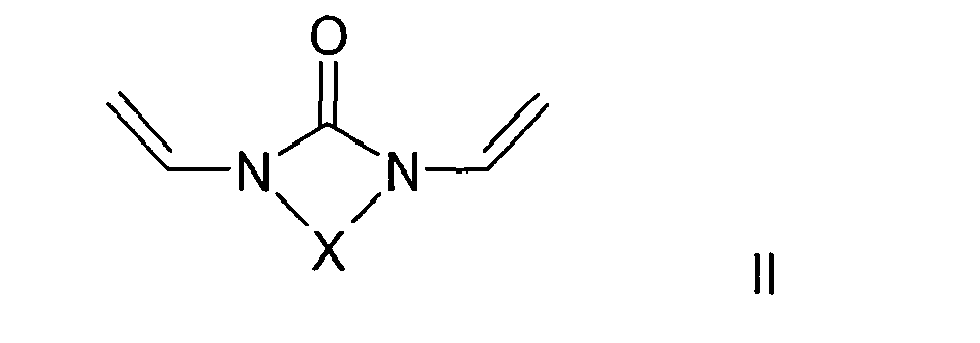


- Das bedeutet, das Polymer entsteht durch Copolymerisation von zumindest einer Verbindung aus der Gruppe der hydrophil substituierten Alkylvinylether gemäß Formel I und zumindest einer Verbindung aus der Gruppe der Vernetzer gemäß Formel II und/oder III und/oder IV. Bevorzugt wird nur eine Verbindung aus der Gruppe der hydrophil substituierten Alkylvinylether gemäß Formel I und eine Verbindung aus der Gruppe der Vernetzer gemäß Formel II, III oder IV eingesetzt. Es können ein oder mehrere Verbindungen aus der Gruppe der hyrophil substituierten Alkylvinylether der Formel I und/oder ein oder mehrere Verbindungen aus der Gruppe der Vernetzer gemäß Formel II und/oder III und/oder IV eingesetzt werden. Weiterhin können dem Polymerisationsgemisch weitere polymerisierbare Verbindungen zugesetzt werden, die mit in das Polymergerüst einpolymerisert werden. Typischerweise sind dies Verbindungen mit mindestens einer polymerisierbaren Doppelbindung. Bevorzugt wird nur eine Verbindung aus der Gruppe der hydrophil substituierten Alkylvinylether gemäß Formel I und eine Verbindung aus der Gruppe der Vernetzer gemäß Formel II, III oder IV eingesetzt.
- In einer bevorzugten Ausführungsform wird als hydrophil substituierter Alkylvinylether 1,2-Ethandiolmonovinylether,
1,3-Propandiolmonovinylether, 1,4-Butandiolmonovinylether, 1,6-Hexandiolmonovinylether oder Diethylenglycolmonovinylether und als cycloaliphatischer Vinylether Cyclohexandimethanolmonovinylether eingesetzt. - Als Vernetzer werden bevorzugt Vebindungen der Formel II eingesetzt. Bevorzugt wird Divinylpropylenharnstoff (1,3-Divinyl-tetrahydropyrimidin-2-on) oder besonders bevorzugt Divinylethylenharnstoff (1,3-Divinylimidazolin-2-on) eingesetzt.
- Der Anteil der hydrophil substituierten Alkylvinylether am Gewicht des Polymeren liegt typischerweise zwischen 1 (Gewichts) % und 90 (Gewichts)% oder einem maximalen Gewichtsanteil des Alkylvinylethers, der einem Molverhältnis von 2:1 bezogen auf einen bifunktionellen Vernetzer entspricht, falls der Alkylvinylether nicht homopolymerisiert. Bevorzugt liegt der Anteil der hydrophil substituierten Alkylvinylether zwischen 10 und 80%, besonders bevorzugt zwischen 35 und 60%. Dementsprechend liegt der Anteil des Vernetzers zwischen 10 und 99, bevorzugt zwischen 20 und 90%, besonders bevorzugt zwischen 40 und 65%.
- Die verfahrenstechnische Ausführung der Copolymerisation von ungesättigten Verbindungen ist dem Fachmann bekannt. Dazu wird eine radikalische Polymerisation durchgeführt. Bevorzugt wird eine durch Radikale initiierte Suspensionspolymerisation, auch Perlpolymerisation genannt, durchgeführt. Je nach Lösungsverhalten der Monomere wird bei in Wasser unlöslichen oder wenig löslichen Monomeren, die auch als Öl bezeichnet werden, in besonders einfacher Ausführung eine Öl in Wasser Suspensionspolymerisation (Normalphasenpolymerisation) durchführt. Bei in Wasser löslichen Monomeren werden hingegen diese in Wasser gelöst und in einem nicht bzw. nur wenig mit Wasser mischbaren organischen Lösungsmittel suspendiert und polymerisiert (Inverse Polymerisation).
- Es wurde gefunden, dass insbesondere bei Einsatz von Divinylethylenharnstoff oder Divinylpropylenharnstoff in Kombination mit den bevorzugten hydrophil substituierten Alkylvinylethern, wie 1,3-Propandiolmonovinylether oder 1,4-Butandiolmonovinylether, eine (Normalphasen-) Suspensionspolymerisation durchgeführt werden kann. Das bietet den Vorteil eines sehr einfachen Herstellverfahrens für die erfindungsgemäßen Polymere, da man in einem einzigen Reaktionsschritt das hydrophile Polymer erhält, ohne die aufwendige inverse Suspensionspolymerisation durchzuführen.
- Die Suspensionspolymerisation wird auf bekannte Weise durchgeführt.
Als Suspensionsmittel wird in der Normalphasen-Suspensionspolymerisation typischerweise Wasser verwendet.
Dem Suspensionsmittel können bekannterweise ein oder mehrere Stabilisatoren und/oder ein oder mehrere grenzflächenaktive Verbindungen zugesetzt werden. - Als Stabilisatoren können eine Vielzahl von wasserlöslichen makromolekularen Verbindungen oder auch feinverteilte anorganische Verbindungen eingesetzt werden.
Beispiele für makromolekulare Stabilisatoren sind Polyvinylpyrolidon, Polyacrylate, Polycarboxylate, Polyacrylamid, Polyvinylalkohol, Hydroxyalkylcellulose, Methylcellulose oder Polyethylenglykole. - Bevorzugt werden Polyvinylalkohole eingesetzt.
- Als anorganische Verbindungen können z. B. Calciumphosphat oder Magnesiumhydroxyd als Stabilisatoren eingesetzt werden.
Weiterhin können der wässerigen Phase Puffersubstanzen wie z. B. Na2HPO4 und NaH2PO4 zugesetzt werden. - Geeignete grenzflächenaktive Verbindungen sind insbesondere anionische und nichtionische Tenside wie Ethoxylate langkettiger Alkohole, ethoxilierte Mono-, Di- und Trialkylphenole, Alkali- und Ammoniumsalze von C12 - C18 Alkylsulfonsäuren oder Arylsulfonsäuren.
- Für die Durchführung der erfindungsgemäßen Polymerisation wird die organische Phase, auch Ölphase genannt, in der wässerigen Phase suspendiert. Die Ölphase enthält dabei in einer Ausführungsform neben den Monomeren inerte Lösungsmittel (Porogene), um die gewünschten Porengrößen einzustellen.
- Geeignete organische Lösungsmittel (Porogene) sind z. B. aliphatische Kohlenwasserstoffe (C6 - C18), wie z. B. Hexan, Dodecan oder Benzingemische, cycloaliphatische Verbindungen wie Cyclohexan, aromatische Kohlenwasserstoffe wie Toluol, Ethylbenzole oder Xylole oder Alkohole wie aliphatische C4 - C12-Alkohole z. B. Heptanol, Dodecanol, Cyclohexanol, Polyethylenglykole oder Polypropylenglykole mit unterschiedlicher Molmasse oder Ester aliphatischer Carbonsäuren wie Butylacetat oder Propylpropionat oder Ester aromatischer Carbonsäuren wie Propylbenzoat oder Ester wie Butylglykolacetat oder Glycerintriacetat oder Ether wie Di-n-Butylether, Di-n-amylether, Diphenylether, Ethylenglykolmonophenylether und Ethylenglykoldiethylether.
Diese Lösungsmittel können entweder als Quell- oder Fällmittel für die Polymere wirken und auf diese Weise die Porosität beeinflussen. - Beispiele für Quellmittel bei den erfindungsgemäßen Polymeren sind niedere Alkohole, aliphatische Ester oder aromatische Kohlenwasserstoffe wie Toluol.
Beispiele für Fällmittel sind aliphatische Kohlenwasserstoffe wie Dodecan oder Benzingemische. Durch Art und Menge der Lösungsmittel in Verbindung mit dem Vernetzungsgrad des Polymeren kann die Porosität der Polymere festgelegt werden. - Weiterhin werden der organischen Phase typischerweise ein oder mehrere radikalisch wirkende Initiatoren zugefügt.
Beispiele für radikalische Initiatoren sind organische Peroxide, wie Di-tert-butylperoxid, Dibenzoylperoxid, Bis(o-methylbenzoyl)peroxid, tert.-Butylhydroperoxid, Cumolhydroperoxid, Di-iso-propylperoxiddicarbonat, Cyclohexanonperoxid, oder aliphatische Azoverbindungen wie α,α'-Azodiisobuttersäurenitril, Azobis-cyanvaleriansäure, 1,1'-Azo-cyklohexan-1,1'-dicarbonsäurenitril oder Azodicarbonamid. Bevorzugt ist α,α'-Azodiisobuttersäurenitril.
Auch mittels Strahlung, z. B. UV-Strahlung, aktivierbare Initiatoren können erfindungsgemäß als radikalische Initiatoren eingesetzt werden. - Die Phasenverhältnisse bei der Suspensionspolymerisation können typischerweise im Volumenverhältnis zwischen 1:20 (Ölphase zu wässriger Phase) und 2:1 variiert werden, bevorzugt sind Verhältnisse zwischen 1:5 und 1:1, besonders bevorzugt zwischen 1:3 und 1:1.
- Das Verhältnis von organischem Lösungsmittel zu Monomer beträgt typischerweise zwischen 1:20 und 4:1, bevorzugt zwischen 1:5 und 3:1, besonders bevorzugt zwischen 1:1 und 2,5:1.
- Die Konzentration des Initiators bezogen auf die Menge an Monomer beträgt typischerweise zwischen 0,01 (Gewichts)% und 10 (Gewichts)%, bevorzugt zwischen 0,1 und 7 (Gewichts)% und besonders bevorzugt zwischen 0,2 und 7 (Gewichts)%.
- Die Konzentration von Stabilisatoren bezogen auf die Menge an Suspendiermittel, in der Regel Wasser, beträgt zwischen 0,01 und 3 (Gewichts)%, typischerweise zwischen 0,02 und 2 (Gewichts)%, besonders bevorzugt zwischen 0,05 und 0,5 (Gewichts)%.
- Die Suspensionspolymerisation wird dann durchgeführt, indem die beiden Phasen unter starkem Rühren gemischt werden. Zusätzlich wird typischerweise für eine Dauer von 1 bis 20 Stunden auf 20 bis 100°C, bevorzugt 40 bis 100°C temperiert. Typischerweise wird über einen Zeitraum von 0,5 bis 5 Stunden auf 40 bis 100°C erhitzt und anschließend nochmals mehrere Stunden bei 70 bis 100°C nachpolymerisiert. Während der ganzen Zeit sollte gerührt werden. Diese Temperaturangaben beziehen sich auf ein System, in dem Wasser als Suspensionsmittel verwendet wird. Bei Einsatz anderer polarer Lösungsmittel anstelle von Wasser können je nach Siedepunkt des Lösungsmittels andere Temperaturbereiche möglich bzw. sinnvoll sein.
- In der Regel ist es vorteilhaft, die erfindungsgemäße Polymerisation in Schutzgasatmosphäre durchzuführen.
- Abschließend wird in der Regel auf Raumtemperatur abgekühlt, die organischen Lösungsmittel entfernt, sofern diese bei der Polymerisation zugesetzt wurden, und das Produkt in Wasser, einem wässrigen Puffer oder einem Gemisch von Wasser mit einem organischen Lösungsmittel wie Ethanol gelagert.
- Falls erforderlich, kann das Polymer durch Siebung oder eine andere Art der Klassierung in die gewünschte Korngrößenverteilung gebracht werden.
- Soll statt der Normalphasen-Suspensionspolymerisation eine inverse Suspensionspolymerisation oder eine Emulsionspolymerisation durchgeführt werden, so ist dem Fachmann bekannt, in welcher Weise die Zusammensetzung der Reaktionslösungen zu verändern ist.
- Ebenso kann die erfindungsgemäße Polymerisation kontinuierlich erfolgen. Besonders bevorzugt werden dabei zur Partikelerzeugung statische Mischer, insbesondere Mikromischer oder Raupenmischer, eingesetzt. In diesen Mischern wird unter Ausnutzung der Strömungsenergie die räumliche Verteilung zweier zu mischender Komponenten durch die Strömungsführung, z.B. durch Trennen und Wiedervereinigen, Verdrehen, Verzerren und Aufweiten so beeinflusst, dass große Grenzflächen für den diffusiven Austausch zwischen den Komponenten entstehen und durch die hohen Scherkräfte eine besonders einheitliche Korngrößenverteilung erzielt werden kann. Verschiedene Mischer und ihr Aufbau sind bekannt. Beispielsweise sind solche Systeme beschrieben in
EP 1177243 . - Zur Durchführung der Reaktionen wird z. B. der Mikromischer mit der wässrigen Phase kontinuierlich mit definiertem Volumenstrom durchströmt. Anschließend wird die Ölphase über die zweite Zuführung, ebenfalls mit definiertem, genau eingestelltem Volumenstrom eingespeist. Das Verhältnis der beiden Volumenströme kann in einem breiten Bereich liegen und richtet sich nach der gewünschten Teilchengröße, der Art und Verteilung der Teilchengrößen, der Viskosität der wässrigen und der Ölphase abhängig von der Reaktionstemperatur sowie der Reaktionskinetik und dem notwendigen Verhältnis der Porogene in der Endmischung zur Erzielung einer geeigneten Porenstruktur. Vorzugsweise liegt das Volumenstromverhältnis zwischen wässriger Phase und Ölphase bei 1:10 bis 100:1, insbesondere bei 2:1 bis 20:1. Bevorzugt wird die aus dem statischen Mischer austretende Suspension in einem kontinuierlich arbeitenden Reaktor polymerisiert.
- Ebenso ist es möglich, die oben beschriebene Vorgehensweise umzukehren. Beispielsweise zur Polymerisation von besonders hydrophilen Monomeren werden diese über die wässrige Phase zugeführt. Nähere Einzelheiten zur Synthese von Perlpolymerisaten mithilfe von Mikromischern finden sich in
EP 1177243 . - Dem Fachmann ist weiterhin bekannt, wie unter anderem durch die Art und Menge des Zusatzes an Suspensionsstabilisatoren und grenzflächenaktiven Verbindungen sowie die Rührintensität Einfluss auf die Partikelgröße des entstehenden Polymers genommen werden kann. In der Regel können mittels Suspensionspolymerisation je nach Art des Rührwerks und der Drehzahl Partikeldurchmesser zwischen 3 µm und 500 µm, bevorzugt zwischen 3 µm und 300 µm erzeugt werden. Die Partikel können unregelmässig geformt oder bevorzugt sphärisch sein.
- Werden die erfindungsgemäßen Polymere mittels Emulsionspolymerisation hergestellt, so können z.B. Partikeldurchmesser zwischen 20 nm und 3000 nm, bevorzugt zwischen 100 und 500 nm erzeugt werden.
- Die erfindungsgemäßen Polymere liegen bevorzugt als unporöse oder bevorzugt poröse Partikel vor. Die Porengrößen können je nach Art und Menge des eingesetzten porogenen Lösungsmittels zwischen 2 und 300 nm liegen. Bevorzugt sind Porengrößen zwischen 2 und 200 nm.
- Genauso können die Polymere auch in Form von Membranen, Fasern, Hohlfasern, Beschichtung oder als monolithischer Formkörper vorliegen. Monolithische Formkörper sind dreidimensionale Körper, z.B. in zylindrischer Form. Bevorzugt haben diese Formkörper eine mono- oder bimodale Porenstruktur.
Gleichermassen können die erfindungsgemäßen Polymere als Kompositmaterialien eingesetzt werden, d.h. beispielsweise als Beschichtung z.B. anorganischer Partikel oder Formkörper, oder im Gemisch mit z.B. anorganischen Bestandteilen. Ein Beispiel hierfür sind Partikel aus dem erfindungsgemäßen Polymer, die durch Einpolymerisierung magnetisierbarer Teilchen oder eines magnetisierbaren Kerns selbst magnetisierbar sind. - Die erfindungsgemäßen hydrophilen, quervernetzten Polymere eignen sich insbesondere als Sorbenzien in der Chromatographie, als Trägermaterialien zur Immobilisierung von biologisch und/oder katalytisch wirksamen Stoffen oder als Trägermaterialien für Festphasensynthesen von z.B. Biopolymeren wie Nukleinsäuren oder Peptiden oder für die kombinatorische Chemie.
- Die erfindungsgemäßen Materialien zeichnen sich durch eine gute Hydrolysestabilität, insbesondere in basischem Medium, aus sowie durch eine gute Druck-Fluß-Stabilität. Weiterhin sind sie aufgrund ihrer großen Hydrophilie insbesondere für biochromatographische Verfahren geeignet. In den Beispielen finden sich zusätzlich experimentelle Daten zu diesen Eigenschaften.
- Besonders geeignet sind die erfindungsgemäßen Polymere als Sorbenzien. Zu diesem Zweck werden sie in bekannter Weise in Chromatographiesäulen oder Kapillaren gefüllt. Genauso kann das erfindungsgemäße Polymer für chromatographische oder andere Zwecke in Kartuschen gepackt werden. Gegenstand der vorliegenden Erfindung sind daher auch Chromatographiesäulen, Kapillaren oder Kartuschen, die ein erfindungsgemäßes Polymer als Sorbens oder Trägermaterial enthalten.
- Die erfindungsgemäßen Polymere können in ihrer nativen Form, d.h. ohne weitere Derivatisierungsschritte eingesetzt werden oder durch einen oder mehrere Derivatisierungsschritte mit anderen oder zusätzlichen Funktionalitäten versehen werden. Insbesondere können sie mit Separationseffektoren derivatisiert werden.
- Die kovalente Anbindung der Separationseffektoren erfolgt in der Regel über die auf dem Polymer vorhandenen funktionellen Gruppen, wie z.B. Hydroxylgruppen, z.B. unter Ausbildung einer Ester- oder bevorzugt einer Ether-Funktion, direkt oder über einen Linker bzw. Abstandshalter. In einer anderen bevorzugten Ausführungsform erfolgt die Verknüpfung mit dem Basismaterial über eine Cer(IV)-katalysierte Pfropfpolymerisation unter Ausbildung einer C-C-Verknüpfung mit dem Basismaterial.
- Separationseffektoren sind dem Fachmann auf dem Gebiet der Chromatographie bekannt. Separationseffektoren sind Substituenten, die bereits während der Synthese des Basismaterials oder nachträglich in das Trägermaterial eingeführt werden können und die Einfluss auf die Oberflächeneigenschaften des Trägermaterials nehmen. Insbesondere werden durch die gezielte Derivatisierung von Trägermaterialien mit Separationseffektoren Trägermaterialien mit bestimmten chromatographischen Eigenschaften erzeugt. Insbesondere können Separationseffektoren folgende endständige Gruppen aufweisen:
- a) eine ionische oder ionisierbare Gruppe, z.B.
-NR7R8 oder -N+R7R8R9,
worin- R7und R8
- unabhängig voneinander
H, Alkyl mit 1-5 C-Atomen
- R9
- Alkyl mit 1-5 C-Atomen
können,- Guanidinium
- SO3 -
- Carbonsäuren
- b) eine hydrophobe Gruppierung, z.B. -OR10 oder -NHR10, wobei R10 C1-C20-Alkyl, C6-C25-Aryl, C7-C25-Alkylaryl oder C7-C25-Arylalkyl bedeuten, und wobei diese Reste auch mit Nitril oder C1-C5-Alkoxy derivatisiert sein können, und wobei auch eine oder mehrere nicht benachbarte CH2-Gruppen durch NH oder O oder auch eine oder mehrere CH Gruppen durch N ersetzt sein können;
- c) eine Metallchelat-Gruppierung;
- d) ein thiophiler Rest;
- e) ein chiraler Rest.
- f) Biomoleküle, wie Proteine (z.B. Antikörper), Peptide, Aminosäuren, Nukleinsäuren, Saccharide, Biotin etc.
- Thiophile Reste sind beispielsweise in
EP 0 165 912 offenbart. - Soll das Polymer zunächst mit einem universellen Linker versehen werden, kann es z.B. zur Einführung von Epoxy-Gruppen mit Glycidylverbindungen wie Butandioldiglycidylether umgesetzt werden.
- Weiterhin kann das erfindungsgemäße Polymer als Basismaterial durch Pfropfpolymerisation mit tentakelartigen Strukturen versehen werden, die wiederum die entsprechenden Separationseffektoren tragen oder mit diesen funktionalisiert werden können. Bevorzugt wird die Pfropfung gemäß
EP 0 337 144 durchgeführt. Die erzeugte Kette ist linear und über eine Monomereinheit mit dem Basismaterial verknüpft. Dazu wird das erfindungsgemäße Basismaterial in einer Lösung von Monomeren suspendiert, vorzugweise in einer wäßrigen Lösung. Das Aufpfropfen des polymeren Materials wird im Zuge einer üblichen Redoxpolymerisation unter Sauerstoffausschluß bewirkt. Als Polymerisations-Katalysator werden Cer(IV)-Ionen eingesetzt, da dieser Katalysator an der Oberfläche des Basismaterials Radikalstellen bildet, von welchen die Pfropfpolymerisation der Monomere gestartet wird.
Die Polymerisation wird durch Abbruchsreaktionen unter Beteilung der Cer-Salze beendet. Deswegen ist die (mittlere) Kettenlänge durch die Konzentrationsverhältnisse des Basismaterials, des Initiators und der Monomeren beeinflussbar. Weiterhin können einheitliche Monomere oder auch Gemische verschiedener Monomere eingesetzt werden; im letzteren Fall entstehen gepfropfte Copolymerisate. - Geeignete Monomere zur Herstellung der Pfropfpolymerisate sind Monomere entsprechend Formel V oder VI.
CR*R**=CR11-Y (Formel V)

- Diese Monomeren stellen (Meth) Acrylsäure (Y = -COOH), (Meth)Acrylsäurederivate mit
Y=
Alle diese Monomere stellen in wässriger Lösung radikalisch polymerisierbare Substanzen mit reversibel bindenden Gruppen dar, die neutral, sauer oder basisch sein können.
Werden als Monomere Vinylencarbonate der Formel VI oder Vinylcarboxylate CR*R** = CR11-OCOCHR15R16 der Formel V eingesetzt, so wird vorzugsweise das erhaltene Produkt anschließend in ein Trennmaterial mit Hydroxylgruppen überführt. Diese Überführung in eine Hydroxyl-Phase wird durch eine an sich bekannte milde alkalische oder saure Verseifung erreicht. Beispielsweise kann die Reaktion mit methanolischer K2CO3-Lösung bei Raumtemperatur, beschrieben z.B. von Y. Tezuka et al., in Macromol. Chem. 186, 685-694 (1985), durchgeführt werden.
In den Formeln V und VI bedeutet R11 vorzugsweise H, d.h. die Acrylsäurederivate sind bevorzugt.
Y in Formel V bedeutet vorzugsweise
-CN oder -CHO.
R15 und R16 bedeuten unabhängig voneinander H oder eine Alkylgruppe mit bis zu 5 C-Atomen. Vorzugsweise ist mindestens einer der Reste R15 und R16 H. Folgende Reste sind besonders bevorzugt: Acetyloxy-, Propionyloxy-, Butyryloxy-, Valeryloxy- und Hexanoyloxy-Rest.
Z bedeutet in Formel V ―OR14, -OH oder -NR12R13, vorzugsweise -NR12R13. Bevorzugt sind dabei Verbindungen, in denen Z - NR12R13 bedeutet und einer der Reste R12 und R13 H ist.
Die Reste R12 und/oder R13 bedeuten bevorzugt eine Alkyl-, Phenyl-, Phenylalkyl- oder Alkylphenylgruppe, wobei die Alkyl- und/oder die Phenylgruppe ein- oder mehrfach, vorzugsweise ein- oder zweifach, insbesondere bevorzugt einfach, substituiert sein kann durch einen Alkoxy-, Cyano-, Amino-, Mono- oder Dialkylamino-, Trialkylammonium- , Carboxyl-, Sulfonsäure-, Acetoxy- oder Acetamino-Rest.
Die Reste R12 und/oder R13 bedeuten bevorzugt Alkyl, Alkoxyalkyl, Cyanoalkyl, Aminoalkyl, Mono- oder Dialkylaminoalkyl, Trialkylammoniumalkyl, Carboxyalkyl oder Sulfonsäurealkyl mit bis zu 10 C-Atomen, bevorzugt bis zu 6 C-Atomen, insbesondere bevorzugt bis zu 4 C-Atomen in der Alkylgruppe, die linear oder verzweigt sein kann. R12 und/oder R13 bedeuten demnach bevorzugt Methyl, Ethyl, Propyl, Butyl, Pentyl, Hexyl, Methoxymethyl, Ethoxymethyl, 2-Methoxyethyl, 2-, 3- oder 4-Oxapentyl, 2-, 3-, 4- oder 5-Oxahexyl, 2-, 3-, 4-, 5- oder 6-Oxaheptyl, Isopropyl, 2- Butyl, Isobutyl, 2-Methylbutyl, Isopentyl, 2-Methylpentyl, 3-Methylpentyl, 2-Oxa-3-methylbutyl, 3-Oxa-4-methylbutyl, 2-Methyl-3-oxapentyl, 2-Methyl- 3-oxahexyl, ferner auch Heptyl, Octyl, Nonyl oder Decyl.
Ferner bevorzugt sind auch Alkylgruppen, die durch eine Cyano, Carboxy- oder Sulfonsäuregruppe substituiert vorliegen. Demnach bedeuten R12 und/oder R13 bevorzugt Cyanomethyl, Cyanoethyl, Cyanopropyl, Cyanobutyl, Cyanopentyl, Cyanohexyl, 2-Cyanopropyl, 2- Cyanobutyl, Carboxylmethyl, Carboxylethyl, Carboxylpropyl, Carboxylisopropyl, Carboxylbutyl, Carboxylpentyl, Carboxylhexyl, Carboxyl- 2-methylpropyl, Carboxyl-2-methylbutyl, Sulfonsäuremethyl, Sulfonsäureethyl, Sulfonsäurepropyl, Sulfonsäurebutyl, Sulfonsäurepentyl, Sulfonsäurehexyl, Sulfonsäure-2-methylpropyl, Sulfonsäure-2-methylbutyl, Sulfonsäure-3-methylbutyl, Sulfonsäure-2-methylpentyl, Sulfonsäure-3- methylhexyl oder Sulfonsäure-2-ethylpentyl.
Ferner sind die Alkylgruppen bevorzugt einfach substituiert durch eine Amino-, Mono- oder Dialkylamino- oder Trialkylammoniumgruppe. Die Alkylgruppen können dabei gleich oder verschieden sein und bis zu 10, vorzugsweise bis zu 6 C- Atomen, insbesondere bevorzugt bis zu 4 C-Atomen, besitzen und bedeuten demnach vorzugsweise Dimethylaminoethyl, Diethylaminoethyl, Methylaminoethyl, Methylaminopropyl, Dimethylaminopropyl, Ethylaminoethyl, Propylaminoethyl, Propylaminopropyl, Dipropylaminoethyl, Dipropylaminobutyl, Diethylaminoethyl, Trimethylammoniumethyl, Trimethylammoniumpropyl,
Trimethylammoniumbutyl, Triethylammoniumethyl, Triethylammoniumpropyl, Triethylammoniumethyl, Aminoethyl, Aminopropyl, Aminobutyl oder Aminopentyl. Alle diese Alkyl- und substituierte Alkylgruppen sind ebenfalls bevorzugt als Substituenten an der Phenylgruppe. - Bevorzugt für R12 und/oder R13 ist auch ein Sulfonsulfid der Struktur - (CH2)n-SO2-(CH2)-S-(CH2)nOH mit n = 2, 3, 4, 5 oder 6, vorzugsweise 2,3 oder 4.
Vorzugsweise hat R12 und/oder R13 auch die Bedeutung einer Phenylgruppe, die vorzugsweise einfach substituiert ist durch Cyano, Cyanoalkyl, Amino, Aminoalkyl, Mono- oder Dialkylamino, Alkyl, Alkoxy, Alkoxyalkyl, Mono- oder Dialkylaminoalkyl, Trialkylammonium- oder Trialkylammoniumalkyl, Carboxy, Carboxyalkyl, Sulfonsäure oder Sulfonsäurealkyl. Die bevorzugten Bedeutungen dieser Substituenten entsprechen den vorstehend angegebenen bevorzugten Alkylgruppen und substituierten Alkylgruppen. Der Substituent an der Phenylgruppe sitzt vorzugsweise in p-Stellung.
p-Acetoxyphenyl, p-Aminophenyl oder p- Acetaminophenyl sind ebenfalls bevorzugte Bedeutungen für R12 und/oder R13.
Bevorzugt für R12 und/oder R13 ist ferner eine Alkylphenyl- oder Phenylalkylgruppe, wobei ebenfalls die angegebenen bevorzugten Bedeutungen für die Alkyl-, substituierten Alkyl- oder substituierten Phenylgruppen gelten sollen.
Demnach gelten folgende substituierte Phenylgruppen beispielsweise als besonders bevorzugt: 4-Cyanophenyl, 4- Alkylphenyl, 4- (N,N-Dimethylamino)-phenyl, 4-(N,N-Dialkylaminoethyl)- phenyl, 4-Ethoxyphenyl, 4-Ethoxyethylphenyl, 4- Trialkylammoniumphenyl, 4- Carboxylphenyl, 4-Sulfonsäurephenyl, Phenylethyl, 4-(N-Ethylamino) phenylpropyl oder 4-Cyanophenyl-ethyl.
Des weiteren sind Monomere der Formel V bevorzugt, in denen R12 und/oder R13 einen cyclischen oder bicyclischen Rest, der aromatisch oder gesättigt sein kann, mit 5-10 C- Atomen, worin ein- oder mehrere CH- oder CH2- Gruppen durch N oder NH, N oder NH und S, oder N oder NH und O ersetzt sind, bedeuten.
R12 und/oder R13 bedeuten demnach bevorzugt auch einen Pyridinrest, Imidazolylrest, Indolylrest, ferner bevorzugt einen Pyrrol-, Pyrimidin-, Pyrazin-, Chinolin- oder Isochinolinrest. - R12 und/oder R13 können beispielsweise auch einen Thiazol-, Thiadiazol-, Morpholin-, Triazin-, Piperazin-, Benzothiazol-, Purin-, Pyrazol-, Triazol-, Pyrrolidin- oder Isoxazol-Rest bedeuten.
Insbesondere bevorzugt sind dabei die aromatischen, heterocyclischen Reste.
Die Reste R12 und R13 müssen, um zu geeigneten Austauschern zu gelangen, so aufeinander abgestimmt werden, dass entweder beide Reste eine saure oder basische Gruppe enthalten oder aber einer der Reste neutral ist. Dem Fachmann bereitet es keine Schwierigkeit, die Gruppen entsprechend zuzuordnen und somit geeignete Reste für R12 und R13 zusammenzustellen, je nach Funktion und Aufgabe des gewünschten Ionenaustauschers.
Vorzugsweise ist einer der beiden Reste R12 und R13 ein neutraler Rest. - R14 bedeutet bevorzugt Alkyl, Alkoxyalkyl, Cyanoalkyl, Carboxyalkyl oder Sulfonsäurealkyl mit bis zu 10 C-Atomen, vorzugsweise mit bis zu 6 C-Atomen, insbesondere bevorzugt mit bis zu 4 C- Atomen in der Alkylgruppe, die linear oder verzweigt sein kann. R14 bedeutet demnach bevorzugt Methyl, Ethyl, Propyl, Butyl, Pentyl, Hexyl, Methoxymethyl, Ethoxymethyl, 2-Methoxyethyl, 2-, 3- oder 4- Oxapentyl, Isopropyl, 2-Butyl, Isobutyl, 2-Methylbutyl, Isopentyl, 2- Methylpentyl, 3-Methylpentyl, 2-Oxa-3-methylbutyl, 3-Oxa-4-methylbutyl, 2- Methyl-3- oxapentyl oder 2-Methyl-3-oxahexyl.
Ferner bevorzugt sind auch Alkylgruppen, die durch eine Cyano, Carboxy- oder Sulfonsäuregruppe substituiert vorliegen. Demnach bedeutet R14 bevorzugt Cyanomethyl, Cyanoethyl, Cyanopropyl, Cyanobutyl, Cyanopentyl, Cyanohexyl, 2-Cyanopropyl, 2-Cyanobutyl, Carboxylmethyl, Carboxylethyl, Carboxylpropyl, Carboxylisopropyl, Carboxylbutyl, Carboxylpentyl, Carboxylhexyl, Carboxyl-2-methylpropyl, Carboxyl-2-methylbutyl, Sulfonsäuremethyl, Sulfonsäureethyl, Sulfonsäurepropyl, Sulfonsäurebutyl, Sulfonsäurepentyl, Sulfonsäurehexyl, Sulfonsäure-2-methylpropyl, Sulfonsäure-2-methylbutyl, Sulfonsäure-3- methylbutyl, Sulfonsäure-2- methylpentyl, Sulfonsäure-3-methylhexyl oder Sulfonsäure-2-ethylpentyl.
Alle diese Alkyl- und substituierten Alkylgruppen sind ebenfalls bevorzugt als Substituenten an der Phenylgruppe.
Vorzugsweise hat R14 auch die Bedeutung einer Phenylgruppe, die vorzugsweise einfach substituiert ist durch Cyano, Cyanoalkyl, Alkyl, Alkoxy, Alkoxyalkyl, Carboxy, Carboxyalkyl, Sulfonsäure oder Sulfonsäurealkyl. Die bevorzugten Bedeutungen dieser Substituenten entsprechen den vorstehend angegebenen bevorzugten Alkylgruppen und substituierten Alkylgruppen. Der Substituent an der Phenylgruppe sitzt vorzugsweise in p-Stellung.
R* und R** in den Monomeren der Formel V bedeuten vorzugsweise H. - R* und R11 in Formel VI bedeuten vorzugsweise H.
- Typischerweise werden Ketten auf das Basismaterial aufgepfropft, die zwischen 2 und 100, vorzugsweise 5 und 60, insbesondere zwischen 10 und 30 Monomereinheiten aufweisen.
- Wie schon vorab erwähnt, gibt es Sorbenzien, bei denen ausschließlich ein Typ von Separationseffektor in der Grundmatrix vorliegt, und CoPolymerisate oder "mixed-mode" Sorbenzien, bei denen mindestens zwei verschiedene Typen von Separationseffektoren im Sorbens vorliegen. "single mode" Sorbentien trennen die gelösten Stoffe (Solute) auf Grundlage einer Art von Wechselwirkung zwischen Separationseffektor und Solute. Bei der Anwendung von mixed mode Sorbenzien beruht die Trennung der gelösten Stoffe (Solute) auf verschiedenen Arten von Wechselwirkungen zwischen Separationseffektor und Solute. Derartige chromatographische Verfahren sind als mixed mode Chromatographie bekannt. Im einfachsten Fall nutzt man beispielsweise die Hydrophobie der Grundmatrix aus, um durch Einführung eines ionischen Separationseffektors ein für die mixed-mode Chromatographie geeignetes Sorbens bereitzustellen. Auch durch Umsetzung einer Grundmatrix mit zwei verschiedenen Reaktanden, von denen einer beispielsweise eine hydrophobe Gruppe, der andere eine ionische Gruppe in die Grundmatrix einführt, sind mixed-mode Sorbentien zugänglich. Der Nachteil beider Vorgehensweisen besteht darin, dass die sterische Beziehung zwischen den verschiedenen Typen von Separationseffektoren nicht definiert sind. Dieser Nachteil wird bei mixed-mode Sorbentien vermieden, bei denen die verschiedenen Separationseffektoren in einem Liganden kombiniert sind. Dieser Ligand ist an die Grundmatrix gebunden.
Beide vorgenannten Typen von mixed-mode Sorbentien sind von L.W. McLaughlin (1989) in Chem.Rev. 89, 309 - 319 in einem Übersichtsartikel beschrieben. Ein mixed-mode Sorbens, dessen verschiedene Separationseffektoren in einem einheitlichen Liganden gebunden vorliegen, kann aus einem mit Chlorpropylgruppen substituierten Trägermaterial durch Überführung der Chlorderivate in Bromderivate und anschließender Umsetzung mit Benzyldimethylamin bereitgestellt werden: Der Ligand ist über eine C3-Kette an die Grundmatrix gebunden. Daran schließt sich eine dimethylsubstituierte Ammoniumgruppierung an, an die ein lipophiler Benzylrest gebunden ist. Eine umgekehrte Anordnung von hydrophoben und ionischen Separationseffektoren in einem Liganden ist durch Umsetzung von mit Aminopropylgruppen substituierten Trägermaterial mit p-Diethylaminobenzoesäure erhältlich: Bei diesem Liganden ist die tertiäre Aminogruppe distal von der Grundmatrix orientiert, während bei der erstgenannten Variante die hydrophobe Benzylgruppe distal angeordnet ist.
Weitere Ausführungsformen derartiger Liganden mit zwei Separationseffektoren sind in folgenden Druckschriften offenbart:WO 96/09116 WO 97/29825 WO 00/69872 WO01/38228 EP 04028798.9 

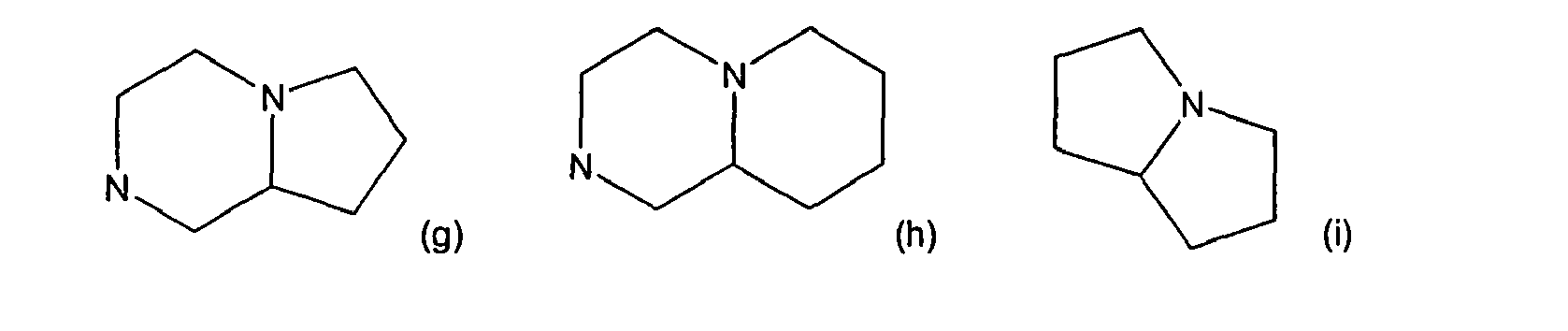


- Auch ohne weitere Ausführungen wird davon ausgegangen, dass ein Fachmann die obige Beschreibung im weitesten Umfang nutzen kann. Die bevorzugten Ausführungsformen und Beispiele sind deswegen lediglich als beschreibende, keineswegs als in irgendeiner Weise limitierende Offenbarung aufzufassen.
- Die vollständige Offenbarung aller vor- und nachstehend aufgeführten Anmeldungen, Patente und Veröffentlichungen ist durch Bezugnahme in diese Anmeldung eingeführt.
- In einem Doppelmantelreaktor werden 1050 ml entionisiertes Wasser (VE Wasser) vorgelegt und darin 0,32 g Tributylphosphat, 4,2 g Natriumsulfat, 0,01 g Natriumlaurylsulfonat und 2,1 g Polyvinylalkohol als Stabilisator gelöst. Die organische Phase, bestehend aus 96,25 g Butandiolmonovinylether, 78,45 g Divinylethylenharnstoff, 175 g Dodecanol und 4,2 g α,α'-Azo-diisobuttersäurenitril wird nach Mischung und Lösung der Bestandteile bei Raumtemperatur zur wässerigen Phase unter Rühren hinzugefügt. Die Suspension wird kräftig gerührt und anschließend auf 70°C erwärmt. Nach ca. 2 Stunden wird für 4 Stunden bei 80°C nachpolymerisiert. Nach Abkühlen auf Raumtemperatur wird das Polymer abgenutscht, das Porogen mit Wasserdampfdestillation entfernt und das Produkt in 20% ethanolischer Lösung gelagert.
Es werden 130 g Polymer, bezogen auf Trockenmasse erhalten. Die durchschnittliche Korngröße beträgt 80 µm. - Spezifische Oberfläche (BET): 322 m2/g
- Das Quellvolumen des Reaktionsproduktes beträgt 4,3 ml/g.
- Die Bestimmung des Retentionsverhalten von Proteinen als Funktion der Salzkonzentration wird eingesetzt, um das Proteinbindungsverhalten des unmodifizierten Trägermaterials zu untersuchen. Da Proteine auf dem unmodifizierten Trägermaterial nur unspezifisch binden, ist es vorteilhaft, wenn möglichst wenig Hintergrundbindung auftritt.
- Das Bindungsverhalten des erfindungsgemäßen Materials (hergestellt entsprechend Beispiel 1) wird im Vergleich zu dem unmodifizierten Copolymer aus 1,2,-Dihydroxy-3-allylaxy-propan und Methylenbisacrylamid, kommerziell erhältlich unter dem Namen FractoPrep® (Merck KGaA, Deutschland), dargestellt. Abbildung 1 zeigt das Bindungsverhalten der Proteine Lysozym und Rinderserumalbumin sowie von NaNO3. Die Abkürzung FP steht für FractoPrep®, B/D steht für das erfindungsgemäße Copolymer aus Butandiolmonovinylether und Divinylethylenharnstoff. Die Wiederfindung der gemessenen Proteine, angegeben als Quotient aus der photometrisch bestimmten Menge an von der Säule unter den Laufbedingungen eluierten Protein zu dem auf die Säule aufgegebenen Protein, ist unter allen Versuchsbedingungen größer 99 %.
- Eine beispielhafte Porenstruktur des erfindungsgemäßen Polymers ist durch die experimentell bestimmten Verteilungskoeffizienten Kd von Dextranen mit unterschiedlichen Molekulargewichten, ausgedrückt durch den Viskositätsradius der Dextrane, beispielhaft in Abbildung 2 gezeigt.
- Das entsprechend Beispiel 1 hergestellte erfindungsgemäße Material wird bei Raumtemperatur in 0,5 M NaOH gelagert (Volumenverhältnis NaOH:
Polymergel = 4:1).
Nach bestimmten Zeiten wird das Trennverhalten des Polymers anhand des Retentionsverhaltens bei der Trennung verschiedener Pullulane (Firma PSS, Mainz, Deutschland) als Markerverbindungen getestet.
Eluent: 100 mM NaCl, 20 mM NaH2PO4, pH 7,2
Säule: 300x10 mm, Fluß: 0,8 ml/min, Brechungsindexdetektor. - Abbildung 3 zeigt die Ergebnisse. Es ist klar zu erkennen, dass die Lagerung in verdünnter Natronlauge keinerlei Auswirkung auf den Verteilungskoeffizienten hat.
Claims (17)
- Hydrophiles vernetztes Polymer auf Basis eines Copolymers zumindest ausb) mindestens einem hydrophil substituierten Alkylvinylether der Formel I
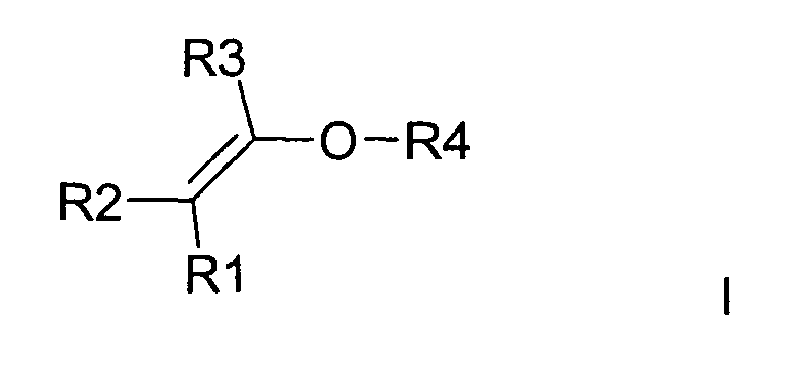
und R4 ein Rest ist, der zumindest eine Hydroxylgruppe trägt undb) mindestens einem Vernetzer entsprechend Formel II und/oder III und/oder IV, mit


C1 bis C10 Alkyl oder Cycloalkyl sind, wobei ein oder mehrere nicht benachbarte Methylengruppen oder nicht in direkter Nachbarschaft von N befindliche Methylengruppen durch O, C=O, S, S=O, SO2, NH, NOH oder N ersetzt sein können und ein oder mehrere H-Atome der Methylengruppen unabhängig voneinander durch Hydroxygruppen, C1-C6-Alkyl, Halogen, NH2, C5-C10-Aryl, NH(C1-C8)Alkyl, N(C1-C8)Alkyl2, C1-C6-Alkoxy oder C1-C6-Alkyl-OH substituiert sein können,
oder C6 bis C18 Aryl sind, wobei ein oder mehrere H-Atome in dem Arylsystem unabhängig voneinander durch Hydroxygruppen, C1-C6-Alkyl, Halogen, NH2, NH(C1-C8)Alkyl, N(C1-C8)Alkyl2, C1-C6-Alkoxy oder C1-C6-Alkyl-OH substituiert sein können und
A ein zweiwertiger Alkylrest mit 2 bis 5 C-Atomen ist, bei dem ein oder mehrere nicht benachbarte Methylengruppen oder nicht in direkter Nachbarschaft von N befindliche Methylengruppen durch O, C=O, S, S=O, SO2, NH, NOH oder N ersetzt sein können und ein oder mehrere H der Methylengruppen unabhängig voneinander durch Hydroxygruppen, C1-C6-Alkyl, Halogen, NH2, C5-C10-Aryl, NH(C1-C8)Alkyl, N(C1-C8)Alkyl2, C1-C6-Alkoxy oder C1-C6-Alkyl-OH substituiert sein können. - Hydrophiles vernetztes Polymer entsprechend Anspruch 1, dadurch gekennzeichnet, das R4 in Formel I
ein geradkettiger oder verzweigter C1 bis C10 Alkylrest ist, bei dem ein oder mehrere nicht benachbarte Methylengruppen durch O, C=O, S, S=O, SO2, NH, NOH, N ersetzt sein können und/oder bei dem ein oder mehrere H-Atome unabhängig voneinander durch C1-C6-Alkyl, C5-C10-Aryl, Halogen, NH2, NH(C1-C8)Alkyl, N(C1-C8)Alkyl2, C1-C6-Alkoxy oder C1-C6-Alkyl-OH substituiert sein können und bei dem mindestens eine OH-Gruppe entweder an dem C1 bis C10 Alkylrest oder an einem Substituenten vorhanden ist,
oder ein cycloaliphatischer Rest mit typischerweise 5 bis 10 C-Atomen, bei dem ein oder mehrere nicht benachbarte Methylengruppen durch O, C=O, S, S=O, SO2, NH, NOH, N ersetzt sein können und/oder bei dem ein oder mehrere H-Atome des cycloaliphatischen Restes unabhängig voneinander durch C1-C6-Alkyl, C5-C10-Aryl, Halogen, NH2, NH(C1-C8)Alkyl, N(C1-C8)Alkyl2, C1-C6-Alkoxy oder C1-C6-Alkyl-OH substituiert sein können, wobei mindestens eine OH-Gruppe entweder am cycloaliphatischen Ring oder an einer Seitenkette bzw. einem Substituenten vorhanden ist, oder ein
C6 bis C18 Aryl-Rest, wobei ein oder mehrere H-Atome in dem Aryl-Rest unabhängig voneinander durch Hydroxygruppen, C1-C6-Alkyl, C5-C10-Aryl, Halogen, NH2, NH(C1-C8)Alkyl, N(C1-C8)Alkyl2, C1-C6-Alkoxy oder C1-C6-Alkyl-OH substituiert sein können, wobei mindestens eine OH-Gruppe entweder am Aryl-Rest oder an einer Seitenkette bzw. einem Substituenten vorhanden ist, oder ein
C5 bis C18 Heteroaryl-Rest, wobei ein oder mehrere H-Atome in dem Heteroaryl-Rest unabhängig voneinander durch Hydroxygruppen, C1-C6-Alkyl, C5-C10-Aryl, Halogen, NH2, NH(C1-C8)Alkyl, N(C1-C8)Alkyl2, C1-C6-Alkoxy oder C1-C6-Alkyl-OH substituiert sein können, wobei mindestens eine OH-Gruppe entweder am Heteroaryl-Rest oder an einer Seitenkette bzw. einem Substituenten vorhanden ist. - Hydrophiles vernetztes Polymer entsprechend Anspruch 1 oder 2, dadurch gekennzeichnet, dass als hydrophil substituierter Alkylvinylether 1,2-Ethandiolmonovinylether, 1,3-Propandiolmonovinylether, 1,4-Butandiolmonovinylether, 1,6-Hexandiolmonovinylether, Diethylenglykolmonovinylether oder Cyclohexandimethanolmonovinylether eingesetzt wird.
- Hydrophiles vernetztes Polymer nach einem oder mehreren der Ansprüche 1 bis 3, dadurch gekennzeichnet, dass als Vernetzer Divinylethylenharnstoff (1,3-Divinylimidazolin-2-on) oder Divinylpropylenharnstoff (1,3-Divinyl-tetrahydropyrimidin-2-on) eingesetzt wird.
- Hydrophiles vernetztes Polymer nach einem oder mehreren der Ansprüche 1 bis 4, dadurch gekennzeichnet, dass das Polymer porös mit Porengrößen zwischen 2 und 200 nm ist.
- Hydrophiles vernetztes Polymer nach einem oder mehreren der Ansprüche 1 bis 5, dadurch gekennzeichnet, dass das Polymer in Form von Partikeln mit einem Durchmesser zwischen 3 und 300 µm vorliegt.
- Hydrophiles vernetztes Polymer nach einem oder mehreren der Ansprüche 1 bis 6, dadurch gekennzeichnet, dass das Polymer mit Separationseffektoren derivatisiert ist.
- Hydrophiles vernetztes Polymer nach einem oder mehreren der Ansprüche 1 bis 7, dadurch gekennzeichnet, dass das Polymer mit tentakelartigen Strukturen derivatisiert ist, die durch Pfropfpolymerisation unter Cer(IV)-Katalyse auf das Polymer aufgebracht wurden.
- Hydrophiles vernetztes Polymer nach Anspruch 8, dadurch gekennzeichnet, dass die tentakelartigen Strukturen Copolymeriate sind, die aus zwei oder mehreren unterschiedlichen Monomeren erzeugt wurden.
- Verfahren zur Herstellung von Polymeren, dadurch gekennzeichnet, dass zumindest ein hydrophil substituierter Alkylvinylether der Formel I und zumindest ein Vernetzer entsprechend Formel II und/oder III und/oder IV copolymerisiert werden, mit

und R4 ein Rest ist, der zumindest eine Hydroxylgruppe trägt und


C1 bis C10 Alkyl oder Cycloalkyl sind, wobei ein oder mehrere nicht benachbarte Methylengruppen oder nicht in direkter Nachbarschaft von N befindliche Methylengruppen durch O, C=O, S, S=O, SO2, NH, NOH oder N ersetzt sein können und ein oder mehrere H der Methylengruppen unabhängig voneinander durch Hydroxygruppen, C1-C6-Alkyl, Halogen, NH2, C5-C10-Aryl, NH(C1-C8)Alkyl, N(C1-C8)Alkyl2, C1-C6-Alkoxy oder C1-C6-Alkyl-OH substituiert sein können,
oder C6 bis C18 Aryl sind, wobei ein oder mehrere H in dem Arylsystem unabhängig voneinander durch Hydroxygruppen, C1-C6-Alkyl, Halogen, NH2, NH(C1-C8)Alkyl, N(C1-C8)Alkyl2, C1-C6-Alkoxy oder C1-C6-Alkyl-OH substituiert seinkönnen und
A ein zweiwertiger Alkylrest mit 2 bis 5 C-Atomen ist, bei dem ein oder mehrere nicht benachbarte Methylengruppen oder nicht in direkter Nachbarschaft von N befindliche Methylengruppen durch O, C=O, S, S=O, SO2, NH, NOH oder N ersetzt sein können und ein oder mehrere H der Methylengruppen unabhängig voneinander durch Hydroxygruppen, C1-C6-Alkyl, Halogen, NH2, C5-C10-Aryl, NH(C1-C8)Alkyl, N(C1-C8)Alkyl2, C1-C6-Alkoxy oder C1-C6-Alkyl-OH substituiert sein können. - Verfahren nach Anspruch 10, dadurch gekennzeichnet, dass ein hydrophil substituierter Alkylvinylether der Formel I eingesetzt wird, in dem
R4
ein geradkettiger oder verzweigter C1 bis C10 Alkylrest ist, bei dem ein oder mehrere nicht benachbarte Methylengruppen durch O, C=O, S, S=O, SO2, NH, NOH, N ersetzt sein können und/oder bei dem ein oder mehrere H-Atome unabhängig voneinander durch C1-C6-Alkyl, C5-C10-Aryl, Halogen, NH2, NH(C1-C8)Alkyl, N(C1-C8)Alkyl2, C1-C6-Alkoxy oder C1-C6-Alkyl-OH substituiert sein kann und bei dem mindestens eine OH-Gruppe entweder an dem C1 bis C10 Alkylrest oder an einem Substituenten vorhanden ist,
oder ein cycloaliphatischer Rest mit typischerweise 5 bis 10 C-Atomen, bei dem ein oder mehrere nicht benachbarte Methylengruppen durch O, C=O, S, S=O, SO2, NH, NOH, N ersetzt sein können und/oder bei dem ein oder mehrere H-Atome des cycloaliphatischen Restes unabhängig voneinander durch C1-C6-Alkyl, C5-C10-Aryl, Halogen, NH2, NH(C1-C8)Alkyl, N(C1-C8)Alkyl2. C1-C6-Alkoxy oder C1-C6-Alkyl-OH substituiert sein können, wobei mindestens eine OH-Gruppe entweder am cycloaliphatischen Ring oder an einer Seitenkette bzw. einem Substituenten vorhanden ist, oder ein
C6 bis C18 Aryl-Rest , wobei ein oder mehrere H-Atome in dem Aryl-Rest unabhängig voneinander durch Hydroxygruppen, C1-C6-Alkyl, C5-C10-Aryl, Halogen, NH2, NH(C1-C8)Alkyl, N(C1-C8)Alkyl2, C1-C6-Alkoxy oder C1-C6-Alkyl-OH substituiert sein können, wobei mindestens eine OH-Gruppe entweder am Aryl-Rest oder an einer Seitenkette bzw. einem Substituenten vorhanden ist, oder ein
C5 bis C18 Heteroaryl-Rest, wobei ein oder mehrere H-Atome in dem Heteroaryl-Rest unabhängig voneinander durch Hydroxygruppen, C1-C6-Alkyl, C5-C10-Aryl, Halogen, NH2, NH(C1-C8)Alkyl, N(C1-C8)Alkyl2, C1-C6-Alkoxy oder C1-C6-Alkyl-OH substituiert sein können, wobei mindestens eine OH-Gruppe entweder am Heteroaryl-Rest oder an einer Seitenkette bzw. einem Substituenten vorhanden ist. - Verfahren nach Anspruch 10 oder 11, dadurch gekennzeichnet, dass eine radikalische Suspensionspolymerisation durchgeführt wird.
- Verfahren nach einem oder mehreren der Ansprüche 10 bis 12, dadurch gekennzeichnet, dass eine radikalische Suspensionspolymerisation in Wasser als Suspensionsmittel in Gegenwart von mindestens einem Suspensionsstabilisator und optionalen weiteren Zusätzen, bevorzugt anorganischen Salzen und grenzflächenaktiven Verbindungen durchgeführt wird.
- Verfahren nach einem oder mehreren der Ansprüche 10 bis 13, dadurch gekennzeichnet, dass die Temperatur während der Polymerisation zwischen 40 und 100°C liegt.
- Verfahren nach einem oder mehreren der Ansprüche 10 bis 14, dadurch gekennzeichnet, dass hydrophil substituierte Alkylvinylether und Vernetzer in einem Massenverhältnis zwischen 10:90 und 80:20 eingesetzt werden.
- Chromatographiesäule, Kapillare oder Kartusche enthaltend ein Polymer entsprechend einem oder mehreren der Ansprüche 1 bis 9 als Sorbens oder Trägermaterial.
- Verwendung eines hydrophilen vernetzten Polymers entsprechend einem oder mehreren der Ansprüche 1 bis 9 als Sorbens in der Chromatographie, als Trägermaterial zur Immobilisierung biologisch oder katalytisch aktiver Substanzen oder als Trägermaterial für eine Festphasensynthese.
Priority Applications (12)
| Application Number | Priority Date | Filing Date | Title |
|---|---|---|---|
| EP05016846A EP1754534A1 (de) | 2005-08-03 | 2005-08-03 | Hydrophiles vernetztes Polymer |
| KR1020087005296A KR101289911B1 (ko) | 2005-08-03 | 2006-06-08 | 친수성 가교 중합체 |
| PCT/EP2006/005484 WO2007014591A1 (de) | 2005-08-03 | 2006-06-08 | Hydrophiles vernetztes polymer |
| CA2617645A CA2617645C (en) | 2005-08-03 | 2006-06-08 | Hydrophilic crosslinked polymer |
| CN201110266314.2A CN102417557B (zh) | 2005-08-03 | 2006-06-08 | 亲水交联聚合物 |
| JP2008524371A JP5475284B2 (ja) | 2005-08-03 | 2006-06-08 | 親水性架橋ポリマー |
| ES06754224.1T ES2528426T3 (es) | 2005-08-03 | 2006-06-08 | Polímero hidrófilo reticulado |
| CN2006800285993A CN101258175B (zh) | 2005-08-03 | 2006-06-08 | 亲水交联聚合物 |
| EP06754224.1A EP1910433B1 (de) | 2005-08-03 | 2006-06-08 | Hydrophiles vernetztes polymer |
| US11/997,613 US7951885B2 (en) | 2005-08-03 | 2006-06-08 | Hydrophilic crosslinked polymer |
| US12/947,900 US8765897B2 (en) | 2005-08-03 | 2010-11-17 | Hydrophilic crosslinked polymer |
| US14/173,218 US20140155565A1 (en) | 2005-08-03 | 2014-02-05 | Hydrophilic crosslinked polymer |
Applications Claiming Priority (1)
| Application Number | Priority Date | Filing Date | Title |
|---|---|---|---|
| EP05016846A EP1754534A1 (de) | 2005-08-03 | 2005-08-03 | Hydrophiles vernetztes Polymer |
Publications (1)
| Publication Number | Publication Date |
|---|---|
| EP1754534A1 true EP1754534A1 (de) | 2007-02-21 |
Family
ID=35148786
Family Applications (1)
| Application Number | Title | Priority Date | Filing Date |
|---|---|---|---|
| EP05016846A Withdrawn EP1754534A1 (de) | 2005-08-03 | 2005-08-03 | Hydrophiles vernetztes Polymer |
Country Status (1)
| Country | Link |
|---|---|
| EP (1) | EP1754534A1 (de) |
Cited By (1)
| Publication number | Priority date | Publication date | Assignee | Title |
|---|---|---|---|---|
| CN114007737A (zh) * | 2019-07-03 | 2022-02-01 | 默克专利股份公司 | 抗体药物缀合物纯化 |
Citations (15)
| Publication number | Priority date | Publication date | Assignee | Title |
|---|---|---|---|---|
| DE3344912A1 (de) | 1983-12-13 | 1985-06-20 | Hoechst Ag, 6230 Frankfurt | Vernetzte polymerisate, verfahren zu ihrer herstellung und ihre anwendung |
| EP0165912A2 (de) | 1984-05-17 | 1985-12-27 | Jerker Porath | Thioether-Sorbentmittel für die Trennung von Proteinen und dergleichen |
| EP0266503A1 (de) * | 1986-08-28 | 1988-05-11 | Hoechst Aktiengesellschaft | Vernetzte Polymerisate und Verfahren zu ihrer Herstellung |
| DE3714276A1 (de) | 1987-04-29 | 1988-11-17 | Hoechst Ag | Hydrophile, vernetzte polymerisate, verfahren zu ihrer herstellung und ihre verwendung |
| EP0337144A1 (de) | 1988-03-31 | 1989-10-18 | MERCK PATENT GmbH | Trennmaterialien |
| EP0482339A1 (de) | 1990-09-15 | 1992-04-29 | Röhm Gmbh | Hochvernetztes, perlförmiges, aktivierbares, hydrophiles Trägermaterial |
| WO1995013861A1 (en) | 1993-11-17 | 1995-05-26 | Pharmacia Biotech Ab | A method for separation and synthetic polymers that can be used as separation media in the method |
| WO1996009116A1 (en) | 1994-09-23 | 1996-03-28 | Massey University | Chromatographic resins and methods for using same |
| US5599702A (en) * | 1990-12-24 | 1997-02-04 | Hoechst Aktiengesellschaft | D-amino acid oxidase from Trigonopsis variabilis immobilized on porous copolymer beads |
| WO1997029825A1 (en) | 1996-02-19 | 1997-08-21 | Amersham Pharmacia Biotech Aktiebolag | Process for chromatographic separation of peptides and nucleic acid, and new high affinity ion exchange matrix |
| WO2000069872A2 (en) | 1999-05-14 | 2000-11-23 | Promega Corporation | pH DEPENDENT ION EXCHANGE MATRIX AND METHOD OF USE IN THE ISOLATION OF NUCLEIC ACIDS |
| WO2001038228A1 (en) | 1999-11-22 | 2001-05-31 | Amersham Biosciences Ab | A method for anion-exchange adsorption and thioether anion-exchangers |
| EP1177243A1 (de) | 1999-05-06 | 2002-02-06 | MERCK PATENT GmbH | Verfahren zur herstellung von perlpolymerisaten |
| WO2003104294A1 (en) | 2002-06-05 | 2003-12-18 | Imperial College Innovations Limited | Polyvinyl ethers |
| EP1693108A1 (de) | 2004-12-04 | 2006-08-23 | MERCK PATENT GmbH | Mischmodus Anionenaustauschertrennungsmaterial |
-
2005
- 2005-08-03 EP EP05016846A patent/EP1754534A1/de not_active Withdrawn
Patent Citations (15)
| Publication number | Priority date | Publication date | Assignee | Title |
|---|---|---|---|---|
| DE3344912A1 (de) | 1983-12-13 | 1985-06-20 | Hoechst Ag, 6230 Frankfurt | Vernetzte polymerisate, verfahren zu ihrer herstellung und ihre anwendung |
| EP0165912A2 (de) | 1984-05-17 | 1985-12-27 | Jerker Porath | Thioether-Sorbentmittel für die Trennung von Proteinen und dergleichen |
| EP0266503A1 (de) * | 1986-08-28 | 1988-05-11 | Hoechst Aktiengesellschaft | Vernetzte Polymerisate und Verfahren zu ihrer Herstellung |
| DE3714276A1 (de) | 1987-04-29 | 1988-11-17 | Hoechst Ag | Hydrophile, vernetzte polymerisate, verfahren zu ihrer herstellung und ihre verwendung |
| EP0337144A1 (de) | 1988-03-31 | 1989-10-18 | MERCK PATENT GmbH | Trennmaterialien |
| EP0482339A1 (de) | 1990-09-15 | 1992-04-29 | Röhm Gmbh | Hochvernetztes, perlförmiges, aktivierbares, hydrophiles Trägermaterial |
| US5599702A (en) * | 1990-12-24 | 1997-02-04 | Hoechst Aktiengesellschaft | D-amino acid oxidase from Trigonopsis variabilis immobilized on porous copolymer beads |
| WO1995013861A1 (en) | 1993-11-17 | 1995-05-26 | Pharmacia Biotech Ab | A method for separation and synthetic polymers that can be used as separation media in the method |
| WO1996009116A1 (en) | 1994-09-23 | 1996-03-28 | Massey University | Chromatographic resins and methods for using same |
| WO1997029825A1 (en) | 1996-02-19 | 1997-08-21 | Amersham Pharmacia Biotech Aktiebolag | Process for chromatographic separation of peptides and nucleic acid, and new high affinity ion exchange matrix |
| EP1177243A1 (de) | 1999-05-06 | 2002-02-06 | MERCK PATENT GmbH | Verfahren zur herstellung von perlpolymerisaten |
| WO2000069872A2 (en) | 1999-05-14 | 2000-11-23 | Promega Corporation | pH DEPENDENT ION EXCHANGE MATRIX AND METHOD OF USE IN THE ISOLATION OF NUCLEIC ACIDS |
| WO2001038228A1 (en) | 1999-11-22 | 2001-05-31 | Amersham Biosciences Ab | A method for anion-exchange adsorption and thioether anion-exchangers |
| WO2003104294A1 (en) | 2002-06-05 | 2003-12-18 | Imperial College Innovations Limited | Polyvinyl ethers |
| EP1693108A1 (de) | 2004-12-04 | 2006-08-23 | MERCK PATENT GmbH | Mischmodus Anionenaustauschertrennungsmaterial |
Non-Patent Citations (1)
| Title |
|---|
| L.W. MCLAUGHLIN, CHEM.REV., vol. 89, 1989, pages 309 - 319 |
Cited By (1)
| Publication number | Priority date | Publication date | Assignee | Title |
|---|---|---|---|---|
| CN114007737A (zh) * | 2019-07-03 | 2022-02-01 | 默克专利股份公司 | 抗体药物缀合物纯化 |
Similar Documents
| Publication | Publication Date | Title |
|---|---|---|
| EP1910433B1 (de) | Hydrophiles vernetztes polymer | |
| DE69317154T2 (de) | Verfahren zur Herstellung vernetzter Copolymere von Methacrylsäureanhydrid | |
| DE69316231T2 (de) | Selektive, die porengrösse betreffende chemische modifikation poröser materialien | |
| DE60038123T2 (de) | Weitporige partikel für chromatographie hergestellt durch suspensionspolymerisation | |
| DE69521997T2 (de) | Verfahren zur herstellung von teilchen und teilchen die mit hilfe dieses verfahrens hergestellt werden können | |
| DE69701140T2 (de) | Nicht-thrombogene und anti-thrombogene polymere | |
| DE3543348A1 (de) | Perlfoermige vernetzte, epoxy- und basische aminogruppen aufweisende mischpolymerisate, verfahren zu ihrer herstellung und ihre verwendung | |
| DE2722751C2 (de) | Perlpolymerisat mit einem Teilchendurchmesser von 5 bis 1000 μm und innerem Hohlraum | |
| DE3888564T2 (de) | Verfahren zur Herstellung von vernetzten Polymerteilchen. | |
| DE60008380T2 (de) | Verfahren zur herstellung von fluorinierten absorbierenden polymerpartikeln | |
| DE69731444T2 (de) | Alkyliertes poröses harz, verfahren zu seiner herstellung und seine verwendung | |
| EP3484612A1 (de) | Chromatographiemedium mit gebundenen mikroglobuli und verfahren zu dessen herstellung | |
| CH636628A5 (en) | Process for the preparation of biologically active compounds, and the use thereof | |
| DD159908A5 (de) | Fuellmaterial fuer schnellfluessigkeitschromatographie und verfahren fuer dessen herstellung | |
| DE19804518C2 (de) | Verfahren zur Herstellung von perlförmigen Mischpolymerisaten auf Acrylatbasis, danach hergestellte Trägerpolymermaterialien und deren Verwendung | |
| DE69410763T2 (de) | Microsphäre und Verfahren zu deren Herstellung | |
| EP2285485B1 (de) | Ce(iv) initiierte pfropfpolymerisation auf nicht hydroxylgruppenhaltigen polymeren | |
| DE69316702T2 (de) | Verfahren zur Herstellung von Polymerpartikeln mit Unregelmässiger Form | |
| EP1432513B1 (de) | Alkalistabile hydrophile sorbentien für die ionenaustauschchromatographie | |
| WO2002002647A1 (de) | Verbesserte mikrogele und filme | |
| EP1754534A1 (de) | Hydrophiles vernetztes Polymer | |
| WO2010086408A1 (de) | Verfahren zur herstellung photovernetzbarer nanopartikel im kontinuierlichen reaktor | |
| EP0482339A1 (de) | Hochvernetztes, perlförmiges, aktivierbares, hydrophiles Trägermaterial | |
| EP0697905B1 (de) | Verfahren und träger für die gelpermeationschromatographie | |
| WO2019106047A1 (de) | Verfahren zur erzeugung von biofunktionalen polymerpartikeln |
Legal Events
| Date | Code | Title | Description |
|---|---|---|---|
| PUAI | Public reference made under article 153(3) epc to a published international application that has entered the european phase |
Free format text: ORIGINAL CODE: 0009012 |
|
| 17P | Request for examination filed |
Effective date: 20050803 |
|
| AK | Designated contracting states |
Kind code of ref document: A1 Designated state(s): AT BE BG CH CY CZ DE DK EE ES FI FR GB GR HU IE IS IT LI LT LU LV MC NL PL PT RO SE SI SK TR |
|
| AX | Request for extension of the european patent |
Extension state: AL BA HR MK YU |
|
| AKX | Designation fees paid | ||
| STAA | Information on the status of an ep patent application or granted ep patent |
Free format text: STATUS: THE APPLICATION IS DEEMED TO BE WITHDRAWN |
|
| 18D | Application deemed to be withdrawn |
Effective date: 20070822 |
|
| REG | Reference to a national code |
Ref country code: DE Ref legal event code: 8566 |