EP0165912A2 - Thioether adsorbent intended for the separation of proteins and the like - Google Patents
Thioether adsorbent intended for the separation of proteins and the like Download PDFInfo
- Publication number
- EP0165912A2 EP0165912A2 EP85850148A EP85850148A EP0165912A2 EP 0165912 A2 EP0165912 A2 EP 0165912A2 EP 85850148 A EP85850148 A EP 85850148A EP 85850148 A EP85850148 A EP 85850148A EP 0165912 A2 EP0165912 A2 EP 0165912A2
- Authority
- EP
- European Patent Office
- Prior art keywords
- adsorbent
- alkyl
- polymeric netting
- proteins
- solid phase
- Prior art date
- Legal status (The legal status is an assumption and is not a legal conclusion. Google has not performed a legal analysis and makes no representation as to the accuracy of the status listed.)
- Granted
Links
- FOSNOMMMKGKRNB-UHFFFAOYSA-N C1CN[IH]CC1 Chemical compound C1CN[IH]CC1 FOSNOMMMKGKRNB-UHFFFAOYSA-N 0.000 description 1
Classifications
-
- C—CHEMISTRY; METALLURGY
- C07—ORGANIC CHEMISTRY
- C07K—PEPTIDES
- C07K1/00—General methods for the preparation of peptides, i.e. processes for the organic chemical preparation of peptides or proteins of any length
- C07K1/14—Extraction; Separation; Purification
- C07K1/16—Extraction; Separation; Purification by chromatography
- C07K1/20—Partition-, reverse-phase or hydrophobic interaction chromatography
-
- A—HUMAN NECESSITIES
- A61—MEDICAL OR VETERINARY SCIENCE; HYGIENE
- A61K—PREPARATIONS FOR MEDICAL, DENTAL OR TOILETRY PURPOSES
- A61K35/00—Medicinal preparations containing materials or reaction products thereof with undetermined constitution
- A61K35/12—Materials from mammals; Compositions comprising non-specified tissues or cells; Compositions comprising non-embryonic stem cells; Genetically modified cells
- A61K35/14—Blood; Artificial blood
- A61K35/16—Blood plasma; Blood serum
-
- B—PERFORMING OPERATIONS; TRANSPORTING
- B01—PHYSICAL OR CHEMICAL PROCESSES OR APPARATUS IN GENERAL
- B01J—CHEMICAL OR PHYSICAL PROCESSES, e.g. CATALYSIS OR COLLOID CHEMISTRY; THEIR RELEVANT APPARATUS
- B01J20/00—Solid sorbent compositions or filter aid compositions; Sorbents for chromatography; Processes for preparing, regenerating or reactivating thereof
- B01J20/30—Processes for preparing, regenerating, or reactivating
- B01J20/32—Impregnating or coating ; Solid sorbent compositions obtained from processes involving impregnating or coating
- B01J20/3202—Impregnating or coating ; Solid sorbent compositions obtained from processes involving impregnating or coating characterised by the carrier, support or substrate used for impregnation or coating
- B01J20/3204—Inorganic carriers, supports or substrates
-
- B—PERFORMING OPERATIONS; TRANSPORTING
- B01—PHYSICAL OR CHEMICAL PROCESSES OR APPARATUS IN GENERAL
- B01J—CHEMICAL OR PHYSICAL PROCESSES, e.g. CATALYSIS OR COLLOID CHEMISTRY; THEIR RELEVANT APPARATUS
- B01J20/00—Solid sorbent compositions or filter aid compositions; Sorbents for chromatography; Processes for preparing, regenerating or reactivating thereof
- B01J20/30—Processes for preparing, regenerating, or reactivating
- B01J20/32—Impregnating or coating ; Solid sorbent compositions obtained from processes involving impregnating or coating
- B01J20/3202—Impregnating or coating ; Solid sorbent compositions obtained from processes involving impregnating or coating characterised by the carrier, support or substrate used for impregnation or coating
- B01J20/3206—Organic carriers, supports or substrates
-
- B—PERFORMING OPERATIONS; TRANSPORTING
- B01—PHYSICAL OR CHEMICAL PROCESSES OR APPARATUS IN GENERAL
- B01J—CHEMICAL OR PHYSICAL PROCESSES, e.g. CATALYSIS OR COLLOID CHEMISTRY; THEIR RELEVANT APPARATUS
- B01J20/00—Solid sorbent compositions or filter aid compositions; Sorbents for chromatography; Processes for preparing, regenerating or reactivating thereof
- B01J20/30—Processes for preparing, regenerating, or reactivating
- B01J20/32—Impregnating or coating ; Solid sorbent compositions obtained from processes involving impregnating or coating
- B01J20/3231—Impregnating or coating ; Solid sorbent compositions obtained from processes involving impregnating or coating characterised by the coating or impregnating layer
- B01J20/3242—Layers with a functional group, e.g. an affinity material, a ligand, a reactant or a complexing group
- B01J20/3268—Macromolecular compounds
- B01J20/3272—Polymers obtained by reactions otherwise than involving only carbon to carbon unsaturated bonds
- B01J20/3274—Proteins, nucleic acids, polysaccharides, antibodies or antigens
-
- B—PERFORMING OPERATIONS; TRANSPORTING
- B01—PHYSICAL OR CHEMICAL PROCESSES OR APPARATUS IN GENERAL
- B01J—CHEMICAL OR PHYSICAL PROCESSES, e.g. CATALYSIS OR COLLOID CHEMISTRY; THEIR RELEVANT APPARATUS
- B01J20/00—Solid sorbent compositions or filter aid compositions; Sorbents for chromatography; Processes for preparing, regenerating or reactivating thereof
- B01J20/30—Processes for preparing, regenerating, or reactivating
- B01J20/32—Impregnating or coating ; Solid sorbent compositions obtained from processes involving impregnating or coating
- B01J20/3231—Impregnating or coating ; Solid sorbent compositions obtained from processes involving impregnating or coating characterised by the coating or impregnating layer
- B01J20/3242—Layers with a functional group, e.g. an affinity material, a ligand, a reactant or a complexing group
- B01J20/3268—Macromolecular compounds
- B01J20/328—Polymers on the carrier being further modified
- B01J20/3282—Crosslinked polymers
Definitions
- adsorbents are used within the fields of biochemistry and biotechnology for the isolation of macro- as well as “micromolecules” and for the immobilization of e.g. enzymes for technical applications, as well as antigens and antibodies for the diagnosis of diseases.
- the present invention belongs to this category of adsorbents but distinguishes from conventional types of adsorption agents as to certain characteristic properties.
- the invention relates to a finely divided adsorbent consisting of particles having in a particularly useful form a spherical configuration with a diameter in the magnitude of 1 - 1000 pm.
- the particles are distinguished by their structure of a polymeric netting penetrating the entire particles or acting as a surface coating, and containing substituents having the structure wherein X can be >S0 2 , >SO, >S or >Se and Y is >S or NR, for example and wherein Z is N or CH,and R can be an arbitrary substituent.
- a distinguishing feature of the invention is its adsorption properties, the nature of which can be of a kind similar to that of so-called hydrophobic adsorbents.
- the adsorption of proteins is increased in the presence of high concentrations of aqueous structure organized salts such as e.g. alkali chlorides, alkali sulfates and magnesium sulfates.
- adsorbents according to the invention preferably adsorb other proteins than is the case with hydrophobic adsorbents based on the presence of alkyl groups containing e.g. 8 - 18 carbon atoms.
- R can be hydrophilic, e.g. -CH 2 -CH 2 -OH, or even -CH 2 -CHOH-CH 2 0H, which indicates that a characteristic and hitherto unknown adsorption effect is connected with the structure this effect being distinguished from the hydrophobic adsorption.
- This interaction may be called thiophilic ("attracted to sulfur”), said adsorption thus being a thiophilic adsorption.
- the total adsorption effect can be modified in response to the chemical character of R. If a carboxyl group is introduced, the thiophilic adsorption is damped and the charge-dependent adsorption tends to take over.
- the R group can be aromatic, e.g. phenyl (Example 6).
- phenyl Example 6
- the R group can be a heterocyclic group directly or indirectly bound to X, for example
- heterocyclic R groups may also comprise thenyl; although thenyl may be directly attached to a thiol group in the matrix:
- the adsorption is modified in various manners by the heterocyclic groups, but the thiophilic adsorption, manifested by the dependency un salt, will always remain.
- Adsorbents according to the invention can be prepared from a thiol- or epoxide-containing carrier:
- one embodiment of the invention can.consist of particles constituting a netting for proteins which is permeable all the way to the center.
- the particle nucleus does not have to contain the group which is characteristic for adsorption.
- a third alternative can consist of a more or less heavy layer of netting surrounding an impermeable nucleus.
- the nucleus can be arbitrarily formed and constitute e.g. a fiber, the interior surface of a hose, a beaker or some other vessel, etc.
- the polymeric netting For the permeation of macromolecules and for the appropriate appearance of the distinguishing adsorption characteristics, the polymeric netting must have a specific property; it must be hydrophilic and permeable for the macromolecules, it must be resistent within a pH range where proteins can be adsorbed without being damaged, preferably within the range of pH 4-8 but suitably within a wider range.
- the chemical properties of the polymeric netting must also be well adapted to allow introduction of the group characteristic for the adsorption.
- the invention is restricted by these limitations to hydrophilic polymers of the following types: polyalcohols such as e.g.
- the gel netting can furthermore consist of inorganic gels to which have been coupled organic hydroxyl-containing substituents, for example substituted silicic acid gels, or groups such as
- a particularly useful adsorbent according to the invention consists of cross-linked agar.
- Particulate 6% agarose gel was treated in a reaction vessel with 5% butanediol-bis-glycidyl ether in 0.6 M NaOH for 2 hours at 40°C.
- the gel was washed and then converted to thiol derivative by treatment with NaSH in 1 M Na 2 CO 3 in the presence of 0.1% NaBH 4 8
- the gel, "thiol agarose” was washed with distilled water followed by 0.1 M NaHCO 3 , and was transferred to a reaction vessel for treatment during 1 hour with 1% divinyl sulfone.
- the gel was tested with regard to its ability of absorbing proteins.
- a gel bed of 5 ml was prepared and washed with 0.1 M Tris-HCl, 0.5 M K 2 S0 4 , at pH 7.6. Human serum dialyzed against this buffer solution to an amount of 50 absorbency properties (280 nm) was introduced into the bed, whereafter the gel was washed with 50 ml of buffer salt solution.
- Adsorbed protein was thereafter desorbed by first washing with 0.1 M tris-HCl, pH 7.6 (without K 2 S0 4 ) and then with 40% ehtylene glycol, with 30% isopropanol, and finally with 95% ethanol. 45% protein was adsorbed to the gel of which 25% was eluated with the sulfate-free buffer and the remaining part with other eluents.
- Example 1 was repeated but with the difference that cellulose powder was used instead of agarose particles.
- Thiol agarose was activated with divinyl sulfone followed by the attachment of 2.3-dihydroxy-propane-1-thiol as described in Example 1.
- 43% of the proteins having the same selectivity pattern as in Examples 1-3 was adsorbed but with the difference that the desorption with ethylene glycol was more efficient (10% compared to 6% in Example 1).
- Example 4 The same procedure was employed as in Example 4 but with the use of 2.3-dimercapto-1-propanol. The adsorption capacity was lower (32%).
- Epichlorohydrin-activated agarose was converted into thiol gel and was treated with phenylvinyl sulfone in 0.1 M NaHC0 3 . 20% serum protein was adsorbed on the gel, mainly by thiophilic adsorption as it was obvious that all albumine passed the bed without adhering.
- Thiolgel according to previous examples was converted as described in Example 6 but with the difference that the phenylvinyl sulfone was exchanged for phenyl vinyl sulfoxide.
- the capacity was somewhat higher as compared with corresponding sulfone derviative (22%), although the selectivity was the same.
- Thiolagarose was divinylsulfone-activated as in Example 1 and was then converted with thioglycolic acid in 0.1 M NaHC0 3 . The product was found to adsorb less than 5% protein. After esterification, the capacity was increased to 37% although the yield at desorption was low; total yield about 75%.
- Divinylsulfone-activated thiolagarose was converted with selenoglycolic acid analogously with Example 8.
- the adsorption capacity was low both prior to and after esterification.
- Reduction with NaBH 4 in LiCl solution resulted in an extremely high improvement of the adsorption capacity (48% increase). It proved very difficult however to desorb adhered protein (total yield 63%).
- Divinylsulfone-activated thiolagarose was linked with 2.2'-diehtylamino ethane thiol in 0.1 M NaHC0 3 .
- the product obtained was found to have an extremely low adsorption capacity (13%). Liptoproteins in principle were fixed to the gel.
Landscapes
- Chemical & Material Sciences (AREA)
- Health & Medical Sciences (AREA)
- Organic Chemistry (AREA)
- Analytical Chemistry (AREA)
- Life Sciences & Earth Sciences (AREA)
- Chemical Kinetics & Catalysis (AREA)
- General Health & Medical Sciences (AREA)
- Biochemistry (AREA)
- Hematology (AREA)
- Medicinal Chemistry (AREA)
- Molecular Biology (AREA)
- Cell Biology (AREA)
- Genetics & Genomics (AREA)
- Zoology (AREA)
- Biophysics (AREA)
- Engineering & Computer Science (AREA)
- Biomedical Technology (AREA)
- Biotechnology (AREA)
- Developmental Biology & Embryology (AREA)
- Immunology (AREA)
- Virology (AREA)
- Proteomics, Peptides & Aminoacids (AREA)
- Pharmacology & Pharmacy (AREA)
- Epidemiology (AREA)
- Animal Behavior & Ethology (AREA)
- Public Health (AREA)
- Veterinary Medicine (AREA)
- Inorganic Chemistry (AREA)
- Solid-Sorbent Or Filter-Aiding Compositions (AREA)
- Enzymes And Modification Thereof (AREA)
- Peptides Or Proteins (AREA)
Abstract
Description
- Different kinds of adsorbents are used within the fields of biochemistry and biotechnology for the isolation of macro- as well as "micromolecules" and for the immobilization of e.g. enzymes for technical applications, as well as antigens and antibodies for the diagnosis of diseases. The present invention belongs to this category of adsorbents but distinguishes from conventional types of adsorption agents as to certain characteristic properties.
- The invention relates to a finely divided adsorbent consisting of particles having in a particularly useful form a spherical configuration with a diameter in the magnitude of 1 - 1000 pm. The particles are distinguished by their structure of a polymeric netting penetrating the entire particles or acting as a surface coating, and containing substituents having the structure


- A distinguishing feature of the invention is its adsorption properties, the nature of which can be of a kind similar to that of so-called hydrophobic adsorbents. For example, the adsorption of proteins is increased in the presence of high concentrations of aqueous structure organized salts such as e.g. alkali chlorides, alkali sulfates and magnesium sulfates. Apparently however, adsorbents according to the invention preferably adsorb other proteins than is the case with hydrophobic adsorbents based on the presence of alkyl groups containing e.g. 8 - 18 carbon atoms.
- An unexpected and surprising discovery is that R can be hydrophilic, e.g. -CH2-CH2-OH, or even -CH2-CHOH-CH20H, which indicates that a characteristic and hitherto unknown adsorption effect is connected with the structure
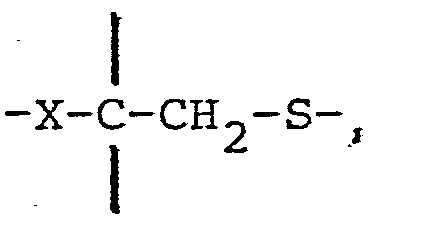
- This interaction may be called thiophilic ("attracted to sulfur"), said adsorption thus being a thiophilic adsorption.
- R may be an unsubstituted alkyl group CH3(CH2)n-. If n is a large integer there are obtained elements of hydrophobic as well as thiophilic adsorption where the hydrophobic adsorption tends to become predominant along with the increasing n. For n=o, i.e. R = methyl, there is practically obtained nothing but a thiophilic adsorption.
- Consequently, the total adsorption effect can be modified in response to the chemical character of R. If a carboxyl group is introduced, the thiophilic adsorption is damped and the charge-dependent adsorption tends to take over.
- The R group can be aromatic, e.g. phenyl (Example 6). Strangely enough, the adsorption of proteins to a product according to the invention, having the structure

- The R group can be a heterocyclic group directly or indirectly bound to X, for example


- The heterocyclic R groups may also comprise thenyl;


- The adsorption is modified in various manners by the heterocyclic groups, but the thiophilic adsorption, manifested by the dependency un salt, will always remain.
- Adsorbents according to the invention can be prepared from a thiol- or epoxide-containing carrier:

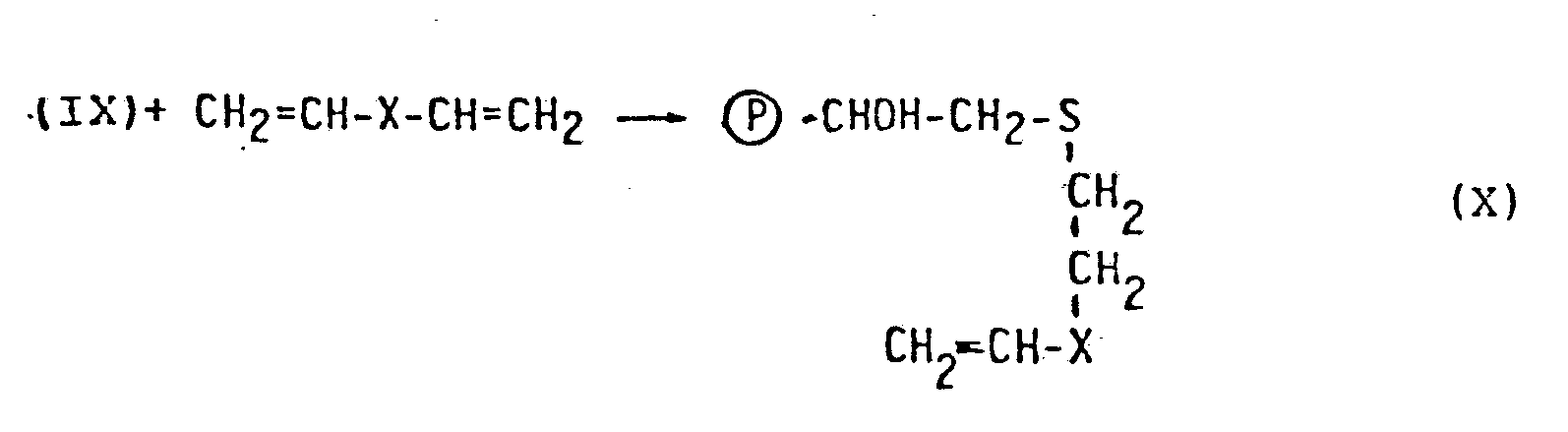


- It is also possible in principle to prepare the inventive adsorbents directly from a hydroxyl- or amino group-containing carrier, for example


- It appears from the aforegoing that one embodiment of the invention can.consist of particles constituting a netting for proteins which is permeable all the way to the center. In accordance with another alternative, only the surface layer of the particle is permeable for proteins, and in such a case the particle nucleus does not have to contain the group which is characteristic for adsorption. A third alternative can consist of a more or less heavy layer of netting surrounding an impermeable nucleus. The nucleus can be arbitrarily formed and constitute e.g. a fiber, the interior surface of a hose, a beaker or some other vessel, etc.
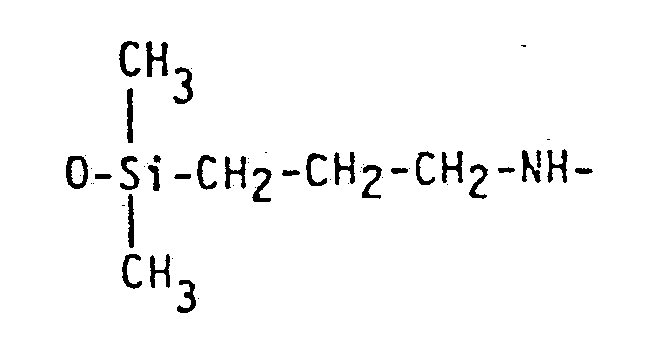
- For the permeation of macromolecules and for the appropriate appearance of the distinguishing adsorption characteristics, the polymeric netting must have a specific property; it must be hydrophilic and permeable for the macromolecules, it must be resistent within a pH range where proteins can be adsorbed without being damaged, preferably within the range of pH 4-8 but suitably within a wider range. The chemical properties of the polymeric netting must also be well adapted to allow introduction of the group characteristic for the adsorption. With regard to the polymeric netting, the invention is restricted by these limitations to hydrophilic polymers of the following types: polyalcohols such as e.g. polyvinyl alcohols, polyhydroxy methanes, polysaccharides, cross-linked hexitholes and polyamides such as cross-linked polyacryl amide. Also cross-linked polyamines and polyacides can be mentioned, although it should then be observed that the adsorption will be more complicated by the presence of the ionogenic groups. The gel netting can furthermore consist of inorganic gels to which have been coupled organic hydroxyl-containing substituents, for example substituted silicic acid gels, or groups such as
-
- A particularly useful adsorbent according to the invention consists of cross-linked agar.
- Particulate 6% agarose gel was treated in a reaction vessel with 5% butanediol-bis-glycidyl ether in 0.6 M NaOH for 2 hours at 40°C. The gel was washed and then converted to thiol derivative by treatment with NaSH in 1 M Na2CO3 in the presence of 0.1% NaBH48 The gel, "thiol agarose", was washed with distilled water followed by 0.1 M NaHCO3, and was transferred to a reaction vessel for treatment during 1 hour with 1% divinyl sulfone. To the thiol agarose, treated with divinyl sulfone, was added excess mercapto ethanol and the mixture was allowed to react for 2 hours in 0.1 M NaHCO3.
- The gel was tested with regard to its ability of absorbing proteins. A gel bed of 5 ml was prepared and washed with 0.1 M Tris-HCl, 0.5 M K2S04, at pH 7.6. Human serum dialyzed against this buffer solution to an amount of 50 absorbency properties (280 nm) was introduced into the bed, whereafter the gel was washed with 50 ml of buffer salt solution. Adsorbed protein was thereafter desorbed by first washing with 0.1 M tris-HCl, pH 7.6 (without K2S04) and then with 40% ehtylene glycol, with 30% isopropanol, and finally with 95% ethanol. 45% protein was adsorbed to the gel of which 25% was eluated with the sulfate-free buffer and the remaining part with other eluents.
- It was shown by electrophoretic analysis that all serum albumine passed the gel without adsorption, whereas immunoglobulin was fixed to the gel and was eluated by the salt-free buffer. α2-macroglobuline as well as lipoproteins were also completely adsorbed.
- Example 1 was repeated but with the difference that cellulose powder was used instead of agarose particles.
- A trial was carried out with epichlorohydrin-treated polyacryl amide (commercial Eupergite). The oxirane gel was converted to SH-gel with NaSH, which was then treated with divinyl sulfone and thereafter with mercapto ethanol. The polyacrylamide derivative had a somewhat lower capacity than had the agarose gel according to Example 1, but the selectivity was principally the same.
- Thiol agarose was activated with divinyl sulfone followed by the attachment of 2.3-dihydroxy-propane-1-thiol as described in Example 1. In an adsorption test with human serum, 43% of the proteins having the same selectivity pattern as in Examples 1-3 was adsorbed but with the difference that the desorption with ethylene glycol was more efficient (10% compared to 6% in Example 1).
- The same procedure was employed as in Example 4 but with the use of 2.3-dimercapto-1-propanol. The adsorption capacity was lower (32%).
- Epichlorohydrin-activated agarose was converted into thiol gel and was treated with phenylvinyl sulfone in 0.1 M NaHC03. 20% serum protein was adsorbed on the gel, mainly by thiophilic adsorption as it was obvious that all albumine passed the bed without adhering.
- Thiolgel according to previous examples was converted as described in Example 6 but with the difference that the phenylvinyl sulfone was exchanged for phenyl vinyl sulfoxide. The capacity was somewhat higher as compared with corresponding sulfone derviative (22%), although the selectivity was the same.
- Thiolagarose was divinylsulfone-activated as in Example 1 and was then converted with thioglycolic acid in 0.1 M NaHC03. The product was found to adsorb less than 5% protein. After esterification, the capacity was increased to 37% although the yield at desorption was low; total yield about 75%.
- Divinylsulfone-activated thiolagarose was converted with selenoglycolic acid analogously with Example 8. The adsorption capacity was low both prior to and after esterification. Reduction with NaBH4 in LiCl solution resulted in an extremely high improvement of the adsorption capacity (48% increase). It proved very difficult however to desorb adhered protein (total yield 63%).
- Divinylsulfone-activated thiolagarose was linked with 2.2'-diehtylamino ethane thiol in 0.1 M NaHC03. The product obtained was found to have an extremely low adsorption capacity (13%). Liptoproteins in principle were fixed to the gel.
- Agarose was activated with thosyl chloride in alkali and was then treated with 1.2-ethane thiol followed by methyl iodide. The product was found to have good capacity (43%). 36% of the adsorbed material was desorbed by the sulfate-free buffer. The total yield was quantitative.
Claims (7)

or an alkyl, hydroxy alkyl, mercapto alkyl or a phenyl group containing a nitro group, or hydroxyl or amino group unsubstituted or substituted with alkyl, hydroxy alkyl or acyl in ortho- or para-position to a thioether atom or a heterocyclic, nitrogen-containing ring;

Applications Claiming Priority (2)
| Application Number | Priority Date | Filing Date | Title |
|---|---|---|---|
| SE8402662 | 1984-05-17 | ||
| SE8402662A SE470261B (en) | 1984-05-17 | 1984-05-17 | Adsorbent for the separation and immobilization of proteins, methods of preparing an adsorbent, and its use for biopolymer fractionation |
Publications (3)
| Publication Number | Publication Date |
|---|---|
| EP0165912A2 true EP0165912A2 (en) | 1985-12-27 |
| EP0165912A3 EP0165912A3 (en) | 1987-01-28 |
| EP0165912B1 EP0165912B1 (en) | 1990-02-07 |
Family
ID=20355913
Family Applications (1)
| Application Number | Title | Priority Date | Filing Date |
|---|---|---|---|
| EP85850148A Expired - Lifetime EP0165912B1 (en) | 1984-05-17 | 1985-04-29 | Thioether adsorbent intended for the separation of proteins and the like |
Country Status (4)
| Country | Link |
|---|---|
| EP (1) | EP0165912B1 (en) |
| JP (1) | JPS615099A (en) |
| DE (1) | DE3575872D1 (en) |
| SE (1) | SE470261B (en) |
Cited By (19)
| Publication number | Priority date | Publication date | Assignee | Title |
|---|---|---|---|---|
| WO1989008257A1 (en) * | 1988-02-26 | 1989-09-08 | Jerker Porath | Determining reactants and combinations of reactants involved in biospecific reactions |
| EP0361060A1 (en) * | 1988-08-26 | 1990-04-04 | Brigham Young University | Sulfur and nitrogen-containing hydrocarbon compounds and process using same in recovering and concentrating desired ions from solutions thereof |
| EP0371636A3 (en) * | 1988-11-09 | 1990-07-18 | Chembiomed, Ltd. | Improved affinity supports for hemoperfusion |
| WO1990009832A1 (en) * | 1989-02-21 | 1990-09-07 | Eastman Kodak Company | High performance affinity chromatography column comprising non-porous, monodisperse polymeric packing material |
| EP0417755A1 (en) * | 1989-09-13 | 1991-03-20 | Daiso Co., Ltd. | Packing for chromatography and its use for separating water soluble organic compounds |
| US5149425A (en) * | 1988-11-09 | 1992-09-22 | Chembiomed, Ltd. | Affinity supports for hemoperfusion |
| WO1992016292A1 (en) * | 1991-03-22 | 1992-10-01 | Kem-En-Tec A/S | Adsorption matrices |
| EP0565978A1 (en) * | 1992-04-16 | 1993-10-20 | MERCK PATENT GmbH | Artivated carriers, their fabrication and use |
| DE19623131A1 (en) * | 1996-06-10 | 1997-12-11 | Dianova Lizenz Und Beteiligung | Conjugate, suitable for binding substances |
| WO1998008603A1 (en) * | 1996-08-30 | 1998-03-05 | Upfront Chromatography A/S | Isolation of immunoglobulins |
| EP0764048A4 (en) * | 1994-05-16 | 1998-03-18 | Biosepra Inc | Chromatography adsorbents utilizing mercapto heterocyclic ligands |
| EP0891223A4 (en) * | 1996-01-11 | 1999-07-28 | Univ Massey | Methods for the preparation of resins with ligands attached thereto through a linking group comprising sulfide, sulfoxide, sulfone or sulfonate functionality |
| US6572766B1 (en) | 1997-03-04 | 2003-06-03 | Amersham Biosciences Ab | Matrices for separation and separation exploiting said matrices |
| WO2004018071A3 (en) * | 2002-08-23 | 2004-07-29 | Johnson Matthey Plc | Chromatographic medium |
| DE10313324A1 (en) * | 2003-03-25 | 2004-10-21 | Instraction Gmbh | Preparing sorbent having at least two groups for selective binding, useful, e.g. for detecting receptor-agent interaction, in drug screening and in substrate separation or purification |
| WO2005073711A3 (en) * | 2004-01-20 | 2005-11-10 | Pall Corp | Chromatographic material for the absorption of proteins at physiological ionic strength |
| US7144743B2 (en) | 2002-09-13 | 2006-12-05 | Pall Corporation | Preparation and use of mixed mode solid substrates for chromatography adsorbents and biochip arrays |
| EP1754534A1 (en) | 2005-08-03 | 2007-02-21 | MERCK PATENT GmbH | Crosslinked hydrophile polymer |
| WO2016188606A1 (en) | 2015-05-22 | 2016-12-01 | Merck Patent Gmbh | Device for substance separation |
Family Cites Families (4)
| Publication number | Priority date | Publication date | Assignee | Title |
|---|---|---|---|---|
| DE2319495C2 (en) * | 1973-04-17 | 1985-01-10 | Yeda Research And Development Co., Ltd., Rehovot | Method for the selective, reversible binding of biomolecules to an adsorbent in a chromatographic column |
| LU73094A1 (en) * | 1975-07-29 | 1977-03-24 | ||
| US4111838A (en) * | 1977-09-09 | 1978-09-05 | Eastman Kodak Company | Composition for chromatography |
| GB2092470B (en) * | 1981-02-10 | 1984-07-18 | Tanabe Seiyaku Co | Method for reducing the pyrogen content of or removing pyrogens from solutions contaminated therewith |
-
1984
- 1984-05-17 SE SE8402662A patent/SE470261B/en not_active IP Right Cessation
-
1985
- 1985-04-29 EP EP85850148A patent/EP0165912B1/en not_active Expired - Lifetime
- 1985-04-29 DE DE8585850148T patent/DE3575872D1/en not_active Expired - Lifetime
- 1985-05-17 JP JP60105768A patent/JPS615099A/en active Granted
Cited By (34)
| Publication number | Priority date | Publication date | Assignee | Title |
|---|---|---|---|---|
| WO1989008257A1 (en) * | 1988-02-26 | 1989-09-08 | Jerker Porath | Determining reactants and combinations of reactants involved in biospecific reactions |
| EP0361060A1 (en) * | 1988-08-26 | 1990-04-04 | Brigham Young University | Sulfur and nitrogen-containing hydrocarbon compounds and process using same in recovering and concentrating desired ions from solutions thereof |
| US5240601A (en) * | 1988-11-09 | 1993-08-31 | Chembiomed, Ltd. | Affinity supports for hemoperfusion |
| AU625377B2 (en) * | 1988-11-09 | 1992-07-09 | Chembiomed Ltd. | Affinity supports for hemoperfusion |
| US5149425A (en) * | 1988-11-09 | 1992-09-22 | Chembiomed, Ltd. | Affinity supports for hemoperfusion |
| EP0371636A3 (en) * | 1988-11-09 | 1990-07-18 | Chembiomed, Ltd. | Improved affinity supports for hemoperfusion |
| WO1990009832A1 (en) * | 1989-02-21 | 1990-09-07 | Eastman Kodak Company | High performance affinity chromatography column comprising non-porous, monodisperse polymeric packing material |
| EP0417755A1 (en) * | 1989-09-13 | 1991-03-20 | Daiso Co., Ltd. | Packing for chromatography and its use for separating water soluble organic compounds |
| US5103000A (en) * | 1989-09-13 | 1992-04-07 | Daiso Co., Ltd. | Packing for chromatography and method for separating water soluble organic compounds using the same |
| WO1992016292A1 (en) * | 1991-03-22 | 1992-10-01 | Kem-En-Tec A/S | Adsorption matrices |
| AU663700B2 (en) * | 1991-03-22 | 1995-10-19 | Kem-En-Tec A/S | Adsorption matrices |
| EP0565978A1 (en) * | 1992-04-16 | 1993-10-20 | MERCK PATENT GmbH | Artivated carriers, their fabrication and use |
| WO1993020935A1 (en) * | 1992-04-16 | 1993-10-28 | Merck Patent Gmbh | Activated substrate materials, their production and use |
| US6291216B1 (en) * | 1992-04-16 | 2001-09-18 | Merck Patent Gesellschaft Mit Beschrankter Haftung | Affinity supports containing ligands bound to oxirane groups |
| EP0764048A4 (en) * | 1994-05-16 | 1998-03-18 | Biosepra Inc | Chromatography adsorbents utilizing mercapto heterocyclic ligands |
| EP0891223A4 (en) * | 1996-01-11 | 1999-07-28 | Univ Massey | Methods for the preparation of resins with ligands attached thereto through a linking group comprising sulfide, sulfoxide, sulfone or sulfonate functionality |
| EP1464391A3 (en) * | 1996-01-11 | 2004-12-29 | Massey University | Methods for the preparation of resins with ligands attached thereto through a linking group comprising sulfide, sulfoxide, sulfone or sulfonate functionality |
| DE19623131A1 (en) * | 1996-06-10 | 1997-12-11 | Dianova Lizenz Und Beteiligung | Conjugate, suitable for binding substances |
| DE19623131C2 (en) * | 1996-06-10 | 2001-10-31 | Gerhard Harry Scholz | Conjugate, process for its preparation and its use for binding substances |
| US6919436B2 (en) | 1996-08-30 | 2005-07-19 | Upfront Chromatography A/S | Isolation of proteins |
| US6498236B1 (en) | 1996-08-30 | 2002-12-24 | Upfront Chromatography A/S | Isolation of immunoglobulins |
| WO1998008603A1 (en) * | 1996-08-30 | 1998-03-05 | Upfront Chromatography A/S | Isolation of immunoglobulins |
| US7745582B2 (en) | 1996-08-30 | 2010-06-29 | Upfront Chromatography | Isolation of immunoglobulins |
| US7442779B2 (en) | 1996-08-30 | 2008-10-28 | Upfront Chromatography A/S | Isolation of proteins |
| US6572766B1 (en) | 1997-03-04 | 2003-06-03 | Amersham Biosciences Ab | Matrices for separation and separation exploiting said matrices |
| US7335306B2 (en) | 2002-08-23 | 2008-02-26 | Anglo Platinum Limited | Chromatographic medium |
| WO2004018071A3 (en) * | 2002-08-23 | 2004-07-29 | Johnson Matthey Plc | Chromatographic medium |
| US7144743B2 (en) | 2002-09-13 | 2006-12-05 | Pall Corporation | Preparation and use of mixed mode solid substrates for chromatography adsorbents and biochip arrays |
| US7326776B2 (en) | 2002-09-13 | 2008-02-05 | Pall Corporation | Preparation and use of mixed mode solid substrates for chromatography adsorbents and biochip arrays |
| DE10313324A1 (en) * | 2003-03-25 | 2004-10-21 | Instraction Gmbh | Preparing sorbent having at least two groups for selective binding, useful, e.g. for detecting receptor-agent interaction, in drug screening and in substrate separation or purification |
| WO2005073711A3 (en) * | 2004-01-20 | 2005-11-10 | Pall Corp | Chromatographic material for the absorption of proteins at physiological ionic strength |
| US8021889B2 (en) | 2004-01-20 | 2011-09-20 | Pall Corporation | Chromatographic material for the absorption of proteins at physiological ionic strength |
| EP1754534A1 (en) | 2005-08-03 | 2007-02-21 | MERCK PATENT GmbH | Crosslinked hydrophile polymer |
| WO2016188606A1 (en) | 2015-05-22 | 2016-12-01 | Merck Patent Gmbh | Device for substance separation |
Also Published As
| Publication number | Publication date |
|---|---|
| DE3575872D1 (en) | 1990-03-15 |
| SE8402662D0 (en) | 1984-05-17 |
| JPH059440B2 (en) | 1993-02-04 |
| EP0165912A3 (en) | 1987-01-28 |
| JPS615099A (en) | 1986-01-10 |
| SE470261B (en) | 1993-12-20 |
| EP0165912B1 (en) | 1990-02-07 |
| SE8402662L (en) | 1985-11-18 |
Similar Documents
| Publication | Publication Date | Title |
|---|---|---|
| EP0165912B1 (en) | Thioether adsorbent intended for the separation of proteins and the like | |
| US4696980A (en) | Sulfone activated thioether adsorbents for the separation of proteins and the like | |
| US4677027A (en) | Polymer coated particles having immobilized metal ions on the surfaces thereof | |
| US5092992A (en) | Polyethyleneimine matrixes for affinity chromatography | |
| US3917527A (en) | Hydrophobic chromatography | |
| US4423158A (en) | Ion adsorbent for metals having a coordination number greater than two | |
| US4837348A (en) | Bonded phase chromatographic supports | |
| EP0764048B1 (en) | Chromatography adsorbents utilizing mercapto heterocyclic ligands | |
| US4048416A (en) | Thiopolymers, their derivatives and methods for their preparation and use | |
| EP0593417B1 (en) | Adsorbent for metal ions, proteins and other inorganic and organic substances | |
| US5085779A (en) | Polyethyleneimine matrixes for affinity chromatography | |
| JPH0290943A (en) | Material capable of immobilizing biological substance and application thereof as carrier of affinity chromatography | |
| EP0180563A2 (en) | An amphiphathic gel-product for chromatographic and batchwise adsorption | |
| EP0764049B1 (en) | Alkali resistant protein adsorbent | |
| US4406792A (en) | Separation agent | |
| WO1991003257A1 (en) | Methods for activating polymeric carriers and compositions prepared therefrom for use in affinity chromatography | |
| EP0085661B1 (en) | Metal ion adsorbent | |
| EP0403700B1 (en) | Polyethyleneimine matrixes for affinity chromatography | |
| DE69917574T2 (en) | Method for the immobilization of compounds | |
| JP2005281399A (en) | Method for producing molecular template material, method for separating / purifying molecular template material and target substance | |
| SU1054353A1 (en) | Process for preparing adsorbents containing amino groups | |
| DE68902392T2 (en) | POLYETHYLENIMINE MATERIALS FOR AFFINITY CHROMATOGRAPHY. | |
| JPH02176461A (en) | Carrier for afinity chromatography and manufacture thereof | |
| IE63044B1 (en) | Polyethyleneimine matrixes for affinity chromatography | |
| CS271590B1 (en) | Carrier for affine chromatography and method of its preparation |
Legal Events
| Date | Code | Title | Description |
|---|---|---|---|
| PUAI | Public reference made under article 153(3) epc to a published international application that has entered the european phase |
Free format text: ORIGINAL CODE: 0009012 |
|
| AK | Designated contracting states |
Designated state(s): DE FR GB |
|
| PUAL | Search report despatched |
Free format text: ORIGINAL CODE: 0009013 |
|
| AK | Designated contracting states |
Kind code of ref document: A3 Designated state(s): DE FR GB |
|
| 17P | Request for examination filed |
Effective date: 19870512 |
|
| 17Q | First examination report despatched |
Effective date: 19880802 |
|
| GRAA | (expected) grant |
Free format text: ORIGINAL CODE: 0009210 |
|
| AK | Designated contracting states |
Kind code of ref document: B1 Designated state(s): DE FR GB |
|
| REF | Corresponds to: |
Ref document number: 3575872 Country of ref document: DE Date of ref document: 19900315 |
|
| ET | Fr: translation filed | ||
| PLBE | No opposition filed within time limit |
Free format text: ORIGINAL CODE: 0009261 |
|
| STAA | Information on the status of an ep patent application or granted ep patent |
Free format text: STATUS: NO OPPOSITION FILED WITHIN TIME LIMIT |
|
| 26N | No opposition filed | ||
| PGFP | Annual fee paid to national office [announced via postgrant information from national office to epo] |
Ref country code: FR Payment date: 19970414 Year of fee payment: 13 |
|
| PGFP | Annual fee paid to national office [announced via postgrant information from national office to epo] |
Ref country code: DE Payment date: 19970417 Year of fee payment: 13 |
|
| PGFP | Annual fee paid to national office [announced via postgrant information from national office to epo] |
Ref country code: GB Payment date: 19970428 Year of fee payment: 13 |
|
| PG25 | Lapsed in a contracting state [announced via postgrant information from national office to epo] |
Ref country code: GB Free format text: LAPSE BECAUSE OF NON-PAYMENT OF DUE FEES Effective date: 19980429 |
|
| PG25 | Lapsed in a contracting state [announced via postgrant information from national office to epo] |
Ref country code: FR Free format text: THE PATENT HAS BEEN ANNULLED BY A DECISION OF A NATIONAL AUTHORITY Effective date: 19980430 |
|
| GBPC | Gb: european patent ceased through non-payment of renewal fee |
Effective date: 19980429 |
|
| PG25 | Lapsed in a contracting state [announced via postgrant information from national office to epo] |
Ref country code: DE Free format text: LAPSE BECAUSE OF NON-PAYMENT OF DUE FEES Effective date: 19990202 |
|
| REG | Reference to a national code |
Ref country code: FR Ref legal event code: ST |