EP1753629B1 - Solid work machine tire with resilient body - Google Patents
Solid work machine tire with resilient body Download PDFInfo
- Publication number
- EP1753629B1 EP1753629B1 EP05735517A EP05735517A EP1753629B1 EP 1753629 B1 EP1753629 B1 EP 1753629B1 EP 05735517 A EP05735517 A EP 05735517A EP 05735517 A EP05735517 A EP 05735517A EP 1753629 B1 EP1753629 B1 EP 1753629B1
- Authority
- EP
- European Patent Office
- Prior art keywords
- cavities
- work machine
- tire
- radial
- band
- Prior art date
- Legal status (The legal status is an assumption and is not a legal conclusion. Google has not performed a legal analysis and makes no representation as to the accuracy of the status listed.)
- Expired - Lifetime
Links
- 239000007787 solid Substances 0.000 title description 13
- 239000000463 material Substances 0.000 claims abstract description 53
- 239000011800 void material Substances 0.000 claims abstract description 35
- 239000013536 elastomeric material Substances 0.000 claims abstract description 7
- 230000004888 barrier function Effects 0.000 claims description 7
- 229920001971 elastomer Polymers 0.000 description 12
- 239000005060 rubber Substances 0.000 description 10
- 230000002441 reversible effect Effects 0.000 description 6
- 238000005452 bending Methods 0.000 description 5
- 230000000750 progressive effect Effects 0.000 description 4
- 238000007906 compression Methods 0.000 description 3
- 230000006835 compression Effects 0.000 description 3
- 230000000670 limiting effect Effects 0.000 description 3
- 230000001133 acceleration Effects 0.000 description 2
- 239000000806 elastomer Substances 0.000 description 2
- 239000000203 mixture Substances 0.000 description 2
- 229920003052 natural elastomer Polymers 0.000 description 2
- 229920001194 natural rubber Polymers 0.000 description 2
- 230000036961 partial effect Effects 0.000 description 2
- 229920003051 synthetic elastomer Polymers 0.000 description 2
- 244000043261 Hevea brasiliensis Species 0.000 description 1
- 230000001351 cycling effect Effects 0.000 description 1
- 230000003247 decreasing effect Effects 0.000 description 1
- 238000006073 displacement reaction Methods 0.000 description 1
- 239000006263 elastomeric foam Substances 0.000 description 1
- 238000005188 flotation Methods 0.000 description 1
- 238000009472 formulation Methods 0.000 description 1
- 238000004519 manufacturing process Methods 0.000 description 1
- 238000000034 method Methods 0.000 description 1
- 238000000465 moulding Methods 0.000 description 1
- 229920002635 polyurethane Polymers 0.000 description 1
- 239000004814 polyurethane Substances 0.000 description 1
- 230000002829 reductive effect Effects 0.000 description 1
- 239000012265 solid product Substances 0.000 description 1
- 239000005061 synthetic rubber Substances 0.000 description 1
Images


Classifications
-
- B—PERFORMING OPERATIONS; TRANSPORTING
- B60—VEHICLES IN GENERAL
- B60C—VEHICLE TYRES; TYRE INFLATION; TYRE CHANGING; CONNECTING VALVES TO INFLATABLE ELASTIC BODIES IN GENERAL; DEVICES OR ARRANGEMENTS RELATED TO TYRES
- B60C7/00—Non-inflatable or solid tyres
- B60C7/10—Non-inflatable or solid tyres characterised by means for increasing resiliency
- B60C7/107—Non-inflatable or solid tyres characterised by means for increasing resiliency comprising lateral openings
Definitions
- the present disclosure relates generally to work machine tires, and more specifically to non-pneumatic work machine tires.
- work machine tires can be non-pneumatic, and thus, are comprised of solid or semi-solid products.
- the non-pneumatic work machine tires are more durable than pneumatic tires, the non-pneumatic tires are often too stiff to provide a smooth ride and lack the contact area with the ground to provide relatively good traction.
- some non-pneumatic tires include a radial band of unpressurized cavities, or recesses. The radial band lessens the stiffness and increases the deformation of the tire so it will ride better than a solid tire.
- Such a tire is sold by MITL under a trademark that suggests flexibility, but it still provides a stiff ride more similar to a solid tire than a pneumatic tire.
- the non-pneumatic tire described in U.S. Patent Number 5,042,544 corresponding with the preamble of claim 1, issued to Dehasse, on 27 August 1991 defined a radial band of recesses that enable the tire to deform due to a load and provides an area of contact with the road that is supposedly similar to that provided by a pneumatic tire.
- the recesses of the Dehasse non-pneumatic tire are taught as being intrinsically dissymmetrical to any radial direction and overlap one another.
- the Dehasse non-pneumatic tire uses recesses in order to control the tire performance and road handling, the Dehasse tire is intended to have a weight and bulk similar to that of pneumatic tires. Thus, the Dehasse tire would not possess the durability required for high load, low speed work machine applications.
- the present disclosure is directed at overcoming one or more of the problems set forth above.
- a work machine tire includes an annular body of elastomeric material.
- a radial middle region of the elastomeric material defines a plurality of unpressurized cavities distributed in a pattern that includes a first radially inner band of cavities and a second radially outer band of cavities.
- Each cavity of the first radial band of cavities is oriented at a positive angle with respect to a radius therethrough, and each cavity of the second radial band of cavities is oriented at a negative angle with respect to a radius therethrough.
- a material volume of the radial middle region is more than one and a half times greater than a combined void volume of the plurality of unpressurized cavities.
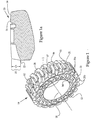
- FIG. 1 there is shown an isometric view of a work machine tire 10, according to a preferred embodiment of the present disclosure.
- all work machine tires 10, 110, 210, 310, 410 and 510 illustrated in the six embodiments are 31 inch diameter tires designed for a skid steer loader, those skilled in the art will appreciate that the present disclosure contemplates tires of various sizes that can be used with other various work machines, preferably with relatively small work machines, such as small wheel loaders, backhoe loaders and maybe trucks, but other larger work machines are still suitable.
- the work machine tire 10 includes an annular body 11 of elastomeric material.
- annular body 11 could be made from various elastomeric materials, the annular body 11 is illustrated as being made from rubber of any suitable tire formulation known in the art.
- tire 10 might be molded from a natural rubber or a natural/synthetic rubber blend having a Young's Modulus between 1 MPa and 6 MPa at 100% elongation.
- a 100% tensile modulus of about 2.75 MPa is used.
- Fully synthetic elastomers, such as polyurethanes could also be used.
- the annular body 11 includes a radial middle region 12, and preferably a radial outer region 13 and a radial inner region 14, both of which are adjacent to the radial middle region 12.
- the radial inner region 14 attaches to a wheel hub in a conventional manner, such as by being directly bonded thereto, and the wheel is attached to the work machine.
- the radial outer region includes the tread.
- the radial outer region 13 and the radial inner region 14 are preferably, but not necessarily cavity-free, and the radial middle region 12 defines a plurality of unpressurized cavities 15 that are distributed in a pattern that includes a first radial band of cavities 16 and a second radial band of cavities 17.
- the bands may or may not overlap, depending upon the desired properties of the particular application.
- the cavities 15 are evenly spaced throughout each radial band 16 and 17.
- Each cavity within the first radial band of cavities 16 is oriented at a positive angle with respect to a radius therethrough, and each cavity within the second radial band of cavities 17 is oriented at a negative angle with respect to a radius therethrough.
- the first and second radial bands of cavities 16 and 17 are oriented at opposing angles in order to cancel or reduce any torsional stiffness bias created by each radial band of cavities 16 and 17. Without the first radial band of cavities 16 canceling the torsional stiffness bias of the second radial band of cavities 17, and vice versa, a tangential force acting in a forward direction on the work machine tire 10, when compared with the reverse direction, might cause a significantly different degree of rotation of an outer portion of the work machine tire 10 to rotate with respect to an inner portion. This could result in unpredictable work machine motion during acceleration, stopping, pulling, pushing, digging, or any other work cycle that could produce a tangential force on the tire.
- the positive angle is 63° and the negative angle is 52° with respect to a radial line through the center of the cavity.
- the positive and negative angles can vary, and are determined based on various factors, including but not limited to, the size and shape of cavities within the first radial band and the second radial band.
- the positive angle of the first radial band 16 is preferably different than the negative angle of the second radial band 17, those skilled in the art will appreciate that the positive angle and the negative angle could be the same.
- the shape and/or size and/or number of the cavities within the first radial band may need to be different than the shape and/or size and/or number of cavities in the second radial band in order to generate similar performance.
- the number of cavities is preferably proportional to the diameter of the tire.
- the work machine tire 10 includes less than fifty unpressurized cavities 15.
- the work machine tire 10 includes forty unpressurized cavities 15, with twenty unpressurized cavities within each of the first and second radial bands 16 and 17.
- each of the unpressurized cavities within the plurality 15 have an axis of symmetry parallel to a tire axis of rotation 18.
- the plurality of unpressurized cavities 15 preferably have a uniform shape and volume, it should be appreciated that the first radial band of cavities could have a different shape than the second radial band of cavities.
- the shape and/or size of the first radial band may differ from the shape and/or sizes of the second radial band.
- the uniform shape illustrated includes a cross-sectional shape with a perimeter 25 that includes a pair of straight wall portions 25 a separated by a pair of arches 25b.
- the length and width of the cross-sectional shape can vary depending on various factors, including but not limited to, the desired combined void volume. In the preferred embodiment, the length of the cavities 15 is illustrated as approximately 2.3 inches, the width is approximately 0.9 inch, and the depth is approximately 4.9 inches if extending half the tire width, but may be 9.8 inches if extending the full width of the tire.
- FIG. 1a there is shown a cross-sectioned view of the radial outer region 13 of the work machine tire 10.
- the radial outer region 13 includes an exposed off-road tread pattern 21 that has a depth 22, which is the distance between a base 23 and a top 24 of the tread 21.
- the view of Fig. 1a and similar views in the other drawings show the theoretical intersection of the side profile and the crown at the comers; it may not reflect the maximum diametrical location on the tire. Although maximum tread depth is desirable for traction and wear purposes, the tread depth 22 is limited by the overall desired diameter of the tire 10.
- the tread depth 22 is typically a compromise between the desired traction, stiffness and rubber strain of the tire 10.
- the depth 22 of the off-road tread pattern 21 is at least one inch. In the preferred embodiment illustrated in Figure 1a , the off-road tread is 1.74 inches deep. Those skilled in the art will appreciate that the off-road tread 21 should be sufficient for the operation of work machine tire 10 in off-road environments.
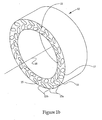
- the radial middle region 12 includes a material volume, and the plurality of unpressurized cavities 15 have a combined void volume.
- radial middle region is bounded by an inner diameter that is tangent to the inner band of cavities 16, and bounded by an outer diameter tangent to the outer band of cavities 17.
- a ratio of the material volume to the combined void volume may vary, the material volume is more than one and a half times greater than a combined void volume of the plurality of unpressurized cavities 15.
- the material volume of the middle radial region 12 is about twice the combined void volume.
- the cavities 15 within the tire 10 lessen the stiffness of the tire 10 in order to provide deflection and a relatively smooth ride for the operator the load and the work machine. Moreover, the cavities 15 permit the material to deflect by bending, rather than by either pure compression or stretching, thereby limiting the material strain while permitting substantial deflections. However, the work machine tire 10 must include sufficient material in order to carry the loads to which the work machine is subjected. Thus, the determination of the material volume to the combined void volume ratio is a compromise between various known factors, including but not limited to the desired stiffness and strain and durability of the work machine tire.
- each cavity within the plurality 115 includes a length of 2.2 inches, a width of 0.9 inch, and a depth of 4.9 inches for halfway through (9.8 inches if full width of tire).
- the radial outer region 113 includes an exposed off-road tread pattern 121 that has a depth 122 defined as the distance between a base 123 of the tread 121 and a top 124 of the tread 121.
- the depth 22 of the off-road tread pattern 21 of Figure 1 was 1.74 inches
- the depth 122 of the off-road tread pattern 121 of the second embodiment is 1.98 inches.
- the work machine tire 10 can support a thicker off-road tread 121 than in the preferred embodiment.
- the higher material volume to void volume ratio may result in an increased stiffness that can affect the smoothness of the work machine ride.
- a work machine tire 210 is similar to the work machine tires 10 and 110 of the preferred and second embodiments except that a material volume to a combined void volume ratio of the work machine 210 is less than that of the preferred and the second embodiments.
- a radial middle region 212 of the work machine tire 210 includes the material volume that is 1.8 times greater (which is still about twice) than the combined void volume of the plurality of cavities 215.
- Each cavity within the plurality 215 includes a length of 2.3 inches, a width of 1.1 inches, and a depth of 4.9 inches for half way through (9.8 inches if full width of tire).
- the radial outer region 213 includes an exposed off-road tread 221 that includes a depth 222 defined as the distance between a base 223 and a top 224 of the tread 221.
- the depth 222 of the tread 221 is 1.54 inches.
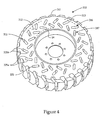
- the work machine tire 310 includes an annular body 311 that includes a radial middle region 312 adjacent to a preferably cavity-free radial inner region 14 and a preferably cavity-free radial outer region 313.
- the radial middle region 312 defines a plurality of unpressurized cavities 315 that include that a first radial band of cavities 316 that are oriented at a positive angle with respect to a radius therethrough and a second radial band of cavities 317 that are oriented at a negative angle with respect to a radius therethrough.
- the tires 10, 110 and 210 of the first, second and third embodiments include twenty cavities in each radial band 16, 116, 216 and 17, 117, 217
- the work machine 310 defines eighteen cavities in each of the first and second radial bands 316 and 317, for a total of thirty-six cavities within the plurality 315.
- a material volume of the radial middle region 312 is 2.6 times a combined void volume of the plurality of cavities 315.
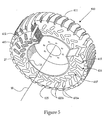
- the work machine tire 410 includes an annular body 411 that includes a radial middle region 412 adjacent to a preferably cavity-free radial inner region 14 and a preferably cavity-free radial outer region 413.
- the radial middle region 412 defines a plurality of unpressurized cavities 415 that include that a first radial band of cavities 416 that are oriented at a positive angle with respect to a radius therethrough and a second radial band of cavities 417 that are oriented at a negative angle with respect to a radius therethrough.
- the work machine tire 410 includes twenty-four cavities in each of the first and second radial bands 416 and 417, for a total of forty-eight cavities 415. Further, a material volume of the radial middle region 412 is 2.1 times a combined void volume of the plurality of cavities 415. Although any embodiment of the present disclosure could include a barrier for, at least, a portion of the cavities, the work machine tire 410 is illustrated as including at least one barrier 27 separating the unpressurized cavities 415 from the space surrounding the tire 410. The barriers 27 prevent debris from entering the cavities 415 and affecting the performance of the tire 410.
- the barriers 27 being comprised of various materials, including, but not limited to a thin screen or rubber layer over the cavity, or possibly by filling the cavity with an elastomeric foam.
- the barriers 27 can be inserted into the cavities 415 or cover the opening of the cavities 415.
- the material for the barriers 27 can be selected to alter the deflection rate of the tire 410, or to not affect the performance of the tire 410.
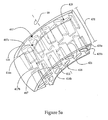
- FIG. 5a there is shown a diagrammatic representation through a portion of the work machine tire 410 of Figure 5 .
- the unpressurized cavities 415 are illustrated as extending about half the width 431 of the tire 410.
- the first radial band of cavities 416 includes an inboard band of cavities 416a and an outboard band of cavities 416b that are out of phase with respect to the inboard band of cavities 416a about the axis of rotation 18.
- the second radial band of cavities 417 includes an inboard band of cavities 417a and an outboard band of cavities 417b that are out of phase with respect to the inboard band of cavities 417a about the axis of rotation 18.
- the cavities 415 are evenly spread throughout the radial middle region 412 of the tire 410 in order to provide uniform performance of the tire 410 throughout 360° of rotation.
- each cavity of the plurality 415 includes a tapered end 426 adjacent to the middle of the width 431 of the tire 410.
- the tapered ends 426 of the cavities 415 eases the removal of a molding core from the elastomeric material to form the cavities 415 during manufacturing.
- a taper can impart a different spring rate to the tire, and can be used to tailor the ground pressure distribution under the tire, i.e. cause the middle of the tire to carry more load.
- tire 510 includes a radial inner region 14, a radial middle region 512 that includes a plurality of unpressurized cavities 415 and a radial outer region 513 that includes the tread.
- the tread has a depth 522 of about 1.37 inches.
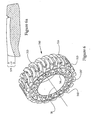
- This embodiment is similar to some of the previous embodiments in that each of the radial bands of cavities 516 and 517 each include twenty cavities. Also, this embodiment differs from the earlier embodiment in that the ratio of the material volume to the combined void volume in the middle region 412 is 1.6, which is still about twice.
- Table I there is shown data summarizing the geometry for the six embodiments of the work machine tire 10,110, 210, 310, 410 and 510.
- Each work machine tire 10, 110, 210, 310, 410 and 510 are 31 inch diameter tires made for a skid steer loader.
- Table I EMBOD. TREAD DEPTH in. STIFFNESS @4500#, lb/in CAVITY WIDTH in. CAVITY LENGTH in.
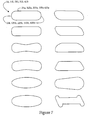
- FIG. 7 there is shown a collection of diagrammatic representations of various-shaped cavities of work machine tires, according to the present disclosure.
- the work machine tires 10, 110, 210, 310, 410 and 510 of the illustrated embodiments include pluralities of cavities 15, 115, 215, 315, 415 and 515 that include the preferred cross-sectional shape having the pair of straight deflectable wall portions 25a, 125a, 225a, 325a, 425a separated by the pair of symmetrical arches 25b, 125b, 225b, 325, 425b.
- the present disclosure contemplates use of various other cavity shapes, all of which include a pair of deflectable wall portions separated by a pair of arches, including, but not limited to, those illustrated in Figure 7 .
- the shapes are preferably symmetrical, but can have a skewed shape. Further, the present disclosure contemplates a work machine tire including non-uniform cavities. Those skilled in the art appreciate that there are various combinations of cavity shapes that can provide the desired stiffness, torque cancellation, and durability of the work machine tire. Thus, Fig. 7 represents only a fraction of cavity shapes that are appropriate for the work machine tire.
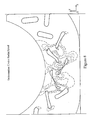
- FIG. 8 there is shown a diagrammatic representation illustrating the deflection of a work machine under a radial load.
- the dotted and dashed lines show contours of constant strain in the elastomeric material out of which the tire is manufactured.
- strain appears to the largest in small regions adjacent the arches of the respective cavities.
- the material surrounding the cavities absorbs the radial load primarily by bending the deflectable wall portions of each cavity toward one another while the arches at the opposite ends of each cavity deform to accommodate the deflection of the wall portions.
- the tire deflects while minimizing material strain.
- the work machine tire can include a progressive spring, or deflection, rate, meaning that stiffness is greater at higher radial loads than at lower radial loads. This assists the tire in supporting a load without collapsing the cavities at relatively high radial loads.
- the cavities can collapse such that the wall portions contact one another, and the radial load will be absorbed through the rubber-to-rubber contact in order to place an upper limit on the maximum strain for a given tire strain.
- the overload protection collapse of the cavities 15 occurs at approximately 6,000 pounds.
- the cavities do not collapse over an expected load range for the particular tire, work machine and application.
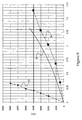
- FIG. 9 there is shown a graph illustrating deflection (D) of a work machine tire versus radial load (L), according to the present disclosure.
- Deflection (D) is illustrated along the x-axis in inches
- the radial load (L) is illustrated along the y-axis in pounds.
- the upward concavity of the curve demonstrates a preferred progressive spring rate.
- the work machine tire 10 preferably includes an average deflection rate 28 in this skid steer example of about 0.3 inches per 1000 pounds, at least up to a load of 4000 pounds.
- a deflection rate 29 of a conventional solid, non-pneumatic tire is about .05 inches per 1000 pounds.
- the deflection rate 30 of a conventional pneumatic tire is greater than the deflection rate 28 for the work machine tire
- the deflection rate 28 for the work machine tire 10 is more similar to the deflection rate 30 for the pneumatic tire than the deflection rate 29 of the solid tire.
- the material volume is more than one and a half times greater than the combined void volume, and the first radial band of cavities 16, 116, 216, 316, 416 and 516 is oriented at a positive angle with respect to a radius therethrough and the second radial band of cavities 17, 117, 217, 317, 417 and 517 is oriented at a negative angle with respect to a radius therethrough.
- the work machine tire 10 During normal operation of the skid steer loader, the work machine tire 10 will be subjected to a predictable range of radial loads. Under this range of radial loads, the material around the plurality of cavities 15 absorbs the radial load primarily by bending rather than by pure compression or stretching, thereby maintaining a relatively low maximum strain on the material. The deflection of the work machine tire 10 by bending the material that defines cavities 15 will cause a larger contact area with the ground, which provides increased traction. Due to the bending around the cavities 15 during normal operation of the work machine, the work machine tire 10 will have a stiffness more comparable to that of a pneumatic tire than a solid tire, and thus, provide the work machine operator with a relatively smooth ride. As illustrated in Figure 9 , the deflection rate 28 of the work machine 10 under 4000 pounds is more similar to the deflection rate 30 of a conventional pneumatic tire than the deflection rate 29 of a conventional solid tire.
- the work machine tire 10 preferably includes the deflection rate of 0.3 inches per 1000 pounds up to 4000 pounds, the work machine tire 10 includes a progressive spring rate that provides protection for the work machine tire 10 and the skid steer loader.
- the work machine tire 10 may become stiffer at higher radial loads.
- the cavities 15 can remain open under the higher radial loads.
- the cavities 15 will collapse, and the rubber-to-rubber contact will absorb the overload. The collapse will limit the strain that can be placed on the material.
- each radial band of cavities 16 and 17 will have a torsional stiffness bias in the direction of their respective angles, the second radial band of cavities 17 at the negative angle can cancel the torsional stiffness bias of the first radial band of cavities 16 at the positive angle, and vice versa.
- the torque will not move an outer portion of the tire 10 in relation to an inner portion of the tire 10 different amounts depending on whether the tangential force from the torque is in a forward direction or a reverse direction.
- the opposing angles of the cavities 15 provide a balanced clockwise and counterclockwise torsional stiffness for the work machine tire.
- the material volume to combined void volume can be altered.
- other considerations were made, including an assessment of how similar the ride would be to a pneumatic tire, whether there was adequate lateral stability (i.e. no worse than a pneumatic tire), and whether the flotation and traction approximated a pneumatic tire.
- Other considerations included maximizing torsional stiffness, minimizing elastomer strain and finally, maximizing the radial load at which the cavities would collapse.
- all work machine tires contemplated by the present disclosure have a material volume to void volume ratio more than one and a half, in the preferred embodiment for the work machine tire 10 for a skid steer loader, the material volume is about twice the combined void volume.
- the material volume to combined void volume can be altered by altering the size, angle and number of the cavities 15.
- the work machine tires 10, 110, 210 of the first, second and third embodiments have different material volume to combined void volume, ratios because the size, rather than the number, of the cavities 15, 115, 215 differs among the work machine tires 10, 110 and 210.
- a relatively low stiffness is desirable, the decrease in stiffness and strain is limited by the normal operating radial loads and the desired tread depth. The greater the normal operating load, the greater material volume to combined void volume may be required. The decrease in stiffness is also limited by the desired depth of the tread.
- the depth 22 of the tread 21 is 1.74 inches. Overall, it is generally a goal to maximize tread depth while maintaining a relatively low stiffness and material strain.
- the present disclosure contemplates various methods for limiting the torsional stiffness bias through the opposing radial bands of cavities.
- the radial bands of cavities 16 and 17 are at different opposing angles, 63° positive angle and 52° negative angle with respect to a radial line through the center of the cavity, but each cavity within the plurality 15 has a uniform shape and size, which may include a taper.
- Each cavity 15 has straight segments or deflectable wall portions 15a separated by curved segments or arches 15b that have a width of approximately 0.9 inch.
- the total cavity length is about 2.3 inches.
- the present disclosure contemplates the torsional stiffness bias being cancelled by altering the angles, size, number and shape of the cavities 15.
- the torsional stiffness bias could also be cancelled by radial bands having the same positive and negative angles, but different sizes and/or shapes.
- radial bands having the same positive and negative angles, but different sizes and/or shapes.
- Reducing torsional stiffness bias can prevent or reduce uncontrolled forward/reverse motion of the work machine during a change of a vertical load.
- this same factor can serve to prevent or reduce uncontrolled vertical motion from a forward or reverse torque.
- the present disclosure is advantageous because it provides a durable work machine tire that provides a relatively smooth ride for a work machine operator, the work machine and the load. Because the material volume of the radial middle region 12 is, at least, one and a half times greater than the combined void volume of the plurality of cavities 15, the work machine tire can provide the durability required of a work machine tire in harsh environments and under relatively substantial loads. However, because the work machine tire 10 defines the plurality of cavities 15, the rubber can mostly bend, rather than purely compress or stretch, under the loads. Thus, the work machine tire 10 can also provide more deflection, creating a softer ride, at lower rubber strains.
- the radial bands of cavities 16 and 17 being oriented at positive and negative angles relative to a respective radius therethrough can cancel the torsional stiffness bias of one another.
- the material surrounding the cavities 15 can absorb the tangential forces acting on the tire 10 while limiting the rotation of the outer portion of the tire relative to the inner portion during periods of acceleration, deceleration, and torques due to normal work cycles.
- the present disclosure is also advantageous because the work machine tire 10 and work machine is protected from overload. Because the work machine tire 10 include the progressive deflection rate, the increased stiffness at higher radial loads allows the cavities 15 to remain open at the higher radial loads. However, when the tire is subjected to an overload situation, the work machine tire 10 will limit the material strain by collapsing the cavities 15. The rubber-to-rubber contact can absorb the overload but the tire then performs more like a solid tire.
- the present disclosure is advantageous because the dimensions of the radial middle region can be adjusted to fit the desired operating goals of each specific work machine tire.
- the compromise between tread depth and strain and stiffness can be adjusted by adjusting the material volume to combined void volume ratio.
- the angles, size, number and shapes of the cavities can be adjusted in order to sufficiently cancel the torsional stiffness bias of the radial band of cavities and produce other known performance characteristics.
Landscapes
- Engineering & Computer Science (AREA)
- Mechanical Engineering (AREA)
- Tires In General (AREA)
- Springs (AREA)
Abstract
Description
- The present disclosure relates generally to work machine tires, and more specifically to non-pneumatic work machine tires.
- Because work machines often operate in harsh environments and are continuously cycling through no load and relatively heavy loads, work machine tires must be durable and not susceptible to flats. In fact, it has been found that although conventional pneumatic tires provide a smooth ride, pneumatic tires often are less durable than solid tires. However solid tires are known to provide a less than smooth ride.
- In order to provide sufficient durability, work machine tires can be non-pneumatic, and thus, are comprised of solid or semi-solid products. Although the non-pneumatic work machine tires are more durable than pneumatic tires, the non-pneumatic tires are often too stiff to provide a smooth ride and lack the contact area with the ground to provide relatively good traction. In order to improve the ride of the work machine, some non-pneumatic tires include a radial band of unpressurized cavities, or recesses. The radial band lessens the stiffness and increases the deformation of the tire so it will ride better than a solid tire. Such a tire is sold by MITL under a trademark that suggests flexibility, but it still provides a stiff ride more similar to a solid tire than a pneumatic tire.
- In another example, the non-pneumatic tire described in
U.S. Patent Number 5,042,544 corresponding with the preamble ofclaim 1, issued to Dehasse, on 27 August 1991, defined a radial band of recesses that enable the tire to deform due to a load and provides an area of contact with the road that is supposedly similar to that provided by a pneumatic tire. Further, in order to better control the deformability of the tire and to limit the collapse of the recesses, the recesses of the Dehasse non-pneumatic tire are taught as being intrinsically dissymmetrical to any radial direction and overlap one another. Although the Dehasse non-pneumatic tire uses recesses in order to control the tire performance and road handling, the Dehasse tire is intended to have a weight and bulk similar to that of pneumatic tires. Thus, the Dehasse tire would not possess the durability required for high load, low speed work machine applications. - Work machine tires are also subjected to tangential forces, such as braking and traction forces, and widely varying radial forces associated with payload. A single radial band of cavities, especially those that are angled, would exhibit unequal clockwise and counterclockwise torsional stiffness. In addition, they would have the tendency to rotate the outer portion of the tire relative to the hub as radial load is varied. This torsional stiffness bias could result in undesirable and unpredictable work machine motion.
- The present disclosure is directed at overcoming one or more of the problems set forth above.
- In one aspect, a work machine tire includes an annular body of elastomeric material. A radial middle region of the elastomeric material defines a plurality of unpressurized cavities distributed in a pattern that includes a first radially inner band of cavities and a second radially outer band of cavities. Each cavity of the first radial band of cavities is oriented at a positive angle with respect to a radius therethrough, and each cavity of the second radial band of cavities is oriented at a negative angle with respect to a radius therethrough. In one aspect, a material volume of the radial middle region is more than one and a half times greater than a combined void volume of the plurality of unpressurized cavities.
-
-
Figure 1 is an isometric view of a work machine tire, according to a preferred embodiment of the present disclosure; -
Figure 1a is a cross-sectioned view of a radial outer or tread region of the work machine tire ofFigure 1 ; -
Figure 1b is an isometric view of a radial middle region of the work machine tire ofFigure 1 ; -
Figure 2 is an isometric view of a work machine tire, according to a second embodiment of the disclosure; -
Figure 2a is a cross-sectioned view of a radial outer or tread region of the work machine tire ofFigure 2 ; -
Figure 3 is an isometric view of a work machine tire, according to a third embodiment of the disclosure; -
Figure 3a is a cross-sectioned view of a radial outer or tread region of the work machine tire ofFigure 3 ; -
Figure 4 is an isometric view of a work machine tire, according to a fourth embodiment of the disclosure; -
Figure 5 is a partial cross-sectioned isometric view of a work machine tire, according to a fifth embodiment of the disclosure; -
Figure 5a is a diagrammatic representation of a portion of the work machine tire ofFigure 5 ; -
Figure 6 is an isometric view of a work machine tire according to a sixth embodiment of the disclosure; -
Figure 6a is a cross sectional view of a radial outer or tread region of the work machine tire ofFigure 6 . -
Figure 7 is a collection of diagrammatic representations of various-shaped cavities for work machine tires, according to the disclosure; -
Figure 8 is a diagrammatic representation illustrating deflection of a work machine tire under a radial load; -
Figure 9 is a graph illustrating a work machine tire deflection versus radial load, for comparison with solid and pneumatic tires. - Referring to
Figure 1 , there is shown an isometric view of awork machine tire 10, according to a preferred embodiment of the present disclosure. Although allwork machine tires work machine tire 10 includes anannular body 11 of elastomeric material. Although theannular body 11 could be made from various elastomeric materials, theannular body 11 is illustrated as being made from rubber of any suitable tire formulation known in the art. For example,tire 10 might be molded from a natural rubber or a natural/synthetic rubber blend having a Young's Modulus between 1 MPa and 6 MPa at 100% elongation. For the preferred embodiments shown, a 100% tensile modulus of about 2.75 MPa is used. Fully synthetic elastomers, such as polyurethanes could also be used. Theannular body 11 includes aradial middle region 12, and preferably a radialouter region 13 and a radialinner region 14, both of which are adjacent to theradial middle region 12. The radialinner region 14 attaches to a wheel hub in a conventional manner, such as by being directly bonded thereto, and the wheel is attached to the work machine. The radial outer region includes the tread. - The radial
outer region 13 and the radialinner region 14 are preferably, but not necessarily cavity-free, and theradial middle region 12 defines a plurality ofunpressurized cavities 15 that are distributed in a pattern that includes a first radial band ofcavities 16 and a second radial band ofcavities 17. The bands may or may not overlap, depending upon the desired properties of the particular application. As illustrated, thecavities 15 are evenly spaced throughout eachradial band cavities 16 is oriented at a positive angle with respect to a radius therethrough, and each cavity within the second radial band ofcavities 17 is oriented at a negative angle with respect to a radius therethrough. The first and second radial bands ofcavities cavities cavities 16 canceling the torsional stiffness bias of the second radial band ofcavities 17, and vice versa, a tangential force acting in a forward direction on thework machine tire 10, when compared with the reverse direction, might cause a significantly different degree of rotation of an outer portion of thework machine tire 10 to rotate with respect to an inner portion. This could result in unpredictable work machine motion during acceleration, stopping, pulling, pushing, digging, or any other work cycle that could produce a tangential force on the tire. In the illustrated preferred embodiment, the positive angle is 63° and the negative angle is 52° with respect to a radial line through the center of the cavity. However, those skilled in the art appreciate that the positive and negative angles can vary, and are determined based on various factors, including but not limited to, the size and shape of cavities within the first radial band and the second radial band. Moreover, although the positive angle of the firstradial band 16 is preferably different than the negative angle of the secondradial band 17, those skilled in the art will appreciate that the positive angle and the negative angle could be the same. However, to do so, the shape and/or size and/or number of the cavities within the first radial band may need to be different than the shape and/or size and/or number of cavities in the second radial band in order to generate similar performance. When scaling, the number of cavities is preferably proportional to the diameter of the tire. - The
work machine tire 10 includes less than fiftyunpressurized cavities 15. In the illustrated preferred embodiment ofFigure 1 , thework machine tire 10 includes fortyunpressurized cavities 15, with twenty unpressurized cavities within each of the first and secondradial bands plurality 15 have an axis of symmetry parallel to a tire axis ofrotation 18. Although the plurality ofunpressurized cavities 15 preferably have a uniform shape and volume, it should be appreciated that the first radial band of cavities could have a different shape than the second radial band of cavities. For instance, if the first and second radial bands were oriented at the similar positive and negative angles, the shape and/or size of the first radial band may differ from the shape and/or sizes of the second radial band. Although the present disclosure contemplates various shapes of the cavities, the uniform shape illustrated includes a cross-sectional shape with aperimeter 25 that includes a pair ofstraight wall portions 25 a separated by a pair ofarches 25b. The length and width of the cross-sectional shape can vary depending on various factors, including but not limited to, the desired combined void volume. In the preferred embodiment, the length of thecavities 15 is illustrated as approximately 2.3 inches, the width is approximately 0.9 inch, and the depth is approximately 4.9 inches if extending half the tire width, but may be 9.8 inches if extending the full width of the tire. - Referring to
Figure 1a , there is shown a cross-sectioned view of the radialouter region 13 of thework machine tire 10. The radialouter region 13 includes an exposed off-road tread pattern 21 that has a depth 22, which is the distance between a base 23 and a top 24 of thetread 21. The view ofFig. 1a and similar views in the other drawings show the theoretical intersection of the side profile and the crown at the comers; it may not reflect the maximum diametrical location on the tire. Although maximum tread depth is desirable for traction and wear purposes, the tread depth 22 is limited by the overall desired diameter of thetire 10. Those skilled in the art will appreciate that the larger the material volume between the outer radial band of cavities, illustrated inFigure 1a as the second radial band ofcavities 17, and the outer diameter of the tire, the greater the possible tread depth 22. Thus, in order to maintain the diameter of a work machine tire while increasing the tread depth, the pattern of cavities can be made more compact or the number of cavities limited, which, in return, could affect the desired stiffness and rubber strain of the tire under a load. Therefore, the tread depth 22 is typically a compromise between the desired traction, stiffness and rubber strain of thetire 10. Preferably, in all embodiments for the 31 inch tire for the skid steer loader, the depth 22 of the off-road tread pattern 21 is at least one inch. In the preferred embodiment illustrated inFigure 1a , the off-road tread is 1.74 inches deep. Those skilled in the art will appreciate that the off-road tread 21 should be sufficient for the operation ofwork machine tire 10 in off-road environments. - Referring to
Figure 1b , there is shown an isometric view of the radialmiddle region 12 of thework machine tire 10. The radialmiddle region 12 includes a material volume, and the plurality ofunpressurized cavities 15 have a combined void volume. For purposes of this disclosure, radial middle region is bounded by an inner diameter that is tangent to the inner band ofcavities 16, and bounded by an outer diameter tangent to the outer band ofcavities 17. Although a ratio of the material volume to the combined void volume may vary, the material volume is more than one and a half times greater than a combined void volume of the plurality ofunpressurized cavities 15. In the preferred version of the tire, the material volume of the middleradial region 12 is about twice the combined void volume. Those skilled in the art will appreciate that thecavities 15 within thetire 10 lessen the stiffness of thetire 10 in order to provide deflection and a relatively smooth ride for the operator the load and the work machine. Moreover, thecavities 15 permit the material to deflect by bending, rather than by either pure compression or stretching, thereby limiting the material strain while permitting substantial deflections. However, thework machine tire 10 must include sufficient material in order to carry the loads to which the work machine is subjected. Thus, the determination of the material volume to the combined void volume ratio is a compromise between various known factors, including but not limited to the desired stiffness and strain and durability of the work machine tire. - Referring to
Figure 2 , there is shown an isometric view of awork machine tire 110, according to a second embodiment of the present disclosure. Thework machine tire 110 of the second embodiment is similar to thework machine tire 10 of the preferred embodiment except the material volume to the combined void volume ratio of thework machine tire 110 is greater than that of the preferred embodiment. The material volume of the radialmiddle region 112 is 2.1 times greater (which is still about twice) than the combined void volume of the plurality ofunpressurized cavities 115. Being that both workmachine tires radial bands plurality 115 is smaller. In the illustrated second embodiment, each cavity within theplurality 115 includes a length of 2.2 inches, a width of 0.9 inch, and a depth of 4.9 inches for halfway through (9.8 inches if full width of tire). - Referring to
Figure 2a , there is shown a cross-sectioned view of a radialouter region 113 of thework machine tire 110 ofFigure 2 . Similar to the preferred embodiment, the radialouter region 113 includes an exposed off-road tread pattern 121 that has adepth 122 defined as the distance between a base 123 of thetread 121 and a top 124 of thetread 121. Whereas the depth 22 of the off-road tread pattern 21 ofFigure 1 was 1.74 inches, thedepth 122 of the off-road tread pattern 121 of the second embodiment is 1.98 inches. Being that the second embodiment includes a greater material volume to void volume ratio, thework machine tire 10 can support a thicker off-road tread 121 than in the preferred embodiment. However, the higher material volume to void volume ratio may result in an increased stiffness that can affect the smoothness of the work machine ride. - Referring to
Figure 3 , there is shown awork machine tire 210, according to a third embodiment of the present disclosure. Thework machine tire 210 is similar to thework machine tires work machine 210 is less than that of the preferred and the second embodiments. A radialmiddle region 212 of thework machine tire 210 includes the material volume that is 1.8 times greater (which is still about twice) than the combined void volume of the plurality ofcavities 215. Each cavity within theplurality 215 includes a length of 2.3 inches, a width of 1.1 inches, and a depth of 4.9 inches for half way through (9.8 inches if full width of tire). - Referring to
Figure 3a , there is shown a cross-sectioned view of a radialouter region 213 of thework machine tire 210 ofFigure 3 . As with the preferred and second embodiments, the radialouter region 213 includes an exposed off-road tread 221 that includes adepth 222 defined as the distance between a base 223 and a top 224 of thetread 221. Thedepth 222 of thetread 221 is 1.54 inches. Being that the material volume to combined void volume of thework machine tire 210 is less than that of the first and second embodiments, thetire 210 includes athinner tread 221, but likely provides a smoother ride. - Referring to
Figure 4 , there is shown awork machine tire 310, according to a fourth embodiment of the present disclosure. As with the other embodiments, thework machine tire 310 includes anannular body 311 that includes a radialmiddle region 312 adjacent to a preferably cavity-free radialinner region 14 and a preferably cavity-free radialouter region 313. The radialmiddle region 312 defines a plurality ofunpressurized cavities 315 that include that a first radial band ofcavities 316 that are oriented at a positive angle with respect to a radius therethrough and a second radial band ofcavities 317 that are oriented at a negative angle with respect to a radius therethrough. Whereas thetires radial band work machine 310 defines eighteen cavities in each of the first and secondradial bands plurality 315. Further, a material volume of the radialmiddle region 312 is 2.6 times a combined void volume of the plurality ofcavities 315. - Referring to
Figure 5 , there is shown a partial cross-sectioned angled view of awork machine tire 410, according to a fifth embodiment of the present disclosure. Thework machine tire 410 includes anannular body 411 that includes a radialmiddle region 412 adjacent to a preferably cavity-free radialinner region 14 and a preferably cavity-free radialouter region 413. The radialmiddle region 412 defines a plurality ofunpressurized cavities 415 that include that a first radial band ofcavities 416 that are oriented at a positive angle with respect to a radius therethrough and a second radial band ofcavities 417 that are oriented at a negative angle with respect to a radius therethrough. Thework machine tire 410 includes twenty-four cavities in each of the first and secondradial bands cavities 415. Further, a material volume of the radialmiddle region 412 is 2.1 times a combined void volume of the plurality ofcavities 415. Although any embodiment of the present disclosure could include a barrier for, at least, a portion of the cavities, thework machine tire 410 is illustrated as including at least onebarrier 27 separating theunpressurized cavities 415 from the space surrounding thetire 410. Thebarriers 27 prevent debris from entering thecavities 415 and affecting the performance of thetire 410. The present disclosure contemplates thebarriers 27 being comprised of various materials, including, but not limited to a thin screen or rubber layer over the cavity, or possibly by filling the cavity with an elastomeric foam. Thus, thebarriers 27 can be inserted into thecavities 415 or cover the opening of thecavities 415. Those skilled in the art will appreciate that the material for thebarriers 27 can be selected to alter the deflection rate of thetire 410, or to not affect the performance of thetire 410. - Referring to
Figure 5a , there is shown a diagrammatic representation through a portion of thework machine tire 410 ofFigure 5 . Although the present disclosure contemplates the unpressurized cavities extending through a width of the radialmiddle region 412, theunpressurized cavities 415 are illustrated as extending about half thewidth 431 of thetire 410. The first radial band ofcavities 416 includes an inboard band ofcavities 416a and an outboard band ofcavities 416b that are out of phase with respect to the inboard band ofcavities 416a about the axis ofrotation 18. Similarly, the second radial band ofcavities 417 includes an inboard band ofcavities 417a and an outboard band ofcavities 417b that are out of phase with respect to the inboard band ofcavities 417a about the axis ofrotation 18. Thus, thecavities 415 are evenly spread throughout the radialmiddle region 412 of thetire 410 in order to provide uniform performance of thetire 410 throughout 360° of rotation. Preferably, each cavity of theplurality 415 includes atapered end 426 adjacent to the middle of thewidth 431 of thetire 410. The tapered ends 426 of thecavities 415 eases the removal of a molding core from the elastomeric material to form thecavities 415 during manufacturing. A taper can impart a different spring rate to the tire, and can be used to tailor the ground pressure distribution under the tire, i.e. cause the middle of the tire to carry more load. - Referring now to
Figures 6 and 6a , awork machine tire 510 according to still another embodiment of the present disclosure is illustrated. Like the other tires previously described,tire 510 includes a radialinner region 14, a radialmiddle region 512 that includes a plurality ofunpressurized cavities 415 and a radialouter region 513 that includes the tread. In this embodiment, the tread has adepth 522 of about 1.37 inches. This embodiment is similar to some of the previous embodiments in that each of the radial bands ofcavities middle region 412 is 1.6, which is still about twice. - Referring to Table I, there is shown data summarizing the geometry for the six embodiments of the work machine tire 10,110, 210, 310, 410 and 510. Each
work machine tire Table I EMBOD. TREAD DEPTH in. STIFFNESS @4500#, lb/in CAVITY WIDTH in. CAVITY LENGTH in. #HOLES /ROW MATL/ VOID RATIO 1 1.74 4800 0.9 2.3 20 2.0 2 1.98 5500 0.9 2.2 20 2.1 3 1.54 4400 1.1 2.3 20 1.8 4 N/A 4300 0.9 2.8 18 2.6 5 N/A Probably lowest 0.9 2.8 24 2.1 6 1.37 4100 1.1 2.6 20 1.6 work machine tire 410 of the fifth embodiment may require the thinnest tread, it may have the stiffness closest to that of a pneumatic tire. Forembodiments 1, 2, 3 and 6 that all have twenty cavities per row, increasing the material volume to combined void volume ratios increases the radial stiffness and also enables that design to carry a greater tread depth. Decreasing the numbers of apertures to eighteen cavities per row, such as shown in the fourth embodiment, or increasing the number of cavities to twenty-four cavities per row, such as in the fifth embodiment, changes the material to void ratio, stiffness of the tire, elastomer strain, and tread depth. These embodiments have larger material to void ratios, but their longer cavities, radial placement, and angular orientations combine to provide less radial stiffness. Though, it should be noted that they have not been optimized for maximum tread lug depth. - Referring to
Figure 7 , there is shown a collection of diagrammatic representations of various-shaped cavities of work machine tires, according to the present disclosure. Thework machine tires cavities deflectable wall portions symmetrical arches Figure 7 . The shapes are preferably symmetrical, but can have a skewed shape. Further, the present disclosure contemplates a work machine tire including non-uniform cavities. Those skilled in the art appreciate that there are various combinations of cavity shapes that can provide the desired stiffness, torque cancellation, and durability of the work machine tire. Thus,Fig. 7 represents only a fraction of cavity shapes that are appropriate for the work machine tire. - Referring to
Figure 8 , there is shown a diagrammatic representation illustrating the deflection of a work machine under a radial load. The dotted and dashed lines show contours of constant strain in the elastomeric material out of which the tire is manufactured. As can be seen, strain appears to the largest in small regions adjacent the arches of the respective cavities. The material surrounding the cavities absorbs the radial load primarily by bending the deflectable wall portions of each cavity toward one another while the arches at the opposite ends of each cavity deform to accommodate the deflection of the wall portions. This contrasts with other solid tires that carry a load via pure compression or stretching of the tire material. Thus, the tire deflects while minimizing material strain. The work machine tire can include a progressive spring, or deflection, rate, meaning that stiffness is greater at higher radial loads than at lower radial loads. This assists the tire in supporting a load without collapsing the cavities at relatively high radial loads. However, when the tire is overloaded, the cavities can collapse such that the wall portions contact one another, and the radial load will be absorbed through the rubber-to-rubber contact in order to place an upper limit on the maximum strain for a given tire strain. For instance, for thework machine tire 10 of the preferred embodiment, the overload protection collapse of thecavities 15 occurs at approximately 6,000 pounds. Preferably, the cavities do not collapse over an expected load range for the particular tire, work machine and application. - Referring to
Figure 9 , there is shown a graph illustrating deflection (D) of a work machine tire versus radial load (L), according to the present disclosure. Deflection (D) is illustrated along the x-axis in inches, and the radial load (L) is illustrated along the y-axis in pounds. The upward concavity of the curve demonstrates a preferred progressive spring rate. Thework machine tire 10 preferably includes anaverage deflection rate 28 in this skid steer example of about 0.3 inches per 1000 pounds, at least up to a load of 4000 pounds. Adeflection rate 29 of a conventional solid, non-pneumatic tire is about .05 inches per 1000 pounds. Although thedeflection rate 30 of a conventional pneumatic tire is greater than thedeflection rate 28 for the work machine tire, thedeflection rate 28 for thework machine tire 10 is more similar to thedeflection rate 30 for the pneumatic tire than thedeflection rate 29 of the solid tire. - Referring to
Figures 1-9 and Table I, the operation of the present disclosure will be discussed for thework machine tire 10 illustrated in the preferred embodiment. However, those skilled in the art will appreciate that the operation of the present disclosure is similar for each work machine tire 10,110, 210, 310, 410 and 510 illustrated in each embodiment. Further, although the operation of the present disclosure will be discussed for a 31 inch diameterwork machine tire 10 for use with a skid steer loader, those skilled in the art should appreciate that the operation of the present disclosure is similar for various sized work machine tires for use with various work machines. Although the actual number, volume, shape and angle of the unpressurized cavities may vary among different sized tires for different work machine applications, in every illustrated version of the present disclosure, the material volume is more than one and a half times greater than the combined void volume, and the first radial band ofcavities cavities - During normal operation of the skid steer loader, the
work machine tire 10 will be subjected to a predictable range of radial loads. Under this range of radial loads, the material around the plurality ofcavities 15 absorbs the radial load primarily by bending rather than by pure compression or stretching, thereby maintaining a relatively low maximum strain on the material. The deflection of thework machine tire 10 by bending the material that definescavities 15 will cause a larger contact area with the ground, which provides increased traction. Due to the bending around thecavities 15 during normal operation of the work machine, thework machine tire 10 will have a stiffness more comparable to that of a pneumatic tire than a solid tire, and thus, provide the work machine operator with a relatively smooth ride. As illustrated inFigure 9 , thedeflection rate 28 of thework machine 10 under 4000 pounds is more similar to thedeflection rate 30 of a conventional pneumatic tire than thedeflection rate 29 of a conventional solid tire. - However, during operation of the skid steer loader, the greater the radial load, the greater the material strain. Although the
work machine tire 10 preferably includes the deflection rate of 0.3 inches per 1000 pounds up to 4000 pounds, thework machine tire 10 includes a progressive spring rate that provides protection for thework machine tire 10 and the skid steer loader. Thus, thework machine tire 10 may become stiffer at higher radial loads. Because thework machine tire 10 is stiffer at higher radial loads, thecavities 15 can remain open under the higher radial loads. However, at a point of overload, illustrated in the preferred embodiment as 6000 pounds, thecavities 15 will collapse, and the rubber-to-rubber contact will absorb the overload. The collapse will limit the strain that can be placed on the material. - During operation of the skid steer loader, there are certain situations, such as stopping the forward movement of the skid steer loader, that may create tangential forces on the
work machine tire 10. These tangential forces could also occur in a typical work cycle due to traction forces from digging, pushing, pulling, etc. The material surrounding thecavities 15 oriented at opposing angles can bend to absorb the tangential force. Although each radial band ofcavities cavities 17 at the negative angle can cancel the torsional stiffness bias of the first radial band ofcavities 16 at the positive angle, and vice versa. Thus, the torque will not move an outer portion of thetire 10 in relation to an inner portion of thetire 10 different amounts depending on whether the tangential force from the torque is in a forward direction or a reverse direction. The opposing angles of thecavities 15 provide a balanced clockwise and counterclockwise torsional stiffness for the work machine tire. - In order to achieve a desired ride while maintaining durability under radial loads and a maximum tread depth of a work machine tire, the material volume to combined void volume can be altered. In choosing a preferred embodiment other considerations were made, including an assessment of how similar the ride would be to a pneumatic tire, whether there was adequate lateral stability (i.e. no worse than a pneumatic tire), and whether the flotation and traction approximated a pneumatic tire. Other considerations included maximizing torsional stiffness, minimizing elastomer strain and finally, maximizing the radial load at which the cavities would collapse. Although all work machine tires contemplated by the present disclosure have a material volume to void volume ratio more than one and a half, in the preferred embodiment for the
work machine tire 10 for a skid steer loader, the material volume is about twice the combined void volume. - As shown in Table I, the material volume to combined void volume can be altered by altering the size, angle and number of the
cavities 15. For instance, thework machine tires cavities work machine tires tread 21 is 1.74 inches. Overall, it is generally a goal to maximize tread depth while maintaining a relatively low stiffness and material strain. - Further, those skilled in the art will appreciate that the present disclosure contemplates various methods for limiting the torsional stiffness bias through the opposing radial bands of cavities. In the preferred embodiment, the radial bands of
cavities plurality 15 has a uniform shape and size, which may include a taper. Eachcavity 15 has straight segments or deflectable wall portions 15a separated by curved segments or arches 15b that have a width of approximately 0.9 inch. The total cavity length is about 2.3 inches. However, the present disclosure contemplates the torsional stiffness bias being cancelled by altering the angles, size, number and shape of thecavities 15. For instance, the torsional stiffness bias could also be cancelled by radial bands having the same positive and negative angles, but different sizes and/or shapes. There are various patterns that will provide a balanced clockwise and counterclockwise torsional stiffness for the work machine tire. Reducing torsional stiffness bias can prevent or reduce uncontrolled forward/reverse motion of the work machine during a change of a vertical load. In addition this same factor can serve to prevent or reduce uncontrolled vertical motion from a forward or reverse torque. There is also a desire to provide equal displacements in response to forward and reverse torques. Finally, there is a desire to balance strain in the material around the cavities during forward/reverse drive torque applications. - The present disclosure is advantageous because it provides a durable work machine tire that provides a relatively smooth ride for a work machine operator, the work machine and the load. Because the material volume of the radial
middle region 12 is, at least, one and a half times greater than the combined void volume of the plurality ofcavities 15, the work machine tire can provide the durability required of a work machine tire in harsh environments and under relatively substantial loads. However, because thework machine tire 10 defines the plurality ofcavities 15, the rubber can mostly bend, rather than purely compress or stretch, under the loads. Thus, thework machine tire 10 can also provide more deflection, creating a softer ride, at lower rubber strains. Moreover, the radial bands ofcavities cavities 15 can absorb the tangential forces acting on thetire 10 while limiting the rotation of the outer portion of the tire relative to the inner portion during periods of acceleration, deceleration, and torques due to normal work cycles. - The present disclosure is also advantageous because the
work machine tire 10 and work machine is protected from overload. Because thework machine tire 10 include the progressive deflection rate, the increased stiffness at higher radial loads allows thecavities 15 to remain open at the higher radial loads. However, when the tire is subjected to an overload situation, thework machine tire 10 will limit the material strain by collapsing thecavities 15. The rubber-to-rubber contact can absorb the overload but the tire then performs more like a solid tire. - Moreover, the present disclosure is advantageous because the dimensions of the radial middle region can be adjusted to fit the desired operating goals of each specific work machine tire. The compromise between tread depth and strain and stiffness can be adjusted by adjusting the material volume to combined void volume ratio. Further, the angles, size, number and shapes of the cavities can be adjusted in order to sufficiently cancel the torsional stiffness bias of the radial band of cavities and produce other known performance characteristics.
- It should be understood that the above description is intended for illustrative purposes only, and is not intended to limit the scope of the present disclosure in any way. Thus, those skilled in the art will appreciate that other aspects, objects, and advantages of the disclosure can be obtained from a study of the drawings, the disclosure and the appended claims.
Claims (10)
- A work machine tire (10, 110, 210, 310, 410, 510), comprising:an annular body (11, 111, 211, 311, 411) of elastomeric material that includes a radial middle region (12, 112, 212, 312, 412, 512) having a material volume and defining a plurality of unpressurized cavities with a combined void volume, and being distributed in a pattern that includes a first radially inner band of cavities (16, 116, 216, 316, 416, 516) and a second radially outer band of cavities (17, 117, 217, 317, 417, 517);each cavity of said first radial band of cavities (16, 116, 216, 316, 416, 516) being oriented at a positive angle with respect to a radius therethrough;each cavity of said second radial band of cavities (17, 117, 217, 317, 417, 517) being oriented at a negative angle with respect to a radius therethrough; characterized in thatsaid material volume being more than one and a half times greater than said combined void volume.
- The work machine tire (10, 110, 210, 310, 410, 510) of claim 1 having an average deflection rate that is about 0.3 inches (7.62mm) per 1000 pounds (4450 N) at least up to a load of 4000 pounds (17800 N).
- The work machine tire (10, 110, 210, 310, 410, 510) of claim 1 wherein said unpressurized cavities each have an axis of symmetry parallel to a tire axis of rotation (18);
said unpressurized cavities have a uniform shape and volume; and
each of said radial bands has twenty cavities. - The work machine tire (10, 110, 210, 310, 410, 510) of claim 1 wherein said unpressurized cavities each have a cross-sectional shape with a perimeter (25) that includes a pair of straight segments (25a, 125a, 225a, 325a, 425a) separated by a pair of curved segments (25b, 125b, 225b, 325b, 425b).
- The work machine tire (10, 110, 210, 310, 410, 510) of claim 1 including at least one barrier (27) separating said unpressurized cavities from space surrounding the tire.
- The work machine tire (10, 110, 210, 310, 410, 510) of claim 1 wherein said first radial band of cavities (16, 116, 216, 316, 416, 516) includes an inboard band of cavities and an outboard band of cavities that are out of phase with respect to said inboard band of cavities about a tire axis of rotation (18).
- The work machine tire (10, 110, 210, 310, 410, 510) of claim 1 wherein said material volume is about twice said combined void volume.
- The work machine tire (10, 110, 210, 310, 410, 510) of claim 1 wherein said annular body (11, 111,211,311,411) includes a cavity free radial outer region adjacent said middle region that includes an exposed off-road tread pattern; and
said off-road tread pattern has a tread depth that is at least one inch (25.4mm). - The work machine tire (10, 110, 210, 310, 410, 510) of claim 1 wherein
each of said plurality of cavities is defined by first and second arches connected by first and second deflectable wall portions. - The work machine tire (10, 110, 210, 310, 410, 510) of claim 1 wherein said plurality of cavities are sized and arranged such that a radial load causes said first and second wall portions to deflect towards one another in an area adjacent said radial load.
Applications Claiming Priority (2)
| Application Number | Priority Date | Filing Date | Title |
|---|---|---|---|
| US10/864,898 US7174936B2 (en) | 2003-12-22 | 2004-06-09 | Solid suspended work machine tire |
| PCT/US2005/012146 WO2006001875A1 (en) | 2004-06-09 | 2005-04-11 | Solid work machine tire with resilient body |
Publications (2)
| Publication Number | Publication Date |
|---|---|
| EP1753629A1 EP1753629A1 (en) | 2007-02-21 |
| EP1753629B1 true EP1753629B1 (en) | 2011-01-05 |
Family
ID=34965675
Family Applications (1)
| Application Number | Title | Priority Date | Filing Date |
|---|---|---|---|
| EP05735517A Expired - Lifetime EP1753629B1 (en) | 2004-06-09 | 2005-04-11 | Solid work machine tire with resilient body |
Country Status (8)
| Country | Link |
|---|---|
| US (1) | US7174936B2 (en) |
| EP (1) | EP1753629B1 (en) |
| CN (1) | CN100564074C (en) |
| AT (1) | ATE494160T1 (en) |
| AU (1) | AU2005257777A1 (en) |
| CA (1) | CA2565434C (en) |
| DE (1) | DE602005025758D1 (en) |
| WO (1) | WO2006001875A1 (en) |
Families Citing this family (81)
| Publication number | Priority date | Publication date | Assignee | Title |
|---|---|---|---|---|
| US20070029020A1 (en) * | 2004-06-09 | 2007-02-08 | Caterpillar Inc. | Solid suspended tire |
| GB2448026B (en) * | 2005-02-09 | 2008-11-26 | Remotec Uk Ltd | Tyre |
| JP4950563B2 (en) * | 2005-06-07 | 2012-06-13 | インベンテイオ・アクテイエンゲゼルシヤフト | Wheels that drive flexible handrails |
| US20070119531A1 (en) * | 2005-11-25 | 2007-05-31 | Amerityre | Airless spare tire |
| US7743711B2 (en) * | 2006-03-08 | 2010-06-29 | Leitner-Poma Of America, Inc. | Deformable drive sheave |
| WO2008009042A1 (en) * | 2006-07-18 | 2008-01-24 | Crocodile Technology (Uk) Limited | Tyre construction |
| AP2009004883A0 (en) * | 2006-11-03 | 2009-06-30 | Bpt Technologies Propritary Ltd | A wheel |
| WO2008063546A2 (en) * | 2006-11-24 | 2008-05-29 | Gpx International Tire Corporation | Agricultural vehicle tire |
| US8109308B2 (en) | 2007-03-27 | 2012-02-07 | Resilient Technologies LLC. | Tension-based non-pneumatic tire |
| US8104524B2 (en) * | 2007-03-27 | 2012-01-31 | Resilient Technologies Llc | Tension-based non-pneumatic tire |
| US11014407B2 (en) | 2007-03-27 | 2021-05-25 | Bridgestone Americas Tire Operations, Llc | Tension-based non-pneumatic tire |
| WO2009005945A1 (en) * | 2007-06-29 | 2009-01-08 | Societe De Technologie Michelin | Elastic shear band with cylindrical elements |
| US8056593B2 (en) * | 2007-10-26 | 2011-11-15 | Chemtura Corporation | Non-pneumatic tire |
| USD602422S1 (en) | 2007-12-10 | 2009-10-20 | Chemtura Corporation | Tire |
| US8061398B2 (en) * | 2008-02-25 | 2011-11-22 | Chemtura Corporation | Non-pneumatic tire having angled tread groove wall |
| US20090110894A1 (en) * | 2007-10-26 | 2009-04-30 | Nybakken George H | Polyurethane elastomer articles from low free diphenylmethane diisocyanate prepolymers |
| USD602852S1 (en) | 2007-10-26 | 2009-10-27 | Chemtura Corporation | Tire |
| US20090121542A1 (en) * | 2007-11-13 | 2009-05-14 | Caterpillar Inc. | Track for a machine |
| US9139046B2 (en) * | 2007-11-13 | 2015-09-22 | Caterpillar, Inc. | Adjustable insert for a tire |
| US20090211677A1 (en) * | 2008-02-25 | 2009-08-27 | Palinkas Richard L | Modular tire assembly |
| US20090211681A1 (en) * | 2008-02-25 | 2009-08-27 | Palinkas Richard L | Tire and tire rim assembly |
| NL1035290C2 (en) * | 2008-04-14 | 2009-10-15 | Magna Tyres Europ B V | Rubber tire for heavy vehicle, has multiple elongated tread elements arranged in specific angle to support tire in middle of tire profile, and connecting elements arranged between tread elements |
| US9108470B2 (en) | 2008-09-29 | 2015-08-18 | Polaris Industries Inc. | Run-flat device |
| US9139045B2 (en) * | 2008-11-06 | 2015-09-22 | Chemtura Corporation | Multiple hardness non-pneumatic tire |
| US20100212797A1 (en) * | 2009-02-24 | 2010-08-26 | Vanquish Products Llc | Adjustable Foam Inserts for Vehicle Tires |
| USD615920S1 (en) | 2009-06-02 | 2010-05-18 | Maine Industrial Tire Llc | Tire |
| US8176957B2 (en) * | 2009-07-20 | 2012-05-15 | Resilient Technologies, Llc. | Tension-based non-pneumatic tire |
| US8944125B2 (en) * | 2009-07-20 | 2015-02-03 | Polaris Industries Inc. | Tension-based non-pneumatic tire |
| US9662939B2 (en) * | 2009-07-28 | 2017-05-30 | Bridgestone Americas Tire Operations, Llc | Tension-based non-pneumatic tire |
| US8479789B2 (en) * | 2009-09-15 | 2013-07-09 | Giles A. Hill, III | Self-pumping vent holes for cooling solid rubber tire and method of construction |
| US8555941B2 (en) * | 2010-08-12 | 2013-10-15 | The Boeing Company | Non-pneumatic survivable tire, cover and fabrication processes |
| US20120234444A1 (en) * | 2011-03-18 | 2012-09-20 | Chemtura Corporation | Non-pneumatic tire with annular spoke reinforcing web |
| EP2855169B1 (en) * | 2011-05-24 | 2020-01-08 | Prospect SA Investments 121 Limited | An airless tyre for vehicles |
| US8905097B2 (en) | 2012-02-01 | 2014-12-09 | Bridgestone Americas Tire Operations, Llc | Agricultural tire tread |
| US9573422B2 (en) | 2012-03-15 | 2017-02-21 | Polaris Industries Inc. | Non-pneumatic tire |
| US20140062172A1 (en) * | 2012-08-30 | 2014-03-06 | Caterpillar Inc. | Non-pneumatic tire |
| US20140062168A1 (en) * | 2012-08-30 | 2014-03-06 | Caterpillar Inc. | Non-pneumatic tire |
| US20140062171A1 (en) * | 2012-08-30 | 2014-03-06 | Caterpillar Inc. | Non-pneumatic tire |
| US20140062170A1 (en) * | 2012-08-30 | 2014-03-06 | Caterpillar Inc. | Non-pneumatic tire |
| US20140062169A1 (en) * | 2012-08-30 | 2014-03-06 | Caterpillar Inc. | Non-pneumatic tire |
| US9149994B2 (en) | 2012-12-12 | 2015-10-06 | Caterpillar Inc. | Systems for molding non-pneumatic tires |
| JP6051037B2 (en) * | 2012-12-26 | 2016-12-21 | 株式会社ブリヂストン | Non pneumatic tire |
| US9511631B2 (en) * | 2012-12-26 | 2016-12-06 | Bridgestone Corporation | Non-pneumatic tire |
| US9242509B2 (en) * | 2013-02-07 | 2016-01-26 | Alice Chang | Non pneumatic vehicle tires and pneumatic vehicle tires with tread patterns |
| KR101356326B1 (en) * | 2013-02-28 | 2014-01-29 | 한국타이어 주식회사 | Non-pneumatic tire having reinforcing material of plate wire structure |
| USD731962S1 (en) | 2013-03-15 | 2015-06-16 | Caterpillar Inc. | Surface pattern for a tire |
| USD727247S1 (en) | 2013-03-15 | 2015-04-21 | Caterpillar Inc. | Non-pneumatic tire |
| US20150034225A1 (en) * | 2013-07-30 | 2015-02-05 | Caterpillar Inc. | Reinforced non-pneumatic tire and system for molding reinforced non-pneumatic tire |
| CN103434343A (en) * | 2013-09-02 | 2013-12-11 | 昆山建金工业设计有限公司 | Anti-explosion tire |
| US9919568B2 (en) | 2013-09-24 | 2018-03-20 | Bridgestone Americas Tire Operations, Llc | Tire with toroidal element |
| JP6751345B2 (en) | 2013-12-24 | 2020-09-02 | ブリヂストン アメリカズ タイヤ オペレーションズ、 エルエルシー | Airless tire structure with indefinite stiffness |
| US9919874B2 (en) * | 2014-03-10 | 2018-03-20 | Goodrich Corporation | Compliant tire |
| USD746220S1 (en) * | 2014-04-13 | 2015-12-29 | Bridgestone Americas Tire Operations, Llc | Tire tread |
| USD744408S1 (en) * | 2014-05-20 | 2015-12-01 | Cheng Shin Rubber (Xiamen) Ind, Ltd. | Tire |
| US9487046B2 (en) * | 2014-07-18 | 2016-11-08 | Caterpillar Inc. | Laminated non-pneumatic tire |
| USD776604S1 (en) * | 2014-11-24 | 2017-01-17 | Compagnie Generale Des Etablissements Michelin | Wheel tread |
| USD777655S1 (en) | 2014-12-02 | 2017-01-31 | Caterpillar Inc. | Urethane tire |
| WO2016100017A1 (en) | 2014-12-18 | 2016-06-23 | Bridgestone Americas Tire Operations, Llc | Tire with arched spokes |
| USD813152S1 (en) | 2014-12-18 | 2018-03-20 | Bridgestone Americas Tire Operations, Llc | Non-pneumatic tire |
| USD813151S1 (en) | 2014-12-18 | 2018-03-20 | Bridgestone Americas Tire Operations, Llc | Non-pneumatic tire |
| USD812552S1 (en) | 2014-12-18 | 2018-03-13 | Bridgestone Americas Tire Operations, Llc | Non-pneumatic tire |
| USD792332S1 (en) | 2015-06-03 | 2017-07-18 | Mtd Products Inc | Non-pneumatic tire |
| US20160214435A1 (en) | 2015-01-27 | 2016-07-28 | Mtd Products Inc | Wheel assemblies with non-pneumatic tires |
| US10899169B2 (en) | 2015-01-27 | 2021-01-26 | Mtd Products Inc | Wheel assemblies with non-pneumatic tires |
| USD767483S1 (en) | 2015-02-13 | 2016-09-27 | Caterpillar Inc. | Tire tread |
| USD784917S1 (en) | 2015-06-03 | 2017-04-25 | Mtd Products Inc | Non-pneumatic tire |
| USD773387S1 (en) | 2015-07-10 | 2016-12-06 | Caterpillar Inc. | Tire shear band |
| USD803147S1 (en) * | 2015-08-07 | 2017-11-21 | Maxam Tire North America Inc. | Tire |
| WO2017097375A1 (en) * | 2015-12-11 | 2017-06-15 | Artic Investments S.A. | Non-pneumatic tyre with an improved cavity aperture |
| KR101789407B1 (en) * | 2016-02-26 | 2017-10-23 | 엘지전자 주식회사 | Robot cleaner and wheel assembly |
| CA175976S (en) * | 2017-01-24 | 2018-08-21 | Michelin & Cie | Tire |
| WO2018204250A1 (en) * | 2017-05-01 | 2018-11-08 | Achaemenid, Llc | Electric shock guard for appliance |
| PL423490A1 (en) * | 2017-11-17 | 2019-05-20 | Korzekwa Anita Przed Produkcyjno Handlowe Anitex | Tyre of a baby pram wheel |
| CN111936322B (en) * | 2018-03-23 | 2023-01-17 | 特雷勒堡车轮系统意大利股份公司 | Elastomeric tires designed for industrial and construction machinery |
| USD913910S1 (en) * | 2018-04-06 | 2021-03-23 | Fredrick Taylor | Tire tread |
| USD859296S1 (en) | 2018-04-19 | 2019-09-10 | Compagnie Generale Des Etablissements Michelin | Tire |
| USD909286S1 (en) * | 2019-07-25 | 2021-02-02 | Vision Technical Services Pty Ltd | Airless sand tire |
| WO2021030132A1 (en) * | 2019-08-09 | 2021-02-18 | Berkshire Grey, Inc. | Systems and methods for providing wheels having variable spring rates |
| US11148468B1 (en) | 2021-05-03 | 2021-10-19 | Abraham Ballena | Non-pneumatic tire with individual tire modules |
| USD1017526S1 (en) * | 2021-09-10 | 2024-03-12 | Otr Wheel Engineering, Inc. | Tire tread |
| USD1037990S1 (en) * | 2022-12-21 | 2024-08-06 | Sailun Group Co., Ltd. | Tire |
Family Cites Families (89)
| Publication number | Priority date | Publication date | Assignee | Title |
|---|---|---|---|---|
| US410603A (en) * | 1889-09-10 | Cash indicator and register | ||
| US68536A (en) * | 1867-09-03 | Improvement in hay-knives | ||
| US2603267A (en) * | 1952-07-15 | Resilient wheel | ||
| DE123458C (en) | ||||
| US1402190A (en) * | 1922-01-03 | Cushion | ||
| US329413A (en) * | 1885-10-27 | Brush | ||
| US57136A (en) * | 1866-08-14 | Improved punch | ||
| US1485573A (en) * | 1924-03-04 | swinehart | ||
| US317584A (en) * | 1885-05-12 | Device for converting motion | ||
| US455996A (en) * | 1891-07-14 | Boom-stick | ||
| US92589A (en) * | 1869-07-13 | Improvement in automatic fan | ||
| US82002A (en) * | 1868-09-08 | Improvement in horse hay-rakes | ||
| US401896A (en) * | 1889-04-23 | mcfarlane | ||
| US1195379A (en) * | 1916-08-22 | Besilient wheel | ||
| US414724A (en) * | 1889-11-12 | Inson | ||
| US654169A (en) * | 1900-03-13 | 1900-07-24 | Paul Humphrey Macneil | Wheel. |
| US965922A (en) * | 1908-04-15 | 1910-08-02 | Emile Baptiste Merigoux | Resilient tire. |
| US982634A (en) * | 1909-12-21 | 1911-01-24 | Frank Reed | Tire. |
| US1040074A (en) * | 1910-11-21 | 1912-10-01 | Michael M Weiss | Cushion-tire for vehicle-wheels. |
| US1026468A (en) * | 1911-03-02 | 1912-05-14 | American Tire & Rubber Company | Cushion-tire for vehicle-wheels. |
| US1113912A (en) * | 1913-01-13 | 1914-10-13 | Frederick V Roesel | Core for resilient wheel-tires. |
| US1165512A (en) * | 1915-02-10 | 1915-12-28 | Thomas N Jordan | Tire. |
| US1258573A (en) * | 1917-04-06 | 1918-03-05 | Samuel Johnstone | Automobile cushion-wheel. |
| US1386512A (en) * | 1919-02-19 | 1921-08-02 | Henry M Lambert | Tire-mold |
| US1402947A (en) * | 1919-03-01 | 1922-01-10 | Samuel Johnstone | Tire |
| US1365539A (en) * | 1919-12-03 | 1921-01-11 | John J Rowe | Vehicle-tire |
| US1570048A (en) * | 1920-08-25 | 1926-01-19 | Faultless Pneumatic Tire Compa | Vehicle tire |
| US1430100A (en) * | 1920-10-15 | 1922-09-26 | Lawrence O Mitchell | Tire |
| US1462760A (en) * | 1920-12-13 | 1923-07-24 | K F & C Tire & Rubber Corp | Cushion tire |
| US1444892A (en) * | 1921-01-26 | 1923-02-13 | Westgate Harry Grover | Tire filler |
| US1423580A (en) * | 1921-04-27 | 1922-07-25 | Robbins George Arthur Howard | Resilient core for motor tires |
| GB185988A (en) | 1921-11-01 | 1922-09-21 | George Arthur Howard Robbins | Improvements in resilient cores for motor tyres |
| US1414252A (en) * | 1921-12-29 | 1922-04-25 | William A Brubaker | Cushion tire |
| US1678014A (en) * | 1922-08-04 | 1928-07-24 | Overman Cushion Tire Company I | Tire |
| US1617870A (en) * | 1922-08-29 | 1927-02-15 | Snider Charles Albert | Cushion tire |
| US1624856A (en) * | 1922-09-05 | 1927-04-12 | Arthur E Bauman | Resilient tire |
| US1702081A (en) * | 1922-11-17 | 1929-02-12 | Schuyler C Hatfield | Hub tire |
| US1469020A (en) * | 1923-03-12 | 1923-09-25 | Clarence S Preston | Resilient channel and cushion tire |
| FR567280A (en) | 1923-06-11 | 1924-02-27 | Advanced cellular elastic bandages | |
| US1670827A (en) * | 1923-07-26 | 1928-05-22 | Seiberling Rubber Co | Vehicle tire |
| US1584785A (en) * | 1923-09-04 | 1926-05-18 | Charles D Mccollough | Resilient wheel tire |
| US1526503A (en) * | 1923-11-05 | 1925-02-17 | Clarence S Preston | Semisolid tire |
| US1641150A (en) * | 1924-01-30 | 1927-09-06 | William A Brubaker | Cushion tire |
| US1524718A (en) * | 1924-02-16 | 1925-02-03 | John H Leach | Cushion tire |
| US1597381A (en) * | 1924-05-13 | 1926-08-24 | Henry M Lambert | Cushion tire |
| US1572440A (en) * | 1924-07-03 | 1926-02-09 | Lambert Tire & Rubber Co | Mold for manufacturing tires |
| US1616843A (en) * | 1924-07-29 | 1927-02-08 | William A Brubaker | Cushion tire |
| US1591982A (en) * | 1925-03-18 | 1926-07-13 | William R Kirkwood | Demountable cushion tire |
| US1618843A (en) | 1925-04-16 | 1927-02-22 | Marx Richard | Loom |
| US1678631A (en) * | 1926-07-12 | 1928-07-31 | Barker John | Vehicle tire |
| US1662007A (en) * | 1927-03-17 | 1928-03-06 | Kuhlke Machine Company | Cushion tire |
| GB392299A (en) | 1932-02-12 | 1933-05-18 | British Thomson Houston Co Ltd | Improvements in and relating to dynamo electric machines |
| US2620844A (en) * | 1950-04-27 | 1952-12-09 | Lord Mfg Co | Cushioned tire |
| US2742941A (en) * | 1952-03-10 | 1956-04-24 | Up Right Inc | Rubber tire |
| US3188775A (en) * | 1961-09-25 | 1965-06-15 | William J Cosmos | One piece industrial wheel |
| US3219090A (en) * | 1963-09-04 | 1965-11-23 | Air Flex Corp | Wheel |
| US3822732A (en) * | 1972-10-16 | 1974-07-09 | Air Cushion Vehicles | Resilient vehicle wheel with corrugated tread wall and inwardly-dished corrugated end walls |
| DE2460050A1 (en) * | 1974-12-19 | 1976-06-24 | Bayer Ag | TWO-PIECE PROTECTIVE TIRE |
| US4226273A (en) * | 1978-06-30 | 1980-10-07 | The Goodyear Tire & Rubber Company | Nonpneumatic tire and rim assembly |
| US4832098A (en) * | 1984-04-16 | 1989-05-23 | The Uniroyal Goodrich Tire Company | Non-pneumatic tire with supporting and cushioning members |
| US4921029A (en) * | 1984-04-16 | 1990-05-01 | The Uniroyal Goodrich Tire Company | Trapezoidal non-pneumatic tire with supporting and cushioning members |
| AT394827B (en) * | 1985-10-16 | 1992-06-25 | Uniroyal Goodrich Tire Co | Tyre |
| DE3614260A1 (en) * | 1986-04-26 | 1987-10-29 | Schaeffler Waelzlager Kg | COMPONENT MADE FROM A SPRAY OR MOLDABLE POLYMER MATERIAL |
| US4784201A (en) * | 1986-05-13 | 1988-11-15 | The Uniroyal Goodrich Tire Company | Non-pneumatic tire with vibration reducing features |
| ATE121020T1 (en) * | 1987-01-29 | 1995-04-15 | Airboss Ltd | BASIC CONTACT SURFACE FOR TRACKERS AND WHEELS. |
| JPH0195905A (en) * | 1987-10-08 | 1989-04-14 | Sumitomo Rubber Ind Ltd | Casting tire |
| USD317584S (en) | 1987-12-10 | 1991-06-18 | The Ohtsu Tire & Rubber Co., Ltd. | Vehicle tire |
| KR900700308A (en) * | 1987-12-15 | 1990-08-13 | 알란 로버트 번스 | Tire structures |
| US4934425A (en) * | 1988-03-23 | 1990-06-19 | Uniroyal Chemical Company, Inc. | Non-pneumatic tire |
| US5078454A (en) * | 1988-07-19 | 1992-01-07 | Altrack Limited | Wheel or endless track |
| FR2647715B1 (en) * | 1989-06-01 | 1991-08-23 | Michelin & Cie | AUXILIARY WHEEL TO BE TEMPORARILY PAIRED TO A VEHICLE WHEEL, A WHEELING DEVICE THUS OBTAINED |
| CA2011473C (en) * | 1989-05-22 | 1998-01-06 | Richard L. Palinkas | Trapezoidal non-pneumatic tire with supporting and cushioning members |
| US4945962A (en) * | 1989-06-09 | 1990-08-07 | The Uniroyal Goodrich Tire Company | Honeycomb non-pneumatic tire with a single web on one side |
| FR2652310A1 (en) * | 1989-09-28 | 1991-03-29 | Michelin & Cie | NON-PNEUMATIC DEFORMABLE BANDAGE. |
| WO1991017899A1 (en) * | 1990-05-14 | 1991-11-28 | Airboss Limited | Ground engaging means |
| AU109614S (en) | 1990-05-14 | 1990-11-19 | Altrack Ltd | Tyre |
| CA2043082A1 (en) * | 1991-02-27 | 1992-08-28 | James Edward Duddey | Non-pneumatic spare tire |
| US5174634A (en) * | 1991-06-28 | 1992-12-29 | Motor Wheel Corporation | Non-pneumatic spare wheel and tire |
| US5265659A (en) * | 1992-03-18 | 1993-11-30 | Uniroyal Goodrich Licensing Services, Inc. | Non-pneumatic tire with ride-enhancing insert |
| US5223599A (en) * | 1992-04-10 | 1993-06-29 | Uniroyal Chemical Company, Inc. | Polyurethane elastomer and non-pneumatic tire fabricated therefrom |
| CA2197429A1 (en) * | 1994-08-19 | 1996-02-29 | Gregory Richard Haydon | Ground-engaging structure |
| AU128737S (en) | 1995-05-19 | 1996-11-26 | Airboss Tyres Pty Ltd | Tyre |
| WO1997018959A1 (en) * | 1995-11-20 | 1997-05-29 | Airboss Tyres Pty. Ltd. | Cyclically moveable ground-engaging structure |
| USD401896S (en) | 1996-05-03 | 1998-12-01 | Airboss Tyres Pty Ltd | Tire |
| US6068353A (en) * | 1998-07-10 | 2000-05-30 | Agtracks, Inc. | Track apparatus incorporating non-pneumatic wheels |
| USD414724S (en) | 1998-09-29 | 1999-10-05 | Chiang-Li Lu | Wheel |
| US6834696B1 (en) * | 2000-06-29 | 2004-12-28 | Bridgestone/Firestone North American Tire, Llc | Runflat tire with cantilever-like sidewall construction |
| JP4072708B2 (en) * | 2000-12-28 | 2008-04-09 | 福山ゴム工業株式会社 | Cushion tire |
| USD455996S1 (en) | 2001-04-17 | 2002-04-23 | Caterpillar Inc. | Tire |
-
2004
- 2004-06-09 US US10/864,898 patent/US7174936B2/en not_active Expired - Fee Related
-
2005
- 2005-04-11 CN CNB2005800181097A patent/CN100564074C/en not_active Expired - Fee Related
- 2005-04-11 EP EP05735517A patent/EP1753629B1/en not_active Expired - Lifetime
- 2005-04-11 WO PCT/US2005/012146 patent/WO2006001875A1/en not_active Ceased
- 2005-04-11 AU AU2005257777A patent/AU2005257777A1/en not_active Abandoned
- 2005-04-11 AT AT05735517T patent/ATE494160T1/en not_active IP Right Cessation
- 2005-04-11 DE DE602005025758T patent/DE602005025758D1/en not_active Expired - Lifetime
- 2005-04-11 CA CA2565434A patent/CA2565434C/en not_active Expired - Fee Related
Also Published As
| Publication number | Publication date |
|---|---|
| AU2005257777A1 (en) | 2006-01-05 |
| US7174936B2 (en) | 2007-02-13 |
| DE602005025758D1 (en) | 2011-02-17 |
| CA2565434C (en) | 2013-07-23 |
| CA2565434A1 (en) | 2006-01-05 |
| WO2006001875A1 (en) | 2006-01-05 |
| ATE494160T1 (en) | 2011-01-15 |
| CN1964857A (en) | 2007-05-16 |
| CN100564074C (en) | 2009-12-02 |
| US20050133133A1 (en) | 2005-06-23 |
| EP1753629A1 (en) | 2007-02-21 |
Similar Documents
| Publication | Publication Date | Title |
|---|---|---|
| CA2565434C (en) | Solid work machine tire with resilient body | |
| WO2008045194A1 (en) | Solid work machine tire with resilient body | |
| JP3985871B2 (en) | Non-pneumatic tires for vehicles | |
| EP2910388B1 (en) | Apparatus for multilayer shear band reinforcement | |
| CN101687433B (en) | Tension-based non-pneumatic tire | |
| US9139046B2 (en) | Adjustable insert for a tire | |
| EP3162589B1 (en) | Non-pneumatic tire | |
| MX2013010574A (en) | Non- pneumatic tire with annular spoke reinforcement. | |
| CN103732422B (en) | Tires with a variable sipe density tread and a rounded crown | |
| US4936365A (en) | Anisotropic tire | |
| JP2011183894A (en) | Non-pneumatic tire | |
| EP1759886B1 (en) | Pneumatic radial tire for two-wheeled motor vehicle | |
| JPH0445364B2 (en) | ||
| WO2019010432A1 (en) | Non-pneumatic wheel | |
| CA2064369C (en) | Industrial solid tires | |
| JP6911255B2 (en) | Non-pneumatic tires | |
| EP3768525B1 (en) | Solid tyre provided with cushioning holes, | |
| GB2204002A (en) | Heavy duty low profile pneumatic radial tires | |
| KR102437390B1 (en) | Non-pneumatic tire | |
| EP4081412B1 (en) | A noise improving tread | |
| KR100557510B1 (en) | tire | |
| CN210617753U (en) | Wear-resistant tire for agricultural machinery | |
| JPWO1998025774A1 (en) | tire structure |
Legal Events
| Date | Code | Title | Description |
|---|---|---|---|
| PUAI | Public reference made under article 153(3) epc to a published international application that has entered the european phase |
Free format text: ORIGINAL CODE: 0009012 |
|
| 17P | Request for examination filed |
Effective date: 20061013 |
|
| AK | Designated contracting states |
Kind code of ref document: A1 Designated state(s): AT BE BG CH CY CZ DE DK EE ES FI FR GB GR HU IE IS IT LI LT LU MC NL PL PT RO SE SI SK TR |
|
| DAX | Request for extension of the european patent (deleted) | ||
| 17Q | First examination report despatched |
Effective date: 20090529 |
|
| GRAP | Despatch of communication of intention to grant a patent |
Free format text: ORIGINAL CODE: EPIDOSNIGR1 |
|
| GRAS | Grant fee paid |
Free format text: ORIGINAL CODE: EPIDOSNIGR3 |
|
| GRAA | (expected) grant |
Free format text: ORIGINAL CODE: 0009210 |
|
| AK | Designated contracting states |
Kind code of ref document: B1 Designated state(s): AT BE BG CH CY CZ DE DK EE ES FI FR GB GR HU IE IS IT LI LT LU MC NL PL PT RO SE SI SK TR |
|
| REG | Reference to a national code |
Ref country code: GB Ref legal event code: FG4D |
|
| REG | Reference to a national code |
Ref country code: CH Ref legal event code: EP |
|
| REG | Reference to a national code |
Ref country code: IE Ref legal event code: FG4D |
|
| REF | Corresponds to: |
Ref document number: 602005025758 Country of ref document: DE Date of ref document: 20110217 Kind code of ref document: P |
|
| REG | Reference to a national code |
Ref country code: DE Ref legal event code: R096 Ref document number: 602005025758 Country of ref document: DE Effective date: 20110217 |
|
| REG | Reference to a national code |
Ref country code: NL Ref legal event code: VDEP Effective date: 20110105 |
|
| PG25 | Lapsed in a contracting state [announced via postgrant information from national office to epo] |
Ref country code: SI Free format text: LAPSE BECAUSE OF FAILURE TO SUBMIT A TRANSLATION OF THE DESCRIPTION OR TO PAY THE FEE WITHIN THE PRESCRIBED TIME-LIMIT Effective date: 20110105 |
|
| LTIE | Lt: invalidation of european patent or patent extension |
Effective date: 20110105 |
|
| PG25 | Lapsed in a contracting state [announced via postgrant information from national office to epo] |
Ref country code: LT Free format text: LAPSE BECAUSE OF FAILURE TO SUBMIT A TRANSLATION OF THE DESCRIPTION OR TO PAY THE FEE WITHIN THE PRESCRIBED TIME-LIMIT Effective date: 20110105 Ref country code: SE Free format text: LAPSE BECAUSE OF FAILURE TO SUBMIT A TRANSLATION OF THE DESCRIPTION OR TO PAY THE FEE WITHIN THE PRESCRIBED TIME-LIMIT Effective date: 20110105 Ref country code: IS Free format text: LAPSE BECAUSE OF FAILURE TO SUBMIT A TRANSLATION OF THE DESCRIPTION OR TO PAY THE FEE WITHIN THE PRESCRIBED TIME-LIMIT Effective date: 20110505 Ref country code: ES Free format text: LAPSE BECAUSE OF FAILURE TO SUBMIT A TRANSLATION OF THE DESCRIPTION OR TO PAY THE FEE WITHIN THE PRESCRIBED TIME-LIMIT Effective date: 20110416 Ref country code: PT Free format text: LAPSE BECAUSE OF FAILURE TO SUBMIT A TRANSLATION OF THE DESCRIPTION OR TO PAY THE FEE WITHIN THE PRESCRIBED TIME-LIMIT Effective date: 20110505 Ref country code: GR Free format text: LAPSE BECAUSE OF FAILURE TO SUBMIT A TRANSLATION OF THE DESCRIPTION OR TO PAY THE FEE WITHIN THE PRESCRIBED TIME-LIMIT Effective date: 20110406 |
|
| PG25 | Lapsed in a contracting state [announced via postgrant information from national office to epo] |
Ref country code: FI Free format text: LAPSE BECAUSE OF FAILURE TO SUBMIT A TRANSLATION OF THE DESCRIPTION OR TO PAY THE FEE WITHIN THE PRESCRIBED TIME-LIMIT Effective date: 20110105 Ref country code: PL Free format text: LAPSE BECAUSE OF FAILURE TO SUBMIT A TRANSLATION OF THE DESCRIPTION OR TO PAY THE FEE WITHIN THE PRESCRIBED TIME-LIMIT Effective date: 20110105 Ref country code: BG Free format text: LAPSE BECAUSE OF FAILURE TO SUBMIT A TRANSLATION OF THE DESCRIPTION OR TO PAY THE FEE WITHIN THE PRESCRIBED TIME-LIMIT Effective date: 20110405 Ref country code: AT Free format text: LAPSE BECAUSE OF FAILURE TO SUBMIT A TRANSLATION OF THE DESCRIPTION OR TO PAY THE FEE WITHIN THE PRESCRIBED TIME-LIMIT Effective date: 20110105 Ref country code: CY Free format text: LAPSE BECAUSE OF FAILURE TO SUBMIT A TRANSLATION OF THE DESCRIPTION OR TO PAY THE FEE WITHIN THE PRESCRIBED TIME-LIMIT Effective date: 20110105 Ref country code: BE Free format text: LAPSE BECAUSE OF FAILURE TO SUBMIT A TRANSLATION OF THE DESCRIPTION OR TO PAY THE FEE WITHIN THE PRESCRIBED TIME-LIMIT Effective date: 20110105 Ref country code: NL Free format text: LAPSE BECAUSE OF FAILURE TO SUBMIT A TRANSLATION OF THE DESCRIPTION OR TO PAY THE FEE WITHIN THE PRESCRIBED TIME-LIMIT Effective date: 20110105 |
|
| PG25 | Lapsed in a contracting state [announced via postgrant information from national office to epo] |
Ref country code: DK Free format text: LAPSE BECAUSE OF FAILURE TO SUBMIT A TRANSLATION OF THE DESCRIPTION OR TO PAY THE FEE WITHIN THE PRESCRIBED TIME-LIMIT Effective date: 20110105 Ref country code: EE Free format text: LAPSE BECAUSE OF FAILURE TO SUBMIT A TRANSLATION OF THE DESCRIPTION OR TO PAY THE FEE WITHIN THE PRESCRIBED TIME-LIMIT Effective date: 20110105 |
|
| PLBE | No opposition filed within time limit |
Free format text: ORIGINAL CODE: 0009261 |
|
| STAA | Information on the status of an ep patent application or granted ep patent |
Free format text: STATUS: NO OPPOSITION FILED WITHIN TIME LIMIT |
|
| PG25 | Lapsed in a contracting state [announced via postgrant information from national office to epo] |
Ref country code: SK Free format text: LAPSE BECAUSE OF FAILURE TO SUBMIT A TRANSLATION OF THE DESCRIPTION OR TO PAY THE FEE WITHIN THE PRESCRIBED TIME-LIMIT Effective date: 20110105 Ref country code: MC Free format text: LAPSE BECAUSE OF NON-PAYMENT OF DUE FEES Effective date: 20110430 Ref country code: CZ Free format text: LAPSE BECAUSE OF FAILURE TO SUBMIT A TRANSLATION OF THE DESCRIPTION OR TO PAY THE FEE WITHIN THE PRESCRIBED TIME-LIMIT Effective date: 20110105 Ref country code: RO Free format text: LAPSE BECAUSE OF FAILURE TO SUBMIT A TRANSLATION OF THE DESCRIPTION OR TO PAY THE FEE WITHIN THE PRESCRIBED TIME-LIMIT Effective date: 20110105 |
|
| REG | Reference to a national code |
Ref country code: CH Ref legal event code: PL |
|
| 26N | No opposition filed |
Effective date: 20111006 |
|
| PG25 | Lapsed in a contracting state [announced via postgrant information from national office to epo] |
Ref country code: IT Free format text: LAPSE BECAUSE OF FAILURE TO SUBMIT A TRANSLATION OF THE DESCRIPTION OR TO PAY THE FEE WITHIN THE PRESCRIBED TIME-LIMIT Effective date: 20110105 |
|
| PG25 | Lapsed in a contracting state [announced via postgrant information from national office to epo] |
Ref country code: CH Free format text: LAPSE BECAUSE OF NON-PAYMENT OF DUE FEES Effective date: 20110430 Ref country code: LI Free format text: LAPSE BECAUSE OF NON-PAYMENT OF DUE FEES Effective date: 20110430 |
|
| REG | Reference to a national code |
Ref country code: IE Ref legal event code: MM4A |
|
| REG | Reference to a national code |
Ref country code: DE Ref legal event code: R097 Ref document number: 602005025758 Country of ref document: DE Effective date: 20111006 |
|
| PG25 | Lapsed in a contracting state [announced via postgrant information from national office to epo] |
Ref country code: IE Free format text: LAPSE BECAUSE OF NON-PAYMENT OF DUE FEES Effective date: 20110411 |
|
| PG25 | Lapsed in a contracting state [announced via postgrant information from national office to epo] |
Ref country code: LU Free format text: LAPSE BECAUSE OF NON-PAYMENT OF DUE FEES Effective date: 20110411 |
|
| PG25 | Lapsed in a contracting state [announced via postgrant information from national office to epo] |
Ref country code: TR Free format text: LAPSE BECAUSE OF FAILURE TO SUBMIT A TRANSLATION OF THE DESCRIPTION OR TO PAY THE FEE WITHIN THE PRESCRIBED TIME-LIMIT Effective date: 20110105 |
|
| PG25 | Lapsed in a contracting state [announced via postgrant information from national office to epo] |
Ref country code: HU Free format text: LAPSE BECAUSE OF FAILURE TO SUBMIT A TRANSLATION OF THE DESCRIPTION OR TO PAY THE FEE WITHIN THE PRESCRIBED TIME-LIMIT Effective date: 20110105 |
|
| REG | Reference to a national code |
Ref country code: FR Ref legal event code: PLFP Year of fee payment: 11 |
|
| PGFP | Annual fee paid to national office [announced via postgrant information from national office to epo] |
Ref country code: GB Payment date: 20150325 Year of fee payment: 11 |
|
| PGFP | Annual fee paid to national office [announced via postgrant information from national office to epo] |
Ref country code: DE Payment date: 20150429 Year of fee payment: 11 |
|
| PGFP | Annual fee paid to national office [announced via postgrant information from national office to epo] |
Ref country code: FR Payment date: 20150325 Year of fee payment: 11 |
|
| REG | Reference to a national code |
Ref country code: DE Ref legal event code: R119 Ref document number: 602005025758 Country of ref document: DE |
|
| GBPC | Gb: european patent ceased through non-payment of renewal fee |
Effective date: 20160411 |
|
| REG | Reference to a national code |
Ref country code: FR Ref legal event code: ST Effective date: 20161230 |
|
| PG25 | Lapsed in a contracting state [announced via postgrant information from national office to epo] |
Ref country code: GB Free format text: LAPSE BECAUSE OF NON-PAYMENT OF DUE FEES Effective date: 20160411 Ref country code: FR Free format text: LAPSE BECAUSE OF NON-PAYMENT OF DUE FEES Effective date: 20160502 Ref country code: DE Free format text: LAPSE BECAUSE OF NON-PAYMENT OF DUE FEES Effective date: 20161101 |