EP1746541B1 - Rendering by using object symmetry - Google Patents
Rendering by using object symmetry Download PDFInfo
- Publication number
- EP1746541B1 EP1746541B1 EP06023000A EP06023000A EP1746541B1 EP 1746541 B1 EP1746541 B1 EP 1746541B1 EP 06023000 A EP06023000 A EP 06023000A EP 06023000 A EP06023000 A EP 06023000A EP 1746541 B1 EP1746541 B1 EP 1746541B1
- Authority
- EP
- European Patent Office
- Prior art keywords
- symmetry
- planes
- triangle
- dimensional
- data
- Prior art date
- Legal status (The legal status is an assumption and is not a legal conclusion. Google has not performed a legal analysis and makes no representation as to the accuracy of the status listed.)
- Expired - Lifetime
Links
Images



Classifications
-
- G—PHYSICS
- G06—COMPUTING OR CALCULATING; COUNTING
- G06T—IMAGE DATA PROCESSING OR GENERATION, IN GENERAL
- G06T15/00—3D [Three Dimensional] image rendering
- G06T15/10—Geometric effects
- G06T15/40—Hidden part removal
Definitions
- the present invention relates to a method of preparing object files on a first device that are used for rendering two-dimensional images of three-dimensional objects on a second device.
- the object files contain data defining polygon primitives representing at least one three-dimensional object.
- the data in the object file is rearranged for determining a rendering order in which said polygon primitives may be rendered in which the hidden surface problem is solved.
- the invention relates further to a mobile communication terminal comprising image processing means for rendering images of three-dimensional objects on a display.
- the present invention relates also to a method of rendering two-dimensional images of three-dimensional objects by processing data defining polygon primitives with a reduced amount of vertex data.
- the invention further relates to a mobile communication terminal comprising image processing means for rendering images of three-dimensional objects on a display capable of displaying an image on the basis of a reduced amount of vertex data.
- animated three-dimensional graphics were exclusively applied in devices with a relatively high processing power such as, for instance, in generating displays of the appearance of an object from several angles on a workstation or a PC during computer aided design and computer aided manufacture, in electronic video arcade games, or in driving- or flight simulators.
- Three-dimensional graphics now also find their way into devices with a relatively low processing power such as mobile phones, personal digital assistants (PDA) and hand-held video games.
- PDA personal digital assistants
- the speed at which the apparatus can perform calculations, coupled with the minimum acceptable frame rate, provides a limit to the number of calculations which can be performed to generate each image.
- Image synthesis is usually performed by representing an object as a number of polygon primitives defined by vertices, projecting the polygon primitives onto an image plane, and then processing each polygon primitive in order to define, for each pixel of the projected polygon, the pixel color.
- a major problem in rendering three-dimensional graphics is the removal of hidden surfaces. From the viewpoint, the nearer surfaces should obscure the further parts.
- a common approach is to test, when a given pixel is rendered, whether it lies in front (and therefore occludes) or behind, (and therefore is occluded by) the pixel (if any) which is already within the image buffer. Accordingly, each pixel needs to be assigned a depth value.
- This technique is referred to as the "z-buffer algorithm”. This technique is a technically simple approach, but it is resource intensive in terms of storage and processing power since it involves a large number of comparison operations (on the order of the number of pixels in the image buffer), for real time operation.
- the "Painter's Algorithm” examines the coordinates of the vertices of the polygons, and ranks the polygons into order of decreasing distance from the viewpoint. The polygons are then rendered in order of decreasing distance, so that the pixels of the most distant polygons are first written into the image buffer, and are overwritten as necessary by those of nearer polygons.
- this technique requires the sorting operation of all polygons to be repeated each time the viewpoint changes, and consequently, requires a large amount of computation in real time.
- polygons are viewed as having two faces; one face directed inwardly towards the interior of the object (the "back” face) and one face directed outwardly of the object (the "front” face).
- the "back" face of a polygon is never visible; only polygons which face forwards therefore need to be displayed. Accordingly, a decision is made prior to rendering whether, from the viewing angle concerned, a given polygon is showing its front (outer) or back (inner) face, and only those polygons which are facing forward are rendered. This method of back face culling reduces the problem of hidden surface removal, but does not eliminate the problem altogether.
- BSP Binary space partitioning
- a pre-processing stage is performed in which a tree-structured model is built in memory, each node in the tree being a polygon on a space partitioning plane and pointing to successor and predecessor nodes (if any).
- One of the nodes contains a tree consisting of polygons strictly on one side of the partitioning plane, while the other node contains the rest.
- Another known technique is polygon stripping i.e. to convert independent triangles or polygons into triangle strips.
- a first triangle is identified with an either clockwise or counterclockwise winding, and then all subsequent triangles in the strip will alternate winding.
- the strip is continued until the triangle strip runs off the edge of the object or runs into a polygon that is already a part of another strip.
- EP1227443 discloses a system for rendering an image of an object having a curved surface.
- the system includes a component for determining an integer M number of attributes relating to rendering the image and a component for pre-computing an integer N number of attributes relating to rendering the image.
- N is less than or equal to M and the N number of attributes are pre-computable.
- F1YNN P J a 3-D object recognition with symmetric models: symmetry extraction and an encoding" IEEE Transactions on pattern analysis and machine intelligence, IEEE Service Center, Los Alamitos, California, US, volume 16, number 8, 1 August 1994 (1994-08-01), pages 814-818, XP 000464934 ISSN 0162-88 28 and discloses a pair of techniques for incorporating knowledge of the symmetries of object models into an object recognition system.
- the techniques with the symmetric models is implemented in the object recognition system employing invariant feature indexing as a correspondence-building mechanism.
- planes of symmetry that are not perpendicular with one of the X-, Y- or Z-axis of the object coordinate system are ignored.
- the first device may comprise higher performance image processing means, such as used in a PC or a workstation and said second device may comprise lower performance processing means such as used in a mobile communication terminal, a PDA or a handheld video game.
- the second terminal is preferably a mobile phone.
- This object is achieved in accordance with claim 5 by providing a mobile communication terminal comprising image processing means for rendering images of three-dimensional objects on a display, means for storing vertex data, means for storing planes of symmetry data and means for mirroring vertex data in a symmetry plane.
- Three-dimensional graphics systems provide a virtual three-dimensional (3-D) environment in which objects, light sources and a viewing position may be manipulated within a notional three-dimensional space.
- the viewing position provides a window into the virtual three-dimensional world, often referred to as "world space”.
- This world space itself only exists as data defining three-dimensional coordinates and other variables, such as color and reflectivity.
- the two-dimensional image presented at the notional window must be created by processing the three-dimensional image data, in a procedure known as rendering.
- rendering consists of allocating picture element values to two-dimensional regions of the image. Therefore, these coordinate points are converted into notional regions by effectively connecting the points by straight lines to provide a three-dimensional net of flat, two-dimensional triangles, defined by a number of vertices.
- the present invention will be described by using triangles, but the reader skilled in the art will appreciate that the techniques described also apply to other flat polygons.
- the picture element values are generated on a triangle-by-triangle basis, until the whole object has been tessellated, i.e. broken down into triangles.
- the vertex data thus created is stored in an original order in the object file.
- the triangles are saved in a manner that defines a normal vector identifying the front face (solid objects always have a front face and a back face, the latter never being visible) of the triangles.
- the "front" face is defined by vector normal to the surface of the triangle, with the direction of the vector (and hence the direction of the front face) being determined by a right-hand (or, optionally, left-hand) rule traversing the three vertices of the triangle in an order determined by the manner in which they are stored in the triangle's data structure. For instance, in Fig. 1 , the three points 22,23,24 determine the direction of the normal vector 25, and hence the side of the triangle 21 that is to be defined as the front face 26.
- the normal vector 25 is e.g. determined by the cross product of two vectors along the edges of the triangle. The above steps are all carried out on a workstation, PC or similar high performance computer.
- the picture element values generated by the rendering process are saved on the workstation.
- the triangles are sorted in an order which ensures that occluded triangles are rendered before the triangles which occlude them.
- Real-time sorting of the triangle order is unfeasible on e.g. a mobile phone with relatively low performance hardware for processing the data.
- this problem was solved partially by preparing a predetermined rendering order, which could, however, change as changes are made to the viewing direction or the location of the viewpoint. As will be shown here, the technique according to the invention overcomes this problem.
- object as used here includes single objects and also a collection of several separate objects, as long as the objects in that collection do not move with respect to each other during the animation, e.g. a table and a flower pot and a chair next to the table can be considered as one object, if they don't move with respect to each other. If in the course of animation the chair moves, it can't be the same object as the desk.
- Fig. 2 The stages for providing a three-dimensional graphics environment on a workstation or other powerful computer (not shown) are shown in Fig. 2 .
- data defining the objects is prepared.
- a first object is modeled.
- a second object is modeled and so on until at step 45 an Nth object is modeled.
- Each object is modeled with reference to its own set of coordinates, often referred to as its own modeling space.
- each set of object data defines a shape, and the data required to reproduce said shape in a graphics environment is stored in an object file in the form of vertex data.
- the next stage consists of steps 50, 52, 55 and 60, which form part of the pre-processing stage.
- an object file is read which defines the shape of the object in terms of triangle vertices and triangle surface characteristics.
- triangle strips are created by processing the data defined by the object file.
- the strips are created in such a way that the hidden surface problem is solved for all possible viewing directions, i.e. the object file is made hidden surface removal tolerant (HSR tolerant), so that when the strips have been created no care needs to be taken to solve the hidden surface problem, independent of viewing direction and camera position.
- HSR tolerant hidden surface removal tolerant
- step 55 it is determined whether the objects have any planes of symmetry (this information is usually already available from the object file after the modeling procedure). All triangles at one side of a plane of symmetry are removed and, if not present already, the plane of symmetry is stored in the object file.
- steps 35 to 60 are performed on a first device, typically a workstation with powerful graphics processing means, and once all object files have been processed they can be transferred to a second device for display, a device with lesser graphics processing power, which is typically a mobile terminal, in the present embodiment a mobile phone 1.
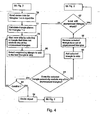
- Step 52 of Fig. 2 is shown in more detail in the flowchart in Fig. 4 .
- step 76 the vertex data of all the triangles 1-n of the object are read, starting with the number of vertices, the number of triangles, the vertex data and the triangle data. Based on the vertex data the triangle planes for each of the triangles 1-n are calculated one after another in step 77.
- step 78 a new triangle strip is started by selecting a triangle that does not occlude any of the unprocessed triangles.
- the selection of the first triangle may be done in a greedy style by simply choosing the first triangle in the set of unprocessed triangles.
- heuristic search techniques can be used to identify those triangles that potentially occlude the least number of remaining unprocessed triangles, e.g. by selecting triangles that do not have many unprocessed neighbors. Starting a new strip with thus identified triangles will result in fewer and longer triangles strips per object.
- the triangle selected to start the strip with is then compared with the triangles in the set of unprocessed triangles to determine if the selected triangle can potentially occlude any of the unprocessed triangles.
- a procedure for carrying out this determination is described below with reference to Fig. 5 .
- step 80 a neighboring triangle to be added to the triangle strip is selected.
- the selected triangle is then compared in step 81 with the triangles in the set of unprocessed triangles to determine if the selected triangle can potentially occlude any of the unprocessed triangles.
- the procedure for carrying out this determination is described further below with reference to Fig. 5 .
- the selected triangle is added to the strip in step 85 if the determination in step 81 is negative.
- the selected triangle is then removed from the set of unprocessed triangles in step 86.
- step 87 the question is asked if the set with unprocessed triangles is empty. All triangles in the object file have been processed if the question asked in step 87 is answered in the positive, and control is given to step 60 ( Fig. 2 ). If the question asked in step 87 is answered, in the negative, control is given to step 80 to select a new neighboring triangle to add to the triangle strip.
- step 83 a check for a conflict is run in step 83, i.e. check if a circle exists such as when a first triangle can potentially occlude a second triangle, the second triangle can potentially occlude a third triangle and the third triangle can potentially occlude the first triangle. Thus it is impossible to create an object file in which the rendering order is correct for all possible viewing directions. If the check for a conflict is answered in the negative, a new triangle strip is started in step 78. If the check for a conflict is answered in the positive, the object is divided using binary space partitioning techniques, e.g. by dividing the object into two over the triangle surface of the last selected triangle. Control is then given to step 52 ( Fig.
- the conflict check is performed by determining if any triangle can be selected such that it doesn't potentially cover any other unprocessed triangle. If this determination is answered in the negative, the object needs to be divided.
- a selected triangle can be compared with the unprocessed triangles starting with step 91, in which the value for a parameter X is set to 1 and the value for a parameter Y is set equal to the number of triangles in the set of unprocessed triangles.
- step 92 the question is asked if the selected triangle has one or more vertices in front of the plane of triangle X in the set of unprocessed triangles. If the question asked in step 92 is answered in the positive, the question is asked in step 93 if triangle X has one or more vertices behind the plane of the selected triangle. If the question asked in step 93 is also answered positive control is-given to step 83 ( Fig. 4 ).
- step 92 or 93 If the question asked in step 92 or 93 is answered in the negative, the value of parameter X is increased with one in step 94 and in step 95 the question is asked if the value of parameter X is equal to the value of parameter Y.
- step 95 When the question asked in step 95 is answered in the negative, the procedure of steps 92, 93, 94 and 95 is repeated until the question asked in step 95 is answered in the positive. Then control is given to step 85 to add the selected triangle to the triangle strip.
- the above procedure is repeated until the set with unprocessed triangles is empty, and the object file is in a format in which the triangles are in an order in which they can be displayed without needing to solve the hidden surface problem. Further, the triangles are arranged in triangle strips and therefore the amount of calculations to display the object is further reduced.
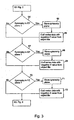
- step 55 which is not mandatory to the present embodiment, is shown in more detail in the flowchart in Fig. 3 .
- the plane of symmetry is stored in the object file in step 65, and all vertices with negative Z-axis values are culled from the object file in step 66.
- the vertex indices are reordered so that each mirrored vertex below the symmetry plane comes after its pair above the symmetry plane, then the ones above the symmetry plane are marked so that they have a mirrored counterpart.
- step 65 or when no symmetry in the XY plane is detected, it is determined if the object is symmetrical in the XZ plane in step 67.
- the plane of symmetry is stored in the object file in step 68, and all vertices with negative Y-axis values are culled from the object file in step 69.
- step 69 or when no symmetry in the XZ plane is detected, it is determined if the object is symmetrical in the YZ plane in step 70.
- the plane of symmetry is stored in the object file in step 71, and all vertices with negative X-axis values are culled from the object file in step 72.
- step 72 or when no symmetry in the YZ plane is detected, control is moved to step 60 in Fig. 2 .
- the amount of vertex data in the object file can thus be reduced by up to a factor of 8 depending on the number of symmetry planes of the object.
- almost all objects used in computer graphics have at least one and often two planes of symmetry, and thus a reduction in the amount of vertex data by a factor 2 to 4 is achievable. This is of significant importance when storing animated 3-D graphics on e.g. a mobile phone 1 as shown in Fig. 8 because of its relatively limited memory capacity.
- step 60 When it is decided in step 60 that all objects 1-N have been thus processed, the object files are ready to be transferred from the workstation to the mobile phone 1 for display.
- the data transfer from the workstation to the mobile phone could be via IR signals (IrDA) or RF signals, (Bluetooth) over the air as messages (SMS or MMS), cable, native (at production site) or any other suitable medium.
- the object files 1-N are loaded onto the mobile phone in step 100 and stored on the random access memory (RAM) 17 of the mobile phone 1 (cf. Fig. 8 ).
- the mobile phone is provided with a processor (CPU) 10 that is capable to write data to and read data from the RAM 17.
- the CPU 10 controls a digital signal processor 12 coupled to a microphone 14 and a speaker 15.
- the mobile phone 1 is further provided with a subscriber identity module (SIM card) 16.
- SIM card subscriber identity module
- An RF transmitter - receiver circuit 18 is also connected to the CPU 10.
- a software embedded 3-D engine 20 drives the LCD or plasma screen 30.
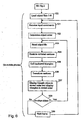
- step 101 input commands are received which essentially define lighting and view parameters.
- the object rendering order is determined in step 102, preferably by using binary space partitioning techniques.
- the data of the first (most occluded) object to be rendered are read in step 103.
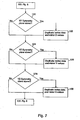
- step 104 the triangles that were removed from one side of a symmetry surface are restored. The procedure is illustrated in more detail in the flowchart shown in Fig. 7 .
- step 120 the question is asked whether a symmetry plane in the XY surface is stored in the object file. If the question asked in step 120 is answered in the affirmative, then a new set of vertices is created in step 122 by duplicating all vertex data presently in the object file and flipping the sign of the Z-axis values for the newly created vertices, so that the earlier removed vertices are restored, and the control is moved to step 124. If the question asked in step 120 is answered in the negative, the control is moved directly to step 124.
- step 124 the question is asked whether a symmetry plane in the XZ surface is stored in the object file. If the question asked in step 124 is answered in the affirmative, a new set of vertices is created in step 126 by duplicating all vertex data presently in the object file and flipping the sign of the Y-axis values for the newly created vertices, so that the earlier removed vertices are restored, and the control is moved to step 128. If the question asked in step 124 is answered in the negative, the control is moved directly to step 128.
- step 128 the question is asked whether a symmetry plane in the YZ surface is stored in the object file. If the question asked in step 128 is answered in the affirmative, a new set of vertices is created in step 130 by duplicating all vertex data presently in the object file and flipping the sign of the X-axis values for the newly created vertices, so that the earlier removed vertices are restored, and the control is moved to step 105 ( Fig. 6 ). If the question asked in step 128 is answered in the negative, the control is moved directly to step 105 ( Fig. 6 ). Thus, all the vertices removed from the object file on the workstation in step 52 are restored again.
- step 105 it is determined whether a given triangle's predefined front face is visible with present viewing direction.
- the direction of the front faces of the triangles 1-n in the object file are compared with the viewing direction, by calculating the dot product of the vector of the viewing direction and the normal vector of the respective triangle.
- this product is negative the triangle in question is culled since its front surface cannot be seen with the present viewing direction.
- the amount of triangles is statistically reduced by 50%.
- a usually more accurate, often even faster (as it not necessary to calculate normal, and the direction to camera changes with every triangle as well) way of detecting backfacing triangles is to calculate its area on the screen after projection. If the screen area is negative, the triangle is backfacing.
- step 106 the transformation of vertices of the triangles from model space (i.e. the object file's reference coordinate system) into device space (i.e. the display or screen coordinate system) takes place using a matrix-vector multiplication.
- model space i.e. the object file's reference coordinate system
- device space i.e. the display or screen coordinate system
- step 107 the vertex data is sent to the display for viewing in step 107.
- step 107 the triangle strips are rendered in the order in which they were created, which in this embodiment corresponds to the order in which they are stored in the object file.
- the triangles are displayed in the order in which they were added to the respective triangle strip, which in this embodiment corresponds to the order in which they are stored in the object file. Consequently, the triangles can be displayed in the order in which they are stored in the object file without needing to address the hidden surface problem whilst displaying the triangles.
- step 108 the question is asked if another object is to be displayed. If the question asked in step 108 is answered in the affirmative, the control is moved to step 103 at which the data of the next object file are read. Thus, steps 103 to 107 are repeated until all objects have been displayed. When all objects have been displayed, the next frame is to be displayed and control is given to step 101 to receive the input commands for the next frame.
- the mirrored vertices are removed as shown in the flowchart of Fig. 3 , but the polygons are not stripped, i.e. step 55 in Fig. 2 is omitted.
- a reduced size object file is obtained that may be easily stored in the mobile phone, but when displaying the triangles it will be necessary to solve the hidden surface problem.
- the painter's algorithm or the Z-buffering technique could be used on the mobile phone 1, the limits of the processing power of the mobile phone will though be reached relatively quickly.
- the efficient techniques of the invention allow real time animated 3-D graphics on devices with relatively limited image processing hardware, such as mobile phones, PDAs and handheld video games.
- the invention is therefore not limited to the device described in the preferred embodiments (a mobile phone with a SIM card), the invention can be applied any other type of mobile phone or device listed above.
Landscapes
- Physics & Mathematics (AREA)
- Engineering & Computer Science (AREA)
- Geometry (AREA)
- Computer Graphics (AREA)
- General Physics & Mathematics (AREA)
- Theoretical Computer Science (AREA)
- Image Generation (AREA)
- Processing Or Creating Images (AREA)
Priority Applications (1)
| Application Number | Priority Date | Filing Date | Title |
|---|---|---|---|
| DE60238452T DE60238452D1 (de) | 2002-10-15 | 2002-10-15 | Darstellung von Objekten durch Ausnutzung von Symmetrieeigenschaften der Objekte |
Applications Claiming Priority (2)
| Application Number | Priority Date | Filing Date | Title |
|---|---|---|---|
| EP02785213A EP1559074B1 (en) | 2002-10-15 | 2002-10-15 | Three dimensional image processing |
| PCT/EP2002/011507 WO2004036504A1 (en) | 2002-10-15 | 2002-10-15 | Three dimensional image processing |
Related Parent Applications (2)
| Application Number | Title | Priority Date | Filing Date |
|---|---|---|---|
| EP02785213.6 Division | 2002-10-15 | ||
| EP02785213A Division EP1559074B1 (en) | 2002-10-15 | 2002-10-15 | Three dimensional image processing |
Publications (3)
| Publication Number | Publication Date |
|---|---|
| EP1746541A2 EP1746541A2 (en) | 2007-01-24 |
| EP1746541A3 EP1746541A3 (en) | 2007-03-21 |
| EP1746541B1 true EP1746541B1 (en) | 2010-11-24 |
Family
ID=32103871
Family Applications (2)
| Application Number | Title | Priority Date | Filing Date |
|---|---|---|---|
| EP06023000A Expired - Lifetime EP1746541B1 (en) | 2002-10-15 | 2002-10-15 | Rendering by using object symmetry |
| EP02785213A Expired - Lifetime EP1559074B1 (en) | 2002-10-15 | 2002-10-15 | Three dimensional image processing |
Family Applications After (1)
| Application Number | Title | Priority Date | Filing Date |
|---|---|---|---|
| EP02785213A Expired - Lifetime EP1559074B1 (en) | 2002-10-15 | 2002-10-15 | Three dimensional image processing |
Country Status (7)
| Country | Link |
|---|---|
| US (4) | US7391418B2 (enExample) |
| EP (2) | EP1746541B1 (enExample) |
| JP (1) | JP4230456B2 (enExample) |
| CN (2) | CN1333375C (enExample) |
| AU (1) | AU2002350540A1 (enExample) |
| DE (2) | DE60238452D1 (enExample) |
| WO (1) | WO2004036504A1 (enExample) |
Families Citing this family (28)
| Publication number | Priority date | Publication date | Assignee | Title |
|---|---|---|---|---|
| WO2004036504A1 (en) * | 2002-10-15 | 2004-04-29 | Nokia Corporation | Three dimensional image processing |
| US8081182B2 (en) * | 2004-03-03 | 2011-12-20 | Qualcomm Incorporated | Depth buffer for rasterization pipeline |
| JP4275593B2 (ja) * | 2004-08-09 | 2009-06-10 | 富士通株式会社 | 接触定義装置、接触定義プログラム、接触定義方法 |
| KR100695156B1 (ko) * | 2005-02-03 | 2007-03-14 | 삼성전자주식회사 | 객체의 그래픽 이미지를 변환하는 방법 및 장치 |
| ATE433172T1 (de) * | 2005-04-04 | 2009-06-15 | Revolver Ltd | Wiedergabe von 3d-computergraphik unter verwendung von 2d-computergraphik-fähigkeiten |
| US20060232595A1 (en) * | 2005-04-18 | 2006-10-19 | Stephen Junkins | Rasterizer driven cache coherency |
| US8696464B2 (en) | 2005-08-19 | 2014-04-15 | Nintendo Co., Ltd. | Enhanced method and apparatus for selecting and rendering performance data |
| US8207972B2 (en) * | 2006-12-22 | 2012-06-26 | Qualcomm Incorporated | Quick pixel rendering processing |
| US8373717B2 (en) * | 2007-04-25 | 2013-02-12 | Nvidia Corporation | Utilization of symmetrical properties in rendering |
| US20080266287A1 (en) * | 2007-04-25 | 2008-10-30 | Nvidia Corporation | Decompression of vertex data using a geometry shader |
| US20080266286A1 (en) * | 2007-04-25 | 2008-10-30 | Nvidia Corporation | Generation of a particle system using a geometry shader |
| US8289319B2 (en) * | 2007-10-08 | 2012-10-16 | Ati Technologies Ulc | Apparatus and method for processing pixel depth information |
| US8379019B2 (en) * | 2007-12-26 | 2013-02-19 | Advanced Micro Devices, Inc. | Fast triangle reordering for vertex locality and reduced overdraw |
| JP2010003136A (ja) * | 2008-06-20 | 2010-01-07 | Fujitsu Ltd | 3次元モデルデータを生成する装置および方法 |
| US20100138793A1 (en) * | 2008-12-02 | 2010-06-03 | Microsoft Corporation | Discrete objects for building virtual environments |
| WO2010101227A1 (ja) * | 2009-03-04 | 2010-09-10 | 日本電気株式会社 | 物体位置推定用情報作成装置、物体位置推定用情報作成方法およびプログラム |
| KR101076807B1 (ko) * | 2009-05-29 | 2011-10-25 | 주식회사 실리콘아츠 | 레이 트레이싱 장치 및 방법 |
| CN102104584B (zh) * | 2009-12-21 | 2013-09-04 | 中国移动通信集团公司 | 下发3d模型数据的方法、装置和3d模型数据传输系统 |
| US9053562B1 (en) | 2010-06-24 | 2015-06-09 | Gregory S. Rabin | Two dimensional to three dimensional moving image converter |
| US8773427B2 (en) | 2010-12-22 | 2014-07-08 | Sony Corporation | Method and apparatus for multiview image generation using depth map information |
| US20140172144A1 (en) * | 2012-12-17 | 2014-06-19 | Mitsubishi Electric Research Laboratories, Inc. | System and Method for Determining Surface Defects |
| US9992021B1 (en) | 2013-03-14 | 2018-06-05 | GoTenna, Inc. | System and method for private and point-to-point communication between computing devices |
| US9842428B2 (en) * | 2014-06-27 | 2017-12-12 | Samsung Electronics Co., Ltd. | Dynamically optimized deferred rendering pipeline |
| CN108553899A (zh) * | 2018-03-26 | 2018-09-21 | 北京幻灵科技有限责任公司 | 一种即点即玩游戏的开发装置及其方法 |
| WO2020108738A1 (en) * | 2018-11-27 | 2020-06-04 | Renesas Electronics Corporation | Instruction list generation |
| CN111258526B (zh) | 2020-05-06 | 2020-08-28 | 上海幻电信息科技有限公司 | 投屏方法和系统 |
| CN111701236A (zh) * | 2020-06-18 | 2020-09-25 | 福建天晴在线互动科技有限公司 | 一种采用2d资源方式实现仿3d游戏效果的方法及其系统 |
| CN116843811A (zh) * | 2022-03-23 | 2023-10-03 | 腾讯科技(成都)有限公司 | 三维模型渲染方法、装置、设备及存储介质 |
Family Cites Families (27)
| Publication number | Priority date | Publication date | Assignee | Title |
|---|---|---|---|---|
| JPH0259983A (ja) * | 1988-08-26 | 1990-02-28 | Nippon Telegr & Teleph Corp <Ntt> | 立体形状データ生成装置 |
| US5325485A (en) * | 1992-10-30 | 1994-06-28 | International Business Machines Corporation | Method and apparatus for displaying primitives processed by a parallel processor system in a sequential order |
| GB9303009D0 (en) * | 1993-02-15 | 1993-03-31 | Canon Res Ct Europe Ltd | Processing image data |
| JPH07141522A (ja) * | 1993-06-16 | 1995-06-02 | Hitachi Ltd | 擬似視界画像発生装置 |
| JP3638637B2 (ja) * | 1994-06-17 | 2005-04-13 | 株式会社ナムコ | ポリゴンデータ変換装置及び3次元シミュレータ装置 |
| EP0740272A2 (en) * | 1995-04-28 | 1996-10-30 | Sun Microsystems, Inc. | Method and apparatus for fast rendering of three-dimensional objects |
| US5835095A (en) * | 1995-05-08 | 1998-11-10 | Intergraph Corporation | Visible line processor |
| US5793371A (en) * | 1995-08-04 | 1998-08-11 | Sun Microsystems, Inc. | Method and apparatus for geometric compression of three-dimensional graphics data |
| US6525722B1 (en) * | 1995-08-04 | 2003-02-25 | Sun Microsystems, Inc. | Geometry compression for regular and irregular mesh structures |
| US5999189A (en) * | 1995-08-04 | 1999-12-07 | Microsoft Corporation | Image compression to reduce pixel and texture memory requirements in a real-time image generator |
| GB9610212D0 (en) * | 1996-05-16 | 1996-07-24 | Cyberglass Limited | Method and apparatus for generating moving characters |
| US6030289A (en) * | 1996-06-27 | 2000-02-29 | Konami Co., Ltd. | Video game apparatus, method of displaying models in video game apparatus, and computer-readable recording medium for use with video game apparatus |
| WO1998000811A1 (en) * | 1996-06-28 | 1998-01-08 | Resolution Technologies, Inc. | Fly-through computer aided design method and apparatus |
| JP3785709B2 (ja) * | 1996-12-13 | 2006-06-14 | ソニー株式会社 | 形状データの近似化方法及び描画装置 |
| US5982385A (en) * | 1997-07-31 | 1999-11-09 | Hewlett-Packard Co. | Geometrical object representation system and method for efficiently representing a geometrical object for use by a computer graphics system |
| JP3973273B2 (ja) * | 1997-09-22 | 2007-09-12 | 三洋電機株式会社 | 画像生成装置および画像生成方法 |
| US6438266B1 (en) * | 1998-08-27 | 2002-08-20 | Lucent Technologies Inc. | Encoding images of 3-D objects with improved rendering time and transmission processes |
| JP2000235589A (ja) * | 1999-02-15 | 2000-08-29 | Toray Ind Inc | 物品の表示方法および表示装置 |
| US6573895B1 (en) * | 1999-04-16 | 2003-06-03 | Unigraphics Solutions Inc. | Clustered backface culling |
| US6426747B1 (en) * | 1999-06-04 | 2002-07-30 | Microsoft Corporation | Optimization of mesh locality for transparent vertex caching |
| JP2001087288A (ja) * | 1999-09-24 | 2001-04-03 | Ngk Spark Plug Co Ltd | 補填用人工骨設計システム及びそれを用いた補填用人工骨の製造方法 |
| JP2001118082A (ja) * | 1999-10-15 | 2001-04-27 | Toshiba Corp | 描画演算処理装置 |
| JP2002042153A (ja) * | 2000-07-27 | 2002-02-08 | Namco Ltd | ゲームシステム及び情報記憶媒体 |
| JP2002083314A (ja) * | 2000-09-06 | 2002-03-22 | Namco Ltd | ゲームシステム及び情報記憶媒体 |
| US7154504B2 (en) | 2001-01-26 | 2006-12-26 | Microsoft Corporation | System and method for fast, smooth rendering of lit, textured spheres |
| US6603471B2 (en) * | 2001-01-31 | 2003-08-05 | Intel Corporation | Reducing detail in animated three-dimensional models |
| WO2004036504A1 (en) * | 2002-10-15 | 2004-04-29 | Nokia Corporation | Three dimensional image processing |
-
2002
- 2002-10-15 WO PCT/EP2002/011507 patent/WO2004036504A1/en not_active Ceased
- 2002-10-15 AU AU2002350540A patent/AU2002350540A1/en not_active Abandoned
- 2002-10-15 CN CNB028297563A patent/CN1333375C/zh not_active Expired - Lifetime
- 2002-10-15 DE DE60238452T patent/DE60238452D1/de not_active Expired - Lifetime
- 2002-10-15 JP JP2004543992A patent/JP4230456B2/ja not_active Expired - Fee Related
- 2002-10-15 US US10/531,198 patent/US7391418B2/en not_active Expired - Lifetime
- 2002-10-15 EP EP06023000A patent/EP1746541B1/en not_active Expired - Lifetime
- 2002-10-15 CN CN2006101322578A patent/CN1932885B/zh not_active Expired - Lifetime
- 2002-10-15 DE DE60229447T patent/DE60229447D1/de not_active Expired - Lifetime
- 2002-10-15 EP EP02785213A patent/EP1559074B1/en not_active Expired - Lifetime
-
2008
- 2008-05-30 US US12/130,338 patent/US7671857B2/en not_active Expired - Lifetime
- 2008-05-30 US US12/130,246 patent/US20080225046A1/en not_active Abandoned
- 2008-05-30 US US12/130,193 patent/US7733341B2/en not_active Expired - Lifetime
Also Published As
| Publication number | Publication date |
|---|---|
| CN1932885A (zh) | 2007-03-21 |
| DE60238452D1 (de) | 2011-01-05 |
| EP1746541A2 (en) | 2007-01-24 |
| CN1333375C (zh) | 2007-08-22 |
| JP4230456B2 (ja) | 2009-02-25 |
| US20080225047A1 (en) | 2008-09-18 |
| CN1932885B (zh) | 2012-02-29 |
| EP1559074A1 (en) | 2005-08-03 |
| US20080225046A1 (en) | 2008-09-18 |
| DE60229447D1 (de) | 2008-11-27 |
| AU2002350540A1 (en) | 2004-05-04 |
| JP2006503355A (ja) | 2006-01-26 |
| EP1746541A3 (en) | 2007-03-21 |
| US20060146049A1 (en) | 2006-07-06 |
| WO2004036504A1 (en) | 2004-04-29 |
| US20080303816A1 (en) | 2008-12-11 |
| CN1685370A (zh) | 2005-10-19 |
| US7391418B2 (en) | 2008-06-24 |
| US7733341B2 (en) | 2010-06-08 |
| EP1559074B1 (en) | 2008-10-15 |
| US7671857B2 (en) | 2010-03-02 |
Similar Documents
| Publication | Publication Date | Title |
|---|---|---|
| EP1746541B1 (en) | Rendering by using object symmetry | |
| JP2006503355A5 (enExample) | ||
| US6744434B2 (en) | Cuts removal system for triangulated CAD Models | |
| US8411088B2 (en) | Accelerated ray tracing | |
| Ganovelli et al. | Buckettree: Improving collision detection between deformable objects | |
| EP3937135B1 (en) | Instanced rendering of voxel octree | |
| US10325403B2 (en) | Image based rendering techniques for virtual reality | |
| CN107578467B (zh) | 一种医疗器械三维建模方法及装置 | |
| CN115814407B (zh) | 信息处理方法、装置、存储介质以及电子装置 | |
| WO2019088865A1 (ru) | Способ и система удаления невидимых поверхностей трёхмерной сцены | |
| CN116934938A (zh) | 三维模型纹理处理方法、设备和存储介质 | |
| CN111179402A (zh) | 一种目标对象的渲染方法、装置及系统 | |
| KR100693134B1 (ko) | 3차원 이미지 처리 | |
| US6664957B1 (en) | Apparatus and method for three-dimensional graphics drawing through occlusion culling | |
| CN109636888A (zh) | 2d特效制作方法及装置、电子设备、存储介质 | |
| CN117953147A (zh) | 三维重建方法和装置、设备、存储介质 | |
| CN117813628A (zh) | 用于3d环境中的实时光线跟踪的系统和方法 | |
| KR100848687B1 (ko) | 3차원 그래픽 처리 장치 및 그것의 동작 방법 | |
| JP3711273B2 (ja) | オクルージョンカリングを行う3次元グラフィックス描画装置 | |
| JP2007299080A (ja) | 画像生成方法及び画像生成装置 | |
| JP2881735B1 (ja) | 三次元動画データ転送方法 | |
| CN119809982A (zh) | 数据处理方法、设备、介质及程序产品 | |
| JP2001291115A (ja) | 3次元図形描画方法およびこの方法を記録した記録媒体 | |
| JP2002197481A (ja) | 3次元形状処理装置、3次元形状処理方法およびその方法を実施するためのプログラムを記録した記録媒体 |
Legal Events
| Date | Code | Title | Description |
|---|---|---|---|
| PUAI | Public reference made under article 153(3) epc to a published international application that has entered the european phase |
Free format text: ORIGINAL CODE: 0009012 |
|
| AC | Divisional application: reference to earlier application |
Ref document number: 1559074 Country of ref document: EP Kind code of ref document: P |
|
| AK | Designated contracting states |
Kind code of ref document: A2 Designated state(s): DE FR GB NL |
|
| PUAL | Search report despatched |
Free format text: ORIGINAL CODE: 0009013 |
|
| AK | Designated contracting states |
Kind code of ref document: A3 Designated state(s): DE FR GB NL |
|
| 17P | Request for examination filed |
Effective date: 20070921 |
|
| 17Q | First examination report despatched |
Effective date: 20071025 |
|
| AKX | Designation fees paid |
Designated state(s): DE FR GB NL |
|
| RIN1 | Information on inventor provided before grant (corrected) |
Inventor name: STRANDTOFT, ASGER Inventor name: PULLI, KARI |
|
| GRAP | Despatch of communication of intention to grant a patent |
Free format text: ORIGINAL CODE: EPIDOSNIGR1 |
|
| GRAS | Grant fee paid |
Free format text: ORIGINAL CODE: EPIDOSNIGR3 |
|
| GRAA | (expected) grant |
Free format text: ORIGINAL CODE: 0009210 |
|
| AC | Divisional application: reference to earlier application |
Ref document number: 1559074 Country of ref document: EP Kind code of ref document: P |
|
| AK | Designated contracting states |
Kind code of ref document: B1 Designated state(s): DE FR GB NL |
|
| REG | Reference to a national code |
Ref country code: GB Ref legal event code: FG4D |
|
| REF | Corresponds to: |
Ref document number: 60238452 Country of ref document: DE Date of ref document: 20110105 Kind code of ref document: P |
|
| REG | Reference to a national code |
Ref country code: NL Ref legal event code: VDEP Effective date: 20101124 |
|
| PG25 | Lapsed in a contracting state [announced via postgrant information from national office to epo] |
Ref country code: NL Free format text: LAPSE BECAUSE OF FAILURE TO SUBMIT A TRANSLATION OF THE DESCRIPTION OR TO PAY THE FEE WITHIN THE PRESCRIBED TIME-LIMIT Effective date: 20101124 |
|
| PLBE | No opposition filed within time limit |
Free format text: ORIGINAL CODE: 0009261 |
|
| STAA | Information on the status of an ep patent application or granted ep patent |
Free format text: STATUS: NO OPPOSITION FILED WITHIN TIME LIMIT |
|
| 26N | No opposition filed |
Effective date: 20110825 |
|
| REG | Reference to a national code |
Ref country code: DE Ref legal event code: R097 Ref document number: 60238452 Country of ref document: DE Effective date: 20110825 |
|
| REG | Reference to a national code |
Ref country code: GB Ref legal event code: 732E Free format text: REGISTERED BETWEEN 20150910 AND 20150916 |
|
| REG | Reference to a national code |
Ref country code: DE Ref legal event code: R081 Ref document number: 60238452 Country of ref document: DE Owner name: NOKIA TECHNOLOGIES OY, FI Free format text: FORMER OWNER: NOKIA CORP., 02610 ESPOO, FI Ref country code: DE Ref legal event code: R081 Ref document number: 60238452 Country of ref document: DE Owner name: BEIJING XIAOMI MOBILE SOFTWARE CO., LTD., CN Free format text: FORMER OWNER: NOKIA CORP., 02610 ESPOO, FI |
|
| REG | Reference to a national code |
Ref country code: FR Ref legal event code: PLFP Year of fee payment: 15 |
|
| PGFP | Annual fee paid to national office [announced via postgrant information from national office to epo] |
Ref country code: FR Payment date: 20160919 Year of fee payment: 15 |
|
| PGFP | Annual fee paid to national office [announced via postgrant information from national office to epo] |
Ref country code: GB Payment date: 20161012 Year of fee payment: 15 |
|
| REG | Reference to a national code |
Ref country code: FR Ref legal event code: TP Owner name: NOKIA TECHNOLOGIES OY, FI Effective date: 20170109 |
|
| GBPC | Gb: european patent ceased through non-payment of renewal fee |
Effective date: 20171015 |
|
| REG | Reference to a national code |
Ref country code: DE Ref legal event code: R081 Ref document number: 60238452 Country of ref document: DE Owner name: BEIJING XIAOMI MOBILE SOFTWARE CO., LTD., CN Free format text: FORMER OWNER: NOKIA TECHNOLOGIES OY, ESPOO, FI |
|
| REG | Reference to a national code |
Ref country code: FR Ref legal event code: ST Effective date: 20180629 |
|
| PG25 | Lapsed in a contracting state [announced via postgrant information from national office to epo] |
Ref country code: GB Free format text: LAPSE BECAUSE OF NON-PAYMENT OF DUE FEES Effective date: 20171015 |
|
| PG25 | Lapsed in a contracting state [announced via postgrant information from national office to epo] |
Ref country code: FR Free format text: LAPSE BECAUSE OF NON-PAYMENT OF DUE FEES Effective date: 20171031 |
|
| PGFP | Annual fee paid to national office [announced via postgrant information from national office to epo] |
Ref country code: DE Payment date: 20211020 Year of fee payment: 20 |
|
| REG | Reference to a national code |
Ref country code: DE Ref legal event code: R071 Ref document number: 60238452 Country of ref document: DE |