EP1721725B1 - Gasströmung für das Fenster einer Kammer von eine Vorrichtung für das schichtweise Lasersintern - Google Patents
Gasströmung für das Fenster einer Kammer von eine Vorrichtung für das schichtweise Lasersintern Download PDFInfo
- Publication number
- EP1721725B1 EP1721725B1 EP06009533A EP06009533A EP1721725B1 EP 1721725 B1 EP1721725 B1 EP 1721725B1 EP 06009533 A EP06009533 A EP 06009533A EP 06009533 A EP06009533 A EP 06009533A EP 1721725 B1 EP1721725 B1 EP 1721725B1
- Authority
- EP
- European Patent Office
- Prior art keywords
- window
- exposed surface
- powder
- inert gas
- flow
- Prior art date
- Legal status (The legal status is an assumption and is not a legal conclusion. Google has not performed a legal analysis and makes no representation as to the accuracy of the status listed.)
- Ceased
Links
Images


Classifications
-
- B—PERFORMING OPERATIONS; TRANSPORTING
- B29—WORKING OF PLASTICS; WORKING OF SUBSTANCES IN A PLASTIC STATE IN GENERAL
- B29C—SHAPING OR JOINING OF PLASTICS; SHAPING OF MATERIAL IN A PLASTIC STATE, NOT OTHERWISE PROVIDED FOR; AFTER-TREATMENT OF THE SHAPED PRODUCTS, e.g. REPAIRING
- B29C64/00—Additive manufacturing, i.e. manufacturing of three-dimensional [3D] objects by additive deposition, additive agglomeration or additive layering, e.g. by 3D printing, stereolithography or selective laser sintering
- B29C64/10—Processes of additive manufacturing
- B29C64/141—Processes of additive manufacturing using only solid materials
- B29C64/153—Processes of additive manufacturing using only solid materials using layers of powder being selectively joined, e.g. by selective laser sintering or melting
-
- B—PERFORMING OPERATIONS; TRANSPORTING
- B33—ADDITIVE MANUFACTURING TECHNOLOGY
- B33Y—ADDITIVE MANUFACTURING, i.e. MANUFACTURING OF THREE-DIMENSIONAL [3D] OBJECTS BY ADDITIVE DEPOSITION, ADDITIVE AGGLOMERATION OR ADDITIVE LAYERING, e.g. BY 3D PRINTING, STEREOLITHOGRAPHY OR SELECTIVE LASER SINTERING
- B33Y30/00—Apparatus for additive manufacturing; Details thereof or accessories therefor
Definitions
- the invention relates generally to a method of rapid prototyping and manufacturing and, more particularly, to laser sintering and the ability to prevent the build up of monomers and oligomers that condense and solidify in the form of films or larger crystals on windows within the process chamber during laser sintering operations.
- Rapid prototyping and manufacturing is the name given to a field of technologies that can be used to form three-dimensional objects rapidly and automatically from computer data representing the objects.
- rapid prototyping and manufacturing techniques build three-dimensional objects, layer-by-layer, from a working medium utilizing sliced data sets representing cross-sections of the object to be formed.
- an object representation is initially provided by a Computer Aided Design (CAD) system.
- CAD Computer Aided Design
- RP&M techniques are sometimes referred to as solid imaging and include stereolithography, ink jet printing as applied to solid imaging, and laser sintering.
- a laser sintering apparatus dispenses a thin layer of heat-fusible powder, often a fusible polymer powder, polymer coated metal, or ceramic, across a process chamber to create a bed of the powder.
- the laser sintering apparatus then applies thermal energy to melt those portions of the powder layer corresponding to a cross-section of the article being built in that powder layer.
- the article is formed within a mass of powder commonly referred to as the "part cake.”
- Lasers typically supply the thermal energy through modulation and precise directional control to a targeted area of the powder layer.
- Conventional selective laser sintering systems such as the VanguardTM system available from 3D Systems, Inc., use carbon dioxide lasers and position the laser beam by way of galvanometer-driven mirrors that deflect the laser beam.
- the part cake is supported on a moveable build platform upon which the bed of powder is disposed. After a powder layer is fused, the build platform moves downward by an incremental distance and the apparatus then dispenses across the powder bed an additional layer of powder onto the previously fused layer and repeats the process of melting and selective fusing of the powder in this next layer. Fused portions of later layers fuse to fused portions of previous layers as appropriate for the article, until the article is complete. These articles are sometimes referred to as "built parts.” Each additional layer of powder is typically dispensed from a powder feed system that dispenses a measured amount of powder onto the powder bed. A powder spreader, such as a blade or roller then picks up and spreads the powder over the powder bed in a uniform manner.
- a powder spreader such as a blade or roller then picks up and spreads the powder over the powder bed in a uniform manner.
- Cooling may require several hours or days, depending upon the size and number of parts being built in a single build.
- the most common powder material utilized in laser sintering systems is a nylon polyamide. Because the laser sintering process is a thermally based process the heat generating laser used to fuse the powder material together generates chemical by-products during the process. These by-products are volatile monomers and oligomers that vaporize and condense on the cooler surfaces on the interior of the process chamber. Especially susceptible to the build-up of these chemical by-products are the process functional equipment glass windows on the interior and ceiling of the process chamber. The build-up can be in the form of a thin film or frost-like crystals.
- the build-up of chemical by-products on process chamber exposed surface of the laser window is especially problematic because over a relatively short period of time the laser power delivered to the powder bed can be attenuated by as much as 50% in areas with film build-up and by as much as 71% in areas with frost-like crystalline build-up.
- Other process equipment functional windows within the process chamber that can become obstructed with chemical by-product build-up include the IR sensor window and IR camera window for which any attenuation of the IR signal between the powder part bed and the sensing devices can cause catastrophic loss of thermal control during the laser sintering process. If a video camera is employed to film the build process, that process functional window can also become obstructed and prevent effective filming from occurring over time.
- a laser sintering system having an improved design to minimize the build-up of chemical by-products of the laser sintering process on the process chamber exposed surfaces of process equipment functional windows.
- a curtain of velocity controlled, laminar flow, temperature controlled, clean inert gas is provided that passes parallel to the process chamber exposed surface of process equipment windows.
- the flow of inert gas that is fed from a discharge orifice over the exposed surface of a process equipment functional window has a specific Reynolds number characteristic of the flow geometry of about 200 or less.
- the temperature of the inert gas is warm enough so as to not promote condensation or precipitation of volatile chemical by-products on the exposed surfaces of the process equipment functional windows, but that it is not hotter than the condensation temperature of the undesired chemical products.
- the temperature of the inert gas flowing across the exposed surface of the process equipment functional windows is within the range of 50°C to about 180°C.
- the inert gas flowing across the exposed process equipment functional windows is at a flow rate of about 10 liters per minute or less and a velocity of about 3.6 meters per second or less.
- an inert gas diffuser is mounted to the frame of the process equipment functional window with an elongated discharge opening that is effective to change the direction of flow from being transverse to the exposed surface to parallel to the exposed surface as the gas enters the process chamber.
- the inert gas diffuser has a discharge orifice that is elongated and narrow in shape and is sealingly mounted against the exposed surface of the process equipment window and to the window frame, spanning an arc that is less than half the circumference of the circular process equipment functional window.
- FIG. 1 A laser sintering apparatus or system having a removable build chamber is illustrated in FIG. 1 indicated generally by the numeral 10.
- the laser sintering system 10 includes a process chamber 11, an associated support housing 12, and a removable build chamber 14 that may be supported by a build carriage 15.
- the build carriage 15, along with the build chamber 14, may be removably inserted into the support housing 12.
- the laser sintering apparatus 10 may include a lifting device (not shown in FIG. 1 ) that is adapted to move the build chamber 14 between a load position and a build position.
- the term "build position" refers to the position of the build chamber 14 wherein the build platform is properly aligned with the powder bed such that vertical travel of the build platform is substantially perpendicular to the powder bed.
- the laser sintering apparatus 10 In the build position the laser sintering apparatus 10 is ready to build parts.
- the lifting device can comprise hydraulic or pneumatic cylinders, electric motors, or the like.
- the laser sintering system 10 also includes an associated laser unit 40 that includes the laser and associated mechanisms for generating and targeting a laser beam within the process chamber 11.
- the build chamber 14 may also include a plurality of alignment surfaces (not shown) that are each adapted to releasably engage a corresponding surface on the support housing. As the build chamber 14 is moved into the build position, the alignment surfaces engage the corresponding surfaces on the support housing 12 and position the build chamber 14 so it is properly aligned with the process chamber 11.
- the design and operation of the removable build chamber is described in greater detail in co-pending U.S. Patent application serial number 11/088,133 filed March 23, 2005 and assigned to the assignee of the present invention.
- the process chamber 14 includes a powder bed (not shown) and an associated powder dispensing system having a powder material feed hopper and feed mechanism (both also not shown).
- the process chamber 11 also includes a powder material spreader preferably in the form of a counter-rotating roller (not shown) that is adapted to pick up and spread the dispensed powder material over the powder bed in a uniform manner.
- the powder bed may include an opening that is adapted to removably receive the build chamber within process chamber 11.
- the term "powder spreader" includes rollers, wipers, doctor blades, or any other suitable device that may be used for spreading the powder across the powder bed in a uniform manner.
- the build chamber 14 includes a build cylinder (not shown) having a moveable build platform (also not shown).
- the process chamber 11 may also include one or more overflow receptacles (also not shown) that are adapted to receive any excess powder during the powder material spreading operation.
- the powder material spreader spreads the powder material across the surface of the powder bed and deposits a discrete layer of powder material onto the surface of the moveable build platform to form the part cake.
- the term "part cake” refers to the layer(s) of heat-fusible powder, including the sintered powder and unfused powder, that has been deposited onto the surface of the build platform.
- the build platform may be controlled by a motor (not shown) to move downwardly below the powder bed in small incremental steps, for example 0.125 mm, to define the thickness of each layer of the powder material to be processed.
- the motion is not limited to unidirectional motion, e.g. a downward motion of 0.500 mm followed by an upward motion of 0.375 mm will result in a final downward position that is 0.125 mm lower than the last step.
- the build platform is moveable within the build cylinder along an axis of vertical travel (not shown).
- the powder bed defines a horizontal plane that is substantially perpendicular to the vertical travel of the build platform in the build cylinder when the build chamber 14 is properly positioned and aligned in the build position.
- vertical travel refers to the movement of the build platform as it moves within the build cylinder.
- the dispensing system dispenses a measured amount of powder material onto the powder bed.
- the powder material spreader then traverses across the powder bed one or more times distributing a uniform layer of powder across the surface of the build platform to form the part cake.
- each resulting layer of fused powder material formed on the build platform may be off-set from the nominal or expected position of the layer. As a result, the dimensions of a part built thereon may be distorted, which may cause the part to be unusable.
- the build chamber 14 is positioned within the laser sintering system 10 by being moved upwardly in the direction of the process chamber 11. Continued upward movement of the build chamber 14 causes the alignment surfaces on both the build chamber 14 and the support housing 12 to contact each other and align the build platform with the powder bed and an opening (not shown) in the powder bed.
- the process chamber 11 may also include a seal for creating a sealing relationship between the powder bed and the build cylinder.
- the seal comprises a heat resistant elastomeric material that is effective to prevent the powder material from passing between the interface of the powder bed and the build cylinder and to contain the inert gas atmosphere.
- a laser and its associated targeting mechanisms are mounted in a unit 40, as shown in FIG. 1 , above the process chamber 11.
- the build chamber 14 is preheated prior to insertion into housing 12 and engagement with process chamber 11.
- Heaters (not shown) within process chamber 11 help maintain the appropriate temperature and atmospheric conditions for the fabrication of a three-dimensional part.
- the atmosphere typically comprises an inert gaseous atmosphere, such as nitrogen.
- the system also includes an associated computer system (not shown) that is configured to operate the laser and its associated optics system.
- the computer may be programmed with information indicative of the desired boundaries of a plurality of cross sections of the part to be produced.
- a laser beam is generated by a laser (both not shown), and aimed at the target surface or area by way of a scanning system (also not shown) that generally includes galvanometer-driven mirrors that deflect the laser beam.
- target area refers to the top surface of the part cake.
- the laser and galvonmeter systems are normally isolated from the process chamber 11 by a laser window.
- the process chamber 11 includes one or more radiant heaters (not shown) that heat the part cake and an area of the powder bed adjacent to the part cake.
- the deflection and focal length of the laser beam may be controlled, in combination with modulation of the laser, to direct laser energy to those locations of the fusible powder layer corresponding to a cross-section of the part to be formed in that layer.
- the process chamber 11 includes a powder dispensing system comprising a single powder feed hopper with a feed mechanism controlled by a motor (not shown) to control the amount of powder dropped onto the powder bed below.
- the feed mechanism may be of several types including, for example, a star feeder, an auger feeder, or a rotary drum feeder.
- the powder dispensing system may comprise one or more feed pistons that are disposed within the build chamber. In this last embodiment, one or more feed piston(s) push up a measured amount of powder into the powder bed. Thereafter, the powder spreader picks up and spreads the powder over the powder bed and build platform in a uniform manner.
- the powder feed system may comprise a reciprocatable overhead hopper system having a blade attached to the bottom of the hopper opening to deliver and then spread the powder.
- powder spreader preferably comprises a counter-rotating roller driven by a motor (not shown) that spreads powder from a powder wave across the laser target area.
- the powder spreader carries any residual powder material not deposited on the target area into overflow mechanisms (not shown) that may be disposed at opposing ends of the process chamber 11.
- the powder material can be spread by other means including a wiper or doctor blade.
- the powder spreader may comprise a leveling roller having a transverse axis that extends laterally across the surface of the roller.
- the plane defined by the travel of the powder spreader across the powder bed is substantially perpendicular to the vertical travel of 111G build platform.
- substantially perpendicular as used herein means that the some deviation from ninety degrees is permitted provided that the dimensional accuracy of the part being built remains acceptable.
- the heat in the process chamber and the action of the laser cause chemical by-products from the powder material, such as nylon polyamide, to vaporize and condense on the cooler interior surfaces of the process chamber 11.
- the powder material such as nylon polyamide
- these by-products build-up in undesirable thin films or frost-like crystalline particles after condensing on the surfaces.
- Powder material dust particles in the process chamber atmosphere can also become entrained in gas streams impinging on these windows causing the particles to adhere. This build-up obstructs the window and can have the detrimental effect of attenuating the power of the laser striking the powder bed part cake or the signal of an IR sensor.
- FIG. 2 illustrates an inert gas dispenser in the form of a diffuser indicated generally by the numeral 16.
- Diffuser 16 is a housing that includes a gas inlet orifice 17, a flat first side 18, and an arcuate opposing second side 19.
- the first side 18 is of a length that is less than the arcuate opposing second side 19 so that the first side 18 is recessed from the exposed surface of a process equipment functional window, such as laser window 32 shown briefly in FIG. 3 .
- This recess creates a recessed discharge opening 21 that is parallel to the exposed surface of the window permits the flow of a clean inert gas, preferably nitrogen, to be directed across the exposed surface of the process equipment functional window.
- the recessed discharge opening 21 is about 0.7 mm high and about 60-70 mm wide.
- the arcuate opposing second side 19 has a sealing surface 22 that seats against and seals to the exposed surface of the process equipment functional window when diffuser 16 is installed. This creates the arrangement seen in FIG. 3 .
- the recessed discharge opening 21 must be sized to create a gas flow that remains below the specific Reynolds number characteristic of the flow geometry to avoid transitioning from laminar flow to turbulence.
- the inert gas is fed from inlet orifice 17, initially flowing in a direction transverse to the exposed surface of the process equipment functional window into the diffuser 16 where the direction of flow is changed and the gas is dispensed from the elongated and narrow recessed discharge opening 21.
- the inert gas is dispensed in a laminar flow at a controlled velocity across the exposed surface to form a curtain of nitrogen gas that blankets the exposed surface and prevents or minimizes a build up of undesired chemical by-product from the powder material being laser sintered.
- the nitrogen gas is dispensed at a temperature that is less then the condensation temperatures of chemical by-products that are typically above about 180° to 200°C.
- the temperature of the gas being dispensed is kept within the range of about 50° to about 180°C.
- the nitrogen gas is dispensed in a laminar flow across the exposed surface of the window at a flow rate of less than about 10 liters per minute, more preferably about 7 liters per minute, and most preferably about 5 liters per minute and a velocity of about 3.6 meters per second, more preferably about 2.5 meters per second, and most preferably about 1.8 meters per second.
- This flow rate is low enough so that the velocity is such that the flow of inert gas out of the discharge orifice 21 of diffuser 16 stays below the Reynolds number for this flow geometry that maintains the inert gas flow as laminar and the flow does not become turbulent.
- the gas flow speed does not exceed the point at which the viscous or diffusive dissipation can no longer stabilize the flow where the laminar flow transitions to turbulent flow.
- the discharge orifice for any discharge orifice size and geometry must maintain an inert gas flow with a Reynolds number characteristic of the flow geometry of less than 200, more preferably less than 140, and most preferably less than 100 to prevent of minimize the build-up of undesired chemical by-products on windows surfaces exposed to the process chamber during laser sintering.
- the height of the elongated, narrow slit opening was used in place of the diameter and Re was determined to be 94 for a flow rate of 5 liters per minute and a velocity of 1.8 meters per second.
- This same approach is to be used to determine the Reynolds number for any narrow slit orifice geometry.
- a window module 31 includes a laser window 32 and an IR camera window 39.
- Laser window 32 is retained by a frame 34 and utilizes clamps 35 to install and maintain the diffuser 16 in contact with the exposed surface of laser window 32.
- the recessed discharge opening 21 dispenses the laminar flow of nitrogen gas received from gas line 36 through coupling 38.
- the laser window 32 is clear, but the IR camera window without the diffuser 16 is seen as having obstructions in the form of frost-like crystalline particles adhered to its surface.
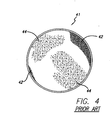
- FIG. 4 illustrates a prior art laser window indicated generally by the numeral 41 that is obstructed by chemical by-products on its process chamber exposed surface.
- chemical by-product films 42 have been found to attenuate as much as fifty percent of the power transmitted by the laser beam through the window.
- the frost-like crystalline particle areas of build up 44 have been found to attenuate as much as seventy-one percent of the laser beam power directed through the window to the powder bed in the part cake.
- Diffuser 16 can be employed in any process equipment functional window including the laser window illustrated herein, as well as IR sensor windows, IR camera windows, and video camera windows, as appropriate.
- the discharge orifice could be any appropriate size and geometric shape, such as oval, triangular, rectangular, pentagonal or other polygonal shape, as long as the flow of inert gas therefrom is such that the Reynolds number characteristic for the flow geometry is below that which is in the turbulent range.
- the discharge orifice could also be a plurality of small openings with the proper flow rate to ensure a gas flow across the exposed window surface in the laminar range. The inert gas flow must remain laminar beyond the discharge orifice across the exposed window surface.
Landscapes
- Chemical & Material Sciences (AREA)
- Engineering & Computer Science (AREA)
- Materials Engineering (AREA)
- Physics & Mathematics (AREA)
- Optics & Photonics (AREA)
- Manufacturing & Machinery (AREA)
- Mechanical Engineering (AREA)
- Powder Metallurgy (AREA)
Claims (11)
- Eine Vorrichtung zum Bilden eines dreidimensionalen Objekts schichtweise von einem Pulvermaterial durch Lasersintem, umfassend in Kombination:a. eine Prozesskammer, die einen Boden hat, eine bewegliche Stützplattform, um mit dem Boden zusammenzuwirken, zwei entgegengesetzte Enden und eine Decke;b. ein Pulvermaterialzuführer, um auf gesteuerte Weise ein Pulvermaterial zu der Prozesskammer von einer Materialquelle zuzuführen;c. einen Pulververteiler, der bewegbar an der Vorrichtung befestigt ist und mit dem Materialzuführer zusammenwirkt, um Pulvermaterial über den Boden zu verteilen, um ein Pulverbett zwischen den zwei entgegen gesetzten Enden zu bilden;d. eine thermische Energiequelle, die in der Lage ist, selektiv thermische Energie zum Material in dem Pulverbett zuzuführen, welches von der Stützplattform getragen ist, um Pulvermaterial in jeder Schicht und mit zuvor verschmolzenen Schichten zu verschmelzen, um ein dreidimensionales Objekt zu bilden;e. wenigstens ein funktionales Fenster für Prozessausrüstung, das eine Oberfläche hat, die der Prozesskammer ausgesetzt ist, wobei das Fenster eine kreisförmige Form hat und einen Umfang und in einem Rahmen montiert ist;f. eine Inertgasquelle, welche das Inertgas in einer Strömungsrichtung zu der ausgesetzten Oberfläche des Fensters zuführt; undg. einen Inertgasverteiler, der an dem Fenster über weniger als die Hälfte des Umfangs montiert ist und abdichtend gegen die ausgesetzte Oberfläche des Fensters für Prozessausrüstung montiert ist, welcher Verteiler weiter wenigstens eine positive Strömungsauslassöffnung zu der ausgesetzten Oberfläche hat, mit einer Strömungsgeometrie, die in der Lage ist, ein inertes Gas in einer laminaren Strömung bei einer effektiven Geschwindigkeit über die ausgesetzte Oberfläche auszugeben, um einen Vorhang von Inertgas über die ausgesetzte Oberfläche zu bilden und bei einer Strömungsrate, die eine Reynolds-Zahl-Charakteristik der Strömungsgeometrie von weniger als 200 hat, um den Aufbau von chemischen Nebenprodukten aus dem Pulvermaterial auf der ausgesetzten Oberfläche des Fensters während des Lasersintems effektiv zu minimieren.
- Vorrichtung nach Anspruch 1, wobei die wenigstens eine Ausstoßöffnung das inerte Gas mit einer Strömungsrate ausstößt, die eine Reynolds-Zahl-Charakteristik der Strömungsgeometrie von weniger als 140 hat.
- Vorrichtung nach Anspruch 1, wobei die wenigstens eine Ausstoßöffnung das inerte Gas mit einer Strömungsrate ausstößt, die eine Reynolds-Zahl-Charakteristik der Strömungsgeometrie von weniger als 100 hat.
- Vorrichtung nach Anspruch 1, wobei der Verteiler gebogen ist und abdichtend gegen die ausgesetzte Oberfläche und den Rahmen montiert ist.
- Vorrichtung nach Anspruch 4, wobei der Verteiler die Richtung der Strömung des Inertgases von quer zu der ausgesetzten Oberfläche zu parallel zu der ausgesetzten Oberfläche ändert.
- Vorrichtung nach Anspruch 4, wobei die Ausstoßöffnung eine erste Seite hat und eine entgegen gesetzte gekrümmte zweite Seite, welche erste Seite eine Länge hat, die geringer ist als eine Länge der entgegen gesetzten gekrümmten zweiten Seite, so dass die erste Seite von der ausgesetzten Oberfläche des Fensters zurückgesetzt ist, wenn der Verteiler gegen die ausgesetzte Oberfläche montiert ist.
- Vorrichtung nach Anspruch 1, wobei das inerte Gas Stickstoffgas ist.
- Vorrichtung nach Anspruch 7, wobei das funktionale Fenster der Prozessausrüstung eines aus der folgenden Gruppe ist: ein Laserfenster, ein Infrarotsensorfenster, ein Infrarotkamerafenster und ein Videokamerafenster.
- Vorrichtung nach Anspruch 7, wobei das Stickstoffgas in einer laminaren Strömung ausgegeben wird bei einer Temperatur, die niedriger ist als die Kondensationstemperatur der chemischen Nebenprodukte aus dem Pulvermaterial.
- Vorrichtung nach Anspruch 9, wobei das Stickstoffgas bei einer Temperatur in dem Bereich von 50°C bis etwa 180°C ausgegeben wird.
- Vorrichtung nach Anspruch 1, wobei die wenigstens eine Ausstoßöffnung länglich ist.
Applications Claiming Priority (1)
| Application Number | Priority Date | Filing Date | Title |
|---|---|---|---|
| US11/125,401 US7807947B2 (en) | 2005-05-09 | 2005-05-09 | Laser sintering process chamber gas curtain window cleansing in a laser sintering system |
Publications (2)
| Publication Number | Publication Date |
|---|---|
| EP1721725A1 EP1721725A1 (de) | 2006-11-15 |
| EP1721725B1 true EP1721725B1 (de) | 2008-02-27 |
Family
ID=36572205
Family Applications (1)
| Application Number | Title | Priority Date | Filing Date |
|---|---|---|---|
| EP06009533A Ceased EP1721725B1 (de) | 2005-05-09 | 2006-05-09 | Gasströmung für das Fenster einer Kammer von eine Vorrichtung für das schichtweise Lasersintern |
Country Status (4)
| Country | Link |
|---|---|
| US (1) | US7807947B2 (de) |
| EP (1) | EP1721725B1 (de) |
| JP (1) | JP4898280B2 (de) |
| DE (2) | DE102006021504B4 (de) |
Cited By (1)
| Publication number | Priority date | Publication date | Assignee | Title |
|---|---|---|---|---|
| US9399321B2 (en) | 2009-07-15 | 2016-07-26 | Arcam Ab | Method and apparatus for producing three-dimensional objects |
Families Citing this family (89)
| Publication number | Priority date | Publication date | Assignee | Title |
|---|---|---|---|---|
| DE102005030067A1 (de) * | 2005-06-27 | 2006-12-28 | FHS Hochschule für Technik, Wirtschaft und soziale Arbeit St. Gallen | Verfahren und Vorrichtung zur Herstellung eines dreidimensionalen Gegenstandes durch ein generatives 3D-Verfahren |
| DE102006044555A1 (de) * | 2006-09-21 | 2008-04-03 | Mtu Aero Engines Gmbh | Reparaturverfahren |
| CN101678455B (zh) * | 2007-05-15 | 2012-09-26 | 阿卡姆股份公司 | 用于生成三维产品的方法和设备 |
| US20100310404A1 (en) * | 2007-12-06 | 2010-12-09 | Ulf Ackelid | Apparataus and method for producing a three-dimensional object |
| US8992816B2 (en) | 2008-01-03 | 2015-03-31 | Arcam Ab | Method and apparatus for producing three-dimensional objects |
| EP2398611B1 (de) | 2009-02-18 | 2014-04-16 | Arcam Ab | Vorrichtung zur herstellung eines dreidimensionalen objekts |
| EP2667987B1 (de) | 2011-01-28 | 2019-03-06 | Arcam Ab | Verfahren zur herstellung eines dreidimensionalen objekts |
| DE102011085154A1 (de) * | 2011-10-25 | 2013-04-25 | Evonik Industries Ag | Vorrichtung zur Vermeidung von Ablagerungen an optischen Komponenten im Laser-Sintern |
| US9079248B2 (en) | 2011-12-28 | 2015-07-14 | Arcam Ab | Method and apparatus for increasing the resolution in additively manufactured three-dimensional articles |
| CN104023948B (zh) | 2011-12-28 | 2016-07-06 | 阿卡姆股份公司 | 用于在无模成形中检测缺陷的方法和设备 |
| WO2013098135A1 (en) | 2011-12-28 | 2013-07-04 | Arcam Ab | Method and apparatus for manufacturing porous three-dimensional articles |
| TWI472427B (zh) | 2012-01-20 | 2015-02-11 | 財團法人工業技術研究院 | 粉體鋪層裝置與方法及其積層製造方法 |
| WO2013167194A1 (en) | 2012-05-11 | 2013-11-14 | Arcam Ab | Powder distribution in additive manufacturing |
| CN104781022B (zh) | 2012-11-06 | 2017-10-17 | 阿卡姆股份公司 | 用于加成制造的粉末预处理 |
| US9029809B2 (en) | 2012-11-30 | 2015-05-12 | Ultratech, Inc. | Movable microchamber system with gas curtain |
| US9505172B2 (en) | 2012-12-17 | 2016-11-29 | Arcam Ab | Method and apparatus for additive manufacturing |
| US9718129B2 (en) | 2012-12-17 | 2017-08-01 | Arcam Ab | Additive manufacturing method and apparatus |
| ES2670977T3 (es) | 2013-02-14 | 2018-06-04 | Renishaw Plc. | Aparato de solidificación selectiva por láser y método |
| US9669583B2 (en) | 2013-03-15 | 2017-06-06 | Renishaw Plc | Selective laser solidification apparatus and method |
| CN105163930B (zh) | 2013-03-15 | 2017-12-12 | 3D系统公司 | 用于激光烧结系统的滑道 |
| US9550207B2 (en) | 2013-04-18 | 2017-01-24 | Arcam Ab | Method and apparatus for additive manufacturing |
| US9676031B2 (en) | 2013-04-23 | 2017-06-13 | Arcam Ab | Method and apparatus for forming a three-dimensional article |
| US9415443B2 (en) | 2013-05-23 | 2016-08-16 | Arcam Ab | Method and apparatus for additive manufacturing |
| EP3415254A1 (de) * | 2013-06-10 | 2018-12-19 | Renishaw PLC | Vorrichtung und verfahren für selektive lasererstarrung |
| US9468973B2 (en) | 2013-06-28 | 2016-10-18 | Arcam Ab | Method and apparatus for additive manufacturing |
| US9505057B2 (en) | 2013-09-06 | 2016-11-29 | Arcam Ab | Powder distribution in additive manufacturing of three-dimensional articles |
| US9676033B2 (en) | 2013-09-20 | 2017-06-13 | Arcam Ab | Method for additive manufacturing |
| US10434572B2 (en) | 2013-12-19 | 2019-10-08 | Arcam Ab | Method for additive manufacturing |
| US9802253B2 (en) | 2013-12-16 | 2017-10-31 | Arcam Ab | Additive manufacturing of three-dimensional articles |
| US10130993B2 (en) | 2013-12-18 | 2018-11-20 | Arcam Ab | Additive manufacturing of three-dimensional articles |
| US9789563B2 (en) | 2013-12-20 | 2017-10-17 | Arcam Ab | Method for additive manufacturing |
| US9789541B2 (en) | 2014-03-07 | 2017-10-17 | Arcam Ab | Method for additive manufacturing of three-dimensional articles |
| US20150283613A1 (en) | 2014-04-02 | 2015-10-08 | Arcam Ab | Method for fusing a workpiece |
| US20150367418A1 (en) | 2014-06-20 | 2015-12-24 | Velo3D, Inc. | Apparatuses, systems and methods for three-dimensional printing |
| US9310188B2 (en) | 2014-08-20 | 2016-04-12 | Arcam Ab | Energy beam deflection speed verification |
| TWI529055B (zh) | 2014-10-27 | 2016-04-11 | 財團法人工業技術研究院 | 積層製造系統以及積層製造方法 |
| US20160167303A1 (en) | 2014-12-15 | 2016-06-16 | Arcam Ab | Slicing method |
| US9406483B1 (en) | 2015-01-21 | 2016-08-02 | Arcam Ab | Method and device for characterizing an electron beam using an X-ray detector with a patterned aperture resolver and patterned aperture modulator |
| GB201505458D0 (en) | 2015-03-30 | 2015-05-13 | Renishaw Plc | Additive manufacturing apparatus and methods |
| US11014161B2 (en) | 2015-04-21 | 2021-05-25 | Arcam Ab | Method for additive manufacturing |
| KR20160144307A (ko) * | 2015-06-08 | 2016-12-16 | 울트라테크 인크. | 국소 처리가스 분위기를 이용한 마이크로챔버 레이저 처리 시스템 및 방법 |
| US10807187B2 (en) | 2015-09-24 | 2020-10-20 | Arcam Ab | X-ray calibration standard object |
| US11571748B2 (en) | 2015-10-15 | 2023-02-07 | Arcam Ab | Method and apparatus for producing a three-dimensional article |
| EP3370948A4 (de) | 2015-11-06 | 2019-07-24 | Velo3d Inc. | Professionelles dreidimensionales drucken |
| US10525531B2 (en) | 2015-11-17 | 2020-01-07 | Arcam Ab | Additive manufacturing of three-dimensional articles |
| US10610930B2 (en) | 2015-11-18 | 2020-04-07 | Arcam Ab | Additive manufacturing of three-dimensional articles |
| US10207454B2 (en) | 2015-12-10 | 2019-02-19 | Velo3D, Inc. | Systems for three-dimensional printing |
| US10252335B2 (en) | 2016-02-18 | 2019-04-09 | Vel03D, Inc. | Accurate three-dimensional printing |
| JP6850945B2 (ja) * | 2016-02-19 | 2021-03-31 | 株式会社アスペクト | 粉末床溶融結合装置 |
| EP3423196A4 (de) | 2016-03-03 | 2019-10-30 | Desktop Metal, Inc. | Pneumatisches spritzen von metall zur generativen fertigung |
| US11247274B2 (en) | 2016-03-11 | 2022-02-15 | Arcam Ab | Method and apparatus for forming a three-dimensional article |
| CN109070582B (zh) * | 2016-05-12 | 2020-10-27 | 惠普发展公司,有限责任合伙企业 | 校准打印站 |
| US10549348B2 (en) | 2016-05-24 | 2020-02-04 | Arcam Ab | Method for additive manufacturing |
| US11325191B2 (en) | 2016-05-24 | 2022-05-10 | Arcam Ab | Method for additive manufacturing |
| US10525547B2 (en) | 2016-06-01 | 2020-01-07 | Arcam Ab | Additive manufacturing of three-dimensional articles |
| US10259044B2 (en) | 2016-06-29 | 2019-04-16 | Velo3D, Inc. | Three-dimensional printing and three-dimensional printers |
| US11691343B2 (en) | 2016-06-29 | 2023-07-04 | Velo3D, Inc. | Three-dimensional printing and three-dimensional printers |
| DE102016114054A1 (de) * | 2016-07-29 | 2018-02-01 | Cl Schutzrechtsverwaltungs Gmbh | Pulverkammertischanordnung |
| US20180095450A1 (en) | 2016-09-30 | 2018-04-05 | Velo3D, Inc. | Three-dimensional objects and their formation |
| US10792757B2 (en) | 2016-10-25 | 2020-10-06 | Arcam Ab | Method and apparatus for additive manufacturing |
| US20180126460A1 (en) | 2016-11-07 | 2018-05-10 | Velo3D, Inc. | Gas flow in three-dimensional printing |
| US10987752B2 (en) | 2016-12-21 | 2021-04-27 | Arcam Ab | Additive manufacturing of three-dimensional articles |
| WO2018129089A1 (en) | 2017-01-05 | 2018-07-12 | Velo3D, Inc. | Optics in three-dimensional printing |
| US10357829B2 (en) | 2017-03-02 | 2019-07-23 | Velo3D, Inc. | Three-dimensional printing of three-dimensional objects |
| DE102017205027A1 (de) * | 2017-03-24 | 2018-09-27 | SLM Solutions Group AG | Vorrichtung und Verfahren zum Herstellen von dreidimensionalen Werkstücken |
| US20180281283A1 (en) | 2017-03-28 | 2018-10-04 | Velo3D, Inc. | Material manipulation in three-dimensional printing |
| US11059123B2 (en) | 2017-04-28 | 2021-07-13 | Arcam Ab | Additive manufacturing of three-dimensional articles |
| US11292062B2 (en) | 2017-05-30 | 2022-04-05 | Arcam Ab | Method and device for producing three-dimensional objects |
| US11185926B2 (en) | 2017-09-29 | 2021-11-30 | Arcam Ab | Method and apparatus for additive manufacturing |
| US10529070B2 (en) | 2017-11-10 | 2020-01-07 | Arcam Ab | Method and apparatus for detecting electron beam source filament wear |
| US11072117B2 (en) | 2017-11-27 | 2021-07-27 | Arcam Ab | Platform device |
| US10821721B2 (en) | 2017-11-27 | 2020-11-03 | Arcam Ab | Method for analysing a build layer |
| US12350754B2 (en) | 2017-12-22 | 2025-07-08 | Arcam Ab | Electron beam source and the use of the same |
| US11517975B2 (en) | 2017-12-22 | 2022-12-06 | Arcam Ab | Enhanced electron beam generation |
| US10272525B1 (en) | 2017-12-27 | 2019-04-30 | Velo3D, Inc. | Three-dimensional printing systems and methods of their use |
| US10144176B1 (en) | 2018-01-15 | 2018-12-04 | Velo3D, Inc. | Three-dimensional printing systems and methods of their use |
| FR3076760B1 (fr) * | 2018-01-15 | 2020-02-07 | Chanel Parfums Beaute | Procede de post-traitement d'une piece obtenue par fabrication additive a partir d'une poudre d'un materiau plastique |
| US11267051B2 (en) | 2018-02-27 | 2022-03-08 | Arcam Ab | Build tank for an additive manufacturing apparatus |
| US11458682B2 (en) | 2018-02-27 | 2022-10-04 | Arcam Ab | Compact build tank for an additive manufacturing apparatus |
| EP3542929A1 (de) * | 2018-03-23 | 2019-09-25 | United Grinding Group Management AG | Überwachungsvorrichtung zur überwachung eines gasflusses entlang einer additiv hinzugefügten materialschicht |
| US11400519B2 (en) | 2018-03-29 | 2022-08-02 | Arcam Ab | Method and device for distributing powder material |
| US12121964B2 (en) | 2018-11-07 | 2024-10-22 | James J. Myrick | Processes, compositions and systems for 2D and 3D printing |
| US12011873B2 (en) | 2018-12-14 | 2024-06-18 | Seurat Technologies, Inc. | Additive manufacturing system for object creation from powder using a high flux laser for two-dimensional printing |
| WO2020139858A1 (en) * | 2018-12-26 | 2020-07-02 | Holo, Inc. | Sensors for three-dimensional printing systems and methods |
| US11724336B2 (en) * | 2019-02-06 | 2023-08-15 | Honeywell Federal Manufacturings Technologies, Llc | Apparatus for a laser welding system |
| CN111873414A (zh) * | 2019-05-03 | 2020-11-03 | 罗天珍 | 一种三维打印机专用狭缝自封铺粉装置 |
| JP2022544339A (ja) | 2019-07-26 | 2022-10-17 | ヴェロ3ディー,インコーポレーテッド | 三次元オブジェクトの形成における品質保証 |
| CN115666905B (zh) * | 2020-05-27 | 2026-02-10 | 速尔特技术有限公司 | 用于增材制造的模块结构 |
| US12158576B2 (en) | 2021-05-28 | 2024-12-03 | Kla Corporation | Counterflow gas nozzle for contamination mitigation in extreme ultraviolet inspection systems |
Family Cites Families (17)
| Publication number | Priority date | Publication date | Assignee | Title |
|---|---|---|---|---|
| JPS59223191A (ja) * | 1983-06-03 | 1984-12-14 | Mitsubishi Heavy Ind Ltd | レ−ザ溶接装置 |
| US5637175A (en) * | 1988-10-05 | 1997-06-10 | Helisys Corporation | Apparatus for forming an integral object from laminations |
| JPH0577081A (ja) * | 1991-09-19 | 1993-03-30 | Mitsubishi Electric Corp | レーザ加工装置 |
| US5837960A (en) * | 1995-08-14 | 1998-11-17 | The Regents Of The University Of California | Laser production of articles from powders |
| DE29513026U1 (de) * | 1995-08-16 | 1995-10-05 | Eos Electro Optical Syst | Vorrichtung zur schichtweisen Herstellung eines Objektes mittels Lasersintern |
| US5883357A (en) * | 1996-03-25 | 1999-03-16 | Case Western Reserve University | Selective vacuum gripper |
| US6919054B2 (en) * | 2002-04-10 | 2005-07-19 | Neophotonics Corporation | Reactant nozzles within flowing reactors |
| DE19858681A1 (de) | 1998-12-18 | 2000-06-21 | Linde Tech Gase Gmbh | Vehrfahren und Vorrichtug zur Lasermaterialbearbeitung mit einem Gasstrom geringer Strömungsgeschwindigkeit |
| AU2001255554A1 (en) * | 2000-04-20 | 2001-11-07 | Vanderbilt University | Method and system for thick-film deposition of ceramic materials |
| EP1182002B1 (de) * | 2000-08-05 | 2004-03-03 | Trumpf Werkzeugmaschinen GmbH + Co. KG | Laserbearbeitungsmaschine mit wenigstens einem mit einem Spülmedium beaufschlagbaren optischen Element |
| AU2002324775A1 (en) * | 2001-08-23 | 2003-03-10 | Sciperio, Inc. | Architecture tool and methods of use |
| JP2003080604A (ja) * | 2001-09-10 | 2003-03-19 | Fuji Photo Film Co Ltd | 積層造形装置 |
| US6902246B2 (en) * | 2001-10-03 | 2005-06-07 | 3D Systems, Inc. | Quantized feed system for solid freeform fabrication |
| JP2004277878A (ja) * | 2003-02-25 | 2004-10-07 | Matsushita Electric Works Ltd | 三次元形状造形物の製造装置及び製造方法 |
| US6815636B2 (en) * | 2003-04-09 | 2004-11-09 | 3D Systems, Inc. | Sintering using thermal image feedback |
| DE10342882A1 (de) * | 2003-09-15 | 2005-05-19 | Trumpf Werkzeugmaschinen Gmbh + Co. Kg | Vorrichtung und Verfahren zur Herstellung eines dreidimensionalen Formkörpers |
| US6930278B1 (en) * | 2004-08-13 | 2005-08-16 | 3D Systems, Inc. | Continuous calibration of a non-contact thermal sensor for laser sintering |
-
2005
- 2005-05-09 US US11/125,401 patent/US7807947B2/en active Active
-
2006
- 2006-05-09 DE DE102006021504.4A patent/DE102006021504B4/de not_active Expired - Fee Related
- 2006-05-09 JP JP2006130040A patent/JP4898280B2/ja active Active
- 2006-05-09 EP EP06009533A patent/EP1721725B1/de not_active Ceased
- 2006-05-09 DE DE602006000577T patent/DE602006000577T2/de active Active
Cited By (1)
| Publication number | Priority date | Publication date | Assignee | Title |
|---|---|---|---|---|
| US9399321B2 (en) | 2009-07-15 | 2016-07-26 | Arcam Ab | Method and apparatus for producing three-dimensional objects |
Also Published As
| Publication number | Publication date |
|---|---|
| DE602006000577T2 (de) | 2009-03-19 |
| US20060249485A1 (en) | 2006-11-09 |
| US7807947B2 (en) | 2010-10-05 |
| JP2006341594A (ja) | 2006-12-21 |
| DE102006021504B4 (de) | 2016-06-30 |
| DE102006021504A1 (de) | 2008-04-17 |
| JP4898280B2 (ja) | 2012-03-14 |
| DE602006000577D1 (de) | 2008-04-10 |
| EP1721725A1 (de) | 2006-11-15 |
Similar Documents
| Publication | Publication Date | Title |
|---|---|---|
| EP1721725B1 (de) | Gasströmung für das Fenster einer Kammer von eine Vorrichtung für das schichtweise Lasersintern | |
| JP7209050B2 (ja) | 付加製造システムのためのプリントヘッドモジュール | |
| EP1704989B1 (de) | Vorrichtung und Verfahren zum Ausrichten eines entfernbaren Formzimmers in einem Prozesszimmer | |
| US9050753B2 (en) | Liquefier assembly having inlet liner for use in additive manufacturing system | |
| US10391707B2 (en) | Additive manufacturing system having laser and dispenser on common support | |
| US7790096B2 (en) | Thermal management system for a removable build chamber for use with a laser sintering system | |
| US6492651B2 (en) | Surface scanning system for selective deposition modeling | |
| KR20200030616A (ko) | 적층 제조를 위한 온도 제어 | |
| KR20180021221A (ko) | 냉각제 시스템을 갖는 적층 제조 | |
| KR20180042306A (ko) | 적층 제조 시스템을 위한 프린트헤드 모듈들의 어레이 | |
| CN110430994A (zh) | 用具有旋转多边形的能量输送系统的增材制造 | |
| WO2021055667A1 (en) | System and method for additive manufacturing | |
| US6153142A (en) | Stereolithographic method and apparatus for production of three dimensional objects with enhanced thermal control of the build environment | |
| CN111417505A (zh) | 利用两件式多边形扫描仪的增材制造 | |
| US11097474B2 (en) | Extrusion tip insert for use in additive manufacturing system | |
| EP1545884B1 (de) | Vorrichtung und verfahren zum drucken eines fluidmaterials mittels einer drucktechnik mit kontinuierlichem strahl | |
| JP2021523293A (ja) | ポリゴンスキャナを用いた付加製造 | |
| US20240066797A1 (en) | Apparatus and method for performing 3d printing by tappet dispensing |
Legal Events
| Date | Code | Title | Description |
|---|---|---|---|
| PUAI | Public reference made under article 153(3) epc to a published international application that has entered the european phase |
Free format text: ORIGINAL CODE: 0009012 |
|
| AK | Designated contracting states |
Kind code of ref document: A1 Designated state(s): AT BE BG CH CY CZ DE DK EE ES FI FR GB GR HU IE IS IT LI LT LU LV MC NL PL PT RO SE SI SK TR |
|
| AX | Request for extension of the european patent |
Extension state: AL BA HR MK YU |
|
| 17P | Request for examination filed |
Effective date: 20070515 |
|
| GRAP | Despatch of communication of intention to grant a patent |
Free format text: ORIGINAL CODE: EPIDOSNIGR1 |
|
| AKX | Designation fees paid |
Designated state(s): DE FR GB IT |
|
| GRAS | Grant fee paid |
Free format text: ORIGINAL CODE: EPIDOSNIGR3 |
|
| GRAA | (expected) grant |
Free format text: ORIGINAL CODE: 0009210 |
|
| AK | Designated contracting states |
Kind code of ref document: B1 Designated state(s): DE FR GB IT |
|
| REG | Reference to a national code |
Ref country code: GB Ref legal event code: FG4D |
|
| REF | Corresponds to: |
Ref document number: 602006000577 Country of ref document: DE Date of ref document: 20080410 Kind code of ref document: P |
|
| ET | Fr: translation filed | ||
| PLBE | No opposition filed within time limit |
Free format text: ORIGINAL CODE: 0009261 |
|
| STAA | Information on the status of an ep patent application or granted ep patent |
Free format text: STATUS: NO OPPOSITION FILED WITHIN TIME LIMIT |
|
| RAP2 | Party data changed (patent owner data changed or rights of a patent transferred) |
Owner name: 3D SYSTEMS, INC. |
|
| 26N | No opposition filed |
Effective date: 20081128 |
|
| REG | Reference to a national code |
Ref country code: FR Ref legal event code: CA |
|
| REG | Reference to a national code |
Ref country code: FR Ref legal event code: PLFP Year of fee payment: 11 |
|
| REG | Reference to a national code |
Ref country code: DE Ref legal event code: R079 Ref document number: 602006000577 Country of ref document: DE Free format text: PREVIOUS MAIN CLASS: B29C0067000000 Ipc: B29C0064106000 |
|
| REG | Reference to a national code |
Ref country code: FR Ref legal event code: PLFP Year of fee payment: 12 |
|
| REG | Reference to a national code |
Ref country code: FR Ref legal event code: PLFP Year of fee payment: 13 |
|
| PGFP | Annual fee paid to national office [announced via postgrant information from national office to epo] |
Ref country code: IT Payment date: 20230519 Year of fee payment: 18 Ref country code: FR Payment date: 20230525 Year of fee payment: 18 Ref country code: DE Payment date: 20230530 Year of fee payment: 18 |
|
| PGFP | Annual fee paid to national office [announced via postgrant information from national office to epo] |
Ref country code: GB Payment date: 20230529 Year of fee payment: 18 |
|
| REG | Reference to a national code |
Ref country code: DE Ref legal event code: R119 Ref document number: 602006000577 Country of ref document: DE |
|
| GBPC | Gb: european patent ceased through non-payment of renewal fee |
Effective date: 20240509 |
|
| PG25 | Lapsed in a contracting state [announced via postgrant information from national office to epo] |
Ref country code: DE Free format text: LAPSE BECAUSE OF NON-PAYMENT OF DUE FEES Effective date: 20241203 |
|
| PG25 | Lapsed in a contracting state [announced via postgrant information from national office to epo] |
Ref country code: FR Free format text: LAPSE BECAUSE OF NON-PAYMENT OF DUE FEES Effective date: 20240531 |
|
| PG25 | Lapsed in a contracting state [announced via postgrant information from national office to epo] |
Ref country code: GB Free format text: LAPSE BECAUSE OF NON-PAYMENT OF DUE FEES Effective date: 20240509 Ref country code: IT Free format text: LAPSE BECAUSE OF NON-PAYMENT OF DUE FEES Effective date: 20240509 |